JP2005297340A - Method for producing polyolefin resin extruded foam - Google Patents
Method for producing polyolefin resin extruded foam Download PDFInfo
- Publication number
- JP2005297340A JP2005297340A JP2004116421A JP2004116421A JP2005297340A JP 2005297340 A JP2005297340 A JP 2005297340A JP 2004116421 A JP2004116421 A JP 2004116421A JP 2004116421 A JP2004116421 A JP 2004116421A JP 2005297340 A JP2005297340 A JP 2005297340A
- Authority
- JP
- Japan
- Prior art keywords
- foam
- shrinkage
- polyolefin resin
- agent
- weight
- Prior art date
- Legal status (The legal status is an assumption and is not a legal conclusion. Google has not performed a legal analysis and makes no representation as to the accuracy of the status listed.)
- Pending
Links
Landscapes
- Manufacture Of Porous Articles, And Recovery And Treatment Of Waste Products (AREA)
- Extrusion Moulding Of Plastics Or The Like (AREA)
- Molding Of Porous Articles (AREA)
Abstract
Description
本発明は、ポリオレフィン系樹脂押出発泡体に残留する可燃性発泡剤の、空気等の不活性ガスへの置換を容易にしたポリオレフィン系樹脂押出発泡体の製造方法に関する。 The present invention relates to a method for producing a polyolefin resin extruded foam that facilitates replacement of a combustible foaming agent remaining in a polyolefin resin extruded foam with an inert gas such as air.
特許文献1では、ガスの樹脂に対する透過速度を調整する添加剤(以降、収縮防止剤と記載)として、熱可塑性樹脂へ長鎖脂肪酸とポリオールの部分エステルや脂肪酸アミドを配合する事により、発泡剤の樹脂に対する透過性を低下させ、熟成期間中の発泡体収縮を防いでいる。このため発泡体内部には、発泡剤が長期に渡り残留する。
一方押出発泡体の製造に用いられる発泡剤は、近年フロン系発泡剤から炭化水素系発泡剤に切り替えられてきている。炭化水素系発泡剤は可燃性のガスである事から、発泡体内部に発泡剤が残留していると、火源が近くにある場合、発泡体が着火・燃焼する可能性が高まる。この問題を解決する方法として高温下で発泡体を長期間保存し発泡体内部の発泡剤濃度を安全な濃度まで低下させる方法が一般的にとられているが、製造業者は長期間製品を出荷出来ない状況におかれることもある。
In Patent Document 1, as an additive for adjusting the permeation rate of a gas to a resin (hereinafter referred to as an anti-shrinkage agent), a foaming agent is obtained by blending a long-chain fatty acid and a partial ester of a polyol or a fatty acid amide into a thermoplastic resin. This reduces the permeability of the resin to the resin, and prevents foam shrinkage during the aging period. Therefore, the foaming agent remains in the foam for a long time.
On the other hand, foaming agents used for the production of extruded foams have recently been switched from fluorocarbon foaming agents to hydrocarbon foaming agents. Since the hydrocarbon-based foaming agent is a flammable gas, if the foaming agent remains inside the foam, the possibility of the foam igniting and burning increases when the fire source is nearby. As a method for solving this problem, a method is generally used in which the foam is stored for a long time at a high temperature and the foaming agent concentration in the foam is lowered to a safe concentration. Sometimes you can't do it.
発泡体中に残存する可燃性発泡剤を空気等の不燃性の無機ガスと置換する時間を短縮する方法として、発泡体を製造後にその表面から穿孔を施す方法(特許文献2)がある。しかしながら、特許文献2の方法では発泡剤の逸散性を高めるために孔の幅を大きく、あるいは孔の間隔を小さくした場合、発泡剤の急激な逸散により発泡体気泡内部の圧力が低下し、その結果体積収縮が大きくなり、充分な体積回復が得られなくなるという問題があった。又、孔を開ける事により吸水率が高くなるため、断熱材等に使用した場合断熱性能が低下する問題がある。
本発明は、発泡剤として可燃性ガスを使用した押出発泡による発泡体の製造方法において、短期間で可燃性発泡ガスを空気等の無機ガスに置換することができ、かつ、充分に体積回復が可能な熱可塑性樹脂発泡体およびその製造方法を提供することを目的とする。 The present invention relates to a method for producing a foam by extrusion foaming using a combustible gas as a foaming agent, and the combustible foaming gas can be replaced with an inorganic gas such as air in a short period of time, and sufficient volume recovery can be achieved. An object of the present invention is to provide a possible thermoplastic resin foam and a method for producing the same.
本発明者等は、発泡体の気泡膜表面に存在する収縮防止剤の層に幅0.1μmより大きい割れを生じさせることで上記課題が解決されることを見出し、本発明をなすに至った。
すなわち、本発明は、下記の通りである。
1)ポリオレフィン系樹脂、可燃性発泡剤、及びパルミチン酸モノグリセライドが重量割合で50重量%以上含まれる収縮防止剤を押出機中で溶融混練して得られる溶融ゲルを低圧領域に押出して発泡体を得た後、25℃以上の温度で発泡体を保持することで、発泡体気泡膜表面に存在する該収縮防止剤の層に幅0.1μmより大きい割れを生じさせることを特徴とするポリオレフィン系樹脂押出発泡体の製造方法。
2)ポリオレフィン系樹脂、可燃性発泡剤、及びパルミチン酸モノグリセライドが重量割合で50重量%以上含まれる収縮防止剤を押出機中で溶融混練して得られる溶融ゲルを低圧領域に押出して発泡体を得た後、40℃以上の温度で発泡体を保持することで、発泡体気泡膜表面に存在する該収縮防止剤の層に幅0.1μmより大きい割れを生じさせることを特徴とするポリオレフィン系樹脂押出発泡体の製造方法。
3)ポリオレフィン系樹脂、可燃性発泡剤、及びパルミチン酸モノグリセライドが重量合割合で50重量%以上含まれる収縮防止剤を押出機中で溶融混練して得られる溶融ゲルを低圧領域に押出して発泡体を得た後、発泡体の気泡膜に応力を加えることで発泡体気泡膜表面に存在する該収縮防止剤の層に幅0.1μmより大きい割れを生じさせることを特徴とするポリオレフィン系樹脂押出発泡体の製造方法。
4)収縮防止剤が、パルミチン酸モノグリセライドの重量割合が80重量%以上であることを特徴とする1)から3)に記載のポリオレフィン系樹脂押出発泡体の製造方法。
5)ポリオレフィン系樹脂押出発泡体の収縮が押出発泡後最大となる時期より後に発泡体気泡膜表面に存在する該収縮防止剤の層に幅0.1μmより大きい割れを生じさせることを特徴とする、1)〜4)に記載のポリオレフィン系樹脂押出発泡体の製造方法。
6)1)〜5)に記載の製造方法により得られたポリオレフィン系樹脂押出発泡体。
The inventors of the present invention have found that the above problem can be solved by causing a crack larger than 0.1 μm in width in the shrinkage-preventing agent layer present on the foam film surface of the foam, and have made the present invention. .
That is, the present invention is as follows.
1) A foam is obtained by extruding a melt gel obtained by melt-kneading a polyolefin resin, a flammable foaming agent, and an anti-shrinkage agent containing 50% by weight or more of palmitic acid monoglyceride in an extruder in a low pressure region. A polyolefin system characterized in that, after being obtained, the foam is held at a temperature of 25 ° C. or higher to cause a crack larger than 0.1 μm in width in the layer of the shrinkage-preventing agent present on the foam cell membrane surface. Manufacturing method of resin extrusion foam.
2) A foam is obtained by extruding a molten gel obtained by melting and kneading a polyolefin resin, a flammable foaming agent, and an anti-shrinkage agent containing 50% by weight or more of palmitic acid monoglyceride in an extruder into a low pressure region. A polyolefin system characterized by causing a crack larger than 0.1 μm in width to the shrinkage-preventing agent layer present on the surface of the foam cell membrane by holding the foam at a temperature of 40 ° C. or higher after being obtained Manufacturing method of resin extrusion foam.
3) A foam obtained by extruding a melt gel obtained by melt-kneading a polyolefin resin, a flammable foaming agent, and an anti-shrinkage agent containing 50% by weight or more of palmitic acid monoglyceride in an extruder in a low pressure region. A polyolefin resin extrusion characterized by causing a crack larger than 0.1 μm in width of the shrinkage-preventing agent layer present on the surface of the foam cell membrane by applying stress to the cell membrane of the foam A method for producing a foam.
4) The method for producing an extruded polyolefin-based resin foam according to 1) to 3), wherein the shrinkage-preventing agent has a weight ratio of palmitic acid monoglyceride of 80% by weight or more.
5) It is characterized in that a crack larger than 0.1 μm in width is formed in the layer of the shrinkage-preventing agent present on the surface of the foam cell membrane after the time when the shrinkage of the polyolefin resin extruded foam becomes the maximum after extrusion foaming. The manufacturing method of the polyolefin-type resin extrusion foam as described in 1) -4).
6) A polyolefin resin extruded foam obtained by the production method described in 1) to 5).
本発明のポリオレフィン系樹脂押出発泡体の製造方法は、短期間で発泡体中の可燃性発泡ガスを空気等の無機ガスに置換することができ、かつ、充分な体積回復を可能とし、吸水率の低い押出発泡体を提供する。 The method for producing a polyolefin resin extruded foam of the present invention can replace the combustible foaming gas in the foam with an inorganic gas such as air in a short period of time, and enables a sufficient volume recovery and water absorption rate. Low extrusion foam.
本発明について、特にその好ましい実施態様を中心に、以下具体的に説明する。
本発明に用いられるポリオレフィン系樹脂とは、一般公知のポリオレフィン系樹脂と呼ばれるものならいずれを用いてもよい。例えば、高密度ポリエチレン、中密度ポリエチレン、低密度ポリエチレン、直鎖状低密度ポリエチレン、直鎖状超低密度ポリエチレン等のポリエチレン、ポリプロピレン、ポリブテン、エチレン−プロピレンブロック共重合体、エチレン−プロピレンランダム共重合体、エチレン−ブテンランダム共重合体、エチレン−ブテン−プロピレンランダム共重合体等が挙げられ、少なくとも1種類を樹脂中に含むものである。発泡性に優れ、大きな断面の発泡体が得られるという点で低密度ポリエチレンが、もっとも好ましい。ポリオレフィン系樹脂に、他種類樹脂を配合しても支障ないが、その場合ポリオレフィン系樹脂は全樹脂量の50重量%以上が好ましい。ポリオレフィン系樹脂と配合する他種類樹脂はポリオレフィン系樹脂と配合できるものならどんな樹脂でも支障はない。それらの配合量は樹脂全体の50重量%未満であり、ポリスチレン系樹脂などは40重量%以下がより好ましい。ポリスチレン系樹脂には、ポリスチレン、ハイインパクトポリスチレン等が用いられるが、樹脂に制限はない。また更にポリスチレン系樹脂を混合する場合には相溶性を上げるために水素添化されたスチレン−ブタジエンブロック共重合体を樹脂全体の20重量%以下混合するのがより好ましく、10重量%以下であればさらに好ましい。
The present invention will be specifically described below, particularly focusing on preferred embodiments thereof.
As the polyolefin resin used in the present invention, any known polyolefin resin may be used. For example, polyethylene such as high density polyethylene, medium density polyethylene, low density polyethylene, linear low density polyethylene, linear ultra low density polyethylene, polypropylene, polybutene, ethylene-propylene block copolymer, ethylene-propylene random copolymer Examples thereof include a polymer, an ethylene-butene random copolymer, an ethylene-butene-propylene random copolymer, and the like, wherein at least one kind is included in the resin. Low-density polyethylene is most preferable in that it has excellent foamability and a foam having a large cross section can be obtained. Even if other types of resins are blended with the polyolefin resin, there is no problem. In that case, the polyolefin resin is preferably 50% by weight or more of the total resin amount. Any other resin can be blended with the polyolefin resin as long as it can be blended with the polyolefin resin. Their blending amount is less than 50% by weight of the whole resin, and polystyrene resin and the like are more preferably 40% by weight or less. As the polystyrene resin, polystyrene, high impact polystyrene or the like is used, but the resin is not limited. Further, in the case of mixing a polystyrene resin, it is more preferable to mix a hydrogenated styrene-butadiene block copolymer in an amount of 20% by weight or less of the entire resin in order to increase the compatibility. More preferred.
本発明の発泡体に用いられる可燃性発泡剤は、主として一般に公知の可燃性発泡剤であるが、不燃性発泡剤を混合しても支障はない。可燃性発泡剤としては、例えばプロパン、n−ブタン、i−ブタン、n−ペンタン、i−ペンタン、ヘキサン等の脂肪族炭化水素や、シクロブタン、シクロペンタン等の環式脂肪族炭化水素や、クロロジフルオロエタン、ジフルオロエタン、メチルクロライド、エチルクロライド等のハロゲン化炭化水素等が上げられる。また不燃性の発泡剤としては、例えばトリクロロフルオロメタン、ジクロロジフルオロメタン、テトラフルオロエタン、ジクロロテトラフルオロエタン、メチレンクロライド等のハロゲン化炭化水素、炭酸ガス、窒素、ヘリウム、アルゴン等の無機ガスが挙げられる。これらの発泡剤は、単体で用いても良く、2種以上の発泡剤を混合して用いても良い。発泡剤としては、ブタンを使用するのが大断面の発泡体を得る事ができるので好ましい。ブタンを使用する場合、ブタンに占めるノルマルブタンの比率は65〜100重量%、好ましくは70〜100重量%である。ノルマルブタンの比率が65〜100重量%であると、発泡体からの発泡剤の逸散が速く、早期に発泡体内のガス濃度が、燃焼範囲下限濃度(1.8vol%)未満にまで低下し、発泡体が着火・燃焼する可能性を低減できる。発泡剤の添加量は、所定の密度に合せて調節されるが、ポリオレフィン系樹脂100重量部に対して2〜30重量部程度である。 The combustible foaming agent used in the foam of the present invention is mainly a generally known combustible foaming agent, but there is no problem even if a noncombustible foaming agent is mixed. Examples of the flammable blowing agent include aliphatic hydrocarbons such as propane, n-butane, i-butane, n-pentane, i-pentane, and hexane, cycloaliphatic hydrocarbons such as cyclobutane and cyclopentane, chloro And halogenated hydrocarbons such as difluoroethane, difluoroethane, methyl chloride, and ethyl chloride. Examples of nonflammable blowing agents include halogenated hydrocarbons such as trichlorofluoromethane, dichlorodifluoromethane, tetrafluoroethane, dichlorotetrafluoroethane, and methylene chloride, and inorganic gases such as carbon dioxide, nitrogen, helium, and argon. It is done. These foaming agents may be used alone or as a mixture of two or more foaming agents. As the foaming agent, it is preferable to use butane because a foam with a large cross section can be obtained. When butane is used, the ratio of normal butane to butane is 65 to 100% by weight, preferably 70 to 100% by weight. When the ratio of normal butane is 65 to 100% by weight, the foaming agent is rapidly dissipated from the foam, and the gas concentration in the foam is lowered to less than the lower limit of combustion range (1.8 vol%) at an early stage. The possibility of the foam igniting and burning can be reduced. The addition amount of the foaming agent is adjusted according to a predetermined density, but is about 2 to 30 parts by weight with respect to 100 parts by weight of the polyolefin resin.
本発明で用いる収縮防止剤は、パルミチン酸モノグリセライドを50重量%以上含んでいれば他の収縮防止剤と併用してもかまわない。例えば、脂肪酸と多価アルコールのエステル、脂肪酸アミド、アルキル脂肪酸アミド等と併用できる。脂肪酸としては、例えば、パルミチン酸、ラウリン酸、オレイン酸、ステアリン酸、ベヘン酸等が挙げられる。多価アルコールとしては、例えば、グリセリン、ジグリセリン、トリグリセリン、キシリット、マンニット、ソルビット、ソルビタン等が挙げられる。収縮防止剤の添加量はポリオレフィン系樹脂100重量部に対して0.3〜2重量部用いるのが好ましい。更に好ましくは0.5〜1重量部である。0.3重量部より少ないと体積回復性が悪くなる傾向にあり、2重量部を超えるとガス置換促進効果が悪くなる傾向にある。 The antishrink agent used in the present invention may be used in combination with other antishrink agents as long as it contains 50% by weight or more of palmitic acid monoglyceride. For example, it can be used in combination with fatty acid and polyhydric alcohol esters, fatty acid amides, alkyl fatty acid amides, and the like. Examples of the fatty acid include palmitic acid, lauric acid, oleic acid, stearic acid, behenic acid and the like. Examples of the polyhydric alcohol include glycerin, diglycerin, triglycerin, xylit, mannitol, sorbit, sorbitan and the like. The addition amount of the shrinkage inhibitor is preferably 0.3 to 2 parts by weight with respect to 100 parts by weight of the polyolefin resin. More preferably, it is 0.5 to 1 part by weight. When the amount is less than 0.3 part by weight, the volume recoverability tends to deteriorate, and when the amount exceeds 2 parts by weight, the gas replacement promoting effect tends to deteriorate.
押出発泡体は、発泡直後から発泡体の温度が下がること、及び発泡体から発泡剤が抜けることで時間経過とともに収縮が大きくなる、収縮が最大収縮となった後は、徐々に体積が回復する。収縮防止剤が発泡体の収縮を抑制するのは、収縮防止剤が、発泡体の気泡膜の表面に層状に存在する事で発泡剤が発泡体から抜ける速度を減速し、発泡体内に空気が流入する速度と発泡剤の抜ける速度をほぼ等しくするためだと言われている。本発明では、気泡膜表面の収縮防止剤の層に割れを生じさせることにより発泡剤の透過性が高まり発泡剤と空気の置換が早期に達成できる。 Extruded foam shrinks with time as the temperature of the foam drops immediately after foaming and the foaming agent is removed from the foam. After shrinkage reaches maximum shrinkage, the volume gradually recovers. . The anti-shrink agent suppresses the shrinkage of the foam because the anti-shrink agent exists in a layered manner on the surface of the foam cell membrane, and the speed at which the foam is removed from the foam is reduced, and air is introduced into the foam. It is said that the rate of inflow and the rate of removal of the blowing agent are almost equal. In the present invention, by causing cracks in the layer of the shrinkage-preventing agent on the surface of the cell membrane, the permeability of the foaming agent is increased and the replacement of the foaming agent and air can be achieved at an early stage.
本発明で用いる収縮防防止剤であるパルミチン酸モノグリセライドは、収縮防止剤の中では分子量が小さく結晶化しやすい傾向がある。このため発泡直後は、気泡膜表面に層状に存在して発泡剤の透過性を抑制するが、時間経過と共に結晶化が進み収縮防止剤の層に割れが生じることで発泡剤の透過性が促進される。割れの大きさは、気泡膜表面を電子顕微鏡にて観察すると、幅0.1μm〜10μm程度の物が観察できるが、本発明の効果を得るには、割れの幅が0.1μm以上であれば良い。収縮防止剤の層に割れ発生を促進する手段としては、例えば、室温(25℃)以上の温度、より好ましくは40度以上の温度で発泡体を保持することで、収縮防止剤の結晶化が促進され、早期に収縮防止剤の層に割れが生じる。保持温度の上限は、発泡に用いた収縮防止剤の融点−3度である。発泡体を所定の温度で保持する方法としては、例えば、所定の温度に調節された倉庫等で保管することが挙げられる。又、発泡体の気泡膜に応力を加えることでも収縮防止剤の層に割れが発生するのを促進できる。発泡体の気泡膜に応力を加える方法としては、例えば、発泡体厚みよりも間隔の狭い2つのロールの間に発泡体を通過させることが挙げられる。加える応力は、発泡体の歪が20〜60%となる応力が好ましい。より好ましくは、発泡体の歪が、20〜40%となる応力である。歪が20%となる応力より小さいと割れが発生しにくく、歪が60%を超える応力であると体積回復性が悪くなる傾向にある。これらの方法は、単独で用いても、両方を併用しても良い。 The palmitic acid monoglyceride, which is an anti-shrinkage agent used in the present invention, has a small molecular weight and tends to crystallize among the anti-shrinkage agents. For this reason, immediately after foaming, it exists in the form of a layer on the surface of the cell membrane and suppresses the permeability of the foaming agent. Is done. As for the size of the cracks, when the surface of the bubble film is observed with an electron microscope, an object having a width of about 0.1 μm to 10 μm can be observed. It ’s fine. As a means for promoting the occurrence of cracks in the anti-shrinkage agent layer, for example, by holding the foam at a temperature of room temperature (25 ° C.) or higher, more preferably 40 ° C. or higher, crystallization of the anti-shrinkage agent It is accelerated and cracks occur in the anti-shrinkage agent layer at an early stage. The upper limit of the holding temperature is the melting point −3 degrees of the shrinkage preventing agent used for foaming. Examples of the method for holding the foam at a predetermined temperature include storing the foam in a warehouse adjusted to the predetermined temperature. Moreover, it can also promote that a crack generate | occur | produces in the layer of an anti-shrink agent by applying stress to the foam film of a foam. As a method of applying stress to the foam film of the foam, for example, the foam may be passed between two rolls that are narrower than the foam thickness. The stress to be applied is preferably a stress at which the foam has a strain of 20 to 60%. More preferably, the stress is such that the foam has a strain of 20 to 40%. If the strain is less than 20%, cracks are unlikely to occur, and if the strain exceeds 60%, the volume recoverability tends to deteriorate. These methods may be used alone or in combination.
収縮防止剤の層に割れを生じさせる時期は、発泡体の収縮が最大となった後であると収縮量が小さくなり体積回復性が良好となるので好ましい。割れを生じさせる時期を調節する手段としては、発泡体を保存する温度、応力を加える時期、パルミチン酸モノグリセライドの重量割合を調節することで達成出来る。例えば、発泡体を保存する温度を高くすると、われの発生時期を早くすることが出来る。又パルミチン酸モノグリセライドの重量割合を増加するとわれの発生時期を早くすることが出来る。
本発明においては、必要に応じて一般に使用されている気泡核形成剤を用いてもよい。この気泡核形成剤としては、例えば、タルクのような無機物質、ステアリン酸亜鉛のような脂肪酸の金属塩、あるいは押出機の温度で分解して分解ガスを発生するような化学発泡剤、またはその温度で反応して炭酸ガスを発生する酸とアルカリの混合物のようなものである。これらの気泡核形成剤を使用することで得られる発泡体のセルサイズの大きさを任意に制御することができる。
It is preferable that the cracking occurs in the layer of the shrinkage prevention agent after the foam shrinkage is maximized, because the shrinkage amount is reduced and the volume recoverability is improved. As a means for adjusting the time when the crack is generated, it can be achieved by adjusting the temperature at which the foam is stored, the time when the stress is applied, and the weight ratio of palmitic acid monoglyceride. For example, if the temperature at which the foam is stored is increased, the crack generation time can be advanced. In addition, increasing the weight ratio of palmitic acid monoglyceride can accelerate the generation of cracks.
In the present invention, a bubble nucleating agent generally used may be used as necessary. Examples of the bubble nucleating agent include an inorganic substance such as talc, a metal salt of a fatty acid such as zinc stearate, a chemical foaming agent that decomposes at the temperature of the extruder and generates a decomposition gas, or the like. It is like a mixture of acid and alkali that reacts at temperature to generate carbon dioxide. By using these cell nucleating agents, the cell size of the foam obtained can be arbitrarily controlled.
さらに、本発明においては必要に応じて、ポリオレフィン系樹脂に対し帯電防止剤、酸化防止剤、紫外線吸収剤、着色剤等の添加剤を添加することもできる。
本発明の発泡体の製造方法は、押出機内で樹脂と発泡剤及び収縮防止剤、必要に応じて気泡核形成剤等の添加剤を加圧下で溶融混練した後、適正な発泡温度まで冷却して得られた発泡性溶融混合物を押出機先端に取り付けたダイスを通して大気圧下に押し出して発泡させることによるものである。
本発明で得られる発泡体厚みは20mm以上80mm以下が好ましく、その厚み構成は単層または熱融着等による積層のいずれでも構わない。
Furthermore, in the present invention, additives such as an antistatic agent, an antioxidant, an ultraviolet absorber, and a colorant can be added to the polyolefin resin as necessary.
The method for producing a foam of the present invention is to melt and knead an additive such as a resin, a foaming agent and an anti-shrinkage agent, and if necessary, a cell nucleation agent in an extruder, and then cool to an appropriate foaming temperature. This is because the foamable molten mixture obtained in this manner is extruded under atmospheric pressure through a die attached to the tip of the extruder and foamed.
The thickness of the foam obtained in the present invention is preferably 20 mm or more and 80 mm or less, and the thickness configuration may be either a single layer or a laminate by heat fusion or the like.
本発明で得られる発泡体の独立気泡率は、好ましくは80〜100%、より好ましくは90〜100%である。独立気泡率が80%以上であると、緩衝包装材として充分な緩衝性能を発揮することができるとともに、発泡体内へ水が浸入しにくいため吸水率を低くすることができる。
本発明で得られる発泡体の密度は、好ましくは10〜100kg/m3、さらに好ましくは20〜70kg/m3である。密度が10〜100kg/m3であると、断熱材、浮き材、緩衝包装材用途として使用できる。また、セルサイズは、好ましくは0.3〜3.0mm、より好ましくは0.5〜2.5mmである。断熱材用途においては、セルサイズは小さいほど断熱性能がよいので好ましい。
The closed cell ratio of the foam obtained in the present invention is preferably 80 to 100%, more preferably 90 to 100%. When the closed cell ratio is 80% or more, sufficient buffer performance as a cushioning packaging material can be exhibited, and the water absorption rate can be lowered because water hardly enters the foamed body.
The density of the foam obtained in the present invention is preferably 10 to 100 kg / m 3 , more preferably 20 to 70 kg / m 3 . When the density is 10 to 100 kg / m 3, it can be used as a heat insulating material, a floating material, or a buffer packaging material. The cell size is preferably 0.3 to 3.0 mm, more preferably 0.5 to 2.5 mm. In the heat insulating material application, the smaller the cell size, the better the heat insulating performance, which is preferable.
以下、本発明を実施例に基づいて説明するが、本発明の内容をこれらの実施例に限定するものではない。実施例に示された値は次の方法により測定したものである。また、各種の評価、測定は下記の方法に拠った。 EXAMPLES Hereinafter, although this invention is demonstrated based on an Example, the content of this invention is not limited to these Examples. The values shown in the examples are measured by the following method. Various evaluations and measurements were performed according to the following methods.
(1)体積回復性
押出発泡1分後に樹脂発泡体の長さを1000mmに切断し、当該発泡体の幅、厚み、長さを正確に測定し、それぞれの寸法を乗じて算出した発泡体の体積をVoとする。同樹脂発泡体を発泡1時間後から一定の温度で保存した後、発泡1週間後に再び各寸法を測定、それぞれの寸法を乗じて算出した体積をVとする。体積維持率(R)を次式によって算出し、その値を基に体積回復性を以下の基準で評価した。
R(%)=V/Vo×100
◎:R≧95(体積回復性が非常に優れ、製造時の寸法維持が非常に容易)
○:90≦R<95(体積回復性が優れ、製造時の寸法維持が容易)
×:R<90(体積回復性に乏しく、製造時の寸法維持が困難)
(1) Volume recoverability After 1 minute of extrusion foaming, the length of the resin foam is cut to 1000 mm, the width, thickness, and length of the foam are accurately measured, and the foam is calculated by multiplying the respective dimensions. Let the volume be Vo. After storing the resin foam at a constant temperature after 1 hour of foaming, each dimension is measured again after 1 week of foaming, and the volume calculated by multiplying each dimension is defined as V. The volume retention ratio (R) was calculated by the following formula, and volume recoverability was evaluated based on the value according to the following criteria.
R (%) = V / Vo × 100
A: R ≧ 95 (volume recovery is very excellent and dimensional maintenance during production is very easy)
○: 90 ≦ R <95 (excellent volume recovery and easy maintenance of dimensions during production)
X: R <90 (Volume recoverability is poor and it is difficult to maintain dimensions during production)
(2)ガス置換促進効果
発泡1時間後から一定の温度で保存した樹脂発泡体を内径16mmのコルクボーラーを使用して厚み方向に円柱状に抜き出して試験片とする。この試験片の体積と重量をすばやく測定後、直ちに、内容積を測定したヘッドスペースボトル(ジーエルサイエンス社製)に入れ密封し、170℃で1.5時間加熱溶融させる。その後、ボトルを室温まで自然冷却後、該ボトル内のガスを分取、ガスクロマトグラフ(島津製作所製:GC−14B)にて分析した。予め既知のガス濃度測定より作成しておいた検量線と、試験片の体積、試験片の樹脂部分容積、ボトル内容積を用いて発泡体中の残存発泡剤濃度をn=3の平均で算出した。発泡体内残存発泡剤濃度と無機ガスとの置換促進効果は以下の基準で評価した。
◎:残存ブタン濃度が発泡後1週間の時点で燃焼範囲下限未満に到達
○:残存ブタン濃度が発泡後2週間の時点で燃焼範囲下限未満に到達
×:残存ブタン濃度が発泡後2週間の時点で燃焼範囲下限以上
(2) Gas replacement acceleration effect A resin foam stored at a constant temperature after 1 hour of foaming is extracted into a columnar shape in the thickness direction using a cork borer having an inner diameter of 16 mm to obtain a test piece. Immediately after measuring the volume and weight of the test piece, it is immediately sealed in a head space bottle (manufactured by GL Sciences Inc.) whose internal volume has been measured, and heated and melted at 170 ° C. for 1.5 hours. Then, after naturally cooling the bottle to room temperature, the gas in the bottle was collected and analyzed by a gas chromatograph (manufactured by Shimadzu Corporation: GC-14B). Calculate the residual blowing agent concentration in the foam with an average of n = 3 using the calibration curve prepared from the known gas concentration measurement, the volume of the test piece, the resin partial volume of the test piece, and the volume in the bottle. did. The effect of promoting the substitution between the foaming agent residual foaming agent concentration and the inorganic gas was evaluated according to the following criteria.
◎: Residual butane concentration reached less than the lower combustion range at 1 week after foaming ○: Residual butane concentration reached less than the lower combustion range at 2 weeks after foaming ×: Residual butane concentration at 2 weeks after foaming In the combustion range lower limit or more
(3)収縮防止剤の層の観察
発泡体を液体窒素中で凍結後、破壊により観察用気泡膜の切片を得る。得られた気泡膜の切片を、OsO4により固定し、走査型電子顕微鏡S−900(日立製作所製)で任意の切片10個について観察し、以下の基準で評価した。
○:収縮防止剤の層に幅0.1μmより大きい割れが5個以上の切片に存在する
×:収縮防止剤の層に幅0.1μmより大きい割れが5個以上の切片で観察されない
(3) Observation of the layer of the shrinkage-preventing agent After the foam is frozen in liquid nitrogen, a section of the bubble film for observation is obtained by breaking. The obtained sections of the bubble membrane were fixed with OsO 4 , observed with 10 scanning sections with a scanning electron microscope S-900 (manufactured by Hitachi, Ltd.), and evaluated according to the following criteria.
○: Cracks larger than 0.1 μm in the shrinkage prevention agent layer are present in 5 or more slices ×: Cracks greater than 0.1 μm in width in the shrinkage prevention agent are not observed in 5 or more slices
(4)発泡体の独立気泡率
ASTM−D2856に記載されているエアーピクノメーター法(東京サイエンス(株)製、空気比較式比重計1000型使用)により測定し、n=5の平均で算出した。
(4) Closed-cell ratio of foam Measured by the air pycnometer method described in ASTM-D2856 (Tokyo Science Co., Ltd., using air comparison type hydrometer 1000 type), and calculated with an average of n = 5 .
(5)発泡体のセルサイズ
発泡体の中央部から試験片をカットし、カット面に発泡体の押出方向、幅方向、厚み方向に沿ってL(mm)の直線を引き、これらの直線に接触している気泡の数を数え、次式により押出方向、幅方向、厚み方向のセルサイズを算出し、更に3方向の平均値をセルサイズとした(グリッドライン法)。
セルサイズ(mm)=1.626×L/気泡数
(5) Cell size of foam The test piece is cut from the center of the foam, and a straight line of L (mm) is drawn on the cut surface along the extrusion direction, the width direction, and the thickness direction of the foam. The number of bubbles in contact was counted, the cell size in the extrusion direction, the width direction, and the thickness direction was calculated by the following formula, and the average value in the three directions was defined as the cell size (grid line method).
Cell size (mm) = 1.626 × L / number of bubbles
[実施例1]
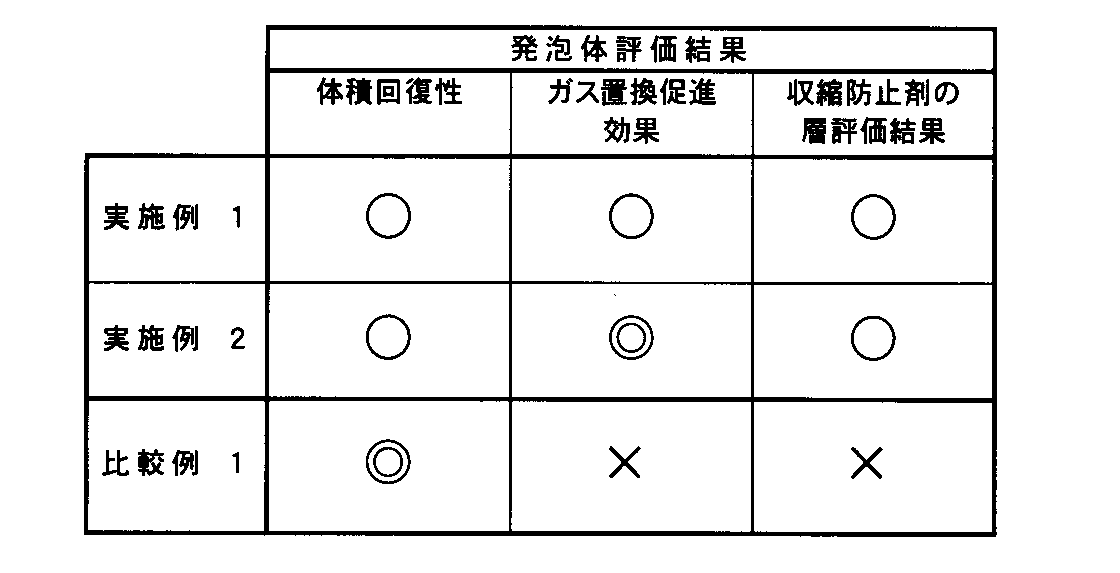
150mmのバレル内径を有するスクリュー型押出機の供給領域に900kg/時間の速度で、低密度ポリエチレン(密度0.921g/cm3、MI=2.9g/10分)、及び樹脂100重量部に対し、気泡調整剤としてタルク1.5重量部と収縮防止剤としてパルミチン酸モノグリセライド(純度90%、融点73℃)0.6重量部ともに供給した。押出機のバレル温度を190℃〜210℃に調整し、押出機の先端に取り付けた発泡剤注入口から発泡剤としてノルマルブタン(燃焼範囲下限値:1.8vol%)をこの樹脂100重量部に対し6.8重量部を圧入し、当該溶融樹脂組成物と混合して発泡性溶融混合物とした。この発泡性溶融混合物を押出機の出口に取り付けた冷却装置で108℃まで冷却した後、約3.4mmの平均厚みと約215mm幅の開口部形状を有するオリフィスプレートより、常温、大気圧下の雰囲気中に連続的に押し出して発泡させ、樹脂発泡体の引き取り速度を調整しながら成形して、厚み62mm、幅600mm、長さ1000mm、セルサイズ1.1mm、密度38kg/m3、独立気泡率95%の板状樹脂発泡体を得た。この発泡体を発泡1時間後から40℃の環境下で保存し、体積回復性及びガス置換促進効果の評価を行なった。その結果を表1に示す。
[Example 1]
Low density polyethylene (density 0.921 g / cm 3 , MI = 2.9 g / 10 min), and 100 parts by weight of resin at a feed rate of a screw type extruder having a barrel inner diameter of 150 mm at a rate of 900 kg / hour In addition, 1.5 parts by weight of talc was supplied as a foam regulator, and 0.6 parts by weight of palmitic acid monoglyceride (purity 90%, melting point 73 ° C.) was supplied as a shrinkage inhibitor. The barrel temperature of the extruder was adjusted to 190 ° C. to 210 ° C., and normal butane (combustion range lower limit: 1.8 vol%) was added to 100 parts by weight of this resin as a blowing agent from the blowing agent inlet attached to the tip of the extruder. On the other hand, 6.8 parts by weight were press-fitted and mixed with the molten resin composition to obtain a foamable molten mixture. After cooling this foamable molten mixture to 108 ° C. with a cooling device attached to the outlet of the extruder, it was cooled at room temperature and atmospheric pressure from an orifice plate having an average thickness of about 3.4 mm and an opening shape of about 215 mm width. Continuous extrusion into the atmosphere and foaming, molding while adjusting the take-up speed of the resin foam, thickness 62mm, width 600mm, length 1000mm, cell size 1.1mm, density 38kg / m 3 , closed cell rate A 95% plate-like resin foam was obtained. This foam was stored in an environment of 40 ° C. after 1 hour of foaming, and the volume recoverability and gas replacement acceleration effect were evaluated. The results are shown in Table 1.
[実施例2]
実施例1と同一の方法で得た板状樹脂発泡体を発泡1時間後から40度の環境で保存し、発泡後2日目に発泡体の厚み方向に歪率40%の圧縮を加えた。圧縮後は、再度40℃の環境で保存し体積回復性及びガス置換促進効果の評価を行なった。その結果を表1に示す。
[Example 2]
The plate-like resin foam obtained by the same method as in Example 1 was stored in an environment of 40 degrees from 1 hour after foaming, and compression with a strain rate of 40% was applied in the thickness direction of the foam on the second day after foaming. . After compression, the sample was stored again in an environment of 40 ° C., and the volume recoverability and gas replacement acceleration effect were evaluated. The results are shown in Table 1.
[比較例1]
収縮防止剤としてステアリン酸モノグリセライド0.6重量部を使用した以外は、実施例1と同一の方法で得た板状樹脂発泡体を発泡1時間後から40℃の環境で保存し、体積回復性及びガス置換促進効果の評価を行なった。その結果を表1に示す。
[Comparative Example 1]
Except that 0.6 parts by weight of stearic acid monoglyceride was used as an anti-shrink agent, the plate-like resin foam obtained by the same method as in Example 1 was stored in an environment of 40 ° C. after 1 hour of foaming, and volume recoverability was obtained. And the gas replacement acceleration effect was evaluated. The results are shown in Table 1.
本発明は、発泡剤として可燃性ガスを使用した押出発泡による発泡体の製造方法において、短期間で可燃性発泡ガスを空気等の無機ガスに置換することができ、かつ、充分に体積回復が可能なポリオレフィン系樹脂発泡体の製造の分野で好適に利用出来る。又、吸水率が低く、断熱材分野に好適に利用できる。 The present invention relates to a method for producing a foam by extrusion foaming using a combustible gas as a foaming agent, and the combustible foaming gas can be replaced with an inorganic gas such as air in a short period of time, and sufficient volume recovery can be achieved. It can be suitably used in the field of production of possible polyolefin resin foams. In addition, it has a low water absorption rate and can be suitably used in the field of heat insulating materials.
Claims (6)
Priority Applications (1)
| Application Number | Priority Date | Filing Date | Title |
|---|---|---|---|
| JP2004116421A JP2005297340A (en) | 2004-04-12 | 2004-04-12 | Method for producing polyolefin resin extruded foam |
Applications Claiming Priority (1)
| Application Number | Priority Date | Filing Date | Title |
|---|---|---|---|
| JP2004116421A JP2005297340A (en) | 2004-04-12 | 2004-04-12 | Method for producing polyolefin resin extruded foam |
Publications (1)
| Publication Number | Publication Date |
|---|---|
| JP2005297340A true JP2005297340A (en) | 2005-10-27 |
Family
ID=35329482
Family Applications (1)
| Application Number | Title | Priority Date | Filing Date |
|---|---|---|---|
| JP2004116421A Pending JP2005297340A (en) | 2004-04-12 | 2004-04-12 | Method for producing polyolefin resin extruded foam |
Country Status (1)
| Country | Link |
|---|---|
| JP (1) | JP2005297340A (en) |
-
2004
- 2004-04-12 JP JP2004116421A patent/JP2005297340A/en active Pending
Similar Documents
| Publication | Publication Date | Title |
|---|---|---|
| AU735544B2 (en) | A short time frame process for producing extruded closed cell low density propylene polymer foams | |
| US9714330B2 (en) | Method of manufacturing polystyrene foam with polymer processing additives | |
| JP4077745B2 (en) | Polyolefin resin in-mold foam molding | |
| JP2011225641A (en) | Extruded foam of polystyrenic resin and method for producing the same | |
| US20140187656A1 (en) | Method of manufacturing polystyrene foam with polymer processing additives | |
| JPH0867758A (en) | Polypropylene resin foam and method for producing the same | |
| WO2001051550A1 (en) | Foamable composition using high density polyethylene | |
| US20070090552A1 (en) | Method of manufacturing polystyrene foam with polymer processing additives | |
| JP5044589B2 (en) | Polyvinylidene fluoride-based resin foamed particles, and polyvinylidene fluoride-based resin foamed particles | |
| JP5563442B2 (en) | Low solubility hydrofluorocarbon containing alkenyl aromatic foam | |
| EP1308475B1 (en) | Physically foamed fine cellular polyethylene foam | |
| JP2005297341A (en) | Method for producing polyolefin resin extruded foam | |
| JP2004307662A (en) | Method for producing crystalline polylactic acid-based resin foam | |
| JP2006077218A (en) | Thermoplastic resin extruded foam and method for producing the same | |
| JP4791016B2 (en) | Polyolefin resin extruded foam | |
| JP7229754B2 (en) | Non-crosslinked polyethylene resin extruded foam board and method for producing the same | |
| JP3888944B2 (en) | Method for producing styrene resin foam sheet | |
| JP4756957B2 (en) | Extruded foam | |
| JP4101684B2 (en) | Styrenic resin foam plate and manufacturing method thereof | |
| JP2005126568A (en) | Gas regulator and thermoplastic resin foam using the same | |
| JP2007039601A (en) | Extruded foam | |
| JP2004352840A (en) | Method for producing extruded low ignition olefin resin foam | |
| JP3721109B2 (en) | Styrenic resin foam and method for producing the same | |
| JPH0711039A (en) | Non-crosslinked polyethylene resin foam and method for producing the same | |
| JP2004352839A (en) | Extruded olefin resin foam |