JP2005293764A - Information recording medium, apparatus and method for recording / reproducing information on information recording medium - Google Patents
Information recording medium, apparatus and method for recording / reproducing information on information recording medium Download PDFInfo
- Publication number
- JP2005293764A JP2005293764A JP2004109820A JP2004109820A JP2005293764A JP 2005293764 A JP2005293764 A JP 2005293764A JP 2004109820 A JP2004109820 A JP 2004109820A JP 2004109820 A JP2004109820 A JP 2004109820A JP 2005293764 A JP2005293764 A JP 2005293764A
- Authority
- JP
- Japan
- Prior art keywords
- information
- data
- stream
- recording
- recorded
- Prior art date
- Legal status (The legal status is an assumption and is not a legal conclusion. Google has not performed a legal analysis and makes no representation as to the accuracy of the status listed.)
- Pending
Links
Images







Landscapes
- Television Signal Processing For Recording (AREA)
- Signal Processing For Digital Recording And Reproducing (AREA)
- Management Or Editing Of Information On Record Carriers (AREA)
Abstract
【課題】本発明は同時に記録と再生制御が可能な情報記録媒体と、その情報記録媒体に対して情報を記録/再生する装置、方法を提供する。
【解決手段】リアルタイムデータを記録する際にその配置情報をディスク上に記録することで、AVストリーム・データの再生を容易にし、更に、同時録再における機器間の互換性を高めることが出来る。
【選択図】図21The present invention provides an information recording medium capable of simultaneously controlling recording and reproduction, and an apparatus and method for recording / reproducing information on the information recording medium.
When real-time data is recorded, the arrangement information is recorded on a disk, so that AV stream data can be easily reproduced, and compatibility between devices in simultaneous recording / playback can be improved.
[Selection] Figure 21
Description
本発明は読み書き可能な情報記録媒体であって、特に、動画像データおよび静止画データおよびオーディオデータおよびデータ放送等の種々のフォーマットのデータを含むマルチメディアデータが記録される情報記録媒体に関する。さらに、本発明はそのような情報記録媒体に対して情報の記録/再生を行なう装置及び方法に関する。 The present invention relates to a readable / writable information recording medium, and more particularly to an information recording medium on which multimedia data including data of various formats such as moving image data, still image data, audio data, and data broadcasting is recorded. Furthermore, the present invention relates to an apparatus and method for recording / reproducing information on such an information recording medium.
650MB程度が上限であった書き換え型光ディスクの分野で数GBの容量を有する相変化型ディスクDVD−RAMが出現した。デジタルAVデータの符号化規格であるMPEG(MPEG2)の実用化とあいまってDVD−RAMは、コンピュータ用途だけでなくオーディオ・ビデオ(AV)技術分野における記録・再生メディアとして期待されている。 In the field of rewritable optical discs, the upper limit of which is about 650 MB, a phase change disc DVD-RAM having a capacity of several GB has appeared. Combined with the practical application of MPEG (MPEG2), which is an encoding standard for digital AV data, DVD-RAM is expected as a recording / reproducing medium not only for computer use but also in the audio / video (AV) technical field.
昨今、日本においてもデジタル放送が開始され、MPEGトランスポートストリーム(以下「MPEG−TS」と称す。)にのせて、複数番組の映像、音声、データを同時に多重化して送出することが可能となり、HDDやDVDを利用したデジタル放送記録装置が普及しつつある。 Recently, digital broadcasting has been started in Japan, and it is possible to simultaneously multiplex and send video, audio and data of multiple programs on an MPEG transport stream (hereinafter referred to as “MPEG-TS”). Digital broadcast recording devices using HDD and DVD are becoming widespread.
このような次世代型のデジタル放送レコーダ(例えばBlu−ray Discレコーダ、以下BDレコーダもしくは、レコーダ)は、デジタル放送の形態に合わせて、放送のままのMPEG−TSを変換することなくそのままの形式で記録する。 Such a next-generation digital broadcast recorder (for example, a Blu-ray Disc recorder, hereinafter referred to as a BD recorder or a recorder) is in a format as it is without converting MPEG-TS as it is in accordance with the form of digital broadcasting. Record with.
しかしながら、光ディスクであるBDに書き込む際には、1倍速メディアと1倍速のドライブしかなく、現在のDVDレコーダのような同時録再ができる仕組みは提供できなかった。DVDについては、特許文献1に詳しい。
本発明は上記課題を解決すべくなされたものであり、その目的とするところは、光ディスク等の情報記録媒体に記録したコンテンツを再生しながら、同時にその記録媒体の空き領域に別コンテンツを記録した情報記録媒体と、そのような情報記録媒体に対してデータの記録、再生を行なう装置及び方法を提供することにある。 The present invention has been made to solve the above-described problems, and the object of the present invention is to reproduce content recorded on an information recording medium such as an optical disc and simultaneously record another content in an empty area of the recording medium. An object is to provide an information recording medium, and an apparatus and method for recording and reproducing data on such an information recording medium.
本発明の第1の態様において、上記課題を解決するため、請求項1にかかる発明は、少なくとも映像情報もしくは音声情報を含むストリームとその管理情報を情報記録媒体に記録する情報記録装置であって、前記管理情報には、前記情報記録媒体に記録されたストリームの配置情報を示す情報が記述されており、前記情報記録装置は、前記配置情報をもって、前記ストリームを再生しながら、同時に前記情報記録媒体にストリームを記録可能か否かを判定することを特徴とする情報記録装置とする。
In a first aspect of the present invention, in order to solve the above problems, the invention according to
請求項2にかかる発明は、請求項1に記載の情報記録装置であって、前記管理情報には、前記情報記録媒体に記録されたストリーム毎の配置情報が管理されており、前記情報記録装置は、前記配置情報をもって、前記ストリームを再生しながら、同時に前記情報記録媒体にストリームを記録可能か否かを判定することを特徴とする情報記録装置とする。
The invention according to
請求項3にかかる発明は、少なくとも映像情報もしくは音声情報を含むストリームを情報記録媒体に記録する情報記録装置であって、前記情報記録媒体には、n倍速記録が可能か否かの識別情報が記録されており、前記情報記録装置は、前記情報記録媒体の前記識別情報をもって、前記ストリームを再生しながら、同時に前記情報記録媒体にストリームを記録可能か否かを判定することを特徴とする情報記録装置とする。 According to a third aspect of the present invention, there is provided an information recording apparatus for recording a stream including at least video information or audio information on an information recording medium, wherein the information recording medium has identification information indicating whether or not n-times speed recording is possible. Information is recorded, and the information recording apparatus determines whether or not the stream can be recorded on the information recording medium at the same time while reproducing the stream with the identification information of the information recording medium. A recording device is assumed.
本発明の情報記録装置は、リアルタイムデータ記録時にその配置情報を併せて情報記録媒体上に記録しておくことで、リアルタイムデータの連続再生が可能か否か、また、リアルタイムデータを読み込み(再生)ながら、その情報記録媒体に別のリアルタイムデータを記録することが可能か否かが判断できる。 The information recording apparatus of the present invention records whether or not real-time data can be continuously reproduced by recording the arrangement information on the information recording medium together with real-time data recording, and reads (reproduces) real-time data. However, it can be determined whether or not another real-time data can be recorded on the information recording medium.
従って、ユーザーがある情報記録媒体に対して、同時録再(コンテンツAを再生しながら、コンテンツBを記録する)を行った際に、正しく同時録再が可能か否かを情報記録装置が予め記録前に判断でき、同時録再中での記録失敗をなくすことが可能となる。 Therefore, when the user performs simultaneous recording / reproducing (recording content B while reproducing content A) on a certain information recording medium, the information recording apparatus determines in advance whether or not simultaneous recording / reproducing can be performed correctly. It can be judged before recording, and it is possible to eliminate recording failure during simultaneous recording and playback.
以下、添付の図面を用いて本発明に係る情報記録媒体、記録装置及び再生装置の実施形態であるDVDディスク、DVDレコーダ及びDVDプレーヤについて下記の順序で説明する。 Hereinafter, a DVD disk, a DVD recorder, and a DVD player, which are embodiments of an information recording medium, a recording apparatus, and a reproducing apparatus according to the present invention, will be described in the following order with reference to the accompanying drawings.
特に、発明のポイントは「8.詳細な実施形態」で説明する。なお、関連の度合いは異なるが、全て本発明の実施形態である。 In particular, the points of the invention will be described in “8. Detailed Embodiment”. Although the degree of association is different, all are embodiments of the present invention.
1.DVDレコーダ装置のシステム概要
2.DVDレコーダ装置の機能概要
3.DVDディスクの概要
4.再生されるAV情報の概要
5.AV情報の管理情報と再生制御の概要
6.再生機能の基本動作
7.記録機能の基本動作
8.詳細な実施形態
(1.DVDレコーダ装置のシステム概要)
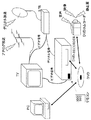
図1は、DVDレコーダ装置の外観と関連機器とのインターフェースの一例を説明する図である。
1. 1. System overview of
FIG. 1 is a diagram for explaining an example of an interface between an external appearance of a DVD recorder device and related devices.
図1に示すように、DVDレコーダには光ディスクであるDVDが装填され、ビデオ情報の記録再生を行う。操作は一般的にはリモコンで行われる。 As shown in FIG. 1, a DVD, which is an optical disk, is loaded on a DVD recorder, and video information is recorded and reproduced. The operation is generally performed with a remote controller.
DVDレコーダに入力されるビデオ情報にはアナログ信号とデジタル信号の両者があり、アナログ信号としてはアナログ放送があり、デジタル信号としてデジタル放送がある。一般的にはアナログ放送は、テレビジョン装置に内蔵された受信機により受信、復調され、NTSC等のアナログビデオ信号としてDVDレコーダに入力され、デジタル放送は、受信機であるSTB(Set Top Box)でデジタル信号に復調され、DVDレコーダに入力され記録される。 The video information input to the DVD recorder includes both an analog signal and a digital signal. The analog signal includes analog broadcast, and the digital signal includes digital broadcast. In general, an analog broadcast is received and demodulated by a receiver built in the television apparatus and input to a DVD recorder as an analog video signal such as NTSC, and a digital broadcast is an STB (Set Top Box) which is a receiver. Are demodulated into digital signals and input to a DVD recorder for recording.
一方、ビデオ情報が記録されたDVDディスクはDVDレコーダにより再生され外部に出力される。出力も入力同様に、アナログ信号とデジタル信号の両者があり、アナログ信号であれば直接テレビジョン装置に入力され、デジタル信号であればSTBを経由し、アナログ信号に変換された後にテレビジョン装置に入力されテレビジョン装置で映像表示される。 On the other hand, a DVD disc on which video information is recorded is reproduced by a DVD recorder and output to the outside. Similarly to the input, both the analog signal and the digital signal are output. If the signal is an analog signal, the signal is directly input to the television device. If the signal is a digital signal, the signal is input to the television device via the STB and then converted to the analog signal. The video is input and displayed on the television device.
また、DVDディスクにはDVDレコーダ以外のDVDカムコーダや、パーソナルコンピュータでビデオ情報が記録再生される場合がある。DVDレコーダ外でビデオ情報が記録されたDVDディスクであっても、DVDレコーダに装填されれば、DVDレコーダはこれを再生する。 Further, video information may be recorded / reproduced on / from a DVD disc by a DVD camcorder other than the DVD recorder or a personal computer. Even if it is a DVD disc on which video information is recorded outside the DVD recorder, the DVD recorder reproduces it if it is loaded in the DVD recorder.
なお、上述したアナログ放送やデジタル放送のビデオ情報には通常、音声情報が付随している。付随している音声情報も同様にDVDレコーダで記録再生される。またビデオ情報は一般的には動画であるが、静止画の場合もある。例えば、DVDカムコーダの写真機能で静止画が記録される場合がそうなる。 Note that audio information is usually attached to the video information of the above-described analog broadcast and digital broadcast. The accompanying audio information is similarly recorded and reproduced by the DVD recorder. The video information is generally a moving image, but may be a still image. For example, this is the case when a still image is recorded by the photo function of a DVD camcorder.
なお、STBとDVDレコーダの間のデジタルI/FはIEEE1394、ATAPI、SCSI等がありうる。 The digital I / F between the STB and the DVD recorder can be IEEE 1394, ATAPI, SCSI, or the like.
なお、DVDレコーダとテレビジョン装置との間はコンポジットビデオ信号であるNTSCと例示したが、輝度信号と色差信号を個別に伝送するコンポーネント信号でもよい。さらには、AV機器とテレビジョン装置の間の映像伝送I/FはアナログI/FをデジタルI/F、例えば、DVIに置きかえる研究開発が進められており、DVDレコーダとテレビジョン装置がデジタルI/Fで接続されることも当然予想される。 In addition, although NTSC which is a composite video signal was illustrated between a DVD recorder and a television apparatus, the component signal which transmits a luminance signal and a color difference signal separately may be sufficient. Furthermore, the video transmission I / F between the AV equipment and the television apparatus has been researched and developed to replace the analog I / F with a digital I / F, for example, DVI, and the DVD recorder and the television apparatus are digital I / F. Of course, it is expected to be connected by / F.
(2.DVDレコーダ装置の機能概要)
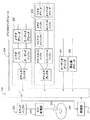
図2は、DVDレコーダ装置の機能を示すブロック図である。ドライブ装置は、DVD−RAMディスク100のデータを読み出す光ピックアップ101、ECC(Error Correcting Code)処理部102、トラックバッファ103、トラックバッファへ103の入出力を切り替えるスイッチ104、エンコーダ部105及びデコーダ部106を備える。
(2. Function overview of DVD recorder device)
FIG. 2 is a block diagram showing functions of the DVD recorder device. The drive device includes an optical pickup 101 that reads data from the DVD-
図に示すように、DVD−RAMディスク100には、1セクタ=2KBを最小単位としてデータが記録される。 また、16セクタ=1ECCブロックとして、ECCブロックを単位としてECC処理部102でエラー訂正処理が施される。
As shown in the figure, data is recorded on the DVD-
なお、DVDレコーダ装置はデータの蓄積媒体として、DVDディスクに加え、半導体メモリカードやハードディスクドライブ装置を備えても良い。図4は、半導体メモリカードとハードディスクドライブ装置を備える場合のDVDレコーダのブロック図を示す。 Note that the DVD recorder device may include a semiconductor memory card or a hard disk drive as a data storage medium in addition to the DVD disk. FIG. 4 shows a block diagram of a DVD recorder provided with a semiconductor memory card and a hard disk drive device.
なお、1セクタは512Bでも良いし、8KB等でも良い。また、ECCブロックも1セクタ、16セクタ、32セクタ等でも良い。記録できる情報容量の増大に伴い、セクタサイズ及びECCブロックを構成するセクタ数は増大すると予想される。 One sector may be 512B, 8KB, or the like. The ECC block may be 1 sector, 16 sectors, 32 sectors, or the like. As the information capacity that can be recorded increases, the sector size and the number of sectors constituting the ECC block are expected to increase.
トラックバッファ103は、DVD−RAMディスク100にAVデータをより効率良く記録するため、AVデータを可変ビットレート(VBR)で記録するためのバッファである。DVD−RAM100への読み書きレート(Va)が固定レートであるのに対して、AVデータはその内容(ビデオであれば画像)の持つ複雑さに応じてビットレート(Vb)が変化するため、このビットレートの差を吸収するためのバッファである。
The
このトラックバッファ103を更に有効利用すると、ディスク100上にAVデータを離散配置することが可能になる。図3A、図3Bを用いてこれを説明する。
If this
図3Aは、ディスク上のアドレス空間を示す図である。図3Aに示す様にAVデータが[a1、a2]の連続領域と[a3、a4]の連続領域に分かれて記録されている場合、a2からa3へシークを行っている間、トラックバッファに蓄積してあるデータをデコーダ部106へ供給することでAVデータの連続再生が可能になる。この時の状態を示したのが図3Bである。
FIG. 3A shows an address space on the disk. As shown in FIG. 3A, when AV data is recorded separately in a continuous area of [a1, a2] and a continuous area of [a3, a4], it is stored in the track buffer while seeking from a2 to a3. By supplying the data to the
位置a1で読み出しを開始したAVデータは、時刻t1からトラックバッファへ103入力されるとともに、トラックバッファ103からデータの出力が開始される。これにより、トラックバッファへの入力レート(Va)とトラックバッファからの出力レート(Vb)のレート差(Va−Vb)の分だけトラックバッファへデータが蓄積されていく。この状態が、検索領域がa2に達するまで、すなわち、時刻t2に達するまで継続する。この間にトラックバッファ103に蓄積されたデータ量をB(t2)とすると、時間t2から、領域a3のデータの読み出しを開始する時刻t3までの間、トラックバッファ103に蓄積されているB(t2)を消費してデコーダ106へ供給しつづけられれば良い。
The AV data that has been read out at the position a1 is input to the
言い方を変えれば、シーク前に読み出すデータ量([a1、a2])が一定量以上確保されていれば、シークが発生した場合でも、AVデータの連続供給が可能である。 In other words, if a certain amount or more of data to be read before seeking ([a1, a2]) is secured, AV data can be continuously supplied even if a seek occurs.
AVデータの連続供給が可能な連続領域のサイズはECCブロック数(N_ecc)に換算すると次の式で示される。式において、N_secはECCブロックを構成するセクタ数であり、S_sizeはセクタサイズ、Tjはシーク性能(最大シーク時間)である。 The size of a continuous area in which AV data can be continuously supplied is expressed by the following equation when converted into the number of ECC blocks (N_ecc). In the equation, N_sec is the number of sectors constituting the ECC block, S_size is the sector size, and Tj is the seek performance (maximum seek time).
N_ecc = Vb*Tj/((N_sec*8*S_size)*(1-Vb/Va))
また、連続領域の中には欠陥セクタが生じる場合がある。この場合も考慮すると連続領域は次の式で示される。式において、dN_eccは容認する欠陥セクタのサイズであり、Tsは連続領域の中で欠陥セクタをスキップするのに要する時間である。このサイズもECCブロック数で表される。
N_ecc = Vb * Tj / ((N_sec * 8 * S_size) * (1-Vb / Va))
In addition, a defective sector may occur in the continuous area. Considering this case as well, the continuous region is expressed by the following equation. In the equation, dN_ecc is the size of the defective sector that is tolerated, and Ts is the time required to skip the defective sector in the continuous region. This size is also expressed by the number of ECC blocks.
N_ecc = dN_ecc+Vb*Tj/((N_sec*8*S_size)*(1-Vb/Va))
なお、ここでは、DVD−RAMからデータを読み出す、即ち再生の場合の例を説明したが、DVD−RAMへのデータの書き込み、即ち録画の場合も同様に考えることができる。
N_ecc = dN_ecc + Vb * Tj / ((N_sec * 8 * S_size) * (1-Vb / Va))
Here, an example of reading data from a DVD-RAM, that is, a case of reproducing has been described, but writing data to a DVD-RAM, that is, a case of recording can be considered similarly.
上述したように、DVD−RAMでは一定量以上のデータが連続記録さえされていればディスク上にAVデータを分散記録しても連続再生/録画が可能である。DVDでは、この連続領域をCDAと称する。 As described above, in a DVD-RAM, as long as a certain amount or more of data is continuously recorded, continuous reproduction / recording is possible even if AV data is distributedly recorded on the disc. In DVD, this continuous area is called CDA.
(3.DVDディスクの概要)
図5A、図5Bは、記録可能な光ディスクであるDVD−RAMディスクの外観と物理構造を表した図である。なお、DVD−RAMは一般的にはカートリッジに収納された状態でDVDレコーダに装填される。記録面を保護するのが目的である。但し、記録面の保護が別の構成で行われたり、容認できる場合にはカートリッジに収納せずに、DVDレコーダに直接装填できるようにしてももちろん良い。
(3. Overview of DVD disc)
5A and 5B are views showing the appearance and physical structure of a DVD-RAM disc that is a recordable optical disc. Note that the DVD-RAM is generally loaded in a DVD recorder while being stored in a cartridge. The purpose is to protect the recording surface. However, if the recording surface is protected by another configuration or is acceptable, it is of course possible to directly load the DVD recorder without storing it in the cartridge.
DVD−RAMディスクは相変化方式によりデータを記録する。ディスク上の記録データはセクタ単位で管理され、アクセス用のアドレスが付随する。16個のセクタは誤り訂正の単位となり、誤り訂正コードが付与され、ECCブロックと呼称される。 DVD-RAM discs record data by the phase change method. The recording data on the disc is managed in units of sectors and accompanied with an access address. The 16 sectors are units for error correction, and are given an error correction code and are called ECC blocks.
図5Aは、記録可能な光ディスクであるDVD−RAMディスクの記録領域を表した図である。同図のように、DVD−RAMディスクは、最内周にリードイン領域を、最外周にリードアウト領域を、その間にデータ領域を配置している。リードイン領域は、光ピックアップのアクセス時においてサーボを安定させるために必要な基準信号や他のメディアとの識別信号などが記録されている。リードアウト領域もリードイン領域と同様の基準信号などが記録される。データ領域は、最小のアクセス単位であるセクタ(2048バイトとする)に分割されている。 また、DVD−RAMは、記録・再生時においてZ−CLV(Zone Constant Linear Velocity)と呼ばれる回転制御を実現するために、データ領域が複数のゾーン領域に分割されている。 FIG. 5A is a diagram showing a recording area of a DVD-RAM disc which is a recordable optical disc. As shown in the figure, the DVD-RAM disc has a lead-in area on the innermost periphery, a lead-out area on the outermost periphery, and a data area therebetween. In the lead-in area, a reference signal necessary for stabilizing the servo at the time of accessing the optical pickup, an identification signal with other media, and the like are recorded. In the lead-out area, the same reference signal as the lead-in area is recorded. The data area is divided into sectors (2048 bytes) which are the minimum access unit. Further, in the DVD-RAM, a data area is divided into a plurality of zone areas in order to realize rotation control called Z-CLV (Zone Constant Linear Velocity) during recording / reproduction.
図5Aは、DVD−RAMに同心円状に設けられた複数のゾーン領域を示す図である。同図のように、DVD−RAMは、ゾーン0〜ゾーン23の24個のゾーン領域に分割されている。DVD−RAMの回転角速度は、内周側のゾーン程速くなるようにゾーン領域毎に設定され、光ピックアップが1つのゾーン内でアクセスする間は一定に保たれる。これにより、DVD−RAMの記録密度を高めるとともに、記録・再生時における回転制御を容易にしている。
FIG. 5A is a diagram showing a plurality of zone regions provided concentrically on the DVD-RAM. As shown in the figure, the DVD-RAM is divided into 24 zone areas,
図5Bは、図5Aにおいて同心円状に示したリードイン領域と、リードアウト領域と、ゾーン領域0〜23を横方向に配置した説明図である。
FIG. 5B is an explanatory diagram in which the lead-in area, the lead-out area, and the
リードイン領域とリードアウト領域は、その内部に欠陥管理領域(DMA:Defect Management Area)を有する。欠陥管理領域とは、欠陥が生じたセクタの位置を示す位置情報と、その欠陥セクタを代替するセクタが上記代替領域の何れに存在するかを示す代替位置情報とが記録されている領域をいう。 The lead-in area and the lead-out area have a defect management area (DMA: Defect Management Area) therein. The defect management area refers to an area in which position information indicating the position of a sector in which a defect has occurred and replacement position information indicating in which of the replacement areas a sector that replaces the defective sector exists. .
各ゾーン領域はその内部にユーザ領域を有すると共に、境界部に代替領域及び未使用領域を有している。ユーザ領域は、ファイルシステムが記録用領域として利用することができる領域をいう。代替領域は、欠陥セクタが存在する場合に代替使用される領域である。未使用領域は、データ記録に使用されない領域である。未使用領域は、2トラック分程度設けられる。未使用領域を設けているのは、ゾーン内では隣接するトラックの同じ位置にセクタアドレスが記録されているが、Z−CLVではゾーン境界に隣接するトラックではセクタアドレスの記録位置が異なるため、それに起因するセクタアドレス誤判別を防止するためである。 Each zone area has a user area therein, and an alternative area and an unused area at the boundary. The user area is an area that can be used as a recording area by the file system. The replacement area is an area that is used instead when a defective sector exists. The unused area is an area that is not used for data recording. Unused areas are provided for about two tracks. The unused area is provided because the sector address is recorded at the same position in the adjacent track in the zone, but in Z-CLV, the recording position of the sector address is different in the track adjacent to the zone boundary. This is to prevent erroneous sector address discrimination.
このようにゾーン境界にはデータ記録に使用されないセクタが存在する。そのためデータ記録に使用されるセクタのみを連続的に示すように、DVD−RAMは、内周から順に論理セクタ番号(LSN:Logical Sector Number)をユーザ領域の物理セクタに割り当てている。 Thus, there are sectors that are not used for data recording at the zone boundaries. Therefore, the DVD-RAM assigns logical sector numbers (LSN: Logical Sector Number) sequentially to the physical sectors in the user area so that only the sectors used for data recording are shown continuously.
図6A、図6Bは、論理セクタにより構成されるDVD−RAMの論理的なデータ空間を示す。論理的なデータ空間はボリューム空間と呼称され、ユーザデータを記録する。 6A and 6B show a logical data space of a DVD-RAM configured by logical sectors. The logical data space is called a volume space and records user data.
ボリューム領域は、記録データをファイルシステムで管理する。すなわち、データを格納する1群のセクタをファイルとして、さらには1群のファイルをディレクトリとして管理するボリューム構造情報がボリューム領域の先頭と終端に記録される。本実施の形態のファイルシステムはUDFと呼称され、ISO13346規格に準拠している。 The volume area manages recording data with a file system. That is, volume structure information for managing a group of sectors for storing data as a file and further managing a group of files as a directory is recorded at the beginning and end of the volume area. The file system of this embodiment is called UDF and conforms to the ISO 13346 standard.
なお、上記1群のセクタはボリューム空間で必ずしも連続的には配置されず、部分的に離散配置される。このため、ファイルシステムは、ファイルを構成するセクタ群のうち、ボリューム空間で連続的に配置される1群のセクタをエクステントとして管理し、ファイルを関連のあるエクステントの集合として管理する。 The group of sectors is not necessarily arranged continuously in the volume space, but is partially arranged discretely. For this reason, the file system manages a group of sectors arranged continuously in the volume space among the sector groups constituting the file as extents, and manages the file as a set of related extents.
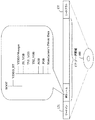
図7は、DVD−RAMに記録されるディレクトリとファイルの構造を示す。ルートの下に、VIDEO_RTディレクトリがあり、この下に、再生用のデータである各種オブジェクトのファイルと、これらの再生順序や各種属性を示す管理情報としてVIDEO Managerファイルが格納される。 FIG. 7 shows the structure of directories and files recorded on the DVD-RAM. Below the root is a VIDEO_RT directory, and below this, a file of various objects as data for reproduction, and a VIDEO Manager file as management information indicating their reproduction order and various attributes are stored.
オブジェクトはMPEG規格に準拠したデータであり、PS_VOB、TS1_VOB、TS2_VOB、AOB、POB、MNF(Manufacturer's Private Data)がある。 The object is data conforming to the MPEG standard, and includes PS_VOB, TS1_VOB, TS2_VOB, AOB, POB, and MNF (Manufacturer's Private Data).
PS_VOB、AOB、POBはMPEGのプログラムストリーム(PS)であり、TS1_VOB及びTS2_VOBはトランスポートストリーム(TS)である。プログラムストリームは、パッケージメディアにAV情報を格納することを考慮されたデータ構造を有し、一方、トランスポートストリームは通信メディアを考慮したデータ構造を有する。 PS_VOB, AOB, and POB are MPEG program streams (PS), and TS1_VOB and TS2_VOB are transport streams (TS). The program stream has a data structure that allows for storing AV information in the package media, while the transport stream has a data structure that allows for communication media.
PS_VOB、TS1_VOB、TS2_VOBは、いずれも映像情報と音声情報を共に有し映像情報が主体となるオブジェクトである。このうち、TS1_VOBは原則、DVDレコーダによりエンコードが行われ、内部のピクチャ構造が詳細に管理されているオブジェクトであり、TS2_VOBはDVDレコーダ外でエンコードされたオブジェクトであり、内部のピクチャ構造等のデータ構造が一部不明なオブジェクトである。 PS_VOB, TS1_VOB, and TS2_VOB are all objects having both video information and audio information, and mainly video information. Among these, TS1_VOB is an object in which encoding is performed by a DVD recorder and the internal picture structure is managed in detail, and TS2_VOB is an object encoded outside the DVD recorder, and data such as the internal picture structure is included. An object whose structure is partially unknown.
典型的には、TS1_VOBは外部から入力されるアナログビデオ信号をDVDレコーダがトランスポートストリームにエンコードしたオブジェクトであり、TS2_VOBは外部から入力されるデジタルビデオ信号をエンコードすることなく直接ディスクに記録したオブジェクトである。つまりデジタル放送をDVDレコーダが記録する際には、一般的にTS2_VOBである。 Typically, TS1_VOB is an object obtained by encoding an externally input analog video signal into a transport stream by a DVD recorder, and TS2_VOB is an object recorded directly on a disc without encoding an externally input digital video signal. It is. That is, when a DVD recorder records a digital broadcast, it is generally TS2_VOB.
AOB、POBはMPEGのプログラムストリームであり、AOBは音声情報が主体となるオブジェクトであり、POBは静止画が主体となるオブジェクトである。 AOB and POB are MPEG program streams, AOB is an object mainly composed of audio information, and POB is an object mainly composed of a still image.
MNF(Manufacturer's Private Data)は製造者固有の情報を格納するためのデータ領域である。 MNF (Manufacturer's Private Data) is a data area for storing information unique to the manufacturer.
上述した、映像情報主体、音声情報主体とは、ビットレートの割り当てが大きいことを意味する。VOBは映画等のアプリケーションに用いられ、AOBは音楽アプリケーションに用いられる。 The above-mentioned video information main body and audio information main body means that the bit rate is largely allocated. VOB is used for applications such as movies, and AOB is used for music applications.
(4.再生されるAV情報の概要)
図8は、DVDディスクに各種AVオブジェクトとして記録されるMPEGデータの構造を示す図である。
(4. Overview of reproduced AV information)
FIG. 8 is a diagram showing the structure of MPEG data recorded as various AV objects on a DVD disc.
図8が示すようにビデオストリーム及びオーディオストリームは、それぞれ分割され多重される。MPEG規格においては、多重化後のストリームをシステムストリームと呼称する。DVDの場合、DVD固有の情報が設定されたシステムストリームをVOB(Video Object)と呼称している。分割の単位は、パック・パケットと称され、約2KByteのデータ量を有する。 As shown in FIG. 8, the video stream and the audio stream are each divided and multiplexed. In the MPEG standard, the multiplexed stream is called a system stream. In the case of a DVD, a system stream in which information specific to the DVD is set is called a VOB (Video Object). The unit of division is called a pack packet, and has a data amount of about 2 KB.
ビデオストリームはMPEG規格で符号化されており、可変ビットレートで圧縮されており、動きが激しい等の複雑な映像であればビットレートが高くなっている。MPEG規格では、映像の各ピクチャは、Iピクチャ、Pピクチャ、Bピクチャに種類分けして符号化される。このうち、Iピクチャはフレーム内で完結する空間的な圧縮符号化が施されおり、Pピクチャ、Bピクチャはフレーム間の相関を利用した時間的な圧縮符号化が施されている。MPEGでは少なくともIピクチャを含む区間をGOP(Group of Picture)として管理する。GOPは早送り再生等の特殊再生におけるアクセスポイントになる。フレーム内圧縮されたIピクチャを有するためである。 The video stream is encoded according to the MPEG standard, is compressed at a variable bit rate, and the bit rate is high for complex video such as intense motion. In the MPEG standard, each picture of a video is encoded by being classified into an I picture, a P picture, and a B picture. Among these, the I picture is subjected to spatial compression coding that is completed within a frame, and the P picture and B picture are subjected to temporal compression coding using the correlation between frames. In MPEG, a section including at least an I picture is managed as a GOP (Group of Pictures). GOP becomes an access point for special playback such as fast-forward playback. This is because it has an I picture compressed in a frame.
一方、音声ストリームの符号化には、DVDの場合、MPEGオーディオに加え、AC―3やLPCMの符号化が用いられる。 On the other hand, in the case of DVD, AC-3 or LPCM encoding is used for encoding an audio stream in addition to MPEG audio.
図8が示すように、GOPを構成するビデオ情報とそれに付随する音声情報とを含む多重化後のデータ単位はVOBU(Video Object Unit)と称される。VOBUには、当該動画区間の管理用の情報をヘッダ情報として含ませる場合がある。 As shown in FIG. 8, a multiplexed data unit including video information constituting the GOP and accompanying audio information is called a VOBU (Video Object Unit). The VOBU may include information for managing the moving image section as header information.
図8で説明したシステムストリームには、プログラムストリーム(PS)とトランスポートストリーム(TS)がある。前者はパッケージメディアを考慮したデータ構造を有し、後者は通信メディアを考慮したデータ構造を有する。 The system stream described in FIG. 8 includes a program stream (PS) and a transport stream (TS). The former has a data structure considering a package medium, and the latter has a data structure considering a communication medium.
図9は、プログラムストリームとトランスポートストリームのデータ構造の概要を説明する図である。 FIG. 9 is a diagram for explaining the outline of the data structure of the program stream and the transport stream.
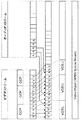
プログラムストリームは、伝送及び多重化の最小単位である固定長のパックからなり、パックはさらに、1つ以上のパケットを有する。パックもパケットもヘッダ部とデータ部を有する。MPEGではデータ部をペイロードと称する。DVDの場合はパックの固定長はセクタサイズと整合性をとり2KBになる。パックは複数のパケットを有することができるが、DVDの映像や音声を格納するパックは1パケットのみを有するため、特別な場合を除いて1パック=1パケットになる。 The program stream is composed of a fixed-length pack that is a minimum unit of transmission and multiplexing, and the pack further includes one or more packets. Both packs and packets have a header part and a data part. In MPEG, the data part is called a payload. In the case of DVD, the fixed length of the pack is 2 KB, consistent with the sector size. A pack can have a plurality of packets, but since a pack for storing video and audio of a DVD has only one packet, one pack = 1 packet except in special cases.
一方、トランスポートストリームの伝送及び多重化の単位は固定長のTSパケットからなる。TSパケットのサイズは188Bであり、通信用規格であるATM伝送との整合性をとっている。TSパケットは1つ以上が集まりPESパケットを構成する。 On the other hand, the unit of transport stream transmission and multiplexing consists of fixed-length TS packets. The size of the TS packet is 188B, which is consistent with ATM transmission, which is a communication standard. One or more TS packets gather to form a PES packet.
PESパケットはプログラムストリームとトランスポートストリームで共通する概念であり、データ構造は共通である。プログラムストリームのパックに格納されるパケットはPESパケットを直接構成し、トランスポートストリームのTSパケットは1つ以上が集まりPESパケットを構成する。 The PES packet is a concept common to the program stream and the transport stream, and the data structure is common. The packets stored in the program stream pack directly constitute a PES packet, and one or more transport stream TS packets gather to form a PES packet.
また、PESパケットは符号化の最小単位であり、符号化が共通するビデオ情報、オーディオ情報をそれぞれ格納する。すなわち、一つのPESパケット内に符号化方式の異なるビデオ情報、オーディオ情報が混在して格納されることはない。但し、同じ符号化方式であればピクチャバウンダリやオーディオフレームのバウンダリは保証せずとも良い。図9に示すように複数のPESパケットで1つのフレームを格納したり、1つのPESパケットに複数のフレームを格納するケースもありうる。 The PES packet is the minimum unit of encoding, and stores video information and audio information that are common to encoding. That is, video information and audio information with different encoding methods are not mixedly stored in one PES packet. However, picture boundaries and audio frame boundaries may not be guaranteed if the encoding method is the same. As shown in FIG. 9, there may be a case where one frame is stored in a plurality of PES packets or a plurality of frames are stored in one PES packet.
図10A〜10Cと図11A〜11Cに、トランスポートストリームとプログラムストリームの個別のデータ構造を示す。 10A to 10C and FIGS. 11A to 11C show individual data structures of the transport stream and the program stream.
図10A〜10C、図12A〜12Dに示すように、TSパケットは、TSパケットヘッダと、適用フィールドと、ペイロード部から構成される。TSパケットヘッダにはPID(Packet Identifier)が格納され、これにより、TSパケットが所属するビデオストリームまたはオーディオストリーム等の各種ストリームが識別される。 As shown in FIGS. 10A to 10C and FIGS. 12A to 12D, the TS packet includes a TS packet header, an application field, and a payload portion. The TS packet header stores a PID (Packet Identifier), thereby identifying various streams such as a video stream or an audio stream to which the TS packet belongs.
適用フィールドにはPCR(Program Clock Reference)が格納される。PCRはストリームをデコードする機器の基準クロック(STC)の参照値である。機器は典型的にはPCRのタイミングでシステムストリームをデマルチプレクスし、ビデオストリーム等の各種ストリームに再構築する。 The application field stores PCR (Program Clock Reference). PCR is a reference value of a standard clock (STC) of a device that decodes a stream. The device typically demultiplexes the system stream at the timing of PCR and reconstructs it into various streams such as a video stream.
PESヘッダには、DTS(Decoding Time Stamp)とPTS(Presentation Time Stamp)が格納される。DTSは当該PESパケットに格納されるピクチャ/オーディオフレームのデコードタイミングを示し、PTSは映像音声出力等のプレゼンテーションタイミングを示す。 In the PES header, DTS (Decoding Time Stamp) and PTS (Presentation Time Stamp) are stored. DTS indicates the decoding timing of the picture / audio frame stored in the PES packet, and PTS indicates the presentation timing such as video / audio output.
なお、全てのPESパケットヘッダにPTS、DTSを有する必要はなく、Iピクチャの先頭データが格納開始されるPESパケットのヘッダにPTS、DTSがあればデコード及び出力に支障はない。 Note that it is not necessary to have PTS and DTS in all PES packet headers. If there is a PTS and DTS in the header of a PES packet in which the head data of an I picture is started to be stored, there is no problem in decoding and output.
TSパケットの構造の詳細は図12A〜図12Dに示される。 Details of the structure of the TS packet are shown in FIGS. 12A to 12D.
図12A〜図12Dに示すように、適用フィールドにはPCRに加えて、ランダムアクセス表示フラグが格納され、当該フラグにより、対応するペイロード部にビデオ・オーディオのフレーム先頭であってアクセスポイントとなりうるデータを格納するか否かを示す。また、TSパケットのヘッダ部には前述したPIDに加えて、PESパケットの開始を示すユニット開始表示フラグ、適用フィールドが後続するか否かを示す適用フィールド制御情報も格納される。ユニット開始表示フラグは新たなPESパケットの開始を示し、PIDはストリームの種類及び属性を示す。 As shown in FIGS. 12A to 12D, in addition to PCR, a random access display flag is stored in the application field, and data corresponding to the beginning of a video / audio frame and serving as an access point can be stored in the corresponding payload portion according to the flag. Whether or not is stored. In addition to the PID described above, a unit start display flag indicating the start of the PES packet and application field control information indicating whether the application field follows are stored in the header portion of the TS packet. The unit start display flag indicates the start of a new PES packet, and the PID indicates the type and attribute of the stream.
図11A〜図11Cには、プログラムストリームを構成するパックの構造を示す。パックは、パックヘッダにSCRを有し、格納するパケットのパケットヘッダにstream_idを有している。SCRはトランスポートストリームのPCRと、stream_idはPIDと実質同じである。またPESパケットのデータ構造はトランスポートストリームと共通なため、PESヘッダにPTSとDTSが格納される。 FIG. 11A to FIG. 11C show the structure of packs that constitute a program stream. The pack has an SCR in the pack header, and a stream_id in the packet header of the packet to be stored. SCR is the PCR of the transport stream, and stream_id is substantially the same as PID. Since the data structure of the PES packet is common to the transport stream, PTS and DTS are stored in the PES header.
プログラムストリームとトランスポートストリームの大きな違いの1つに、トランスポートストリームではマルチプログラムが許される点がある。すなわち、番組という単位では1つの番組しかプログラムストリームは伝送できないが、トランスポートストリームは複数の番組を同時に伝送することを想定している。このため、トランスポートストリームでは、番組毎に番組を構成するビデオストリームとオーディオストリームがいずれかを再生装置が識別することが必要になる。 One of the major differences between a program stream and a transport stream is that multiple programs are allowed in the transport stream. That is, it is assumed that only one program can be transmitted in the unit of program, but the transport stream transmits a plurality of programs simultaneously. For this reason, in the transport stream, it is necessary for the playback device to identify either the video stream or the audio stream that constitutes the program for each program.
図13A〜13C2に、番組を構成するオーディオストリームとビデオストリームの構成情報を伝送するPATテーブル、PMAPテーブルを示す。これらの図に示すように、番組毎に使用されるビデオストリームとオーディオストリームの組み合わせに関する情報をPMAPテーブルが格納し、番組とPMAPテーブルの組み合わせに関する情報をPATテーブルが格納する。再生装置は、PATテーブル、PMAPテーブルにより出力が要求された番組を構成するビデオストリームとオーディオストリームを検出することができる。 13A to 13C2 show a PAT table and a PMAP table for transmitting the configuration information of the audio stream and video stream constituting the program. As shown in these figures, the PMAP table stores information related to the combination of the video stream and the audio stream used for each program, and the PAT table stores information related to the combination of the program and the PMAP table. The playback apparatus can detect a video stream and an audio stream that constitute a program whose output is requested by the PAT table and the PMAP table.
次に上述してきたプログラムストリームのパックと、トランスポートストリームのTSパケットのディスク上の配置に関して、図14A〜14Cを用いて説明する。 Next, the arrangement of the program stream pack and transport stream TS packet described above on the disk will be described with reference to FIGS.
図14Aに示すように、16個のセクタはECCブロックを構成する。 As shown in FIG. 14A, the 16 sectors constitute an ECC block.
プログラムストリームの形式をとるビデオオブジェクト(PS_VOB)を構成するパック(PS Pack)は、図14Bが示すように、セクタバウンダリで配置される。パックサイズもセクタサイズも2KBだからである。 A pack (PS Pack) that constitutes a video object (PS_VOB) in the form of a program stream is arranged on a sector boundary as shown in FIG. 14B. This is because the pack size and sector size are 2 KB.
一方、トランスポートストリームの形式をとるビデオオブジェクト(TS1−VOB/TS2−VOB)は8KBのサイズを有する単位でECCブロック内に配置される。この8KB単位で18Bのヘッダ領域を有し、データ領域にはATS情報が付加されたTSパケットが43個配置される。ATS情報(Arrival Time Stamp Information)は、DVDレコーダにより生成し付加される情報であって、当該パケットがDVDレコーダに外部より伝送されてきたタイミングを示す情報である。 On the other hand, a video object (TS1-VOB / TS2-VOB) in the form of a transport stream is arranged in an ECC block in units having a size of 8 KB. This 8 KB unit has an 18B header area, and 43 TS packets to which ATS information is added are arranged in the data area. ATS information (Arrival Time Stamp Information) is information generated and added by a DVD recorder, and is information indicating the timing at which the packet is transmitted from the outside to the DVD recorder.
尚、図14Cに示したように、固定バイトのATSとMPEG−TSパケットとの組で連続して記録したMPEG−TSの蓄積フォーマットも有り得る。 As shown in FIG. 14C, there may be an MPEG-TS storage format in which a fixed byte ATS and an MPEG-TS packet are continuously recorded.
(5.AV情報の管理情報と再生制御の概要)
図15A、15B、16A、16Bは図7が示すところのビデオ管理情報(Video Manager)と称されるファイルのデータ構造を示す図である。
(5. Overview of AV information management information and playback control)
15A, 15B, 16A, and 16B are diagrams showing the data structure of a file called video management information (Video Manager) shown in FIG.
ビデオ管理情報は、各種オブジェクトのディスク上の記録位置等の管理情報を示すオブジェクト情報と、オブジェクトの再生順序等を示す再生制御情報とを有する。 The video management information includes object information indicating management information such as recording positions of various objects on the disc, and reproduction control information indicating the reproduction order of the objects.
図15A、15Bはディスクに記録されるオブジェクトとして、PS−VOB#1〜PS−VOB#n、TS1−VOB#1〜TS1−VOB#n、TS2−VOB#1〜TS2−VOB#nがある場合を示す。
15A and 15B include PS-
図15Aが示すように、これらオブジェクトの種類に応じて、PS−VOB用の情報テーブルと、TS1−VOB用の情報テーブルと、TS2−VOB用の情報テーブルが個別に存在すると共に、各情報テーブルは各オブジェクト毎のVOB情報を有している。 As shown in FIG. 15A, according to the types of these objects, an information table for PS-VOB, an information table for TS1-VOB, and an information table for TS2-VOB exist individually, and each information table Has VOB information for each object.
VOB情報は、それぞれ、対応するオブジェクトの一般情報と、オブジェクトの属性情報と、オブジェクトの再生時刻をディスク上のアドレスに変換するためのアクセスマップ、当該アクセスマップの管理情報を有している。一般情報は、対応するオブジェクトの識別情報、オブジェクトの記録時刻等を有し、属性情報は、ビデオストリームのコーディングモードをはじめとするビデオストリーム情報(V_ATR)と、オーディオストリームの本数(AST_Ns)と、オーディオストリームのコーディングモードをはじめとするオーディオストリーム情報(A_ATR)とから構成される。 Each VOB information includes general information of the corresponding object, attribute information of the object, an access map for converting the reproduction time of the object into an address on the disk, and management information of the access map. The general information includes identification information of the corresponding object, the recording time of the object, and the attribute information includes video stream information (V_ATR) including the coding mode of the video stream, the number of audio streams (AST_Ns), It consists of audio stream information (A_ATR) including the audio stream coding mode.
アクセスマップを必要とする理由は2つある。まず1つは、再生経路情報がオブジェクトのディスク上での記録位置をセクタアドレス等で直接的に参照するのを避け、オブジェクトの再生時刻で間接的に参照できるようにするためである。RAM媒体の場合、オブジェクトの記録位置が編集等で変更される場合がおこりうるが、再生経路情報がセクタアドレス等で直接的にオブジェクトの記録位置を参照している場合、更新すべき再生経路情報が多くなるためである。一方、再生時刻で間接的に参照している場合は、再生経路情報の更新は不要で、アクセスマップの更新のみ行えば良い。 There are two reasons for requiring an access map. The first is to prevent the playback path information from referring directly to the recording position of the object on the disk by the sector address or the like and to indirectly refer to the playback time of the object. In the case of a RAM medium, the object recording position may be changed by editing or the like, but when the reproduction path information directly refers to the object recording position by a sector address or the like, the reproduction path information to be updated This is because there are many. On the other hand, when referring indirectly by the playback time, it is not necessary to update the playback path information, and only the access map needs to be updated.
2つ目の理由は、AVストリームが一般に時間軸とデータ(ビット列)軸の二つの基準を有しており、この二つの基準間には完全な相関性がないためである。 The second reason is that an AV stream generally has two criteria, a time axis and a data (bit string) axis, and there is no perfect correlation between the two criteria.
例えば、ビデオストリームの国際標準規格であるMPEG−2ビデオの場合、可変ビットレート(画質の複雑さに応じてビットレートを変える方式)を用いることが主流になりつつあり、この場合、先頭からのデータ量と再生時間との間に比例関係がないため、時間軸を基準にしたランダムアクセスができない。この問題を解決するため、オブジェクト情報は、時間軸とデータ(ビット列)軸との間の変換を行なうためのアクセスマップを有している。 For example, in the case of MPEG-2 video, which is an international standard for video streams, it is becoming mainstream to use a variable bit rate (a method in which the bit rate is changed according to the complexity of the image quality). Since there is no proportional relationship between the amount of data and the playback time, random access based on the time axis is not possible. In order to solve this problem, the object information has an access map for performing conversion between the time axis and the data (bit string) axis.
図15Aが示すように再生制御情報は、ユーザ定義再生経路情報テーブル、オリジナル再生経路情報テーブル、タイトルサーチポインタを有する。 As shown in FIG. 15A, the playback control information includes a user-defined playback path information table, an original playback path information table, and a title search pointer.
図16Aが示すように、再生経路には、DVDレコーダがオブジェクト記録時に記録された全てのオブジェクトを示すように自動生成するオリジナル定義再生経路情報と、ユーザが自由に再生シーケンスを定義できるユーザ定義再生経路情報の2種類がある。再生経路はDVDではPGC情報(Program Chain Information)と統一的呼称され、また、ユーザ定義再生経路情報はU−PGC情報、オリジナル再生経路情報はO−PGC情報と呼称される。O−PGC情報、U−PGC情報はそれぞれ、オブジェクトの再生区間であるセルを示す情報であるセル情報をテーブル形式で列挙する情報である。O−PGC情報で示されるオブジェクトの再生区間はオリジナルセル(O−CELL)と呼称され、U−PGC情報で示されるオブジェクトの再生区間はユーザセル(U−CELL)と呼称される。 As shown in FIG. 16A, the playback path includes original definition playback path information automatically generated so that all objects recorded by the DVD recorder during object recording, and user-defined playback that allows the user to freely define a playback sequence. There are two types of route information. The playback path is collectively called PGC information (Program Chain Information) in the DVD, the user-defined playback path information is called U-PGC information, and the original playback path information is called O-PGC information. Each of the O-PGC information and the U-PGC information is information that lists cell information, which is information indicating cells that are playback sections of an object, in a table format. The playback section of the object indicated by the O-PGC information is called an original cell (O-CELL), and the playback section of the object shown by the U-PGC information is called a user cell (U-CELL).
セルは、オブジェクトの再生開始時刻と再生終了時刻でオブジェクトの再生区間を示し、再生開始時刻と再生終了時刻は前述したアクセスマップにより、オブジェクトの実際のディスク上の記録位置情報に変換される。 The cell indicates the object playback section by the playback start time and playback end time of the object, and the playback start time and playback end time are converted into the recording position information of the object on the actual disk by the access map described above.
図16Bが示すように、PGC情報により示されるセル群は、テーブルのエントリー順序に従って順次再生される一連の再生シーケンスを構成する。 As shown in FIG. 16B, the cell group indicated by the PGC information constitutes a series of playback sequences that are sequentially played back according to the entry order of the table.
図17は、オブジェクト、セル、PGC、アクセスマップの関係を具体的に説明する図である。 FIG. 17 is a diagram for specifically explaining the relationship among objects, cells, PGCs, and access maps.
図17に示すように、オリジナルPGC情報50は少なくとも1つのセル情報60、61、62、63を含む。 セル情報60…は再生するオブジェクトを指定し、かつ、そのオブジェクトタイプ、オブジェクトの再生区間を指定する。PGC情報50におけるセル情報の記録順序は、各セルが指定するオブジェクトが再生されるときの再生順序を示す。
As shown in FIG. 17, the
一のセル情報60には、それが指定するオブジェクトの種類を示すタイプ情報(Type)60aと、オブジェクトの識別情報であるオブジェクトID(Object ID) 60bと、時間軸上でのオブジェクト内の開始時刻情報(Start_PTM)60cと、時間軸上でのオブジェクト内の終了時刻情報(End_PTM)60dとが含まれる。
One
データ再生時は、PCG情報50内のセル情報60が順次読み出され、各セルにより指定されるオブジェクトが、セルにより指定される再生区間分再生されることになる。
At the time of data reproduction, the
アクセスマップ80cは、セル情報が示す開始時刻情報と終了時刻情報とをオブジェクトのディスク上での位置情報に変換する。
The
上述したマップ情報であるが、オブジェクトの記録時にともに生成され記録される。マップを生成するためには、オブジェクトのデータ内のピクチャ構造を解析する必要がある。具体的には図9で示すIピクチャの位置の検出と、図10A〜10C、図11A〜11Cに示す当該Iピクチャの再生時刻であるPTS等のタイムスタンプ情報の検出が必要になる。 The map information described above is generated and recorded together with the recording of the object. In order to generate a map, it is necessary to analyze the picture structure in the data of the object. Specifically, it is necessary to detect the position of the I picture shown in FIG. 9 and time stamp information such as PTS that is the reproduction time of the I picture shown in FIGS. 10A to 10C and FIGS. 11A to 11C.
ここで、PS−VOBとTS1−VOBとTS2−VOBのマップ情報を生成する際に生じる問題について以下説明する。 Here, problems that occur when generating map information of PS-VOB, TS1-VOB, and TS2-VOB will be described below.
PS−VOB、TS−VOB1は、図1で説明したように主として、受信されたアナログ放送をDVDレコーダがMPEGストリームにエンコードすることにより生成される。このため、Iピクチャや各種タイムスタンプの情報は自らが生成しており、DVDレコーダにとってストリーム内部のデータ構造は明確であり、マップ情報の生成になんの問題も生じない。 PS-VOB and TS-VOB1 are generated mainly by encoding a received analog broadcast into an MPEG stream as described in FIG. Therefore, the information of the I picture and various time stamps is generated by itself, the data structure inside the stream is clear for the DVD recorder, and no problem occurs in the generation of map information.
次に、TS2−VOBであるが、図1で説明したように主として、受信されたデジタル放送をDVDレコーダがエンコードすることなく直接ディスクに記録する。このため、PS−VOBのようにIピクチャの位置とタイムスタンプ情報を自ら生成するわけではないため、DVDレコーダにとってストリーム内部のデータ構造は明確ではなく、記録するデジタルストリームからこれら情報を検出することが必要になる。 Next, as for TS2-VOB, as described with reference to FIG. 1, the received digital broadcast is mainly recorded directly on the disk without being encoded by the DVD recorder. For this reason, unlike the PS-VOB, the position and time stamp information of the I picture is not generated by itself, so that the data structure inside the stream is not clear for the DVD recorder, and this information is detected from the digital stream to be recorded. Is required.
このため、DVDレコーダは、レコーダ外部にてエンコードされたストリームを記録しているTS2−VOBのマップ情報については下記のようにIピクチャとタイムスタンプを検出する。 For this reason, the DVD recorder detects an I picture and a time stamp as follows for the map information of TS2-VOB recording a stream encoded outside the recorder.
まず、Iピクチャの検出は、図12A〜12Dに示すTSパケットの適用フィールドのランダムアクセス表示情報を検出することにより行う。また、タイムスタンプの検出については、PESヘッダのPTSを検出することにより行う。タイムスタンプについては、PTSの代わりに、適用フィールドのPCRや、TSパケットがDVDレコーダに伝送されてきた到着タイミングであるATSで代用することもある。いずれにせよ、DVDレコーダはMPEGストリームのビデオ層のデータ構造を解析することなく、その上位層であるシステム層の情報により、Iピクチャの位置を検出する。これは、マップ情報を生成するためにビデオ層の解析まで行うのはシステムの負荷が大きいためである。 First, the I picture is detected by detecting the random access display information in the application field of the TS packet shown in FIGS. The time stamp is detected by detecting the PTS in the PES header. For the time stamp, instead of the PTS, the PCR of the application field or the ATS that is the arrival timing at which the TS packet is transmitted to the DVD recorder may be substituted. In any case, the DVD recorder detects the position of the I picture based on the information of the system layer that is an upper layer without analyzing the data structure of the video layer of the MPEG stream. This is because the load on the system is high until the analysis of the video layer is performed in order to generate the map information.
また、システム層の検出が不可能な場合もありうるが、この場合は、マップ情報が生成できないため、有効なマップ情報が無いことを示すことが必要になる。DVDレコーダでは図15Bに示すマップ管理情報によりこれらが示される。 Further, the system layer may not be detected. In this case, map information cannot be generated, and thus it is necessary to indicate that there is no effective map information. In the DVD recorder, these are indicated by the map management information shown in FIG. 15B.
図15Bに示すようにマップ管理情報は、マップ有効性情報と自己エンコーディングフラグとを有する。自己エンコーディングフラグは、DVDレコーダ自らがエンコードしたオブジェクトであることを示し、内部のピクチャ構造が明確であり、マップ情報のタイムスタンプ情報やIピクチャの位置情報等が正確であることを示している。また、マップ有効性情報は、有効なアクセスマップの有無を示す。 As shown in FIG. 15B, the map management information includes map validity information and a self-encoding flag. The self-encoding flag indicates an object encoded by the DVD recorder itself, the internal picture structure is clear, and the time stamp information of the map information, the position information of the I picture, and the like are accurate. The map validity information indicates whether or not there is a valid access map.
なお、システム層の検出が不可能な例としては、適用フィールドが設定されていない場合や、そもそもMPEGトランスポートストリームで無いデジタルストリームの場合が考えうる。デジタル放送が世界各国で各種方式が成立しうるため、DVDレコーダがマップを生成できないオブジェクトを記録するケースも当然予想される。例えば、日本のデジタル放送を想定したDVDレコーダを米国で使用し、米国のデジタル放送を記録した場合、マップを生成できないオブジェクトを記録するケースが出てくる。 Note that examples in which the system layer cannot be detected include a case where an application field is not set or a digital stream that is not an MPEG transport stream in the first place. Since various types of digital broadcasting can be established in various countries around the world, it is naturally expected that DVD recorders record objects that cannot generate maps. For example, when a DVD recorder that assumes Japanese digital broadcasting is used in the US and US digital broadcasting is recorded, there are cases where an object that cannot generate a map is recorded.
但し、DVDレコーダはマップ情報が生成されないオブジェクトについても、先頭から順次再生することは可能である。この場合、記録されたデジタルストリームをデジタルI/Fを介して、当該ストリームに対応したSTBに出力することでこれを映像再生することができる。 However, the DVD recorder can also sequentially reproduce objects from which no map information is generated from the top. In this case, the recorded digital stream can be reproduced by outputting it to the STB corresponding to the stream via the digital I / F.
(6.再生機能の基本動作)
次に、図18を用いて上記光ディスクを再生するDVDレコーダプレーヤの再生動作について説明する。
(6. Basic operation of playback function)
Next, the reproduction operation of the DVD recorder player that reproduces the optical disk will be described with reference to FIG.
図18に示すように、プレーヤは、光ディスク100からデータを読み出す光ピックアップ201と、読み出したデータのエラー訂正等を行なうECC処理部202と、エラー訂正後の読み出しデータを一時的に格納するトラックバッファ203と、動画オブジェクト(PS_VOB)等のプログラムストリームを再生するPSデコーダ205と、デジタル放送オブジェクト(TS2_VOB)等のトランスポートストリームを再生するTSデコーダ206と、オーディオ・オブジェクト(AOB)を再生するオーディオデコーダ207と、静止画オブジェクト(POB)をデコードする静止画デコーダ208と、各デコーダ205、206…へのデータ入力を切り換える切換え手段210と、プレーヤの各部を制御する制御部211とを備える。
As shown in FIG. 18, the player has an optical pickup 201 that reads data from the
光ディスク100上に記録されているデータは、光ピックアップ201から読み出され、ECC処理部202を通してトラックバッファ203に格納される。トラックバッファ203に格納されたデータは、PSデコーダ205、TSデコーダ206、オーディオデコーダ207、静止画デコーダ208の何れかに入力されデコードおよび出力される。
Data recorded on the
このとき、制御部211は読み出すべきデータを図16が示す再生経路情報(PGC)が示す再生シーケンスに基づき決定する。すなわち、図16の例であれば、制御部211は、VOB#1の部分区間(CELL#1)を最初に再生し、次いで、VOB#3の部分区間(CELL#2)を再生し、最後にVOB#2(CELL#3)と再生する制御を行う。
At this time, the
また、制御部211は、図17が示す再生経路情報(PGC)のセル情報により、再生するセルのタイプ、対応するオブジェクト、オブジェクトの再生開始時刻、再生終了時刻を獲得することができる。制御部211は、セル情報により特定されるオブジェクトの区間のデータを、適合するデコーダに入力する。
Also, the
この際、制御部211は、セル情報のObject IDにより再生対象のオブジェクトを特定する。さらに、制御部211は、特定したオブジェクトの再生区間であるセルの特定を、セル情報のStartPTMとEndPTMを、対応するVOB情報のアクセスマップでディスク情報のアドレスに変換することにより行う。
At this time, the
また、本実施形態のプレーヤは、さらに、AVストリームを外部に供給するためのデジタルインターフェース204を有している。これにより、AVストリームをIEEE1394やIEC958などの通信手段を介して外部に供給することも可能である。これは、特に、自らがエンコードしていないTS2−VOBについては、プレーヤ内部に該当するデコーダが存在しないケースもありうるため、デコードすることなく、直接、デジタルインターフェース204を通じて外部のSTBに出力し、そのSTBで再生させることができる。
The player according to the present embodiment further includes a
外部にデジタルデータを直接出力する際には、制御部211は図15Bのマップ管理情報に基づき、ランダムアクセス再生が可能かを否か判断する。アクセスポイント情報フラグが有効であれば、アクセスマップはIピクチャの位置情報を有する。このため、制御部211は外部機器から早送り再生等の要求があればこれに応じて、Iピクチャを含むデジタルデータをデジタルI/Fを介して外部機器に出力することができる。また、タイムアクセス情報フラグが有効であれば、タイムアクセスが可能である。このため制御部211は、外部の機器からのタイムアクセスの要求に応じて、指定された再生時刻に相当するピクチャデータを含むデジタルデータをデジタルI/Fを介して外部機器に出力することができる。
When outputting digital data directly to the outside, the
(7.記録機能の基本動作)
次に、図19を用いて上記光ディスクに対して記録、再生を行なう本発明に係るDVDレコーダの構成および動作について説明する。
(7. Basic operation of recording function)
Next, the configuration and operation of the DVD recorder according to the present invention for recording and reproducing with respect to the optical disc will be described with reference to FIG.
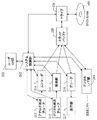
図19に示すように、DVDレコーダは、ユーザへの表示およびユーザからの要求を受け付けるユーザインターフェース部222、DVDレコーダ全体の管理および制御を司るシステム制御部212、VHFおよびUHFを受信するアナログ放送チューナ213、アナログ信号をデジタル信号に変換しMPEGプログラムストリームにエンコードするエンコーダ214、デジタル衛星放送を受信するデジタル放送チューナ215、デジタル衛星で送られるMPEGトランスポートストリームを解析する解析部216、テレビおよびスピーカなどの表示部217、AVストリームをデコードするデコーダ218とを備える。デコーダ218は、図18に示した第1及び第2のデコーダ等からなる。さらに、DVDレコーダは、デジタルインターフェース部219と、書きこみデータを一時的に格納するトラックバッファ220と、DVD−RAM100にデータを書きこむドライブ221とを備える。デジタルインターフェース部219はIEEE1394等の通信手段により外部機器にデータを出力するインターフェースである。
As shown in FIG. 19, the DVD recorder has a
このように構成されるDVDレコーダにおいては、ユーザインターフェース部222が最初にユーザからの要求を受ける。ユーザインターフェース部222はユーザからの要求をシステム制御部212に伝え、システム制御部212はユーザからの要求を解釈すると共に各モジュールへの処理要求を行う。
In the DVD recorder configured as described above, the
録画には、入力されるデジタルデータを自らエンコードするセルフエンコーディングと、エンコード済みのデジタルデータをエンコードすることなくディスクに記録するアウトサイドエンコーディングがある。 Recording includes self-encoding that encodes input digital data by itself and outside encoding that records encoded digital data on a disc without encoding.
(7.1 セルフエンコーディングによる録画動作)
最初にセルフエンコーディングの録画について、アナログ放送をPS−VOBにエンコードして記録する動作を以下、具体的に説明する。
(7.1 Recording operation by self-encoding)
First, with respect to self-encoding recording, an operation of encoding an analog broadcast into PS-VOB and recording it will be specifically described below.
システム制御部212はアナログ放送チューナ213への受信とエンコーダ部214へのエンコードを要求する。
The
エンコーダ部214はアナログ放送チューナ213から送られるAVデータをビデオエンコード、オーディオエンコードおよびシステムエンコードしてトラックバッファ220に送出する。
The
エンコーダ部214は、エンコード開始直後に、エンコードしているMPEGプログラムストリームの先頭データが有するタイムスタンプ情報を再生開始時刻(PS_VOB_V_S_PTM)としてシステム制御部212に送り、続いてアクセスマップを作成するために必要な情報をエンコード処理と平行してシステム制御部212に送る。この値は、後に生成される図17に示すセル情報のStart_PTMに設定される。タイムスタンプ情報は、一般的にはPTSになるがSCRで代用しても良い。
The
次にシステム制御部212は、ドライブ221に対して記録要求を出し、ドライブ221はトラックバッファ220に蓄積されているデータを取り出しDVD−RAMディスク100に記録する。この際、前述した連続領域(CDA)をディスク上の記録可能領域から検索し、検索した連続領域にデータを記録していく。
Next, the
録画終了はユーザからのストップ要求によって指示される。ユーザからの録画停止要求は、ユーザインターフェース部222を通してシステム制御部212に伝えられ、システム制御部212はアナログ放送チューナ213とエンコーダ部214に対して停止要求を出す。
The end of recording is instructed by a stop request from the user. The recording stop request from the user is transmitted to the
エンコーダ214はシステム制御部212からのエンコード停止要求を受けエンコード処理を止め、最後にエンコードを行ったMPEGプログラムストリームの終端データが有するタイムスタンプ情報を再生終了時刻(PS_VOB_V_E_PTM)として、システム制御部212に送る。この値は、図17に示すセル情報のEnd_PTMに設定される。タイムスタンプ情報は通常PTSが設定されるが、SCRで代用しても良い。
The
システム制御部212は、エンコード処理終了後、エンコーダ214から受け取った情報に基づき、図15に示すPS−VOB用のVOB情報(PS−VOBI)と再生制御情報を生成する。
After the encoding process is completed, the
ここで、生成されるVOB情報はオブジェクト種類に適合したアクセスマップとマップ管理情報とを含む。システム制御部212は、マップ管理情報のマップ有効性情報を有効に設定すると共に、自己エンコーディングフラグをONにする。
Here, the generated VOB information includes an access map suitable for the object type and map management information. The
また、再生制御情報は、記録されるオブジェクトを再生対象の1つとする図16に示すオリジナル再生経路(O−PGC情報)が生成される。生成されたO−PGC情報はオリジナル再生経路テーブルに追記される。オリジナル再生経路(O−PGC情報)はセル情報を有する。セル情報のタイプ情報には「PS−VOB」が設定される。 Further, as the reproduction control information, an original reproduction path (O-PGC information) shown in FIG. 16 is generated, in which an object to be recorded is one of reproduction targets. The generated O-PGC information is added to the original reproduction path table. The original reproduction path (O-PGC information) has cell information. “PS-VOB” is set in the type information of the cell information.
最後にシステム制御部212は、ドライブ221に対してトラックバッファ220に蓄積されているデータの記録終了と、PS−VOB用のVOB情報(PS_VOBI)および再生制御情報の記録を要求し、ドライブ221がトラックバッファ220の残りデータと、これらの情報をDVD−RAMディスク100に記録し、録画処理を終了する。
Finally, the
なお、アナログ放送をTS1−VOBにエンコードしてももちろん良い。この場合、エンコーダ214はアナログ信号をデジタル信号に変換しMPEGトランスポートストリームにエンコードするエンコーダである必要があり、セル情報内のタイプ情報は「TS1−VOB」に設定される。
この場合のStart_PTMおよびEnd_PTMは、PTSでも良いしPCRを用いても良い。
Of course, analog broadcasting may be encoded into TS1-VOB. In this case, the
In this case, Start_PTM and End_PTM may be PTS or PCR.
(7.2 アウトサイドエンコーディングによる録画動作)
次にアウトサイドエンコーディングによる録画について、デジタル放送を録画する動作を通して以下、具体的に説明する。この場合、記録されるオブジェクトの種類はTS2−VOBになる。
(7.2 Recording operation by outside encoding)
Next, recording by outside encoding will be specifically described below through an operation of recording a digital broadcast. In this case, the type of object to be recorded is TS2-VOB.
ユーザによるデジタル放送録画要求は、ユーザインターフェース部222を通してシステム制御部212に伝えられる。システム制御部212はデジタル放送チューナ215への受信と解析部216へのデータ解析を要求する。
A digital broadcast recording request by the user is transmitted to the
デジタル放送チューナ215から送られるMPEGトランスポートストリームは解析部216を通してトラックバッファ220へ転送される。
The MPEG transport stream sent from the
解析部216は、最初にデジタル放送として受信されたエンコード済みのMPEGトランスポートストリーム(TS2−VOB)のVOB情報(TS2_VOBI)の生成に必要な情報として、トランスポートストリームの先頭データが有するタイムスタンプ情報を開始時刻情報(TS2_VOB_V_S_PTM)として抽出し、システム制御部212に送る。開始時刻情報は、後に生成される図17に示すセル情報のStart_PTMに設定される。このタイムスタンプ情報は、PCR又はPTSになる。また、オブジェクトがDVDレコーダに伝送されてくるタイミングであるATSで代用しても良い。
The
解析部216は、さらに、MPEGトランスポートストリームのシステム層を解析し、アクセスマップ作成に必要な情報を検出する。Iピクチャのオブジェクト内での位置については、前述したようにTSパケットヘッダ中の適用フィールド(adaptation field)内のランダムアクセスインジケータ(randam_access_indicator)をもとに検出する。
The
次にシステム制御部212は、ドライブ221に対して記録要求を出力し、ドライブ221はトラックバッファ220に蓄積されているデータを取り出しDVD−RAMディスク100に記録する。この時、システム制御部212はファイルシステムのアロケーション情報からディスク上のどこに記録するかをあわせてドライブ221に指示する。この際、前述した連続領域(CDA)をディスク上の記録可能領域から検索し、検索した連続領域にデータを記録していく。
Next, the
録画終了はユーザからのストップ要求によって指示される。ユーザからの録画停止要求は、ユーザインターフェース部222を通してシステム制御部212に伝えられ、システム制御部212はデジタルチューナ215と解析部216に停止要求を出す。
The end of recording is instructed by a stop request from the user. The recording stop request from the user is transmitted to the
解析部216はシステム制御部212からの解析停止要求を受け解析処理を止め、最後に解析を行ったMPEGトランスポートストリームの終了区間のデータが有するタイムスタンプ情報を表示終了時刻(TS2_VOB_V_E_PTM)としてシステム制御部212に送る。この値は、図17に示すセル情報のEnd_PTMに設定される。このタイムスタンプ情報は、PCR又はPTSになる。また、オブジェクトがDVDレコーダに伝送されてくるタイミングであるATSで代用しても良い。
The
システム制御部212は、デジタル放送の受信処理終了後、解析部216から受け取った情報に基づき、図15に示すTS2−VOB用のVOB情報(TS2_VOBI)と再生制御情報を生成する。
The
ここで、生成されるVOB情報はオブジェクト種類に適合したアクセスマップとマップ管理情報とを含む。システム制御部212は、Iピクチャのオブジェクト内での位置等を検出でき有効なアクセスマップを生成した場合にはマップ管理情報のマップ有効性情報を有効に設定する。また自己エンコーディングフラグはOFF設定をする。有効なアクセスマップを生成できなかった場合にはマップ有効性情報を無効に設定する。なお、有効なアクセスマップを生成できないケースとしては、対応していないデジタル放送を受信した場合や、適用フィールドにランダムアクセス情報が無い場合等が考えられる。また、デジタルI/Fから直接入力された場合は、MPEGトランスポートストリームでないケースもありえ、この場合も当然、マップ有効性情報は無効に設定される。
Here, the generated VOB information includes an access map suitable for the object type and map management information. When the
また、再生制御情報は、記録されるオブジェクトを再生対象の1つとする図16に示すオリジナル再生経路(O−PGC情報)が生成される。生成されたO−PGC情報はオリジナル再生経路テーブルに追記される。オリジナル再生経路(O−PGC情報)はセル情報を有する。セル情報のタイプ情報には「TS2−VOB」が設定される。 Further, as the reproduction control information, an original reproduction path (O-PGC information) shown in FIG. 16 is generated, in which an object to be recorded is one of reproduction targets. The generated O-PGC information is added to the original reproduction path table. The original reproduction path (O-PGC information) has cell information. “TS2-VOB” is set in the type information of the cell information.
最後にシステム制御部212は、ドライブ221に対してトラックバッファ220に蓄積されているデータの記録終了と、TS2−VOB用のVOB情報(TS2_VOBI)および再生制御情報の記録を要求し、ドライブ221がトラックバッファ220の残りデータと、これらの情報をDVD−RAMディスク100に記録し、録画処理を終了する。
Finally, the
以上、ユーザからの録画開始および終了要求をもとに動作を説明したが、例えば、VTRで使用されているタイマー録画の場合では、ユーザの代わりにシステム制御部が自動的に録画開始および終了要求を発行するだけであって、本質的にDVDレコーダの動作が異なるものではない。 The operation has been described above based on the recording start and end requests from the user. For example, in the case of timer recording used in a VTR, the system control unit automatically requests recording start and end instead of the user. The operation of the DVD recorder is not essentially different.
(8.詳細な実施形態)
(実施の形態1)
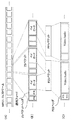
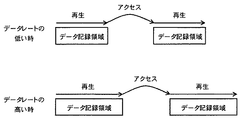
図20はAVストリームファイルの配置を示す図である。AVストリームファイルが複数の連続領域に分割して記録される例を、データレートが低い場合と高い場合に分けて示している。データレートが低い場合は、高い場合に比べ、連続再生を行うために必要な連続領域の長さは短い。領域間のアクセス時間を最大アクセス時間と仮定して、ピックアップが、次の連続領域へアクセスしても連続再生が途切れないような連続領域の長さが予め定められている。例えば、データレートが、25Mbps(Mega bits/秒)の連続領域の長さが10MB(Mega Bytes)、30Mbpsでは、20MBと定められているとする。AVストリームファイルを記録する際に、記録するデータレートに応じて、このような、2つの配置ルールがある。
(8. Detailed embodiment)
(Embodiment 1)
FIG. 20 shows the arrangement of AV stream files. An example in which an AV stream file is divided and recorded in a plurality of continuous areas is shown separately when the data rate is low and when the data rate is high. When the data rate is low, the length of the continuous area necessary for continuous playback is shorter than when the data rate is high. Assuming that the access time between areas is the maximum access time, the length of the continuous area is determined in advance so that the continuous reproduction is not interrupted even if the pickup accesses the next continuous area. For example, it is assumed that the length of a continuous area with a data rate of 25 Mbps (Mega bits / second) is set to 10 MB (Mega Bytes), and 30 Mbps is set to 20 MB. When an AV stream file is recorded, there are two such arrangement rules according to the data rate to be recorded.
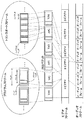
本発明では、これらの2つの配置ルールを識別するために、この識別情報を、AVストリームファイルを管理するVOB情報(VOBI)の中に記録することを特徴とする。VOBIには、データのレート情報も記録されるために、配置ルールの情報を合わせて記録することで、再生機器が、対応するAVストリームファイルを再生する場合に、必要なバッファサイズを設定することができ、より確実な、連続再生を行うことが出来るようになる。 In the present invention, in order to identify these two arrangement rules, this identification information is recorded in VOB information (VOBI) for managing the AV stream file. Since the data rate information is also recorded in the VOBI, the necessary buffer size is set when the playback device plays back the corresponding AV stream file by recording the layout rule information together. This makes it possible to perform more reliable continuous playback.
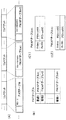
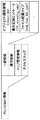
図21は、VOBI内に設定された、配置ルールの識別情報のフィールドを表す図である。real−time_file_typeフィールドに、配置ルールの情報が記録される。値が1の場合は、対応するAVストリームファイルが第1の配置ルールで記録されるファイルであることを示しており、値が2の場合には、対応するAVストリームファイルが第2の配置ルールで記録されるファイルであることを示している。TS_recording_rateフィールドには、対応するAVストリームファイルに記録されているAVストリーム・データの最大データレートの値が記録される。 FIG. 21 is a diagram showing fields of identification information of arrangement rules set in VOBI. Placement rule information is recorded in the real-time_file_type field. When the value is 1, it indicates that the corresponding AV stream file is a file recorded by the first placement rule. When the value is 2, the corresponding AV stream file is the second placement rule. Indicates that the file is recorded. In the TS_recording_rate field, the maximum data rate value of the AV stream data recorded in the corresponding AV stream file is recorded.
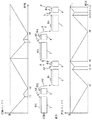
図22は、同時録再モデルに従って、複数のAVストリーム・データを同時に録画・再生する方法(同時録再の方法)についての原理を説明する図であり、図23は、2つのAVストリーム・データを同時録再する同時録再モデルを示す図である。 FIG. 22 is a diagram for explaining the principle of a method for simultaneously recording and reproducing a plurality of AV stream data according to the simultaneous recording / reproducing model (simultaneous recording / reproducing method), and FIG. 23 shows two AV stream data. It is a figure which shows the simultaneous recording / reproducing model which records and reproduces simultaneously.
同時録再モデルは、情報記録媒体に対してAVストリーム・データを記録再生するピックアップ64と、第1のAVストリーム・データを符号化するエンコーダ60と、符号化された第1のAVストリーム・データをピックアップ64により記録する前に一時的に保持する記録バッファ62と、ピックアップ64により再生された第2のAVストリーム・データを一時的に保持する再生バッファ63と、再生バッファ63から転送された第2のAVストリーム・データを復号化するデコーダ61とを含む。ここで、AVストリーム・データとは、映像データおよび音声データのうちの少なくとも一方を含むデータをいう。情報記録媒体とは、光ディスクなどの任意のタイプの記録媒体をいう。
The simultaneous recording / reproducing model includes a
図22は、AVストリーム・データA、Bを同時録再する場合における、同時録再モデルの記録バッファ62、再生バッファ63内のデータ量の推移を示す。この図に示される例では、AVストリーム・データAを情報記録媒体上の領域1、2、3、4に記録しながら、情報記録媒体上の領域5、6、7、8に記録されたAVストリーム・データBを再生する。ここで、領域1〜4は、AVストリーム・データAを記録する領域として割付けられた領域であり、領域5〜8は、AVストリーム・データBを記録した領域として割付けられた領域である。
FIG. 22 shows changes in the amount of data in the
図22において、A1〜A7は、ピックアップ64がアクセスすべき領域間を移動する動作(アクセス動作)を示す。アクセス動作A1〜A7に必要な時間は、それぞれ、ピックアップ64が情報記録媒体の最内周にある領域と最外周にある領域との間をアクセスするのに必要な時間(すなわち、最大アクセス時間Ta)であるとする。記録バッファ62、再生バッファ63とピックアップ64との間のデータ転送レートは、ピックアップ64がデータの記録または再生を行うときのデータレートであり、一定値のVtであるとする。エンコーダ60と記録バッファ62との間のデータ転送レートおよびデコーダ61と再生バッファ63との間のデータ転送レートは、一定のVdであるとする。Vdは、記録再生されるデータが可変レートで圧縮されている場合には、その可変レートの最大値である。
In FIG. 22, A1 to A7 indicate an operation (access operation) in which the
記録動作W1において、記録バッファ62に蓄積されたAVストリーム・データAが領域1に記録される。領域1の終端において記録バッファ62はエンプティでないため、AVストリーム・データAの記録動作からAVストリーム・データBの再生動作への切り替えは発生しない。アクセス動作A1の後、記録動作W2において、記録バッファ62に蓄積されたAVストリーム・データAが領域2に記録される。
In the recording operation W1, the AV stream data A stored in the
記録動作W2を実行している間に、記録バッファ62がエンプティになる。その結果、AVストリーム・データAの記録動作からAVストリーム・データBの再生動作への切り替えが発生する(アクセス動作A2)。
While the recording operation W2 is being executed, the
再生動作R1において、領域5からAVストリーム・データBが読み出され、再生バッファ63に蓄積される。領域5の終端において再生バッファ63はフルではないため、AVストリーム・データBの再生動作からAVストリーム・データAの記録動作への切り替えは発生しない。アクセス動作A3の後、再生動作R2において、領域6からAVストリーム・データBが読み出され、再生バッファ63に蓄積される。
In the
再生動作R2を実行している間に、再生バッファ63がフルになる。その結果、AVストリーム・データBの再生動作からAVストリーム・データAの記録動作への切り替えが発生する(アクセス動作A4)。
While the reproduction operation R2 is being executed, the
このように、同時録再の方法は、多くとも1回のアクセス動作と多くとも2回の記録動作とによって記録バッファ62をエンプティにすることができるという条件と、多くとも1回のアクセス動作と多くとも2回の再生動作とによって再生バッファ63をフルにすることができるという条件との両方を満たすように設計されている。すなわち、同時録再の条件は、これらの2つの条件の両方を満たすことである。これにより、記録バッファ62、再生バッファ63をオーバーフローさせることなく、記録バッファ62、再生バッファ63をアンダーフローさせることなく、AVストリーム・データAを情報記録媒体に記録しつつ、情報記録媒体に記録されたAVストリーム・データBを再生することを保証することが可能になる。
As described above, the simultaneous recording / reproducing method is based on the condition that the
例えば、AVストリーム・データAを記録する領域として割付けられた少なくとも1つの記録領域のそれぞれがY以上のサイズを有し、かつ、AVストリーム・データBが記録された領域として割付けられた少なくとも1つの再生領域のそれぞれがY以上のサイズを有することにより、同時録再条件を満たすことができる。 For example, each of at least one recording area allocated as an area for recording AV stream data A has a size equal to or larger than Y, and at least one allocated as an area in which AV stream data B is recorded Since each reproduction area has a size equal to or larger than Y, the simultaneous recording / playback condition can be satisfied.
従って、同時録再条件を満たすためには、Y以上のサイズを有する少なくとも1つの未割付け領域を検索し、そのようにして検索された少なくとも1つの記録領域をAVストリーム・データAを記録する領域として割付けるようにすればよい。 Therefore, in order to satisfy the simultaneous recording / playback condition, at least one unallocated area having a size equal to or larger than Y is searched, and the AV stream data A is recorded in at least one recording area thus searched. Should be assigned as
AVストリーム・データBを記録する領域についても同様である。 The same applies to the area for recording the AV stream data B.
図22に示される例では、領域1〜4のそれぞれが含まれる記録領域がY以上のサイズを有し、かつ、領域5〜8のそれぞれが含まれる再生領域がY以上のサイズを有することにより同時録再条件を満たすことができる。すなわち、領域2と3は連続した記録領域であり、領域6と7は連続した再生領域である。
In the example shown in FIG. 22, the recording area including each of the
ここで、記録領域、再生領域の最小サイズYと、記録バッファ62、再生バッファ63に必要なバッファサイズBとは、以下の式に従って求められる。
Here, the minimum size Y of the recording area and the reproduction area and the buffer size B required for the
Y=4×Ta×Vd×Vt÷(Vt−2×Vd)
B=(4×Ta+Y÷Vt)×Vd
記録領域、再生領域の最小サイズYの式は、以下のようにして導かれる。
Y = 4 × Ta × Vd × Vt ÷ (Vt−2 × Vd)
B = (4 × Ta + Y ÷ Vt) × Vd
The expression of the minimum size Y of the recording area and the reproduction area is derived as follows.
AVストリーム・データAの記録動作において、記録バッファ62内のデータは、Vt−Vdで消費され、アクセス動作およびAVストリーム・データBの再生動作において、記録バッファ62内のデータは、Vdで蓄積される。記録動作W1、アクセス動作A1、記録動作W2の間に消費される記録バッファ62のデータ量と、アクセス動作A2、再生動作R1、アクセス動作A3、再生動作R2およびアクセス動作A4の間に蓄積される記録バッファ62のデータ量とは等しい。
In the recording operation of the AV stream data A, the data in the
従って、2つのAVストリーム・データを同時録再する場合には、以下の式が成り立つ。 Therefore, when recording and reproducing two AV stream data at the same time, the following equation is established.
Y÷Vt×(Vt−Vd)−Ta×Vd=(3×Ta+Y÷Vt)×Vd
この式を変形することにより、記録領域、再生領域の最小サイズYの式が得られる。
Y ÷ Vt × (Vt−Vd) −Ta × Vd = (3 × Ta + Y ÷ Vt) × Vd
By transforming this equation, an equation for the minimum size Y of the recording area and the reproduction area can be obtained.
複数の機器間で、同時録再を行うためには、上記の同時録再の条件を満たすようにデータをディスク上に配置する必要がある。しかしながら、先に説明したように、同時録再をサポートしない機器が、1つのAVストリームデータのみを連続再生できるように、データを配置する場合がある。この場合には、同時録再の条件から決まる領域のサイズより小さな領域にデータが配置される場合があり、このデータを再生しながら、他のデータを同時に記録することが出来ない。 In order to perform simultaneous recording / playback between a plurality of devices, it is necessary to arrange data on the disk so as to satisfy the above-mentioned simultaneous recording / playback conditions. However, as described above, data may be arranged so that a device that does not support simultaneous recording / playback can continuously reproduce only one AV stream data. In this case, data may be arranged in an area smaller than the size of the area determined by the simultaneous recording / reproducing condition, and other data cannot be recorded simultaneously while reproducing this data.
このため、本発明では、AVストリームを記録する場合に、同時録再の条件を満たすような配置ルールで記録したか、もしくは、1つのAVストリームのみを再生できる条件を満たす配置ルールで記録したのかを、識別する情報を、ディスク上に記録することが有用である。図21で説明したVOBI内に設定された、配置ルールの識別情報のフィールドに、これらの情報を記録してもよい。すなわち、real−time_file_typeフィールドにおいて、値が3と4の場合は、同時録再において、再生が可能なようにデータが配置されていることを示している。また、値が3の場合は、対応するAVストリームファイルが、データレート25Mbpsとして、第3の配置ルールで記録されたファイルであることを示しており、値が4の場合には、対応するAVストリームファイルがデータレート30Mbpsとして、第2の配置ルールで記録されたファイルであることを示している。 For this reason, in the present invention, when recording an AV stream, is it recorded according to an arrangement rule that satisfies the simultaneous recording / playback condition, or is it recorded according to an arrangement rule that satisfies the condition that only one AV stream can be played back? It is useful to record information for identifying the disc on the disc. These pieces of information may be recorded in the field of the identification information of the arrangement rule set in the VOBI described with reference to FIG. That is, in the real-time_file_type field, values of 3 and 4 indicate that data is arranged so that playback is possible in simultaneous recording and playback. Further, a value of 3 indicates that the corresponding AV stream file is a file recorded at the data rate of 25 Mbps according to the third arrangement rule. A value of 4 indicates that the corresponding AV stream file is a corresponding AV stream file. This indicates that the stream file is a file recorded with the second arrangement rule at a data rate of 30 Mbps.
このように、同時録再可能なAVストリームファイルと同時録再が出来ないAVストリームファイルが、混在してディスク上に記録される場合に、どのファイルが、同時録再可能かを容易に識別できるように、識別情報を持つことで、記録機器を操作するユーザが同時録再を行うに、記録機器が同時録再できるかどうかをユーザに通知することが出来るようになる。 As described above, when AV stream files that can be simultaneously recorded and played back and AV stream files that cannot be played back simultaneously are recorded on the disc, it is possible to easily identify which files can be simultaneously recorded and played back. As described above, having the identification information enables the user who operates the recording device to notify the user whether the recording device can perform simultaneous recording / playback when performing simultaneous recording / playback.
なお、配置ルールの情報をVOBIに記録する例を説明したが、配置ルールの情報をPGCに記録してもよい。 In addition, although the example which records the information of arrangement | positioning rule on VOBI was demonstrated, you may record information on arrangement | positioning rule on PGC.
なお、記録するデータレートが2種類ある例を説明したが、2種類に限定されない。また、複数のデータレートのAVストリームファイルが記録される場合、データレートの低いAVストリームファイルが同時録再できるようにするには、記録するAVストリームファイルが再生される場合のデータレートと、将来の同時録再において、記録されるAVストリームファイルの想定される最大のデータレートとで、同時録再の条件を満たすようにすればよい。 In addition, although the example which has two types of data rates to record was demonstrated, it is not limited to two types. Further, when AV stream files having a plurality of data rates are recorded, in order to be able to simultaneously record / reproduce AV stream files having a low data rate, the data rate when the AV stream file to be recorded is reproduced and the future In the simultaneous recording / playback, the simultaneous recording / playback condition may be satisfied with the maximum data rate assumed for the AV stream file to be recorded.
すなわち、これから記録するAVストリームファイルのデータレートをVd1,将来の同時録再において、記録されるAVストリームファイルの想定される最大のデータレートVd2として、記録領域の最小サイズYは、以下の式に従って求められる。 That is, assuming that the data rate of the AV stream file to be recorded is Vd1, and the maximum data rate Vd2 assumed for the AV stream file to be recorded in the future simultaneous recording / playback, the minimum size Y of the recording area is given by the following equation: Desired.
Y=4×Ta×Vd1×Vt÷(Vt−Vd1−Vd2)
尚、上記説明においては、real_time_file_typeを個々のストリーム管理情報(VOB情報)に格納するとして説明してきたが、本発明はこれに限らず、図15(a)のコンテンツ全体を管理するビデオ管理情報(Video Manager)に格納しても良い。
Y = 4 × Ta × Vd1 × Vt ÷ (Vt−Vd1−Vd2)
In the above description, real_time_file_type has been described as being stored in individual stream management information (VOB information). However, the present invention is not limited to this, and video management information (FIG. 15A) for managing the entire content ( (Video Manager) may be stored.
この場合の利点は、このビデオ管理情報によって管理されたディスク上(ボリューム)のストリーム配置は全て指定されたreal_time_file_typeを満たすように設定されることとなり、このディスク(ボリューム)に対して同時録再が可能か否かの判断になり、個々のストリーム単位で管理した場合よりもユーザーに分かりやすいシステムを提供することが可能となる。 The advantage in this case is that all the stream arrangements on the disk (volume) managed by this video management information are set to satisfy the specified real_time_file_type, and simultaneous recording / playback is performed for this disk (volume). It is determined whether or not it is possible, and it becomes possible to provide a system that is easier for the user to understand than in the case where the management is performed in units of individual streams.
尚、ディスク単位での同時録再が可能か否かを判定するのに、記録媒体であるディスク自体が2倍速記録/再生に対応したディスクか否かをドライブが判定し、もし2倍速以上に対応したディスクであれば、全て所定の記録レートに対応した配置ルールでAVストリームファイルを配置するとしても良い。 In order to determine whether or not simultaneous recording / playback in units of disks is possible, the drive determines whether or not the disk itself, which is a recording medium, is a disk that supports double-speed recording / playback. If the disc is compatible, AV stream files may be arranged according to an arrangement rule corresponding to a predetermined recording rate.
この場合は、ユーザーが2倍速以上に対応したディスクと、同時録再に対応した機器の組み合わせで、該ディスクに対して、同時録再できることが容易に判断でき、機器利用の利便性が向上する。 In this case, the user can easily determine that simultaneous recording / playback can be performed on the disc by combining a disc compatible with double speed or higher and a device compatible with simultaneous recording / playback, thereby improving the convenience of using the device. .
尚、上記説明においては、real_time_file_typeの情報からのみで、記録するAVストリームのデータレートと、同時録再可能か否かを示すとして説明したが、本発明はこれに限らず、TS_recording_rate(該AVストリームの瞬間的な最大記録レート)と、同時録再可能か否かの1ビットのフラグ情報の2つを組み合わせてreal_time_file_typeと同等の効果を得ても良い。 In the above description, it has been described that the data rate of the AV stream to be recorded and whether simultaneous recording / playback is possible or not are based only on the information of real_time_file_type, but the present invention is not limited to this, and TS_recording_rate (the AV stream 2) and 1-bit flag information indicating whether simultaneous recording / playback is possible may be combined to obtain an effect equivalent to that of real_time_file_type.
本発明は、特定の実施形態について説明されてきたが、当業者にとっては他の多くの変形例、修正、他の利用が明らかである。それゆえ、本発明は、ここでの特定の開示に限定されず、添付の請求の範囲によってのみ限定され得る。 Although the present invention has been described with respect to particular embodiments, many other variations, modifications, and other uses will be apparent to those skilled in the art. Accordingly, the invention is not limited to the specific disclosure herein, but can be limited only by the scope of the appended claims.
本発明によれば、リアルタイムデータを記録する際にその配置情報をディスク上に記録することで、AVストリーム・データの再生を容易にし、更に、同時録再における機器間の互換性を高めることが出来ることが期待される。 According to the present invention, when real-time data is recorded, the arrangement information is recorded on the disk, thereby facilitating the reproduction of AV stream data and further improving the compatibility between devices in simultaneous recording / playback. It is expected to be possible.
Claims (3)
Priority Applications (1)
| Application Number | Priority Date | Filing Date | Title |
|---|---|---|---|
| JP2004109820A JP2005293764A (en) | 2004-04-02 | 2004-04-02 | Information recording medium, apparatus and method for recording / reproducing information on information recording medium |
Applications Claiming Priority (1)
| Application Number | Priority Date | Filing Date | Title |
|---|---|---|---|
| JP2004109820A JP2005293764A (en) | 2004-04-02 | 2004-04-02 | Information recording medium, apparatus and method for recording / reproducing information on information recording medium |
Publications (1)
| Publication Number | Publication Date |
|---|---|
| JP2005293764A true JP2005293764A (en) | 2005-10-20 |
Family
ID=35326522
Family Applications (1)
| Application Number | Title | Priority Date | Filing Date |
|---|---|---|---|
| JP2004109820A Pending JP2005293764A (en) | 2004-04-02 | 2004-04-02 | Information recording medium, apparatus and method for recording / reproducing information on information recording medium |
Country Status (1)
| Country | Link |
|---|---|
| JP (1) | JP2005293764A (en) |
Cited By (1)
| Publication number | Priority date | Publication date | Assignee | Title |
|---|---|---|---|---|
| JP2008276877A (en) * | 2007-04-27 | 2008-11-13 | Toshiba Corp | Information recording apparatus, information recording method, information reproducing apparatus, and information reproducing method |
-
2004
- 2004-04-02 JP JP2004109820A patent/JP2005293764A/en active Pending
Cited By (1)
| Publication number | Priority date | Publication date | Assignee | Title |
|---|---|---|---|---|
| JP2008276877A (en) * | 2007-04-27 | 2008-11-13 | Toshiba Corp | Information recording apparatus, information recording method, information reproducing apparatus, and information reproducing method |
Similar Documents
| Publication | Publication Date | Title |
|---|---|---|
| JP3863528B2 (en) | Stream converting apparatus and method, information recording apparatus and method, and information recording medium | |
| US7305170B2 (en) | Information recording medium, apparatus and method for recording or reproducing data thereof | |
| JP3863526B2 (en) | Stream converting apparatus and method, information recording apparatus and method, and information recording medium | |
| JP4527164B2 (en) | Recording medium, recording apparatus, and reproducing apparatus | |
| JP2002325221A (en) | Information recording medium and device for recording and reproducing information on the information recording medium | |
| JP4313521B2 (en) | Information information recording medium, recording apparatus, recording method, reproducing apparatus, reproducing method, and program | |
| JP2003022658A (en) | Information recording medium, device for recording and reproducing information on information recording medium | |
| JP3862630B2 (en) | Information recording medium, apparatus and method for recording information on information recording medium | |
| JPH11298845A (en) | Optical disk, optical disk recorder and optical disk player | |
| JP2002358728A (en) | Information recording medium, device for recording and reproducing information on information recording medium | |
| JP3937949B2 (en) | Image recording device | |
| KR20060066613A (en) | Optical disc device, optical disc recording method and optical disc | |
| JP2002369138A (en) | Information recording medium, device for recording and reproducing information on information recording medium | |
| JP2002335483A (en) | Information recording medium, device for recording and reproducing information on information recording medium | |
| JP2002343030A (en) | Information recording medium, device for recording and reproducing information on information recording medium | |
| JP2002344887A (en) | Information reproducing apparatus and reproducing method | |
| JP2002334561A (en) | Information recording medium, device for recording and reproducing information on information recording medium | |
| JP2003061032A (en) | Information recording medium | |
| JP2003022608A (en) | Information recording medium, device for recording information on information recording medium | |
| JP2002335477A (en) | Information recording medium, device for recording and reproducing information on information recording medium | |
| JP2002367341A (en) | Information recording medium, device for recording and reproducing information on information recording medium | |
| JP2002358729A (en) | Information recording medium, device for recording and reproducing information on information recording medium | |
| JP2002369137A (en) | Information recording medium | |
| JP2006031744A (en) | AV data recording apparatus and reproducing apparatus | |
| JP2002344888A (en) | Information recording medium |