JP2005292807A - Silver halide photographic light-sensitive material - Google Patents
Silver halide photographic light-sensitive material Download PDFInfo
- Publication number
- JP2005292807A JP2005292807A JP2005056707A JP2005056707A JP2005292807A JP 2005292807 A JP2005292807 A JP 2005292807A JP 2005056707 A JP2005056707 A JP 2005056707A JP 2005056707 A JP2005056707 A JP 2005056707A JP 2005292807 A JP2005292807 A JP 2005292807A
- Authority
- JP
- Japan
- Prior art keywords
- group
- atom
- silver halide
- general formula
- heterocyclic
- Prior art date
- Legal status (The legal status is an assumption and is not a legal conclusion. Google has not performed a legal analysis and makes no representation as to the accuracy of the status listed.)
- Pending
Links
- -1 Silver halide Chemical class 0.000 title claims abstract description 416
- 229910052709 silver Inorganic materials 0.000 title claims abstract description 221
- 239000004332 silver Substances 0.000 title claims abstract description 221
- 239000000463 material Substances 0.000 title claims abstract description 88
- 239000000839 emulsion Substances 0.000 claims abstract description 225
- 238000011161 development Methods 0.000 claims abstract description 41
- 229910021607 Silver chloride Inorganic materials 0.000 claims abstract description 14
- HKZLPVFGJNLROG-UHFFFAOYSA-M silver monochloride Chemical compound [Cl-].[Ag+] HKZLPVFGJNLROG-UHFFFAOYSA-M 0.000 claims abstract description 14
- 125000000217 alkyl group Chemical group 0.000 claims description 268
- 125000003118 aryl group Chemical group 0.000 claims description 222
- 125000000623 heterocyclic group Chemical group 0.000 claims description 178
- 150000001875 compounds Chemical class 0.000 claims description 132
- 125000004435 hydrogen atom Chemical group [H]* 0.000 claims description 130
- 125000003342 alkenyl group Chemical group 0.000 claims description 85
- 229910052717 sulfur Inorganic materials 0.000 claims description 74
- 125000000304 alkynyl group Chemical group 0.000 claims description 68
- 239000011669 selenium Substances 0.000 claims description 66
- 229910052711 selenium Inorganic materials 0.000 claims description 62
- 125000002252 acyl group Chemical group 0.000 claims description 60
- 125000004429 atom Chemical group 0.000 claims description 55
- 239000010931 gold Substances 0.000 claims description 43
- 125000003917 carbamoyl group Chemical group [H]N([H])C(*)=O 0.000 claims description 42
- 125000001424 substituent group Chemical group 0.000 claims description 42
- 125000003545 alkoxy group Chemical group 0.000 claims description 41
- 125000003277 amino group Chemical group 0.000 claims description 37
- 125000006575 electron-withdrawing group Chemical group 0.000 claims description 34
- 229910052760 oxygen Inorganic materials 0.000 claims description 34
- 125000004434 sulfur atom Chemical group 0.000 claims description 34
- PCHJSUWPFVWCPO-UHFFFAOYSA-N gold Chemical compound [Au] PCHJSUWPFVWCPO-UHFFFAOYSA-N 0.000 claims description 33
- 229910052737 gold Inorganic materials 0.000 claims description 32
- BQCADISMDOOEFD-UHFFFAOYSA-N Silver Chemical compound [Ag] BQCADISMDOOEFD-UHFFFAOYSA-N 0.000 claims description 31
- 125000005161 aryl oxy carbonyl group Chemical group 0.000 claims description 31
- BUGBHKTXTAQXES-UHFFFAOYSA-N Selenium Chemical compound [Se] BUGBHKTXTAQXES-UHFFFAOYSA-N 0.000 claims description 30
- 125000004453 alkoxycarbonyl group Chemical group 0.000 claims description 30
- 125000004433 nitrogen atom Chemical group N* 0.000 claims description 30
- 229910052714 tellurium Inorganic materials 0.000 claims description 27
- 125000002887 hydroxy group Chemical group [H]O* 0.000 claims description 25
- 125000004437 phosphorous atom Chemical group 0.000 claims description 17
- 125000004122 cyclic group Chemical group 0.000 claims description 14
- VOPWNXZWBYDODV-UHFFFAOYSA-N Chlorodifluoromethane Chemical compound FC(F)Cl VOPWNXZWBYDODV-UHFFFAOYSA-N 0.000 claims description 11
- 150000001450 anions Chemical class 0.000 claims description 7
- 206010034972 Photosensitivity reaction Diseases 0.000 claims description 3
- 230000036211 photosensitivity Effects 0.000 claims description 3
- UFHFLCQGNIYNRP-UHFFFAOYSA-N Hydrogen Chemical compound [H][H] UFHFLCQGNIYNRP-UHFFFAOYSA-N 0.000 claims description 2
- 229910052739 hydrogen Inorganic materials 0.000 claims description 2
- 239000001257 hydrogen Substances 0.000 claims description 2
- 238000012545 processing Methods 0.000 abstract description 49
- 206010070834 Sensitisation Diseases 0.000 abstract description 47
- 230000008313 sensitization Effects 0.000 abstract description 47
- 230000035945 sensitivity Effects 0.000 abstract description 26
- 230000003287 optical effect Effects 0.000 abstract description 14
- AJDUTMFFZHIJEM-UHFFFAOYSA-N n-(9,10-dioxoanthracen-1-yl)-4-[4-[[4-[4-[(9,10-dioxoanthracen-1-yl)carbamoyl]phenyl]phenyl]diazenyl]phenyl]benzamide Chemical compound O=C1C2=CC=CC=C2C(=O)C2=C1C=CC=C2NC(=O)C(C=C1)=CC=C1C(C=C1)=CC=C1N=NC(C=C1)=CC=C1C(C=C1)=CC=C1C(=O)NC1=CC=CC2=C1C(=O)C1=CC=CC=C1C2=O AJDUTMFFZHIJEM-UHFFFAOYSA-N 0.000 abstract 1
- 239000001043 yellow dye Substances 0.000 abstract 1
- 239000010410 layer Substances 0.000 description 225
- 239000003381 stabilizer Substances 0.000 description 68
- SQGYOTSLMSWVJD-UHFFFAOYSA-N silver(1+) nitrate Chemical compound [Ag+].[O-]N(=O)=O SQGYOTSLMSWVJD-UHFFFAOYSA-N 0.000 description 62
- 238000000034 method Methods 0.000 description 59
- 150000003839 salts Chemical class 0.000 description 52
- 239000000243 solution Substances 0.000 description 44
- ADZWSOLPGZMUMY-UHFFFAOYSA-M silver bromide Chemical compound [Ag]Br ADZWSOLPGZMUMY-UHFFFAOYSA-M 0.000 description 42
- JKFYKCYQEWQPTM-UHFFFAOYSA-N 2-azaniumyl-2-(4-fluorophenyl)acetate Chemical compound OC(=O)C(N)C1=CC=C(F)C=C1 JKFYKCYQEWQPTM-UHFFFAOYSA-N 0.000 description 41
- 229910021612 Silver iodide Inorganic materials 0.000 description 41
- 125000003178 carboxy group Chemical group [H]OC(*)=O 0.000 description 41
- 229940045105 silver iodide Drugs 0.000 description 41
- 125000004432 carbon atom Chemical group C* 0.000 description 40
- 125000005843 halogen group Chemical group 0.000 description 40
- 239000000975 dye Substances 0.000 description 38
- XLYOFNOQVPJJNP-UHFFFAOYSA-N water Substances O XLYOFNOQVPJJNP-UHFFFAOYSA-N 0.000 description 37
- 108010010803 Gelatin Proteins 0.000 description 33
- 229920000159 gelatin Polymers 0.000 description 33
- 239000008273 gelatin Substances 0.000 description 33
- 235000019322 gelatine Nutrition 0.000 description 33
- 235000011852 gelatine desserts Nutrition 0.000 description 33
- 125000000020 sulfo group Chemical group O=S(=O)([*])O[H] 0.000 description 32
- 229910001961 silver nitrate Inorganic materials 0.000 description 31
- 125000004104 aryloxy group Chemical group 0.000 description 30
- 239000002904 solvent Substances 0.000 description 29
- 125000004093 cyano group Chemical group *C#N 0.000 description 28
- 239000003446 ligand Substances 0.000 description 28
- 238000002360 preparation method Methods 0.000 description 28
- 239000011248 coating agent Substances 0.000 description 26
- 238000000576 coating method Methods 0.000 description 26
- 238000002156 mixing Methods 0.000 description 26
- 125000004391 aryl sulfonyl group Chemical group 0.000 description 25
- 239000002245 particle Substances 0.000 description 24
- 229910052751 metal Inorganic materials 0.000 description 23
- 239000002184 metal Substances 0.000 description 23
- 229910052783 alkali metal Inorganic materials 0.000 description 22
- 230000003595 spectral effect Effects 0.000 description 22
- 229910052736 halogen Inorganic materials 0.000 description 21
- 239000000126 substance Substances 0.000 description 21
- FAPWRFPIFSIZLT-UHFFFAOYSA-M Sodium chloride Chemical compound [Na+].[Cl-] FAPWRFPIFSIZLT-UHFFFAOYSA-M 0.000 description 20
- 150000002500 ions Chemical class 0.000 description 20
- IOLCXVTUBQKXJR-UHFFFAOYSA-M potassium bromide Chemical compound [K+].[Br-] IOLCXVTUBQKXJR-UHFFFAOYSA-M 0.000 description 20
- 125000004414 alkyl thio group Chemical group 0.000 description 18
- 125000005110 aryl thio group Chemical group 0.000 description 18
- 125000001951 carbamoylamino group Chemical group C(N)(=O)N* 0.000 description 18
- 239000003112 inhibitor Substances 0.000 description 18
- 125000004430 oxygen atom Chemical group O* 0.000 description 18
- 125000004442 acylamino group Chemical group 0.000 description 17
- 239000000203 mixture Substances 0.000 description 16
- 239000011593 sulfur Substances 0.000 description 16
- NINIDFKCEFEMDL-UHFFFAOYSA-N Sulfur Chemical compound [S] NINIDFKCEFEMDL-UHFFFAOYSA-N 0.000 description 15
- 125000002485 formyl group Chemical group [H]C(*)=O 0.000 description 15
- XMBWDFGMSWQBCA-UHFFFAOYSA-M iodide Chemical compound [I-] XMBWDFGMSWQBCA-UHFFFAOYSA-M 0.000 description 15
- 230000001235 sensitizing effect Effects 0.000 description 15
- XEEYBQQBJWHFJM-UHFFFAOYSA-N Iron Chemical compound [Fe] XEEYBQQBJWHFJM-UHFFFAOYSA-N 0.000 description 14
- 125000001820 oxy group Chemical group [*:1]O[*:2] 0.000 description 14
- 239000004094 surface-active agent Substances 0.000 description 14
- 229940065287 selenium compound Drugs 0.000 description 13
- 239000000084 colloidal system Substances 0.000 description 12
- 125000000449 nitro group Chemical group [O-][N+](*)=O 0.000 description 12
- NLKNQRATVPKPDG-UHFFFAOYSA-M potassium iodide Chemical compound [K+].[I-] NLKNQRATVPKPDG-UHFFFAOYSA-M 0.000 description 12
- QGZKDVFQNNGYKY-UHFFFAOYSA-N Ammonia Chemical compound N QGZKDVFQNNGYKY-UHFFFAOYSA-N 0.000 description 11
- 230000015572 biosynthetic process Effects 0.000 description 11
- 125000001841 imino group Chemical group [H]N=* 0.000 description 11
- 229920000098 polyolefin Polymers 0.000 description 11
- 239000012266 salt solution Substances 0.000 description 11
- XFXPMWWXUTWYJX-UHFFFAOYSA-N Cyanide Chemical compound N#[C-] XFXPMWWXUTWYJX-UHFFFAOYSA-N 0.000 description 10
- 125000004390 alkyl sulfonyl group Chemical group 0.000 description 10
- 150000002367 halogens Chemical class 0.000 description 10
- RAXXELZNTBOGNW-UHFFFAOYSA-N imidazole Natural products C1=CNC=N1 RAXXELZNTBOGNW-UHFFFAOYSA-N 0.000 description 10
- 230000008569 process Effects 0.000 description 10
- 150000003343 selenium compounds Chemical class 0.000 description 10
- 239000011780 sodium chloride Substances 0.000 description 10
- KWYUFKZDYYNOTN-UHFFFAOYSA-M Potassium hydroxide Chemical compound [OH-].[K+] KWYUFKZDYYNOTN-UHFFFAOYSA-M 0.000 description 9
- 125000004397 aminosulfonyl group Chemical group NS(=O)(=O)* 0.000 description 9
- ZBKIUFWVEIBQRT-UHFFFAOYSA-N gold(1+) Chemical class [Au+] ZBKIUFWVEIBQRT-UHFFFAOYSA-N 0.000 description 9
- 125000004149 thio group Chemical group *S* 0.000 description 9
- 239000004698 Polyethylene Substances 0.000 description 8
- FZWLAAWBMGSTSO-UHFFFAOYSA-N Thiazole Chemical compound C1=CSC=N1 FZWLAAWBMGSTSO-UHFFFAOYSA-N 0.000 description 8
- 239000002253 acid Substances 0.000 description 8
- 125000004423 acyloxy group Chemical group 0.000 description 8
- 150000003842 bromide salts Chemical class 0.000 description 8
- 230000000694 effects Effects 0.000 description 8
- 239000007788 liquid Substances 0.000 description 8
- 229910052757 nitrogen Inorganic materials 0.000 description 8
- 239000013110 organic ligand Substances 0.000 description 8
- 229920000573 polyethylene Polymers 0.000 description 8
- 101100221809 Neurospora crassa (strain ATCC 24698 / 74-OR23-1A / CBS 708.71 / DSM 1257 / FGSC 987) cpd-7 gene Proteins 0.000 description 7
- 150000001768 cations Chemical class 0.000 description 7
- 239000003086 colorant Substances 0.000 description 7
- 239000011259 mixed solution Substances 0.000 description 7
- 239000000758 substrate Substances 0.000 description 7
- 125000000472 sulfonyl group Chemical group *S(*)(=O)=O 0.000 description 7
- 125000002813 thiocarbonyl group Chemical group *C(*)=S 0.000 description 7
- RLYUNPNLXMSXAX-UHFFFAOYSA-N 5-methylthiazole Chemical compound CC1=CN=CS1 RLYUNPNLXMSXAX-UHFFFAOYSA-N 0.000 description 6
- QTBSBXVTEAMEQO-UHFFFAOYSA-N Acetic acid Chemical compound CC(O)=O QTBSBXVTEAMEQO-UHFFFAOYSA-N 0.000 description 6
- KCXVZYZYPLLWCC-UHFFFAOYSA-N EDTA Chemical compound OC(=O)CN(CC(O)=O)CCN(CC(O)=O)CC(O)=O KCXVZYZYPLLWCC-UHFFFAOYSA-N 0.000 description 6
- XEKOWRVHYACXOJ-UHFFFAOYSA-N Ethyl acetate Chemical compound CCOC(C)=O XEKOWRVHYACXOJ-UHFFFAOYSA-N 0.000 description 6
- FZERHIULMFGESH-UHFFFAOYSA-N N-phenylacetamide Chemical compound CC(=O)NC1=CC=CC=C1 FZERHIULMFGESH-UHFFFAOYSA-N 0.000 description 6
- WCUXLLCKKVVCTQ-UHFFFAOYSA-M Potassium chloride Chemical compound [Cl-].[K+] WCUXLLCKKVVCTQ-UHFFFAOYSA-M 0.000 description 6
- QAOWNCQODCNURD-UHFFFAOYSA-N Sulfuric acid Chemical compound OS(O)(=O)=O QAOWNCQODCNURD-UHFFFAOYSA-N 0.000 description 6
- 229910052799 carbon Inorganic materials 0.000 description 6
- 239000003795 chemical substances by application Substances 0.000 description 6
- 238000004040 coloring Methods 0.000 description 6
- 150000004696 coordination complex Chemical class 0.000 description 6
- 239000006185 dispersion Substances 0.000 description 6
- 229910021645 metal ion Inorganic materials 0.000 description 6
- 150000002894 organic compounds Chemical class 0.000 description 6
- 229920013716 polyethylene resin Polymers 0.000 description 6
- BWHMMNNQKKPAPP-UHFFFAOYSA-L potassium carbonate Chemical compound [K+].[K+].[O-]C([O-])=O BWHMMNNQKKPAPP-UHFFFAOYSA-L 0.000 description 6
- GZTPJDLYPMPRDF-UHFFFAOYSA-N pyrrolo[3,2-c]pyrazole Chemical compound N1=NC2=CC=NC2=C1 GZTPJDLYPMPRDF-UHFFFAOYSA-N 0.000 description 6
- 229920006395 saturated elastomer Polymers 0.000 description 6
- 229910052708 sodium Inorganic materials 0.000 description 6
- 239000011734 sodium Substances 0.000 description 6
- GEHJYWRUCIMESM-UHFFFAOYSA-L sodium sulfite Chemical compound [Na+].[Na+].[O-]S([O-])=O GEHJYWRUCIMESM-UHFFFAOYSA-L 0.000 description 6
- 150000003568 thioethers Chemical class 0.000 description 6
- 238000005011 time of flight secondary ion mass spectroscopy Methods 0.000 description 6
- 238000002042 time-of-flight secondary ion mass spectrometry Methods 0.000 description 6
- 239000006097 ultraviolet radiation absorber Substances 0.000 description 6
- 229910052727 yttrium Inorganic materials 0.000 description 6
- QGZKDVFQNNGYKY-UHFFFAOYSA-O Ammonium Chemical compound [NH4+] QGZKDVFQNNGYKY-UHFFFAOYSA-O 0.000 description 5
- CPELXLSAUQHCOX-UHFFFAOYSA-M Bromide Chemical compound [Br-] CPELXLSAUQHCOX-UHFFFAOYSA-M 0.000 description 5
- 239000000654 additive Substances 0.000 description 5
- 229910021529 ammonia Inorganic materials 0.000 description 5
- 229910052794 bromium Inorganic materials 0.000 description 5
- 238000006243 chemical reaction Methods 0.000 description 5
- 229910052801 chlorine Inorganic materials 0.000 description 5
- 125000001651 cyanato group Chemical group [*]OC#N 0.000 description 5
- 125000006165 cyclic alkyl group Chemical group 0.000 description 5
- 238000011033 desalting Methods 0.000 description 5
- 150000003959 diselenides Chemical class 0.000 description 5
- 238000009826 distribution Methods 0.000 description 5
- 150000002019 disulfides Chemical class 0.000 description 5
- 239000006081 fluorescent whitening agent Substances 0.000 description 5
- 125000001153 fluoro group Chemical group F* 0.000 description 5
- 150000002344 gold compounds Chemical class 0.000 description 5
- 229910052740 iodine Inorganic materials 0.000 description 5
- 229910052741 iridium Inorganic materials 0.000 description 5
- GKOZUEZYRPOHIO-UHFFFAOYSA-N iridium atom Chemical compound [Ir] GKOZUEZYRPOHIO-UHFFFAOYSA-N 0.000 description 5
- 229910052742 iron Inorganic materials 0.000 description 5
- 125000005740 oxycarbonyl group Chemical group [*:1]OC([*:2])=O 0.000 description 5
- 239000011347 resin Substances 0.000 description 5
- 229920005989 resin Polymers 0.000 description 5
- 229910052707 ruthenium Inorganic materials 0.000 description 5
- 239000004065 semiconductor Substances 0.000 description 5
- 150000003556 thioamides Chemical class 0.000 description 5
- ZMZDMBWJUHKJPS-UHFFFAOYSA-M thiocyanate group Chemical group [S-]C#N ZMZDMBWJUHKJPS-UHFFFAOYSA-M 0.000 description 5
- 150000003573 thiols Chemical class 0.000 description 5
- 239000012463 white pigment Substances 0.000 description 5
- IVRMZWNICZWHMI-UHFFFAOYSA-N Azide Chemical compound [N-]=[N+]=[N-] IVRMZWNICZWHMI-UHFFFAOYSA-N 0.000 description 4
- VEXZGXHMUGYJMC-UHFFFAOYSA-M Chloride anion Chemical compound [Cl-] VEXZGXHMUGYJMC-UHFFFAOYSA-M 0.000 description 4
- SHZGCJCMOBCMKK-UHFFFAOYSA-N D-mannomethylose Natural products CC1OC(O)C(O)C(O)C1O SHZGCJCMOBCMKK-UHFFFAOYSA-N 0.000 description 4
- SRBFZHDQGSBBOR-IOVATXLUSA-N D-xylopyranose Chemical compound O[C@@H]1COC(O)[C@H](O)[C@H]1O SRBFZHDQGSBBOR-IOVATXLUSA-N 0.000 description 4
- GUUVPOWQJOLRAS-UHFFFAOYSA-N Diphenyl disulfide Chemical compound C=1C=CC=CC=1SSC1=CC=CC=C1 GUUVPOWQJOLRAS-UHFFFAOYSA-N 0.000 description 4
- DGAQECJNVWCQMB-PUAWFVPOSA-M Ilexoside XXIX Chemical compound C[C@@H]1CC[C@@]2(CC[C@@]3(C(=CC[C@H]4[C@]3(CC[C@@H]5[C@@]4(CC[C@@H](C5(C)C)OS(=O)(=O)[O-])C)C)[C@@H]2[C@]1(C)O)C)C(=O)O[C@H]6[C@@H]([C@H]([C@@H]([C@H](O6)CO)O)O)O.[Na+] DGAQECJNVWCQMB-PUAWFVPOSA-M 0.000 description 4
- KFZMGEQAYNKOFK-UHFFFAOYSA-N Isopropanol Chemical compound CC(C)O KFZMGEQAYNKOFK-UHFFFAOYSA-N 0.000 description 4
- 239000004743 Polypropylene Substances 0.000 description 4
- KYQCOXFCLRTKLS-UHFFFAOYSA-N Pyrazine Chemical compound C1=CN=CC=N1 KYQCOXFCLRTKLS-UHFFFAOYSA-N 0.000 description 4
- JUJWROOIHBZHMG-UHFFFAOYSA-N Pyridine Chemical compound C1=CC=NC=C1 JUJWROOIHBZHMG-UHFFFAOYSA-N 0.000 description 4
- KJTLSVCANCCWHF-UHFFFAOYSA-N Ruthenium Chemical compound [Ru] KJTLSVCANCCWHF-UHFFFAOYSA-N 0.000 description 4
- 125000002777 acetyl group Chemical group [H]C([H])([H])C(*)=O 0.000 description 4
- 125000005035 acylthio group Chemical group 0.000 description 4
- 125000004644 alkyl sulfinyl group Chemical group 0.000 description 4
- PYMYPHUHKUWMLA-UHFFFAOYSA-N arabinose Natural products OCC(O)C(O)C(O)C=O PYMYPHUHKUWMLA-UHFFFAOYSA-N 0.000 description 4
- 125000005135 aryl sulfinyl group Chemical group 0.000 description 4
- SRBFZHDQGSBBOR-UHFFFAOYSA-N beta-D-Pyranose-Lyxose Natural products OC1COC(O)C(O)C1O SRBFZHDQGSBBOR-UHFFFAOYSA-N 0.000 description 4
- MSWZFWKMSRAUBD-UHFFFAOYSA-N beta-D-galactosamine Natural products NC1C(O)OC(CO)C(O)C1O MSWZFWKMSRAUBD-UHFFFAOYSA-N 0.000 description 4
- 239000007844 bleaching agent Substances 0.000 description 4
- 125000000473 carbonimidoyl group Chemical group [H]\N=C(/*)* 0.000 description 4
- 230000008859 change Effects 0.000 description 4
- 239000000470 constituent Substances 0.000 description 4
- 229920001577 copolymer Polymers 0.000 description 4
- 239000013078 crystal Substances 0.000 description 4
- 239000012153 distilled water Substances 0.000 description 4
- 238000001035 drying Methods 0.000 description 4
- 239000010419 fine particle Substances 0.000 description 4
- 229910052731 fluorine Inorganic materials 0.000 description 4
- 150000002484 inorganic compounds Chemical class 0.000 description 4
- 229910010272 inorganic material Inorganic materials 0.000 description 4
- 229940006461 iodide ion Drugs 0.000 description 4
- 238000004519 manufacturing process Methods 0.000 description 4
- SCWKACOBHZIKDI-UHFFFAOYSA-N n-[3-(5-sulfanylidene-2h-tetrazol-1-yl)phenyl]acetamide Chemical compound CC(=O)NC1=CC=CC(N2C(N=NN2)=S)=C1 SCWKACOBHZIKDI-UHFFFAOYSA-N 0.000 description 4
- 125000001997 phenyl group Chemical group [H]C1=C([H])C([H])=C(*)C([H])=C1[H] 0.000 description 4
- 229920001155 polypropylene Polymers 0.000 description 4
- 238000001556 precipitation Methods 0.000 description 4
- 230000002265 prevention Effects 0.000 description 4
- CRDYSYOERSZTHZ-UHFFFAOYSA-N selenocyanic acid Chemical group [SeH]C#N CRDYSYOERSZTHZ-UHFFFAOYSA-N 0.000 description 4
- 150000003958 selenols Chemical class 0.000 description 4
- 239000010944 silver (metal) Substances 0.000 description 4
- BZHOWMPPNDKQSQ-UHFFFAOYSA-M sodium;sulfidosulfonylbenzene Chemical compound [Na+].[O-]S(=O)(=S)C1=CC=CC=C1 BZHOWMPPNDKQSQ-UHFFFAOYSA-M 0.000 description 4
- 230000000087 stabilizing effect Effects 0.000 description 4
- 238000003756 stirring Methods 0.000 description 4
- 125000000565 sulfonamide group Chemical group 0.000 description 4
- PORWMNRCUJJQNO-UHFFFAOYSA-N tellurium atom Chemical compound [Te] PORWMNRCUJJQNO-UHFFFAOYSA-N 0.000 description 4
- 125000003396 thiol group Chemical group [H]S* 0.000 description 4
- 238000005406 washing Methods 0.000 description 4
- BCMCBBGGLRIHSE-UHFFFAOYSA-N 1,3-benzoxazole Chemical compound C1=CC=C2OC=NC2=C1 BCMCBBGGLRIHSE-UHFFFAOYSA-N 0.000 description 3
- PGXOMORTLJMALN-UHFFFAOYSA-N 1,4,5-trimethyl-1,2,4-triazol-4-ium-3-thiolate Chemical compound CC=1N(C)C([S-])=N[N+]=1C PGXOMORTLJMALN-UHFFFAOYSA-N 0.000 description 3
- ALAVMPYROHSFFR-UHFFFAOYSA-N 1-methyl-3-[3-(5-sulfanylidene-2h-tetrazol-1-yl)phenyl]urea Chemical compound CNC(=O)NC1=CC=CC(N2C(=NN=N2)S)=C1 ALAVMPYROHSFFR-UHFFFAOYSA-N 0.000 description 3
- YQTCQNIPQMJNTI-UHFFFAOYSA-N 2,2-dimethylpropan-1-one Chemical group CC(C)(C)[C]=O YQTCQNIPQMJNTI-UHFFFAOYSA-N 0.000 description 3
- CSCPPACGZOOCGX-UHFFFAOYSA-N Acetone Chemical compound CC(C)=O CSCPPACGZOOCGX-UHFFFAOYSA-N 0.000 description 3
- OKTJSMMVPCPJKN-UHFFFAOYSA-N Carbon Chemical compound [C] OKTJSMMVPCPJKN-UHFFFAOYSA-N 0.000 description 3
- PQUCIEFHOVEZAU-UHFFFAOYSA-N Diammonium sulfite Chemical compound [NH4+].[NH4+].[O-]S([O-])=O PQUCIEFHOVEZAU-UHFFFAOYSA-N 0.000 description 3
- LFQSCWFLJHTTHZ-UHFFFAOYSA-N Ethanol Chemical compound CCO LFQSCWFLJHTTHZ-UHFFFAOYSA-N 0.000 description 3
- AVXURJPOCDRRFD-UHFFFAOYSA-N Hydroxylamine Chemical compound ON AVXURJPOCDRRFD-UHFFFAOYSA-N 0.000 description 3
- OKKJLVBELUTLKV-UHFFFAOYSA-N Methanol Chemical compound OC OKKJLVBELUTLKV-UHFFFAOYSA-N 0.000 description 3
- ZMXDDKWLCZADIW-UHFFFAOYSA-N N,N-Dimethylformamide Chemical compound CN(C)C=O ZMXDDKWLCZADIW-UHFFFAOYSA-N 0.000 description 3
- KEJOCWOXCDWNID-UHFFFAOYSA-N Nitrilooxonium Chemical compound [O+]#N KEJOCWOXCDWNID-UHFFFAOYSA-N 0.000 description 3
- ZCQWOFVYLHDMMC-UHFFFAOYSA-N Oxazole Chemical compound C1=COC=N1 ZCQWOFVYLHDMMC-UHFFFAOYSA-N 0.000 description 3
- RWRDLPDLKQPQOW-UHFFFAOYSA-N Pyrrolidine Chemical compound C1CCNC1 RWRDLPDLKQPQOW-UHFFFAOYSA-N 0.000 description 3
- 235000010724 Wisteria floribunda Nutrition 0.000 description 3
- XEIPQVVAVOUIOP-UHFFFAOYSA-N [Au]=S Chemical compound [Au]=S XEIPQVVAVOUIOP-UHFFFAOYSA-N 0.000 description 3
- KWEGYAQDWBZXMX-UHFFFAOYSA-N [Au]=[Se] Chemical compound [Au]=[Se] KWEGYAQDWBZXMX-UHFFFAOYSA-N 0.000 description 3
- 229960001413 acetanilide Drugs 0.000 description 3
- 150000001298 alcohols Chemical class 0.000 description 3
- 150000001340 alkali metals Chemical class 0.000 description 3
- 229910052784 alkaline earth metal Inorganic materials 0.000 description 3
- 150000001412 amines Chemical class 0.000 description 3
- 150000003931 anilides Chemical class 0.000 description 3
- 239000007864 aqueous solution Substances 0.000 description 3
- XNSQZBOCSSMHSZ-UHFFFAOYSA-K azane;2-[2-[bis(carboxylatomethyl)amino]ethyl-(carboxymethyl)amino]acetate;iron(3+) Chemical compound [NH4+].[Fe+3].[O-]C(=O)CN(CC([O-])=O)CCN(CC([O-])=O)CC([O-])=O XNSQZBOCSSMHSZ-UHFFFAOYSA-K 0.000 description 3
- IOJUPLGTWVMSFF-UHFFFAOYSA-N benzothiazole Chemical class C1=CC=C2SC=NC2=C1 IOJUPLGTWVMSFF-UHFFFAOYSA-N 0.000 description 3
- 125000003236 benzoyl group Chemical group [H]C1=C([H])C([H])=C(C([H])=C1[H])C(*)=O 0.000 description 3
- 230000005540 biological transmission Effects 0.000 description 3
- 238000004061 bleaching Methods 0.000 description 3
- 229940006460 bromide ion Drugs 0.000 description 3
- 125000002915 carbonyl group Chemical group [*:2]C([*:1])=O 0.000 description 3
- 150000003841 chloride salts Chemical class 0.000 description 3
- 229940125782 compound 2 Drugs 0.000 description 3
- XLJMAIOERFSOGZ-UHFFFAOYSA-M cyanate Chemical compound [O-]C#N XLJMAIOERFSOGZ-UHFFFAOYSA-M 0.000 description 3
- 239000008367 deionised water Substances 0.000 description 3
- 229910021641 deionized water Inorganic materials 0.000 description 3
- 238000005530 etching Methods 0.000 description 3
- 125000001495 ethyl group Chemical group [H]C([H])([H])C([H])([H])* 0.000 description 3
- 238000011156 evaluation Methods 0.000 description 3
- 125000002349 hydroxyamino group Chemical group [H]ON([H])[*] 0.000 description 3
- 230000006872 improvement Effects 0.000 description 3
- ZFSLODLOARCGLH-UHFFFAOYSA-N isocyanuric acid Chemical class OC1=NC(O)=NC(O)=N1 ZFSLODLOARCGLH-UHFFFAOYSA-N 0.000 description 3
- 125000001449 isopropyl group Chemical group [H]C([H])([H])C([H])(*)C([H])([H])[H] 0.000 description 3
- 239000004816 latex Substances 0.000 description 3
- 229920000126 latex Polymers 0.000 description 3
- 125000001434 methanylylidene group Chemical group [H]C#[*] 0.000 description 3
- 125000002496 methyl group Chemical group [H]C([H])([H])* 0.000 description 3
- YYAQOJILQOVUSK-UHFFFAOYSA-N n,n'-diphenylpropanediamide Chemical compound C=1C=CC=CC=1NC(=O)CC(=O)NC1=CC=CC=C1 YYAQOJILQOVUSK-UHFFFAOYSA-N 0.000 description 3
- 229910000510 noble metal Inorganic materials 0.000 description 3
- 229910052762 osmium Inorganic materials 0.000 description 3
- SYQBFIAQOQZEGI-UHFFFAOYSA-N osmium atom Chemical compound [Os] SYQBFIAQOQZEGI-UHFFFAOYSA-N 0.000 description 3
- 239000004848 polyfunctional curative Substances 0.000 description 3
- 229920000642 polymer Polymers 0.000 description 3
- 229910000027 potassium carbonate Inorganic materials 0.000 description 3
- 239000001103 potassium chloride Substances 0.000 description 3
- 235000011164 potassium chloride Nutrition 0.000 description 3
- 239000000843 powder Substances 0.000 description 3
- 230000009467 reduction Effects 0.000 description 3
- 150000003346 selenoethers Chemical class 0.000 description 3
- 238000000926 separation method Methods 0.000 description 3
- 235000010265 sodium sulphite Nutrition 0.000 description 3
- AKHNMLFCWUSKQB-UHFFFAOYSA-L sodium thiosulfate Chemical compound [Na+].[Na+].[O-]S([O-])(=O)=S AKHNMLFCWUSKQB-UHFFFAOYSA-L 0.000 description 3
- 235000019345 sodium thiosulphate Nutrition 0.000 description 3
- 239000007787 solid Substances 0.000 description 3
- 238000003860 storage Methods 0.000 description 3
- 125000000475 sulfinyl group Chemical group [*:2]S([*:1])=O 0.000 description 3
- 150000003463 sulfur Chemical class 0.000 description 3
- VRYALKFFQXWPIH-PBXRRBTRSA-N (3r,4s,5r)-3,4,5,6-tetrahydroxyhexanal Chemical compound OC[C@@H](O)[C@@H](O)[C@H](O)CC=O VRYALKFFQXWPIH-PBXRRBTRSA-N 0.000 description 2
- JYEUMXHLPRZUAT-UHFFFAOYSA-N 1,2,3-triazine Chemical compound C1=CN=NN=C1 JYEUMXHLPRZUAT-UHFFFAOYSA-N 0.000 description 2
- AOSFMYBATFLTAQ-UHFFFAOYSA-N 1-amino-3-(benzimidazol-1-yl)propan-2-ol Chemical compound C1=CC=C2N(CC(O)CN)C=NC2=C1 AOSFMYBATFLTAQ-UHFFFAOYSA-N 0.000 description 2
- MRHCHKRKUVXUGE-UHFFFAOYSA-N 1-methyl-3-[2-(5-sulfanylidene-2h-tetrazol-1-yl)phenyl]urea Chemical compound CNC(=O)NC1=CC=CC=C1N1C(=S)N=NN1 MRHCHKRKUVXUGE-UHFFFAOYSA-N 0.000 description 2
- MSWZFWKMSRAUBD-GASJEMHNSA-N 2-amino-2-deoxy-D-galactopyranose Chemical compound N[C@H]1C(O)O[C@H](CO)[C@H](O)[C@@H]1O MSWZFWKMSRAUBD-GASJEMHNSA-N 0.000 description 2
- MSWZFWKMSRAUBD-IVMDWMLBSA-N 2-amino-2-deoxy-D-glucopyranose Chemical compound N[C@H]1C(O)O[C@H](CO)[C@@H](O)[C@@H]1O MSWZFWKMSRAUBD-IVMDWMLBSA-N 0.000 description 2
- VRYALKFFQXWPIH-HSUXUTPPSA-N 2-deoxy-D-galactose Chemical compound OC[C@@H](O)[C@H](O)[C@H](O)CC=O VRYALKFFQXWPIH-HSUXUTPPSA-N 0.000 description 2
- 150000000565 5-membered heterocyclic compounds Chemical class 0.000 description 2
- 150000000644 6-membered heterocyclic compounds Chemical class 0.000 description 2
- 125000003341 7 membered heterocyclic group Chemical group 0.000 description 2
- HBAQYPYDRFILMT-UHFFFAOYSA-N 8-[3-(1-cyclopropylpyrazol-4-yl)-1H-pyrazolo[4,3-d]pyrimidin-5-yl]-3-methyl-3,8-diazabicyclo[3.2.1]octan-2-one Chemical class C1(CC1)N1N=CC(=C1)C1=NNC2=C1N=C(N=C2)N1C2C(N(CC1CC2)C)=O HBAQYPYDRFILMT-UHFFFAOYSA-N 0.000 description 2
- PAYRUJLWNCNPSJ-UHFFFAOYSA-N Aniline Chemical compound NC1=CC=CC=C1 PAYRUJLWNCNPSJ-UHFFFAOYSA-N 0.000 description 2
- KXDAEFPNCMNJSK-UHFFFAOYSA-N Benzamide Chemical compound NC(=O)C1=CC=CC=C1 KXDAEFPNCMNJSK-UHFFFAOYSA-N 0.000 description 2
- 239000004215 Carbon black (E152) Substances 0.000 description 2
- XXAXVMUWHZHZMJ-UHFFFAOYSA-N Chymopapain Chemical compound OC1=CC(S(O)(=O)=O)=CC(S(O)(=O)=O)=C1O XXAXVMUWHZHZMJ-UHFFFAOYSA-N 0.000 description 2
- WQZGKKKJIJFFOK-CBPJZXOFSA-N D-Gulose Chemical compound OC[C@H]1OC(O)[C@H](O)[C@H](O)[C@H]1O WQZGKKKJIJFFOK-CBPJZXOFSA-N 0.000 description 2
- WQZGKKKJIJFFOK-WHZQZERISA-N D-aldose Chemical compound OC[C@H]1OC(O)[C@@H](O)[C@@H](O)[C@H]1O WQZGKKKJIJFFOK-WHZQZERISA-N 0.000 description 2
- WQZGKKKJIJFFOK-IVMDWMLBSA-N D-allopyranose Chemical compound OC[C@H]1OC(O)[C@H](O)[C@H](O)[C@@H]1O WQZGKKKJIJFFOK-IVMDWMLBSA-N 0.000 description 2
- AEMOLEFTQBMNLQ-AQKNRBDQSA-N D-glucopyranuronic acid Chemical compound OC1O[C@H](C(O)=O)[C@@H](O)[C@H](O)[C@H]1O AEMOLEFTQBMNLQ-AQKNRBDQSA-N 0.000 description 2
- WQZGKKKJIJFFOK-QTVWNMPRSA-N D-mannopyranose Chemical compound OC[C@H]1OC(O)[C@@H](O)[C@@H](O)[C@@H]1O WQZGKKKJIJFFOK-QTVWNMPRSA-N 0.000 description 2
- HMFHBZSHGGEWLO-SOOFDHNKSA-N D-ribofuranose Chemical compound OC[C@H]1OC(O)[C@H](O)[C@@H]1O HMFHBZSHGGEWLO-SOOFDHNKSA-N 0.000 description 2
- IAZDPXIOMUYVGZ-UHFFFAOYSA-N Dimethylsulphoxide Chemical compound CS(C)=O IAZDPXIOMUYVGZ-UHFFFAOYSA-N 0.000 description 2
- LYCAIKOWRPUZTN-UHFFFAOYSA-N Ethylene glycol Chemical compound OCCO LYCAIKOWRPUZTN-UHFFFAOYSA-N 0.000 description 2
- RFSUNEUAIZKAJO-ARQDHWQXSA-N Fructose Chemical compound OC[C@H]1O[C@](O)(CO)[C@@H](O)[C@@H]1O RFSUNEUAIZKAJO-ARQDHWQXSA-N 0.000 description 2
- 229930091371 Fructose Natural products 0.000 description 2
- 239000005715 Fructose Substances 0.000 description 2
- PNNNRSAQSRJVSB-SLPGGIOYSA-N Fucose Natural products C[C@H](O)[C@@H](O)[C@H](O)[C@H](O)C=O PNNNRSAQSRJVSB-SLPGGIOYSA-N 0.000 description 2
- YLQBMQCUIZJEEH-UHFFFAOYSA-N Furan Chemical compound C=1C=COC=1 YLQBMQCUIZJEEH-UHFFFAOYSA-N 0.000 description 2
- IAJILQKETJEXLJ-UHFFFAOYSA-N Galacturonsaeure Natural products O=CC(O)C(O)C(O)C(O)C(O)=O IAJILQKETJEXLJ-UHFFFAOYSA-N 0.000 description 2
- WQZGKKKJIJFFOK-GASJEMHNSA-N Glucose Natural products OC[C@H]1OC(O)[C@H](O)[C@@H](O)[C@@H]1O WQZGKKKJIJFFOK-GASJEMHNSA-N 0.000 description 2
- CPELXLSAUQHCOX-UHFFFAOYSA-N Hydrogen bromide Chemical compound Br CPELXLSAUQHCOX-UHFFFAOYSA-N 0.000 description 2
- QIGBRXMKCJKVMJ-UHFFFAOYSA-N Hydroquinone Chemical compound OC1=CC=C(O)C=C1 QIGBRXMKCJKVMJ-UHFFFAOYSA-N 0.000 description 2
- LKDRXBCSQODPBY-AMVSKUEXSA-N L-(-)-Sorbose Chemical compound OCC1(O)OC[C@H](O)[C@@H](O)[C@@H]1O LKDRXBCSQODPBY-AMVSKUEXSA-N 0.000 description 2
- WQZGKKKJIJFFOK-VSOAQEOCSA-N L-altropyranose Chemical compound OC[C@@H]1OC(O)[C@H](O)[C@@H](O)[C@H]1O WQZGKKKJIJFFOK-VSOAQEOCSA-N 0.000 description 2
- SHZGCJCMOBCMKK-DHVFOXMCSA-N L-fucopyranose Chemical compound C[C@@H]1OC(O)[C@@H](O)[C@H](O)[C@@H]1O SHZGCJCMOBCMKK-DHVFOXMCSA-N 0.000 description 2
- SHZGCJCMOBCMKK-JFNONXLTSA-N L-rhamnopyranose Chemical compound C[C@@H]1OC(O)[C@H](O)[C@H](O)[C@H]1O SHZGCJCMOBCMKK-JFNONXLTSA-N 0.000 description 2
- PNNNRSAQSRJVSB-UHFFFAOYSA-N L-rhamnose Natural products CC(O)C(O)C(O)C(O)C=O PNNNRSAQSRJVSB-UHFFFAOYSA-N 0.000 description 2
- 229910013641 LiNbO 3 Inorganic materials 0.000 description 2
- CERQOIWHTDAKMF-UHFFFAOYSA-N Methacrylic acid Chemical compound CC(=C)C(O)=O CERQOIWHTDAKMF-UHFFFAOYSA-N 0.000 description 2
- YNAVUWVOSKDBBP-UHFFFAOYSA-N Morpholine Chemical compound C1COCCN1 YNAVUWVOSKDBBP-UHFFFAOYSA-N 0.000 description 2
- FBKOEGMKQZSFLK-UHFFFAOYSA-N N-[2-[(4,4-diamino-3-methylcyclohexa-1,5-dien-1-yl)-ethylamino]ethyl]methanesulfonamide Chemical compound NC1(C(C=C(C=C1)N(CCNS(=O)(=O)C)CC)C)N FBKOEGMKQZSFLK-UHFFFAOYSA-N 0.000 description 2
- GRYLNZFGIOXLOG-UHFFFAOYSA-N Nitric acid Chemical compound O[N+]([O-])=O GRYLNZFGIOXLOG-UHFFFAOYSA-N 0.000 description 2
- IOVCWXUNBOPUCH-UHFFFAOYSA-M Nitrite anion Chemical compound [O-]N=O IOVCWXUNBOPUCH-UHFFFAOYSA-M 0.000 description 2
- PCNDJXKNXGMECE-UHFFFAOYSA-N Phenazine Natural products C1=CC=CC2=NC3=CC=CC=C3N=C21 PCNDJXKNXGMECE-UHFFFAOYSA-N 0.000 description 2
- XYFCBTPGUUZFHI-UHFFFAOYSA-N Phosphine Chemical compound P XYFCBTPGUUZFHI-UHFFFAOYSA-N 0.000 description 2
- 239000002202 Polyethylene glycol Substances 0.000 description 2
- WTKZEGDFNFYCGP-UHFFFAOYSA-N Pyrazole Chemical group C=1C=NNC=1 WTKZEGDFNFYCGP-UHFFFAOYSA-N 0.000 description 2
- KAESVJOAVNADME-UHFFFAOYSA-N Pyrrole Chemical compound C=1C=CNC=1 KAESVJOAVNADME-UHFFFAOYSA-N 0.000 description 2
- PYMYPHUHKUWMLA-LMVFSUKVSA-N Ribose Natural products OC[C@@H](O)[C@@H](O)[C@@H](O)C=O PYMYPHUHKUWMLA-LMVFSUKVSA-N 0.000 description 2
- PJANXHGTPQOBST-VAWYXSNFSA-N Stilbene Natural products C=1C=CC=CC=1/C=C/C1=CC=CC=C1 PJANXHGTPQOBST-VAWYXSNFSA-N 0.000 description 2
- YTPLMLYBLZKORZ-UHFFFAOYSA-N Thiophene Chemical compound C=1C=CSC=1 YTPLMLYBLZKORZ-UHFFFAOYSA-N 0.000 description 2
- 229910010413 TiO 2 Inorganic materials 0.000 description 2
- ISWQCIVKKSOKNN-UHFFFAOYSA-L Tiron Chemical compound [Na+].[Na+].OC1=CC(S([O-])(=O)=O)=CC(S([O-])(=O)=O)=C1O ISWQCIVKKSOKNN-UHFFFAOYSA-L 0.000 description 2
- GWEVSGVZZGPLCZ-UHFFFAOYSA-N Titan oxide Chemical compound O=[Ti]=O GWEVSGVZZGPLCZ-UHFFFAOYSA-N 0.000 description 2
- HCHKCACWOHOZIP-UHFFFAOYSA-N Zinc Chemical compound [Zn] HCHKCACWOHOZIP-UHFFFAOYSA-N 0.000 description 2
- 239000006096 absorbing agent Substances 0.000 description 2
- 230000000996 additive effect Effects 0.000 description 2
- 150000001342 alkaline earth metals Chemical class 0.000 description 2
- 125000004450 alkenylene group Chemical group 0.000 description 2
- 125000003282 alkyl amino group Chemical group 0.000 description 2
- 125000002947 alkylene group Chemical group 0.000 description 2
- 125000004419 alkynylene group Chemical group 0.000 description 2
- HMFHBZSHGGEWLO-UHFFFAOYSA-N alpha-D-Furanose-Ribose Natural products OCC1OC(O)C(O)C1O HMFHBZSHGGEWLO-UHFFFAOYSA-N 0.000 description 2
- PMMURAAUARKVCB-UHFFFAOYSA-N alpha-D-ara-dHexp Natural products OCC1OC(O)CC(O)C1O PMMURAAUARKVCB-UHFFFAOYSA-N 0.000 description 2
- WQZGKKKJIJFFOK-PHYPRBDBSA-N alpha-D-galactose Chemical compound OC[C@H]1O[C@H](O)[C@H](O)[C@@H](O)[C@H]1O WQZGKKKJIJFFOK-PHYPRBDBSA-N 0.000 description 2
- SRBFZHDQGSBBOR-STGXQOJASA-N alpha-D-lyxopyranose Chemical compound O[C@@H]1CO[C@H](O)[C@@H](O)[C@H]1O SRBFZHDQGSBBOR-STGXQOJASA-N 0.000 description 2
- 150000001408 amides Chemical class 0.000 description 2
- 229940051881 anilide analgesics and antipyretics Drugs 0.000 description 2
- 125000000129 anionic group Chemical group 0.000 description 2
- PYMYPHUHKUWMLA-WDCZJNDASA-N arabinose Chemical compound OC[C@@H](O)[C@@H](O)[C@H](O)C=O PYMYPHUHKUWMLA-WDCZJNDASA-N 0.000 description 2
- 125000004657 aryl sulfonyl amino group Chemical group 0.000 description 2
- 125000000751 azo group Chemical group [*]N=N[*] 0.000 description 2
- 230000008901 benefit Effects 0.000 description 2
- WPYMKLBDIGXBTP-UHFFFAOYSA-N benzoic acid Chemical compound OC(=O)C1=CC=CC=C1 WPYMKLBDIGXBTP-UHFFFAOYSA-N 0.000 description 2
- 150000001602 bicycloalkyls Chemical group 0.000 description 2
- CQEYYJKEWSMYFG-UHFFFAOYSA-N butyl acrylate Chemical compound CCCCOC(=O)C=C CQEYYJKEWSMYFG-UHFFFAOYSA-N 0.000 description 2
- 229910052791 calcium Inorganic materials 0.000 description 2
- 239000011575 calcium Substances 0.000 description 2
- ZCCIPPOKBCJFDN-UHFFFAOYSA-N calcium nitrate Chemical compound [Ca+2].[O-][N+]([O-])=O.[O-][N+]([O-])=O ZCCIPPOKBCJFDN-UHFFFAOYSA-N 0.000 description 2
- 125000005708 carbonyloxy group Chemical group [*:2]OC([*:1])=O 0.000 description 2
- 150000001767 cationic compounds Chemical class 0.000 description 2
- 229920006317 cationic polymer Polymers 0.000 description 2
- ZUIVNYGZFPOXFW-UHFFFAOYSA-N chembl1717603 Chemical compound N1=C(C)C=C(O)N2N=CN=C21 ZUIVNYGZFPOXFW-UHFFFAOYSA-N 0.000 description 2
- 239000003638 chemical reducing agent Substances 0.000 description 2
- 125000001309 chloro group Chemical group Cl* 0.000 description 2
- ZYGHJZDHTFUPRJ-UHFFFAOYSA-N coumarin Chemical compound C1=CC=C2OC(=O)C=CC2=C1 ZYGHJZDHTFUPRJ-UHFFFAOYSA-N 0.000 description 2
- 230000003247 decreasing effect Effects 0.000 description 2
- KIYLDDORFBQXLC-UHFFFAOYSA-N diazanium dioxido-oxo-sulfanylidene-lambda6-sulfane 1H-imidazole Chemical compound S(=S)(=O)([O-])[O-].[NH4+].N1C=NC=C1.[NH4+] KIYLDDORFBQXLC-UHFFFAOYSA-N 0.000 description 2
- 239000004205 dimethyl polysiloxane Substances 0.000 description 2
- 235000013870 dimethyl polysiloxane Nutrition 0.000 description 2
- UZUODNWWWUQRIR-UHFFFAOYSA-L disodium;3-aminonaphthalene-1,5-disulfonate Chemical compound [Na+].[Na+].C1=CC=C(S([O-])(=O)=O)C2=CC(N)=CC(S([O-])(=O)=O)=C21 UZUODNWWWUQRIR-UHFFFAOYSA-L 0.000 description 2
- 150000002148 esters Chemical class 0.000 description 2
- 150000002170 ethers Chemical class 0.000 description 2
- AEOCXXJPGCBFJA-UHFFFAOYSA-N ethionamide Chemical compound CCC1=CC(C(N)=S)=CC=N1 AEOCXXJPGCBFJA-UHFFFAOYSA-N 0.000 description 2
- 125000001301 ethoxy group Chemical group [H]C([H])([H])C([H])([H])O* 0.000 description 2
- 238000005562 fading Methods 0.000 description 2
- 239000010946 fine silver Substances 0.000 description 2
- 229930182830 galactose Natural products 0.000 description 2
- 229960002442 glucosamine Drugs 0.000 description 2
- 239000008103 glucose Substances 0.000 description 2
- 229940097043 glucuronic acid Drugs 0.000 description 2
- KWIUHFFTVRNATP-UHFFFAOYSA-N glycine betaine Chemical compound C[N+](C)(C)CC([O-])=O KWIUHFFTVRNATP-UHFFFAOYSA-N 0.000 description 2
- 150000002334 glycols Chemical class 0.000 description 2
- 150000004820 halides Chemical class 0.000 description 2
- 229910001385 heavy metal Inorganic materials 0.000 description 2
- 125000000717 hydrazino group Chemical group [H]N([*])N([H])[H] 0.000 description 2
- 229930195733 hydrocarbon Natural products 0.000 description 2
- 150000002430 hydrocarbons Chemical class 0.000 description 2
- 125000002951 idosyl group Chemical class C1([C@@H](O)[C@H](O)[C@@H](O)[C@H](O1)CO)* 0.000 description 2
- 125000003387 indolinyl group Chemical group N1(CCC2=CC=CC=C12)* 0.000 description 2
- 229910001411 inorganic cation Inorganic materials 0.000 description 2
- 150000002503 iridium Chemical class 0.000 description 2
- 125000002462 isocyano group Chemical group *[N+]#[C-] 0.000 description 2
- 150000002576 ketones Chemical class 0.000 description 2
- 238000003475 lamination Methods 0.000 description 2
- 125000005647 linker group Chemical group 0.000 description 2
- 229940057995 liquid paraffin Drugs 0.000 description 2
- 239000011159 matrix material Substances 0.000 description 2
- 125000000956 methoxy group Chemical group [H]C([H])([H])O* 0.000 description 2
- FPLFMJUPDWYPHQ-UHFFFAOYSA-N n-[2-(2-phenylethenyl)phenyl]triazin-4-amine Chemical compound C=1C=CC=C(C=CC=2C=CC=CC=2)C=1NC1=CC=NN=N1 FPLFMJUPDWYPHQ-UHFFFAOYSA-N 0.000 description 2
- 125000004123 n-propyl group Chemical group [H]C([H])([H])C([H])([H])C([H])([H])* 0.000 description 2
- 125000001624 naphthyl group Chemical group 0.000 description 2
- 229940005654 nitrite ion Drugs 0.000 description 2
- 150000002892 organic cations Chemical class 0.000 description 2
- 239000003960 organic solvent Substances 0.000 description 2
- 230000010355 oscillation Effects 0.000 description 2
- WCPAKWJPBJAGKN-UHFFFAOYSA-N oxadiazole Chemical compound C1=CON=N1 WCPAKWJPBJAGKN-UHFFFAOYSA-N 0.000 description 2
- 125000001096 oxamoylamino group Chemical group C(C(=O)N)(=O)N* 0.000 description 2
- FWFGVMYFCODZRD-UHFFFAOYSA-N oxidanium;hydrogen sulfate Chemical compound O.OS(O)(=O)=O FWFGVMYFCODZRD-UHFFFAOYSA-N 0.000 description 2
- 125000001476 phosphono group Chemical group [H]OP(*)(=O)O[H] 0.000 description 2
- 229920000435 poly(dimethylsiloxane) Polymers 0.000 description 2
- 229920001467 poly(styrenesulfonates) Polymers 0.000 description 2
- 229920002401 polyacrylamide Polymers 0.000 description 2
- 229920000728 polyester Polymers 0.000 description 2
- 229920001223 polyethylene glycol Polymers 0.000 description 2
- 229920001296 polysiloxane Polymers 0.000 description 2
- 229910052700 potassium Inorganic materials 0.000 description 2
- 239000003755 preservative agent Substances 0.000 description 2
- 230000002335 preservative effect Effects 0.000 description 2
- 238000003672 processing method Methods 0.000 description 2
- 239000011241 protective layer Substances 0.000 description 2
- 125000002577 pseudohalo group Chemical group 0.000 description 2
- MCSKRVKAXABJLX-UHFFFAOYSA-N pyrazolo[3,4-d]triazole Chemical group N1=NN=C2N=NC=C21 MCSKRVKAXABJLX-UHFFFAOYSA-N 0.000 description 2
- UMJSCPRVCHMLSP-UHFFFAOYSA-N pyridine Natural products COC1=CC=CN=C1 UMJSCPRVCHMLSP-UHFFFAOYSA-N 0.000 description 2
- 230000002829 reductive effect Effects 0.000 description 2
- 238000011160 research Methods 0.000 description 2
- 238000001223 reverse osmosis Methods 0.000 description 2
- 238000012552 review Methods 0.000 description 2
- 230000005070 ripening Effects 0.000 description 2
- DUIOPKIIICUYRZ-UHFFFAOYSA-N semicarbazide group Chemical group NNC(=O)N DUIOPKIIICUYRZ-UHFFFAOYSA-N 0.000 description 2
- 239000002356 single layer Substances 0.000 description 2
- 229940006186 sodium polystyrene sulfonate Drugs 0.000 description 2
- PJANXHGTPQOBST-UHFFFAOYSA-N stilbene Chemical compound C=1C=CC=CC=1C=CC1=CC=CC=C1 PJANXHGTPQOBST-UHFFFAOYSA-N 0.000 description 2
- 235000021286 stilbenes Nutrition 0.000 description 2
- 238000006467 substitution reaction Methods 0.000 description 2
- KDYFGRWQOYBRFD-UHFFFAOYSA-N succinic acid Chemical compound OC(=O)CCC(O)=O KDYFGRWQOYBRFD-UHFFFAOYSA-N 0.000 description 2
- 230000008961 swelling Effects 0.000 description 2
- ZMZDMBWJUHKJPS-UHFFFAOYSA-N thiocyanic acid Chemical compound SC#N ZMZDMBWJUHKJPS-UHFFFAOYSA-N 0.000 description 2
- BRWIZMBXBAOCCF-UHFFFAOYSA-N thiosemicarbazide group Chemical group NNC(=S)N BRWIZMBXBAOCCF-UHFFFAOYSA-N 0.000 description 2
- UMGDCJDMYOKAJW-UHFFFAOYSA-N thiourea Chemical compound NC(N)=S UMGDCJDMYOKAJW-UHFFFAOYSA-N 0.000 description 2
- OGIDPMRJRNCKJF-UHFFFAOYSA-N titanium oxide Inorganic materials [Ti]=O OGIDPMRJRNCKJF-UHFFFAOYSA-N 0.000 description 2
- 150000003852 triazoles Chemical class 0.000 description 2
- 229910052725 zinc Inorganic materials 0.000 description 2
- 239000011701 zinc Substances 0.000 description 2
- VDMJCVUEUHKGOY-JXMROGBWSA-N (1e)-4-fluoro-n-hydroxybenzenecarboximidoyl chloride Chemical compound O\N=C(\Cl)C1=CC=C(F)C=C1 VDMJCVUEUHKGOY-JXMROGBWSA-N 0.000 description 1
- ABXYOVCSAGTJAC-JGWLITMVSA-N (2r,3s,4r,5r)-2,3,4,5,6-pentahydroxyhexanethial Chemical compound OC[C@@H](O)[C@@H](O)[C@H](O)[C@@H](O)C=S ABXYOVCSAGTJAC-JGWLITMVSA-N 0.000 description 1
- ABXYOVCSAGTJAC-DPYQTVNSSA-N (2r,3s,4s,5r)-2,3,4,5,6-pentahydroxyhexanethial Chemical compound OC[C@@H](O)[C@H](O)[C@H](O)[C@@H](O)C=S ABXYOVCSAGTJAC-DPYQTVNSSA-N 0.000 description 1
- QGKMIGUHVLGJBR-UHFFFAOYSA-M (4z)-1-(3-methylbutyl)-4-[[1-(3-methylbutyl)quinolin-1-ium-4-yl]methylidene]quinoline;iodide Chemical compound [I-].C12=CC=CC=C2N(CCC(C)C)C=CC1=CC1=CC=[N+](CCC(C)C)C2=CC=CC=C12 QGKMIGUHVLGJBR-UHFFFAOYSA-M 0.000 description 1
- HXMRAWVFMYZQMG-UHFFFAOYSA-N 1,1,3-triethylthiourea Chemical compound CCNC(=S)N(CC)CC HXMRAWVFMYZQMG-UHFFFAOYSA-N 0.000 description 1
- 150000005206 1,2-dihydroxybenzenes Chemical class 0.000 description 1
- YXIWHUQXZSMYRE-UHFFFAOYSA-N 1,3-benzothiazole-2-thiol Chemical compound C1=CC=C2SC(S)=NC2=C1 YXIWHUQXZSMYRE-UHFFFAOYSA-N 0.000 description 1
- 150000000183 1,3-benzoxazoles Chemical class 0.000 description 1
- YHMYGUUIMTVXNW-UHFFFAOYSA-N 1,3-dihydrobenzimidazole-2-thione Chemical compound C1=CC=C2NC(S)=NC2=C1 YHMYGUUIMTVXNW-UHFFFAOYSA-N 0.000 description 1
- OXFSTTJBVAAALW-UHFFFAOYSA-N 1,3-dihydroimidazole-2-thione Chemical compound SC1=NC=CN1 OXFSTTJBVAAALW-UHFFFAOYSA-N 0.000 description 1
- UMURLIQHQSKULR-UHFFFAOYSA-N 1,3-oxazolidine-2-thione Chemical compound S=C1NCCO1 UMURLIQHQSKULR-UHFFFAOYSA-N 0.000 description 1
- WGJCBBASTRWVJL-UHFFFAOYSA-N 1,3-thiazolidine-2-thione Chemical compound SC1=NCCS1 WGJCBBASTRWVJL-UHFFFAOYSA-N 0.000 description 1
- ZRHUHDUEXWHZMA-UHFFFAOYSA-N 1,4-dihydropyrazol-5-one Chemical compound O=C1CC=NN1 ZRHUHDUEXWHZMA-UHFFFAOYSA-N 0.000 description 1
- GJWAZBMKPWSEKO-UHFFFAOYSA-N 1,4-dihydropyrazole-5-thione Chemical compound S=C1CC=NN1 GJWAZBMKPWSEKO-UHFFFAOYSA-N 0.000 description 1
- 150000005208 1,4-dihydroxybenzenes Chemical class 0.000 description 1
- ASFXKDBHBVHSLT-UHFFFAOYSA-N 1-(4-ethoxyphenyl)-2h-tetrazole-5-thione Chemical compound C1=CC(OCC)=CC=C1N1C(=S)N=NN1 ASFXKDBHBVHSLT-UHFFFAOYSA-N 0.000 description 1
- GGZHVNZHFYCSEV-UHFFFAOYSA-N 1-Phenyl-5-mercaptotetrazole Chemical compound SC1=NN=NN1C1=CC=CC=C1 GGZHVNZHFYCSEV-UHFFFAOYSA-N 0.000 description 1
- HYZJCKYKOHLVJF-UHFFFAOYSA-N 1H-benzimidazole Chemical compound C1=CC=C2NC=NC2=C1 HYZJCKYKOHLVJF-UHFFFAOYSA-N 0.000 description 1
- BAXOFTOLAUCFNW-UHFFFAOYSA-N 1H-indazole Chemical compound C1=CC=C2C=NNC2=C1 BAXOFTOLAUCFNW-UHFFFAOYSA-N 0.000 description 1
- JAAIPIWKKXCNOC-UHFFFAOYSA-N 1h-tetrazol-1-ium-5-thiolate Chemical compound SC1=NN=NN1 JAAIPIWKKXCNOC-UHFFFAOYSA-N 0.000 description 1
- VZYDKJOUEPFKMW-UHFFFAOYSA-N 2,3-dihydroxybenzenesulfonic acid Chemical compound OC1=CC=CC(S(O)(=O)=O)=C1O VZYDKJOUEPFKMW-UHFFFAOYSA-N 0.000 description 1
- VSAZFRKEFQPOIS-UHFFFAOYSA-N 2,5-dihydroxybenzene-1,4-disulfonic acid Chemical compound OC1=CC(S(O)(=O)=O)=C(O)C=C1S(O)(=O)=O VSAZFRKEFQPOIS-UHFFFAOYSA-N 0.000 description 1
- GLIKXZUJKIVGIE-UHFFFAOYSA-N 2-[2-(2-phenylethenyl)phenyl]-1,3-benzoxazole Chemical compound C=1C=CC=C(C=2OC3=CC=CC=C3N=2)C=1C=CC1=CC=CC=C1 GLIKXZUJKIVGIE-UHFFFAOYSA-N 0.000 description 1
- 125000004974 2-butenyl group Chemical group C(C=CC)* 0.000 description 1
- NEAQRZUHTPSBBM-UHFFFAOYSA-N 2-hydroxy-3,3-dimethyl-7-nitro-4h-isoquinolin-1-one Chemical compound C1=C([N+]([O-])=O)C=C2C(=O)N(O)C(C)(C)CC2=C1 NEAQRZUHTPSBBM-UHFFFAOYSA-N 0.000 description 1
- FLFWJIBUZQARMD-UHFFFAOYSA-N 2-mercapto-1,3-benzoxazole Chemical compound C1=CC=C2OC(S)=NC2=C1 FLFWJIBUZQARMD-UHFFFAOYSA-N 0.000 description 1
- KAJMDIRNTNSOLE-UHFFFAOYSA-N 2-naphthalen-1-yl-1,3-benzoxazole Chemical compound C1=CC=C2C(C=3OC4=CC=CC=C4N=3)=CC=CC2=C1 KAJMDIRNTNSOLE-UHFFFAOYSA-N 0.000 description 1
- 125000003903 2-propenyl group Chemical group [H]C([*])([H])C([H])=C([H])[H] 0.000 description 1
- 125000001494 2-propynyl group Chemical group [H]C#CC([H])([H])* 0.000 description 1
- GCSVNNODDIEGEX-UHFFFAOYSA-N 2-sulfanylidene-1,3-oxazolidin-4-one Chemical compound O=C1COC(=S)N1 GCSVNNODDIEGEX-UHFFFAOYSA-N 0.000 description 1
- UGWULZWUXSCWPX-UHFFFAOYSA-N 2-sulfanylideneimidazolidin-4-one Chemical compound O=C1CNC(=S)N1 UGWULZWUXSCWPX-UHFFFAOYSA-N 0.000 description 1
- RVBUGGBMJDPOST-UHFFFAOYSA-N 2-thiobarbituric acid Chemical compound O=C1CC(=O)NC(=S)N1 RVBUGGBMJDPOST-UHFFFAOYSA-N 0.000 description 1
- MGADZUXDNSDTHW-UHFFFAOYSA-N 2H-pyran Chemical compound C1OC=CC=C1 MGADZUXDNSDTHW-UHFFFAOYSA-N 0.000 description 1
- SQOHQIVZGJUMLL-UHFFFAOYSA-N 2h-1,3,4-oxadiazole-5-thione Chemical compound S=C1OCN=N1 SQOHQIVZGJUMLL-UHFFFAOYSA-N 0.000 description 1
- BVOYHDOEENLJLD-UHFFFAOYSA-N 2h-1,3,4-thiadiazole-5-thione Chemical compound S=C1SCN=N1 BVOYHDOEENLJLD-UHFFFAOYSA-N 0.000 description 1
- LTPDITOEDOAWRU-UHFFFAOYSA-N 3,4-dihydroxybenzenesulfonic acid Chemical compound OC1=CC=C(S(O)(=O)=O)C=C1O LTPDITOEDOAWRU-UHFFFAOYSA-N 0.000 description 1
- CLEJZSNZYFJMKD-UHFFFAOYSA-N 3h-1,3-oxazole-2-thione Chemical compound SC1=NC=CO1 CLEJZSNZYFJMKD-UHFFFAOYSA-N 0.000 description 1
- OCVLSHAVSIYKLI-UHFFFAOYSA-N 3h-1,3-thiazole-2-thione Chemical compound SC1=NC=CS1 OCVLSHAVSIYKLI-UHFFFAOYSA-N 0.000 description 1
- MWVTWFVJZLCBMC-UHFFFAOYSA-N 4,4'-bipyridine Chemical compound C1=NC=CC(C=2C=CN=CC=2)=C1 MWVTWFVJZLCBMC-UHFFFAOYSA-N 0.000 description 1
- CQZKSRCKSMZXKF-UHFFFAOYSA-N 4,5-dihydroxybenzene-1,3-disulfonic acid;sodium Chemical compound [Na].[Na].OC1=CC(S(O)(=O)=O)=CC(S(O)(=O)=O)=C1O CQZKSRCKSMZXKF-UHFFFAOYSA-N 0.000 description 1
- XTSVDOIDJDJMDS-UHFFFAOYSA-N 4-sulfanylidene-1,3-thiazolidin-2-one Chemical compound O=C1NC(=S)CS1 XTSVDOIDJDJMDS-UHFFFAOYSA-N 0.000 description 1
- ZCYVEMRRCGMTRW-UHFFFAOYSA-N 7553-56-2 Chemical group [I] ZCYVEMRRCGMTRW-UHFFFAOYSA-N 0.000 description 1
- QTBSBXVTEAMEQO-UHFFFAOYSA-M Acetate Chemical compound CC([O-])=O QTBSBXVTEAMEQO-UHFFFAOYSA-M 0.000 description 1
- VHUUQVKOLVNVRT-UHFFFAOYSA-N Ammonium hydroxide Chemical compound [NH4+].[OH-] VHUUQVKOLVNVRT-UHFFFAOYSA-N 0.000 description 1
- XHVAWZZCDCWGBK-WYRLRVFGSA-M Aurothioglucose Chemical compound OC[C@H]1O[C@H](S[Au])[C@H](O)[C@@H](O)[C@@H]1O XHVAWZZCDCWGBK-WYRLRVFGSA-M 0.000 description 1
- 241000894006 Bacteria Species 0.000 description 1
- 239000005711 Benzoic acid Substances 0.000 description 1
- WKBOTKDWSSQWDR-UHFFFAOYSA-N Bromine atom Chemical group [Br] WKBOTKDWSSQWDR-UHFFFAOYSA-N 0.000 description 1
- 101100501963 Caenorhabditis elegans exc-4 gene Proteins 0.000 description 1
- OYPRJOBELJOOCE-UHFFFAOYSA-N Calcium Chemical compound [Ca] OYPRJOBELJOOCE-UHFFFAOYSA-N 0.000 description 1
- RYGMFSIKBFXOCR-UHFFFAOYSA-N Copper Chemical compound [Cu] RYGMFSIKBFXOCR-UHFFFAOYSA-N 0.000 description 1
- QXNVGIXVLWOKEQ-UHFFFAOYSA-N Disodium Chemical compound [Na][Na] QXNVGIXVLWOKEQ-UHFFFAOYSA-N 0.000 description 1
- KRHYYFGTRYWZRS-UHFFFAOYSA-M Fluoride anion Chemical compound [F-] KRHYYFGTRYWZRS-UHFFFAOYSA-M 0.000 description 1
- MHAJPDPJQMAIIY-UHFFFAOYSA-N Hydrogen peroxide Chemical compound OO MHAJPDPJQMAIIY-UHFFFAOYSA-N 0.000 description 1
- WRYCSMQKUKOKBP-UHFFFAOYSA-N Imidazolidine Chemical compound C1CNCN1 WRYCSMQKUKOKBP-UHFFFAOYSA-N 0.000 description 1
- HBBGRARXTFLTSG-UHFFFAOYSA-N Lithium ion Chemical compound [Li+] HBBGRARXTFLTSG-UHFFFAOYSA-N 0.000 description 1
- PWHULOQIROXLJO-UHFFFAOYSA-N Manganese Chemical compound [Mn] PWHULOQIROXLJO-UHFFFAOYSA-N 0.000 description 1
- CERQOIWHTDAKMF-UHFFFAOYSA-M Methacrylate Chemical compound CC(=C)C([O-])=O CERQOIWHTDAKMF-UHFFFAOYSA-M 0.000 description 1
- HCMVSLMENOCDCK-UHFFFAOYSA-N N#C[Fe](C#N)(C#N)(C#N)(C#N)C#N Chemical compound N#C[Fe](C#N)(C#N)(C#N)(C#N)C#N HCMVSLMENOCDCK-UHFFFAOYSA-N 0.000 description 1
- PRXDZLWELBVSMX-UHFFFAOYSA-N N#C[Ru](C#N)(C#N)(C#N)(C#N)C#N Chemical compound N#C[Ru](C#N)(C#N)(C#N)(C#N)C#N PRXDZLWELBVSMX-UHFFFAOYSA-N 0.000 description 1
- AZFKHTAYVUZBIQ-UHFFFAOYSA-N N[Se]N Chemical compound N[Se]N AZFKHTAYVUZBIQ-UHFFFAOYSA-N 0.000 description 1
- NHNBFGGVMKEFGY-UHFFFAOYSA-N Nitrate Chemical compound [O-][N+]([O-])=O NHNBFGGVMKEFGY-UHFFFAOYSA-N 0.000 description 1
- TZCQJNMJWHSEPI-UHFFFAOYSA-N O.O.O.O.[Na+].[Au+] Chemical compound O.O.O.O.[Na+].[Au+] TZCQJNMJWHSEPI-UHFFFAOYSA-N 0.000 description 1
- JVJDQIUCLWWOHM-UHFFFAOYSA-N OC=1C=C(C=C(C1O)O)S(=O)(=O)O.OC1=C(C=C(C=C1)O)S(=O)(=O)O Chemical compound OC=1C=C(C=C(C1O)O)S(=O)(=O)O.OC1=C(C=C(C=C1)O)S(=O)(=O)O JVJDQIUCLWWOHM-UHFFFAOYSA-N 0.000 description 1
- 239000004372 Polyvinyl alcohol Substances 0.000 description 1
- ZLMJMSJWJFRBEC-UHFFFAOYSA-N Potassium Chemical compound [K] ZLMJMSJWJFRBEC-UHFFFAOYSA-N 0.000 description 1
- NPYPAHLBTDXSSS-UHFFFAOYSA-N Potassium ion Chemical compound [K+] NPYPAHLBTDXSSS-UHFFFAOYSA-N 0.000 description 1
- CZPWVGJYEJSRLH-UHFFFAOYSA-N Pyrimidine Chemical compound C1=CN=CN=C1 CZPWVGJYEJSRLH-UHFFFAOYSA-N 0.000 description 1
- 229910018286 SbF 6 Inorganic materials 0.000 description 1
- FKNQFGJONOIPTF-UHFFFAOYSA-N Sodium cation Chemical compound [Na+] FKNQFGJONOIPTF-UHFFFAOYSA-N 0.000 description 1
- QAOWNCQODCNURD-UHFFFAOYSA-L Sulfate Chemical compound [O-]S([O-])(=O)=O QAOWNCQODCNURD-UHFFFAOYSA-L 0.000 description 1
- SLINHMUFWFWBMU-UHFFFAOYSA-N Triisopropanolamine Chemical compound CC(O)CN(CC(C)O)CC(C)O SLINHMUFWFWBMU-UHFFFAOYSA-N 0.000 description 1
- XSQUKJJJFZCRTK-UHFFFAOYSA-N Urea Natural products NC(N)=O XSQUKJJJFZCRTK-UHFFFAOYSA-N 0.000 description 1
- 238000002441 X-ray diffraction Methods 0.000 description 1
- KJSBBMGOSZQGIZ-UHFFFAOYSA-H [Au+3].[Au+3].[O-]S([O-])(=S)=S.[O-]S([O-])(=S)=S.[O-]S([O-])(=S)=S Chemical class [Au+3].[Au+3].[O-]S([O-])(=S)=S.[O-]S([O-])(=S)=S.[O-]S([O-])(=S)=S KJSBBMGOSZQGIZ-UHFFFAOYSA-H 0.000 description 1
- JHAZYFIGXFFAPP-UHFFFAOYSA-N [Se]C=O Chemical class [Se]C=O JHAZYFIGXFFAPP-UHFFFAOYSA-N 0.000 description 1
- 150000007513 acids Chemical class 0.000 description 1
- NIXOWILDQLNWCW-UHFFFAOYSA-N acrylic acid group Chemical group C(C=C)(=O)O NIXOWILDQLNWCW-UHFFFAOYSA-N 0.000 description 1
- 230000009471 action Effects 0.000 description 1
- 125000002015 acyclic group Chemical group 0.000 description 1
- 125000005073 adamantyl group Chemical group C12(CC3CC(CC(C1)C3)C2)* 0.000 description 1
- 239000003513 alkali Substances 0.000 description 1
- 229910001413 alkali metal ion Inorganic materials 0.000 description 1
- 125000004466 alkoxycarbonylamino group Chemical group 0.000 description 1
- 150000003973 alkyl amines Chemical group 0.000 description 1
- 150000004837 alkyl aryl thioethers Chemical class 0.000 description 1
- XYXNTHIYBIDHGM-UHFFFAOYSA-N ammonium thiosulfate Chemical compound [NH4+].[NH4+].[O-]S([O-])(=O)=S XYXNTHIYBIDHGM-UHFFFAOYSA-N 0.000 description 1
- 239000003945 anionic surfactant Substances 0.000 description 1
- 239000003242 anti bacterial agent Substances 0.000 description 1
- 230000000844 anti-bacterial effect Effects 0.000 description 1
- 229940121375 antifungal agent Drugs 0.000 description 1
- 239000003429 antifungal agent Substances 0.000 description 1
- 229940111121 antirheumatic drug quinolines Drugs 0.000 description 1
- 150000004982 aromatic amines Chemical group 0.000 description 1
- 125000005162 aryl oxy carbonyl amino group Chemical group 0.000 description 1
- 150000001504 aryl thiols Chemical class 0.000 description 1
- 125000005200 aryloxy carbonyloxy group Chemical group 0.000 description 1
- QVGXLLKOCUKJST-UHFFFAOYSA-N atomic oxygen Chemical compound [O] QVGXLLKOCUKJST-UHFFFAOYSA-N 0.000 description 1
- 230000002238 attenuated effect Effects 0.000 description 1
- 125000000656 azaniumyl group Chemical group [H][N+]([H])([H])[*] 0.000 description 1
- 150000001555 benzenes Chemical class 0.000 description 1
- 150000001556 benzimidazoles Chemical class 0.000 description 1
- 235000010233 benzoic acid Nutrition 0.000 description 1
- QRUDEWIWKLJBPS-UHFFFAOYSA-N benzotriazole Chemical compound C1=CC=C2N[N][N]C2=C1 QRUDEWIWKLJBPS-UHFFFAOYSA-N 0.000 description 1
- 239000012964 benzotriazole Substances 0.000 description 1
- 125000001797 benzyl group Chemical group [H]C1=C([H])C([H])=C(C([H])=C1[H])C([H])([H])* 0.000 description 1
- 229960003237 betaine Drugs 0.000 description 1
- 239000011230 binding agent Substances 0.000 description 1
- 230000008033 biological extinction Effects 0.000 description 1
- 238000009835 boiling Methods 0.000 description 1
- 238000005282 brightening Methods 0.000 description 1
- 125000001246 bromo group Chemical group Br* 0.000 description 1
- IAQRGUVFOMOMEM-UHFFFAOYSA-N but-2-ene Chemical group CC=CC IAQRGUVFOMOMEM-UHFFFAOYSA-N 0.000 description 1
- 229910052793 cadmium Inorganic materials 0.000 description 1
- BDOSMKKIYDKNTQ-UHFFFAOYSA-N cadmium atom Chemical compound [Cd] BDOSMKKIYDKNTQ-UHFFFAOYSA-N 0.000 description 1
- NCMHKCKGHRPLCM-UHFFFAOYSA-N caesium(1+) Chemical compound [Cs+] NCMHKCKGHRPLCM-UHFFFAOYSA-N 0.000 description 1
- RLDQYSHDFVSAPL-UHFFFAOYSA-L calcium;dithiocyanate Chemical compound [Ca+2].[S-]C#N.[S-]C#N RLDQYSHDFVSAPL-UHFFFAOYSA-L 0.000 description 1
- DKVNPHBNOWQYFE-UHFFFAOYSA-N carbamodithioic acid Chemical compound NC(S)=S DKVNPHBNOWQYFE-UHFFFAOYSA-N 0.000 description 1
- 150000001721 carbon Chemical group 0.000 description 1
- 125000006297 carbonyl amino group Chemical group [H]N([*:2])C([*:1])=O 0.000 description 1
- 125000002057 carboxymethyl group Chemical group [H]OC(=O)C([H])([H])[*] 0.000 description 1
- 239000003093 cationic surfactant Substances 0.000 description 1
- 238000004140 cleaning Methods 0.000 description 1
- 229940125904 compound 1 Drugs 0.000 description 1
- 229940126214 compound 3 Drugs 0.000 description 1
- 229940125898 compound 5 Drugs 0.000 description 1
- 239000012141 concentrate Substances 0.000 description 1
- 229910052802 copper Inorganic materials 0.000 description 1
- 239000010949 copper Substances 0.000 description 1
- 238000012937 correction Methods 0.000 description 1
- 229960000956 coumarin Drugs 0.000 description 1
- 235000001671 coumarin Nutrition 0.000 description 1
- 150000003997 cyclic ketones Chemical class 0.000 description 1
- 125000000113 cyclohexyl group Chemical group [H]C1([H])C([H])([H])C([H])([H])C([H])(*)C([H])([H])C1([H])[H] 0.000 description 1
- 125000004956 cyclohexylene group Chemical group 0.000 description 1
- 125000002933 cyclohexyloxy group Chemical group C1(CCCCC1)O* 0.000 description 1
- 125000000640 cyclooctyl group Chemical group [H]C1([H])C([H])([H])C([H])([H])C([H])([H])C([H])(*)C([H])([H])C([H])([H])C1([H])[H] 0.000 description 1
- 125000001511 cyclopentyl group Chemical group [H]C1([H])C([H])([H])C([H])([H])C([H])(*)C1([H])[H] 0.000 description 1
- 125000004979 cyclopentylene group Chemical group 0.000 description 1
- 125000001559 cyclopropyl group Chemical group [H]C1([H])C([H])([H])C1([H])* 0.000 description 1
- 238000001739 density measurement Methods 0.000 description 1
- 230000002542 deteriorative effect Effects 0.000 description 1
- 150000004833 diarylthioethers Chemical class 0.000 description 1
- 125000001664 diethylamino group Chemical group [H]C([H])([H])C([H])([H])N(*)C([H])([H])C([H])([H])[H] 0.000 description 1
- 238000009792 diffusion process Methods 0.000 description 1
- 125000002147 dimethylamino group Chemical group [H]C([H])([H])N(*)C([H])([H])[H] 0.000 description 1
- 125000000532 dioxanyl group Chemical group 0.000 description 1
- 125000004119 disulfanediyl group Chemical group *SS* 0.000 description 1
- 239000012990 dithiocarbamate Substances 0.000 description 1
- GVGUFUZHNYFZLC-UHFFFAOYSA-N dodecyl benzenesulfonate;sodium Chemical compound [Na].CCCCCCCCCCCCOS(=O)(=O)C1=CC=CC=C1 GVGUFUZHNYFZLC-UHFFFAOYSA-N 0.000 description 1
- 229940079593 drug Drugs 0.000 description 1
- 239000003814 drug Substances 0.000 description 1
- 239000000428 dust Substances 0.000 description 1
- 230000005611 electricity Effects 0.000 description 1
- 230000001804 emulsifying effect Effects 0.000 description 1
- 238000005516 engineering process Methods 0.000 description 1
- 125000005678 ethenylene group Chemical group [H]C([*:1])=C([H])[*:2] 0.000 description 1
- 125000003754 ethoxycarbonyl group Chemical group C(=O)(OCC)* 0.000 description 1
- 230000001747 exhibiting effect Effects 0.000 description 1
- 230000006870 function Effects 0.000 description 1
- 150000002244 furazanes Chemical class 0.000 description 1
- 125000002541 furyl group Chemical group 0.000 description 1
- MBUPOSHTJMTLLW-OLALXQGDSA-N gold;(2r,3s,4s,5r)-2,3,4,5,6-pentahydroxyhexanethial Chemical compound [Au].OC[C@@H](O)[C@H](O)[C@H](O)[C@@H](O)C=S MBUPOSHTJMTLLW-OLALXQGDSA-N 0.000 description 1
- WCBZUWXBDWQMOI-DEVUXVJFSA-N gold;(2s,3r,4r)-2,3,4,5-tetrahydroxypentanethial Chemical compound [Au].OC[C@@H](O)[C@@H](O)[C@H](O)C=S WCBZUWXBDWQMOI-DEVUXVJFSA-N 0.000 description 1
- MBUPOSHTJMTLLW-MVNLRXSJSA-N gold;(2s,3s,4r,5r)-2,3,4,5,6-pentahydroxyhexanethial Chemical compound [Au].OC[C@@H](O)[C@@H](O)[C@H](O)[C@H](O)C=S MBUPOSHTJMTLLW-MVNLRXSJSA-N 0.000 description 1
- HWHBULSMTZJWCP-UHFFFAOYSA-L gold;dithiocyanate Chemical compound [Au].[S-]C#N.[S-]C#N HWHBULSMTZJWCP-UHFFFAOYSA-L 0.000 description 1
- 125000005842 heteroatom Chemical group 0.000 description 1
- 150000002391 heterocyclic compounds Chemical group 0.000 description 1
- 229920001519 homopolymer Polymers 0.000 description 1
- 150000002429 hydrazines Chemical class 0.000 description 1
- XMBWDFGMSWQBCA-UHFFFAOYSA-N hydrogen iodide Chemical compound I XMBWDFGMSWQBCA-UHFFFAOYSA-N 0.000 description 1
- XLYOFNOQVPJJNP-UHFFFAOYSA-M hydroxide Chemical compound [OH-] XLYOFNOQVPJJNP-UHFFFAOYSA-M 0.000 description 1
- WGCNASOHLSPBMP-UHFFFAOYSA-N hydroxyacetaldehyde Natural products OCC=O WGCNASOHLSPBMP-UHFFFAOYSA-N 0.000 description 1
- 150000002443 hydroxylamines Chemical class 0.000 description 1
- 150000002460 imidazoles Chemical class 0.000 description 1
- 125000002883 imidazolyl group Chemical group 0.000 description 1
- 125000005462 imide group Chemical group 0.000 description 1
- 230000001771 impaired effect Effects 0.000 description 1
- 239000012535 impurity Substances 0.000 description 1
- 150000002473 indoazoles Chemical class 0.000 description 1
- 150000002475 indoles Chemical class 0.000 description 1
- 125000002346 iodo group Chemical group I* 0.000 description 1
- JXDYKVIHCLTXOP-UHFFFAOYSA-N isatin Chemical compound C1=CC=C2C(=O)C(=O)NC2=C1 JXDYKVIHCLTXOP-UHFFFAOYSA-N 0.000 description 1
- 239000012948 isocyanate Substances 0.000 description 1
- 125000001261 isocyanato group Chemical group *N=C=O 0.000 description 1
- 238000002955 isolation Methods 0.000 description 1
- BITXABIVVURDNX-UHFFFAOYSA-N isoselenocyanic acid Chemical class N=C=[Se] BITXABIVVURDNX-UHFFFAOYSA-N 0.000 description 1
- ZLTPDFXIESTBQG-UHFFFAOYSA-N isothiazole Chemical compound C=1C=NSC=1 ZLTPDFXIESTBQG-UHFFFAOYSA-N 0.000 description 1
- 125000001810 isothiocyanato group Chemical group *N=C=S 0.000 description 1
- CTAPFRYPJLPFDF-UHFFFAOYSA-N isoxazole Chemical compound C=1C=NOC=1 CTAPFRYPJLPFDF-UHFFFAOYSA-N 0.000 description 1
- 150000002545 isoxazoles Chemical class 0.000 description 1
- 230000000670 limiting effect Effects 0.000 description 1
- 229910052744 lithium Inorganic materials 0.000 description 1
- 229910001416 lithium ion Inorganic materials 0.000 description 1
- 229910052749 magnesium Inorganic materials 0.000 description 1
- 229910052748 manganese Inorganic materials 0.000 description 1
- 239000011572 manganese Substances 0.000 description 1
- 150000002739 metals Chemical class 0.000 description 1
- 125000001160 methoxycarbonyl group Chemical group [H]C([H])([H])OC(*)=O 0.000 description 1
- 125000000250 methylamino group Chemical group [H]N(*)C([H])([H])[H] 0.000 description 1
- 239000012046 mixed solvent Substances 0.000 description 1
- 230000004048 modification Effects 0.000 description 1
- 238000012986 modification Methods 0.000 description 1
- 229910000096 monohydride Inorganic materials 0.000 description 1
- 125000004108 n-butyl group Chemical group [H]C([H])([H])C([H])([H])C([H])([H])C([H])([H])* 0.000 description 1
- 125000006257 n-butyloxycarbonyl group Chemical group [H]C([H])([H])C([H])([H])C([H])([H])C([H])([H])OC(*)=O 0.000 description 1
- 125000006610 n-decyloxy group Chemical group 0.000 description 1
- 125000006608 n-octyloxy group Chemical group 0.000 description 1
- CMWTZPSULFXXJA-VIFPVBQESA-N naproxen Chemical group C1=C([C@H](C)C(O)=O)C=CC2=CC(OC)=CC=C21 CMWTZPSULFXXJA-VIFPVBQESA-N 0.000 description 1
- 229910017604 nitric acid Inorganic materials 0.000 description 1
- 229910017464 nitrogen compound Inorganic materials 0.000 description 1
- 125000000018 nitroso group Chemical group N(=O)* 0.000 description 1
- 239000002736 nonionic surfactant Substances 0.000 description 1
- YCIMNLLNPGFGHC-UHFFFAOYSA-N o-dihydroxy-benzene Natural products OC1=CC=CC=C1O YCIMNLLNPGFGHC-UHFFFAOYSA-N 0.000 description 1
- 150000002903 organophosphorus compounds Chemical class 0.000 description 1
- 125000003452 oxalyl group Chemical group *C(=O)C(*)=O 0.000 description 1
- 125000003355 oxamoyl group Chemical group C(C(=O)N)(=O)* 0.000 description 1
- CQDAMYNQINDRQC-UHFFFAOYSA-N oxatriazole Chemical group C1=NN=NO1 CQDAMYNQINDRQC-UHFFFAOYSA-N 0.000 description 1
- 150000002916 oxazoles Chemical class 0.000 description 1
- 239000001301 oxygen Substances 0.000 description 1
- 150000004686 pentahydrates Chemical class 0.000 description 1
- CMCWWLVWPDLCRM-UHFFFAOYSA-N phenidone Chemical compound N1C(=O)CCN1C1=CC=CC=C1 CMCWWLVWPDLCRM-UHFFFAOYSA-N 0.000 description 1
- 125000006678 phenoxycarbonyl group Chemical group 0.000 description 1
- 125000005328 phosphinyl group Chemical group [PH2](=O)* 0.000 description 1
- 229910052698 phosphorus Inorganic materials 0.000 description 1
- 229910000073 phosphorus hydride Inorganic materials 0.000 description 1
- 239000000049 pigment Substances 0.000 description 1
- 125000005936 piperidyl group Chemical group 0.000 description 1
- 229920002451 polyvinyl alcohol Polymers 0.000 description 1
- 239000011148 porous material Substances 0.000 description 1
- 239000011591 potassium Substances 0.000 description 1
- XAEFZNCEHLXOMS-UHFFFAOYSA-M potassium benzoate Chemical compound [K+].[O-]C(=O)C1=CC=CC=C1 XAEFZNCEHLXOMS-UHFFFAOYSA-M 0.000 description 1
- 229910001414 potassium ion Inorganic materials 0.000 description 1
- RWPGFSMJFRPDDP-UHFFFAOYSA-L potassium metabisulfite Chemical compound [K+].[K+].[O-]S(=O)S([O-])(=O)=O RWPGFSMJFRPDDP-UHFFFAOYSA-L 0.000 description 1
- 229940043349 potassium metabisulfite Drugs 0.000 description 1
- 235000010263 potassium metabisulphite Nutrition 0.000 description 1
- PPFPHVRWTXBQIJ-UHFFFAOYSA-L potassium;gold(1+);dithiocyanate Chemical compound [K+].[Au+].[S-]C#N.[S-]C#N PPFPHVRWTXBQIJ-UHFFFAOYSA-L 0.000 description 1
- 239000002243 precursor Substances 0.000 description 1
- 125000002924 primary amino group Chemical group [H]N([H])* 0.000 description 1
- 230000001737 promoting effect Effects 0.000 description 1
- 230000001681 protective effect Effects 0.000 description 1
- 150000003212 purines Chemical class 0.000 description 1
- 150000003216 pyrazines Chemical class 0.000 description 1
- DNXIASIHZYFFRO-UHFFFAOYSA-N pyrazoline Chemical compound C1CN=NC1 DNXIASIHZYFFRO-UHFFFAOYSA-N 0.000 description 1
- PBMFSQRYOILNGV-UHFFFAOYSA-N pyridazine Chemical compound C1=CC=NN=C1 PBMFSQRYOILNGV-UHFFFAOYSA-N 0.000 description 1
- 150000003222 pyridines Chemical class 0.000 description 1
- 125000004076 pyridyl group Chemical group 0.000 description 1
- 150000003230 pyrimidines Chemical class 0.000 description 1
- 150000003233 pyrroles Chemical class 0.000 description 1
- 125000002294 quinazolinyl group Chemical class N1=C(N=CC2=CC=CC=C12)* 0.000 description 1
- 150000003248 quinolines Chemical class 0.000 description 1
- 238000004171 remote diagnosis Methods 0.000 description 1
- KIWUVOGUEXMXSV-UHFFFAOYSA-N rhodanine Chemical compound O=C1CSC(=S)N1 KIWUVOGUEXMXSV-UHFFFAOYSA-N 0.000 description 1
- 229910052703 rhodium Inorganic materials 0.000 description 1
- 239000010948 rhodium Substances 0.000 description 1
- MHOVAHRLVXNVSD-UHFFFAOYSA-N rhodium atom Chemical compound [Rh] MHOVAHRLVXNVSD-UHFFFAOYSA-N 0.000 description 1
- 238000005096 rolling process Methods 0.000 description 1
- 229910052701 rubidium Inorganic materials 0.000 description 1
- 229910001419 rubidium ion Inorganic materials 0.000 description 1
- 238000001004 secondary ion mass spectrometry Methods 0.000 description 1
- 229940000207 selenious acid Drugs 0.000 description 1
- 125000003748 selenium group Chemical group *[Se]* 0.000 description 1
- CRDYSYOERSZTHZ-UHFFFAOYSA-M selenocyanate Chemical compound [Se-]C#N CRDYSYOERSZTHZ-UHFFFAOYSA-M 0.000 description 1
- 125000001824 selenocyanato group Chemical group *[Se]C#N 0.000 description 1
- 125000000854 selenoether group Chemical group 0.000 description 1
- MCAHWIHFGHIESP-UHFFFAOYSA-N selenous acid Chemical compound O[Se](O)=O MCAHWIHFGHIESP-UHFFFAOYSA-N 0.000 description 1
- 125000004469 siloxy group Chemical group [SiH3]O* 0.000 description 1
- 125000003808 silyl group Chemical group [H][Si]([H])([H])[*] 0.000 description 1
- 229940080264 sodium dodecylbenzenesulfonate Drugs 0.000 description 1
- 229910001415 sodium ion Inorganic materials 0.000 description 1
- KVCGISUBCHHTDD-UHFFFAOYSA-M sodium;4-methylbenzenesulfonate Chemical compound [Na+].CC1=CC=C(S([O-])(=O)=O)C=C1 KVCGISUBCHHTDD-UHFFFAOYSA-M 0.000 description 1
- 239000007962 solid dispersion Substances 0.000 description 1
- 241000894007 species Species 0.000 description 1
- 230000006641 stabilisation Effects 0.000 description 1
- 238000011105 stabilization Methods 0.000 description 1
- 230000003068 static effect Effects 0.000 description 1
- 238000000859 sublimation Methods 0.000 description 1
- 230000008022 sublimation Effects 0.000 description 1
- 239000001384 succinic acid Substances 0.000 description 1
- 125000005420 sulfonamido group Chemical group S(=O)(=O)(N*)* 0.000 description 1
- 150000003464 sulfur compounds Chemical class 0.000 description 1
- 238000005211 surface analysis Methods 0.000 description 1
- 239000002344 surface layer Substances 0.000 description 1
- 150000003498 tellurium compounds Chemical class 0.000 description 1
- 125000000999 tert-butyl group Chemical group [H]C([H])([H])C(*)(C([H])([H])[H])C([H])([H])[H] 0.000 description 1
- 150000003536 tetrazoles Chemical class 0.000 description 1
- 125000003831 tetrazolyl group Chemical group 0.000 description 1
- VLLMWSRANPNYQX-UHFFFAOYSA-N thiadiazole Chemical compound C1=CSN=N1.C1=CSN=N1 VLLMWSRANPNYQX-UHFFFAOYSA-N 0.000 description 1
- 150000003557 thiazoles Chemical class 0.000 description 1
- CBDKQYKMCICBOF-UHFFFAOYSA-N thiazoline Chemical compound C1CN=CS1 CBDKQYKMCICBOF-UHFFFAOYSA-N 0.000 description 1
- 125000000858 thiocyanato group Chemical group *SC#N 0.000 description 1
- 125000000101 thioether group Chemical group 0.000 description 1
- 229930192474 thiophene Natural products 0.000 description 1
- 229910001428 transition metal ion Inorganic materials 0.000 description 1
- 125000001425 triazolyl group Chemical group 0.000 description 1
- 125000002023 trifluoromethyl group Chemical group FC(F)(F)* 0.000 description 1
- QXJQHYBHAIHNGG-UHFFFAOYSA-N trimethylolethane Chemical compound OCC(C)(CO)CO QXJQHYBHAIHNGG-UHFFFAOYSA-N 0.000 description 1
- 229910052721 tungsten Inorganic materials 0.000 description 1
- 230000037303 wrinkles Effects 0.000 description 1
Landscapes
- Silver Salt Photography Or Processing Solution Therefor (AREA)
Abstract
Description
本発明は、ハロゲン化銀カラー写真感光材料に関し、詳しくは、デジタル露光及び、迅速処理に適したハロゲン化銀カラー写真感光材料に関し、特に高感度で彩度が高く、高いグレー濃度を再現でき、ムラの発生の少ないハロゲン化銀カラー写真感光材料を提供することである。 The present invention relates to a silver halide color photographic light-sensitive material, and in particular, to a silver halide color photographic light-sensitive material suitable for digital exposure and rapid processing, and particularly capable of reproducing high gray density with high sensitivity and high saturation. It is an object of the present invention to provide a silver halide color photographic light-sensitive material with less unevenness.
近年、カラー印画紙等を用いたカラープリント分野において、デジタル露光方式が飛躍的に普及してきている。デジタル露光方式においては一般にコンピュータによる画像処理が行われるために特別な操作をすることなく自動的に高画質なプリントを得ることができる。 In recent years, the digital exposure method has been rapidly spread in the field of color printing using color photographic paper. In the digital exposure method, since image processing is generally performed by a computer, a high-quality print can be automatically obtained without any special operation.
また、現像処理工程の迅速化に対する要求が近年強まっている。これは、他のカラープリント方式、例えばインクジェット方式や昇華型方式などに対してカラー印画紙を用いたプリント生産方式の優位性の一つである高生産性をさらに高めるためである。特に、店頭でデジタルカメラの記録媒体を受け取り、数分程度の短時間で高画質なプリントを返却する、つまりワンストップサービスができるようになれば、カラー印画紙を用いたカラープリントの優位性は益々高まる。
カラー印画紙に用いられるハロゲン化銀乳剤は、主として迅速化の要望から塩化銀含有率の高いハロゲン化銀乳剤が用いられるが、塩化銀含有率の高い感光材料は、同時に感度が低いという欠点を有している。
In recent years, there has been an increasing demand for rapid development processing. This is to further increase high productivity, which is one of the advantages of a print production method using color photographic paper over other color printing methods such as an ink jet method and a sublimation type method. In particular, if a digital camera recording medium is received at a store and high-quality prints are returned in a few minutes, that is, if a one-stop service can be provided, the advantage of color printing using color photographic paper will increase. Rise.
Silver halide emulsions used for color photographic paper are mainly silver halide emulsions with a high silver chloride content because of the demand for speedup. However, photosensitive materials with a high silver chloride content have the disadvantage of low sensitivity at the same time. Have.
高塩化銀乳剤の高感化のために化学増感法、ハロゲン化銀乳剤粒子形成法など種々の改良がなされてきた。ハロゲン化銀乳剤における化学増感の代表的方法としては、硫黄増感、セレン増感、テルル増感、金等の貴金属増感、還元増感および、これらの組み合わせによる、各種増感法が知られている。上記の増感法のうち、セレン増感法におけるセレン増感剤としてセレノカルボン酸エステルすなわちセレノエステルが使用できることが知られている(例えば、特許文献1〜3参照)。 Various improvements such as chemical sensitization and silver halide emulsion grain formation have been made to enhance the sensitivity of high silver chloride emulsions. Typical methods for chemical sensitization in silver halide emulsions include sulfur sensitization, selenium sensitization, tellurium sensitization, sensitization of noble metals such as gold, reduction sensitization, and various sensitizing methods based on a combination thereof. It has been. Among the sensitization methods, it is known that selenocarboxylic acid esters, that is, selenoesters, can be used as selenium sensitizers in the selenium sensitization method (see, for example, Patent Documents 1 to 3).
高品質なカラープリントを得るためにカラー印画紙に求められる性能として、色にごりの少ない彩度の高い色及びより高いグレー濃度を再現できることが重要である。彩度が高いことにより、鮮やかな色調を表現することができ、高いグレー濃度の再現により奥行き感のある画像を表現することができる。カラー印画紙として、色にごりの少ない彩度の高い色を再現する能力があれば、彩度のより低い色はコンピュータを用いた画像処理を介することで作ることができるが、逆にカラー印画紙に彩度の高い色を再現する能力がなければ、より彩度の高い色を再現することはできない。グレー画像はイエロー、マゼンタ及びシアンの各色を同時に発色して得られるため、各色の発色濃度が高いことにより、より高いグレー濃度を再現することができる。 As performance required for color photographic paper in order to obtain a high-quality color print, it is important to be able to reproduce high-saturated colors with less color and higher gray density. Due to the high saturation, a vivid color tone can be expressed, and an image with a sense of depth can be expressed by reproducing a high gray density. If the color photographic paper has the ability to reproduce high-saturated colors with less color, a lower-saturated color can be created through image processing using a computer. Without the ability to reproduce highly saturated colors, it is impossible to reproduce more saturated colors. Since a gray image is obtained by simultaneously developing yellow, magenta, and cyan colors, a higher gray density can be reproduced by increasing the color density of each color.
本発明者らが検討したところ、迅速処理において前記セレン増感を用いることで確かに高感化したが、得られるカラープリントにすじ状のムラを生じる場合、色の彩度が低下する場合、あるいはグレー濃度が低下する場合があることが分かった。
よって本発明が解決しようとする課題は、迅速処理において高感度で彩度が高く、高いグレー濃度を再現でき、ムラの発生の少ないハロゲン化銀カラー写真感光材料を提供することである。
As a result of the study by the present inventors, the above selenium sensitization is surely enhanced by using the selenium sensitization in the rapid processing. It has been found that the gray density may decrease.
Therefore, the problem to be solved by the present invention is to provide a silver halide color photographic light-sensitive material that can reproduce high gray density, high gray density, and less unevenness in rapid processing.
本発明者らは、下記の手段で、上記の課題が達成できることを見出した。
[1]反射支持体上にシアン色素形成カプラー含有ハロゲン化銀乳剤層、マゼンタ色素形成カプラー含有ハロゲン化銀乳剤層およびイエロー色素形成カプラー含有ハロゲン化銀乳剤層を有するハロゲン化銀カラー写真感光材料であって、該色素形成カプラー含有ハロゲン化銀乳剤層の少なくとも1層が、セレン増感された塩化銀含有率90モル%以上のハロゲン化銀乳剤を含有し、前記イエロー色素形成カプラー含有層のハロゲン化銀乳剤のみを1×10⁻⁴秒の時間で露光後発色現像処理して得られるイエロー最大発色濃度(DYmax)が1.90〜2.30、前記マゼンタ色素形成カプラー含有層のハロゲン化銀乳剤層のみを1×10⁻⁴秒の時間で露光後発色現像処理して得られるマゼンタ最大発色濃度(DMmax)が1.95〜2.30、前記シアン色素形成カプラー含有層のハロゲン化銀乳剤のみを1×10⁻⁴秒の時間で露光後発色現像処理して得られるシアン最大発色濃度(DCmax)が1.85〜2.40、前記色素形成カプラー含有ハロゲン化銀乳剤層全てを1×10⁻⁴秒の時間で露光して感光後発色現像処理して得られるイエロー最大発色濃度(DGYmax)、マゼンタ最大発色濃度(DGMmax)及びシアン最大発色濃度(DGCmax)が各々2.10〜2.40、2.30〜2.70及び2.10〜2.45であり、かつ25℃、相対湿度20%におけるカール度が−15〜+15であることを特徴とするハロゲン化銀カラー写真感光材料。
[2]前記シアン色素形成カプラー、マゼンタ色素形成カプラーおよびイエロー色素形成カプラーの総量が1.1g/m2以下であることを特徴とする[1]項に記載のハロゲン化銀カラー写真感光材料。
[3]セレン増感された前記ハロゲン化銀乳剤が下記一般式(SE1)で表されるセレン増感剤で化学増感されていることを特徴とする[1]または[2]項に記載のハロゲン化銀カラー写真感光材料。
The present inventors have found that the above-described problems can be achieved by the following means.
[1] A silver halide color photographic material having a cyan dye-forming coupler-containing silver halide emulsion layer, a magenta dye-forming coupler-containing silver halide emulsion layer, and a yellow dye-forming coupler-containing silver halide emulsion layer on a reflective support. And at least one of the dye-forming coupler-containing silver halide emulsion layers contains a selenium-sensitized silver halide emulsion having a silver chloride content of 90 mol% or more, and the halogen of the yellow dye-forming coupler-containing layer. Silver halide of the magenta dye-forming coupler-containing layer having a yellow maximum color density (DYmax) of 1.90 to 2.30 obtained by color development after exposure for 1 × 10 −4 seconds only for a silver halide emulsion The magenta maximum color density (DMmax) obtained by subjecting only the emulsion layer to color development after exposure for 1 × 10 −4 seconds is 1.95 to 2.30, The maximum cyan color density (DCmax) obtained by color development after exposure of a silver halide emulsion of the cyan dye-forming coupler-containing layer alone for 1 × 10 −4 seconds is 1.85 to 2.40, and the dye formation The yellow maximum color density (DGYmax), magenta maximum color density (DGMmax), and cyan maximum color density obtained by exposing all coupler-containing silver halide emulsion layers to a time of 1 × 10 −4 seconds and performing color development after exposure. (DGCmax) is 2.10 to 2.40, 2.30 to 2.70 and 2.10 to 2.45, respectively, and the curl degree at 25 ° C. and 20% relative humidity is −15 to +15. A silver halide color photographic light-sensitive material characterized by
[2] The silver halide color photographic material as described in the item [1], wherein the total amount of the cyan dye-forming coupler, magenta dye-forming coupler and yellow dye-forming coupler is 1.1 g / m 2 or less.
[3] Item [1] or [2], wherein the selenium-sensitized silver halide emulsion is chemically sensitized with a selenium sensitizer represented by the following general formula (SE1) Silver halide color photographic light-sensitive material.
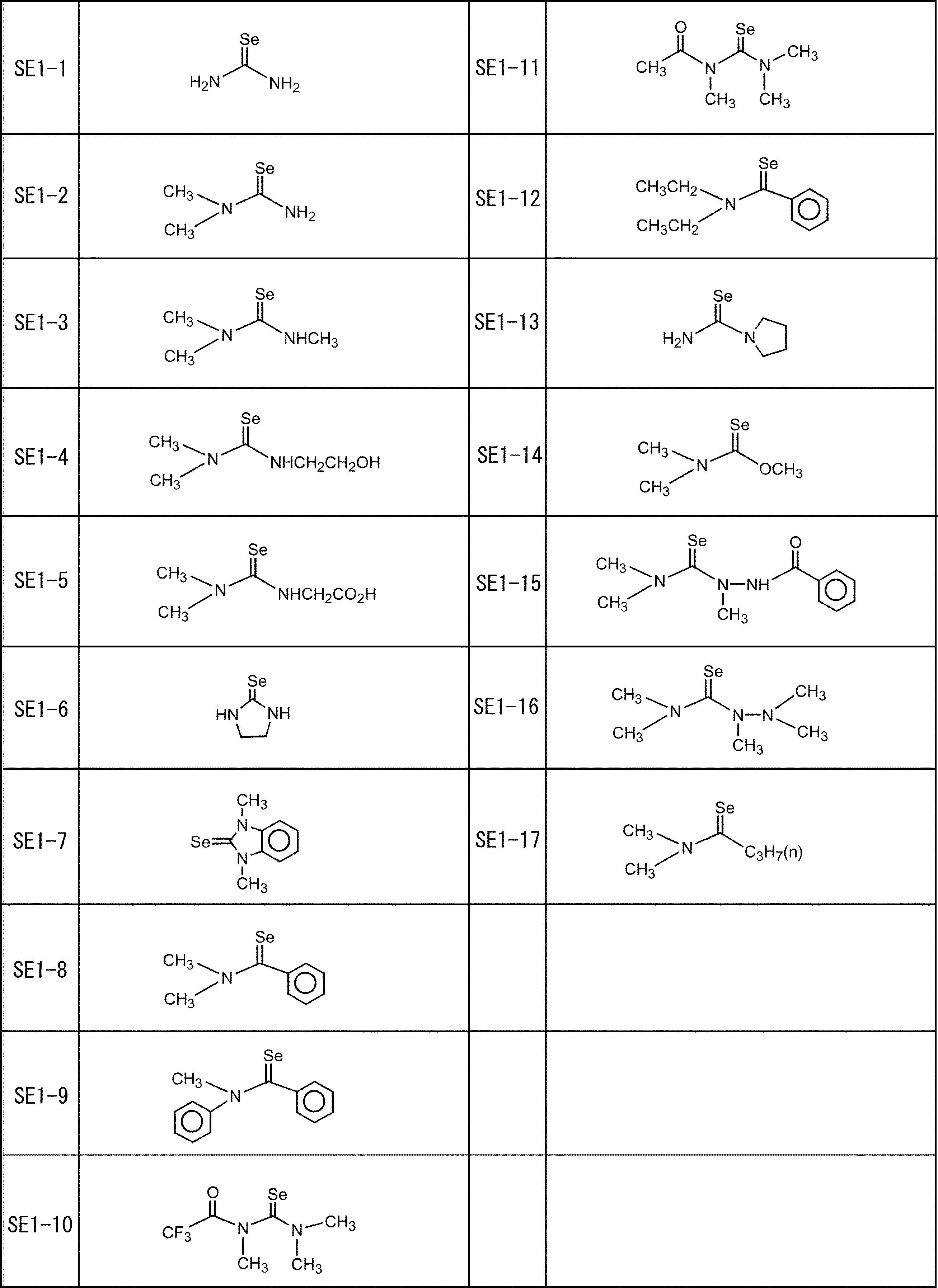
(一般式(SE1)中、M1およびM2は水素原子、アルキル基、アルケニル基、アルキニル基、アリール基、ヘテロ環基、アシル基、アミノ基、アルコキシ基、ヒドロキシ基、またはカルバモイル基を表し、Qはアルキル基、アルケニル基、アルキニル基、アリール基、ヘテロ環基、OM3もしくはNM4M5を表し、M3〜M5は水素原子、アルキル基、アルケニル基、アルキニル基、アリール基、ヘテロ環基を表す。また、M1、M2およびQはそれぞれ結合して環構造を形成してもよい。)
[4]セレン増感された前記ハロゲン化銀乳剤が下記一般式(SE2)で表されるセレン増感剤で化学増感されていることを特徴とする[1]または[2]項に記載のハロゲン化銀カラー写真感光材料。
(In the general formula (SE1), M 1 and M 2 represent a hydrogen atom, an alkyl group, an alkenyl group, an alkynyl group, an aryl group, a heterocyclic group, an acyl group, an amino group, an alkoxy group, a hydroxy group, or a carbamoyl group. , Q represents an alkyl group, an alkenyl group, an alkynyl group, an aryl group, a heterocyclic group, OM 3 or NM 4 M 5 , and M 3 to M 5 represent a hydrogen atom, an alkyl group, an alkenyl group, an alkynyl group, an aryl group, Represents a heterocyclic group, and M 1 , M 2 and Q may be bonded to each other to form a ring structure.)
[4] The item [1] or [2], wherein the selenium-sensitized silver halide emulsion is chemically sensitized with a selenium sensitizer represented by the following general formula (SE2): Silver halide color photographic light-sensitive material.
[5]セレン増感された前記ハロゲン化銀乳剤が下記一般式(SE3)で表されるセレン増感剤で化学増感されていることを特徴とする[1]または[2]項に記載のハロゲン化銀カラー写真感光材料。
[5] Item [1] or [2], wherein the selenium-sensitized silver halide emulsion is chemically sensitized with a selenium sensitizer represented by the following general formula (SE3): Silver halide color photographic light-sensitive material.
(一般式(SE3)中、E1およびE2はアルキル基、アルケニル基、アルキニル基、アリール基、ヘテロ環基、アシル基、アルコキシカルボニル基、アリールオキシカルボニル基もしくはカルバモイル基を表す。E1およびE2は同じであっても異なっていても良い。)
[6]セレン増感された前記ハロゲン化銀乳剤が下記一般式(PF1)〜(PF6)のいずれかで表されるセレン増感剤で化学増感されていることを特徴とする[1]または[2]項に記載のハロゲン化銀カラー写真感光材料。
(In the general formula (SE3), E 1 and E 2 are an alkyl group, an alkenyl group, an alkynyl group, an aryl group, a heterocyclic group, an acyl group, an alkoxycarbonyl group, .E 1 represents an aryloxycarbonyl group or a carbamoyl group and E 2 may be the same or different.)
[6] The selenium-sensitized silver halide emulsion is chemically sensitized with a selenium sensitizer represented by any one of the following general formulas (PF1) to (PF6) [1] Or the silver halide color photographic light-sensitive material as described in the item [2].
(一般式(PF1)中、L21はN原子、S原子、Se原子、Te原子またはP原子を介して金に配位可能な化合物を表す。n21は0または1を表す。A21はO、SまたはNR24を表し、R21〜R24は水素原子または置換基を表す。R23はR21またはR22と共に5〜7員環を形成してもよい。
一般式(PF2)中、L21はN原子、S原子、Se原子、Te原子またはP原子を介して金に配位可能な化合物を表す。n21は0または1を表す。X21はO、SまたはNR25を表し、Y21はアルキル基、アルケニル基、アルキニル基、アリール基、ヘテロ環基、OR26、SR27、N(R28)R29を表す。R25〜R29はそれぞれ水素原子、アルキル基、アルケニル基、アルキニル基、アリール基またはヘテロ環基を表す。X21とY21は互いに結合して環を形成してもよい。
一般式(PF3)中、L21はN原子、S原子、Se原子、Te原子またはP原子を介して金に配位可能な化合物を表す。n21は0または1を表す。R210、R211およびR212はそれぞれ独立に水素原子または置換基を表すが、R210およびR211のうち少なくとも一方は電子求引性基を表す。
一般式(PF4)中、L21はN原子、S原子、Se原子、Te原子またはP原子を介して金に配位可能な化合物を表す。n21は0または1を表す。W21は電子求引性基を表し、R213〜R215はそれぞれ水素原子または置換基を表す。W21とR213は互いに結合して環状構造を形成してもよい。
一般式(PF5)中、L21はN原子、S原子、Se原子、Te原子またはP原子を介して金に配位可能な化合物を表す。n21は0または1を表す。A22はO、S、Se、TeもしくはNR219を表す。R216は水素原子、アルキル基、アルケニル基、アルキニル基、アリール基、ヘテロ環基もしくはアシル基を表し、R217〜R219は水素原子、アルキル基、アルケニル基、アルキニル基、アリール基もしくはヘテロ環基を表す。Z21は置換基を表し、n22は0〜4の整数を表す。n22が2以上である場合はZ21が同じでも異なっていても良い。
一般式(PF6)中、Q21およびQ22は前記一般式(SE1)〜(SE3)より選ばれる化合物を表し、Q21およびQ22中のSe原子はAuに配位結合する。n23は0または1を表し、J21は対アニオンを表す。n23が1の場合、Q21とQ22は同じでも異なってもよい。ただし、式(PF6)で表される化合物は一般式(PF1)〜(PF5)のいずれかで表される化合物を含むものではない。)
[7]セレン増感された前記ハロゲン化銀乳剤のハロゲン化銀粒子の平均球相当径が0.6μm以下であることを特徴とする[1]〜[6]のいずれか1項に記載のハロゲン化銀カラー写真感光材料。
[8]総塗設銀量が0.2g/m2以上0.5g/m2以下であることを特徴とする[1]〜[7]のいずれか1項に記載のハロゲン化銀カラー写真感光材料。
(In the general formula (PF1), L 21 represents a compound capable of coordinating to gold via an N atom, an S atom, a Se atom, a Te atom, or a P atom. N 21 represents 0 or 1. A 21 represents Represents O, S or NR 24 , and R 21 to R 24 represent a hydrogen atom or a substituent, and R 23 may form a 5- to 7-membered ring together with R 21 or R 22 .
In the general formula (PF2), L 21 represents a compound capable of coordinating to gold via an N atom, an S atom, a Se atom, a Te atom, or a P atom. n 21 represents 0 or 1. X 21 represents O, S, or NR 25 , and Y 21 represents an alkyl group, alkenyl group, alkynyl group, aryl group, heterocyclic group, OR 26 , SR 27 , N (R 28 ) R 29 . R 25 to R 29 each represent a hydrogen atom, an alkyl group, an alkenyl group, an alkynyl group, an aryl group, or a heterocyclic group. X 21 and Y 21 may be bonded to each other to form a ring.
In the general formula (PF3), L 21 represents a compound capable of coordinating to gold via an N atom, an S atom, a Se atom, a Te atom, or a P atom. n 21 represents 0 or 1. R 210 , R 211 and R 212 each independently represent a hydrogen atom or a substituent, and at least one of R 210 and R 211 represents an electron withdrawing group.
In the general formula (PF4), L 21 represents a compound capable of coordinating to gold via an N atom, an S atom, a Se atom, a Te atom, or a P atom. n 21 represents 0 or 1. W 21 represents an electron withdrawing group, and R 213 to R 215 each represent a hydrogen atom or a substituent. W 21 and R 213 may be bonded to each other to form a cyclic structure.
In the general formula (PF5), L 21 represents a compound capable of coordinating to gold via an N atom, an S atom, a Se atom, a Te atom, or a P atom. n 21 represents 0 or 1. A 22 represents O, S, Se, Te or NR 219 . R 216 is a hydrogen atom, an alkyl group, an alkenyl group, an alkynyl group, an aryl group, a heterocyclic group or an acyl group, R 217 to R 219 is a hydrogen atom, an alkyl group, an alkenyl group, an alkynyl group, an aryl group or a heterocyclic Represents a group. Z 21 represents a substituent, and n 22 represents an integer of 0 to 4. When n 22 is 2 or more, Z 21 may be the same or different.
In the general formula (PF6), Q 21 and Q 22 represent compounds selected from the general formulas (SE1) to (SE3), and the Se atom in Q 21 and Q 22 is coordinated to Au. n 23 represents 0 or 1, J 21 represents a counter anion. If n 23 is 1, Q 21 and Q 22 may be the same or different. However, the compound represented by the formula (PF6) does not include a compound represented by any one of the general formulas (PF1) to (PF5). )
[7] The average sphere equivalent diameter of silver halide grains of the selenium-sensitized silver halide emulsion is 0.6 μm or less, [1] to [6] Silver halide color photographic material.
[8] The silver halide color photograph as described in any one of [1] to [7], wherein the total coated silver amount is 0.2 g / m 2 or more and 0.5 g / m 2 or less. Photosensitive material.
本発明のハロゲン化銀カラー写真感光材料は、迅速処理において高感度で彩度が高く、高いグレー濃度を再現でき、かつムラの発生が少ないという優れた効果を奏する。 The silver halide color photographic light-sensitive material of the present invention has the excellent effects of high sensitivity and high chroma, rapid reproduction of high gray density, and low occurrence of unevenness in rapid processing.
以下、本発明について詳細に説明する。
本発明のハロゲン化銀カラー写真感光材料は、イエロー色素形成カプラー含有ハロゲン化銀乳剤層、マゼンタ色素形成カプラー含有ハロゲン化銀乳剤層、シアン色素形成カプラー含有ハロゲン化銀乳剤層をそれぞれ少なくとも一層ずつ有する。
本発明において、シアン色素形成カプラー、マゼンタ色素形成カプラーおよびイエロー色素形成カプラーの塗設量の総量は1.1g/m2以下であることが好ましく、0.4g/m2以上1.0g/m2以下であることがより好ましい。
Hereinafter, the present invention will be described in detail.
The silver halide color photographic light-sensitive material of the present invention has at least one each of a yellow dye-forming coupler-containing silver halide emulsion layer, a magenta dye-forming coupler-containing silver halide emulsion layer, and a cyan dye-forming coupler-containing silver halide emulsion layer. .
In the present invention, the total coating amount of the cyan dye-forming coupler, magenta dye-forming coupler and yellow dye-forming coupler is preferably 1.1 g / m 2 or less, preferably 0.4 g / m 2 or more and 1.0 g / m. More preferably, it is 2 or less.
各カプラー含有ハロゲン化銀乳剤層に含まれるハロゲン化銀乳剤は各々異なる感色性のハロゲン化銀乳剤であることが必要である。例えば、イエロー色素形成カプラー含有ハロゲン化銀乳剤層に青感光性ハロゲン化銀乳剤を含有させ、マゼンタ色素形成カプラー含有ハロゲン化銀乳剤層に緑感光性ハロゲン化銀乳剤を含有させ、シアン色素形成カプラー含有ハロゲン化銀乳剤層に赤感光性ハロゲン化銀乳剤を含有させることが好ましい態様の一つであり、この場合、各々のハロゲン化銀乳剤の分光感度ピークは青感光性乳剤が400nm〜500nmであることが好ましく、は420nm〜480nmであることがより好ましく、緑感光性乳剤が510nm〜590nmであることが好ましく、520nm〜580nmであることがより好ましく、赤感光性乳剤が600nm〜800nmであることが好ましく、620nm〜720nmであることがより好ましい。更に各感光性ハロゲン化銀乳剤間で分光感度ピークの波長差が各々30nm以上異なることが好ましく50nm以上異なることがより好ましい。前記の感色性に設定することで、本発明の感光材料に対して3種以上の異なる波長の光を用いて露光後発色現像して得られる画像としてより色にごりの少ない彩度の高い色を再現することができる。 The silver halide emulsion contained in each coupler-containing silver halide emulsion layer must be a silver halide emulsion having a different color sensitivity. For example, a yellow dye-forming coupler-containing silver halide emulsion layer contains a blue-sensitive silver halide emulsion, a magenta dye-forming coupler-containing silver halide emulsion layer contains a green-sensitive silver halide emulsion, and a cyan dye-forming coupler. It is one of the preferred embodiments that the silver halide emulsion layer contains a red light sensitive silver halide emulsion. In this case, the spectral sensitivity peak of each silver halide emulsion is 400 nm to 500 nm in the blue light sensitive emulsion. Preferably, it is 420 nm to 480 nm, green sensitive emulsion is preferably 510 nm to 590 nm, more preferably 520 nm to 580 nm, and red sensitive emulsion is 600 nm to 800 nm. It is preferable that it is 620 nm-720 nm. Furthermore, it is preferable that the wavelength difference of the spectral sensitivity peak differs between each photosensitive silver halide emulsion by 30 nm or more, and more preferably 50 nm or more. By setting the color sensitivity as described above, an image obtained by color development after exposure to light of three or more different types of light-sensitive material of the present invention has a less saturated color and has a high color saturation. Can be reproduced.
上記の感光性に対して、光源として半導体レーザーやLEDを用いたデジタル露光方式の用途からは、上記3種の異なる分光感度は任意に選択することが可能である。このとき色分離の観点からは最近接の分光感度極大が少なくとも30nm以上離れていることが好ましい。この少なくとも3種の異なる分光感度極大をもつ感光層(λ1、λ2、λ3)に含有される発色カプラー(Y、M、C)との対応関係は任意の組み合わせが可能である。さらに青色、緑色、赤色の光以外の波長域を用いることも可能であり、赤外分光感度を有し赤外レーザー露光に対応できることも好ましい。 For the above photosensitivity, the three different spectral sensitivities can be arbitrarily selected from the use of a digital exposure method using a semiconductor laser or LED as a light source. At this time, from the viewpoint of color separation, it is preferable that the nearest spectral sensitivity maximum is separated by at least 30 nm or more. The correspondence relationship with the color couplers (Y, M, C) contained in the photosensitive layers (λ1, λ2, λ3) having at least three different spectral sensitivity maxima can be arbitrarily combined. Furthermore, it is also possible to use wavelength ranges other than blue, green, and red light, and it is also preferable that the infrared spectral sensitivity can be accommodated.
本発明の感光材料は、イエロー発色層、マゼンタ発色層及びシアン発色層以外にも、所望により後述する非感光性親水性コロイド層として、アンチハレーション層、中間層及び着色層を有していてもよい。 The light-sensitive material of the present invention may have an antihalation layer, an intermediate layer, and a colored layer as a non-photosensitive hydrophilic colloid layer to be described later, if desired, in addition to the yellow coloring layer, the magenta coloring layer, and the cyan coloring layer. Good.
次に、セレン化合物について説明する。
セレン化合物として、以下の一般式(SE1)、(SE2)もしくは(SE3)のいずれかで表わされる化合物を好ましく用いることができる。
Next, the selenium compound will be described.
As the selenium compound, a compound represented by any of the following general formulas (SE1), (SE2) or (SE3) can be preferably used.
一般式(SE1)中、M1およびM2は水素原子、アルキル基、アルケニル基、アルキニル基、アリール基、ヘテロ環基、アシル基、アミノ基、アルコキシ基、ヒドロキシ基、またはカルバモイル基を表し、Qはアルキル基、アルケニル基、アルキニル基、アリール基、ヘテロ環基、OM3もしくはNM4M5を表し、M3〜M5は水素原子、アルキル基、アルケニル基、アルキニル基、アリール基、ヘテロ環基を表す。また、M1、M2およびQはそれぞれ結合して環構造を形成してもよい。
一般式(SE2)中、X1、X2およびX3はアルキル基、アルケニル基、アルキニル基、アリール基、ヘテロ環基、OJ1またはNJ2J3を表す。J1〜J3は水素原子、アルキル基、アルケニル基、アルキニル基、アリール基、ヘテロ環基を表す。
一般式(SE3)において、E1およびE2はアルキル基、アルケニル基、アルキニル基、アリール基、ヘテロ環基、アシル基、アルコキシカルボニル基、アリールオキシカルボニル基もしくはカルバモイル基を表す。E1およびE2は同じであっても異なっていても良い。
In General Formula (SE1), M 1 and M 2 represent a hydrogen atom, an alkyl group, an alkenyl group, an alkynyl group, an aryl group, a heterocyclic group, an acyl group, an amino group, an alkoxy group, a hydroxy group, or a carbamoyl group, Q represents an alkyl group, an alkenyl group, an alkynyl group, an aryl group, a heterocyclic group, OM 3 or NM 4 M 5 , and M 3 to M 5 are a hydrogen atom, an alkyl group, an alkenyl group, an alkynyl group, an aryl group, a hetero group Represents a cyclic group. M 1 , M 2 and Q may be bonded to form a ring structure.
In the general formula (SE2), X 1 , X 2 and X 3 represent an alkyl group, an alkenyl group, an alkynyl group, an aryl group, a heterocyclic group, OJ 1 or NJ 2 J 3 . J 1 through J 3 represents a hydrogen atom, an alkyl group, an alkenyl group, an alkynyl group, an aryl group, a heterocyclic group.
In General Formula (SE3), E 1 and E 2 each represents an alkyl group, an alkenyl group, an alkynyl group, an aryl group, a heterocyclic group, an acyl group, an alkoxycarbonyl group, an aryloxycarbonyl group, or a carbamoyl group. E 1 and E 2 may be the same or different.
次に一般式(SE1)で表されるセレン化合物について説明する。
一般式(SE1)中、M1〜M5およびQで表されるアルキル基とは直鎖、分岐、環状の置換もしくは無置換のアルキル基を表す。好ましくは炭素数1〜30の置換もしくは無置換の直鎖または分岐のアルキル基(例えばメチル基、エチル基、イソプロピル基、n−プロピル基、n−ブチル基、t−ブチル基、2−ペンチル基、n−ヘキシル基、n−オクチル基、t−オクチル基、2−エチルヘキシル基、1,5−ジメチルヘキシル基、n−デシル基、n−ドデシル基、n−テトラデシル基、n−ヘキサデシル基、ヒドロキシエチル基、ヒドロキシプロピル基、2,3−ジヒドロキシプロピル基、カルボキシメチル基、カルボキシエチル基、ソディウムスルホエチル基、ジエチルアミノエチル基、ジエチルアミノプロピル基、ブトキシプロピル基、エトキシエトキシエチル基、n−ヘキシルオキシプロピル基等)、炭素数3〜18の置換もしくは無置換の環状アルキル基(例えばシクロプロピル基、シクロペンチル基、シクロヘキシル基、シクロオクチル基、アダマンチル基、シクロドデシル基等)を表す。また、炭素数5〜30の置換もしくは無置換のビシクロアルキル基、(つまり炭素数5〜30のビシクロアルカンから水素原子を一個取り去った一価の基であり、例えば、ビシクロ[1,2,2]ヘプタン−2−イル、ビシクロ[2,2,2]オクタン−3−イル)、更に環構造が多いトリシクロ構造なども包含する。M1〜M5およびQで表されるアルケニル基とは、炭素数2〜16のアルケニル基(例えば、アリル基、2−ブテニル基、3−ペンテニル基等)を表し、M1〜M5およびQで表されるアルキニル基とは炭素数2〜10のアルキニル基(例えば、プロパルギル基、3−ペンチニル基等)を表す。
Next, the selenium compound represented by the general formula (SE1) will be described.
In general formula (SE1), the alkyl group represented by M 1 to M 5 and Q represents a linear, branched, or cyclic substituted or unsubstituted alkyl group. Preferably, it is a substituted or unsubstituted linear or branched alkyl group having 1 to 30 carbon atoms (for example, methyl group, ethyl group, isopropyl group, n-propyl group, n-butyl group, t-butyl group, 2-pentyl group). N-hexyl group, n-octyl group, t-octyl group, 2-ethylhexyl group, 1,5-dimethylhexyl group, n-decyl group, n-dodecyl group, n-tetradecyl group, n-hexadecyl group, hydroxy Ethyl group, hydroxypropyl group, 2,3-dihydroxypropyl group, carboxymethyl group, carboxyethyl group, sodium sulfoethyl group, diethylaminoethyl group, diethylaminopropyl group, butoxypropyl group, ethoxyethoxyethyl group, n-hexyloxypropyl Group), a substituted or unsubstituted cyclic alkyl group having 3 to 18 carbon atoms ( Example, if a cyclopropyl group, a cyclopentyl group, a cyclohexyl group, cyclooctyl group, adamantyl group, a cyclododecyl group). Further, it is a substituted or unsubstituted bicycloalkyl group having 5 to 30 carbon atoms (that is, a monovalent group obtained by removing one hydrogen atom from a bicycloalkane having 5 to 30 carbon atoms, for example, bicyclo [1,2,2 Heptan-2-yl, bicyclo [2,2,2] octane-3-yl), and a tricyclo structure having more ring structures. The alkenyl group represented by M 1 to M 5 and Q represents an alkenyl group having 2 to 16 carbon atoms (for example, an allyl group, a 2-butenyl group, a 3-pentenyl group, etc.), and M 1 to M 5 and The alkynyl group represented by Q represents an alkynyl group having 2 to 10 carbon atoms (eg, propargyl group, 3-pentynyl group, etc.).
M1〜M5およびQで表されるアリール基としては、炭素数6〜20の置換もしくは無置換のフェニル基およびナフチル基(例えば無置換フェニル基、無置換ナフチル基、3,5−ジメチルフェニル、4−ブトキシフェニル基、4−ジメチルアミノフェニル基等)等が挙げられ、ヘテロ環基としては例えばピリジル基、フリル基、イミダゾリル基、ピペリジル基、モルホリル基等が挙げられる。 Examples of the aryl group represented by M 1 to M 5 and Q include a substituted or unsubstituted phenyl group and naphthyl group having 6 to 20 carbon atoms (for example, an unsubstituted phenyl group, an unsubstituted naphthyl group, and 3,5-dimethylphenyl). , 4-butoxyphenyl group, 4-dimethylaminophenyl group and the like, and examples of the heterocyclic group include pyridyl group, furyl group, imidazolyl group, piperidyl group, morpholyl group and the like.
一般式(SE1)中、M1およびM2で表されるアシル基としては例えばアセチル基、ホルミル基、ベンゾイル基、ピバロイル基、カプロイル基、n−ノナノイル基等が挙げられ、アミノ基としては、例えば無置換アミノ基、メチルアミノ基、ヒドロキシエチルアミノ基、n−オクチルアミノ基、ジベンジルアミノ基、ジメチルアミノ基、ジエチルアミノ基等が挙げられ、アルコキシ基としては、例えばメトキシ基、エトキシ基、n−ブチルオキシ基、シクロヘキシルオキシ基、n−オクチルオキシ基、n−デシルオキシ基等が挙げられ、カルバモイル基としては、例えば無置換カルバモイル基、N,N−ジエチルカルバモイル基、N−フェニルカルバモイル基等が挙げられる。 In the general formula (SE1), examples of the acyl group represented by M 1 and M 2 include an acetyl group, a formyl group, a benzoyl group, a pivaloyl group, a caproyl group, and an n-nonanoyl group. For example, an unsubstituted amino group, a methylamino group, a hydroxyethylamino group, an n-octylamino group, a dibenzylamino group, a dimethylamino group, a diethylamino group and the like can be mentioned. Examples of the alkoxy group include a methoxy group, an ethoxy group, and n -Butyloxy group, cyclohexyloxy group, n-octyloxy group, n-decyloxy group, and the like. Examples of the carbamoyl group include unsubstituted carbamoyl group, N, N-diethylcarbamoyl group, and N-phenylcarbamoyl group. It is done.
一般式(SE1)においてM1とM2、QとM1、またはQとM2は互いに結合して環構造を形成しても良く、更にQがNM4M5を表す場合、M4とM5は互いに結合して環構造を形成してもよい。 If the general formula M 1 and M 2 in (SE1), Q and M 1 or Q and M 2, may be bonded together to form a ring structure, further Q represents NM 4 M 5, and M 4 M 5 may be bonded to each other to form a ring structure.
また一般式(SE1)中のM1〜M5およびQは可能な限り置換基を有してもよく、その置換基としては、例えばハロゲン原子(フッ素原子、クロル原子、臭素原子、または沃素原子)、アルキル基(直鎖、分岐、環状のアルキル基で、ビシクロアルキル基、活性メチン基を含む)、アルケニル基、アルキニル基、アリール基、ヘテロ環基(置換する位置は問わない)、アシル基、アルコキシカルボニル基、アリールオキシカルボニル基、ヘテロ環オキシカルボニル基、カルバモイル基、N−ヒドロキシカルバモイル基、N−アシルカルバモイル基、N−スルホニルカルバモイル基、N−カルバモイルカルバモイル基、チオカルバモイル基、N−スルファモイルカルバモイル基、カルバゾイル基、カルボキシ基またはその塩、オキサリル基、オキサモイル基、シアノ基、カルボンイミドイル基(Carbonimidoyl基)、ホルミル基、ヒドロキシ基、アルコキシ基(エチレンオキシ基もしくはプロピレンオキシ基単位を繰り返し含む基を含む)、アリールオキシ基、ヘテロ環オキシ基、アシルオキシ基、(アルコキシもしくはアリールオキシ)カルボニルオキシ基、カルバモイルオキシ基、スルホニルオキシ基、アミノ基、(アルキル,アリール,またはヘテロ環)アミノ基、アシルアミノ基、スルホンアミド基、ウレイド基、チオウレイド基、N−ヒドロキシウレイド基、イミド基、(アルコキシもしくはアリールオキシ)カルボニルアミノ基、スルファモイルアミノ基、セミカルバジド基、チオセミカルバジド基、ヒドラジノ基、アンモニオ基、オキサモイルアミノ基、N−(アルキルもしくはアリール)スルホニルウレイド基、N−アシルウレイド基、N−アシルスルファモイルアミノ基、ヒドロキシアミノ基、ニトロ基、4級化された窒素原子を含むヘテロ環基(例えばピリジニオ基、イミダゾリオ基、キノリニオ基、イソキノリニオ基)、イソシアノ基、イミノ基、メルカプト基、(アルキル,アリール,またはヘテロ環)チオ基、(アルキル,アリール,またはヘテロ環)ジチオ基、(アルキルまたはアリール)スルホニル基、(アルキルまたはアリール)スルフィニル基、スルホ基またはその塩、スルファモイル基、N−アシルスルファモイル基、N−スルホニルスルファモイル基またはその塩、ホスフィノ基、ホスフィニル基、ホスフィニルオキシ基、ホスフィニルアミノ基、シリル基等が挙げられる。なおここで活性メチン基とは2つの電子求引性基で置換されたメチン基を意味し、ここに電子求引性基とはアシル基、アルコシキカルボニル基、アリールオキシカルボニル基、カルバモイル基、アルキルスルホニル基、アリールスルホニル基、スルファモイル基、トリフルオロメチル基、シアノ基、ニトロ基、カルボンイミドイル基(Carbonimidoyl基)を意味する。ここで2つの電子求引性基は互いに結合して環状構造をとっていてもよい。また塩とは、アルカリ金属、アルカリ土類金属、重金属などの陽イオンや、アンモニウムイオン、ホスホニウムイオンなどの有機の陽イオンを意味する。これら置換基は、これら置換基でさらに置換されていてもよい。 M 1 to M 5 and Q in the general formula (SE1) may have a substituent as much as possible. Examples of the substituent include a halogen atom (a fluorine atom, a chloro atom, a bromine atom, or an iodine atom). ), Alkyl groups (straight chain, branched, cyclic alkyl groups, including bicycloalkyl groups and active methine groups), alkenyl groups, alkynyl groups, aryl groups, heterocyclic groups (regarding the position of substitution), acyl groups , Alkoxycarbonyl group, aryloxycarbonyl group, heterocyclic oxycarbonyl group, carbamoyl group, N-hydroxycarbamoyl group, N-acylcarbamoyl group, N-sulfonylcarbamoyl group, N-carbamoylcarbamoyl group, thiocarbamoyl group, N-sulfur Famoylcarbamoyl group, carbazoyl group, carboxy group or salt thereof, oxalyl group Oxamoyl group, cyano group, carbonimidoyl group (Carbonimidoyl group), formyl group, hydroxy group, alkoxy group (including groups containing ethyleneoxy group or propyleneoxy group unit), aryloxy group, heterocyclic oxy group, acyloxy Group, (alkoxy or aryloxy) carbonyloxy group, carbamoyloxy group, sulfonyloxy group, amino group, (alkyl, aryl, or heterocyclic) amino group, acylamino group, sulfonamido group, ureido group, thioureido group, N- Hydroxyureido group, imide group, (alkoxy or aryloxy) carbonylamino group, sulfamoylamino group, semicarbazide group, thiosemicarbazide group, hydrazino group, ammonio group, oxamoylamino group, N- (alkyl) Or aryl) sulfonylureido group, N-acylureido group, N-acylsulfamoylamino group, hydroxyamino group, nitro group, heterocyclic group containing a quaternized nitrogen atom (eg, pyridinio group, imidazolio group, quinolinio group) Group, isoquinolinio group), isocyano group, imino group, mercapto group, (alkyl, aryl, or heterocyclic) thio group, (alkyl, aryl, or heterocyclic) dithio group, (alkyl or aryl) sulfonyl group, (alkyl or Aryl) sulfinyl group, sulfo group or salt thereof, sulfamoyl group, N-acylsulfamoyl group, N-sulfonylsulfamoyl group or salt thereof, phosphino group, phosphinyl group, phosphinyloxy group, phosphinylamino group And a silyl group. Here, the active methine group means a methine group substituted with two electron-withdrawing groups, and the electron-withdrawing group here means an acyl group, an alkoxycarbonyl group, an aryloxycarbonyl group, a carbamoyl group, An alkylsulfonyl group, an arylsulfonyl group, a sulfamoyl group, a trifluoromethyl group, a cyano group, a nitro group, and a carbonimidoyl group (Carbonimidoyl group) are meant. Here, the two electron withdrawing groups may be bonded to each other to form a cyclic structure. The salt means a cation such as alkali metal, alkaline earth metal or heavy metal, or an organic cation such as ammonium ion or phosphonium ion. These substituents may be further substituted with these substituents.
一般式(SE1)で表される好ましい化合物としては、M1及びM2がそれぞれ水素原子、炭素数1〜6の置換もしくは無置換の直鎖または分岐のアルキル基、炭素数3〜6の置換もしくは無置換の環状アルキル基、炭素数2〜6のアルケニル基、炭素数6〜10の置換もしくは無置換のアリール基、ヘテロ環基、及びアシル基であり、Qが、炭素数1〜6の置換もしくは無置換の直鎖または分岐のアルキル基、炭素数3〜6の置換もしくは無置換の環状アルキル基、炭素数2〜6のアルケニル基、炭素数6〜10の置換もしくは無置換のアリール基、またはNM4M5であり、M4およびM5が水素原子、炭素数1〜6の置換もしくは無置換の直鎖または分岐のアルキル基、炭素数3〜6の置換もしくは無置換の環状アルキル基、炭素数2〜6のアルケニル基、炭素数6〜10の置換もしくは無置換のアリール基、ヘテロ環基を表す場合である。より好ましくは、M1及びM2がそれぞれ水素原子、アルキル基、アルケニル基、アリール基であり、Qがアルキル基、アリール基、またはNM4M5であり、M4およびM5が水素原子、アルキル基、アルケニル基、アリール基を表す場合である。更に好ましくはM1及びM2がそれぞれ水素原子、アルキル基、アルケニル基、アリール基であり、QがNM4M5であり、M4およびM5が水素原子、アルキル基、アルケニル基、アリール基を表す場合である。 As preferable compounds represented by the general formula (SE1), M 1 and M 2 are each a hydrogen atom, a substituted or unsubstituted linear or branched alkyl group having 1 to 6 carbon atoms, and a substituted group having 3 to 6 carbon atoms. Or an unsubstituted cyclic alkyl group, an alkenyl group having 2 to 6 carbon atoms, a substituted or unsubstituted aryl group having 6 to 10 carbon atoms, a heterocyclic group, and an acyl group, and Q is 1 to 6 carbon atoms. Substituted or unsubstituted linear or branched alkyl group, substituted or unsubstituted cyclic alkyl group having 3 to 6 carbon atoms, alkenyl group having 2 to 6 carbon atoms, substituted or unsubstituted aryl group having 6 to 10 carbon atoms Or NM 4 M 5 , wherein M 4 and M 5 are a hydrogen atom, a substituted or unsubstituted linear or branched alkyl group having 1 to 6 carbon atoms, a substituted or unsubstituted cyclic alkyl group having 3 to 6 carbon atoms Group, carbon This is a case where an alkenyl group having 2 to 6 carbon atoms, a substituted or unsubstituted aryl group having 6 to 10 carbon atoms, or a heterocyclic group is represented. More preferably, M 1 and M 2 are each a hydrogen atom, an alkyl group, an alkenyl group, or an aryl group, Q is an alkyl group, an aryl group, or NM 4 M 5 , and M 4 and M 5 are hydrogen atoms, In this case, it represents an alkyl group, an alkenyl group, or an aryl group. More preferably, M 1 and M 2 are each a hydrogen atom, an alkyl group, an alkenyl group or an aryl group, Q is NM 4 M 5 , and M 4 and M 5 are a hydrogen atom, an alkyl group, an alkenyl group or an aryl group. Is represented.
本発明の一般式(SE1)で表される化合物は、公知の方法、例えばケミカル・レビューズ(Chem.Rev.)55,181−228(1955)、ジャーナル・オブ・オーガニック・ケミストリー(J.Org.Chem.)24,470−473(1959)、ジャーナル・オブ・ヘテロサイクリック・ケミストリー(J.Heterocycl.Chem.)4,605−609(1967)、「薬誌」82,36−45(1962)、特公昭39−26203号、特開昭63−229449号、OLS−2,043,944号を参考にして合成できる。 The compound represented by the general formula (SE1) of the present invention can be prepared by a known method such as Chemical Reviews (Chem. Rev.) 55, 181-228 (1955), Journal of Organic Chemistry (J. Org). Chem.) 24, 470-473 (1959), Journal of Heterocyclic Chemistry (J. Heterocycl. Chem.) 4, 605-609 (1967), "Drugs" 82, 36-45 (1962). ), JP-B-39-262203, JP-A-63-229449, and OLS-2,043,944.
次に、一般式(SE2)について詳細に説明する。
一般式(SE2)中、X1〜X3およびJ1〜J3で表されるアルキル基、アルケニル基、アルキニル基、アリール基およびヘテロ環基は、それぞれ式(SE1)においてM1〜M5およびQが表すアルキル基、アルケニル基、アルキニル基、アリール基およびヘテロ環基と同義である。またX1〜X3およびJ1〜J3は可能な限り置換基を有していてもよく、その置換基の例としては先に説明した置換基と同じ具体例が挙げられる。
Next, the general formula (SE2) will be described in detail.
In General Formula (SE2), the alkyl group, alkenyl group, alkynyl group, aryl group, and heterocyclic group represented by X 1 to X 3 and J 1 to J 3 are each represented by M 1 to M 5 in Formula (SE1). And Q have the same meaning as the alkyl group, alkenyl group, alkynyl group, aryl group and heterocyclic group. The X 1 to X 3 and J 1 through J 3 may have as much possible substituents include the same specific examples as the substituent described above as examples of the substituent.
一般式(SE2)で表される化合物として好ましくはX1〜X3がそれぞれ炭素数1〜6の置換もしくは無置換の直鎖または分岐のアルキル基、炭素数6〜10の置換もしくは無置換のアリール基、またはヘテロ環基を表す場合であり、より好ましくはX1〜X3がそれぞれ炭素数6〜10の置換もしくは無置換のアリール基を表す場合である。 As the compound represented by the general formula (SE2), preferably X 1 to X 3 are each a substituted or unsubstituted linear or branched alkyl group having 1 to 6 carbon atoms, or a substituted or unsubstituted group having 6 to 10 carbon atoms. It is a case where it represents an aryl group or a heterocyclic group, and more preferably, X 1 to X 3 each represent a substituted or unsubstituted aryl group having 6 to 10 carbon atoms.
本発明の一般式(SE2)で表される化合物は、公知の方法、例えば、オルガニック・フォスフォラス・コンパウンズ(OrganicPhosphorusCompounds、4巻、1〜73頁)、ジャーナル・ケミカル・ソサイエティーB(J.Chem.Soc.(B),1416頁、1968年)、ジャーナル・オルガニック・ケミストリー(J.Org.Chem.32巻、1717頁、1967年)、ジャーナル・オルガニック・ケミストリー(J.Org.Chem.32巻、2999頁、1967年)、テトラヘドロン(Tetrahedron、20、449頁、1964年)、ジャーナル・アメリカン・ケミカル・ソサイエティー(J.Am.Chem.Soc.,91巻、2915頁、1969年)等を参考にして合成できる。 The compound represented by the general formula (SE2) of the present invention can be obtained by a known method, for example, Organic Phosphorus Compounds (Vol. 4, pp. 1-73), Journal Chemical Society B (J. Chem.). Soc. (B), 1416, 1968), Journal Organic Chemistry (J. Org. Chem. 32, 1717, 1967), Journal Organic Chemistry (J. Org. Chem. 32, 2999, 1967), Tetrahedron (20, 449, 1964), Journal American Chemical Society (J. Am. Chem. Soc., 91, 2915, 1969). Etc. with reference to It can be formed.
次に一般式(SE3)で表される化合物について説明する。
一般式(SE3)においてE1およびE2で表されるアルキル基、アルケニル基、アルキニル基、アリール基およびヘテロ環基は、それぞれ一般式(SE1)においてM1〜M5およびQが表すアルキル基、アルケニル基、アルキニル基、アリール基およびヘテロ環基と同義である。E1およびE2で表されるアシル基としては例えばアセチル基、ホルミル基、ベンゾイル基、ピバロイル基、カプロイル基、n−ノナノイル基等が挙げられ、アルコキシカルボニル基としては例えばメトキシカルボニル基、エトキシカルボニル基、n−ブチルオキシカルボニル基、シクロヘキシルオキシカルボニル基、n−オクチルオキシカルボニル基、n−デシルオキシカルボニル基等が挙げられ、アリールオキシカルボニル基としては例えばフェノキシカルボニル基、ナフトキシカルボニル基などが挙げられ、カルバモイル基としては例えば無置換カルバモイル基、N,N−ジエチルカルバモイル基、N−フェニルカルバモイル基などが挙げられる。またE1およびE2は可能な限り置換基を有していてもよく、その置換基の例としては先に説明した置換基と同じ具体例が挙げられる。
Next, the compound represented by general formula (SE3) is demonstrated.
The alkyl group, alkenyl group, alkynyl group, aryl group and heterocyclic group represented by E 1 and E 2 in the general formula (SE3) are each an alkyl group represented by M 1 to M 5 and Q in the general formula (SE1). , Alkenyl group, alkynyl group, aryl group and heterocyclic group. Examples of the acyl group represented by E 1 and E 2 include an acetyl group, a formyl group, a benzoyl group, a pivaloyl group, a caproyl group, and an n-nonanoyl group. Examples of the alkoxycarbonyl group include a methoxycarbonyl group and an ethoxycarbonyl group. Group, n-butyloxycarbonyl group, cyclohexyloxycarbonyl group, n-octyloxycarbonyl group, n-decyloxycarbonyl group and the like. Examples of the aryloxycarbonyl group include phenoxycarbonyl group and naphthoxycarbonyl group. Examples of the carbamoyl group include an unsubstituted carbamoyl group, an N, N-diethylcarbamoyl group, and an N-phenylcarbamoyl group. E 1 and E 2 may have a substituent as much as possible, and examples of the substituent include the same specific examples as those described above.
本発明において、一般式(SE3)で表される好ましい化合物は、E1およびE2が下記一般式(T1)〜(T4)で表される基より選ばれる。この場合、E1およびE2は同じであっても異なっていても良い。 In the present invention, preferred compounds represented by the general formula (SE3) are selected from the groups in which E 1 and E 2 are represented by the following general formulas (T1) to (T4). In this case, E 1 and E 2 may be the same or different.
一般式(T1)において、Y11はアルキル基、アルケニル基、アルキニル基、アリール基、ヘテロ環基、OR11もしくはNR12R13を表し、R11〜R13はアルキル基、アルケニル基、アルキニル基、アリール基もしくはヘテロ環基を表す。一般式(T2)において、L11は2価の連結基を表し、EWGは電子求引性基を表す。一般式(T3)において、A11は酸素原子、硫黄原子もしくはNR17を表し、R14〜R17は水素原子、アルキル基、アルケニル基、アルキニル基、アリール基もしくはヘテロ環基を表す。一般式(T4)において、A12は酸素原子、硫黄原子もしくはNR111を表し、R18は水素原子、アルキル基、アルケニル基、アルキニル基、アリール基、ヘテロ環基もしくはアシル基を表し、R19、R110、R111は水素原子、アルキル基、アルケニル基、アルキニル基、アリール基もしくはヘテロ環基を表す。Z11は置換基を表し、n11は0〜4の整数を表す。n11が2以上である場合はZ11が同じでも異なっていても良い。 In General Formula (T1), Y 11 represents an alkyl group, an alkenyl group, an alkynyl group, an aryl group, a heterocyclic group, OR 11 or NR 12 R 13 , and R 11 to R 13 represent an alkyl group, an alkenyl group, and an alkynyl group. Represents an aryl group or a heterocyclic group. In the general formula (T2), L 11 represents a divalent linking group, and EWG represents an electron withdrawing group. In General Formula (T3), A 11 represents an oxygen atom, a sulfur atom, or NR 17 , and R 14 to R 17 represent a hydrogen atom, an alkyl group, an alkenyl group, an alkynyl group, an aryl group, or a heterocyclic group. In General Formula (T4), A 12 represents an oxygen atom, a sulfur atom, or NR 111 , R 18 represents a hydrogen atom, an alkyl group, an alkenyl group, an alkynyl group, an aryl group, a heterocyclic group, or an acyl group, and R 19 , R 110 and R 111 each represents a hydrogen atom, an alkyl group, an alkenyl group, an alkynyl group, an aryl group or a heterocyclic group. Z 11 represents a substituent, and n 11 represents an integer of 0 to 4. n 11 is the case where 2 or more may be different and Z 11 are the same.
一般式(T1)においてY11はアルキル基、アルケニル基、アルキニル基、アリール基、ヘテロ環基、OR11もしくはNR12R13を表し、R11〜R13はアルキル基、アルケニル基、アルキニル基、アリール基もしくはヘテロ環基を表すが、ここで言うアルキル基とは式(SE1)におけるM1〜M5およびQが表すアルキル基と同義であり、好ましい範囲も同様である。同様に、アルケニル基、アルキニル基、アリール基、ヘテロ環基についてもそれぞれM1〜M5およびQが表すアルケニル基、アルキニル基、アリール基、ヘテロ環基と同義であり、好ましい範囲も同様である。 In General Formula (T1), Y 11 represents an alkyl group, an alkenyl group, an alkynyl group, an aryl group, a heterocyclic group, OR 11 or NR 12 R 13 , and R 11 to R 13 represent an alkyl group, an alkenyl group, an alkynyl group, an aryl group or a heterocyclic group, the alkyl groups referred to herein has the same meaning as the alkyl group represented by M 1 ~M 5 and Q in formula (SE1), and preferred ranges are also the same. Similarly, the alkenyl group, alkynyl group, aryl group and heterocyclic group are the same as the alkenyl group, alkynyl group, aryl group and heterocyclic group represented by M 1 to M 5 and Q, respectively, and the preferred ranges are also the same. .
一般式(T1)において、本発明ではY11はアルキル基、アルケニル基、アルキニル基、アリール基もしくはヘテロ環基である場合が好ましく、アルキル基もしくはアリール基である場合がより好ましい。 In the general formula (T1), in the present invention, Y 11 is preferably an alkyl group, an alkenyl group, an alkynyl group, an aryl group or a heterocyclic group, and more preferably an alkyl group or an aryl group.
一般式(T2)において、L11で表される2価の連結基は、炭素数2〜20のアルキレン基、アルケニレン基、アルキニレン基を表し、特に炭素数2〜10の直鎖、分岐または環状のアルキレン基(例えばエチレン、プロピレン、シクロペンチレン、シクロへキシレン)、アルケニレン基(例えばビニレン)、アルキニレン基(例えばプロピニレン)を表す。好ましいL11としては一般式(L1)、一般式(L2)に示すものが挙げられる。 In the general formula (T2), the divalent linking group represented by L 11 represents an alkylene group having 2 to 20 carbon atoms, an alkenylene group or an alkynylene group, and particularly a linear, branched or cyclic group having 2 to 10 carbon atoms. An alkylene group (for example, ethylene, propylene, cyclopentylene, cyclohexylene), an alkenylene group (for example, vinylene), and an alkynylene group (for example, propynylene). Preferred examples of L 11 include those represented by general formula (L1) and general formula (L2).
一般式(L1)、一般式(L2)において、G1、G2、G3、G4は水素原子、炭素数1〜10のアルキル基、炭素数6〜20のアリール基もしくは炭素数1〜10のヘテロ環基を表し、G1、G2、G3は連結して環を形成しても良い。G1、G2、G3、G4として好ましくは水素原子、アルキル基もしくはアリール基であり、水素原子もしくはアルキル基がより好ましい。 In General Formula (L1) and General Formula (L2), G 1 , G 2 , G 3 , and G 4 are a hydrogen atom, an alkyl group having 1 to 10 carbon atoms, an aryl group having 6 to 20 carbon atoms, or 1 to 1 carbon atoms. Represents 10 heterocyclic groups, and G 1 , G 2 and G 3 may be linked to form a ring. G 1 , G 2 , G 3 and G 4 are preferably a hydrogen atom, an alkyl group or an aryl group, more preferably a hydrogen atom or an alkyl group.
一般式(T2)において、EWGは電子求引性基を表す。ここでいう電子求引性基とは、ハメットの置換基定数σp値が正の値である置換基であり、好ましくはσp値が0.2以上であり、上限としては1.0以下の置換基を表す。σp値が0.2以上の電子求引性基の具体例としてはアシル基、ホルミル基、アシルオキシ基、アシルチオ基、カルバモイル基、アルコキシカルボニル基、アリールオキシカルボニル基、シアノ基、ニトロ基、ジアルキルホスホノ基、ジアリールホスホノ基、ジアルキルホスフィニル基、ジアリールホスフィニル基、ホスホリル基、アルキルスルフィニル基、アリールスルフィニル基、アルキルスルホニル基、アリールスルホニル基、スルホニルオキシ基、アシルチオ基、スルファモイル基、チオシアネート基、チオカルボニル基、イミノ基、N原子で置換したイミノ基、カルボキシ基(またはその塩)、少なくとも2つ以上のハロゲン原子で置換されたアルキル基、少なくとも2つ以上のハロゲン原子で置換されたアルコキシ基、少なくとも2つ以上のハロゲン原子で置換されたアリールオキシ基、アシルアミノ基、少なくとも2つ以上のハロゲン原子で置換されたアルキルアミノ基、少なくとも2つ以上のハロゲン原子で置換されたアルキルチオ基、σp値が0.2以上の他の電子求引性基で置換されたアリール基、ヘテロ環基、ハロゲン原子、アゾ基、セレノシアネート基などが挙げられる。本発明において、EWGは好ましくはアシル基、ホルミル基、カルバモイル基、アルコキシカルボニル基、アリールオキシカルボニル基、シアノ基、ニトロ基、ジアルキルホスホノ基、ジアリールホスホノ基、ジアルキルホスフィニル基、ジアリールホスフィニル基、アルキルスルフィニル基、アリールスルフィニル基、アルキルスルホニル基、アリールスルホニル基、スルファモイル基、チオカルボニル基、イミノ基、N原子で置換したイミノ基、ホスホリル基、カルボキシ基(またはその塩)、少なくとも2つ以上のハロゲン原子で置換されたアルキル基、σp値が0.2以上の他の電子求引性基で置換されたアリール基、ヘテロ環基、またはハロゲン原子であり、より好ましくはアシル基、ホルミル基、カルバモイル基、アルコキシカルボニル基、アリールオキシカルボニル基、シアノ基、ニトロ基、アルキルスルホニル基、アリールスルホニル基、カルボキシ基、少なくとも2つ以上のハロゲン原子で置換されたアルキル基であり、更に好ましくはアシル基、ホルミル基、シアノ基、ニトロ基、アルキルスルホニル基、アリールスルホニル基、少なくとも2つ以上のハロゲン原子で置換されたアルキル基である。 In the general formula (T2), EWG represents an electron withdrawing group. The electron withdrawing group here is a substituent having a positive Hammett's substituent constant σ p value, preferably σ p value is 0.2 or more, and the upper limit is 1.0 or less. Represents a substituent of Specific examples of the electron withdrawing group having a σ p value of 0.2 or more include an acyl group, a formyl group, an acyloxy group, an acylthio group, a carbamoyl group, an alkoxycarbonyl group, an aryloxycarbonyl group, a cyano group, a nitro group, and a dialkyl. Phosphono group, diarylphosphono group, dialkylphosphinyl group, diarylphosphinyl group, phosphoryl group, alkylsulfinyl group, arylsulfinyl group, alkylsulfonyl group, arylsulfonyl group, sulfonyloxy group, acylthio group, sulfamoyl group, A thiocyanate group, a thiocarbonyl group, an imino group, an imino group substituted with an N atom, a carboxy group (or a salt thereof), an alkyl group substituted with at least two or more halogen atoms, and substituted with at least two or more halogen atoms An alkoxy group, at least Two or more aryloxy groups substituted with a halogen atom, an acylamino group, at least two or more alkyl amino group substituted with a halogen atom, at least two or more alkylthio groups substituted with a halogen atom, sigma p value Examples include aryl groups, heterocyclic groups, halogen atoms, azo groups, and selenocyanate groups substituted with 0.2 or more other electron-withdrawing groups. In the present invention, EWG is preferably an acyl group, formyl group, carbamoyl group, alkoxycarbonyl group, aryloxycarbonyl group, cyano group, nitro group, dialkylphosphono group, diarylphosphono group, dialkylphosphinyl group, diarylphosphine group. Finyl group, alkylsulfinyl group, arylsulfinyl group, alkylsulfonyl group, arylsulfonyl group, sulfamoyl group, thiocarbonyl group, imino group, imino group substituted with N atom, phosphoryl group, carboxy group (or salt thereof), at least An alkyl group substituted with two or more halogen atoms, an aryl group substituted with another electron-withdrawing group having a σ p value of 0.2 or more, a heterocyclic group, or a halogen atom, more preferably an acyl group Group, formyl group, carbamoyl group, alkoxy group Bonyl group, aryloxycarbonyl group, cyano group, nitro group, alkylsulfonyl group, arylsulfonyl group, carboxy group, alkyl group substituted with at least two halogen atoms, more preferably acyl group, formyl group, A cyano group, a nitro group, an alkylsulfonyl group, an arylsulfonyl group, or an alkyl group substituted with at least two halogen atoms.
ハメット則はベンゼン誘導体の反応または平衡に及ぼす置換基の影響を定量的に論ずるために1935年にL.P.Hammettにより提唱された経験則であり、ハメットの置換基定数にはσp値とσm値があり、これらの値は多くの一般的な成書に記載されている。例えば、J.A.Dean編「Lange's Handbook of Chemistry」第12版、1979年(McGraw−Hill)や「化学の領域 増刊」、122号、96〜103頁、1979年(南江堂)、またはChemical Reviews,91巻、165〜195頁、1991年に詳しい。本発明においてハメット則の置換基定数で規定される置換基は、これらの成書に記載の文献既知の値がある置換基のみに限定されるということではなく、その値が文献に記載されていない未知のものであってもハメット則に基づいて測定した場合にその範囲内に含まれる限り包含されることはもちろんである。 Hammett's rule was established in 1935 by L. L. in order to quantitatively discuss the effect of substituents on the reaction or equilibrium of benzene derivatives. P. It is an empirical rule proposed by Hammett, and Hammett's substituent constant has a σ p value and a σ m value, and these values are described in many general books. For example, J. et al. A. Dean, “Lange's Handbook of Chemistry”, 12th edition, 1979 (McGraw-Hill) and “Chemical domain special edition”, 122, 96-103, 1979 (Nanedo), or Chemical Reviews, 91, 165- Detailed on page 195, 1991. In the present invention, the substituents defined by the Hammett's rule substituent constants are not limited to only those substituents that have known values described in these documents, but the values are described in the literature. Of course, even unknown ones are included as long as they are included in the range when measured based on Hammett's law.
一般式(T2)において、好ましくはL11が一般式(L1)で表され、G1〜G3が水素原子、アルキル基を表し、EWGがアルコキシ基、アシル基、ホルミル基、カルバモイル基、アルコキシカルボニル基、アリールオキシカルボニル基、シアノ基、ニトロ基、アルキルスルホニル基、アリールスルホニル基、カルボキシ基、少なくとも2つ以上のハロゲン原子で置換されたアルキル基を表す場合である。より好ましくはL11が一般式(L1)で表され、G1〜G3が水素原子、アルキル基を表し、EWGがアルコキシ基、アシル基、ホルミル基、シアノ基、ニトロ基、アルキルスルホニル基、アリールスルホニル基、少なくとも2つ以上のハロゲン原子で置換されたアルキル基を表す場合である。 In the general formula (T2), preferably L 11 is represented by the general formula (L1), G 1 to G 3 represent a hydrogen atom and an alkyl group, EWG represents an alkoxy group, an acyl group, a formyl group, a carbamoyl group, an alkoxy group This is a case where a carbonyl group, an aryloxycarbonyl group, a cyano group, a nitro group, an alkylsulfonyl group, an arylsulfonyl group, a carboxy group, or an alkyl group substituted with at least two halogen atoms is represented. More preferably, L 11 is represented by the general formula (L1), G 1 to G 3 represent a hydrogen atom and an alkyl group, EWG represents an alkoxy group, an acyl group, a formyl group, a cyano group, a nitro group, an alkylsulfonyl group, An arylsulfonyl group represents an alkyl group substituted with at least two or more halogen atoms.
一般式(T3)においてR14〜R17は水素原子、アルキル基、アルケニル基、アルキニル基、アリール基もしくはヘテロ環基を表すが、ここで言うアルキル基とは一般式(SE1)におけるM1〜M5およびQが表すアルキル基と同義であり、好ましい範囲も同様である。同様に、アルケニル基、アルキニル基、アリール基、ヘテロ環基についてもそれぞれM1〜M5およびQが表すアルケニル基、アルキニル基、アリール基、ヘテロ環基と同義であり、好ましい範囲も同様である。 In the general formula (T3), R 14 to R 17 represent a hydrogen atom, an alkyl group, an alkenyl group, an alkynyl group, an aryl group, or a heterocyclic group, and the alkyl group referred to here is M 1 to M 1 in the general formula (SE1). M 5 and Q have the same meaning as the alkyl group represented by, and preferred ranges are also the same. Similarly, the alkenyl group, alkynyl group, aryl group and heterocyclic group are the same as the alkenyl group, alkynyl group, aryl group and heterocyclic group represented by M 1 to M 5 and Q, respectively, and the preferred ranges are also the same. .
本発明において、R14はアルキル基が好ましい。R15およびR16は水素原子、アルキル基もしくはアリール基が好ましく、水素原子もしくはアルキル基がより好ましく、一方が水素原子で他方が水素原子もしくはアルキル基である場合が最も好ましい。R17は水素原子、アルキル基もしくはアリール基が好ましく、水素原子もしくはアルキル基がより好ましく、アルキル基が最も好ましい。 In the present invention, R 14 is preferably an alkyl group. R 15 and R 16 are preferably a hydrogen atom, an alkyl group or an aryl group, more preferably a hydrogen atom or an alkyl group, and most preferably one is a hydrogen atom and the other is a hydrogen atom or an alkyl group. R 17 is preferably a hydrogen atom, an alkyl group or an aryl group, more preferably a hydrogen atom or an alkyl group, and most preferably an alkyl group.
一般式(T3)においてA11は酸素原子、硫黄原子もしくはNR17を表すが、本発明においては酸素原子もしくは硫黄原子である場合が好ましく、酸素原子である場合がより好ましい。 In the general formula (T3), A 11 represents an oxygen atom, a sulfur atom or NR 17. In the present invention, A 11 is preferably an oxygen atom or a sulfur atom, and more preferably an oxygen atom.
一般式(T3)において、好ましくはA11が酸素原子もしくは硫黄原子であり、R14がアルキル基であり、R15およびR16が水素原子、アルキル基もしくはアリール基の場合である。より好ましくはA11が酸素原子であり、R14がアルキル基であり、R15およびR16が水素原子もしくはアルキル基の場合である。 In the general formula (T3), preferably A 11 is an oxygen atom or a sulfur atom, R 14 is an alkyl group, and R 15 and R 16 are a hydrogen atom, an alkyl group, or an aryl group. More preferably, A 11 is an oxygen atom, R 14 is an alkyl group, and R 15 and R 16 are a hydrogen atom or an alkyl group.
一般式(T4)においてR18、R19、R110、R111で表されるアルキル基とは一般式(SE1)におけるM1〜M5およびQが表すアルキル基と同義であり、好ましい範囲も同様である。同様に、アルケニル基、アルキニル基、アリール基、ヘテロ環基についてもそれぞれM1〜M5およびQが表すアルケニル基、アルキニル基、アリール基、ヘテロ環基と同義であり、好ましい範囲も同様である。R18で表されるアシル基はアセチル基、ホルミル基、ベンゾイル基、ピバロイル基、カプロイル基、n−ノナノイル基などが挙げられる。 In general formula (T4), the alkyl group represented by R 18 , R 19 , R 110 , and R 111 is synonymous with the alkyl group represented by M 1 to M 5 and Q in general formula (SE1), and a preferred range is also included. It is the same. Similarly, the alkenyl group, alkynyl group, aryl group and heterocyclic group are the same as the alkenyl group, alkynyl group, aryl group and heterocyclic group represented by M 1 to M 5 and Q, respectively, and the preferred ranges are also the same. . Examples of the acyl group represented by R 18 include an acetyl group, a formyl group, a benzoyl group, a pivaloyl group, a caproyl group, and an n-nonanoyl group.
一般式(T4)においてZ11は置換基を表すが、その例としては先に説明した置換基と同じ具体例が挙げられる。 In the general formula (T4), Z 11 represents a substituent, and examples thereof include the same specific examples as those described above.
本発明において、Z11として好ましくはハロゲン原子、アルキル基、アリール基、ヘテロ環基、アシル基、アルコキシカルボニル基、アリールオキシカルボニル基、カルバモイル基、N−アシルカルバモイル基、N−スルホニルカルバモイル基、N−カルバモイルカルバモイル基、チオカルバモイル基、N−スルファモイルカルバモイル基、カルバゾイル基、カルボキシ基(及びその塩を含む)、シアノ基、ホルミル基、ヒドロキシ基、アルコキシ基、アリールオキシ基、ヘテロ環オキシ基、アシルオキシ基、ニトロ基、アミノ基、(アルキル、アリール、またはヘテロ環)アミノ基、アシルアミノ基、スルホンアミド基、ウレイド基、チオウレイド基、アルキルチオ基、アリールチオ基、ヘテロ環チオ基、(アルキルまたはアリール)スルホニル基、(アルキルまたはアリール)スルフィニル基、スルホ基(及びその塩を含む)、スルファモイル基などであり、より好ましくはハロゲン原子、アルキル基、アリール基、ヘテロ環基、カルボキシ基(及びその塩を含む)、ヒドロキシ基、アルコキシ基、アリールオキシ基、ヘテロ環オキシ基、アシルオキシ基、アミノ基、(アルキル、アリール、またはヘテロ環)アミノ基、アシルアミノ基、ウレイド基、チオウレイド基、アルキルチオ基、アリールチオ基、ヘテロ環チオ基、スルホ基(及びその塩を含む)などであり、更に好ましくはアルキル基、アリール基、カルボキシ基(及びその塩を含む)、ヒドロキシ基、アルコキシ基、アリールオキシ基、(アルキル、アリール、またはヘテロ環)アミノ基、ウレイド基、アルキルチオ基、アリールチオ基、スルホ基(及びその塩を含む)などである。 In the present invention, Z 11 is preferably a halogen atom, alkyl group, aryl group, heterocyclic group, acyl group, alkoxycarbonyl group, aryloxycarbonyl group, carbamoyl group, N-acylcarbamoyl group, N-sulfonylcarbamoyl group, N -Carbamoylcarbamoyl group, thiocarbamoyl group, N-sulfamoylcarbamoyl group, carbazoyl group, carboxy group (including its salt), cyano group, formyl group, hydroxy group, alkoxy group, aryloxy group, heterocyclic oxy group , Acyloxy group, nitro group, amino group, (alkyl, aryl, or heterocyclic) amino group, acylamino group, sulfonamide group, ureido group, thioureido group, alkylthio group, arylthio group, heterocyclic thio group, (alkyl or aryl) ) A sulfonyl group, an (alkyl or aryl) sulfinyl group, a sulfo group (including a salt thereof), a sulfamoyl group, and the like, more preferably a halogen atom, an alkyl group, an aryl group, a heterocyclic group, a carboxy group (and a salt thereof). Including), hydroxy group, alkoxy group, aryloxy group, heterocyclic oxy group, acyloxy group, amino group, (alkyl, aryl, or heterocyclic) amino group, acylamino group, ureido group, thioureido group, alkylthio group, arylthio group , A heterocyclic thio group, a sulfo group (including a salt thereof) and the like, more preferably an alkyl group, an aryl group, a carboxy group (including a salt thereof), a hydroxy group, an alkoxy group, an aryloxy group, (alkyl , Aryl, or heterocyclic) amino group, ureido group, alkyl O group, an arylthio group, (including and salts thereof) a sulfo group and the like.
一般式(T4)において、n11は0〜4の整数を表す。本発明においてn11は0〜2を表す場合が好ましく、0または1である場合がより好ましい。 In formula (T4), n 11 represents an integer of 0-4. In the present invention, n 11 preferably represents 0 to 2, more preferably 0 or 1.
一般式(T4)においてA12は酸素原子、硫黄原子もしくはNR111を表すが、本発明においては酸素原子もしくは硫黄原子を表す場合が好ましく、酸素原子を表す場合がより好ましい。 In General Formula (T4), A 12 represents an oxygen atom, a sulfur atom, or NR 111 , but in the present invention, it preferably represents an oxygen atom or a sulfur atom, and more preferably represents an oxygen atom.
一般式(T4)において、好ましくはA12が酸素原子もしくは硫黄原子であり、R18が水素原子、アルキル基、もしくはアシル基であり、R19およびR110が水素原子、アルキル基、アリール基であり、n11が0〜2であり、Z11がアルキル基、アリール基、カルボキシ基(及びその塩を含む)、ヒドロキシ基、アルコキシ基、アリールオキシ基、(アルキル、アリール、またはヘテロ環)アミノ基、ウレイド基、アルキルチオ基、アリールチオ基、スルホ基(及びその塩を含む)の場合である。より好ましくはA12が酸素原子であり、R18が水素原子もしくはアルキル基であり、R19およびR110が水素原子もしくはアルキル基であり、n11が0〜2であり、Z11がアルキル基、アリール基、カルボキシ基(及びその塩を含む)、アルコキシ基、ウレイド基、スルホ基(及びその塩を含む)の場合である。更に好ましくはA12が酸素原子であり、R18がアルキル基であり、R19およびR110が水素原子であり、n11が0〜2であり、Z11がアルキル基、カルボキシ基(及びその塩を含む)、アルコキシ基、スルホ基(及びその塩を含む)の場合である。 In the general formula (T4), preferably A 12 is an oxygen atom or a sulfur atom, R 18 is a hydrogen atom, an alkyl group, or an acyl group, and R 19 and R 110 are a hydrogen atom, an alkyl group, or an aryl group. N 11 is 0 to 2, Z 11 is an alkyl group, an aryl group, a carboxy group (and a salt thereof), a hydroxy group, an alkoxy group, an aryloxy group, (alkyl, aryl, or heterocycle) amino In the case of a group, ureido group, alkylthio group, arylthio group, sulfo group (and salts thereof). More preferably, A 12 is an oxygen atom, R 18 is a hydrogen atom or an alkyl group, R 19 and R 110 are a hydrogen atom or an alkyl group, n 11 is 0 to 2, and Z 11 is an alkyl group. , An aryl group, a carboxy group (including a salt thereof), an alkoxy group, a ureido group, and a sulfo group (and a salt thereof). More preferably, A 12 is an oxygen atom, R 18 is an alkyl group, R 19 and R 110 are hydrogen atoms, n 11 is 0 to 2, Z 11 is an alkyl group, a carboxy group (and its Salt), an alkoxy group, and a sulfo group (and salts thereof).
本発明において一般式(SE3)で表される化合物のうち、好ましい化合物はE1およびE2のうち、少なくとも一方が一般式(T1)から選ばれる場合、あるいは少なくとも一方が一般式(T4)から選ばれる場合である。より好ましくはE1およびE2のうち、一方が一般式(T1)で他方が一般式(T1)、(T2)、(T4)から選ばれる場合、あるいは一方が一般式(T4)で他方が一般式(T3)、一般式(T4)から選ばれる場合である。更に好ましくはE1およびE2のうち、一方が式一般(T1)で他方が一般式(T2)、(T4)から選ばれる場合、あるいはE1およびE2ともに一般式(T4)から選ばれる場合である。最も好ましくはE1およびE2のうち、一方が一般式(T1)で他方が一般式(T2)から選ばれる場合、あるいはE1およびE2ともに一般式(T4)から選ばれる場合である。 Of the compounds represented by the general formula (SE3) in the present invention, preferred compounds are those in which at least one of E 1 and E 2 is selected from the general formula (T1), or at least one of the compounds represented by the general formula (T4). This is the case. More preferably, one of E 1 and E 2 is selected from general formula (T1) and the other is selected from general formula (T1), (T2), (T4), or one is general formula (T4) and the other is This is a case selected from general formula (T3) and general formula (T4). More preferably, one of E 1 and E 2 is selected from the general formula (T1) and the other is selected from the general formulas (T2) and (T4), or both E 1 and E 2 are selected from the general formula (T4). Is the case. Most preferably, one of E 1 and E 2 is selected from General Formula (T1) and the other is selected from General Formula (T2), or E 1 and E 2 are both selected from General Formula (T4).
一般式(SE3)で表される化合物は既に知られている次の文献、S. Patai, Z. Rappoport編、ザ ケミストリー オブ オルガニック セレニウム アンド テルリウム コンパウンズ(The Chemistry of Organic Selenium and Tellurium Compounds)、第1巻(1986年)、同、第2巻(1987年)、D. Liotta著、オルガノセレニウム ケミストリー(Organo- selenium Chemistry),(1987年)等に記載の方法に準じて合成することができる。 The compound represented by the general formula (SE3) is already known in the following literature, edited by S. Patai, Z. Rappoport, The Chemistry of Organic Selenium and Tellurium Compounds, 1 (1986), 2 (1987), D. Liotta, Organo-Selenium Chemistry, (1987) and the like.
次に一般式(SE1)〜(SE3)のいずれかで表される化合物の具体例を示す。但し、本発明はこれらに限定されるものではない。また、立体異性体が複数存在しうる化合物については、その立体構造を限定するものではない。 Next, specific examples of the compound represented by any one of the general formulas (SE1) to (SE3) are shown. However, the present invention is not limited to these. In addition, the three-dimensional structure of a compound in which a plurality of stereoisomers can exist is not limited.
また、本発明においてはその他のセレン化合物として、特公昭43−13489号、同44−15748号、特開平4−25832号、同4−109240号、同4−271341号、同5−40324号、同5−11385号、同6−51415、同6−175258号、同6−180478号、同6−208186号、同6−208184号、同6−317867号、同7−92599号、同7−98483号、同7−140579号、同7−301879号、同7−301880号、同8−114882号、同9−138475号、同9−197603号、同10−10666号などに記載されているセレン化合物、具体的には、コロイド状金属セレン、セレノケトン類(例えば、セレノベンゾフェノン)、イソセレノシアネート類、セレノカルボン酸類などを用いることができる。またさらに、特公昭46−4553号、同52−34492号などに記載の非不安定セレン化合物、例えば亜セレン酸、セレノシアン酸類(例えば、セレノシアン酸カリウム)、セレナゾール類、セレニド類なども用いることができる。この中では特にセレノシアン酸類が好ましい。 In the present invention, as other selenium compounds, JP-B Nos. 43-13489, 44-15748, JP-A-4-25832, JP-A-4-109240, JP-A-4-271341, JP-A-5-40324, 5-11385, 6-51415, 6-175258, 6-180478, 6-208186, 6-208184, 6-317867, 7-92599, 7- No. 98483, No. 7-140579, No. 7-301879, No. 7-301880, No. 8-114882, No. 9-138475, No. 9-197603, No. 10-10666, etc. Selenium compounds, specifically colloidal metal selenium, selenoketones (eg, selenobenzophenone), isoselenocyanates, Or the like can be used Renokarubon acids. Furthermore, non-labile selenium compounds described in JP-B Nos. 46-4553 and 52-34492, such as selenious acid, selenocyanic acids (for example, potassium selenocyanate), selenazoles, selenides, and the like may be used. it can. Of these, selenocyanic acids are particularly preferred.
以上、セレン化合物として、用いることのできる構造を示してきたが、本発明はこれらに限定されるものではない。本発明で用いるセレン化合物は、X線光電子分光装置で測定したセレン原子の3d軌道電子の束縛エネルギー値が54.0eV以上65.0eV以下であることが、硬調化や低カブリの点で好ましい。 As mentioned above, although the structure which can be used as a selenium compound has been shown, this invention is not limited to these. The selenium compound used in the present invention preferably has a binding energy value of 3d orbital electrons of selenium atoms of 54.0 eV or more and 65.0 eV or less as measured with an X-ray photoelectron spectrometer in terms of high contrast and low fog.
本発明で用いるセレン増感剤の使用量は、使用するセレン化合物、ハロゲン化銀粒子、化学熟成条件等により変わるが、一般にハロゲン化銀1モル当り10−8〜10−4モル、好ましくは10−7〜10−5モル程度を用いる。また、本発明における化学増感の条件としては、特に制限はないが、pClとしては0〜7が好ましく、0〜5がより好ましく、1〜3が更に好ましい。温度としては40〜95℃が好ましく、50〜85℃がより好ましい。 The amount of the selenium sensitizer used in the present invention varies depending on the selenium compound used, silver halide grains, chemical ripening conditions, etc., but is generally 10 −8 to 10 −4 mol, preferably 10 per mol of silver halide. About -7 to 10 -5 mol is used. Moreover, there is no restriction | limiting in particular as conditions for the chemical sensitization in this invention, However, 0-7 are preferable as pCl, 0-5 are more preferable, and 1-3 are still more preferable. As temperature, 40-95 degreeC is preferable and 50-85 degreeC is more preferable.
本発明で用いるセレン化合物は、粒子形成直後から、化学増感終了直前までのどの段階にも添加することができる。好ましい添加時期は、脱塩後から化学増感工程の間である。 The selenium compound used in the present invention can be added at any stage from immediately after grain formation to immediately before the end of chemical sensitization. The preferred addition time is between the chemical sensitization step after desalting.
次に本発明に用いる金セレン化合物について説明する。
本発明に用いる金セレン化合物として、以下の一般式(PF1)〜(PF6)のいずれかで表される化合物を好ましく用いることができる。
Next, the gold selenium compound used in the present invention will be described.
As the gold selenium compound used in the present invention, a compound represented by any one of the following general formulas (PF1) to (PF6) can be preferably used.
一般式(PF1)において、L21はN原子、S原子、Se原子、Te原子またはP原子を介して金に配位可能な化合物を表す。n21は0または1を表す。A21はO、SまたはNR24を表し、R21〜R24は水素原子または置換基を表す。R23はR21またはR22と共に5〜7員環を形成してもよい。
一般式(PF2)において、L21はN原子、S原子、Se原子、Te原子またはP原子を介して金に配位可能な化合物を表す。n21は0または1を表す。X21はO、SまたはNR25を表す。Y21はアルキル基、アルケニル基、アルキニル基、アリール基、ヘテロ環基、OR26、SR27、N(R28)R29を表す。R25〜R29はそれぞれ水素原子、アルキル基、アルケニル基、アルキニル基、アリール基またはヘテロ環基を表す。X21とY21は互いに結合し環を形成してもよい。
一般式(PF3)において、L21はN原子、S原子、Se原子、Te原子またはP原子を介して金に配位可能な化合物を表す。n21は0または1を表す。R210、R211およびR212はそれぞれ独立に水素原子または置換基を表すが、R210およびR211のうち少なくとも一方は電子求引性基を表す。
一般式(PF4)において、L21はN原子、S原子、Se原子、Te原子またはP原子を介して金に配位可能な化合物を表す。n21は0または1を表す。W21は電子求引性基を表し、R213〜R215はそれぞれ水素原子または置換基を表す。W21とR213は互いに結合して環状構造を形成してもよい。
一般式(PF5)において、L21はN原子、S原子、Se原子、Te原子またはP原子を介して金に配位可能な化合物を表す。n21は0または1を表す。A22はO、S、Se、TeもしくはNR219を表す。R216は水素原子、アルキル基、アルケニル基、アルキニル基、アリール基、ヘテロ環基もしくはアシル基を表し、R217〜R219は水素原子、アルキル基、アルケニル基、アルキニル基、アリール基もしくはヘテロ環基を表す。Z21は置換基を表し、n22は0〜4の整数を表す。n22が2以上である場合はZ21が同じでも異なっていても良い。
一般式(PF6)において、Q21およびQ22は先に述べた一般式(SE1)〜(SE3)より選ばれる化合物であり、Q21およびQ22中のSe原子はAuに配位結合する。n23は0または1を表し、J21は対アニオンを表す。n23が1の場合、Q21とQ22は同じでも異なってもよい。ただし、式(PF6)で表される化合物は式一般(PF1)〜(PF5)で表される化合物を含むものではない。
In the general formula (PF1), L 21 represents a compound capable of coordinating to gold via an N atom, an S atom, a Se atom, a Te atom, or a P atom. n 21 represents 0 or 1. A 21 represents O, S or NR 24 , and R 21 to R 24 represent a hydrogen atom or a substituent. R 23 may form a 5- to 7-membered ring together with R 21 or R 22 .
In the general formula (PF2), L 21 represents a compound capable of coordinating to gold via an N atom, an S atom, a Se atom, a Te atom, or a P atom. n 21 represents 0 or 1. X 21 represents O, S or NR 25 . Y 21 represents an alkyl group, an alkenyl group, an alkynyl group, an aryl group, a heterocyclic group, OR 26 , SR 27 , N (R 28 ) R 29 . R 25 to R 29 each represent a hydrogen atom, an alkyl group, an alkenyl group, an alkynyl group, an aryl group, or a heterocyclic group. X 21 and Y 21 may be bonded to each other to form a ring.
In the general formula (PF3), L 21 represents a compound capable of coordinating to gold via an N atom, an S atom, a Se atom, a Te atom, or a P atom. n 21 represents 0 or 1. R 210 , R 211 and R 212 each independently represent a hydrogen atom or a substituent, and at least one of R 210 and R 211 represents an electron withdrawing group.
In the general formula (PF4), L 21 represents a compound capable of coordinating to gold via an N atom, an S atom, a Se atom, a Te atom, or a P atom. n 21 represents 0 or 1. W 21 represents an electron withdrawing group, and R 213 to R 215 each represent a hydrogen atom or a substituent. W 21 and R 213 may be bonded to each other to form a cyclic structure.
In the general formula (PF5), L 21 represents a compound capable of coordinating to gold via an N atom, an S atom, a Se atom, a Te atom, or a P atom. n 21 represents 0 or 1. A 22 represents O, S, Se, Te or NR 219 . R 216 is a hydrogen atom, an alkyl group, an alkenyl group, an alkynyl group, an aryl group, a heterocyclic group or an acyl group, R 217 to R 219 is a hydrogen atom, an alkyl group, an alkenyl group, an alkynyl group, an aryl group or a heterocyclic Represents a group. Z 21 represents a substituent, and n 22 represents an integer of 0 to 4. When n 22 is 2 or more, Z 21 may be the same or different.
In the general formula (PF6), Q 21 and Q 22 are compounds selected from the general formulas (SE1) to (SE3) described above, and Se atoms in Q 21 and Q 22 are coordinated to Au. n 23 represents 0 or 1, J 21 represents a counter anion. If n 23 is 1, Q 21 and Q 22 may be the same or different. However, the compound represented by the formula (PF6) does not include compounds represented by the formulas (PF1) to (PF5).
次に一般式(PF1)で表される金セレン化合物について説明する。
一般式(PF1)において、R21およびR22は好ましくは水素原子、アルキル基、アリール基、ヘテロ環基、ヒドロキシル基、アルコキシ基、アリールオキシ基、ヘテロ環オキシ基、アミノ基、メルカプト基、アルキルチオ基、アリールチオ基、ヘテロ環チオ基であり、更に好ましくは水素原子、アルキル基、アリール基、ヘテロ環基であり、最も好ましくは水素原子またはアルキル基である。
Next, the gold selenium compound represented by the general formula (PF1) will be described.
In the general formula (PF1), R 21 and R 22 are preferably a hydrogen atom, an alkyl group, an aryl group, a heterocyclic group, a hydroxyl group, an alkoxy group, an aryloxy group, a heterocyclic oxy group, an amino group, a mercapto group, an alkylthio group. Group, an arylthio group, and a heterocyclic thio group, more preferably a hydrogen atom, an alkyl group, an aryl group, and a heterocyclic group, and most preferably a hydrogen atom or an alkyl group.
R23は好ましくは水素原子、アルキル基、アリール基、ヘテロ環基であり、更に好ましくはアルキル基、アリール基、ヘテロ環基であり、最も好ましくはアルキル基もしくはアリール基である。R24は好ましくは水素原子、アルキル基、アルケニル基、アルキニル基、アリール基、ヘテロ環基、アミノ基、アシルアミノ基、アルキル及びアリールスルホニルアミノ基、アルキル及びアリールスルホニル基、アシル基、アリールオキシカルボニル基、アルコキシカルボニル基、カルバモイル基であり、更に好ましくは水素原子、アルキル基、アリール基、ヘテロ環基である。 R 23 is preferably a hydrogen atom, an alkyl group, an aryl group, or a heterocyclic group, more preferably an alkyl group, an aryl group, or a heterocyclic group, and most preferably an alkyl group or an aryl group. R 24 is preferably a hydrogen atom, alkyl group, alkenyl group, alkynyl group, aryl group, heterocyclic group, amino group, acylamino group, alkyl and arylsulfonylamino group, alkyl and arylsulfonyl group, acyl group, aryloxycarbonyl group , An alkoxycarbonyl group and a carbamoyl group, more preferably a hydrogen atom, an alkyl group, an aryl group and a heterocyclic group.
R23はR21もしくはR22と共に5〜7員の環構造を形成してもよい。形成される環構造は非芳香族の含酸素、含硫黄または含窒素のヘテロ環となる。またこの環構造は芳香族もしくは非芳香族の炭素環、あるいはヘテロ環と縮環を形成していてもよい。本発明においてはR23がR21もしくはR22と共に5〜7員の環状構造を形成することがより好ましい。 R 23 may form a 5- to 7-membered ring structure together with R 21 or R 22 . The ring structure formed is a non-aromatic oxygen-containing, sulfur-containing or nitrogen-containing heterocycle. This ring structure may form an aromatic or non-aromatic carbocyclic ring or a heterocyclic ring and a condensed ring. It is more preferred that R 23 to form a cyclic structure of 5 to 7 membered with R 21 or R 22 in the present invention.
本発明において、一般式(PF1)で表される化合物のうち、好ましくはA21がO、SまたはNR24であり、R21及びR22がそれぞれ水素原子、アルキル基、アリール基、ヘテロ環基、アルコキシ基、アリールオキシ基、ヘテロ環オキシ基、アルキルチオ基、アリールチオ基、ヘテロ環チオ基であり、R23が水素原子、アルキル基、アリール基、ヘテロ環基であり、R24が水素原子、アルキル基、アリール基、ヘテロ環基、アミノ基、アシルアミノ基、アルキル及びアリールスルホニルアミノ基、アルキル及びアリールスルホニル基、アシル基である。より好ましくはA21がOまたはSであり、R21及びR22がそれぞれ水素原子、アルキル基、アリール基、ヘテロ環基であり、R23がアルキル基、アリール基、ヘテロ環基である。更に好ましくはA21がOまたはSを表し、R21及びR22がそれぞれ水素原子、アルキル基、アリール基であり、R23がアルキル基、アリール基である。特に好ましくはR23がR21またはR22と共に形成した環状構造がグルコース、マンノース、ガラクトース、グロース、キシロース、リキソース、アラビノース、リボース、フコース、イドース、タロース、アロース、アルトロース、ラムノース、ソルボース、ディジトキソース、2−デオキシグルコース、2−デオキシガラクトース、フルクトース、グルコサミン、ガラクトサミン、グルクロン酸などとその糖誘導体(一般式(PF1)におけるA21がOの場合)及びその硫黄類似体(一般式(PF1)におけるA21がSの場合)の場合である。ここで糖誘導体とは糖構造におけるヒドロキシ基、アミノ基、カルボキシ基がアルコキシ基(エチレンオキシ基もしくはプロピレンオキシ基単位を繰り返し含む基を含む)、アリールオキシ基、ヘテロ環オキシ基、アシルオキシ基、アルコキシカルボニルオキシ基、アリールオキシカルボニルオキシ基、カルバモイルオキシ基、スルホニルオキシ基、シリルオキシ基、(アルキル、アリール、またはヘテロ環)アミノ基、アシルアミノ基、スルホンアミド基、ウレイド基、チオウレイド基、N−ヒドロキシウレイド基、アルコキシカルボニルアミノ基、アリールオキシカルボニルアミノ基、スルファモイルアミノ基、セミカルバジド基、チオセミカルバジド基、オキサモイルアミノ基、N−(アルキルまたはアリール)スルホニルウレイド基、N−アシルウレイド基、N−アシルスルファモイルアミノ基、ヒドロキシアミノ基、アシル基、アルコキシカルボニル基、アリールオキシカルボニル基、ヘテロ環オキシカルボニル基、カルバモイル基、N−ヒドロキシカルバモイル基、N−アシルカルバモイル基、N−スルホニルカルバモイル基、N−カルバモイルカルバモイル基、N−スルファモイルカルバモイル基などに置換された化合物を表す。またこれら糖構造においては1位の立体構造が異なるα異性体とβ異性体、および鏡像異性体の関係にあるD体とL体が存在するが、本発明においてはこれら異性体を区別することはない。この場合、好ましい化合物としては例えばセレノグルコース金(I)塩、セレノマンノース金(I)塩、セレノガラクトース金(I)塩、セレノリキソース金(I)塩など、およびこれらの糖誘導体などが挙げられる。 In the present invention, among the compounds represented by the general formula (PF1), A 21 is preferably O, S or NR 24 , and R 21 and R 22 are each a hydrogen atom, an alkyl group, an aryl group, or a heterocyclic group. , An alkoxy group, an aryloxy group, a heterocyclic oxy group, an alkylthio group, an arylthio group, and a heterocyclic thio group, R 23 is a hydrogen atom, an alkyl group, an aryl group, and a heterocyclic group, and R 24 is a hydrogen atom, An alkyl group, an aryl group, a heterocyclic group, an amino group, an acylamino group, an alkyl and arylsulfonylamino group, an alkyl and arylsulfonyl group, and an acyl group. More preferably, A 21 is O or S, R 21 and R 22 are each a hydrogen atom, an alkyl group, an aryl group, or a heterocyclic group, and R 23 is an alkyl group, an aryl group, or a heterocyclic group. More preferably, A 21 represents O or S, R 21 and R 22 are each a hydrogen atom, an alkyl group or an aryl group, and R 23 is an alkyl group or an aryl group. Particularly preferably a cyclic structure glucose R 23 is formed with R 21, or R 22, mannose, galactose, gulose, xylose, lyxose, arabinose, ribose, fucose, idose, talose, allose, altrose, rhamnose, sorbose, Dijitoki source, 2-deoxyglucose, 2-deoxy-galactose, fructose, glucosamine, galactosamine, etc. and the sugar derivative glucuronic acid (if a 21 in the general formula (PF1) is O) and sulfur analogues (general formula (PF1) In the case of A 21 in S). Here, the sugar derivative means a hydroxy group, an amino group, or a carboxy group in a sugar structure, including an alkoxy group (including a group that repeatedly contains an ethyleneoxy group or a propyleneoxy group unit), an aryloxy group, a heterocyclic oxy group, an acyloxy group, and an alkoxy group. Carbonyloxy group, aryloxycarbonyloxy group, carbamoyloxy group, sulfonyloxy group, silyloxy group, (alkyl, aryl, or heterocyclic) amino group, acylamino group, sulfonamide group, ureido group, thioureido group, N-hydroxyureido Group, alkoxycarbonylamino group, aryloxycarbonylamino group, sulfamoylamino group, semicarbazide group, thiosemicarbazide group, oxamoylamino group, N- (alkyl or aryl) sulfonylureido group N-acylureido group, N-acylsulfamoylamino group, hydroxyamino group, acyl group, alkoxycarbonyl group, aryloxycarbonyl group, heterocyclic oxycarbonyl group, carbamoyl group, N-hydroxycarbamoyl group, N-acylcarbamoyl group , An N-sulfonylcarbamoyl group, an N-carbamoylcarbamoyl group, an N-sulfamoylcarbamoyl group and the like. In these sugar structures, there are α isomers and β isomers having different stereostructures at the 1-position, and D isomers and L isomers in the relationship of enantiomers. In the present invention, these isomers should be distinguished. There is no. In this case, preferable compounds include, for example, selenoglucose gold (I) salt, selenomannose gold (I) salt, selenogalactose gold (I) salt, selenolyxose gold (I) salt, and sugar derivatives thereof. It is done.
次に一般式(PF2)で表される化合物について説明する。
一般式(PF2)において、X21は好ましくはOもしくはSであり、より好ましくはOである。Y21は好ましくは炭素数1〜30のアルキル基、アルケニル基、アルキニル基、アリール基またはN原子、O原子、S原子のうち少なくとも一つを含む5〜7員環のヘテロ環基、OR26、SR27、またはN(R28)R29を表すが、好ましくはアルキル基、アリール基、ヘテロ環基、OR26、SR27、またはN(R28)R29であり、より好ましくはアルキル基、アリール基、ヘテロ環基、またはN(R28)R29であり、更に好ましくはアルキル基、アリール基またはヘテロ環基である。
R25〜R29は水素原子、アルキル基、アルケニル基、アルキニル基、アリール基またはヘテロ環基を表し、好ましくは水素原子、アルキル基、アリール基またはヘテロ環基であり、より好ましくはアルキル基またはアリール基である。
Next, the compound represented by general formula (PF2) is demonstrated.
In the general formula (PF2), X 21 is preferably O or S, more preferably O. Y 21 is preferably an alkyl group having 1 to 30 carbon atoms, an alkenyl group, an alkynyl group, an aryl group, or a 5- to 7-membered heterocyclic group containing at least one of N atom, O atom and S atom, OR 26 , SR 27 , or N (R 28 ) R 29 , preferably an alkyl group, aryl group, heterocyclic group, OR 26 , SR 27 , or N (R 28 ) R 29 , more preferably an alkyl group. , An aryl group, a heterocyclic group, or N (R 28 ) R 29 , more preferably an alkyl group, an aryl group, or a heterocyclic group.
R 25 to R 29 represent a hydrogen atom, an alkyl group, an alkenyl group, an alkynyl group, an aryl group or a heterocyclic group, preferably a hydrogen atom, an alkyl group, an aryl group or a heterocyclic group, more preferably an alkyl group or An aryl group.
一般式(PF2)において、X21とY21は互いに結合して環を形成してもよい。この場合に形成される環は3〜7員の含窒素ヘテロ環であり、例えばピロール類、インドール類、イミダゾール類、ベンズイミダゾール類、チアゾール類、ベンゾチアゾール類、イソオキサゾール類、オキサゾール類、ベンゾオキサゾール類、インダゾール類、プリン類、ピリジン類、ピラジン類、ピリミジン類、キノリン類、キナゾリン類が挙げられる。 In the general formula (PF2), X 21 and Y 21 may be bonded to each other to form a ring. The ring formed in this case is a 3- to 7-membered nitrogen-containing heterocycle, such as pyrroles, indoles, imidazoles, benzimidazoles, thiazoles, benzothiazoles, isoxazoles, oxazoles, benzoxazoles. , Indazoles, purines, pyridines, pyrazines, pyrimidines, quinolines, quinazolines.
一般式(PF2)で表される化合物のうち、好ましくはX21がOまたはSであり、Y21がアルキル基、アリール基、ヘテロ環基、OR26、SR27、N(R28)R29であり、R26〜R29がアルキル基、アリール基またはヘテロ環基である。より好ましくはX21がOであり、Y21がアルキル基、アリール基、ヘテロ環基である。最も好ましくはX21がOであり、Y21がアルキル基、アリール基、ヘテロ環基である。 Of the compounds represented by the general formula (PF2), X 21 is preferably O or S, and Y 21 is an alkyl group, aryl group, heterocyclic group, OR 26 , SR 27 , N (R 28 ) R 29. And R 26 to R 29 are an alkyl group, an aryl group, or a heterocyclic group. More preferably, X 21 is O, and Y 21 is an alkyl group, an aryl group, or a heterocyclic group. Most preferably, X 21 is O, and Y 21 is an alkyl group, an aryl group, or a heterocyclic group.
次に一般式(PF3)で表される化合物について説明する。
一般式(PF3)において、R210およびR211の少なくとも一方は電子求引性基を表すが、ここでいう電子求引性基とは、ハメットの置換基定数σp値が正の値である置換基であり、好ましくはσp値が0.2以上であり、上限としては1.0以下の置換基を表す。σp値が0.2以上の電子求引性基の具体例としてはアシル基、ホルミル基、アシルオキシ基、アシルチオ基、カルバモイル基、アルコキシカルボニル基、アリールオキシカルボニル基、シアノ基、ニトロ基、ジアルキルホスホノ基、ジアリールホスホノ基、ジアルキルホスフィニル基、ジアリールホスフィニル基、ホスホリル基、アルキルスルフィニル基、アリールスルフィニル基、アルキルスルホニル基、アリールスルホニル基、スルホニルオキシ基、アシルチオ基、スルファモイル基、チオシアネート基、チオカルボニル基、イミノ基、N原子で置換したイミノ基、カルボキシ基(またはその塩)、少なくとも2つ以上のハロゲン原子で置換されたアルキル基、少なくとも2つ以上のハロゲン原子で置換されたアルコキシ基、少なくとも2つ以上のハロゲン原子で置換されたアリールオキシ基、アシルアミノ基、少なくとも2つ以上のハロゲン原子で置換されたアルキルアミノ基、少なくとも2つ以上のハロゲン原子で置換されたアルキルチオ基、σp値が0.2以上の他の電子求引性基で置換されたアリール基、ヘテロ環基、ハロゲン原子、アゾ基、セレノシアネート基などが挙げられる。本発明において好ましくはアシル基、ホルミル基、カルバモイル基、アルコキシカルボニル基、アリールオキシカルボニル基、シアノ基、ジアルキルホスホノ基、ジアリールホスホノ基、ジアルキルホスフィニル基、ジアリールホスフィニル基、アルキルスルフィニル基、アリールスルフィニル基、アルキルスルホニル基、アリールスルホニル基、スルファモイル基、チオカルボニル基、イミノ基、N原子で置換したイミノ基、ホスホリル基、カルボキシ基(またはその塩)、少なくとも2つ以上のハロゲン原子で置換されたアルキル基、σp値が0.2以上の他の電子求引性基で置換されたアリール基、ヘテロ環基またはハロゲン原子であり、より好ましくはアシル基、カルバモイル基、アルコキシカルボニル基、アリールオキシカルボニル基、シアノ基、カルボキシ基、少なくとも2つ以上のハロゲン原子で置換されたアルキル基、σp値が0.2以上の他の電子求引性基で置換されたアリール基、ヘテロ環基である。
Next, the compound represented by general formula (PF3) is demonstrated.
In General Formula (PF3), at least one of R 210 and R 211 represents an electron-withdrawing group, and the electron-withdrawing group here is a Hammett substituent constant σ p value having a positive value. It is a substituent, preferably σ p value is 0.2 or more, and the upper limit is 1.0 or less. Specific examples of the electron withdrawing group having a σ p value of 0.2 or more include an acyl group, a formyl group, an acyloxy group, an acylthio group, a carbamoyl group, an alkoxycarbonyl group, an aryloxycarbonyl group, a cyano group, a nitro group, and a dialkyl. Phosphono group, diarylphosphono group, dialkylphosphinyl group, diarylphosphinyl group, phosphoryl group, alkylsulfinyl group, arylsulfinyl group, alkylsulfonyl group, arylsulfonyl group, sulfonyloxy group, acylthio group, sulfamoyl group, A thiocyanate group, a thiocarbonyl group, an imino group, an imino group substituted with an N atom, a carboxy group (or a salt thereof), an alkyl group substituted with at least two or more halogen atoms, and substituted with at least two or more halogen atoms An alkoxy group, at least Two or more aryloxy groups substituted with a halogen atom, an acylamino group, at least two or more alkyl amino group substituted with a halogen atom, at least two or more alkylthio groups substituted with a halogen atom, sigma p value Examples include aryl groups, heterocyclic groups, halogen atoms, azo groups, and selenocyanate groups substituted with 0.2 or more other electron-withdrawing groups. In the present invention, an acyl group, formyl group, carbamoyl group, alkoxycarbonyl group, aryloxycarbonyl group, cyano group, dialkylphosphono group, diarylphosphono group, dialkylphosphinyl group, diarylphosphinyl group, alkylsulfinyl are preferred. Group, arylsulfinyl group, alkylsulfonyl group, arylsulfonyl group, sulfamoyl group, thiocarbonyl group, imino group, imino group substituted with N atom, phosphoryl group, carboxy group (or salt thereof), at least two or more halogen atoms An aryl group substituted with another electron-withdrawing group having a σ p value of 0.2 or more, a heterocyclic group or a halogen atom, more preferably an acyl group, a carbamoyl group, an alkoxycarbonyl group Group, aryloxycarboni Group, a cyano group, a carboxy group, at least two or more alkyl group substituted with a halogen atom, an aryl group which sigma p value is substituted with 0.2 or more other electron-withdrawing group is a heterocyclic group .
一般式(PF3)において、R210およびR211の両方とも電子求引性基を表すのが好ましい。R212として好ましくは水素原子、アルキル基、アリール基、ヘテロ環基、アルコキシ基、アリールオキシ基、ヘテロ環オキシ基、アミノ基、アシルアミノ基、アルキルチオ基、アリールチオ基、ヘテロ環チオ基、アルキル及びアリールスルホニル基、アシル基、アリールオキシカルボニル基、アルコキシカルボニル基、カルバモイル基であり、より好ましくは水素原子、アルキル基、アリール基、ヘテロ環基、アルコキシ基、アリールオキシ基、ヘテロ環オキシ基、アミノ基、アシルアミノ基が挙げられる。 In the general formula (PF3), it is preferable that both R 210 and R 211 represent an electron withdrawing group. R212 is preferably a hydrogen atom, alkyl group, aryl group, heterocyclic group, alkoxy group, aryloxy group, heterocyclic oxy group, amino group, acylamino group, alkylthio group, arylthio group, heterocyclic thio group, alkyl and aryl. A sulfonyl group, an acyl group, an aryloxycarbonyl group, an alkoxycarbonyl group, and a carbamoyl group, more preferably a hydrogen atom, an alkyl group, an aryl group, a heterocyclic group, an alkoxy group, an aryloxy group, a heterocyclic oxy group, and an amino group An acylamino group.
一般式(PF3)において、R210、R211、R212は互いに結合して環形成する場合も好ましい。形成される環は、非芳香族の炭素環もしくはヘテロ環であり、5〜7員環が好ましい。環を形成するR210はアシル基、カルバモイル基、オキシカルボニル基、チオカルボニル基、スルホニル基が好ましく、R211はアシル基、カルバモイル基、オキシカルボニル基、チオカルボニル基、スルホニル基、イミノ基、N原子で置換したイミノ基、アシルアミノ基、カルボニルチオ基が好ましい。 In General Formula (PF3), R 210 , R 211 , and R 212 are preferably bonded to each other to form a ring. The ring formed is a non-aromatic carbocyclic or heterocyclic ring, and preferably a 5- to 7-membered ring. R 210 forming a ring is preferably an acyl group, a carbamoyl group, an oxycarbonyl group, a thiocarbonyl group or a sulfonyl group, and R 211 is an acyl group, a carbamoyl group, an oxycarbonyl group, a thiocarbonyl group, a sulfonyl group, an imino group, N An atom-substituted imino group, acylamino group, and carbonylthio group are preferred.
一般式(PF3)で表される化合物のうち、好ましくはR210及びR211が電子求引性基であり、R212が水素原子、アルキル基、アリール基、ヘテロ環基、アルコキシ基、アリールオキシ基、ヘテロ環オキシ基、アミノ基、アシルアミノ基である。より好ましくはR210及びR211が電子求引性基であり、R212が水素原子、アルキル基、アリール基、ヘテロ環基である。最も好ましくはR210及びR211が電子求引性基であり、R212が水素原子、アルキル基、アリール基、ヘテロ環基である。 Of the compounds represented by the general formula (PF3), R 210 and R 211 are preferably electron withdrawing groups, and R 212 is a hydrogen atom, an alkyl group, an aryl group, a heterocyclic group, an alkoxy group, an aryloxy group. A group, a heterocyclic oxy group, an amino group, and an acylamino group. More preferably, R 210 and R 211 are electron withdrawing groups, and R 212 is a hydrogen atom, an alkyl group, an aryl group, or a heterocyclic group. Most preferably, R 210 and R 211 are electron withdrawing groups, and R 212 is a hydrogen atom, an alkyl group, an aryl group, or a heterocyclic group.
また、一般式(PF3)で表される化合物のうち、R210とR211が非芳香族の5〜7員の環を形成しているものも好ましく、この時R212が水素原子、アルキル基、アリール基、ヘテロ環基、アルコキシ基、アリールオキシ基、ヘテロ環オキシ基、アミノ基、アシルアミノ基である。更に好ましくはR210とR211とが非芳香族の5〜7員の環を形成し、R212が水素原子、アルキル基、アリール基、ヘテロ環基である。最も好ましくはR210とR211とが非芳香族の5〜7員の環を形成し、R212が水素原子、アルキル基、アリール基、ヘテロ環基である。 In addition, among the compounds represented by the general formula (PF3), those in which R 210 and R 211 form a non-aromatic 5- to 7-membered ring are also preferable. At this time, R 212 is a hydrogen atom or an alkyl group. , Aryl group, heterocyclic group, alkoxy group, aryloxy group, heterocyclic oxy group, amino group, and acylamino group. More preferably, R 210 and R 211 form a non-aromatic 5- to 7-membered ring, and R 212 is a hydrogen atom, an alkyl group, an aryl group, or a heterocyclic group. Most preferably, R 210 and R 211 form a non-aromatic 5- to 7-membered ring, and R 212 is a hydrogen atom, an alkyl group, an aryl group, or a heterocyclic group.
次に一般式(PF4)で表される化合物について説明する。
一般式(PF4)において、W21が表す電子求引性基は先に述べたR210及びR211が表す電子求引性基と同義であり、好ましい範囲も同様である。
Next, the compound represented by general formula (PF4) is demonstrated.
In the general formula (PF4), the electron withdrawing group represented by W 21 has the same meaning as the electron withdrawing group represented by R 210 and R 211 described above, and the preferred range is also the same.
一般式(PF4)において、R213〜R215として好ましくは水素原子、ハロゲン原子、アルキル基、アルケニル基、アルキニル基、アリール基、ヘテロ環基、シアノ基、カルボキシ基、スルファモイル基、スルホ基、アルキル及びアリールスルホニル基、アシル基,アリールオキシカルボニル基、アルコキシカルボニル基、カルバモイル基などであり、より好ましくは水素原子、ハロゲン原子、アルキル基、アルケニル基、アルキニル基、アリール基、ヘテロ環基、シアノ基、カルボキシ基、スルホ基、アルキル及びアリールスルホニル基、アシル基、アリールオキシカルボニル基、アルコキシカルボニル基、カルバモイル基である。 In formula (PF4), preferably a hydrogen atom R 213 to R 215, halogen atom, an alkyl group, an alkenyl group, an alkynyl group, an aryl group, a heterocyclic group, a cyano group, a carboxy group, a sulfamoyl group, a sulfo group, an alkyl And arylsulfonyl group, acyl group, aryloxycarbonyl group, alkoxycarbonyl group, carbamoyl group, etc., more preferably hydrogen atom, halogen atom, alkyl group, alkenyl group, alkynyl group, aryl group, heterocyclic group, cyano group Carboxy group, sulfo group, alkyl and arylsulfonyl group, acyl group, aryloxycarbonyl group, alkoxycarbonyl group and carbamoyl group.
W21とR213は互いに結合して環を形成してもよい。形成される環は、非芳香族の炭素環もしくはヘテロ環であり、好ましくは5〜7員環である。環を形成するW21はアシル基、カルバモイル基、オキシカルボニル基、チオカルボニル基、スルホニル基が好ましく、R213はアルキル基、アルケニル基、アリール基、ヘテロ環基が好ましい。 W 21 and R 213 may combine with each other to form a ring. The ring formed is a non-aromatic carbocyclic or heterocyclic ring, preferably a 5- to 7-membered ring. W 21 forming a ring is preferably an acyl group, a carbamoyl group, an oxycarbonyl group, a thiocarbonyl group or a sulfonyl group, and R 213 is preferably an alkyl group, an alkenyl group, an aryl group or a heterocyclic group.
一般式(PF4)で表される化合物のうち、好ましくはW21が電子求引性基であり、R213〜R215が水素原子、ハロゲン原子、アルキル基、アルケニル基、アルキニル基、アリール基、ヘテロ環基、シアノ基、カルボキシ基、スルホ基、アルキル及びアリールスルホニル基、アシル基、アリールオキシカルボニル基、アルコキシカルボニル基、カルバモイル基である。より好ましくはW21が電子求引性基であり、R213〜R215が水素原子、ハロゲン原子、アルキル基、アルケニル基、アリール基、ヘテロ環基、シアノ基、カルボキシ基、スルホ基、アルキル及びアリールスルホニル基、アシル基、アリールオキシカルボニル基、アルコキシカルボニル基、カルバモイル基である。最も好ましくはW21が電子求引性基であり、R213〜R215が水素原子、ハロゲン原子、アルキル基、アルケニル基、アルキニル基、アリール基、ヘテロ環基、シアノ基、カルボキシ基、スルホ基、アルキル及びアリールスルホニル基、アシル基、アリールオキシカルボニル基、アルコキシカルボニル基、カルバモイル基である。 Of the compounds represented by the general formula (PF4), preferably W 21 is an electron withdrawing group, and R 213 to R 215 are a hydrogen atom, a halogen atom, an alkyl group, an alkenyl group, an alkynyl group, an aryl group, A heterocyclic group, a cyano group, a carboxy group, a sulfo group, an alkyl and arylsulfonyl group, an acyl group, an aryloxycarbonyl group, an alkoxycarbonyl group, and a carbamoyl group. More preferably, W 21 is an electron withdrawing group, and R 213 to R 215 are a hydrogen atom, a halogen atom, an alkyl group, an alkenyl group, an aryl group, a heterocyclic group, a cyano group, a carboxy group, a sulfo group, an alkyl, and An arylsulfonyl group, an acyl group, an aryloxycarbonyl group, an alkoxycarbonyl group, and a carbamoyl group. And most preferably W 21 is an electron withdrawing group, R 213 to R 215 is a hydrogen atom, a halogen atom, an alkyl group, an alkenyl group, an alkynyl group, an aryl group, a heterocyclic group, a cyano group, a carboxy group, a sulfo group , Alkyl and arylsulfonyl groups, acyl groups, aryloxycarbonyl groups, alkoxycarbonyl groups, and carbamoyl groups.
また、一般式(PF4)で表される化合物のうち、W21とR213とが互いに結合して非芳香族の5〜7員の環を形成しているものも好ましく、この時R213がアルキル基、アルケニル基、アリール基、ヘテロ環基などであり、R214およびR215は水素原子、ハロゲン原子、アルキル基、アルケニル基、アルキニル基、アリール基、ヘテロ環基、シアノ基、カルボキシ基、スルホ基、アルキル及びアリールスルホニル基、アシル基、アリールオキシカルボニル基、アルコキシカルボニル基、カルバモイル基などである。更に好ましくはW21とR213とが互いに結合して非芳香族の5〜7員の環を形成し、R214およびR215が水素原子、ハロゲン原子、アルキル基、アルケニル基、アルキニル基、アリール基、ヘテロ環基、シアノ基、カルボキシ基、スルホ基、アルキル及びアリールスルホニル基、アシル基、アリールオキシカルボニル基、アルコキシカルボニル基、カルバモイル基であり、最も好ましくはW21とR213とが互いに結合して非芳香族の5〜7員の環を形成し、R214およびR215は水素原子、ハロゲン原子、アルキル基、アルケニル基、アルキニル基、アリール基、ヘテロ環基、シアノ基、カルボキシ基、スルホ基、アルキル及びアリールスルホニル基、アシル基、アリールオキシカルボニル基、アルコキシカルボニル基、カルバモイル基である。 In addition, among the compounds represented by the general formula (PF4), preferred others and W 21 and R 213 are bonded to form a 5- to 7-membered non-aromatic heterocycle together, this time R 213 is An alkyl group, an alkenyl group, an aryl group, a heterocyclic group, and the like, and R 214 and R 215 are a hydrogen atom, a halogen atom, an alkyl group, an alkenyl group, an alkynyl group, an aryl group, a heterocyclic group, a cyano group, a carboxy group, A sulfo group, an alkyl and arylsulfonyl group, an acyl group, an aryloxycarbonyl group, an alkoxycarbonyl group, a carbamoyl group, and the like. More preferably, W 21 and R 213 are bonded to each other to form a non-aromatic 5- to 7-membered ring, and R 214 and R 215 are a hydrogen atom, a halogen atom, an alkyl group, an alkenyl group, an alkynyl group, an aryl Group, heterocyclic group, cyano group, carboxy group, sulfo group, alkyl and arylsulfonyl group, acyl group, aryloxycarbonyl group, alkoxycarbonyl group, carbamoyl group, most preferably W 21 and R 213 are bonded to each other To form a non-aromatic 5- to 7-membered ring, and R 214 and R 215 are a hydrogen atom, a halogen atom, an alkyl group, an alkenyl group, an alkynyl group, an aryl group, a heterocyclic group, a cyano group, a carboxy group, Sulfo group, alkyl and arylsulfonyl group, acyl group, aryloxycarbonyl group, alkoxycarbonyl Group, a carbamoyl group.
次に一般式(PF5)で表される化合物について説明する。
一般式(PF5)において、R216は水素原子、アルキル基、アリール基もしくはアシル基が好ましく、水素原子、アルキル基もしくはアシル基がより好ましく、アルキル基が最も好ましい。R217およびR218は水素原子、アルキル基もしくはアリール基が好ましく、水素原子もしくはアルキル基がより好ましく、一方が水素原子で他方が水素原子もしくはアルキル基である場合が最も好ましい。R219は水素原子、アルキル基もしくはアリール基が好ましく、水素原子もしくはアルキル基がより好ましく、アルキル基が最も好ましい。
Next, the compound represented by general formula (PF5) is demonstrated.
In General Formula (PF5), R 216 is preferably a hydrogen atom, an alkyl group, an aryl group, or an acyl group, more preferably a hydrogen atom, an alkyl group, or an acyl group, and most preferably an alkyl group. R 217 and R 218 are preferably a hydrogen atom, an alkyl group or an aryl group, more preferably a hydrogen atom or an alkyl group, and most preferably one is a hydrogen atom and the other is a hydrogen atom or an alkyl group. R 219 is preferably a hydrogen atom, an alkyl group or an aryl group, more preferably a hydrogen atom or an alkyl group, and most preferably an alkyl group.
一般式(PF5)においてA22はO、S、Se、TeもしくはNR219を表すが、本発明においてはO、SもしくはNR219である場合が好ましく、OもしくはSである場合がより好ましく、Oである場合が最も好ましい。 In the general formula (PF5), A 22 represents O, S, Se, Te or NR 219. In the present invention, O 22 , S or NR 219 is preferable, and O or S is more preferable. Is most preferable.
一般式(PF5)においてZ21は置換基を表す。置換基の例としては先に説明した置換基と同じ基が挙げられる。本発明において、Z21として好ましくはハロゲン原子、アルキル基、アリール基、ヘテロ環基、アシル基、アルコキシカルボニル基、アリールオキシカルボニル基、カルバモイル基、N−アシルカルバモイル基、N−スルホニルカルバモイル基、N−カルバモイルカルバモイル基、チオカルバモイル基、N−スルファモイルカルバモイル基、カルバゾイル基、カルボキシ基(及びその塩を含む)、シアノ基、ホルミル基、ヒドロキシ基、アルコキシ基、アリールオキシ基、ヘテロ環オキシ基、アシルオキシ基、ニトロ基、アミノ基、(アルキル、アリール、またはヘテロ環)アミノ基、アシルアミノ基、スルホンアミド基、ウレイド基、チオウレイド基、アルキルチオ基、アリールチオ基、ヘテロ環チオ基、(アルキルまたはアリール)スルホニル基、(アルキルまたはアリール)スルフィニル基、スルホ基(及びその塩を含む)、スルファモイル基などであり、より好ましくはハロゲン原子、アルキル基、アリール基、ヘテロ環基、カルボキシ基(及びその塩を含む)、ヒドロキシ基、アルコキシ基、アリールオキシ基、ヘテロ環オキシ基、アシルオキシ基、アミノ基、(アルキル、アリール、またはヘテロ環)アミノ基、アシルアミノ基、ウレイド基、チオウレイド基、アルキルチオ基、アリールチオ基、ヘテロ環チオ基、スルホ基(及びその塩を含む)などであり、更に好ましくはアルキル基、アリール基、カルボキシ基(及びその塩を含む)、ヒドロキシ基、アルコキシ基、アリールオキシ基、(アルキル、アリール、またはヘテロ環)アミノ基、ウレイド基、アルキルチオ基、アリールチオ基、スルホ基(及びその塩を含む)などである。 In the general formula (PF5), Z 21 represents a substituent. Examples of the substituent include the same groups as those described above. In the present invention, Z 21 is preferably a halogen atom, alkyl group, aryl group, heterocyclic group, acyl group, alkoxycarbonyl group, aryloxycarbonyl group, carbamoyl group, N-acylcarbamoyl group, N-sulfonylcarbamoyl group, N -Carbamoylcarbamoyl group, thiocarbamoyl group, N-sulfamoylcarbamoyl group, carbazoyl group, carboxy group (including its salt), cyano group, formyl group, hydroxy group, alkoxy group, aryloxy group, heterocyclic oxy group , Acyloxy group, nitro group, amino group, (alkyl, aryl, or heterocyclic) amino group, acylamino group, sulfonamide group, ureido group, thioureido group, alkylthio group, arylthio group, heterocyclic thio group, (alkyl or aryl) ) A sulfonyl group, an (alkyl or aryl) sulfinyl group, a sulfo group (including a salt thereof), a sulfamoyl group, and the like, more preferably a halogen atom, an alkyl group, an aryl group, a heterocyclic group, a carboxy group (and a salt thereof). Including), hydroxy group, alkoxy group, aryloxy group, heterocyclic oxy group, acyloxy group, amino group, (alkyl, aryl, or heterocyclic) amino group, acylamino group, ureido group, thioureido group, alkylthio group, arylthio group , A heterocyclic thio group, a sulfo group (including a salt thereof) and the like, more preferably an alkyl group, an aryl group, a carboxy group (including a salt thereof), a hydroxy group, an alkoxy group, an aryloxy group, (alkyl , Aryl, or heterocyclic) amino group, ureido group, alkyl O group, an arylthio group, (including and salts thereof) a sulfo group and the like.
一般式(PF5)においてn22は0〜4の整数を表すが、本発明においてn22は0〜2を表す場合が好ましく、0または1である場合がより好ましい。 In the general formula (PF5), n 22 represents an integer of 0 to 4, but in the present invention, n 22 preferably represents 0 to 2, and more preferably 0 or 1.
一般式(PF5)において、好ましくはA22がO、SもしくはNR219を表し、R216が水素原子、アルキル基、アリール基、アシル基を表し、R217およびR218が水素原子、アルキル基、アリール基を表し、R219が水素原子、アルキル基もしくはアリール基を表し、n22が0〜2を表し、Z21がアルキル基、アリール基、カルボキシ基(及びその塩を含む)、ヒドロキシ基、アルコキシ基、アリールオキシ基、(アルキル、アリール、またはヘテロ環)アミノ基、ウレイド基、アルキルチオ基、アリールチオ基、スルホ基(及びその塩を含む)を表す場合である。より好ましくはA22がO、SもしくはNR219を表し、R216がアルキル基を表し、R217およびR218が水素原子もしくはアルキル基を表し、R219がアルキル基もしくはアリール基を表し、n22が0〜2を表し、Z21がアルキル基、アリール基、カルボキシ基(及びその塩を含む)、ヒドロキシ基、アルコキシ基、アリールオキシ基、(アルキル、アリール、またはヘテロ環)アミノ基、ウレイド基、アルキルチオ基、アリールチオ基、スルホ基(及びその塩を含む)を表す場合である。更に好ましくはA22がO、SもしくはNR219を表し、R216がアルキル基を表し、R217およびR218が水素原子もしくはアルキル基を表し、R219がアルキル基を表し、n22が0〜2を表し、Z21がアルキル基、アリール基、カルボキシ基(及びその塩を含む)、ヒドロキシ基、アルコキシ基、アリールオキシ基、(アルキル、アリール、またはヘテロ環)アミノ基、ウレイド基、アルキルチオ基、アリールチオ基、スルホ基(及びその塩を含む)を表す場合である。最も好ましくはA22がOを表し、R216がアルキル基を表し、R217およびR218の一方が水素原子で他方が水素原子もしくはアルキル基を表し、n22が0〜1を表し、Z21がアルキル基、アリール基、カルボキシ基(及びその塩を含む)、ヒドロキシ基、アルコキシ基、アリールオキシ基、(アルキル、アリール、またはヘテロ環)アミノ基、ウレイド基、アルキルチオ基、アリールチオ基、スルホ基(及びその塩を含む)を表す場合である。 In the general formula (PF5), preferably A 22 represents O, S or NR 219 , R 216 represents a hydrogen atom, an alkyl group, an aryl group, or an acyl group, R 217 and R 218 represent a hydrogen atom, an alkyl group, Represents an aryl group, R 219 represents a hydrogen atom, an alkyl group or an aryl group, n 22 represents 0 to 2, Z 21 represents an alkyl group, an aryl group, a carboxy group (and a salt thereof), a hydroxy group, It represents an alkoxy group, an aryloxy group, an (alkyl, aryl, or heterocyclic) amino group, a ureido group, an alkylthio group, an arylthio group, a sulfo group (and salts thereof). More preferably, A 22 represents O, S or NR 219 , R 216 represents an alkyl group, R 217 and R 218 represent a hydrogen atom or an alkyl group, R 219 represents an alkyl group or an aryl group, and n 22 Represents 0 to 2, Z 21 represents an alkyl group, an aryl group, a carboxy group (and a salt thereof), a hydroxy group, an alkoxy group, an aryloxy group, an (alkyl, aryl, or heterocyclic) amino group, or a ureido group , An alkylthio group, an arylthio group, and a sulfo group (and salts thereof). More preferably, A 22 represents O, S or NR 219 , R 216 represents an alkyl group, R 217 and R 218 represent a hydrogen atom or an alkyl group, R 219 represents an alkyl group, and n 22 represents from 0 to 0 2 and Z 21 is an alkyl group, an aryl group, a carboxy group (and a salt thereof), a hydroxy group, an alkoxy group, an aryloxy group, an (alkyl, aryl, or heterocyclic) amino group, a ureido group, an alkylthio group , An arylthio group, and a sulfo group (and salts thereof). Most preferably, A 22 represents O, R 216 represents an alkyl group, one of R 217 and R 218 represents a hydrogen atom and the other represents a hydrogen atom or an alkyl group, n 22 represents 0 to 1, and Z 21 Is an alkyl group, an aryl group, a carboxy group (including salts thereof), a hydroxy group, an alkoxy group, an aryloxy group, an (alkyl, aryl, or heterocyclic) amino group, a ureido group, an alkylthio group, an arylthio group, a sulfo group. (Including salts thereof).
一般式(PF1)〜(PF5)において、n21は0または1を表すが、n21が1を表す場合、L21はN原子、S原子、Se原子、Te原子もしくはP原子を介して金に配位可能な化合物を表す。具体的には置換もしくは無置換のアミン類(好ましくは炭素数1〜30の、1級、2級、もしくは3級のアルキルアミン、アリールアミンを意味する。)、5ないし6員の含窒素ヘテロ環類(N、O、S及びCの組合せからなる5ないし6員の含窒素ヘテロ環を意味し、置換基を有していてもよい。このヘテロ環は環内のN原子を介して金に配位してもよいし、置換基を介して金に配位してもよく、例えばベンゾトリアゾール、トリアゾール、テトラゾール、インダゾール、ベンズイミダゾール、イミダゾール、ベンゾチアゾール、チアゾール、チアゾリン、ベンゾオキサゾール、ベンゾオキサゾリン、オキサゾール、チアジアゾール、オキサジアゾール、トリアジン、ピロール、ピロリジン、イミダゾリジン、モルホリンが挙げられる。)、メソイオン類(ここでいうメソイオン化合物とは、5または6員の複素環状化合物で、一つの共有結合構造式または局性構造式では満足に表示することができず、また環を構成する全ての原子に関連したπ電子の六偶子を有する化合物で環は部分的正電荷を帯び、環外原子または原子団上の等しい負電荷と釣り合いを保っている化合物であり、メソイオン環としてはイミダゾリウム環、ピラゾリウム環、オキサゾリウム環、チアゾリウム環、トリアゾリウム環、テトラゾリウム環、チアジアゾリウム環、オキサジアゾリウム環、チアトリアゾリウム環、オキサトリアゾリウム環などが挙げられる。)、チオール類(好ましくは炭素数1〜30のアルキルチオール類、または炭素数6〜30のアリールチオール類もしくはN原子、O原子、S原子のうち少なくとも一つを含む5〜7員環のヘテロ環チオール類)、チオエーテル類(好ましくは炭素数1〜30のアルキル基、アリール基、またはN原子、O原子、S原子のうち少なくとも一つを含む5〜7員環ヘテロ環基がそれぞれS原子に結合した化合物であり、対称でも非対称でもよい。例えばジアルキルチオエーテル類、ジアリールチオエーテル類、ジヘテロ環チオエーテル類、アルキル−アリールチオエーテル類、アルキル−ヘテロ環チオエーテル類、アリール−ヘテロ環チオエーテル類が挙げられる。)、 In the general formulas (PF1) to (PF5), n 21 represents 0 or 1, but when n 21 represents 1, L 21 represents gold via an N atom, an S atom, a Se atom, a Te atom, or a P atom. Represents a compound capable of coordination. Specifically, substituted or unsubstituted amines (preferably a primary, secondary, or tertiary alkylamine or arylamine having 1 to 30 carbon atoms), 5- to 6-membered nitrogen-containing hetero Rings (5- to 6-membered nitrogen-containing heterocycle composed of a combination of N, O, S and C, which may have a substituent. This heterocycle is bonded to the gold via an N atom in the ring. It may be coordinated to gold via a substituent, such as benzotriazole, triazole, tetrazole, indazole, benzimidazole, imidazole, benzothiazole, thiazole, thiazoline, benzoxazole, benzoxazoline. , Oxazole, thiadiazole, oxadiazole, triazine, pyrrole, pyrrolidine, imidazolidine, and morpholine.) Mesoions (herein, mesoionic compounds are 5- or 6-membered heterocyclic compounds, which cannot be expressed satisfactorily by one covalent bond structure or local structure, and all atoms constituting the ring) Is a compound with a π-electron hexa-octone related to, wherein the ring is partially positively charged and balances with an equal negative charge on the exocyclic atom or group of atoms, and the mesoionic ring is an imidazolium ring , Pyrazolium ring, oxazolium ring, thiazolium ring, triazolium ring, tetrazolium ring, thiadiazolium ring, oxadiazolium ring, thiatriazolium ring, oxatriazolium ring, etc.), thiols (preferably carbon Alkyl thiols having 1 to 30 carbon atoms, aryl thiols having 6 to 30 carbon atoms, N atom, O atom, S atom 5- to 7-membered heterocyclic thiols containing at least one of the above-mentioned children), thioethers (preferably an alkyl group having 1 to 30 carbon atoms, an aryl group, or at least one of N atom, O atom, and S atom) 5 to 7-membered heterocyclic groups each containing one of them may be symmetric or asymmetric, for example, dialkyl thioethers, diaryl thioethers, diheterocyclic thioethers, alkyl-aryl thioethers, alkyl- Heterocyclic thioethers, aryl-heterocyclic thioethers).
ジスルフィド類(好ましくは炭素数1〜30のアルキル基、アリール基もしくはヘテロ環基がS原子に結合したジスルフィド化合物であり、対称でも非対称でもよい。例えばジアルキルジスルフィド類、ジアリールジスルフィド類、ジヘテロ環ジスルフィド類、アルキル−アリールジスルフィド類、アルキル−ヘテロ環ジスルフィド類、アリール−ヘテロ環ジスルフィド類が挙げられる。より好ましくは、ジアルキルジスルフィド類、ジアリールジスルフィド類またはアルキル−アリールジスルフィド類である。)、チオアミド類(チオアミドは環構造の一部であってもよいし、非環式チオアミドであってもよい。有用なチオアミド類としては、例えば米国特許4,030,925号、同4,031,127号、同4,080,207号、同4,245,037号、同4,255,511号、同4,266,031号、及び同4,276,364号並びにリサーチ・ディスクロージャー(Research Disclosure)第151巻、1976年11月、15162項、及び同第176巻、1978年12月、17626項に開示されているものから選ぶことができる。例えばチオ尿素、チオウレタン、ジチオカルバミン酸エステル、4−チアゾリン−2−チオン、チアゾリジン−2−チオン、4−オキサゾリン−2−チオン、オキサゾリジン−2−チオン、2−ピラゾリン−5−チオン、4−イミダゾリン−2−チオン、2−チオヒダントイン、ローダニン、イソローダニン、2−チオ−2,4−オキサゾリジンジオン、チオバルビツール酸、テトラゾリン−5−チオン、1,2,4−トリアゾリン−3−チオン、1,3,4−チアジアゾリン−2−チオン、1,3,4−オキサジアゾリン−2−チオン、ベンズイミダゾリン−2−チオン、ベンズオキサゾリン−2−チオン及びベンゾチアゾリン−2−チオンであり、これらは置換されてもよい。)、セレノール類(好ましくは炭素数1〜30のアルキルセレノール類、アリールセレノール類、またはN原子、O原子、S原子のうち少なくとも一つを含む5〜7員環のヘテロ環セレノール類である。)、セレノエーテル類(好ましくは炭素数1〜30のアルキル基、アリール基、ヘテロ環基がSe原子に結合したセレノエーテル化合物であり、Se原子に対して対称置換でも非対称置換でもよく、例えばジアルキルセレノエーテル類、ジアリールセレノエーテル類、ジヘテロ環セレノエーテル類、アルキル−アリールセレノエーテル類、アルキル−ヘテロ環セレノエーテル類、アリール−ヘテロ環セレノエーテル類が挙げられる。好ましくはジアルキルセレノエーテル類、ジアリールセレノエーテル類もしくはアルキル−アリールセレノエーテル類である。)、ジセレニド類(好ましくは炭素数1〜30のアルキル基、アリール基もしくはヘテロ環基がSe原子に結合したジセレニド化合物であり、ジセレニド基に対して対称でも非対称でもよく、例えばジアルキルジセレニド類、ジアリールジセレニド類、ジヘテロ環ジセレニド類、アルキル−アリールジセレニド類、アルキル−ヘテロ環ジセレニド類、アリール−ヘテロ環ジセレニド類が挙げられる。好ましくはジアルキルジセレニド類、ジアリールジセレニド類もしくはアルキル−アリールジセレニド類である。)、セレノアミド類(前述のチオアミド化合物のS原子をSe原子に置き換えた化合物が挙げられる。)、テルロール類(前述のセレノール化合物においてSe原子をTe原子に置き換えた化合物が挙げられる。)、テルロエーテル類(前述のセレノエーテル化合物においてSe原子をTe原子に置き換えた化合物が挙げられる。)、ジテルリド類(前述のジセレニド化合物においてSe原子をTe原子に置き換えた化合物が挙げられる。)、テルロアミド類(前述のセレノアミド化合物においてSe原子をTe原子に置き換えた化合物が挙げられる。)、アルキルホスフィン類(好ましくは炭素数1〜20の、1級、2級、もしくは3級のアルキルホスフィン類である。)、アリールホスフィン類(好ましくは炭素数1〜20の、1級、2級、もしくは3級のアリールホスフィン類である。)等を表す。 Disulfides (preferably disulfide compounds in which an alkyl group, aryl group or heterocyclic group having 1 to 30 carbon atoms is bonded to the S atom, and may be symmetric or asymmetrical. For example, dialkyl disulfides, diaryl disulfides, diheterocyclic disulfides , Alkyl-aryl disulfides, alkyl-heterocyclic disulfides, aryl-heterocyclic disulfides, more preferably dialkyl disulfides, diaryl disulfides or alkyl-aryl disulfides), thioamides (thioamides) May be a part of a ring structure or may be an acyclic thioamide Examples of useful thioamides include, for example, U.S. Patent Nos. 4,030,925, 4,031,127, and 4, , 080, 207, the same , 245,037, 4,255,511, 4,266,031, and 4,276,364 and Research Disclosure vol. 151, November 1976, paragraph 15162, And 176, December 1978, 17626. For example, thiourea, thiourethane, dithiocarbamate, 4-thiazoline-2-thione, thiazolidine-2-thione, 4-oxazoline-2-thione, oxazolidine-2-thione, 2-pyrazolin-5-thione, 4-imidazoline-2-thione, 2-thiohydantoin, rhodanine, isorhodanine, 2-thio-2,4-oxazolidinedione, Thiobarbituric acid, tetrazoline-5-thione, 1,2,4-triazoly -3-thione, 1,3,4-thiadiazoline-2-thione, 1,3,4-oxadiazoline-2-thione, benzimidazoline-2-thione, benzoxazoline-2-thione and benzothiazoline-2- Thione, which may be substituted), selenols (preferably alkyl selenols having 1 to 30 carbon atoms, aryl selenols, or at least one of N atom, O atom and S atom). 5 to 7-membered heterocyclic selenols), selenoethers (preferably selenoether compounds in which an alkyl group having 1 to 30 carbon atoms, an aryl group, or a heterocyclic group is bonded to a Se atom; Symmetrical or asymmetrical substitution may be performed on the atom, for example dialkylselenoethers, diarylselenoethers, diheterocyclic selenoes Ethers, alkyl - aryl seleno ethers, alkyl - heterocyclic selenoethers, aryl - heterocyclic selenoethers the like. Dialkylselenoethers, diarylselenoethers or alkyl-arylselenoethers are preferred. ), Diselenides (preferably a diselenide compound in which an alkyl group, aryl group or heterocyclic group having 1 to 30 carbon atoms is bonded to a Se atom, which may be symmetric or asymmetric with respect to the diselenide group, for example, dialkyl diselenides , Diaryl diselenides, diheterocyclic diselenides, alkyl-aryl diselenides, alkyl-heterocyclic diselenides, aryl-heterocyclic diselenides, preferably dialkyl diselenides, diaryl diselenides Alternatively, alkyl-aryl diselenides), selenamides (compounds in which the S atom of the above-mentioned thioamide compound is replaced with Se atoms), tellurols (in the above-mentioned selenol compound, the Se atom is changed to a Te atom). Substituted compounds), telluroate (Including compounds in which Se atoms are replaced with Te atoms in the aforementioned selenoether compounds), ditellurides (including compounds in which Se atoms are replaced with Te atoms in the aforementioned diselenide compounds), telluramides (described above). In which the Se atom is replaced with a Te atom), alkylphosphines (preferably primary, secondary or tertiary alkylphosphines having 1 to 20 carbon atoms), An arylphosphine (preferably a primary, secondary, or tertiary arylphosphine having 1 to 20 carbon atoms) or the like is represented.
L21は好ましくは5ないし6員の含窒素ヘテロ環類、メソイオン類、チオール類、チオエーテル類、チオアミド類、セレノール類、セレノエーテル類、セレノアミド類、アルキルホスフィン類またはアリールホスフィン類であり、更に好ましくは5ないし6員の含窒素ヘテロ環類、メソイオン類、チオール類、チオエーテル類、チオアミド類、セレノール類、アルキルホスフィン類またはアリールホスフィン類であり、最も好ましくはメソイオン類、チオール類、チオエーテル類、チオアミド類、セレノール類、アルキルホスフィン類またはアリールホスフィン類である。特に好ましいL21は下記一般式(PL1)〜(PL5)のいずれかで表される化合物より選ばれる。 L 21 is preferably a 5- to 6-membered nitrogen-containing heterocycle, mesoion, thiol, thioether, thioamide, selenol, selenoether, selenoamide, alkylphosphine or arylphosphine, more preferably Is a 5- to 6-membered nitrogen-containing heterocycle, mesoions, thiols, thioethers, thioamides, selenols, alkylphosphines or arylphosphines, most preferably mesoions, thiols, thioethers, thioamides , Selenols, alkyl phosphines or aryl phosphines. Particularly preferred L 21 is selected from compounds represented by any of the following general formulas (PL1) to (PL5).
一般式(PL1)〜(PL5)において、ChはS、SeまたはTeを表し、M21は水素原子もしくは化合物の電荷を中和する対カチオンを表す。一般式(PL1)において、A23はO、SまたはNR223を表し、R220、R221、R222、R223は、それぞれ前述のR21、R22、R23、R24と同義であり、好ましい範囲も同様である。
一般式(PL2)において、X22はO、SまたはNR224を表し、Y22はH、アルキル基、アルケニル基、アルキニル基、アリール基、ヘテロ環基、OR225、SR226、N(R227)R228を表す。R224、R225、R226、R227、R228はそれぞれ前述のR25、R26、R27、R28、R29と同義であり、好ましい範囲も同様である。
一般式(PL3)において、R229、R230、R231は、それぞれ前述のR210、R211、R212と同義であり、好ましい範囲も同様である。
一般式(PL4)において、W22、R232、R233、R234は、それぞれ前述のW21、R213、R214、R215と同義であり、好ましい範囲も同様である。
一般式(PL5)において、A24はO、S、Se、TeもしくはNR238を表す。R235、R236、R237、R238、Z22、n23はそれぞれ前述のR216、R217、R218、R219、Z21、n22と同義であり、好ましい範囲も同様である。
In formula (PL1) ~ (PL5), Ch is S, represents Se or Te, M 21 represents a counter cation to neutralize the charge of the hydrogen atom or compound. In the general formula (PL1), A 23 represents O, S, or NR 223 , and R 220 , R 221 , R 222 , and R 223 have the same meanings as R 21 , R 22 , R 23 , and R 24 , respectively. The preferable range is also the same.
In General Formula (PL2), X 22 represents O, S, or NR 224 , and Y 22 represents H, an alkyl group, an alkenyl group, an alkynyl group, an aryl group, a heterocyclic group, OR 225 , SR 226 , N (R 227 ) represents the R 228. R 224 , R 225 , R 226 , R 227 , and R 228 have the same meanings as R 25 , R 26 , R 27 , R 28 , and R 29 , respectively, and preferred ranges are also the same.
In general formula (PL3), R 229 , R 230 , and R 231 have the same meanings as R 210 , R 211 , and R 212 described above, respectively, and preferred ranges are also the same.
In the general formula (PL4), W 22 , R 232 , R 233 , and R 234 have the same meanings as the aforementioned W 21 , R 213 , R 214 , and R 215 , respectively, and preferred ranges are also the same.
In formula (PL5), A 24 represents O, S, Se, Te or NR 238. R 235 , R 236 , R 237 , R 238 , Z 22 , and n 23 are the same as R 216 , R 217 , R 218 , R 219 , Z 21 , and n 22 , respectively, and the preferred ranges are also the same.
L21が上記一般式(PL1)〜(PL5)のいずれかで表される化合物より選ばれる時、一般式(PF1)〜(PF5)のいずれかで表される化合物は金(I)に対して対称型錯体にも非対称型錯体にも成り得る。本発明においてはどちらも好ましいが、金(I)に対して対称型錯体である場合がより好ましい。 When L 21 is selected from the compounds represented by any one of the above general formulas (PL1) to (PL5), the compound represented by any one of the general formulas (PF1) to (PF5) is based on gold (I). It can be a symmetric complex or an asymmetric complex. In the present invention, both are preferable, but a case of a symmetric complex with respect to gold (I) is more preferable.
一般式(PL1)〜(PL5)において、ChはS、SeまたはTeを表すが、本発明においてはSもしくはSeが好ましく、更にはSである場合が好ましい。 In the general formulas (PL1) to (PL5), Ch represents S, Se, or Te. In the present invention, S or Se is preferable, and S is more preferable.
一般式(PL1)〜(PL5)において、M21は水素原子もしくは化合物の電荷を中和する対カチオンを表す。M21が対カチオンを表す場合、具体的にはLi、Na、K、Rb、Csなどのアルカリ金属、Mg、Ca、Baなどのアルカリ土類金属など無機の陽イオンや、置換または無置換のアンモニウムイオン、ホスホニウムイオンなど有機の陽イオンなどを表す。ただし、M21が無機の陽イオンである場合、本発明においてM21はAg+イオンおよびAu+イオンを表す事はない。本発明においてM21は水素原子もしくはアルカリ金属の陽イオン、アルカリ土類金属の陽イオン、置換または無置換のアンモニウムイオンが好ましく、アルカリ金属の陽イオン、置換または無置換のアンモニウムイオンがより好ましく、アルカリ金属の陽イオンもしくは置換または無置換のアンモニウムイオンが更に好ましい。 In formula (PL1) ~ (PL5), M 21 represents a counter cation to neutralize the charge of the hydrogen atom or compound. When M 21 represents a counter cation, specifically, an inorganic cation such as an alkali metal such as Li, Na, K, Rb, or Cs, an alkaline earth metal such as Mg, Ca, or Ba, or a substituted or unsubstituted one. It represents organic cations such as ammonium ion and phosphonium ion. However, when M 21 is an inorganic cation, M 21 does not represent an Ag + ion or an Au + ion in the present invention. In the present invention, M 21 is preferably a hydrogen atom or an alkali metal cation, an alkaline earth metal cation, a substituted or unsubstituted ammonium ion, more preferably an alkali metal cation, a substituted or unsubstituted ammonium ion, More preferred are alkali metal cations or substituted or unsubstituted ammonium ions.
本発明において、一般式(PL1)で表される化合物のうち、好ましくはM21がアルカリ金属の陽イオンであり、ChがSまたはSeであり、A23がOまたはSであり、R220及びR221がそれぞれ水素原子、アルキル基、アリール基であり、R222がアルキル基、アリール基の場合である。より好ましくはM21がアルカリ金属の陽イオンであり、ChがSであり、A23がOまたはSであり、R220及びR221がそれぞれ水素原子、アルキル基、アリール基であり、R222がアルキル基、アリール基の場合である。特に好ましくはR222がR220またはR221と共に形成した環状構造がグルコース、マンノース、ガラクトース、グロース、キシロース、リキソース、アラビノース、リボース、フコース、イドース、タロース、アロース、アルトロース、ラムノース、ソルボース、ディジトキソース、2−デオキシグルコース、2−デオキシガラクトース、フルクトース、グルコサミン、ガラクトサミン、グルクロン酸などとその糖誘導体(一般式(PL1)におけるA23がOの場合)及びその硫黄類似体(一般式(PL1)におけるA23がSの場合)の場合である。また、これら糖構造においては1位の立体構造が異なるα異性体とβ異性体、および鏡像異性体の関係にあるD体とL体が存在するが、本発明においてはこれら異性体を区別することはない。L21として好ましい化合物としては例えばチオグルコース、チオマンノース、チオガラクトース、チオリキソース、チオキシロース、チオアラビノース、セレノグルコース、セレノマンノース、セレノガラクトース、セレノリキソース、セレノキシロース、セレノアラビノースおよびテルログルコースなどとそのアルカリ金属塩、およびその硫黄類似体とこれらの誘導体が挙げられる。 In the present invention, among the compounds represented by the general formula (PL1), preferably M 21 is an alkali metal cation, Ch is S or Se, A 23 is O or S, R 220 and In this case, R 221 is a hydrogen atom, an alkyl group, or an aryl group, and R 222 is an alkyl group or an aryl group. More preferably, M 21 is an alkali metal cation, Ch is S, A 23 is O or S, R 220 and R 221 are each a hydrogen atom, an alkyl group, or an aryl group, and R 222 is This is the case for an alkyl group or an aryl group. Particularly preferably a cyclic structure glucose R 222 is formed with R 220, or R 221, mannose, galactose, gulose, xylose, lyxose, arabinose, ribose, fucose, idose, talose, allose, altrose, rhamnose, sorbose, Dijitoki source, 2-deoxyglucose, 2-deoxy-galactose, fructose, glucosamine, galactosamine, etc. and the sugar derivative glucuronic acid (if a 23 in the general formula (PL1) is O) and sulfur analogues (general formula (PL1) In the case of A23 in S). In these sugar structures, there are an α isomer and a β isomer having different stereostructures at the 1-position, and a D isomer and an L isomer that are in the relationship of enantiomers. In the present invention, these isomers are distinguished. There is nothing. Preferred compounds as L 21 include, for example, thioglucose, thiomannose, thiogalactose, thiolyxose, thioxylose, thioarabinose, selenoglucose, selenomannose, selenogalactose, selenolyxose, selenoxylose, selenoarabinose and telluroglucose and alkalis thereof Metal salts, and their sulfur analogues and their derivatives.
一般式(PL2)で表される化合物のうち、好ましくはM21がアルカリ金属の陽イオンであり、ChがSもしくはSeであり、X22がOまたはSであり、Y22がH、アルキル基、アリール基、ヘテロ環基、OR225、SR226、N(R227)R228であり、R224〜R228がアルキル基、アリール基またはヘテロ環基の場合である。より好ましくはM21がアルカリ金属の陽イオンであり、ChがSもしくはSeであり、X22がOであり、Y22がアルキル基、アリール基、ヘテロ環基の場合である。最も好ましくはM21がアルカリ金属の陽イオンであり、ChがSであり、X22がOであり、Y22がアルキル基、アリール基、ヘテロ環基の場合である。 Of the compounds represented by the general formula (PL2), M 21 is preferably an alkali metal cation, Ch is S or Se, X 22 is O or S, Y 22 is H, an alkyl group , An aryl group, a heterocyclic group, OR 225 , SR 226 , N (R 227 ) R 228 , and R 224 to R 228 are an alkyl group, an aryl group, or a heterocyclic group. More preferably, M 21 is an alkali metal cation, Ch is S or Se, X 22 is O, and Y 22 is an alkyl group, an aryl group, or a heterocyclic group. Most preferably, M 21 is an alkali metal cation, Ch is S, X 22 is O, and Y 22 is an alkyl group, an aryl group, or a heterocyclic group.
一般式(PL3)で表される化合物のうち、好ましくはM21がアルカリ金属の陽イオンであり、ChがSまたはSeであり、R229及びR230が電子求引性基であり、R231が水素原子、アルキル基、アリール基、ヘテロ環基、アルコキシ基、アリールオキシ基、ヘテロ環オキシ基、アミノ基、アシルアミノ基である。より好ましくはM21がアルカリ金属の陽イオンであり、ChがSまたはSeであり、R229及びR230が電子求引性基であり、R231が水素原子、アルキル基、アリール基、ヘテロ環基である。最も好ましくはM21がアルカリ金属の陽イオンであり、ChがSであり、R229及びR230が電子求引性基であり、R231が水素原子、アルキル基、アリール基、ヘテロ環基である。 Of the compounds represented by the general formula (PL3), M 21 is preferably an alkali metal cation, Ch is S or Se, R 229 and R 230 are electron-withdrawing groups, and R 231 Are a hydrogen atom, an alkyl group, an aryl group, a heterocyclic group, an alkoxy group, an aryloxy group, a heterocyclic oxy group, an amino group, and an acylamino group. More preferably, M 21 is an alkali metal cation, Ch is S or Se, R 229 and R 230 are electron-attracting groups, R 231 is a hydrogen atom, an alkyl group, an aryl group, a heterocyclic ring It is a group. Most preferably, M 21 is an alkali metal cation, Ch is S, R 229 and R 230 are electron withdrawing groups, R 231 is a hydrogen atom, an alkyl group, an aryl group, or a heterocyclic group. is there.
また、一般式(PL3)で表される化合物のうち、R229とR230が非芳香族の5〜7員の環を形成しているものも好ましく、この時M21がアルカリ金属の陽イオンであり、ChがSまたはSeであり、R231が水素原子、アルキル基、アリール基、ヘテロ環基、アルコキシ基、アリールオキシ基、ヘテロ環オキシ基、アミノ基、アシルアミノ基である。更に好ましくはR229とR230とが非芳香族の5〜7員の環を形成し、M21がアルカリ金属の陽イオンであり、ChがSまたはSeを表し、R231が水素原子、アルキル基、アリール基、ヘテロ環基である。最も好ましくはMがアルカリ金属の陽イオンであり、ChがSであり、R229とR230とが非芳香族の5〜7員の環を形成し、R231が水素原子、アルキル基、アリール基、ヘテロ環基である。 In addition, among the compounds represented by the general formula (PL3), those in which R 229 and R 230 form a non-aromatic 5- to 7-membered ring are also preferable. At this time, M 21 is a cation of an alkali metal. And Ch is S or Se, and R 231 is a hydrogen atom, an alkyl group, an aryl group, a heterocyclic group, an alkoxy group, an aryloxy group, a heterocyclic oxy group, an amino group, or an acylamino group. More preferably, R 229 and R 230 form a non-aromatic 5- to 7-membered ring, M 21 is an alkali metal cation, Ch represents S or Se, R 231 is a hydrogen atom, alkyl Group, aryl group, and heterocyclic group. Most preferably, M is an alkali metal cation, Ch is S, R 229 and R 230 form a non-aromatic 5- to 7-membered ring, and R 231 is a hydrogen atom, alkyl group, aryl Group, a heterocyclic group.
一般式(PL4)で表される化合物のうち、好ましくはM21がアルカリ金属の陽イオンであり、ChがSまたはSeであり、W22が電子求引性基であり、R232〜R234が水素原子、ハロゲン原子、アルキル基、アルケニル基、アルキニル基、アリール基、ヘテロ環基、シアノ基、カルボキシ基、スルホ基、アルキル及びアリールスルホニル基、アシル基、アリールオキシカルボニル基、アルコキシカルボニル基、カルバモイル基である。より好ましくはM21がアルカリ金属の陽イオンであり、ChがSまたはSeであり、W22が電子求引性基であり、R232〜R234が水素原子、ハロゲン原子、アルキル基、アルケニル基、アリール基、ヘテロ環基、シアノ基、カルボキシ基、スルホ基、アルキル及びアリールスルホニル基、アシル基、アリールオキシカルボニル基、アルコキシカルボニル基、カルバモイル基である。最も好ましくはM21がアルカリ金属の陽イオンであり、ChがSまたはSeであり、W22が電子求引性基であり、R232〜R234が水素原子、ハロゲン原子、アルキル基、アルケニル基、アルキニル基、アリール基、ヘテロ環基、シアノ基、カルボキシ基、スルホ基、アルキル及びアリールスルホニル基、アシル基、アリールオキシカルボニル基、アルコキシカルボニル基、カルバモイル基である。 Of the compounds represented by the general formula (PL4), M 21 is preferably an alkali metal cation, Ch is S or Se, W 22 is an electron-attracting group, and R 232 to R 234 Is a hydrogen atom, halogen atom, alkyl group, alkenyl group, alkynyl group, aryl group, heterocyclic group, cyano group, carboxy group, sulfo group, alkyl and arylsulfonyl group, acyl group, aryloxycarbonyl group, alkoxycarbonyl group, It is a carbamoyl group. More preferably, M 21 is an alkali metal cation, Ch is S or Se, W 22 is an electron-attracting group, and R 232 to R 234 are a hydrogen atom, a halogen atom, an alkyl group, or an alkenyl group. An aryl group, a heterocyclic group, a cyano group, a carboxy group, a sulfo group, an alkyl and arylsulfonyl group, an acyl group, an aryloxycarbonyl group, an alkoxycarbonyl group, and a carbamoyl group. Most preferably, M 21 is an alkali metal cation, Ch is S or Se, W 22 is an electron withdrawing group, and R 232 to R 234 are a hydrogen atom, a halogen atom, an alkyl group, an alkenyl group. Alkynyl group, aryl group, heterocyclic group, cyano group, carboxy group, sulfo group, alkyl and arylsulfonyl group, acyl group, aryloxycarbonyl group, alkoxycarbonyl group, carbamoyl group.
また、一般式(PL4)で表される化合物のうち、W22とR232とが互いに結合して非芳香族の5〜7員の環を形成しているものも好ましく、この時M21がアルカリ金属の陽イオンであり、ChがSまたはSeを表し、R26がアルキル基、アルケニル基、アリール基、ヘテロ環基などであり、R233およびR234は水素原子、ハロゲン原子、アルキル基、アルケニル基、アルキニル基、アリール基、ヘテロ環基、シアノ基、カルボキシ基、スルホ基、アルキル及びアリールスルホニル基、アシル基、アリールオキシカルボニル基、アルコキシカルボニル基、カルバモイル基などであるものが好ましい。更に好ましくはM21がアルカリ金属の陽イオンであり、ChがSもしくはSeを表し、W22とR232とが互いに結合して非芳香族の5〜7員の環を形成し、R233およびR234が水素原子、ハロゲン原子、アルキル基、アルケニル基、アルキニル基、アリール基、ヘテロ環基、シアノ基、カルボキシ基、スルホ基、アルキル及びアリールスルホニル基、アシル基、アリールオキシカルボニル基、アルコキシカルボニル基、カルバモイル基であり、最も好ましくはM21がアルカリ金属の陽イオンであり、ChがSを表し、W22とR232とが互いに結合して非芳香族の5〜7員の環を形成し、R233およびR234は水素原子、ハロゲン原子、アルキル基、アルケニル基、アルキニル基、アリール基、ヘテロ環基、シアノ基、カルボキシ基、スルホ基、アルキル及びアリールスルホニル基、アシル基、アリールオキシカルボニル基、アルコキシカルボニル基、カルバモイル基である。 Further, among the compounds represented by the general formula (PL4), those in which W 22 and R 232 are bonded to each other to form a non-aromatic 5- to 7-membered ring are also preferable, and at this time, M 21 is An alkali metal cation, Ch represents S or Se, R 26 represents an alkyl group, an alkenyl group, an aryl group, a heterocyclic group, or the like, and R 233 and R 234 represent a hydrogen atom, a halogen atom, an alkyl group, Those which are alkenyl group, alkynyl group, aryl group, heterocyclic group, cyano group, carboxy group, sulfo group, alkyl and arylsulfonyl group, acyl group, aryloxycarbonyl group, alkoxycarbonyl group, carbamoyl group and the like are preferable. More preferably, M 21 is an alkali metal cation, Ch represents S or Se, W 22 and R 232 are bonded to each other to form a non-aromatic 5- to 7-membered ring, R 233 and R 234 is a hydrogen atom, halogen atom, alkyl group, alkenyl group, alkynyl group, aryl group, heterocyclic group, cyano group, carboxy group, sulfo group, alkyl and arylsulfonyl group, acyl group, aryloxycarbonyl group, alkoxycarbonyl A carbamoyl group, most preferably M 21 is an alkali metal cation, Ch represents S, and W 22 and R 232 are bonded to each other to form a non-aromatic 5- to 7-membered ring. and, R 233 and R 234 is a hydrogen atom, a halogen atom, an alkyl group, an alkenyl group, an alkynyl group, an aryl group, a heterocyclic group, a cyano group Carboxy group, a sulfo group, an alkyl- or arylsulfonyl group, an acyl group, an aryloxycarbonyl group, an alkoxycarbonyl group, a carbamoyl group.
一般式(PL5)で表される化合物のうち、好ましくはChがSもしくはSeであり、A24がO、SもしくはNR238を表し、R235が水素原子、アルキル基、アリール基、アシル基を表し、R236およびR237が水素原子、アルキル基、アリール基を表し、R238が水素原子、アルキル基もしくはアリール基を表し、n23が0〜2を表し、Z22がアルキル基、アリール基、カルボキシ基(及びその塩を含む)、ヒドロキシ基、アルコキシ基、アリールオキシ基、(アルキル、アリール、またはヘテロ環)アミノ基、ウレイド基、アルキルチオ基、アリールチオ基、スルホ基(及びその塩を含む)を表す場合である。より好ましくはChがSもしくはSeであり、A24がO、SもしくはNR238を表し、R235がアルキル基を表し、R236およびR237が水素原子もしくはアルキル基を表し、R238がアルキル基もしくはアリール基を表し、n23が0〜2を表し、Z22がアルキル基、アリール基、カルボキシ基(及びその塩を含む)、ヒドロキシ基、アルコキシ基、アリールオキシ基、(アルキル、アリール、またはヘテロ環)アミノ基、ウレイド基、アルキルチオ基、アリールチオ基、スルホ基(及びその塩を含む)を表す場合である。更に好ましくはA24がO、SもしくはNR238を表し、R235がアルキル基を表し、R236およびR237が水素原子もしくはアルキル基を表し、R238がアルキル基を表し、n23が0〜2を表し、Z22がアルキル基、アリール基、カルボキシ基(及びその塩を含む)、ヒドロキシ基、アルコキシ基、アリールオキシ基、(アルキル、アリール、またはヘテロ環)アミノ基、ウレイド基、アルキルチオ基、アリールチオ基、スルホ基(及びその塩を含む)を表す場合である。最も好ましくはChがSであり、A24がOを表し、R235がアルキル基を表し、R236およびR237の一方が水素原子で他方が水素原子もしくはアルキル基を表し、n23が0〜1を表し、Z22がアルキル基、アリール基、カルボキシ基(及びその塩を含む)、ヒドロキシ基、アルコキシ基、アリールオキシ基、(アルキル、アリール、またはヘテロ環)アミノ基、ウレイド基、アルキルチオ基、アリールチオ基、スルホ基(及びその塩を含む)を表す場合である。 Of the compounds represented by the general formula (PL5), Ch is preferably S or Se, A 24 represents O, S or NR 238 , and R 235 represents a hydrogen atom, an alkyl group, an aryl group or an acyl group. R 236 and R 237 represent a hydrogen atom, an alkyl group or an aryl group, R 238 represents a hydrogen atom, an alkyl group or an aryl group, n 23 represents 0 to 2, Z 22 represents an alkyl group or an aryl group Carboxy group (including salts thereof), hydroxy group, alkoxy group, aryloxy group, (alkyl, aryl, or heterocyclic) amino group, ureido group, alkylthio group, arylthio group, sulfo group (and salts thereof) ). More preferably, Ch is S or Se, A 24 represents O, S or NR 238 , R 235 represents an alkyl group, R 236 and R 237 represent a hydrogen atom or an alkyl group, and R 238 represents an alkyl group. Or an aryl group, n 23 represents 0 to 2, Z 22 represents an alkyl group, an aryl group, a carboxy group (including a salt thereof), a hydroxy group, an alkoxy group, an aryloxy group, (alkyl, aryl, or Heterocycle) represents an amino group, a ureido group, an alkylthio group, an arylthio group, a sulfo group (and salts thereof). More preferably, A 24 represents O, S or NR 238 , R 235 represents an alkyl group, R 236 and R 237 represent a hydrogen atom or an alkyl group, R 238 represents an alkyl group, and n 23 represents 0 to 0 2 and Z 22 represents an alkyl group, an aryl group, a carboxy group (including a salt thereof), a hydroxy group, an alkoxy group, an aryloxy group, an (alkyl, aryl, or heterocyclic) amino group, a ureido group, an alkylthio group. , An arylthio group, and a sulfo group (and salts thereof). Most preferably, Ch is S, A 24 represents O, R 235 represents an alkyl group, one of R 236 and R 237 represents a hydrogen atom and the other represents a hydrogen atom or an alkyl group, and n 23 represents 0 to 1 and Z 22 represents an alkyl group, an aryl group, a carboxy group (and a salt thereof), a hydroxy group, an alkoxy group, an aryloxy group, an (alkyl, aryl, or heterocyclic) amino group, a ureido group, and an alkylthio group. , An arylthio group, and a sulfo group (and salts thereof).
一般式(PL1)〜(PL5)のいずれかで表される化合物は特開2004−4446号公報に記載の方法で合成することができる。
一般式(PL1)〜(PL5)のいずれかで表される化合物のうち、L21として好ましくは一般式(PL1)、(PL2)又は(PL5)のいずれかで表される化合物であり、より好ましくは一般式(PL1)又は(PL5)で表される化合物であり、最も好ましくは一般式(PL1)で表される化合物である。
The compound represented by any one of the general formulas (PL1) to (PL5) can be synthesized by the method described in JP-A-2004-4446.
Among the general formula (PL1) ~ compound represented by any one of (PL5), preferably the general formula as L 21 (PL1), a compound represented by any one of (PL2) or (PL5), more A compound represented by the general formula (PL1) or (PL5) is preferable, and a compound represented by the general formula (PL1) is most preferable.
次に一般式(PF6)で表される化合物について説明する。
一般式(PF6)において、J21は対アニオンを表す。対アニオンとは、具体的にはハロゲンイオン(例えばF−、Cl−、Br−、I−)、テトラフルオロボロネートイオン(BF4 −)、ヘキサフルオロホスホネートイオン(PF6 −)、ヘキサフルオロアンチモネートイオン(SbF6 −)、アリールスルホネートイオン(例えばp−トルエンスルホネートイオンなど)、アルキルスルホネートイオン(例えばメタンスルホネートイオン、トリフルオロメタンスルホネートイオンなど)、カルボキシイオン(例えば酢酸イオン、トリフルオロ酢酸イオン、安息香酸イオンなど)などが挙げられる。なお、これら対アニオンは、メルカプト基(−SH)やチオエーテル基(−S−)、セレノエーテル基(−Se−)、テルロエーテル基(−Te−)などに代表される、金への吸着基を持たない方が好ましい。
Next, the compound represented by general formula (PF6) is demonstrated.
In the general formula (PF6), J 21 represents a counter anion. Specific examples of the counter anion include halogen ions (for example, F − , Cl − , Br − , I − ), tetrafluoroboronate ions (BF 4 − ), hexafluorophosphonate ions (PF 6 − ), hexafluoroantimony. Nate ion (SbF 6 − ), aryl sulfonate ion (eg, p-toluenesulfonate ion), alkyl sulfonate ion (eg, methanesulfonate ion, trifluoromethanesulfonate ion, etc.), carboxy ion (eg, acetate ion, trifluoroacetate ion, benzoic acid) Acid ions, etc.). In addition, these counter anions are adsorbing groups to gold represented by mercapto group (—SH), thioether group (—S—), selenoether group (—Se—), telluroether group (—Te—) and the like. It is preferable not to have.
本発明において、J21はハロゲンイオン、テトラフルオロボロネートイオン、ヘキサフルオロホスホネートイオン、アリールスルホネートイオンもしくはアルキルスルホネートイオンが好ましく、ハロゲンイオン、テトラフルオロボロネートイオンもしくはヘキサフルオロホスホネートイオンがより好ましく、ハロゲンイオンが更に好ましい。ハロゲンイオンの中でもCl−、Br−もしくはI−が好ましく、Cl−もしくはBr−がより好ましく、Cl−が更に好ましい。 In the present invention, J 21 is preferably a halogen ion, tetrafluoroboronate ion, hexafluorophosphonate ion, aryl sulfonate ion or alkyl sulfonate ion, more preferably a halogen ion, tetrafluoroboronate ion or hexafluorophosphonate ion, and a halogen ion. Is more preferable. Among the halogen ions, Cl − , Br − or I − is preferable, Cl − or Br − is more preferable, and Cl − is more preferable.
一般式(PF6)において、Q21およびQ22は先に説明した一般式(SE1)〜(SE3)のいずれかで表される化合物から選ばれる。
Q21又はQ22が一般式(SE1)で表される化合物の場合、好ましくは、M1及びM2がそれぞれ水素原子、アルキル基、アルケニル基、アリール基、ヘテロ環基、及びアシル基であり、Qがアルキル基、アルケニル基、アリール基、またはNM4M5であり、M4およびM5が水素原子、アルキル基、アルケニル基、アリール基、ヘテロ環基を表す場合である。より好ましくは、M1及びM2がそれぞれ水素原子、アルキル基、アルケニル基、アリール基であり、Qがアルキル基、アリール基、またはNM4M5であり、M4およびM5が水素原子、アルキル基、アルケニル基、アリール基である場合である。更に好ましくは、M1及びM2がそれぞれ水素原子、アルキル基、アリール基であり、QがNM4M5であり、M4およびM5が水素原子、アルキル基、アリール基である場合である。
In the general formula (PF6), Q 21 and Q 22 are selected from the compounds represented by any one of the general formulas (SE1) to (SE3) described above.
When Q 21 or Q 22 is a compound represented by the general formula (SE1), preferably M 1 and M 2 are a hydrogen atom, an alkyl group, an alkenyl group, an aryl group, a heterocyclic group, and an acyl group, respectively. , Q is an alkyl group, an alkenyl group, an aryl group, or NM 4 M 5 , and M 4 and M 5 represent a hydrogen atom, an alkyl group, an alkenyl group, an aryl group, or a heterocyclic group. More preferably, M 1 and M 2 are each a hydrogen atom, an alkyl group, an alkenyl group, or an aryl group, Q is an alkyl group, an aryl group, or NM 4 M 5 , and M 4 and M 5 are hydrogen atoms, This is the case of an alkyl group, an alkenyl group, or an aryl group. More preferably, M 1 and M 2 are each a hydrogen atom, an alkyl group or an aryl group, Q is NM 4 M 5 , and M 4 and M 5 are a hydrogen atom, an alkyl group or an aryl group. .
Q21又はQ22が一般式(SE2)で表される化合物の場合、好ましくはV1〜V3がそれぞれアルキル基、アリール基、またはヘテロ環基を表す場合であり、より好ましくはV1〜V3がそれぞれアリール基を表す場合である。 In the case where Q 21 or Q 22 is a compound represented by the general formula (SE2), preferably V 1 to V 3 each represents an alkyl group, an aryl group, or a heterocyclic group, and more preferably V 1 to V 3 . In this case, each V 3 represents an aryl group.
Q21又はQ22が一般式(SE3)で表される化合物の場合、好ましくはE1およびE2が一般式(T2)〜一般式(T4)から選ばれる場合である。より好ましくはE1およびE2のうち、一方が一般式(T4)から選ばれ、他方が一般式(T2)、一般式(T3)もしくは一般式(T4)から選ばれる場合であり、更に好ましくはE1およびE2のうち、一方が一般式(T4)から選ばれ、他方が一般式(T3)もしくは一般式(T4)から選ばれる場合であり、最も好ましくはE1およびE2がともに一般式(T4)から選ばれる場合である。 When Q 21 or Q 22 is a compound represented by the general formula (SE3), preferably E 1 and E 2 are selected from the general formula (T2) to the general formula (T4). More preferably, one of E 1 and E 2 is selected from the general formula (T4), and the other is selected from the general formula (T2), the general formula (T3), or the general formula (T4), and more preferably Is a case where one of E 1 and E 2 is selected from the general formula (T4) and the other is selected from the general formula (T3) or the general formula (T4). Most preferably, both E 1 and E 2 are This is a case selected from the general formula (T4).
本発明において一般式(PF6)で表される化合物のうち、好ましいものはJ21がハロゲンイオン、テトラフルオロボロネートイオン、ヘキサフルオロホスホネートイオン、アリールスルホネートイオンもしくはアルキルスルホネートイオンであり、n23が0または1であり、Q21およびQ22が一般式(SE1)あるいは(SE3)で表される化合物から選ばれる場合であり、より好ましくはJ21がハロゲンイオン、テトラフルオロボロネートイオンもしくはヘキサフルオロホスホネートイオンであり、n23が0であり、Q21が一般式(SE3)で表される化合物から選ばれる場合であり、更に好ましくはJ21がハロゲンイオンであり、n23が0であり、Q21が一般式(SE3)で表される化合物から選ばれる場合である。 Among the compounds represented by the general formula (PF6) in the present invention, preferred are those in which J 21 is a halogen ion, tetrafluoroboronate ion, hexafluorophosphonate ion, aryl sulfonate ion or alkyl sulfonate ion, and n 23 is 0. Or Q 21 and Q 22 are selected from the compounds represented by the general formula (SE1) or (SE3), more preferably J 21 is a halogen ion, tetrafluoroboronate ion or hexafluorophosphonate. An ion, n 23 is 0, and Q 21 is selected from the compounds represented by formula (SE3). More preferably, J 21 is a halogen ion, n 23 is 0, When 21 is selected from compounds represented by the general formula (SE3) That's right.
本発明において、一般式(PF1)〜(PF6)のいずれかで表される化合物のうち、好ましく用いられるのは一般式(PF1)、(PF5)又は(PF6)のいずれかで表される化合物であり、より好ましくは一般式(PF1)又は(PF6)で表される化合物であり、最も好ましくは一般式(PF6)で表される化合物である。 In the present invention, among the compounds represented by any one of the general formulas (PF1) to (PF6), the compound represented by any one of the general formulas (PF1), (PF5) or (PF6) is preferably used. And more preferably a compound represented by the general formula (PF1) or (PF6), most preferably a compound represented by the general formula (PF6).
次に一般式(PF1)〜(PF6)のいずれかで表される化合物の具体例を以下に示す。但し本発明はこれらに限定されるものではない。また、立体異性体が複数存在しうる化合物については、その立体構造を限定するものではない。なお、以下の例示化合物中、Etはエチル基、Meはメチル基、i−Prはイソプロピル基、Phはフェニル基、Bnはベンジル基、Acはアセチル基をそれぞれ示すものである。 Next, specific examples of the compound represented by any one of the general formulas (PF1) to (PF6) are shown below. However, the present invention is not limited to these. In addition, the three-dimensional structure of a compound in which a plurality of stereoisomers can exist is not limited. In the following exemplary compounds, Et represents an ethyl group, Me represents a methyl group, i-Pr represents an isopropyl group, Ph represents a phenyl group, Bn represents a benzyl group, and Ac represents an acetyl group.
本発明の一般式(PF1)〜(PF6)のいずれかで表される化合物の添加量は場合に応じて広範囲に変わり得るが通常ハロゲン化銀1モルあたり1×10⁻⁷〜5×10⁻³モルであり、好ましくは5×10⁻⁶〜5×10⁻⁴モルである。 The amount of the compound represented by any one of the general formulas (PF1) to (PF6) of the present invention may vary widely depending on the case, but is usually 1 × 10 −7 to 5 × 10 − per mole of silver halide. 3 mol, preferably 5 × 10 −6 to 5 × 10 −4 mol.
一般式(PF1)〜(PF6)のいずれかで表される化合物は、水、アルコール類(メタノール、エタノールなど)、ケトン類(アセトンなど)、アミド類(ジメチルホルムアミドなど)、グリコール類(メチルプロピレングリコールなど)及びエステル類(酢酸エチルなど)などに溶解して添加してもよく、また公知の分散法で固体分散物(微結晶分散体)として添加してもよい。 Compounds represented by any one of the general formulas (PF1) to (PF6) are water, alcohols (such as methanol and ethanol), ketones (such as acetone), amides (such as dimethylformamide), and glycols (methylpropylene). Glycol or the like) and esters (such as ethyl acetate) or the like, or may be added as a solid dispersion (microcrystalline dispersion) by a known dispersion method.
一般式(PF1)〜(PF6)のいずれかで表される化合物の添加は、乳剤製造時のどの段階でも可能であるが、ハロゲン化銀粒子形成後から化学増感工程終了までの間に添加することが好ましい。
一般式(PF1)〜(PF6)のいずれかで表される化合物は特開2004−280026号公報に記載の方法で合成することができる。
The compound represented by any one of the general formulas (PF1) to (PF6) can be added at any stage during the production of the emulsion, but is added after the formation of the silver halide grains until the end of the chemical sensitization process. It is preferable to do.
The compound represented by any one of the general formulas (PF1) to (PF6) can be synthesized by the method described in JP-A-2004-280026.
本発明で使用するセレン増感剤として、SE1−2、SE2−1、SE2−12、SE3−16、SE3−31が好ましく、SE3−4、SE3−9、SE3−17、SE3−29、SE3−37がより好ましく、PF2−5、PF3−6、PF4−3、PF5−7が更に好ましく、PF1−1、PF6−1が最も好ましい。 As the selenium sensitizer used in the present invention, SE1-2, SE2-1, SE2-12, SE3-16, and SE3-31 are preferable, and SE3-4, SE3-9, SE3-17, SE3-29, and SE3 are preferable. -37 is more preferable, PF2-5, PF3-6, PF4-3, and PF5-7 are more preferable, and PF1-1 and PF6-1 are most preferable.
本発明において、ハロゲン化銀乳剤は、前記セレン増感にその他の化学増感を併用することができる。化学増感法については、不安定硫黄化合物の添加に代表される硫黄増感、金増感に代表される貴金属増感、あるいは還元増感等を単独若しくは併用して用いることができる。化学増感に用いられる化合物については、特開昭62−215272号公報の第18頁右下欄から第22頁右上欄に記載のものが好ましく用いられる。このうち、特に、金増感を施したものであることが好ましい。金増感を施すことにより、レーザー光等によって走査露光したときの写真性能の変動を更に小さくすることができるからである。 In the present invention, the silver halide emulsion can be used in combination with other chemical sensitization in addition to the selenium sensitization. As the chemical sensitization method, sulfur sensitization represented by addition of unstable sulfur compounds, noble metal sensitization represented by gold sensitization, reduction sensitization, or the like can be used alone or in combination. As the compounds used for chemical sensitization, those described in JP-A-62-215272, from page 18, lower right column to page 22, upper right column are preferably used. Of these, gold sensitization is particularly preferred. This is because by performing gold sensitization, fluctuations in photographic performance when scanning exposure is performed with laser light or the like can be further reduced.
金増感を施すには、種々の無機金化合物や無機配位子を有する金(I)錯体及び有機配位子を有する金(I)化合物を利用することができる。無機金化合物としては、例えば塩化金酸もしくはその塩、無機配位子を有する金(I)錯体としては、例えばジチオシアン酸金(I)カリウム等のジチオシアン酸金化合物やジチオ硫酸金(I)3ナトリウム等のジチオ硫酸金化合物等の化合物を用いることができる。 For gold sensitization, various inorganic gold compounds, gold (I) complexes having inorganic ligands, and gold (I) compounds having organic ligands can be used. Examples of the inorganic gold compound include chloroauric acid or a salt thereof, and a gold (I) complex having an inorganic ligand, for example, a gold dithiocyanate such as gold (I) potassium dithiocyanate or gold (I) 3 dithiosulfate. Compounds such as gold dithiosulfate compounds such as sodium can be used.
有機配位子(有機化合物)を有する金(I)化合物としては、特開平4−267249号に記載のビス金(I)メソイオン複素環類、例えばビス(1,4,5−トリメチル−1,2,4−トリアゾリウム−3−チオラート)オーレート(I)テトラフルオロボレート、特開平11−218870号に記載の有機メルカプト金(I)錯体、例えばカリウム ビス(1−[3−(2−スルホナートベンズアミド)フェニル]−5−メルカプトテトラゾールカリウム塩)オーレート(I)5水和物、特開平4−268550号に記載の窒素化合物アニオンが配位した金(I)化合物、例えば、ビス(1−メチルヒダントイナート)金(I)ナトリウム塩四水和物、を用いることができる。これらの有機配位子を有する金(I)化合物は、あらかじめ合成して単離したものを使用する他に、有機配位子とAu化合物(例えば塩化金酸やその塩)とを混合することにより、発生させて単離することなく、乳剤に添加することができる。更には、乳剤に有機配位子とAu化合物(例えば塩化金酸やその塩)とを別々に添加し、乳剤中で有機配位子を有する金(I)化合物を発生させてもよい。 Examples of the gold (I) compound having an organic ligand (organic compound) include bisgold (I) mesoionic heterocycles described in JP-A-4-267249, such as bis (1,4,5-trimethyl-1, 2,4-triazolium-3-thiolate) orate (I) tetrafluoroborate, organomercaptogold (I) complexes described in JP-A-11-218870, for example, potassium bis (1- [3- (2-sulfonate benzamide) ) Phenyl] -5-mercaptotetrazole potassium salt) orate (I) pentahydrate, gold (I) compound coordinated with nitrogen compound anion described in JP-A-4-268550, for example, bis (1-methylhydan Toinert) gold (I) sodium salt tetrahydrate can be used. The gold (I) compound having these organic ligands may be synthesized in advance and isolated, or may be mixed with an organic ligand and an Au compound (for example, chloroauric acid or a salt thereof). Can be added to the emulsion without generation and isolation. Furthermore, an organic ligand and an Au compound (for example, chloroauric acid or a salt thereof) may be added separately to the emulsion to generate a gold (I) compound having an organic ligand in the emulsion.
また、米国特許第3,503,749号に記載されている金(I)チオレート化合物、特開平8−69074号、特開平8−69075号、特開平9−269554号に記載の金化合物、米国特許第5620841号、同5912112号、同5620841号、同5939245号、同5912111号に記載の化合物も用いることができる。これらの化合物の添加量は場合に応じて広範囲に変わり得るがハロゲン化銀1モルあたり5×10⁻⁷〜5×10⁻³モル、好ましくは5×10⁻⁶〜5×10⁻⁴モルである。 Further, gold (I) thiolate compounds described in US Pat. No. 3,503,749, gold compounds described in JP-A-8-69074, JP-A-8-69075, and JP-A-9-269554, The compounds described in Japanese Patent Nos. 5620841, 5912112, 5620841, 5939245, and 5912111 can also be used. The amount of these compounds added may vary widely depending on the case, but is 5 × 10 −7 to 5 × 10 −3 mol, preferably 5 × 10 −6 to 5 × 10 −4 mol per mol of silver halide. is there.
また、コロイド状硫化金を用いることも可能であり、その製造方法はリサーチ・ディスクロージャー(Research Disclosure,37154)、ソリッド ステート イオニクス(Solid State Ionics)第79巻、60〜66頁、1995年刊、Compt.Rend.Hebt.Seances Acad.Sci.Sect.B第263巻、1328頁、1966年刊等に記載されている。硫化金コロイドの添加量は場合に応じて広範囲に変わり得るがハロゲン化銀1モルあたり金原子として5×10⁻⁷〜5×10⁻³モル、好ましくは5×10⁻⁶〜5×10⁻⁴モルである。 Colloidal gold sulfide can also be used. The manufacturing method thereof is Research Disclosure (37154), Solid State Ionics Vol. 79, 60-66, 1995, Compt. Rend. Hebt. Seans Acad. Sci. Sect. B 263, p. 1328, published in 1966. The addition amount of the gold sulfide colloid may vary widely depending on the case, but 5 × 10 -7 ~5 × 10 -3 mol as per mole of silver halide gold atoms, preferably 5 × 10 -6 ~5 × 10 - 4 moles.
金増感と併せて硫黄増感やテルル増感も同一の分子で行うことが可能であり、AuCh−を放出可能な分子を用いることができる。ここでAuはAu(I)を表し、Chは、硫黄原子またはテルル原子を表す。AuCh−を放出可能な分子とは、例えば、AuCh−Lで表される金化合物が挙げられる。ここで、LはAuChと結合して分子を構成する原子団を表す。また、Auに対して、Ch−Lとともに更にもう一つ以上の配位子が配位してもよい。具体的な化合物の例としては、チオ糖のAu(I)塩(α金チオグルコース等の金チオグルコース、金パーアセチルチオグルコース、金チオマンノース、金チオガラクトース、金チオアラビノース等)、テルロ糖のAu(I)塩、等である。
ここでチオ糖、テルロ糖とは、糖のアノマー位水酸基がそれぞれSH基、TeH基に置き換わった化合物を表す。これらの化合物の添加量は場合に応じて広範囲に変わり得るがハロゲン化銀1モルあたり5×10⁻⁷〜5×10⁻³モル、好ましくは3×10⁻⁶〜3×10⁻⁴モルである。
In addition to gold sensitization, sulfur sensitization and tellurium sensitization can be performed with the same molecule, and a molecule capable of releasing AuCh- can be used. Here, Au represents Au (I), and Ch represents a sulfur atom or a tellurium atom. Examples of the molecule capable of releasing AuCh- include a gold compound represented by AuCh-L. Here, L represents an atomic group constituting a molecule by binding to AuCh. Further, one or more ligands may be coordinated with Au together with Ch-L. Specific examples of compounds include Au (I) salts of thiosugars (gold thioglucose such as α-gold thioglucose, gold peracetylthioglucose, gold thiomannose, gold thiogalactose, gold thioarabinose, etc.), tellurose sugar Au (I) salt, and the like.
Here, the thio sugar and the telluro sugar represent compounds in which the anomeric hydroxyl group of the sugar is replaced with an SH group and a TeH group, respectively. The amount of these compounds added may vary widely depending on the case, but is 5 × 10 −7 to 5 × 10 −3 mol, preferably 3 × 10 −6 to 3 × 10 −4 mol per mol of silver halide. is there.
ハロゲン化銀乳剤には、上記の金増感と他の増感法、例えば硫黄増感、テルル増感、還元増感あるいは金化合物以外を用いた貴金属増感等と組み合わせてもよい。 The silver halide emulsion may be combined with the above gold sensitization and other sensitization methods such as sulfur sensitization, tellurium sensitization, reduction sensitization, or noble metal sensitization using other than gold compounds.
本発明に用いられるハロゲン化銀乳剤には、感光材料の製造工程、保存中あるいは写真処理中のかぶりを防止する、あるいは写真性能を安定化させる目的で種々の化合物あるいはそれ等の前駆体を添加することができる。これらの化合物の具体例は、特開昭62−215272号公報の第39頁〜第72頁に記載のものが好ましく用いられる。更にEP0447647号公報に記載された5−アリールアミノ−1,2,3,4−チアトリアゾール化合物(該アリール残基には少なくとも一つの電子吸引性基を持つ)も好ましく用いられる。 To the silver halide emulsion used in the present invention, various compounds or precursors thereof are added for the purpose of preventing fogging during the production process, storage or photographic processing of the light-sensitive material, or stabilizing the photographic performance. can do. Specific examples of these compounds are preferably those described on pages 39 to 72 of JP-A-62-215272. Furthermore, a 5-arylamino-1,2,3,4-thiatriazole compound (the aryl residue has at least one electron-withdrawing group) described in EP 0447647 is also preferably used.
また、本発明において、ハロゲン化銀乳剤の保存性を高めるため、特開平11−109576号公報に記載のヒドロキサム酸誘導体、特開平11−327094号公報に記載のカルボニル基に隣接して、両端がアミノ基若しくはヒドロキシル基が置換した二重結合を有す環状ケトン類(特に一般式(S1)で表されるもので、段落番号0036〜0071は本明細書に取り込むことができる。)、特開平11−143011号公報に記載のスルホ置換のカテコールやハイドロキノン類(例えば、4,5−ジヒドロキシ−1,3−ベンゼンジスルホン酸、2,5−ジヒドロキシ−1,4−ベンゼンジスルホン酸、3,4−ジヒドロキシベンゼンスルホン酸、2,3−ジヒドロキシベンゼンスルホン酸、2,5−ジヒドロキシベンゼンスルホン酸、3,4,5−トリヒドロキシベンゼンスルホン酸及びこれらの塩など)、米国特許第5,556,741号明細書の一般式(A)で表されるヒドロキシルアミン類(米国特許第5,556,741号明細書の第4欄の第56行〜第11欄の第22行の記載は本発明においても好ましく適用され、本明細書の一部として取り込まれる)、特開平11−102045号公報の一般式(I)〜(III)で表される水溶性還元剤は、本発明においても好ましく使用される。 In the present invention, in order to enhance the storage stability of the silver halide emulsion, both ends are adjacent to the hydroxamic acid derivative described in JP-A-11-109576 and the carbonyl group described in JP-A-11-327094. Cyclic ketones having a double bond substituted with an amino group or a hydroxyl group (particularly those represented by the general formula (S1), paragraph numbers 0036 to 0071 can be incorporated in the present specification), The sulfo-substituted catechol and hydroquinones described in JP-A-11-143011 (for example, 4,5-dihydroxy-1,3-benzenedisulfonic acid, 2,5-dihydroxy-1,4-benzenedisulfonic acid, 3,4- Dihydroxybenzenesulfonic acid, 2,3-dihydroxybenzenesulfonic acid, 2,5-dihydroxybenzenesulfonic acid 3,4,5-trihydroxybenzenesulfonic acid and salts thereof), hydroxylamines represented by the general formula (A) in US Pat. No. 5,556,741 (US Pat. No. 5,556,56) No. 741 column 4 line 56 to 11 column 22 line description is preferably applied to the present invention and is incorporated as part of this specification), JP-A-11-102045 The water-soluble reducing agents represented by the general formulas (I) to (III) are also preferably used in the present invention.
また、本発明に用いられるハロゲン化銀乳剤には、所望の光波長域に感光性を示す、いわゆる分光感度を付与する目的で、分光増感色素を含有させることができる。青、緑、赤領域の分光増感に用いられる分光増感色素としては、例えば、F.M.Harmer著 Heterocyclic compounds−Cyanine dyes and related compounds (John Wiley & Sons [New York,London] 社刊1964年)に記載されているものを挙げることができる。具体的な化合物の例ならびに分光増感法は、前出の特開昭62−215272号公報の第22頁右上欄〜第38頁に記載のものが好ましく用いられる。また、特に塩化銀含有率の高いハロゲン化銀乳剤粒子の赤感光性分光増感色素としては特開平3−123340号公報に記載された分光増感色素が安定性、吸着の強さ、露光の温度依存性等の観点から非常に好ましい。 The silver halide emulsion used in the present invention may contain a spectral sensitizing dye for the purpose of imparting so-called spectral sensitivity exhibiting photosensitivity in a desired light wavelength range. Examples of spectral sensitizing dyes used for spectral sensitization in the blue, green, and red regions include F.I. M.M. Examples include those described in Harmer's Heterocyclic compounds-Cyanine dyes and related compounds (John Wiley & Sons [New York, London, 1964)]. As specific examples of compounds and spectral sensitization, those described in JP-A-62-215272, page 22, right upper column to page 38 are preferably used. Further, as a red-sensitive spectral sensitizing dye of silver halide emulsion grains having a particularly high silver chloride content, the spectral sensitizing dye described in JP-A-3-123340 is stable, adsorbed, and exposed. This is very preferable from the viewpoint of temperature dependency.
これらの分光増感色素の添加量は場合に応じて広範囲にわたり、ハロゲン化銀1モル当り、0.5×10⁻⁶モル〜1.0×10⁻²モルの範囲が好ましい。更に好ましくは、1.0×10⁻⁶モル〜5.0×10⁻³モルの範囲である。 The addition amount of these spectral sensitizing dyes varies widely depending on the case, and is preferably in the range of 0.5 × 10 −6 mol to 1.0 × 10 −2 mol per mol of silver halide. More preferably, it is in the range of 1.0 × 10 −6 mol to 5.0 × 10 −3 mol.
本発明のハロゲン化銀カラー写真感光材料に含有されるハロゲン化銀乳剤の粒子形状には特に制限はないが、実質的に{100}面を持つ立方体、14面体の結晶粒子(これらは粒子頂点が丸みを帯び、さらに高次の面を有していてもよい)、8面体の結晶粒子、主表面が{100}面または{111}面からなるアスペクト比3以上の平板状粒子からなることが好ましい。アスペクト比とは、投影面積に相当する円の直径を粒子の厚さで割った値である。 The grain shape of the silver halide emulsion contained in the silver halide color photographic light-sensitive material of the present invention is not particularly limited, but is substantially a cubic or tetradecahedral crystal grain having {100} faces (these are the grain apexes). May be rounded and may have higher-order planes), octahedral crystal grains, and tabular grains having an aspect ratio of 3 or more, the main surfaces of which are {100} faces or {111} faces. Is preferred. The aspect ratio is a value obtained by dividing the diameter of a circle corresponding to the projected area by the thickness of the particle.
本発明のハロゲン化銀カラー写真感光材料に含有されるハロゲン化銀乳剤は、迅速処理性のために塩化銀含有率が90モル%以上である必要があり、93モル%以上が好ましく、95モル%以上が更に好ましい。臭化銀含有率は0.1〜7モル%であることが好ましく、0.5〜5モル%であることが更に好ましい。沃化銀含有率は高照度露光で高感度かつ硬調であることから0.02〜1モル%であることが好ましく、0.05〜0.50モル%が更に好ましく、0.07〜0.40モル%が最も好ましい。本発明の特定のハロゲン化銀粒子は、沃臭塩化銀粒子が好ましく、上記のハロゲン組成の沃臭塩化銀粒子が更に好ましい。 The silver halide emulsion contained in the silver halide color photographic light-sensitive material of the present invention must have a silver chloride content of 90 mol% or more, preferably 93 mol% or more, and 95 mol for rapid processing. % Or more is more preferable. The silver bromide content is preferably 0.1 to 7 mol%, and more preferably 0.5 to 5 mol%. The silver iodide content is preferably 0.02-1 mol%, more preferably 0.05-0.50 mol%, and more preferably 0.07-0. 40 mol% is most preferred. The specific silver halide grains of the present invention are preferably silver iodobromochloride grains, more preferably silver iodobromochloride grains having the above halogen composition.
本発明において、ハロゲン化銀粒子は、臭化銀含有相および/または沃化銀含有相を有することが好ましい。ここで、臭化銀あるいは沃化銀含有相とは周囲よりも臭化銀あるいは沃化銀の濃度が高い部位を意味する。臭化銀含有相あるいは沃化銀含有相とその周囲とのハロゲン組成は連続的に変化してもよく、また急峻に変化してもよい。このような臭化銀あるいは沃化銀含有相は、粒子内のある部分で濃度がほぼ一定の幅をもった層を形成してもよく、広がりをもたない極大点であってもよい。臭化銀含有相の局所的臭化銀含有率は、5モル%以上であることが好ましく、10〜80モル%であることが更に好ましく、15〜50モル%であることが最も好ましい。沃化銀含有相の局所的沃化銀含有率は、0.3モル%以上であることが好ましく、0.5〜8モル%であることが更に好ましく、1〜5モル%であることが最も好ましい。また、このような臭化銀あるいは沃化銀含有相は、それぞれ粒子内に層状に複数個あってもよく、それぞれの臭化銀あるいは沃化銀含有率が異なってよいが、それぞれ最低1個の含有相を有する必要がある。 In the present invention, the silver halide grains preferably have a silver bromide-containing phase and / or a silver iodide-containing phase. Here, the silver bromide or silver iodide-containing phase means a portion where the concentration of silver bromide or silver iodide is higher than the surroundings. The halogen composition of the silver bromide-containing phase or silver iodide-containing phase and its surroundings may change continuously or may change sharply. Such a silver bromide or silver iodide-containing phase may form a layer having a substantially constant width at a certain portion in the grain, or may be a maximum point having no spread. The local silver bromide content of the silver bromide-containing phase is preferably 5 mol% or more, more preferably 10 to 80 mol%, and most preferably 15 to 50 mol%. The local silver iodide content of the silver iodide-containing phase is preferably 0.3 mol% or more, more preferably 0.5 to 8 mol%, and more preferably 1 to 5 mol%. Most preferred. Further, a plurality of such silver bromide or silver iodide-containing phases may be formed in layers in each grain, and the silver bromide or silver iodide content may be different, but at least one of each. It is necessary to have a contained phase of
本発明において、ハロゲン化銀乳剤に臭化銀含有相あるいは沃化銀含有相を設ける場合には、それぞれ粒子を取り囲むように層状にあることが重要である。粒子を取り囲むように層状に形成された臭化銀含有相あるいは沃化銀含有相は、それぞれの相の中で粒子の周回方向に均一な濃度分布を有することがひとつの好ましい態様である。しかし、粒子を取り囲むように層状にある臭化銀含有相あるいは沃化銀含有相の中は、臭化銀あるいは沃化銀濃度の極大点または極小点が粒子の周回方向に存在し、濃度分布を有していてもよい。例えば、粒子表面近傍に粒子を取り囲むように層状に臭化銀含有相あるいは沃化銀含有相を有する場合、粒子コーナーまたはエッジの臭化銀あるいは沃化銀濃度は、主表面と異なる濃度になる場合がある。また、粒子を取り囲むように層状にある臭化銀含有相と沃化銀含有相とは別に、粒子の表面の特定部に完全に孤立して存在し、粒子を取り囲んでいない臭化銀含有相あるいは沃化銀含有相があってもよい。 In the present invention, when a silver bromide-containing phase or a silver iodide-containing phase is provided in a silver halide emulsion, it is important that the silver halide emulsion is layered so as to surround each grain. In one preferred embodiment, the silver bromide-containing phase or the silver iodide-containing phase formed in layers so as to surround the grains has a uniform concentration distribution in the circumferential direction of the grains in each phase. However, in the silver bromide-containing phase or silver iodide-containing phase that are layered so as to surround the grain, the maximum or minimum point of the silver bromide or silver iodide concentration exists in the circumferential direction of the grain, and the concentration distribution You may have. For example, when a silver bromide-containing phase or silver iodide-containing phase is formed in a layer so as to surround the grain in the vicinity of the grain surface, the silver bromide or silver iodide concentration at the grain corner or edge is different from the main surface. There is a case. In addition to the silver bromide-containing phase and the silver iodide-containing phase that are layered so as to surround the grain, the silver bromide-containing phase that is completely isolated in a specific part of the surface of the grain and does not surround the grain Alternatively, there may be a silver iodide containing phase.
本発明においてハロゲン化銀乳剤が臭化銀含有相を含有する場合、その臭化銀含有相は粒子の内部に臭化銀濃度極大を有するように層状に形成されていることが好ましい。また、本発明のハロゲン化銀乳剤が沃化銀含有相を含有する場合、その沃化銀含有相は粒子の表面に沃化銀濃度極大を有するように層状に形成されていることが好ましい。このような臭化銀含有相あるいは沃化銀含有相は、より少ない臭化銀あるいは沃化銀含有量で局所濃度を上げる意味から、粒子体積の3%以上30%以下の銀量で構成されていることが好ましく、3%以上15%以下の銀量で構成されていることが更に好ましい。 In the present invention, when the silver halide emulsion contains a silver bromide-containing phase, the silver bromide-containing phase is preferably formed in a layered manner so as to have a silver bromide concentration maximum inside the grain. Further, when the silver halide emulsion of the present invention contains a silver iodide-containing phase, the silver iodide-containing phase is preferably formed in a layered manner so as to have a silver iodide concentration maximum on the surface of the grain. Such a silver bromide-containing phase or silver iodide-containing phase is composed of a silver amount of 3% to 30% of the grain volume in order to increase the local concentration with a smaller silver bromide or silver iodide content. It is preferable that the silver content is 3% or more and 15% or less.
本発明において、ハロゲン化銀乳剤は、臭化銀含有相および沃化銀含有相を両方含むことが好ましい。その場合、臭化銀含有相と沃化銀含有相は粒子の同一個所にあっても、異なる場所にあってもよいが、異なる場所にあるほうが粒子形成の制御を容易にする点で好ましい。また、臭化銀含有相に沃化銀を含有していてもよく、逆に沃化銀含有相に臭化銀を含有していてもよい。一般に、高塩化銀粒子形成中に添加する沃化物は臭化物よりも粒子表面にしみだしやすいために沃化銀含有相は粒子表面の近傍に形成されやすい。従って、臭化銀含有相と沃化銀含有相が粒子内の異なる場所にある場合、臭化銀含有相は沃化銀含有相より内側に形成することが好ましい。このような場合、粒子表面近傍の沃化銀含有相よりも更に外側に、別の臭化銀含有相を設けてもよい。 In the present invention, the silver halide emulsion preferably contains both a silver bromide-containing phase and a silver iodide-containing phase. In this case, the silver bromide-containing phase and the silver iodide-containing phase may be at the same place or different places in the grain, but it is preferable that the silver bromide-containing phase and the silver iodide-containing phase are in different places from the viewpoint of facilitating control of grain formation. Further, the silver bromide-containing phase may contain silver iodide, and conversely, the silver iodide-containing phase may contain silver bromide. In general, iodide added during the formation of high silver chloride grains tends to ooze out on the grain surface than bromide, so the silver iodide-containing phase tends to be formed near the grain surface. Therefore, when the silver bromide-containing phase and the silver iodide-containing phase are at different locations in the grain, the silver bromide-containing phase is preferably formed inside the silver iodide-containing phase. In such a case, another silver bromide-containing phase may be provided further outside the silver iodide-containing phase near the grain surface.
高感度化や硬調化などの効果を発現させるために必要な臭化銀含有量あるいは沃化銀含有量は、臭化銀含有相あるいは沃化銀含有相を粒子内部に形成するほど増加してしまい、必要以上に塩化銀含有量を落として迅速処理性を損なってしまう恐れがある。従って、写真作用を制御するこれらの機能を粒子内の表面近くに集約するために、臭化銀含有相と沃化銀含有相は隣接していることが好ましい。これらの点から、臭化銀含有相は内側から測って粒子体積の50%から100%の位置のいずれかに形成し、沃化銀含有相は粒子体積の85%から100%の位置のいずれかに形成することが好ましい。また、臭化銀含有相は粒子体積の70%から95%の位置のいずれかに形成し、沃化銀含有相は粒子体積の90%から100%の位置のいずれかに形成することが更に好ましい。 The silver bromide content or silver iodide content necessary to develop effects such as high sensitivity and high contrast increases as the silver bromide-containing phase or silver iodide-containing phase is formed inside the grain. Therefore, there is a fear that the silver chloride content is reduced more than necessary, and the rapid processability is impaired. Therefore, in order to concentrate these functions for controlling the photographic action near the surface in the grain, the silver bromide-containing phase and the silver iodide-containing phase are preferably adjacent to each other. From these points, the silver bromide-containing phase is formed at any of the positions of 50% to 100% of the grain volume as measured from the inside, and the silver iodide-containing phase is any of the positions at 85% to 100% of the grain volume. It is preferable to form it. Further, the silver bromide-containing phase is formed at any position from 70% to 95% of the grain volume, and the silver iodide-containing phase is further formed at any position from 90% to 100% of the grain volume. preferable.
本発明においてハロゲン化銀乳剤に臭化銀あるいは沃化銀を含有させるための臭化物あるいは沃化物イオンの導入は、臭化物塩あるいは沃化物塩の溶液を単独で添加させるか、或いは銀塩溶液と高塩化物塩溶液の添加と併せて臭化物塩あるいは沃化物塩溶液を添加してもよい。後者の場合は、臭化物塩あるいは沃化物塩溶液と高塩化物塩溶液を別々に、または臭化物塩あるいは沃化物塩と高塩化物塩の混合溶液として添加してもよい。臭化物塩あるいは沃化物塩は、アルカリもしくはアルカリ土類臭化物塩あるいは沃化物塩のような溶解性塩の形で添加する。或いは米国特許第5,389,508号明細書に記載される有機分子から臭化物イオンあるいは沃化物イオンを開裂させることで導入することもできる。また別の臭化物あるいは沃化物イオン源として、微小臭化銀粒子あるいは微小沃化銀粒子を用いることもできる。 In the present invention, bromide or iodide ions for containing silver bromide or silver iodide in the silver halide emulsion may be added by adding a bromide salt or iodide salt solution alone, Along with the addition of the chloride salt solution, a bromide salt or iodide salt solution may be added. In the latter case, bromide salt or iodide salt solution and high chloride salt solution may be added separately or as a mixed solution of bromide salt or iodide salt and high chloride salt. The bromide salt or iodide salt is added in the form of a soluble salt such as an alkali or alkaline earth bromide salt or iodide salt. Alternatively, it can be introduced by cleaving bromide ions or iodide ions from organic molecules described in US Pat. No. 5,389,508. As another bromide or iodide ion source, fine silver bromide grains or fine silver iodide grains can also be used.
臭化物塩あるいは沃化物塩溶液の添加は、粒子形成の一時期に集中して行ってもよく、またある一定期間かけて行ってもよい。高塩化物乳剤への沃化物イオンの導入位置は、高感度で低被りな乳剤を得る上で制限される。沃化物イオンの導入は、乳剤粒子のより内部に行うほど感度の増加が小さい。故に沃化物塩溶液の添加は、粒子体積の50%より外側が好ましく、より好ましくは70%より外側から、最も好ましくは85%より外側から行うのがよい。また沃化物塩溶液の添加は、好ましくは粒子体積の98%より内側で、最も好ましくは96%より内側で終了するのがよい。沃化物塩溶液の添加は、粒子表面から少し内側で終了することで、より高感度で低被りな乳剤を得ることができる。
一方、臭化物塩溶液の添加は、粒子体積の50%より外側が好ましく、より好ましくは70%より外側から行うのがよい。
The addition of the bromide salt or iodide salt solution may be concentrated during a period of grain formation or may be performed over a certain period. The position of introduction of iodide ions into the high chloride emulsion is limited in obtaining a high sensitivity and low fog emulsion. Iodide ions are introduced more into the emulsion grains and the increase in sensitivity is smaller. Therefore, the iodide salt solution is preferably added outside 50% of the grain volume, more preferably outside 70%, and most preferably outside 85%. Further, the addition of the iodide salt solution is preferably completed within 98% of the grain volume, and most preferably within 96%. The addition of the iodide salt solution is completed slightly inside from the grain surface, whereby an emulsion with higher sensitivity and lower covering can be obtained.
On the other hand, the addition of the bromide salt solution is preferably performed outside 50% of the particle volume, more preferably outside 70%.
粒子内の深さ方向への臭化物あるいは沃化物イオン濃度の分布は、エッチング/TOF−SIMS(Time of Flight - Secondary Ion Mass Spectrometry)法により、例えばPhi Evans社製TRIFTII型TOF−SIMSを用いて測定できる。TOF−SIMS法については、具体的には日本表面科学会編「表面分析技術選書二次イオン質量分析法」丸善株式会社(1999年発行)に記載されている。エッチング/TOF−SIMS法で乳剤粒子を解析すると、沃化物塩溶液の添加を粒子の内側で終了しても、粒子表面に向けて沃化物イオンがしみ出していることが分析できる。本発明の乳剤は、エッチング/TOF−SIMS法による分析で、沃化物イオンは粒子表面で濃度極大を有し、内側に向けて沃化物イオン濃度が減衰していることが好ましく、臭化物イオンは粒子内部で濃度極大を有することが好ましい。臭化銀の局所濃度は、臭化銀含有量がある程度高ければX線回折法でも測定することができる。 Distribution of bromide or iodide ion concentration in the depth direction in the particle is measured by etching / TOF-SIMS (Time of Flight-Secondary Ion Mass Spectrometry) method, for example, using TRIFT II type TOF-SIMS manufactured by Phi Evans. it can. The TOF-SIMS method is specifically described in “Surface Analysis Technology Selection Secondary Ion Mass Spectrometry” Maruzen Co., Ltd. (1999), edited by the Surface Science Society of Japan. When the emulsion grains are analyzed by the etching / TOF-SIMS method, it is possible to analyze that iodide ions ooze out toward the grain surface even when the addition of the iodide salt solution is finished inside the grains. The emulsion of the present invention is analyzed by etching / TOF-SIMS method, and it is preferable that iodide ions have a maximum concentration on the grain surface, and the iodide ion concentration is attenuated toward the inside. It is preferable to have a concentration maximum inside. The local concentration of silver bromide can also be measured by X-ray diffraction if the silver bromide content is somewhat high.
本明細書において球相当径は、個々の粒子の体積と等しい体積を有する球の直径で表される。本発明の乳剤は粒子サイズ分布が単分散な粒子からなることが好ましい。本発明の全粒子の球相当径の変動系数は20%以下であることが好ましく、15%以下であることがより好ましく、10%以下であることが更に好ましい。球相当径の変動係数とは、個々の粒子の球相当径の標準偏差の、球相当径の平均に対する百分率で表される。このとき、広いラチチュードを得る目的で上記の単分散乳剤を同一層にブレンドして使用することや、重層塗布することも好ましく行われる。 In this specification, the equivalent sphere diameter is represented by the diameter of a sphere having a volume equal to the volume of each particle. The emulsion of the present invention is preferably composed of grains having a monodispersed grain size distribution. The variation system number of the sphere equivalent diameter of all the particles of the present invention is preferably 20% or less, more preferably 15% or less, and still more preferably 10% or less. The variation coefficient of the equivalent sphere diameter is expressed as a percentage of the standard deviation of the equivalent sphere diameter of each particle with respect to the average equivalent sphere diameter. At this time, for the purpose of obtaining a wide latitude, it is preferable to use the above monodispersed emulsion by blending it in the same layer or to carry out multilayer coating.
本発明において、イエロー色素形成カプラー含有ハロゲン化銀乳剤層のハロゲン化銀乳剤に含まれる粒子の球相当径は、0.6μm以下であることが好ましく、0.5μm以下であることが更に好ましく、0.4μm以下であることが最も好ましい。マゼンタ色素形成カプラー含有ハロゲン化銀乳剤層およびシアン色素形成カプラー含有ハロゲン化銀乳剤層のハロゲン化銀乳剤に含まれる粒子の球相当径は、0.5μm以下であることが好ましく、0.4μm以下であることが更に好ましく、0.3μm以下であることが最も好ましい。これらのいずれのハロゲン化銀乳剤に含まれる粒子の球相当径における下限は、0.05μm以上が好ましく、0.1μmがより好ましく0.2μmがさらに好ましい。本明細書において球相当径は、個々の粒子の体積と等しい体積を有する球の直径で表される。球相当径0.6μmの粒子は辺長約0.48μmの立方体粒子に相当し、球相当径0.5μmの粒子は辺長約0.40μmの立方体粒子に相当し、球相当径0.4μmの粒子は辺長約0.32μmの立方体粒子に相当し、球相当径0.3μmの粒子は辺長約0.24μmの立方体粒子に相当する。本発明のハロゲン化銀乳剤には、本発明で定義されるハロゲン化銀乳剤に含まれるハロゲン化銀粒子(即ち、特定のハロゲン化銀粒子)以外のハロゲン化銀粒子を含んでよい。しかしながら、本発明で定義されるハロゲン化銀乳剤は、全粒子の全投影面積の50%以上が本発明で定義されるハロゲン化銀粒子であることが好ましく、80%以上であることがより好ましく、90%以上であることが更に好ましい。 In the present invention, the sphere equivalent diameter of the grains contained in the silver halide emulsion of the yellow dye-forming coupler-containing silver halide emulsion layer is preferably 0.6 μm or less, more preferably 0.5 μm or less, Most preferably, it is 0.4 μm or less. The equivalent spherical diameter of the grains contained in the silver halide emulsion of the magenta dye-forming coupler-containing silver halide emulsion layer and the cyan dye-forming coupler-containing silver halide emulsion layer is preferably 0.5 μm or less, preferably 0.4 μm or less. More preferably, it is most preferably 0.3 μm or less. The lower limit of the sphere equivalent diameter of the grains contained in any of these silver halide emulsions is preferably 0.05 μm or more, more preferably 0.1 μm, and even more preferably 0.2 μm. In this specification, the equivalent sphere diameter is represented by the diameter of a sphere having a volume equal to the volume of each particle. Particles with a sphere equivalent diameter of 0.6 μm correspond to cubic particles with a side length of about 0.48 μm, particles with a sphere equivalent diameter of 0.5 μm correspond to cubic particles with a side length of about 0.40 μm, and a sphere equivalent diameter of 0.4 μm. These particles correspond to cubic particles having a side length of about 0.32 μm, and particles having a sphere equivalent diameter of 0.3 μm correspond to cubic particles having a side length of about 0.24 μm. The silver halide emulsion of the present invention may contain silver halide grains other than the silver halide grains (that is, specific silver halide grains) contained in the silver halide emulsion defined in the present invention. However, in the silver halide emulsion defined in the present invention, 50% or more of the total projected area of all grains is preferably silver halide grains defined in the present invention, and more preferably 80% or more. More preferably, it is 90% or more.
本発明において、ハロゲン化銀乳剤中のハロゲン化銀粒子が、少なくとも2種の異なる配位子を有するIrを中心金属とする6配位錯体を含有することは、本発明の好ましい態様の1つである。該Irを中心金属とする6配位錯体としては、ハロゲン配位子および有機配位子を同一錯体中に含むIrを中心金属とする6配位錯体や、ハロゲン配位子およびハロゲン以外の無機配位子を同一錯体中に含むIrを中心金属とする6配位錯体がなかでも好ましい。ハロゲン配位子および有機配位子を同一錯体中に含むIrを中心金属とする6配位錯体とハロゲン配位子およびハロゲン以外の無機配位子を同一錯体中に含むIrを中心金属とする6配位錯体の両方を有することが更に好ましい。 In the present invention, it is one of the preferred embodiments of the present invention that the silver halide grains in the silver halide emulsion contain a six-coordination complex having Ir as a central metal having at least two different ligands. It is. Examples of the hexacoordination complex having Ir as a central metal include a hexacoordination complex having Ir as a central metal containing a halogen ligand and an organic ligand in the same complex, and inorganic compounds other than halogen ligands and halogens. Of these, hexacoordinate complexes containing Ir as a central metal and containing a ligand in the same complex are preferred. Hexacoordination complex containing halogen ligand and organic ligand in the same complex with Ir as the central metal, and Ir containing halogen ligand and inorganic ligand other than halogen in the same complex as the central metal It is more preferred to have both hexacoordinate complexes.
本発明で好ましく用いられるIrを中心金属とする6配位錯体は、下記一般式(I)で表される金属錯体である。 The hexacoordination complex having Ir as a central metal preferably used in the present invention is a metal complex represented by the following general formula (I).
一般式(I)
[IrXI nLI (6−n)]m
Formula (I)
[IrX I n L I (6 -n)] m
一般式(I)において、XIはハロゲンイオン、またはシアン酸イオン以外の擬ハロゲンイオンを表し、LIはXIとは異なる任意の配位子を表す。nは3、4または5を表し、mは4−、3−、2−、1−、0または1+を表す。
ここで、3〜5個のXIは互いに同一でも異なってもよく、またLIが複数存在する場合、複数のLIは互いに同一でも異なってもよい。
上記において、擬ハロゲン(ハロゲノイド)イオンとは、ハロゲンイオンに似た性質を有するイオンのことであり、例えば、シアン化物イオン(CN−)、チオシアン酸イオン(SCN−)、セレノシアン酸イオン(SeCN−)、テルロシアン酸イオン(TeCN−)、アジドジチオ炭酸イオン(SCSN3 −)、シアン酸イオン(OCN−)、雷酸イオン(ONC−)、アジ化物イオン(N3 −)等が挙げられる。
XIとして好ましくはフッ化物イオン、塩化物イオン、臭化物イオン、ヨウ化物イオン、シアン化物イオン、イソシアン酸イオン、チオシアン酸イオン、硝酸イオン、亜硝酸イオン、または、アジ化物イオンであり、中でも塩化物イオン、および臭化物イオンであることが特に好ましい。LIには特に制限はなく、無機化合物であっても有機化合物であってもよく、電荷を持っていても無電荷であってもよいが、無電荷の無機化合物または有機化合物であることが好ましい。
In the general formula (I), X I represents a halogen ion or a pseudohalogen ion other than a cyanate ion, and L I represents an arbitrary ligand different from X I. n represents 3, 4 or 5, and m represents 4-, 3-, 2-, 1-, 0 or 1+.
Here, 3-5 X I may be the same or different from each other. When L I there are a plurality, a plurality of L I may be the same or different from each other.
In the above, the pseudohalogen (halogenoid) ion is an ion having properties similar to a halogen ion. For example, cyanide ion (CN − ), thiocyanate ion (SCN − ), selenocyanate ion (SeCN −). ), Tellurocyanate ion (TeCN − ), azidodithiocarbonate ion (SCSN 3 − ), cyanate ion (OCN − ), thunderate ion (ONC − ), azide ion (N 3 − ) and the like.
XI is preferably fluoride ion, chloride ion, bromide ion, iodide ion, cyanide ion, isocyanate ion, thiocyanate ion, nitrate ion, nitrite ion, or azide ion, among which chloride Particularly preferred are ions and bromide ions. L I is not particularly limited to, it may be an organic compound be an inorganic compound, that charge may be also uncharged have a, but an inorganic compound or organic compound uncharged preferable.
一般式(I)で表される金属錯体の中でも、下記一般式(IA)で表される金属錯体が好ましい。 Among the metal complexes represented by the general formula (I), the metal complexes represented by the following general formula (IA) are preferable.
一般式(IA)
[IrXIA nLIA (6−n)]m
Formula (IA)
[IrX IA n L IA (6-n) ] m
一般式(IA)において、XIAはハロゲンイオンまたはシアン酸イオン以外の擬ハロゲンイオンを表し、LIAはXIAとは異なる任意の無機配位子を表す。nは3、4または5を表し、mは4−、3−、2−、1−、0または1+を表す。
なお、XIAは一般式(I)のXIと同義であり、好ましい範囲も同じである。LIAとして好ましくは水、OCN、アンモニア、ホスフィン、カルボニルであり、特に水であることが好ましい。
ここで、3〜5個のXIAは互いに同一でも異なってもよく、またLIAが複数存在する場合、複数のLIAは互いに同一でも異なってもよい。
In formula (IA), X IA represents a pseudohalogen ion other than halide ion or cyanide ion, L IA represent different any inorganic ligand and X IA. n represents 3, 4 or 5, and m represents 4-, 3-, 2-, 1-, 0 or 1+.
Incidentally, X IA has the same meaning as X I of the general formula (I), and preferred ranges are also the same. LIA is preferably water, OCN, ammonia, phosphine, or carbonyl, and particularly preferably water.
Here, three to five X IA may be the same or different from each other. When L IA there are a plurality, a plurality of L IA may be the same or different from each other.
一般式(I)で表される金属錯体の中でも、下記一般式(IB)で表される金属錯体が更に好ましい。 Among the metal complexes represented by the general formula (I), a metal complex represented by the following general formula (IB) is more preferable.
一般式(IB)
[IrXIB nLIB (6−n)]m
Formula (IB)
[IrX IB n L IB (6-n) ] m
一般式(IB)において、XIBはハロゲンイオンまたはシアン酸イオン以外の擬ハロゲンイオンを表し、LIBは鎖式または環式の炭化水素を母体構造とするか、またはその母体構造の一部の炭素または水素原子が他の原子または原子団に置き換えられた配位子を表す。nは3、4または5を表し、mは4−、3−、2−、1−、0または1+を表す。
なお、XIBは一般式(I)のXIと同義であり、好ましい範囲も同じである。LIBは鎖式または環式の炭化水素を母体構造とするか、またはその母体構造の一部の炭素または水素原子が他の原子または原子団に置き換えられた配位子を表すが、シアン化物イオンは含めない。LIBは複素環化合物が好ましい。より好ましくは5員環化合物を配位子とする錯体であり、5員環化合物の中でも少なくとも1の窒素原子と少なくとも1つの硫黄原子を5員環骨格の中に含有する化合物であることがさらに好ましい。
ここで、3〜5個のXIBは互いに同一でも異なってもよく、またLIBが複数存在する場合、複数のLIBは互いに同一でも異なってもよい。
In formula (IB), X IB represents a pseudohalogen ion other than halide ion or cyanide ion, L IB is a part of Kusarishiki or cyclic or a hydrocarbon as a matrix structure, or parent structure Represents a ligand in which a carbon or hydrogen atom is replaced by another atom or atomic group. n represents 3, 4 or 5, and m represents 4-, 3-, 2-, 1-, 0 or 1+.
X IB has the same meaning as X I in formula (I), and the preferred range is also the same. L IB represents an Kusarishiki or cyclic or a hydrocarbon as a matrix structure, or a part carbon or hydrogen atoms of the parent structure is replaced by another atom or atomic group ligand, cyanide Ions are not included. LIB is preferably a heterocyclic compound. More preferably, it is a complex having a five-membered ring compound as a ligand, and among the five-membered ring compounds, it is further a compound containing at least one nitrogen atom and at least one sulfur atom in a five-membered ring skeleton. preferable.
Here, three to five X IB may be the same or different from each other. When L IB there are a plurality, a plurality of L IB may be the same or different from each other.
一般式(IB)で表される金属錯体の中でも、下記一般式(IC)で表される金属錯体が更に好ましい。 Among the metal complexes represented by the general formula (IB), the metal complex represented by the following general formula (IC) is more preferable.
一般式(IC)
[IrXIC nLIC (6−n)]m
General formula (IC)
[IrX IC n L IC (6-n) ] m
一般式(IC)において、XICはハロゲンイオンまたはシアン酸イオン以外の擬ハロゲンイオンを表し、LICは5員環配位子あり、かつ該環骨格中に少なくとも1つの窒素原子と少なくとも1つの硫黄原子を含有する配位子である。該環骨格中の炭素原子上に任意の置換基を持ってよい。nは3、4または5を表し、mは4−、3−、2−、1−、0または1+を表す。
なお、XICは一般式(I)のXIと同義であり、好ましい範囲も同じである。LIC中の環骨格中の炭素原子上の置換基としては、n−プロピル基より小さな体積を持つ置換基であることが好ましい。置換基としてメチル基、エチル基、メトキシ基、エトキシ基、シアノ基、イソシアノ基、シアナト基、イソシアナト基、チオシアナト基、イソチオシアナト基、ホルミル基、チオホルミル基、ヒドロキシ基、メルカプト基、アミノ基、ヒドラジノ基、アジド基、ニトロ基、ニトロソ基、ヒドロキシアミノ基、カルボキシル基、カルバモイル基、フルオロ基、クロロ基、ブロモ基、ヨード基が好ましい。
ここで、3〜5個のXICは互いに同一でも異なってもよく、またLICが複数存在する場合、複数のLICは互いに同一でも異なってもよい。
In the general formula (IC), X IC represents a pseudohalogen ion other than a halogen ion or a cyanate ion, L IC has a 5-membered ring ligand, and at least one nitrogen atom and at least one nitrogen atom in the ring skeleton It is a ligand containing a sulfur atom. An arbitrary substituent may be present on a carbon atom in the ring skeleton. n represents 3, 4 or 5, and m represents 4-, 3-, 2-, 1-, 0 or 1+.
X IC has the same meaning as X I in formula (I), and the preferred range is also the same. L The substituent on the carbon atoms of the ring skeleton in IC, is preferably a substituent having a smaller volume than n- propyl group. As substituents, methyl group, ethyl group, methoxy group, ethoxy group, cyano group, isocyano group, cyanato group, isocyanato group, thiocyanato group, isothiocyanato group, formyl group, thioformyl group, hydroxy group, mercapto group, amino group, hydrazino group Azide group, nitro group, nitroso group, hydroxyamino group, carboxyl group, carbamoyl group, fluoro group, chloro group, bromo group and iodo group are preferred.
Here, three to five X IC may be the same or different from each other. When L IC there are a plurality, a plurality of L IC may be the same or different from each other.
以下に一般式(I)で表される金属錯体の好ましい具体例を挙げるが、本発明はこれらに限定されるものではない。 Although the preferable specific example of a metal complex represented with general formula (I) below is given, this invention is not limited to these.
[IrCl5(H2O)]2−
[IrCl4(H2O)2]−
[IrCl5(H2O)]−
[IrCl4(H2O)2]0
[IrCl5(OH)]3−
[IrCl4(OH)2]3−
[IrCl5(OH)]2−
[IrCl4(OH)2]2−
[IrCl5(O)]4−
[IrCl5(O)]3−
[IrCl4(O)2]4−
[IrBr5(H2O)]2−
[IrBr4(H2O)2]−
[IrBr5(H2O)]−
[IrBr4(H2O)2]0
[IrBr5(OH)]3−
[IrBr4(OH)2]3−
[IrBr5(OH)]2−
[IrBr4(OH)2]2−
[IrBr5(O)]4−
[IrBr5(O)]3−
[IrBr4(O)2]4−
[IrCl5(OCN)]3−
[IrBr5(OCN)]3−
[IrCl5(thiazole)]2−
[IrCl4(thiazole)2]−
[IrCl3(thiazole)3]0
[IrBr5(thiazole)]2−
[IrBr4(thiazole)2]−
[IrBr3(thiazole)3]0
[IrCl5(5−methylthiazole)]2−
[IrCl4(5−methylthiazole)2]−
[IrBr5(5−methylthiazole)]2−
[IrBr4(5−methylthiazole)2]−
[IrCl 5 (H 2 O)] 2−
[IrCl 4 (H 2 O) 2 ] −
[IrCl 5 (H 2 O)] −
[IrCl 4 (H 2 O) 2 ] 0
[IrCl 5 (OH)] 3−
[IrCl 4 (OH) 2 ] 3−
[IrCl 5 (OH)] 2−
[IrCl 4 (OH) 2 ] 2−
[IrCl 5 (O)] 4−
[IrCl 5 (O)] 3−
[IrCl 4 (O) 2 ] 4−
[IrBr 5 (H 2 O)] 2−
[IrBr 4 (H 2 O) 2 ] −
[IrBr 5 (H 2 O)] −
[IrBr 4 (H 2 O) 2 ] 0
[IrBr 5 (OH)] 3−
[IrBr 4 (OH) 2 ] 3−
[IrBr 5 (OH)] 2−
[IrBr 4 (OH) 2 ] 2−
[IrBr 5 (O)] 4−
[IrBr 5 (O)] 3−
[IrBr 4 (O) 2 ] 4−
[IrCl 5 (OCN)] 3−
[IrBr 5 (OCN)] 3−
[IrCl 5 (thiazole)] 2−
[IrCl 4 (thiazole) 2 ] −
[IrCl 3 (thiazole) 3 ] 0
[IrBr 5 (thiazole)] 2−
[IrBr 4 (thiazole) 2 ] −
[IrBr 3 (thiazole) 3 ] 0
[IrCl 5 (5-methylthiazole)] 2−
[IrCl 4 (5-methylthiazole) 2 ] −
[IrBr 5 (5-methylthiazole)] 2−
[IrBr 4 (5-methylthiazole) 2 ] −
本発明のハロゲン化銀乳剤における特定のハロゲン化銀粒子は、6個全てのリガンドがCl、BrまたはIからなるIrを中心金属とする6配位錯体を有することが更に好ましい。この場合、6配位錯体中にCl、BrまたはIが混在していてもよい。Cl、BrまたはIをリガンドとして有するIrを中心金属とする6配位錯体は、臭化銀含有相に含まれることが、高照度露光で硬調な階調を得るために特に好ましい。
以下に、6個全てのリガンドがCl、BrまたはIからなるIrを中心金属とする6配位錯体の具体例を挙げるが、本発明におけるイリジウムはこれらに限定されない。
[IrCl6]2−
[IrCl6]3−
[IrBr6]2−
[IrBr6]3−
[IrI6]3−
More preferably, the specific silver halide grains in the silver halide emulsion of the present invention have a six-coordinate complex in which all six ligands are composed of Cl, Br or I and whose center metal is Ir. In this case, Cl, Br, or I may be mixed in the hexacoordination complex. It is particularly preferable that a hexacoordinate complex containing Ir as a central metal having Cl, Br or I as a ligand is contained in a silver bromide-containing phase in order to obtain a high gradation in high-illuminance exposure.
Specific examples of the 6-coordination complex in which all six ligands are composed of Cl, Br or I and having Ir as a central metal are given below, but iridium in the present invention is not limited to these.
[IrCl 6 ] 2−
[IrCl 6 ] 3−
[IrBr 6 ] 2−
[IrBr 6 ] 3−
[IrI 6 ] 3−
以上に挙げた金属錯体は陰イオンであり、陽イオンと塩を形成した時にはその対陽イオンとして水に溶解しやすいものが好ましい。具体的には、ナトリウムイオン、カリウムイオン、ルビジウムイオン、セシウムイオンおよびリチウムイオン等のアルカリ金属イオン、アンモニウムイオン、アルキルアンモニウムイオンが好ましい。これらの金属錯体は、水のほかに水と混合し得る適当な有機溶媒(例えば、アルコール類、エーテル類、グリコール類、ケトン類、エステル類、アミド類等)との混合溶媒に溶かして使うことができる。これらのイリジウム錯体は、粒子形成中に銀1モル当たり1×10⁻¹⁰モル〜1×10⁻³モル添加することが好ましく、1×10⁻⁸モル〜1×10⁻⁵モル添加することが最も好ましい。 The metal complex mentioned above is an anion, and when a salt is formed with a cation, the metal complex that is easily dissolved in water as the counter cation is preferable. Specifically, alkali metal ions such as sodium ion, potassium ion, rubidium ion, cesium ion and lithium ion, ammonium ion and alkylammonium ion are preferable. In addition to water, these metal complexes should be dissolved in a mixed solvent with an appropriate organic solvent (for example, alcohols, ethers, glycols, ketones, esters, amides, etc.) that can be mixed with water. Can do. These iridium complexes are preferably added in an amount of 1 × 10 −10 mol to 1 × 10 −3 mol, and 1 × 10 −8 mol to 1 × 10 −5 mol per mol of silver during grain formation. Most preferred.
本発明において上記のイリジウム錯体は、ハロゲン化銀粒子形成時に反応溶液中に直接添加するか、ハロゲン化銀粒子を形成するためのハロゲン化物水溶液中、あるいはそれ以外の溶液中に添加し、粒子形成反応溶液に添加することにより、ハロゲン化銀粒子内に組み込むのが好ましい。また、あらかじめイリジウム錯体を粒子内に組み込んだ微粒子で物理熟成してハロゲン化銀粒子に組み込むことも好ましい。さらにこれらの方法を組み合わせてハロゲン化銀粒子内へ含有させることもできる。 In the present invention, the above-mentioned iridium complex is added directly to the reaction solution at the time of silver halide grain formation, added to an aqueous halide solution for forming silver halide grains, or to other solutions to form grains. It is preferably incorporated into the silver halide grains by adding to the reaction solution. It is also preferable to physically ripen the fine particles in which the iridium complex is previously incorporated in the grains and to incorporate them in the silver halide grains. Further, these methods can be combined and contained in the silver halide grains.
これらの錯体をハロゲン化銀粒子に組み込む場合、粒子内部に均一に存在させることも行われるが、特開平4−208936号、特開平2−125245号、特開平3−188437号各公報に開示されている様に、粒子表面層のみに存在させることも好ましく、粒子内部のみに錯体を存在させ粒子表面には錯体を含有しない層を付加することも好ましい。また、米国特許第5,252,451号および同第5,256,530号明細書に開示されているように、錯体を粒子内に組み込んだ微粒子で物理熟成して粒子表面相を改質することも好ましい。さらに、これらの方法を組み合わせて用いることもでき、複数種の錯体を1つのハロゲン化銀粒子内に組み込んでもよい。本発明においては、2種以上、好ましくは3種以上のイリジウム錯体を使用するのが好ましい。
上記の錯体を含有させる位置のハロゲン組成には特に制限はないが、6個全てのリガンドがCl、BrまたはIからなるIrを中心金属とする6配位錯体は、臭化銀濃度極大部に含有させることが好ましい。
When these complexes are incorporated into silver halide grains, they can be uniformly present inside the grains, but they are disclosed in JP-A-4-208936, JP-A-2-125245, and JP-A-3-188437. As described above, it is also preferable to be present only in the particle surface layer, and it is also preferable to add a layer containing no complex only on the particle surface and containing no complex on the particle surface. Further, as disclosed in US Pat. Nos. 5,252,451 and 5,256,530, physical ripening is performed with fine particles in which the complex is incorporated in the particles to modify the particle surface phase. It is also preferable. Furthermore, these methods can be used in combination, and a plurality of types of complexes may be incorporated in one silver halide grain. In the present invention, it is preferable to use two or more, preferably three or more iridium complexes.
The halogen composition at the position where the above complex is contained is not particularly limited, but the hexacoordinate complex having Ir as the central metal, in which all six ligands are Cl, Br or I, has a silver bromide concentration maximum. It is preferable to contain.
本発明においては、イリジウム以外に他の金属イオンをハロゲン化銀粒子の内部及び/または表面にドープすることができる。用いる金属イオンとしては遷移金属イオンが好ましく、なかでも、鉄、ルテニウム、オスミウム、またはロジウムであることが好ましい。さらにこれらの金属イオンは配位子を伴い6配位八面体型錯体として用いることがより好ましい。無機化合物を配位子として用いる場合には、シアン化物イオン、ハロゲン化物イオン、チオシアン、水酸化物イオン、過酸化物イオン、アジ化物イオン、亜硝酸イオン、水、アンモニア、ニトロシルイオン、または、チオニトロシルイオンを用いることが好ましく、上記の鉄、ルテニウム、オスミウム、鉛、カドミウム、または、亜鉛のいずれの金属イオンに配位させて用いることも好ましく、複数種の配位子を1つの錯体分子中に用いることも好ましい。また、配位子として有機化合物を用いることも出来、好ましい有機化合物としては主鎖の炭素数が5以下の鎖状化合物および/または5員環あるいは6員環の複素環化合物を挙げることが出来る。さらに好ましい有機化合物は分子内に窒素原子、リン原子、酸素原子、または、硫黄原子を金属への配位原子として有する化合物であり、特に好ましくはフラン、チオフェン、オキサゾール、イソオキサゾール、チアゾール、イソチアゾール、イミダゾール、ピラゾール、トリアゾール、フラザン、ピラン、ピリジン、ピリダジン、ピリミジン、ピラジンであり、さらにこれらの化合物を基本骨格としそれらに置換基を導入した化合物もまた好ましい。 In the present invention, in addition to iridium, other metal ions can be doped inside and / or on the surface of silver halide grains. As a metal ion to be used, a transition metal ion is preferable, and iron, ruthenium, osmium, or rhodium is particularly preferable. Further, these metal ions are more preferably used as a hexacoordinate octahedral complex with a ligand. When an inorganic compound is used as a ligand, cyanide ion, halide ion, thiocyan, hydroxide ion, peroxide ion, azide ion, nitrite ion, water, ammonia, nitrosyl ion, or thiol It is preferable to use a nitrosyl ion, and it is also preferable to use it in coordination with any of the above metal ions of iron, ruthenium, osmium, lead, cadmium, or zinc, and a plurality of kinds of ligands are contained in one complex molecule. It is also preferable to use it. An organic compound can also be used as the ligand, and preferred organic compounds include a chain compound having 5 or less carbon atoms in the main chain and / or a 5-membered or 6-membered heterocyclic compound. . More preferable organic compounds are compounds having a nitrogen atom, a phosphorus atom, an oxygen atom or a sulfur atom in the molecule as a coordination atom to the metal, particularly preferably furan, thiophene, oxazole, isoxazole, thiazole, isothiazole. , Imidazole, pyrazole, triazole, furazane, pyran, pyridine, pyridazine, pyrimidine, and pyrazine, and compounds in which these compounds are used as a basic skeleton and substituents are introduced into them are also preferable.
金属イオンと配位子の組み合わせとして好ましくは、鉄イオン及びルテニウムイオンとシアン化物イオンの組み合わせである。本発明においては、イリジウムとこれらの化合物を併用することが好ましい。これらの化合物においてシアン化物イオンは、中心金属である鉄またはルテニウムへの配位数のうち過半数を占めることが好ましく、残りの配位部位はチオシアン、アンモニア、水、ニトロシルイオン、ジメチルスルホキシド、ピリジン、ピラジン、または、4,4’−ビピリジンで占められることが好ましい。最も好ましくは中心金属の6つの配位部位が全てシアン化物イオンで占められ、ヘキサシアノ鉄錯体またはヘキサシアノルテニウム錯体を形成することである。これらシアン化物イオンを配位子とする錯体は、粒子形成中に銀1モル当たり1×10⁻⁸モル〜1×10⁻²モル添加することが好ましく、1×10⁻⁶モル〜5×10⁻⁴モル添加することが最も好ましい。ルテニウムおよびオスミウムを中心金属とした場合にはニトロシルイオン、チオニトロシルイオン、または水分子と塩化物イオンとを配位子として共に用いることも好ましい。より好ましくはペンタクロロニトロシル錯体、ペンタクロロチオニトロシル錯体、または、ペンタクロロアクア錯体を形成することであり、ヘキサクロロ錯体を形成することも好ましい。これらの錯体は、粒子形成中に銀1モル当たり1×10−10モル〜1×10−6モル添加することが好ましく、より好ましくは1×10−9モル〜1×10−6モル添加することである。 A combination of metal ions and ligands is preferably a combination of iron ions, ruthenium ions and cyanide ions. In the present invention, it is preferable to use iridium and these compounds in combination. In these compounds, the cyanide ion preferably accounts for a majority of the coordination number to iron or ruthenium as the central metal, and the remaining coordination sites are thiocyanate, ammonia, water, nitrosyl ion, dimethyl sulfoxide, pyridine, It is preferably occupied by pyrazine or 4,4′-bipyridine. Most preferably, all six coordination sites of the central metal are occupied by cyanide ions to form a hexacyanoiron complex or a hexacyanoruthenium complex. These complexes containing cyanide ions as ligands are preferably added in an amount of 1 × 10 −8 to 1 × 10 −2 mol per mol of silver during grain formation, and 1 × 10 −6 to 5 × 10 Most preferably, -4 mol is added. When ruthenium and osmium are used as the central metals, it is also preferable to use nitrosyl ions, thionitrosyl ions, or water molecules and chloride ions together as ligands. More preferably, a pentachloronitrosyl complex, a pentachlorothionitrosyl complex, or a pentachloroaqua complex is formed, and a hexachloro complex is also preferably formed. These complexes are preferably added in an amount of 1 × 10 −10 mol to 1 × 10 −6 mol, more preferably 1 × 10 −9 mol to 1 × 10 −6 mol, per mol of silver during grain formation. That is.
本発明においては、色にごりを低減するために、公知の混色防止剤を用いることができる。混色防止剤とは、感光されたハロゲン化銀乳剤が発色現像液と反応して生成する現像主薬酸化体が拡散して他層のカプラーと反応することを抑制する化合物である。混色防止剤としては、中でも以下に挙げる特許文献に記載のものが好ましい。例えば、特開平5−333501号公報に記載の高分子量のレドックス化合物、WO98/33760号明細書、米国特許第4,923,787号明細書等に記載のフェニドンやヒドラジン系化合物、特開平5−249637号公報、特開平10−282615号公報及び独国特許第19629142A1号明細書等に記載のホワイトカプラーを用いることができる。また、特に現像液のpHを上げ、現像の迅速化を行う場合には独国特許第19618786A1号明細書、欧州特許第839623A1号明細書、欧州特許第842975A1号明細書、独国特許19806846A1号明細書及び仏国特許第2760460A1号明細書等に記載のレドックス化合物を用いることも好ましい。
混色防止剤は、写真構成層のいずれの層に含有させることもできるが、色にごりの低減のためには、ハロゲン化銀乳剤含有層の間に設けられる中間層に含有させることが好ましい態様である。混色防止剤は発色現像の際に現像主薬の酸化体と反応するため、混色防止剤の含有量を増やすと発色濃度が低下する場合がある。そのため混色防止剤の含有量は色にごり及び発色濃度の両性能に影響し得る。混色防止剤の含有量はハロゲン化銀感光材料の態様により様々であるが、一般にはハロゲン化銀感光材料1m2当たり0.01g〜10gが好ましく、0.04g〜1gがより好ましい。
In the present invention, a known color mixing inhibitor can be used in order to reduce the color fog. An anti-color mixing agent is a compound that suppresses the diffusion of the oxidized developing agent produced by the reaction of the exposed silver halide emulsion with the color developer to react with the coupler in the other layer. As the color mixing inhibitor, those described in the following patent documents are preferable. For example, high molecular weight redox compounds described in JP-A-5-333501, phenidone and hydrazine compounds described in WO98 / 33760, US Pat. No. 4,923,787, etc. White couplers described in Japanese Patent No. 249637, Japanese Patent Application Laid-Open No. 10-282615, German Patent No. 19629142A1, and the like can be used. In particular, in the case of increasing the pH of the developer to speed up development, German Patent No. 19618786A1, European Patent No. 839623A1, European Patent No. 842975A1, German Patent No. 180686846A1 And redox compounds described in French Patent No. 2760460A1 are also preferable.
The color mixing inhibitor can be contained in any layer of the photographic composition layer. However, in order to reduce color turbidity, it is preferable that the color mixing inhibitor is contained in an intermediate layer provided between the silver halide emulsion-containing layers. is there. Since the color mixing inhibitor reacts with an oxidized form of the developing agent during color development, when the content of the color mixing inhibitor is increased, the color density may decrease. Therefore, the content of the color mixing inhibitor can affect both the performance of color fog and color density. The content of the color mixing inhibitor varies depending on the mode of the silver halide photosensitive material, but is generally preferably 0.01 g to 10 g, more preferably 0.04 g to 1 g per 1 m 2 of the silver halide photosensitive material.
本発明のハロゲン化銀写真感光材料においては、イエロー色素形成カプラー含有層のハロゲン化銀乳剤のみを1×10−4秒の時間で露光後発色現像処理して得られるイエロー最大発色濃度(DYmax)が1.90〜2.30であり、マゼンタ色素形成カプラー含有層のハロゲン化銀乳剤層のみを1×10⁻⁴秒の時間で露光後発色現像処理して得られるマゼンタ最大発色濃度(DMmax)が1.95〜2.30であり、シアン色素形成カプラー含有層のハロゲン化銀乳剤のみを1×10⁻⁴秒の時間で露光後発色現像処理して得られるシアン最大発色濃度(DCmax)が1.85〜2.40であり、色素形成カプラー含有ハロゲン化銀乳剤層全てを1×10⁻⁴秒の時間で露光して感光後発色現像処理して得られるイエロー最大発色濃度(DGYmax)、マゼンタ最大発色濃度(DGMmax)及びシアン最大発色濃度(DGCmax)が各々2.10〜2.40、2.30〜2.70及び2.10〜2.45であることが必要である。より好ましくは、(DYmax)が1.95〜2.25であり、(DMmax)が2.00〜2.25であり、(DCmax)が1.90〜2.35であり、(DGYmax)、(DGMmax)及び(DGCmax)が各々2.15〜2.35、2.25〜2.65及び2.15〜2.40である。
上記の範囲に設定した本発明のハロゲン化銀カラー写真感光材料は、迅速処理においても色にごりが少なくより高いグレー濃度を再現できる。
上記濃度が本発明の範囲より低い場合には、得られる画像の濃度が低いために色の薄い画像や、深みの不足した画像となる。上記濃度が本発明の範囲より高い場合にはデジタル露光と迅速処理を組み合わせた場合にはむしろグレー発色濃度が低下し、色にごりの増大及びスジ状のムラが増加してしまう。
In the silver halide photographic light-sensitive material of the present invention, the maximum yellow color density (DYmax) obtained by subjecting only the silver halide emulsion of the yellow dye-forming coupler-containing layer to color development after exposure for 1 × 10 −4 seconds. Is 1.90-2.30, and the magenta maximum color density (DMmax) obtained by subjecting only the silver halide emulsion layer of the magenta dye-forming coupler-containing layer to color development after exposure for 1 × 10 −4 seconds. Is 1.95-2.30, and the cyan maximum color density (DCmax) obtained by subjecting only the silver halide emulsion of the cyan dye-forming coupler-containing layer to color development after exposure for 1 × 10 −4 seconds is The maximum yellow color density (DGYmax) obtained by subjecting all the silver halide emulsion layers containing a dye-forming coupler to 1 × 10 −4 seconds after exposure and color development after exposure to 1.85 to 2.40, Maze It is necessary that data maximum color density (DGMmax) and cyan maximum color density (DGCmax) are each 2.10~2.40,2.30~2.70 and from 2.10 to 2.45. More preferably, (DYmax) is 1.95 to 2.25, (DMmax) is 2.00 to 2.25, (DCmax) is 1.90 to 2.35, (DGYmax), (DGMmax) and (DGCmax) are 2.15 to 2.35, 2.25 to 2.65 and 2.15 to 2.40, respectively.
The silver halide color photographic light-sensitive material of the present invention set in the above range can reproduce a higher gray density with less color blur even in rapid processing.
When the density is lower than the range of the present invention, the density of the obtained image is low, resulting in a light color image or an image with insufficient depth. When the above density is higher than the range of the present invention, when the digital exposure and rapid processing are combined, the gray color density is rather lowered, resulting in an increase in color turbulence and streak-like unevenness.
次に、DYmax、DMmax、DCmax、DGYmax、DGMmax及びDGCmaxを求める方法について詳しく述べる。
イエロー色素形成カプラー含有層中に含まれるハロゲン化銀乳剤のみを感光する波長の光を介して1×10⁻⁴秒の露光時間で階調露光を与えた後に以下の発色現像処理を行い、得られた画像の濃度測定より特性曲線を求め、これよりイエローの最大発色濃度(DYmax)を読み取る。
[処理]
処理工程 温 度 時 間
カラー現像 38.5℃ 45秒
漂白定着 38.0℃ 45秒
リンス(1) 38.0℃ 20秒
リンス(2) 38.0℃ 20秒
リンス(3) 38.0℃ 20秒
リンス(4) 38.0℃ 30秒
(リンスは(1)から(4)へのタンク向流方式とする。)
Next, a method for obtaining DYmax, DMmax, DCmax, DGYmax, DGMmax and DGCmax will be described in detail.
The following color development processing is carried out after giving gradation exposure with an exposure time of 1 × 10 −4 seconds via light having a wavelength for sensitizing only the silver halide emulsion contained in the yellow dye-forming coupler-containing layer. A characteristic curve is obtained by measuring the density of the obtained image, and the maximum color density (DYmax) of yellow is read therefrom.
[processing]
Processing process Temperature Time Color development 38.5 ° C 45 seconds Bleach fixing 38.0 ° C 45 seconds Rinse (1) 38.0 ° C 20 seconds Rinse (2) 38.0 ° C 20 seconds Rinse (3) 38.0 ° C 20 seconds Rinse (4) 38.0 ° C. 30 seconds (Rinse is a tank countercurrent system from (1) to (4))
各処理液の組成は以下の通りである。
[カラー現像液] [タンク液]
水 800ミリリットル
ジメチルポリシロキサン系界面活性剤
(シリコーンKF351A/信越化学工業社製、商品名) 0.1g
トリ(イソプロパノール)アミン 8.8g
エチレンジアミン四酢酸 4.0g
ポリエチレングリコール(分子量300) 10.0g
4,5−ジヒドロキシベンゼン−1,3−ジスルホン酸
ナトリウム 0.5g
塩化カリウム 10.0g
臭化カリウム 0.040g
トリアジニルアミノスチルベン系蛍光増白剤
(ハッコールFWA−SF/昭和化学社製、商品名) 2.5g
亜硫酸ナトリウム 0.1g
ジナトリウム−N,N−ビス(スルホナートエチル)
ヒドロキシルアミン 8.5g
N−エチル−N−(β−メタンスルホンアミドエチル)
−3−メチル−4−アミノ−4−アミノアニリン
・3/2硫酸・1水塩 5.0g
炭酸カリウム 26.3g
水を加えて 1000ミリリットル
pH(25℃/水酸化カリウム及び硫酸にて調整) 10.15
The composition of each treatment liquid is as follows.
[Color developer] [Tank solution]
Water 800ml Dimethylpolysiloxane surfactant (Silicone KF351A / Shin-Etsu Chemical Co., Ltd., trade name) 0.1g
8.8 g of tri (isopropanol) amine
Ethylenediaminetetraacetic acid 4.0 g
Polyethylene glycol (molecular weight 300) 10.0g
Sodium 4,5-dihydroxybenzene-1,3-disulfonate 0.5g
Potassium chloride 10.0g
Potassium bromide 0.040g
Triazinylaminostilbene fluorescent whitening agent (Haccor FWA-SF / trade name, manufactured by Showa Chemical Co., Ltd.) 2.5 g
Sodium sulfite 0.1g
Disodium-N, N-bis (sulfonate ethyl)
Hydroxylamine 8.5g
N-ethyl-N- (β-methanesulfonamidoethyl)
-3-Methyl-4-amino-4-aminoaniline 3/2 sulfuric acid monohydrate 5.0 g
Potassium carbonate 26.3g
1000ml pH by adding water (25 ° C / adjusted with potassium hydroxide and sulfuric acid) 10.15
[漂白定着液] [タンク液]
水 700ミリリットル
エチレンジアミン四酢酸鉄(III)アンモニウム 47.0g
エチレンジアミン四酢酸 1.4g
m−カルボキシベンゼンスルフィン酸 8.3g
硝酸(67%) 16.5g
イミダゾール 14.6g
チオ硫酸アンモニウム(750g/リットル) 107.0ミリリットル
亜硫酸アンモニウム 16.0g
重亜硫酸アンモニウム 23.1g
水を加えて 1000ミリリットル
pH(25℃/酢酸およびアンモニアにて調整) 6.0
[Bleaching fixer] [Tank solution]
Water 700ml Ethylenediaminetetraacetate ammonium iron (III) 47.0g
1.4g of ethylenediaminetetraacetic acid
8.3 g of m-carboxybenzenesulfinic acid
Nitric acid (67%) 16.5g
14.6 g of imidazole
Ammonium thiosulfate (750 g / liter) 107.0 ml Ammonium sulfite 16.0 g
23.1 g ammonium bisulfite
Add water and add 1000ml pH (adjusted with 25 ° C / acetic acid and ammonia) 6.0
[リンス液] [タンク液]
塩素化イソシアヌール酸ナトリウム 0.02g
脱イオン水(導電度5μS/cm以下) 1000ミリリットル
pH 6.5
[Rinse solution] [Tank solution]
Chlorinated isocyanurate sodium 0.02g
Deionized water (conductivity 5μS / cm or less) 1000ml pH 6.5
ハロゲン化銀乳剤の分光感度はある範囲の波長領域にわたって感度分布を持つため、イエロー色素形成カプラー含有層中に含まれるハロゲン化銀乳剤のみを感光するためには、他層に含まれるハロゲン化銀乳剤に対しては極力分光感度の低い波長の光を選択して露光する必要がある。また、波長範囲の狭い光で露光することが必要であり、光源にバンドパスフィルターを介することで得ることができる。イエローの発色が最大となる露光量より更に高い露光量において他層に含有されるハロゲン化銀乳剤が感光されて発色することははDYmaxを求めることに関して何ら問題はない。分光感度を有する波長領域にわたっていずれの波長の光を用いて露光しても、イエローの最大発色濃度を得るための露光量において他層に含有されるハロゲン化銀乳剤が感光する場合には、他層が発色しない最大の露光量におけるイエロー発色濃度をDYmaxとする。
DYmaxを求める方法に対して、露光に用いる光の波長をマゼンタ色素形成カプラー含有層中に含まれるハロゲン化銀乳剤のみを感光する波長に変更する以外は同様にして、マゼンタ最大発色濃度(DMmax)を読み取る。また、DYmaxを求める方法に対して、露光に用いる光の波長をシアン色素形成カプラー含有層中に含まれるハロゲン化銀乳剤のみを感光する波長に変更する以外は同様にして、シアン最大発色濃度(DCmax)を読み取る。
またDYmaxを求める方法に対して、露光に用いる光を全ての色素形成カプラー含有層中のハロゲン化銀乳剤を同時に感光させる光に変える以外は同様にして全色が発色した画像に対する、即ちグレー画像に対応する特性曲線を求め、これよりイエロー最大発色濃度(DGYmax)、マゼンタ最大発色濃度(DGMmax)及びシアン最大発色濃度(DGCmax)を読み取る。
Since the spectral sensitivity of the silver halide emulsion has a sensitivity distribution over a certain wavelength range, in order to sensitize only the silver halide emulsion contained in the yellow dye-forming coupler-containing layer, the silver halide contained in other layers For the emulsion, it is necessary to select and expose light having a wavelength as low as possible in spectral sensitivity. In addition, it is necessary to perform exposure with light having a narrow wavelength range, which can be obtained by passing a band pass filter in the light source. There is no problem with respect to obtaining DYmax that the silver halide emulsion contained in the other layer is exposed and colored at an exposure amount higher than the exposure amount at which yellow color development is maximum. If the silver halide emulsion contained in the other layer is sensitive to the exposure amount for obtaining the maximum color density of yellow even if it is exposed using light of any wavelength over the spectral region having spectral sensitivity, Let DYmax be the yellow color density at the maximum exposure amount at which the layer does not develop color.
The magenta maximum color density (DMmax) is the same as the method for obtaining DYmax, except that the wavelength of light used for exposure is changed to a wavelength at which only the silver halide emulsion contained in the magenta dye-forming coupler-containing layer is exposed. Read. Similarly to the method for obtaining DYmax, except that the wavelength of light used for exposure is changed to a wavelength for exposing only the silver halide emulsion contained in the cyan dye-forming coupler-containing layer, the maximum cyan color density ( DCmax).
In addition, for the method of obtaining DYmax, except that the light used for exposure is changed to light that simultaneously exposes the silver halide emulsion in all the dye-forming coupler-containing layers, it corresponds to an image in which all colors are developed, that is, a gray image. A characteristic curve corresponding to is obtained, and the yellow maximum color density (DGYmax), magenta maximum color density (DGMmax), and cyan maximum color density (DGCmax) are read therefrom.
また、本発明のハロゲン化銀カラー写真感光材料においてはムラの低減のために、25℃相対湿度20%(以下、相対湿度をRHと表すことがある。)におけるカール度が−15〜+15であることが必要であり、−10〜+10であることがより好ましい。
本発明でいうカール度は、下記手順によって求めることが出来る。
25℃55%RHでそりの無い状態のハロゲン化銀感光材料を、10cm×10cmに裁断し、暗所25℃20%RHの環境下で24時間放置した後、25℃20%RHの環境下で、曲率半径R(単位m)の逆数(1/R)を求め、これをカール度と定義する。25℃55%RHでそりの無い状態とは、本発明においては、25℃55%RHの環境下で曲率半径が1m以上であることを意味する。
感光材料の保存形態としてロール状に巻かれることが通常行われているが、このままでは支持体のまき癖のために、本発明のカール度を測定することは出来ない。このようなまき癖のついたハロゲン化銀感光材料を25℃55%RHにおいてそりの無い状態にするための一つの方法は、平面上にハロゲン化銀感光材料を置き、その上方から100cm2当たり1Kg程度の力を均一にかけて静置することである。力をかけてそりを取り除く場合、感光材料に傷や折り目をつけないことが必要である。
カール度が+とは、感光材料の感光性層を塗設した側の面が凹状態であることを示し、カール度が−とは、感光材料の感光性層を塗設した側の面が凸状態であることを示す。
本発明において、ハロゲン化銀カラー写真感光材料のカール度は様々な要因によって変化する。例えば、感光性層中のゼラチンの種類や量、油溶性化合物とゼラチンの割合、塩濃度、ゼラチン硬膜剤の種類や量及びハロゲン化銀感光材料を作成してからの経過時間によってカール度が変化する。また、支持体の材質や厚み、ラミネート層の材質や量によってもカール度が変化する。
本発明において、カール度を−15〜+15の範囲にするためには、支持体の感光性層が塗設されていない側にゼラチン層を設けることや、支持体上のラミネート量を変更することにより達成することができる。これらの方法の中で、支持体の感光性層が塗設されていない側のラミネート量を適宜変更することが好ましい態様の一つである。
Further, in the silver halide color photographic light-sensitive material of the present invention, the curl degree at −25 ° C. relative humidity 20% (hereinafter, relative humidity may be expressed as RH) is −15 to +15 in order to reduce unevenness. It is necessary to be, and it is more preferably −10 to +10.
The curl degree referred to in the present invention can be determined by the following procedure.
A silver halide photosensitive material without warp at 25 ° C. and 55% RH is cut into 10 cm × 10 cm, left in a dark place at 25 ° C. and 20% RH for 24 hours, and then at 25 ° C. and 20% RH. Then, the reciprocal (1 / R) of the radius of curvature R (unit m) is obtained, and this is defined as the curl degree. In the present invention, the state of no warp at 25 ° C. and 55% RH means that the radius of curvature is 1 m or more in an environment of 25 ° C. and 55% RH.
As a preserving form of the photosensitive material, it is usually carried out in the form of a roll. However, the curling degree of the present invention cannot be measured because of the rolling of the support as it is. One method for making such a silver halide light-sensitive material with a perforation free of warpage at 25 ° C. and 55% RH is to place the silver halide light-sensitive material on a flat surface, and from above, per 100 cm 2 . It is to leave still with a uniform force of about 1 kg. When removing the warp with force, it is necessary not to scratch or crease the photosensitive material.
A curl degree of + indicates that the surface of the photosensitive material on which the photosensitive layer is coated is concave, and a curl degree of-indicates that the surface of the photosensitive material on which the photosensitive layer is coated is Indicates a convex state.
In the present invention, the curl degree of the silver halide color photographic light-sensitive material varies depending on various factors. For example, the degree of curl depends on the type and amount of gelatin in the photosensitive layer, the ratio of oil-soluble compound and gelatin, the salt concentration, the type and amount of gelatin hardener, and the elapsed time since the silver halide photosensitive material was prepared. Change. Further, the curl degree varies depending on the material and thickness of the support and the material and amount of the laminate layer.
In the present invention, in order to make the curl degree in the range of −15 to +15, a gelatin layer is provided on the side of the support on which the photosensitive layer is not coated, or the amount of lamination on the support is changed. Can be achieved. Among these methods, it is one of preferred embodiments that the amount of lamination on the side of the support on which the photosensitive layer is not coated is appropriately changed.
本発明の感光材料には、従来公知の写真用素材や添加剤を使用できる。
例えば、写真用支持体としては、反射型支持体を用いることができる。反射型支持体としては、特に複数のポリエチレン層やポリエステル層でラミネートされ、このような耐水性樹脂層(ラミネート層)の少なくとも一層に酸化チタン等の白色顔料を含有する反射支持体が好ましい。
Conventionally known photographic materials and additives can be used in the light-sensitive material of the present invention.
For example, a reflective support can be used as the photographic support. As the reflective support, a reflective support that is laminated with a plurality of polyethylene layers or polyester layers and contains a white pigment such as titanium oxide in at least one layer of such a water-resistant resin layer (laminate layer) is preferable.
本発明においてさらに好ましい反射支持体としては、ハロゲン化銀乳剤層を設ける側の紙基体上に微小空孔を有するポリオレフィン層を有しているものが挙げられる。ポリオレフィン層は多層から成っていてもよく、その場合、好ましくはハロゲン化銀乳剤層側のゼラチン層に隣接するポリオレフィン層は微小空孔を有さず(例えば、ポリプロピレン、ポリエチレン)、紙基体上に近い側に微小空孔を有するポリオレフィン(例えばポリプロピレン、ポリエチレン)から成るものがより好ましい。紙基体及び写真構成層の間に位置するこれら多層若しくは一層のポリオレフィン層の密度は0.40〜1.0g/mlであることが好ましく、0.50〜0.70g/mlがより好ましい。また、紙基体及び写真構成層の間に位置するこれら多層若しくは一層のポリオレフィン層の厚さは10〜100μmが好ましく、15〜70μmがさらに好ましい。また、ポリオレフィン層と紙基体の厚さの比は0.05〜0.2が好ましく、0.1〜0.15がさらに好ましい。 In the present invention, more preferred reflective supports include those having a polyolefin layer having fine pores on the paper substrate on the side on which the silver halide emulsion layer is provided. The polyolefin layer may consist of multiple layers, in which case the polyolefin layer adjacent to the gelatin layer on the silver halide emulsion layer side preferably has no micropores (eg, polypropylene, polyethylene) and is on a paper substrate. More preferred is a polyolefin (for example, polypropylene or polyethylene) having micropores on the near side. The density of the multi-layer or single-layer polyolefin layer located between the paper substrate and the photographic constituent layer is preferably 0.40 to 1.0 g / ml, more preferably 0.50 to 0.70 g / ml. The thickness of the multilayer or single layer of polyolefin positioned between the paper substrate and the photographic composition layer is preferably 10 to 100 μm, and more preferably 15 to 70 μm. Further, the ratio of the thickness of the polyolefin layer to the paper substrate is preferably 0.05 to 0.2, more preferably 0.1 to 0.15.
また、上記紙基体の写真構成層とは逆側(裏面)にポリオレフィン層を設けることも、反射支持体の剛性を高める点から好ましく、この場合、裏面のポリオレフィン層は表面が艶消しされたポリエチレン又はポリプロピレンが好ましく、ポリプロピレンがより好ましい。裏面のポリオレフィン層は5〜50μmが好ましく、10〜30μmがより好ましく、さらに密度が0.7〜1.1g/mlであることが好ましい。本発明における反射支持体において、紙基体上に設けるポリオレフィン層に関する好ましい態様については、特開平10−333277号公報、同10−333278号公報、同11−52513号公報、同11−65024号公報、EP0880065号明細書、及びEP0880066号明細書に記載されている例が挙げられる。 In addition, it is also preferable to provide a polyolefin layer on the opposite side (back surface) to the photographic constituent layer of the paper substrate from the viewpoint of increasing the rigidity of the reflective support. In this case, the back surface polyolefin layer has a matte polyethylene surface. Alternatively, polypropylene is preferable, and polypropylene is more preferable. The polyolefin layer on the back surface is preferably 5 to 50 μm, more preferably 10 to 30 μm, and further preferably the density is 0.7 to 1.1 g / ml. In the reflective support in the present invention, preferred embodiments relating to the polyolefin layer provided on the paper substrate are disclosed in JP-A-10-333277, JP-A-10-333278, JP-A-11-52513, and JP-A-11-65024. Examples are described in EP0880065 and EP0880066.
更に前記の耐水性樹脂層中には蛍光増白剤を含有することが好ましい。また、前記蛍光増白剤を分散含有する親水性コロイド層を、別途形成してもよい。前記蛍光増白剤として、好ましくは、ベンゾオキサゾール系、クマリン系、ピラゾリン系を用いることができ、更に好ましくは、ベンゾオキサゾリルナフタレン系及びベンゾオキサゾリルスチルベン系の蛍光増白剤である。使用量は、特に限定されていないが、好ましくは1〜100mg/m2である。耐水性樹脂に混合する場合の混合比は、好ましくは樹脂に対して0.0005〜3質量%であり、更に好ましくは0.001〜0.5質量%である。 Furthermore, it is preferable to contain a fluorescent whitening agent in the water-resistant resin layer. Further, a hydrophilic colloid layer containing the fluorescent brightening agent in a dispersed manner may be separately formed. As the optical brightener, benzoxazole-based, coumarin-based, and pyrazoline-based compounds can be preferably used, and benzoxazolylnaphthalene-based and benzoxazolyl stilbene-based fluorescent brighteners are more preferable. Although the usage-amount is not specifically limited, Preferably it is 1-100 mg / m < 2 >. The mixing ratio in the case of mixing with a water-resistant resin is preferably 0.0005 to 3 mass%, more preferably 0.001 to 0.5 mass%, based on the resin.
反射型支持体としては、透過型支持体、又は上記のような反射型支持体上に、白色顔料を含有する親水性コロイド層を塗設したものでもよい。また、反射型支持体は、鏡面反射性又は第2種拡散反射性の金属表面をもつ支持体であってもよい。 The reflective support may be a transmissive support or a reflective colloid coated with a hydrophilic colloid layer containing a white pigment. Further, the reflective support may be a support having a specular or second-type diffuse reflective metal surface.
また、本発明の感光材料に用いられる支持体としては、ディスプレイ用に白色ポリエステル系支持体又は白色顔料を含む層がハロゲン化銀乳剤層を有する側の支持体上に設けられた支持体を用いてもよい。更に鮮鋭性を改良するために、アンチハレーション層を支持体のハロゲン化銀乳剤層塗布側又は裏面に塗設するのが好ましい。特に反射光でも透過光でもディスプレイが観賞できるように、支持体の透過濃度を0.35〜0.8の範囲に設定するのが好ましい。 Further, as a support used in the light-sensitive material of the present invention, a white polyester support or a support in which a layer containing a white pigment is provided on a support having a silver halide emulsion layer is used for a display. May be. In order to further improve the sharpness, an antihalation layer is preferably coated on the silver halide emulsion layer coating side or the back surface of the support. In particular, the transmission density of the support is preferably set in the range of 0.35 to 0.8 so that the display can be viewed with either reflected light or transmitted light.
本発明の感光材料には、画像のシャープネス等を向上させる目的で親水性コロイド層に、欧州特許EP0,337,490A2号明細書の第27〜76頁に記載の、処理により脱色可能な染料(中でもオキソノール系染料)を感光材料の680nmに於ける光学反射濃度が0.70以上になるように添加したり、支持体の耐水性樹脂層中に2〜4価のアルコール類(例えばトリメチロールエタン)等で表面処理された酸化チタンを12質量%以上(より好ましくは14質量%以上)含有させるのが好ましい。 In the light-sensitive material of the present invention, a dye which can be decolored by processing as described in pages 27 to 76 of European Patent EP0,337,490A2 is applied to a hydrophilic colloid layer for the purpose of improving the sharpness of an image. Among them, oxonol dyes are added so that the optical reflection density at 680 nm of the light-sensitive material is 0.70 or more, or divalent to tetravalent alcohols (for example, trimethylolethane) are added to the water-resistant resin layer of the support. ) Etc. It is preferable to contain 12% by mass or more (more preferably 14% by mass or more) of titanium oxide surface-treated.
本発明の感光材料には、イラジエーション防止、ハレーションを防止及びセーフライト安全性を向上させる目的で親水性コロイド層に、欧州特許EP0337490A2号明細書の第27〜76頁に記載の、処理により脱色可能な染料(中でもオキソノール染料、シアニン染料)を添加することが好ましい。さらに、欧州特許EP0819977号明細書に記載の染料も本発明に好ましく添加される。これらの水溶性染料の中には使用量を増やすと色分離やセーフライト安全性を悪化するものもある。色分離を悪化させないで使用できる染料としては、特開平5−127324号公報、同5−127325号公報、同5−216185号公報に記載された水溶性染料が好ましい。 In the light-sensitive material of the present invention, for the purpose of preventing irradiation, preventing halation and improving safelight safety, the hydrophilic colloid layer is decolored by processing as described on pages 27 to 76 of EP 0337490 A2. It is preferable to add possible dyes (in particular, oxonol dyes and cyanine dyes). Furthermore, the dyes described in European Patent EP0819977 are also preferably added to the present invention. Some of these water-soluble dyes degrade color separation and safelight safety when the amount used is increased. As a dye that can be used without deteriorating color separation, water-soluble dyes described in JP-A Nos. 5-127324, 5-127325, and 5-216185 are preferable.
本発明においては、水溶性染料の代わり、あるいは水溶性染料と併用しての処理で脱色可能な着色層が用いられる。用いられる処理で脱色可能な着色層は、乳剤層に直かに接してもよく、ゼラチンやハイドロキノンなどの処理混色防止剤を含む中間層を介して接するように配置されていてもよい。この着色層は、着色された色と同種の原色に発色する乳剤層の下層(支持体側)に設置されることが好ましい。各原色毎に対応する着色層を全て個々に設置することも、このうちに一部のみを任意に選んで設置することも可能である。また複数の原色域に対応する着色を行った着色層を設置することも可能である。着色層の光学反射濃度は、露光に使用する波長域(通常のプリンター露光においては400nm〜700nmの可視光領域、走査露光の場合には使用する走査露光光源の波長)において最も光学濃度の高い波長における光学濃度値が0.2以上3.0以下であることが好ましい。さらに好ましくは0.5以上2.5以下、特に0.8以上2.0以下が好ましい。 In the present invention, a colored layer that can be decolored by treatment in place of the water-soluble dye or in combination with the water-soluble dye is used. The colored layer that can be decolored by the treatment used may be in direct contact with the emulsion layer, or may be disposed so as to be in contact with an intermediate layer containing a treatment color mixing inhibitor such as gelatin or hydroquinone. This colored layer is preferably placed under the emulsion layer (support side) that develops the same primary color as the colored color. It is possible to install all the colored layers corresponding to each primary color individually, or to select and install only some of them. It is also possible to install a colored layer that has been colored corresponding to a plurality of primary color gamuts. The optical reflection density of the colored layer is the wavelength having the highest optical density in the wavelength range used for exposure (visible light range of 400 nm to 700 nm for normal printer exposure, wavelength of the scanning exposure light source used for scanning exposure). The optical density value at is preferably 0.2 or more and 3.0 or less. More preferably, it is 0.5 or more and 2.5 or less, and particularly preferably 0.8 or more and 2.0 or less.
着色層を形成するためには、従来公知の方法が適用できる。例えば、特開平2−282244号公報の3頁右上欄から8頁に記載された染料や、特開平3−7931号公報の3頁右上欄から11頁左下欄に記載された染料のように固体微粒子分散体の状態で親水性コロイド層に含有させる方法、アニオン性色素をカチオンポリマーに媒染する方法、色素をハロゲン化銀等の微粒子に吸着させて層中に固定する方法、特開平1−239544号公報に記載されているようなコロイド銀を使用する方法などである。色素の微粉末を固体状で分散する方法としては、例えば、少なくともpH6以下では実質的に水不溶性であるが、少なくともpH8以上では実質的に水溶性である微粉末染料を含有させる方法が特開平2−308244号公報の第4〜13頁に記載されている。また、例えば、アニオン性色素をカチオンポリマーに媒染する方法としては、特開平2−84637号公報の第18〜26頁に記載されている。光吸収剤としてのコロイド銀の調製法については米国特許第2,688,601号明細書、同3,459,563号明細書に示されている。これらの方法のなかで微粉末染料を含有させる方法、コロイド銀を使用する方法などが好ましい。 In order to form the colored layer, a conventionally known method can be applied. For example, the dyes described in JP-A-2-282244, page 3 from the upper right column to page 8, and the dyes described in JP-A-3-7931, page 3 from upper right column to page 11, lower left column are solid. A method of incorporating a hydrophilic colloid layer in the form of a fine particle dispersion, a method of mordanting an anionic dye into a cationic polymer, a method of adsorbing a dye to fine particles such as silver halide and fixing it in the layer, JP-A-1-239544 For example, a method using colloidal silver as described in Japanese Patent Publication. As a method of dispersing a fine powder of a pigment in a solid state, for example, a method of containing a fine powder dye which is substantially water-insoluble at least at pH 6 or less but substantially water-soluble at least at pH 8 or more is disclosed in Japanese Patent Application Laid-Open No. Hei. No. 2-308244, pages 4 to 13. Further, for example, a method for mordanting an anionic dye into a cationic polymer is described on pages 18 to 26 of JP-A-2-84737. US Pat. Nos. 2,688,601 and 3,459,563 show preparation methods for colloidal silver as a light absorber. Among these methods, a method of containing a fine powder dye and a method of using colloidal silver are preferable.
本発明の感光材料は、カラー反転印画紙、カラー印画紙ディスプレイ感光材料、デジタルカラープルーフ等に用いられるが、中でも特にカラー印画紙として用いるのが好ましい。カラー印画紙は一般には、これらのハロゲン化銀乳剤層は支持体から近い順にイエロー発色青感光性ハロゲン化銀乳剤層、マゼンタ発色緑感光性ハロゲン化銀乳剤層、シアン発色赤感光性ハロゲン化銀乳剤層という構成である。 The light-sensitive material of the present invention is used for color reversal photographic paper, color photographic paper display light-sensitive material, digital color proof, and the like. In general, color photographic paper has these silver halide emulsion layers in the order from the support, yellow-colored blue-sensitive silver halide emulsion layer, magenta-colored green-sensitive silver halide emulsion layer, cyan-colored red-sensitive silver halide. The composition is an emulsion layer.
しかしながら、これとは異なった層構成をであっても構わない。
青感光性ハロゲン化銀乳剤層は支持体上のいずれの位置に配置されても構わないが、該青感光性ハロゲン化銀乳剤層にハロゲン化銀平板粒子を含有する場合は、緑感光性ハロゲン化銀乳剤層又は赤感光性ハロゲン化銀乳剤層の少なくとも一層よりも支持体から離れた位置に塗設されていることが好ましい。また、発色現像促進、脱銀促進、増感色素による残色の低減の観点からは、青感光性ハロゲン化銀乳剤層は他のハロゲン化銀乳剤層より、支持体から最も離れた位置に塗設されていることが好ましい。更に、Blix退色の低減の観点からは、赤感光性ハロゲン化銀乳剤層は他のハロゲン化銀乳剤層の中央の層が好ましく、光退色の低減の観点からは赤感光性ハロゲン化銀乳剤層は最下層が好ましい。また、イエロー、マゼンタ及びシアンのそれぞれの発色層は2層又は3層からなってもよい。例えば、特開平4−75055号公報、同9−114035号公報、同10−246940号公報、米国特許第5,576,159号明細書等に記載のように、ハロゲン化銀乳剤を含有しないカプラー層をハロゲン化銀乳剤層に隣接して設け、発色層とすることも好ましい。
However, a different layer structure may be used.
The blue-sensitive silver halide emulsion layer may be disposed at any position on the support. However, when the blue-sensitive silver halide emulsion layer contains tabular grains of green halide, It is preferably coated at a position farther from the support than at least one of the silver halide emulsion layer or the red-sensitive silver halide emulsion layer. In addition, from the viewpoint of promoting color development, desilvering, and reducing residual color by sensitizing dye, the blue-sensitive silver halide emulsion layer is coated at the position farthest from the support than the other silver halide emulsion layers. It is preferable to be provided. Further, from the viewpoint of reducing Blix fading, the red-sensitive silver halide emulsion layer is preferably the center layer of other silver halide emulsion layers, and from the viewpoint of reducing photobleaching, the red-sensitive silver halide emulsion layer is preferred. Is preferably the lowermost layer. Further, each of the coloring layers of yellow, magenta and cyan may be composed of two layers or three layers. For example, couplers containing no silver halide emulsion, as described in JP-A-4-75055, 9-1114035, 10-246940, US Pat. No. 5,576,159, etc. It is also preferable to provide a layer adjacent to the silver halide emulsion layer to form a coloring layer.
感光材料には、紫外線吸収剤としてモル吸光係数の高いトリアジン骨核を有する化合物を用いることが好ましく、例えば、以下の特許文献に記載の化合物を用いることができる。これらは、感光性層又は/及び非感光性に好ましく添加される。
例えば、特開昭46−3335号、同55−152776号、特開平5−197074号、同5−232630号、同5−307232号、同6−211813号、同8−53427号、同8−234364号、同8−239368号、同9−31067号、同10−115898号、同10−147577号、同10−182621号、独国特許第19739797A号、欧州特許第711804A号及び特表平8−501291号等に記載されている化合物を使用できる。
For the light-sensitive material, it is preferable to use a compound having a triazine skeleton with a high molar extinction coefficient as an ultraviolet absorber. For example, compounds described in the following patent documents can be used. These are preferably added to the photosensitive layer and / or non-photosensitive.
For example, JP-A-46-3335, JP-A-55-15276, JP-A-5-197004, JP-A-5-232630, JP-A-5-307232, JP-A-6-21813, JP-A-8-53427, and 8- No. 234364, No. 8-239368, No. 9-31067, No. 10-115898, No. 10-147777, No. 10-182621, German Patent No. 19739797A, European Patent No. The compounds described in 501291 etc. can be used.
本発明の感光材料に用いることのできる結合剤又は保護コロイドとしては、ゼラチンを用いることが有利であるが、それ以外の親水性コロイドを単独であるいはゼラチンとともに用いることができる。好ましいゼラチンとしては、鉄、銅、亜鉛、マンガン等の不純物として含有される重金属は、好ましくは5ppm以下、更に好ましくは3ppm以下である。また、感光材料中に含まれるカルシウム量は、好ましくは20mg/m2以下、更に好ましくは10mg/m2以下、最も好ましくは5mg/m2以下である。 As the binder or protective colloid that can be used in the light-sensitive material of the present invention, gelatin is advantageously used, but other hydrophilic colloids can be used alone or in combination with gelatin. As a preferable gelatin, the heavy metal contained as impurities such as iron, copper, zinc and manganese is preferably 5 ppm or less, more preferably 3 ppm or less. The amount of calcium contained in the light-sensitive material is preferably 20 mg / m 2 or less, more preferably 10 mg / m 2 or less, and most preferably 5 mg / m 2 or less.
感光材料には、親水性コロイド層中に繁殖して画像を劣化させる各種の黴や細菌を防ぐために、特開昭63−271247号公報に記載のような防菌・防黴剤を添加するのが好ましい。さらに、感光材料の被膜pHは4.0〜7.0が好ましく、より好ましくは4.0〜6.5である。 An antibacterial / antifungal agent as described in JP-A-63-271247 is added to the photosensitive material in order to prevent various wrinkles and bacteria that propagate in the hydrophilic colloid layer and degrade the image. Is preferred. Further, the film pH of the photosensitive material is preferably 4.0 to 7.0, more preferably 4.0 to 6.5.
本発明における写真構成層構成層中の総塗設ゼラチン量は3g/m2以上6g/m2以下であることが好ましく、3g/m2以上5g/m2以下であることが更に好ましい。また、超迅速処理した場合でも、現像進行性、及び定着漂白性、残色を満足するために、写真構成層全体の膜厚が3μm〜7.5μmであることが好ましく、更に3μm〜6.5μmであることが好ましい。乾燥膜厚の評価方法は、乾燥膜剥離前後の膜厚の変化、あるいは断面の光学顕微鏡や電子顕微鏡での観察により測定することができる。本発明において、現像進行性と乾燥速度を上げることを両立するために、膨潤膜厚が8μm〜19μmであることが好ましく、更に9μm〜18μmであることが好ましい。膨潤膜厚の測定としては、35℃の水溶液中に乾燥した感光材料を浸し、膨潤して十分平衡に達した状態で打点方法にて測定することができる。本発明における総塗布銀量は、0.2g/m2〜0.5g/m2であることが好ましく、0.2g/m2〜0.45g/m2であることが更に好ましく、0.2g/m2〜0.40g/m2であることが最も好ましい。 Total Coating amount of gelatin photographic constituent layers constituting layer in the present invention is more preferably preferably not more than 3 g / m 2 or more 6 g / m 2, is 3 g / m 2 or more 5 g / m 2 or less. Further, even in the case of ultra-rapid processing, in order to satisfy development progress, fixing bleachability, and residual color, the film thickness of the entire photographic constituent layer is preferably 3 μm to 7.5 μm, and more preferably 3 μm to 6. It is preferably 5 μm. The dry film thickness can be measured by measuring the change in film thickness before and after peeling the dry film, or by observing the cross section with an optical microscope or an electron microscope. In the present invention, the swelling film thickness is preferably 8 μm to 19 μm, and more preferably 9 μm to 18 μm, in order to achieve both development progress and increase in the drying speed. The swelling film thickness can be measured by the dot method in a state where the dried photosensitive material is immersed in an aqueous solution at 35 ° C. and swelled to reach a sufficient equilibrium. The total coated silver amount in the present invention is more preferably is preferably 0.2g / m 2 ~0.5g / m 2 , a 0.2g / m 2 ~0.45g / m 2 , 0. Most preferably, it is 2 g / m < 2 > -0.40 g / m < 2 >.
感光材料には、塗布安定性向上、静電気発生防止、帯電量調節等の点から界面活性剤を添加することができる。界面活性剤としてはアニオン系界面活性剤、カチオン系界面活性剤、ベタイン系界面活性剤、ノニオン系界面活性剤があり、例えば特開平5−333492号に記載のものが挙げられる。本発明に用いる界面活性剤としてはフッ素原子含有の界面活性剤が好ましい。特に、フッ素原子含有界面活性剤を好ましく用いることができる。これらのフッ素原子含有界面活性剤は単独で用いても、従来公知の他の界面活性剤と併用してもかまわないが、好ましくは従来公知の他の界面活性剤との併用である。これらの界面活性剤の感光材料への添加量は特に限定されるものではないが、一般的には、1×10⁻⁵〜1g/m2、好ましくは1×10−4〜1×10−1g/m2、更に好ましくは1×10−3〜1×10−2g/m2である。 A surfactant can be added to the light-sensitive material from the viewpoints of improving the coating stability, preventing the generation of static electricity, and adjusting the charge amount. Examples of the surfactant include an anionic surfactant, a cationic surfactant, a betaine surfactant, and a nonionic surfactant, and examples thereof include those described in JP-A-5-333492. The surfactant used in the present invention is preferably a fluorine atom-containing surfactant. In particular, a fluorine atom-containing surfactant can be preferably used. These fluorine atom-containing surfactants may be used alone or in combination with other conventionally known surfactants, but are preferably used in combination with other conventionally known surfactants. The amount of these surfactants added to the photosensitive material is not particularly limited, but is generally 1 × 10 −5 to 1 g / m 2 , preferably 1 × 10 −4 to 1 × 10 −. 1 g / m 2 , more preferably 1 × 10 −3 to 1 × 10 −2 g / m 2 .
本発明において適用されるハロゲン化銀乳剤やその他の素材(添加剤など)及び写真構成層(層配置など)、並びにこの感光材料を処理するために適用される処理法や処理用添加剤としては、特開昭62−215272号公報、特開平2−33144号公報、欧州特許EP0,355,660A2号明細書に記載されているもの、特に欧州特許EP355,660A2号明細書に記載されているものが好ましく用いられる。更には、特開平5−34889号公報、同4−359249号公報、同4−313753号公報、同4−270344号公報、同5−66527号公報、同4−34548号公報、同4−145433号公報、同2−854号公報、同1−158431号公報、同2−90145号公報、同3−194539号公報、同2−93641号公報、欧州特許公開第0520457A2号明細書等に記載のハロゲン化銀カラー写真感光材料やその処理方法も好ましい。 As silver halide emulsions and other materials (additives, etc.) and photographic composition layers (layer arrangement, etc.) applied in the present invention, and processing methods and processing additives applied to process this photosensitive material, Disclosed in JP-A-62-215272, JP-A-2-33144, European Patent EP0,355,660A2, particularly those described in European Patent EP355,660A2. Is preferably used. Furthermore, JP-A-5-34889, JP-A-4-359249, JP-A-4-313733, JP-A-4-270344, JP-A-5-66527, JP-A-4-34548, JP-A-4-145433. No. 2-854, No. 1-158431, No. 2-90145, No. 3-194539, No. 2-93641, EP-A-0520457A2, and the like. A silver halide color photographic light-sensitive material and a processing method thereof are also preferable.
特に、本発明においては、前記の反射型支持体やハロゲン化銀乳剤、更にはハロゲン化銀粒子中にドープされる異種金属イオン種、ハロゲン化銀乳剤の保存安定剤又はカブリ防止剤、化学増感法(増感剤)、分光増感法(分光増感剤)、シアン、マゼンタ、イエローカプラー及びその乳化分散法、色像保存性改良剤(ステイン防止剤や褪色防止剤)、染料(着色層)、ゼラチン種、感光材料の層構成や感光材料の被膜pHなどについては、下記表1に示す特許文献の各箇所に記載のものが特に好ましく適用できる。 In particular, in the present invention, the reflection type support and silver halide emulsion described above, further different metal ion species doped in the silver halide grains, storage stabilizer or antifoggant for silver halide emulsion, chemical enhancement, Sensitization method (sensitizer), spectral sensitization method (spectral sensitizer), cyan, magenta, yellow coupler and its emulsifying dispersion method, color image preservability improving agent (stain inhibitor and anti-fading agent), dye (coloring) As for the layer), the gelatin type, the layer structure of the photosensitive material, the coating pH of the photosensitive material, and the like, those described in each part of the patent literature shown in Table 1 below are particularly preferably applicable.
本発明において用いられるシアン、マゼンタ及びイエローカプラーとしては、その他、特開昭62−215272号公報の第91頁右上欄4行目〜121頁左上欄6行目、特開平2−33144号公報の第3頁右上欄14行目〜18頁左上欄末行目と第30頁右上欄6行目〜35頁右下欄11行目やEP0355,660A2号明細書の第4頁15行目〜27行目、5頁30行目〜28頁末行目、45頁29行目〜31行目、47頁23行目〜63頁50行目に記載のカプラーも有用である。
また、本発明はWO98/33760号明細書の一般式(II)及び(III)、特開平10−221825号公報の一般式(D)で表される化合物を添加してもよく、好ましい。
Other examples of cyan, magenta and yellow couplers used in the present invention include those described in JP-A-62-215272, page 91, upper right column, line 4 to page 121, upper left column, line 6; JP-A-2-33144. Page 3, upper right column, line 14 to page 18, upper left column, last line, page 30, upper right column, line 6 to page 35, lower right column, line 11 and page 0, line 15 to 27 of EP0355,660A2. Couplers described in the 5th line, 5th page, 30th line to 28th page, 45th page, 29th line to 31st line, 47th page, 23rd line to 63rd page, 50th line are also useful.
In the present invention, compounds represented by the general formulas (II) and (III) of WO 98/33760 and the general formula (D) of JP-A-10-221825 may be added.
本発明に用いられるマゼンタ色素形成カプラー(単に、「マゼンタカプラー」という場合がある)としては、前記の表の公知文献に記載されたような5−ピラゾロン系マゼンタカプラーやピラゾロアゾール系マゼンタカプラーが用いられるが、中でも色相や画像安定性、発色性等の点で特開昭61−65245号公報に記載されたような2級又は3級アルキル基がピラゾロトリアゾール環の2、3又は6位に直結したピラゾロトリアゾールカプラー、特開昭61−65246号公報に記載されたような分子内にスルホンアミド基を含んだピラゾロアゾールカプラー、特開昭61−147254号公報に記載されたようなアルコキシフェニルスルホンアミドバラスト基を持つピラゾロアゾールカプラーや欧州特許第226,849A号明細書や同第294,785A号明細書に記載されたような6位にアルコキシ基やアリールオキシ基をもつピラゾロアゾールカプラーの使用が好ましい。特に、マゼンタカプラーとしては特開平8−122984号公報に記載の一般式(M−I)で表されるピラゾロアゾールカプラーが好ましく、該特許文献の段落番号0009〜0026はそのまま本発明に適用され、本明細書の一部として取り込まれる。これに加えて、欧州特許第854384号明細書、同第884640号明細書に記載の3位と6位の両方に立体障害基を有するピラゾロアゾールカプラーも好ましく用いられる。 Examples of the magenta dye-forming coupler used in the present invention (sometimes simply referred to as “magenta coupler”) include 5-pyrazolone-based magenta couplers and pyrazoloazole-based magenta couplers described in the publicly known literatures in the above table. Among them, a secondary or tertiary alkyl group as described in JP-A-61-65245 is the 2, 3, or 6 position of the pyrazolotriazole ring among them in terms of hue, image stability, color developability, etc. A pyrazolotriazole coupler directly connected to a pyrazoloazole coupler containing a sulfonamide group in the molecule as described in JP-A-61-65246, as described in JP-A-61-147254 Pyrazoloazole couplers having an alkoxyphenylsulfonamide ballast group, European Patent No. 226,849A, Use of pyrazoloazole couplers having a 6-position alkoxy or aryloxy group as described in the 294,785A Pat are preferred. In particular, the magenta coupler is preferably a pyrazoloazole coupler represented by the general formula (M-I) described in JP-A-8-122984. Paragraph Nos. 0009 to 0026 of the patent document are directly applied to the present invention. , Incorporated herein as part of this specification. In addition to this, pyrazoloazole couplers having sterically hindered groups at both the 3-position and the 6-position described in EP 854384 and EP 844640 are also preferably used.
また、イエロー色素形成カプラー(単に、「イエローカプラー」という場合がある)としては、前記表中に記載の化合物の他に、欧州特許EP0447969A1号明細書に記載のアシル基に3〜5員の環状構造を有するアシルアセトアミド型イエローカプラー、欧州特許EP0482552A1号明細書に記載の環状構造を有するマロンジアニリド型イエローカプラー、欧州公開特許第953870A1号明細書、同第953871A1号明細書、同第953872A1号明細書、同第953873A1号明細書、同第953874A1号明細書、同第953875A1号明細書等に記載のピロール−2又は3−イル若しくはインドール−2又は3−イルカルボニル酢酸アニリド系カプラー、米国特許第5,118,599号明細書に記載されたジオキサン構造を有するアシルアセトアミド型イエローカプラーまたは特開2003−173007号公報に記載のアシル基にヘテロ環が置換したアセトアニリド型イエローカプラーが好ましく用いられる。その中でも、アシル基が1−アルキルシクロプロパン−1−カルボニル基であるアシルアセトアミド型イエローカプラー、アニリドの一方がインドリン環を構成するマロンジアニリド型イエローカプラー、またはアシル基にヘテロ環が置換したアセトアニリド型イエローカプラーの使用が好ましい。これらのカプラーは、単独あるいは併用することができる。が好ましく用いられる。その中でも、アシル基が1−アルキルシクロプロパン−1−カルボニル基であるアシルアセトアミド型イエローカプラー、アニリドの一方がインドリン環を構成するマロンジアニリド型イエローカプラー、またはアシル基にヘテロ環が置換したアセトアニリド型イエローカプラーの使用が好ましい。これらのカプラーは、単独あるいは併用することができる。 Further, as yellow dye-forming couplers (sometimes simply referred to as “yellow couplers”), in addition to the compounds described in the above table, a 3- to 5-membered cyclic group is added to the acyl group described in European Patent EP 0447969A1. An acylacetamide type yellow coupler having a structure, a malondianilide type yellow coupler having a cyclic structure described in European Patent EP 0 482 552 A1, European Patent Publication Nos. 935870A1, 953871A1, and 957,72A1 Pyrrole-2 or 3-yl or indole-2 or 3-ylcarbonylacetic acid anilide type couplers described in U.S. Pat. Nos. 5,953,873, 953874, 1,953875A1, etc. Described in the specification of 5,118,599 Acylacetamide yellow couplers or JP acetanilide type yellow couplers heterocyclic acyl group is substituted as described in 2003-173007 JP preferably used having a dioxane structure. Among them, an acylacetamide type yellow coupler in which the acyl group is a 1-alkylcyclopropane-1-carbonyl group, a malondianilide type yellow coupler in which one of the anilides constitutes an indoline ring, or an acetanilide in which a heterocyclic ring is substituted on the acyl group The use of type yellow couplers is preferred. These couplers can be used alone or in combination. Is preferably used. Among them, an acylacetamide type yellow coupler in which the acyl group is a 1-alkylcyclopropane-1-carbonyl group, a malondianilide type yellow coupler in which one of the anilides constitutes an indoline ring, or an acetanilide in which a heterocyclic ring is substituted on the acyl group The use of type yellow couplers is preferred. These couplers can be used alone or in combination.
本発明に使用するカプラーは、前出表中記載の高沸点有機溶媒の存在下で(又は不存在下で)ローダブルラテックスポリマー(例えば米国特許第4,203,716号明細書)に含浸させて、又は水不溶性かつ有機溶媒可溶性のポリマーとともに溶かして親水性コロイド水溶液に乳化分散させることが好ましい。好ましく用いることのできる水不溶性かつ有機溶媒可溶性のポリマーは、米国特許第4,857,449号明細書の第7欄〜15欄及び国際公開WO88/00723号明細書の第12頁〜30頁に記載の単独重合体又は共重合体が挙げられる。より好ましくはメタクリレート系あるいはアクリルアミド系ポリマー、特にアクリルアミド系ポリマーの使用が色像安定性等の上で好ましい。 The coupler used in the present invention is impregnated into a loadable latex polymer (eg, US Pat. No. 4,203,716) in the presence (or absence) of the high boiling organic solvent described in the above table. Alternatively, it is preferably dissolved together with a water-insoluble and organic solvent-soluble polymer and emulsified and dispersed in a hydrophilic colloid aqueous solution. Water-insoluble and organic solvent-soluble polymers that can be preferably used are described in U.S. Pat. No. 4,857,449, columns 7 to 15, and International Publication WO 88/00723, pages 12 to 30. The described homopolymers or copolymers are mentioned. More preferably, use of a methacrylate or acrylamide polymer, particularly an acrylamide polymer is preferred in view of color image stability.
本発明のハロゲン化銀カラー写真感光材料は迅速処理に好ましく適用される。迅速処理を行う場合には、発色現像時間は好ましくは40秒以下、更に好ましくは30秒以下6秒以上、最も好ましくは20秒以下6秒以上である。同様に、漂白定着時間は好ましくは40秒以下、更に好ましくは30秒以下6秒以上、最も好ましくは20秒以下6秒以上である。また、水洗又は安定化時間は、好ましくは100秒以下、更に好ましくは80秒以下6秒以上である。
尚、発色現像時間とは、感光材料が発色現像液中に入ってから次の処理工程の漂白定着液に入るまでの時間をいう。例えば、自動現像機などで処理される場合には、感光材料が発色現像液中に浸漬されている時間(いわゆる液中時間)と、感光材料が発色現像液を離れ、次の処理工程の漂白定着浴に向けて空気中を搬送されている時間(いわゆる空中時間)との両者の合計を発色現像時間という。同様に、漂白定着時間とは、感光材料が漂白定着液中に入ってから次の水洗又は安定浴に入るまでの時間をいう。また、水洗又は安定化時間とは、感光材料が水洗又は安定化液中に入ってから乾燥工程に向けて液中にある時間(いわゆる液中時間)をいう。
The silver halide color photographic light-sensitive material of the present invention is preferably applied to rapid processing. When rapid processing is performed, the color development time is preferably 40 seconds or less, more preferably 30 seconds or less and 6 seconds or more, and most preferably 20 seconds or less and 6 seconds or more. Similarly, the bleach-fixing time is preferably 40 seconds or less, more preferably 30 seconds or less and 6 seconds or more, and most preferably 20 seconds or less and 6 seconds or more. The washing or stabilizing time is preferably 100 seconds or shorter, more preferably 80 seconds or shorter and 6 seconds or longer.
The color development time refers to the time from when the photosensitive material enters the color developer until it enters the bleach-fixing solution in the next processing step. For example, in the case of processing with an automatic developing machine or the like, the time during which the photosensitive material is immersed in the color developer (so-called submerged time) and the photosensitive material leave the color developer and are bleached in the next processing step. The sum of both the time during which the toner is conveyed in the air toward the fixing bath (so-called air time) is referred to as color development time. Similarly, the bleach-fixing time refers to the time from when the photosensitive material enters the bleach-fixing solution until the next washing or stabilizing bath. The water washing or stabilization time refers to the time (so-called liquid time) that the photosensitive material is in the liquid for the drying process after entering the water washing or stabilizing liquid.
本発明のハロゲン化銀カラー写真感光材料は、以下の公知資料に記載の露光、現像システムと組み合わせて好ましく用いることもできる。前記現像システムとしては、特開平10−333253号公報に記載の自動プリント並びに現像システム、特開2000−10206号公報に記載の感光材料搬送装置、特開平11−215312号公報に記載の画像読取装置を含む記録システム、特開平11−88619号公報並びに同10−202950号公報に記載のカラー画像記録方式からなる露光システム、特開平10−210206号公報に記載の遠隔診断方式を含むデジタルフォトプリントシステム、及び特開2000−310822号公報に記載の画像記録装置を含むフォトプリントシステムが挙げられる。 The silver halide color photographic light-sensitive material of the present invention can be preferably used in combination with the exposure and development systems described in the following known documents. Examples of the developing system include an automatic printing and developing system described in JP-A-10-333253, a photosensitive material conveying apparatus described in JP-A-2000-10206, and an image reading apparatus described in JP-A-11-215312. , An exposure system comprising a color image recording system described in JP-A-11-88619 and JP-A-10-202950, and a digital photo print system including a remote diagnosis system described in JP-A-10-210206 And a photo print system including the image recording apparatus described in Japanese Patent Application Laid-Open No. 2000-310822.
以下に、本発明を実施例によって具体的に説明するが、本発明はこれらに限定されるものではない。 EXAMPLES The present invention will be specifically described below with reference to examples, but the present invention is not limited to these examples.
実施例1
(青感光性乳剤B−1〜B−3の調製)
攪拌した脱イオンゼラチンを含む脱イオン蒸留水に、硝酸銀溶液と塩化ナトリウム溶液を同時添加して混合する方法で、高塩化銀立方体粒子を調製した。この調製の過程において、硝酸銀の添加が25%の時点から30%の時点にかけて、Cs2[OsCl5(NO)]を添加した。硝酸銀の添加が60%の時点から70%の時点にかけて、臭化カリウム(出来上がりのハロゲン化銀1モルあたり3.0モル%)およびK4[Fe(CN)6]を添加した。硝酸銀の添加が70%の時点から75%の時点にかけて、K2[IrCl6]およびK2[IrCl5(H2O)]およびK[IrCl4(H2O)2]を添加した。硝酸銀の添加が93%終了した時点で沃化カリウム(出来上がりのハロゲン化銀1モルあたり0.35モル%)を激しく攪拌しながら添加した。得られた乳剤粒子は、辺長0.38μm、変動係数9.8%の単分散立方体沃臭塩化銀粒子であった。この乳剤に沈降脱塩処理を施した後、ゼラチンと、化合物(Ab−1)、(Ab−2)、(Ab−3)、(Ab−4)および硝酸カルシウムを添加し再分散を行った。
Example 1
(Preparation of blue-sensitive emulsions B-1 to B-3)
High silver chloride cubic particles were prepared by a method in which a silver nitrate solution and a sodium chloride solution were simultaneously added to and mixed with deionized distilled water containing stirred deionized gelatin. In the course of this preparation, Cs 2 [OsCl 5 (NO)] was added from the time when the addition of silver nitrate was 25% to 30%. Potassium bromide (3.0 mole% per mole of finished silver halide) and K 4 [Fe (CN) 6 ] were added from 60% to 70% silver nitrate addition. K 2 [IrCl 6 ] and K 2 [IrCl 5 (H 2 O)] and K [IrCl 4 (H 2 O) 2 ] were added from 70% to 75% addition of silver nitrate. When the addition of silver nitrate was completed 93%, potassium iodide (0.35 mol% per mol of finished silver halide) was added with vigorous stirring. The obtained emulsion grains were monodispersed cubic silver iodobromochloride grains having a side length of 0.38 μm and a coefficient of variation of 9.8%. This emulsion was subjected to precipitation desalting, and then re-dispersed by adding gelatin, compounds (Ab-1), (Ab-2), (Ab-3), (Ab-4) and calcium nitrate. .
再分散した乳剤を40℃で溶解し、ベンゼンチオスルホン酸ナトリウム、p−グルタルアミドフェニルジスルフィド、硫黄増感剤としてトリエチルチオ尿素、及び金硫黄増感剤として化合物−1を添加し、化学増感が最適になるように熟成した。その後、1−(3−アセトアミドフェニル)−5−メルカプトテトラゾール、1−(5−メチルウレイドフェニル)−5−メルカプトテトラゾール、化合物−2、化合物−3で表される繰り返し単位2または3が主成分の化合物(末端X1およびX2はヒドロキシル基)、化合物−4および臭化カリウムを添加した。更に乳剤調製工程の途中で増感色素S−1、S−2、およびS−3を添加することにより分光増感を行った。こうして得られた乳剤を乳剤B−1とした。 The redispersed emulsion was dissolved at 40 ° C., and sodium benzenethiosulfonate, p-glutaramide phenyl disulfide, triethylthiourea as a sulfur sensitizer, and compound-1 as a gold sulfur sensitizer were added to chemically sensitize. Aged to be optimal. Thereafter, repeating unit 2 or 3 represented by 1- (3-acetamidophenyl) -5-mercaptotetrazole, 1- (5-methylureidophenyl) -5-mercaptotetrazole, compound-2, compound-3 is a main component. (Terminal X 1 and X 2 are hydroxyl groups), Compound-4 and potassium bromide were added. Further, spectral sensitization was performed by adding sensitizing dyes S-1, S-2, and S-3 during the emulsion preparation process. The emulsion thus obtained was designated as Emulsion B-1.
乳剤B−1の調製において、硝酸銀溶液と塩化ナトリウム溶液を同時添加して混合する時の混合溶液の温度と添加速度を変更する以外は同様にして、乳剤B−2を調製した。B−2乳剤の粒子は辺長0.55μm、変動係数9.3%の単分散立方体沃臭塩化銀粒子であった。 Emulsion B-2 was prepared in the same manner as in the preparation of Emulsion B-1, except that the temperature of the mixed solution and the addition speed were changed when the silver nitrate solution and the sodium chloride solution were simultaneously added and mixed. The grains of the B-2 emulsion were monodispersed cubic silver iodobromochloride grains having a side length of 0.55 μm and a coefficient of variation of 9.3%.
乳剤B−1の調製において、硫黄増感剤及び金硫黄増感剤の代わりに、セレン増感剤として前記の例示化合物(SE1−8)を、金増感剤として(ビス(1,4,5−トリメチル−1,2,4−トリアゾリウム−3−チオラート)オーレート(I)テトラフルオロボレート)を用いること以外は同様にして乳剤B−3を調製した。B−3乳剤の粒子は辺長0.38μm、変動係数9.7%の単分散立方体沃臭塩化銀粒子であった。 In the preparation of Emulsion B-1, instead of the sulfur sensitizer and the gold sulfur sensitizer, the above exemplified compound (SE1-8) was used as the selenium sensitizer and (bis (1,4,4) was used as the gold sensitizer. Emulsion B-3 was prepared in the same manner except that 5-trimethyl-1,2,4-triazolium-3-thiolate) orate (I) tetrafluoroborate) was used. The grains of the B-3 emulsion were monodispersed cubic silver iodobromochloride grains having a side length of 0.38 μm and a coefficient of variation of 9.7%.
(緑感光性乳剤G−1〜G−3の調製)
攪拌した脱イオンゼラチンを含む脱イオン蒸留水に、硝酸銀と塩化ナトリウムを同時添加して混合する方法で、高塩化銀立方体粒子を調製した。この調製の過程において、硝酸銀の添加が75%の時点から80%の時点にかけて、K4[Ru(CN)6]を添加した。硝酸銀の添加が80%の時点から90%の時点にかけて、臭化カリウム(出来上がりのハロゲン化銀1モルあたり1.5モル%)を添加した。硝酸銀の添加が75%の時点から90%の時点にかけて、K2[IrCl6]およびK2[RhBr5(H2O)]を添加した。硝酸銀の添加が95%終了した時点で沃化カリウム(出来上がりのハロゲン化銀1モルあたり0.15モル%)を激しく攪拌しながら添加した。更に、硝酸銀の添加が87%から98%の時点にかけて、K2[IrCl5(H2O)]およびK[IrCl4(H2O)2]を添加した。得られた乳剤粒子は、辺長0.35μm、変動係数9.0%の単分散立方体沃臭塩化銀粒子であった。この乳剤に前記と同様に沈降脱塩処理および再分散を施した。
(Preparation of green photosensitive emulsions G-1 to G-3)
High silver chloride cubic particles were prepared by simultaneously adding silver nitrate and sodium chloride to deionized distilled water containing deionized gelatin and mixing. In the course of this preparation, K 4 [Ru (CN) 6 ] was added from the point when the addition of silver nitrate was 75% to 80%. Potassium bromide (1.5 mole percent per mole of finished silver halide) was added from the 80 percent to 90 percent addition of silver nitrate. K 2 [IrCl 6 ] and K 2 [RhBr 5 (H 2 O)] were added from 75% to 90% addition of silver nitrate. When the addition of silver nitrate was completed at 95%, potassium iodide (0.15 mol% per mol of finished silver halide) was added with vigorous stirring. Further, K 2 [IrCl 5 (H 2 O)] and K [IrCl 4 (H 2 O) 2 ] were added when the addition of silver nitrate was 87% to 98%. The obtained emulsion grains were monodisperse cubic silver iodobromochloride grains having a side length of 0.35 μm and a coefficient of variation of 9.0%. This emulsion was subjected to precipitation desalting and redispersion in the same manner as described above.
この乳剤を40℃で溶解し、ベンゼンチオスルホン酸ナトリウム、p−グルタルアミドフェニルジスルフィド、硫黄増感剤としてチオ硫酸ナトリウムおよび金増感剤として塩化金酸を添加し、化学増感が最適になるように熟成した。その後、1−(3−アセトアミドフェニル)−5−メルカプトテトラゾール、1−(5−メチルウレイドフェニル)−5−メルカプトテトラゾール、化合物−2、化合物−4および臭化カリウムを添加した。更に乳剤調製工程の途中で増感色素として、増感色素S−4、S−5、S−6およびS−7を添加することにより分光増感を行った。こうして得られた乳剤を乳剤G−1とした。 This emulsion is dissolved at 40 ° C., and sodium benzenethiosulfonate, p-glutaramide phenyl disulfide, sodium thiosulfate as a sulfur sensitizer and chloroauric acid as a gold sensitizer are added to optimize chemical sensitization. So matured. Thereafter, 1- (3-acetamidophenyl) -5-mercaptotetrazole, 1- (5-methylureidophenyl) -5-mercaptotetrazole, compound-2, compound-4 and potassium bromide were added. Furthermore, spectral sensitization was performed by adding sensitizing dyes S-4, S-5, S-6 and S-7 as sensitizing dyes during the emulsion preparation process. The emulsion thus obtained was designated as Emulsion G-1.
乳剤G−1の調製において、硝酸銀溶液と塩化ナトリウム溶液を同時添加して混合する時の混合溶液の温度と添加速度を変更する以外は同様にして、乳剤G−2を調製した。G−2乳剤の粒子は辺長0.44μm、変動係数9.3%の単分散立方体沃臭塩化銀粒子であった。 Emulsion G-2 was prepared in the same manner as in the preparation of Emulsion G-1, except that the temperature of the mixed solution and the addition rate when the silver nitrate solution and the sodium chloride solution were simultaneously added and mixed were changed. The grains of the G-2 emulsion were monodispersed cubic silver iodobromochloride grains having a side length of 0.44 μm and a coefficient of variation of 9.3%.
乳剤G−1の調製において、硫黄増感剤に加えてセレン増感剤として前記の例示化合物(SE2−12)を、硫黄に対するセレンのモル比が1対3となるように添加して最適に化学増感すること以外は同様にして乳剤G−3を調製した。G−3乳剤の粒子は辺長0.35μm、変動係数9.7%の単分散立方体沃臭塩化銀粒子であった。 In the preparation of emulsion G-1, in addition to the sulfur sensitizer, the above exemplified compound (SE2-12) was added as a selenium sensitizer so that the molar ratio of selenium to sulfur was 1: 3. Emulsion G-3 was prepared in the same manner except for chemical sensitization. The grains of the G-3 emulsion were monodispersed cubic silver iodobromochloride grains having a side length of 0.35 μm and a coefficient of variation of 9.7%.
(赤感光性乳剤R−1〜R−3の調製)
攪拌した脱イオンゼラチンを含む脱イオン蒸留水に、硝酸銀と塩化ナトリウム同時添加して混合する方法で、高塩化銀立方体粒子を調製した。この調製の過程において、硝酸銀の添加が40%の時点から80%の時点にかけて、K2[RuCl5(NO)]を添加した。硝酸銀の添加が93%の時点から98%の時点にかけて、K4[Fe(CN)6]を添加した。硝酸銀の添加が85%の時点から100%の時点にかけて、臭化カリウム(出来上がりのハロゲン化銀1モルあたり3.5モル%)を添加した。硝酸銀の添加が88%の時点から93%の時点にかけて、K2[IrCl5(5−methylthiazole)]を添加した。硝酸銀の添加が93%終了した時点で沃化カリウム(出来上がりのハロゲン化銀1モル当たり沃化銀量が0.10モル%となる量)を激しく攪拌しながら添加した。更に、硝酸銀の添加が93%から98%の時点にかけて、K2[IrCl5(H2O)]およびK[IrCl4(H2O)2]を添加した。得られた乳剤粒子は立方体辺長0.40μm、変動係数9.5%の単分散立方体沃臭塩化銀乳剤粒子であった。得られた乳剤に前記と同様にして沈降脱塩処理および再分散を行った。
(Preparation of red photosensitive emulsions R-1 to R-3)
High silver chloride cubic particles were prepared by a method in which silver nitrate and sodium chloride were simultaneously added to and mixed with deionized distilled water containing stirred deionized gelatin. In the course of this preparation, K 2 [RuCl 5 (NO)] was added from the point where the addition of silver nitrate was 40% to 80%. K 4 [Fe (CN) 6 ] was added from the time when the addition of silver nitrate was 93% to 98%. Potassium bromide (3.5 mol% per mol of finished silver halide) was added from the 85% to 100% addition of silver nitrate. K 2 [IrCl 5 (5-methylthiazole)] was added from 88% to 93% when silver nitrate was added. When 93% of the addition of silver nitrate was completed, potassium iodide (amount of silver iodide to be 0.10 mol% per mol of the finished silver halide) was added with vigorous stirring. Further, K 2 [IrCl 5 (H 2 O)] and K [IrCl 4 (H 2 O) 2 ] were added when the addition of silver nitrate was 93% to 98%. The obtained emulsion grains were monodispersed cubic silver iodobromochloride emulsion grains having a cube side length of 0.40 μm and a coefficient of variation of 9.5%. The obtained emulsion was subjected to precipitation desalting and redispersion in the same manner as described above.
この乳剤を40℃で溶解し、増感色素S−8、化合物−5、ベンゼンチオスルホン酸ナトリウム、p−グルタルアミドフェニルジスルフィド、硫黄増感剤としチオ硫酸ナトリウムおよび金増感剤として(ビス(1,4,5−トリメチル−1,2,4−トリアゾリウム−3−チオラート)オーレート(I)テトラフルオロボレート)を添加し、化学増感が最適になるように熟成した。その後、1−(3−アセトアミドフェニル)−5−メルカプトテトラゾール、1−(5−メチルウレイドフェニル)−5−メルカプトテトラゾール、化合物−2、化合物−4、および臭化カリウムを添加した。こうして得られた乳剤を乳剤R−1とした。 This emulsion was dissolved at 40 ° C., and sensitizing dye S-8, compound-5, sodium benzenethiosulfonate, p-glutaramide phenyl disulfide, sulfur sensitizer, sodium thiosulfate and gold sensitizer (bis ( 1,4,5-trimethyl-1,2,4-triazolium-3-thiolate) orate (I) tetrafluoroborate) was added and ripened to optimize chemical sensitization. Thereafter, 1- (3-acetamidophenyl) -5-mercaptotetrazole, 1- (5-methylureidophenyl) -5-mercaptotetrazole, compound-2, compound-4, and potassium bromide were added. The emulsion thus obtained was designated as Emulsion R-1.
乳剤R−1の調製において、硝酸銀溶液と塩化ナトリウム溶液を同時添加して混合する時の混合溶液の温度と添加速度を変更する以外は同様にして、乳剤R−2を調製した。R−2乳剤の粒子は辺長0.50μm、変動係数9.0%の単分散立方体沃臭塩化銀粒子であった。 Emulsion R-2 was prepared in the same manner as in the preparation of Emulsion R-1, except that the temperature of the mixed solution and the addition speed were changed when the silver nitrate solution and the sodium chloride solution were simultaneously added and mixed. The grains of R-2 emulsion were monodispersed cubic silver iodobromochloride grains having a side length of 0.50 μm and a coefficient of variation of 9.0%.
乳剤R−1の調製において、硫黄増感剤に加えてセレン増感剤として前記の例示化合物(SE2−12)を、硫黄に対するセレンのモル比が1対3となるように添加して最適に化学増感すること以外は同様にして乳剤R−3を調製した。R−3乳剤の粒子は辺長0.35μm、変動係数9.4%の単分散立方体沃臭塩化銀粒子であった。 In the preparation of emulsion R-1, in addition to the sulfur sensitizer, the above exemplary compound (SE2-12) was added as a selenium sensitizer so that the molar ratio of selenium to sulfur was 1: 3. Emulsion R-3 was prepared in the same manner except for chemical sensitization. The grains of the R-3 emulsion were monodispersed cubic silver iodobromochloride grains having a side length of 0.35 μm and a coefficient of variation of 9.4%.
第一層塗布液調製
イエローカプラー(ExY)57g、色像安定剤(Cpd−1)7g、色像安定剤(Cpd−2)4g、色像安定剤(Cpd−3)7g、色像安定剤(Cpd−8)2gを溶媒(Solv−1)21g及び酢酸エチル80mlに溶解し、この液を4gのドデシルベンゼンスルホン酸ナトリウムを含む23.5質量%ゼラチン水溶液220g中に高速攪拌乳化機(ディゾルバー)で乳化分散し、水を加えて900gの乳化分散物Aを調製した。
一方、前記乳化分散物Aと乳剤B−1とを混合溶解し、後記組成となるように第一層塗布液を調製した。乳剤塗布量は、銀量換算塗布量を示す。
Preparation of first layer coating solution 57 g of yellow coupler (ExY), 7 g of color image stabilizer (Cpd-1), 4 g of color image stabilizer (Cpd-2), 7 g of color image stabilizer (Cpd-3), color image stabilizer 2 g of (Cpd-8) was dissolved in 21 g of a solvent (Solv-1) and 80 ml of ethyl acetate, and this solution was dissolved in 220 g of a 23.5% by weight gelatin aqueous solution containing 4 g of sodium dodecylbenzenesulfonate (dissolver). ), And water was added to prepare 900 g of emulsified dispersion A.
On the other hand, the emulsified dispersion A and the emulsion B-1 were mixed and dissolved, and a first layer coating solution was prepared so as to have the composition described later. The emulsion coating amount indicates the silver coating amount.
第二層〜第七層用の塗布液も第一層塗布液と同様の方法で調製した。各層のゼラチン硬化剤としては、(H−1)、(H−2)、(H−3)を用いた。また、各層に(Ab−1)、(Ab−2)、(Ab−3)、及び(Ab−4)をそれぞれ全量が14.0mg/m2、62.0mg/m2,5.0mg/m2及び10.0mg/m2となるように添加した。 The coating solutions for the second to seventh layers were prepared in the same manner as the first layer coating solution. (H-1), (H-2), and (H-3) were used as gelatin hardeners for each layer. In addition, (Ab-1), (Ab-2), (Ab-3), and (Ab-4) were added to each layer in a total amount of 14.0 mg / m 2 , 62.0 mg / m 2 , 5.0 mg / was added such that the m 2 and 10.0 mg / m 2.
1−(3−メチルウレイドフェニル)−5−メルカプトテトラゾールを、第二層、第四層、および第六層、それぞれ0.2mg/m2、0.2mg/m2、0.6mg/m2となるように添加した。青感性乳剤層および緑感性乳剤層に対し、4−ヒドロキシ−6−メチル−1,3,3a,7−テトラザインデンを、それぞれハロゲン化銀1モル当たり、1×10−4モル、2×10−4モル添加した。赤感性乳剤層にメタクリル酸とアクリル酸ブチルの共重合体ラテックス(質量比1:1、平均分子量200000〜400000)を0.05g/m2を添加した。第二層、第四層および第六層にカテコール−3,5−ジスルホン酸二ナトリウムをそれぞれ6mg/m2、6mg/m2、18mg/m2となるように添加した。各層にポリスチレンスルホン酸ナトリウムを必要に応じて加え塗布液の粘度を調節した。また、イラジエーション防止のために、以下の染料(カッコ内は塗布量を表す)を添加した。 1- (3-Methylureidophenyl) -5-mercaptotetrazole was added to the second, fourth and sixth layers, 0.2 mg / m 2 , 0.2 mg / m 2 and 0.6 mg / m 2 respectively. It added so that it might become. For the blue-sensitive emulsion layer and the green-sensitive emulsion layer, 4-hydroxy-6-methyl-1,3,3a, 7-tetrazaindene is respectively 1 × 10 −4 mol, 2 ×, per mol of silver halide. 10-4 mol was added. 0.05 g / m 2 of a copolymer latex of methacrylic acid and butyl acrylate (mass ratio 1: 1, average molecular weight 200,000 to 400,000) was added to the red sensitive emulsion layer. The second layer, was added the fourth layer and the sixth layer in disodium catechol-3,5-disulfonate as respectively a 6mg / m 2, 6mg / m 2, 18mg / m 2. Sodium polystyrene sulfonate was added to each layer as necessary to adjust the viscosity of the coating solution. In order to prevent irradiation, the following dyes were added (the amount in parentheses represents the coating amount).
(層構成)
以下に、各層の構成を示す。数字は塗布量(g/m2)を表す。ハロゲン化銀乳剤は、銀換算塗布量を表す。
支持体
ポリエチレン樹脂ラミネート紙
[第一層側のポリエチレン樹脂に白色顔料(TiO2;含有率18質量%、ZnO;含有率2質量%)、蛍光増白剤(4,4’−ビス(5−メチルベンゾオキサゾリル)スチルベン(含有率0.04質量%))および青味染料(群青、含有率0.28質量%)を含む。ポリエチレン樹脂の量は25.0g/m2]
第一層(青感性乳剤層)
乳剤B−1 0.24
ゼラチン 1.25
イエローカプラー(ExY) 0.57
色像安定剤(Cpd−1) 0.07
色像安定剤(Cpd−2) 0.04
色像安定剤(Cpd−3) 0.07
色像安定剤(Cpd−8) 0.02
溶媒(Solv−1) 0.21
(Layer structure)
The structure of each layer is shown below. The numbers represent the coating amount (g / m 2 ). The silver halide emulsion represents a coating amount in terms of silver.
Support Polyethylene resin laminated paper [White pigment (TiO 2 ; content 18% by mass, ZnO; content 2% by mass) on the first layer side polyethylene resin, fluorescent whitening agent (4,4′-bis (5- Methylbenzoxazolyl) stilbene (content 0.04% by mass)) and bluish dye (ultraviolet, content 0.28% by mass). The amount of polyethylene resin is 25.0 g / m 2 ]
First layer (blue sensitive emulsion layer)
Emulsion B-1 0.24
Gelatin 1.25
Yellow coupler (ExY) 0.57
Color image stabilizer (Cpd-1) 0.07
Color image stabilizer (Cpd-2) 0.04
Color image stabilizer (Cpd-3) 0.07
Color image stabilizer (Cpd-8) 0.02
Solvent (Solv-1) 0.21
第二層(混色防止層)
ゼラチン 0.99
混色防止剤(Cpd−4) 0.09
色像安定剤(Cpd−5) 0.018
色像安定剤(Cpd−6) 0.13
色像安定剤(Cpd−7) 0.01
混色防止剤(Cpd−19) 0.005
溶媒(Solv−1) 0.06
溶媒(Solv−2) 0.22
Second layer (color mixing prevention layer)
Gelatin 0.99
Color mixing inhibitor (Cpd-4) 0.09
Color image stabilizer (Cpd-5) 0.018
Color image stabilizer (Cpd-6) 0.13
Color image stabilizer (Cpd-7) 0.01
Color mixing inhibitor (Cpd-19) 0.005
Solvent (Solv-1) 0.06
Solvent (Solv-2) 0.22
第三層(緑感性乳剤層)
乳剤G−1 0.14
ゼラチン 1.36
マゼンタカプラー(ExM) 0.15
紫外線吸収剤(UV−A) 0.14
色像安定剤(Cpd−2) 0.02
色像安定剤(Cpd−4) 0.002
色像安定剤(Cpd−6) 0.09
色像安定剤(Cpd−8) 0.02
色像安定剤(Cpd−9) 0.03
色像安定剤(Cpd−10) 0.01
色像安定剤(Cpd−11) 0.0001
溶媒(Solv−3) 0.11
溶媒(Solv−4) 0.22
溶媒(Solv−5) 0.20
Third layer (green sensitive emulsion layer)
Emulsion G-1 0.14
Gelatin 1.36
Magenta coupler (ExM) 0.15
Ultraviolet absorber (UV-A) 0.14
Color image stabilizer (Cpd-2) 0.02
Color image stabilizer (Cpd-4) 0.002
Color image stabilizer (Cpd-6) 0.09
Color image stabilizer (Cpd-8) 0.02
Color image stabilizer (Cpd-9) 0.03
Color image stabilizer (Cpd-10) 0.01
Color image stabilizer (Cpd-11) 0.0001
Solvent (Solv-3) 0.11
Solvent (Solv-4) 0.22
Solvent (Solv-5) 0.20
第四層(混色防止層)
ゼラチン 0.71
混色防止剤(Cpd−4) 0.06
色像安定剤(Cpd−5) 0.013
色像安定剤(Cpd−6) 0.10
色像安定剤(Cpd−7) 0.007
混色防止剤(Cpd−19) 0.003
溶媒(Solv−1) 0.04
溶媒(Solv−2) 0.16
Fourth layer (color mixing prevention layer)
Gelatin 0.71
Color mixing inhibitor (Cpd-4) 0.06
Color image stabilizer (Cpd-5) 0.013
Color image stabilizer (Cpd-6) 0.10
Color image stabilizer (Cpd-7) 0.007
Color mixing inhibitor (Cpd-19) 0.003
Solvent (Solv-1) 0.04
Solvent (Solv-2) 0.16
第五層(赤感性乳剤層)
乳剤R−1 0.12
ゼラチン 1.11
シアンカプラー(ExC−2) 0.13
シアンカプラー(ExC−3) 0.03
色像安定剤(Cpd−1) 0.05
色像安定剤(Cpd−6) 0.06
色像安定剤(Cpd−7) 0.02
色像安定剤(Cpd−9) 0.04
色像安定剤(Cpd−10) 0.01
色像安定剤(Cpd−14) 0.01
色像安定剤(Cpd−15) 0.12
色像安定剤(Cpd−16) 0.03
色像安定剤(Cpd−17) 0.09
色像安定剤(Cpd−18) 0.07
溶媒(Solv−5) 0.15
溶媒(Solv−8) 0.05
5th layer (red-sensitive emulsion layer)
Emulsion R-1 0.12
Gelatin 1.11
Cyan coupler (ExC-2) 0.13
Cyan coupler (ExC-3) 0.03
Color image stabilizer (Cpd-1) 0.05
Color image stabilizer (Cpd-6) 0.06
Color image stabilizer (Cpd-7) 0.02
Color image stabilizer (Cpd-9) 0.04
Color image stabilizer (Cpd-10) 0.01
Color image stabilizer (Cpd-14) 0.01
Color image stabilizer (Cpd-15) 0.12
Color image stabilizer (Cpd-16) 0.03
Color image stabilizer (Cpd-17) 0.09
Color image stabilizer (Cpd-18) 0.07
Solvent (Solv-5) 0.15
Solvent (Solv-8) 0.05
第六層(紫外線吸収層)
ゼラチン 0.46
紫外線吸収剤(UV−B) 0.45
化合物(S1−4) 0.0015
溶媒(Solv−7) 0.25
第七層(保護層)
ゼラチン 1.00
ポリビニルアルコールのアクリル変性共重合体
(変性度17%) 0.04
流動パラフィン 0.02
界面活性剤(Cpd−13) 0.01
Sixth layer (UV absorbing layer)
Gelatin 0.46
Ultraviolet absorber (UV-B) 0.45
Compound (S1-4) 0.0015
Solvent (Solv-7) 0.25
Seventh layer (protective layer)
Gelatin 1.00
Acrylic modified copolymer of polyvinyl alcohol (degree of modification 17%) 0.04
Liquid paraffin 0.02
Surfactant (Cpd-13) 0.01
以上のようにして感光材料を作成し、25℃相対湿度55%暗所で6日間経過した試料を試料101とした。
試料101に対して、感光材料作成後の経過日数を6日から21日に変更する以外は同様にして試料102を作成した。試料102に対して、第一層、第三層及び第五層の乳剤B−1、G−1及びR−1をそれぞれB−2、G−2及びR−2に変更し、感光性層が塗設されていない側の支持体上にラミネートされたポリエチレンの量を変更する以外は同様にして試料103及び104を作成した。試料101及び試料102に対して、第一層〜第五層の塗設量を、各層中の材料の割合を変えずに増量または減量した以外は同様にして、試料105〜108を作成した。試料101及び試料102に対して、第一層、第三層及び第五層の乳剤B−1、G−1及びR−1をそれぞれB−3、G−3及びR−3に変更する以外は同様にして試料109及び試料110を作成した。試料109及び試料110に対して、第一層〜第五層の塗設量を、各層中の材料の割合を変えずに増量または減量した以外は同様にして、試料111〜114を作成した。試料109及び試料110に対して、感光性層が塗設されていない側の支持体上にラミネートされたポリエチレンの量を変更する以外は同様にして試料115〜119を作成した。試料110に対して、第一層、第三層及び第五層の塗設量を、各層中の材料の割合を変えずに増量し、更に感光性層が塗設されていない側の支持体上にラミネートされたポリエチレンの塗設量を変更する以外は同様にして試料120及び試料121を作成した。
A photosensitive material was prepared as described above, and a sample that had passed 6 days in a dark place at 25 ° C. and 55% relative humidity was designated as Sample 101.
Sample 102 was prepared in the same manner as sample 101, except that the number of days elapsed after preparation of the photosensitive material was changed from 6 days to 21 days. The first layer, the third layer, and the fifth layer of the emulsion B-1, G-1, and R-1 were changed to B-2, G-2, and R-2, respectively, for the sample 102, and the photosensitive layer Samples 103 and 104 were prepared in the same manner except that the amount of polyethylene laminated on the support on the side where no is coated was changed. Samples 105 to 108 were prepared in the same manner as Sample 101 and Sample 102, except that the coating amount of the first layer to the fifth layer was increased or decreased without changing the ratio of the material in each layer. Other than changing the emulsions B-1, G-1, and R-1 of the first layer, the third layer, and the fifth layer to B-3, G-3, and R-3, respectively, with respect to the sample 101 and the sample 102 Similarly, Sample 109 and Sample 110 were prepared. Samples 111 to 114 were prepared in the same manner as Sample 109 and Sample 110, except that the coating amount of the first layer to the fifth layer was increased or decreased without changing the ratio of the material in each layer. Samples 115 to 119 were similarly prepared for sample 109 and sample 110 except that the amount of polyethylene laminated on the support on the side where the photosensitive layer was not coated was changed. The support on the side where the coating amount of the first layer, the third layer, and the fifth layer is increased without changing the ratio of the material in each layer and the photosensitive layer is not coated. Sample 120 and sample 121 were prepared in the same manner except that the amount of polyethylene laminated on the top was changed.
これらの試料について、25℃、20%RHにおけるカール度を求めた。 About these samples, the curl degree in 25 degreeC and 20% RH was calculated | required.
これらの試料に対して、470nmに透過波長ピークを有するバンドパスフィルター(半値巾10nm)と光学ウェッジを介して1×10⁻⁴秒の露光時間で単色露光を行い、更に以下の処理を行った。
[処理A]
処理工程 温 度 時 間
カラー現像 38.5℃ 45秒
漂白定着 38.0℃ 45秒
リンス(1) 38.0℃ 20秒
リンス(2) 38.0℃ 20秒
リンス(3) 38.0℃ 20秒
リンス(4) 38.0℃ 30秒
(リンスは(1)から(4)へのタンク向流方式とした。)
These samples were subjected to monochromatic exposure with an exposure time of 1 × 10 −4 seconds through a bandpass filter (half width 10 nm) having a transmission wavelength peak at 470 nm and an optical wedge, and the following processing was further performed. .
[Processing A]
Processing process Temperature Time Color development 38.5 ° C 45 seconds Bleach fixing 38.0 ° C 45 seconds Rinse (1) 38.0 ° C 20 seconds Rinse (2) 38.0 ° C 20 seconds Rinse (3) 38.0 ° C 20 seconds Rinse (4) 38.0 ° C. 30 seconds (Rinse was a tank countercurrent system from (1) to (4))
各処理液の組成は以下の通りである。
[カラー現像液] [タンク液]
水 800ミリリットル
ジメチルポリシロキサン系界面活性剤
(シリコーンKF351A/信越化学工業社製、商品名) 0.1g
トリ(イソプロパノール)アミン 8.8g
エチレンジアミン四酢酸 4.0g
ポリエチレングリコール(分子量300) 10.0g
4,5−ジヒドロキシベンゼン−1,3−ジスルホン酸
ナトリウム 0.5g
塩化カリウム 10.0g
臭化カリウム 0.040g
トリアジニルアミノスチルベン系蛍光増白剤
(ハッコールFWA−SF/昭和化学社製、商品名) 2.5g
亜硫酸ナトリウム 0.1g
ジナトリウム−N,N−ビス(スルホナートエチル)
ヒドロキシルアミン 8.5g
N−エチル−N−(β−メタンスルホンアミドエチル)
−3−メチル−4−アミノ−4−アミノアニリン
・3/2硫酸・1水塩 5.0g
炭酸カリウム 26.3g
水を加えて 1000ミリリットル
pH(25℃/水酸化カリウム及び硫酸にて調整) 10.15
The composition of each treatment liquid is as follows.
[Color developer] [Tank solution]
Water 800ml Dimethylpolysiloxane surfactant (Silicone KF351A / Shin-Etsu Chemical Co., Ltd., trade name) 0.1g
8.8 g of tri (isopropanol) amine
Ethylenediaminetetraacetic acid 4.0 g
Polyethylene glycol (molecular weight 300) 10.0g
Sodium 4,5-dihydroxybenzene-1,3-disulfonate 0.5g
Potassium chloride 10.0g
Potassium bromide 0.040g
Triazinylaminostilbene fluorescent whitening agent (Haccor FWA-SF / trade name, manufactured by Showa Chemical Co., Ltd.) 2.5 g
Sodium sulfite 0.1g
Disodium-N, N-bis (sulfonate ethyl)
Hydroxylamine 8.5g
N-ethyl-N- (β-methanesulfonamidoethyl)
-3-Methyl-4-amino-4-aminoaniline 3/2 sulfuric acid monohydrate 5.0 g
Potassium carbonate 26.3g
1000ml pH by adding water (25 ° C / adjusted with potassium hydroxide and sulfuric acid) 10.15
[漂白定着液] [タンク液]
水 700ミリリットル
エチレンジアミン四酢酸鉄(III)アンモニウム 47.0g
エチレンジアミン四酢酸 1.4g
m−カルボキシベンゼンスルフィン酸 8.3g
硝酸(67%) 16.5g
イミダゾール 14.6g
チオ硫酸アンモニウム(750g/リットル) 107.0ミリリットル
亜硫酸アンモニウム 16.0g
重亜硫酸アンモニウム 23.1g
水を加えて 1000ミリリットル
pH(25℃/酢酸およびアンモニアにて調整) 6.0
[Bleaching fixer] [Tank solution]
Water 700ml Ethylenediaminetetraacetate ammonium iron (III) 47.0g
1.4g of ethylenediaminetetraacetic acid
8.3 g of m-carboxybenzenesulfinic acid
Nitric acid (67%) 16.5g
14.6 g of imidazole
Ammonium thiosulfate (750 g / liter) 107.0 ml Ammonium sulfite 16.0 g
23.1 g ammonium bisulfite
Add water and add 1000ml pH (adjusted with 25 ° C / acetic acid and ammonia) 6.0
[リンス液] [タンク液]
塩素化イソシアヌール酸ナトリウム 0.02g
脱イオン水(導電度5μS/cm以下) 1000ミリリットル
pH 6.5
[Rinse solution] [Tank solution]
Chlorinated isocyanurate sodium 0.02g
Deionized water (conductivity 5μS / cm or less) 1000ml pH 6.5
処理後の試料を、富士写真フイルム(株)製HPD型濃度測定装置を用いて発色濃度測定を行い、イエローカプラー含有層の発色に対応する特性曲線を得た。
更に、上記の特性曲線を得た方法に対して、露光に用いるバンドパスフィルターの透過波長ピークを470nmから550nm及び700nmに変更すること以外は同様にして、各々マゼンタカプラー含有層の発色に対応する特性曲線及び、シアンカプラー含有層の発色に対応する特性曲線を得た。これらの特性曲線から、イエロー最大発色濃度(DYmax)、マゼンタ最大発色濃度(DMmax)及びシアン最大発色濃度(DCmax)を求めた。
The processed sample was subjected to color density measurement using an HPD type density measuring device manufactured by Fuji Photo Film Co., Ltd., and a characteristic curve corresponding to the color development of the yellow coupler-containing layer was obtained.
Furthermore, the method for obtaining the characteristic curve described above corresponds to the color development of the magenta coupler-containing layer in the same manner except that the transmission wavelength peak of the bandpass filter used for exposure is changed from 470 nm to 550 nm and 700 nm. A characteristic curve and a characteristic curve corresponding to the color development of the cyan coupler-containing layer were obtained. From these characteristic curves, the maximum yellow color density (DYmax), magenta maximum color density (DMmax), and cyan maximum color density (DCmax) were determined.
また、前記の特性曲線を得るための露光条件に対して、バンドパスフィルターを介する変わりに、富士写真フイルム(株)製、カラープリント色補正用フィルターを介すること以外は同様にしてイエロー、マゼンタ及びシアン含有層を同時に発色させた、グレー発色に対応する特性曲線を得た。この特性曲線からグレー発色におけるイエロー最大発色濃度(DGYmax)、マゼンタ最大発色濃度(DGMmax)及びシアン最大発色濃度(DGCmax)を求めた。 In addition, with respect to the exposure conditions for obtaining the above characteristic curve, instead of passing through a band pass filter, Fuji, Photo Film Co., Ltd., except that it passes through a color print color correction filter, yellow, magenta and A characteristic curve corresponding to gray color development was obtained in which the cyan-containing layer was colored simultaneously. From this characteristic curve, yellow maximum color density (DGYmax), magenta maximum color density (DGMmax) and cyan maximum color density (DGCmax) in gray color development were determined.
これらの試料の構成、カール度及び濃度の値を表2に示す。 The composition, curl degree and concentration values of these samples are shown in Table 2.
次に、各試料に以下のデジタル露光装置を用いて青光、緑光及び赤光各々の階調露光を個別に与え、露光を終了して5秒後から下記の処理Bで迅速処理を行った。
[デジタル露光装置]
レーザー光源としては、半導体レーザー(発振波長 約940nm)を導波路状の反転ドメイン構造を有するLiNbO3のSHG結晶により波長変換して取り出した約470nmの青色レーザー、半導体レーザー(発振波長 約1060nm)を導波路状の反転ドメイン構造を有するLiNbO3のSHG結晶により波長変換して取り出した約530nmの緑色レーザーおよび波長約650nmの赤色半導体レーザー(日立タイプNo.HL6501MG、商品名)を用いた。3色のそれぞれのレーザー光を外部変調素子を介して露光量を変えながらポリゴンミラーにより走査方向に対して垂直方向に移動し、試料上に、順次走査露光できるようにした。半導体レーザーの温度による光量変動は、ペルチェ素子を利用して温度を一定に保つことで抑えた。実効的なビーム径は、80μmで、走査ピッチは42.3μm(600dpi)であり、1画素当たりの平均露光時間は、1.7×10⁻⁷秒であった。
Next, each sample was individually subjected to gradation exposure of blue light, green light and red light using the following digital exposure apparatus, and after the exposure was completed, rapid processing was performed in the following process B after 5 seconds. .
[Digital exposure equipment]
As a laser light source, a blue laser of about 470 nm and a semiconductor laser (oscillation wavelength of about 1060 nm) extracted by converting the wavelength of a semiconductor laser (oscillation wavelength of about 940 nm) with a LiNbO 3 SHG crystal having a waveguide-like inversion domain structure are used. A green laser having a wavelength of about 530 nm and a red semiconductor laser having a wavelength of about 650 nm (Hitachi type No. HL6501MG, trade name) extracted by wavelength conversion using an SHG crystal of LiNbO 3 having a waveguide-like inversion domain structure were used. The laser beams of the three colors were moved in the direction perpendicular to the scanning direction by the polygon mirror while changing the exposure amount via the external modulation element, so that the sample could be sequentially scanned and exposed. Light intensity fluctuation due to the temperature of the semiconductor laser was suppressed by keeping the temperature constant by using a Peltier element. The effective beam diameter was 80 μm, the scanning pitch was 42.3 μm (600 dpi), and the average exposure time per pixel was 1.7 × 10 −7 seconds.
[処理B]
試料101を127mm幅のロール状に加工し、上記のデジタル露光装置を用いて標準的な写真画像を露光した。その後下記の処理工程にて発色現像補充液の容量が発色現像タンク容量の2倍となるまで連続処理(ランニング)を行った。このランニング処理液を用いた処理を処理Bとした。
処理工程 温度 時間 補充量
発色現像 45.0℃ 25秒 35mL
漂白定着 40.0℃ 25秒 30mL
リンス1 45.0℃ 4秒 −
リンス2 45.0℃ 4秒 −
リンス3 45.0℃ 3秒 −
リンス4 45.0℃ 5秒 121mL
乾燥 80℃ 15秒
(注)
* 感光材料1m2あたりの補充量
**富士写真フイルム(株)製リンスクリーニングシステムRC50Dをリンス3に装着し、リンス3からリンス液を取り出してポンプにより逆浸透モジュール(RC50D)へ送る。同槽で送られた透過水はリンス4に供給し、濃縮液はリンス3に戻す。逆浸透モジュールへの透過水量は50〜300mL/分を維持するようにポンプ圧を調整し、1日10時間温調循環させた。リンスは1から4への4タンク向流方式とした。
[Process B]
Sample 101 was processed into a 127 mm wide roll, and a standard photographic image was exposed using the digital exposure apparatus described above. Thereafter, continuous processing (running) was performed in the following processing steps until the volume of the color developer replenisher became twice the volume of the color developer tank. The treatment using this running treatment liquid was designated as treatment B.
Processing process Temperature Time Replenishment color development 45.0 ° C 25 seconds 35 mL
Bleach fixing 40.0 ° C 25 seconds 30mL
Rinse 1 45.0 ° C. 4 seconds −
Rinse 2 45.0 ° C. 4 seconds −
Rinse 3 45.0 ° C. 3 seconds −
Rinse 4 45.0 ° C 5 seconds 121mL
Drying 80 ° C 15 seconds (Note)
* The photosensitive material 1 m 2 per replenishment amount ** manufactured by Fuji Photo Film Co., Ltd. rinse cleaning system RC50D attached to rinse 3 sends from the rinse 3, and the rinse solution was taken out to the reverse osmosis module (RC50D) by a pump. The permeated water sent in the tank is supplied to the rinse 4 and the concentrated solution is returned to the rinse 3. The pump pressure was adjusted so that the amount of permeated water to the reverse osmosis module was maintained at 50 to 300 mL / min, and the temperature was circulated for 10 hours per day. The rinsing was a 4-tank counterflow system from 1 to 4.
各処理液の組成は以下の通りである。
[発色現像液] [タンク液] [補充液]
水 800mL 800mL
蛍光増白剤(FL−3) 4.0g 8.0g
残色低減剤(SR−1) 3.0g 5.5g
トリイソプロパノールアミン 8.8g 8.8g
p−トルエンスルホン酸ナトリウム 10.0g 10.0g
エチレンジアミン4酢酸 4.0g 4.0g
亜硫酸ナトリウム 0.10g 0.10g
塩化カリウム 10.0g −
4,5−ジヒドロキシベンゼン−
1,3−ジスルホン酸ナトリウム 0.50g 0.50g
ジナトリウム−N,N−ビス(スルホナートエチル)
ヒドロキシルアミン 8.5g 14.0g
4−アミノ−3−メチル−N−エチル−N−
(β−メタンスルホンアミドエチル)アニリン
・3/2硫酸塩・モノハイドレード 7.0g 19.0g
炭酸カリウム 26.3g 26.3g
水を加えて全量 1000mL 1000mL
pH(25℃、硫酸とKOHで調整) 10.25 12.6
The composition of each treatment liquid is as follows.
[Color developer] [Tank solution] [Replenisher]
800 ml of water 800 ml
Optical brightener (FL-3) 4.0g 8.0g
Residual color reducing agent (SR-1) 3.0 g 5.5 g
Triisopropanolamine 8.8g 8.8g
Sodium p-toluenesulfonate 10.0 g 10.0 g
Ethylenediaminetetraacetic acid 4.0 g 4.0 g
Sodium sulfite 0.10g 0.10g
Potassium chloride 10.0 g −
4,5-dihydroxybenzene-
Sodium 1,3-disulfonate 0.50 g 0.50 g
Disodium-N, N-bis (sulfonate ethyl)
Hydroxylamine 8.5g 14.0g
4-Amino-3-methyl-N-ethyl-N-
(Β-Methanesulfonamidoethyl) aniline
・ 3/2 sulfate ・ Monohydride 7.0g 19.0g
Potassium carbonate 26.3g 26.3g
Add water for a total volume of 1000 mL 1000 mL
pH (adjusted with sulfuric acid and KOH at 25 ° C.) 10.25 12.6
[漂白定着液] [タンク液] [補充液]
水 800mL 800mL
チオ硫酸アンモニウム(750g/L) 107mL 214mL
コハク酸 29.5g 59.0g
エチレンジアミン4酢酸鉄(III)
アンモニウム 47.0g 94.0g
エチレンジアミン4酢酸 1.4g 2.8g
硝酸(67%) 17.5g 35.0g
イミダゾール 14.6g 29.2g
亜硫酸アンモニウム 16.0g 32.0g
メタ重亜硫酸カリウム 23.1g 46.2g
水を加えて全量 1000mL 1000mL
pH(25℃、硝酸とアンモニア水で調整) 6.00 6.00
[Bleaching Fixer] [Tank Solution] [Replenisher]
800 ml of water 800 ml
Ammonium thiosulfate (750 g / L) 107 mL 214 mL
Succinic acid 29.5g 59.0g
Ethylenediaminetetraacetic acid iron (III)
Ammonium 47.0g 94.0g
Ethylenediaminetetraacetic acid 1.4 g 2.8 g
Nitric acid (67%) 17.5g 35.0g
Imidazole 14.6g 29.2g
Ammonium sulfite 16.0 g 32.0 g
Potassium metabisulfite 23.1g 46.2g
Add water for a total volume of 1000 mL 1000 mL
pH (adjusted with 25 ° C, nitric acid and aqueous ammonia) 6.00 6.00
[リンス液] [タンク液] [補充液]
塩素化イソシアヌール酸ナトリウム 0.02g 0.02g
脱イオン水(電導度5μS/cm以下) 1000mL 1000mL
pH(25℃) 6.5 6.5
[Rinse solution] [Tank solution] [Replenisher solution]
Chlorinated isocyanurate sodium 0.02g 0.02g
Deionized water (conductivity 5μS / cm or less) 1000mL 1000mL
pH (25 ° C.) 6.5 6.5
処理後の各試料のイエロー、マゼンタ及びシアン発色濃度を測定し、特性曲線を得た。青光で露光後処理した試料より、イエローカプラー含有層の発色に対応する特性曲線を得た。緑光で露光後処理した試料より、マゼンタカプラー含有層の発色に対応する特性曲線を得た。赤光で露光後処理した試料より、シアンカプラー含有層の発色に対応する特性曲線を得た。感度は、未露光部の濃度より0.3高い発色濃度を与える露光量の逆数とし、試料101の感度を100とした相対値で表した。この値が大きいほど高感であることを表す。また、イエローカプラー含有層の発色に対応する特性曲線より、イエロー濃度が1.7でのマゼンタ濃度(Y中M)、マゼンタ濃度が1.7でのイエロー濃度及びシアン濃度(M中Y及びM中C)、シアン濃度が1.7でのマゼンタ濃度(C中M)の値を求め、試料101の値に対する増減で表し、色にごりの指標とした。この値が小さいほど色にごりが少なくより好ましいことを表す。
また、各カプラー含有層の発色に対応する特性曲線より、発色濃度が1.7となる露光量(E0.7)を求めた。各試料に対し青光、緑光及び赤光を同時にこの露光量(E0.7)で均一に露光後、5秒後から前記の処理Bで迅速処理を行った。処理後の試料を濃度測定することで、各試料のグレー画像中のイエロー発色濃度(DGY)、マゼンタ発色濃度(DGM)及びシアン発色濃度(DGC)を求めた。これらの値が大きいほどグレー濃度が高いことを表す。
The yellow, magenta and cyan color densities of each sample after processing were measured to obtain characteristic curves. A characteristic curve corresponding to the color development of the yellow coupler-containing layer was obtained from the sample treated after exposure with blue light. A characteristic curve corresponding to the color development of the magenta coupler-containing layer was obtained from the sample after the exposure treatment with green light. A characteristic curve corresponding to the color development of the cyan coupler-containing layer was obtained from the sample treated after exposure with red light. Sensitivity was expressed as a relative value with the reciprocal of the exposure amount giving a color density 0.3 higher than the density of the unexposed area, and the sensitivity of the sample 101 as 100. The larger the value, the higher the feeling. Further, from the characteristic curve corresponding to the color development of the yellow coupler-containing layer, the magenta density (M in Y) at a yellow density of 1.7, and the yellow density and cyan density (Y and M in M) at a magenta density of 1.7. Middle C), the value of magenta density (M in C) at a cyan density of 1.7 was determined, expressed as an increase or decrease with respect to the value of sample 101, and used as an index of color turbidity. The smaller this value is, the smaller the color is and the more preferable.
Further, from the characteristic curve corresponding to the color development of each coupler-containing layer, the exposure amount (E0.7) at which the color density is 1.7 was determined. Each sample was subjected to blue light, green light, and red light simultaneously and uniformly at this exposure amount (E0.7), and after 5 seconds, rapid processing was performed in the above-mentioned processing B. By measuring the density of the processed sample, the yellow color density (DGY), magenta color density (DGM), and cyan color density (DGC) in the gray image of each sample were determined. The larger these values, the higher the gray density.
また、イエロー濃度、マゼンタ濃度及びシアン濃度がいずれも0.3となるように各レーザー露光強度を調節して均一露光を行い、露光後5秒から前記の処理Bを行ない均一グレー画像を得た。各試料毎にこのグレー画像を2Lサイズで10枚ずつ作成して、以下の評価基準でスジ状のムラを目視で評価した。
[スジ状ムラの評価基準]
◎ スジが見あたらない。
○ スジの発生がほとんどない。
△ スジの発生があるが、許容できる。
× スジの発生があり、許容できない。
×× スジの発生が多く、許容できない。
Further, each laser exposure intensity was adjusted so that the yellow density, the magenta density, and the cyan density were all 0.3, and uniform exposure was performed, and the process B was performed from 5 seconds after the exposure to obtain a uniform gray image. . Ten gray images of 2L size were created for each sample, and streaky unevenness was visually evaluated according to the following evaluation criteria.
[Evaluation criteria for striped unevenness]
◎ There are no streaks.
○ There are almost no streaks.
△ There are streaks but they are acceptable.
× There are streaks, which are unacceptable.
Xx There are many streaks and it is not acceptable.
結果を表3に示す。 The results are shown in Table 3.
表2及び表3より、以下の事が分かる。
表2より、各試料を高照度露光後に処理Aで処理して得られたグレーの最大発色濃度は、硫黄増感乳剤、セレン増感乳剤いずれを用いた試料でも層構成が同じであれば大差はない。一方、走査露光と迅速処理を組み合わせた表3の結果より、セレン増感した乳剤を用いた試料は、同じ層構成で試料作成から処理までの経過時間の等しいセレン増感した乳剤を含まない試料に対して高感度で、色にごりが少なく、グレー濃度が高いこと、特にDGYが高いことが明らかである。硫黄増感乳剤の粒子サイズを大きくすることで高感化することはできるが、色にごりの増加及びグレー濃度の低下を引き起こすことが分かる。またセレン増感乳剤を含まない試料において、各層の塗設量を変更することで色にごり及びグレー濃度を変えることが出来るが、これらに対してセレン増感乳剤を含む試料の方がグレー濃度が高いこと、特にDGYが高いことが明らかである。
セレン増感乳剤を含む試料の方がグレー濃度が高いことは、走査露光と迅速処理を組み合わせた表3の場合のみに生じる現象であり、予想できない驚くべき効果であった。
セレン増感乳剤を含む試料においては、スジ状のムラが発生して実用上問題であったが、カール度を本発明の範囲に設定することで改良されることが分かる。カール度の設定によるスジ状のムラの改良は、セレン増感乳剤を含む試料を用いた場合にのみ見られる現象であり、予想できない驚くべき効果であった。また、セレン増感乳剤を含む試料のカール度は試料作成から処理までの期間によって変化しているが、カール度を調節して本発明の範囲に設定することで、試料作成から処理までの期間をより短縮した場合にもスジ状のムラの発生を抑えられることが分かり、感光材料の市場への供給性の観点からも有利であることが分かる。また、カール度の設定によるスジ状のムラの改良効果があるのは本発明で規定したDYmax、DMmax、DCmax、DGYmax、DGMmax及びDGCmaxの範囲内であることも明らかである。
以上より、本発明の効果が明らかである。
From Tables 2 and 3, the following can be understood.
From Table 2, the maximum color density of gray obtained by treating each sample with high-illuminance exposure after treatment A is greatly different if the sample uses either a sulfur-sensitized emulsion or a selenium-sensitized emulsion and has the same layer structure. There is no. On the other hand, from the results of Table 3 which combined scanning exposure and rapid processing, the sample using the selenium-sensitized emulsion does not contain the selenium-sensitized emulsion having the same layer structure and the same elapsed time from sample preparation to processing. It is clear that the color density is low, the gray density is high, and the DGY is particularly high. Although it is possible to increase the sensitivity by increasing the grain size of the sulfur-sensitized emulsion, it can be seen that it causes an increase in color turbidity and a decrease in gray density. In samples that do not contain selenium sensitized emulsions, the color density and gray density can be changed by changing the coating amount of each layer. On the other hand, samples containing selenium sensitized emulsions have a higher gray density. It is clear that it is high, especially DGY.
The higher gray density of the sample containing the selenium-sensitized emulsion is a phenomenon that occurs only in the case of Table 3 where scanning exposure and rapid processing are combined, and was an unexpected and surprising effect.
In the sample containing the selenium sensitized emulsion, streaky unevenness was generated, which was a problem in practical use. However, it can be seen that the curl degree is improved within the range of the present invention. The improvement of streak-like unevenness by setting the curl degree is a phenomenon that can be seen only when a sample containing a selenium-sensitized emulsion is used, and was an unexpected and surprising effect. The curl degree of the sample containing the selenium sensitized emulsion varies depending on the period from sample preparation to processing. By adjusting the curl degree and setting it within the range of the present invention, the period from sample preparation to processing. It can be seen that the occurrence of streak-like unevenness can be suppressed even when the length is shortened, which is advantageous from the viewpoint of the supply of photosensitive materials to the market. It is also clear that the streak-like unevenness improvement effect by setting the curl degree is within the range of DYmax, DMmax, DCmax, DGYmax, DGMmax and DGCmax defined in the present invention.
From the above, the effects of the present invention are clear.
実施例2
(青感光性乳剤B−4、B−5の調製)
実施例1の乳剤B−1の調製において、硝酸銀溶液と塩化ナトリウム溶液を同時添加して混合する時の混合溶液の温度と添加速度を変更し、添加する増感色素をS−2、S−3及びS−9の組み合わせに変更する以外は同様にして、乳剤B−4及びB−5を調製した。B−4乳剤の粒子は辺長0.42μm、変動係数9.1%の単分散立方体沃臭塩化銀粒子であった。B−5乳剤の粒子は辺長0.35μm、変動係数9.8%の単分散立方体沃臭塩化銀粒子であった。
Example 2
(Preparation of blue-sensitive emulsions B-4 and B-5)
In the preparation of the emulsion B-1 of Example 1, the temperature and the addition speed of the mixed solution when the silver nitrate solution and the sodium chloride solution were simultaneously added and mixed were changed, and the sensitizing dye to be added was changed to S-2, S- Emulsions B-4 and B-5 were prepared in the same manner except that the combination was changed to 3 and S-9. The grains of the B-4 emulsion were monodispersed cubic silver iodobromochloride grains having a side length of 0.42 μm and a coefficient of variation of 9.1%. The grains of the B-5 emulsion were monodispersed cubic silver iodobromochloride grains having a side length of 0.35 μm and a coefficient of variation of 9.8%.
(緑感光性乳剤G−4、G−5の調製)
実施例1の乳剤G−1の調製において、硝酸銀溶液と塩化ナトリウム溶液を同時添加して混合する時の混合溶液の温度と添加速度を変更し、添加する増感色素をS−4〜S−7に加えて更にS−10を用いること以外は同様にして、乳剤G−4及びG−5を調製した。G−4乳剤の粒子は辺長0.33μm、変動係数9.5%の単分散立方体沃臭塩化銀粒子であった。G−5乳剤の粒子は辺長0.27μm、変動係数9.8%の単分散立方体沃臭塩化銀粒子であった。
(Preparation of green photosensitive emulsions G-4 and G-5)
In the preparation of the emulsion G-1 of Example 1, the temperature and the addition rate of the mixed solution when the silver nitrate solution and the sodium chloride solution were simultaneously added and mixed were changed, and the sensitizing dye to be added was changed to S-4 to S-. Emulsions G-4 and G-5 were prepared in the same manner except that S-10 was used in addition to 7. The grains of the G-4 emulsion were monodispersed cubic silver iodobromochloride grains having a side length of 0.33 μm and a coefficient of variation of 9.5%. The grains of the G-5 emulsion were monodispersed cubic silver iodobromochloride grains having a side length of 0.27 μm and a coefficient of variation of 9.8%.
(赤感光性乳剤R−4、R−5の調製)
攪拌した脱イオンゼラチンを含む脱イオン蒸留水に、硝酸銀と塩化ナトリウム同時添加して混合する方法で、高塩化銀立方体粒子を調製した。この調製の過程において、硝酸銀の添加が40%の時点から80%の時点にかけて、Cs2[OsCl5(NO)]を添加した。硝酸銀の添加が93%の時点から98%の時点にかけて、K4[Ru(CN)6]を添加した。硝酸銀の添加が85%の時点から100%の時点にかけて、臭化カリウム(出来上がりのハロゲン化銀1モルあたり3.5モル%)を添加した。硝酸銀の添加が88%の時点から93%の時点にかけて、K2[IrCl5(5−methylthiazole)]を添加した。硝酸銀の添加が93%終了した時点で沃化カリウム(出来上がりのハロゲン化銀1モル当たり沃化銀量が0.20モル%となる量)を激しく攪拌しながら添加した。更に、硝酸銀の添加が93%から98%の時点にかけて、K2[IrCl5(H2O)]およびK[IrCl4(H2O)2]を添加した。得られた乳剤粒子は立方体辺長0.38μm、変動係数9.5%の単分散立方体沃臭塩化銀乳剤粒子であった。得られた乳剤に前記と同様にして沈降脱塩処理および再分散を行った。
(Preparation of red photosensitive emulsions R-4 and R-5)
High silver chloride cubic particles were prepared by a method in which silver nitrate and sodium chloride were simultaneously added to and mixed with deionized distilled water containing stirred deionized gelatin. In the course of this preparation, Cs 2 [OsCl 5 (NO)] was added from 40% to 80% addition of silver nitrate. K 4 [Ru (CN) 6 ] was added from the time when the addition of silver nitrate was 93% to 98%. Potassium bromide (3.5 mol% per mol of finished silver halide) was added from the 85% to 100% addition of silver nitrate. K 2 [IrCl 5 (5-methylthiazole)] was added from 88% to 93% when silver nitrate was added. When 93% of the addition of silver nitrate was completed, potassium iodide (amount of silver iodide to be 0.20 mol% per mol of the finished silver halide) was added with vigorous stirring. Further, K 2 [IrCl 5 (H 2 O)] and K [IrCl 4 (H 2 O) 2 ] were added when the addition of silver nitrate was 93% to 98%. The obtained emulsion grains were monodispersed cubic silver iodobromochloride emulsion grains having a cube side length of 0.38 μm and a coefficient of variation of 9.5%. The obtained emulsion was subjected to precipitation desalting and redispersion in the same manner as described above.
この乳剤を40℃で溶解し、増感色素S−11、S−12及び化合物−6、ベンゼンチオスルフォン酸ナトリウム、p−グルタルアミドフェニルジスルフィド、硫黄増感剤としチオ硫酸ナトリウムおよび金増感剤として(ビス(1,4,5−トリメチル−1,2,4−トリアゾリウム−3−チオラート)オーレート(I)テトラフルオロボレート)を添加し、化学増感が最適になるように熟成した。その後、1−(3−アセトアミドフェニル)−5−メルカプトテトラゾール、1−フェニル−5−メルカプトテトラゾール、1−(4−エトキシフェニル)−5−メルカプトテトラゾール、化合物−4、および臭化カリウムを添加した。こうして得られた乳剤を乳剤R−4とした。 This emulsion was dissolved at 40 ° C., and sensitizing dyes S-11, S-12 and compound-6, sodium benzenethiosulfonate, p-glutaramide phenyl disulfide, sulfur sensitizer, sodium thiosulfate and gold sensitizer (Bis (1,4,5-trimethyl-1,2,4-triazolium-3-thiolate) orate (I) tetrafluoroborate) was added and ripened to optimize chemical sensitization. Then 1- (3-acetamidophenyl) -5-mercaptotetrazole, 1-phenyl-5-mercaptotetrazole, 1- (4-ethoxyphenyl) -5-mercaptotetrazole, compound-4, and potassium bromide were added. . The emulsion thus obtained was designated as Emulsion R-4.
乳剤R−4の調製において、硝酸銀溶液と塩化ナトリウム溶液を同時添加して混合する時の混合溶液の温度と添加速度を変更する以外は同様にして、赤感光性乳剤R−5を調製した。得られた乳剤R−5は立方体辺長0.29μm、変動係数9.8%の単分散立方体沃臭塩化銀粒子であった。 A red-sensitive emulsion R-5 was prepared in the same manner as in the preparation of emulsion R-4, except that the temperature of the mixed solution and the addition speed were changed when the silver nitrate solution and the sodium chloride solution were simultaneously added and mixed. The resulting emulsion R-5 was monodispersed cubic silver iodobromochloride grains having a cube side length of 0.29 μm and a coefficient of variation of 9.8%.
第一層〜第七層用の塗布液は、実施例1の塗布液と同様の方法で調製した。各層のゼラチン硬化剤としては、1−オキシ−3,5−ジクロロ−s−トリアジンナトリウム塩(H−1)、(H−2)、(H−3)を用いた。また、各層に(Ab−1)、(Ab−2)、(Ab−3)及び(Ab−4)をそれぞれ全量が10.0mg/m2、60.0mg/m、10.0mg/m2及び8.0mg/m2となるように添加した。 The coating solutions for the first to seventh layers were prepared in the same manner as the coating solution of Example 1. As the gelatin hardener for each layer, 1-oxy-3,5-dichloro-s-triazine sodium salt (H-1), (H-2), (H-3) was used. Moreover, (Ab-1), (Ab-2), (Ab-3), and (Ab-4) are added to each layer in a total amount of 10.0 mg / m 2 , 60.0 mg / m, 10.0 mg / m 2, respectively. And 8.0 mg / m 2 .
1−(3−メチルウレイドフェニル)−5−メルカプトテトラゾールを、第二層、第四層、および第六層、それぞれ0.3mg/m2、0.2mg/m2、0.7mg/m2となるように添加した。青感性乳剤層および緑感性乳剤層に対し、4−ヒドロキシ−6−メチル−1,3,3a,7−テトラザインデンを、それぞれハロゲン化銀1モル当たり、1×10−4モル、1×10−4モル添加した。赤感性乳剤層にメタクリル酸とアクリル酸ブチルの共重合体ラテックス(質量比1:1、平均分子量200000〜400000)を0.03g/m2を添加した。第二層、第四層および第六層にカテコール−3,5−ジスルホン酸二ナトリウムをそれぞれ4mg/m2、8mg/m2、12mg/m2となるように添加した。各層にポリスチレンスルホン酸ナトリウムを必要に応じて加え塗布液の粘度を調節した。また、イラジエーション防止のために、実施例1と同様にして染料を添加した。 1- (3-Methylureidophenyl) -5-mercaptotetrazole was added to the second, fourth and sixth layers, 0.3 mg / m 2 , 0.2 mg / m 2 and 0.7 mg / m 2 respectively. It added so that it might become. 4-Hydroxy-6-methyl-1,3,3a, 7-tetrazaindene was added to the blue-sensitive emulsion layer and the green-sensitive emulsion layer in an amount of 1 × 10 −4 mol, 1 ×, per mol of silver halide, respectively. 10-4 mol was added. 0.03 g / m 2 of a copolymer latex of methacrylic acid and butyl acrylate (mass ratio 1: 1, average molecular weight 200000-400000) was added to the red sensitive emulsion layer. The second layer, was added the fourth layer and the sixth layer in catechol-3,5-disulfonic acid disodium to respective concentrations as 4mg / m 2, 8mg / m 2, 12mg / m 2. Sodium polystyrene sulfonate was added to each layer as necessary to adjust the viscosity of the coating solution. Further, a dye was added in the same manner as in Example 1 to prevent irradiation.
(層構成)
以下に、各層の構成を示す。数字は塗布量(g/m2)を表す。ハロゲン化銀乳剤は、銀換算塗布量を表す。
支持体
ポリエチレン樹脂ラミネート紙
[第一層側のポリエチレン樹脂に白色顔料(TiO2;含有率20質量%、ZnO;含有率1質量%)、蛍光増白剤(4,4’−ビス(5−メチルベンゾオキサゾリル)スチルベン(含有率0.03質量%))および青味染料(群青、含有率0.28質量%)を含む。ポリエチレン樹脂の量は28.0g/m2]
第一層(青色感光性乳剤層)
乳剤(B−4とB−5のAgモル当たり5:5の混合物) 0.16
ゼラチン 1.32
イエローカプラー(ExY2) 0.34
色像安定剤(Cpd−1) 0.01
色像安定剤(Cpd−2) 0.01
色像安定剤(Cpd−8) 0.08
色像安定剤(Cpd−18) 0.01
色像安定剤(Cpd−20) 0.15
色像安定剤(Cpd−21) 0.01
色像安定剤(Cpd−23) 0.15
色像安定剤(Cpd−25) 0.02
添加剤(ExC−1) 0.001
色像安定剤(UV−C) 0.01
溶媒(Solv−4) 0.23
溶媒(Solv−6) 0.04
溶媒(Solv−13) 0.23
(Layer structure)
The structure of each layer is shown below. The numbers represent the coating amount (g / m 2 ). The silver halide emulsion represents a coating amount in terms of silver.
Support Polyethylene resin laminated paper [White pigment (TiO 2 ; content 20% by mass, ZnO; content 1% by mass) on the first layer side polyethylene resin, fluorescent whitening agent (4,4′-bis (5- Methylbenzoxazolyl) stilbene (content 0.03% by mass)) and bluish dye (ultraviolet, content 0.28% by mass). The amount of polyethylene resin is 28.0 g / m 2 ]
First layer (blue photosensitive emulsion layer)
Emulsion (5: 5 mixture per Ag mole of B-4 and B-5) 0.16
Gelatin 1.32
Yellow coupler (ExY2) 0.34
Color image stabilizer (Cpd-1) 0.01
Color image stabilizer (Cpd-2) 0.01
Color image stabilizer (Cpd-8) 0.08
Color image stabilizer (Cpd-18) 0.01
Color image stabilizer (Cpd-20) 0.15
Color image stabilizer (Cpd-21) 0.01
Color image stabilizer (Cpd-23) 0.15
Color image stabilizer (Cpd-25) 0.02
Additive (ExC-1) 0.001
Color image stabilizer (UV-C) 0.01
Solvent (Solv-4) 0.23
Solvent (Solv-6) 0.04
Solvent (Solv-13) 0.23
第二層(混色防止層)
ゼラチン 0.78
混色防止剤(Cpd−4) 0.05
混色防止剤(Cpd−12) 0.01
色像安定剤(Cpd−5) 0.006
色像安定剤(Cpd−6) 0.05
色像安定剤(UV−C) 0.06
色像安定剤(Cpd−7) 0.006
防腐剤(Ab−2) 0.006
溶媒(Solv−1) 0.06
溶媒(Solv−5) 0.07
溶媒(Solv−10) 0.06
溶媒(Solv−12) 0.07
Second layer (color mixing prevention layer)
Gelatin 0.78
Color mixing inhibitor (Cpd-4) 0.05
Color mixing inhibitor (Cpd-12) 0.01
Color image stabilizer (Cpd-5) 0.006
Color image stabilizer (Cpd-6) 0.05
Color image stabilizer (UV-C) 0.06
Color image stabilizer (Cpd-7) 0.006
Preservative (Ab-2) 0.006
Solvent (Solv-1) 0.06
Solvent (Solv-5) 0.07
Solvent (Solv-10) 0.06
Solvent (Solv-12) 0.07
第三層(緑色感光性乳剤層)
乳剤(G−4とG−5のAgモル当たり3:7の混合物) 0.12
ゼラチン 0.95
マゼンタカプラー(ExM) 0.12
紫外線吸収剤(UV−C) 0.03
色像安定剤(Cpd−2) 0.01
色像安定剤(Cpd−6) 0.08
色像安定剤(Cpd−7) 0.005
色像安定剤(Cpd−8) 0.01
色像安定剤(Cpd−9) 0.01
色像安定剤(Cpd−10) 0.005
色像安定剤(Cpd−11) 0.000
色像安定剤(Cpd−20) 0.01
溶媒(Solv−3) 0.06
溶媒(Solv−4) 0.12
溶媒(Solv−6) 0.05
溶媒(Solv−13) 0.16
Third layer (green photosensitive emulsion layer)
Emulsion (3: 7 mixture per mole Ag of G-4 and G-5) 0.12
Gelatin 0.95
Magenta coupler (ExM) 0.12
UV absorber (UV-C) 0.03
Color image stabilizer (Cpd-2) 0.01
Color image stabilizer (Cpd-6) 0.08
Color image stabilizer (Cpd-7) 0.005
Color image stabilizer (Cpd-8) 0.01
Color image stabilizer (Cpd-9) 0.01
Color image stabilizer (Cpd-10) 0.005
Color image stabilizer (Cpd-11) 0.000
Color image stabilizer (Cpd-20) 0.01
Solvent (Solv-3) 0.06
Solvent (Solv-4) 0.12
Solvent (Solv-6) 0.05
Solvent (Solv-13) 0.16
第四層(混色防止層)
ゼラチン 0.65
混色防止剤(Cpd−4) 0.04
混色防止剤(Cpd−12) 0.01
色像安定剤(Cpd−5) 0.005
色像安定剤(Cpd−6) 0.04
色像安定剤(UV−C) 0.05
色像安定剤(Cpd−7) 0.005
防腐剤(Ab−2) 0.005
溶媒(Solv−1) 0.05
溶媒(Solv−5) 0.06
溶媒(Solv−10) 0.05
溶媒(Solv−12) 0.06
Fourth layer (color mixing prevention layer)
Gelatin 0.65
Color mixing inhibitor (Cpd-4) 0.04
Color mixing inhibitor (Cpd-12) 0.01
Color image stabilizer (Cpd-5) 0.005
Color image stabilizer (Cpd-6) 0.04
Color image stabilizer (UV-C) 0.05
Color image stabilizer (Cpd-7) 0.005
Preservative (Ab-2) 0.005
Solvent (Solv-1) 0.05
Solvent (Solv-5) 0.06
Solvent (Solv-10) 0.05
Solvent (Solv-12) 0.06
第五層(赤色感光性乳剤層)
乳剤(R−4とR−5のAgモル当たり7:3の混合物) 0.10
ゼラチン 1.11
シアンカプラー(ExC−4) 0.16
色像安定剤(Cpd−1) 0.03
色像安定剤(Cpd−7) 0.01
色像安定剤(Cpd−9) 0.04
色像安定剤(Cpd−10) 0.001
色像安定剤(Cpd−14) 0.001
色像安定剤(Cpd−15) 0.18
色像安定剤(Cpd−16) 0.002
色像安定剤(Cpd−17) 0.001
色像安定剤(Cpd−18) 0.05
色像安定剤(Cpd−19) 0.04
色像安定剤(UV−5) 0.10
溶媒(Solv−5) 0.19
5th layer (red photosensitive emulsion layer)
Emulsion (mixture of 7: 3 per Ag mole of R-4 and R-5) 0.10
Gelatin 1.11
Cyan coupler (ExC-4) 0.16
Color image stabilizer (Cpd-1) 0.03
Color image stabilizer (Cpd-7) 0.01
Color image stabilizer (Cpd-9) 0.04
Color image stabilizer (Cpd-10) 0.001
Color image stabilizer (Cpd-14) 0.001
Color image stabilizer (Cpd-15) 0.18
Color image stabilizer (Cpd-16) 0.002
Color image stabilizer (Cpd-17) 0.001
Color image stabilizer (Cpd-18) 0.05
Color image stabilizer (Cpd-19) 0.04
Color image stabilizer (UV-5) 0.10
Solvent (Solv-5) 0.19
第六層(紫外線吸収層)
ゼラチン 0.34
紫外線吸収剤(UV−D) 0.24
化合物(S1−4) 0.0015
溶媒(Solv−11) 0.11
Sixth layer (UV absorbing layer)
Gelatin 0.34
Ultraviolet absorber (UV-D) 0.24
Compound (S1-4) 0.0015
Solvent (Solv-11) 0.11
第七層(保護層)
ゼラチン 0.82
添加剤(Cpd−22) 0.03
流動パラフィン 0.02
界面活性剤(Cpd−24) 0.02
Seventh layer (protective layer)
Gelatin 0.82
Additive (Cpd-22) 0.03
Liquid paraffin 0.02
Surfactant (Cpd-24) 0.02
以上のようにして感光材料を作成し、25℃相対湿度55%暗所で14日間経過した試料を試料201とした。試料201に対して、第一層、第三層及び第五層の乳剤B−4、B−5、G−4、G−5、R−4及びR−5をそれぞれの乳剤調製に用いた硫黄増感剤を下記表4に記載のセレン増感剤に変更する以外は同様にして試料202〜205を作成した。試料201〜205に対して感光性層が塗設されていない側の支持体上にラミネートされたポリエチレンの塗設量を変更する以外は同様にして試料206〜210を作成した。 A light-sensitive material was prepared as described above, and a sample that had passed 14 days at 25 ° C. and 55% relative humidity in a dark place was designated as Sample 201. For sample 201, first layer, third layer and fifth layer emulsions B-4, B-5, G-4, G-5, R-4 and R-5 were used in the respective emulsion preparations. Samples 202 to 205 were prepared in the same manner except that the sulfur sensitizer was changed to the selenium sensitizer described in Table 4 below. Samples 206 to 210 were prepared in the same manner except that the coating amount of polyethylene laminated on the support on the side where the photosensitive layer was not coated was changed.
試料201〜210について、実施例1と同様の露光、処理を行った。ただし、実施例1で用いた[処理B]の代わりに、[処理B]に対して処理時間を変更した以外は同様の[処理C]を用いた。感度及び色にごりの値は試料201を基準とした相対値を用い、それ以外は実施例1と同様の方法で評価を行った。
得られた結果を表4および5にまとめた。
Samples 201 to 210 were exposed and processed in the same manner as in Example 1. However, instead of [Processing B] used in Example 1, the same [Processing C] was used except that the processing time was changed for [Processing B]. For the sensitivity and the color dust, relative values based on the sample 201 were used, and the evaluation was performed in the same manner as in Example 1 except that.
The results obtained are summarized in Tables 4 and 5.
[処理C]
試料101を127mm幅のロール状に加工し、前記のデジタル露光装置を用いて標準的な写真画像を露光した。その後下記の処理工程にて発色現像補充液の容量が発色現像タンク容量の2倍となるまで連続処理(ランニング)を行った。このランニング処理液を用いた処理を処理Cとした。
処理工程 温度 時間 補充量
発色現像 45.0℃ 15秒 35mL
漂白定着 40.0℃ 15秒 30mL
リンス1 45.0℃ 3秒 −
リンス2 45.0℃ 3秒 −
リンス3 45.0℃ 3秒 −
リンス4 45.0℃ 4秒 121mL
乾燥 80℃ 12秒
*[処理B]に対して処理時間を短縮するために、ラック改造及び感光材料の搬送速度を変更した。
[Process C]
Sample 101 was processed into a 127 mm wide roll, and a standard photographic image was exposed using the digital exposure apparatus. Thereafter, continuous processing (running) was performed in the following processing steps until the volume of the color developer replenisher became twice the volume of the color developer tank. The treatment using this running treatment liquid was designated as treatment C.
Processing process Temperature Time Replenishment amount Color development 45.0 ℃ 15 seconds 35mL
Bleach fixing 40.0 ℃ 15 seconds 30mL
Rinse 1 45.0 ° C. 3 seconds −
Rinse 2 45.0 ° C. 3 seconds −
Rinse 3 45.0 ° C. 3 seconds −
Rinse 4 45.0 ° C 4 seconds 121mL
In order to shorten the processing time for drying at 80 ° C. for 12 seconds * [Processing B], the rack was modified and the conveyance speed of the photosensitive material was changed.
表4及び表5より、実施例1から感光材料の構成を変え、更に迅速な処理を行った実施例2においても本発明の効果は明らかである。
From Tables 4 and 5, the effect of the present invention is clear also in Example 2 in which the composition of the photosensitive material was changed from Example 1 and the processing was further speeded up.
Claims (8)
一般式(PF2)中、L21はN原子、S原子、Se原子、Te原子またはP原子を介して金に配位可能な化合物を表す。n21は0または1を表す。X21はO、SまたはNR25を表し、Y21はアルキル基、アルケニル基、アルキニル基、アリール基、ヘテロ環基、OR26、SR27、N(R28)R29を表す。R25〜R29はそれぞれ水素原子、アルキル基、アルケニル基、アルキニル基、アリール基またはヘテロ環基を表す。X21とY21は互いに結合して環を形成してもよい。
一般式(PF3)中、L21はN原子、S原子、Se原子、Te原子またはP原子を介して金に配位可能な化合物を表す。n21は0または1を表す。R210、R211およびR212はそれぞれ独立に水素原子または置換基を表すが、R210およびR211のうち少なくとも一方は電子求引性基を表す。
一般式(PF4)中、L21はN原子、S原子、Se原子、Te原子またはP原子を介して金に配位可能な化合物を表す。n21は0または1を表す。W21は電子求引性基を表し、R213〜R215はそれぞれ水素原子または置換基を表す。W21とR213は互いに結合して環状構造を形成してもよい。
一般式(PF5)中、L21はN原子、S原子、Se原子、Te原子またはP原子を介して金に配位可能な化合物を表す。n21は0または1を表す。A22はO、S、Se、TeもしくはNR219を表す。R216は水素原子、アルキル基、アルケニル基、アルキニル基、アリール基、ヘテロ環基もしくはアシル基を表し、R217〜R219は水素原子、アルキル基、アルケニル基、アルキニル基、アリール基もしくはヘテロ環基を表す。Z21は置換基を表し、n22は0〜4の整数を表す。n22が2以上である場合はZ21が同じでも異なっていても良い。
一般式(PF6)中、Q21およびQ22は前記一般式(SE1)〜(SE3)より選ばれる化合物を表し、Q21およびQ22中のSe原子はAuに配位結合する。n23は0または1を表し、J21は対アニオンを表す。n23が1の場合、Q21とQ22は同じでも異なってもよい。ただし、式(PF6)で表される化合物は一般式(PF1)〜(PF5)のいずれかで表される化合物を含むものではない。) 3. The selenium sensitized silver halide emulsion is chemically sensitized with a selenium sensitizer represented by any one of the following general formulas (PF1) to (PF6): The silver halide color photographic light-sensitive material described.
In the general formula (PF2), L 21 represents a compound capable of coordinating to gold via an N atom, an S atom, a Se atom, a Te atom, or a P atom. n 21 represents 0 or 1. X 21 represents O, S, or NR 25 , and Y 21 represents an alkyl group, alkenyl group, alkynyl group, aryl group, heterocyclic group, OR 26 , SR 27 , N (R 28 ) R 29 . R 25 to R 29 each represent a hydrogen atom, an alkyl group, an alkenyl group, an alkynyl group, an aryl group, or a heterocyclic group. X 21 and Y 21 may be bonded to each other to form a ring.
In the general formula (PF3), L 21 represents a compound capable of coordinating to gold via an N atom, an S atom, a Se atom, a Te atom, or a P atom. n 21 represents 0 or 1. R 210 , R 211 and R 212 each independently represent a hydrogen atom or a substituent, and at least one of R 210 and R 211 represents an electron withdrawing group.
In the general formula (PF4), L 21 represents a compound capable of coordinating to gold via an N atom, an S atom, a Se atom, a Te atom, or a P atom. n 21 represents 0 or 1. W 21 represents an electron withdrawing group, and R 213 to R 215 each represent a hydrogen atom or a substituent. W 21 and R 213 may be bonded to each other to form a cyclic structure.
In the general formula (PF5), L 21 represents a compound capable of coordinating to gold via an N atom, an S atom, a Se atom, a Te atom, or a P atom. n 21 represents 0 or 1. A 22 represents O, S, Se, Te or NR 219 . R 216 is a hydrogen atom, an alkyl group, an alkenyl group, an alkynyl group, an aryl group, a heterocyclic group or an acyl group, R 217 to R 219 is a hydrogen atom, an alkyl group, an alkenyl group, an alkynyl group, an aryl group or a heterocyclic Represents a group. Z 21 represents a substituent, and n 22 represents an integer of 0 to 4. When n 22 is 2 or more, Z 21 may be the same or different.
In the general formula (PF6), Q 21 and Q 22 represent compounds selected from the general formulas (SE1) to (SE3), and the Se atom in Q 21 and Q 22 is coordinated to Au. n 23 represents 0 or 1, J 21 represents a counter anion. If n 23 is 1, Q 21 and Q 22 may be the same or different. However, the compound represented by the formula (PF6) does not include a compound represented by any one of the general formulas (PF1) to (PF5). )
The silver halide color photographic light-sensitive material according to any one of claims 1 to 7, wherein the total coated silver amount is 0.2 g / m 2 or more and 0.5 g / m 2 or less.
Priority Applications (4)
| Application Number | Priority Date | Filing Date | Title |
|---|---|---|---|
| JP2005056707A JP2005292807A (en) | 2004-03-11 | 2005-03-01 | Silver halide photographic light-sensitive material |
| US10/592,319 US7527922B2 (en) | 2004-03-11 | 2005-03-10 | Silver halide color photographic light-sensitive material |
| PCT/JP2005/004725 WO2005088394A1 (en) | 2004-03-11 | 2005-03-10 | Photosensitive material for silver halide color photograph |
| EP05720960A EP1726990A4 (en) | 2004-03-11 | 2005-03-10 | Photosensitive material for silver halide color photograph |
Applications Claiming Priority (2)
| Application Number | Priority Date | Filing Date | Title |
|---|---|---|---|
| JP2004068408 | 2004-03-11 | ||
| JP2005056707A JP2005292807A (en) | 2004-03-11 | 2005-03-01 | Silver halide photographic light-sensitive material |
Publications (1)
| Publication Number | Publication Date |
|---|---|
| JP2005292807A true JP2005292807A (en) | 2005-10-20 |
Family
ID=35325737
Family Applications (1)
| Application Number | Title | Priority Date | Filing Date |
|---|---|---|---|
| JP2005056707A Pending JP2005292807A (en) | 2004-03-11 | 2005-03-01 | Silver halide photographic light-sensitive material |
Country Status (1)
| Country | Link |
|---|---|
| JP (1) | JP2005292807A (en) |
Citations (9)
| Publication number | Priority date | Publication date | Assignee | Title |
|---|---|---|---|---|
| JPH09101585A (en) * | 1995-10-05 | 1997-04-15 | Fuji Photo Film Co Ltd | Silver halide photographic sensitive material |
| JPH09101586A (en) * | 1995-10-06 | 1997-04-15 | Fuji Photo Film Co Ltd | Silver halide photographic sensitive material |
| JPH09146215A (en) * | 1995-11-27 | 1997-06-06 | Fuji Photo Film Co Ltd | Silver halide photographic sensitive material and image forming method |
| JP2000352792A (en) * | 1999-06-14 | 2000-12-19 | Konica Corp | Silver halide photographic sensitive material |
| JP2001343719A (en) * | 2000-03-27 | 2001-12-14 | Fuji Photo Film Co Ltd | Silver halide photosensitive material and image-forming method therefor |
| JP2003287838A (en) * | 2002-03-28 | 2003-10-10 | Fuji Photo Film Co Ltd | Silver halide emulsion |
| JP2004004144A (en) * | 2002-03-26 | 2004-01-08 | Fuji Photo Film Co Ltd | Silver halide photographic emulsion |
| JP2004170923A (en) * | 2002-11-06 | 2004-06-17 | Fuji Photo Film Co Ltd | Silver halide color photographic sensitive material and cyanine compound |
| JP2004347981A (en) * | 2003-05-23 | 2004-12-09 | Fuji Photo Film Co Ltd | Silver halide photographic emulsion |
-
2005
- 2005-03-01 JP JP2005056707A patent/JP2005292807A/en active Pending
Patent Citations (9)
| Publication number | Priority date | Publication date | Assignee | Title |
|---|---|---|---|---|
| JPH09101585A (en) * | 1995-10-05 | 1997-04-15 | Fuji Photo Film Co Ltd | Silver halide photographic sensitive material |
| JPH09101586A (en) * | 1995-10-06 | 1997-04-15 | Fuji Photo Film Co Ltd | Silver halide photographic sensitive material |
| JPH09146215A (en) * | 1995-11-27 | 1997-06-06 | Fuji Photo Film Co Ltd | Silver halide photographic sensitive material and image forming method |
| JP2000352792A (en) * | 1999-06-14 | 2000-12-19 | Konica Corp | Silver halide photographic sensitive material |
| JP2001343719A (en) * | 2000-03-27 | 2001-12-14 | Fuji Photo Film Co Ltd | Silver halide photosensitive material and image-forming method therefor |
| JP2004004144A (en) * | 2002-03-26 | 2004-01-08 | Fuji Photo Film Co Ltd | Silver halide photographic emulsion |
| JP2003287838A (en) * | 2002-03-28 | 2003-10-10 | Fuji Photo Film Co Ltd | Silver halide emulsion |
| JP2004170923A (en) * | 2002-11-06 | 2004-06-17 | Fuji Photo Film Co Ltd | Silver halide color photographic sensitive material and cyanine compound |
| JP2004347981A (en) * | 2003-05-23 | 2004-12-09 | Fuji Photo Film Co Ltd | Silver halide photographic emulsion |
Similar Documents
| Publication | Publication Date | Title |
|---|---|---|
| JP3973951B2 (en) | Silver halide color photographic light-sensitive material and image forming method using the same | |
| JP2004004144A (en) | Silver halide photographic emulsion | |
| JP4292051B2 (en) | Silver halide emulsion and silver halide color photographic light-sensitive material | |
| JP4130141B2 (en) | Image forming method using silver halide emulsion and silver halide color photographic material containing the same | |
| JP2005292807A (en) | Silver halide photographic light-sensitive material | |
| JP2006106022A (en) | Silver halide color photographic sensitive material | |
| JP4159815B2 (en) | Silver halide photographic material | |
| JP4048532B2 (en) | Silver halide color photographic light-sensitive material and image forming method using the same | |
| JP4528156B2 (en) | Silver halide color photographic light-sensitive material | |
| JP4112294B2 (en) | Silver halide color photographic light-sensitive material | |
| JP4048531B2 (en) | Silver halide emulsion, silver halide color photographic light-sensitive material, and image forming method using silver halide color photographic light-sensitive material | |
| JP4167036B2 (en) | Silver halide color photographic light-sensitive material and image forming method | |
| JP2005309390A (en) | Silver halide color photosensitive material | |
| JP4125064B2 (en) | Silver halide color photographic light-sensitive material and color image forming method | |
| JP4102607B2 (en) | Image forming method using silver halide color photographic light-sensitive material and silver halide color photographic light-sensitive material | |
| JP2002162708A (en) | Silver halide photosensitive material | |
| JP4015869B2 (en) | Silver halide color photographic light-sensitive material and image forming method using the same | |
| JP4156325B2 (en) | Silver halide color photographic light-sensitive material and image forming method | |
| JP4181345B2 (en) | Image forming method and silver halide color photographic light-sensitive material | |
| WO2005088394A1 (en) | Photosensitive material for silver halide color photograph | |
| JP2004004446A (en) | Silver halide emulsion, method for preparation of this emulsion, silver halide photographic sensitive material, and image forming method for this photosensitive material | |
| JP2004280026A (en) | Silver halide emulsion and silver halide color photosensitive material | |
| JP2005309395A (en) | Silver halide emulsion and silver halide color photosensitive material | |
| JP2003114489A (en) | Silver halide emulsion, chemical sensitization method and silver halide photographic sensitive material | |
| JP2005292822A (en) | Photosensitive material for silver halide color photograph |
Legal Events
| Date | Code | Title | Description |
|---|---|---|---|
| A711 | Notification of change in applicant |
Effective date: 20061207 Free format text: JAPANESE INTERMEDIATE CODE: A712 |
|
| A621 | Written request for application examination |
Effective date: 20070615 Free format text: JAPANESE INTERMEDIATE CODE: A621 |
|
| A131 | Notification of reasons for refusal |
Free format text: JAPANESE INTERMEDIATE CODE: A131 Effective date: 20100209 |
|
| A02 | Decision of refusal |
Free format text: JAPANESE INTERMEDIATE CODE: A02 Effective date: 20100629 |