JP2005291944A - Alkali-silica reactivity testing method for aggregate - Google Patents
Alkali-silica reactivity testing method for aggregate Download PDFInfo
- Publication number
- JP2005291944A JP2005291944A JP2004107939A JP2004107939A JP2005291944A JP 2005291944 A JP2005291944 A JP 2005291944A JP 2004107939 A JP2004107939 A JP 2004107939A JP 2004107939 A JP2004107939 A JP 2004107939A JP 2005291944 A JP2005291944 A JP 2005291944A
- Authority
- JP
- Japan
- Prior art keywords
- aggregate
- alkali
- silica
- mass
- silica reactivity
- Prior art date
- Legal status (The legal status is an assumption and is not a legal conclusion. Google has not performed a legal analysis and makes no representation as to the accuracy of the status listed.)
- Granted
Links
- VYPSYNLAJGMNEJ-UHFFFAOYSA-N silicon dioxide Inorganic materials O=[Si]=O VYPSYNLAJGMNEJ-UHFFFAOYSA-N 0.000 title claims abstract description 302
- 239000000377 silicon dioxide Substances 0.000 title claims abstract description 150
- 230000009257 reactivity Effects 0.000 title claims abstract description 86
- 238000012360 testing method Methods 0.000 title claims abstract description 8
- 239000003513 alkali Substances 0.000 claims abstract description 176
- 238000000034 method Methods 0.000 claims abstract description 72
- 238000012216 screening Methods 0.000 claims abstract description 12
- 238000011282 treatment Methods 0.000 claims description 52
- 238000010998 test method Methods 0.000 claims description 37
- HEMHJVSKTPXQMS-UHFFFAOYSA-M Sodium hydroxide Chemical compound [OH-].[Na+] HEMHJVSKTPXQMS-UHFFFAOYSA-M 0.000 claims description 27
- 239000007864 aqueous solution Substances 0.000 claims description 27
- KWYUFKZDYYNOTN-UHFFFAOYSA-M Potassium hydroxide Chemical compound [OH-].[K+] KWYUFKZDYYNOTN-UHFFFAOYSA-M 0.000 claims description 12
- 239000002245 particle Substances 0.000 claims description 9
- 238000013098 chemical test method Methods 0.000 abstract 1
- 238000006243 chemical reaction Methods 0.000 description 36
- 239000000523 sample Substances 0.000 description 34
- 239000000126 substance Substances 0.000 description 27
- XLYOFNOQVPJJNP-UHFFFAOYSA-N water Substances O XLYOFNOQVPJJNP-UHFFFAOYSA-N 0.000 description 18
- 238000009835 boiling Methods 0.000 description 15
- 239000011550 stock solution Substances 0.000 description 14
- 239000004575 stone Substances 0.000 description 14
- 238000011002 quantification Methods 0.000 description 10
- 239000000243 solution Substances 0.000 description 10
- 238000010828 elution Methods 0.000 description 9
- VEXZGXHMUGYJMC-UHFFFAOYSA-N Hydrochloric acid Chemical compound Cl VEXZGXHMUGYJMC-UHFFFAOYSA-N 0.000 description 6
- VLTRZXGMWDSKGL-UHFFFAOYSA-N perchloric acid Chemical compound OCl(=O)(=O)=O VLTRZXGMWDSKGL-UHFFFAOYSA-N 0.000 description 6
- 238000003321 atomic absorption spectrophotometry Methods 0.000 description 5
- 239000012470 diluted sample Substances 0.000 description 5
- 238000010438 heat treatment Methods 0.000 description 5
- 238000002835 absorbance Methods 0.000 description 4
- KJFMBFZCATUALV-UHFFFAOYSA-N phenolphthalein Chemical compound C1=CC(O)=CC=C1C1(C=2C=CC(O)=CC=2)C2=CC=CC=C2C(=O)O1 KJFMBFZCATUALV-UHFFFAOYSA-N 0.000 description 4
- BASFCYQUMIYNBI-UHFFFAOYSA-N platinum Chemical compound [Pt] BASFCYQUMIYNBI-UHFFFAOYSA-N 0.000 description 4
- 238000002360 preparation method Methods 0.000 description 4
- 230000001105 regulatory effect Effects 0.000 description 4
- 239000012488 sample solution Substances 0.000 description 4
- 238000004448 titration Methods 0.000 description 4
- MUBZPKHOEPUJKR-UHFFFAOYSA-N Oxalic acid Chemical compound OC(=O)C(O)=O MUBZPKHOEPUJKR-UHFFFAOYSA-N 0.000 description 3
- 238000010521 absorption reaction Methods 0.000 description 3
- 239000012153 distilled water Substances 0.000 description 3
- 238000001035 drying Methods 0.000 description 3
- 229910052500 inorganic mineral Inorganic materials 0.000 description 3
- 239000007788 liquid Substances 0.000 description 3
- 238000004519 manufacturing process Methods 0.000 description 3
- 235000010755 mineral Nutrition 0.000 description 3
- 239000011707 mineral Substances 0.000 description 3
- 238000005375 photometry Methods 0.000 description 3
- 239000000843 powder Substances 0.000 description 3
- 239000004576 sand Substances 0.000 description 3
- 238000002798 spectrophotometry method Methods 0.000 description 3
- 239000008399 tap water Substances 0.000 description 3
- 235000020679 tap water Nutrition 0.000 description 3
- 238000005406 washing Methods 0.000 description 3
- APUPEJJSWDHEBO-UHFFFAOYSA-P ammonium molybdate Chemical compound [NH4+].[NH4+].[O-][Mo]([O-])(=O)=O APUPEJJSWDHEBO-UHFFFAOYSA-P 0.000 description 2
- 239000011609 ammonium molybdate Substances 0.000 description 2
- 235000018660 ammonium molybdate Nutrition 0.000 description 2
- 229940010552 ammonium molybdate Drugs 0.000 description 2
- 239000004927 clay Substances 0.000 description 2
- 230000006866 deterioration Effects 0.000 description 2
- 239000010419 fine particle Substances 0.000 description 2
- 238000007654 immersion Methods 0.000 description 2
- 239000000463 material Substances 0.000 description 2
- 239000004570 mortar (masonry) Substances 0.000 description 2
- 229910052697 platinum Inorganic materials 0.000 description 2
- 229910052573 porcelain Inorganic materials 0.000 description 2
- 229910001414 potassium ion Inorganic materials 0.000 description 2
- 239000000047 product Substances 0.000 description 2
- 238000010298 pulverizing process Methods 0.000 description 2
- 230000035484 reaction time Effects 0.000 description 2
- 229910001415 sodium ion Inorganic materials 0.000 description 2
- 206010028980 Neoplasm Diseases 0.000 description 1
- GQPLMRYTRLFLPF-UHFFFAOYSA-N Nitrous Oxide Chemical compound [O-][N+]#N GQPLMRYTRLFLPF-UHFFFAOYSA-N 0.000 description 1
- 239000006004 Quartz sand Substances 0.000 description 1
- HSFWRNGVRCDJHI-UHFFFAOYSA-N alpha-acetylene Natural products C#C HSFWRNGVRCDJHI-UHFFFAOYSA-N 0.000 description 1
- XAGFODPZIPBFFR-UHFFFAOYSA-N aluminium Chemical compound [Al] XAGFODPZIPBFFR-UHFFFAOYSA-N 0.000 description 1
- 229910052782 aluminium Inorganic materials 0.000 description 1
- 201000011510 cancer Diseases 0.000 description 1
- 229910001748 carbonate mineral Inorganic materials 0.000 description 1
- 239000011045 chalcedony Substances 0.000 description 1
- 229910052906 cristobalite Inorganic materials 0.000 description 1
- 230000003247 decreasing effect Effects 0.000 description 1
- 238000007865 diluting Methods 0.000 description 1
- 238000011038 discontinuous diafiltration by volume reduction Methods 0.000 description 1
- 229910000514 dolomite Inorganic materials 0.000 description 1
- 239000010459 dolomite Substances 0.000 description 1
- 125000002534 ethynyl group Chemical group [H]C#C* 0.000 description 1
- 238000001914 filtration Methods 0.000 description 1
- 238000000227 grinding Methods 0.000 description 1
- 238000005259 measurement Methods 0.000 description 1
- 239000000203 mixture Substances 0.000 description 1
- 230000003472 neutralizing effect Effects 0.000 description 1
- 229960001730 nitrous oxide Drugs 0.000 description 1
- 239000011022 opal Substances 0.000 description 1
- 235000006408 oxalic acid Nutrition 0.000 description 1
- 239000002244 precipitate Substances 0.000 description 1
- 238000012545 processing Methods 0.000 description 1
- 239000010453 quartz Substances 0.000 description 1
- 239000011435 rock Substances 0.000 description 1
- 238000005507 spraying Methods 0.000 description 1
- 229910001220 stainless steel Inorganic materials 0.000 description 1
- 239000010935 stainless steel Substances 0.000 description 1
- 229910052905 tridymite Inorganic materials 0.000 description 1
- 239000005335 volcanic glass Substances 0.000 description 1
Images
Landscapes
- Investigating Or Analyzing Non-Biological Materials By The Use Of Chemical Means (AREA)
Abstract
Description
本発明は、骨材のアルカリシリカ反応性を化学的な方法によって簡易かつ迅速に判定する試験方法に関する。 The present invention relates to a test method for easily and quickly determining the alkali silica reactivity of an aggregate by a chemical method.
アルカリシリカ反応(アルカリ骨材反応)は、骨材中のシリカ(SiO2)とコンクリートに含まれるアルカリとが反応することによって生じた生成物が吸水して膨張し、コンクリートにひび割れ等を生じさせる現象である。 Alkali-silica reaction (alkali-aggregate reaction) causes the product generated by the reaction between silica (SiO 2 ) in the aggregate and the alkali contained in the concrete to absorb water and expand, causing cracks and the like in the concrete. It is a phenomenon.
アルカリシリカ反応は、「コンクリートの癌」とも呼ばれるように、一度劣化が始まると抑止することが困難であり、やがてコンクリート構造物に重大なダメージを与えることになる。したがって、アルカリシリカ反応性を有する骨材を排除することが必要であり、骨材のアルカリシリカ反応性を評価するための試験方法が各種提案されている。 Alkali-silica reaction is difficult to suppress once deterioration begins, as is also called “concrete cancer”, and will eventually cause serious damage to concrete structures. Therefore, it is necessary to exclude the aggregate having alkali silica reactivity, and various test methods for evaluating the alkali silica reactivity of the aggregate have been proposed.
アルカリシリカ反応の特徴点が、(1)骨材中の特定の鉱物を原因とする点、(2)化学反応である点、(3)膨張してコンクリートを劣化させる点にあることから、骨材のアルカリシリカ反応性を評価する試験方法は、(1)鉱物学的観察試験、(2)化学法、(3)膨張変化試験の三つに大別される。 The features of the alkali-silica reaction are (1) the point caused by specific minerals in the aggregate, (2) the chemical reaction, and (3) the point of expansion and deterioration of concrete. Test methods for evaluating the alkali-silica reactivity of the material are roughly classified into (1) mineralogical observation test, (2) chemical method, and (3) expansion change test.
鉱物学的観察試験方法は、岩石を偏光顕微鏡等で直接観察し、反応性のあるシリカ質鉱物(オパール、カルセドニー、トリジマイト、クリストバライト、隠微晶質・非晶質シリカ、歪みのある石英、シリカ質の火山ガラス等)又は反応性のある炭酸塩鉱物(ドロマイト)が存在しているか否かを観察する手法であり、日本ではJCI−DD3がこれに相当し、有害鉱物に特化した試験方法になっている。 Mineralogical observation test method involves directly observing rocks with a polarizing microscope, etc., and reactive siliceous minerals (opal, chalcedony, tridymite, cristobalite, hidden microcrystalline / amorphous silica, strained quartz, silica Quality volcanic glass etc.) or a reactive carbonate mineral (dolomite) is observed. JCI-DD3 is equivalent to this in Japan, and it is a test method specialized for harmful minerals. It has become.
化学法は、骨材とアルカリとを反応させ、溶出するシリカ量(Sc:mmol/L)と消費されるアルカリ量(Rc:mmol/L)との関係が、Rc/Sc≧1である場合には、その骨材は無害(アルカリシリカ反応性が低い)であると判定する手法であり、ASTM−C289、JIS−A1145に代表される。化学法では、骨材をアルカリで溶解する反応を行うため、骨材粒度が結果に影響を及ぼすことを考慮し、粒径が150〜300μmとなるように粉砕された骨材が用いられる(非特許文献1)。また、骨材とアルカリとの反応が平衡に達する時間は100時間以上であるが、反応時間が結果に影響を及ぼすことを考慮し、反応時間は24時間±15分間に設定される(非特許文献1)。また、骨材から溶出するシリカ量は質量法、原子吸光光度法又は吸光光度法によって定量され、アルカリ消費量はフェノールフタレイン指示薬を用いて塩酸で滴定することにより測定される(非特許文献1)。 In the chemical method, when the aggregate and alkali are reacted and the amount of silica eluted (Sc: mmol / L) and the amount of alkali consumed (Rc: mmol / L) is Rc / Sc ≧ 1 Is a technique for determining that the aggregate is harmless (low alkali silica reactivity), and is represented by ASTM-C289 and JIS-A1145. In the chemical method, since the aggregate is dissolved in an alkali, the aggregate is pulverized so that the particle size is 150 to 300 μm in consideration of the influence of the aggregate particle size on the result (non-non-conductive). Patent Document 1). In addition, the time for the reaction between the aggregate and the alkali to reach equilibrium is 100 hours or more, but considering that the reaction time affects the result, the reaction time is set to 24 hours ± 15 minutes (non-patent) Reference 1). Further, the amount of silica eluted from the aggregate is quantified by mass method, atomic absorption spectrophotometry or absorptiometry, and the alkali consumption is measured by titration with hydrochloric acid using a phenolphthalein indicator (Non-patent Document 1). ).
膨張変化試験法(モルタルバー法)は、砂サイズに粒度構成を調整した骨材試料でモルタルを成形し、その膨張量より反応性を判定する手法であり、ASTM−C227、JIS−A1146に代表される。膨張変化試験は、比較的安定した結果が得られるが、判定に少なくとも6月の期間が必要である。
上記三つの試験法のうち、結果が比較的短期間に得られる化学法が汎用されている。
しかしながら、化学法では、骨材から溶出するシリカ量を定量するために、質量法、原子吸光光度法又は吸光光度法を用いる必要がある。
ここで、質量法は、試料溶液に塩酸を加えて蒸留乾固した後、得られた乾固物を過塩素酸処理し、沈殿物を白金るつぼ又は磁器るつぼに入れて1000±50℃に強熱する方法である。したがって、質量法では、過塩素酸のような危険な薬品を使用する必要がある、白金るつぼ又は磁器るつぼを使用し1000±50℃という高温で処理する必要がある、作業が煩雑である、等という問題点がある。また、原子吸光光度法は、試料溶液を希釈し、その希釈試料溶液をアセチレン・酸化二窒素の高温フレーム中に噴霧させて、吸光光度計を用いて251.6nmにおける吸光度を測定する方法であり、吸光光度法は、試料溶液を希釈し、その希釈試料溶液にモリブデン酸アンモニウムを加え、試料溶液に含有されるシリカとモリブデン酸アンモニウムとを反応させ、シュウ酸を加えた上で吸光光度計により410nm付近で吸光度を測定する方法である。したがって、原子吸光光度法又は吸光光度法では、吸光光度計という高価な装置を使用する必要がある、吸光度の測定に高度な技術が必要である、作業が煩雑である、等という問題点がある。
Of the above three test methods, chemical methods that can obtain results in a relatively short time are widely used.
However, in the chemical method, it is necessary to use a mass method, an atomic absorption photometry method or an absorptiometry method in order to quantify the amount of silica eluted from the aggregate.
Here, in the mass method, after adding hydrochloric acid to a sample solution and distilling to dryness, the obtained dried product is treated with perchloric acid, and the precipitate is put in a platinum crucible or a porcelain crucible, and the strength is increased to 1000 ± 50 ° C. It is a method of heating. Therefore, in the mass method, it is necessary to use a dangerous chemical such as perchloric acid, it is necessary to use a platinum crucible or a porcelain crucible at a high temperature of 1000 ± 50 ° C., and the work is complicated. There is a problem. The atomic absorption spectrophotometry is a method of diluting a sample solution, spraying the diluted sample solution into a high-temperature frame of acetylene / dinitrogen oxide, and measuring the absorbance at 251.6 nm using an absorptiometer. In the spectrophotometric method, the sample solution is diluted, ammonium molybdate is added to the diluted sample solution, the silica contained in the sample solution is reacted with ammonium molybdate, oxalic acid is added, and then the absorptiometer is used. This is a method of measuring absorbance at around 410 nm. Therefore, the atomic absorption spectrophotometry or the spectrophotometry has a problem that it is necessary to use an expensive apparatus called an absorptiometer, an advanced technique is required for measuring the absorbance, and the work is complicated. .
また、化学法では、骨材の粒径を調整するための時間及び労力が必要であり、しかも骨材が150μm未満に粉砕された場合には正確な判定が困難となる場合があるので粉砕には細心の注意が必要となる。 In addition, the chemical method requires time and effort to adjust the particle size of the aggregate, and when the aggregate is pulverized to less than 150 μm, accurate determination may be difficult, so pulverization is difficult. You need to be careful.
さらに、化学法では、骨材を粉砕するための装置が必要となるが、このような装置は生コンクリート工場、骨材生産場等の骨材を取り扱う現場に普及していないため、現場において骨材を日常管理するには不向きである。 Furthermore, the chemical method requires a device for grinding the aggregate. However, since such a device is not widely used at sites handling aggregates such as ready-mixed concrete factories and aggregate production sites, Not suitable for daily management of materials.
そこで、本発明は、骨材のアルカリシリカ反応性を化学的な方法によって簡易かつ迅速に判定する試験方法、及び該試験方法を用いて複数の骨材群からアルカリシリカ反応性の低い骨材群を簡易かつ迅速にスクリーニングする方法を提供することを目的とする。 Accordingly, the present invention provides a test method for simply and rapidly determining the alkali silica reactivity of an aggregate by a chemical method, and an aggregate group having low alkali silica reactivity from a plurality of aggregate groups using the test method. An object of the present invention is to provide a simple and rapid screening method.
上記目的を達成するために、本発明は、骨材をアルカリ処理して前記骨材からアルカリ可溶成分を溶出させ、前記骨材の質量減少量を測定し、前記骨材の質量減少量を指標として前記骨材のアルカリシリカ反応性を判定することを特徴とする骨材のアルカリシリカ反応性試験方法(以下「本発明の試験方法」という。)を提供する(請求項1)。 In order to achieve the above object, the present invention is to subject an aggregate to an alkali treatment to elute alkali-soluble components from the aggregate, measure a mass reduction amount of the aggregate, and determine a mass reduction amount of the aggregate. An aggregate alkali-silica reactivity test method (hereinafter referred to as “test method of the present invention”) characterized by determining the alkali-silica reactivity of the aggregate as an index is provided (Claim 1).
本発明の試験方法によれば、アルカリ処理による骨材の質量減少量を指標として骨材のアルカリシリカ反応性を判定することができるので、質量法、原子吸光光度法又は吸光光度法という煩雑な方法を用いて、骨材から溶出するシリカ量を定量する必要がない。また、本発明の試験方法によれば、アルカリ処理前に予め骨材を粉砕しておく必要がない。したがって、本発明の試験方法によれば、骨材のアルカリシリカ反応性を化学的な方法によって簡易かつ迅速に判定することができる。 According to the test method of the present invention, the alkali silica reactivity of the aggregate can be determined using the mass reduction amount of the aggregate due to the alkali treatment as an index, so that the complicated method of mass method, atomic absorption spectrophotometry or spectrophotometry is used. There is no need to quantify the amount of silica eluted from the aggregate using the method. Further, according to the test method of the present invention, it is not necessary to pulverize the aggregate in advance before the alkali treatment. Therefore, according to the test method of the present invention, the alkali silica reactivity of the aggregate can be easily and quickly determined by a chemical method.
本発明の試験方法の好ましい態様においては、前記アルカリ処理で消費されたアルカリ量を測定し、下記式を満たす場合に前記骨材のアルカリシリカ反応性が低いと判定し、下記式を満たさない場合に前記骨材のアルカリシリカ反応性が高いと判定する(請求項2)。本態様によれば、骨材のアルカリシリカ反応性を正確に判定することができる。
(アルカリ消費量/骨材質量減少量)≧(25000/アルカリ処理前骨材質量)
In a preferred embodiment of the test method of the present invention, the amount of alkali consumed in the alkali treatment is measured, and when the following formula is satisfied, it is determined that the alkali silica reactivity of the aggregate is low, and the following formula is not satisfied: It is determined that the aggregate has high alkali-silica reactivity (claim 2). According to this aspect, the alkali silica reactivity of the aggregate can be accurately determined.
(Alkali consumption / Aggregate mass decrease) ≧ (25000 / Aggregate mass before alkali treatment)
本発明の試験方法の好ましい態様においては、前記骨材をアルカリ水溶液に浸漬することにより前記アルカリ処理を行う(請求項3)。本態様によれば、骨材のアルカリ処理を簡便かつ迅速に行うことができる。本態様において、上記式に基づいて骨材のアルカリシリカ反応性を判定する場合には、前記アルカリ水溶液のアルカリ消費量を測定する(請求項4)。 In the preferable aspect of the test method of this invention, the said alkali treatment is performed by immersing the said aggregate in alkaline aqueous solution (Claim 3). According to this aspect, the alkali treatment of the aggregate can be performed simply and quickly. In this aspect, when determining the alkali silica reactivity of the aggregate based on the above formula, the alkali consumption of the aqueous alkali solution is measured (claim 4).
本発明の試験方法の好ましい態様においては、前記アルカリが水酸化ナトリウム又は水酸化カリウムである(請求項5)。コンクリートで生じるアルカリシリカ反応は、コンクリートに含有されるナトリウムイオン又はカリウムイオンが原因であるため、本態様によれば、実際に骨材を使用したときに生じ得るアルカリシリカ反応性を反映した判定結果を得ることができる。 In a preferred embodiment of the test method of the present invention, the alkali is sodium hydroxide or potassium hydroxide (Claim 5). Since the alkali silica reaction that occurs in concrete is caused by sodium ions or potassium ions contained in the concrete, according to this aspect, the determination result reflecting the alkali silica reactivity that can occur when the aggregate is actually used. Can be obtained.
本発明の試験方法の好ましい態様においては、前記アルカリ処理を80℃以上の温度条件下で行う(請求項6)。本態様によれば、アルカリ処理時間を短縮でき、骨材のアルカリシリカ反応性を迅速に判定することができる。本態様において、前記アルカリ処理を加圧条件下で行うのが好ましい(請求項7)。本態様によれば、さらにアルカリ処理時間を短縮でき、骨材のアルカリシリカ反応性を迅速に判定することができる。さらに、本態様において、前記加圧条件が大気圧より50〜150kPa高い圧力であることが好ましい(請求項8)。 In a preferred embodiment of the test method of the present invention, the alkali treatment is performed under a temperature condition of 80 ° C. or higher (Claim 6). According to this aspect, the alkali treatment time can be shortened, and the alkali silica reactivity of the aggregate can be quickly determined. In this embodiment, it is preferable that the alkali treatment is performed under a pressurized condition (claim 7). According to this aspect, the alkali treatment time can be further shortened, and the alkali silica reactivity of the aggregate can be quickly determined. Furthermore, in this aspect, it is preferable that the pressurizing condition is a pressure 50 to 150 kPa higher than the atmospheric pressure (Claim 8).
本発明の試験方法の好ましい態様においては、前記骨材の粒径が13〜20mmである(請求項9)。本態様によれば、実際に使用するサイズの骨材についてアルカリシリカ反応性を判定することができ、これにより、骨材として実際に使用したときに生じ得るアルカリシリカ反応性を反映した判定結果を得ることができる。 In a preferred embodiment of the test method of the present invention, the aggregate has a particle size of 13 to 20 mm (Claim 9). According to this aspect, the alkali silica reactivity can be determined for the aggregate of the size actually used, and thereby the determination result reflecting the alkali silica reactivity that can occur when actually used as an aggregate. Can be obtained.
上記目的を達成するために、本発明は、複数の骨材群からアルカリシリカ反応性の低い骨材群をスクリーニングする方法であって、本発明の試験方法を用いて、各骨材群から採取した骨材のアルカリシリカ反応性を判定し、その判定結果に基づいてアルカリシリカ反応性の低い骨材群をスクリーニングすることを特徴とする前記方法(以下「本発明のスクリーニング方法」という。)を提供する(請求項10)。 In order to achieve the above object, the present invention is a method for screening an aggregate group having low alkali silica reactivity from a plurality of aggregate groups, and collected from each aggregate group using the test method of the present invention. The above-described method (hereinafter referred to as “the screening method of the present invention”) is characterized in that the alkali-silica reactivity of the aggregate is determined and an aggregate group having low alkali-silica reactivity is screened based on the determination result. (Claim 10).
本発明のスクリーニング方法によれば、複数の骨材群からアルカリシリカ反応性の低い骨材群を簡便かつ迅速にスクリーニングすることができる。特に、本発明の試験方法において上記式を利用すれば、骨材のアルカリシリカ反応性をより正確に判定することができるので、スクリーニング精度を向上させることができる。また、各骨材群から採取した骨材の粒径が13〜20mmであれば、骨材として実際に使用したときに生じ得るアルカリシリカ反応性を反映した判定結果を得ることができるので、スクリーニング精度を向上させることができる。 According to the screening method of the present invention, an aggregate group having low alkali silica reactivity can be easily and quickly screened from a plurality of aggregate groups. In particular, if the above formula is used in the test method of the present invention, the alkali silica reactivity of the aggregate can be determined more accurately, so that the screening accuracy can be improved. Moreover, if the particle size of the aggregate collected from each aggregate group is 13 to 20 mm, a determination result reflecting the alkali silica reactivity that can occur when actually used as an aggregate can be obtained. Accuracy can be improved.
本発明によれば、骨材のアルカリシリカ反応性を化学的な方法によって簡易かつ迅速に判定する試験方法、及び該試験方法を用いて複数の骨材群からアルカリシリカ反応性の低い骨材群を簡易かつ迅速にスクリーニングする方法が提供される。また、本発明によれば、JIS−A1145で規定される質量法、原子吸光光度法又は吸光光度法を使用する必要がないので、簡易かつ迅速に骨材のアルカリシリカ反応性を判定することができる。また、本発明によれば、過塩素酸のような危険な薬品を使用する必要がないので作業に危険性がなく、吸光度を測定する必要がないため吸光光度計という高価な装置を使用する必要がなく、吸光光度計の操作等の高度な技術を必要とせず、骨材とアルカリとの反応においては市販の安価な圧力鍋、電気ジャーポット等を使用すれば十分であり、誰でも容易に作業が可能であるとともに、容易に骨材のアルカリシリカ反応性を判定することができる。さらに、本発明の試験方法及びスクリーニング方法は、生コンクリート工場、骨材生産場等の骨材を取り扱う現場において骨材を日常管理する際に有用である。 According to the present invention, a test method for simply and quickly determining the alkali silica reactivity of an aggregate by a chemical method, and an aggregate group having low alkali silica reactivity from a plurality of aggregate groups using the test method. A simple and rapid screening method is provided. Further, according to the present invention, it is not necessary to use the mass method, atomic absorption photometry method or absorption photometry method defined in JIS-A1145, so that the alkali silica reactivity of the aggregate can be determined easily and quickly. it can. Further, according to the present invention, there is no need to use a dangerous chemical such as perchloric acid, so there is no danger in the work, and there is no need to measure the absorbance, so it is necessary to use an expensive apparatus called an absorptiometer. There is no need for advanced techniques such as operation of an absorptiometer, and it is sufficient to use a commercially available inexpensive pressure cooker, electric jar pot, etc. for the reaction between aggregate and alkali. Work can be performed and the alkali-silica reactivity of the aggregate can be easily determined. Furthermore, the test method and screening method of the present invention are useful for daily management of aggregates at sites handling aggregates such as ready-mixed concrete factories and aggregate production sites.
以下、本発明について詳細に説明する。
骨材の種類は、シリカ(SiO2)を含有する限り特に限定されるものではなく、天然骨材であってもよいし、人工骨材であってもよい。骨材としては、例えば、砂、砂利、砕砂、砕石、珪砂等を使用することができる。
骨材の粒径は特に限定されるものではないが、13〜20mmであることが好ましい。骨材の粒径が上記範囲にあると、骨材として実際に使用したときに生じ得るアルカリシリカ反応性を反映した判定結果を得ることができる。
骨材は粉砕した後に使用してもよいが、アルカリシリカ反応性を簡便かつ迅速に判定する点から、骨材を粉砕せずにそのまま使用することが好ましい。
1度の試験で使用する骨材の個数は特に限定されるものではないが、通常複数個の骨材(骨材群)を1度の試験で使用する。
Hereinafter, the present invention will be described in detail.
The type of aggregate is not particularly limited as long as it contains silica (SiO 2 ), and may be natural aggregate or artificial aggregate. As the aggregate, for example, sand, gravel, crushed sand, crushed stone, quartz sand and the like can be used.
The particle size of the aggregate is not particularly limited, but is preferably 13 to 20 mm. When the particle size of the aggregate is in the above range, it is possible to obtain a determination result reflecting the alkali silica reactivity that can occur when the aggregate is actually used.
Although the aggregate may be used after being pulverized, it is preferable to use the aggregate as it is without pulverizing from the viewpoint of easily and quickly determining the alkali silica reactivity.
The number of aggregates used in one test is not particularly limited, but usually a plurality of aggregates (aggregate group) are used in one test.
骨材のアルカリシリカ反応性の判定精度を向上させる点から、骨材をアルカリ処理する前に、骨材を洗浄し、骨材に付着している微粉分、粘土分等を除去することが好ましい。骨材の洗浄には通常、水道水、蒸留水等の水が用いられるが、骨材の最終的な洗浄は蒸留水を用いて行うことが好ましい。骨材の質量減少量を正確に算出できるように、洗浄後の骨材は十分に乾燥することが好ましい。アルカリ処理前の骨材の乾燥質量は、アルカリ処理前のいずれの時点で測定してもよいが、洗浄し十分に乾燥させた後に測定することが好ましい。 From the viewpoint of improving the determination accuracy of the alkali-silica reactivity of the aggregate, it is preferable to wash the aggregate and remove the fine powder, clay and the like adhering to the aggregate before the aggregate is alkali-treated. . Usually, water such as tap water and distilled water is used for washing the aggregate, but the final washing of the aggregate is preferably performed using distilled water. It is preferable that the washed aggregate is sufficiently dried so that the mass reduction amount of the aggregate can be accurately calculated. The dry mass of the aggregate before the alkali treatment may be measured at any point before the alkali treatment, but it is preferably measured after washing and sufficiently drying.
アルカリ処理は、骨材からアルカリ可溶成分を溶出させることができる限り特に限定されるものではない。なお、「アルカリ可溶成分」は、骨材に含まれる成分のうち、アルカリと反応して溶解する成分であるが、本発明者等によって、骨材から溶出するアルカリ可溶成分の大部分がシリカ(SiO2)であることが明らかにされた。 The alkali treatment is not particularly limited as long as the alkali-soluble component can be eluted from the aggregate. The “alkali-soluble component” is a component that reacts and dissolves with alkali among the components contained in the aggregate, but most of the alkali-soluble component eluted from the aggregate by the present inventors. It was revealed to be silica (SiO 2 ).
アルカリの種類は、骨材中のシリカ(SiO2)と反応できる限り特に限定されるものではないが、水酸化ナトリウム又は水酸化カリウムを使用することが好ましい。コンクリートで生じるアルカリシリカ反応は、コンクリートに含有されるナトリウムイオン又はカリウムイオンが原因であるため、水酸化ナトリウム又は水酸化カリウムを使用すれば、実際に骨材を使用したときに生じ得るアルカリシリカ反応性を反映した判定結果を得ることができる。アルカリは通常アルカリ水溶液として使用する。アルカリ水溶液のアルカリ濃度は特に限定されるものではないが、通常0.1〜5N、好ましくは1〜2Nである。 The type of alkali is not particularly limited as long as it can react with silica (SiO 2 ) in the aggregate, but it is preferable to use sodium hydroxide or potassium hydroxide. The alkali silica reaction that occurs in concrete is caused by the sodium ions or potassium ions contained in the concrete, so if sodium hydroxide or potassium hydroxide is used, the alkali silica reaction that can occur when using aggregate actually A determination result reflecting the sex can be obtained. The alkali is usually used as an aqueous alkali solution. Although the alkali concentration of aqueous alkali solution is not specifically limited, Usually, 0.1-5N, Preferably it is 1-2N.
アルカリ処理は、骨材をアルカリ水溶液に浸漬することにより行うことが好ましい。これにより、骨材のアルカリ処理を簡便かつ迅速に行うことができる。アルカリ水溶液の量は、骨材全体がアルカリ水溶液に浸漬するように調整することが好ましい。骨材をアルカリ水溶液に浸漬する時間は、骨材からアルカリ可溶成分を溶出させるのに十分な時間であり、アルカリの種類、アルカリ濃度、アルカリ処理時の温度条件、アルカリ処理時の圧力条件等に応じて適宜調整することができるが、通常1〜168時間である。 The alkali treatment is preferably performed by immersing the aggregate in an alkaline aqueous solution. Thereby, the alkali treatment of aggregate can be performed simply and rapidly. The amount of the alkaline aqueous solution is preferably adjusted so that the entire aggregate is immersed in the alkaline aqueous solution. The time for immersing the aggregate in the aqueous alkali solution is sufficient to elute the alkali-soluble components from the aggregate, such as the type of alkali, alkali concentration, temperature conditions during alkali treatment, pressure conditions during alkali treatment, etc. Although it can adjust suitably according to, it is 1 to 168 hours normally.
アルカリ処理時の温度条件は、骨材からアルカリ可溶成分を溶出させることができる限り特に限定されるものではないが、短時間にアルカリ可溶成分を溶出させるための温度条件は、通常40℃以上、好ましくは80℃以上、さらに好ましくは98℃以上である。温度条件が80℃以上であれば、骨材からアルカリ可溶成分を短時間に溶出させることができ、温度条件が98℃以上であれば、さらに短時間に溶出させることができる。 The temperature condition during the alkali treatment is not particularly limited as long as the alkali-soluble component can be eluted from the aggregate, but the temperature condition for eluting the alkali-soluble component in a short time is usually 40 ° C. Above, preferably 80 ° C. or higher, more preferably 98 ° C. or higher. If the temperature condition is 80 ° C. or higher, the alkali-soluble component can be eluted from the aggregate in a short time, and if the temperature condition is 98 ° C. or higher, it can be eluted in a shorter time.
骨材をアルカリ水溶液に浸漬することによりアルカリ処理を行う場合には、アルカリ水溶液の温度を上記温度条件に設定する。骨材を80℃以上のアルカリ水溶液に浸漬する場合には、浸漬時間を24〜120時間とすることができ、骨材を98℃以上のアルカリ水溶液に浸漬する場合には、浸漬時間を24〜72時間とすることができる。 When the alkali treatment is performed by immersing the aggregate in the alkaline aqueous solution, the temperature of the alkaline aqueous solution is set to the above temperature condition. When the aggregate is immersed in an alkaline aqueous solution at 80 ° C. or higher, the immersion time can be 24 to 120 hours, and when the aggregate is immersed in an alkaline aqueous solution at 98 ° C. or higher, the immersion time is 24 to 72 hours.
アルカリ水溶液の加熱方法は特に限定されるものではなく、例えば、アルカリ水溶液を収容した容器をウォーターバス等の温水中に浸して加熱してもよいし、市販の電気ポットに上記容器を入れて加熱してもよい。また、アルカリ水溶液は骨材を浸漬する前に加熱してもよいし、骨材を浸漬した後に加熱してもよい。 The heating method of the alkaline aqueous solution is not particularly limited. For example, the container containing the alkaline aqueous solution may be heated by immersing it in warm water such as a water bath, or the container is heated in a commercially available electric pot. May be. The alkaline aqueous solution may be heated before the aggregate is immersed, or may be heated after the aggregate is immersed.
アルカリ処理時の圧力条件は、骨材からアルカリ可溶成分を溶出させることができる限り特に限定されるものではないが、加圧条件であることが好ましい。アルカリ処理を加圧条件下で行うことにより、骨材からアルカリ可溶成分を短時間に溶出させることができる。加圧条件は特に限定されるものではないが、好ましくは大気圧より50〜150kPa高い圧力、さらに好ましくは大気圧より50〜100kPa高い圧力である。 The pressure condition during the alkali treatment is not particularly limited as long as the alkali-soluble component can be eluted from the aggregate, but is preferably a pressure condition. By performing the alkali treatment under pressure, the alkali-soluble component can be eluted from the aggregate in a short time. The pressurizing condition is not particularly limited, but is preferably a pressure 50 to 150 kPa higher than the atmospheric pressure, and more preferably a pressure 50 to 100 kPa higher than the atmospheric pressure.
骨材をアルカリ水溶液に浸漬することによりアルカリ処理を行う場合であって、加圧条件が大気圧より50〜150kPa高い圧力である場合には、加熱によりアルカリ水溶液の温度を111〜127℃に上昇させることができ、加圧条件が大気圧より50〜100kPa高い圧力である場合には、加熱によりアルカリ水溶液の温度を111〜120℃に上昇させることができる。また、上記加圧条件下においては、骨材をアルカリ水溶液に浸漬する時間を1〜24時間とすることができる。 In the case where the alkali treatment is performed by immersing the aggregate in the alkaline aqueous solution, and the pressure condition is 50 to 150 kPa higher than the atmospheric pressure, the temperature of the alkaline aqueous solution is raised to 111 to 127 ° C. by heating. When the pressurizing condition is a pressure 50 to 100 kPa higher than the atmospheric pressure, the temperature of the alkaline aqueous solution can be raised to 111 to 120 ° C. by heating. Moreover, under the said pressurization conditions, the time which immerses an aggregate in alkaline aqueous solution can be made into 1 to 24 hours.
加圧方法は特に限定されるものではなく、例えば、アルカリ水溶液を収容した容器(例えば圧力鍋)に蓋をした状態で、当該容器を加熱することにより当該容器内を加圧することができる。 The pressurizing method is not particularly limited. For example, the inside of the container can be pressurized by heating the container in a state where a container (for example, a pressure cooker) containing an alkaline aqueous solution is covered.
骨材の質量減少量は、アルカリ処理前後の骨材の質量の差として算出することができる。骨材の質量減少量を正確に算出できるように、アルカリ処理後の骨材の質量は、アルカリ処理後の骨材を乾燥させた後に測定することが好ましい。例えば、骨材をアルカリ水溶液に浸漬することによりアルカリ処理を行う場合には、骨材とアルカリ水溶液とを濾過等により分離し、骨材を乾燥させてから、アルカリ処理後の骨材の質量を測定する。 The mass reduction amount of the aggregate can be calculated as a difference in mass of the aggregate before and after the alkali treatment. The mass of the aggregate after alkali treatment is preferably measured after drying the aggregate after alkali treatment so that the mass reduction amount of the aggregate can be accurately calculated. For example, when the alkali treatment is performed by immersing the aggregate in an alkaline aqueous solution, the aggregate and the alkaline aqueous solution are separated by filtration or the like, the aggregate is dried, and then the mass of the aggregate after the alkali treatment is determined. taking measurement.
骨材の質量減少量は、アルカリ処理によって骨材から溶出したアルカリ可溶成分量と等しく、骨材から溶出したアルカリ可溶成分の大部分はシリカ(SiO2)であるから、骨材の質量減少量は、骨材から溶出したシリカ量と同視することができる。骨材から溶出したシリカ量が多いほど骨材のアルカリシリカ反応性が高くなり、骨材から溶出したシリカ量が少ないほど骨材のアルカリシリカ反応性が低くなるから、アルカリ処理による骨材の質量減少量を指標とすれば、質量法、原子吸光光度法又は吸光光度法を用いて骨材から溶出するシリカ量を定量しなくても、骨材のアルカリシリカ反応性を判定することができる。すなわち、アルカリ処理による骨材の質量減少量が多ければ骨材のアルカリシリカ反応性が高いと判定することができる一方、アルカリ処理による骨材の質量減少量が少なければ骨材のアルカリシリカ反応性が低いと判定することができる。 The mass reduction amount of the aggregate is equal to the amount of the alkali-soluble component eluted from the aggregate by alkali treatment, and most of the alkali-soluble component eluted from the aggregate is silica (SiO 2 ). The amount of decrease can be equated with the amount of silica eluted from the aggregate. The higher the amount of silica eluted from the aggregate, the higher the alkali silica reactivity of the aggregate, and the lower the amount of silica eluted from the aggregate, the lower the alkali silica reactivity of the aggregate. If the amount of decrease is used as an index, the alkali silica reactivity of the aggregate can be determined without quantifying the amount of silica eluted from the aggregate using a mass method, atomic absorption spectrophotometry or absorptiometry. That is, if the mass reduction amount of the aggregate by alkali treatment is large, it can be determined that the alkali silica reactivity of the aggregate is high, whereas if the mass reduction amount of the aggregate by alkali treatment is small, the alkali silica reactivity of the aggregate Can be determined to be low.
上記のようにアルカリ処理による骨材の質量減少量のみを指標とするのではなく、アルカリ処理による骨材の質量減少量に基づいて算出される他のパラメータを用いて骨材のアルカリ反応性を判定してもよい。上記パラメータとしては、例えば、アルカリ処理による骨材の体積減少量、アルカリ処理による骨材の密度減少量等が挙げられる。 Rather than using only the mass loss of aggregate due to alkali treatment as an index as described above, the alkali reactivity of the aggregate is determined using other parameters calculated based on the mass loss of aggregate due to alkali treatment. You may judge. Examples of the parameters include an aggregate volume reduction amount by alkali treatment, an aggregate density reduction amount by alkali treatment, and the like.
骨材の質量減少量が多いか少ないかは一定の基準を設けて判断されるものであり、例えば、アルカリシリカ反応性の程度が判明している骨材の質量減少量を基準として判断することができる。また、骨材の質量減少量を第一の指標とするとともにアルカリ処理で消費されたアルカリ量を第二の指標とし、下記式を満たす場合には、骨材のアルカリシリカ反応性が低いと判定することができ、下記式を満たさない場合には、骨材のアルカリシリカ反応性が高いと判定することができる。
(アルカリ消費量/骨材質量減少量)≧(25000/アルカリ処理前骨材質量)
Whether the mass loss of aggregate is large or small is determined by setting a certain standard, for example, judging based on the mass loss of aggregate for which the degree of alkali silica reactivity is known Can do. Moreover, when the amount of mass loss of the aggregate is the first index and the amount of alkali consumed in the alkali treatment is the second index, and the following formula is satisfied, it is determined that the alkali silica reactivity of the aggregate is low. If the following formula is not satisfied, it can be determined that the alkali silica reactivity of the aggregate is high.
(Alkali consumption / Aggregate mass decrease) ≧ (25000 / Aggregate mass before alkali treatment)
なお、骨材質量減少量は反応前骨材質量から反応後骨材質量を差し引くことにより求められるものなので、骨材質量減少量を測定するにあたり反応前骨材質量も測定されることとなる。また、上記式に基づいて骨材のアルカリシリカ反応性を判定する場合には、骨材を0.5〜5Nのアルカリ水溶液に、80〜127℃の温度条件下で1〜120時間浸漬することにより、骨材のアルカリ処理を行うことが好ましく、骨材を1〜2Nのアルカリ水溶液に、80〜120℃の温度条件下で1〜72時間浸漬することにより、骨材のアルカリ処理を行うことがさらに好ましい。 Since the aggregate mass reduction amount is obtained by subtracting the post-reaction aggregate mass from the pre-reaction aggregate mass, the pre-reaction aggregate mass is also measured when measuring the aggregate mass reduction amount. Moreover, when determining the alkali-silica reactivity of an aggregate based on the said formula, immerse an aggregate in the 0.5-5N aqueous alkali solution on 80-127 degreeC temperature conditions for 1 to 120 hours. The aggregate is preferably subjected to alkali treatment, and the aggregate is subjected to alkali treatment by immersing the aggregate in a 1 to 2N aqueous alkali solution at a temperature of 80 to 120 ° C. for 1 to 72 hours. Is more preferable.
骨材をアルカリ水溶液に浸漬することによりアルカリ処理を行う場合には、アルカリ水溶液のアルカリ消費量を第二の指標とすることができる。アルカリ処理で消費されたアルカリ量の測定方法は特に限定されるものではない。アルカリ消費量は、例えば、フェノールフタレインを指示薬として、塩酸で中和滴定をすることにより測定することができる。 When the alkali treatment is performed by immersing the aggregate in the alkaline aqueous solution, the alkali consumption of the alkaline aqueous solution can be used as the second index. The method for measuring the amount of alkali consumed in the alkali treatment is not particularly limited. The alkali consumption can be measured, for example, by neutralizing titration with hydrochloric acid using phenolphthalein as an indicator.
本発明の試験方法は、複数の骨材群からアルカリシリカ反応性の低い骨材群をスクリーニングする際に利用することができる。すなわち、本発明の試験方法を用いて、各骨材群から採取した骨材のアルカリシリカ反応性を判定し、その判定結果に基づいてアルカリシリカ反応性が低い骨材群をスクリーニングすることができる。 The test method of the present invention can be used when screening an aggregate group having low alkali silica reactivity from a plurality of aggregate groups. That is, by using the test method of the present invention, the alkali silica reactivity of the aggregate collected from each aggregate group can be determined, and the aggregate group having a low alkali silica reactivity can be screened based on the determination result. .
以下、実施例を示して本発明を具体的に説明するが、本発明は下記の実施例に何ら限定されるものではない。
〔実施例1〕
(1)代表試料の調製
骨材1200gを採取し、ステンレスバット上で水道水とブラシとを使用して微粉分、粘土分を洗い流した。洗浄した骨材を開き目13mmの篩い上に移し、骨材を篩いごと水中に沈めて微粒を取り除いた。微粒を取り除いた骨材を1Lの蒸留水でゆすぎ、温風乾燥機を用いて105℃で乾燥させた。乾燥後、開き目13mmの篩いを通し、微粉を除去した。以上の処理を種々の骨材(砂岩砕石、チャート玉石及び安山岩砕石)について行い、各骨材の代表試料を調製した。
EXAMPLES Hereinafter, although an Example is shown and this invention is demonstrated concretely, this invention is not limited to the following Example at all.
[Example 1]
(1) Preparation of representative sample 1200 g of aggregate was collected, and fine powder and clay were washed away using tap water and a brush on a stainless steel vat. The washed aggregate was transferred onto a sieve having an opening of 13 mm, and the aggregate was submerged in water together with the sieve to remove fine particles. The aggregate from which the fine particles had been removed was rinsed with 1 L of distilled water and dried at 105 ° C. using a hot air dryer. After drying, the fine powder was removed through a sieve having an opening of 13 mm. The above processing was performed on various aggregates (sandstone crushed stone, chart boulder and andesite crushed stone), and representative samples of each aggregate were prepared.
(2)骨材試料とアルカリとの反応
1Lのポリ容器に、代表試料から計り取った骨材試料1000gと1NのNaOH水溶液500mLとを入れて、蓋でポリ容器を密閉した。圧力鍋(ワンダーシェフプロフェッショナルミドルサイズ10L(伊藤アルミニウム工業社製))にポリ容器内の試料液面以上となるように熱湯を入れ、予熱をするためにポリ容器を圧力鍋内に静置した。その後5分間電磁調理器(KZ−PH1(松下電器社製))で加熱し、圧力鍋の蓋をせずに沸騰させた。沸騰後、圧力鍋の蓋をして120℃に加熱し、圧力鍋の錘が動き出した後60分間又は180分間煮沸した。その後、圧力鍋の錘を傾け圧力鍋内の圧力を下げて、ポリ容器を取り出し、流水で室温まで冷却し、それぞれ試料原液とした。
(2) Reaction between aggregate sample and alkali In a 1 L plastic container, 1000 g of an aggregate sample measured from a representative sample and 500 mL of 1N NaOH aqueous solution were placed, and the plastic container was sealed with a lid. Hot water was poured into a pressure cooker (Wonder Chef Professional Middle Size 10L (manufactured by Ito Aluminum Industry Co., Ltd.)) so as to be above the sample liquid level in the poly container, and the poly container was left in the pressure cooker for preheating. Then, it heated with the electromagnetic cooker (KZ-PH1 (made by Matsushita Electric Corp.)) for 5 minutes, and it boiled without carrying out the lid | cover of a pressure cooker. After boiling, the pressure cooker was capped and heated to 120 ° C. and boiled for 60 minutes or 180 minutes after the pressure cooker's weight began to move. Thereafter, the pressure cooker was tilted to lower the pressure in the pressure cooker, the plastic container was taken out, cooled to room temperature with running water, and each was used as a sample stock solution.
(3)溶解シリカ量の定量
試料原液5mLをホールピペットで採取し、100mLのメスフラスコで20倍に希釈した。その希釈した試料液について、JIS−A1145に準拠して溶解シリカ量(Scg)(mmol/L)の定量を、分光光度計(商品名:V−550(日本分光社製))を用いて行った。また、骨材から溶出したシリカ(SiO2)の質量(以下「溶出シリカ質量」という。)(g)を下記式により算出した。
溶出シリカ質量=Scg×(500/1000)×(60.09/1000)
(3) Quantification of amount of dissolved silica 5 mL of sample stock solution was collected with a whole pipette and diluted 20 times with a 100 mL volumetric flask. With respect to the diluted sample solution, the amount of dissolved silica (Scg) (mmol / L) is determined in accordance with JIS-A1145 using a spectrophotometer (trade name: V-550 (manufactured by JASCO Corporation)). It was. Further, the mass of silica (SiO 2 ) eluted from the aggregate (hereinafter referred to as “elution silica mass”) (g) was calculated by the following formula.
Mass of eluted silica = Scg × (500/1000) × (60.09 / 1000)
(4)骨材質量減少量の定量
煮沸後の試料原液について、開き目750μmの篩いを用いて、溶液と骨材とを分離し、骨材は篩い上で水道水を用いてNaOH水溶液を洗い流した後、温風乾燥機を用いて105℃で乾燥し質量を測定した。
(4) Quantification of aggregate mass reduction amount About boiled sample stock solution, the solution and aggregate are separated using a sieve with an opening of 750 μm, and the aggregate is washed with NaOH aqueous solution using tap water on the sieve. Then, it dried at 105 degreeC using the warm air dryer, and measured the mass.
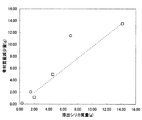
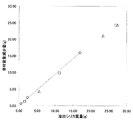
骨材試料とアルカリとの反応(上記(2)参照)における煮沸時間が60分間及び180分間である場合のScg(mmol/L)、溶出シリカ質量(g)及び骨材質量減少量(g)をそれぞれ表1及び表2に示す。また、骨材質量減少量(g)と溶出シリカ質量(g)との関係を図1に示す。なお、図1中「○」は煮沸時間が60分間である場合の骨材質量減少量と溶出シリカ質量との関係を、「□」は煮沸時間が180分間である場合の骨材質量減少量と溶出シリカ質量との関係を示す。 Scg (mmol / L), mass of eluted silica (g), and aggregate mass loss (g) when the boiling time in the reaction between the aggregate sample and alkali (see (2) above) is 60 minutes and 180 minutes Are shown in Table 1 and Table 2, respectively. Moreover, the relationship between aggregate mass reduction | decrease amount (g) and elution silica mass (g) is shown in FIG. In FIG. 1, “◯” indicates the relationship between the aggregate mass decrease amount when the boiling time is 60 minutes and the eluted silica mass, and “□” indicates the aggregate mass decrease amount when the boiling time is 180 minutes. And the eluted silica mass.
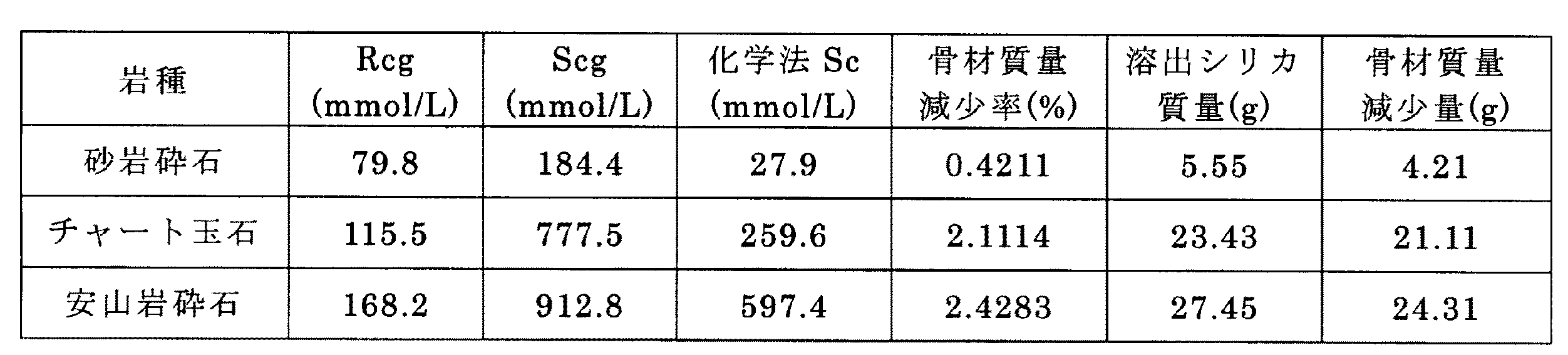
図1に示すように、骨材質量減少量と溶出シリカ質量との比は、ほぼ1であった。このことから、本実施例のアルカリ処理により骨材から溶出したアルカリ可溶成分の大部分がシリカ(SiO2)であり、骨材質量減少量と溶出シリカ質量とを同視できることが明らかとなった。溶出シリカ質量が多いほど骨材のアルカリシリカ反応性が高くなり、溶出シリカ質量が少ないほど骨材のアルカリシリカ反応性が低くなるので、骨材質量減少量を指標とすれば、骨材のアルカリシリカ反応性を判定できると考えられる。 As shown in FIG. 1, the ratio between the aggregate mass reduction amount and the eluted silica mass was approximately 1. From this, it became clear that the majority of the alkali-soluble component eluted from the aggregate by the alkali treatment of this example is silica (SiO 2 ), and the mass loss of the aggregate and the mass of the eluted silica can be equated. . The higher the eluted silica mass, the higher the alkali silica reactivity of the aggregate, and the lower the eluted silica mass, the lower the alkali silica reactivity of the aggregate. It is considered that the silica reactivity can be determined.
〔実施例2〕
(1)代表試料の調製
実施例1と同様の方法により、種々の骨材(砂岩砕石、チャート玉石及び安山岩砕石)の代表試料を調製した。
[Example 2]
(1) Preparation of representative samples Representative samples of various aggregates (sandstone crushed stone, chart boulder and andesite crushed stone) were prepared by the same method as in Example 1.
(2)骨材試料とアルカリとの反応
1Lのポリ容器に、代表試料から計り取った骨材試料1000gと1NのNaOH水溶液500mLとを入れ、蓋でポリ容器を密閉した。そのポリ容器を電気ジャーポット(NC−EZT40−C(松下電器社製))に入れ、水を適量満たして電源を入れて98℃にセットした。24時間、72時間又は168時間反応させた後、ポリ容器を取り出して流水を用いて室温まで冷却し、それぞれ試料原液とした。
(2) Reaction between aggregate sample and alkali In a 1 L plastic container, 1000 g of an aggregate sample measured from a representative sample and 500 mL of 1 N NaOH aqueous solution were placed, and the poly container was sealed with a lid. The poly container was put into an electric jar pot (NC-EZT40-C (manufactured by Matsushita Electric Industrial Co., Ltd.)), filled with an appropriate amount of water, turned on, and set at 98 ° C. After reacting for 24 hours, 72 hours, or 168 hours, the plastic container was taken out and cooled to room temperature using running water to prepare a sample stock solution.
(3)アルカリ消費量の定量
試料原液5mLをホールピペットで採取し、100mLのメスフラスコで20倍に希釈した。その希釈した試料液について、JIS−A1145に準拠して滴定によりアルカリ消費量(Rcg)(mmol/L)を測定した。
(3) Quantification of alkali consumption 5 mL of sample stock solutions were extract | collected with the whole pipette, and it diluted 20 times with the 100 mL volumetric flask. About the diluted sample liquid, alkali consumption (Rcg) (mmol / L) was measured by titration based on JIS-A1145.
(4)溶解シリカ量の定量
得られた試料原液について、実施例1と同様の方法により溶解シリカ量(Scg)(mmol/L)の定量を行い、上記と同様に溶出シリカ質量(g)を算出した。
(4) Quantification of the amount of dissolved silica For the obtained sample stock solution, the amount of dissolved silica (Scg) (mmol / L) was quantified by the same method as in Example 1, and the mass of eluted silica (g) was determined in the same manner as above. Calculated.
(5)骨材質量減少量の定量
煮沸後の試料原液について、実施例1と同様の方法により骨材質量減少量の定量を行った。
また、骨材質量減少率(%)については、下記式に基づいて算出した。
骨材質量減少率=(骨材質量減少量/反応前骨材質量)×100
(5) Quantification of aggregate mass reduction amount The aggregate mass reduction amount was quantified by the method similar to Example 1 about the sample stock solution after boiling.
The aggregate mass reduction rate (%) was calculated based on the following formula.
Aggregate mass reduction rate = (Aggregate mass reduction amount / Aggregate mass before reaction) × 100
(6)上記(1)〜(5)の処理とは別に、各種の骨材(砂岩砕石、チャート玉石及び安山岩砕石)について、JIS−A1145(化学法)に準拠して、骨材試料を調製し、その骨材試料とアルカリとの反応操作を行った後、アルカリ消費量(Rc)(mmol/L)の測定をし、吸光光度法により溶解シリカ量(Sc)(mmol/L)の定量を行った。 (6) Separately from the treatments (1) to (5) above, various aggregates (sandstone crushed stone, chart boulder, and andesite crushed stone) are prepared in accordance with JIS-A1145 (chemical method). After the reaction between the aggregate sample and the alkali, the alkali consumption (Rc) (mmol / L) was measured, and the amount of dissolved silica (Sc) (mmol / L) was determined by absorptiometry. Went.
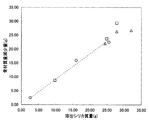
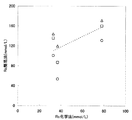
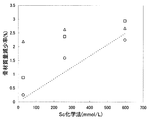
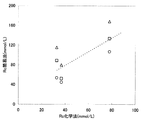
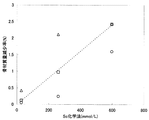
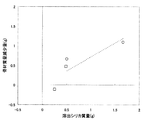
骨材試料とアルカリとの反応(上記(2)参照)における煮沸時間が24時間、72時間及び168時間である場合のRcg(mmol/L)、Scg(mmol/L)、溶出シリカ質量(g)及び骨材質量減少量(g)をそれぞれ表3、表4及び表5に示す。また、骨材質量減少量(g)と溶出シリカ質量(g)との関係を図2に示す。また、Rcg(図中「Rc簡易法」)とRc(図中「Rc化学法」)との関係を図3に示す。また、骨材質量減少率とSc(図中「Sc化学法」)との関係を図4に示す。なお、図中「○」は、煮沸時間が24時間である場合を、「□」は煮沸時間が72時間である場合を、「△」は煮沸時間が168時間である場合を示す。 Rcg (mmol / L), Scg (mmol / L), and eluted silica mass (g) when the boiling time in the reaction between the aggregate sample and alkali (see (2) above) is 24 hours, 72 hours and 168 hours ) And aggregate mass loss (g) are shown in Table 3, Table 4 and Table 5, respectively. Moreover, the relationship between aggregate mass reduction | decrease amount (g) and elution silica mass (g) is shown in FIG. FIG. 3 shows the relationship between Rcg (“Rc simplified method” in the figure) and Rc (“Rc chemical method” in the figure). FIG. 4 shows the relationship between the aggregate mass reduction rate and Sc (“Sc chemical method” in the figure). In the figure, “◯” indicates that the boiling time is 24 hours, “□” indicates that the boiling time is 72 hours, and “Δ” indicates that the boiling time is 168 hours.
図2に示すように、骨材質量減少量と溶出シリカ質量との比は、ほぼ1であった。このことから、本実施例のアルカリ処理により骨材から溶出したアルカリ可溶成分の大部分がシリカ(SiO2)であり、骨材質量減少量と溶出シリカ質量とを同視できることが明らかとなった。溶出シリカ質量が多いほど骨材のアルカリシリカ反応性が高くなり、溶出シリカ質量が少ないほど骨材のアルカリシリカ反応性が低くなるので、骨材質量減少量を指標とすれば、骨材のアルカリシリカ反応性を判定できると考えられる。 As shown in FIG. 2, the ratio between the aggregate mass reduction amount and the eluted silica mass was approximately 1. From this, it became clear that the majority of the alkali-soluble component eluted from the aggregate by the alkali treatment of this example is silica (SiO 2 ), and the mass loss of the aggregate and the mass of the eluted silica can be equated. . The higher the eluted silica mass, the higher the alkali silica reactivity of the aggregate, and the lower the eluted silica mass, the lower the alkali silica reactivity of the aggregate. It is considered that the silica reactivity can be determined.
図3から、下記式(1)が成立することが明らかとなった。
Rc≒Rcg・・・(1)
図4から、下記式(2)が成立することが明らかとなった。
骨材質量減少率=Sc×0.004・・・(2)
上記式(2)から下記式(3)が導き出された。
Sc=250×骨材質量減少率
=25000×骨材質量減少量/反応前骨材質量・・・(3)
JIS−A1145の化学法では、下記式(4)が成立する場合に、骨材のアルカリシリカ反応性が低いと判定できることが知られている。
Rc/Sc≧1・・・(4)
したがって、上記式(4)に上記式(1)及び(3)を代入することにより得られた下記式(5)は、骨材のアルカリシリカ反応性が低い場合に成立することが明らかとなった。
(Rcg/骨材質量減少量)≧(25000/反応前骨材質量)・・・(5)
すなわち、骨材質量減少量及びRcgを測定すれば、骨材のアルカリシリカ反応性を判定できることが明らかとなった。なお、骨材質量減少量は反応前骨材質量から反応後骨材質量を差し引くことにより求められるものなので、骨材質量減少量を測定するにあたり反応前骨材質量も測定されることとなる。
From FIG. 3, it is clear that the following formula (1) is established.
Rc≈Rcg (1)
From FIG. 4, it is clear that the following formula (2) holds.
Aggregate mass reduction rate = Sc × 0.004 (2)
The following formula (3) was derived from the above formula (2).
Sc = 250 × Aggregate mass decrease rate = 25000 × Aggregate mass decrease / Aggregate mass before reaction (3)
In the chemical method of JIS-A1145, it is known that when the following formula (4) is established, it can be determined that the alkali silica reactivity of the aggregate is low.
Rc / Sc ≧ 1 (4)
Therefore, it is clear that the following formula (5) obtained by substituting the above formulas (1) and (3) into the above formula (4) is established when the alkali silica reactivity of the aggregate is low. It was.
(Rcg / Aggregate mass reduction) ≧ (25000 / Aggregate mass before reaction) (5)
That is, it was revealed that the alkali silica reactivity of the aggregate can be determined by measuring the aggregate mass reduction amount and Rcg. Since the aggregate mass reduction amount is obtained by subtracting the post-reaction aggregate mass from the pre-reaction aggregate mass, the pre-reaction aggregate mass is also measured when measuring the aggregate mass reduction amount.
〔実施例3〕
(1)代表試料の調製
実施例1と同様の方法により、種々の骨材(砂岩砕石、チャート玉石及び安山岩砕石)の代表試料を調製した。
Example 3
(1) Preparation of representative samples Representative samples of various aggregates (sandstone crushed stone, chart boulder and andesite crushed stone) were prepared by the same method as in Example 1.
(2)骨材試料とアルカリとの反応
1Lのポリ容器に、代表試料から計り取った骨材試料1000gと1NのNaOH水溶液500mLを入れ、蓋でポリ容器を密閉した。そのポリ容器をウォーターバスに入れ、水を適量満たして80℃になるようにセットした。24時間後、ポリ容器を取り出して流水を用いて室温まで冷却し、試料原液とした。
(2) Reaction of Aggregate Sample with Alkali 1000 g of an aggregate sample measured from a representative sample and 500 mL of 1N NaOH aqueous solution were placed in a 1 L polycontainer, and the polycontainer was sealed with a lid. The polycontainer was placed in a water bath and set to 80 ° C. with an appropriate amount of water. After 24 hours, the plastic container was taken out and cooled to room temperature using running water to obtain a sample stock solution.
(3)アルカリ消費量の定量
試料原液5mLをホールピペットで採取し、100mLのメスフラスコで20倍に希釈した。その希釈した試料液について、JIS−A1145に準拠して滴定によりアルカリ消費量(Rcg)を測定した。
(3) Quantification of alkali consumption 5 mL of sample stock solutions were extract | collected with the whole pipette, and it diluted 20 times with the 100 mL volumetric flask. About the diluted sample liquid, alkali consumption (Rcg) was measured by titration based on JIS-A1145.
(4)溶解シリカ量の定量
得られた試料原液について、実施例1と同様の方法により溶解シリカ量(Scg)の定量を行い、上記と同様に溶出シリカ質量を算出した。
(4) Quantification of amount of dissolved silica For the obtained sample stock solution, the amount of dissolved silica (Scg) was quantified by the same method as in Example 1, and the mass of eluted silica was calculated in the same manner as described above.
(5)骨材質量減少量の定量
煮沸後の試料原液について、実施例1と同様の方法により骨材質量減少量の定量を行った。
また、骨材質量減少率(%)について下記式に基づいて算出した。
骨材質量減少率=(骨材質量減少量/反応前骨材質量)×100
(5) Quantification of aggregate mass reduction amount The aggregate mass reduction amount was quantified by the method similar to Example 1 about the sample stock solution after boiling.
The aggregate mass reduction rate (%) was calculated based on the following formula.
Aggregate mass reduction rate = (Aggregate mass reduction amount / Aggregate mass before reaction) × 100
(6)上記(1)〜(5)の処理とは別に、各種の骨材(砂岩砕石、チャート玉石及び安山岩砕石)について、JIS−A1145(化学法)に準拠して、骨材試料を調製し、その骨材試料とアルカリとの反応操作を行った後、アルカリ消費量(Rc)(mmol/L)の測定をし、吸光光度法により溶解シリカ量(Sc)(mmol/L)の定量を行った。 (6) Separately from the treatments (1) to (5) above, various aggregates (sandstone crushed stone, chart boulder, and andesite crushed stone) are prepared in accordance with JIS-A1145 (chemical method). After the reaction between the aggregate sample and the alkali, the alkali consumption (Rc) (mmol / L) was measured, and the amount of dissolved silica (Sc) (mmol / L) was determined by absorptiometry. Went.
骨材試料とアルカリとの反応(上記(2)参照)における煮沸時間が24時間、72時間及び168時間である場合のRcg(mmol/L)、Scg(mmol/L)、溶出シリカ質量(g)及び骨材質量減少量(g)をそれぞれ表6、表7及び表8に示す。また、骨材質量減少量と溶出シリカ質量との関係を図5に示す。また、Rcg(図中「Rc簡易法」)と、JIS−A1145に規定される化学法により求められたアルカリ消費量(Rc)(図中「Rc化学法」)との関係を図6に示す。また、骨材質量減少率(%)((骨材質量減少量/反応前骨材質量)×100)と、JIS−A1145に規定される化学法により求められた溶解シリカ量(Sc)との関係を図7に示す。なお、図中「○」は、煮沸時間が24時間である場合を、「□」は煮沸時間が72時間である場合を、「△」は煮沸時間が168時間である場合を示す。 Rcg (mmol / L), Scg (mmol / L), and eluted silica mass (g) when the boiling time in the reaction between the aggregate sample and alkali (see (2) above) is 24 hours, 72 hours and 168 hours ) And aggregate mass loss (g) are shown in Table 6, Table 7 and Table 8, respectively. FIG. 5 shows the relationship between the aggregate mass reduction amount and the eluted silica mass. FIG. 6 shows the relationship between Rcg (“Rc simplified method” in the figure) and alkali consumption (Rc) (“Rc chemical method” in the figure) determined by the chemical method defined in JIS-A1145. . Further, the aggregate mass reduction rate (%) ((aggregate mass reduction amount / aggregate mass before reaction) × 100) and the amount of dissolved silica (Sc) determined by the chemical method defined in JIS-A1145 The relationship is shown in FIG. In the figure, “◯” indicates that the boiling time is 24 hours, “□” indicates that the boiling time is 72 hours, and “Δ” indicates that the boiling time is 168 hours.
図5に示すように、骨材質量減少量と溶出シリカ質量との比は、ほぼ1であった。このことから、本実施例のアルカリ処理により骨材から溶出したアルカリ可溶成分の大部分がシリカ(SiO2)であり、骨材質量減少量と溶出シリカ質量とを同視できることが明らかとなった。溶出シリカ質量が多いほど骨材のアルカリシリカ反応性が高くなり、溶出シリカ質量が少ないほど骨材のアルカリシリカ反応性が低くなるので、骨材質量減少量を指標とすれば、骨材のアルカリシリカ反応性を判定できると考えられる。 As shown in FIG. 5, the ratio between the aggregate mass decrease and the eluted silica mass was approximately 1. From this, it became clear that the majority of the alkali-soluble component eluted from the aggregate by the alkali treatment of this example is silica (SiO 2 ), and the mass loss of the aggregate and the mass of the eluted silica can be equated. . The higher the eluted silica mass, the higher the alkali silica reactivity of the aggregate, and the lower the eluted silica mass, the lower the alkali silica reactivity of the aggregate. It is considered that the silica reactivity can be determined.
図6から、下記式(1)が成立することが明らかとなった。
Rc≒Rcg・・・(1)
図7から、下記式(2)が成立することが明らかとなった。
骨材質量減少率=Sc×0.004・・・(2)
上記式(2)から下記式(3)が導き出された。
Sc=250×骨材質量減少率
=25000×骨材質量減少量/反応前骨材質量・・・(3)
JIS−A1145の化学法では、下記式(4)が成立する場合に、骨材のアルカリシリカ反応性が低いと判定できることが知られている。
Rc/Sc≧1・・・(4)
したがって、上記式(4)に上記式(1)及び(3)を代入することにより得られた下記式(5)は、骨材のアルカリシリカ反応性が低い場合に成立することが明らかとなった。
(Rcg/骨材質量減少量)≧(25000/反応前骨材質量)・・・(5)
すなわち、骨材質量減少量及びRcgを測定すれば、骨材のアルカリシリカ反応性を判定できることが明らかとなった。なお、骨材質量減少量は反応前骨材質量から反応後骨材質量を差し引くことにより求められるものなので、骨材質量減少量を測定するにあたり反応前骨材質量も測定されることとなる。
From FIG. 6, it is clear that the following formula (1) is established.
Rc≈Rcg (1)
From FIG. 7, it is clear that the following formula (2) holds.
Aggregate mass reduction rate = Sc × 0.004 (2)
The following formula (3) was derived from the above formula (2).
Sc = 250 × Aggregate mass decrease rate = 25000 × Aggregate mass decrease / Aggregate mass before reaction (3)
In the chemical method of JIS-A1145, it is known that when the following formula (4) is established, it can be determined that the alkali silica reactivity of the aggregate is low.
Rc / Sc ≧ 1 (4)
Therefore, it is clear that the following formula (5) obtained by substituting the above formulas (1) and (3) into the above formula (4) is established when the alkali silica reactivity of the aggregate is low. It was.
(Rcg / Aggregate mass reduction) ≧ (25000 / Aggregate mass before reaction) (5)
That is, it was revealed that the alkali silica reactivity of the aggregate can be determined by measuring the aggregate mass reduction amount and Rcg. Since the aggregate mass reduction amount is obtained by subtracting the post-reaction aggregate mass from the pre-reaction aggregate mass, the pre-reaction aggregate mass is also measured when measuring the aggregate mass reduction amount.
〔実施例4〕
(1)代表試料の調製
実施例1と同様の方法により、種々の骨材(砂岩砕石、チャート玉石及び安山岩砕石)の代表試料を調製した。
Example 4
(1) Preparation of representative samples Representative samples of various aggregates (sandstone crushed stone, chart boulder and andesite crushed stone) were prepared by the same method as in Example 1.
(2)骨材試料とアルカリとの反応
1Lのポリ容器に、代表試料から計り取った骨材試料1000gと1NのNaOH水溶液500mLを入れ、蓋でポリ容器を密閉した。そのポリ容器をウォーターバスに入れ、水を適量満たして40℃になるようにセットした。24時間後、ポリ容器を取り出して流水を用いて室温まで冷却し、試料原液とした。
(2) Reaction of Aggregate Sample with Alkali 1000 g of an aggregate sample measured from a representative sample and 500 mL of 1N NaOH aqueous solution were placed in a 1 L polycontainer, and the polycontainer was sealed with a lid. The polycontainer was placed in a water bath and set to 40 ° C. with an appropriate amount of water. After 24 hours, the plastic container was taken out and cooled to room temperature using running water to obtain a sample stock solution.
(3)溶解シリカ量の定量
得られた試料原液について、実施例1と同様の方法により溶解シリカ量(Scg)の定量を行い、上記と同様に溶出シリカ質量を算出した。
(3) Quantification of the amount of dissolved silica About the obtained sample stock solution, the amount of dissolved silica (Scg) was quantified by the method similar to Example 1, and the mass of elution silica was computed similarly to the above.
(4)骨材質量減少量の定量
煮沸後の試料原液について、実施例1と同様の方法により骨材質量減少量の定量を行った。
(4) Quantification of aggregate mass reduction amount The aggregate mass reduction amount was quantified by the method similar to Example 1 about the sample stock solution after boiling.
Scg(mmol/L)、溶出シリカ質量(g)及び骨材質量減少量(g)を表9に示す。また、骨材質量減少量と溶出シリカ質量との関係を図8に示す。なお、図中「○」は安山岩砕石の骨材質量減少量と溶出シリカ質量との関係を、「□」はチャート玉石の骨材質量減少量と溶出シリカ質量との関係を示す。 Table 9 shows Scg (mmol / L), eluted silica mass (g), and aggregate mass loss (g). Moreover, the relationship between aggregate mass reduction | decrease amount and elution silica mass is shown in FIG. In the figure, “◯” represents the relationship between the mass loss of the andesite crushed stone and the eluted silica mass, and “□” represents the relationship between the aggregate mass decreased amount of the chart boulder and the eluted silica mass.
図8に示すように、骨材質量減少量と溶出シリカ質量との比は、ほぼ1であった。このことから、本実施例のアルカリ処理により骨材から溶出したアルカリ可溶成分の大部分がシリカ(SiO2)であり、骨材質量減少量と溶出シリカ質量とを同視できることが明らかとなった。溶出シリカ質量が多いほど骨材のアルカリシリカ反応性が高くなり、溶出シリカ質量が少ないほど骨材のアルカリシリカ反応性が低くなるので、骨材質量減少量を指標とすれば、骨材のアルカリシリカ反応性を判定できると考えられる。 As shown in FIG. 8, the ratio between the aggregate mass reduction amount and the eluted silica mass was approximately 1. From this, it became clear that the majority of the alkali-soluble component eluted from the aggregate by the alkali treatment of this example is silica (SiO 2 ), and the mass loss of the aggregate and the mass of the eluted silica can be equated. . The higher the eluted silica mass, the higher the alkali silica reactivity of the aggregate, and the lower the eluted silica mass, the lower the alkali silica reactivity of the aggregate. It is considered that the silica reactivity can be determined.
本発明の試験方法及びスクリーニング方法は、生コンクリート工場、骨材生産場等の骨材を取り扱う現場において骨材を日常管理する際に有用である。 The test method and screening method of the present invention are useful for daily management of aggregates at sites handling aggregates such as ready-mixed concrete factories and aggregate production sites.
Claims (10)
(アルカリ消費量/骨材質量減少量)≧(25000/アルカリ処理前骨材質量) The amount of alkali consumed in the alkali treatment is measured, and when the following formula is satisfied, it is determined that the alkali silica reactivity of the aggregate is low, and when the following formula is not satisfied, the alkali silica reactivity of the aggregate is high The alkali-silica reactivity test method according to claim 1, wherein
(Alkali consumption / Aggregate mass decrease) ≧ (25000 / Aggregate mass before alkali treatment)
請求項1〜9のいずれかに記載のアルカリシリカ反応性試験方法を用いて、各骨材群から採取した骨材のアルカリシリカ反応性を判定し、その判定結果に基づいてアルカリシリカ反応性の低い骨材群をスクリーニングすることを特徴とする前記方法。
A method for screening an aggregate group having low alkali silica reactivity from a plurality of aggregate groups,
Using the alkali silica reactivity test method according to any one of claims 1 to 9, the alkali silica reactivity of the aggregate collected from each aggregate group is determined, and based on the determination result, the alkali silica reactivity is determined. Screening said low aggregate group.
Priority Applications (1)
| Application Number | Priority Date | Filing Date | Title |
|---|---|---|---|
| JP2004107939A JP4093983B2 (en) | 2004-03-31 | 2004-03-31 | Test method for alkali-silica reactivity of aggregates |
Applications Claiming Priority (1)
| Application Number | Priority Date | Filing Date | Title |
|---|---|---|---|
| JP2004107939A JP4093983B2 (en) | 2004-03-31 | 2004-03-31 | Test method for alkali-silica reactivity of aggregates |
Publications (2)
| Publication Number | Publication Date |
|---|---|
| JP2005291944A true JP2005291944A (en) | 2005-10-20 |
| JP4093983B2 JP4093983B2 (en) | 2008-06-04 |
Family
ID=35325029
Family Applications (1)
| Application Number | Title | Priority Date | Filing Date |
|---|---|---|---|
| JP2004107939A Expired - Fee Related JP4093983B2 (en) | 2004-03-31 | 2004-03-31 | Test method for alkali-silica reactivity of aggregates |
Country Status (1)
| Country | Link |
|---|---|
| JP (1) | JP4093983B2 (en) |
Cited By (2)
| Publication number | Priority date | Publication date | Assignee | Title |
|---|---|---|---|---|
| JP2011203104A (en) * | 2010-03-25 | 2011-10-13 | Taiheiyo Cement Corp | Alkali-silica reactivity determination device of aggregate, and method of the same |
| US12247970B2 (en) * | 2020-12-04 | 2025-03-11 | The U.S. Department of Transportation. Federal Highway Administration | Method for the assessment of alkali-silica reactivity of aggregates and concrete mixtures |
-
2004
- 2004-03-31 JP JP2004107939A patent/JP4093983B2/en not_active Expired - Fee Related
Cited By (2)
| Publication number | Priority date | Publication date | Assignee | Title |
|---|---|---|---|---|
| JP2011203104A (en) * | 2010-03-25 | 2011-10-13 | Taiheiyo Cement Corp | Alkali-silica reactivity determination device of aggregate, and method of the same |
| US12247970B2 (en) * | 2020-12-04 | 2025-03-11 | The U.S. Department of Transportation. Federal Highway Administration | Method for the assessment of alkali-silica reactivity of aggregates and concrete mixtures |
Also Published As
| Publication number | Publication date |
|---|---|
| JP4093983B2 (en) | 2008-06-04 |
Similar Documents
| Publication | Publication Date | Title |
|---|---|---|
| Schröfl et al. | A review of characterisation methods for superabsorbent polymer (SAP) samples to be used in cement-based construction materials: report of the RILEM TC 260-RSC | |
| CN101294904B (en) | A kind of preparation method of surface-enhanced Raman scattering substrate | |
| CN107140654B (en) | Preparation method of modified quartz sand | |
| Zhang et al. | Mitigation of efflorescence for multi-componential geopolymer: Influence of steel slag, flue gas desulfurization gypsum and pre-curing periods | |
| JP3768442B2 (en) | Analytical sample preparation method and element quantification method | |
| CN108680593A (en) | A kind of X-ray fluorescence spectra quickly measures primary and secondary in granite, the method for micro constitutent | |
| CN115436122B (en) | Rapid detection method for residual quantity of polyaluminium flocculant in machine-made sand | |
| CN113933288A (en) | Method for detecting contents of silicon and calcium elements in silicon-calcium alloy by utilizing ICP (inductively coupled plasma) | |
| Yang et al. | In-situ alkali–silica reaction evolution of lightweight aggregate concretes prepared with alkali-activated cement and ordinary portland cement assessed by X-ray micro computed-tomography | |
| JP4093983B2 (en) | Test method for alkali-silica reactivity of aggregates | |
| Hussain et al. | Role of scoria natural pozzolan in the passive film development for steel rebars in chloride-contaminated concrete environment | |
| CN104353441B (en) | A kind of ion blotting material for enrichment water body ultra trace methyl mercury | |
| CN112345570A (en) | A kind of method for measuring glass fiber composition | |
| Kawabata et al. | Effects of Soak Solution Type on Alkali Release from Volcanic Aggre-gates− Is Alkali Release Really Responsible for Accelerating ASR Expansion?− | |
| El-Batal et al. | Infrared reflection spectroscopy for precise tracking of corrosion behavior in 3d-transition metals doped binary lead silicate glass | |
| CN104931486A (en) | Rapid determination method for content of four kinds of oxides in vermiculite | |
| CN104101553B (en) | Non-heated ore pulp enriched fineness rapid assay methods | |
| CN104316431A (en) | Method for detecting content of diatomaceous earth in diatom ooze wall material | |
| CN115784302B (en) | Method for dissolving zirconium oxide | |
| CN112730733A (en) | Method for detecting content of chloride ions in sea sand | |
| Miller et al. | Evaluation of superabsorbent polymers for use in cementitious systems for the purpose of mitigating autogenous shrinkage | |
| CN112665933A (en) | Pretreatment method for mercury isotope determination of environmental sample | |
| CN116818814A (en) | A method for detecting main elements of aluminum refractory materials using X-ray fluorescence without standard sample | |
| CN104062285A (en) | Determination method for contents of calcium, aluminum and silicon elements in solid surface materials | |
| CN106596429B (en) | Determination method of silicon dioxide in fluorine-containing samples |
Legal Events
| Date | Code | Title | Description |
|---|---|---|---|
| A621 | Written request for application examination |
Effective date: 20060403 Free format text: JAPANESE INTERMEDIATE CODE: A621 |
|
| A977 | Report on retrieval |
Free format text: JAPANESE INTERMEDIATE CODE: A971007 Effective date: 20071130 |
|
| A131 | Notification of reasons for refusal |
Effective date: 20071213 Free format text: JAPANESE INTERMEDIATE CODE: A131 |
|
| A521 | Written amendment |
Free format text: JAPANESE INTERMEDIATE CODE: A523 Effective date: 20080130 |
|
| TRDD | Decision of grant or rejection written | ||
| A01 | Written decision to grant a patent or to grant a registration (utility model) |
Effective date: 20080227 Free format text: JAPANESE INTERMEDIATE CODE: A01 |
|
| A61 | First payment of annual fees (during grant procedure) |
Effective date: 20080304 Free format text: JAPANESE INTERMEDIATE CODE: A61 |
|
| FPAY | Renewal fee payment (prs date is renewal date of database) |
Year of fee payment: 3 Free format text: PAYMENT UNTIL: 20110314 |
|
| R150 | Certificate of patent (=grant) or registration of utility model |
Free format text: JAPANESE INTERMEDIATE CODE: R150 |
|
| FPAY | Renewal fee payment (prs date is renewal date of database) |
Free format text: PAYMENT UNTIL: 20110314 Year of fee payment: 3 |
|
| S531 | Written request for registration of change of domicile |
Free format text: JAPANESE INTERMEDIATE CODE: R313531 |
|
| FPAY | Renewal fee payment (prs date is renewal date of database) |
Year of fee payment: 3 Free format text: PAYMENT UNTIL: 20110314 |
|
| R350 | Written notification of registration of transfer |
Free format text: JAPANESE INTERMEDIATE CODE: R350 |
|
| LAPS | Cancellation because of no payment of annual fees |