JP2005290983A - Method of repairing pottery tile surface - Google Patents
Method of repairing pottery tile surface Download PDFInfo
- Publication number
- JP2005290983A JP2005290983A JP2005197030A JP2005197030A JP2005290983A JP 2005290983 A JP2005290983 A JP 2005290983A JP 2005197030 A JP2005197030 A JP 2005197030A JP 2005197030 A JP2005197030 A JP 2005197030A JP 2005290983 A JP2005290983 A JP 2005290983A
- Authority
- JP
- Japan
- Prior art keywords
- tile surface
- tile
- ceramic tile
- colored transparent
- coloring
- Prior art date
- Legal status (The legal status is an assumption and is not a legal conclusion. Google has not performed a legal analysis and makes no representation as to the accuracy of the status listed.)
- Pending
Links
Landscapes
- Finishing Walls (AREA)
- Working Measures On Existing Buildindgs (AREA)
Abstract
Description
本発明は、建築物等の外装仕上げに用いられている陶磁器タイル面の改修方法に係るものである。 The present invention relates to a method for repairing a ceramic tile surface used for exterior finishing of a building or the like.
磁器質タイル、せっ器質タイル、半磁器質タイル、陶器質タイル等の陶磁器タイルによる仕上げは、一般に、耐久性や意匠性が良好であることから、建築物等の躯体の保護、あるいは美観性の向上のために好んで使用されている。 Finishing with porcelain tiles such as porcelain tiles, porcelain tiles, semi-porcelain tiles, and porcelain tiles generally has good durability and design, so that it can protect buildings and other aesthetics. It is used favorably for improvement.
しかしながら、建築物等の外装用として施工された陶磁器タイルの場合は、太陽光や風雨等の影響を受ける環境下で長期間曝露されることとなる。その結果、タイル部分の光沢低下、褪色、浸蝕、あるいは目地部分の中性化や強度低下等に挙げられるような劣化が進行する。さらには、大気中の塵、排気ガス等の浮遊汚染物質、躯体内部からのエフロレッセンスや錆、シーリング材からの油分等により汚染が進行してしまう。このような陶磁器タイル面については、耐久性や意匠性等を回復させるために、改修の必要性が生じている。 However, in the case of a ceramic tile constructed for an exterior of a building or the like, it will be exposed for a long time in an environment affected by sunlight or wind and rain. As a result, deterioration such as reduction in gloss of the tile portion, discoloration, erosion, or neutralization or strength reduction of the joint portion proceeds. Furthermore, contamination proceeds due to airborne dust, floating pollutants such as exhaust gas, efflorescence and rust from the inside of the enclosure, and oil from the sealing material. For such ceramic tile surfaces, there is a need for refurbishment in order to restore durability, design and the like.
陶磁器タイル面を改修する方法としては、特許文献1に、顔料を含まないクリヤー塗料を積層する方法が提案されている。該発明においては、クリヤー塗料を使用することで、既存陶磁器タイル面の意匠性を変更することなく、防水性を付与することができるとされている。 As a method for refurbishing the ceramic tile surface, Patent Document 1 proposes a method of laminating a clear paint not containing a pigment. In this invention, it is said that waterproofness can be imparted without changing the design of the existing ceramic tile surface by using the clear paint.
該発明は、劣化や汚染の程度が軽微である陶磁器タイル面に対しては適用可能である。しかしながら、長期曝露によって、著しく劣化が進行し大きく褪色してしまった面や、著しく汚染が進行し洗浄を行っても汚染を完全に除去できないような面に対しては、美観性を向上させることができず、意匠性の問題を解消できない。 The present invention can be applied to a ceramic tile surface whose degree of deterioration and contamination is slight. However, improve aesthetics on surfaces that have deteriorated significantly due to long-term exposure, or on surfaces that have been significantly deteriorated and cannot be removed completely even after cleaning. Can not solve the problem of design.
劣化や汚染の問題に対処するためには、陶磁器タイル面に着色塗料を塗付する方法がある。しかし、陶磁器タイル面全体を同一色で塗装すると、目地部とタイル部とのコントラストが失われ、外観が単調になってしまう。また、既存タイルが様々な模様を有する場合には、その模様を生かすことができない。 In order to cope with the problems of deterioration and contamination, there is a method of applying a colored paint to the ceramic tile surface. However, if the entire ceramic tile surface is painted with the same color, the contrast between the joint portion and the tile portion is lost, and the appearance becomes monotonous. Moreover, when the existing tile has various patterns, the patterns cannot be utilized.
したがって、本発明が解決しようとする課題は、劣化や汚染が進行した陶磁器タイル面に対し、既存タイル面の意匠性を生かしつつ、目地部とタイル部とのコントラストを明瞭にして美観性を向上でき、さらには、耐汚染性、防水性、耐候性等を付与することのできる改修方法を得ることである。 Therefore, the problem to be solved by the present invention is to improve the aesthetics by clarifying the contrast between the joint part and the tile part while taking advantage of the design of the existing tile face for the ceramic tile face that has deteriorated or contaminated. It is also possible to obtain a repair method that can impart stain resistance, waterproofness, weather resistance, and the like.
このような課題を解決するために本発明者らは、鋭意検討の結果、特定着色液を用いて目地部を着色した後に、特定の着色透明塗料を全面に塗装する方法を見出し、本発明を完成した。 In order to solve such problems, the present inventors have intensively studied and found a method of coating a specific colored transparent paint on the entire surface after coloring the joint portion using a specific coloring liquid, and completed.
すなわち、本発明の磁器タイル面の改修方法は、以下の特徴を有するものである。
1.陶磁器タイル面に対し、顔料及び/または染料を含有する着色液を用いて目地部を着色する第1の工程、結合材に加水分解性シリル基を含有し、かつ、隠ぺい率が0.10〜0.60である着色透明塗料を全面に塗装する第2の工程を含むことを特徴とする陶磁器タイル面の改修方法。
2.第2の工程において、加水分解性シリル基を含有するアクリル系合成樹脂と、該樹脂を溶解可能な、溶解性パラメータ6.5〜9.5の脂肪族炭化水素系溶剤を主成分とする溶剤を含有し、かつ、隠ぺい率が0.10〜0.60である着色透明塗料を用いることを特徴とする1.に記載の陶磁器タイル面の改修方法。
3.第2の工程において、加水分解性シリル基を含有するアクリル系合成樹脂が、溶解性パラメーター6.5〜9.5の脂肪族炭化水素系溶剤を主成分とする溶剤に分散した非水分散型樹脂組成物を含有し、かつ、隠ぺい率が0.10〜0.60である着色透明塗料を用いることを特徴とする1.または2.に記載の陶磁器タイル面の改修方法。
4.着色透明塗料中に、化2で示されるシリケートオリゴマーを含有することを特徴とする2.または3.に記載の陶磁器タイル面の改修方法。
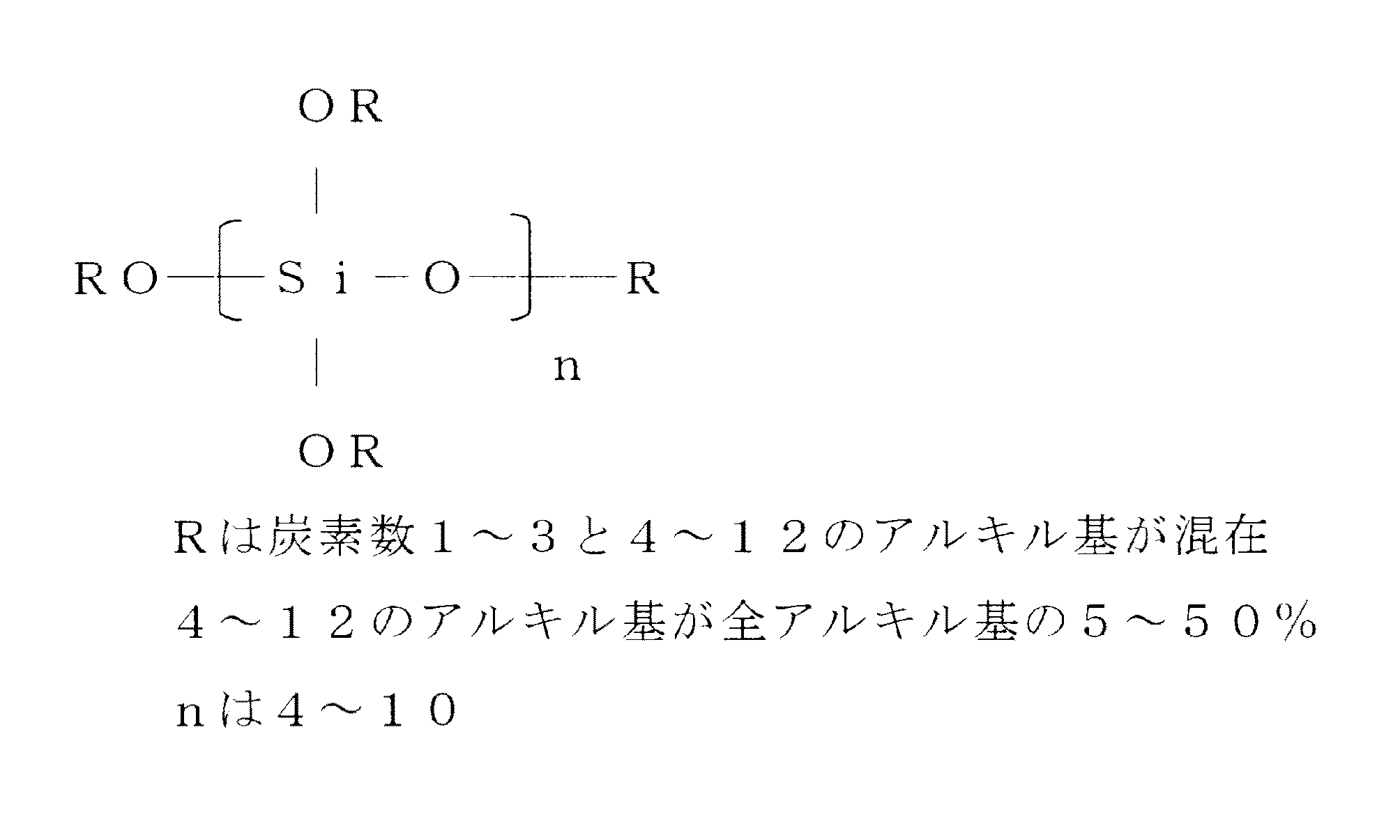
1. 1st process of coloring a joint part using the coloring liquid containing a pigment and / or a dye with respect to a ceramic tile surface, the hydrolyzable silyl group is contained in the binder, and the concealment rate is 0.10 to 0.10. A method for repairing a ceramic tile surface, comprising a second step of coating the entire surface with a colored transparent paint of 0.60.
2. In the second step, a solvent composed mainly of an acrylic synthetic resin containing a hydrolyzable silyl group and an aliphatic hydrocarbon solvent having a solubility parameter of 6.5 to 9.5 that can dissolve the resin. And a transparent coloring paint having a concealment ratio of 0.10 to 0.60 is used. The method of repairing the ceramic tile surface described in 1.
3. In the second step, a non-aqueous dispersion type in which an acrylic synthetic resin containing a hydrolyzable silyl group is dispersed in a solvent mainly composed of an aliphatic hydrocarbon solvent having a solubility parameter of 6.5 to 9.5 1. A colored transparent paint containing a resin composition and having a concealment ratio of 0.10 to 0.60 is used. Or 2. The method of repairing the ceramic tile surface described in 1.
4). 1. A silicate oligomer represented by Chemical Formula 2 is contained in the colored transparent paint. Or 3. The method of repairing the ceramic tile surface described in 1.
本発明を劣化や汚染が進行した陶磁器タイル面に対して適用することで、既存タイル面の意匠性を生かしつつ、改修タイル面の目地部とタイル部とのコントラストを明瞭にして美観性を向上でき、さらには、耐汚染性、防水性、耐候性等を付与することができる。 By applying the present invention to a ceramic tile surface that has deteriorated or contaminated, the design of the existing tile surface is utilized, and the contrast between the joint portion of the modified tile surface and the tile portion is clarified to improve aesthetics. Furthermore, stain resistance, waterproofness, weather resistance, and the like can be imparted.
以下、本発明を実施するための最良の形態とともに詳細に説明する。 Hereinafter, it explains in detail with the best form for carrying out the present invention.
本発明は、建築物外装等の陶磁器タイル面に対して適用するものである。陶磁器タイルの種類としては、磁器質タイル、せっ器質タイル、半磁器質タイル、陶器質タイル等があげられる。このようなタイルによって仕上げられた面であれば、本発明は適用できるが、特に、長期曝露によって劣化や汚染が著しく進行した陶磁器タイル面に対して、優れた効果を発揮する。 The present invention is applied to a ceramic tile surface such as a building exterior. Examples of the ceramic tiles include porcelain tiles, stoneware tiles, semi- porcelain tiles, and ceramic tiles. Although the present invention can be applied to any surface finished with such a tile, an excellent effect is exerted particularly on a ceramic tile surface that has deteriorated or contaminated significantly due to long-term exposure.
本発明においては、第1の工程として、顔料及び/または染料を含有する着色液(以下、着色液ともいう)を用いて目地部を着色する。本発明における着色液を、改修の対象となる陶磁器タイル面の目地部に塗付すると、顔料及び/または染料(以下、着色成分という)が目地内部に浸透し、目地部が着色される。この工程を含むことによって、最終的に、改修を施したタイル面における目地部とタイル部とのコントラストを明瞭にすることができる。 In this invention, as a 1st process, a joint part is colored using the coloring liquid (henceforth a coloring liquid) containing a pigment and / or dye. When the coloring liquid in the present invention is applied to the joint part of the ceramic tile surface to be repaired, the pigment and / or dye (hereinafter referred to as a coloring component) penetrates into the joint part, and the joint part is colored. By including this step, it is possible to finally clarify the contrast between the joint portion and the tile portion on the tile surface subjected to the repair.
着色液に含有される着色成分としては、カーボンブラック、酸化チタン、酸化亜鉛、酸化第二鉄(ベンガラ)、クロム酸鉛(モリブデートオレンジ)、黄鉛、黄色酸化鉄、オーカー、群青、コバルトグリーン等の無機系顔料;アゾ系、ナフトール系、ピラゾロン系、アントラキノン系、ペリレン系、キナクリドン系、ジスアゾ系、イソインドリノン系、ベンゾイミダゾール系、フタロシアニン系、キノフタロン系等の有機系顔料;油溶性染料、酸性染料、塩基性染料、反応性染料、直接染料等の染料をあげることができる。着色成分の含有量は、特に限定されないが、通常は着色液中に0.05〜2.0重量%含有される。 Coloring components contained in the coloring liquid include carbon black, titanium oxide, zinc oxide, ferric oxide (Bengara), lead chromate (molybdate orange), chrome lead, yellow iron oxide, ocher, ultramarine, and cobalt green. Inorganic pigments such as: azo, naphthol, pyrazolone, anthraquinone, perylene, quinacridone, disazo, isoindolinone, benzimidazole, phthalocyanine, quinophthalone, and other organic pigments; oil-soluble dyes And dyes such as acid dyes, basic dyes, reactive dyes, and direct dyes. The content of the coloring component is not particularly limited, but is usually 0.05 to 2.0% by weight in the coloring liquid.
本発明に用いる着色液には、着色成分の他に、ノニオン性界面活性剤、アニオン性界面活性剤、カチオン性界面活性剤、両性界面活性剤等の各種界面活性剤、消泡剤、沈降防止剤等を含有してもよい。また、着色液の溶媒としては、水の他、メタノール、エタノール、イソプロピルアルコール、エチレングリコール、プロピレングリコール等の水溶性溶剤が使用できる。 In addition to coloring components, the coloring liquid used in the present invention includes various surfactants such as nonionic surfactants, anionic surfactants, cationic surfactants, and amphoteric surfactants, antifoaming agents, and anti-settling agents. An agent or the like may be contained. In addition to water, water-soluble solvents such as methanol, ethanol, isopropyl alcohol, ethylene glycol, and propylene glycol can be used as the solvent for the coloring liquid.
着色液の色調は、タイル部と目地部との色差がより大きくなるように適宜設定すればよいが、本発明では特に、タイル部と、着色した目地部との色差が、△L値で5以上となるように設定することが好ましい。 The color tone of the coloring liquid may be appropriately set so that the color difference between the tile portion and the joint portion becomes larger. In the present invention, in particular, the color difference between the tile portion and the colored joint portion is 5 in ΔL value. It is preferable to set so as to be above.
本発明において、着色液を目地部に塗付する際の方法としては特に限定されないが、例えば、刷毛、布、ローラー、スプレー、スポンジ等を用いることができる。 In the present invention, the method for applying the coloring liquid to the joint is not particularly limited, and for example, a brush, cloth, roller, spray, sponge, or the like can be used.
着色液がタイルに付着した場合は、水等による洗浄を行えばよい。仮にタイル部に着色液が付着したとしても、タイル部は目地部に比べ吸水性が低く、着色成分が浸透しにくいため、洗浄を行うことによって着色成分を除去することができる。この際、目地部の着色成分は、目地内部に浸透しているため、除去されにくくなっており、タイル面全体を水洗することも可能である。また、タイル部に着色成分が残ったとしても、第2の工程でカバーできるので問題にはならない。 When the coloring liquid adheres to the tile, it may be washed with water or the like. Even if the coloring liquid adheres to the tile portion, the tile portion has a lower water absorption than the joint portion and the coloring component does not easily permeate, so that the coloring component can be removed by washing. At this time, since the coloring component of the joint part penetrates into the joint part, it is difficult to be removed, and the entire tile surface can be washed with water. Further, even if the coloring component remains in the tile portion, it can be covered in the second step, so that there is no problem.
本発明においては、上記第1の工程の前処理として、目地部あるいはタイル面全体に対し、エッチングを行うことが好ましい。エッチングを行うことにより目地部への着色液の浸透性や着色性をより高めることができる。エッチングの方法については、特に限定されるものではないが、硫酸の濃度5〜10%程度の溶液、塩酸の濃度2〜10%程度の溶液、リン酸の濃度10〜20%程度の溶液、クエン酸の濃度3%程度の溶液がエッチング剤として用いられる。また、フッ化水素アンモニウム、フッ化アンモニウム、珪フッ化アンモニム水溶液等は、ガラスのエッチング剤として使用できるものであるため、目地部分のシリカ成分による汚染物質除去や陶磁器タイル表面の釉薬層をエッチングする場合に好適に用いられる。 In the present invention, it is preferable to etch the joint portion or the entire tile surface as the pretreatment of the first step. By performing the etching, it is possible to further improve the permeability and coloring property of the coloring liquid into the joint. The etching method is not particularly limited, but a solution having a sulfuric acid concentration of about 5 to 10%, a hydrochloric acid concentration of about 2 to 10%, a phosphoric acid concentration of about 10 to 20%, a quencher A solution having an acid concentration of about 3% is used as an etching agent. In addition, ammonium hydrogen fluoride, ammonium fluoride, ammonium silicofluoride aqueous solution, etc. can be used as glass etchants, so it removes pollutants from silica components in joints and etches glaze layers on ceramic tile surfaces. It is preferably used in some cases.
本発明においては、第2の工程として、結合材に加水分解性シリル基を含有し、かつ、隠ぺい率が0.10〜0.60である着色透明塗料を陶磁器タイル面全面に塗装する。 In the present invention, as a second step, a colored transparent paint containing a hydrolyzable silyl group in the binder and having a concealment ratio of 0.10 to 0.60 is applied to the entire surface of the ceramic tile.
本発明に用いる着色透明塗料は、結合材に加水分解性シリル基を含有することが必要である。この官能基によって、各種陶磁器タイル及び目地に対し、優れた密着性が発現される。加水分解性シリル基を含有する化合物としては、加水分解性シリル基含有アクリル系単量体、シランカップリング剤等があげられる。 The colored transparent paint used in the present invention needs to contain a hydrolyzable silyl group in the binder. By this functional group, excellent adhesion to various ceramic tiles and joints is expressed. Examples of the compound containing a hydrolyzable silyl group include hydrolyzable silyl group-containing acrylic monomers and silane coupling agents.
加水分解性シリル基含有アクリル系単量体として、具体的には、γ−(メタ)アクリロキシプロピルトリメトキシシラン、γ−(メタ)アクリロキシプロピルトリエトキシシラン、γ−(メタ)アクリロキシプロピルメチルジメトキシシラン、γ−(メタ)アクリロキシプロピルメチルジエトキシシラン等があげられる。 Specific examples of the hydrolyzable silyl group-containing acrylic monomer include γ- (meth) acryloxypropyltrimethoxysilane, γ- (meth) acryloxypropyltriethoxysilane, and γ- (meth) acryloxypropyl. Examples thereof include methyldimethoxysilane and γ- (meth) acryloxypropylmethyldiethoxysilane.
加水分解性シリル基含有アクリル系単量体は、該単量体と他の単量体との共重合によって、結合材として使用可能となる。加水分解性シリル基含有アクリル系単量体と共重合可能な他の単量体としては、たとえば、メチル(メタ)アクリレート、ブチル(メタ)アクリレート、シクロヘキシル(メタ)アクリレートなどのアルキル基含有(メタ)アクリル系単量体;2−ヒドロキシエチル(メタ)アクリレートなどの水酸基含有(メタ)アクリル系単量体;(メタ)アクリル酸などのエチレン性不飽和カルボン酸;ジメチルアミノエチル(メタ)アクリレートなどのアミノ基含有(メタ)アクリル系単量体;(メタ)アクリルアミドなどのアミド含有(メタ)アクリル系単量体;アクリロニトリルなどのニトリル基含有(メタ)アクリル系単量体;グリシジル(メタ)アクリレートなどのエポキシ基含有(メタ)アクリル系単量体等を例示できる。その他にも、スチレン、メチルスチレンなどの芳香族炭化水素系ビニル単量体;マレイン酸、イタコン酸などのα,β−エチレン性不飽和カルボン酸;スチレンスルホン酸などのスルホン酸含有ビニル単量体;無水マレイン酸などの酸無水物;塩化ビニル、塩化ビニリデンなどの塩素含有単量体;ヒドロキシエチルビニルエーテルなどの水酸基含有アルキルビニルエーテル;エチレングリコールモノアリルエーテルなどのアルキレングリコールモノアリルエーテル;エチレン、プロピレンなどのα−オレフィン;酢酸ビニルなどのビニルエステル;メチルビニルエーテルなどのビニルエーテル;エチルアリルエーテルなどのアリルエーテル等が使用できる。 The hydrolyzable silyl group-containing acrylic monomer can be used as a binder by copolymerization of the monomer with another monomer. Other monomers copolymerizable with the hydrolyzable silyl group-containing acrylic monomer include, for example, methyl group (meth) acrylate, butyl (meth) acrylate, cyclohexyl (meth) acrylate, etc. ) Acrylic monomers; hydroxyl group-containing (meth) acrylic monomers such as 2-hydroxyethyl (meth) acrylate; ethylenically unsaturated carboxylic acids such as (meth) acrylic acid; dimethylaminoethyl (meth) acrylate, etc. Amino group-containing (meth) acrylic monomers; amide-containing (meth) acrylic monomers such as (meth) acrylamide; nitrile group-containing (meth) acrylic monomers such as acrylonitrile; glycidyl (meth) acrylate Examples thereof include epoxy group-containing (meth) acrylic monomers. In addition, aromatic hydrocarbon vinyl monomers such as styrene and methylstyrene; α, β-ethylenically unsaturated carboxylic acids such as maleic acid and itaconic acid; sulfonic acid-containing vinyl monomers such as styrenesulfonic acid Acid anhydrides such as maleic anhydride; chlorine-containing monomers such as vinyl chloride and vinylidene chloride; hydroxyl-containing alkyl vinyl ethers such as hydroxyethyl vinyl ether; alkylene glycol monoallyl ethers such as ethylene glycol monoallyl ether; ethylene, propylene, etc. Α-olefins of vinyl acetate, vinyl esters such as vinyl acetate, vinyl ethers such as methyl vinyl ether, and allyl ethers such as ethyl allyl ether can be used.
シランカップリング剤は、各種の結合材に添加することによって使用できる。シランカップリング剤としては、具体的には、γ−グリシドキシプロピルメチルジエトキシシラン、γ−グリシドキシプロピルメチルトリエトキシシラン、β−(3,4エポキシシクロヘキシル)エチルトリメトキシシラン、N−β(アミノエチル)γ−アミノプロピルメチルトリエトキシシラン、γ−アミノプロピルトリメトキシシラン、γ−アミノプロピルトリエトキシシラン等があげられる。 A silane coupling agent can be used by adding to various binders. Specific examples of the silane coupling agent include γ-glycidoxypropylmethyldiethoxysilane, γ-glycidoxypropylmethyltriethoxysilane, β- (3,4-epoxycyclohexyl) ethyltrimethoxysilane, N- β (aminoethyl) γ-aminopropylmethyltriethoxysilane, γ-aminopropyltrimethoxysilane, γ-aminopropyltriethoxysilane and the like can be mentioned.
着色透明塗料の媒体形態は特に限定されず、強溶剤系、弱溶剤系、水性系の形態が使用可能であるが、陶磁器タイル面への密着性、作業性、環境衛生性等を考慮すると、弱溶剤系が好ましい。 The medium form of the colored transparent paint is not particularly limited, and a strong solvent system, a weak solvent system, and an aqueous system form can be used, but considering adhesiveness to the ceramic tile surface, workability, environmental hygiene, etc. Weak solvent systems are preferred.
このような弱溶剤系塗料としては、前述の加水分解性シリル基を含有するアクリル系単量体と、炭素数4〜12個の脂肪族または脂環式アルキル基を有する(メタ)アクリル酸アルキル単量体、および、その他のラジカル重合性二重結合を含有する単量体から形成される重合体が、溶解性パラメーター6.5〜9.5の脂肪族炭化水素系溶剤を主成分とする溶剤に溶解した弱溶剤可溶タイプや、前述の加水分解性シリル基を含有するアクリル系単量体を重合して得られた重合物を溶解しない、溶解性パラメーター6.5〜9.5の脂肪族炭化水素系溶剤を主成分とする溶剤中で、該溶剤に溶解する樹脂系分散安定剤の存在下に、分散せしめた非水分散型樹脂組成物、及びこれらの複合タイプがあげられる。 Examples of such weak solvent-based paints include the above-mentioned acrylic monomers containing hydrolyzable silyl groups and alkyl (meth) acrylates having an aliphatic or alicyclic alkyl group having 4 to 12 carbon atoms. A polymer formed from a monomer and another monomer containing a radical polymerizable double bond is mainly composed of an aliphatic hydrocarbon solvent having a solubility parameter of 6.5 to 9.5. A weak solvent-soluble type dissolved in a solvent or a polymer obtained by polymerizing an acrylic monomer containing a hydrolyzable silyl group as described above, having a solubility parameter of 6.5 to 9.5 Examples thereof include a non-aqueous dispersion type resin composition dispersed in a solvent containing an aliphatic hydrocarbon solvent as a main component in the presence of a resin dispersion stabilizer dissolved in the solvent, and a composite type thereof.
特に、前述の弱溶剤可溶タイプや非水分散型樹脂組成物では、さらにその組成中に化3で示されるシリケートオリゴマーを含有することにより、耐汚染性により優れた表面を形成可能となる。
本発明に用いる着色透明塗料は、隠ぺい率が0.10〜0.60(好ましくは0.15〜0.40)であることが必要である。隠ぺい率がこのような範囲内であることにより、既存陶磁器タイル面の意匠性を生かしたままに、美観性を向上でき、さらに、タイル部及び目地部に耐汚染性、防水性、耐候性等を付与することができる。隠ぺい率が0.10より小さいと、褪色や汚染を回復できず、美麗な外観を得られない。隠ぺい率が0.60より大きいと、タイル部と目地部とのコントラストが不明瞭となり、既存タイル面の意匠性が失われ、タイル全体が単調な外観になってしまうおそれがある。 The colored transparent paint used in the present invention needs to have a concealment ratio of 0.10 to 0.60 (preferably 0.15 to 0.40). When the concealment ratio is within such a range, the aesthetics can be improved while taking advantage of the design of the existing ceramic tile surface, and the tile and joints are resistant to contamination, waterproof, weather resistance, etc. Can be granted. If the concealment rate is less than 0.10, the fading and contamination cannot be recovered and a beautiful appearance cannot be obtained. If the concealment ratio is larger than 0.60, the contrast between the tile portion and the joint portion becomes unclear, the design property of the existing tile surface is lost, and the entire tile may have a monotonous appearance.
本発明における隠ぺい率とは、JIS K 5400の7.2に準じて測定される値である。具体的には、塗装時に使用する塗料(希釈を行う場合は、希釈後の塗料)を隠ぺい率試験紙に150μm塗付し、温度20℃、湿度65%環境下で48時間乾燥させた試験片について、下記式、
隠ぺい率=(黒地上の塗膜の視感反射率)/(白地上の塗膜の視感反射率)
で表される値である。
The concealment rate in the present invention is a value measured according to JIS K 5400 7.2. Specifically, a test piece obtained by applying 150 μm of a coating material used at the time of painting (diluted coating material when diluted) to a concealment rate test paper, and drying it for 48 hours in a temperature 20 ° C. and humidity 65% environment. About the following formula,
Hiding ratio = (luminous reflectance of paint film on black ground) / (luminous reflectance of paint film on white ground)
It is a value represented by
本発明に用いる着色透明塗料の色調は、改修の対象となる既存陶磁器タイルの色柄に応じて、隠ぺい率が0.10〜0.60の範囲で、適宜設定すればよい。この際用いられる顔料としては、酸化チタン、酸化亜鉛、カーボンブラック、酸化第二鉄(ベンガラ)、クロム酸鉛(モリブデートオレンジ)、黄鉛、黄色酸化鉄、オーカー、群青、コバルトグリーン等の無機系顔料、アゾ系、ナフトール系、ピラゾロン系、アントラキノン系、ペリレン系、キナクリドン系、ジスアゾ系、イソインドリノン系、ベンゾイミダゾール系、フタロシアニン系、キノフタロン系等の有機顔料が使用できる。また、重質炭酸カルシウム、クレー、カオリン、タルク、沈降性硫酸バリウム、炭酸バリウム、ホワイトカーボン、珪藻土等の体質顔料を使用することも可能である。 What is necessary is just to set suitably the color tone of the colored transparent coating material used for this invention in the range of the concealment rate of 0.10-0.60 according to the color pattern of the existing ceramic tile used as the object of repair. In this case, the pigment used is inorganic such as titanium oxide, zinc oxide, carbon black, ferric oxide (Bengara), lead chromate (molybdate orange), yellow lead, yellow iron oxide, ocher, ultramarine, cobalt green, etc. Organic pigments such as pigments, azo, naphthol, pyrazolone, anthraquinone, perylene, quinacridone, disazo, isoindolinone, benzimidazole, phthalocyanine, and quinophthalone can be used. It is also possible to use extender pigments such as heavy calcium carbonate, clay, kaolin, talc, precipitated barium sulfate, barium carbonate, white carbon, diatomaceous earth.
また、着色透明塗料には、可塑剤、防腐剤、防黴剤、消泡剤、レベリング剤、顔料分散剤、沈降防止剤、たれ防止剤、紫外線吸収剤、酸化防止剤などの添加剤を単独あるいは併用して配合することができる。 In addition, additives such as plasticizers, antiseptics, antifungal agents, antifoaming agents, leveling agents, pigment dispersants, anti-settling agents, anti-sagging agents, ultraviolet absorbers, and antioxidants are used alone in colored transparent paints. Or it can mix | blend in combination.
着色透明塗料の塗装方法としては、特に限定されず、刷毛塗り、スプレー塗装、ローラー塗装等、公知の塗装方法を用いることができる。 It does not specifically limit as a coating method of a colored transparent coating material, Well-known coating methods, such as brush coating, spray coating, and roller coating, can be used.
着色透明塗料を塗装する際の塗付量は、塗装する材料や基材の種類等により適宜設定すればよいが、通常、0.1kg/m2〜0.3kg/m2程度の塗付量にて塗装を行うことが望ましい。着色透明塗料をこのような塗付量で塗装することにより、既存タイル面の意匠性を生かしつつ、美麗な外観を得ることができる。 Coat-weight when painting a colored transparent paint may be appropriately set by the kind of material and the substrate to be coated, usually, 0.1kg / m 2 ~0.3kg / m 2 about coat-weight It is desirable to paint with. By applying the colored transparent paint in such a coating amount, a beautiful appearance can be obtained while taking advantage of the design of the existing tile surface.
以下に実施例及び比較例を示し、本発明の特徴をより明確にする。 Examples and Comparative Examples are shown below to clarify the features of the present invention.
(実施例1)
目地部セメント色のモルタル、タイル部茶系色の磁器質タイルからなり、施工後5年経過したタイル面を基材とした。この基材に対し、カーボンブラック、アニオン系界面活性剤、及び水からなり、カーボンブラック含有量が0.3%である着色液を目地部に塗付した後、水洗し、室温にて乾燥させた。ここで、着色した目地部と、タイル部との△Lを測定したところ16.7であった。次に表1に示した原料を使用し、表2の配合によって調製した塗料1をウールローラーにて塗付量0.2kg/m2で塗装し、室温にて乾燥させた。これにより、タイル部と目地部とのコントラストが明瞭となり、タイル面全体の美観性も飛躍的に向上した。
(Example 1)
The tile surface was made of cement mortar and tiled tea color porcelain tiles. The base material is coated with a coloring liquid consisting of carbon black, an anionic surfactant, and water and having a carbon black content of 0.3%, then washed with water and dried at room temperature. It was. Here, ΔL between the colored joint and the tile was measured and found to be 16.7. Next, using the raw materials shown in Table 1, paint 1 prepared by blending in Table 2 was applied with a wool roller at a coating amount of 0.2 kg / m 2 and dried at room temperature. As a result, the contrast between the tile portion and the joint portion became clear, and the aesthetics of the entire tile surface was also dramatically improved.
(実施例2)
塗料1に替えて塗料2を使用した以外は、実施例1と同様に試験を行ったところ、タイル部と目地部とのコントラストが明瞭となり、タイル面全体の美観性も飛躍的に向上した。
(Example 2)
A test was conducted in the same manner as in Example 1 except that the paint 2 was used in place of the paint 1. As a result, the contrast between the tile part and the joint part became clear, and the aesthetics of the entire tile surface was dramatically improved.
(実施例3)
塗料1に替えて塗料3を使用した以外は、実施例1と同様に試験を行ったところ、タイル部と目地部とのコントラストが明瞭となり、タイル面全体の美観性も飛躍的に向上した。
(Example 3)
A test was conducted in the same manner as in Example 1 except that the paint 3 was used in place of the paint 1. As a result, the contrast between the tile portion and the joint portion became clear, and the aesthetics of the entire tile surface was dramatically improved.
(実施例4)
塗料1に替えて塗料4を使用した以外は、実施例1と同様に試験を行ったところ、タイル部と目地部とのコントラストが明瞭となり、タイル面全体の美観性も飛躍的に向上した。
Example 4
A test was conducted in the same manner as in Example 1 except that the paint 4 was used in place of the paint 1. As a result, the contrast between the tile portion and the joint portion became clear, and the aesthetics of the entire tile surface improved dramatically.
(実施例5)
塗料1に替えて塗料5を使用した以外は、実施例1と同様に試験を行ったところ、タイル部と目地部とのコントラストが明瞭となり、タイル面全体の美観性も飛躍的に向上した。
(Example 5)
A test was conducted in the same manner as in Example 1 except that the paint 5 was used in place of the paint 1. As a result, the contrast between the tile part and the joint part became clear, and the aesthetics of the entire tile surface was dramatically improved.
(実施例6)
実施例1と同一の基材に対し、カーボンブラック、アニオン系界面活性剤、及び水からなり、カーボンブラック含有量が0.1%である着色液を目地部に塗付した後、水洗し、室温にて乾燥させた。ここで、着色した目地部と、タイル部との△Lを測定したところ7.6であった。次に表2に示す塗料6をウールローラーにて塗付量0.2kg/m2で塗装し、室温にて乾燥させた。これにより、タイル部と目地部とのコントラストが明瞭となり、タイル面全体の美観性も飛躍的に向上した。
(Example 6)
For the same substrate as in Example 1, after applying a coloring liquid consisting of carbon black, an anionic surfactant, and water and having a carbon black content of 0.1% on the joint, it was washed with water, Dry at room temperature. Here, ΔL between the colored joint and the tile was measured and found to be 7.6. Next, the coating material 6 shown in Table 2 was applied at a coating amount of 0.2 kg / m 2 with a wool roller and dried at room temperature. As a result, the contrast between the tile portion and the joint portion became clear, and the aesthetics of the entire tile surface was also dramatically improved.
(実施例7)
実施例1と同一の基材に対し、フッ化アンモニウム5%水溶液をスポンジにて擦りながら塗付し、タイル面全体をエッチングした後、水洗した。次に、カーボンブラック、アニオン系界面活性剤、及び水からなり、カーボンブラック含有量が0.1%である着色液を目地部に塗付した後、水洗し、室温にて乾燥させた。ここで、着色した目地部と、タイル部との△Lを測定したところ9.1であった。さらに、表2に示す塗料6をウールローラーにて塗付量0.2kg/m2で塗装し、室温にて乾燥させた。これにより、タイル部と目地部とのコントラストが明瞭となり、タイル面全体の美観性も飛躍的に向上した。
(Example 7)
A 5% ammonium fluoride aqueous solution was applied to the same substrate as in Example 1 while rubbing with a sponge, and the entire tile surface was etched and then washed with water. Next, a coloring liquid composed of carbon black, an anionic surfactant, and water and having a carbon black content of 0.1% was applied to the joint, washed with water, and dried at room temperature. Here, ΔL between the colored joint and the tile was measured and found to be 9.1. Furthermore, the coating material 6 shown in Table 2 was applied at a coating amount of 0.2 kg / m 2 with a wool roller and dried at room temperature. As a result, the contrast between the tile portion and the joint portion became clear, and the aesthetics of the entire tile surface was also dramatically improved.
(比較例1)
実施例1と同一の基材に対し、タイル全体を水洗し、乾燥させた。ここで、目地部とタイル部との△Lを測定したところ3.2であった。次に、表2に示す塗料1をウールローラーにて塗付量0.2kg/m2で塗装し、室温にて乾燥させた。このようにして得たタイル面は、タイル部と目地部とのコントラストが不明瞭になってしまった。
(Comparative Example 1)
The entire tile was washed with water and dried on the same substrate as in Example 1. Here, ΔL between the joint portion and the tile portion was measured and found to be 3.2. Next, the coating material 1 shown in Table 2 was applied at a coating amount of 0.2 kg / m 2 with a wool roller and dried at room temperature. In the tile surface thus obtained, the contrast between the tile portion and the joint portion has become unclear.
(比較例2)
実施例1と同一の基材に対し、カーボンブラック、アニオン系界面活性剤、及び水からなり、カーボンブラック含有量が0.1%である着色液を目地部に塗付した後、水洗し、乾燥させた。ここで、着色した目地部と、タイル部との△Lを測定したところ7.6であった。次に表2に示す塗料7をウールローラーにて塗付量0.2kg/m2で塗装し、室温にて乾燥させた。このようにして得たタイル面は、タイル部に残存した汚染が露出してしまい、美観性に劣る結果となった。
(Comparative Example 2)
For the same substrate as in Example 1, after applying a coloring liquid consisting of carbon black, an anionic surfactant, and water and having a carbon black content of 0.1% on the joint, it was washed with water, Dried. Here, ΔL between the colored joint and the tile was measured and found to be 7.6. Next, the coating material 7 shown in Table 2 was applied at a coating amount of 0.2 kg / m 2 with a wool roller and dried at room temperature. The tile surface thus obtained was exposed to contamination remaining in the tile portion, resulting in poor aesthetics.
(比較例3)
実施例1と同一の基材に対し、カーボンブラック、アニオン系界面活性剤、及び水からなり、カーボンブラック含有量が0.2%である着色液を目地部に塗付した後、水洗し、乾燥させた。ここで、着色した目地部と、タイル部との△Lを測定したところ12.5であった。次に表2に示す塗料8をウールローラーにて塗付量0.2kg/m2で塗装し、室温にて乾燥させた。このようにして得たタイル面は、タイル部と目地部とのコントラストが不明瞭になり、単調な仕上りとなってしまった。
(Comparative Example 3)
For the same substrate as in Example 1, after applying a coloring liquid consisting of carbon black, an anionic surfactant, and water and having a carbon black content of 0.2% to the joint, it was washed with water, Dried. Here, ΔL between the colored joint and the tile was measured and found to be 12.5. Next, the paint 8 shown in Table 2 was applied with a wool roller at a coating amount of 0.2 kg / m 2 and dried at room temperature. In the tile surface thus obtained, the contrast between the tile portion and the joint portion becomes unclear, resulting in a monotonous finish.
Claims (4)
The method for repairing a ceramic tile surface according to claim 2 or 3, wherein the colored transparent paint contains a silicate oligomer represented by Chemical Formula 1.
Priority Applications (1)
| Application Number | Priority Date | Filing Date | Title |
|---|---|---|---|
| JP2005197030A JP2005290983A (en) | 2005-07-06 | 2005-07-06 | Method of repairing pottery tile surface |
Applications Claiming Priority (1)
| Application Number | Priority Date | Filing Date | Title |
|---|---|---|---|
| JP2005197030A JP2005290983A (en) | 2005-07-06 | 2005-07-06 | Method of repairing pottery tile surface |
Related Parent Applications (1)
| Application Number | Title | Priority Date | Filing Date |
|---|---|---|---|
| JP22186599A Division JP3727201B2 (en) | 1999-08-05 | 1999-08-05 | How to repair ceramic tiles |
Publications (1)
| Publication Number | Publication Date |
|---|---|
| JP2005290983A true JP2005290983A (en) | 2005-10-20 |
Family
ID=35324219
Family Applications (1)
| Application Number | Title | Priority Date | Filing Date |
|---|---|---|---|
| JP2005197030A Pending JP2005290983A (en) | 2005-07-06 | 2005-07-06 | Method of repairing pottery tile surface |
Country Status (1)
| Country | Link |
|---|---|
| JP (1) | JP2005290983A (en) |
-
2005
- 2005-07-06 JP JP2005197030A patent/JP2005290983A/en active Pending
Similar Documents
| Publication | Publication Date | Title |
|---|---|---|
| CN112625468A (en) | Multifunctional composite coating and preparation method thereof | |
| KR102060601B1 (en) | Water proof painting composition for concrete structure and painting method | |
| CN106256859A (en) | A kind of colorful environmental protection coating material of nanometer high durable and preparation method thereof | |
| KR100370876B1 (en) | Antifouling agent for water-based coating material, fouling-resistant water-based coating composition, and method of using the same | |
| KR20190041479A (en) | Benzophenone derivatives, aqueous copolymer dispersants and aqueous coating compositions | |
| KR101291114B1 (en) | Waterproof and anticorrosion paint composition including elastomer polymer and ceramic and constructing methods using thereof | |
| JP3727201B2 (en) | How to repair ceramic tiles | |
| JP4491313B2 (en) | Method for painting decorative surface and decorative laminate | |
| JP3245566B2 (en) | Method of forming moisture-permeable coating film | |
| JP3688524B2 (en) | How to repair ceramic tiles | |
| CN104109471A (en) | High-air-permeability high-weather-resistance green architectural protective paint | |
| KR102324161B1 (en) | Water paint composition for preventing carbocation and manufacturing method thereof | |
| KR102225331B1 (en) | Method for coating structure | |
| JP2006122820A (en) | Finish coating method | |
| JP3214881B2 (en) | Finishing method of cement base material | |
| JP2596749B2 (en) | Reinforced makeup method for old deteriorated surface | |
| JP5411024B2 (en) | Waterproof material and waterproof layer repair method | |
| JP4491312B2 (en) | Method for forming moisture-permeable coating film | |
| JP3245575B2 (en) | Method of forming moisture-permeable coating film | |
| JP4118158B2 (en) | How to repair ceramic tiles | |
| JP4118149B2 (en) | How to repair ceramic tiles | |
| JP4087261B2 (en) | How to repair ceramic tiles | |
| JP4118152B2 (en) | How to repair ceramic tiles | |
| JP2667583B2 (en) | Finishing method of cement base material | |
| CN116120809B (en) | Repairing coating and preparation method and application thereof |