JP2005290445A - Method for preparing annealing separator slurry and method for producing grain-oriented electrical steel sheet - Google Patents
Method for preparing annealing separator slurry and method for producing grain-oriented electrical steel sheet Download PDFInfo
- Publication number
- JP2005290445A JP2005290445A JP2004105236A JP2004105236A JP2005290445A JP 2005290445 A JP2005290445 A JP 2005290445A JP 2004105236 A JP2004105236 A JP 2004105236A JP 2004105236 A JP2004105236 A JP 2004105236A JP 2005290445 A JP2005290445 A JP 2005290445A
- Authority
- JP
- Japan
- Prior art keywords
- chloride
- slurry
- water
- annealing separator
- mass
- Prior art date
- Legal status (The legal status is an assumption and is not a legal conclusion. Google has not performed a legal analysis and makes no representation as to the accuracy of the status listed.)
- Pending
Links
Images


Landscapes
- Chemical Treatment Of Metals (AREA)
- Manufacturing Of Steel Electrode Plates (AREA)
- Soft Magnetic Materials (AREA)
Abstract
【課題】 フォルステライト被膜を形成しない方向性電磁鋼板の製造方法において用いられる、鉄損を安定して低減することができる焼鈍分離剤のスラリー調製方法とその焼鈍分離剤スラリーを用いた方向性電磁鋼板の製造方法を提案する。
【解決手段】 マグネシア100質量部に対して、塩素換算で0.1〜10質量部の塩化物を含む焼鈍分離剤のスラリーを調製する方法において、塩化物として水可溶性塩化物を添加する場合は、水可溶性塩化物を水に溶解させて得た溶液を用い、水不溶性塩化物を添加する場合は、累積90%径が20μm以下である塩化物粒子を用い、Sn塩化物および/またはSb塩化物を添加する場合は、流速0.2m/s以上で攪拌された水中またはスラリー中にSn塩化物および/またはSb塩化物を投入して生成される塩化物溶液および塩化物分散の混合液を用いて方向性電磁鋼板用焼鈍分離剤スラリーを調製する。
【選択図】 図1PROBLEM TO BE SOLVED: To prepare a slurry for an annealing separator capable of stably reducing iron loss used in a method for producing a grain-oriented electrical steel sheet not forming a forsterite film, and a directional electromagnetic using the annealing separator slurry. A method for manufacturing steel sheets is proposed.
SOLUTION: In a method for preparing a slurry of an annealing separator containing 0.1 to 10 parts by mass of chloride in terms of chlorine with respect to 100 parts by mass of magnesia, water-soluble chloride is added as a chloride when water is added. When using a solution obtained by dissolving soluble chloride in water and adding water-insoluble chloride, use chloride particles with a cumulative 90% diameter of 20 μm or less, and add Sn chloride and / or Sb chloride. When adding, use a mixed solution of chloride solution and chloride dispersion generated by adding Sn chloride and / or Sb chloride into water or slurry stirred at a flow rate of 0.2 m / s or more. An annealing separator slurry for heat-resistant electrical steel sheets is prepared.
[Selection] Figure 1
Description
本発明は、電源用トランス等の鉄心として主に使用されるフォルステライト被膜のない低鉄損方向性電磁鋼板の製造に用いられる焼鈍分離剤スラリーの調整方法と、そのスラリーを用いた方向性電磁鋼板の製造方法に関するものである。 The present invention relates to a method for adjusting an annealing separator slurry used in the production of a low iron loss directional electrical steel sheet without a forsterite coating, which is mainly used as an iron core of a power transformer, and a directional electromagnetic using the slurry. The present invention relates to a method for manufacturing a steel sheet.
方向性電磁鋼板は、地鉄の鋼板表面にフォルステライト(Mg2SiO4)を主体とする被膜、あるいはさらに該被膜の上に絶縁被膜の2重の被膜が形成されているのが普通である。また、方向性電磁鋼板の鉄損は、鋼板の厚さ、比抵抗、不純物の量、結晶方位、結晶粒度の他、鋼板表面の粗度や表面に付与される張力によっても大きく影響されることが知られており、鋼板の地鉄表面とフォルステライト被膜との界面の粗度を低減することにより、鉄損を大幅に低減できることが報告されている(例えば、特許文献1等参照。)。 A grain-oriented electrical steel sheet is usually formed by forming a film mainly composed of forsterite (Mg 2 SiO 4 ) on the surface of the steel sheet of the ground iron, or further forming a double film of an insulating film on the film. . In addition, the iron loss of grain-oriented electrical steel sheets is greatly affected by the steel sheet thickness, specific resistance, amount of impurities, crystal orientation, crystal grain size, as well as the surface roughness of the steel sheet and the tension applied to the surface. Is known, and it has been reported that iron loss can be significantly reduced by reducing the roughness of the interface between the surface of the steel sheet and the forsterite film (see, for example, Patent Document 1).
しかし、粗度の小さい地鉄表面を得るには、通常の方向性電磁鋼板の製造において、仕上焼鈍工程で形成されるフォルステライト質の被膜は不都合である。というのは、通常、フォルステライト被膜と地鉄の界面は深く入り込んで凹凸形状になって形成されるため、地鉄表面の平滑化がなされず、また、この鋼板内部に入り込んだフォルステライト被膜によって磁壁の移動が阻害され、鉄損が増加するからである。 However, in order to obtain a surface iron surface having a low roughness, the forsterite film formed in the finish annealing process is inconvenient in the production of ordinary grain-oriented electrical steel sheets. This is because the interface between the forsterite film and the steel is usually deeply formed into an irregular shape, so the surface of the steel is not smoothed. This is because the movement of the domain wall is hindered and the iron loss increases.
そこで、粗度の小さい地鉄表面を得るために、フォルステライト被膜を形成させない技術が開発されている。例えば、特許文献2等には、仕上焼鈍時の焼鈍分離剤として、通常のMgOを主体とする焼鈍分離剤を用いずに、Al2O3等のSiO2と反応しないあるいは反応しにくい物質を焼鈍分離剤として用いることにより、フォルステライト被膜を形成させずに高い磁束密度を有する方向性電磁鋼板を得る技術が開示されている。また、特許文献3等には、マグネシアに対してアルカリ金属またはアルカリ土類金属の塩化物を添加することにより、フォルステライト被膜の形成を抑制した打ち抜き性に優れる方向性電磁鋼板の製造技術が開示されている。
しかしながら、特許文献2に開示された、アルミナを主体とする焼鈍分離剤を用いる技術は、仕上焼鈍中に地鉄中からS,Seを除去する、いわゆる純化が困難であり、鉄損の劣化を招くという問題があった。一方、特許文献3に開示された、マグネシアに塩化物を添加する技術は、地鉄中からS,Seを除去することは可能である。しかし、発明者らの調査では、マグネシア中に添加する塩化物の種類や添加方法によって、鉄損の低減効果に大きな差があることが明らかになった。すなわち、焼鈍分離剤スラリー中への塩化物の添加を適正に行わなければ、方向性電磁鋼板の低鉄損化は達成できないという問題があった。 However, the technique using the annealing separator mainly composed of alumina disclosed in Patent Document 2 is difficult to perform so-called purification, in which S and Se are removed from the ground iron during finish annealing, and the iron loss is deteriorated. There was a problem of inviting. On the other hand, the technique of adding chloride to magnesia disclosed in Patent Document 3 can remove S and Se from the ground iron. However, the inventors' investigation has revealed that there is a great difference in the effect of reducing iron loss depending on the kind of chloride added to magnesia and the addition method. That is, there is a problem that the iron loss of the grain-oriented electrical steel sheet cannot be achieved unless the chloride is properly added to the annealing separator slurry.
本発明の目的は、フォルステライト被膜を形成しない方向性電磁鋼板の製造方法において用いられる、鉄損を安定して低減することができる焼鈍分離剤のスラリー調製方法とその焼鈍分離剤スラリーを用いた方向性電磁鋼板の製造方法を提案することにある。 An object of the present invention is to use a slurry preparation method of an annealing separator capable of stably reducing iron loss, which is used in a method for manufacturing a grain-oriented electrical steel sheet not forming a forsterite film, and the annealing separator slurry. The purpose is to propose a method of manufacturing a grain-oriented electrical steel sheet.
発明者らは、焼鈍分離剤に塩化物を添加することによってフォルステライト被膜の形成がなく、鋼板表面を平滑化した方向性電磁鋼板を得る技術における上記問題点、すなわち、鉄損低減効果が安定しないという問題点の原因について鋭意検討を行った。その結果、焼鈍分離剤の調製方法より、仕上焼鈍中に鋼板表面に形成されるフォルステライト被膜が不均一となる場合があること、また、これを防止するためには、焼鈍分離剤に添加する塩化物の特性に応じてスラリーの調製方法を適正化することが重要であることを見出し、本発明を完成させた。 The inventors found that the above problem in the technology for obtaining a grain-oriented electrical steel sheet in which the forsterite film is not formed by adding chloride to the annealing separator and the steel sheet surface is smoothed, that is, the iron loss reduction effect is stable. We have intensively investigated the cause of the problem of not doing. As a result, the forsterite film formed on the surface of the steel sheet during finish annealing may become non-uniform due to the method for preparing the annealing separator, and to prevent this, it is added to the annealing separator. The present inventors have found that it is important to optimize the method of preparing the slurry according to the characteristics of the chloride.
すなわち、本発明は、マグネシア100質量部に対して、塩素換算で0.1〜10質量部の水可溶性塩化物を含む焼鈍分離剤のスラリーを調製する方法において、前記水可溶性塩化物を水に溶解させて得た水可溶性塩化物溶液を用いることを特徴とする方向性電磁鋼板用焼鈍分離剤スラリーの調製方法である。 That is, the present invention provides a method for preparing a slurry of an annealing separator containing 0.1 to 10 parts by mass of a water-soluble chloride in terms of chlorine with respect to 100 parts by mass of magnesia, wherein the water-soluble chloride is dissolved in water. It is the preparation method of the annealing separator slurry for grain-oriented electrical steel sheets characterized by using the water-soluble chloride solution obtained in this way.
また、本発明は、マグネシア100質量部に対して、塩素換算で0.1〜10質量部の水不溶性塩化物を含む焼鈍分離剤のスラリーを調製する方法において、前記水不溶性塩化物として、累積90%径が20μm以下である塩化物粒子を用いることを特徴とする方向性電磁鋼板用焼鈍分離剤スラリーの調製方法である。 Further, the present invention provides a method for preparing a slurry of an annealing separator containing 0.1 to 10 parts by mass of water-insoluble chloride in terms of chlorine with respect to 100 parts by mass of magnesia. A method for preparing an annealing separator slurry for grain-oriented electrical steel sheets, wherein chloride particles having a diameter of 20 μm or less are used.
また、本発明は、マグネシア100質量部に対して、塩素換算で0.1〜10質量部の塩化物を含有させてなる焼鈍分離剤のスラリーを調製する方法において、水可溶性塩化物を水に溶解させて得た水可溶性塩化物溶液および累積90%径が20μm以下である水不溶性塩化物粒子を用いることを特徴とする方向性電磁鋼板用焼鈍分離剤スラリーの調製方法である。 Further, the present invention provides a method for preparing a slurry of an annealing separator containing 0.1 to 10 parts by mass of chloride in terms of chlorine with respect to 100 parts by mass of magnesia, wherein water-soluble chloride is dissolved in water. A method for preparing an annealing separator slurry for grain-oriented electrical steel sheets, characterized in that the water-soluble chloride solution obtained and water-insoluble chloride particles having a cumulative 90% diameter of 20 μm or less are used.
また、本発明は、マグネシア100質量部に対して、塩素換算で0.1〜10質量部のSn塩化物および/またはSb塩化物を含む焼鈍分離剤のスラリーを調製する方法において、前記塩化物を流速0.2m/s以上で攪拌された水中に投入して生成される塩化物溶液および塩化物分散体の混合液を用いることを特徴とする方向性電磁鋼板用焼鈍分離剤スラリーの調製方法である。 Further, the present invention provides a method for preparing a slurry of an annealing separator containing 0.1 to 10 parts by mass of Sn chloride and / or Sb chloride in terms of chlorine with respect to 100 parts by mass of magnesia. A method for preparing an annealing separator slurry for grain-oriented electrical steel sheets, characterized by using a mixed solution of a chloride solution and a chloride dispersion produced by being poured into water stirred at 0.2 m / s or more.
また、本発明は、マグネシア100質量部に対して、塩素換算で0.1〜10質量部のSn塩化物および/またはSb塩化物を含む焼鈍分離剤のスラリーを調製する方法において、前記塩化物とマグネシアの混合物を流速0.2m/s以上で攪拌された水中に投入することを特徴とする方向性電磁鋼板用焼鈍分離剤スラリーの調製方法である。 The present invention also provides a method for preparing a slurry of an annealing separator containing 0.1 to 10 parts by mass of Sn chloride and / or Sb chloride in terms of chlorine with respect to 100 parts by mass of magnesia. This is a method for preparing an annealing separator slurry for grain-oriented electrical steel sheets, which is poured into water stirred at a flow rate of 0.2 m / s or more.
また、本発明は、マグネシア100質量部に対して、塩素換算で0.1〜10質量部のSn塩化物および/またはSb塩化物を含む焼鈍分離剤のスラリーを調製する方法において、前記塩化物を流速0.2m/s以上で攪拌されたマグネシアのスラリー中に投入することを特徴とする方向性電磁鋼板用焼鈍分離剤スラリーの調製方法である。 Further, the present invention provides a method for preparing a slurry of an annealing separator containing 0.1 to 10 parts by mass of Sn chloride and / or Sb chloride in terms of chlorine with respect to 100 parts by mass of magnesia. A method for preparing an annealing separator slurry for grain-oriented electrical steel sheets, wherein the slurry is put into a slurry of magnesia stirred at 0.2 m / s or more.
さらに、本発明は、鋼スラブを熱間圧延し、冷間圧延し、その後、脱炭焼鈍して得た鋼板の表面に焼鈍分離剤スラリーを塗布し、仕上焼鈍する一連の工程を経て方向性電磁鋼板の製造方法において、前記焼鈍分離剤スラリーとして、上記焼鈍分離剤スラリーを用いることを特徴とする方向性電磁鋼板の製造方法である。 Furthermore, the present invention is directed through a series of steps in which a steel slab is hot-rolled, cold-rolled, and then coated with an annealing separator slurry on the surface of the steel sheet obtained by decarburization annealing, followed by finish annealing. In the method for manufacturing an electrical steel sheet, the annealing separator slurry is used as the annealing separator slurry.
本発明によれば、フォルステライト被膜のない方向性電磁鋼板の鉄損を、安定して低減することができるので、品質の安定化、製造歩留まりの向上に大いに寄与する。 According to the present invention, the iron loss of a grain-oriented electrical steel sheet without a forsterite coating can be stably reduced, which greatly contributes to stabilization of quality and improvement of manufacturing yield.
本発明が対象とする方向性電磁鋼板は、仕上焼鈍前までは、従来公知の方法および条件で製造することができる。
方向性電磁鋼板の鋼素材は、その成分組成として、Siを2.0〜7.0mass%含有したものであることが好ましい。Siは、鋼板の電気抵抗を高め、鉄損を低減するのに有効な成分である。しかし、含有量が2.0mass%未満であると、二次再結晶焼鈍中に変態を生じて安定した二次再結晶組織が得られず、良好な磁気特性を得ることができない。一方、Si含有量が7.0mass%を超えると、鋼が硬くなり過ぎて製造や加工が困難になると共に、飽和磁束密度の低下を招くからである。より好ましくは、2.6〜3.8mass%の範囲である。
The grain-oriented electrical steel sheet to which the present invention is directed can be produced by a conventionally known method and conditions before finish annealing.
The steel material of the grain-oriented electrical steel sheet preferably contains 2.0 to 7.0 mass% Si as its component composition. Si is an effective component for increasing the electrical resistance of the steel sheet and reducing iron loss. However, if the content is less than 2.0 mass%, transformation occurs during secondary recrystallization annealing, a stable secondary recrystallization structure cannot be obtained, and good magnetic properties cannot be obtained. On the other hand, if the Si content exceeds 7.0 mass%, the steel becomes too hard, making it difficult to manufacture and process, and lowering the saturation magnetic flux density. More preferably, it is the range of 2.6-3.8 mass%.
また、鋼素材中には、インヒビタ成分として、Alを0.01mass%以上含有することが好ましい。Alを0.01mass%以上含有することにより、二次再結晶後の結晶配向性を向上することができる。なお、Alを添加する場合、その量が0.06mass%を超えると、再び結晶配向性の劣化が生じるので0.06mass%以下とすることが好ましい。より好ましいAlの範囲は、0.02〜0.03mass%である。 Moreover, it is preferable to contain 0.01 mass% or more of Al as an inhibitor component in a steel raw material. By containing 0.01 mass% or more of Al, the crystal orientation after secondary recrystallization can be improved. In addition, when adding Al, when the quantity exceeds 0.06 mass%, since crystal orientation will deteriorate again, it is preferable to make it 0.06 mass% or less. A more preferable range of Al is 0.02 to 0.03 mass%.
Nもまた、Alと同様にインヒビタ作用があるので含有させることが好ましい。添加量は、ふくれ欠陥の発生を防止するためには200mass ppm以下に制限することが好ましい。一方、下限は特に規定しないが、10mass ppm未満まで工業的に低下させるのは経済的に困難であることから、10mass ppm以上の添加量とすることが好ましい。 N is also preferably contained since it has an inhibitory action like Al. The amount added is preferably limited to 200 mass ppm or less in order to prevent occurrence of blister defects. On the other hand, the lower limit is not particularly defined, but it is economically difficult to industrially lower it to less than 10 mass ppm, so it is preferable to set the addition amount to 10 mass ppm or more.
なお、一次再結晶焼鈍後に、後述する増窒素処理(浸窒処理)を行う工程を付加する場合には、鋼素材中のN含有量を低減することができる。この場合には、スラブ加熱を行う際、インヒビタ成分を固溶するための高温加熱が不要となるため、操業の自由度が増すという利点がある。また、増窒素処理を行う場合には、他のインヒビタ成分である、Mn、SおよびSeの添加は必ずしも必要ではないが、鋼の延性改善等の他の目的で適宜添加してもよい。 In addition, when adding the process of performing the nitrogen increase process (nitrogenation process) mentioned later after primary recrystallization annealing, N content in a steel raw material can be reduced. In this case, when slab heating is performed, high temperature heating for dissolving the inhibitor component is not necessary, and there is an advantage that the degree of freedom in operation is increased. In addition, when nitrogen increase treatment is performed, addition of other inhibitor components such as Mn, S, and Se is not always necessary, but they may be added as appropriate for other purposes such as improving the ductility of steel.
しかし、増窒素処理を行わない場合は、鋼素材中に、SおよびSeを合計で0.01〜0.06mass%の範囲で含有させることが好ましい。さらに、SおよびSeを添加する場合には、これらの元素をMn化合物として析出させるために、Mnを0.01〜0.2mass%の範囲で含有させることが望ましい。それぞれの含有量が少なすぎると、二次再結晶を生じるための析出物の量が不足し、一方、含有量が多すぎると、熱間圧延前のスラブ加熱でインヒビタ成分を固溶させることが困難となるからである。なお、増窒素処理を行う場合でも、インヒビタとしての目的以外でMn、SおよびSeを添加する場合も、上記と同範囲の添加量とすることが好ましい。 However, when no nitrogen increase treatment is performed, it is preferable to contain S and Se in a total amount of 0.01 to 0.06 mass% in the steel material. Furthermore, when adding S and Se, in order to precipitate these elements as Mn compounds, it is desirable to contain Mn in the range of 0.01 to 0.2 mass%. If the respective contents are too small, the amount of precipitates for causing secondary recrystallization is insufficient. On the other hand, if the content is too large, the inhibitor component may be dissolved in the slab heating before hot rolling. It will be difficult. In addition, even when performing a nitrogen increase process, when adding Mn, S, and Se other than the objective as an inhibitor, it is preferable to set it as the addition amount of the same range as the above.
さらに、鋼素材中には、上記元素の他に、方向性電磁鋼板の磁気特性を向上するために、B,Bi,Sb,Mo,Te,Sn,P,Ge,As,Nb,Ni,Cr,Ti,Cu,Pb,ZnおよびInから選ばれる1種または2種以上の元素を合計で0.0005〜2.0mass%の範囲で含有させてもよい。これら元素の合計含有量が、0.0005mass%未満では、十分な改善効果が認められず、一方、2.0mass%を超えると、磁束密度の低下を招くからである。 Furthermore, in addition to the above elements, in order to improve the magnetic properties of grain-oriented electrical steel sheets, steel materials include B, Bi, Sb, Mo, Te, Sn, P, Ge, As, Nb, Ni, Cr. , Ti, Cu, Pb, Zn, and In may be contained in the range of 0.0005 to 2.0 mass% in total in one or more elements selected from In. This is because if the total content of these elements is less than 0.0005 mass%, a sufficient improvement effect is not observed, whereas if it exceeds 2.0 mass%, the magnetic flux density is reduced.
また、鋼素材中には、再結晶集合組織を制御して磁気特性を向上させる目的で、Cを0.005〜0.8mass%の範囲で含有させることが好ましい。なお、C,S,SeおよびNなどの元素はいずれも、磁気特性に対しては有害な元素であり、特に鉄損特性を劣化させることから、製品板においては、それぞれC:0.003mass%以下、S,Se:各々0.002mass%以下およびN:0.002mass%以下に低減することが好ましい。 Moreover, it is preferable to contain C in the range of 0.005-0.8 mass% in the steel material for the purpose of controlling the recrystallization texture and improving the magnetic properties. In addition, since elements such as C, S, Se, and N are all harmful elements to the magnetic properties and particularly deteriorate the iron loss properties, C: 0.003 mass% or less in the product plate, respectively. , S, Se: Each is preferably reduced to 0.002 mass% or less and N: 0.002 mass% or less.
次に、本発明の方向性電磁鋼板の製造方法について説明する。
上述した適正な成分組成を有する鋼を通常公知の方法で溶製し、連続鋳造あるいは造塊−分塊圧延により得た鋼スラブを通常公知の方法により熱間圧延して熱延板とし、必要に応じて熱延板焼鈍し、次いで、1回または中間焼鈍を挟む2回以上の冷間圧延または温間圧延により最終板厚の冷延板とするのが好ましい。なお、上記の製造方法においては、連続熱延法やシートバーキャスト法、コイルキャスト法で得た素材を用いてもよい。
Next, the manufacturing method of the grain-oriented electrical steel sheet of this invention is demonstrated.
The steel having the proper composition described above is melted by a generally known method, and a steel slab obtained by continuous casting or ingot-bundling rolling is hot-rolled by a generally known method to form a hot-rolled sheet. Accordingly, it is preferable that the hot-rolled sheet is annealed, and then a cold-rolled sheet having a final sheet thickness is formed by cold rolling or warm rolling two or more times with one or intermediate annealing. In the above manufacturing method, a material obtained by a continuous hot rolling method, a sheet bar casting method, or a coil casting method may be used.
上記のようにして得た冷延板は、その後、一次再結晶焼鈍と、必要に応じて増窒素処理を施す。一次再結晶焼鈍は、脱炭焼鈍を兼ねる場合もある。また、上記増窒素処理は、インヒビタとして作用するAlNを固溶させるために行われている熱間圧延前のスラブ高温加熱を省略することを目的するものである。具体的には、一次再結晶焼鈍した鋼板を、アンモニアを含む雰囲気中に加熱通板することなどにより行われる。 The cold-rolled sheet obtained as described above is then subjected to primary recrystallization annealing and, if necessary, nitrogen increase treatment. Primary recrystallization annealing may also serve as decarburization annealing. Further, the nitrogen increase treatment is intended to omit the high temperature heating of the slab before hot rolling, which is performed to dissolve AlN acting as an inhibitor. Specifically, the steel sheet subjected to primary recrystallization annealing is heated and passed in an atmosphere containing ammonia.
一次再結晶焼鈍あるいは増窒素処理を施した鋼板は、その後、焼鈍分離剤を塗布し、仕上焼鈍を行う。上記、焼鈍分離剤は、マグネシアを主体とするものであることが必要である。その理由は、地鉄中のS,Se等の不純物を除去するためであり、さらには、鋼板表面に、一度、フォルステライト被膜を形成させるのに必要なマグネシウムを供給するためでもある。つまり、本発明では、一度、鋼板表面を覆うようにフォルステライト被膜を形成させると共に、フォルステライトと地鉄との界面を平滑化することにより、仕上焼鈍の冷却過程においてフォルステライト被膜の剥離を起こさせる技術である。上記、フォルステライト被膜を形成するためのマグネシアには、従来公知のものを用いることができる。 The steel sheet subjected to primary recrystallization annealing or nitrogen increase treatment is then applied with an annealing separator and subjected to finish annealing. The annealing separator described above must be mainly composed of magnesia. The reason is to remove impurities such as S and Se in the ground iron, and also to supply magnesium necessary to form a forsterite film once on the steel sheet surface. In other words, in the present invention, once the forsterite film is formed so as to cover the surface of the steel sheet, and the interface between the forsterite and the ground iron is smoothed, the forsterite film is peeled off during the cooling process of finish annealing. Technology. A conventionally well-known thing can be used for the magnesia for forming the said forsterite film.
仕上焼鈍に用いるマグネシアを主剤とする焼鈍分離剤には、マグネシア:100質量部に対して、塩素化合物(塩化物)を塩素換算(塩素元素の質量換算)で0.1〜10質量部添加する必要がある。塩化物を添加する目的は、フォルステライトと地鉄との界面を平滑化するためであり、上記範囲よりも少なくても、また多過ぎても、フォルステライトと地鉄との界面が粗くなり、仕上焼鈍冷却時におけるフォルステライトの剥離が困難になる。 It is necessary to add 0.1 to 10 parts by mass of chlorine compound (chloride) in terms of chlorine (in terms of chlorine element) to 100 parts by mass of magnesia: 100 parts by mass of magnesia used as the final annealing agent. is there. The purpose of adding chloride is to smooth the interface between forsterite and ground iron, and even if less than the above range, or too much, the interface between forsterite and ground iron becomes rough, Forsterite is difficult to peel off during finish annealing cooling.
ここで、本発明における最も重要な要件である、焼鈍分離剤スラリーの調整方法について説明する。
まず、塩化物が水可溶性の場合には、水に溶解した状態、すなわち、塩化物溶液の状態として焼鈍分離剤のスラリー中に添加する必要がある。というのは、マグネシアのスラリーにおいては、水分子がマグネシアの水和に関与しているため、溶解度が比較的大きい塩化物でも、特に、混合・攪拌の時間が短い場合は溶解せずに粒子として存在する場合があり、このような場合には、仕上焼鈍の昇温過程で、上記未溶解粒子が存在する部分のフォルステライト被膜が地鉄に食い込むような形で形成され、地鉄表面が平滑にならないからである。よって、水可溶性塩化物と言えども、水にいったん溶解させて得られた水溶液を用いて、前記塩化物を添加する必要がある。
Here, a method for adjusting the annealing separator slurry, which is the most important requirement in the present invention, will be described.
First, when the chloride is water-soluble, it is necessary to add it to the slurry of the annealing separator as a state dissolved in water, that is, as a chloride solution. This is because, in magnesia slurry, water molecules are involved in magnesia hydration, so even if the solubility is relatively high, even if the mixing and stirring time is short, it will not dissolve and become particles. In such a case, the forsterite film in the part where the undissolved particles exist is formed in a form that bites into the ground iron in the temperature raising process of finish annealing, and the surface of the ground iron is smooth. It is because it does not become. Therefore, even if it is a water-soluble chloride, it is necessary to add the chloride using an aqueous solution obtained by once dissolving in water.
一方、塩化物が水不溶性の場合には、累積90%粒径が20μm以下の塩化物粒子を用いてスラリー中に前記塩化物を含有させる必要がある。塩化物中に20μmを超える粒子が多く含まれていると、未溶解粒子と同様に、仕上焼鈍の昇温過程で、この粗大粒子が存在する部分のフォルステライト被膜が地鉄に食い込むような形で形成され、地鉄表面が平滑にならない。この問題は、水不溶性塩化物の90%粒径を20μm以下にすることにより回避し、全体に均一で平滑な地鉄界面を得ることができる。ここで上記累積90%粒径とは、粒度分布を百分率で表し、粒径の小さい方から累積していったときに、累積重量が90%となるところの粒径のことを意味する。 On the other hand, when the chloride is insoluble in water, it is necessary to contain the chloride in the slurry using chloride particles having a cumulative 90% particle size of 20 μm or less. When many particles exceeding 20μm are contained in the chloride, the shape of the forsterite film where the coarse particles exist will bite into the iron during the temperature rise process of finish annealing, as in the case of undissolved particles. The surface of the ground iron is not smooth. This problem can be avoided by setting the 90% particle size of the water-insoluble chloride to 20 μm or less, and a uniform and smooth base iron interface can be obtained as a whole. Here, the cumulative 90% particle size means a particle size distribution where the particle size distribution is expressed as a percentage, and the cumulative weight becomes 90% when accumulated from the smaller particle size.
また、焼鈍分離剤に添加する塩化物として、前記水可溶性塩化物と水不溶性塩化物を併用してもよい。この場合には、水可溶性塩化物は、一旦、水に溶解させた塩化物溶液として、また、水不溶性塩化物は、累積90%粒径が20μm以下の塩化物粒子として焼鈍分離剤のスラリー調製に用いることが必要である。 Moreover, you may use together the said water-soluble chloride and water-insoluble chloride as a chloride added to an annealing separation agent. In this case, water-soluble chloride is prepared as a chloride solution once dissolved in water, and water-insoluble chloride is prepared as a slurry of annealing separator as chloride particles having a cumulative 90% particle size of 20 μm or less. It is necessary to use it.
また、焼鈍分離剤に添加する塩化物として、Sn塩化物および/またはSb塩化物を用いる場合には、これら塩化物は、流速0.2m/s以上で攪拌とした水またはスラリー中に投入する必要がある。その理由は、これらの塩化物を水またはマグネシアの水スラリーに添加し、十分に攪拌・混合すると、例えば下記式;
SnCl2 + H2O → HCl +Sn(OH)Cl
SbCl3 + H2O → 2HCl +SbOCl
のように加水分解が進行し、塩化水素と粒径10μm以下の微細な水不溶性のオキシ塩化物とに分解され、さらに発生した塩化水素は、マグネシアと反応して水溶性の塩化マグネシウムとなって均質にスラリー中に拡散する。しかし、水またはスラリーの攪拌が弱い状態では、上記オキシ塩化物の粒子は、20μm以上に成長しやすく、そのため、上記水不溶性塩化物の場合と同様に、部分的なフォルステライトの地鉄界面への食い込みが発生するようになるからである。従って、Sn塩化物やSb塩化物は、十分に攪拌している状態の水または水スラリー中に添加する必要がある。ここで、十分に攪拌した状態とは、水または水スラリーが流速で0.2m/s以上で攪拌されている状態を意味し、これよりも流速が遅い攪拌では、20μmを超える水不溶性の粒子が形成されやすい。よって、Sn塩化物および/またはSb塩化物を焼鈍分離剤に添加する塩化物として使用する時は、流速0.2m/s以上で攪拌とした水中にそれらの塩化物を投入した分散体を用いて焼鈍分離剤のスラリーを調製するか、もしくは、前記の流速としたマグネシアのスラリー中にそれらの塩化物を投入して焼鈍分離剤スラリーを調製する必要がある。
In addition, when Sn chloride and / or Sb chloride is used as the chloride to be added to the annealing separator, these chlorides must be put into water or slurry stirred at a flow rate of 0.2 m / s or more. There is. The reason is that when these chlorides are added to water or a magnesia water slurry, and sufficiently stirred and mixed, for example, the following formula:
SnCl 2 + H 2 O → HCl + Sn (OH) Cl
SbCl 3 + H 2 O → 2HCl + SbOCl
As the hydrolysis proceeds, it is decomposed into hydrogen chloride and fine water-insoluble oxychloride with a particle size of 10 μm or less, and the generated hydrogen chloride reacts with magnesia to form water-soluble magnesium chloride. Homogeneously diffuses into the slurry. However, in the state where the stirring of water or slurry is weak, the oxychloride particles tend to grow to 20 μm or more, and therefore, as in the case of the water-insoluble chloride, the partial forsterite to the iron interface. This is because the bite of the cedar occurs. Therefore, it is necessary to add Sn chloride and Sb chloride to water or water slurry in a sufficiently stirred state. Here, the sufficiently agitated state means a state where water or water slurry is agitated at a flow rate of 0.2 m / s or more. With agitation where the flow rate is slower than this, water-insoluble particles exceeding 20 μm are produced. Easy to form. Therefore, when using Sn chloride and / or Sb chloride as a chloride added to the annealing separator, use a dispersion in which the chlorides are put into water stirred at a flow rate of 0.2 m / s or more. It is necessary to prepare a slurry of the annealing separator, or to prepare an annealing separator slurry by introducing those chlorides into the magnesia slurry having the above flow rate.
なお、このようにして調製したマグネシアと塩化物からなる焼鈍分離剤スラリーには、さらに地鉄とフォルステライトの界面を平滑にするために、アルカリ金属やアルカリ土類金属、B,Sb,Sn,Bi,Pb,Ti,Mn,Cr等の酸化物、窒化物、硫酸塩、硝酸塩および水酸化物を適宜添加してもよい。 In addition, in the annealing separator slurry made of magnesia and chloride prepared in this manner, an alkali metal, alkaline earth metal, B, Sb, Sn, Oxides such as Bi, Pb, Ti, Mn, and Cr, nitrides, sulfates, nitrates, and hydroxides may be added as appropriate.
C:0.06mass%、Si:3.3mass%、Mn:0.09mass%、S:0.003mas%、Se:0.02mass%、Al:0.02mass%、N:0.01mass%、Sb:0.03mass%およびCu:0.1mass%を含み、残部がFeおよび不可避的不純物からなる鋼スラブを、1380℃に加熱し、熱間圧延して厚さ2.0mmの熱延板とし、熱延板焼鈍を施した。その後、この熱延板を、冷間圧延、中間焼鈍、210℃での温間圧延を行い、板厚0.22mmの冷延鋼板とし、引き続き、脱炭焼鈍を兼ねた一次再結晶焼鈍を施した。さらに、この一次再結晶焼鈍後の鋼板に、表1に示した各種の塩化物を添加して、マグネシアを主とする焼鈍分離剤のスラリーを調製し、このスラリーを目付量13g/m2に設定して鋼板表面に塗布し、乾燥した。ここで、上記スラリーの調製方法は、塩化物が水可溶性の場合は、表1のNo.1〜5の方法で、塩化物を焼鈍分離剤スラリー中に添加した。また、塩化物が水不溶性の場合は、塩化物の累積90%粒径が、表1のNo.6〜11に示した値となるように調整した塩化物粒子をマグネシアに添加し、水スラリーとした。 C: 0.06 mass%, Si: 3.3 mass%, Mn: 0.09 mass%, S: 0.003 mass%, Se: 0.02 mass%, Al: 0.02 mass%, N: 0.01 mass%, Sb: 0.03 mass% and Cu: A steel slab containing 0.1 mass% and the balance consisting of Fe and inevitable impurities was heated to 1380 ° C. and hot-rolled into a hot-rolled sheet having a thickness of 2.0 mm, and subjected to hot-rolled sheet annealing. Then, this hot-rolled sheet was cold-rolled, intermediate-annealed, and warm-rolled at 210 ° C to obtain a cold-rolled steel sheet with a sheet thickness of 0.22 mm, followed by primary recrystallization annealing that also served as decarburization annealing. . Furthermore, various chlorides shown in Table 1 are added to the steel sheet after the primary recrystallization annealing to prepare a slurry of an annealing separator mainly composed of magnesia, and this slurry is adjusted to a basis weight of 13 g / m 2 . It set, apply | coated to the steel plate surface, and dried. Here, when the chloride was water-soluble, the slurry was added to the annealing separator slurry by the methods of Nos. 1 to 5 in Table 1. If the chloride is insoluble in water, chloride particles adjusted so that the cumulative 90% particle size of the chloride will be the values shown in Nos. 6 to 11 in Table 1 are added to magnesia, and water slurry is added. It was.
焼鈍分離剤を塗布・乾燥した鋼板は、その後、コイル状に巻き取った後、800℃までをN2雰囲気で平均50℃/hで、800〜1000℃をN2雰囲気で平均10℃/hで、さらに、1000〜1200℃をH2雰囲気で平均15℃/hで昇温し、1200℃で6h保持するパターンの仕上焼鈍を行い、その後、冷却してフォルステライト被膜の無い方向性電磁鋼板を得た。かくして得られた方向性電磁綱板を、水洗およびリン酸酸洗によって表面を洗浄し、さらに、8MPaの張力を加えながら3vol%のH2を含むN2雰囲気中で、820℃×20秒間保持する平坦化焼鈍を行った。このようにして得た鋼帯から、磁気測定用の試料を採取し、歪取り焼鈍を行ってから、1.7T、50Hzにおける履歴損を、エプスタイン枠を使った直流磁化測定によって測定した。 The steel plate coated with an annealing separator and dried is then wound into a coil and then averaged up to 800 ° C. in an N 2 atmosphere at 50 ° C./h, and 800-1000 ° C. in an N 2 atmosphere on average 10 ° C./h. Then, heat treatment is performed at an average temperature of 1000 to 1200 ° C. in an H 2 atmosphere at 15 ° C./h, and finish annealing is performed for a pattern that is held at 1200 ° C. for 6 hours. Got. The surface of the directional electromagnetic sheet thus obtained was washed with water and phosphoric acid, and further maintained at 820 ° C. for 20 seconds in an N 2 atmosphere containing 3 vol% H 2 while applying a tension of 8 MPa. The flattening annealing was performed. From the steel strip thus obtained, a sample for magnetic measurement was collected and subjected to strain relief annealing, and then the hysteresis loss at 1.7 T and 50 Hz was measured by DC magnetization measurement using an Epstein frame.
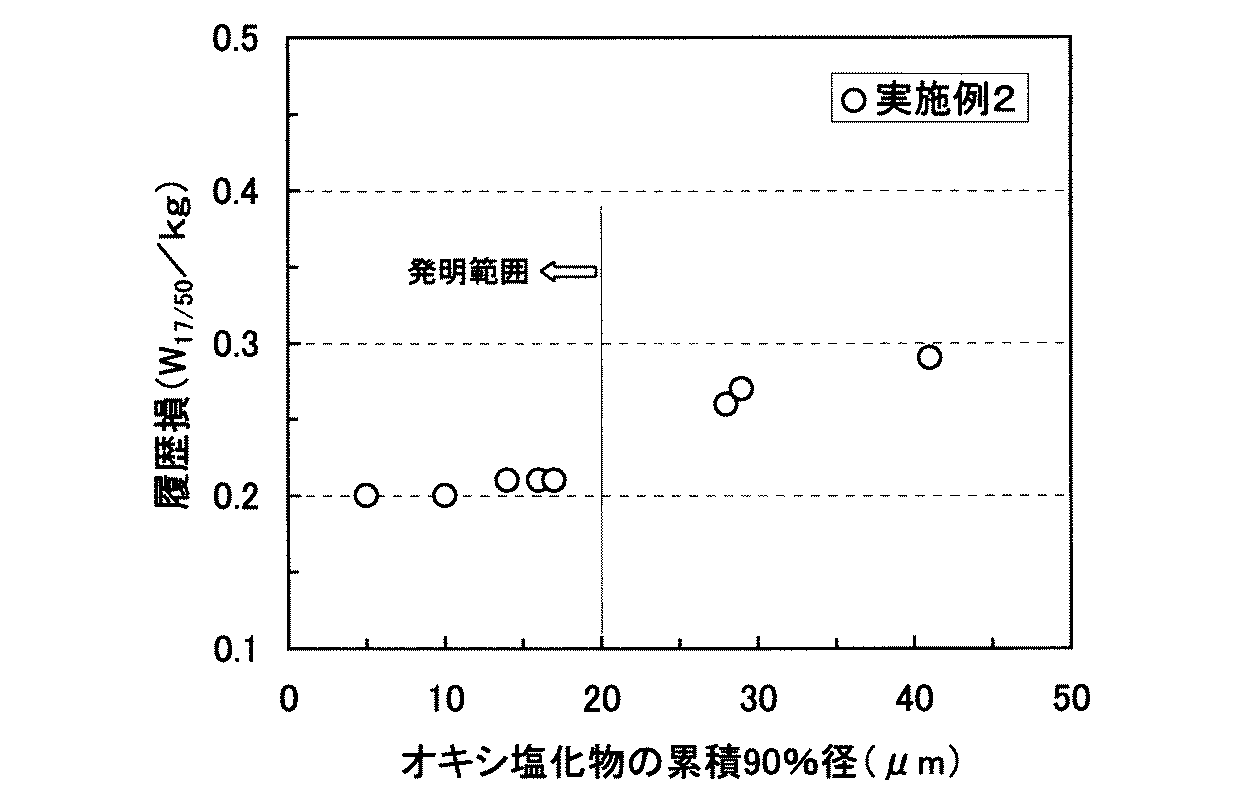
これらの測定結果を表1中に併記して示した。なお、参考例として塩化物を添加しない場合についても測定を行い、表1のNo.12に示した。この表1の結果から、本発明の条件に適合する条件(No.1,2およびのNo.6〜9)においては、履歴損が塩化物を添加しない参考例と比較して、0.1W17/50/kg程度低減されていることがわかる。一方、本発明範囲外であるNo.3〜5、10および11では、十分な鉄損低減効果が得られていない。なお、水不溶性塩化物の粒径と、履歴損の関係を図1に示した。 These measurement results are shown together in Table 1. As a reference example, measurement was also performed when no chloride was added, and the result is shown in No. 12 of Table 1. From the results shown in Table 1, in conditions (No. 1, 2 and Nos. 6 to 9) that meet the conditions of the present invention, the hysteresis loss is 0.1 W 17 compared with the reference example in which no chloride is added. It can be seen that it is reduced by about / 50 / kg. On the other hand, in No. 3-5, 10 and 11 which are outside the scope of the present invention, a sufficient iron loss reduction effect is not obtained. The relationship between the particle size of the water-insoluble chloride and the history loss is shown in FIG.
C:0.06mass%、Si:3.3mass%、Mn:0.09mass%、S:0.003mass%、Se:0.02mass%、Al:0.02mass%、N:0.01mass%、Sb:0.03mass%およびCu:0.1mass%を含み、残部がFeおよび不可避的不純物からなる鋼スラブを1380℃に加熱し、熱間圧延し、板厚2.0mmの熱延板とし、熱延板焼鈍を施した後、この熱延板を、冷間圧延、中間焼鈍、210℃での温間圧延を行い、板厚0.22mmの冷延鋼板とし、引き続き、脱炭焼鈍を兼ねた一次再結晶焼鈍を施した。その後、この鋼板に、マグネシア100質量部に対して、SnCl2・2H2OまたはSbCl3をそれぞれ塩素換算で2質量部添加し、水スラリーとした焼鈍分離剤を、目付量13g/m2で塗布し、乾燥した。ここで、SnCl2・2H2O、SbCl3は90%粒径が1mm以上の粗粒を用い、上記水スラリーの調製方法は、表2の各種条件で行った。さらにこの鋼板を、コイル状に巻き取った後、800℃までをN2雰囲気で平均50℃/hで、800〜1000℃をN2雰囲気で平均10℃/hで、1000〜1200℃をH2雰囲気で平均15℃/hで昇温し、1200℃×6h保持するパターンの仕上焼鈍を行い、冷却してフォルステライト被膜の無い方向性電磁鋼板を得た。その後、この方向性電磁鋼板を、水洗およびリン酸酸洗によって表面洗浄し、さらに8MPaの張力を加えながら3vol%のH2を含むN2雰囲気中で、820℃×20秒間保持する平坦化焼鈍を行った。 C: 0.06 mass%, Si: 3.3 mass%, Mn: 0.09 mass%, S: 0.003 mass%, Se: 0.02 mass%, Al: 0.02 mass%, N: 0.01 mass%, Sb: 0.03 mass% and Cu: A steel slab containing 0.1 mass% and the balance consisting of Fe and inevitable impurities is heated to 1380 ° C, hot-rolled to form a hot-rolled sheet with a thickness of 2.0 mm, and this heat-rolled sheet is annealed. The rolled sheet was subjected to cold rolling, intermediate annealing, and warm rolling at 210 ° C. to form a cold rolled steel sheet having a thickness of 0.22 mm, followed by primary recrystallization annealing that also served as decarburization annealing. After that, 2 parts by mass of SnCl 2 · 2H 2 O or SbCl 3 in terms of chlorine was added to 100 parts by mass of magnesia, and an annealing separator as a water slurry was added to the steel sheet at a basis weight of 13 g / m 2 . Applied and dried. Here, SnCl 2 .2H 2 O and SbCl 3 were coarse particles having a 90% particle diameter of 1 mm or more, and the method for preparing the water slurry was performed under various conditions shown in Table 2. After further the steel sheet was wound into a coil, up to 800 ° C. at an average 50 ° C. / h in N 2 atmosphere at an average 10 ° C. / h N 2 atmosphere 800 to 1000 ° C., the 1000 to 1200 ° C. H The temperature was raised at an average of 15 ° C./h in 2 atmospheres, finish annealing was carried out with a pattern maintained at 1200 ° C. × 6 h, and cooled to obtain a grain-oriented electrical steel sheet without a forsterite film. Thereafter, the grain-oriented electrical steel sheet is surface-washed by water washing and phosphoric acid pickling, and further flattened annealing is held at 820 ° C. for 20 seconds in an N 2 atmosphere containing 3 vol% H 2 while applying a tension of 8 MPa. Went.
かくして得られた鋼帯から、磁気測定用の試料を採取し、歪取り焼鈍を行ってから1.7T、50Hzにおける履歴損を、エプスタイン枠を使った直流磁化測定によって測定した。また、スラリーを水で希釈して乾燥した後、走査型電子顕微鏡で粒径を観察し、Sn,Sbのオキシ塩化物の粒径分布を測定した。測定結果を表2に併記して示す。また、オキシ塩化物の粒径と履歴損の関係を図2に示した。表2から、本発明に従いSn塩化物またはSb塩化物を、流速0.2m/s以上で攪拌した状態において添加した場合(No.13〜17)には、生成するオキシ塩化物の粒径を20μm以下に抑制することができるため、塩化物を無添加の場合(表1のNo.12)の履歴損と比較し、大きく低減できることがわかる。一方、流速0.2m/s以上で攪拌した状態で、Sn塩化物またはSb塩化物を添加した場合には、オキシ塩化物の粒径を小さく制御できないため、履歴損の低減効果は小さい。 A sample for magnetic measurement was taken from the steel strip thus obtained, and after performing strain relief annealing, the hysteresis loss at 1.7 T and 50 Hz was measured by DC magnetization measurement using an Epstein frame. Further, after the slurry was diluted with water and dried, the particle size was observed with a scanning electron microscope, and the particle size distribution of Sn and Sb oxychlorides was measured. The measurement results are shown together in Table 2. The relationship between the particle size of oxychloride and the history loss is shown in FIG. From Table 2, when Sn chloride or Sb chloride is added in a state of stirring at a flow rate of 0.2 m / s or more according to the present invention (No. 13 to 17), the particle size of the oxychloride produced is 20 μm. Since it can suppress to the following, it turns out that it can reduce greatly compared with the hysteresis loss in the case of no addition of chloride (No. 12 in Table 1). On the other hand, when Sn chloride or Sb chloride is added while stirring at a flow rate of 0.2 m / s or more, the particle size of oxychloride cannot be controlled to be small, so the effect of reducing hysteresis loss is small.
Claims (7)
Priority Applications (1)
| Application Number | Priority Date | Filing Date | Title |
|---|---|---|---|
| JP2004105236A JP2005290445A (en) | 2004-03-31 | 2004-03-31 | Method for preparing annealing separator slurry and method for producing grain-oriented electrical steel sheet |
Applications Claiming Priority (1)
| Application Number | Priority Date | Filing Date | Title |
|---|---|---|---|
| JP2004105236A JP2005290445A (en) | 2004-03-31 | 2004-03-31 | Method for preparing annealing separator slurry and method for producing grain-oriented electrical steel sheet |
Publications (1)
| Publication Number | Publication Date |
|---|---|
| JP2005290445A true JP2005290445A (en) | 2005-10-20 |
Family
ID=35323713
Family Applications (1)
| Application Number | Title | Priority Date | Filing Date |
|---|---|---|---|
| JP2004105236A Pending JP2005290445A (en) | 2004-03-31 | 2004-03-31 | Method for preparing annealing separator slurry and method for producing grain-oriented electrical steel sheet |
Country Status (1)
| Country | Link |
|---|---|
| JP (1) | JP2005290445A (en) |
Cited By (3)
| Publication number | Priority date | Publication date | Assignee | Title |
|---|---|---|---|---|
| JP2014196536A (en) * | 2013-03-29 | 2014-10-16 | Jfeスチール株式会社 | Method of flattening and annealing grain-oriented electrical steel sheet and method of producing grain-oriented electrical steel sheet |
| CN104884646A (en) * | 2012-12-28 | 2015-09-02 | Posco公司 | Grain-oriented electrical steel sheet, and method for manufacturing same |
| CN113166832A (en) * | 2018-09-27 | 2021-07-23 | Posco公司 | Annealing separator composition for grain-oriented electrical steel sheet, and method for manufacturing same |
-
2004
- 2004-03-31 JP JP2004105236A patent/JP2005290445A/en active Pending
Cited By (6)
| Publication number | Priority date | Publication date | Assignee | Title |
|---|---|---|---|---|
| CN104884646A (en) * | 2012-12-28 | 2015-09-02 | Posco公司 | Grain-oriented electrical steel sheet, and method for manufacturing same |
| JP2016513358A (en) * | 2012-12-28 | 2016-05-12 | ポスコ | Oriented electrical steel sheet and manufacturing method thereof |
| US10023932B2 (en) | 2012-12-28 | 2018-07-17 | Posco | Grain-oriented electrical steel sheet, and method for manufacturing the same |
| JP2014196536A (en) * | 2013-03-29 | 2014-10-16 | Jfeスチール株式会社 | Method of flattening and annealing grain-oriented electrical steel sheet and method of producing grain-oriented electrical steel sheet |
| CN113166832A (en) * | 2018-09-27 | 2021-07-23 | Posco公司 | Annealing separator composition for grain-oriented electrical steel sheet, and method for manufacturing same |
| US11685962B2 (en) | 2018-09-27 | 2023-06-27 | Posco Co., Ltd | Annealing separator composition for grain-oriented electrical steel sheet, grain-oriented electrical steel sheet, and method for manufacturing grain-oriented electrical steel sheet |
Similar Documents
| Publication | Publication Date | Title |
|---|---|---|
| RU2532786C2 (en) | Manufacturing method of non-textured electrical steel with high magnetic properties | |
| CN104136637B (en) | Manufacturing method of non-oriented electrical steel sheet | |
| JP5930120B2 (en) | Non-oriented electrical steel sheet and manufacturing method thereof | |
| JP5679090B2 (en) | Method for producing grain-oriented electrical steel sheet | |
| CN107614725B (en) | Grain-oriented electrical steel sheet and method for producing the same | |
| JP5760590B2 (en) | Method for producing grain-oriented electrical steel sheet | |
| JP6763148B2 (en) | Non-oriented electrical steel sheet | |
| KR101696627B1 (en) | Annealing separating agent composition for base coating free electrical steel sheet, and method for manufacturing base coating free electrical steel sheet using the same | |
| JP6586815B2 (en) | Non-oriented electrical steel sheet excellent in iron loss and manufacturing method thereof | |
| JP5696404B2 (en) | Method for producing grain-oriented electrical steel sheet | |
| JP5263012B2 (en) | Non-oriented electrical steel sheet and manufacturing method thereof | |
| CN110114488A (en) | The excellent non orientation electromagnetic steel plate of recycling property | |
| JP4280004B2 (en) | Semi-processed non-oriented electrical steel sheet with extremely excellent iron loss and magnetic flux density and method for producing the same | |
| JPWO2020149351A1 (en) | Manufacturing method of grain-oriented electrical steel sheet | |
| CN100549206C (en) | Non-oriented electrical steel sheet excellent in magnetic properties in rolling direction and manufacturing method thereof | |
| JP3921806B2 (en) | Method for producing grain-oriented silicon steel sheet | |
| JP4211260B2 (en) | Method for producing grain-oriented electrical steel sheet | |
| JP2005002401A (en) | Method for producing non-oriented electrical steel sheet | |
| JP4205816B2 (en) | Method for producing unidirectional electrical steel sheet with high magnetic flux density | |
| CN109312415A (en) | Annealing release agent composition, its preparation method and preparation method of grain-oriented electrical steel sheet using the same | |
| JP5857983B2 (en) | Manufacturing method of grain-oriented electrical steel sheet and MgO for annealing separator | |
| JP2002356752A (en) | Non-oriented electrical steel sheet with extremely excellent iron loss and magnetic flux density and method for producing the same | |
| JP4239456B2 (en) | Method for producing grain-oriented electrical steel sheet | |
| JP4239457B2 (en) | Method for producing grain-oriented electrical steel sheet | |
| KR102583464B1 (en) | Manufacturing method of grain-oriented electrical steel sheet |