JP2005290146A - Method of peeling adherend - Google Patents
Method of peeling adherend Download PDFInfo
- Publication number
- JP2005290146A JP2005290146A JP2004105578A JP2004105578A JP2005290146A JP 2005290146 A JP2005290146 A JP 2005290146A JP 2004105578 A JP2004105578 A JP 2004105578A JP 2004105578 A JP2004105578 A JP 2004105578A JP 2005290146 A JP2005290146 A JP 2005290146A
- Authority
- JP
- Japan
- Prior art keywords
- adhesive
- adherend
- substrate
- cured
- laminate
- Prior art date
- Legal status (The legal status is an assumption and is not a legal conclusion. Google has not performed a legal analysis and makes no representation as to the accuracy of the status listed.)
- Pending
Links
Images
Landscapes
- Adhesives Or Adhesive Processes (AREA)
- Mechanical Treatment Of Semiconductor (AREA)
Abstract
【課題】 被着体および基体を破損させることなく、また被着体表面および基体表面に接着剤を残存させることなく、被着体を基体から容易に剥離する方法を提供すること。
【解決手段】 (I)被着体と基体とが硬化された接着剤を介して積層された積層体
に、光照射を施して接着剤硬化物を分解する工程と、
(II)接着剤硬化物が分解された積層体を加熱して、接着剤硬化物を発泡させる工程と、(III)発泡させた接着剤硬化物を溶剤および/またはアルカリ性水溶液により溶解させ
て、基体から被着体を剥離する工程と
を含む被着体の剥離方法。
【選択図】 図1
PROBLEM TO BE SOLVED: To provide a method for easily peeling an adherend from a substrate without damaging the adherend and the substrate and without leaving an adhesive on the surface of the adherend and the substrate.
(I) a step of decomposing a cured adhesive product by irradiating light to a laminate in which an adherend and a substrate are laminated via a cured adhesive;
(II) heating the laminate in which the cured adhesive is decomposed to foam the cured adhesive, and (III) dissolving the foamed cured adhesive with a solvent and / or an alkaline aqueous solution, A method for peeling the adherend from the substrate.
[Selection] Figure 1
Description
本発明は、接着剤を介して基体に接着された被着体を、容易に基体から剥離する方法に関する。より詳しくは、被着体および基体を破損させることなく、また被着体表面および基体表面に接着剤を残存させることなく、被着体を気体から剥離する方法に関する。 The present invention relates to a method for easily peeling an adherend bonded to a substrate via an adhesive from the substrate. More specifically, the present invention relates to a method for peeling an adherend from a gas without damaging the adherend and the substrate and without leaving an adhesive on the adherend surface and the substrate surface.
半導体用ウェハーおよび/またはデバイスの搭載されたウェハーは、その使用する目的に応じてその表面および/または裏面について種々の表面加工が施される。たとえば、CMP(Chemical Mechanical Polishing)などの表面加工技術によるウェハー表面および
/または裏面の均一化表面加工は、ウェハーなどの被加工体の加工される基準面の位置を設定し、かつCMPスラリー(研磨剤)やグラインダーなどの表面加工用材料に対して加工処理時に一定の平面を保持することが必要になる。その加工される基準面を設定するために、ウェハーの表面または裏面をたとえば硬質基板および/または弾性体キャリア(バッキング材)に密着させてウェハーを保持するとともに、加工処理時にウェハーが厳密かつ強力に保持される必要がある。
A semiconductor wafer and / or a wafer on which a device is mounted is subjected to various surface treatments on the front surface and / or back surface depending on the purpose of use. For example, uniform surface processing of a wafer surface and / or back surface by a surface processing technique such as CMP (Chemical Mechanical Polishing) sets the position of a reference surface on which a workpiece such as a wafer is processed, and CMP slurry (polishing) It is necessary to maintain a certain flat surface during processing for surface processing materials such as agents) and grinders. In order to set the reference surface to be processed, the front or back surface of the wafer is held in close contact with, for example, a hard substrate and / or an elastic carrier (backing material) to hold the wafer, and the wafer is strictly and strongly processed during processing. Need to be retained.
このように強力に接着されたウェハーと硬質基板とを剥離する場合、容易に剥離することができず、ウェハーや硬質基板の破損やこれらの表面に接着剤が残存するという問題があった。 When the strongly bonded wafer and the hard substrate are peeled off as described above, the wafer and the hard substrate cannot be easily peeled off, and there is a problem that the wafer or the hard substrate is damaged or the adhesive remains on the surface.
一方、被着体と基体との剥離方法としては、水または親水性溶媒に可溶な接着剤を用いて接着した接着物に、水または親水性溶媒による処理を施して被着体を剥離する方法(特許文献1)や、特定の粘着テープが被着体に接着された接着剤構造体をガラス板に貼り付け、この粘着テープの接着剤層に超音波などの刺激を与えて接着剤層から気体を放出させ、被着体と粘着テープとの接着面積を低減させることによって、被着体とガラス板とを剥離する方法(特許文献2および2)が提案されている。しかしながら、これらの方法では、接着に寄与している成分が溶剤等に溶解性を示す必要がある。
本発明は、上記のような従来技術に伴う問題を解決しようとするものであって、被着体および基体を破損させることなく、また被着体表面および基体表面に接着剤を残存させることなく、被着体を基体から容易に剥離する方法を提供することを課題とする。 The present invention is intended to solve the problems associated with the prior art as described above, without damaging the adherend and the substrate, and without leaving an adhesive on the surface of the adherend and the substrate. An object of the present invention is to provide a method for easily peeling an adherend from a substrate.
本発明者は、上記問題点を解決すべく鋭意研究し、光照射により接着剤を分解した後、加熱して接着剤を発泡させることによって、発泡された接着剤が容易に溶剤等に溶解できることを見出し、発明を完成するに至った。 The present inventor has intensively studied to solve the above problems, and after the adhesive is decomposed by light irradiation, the foamed adhesive can be easily dissolved in a solvent or the like by heating and foaming the adhesive. The present invention has been completed.
すなわち、本発明に係る被着体の剥離方法は、
(I)被着体と基体とが硬化された接着剤を介して積層された積層体に、光照射を施して
接着剤硬化物を分解する工程と、
(II)接着剤硬化物が分解された積層体を加熱して、接着剤硬化物を発泡させる工程と、(III)発泡させた接着剤硬化物を溶剤および/またはアルカリ性水溶液により溶解させ
て、基体から被着体を剥離する工程と
を含む被着体の剥離方法。
That is, the method for peeling the adherend according to the present invention includes:
(I) a step of decomposing an adhesive cured product by irradiating light to a laminate in which an adherend and a substrate are laminated via a cured adhesive;
(II) heating the laminate in which the cured adhesive is decomposed to foam the cured adhesive, and (III) dissolving the foamed cured adhesive with a solvent and / or an alkaline aqueous solution, A method for peeling the adherend from the substrate.
光照射前の接着剤硬化物は、溶剤および/またはアルカリ性水溶液に対して不溶性または難溶性であることが好ましい。
前記接着剤は、感放射線性酸発生剤を含有し、かつ前記工程(I)において、該感放射
線性酸発生剤の吸収波長の光を前記積層体に照射して該感放射線性酸発生剤から酸を発生させ、この酸の作用により前記接着剤硬化物を分解することが好ましい。
The cured adhesive prior to light irradiation is preferably insoluble or hardly soluble in the solvent and / or alkaline aqueous solution.
The adhesive contains a radiation-sensitive acid generator, and in the step (I), the radiation-sensitive acid generator is irradiated with light having an absorption wavelength of the radiation-sensitive acid generator. It is preferable to generate an acid from the above and decompose the cured adhesive by the action of this acid.
本発明によると、接着剤により基体に接着された被着体を、基体から剥離する際に、被着体および基体を破損させることなく、また被着体表面および基体表面に接着剤を残存させることなく、被着体を基体から容易に剥離することができる。 According to the present invention, when the adherend adhered to the substrate with the adhesive is peeled from the substrate, the adherend and the substrate are not damaged, and the adhesive remains on the adherend surface and the substrate surface. Therefore, the adherend can be easily peeled off from the substrate.
本発明に係る被着体の剥離方法は、被着体と接着剤と基体とをこの順で積層し、接着剤を硬化させて得られた積層体に、光照射を施して接着剤硬化物を分解した後、この分解された接着剤硬化物を加熱により発泡させ、発泡された接着剤硬化物を溶剤および/またはアルカリ性水溶液により溶解させて基体から被着体を剥離する方法である。 In the method for peeling an adherend according to the present invention, the adherend, the adhesive, and the substrate are laminated in this order, and the laminate obtained by curing the adhesive is irradiated with light to cure the adhesive. Then, the decomposed cured adhesive product is foamed by heating, the foamed cured adhesive product is dissolved in a solvent and / or an alkaline aqueous solution, and the adherend is peeled off from the substrate.
まず、本発明に用いられる材料について説明するが、本発明に係る被着体の剥離方法はこれらの材料によって限定させるものではない。
<積層体>
本発明に用いられる積層体は、後述する被着体と接着剤と基体とをこの順で積層し、接着剤を硬化させることによって被着体と基体とを接着した、被着体/接着剤硬化物層/基体からなる積層体である。このような積層体は、硬化した接着剤により被着体と基体とが強固に接着していることが好ましい。なお、本明細書において、「接着剤硬化物」とは、接着剤が硬化した成分であって、被着体と基体との接着に直接寄与している成分を意味し、後述する感放射線性酸発生剤は含まれない。また、「接着剤硬化物層」はこの「接着剤硬化物」を含む層を意味する。
First, materials used in the present invention will be described. However, the method for peeling the adherend according to the present invention is not limited by these materials.
<Laminated body>
The laminate used in the present invention is an adherend / adhesive obtained by laminating an adherend, an adhesive, and a substrate, which will be described later, in this order, and bonding the adherend and the substrate by curing the adhesive. A laminate comprising a cured product layer / substrate. In such a laminate, it is preferable that the adherend and the substrate are firmly bonded by the cured adhesive. In the present specification, the “cured adhesive product” is a component obtained by curing the adhesive and directly contributes to the adhesion between the adherend and the substrate. Acid generators are not included. The “adhesive cured product layer” means a layer containing this “adhesive cured product”.
(接着剤)
本発明を実施するために用いられる接着剤は、硬化することによって被着体と基体とを強固に接着することができる接着剤であって、この接着剤を硬化して形成された接着剤硬化物は溶剤および/またはアルカリ性水溶液に対して不溶性または難溶性であることが好ましく、かつ前記接着剤硬化物に光照射を施してこの硬化物を分解し、分解生成物を加熱により気化させて分解後の硬化物を発泡させると、前記接着剤硬化物が溶剤および/またはアルカリ性水溶液に容易に溶解するような接着剤である。
(adhesive)
The adhesive used for carrying out the present invention is an adhesive capable of firmly bonding the adherend and the substrate by curing, and curing the adhesive formed by curing the adhesive. The product is preferably insoluble or sparingly soluble in the solvent and / or alkaline aqueous solution, and the cured adhesive is irradiated with light to decompose the cured product, and the decomposition product is vaporized by heating to decompose. When the later cured product is foamed, the adhesive cured product is easily dissolved in a solvent and / or an alkaline aqueous solution.
このような接着剤としては、接着剤の硬化物に光照射を施すと、この硬化物が光の直接的な作用により分解されて前記分解生成物が生成するような接着剤でもよいが、感放射線性酸発生剤を含有する接着剤が好ましい。感放射線性酸発生剤を含有する接着剤は、この接着剤の硬化物に光照射を施すと、感放射線性酸発生剤から酸が発生し、この酸の作用により硬化物が分解されて前記分解生成物が生成する。 Such an adhesive may be an adhesive in which when the cured product of the adhesive is irradiated with light, the cured product is decomposed by the direct action of light to produce the decomposition product. An adhesive containing a radioactive acid generator is preferred. In the adhesive containing a radiation sensitive acid generator, when the cured product of this adhesive is irradiated with light, an acid is generated from the radiation sensitive acid generator. A decomposition product is produced.
本発明に用いられる接着剤として、たとえば、t−ブチルメタクリレートまたはt−ブチルアクリレートの単独重合体あるいはこれらのモノマーのうちの少なくとも1種のモノマーの共重合体、2,5−ジメチル−2,5−ヘキサンジオールジアクリレート等の酸分解性の架橋剤、光ラジカル開始剤および光酸発生剤等を溶剤に溶解した接着剤溶液が挙げられる。
(被着体および基体)
本発明に用いられる被着体および基体は、前記接着剤によって互いに接着されるものであれば特に限定されないが、被着体および基体の表面が前記接着剤によって変質しないものが好ましい。また、前記被着体および基体は、耐熱性および耐溶剤性を有するものが好ましい。さらに、被着体および基体の少なくとも一方は透明であることが好ましい。
As an adhesive used in the present invention, for example, a homopolymer of t-butyl methacrylate or t-butyl acrylate, or a copolymer of at least one of these monomers, 2,5-dimethyl-2,5 -Adhesive solution in which an acid-decomposable crosslinking agent such as hexanediol diacrylate, a photo radical initiator, a photo acid generator and the like are dissolved in a solvent.
(Adherent and substrate)
The adherend and the substrate used in the present invention are not particularly limited as long as they are bonded to each other by the adhesive, but those in which the surfaces of the adherend and the substrate are not altered by the adhesive are preferable. Further, the adherend and the substrate preferably have heat resistance and solvent resistance. Further, at least one of the adherend and the substrate is preferably transparent.
本発明に用いられる被着体としては、たとえば、石英ガラス、ライムソーダガラス、水ガラス、ポリカーボネート、ポリエチレンテレフタレート等が挙げられる。
また、基体としては、たとえば、Siウェハーや、Siウェハーに各種加工を施した基板、セラミック基板、ガラス基板などが挙げられる。
(積層体の作製方法)
本発明に用いられる積層体の作製方法は、前記被着体と接着剤と基体とを用いて、被着体/接着剤硬化物/基体からなる積層体を作製できる方法であれば特に制限されない。たとえば、被着体および/または基体に接着剤を塗布した後、この接着剤を介して被着体と基体とを密着させ、この接着剤を光硬化または熱硬化させることによって被着体と基体とを接着する方法が挙げられる。積層体の作製条件は特に限定されないが、接着剤が分解されない条件で作製することが好ましい。たとえば、接着剤に感放射線性酸発生剤が含まれる場合には、加熱により接着剤を硬化させる方法、または感放射線性酸発生剤の吸収波長を有しない光を照射して接着剤を硬化させる方法が好ましい。
Examples of the adherend used in the present invention include quartz glass, lime soda glass, water glass, polycarbonate, and polyethylene terephthalate.
Examples of the substrate include a Si wafer, a substrate obtained by performing various processes on the Si wafer, a ceramic substrate, and a glass substrate.
(Method for producing laminate)
The method for producing a laminate used in the present invention is not particularly limited as long as it is a method capable of producing a laminate comprising an adherend / cured adhesive / substrate using the adherend, an adhesive, and a substrate. . For example, after applying an adhesive to the adherend and / or substrate, the adherend and the substrate are brought into close contact with each other through the adhesive, and the adhesive is photocured or thermally cured to thereby adhere the substrate and the substrate. And a method of adhering to each other. There are no particular restrictions on the conditions for producing the laminate, but it is preferable to produce them under conditions that do not allow the adhesive to be decomposed. For example, when a radiation-sensitive acid generator is included in the adhesive, the adhesive is cured by irradiating light that does not have the absorption wavelength of the radiation-sensitive acid generator, or by curing the adhesive by heating. The method is preferred.
<被着体の剥離方法>
本発明に係る被着体の剥離方法を、上述した材料を例にして説明する。
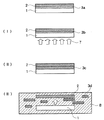
(I)分解工程(図1(I)):
上述した方法で作製された、被着体/接着剤硬化物/基体からなる積層体に光照射を施す。この処理により接着剤硬化物が分解され、加熱により気化する分解生成物が生成する。
<Method of peeling the adherend>
The method for peeling the adherend according to the present invention will be described using the above-described materials as an example.
(I) Decomposition process (FIG. 1 (I)):
Light irradiation is performed on the laminate made of the adherend / cured adhesive / substrate produced by the method described above. By this treatment, the cured adhesive is decomposed and a decomposition product that is vaporized by heating is generated.
たとえば、感放射線性酸発生剤を含有する接着剤を用いた場合、前記積層体の被着体側および/または基体側から積層体に感放射線性酸発生剤の吸収波長の光を照射すると、感放射線性酸発生剤から酸が発生し、この酸の作用により接着剤硬化物が分解され、前記分解生成物が生成する。このとき、光は、被着体側および基体側のうち、透明なものの方向から照射することが好ましい。また、照射する光の波長は、感放射線性酸発生剤の吸収波長を含むものであれば特に制限されないが、500〜150nm、好ましくは400〜250nmが望ましい。 For example, when an adhesive containing a radiation-sensitive acid generator is used, if the laminate is irradiated with light having an absorption wavelength of the radiation-sensitive acid generator from the adherend side and / or the substrate side of the laminate, An acid is generated from the radioactive acid generator, and the cured adhesive product is decomposed by the action of the acid, and the decomposition product is generated. At this time, it is preferable to irradiate light from the direction of a transparent thing among an adherend side and a base | substrate side. Moreover, the wavelength of the light to irradiate will not be restrict | limited especially if the absorption wavelength of a radiation sensitive acid generator is included, However 500-150 nm, Preferably 400-250 nm is desirable.
この工程で積層体に光照射する際に使用される光源としては、感放射線性酸発生剤の吸収波長を有する光を照射できるものであれば特に制限されないが、たとえば、低圧水銀灯、高圧水銀灯、超高圧水銀灯、メタルハライドランプ、アルゴンガスレーザーなどが挙げられる。
(II)発泡工程(図1(II)):
工程(I)で接着剤硬化物を分解した積層体を加熱する。この処理により、前記分解生
成物が気化して、工程(I)で得られた接着剤硬化物が発泡する。積層体を加熱する温度
は、前記分解生成物が気化する温度以上であれば特に制限されないが、被着体および基体が変質しない温度が好ましい。具体的には、50〜200℃、好ましくは80〜170℃が望ましい。加熱装置としては、前記接着剤硬化物を均一に発泡できる装置であれば特に制限されないが、たとえば、クリーンオーブン、ホットプレート、赤外線炉などが挙げられる。
(III)溶解および剥離工程(図1(III)):
工程(II)で接着剤硬化物を発泡させた積層体を、溶剤および/またはアルカリ性水溶液に浸漬する。この処理により、発泡させた接着剤硬化物が溶剤および/またはアルカリ
性水溶液に溶解する。溶剤および/またはアルカリ性水溶液への溶解方法は特に限定されず、1段ディップでも多段ディップでもよい。このとき用いられる溶剤およびアルカリ性水溶液は、発泡させた接着剤硬化物を効率よく溶解でき、さらに被着体および基体にダメージを与えない溶剤であれば特に限定はない。
The light source used when irradiating the laminate with light in this step is not particularly limited as long as it can irradiate light having the absorption wavelength of the radiation-sensitive acid generator. For example, a low-pressure mercury lamp, a high-pressure mercury lamp, Examples include ultra high pressure mercury lamps, metal halide lamps, and argon gas lasers.
(II) Foaming process (FIG. 1 (II)):
The laminated body which decomposed | disassembled adhesive hardened | cured material at the process (I) is heated. By this treatment, the decomposition product is vaporized, and the cured adhesive product obtained in the step (I) is foamed. The temperature at which the laminate is heated is not particularly limited as long as it is equal to or higher than the temperature at which the decomposition product vaporizes, but is preferably a temperature at which the adherend and the substrate are not denatured. Specifically, 50 to 200 ° C., preferably 80 to 170 ° C. is desirable. The heating device is not particularly limited as long as it can uniformly foam the cured adhesive product, and examples thereof include a clean oven, a hot plate, and an infrared furnace.
(III) Dissolution and peeling process (FIG. 1 (III)):
The laminate in which the cured adhesive is foamed in the step (II) is immersed in a solvent and / or an alkaline aqueous solution. By this treatment, the foamed cured adhesive is dissolved in the solvent and / or the alkaline aqueous solution. The method for dissolving in a solvent and / or an alkaline aqueous solution is not particularly limited, and may be a single-stage dip or a multi-stage dip. The solvent and the alkaline aqueous solution used at this time are not particularly limited as long as they can dissolve the foamed adhesive cured product efficiently and do not damage the adherend and the substrate.
このような溶剤としては、たとえば、メタノール、エタノール、イソプロパノール、エチレングリコールモノメチルエーテル、エチレングリコールモノエチルエーテル、エチレングリコールモノメチルエーテルアセテート、エチレングリコールモノエチルエーテルアセテート、ジエチレングリコールモノメチルエーテル、ジエチレングリコールモノエチルエーテル、プロピレングリコールモノメチルエーテルアセテート、プロピレングリコールモノプロピルエーテルアセテート、トルエン、キシレン、アセトン、メチルエチルケトン、2−ヘプタノン、3−ヘプタノン、4−ヘプタノン、シクロヘキサノン、2−ヒドロキシプロピオン酸エチル、2−ヒドロキシ−2−メチルプロピオン酸エチル、エトキシ酢酸エチル、ヒドロキシ酢酸エチル、2−ヒドロキシ−3−メチルブタン酸メチル、3−メトキシプロピオン酸メチル、3−エトキシプロピオン酸エチル、3−メトキシプロピオン酸エチル、酢酸ブチル、ピルビン酸メチル、ピルビン酸エチル、ジメチルスルホキシド、n−メチルピロリドン、γ―ブチロラクトン等が挙げられる。これらは1種単独で使用しても良いし、2種以上を混合して使用してもよい。 Examples of such solvents include methanol, ethanol, isopropanol, ethylene glycol monomethyl ether, ethylene glycol monoethyl ether, ethylene glycol monomethyl ether acetate, ethylene glycol monoethyl ether acetate, diethylene glycol monomethyl ether, diethylene glycol monoethyl ether, propylene glycol. Monomethyl ether acetate, propylene glycol monopropyl ether acetate, toluene, xylene, acetone, methyl ethyl ketone, 2-heptanone, 3-heptanone, 4-heptanone, cyclohexanone, ethyl 2-hydroxypropionate, ethyl 2-hydroxy-2-methylpropionate , Ethyl ethoxyacetate, ethyl hydroxyacetate Methyl 2-hydroxy-3-methylbutanoate, methyl 3-methoxypropionate, ethyl 3-ethoxypropionate, ethyl 3-methoxypropionate, butyl acetate, methyl pyruvate, ethyl pyruvate, dimethyl sulfoxide, n-methylpyrrolidone, Examples thereof include γ-butyrolactone. These may be used individually by 1 type, and 2 or more types may be mixed and used for them.
上記溶剤には、アルカリを適量混合することができる。アルカリ成分としては、エチルアミン、n−プロピルアミン、ジエチルアミン、ジ−n−プロピルアミン、トリエチルアミン、メチルジエチルアミン、ジメチルエタノールアミン、トリエタノールアミン、テトラメチルアンモニウムヒドロキシド、テトラエチルアンモニウムヒドロキシド、ピロール、ピペリジン、1,8−ジアザビシクロ[5.4.0]−7−ウンデセン、1,5−ジアザビシクロ[4.3.0]−5−ノナンなどのアルカリ類が挙げられる。 An appropriate amount of alkali can be mixed in the solvent. Examples of the alkaline component include ethylamine, n-propylamine, diethylamine, di-n-propylamine, triethylamine, methyldiethylamine, dimethylethanolamine, triethanolamine, tetramethylammonium hydroxide, tetraethylammonium hydroxide, pyrrole, piperidine, 1 , 8-diazabicyclo [5.4.0] -7-undecene, 1,5-diazabicyclo [4.3.0] -5-nonane, and the like.
アルカリ水溶液として、たとえば、水酸化ナトリウム、水酸化カリウム、炭酸ナトリウム、ケイ酸ナトリウム、メタケイ酸ナトリウム、アンモニア水、エチルアミン、n−プロピルアミン、ジエチルアミン、ジ−n−プロピルアミン、トリエチルアミン、メチルジエチルアミン、ジメチルエタノールアミン、トリエタノールアミン、テトラメチルアンモニウムヒドロキシド、テトラエチルアンモニウムヒドロキシド、ピロール、ピペリジン、1,8−ジアザビシクロ[5.4.0]−7−ウンデセン、1,5−ジアザビシクロ[4.3.0]−5−ノナンなどのアルカリ類の水溶液を使用することができる。 Examples of the alkaline aqueous solution include sodium hydroxide, potassium hydroxide, sodium carbonate, sodium silicate, sodium metasilicate, aqueous ammonia, ethylamine, n-propylamine, diethylamine, di-n-propylamine, triethylamine, methyldiethylamine, dimethyl. Ethanolamine, triethanolamine, tetramethylammonium hydroxide, tetraethylammonium hydroxide, pyrrole, piperidine, 1,8-diazabicyclo [5.4.0] -7-undecene, 1,5-diazabicyclo [4.3.0] An aqueous solution of an alkali such as -5-nonane can be used.
また、上記アルカリ水溶液にメタノール、エタノールなどの水溶性有機溶媒や界面活性剤を適当量添加した水溶液を現像液として使用することもできる。
本発明に係る被着体の剥離方法によると、発泡工程(II)を実施することによって工程(III)で接着剤硬化物を容易に溶解することができ、被着体と基体とを容易に剥離でき
る。すなわち、工程(I)で分解された接着剤硬化物を発泡せずに溶剤および/またはア
ルカリ性水溶液に浸漬しても硬化物を溶解させることが困難である場合、この発泡工程を実施することにより硬化物内部に気泡が形成され、硬化物の内部に十分に溶剤等が浸透して硬化物を溶解させることができる。硬化物の内部にまで十分に溶剤等が浸透しないために硬化物を溶解させることが困難である場合には特に効果的である。また、前記工程(I
)で分解された接着剤硬化物を発泡せずに溶剤および/またはアルカリ性水溶液に浸漬して硬化物を溶解できる場合であっても、この発泡工程を実施することにより硬化物内部に気泡が形成され、硬化物の内部に十分に溶剤等が浸透することから硬化物を迅速に溶解させることができる。
Further, an aqueous solution obtained by adding an appropriate amount of a water-soluble organic solvent such as methanol or ethanol or a surfactant to the alkaline aqueous solution can also be used as a developer.
According to the method for peeling an adherend according to the present invention, by performing the foaming step (II), the cured adhesive can be easily dissolved in the step (III), and the adherend and the substrate can be easily separated. Can peel. That is, if it is difficult to dissolve the cured product by immersing it in a solvent and / or an alkaline aqueous solution without foaming the cured adhesive product decomposed in the step (I), this foaming step is carried out. Bubbles are formed inside the cured product, and the solvent or the like can sufficiently penetrate into the cured product to dissolve the cured product. This is particularly effective when it is difficult to dissolve the cured product because the solvent or the like does not sufficiently penetrate into the cured product. In addition, the process (I
Even if the cured adhesive can be dissolved by dissolving it in a solvent and / or an alkaline aqueous solution without foaming, foaming can be formed inside the cured product by carrying out this foaming process. In addition, since the solvent or the like sufficiently penetrates into the cured product, the cured product can be rapidly dissolved.
以下、本発明を実施例により説明するが、本発明は、この実施例により何ら限定されるものではない。 EXAMPLES Hereinafter, although an Example demonstrates this invention, this invention is not limited at all by this Example.
<積層体の作製>
(接着剤の調製)
ドライアイス/メタノール還流器と温度計を装着したフラスコを窒素で置換した後、重合開始剤として2,2’−アゾビスイソブチロニトリル3.0g、溶媒として2−ヒドロキシプロピオン酸エチルを120g仕込み、重合開始剤が溶解するまで攪拌した。引き続いて、t−ブチルメタクリレート100gを仕込んだ後、穏やかに攪拌を始めた。その後、溶液の温度を90℃に上昇させ、この温度で4時間重合し、さらに100℃に昇温してこの温度で1時間重合を行った。その後、室温まで放冷し、フラスコ内を空気で置換した。得られた反応液を多量のメタノールに滴下して反応生成物を凝固させた。この凝固物を水洗後、凝固物と同重量のテトラヒドロフランに再溶解し、多量のメタノールで再度凝固させた。この再溶解−凝固操作を計3回行った後、得られた凝固物を65℃で48時間真空乾燥し、t−ブチルメタクリレートの重合体を得た。
<Production of laminate>
(Preparation of adhesive)
A flask equipped with a dry ice / methanol reflux and a thermometer was replaced with nitrogen, and then charged with 3.0 g of 2,2′-azobisisobutyronitrile as a polymerization initiator and 120 g of ethyl 2-hydroxypropionate as a solvent. The mixture was stirred until the polymerization initiator was dissolved. Subsequently, after 100 g of t-butyl methacrylate was charged, stirring was started gently. Thereafter, the temperature of the solution was raised to 90 ° C., polymerization was carried out at this temperature for 4 hours, and the temperature was further raised to 100 ° C. to carry out polymerization at this temperature for 1 hour. Thereafter, the mixture was allowed to cool to room temperature, and the inside of the flask was replaced with air. The obtained reaction solution was dropped into a large amount of methanol to coagulate the reaction product. The coagulated product was washed with water, redissolved in tetrahydrofuran having the same weight as the coagulated product, and coagulated again with a large amount of methanol. After this re-dissolution / coagulation operation was carried out three times in total, the obtained coagulated product was vacuum-dried at 65 ° C. for 48 hours to obtain a polymer of t-butyl methacrylate.
このt−ブチルメタクリレートの重合体100重量部と、2,5−ジメチル−2,5−ヘキサンジオールジアクリレート10重量部と、IRGACURE369(チバ・スペシャリティー・ケミカルズ社製、2−ベンジル−2−ジメチルアミノ−1−(4−モルフォリノフェニル)−ブタノン−1)2重量部と、4,7−ジ−n−ブトキシナフチルテトラヒドロチオフェニウムトリフルオロメタンスルフォネート8重量部と、トリ−n−オクチルアミン0.15重量部と、NBX−15(ネオス社製)0.1重量部とを2−ヒドロキシプロピオン酸エチル100重量部に溶解した。得られた溶液を孔径3μmのメンブレンフィルター(ADVANTEC社製、カプセルカートリッジフィルターCCP−FX−C1B)を用いてろ過して、接着剤を調製した。 100 parts by weight of this t-butyl methacrylate polymer, 10 parts by weight of 2,5-dimethyl-2,5-hexanediol diacrylate, IRGACURE 369 (manufactured by Ciba Specialty Chemicals, 2-benzyl-2-dimethyl) 2 parts by weight of amino-1- (4-morpholinophenyl) -butanone-1), 8 parts by weight of 4,7-di-n-butoxynaphthyltetrahydrothiophenium trifluoromethanesulfonate, and tri-n-octyl 0.15 part by weight of amine and 0.1 part by weight of NBX-15 (manufactured by Neos) were dissolved in 100 parts by weight of ethyl 2-hydroxypropionate. The resulting solution was filtered using a membrane filter (manufactured by ADVANTEC, capsule cartridge filter CCP-FX-C1B) having a pore size of 3 μm to prepare an adhesive.
(積層体の作製)
被着体として4インチシリコンウェハーを使用し、基体として石英ガラスを使用した。上記接着剤を4インチシリコンウェハーにスピンコートした後、100℃のホットプレートにて5分間ベークした。これを4回繰り返して、膜厚50μmの塗膜を形成した。次に120℃のホットプレート上に厚さ2mmの石英板ガラスを設置し、加熱した状態で、接着剤を塗布した上記4インチシリコンウェハーを、接着剤塗布面をガラス面側にして設置した。このシリコンウェハー上に、重さ約1kgの重しをシリコンウェハー全面に均一に加重がかかるように設置し、約1分間加熱密着して、シリコンウェハー/接着剤/石英板ガラスからなる積層体を形成した。
(Production of laminate)
A 4-inch silicon wafer was used as the adherend, and quartz glass was used as the substrate. The adhesive was spin-coated on a 4-inch silicon wafer, and then baked on a hot plate at 100 ° C. for 5 minutes. This was repeated 4 times to form a coating film having a thickness of 50 μm. Next, a quartz plate glass having a thickness of 2 mm was placed on a 120 ° C. hot plate, and the heated 4-inch silicon wafer coated with the adhesive was placed with the adhesive coated surface on the glass surface side. On this silicon wafer, a weight of about 1 kg is placed so that the entire surface of the silicon wafer is uniformly loaded, and heat-adhered for about 1 minute to form a laminate composed of silicon wafer / adhesive / quartz plate glass. did.
この積層体のガラス板側から、i線カットオフフィルターを設置したマスクアライナーを用いてi線以下の波長をカットした主にg−h線領域の光を1000mJ/cm2照射
し、そのまま150℃のホットプレートでガラス面を上にして10分加熱して接着剤を硬化させた。得られた積層体のシリコンウェハーと石英板ガラスは強固に接着され、剥離できないことを確認した。
From the glass plate side of this laminate, a mask aligner provided with an i-line cut-off filter was used to irradiate light in the gh-line region mainly at a wavelength of i-line or less and 1000 mJ / cm 2 , and the temperature was 150 ° C. as it was. The adhesive was cured by heating for 10 minutes with the glass plate facing up. It was confirmed that the silicon wafer and the quartz plate glass of the obtained laminate were firmly bonded and could not be peeled off.
<被着体の剥離>
上記積層体の石英板ガラス側から、i線カットオフフィルターを設置せずに前記マスクアライナーを用いてg−h−i全波長の光を1000mJ/cm2照射した。この積層体
をそのまま120℃のホットプレートでガラス面を上にして5分間加熱した。
<Peeling of adherend>
From the quartz plate glass side of the laminate, light having a total wavelength of g-i was irradiated at 1000 mJ / cm 2 using the mask aligner without installing an i-line cutoff filter. This laminate was heated on a hot plate at 120 ° C. for 5 minutes with the glass surface facing up.
その後、この積層体をアセトン中で室温にて約5分間ディップしてウェハーを脱着し、接着剤硬化物を除去した。得られたウェハーおよび石英ガラスをイソプロパノールにて1分間リンスし、さらに超純水でリンスした後、エアーブローにて乾燥した。 Thereafter, the laminate was dipped in acetone at room temperature for about 5 minutes to remove the wafer, and the cured adhesive was removed. The obtained wafer and quartz glass were rinsed with isopropanol for 1 minute, further rinsed with ultrapure water, and then dried by air blow.
得られたウェハーおよび石英ガラスを観察した結果、接着剤硬化物の付着はなく、また表面の損傷も見られなかった。
<比較例1>
<被着体の剥離>
実施例1で作製した積層体をそのまま120℃のホットプレートで石英ガラス面を上にして5分間加熱した。この加熱後の積層体をアセトン中で室温にて約5分間ディップしたが、ウェハーを脱着することはできなかった。
As a result of observing the obtained wafer and quartz glass, there was no adhesion of the cured adhesive and no surface damage was observed.
<Comparative Example 1>
<Peeling of adherend>
The laminate produced in Example 1 was heated as it was for 5 minutes with a hot plate at 120 ° C. with the quartz glass surface facing up. The heated laminate was dipped in acetone at room temperature for about 5 minutes, but the wafer could not be detached.
<比較例2>
<被着体の剥離>
実施例1で作製した積層体の石英板ガラス側から、i線カットオフフィルターを設置せずに前記マスクアライナーを用いてg−h−i全波長の光を1000mJ/cm2照射し
た。この光照射後の積層体をアセトン中で室温にて約5分間ディップしたが、ウェハーを脱着することはできなかった。
<Comparative example 2>
<Peeling of adherend>
From the quartz plate glass side of the laminate produced in Example 1, 1000 mJ / cm 2 of gh-i full-wavelength light was irradiated using the mask aligner without installing an i-line cutoff filter. The laminated body after this light irradiation was dipped in acetone at room temperature for about 5 minutes, but the wafer could not be detached.
本発明に係る被着体の剥離方法を用いることによって、被着体と基体とを、破損させることなく、かつ表面に接着剤を残存させることなく、剥離できることから、被着体と基体とを強固に仮止めする必要がある場合、たとえば、電子部品を回路基板などに仮止めする場合などに適用することができる。 By using the adherend peeling method according to the present invention, the adherend and the substrate can be peeled without damaging and without leaving an adhesive on the surface. This can be applied to cases where it is necessary to firmly fix firmly, for example, to temporarily fix electronic components to a circuit board or the like.
1 透明な硬質基板
2 ウェハー
3a 硬化後の接着剤層
3b 分解処理後の接着剤層
3c 発泡後の接着剤層
3d 溶剤等に溶解した接着剤
7 放射線
8 溶剤および/またはアルカリ水溶液
DESCRIPTION OF
Claims (3)
て接着剤硬化物を分解する工程と、
(II)接着剤硬化物が分解された積層体を加熱して、接着剤硬化物を発泡させる工程と、(III)発泡させた接着剤硬化物を溶剤および/またはアルカリ性水溶液により溶解させ
て、基体から被着体を剥離する工程と
を含む被着体の剥離方法。 (I) a step of decomposing an adhesive cured product by irradiating light to a laminate in which an adherend and a substrate are laminated via a cured adhesive;
(II) heating the laminate in which the cured adhesive is decomposed to foam the cured adhesive, and (III) dissolving the foamed cured adhesive with a solvent and / or an alkaline aqueous solution, A method for peeling the adherend from the substrate.
性酸発生剤の吸収波長の光を前記積層体に照射して該感放射線性酸発生剤から酸を発生させ、この酸の作用により前記接着剤硬化物を分解することを特徴とする請求項1または2に記載の被着体の剥離方法。
From the radiation-sensitive acid generator, the adhesive contains a radiation-sensitive acid generator, and in the step (I), the laminate is irradiated with light having an absorption wavelength of the radiation-sensitive acid generator. The method for peeling an adherend according to claim 1 or 2, wherein an acid is generated and the cured adhesive is decomposed by the action of the acid.
Priority Applications (1)
| Application Number | Priority Date | Filing Date | Title |
|---|---|---|---|
| JP2004105578A JP2005290146A (en) | 2004-03-31 | 2004-03-31 | Method of peeling adherend |
Applications Claiming Priority (1)
| Application Number | Priority Date | Filing Date | Title |
|---|---|---|---|
| JP2004105578A JP2005290146A (en) | 2004-03-31 | 2004-03-31 | Method of peeling adherend |
Publications (1)
| Publication Number | Publication Date |
|---|---|
| JP2005290146A true JP2005290146A (en) | 2005-10-20 |
Family
ID=35323454
Family Applications (1)
| Application Number | Title | Priority Date | Filing Date |
|---|---|---|---|
| JP2004105578A Pending JP2005290146A (en) | 2004-03-31 | 2004-03-31 | Method of peeling adherend |
Country Status (1)
| Country | Link |
|---|---|
| JP (1) | JP2005290146A (en) |
Cited By (9)
| Publication number | Priority date | Publication date | Assignee | Title |
|---|---|---|---|---|
| WO2008072437A1 (en) * | 2006-12-12 | 2008-06-19 | Tokyo Ohka Kogyo Co., Ltd. | Adhesive composition, adhesive film and separation method |
| WO2008093507A1 (en) * | 2007-01-31 | 2008-08-07 | Jsr Corporation | Radiation-sensitive resin composition |
| JP2009144048A (en) * | 2007-12-13 | 2009-07-02 | Tokyo Ohka Kogyo Co Ltd | Method for treating adhesive |
| JP2009197169A (en) * | 2008-02-22 | 2009-09-03 | Seiko Epson Corp | Joined body and joining method |
| WO2012081608A1 (en) * | 2010-12-14 | 2012-06-21 | 住友ベークライト株式会社 | Temporary fixative and method for finishing substrate |
| WO2012081611A1 (en) * | 2010-12-14 | 2012-06-21 | 住友ベークライト株式会社 | Method for processing base material |
| JP2012126803A (en) * | 2010-12-14 | 2012-07-05 | Sumitomo Bakelite Co Ltd | Temporary fixing agent, and method for processing base material |
| CN112992763A (en) * | 2019-12-13 | 2021-06-18 | 日东电工株式会社 | Method for peeling adhesive sheet |
| WO2021256386A1 (en) * | 2020-06-15 | 2021-12-23 | 日産化学株式会社 | Laminate, release agent composition, and method for manufacturing processed semiconductor substrate |
Citations (5)
| Publication number | Priority date | Publication date | Assignee | Title |
|---|---|---|---|---|
| JPH11143079A (en) * | 1997-09-02 | 1999-05-28 | Jsr Corp | Radiation-sensitive resin composition |
| JP2002348558A (en) * | 2001-05-25 | 2002-12-04 | Sekisui Chem Co Ltd | How to remove adhesive |
| JP2003268345A (en) * | 2002-03-20 | 2003-09-25 | Sekisui Chem Co Ltd | Adhesive, pressure-sensitive adhesive tape and method of peeling adhesive |
| JP2004091738A (en) * | 2002-09-03 | 2004-03-25 | Sekisui Chem Co Ltd | How to reduce adhesion |
| JP4474854B2 (en) * | 2003-07-02 | 2010-06-09 | Jsr株式会社 | Radiation-sensitive adhesive composition and wafer processing method using the same |
-
2004
- 2004-03-31 JP JP2004105578A patent/JP2005290146A/en active Pending
Patent Citations (5)
| Publication number | Priority date | Publication date | Assignee | Title |
|---|---|---|---|---|
| JPH11143079A (en) * | 1997-09-02 | 1999-05-28 | Jsr Corp | Radiation-sensitive resin composition |
| JP2002348558A (en) * | 2001-05-25 | 2002-12-04 | Sekisui Chem Co Ltd | How to remove adhesive |
| JP2003268345A (en) * | 2002-03-20 | 2003-09-25 | Sekisui Chem Co Ltd | Adhesive, pressure-sensitive adhesive tape and method of peeling adhesive |
| JP2004091738A (en) * | 2002-09-03 | 2004-03-25 | Sekisui Chem Co Ltd | How to reduce adhesion |
| JP4474854B2 (en) * | 2003-07-02 | 2010-06-09 | Jsr株式会社 | Radiation-sensitive adhesive composition and wafer processing method using the same |
Cited By (14)
| Publication number | Priority date | Publication date | Assignee | Title |
|---|---|---|---|---|
| WO2008072437A1 (en) * | 2006-12-12 | 2008-06-19 | Tokyo Ohka Kogyo Co., Ltd. | Adhesive composition, adhesive film and separation method |
| WO2008093507A1 (en) * | 2007-01-31 | 2008-08-07 | Jsr Corporation | Radiation-sensitive resin composition |
| JPWO2008093507A1 (en) * | 2007-01-31 | 2010-05-20 | Jsr株式会社 | Radiation sensitive resin composition |
| JP2009144048A (en) * | 2007-12-13 | 2009-07-02 | Tokyo Ohka Kogyo Co Ltd | Method for treating adhesive |
| JP2009197169A (en) * | 2008-02-22 | 2009-09-03 | Seiko Epson Corp | Joined body and joining method |
| WO2012081611A1 (en) * | 2010-12-14 | 2012-06-21 | 住友ベークライト株式会社 | Method for processing base material |
| WO2012081608A1 (en) * | 2010-12-14 | 2012-06-21 | 住友ベークライト株式会社 | Temporary fixative and method for finishing substrate |
| JP2012126803A (en) * | 2010-12-14 | 2012-07-05 | Sumitomo Bakelite Co Ltd | Temporary fixing agent, and method for processing base material |
| CN112992763A (en) * | 2019-12-13 | 2021-06-18 | 日东电工株式会社 | Method for peeling adhesive sheet |
| WO2021256386A1 (en) * | 2020-06-15 | 2021-12-23 | 日産化学株式会社 | Laminate, release agent composition, and method for manufacturing processed semiconductor substrate |
| JPWO2021256386A1 (en) * | 2020-06-15 | 2021-12-23 | ||
| CN115702204A (en) * | 2020-06-15 | 2023-02-14 | 日产化学株式会社 | Laminate, release agent composition, and method for producing processed semiconductor substrate |
| US12297381B2 (en) | 2020-06-15 | 2025-05-13 | Nissan Chemical Corporation | Laminate, release agent composition, and method for manufacturing processed semiconductor substrate |
| JP7900737B2 (en) | 2020-06-15 | 2026-08-05 | 日産化学株式会社 | Laminate, release agent composition, and method for manufacturing a processed semiconductor substrate |
Similar Documents
| Publication | Publication Date | Title |
|---|---|---|
| TWI607877B (en) | Support separation method | |
| TWI539535B (en) | Wafer processing method | |
| TW201139132A (en) | Method for manufacturing hard translucent plate laminate and apparatus for bonding hard translucent plates | |
| US20100086799A1 (en) | Removal method, adhesive agent for substrate, and laminate including substrate | |
| CN107851551A (en) | The processing method of base material, temporary transient fixing composition and semiconductor device | |
| KR101844204B1 (en) | Laminate production method, substrate processing method, and laminate | |
| JP6649111B2 (en) | Laminate, method for producing laminate, and method for treating substrate | |
| US6245188B1 (en) | Process for the removal of resist material | |
| TWI841608B (en) | Method and kit for manufacturing electronic parts | |
| JP6654825B2 (en) | Double-sided adhesive tape for semiconductor processing | |
| JP6446248B2 (en) | LAMINATE MANUFACTURING METHOD, SUBSTRATE TREATING METHOD, AND LAMINATE | |
| TW202214776A (en) | Agglutinant for pellicles, pellicle frame with agglutinant layer, pellicle, exposure original plate with pellicle, exposure method, method for producing semiconductor, and method for producing liquid crystal display board | |
| JP2012107194A (en) | Self-adhesive composition and self-adhesive tape for semiconductor processing | |
| JP6114610B2 (en) | Processing method and processing apparatus | |
| JP2010150432A (en) | Releasable pressure-sensitive adhesive tape for masking | |
| WO2015029577A1 (en) | Method for producing laminate, and laminate | |
| JP2015149433A (en) | Method for processing wafer | |
| JP6006569B2 (en) | Laminate and method for producing laminate | |
| WO2024128279A1 (en) | Peeling agent composition for photoirradiation-based peeling, laminate, and method for producing processed semiconductor substrate or electronic device layer | |
| JP6022878B2 (en) | Laminate manufacturing method and separation layer forming apparatus | |
| JP6853393B2 (en) | Double-sided adhesive tape for semiconductor processing | |
| JPH05345883A (en) | Photosensitive protecting sheet | |
| JP2005243780A (en) | Wafer support member and wafer processing method | |
| JP4099221B2 (en) | Resist removal method | |
| JP6006600B2 (en) | LAMINATE MANUFACTURING METHOD AND LAMINATE |
Legal Events
| Date | Code | Title | Description |
|---|---|---|---|
| A621 | Written request for application examination |
Effective date: 20060727 Free format text: JAPANESE INTERMEDIATE CODE: A621 |
|
| A977 | Report on retrieval |
Effective date: 20100222 Free format text: JAPANESE INTERMEDIATE CODE: A971007 |
|
| A131 | Notification of reasons for refusal |
Effective date: 20100622 Free format text: JAPANESE INTERMEDIATE CODE: A132 |
|
| A02 | Decision of refusal |
Free format text: JAPANESE INTERMEDIATE CODE: A02 Effective date: 20101026 |