JP2005290044A - Water-based ink for inkjet recording - Google Patents
Water-based ink for inkjet recording Download PDFInfo
- Publication number
- JP2005290044A JP2005290044A JP2004103042A JP2004103042A JP2005290044A JP 2005290044 A JP2005290044 A JP 2005290044A JP 2004103042 A JP2004103042 A JP 2004103042A JP 2004103042 A JP2004103042 A JP 2004103042A JP 2005290044 A JP2005290044 A JP 2005290044A
- Authority
- JP
- Japan
- Prior art keywords
- polyurethane resin
- ink
- water
- pigment
- polyether
- Prior art date
- Legal status (The legal status is an assumption and is not a legal conclusion. Google has not performed a legal analysis and makes no representation as to the accuracy of the status listed.)
- Granted
Links
Landscapes
- Ink Jet (AREA)
- Ink Jet Recording Methods And Recording Media Thereof (AREA)
- Inks, Pencil-Leads, Or Crayons (AREA)
Abstract
Description
本発明は、光沢に優れた着色画像と初期顔料分散性に優れたインクジェット記録用水性インクに関する。 The present invention relates to a water-based ink for inkjet recording excellent in glossy colored images and initial pigment dispersibility.
インクジェット記録用水性インクは、一般的に、カーボンブラックや有彩色の有機顔料と、スチレン樹脂、アクリル樹脂、ポリエステル樹脂等の合成樹脂から調製される。最近では、この合成樹脂として、前記した樹脂に比べてより耐擦過性に優れたポリウレタン樹脂の使用が提案され始めている。 Water-based inks for inkjet recording are generally prepared from carbon black or chromatic organic pigments and synthetic resins such as styrene resins, acrylic resins, and polyester resins. Recently, it has begun to propose the use of a polyurethane resin having superior scratch resistance as compared with the above-mentioned resin as the synthetic resin.
この様なポリウレタン樹脂としては、例えば、酸価10〜120で数平均分子量5,000〜20,000のポリウレタン樹脂(特許文献1)、酸価10〜200で数平均分子量2,000〜10,000であってオキシエチレンの繰り返し単位を特定量含有するポリウレタン樹脂(特許文献2)及び酸価55〜350で重量平均分子量30万以下のポリウレタン樹脂(特許文献3)等が知られている。 As such a polyurethane resin, for example, a polyurethane resin having an acid value of 10 to 120 and a number average molecular weight of 5,000 to 20,000 (Patent Document 1), an acid value of 10 to 200 and a number average molecular weight of 2,000 to 10, A polyurethane resin having a specific amount of repeating units of oxyethylene (Patent Document 2) and a polyurethane resin having an acid value of 55 to 350 and a weight average molecular weight of 300,000 or less (Patent Document 3) are known.
しかしながら、特許文献1に記載されたポリウレタン樹脂は、ポリカプロラクトンジオールから得られるポリカプロラクトン系ポリウレタン樹脂であり、ある程度の初期顔料分散性に優れたインクを調製できるものの、光沢等に優れた着色画像は得られない。特許文献3に記載されたポリウレタン樹脂は、脂肪族ポリエステルジオールから得られるポリエステル系ポリウレタン樹脂であり、ある程度の初期顔料分散性に優れたインクを調製できるものの、光沢に優れた着色画像は得られない。 However, the polyurethane resin described in Patent Document 1 is a polycaprolactone-based polyurethane resin obtained from polycaprolactone diol, and although an ink excellent in some initial pigment dispersibility can be prepared, a colored image excellent in gloss and the like is I can't get it. The polyurethane resin described in Patent Document 3 is a polyester-based polyurethane resin obtained from an aliphatic polyester diol, and although an ink excellent in some initial pigment dispersibility can be prepared, a colored image excellent in gloss cannot be obtained. .
また特許文献2に記載されたポリウレタン樹脂は、ポリエーテルジオールから得られるポリエーテル系ポリウレタン樹脂であり、特許文献1や3に記載されたポリウレタン樹脂に比べれば、初期顔料分散性に優れたインクを調製できるものの、やはり光沢等に優れた着色画像は得られない。 The polyurethane resin described in Patent Document 2 is a polyether-based polyurethane resin obtained from a polyether diol. Compared to the polyurethane resins described in Patent Documents 1 and 3, an ink having excellent initial pigment dispersibility is used. Although it can be prepared, a colored image excellent in gloss and the like cannot be obtained.
そこで、光沢により優れた着色画像が得られかつ初期顔料分散性により優れたインクジェット記録用水性インクが求められている。 Accordingly, there is a need for a water-based ink for ink jet recording that provides a colored image that is superior in gloss and that is superior in initial pigment dispersibility.
本発明は、光沢により優れた着色画像が得られかつ初期顔料分散性により優れたインクジェット記録用水性インクを提供することを目的とする。 An object of the present invention is to provide a water-based ink for ink jet recording, which can provide a colored image superior in gloss and excellent in initial pigment dispersibility.
本発明者等は、ポリエーテルジオールを用いたポリエーテル系ポリウレタン樹脂が、インクジェット記録用水性インクとした場合に、相対的に光沢に優れた着色画像を与えることに着眼し、ポリエーテルジオールの種類及び酸価値等を振ってポリウレタン樹脂を合成し、これらポリウレタン樹脂から調製したインクについて、その着色画像特性及び顔料分散性について鋭意検討した。
その結果、ポリウレタン樹脂としては、ポリ(オキシテトラメチレン)構造を含有する特定酸価範囲のポリウレタン樹脂から調製されたインクジェット記録用水性インクが、光沢により優れた着色画像が得られかつ初期顔料分散性にもより優れていることを見い出し、本発明を完成するに至った。
The present inventors have focused on providing a colored image having relatively high gloss when a polyether-based polyurethane resin using a polyether diol is used as a water-based ink for inkjet recording. In addition, a polyurethane resin was synthesized by shaking the acid value and the like, and the color image characteristics and pigment dispersibility of the ink prepared from the polyurethane resin were intensively studied.
As a result, the water-based ink for ink-jet recording prepared from a polyurethane resin having a specific acid value range containing a poly (oxytetramethylene) structure as a polyurethane resin can provide a colored image with excellent gloss and initial pigment dispersibility. The present invention has been found to be superior to the present invention.
即ち本発明は、顔料と、酸基含有ポリエーテル系ポリウレタン樹脂と、塩基性物質とを含有するインクジェット記録用水性インクにおいて、酸基含有ポリエーテル系ポリウレタン樹脂として、ポリ(オキシテトラメチレン)構造を含有し酸価40〜90のポリエーテル系ポリウレタン樹脂を用いることを特徴とするインクジェット記録用水性インクを提供する。 That is, the present invention provides a water-based ink for ink jet recording containing a pigment, an acid group-containing polyether polyurethane resin, and a basic substance, and has a poly (oxytetramethylene) structure as an acid group-containing polyether polyurethane resin. A water-based ink for ink-jet recording is provided, which comprises using a polyether-based polyurethane resin having an acid value of 40 to 90.
本発明のインクジェット記録用水性インクは、ポリ(オキシテトラメチレン)構造を有しかつ特定酸価範囲であるポリエーテル系ポリウレタン樹脂を含有しているので、光沢により優れた着色画像が得られかつ初期顔料分散性にもより優れているという格別顕著な効果を奏する。 The water-based ink for ink-jet recording of the present invention contains a polyether-based polyurethane resin having a poly (oxytetramethylene) structure and having a specific acid value range, so that an excellent colored image can be obtained due to gloss and the initial stage. It has a particularly remarkable effect of being superior in pigment dispersibility.
以下に、本発明をさらに詳しく説明する。本発明で提供されるインクジェット記録用水性インクは、少なくとも顔料と、酸基含有ポリエーテル系ポリウレタン樹脂を含有するインクジェット記録用水性インクにおいて、前記酸基含有ポリエーテル系ポリウレタン樹脂として、ポリ(オキシテトラメチレン)構造を含有し、酸価40〜90のポリエーテル系ポリウレタン樹脂を用いることを特徴とするインクジェット記録用水性インクである。 Hereinafter, the present invention will be described in more detail. The water base ink for ink jet recording provided in the present invention is a water base ink for ink jet recording containing at least a pigment and an acid group-containing polyether polyurethane resin. A water-based ink for ink-jet recording using a polyether-based polyurethane resin having a methylene structure and an acid value of 40 to 90.
本発明のインクジェット記録用水性インクを調製する際、顔料としては、公知慣用の無機顔料や有機顔料がいずれも使用できる。 When preparing the water-based ink for inkjet recording of the present invention, any known and commonly used inorganic pigments and organic pigments can be used as the pigment.
無機顔料としては、例えば、二酸化チタン、酸化亜鉛、酸化鉄、酸化クロム、鉄黒、コバルトブルー、アルミナ白、酸化鉄黄、ビリジアン、硫化亜鉛、リトボン、カドミウムイエロー、朱、カドミウムレッド、黄鉛、モリブデートオレンジ、ジンククロメート、ストロンチウムクロメート、ホワイトカーボン、クレー、タルク、群青、沈降性硫酸バリウム、バライト粉、炭酸カルシウム、鉛白、紺青、マンガンバイオレット、カーボンブラック、アルミニウム粉、パール系顔料等が挙げられる。 Examples of inorganic pigments include titanium dioxide, zinc oxide, iron oxide, chromium oxide, iron black, cobalt blue, alumina white, iron oxide yellow, viridian, zinc sulfide, ritbon, cadmium yellow, vermilion, cadmium red, yellow lead, Molybdate orange, zinc chromate, strontium chromate, white carbon, clay, talc, ultramarine, precipitated barium sulfate, barite powder, calcium carbonate, lead white, bitumen, manganese violet, carbon black, aluminum powder, pearl pigment, etc. It is done.
有機顔料としては、例えば、キナクリドン系顔料、フタロシアニン系顔料、スレン系顔料、ペリレン系顔料、フタロン系顔料、ジオキサジン系顔料、イソインドリノン系顔料、メチン・アゾメチン系顔料、ジケトピロロピロール系顔料、アゾレーキ顔料系顔料、不溶性アゾ系顔料、縮合アゾ系顔料等が挙げられる。 Examples of organic pigments include quinacridone pigments, phthalocyanine pigments, selenium pigments, perylene pigments, phthalone pigments, dioxazine pigments, isoindolinone pigments, methine / azomethine pigments, diketopyrrolopyrrole pigments, Examples include azo lake pigments, insoluble azo pigments, and condensed azo pigments.
より微細化が容易で高い着色力を達成出来る点で、有彩色顔料としては、有機顔料を用いることが好ましい。またポリ(オキシアルキレン)構造のオキシアルキレンの繰り返し単位数nの同一としたポリエーテル系ポリウレタン樹脂同士の対比において、樹脂中にポリ(オキシテトラメチレン)構造を含有することによる、初期顔料分散性の改良効果がより高い有機顔料は、キナクリドン系顔料である。 It is preferable to use an organic pigment as the chromatic pigment in that it can be made finer and high coloring power can be achieved. Further, in comparison between polyether polyurethane resins having the same number of repeating units n of oxyalkylene having a poly (oxyalkylene) structure, the initial pigment dispersibility can be improved by containing a poly (oxytetramethylene) structure in the resin. An organic pigment having a higher improvement effect is a quinacridone pigment.
本発明においてポリウレタン樹脂とは、ウレタン結合以外に尿素結合をも含有する樹脂(ポリウレタンポリ尿素樹脂という。)を包含する広義のウレタン樹脂を意味する。本発明に用いられるポリウレタン樹脂は、ポリ(オキシテトラメチレン)構造を含有しかつ酸価40〜90である。 In the present invention, the polyurethane resin means a urethane resin in a broad sense including a resin containing a urea bond in addition to the urethane bond (referred to as a polyurethane polyurea resin). The polyurethane resin used in the present invention contains a poly (oxytetramethylene) structure and has an acid value of 40 to 90.
ポリエーテル系ポリウレタン樹脂は、ポリエーテル部分が加水分解を受けないので、ポリエステル系ポリウレタン樹脂に比べて、湿熱履歴後の着色画像の被記録媒体上での密着性やその光沢が低下し難いという優れた特徴を持っている。中でもポリ(オキシテトラメチレン)構造を含有するポリエーテル系ポリウレタン樹脂は、その他のポリエーテル系ポリウレタン樹脂に比べてよりこれらの特徴が顕著である。 The polyether polyurethane resin is superior in that the polyether portion is not hydrolyzed, so that the adhesion of the colored image after the wet heat history on the recording medium and its gloss are less likely to be lower than the polyester polyurethane resin. Have the characteristics. Among these, the characteristics of the polyether-based polyurethane resin containing a poly (oxytetramethylene) structure are more remarkable than other polyether-based polyurethane resins.
ポリ(オキシテトラメチレン)構造とは、後記一般式(1)で表される部分構造を意味する。後記一般式(1)中のオキシテトラメチレンの繰り返し単位数nは、特に限定されるものではないが、2〜50である。この繰り返し単位数nは平均値である。この繰り返し単位数nは、耐擦過性により優れた着色画像が得られかつ水性媒体への初期分散性に優れることから、好ましくは10〜40であり、更に経時における分散安定性、つまり貯蔵安定性にも優れた水性インクが得られることから、より好ましくは20〜30である。この傾向は、顔料としてキナクリドン系顔料を用いた場合に顕著である。 The poly (oxytetramethylene) structure means a partial structure represented by the general formula (1) described later. The number of repeating units n of oxytetramethylene in the general formula (1) described later is not particularly limited, but is 2 to 50. This number of repeating units n is an average value. The number of repeating units n is preferably 10 to 40 because an excellent colored image is obtained due to scratch resistance and excellent initial dispersibility in an aqueous medium, and further, dispersion stability over time, that is, storage stability. Further, it is more preferably 20 to 30 because an excellent water-based ink can be obtained. This tendency is remarkable when a quinacridone pigment is used as the pigment.
また酸価とは、酸基含有ポリエーテル系ポリウレタン樹脂の不揮発分1gを中和するのに必要な水酸化カリウムのミリグラム数を意味する。酸価の単位は、mgKOH/gである。この酸価は、ポリエーテル系ポリウレタン樹脂中の中和されていない(遊離の)酸基に基づくものである。酸基としては、例えば、カルボキシル基、スルホン酸基、燐酸基等が挙げられる。 The acid value means the number of milligrams of potassium hydroxide required to neutralize 1 g of the nonvolatile content of the acid group-containing polyether polyurethane resin. The unit of the acid value is mgKOH / g. This acid value is based on unneutralized (free) acid groups in the polyether-based polyurethane resin. Examples of the acid group include a carboxyl group, a sulfonic acid group, and a phosphoric acid group.
本発明に用いられるポリウレタン樹脂中のポリ(オキシテトラメチレン)構造の含有量は、特に制限されるものではないが、着色画像の優れた光沢と水性媒体中への優れた初期分散性と分散安定性を兼備することが出来る点で、30〜70重量%とすることが好ましい。ポリウレタン樹脂のポリ(オキシテトラメチレン)構造以外の構造は、例えば、直鎖又は分岐のアルキレン結合、ウレタン結合、尿素結合等で構成することが出来る。 The content of the poly (oxytetramethylene) structure in the polyurethane resin used in the present invention is not particularly limited, but it has excellent gloss of colored images, excellent initial dispersibility in an aqueous medium and dispersion stability. It is preferable to set it as 30 to 70 weight% at the point which can combine property. The structure other than the poly (oxytetramethylene) structure of the polyurethane resin can be composed of, for example, a linear or branched alkylene bond, a urethane bond, a urea bond, or the like.
本発明に用いられるポリウレタン樹脂は、前記した要件を満たしたものであればどの様な製造方法で得られたものでも良いが、それは、例えば、ポリ(オキシテトラメチレン)グリコールと、有機ジイソシアネート化合物と、酸基とそれ以外の活性水素原子を2つ含有する活性水素化合物とを必須成分として、必要に応じて前記以外の活性水素化合物を用いて反応させることで得ることが出来る。勿論、末端イソシアネート基のプレポリマーを製造し、これを鎖伸長させる方法で製造することも出来る。 The polyurethane resin used in the present invention may be obtained by any production method as long as it satisfies the above-mentioned requirements. For example, it can be obtained by, for example, poly (oxytetramethylene) glycol, an organic diisocyanate compound, The active hydrogen compound containing two active hydrogen atoms other than the acid group as an essential component can be obtained by reacting with an active hydrogen compound other than those described above as necessary. Of course, it can also be produced by producing a prepolymer of a terminal isocyanate group and subjecting it to chain extension.
ポリ(オキシテトラメチレン)グリコールとは、当業界においてPTMGと略記され、後記一般式(2)で表されるポリ(オキシテトラメチレン)構造を分子内に含有するジオール化合物である。後記一般式(2)中の繰り返し単位数nについては、前記一般式(1)において説明したことと同様のことが言える。ポリ(オキシテトラメチレン)グリコールは、種々の繰り返し単位数nのものの混合物であることから、nは平均値として表される。 Poly (oxytetramethylene) glycol is a diol compound that is abbreviated as PTMG in the art and contains a poly (oxytetramethylene) structure represented by the following general formula (2) in the molecule. About the repeating unit number n in postscript General formula (2), it can say that it is the same as having demonstrated in the said General formula (1). Since poly (oxytetramethylene) glycol is a mixture of various repeating units of n, n is expressed as an average value.
有機ジイソシアネート化合物としては、特に限定はなく、例えばヘキサメチレンジイソシアネート、2,2,4−トリメチルヘキサメチレンジイソシアネート等の脂肪族ジイソシアネー卜化合物、イソホロンジイソシアネー卜、水添キシリレンジイソシアネート、4,4−シクロヘキシルメタンジイソシアネート等の脂環族ジイソシアネー卜化合物、キシリレンジイソシアネート、テトラメチルキシレンジイソシアネー卜等の芳香脂肪族ジイソシアネー卜化合物、トルイレンジイソシアネー卜、フェニルメタンジイソシアネート等の芳香族ジイソシアネー卜化合物が挙げられる。 The organic diisocyanate compound is not particularly limited, and examples thereof include aliphatic diisocyanate compounds such as hexamethylene diisocyanate and 2,2,4-trimethylhexamethylene diisocyanate, isophorone diisocyanate, hydrogenated xylylene diisocyanate, 4,4- Examples include alicyclic diisocyanate compounds such as cyclohexylmethane diisocyanate, aromatic aliphatic diisocyanate compounds such as xylylene diisocyanate and tetramethylxylene diisocyanate, and aromatic diisocyanate compounds such as toluylene diisocyanate and phenylmethane diisocyanate. It is done.
有機ジイソシアネート化合物としては、着色画像の耐光変色が起こり難い点では、一般に脂肪族または脂環族ジイソシアネート化合物が好ましく、着色画像の光沢がより高い点では、芳香族または脂環族ジイソシアネート化合物が好ましい。 As the organic diisocyanate compound, an aliphatic or alicyclic diisocyanate compound is generally preferable from the viewpoint that the light fast discoloration of the colored image does not occur, and an aromatic or alicyclic diisocyanate compound is preferable from the viewpoint of higher gloss of the colored image.
本発明に用いられるポリウレタン樹脂は、さらに分子内に遊離の酸基を含有する。酸基がポリウレタン樹脂の分子内に含有されていることにより、当該樹脂の水性媒体中での溶解性が増大し、また樹脂中の酸基により顔料の初期分散性や分散安定性が大きく向上する。ポリウレタン樹脂の分子内に酸基を導入するために、酸基とそれ以外の活性水素原子を2つ含有する活性水素化合物を用いることが好ましい。 The polyurethane resin used in the present invention further contains free acid groups in the molecule. When the acid group is contained in the molecule of the polyurethane resin, the solubility of the resin in an aqueous medium is increased, and the initial dispersibility and dispersion stability of the pigment are greatly improved by the acid group in the resin. . In order to introduce an acid group into the molecule of the polyurethane resin, it is preferable to use an active hydrogen compound containing an acid group and two other active hydrogen atoms.
このような活性水素化合物としては、例えば、酸基としてカルボキシル基及び/又はスルホン酸基を含有しそれ以外の活性水素原子を2つ含有する活性水素化合物が特に制限なく使用できるが、例えば、2,2−ジメチロール乳酸、2,2−ジメチロールプロピオン酸、2,2−ジメチロールブタン酸、2,2−ジメチロール吉草酸、3,4−ジアミノブタンスルホン酸、3,6−ジアミノ−2−トルエンスルホン酸等が挙げられる。酸基とそれ以外の活性水素原子を2つ含有する活性水素化合物の使用量は、ポリウレタン樹脂の酸価が前記範囲となる様な量である。 As such an active hydrogen compound, for example, an active hydrogen compound containing a carboxyl group and / or a sulfonic acid group as an acid group and containing two other active hydrogen atoms can be used without particular limitation. , 2-dimethylollactic acid, 2,2-dimethylolpropionic acid, 2,2-dimethylolbutanoic acid, 2,2-dimethylolvaleric acid, 3,4-diaminobutanesulfonic acid, 3,6-diamino-2-toluene A sulfonic acid etc. are mentioned. The amount of the active hydrogen compound containing an acid group and two other active hydrogen atoms is such that the acid value of the polyurethane resin falls within the above range.
本発明に用いられるポリウレタン樹脂は、前記した様にポリ(オキシテトラメチレン)グリコールと、有機ジイソシアネート化合物と、酸基とそれ以外の活性水素原子を2つ含有する活性水素化合物のみに基づく化学構造の樹脂であっても良いが、着色画像に対応する皮膜の硬度の調整等のために、その他の活性水素化合物に基づく化学構造を含有していても良い。 As described above, the polyurethane resin used in the present invention has a chemical structure based only on poly (oxytetramethylene) glycol, an organic diisocyanate compound, and an active hydrogen compound containing two acid groups and two other active hydrogen atoms. Although it may be a resin, it may contain a chemical structure based on other active hydrogen compounds in order to adjust the hardness of the film corresponding to the colored image.
酸基を導入するため以外に必要に応じて用いる活性水素化合物としては、例えば、エチレングリコール、ジエチレングリコール、プロピレングリコール、ジプロピレングリコール、1,2−プロパンジオール、1,3−プロパンジオール、1,4−ブタンジオール等の低分子ジオールが挙げられる。 Examples of the active hydrogen compound used as needed other than for introducing an acid group include, for example, ethylene glycol, diethylene glycol, propylene glycol, dipropylene glycol, 1,2-propanediol, 1,3-propanediol, 1,4 -Low molecular diols such as butanediol.
この際の活性水素化合物としては、分岐構造を有する低分子ジオールを併用することが好ましい。分岐構造を有する低分子ジオールと有機ジイソシアネートとの重付加反応構造をポリウレタン樹脂に導入すると、側鎖の立体障害により結晶性が乱されるため水性媒体中での分散粒子の初期分散性や分散安定性が向上する。このような分岐構造を有する低分子ジオールとしては、例えば、ネオペンチルグリコールやブチルエチルプロパンジオール等の脂肪族ジオールが挙げられる。 In this case, as the active hydrogen compound, it is preferable to use a low molecular diol having a branched structure in combination. When a polyaddition reaction structure of a low molecular diol having a branched structure and an organic diisocyanate is introduced into a polyurethane resin, the crystallinity is disturbed by steric hindrance of the side chain, so that the initial dispersibility and dispersion stability of dispersed particles in an aqueous medium Improves. Examples of the low molecular diol having such a branched structure include aliphatic diols such as neopentyl glycol and butyl ethyl propane diol.
本発明に用いるポリウレタン樹脂は、直鎖状(リニアー)であることが着色画像の皮膜物性の観点からは好ましいが、直鎖状ポリウレタン樹脂であることの特徴を損なわない範囲において、必要に応じて、前記した原料に加えて、3官能以上の活性水素化合物や3官能以上の有機ポリイソシアネート化合物を適宜併用して、3次元網目構造を有するポリウレタン樹脂を、直鎖状のポリウレタン樹脂に極少量含有させても良い。 The polyurethane resin used in the present invention is preferably linear (linear) from the viewpoint of the film properties of the colored image, but as long as the characteristics of being a linear polyurethane resin are not impaired, as necessary. In addition to the raw materials described above, a tri- or higher-functional active hydrogen compound or a tri- or higher-functional organic polyisocyanate compound is used in combination, and a polyurethane resin having a three-dimensional network structure is contained in a very small amount in a linear polyurethane resin. You may let them.
本発明に用いられるポリウレタン樹脂は、酸価40〜90にあることが、塩基性物質を添加した際の、水性媒体への顔料の初期分散性や水性媒体中の分散安定性が良好で、また調製されたインクジェット記録用水性インクの印字安定性が良く、着色画像の耐水性も良好な上、耐摩擦性、耐棒積み性等の画像保存性も良好となるので好ましい。 The polyurethane resin used in the present invention has an acid value of 40 to 90, when the basic substance is added, the initial dispersibility of the pigment in the aqueous medium and the dispersion stability in the aqueous medium are good. The prepared water-based ink for ink-jet recording is preferable because the printing stability is good, the water resistance of the colored image is good, and the image storability such as friction resistance and sticking resistance is also good.
塩基性物質としては、例えば、アンモニア、エチルアミン、トリメチルアミン、トリエチルアミン、トリイソプロピルアミン、トリブチルアミン、トリエタノールアミン、N−メチルジエタノールアミン、N−フェニルジエタノールアミン、モノエタノールアミン、ジメチルエタノールアミン、ジエチルエタノールアミン、モルホリン、N−メチルモルホリン、2−アミノ−2−エチル−1−プロパノール等の有機アミン類、リチウム、カリウム、ナトリウム等のアルカリ金属、水酸化ナトリウム、水酸化カリウムの無機アルカリ類等が挙げられる。塩基性物質の使用量は、ポリウレタン樹脂の物性に応じて適宜設定されるが、塩基性物質の使用量は特に制限されるものではないが、通常、ポリウレタン樹脂の酸価の70〜130%を中和するのに必要な量の塩基性物質が用いられる。 Examples of basic substances include ammonia, ethylamine, trimethylamine, triethylamine, triisopropylamine, tributylamine, triethanolamine, N-methyldiethanolamine, N-phenyldiethanolamine, monoethanolamine, dimethylethanolamine, diethylethanolamine, morpholine. , N-methylmorpholine, organic amines such as 2-amino-2-ethyl-1-propanol, alkali metals such as lithium, potassium and sodium, and inorganic alkalis such as sodium hydroxide and potassium hydroxide. The amount of the basic substance used is appropriately set according to the physical properties of the polyurethane resin, but the amount of the basic substance used is not particularly limited, but usually 70 to 130% of the acid value of the polyurethane resin. The amount of basic material necessary to neutralize is used.
本発明に用いられるポリウレタン樹脂は、通常重量平均分子量で、2,000〜100,000、好ましくは3,000〜50,000、さらに好ましくは5,000〜30,000である。ポリウレタン樹脂の分子量は、ゲルパーミエーションクロマトグラフィーにより測定され、ポリスチレン換算の値として表される。以下、特に断りのない限り、本発明においてポリウレタン樹脂の分子量は重量平均を基準とする。 The polyurethane resin used in the present invention usually has a weight average molecular weight of 2,000 to 100,000, preferably 3,000 to 50,000, and more preferably 5,000 to 30,000. The molecular weight of the polyurethane resin is measured by gel permeation chromatography and expressed as a value in terms of polystyrene. Hereinafter, unless otherwise specified, in the present invention, the molecular weight of the polyurethane resin is based on the weight average.
ポリウレタン樹脂の分子量が2,000未満であると、被記録媒体への顔料の定着性が乏しくなるとともに水性媒体中での顔料の分散安定性が低下し好ましくない。一方、ポリウレタン樹脂の分子量が100,000を超えると、塩基性物質を添加しても水性媒体中へのポリウレタン樹脂の溶解性が低下すると共に、調製されるインクジェット記録用水性インクの粘度が高くなるので好ましくない。 If the molecular weight of the polyurethane resin is less than 2,000, the fixability of the pigment to the recording medium becomes poor and the dispersion stability of the pigment in the aqueous medium is undesirably lowered. On the other hand, when the molecular weight of the polyurethane resin exceeds 100,000, the solubility of the polyurethane resin in the aqueous medium is lowered even when a basic substance is added, and the viscosity of the prepared aqueous ink for inkjet recording is increased. Therefore, it is not preferable.
本発明のインクジェット記録用水性インクを調製するに当たっては、質量換算で顔料100部に対してポリウレタン樹脂の不揮発分を通常20〜100部、好ましくは30〜50部となる様にする。インク中の顔料に対するポリウレタン樹脂の量が少ないと着色画像の色濃度が低下する傾向にあるし、一方、多いとインク粘度や流動性の面から使用しにくくなるので好ましくない。 In preparing the water-based ink for ink jet recording of the present invention, the non-volatile content of the polyurethane resin is usually 20 to 100 parts, preferably 30 to 50 parts per 100 parts of the pigment in terms of mass. If the amount of the polyurethane resin relative to the pigment in the ink is small, the color density of the colored image tends to decrease. On the other hand, if the amount is large, it is difficult to use from the viewpoint of ink viscosity and fluidity.
本発明のインクジェット記録用水性インクは、例えば顔料濃度がより高いポリウレタン樹脂を含む水性顔料分散体を調製し、それを希釈する等して調製することが出来る。
このポリウレタン樹脂を含む水性顔料分散体は、例えば後記する様な1)〜4)の方法で製造することが出来る。
1)ポリウレタン樹脂の水性分散体に、顔料を機械的に強制分散する水性顔料分散体の製造方法。
2)顔料の存在下の液媒体中で分散剤を用いて、ポリウレタン樹脂の各原料成分を反応させポリウレタン樹脂とした後、かつ任意の工程で水を含ませ、必要に応じて会合や脱溶剤を行う水性顔料分散体の製造方法。
3)顔料とポリウレタン樹脂と有機溶剤の混合物を、水と塩基性物質を用いて徐徐に油相から水相に転相させてから脱溶剤して、顔料がポリウレタン樹脂で被覆されたマイクロカプセル型複合粒子とする、同複合粒子を含む水性顔料分散体の製造方法。
4)顔料とポリウレタン樹脂と塩基性物質と有機溶剤と水との均一混合物から脱溶剤を行い、酸を加えて酸析し析出物を洗浄後、この析出物を塩基性物質と共に水性媒体に分散させる、顔料がポリウレタン樹脂で被覆されたマイクロカプセル型複合粒子とする、同複合粒子を含む水性顔料分散体の製造方法。
The aqueous inkjet recording ink of the present invention can be prepared, for example, by preparing an aqueous pigment dispersion containing a polyurethane resin having a higher pigment concentration and diluting it.
The aqueous pigment dispersion containing this polyurethane resin can be produced, for example, by the methods 1) to 4) as described later.
1) A method for producing an aqueous pigment dispersion in which a pigment is mechanically forcedly dispersed in an aqueous dispersion of a polyurethane resin.
2) After each polyurethane resin raw material component is reacted with a dispersant in a liquid medium in the presence of a pigment to obtain a polyurethane resin, water is added at an optional step, and associating or solvent-removing as necessary. A method for producing an aqueous pigment dispersion.
3) A microcapsule type in which a pigment, polyurethane resin, and organic solvent mixture is gradually phase-inverted from an oil phase to an aqueous phase using water and a basic substance, and then the solvent is removed. A method for producing an aqueous pigment dispersion containing composite particles, which is composite particles.
4) Solvent removal from a uniform mixture of pigment, polyurethane resin, basic substance, organic solvent and water, acid addition, acid precipitation, washing the precipitate, and dispersing the precipitate together with the basic substance in an aqueous medium A method for producing an aqueous pigment dispersion containing the composite particles, wherein the microcapsule composite particles are coated with a polyurethane resin.
本発明において、水性媒体とは水のみ又は水と有機溶剤との混合物であって水の含有割合が質量換算で60%以上であるものを言う。水性媒体としては、有機溶剤を全く含まないか又は極力含有しないものを用いることが、火災防止や環境安全の面から好ましい。これは後記する水性顔料分散体の場合も、本発明のインクジェット記録用水性インクの場合でも同様である。 In the present invention, the aqueous medium means water alone or a mixture of water and an organic solvent and the water content is 60% or more in terms of mass. As the aqueous medium, it is preferable from the viewpoint of fire prevention and environmental safety to use one containing no organic solvent or containing as little as possible. The same applies to the case of the aqueous pigment dispersion described later and the case of the aqueous ink for inkjet recording of the present invention.
水性顔料分散体の製造方法では、前記いずれの製造方法をとるにせよ、顔料、ポリウレタン樹脂、塩基性物質および水からなる混合物を分散する工程を必須として含ませることが好ましい。この混合物には水溶性有機溶剤を含めるのが好ましい。より具体的には、少なくとも顔料、ポリウレタン樹脂、塩基性物質、水溶性有機溶剤および水からなる混合物を分散する工程(分散工程)を含ませることが好ましい。 In any of the above production methods, the method for producing an aqueous pigment dispersion preferably includes a step of dispersing a mixture comprising a pigment, a polyurethane resin, a basic substance and water as an essential step. This mixture preferably contains a water-soluble organic solvent. More specifically, it is preferable to include a step (dispersion step) of dispersing a mixture of at least a pigment, a polyurethane resin, a basic substance, a water-soluble organic solvent, and water.
また、分散工程において水溶性有機溶剤を併用することができ、それにより分散工程における液粘度を低下させることができる場合がある。水溶性有機溶剤の例としては、アセトン、メチルエチルケトン、メチルブチルケトン、メチルイソブチルケトン、等のケトン類;メタノール、エタノール、2−プロパノール、2−メチル−1−プロパノール、1−ブタノール、2−メトキシエタノール、等のアルコール類;テトラヒドロフラン、1,4−ジオキサン、1,2−ジメトキシエタン、等のエーテル類;ジメチルホルムアミド、N−メチルピロリドン、等のアミド類が挙げられ、とりわけ炭素原子数が3〜6のケトンおよび炭素原子数が1〜5のアルコールからなる群から選ばれる化合物を用いるのが好ましい。これらの水溶性有機溶剤はポリウレタン樹脂溶液として用いられても良く、別途独立に分散混合物中に加えられても良い。 In addition, a water-soluble organic solvent can be used in combination in the dispersion step, which can reduce the liquid viscosity in the dispersion step. Examples of water-soluble organic solvents include ketones such as acetone, methyl ethyl ketone, methyl butyl ketone, and methyl isobutyl ketone; methanol, ethanol, 2-propanol, 2-methyl-1-propanol, 1-butanol, 2-methoxyethanol Alcohols such as tetrahydrofuran, 1,4-dioxane, 1,2-dimethoxyethane, and the like; amides such as dimethylformamide, N-methylpyrrolidone, and the like. It is preferable to use a compound selected from the group consisting of a ketone and an alcohol having 1 to 5 carbon atoms. These water-soluble organic solvents may be used as a polyurethane resin solution, or may be separately added to the dispersion mixture.
本発明のインクジェット記録用水性インクは、少なくとも顔料、酸基含有ポリエーテル系ポリウレタン樹脂、塩基性物質および水からなる混合物を分散装置により分散する工程を含むプロセスによって製造することができる。 The water-based ink for inkjet recording of the present invention can be produced by a process including a step of dispersing a mixture of at least a pigment, an acid group-containing polyether polyurethane resin, a basic substance and water with a dispersing device.
製造プロセスに組み込み得るその他の工程の例としては、予備分散工程、溶解工程、希釈工程、蒸留工程、遠心分離工程、酸析工程、濾過工程、再分散工程、pH調整工程、充填工程等が挙げられる。 Examples of other steps that can be incorporated into the manufacturing process include pre-dispersion step, dissolution step, dilution step, distillation step, centrifugation step, acid precipitation step, filtration step, redispersion step, pH adjustment step, filling step, etc. It is done.
予備分散工程の例には、溶液状態または溶融状態の樹脂と顔料を混合、分散し、スラリー状、ペースト状もしくはマスターバッチまたはチップと呼ばれる固体状態にする工程等がある。溶解工程の例には、固体状の酸基含有ポリエーテル系ポリウレタン樹脂を有機溶剤、好ましくは水溶性有機溶剤中、または塩基性物質を含む水性媒体中に溶解させる工程、もしくは酸基含有ポリエーテル系ポリウレタン樹脂の水溶性有機溶剤溶液を塩基性物質を含む水性媒体中に溶解させる工程等がある。 Examples of the pre-dispersing step include a step of mixing and dispersing a resin in a solution state or a molten state and a pigment to form a solid state called a slurry, paste, masterbatch or chip. Examples of the dissolving step include a step of dissolving a solid acid group-containing polyether polyurethane resin in an organic solvent, preferably a water-soluble organic solvent, or an aqueous medium containing a basic substance, or an acid group-containing polyether. For example, a step of dissolving a water-soluble organic solvent solution of a polyurethane resin in an aqueous medium containing a basic substance.
蒸留工程の例には、分散工程において有機溶剤を使用した場合にこれを除去する工程、所望の固形分濃度にするため余剰の水を除去する工程がある。遠心分離工程の例には、インクジェット記録用水性インクとしての使用適性に悪影響を及ぼす分散体中の粗大粒子を除去する工程等がある。 Examples of the distillation step include a step of removing an organic solvent when used in the dispersion step and a step of removing excess water to obtain a desired solid content concentration. Examples of the centrifugation step include a step of removing coarse particles in the dispersion that adversely affect the suitability for use as a water-based ink for inkjet recording.
酸析工程の例には、分散工程で得られた水性顔料分散体に塩酸、硫酸、酢酸等の酸を加えて酸性化し、塩基と塩を形成することによって溶解状態にある酸基含有ポリエーテル系ポリウレタン樹脂を顔料表面に析出させる工程がある。この工程により顔料と酸基含有ポリエーテル系ポリウレタン樹脂との相互作用を高めることができる。その結果、顔料が酸基含有ポリエーテル系ポリウレタン樹脂の濃密な層によって被覆される。これにより、顔料が酸基含有ポリエーテル系ポリウレタン樹脂によって被覆された、いわゆるマイクロカプセル化顔料が水性媒体中に分散している形態を取らせることができ、水性顔料分散体として、分散到達レベルや分散安定性等の物性面や耐溶剤性等の使用適性の面で、より優れた特性を発揮させることができる。 Examples of acid precipitation processes include acid group-containing polyethers that are dissolved by adding acid such as hydrochloric acid, sulfuric acid, and acetic acid to the aqueous pigment dispersion obtained in the dispersion process to form a salt with a base. There is a step of depositing a polyurethane resin on the pigment surface. By this step, the interaction between the pigment and the acid group-containing polyether polyurethane resin can be enhanced. As a result, the pigment is covered with a dense layer of the acid group-containing polyether polyurethane resin. As a result, a so-called microencapsulated pigment in which the pigment is coated with an acid group-containing polyether-based polyurethane resin can be dispersed in an aqueous medium. More excellent characteristics can be exhibited in terms of physical properties such as dispersion stability and suitability for use such as solvent resistance.
濾過工程の例には、遠心分離工程と同様に分散粒子中の粗大粒子をカートリッジフィルターやメンブレンフィルターにより除去する工程、前述した酸析工程後にフィルタープレス、ヌッチェ式濾過装置、加圧濾過装置等により濾過する工程等がある。 Examples of the filtration step include a step of removing coarse particles in the dispersed particles with a cartridge filter or a membrane filter as in the centrifugal separation step, a filter press, a Nutsche filtration device, a pressure filtration device, etc. after the acid precipitation step described above. There is a process of filtering.
再分散工程の例には、酸析工程、濾過工程によって得られた固形分に塩基性物質および必要により水や添加物を加えて再び分散体とする工程がある。それにより酸基含有ポリエーテル系ポリウレタン樹脂中のイオン化した酸基の対イオンを分散工程で用いたものから変更することができる。 Examples of the redispersion step include a step of adding a basic substance and, if necessary, water and additives to the solid content obtained by the acid precipitation step and the filtration step to form a dispersion again. Thereby, the counter ion of the ionized acid group in the acid group-containing polyether polyurethane resin can be changed from that used in the dispersion step.
分散工程において用いることのできる分散装置として、既に公知の種々の方式による装置が使用でき、特に限定されるものではないが、例えば、スチール、ステンレス、ジルコニア、アルミナ、窒化ケイ素、ガラス等でできた直径0.1〜10mm程度の球状分散媒体の運動エネルギーを利用する方式、機械的攪拌によるせん断力を利用する方式、高速で供給された被分散物流束の圧力変化、流路変化あるいは衝突に伴って発生する力を利用する方式、等の分散方式を採ることができる。 As a dispersion apparatus that can be used in the dispersion step, apparatuses by various known methods can be used, and are not particularly limited. For example, the dispersion apparatus can be made of steel, stainless steel, zirconia, alumina, silicon nitride, glass, or the like. A method that uses the kinetic energy of a spherical dispersion medium with a diameter of about 0.1 to 10 mm, a method that uses shearing force by mechanical stirring, a pressure change of a dispersed flow bundle supplied at high speed, a flow path change or a collision It is possible to adopt a dispersion method such as a method using the force generated by
本発明のインクジェット記録用水性インクは、少なくとも顔料、酸基含有ポリエーテル系ポリウレタン樹脂および塩基性物質を含有する水性顔料分散体に、例えば、水溶性有機溶剤、水等を更に混合して調製される。本発明のインクジェット記録用水性インクは、顔料100部に対して不揮発分にして20〜100部のポリエーテル系ポリウレタン樹脂を含有する様に調製することが好ましい。本発明のインクジェット記録用水性インクの調製に当たっては、必要に応じて界面活性剤、水溶性樹脂、防腐剤、粘度調整剤、pH調整剤、キレート化剤等を添加することもできる。 The aqueous ink for inkjet recording of the present invention is prepared by further mixing, for example, a water-soluble organic solvent, water, etc., with an aqueous pigment dispersion containing at least a pigment, an acid group-containing polyether polyurethane resin and a basic substance. The The water-based ink for inkjet recording of the present invention is preferably prepared so as to contain 20 to 100 parts of a polyether-based polyurethane resin in a nonvolatile content with respect to 100 parts of the pigment. In preparing the water-based ink for inkjet recording of the present invention, a surfactant, a water-soluble resin, an antiseptic, a viscosity modifier, a pH adjuster, a chelating agent, and the like can be added as necessary.
インクジェット記録用水性インクの調製に用いることのできる水溶性有機溶剤としては、例えば、前記したものの他に、1−プロパノール、2−ブトキシエタノール、2−(2−メトキシエトキシ)エタノール、2−(2−ブトキシエトキシ)エタノール、2−[2−(2−メトキシエトキシ)エトキシ]エタノール、2−[2−(2−ブトキシエトキシ)エトキシ]エタノール等のアルコール類;1,2−エタンジオール、1,2−プロパンジオール、1,2−プロパンジオール、1,2−ブタンジオール、2,3−ブタンジオール、2,2´−オキシビスエタノール、2,2´―エチレンジオキシビス(エタノール)、チオエタノール、グリセリン、1,2,6−ヘキサントリオール等の多価アルコール類;ジメチルアセトアミド、1,3−ジメチル−2−イミダゾリジノン等のアミド類;メチルn−ブチルケトン等のケトン類;1,2−ジエトキシエタン、2,2´−オキシビス(2−メトキシエタン)、2,2´−オキシビス(2−エトキシエタン)、2,2´エチレンジオキシビス(2−メトキシエタン)、2,2´―エチレンオキシビス(2−メトキシエタン)等のエーテル類が挙げられる。記録液中の水溶性有機溶剤の含有割合は、50重量%以下が好ましく、5〜40重量%の範囲が特に好ましい。 Examples of the water-soluble organic solvent that can be used for the preparation of the water-based ink for inkjet recording include, in addition to those described above, 1-propanol, 2-butoxyethanol, 2- (2-methoxyethoxy) ethanol, 2- (2 Alcohols such as -butoxyethoxy) ethanol, 2- [2- (2-methoxyethoxy) ethoxy] ethanol, 2- [2- (2-butoxyethoxy) ethoxy] ethanol; 1,2-ethanediol, 1,2 -Propanediol, 1,2-propanediol, 1,2-butanediol, 2,3-butanediol, 2,2'-oxybisethanol, 2,2'-ethylenedioxybis (ethanol), thioethanol, Polyhydric alcohols such as glycerin and 1,2,6-hexanetriol; dimethylacetamide, 1,3 Amides such as dimethyl-2-imidazolidinone; Ketones such as methyl n-butyl ketone; 1,2-diethoxyethane, 2,2′-oxybis (2-methoxyethane), 2,2′-oxybis ( Examples include ethers such as 2-ethoxyethane), 2,2′-ethylenedioxybis (2-methoxyethane), and 2,2′-ethyleneoxybis (2-methoxyethane). The content of the water-soluble organic solvent in the recording liquid is preferably 50% by weight or less, and particularly preferably in the range of 5 to 40% by weight.
本発明のインクジェット記録用水性インクを調製する際には、アニオン性、カチオン性、両性イオン性、非イオン性のいずれの界面活性剤を用いることが出来る。 In preparing the water-based ink for inkjet recording of the present invention, any of anionic, cationic, zwitterionic and nonionic surfactants can be used.
アニオン性界面活性剤としては、例えば、脂肪酸塩類、アルキル硫酸エステル塩類、ベンゼンスルホン酸塩類、ナフタレンスルホン酸塩類、スルホコハク酸エステル塩類、ポリオキシエチレン硫酸エステル塩類、リン酸エステル類が挙げられる。 Examples of the anionic surfactant include fatty acid salts, alkyl sulfate esters, benzene sulfonates, naphthalene sulfonates, sulfosuccinate esters, polyoxyethylene sulfate esters, and phosphate esters.
カチオン性界面活性剤としては、例えば、アルキルアミン塩類、第4級アンモニウム塩類が挙げられる。両性イオン性界面活性剤としては、例えば、アルキルベタイン類等が挙げられる。 Examples of the cationic surfactant include alkylamine salts and quaternary ammonium salts. Examples of zwitterionic surfactants include alkylbetaines.
非イオン性活性剤としては、例えば、ポリオキシエチレンアルキルエーテル類、ポリオキシエチレンフェニルエーテル類、オキシラン重合体類、ソルビタン脂肪酸エステル類、ソルビトール脂肪酸エステル類、グリセリン脂肪酸エステル類が挙げられる。これらの非イオン性活性剤の中でもHLBが14以上のものが特に好ましい。 Examples of nonionic activators include polyoxyethylene alkyl ethers, polyoxyethylene phenyl ethers, oxirane polymers, sorbitan fatty acid esters, sorbitol fatty acid esters, and glycerin fatty acid esters. Among these nonionic active agents, those having an HLB of 14 or more are particularly preferred.
本発明のインクジェット記録用水性インク及びその前駆体である水性顔料分散体における、顔料粒子とポリウレタン樹脂粒子或いは顔料がポリウレタン樹脂で被覆されたマイクロカプセル型複合粒子からなる分散粒子は、着色画像特性や吐出安定性の面から、100nm以上200nm未満であることが好ましい。 In the water-based ink for inkjet recording of the present invention and the aqueous pigment dispersion which is a precursor thereof, dispersed particles composed of pigment particles and polyurethane resin particles or microcapsule composite particles in which a pigment is coated with a polyurethane resin, From the viewpoint of ejection stability, it is preferably 100 nm or more and less than 200 nm.
本発明のインクジェット記録用水性インクの調製には水溶性樹脂を用いることが出来る。この水溶性樹脂としては、例えば、にかわ、ゼラチン、カゼイン、アルブミン、アラビアゴム、フィッシュグリュー、アルギン酸、メチルセルロース、カルボキシメチルセルロース、ヒドロキシエチルセルロース、ポリ酸化エチレン、ポリビニルアルコール、ポリアクリルアミド、ポリアクリル酸、ポリビニルエーテル、ポリビニルピロリドン、スチレン−マレイン酸共重合体、スチレン−(メタ)アクリル酸共重合体、(メタ)アクリル酸エステル−(メタ)アクリル酸共重合体等が挙げられる。 A water-soluble resin can be used for the preparation of the water-based ink for inkjet recording of the present invention. Examples of the water-soluble resin include glue, gelatin, casein, albumin, gum arabic, fish mulled, alginic acid, methyl cellulose, carboxymethyl cellulose, hydroxyethyl cellulose, polyethylene oxide, polyvinyl alcohol, polyacrylamide, polyacrylic acid, polyvinyl ether, Examples include polyvinylpyrrolidone, styrene-maleic acid copolymer, styrene- (meth) acrylic acid copolymer, (meth) acrylic acid ester- (meth) acrylic acid copolymer, and the like.
スチレン−(メタ)アクリル酸共重合体、(メタ)アクリル酸エステル−(メタ)アクリル酸共重合体は、本発明で用いる前記した様なポリウレタン樹脂との相溶性に優れており、本発明における特定ポリウレタン樹脂との併用により、初期顔料分散性を損ねることなく、被記録媒体上における着色画像の濃度や耐光性をより高めることが出来る。この際、前記した様な共重合体は、質量換算でポリウレタン樹脂の不揮発分100部当たり、不揮発分0.5〜100部とすることが好ましい。 The styrene- (meth) acrylic acid copolymer and the (meth) acrylic acid ester- (meth) acrylic acid copolymer are excellent in compatibility with the polyurethane resin as described above used in the present invention. By using in combination with the specific polyurethane resin, the density and light resistance of the colored image on the recording medium can be further increased without impairing the initial pigment dispersibility. Under the present circumstances, it is preferable that the above-mentioned copolymer shall be 0.5-100 parts of non volatile matters per 100 parts of non volatile matters of a polyurethane resin in mass conversion.
本発明のインクジェット記録用水性インクは、前記した様な水性顔料分散体に質量換算で顔料が3〜10%となる様に添加剤や液媒体を添加して希釈し、必要に応じて遠心分離や濾過する等することで調製することが出来る。 The aqueous ink for inkjet recording of the present invention is diluted by adding an additive or a liquid medium so that the pigment is 3 to 10% in terms of mass in the aqueous pigment dispersion as described above, and is centrifuged if necessary. Or by filtering.
本発明のインクジェット記録用水性インクは、各種の被記録媒体への印字記録等に用いることが出来る。この際の被記録媒体としては、例えば、普通紙、写真用紙、マット紙、合成樹脂フイルム・シート等が挙げられる。本発明のインクジェット記録用水性インクで印字記録を行うことで、特に優れた光沢が得られるのは、写真用紙である。 The water-based ink for inkjet recording of the present invention can be used for printing and recording on various recording media. Examples of the recording medium at this time include plain paper, photographic paper, matte paper, synthetic resin film and sheet. Photographic paper is particularly excellent in gloss when printed and recorded with the aqueous inkjet recording ink of the present invention.
以下、実施例にて本発明を詳細に説明するが、これらの実施例は本発明を具体的に説明するものであり、実施の態様がこれにより限定されるものではない。 EXAMPLES Hereinafter, although an Example demonstrates this invention in detail, these Examples demonstrate this invention concretely and an aspect is not limited by this.
<合成例1>(酸基含有ポリエーテル系ポリウレタン樹脂の合成)
温度計、攪拌機、窒素導入管、冷却管を備えた4つ口フラスコに、数平均分子量2,000のポリ(オキシテトラメチレン)グリコール(n=27.5。PTMG2000)を480g、イソホロンジイソシアネート(IPDI)を282g、ジブチル錫ジラウレート(DBTDL)を0.007g仕込み、窒素ガス雰囲気下100℃で1時間反応させた。その後65℃以下に冷却しジメチロールプロピオン酸(DMPA)0.007g、ネオペンチルグリコール(NPG)およびメチルエチルケトン(MEK)447.8gを添加し、80℃で 16時間反応させた後、MEK 408.1g、メタノールを加えて反応を停止し、酸価55、ポリスチレン換算で重量平均分子量33,000の直鎖状の酸基含有ポリエーテル系ポリウレタン樹脂を得た。このポリエーテル系ポリウレタン樹脂は、ポリ(オキシテトラメチレン)構造を54%含有し、NPG(分岐構造を有する低分子ジオール)とIPDIとの重付加反応構造を含有していた。
<Synthesis Example 1> (Synthesis of acid group-containing polyether polyurethane resin)
In a four-necked flask equipped with a thermometer, a stirrer, a nitrogen introduction tube, and a cooling tube, 480 g of poly (oxytetramethylene) glycol (n = 27.5. PTMG2000) having a number average molecular weight of 2,000, isophorone diisocyanate (IPDI) ) And 282 g of dibutyltin dilaurate (DBTDL) were charged and reacted at 100 ° C. for 1 hour in a nitrogen gas atmosphere. Thereafter, the mixture was cooled to 65 ° C. or lower, 0.007 g of dimethylolpropionic acid (DMPA), neopentyl glycol (NPG) and 447.8 g of methyl ethyl ketone (MEK) were added, reacted at 80 ° C. for 16 hours, and then 408.1 g of MEK. Then, methanol was added to stop the reaction, and a linear acid group-containing polyether polyurethane resin having an acid value of 55 and a weight average molecular weight of 33,000 in terms of polystyrene was obtained. This polyether-based polyurethane resin contained 54% of a poly (oxytetramethylene) structure and a polyaddition reaction structure of NPG (low molecular diol having a branched structure) and IPDI.
<合成例2>
合成例1と同様の装置に、ポリ(オキシテトラメチレン)グリコールに代えて数平均分子量2,000のポリプロピレングリコール(PPG2000)、IPDI、DBTDLを仕込み、窒素ガス雰囲気下100℃で1時間反応させた。その後65℃以下に冷却しDMPA、NPGおよびMEKを添加し、80℃で16時間反応させた後、MEK 、メタノールを加えて反応を停止し、酸価55、ポリスチレン換算で重量平均分子量29,000の直鎖状の酸基含有ポリエーテル系ポリウレタン樹脂を得た。このポリエーテル系ポリウレタン樹脂は、ポリ(オキシプロピレン)構造を54%含有し、NPGとIPDIとの重付加反応構造を含有していた。
<Synthesis Example 2>
In the same apparatus as in Synthesis Example 1, instead of poly (oxytetramethylene) glycol, polypropylene glycol (PPG2000) having a number average molecular weight of 2,000, IPDI and DBTDL were charged and reacted at 100 ° C. for 1 hour in a nitrogen gas atmosphere. . After cooling to 65 ° C. or lower, DMPA, NPG and MEK were added and reacted at 80 ° C. for 16 hours. Then, MEK and methanol were added to stop the reaction, acid value 55, weight average molecular weight 29,000 in terms of polystyrene. A linear acid group-containing polyether polyurethane resin was obtained. This polyether-based polyurethane resin contained 54% of a poly (oxypropylene) structure and a polyaddition reaction structure of NPG and IPDI.
<合成例3>
合成例1と同様の装置に、数平均分子量1,000のポリエチレングリコール(PEG1000)、IPDI、DBTDLを仕込み、窒素ガス雰囲気下100℃で1時間反応させた。その後65℃以下に冷却しDMPA、NPGおよびMEKを添加し、80℃で16時間反応させた後、MEK 、メタノールを加えて反応を停止し、酸価55、ポリスチレン換算で数平均分子量19,000の直鎖状の酸基含有ポリエーテル系ポリウレタン樹脂を得た。このポリエーテル系ポリウレタン樹脂は、ポリ(オキシエチレン)構造を50%含有し、NPGとIPDIとの重付加反応構造を含有していた。
<Synthesis Example 3>
A device similar to Synthesis Example 1 was charged with polyethylene glycol (PEG 1000) having a number average molecular weight of 1,000, IPDI, and DBTDL, and reacted at 100 ° C. for 1 hour in a nitrogen gas atmosphere. After cooling to 65 ° C. or lower, DMPA, NPG and MEK were added and reacted at 80 ° C. for 16 hours. Then, MEK and methanol were added to stop the reaction. The acid value was 55 and the number average molecular weight in terms of polystyrene was 19,000. A linear acid group-containing polyether polyurethane resin was obtained. This polyether-based polyurethane resin contained 50% poly (oxyethylene) structure and contained a polyaddition reaction structure of NPG and IPDI.
<合成例4>
合成例1と同様の装置に、必要量のPTMG2000、IPDI、DBTDL等を仕込み、反応させた後、同様にMEK 、メタノールを加えて反応を停止し、酸価22、合成例1と同様の重量分子量の直鎖状の酸基含有ポリエーテル系ポリウレタン樹脂を得た。このポリエーテル系ポリウレタン樹脂は、ポリ(オキシテトラメチレン)構造を66%含有し、NPGとIPDIとの重付加反応構造をしていた。
<Synthesis Example 4>
The same amount of PTMG2000, IPDI, DBTDL, etc. was charged into the same apparatus as in Synthesis Example 1 and reacted, then MEK and methanol were added in the same manner to stop the reaction. The acid value was 22 and the same weight as in Synthesis Example 1 A linear acid group-containing polyether polyurethane resin having a molecular weight was obtained. This polyether-based polyurethane resin contained 66% poly (oxytetramethylene) structure and had a polyaddition reaction structure between NPG and IPDI.
<製造例1>
合成例1で得た酸基含有ポリエーテル系ポリウレタン樹脂、5%水酸化カリウム水溶液、Fastogen(登録商標)Blue TGR(大日本インキ化学工業(株)社製銅フタロシアニン系顔料)を仕込み、混合した。ここでそれぞれの仕込量は、銅フタロシアニン系顔料が1000部、樹脂は顔料に対して不揮発分で50質量%の比率となる量、5%水酸化カリウム水溶液は酸基含有ポリエーテル系ポリウレタン樹脂の酸価が100%中和される量、水は混合液の不揮発分を30%とするのに必要な量である。
混合液をペイントコンディショナー(直径0.5mmのジルコニアビーズ使用)で2時間分散した。分散終了後、ジルコニアビーズを除いて得られた液をエバポレーターでメチルエチルケトンを留去した後、遠心分離処理(8200 G、30分間)して粗大粒子を除くことにより不揮発分18.0%の水性顔料分散体を得た。
<Production Example 1>
The acid group-containing polyether polyurethane resin obtained in Synthesis Example 1 and a 5% aqueous potassium hydroxide solution and Fastogen (registered trademark) Blue TGR (copper phthalocyanine pigment manufactured by Dainippon Ink and Chemicals, Inc.) were mixed and mixed. . Here, the amount of each charged is 1000 parts of copper phthalocyanine pigment, the amount of resin is 50% by mass in non-volatile content with respect to the pigment, and 5% potassium hydroxide aqueous solution is an acid group-containing polyether polyurethane resin. The amount by which the acid value is neutralized by 100%, and water are the amount necessary to make the nonvolatile content of the mixed solution 30%.
The mixed solution was dispersed for 2 hours with a paint conditioner (using zirconia beads having a diameter of 0.5 mm). After completion of dispersion, the liquid obtained by removing zirconia beads is evaporated to remove methyl ethyl ketone with an evaporator, and then centrifuged (8200 G, 30 minutes) to remove coarse particles, thereby removing an aqueous pigment having a non-volatile content of 18.0%. A dispersion was obtained.
<製造例2>
Fastogen(登録商標)Blue TGRに代えて同量のFastogen(登録商標)Super Magenta RTS(大日本インキ化学工業(株)社製キナクリドン系顔料)を用いる以外は製造例1と同様にして不揮発分18.6%の水性顔料分散体を得た。
<Production Example 2>
Nonvolatile content 18 in the same manner as in Production Example 1 except that the same amount of Fastogen (registered trademark) Super Magenta RTS (Dainippon Ink Chemical Co., Ltd. quinacridone pigment) was used instead of Fastogen (registered trademark) Blue TGR. A 6% aqueous pigment dispersion was obtained.
<比較製造例1>
合成例1で得た酸基含有ポリエーテル系ポリウレタン樹脂に代えて、合成例3で得た酸基含有ポリエーテル系ポリウレタン樹脂を不揮発分で同量となるように用いた以外は、製造例1と同様の操作を行って不揮発分18.3%の水性顔料分散体を得た。
<Comparative Production Example 1>
Production Example 1 except that the acid group-containing polyether-based polyurethane resin obtained in Synthesis Example 3 was used so as to have the same amount in the nonvolatile content instead of the acid-group-containing polyether-based polyurethane resin obtained in Synthesis Example 1. An aqueous pigment dispersion having a nonvolatile content of 18.3% was obtained in the same manner as described above.
<比較製造例2>
合成例1で得た酸基含有ポリエーテル系ポリウレタン樹脂に代えて、合成例4で得た酸基含有ポリエーテル系ポリウレタン樹脂を不揮発分で同量となるように用いた以外は、製造例1と同様の操作を行ったが、分散不良となり、良好な水性顔料分散体は得られなかった。
<Comparative Production Example 2>
Production Example 1 except that instead of the acid group-containing polyether polyurethane resin obtained in Synthesis Example 1, the acid group-containing polyether polyurethane resin obtained in Synthesis Example 4 was used so as to have the same amount in nonvolatile content. The same operation was performed, but the dispersion was poor and a good aqueous pigment dispersion could not be obtained.
<比較製造例3>
合成例1で得た酸基含有ポリエーテル系ポリウレタン樹脂に代えて、合成例2で得た酸基含有ポリエーテル系ポリウレタン樹脂を不揮発分で同量となるように用いた以外は、製造例2と同様の操作を行って不揮発分17.9%の水性顔料分散体を得た。
<Comparative Production Example 3>
Production Example 2 except that instead of the acid group-containing polyether polyurethane resin obtained in Synthesis Example 1, the acid group-containing polyether polyurethane resin obtained in Synthesis Example 2 was used so as to have the same amount in nonvolatile content. An aqueous pigment dispersion having a nonvolatile content of 17.9% was obtained in the same manner as in Example 1.
<比較製造例4>
合成例1で得た酸基含有ポリエーテル系ポリウレタン樹脂に代えて、合成例3で得た酸基含有ポリエーテル系ポリウレタン樹脂を不揮発分で同量となるように用いた以外は、製造例2と同様の操作を行って不揮発分16.6%の水性顔料分散体を得た。
<Comparative Production Example 4>
Production Example 2 except that instead of the acid group-containing polyether polyurethane resin obtained in Synthesis Example 1, the acid group-containing polyether polyurethane resin obtained in Synthesis Example 3 was used so as to have the same amount in nonvolatile content. An aqueous pigment dispersion having a nonvolatile content of 16.6% was obtained in the same manner as in Example 1.
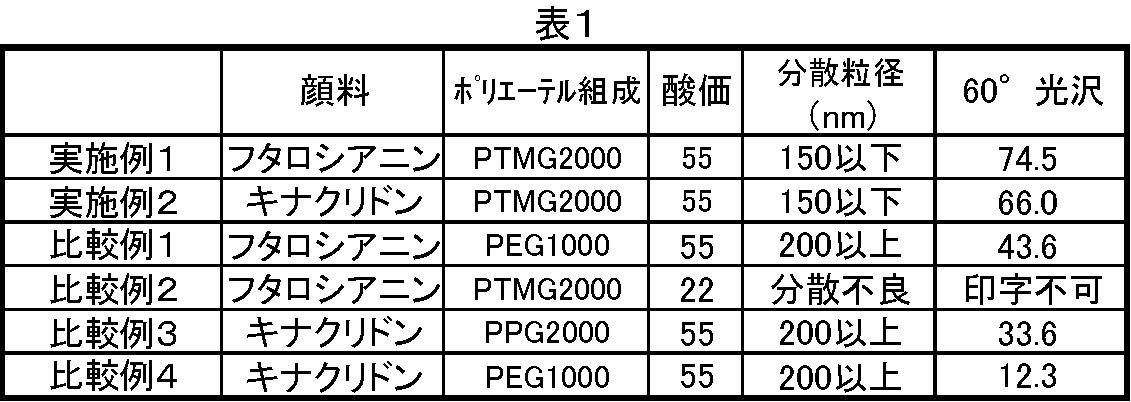
製造例1〜2及び比較製造例1〜4の水性顔料分散体の顔料分散性についてFPAR−1000(大塚電子(株)製)にて、分散粒子の分散粒径を測定した。この結果を表1に示した。分散粒子の分散粒径は、初期顔料分散性を表す尺度であり、例えば水性顔料分散体や水性インクにおける顔料の初期分散性を意味する。 Regarding the pigment dispersibility of the aqueous pigment dispersions of Production Examples 1 and 2 and Comparative Production Examples 1 to 4, the dispersed particle size of the dispersed particles was measured with FPAR-1000 (manufactured by Otsuka Electronics Co., Ltd.). The results are shown in Table 1. The dispersed particle diameter of the dispersed particles is a scale representing the initial pigment dispersibility, and means, for example, the initial dispersibility of the pigment in the aqueous pigment dispersion or the aqueous ink.
製造例1で得られた水性顔料分散体から、特開平7−228808号公報記載の実施例1を参考にしてピエゾ方式インクジェット記録用水性インクを調製した。インク組成を以下に示した。 From the aqueous pigment dispersion obtained in Production Example 1, a piezo ink jet recording aqueous ink was prepared with reference to Example 1 described in JP-A-7-228808. The ink composition is shown below.
水性顔料分散体 25.0部
トリエチレングリコールモノブチルエーテル 10.0部
ジエチレングリコール 15.0部
サーフィノール465(エアプロダクツ社製) 0.8部
水 49.2部
Aqueous pigment dispersion 25.0 parts Triethylene glycol monobutyl ether 10.0 parts Diethylene glycol 15.0 parts Surfinol 465 (manufactured by Air Products) 0.8 parts Water 49.2 parts
こうして調製したインクを、ピエゾ方式のインクジェットプリンタ(EM-930C、セイコーエプソン(株)製)にて、写真用紙<光沢>(セイコーエプソン(株)製)にベタ印字した。この印字物についてヘイズグロスメーター(BYK Gardner社製)を使用し、測定角度60度で着色画像の光沢を測定した。この結果を表1に示した。またインクの初期顔料分散性について、インク中の分散粒子の分散粒径を測定したが、インクも対応する水性顔料分散体のそれとほぼ同等であった。 The ink thus prepared was solid-printed on photographic paper <gloss> (manufactured by Seiko Epson Corporation) using a piezo ink jet printer (EM-930C, manufactured by Seiko Epson Corporation). The gloss of the colored image was measured on the printed matter using a haze gloss meter (BYK Gardner) at a measurement angle of 60 degrees. The results are shown in Table 1. Further, regarding the initial pigment dispersibility of the ink, the dispersed particle diameter of the dispersed particles in the ink was measured, and the ink was almost the same as that of the corresponding aqueous pigment dispersion.
製造例1で得られた水性顔料分散体に代えて製造例2で得られた水性顔料分散体の同量を用いる以外は実施例1と同様の操作を行い、インクジェット記録用水性インクを調製した。実施例1と同様に光沢を測定した。この結果を表1に示した。インク中の分散粒子の分散粒径は対応する水性顔料分散体のそれとほぼ同等であった。 A water-based ink for inkjet recording was prepared in the same manner as in Example 1 except that the same amount of the aqueous pigment dispersion obtained in Production Example 2 was used instead of the aqueous pigment dispersion obtained in Production Example 1. . The gloss was measured in the same manner as in Example 1. The results are shown in Table 1. The dispersed particle size of the dispersed particles in the ink was almost the same as that of the corresponding aqueous pigment dispersion.
比較例1〜2
製造例1で得られた水性顔料分散体に代えて比較製造例1〜2で得られた水性顔料分散体の同量を用いる以外は実施例1と同様の操作を行い、インクジェット記録用水性インクを調製しし、実施例1と同様に光沢を測定した。この結果を表1に示した。比較例2のインクは印字が出来なった。比較例1のインク中の分散粒子の分散粒径は対応する水性顔料分散体のそれとほぼ同等であった。
Comparative Examples 1-2
A water-based ink for inkjet recording was carried out in the same manner as in Example 1 except that the same amount of the aqueous pigment dispersion obtained in Comparative Production Examples 1 and 2 was used instead of the aqueous pigment dispersion obtained in Production Example 1. The gloss was measured in the same manner as in Example 1. The results are shown in Table 1. The ink of Comparative Example 2 could not be printed. The dispersed particle size of the dispersed particles in the ink of Comparative Example 1 was almost the same as that of the corresponding aqueous pigment dispersion.
比較例3〜4
製造例2で得られた水性顔料分散体に代えて比較製造例3〜4で得られた水性顔料分散体の同量を用いる以外は実施例1と同様の操作を行い、インクジェット記録用水性インクを調製した。実施例1と同様に光沢を測定した。この結果を表1に示した。各々のインク中の分散粒子の分散粒径は対応する各水性顔料分散体のそれとほぼ同等であった。
Comparative Examples 3-4
A water-based ink for inkjet recording was carried out in the same manner as in Example 1, except that the same amount of the aqueous pigment dispersion obtained in Comparative Production Examples 3 to 4 was used instead of the aqueous pigment dispersion obtained in Production Example 2. Was prepared. The gloss was measured in the same manner as in Example 1. The results are shown in Table 1. The dispersed particle size of the dispersed particles in each ink was almost equivalent to that of each corresponding aqueous pigment dispersion.
尚、表1中の150以下は分散粒径が100〜150nmであることを表し、一方200以上は分散粒径が200〜300nmであることを表す。 In Table 1, 150 or less means that the dispersed particle diameter is 100 to 150 nm, while 200 or more means that the dispersed particle diameter is 200 to 300 nm.
フタロシアニン系顔料を用いた同一酸価での対比において、実施例1のポリ(オキシテトラメチレン)構造を含有するポリエーテル系ポリウレタン樹脂を含有する本発明のインクジェット記録用水性インクは、比較例1のポリ(オキシエチレン)構造を含有するポリエーテル系ウレタン樹脂を含有する従来のインクジェット記録用水性インクに比べて、初期顔料分散性や着色画像の光沢により優れていることがわかる。 In contrast with the same acid value using a phthalocyanine pigment, the aqueous ink for inkjet recording of the present invention containing the polyether-based polyurethane resin containing the poly (oxytetramethylene) structure of Example 1 is the same as that of Comparative Example 1. It can be seen that the initial pigment dispersibility and the gloss of the colored image are superior to the conventional water-based ink for inkjet recording containing a polyether-based urethane resin containing a poly (oxyethylene) structure.
一方、フタロシアニン系顔料を用いた同一ポリ(オキシアルキレン)構造での対比において、実施例1のポリウレタン樹脂の酸価が特定範囲に入る本発明のインクジェット記録用水性インクは、比較例1の酸価が低い従来のインクジェット記録用水性インクに比べて、初期顔料分散性や着色画像の光沢により優れていることがわかる。 On the other hand, the water-based ink for ink-jet recording of the present invention in which the acid value of the polyurethane resin of Example 1 falls within a specific range in comparison with the same poly (oxyalkylene) structure using the phthalocyanine pigment is the acid value of Comparative Example 1. It can be seen that the initial pigment dispersibility and the gloss of the colored image are superior to the conventional water-based ink for ink jet recording having a low viscosity.
キナクリドン系顔料を用いた同一酸価での対比において、実施例2のポリ(オキシテトラメチレン)構造を含有するポリエーテル系ポリウレタン樹脂を含有する本発明のインクジェット記録用水性インクは、比較例3及び4の様なポリ(オキシエチレン)構造やポリ(オキシプロピレン)構造を含有するポリエーテル系ウレタン樹脂を含有する従来のインクジェット記録用水性インクに比べて、初期顔料分散性や着色画像の光沢により優れていることがわかる。尚、この対比においては、フタロシアニン系顔料に比べてキナクリドン系顔料の方が、光沢値の改良程度は大きかった。 In contrast with the same acid value using a quinacridone pigment, the aqueous ink for inkjet recording of the present invention containing the polyether-based polyurethane resin containing the poly (oxytetramethylene) structure of Example 2 was used as Comparative Example 3 and Compared with conventional water-based inks for inkjet recording containing a polyether-based urethane resin containing a poly (oxyethylene) structure or poly (oxypropylene) structure such as 4, it is superior in initial pigment dispersibility and gloss of colored images You can see that In this comparison, the quinacridone pigment had a greater improvement in gloss value than the phthalocyanine pigment.
また、オキシテトラメチレンの繰り返し単位数n=20〜30のポリ(オキシテトラメチレン)構造を含有するポリウレタン樹脂から調製された実施例1のインクジェット記録用水性インクを、70℃×7日で貯蔵した際の貯蔵前後における分散粒子の分散粒径の変化率を評価したところ変化率が10%以内であり、顔料等のインク中での経時における分散安定性が良好であり、優れた貯蔵安定性を有していた。 In addition, the aqueous inkjet recording ink of Example 1 prepared from a polyurethane resin containing a poly (oxytetramethylene) structure having a repeating unit number n = 20 to 30 of oxytetramethylene was stored at 70 ° C. for 7 days. When the rate of change in the dispersed particle size of the dispersed particles before and after storage was evaluated, the rate of change was within 10%, the dispersion stability over time in inks such as pigments was good, and excellent storage stability. Had.
さらに、オキシテトラメチレンの繰り返し単位数n=20〜30のポリ(オキシテトラメチレン)構造を含有するポリウレタン樹脂から調製された実施例2のインクジェット記録用水性インクを、70℃×3日で貯蔵した際の貯蔵前後における分散粒子の分散粒径の変化率を評価したところ変化率が10%以内であり、顔料等のインク中での経時における分散安定性が良好であり、優れた貯蔵安定性を有していた。 Furthermore, the aqueous ink for inkjet recording of Example 2 prepared from a polyurethane resin containing a poly (oxytetramethylene) structure having a repeating unit number n = 20 to 30 of oxytetramethylene was stored at 70 ° C. for 3 days. When the rate of change in the dispersed particle size of the dispersed particles before and after storage was evaluated, the rate of change was within 10%, the dispersion stability over time in inks such as pigments was good, and excellent storage stability. Had.
比較例1〜4のインクジェット記録用水性インクは、いずれも、対応する同色の実施例のそれに比べてインクの貯蔵安定性が著しく劣っていた。
In each of the aqueous inkjet recording inks of Comparative Examples 1 to 4, the storage stability of the ink was remarkably inferior to that of the corresponding Example of the same color.
Claims (6)
The water-based ink for ink-jet recording according to any one of claims 1 to 5, comprising 20 to 100 parts of a polyether-based polyurethane resin in a nonvolatile content with respect to 100 parts of the pigment.
Priority Applications (1)
| Application Number | Priority Date | Filing Date | Title |
|---|---|---|---|
| JP2004103042A JP4756305B2 (en) | 2004-03-31 | 2004-03-31 | Water-based ink for inkjet recording |
Applications Claiming Priority (1)
| Application Number | Priority Date | Filing Date | Title |
|---|---|---|---|
| JP2004103042A JP4756305B2 (en) | 2004-03-31 | 2004-03-31 | Water-based ink for inkjet recording |
Publications (2)
| Publication Number | Publication Date |
|---|---|
| JP2005290044A true JP2005290044A (en) | 2005-10-20 |
| JP4756305B2 JP4756305B2 (en) | 2011-08-24 |
Family
ID=35323353
Family Applications (1)
| Application Number | Title | Priority Date | Filing Date |
|---|---|---|---|
| JP2004103042A Expired - Lifetime JP4756305B2 (en) | 2004-03-31 | 2004-03-31 | Water-based ink for inkjet recording |
Country Status (1)
| Country | Link |
|---|---|
| JP (1) | JP4756305B2 (en) |
Cited By (18)
| Publication number | Priority date | Publication date | Assignee | Title |
|---|---|---|---|---|
| JP2008101160A (en) * | 2006-10-20 | 2008-05-01 | Mitsui Chemicals Polyurethanes Inc | Water-based polyurethane resin, water-based ink and pigment dispersion |
| WO2008106147A1 (en) * | 2007-02-28 | 2008-09-04 | Eastman Kodak Company | Pigment based inks for inkjet printing |
| JP2009298929A (en) * | 2008-06-13 | 2009-12-24 | Sanyo Chem Ind Ltd | Polyurethane resin aqueous dispersion |
| EP2154210A2 (en) | 2008-07-31 | 2010-02-17 | Seiko Epson Corporation | Ink composition, recorded material, recording method, and recording apparatus |
| US7790783B2 (en) | 2005-10-31 | 2010-09-07 | Seiko Epson Corporation | Water-base ink composition, inkjet recording method and recorded matter |
| WO2010137745A1 (en) * | 2009-05-29 | 2010-12-02 | Ricoh Company, Ltd. | Inkjet recording ink set, ink cartridge, and inkjet recording apparatus |
| JP2012031385A (en) * | 2010-07-05 | 2012-02-16 | Canon Inc | Inkjet ink, inkjet recording method, and ink cartridge |
| US8187371B2 (en) | 2007-02-28 | 2012-05-29 | Eastman Kodak Company | Pigment based inks for high speed durable inkjet printing |
| JP2013532213A (en) * | 2010-06-17 | 2013-08-15 | ヒューレット−パッカード デベロップメント カンパニー エル.ピー. | Polyurethane-containing inkjet ink |
| US8556400B2 (en) | 2004-10-22 | 2013-10-15 | Seiko Epson Corporation | Inkjet recording ink |
| US8684509B2 (en) | 2011-03-30 | 2014-04-01 | Canon Kabushiki Kaisha | Ink jet ink, ink cartridge, and ink jet recording method |
| US8690307B2 (en) | 2011-03-30 | 2014-04-08 | Canon Kabushiki Kaisha | Ink jet ink, ink cartridge, and ink jet recording method |
| CN103788761A (en) * | 2014-01-08 | 2014-05-14 | 林庆福 | Aqueous ink and preparation method thereof |
| US8955953B2 (en) | 2008-01-25 | 2015-02-17 | Ricoh Company, Ltd. | Inkjet recording ink, ink cartridge, inkjet printing apparatus and image forming method |
| JP2015120818A (en) * | 2013-12-24 | 2015-07-02 | Dic株式会社 | Aqueous pigment dispersion and water-based ink for inkjet recording |
| JP2016130278A (en) * | 2015-01-13 | 2016-07-21 | Dic株式会社 | Aqueous pigment dispersion, and aqueous ink for inkjet recording |
| JP2021102691A (en) * | 2019-12-25 | 2021-07-15 | セイコーエプソン株式会社 | Ink jet ink composition, ink composition producing method, recorded product, and ink jet recording method |
| WO2021235414A1 (en) * | 2020-05-21 | 2021-11-25 | 日本化薬株式会社 | Ink composition, method for ink jet textile printing, and method for ink jet dyeing |
Citations (5)
| Publication number | Priority date | Publication date | Assignee | Title |
|---|---|---|---|---|
| JPH05194688A (en) * | 1991-07-05 | 1993-08-03 | Hoechst Ag | Polyurethane dispersion |
| JPH0931360A (en) * | 1995-07-21 | 1997-02-04 | Dainippon Ink & Chem Inc | Method for producing aqueous pigment dispersion, and aqueous colorant composition containing the aqueous pigment dispersion |
| JP2000136336A (en) * | 1998-11-04 | 2000-05-16 | Kuraray Co Ltd | Water-based ink |
| JP2000248213A (en) * | 1999-02-26 | 2000-09-12 | Mitsubishi Chemicals Corp | Recording liquid and ink jet recording method |
| JP2002167536A (en) * | 2000-06-14 | 2002-06-11 | Mitsubishi Chemicals Corp | Recording liquid and ink jet recording method |
-
2004
- 2004-03-31 JP JP2004103042A patent/JP4756305B2/en not_active Expired - Lifetime
Patent Citations (5)
| Publication number | Priority date | Publication date | Assignee | Title |
|---|---|---|---|---|
| JPH05194688A (en) * | 1991-07-05 | 1993-08-03 | Hoechst Ag | Polyurethane dispersion |
| JPH0931360A (en) * | 1995-07-21 | 1997-02-04 | Dainippon Ink & Chem Inc | Method for producing aqueous pigment dispersion, and aqueous colorant composition containing the aqueous pigment dispersion |
| JP2000136336A (en) * | 1998-11-04 | 2000-05-16 | Kuraray Co Ltd | Water-based ink |
| JP2000248213A (en) * | 1999-02-26 | 2000-09-12 | Mitsubishi Chemicals Corp | Recording liquid and ink jet recording method |
| JP2002167536A (en) * | 2000-06-14 | 2002-06-11 | Mitsubishi Chemicals Corp | Recording liquid and ink jet recording method |
Cited By (27)
| Publication number | Priority date | Publication date | Assignee | Title |
|---|---|---|---|---|
| US8556400B2 (en) | 2004-10-22 | 2013-10-15 | Seiko Epson Corporation | Inkjet recording ink |
| US7790783B2 (en) | 2005-10-31 | 2010-09-07 | Seiko Epson Corporation | Water-base ink composition, inkjet recording method and recorded matter |
| JP2008101160A (en) * | 2006-10-20 | 2008-05-01 | Mitsui Chemicals Polyurethanes Inc | Water-based polyurethane resin, water-based ink and pigment dispersion |
| WO2008106147A1 (en) * | 2007-02-28 | 2008-09-04 | Eastman Kodak Company | Pigment based inks for inkjet printing |
| US8187371B2 (en) | 2007-02-28 | 2012-05-29 | Eastman Kodak Company | Pigment based inks for high speed durable inkjet printing |
| US8955953B2 (en) | 2008-01-25 | 2015-02-17 | Ricoh Company, Ltd. | Inkjet recording ink, ink cartridge, inkjet printing apparatus and image forming method |
| JP2009298929A (en) * | 2008-06-13 | 2009-12-24 | Sanyo Chem Ind Ltd | Polyurethane resin aqueous dispersion |
| EP2565242A1 (en) * | 2008-07-31 | 2013-03-06 | Seiko Epson Corporation | Ink composition, recorded material, recording method, and recording apparatus |
| EP2154210A2 (en) | 2008-07-31 | 2010-02-17 | Seiko Epson Corporation | Ink composition, recorded material, recording method, and recording apparatus |
| EP2154210A3 (en) * | 2008-07-31 | 2010-04-07 | Seiko Epson Corporation | Ink composition, recorded material, recording method, and recording apparatus |
| US8158697B2 (en) | 2008-07-31 | 2012-04-17 | Seiko Epson Corporation | Ink composition, recorded material, recording method, and recording apparatus |
| WO2010137745A1 (en) * | 2009-05-29 | 2010-12-02 | Ricoh Company, Ltd. | Inkjet recording ink set, ink cartridge, and inkjet recording apparatus |
| US8740371B2 (en) | 2009-05-29 | 2014-06-03 | Ricoh Company, Ltd. | Inkjet recording ink set, ink cartridge, and inkjet recording apparatus |
| JP2011006672A (en) * | 2009-05-29 | 2011-01-13 | Ricoh Co Ltd | Ink-jet recording ink set, ink cartridge and ink-jet recording device |
| EP2582763A4 (en) * | 2010-06-17 | 2015-07-01 | Hewlett Packard Development Co | Polyurethane-containing inkjet ink |
| JP2013532213A (en) * | 2010-06-17 | 2013-08-15 | ヒューレット−パッカード デベロップメント カンパニー エル.ピー. | Polyurethane-containing inkjet ink |
| JP2012031385A (en) * | 2010-07-05 | 2012-02-16 | Canon Inc | Inkjet ink, inkjet recording method, and ink cartridge |
| US8690307B2 (en) | 2011-03-30 | 2014-04-08 | Canon Kabushiki Kaisha | Ink jet ink, ink cartridge, and ink jet recording method |
| US8684509B2 (en) | 2011-03-30 | 2014-04-01 | Canon Kabushiki Kaisha | Ink jet ink, ink cartridge, and ink jet recording method |
| JP2015120818A (en) * | 2013-12-24 | 2015-07-02 | Dic株式会社 | Aqueous pigment dispersion and water-based ink for inkjet recording |
| CN103788761A (en) * | 2014-01-08 | 2014-05-14 | 林庆福 | Aqueous ink and preparation method thereof |
| CN103788761B (en) * | 2014-01-08 | 2016-06-15 | 林庆福 | A kind of water color ink and preparation method |
| JP2016130278A (en) * | 2015-01-13 | 2016-07-21 | Dic株式会社 | Aqueous pigment dispersion, and aqueous ink for inkjet recording |
| JP2021102691A (en) * | 2019-12-25 | 2021-07-15 | セイコーエプソン株式会社 | Ink jet ink composition, ink composition producing method, recorded product, and ink jet recording method |
| JP7347201B2 (en) | 2019-12-25 | 2023-09-20 | セイコーエプソン株式会社 | Inkjet ink composition, method for producing ink composition, recorded matter, and inkjet recording method |
| WO2021235414A1 (en) * | 2020-05-21 | 2021-11-25 | 日本化薬株式会社 | Ink composition, method for ink jet textile printing, and method for ink jet dyeing |
| JPWO2021235414A1 (en) * | 2020-05-21 | 2021-11-25 |
Also Published As
| Publication number | Publication date |
|---|---|
| JP4756305B2 (en) | 2011-08-24 |
Similar Documents
| Publication | Publication Date | Title |
|---|---|---|
| JP4756305B2 (en) | Water-based ink for inkjet recording | |
| JP5093424B1 (en) | Ink jet printing ink binder, ink jet printing ink containing the same, and printed matter | |
| CN102939345B (en) | Polyurethane resin adhesion pigment, pigment dispersion composition and inkjet ink composition | |
| JP5757405B2 (en) | Inkjet recording ink set, ink cartridge using the same, inkjet recording apparatus, image forming method, and image formed article | |
| KR101292234B1 (en) | Pigment dispersion and aqueous ink for inkjet recording | |
| JP5672172B2 (en) | Ink jet printing ink binder, ink jet printing ink containing the same, and printed matter | |
| CN103068932B (en) | Polyurethane resin addition pigment, process for producing polyurethane resin addition pigment, pigment dispersion composition, and jet printing ink composition | |
| US20120321863A1 (en) | Process for preparing encapsulated solid particles | |
| JP4609606B1 (en) | Ink jet printing ink binder, ink jet printing ink containing the same, and printed matter | |
| JP4461222B2 (en) | Pigment-dispersed aqueous recording liquid and printed matter | |
| JP5488900B2 (en) | Pigment dispersion composition and inkjet ink composition | |
| WO2011004675A1 (en) | Binder for ink-jet printing ink, ink-jet printing ink containing same, and printed matter | |
| KR101877083B1 (en) | Process for producing pigment dispersion composition | |
| JP2012036287A (en) | Inkjet recording ink, ink cartridge, and image forming apparatus | |
| JP5875992B2 (en) | Method for preparing encapsulated solid particles | |
| JP2008024733A (en) | Aqueous pigment dispersion and ink composition using the same | |
| JP2015120818A (en) | Aqueous pigment dispersion and water-based ink for inkjet recording | |
| JP2018002798A (en) | Manufacturing method of aqueous pigment dispersion and aqueous ink for inkjet recording | |
| JP6176486B2 (en) | Aqueous pigment dispersion for preparing water-based ink for ink-jet recording and water-based ink for ink-jet recording | |
| JP5029932B2 (en) | Ink jet printing ink, method for producing ink jet printing ink, and printed matter | |
| JP6398732B2 (en) | Aqueous pigment dispersion and water-based ink for inkjet recording | |
| JP4993040B2 (en) | Ink jet printing ink binder, ink jet printing ink containing the same, and printed matter | |
| JP2010195965A (en) | Binder for ink-jet pigment ink | |
| JP2008143960A (en) | Aqueous pigment dispersion and ink composition using the same | |
| WO2023114575A1 (en) | Aqueous inkjet inks containing a polyurethane polymer |
Legal Events
| Date | Code | Title | Description |
|---|---|---|---|
| RD01 | Notification of change of attorney |
Free format text: JAPANESE INTERMEDIATE CODE: A7421 Effective date: 20050909 |
|
| A621 | Written request for application examination |
Free format text: JAPANESE INTERMEDIATE CODE: A621 Effective date: 20070306 |
|
| A977 | Report on retrieval |
Free format text: JAPANESE INTERMEDIATE CODE: A971007 Effective date: 20100624 |
|
| A131 | Notification of reasons for refusal |
Free format text: JAPANESE INTERMEDIATE CODE: A131 Effective date: 20100706 |
|
| A521 | Request for written amendment filed |
Free format text: JAPANESE INTERMEDIATE CODE: A523 Effective date: 20100901 |
|
| TRDD | Decision of grant or rejection written | ||
| A01 | Written decision to grant a patent or to grant a registration (utility model) |
Free format text: JAPANESE INTERMEDIATE CODE: A01 Effective date: 20110506 |
|
| A61 | First payment of annual fees (during grant procedure) |
Free format text: JAPANESE INTERMEDIATE CODE: A61 Effective date: 20110519 |
|
| R150 | Certificate of patent or registration of utility model |
Ref document number: 4756305 Country of ref document: JP Free format text: JAPANESE INTERMEDIATE CODE: R150 Free format text: JAPANESE INTERMEDIATE CODE: R150 |
|
| FPAY | Renewal fee payment (event date is renewal date of database) |
Free format text: PAYMENT UNTIL: 20140610 Year of fee payment: 3 |
|
| R250 | Receipt of annual fees |
Free format text: JAPANESE INTERMEDIATE CODE: R250 |
|
| R250 | Receipt of annual fees |
Free format text: JAPANESE INTERMEDIATE CODE: R250 |
|
| R250 | Receipt of annual fees |
Free format text: JAPANESE INTERMEDIATE CODE: R250 |
|
| R250 | Receipt of annual fees |
Free format text: JAPANESE INTERMEDIATE CODE: R250 |
|
| R250 | Receipt of annual fees |
Free format text: JAPANESE INTERMEDIATE CODE: R250 |
|
| R250 | Receipt of annual fees |
Free format text: JAPANESE INTERMEDIATE CODE: R250 |
|
| R250 | Receipt of annual fees |
Free format text: JAPANESE INTERMEDIATE CODE: R250 |
|
| R250 | Receipt of annual fees |
Free format text: JAPANESE INTERMEDIATE CODE: R250 |
|
| R250 | Receipt of annual fees |
Free format text: JAPANESE INTERMEDIATE CODE: R250 |
|
| EXPY | Cancellation because of completion of term |