JP2004077458A - Gas sensor and method of manufacturing gas sensor - Google Patents
Gas sensor and method of manufacturing gas sensor Download PDFInfo
- Publication number
- JP2004077458A JP2004077458A JP2002329930A JP2002329930A JP2004077458A JP 2004077458 A JP2004077458 A JP 2004077458A JP 2002329930 A JP2002329930 A JP 2002329930A JP 2002329930 A JP2002329930 A JP 2002329930A JP 2004077458 A JP2004077458 A JP 2004077458A
- Authority
- JP
- Japan
- Prior art keywords
- gas sensor
- gas
- protective layer
- metal
- catalytically active
- Prior art date
- Legal status (The legal status is an assumption and is not a legal conclusion. Google has not performed a legal analysis and makes no representation as to the accuracy of the status listed.)
- Pending
Links
Images
Landscapes
- Investigating Or Analyzing Materials By The Use Of Fluid Adsorption Or Reactions (AREA)
Abstract
【課題】飲食物の新鮮度の判断は主観的で曖昧な場合が多いため,半導体ガスセンサを利用し新鮮度を感知する技術の研究が活発に行われている。しかしながら,野菜や果物類の新鮮度感知において重要な,エチレン,エタノール,アルデヒド類,メルカプタン類,アミン類などのガスに対して,良好な応答性で耐久性に優れたガス検出を行うことができなかった。
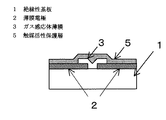
【解決手段】本発明のガスセンサは,絶縁性基板1と,絶縁性基板1の上に所定の間隔をおいて設けられた一対の薄膜電極2と,少なくとも所定の間隔を実質上充填するように設けられた,金属酸化物を有するガス感応体薄膜3と,金属酸化物の外部に露出した表面を被覆するように形成された触媒活性保護層5とを備えたガスセンサである。
【選択図】 図1[PROBLEMS] Because determination of freshness of food and drink is subjective and often ambiguous, researches on a technology for sensing freshness using a semiconductor gas sensor are being actively conducted. However, it is possible to detect gas with good responsiveness and excellent durability for gases such as ethylene, ethanol, aldehydes, mercaptans, and amines, which are important for sensing the freshness of vegetables and fruits. Did not.
A gas sensor according to the present invention includes an insulating substrate, a pair of thin-film electrodes provided on the insulating substrate at a predetermined interval, and substantially filling at least a predetermined interval. The gas sensor includes a gas sensitive thin film 3 having a metal oxide provided thereon and a catalytically active protective layer 5 formed so as to cover a surface exposed to the outside of the metal oxide.
[Selection diagram] Fig. 1
Description
【0001】
【発明の属する技術分野】
本発明は,たとえば野菜や果物の新鮮度や腐敗度を感知するためのガスセンサ,およびガスセンサの製造方法に関する。
【0002】
【従来の技術】
飲食物の新鮮度は,人間の視覚,味覚,又は喉覚の感覚により主観的に判断され,該新鮮度の判断が曖昧な場合が多いため,半導体ガスセンサを利用し新鮮度を感知する技術の研究が,活発に行われている。
【0003】
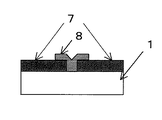
一般に半導体ガスセンサは,図9に示すように,絶縁性基板1と,一対の電極7と,ガス感応体8とから構成される。ここで,図9の半導体ガスセンサは,絶縁性基板1上に一対の電極7を設け,絶縁性基板1上と一対の電極7上にガス感応体8を形成した構成である。
【0004】
最近,生魚の新鮮度を感知するため該生魚類から発生する悪臭成分のトリメチルアミンを感知し得る半導体ガスセンサが開発されている。感知材料としては,ニ酸化チタニウム酸化物半導体が広く用いられ,前記ニ酸化チタニウムに触媒の金属成分を添加しセンサの感度を向上させていた。この場合,センサの感度に影響を及ぼすものは触媒の作用,分散状態と感知膜の膜厚であって,前記触媒の作用を向上するためには触媒の成分及び添加量が重要な役割をする。更に,前記ニ酸化チタニウムを感知材料に用いる他にマグネシウム添加酸化インジウムをトリメチルアミンに対するガスセンサの感知材料とし,酸化インジウムに酸化マグネシウムを5mol%添加して原子制御により電子濃度を低下させ,空気中のセンサ抵抗を大きくしてセンサの感度を向上させる研究が行われている。しかし,このようなトリメチルアミンに対するガスセンサは,未だ研究初歩段階にあって実際に応用されていない上に,感知センサの電力消耗が多く,大量生産には向いていない。
【0005】
野菜類の新鮮度感知装置においては,生魚のトリメチルアミンとは違って,野菜から発生する硫化物ガス(メルカプタン類)に対し優秀な感度を有する,野菜新鮮度感知センサが開発されている。たとえば,酸化スズ粉末に所定量のパラジウム粉末を添加して混合した後に粉砕する段階と,粉砕された酸化スズ及びパラジウムの粉末を所定温度で所定時間だけ仮焼した後に有機物と混合してペーストをつくる段階と,前記ペーストを基板の電極面上にコーティングして感知膜を形成する段階と,前記コーティングをした後に乾燥させ所定温度で所定時間の間焼結し,前記電極面にリードワイヤを装着する段階とを順次行って,野菜新鮮度感知センサを製造する方法がある(たとえば,下記の特許文献1参照)。
【0006】
【特許文献1】
特許番号第2875174号明細書
【0007】
【発明が解決しようとする課題】
ところで,野菜や果物からは,初期から微量のエチレン,エタノール,アルデヒド類の発生がみられ,メルカプタン類は野菜や果物の腐敗開始時期から,アンモニアなどのアミン類は果物の腐敗開始時期から発生することがわかってきた。この結果,野菜や果物類の新鮮度感知においては,エチレン,エタノール,アルデヒド類などのガスの方が有効であり,メルカプタン類やアンモニアなどのアミン類は野菜や果物類の腐敗感知に有効であることが明らかになってきた。
【0008】
しかしながら,従来の酸化スズ粉末と所定量のパラジウム粉末を混合・粉砕・仮焼した後に有機物と混合して得られたペーストを,基板の電極面上にコーティングして乾燥・焼結して形成した感知膜を有する前述の野菜新鮮度感知センサでは,新鮮度検知に有効な1ppmレベルの微量なエチレン,エタノール,アルデヒド類などのガスを良好な応答性で(高感度で)検知することは困難である。また,野菜や果物の腐敗検知に有効な1ppmレベルのメルカプタン類やアミン類を検知することは困難である。
【0009】
さらに,半導体式ガスセンサを冷蔵庫に搭載して野菜や果物の鮮度や腐敗を検出の目的に用いる場合,冷蔵庫をかなりの期間使用すると,ガスセンサの劣化により出力信号が低下して,鮮度や腐敗を検知できないことがあった。本発明者は,この半導体式センサの出力が低下する(すなわち劣化する)のは,センサの中心的な機能を担う電極や触媒が反応の進行とともに経時的に劣化することによるものであり,野菜や果物から発生するアルコール類やアルデヒド類などの還元性ガスで触媒が還元されたり,電極表面や触媒にメルカプタン類やアミン類などが強く吸着したりして,検知ガスの検出反応が阻害されることによると考えている。また,これらの半導体式ガスセンサでは,センサ機能の中心を担う電極または触媒などに貴金属を用いる場合が多いが,これらの貴金属は,硫黄系化合物やシリコーン系化合物に弱くて劣化し易く,耐久性(信頼性)の確保が非常に困難になることがあった。
【0010】
このように,エチレン,エタノール,アルデヒド類,メルカプタン類,アミン類などのガスに対して,良好な応答性で耐久性に優れたガス検出を行うことが困難であった。
【0011】
本発明は,上記従来のこのような課題を考慮し,たとえば,野菜や果物類の新鮮度感知において重要なエチレン,エタノール,アルデヒド類,メルカプタン類,アミン類などのガスに対して,良好な応答性で耐久性に優れたガス検出を行うことができるガスセンサ,およびガスセンサの製造方法を提供することを目的とするものである。
【0012】
【課題を解決するための手段】
第1の本発明は,絶縁性の基板(1)と,
前記基板(1)の上に所定の間隔をおいて設けられた一対の第一の電極(2)と,
少なくとも前記所定の間隔を実質上充填するように設けられた,金属酸化物を有するガス感応体(3)と,
前記金属酸化物の外部に露出した表面を被覆するように形成された,および/または前記金属酸化物の内部に存在する間隙を補填するように形成された触媒活性保護層(5)とを備えたガスセンサである。
【0013】
第2の本発明は,前記第一の電極(2)は,薄膜電極(2)であって,
その薄膜電極(2)のそれぞれに対して設けられた,電圧印加を行うための一対の厚膜電極(6)をさらに備えた第1の本発明のガスセンサである。
【0014】
第3の本発明は,前記厚膜電極(6)は,前記ガス感応体(3)に接触しないように設けられている第2の本発明のガスセンサである。
【0015】
第4の本発明は,前記触媒活性保護層(5)は,前記厚膜電極(6)をも被覆するように形成されている第3の本発明のガスセンサである。
【0016】
第5の本発明は,前記金属酸化物は,酸化スズ,酸化インジウム,酸化亜鉛,酸化タングステンの内の少なくとも一つを主成分として含む第1の本発明のガスセンサである。
【0017】
第6の本発明は,前記触媒活性保護層(5)は,酸化ケイ素を主成分として含み,チタン,バナジウム,クロム,マンガン,鉄,コバルト,ニッケル,亜鉛,銅,白金,パラジウム,ルテニウム,ロジウムの内の少なくとも一つを助触媒として含む第1の本発明のガスセンサである。
【0018】
第7の本発明は,第1の本発明のガスセンサの製造方法であって,
ゾルゲル法を利用して,前記触媒活性保護層(5)を形成するステップを備えたガスセンサの製造方法である。
【0019】
第8の本発明は,第1の本発明のガスセンサの製造方法であって,
有機ケイ素化合物を含む有機溶液に助触媒と水と酸とを含む有機溶液を滴下および混合した後に加水分解および重縮合を行った溶液を利用して,前記触媒活性保護層(5)を形成するステップを備えたガスセンサの製造方法である。
【0020】
第9の本発明は,前記有機ケイ素化合物は,テトラアルコキシシラン,フルオロアルキルトリアルコキシシラン,ジフルオロアルキルジアルコキシシランの内の少なくとも一つを含む第8の本発明のガスセンサの製造方法である。
【0021】
第10の本発明は,前記助触媒は,チタン,バナジウム,クロム,マンガン,鉄,コバルト,ニッケル,亜鉛,銅,白金,パラジウム,ルテニウム,ロジウムの内の少なくとも一つの金属を含む,硝酸塩,塩化物塩,硫酸塩,アセチルアセトン錯塩の内の何れかである第8の本発明のガスセンサの製造方法である。
【0022】
第11の本発明は,前記酸は,塩酸,硫酸,硝酸,アンモニア,アルコールアミン類の内の何れかである第8の本発明のガスセンサの製造方法である。
【0023】
第12の本発明は,前記有機ケイ素化合物を含む有機溶液は,前記重縮合を促進するための有機金属化合物をさらに含む第8の本発明のガスセンサの製造方法である。
【0024】
第13の本発明は,前記有機金属化合物は,チタン,ジルコニウム,スズ,アルミニウム,亜鉛の内の少なくとも一つの金属を含む金属アルコキシドである第12の本発明のガスセンサの製造方法である。
【0025】
【発明の実施の形態】
以下に,本発明の実施の形態について,図面を参照しつつ説明を行う。
【0026】
(実施の形態1)
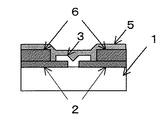
はじめに,図1〜2を主として参照しながら,本実施の形態のガスセンサの構成および作用について説明する。
【0027】
図1〜2は,本発明の実施の形態1のガスセンサの概略断面図である。
【0028】
1はアルミナ,ムライト等の絶縁性の基板,2は金,銀,白金等の金属からなる薄膜電極,3は酸化スズ,酸化インジウム,酸化亜鉛,酸化タングステンなどを主成分する金属酸化物からなるガス感応体薄膜,5は酸化ケイ素を主成分とする触媒活性保護層,6は金,銀,白金等の金属からなる厚膜電極である。
【0029】
基板1は,表面が絶縁性を有し,加熱機能を備えているものであれば,いずれのものも使用することができ,材料や構成等を限定するものではない。しかしながら,基板の表面粗さは0.01〜1μmの間であることが好ましい。
【0030】
薄膜電極2および厚膜電極6は,ガス感応体3に電圧印加して,その抵抗値を測定することが主たる目的であり,電極の材料,構成,パターン,製造方法等を限定するものではない。しかしながら,薄膜電極2の厚さは0.1〜1μm,厚膜電極4の厚さは3〜20μmの間であることが好ましい。また,厚膜電極4はリードとの接合をよくするためであり,構成上必ずしも必要ではない。
【0031】
なお,絶縁性基板1は本発明の基板に対応し,薄膜電極2は本発明の第一の電極に対応し,ガス感応体薄膜3は本発明のガス感応体に対応し,触媒活性保護層5は本発明の触媒活性保護層に対応する。また,薄膜電極2は本発明の薄膜電極に対応し,厚膜電極6は本発明の厚膜電極に対応する。
【0032】
つぎに,本実施の形態のガスセンサの製造方法について説明する。
【0033】
ガス感応体薄膜3は,以下のようにして形成することができる。
【0034】
基板上にガス感応体薄膜3を形成するための組成物の被膜を形成した後,数百℃以上の温度で焼成し,ガス感応体薄膜3を形成する。なお,ガス感応体形成用組成物の塗布には,スクリーン印刷法,ロールコート法,ディップコート法,スピンコート法等を用いることができるが,スクリーン印刷法が好ましい。また,焼成温度としては,ガス感応体薄膜3を形成するための組成物が分解する温度以上で,かつ基板1の変形温度以下であればよく,400〜800℃が好ましい。
【0035】
ガス感応体薄膜3を形成するための組成物は以下のようにして合成する。
【0036】
まず,活剤に有機溶剤を加え,溶解させる。ここで,活剤はガス感応体薄膜3の感度やガス選択性の向上を目的として添加される金属塩であり,金属マグネシウム塩,金属カルシウム塩,金属ストロンチウム塩,金属バリウム塩等のアルカリ土類金属塩や,金属チタン塩,金属ジルコニウム塩,金属バナジウム塩,金属クロム塩,金属マンガン塩,金属鉄塩,金属コバルト塩,金属ニッケル塩,金属銅塩等の遷移金属塩,金属亜鉛塩,金属鉛塩,金属カドミウム塩,金属アンチモン塩,金属ビスマス塩,金属パラジウム塩等が挙げられる。化合物としては,室温では比較的安定であるが,加熱処理により容易に分解し易いものであればよく,無機塩でも有機塩でも良い。例えば,無機塩では硝酸塩,硫酸塩,塩化物塩等が,有機塩ではカルボン酸塩,ジカルボン酸塩やアセチルアセトン錯塩が挙げられる。さらに,前記有機溶剤としては,金属スズせっけんと粘度調整剤のいずれも溶解することができるものであり,メトキシエタノール,ブチルカルビトールなどのエーテルアルコール類,アセチルアセトンなどのβ−ジケトン類,酢酸ブチルカルビトールなどのエステル類,α−テルピネオールなどのテルペン系溶剤などが挙げられる。
【0037】
次に,粘度調整剤を前記有機溶液に加えて,混合する。ここで,粘度調整剤は,有機溶液の粘度を増加させる増粘効果を有するポリマーであればよく,例えば,ポリビニルピロリジノン,エチルセルロース等が挙げられる。
【0038】
最後に,金属スズせっけんを前記有機溶液に加えて,混合する。ここで,金属スズせっけんは,2−エチルヘキサン酸スズやナフテン酸スズなどが挙げられる。
【0039】
なお,ガス感応体薄膜3は,金属酸化物半導体薄膜であればよく,酸化スズ,酸化インジウム,酸化タングステン,酸化亜鉛などが挙げられ,製膜方法も前記の有機金属化合物の熱分解法に限定するものではなく,ゾルゲル法やCVD法などの化学的製膜法や,真空蒸着法やスパッタリング法などの物理的製膜法も用いることができる。
【0040】
触媒活性保護層5は,以下のようにして形成することができる。
【0041】
ガス感応体薄膜3の上に触媒活性保護層5を形成するための組成物の被膜を形成した後,数百℃以上の温度で焼成し,触媒活性保護層5を形成する。なお,触媒活性保護層5を形成するための組成物の塗布には,スクリーン印刷法,ロールコート法,ディップコート法,スピンコート法等を用いることができるが,ディップコート法またはスピンコート法が好ましい。また,焼成温度としては,触媒活性保護層5を形成するための組成物が分解する温度以上で,かつ基板1の変形温度以下であればよく,400〜800℃が好ましい。
【0042】
なお,より具体的には,触媒活性保護層5を形成するための組成物は以下のようにして合成する。
【0043】
まず,有機溶剤に有機ケイ素化合物を加え,溶解させて,原料溶液を得る。
【0044】
ここで,有機ケイ素化合物は加水分解・重縮合するものであればよく,テトラエチルオルソシリケートなどのテトラアルコキシシラン,フロオロメチルトリエチルシリケートなどのフロオロアルキルトリアルコキシシラン,ジフルオロアルキルジアルコキシシランなどの金属アルコキシドが挙げられる。次に,加水分解用溶液として,別に所定量の水と,加水分解の触媒として塩酸,硝酸,硫酸などの酸を有機溶剤に溶解させる。さらに,この有機溶剤に助触媒を加えることができる。この助触媒は,触媒活性保護層5の触媒活性やガス感応体薄膜3の信頼性およびガス選択性の向上を目的として添加される金属塩であり,金属チタン塩,金属バナジウム塩,金属クロム塩,金属マンガン塩,金属鉄塩,金属コバルト塩,金属ニッケル塩などの遷移金属塩,金属亜鉛塩や金属銅塩,金属白金塩,金属パラジウム塩,金属ルテニウム塩,金属ロジウム塩などの貴金属塩などが挙げられる。化合物としては,酸性溶液に溶解し,安定に存在するものであれば良く,無機塩でも有機塩でも良い。例えば,無機塩では硝酸塩,硫酸塩,塩化物塩等が,有機塩ではカルボン酸塩,ジカルボン酸塩やアセチルアセトン錯塩が挙げられる。なお,有機溶剤は,有機ケイ素化合物のアルコキシル基との反応性から,同じ官能基をもつような,メタノール,エタノールなどのアルコール類や,メトキシエタノール,エトキシエタノールなどのエーテルアルコール類などが挙げられる。
【0045】
最後に,有機ケイ素化合物の溶解した原料溶液に,所定量の水と酸と,場合によっては助触媒を含んだ加水分解用溶液を滴下,混合して,触媒活性保護層5を形成するための組成物を得る。なお,加水分解時および加水分解後に,加熱してもよい。
【0046】
触媒活性保護層5は,その表面にてアルコール類,アルデヒド類,メルカプタン類やアミン類が分解された時に電荷を発生し,その電荷が触媒活性保護層5からガス感応体薄膜3に移動することにより,薄膜電極2の一対の電極間に電位差を生じさせ,ガス濃度を検知させる。
【0047】
すなわち,本実施の形態においては,触媒活性保護層5がガス感応体薄膜3に協動してその表面にてアルコール類,アルデヒド類,メルカプタン類やアミン類を検知することにより,ガス感応体薄膜3に直接ガスが接触することを防ぎ,ガス検知能力の保持と感応体薄膜の保護とを両立させている。このとき触媒活性保護層5が助触媒を含んだ構成であれば,さらにガス濃度の検出感度が向上する。
【0048】
さらに,触媒活性保護層5は多孔膜となっており,アルコール類,アルデヒド類,メルカプタン類やアミン類の一部は膜の孔を通ってガス感応体薄膜3に到達し,ガス濃度の検知に寄与することにより,ガスセンサの感度をさらに向上させるものと考えられる。このとき到達したガス薄膜電極2やガス感応体薄膜3の劣化の原因となるが,その量は従来例と比して極微量になっているため,耐久性を向上させるのに充分な効果が得られている。
【0049】
(実施の形態2)
はじめに,図5〜6を主として参照しながら,本実施の形態のガスセンサの構成および作用について説明する。
【0050】
図5〜6は,本発明の実施の形態2のガスセンサの概略断面図である。
【0051】
1はアルミナ,ムライト等の絶縁性の基板,2は金,銀,白金等の金属からなる薄膜電極,13は酸化スズ,酸化インジウム,酸化亜鉛,酸化タングステンなどを主成分とする網目構造を有する金属酸化物薄膜14と,前記金属酸化物薄膜中に含浸した酸化ケイ素を主成分とする吸水率が5%以下である触媒活性保護層15からなるガス感応体薄膜,6は金,銀,白金等の金属からなる厚膜電極である。
【0052】
ここで,基板1は,表面が絶縁性を有し,加熱機能を備えているものであれば,いずれのものも使用することができ,材料や構成等を限定するものではない。しかしながら,基板の表面粗さは0.01〜1μmの間であることが好ましい。また,薄膜電極2および厚膜電極6は,ガス感応体13に電圧印加して,その抵抗値を測定することが主たる目的であり,電極の材料,構成,パターン,製造方法等を限定するものではない。しかしながら,薄膜電極2の厚さは0.1〜1μm,厚膜電極14の厚さは3〜20μmの間であることが好ましい。また,厚膜電極6はリードとの接合をよくするためであり,構成上必ずしも必要ではない。
【0053】
なお,金属酸化物薄膜14は本発明のガス感応体に対応し,触媒活性保護層15は本発明の触媒活性保護層に対応する。
【0054】
つぎに,本実施の形態のガスセンサの製造方法について説明する。
【0055】
厚さ0.4mmのアルミナ基板の上に,金の有機金属化合物ペ−ストをスクリーン印刷法により塗布・乾燥した後,800℃で焼成して,膜厚が0.3μmの第一層の薄膜電極2を形成した。
【0056】
次に,第一層の薄膜電極2上に,同様に金の厚膜印刷用ペーストをスクリーン印刷法により塗布・乾燥した後,800℃で焼成して,膜厚が5μmの第二層の厚膜電極6を形成した。
【0057】
ガス感応体薄膜13は,金属酸化物薄膜14を形成した後に,前記金属酸化物薄膜14中に含浸した触媒活性保護層15を形成することにより得られる。
【0058】
金属酸化物薄膜14は,以下のようにして形成することができる。
【0059】
まず,100mlのビーカーに,(数1)が1mol%となるように活剤として塩化パラジウム・2水和物(化1)を秤量し,16gのブチルカルビトールと8gの酢酸ブチルカルビトールを加えて,しばらく攪拌した。そして,粘度調整剤として8gのポリビニルピロリジノンを加え,さらに,24gの2−エチルヘキサン酸スズ(化2)を加えて,撹拌・混合して,所望の金属酸化物薄膜14を形成するための組成物を得た。
【0060】
【数1】
Pd/(Sn+Pd)×100
【0061】
【化1】
PdCl2・2H2O
【0062】
【化2】
Sn(OOCCH(CH2CH3)(CH2)3CH3)2
その金属酸化物薄膜14を形成するための組成物を,厚さ0.4mmのアルミナ基板の上に,スクリーン印刷により塗布後,700℃で1時間焼成し,膜厚が2100nmの酸化スズを主成分とする金属酸化物薄膜14を形成した。
【0063】
ここで,基板1上に金属酸化物薄膜14を形成するための組成物の被膜を形成した後,数百℃以上の温度で焼成し,金属酸化物薄膜14を形成する。なお,金属酸化物薄膜14を形成するための組成物の塗布には,スクリーン印刷法,ロールコート法,ディップコート法,スピンコート法等を用いることができるが,スクリーン印刷法が好ましい。また,焼成温度としては,金属酸化物薄膜14を形成するための組成物が分解する温度以上で,かつ基板1の変形温度以下であればよく,400〜800℃が好ましい。
【0064】
なお,金属酸化物薄膜14を形成するための組成物は以下のようにして合成する。
【0065】
最初に,活剤に有機溶剤を加え,溶解させる。ここで,活剤はガス感応体としての感度やガス選択性の向上を目的として添加される金属塩であり,金属マグネシウム塩,金属カルシウム塩,金属ストロンチウム塩,金属バリウム塩等のアルカリ土類金属塩や,金属チタン塩,金属ジルコニウム塩,金属バナジウム塩,金属クロム塩,金属マンガン塩,金属鉄塩,金属コバルト塩,金属ニッケル塩,金属銅塩等の遷移金属塩,金属亜鉛塩,金属鉛塩,金属カドミウム塩,金属アンチモン塩,金属ビスマス塩,金属パラジウム塩等が挙げられる。化合物としては,室温では比較的安定であるが,加熱処理により容易に分解し易いものであればよく,無機塩でも有機塩でも良い。例えば,無機塩では硝酸塩,硫酸塩,塩化物塩等が,有機塩ではカルボン酸塩,ジカルボン酸塩やアセチルアセトン錯塩が挙げられる。さらに,前記有機溶剤としては,金属スズせっけんと粘度調整剤のいずれも溶解することができるものであり,メトキシエタノール,ブチルカルビトールなどのエーテルアルコール類,アセチルアセトンなどのβ−ジケトン類,酢酸ブチルカルビトールなどのエステル類,α−テルピネオールなどのテルペン系溶剤などが挙げられる。
【0066】
次に,粘度調整剤を前記有機溶液に加えて,混合する。ここで,粘度調整剤は,有機溶液の粘度を増加させる増粘効果を有するポリマーであればよく,例えば,ポリビニルピロリジノン,エチルセルロース等が挙げられる。
【0067】
最後に,金属スズせっけんを前記有機溶液に加えて,混合する。ここで,金属スズせっけんは,2−エチルヘキサン酸スズやナフテン酸スズなどが挙げられる。
【0068】
なお,金属酸化物薄膜14は,金属酸化物半導体であればよく,酸化スズ,酸化インジウム,酸化タングステン,酸化亜鉛などが挙げられ,製膜方法も前記の有機金属化合物の熱分解法に限定するものではなく,ゾルゲル法やCVD法などの化学的製膜法や,真空蒸着法やスパッタリング法などの物理的製膜法も用いることができる。
【0069】
次に,触媒活性保護層15は,以下のようにして形成することができる。
【0070】
8gのエタノールに,10gのテトラエチルオルソシリケートを溶解させて,原料溶液を調製し,同じく8gのエタノールに,0.2gの濃塩酸と10gの水を加えて,加水分解用溶液を調製して,前記原料溶液に,室温中で滴下・混合して,触媒活性保護層15を形成するための組成物を得た。
【0071】
その触媒活性保護層15を形成するための組成物をエタノールで10倍に希釈し,酸化スズを主成分とする金属酸化物薄膜中に,ディップコートにより含浸した後,60℃で5分間乾燥し,300℃で5分間,続いて750℃で20分間焼成し,これらの操作を計2回行い,酸化ケイ素からなる触媒活性保護層15を形成した。このとき,触媒活性保護層15の含水率は,4%であった。
【0072】
ここで,金属酸化物薄膜14中に触媒活性保護層15を形成するための組成物を含浸させた後,数百℃以上の温度で焼成し,触媒活性保護層15を形成する。なお,形成された触媒活性保護層15の含水率を5%以下とすることにより、ガス感応体の劣化の原因となる水酸基の生成を抑制することができる。また、触媒活性保護層15を形成するための組成物の塗布には,スクリーン印刷法,ロールコート法,ディップコート法,スピンコート法等を用いることができるが,ディップコート法またはスピンコート法が好ましい。また,焼成温度としては,触媒活性保護層15を形成するための組成物が分解する温度以上で,かつ基板1の変形温度以下であればよく,400〜800℃が好ましい。
【0073】
なお,より具体的には,触媒活性保護層15を形成するための組成物は以下のようにして合成する。
【0074】
まず,有機溶剤に有機ケイ素化合物を加え,溶解させて,原料溶液を得る。
【0075】
ここで,有機ケイ素化合物は加水分解・重縮合するものであればよく,テトラエチルオルソシリケートなどのテトラアルコキシシラン,フロオロメチルトリエチルシリケートなどのフロオロアルキルトリアルコキシシラン,ジフルオロアルキルジアルコキシシランなどの金属アルコキシドが挙げられる。次に,加水分解用溶液として,別に所定量の水と,加水分解の触媒として塩酸,硝酸,硫酸などの酸を有機溶剤に溶解させる。さらに,この有機溶剤に助触媒を加えることができる。この助触媒は,触媒活性保護層15の触媒活性やガス感応体の信頼性およびガス選択性の向上を目的として添加される金属塩であり,金属チタン塩,金属バナジウム塩,金属クロム塩,金属マンガン塩,金属鉄塩,金属コバルト塩,金属ニッケル塩などの遷移金属塩,金属亜鉛塩や金属銅塩,金属白金塩,金属パラジウム塩,金属ルテニウム塩,金属ロジウム塩などの貴金属塩などが挙げられる。化合物としては,酸性溶液に溶解し,安定に存在するものであれば良く,無機塩でも有機塩でも良い。例えば,無機塩では硝酸塩,硫酸塩,塩化物塩等が,有機塩ではカルボン酸塩,ジカルボン酸塩やアセチルアセトン錯塩が挙げられる。なお,有機溶剤は,有機ケイ素化合物のアルコキシル基との反応性から,同じ官能基をもつような,メタノール,エタノールなどのアルコール類や,メトキシエタノール,エトキシエタノールなどのエーテルアルコール類などが挙げられる。
【0076】
最後に,有機ケイ素化合物の溶解した原料溶液に,所定量の水と酸と,場合によっては助触媒を含んだ加水分解用溶液を滴下,混合して,触媒活性保護層15を形成するための組成物を得る。なお,加水分解時および加水分解後に,加熱してもよい。
【0077】
最後に,作製したセンサ素子を用いて1ppmのジメチルサルファイドに対するガス感度を測定した。7リットルのアクリルボックス中にセンサ素子を固定し,ヒータによって素子温度を350℃に制御して,空気中と,700ppmのジメチルサルファイドをボックス中に10ml加えて,センサ素子に接触させたときのセンサ素子抵抗変化を測定した。空気中におけるセンサ素子抵抗をRA,1ppmのジメチルサルファイドを含むガスを加えて30分後のセンサ素子抵抗をRGとしてRG/RAを求めてセンサ感度とした。このようにして求めた1ppmのジメチルサルファイドに対するセンサ感度は,触媒活性保護層15のある場合とない場合で,0.60と0.90であった。
【0078】
触媒活性保護層15が,耐久性の劣化の原因となる,アルコール類,アルデヒド類,メルカプタン類やアミン類を分解もしくはガス感応体の骨格である金属酸化物粒子表面への水分の直接的な接触を防止する。より具体的には,(1)センサの中心的な機能を担う電極やガス感応体中の触媒の劣化原因である,野菜や果物から発生するアルコール類やアルデヒド類などの還元性ガスによる触媒の還元,(2)電極表面や触媒上へのメルカプタン類やアミン類などの化学吸着,(3)空気中の水分によりガス感応体薄膜表面上の水酸基の形成などが防止されると,本発明者は考えている。もちろん,このような触媒活性保護層の存在により,ガス感応体の骨格を構成する金属酸化物粒子が活性化され,検出ガスに対する応答性が向上していると考えられる。
【0079】
以上においては,本実施の形態1〜2について詳細な説明を行った。
【0080】
以下に,本発明の実施例について,図面を参照しつつより具体的な説明を行う。
【0081】
【実施例】
(実施例1)
厚さ0.4mmのアルミナ基板の上に,金の有機金属化合物ペ−ストをスクリーン印刷法により塗布・乾燥した後,800℃で焼成して,膜厚が0.3μmの第一層の薄膜電極2を形成した。
【0082】
次に,第一層の薄膜電極2上に,同様に金の厚膜印刷用ペーストをスクリーン印刷法により塗布・乾燥した後,800℃で焼成して,膜厚が6μmの第二層の厚膜電極6を形成した。
【0083】
まず,100mlのビーカーに,(数2)が1mol%となるように活剤として金属(M=Mn,Fe,Ni,Co,Zn)2−エチルヘキサン酸を秤量し,粘度調整剤として1gのエチルセルロースを溶解させた10gのブチルカルビトール溶液を加え,さらに,9gの2−エチルヘキサン酸スズ(化2)を加えて,撹拌・混合して,所望のガス感応体形成用組成物を得た。
【0084】
【化2】
Sn(OOCCH(CH2CH3)(CH2)3CH3)2
【0085】
【数2】
M/(Sn+M)×100
そのガス感応体形成用組成物を,厚さ0.4mmのアルミナ基板の上に,スクリーン印刷により塗布後,700℃で1時間焼成し,膜厚が2400nmの酸化スズを主成分とする金属酸化物からなるガス感応体薄膜を形成した。
【0086】
次に,23gのエタノールに,10gのテトラエチルオルソシリケートを溶解させて,原料溶液を調製し,同じく23gのエタノールに,0.2gの濃塩酸と3gの水を加えて,加水分解用溶液を調製して,前記原料溶液に,室温中で滴下・混合して,触媒活性保護層形成用組成物を得た。
【0087】
その触媒活性保護層形成用組成物を,酸化スズを主成分とする金属酸化物からなるガス感応体薄膜上に,ディップコートにより塗布後,500℃で20分間焼成し,200nmの酸化ケイ素からなる触媒活性保護層を形成した。
【0088】
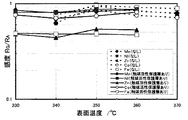
最後に,作製したセンサ素子を用いて1ppmのジメチルサルファイドに対するガス感度を測定した。7リットルのアクリルボックス中にセンサ素子を固定し,ヒータによって素子温度を330〜370℃に制御して,空気中と,700ppmのジメチルサルファイドをボックス中に10ml加えて,センサ素子に接触させたときのセンサ素子抵抗変化を測定した。空気中におけるセンサ素子抵抗をRA,1ppmのジメチルサルファイドを含むガスを加えて30分後のセンサ素子抵抗をRGとしてRG/RAを求めてセンサ感度とした。このようにして求めたセンサ感度の結果を,図3に示す。また,10ppmのアセトアルデヒドに対する感度は,触媒活性保護層のある場合とない場合では,0.50と0.70であった。
【0089】
(実施例2)
活剤として2−エチルヘキサン酸鉄を用いて,上記の(数1)が1mol%となるように酸化スズを主成分とする金属酸化物からなるガス感応体薄膜を形成した。
【0090】
次に,23gのエタノールに,10gのテトラエチルオルソシリケートを溶解させて,原料溶液を調製し,同じく23gのエタノールに,0.2gの濃塩酸と3gの貴金属塩(硝酸ルテニウム,塩化ロジウム,白金−Pソルト)含有5%水溶液を加えて,加水分解用溶液を調製して,前記原料溶液に,室温中で滴下・混合して,触媒活性保護層形成用組成物を得た。
【0091】
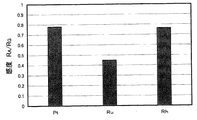
次に,作製したセンサ素子を用いて1ppmのジメチルサルファイドに対するガス感度を素子温度は350℃で測定した。このようにして求めたセンサ感度の結果を,図4に示す。
【0092】
(実施例3)
まず,100mlのビーカーに,(数1)が1mol%となるように活剤として塩化パラジウム(化1)を秤量し,粘度調整剤として1gのエチルセルロースを溶解させた13gのブチルカルビトール溶液を加え,さらに,6gの2−エチルヘキサン酸スズ(化3)を加えて,撹拌・混合して,所望のガス感応体形成用組成物を得た。
【0093】
【数1】
Pd/(Sn+Pd)×100
【0094】
【化1】
PdCl2・2H2O
そのガス感応体形成用組成物を,厚さ0.4mmのアルミナ基板の上に,スクリーン印刷により塗布後,700℃で1時間焼成し,膜厚が1800nmの酸化スズを主成分とする金属酸化物からなるガス感応体薄膜を形成した。
【0095】
次に,8gのエタノールに,10gのテトラエチルオルソシリケートを溶解させて,原料溶液を調製し,同じく8gのエタノールに,0.2gの濃塩酸と10gの水を加えて,加水分解用溶液を調製して,前記原料溶液に,室温中で滴下・混合して,触媒活性保護層形成用組成物を得た。
【0096】
次に,作製したセンサ素子を用いて1ppmのエチレン,エタノール,アンモニア,ジメチルサルファイドに対する応答特性を素子温度が350℃で測定した。このようにして求めたセンサが示す感度は,それぞれ,0.60,0.12,0.80,0.62であった。
【0097】
(実施例4)
23gのエタノールに,10gのテトラエチルオルソシリケートを溶解させて,原料溶液を調製し,同じく23gのエタノールに,0.2gの濃塩酸と3gの水を加えて,加水分解用溶液を調製して,前記原料溶液に,室温中で滴下・混合して,触媒活性保護層形成用組成物を得た。
【0098】
その触媒活性保護層形成用組成物をエタノールで5〜15倍に希釈した。そして,希釈した触媒活性保護層形成用組成物を,酸化スズを主成分とする金属酸化物からなるガス感応体薄膜上に,ディップコートにより含浸後,500℃で20分間焼成し,200nmの酸化ケイ素からなる触媒活性保護層を形成した
他は実施例1に同じである。
【0099】
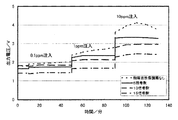
作製したセンサ素子を用いて0.1ppm,1ppm,10ppmのジメチルサルファイドに対するガス感度を測定したときのセンサの応答性を図7に示す。
【0100】
(実施例5)
触媒活性保護層形成用組成物をエタノールで5倍に希釈し,酸化スズを主成分とする金属酸化物薄膜中に,ディップコートにより含浸した後,60℃で5分間乾燥し,300℃5分間,続いて750℃で20分間焼成し,これらの操作を計2回行い,酸化ケイ素からなる触媒活性保護層5を形成した。他は実施例1に同じである。
【0101】
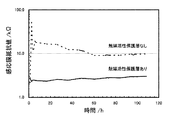
40℃,95%RHで100時間,通電したときのセンサ素子の抵抗値変化を図8に示す。本発明の触媒活性保護層のあるセンサ素子の抵抗値は,100時間経過時でもほとんど変化していないことがわかる。
【0102】
以上においては,本実施例1〜5について詳細な説明を行った。
【0103】
これまでの説明から明らかなように,前記ガス感応体薄膜上および/またはガス感応体薄膜中に,酸化ケイ素を主成分とする触媒活性保護層が形成されていることで,劣化の原因となる,アルコール類,アルデヒド類,メルカプタン類やアミン類を分解もしくはガス感応体薄膜への進入を阻害し,センサの中心的な機能を担う電極やガス感応体中の触媒の劣化原因である,野菜や果物から発生するアルコール類やアルデヒド類などの還元性ガスによる触媒の還元および電極表面や触媒上へのメルカプタン類やアミン類などの化学吸着などを防ぐことができる。また,空気中の水分によりガス感応体薄膜表面上の水酸基の形成を防ぐ効果も有している。
【0104】
また,本発明は,化学的製膜法であるゾルゲル法により,ガス感応体薄膜上酸化ケイ素を主成分とする触媒活性保護層を形成したり,ガス感応体の骨格を構成する金属酸化物粒子の網目構造の隙間に,酸化ケイ素を主成分とする触媒活性保護層が含浸させることで,ガス感応体薄膜に密着性が高く,センサ動作時の対熱衝撃性に優れ,高信頼性のガスセンサを得ることができる。さらに,有機ケイ素化合物の有機溶液に,助触媒と水を含む有機溶液を滴下・混合して,加水分解・重縮合により形成した有機溶液を,ガス感応体薄膜上に塗布・乾燥し,焼成することにより触媒活性保護層を形成する方法を用いることにより,助触媒となる遷移金属元素や貴金属元素を容易に触媒活性保護層に均一に分散・添加することが可能になるため,より高活性な触媒活性保護層を得ることができる。以上のことから,高感度の1ppmレベルの検知ガス(エチレン,エタノール,アルデヒド類,メルカプタン類,アミン類)を検知する高信頼性のガスセンサが得られる。
【0105】
【発明の効果】
本発明は,たとえば,野菜や果物類の新鮮度感知において重要なエチレン,エタノール,アルデヒド類,メルカプタン類,アミン類などのガスに対して,良好な応答性で耐久性に優れたガス検出を行うことができるという長所を有する。
【図面の簡単な説明】
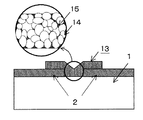
【図1】本発明の実施の形態1のガスセンサ(その1)の概略断面図である。
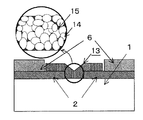
【図2】本発明の実施の形態1のガスセンサ(その2)の概略断面図である。
【図3】本発明の実施例1のガスセンサのジメチルサルファイドに対する感度と素子温度との関係を示す図である。
【図4】本発明の実施例2のガスセンサのジメチルサルファイドに対する感度を示す図である。
【図5】本発明の実施の形態2のガスセンサ(その1)の概略断面図である。
【図6】本発明の実施の形態2のガスセンサ(その2)の概略断面図である。
【図7】本発明の実施例4のガスセンサ(5〜15倍希釈時)および触媒活性保護層なしのガスセンサのジメチルサルファイドに対する応答性を示す図である。
【図8】本発明の実施例5のガスセンサの40℃,95%RHでの高温高湿試験でのセンサ素子の抵抗値変化を示す図である。
【図9】従来の半導体式ガスセンサの概略断面図である。
【符号の説明】
1 絶縁性基板
2 薄膜電極
3 ガス感応体薄膜
5 触媒活性保護層
6 厚膜電極
13 ガス感応体薄膜
14 金属酸化物薄膜
15 触媒活性保護層[0001]
TECHNICAL FIELD OF THE INVENTION
The present invention relates to a gas sensor for sensing freshness and decay of vegetables and fruits, and a method for manufacturing the gas sensor.
[0002]
[Prior art]
The freshness of food and drink is subjectively judged based on human senses of vision, taste, or throat, and the judgment of freshness is often ambiguous. Research is being actively conducted.
[0003]
Generally, a semiconductor gas sensor includes an
[0004]
Recently, a semiconductor gas sensor capable of detecting trimethylamine, a malodorous component generated from the raw fish, has been developed to detect the freshness of the raw fish. As a sensing material, a titanium dioxide oxide semiconductor is widely used, and a metal component of a catalyst is added to the titanium dioxide to improve the sensitivity of the sensor. In this case, what affects the sensitivity of the sensor is the action of the catalyst, the dispersed state and the thickness of the sensing film, and the components and the amount of the catalyst play an important role in improving the action of the catalyst. . Further, in addition to using the above-mentioned titanium dioxide as a sensing material, magnesium-added indium oxide is used as a sensing material of a gas sensor for trimethylamine. Magnesium oxide is added to indium oxide in an amount of 5 mol% to lower the electron concentration by atomic control, and the sensor in the air is used. Research is being conducted to increase the resistance and improve the sensitivity of the sensor. However, such a gas sensor for trimethylamine is still in its infancy at the initial stage of research and has not been actually applied. Further, the power consumption of the sensing sensor is large and it is not suitable for mass production.
[0005]
In the freshness sensor for vegetables, unlike trimethylamine of raw fish, a vegetable freshness sensor having excellent sensitivity to sulfide gas (mercaptans) generated from vegetables has been developed. For example, adding a predetermined amount of palladium powder to tin oxide powder, mixing and pulverizing, and calcining the pulverized tin oxide and palladium powder at a predetermined temperature for a predetermined time and mixing with an organic substance to form a paste. Forming, coating the paste on the electrode surface of the substrate to form a sensing film, drying after coating, sintering at a predetermined temperature for a predetermined time, and attaching a lead wire to the electrode surface And a step of sequentially manufacturing the freshness detecting sensor for vegetables (see, for example,
[0006]
[Patent Document 1]
Patent No. 2875174 specification
[0007]
[Problems to be solved by the invention]
By the way, from the beginning, trace amounts of ethylene, ethanol, and aldehydes are generated from vegetables and fruits, and mercaptans are generated from the onset of decay of vegetables and fruits, and amines such as ammonia are generated from the onset of decay of fruits. I understand that. As a result, gases such as ethylene, ethanol and aldehydes are more effective in detecting freshness of vegetables and fruits, and amines such as mercaptans and ammonia are more effective in detecting spoilage of vegetables and fruits. It became clear.
[0008]
However, a paste obtained by mixing, pulverizing, and calcining a conventional amount of tin oxide powder and a predetermined amount of palladium powder and then mixing with an organic material is coated on the electrode surface of the substrate, and dried and sintered to form a paste. With the above-mentioned vegetable freshness sensor with a sensing membrane, it is difficult to detect 1 ppm-level trace gases such as ethylene, ethanol and aldehydes with good responsiveness (with high sensitivity), which is effective for freshness detection. is there. Also, it is difficult to detect mercaptans and amines at a level of 1 ppm, which are effective for detecting spoilage of vegetables and fruits.
[0009]
Furthermore, when a semiconductor-type gas sensor is mounted on a refrigerator and used for the purpose of detecting freshness and decay of vegetables and fruits, if the refrigerator is used for a long period of time, the output signal decreases due to deterioration of the gas sensor, and the freshness and decay are detected. There was something I couldn't do. The inventor of the present invention has found that the reason why the output of the semiconductor sensor decreases (that is, deteriorates) is that the electrodes and catalysts, which are responsible for the central function of the sensor, deteriorate with time as the reaction progresses. The catalyst is reduced by reducing gases such as alcohols and aldehydes generated from fruits and fruits, and mercaptans and amines are strongly adsorbed on the electrode surface and catalyst, and the detection reaction of the detection gas is inhibited. I think it depends. In these semiconductor gas sensors, noble metals are often used for electrodes or catalysts that play a central role in the sensor function. However, these noble metals are weak to sulfur-based compounds and silicone-based compounds, are easily deteriorated, and have durability ( Reliability) in some cases.
[0010]
As described above, it has been difficult to detect a gas such as ethylene, ethanol, aldehydes, mercaptans, and amines with good responsiveness and excellent durability.
[0011]
The present invention has been made in consideration of the above conventional problems, and has a good response to gases such as ethylene, ethanol, aldehydes, mercaptans, and amines which are important in sensing the freshness of vegetables and fruits. It is an object of the present invention to provide a gas sensor capable of performing gas detection excellent in durability and durability, and a method of manufacturing the gas sensor.
[0012]
[Means for Solving the Problems]
According to a first aspect of the present invention, there is provided an insulating substrate (1),
A pair of first electrodes (2) provided at predetermined intervals on the substrate (1);
A gas-sensitive body (3) having a metal oxide and provided so as to substantially fill at least the predetermined space;
A catalytically active protective layer (5) formed so as to cover a surface exposed to the outside of the metal oxide and / or to fill a gap existing inside the metal oxide. Gas sensor.
[0013]
According to a second aspect of the present invention, the first electrode (2) is a thin-film electrode (2),
The gas sensor according to the first aspect of the present invention further includes a pair of thick film electrodes (6) provided for each of the thin film electrodes (2) for applying a voltage.
[0014]
A third aspect of the present invention is the gas sensor according to the second aspect of the present invention, wherein the thick film electrode (6) is provided so as not to contact the gas sensitive body (3).
[0015]
A fourth aspect of the present invention is the gas sensor according to the third aspect of the present invention, wherein the catalytically active protective layer (5) is formed so as to also cover the thick film electrode (6).
[0016]
The fifth invention is the gas sensor according to the first invention, wherein the metal oxide contains at least one of tin oxide, indium oxide, zinc oxide and tungsten oxide as a main component.
[0017]
In a sixth aspect of the present invention, the catalytically active protective layer (5) contains silicon oxide as a main component, and includes titanium, vanadium, chromium, manganese, iron, cobalt, nickel, zinc, copper, platinum, palladium, ruthenium, and rhodium. Is a gas sensor according to a first aspect of the present invention, which includes at least one of them as a promoter.
[0018]
A seventh invention is a method for manufacturing a gas sensor according to the first invention,
A method for manufacturing a gas sensor, comprising a step of forming the catalytically active protective layer (5) using a sol-gel method.
[0019]
The eighth invention is a method for manufacturing a gas sensor according to the first invention,
An organic solution containing a cocatalyst, water and an acid is dropped and mixed into an organic solution containing an organosilicon compound, and then the solution obtained by hydrolysis and polycondensation is used to form the catalytically active protective layer (5). This is a method for manufacturing a gas sensor including steps.
[0020]
A ninth aspect of the present invention is the method for manufacturing a gas sensor according to the eighth aspect of the present invention, wherein the organosilicon compound contains at least one of tetraalkoxysilane, fluoroalkyl trialkoxysilane, and difluoroalkyldialkoxysilane.
[0021]
According to a tenth aspect of the present invention, the promoter comprises at least one metal selected from the group consisting of titanium, vanadium, chromium, manganese, iron, cobalt, nickel, zinc, copper, platinum, palladium, ruthenium, and rhodium. An eighth aspect of the present invention is the method for manufacturing a gas sensor according to the present invention, which is any one of a salt, a sulfate, and an acetylacetone complex.
[0022]
An eleventh aspect of the present invention is the gas sensor manufacturing method according to the eighth aspect, wherein the acid is any one of hydrochloric acid, sulfuric acid, nitric acid, ammonia, and alcohol amines.
[0023]
A twelfth aspect of the present invention is the gas sensor manufacturing method according to the eighth aspect, wherein the organic solution containing the organosilicon compound further contains an organometallic compound for promoting the polycondensation.
[0024]
A thirteenth aspect of the present invention is the gas sensor manufacturing method according to the twelfth aspect, wherein said organometallic compound is a metal alkoxide containing at least one metal of titanium, zirconium, tin, aluminum and zinc.
[0025]
BEST MODE FOR CARRYING OUT THE INVENTION
Hereinafter, embodiments of the present invention will be described with reference to the drawings.
[0026]
(Embodiment 1)
First, the configuration and operation of the gas sensor according to the present embodiment will be described mainly with reference to FIGS.
[0027]
1 and 2 are schematic sectional views of a gas sensor according to
[0028]
1 is an insulating substrate such as alumina or mullite; 2 is a thin film electrode made of a metal such as gold, silver or platinum; 3 is a metal oxide containing tin oxide, indium oxide, zinc oxide or tungsten oxide as a main component. A gas sensitive thin film, 5 is a catalytically active protective layer containing silicon oxide as a main component, and 6 is a thick film electrode made of a metal such as gold, silver or platinum.
[0029]
Any substrate may be used as long as it has an insulating surface and a heating function, and the
[0030]
The main purpose of the thin-
[0031]
The insulating
[0032]
Next, a method for manufacturing the gas sensor according to the present embodiment will be described.
[0033]
The gas sensitive
[0034]
After forming a film of the composition for forming the gas sensitive substance
[0035]
The composition for forming the gas sensitive
[0036]
First, an organic solvent is added to the active agent and dissolved. Here, the activator is a metal salt added for the purpose of improving the sensitivity and gas selectivity of the gas-sensitive body
[0037]
Next, a viscosity modifier is added to the organic solution and mixed. Here, the viscosity adjusting agent may be a polymer having a thickening effect of increasing the viscosity of the organic solution, and examples thereof include polyvinylpyrrolidinone and ethyl cellulose.
[0038]
Finally, metallic tin soap is added to the organic solution and mixed. Here, examples of the metallic tin soap include tin 2-ethylhexanoate and tin naphthenate.
[0039]
The gas sensitive
[0040]
The catalytically active
[0041]
After forming a film of the composition for forming the catalytically active
[0042]
More specifically, a composition for forming the catalytically active
[0043]
First, an organic silicon compound is added to an organic solvent and dissolved to obtain a raw material solution.
[0044]
Here, the organosilicon compound may be any compound that hydrolyzes and polycondensates, and may be a metal such as a tetraalkoxysilane such as tetraethylorthosilicate, a fluoroalkyltrialkoxysilane such as fluoromethyltriethylsilicate, or a difluoroalkyldialkoxysilane. Alkoxides. Next, a predetermined amount of water is separately dissolved as a hydrolysis solution, and an acid such as hydrochloric acid, nitric acid, and sulfuric acid is dissolved in an organic solvent as a hydrolysis catalyst. Further, a co-catalyst can be added to the organic solvent. This co-catalyst is a metal salt added for the purpose of improving the catalytic activity of the catalytically active
[0045]
Finally, a predetermined amount of water and an acid, and a hydrolysis solution containing a cocatalyst in some cases are dropped and mixed into the raw material solution in which the organosilicon compound is dissolved to form the catalytically active
[0046]
The catalytically active
[0047]
That is, in the present embodiment, the catalytically active
[0048]
Further, the catalytically active
[0049]
(Embodiment 2)
First, the configuration and operation of the gas sensor according to the present embodiment will be described mainly with reference to FIGS.
[0050]
5 and 6 are schematic sectional views of a gas sensor according to
[0051]
1 is an insulating substrate such as alumina or mullite; 2 is a thin film electrode made of a metal such as gold, silver or platinum; and 13 is a network having tin oxide, indium oxide, zinc oxide or tungsten oxide as a main component. A gas sensitive thin film comprising a metal oxide
[0052]
Here, any substrate may be used as long as it has an insulating surface and has a heating function, and the
[0053]
The metal oxide
[0054]
Next, a method for manufacturing the gas sensor according to the present embodiment will be described.
[0055]
A gold organometallic compound paste is applied on a 0.4 mm-thick alumina substrate by a screen printing method, dried and fired at 800 ° C. to form a 0.3 μm-thick first layer thin film.
[0056]
Next, a gold thick-film printing paste is similarly applied on the first-layer thin-
[0057]
The gas sensitive
[0058]
The metal oxide
[0059]
First, palladium chloride dihydrate (chemical formula 1) was weighed as an activator in a 100 ml beaker so that (Equation 1) becomes 1 mol%, and 16 g of butyl carbitol and 8 g of butyl carbitol acetate were added. And stirred for a while. Then, 8 g of polyvinylpyrrolidinone is added as a viscosity modifier, and 24 g of tin 2-ethylhexanoate (Chemical Formula 2) is further added. The mixture is stirred and mixed to form a desired metal oxide
[0060]
(Equation 1)
Pd / (Sn + Pd) × 100
[0061]
Embedded image
PdCl2・ 2H2O
[0062]
Embedded image
Sn (OOCCH (CH2CH3) (CH2) 3CH3)2
A composition for forming the metal oxide
[0063]
Here, a film of a composition for forming the metal oxide
[0064]
The composition for forming the metal oxide
[0065]
First, an organic solvent is added to the active agent and dissolved. Here, the activator is a metal salt added for the purpose of improving the sensitivity and gas selectivity as a gas sensitizer, and is an alkaline earth metal such as a metal magnesium salt, a metal calcium salt, a metal strontium salt, and a metal barium salt. Salt, transition metal salts such as metal titanium salt, metal zirconium salt, metal vanadium salt, metal chromium salt, metal manganese salt, metal iron salt, metal cobalt salt, metal nickel salt, metal copper salt, metal zinc salt, metal lead Salts, metal cadmium salts, metal antimony salts, metal bismuth salts, metal palladium salts and the like. The compound may be relatively stable at room temperature, but may be easily decomposed by heat treatment, and may be an inorganic salt or an organic salt. For example, inorganic salts include nitrates, sulfates, chlorides and the like, and organic salts include carboxylate, dicarboxylate and acetylacetone complex. Further, the organic solvent is capable of dissolving both metallic tin soap and a viscosity modifier, such as ether alcohols such as methoxyethanol and butyl carbitol, β-diketones such as acetylacetone, and butyl carbyl acetate. Esters such as tall, and terpene solvents such as α-terpineol.
[0066]
Next, a viscosity modifier is added to the organic solution and mixed. Here, the viscosity adjusting agent may be a polymer having a thickening effect of increasing the viscosity of the organic solution, and examples thereof include polyvinylpyrrolidinone and ethyl cellulose.
[0067]
Finally, metallic tin soap is added to the organic solution and mixed. Here, examples of the metallic tin soap include tin 2-ethylhexanoate and tin naphthenate.
[0068]
The metal oxide
[0069]
Next, the catalytically active
[0070]
A raw material solution was prepared by dissolving 10 g of tetraethyl orthosilicate in 8 g of ethanol, and 0.2 g of concentrated hydrochloric acid and 10 g of water were added to 8 g of ethanol to prepare a solution for hydrolysis. The raw material solution was dropped and mixed at room temperature to obtain a composition for forming the catalytically active
[0071]
The composition for forming the catalytically active
[0072]
Here, the metal oxide
[0073]
More specifically, a composition for forming the catalytically active
[0074]
First, an organic silicon compound is added to an organic solvent and dissolved to obtain a raw material solution.
[0075]
Here, the organosilicon compound may be any compound that hydrolyzes and polycondensates, and may be a metal such as a tetraalkoxysilane such as tetraethylorthosilicate, a fluoroalkyltrialkoxysilane such as fluoromethyltriethylsilicate, or a difluoroalkyldialkoxysilane. Alkoxides. Next, a predetermined amount of water is separately dissolved as a hydrolysis solution, and an acid such as hydrochloric acid, nitric acid, and sulfuric acid is dissolved in an organic solvent as a hydrolysis catalyst. Further, a co-catalyst can be added to the organic solvent. The cocatalyst is a metal salt added for the purpose of improving the catalytic activity of the catalytically active
[0076]
Finally, a predetermined amount of water and an acid, and optionally a hydrolysis solution containing a co-catalyst are dropped and mixed into the raw material solution in which the organosilicon compound is dissolved to form the catalytically active
[0077]
Finally, the gas sensitivity to 1 ppm of dimethyl sulfide was measured using the manufactured sensor element. The sensor element was fixed in a 7-liter acrylic box, the element temperature was controlled at 350 ° C. by a heater, and 10 ml of air and 700 ppm of dimethyl sulfide were added to the box and the sensor was brought into contact with the sensor element. The element resistance change was measured. RG / RA was determined by setting the sensor element resistance in air to RA and adding a gas containing 1 ppm of dimethyl sulfide to the sensor element resistance after 30 minutes as RG to determine the sensor sensitivity. The sensor sensitivity to 1 ppm of dimethyl sulfide thus obtained was 0.60 and 0.90 with and without the catalytically active
[0078]
The catalytically active
[0079]
In the above, the first and second embodiments have been described in detail.
[0080]
Hereinafter, embodiments of the present invention will be described more specifically with reference to the drawings.
[0081]
【Example】
(Example 1)
A gold organometallic compound paste is applied on a 0.4 mm-thick alumina substrate by a screen printing method, dried and fired at 800 ° C. to form a 0.3 μm-thick first layer thin film.
[0082]
Next, a gold thick film printing paste is similarly applied to the first layer
[0083]
First, a metal (M = Mn, Fe, Ni, Co, Zn) 2-ethylhexanoic acid was weighed as an activator in a 100 ml beaker so that (Equation 2) was 1 mol%, and 1 g of a viscosity modifier was measured. 10 g of a butyl carbitol solution in which ethyl cellulose was dissolved was added, and 9 g of tin 2-ethylhexanoate (Chemical Formula 2) was further added, followed by stirring and mixing to obtain a desired composition for forming a gas-sensitive substance. .
[0084]
Embedded image
Sn (OOCCH (CH2CH3) (CH2)3CH3)2
[0085]
(Equation 2)
M / (Sn + M) × 100
The composition for forming a gas sensitive body is applied on a 0.4 mm-thick alumina substrate by screen printing, and then baked at 700 ° C. for 1 hour to form a metal oxide mainly composed of tin oxide having a thickness of 2400 nm. A gas-sensitive body thin film made of a material was formed.
[0086]
Next, 10 g of tetraethyl orthosilicate was dissolved in 23 g of ethanol to prepare a raw material solution, and 0.2 g of concentrated hydrochloric acid and 3 g of water were added to 23 g of ethanol to prepare a solution for hydrolysis. Then, the composition was dropped and mixed with the raw material solution at room temperature to obtain a composition for forming a catalytically active protective layer.
[0087]
The composition for forming a catalytically active protective layer is applied on a gas-sensitive thin film composed of a metal oxide containing tin oxide as a main component by dip coating, baked at 500 ° C. for 20 minutes, and made of 200 nm silicon oxide. A catalytically active protective layer was formed.
[0088]
Finally, the gas sensitivity to 1 ppm of dimethyl sulfide was measured using the manufactured sensor element. When the sensor element is fixed in a 7-liter acrylic box, the element temperature is controlled to 330 to 370 ° C. by a heater, and 10 ml of air and 700 ppm of dimethyl sulfide are added to the box and brought into contact with the sensor element. Of the sensor element was measured. RG / RA was determined by setting the sensor element resistance in air to RA and adding a gas containing 1 ppm of dimethyl sulfide to the sensor element resistance after 30 minutes as RG to determine the sensor sensitivity. FIG. 3 shows the result of the sensor sensitivity obtained in this manner. The sensitivity to 10 ppm acetaldehyde was 0.50 and 0.70 with and without the catalytically active protective layer.
[0089]
(Example 2)
Using iron 2-ethylhexanoate as an activator, a gas sensitive thin film made of a metal oxide containing tin oxide as a main component was formed such that the above (Equation 1) was 1 mol%.
[0090]
Next, 10 g of tetraethylorthosilicate was dissolved in 23 g of ethanol to prepare a raw material solution. Similarly, in 23 g of ethanol, 0.2 g of concentrated hydrochloric acid and 3 g of noble metal salts (ruthenium nitrate, rhodium chloride, platinum-
[0091]
Next, gas sensitivity to 1 ppm of dimethyl sulfide was measured at a device temperature of 350 ° C. using the manufactured sensor device. FIG. 4 shows the results of the sensor sensitivity obtained in this manner.
[0092]
(Example 3)
First, palladium chloride (chemical formula 1) was weighed as an activator in a 100 ml beaker so that (Equation 1) was 1 mol%, and 13 g of butyl carbitol solution in which 1 g of ethyl cellulose was dissolved was added as a viscosity modifier. Further, 6 g of tin 2-ethylhexanoate (Chemical Formula 3) was added thereto, followed by stirring and mixing to obtain a desired composition for forming a gas-sensitive substance.
[0093]
(Equation 1)
Pd / (Sn + Pd) × 100
[0094]
Embedded image
PdCl2・ 2H2O
The composition for forming a gas sensitive body is applied on a 0.4 mm-thick alumina substrate by screen printing, and then baked at 700 ° C. for 1 hour to form a metal oxide mainly composed of tin oxide having a thickness of 1800 nm. A gas-sensitive body thin film made of a material was formed.
[0095]
Next, 10 g of tetraethylorthosilicate is dissolved in 8 g of ethanol to prepare a raw material solution, and 0.2 g of concentrated hydrochloric acid and 10 g of water are added to 8 g of ethanol to prepare a solution for hydrolysis. Then, the composition was dropped and mixed with the raw material solution at room temperature to obtain a composition for forming a catalytically active protective layer.
[0096]
Next, using the fabricated sensor element, response characteristics to 1 ppm of ethylene, ethanol, ammonia, and dimethylsulfide were measured at an element temperature of 350 ° C. The sensitivities obtained by the sensors thus obtained were 0.60, 0.12, 0.80, and 0.62, respectively.
[0097]
(Example 4)
A raw material solution was prepared by dissolving 10 g of tetraethylorthosilicate in 23 g of ethanol, and 0.2 g of concentrated hydrochloric acid and 3 g of water were added to 23 g of ethanol to prepare a solution for hydrolysis. The raw material solution was dropped and mixed at room temperature to obtain a composition for forming a catalytically active protective layer.
[0098]
The composition for forming a catalytically active protective layer was diluted 5 to 15 times with ethanol. Then, the diluted composition for forming a catalytically active protective layer is impregnated with a dip coat on a gas-sensitive body thin film composed of a metal oxide containing tin oxide as a main component, baked at 500 ° C. for 20 minutes, and oxidized to a thickness of 200 nm. Formed a catalytically active protective layer made of silicon
Others are the same as the first embodiment.
[0099]
FIG. 7 shows the response of the sensor when gas sensitivity to 0.1 ppm, 1 ppm, and 10 ppm of dimethylsulfide was measured using the manufactured sensor element.
[0100]
(Example 5)
The composition for forming a catalytically active protective layer is diluted 5-fold with ethanol, impregnated into a metal oxide thin film containing tin oxide as a main component by dip coating, dried at 60 ° C for 5 minutes, and then at 300 ° C for 5 minutes. Then, firing was performed at 750 ° C. for 20 minutes, and these operations were performed twice in total, to form a catalytically active
[0101]
FIG. 8 shows a change in the resistance value of the sensor element when current is supplied at 40 ° C. and 95% RH for 100 hours. It can be seen that the resistance value of the sensor element having the catalytically active protective layer of the present invention hardly changed even after 100 hours.
[0102]
In the above, Examples 1 to 5 have been described in detail.
[0103]
As is clear from the above description, the formation of the catalytically active protective layer containing silicon oxide as a main component on the gas-sensitive body thin film and / or in the gas-sensitive body thin film causes deterioration. Decomposes alcohols, aldehydes, mercaptans and amines or inhibits entry into the gas-sensitive body thin film, and causes the deterioration of the electrodes and the catalyst in the gas-sensitive body that plays a central role in the sensor. It is possible to prevent reduction of the catalyst by a reducing gas such as alcohols and aldehydes generated from fruits and chemical adsorption of mercaptans and amines on the electrode surface and on the catalyst. It also has the effect of preventing the formation of hydroxyl groups on the surface of the gas-sensitive body thin film due to moisture in the air.
[0104]
The present invention also provides a method for forming a catalytically active protective layer containing silicon oxide as a main component on a gas-sensitive body thin film or a metal oxide particle constituting a skeleton of a gas-sensitive body by a sol-gel method which is a chemical film forming method. Gas-reliable gas sensor with high adhesion to gas sensitive body thin film, excellent thermal shock resistance during sensor operation, by impregnating a catalytically active protective layer composed mainly of silicon oxide into the gaps of the mesh structure of Can be obtained. Furthermore, an organic solution containing a cocatalyst and water is dropped and mixed into an organic solution of an organosilicon compound, and the organic solution formed by hydrolysis and polycondensation is coated on a gas sensitive thin film, dried, and fired. By using the method of forming the catalytically active protective layer, it becomes possible to easily and uniformly disperse and add the transition metal element and the noble metal element as the co-catalyst to the catalytically active protective layer. A catalytically active protective layer can be obtained. From the above, a highly reliable gas sensor that detects highly sensitive 1 ppm level detection gases (ethylene, ethanol, aldehydes, mercaptans, amines) can be obtained.
[0105]
【The invention's effect】
The present invention performs gas detection with excellent responsiveness and excellent durability, for example, for gases such as ethylene, ethanol, aldehydes, mercaptans, and amines that are important in sensing the freshness of vegetables and fruits. It has the advantage of being able to.
[Brief description of the drawings]
FIG. 1 is a schematic sectional view of a gas sensor (No. 1) according to a first embodiment of the present invention.
FIG. 2 is a schematic sectional view of a gas sensor (part 2) according to the first embodiment of the present invention.
FIG. 3 is a diagram illustrating a relationship between sensitivity to dimethyl sulfide and an element temperature of the gas sensor according to the first embodiment of the present invention.
FIG. 4 is a diagram showing the sensitivity of a gas sensor according to a second embodiment of the present invention to dimethyl sulfide.
FIG. 5 is a schematic sectional view of a gas sensor (No. 1) according to a second embodiment of the present invention.
FIG. 6 is a schematic sectional view of a gas sensor (part 2) according to
FIG. 7 is a diagram showing the responsiveness to dimethyl sulfide of the gas sensor of Example 4 of the present invention (when diluted 5 to 15 times) and the gas sensor without a catalytically active protective layer.
FIG. 8 is a diagram showing a change in resistance value of a sensor element in a high temperature and high humidity test at 40 ° C. and 95% RH of the gas sensor of Example 5 of the present invention.
FIG. 9 is a schematic sectional view of a conventional semiconductor gas sensor.
[Explanation of symbols]
1 Insulating substrate
2 Thin film electrode
3 Gas sensitive thin film
5 Protective layer for catalytic activity
6 thick film electrode
13 gas sensitive thin film
14 metal oxide thin film
15 catalytically active protective layer
Claims (13)
前記基板の上に所定の間隔をおいて設けられた一対の第一の電極と,
少なくとも前記所定の間隔を実質上充填するように設けられた,金属酸化物を有するガス感応体と,
前記金属酸化物の外部に露出した表面を被覆するように形成された,および/または前記金属酸化物の内部に存在する間隙を補填するように形成された触媒活性保護層とを備えたガスセンサ。An insulating substrate,
A pair of first electrodes provided at a predetermined interval on the substrate,
A gas-sensitive body having a metal oxide and provided so as to substantially fill at least the predetermined space;
A gas sensor comprising a catalytically active protective layer formed so as to cover a surface exposed to the outside of the metal oxide and / or to fill a gap existing inside the metal oxide.
その薄膜電極のそれぞれに対して設けられた,電圧印加を行うための一対の厚膜電極をさらに備えた請求項1記載のガスセンサ。The first electrode is a thin-film electrode,
2. The gas sensor according to claim 1, further comprising a pair of thick film electrodes provided for each of the thin film electrodes for applying a voltage.
ゾルゲル法を利用して,前記触媒活性保護層を形成するステップを備えたガスセンサの製造方法。The method for manufacturing a gas sensor according to claim 1, wherein
A method for manufacturing a gas sensor, comprising: forming the catalytically active protective layer using a sol-gel method.
有機ケイ素化合物を含む有機溶液に助触媒と水と酸とを含む有機溶液を滴下および混合した後に加水分解および重縮合を行った溶液を利用して,前記触媒活性保護層を形成するステップを備えたガスセンサの製造方法。The method for manufacturing a gas sensor according to claim 1, wherein
Forming an organic solution containing a cocatalyst, water and an acid into an organic solution containing an organosilicon compound by dropping and mixing the solution, followed by hydrolysis and polycondensation to form the catalytically active protective layer. Manufacturing method of a gas sensor.
Priority Applications (1)
| Application Number | Priority Date | Filing Date | Title |
|---|---|---|---|
| JP2002329930A JP2004077458A (en) | 2001-11-14 | 2002-11-13 | Gas sensor and method of manufacturing gas sensor |
Applications Claiming Priority (3)
| Application Number | Priority Date | Filing Date | Title |
|---|---|---|---|
| JP2001349066 | 2001-11-14 | ||
| JP2002180363 | 2002-06-20 | ||
| JP2002329930A JP2004077458A (en) | 2001-11-14 | 2002-11-13 | Gas sensor and method of manufacturing gas sensor |
Publications (2)
| Publication Number | Publication Date |
|---|---|
| JP2004077458A true JP2004077458A (en) | 2004-03-11 |
| JP2004077458A5 JP2004077458A5 (en) | 2005-02-03 |
Family
ID=32034018
Family Applications (1)
| Application Number | Title | Priority Date | Filing Date |
|---|---|---|---|
| JP2002329930A Pending JP2004077458A (en) | 2001-11-14 | 2002-11-13 | Gas sensor and method of manufacturing gas sensor |
Country Status (1)
| Country | Link |
|---|---|
| JP (1) | JP2004077458A (en) |
Cited By (13)
| Publication number | Priority date | Publication date | Assignee | Title |
|---|---|---|---|---|
| CN101329293B (en) * | 2007-06-22 | 2012-05-23 | 郑州炜盛电子科技有限公司 | A semiconductor gas sensor for alcohol vapor and breath alcohol detection |
| CN101329294B (en) * | 2007-06-22 | 2012-05-23 | 郑州炜盛电子科技有限公司 | A gas sensor with strong anti-interference |
| JP2012112718A (en) * | 2010-11-22 | 2012-06-14 | Ngk Spark Plug Co Ltd | Gas sensor |
| CN102662002A (en) * | 2012-04-25 | 2012-09-12 | 中国科学院微电子研究所 | Semiconductor thin film, gas sensor and manufacturing method thereof |
| JP2014031565A (en) * | 2012-08-06 | 2014-02-20 | Kochi Univ Of Technology | Film structure based on zinc oxide and method for producing the same and sensing device composed of the same |
| KR101457374B1 (en) | 2012-09-21 | 2014-11-04 | 고려대학교 산학협력단 | C2H5OH Gas Sensors using Fe-doped Nickel Oxide nano-structures and fabrication method thereof |
| US10481146B2 (en) | 2015-05-22 | 2019-11-19 | Fujitsu Limited | Gas sensor and information processing system |
| US10670552B2 (en) | 2014-06-09 | 2020-06-02 | Fujitsu Limited | Gas sensor and sensor device |
| JP2021096190A (en) * | 2019-12-18 | 2021-06-24 | 新コスモス電機株式会社 | Semiconductor gas detection element |
| CN113758974A (en) * | 2021-08-30 | 2021-12-07 | 中国科学院合肥物质科学研究院 | A kind of oxide semiconductor gas sensor and its preparation method and use |
| CN116046853A (en) * | 2023-01-29 | 2023-05-02 | 国网吉林省电力有限公司电力科学研究院 | A kind of preparation method and application of metal In-doped ZnO quantum dot sensor |
| JP7352714B1 (en) | 2022-11-29 | 2023-09-28 | 新コスモス電機株式会社 | Semiconductor gas detection element |
| JP2026507285A (en) * | 2023-05-09 | 2026-02-27 | エルジー エレクトロニクス インコーポレイティド | Gas sensor and manufacturing method thereof |
-
2002
- 2002-11-13 JP JP2002329930A patent/JP2004077458A/en active Pending
Cited By (16)
| Publication number | Priority date | Publication date | Assignee | Title |
|---|---|---|---|---|
| CN101329294B (en) * | 2007-06-22 | 2012-05-23 | 郑州炜盛电子科技有限公司 | A gas sensor with strong anti-interference |
| CN101329293B (en) * | 2007-06-22 | 2012-05-23 | 郑州炜盛电子科技有限公司 | A semiconductor gas sensor for alcohol vapor and breath alcohol detection |
| JP2012112718A (en) * | 2010-11-22 | 2012-06-14 | Ngk Spark Plug Co Ltd | Gas sensor |
| CN102662002A (en) * | 2012-04-25 | 2012-09-12 | 中国科学院微电子研究所 | Semiconductor thin film, gas sensor and manufacturing method thereof |
| JP2014031565A (en) * | 2012-08-06 | 2014-02-20 | Kochi Univ Of Technology | Film structure based on zinc oxide and method for producing the same and sensing device composed of the same |
| KR101457374B1 (en) | 2012-09-21 | 2014-11-04 | 고려대학교 산학협력단 | C2H5OH Gas Sensors using Fe-doped Nickel Oxide nano-structures and fabrication method thereof |
| US12105046B2 (en) | 2014-06-09 | 2024-10-01 | Fujitsu Limited | Gas sensor and sensor device |
| US10670552B2 (en) | 2014-06-09 | 2020-06-02 | Fujitsu Limited | Gas sensor and sensor device |
| US10481146B2 (en) | 2015-05-22 | 2019-11-19 | Fujitsu Limited | Gas sensor and information processing system |
| JP2021096190A (en) * | 2019-12-18 | 2021-06-24 | 新コスモス電機株式会社 | Semiconductor gas detection element |
| JP7352461B2 (en) | 2019-12-18 | 2023-09-28 | 新コスモス電機株式会社 | Semiconductor gas detection element |
| CN113758974A (en) * | 2021-08-30 | 2021-12-07 | 中国科学院合肥物质科学研究院 | A kind of oxide semiconductor gas sensor and its preparation method and use |
| JP7352714B1 (en) | 2022-11-29 | 2023-09-28 | 新コスモス電機株式会社 | Semiconductor gas detection element |
| JP2024078306A (en) * | 2022-11-29 | 2024-06-10 | 新コスモス電機株式会社 | Semiconductor gas detector |
| CN116046853A (en) * | 2023-01-29 | 2023-05-02 | 国网吉林省电力有限公司电力科学研究院 | A kind of preparation method and application of metal In-doped ZnO quantum dot sensor |
| JP2026507285A (en) * | 2023-05-09 | 2026-02-27 | エルジー エレクトロニクス インコーポレイティド | Gas sensor and manufacturing method thereof |
Similar Documents
| Publication | Publication Date | Title |
|---|---|---|
| WO2003042681A1 (en) | Gas sensor, and production method for gas sensor | |
| JP3644968B2 (en) | Sensor for detecting flammable gases | |
| JP5442844B2 (en) | Thin film type highly active gas sensor using core-shell structured composite nanoparticles as sensor material and method for producing the same | |
| US11221306B2 (en) | Gas detection composite comprising CEO2 uniformly loaded on oxide nanostructure and method of preparation thereof | |
| US12188890B2 (en) | Gas detection complex and method for producing same, gas sensor comprising gas detection complex and method for manufacturing same | |
| Chatterjee et al. | The effect of palladium incorporation on methane sensitivity of antimony doped tin dioxide | |
| US6777024B2 (en) | Method of manufacturing gas sensors | |
| KR20180015369A (en) | Highly reliable complex for detecting gas having independence againt humidity, method for preparing the complex, gas sensor comprising the complex, and method for preparing the gas sensor | |
| JPH0587760A (en) | Gas sensor and manufacturing method thereof | |
| KR102627955B1 (en) | Porous metal oxide-catalyzed double porous structure for ethylene detection and sensor using same | |
| JP7158680B2 (en) | gas sensor | |
| US11692987B2 (en) | CoCr2O4-based gas sensor and method for manufacturing the same | |
| JP2001289809A (en) | Gas sensor and manufacturing method thereof | |
| JP2004108929A (en) | Gas sensor, gas sensor manufacturing method, refrigerator | |
| KR101939904B1 (en) | Gas detection material with high sensitivity and selectivity for methyl benzene, method for preparing the same, and gas sensor comprising the gas detection material | |
| JP3026523B2 (en) | Gas sensor | |
| JP2021096190A (en) | Semiconductor gas detection element | |
| JP3046387B2 (en) | Gas sensor | |
| KR20240123616A (en) | Hydrogen gas detecting material having Ag-Pd-Au / metallic oxide core-shell structure and its manufacturing method, and semiconductor type gas sensor for detecting hydrogen gas using the same | |
| JP2573323B2 (en) | Gas sensor | |
| JPH0735716A (en) | Thick film gas sensor and manufacturing method thereof | |
| JPH11183421A (en) | Contact combustion type gas sensor and method of manufacturing the same | |
| JP2575479B2 (en) | Gas sensor | |
| JPS607351A (en) | Manufacture of gas sensitive element | |
| KR20240059890A (en) | Gas sensor for volatile aromatic compounds using physical mixing of oxide hollow structure and method for manufacturing the same |
Legal Events
| Date | Code | Title | Description |
|---|---|---|---|
| A521 | Request for written amendment filed |
Free format text: JAPANESE INTERMEDIATE CODE: A523 Effective date: 20040301 |