JP2004076216A - Composition for paper coating, coated paper using the same, and method for producing the same - Google Patents
Composition for paper coating, coated paper using the same, and method for producing the same Download PDFInfo
- Publication number
- JP2004076216A JP2004076216A JP2002239863A JP2002239863A JP2004076216A JP 2004076216 A JP2004076216 A JP 2004076216A JP 2002239863 A JP2002239863 A JP 2002239863A JP 2002239863 A JP2002239863 A JP 2002239863A JP 2004076216 A JP2004076216 A JP 2004076216A
- Authority
- JP
- Japan
- Prior art keywords
- monomer
- polymer particles
- mass
- paper
- coating composition
- Prior art date
- Legal status (The legal status is an assumption and is not a legal conclusion. Google has not performed a legal analysis and makes no representation as to the accuracy of the status listed.)
- Pending
Links
Landscapes
- Polymerisation Methods In General (AREA)
- Graft Or Block Polymers (AREA)
- Paper (AREA)
Abstract
【課題】白色度、不透明度、白紙光沢、塗膜強度等をバランス良く備える塗工紙を製造するための紙塗工用組成物並びにそれを用いた塗工紙及びその製造方法を提供する。
【解決手段】本紙塗工用組成物は、容積空孔率(中空率)が60〜99%、且つ平均粒径が300〜5000nmの中空ポリマー粒子(イ)を含有することを特徴とする。更に該中空ポリマー粒子(イ)は0.5〜99.5質量%、バインダー(ロ)は0.5〜99.5質量%顔料及(ハ)び/又は増粘剤(ニ)は0〜99質量%とすることができる。本塗工紙は、紙と、該紙の片面又は両面に形成され、且つ中空ポリマー粒子(イ)及びバインダーを含有する被膜とを備え、中空ポリマー粒子(イ)の容積空孔率及び平均粒径は上記所定の範囲であることを特徴とする。また、この塗工紙は紙に、乾燥後の塗工量が0.3〜30g/m2となるように塗工することにより得られる。
【選択図】 なしThe present invention provides a paper coating composition for producing a coated paper having a good balance of whiteness, opacity, white paper gloss, coating film strength, and the like, a coated paper using the same, and a method for producing the same.
The present paper coating composition is characterized by containing hollow polymer particles (a) having a volume porosity (hollow ratio) of 60 to 99% and an average particle size of 300 to 5000 nm. Further, the hollow polymer particles (a) are 0.5 to 99.5% by mass, the binder (B) is 0.5 to 99.5% by mass, and the pigment and / or the thickener (D) are 0 to 9% by mass. It can be 99% by mass. The coated paper comprises paper and a coating formed on one or both sides of the paper and containing a hollow polymer particle (a) and a binder, and has a volume porosity and an average particle size of the hollow polymer particle (a). The diameter is within the above-mentioned predetermined range. The coated paper is obtained by coating the paper such that the coating amount after drying is 0.3 to 30 g / m 2 .
[Selection diagram] None
Description
【0001】
【発明の属する技術分野】
本発明は、紙塗工用組成物、それを用いた塗工紙及びその製造方法に関する。さらに詳しくは、白色度、不透明度、白紙光沢、塗膜強度、印刷光沢、及び低スペックル特性等をバランス良く備える塗工紙が得られる紙塗工用組成物、それを用いた塗工紙及びその製造方法に関する。
【0002】
【従来の技術】
内部に単一の閉鎖空孔を有する中空ポリマー粒子は、例えば、その空孔に各種の物質を充填させた有機系マイクロカプセル粒子として使用されている。また、粒子を空孔化することよって生じる光散乱を利用した有機系光散乱剤、又は有機系光散乱助剤等としても用いられている。更に、この中空ポリマー粒子は、紙、繊維、皮革等のコーティング、及び塗料等の分野で従来から使用されている。また、これまで、紙塗工用組成物に配合されている中空ポリマー粒子は、その製造方法における制限及び製造コストの観点から、通常、容積空孔率が55%以下であり、塗工紙に白色度、白紙光沢、印刷光沢、不透明度などが十分に付与されているとはいい難い。
【0003】
このような中空ポリマー粒子の製造方法としては、例えば、少なくとも1個のカルボン酸基を含むモノマーを乳化重合させてコアを形成し、その後、異なったモノマー(少なくとも1種のモノマーは、硬質で、Tgが25℃を越え、20℃で皮膜を形成せず、且つアンモニア及びアミンに対して浸透可能なポリマーを生成するものである。)を重合させてシェルを形成し、次いで、コアをアンモニア又はアミンで中和することにより膨潤させ、その後、乾燥させてコア内に単一の空孔を形成させる方法が知られている(特開昭56−32513号公報及び特開昭63−213509号公報等)。
【0004】
しかし、この方法では、コア内に空孔を形成させる際の条件の制御が煩雑、且つ困難であり、更に、この方法により得られる粒子は、コーティング及び塗料等の分野で必要とされる特性のうち、隠蔽性、光沢、塗膜強度、白色度等に一定の改良は認められるものの、これらの特性のバランスの面では必ずしも十分に満足し得るものではない。また、コアをアンモニア又はアミンで中和膨潤させる際に、十分な容積空孔率を有する粒子とするためには、シェルを構成するポリマーのTgより高い温度にしなければならい。また、容積空孔率を高くしたり、シェルの高Tg化及び高分子化したり、又は架橋したりすること等が容易ではなく、そのような中空ポリマー粒子を用いた紙塗工用組成物も十分な性能を有しているとはいえない。尚、容積空孔率の低い中空ポリマー粒子であっても、配合量を多くすれば、隠蔽性、光沢、塗膜強度、白色度等に一定の改良はみられるものの、ある配合量を越えると、むしろ隠蔽性、光沢、塗膜強度、白色度等の特性が低下し、一方、塗工量を大きく引き下げた場合は改良がみられない。
【0005】
【発明が解決しようとする課題】
本発明は、上記の状況に鑑みなされたものであり、白色度、不透明度、白紙光沢、塗膜強度、低スペックル特性等をバランス良く備える塗工紙を製造するため紙塗工用組成物、それを用いた塗工紙及びその製造方法を提供することを目的とする。
【0006】
【課題を解決するための手段】
本発明は以下のとおりである。
1.容積空孔率が60〜99%、且つ平均粒径が300〜5000nmの中空ポリマー粒子(イ)を含有することを特徴とする紙塗工用組成物。
2.上記中空ポリマー粒子(イ)の殻の肉厚は、30〜200nmである1.に記載の紙塗工用組成物。
3.固形分換算で上記中空ポリマー粒子(イ)を0.5〜99.5質量%、バインダー(ロ)を0.5〜99.5質量%並びに顔料及(ハ)び/又は増粘剤(ニ)を0〜99質量%[但し、(イ)、(ロ)、(ハ)及び(ニ)の合計を100質量%とする。]含有する1.2.に記載の紙塗工用組成物。
4.上記中空ポリマー粒子(イ)は、不飽和カルボン酸(a−1)5〜80質量%及び該不飽和カルボン酸(a−1)と共重合可能な他のラジカル重合性モノマー(a−2)20〜95質量%[但し、(a−1)と(a−2)との合計を100質量%とする。]からなるモノマー(a)を乳化重合させてポリマー粒子(A)を調製し、その後、該ポリマー粒子(A)5〜1000質量部の存在下で、不飽和カルボン酸(b−1)0〜20質量%及び該不飽和カルボン酸(b−1)と共重合可能な他のラジカル重合性モノマー(b−2)80〜100質量%[但し、(b−1)と(b−2)との合計を100質量%とする。]からなるモノマー(b)100質量部の一部を乳化重合させ、ポリマー粒子(A)の表層が、モノマー(b)の一部が重合してなるポリマー成分と、該モノマー(b)の未反応モノマー成分とを含むシェル層で被覆されたコアシェル状のポリマー粒子(B)を調製し、次いで、該ポリマー粒子(B)を含む分散体のpHを揮発性塩基によって7以上に調整して該ポリマー粒子(B)を中和膨潤させ、その後、上記未反応モノマー成分を重合させてなるものである上記1.乃至3.のうちのいずれか1項に記載の紙塗工用組成物。
5.上記シェル層において、上記ポリマー成分と上記未反応モノマー成分との質量比が99:1〜50:50である上記4.に記載の紙塗工用組成物。
6.上記シェル層は、上記モノマー(b)のうち上記ポリマー成分となる上記モノマー(b)のうちの一部又は全部を最初に一括仕込みで乳化重合させる5.に記載の紙塗工用組成物。
7.上記一括仕込みされるモノマー(b)を100質量%とした場合に、該一括仕込みされるモノマー(b)の50質量%以上が不飽和カルボン酸エステル及び/又はエチレン性芳香族化合物である上記6.に記載の紙塗工用組成物。
8.上記一括仕込みされるモノマー(b)と上記ポリマー粒子(A)との質量比が10:1〜1:10である上記6.又は7.に記載の紙塗工用組成物。
9.上記ラジカル重合性モノマー(b−2)は架橋性ラジカル重合性モノマーを含有し、架橋性ラジカル重合性モノマーの含有量は、上記ラジカル重合性モノマー(b−2)の全質量を100質量%とした場合に、50質量%以下である4.乃至8.のうちのいずれかに記載の紙塗工用組成物。
10.上記ポリマー粒子(B)を中和膨潤させる際の上記分散体の温度を、上記ポリマー成分のガラス転移温度(Tg)以下とする上記4.乃至8.のうちのいずれかに記載の紙塗工用組成物。
11.上記モノマー(b)を乳化重合させる際に、上記ラジカル重合性モノマー(b−2)のみを用いて重合させ、該モノマー(b)の全量の25質量%が重合した後、上記不飽和カルボン酸(b−1)を共用して重合させる上記4.乃至9.のうちのいずれか1項に記載の紙塗工用組成物。
12.紙と、該紙の片面又は両面に付着された中空ポリマー粒子(イ)と、上記中空ポリマー粒子(イ)を該紙の片面又は両面に接着させるためのバインダーとを備え、上記中空ポリマー粒子(イ)は、容積空孔率が60〜99%、且つ平均粒径が300〜5000nmであることを特徴とする塗工紙。
13.上記1.乃至11.のうちのいずれか1項に記載の紙塗工用組成物を、紙に、乾燥後の塗工量が0.3〜30g/m2となるように塗工することを特徴とする塗工紙の製造方法。
14.上記塗工が非接触式塗工方法により行われる上記13.に記載の塗工紙の製造方法。
【0007】
【発明の実施の形態】
以下、本発明を詳細に説明する。
[1]紙塗工用組成物
中空ポリマー粒子(イ)の容積空孔率は、60〜99%、好ましくは63〜98%、より好ましくは65〜98%、更に好ましくは68〜95%、特に好ましくは70〜92%である。この容積空孔率が60%未満の場合、不透明性、白色度、白紙光沢等が不十分になる。一方、99%を超えると、機械的安定性が低下し、調液時、或いは塗工時に粒子が変形、破壊される。また、中空ポリマー粒子(イ)の平均粒径は300〜5000nmであり、好ましくは500〜3000nm、更に好ましくは700〜2000nmである。この平均粒径が300nm未満の場合、不透明性、白色度、白紙光沢などが低下する。一方、5000nmを超えると、機械的安定性が低下する。
また、この中空ポリマー粒子(イ)の殻の肉厚は、20〜220nm、より好ましくは20〜190nm、更に好ましくは30〜180nm特に好ましくは30〜150nmとすることができる。これにより、紙塗工用組成物の軽量化を図ることができる。中空ポリマー粒子(イ)は、空孔内部に水等の後述する水性媒体が充填された状態で生成媒体中にこの中空ポリマー粒子(イ)を分散させて(以下、この状態の粒子を含水粒子という。)使用しても良いし、この含水粒子を乾燥させて内部の水を除去した乾燥中空粒子(以下、単に中空粒子という。)の状態で使用しても良い。尚、本明細書において、中空ポリマー粒子(イ)とは、この含水粒子と、この中空粒子の両方を示す。
【0008】
また、この中空ポリマー粒子(イ)の材質は、不飽和カルボン酸(b−1)(以下、「モノマー(b−1)」とする。)、及びこのモノマー(b−1)と共重合可能なラジカル重合性モノマー(b−2)(以下、「モノマー(b−2)」とする。)からなるモノマー(b)の共重合体、又はこのモノマー(b)の共重合体とモノマー(b−1)若しくはモノマー(b−2)の重合体との混合物等であることが好ましい。
このモノマー(b−1)として、例えば、(メタ)アクリル酸、クロトン酸、マレイン酸、フマール酸、イタコン酸等のモノ又はジカルボン酸、及びこのジカルボン酸の酸無水物等を挙げることができる。中でも、粒子の安定性の観点から、(メタ)アクリル酸、イタコン酸等が好ましく、(メタ)アクリル酸が更に好ましい。これらは、1種のみでも良いし、2種以上を含有するものでも良い。
【0009】
モノマー(b−2)としては、例えば、不飽和カルボン酸エステル、エチレン性芳香族化合物、その他の非架橋性ラジカル重合性モノマー等を用いることができる。1種のみでも良いし、2種以上を含有するものでも良い。中でも、エチレン性芳香族化合物が好ましく、特に、モノマー(b−2)の全量の50質量%以上が、スチレン等のエチレン性芳香族化合物であることが好ましい。エチレン性芳香族化合物が、50質量%未満であると、ポリマーの屈折率が低下し、白色度、不透明度、光沢が不十分になることがある。
【0010】
また、不飽和カルボン酸エステルとしては、例えば、メチル(メタ)アクリレート、エチル(メタ)アクリレート、プロピル(メタ)アクリレート、ブチル(メタ)アクリレート、ブチル(メタ)アクリレート、2−エチルヘキシル(メタ)アクリレート等含侵挙げられ、これらは1種のみでも良いし、2種以上を含有するものでも良い。
また、このエチレン性芳香族化合物としては、例えば、スチレン、α−メチルスチレン等が挙げられる。これらは1種のみでも良いし、2種以上を含有するものでも良い。
更に、その他の非架橋性ラジカル重合性モノマーとしては、(メタ)アクリロニトリル、酢酸ビニル、N,N−ジメチル(メタ)アクリルアミド等を用いることができる。これらは1種のみでも良いし、2種以上を含有するものでも良い。
【0011】
また、モノマー(b−2)は、架橋性ラジカル重合性モノマーを含有することができる。これにより、最終的に得られる中空粒子の形状を、熱、機械的ストレス、溶剤又は薬品による膨潤、及び分解等に対して維持させることができる。この架橋性ラジカル重合性モノマーとしては、例えば、ジビニルベンゼン、トリビニルベンゼン、ジシクロペンタジエン、ブタジエン、イソプレン、アリルグリシジルエーテル、グリシジル(メタ)アクリレート、エチレングリコールジメタクリレート等が挙げられ、特にジビニルベンゼン、エチレングリコールジ(メタ)アクリレートが好ましい。これらは1種のみでも良いし、2種以上を含有するものでも良い。
架橋性ラジカル重合性モノマーの配合量は、モノマー(b−2)の全量の50質量%(以下、単に、「%」という。)以下であることが好ましく、更に好ましくは0.1〜30%である。架橋性ラジカル重合性モノマーが50%を超えると、容積空孔率が不十分になり好ましくない。また、モノマー(b)の全量を100質量部(以下、単に「部」とする。)とした場合、20部以下、好ましくは0.1〜10部であることが好ましい。
【0012】
モノマー(b)におけるモノマー(b−1)及びモノマー(b−2)の各含有量は、(b−1)と(b−2)との合計を100%とした場合、モノマー(b−1)が0〜20%及びモノマー(b−2)が80〜100%、好ましくはモノマー(b−1)が0.1〜10%及びモノマー(b−2)が90〜99.9%、更に好ましくはモノマー(b−1)が0.2〜5%及びモノマー(b−2)が95〜99.8%である。モノマー(b−1)が20%を超えると、重合安定性が著しく低下し、また、揮発性塩基処理及び加熱処理後のポリマー粒子が、変形して容積空孔率が低下する。
【0013】
中空ポリマー粒子(イ)の含有量は、固形分換算で、中空ポリマー粒子(イ)、バインダー(ロ)顔料(ハ)[0%の場合も含む。]、増粘剤(ニ)[0%の場合も含む。]の含有量の合計(以下、単に、「(イ)〜(ニ)の合計」という。)を100%とした場合、0.5〜99.5%、より好ましくは1〜97%、更に好ましくは3〜95%である。中空ポリマー粒子(イ)が0.5%未満であると、不透明性、白色度、白紙光沢などが低下し、好ましくない。99.5%を超えると、バインダー(ロ)の含有量が0.5%未満となり表面強度が不足し、粉落ち、パイリング等の問題がおきて好ましくない。
また、中空ポリマー粒子(イ)及び顔料(ハ)の合計を100部とした場合、中空ポリマー粒子(イ)の含有量は0.8〜100部、好ましくは20〜100部、より好ましくは25〜90部、より好ましくは30〜80部であることが好ましい。
【0014】
本発明の紙塗工用組成物には、バインダー(ロ)を含有させることができる。バインダー(ロ)としては、例えば、デンプン、変性デンプン、カゼイン等の天然バインダー、スチレン−ブタジエン系共重合体、カルボキシ変性スチレン−ブタジエン系共重合体、アミン変性スチレン−ブタジエン系共重合体、水酸基変性スチレン−ブタジエン系共重合体等の変性スチレン−ブタジエン系共重合体、ポリ酢酸ビニル、アクリル系重合体、ポリクロロプレン、ポリビニルアルコール、カルボキシ変性アクリル系共重合体、アミン変性アクリル系共重合体、水酸基変性アクリル系共重合体等の変性アクリル系共重合体等の合成バインダー等を挙げることができ、これらのバインダーは、1種単独で又は2種以上を組合わせて用いることができる。
中でも、変性スチレン−ブタジエン系共重合体、特に、カルボキシ変性スチレン−ブタジエン共重合体を単独で又はデンプン、カゼイン等の天然バインダーと組合せて用いることが好ましい。
尚、これらのバインダーは、ラテックスの固形分として含有しているものを用いても良いし、粉末状のものを用いても良い。
【0015】
また、バインダーの含有量は、固形分換算で、(イ)〜(ニ)の合計を100%とした場合、0.5〜99.5%、より好ましくは1〜99%、更に好ましくは2.5〜97%、特に好ましくは2.5〜20%ある。バインダーの配合量が0.5%に満たないと表面強度が不足し、粉落ち、パイリング等の問題がおきる場合がある。99.5%を超えると中空ポリマー粒子(イ)の配合量が0.5%未満になり不透明性、白色度、白紙光沢などが悪化し好ましくない。
また、バインダー(ロ)の含有量は、中空ポリマー粒子(イ)及び顔料(ハ)の合計を100部とした場合、固形分換算で、1〜99部、好ましくは1〜20部、より好ましくは2.5〜18部とすることが好ましい。
【0016】
本発明の紙塗工用組成物は、顔料(ハ)及び/又は増粘剤を更に含有することができる。
顔料(ハ)としては、有機系の顔料、無機系の顔料を挙げることができる。無機系の顔料としては、例えば、カオリンクレー、タルク、硫酸バリウム、酸化チタン(ルチル、アナターゼ)、炭酸カルシウム、水酸化アルミニウム、酸化亜鉛、サチンホワイト等を挙げることができる。これらは、1種単独で又は2種以上を組合わせて用いることができる。
有機系の顔料としては、スチレン系、スチレン/ブタジエン系、スチレン/アクリル系、中実プラスチックピグメント、尿素樹脂粒子等を挙げることができる。これらは、1種単独で又は2種以上を組合わせて用いることができる。
【0017】
顔料の含有量は、固形分換算で、(イ)〜(ニ)の合計を100%とした場合99%以下、好ましくは89%以下、より好ましくは20〜75%、更に好ましくは30〜65%とすることができる。
また、顔料(ハ)の含有量は、中空ポリマー粒子(イ)及び顔料(ハ)の合計を100部とした場合、99.2部以下、好ましくは80部以下、より好ましくは10〜75部、更に好ましくは20〜70部、特に好ましくは30〜65部であることが好ましい。
【0018】
増粘剤(ニ)としては、でんぷん、カゼイン、カルボキシ変性セルロース、アクリル系アルカリ増粘剤などが挙げられる。上記増粘剤の含有量は、固形分換算で、(イ)〜(ニ)の合計を100%とした場合、3%以下、好ましくは0.05〜2%、より好ましくは0.05〜1%とすることができる。
更に、増粘剤(ニ)の含有量は、中空ポリマー粒子(イ)及び顔料(ハ)の合計を100部とした場合、5部以下、好ましくは0.5部以下、より好ましくは0.05〜0.2部であることが好ましい。
【0019】
また、上記紙塗工用組成物は、固形分換算で、(イ)〜(ニ)の合計を100%とした場合、以下とすることができる。
[1]中空ポリマー粒子(イ)が0.5〜99.5%、バインダー(ロ)が0.5〜99.5%、且つ顔料(ハ)及び/又は増粘剤(ニ)を0〜99%。
[2]好ましくは中空ポリマー粒子(イ)を0.5〜70%、バインダー(ロ)を1〜15%、顔料(ハ)及び/又は増粘剤を0.5〜70。
[3]より好ましくは中空ポリマー粒子(イ)を30〜70%、バインダー(ロ)を1〜15%、且つ顔料(ハ)及び/又は増粘剤(ニ)を20〜60%。
このとき、顔料(ハ)及び増粘剤(ニ)の含有割合は、固形分換算で、(イ)〜(ニ)の合計を100%としたとき、中空ポリマー粒子(イ)が0.5〜99.5%、バインダー(ロ)0.5〜99.5%、のとき、顔料(ハ)が0〜99%、増粘剤が0〜3%とすることができる。
また、中空ポリマー粒子(イ)が0.5〜70%、バインダー(ロ)が1〜15%、のとき、顔料(ハ)が0.5〜70増粘剤が0.05〜5とすることができる。
更に、中空ポリマー粒子(イ)が30〜70%、バインダー(ロ)が1〜15%のとき、顔料(ハ)が20〜60%増粘剤(ニ)が0.05〜5%とすることができる。
【0020】
また、分散剤、消泡剤、耐水化剤、潤滑剤、湿潤剤、印刷適性向上剤、蛍光増白剤、着色顔料、染料等を更に含有することができる。
分散剤としては、例えば、ピロリン酸ナトリウム、ヘキサメタリン酸ナトリウム、ポリカルボン酸ナトリウム等が挙げられる。これらは、1種単独で又は2種以上を組合わせて用いることができる。この分散剤の含有量は、固形部分換算で中空ポリマー粒子(イ)、顔料(ニ)の合計を100%とした場合、0.01〜2%、好ましくは0.05〜1%とすることができる。
潤滑剤としてはステアリン酸カルシウム、パルミチン酸カルシウム、オレイン酸カルシウムなどの高級脂肪酸塩、ポリエチレンワックスなどが挙げられる。これらは、1種単独で又は2種以上を組合わせて用いることができる。潤滑剤の含有量は、固形分換算で、中空ポリマー粒子(イ)及び顔料(ニ)の含有量の合計を100%とした場合、0.01〜2%、好ましくは0.05〜1%とすることができる。
【0021】
湿潤剤としてはアルキルスルフォン酸塩、アルキルアリルスルフォン酸塩、ロジン酸塩、アルキル脂肪酸塩、アセチルグリコール系界面活性剤、ノニルフェニル系界面活性剤、オキシアルキル系界面活性剤などが挙げられる。これらは、1種単独で又は2種以上を組合わせて用いることができる。この湿潤剤の含有量は、固形分換算で、中空ポリマー粒子(イ)及び顔料(ニ)の含有量の合計を100%とした場合、0.01〜2%、好ましくは0.05〜1%とすることができる。
消泡剤としてはポリグリコール脂肪酸エステル、リン酸エステル、シリコンオイル等が挙げられる。この消泡剤の含有量は、固形分換算で、中空ポリマー粒子(イ)及び顔料(ニ)の含有量の合計を100%とした場合、0.01〜2%、好ましくは0.05〜1%とすることができる。
【0022】
更に、上記紙塗工用組成物を用いて実施例条件下で塗工紙を製造された塗工紙の性能は、(1)白紙光沢が70〜85、印刷光沢が79〜96、不透明度が88〜97、白色度が80〜87、(2)好ましくは白紙光沢が74〜85、印刷光沢が85〜96、不透明度が90〜97、白色度が80〜87、(3)より好ましくは白紙光沢が81〜85、印刷光沢が90〜96、不透明度が91〜97、白色度が82〜87とすることができる。
【0023】
また、(イ)〜(ニ)の合計を100%としたとき、中空ポリマー粒子(イ)が0.5〜99.5%、バインダー(ロ)0.5〜99.5%、顔料(ハ)が0〜99%及び増粘剤が0〜3%の場合、白紙光沢が70〜85、印刷光沢が79〜96、不透明度が88〜97、白色度が80〜87、とすることができる。
また、中空ポリマー粒子(イ)が0.5〜70%、バインダー(ロ)が1〜15%、のとき、顔料(ハ)が0.5〜70増粘剤が0.05〜5%の場合、白紙光沢が74〜85、印刷光沢が85〜96、不透明度が90〜97、白色度が80〜87とすることができる。
更に、中空ポリマー粒子(イ)が30〜70%、バインダー(ロ)が1〜15%の、顔料(ハ)が20〜60%、及び増粘剤(ニ)が0.05〜5%の場合、紙光沢が81〜85、印刷光沢が90〜96、不透明度が91〜97、白色度が82〜87とすることができる。
【0024】
[2]中空ポリマー粒子の製造方法
本発明の紙塗工用組成物に用いる中空ポリマー粒子は以下の方法で製造できる。
即ち、特定のモノマー(a)を乳化重合させてポリマー粒子(A)を調製し、その後、ポリマー粒子(A)の表層を、特定のモノマー(b)を重合させたポリマー成分と、(b)の未反応モノマー成分とを含むシェル層で被覆したコアシェル状のポリマー粒子(B)を調製し、次いで、このポリマー粒子(B)の分散体のpHを揮発性塩基によって7以上に調整し、ポリマー粒子(B)を中和膨潤させ、その後、この未反応モノマーを重合させて中空ポリマー粒子(イ)を得る。以下、工程ごとに具体的に説明する。
【0025】
(1)ポリマー粒子(A)の調製
まず、不飽和カルボン酸(a−1)(以下、「モノマー(a−1)」とする。)、及びこのモノマー(a−1)と共重合可能なラジカル重合性モノマー(a−2)(以下、「モノマー(a−2)」とする。)からなるモノマー(a)を乳化重合させることによってポリマー粒子(A)を調製する。このときに用いる分散媒は、特に限定されないが、通常、水性媒体を用いる。
この水性媒体としては、通常、水を用いるが、水に水溶性有機溶媒(例えば、エタノール、メタノール、アセトン等)が含有されたものを用いても良い。
【0026】
モノマー(a−1)としては、例えば、(メタ)アクリル酸、クロトン酸、マレイン酸、フマール酸、イタコン酸等のモノ又はジカルボン酸、及びこのジカルボン酸の酸無水物等を挙げることができる。中でも、粒子の安定性の観点から、(メタ)アクリル酸、イタコン酸が好ましく、(メタ)アクリル酸が更に好ましい。これらは、1種単独で又は2種以上を組合わせて用いることができる。
【0027】
モノマー(a−2)としては、例えば、不飽和カルボン酸エステル、エチレン性芳香族化合物、その他の非架橋性ラジカル重合性モノマー等を用いることができる。これらは1種単独で又は2種以上を組合わせて用いることができる。中でも、不飽和カルボン酸エステルが好ましく、特に、モノマー(a−2)の50%以上が、不飽和カルボン酸エステルであることが好ましい。不飽和カルボン酸エステルが、モノマー(a−2)の50%未満であると、中空粒子がいびつな形になり、容積空孔率が上がらない。
不飽和カルボン酸エステルとしては、メチル(メタ)アクリレート、エチル(メタ)アクリレート、プロピル(メタ)アクリレート、ブチル(メタ)アクリレート、2−エチルヘキシル(メタ)アクリレート等が挙げられ、これらは1種単独で又は2種以上を組合わせて用いることができる。
また、エチレン性芳香族化合物としては、スチレン、α−メチルスチレン等が挙げられ、これらは1種単独で又は2種以上を組合わせて用いることができる。更に、その他の非架橋性ラジカル重合性モノマーとしては、(メタ)アクリロニトリル、酢酸ビニル、 N,N−ジメチル(メタ)アクリルアミド等が挙げられ、これらは1種単独で又は2種以上を組合わせて用いることができる。
【0028】
また、モノマー(a−2)の一部として架橋性モノマーを使用することができる。この架橋性モノマーとして、ブタジエン、イソプレン、ジビニルベンゼン、エチレングリコールジ(メタ)アクリレート等を用いることができ、これらは1種単独で又は2種以上を組合わせて用いることができる。この架橋性モノマーの配合量は、好ましくはモノマー(a)の全量の5%以下であり、更に好ましくは0.2〜2%である。架橋性モノマーの割合が、モノマー(a)の5%を超えると、揮発性塩基による膨潤が十分でなくなり、容積空孔率が低くなって、隠蔽性、白色度、光沢等の特性が不十分なものとなり好ましくない。
【0029】
モノマー(a)におけるモノマー(a−1)及びモノマー(a−2)の各含有量は、(a−1)と(a−2)との合計を100%とした場合、モノマー(a−1)が5〜80%及びモノマー(a−2)が20〜95%、好ましくはモノマー(a−1)が10〜60%及びモノマー(a−2)が40〜90%、更に好ましくはモノマー(a−1)が20〜50%及びモノマー(a−2)が50〜80%とすることができる。
モノマー(a−1)の含有量が5%未満であると、揮発性塩基による膨潤が十分でなく、容積空孔率が低くなって、隠蔽性、白色度、光沢等の特性が不十分なものとなり好ましくない。一方、モノマー(a−1)が80%を超えると、モノマー(a)の重合安定性が低下し、表層にモノマー(b)からなるポリマーを均一に被覆させることが困難になり、中空粒子の形状がいびつになるため好ましくない。
【0030】
モノマー(a)を分散媒中で乳化重合させる方法については、特に制限はなく、例えば、モノマーを一括添加して重合してもよく、連続的に添加して重合してもよい。均一な粒径の粒子を安定性よく得るためには後者が好ましい。また、ポリマー粒子(A)の調製は、1段の重合で行ってもよく、2段以上の多段階の重合で行ってもよい。更に、シード粒子の存在化にモノマー(a)をシード乳化重合させてもよい。シード粒子としては、均一な粒径の粒子が安定性よく得られるため、モノマー(a)とSP値(溶解度パラメーター)が近いものが特に好ましい。
【0031】
モノマー(a)を乳化重合させるとき乳化剤を用いることができる。この乳化剤としては、例えば、アニオン性界面活性剤、非イオン性界面活性剤、カチオン性界面活性剤、両性界面活性剤、有機懸濁保護剤等を用いることができ、中でも、粒子の安定性の点でアニオン性界面活性剤、非イオン性界面活性剤、有機懸濁保護剤を用いることが好ましい。これらの乳化剤は、1種単独で又は2種以上を組合わせて用いることができる。
アニオン性界面活性剤としては、例えば、ロジン酸カリウム、ロジン酸ナトリウム等のロジン酸塩、オレイン酸カリウム、ラウリン酸カリウム、ラウリン酸ナトリウム、ステアリン酸ナトリウム、ステアリン酸カリウム等の脂肪酸のナトリウム塩又はカリウム塩、ラウリル硫酸ナトリウム等の脂肪族アルコールの硫酸エステル塩、ドデシルベンゼンスルホン酸ナトリウム等のアルキルアリルスルフォン酸等を挙げることができる。これらのアニオン性界面活性剤は、1種単独で又は2種以上を組合わせて用いることができる。
【0032】
非イオン性界面活性剤としては、例えば、ポリエチレングリコールのアルキルエステル、アルキルエーテル、アルキルフェニルエーテル等を挙げることができる。これらの非イオン系界面活性剤は、1種単独で又は2種以上を組合わせて用いることができる。
有機懸濁保護剤としては、例えば、ポリアクリル酸、ポリメタクリル酸、ポリビニルスルホン酸、ポリビニルアルコール、ポリビニルピロリドン、ポリエチレングリコール等の親水性合成高分子物質、ゼラチン、水溶性でんぷん等の天然親水性高分子物質、カルボキシメチルセルロース等の親水性半合成高分子物質等を挙げることができる。これらの有機懸濁保護剤は、1種単独で又は2種以上を組合わせて用いることができる。
カチオン系界面活性剤として脂肪族アミン塩、脂肪四級アンモニウム塩等が挙げられ、これらは1種単独で又は2種類以上組合わせて用いることができる。
両性界面活性剤としてカルボキシベタイン型、アミノカルボン酸塩等が挙げられる。
【0033】
モノマー(a)の乳化重合において用いる重合開始剤としては、例えば、(1)クメンハイドロパーオキサイド、ジイソプロピルベンゼンハイドロパーオキサイド、パラメンタンハイドロパーオキサイド及びt−ブチルハイドロパーオキサイド等で代表される有機ハイドロパーオキサイド類と、含糖ピロリン酸処方、スルホキシレート処方、含糖ピロリン酸処方及びスルホキシレート処方の混合系処方、及びホルムアルデヒド樹脂処方等で代表される還元剤とをそれぞれ組合わせたレドックス系の開始剤、(2)過硫酸カリウム、過硫酸アンモニウム等の過硫酸塩、(3)アゾビスイソブチロニトリル、(4)ベンゾイルパーオキサイド、ラウロイルパーオキサイド等の有機ハイドロパーオキサイド類等を挙げることができる。中でも、粒子の安定性及び粒径の均一性の点で、過硫酸カリウム、過硫酸アンモニウム等の過硫酸塩、アゾビスイソブチロニトリル、ベンゾイルパーオキサイドが好ましい。
【0034】
モノマー(a)を重合する際の重合温度は、好ましくは5〜95℃、更に好ましくは50〜90℃である。重合温度が5℃未満であると、不飽和カルボン酸の反応性が低く、粒子が不安定になることがある。一方、95℃を超えると、粒子が不安定になることがある。
このようにして得られるポリマー粒子(A)は、アルカリ膨潤性のコア粒子となるものであり、ポリマー粒子(A)の平均粒子径としては、好ましくは0.1〜2μm、更に好ましくは0.2〜2μmである。
【0035】
(2)ポリマー粒子(B)の調製
ポリマー粒子(A)5〜1000部、好ましくは7〜100部、更に好ましくは10〜50部の存在下で、モノマー(b)100部を乳化重合させて、ポリマー粒子(A)の表層が、モノマー(b)の一部が重合してなるポリマー成分と、モノマー(b)の未反応モノマー成分とを含むシェル層で被覆されたコアシェル状のポリマー粒子(B)を調製する。
ポリマー粒子(A)が、5部未満であると、最終目的物である中空ポリマー粒子(イ)の空孔形成が不十分となり、塗膜としたときに隠蔽性、白色度、光沢等が劣ったものとなる。一方、ポリマー粒子(A)が1000部を超えると、重合安定性が低下し、また、揮発性塩基処理及び加熱処理後のポリマー粒子が、破裂、変形して潰れてしまい、容積空孔率が低下する。
ここで、このモノマー(b)は、前記したモノマー(b−1)と、前記モノマー(b−2)とからなるものを用いることができ、これらの含有量は、前記したとおりである。
【0036】
モノマー(b)を乳化重合する方法としては特に制限はなく、前記のポリマー粒子(A)の場合と同様の方法を用いることができる。
この場合、シェルの被覆構造を完全にするためには、モノマー(b)のうち上記ポリマー成分となるモノマー(b)の一部又は全部を最初に一括して仕込み、乳化重合させることが好ましい。その際、一括仕込みされるモノマー(b)とポリマー粒子(A)の質量比は(10:1)〜(1:10)、より好ましくは(5:1)〜(1:5)が好ましい。この比率が(10:1)を超えた場合、安定性に問題を生じる。また、(1:10)未満の場合、ポリマー粒子(A)の被覆が十分でなく中空粒子がいびつになり容積空孔率が低下する。
この最初に一括仕込みされるモノマー(b)は、スチレン等エチレン性芳香族化合物及びメチル(メタ)アクリレート等の不飽和カルボン酸エステルが特に好ましい。
【0037】
また、中空粒子の容積空孔率を上げるためには、最初にモノマー(b−2)のみで重合を行い、モノマー(b)の全量の10〜35%、好ましくは20〜30%の重合が終了した後に、モノマー(b−1)を併用して重合させることが好ましい。
【0038】
またポリマー粒子(B)のシェル層においてモノマー(b)が重合してなるポリマー成分と、未反応のモノマー成分との質量比が(99:1)〜(50:50)、より好ましくは(97:3)〜(80:20)であることがより好ましい。この比率が(99:1)を超えると、容積空孔率を高くするためには、揮発性塩基による中和時に温度を高くする必要があるため好ましくない。更に、(50:50)未満だと、中和膨潤時の温度、PHコントロールが難しく、様態が悪化しやすく、中空粒子がいびつに変形して好ましくない。
【0039】
ポリマー粒子(B)の上記シェル層のガラス転移温度(Tg)は、50℃以上、好ましくは70℃以上、より好ましくは100℃以上であることが、白色度、不透明度、光沢の向上の点から好ましい。また、ポリマー粒子(B)の粒子径は、好ましくは0.15〜4μm、更に好ましくは0.25〜3μmである。
【0040】
(5)中空ポリマー粒子(イ)の調製
前工程で調製したコアシェル状のポリマー粒子(B)の分散体のpHをアンモニア、アミン等の揮発性塩基によって7以上に調整して中和膨潤させて、その後、必要に応じて加温し、更にはモノマー(b)のうちの未反応のモノマー成分を重合させることによって、内部に水性媒体が充填された中空ポリマー粒子(イ)(含水粒子)を調製する。
【0041】
ポリマー粒子(B)を中和膨潤させる際の分散体の温度は、ポリマー粒子(B)のシェル層の未反応モノマー成分量にもよるが、ポリマー粒子(B)のシェル層を構成する上記ポリマー成分のガラス転移温度(Tg)以下とすることが好ましい。このTgを超える温度で中和膨潤させるとコアが殻を破って外に飛び出す可能性がある。
モノマー(b)が重合してなるポリマー成分は、揮発性塩基が浸透し得るものであるので、揮発性塩基の浸透によって、ポリマー粒子(A)を構成する成分が中和される。これに伴い、ポリマー粒子(A)を構成する成分が著しく吸水する。
【0042】
ポリマー粒子(B)を中和膨潤させた後、シェル層に存在する未反応モノマー成分を重合させて含水粒子を得る。この未反応モノマー成分を重合させた後の残存モノマーの分散体中における濃度は3000ppm以下が好ましく、1000ppm以下が更に好ましく、300ppm以下が特に好ましい。分散体中に3000ppmを超えるモノマーが残存していると、中空ポリマー粒子(イ)の殻の剛性が不十分になり、この中空ポリマー粒子(イ)が変形し易くなり好ましくない。
【0043】
中和膨潤後のポリマー粒子(B)のシェル層に残存する未反応モノマー成分を十分重合させるために、重合開始剤、重合開始助剤、還元剤等を更に添加してもよい。この重合開始剤としては、例えば、(1)クメンハイドロパーオキサイド、ジイソプロピルベンゼンハイドロパーオキサイド、パラメンタンハイドロパーオキサイド、t−ブチルハイドロパーオキサイド等で代表される有機ハイドロパーオキサイド類と、含糖ピロリン酸処方、スルホキシレート処方、含糖ピロリン酸処方/スルホキシレート処方の混合系処方、ホルムアルデヒド樹脂処方等で代表される還元剤との組合せによるレドックス系の開始剤、(2)過硫酸カリウム、過硫酸アンモニウム等の過硫酸塩、(3)アゾビスイソブチロニトリル、(4)ベンゾイルパーオキサイド、ラウロイルパーオキサイド等の有機ハイドロパーオキサイド類等を挙げることができ、中でも、高い反応性を有している点からt−ブチルハイドロパーオキサイドとホルムアルデヒド樹脂とを組み合わせた系が好ましい。
【0044】
また、ポリマー粒子(B)を中和膨潤させた後、新たにラジカル重合性モノマーを添加して重合させ、中空ポリマー粒子(イ)の殻の一部にすることもできる。その場合、上記の重合開始剤等を併せて添加することが好ましい。
【0045】
中空ポリマー粒子(イ)は、上記紙塗工用組成物として用いる場合は、乾燥を行うことなく、この含水粒子の状態のまま用いることもできるが、その後、乾燥この含水粒子を乾燥させて分散媒である水性媒体を揮発させて粒子内部の水性媒体も揮発させた粉末状の中空粒子として用いても良い。尚、含水粒子を上記紙塗工用組成物として用いた場合、塗料等の乾燥時に水性媒体が揮発して中空となる。
【0046】
この生成した含水粒子を乾燥させて粉末状の中空粒子とする方法は特に制限されないが、例えば、135〜155℃の温度における噴霧乾燥法、50〜70℃の温度における熱風乾燥機を用いたトレイ乾燥法、及び15〜70℃の温度における流動床乾燥法等を挙げることができる。
以上の製造工程により、粒子径が300〜5000nmで、且つ単一の空孔を有し、容積空孔率が、60〜99%の中空ポリマー粒子(イ)を得ることができる。
【0047】
[3]塗工紙及びその製造方法
本発明の塗工紙は、紙と、この紙の片面又は両面に形成され、且つ中空ポリマー粒子(イ)及びバインダーを含有する被膜とを備え、上記中空ポリマー粒子(イ)は、容積空孔率が60〜99%、且つ平均粒径が300〜5000nmである。
この中空ポリマー粒子(イ)は、前記[1]の中空ポリマー粒子(イ)の説明をそのまま適用することができる。
バインダーは、中空ポリマー粒子(イ)及び顔料(ニ)同士等をお互いに接着させるためのものであり、更に、中空ポリマー粒子(イ)及び顔料(ニ)の粒子が紙表面と接する箇所で、これらを接着させる機能等を有するものである。尚、塗工紙においてこのバインダーは接着層として構成される。また、このバインダーは、前記[1]のバインダー(ロ)の説明をそのまま適用することができる。また、中空ポリマー粒子(イ)を作製する方法は、前記[2]の説明をそのまま適用することができる。
更に、顔料(ハ)、増粘剤(ニ)を含有させることができ、これらの材質、含有量等は前記[1]の説明をそのまま適用することができる。
分散剤、消泡剤、耐水化剤、潤滑剤、湿潤剤、印刷適性向上剤、蛍光増白剤、着色顔料、染料等を更に含有することができ、これらの材質、含有量等は前記した説明をそのまま適用することができる。
【0048】
また、本発明の塗工紙は、前記[1]で説明した塗工用組成物を紙に塗工することによって製造することができる。
この塗工用組成物の塗工量は乾燥後において0.3〜30g/m2であり、好ましくは0.5〜20g/m2、更に好ましくは1〜15g/m2である。この塗工量が0.3g/m2未満であると、紙を十分に被覆することができず、不透明性、白紙光沢、白色度等が劣り、30g/m2を超えると、塗工層の嵩が大きくなりすぎて、表面強度が低下する。
【0049】
この塗工方法としては、例えば、ショートデュエルコーター、バリデュエルコーター、ロッドブレードコーター等のブレードコーター、ゲートロールコーター、インラインサイズプレス、メータードサイズプレス等のロールコーター等による接触式塗工方法を挙げることができる。また、エアナイフコーター、カーテンコーター、スプレーコーター等による非接触式塗工方法を挙げることができる。そのなかでもカーテンコーター、スプレーコーター等の非接触式塗工方法が不透明性、白色度、白紙光沢、印刷光沢の点から特に好ましい。
また、後処理工程でスーパーカレンダー、グロスカレンダー、ソフトニップカレンダー、ラスタープレス等のカレンダー処理を施すことが好ましい。これにより、光沢がより優れた塗工紙が得られる。
【0050】
【実施例】
以下、実施例によって本発明を更に具体的に説明する
尚、以下の記載において「部」及び「%」は、特別に規定しない限り質量部および質量%を示す。
また、実施例及び比較例における重合は、すべて窒素ガス雰囲気において行った。
【0051】
(1)シード粒子の水性分散体の調製
シード粒子の水性分散体の調製例を以下に示す。
容量2リットルの反応容器に、予め、媒体として水109.5部、乳化剤としてドデシルベンゼンスルホン酸ナトリウム[花王(株)製、商品名「F65」]0.2部、重合開始剤として過硫酸ナトリウム0.5部を投入した。
一方で、メタクリル酸メチル90部、メタクリル酸10部、分子量調整剤としてオクチルチオグリコレート0.5部、乳化剤[花王(株)製、商品名「F65」]0.1部及び水40部を混合攪拌してモノマーの水性分散体を調製した。
このモノマーの水性分散体の20%を上記反応容器に投入し、反応容器内の液を攪拌しながら温度75℃まで昇温して1時間重合反応を行い、その後、温度を75℃に保ちながら残りのモノマーの水性分散体を連続的に2時間かけて反応容器に添加し、さらに、2時間熟成を行い、固形分40%、粒子径200nm、重量平均分子量70,000のシード粒子の水性分散体を得た。
【0052】
(2)ポリマー粒子(A)の水性分散体の調製
ポリマー粒子(A)の水性分散体の調製例を以下に示す。
容量2リットルの反応容器に、予め、媒体として水186部を投入し、これに(1)で調製したシード粒子の水性分散体を固形分換算で10部(水性分散体で25部)、重合開始剤として過硫酸ナトリウム0.5部を投入した。
一方で、メタクリル酸メチル69.5部、メタクリル酸30部、ジビニルベンゼン0.5部(純度55%)、乳化剤[花王(株)製、商品名「F65」]0.1部及び水40部を混合攪拌してモノマーの水性分散体を調製した。
その後、反応容器内の液を攪拌しながら温度80℃まで昇温、保持し、このモノマーの水性分散体を反応容器に連続的に3時間かけて投入した。次いで、更に2時間熟成を行ない、固形分として粒子径410nmのポリマー粒子(A−1)を31%含有する水性分散体を得た。
【0053】
(3)ポリマー粒子(B)及び中空ポリマー粒子(イ)の調製
中空ポリマー粒子(B)及び本発明の中空ポリマー粒子(イ)の調製例を以下の重合例1〜14により示す。
▲1▼重合例1
容量2リットルの反応容器に、予め、媒体として水300部を投入し、これに(2)で調製したポリマー粒子(A−1)の水性分散体を固形分換算で16部(水性分散体で51.6部)、最初に一括仕込みで重合させるモノマー(b−2)としてのスチレン10部、重合開始剤としての過硫酸ナトリウム0.4部を投入した。
一方で、連続仕込みで重合させるためのモノマー(b−2)としてのスチレン69.5部、乳化剤[花王(株)製、商品名「F65」]0.1部、モノマー(b−1)としてのアクリル酸0.5部及び水40部を混合攪拌してモノマーの水性分散体を調製した。
その後、反応容器内の液を攪拌しながら温度80℃まで昇温、保持して30分間でスチレンの重合を行い、ポリマー粒子(A−1)にスチレンポリマーが複合したポリマー粒子を得た。次いで、この反応容器内の液を攪拌しながら80℃に保持して上記モノマーの水性分散体を反応容器に連続的に4時間かけて投入した。
更に、上記モノマーの水性分散体をすべて反応容器に投入した直後に、最後に一括仕込みで重合するためのモノマー(b−2)としてのスチレン20部を一括投入し、ポリマー粒子(A−1)の表層にスチレンとアクリル酸とを重合させ、積層させたコアシェル状のポリマー粒子(B−1)を得た。このポリマー粒子(B−1)の粒子径は810nmであった。
すべてのモノマーを投入した後、およそ3分後に攪拌しながら25%水酸化アンモニウム2部(水溶液で8部)を一括投入して、2時間攪拌し、熟成した。25%水酸化アンモニウム投入直前のモノマー(b)全体に対する未反応モノマー成分の質量比は9%であった。
その後、t−ブチルハイドロパーオキサイド0.3部とホルムアルデヒド樹脂0.1部を投入し、そのまま1時間攪拌して、固形分23.3%、外径1100nm、内径930nmの球状の中空ポリマー粒子(イ−1)の水性分散体を得た。
【0054】
▲2▼重合例2〜14
ポリマー粒子(A−1)の配合量及びモノマー(b)の種類と配合量を変えたこと以外は重合例1と同様にして、ポリマー粒子(B−2)〜(B−14)を調製した。また、重合例3及び重合例9では(B−3)及び(B−9)の固形分を18%に希釈してpH調整時における加熱処理を行い、pH調整時におけるモノマー(b)のうちの未反応モノマーの質量比、pH調整後の熱処理温度を表1に示すように変えたこと以外は重合例1と同様にして、中空ポリマー粒子(イ−2)〜(イ−14)を調製した。
【0055】
【表1】
(4)中空ポリマー粒子(イ)の評価
▲1▼重合安定性
重合安定性;反応容器内壁及び攪拌翼への凝集物の付着状態により評価した。評価基準は、下記〇、△及び×のとおりである。結果を表1に併記する。
○:付着物極少量、△;付着物やや多い、×;付着物非常に多い
【0057】
▲2▼平均粒径
平均粒径は、電子顕微鏡(日本電子社製、型式「JSM−6360LA」)、倍率5000倍による観察において無作為に抽出した100個の粒子の測定結果の平均値である。その結果、中空ポリマー粒子(イ−1)〜(イ−14)の平均粒子径は、990〜1190nmであった。結果を表1に併記する。
▲3▼平均空孔径
平均空孔径は、電子顕微鏡(日本電子社製、型式「JSM−6360LA」)による倍率5000倍の観察において無作為に抽出した100個の粒子の測定結果の平均値である。その結果、中空ポリマー粒子(イ−1)〜(イ−14)の平均空孔径は、800〜1100nmであった。結果を表1に併記する。
【0058】
▲4▼容積空孔率
容積空孔率は、上記で得られた平均粒子径及び平均空孔形から粒子の体積と内孔の容積を算出し、式:(内孔容積/粒子体積)×100により求めた。その結果、中空ポリマー粒子(イ−1)〜(イ−9)の容積空孔率は61〜89%、(イ−10)〜(イ−14)の容積空孔率は38〜59%であった。結果を表1に併記する。
▲5▼粒子形状及び内孔の形状
重合例1〜14における中空ポリマー粒子(イ−1)〜(イ−14)を、電子顕微鏡(日本電子社製、型式「JSM−6360LA」)により倍率5000倍で観察し、外形を及び空孔形を確認した。その結果、中空ポリマー粒子(イ−1)〜(イ−14)はいずれも単一空孔を有する球状中空粒子であった。結果を表1に併記する。
【0059】
(5)紙塗工用組成物の調製
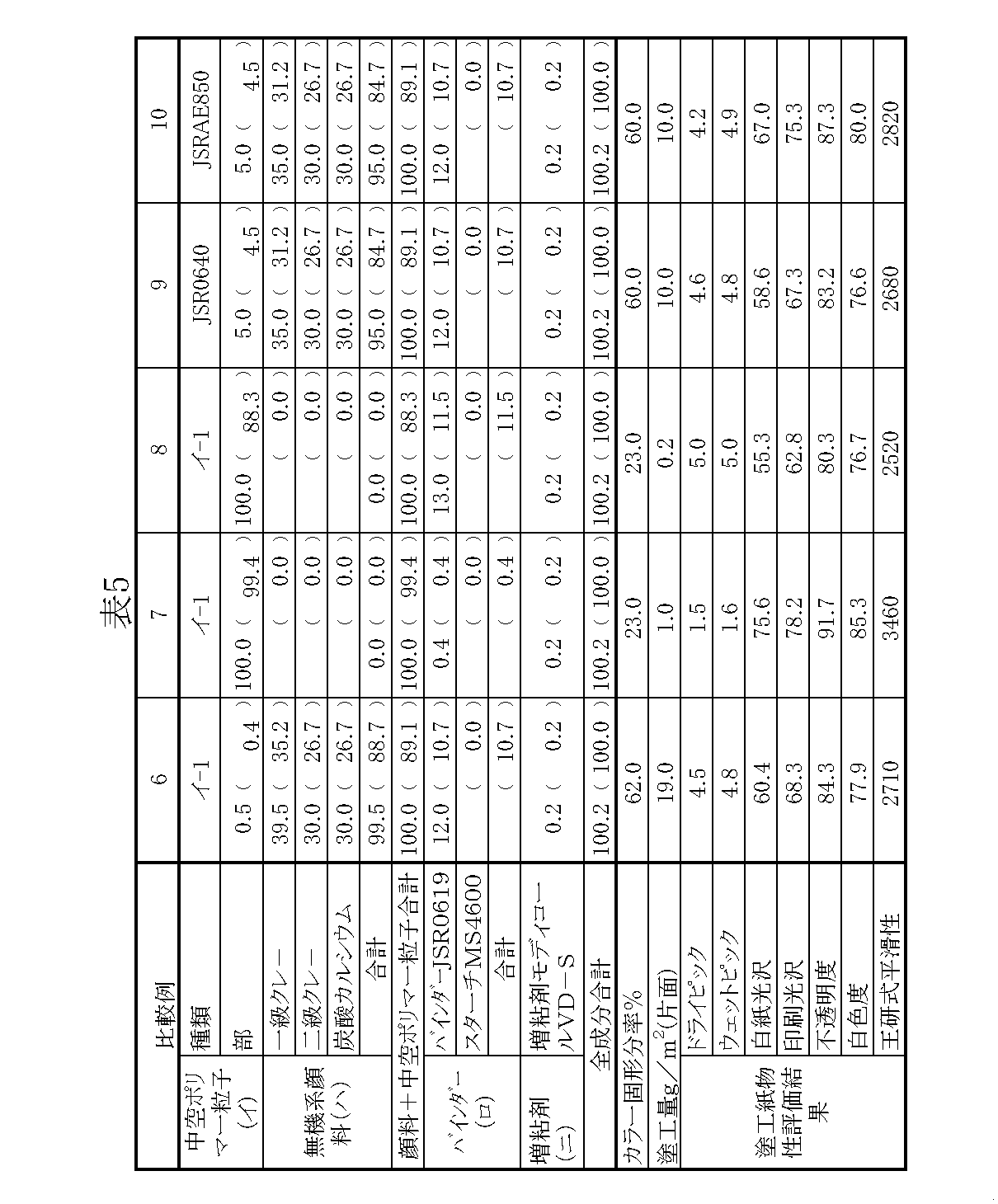
▲1▼実施例1〜12及び比較例1〜8
分散剤(東亜合成化学工業(株)製、商品名「アロンT−40」)0.05%、水酸化ナトリウム0.2%を水に溶解し、コーレス分散機で攪拌しながら表2及び表3に示す無機系顔料を添加した。尚、表2及び表3おいて、一級クレーとしては、EMC社製、商品名「UW−90」、二級クレーとしては、Huber社製、商品名「HS」、炭酸カルシウムとしては、ECC社製、商品名「カービタル90」を使用した。
無機系顔料を添加した後、30分間攪拌し、更に表2及び表3に示す中空ポリマー粒子(イ−1)〜(イ−14)、バインダー(ロ)としての共重合体ラテックス[JSR(株)製、商品名「JSR0619」(固形分率48%)]及びスターチ[日本食品(株)製、商品名「MS−4600」]、増粘剤(サンノプコ社製、商品名「モデコールVD―S」)を、表2及び表3に示す量添加し、全固形分率(以下、カラー固形分率という。)が表2及び表3示す値になるように水を加え、紙塗工用組成物を調製した。尚、表2及び表3の括弧内の数値は固形分換算における中空ポリマー粒子(イ)、バインダー(ロ)、顔料(ハ)及び、増粘剤(ニ)の合計を100部とした場合における配合量を示す。
また、比較例1〜5は、中空ポリマー粒子(イ)として、容積空孔率が60%未満である(イ−10)〜(イ−14)を用いたものである。また、比較例7は、固形分換算における中空ポリマー粒子(イ)、バインダー(ロ)、顔料(ハ)及び、増粘剤(ニ)の合計を100部とした場合における顔料(ハ)の配合量が0.5部未満(表4及表5参照)のものである。更に、比較例7は、固形分換算における中空ポリマー粒子(イ)、バインダー(ロ)、顔料(ハ)及び、増粘剤(ニ)の合計を100部とした場合におけるバインダー(ロ)の配合量が0.5部未満(表4及び表5参照)のものである。
【0060】
▲2▼比較例9
ポリマー粒子として、中空でないポリマー粒子(JSR(株)製、商品名「JSR0640」)を用いたこと以外は、実施例1〜12、比較例1〜8と同様な方法により、紙塗工用組成物を調製した。
▲3▼比較例10
ポリマー粒子として、容積空孔率が60%未満である市販のポリマー粒子(JSR(株)製、商品名「JSRAE850」)を用いたこと以外は、実施例1〜11、比較例1〜8と同様な方法により、紙塗工用組成物を調製した。
【0061】
【表2】
【表3】
【表4】
【表5】
(6)塗工紙の製造
市販の上質紙(坪量72g/m2)に、実施例1〜11及び比較例1〜10の紙塗工用組成物を乾燥後の塗工量が表2及び表3に示した値となるようにラボカーテンコーター(アネスト岩田社製、型式「フローコーターFL−S3G」、塗工速度100m/s)で塗工した後、150℃のギヤオーブンで3秒間乾燥した。得られた片面塗工紙をラボスーパーカレンダー(由利ロール社製)に、ロール表面温度40℃、線圧10N/mの条件で2回通し、光沢のある塗工紙を得た。尚、比較例8は、紙塗工用組成物の乾燥後の塗工量が0.3g/m2未満のものである。
【0066】
(7)塗工紙の評価方法
(6)で得られた塗工紙を下記の方法により評価した。結果を表2及び表3に併記する。
▲1▼ドライピック強度
RI型印刷機を使用し、タックNo.9のインキで数回重ね刷りを行い、印刷面のピッキング状態を肉眼で評価した(5段階評価で数値が大きいほうが良好である。)。
▲2▼ウエットピック強度
RI型印刷機を使用し、モルトンロールで試験片上に給水を行った後に1回印刷を行い、印刷面のピッキング状態を肉眼で評価した(5段階評価で数値が大きいほうが良好である。)。
▲3▼白紙光沢
未印刷塗工紙の光沢を、村山式光沢計を用い、入射角75度,反射角75度で測定した。数値の大きい方が良好である。
▲4▼印刷光沢
RI型印刷機を使用し、タックNo.5のインキで印刷をおこない、インキが乾いた後、印刷面の光沢を村山式光沢計を用い、入射角75度,反射角75度で測定した。数値の大きい方が良好である。
▲5▼白色度
白色度計を用いてブルーフィルターによって測定するハンター比色により評価した。数値の大きい方が良好である。
▲6▼不透明度
白色度計を用いてグリーンフィルターで測定するハンター比色により評価した。数値の大きい方が良好である。
▲7▼王研式透気平滑度
王研式透気平滑度計を用いて試験片の平滑度を求めた。大きい方が良好である。
【0067】
(8)実施例の効果
ポリマー粒子として中空ではないものを使用した場合、或いは容積空孔率が60%未満の場合(比較例1〜5、9及び10)は、白紙光沢が58.6〜68.5、印刷光沢が67.3〜73.3、不透明度が83.2〜87.7、白色度が76.6〜81.0であり、劣っていた。
また、バインダー(ロ)(固形分)、顔料(ハ)及び、増粘剤(ニ)の合計を100部とした場合における顔料(ハ)の配合量が0.5部未満(表3参照)の場合、白紙光沢が60.4、印刷光沢68.3、不透明度84.3、白色度が77.9であり、各特性が十分ではなかった。
これに対し、容積空孔率が60%以上、且つ配合した中空粒子が0.5%以上の場合(比較例7、及び実施例1〜12)、白紙光沢が75.1〜83.9、印刷光沢が78.2〜95.3、不透明度が90.0〜94.2、白色度が82.9〜85.2であり、優れていた。
【0068】
特に、中空ポリマー粒子(イ)及び顔料(ハ)の合計を100部とした場合における中空ポリマー粒子(イ)の配合量が40〜70部、顔料(ハ)の配合量が30〜60部の場合(実施例5、9、11)白紙光沢82.9〜83.9、印刷光沢91.0〜92.1、不透明度92.4〜94.2、白色度83.1〜84.4であり、これらの性能及びそのバランスが極めて優れていることが判る。
【0069】
更に、バインダー(ロ)(固形分)、顔料(ハ)及び、増粘剤(ニ)の合計を100部とした場合におけるバインダー(ロ)の配合量が0.5部未満の場合(比較例7)、十分なドライピック強度、ウエットピック強度が得られないが、0.5%以上の場合(実施例1〜12)、ドライピック強度が4.0〜5.0、ウエットピック強度が4.1〜5.0であり、十分優れていることが判る。
【0070】
また、配合量が本発明の範囲にある場合であっても、塗工量が0.3g/m2未満の場合(比較例8)、十分な白紙光沢、印刷光沢、不透明度、白色度が得られないが、塗工量が0.3g/m2以上場合(実施例1〜12)、白紙光沢、印刷光沢、不透明度、白色度が優れている。
【0071】
【発明の効果】
本発明の紙塗工用組成物では、容積空孔率及び平均粒径が所定の範囲にある中空ポリマー粒子が含有されているので、白色度、不透明度、白紙光沢、塗膜強度、及び印刷光沢等の印刷特性をバランス良く備える塗工紙を得ることができる。また、バインダーが所定の割合で含有される場合は、より優れた表面強度、不透明性、白色光沢等を有する塗工紙が得られる紙塗工用組成物とすることができる。
更に、顔料等のその他の添加物を含有する場合は、より優れた白色度、不透明度、白紙光沢、塗膜強度、及び印刷光沢等の印刷特性を有する塗工紙が得られる紙塗工用組成物とすることができる。
また、中空ポリマー粒子を所定の方法により製造した場合は、より容積空孔率が大きい中空ポリマー粒子が得られる。
更に、上記紙塗工用組成物を用いて、塗工量を所定の値で塗工することによって、より優れた性能を有する塗工紙が得られる。
また、非接触式塗工方法により塗工した場合は、より優れた性能を有する塗工紙が得られる。[0001]
TECHNICAL FIELD OF THE INVENTION
The present invention relates to a paper coating composition, a coated paper using the same, and a method for producing the same. More specifically, a paper coating composition capable of obtaining a coated paper having a good balance of whiteness, opacity, white paper gloss, coating film strength, print gloss, low speckle characteristics, and the like, and coated paper using the same. And its manufacturing method.
[0002]
[Prior art]
Hollow polymer particles having a single closed pore inside are used, for example, as organic microcapsule particles in which the pores are filled with various substances. Further, it is also used as an organic light scattering agent utilizing light scattering generated by porosity of particles, or an organic light scattering auxiliary. Further, the hollow polymer particles are conventionally used in the fields of coating of paper, fiber, leather and the like, and paints. In addition, the hollow polymer particles that have heretofore been blended in the paper coating composition usually have a volume porosity of 55% or less from the viewpoint of restrictions in the production method and production costs, and It is difficult to say that whiteness, blank gloss, print gloss, opacity and the like are sufficiently provided.
[0003]
As a method for producing such hollow polymer particles, for example, a monomer containing at least one carboxylic acid group is emulsion-polymerized to form a core, and then a different monomer (at least one monomer is hard, Tg is greater than 25 ° C., which forms a polymer that does not form a film at 20 ° C. and is permeable to ammonia and amines) to form a shell, and then the core is treated with ammonia or A method is known in which a single pore is formed in a core by swelling by neutralizing with an amine, followed by drying (JP-A-56-32513 and JP-A-63-213509). etc).
[0004]
However, in this method, it is complicated and difficult to control conditions for forming pores in the core, and the particles obtained by this method have characteristics required in the fields of coating and paint. Among them, although certain improvements are observed in hiding properties, gloss, coating film strength, whiteness, etc., it is not always satisfactory in terms of the balance of these properties. Further, when neutralizing and swelling the core with ammonia or an amine, in order to obtain particles having a sufficient volume porosity, the temperature must be higher than the Tg of the polymer constituting the shell. Further, it is not easy to increase the volume porosity, increase the Tg of the shell and polymerize, or crosslink, etc., and a paper coating composition using such hollow polymer particles is also used. It cannot be said that it has sufficient performance. In addition, even in the case of hollow polymer particles having a low volume porosity, if the blending amount is increased, concealing properties, gloss, coating strength, whiteness, etc. are improved to a certain extent, but when a certain blending amount is exceeded. Rather, characteristics such as hiding power, gloss, coating film strength, and whiteness are reduced. On the other hand, when the coating amount is greatly reduced, no improvement is observed.
[0005]
[Problems to be solved by the invention]
The present invention has been made in view of the above circumstances, a paper coating composition for producing a coated paper having a good balance of whiteness, opacity, white paper gloss, coating strength, low speckle characteristics, etc. And a coated paper using the same and a method for producing the same.
[0006]
[Means for Solving the Problems]
The present invention is as follows.
1. A paper coating composition comprising a hollow polymer particle (a) having a volume porosity of 60 to 99% and an average particle size of 300 to 5000 nm.
2. The shell thickness of the hollow polymer particles (a) is 30 to 200 nm. 3. The paper coating composition according to item 1.
3. 0.5 to 99.5% by mass of the hollow polymer particles (a), 0.5 to 99.5% by mass of the binder (b), and a pigment and / or a thickener (d) in terms of solid content. ) Is 0 to 99% by mass [provided that the sum of (A), (B), (C) and (D) is 100% by mass. 1.2. 3. The paper coating composition according to item 1.
4. The hollow polymer particles (a) are 5 to 80% by mass of the unsaturated carboxylic acid (a-1) and another radical polymerizable monomer (a-2) copolymerizable with the unsaturated carboxylic acid (a-1). 20 to 95% by mass [provided that the sum of (a-1) and (a-2) is 100% by mass. To prepare polymer particles (A) by emulsion polymerization of the monomer (a), and then, in the presence of 5 to 1000 parts by mass of the polymer particles (A), unsaturated carboxylic acids (b-1) 0 to 0 20% by mass and 80 to 100% by mass of another radical polymerizable monomer (b-2) copolymerizable with the unsaturated carboxylic acid (b-1) [however, (b-1) and (b-2) To 100% by mass. A part of 100 parts by mass of the monomer (b) is emulsion-polymerized, and the surface layer of the polymer particles (A) is polymerized by partially polymerizing the monomer (b). A core-shell polymer particle (B) coated with a shell layer containing a reactive monomer component is prepared, and then the pH of the dispersion containing the polymer particle (B) is adjusted to 7 or more with a volatile base. The polymer particles (B) are obtained by neutralizing and swelling the polymer particles (B) and then polymerizing the unreacted monomer components. To 3. The paper coating composition according to any one of the above.
5. 3. In the shell layer, wherein the mass ratio of the polymer component to the unreacted monomer component is from 99: 1 to 50:50. 3. The paper coating composition according to item 1.
6. 4. In the shell layer, part or all of the monomer (b) to be the polymer component among the monomers (b) is first subjected to batch polymerization and emulsion polymerization. 3. The paper coating composition according to item 1.
7. When the amount of the monomer (b) charged at a time is 100% by mass, at least 50% by mass of the monomer (b) charged at a time is an unsaturated carboxylic acid ester and / or an ethylenic aromatic compound. . 3. The paper coating composition according to item 1.
8. 5. The mass ratio of the monomer (b) and the polymer particles (A), which are charged together, is 10: 1 to 1:10. Or 7. 3. The paper coating composition according to item 1.
9. The radically polymerizable monomer (b-2) contains a crosslinkable radically polymerizable monomer, and the content of the crosslinkable radically polymerizable monomer is such that the total mass of the radically polymerizable monomer (b-2) is 100% by mass. 3. The content is 50% by mass or less. To 8. The paper coating composition according to any one of the above.
10. 3. The temperature of the dispersion when neutralizing and swelling the polymer particles (B) is set to be equal to or lower than the glass transition temperature (Tg) of the polymer component. To 8. The paper coating composition according to any one of the above.
11. When the monomer (b) is emulsion-polymerized, polymerization is performed using only the radical-polymerizable monomer (b-2), and after 25% by mass of the total amount of the monomer (b) is polymerized, the unsaturated carboxylic acid 3. The above (4) in which (b-1) is commonly used for polymerization. To 9. The paper coating composition according to any one of the above.
12. A sheet of paper, hollow polymer particles (a) attached to one or both sides of the paper, and a binder for bonding the hollow polymer particles (a) to one or both sides of the paper; A) Coated paper characterized by having a volume porosity of 60 to 99% and an average particle size of 300 to 5000 nm.
13. The above 1. To 11. The paper coating composition according to any one of the above, the coated amount after drying is 0.3 to 30 g / m on paper. 2 A method for producing coated paper, characterized in that coating is performed so that
14. 13. The above-mentioned 13. wherein the coating is performed by a non-contact coating method. The method for producing a coated paper according to the above.
[0007]
BEST MODE FOR CARRYING OUT THE INVENTION
Hereinafter, the present invention will be described in detail.
[1] Composition for paper coating
The volume porosity of the hollow polymer particles (a) is 60 to 99%, preferably 63 to 98%, more preferably 65 to 98%, still more preferably 68 to 95%, and particularly preferably 70 to 92%. . When the volume porosity is less than 60%, the opacity, whiteness, gloss of white paper, and the like become insufficient. On the other hand, if it exceeds 99%, the mechanical stability is reduced, and the particles are deformed or broken at the time of liquid preparation or coating. The average particle size of the hollow polymer particles (a) is 300 to 5000 nm, preferably 500 to 3000 nm, and more preferably 700 to 2000 nm. When the average particle size is less than 300 nm, opacity, whiteness, gloss of white paper, and the like are reduced. On the other hand, if it exceeds 5000 nm, the mechanical stability decreases.
The shell thickness of the hollow polymer particles (a) can be 20 to 220 nm, more preferably 20 to 190 nm, still more preferably 30 to 180 nm, and particularly preferably 30 to 150 nm. As a result, the weight of the paper coating composition can be reduced. The hollow polymer particles (a) are prepared by dispersing the hollow polymer particles (a) in a production medium in a state where the pores are filled with an aqueous medium, such as water, which will be described later (hereinafter the particles in this state are hydrated particles). ), Or may be used in the form of dried hollow particles (hereinafter simply referred to as hollow particles) in which the water-containing particles have been dried to remove the water inside. In the present specification, the hollow polymer particles (a) refer to both the water-containing particles and the hollow particles.
[0008]
The material of the hollow polymer particles (a) is copolymerizable with the unsaturated carboxylic acid (b-1) (hereinafter referred to as "monomer (b-1)") and the monomer (b-1). Of a monomer (b) comprising a radically polymerizable monomer (b-2) (hereinafter referred to as “monomer (b-2)”), or a copolymer of the monomer (b) and a monomer (b) -1) or a mixture with the polymer of the monomer (b-2).
Examples of the monomer (b-1) include mono- or dicarboxylic acids such as (meth) acrylic acid, crotonic acid, maleic acid, fumaric acid, and itaconic acid, and acid anhydrides of the dicarboxylic acids. Above all, from the viewpoint of particle stability, (meth) acrylic acid, itaconic acid and the like are preferable, and (meth) acrylic acid is more preferable. These may be used alone or in combination of two or more.
[0009]
As the monomer (b-2), for example, unsaturated carboxylic acid esters, ethylenic aromatic compounds, other non-crosslinkable radically polymerizable monomers, and the like can be used. Only one kind may be used, or two or more kinds may be contained. Among them, an ethylenic aromatic compound is preferable, and it is particularly preferable that 50% by mass or more of the total amount of the monomer (b-2) is an ethylenic aromatic compound such as styrene. When the amount of the ethylenic aromatic compound is less than 50% by mass, the refractive index of the polymer decreases, and whiteness, opacity, and gloss may become insufficient.
[0010]
Examples of the unsaturated carboxylic acid ester include methyl (meth) acrylate, ethyl (meth) acrylate, propyl (meth) acrylate, butyl (meth) acrylate, butyl (meth) acrylate, and 2-ethylhexyl (meth) acrylate. These may be impregnated, and these may be used alone or in combination of two or more.
Examples of the ethylenic aromatic compound include styrene and α-methylstyrene. These may be used alone or in combination of two or more.
Further, as other non-crosslinkable radical polymerizable monomers, (meth) acrylonitrile, vinyl acetate, N, N-dimethyl (meth) acrylamide and the like can be used. These may be used alone or in combination of two or more.
[0011]
Further, the monomer (b-2) may contain a crosslinkable radical polymerizable monomer. Thereby, the shape of the finally obtained hollow particles can be maintained against heat, mechanical stress, swelling by a solvent or a chemical, decomposition, and the like. Examples of the crosslinkable radical polymerizable monomer include divinylbenzene, trivinylbenzene, dicyclopentadiene, butadiene, isoprene, allyl glycidyl ether, glycidyl (meth) acrylate, ethylene glycol dimethacrylate, and the like. Ethylene glycol di (meth) acrylate is preferred. These may be used alone or in combination of two or more.
The compounding amount of the crosslinkable radical polymerizable monomer is preferably 50% by mass (hereinafter, simply referred to as “%”) or less, more preferably 0.1 to 30% of the total amount of the monomer (b-2). It is. When the amount of the crosslinkable radical polymerizable monomer exceeds 50%, the volume porosity becomes insufficient, which is not preferable. When the total amount of the monomer (b) is 100 parts by mass (hereinafter, simply referred to as “parts”), the amount is preferably 20 parts or less, more preferably 0.1 to 10 parts.
[0012]
The content of each of the monomer (b-1) and the monomer (b-2) in the monomer (b) is as follows, when the sum of (b-1) and (b-2) is 100%. ) Is from 0 to 20% and the monomer (b-2) is from 80 to 100%, preferably from 0.1 to 10% of the monomer (b-1) and from 90 to 99.9% of the monomer (b-2). Preferably, the monomer (b-1) is 0.2 to 5% and the monomer (b-2) is 95 to 99.8%. When the amount of the monomer (b-1) exceeds 20%, the polymerization stability is remarkably reduced, and the polymer particles after the volatile base treatment and the heat treatment are deformed to reduce the volume porosity.
[0013]
The content of the hollow polymer particles (a) in terms of solid content includes the case of the hollow polymer particles (a), the binder (b), the pigment (c) [0%]. ], Thickener (d) [including the case of 0%. ] (Hereinafter simply referred to as "the sum of (a) to (d)") as 100%, 0.5 to 99.5%, more preferably 1 to 97%, Preferably it is 3-95%. If the amount of the hollow polymer particles (a) is less than 0.5%, opacity, whiteness, glossiness of white paper, etc. decrease, which is not preferable. If it exceeds 99.5%, the content of the binder (b) is less than 0.5%, the surface strength is insufficient, and problems such as powder dropping and piling are unpreferable.
When the total of the hollow polymer particles (a) and the pigment (c) is 100 parts, the content of the hollow polymer particles (a) is 0.8 to 100 parts, preferably 20 to 100 parts, and more preferably 25 parts. It is preferably from 90 to 90 parts, more preferably from 30 to 80 parts.
[0014]
The paper coating composition of the present invention may contain a binder (b). Examples of the binder (b) include natural binders such as starch, modified starch, casein, styrene-butadiene copolymer, carboxy-modified styrene-butadiene copolymer, amine-modified styrene-butadiene copolymer, and hydroxyl group-modified. Modified styrene-butadiene copolymer such as styrene-butadiene copolymer, polyvinyl acetate, acrylic polymer, polychloroprene, polyvinyl alcohol, carboxy-modified acrylic copolymer, amine-modified acrylic copolymer, hydroxyl group Synthetic binders such as modified acrylic copolymers such as modified acrylic copolymers can be used, and these binders can be used alone or in combination of two or more.
Among them, it is preferable to use a modified styrene-butadiene copolymer, particularly a carboxy-modified styrene-butadiene copolymer, alone or in combination with a natural binder such as starch and casein.
Incidentally, as these binders, those contained as a solid content of latex may be used, or powdery ones may be used.
[0015]
Further, the content of the binder is 0.5 to 99.5%, more preferably 1 to 99%, and further preferably 2 to 100% in terms of solid content, when the total of (a) to (d) is 100%. 0.5 to 97%, particularly preferably 2.5 to 20%. If the amount of the binder is less than 0.5%, the surface strength is insufficient, and problems such as powder dropping and piling may occur. If it exceeds 99.5%, the blending amount of the hollow polymer particles (a) becomes less than 0.5%, and the opacity, whiteness, gloss of white paper and the like are undesirably deteriorated.
The content of the binder (b) is 1 to 99 parts, preferably 1 to 20 parts, more preferably 1 to 20 parts, in terms of solid content, when the total of the hollow polymer particles (a) and the pigment (c) is 100 parts. Is preferably 2.5 to 18 parts.
[0016]
The paper coating composition of the present invention may further contain a pigment (c) and / or a thickener.
Examples of the pigment (c) include organic pigments and inorganic pigments. Examples of inorganic pigments include kaolin clay, talc, barium sulfate, titanium oxide (rutile, anatase), calcium carbonate, aluminum hydroxide, zinc oxide, and satin white. These can be used alone or in combination of two or more.
Examples of the organic pigments include styrene, styrene / butadiene, styrene / acrylic, solid plastic pigment, and urea resin particles. These can be used alone or in combination of two or more.
[0017]
The content of the pigment is 99% or less, preferably 89% or less, more preferably 20 to 75%, and still more preferably 30 to 65% in terms of solid content, when the total of (a) to (d) is 100%. %.
The content of the pigment (c) is 99.2 parts or less, preferably 80 parts or less, more preferably 10 to 75 parts, when the total of the hollow polymer particles (a) and the pigment (c) is 100 parts. And more preferably 20 to 70 parts, and particularly preferably 30 to 65 parts.
[0018]
Examples of the thickener (d) include starch, casein, carboxy-modified cellulose, and acrylic alkali thickeners. The content of the thickener is 3% or less, preferably 0.05 to 2%, more preferably 0.05 to 100% in terms of solid content, when the total of (a) to (d) is 100%. It can be 1%.
Further, the content of the thickener (d) is 5 parts or less, preferably 0.5 part or less, more preferably 0.5 part or less, when the total of the hollow polymer particles (a) and the pigment (c) is 100 parts. It is preferably from 0.5 to 0.2 part.
[0019]
In addition, when the total of (a) to (d) is 100% in terms of solid content, the composition for paper coating can be as follows.
[1] 0.5 to 99.5% of hollow polymer particles (a), 0.5 to 99.5% of binder (b), and 0 to 0 pigment (c) and / or thickener (d) 99%.
[2] Preferably, 0.5 to 70% of the hollow polymer particles (a), 1 to 15% of the binder (b), and 0.5 to 70 of the pigment (c) and / or the thickener.
[3] More preferably, 30 to 70% of the hollow polymer particles (a), 1 to 15% of the binder (b), and 20 to 60% of the pigment (c) and / or the thickener (d).
At this time, the content ratio of the pigment (c) and the thickener (d) is 0.5% when the total of (a) to (d) is 100% in terms of solid content, and the hollow polymer particles (a) are 0.5%. When the content is バ イ ン ダ ー 99.5% and the binder (b) is 0.5 to 99.5%, the pigment (c) can be 0 to 99% and the thickener can be 0 to 3%.
When the hollow polymer particles (a) are 0.5 to 70% and the binder (b) is 1 to 15%, the pigment (c) is 0.5 to 70 and the thickener is 0.05 to 5. be able to.
Furthermore, when the hollow polymer particles (a) are 30 to 70% and the binder (b) is 1 to 15%, the pigment (c) is 20 to 60% and the thickener (d) is 0.05 to 5%. be able to.
[0020]
Further, it may further contain a dispersant, an antifoaming agent, a water-proofing agent, a lubricant, a wetting agent, a printability improving agent, a fluorescent whitening agent, a coloring pigment, a dye and the like.
Examples of the dispersant include sodium pyrophosphate, sodium hexametaphosphate, sodium polycarboxylate and the like. These can be used alone or in combination of two or more. The content of the dispersant is 0.01 to 2%, preferably 0.05 to 1%, when the total of the hollow polymer particles (a) and the pigment (d) is 100% in terms of the solid portion. Can be.
Examples of the lubricant include higher fatty acid salts such as calcium stearate, calcium palmitate and calcium oleate, and polyethylene wax. These can be used alone or in combination of two or more. The content of the lubricant is 0.01 to 2%, preferably 0.05 to 1%, when the total content of the hollow polymer particles (a) and the pigment (d) is 100% in terms of solid content. It can be.
[0021]
Examples of the wetting agent include an alkyl sulfonate, an alkyl allyl sulfonate, a rosinate, an alkyl fatty acid salt, an acetyl glycol-based surfactant, a nonylphenyl-based surfactant, and an oxyalkyl-based surfactant. These can be used alone or in combination of two or more. The content of the wetting agent is 0.01 to 2%, preferably 0.05 to 1%, assuming that the total content of the hollow polymer particles (a) and the pigment (d) is 100% in terms of solid content. %.
Examples of the antifoaming agent include polyglycol fatty acid esters, phosphoric acid esters, and silicone oil. The content of the defoamer is 0.01 to 2%, preferably 0.05 to 2% in terms of solid content, when the total content of the hollow polymer particles (a) and the pigment (d) is 100%. It can be 1%.
[0022]
Furthermore, the performance of the coated paper manufactured by using the above-mentioned paper coating composition under the conditions of the examples is as follows: (1) 70-85 blank gloss, 79-96 printed gloss, and opacity. 88-97, whiteness 80-87, (2) preferably white paper gloss 74-85, printing gloss 85-96, opacity 90-97, whiteness 80-87, more preferably (3) Can have a white paper gloss of 81 to 85, a print gloss of 90 to 96, an opacity of 91 to 97, and a whiteness of 82 to 87.
[0023]
Assuming that the total of (a) to (d) is 100%, the hollow polymer particles (a) are 0.5 to 99.5%, the binder (b) is 0.5 to 99.5%, and the pigment (c) ) Is 0 to 99% and the thickener is 0 to 3%, white paper gloss is 70 to 85, print gloss is 79 to 96, opacity is 88 to 97, and whiteness is 80 to 87. it can.
When the hollow polymer particles (a) are 0.5 to 70% and the binder (b) is 1 to 15%, the pigment (c) is 0.5 to 70% of the thickener and 0.05 to 5%. In this case, the glossiness of the white paper can be 74 to 85, the glossiness of the print is 85 to 96, the opacity is 90 to 97, and the whiteness can be 80 to 87.
Furthermore, 30 to 70% of the hollow polymer particles (a), 1 to 15% of the binder (b), 20 to 60% of the pigment (c), and 0.05 to 5% of the thickener (d). In this case, the paper gloss can be 81 to 85, the print gloss is 90 to 96, the opacity is 91 to 97, and the whiteness is 82 to 87.
[0024]
[2] Method for producing hollow polymer particles
The hollow polymer particles used in the paper coating composition of the present invention can be produced by the following method.
That is, the specific monomer (a) is emulsion-polymerized to prepare polymer particles (A), and thereafter, the surface layer of the polymer particles (A) is coated with a polymer component obtained by polymerizing the specific monomer (b); A core-shell polymer particle (B) coated with a shell layer containing the unreacted monomer component (B) is prepared, and then the pH of the dispersion of the polymer particle (B) is adjusted to 7 or more with a volatile base, The particles (B) are neutralized and swelled, and then the unreacted monomers are polymerized to obtain hollow polymer particles (A). Hereinafter, each step will be described specifically.
[0025]
(1) Preparation of polymer particles (A)
First, an unsaturated carboxylic acid (a-1) (hereinafter, referred to as "monomer (a-1)") and a radical polymerizable monomer (a-2) copolymerizable with the monomer (a-1) ( Hereinafter, referred to as “monomer (a-2)”), polymer particles (A) are prepared by emulsion polymerization of a monomer (a) composed of: The dispersion medium used at this time is not particularly limited, but usually, an aqueous medium is used.
As the aqueous medium, water is usually used, but a water-containing organic solvent (eg, ethanol, methanol, acetone, etc.) may be used.
[0026]
Examples of the monomer (a-1) include mono- or dicarboxylic acids such as (meth) acrylic acid, crotonic acid, maleic acid, fumaric acid, and itaconic acid, and acid anhydrides of the dicarboxylic acids. Among them, (meth) acrylic acid and itaconic acid are preferred from the viewpoint of particle stability, and (meth) acrylic acid is more preferred. These can be used alone or in combination of two or more.
[0027]
As the monomer (a-2), for example, unsaturated carboxylic acid esters, ethylenic aromatic compounds, other non-crosslinkable radical polymerizable monomers, and the like can be used. These can be used alone or in combination of two or more. Among them, unsaturated carboxylic esters are preferable, and it is particularly preferable that 50% or more of the monomer (a-2) is an unsaturated carboxylic ester. When the amount of the unsaturated carboxylic acid ester is less than 50% of the monomer (a-2), the hollow particles become distorted and the volume porosity does not increase.
Examples of the unsaturated carboxylic acid ester include methyl (meth) acrylate, ethyl (meth) acrylate, propyl (meth) acrylate, butyl (meth) acrylate, 2-ethylhexyl (meth) acrylate, and the like. Alternatively, two or more kinds can be used in combination.
In addition, examples of the ethylenic aromatic compound include styrene, α-methylstyrene, and the like, and these can be used alone or in combination of two or more. Further, other non-crosslinkable radical polymerizable monomers include (meth) acrylonitrile, vinyl acetate, N, N-dimethyl (meth) acrylamide, and the like. These may be used alone or in combination of two or more. Can be used.
[0028]
A crosslinkable monomer can be used as a part of the monomer (a-2). As this crosslinkable monomer, butadiene, isoprene, divinylbenzene, ethylene glycol di (meth) acrylate and the like can be used, and these can be used alone or in combination of two or more. The amount of the crosslinking monomer is preferably 5% or less of the total amount of the monomer (a), more preferably 0.2 to 2%. When the proportion of the crosslinkable monomer exceeds 5% of the monomer (a), the swelling due to the volatile base becomes insufficient, the volume porosity becomes low, and the properties such as hiding power, whiteness and gloss are insufficient. It is not preferable.
[0029]
Each content of the monomer (a-1) and the monomer (a-2) in the monomer (a) is, when the sum of (a-1) and (a-2) is 100%, the monomer (a-1) ) Is 5 to 80% and the monomer (a-2) is 20 to 95%, preferably the monomer (a-1) is 10 to 60% and the monomer (a-2) is 40 to 90%, more preferably the monomer (a). a-1) can be 20 to 50% and the monomer (a-2) can be 50 to 80%.
When the content of the monomer (a-1) is less than 5%, the swelling due to the volatile base is not sufficient, the volume porosity is low, and the properties such as hiding properties, whiteness, and gloss are insufficient. It is not preferable. On the other hand, when the amount of the monomer (a-1) exceeds 80%, the polymerization stability of the monomer (a) decreases, and it becomes difficult to uniformly coat the polymer composed of the monomer (b) on the surface layer. It is not preferable because the shape becomes irregular.
[0030]
The method of emulsion-polymerizing the monomer (a) in the dispersion medium is not particularly limited. For example, the monomer may be added at once and the polymerization may be performed continuously, or the polymerization may be performed continuously. The latter is preferable in order to obtain particles having a uniform particle size with good stability. Further, the preparation of the polymer particles (A) may be performed by one-stage polymerization, or may be performed by two or more stages of multi-stage polymerization. Further, the monomer (a) may be subjected to seed emulsion polymerization in the presence of seed particles. As the seed particles, particles having a similar SP value (solubility parameter) to the monomer (a) are particularly preferable because particles having a uniform particle size can be obtained with good stability.
[0031]
When emulsion-polymerizing the monomer (a), an emulsifier can be used. As the emulsifier, for example, an anionic surfactant, a nonionic surfactant, a cationic surfactant, an amphoteric surfactant, an organic suspension protective agent, and the like can be used. From the viewpoint, it is preferable to use an anionic surfactant, a nonionic surfactant, and an organic suspension protective agent. These emulsifiers can be used alone or in combination of two or more.
Examples of the anionic surfactant include rosinates such as potassium rosinate and sodium rosinate, and sodium or potassium salts of fatty acids such as potassium oleate, potassium laurate, sodium laurate, sodium stearate, and potassium stearate. Salts, sulfate salts of aliphatic alcohols such as sodium lauryl sulfate, and alkyl allyl sulfonic acids such as sodium dodecylbenzenesulfonate. These anionic surfactants can be used alone or in combination of two or more.
[0032]
Examples of the nonionic surfactant include alkyl esters, alkyl ethers and alkyl phenyl ethers of polyethylene glycol. These nonionic surfactants can be used alone or in combination of two or more.
Examples of the organic suspension protectant include, for example, hydrophilic synthetic high molecular substances such as polyacrylic acid, polymethacrylic acid, polyvinyl sulfonic acid, polyvinyl alcohol, polyvinyl pyrrolidone, and polyethylene glycol; gelatin; and natural hydrophilic substances such as water-soluble starch. Molecular substances, hydrophilic semi-synthetic polymer substances such as carboxymethyl cellulose, and the like can be given. These organic suspension protective agents can be used alone or in combination of two or more.
Examples of the cationic surfactant include an aliphatic amine salt and a fatty quaternary ammonium salt, and these can be used alone or in combination of two or more.
Examples of the amphoteric surfactant include a carboxybetaine type and an aminocarboxylate.
[0033]
Examples of the polymerization initiator used in the emulsion polymerization of the monomer (a) include (1) organic hydropoxides represented by cumene hydroperoxide, diisopropylbenzene hydroperoxide, paramenthane hydroperoxide, t-butyl hydroperoxide and the like. A redox system in which a peroxide is combined with a reducing agent represented by a sugar-containing pyrophosphate formulation, a sulfoxylate formulation, a mixed formulation of a sugar-containing pyrophosphate formulation and a sulfoxylate formulation, and a formaldehyde resin formulation. Initiators, (2) persulfates such as potassium persulfate and ammonium persulfate, (3) organic hydroperoxides such as azobisisobutyronitrile, (4) benzoyl peroxide, lauroyl peroxide and the like. Can be. Of these, persulfates such as potassium persulfate and ammonium persulfate, azobisisobutyronitrile, and benzoyl peroxide are preferred from the viewpoints of particle stability and particle size uniformity.
[0034]
The polymerization temperature at the time of polymerizing the monomer (a) is preferably 5 to 95C, more preferably 50 to 90C. When the polymerization temperature is lower than 5 ° C., the reactivity of the unsaturated carboxylic acid is low, and the particles may become unstable. On the other hand, when the temperature exceeds 95 ° C., the particles may become unstable.
The polymer particles (A) thus obtained are to be alkali-swellable core particles, and the average particle diameter of the polymer particles (A) is preferably 0.1 to 2 μm, more preferably 0.1 to 2 μm. 2 to 2 μm.
[0035]
(2) Preparation of polymer particles (B)
In the presence of 5 to 1000 parts, preferably 7 to 100 parts, more preferably 10 to 50 parts of the polymer particles (A), 100 parts of the monomer (b) is emulsion-polymerized to form a surface layer of the polymer particles (A), Core-shell polymer particles (B) coated with a shell layer containing a polymer component obtained by partially polymerizing the monomer (b) and an unreacted monomer component of the monomer (b) are prepared.
When the amount of the polymer particles (A) is less than 5 parts, the formation of voids in the final target hollow polymer particles (a) becomes insufficient, and when formed into a coating film, the concealing properties, whiteness, gloss, etc. are poor. It will be. On the other hand, when the amount of the polymer particles (A) exceeds 1,000 parts, the polymerization stability is reduced, and the polymer particles after the volatile base treatment and the heat treatment are ruptured, deformed and crushed, and the volume porosity is reduced. descend.
Here, as the monomer (b), those composed of the above-mentioned monomer (b-1) and the above-mentioned monomer (b-2) can be used, and their contents are as described above.
[0036]
The method for emulsion polymerization of the monomer (b) is not particularly limited, and the same method as in the case of the polymer particles (A) can be used.
In this case, in order to complete the coating structure of the shell, it is preferable to initially charge a part or all of the monomer (b) to be the polymer component among the monomers (b) and carry out emulsion polymerization. At that time, the mass ratio of the monomer (b) and the polymer particles (A) charged together is preferably (10: 1) to (1:10), more preferably (5: 1) to (1: 5). When this ratio exceeds (10: 1), a problem occurs in stability. On the other hand, when the ratio is less than (1:10), the coating of the polymer particles (A) is not sufficient, the hollow particles are distorted, and the volume porosity decreases.
As the monomer (b) initially charged at once, an ethylenic aromatic compound such as styrene and an unsaturated carboxylic acid ester such as methyl (meth) acrylate are particularly preferable.
[0037]
Further, in order to increase the volume porosity of the hollow particles, polymerization is first carried out only with the monomer (b-2), and polymerization of 10 to 35%, preferably 20 to 30% of the total amount of the monomer (b) is carried out. After the termination, it is preferable to carry out the polymerization using the monomer (b-1) in combination.
[0038]
Further, the mass ratio of the polymer component obtained by polymerizing the monomer (b) in the shell layer of the polymer particles (B) to the unreacted monomer component is (99: 1) to (50:50), and more preferably (97:50). : 3) to (80:20). If this ratio exceeds (99: 1), it is not preferable because the temperature must be increased during neutralization with a volatile base in order to increase the volume porosity. Further, when the ratio is less than (50:50), it is difficult to control the temperature and PH during the neutralization swelling, the state is apt to be deteriorated, and the hollow particles are undesirably deformed.
[0039]
The glass transition temperature (Tg) of the shell layer of the polymer particles (B) is 50 ° C. or higher, preferably 70 ° C. or higher, more preferably 100 ° C. or higher, in terms of improvement in whiteness, opacity, and gloss. Is preferred. The particle diameter of the polymer particles (B) is preferably 0.15 to 4 μm, more preferably 0.25 to 3 μm.
[0040]
(5) Preparation of hollow polymer particles (a)
The pH of the dispersion of the core-shell-shaped polymer particles (B) prepared in the previous step is adjusted to 7 or more with a volatile base such as ammonia or an amine to neutralize and swell, and then, if necessary, heated. Further, by polymerizing the unreacted monomer component of the monomer (b), hollow polymer particles (a) (water-containing particles) filled with an aqueous medium are prepared.
[0041]
The temperature of the dispersion at the time of neutralizing and swelling the polymer particles (B) depends on the amount of unreacted monomer components in the shell layer of the polymer particles (B). The glass transition temperature (Tg) of the component is preferably equal to or less than the glass transition temperature. If neutralization and swelling are performed at a temperature exceeding this Tg, the core may break through the shell and jump out.
Since the polymer component obtained by polymerizing the monomer (b) is capable of penetrating the volatile base, the component constituting the polymer particles (A) is neutralized by the penetration of the volatile base. Along with this, the components constituting the polymer particles (A) absorb water significantly.
[0042]
After neutralizing and swelling the polymer particles (B), the unreacted monomer components present in the shell layer are polymerized to obtain water-containing particles. The concentration of the residual monomer in the dispersion after polymerization of the unreacted monomer component is preferably 3000 ppm or less, more preferably 1000 ppm or less, and particularly preferably 300 ppm or less. When a monomer exceeding 3000 ppm remains in the dispersion, the rigidity of the shell of the hollow polymer particles (a) becomes insufficient, and the hollow polymer particles (a) are easily deformed, which is not preferable.
[0043]
In order to sufficiently polymerize the unreacted monomer components remaining in the shell layer of the polymer particles (B) after the neutralization and swelling, a polymerization initiator, a polymerization initiation assistant, a reducing agent, and the like may be further added. Examples of the polymerization initiator include (1) organic hydroperoxides represented by cumene hydroperoxide, diisopropylbenzene hydroperoxide, paramenthane hydroperoxide, t-butyl hydroperoxide and the like; A redox-based initiator in combination with a reducing agent represented by an acid formulation, a sulfoxylate formulation, a sugar-containing pyrophosphate formulation / sulfoxylate formulation, a formaldehyde resin formulation, (2) potassium persulfate, Persulfates such as ammonium persulfate; (3) azobisisobutyronitrile; (4) organic hydroperoxides such as benzoyl peroxide and lauroyl peroxide; T-butyl hydroperoxy Systems that combine the id and formaldehyde resin is preferable.
[0044]
In addition, after the polymer particles (B) are neutralized and swollen, a radical polymerizable monomer is newly added and polymerized to form a part of the shell of the hollow polymer particles (A). In that case, it is preferable to add the above-mentioned polymerization initiator and the like together.
[0045]
When the hollow polymer particles (a) are used as the above-mentioned paper coating composition, they can be used as they are without drying, but then they are dried and then dispersed by drying. The aqueous medium as a medium may be volatilized, and the aqueous medium inside the particles may be volatilized and used as powdery hollow particles. When the water-containing particles are used as the paper coating composition, the aqueous medium volatilizes when the paint or the like is dried and becomes hollow.
[0046]
The method for drying the produced hydrated particles to form powdery hollow particles is not particularly limited. For example, a spray drying method at a temperature of 135 to 155 ° C., a tray using a hot air dryer at a temperature of 50 to 70 ° C. A drying method, a fluidized bed drying method at a temperature of 15 to 70 ° C, and the like can be given.
Through the above-described production steps, hollow polymer particles (a) having a particle diameter of 300 to 5000 nm, having a single pore, and having a volume porosity of 60 to 99% can be obtained.
[0047]
[3] Coated paper and its manufacturing method
The coated paper of the present invention comprises a paper and a coating formed on one or both surfaces of the paper and containing a hollow polymer particle (a) and a binder, wherein the hollow polymer particle (a) has a volume void. The ratio is 60 to 99%, and the average particle size is 300 to 5000 nm.
For the hollow polymer particles (a), the description of the hollow polymer particles (a) in [1] can be applied as it is.
The binder is for adhering the hollow polymer particles (a) and the pigment (d) to each other, and further, at a position where the hollow polymer particles (a) and the pigment (d) contact the paper surface, They have a function of bonding them. In a coated paper, this binder is configured as an adhesive layer. The description of the binder (b) in [1] can be applied to this binder as it is. As for the method for producing the hollow polymer particles (a), the description of the above [2] can be applied as it is.
Further, a pigment (c) and a thickener (d) can be contained, and the description of the above [1] can be applied as they are with respect to their materials and contents.
A dispersant, an antifoaming agent, a water-proofing agent, a lubricant, a wetting agent, a printability improving agent, a fluorescent whitening agent, a coloring pigment, a dye, and the like can be further contained. The description can be applied as it is.
[0048]
The coated paper of the present invention can be manufactured by applying the coating composition described in the above [1] to paper.
The coating amount of this coating composition is 0.3 to 30 g / m after drying. 2 And preferably 0.5 to 20 g / m 2 , More preferably 1 to 15 g / m 2 It is. This coating amount is 0.3 g / m 2 If it is less than 30, the paper cannot be coated sufficiently, the opacity, gloss of white paper, whiteness, etc. are inferior, and 30 g / m 2 If it exceeds, the bulk of the coating layer becomes too large, and the surface strength decreases.
[0049]
Examples of this coating method include a contact coating method using a roll coater such as a blade coater such as a short dwell coater, a bari dwell coater, and a rod blade coater, a gate roll coater, an inline size press, and a metered size press. be able to. Further, a non-contact coating method using an air knife coater, a curtain coater, a spray coater or the like can be used. Among them, a non-contact coating method such as a curtain coater or a spray coater is particularly preferable in terms of opacity, whiteness, gloss of white paper, and gloss of printing.
In the post-treatment step, it is preferable to perform a calendar treatment such as a super calender, a gloss calender, a soft nip calender, and a raster press. Thereby, a coated paper having more excellent gloss can be obtained.
[0050]
【Example】
Hereinafter, the present invention will be described more specifically with reference to examples.
In the following description, "parts" and "%" indicate parts by mass and% by mass, respectively, unless otherwise specified.
Further, the polymerizations in Examples and Comparative Examples were all performed in a nitrogen gas atmosphere.
[0051]
(1) Preparation of aqueous dispersion of seed particles
An example of preparing an aqueous dispersion of seed particles is shown below.
In a reaction vessel having a capacity of 2 liters, in advance, 109.5 parts of water as a medium, 0.2 parts of sodium dodecylbenzenesulfonate [trade name "F65" manufactured by Kao Corporation] as an emulsifier, and sodium persulfate as a polymerization initiator 0.5 part was charged.
On the other hand, 90 parts of methyl methacrylate, 10 parts of methacrylic acid, 0.5 part of octylthioglycolate as a molecular weight modifier, 0.1 part of an emulsifier [trade name "F65" manufactured by Kao Corporation] and 40 parts of water were added. An aqueous dispersion of the monomer was prepared by mixing and stirring.
20% of the aqueous dispersion of the monomer is charged into the above reaction vessel, and the temperature in the reaction vessel is raised to 75 ° C. while stirring, and the polymerization reaction is carried out for 1 hour. Thereafter, while maintaining the temperature at 75 ° C. The remaining aqueous dispersion of the monomer was continuously added to the reaction vessel over 2 hours, and the mixture was aged for 2 hours. The aqueous dispersion of seed particles having a solid content of 40%, a particle diameter of 200 nm, and a weight average molecular weight of 70,000 was performed. Got a body.
[0052]
(2) Preparation of aqueous dispersion of polymer particles (A)
The preparation example of the aqueous dispersion of the polymer particles (A) is shown below.
186 parts of water was previously charged as a medium into a reaction vessel having a capacity of 2 liters, and 10 parts of an aqueous dispersion of seed particles prepared in (1) in terms of solid content (25 parts of an aqueous dispersion) was added thereto. 0.5 part of sodium persulfate was charged as an initiator.
On the other hand, 69.5 parts of methyl methacrylate, 30 parts of methacrylic acid, 0.5 part of divinylbenzene (purity 55%), 0.1 part of an emulsifier [trade name "F65" manufactured by Kao Corporation] and 40 parts of water Was mixed and stirred to prepare an aqueous dispersion of the monomer.
Thereafter, the temperature in the reaction vessel was raised to and maintained at 80 ° C. while stirring, and the aqueous dispersion of the monomer was continuously charged into the reaction vessel over 3 hours. Next, aging was carried out for 2 hours to obtain an aqueous dispersion containing 31% of polymer particles (A-1) having a particle diameter of 410 nm as a solid content.
[0053]
(3) Preparation of polymer particles (B) and hollow polymer particles (a)
Preparation examples of the hollow polymer particles (B) and the hollow polymer particles (a) of the present invention are shown by the following polymerization examples 1 to 14.
(1) Polymerization example 1
A reaction vessel having a capacity of 2 liters is charged in advance with 300 parts of water as a medium, and 16 parts of an aqueous dispersion of polymer particles (A-1) prepared in (2) in terms of solid content is added thereto (as an aqueous dispersion). 51.6 parts), 10 parts of styrene as a monomer (b-2) to be polymerized by batch charging, and 0.4 parts of sodium persulfate as a polymerization initiator were initially charged.
On the other hand, 69.5 parts of styrene as a monomer (b-2) to be polymerized by continuous charging, 0.1 part of an emulsifier [trade name "F65" manufactured by Kao Corporation] as a monomer (b-1) Of acrylic acid and 40 parts of water were mixed and stirred to prepare an aqueous dispersion of a monomer.
Then, while stirring and heating the liquid in the reaction vessel to a temperature of 80 ° C., styrene was polymerized for 30 minutes to obtain polymer particles (A-1) in which a styrene polymer was composited. Next, the solution in the reaction vessel was maintained at 80 ° C. while stirring, and the aqueous dispersion of the monomer was continuously charged into the reaction vessel over 4 hours.
Further, immediately after all the aqueous dispersions of the above monomers were charged into the reaction vessel, finally, 20 parts of styrene as the monomer (b-2) for polymerization by batch charging were charged, and polymer particles (A-1) In the surface layer of the above, styrene and acrylic acid were polymerized to obtain core-shell polymer particles (B-1) laminated. The particle diameter of the polymer particles (B-1) was 810 nm.
After all the monomers were charged, about 3 minutes later, 2 parts of 25% ammonium hydroxide (8 parts of an aqueous solution) were added at once while stirring, and the mixture was stirred for 2 hours and aged. The mass ratio of the unreacted monomer component to the entire monomer (b) immediately before 25% ammonium hydroxide was charged was 9%.
Thereafter, 0.3 part of t-butyl hydroperoxide and 0.1 part of formaldehyde resin were charged, and the mixture was stirred as it was for 1 hour, and 23.3% of solid content, 1100 nm in outside diameter, and 930 nm in inside diameter of spherical hollow polymer particles ( An aqueous dispersion of i) was obtained.
[0054]
(2) Polymerization examples 2 to 14
Polymer particles (B-2) to (B-14) were prepared in the same manner as in Polymerization Example 1 except that the amount of the polymer particles (A-1) and the type and amount of the monomer (b) were changed. . Further, in Polymerization Examples 3 and 9, the solid content of (B-3) and (B-9) was diluted to 18% and heat treatment was performed at the time of pH adjustment. The hollow polymer particles (a-2) to (a-14) were prepared in the same manner as in Polymerization Example 1 except that the mass ratio of the unreacted monomer and the heat treatment temperature after pH adjustment were changed as shown in Table 1. did.
[0055]
[Table 1]
(4) Evaluation of hollow polymer particles (a)
(1) Polymerization stability
Polymerization stability; evaluated by the state of adhesion of aggregates to the inner wall of the reaction vessel and the stirring blade. The evaluation criteria are as shown in the following ①, △ and ×. The results are also shown in Table 1.
:: extremely small amount of deposits, Δ; slightly large amount of deposits, ×: extremely large amount of deposits
[0057]
(2) Average particle size
The average particle size is the average value of the measurement results of 100 particles randomly extracted in an electron microscope (manufactured by JEOL Ltd., model “JSM-6360LA”) and observation at a magnification of 5,000. As a result, the average particle diameter of the hollow polymer particles (a-1) to (a-14) was 990 to 1190 nm. The results are also shown in Table 1.
(3) Average pore size
The average pore diameter is an average value of measurement results of 100 particles randomly extracted in observation at a magnification of 5,000 times using an electron microscope (manufactured by JEOL Ltd., model “JSM-6360LA”). As a result, the average pore diameter of the hollow polymer particles (a-1) to (a-14) was 800 to 1100 nm. The results are also shown in Table 1.
[0058]
(4) Volume porosity
The volume porosity was determined by calculating the volume of particles and the volume of inner pores from the average particle diameter and the average pore shape obtained above, and using the formula: (inner volume / particle volume) × 100. As a result, the volume porosity of the hollow polymer particles (a-1) to (a-9) was 61 to 89%, and the volume porosity of (a-10) to (a-14) was 38 to 59%. there were. The results are also shown in Table 1.
(5) Particle shape and inner hole shape
The hollow polymer particles (a-1) to (a-14) in Polymerization Examples 1 to 14 were observed with an electron microscope (manufactured by JEOL Ltd., model "JSM-6360LA") at a magnification of 5000 times, and the outer shape and pores were observed. I confirmed the shape. As a result, the hollow polymer particles (a-1) to (a-14) were all spherical hollow particles having a single pore. The results are also shown in Table 1.
[0059]
(5) Preparation of composition for paper coating
(1) Examples 1 to 12 and Comparative Examples 1 to 8
Dispersant (Toa Gosei Chemical Industry Co., Ltd., trade name "Aron T-40") 0.05% and sodium hydroxide 0.2% are dissolved in water, and stirred with a Coreless disperser. The inorganic pigment shown in No. 3 was added. In Tables 2 and 3, the first-class clay was manufactured by EMC, trade name "UW-90", the second-class clay was manufactured by Huber, trade name "HS", and the calcium carbonate was ECC manufactured by ECC. The product name "Carbital 90" was used.
After the addition of the inorganic pigment, the mixture was stirred for 30 minutes, and the hollow polymer particles (a-1) to (a-14) shown in Tables 2 and 3 and a copolymer latex as a binder (b) [JSR Corporation ), Trade name "JSR0619" (solid content: 48%)] and starch [manufactured by Nippon Shokuhin Co., Ltd., trade name "MS-4600"], thickener (manufactured by San Nopco, trade name "Modecol VD-S"). )) Was added in the amounts shown in Tables 2 and 3, and water was added so that the total solid content (hereinafter, referred to as color solid content) would be the value shown in Tables 2 and 3, and the composition for paper coating was added. Was prepared. The values in parentheses in Tables 2 and 3 are based on the case where the total of the hollow polymer particles (a), the binder (b), the pigment (c), and the thickener (d) is 100 parts in terms of solid content. Shows the blending amount.
In Comparative Examples 1 to 5, (A-10) to (A-14) each having a volume porosity of less than 60% were used as the hollow polymer particles (A). Further, Comparative Example 7 shows the composition of the pigment (c) when the total of the hollow polymer particles (a), the binder (b), the pigment (c), and the thickener (d) was 100 parts in terms of solid content. The amount is less than 0.5 parts (see Tables 4 and 5). Further, Comparative Example 7 shows the blending of the binder (b) when the total of the hollow polymer particles (a), the binder (b), the pigment (c), and the thickener (d) was 100 parts in terms of solid content. The amount is less than 0.5 part (see Tables 4 and 5).
[0060]
(2) Comparative Example 9
Except for using solid polymer particles (manufactured by JSR Corporation, trade name “JSR0640”) as the polymer particles, a paper coating composition was prepared in the same manner as in Examples 1 to 12 and Comparative Examples 1 to 8. Was prepared.
{Circle around (3)} Comparative Example 10
Examples 1 to 11 and Comparative Examples 1 to 8 except that commercially available polymer particles having a volume porosity of less than 60% (trade name “JSRAE850” manufactured by JSR Corporation) were used as the polymer particles. In a similar manner, a paper coating composition was prepared.
[0061]
[Table 2]
[Table 3]
[Table 4]
[Table 5]
(6) Production of coated paper
Commercial high-quality paper (basis weight 72 g / m 2 ), A lab curtain coater (manufactured by Anest Iwata Co., Ltd.) such that the coating amounts after drying the paper coating compositions of Examples 1 to 11 and Comparative Examples 1 to 10 are the values shown in Tables 2 and 3. , Model "Flow coater FL-S3G", coating speed 100 m / s), and dried in a gear oven at 150 ° C for 3 seconds. The obtained single-side coated paper was passed twice through a laboratory super calendar (manufactured by Yuri Roll Co., Ltd.) under the conditions of a roll surface temperature of 40 ° C. and a linear pressure of 10 N / m to obtain a glossy coated paper. In Comparative Example 8, the coating amount after drying of the paper coating composition was 0.3 g / m. 2 Less than.
[0066]
(7) Evaluation method of coated paper
The coated paper obtained in (6) was evaluated by the following method. The results are shown in Tables 2 and 3.
(1) Dry pick strength
Using a RI type printing machine, tack no. Overprinting was performed several times with the ink No. 9 and the picking state of the printing surface was evaluated with the naked eye (the larger the numerical value in the five-step evaluation, the better).
(2) Wet topic strength
Using a RI-type printing machine, water was supplied onto the test piece with a Molton roll, and then printing was performed once, and the picking state of the printed surface was evaluated with the naked eye (the higher the numerical value in the five-step evaluation, the better).
▲ 3 ▼ Blank gloss
The gloss of the unprinted coated paper was measured using a Murayama gloss meter at an incident angle of 75 degrees and a reflection angle of 75 degrees. The larger the value, the better.
▲ 4 ▼ Print gloss
Using a RI type printing machine, tack no. Printing was performed with the ink No. 5, and after the ink was dried, the gloss of the printed surface was measured using a Murayama gloss meter at an incident angle of 75 degrees and a reflection angle of 75 degrees. The larger the value, the better.
▲ 5 ▼ Whiteness
It was evaluated by Hunter colorimetry measured with a blue filter using a whiteness meter. The larger the value, the better.
▲ 6 ▼ Opacity
The evaluation was made by Hunter colorimetry measured with a green filter using a whiteness meter. The larger the value, the better.
(7) Oken-style air smoothness
The smoothness of the test piece was determined using an Oken-type air smoothness meter. Larger is better.
[0067]
(8) Effects of the embodiment
When a non-hollow polymer particle is used or the volume porosity is less than 60% (Comparative Examples 1 to 5, 9 and 10), the blank gloss is 58.6 to 68.5 and the print gloss is 67.3-73.3, opacity was 83.2-87.7, and whiteness was 76.6-81.0, which was inferior.
Further, when the total amount of the binder (b) (solid content), the pigment (c), and the thickener (d) is 100 parts, the blending amount of the pigment (c) is less than 0.5 part (see Table 3). In the case of, the white paper gloss was 60.4, the print gloss was 68.3, the opacity was 84.3, and the whiteness was 77.9, and each property was not sufficient.
On the other hand, when the volume porosity is 60% or more and the blended hollow particles are 0.5% or more (Comparative Example 7 and Examples 1 to 12), the white paper gloss is 75.1 to 83.9, The print gloss was 78.2 to 95.3, the opacity was 90.0 to 94.2, and the whiteness was 82.9 to 85.2, which was excellent.
[0068]
In particular, when the total amount of the hollow polymer particles (a) and the pigment (c) is 100 parts, the compounding amount of the hollow polymer particles (a) is 40 to 70 parts, and the compounding amount of the pigment (c) is 30 to 60 parts. Case (Examples 5, 9, and 11) White paper gloss 82.9 to 83.9, print gloss 91.0 to 92.1, opacity 92.4 to 94.2, whiteness 83.1 to 84.4 It can be seen that these performances and their balance are extremely excellent.
[0069]
Further, when the total amount of the binder (b) (solid content), the pigment (c), and the thickener (d) is 100 parts, the amount of the binder (b) is less than 0.5 part (Comparative Example 7) Although sufficient dry pick strength and wet topic strength cannot be obtained, when 0.5% or more (Examples 1 to 12), dry pick strength is 4.0 to 5.0 and wet topic strength is 4 0.1 to 5.0, which indicates that it is sufficiently excellent.
[0070]
Further, even when the compounding amount is within the range of the present invention, the coating amount is 0.3 g / m 2 If less than (Comparative Example 8), sufficient white paper gloss, print gloss, opacity, and whiteness cannot be obtained, but the coating amount is 0.3 g / m. 2 In the above cases (Examples 1 to 12), the glossiness of blank paper, glossiness of printing, opacity, and whiteness are excellent.
[0071]
【The invention's effect】
Since the paper coating composition of the present invention contains hollow polymer particles having a volume porosity and an average particle size within a predetermined range, whiteness, opacity, white paper gloss, coating film strength, and printing Coated paper having printing characteristics such as glossiness in a well-balanced manner can be obtained. When the binder is contained in a predetermined ratio, a paper coating composition that can provide a coated paper having more excellent surface strength, opacity, white gloss, and the like can be obtained.
Further, when other additives such as pigments are contained, for paper coating, coated paper having printing characteristics such as better whiteness, opacity, white gloss, coating strength, and print gloss can be obtained. It can be a composition.
When hollow polymer particles are produced by a predetermined method, hollow polymer particles having a larger volume porosity can be obtained.
Furthermore, a coated paper having more excellent performance can be obtained by applying the coating amount at a predetermined value using the paper coating composition.
When the coating is performed by a non-contact coating method, a coated paper having more excellent performance can be obtained.
Claims (14)
その後、該ポリマー粒子(A)5〜1000質量部の存在下で、不飽和カルボン酸(b−1)0〜20質量%及び該不飽和カルボン酸(b−1)と共重合可能な他のラジカル重合性モノマー(b−2)80〜100質量%[但し、(b−1)と(b−2)との合計を100質量%とする。]からなるモノマー(b)100質量部の一部を乳化重合させ、ポリマー粒子(A)の表層が、モノマー(b)の一部が重合してなるポリマー成分と、該モノマー(b)の未反応モノマー成分とを含むシェル層で被覆されたコアシェル状のポリマー粒子(B)を調製し、
次いで、該ポリマー粒子(B)を含む分散体のpHを揮発性塩基によって7以上に調整して該ポリマー粒子(B)を中和膨潤させ、その後、上記未反応モノマー成分を重合させてなるものである請求項1乃至3のうちのいずれか1項に記載の紙塗工用組成物。The hollow polymer particles (a) are 5 to 80% by mass of the unsaturated carboxylic acid (a-1) and another radical polymerizable monomer (a-2) copolymerizable with the unsaturated carboxylic acid (a-1). 20 to 95% by mass [provided that the sum of (a-1) and (a-2) is 100% by mass. Is prepared by emulsion polymerization of the monomer (a) consisting of
Thereafter, in the presence of 5 to 1000 parts by mass of the polymer particles (A), 0 to 20% by mass of the unsaturated carboxylic acid (b-1) and another polymerizable with the unsaturated carboxylic acid (b-1). 80 to 100% by mass of radical polymerizable monomer (b-2) [however, the total of (b-1) and (b-2) is 100% by mass. A part of 100 parts by mass of the monomer (b) is emulsion-polymerized, and the surface layer of the polymer particles (A) is polymerized by polymerizing a part of the monomer (b). Preparing core-shell polymer particles (B) coated with a shell layer containing a reactive monomer component,
Then, the pH of the dispersion containing the polymer particles (B) is adjusted to 7 or more with a volatile base to neutralize and swell the polymer particles (B), and then the unreacted monomer component is polymerized. The paper coating composition according to any one of claims 1 to 3, wherein
Priority Applications (1)
| Application Number | Priority Date | Filing Date | Title |
|---|---|---|---|
| JP2002239863A JP2004076216A (en) | 2002-08-20 | 2002-08-20 | Composition for paper coating, coated paper using the same, and method for producing the same |
Applications Claiming Priority (1)
| Application Number | Priority Date | Filing Date | Title |
|---|---|---|---|
| JP2002239863A JP2004076216A (en) | 2002-08-20 | 2002-08-20 | Composition for paper coating, coated paper using the same, and method for producing the same |
Publications (2)
| Publication Number | Publication Date |
|---|---|
| JP2004076216A true JP2004076216A (en) | 2004-03-11 |
| JP2004076216A5 JP2004076216A5 (en) | 2005-10-20 |
Family
ID=32022837
Family Applications (1)
| Application Number | Title | Priority Date | Filing Date |
|---|---|---|---|
| JP2002239863A Pending JP2004076216A (en) | 2002-08-20 | 2002-08-20 | Composition for paper coating, coated paper using the same, and method for producing the same |
Country Status (1)
| Country | Link |
|---|---|
| JP (1) | JP2004076216A (en) |
Cited By (8)
| Publication number | Priority date | Publication date | Assignee | Title |
|---|---|---|---|---|
| JP2005314834A (en) * | 2004-04-28 | 2005-11-10 | Jsr Corp | Coated paper manufacturing method and coating composition |
| JP2007277792A (en) * | 2006-03-13 | 2007-10-25 | Jsr Corp | Pigment composition and coated body |
| JP2008223188A (en) * | 2007-03-14 | 2008-09-25 | Jsr Corp | Coating composition and coated body |
| WO2010113812A1 (en) * | 2009-03-30 | 2010-10-07 | 積水化成品工業株式会社 | Irregularly shaped particles and method for producing same |
| JP2012214959A (en) * | 2011-03-30 | 2012-11-08 | Nippon Paper Industries Co Ltd | Coated white paperboard and manufacturing method of the same |
| JP2014070078A (en) * | 2012-09-27 | 2014-04-21 | Nippon Zeon Co Ltd | Hollow polymer particle, aqueous fluid dispersion, coated composition, and coated paper |
| CN115427141A (en) * | 2020-04-24 | 2022-12-02 | 丘奇和德怀特有限公司 | Hollow granule, product incorporating the granule, and method of making the granule |
| CN115698427A (en) * | 2020-06-16 | 2023-02-03 | 日本制纸株式会社 | coated paper |
-
2002
- 2002-08-20 JP JP2002239863A patent/JP2004076216A/en active Pending
Cited By (9)
| Publication number | Priority date | Publication date | Assignee | Title |
|---|---|---|---|---|
| JP2005314834A (en) * | 2004-04-28 | 2005-11-10 | Jsr Corp | Coated paper manufacturing method and coating composition |
| JP2007277792A (en) * | 2006-03-13 | 2007-10-25 | Jsr Corp | Pigment composition and coated body |
| JP2008223188A (en) * | 2007-03-14 | 2008-09-25 | Jsr Corp | Coating composition and coated body |
| WO2010113812A1 (en) * | 2009-03-30 | 2010-10-07 | 積水化成品工業株式会社 | Irregularly shaped particles and method for producing same |
| US8568750B2 (en) | 2009-03-30 | 2013-10-29 | Sekisui Plastics Co., Ltd. | Deformed shaped particles and method for producing the same |
| JP2012214959A (en) * | 2011-03-30 | 2012-11-08 | Nippon Paper Industries Co Ltd | Coated white paperboard and manufacturing method of the same |
| JP2014070078A (en) * | 2012-09-27 | 2014-04-21 | Nippon Zeon Co Ltd | Hollow polymer particle, aqueous fluid dispersion, coated composition, and coated paper |
| CN115427141A (en) * | 2020-04-24 | 2022-12-02 | 丘奇和德怀特有限公司 | Hollow granule, product incorporating the granule, and method of making the granule |
| CN115698427A (en) * | 2020-06-16 | 2023-02-03 | 日本制纸株式会社 | coated paper |
Similar Documents
| Publication | Publication Date | Title |
|---|---|---|
| US10793740B2 (en) | Aqueous polymer dispersion for paper with a copolymer of vinyl acetate and an acrylate monomer prepared in the presence of a starch derivative | |
| US5216044A (en) | Synthetic core-shell particle resin emulsion, process for producing and coating compositions comprising same | |
| JP4150515B2 (en) | Method for forming an aqueous polymer dispersion | |
| US20040034147A1 (en) | Hollow polymer particle, process for producing the same, paper coating composition using the same, coated paper and process for producing the same | |
| TWI757347B (en) | Aqueous matte coating compositions | |
| US10414938B2 (en) | Aqueous polymer dispersion for paper with a copolymer of vinyl acetate and an acrylate monomer | |
| EP0376684A2 (en) | Process for preparing polymer emulsion particles having pores | |
| GB1602996A (en) | Paper products comprising or coated with graft copolymer pigments | |
| JP4843850B2 (en) | Method for producing hollow polymer particles | |
| JP2002030113A (en) | Method for producing hollow polymer particles | |
| US5643993A (en) | Aqueous polymer dispersion, method for making same, and use thereof for preparing paints | |
| JP4650595B2 (en) | Method for producing hollow polymer particles | |
| EP2791179A1 (en) | Polymer dispersions | |
| JP3313149B2 (en) | Emulsion particles with voids | |
| JP2668909B2 (en) | Alkali-swellable polymer particles, polymer particles having pores inside, and paper coating compositions using these | |
| CZ2002228A3 (en) | A color coating composition, a cellulosic product coated with the composition, and a water-soluble polymer contained in the composition | |
| JPH0214222A (en) | Flat emulsion particle having dent part and production thereof | |
| JP3465826B2 (en) | Method for producing hollow polymer fine particles | |
| KR100890496B1 (en) | Hollow polymer particles and production method thereof, and paper coating composition, coated paper and production method thereof using the same | |
| JP4462712B2 (en) | Latex composition for moisture-proof processing | |
| JPH0639760B2 (en) | Method for producing composition for paper coating | |
| WO2015080132A1 (en) | Pigment dispersant, composition for coated paper, and coated paper | |
| JPH06287503A (en) | Latex for paper coating | |
| JPS6128697B2 (en) | ||
| JPH03199494A (en) | Production of composition for coated paper and coated paper |
Legal Events
| Date | Code | Title | Description |
|---|---|---|---|
| RD04 | Notification of resignation of power of attorney |
Free format text: JAPANESE INTERMEDIATE CODE: A7424 Effective date: 20050606 |
|
| A521 | Written amendment |
Effective date: 20050616 Free format text: JAPANESE INTERMEDIATE CODE: A523 |
|
| A621 | Written request for application examination |
Effective date: 20050616 Free format text: JAPANESE INTERMEDIATE CODE: A621 |
|
| A977 | Report on retrieval |
Free format text: JAPANESE INTERMEDIATE CODE: A971007 Effective date: 20071029 |
|
| A131 | Notification of reasons for refusal |
Free format text: JAPANESE INTERMEDIATE CODE: A131 Effective date: 20071101 |
|
| A521 | Written amendment |
Effective date: 20071227 Free format text: JAPANESE INTERMEDIATE CODE: A523 |
|
| A02 | Decision of refusal |
Effective date: 20080507 Free format text: JAPANESE INTERMEDIATE CODE: A02 |