ES2867807T3 - Process for the preparation of α-functionalized ketones - Google Patents
Process for the preparation of α-functionalized ketones Download PDFInfo
- Publication number
- ES2867807T3 ES2867807T3 ES17167814T ES17167814T ES2867807T3 ES 2867807 T3 ES2867807 T3 ES 2867807T3 ES 17167814 T ES17167814 T ES 17167814T ES 17167814 T ES17167814 T ES 17167814T ES 2867807 T3 ES2867807 T3 ES 2867807T3
- Authority
- ES
- Spain
- Prior art keywords
- linear
- branched
- alkyl
- alkenyl
- alkoxide
- Prior art date
- Legal status (The legal status is an assumption and is not a legal conclusion. Google has not performed a legal analysis and makes no representation as to the accuracy of the status listed.)
- Active
Links
- 0 Cc1c(*)c(*)c(C(C(*)(*)*)=N)c(*)c1* Chemical compound Cc1c(*)c(*)c(C(C(*)(*)*)=N)c(*)c1* 0.000 description 2
Classifications
-
- C—CHEMISTRY; METALLURGY
- C07—ORGANIC CHEMISTRY
- C07D—HETEROCYCLIC COMPOUNDS
- C07D295/00—Heterocyclic compounds containing polymethylene-imine rings with at least five ring members, 3-azabicyclo [3.2.2] nonane, piperazine, morpholine or thiomorpholine rings, having only hydrogen atoms directly attached to the ring carbon atoms
- C07D295/04—Heterocyclic compounds containing polymethylene-imine rings with at least five ring members, 3-azabicyclo [3.2.2] nonane, piperazine, morpholine or thiomorpholine rings, having only hydrogen atoms directly attached to the ring carbon atoms with substituted hydrocarbon radicals attached to ring nitrogen atoms
- C07D295/10—Heterocyclic compounds containing polymethylene-imine rings with at least five ring members, 3-azabicyclo [3.2.2] nonane, piperazine, morpholine or thiomorpholine rings, having only hydrogen atoms directly attached to the ring carbon atoms with substituted hydrocarbon radicals attached to ring nitrogen atoms substituted by doubly bound oxygen or sulphur atoms
- C07D295/104—Heterocyclic compounds containing polymethylene-imine rings with at least five ring members, 3-azabicyclo [3.2.2] nonane, piperazine, morpholine or thiomorpholine rings, having only hydrogen atoms directly attached to the ring carbon atoms with substituted hydrocarbon radicals attached to ring nitrogen atoms substituted by doubly bound oxygen or sulphur atoms with the ring nitrogen atoms and the doubly bound oxygen or sulfur atoms attached to the same carbon chain, which is not interrupted by carbocyclic rings
- C07D295/108—Heterocyclic compounds containing polymethylene-imine rings with at least five ring members, 3-azabicyclo [3.2.2] nonane, piperazine, morpholine or thiomorpholine rings, having only hydrogen atoms directly attached to the ring carbon atoms with substituted hydrocarbon radicals attached to ring nitrogen atoms substituted by doubly bound oxygen or sulphur atoms with the ring nitrogen atoms and the doubly bound oxygen or sulfur atoms attached to the same carbon chain, which is not interrupted by carbocyclic rings to an acyclic saturated chain
-
- C—CHEMISTRY; METALLURGY
- C07—ORGANIC CHEMISTRY
- C07C—ACYCLIC OR CARBOCYCLIC COMPOUNDS
- C07C45/00—Preparation of compounds having >C = O groups bound only to carbon or hydrogen atoms; Preparation of chelates of such compounds
- C07C45/61—Preparation of compounds having >C = O groups bound only to carbon or hydrogen atoms; Preparation of chelates of such compounds by reactions not involving the formation of >C = O groups
- C07C45/64—Preparation of compounds having >C = O groups bound only to carbon or hydrogen atoms; Preparation of chelates of such compounds by reactions not involving the formation of >C = O groups by introduction of functional groups containing oxygen only in singly bound form
-
- C—CHEMISTRY; METALLURGY
- C07—ORGANIC CHEMISTRY
- C07C—ACYCLIC OR CARBOCYCLIC COMPOUNDS
- C07C319/00—Preparation of thiols, sulfides, hydropolysulfides or polysulfides
- C07C319/14—Preparation of thiols, sulfides, hydropolysulfides or polysulfides of sulfides
- C07C319/20—Preparation of thiols, sulfides, hydropolysulfides or polysulfides of sulfides by reactions not involving the formation of sulfide groups
-
- C—CHEMISTRY; METALLURGY
- C07—ORGANIC CHEMISTRY
- C07C—ACYCLIC OR CARBOCYCLIC COMPOUNDS
- C07C2601/00—Systems containing only non-condensed rings
- C07C2601/02—Systems containing only non-condensed rings with a three-membered ring
-
- C—CHEMISTRY; METALLURGY
- C07—ORGANIC CHEMISTRY
- C07C—ACYCLIC OR CARBOCYCLIC COMPOUNDS
- C07C2601/00—Systems containing only non-condensed rings
- C07C2601/12—Systems containing only non-condensed rings with a six-membered ring
- C07C2601/14—The ring being saturated
-
- C—CHEMISTRY; METALLURGY
- C07—ORGANIC CHEMISTRY
- C07C—ACYCLIC OR CARBOCYCLIC COMPOUNDS
- C07C2601/00—Systems containing only non-condensed rings
- C07C2601/12—Systems containing only non-condensed rings with a six-membered ring
- C07C2601/16—Systems containing only non-condensed rings with a six-membered ring the ring being unsaturated
-
- C—CHEMISTRY; METALLURGY
- C07—ORGANIC CHEMISTRY
- C07C—ACYCLIC OR CARBOCYCLIC COMPOUNDS
- C07C2602/00—Systems containing two condensed rings
- C07C2602/02—Systems containing two condensed rings the rings having only two atoms in common
- C07C2602/04—One of the condensed rings being a six-membered aromatic ring
- C07C2602/10—One of the condensed rings being a six-membered aromatic ring the other ring being six-membered, e.g. tetraline
Landscapes
- Chemical & Material Sciences (AREA)
- Organic Chemistry (AREA)
- Chemical Kinetics & Catalysis (AREA)
- Organic Low-Molecular-Weight Compounds And Preparation Thereof (AREA)
- Wrappers (AREA)
- Low-Molecular Organic Synthesis Reactions Using Catalysts (AREA)
- Paints Or Removers (AREA)
- Inks, Pencil-Leads, Or Crayons (AREA)
Abstract
Un proceso para la preparación de una cetona α-funcionalizada de fórmula general I, **(Ver fórmula)** en la que R1 y R2 son iguales o diferentes y se seleccionan independientemente entre H, alquilo C1-C8 lineal o ramificado, cicloalquilo C3-C3, alquenilo C2-C8 lineal o ramificado, cicloalquenilo C5-C8, alquinilo C2-C8 lineal o ramificado, arilo C6-C14 o forman cicloalquilo C3-C12 o cicloalquenilo C5-C12 junto con el átomo de C de conexión; R3, R4, R5, R6 y R7 son iguales o diferentes y se seleccionan independientemente entre H, alquilo C1-C8 lineal o ramificado, alquenilo C2-C8 lineal o ramificado, alcoxi C1-C8, alqueniloxi C2-C8, cicloalquilo C3-C8, arilo C6-C14, cicloalcoxi C3-C8, arilalcoxi C7-C15, alquenilarilalcoxi C9-C15, N(R8)2 o SR8 seleccionándose R8 entre alquilo C1-C8 lineal o ramificado, alquenilo C2-C8 lineal o ramificado, arilo C6-C14, alcoxi C1-C8, alqueniloxi C2-C8, cicloalquilo C3-C8, cicloalcoxi C3-C8, arilalcoxi C7-C15, alquenilarilalcoxi C9-C15, o R8 forma un sistema alicíclico C3-C9 junto con el átomo de N de conexión, opcionalmente uno o más átomos de carbono se reemplazan con O, o dos R adyacentes forman un sistema aromático junto con el anillo de benceno de fórmula I; Z se selecciona entre OR9, NHR9 y NR10R11 seleccionándose R9, R10 y R11 independientemente entre H, alquilo C1-C8 lineal o ramificado, alquenilo C2-C8 lineal o ramificado, alcoxi C1-C8, alqueniloxi C2-C8, cicloalquilo C3-C8, cicloalcoxi C3-C8, arilo C6-C14, arilalquilo C7-C15, arilalcoxi C7-C15, alquenilarilalcoxi C9-C15, alquenilarilalquilo C9-C15; o R10 y R11 forman un sistema alicíclico C3-C9 junto con los átomos de N o C de conexión, opcionalmente uno o más átomos de carbono se reemplazan con O; caracterizado por que una cetona de fórmula general II **(Ver fórmula)** en la que R1, R2, R3, R4, R5, R6 y R7 son como se han definido anteriormente, se pone en contacto en condiciones de transferencia de fase con un alcano C2-C8 y/o un alqueno C2-C8 al menos parcialmente halogenados, y i) una base seleccionada entre el grupo que comprende hidróxido de metal alcalino, hidróxido de metal alcalinotérreo, alcóxido C1-C8 de metal alcalino, alcóxido C1-C8 de metal alcalinotérreo y mezclas de los mismos, o ii) una base seleccionada entre el grupo que comprende hidróxido de metal alcalino, hidróxido de metal alcalinotérreo, alcóxido C1-C8 de metal alcalino, alcóxido C1-C8 de metal alcalino y mezclas de los mismos junto con la forma protonada de Z como se ha definido anteriormente.A process for the preparation of an α-functionalized ketone of general formula I, ** (See formula) ** in which R1 and R2 are the same or different and are independently selected from H, linear or branched C1-C8 alkyl, cycloalkyl C3-C3, C2-C8 straight or branched alkenyl, C5-C8 cycloalkenyl, C2-C8 straight or branched alkynyl, C6-C14 aryl or form C3-C12 cycloalkyl or C5-C12 cycloalkenyl together with the connecting C atom; R3, R4, R5, R6 and R7 are the same or different and are independently selected from H, linear or branched C1-C8 alkyl, linear or branched C2-C8 alkenyl, C1-C8 alkoxy, C2-C8 alkenyloxy, C3-C8 cycloalkyl , C6-C14 aryl, C3-C8 cycloalkoxy, C7-C15 arylalkoxy, C9-C15 alkenylarylalkoxy, N (R8) 2 or SR8 with R8 being selected from linear or branched C1-C8 alkyl, linear or branched C2-C8 alkenyl, C6- aryl C14, C1-C8 alkoxy, C2-C8 alkenyloxy, C3-C8 cycloalkyl, C3-C8 cycloalkoxy, C7-C15 arylalkoxy, C9-C15 alkenylarylalkoxy, or R8 forms a C3-C9 alicyclic system together with the connecting N atom, optionally one or more carbon atoms are replaced with O, or two adjacent Rs form an aromatic system together with the benzene ring of formula I; Z is selected from OR9, NHR9 and NR10R11 with R9, R10 and R11 independently selected from H, linear or branched C1-C8 alkyl, linear or branched C2-C8 alkenyl, C1-C8 alkoxy, C2-C8 alkenyloxy, C3-C8 cycloalkyl, C3-C8 cycloalkoxy, C6-C14 aryl, C7-C15 arylalkyl, C7-C15 arylalkoxy, C9-C15 alkenylarylalkoxy, C9-C15 alkenylarylalkyl; or R10 and R11 form a C3-C9 alicyclic system together with the connecting N or C atoms, optionally one or more carbon atoms are replaced with O; characterized in that a ketone of general formula II ** (See formula) ** in which R1, R2, R3, R4, R5, R6 and R7 are as defined above, is contacted under phase transfer conditions with an at least partially halogenated C2-C8 alkane and / or a C2-C8 alkene, and i) a base selected from the group comprising alkali metal hydroxide, alkaline earth metal hydroxide, C1-C8 alkali metal alkoxide, C1- alkoxide C8 alkaline earth metal and mixtures thereof, or ii) a base selected from the group comprising alkali metal hydroxide, alkaline earth metal hydroxide, C1-C8 alkali metal alkoxide, C1-C8 alkali metal alkoxide and mixtures of the themselves together with the protonated form of Z as defined above.
Description
DESCRIPCIÓNDESCRIPTION
Proceso para la preparación de cetonas a-funcionalizadasProcess for the preparation of α-functionalized ketones
Campo de la invenciónField of the invention
La presente invención se refiere a un proceso para la preparación de una cetona a-funcionalizada, y a una cetona afuncionalizada obtenida por dicho proceso.The present invention relates to a process for the preparation of an α-functionalized ketone, and to an afunctionalized ketone obtained by said process.
Antecedentes de la invenciónBackground of the invention
Los procesos de fotopolimerización han adquirido una gran importancia en un gran número de aplicaciones, por ejemplo, en recubrimientos de sobreimpresión, tintas de impresión, en la fabricación de placas de circuitos impresos electrónicos y planchas de impresión, y en el recubrimiento de diversos sustratos, tales como madera, plásticos, papel, vidrio o metal, debido a sus tremendas ventajas sobre los sistemas de endurecimiento convencionales. Una de las ventajas de la fotopolimerización por irradiación UV en presencia de fotoiniciadores es la gran velocidad. Sin embargo, la velocidad depende enormemente del fotoiniciador empleado. Entre los fotoiniciadores más eficaces se encuentran las cetonas a-hidroxiladas como se describe, por ejemplo, en la patente alemana n.° 2.722.264 y en la solicitud de patente estadounidense US 4.740.624. Se describen métodos adicionales para la a-funcionalización de cetonas, por ejemplo, en Gary Jing Chuang et al., "A Dinuclear Palladium Catalyst for a-Hydroxylation of Carbonyls with O2", J. Am. Chem. Soc. 133, 1760-1762 (2011). Chengqun Chen et al. "An Efficient Method for the Synthesis of a-Hydroxyalkyl Aryl Ketones", Synthesis 2008, n.° 20, 3205-3208; Marek Koprowski et al., "Asymmetric oxidation of enol phosphates to a-hydroxy ketones by (salen)manganese(III) complex; Effects of the substitution pattern of enol phosphates on the stereochemistry of oxygen transfer", Tetrahedron 62 12363-12374 (2006); Franklin A. Davis et al., "Oxidation of Silyl Enol Ethers Using 2-Sulfonyloxaziridines; Synthesis of a-Siloxy Epoxides and a-Hydroxy Carbonyl Compounds", J. Org. Chem. 52, 954-955 (1987); Yu-Feng Liang et al., "Highly Efficient C-H Hydroxylation of Carbonyl Compounds with Oxygen under Mild Conditions", Angew. Chem. 2014, 126, 558-562; Yu-Feng Liang et al., "I2-or NBS-Catalyzed Highly Efficient aHydroxylation of Ketones with Dimethyl Sulfoxide", Org. Lett. 17, 876-879 (2015); Bang-Chi Chen et al., "ahydroxylation of enolates and silyl enol ethers", Organic Reactions, Vol. 62, 2003, publicado por John Wiley & Sons, Inc.Photopolymerization processes have become very important in a large number of applications, for example, in overprint coatings, printing inks, in the manufacture of electronic printed circuit boards and printing plates, and in the coating of various substrates, such as wood, plastics, paper, glass or metal, due to their tremendous advantages over conventional hardening systems. One of the advantages of photopolymerization by UV irradiation in the presence of photoinitiators is the high speed. However, the speed is highly dependent on the photoinitiator used. Among the most effective photoinitiators are α-hydroxylated ketones as described, for example, in German Patent No. 2,722,264 and US Patent Application US 4,740,624. Additional methods for a-functionalization of ketones are described, for example, in Gary Jing Chuang et al., "A Dinuclear Palladium Catalyst for a-Hydroxylation of Carbonyls with O2", J. Am. Chem. Soc. 133, 1760- 1762 (2011). Chengqun Chen et al. "An Efficient Method for the Synthesis of a-Hydroxyalkyl Aryl Ketones", Synthesis 2008, No. 20, 3205-3208; Marek Koprowski et al., "Asymmetric oxidation of enol phosphates to a-hydroxy ketones by (depart) manganese (III) complex; Effects of the substitution pattern of enol phosphates on the stereochemistry of oxygen transfer", Tetrahedron 62 12363-12374 (2006 ); Franklin A. Davis et al., "Oxidation of Silyl Enol Ethers Using 2-Sulfonyloxaziridines; Synthesis of a-Siloxy Epoxides and a-Hydroxy Carbonyl Compounds", J. Org. Chem. 52, 954-955 (1987); Yu-Feng Liang et al., "Highly Efficient CH Hydroxylation of Carbonyl Compounds with Oxygen under Mild Conditions", Angew. Chem. 2014, 126, 558-562; Yu-Feng Liang et al., "I2-or NBS-Catalyzed Highly Efficient aHydroxylation of Ketones with Dimethyl Sulfoxide", Org. Lett. 17, 876-879 (2015); Bang-Chi Chen et al., "Ahydroxylation of enolates and silyl enol ethers", Organic Reactions, Vol. 62, 2003, published by John Wiley & Sons, Inc.
El documento US 4740624 A desvela un proceso para la preparación de cetonas a-hidroxiladas que se lleva a cabo poniendo en contacto la alquil aril cetona correspondiente en condiciones de transferencia de fase con un tetrahalogenometano y un hidróxido de metal alcalino. El documento WO 2006/034066 A1 desvela un proceso de múltiples etapas para sintetizar un compuesto de a-amino cetona, que comprende hacer reaccionar una tioéter cetona aromática con gas cloro, hacer reaccionar el compuesto clorado obtenido con una amina primaria o secundaria en presencia de un ácido de Lewis, o con un alcoholato alcalino y, posteriormente, con una amina primaria o secundaria. La referencia mencionada anteriormente de Chengqun Chen et al. describe la exposición de alquil aril cetonas a una mezcla de peroximonosulfato potásico y anhídrido trifluoroacético en presencia de una cantidad catalítica de yodobenceno para obtener a-hidroxialquil aril cetonas.US 4740624 A discloses a process for the preparation of α-hydroxylated ketones which is carried out by contacting the corresponding alkyl aryl ketone under phase transfer conditions with a tetrahalogenomethane and an alkali metal hydroxide. Document WO 2006/034066 A1 discloses a multi-stage process for synthesizing an α-amino ketone compound, which comprises reacting an aromatic thioether ketone with chlorine gas, reacting the obtained chlorinated compound with a primary or secondary amine in the presence of a Lewis acid, or with an alkali alcoholate and subsequently with a primary or secondary amine. The aforementioned reference from Chengqun Chen et al. describes the exposure of alkyl aryl ketones to a mixture of potassium peroxymonosulfate and trifluoroacetic anhydride in the presence of a catalytic amount of iodobenzene to obtain α-hydroxyalkyl aryl ketones.
Sin embargo, los procesos empleados para la preparación de las cetonas a-hidroxiladas tienen varias desventajas. En particular, debe señalarse que las cetonas a-hidroxiladas se preparan por reacciones de múltiples etapas que dan como resultado una gran diversidad de subproductos que reducen el rendimiento y la pureza de la cetona a-hidroxilada deseada. Además, son necesarias etapas de purificación complicadas. Por consiguiente, los procesos bien conocidos de la técnica anterior son bastante complejos, requieren productos químicos o catalizadores costosos, además de consumir mucho tiempo y productos químicos.However, the processes used for the preparation of α-hydroxylated ketones have several disadvantages. In particular, it should be noted that α-hydroxy ketones are prepared by multi-step reactions that result in a wide variety of by-products that reduce the yield and purity of the desired α-hydroxy ketone. Furthermore, complicated purification steps are necessary. Accordingly, well known prior art processes are quite complex, require expensive chemicals or catalysts, as well as being time consuming and chemical intensive.
A pesar de los numerosos esfuerzos, sigue sin existir un proceso simple y económico para este tipo de funcionalización. Por lo tanto, existe una necesidad continua en la técnica de proporcionar un proceso para la preparación de cetonas a-funcionalizadas que evite las desventajas anteriores. En particular, es deseable proporcionar un proceso para la preparación de cetonas a-funcionalizadas que evite una reacción de múltiples etapas. Además, es deseable proporcionar un proceso para la preparación de cetonas a-funcionalizadas usando materiales de partida económicos y seguros. Además, es deseable proporcionar un proceso para la preparación de cetonas afuncionalizadas que evite etapas de purificación complicadas para obtener las cetonas a-funcionalizadas deseadas. Además de esto, es deseable proporcionar un proceso para la preparación de cetonas a-funcionalizadas que evite la formación excesiva de subproductos y, por lo tanto, aumente el rendimiento y la pureza de las cetonas afuncionalizadas deseadas. Además, sigue existiendo la necesidad de un proceso que permita la preparación de cetonas a-funcionalizadas que no han sido accesibles hasta ahora por los procesos de la técnica anterior.Despite numerous efforts, there is still no simple and inexpensive process for this type of functionalization. Therefore, there is a continuing need in the art to provide a process for the preparation of α-functionalized ketones that avoids the above disadvantages. In particular, it is desirable to provide a process for the preparation of α-functionalized ketones that avoids a multi-step reaction. Furthermore, it is desirable to provide a process for the preparation of α-functionalized ketones using inexpensive and safe starting materials. Furthermore, it is desirable to provide a process for the preparation of non-functionalized ketones that avoids complicated purification steps to obtain the desired α-functionalized ketones. In addition to this, it is desirable to provide a process for the preparation of α-functionalized ketones that avoids excessive by-product formation and thereby increases the yield and purity of the desired functionalized ketones. Furthermore, there remains a need for a process that allows the preparation of α-functionalized ketones that have not been accessible heretofore by prior art processes.
Por consiguiente, es un objetivo de la presente invención proporcionar un proceso para la preparación de cetonas afuncionalizadas. Además, es un objetivo de la presente invención proporcionar un proceso en un solo recipiente para la preparación de cetonas a-funcionalizadas. Es otro objetivo más de la presente invención proporcionar un proceso para la preparación de cetonas a-funcionalizadas que use materiales de partida económicos y sin etapas de purificación complicadas para obtener las cetonas a-funcionalizadas deseadas. Es todavía un objetivo más de la presente invención proporcionar un proceso para la preparación de cetonas a-funcionalizadas que aumente el rendimiento y la pureza de las cetonas a-funcionalizadas deseadas. Es otro objetivo de la presente invención proporcionar un proceso que permita la preparación de cetonas a-funcionalizadas que no han sido accesibles hasta ahora por los procesos de la técnica anterior. Es un objetivo adicional de la presente memoria descriptiva proporcionar nuevas cetonas a-funcionalizadas que puedan usarse como fotoiniciadores.Accordingly, it is an object of the present invention to provide a process for the preparation of non-functionalized ketones. Furthermore, it is an object of the present invention to provide a one-pot process for the preparation of α-functionalized ketones. It is yet another object of the present invention to provide a process for the preparation of α-functionalized ketones that uses inexpensive starting materials and without complicated purification steps to obtain the desired α-functionalized ketones. It is still a further objective of the present invention to provide a process for the preparation of α-functionalized ketones that increases the yield and purity of the desired α-functionalized ketones. It is another object of the present invention to provide a process that allows the preparation of α-functionalized ketones that have hitherto not been accessible by prior art processes. It is a further objective of the present specification to provide new α-functionalized ketones that can be used as photoinitiators.
Sumario de la invenciónSummary of the invention
Los anteriores y otros objetivos se consiguen por la materia de la presente invención. La presente invención proporciona un proceso para la preparación de una cetona a-funcionalizada de acuerdo con la reivindicación 1.The foregoing and other objects are achieved by the subject matter of the present invention. The present invention provides a process for the preparation of an α-functionalized ketone according to claim 1.
De acuerdo con la presente invención, se proporciona un proceso para la preparación de una cetona a-funcionalizada de fórmula general I,According to the present invention, a process is provided for the preparation of an α-functionalized ketone of general formula I,

en donde Ri y R2 son iguales o diferentes y se seleccionan independientemente entre H, alquilo C1-C8 lineal o ramificado, cicloalquilo C3-C8, alquenilo C2-C8 lineal o ramificado, cicloalquenilo C5-C8 , alquinilo C2-C8 lineal o ramificado, arilo C6-C14 o forman cicloalquilo C3-C12 o cicloalquenilo C5-C12 junto con el átomo de C de conexión;wherein Ri and R 2 are the same or different and are independently selected from H, C 1 -C 8 linear or branched alkyl, C 3 -C 8 cycloalkyl, C 2 -C 8 linear or branched alkenyl, C 5 -C 8 cycloalkenyl C 2 -C 8 straight or branched alkynyl, C 6 -C 14 aryl or form C 3 -C 12 cycloalkyl or C 5 -C 12 cycloalkenyl together with the connecting C atom;
R3 , R4 , R5 , R6 y R7 son iguales o diferentes y se seleccionan independientemente entre H, alquilo C1-C8 lineal o ramificado, alquenilo C2-C8 lineal o ramificado, alcoxi C1-C8 , alqueniloxi C2-C8 , cicloalquilo C3-C8, arilo C6-C14, cicloalcoxi C3-C8 , arilalcoxi C7-C15, alquenilarilalcoxi C9-C15, N(R8)2 o SR8 seleccionándose R8 entre alquilo C1-C8 lineal o ramificado, alquenilo C2-C8 lineal o ramificado, arilo C6-C14, alcoxi C1-C8, alqueniloxi C2-C8 , cicloalquilo C3-C8 , cicloalcoxi C3-C8, arilalcoxi C7-C15, alquenilarilalcoxi C9-C15 o R8 forma un sistema alicíclico C3-C9 junto con el átomo de N de conexión, opcionalmente uno o más átomos de carbono se reemplazan con O, o dos R adyacentes forman un sistema aromático junto con el anillo de benceno de fórmula I;R 3, R 4, R 5, R 6 and R 7 are identical or different and are independently selected from H, C 1 -C 8 linear or branched alkyl, C 2 -C 8 linear or branched alkoxy C 1 -C 8 alkenyloxy C 2 -C 8, cycloalkyl C 3 -C 8, C 6 -C 14 aryl, C 3 -C 8 cycloalkoxy, C 7 -C 15 arylalkoxy, C 9 -C 15 alquenilarilalcoxi, N (R 8) 2 or SR8 R8 selected from C 1 -C 8 alkyl linear or branched alkenyl , C 2 -C 8 linear or branched C 6 -C 14 aryl, C 1 -C 8 alkoxy, alkenyloxy C 2 -C 8, cycloalkyl C 3 -C 8 cycloalkoxy , C 3 -C 8, C 7 -C 15 arylalkoxy, C 9 -C 15 alquenilarilalcoxi or R8 form an alicyclic system C 3 -C 9 together with the N atom connection, optionally one or more carbon atoms replaced with O, or two adjacent Rs form an aromatic system together with the benzene ring of formula I;
Z se selecciona entre OR9, NHR9 y NR10R11 seleccionándose R9 , R10 y R11 independientemente entre H, alquilo C1-C8 lineal o ramificado, alquenilo C2-C8 lineal o ramificado, alcoxi C1-C8 , alqueniloxi C2-C8 , cicloalquilo C3-C8, cicloalcoxi C3-C8 , arilo C6-C14, arilalquilo C7-C15, arilalcoxi C7-C15, alquenilarilalcoxi C9-C15, alquenilarilalquilo C9-C15; o forman un sistema alicíclico C3-C9 junto con el átomo de N o C de conexión, opcionalmente uno o más átomos de carbono se reemplazan con O;Z is selected from OR 9, NHR 9 and NR 10 R 11 selected R 9, R 10 and R 11 independently from H, C 1 -C 8 linear or branched alkyl, C 2 -C 8 linear or branched alkoxy C 1 -C 8 alkenyloxy , C 2 -C 8, cycloalkyl C 3 -C 8 cycloalkoxy , C 3 -C 8, C 6 -C 14 aryl, C 7 -C 15 arylalkyl, C 7 -C 15 arylalkoxy, alquenilarilalcoxi C 9 - C 15 , C 9 -C 15 alkenylarylalkyl; or they form a C 3 -C 9 alicyclic system together with the connecting N or C atom, optionally one or more carbon atoms are replaced with O;
caracterizado por que una cetona de fórmula general IIcharacterized in that a ketone of general formula II

en donde R1, R2, R3, R4 , R5 , R6 y R7 son como se han definido anteriormente, se pone en contacto en condiciones de transferencia de fase con un alcano C2-C8 y/o alqueno C2-C8 al menos parcialmente halogenado, y i) una base seleccionada entre el grupo que comprende hidróxido de metal alcalino, hidróxido de metal alcalinotérreo, alcóxido C1-C8 de metal alcalino, alcóxido C1-C8 de metal alcalinotérreo y mezclas de los mismos, o ii) una base seleccionada entre el grupo que comprende hidróxido de metal alcalino, hidróxido de metal alcalinotérreo, alcóxido C1-C8 de metal alcalino, alcóxido C1-C8 de metal alcalino y mezclas de los mismos junto con la forma protonada de Z como se ha definido anteriormente.where R 1 , R 2 , R 3 , R 4 , R 5 , R6 and R 7 are as defined above, it is contacted under phase transfer conditions with a C 2 -C 8 alkane and / or alkene C 2 -C 8 at least partially halogenated, and i) a base selected from the group comprising alkali metal hydroxide, alkaline earth metal hydroxide, C 1 -C8 alkali metal alkoxide, C 1 -C 8 alkoxide of alkaline earth metal and mixtures thereof, or ii) a base selected from the group comprising alkali metal hydroxide, alkaline earth metal hydroxide, alkali metal C 1 -C 8 alkoxide, alkali metal C 1 -C 8 alkoxide and mixtures thereof together with the protonated form of Z as defined above.
Sorprendentemente, los inventores descubrieron que dicho proceso es adecuado para la preparación de cetonas afuncionalizadas en un proceso en un solo recipiente mediante el uso de materiales de partida económicos y evitando etapas de purificación complicadas para obtener las cetonas a-funcionalizadas deseadas. Por lo tanto, el proceso para la preparación de cetonas a-funcionalizadas aumenta el rendimiento y la pureza de las cetonas a-funcionalizadas deseadas. Además, el proceso permite la preparación de cetonas a-funcionalizadas que no han sido accesibles hasta ahora por los procesos de la técnica anterior y, por lo tanto, también da como resultado nuevas cetonas afuncionalizadas que pueden utilizarse como fotoiniciadores.Surprisingly, the inventors found that such a process is suitable for the preparation of functionalized ketones in a one-pot process by using inexpensive starting materials and avoiding complicated purification steps to obtain the desired α-functionalized ketones. Therefore, the process for the preparation of α-functionalized ketones increases the yield and purity of α-functionalized ketones. desired. Furthermore, the process enables the preparation of α-functionalized ketones that have hitherto not been accessible by prior art processes and therefore also results in new, non-functionalized ketones that can be used as photoinitiators.
Realizaciones ventajosas del proceso inventivo se definen en las correspondientes sub-reivindicaciones.Advantageous embodiments of the inventive process are defined in the corresponding sub-claims.
De acuerdo con una realización, R1 y R2 son iguales.According to one embodiment, R 1 and R 2 are the same.
De acuerdo con otra realización, R1 y R2 se seleccionan entre H y alquilo C1-C8 lineal o ramificado, preferentemente alquilo C1-C6 lineal o ramificado, más preferentemente alquilo C1-C4 lineal o ramificado y lo más preferentemente alquilo C1-C3 lineal.According to another embodiment, R 1 and R 2 are selected from H and C 1 -C 8 linear or branched alkyl, preferably C 1 -C 6 linear or branched alkyl, more preferably C 1 -C 4 linear or branched alkyl, and so on. more preferably linear C 1 -C 3 alkyl.
De acuerdo con otra realización más, R1 y R2 son diferentes y se seleccionan independientemente entre H y alquilo C1-C8 lineal o ramificado, preferentemente alquilo C1-C6 lineal o ramificado, más preferentemente alquilo C1-C4 lineal o ramificado y lo más preferentemente alquilo C1-C3 lineal.According to yet another embodiment, R 1 and R 2 are different and are independently selected from H and C 1 -C 8 linear or branched alkyl, preferably C 1 -C 6 linear or branched alkyl, more preferably C 1 -C 4 alkyl linear or branched and most preferably linear C 1 -C 3 alkyl.
De acuerdo con una realización, R1 y R2 forman cicloalquilo C4-C10, preferentemente cicloalquilo C4-C8 , y lo más preferentemente cicloalquilo Ce, junto con el átomo de C de conexión.According to one embodiment, R 1 and R 2 form C 4 -C 10 cycloalkyl, preferably C 4 -C 8 cycloalkyl, and most preferably Ce cycloalkyl, together with the connecting C atom.
De acuerdo con otra realización, esos R3, R4, R5 , R6 y R7 son iguales.According to another embodiment, those R 3 , R 4 , R 5 , R6 and R 7 are the same.
De acuerdo con otra realización más, R3, R4, R5 , R6 y R7 se seleccionan entre H y alquilo C1-C8 lineal o ramificado, preferentemente alquilo C1-C6 lineal o ramificado, más preferentemente alquilo C1-C4 lineal o ramificado y lo más preferentemente alquilo C1-C3 lineal.According to yet another embodiment, R 3 , R 4 , R 5 , R6 and R 7 are selected from H and C 1 -C 8 linear or branched alkyl, preferably C 1 -C 6 linear or branched alkyl, more preferably C alkyl 1 -C 4 linear or branched and most preferably C 1 -C 3 linear alkyl.
De acuerdo con una realización, R3 , R4, R5, R6 y R7 son diferentes y al menos uno de ellos se selecciona entre alquilo C1-C8 lineal o ramificado, alquenilo C2-C8 lineal o ramificado, alcoxi C1-C8 ; alqueniloxi C2-C8 , alquenilarilalcoxi C9-C15 o N(R8)2 o SR8 seleccionándose R8 entre alquilo C1-C8 lineal o ramificado o alquenilo C2-C8 lineal o ramificado o R8 forma un sistema alicíclico C3-C9 junto con el átomo de N de conexión.According to one embodiment, R 3 , R 4 , R 5 , R6 and R 7 are different and at least one of them is selected from linear or branched C 1 -C 8 alkyl, linear or branched C 2 -C 8 alkenyl, C 1 -C 8 alkoxy; C 2 -C 8 alkenyloxy, C 9 -C 15 alkenylarylalkoxy or N (R 8 ) 2 or SR8 with R8 selected from linear or branched C 1 -C 8 alkyl or linear or branched C 2 -C 8 alkenyl or R8 forms an alicyclic system C 3 -C 9 together with the connecting N atom.
De acuerdo con otra realización, uno de R3, R4 , R5 , R6 y R7 es alquenilo C2-C8 lineal o ramificado, preferentemente alquenilo C2-C6 y lo más preferentemente alquenilo C2-C3 ; alcoxi C1-C8 , preferentemente alcoxi C1-C6 y lo más preferentemente alcoxi C1-C3; alqueniloxi C2-C8, preferentemente alqueniloxi C2-C6 y lo más preferentemente alqueniloxi C3-C5; alquenilarilalcoxi C9-C15, preferentemente alquenilarilalcoxi C9-C12 y lo más preferentemente alquenilarilalcoxi C9-C10; o N(R8)2 o SR8 seleccionándose R8 entre alquilo C1-C8 lineal o ramificado o alquenilo C2-C8 lineal o ramificado o R8 forma un sistema alicíclico C3-C9 junto con el átomo de N de conexión; y los restantes se seleccionan independientemente entre H y alquilo C1-C8 lineal o ramificado, preferentemente alquilo C1-C6 lineal o ramificado, más preferentemente alquilo C1-C4 lineal o ramificado y lo más preferentemente alquilo C1-C3 lineal. De acuerdo con otra realización más, dos o tres de R3 , R4 , R5 , R6 y R7 son alquenilo C2-C8 lineal o ramificado, preferentemente alquenilo C2-C6 y lo más preferentemente alquenilo C2-C3; alcoxi C1-C8 , preferentemente alcoxi C1-C6 y lo más preferentemente alcoxi C1-C3; alqueniloxi C2-C8 , preferentemente alqueniloxi C2-C6 y lo más preferentemente alqueniloxi C3-C5 ; y alquenilarilalcoxi C9-C15, preferentemente alquenilarilalcoxi C9-C12 y lo más preferentemente alquenilarilalcoxi C9-C10, y los restantes se seleccionan independientemente entre H y alquilo C1-C8 lineal o ramificado, preferentemente alquilo C1-C6 lineal o ramificado, más preferentemente alquilo C1-C4 lineal o ramificado y lo más preferentemente alquilo C1-C3 lineal.According to another embodiment, one of R 3 , R 4 , R 5 , R6 and R 7 is straight or branched C 2 -C 8 alkenyl, preferably C 2 -C 6 alkenyl and most preferably C 2 -C 3 alkenyl; C 1 -C 8 alkoxy, preferably C 1 -C 6 alkoxy and most preferably C 1 -C 3 alkoxy; C 2 -C 8 alkenyloxy, preferably C 2 -C 6 alkenyloxy and most preferably C 3 -C 5 alkenyloxy; C 9 -C 15 alkenylarylalkoxy, preferably C 9 -C 12 alkenylarylalkoxy and most preferably C 9 -C 10 alkenylarylalkoxy; or N (R 8 ) 2 or SR8 with R8 being selected from linear or branched C 1 -C 8 alkyl or linear or branched C 2 -C 8 alkenyl or R8 forms a C 3 -C 9 alicyclic system together with the connecting N atom ; and the remainder are independently selected from H and C 1 -C 8 linear or branched alkyl, preferably C 1 -C 6 linear or branched alkyl, more preferably C 1 -C 4 linear or branched alkyl, and most preferably C 1 -C alkyl 3 linear. According to yet another embodiment, two or three of R 3 , R 4 , R 5 , R6 and R 7 are linear or branched C 2 -C 8 alkenyl, preferably C 2 -C 6 alkenyl and most preferably C 2 -alkenyl C 3 ; C 1 -C 8 alkoxy, preferably C 1 -C6 alkoxy and most preferably C 1 -C 3 alkoxy; C 2 -C 8 alkenyloxy, preferably C 2 -C 6 alkenyloxy and most preferably C 3 -C 5 alkenyloxy; and C 9 -C 15 alkenylarylalkoxy, preferably C 9 -C 12 alkenylarylalkoxy and most preferably C 9 -C 10 alkenylarylalkoxy, and the remainder are independently selected from H and linear or branched C 1 -C 8 alkyl, preferably C 1 -alkyl C 6 linear or branched, more preferably C 1 -C 4 linear or branched alkyl and most preferably C 1 -C 3 linear alkyl.
De acuerdo con una realización, esos R3 y R4 o R4 y R5 forman un sistema aromático junto con el anillo de benceno de fórmula I, preferentemente un sistema aromático bicíclico, tricíclico o tetracíclico, más preferentemente un sistema aromático seleccionado entre un sistema naftilo, antracenilo y fenantrenilo.According to one embodiment, those R 3 and R 4 or R 4 and R 5 form an aromatic system together with the benzene ring of formula I, preferably a bicyclic, tricyclic or tetracyclic aromatic system, more preferably an aromatic system selected from a naphthyl, anthracenyl and phenanthrenyl system.
De acuerdo con otra realización, uno de los R restantes es alquenilo C2-C8 lineal o ramificado, preferentemente alquenilo C2-C6 y lo más preferentemente alquenilo C2-C3 ; alqueniloxi C2-C8 , preferentemente alqueniloxi C2-C6 y lo más preferentemente alqueniloxi C3-C5 ; y alquenilarilalcoxi C9-C15, preferentemente alquenilarilalcoxi C9-C12 y lo más preferentemente alquenilarilalcoxi C9-C10; y los restantes se seleccionan independientemente entre H y alquilo C1-C8 lineal o ramificado, preferentemente alquilo C1-C6 lineal o ramificado, más preferentemente alquilo C1-C4 lineal o ramificado y lo más preferentemente alquilo C1-C3 lineal.According to another embodiment, one of the remaining Rs is straight or branched C 2 -C 8 alkenyl, preferably C 2 -C 6 alkenyl and most preferably C 2 -C 3 alkenyl; C 2 -C 8 alkenyloxy, preferably C 2 -C 6 alkenyloxy and most preferably C 3 -C 5 alkenyloxy; and C 9 -C 15 alkenylarylalkoxy, preferably C 9 -C 12 alkenylarylalkoxy and most preferably C 9 -C 10 alkenylarylalkoxy; and the remainder are independently selected from H and C 1 -C 8 linear or branched alkyl, preferably C 1 -C 6 linear or branched alkyl, more preferably C 1 -C 4 linear or branched alkyl, and most preferably C 1 -C alkyl 3 linear.
De acuerdo con otra realización más, Z es OR9 seleccionándose R9 entre H, alquilo C1-C8 lineal o ramificado, alquenilo C2-C8 lineal o ramificado, alcoxi C1-C8 , alqueniloxi C2-C8 , cicloalquilo C3-C8 , cicloalcoxi C3-C8, arilalcoxi C7-C15 y alquenilarilalcoxi C9-C15, preferentemente R9 es H o Z es NR10R11 seleccionándose R10 y R11 independientemente entre H, alquilo C1-C8 lineal o ramificado, cicloalquilo C3-C8, arilo C6-C14, o R10 y R11 forman un sistema alicíclico C3-C6 junto con el átomo de N de conexión, opcionalmente uno o más átomos de carbono se reemplazan con O, preferentemente R10 y R11 forman un sistema alicíclico C5-C6 junto con el átomo de N de conexión y uno o más átomos de carbono se reemplazan con O.According to another embodiment, Z is OR 9 R 9 selected from H, C 1 -C 8 linear or branched alkyl, C 2 -C 8 linear or branched alkoxy C 1 -C 8 alkenyloxy , C 2 -C 8 , C 3 -C 8 cycloalkyl, C 3 -C 8 cycloalkoxy, C 7 -C 15 arylalkoxy and C 9 -C 15 alkenylarylalkoxy, preferably R 9 is H or Z is NR 10 R 11 with R 10 and R 11 independently selected from H , C 1 -C 8 linear or branched alkyl, C 3 -C 8, C 6 -C 14 aryl, or R 10 and R 11 form an alicyclic system C 3 -C 6 together with the N atom connection, optionally one or more carbon atoms are replaced with O, preferably R 10 and R 11 form a C 5 -C 6 alicyclic system together with the connecting N atom and one or more carbon atoms are replaced with O.
De acuerdo con una realización, el alcano C2-C8 y/o alqueno C2-C8 al menos parcialmente halogenado está totalmente halogenado, preferentemente el alcano C2-C8 y/o alqueno C2-C8 al menos parcialmente halogenado se selecciona entre hexacloroetano, tetracloroetileno y mezclas de los mismos.According to one embodiment, the C 2 -C 8 alkane and / or C 2 -C 8 alkene at least partially halogenated is fully halogenated, preferably at least partially halogenated C 2 -C 8 alkane and / or C 2 -C 8 alkene is selected from hexachloroethane, tetrachlorethylene and mixtures thereof.
De acuerdo con otra realización, la base se selecciona entre el grupo que comprende hidróxido sódico; hidróxido de litio; hidróxido potásico; alcóxido C1-C6 sódico, preferentemente alcóxido C1-C4 sódico y lo más preferentemente alcóxido C1-C2 sódico; alcóxido C1-C6 de litio, preferentemente alcóxido C1-C4 de litio y lo más preferentemente alcóxido C1-C2 de litio; alcóxido C1-C6 potásico, preferentemente alcóxido C1-C4 potásico y lo más preferentemente alcóxido C1-C2 potásico; y mezclas de los mismos; o la base se selecciona entre alcóxido C1-C6 sódico, preferentemente alcóxido C1-C4 sódico y lo más preferentemente alcóxido C1-C2 sódico; alcóxido C1-C6 potásico, preferentemente alcóxido C1-C4 potásico y lo más preferentemente alcóxido C1-C2 potásico, junto con la forma protonada de Z como se ha definido anteriormente.According to another embodiment, the base is selected from the group comprising sodium hydroxide; lithium hydroxide; potassium hydroxide; sodium C 1 -C 6 alkoxide, preferably sodium C 1 -C 4 alkoxide and most preferably sodium C 1 -C 2 alkoxide; C 1 -C 6 alkoxide of lithium, preferably C 1 -C 4 alkoxide of lithium and most preferably C 1 -C 2 alkoxide of lithium; potassium C 1 -C 6 alkoxide, preferably potassium C 1 -C 4 alkoxide and most preferably potassium C 1 -C 2 alkoxide; and mixtures thereof; or the base is selected from sodium C 1 -C 6 alkoxide, preferably sodium C 1 -C 4 alkoxide and most preferably sodium C 1 -C 2 alkoxide; Potassium C 1 -C 6 alkoxide, preferably potassium C 1 -C 4 alkoxide and most preferably potassium C 1 -C 2 alkoxide, together with the protonated form of Z as defined above.
De acuerdo con otra realización más, la base está en forma de una solución acuosa o la base se proporciona en un disolvente orgánico, preferentemente el disolvente orgánico se selecciona entre el grupo que comprende metanol, etanol, n-propanol, ferc-butanol, diclorometano, tetracloroetileno, tetrahidrofurano, acetato de etilo, acetona, N,N-dimetilformamida, dimetilsulfóxido, dioxano, tal como 1,3-dioxano o 1,4-dioxano, 1,2-dimetoxietano, éter dimetílico de dietilenglicol, éter dimetílico de trietilenglicol y mezclas de los mismos.According to yet another embodiment, the base is in the form of an aqueous solution or the base is provided in an organic solvent, preferably the organic solvent is selected from the group comprising methanol, ethanol, n-propanol, ferc-butanol, dichloromethane , tetrachlorethylene, tetrahydrofuran, ethyl acetate, acetone, N, N-dimethylformamide, dimethylsulfoxide, dioxane, such as 1,3-dioxane or 1,4-dioxane, 1,2-dimethoxyethane, diethylene glycol dimethyl ether, triethylene glycol dimethyl ether and mixtures thereof.
De acuerdo con una realización, el proceso se realiza a una temperatura de al menos 30 °C, preferentemente en el intervalo de 30 a 120 °C, más preferentemente en el intervalo de 40 a 100 °C, y lo más preferentemente en el intervalo de 40 a 90 °C.According to one embodiment, the process is carried out at a temperature of at least 30 ° C, preferably in the range of 30 to 120 ° C, more preferably in the range of 40 to 100 ° C, and most preferably in the range 40 to 90 ° C.
De acuerdo con otra realización, el proceso se realiza en un disolvente orgánico, preferentemente el disolvente orgánico se selecciona entre el grupo que comprende metanol, etanol, n-propanol, ferc-butanol, diclorometano, tetracloroetileno, tetrahidrofurano, acetato de etilo, acetona, N,N-dimetilformamida, dimetilsulfóxido, dioxano, tal como 1,3-dioxano o 1,4-dioxano, 1,2-dimetoxietano, éter dimetílico de dietilenglicol, éter dimetílico de trietilenglicol y mezclas de los mismos.According to another embodiment, the process is carried out in an organic solvent, preferably the organic solvent is selected from the group comprising methanol, ethanol, n-propanol, ferc-butanol, dichloromethane, tetrachlorethylene, tetrahydrofuran, ethyl acetate, acetone, N, N-dimethylformamide, dimethylsulfoxide, dioxane, such as 1,3-dioxane or 1,4-dioxane, 1,2-dimethoxyethane, diethylene glycol dimethyl ether, triethylene glycol dimethyl ether, and mixtures thereof.
De acuerdo con otra realización más, el proceso se realiza en presencia de un catalizador de transferencia de fase, preferentemente el catalizador de transferencia de fase se selecciona entre una sal de amonio cuaternario, cloruro de tetraalquilfosfonio, bromuro de tetraalquilfosfonio y mezclas de los mismos, preferentemente el catalizador de transferencia de fase es una sal de tetraalquilamonio o una sal de trialquilarilamonio, más preferentemente el catalizador de transferencia de fase se selecciona entre el grupo que comprende hidróxido de benciltrimetilamonio, cloruro de benciltrietilamonio, cloruro de tetrabutilamonio, bromuro de tetrabutilamonio, hidrogenosulfato de tetrabutilamonio, hidróxido de tetrabutilamonio, cloruro de metiltrioctilamonio, cetil piridinio y mezclas de los mismos. According to yet another embodiment, the process is carried out in the presence of a phase transfer catalyst, preferably the phase transfer catalyst is selected from a quaternary ammonium salt, tetraalkylphosphonium chloride, tetraalkylphosphonium bromide and mixtures thereof, preferably the phase transfer catalyst is a tetraalkylammonium salt or a trialkylarylammonium salt, more preferably the phase transfer catalyst is selected from the group comprising benzyltrimethylammonium hydroxide, benzyltriethylammonium chloride, tetrabutylammonium chloride, tetrabutylammonium bromide, hydrogen sulfate of tetrabutylammonium, tetrabutylammonium hydroxide, methyltrioctylammonium chloride, cetyl pyridinium, and mixtures thereof.
De acuerdo con una realización, la cetona a-funcionalizada se obtiene en una reacción de un solo recipiente.According to one embodiment, the α-functionalized ketone is obtained in a one-pot reaction.
De acuerdo con otra realización, el proceso comprende adicionalmente una etapa deAccording to another embodiment, the process further comprises a step of
i) separar las fases orgánica y acuosa obtenidas, y/oi) separating the organic and aqueous phases obtained, and / or
ii) extraer la fase acuosa obtenida con el disolvente orgánico empleado en el proceso y combinar las fases orgánicas obtenidas, y/oii) extracting the aqueous phase obtained with the organic solvent used in the process and combining the organic phases obtained, and / or
iii) acidificar la fase orgánica obtenida a un pH de 3 a 6.5.iii) acidify the organic phase obtained to a pH of 3 to 6.5.
De acuerdo con un aspecto adicional de la presente memoria descriptiva, se proporciona una cetona a-funcionalizada obtenida por un proceso, como se define en el presente documento.According to a further aspect of the present specification, there is provided an α-functionalized ketone obtained by a process, as defined herein.
En lo sucesivo, se describirán con más profundidad los detalles y realizaciones preferidas del proceso inventivo para la preparación de una cetona a-funcionalizada.Hereinafter, the details and preferred embodiments of the inventive process for the preparation of an α-functionalized ketone will be described in more depth.
Descripción detallada de la invenciónDetailed description of the invention
Se proporciona un proceso para la preparación de una cetona a-funcionalizada. Se entiende que se prepara una cetona a-funcionalizada de fórmula general I, A process is provided for the preparation of an α-functionalized ketone. It is understood that an α-functionalized ketone of general formula I is prepared,

en donde Ri y R2 son iguales o diferentes y se seleccionan independientemente entre H, alquilo C1-C8 lineal o ramificado, cicloalquilo C3-C8, alquenilo C2-C8 lineal o ramificado, cicloalquenilo C5-C8 , alquinilo C2-C8 lineal o ramificado, arilo C6-C14 o forman cicloalquilo C3-C12 o cicloalquenilo C5-C12 junto con el átomo de C de conexión; R3 , R4 , R5 , R6 y R7 son iguales o diferentes y se seleccionan independientemente entre H, alquilo C1-C8 lineal o ramificado, alquenilo C2-C8 lineal o ramificado, alcoxi C1-C8 , alqueniloxi C2-C8 , cicloalquilo C3-C8, arilo C6-C14, cicloalcoxi C3-C8 , arilalcoxi C7-C15, alquenilarilalcoxi C9-C15, N(R8)2 o SR8 seleccionándose R8 entre alquilo C1-C8 lineal o ramificado, alquenilo C2-C8 lineal o ramificado, arilo C6-C14, alcoxi C1-C8, alqueniloxi C2-C8 , cicloalquilo C3-C8 , cicloalcoxi C3-C8, arilalcoxi C7-C15, alquenilarilalcoxi C9-C15 o R8 forma un sistema alicíclico C3-C9 junto con el átomo de N de conexión, opcionalmente uno o más átomos de carbono se reemplazan con O, o dos R adyacentes forman un sistema aromático junto con el anillo de benceno de fórmula I;wherein Ri and R 2 are the same or different and are independently selected from H, C 1 -C 8 linear or branched alkyl, C 3 -C 8 cycloalkyl, C 2 -C 8 linear or branched alkenyl, C 5 -C 8 cycloalkenyl C 2 -C 8 straight or branched alkynyl, C 6 -C 14 aryl or form C 3 -C 12 cycloalkyl or C 5 -C 12 cycloalkenyl together with the connecting C atom; R 3, R 4, R 5, R 6 and R 7 are identical or different and are independently selected from H, C 1 -C 8 linear or branched alkyl, C 2 -C 8 linear or branched alkoxy C 1 -C 8 alkenyloxy C 2 -C 8, cycloalkyl C 3 -C 8, C 6 -C 14 aryl, C 3 -C 8 cycloalkoxy, C 7 -C 15 arylalkoxy, C 9 -C 15 alquenilarilalcoxi, N (R 8) 2 or SR8 R8 selected from C 1 -C 8 alkyl linear or branched alkenyl , C 2 -C 8 linear or branched C 6 -C 14 aryl, C 1 -C 8 alkoxy, alkenyloxy C 2 -C 8, cycloalkyl C 3 -C 8 cycloalkoxy , C 3 -C 8, C 7 -C 15 arylalkoxy, C 9 -C 15 alquenilarilalcoxi or R8 form an alicyclic system C 3 -C 9 together with the N atom connection, optionally one or more carbon atoms replaced with O, or two adjacent Rs form an aromatic system together with the benzene ring of formula I;
Z se selecciona entre OR9, NHR9 y NR10R11 seleccionándose R9 , R10 y R11 independientemente entre H, alquilo C1-C8 lineal o ramificado, alquenilo C2-C8 lineal o ramificado, alcoxi C1-C8 , alqueniloxi C2-C8 , cicloalquilo C3-C8, cicloalcoxi C3-C8 , arilo C6-C14, arilalquilo C7-C15, arilalcoxi C7-C15, alquenilarilalcoxi C9-C15, alquenilarilalquilo C9-C15; o R10 y R11 forman un sistema alicíclico C3-C9 junto con el átomo de N o C de conexión, opcionalmente uno o más átomos de carbono se reemplazan con O.Z is selected from OR 9, NHR 9 and NR 10 R 11 selected R 9, R 10 and R 11 independently from H, C 1 -C 8 linear or branched alkyl, C 2 -C 8 linear or branched alkoxy C 1 -C 8 alkenyloxy , C 2 -C 8, cycloalkyl C 3 -C 8 cycloalkoxy , C 3 -C 8, C 6 -C 14 aryl, C 7 -C 15 arylalkyl, C 7 -C 15 arylalkoxy, alquenilarilalcoxi C 9 - C 15 , C 9 -C 15 alkenylarylalkyl; or R 10 and R 11 form a C 3 -C 9 alicyclic system together with the connecting N or C atom, optionally one or more carbon atoms are replaced with O.
Con respecto a R1 y R2 en la fórmula general I, debe entenderse que pueden ser iguales o diferentes. Preferentemente, R1 y R2 son iguales o diferentes y se seleccionan independientemente entre H, alquilo C1-C8 lineal o ramificado, cicloalquilo C3-C8 , alquenilo C2-C8 lineal o ramificado, cicloalquenilo C5-C8 , alquinilo C2-C8 lineal o ramificado, arilo C6-C14 o forman cicloalquilo C3-C12 o cicloalquenilo C5-C12 junto con el átomo de C de conexión.With respect to R 1 and R 2 in general formula I, it should be understood that they may be the same or different. Preferably, R 1 and R 2 are the same or different and are independently selected from H, C 1 -C 8 linear or branched alkyl, C 3 -C 8 cycloalkyl, C 2 -C 8 linear or branched alkenyl, C 5 -C cycloalkenyl 8 , C 2 -C 8 straight or branched alkynyl, C6-C 14 aryl or form C 3 -C 12 cycloalkyl or C 5 -C 12 cycloalkenyl together with the connecting C atom.
La expresión "alquilo C1-C8 lineal o ramificado" en el significado de la presente invención se refiere a un grupo alquilo de cadena lineal o ramificada que tiene de 1 a 8 átomos de carbono, e incluye, por ejemplo, metilo, etilo, propilo, isopropilo, butilo, isobutilo, butilo secundario, butilo terciario, pentilo, isopentilo, neopentilo, hexilo, heptilo, octilo, 2-etilhexilo y 1,1,3,3-tetrametilbutilo.The term " straight or branched C 1 -C 8 alkyl" in the meaning of the present invention refers to a straight or branched chain alkyl group having 1 to 8 carbon atoms, and includes, for example, methyl, ethyl , propyl, isopropyl, butyl, isobutyl, secondary butyl, tertiary butyl, pentyl, isopentyl, neopentyl, hexyl, heptyl, octyl, 2-ethylhexyl and 1,1,3,3-tetramethylbutyl.
La expresión "cicloalquilo C3-C8" en el significado de la presente invención se refiere a un alquilo cíclico que tiene de 3 a 8 átomos de carbono, e incluye, por ejemplo, ciclopropilo, ciclobutilo, ciclopentilo, ciclohexilo y cicloheptilo.The term "C 3 -C 8 cycloalkyl" in the meaning of the present invention refers to a cyclic alkyl having 3 to 8 carbon atoms, and includes, for example, cyclopropyl, cyclobutyl, cyclopentyl, cyclohexyl and cycloheptyl.
La expresión "cicloalquenilo C5-C8" en el significado de la presente invención se refiere a un alquenilo cíclico que tiene de 3 a 8 átomos de carbono, e incluye, por ejemplo, ciclopentenilo, ciclohexenilo y cicloheptenilo.The term "C 5 -C 8 cycloalkenyl" in the meaning of the present invention refers to a cyclic alkenyl having 3 to 8 carbon atoms, and includes, for example, cyclopentenyl, cyclohexenyl and cycloheptenyl.
La expresión "alquenilo C2-C8 lineal o ramificado" en el significado de la presente invención se refiere a un grupo alquenilo de cadena lineal o ramificada que tiene de 2 a 8 átomos de carbono, e incluye, por ejemplo, etenilo, propenilo, tal como 2-propenilo, butenilo, pentenilo, hexenilo, heptenilo y octenilo. El término "alquenilo" en el significado de la presente invención incluye los isómeros cis y trans.The term " straight or branched C 2 -C 8 alkenyl" in the meaning of the present invention refers to a straight or branched chain alkenyl group having 2 to 8 carbon atoms, and includes, for example, ethenyl, propenyl , such as 2-propenyl, butenyl, pentenyl, hexenyl, heptenyl, and octenyl. The term "alkenyl" in the meaning of the present invention includes the cis and trans isomers.
La expresión "alquinilo C2-C8 lineal o ramificado" en el significado de la presente invención se refiere a un grupo alquinilo de cadena lineal o ramificada que tiene de 2 a 8 átomos de carbono, e incluye, por ejemplo, etinilo, propinilo, tal como 1 -propinilo o 2-propinilo, por ejemplo, propargilo, butinilo, pentinilo, hexinilo, heptinilo y octinilo.The term " straight or branched C 2 -C 8 alkynyl" in the meaning of the present invention refers to a straight or branched chain alkynyl group having 2 to 8 carbon atoms, and includes, for example, ethynyl, propynyl , such as 1-propynyl or 2-propynyl, for example, propargyl, butynyl, pentynyl, hexynyl, heptynyl and octynyl.
La expresión "arilo C6-C14" en el significado de la presente invención se refiere a un grupo que contiene uno o más anillos de hidrocarburo insaturados de 6 miembros, en donde la insaturación se representa formalmente por dobles enlaces conjugados y que puede estar opcionalmente sustituido en uno o más átomos de carbono de dicho anillo o anillos con grupos alquilo seleccionados independientemente. Por lo tanto, la expresión "arilo C6-C14" incluye preferentemente arilo C6-C10 y alquilarilo C6-C14 (sin sustituir). Los ejemplos adecuados incluyen, por ejemplo, fenilo, naftilo, metilfenilo, dimetoxifenilo, 5-isopropil-2-metilfenilo, metilfenilo, etilfenilo, dimetilfenilo, t-butilfenilo, metilnaftilo y dimetilnaftilo.The term "C 6 -C 14 aryl" in the meaning of the present invention refers to a group containing one or more 6-membered unsaturated hydrocarbon rings, where unsaturation is formally represented by conjugated double bonds and which may be optionally substituted on one or more carbon atoms of said ring or rings with independently selected alkyl groups. Therefore, the term "C 6 -C 14 aryl" preferably includes C 6 -C 10 aryl and C 6 -C 14 alkylaryl (unsubstituted). Suitable examples include, for example, phenyl, naphthyl, methylphenyl, dimethoxyphenyl, 5-isopropyl-2-methylphenyl, methylphenyl, ethylphenyl, dimethylphenyl, t-butylphenyl, methylnaphthyl, and dimethylnaphthyl.
La expresión "forman cicloalquilo C3-C12 junto con el átomo de C de conexión" en el significado de la presente invención se refiere a un alquilo mono-, bi- o tricíclico que tiene de 3 a 12 átomos de carbono, e incluye, por ejemplo, ciclopropilo, ciclobutilo, ciclopentilo, ciclohexilo, cicloheptilo, norbornilo y adamantilo. The expression "form C 3 -C 12 cycloalkyl together with the connecting C atom" in the meaning of the present invention refers to a mono-, bi- or tricyclic alkyl having 3 to 12 carbon atoms, and includes , for example, cyclopropyl, cyclobutyl, cyclopentyl, cyclohexyl, cycloheptyl, norbornyl, and adamantyl.
La expresión "forman cicloalquenilo C5-C12 junto con el átomo de C de conexión" en el significado de la presente invención se refiere a un alquenilo mono-, bi- o tricíclico que tiene de 5 a 12 átomos de carbono, e incluye, uno o más, preferentemente uno, doble(s) enlace(s). Los ejemplos adecuados incluyen, por ejemplo, ciclopentenilo, ciclohexenilo, ciclohexadienilo y cicloheptenilo. Se entiende que el doble enlace del cicloalquenilo C5-C12 se localiza de tal manera que no se forme un compuesto de carbonilo a,p-insaturado. Por lo tanto, Ri y R2 en la fórmula general I pueden formar cicloalquenilo C5-C12 junto con el átomo de C de conexión con la condición de que no se forme un compuesto de carbonilo a,p-insaturado.The expression "form C 5 -C 12 cycloalkenyl together with the connecting C atom" in the meaning of the present invention refers to a mono-, bi- or tricyclic alkenyl having 5 to 12 carbon atoms, and includes , one or more, preferably one, double bond (s). Suitable examples include, for example, cyclopentenyl, cyclohexenyl, cyclohexadienyl, and cycloheptenyl. It is understood that the C 5 -C 12 cycloalkenyl double bond is located such that an α, p-unsaturated carbonyl compound is not formed. Therefore, Ri and R 2 in general formula I can form C 5 -C 12 cycloalkenyl together with the connecting C atom provided that no α, p-unsaturated carbonyl compound is formed.
En una realización, R1 y R2 son iguales o diferentes y se seleccionan independientemente entre H, alquilo C1-C8 lineal o ramificado, cicloalquilo C3-C8, o forman cicloalquilo C3-C12 junto con el átomo de C de conexión. Preferentemente,In one embodiment, R 1 and R 2 are the same or different and are independently selected from H, C 1 -C 8 linear or branched alkyl, C 3 -C 8 cycloalkyl, or form C 3 -C 12 cycloalkyl together with the atom atom. Connection C. Preferably,
R1 y R2 son iguales o diferentes y se seleccionan independientemente entre H o alquilo C1-C8 lineal o ramificado.R 1 and R 2 are the same or different and are independently selected from H or C 1 -C 8 straight or branched alkyl.
Por ejemplo, R1 y R2 son iguales. En esta realización, R1 y R2 se seleccionan preferentemente entre H, alquilo C1-C8 lineal o ramificado, cicloalquilo C3-C8, alquenilo C2-C8 lineal o ramificado, cicloalquenilo C5-C8 , alquinilo C2-C8 lineal o ramificado, arilo C6-C14 o forman cicloalquilo C3-C12 o cicloalquenilo C5-C12 junto con el átomo de C de conexión.For example, R 1 and R 2 are the same. In this embodiment, R 1 and R 2 are preferably selected from H, C 1 -C 8 linear or branched alkyl, C 3 -C 8 cycloalkyl, C 2 -C 8 linear or branched alkenyl, C 5 -C 8 cycloalkenyl, alkynyl C 2 -C 8 straight or branched, C 6 -C 14 aryl or form C 3 -C 12 cycloalkyl or C 5 -C 12 cycloalkenyl together with the connecting C atom.
En una realización, R1 y R2 son iguales y son H.In one embodiment, R 1 and R 2 are the same and are H.
En otra realización, R1 y R2 son iguales y son alquilo C1-C8 lineal o ramificado, por ejemplo alquilo C1-C8 lineal. Por ejemplo, R1 y R2 son iguales y son alquilo C1-C6 lineal o ramificado, por ejemplo alquilo C1-C6 lineal, preferentemente alquilo C1-C4 lineal o ramificado, por ejemplo alquilo C1-C4 lineal, y lo más preferentemente alquilo C1-C3 lineal, por ejemplo alquilo C1 o C2 , especialmente alquilo C1. Se prefiere especialmente que R1 y R2 sean iguales y sean alquiloIn another embodiment, R 1 and R 2 are the same and are C 1 -C 8 linear or branched, for example C 1 -C 8 linear. For example, R 1 and R 2 are the same and are alkyl C1 - C6 linear or branched alkyl , for example C1 - C6 linear, preferably C 1 -C 4 linear or branched, for example C 1 -C alkyl 4 linear, and most preferably C 1 -C 3 linear alkyl, for example C 1 or C 2 alkyl, especially C 1 alkyl. It is especially preferred that R 1 and R 2 are the same and are alkyl
C1 o C2, por ejemplo alquilo C1.C 1 or C 2 , for example C 1 alkyl.
En otra realización, R1 y R2 forman cicloalquilo C3-C12 junto con el átomo de C de conexión. Por ejemplo, R1 y R2 forman cicloalquilo C4-C10, preferentemente cicloalquilo C4-C8 , aún más preferentemente cicloalquilo C4-C6, y lo más preferentemente cicloalquilo C5 o Ce, por ejemplo cicloalquilo Ce, junto con el átomo de C de conexión.In another embodiment, R 1 and R 2 form C 3 -C 12 cycloalkyl together with the connecting C atom. For example, R 1 and R 2 form C 4 -C 10 cycloalkyl, preferably C 4 -C 8 cycloalkyl, even more preferably C 4 -C 6 cycloalkyl, and most preferably C 5 or Ce cycloalkyl, for example Ce cycloalkyl, together with the connecting C atom.
En otra realización, R1 y R2 son iguales y son alquenilo C2-C8 lineal o ramificado, por ejemplo alquenilo C2-C8 lineal.In another embodiment, R 1 and R 2 are the same and are C 2 -C 8 alkenyl, linear or branched alkenyl , for example C 2 -C 8 linear.
Por ejemplo, R1 y R2 son iguales y son alquenilo C2-C6 lineal o ramificado, por ejemplo alquenilo C2-C6 lineal, preferentemente alquenilo C2-C4 lineal o ramificado, por ejemplo alquenilo C2-C4 lineal, y lo más preferentemente alquenilo C2 o C3 lineal o ramificado, por ejemplo alquenilo C2 o C3 lineal. Se prefiere especialmente que R1 y R2 sean iguales y sean alquenilo C3.For example, R 1 and R 2 are the same and are alkenyl C2 - C6 linear or branched, for example 2 -C 6 alkenyl linear C, preferably alkenyl C 2 -C 4 linear or branched, for example C 2 -C alkenyl 4 linear, and most preferably C 2 alkenyl or C 3 linear or branched alkenyl , for example C 2 or C 3 linear. It is especially preferred that R 1 and R 2 are the same and are C 3 alkenyl.
En otra realización, R1 y R2 son iguales y son alquinilo C2-C8 lineal o ramificado, por ejemplo alquinilo C2-C8 lineal. Por ejemplo, R1 y R2 son iguales y son alquinilo C2-C6 lineal o ramificado, por ejemplo alquinilo C2-C6 lineal, preferentemente alquinilo C2-C4 lineal o ramificado, por ejemplo alquinilo C2-C4 lineal, y lo más preferentemente alquinilo C2 o C3 lineal o ramificado, por ejemplo alquinilo C2 o C3 lineal. Se prefiere especialmente que R1 y R2 sean iguales y sean alquinilo C3.In another embodiment, R 1 and R 2 are the same and are C 2 -C 8 alkynyl, linear or branched alkynyl , for example C 2 -C 8 linear. For example, R 1 and R 2 are equal and are alkynyl C2 - C6 linear or branched, for example 2 -C 6 alkynyl linear C, preferably alkynyl , C 2 -C 4 linear or branched, for example C 2 -C alkynyl 4 linear, and most preferably C 2 or C 3 straight or branched alkynyl, for example C 2 or C 3 linear alkynyl. It is especially preferred that R 1 and R 2 are the same and are C 3 alkynyl.
En otra realización, R1 y R2 son iguales y son arilo C6-C14 lineal o ramificado, por ejemplo arilo C6-C10 o alquilarilo C6-C14 (sin sustituir). Por ejemplo, R1 y R2 son iguales y son arilo C6 o C10 (sin sustituir). Como alternativa, R1 y R2 son iguales y son alquilarilo C8-C12.In another embodiment, R 1 and R 2 are the same and are straight or branched C 6 -C 14 aryl, for example C 6 -C 10 aryl or C6-C 14 alkylaryl (unsubstituted). For example, R 1 and R 2 are the same and are C6 or C 10 aryl (unsubstituted). Alternatively, R 1 and R 2 are the same and are C 8 -C 12 alkylaryl.
En otra realización, R1 y R2 forman cicloalquenilo C5-C12 junto con el átomo de C de conexión. Por ejemplo, R1 y R2 forman cicloalquenilo C5-C10, preferentemente cicloalquenilo C5-C8 y lo más preferentemente cicloalquenilo C5 o Ce, por ejemplo cicloalquenilo Ce, junto con el átomo de C de conexión.In another embodiment, R 1 and R 2 form C 5 -C 12 cycloalkenyl together with the connecting C atom. For example, R 1 and R 2 form C 5 -C 10 cycloalkenyl, preferably C 5 -C 8 cycloalkenyl and most preferably C 5 or Ce cycloalkenyl, eg Ce cycloalkenyl, together with the connecting C atom.
Si R1 y R2 son iguales, se prefiere que R1 y R2 sean alquilo C1-C8 lineal o ramificado, preferentemente alquilo C1-C8 lineal, o formen cicloalquilo C3-C12, preferentemente cicloalquilo C5 o Ce, junto con el átomo de C de conexión. Más preferentemente, R1 y R2 son alquilo C1-C8 lineal o ramificado, preferentemente alquilo C1-C8 lineal, o forman cicloalquilo C3-C12. Lo más preferentemente, R1 y R2 son alquilo C1-C8 lineal o ramificado, preferentemente alquilo C1-C8 lineal. Como alternativa, R1 y R2 son diferentes. En esta realización, R1 y R2 independientemente entre H, alquilo C1-C8 lineal o ramificado, cicloalquilo C3-C8, alquenilo C2-C8 lineal o ramificado, cicloalquenilo C5-C8, alquinilo C2-C8 lineal o ramificado o arilo Ca-C^. Por ejemplo, R1 y R2 son diferentes y se seleccionan entre H y alquilo C1-C8 lineal o ramificado, por ejemplo alquilo C1-C8 lineal, preferentemente alquilo C1-Ce lineal o ramificado, por ejemplo alquilo C1-Ce lineal, más preferentemente alquilo C1-C4 lineal o ramificado, por ejemplo alquilo C1-C4 lineal, y lo más preferentemente alquilo C1-C3 lineal, por ejemplo alquilo C1 o C2 , alquenilo C2-C8 lineal o ramificado, por ejemplo alquenilo C2-C8 lineal, preferentemente alquenilo C2-Ce lineal o ramificado, por ejemplo alquenilo C2-Ce lineal, más preferentemente alquenilo C2-C4 lineal o ramificado, por ejemplo alquenilo C2-C4 lineal, aún más preferentemente alquenilo C2 o C3 lineal o ramificado, por ejemplo alquenilo C2 o C3 lineal y lo más preferentemente alquenilo C3 , y alquinilo C2-C8 lineal o ramificado, por ejemplo alquinilo C2-C8 lineal, preferentemente alquinilo C2-Ce lineal o ramificado, por ejemplo alquinilo C2-Ce lineal, más preferentemente alquinilo C2-C4 lineal o ramificado, por ejemplo alquinilo C2-C4 lineal, aún más preferentemente alquinilo C2 o C3 lineal o ramificado, por ejemplo alquinilo C2 o C3 lineal y lo más preferentemente alquinilo C3 , por ejemplo propargilo. En una realización, R1 y R2 son diferentes y se seleccionan entre H y alquilo C1-C8 lineal o ramificado, por ejemplo alquilo C1-C8 lineal, preferentemente alquilo C1-C6 lineal o ramificado, por ejemplo alquilo C1-C6 lineal, más preferentemente alquilo C1-C4 lineal o ramificado, por ejemplo alquilo C1-C4 lineal, y lo más preferentemente alquilo C1-C3 lineal, por ejemplo alquilo C1 o C2. En una realización, R1 y R2 son diferentes y se seleccionan entre H y alquilo C1 o C2, preferentemente alquilo C2.If R 1 and R 2 are equal, it is preferred that R 1 and R 2 are C 1 -C 8 linear or branched, preferably C 1 -C 8 linear, or cycloalkyl C 3 -C 12 form, preferably C 5 cycloalkyl or Ce, along with the connecting C atom. More preferably, R 1 and R 2 are C 1 -C 8 linear or branched, preferably C 1 -C 8 linear or form cycloalkyl , C 3 -C 12. Most preferably R 1 and R 2 are straight or branched C 1 -C 8 alkyl, preferably linear C 1 -C8 alkyl. Alternatively, R 1 and R 2 are different. In this embodiment, R 1 and R 2 independently of H, C 1 -C 8 straight or branched alkyl, C 3 -C 8 cycloalkyl, C 2 -C 8 straight or branched alkenyl, C 5 -C 8 cycloalkenyl, C 2 alkynyl -C 8 linear or branched or aryl Ca-C ^. For example, R 1 and R 2 are different and selected from H and C 1 -C 8 linear or branched alkyl, for example C 1 -C 8 linear alkyl, preferably C 1 -Ce linear or branched alkyl, for example C alkyl 1 -Ce linear, more preferably C1 - C4 alkyl, linear or branched alkyl , for example C1 - C4 linear, and most preferably C 1 -C 3 alkyl linear, for example C 1 or C 2 alkenyl C 2 -C 8 linear or branched, for example C 2 -C 8 linear alkenyl, preferably C 2 -Ce linear or branched alkenyl, for example C 2 -Ce linear alkenyl, more preferably C 2 -C 4 linear or branched alkenyl, for for example C 2 -C 4 linear alkenyl, even more preferably C 2 or C 3 linear or branched alkenyl, for example C 2 or C 3 linear alkenyl and most preferably C 3 alkenyl, and C 2 -C 8 linear or branched alkynyl, for example C 2 -C 8 alkynyl linear, preferably C 2 alkynyl -Ce linear or branched, for example C 2 alkynyl Ce linear, more alkynyl preferably C 2 -C 4 linear or branched, for example C 2 -C 4 alkynyl linear, even more preferably C 2 alkynyl or C 3 linear or branched alkynyl , for example C 2 or C 3 and most preferably linear C 3 alkynyl , for example propargyl. In one embodiment, R 1 and R 2 are different and selected from H and C 1 -C 8 linear or branched alkyl, for example C 1 -C 8 linear alkyl, preferably C1 - C6 alkyl linear or branched alkyl , for example C1 - C6 linear alkyl more preferably C1 - C4 linear or branched alkyl , for example C1 - C4 linear, and most preferably C 1 -C 3 linear, for example C 1 or C 2 alkyl. In one embodiment, R 1 and R 2 are different and are selected from H and C 1 or C 2 alkyl, preferably C 2 alkyl.
Si R1 y R2 son diferentes, R1 o R2 es preferentemente H y el resto de R1 o R2 es preferentemente alquilo C1-C8 lineal o ramificado, por ejemplo alquilo C1-C8 lineal, preferentemente alquilo C1-C6 lineal o ramificado, por ejemplo alquilo C1-C6 lineal, más preferentemente alquilo C1-C4 lineal o ramificado, por ejemplo alquilo C1-C4 lineal, aún más preferentemente alquilo C1-C3 lineal, y lo más preferentemente alquilo C1 o C2, por ejemplo alquilo C2.If R 1 and R 2 are different, R 1 or R 2 is preferably H and the other R 1 or R 2 is preferably C 1 -C 8 linear or branched, for example C 1 -C 8 linear, preferably alkyl C 1 -C 6 linear or branched, for example C 1 -C 6 linear alkyl, more preferably C 1 -C 4 linear or branched alkyl, for example C 1 -C 4 linear alkyl, still more preferably C 1 -C 3 alkyl linear, and most preferably C 1 or C 2 alkyl, for example C 2 alkyl.
Preferentemente, R1 y R2 son iguales.Preferably R 1 and R 2 are the same.
La cetona a-funcionalizada de fórmula general I comprende además restos R3 , R4, R5, R6 y R7. Se entiende que R3 , R4 , R5 , R6 y R7 pueden ser iguales o diferentes. Además, R3 , R4 , R5 , R6 y R7 son iguales o diferentes y se seleccionan independientemente entre H, alquilo C1-C8 lineal o ramificado, alquenilo C2-C8 lineal o ramificado, alcoxi C1-C8, alqueniloxi C2-C8 , cicloalquilo C3-C8 , arilo C6-C14, cicloalcoxi C3-C8 , arilalcoxi C7-C15, alquenilarilalcoxi C9-C15, N(R8)2 o SR8 seleccionándose R8 entre alquilo C1-C8 lineal o ramificado, alquenilo C2-C8 lineal o ramificado, arilo C6-C14, alcoxi C1-C8 , alqueniloxi C2-C8, cicloalquilo C3-C8, cicloalcoxi C3-C8, arilalcoxi C7-C15, alquenilarilalcoxi C9-C15, o R8 forma un sistema alicíclico C3-C9 junto con el átomo de N de conexión, o R8 forma un sistema alicíclico C3-C9 junto con el átomo de N de conexión, opcionalmente uno o más átomos de carbono se reemplazan con O, o dos R adyacentes forman un sistema aromático junto con el anillo de benceno de fórmula I.The α-functionalized ketone of general formula I further comprises residues R 3 , R 4 , R 5 , R6 and R 7 . It is understood that R 3 , R 4 , R 5 , R6 and R 7 may be the same or different. In addition, R 3, R 4, R 5, R 6 and R 7 are identical or different and are independently selected from H, C 1 -C 8 linear or branched alkyl, C 2 -C 8 linear or branched alkoxy C 1 - C 8 alkenyloxy , C 2 -C 8, cycloalkyl C 3 -C 8, C 6 -C 14 aryl, C 3 -C 8 cycloalkoxy, C 7 -C 15 arylalkoxy, C 9 -C 15 alquenilarilalcoxi, N (R 8) 2 or SR8 R8 selected from C 1 -C 8 alkyl linear or branched alkenyl , C 2 -C 8 linear or branched C 6 -C 14 aryl, C 1 -C 8 alkoxy, alkenyloxy C 2 -C 8, cycloalkyl C 3 -C 8 cycloalkoxy , C 3 -C 8, C 7 -C 15 arylalkoxy, C 9 -C 15 alquenilarilalcoxi or R8 form an alicyclic system C 3 -C 9 together with the N atom connection, or R8 form a system C 3 -C 9 alicyclic together with the connecting N atom, optionally one or more carbon atoms are replaced with O, or two adjacent R's form an aromatic system together with the benzene ring of formula I.
La expresión "alcoxi C1-C8" en el significado de la presente invención significa que el resto alcoxi tiene un alquilo de cadena lineal o ramificada que tiene de 1 a 8 átomos de carbono, e incluye, por ejemplo, metoxi, etoxi, propoxi, isopropoxi, butoxi, isobutoxi, butoxi terciario, pentiloxi, hexiloxi, heptiloxi y octiloxi.The term "C 1 -C 8 alkoxy" in the meaning of the present invention means that the alkoxy moiety has a straight or branched chain alkyl having 1 to 8 carbon atoms, and includes, for example, methoxy, ethoxy, propoxy, isopropoxy, butoxy, isobutoxy, tertiary butoxy, pentyloxy, hexyloxy, heptyloxy, and octyloxy.
La expresión "alqueniloxi C2-C8" en el significado de la presente invención significa que el resto alqueniloxi tiene un alquenilo de cadena lineal o ramificada que tiene de 2 a 8 átomos de carbono, e incluye, por ejemplo, eteniloxi, propeniloxi, buteniloxi, penteniloxi, hexeniloxi, hepteniloxi y octeniloxi.The term "C 2 -C 8 alkenyloxy" in the meaning of the present invention means that the alkenyloxy moiety has a straight or branched chain alkenyl having 2 to 8 carbon atoms, and includes, for example, ethenyloxy, propenyloxy, butenyloxy, pentenyloxy, hexenyloxy, heptenyloxy, and octenyloxy.
La expresión "cicloalcoxi C3-C8" en el significado de la presente invención significa que el resto cicloalcoxi tiene un alquilo cíclico que tiene de 3 a 8 átomos de carbono, e incluye, por ejemplo, ciclopropiloxi, ciclobutiloxi, ciclopentiloxi, ciclohexiloxi y cicloheptiloxi.The term "C 3 -C 8 cycloalkoxy" in the meaning of the present invention means that the cycloalkoxy moiety has a cyclic alkyl having 3 to 8 carbon atoms, and includes, for example, cyclopropyloxy, cyclobutyloxy, cyclopentyloxy, cyclohexyloxy and cycloheptyloxy.
La expresión "arilalcoxi C7-C15" en el significado de la presente invención significa que el resto alcoxi tiene un alquilo de cadena lineal o ramificada que tiene de 1 a 8 átomos de carbono, preferentemente 1 o 2 átomos de carbono, que está conectado con arilo C6-C14.The expression "C 7 -C 15 arylalkoxy" in the meaning of the present invention means that the alkoxy moiety has a straight or branched chain alkyl having 1 to 8 carbon atoms, preferably 1 or 2 carbon atoms, which is connected with C 6 -C 14 aryl.
La expresión "arilalquilo C7-C15" en el significado de la presente invención significa que el resto alquilo es un alquilo de cadena lineal o ramificada que tiene de 1 a 4 átomos de carbono, preferentemente 1 o 2 átomos de carbono, que está conectado con arilo C6-C14.The expression "C 7 -C 15 arylalkyl" in the meaning of the present invention means that the alkyl moiety is a straight or branched chain alkyl having 1 to 4 carbon atoms, preferably 1 or 2 carbon atoms, which is connected with C 6 -C 14 aryl.
La expresión "alquenilarilalcoxi C9-C15" en el significado de la presente invención significa que el resto alcoxi tiene un alquilo de cadena lineal o ramificada que tiene de 1 a 8 átomos de carbono, preferentemente 1 o 2 átomos de carbono, que está conectado con arilo C6-C14, preferentemente arilo C6, que está conectado adicionalmente con C2-C8 lineal o ramificado, preferentemente alquenilo C2. Preferentemente, los restos alcoxi y alquenilo están conectados en la posición para del resto arilo.The expression "C 9 -C 15 alkenylarylalkoxy" in the meaning of the present invention means that the alkoxy moiety has a straight or branched chain alkyl having 1 to 8 carbon atoms, preferably 1 or 2 carbon atoms, which is connected with C 6 -C 14 aryl, preferably C6 aryl, which is further connected with linear or branched C 2 -C 8 , preferably C 2 alkenyl. Preferably, the alkoxy and alkenyl moieties are connected in the para position of the aryl moiety.
En una realización, R3 , R4 , R5 , R6 y R7 son iguales. En esta realización, R3, R4 , R5 , R6 y R7 son iguales y se seleccionan entre H y alquilo C1-C8 lineal o ramificado, por ejemplo alquilo C1-C8 lineal. Por ejemplo, R3, R4, R5 , R6 y R7 son iguales y son alquilo C1-C6 lineal o ramificado, por ejemplo alquilo C1-C6 lineal, preferentemente alquilo C1-C4 lineal o ramificado, por ejemplo alquilo C1-C4 lineal, y lo más preferentemente alquilo C1-C3 lineal, por ejemplo alquilo C1 o C2 lineal. Se prefiere especialmente que R3 , R4 , R5, R6 y R7 sean iguales y sean H.In one embodiment, R 3 , R 4 , R 5 , R6, and R 7 are the same. In this embodiment, R 3 , R 4 , R 5 , R6 and R 7 are the same and are selected from H and C 1 -C 8 linear or branched alkyl, for example C 1 -C 8 linear alkyl. For example, R 3 , R 4 , R 5 , R6 and R 7 are the same and are C 1 -C 6 linear or branched alkyl, for example C 1 -C 6 linear alkyl, preferably C 1 -C 4 linear or branched alkyl , for example C 1 -C 4 linear alkyl, and most preferably C 1 -C 3 linear alkyl, for example C 1 or C 2 linear alkyl. It is especially preferred that R 3 , R 4 , R 5 , R6 and R 7 are the same and are H.
Como alternativa, R3 , R4, R5, R6 y R7 son diferentes. En esta realización, R3, R4 , R5, R6 y R7 son diferentes y al menos uno de ellos se selecciona entre alquilo C1-C8 lineal o ramificado, alquenilo C2-C8 lineal o ramificado, alcoxi C1-C8, alqueniloxi C2-C8 , alquenilarilalcoxi C9-C15 o N(R8)2 o SR8 seleccionándose R8 entre alquilo C1-C8 lineal o ramificado o alquenilo C2-C8 lineal o ramificado o R8 forma un sistema alicíclico C3-C9 junto con el átomo de N de conexión.Alternatively, R 3 , R 4 , R 5 , R6, and R 7 are different. In this embodiment, R 3 , R 4 , R 5 , R6 and R 7 are different and at least one of them is selected from straight or branched C 1 -C 8 alkyl, straight or branched C 2 -C 8 alkenyl, C alkoxy 1 -C 8 , C 2 -C 8 alkenyloxy, C 9 -C 15 alkenylarylalkoxy or N (R 8 ) 2 or SR8 with R8 selected from linear or branched C 1 -C 8 alkyl or linear or branched C 2 -C 8 alkenyl or R8 forms a C 3 -C 9 alicyclic system together with the connecting N atom.
La expresión "al menos un" en el significado de la presente invención significa que uno o más de R3, R4, R5, R6 y R7 se selecciona entre alquilo C1-C8 lineal o ramificado, alquenilo C2-C8 lineal o ramificado, alcoxi C1-C8, alqueniloxi C2-C8, alquenilarilalcoxi C9-C15 o N(R8)2 o SR8 seleccionándose R8 entre alquilo C1-C8 lineal o ramificado o alquenilo C2-C8 lineal o ramificado o R8 forma un sistema alicíclico C3-C9 junto con el átomo de N de conexión.The expression "at least one" in the meaning of the present invention means that one or more of R 3 , R 4 , R 5 , R6 and R 7 is selected from linear or branched C 1 -C 8 alkyl, C 2 - alkenyl C 8 linear or branched, C 1 -C 8 alkoxy, C 2 -C8 alkenyloxy, C 9 -C 15 alkenylarylalkoxy or N (R 8 ) 2 or SR8 with R8 being selected from linear or branched C 1 -C 8 alkyl or C 2 alkenyl -C8 linear or branched or R8 forms a C 3 -C 9 alicyclic system together with the connecting N atom.
Por ejemplo, uno, dos o tres de R3, R4, R5, R6 y R7 se seleccionan entre alquilo C1-C8 lineal o ramificado, alquenilo C2-C8 lineal o ramificado, alcoxi C1-C8, alqueniloxi C2-C8, alquenilarilalcoxi C9-C15 o N(R8)2 o SR8 seleccionándose R8 entre alquilo C1-C8 lineal o ramificado o alquenilo C2-C8 lineal o ramificado o R8 forma un sistema alicíclico C3-C9 junto con el átomo de N de conexión. Por ejemplo, uno o dos de R3, R4, R5, R6 y R7 se seleccionan entre alquilo C1-C8 lineal o ramificado, alquenilo C2-C8 lineal o ramificado, alcoxi C1-C8 , alqueniloxi C2-C8, alquenilarilalcoxi C9-C15 o N(R8)2 o SR8 seleccionándose R8 entre alquilo C1-C8 lineal o ramificado o alquenilo C2-C8 lineal o ramificado o R8 forma un sistema alicíclico C3-C9 junto con el átomo de N de conexión. Preferentemente, uno de R3, R4 , R5, R6 y R7 se selecciona entre alquilo C1-C8 lineal o ramificado, alquenilo C2-C8 lineal o ramificado, alcoxi C1-C8, alqueniloxi C2-C8, alquenilarilalcoxi C9-C15 o N(R8)2 o SR8 seleccionándose R8 entre alquilo C1-C8 lineal o ramificado o alquenilo C2-C8 lineal o ramificado o R8 forma un sistema alicíclico C3-C9 junto con el átomo de N de conexión.For example, one, two or three of R 3 , R 4 , R 5 , R6 and R 7 are selected from C 1 -C 8 linear or branched alkyl, C 2 -C8 linear or branched alkenyl, C 1 -C 8 alkoxy , C 2 -C 8 alkenyloxy, C 9 -C 15 alkenylarylalkoxy or N (R 8 ) 2 or SR8 with R8 being selected between C 1 -C 8 linear or branched alkenyl or C 2 -C 8 linear or branched or R8 forms a C 3 -C alicyclic system 9 together with the N atom connection. For example, one or two of R 3, R 4, R 5, R 6 and R 7 are selected from C 1 -C 8 alkyl linear or branched alkenyl , C 2 -C 8 linear or branched alkoxy C 1 -C 8, C 2 -C 8 alkenyloxy, C 9 -C 15 alkenylarylalkoxy or N (R 8 ) 2 or SR8 with R8 selected from linear or branched C 1 -C 8 alkyl or linear or branched C 2 -C 8 alkenyl or R8 forms an alicyclic system C 3 -C 9 together with the connecting N atom. Preferably, one of R 3 , R 4 , R 5 , R6 and R 7 is selected from linear or branched C 1 -C 8 alkyl, linear or branched C 2 -C 8 alkenyl, C 1 -C 8 alkoxy, C 2 alkenyloxy -C 8 , C 9 -C 15 alkenylarylalkoxy or N (R 8 ) 2 or SR8 with R8 being selected from linear or branched C 1 -C 8 alkyl or linear or branched C 2 -C 8 alkenyl or R8 forms a C 3 alicyclic system - C 9 together with the connecting N atom.
Si R3 , R4, R5, R6 y R7 son diferentes y al menos uno de ellos se selecciona entre alquilo C1-C8 lineal o ramificado, alquenilo C2-C8 lineal o ramificado, alcoxi C1-C8, alqueniloxi C2-C8 , alquenilarilalcoxi C9-C15 o N(R8)2 o SR8 seleccionándose R8 entre alquilo C1-C8 lineal o ramificado o alquenilo C2-C8 lineal o ramificado o R8 forma un sistema alicíclico C3-C9 junto con el átomo de N de conexión, se prefiere que los restantes se seleccionen entre H y alquilo C1-C8 lineal o ramificado, preferentemente alquilo C1-C6 lineal o ramificado, más preferentemente alquilo C1-C4 lineal o ramificado y lo más preferentemente alquilo C1-C3 lineal, por ejemplo alquilo C1 o C2. Por ejemplo, R3 , R4, R5, R6 y R7 son diferentes y al menos uno de ellos se selecciona entre alquilo C1-C8 lineal o ramificado, alquenilo C2-C8 lineal o ramificado, alcoxi C1-C8, alqueniloxi C2-C8 , alquenilarilalcoxi C9-C15 o N(R8)2 o SR8 seleccionándose R8 entre alquilo C1-C8 lineal o ramificado o alquenilo C2-C8 lineal o ramificado o R8 forma un sistema alicíclico C3-C9 junto con el átomo de N de conexión y los restantes son H.If R 3 , R 4 , R 5 , R6 and R 7 are different and at least one of them is selected from linear or branched C 1 -C 8 alkyl, linear or branched C 2 -C 8 alkenyl, C 1 -C alkoxy 8 , C 2 -C 8 alkenyloxy, C 9 -C 15 alkenylarylalkoxy or N (R 8 ) 2 or SR8 with R8 being selected from linear or branched C 1 -C 8 alkyl or linear or branched C 2 -C 8 alkenyl or R8 forms a C 3 -C 9 alicyclic system together with the connecting N atom, it is preferred that the remainder are selected from H and linear or branched C 1 -C8 alkyl, preferably linear or branched C 1 -C 6 alkyl, more preferably C alkyl 1 -C 4 linear or branched and most preferably C 1 -C 3 linear alkyl, for example C 1 or C 2 alkyl. For example, R 3 , R 4 , R 5 , R6 and R 7 are different and at least one of them is selected from linear or branched C 1 -C 8 alkyl, linear or branched C 2 -C 8 alkenyl, C 1 alkoxy -C 8 , C 2 -C 8 alkenyloxy, C 9 -C 15 alkenylarylalkoxy or N (R 8 ) 2 or SR8 with R8 being selected from linear or branched C 1 -C 8 alkyl or linear or branched C 2 -C 8 alkenyl or R8 forms a C 3 -C 9 alicyclic system together with the connecting N atom and the remainder are H.
En una realización, R3, R4 , R5 , R6 y R7 son diferentes y uno de ellos se selecciona entre alquilo C1-C8 lineal o ramificado, alquenilo C2-C8 lineal o ramificado, alcoxi C1-C8, alqueniloxi C2-C8 , alquenilarilalcoxi C9-C15 o N(R8)2 o SR8 seleccionándose R8 entre alquilo C1-C8 lineal o ramificado o alquenilo C2-C8 lineal o ramificado o R8 forma un sistema alicíclico C3-C9 junto con el átomo de N de conexión.In one embodiment, R 3, R 4, R 5, R 6 and R 7 are different and one of them is selected from C 1 -C 8 linear or branched alkyl , C 2 -C 8 linear or branched alkoxy C 1 - C 8 , C 2 -C 8 alkenyloxy, C 9 -C 15 alkenylarylalkoxy or N (R 8 ) 2 or SR8 with R8 selected from linear or branched C 1 -C 8 alkyl or linear or branched C 2 -C 8 alkenyl or R8 forms a C 3 -C 9 alicyclic system together with the connecting N atom.
Por ejemplo, R3 , R4 , R5 , R6 y R7 son diferentes y uno de ellos es alquenilo C2-C8 lineal o ramificado, por ejemplo alquenilo C2-C8 lineal; preferentemente alquenilo C2-C6 lineal o ramificado, por ejemplo alquenilo C2-C6 lineal; y lo más preferentemente alquenilo C2-C3, por ejemplo alquenilo C2 o C3 ; y los restantes son H.For example, R 3, R 4, R 5, R 6 and R 7 are different and one is alkenyl C 2 -C 8 linear or branched alkenyl , for example C 2 -C 8 linear; alkenyl preferably C2 - C6 linear or branched, for example 2 -C 6 alkenyl linear C; and most preferably C 2 -C 3 alkenyl, for example C 2 or C 3 alkenyl; and the remainder are H.
Como alternativa, R3, R4, R5 , R6 y R7 son diferentes y uno de ellos es alqueniloxi C2-C8 , preferentemente alqueniloxi C2-C6 y lo más preferentemente alqueniloxi C3-C5 , por ejemplo alqueniloxi C3 o C4, especialmente alqueniloxi C3 ; y los restantes son H.Alternatively, R 3 , R 4 , R 5 , R6 and R 7 are different and one of them is C 2 -C 8 alkenyloxy, preferably C 2 -C 6 alkenyloxy and most preferably C 3 -C 5 alkenyloxy, for example C 3 or C 4 alkenyloxy, especially C 3 alkenyloxy; and the remainder are H.
En una realización, R3 , R4, R5, R6 y R7 son diferentes y uno de ellos es alqueniloxi C2-C8, preferentemente alqueniloxi C2-C6 y lo más preferentemente alqueniloxi C3-C5 , por ejemplo alqueniloxi C3 o C4, especialmente alqueniloxi C3 ; y los restantes se seleccionan independientemente entre H y alquilo C1-C8 lineal o ramificado, por ejemplo alquilo C1-C8 lineal, preferentemente alquilo C1-C6 lineal o ramificado, por ejemplo alquilo C1-C6 lineal, más preferentemente alquilo C1-C4 lineal o ramificado, por ejemplo alquilo C1-C4 lineal, y lo más preferentemente alquilo C1-C3 lineal, por ejemplo alquilo C1 o C2 , especialmente alquilo C1.In one embodiment, R 3 , R 4 , R 5 , R6 and R 7 are different and one of them is C 2 -C 8 alkenyloxy, preferably C 2 -C 6 alkenyloxy and most preferably C 3 -C 5 alkenyloxy, for example C 3 or C 4 alkenyloxy, especially C 3 alkenyloxy; and the remainder are independently selected from H and C 1 -C 8 linear or branched alkyl, for example C 1 -C 8 linear alkyl, preferably C 1 -C 6 linear or branched alkyl, for example C 1 -C 6 linear alkyl, more preferably C1 - C4 alkyl, linear or branched alkyl , for example C1 - C4 linear, and most preferably C 1 -C 3 alkyl linear, for example C 1 or C 2, particularly C 1.
Por ejemplo, R3 , R4 , R5, R6 y R7 son diferentes y uno de ellos es alqueniloxi C2-C8, preferentemente alqueniloxi C2-C6 y lo más preferentemente alqueniloxi C3-C5 , por ejemplo alqueniloxi C3 o C4 , especialmente alqueniloxi C3; y dos de los restantes son H y dos de los restantes son alquilo C1-C8 lineal o ramificado, por ejemplo alquilo C1-C8 lineal, preferentemente alquilo C1-C6 lineal o ramificado, por ejemplo alquilo C1-C6 lineal, más preferentemente alquilo C1-C4 lineal o ramificado, por ejemplo alquilo C1-C4 lineal, y lo más preferentemente alquilo C1-C3 lineal, por ejemplo alquilo C1 o C2, especialmente alquilo C1.For example, R 3 , R 4 , R 5 , R6 and R 7 are different and one of them is C 2 -C 8 alkenyloxy, preferably C 2 -C 6 alkenyloxy and most preferably C 3 -C 5 alkenyloxy, for example C 3 or C 4 alkenyloxy, especially C 3 alkenyloxy; and two remaining are H and the remaining two are C 1 -C 8 linear or branched, for example C 1 -C 8 linear, preferably C 1 -C 6 linear or branched, for example C 1 - C 6 linear, more preferably C 1 -C 4 linear or branched alkyl, for example C 1 -C 4 linear alkyl, and most preferably C 1 -C 3 linear alkyl, for example C 1 or C 2 alkyl, especially C alkyl 1 .
Como alternativa, R3, R4, R5 , R6 y R7 son diferentes y uno de ellos es alquenilarilalcoxi C9-C15, preferentemente alquenilarilalcoxi C9-C12 y lo más preferentemente alquenilarilalcoxi C9-C10; y los restantes son H.Alternatively, R 3 , R 4 , R 5 , R6, and R 7 are different and one of them is C 9 -C 15 alkenylarylalkoxy, preferably C 9 -C 12 alkenylarylalkoxy and most preferably C 9 -C 10 alkenylarylalkoxy; and the remainder are H.
Como alternativa, R3, R4 , R5 , R6 y R7 son diferentes y uno de ellos es SR8 seleccionándose R8 entre alquilo C1-C8 lineal o ramificado, por ejemplo alquilo C1-C8 lineal, preferentemente alquilo C1-C6 lineal o ramificado, por ejemplo alquilo C1-C6 lineal, preferentemente alquilo C1-C4 lineal o ramificado, por ejemplo alquilo C1-C4 lineal, y lo más preferentemente alquilo C1-C3 lineal, por ejemplo alquilo C1 o C2 , especialmente alquilo C1; y los restantes son H. Alternatively, R 3, R 4, R 5, R 6 and R 7 are different and one of them is selected R8 SR8 from C 1 -C 8 alkyl linear or branched, for example C 1 -C 8 linear alkyl preferably C 1 -C 6 linear or branched, for example C 1 -C 6 linear alkyl, preferably C 1 -C 4 linear or branched alkyl, for example C 1 -C 4 linear alkyl, and most preferably C 1 -C 3 linear alkyl , for example C 1 or C 2 alkyl, especially C 1 alkyl; and the remainder are H.
Como alternativa, R3, R4, R5, R6 y R7 son diferentes y uno de ellos es N(R8)2 formando R8 un sistema alicíclico C3-C9 , preferentemente un sistema alicíclico C3-C7 , más preferentemente un sistema alicíclico C4-C6 y lo más preferentemente un sistema alicíclico C5 o C6, junto con el átomo de N de conexión; y los restantes son H. Opcionalmente, uno o más átomos de carbono se reemplazan con O. Preferentemente, R3 , R4, R5, R6 y R7 son diferentes y uno de ellos es N(R8)2 formando R8 un sistema alicíclico C3-C9 , preferentemente un sistema alicíclico C3-C7 , más preferentemente un sistema alicíclico C4-C6 y lo más preferentemente un sistema alicíclico C5 o C6, junto con el átomo de N de conexión, en donde uno o más, preferentemente uno, átomos de carbono se reemplazan con O; y los restantes son H.Alternatively, R 3 , R 4 , R 5 , R6 and R 7 are different and one of them is N (R 8 ) 2 with R8 forming a C 3 -C 9 alicyclic system, preferably a C 3 -C 7 alicyclic system, more preferably a C 4 -C 6 alicyclic system and most preferably a C 5 or C6 alicyclic system, together with the connecting N atom; and the remainder are H. Optionally, one or more carbon atoms are replaced with O. Preferably, R 3 , R 4 , R 5 , R6 and R 7 are different and one of them is N (R 8 ) 2 forming R8 a C 3 -C 9 alicyclic system, preferably a C 3 -C 7 alicyclic system, more preferably a C 4 -C 6 alicyclic system and most preferably a C 5 or C6 alicyclic system, together with the connecting N atom, in where one or more, preferably one, carbon atoms are replaced with O; and the remainder are H.
Si R3 , R4 , R5 , R6 y R7 son diferentes y uno de ellos se selecciona entre alquilo C1-C8 lineal o ramificado, alquenilo C2-C8 lineal o ramificado, alcoxi C1-C8, alqueniloxi C2-C8, alquenilarilalcoxi C9-C15 o N(R8)2 o SR8 seleccionándose R8 entre alquilo C1-C8 lineal o ramificado o alquenilo C2-C8 lineal o ramificado o R8 forma un sistema alicíclico C3-C9 junto con el átomo de N de conexión, se prefiere que R5 se seleccione entre alquilo C1-C8 lineal o ramificado, alquenilo C2-C8 lineal o ramificado, alcoxi C1-C8, alqueniloxi C2-C8, alquenilarilalcoxi C9-C15 o N(R8)2 o SR8 seleccionándose R8 entre alquilo C1-C8 lineal o ramificado o alquenilo C2-C8 lineal o ramificado o R8 forma un sistema alicíclico C3-C9 junto con el átomo de N de conexión.If R 3 , R 4 , R 5 , R6 and R 7 are different and one of them is selected from linear or branched C 1 -C 8 alkyl, linear or branched C 2 -C8 alkenyl, C 1 -C 8 alkoxy, alkenyloxy C 2 -C 8 , C 9 -C 15 alkenylarylalkoxy or N (R 8 ) 2 or SR8 with R8 selected from linear or branched C 1 -C 8 alkyl or linear or branched C 2 -C 8 alkenyl or R8 forms an alicyclic system C 3 -C 9 together with the connecting N atom, it is preferred that R 5 is selected from linear or branched C 1 -C 8 alkyl, straight or branched C 2 -C8 alkenyl, C 1 -C 8 alkoxy, C 2 -C 8 alkenyloxy, alkenylarylalkoxy C 9 -C 15 or N (R 8 ) 2 or SR8 with R8 being selected from linear or branched C 1 -C 8 alkyl or linear or branched C 2 -C 8 alkenyl or R8 forms a C 3 -C 9 alicyclic system together with the connecting N atom.
Por lo tanto, si R3 , R4 , R5, R6 y R7 son diferentes y uno de ellos se selecciona entre alquilo C1-C8 lineal o ramificado, alquenilo C2-C8 lineal o ramificado, alcoxi C1-C8, alqueniloxi C2-C8 , alquenilarilalcoxi C9-C15 o N(R8)2 o SR8 seleccionándose R8 entre alquilo C1-C8 lineal o ramificado o alquenilo C2-C8 lineal o ramificado o R8 forma un sistema alicíclico C3-C9 junto con el átomo de N de conexión, se prefiere que este grupo esté en posición para con respecto al grupo ceto.Therefore, if R 3 , R 4 , R 5 , R6 and R 7 are different and one of them is selected from linear or branched C 1 -C 8 alkyl, linear or branched C 2 -C 8 alkenyl, C 1 alkoxy -C 8 , C 2 -C 8 alkenyloxy, C 9 -C 15 alkenylarylalkoxy or N (R 8 ) 2 or SR8 with R8 being selected from linear or branched C 1 -C 8 alkyl or linear or branched C 2 -C 8 alkenyl or R8 forms a C 3 -C 9 alicyclic system together with the connecting N atom, it is preferred that this group is in the para position to the keto group.
En una realización alternativa, R3 , R4 , R5, R6 y R7 son diferentes y dos o tres de ellos son alquenilo C2-C8 lineal o ramificado, por ejemplo alquenilo C2-C8 lineal, preferentemente alquenilo C2-C6 lineal o ramificado, por ejemplo alquenilo C2-C6 lineal, y lo más preferentemente alquenilo C2-C3 ; alcoxi C1-C8, preferentemente alcoxi C1-C6 y lo más preferentemente alcoxi C1-C3; alqueniloxi C2-C8, preferentemente alqueniloxi C2-C6 y lo más preferentemente alqueniloxi C3-C5; y alquenilarilalcoxi C9-C15, preferentemente alquenilarilalcoxi C9-C12 y lo más preferentemente alquenilarilalcoxi C9-C10, y los restantes se seleccionan independientemente entre H y alquilo C1-C8 lineal o ramificado, preferentemente alquilo C1-C6 lineal o ramificado, más preferentemente alquilo C1-C4 lineal o ramificado y lo más preferentemente alquilo C1-C3 lineal, por ejemplo alquilo C1 o C2 , especialmente alquilo C1.In an alternative embodiment, R 3, R 4, R 5, R 6 and R 7 are different and two or three of them are alkenyl C 2 -C 8 linear or branched, for example alkenyl , C 2 -C 8 linear, preferably alkenyl C Linear or branched 2 -C 6 , for example linear C 2 -C 6 alkenyl, and most preferably C 2 -C 3 alkenyl; C 1 -C 8 alkoxy, preferably C 1 -C 6 alkoxy and most preferably C 1 -C 3 alkoxy; C 2 -C 8 alkenyloxy, preferably C 2 -C 6 alkenyloxy and most preferably C 3 -C 5 alkenyloxy; and C 9 -C 15 alkenylarylalkoxy, preferably C 9 -C 12 alkenylarylalkoxy and most preferably C 9 -C 10 alkenylarylalkoxy, and the remainder are independently selected from H and linear or branched C 1 -C 8 alkyl, preferably C 1 -alkyl C 6 linear or branched, more preferably C 1 -C 4 linear or branched alkyl and most preferably C 1 -C 3 linear alkyl, for example C 1 or C 2 alkyl, especially C 1 alkyl.
Por ejemplo, R3, R4, R5, R6 y R7 son diferentes y dos de ellos son alquenilo C2-C8 lineal o ramificado, por ejemplo alquenilo C2-C8 lineal, preferentemente alquenilo C2-C6 lineal o ramificado, por ejemplo alquenilo C2-C6 lineal, y lo más preferentemente alquenilo C2-C3; alcoxi C1-C8, preferentemente alquiloxi C1-C6 y lo más preferentemente alquiloxi C1-C3 ; alqueniloxi C2-C8 , preferentemente alqueniloxi C2-C6 y lo más preferentemente alqueniloxi C3-C5; y alquenilarilalcoxi C9-C15, preferentemente alquenilarilalcoxi C9-C12 y lo más preferentemente alquenilarilalcoxi C9-C10, y los restantes se seleccionan independientemente entre H y alquilo C1-C8 lineal o ramificado, preferentemente alquiloFor example, R 3 , R 4 , R 5 , R6 and R 7 are different and two of them are C 2 -C 8 linear or branched alkenyl, for example C 2 -C 8 linear alkenyl, preferably C 2 -C 6 alkenyl linear or branched, for example linear C 2 -C 6 alkenyl, and most preferably C 2 -C 3 alkenyl; C 1 -C 8 alkoxy, preferably C 1 -C 6 alkyloxy and most preferably C 1 -C 3 alkyloxy; C 2 -C 8 alkenyloxy, preferably C 2 -C 6 alkenyloxy and most preferably C 3 -C 5 alkenyloxy; and C 9 -C 15 alkenylarylalkoxy, preferably C 9 -C 12 alkenylarylalkoxy and most preferably C 9 -C 10 alkenylarylalkoxy, and the remainder are independently selected from H and linear or branched C 1 -C 8 alkyl, preferably alkyl
C1-C6 lineal o ramificado, más preferentemente alquilo C1-C4 lineal o ramificado y lo más preferentemente alquilo C1-C3 lineal, por ejemplo alquilo C1 o C2 , especialmente alquilo C1. Preferentemente, R3, R4, R5 , R6 y dos de ellos son alqueniloxi C2-C8 , preferentemente alqueniloxi C2-C6 y lo más preferentemente alqueniloxi C3-C5; y los restantes se seleccionan independientemente entre H y alquilo C1-C8 lineal o ramificado, preferentemente alquiloC 1 -C 6 linear or branched, more preferably C 1 -C 4 linear or branched alkyl and most preferably C 1 -C 3 linear alkyl, for example C 1 or C 2 alkyl, especially C 1 alkyl. Preferably R 3 , R 4 , R 5 , R6 and two of them are C 2 -C 8 alkenyloxy, preferably C 2 -C 6 alkenyloxy and most preferably C 3 -C 5 alkenyloxy; and the remainder are independently selected from H and C 1 -C 8 linear or branched alkyl, preferably alkyl
C1-C6 lineal o ramificado, más preferentemente alquilo C1-C4 lineal o ramificado y lo más preferentemente alquilo C1-C3 lineal, por ejemplo alquilo C1 o C2, especialmente alquilo C1, preferentemente los restantes son H.C 1 -C 6 linear or branched, more preferably C 1 -C 4 linear or branched alkyl and most preferably C 1 -C 3 linear alkyl, for example C 1 or C 2 alkyl, especially C 1 alkyl, preferably the remainder are H.
Como alternativa, R3, R4 , R5, R6 y R7 son diferentes y dos de ellos son alcoxi C1-C8 , preferentemente alcoxi C1-C6 y lo más preferentemente alcoxi C1-C3; y los restantes se seleccionan independientemente entre H y alquilo C1-C8 lineal o ramificado, preferentemente alquilo C1-C6 lineal o ramificado, más preferentemente alquilo C1-C4 lineal o ramificado y lo más preferentemente alquilo C1-C3 lineal, por ejemplo alquilo C1 o C2, especialmente alquilo C1, preferentemente los restantes son H.Alternatively, R 3 , R 4 , R 5 , R6 and R 7 are different and two of them are C 1 -C 8 alkoxy, preferably C 1 -C 6 alkoxy and most preferably C 1 -C 3 alkoxy; and the remainder are independently selected from H and C 1 -C 8 linear or branched alkyl, preferably C 1 -C 6 linear or branched alkyl, more preferably C 1 -C 4 linear or branched alkyl, and most preferably C 1 -C alkyl 3 linear, for example C 1 or C 2 alkyl, especially C 1 alkyl, preferably the remainder are H.
En una realización, R3 , R4 , R5, R6 y R7 son diferentes y tres de ellos son alquenilarilalcoxi C9-C15, preferentemente alquenilarilalcoxi C9-C12 y lo más preferentemente alquenilarilalcoxi C9-C10, y los restantes se seleccionan independientemente entre H y alquilo C1-C8 lineal o ramificado, preferentemente alquilo C1-C6 lineal o ramificado, más preferentemente alquilo C1-C4 lineal o ramificado y lo más preferentemente alquilo C1-C3 lineal, por ejemplo alquilo C1 o C2 , especialmente alquilo C1, preferentemente los restantes son H.In one embodiment, R 3 , R 4 , R 5 , R6 and R 7 are different and three of them are C 9 -C 15 alkenylarylalkoxy, preferably C 9 -C 12 alkenylarylalkoxy and most preferably C 9 -C 10 alkenylarylalkoxy, and the remainder are independently selected from H and C 1 -C 8 linear or branched alkyl, preferably C 1 -C 6 linear or branched alkyl, more preferably C 1 -C 4 linear or branched alkyl, and most preferably C 1 -C 3 alkyl linear, for example C 1 or C 2 alkyl, especially C 1 alkyl, preferably the remainder are H.
Si dos o tres de R3 , R4 , R5 , R6 y R7 son alquenilo C2-C8 lineal o ramificado, por ejemplo alquenilo C2-C8 lineal, preferentemente alquenilo C2-C6 lineal o ramificado, por ejemplo alquenilo C2-C6 lineal, y lo más preferentemente alquenilo C2-C3 ; alcoxi C1-C8, preferentemente alquiloxi C1-C6 y lo más preferentemente alquiloxi C1-C3; alqueniloxi C2-C8, preferentemente alqueniloxi C2-C6 y lo más preferentemente alqueniloxi C3-C5 ; y alquenilarilalcoxi C9-C15, preferentemente alquenilarilalcoxi C9-C12 y lo más preferentemente alquenilarilalcoxi C9-C10, Se entiende que preferentemente R4 y/o R5 y/o R6 son alquenilo C2-C8 lineal o ramificado, por ejemplo alquenilo C2-C8 lineal, preferentemente alquenilo C2-C6 lineal o ramificado, por ejemplo alquenilo C2-C6 lineal, y lo más preferentemente alquenilo C2-C3 ; alcoxi C1-C8, preferentemente alquiloxi C1-C6 y lo más preferentemente alquiloxi C1-C3; alqueniloxi C2-C8, preferentemente alqueniloxi C2-C6 y lo más preferentemente alqueniloxi C3-C5 ; y alquenilarilalcoxi C9-C15, preferentemente alquenilarilalcoxi C9-C12 y lo más preferentemente alquenilarilalcoxi C9-C10.If two or three of R 3, R 4, R 5, R 6 and R 7 are C 2 -C 8 alkenyl, linear or branched alkenyl , for example C 2 -C 8 linear alkenyl preferably C2 - C6 linear or branched, for example linear C 2 -C 6 alkenyl, and most preferably C 2 -C 3 alkenyl; C 1 -C 8 alkoxy, preferably C 1 -C 6 alkyloxy and most preferably C 1 -C 3 alkyloxy; C 2 -C8 alkenyloxy, preferably C 2 -C 6 alkenyloxy and most preferably C 3 -C 5 alkenyloxy; and C 9 -C 15 alkenylarylalkoxy, preferably C 9 -C 12 alkenylarylalkoxy and most preferably C 9 -C 10 alkenylarylalkoxy, It is understood that preferably R 4 and / or R 5 and / or R6 are linear C 2 -C 8 alkenyl or branched, for example C 2 -C 8 alkenyl linear alkenyl preferably C2 - C6 linear or branched alkenyl , for example C2 - C6 linear, and most preferably C 2 -C 3 alkenyl; C 1 -C 8 alkoxy, preferably C 1 -C 6 alkyloxy and most preferably C 1 -C 3 alkyloxy; C 2 -C8 alkenyloxy, preferably C 2 -C 6 alkenyloxy and most preferably C 3 -C 5 alkenyloxy; and C 9 -C 15 alkenylarylalkoxy, preferably C 9 -C 12 alkenylarylalkoxy and most preferably C 9 -C 10 alkenylarylalkoxy.
En una realización, R3 y R4 o R4 y R5 forman un sistema aromático junto con el anillo de benceno de fórmula generalIn one embodiment, R 3 and R 4 or R 4 and R 5 form an aromatic system together with the benzene ring of the general formula
I, preferentemente un sistema aromático bicíclico, tricíclico o tetracíclico, más preferentemente un sistema aromático seleccionado entre un sistema naftilo, antracenilo y fenantrenilo. El sistema aromático es preferentemente un sistema aromático bicíclico, lo más preferentemente naftilo.I, preferably a bicyclic, tricyclic or tetracyclic aromatic system, more preferably an aromatic system selected from a naphthyl, anthracenyl and phenanthrenyl system. The aromatic system is preferably a bicyclic aromatic system, most preferably naphthyl.
Por ejemplo, R4 y R5 forman un sistema aromático junto con el anillo de benceno de fórmula general I, preferentemente un sistema aromático bicíclico, lo más preferentemente naftilo; y los restantes se seleccionan independientemente entre H y alquilo C1-C8 lineal o ramificado, preferentemente alquilo C1-C6 lineal o ramificado, más preferentemente alquilo C1-C4 lineal o ramificado y lo más preferentemente alquilo C1-C3 lineal, preferentemente H. For example, R 4 and R 5 form an aromatic system together with the benzene ring of general formula I, preferably a bicyclic aromatic system, most preferably naphthyl; and the remainder are independently selected from H and C 1 -C 8 linear or branched alkyl, preferably C 1 -C 6 linear or branched alkyl, more preferably C 1 -C 4 linear or branched alkyl, and most preferably C 1 -C alkyl 3 linear, preferably H.
Se entiende que uno de los R restantes puede ser alquenilo C2-C8 lineal o ramificado, preferentemente alquenilo C2-C6 y lo más preferentemente alquenilo C2-C3; alqueniloxi C2-C8, preferentemente alqueniloxi C2-C6 y lo más preferentemente alqueniloxi C3-C5 ; y alquenilarilalcoxi C9-C15, preferentemente alquenilarilalcoxi C9-C12 y lo más preferentemente alquenilarilalcoxi C9-C10; y los restantes pueden seleccionarse independientemente entre H y alquilo C1-C8 lineal o ramificado, preferentemente alquilo C1-C6 lineal o ramificado, más preferentemente alquilo C1-C4 lineal o ramificado y lo más preferentemente alquilo C1-C3 lineal, por ejemplo alquilo C1 o C2, especialmente alquilo C1, por ejemplo alquilo C1 o C2 , especialmente alquilo C1, preferentemente H.It is understood that one of the remaining R's may be straight or branched C 2 -C 8 alkenyl, preferably C 2 -C6 alkenyl and most preferably C 2 -C 3 alkenyl; C 2 -C 8 alkenyloxy, preferably C 2 -C 6 alkenyloxy and most preferably C 3 -C 5 alkenyloxy; and C 9 -C 15 alkenylarylalkoxy, preferably C 9 -C 12 alkenylarylalkoxy and most preferably C 9 -C 10 alkenylarylalkoxy; and the remainder can be independently selected from H and C 1 -C 8 linear or branched alkyl, preferably C 1 -C 6 linear or branched alkyl, more preferably C 1 -C 4 linear or branched alkyl, and most preferably C 1 -C alkyl 3 linear, for example C 1 or C 2 alkyl, especially C 1 alkyl, for example C 1 or C 2 alkyl, especially C 1 alkyl, preferably H.
En una realización, R4 y R5 forman un sistema aromático junto con el anillo de benceno de fórmula general I, preferentemente un sistema aromático bicíclico, lo más preferentemente naftilo, y R3 es alquenilo C2-C8 lineal o ramificado, preferentemente alquenilo C2-C6 y lo más preferentemente alquenilo C2-C3; alqueniloxi C2-C8 , preferentemente alqueniloxi C2-C6 y lo más preferentemente alqueniloxi C3-C5; y alquenilarilalcoxi C9-C15, preferentemente alquenilarilalcoxi C9-C12 y lo más preferentemente alquenilarilalcoxi C9-C10; y los restantes se seleccionan independientemente entre H y alquilo C1-C8 lineal o ramificado, preferentemente alquilo C1-C6 lineal o ramificado, más preferentemente alquilo C1-C4 lineal o ramificado y lo más preferentemente alquilo C1-C3 lineal, preferentemente H. Por ejemplo, R4 y R5 forman un sistema aromático junto con el anillo de benceno de fórmula general I, preferentemente un sistema aromático bicíclico, lo más preferentemente naftilo, y R3 es alquenilarilalcoxi C9-C15, preferentemente alquenilarilalcoxi C9-C12 y lo más preferentemente alquenilarilalcoxi C9-C10; y los restantes son H.In one embodiment, R 4 and R 5 form an aromatic system together with the benzene ring of general formula I, preferably a bicyclic aromatic system, most preferably naphthyl, and R 3 is linear or branched C 2 -C 8 alkenyl, preferably C 2 -C 6 alkenyl and most preferably C 2 -C 3 alkenyl; C 2 -C 8 alkenyloxy, preferably C 2 -C 6 alkenyloxy and most preferably C 3 -C 5 alkenyloxy; and C 9 -C 15 alkenylarylalkoxy, preferably C 9 -C 12 alkenylarylalkoxy and most preferably C 9 -C 10 alkenylarylalkoxy; and the remainder are independently selected from H and C 1 -C 8 linear or branched alkyl, preferably C 1 -C 6 linear or branched alkyl, more preferably C 1 -C 4 linear or branched alkyl, and most preferably C 1 -C alkyl 3 linear, preferably H. For example, R 4 and R 5 form an aromatic system together with the benzene ring of general formula I, preferably a bicyclic aromatic system, most preferably naphthyl, and R 3 is C 9 -C 15 alkenylarylalkoxy , preferably C 9 -C 12 alkenylarylalkoxy and most preferably C 9 -C 10 alkenylarylalkoxy; and the remainder are H.
La cetona a-funcionalizada de fórmula general I comprende además Z que se selecciona entre OR9 , NHR9 y NR10R11 seleccionándose R9, R10 y R11 independientemente entre H, alquilo C1-C8 lineal o ramificado, alquenilo C2-C8 lineal o ramificado, alcoxi C1-C8, alqueniloxi C2-C8 , cicloalquilo C3-C8, cicloalcoxi C3-C8 , arilo C6-C14, arilalquilo C7-C15, arilalcoxi C7-C15, alquenilarilalcoxi C9-C15, alquenilarilalquilo C9-C15; o R10 y R11 forman un sistema alicíclico C3-C9 junto con el átomo de N o C de conexión, opcionalmente uno o más átomos de carbono se reemplazan con O.The α-functionalized ketone of general formula I further comprises Z which is selected from OR 9 , NHR 9 and NR 10 R 11 with R 9 , R 10 and R 11 independently selected from H, linear or branched C 1 -C 8 alkyl, alkenyl C 2 -C 8 linear or branched alkoxy C 1 -C 8 alkenyloxy , C 2 -C 8, cycloalkyl C 3 -C 8 cycloalkoxy , C 3 -C 8, C 6 -C 14 aryl, C 7 -C 15 arylalkyl , C 7 -C 15 arylalkoxy, C 9 -C 15 alquenilarilalcoxi, alquenilarilalquilo C 9 -C 15; or R 10 and R 11 form a C 3 -C 9 alicyclic system together with the connecting N or C atom, optionally one or more carbon atoms are replaced with O.
En una realización, Z es OR9 seleccionándose R9 entre H, alquilo C1-C8 lineal o ramificado, alquenilo C2-C8 lineal o ramificado, alcoxi C1-C8, alqueniloxi C2-C8, cicloalquilo C3-C8 , cicloalcoxi C3-C8 , arilalcoxi C7-C15 y alquenilarilalcoxi C9-C15, preferentemente R9 es H o Z es NR10R11 seleccionándose R10 y R11 independientemente entre H, alquilo C1-C8 lineal o ramificado, cicloalquilo C3-C8 , arilo C6-C14, o R10 y R11 forman un sistema alicíclico C3-C6 junto con el átomo de N de conexión, opcionalmente uno o más átomos de carbono se reemplazan con O, preferentemente R10 y R11 forman un sistema alicíclico C5-C6 junto con el átomo de N de conexión y uno o más átomos de carbono se reemplazan con O.In one embodiment, Z is OR 9 R 9 selected from H, C 1 -C 8 linear or branched alkyl, C 2 -C 8 linear or branched alkoxy C 1 -C 8 alkenyloxy , C 2 -C 8, cycloalkyl C 3 -C 8 , C 3 -C 8 cycloalkoxy, C 7 -C 15 arylalkoxy and C 9 -C 15 alkenylarylalkoxy, preferably R 9 is H or Z is NR 10 R 11 with R 10 and R 11 independently selected from H, C alkyl Linear or branched 1 -C 8 , C 3 -C 8 cycloalkyl, C 6 -C 14 aryl, or R 10 and R 11 form a C 3 -C 6 alicyclic system together with the connecting N atom, optionally one or more Carbon atoms are replaced with O, preferably R 10 and R 11 form a C 5 -C 6 alicyclic system together with the connecting N atom and one or more carbon atoms are replaced with O.
Preferentemente, Z es OR9 siendo R9 H o NR10R11 formando R10 y R11 un sistema alicíclico C5-C6 , preferentemente un sistema alicíclico C6, junto con el átomo de N de conexión y uno o más átomos de carbono, preferentemente un átomo de carbono, se reemplaza(n) con O.Preferably, Z is OR 9 wherein R 9 H or NR 10 R 11 R 10 and R form an alicyclic system 11 C 5 -C 6, preferably a C6 alicyclic system, together with the N atom connection and one or more atoms carbon, preferably a carbon atom, is replaced with O.
Una cetona a-funcionalizada especialmente preferida de fórmula general I es una cetona, en donde R1 y R2 son iguales y se seleccionan entre alquilo C1-C8 lineal o ramificado, por ejemplo alquilo C1-C8 lineal, preferentemente alquilo C1-C6 lineal o ramificado, por ejemplo alquilo C1-C6 lineal, más preferentemente alquilo C1-C4 lineal o ramificado, por ejemplo alquilo C1-C4 lineal, y lo más preferentemente alquilo C1-C3 lineal, por ejemplo alquilo C1 o C2, especialmente alquilo C1; R3, R4 , R5 , R6 y R7 son iguales y son H, y Z es OR9 siendo R9 H.A ketone-functionalized preferably of general formula I is a ketone, wherein R 1 and R 2 are the same and are selected from C 1 -C 8 alkyl linear or branched, for example C 1 -C 8 linear, preferably alkyl C 1 -C6 linear or branched, for example C 1 -C 6 linear alkyl, more preferably C 1 -C 4 linear or branched alkyl, for example C 1 -C 4 linear alkyl, and most preferably C 1 -C 3 alkyl linear, for example C 1 or C 2 alkyl, especially C 1 alkyl; R 3 , R 4 , R 5 , R6, and R 7 are the same and are H, and Z is OR 9 where R 9 is H.
Por ejemplo, la cetona a-funcionalizada de fórmula general I es una cetona, en donde R1 y R2 son iguales y son alquilo C1; R3, R4, R5 , R6 y R7 son iguales y son H, y Z es OR9 siendo R9 H.For example, the α-functionalized ketone of general formula I is a ketone, wherein R 1 and R 2 are the same and are C 1 alkyl; R 3 , R 4 , R 5 , R6, and R 7 are the same and are H, and Z is OR 9 where R 9 is H.
Como alternativa, la cetona a-funcionalizada de fórmula general I es una cetona, en donde R1 y R2 forman cicloalquilo C3-C12, preferentemente cicloalquilo C4-C10, más preferentemente cicloalquilo C4-C8, aún más preferentemente cicloalquilo C4-C6 , y lo más preferentemente cicloalquilo C5 o C6, por ejemplo cicloalquilo C6, junto con el átomo de C de conexión; R4, R5, R6 y R7 son iguales y son H, y Z es OR9 siendo R9 H.Alternatively, the α-functionalized ketone of general formula I is a ketone, wherein R 1 and R 2 form C 3 -C 12 cycloalkyl, preferably C 4 -C 10 cycloalkyl, more preferably C 4 -C 8 cycloalkyl, even more preferably C 4 -C 6 cycloalkyl, and most preferably C 5 or C6 cycloalkyl, for example C6 cycloalkyl, together with the connecting C atom; R 4 , R 5 , R6, and R 7 are equal and are H, and Z is OR 9 where R 9 is H.
Como alternativa, la cetona a-funcionalizada de fórmula general I es una cetona, en donde R1 y R2 son iguales y se seleccionan entre alquilo C1-C8 lineal o ramificado, por ejemplo alquilo C1-C8 lineal, preferentemente alquilo C1-C6 lineal o ramificado, por ejemplo alquilo C1-C6 lineal, más preferentemente alquilo C1-C4 lineal o ramificado, por ejemplo alquilo C1-C4 lineal, y lo más preferentemente alquilo C1-C3 lineal, por ejemplo alquilo C1 o C2 , especialmente alquilo C1; R4 , R5 , R6 y R7 son iguales y son H, y Z es NR10R11 formando R10 y R11 un sistema alicíclico C5-C6 , preferentemente un sistema alicíclico C6.Alternatively, the ketone-functionalized general formula I is a ketone, wherein R 1 and R 2 are the same and are selected from C 1 -C 8 alkyl linear or branched, for example C 1 -C 8 linear, preferably C 1 -C 6 linear or branched alkyl, for example C 1 -C 6 linear alkyl, more preferably C 1 -C 4 linear or branched alkyl, for example C 1 -C 4 linear alkyl, and most preferably C 1 - alkyl Linear C 3 , for example C 1 or C 2 alkyl, especially C 1 alkyl; R 4 , R 5 , R6 and R 7 are the same and are H, and Z is NR 10 R 11 with R 10 and R 11 forming a C 5 -C 6 alicyclic system, preferably a C6 alicyclic system.
Como alternativa, la cetona a-funcionalizada de fórmula general I es una cetona, en donde R1 y R2 son iguales y se seleccionan entre alquilo C1-C8 lineal o ramificado, por ejemplo alquilo C1-C8 lineal, preferentemente alquilo C1-C6 lineal o ramificado, por ejemplo alquilo C1-C6 lineal, más preferentemente alquilo C1-C4 lineal o ramificado, por ejemplo alquilo C1-C4 lineal, y lo más preferentemente alquilo C1-C3 lineal, por ejemplo alquilo C1 o C2 , especialmente alquilo C1; R4 , R5 , R6 y R7 son iguales y son H, y Z es NR10R11 formando R10 y R11 un sistema alicíclico C5-C6 , preferentemente un sistema alicíclico C6, junto con el átomo de N de conexión y uno o más, preferentemente uno, átomos de carbono se reemplazan con O. Alternatively, the ketone-functionalized general formula I is a ketone, wherein R 1 and R 2 are the same and are selected from C 1 -C 8 alkyl linear or branched, for example C 1 -C 8 linear, preferably C 1 -C 6 linear or branched alkyl, for example C 1 -C 6 linear alkyl, more preferably C 1 -C 4 linear or branched alkyl, for example C 1 -C 4 linear alkyl, and most preferably C 1 - alkyl Linear C 3 , for example C 1 or C 2 alkyl, especially C 1 alkyl; R 4 , R 5 , R6 and R 7 are the same and are H, and Z is NR 10 R 11 with R 10 and R 11 forming a C 5 -C 6 alicyclic system, preferably a C6 alicyclic system, together with the N atom connection and one or more, preferably one, carbon atoms are replaced with O.
Por ejemplo, la cetona a-funcionalizada de fórmula general I es una cetona, en donde Ri y R2 son iguales y son alquilo C1; R4 , R5 , R6 y R7 son iguales y son H, y Z es NR10R11 formando R10 y R11 un sistema alicíclico C5-C6 , preferentemente un sistema alicíclico Ce, junto con el átomo de N de conexión y uno o más, preferentemente uno, átomos de carbono se reemplazan con O.For example, the α-functionalized ketone of general formula I is a ketone, where Ri and R 2 are the same and are C 1 alkyl; R 4 , R 5 , R6 and R 7 are the same and are H, and Z is NR 10 R 11 with R 10 and R 11 forming a C 5 -C 6 alicyclic system, preferably a Ce alicyclic system, together with the N atom connection and one or more, preferably one, carbon atoms are replaced with O.
Como alternativa, la cetona a-funcionalizada de fórmula general I es una cetona, en donde Ri y R2 son iguales y se seleccionan entre alquilo C1-C8 lineal o ramificado, por ejemplo alquilo C1-C8 lineal, preferentemente alquilo C1-C6 lineal o ramificado, por ejemplo alquilo C1-C6 lineal, más preferentemente alquilo C1-C4 lineal o ramificado, por ejemplo alquilo C1-C4 lineal, y lo más preferentemente alquilo C1-C3 lineal, por ejemplo alquilo C1 o C2 , especialmente alquilo C1; R4 , R5 , R6 y R7 son diferentes y uno de ellos, preferentemente R5, es alquenilo C2-C8 lineal o ramificado, preferentemente alquenilo C2-C6 lineal o ramificado y lo más preferentemente alquenilo C2-C3, por ejemplo alquenilo C2 ; y los restantes son H y Z es OR9 siendo Rg H.Alternatively, the ketone-functionalized general formula I is a ketone, where Ri and R 2 are the same and are selected from C 1 -C 8 linear or branched, for example C 1 -C 8 linear, preferably alkyl C 1 -C 6 linear or branched, for example C 1 -C 6 linear alkyl, more preferably C 1 -C 4 linear or branched alkyl, for example C 1 -C 4 linear alkyl, and most preferably C 1 -C alkyl 3 linear, for example C 1 or C 2 alkyl, especially C 1 alkyl; R 4 , R 5 , R6 and R 7 are different and one of them, preferably R 5 , is linear or branched C 2 -C 8 alkenyl, preferably linear or branched C 2 -C 6 alkenyl and most preferably C 2 - alkenyl C 3 , for example C 2 alkenyl; and the remainder are H and Z is OR 9 with Rg H.
Por ejemplo, la cetona a-funcionalizada de fórmula general I es una cetona, en donde R1 y R2 son iguales y son alquilo C1; R4 , R5 , R6 y R7 son diferentes y uno de ellos, preferentemente R5, es alquenilo C2-C8 lineal o ramificado, preferentemente alquenilo C2-C6 lineal o ramificado y lo más preferentemente alquenilo C2-C3, por ejemplo alquenilo C2 ; y los restantes son H y Z es ORg siendo Rg H.For example, the α-functionalized ketone of general formula I is a ketone, wherein R 1 and R 2 are the same and are C 1 alkyl; R 4 , R 5 , R6 and R 7 are different and one of them, preferably R 5 , is linear or branched C 2 -C 8 alkenyl, preferably linear or branched C 2 -C 6 alkenyl and most preferably C 2 - alkenyl C 3 , for example C 2 alkenyl; and the remainder are H and Z is ORg with Rg H.
Como alternativa, la cetona a-funcionalizada de fórmula general I es una cetona, en donde R1 y R2 son iguales y se seleccionan entre alquilo C1-C8 lineal o ramificado, por ejemplo alquilo C1-C8 lineal, preferentemente alquilo C1-C6 lineal o ramificado, por ejemplo alquilo C1-C6 lineal, más preferentemente alquilo C1-C4 lineal o ramificado, por ejemplo alquilo C1-C4 lineal, y lo más preferentemente alquilo C1-C3 lineal, por ejemplo alquilo C1 o C2 , especialmente alquilo C1; R4 , R5 , R6 y R7 son diferentes y uno de ellos, preferentemente R5, es alquenilo C2-C8 lineal o ramificado, preferentemente alquenilo C2-C6 lineal o ramificado y lo más preferentemente alquenilo C2-C3, por ejemplo alquenilo C2 ; y los restantes son H y Z es NR10R11 formando R10 y R11 un sistema alicíclico C5-C6 , preferentemente un sistema alicíclico Ce, junto con el átomo de N de conexión y uno o más, preferentemente uno, átomos de carbono se reemplazan con O.Alternatively, the ketone-functionalized general formula I is a ketone, wherein R 1 and R 2 are the same and are selected from C 1 -C 8 alkyl linear or branched, for example C 1 -C 8 linear, preferably C 1 -C 6 linear or branched alkyl, for example C 1 -C 6 linear alkyl, more preferably C 1 -C 4 linear or branched alkyl, for example C 1 -C 4 linear alkyl, and most preferably C 1 - alkyl Linear C 3 , for example C 1 or C 2 alkyl, especially C 1 alkyl; R 4 , R 5 , R6 and R 7 are different and one of them, preferably R 5 , is linear or branched C 2 -C 8 alkenyl, preferably linear or branched C 2 -C 6 alkenyl and most preferably C 2 - alkenyl C 3 , for example C 2 alkenyl; and the remainder are H and Z is NR 10 R 11 R 10 and R form an alicyclic system 11 C 5 -C 6, preferably an alicyclic Ce system together with the N atom connection and one or more, preferably one, atoms carbon are replaced with O.
Por ejemplo, la cetona a-funcionalizada de fórmula general I es una cetona, en donde R1 y R2 son iguales y son alquilo C1; R4 , R5 , R6 y R7 son diferentes y uno de ellos, preferentemente R5, es alquenilo C2-C8 lineal o ramificado, preferentemente alquenilo C2-C6 lineal o ramificado y lo más preferentemente alquenilo C2-C3, por ejemplo alquenilo C2 ; y los restantes son H y Z es NR10R11 formando R10 y R11 un sistema alicíclico C5-C6 , preferentemente un sistema alicíclico Ce, junto con el átomo de N de conexión y uno o más, preferentemente uno, átomos de carbono se reemplazan con O.For example, the α-functionalized ketone of general formula I is a ketone, wherein R 1 and R 2 are the same and are C 1 alkyl; R 4 , R 5 , R6 and R 7 are different and one of them, preferably R 5 , is linear or branched C 2 -C 8 alkenyl, preferably linear or branched C 2 -C 6 alkenyl and most preferably C 2 - alkenyl C 3 , for example C 2 alkenyl; and the remainder are H and Z is NR 10 R 11 R 10 and R form an alicyclic system 11 C 5 -C 6, preferably an alicyclic Ce system together with the N atom connection and one or more, preferably one, atoms carbon are replaced with O.
Como alternativa, la cetona a-funcionalizada de fórmula general I es una cetona, en donde R1 y R2 son iguales y se seleccionan entre alquilo C1-C8 lineal o ramificado, por ejemplo alquilo C1-C8 lineal, preferentemente alquilo C1-C6 lineal o ramificado, por ejemplo alquilo C1-C6 lineal, más preferentemente alquilo C1-C4 lineal o ramificado, por ejemplo alquilo C1-C4 lineal, y lo más preferentemente alquilo C1-C3 lineal, por ejemplo alquilo C1 o C2 , especialmente alquilo C1; R4 , R5, R6 y R7 son diferentes y uno de ellos, preferentemente R5, es s R8 seleccionándose R8 entre alquilo C1-C8 lineal o ramificado, por ejemplo alquilo C1-C8 lineal, preferentemente alquilo C1-C6 lineal o ramificado, por ejemplo alquilo C1-C6 lineal, más preferentemente alquilo C1-C4 lineal o ramificado, por ejemplo alquilo C1-C4 lineal, y lo más preferentemente alquilo C1-C3 lineal, por ejemplo alquilo C1 o C2 , especialmente alquilo C1; y los restantes son H y Z es ORg siendo Rg H.Alternatively, the ketone-functionalized general formula I is a ketone, wherein R 1 and R 2 are the same and are selected from C 1 -C 8 alkyl linear or branched, for example C 1 -C 8 linear, preferably C 1 -C 6 linear or branched alkyl, for example C 1 -C 6 linear alkyl, more preferably C 1 -C 4 linear or branched alkyl, for example C 1 -C 4 linear alkyl, and most preferably C 1 - alkyl Linear C 3 , for example C 1 or C 2 alkyl, especially C 1 alkyl; R 4, R 5, R 6 and R 7 are different and one of them, preferably R 5 is selected R8 R8 s from C 1 -C 8 alkyl linear or branched, for example C 1 -C 8 linear alkyl preferably C 1 -C 6 linear or branched, for example C 1 -C 6 linear alkyl, more preferably C 1 -C 4 linear or branched alkyl, for example C 1 -C 4 linear alkyl, and most preferably C 1 -C 3 alkyl linear, for example C 1 or C 2 alkyl, especially C 1 alkyl; and the remainder are H and Z is ORg with Rg H.
Por ejemplo, la cetona a-funcionalizada de fórmula general I es una cetona, en donde R1 y R2 son iguales y son alquilo C1; R4 , R5, R6 y R7 son diferentes y uno de ellos, preferentemente R5, es SR8 seleccionándose R8 entre alquilo C1-C8 lineal o ramificado, por ejemplo alquilo C1-C8 lineal, preferentemente alquilo C1-C6 lineal o ramificado, por ejemplo alquilo C1-C6 lineal, más preferentemente alquilo C1-C4 lineal o ramificado, por ejemplo alquilo C1-C4 lineal, y lo más preferentemente alquilo C1-C3 lineal, por ejemplo alquilo C1 o C2 , especialmente alquilo C1; y los restantes son H y Z es ORg siendo Rg H.For example, the α-functionalized ketone of general formula I is a ketone, wherein R 1 and R 2 are the same and are C 1 alkyl; R 4, R 5, R 6 and R 7 are different and one of them, preferably R 5 is selected R8 SR8 from C 1 -C 8 alkyl linear or branched, for example C 1 -C 8 linear, preferably C 1 -C 6 linear or branched, for example C 1 -C 6 linear alkyl, more preferably C 1 -C 4 linear or branched alkyl, for example C 1 -C 4 linear alkyl, and most preferably C 1 -C 3 linear alkyl , for example C 1 or C 2 alkyl, especially C 1 alkyl; and the remainder are H and Z is ORg with Rg H.
Como alternativa, la cetona a-funcionalizada de fórmula general I es una cetona, en donde R1 y R2 son iguales y se seleccionan entre alquilo C1-C8 lineal o ramificado, por ejemplo alquilo C1-C8 lineal, preferentemente alquilo C1-C6 lineal o ramificado, por ejemplo alquilo C1-C6 lineal, más preferentemente alquilo C1-C4 lineal o ramificado, por ejemplo alquilo C1-C4 lineal, y lo más preferentemente alquilo C1-C3 lineal, por ejemplo alquilo C1 o C2 , especialmente alquilo C1; R4 , R5, R6 y R7 son diferentes y uno de ellos, preferentemente R5, es s R8 seleccionándose R8 entre alquilo C1-C8 lineal o ramificado, por ejemplo alquilo C1-C8 lineal, preferentemente alquilo C1-C6 lineal o ramificado, por ejemplo alquilo C1-C6 lineal, más preferentemente alquilo C1-C4 lineal o ramificado, por ejemplo alquilo C1-C4 lineal, y lo más preferentemente alquilo C1-C3 lineal, por ejemplo alquilo C1 o C2 , especialmente alquilo C1; y los restantes son H y Z es NR10R11 formando R10 y R11 un sistema alicíclico C5-C6, preferentemente un sistema alicíclico Ce, junto con el átomo de N de conexión y uno o más, preferentemente uno, átomos de carbono se reemplazan con O.Alternatively, the ketone-functionalized general formula I is a ketone, wherein R 1 and R 2 are the same and are selected from C 1 -C 8 alkyl linear or branched, for example C 1 -C 8 linear, preferably C 1 -C 6 linear or branched alkyl, for example C 1 -C 6 linear alkyl, more preferably C 1 -C 4 linear or branched alkyl, for example C 1 -C 4 linear alkyl, and most preferably C 1 - alkyl Linear C 3 , for example C 1 or C 2 alkyl, especially C 1 alkyl; R 4, R 5, R 6 and R 7 are different and one of them, preferably R 5 is selected R8 R8 s from C 1 -C 8 alkyl linear or branched, for example C 1 -C 8 linear alkyl preferably C 1 -C 6 linear or branched, for example C 1 -C 6 linear alkyl, more preferably C 1 -C 4 linear or branched alkyl, for example C 1 -C 4 linear alkyl, and most preferably C 1 -C 3 alkyl linear, for example C 1 or C 2 alkyl, especially C 1 alkyl; and the remainder are H and Z is NR 10 R 11 R 10 and R form an alicyclic system 11 C 5 -C 6, preferably an alicyclic Ce system together with the N atom connection and one or more, preferably one, atoms carbon are replaced with O.
Por ejemplo, la cetona a-funcionalizada de fórmula general I es una cetona, en donde R1 y R2 son iguales y son alquilo C1; R4 , R5, R6 y R7 son diferentes y uno de ellos, preferentemente R5, es SR8 seleccionándose R8 entre alquilo C1-C8 lineal o ramificado, por ejemplo alquilo C1-C8 lineal, preferentemente alquilo C1-C6 lineal o ramificado, por ejemplo alquilo Ci-Ca lineal, más preferentemente alquilo C1-C4 lineal o ramificado, por ejemplo alquilo C1-C4 lineal, y lo más preferentemente alquilo C1-C3 lineal, por ejemplo alquilo C1 o C2 , especialmente alquilo C1; y los restantes son H y Z es NR10R11 formando R10 y R11 un sistema alicíclico C5-C6 , preferentemente un sistema alicíclico C6, junto con el átomo de N de conexión y uno o más, preferentemente uno, átomos de carbono se reemplazan con O.For example, the α-functionalized ketone of general formula I is a ketone, wherein R 1 and R 2 are the same and are C 1 alkyl; R 4 , R 5 , R6 and R 7 are different and one of them, preferably R 5 , is SR8, R8 being selected from C 1 -C 8 alkyl linear or branched, eg linear C 1 -C 8 alkyl, preferably linear or branched C 1 -C 6 alkyl, eg linear Ci-Ca alkyl, more preferably linear or branched C 1 -C 4 alkyl, eg C 1 alkyl -C 4 linear, and most preferably C 1 -C 3 linear alkyl, for example C 1 or C 2 alkyl, especially C 1 alkyl; and the remainder are H and Z is NR 10 R 11 R 10 and R form an alicyclic system 11 C 5 -C 6, preferably C6 alicyclic system, together with the N atom connection and one or more, preferably one, atoms carbon are replaced with O.
Como alternativa, la cetona a-funcionalizada de fórmula general I es una cetona, en donde R1 y R2 son iguales y se seleccionan entre alquilo C1-C8 lineal o ramificado, por ejemplo alquilo C1-C8 lineal, preferentemente alquilo C1-Ca lineal o ramificado, por ejemplo alquilo C1-Ca lineal, más preferentemente alquilo C1-C4 lineal o ramificado, por ejemplo alquilo C1-C4 lineal, y lo más preferentemente alquilo C1-C3 lineal, por ejemplo alquilo C1 o C2 , especialmente alquilo C1; R3 , R4, R5, Ra y R7 son diferentes y uno de ellos es alqueniloxi C2-C8, preferentemente alqueniloxi C2-Ca y lo más preferentemente alqueniloxi C3-C5, por ejemplo alqueniloxi C3 o C4 , especialmente alqueniloxi C3; y dos de los restantes son H y dos de los restantes son alquilo C1-C8 lineal o ramificado, por ejemplo alquilo C1-C8 lineal, preferentemente alquilo C1-Ca lineal o ramificado, por ejemplo alquilo C1-Ca lineal, más preferentemente alquilo C1-C4 lineal o ramificado, por ejemplo alquilo C1-C4 lineal, y lo más preferentemente alquilo C1-C3 lineal, por ejemplo alquilo C1 o C2, especialmente alquilo C1; y Z es OR9 siendo R9 H.Alternatively, the ketone-functionalized general formula I is a ketone, wherein R 1 and R 2 are the same and are selected from C 1 -C 8 alkyl linear or branched, for example C 1 -C 8 linear, preferably C 1 -C linear or branched alkyl, for example C 1 -C linear alkyl, more preferably C 1 -C 4 linear or branched alkyl, for example C 1 -C 4 linear alkyl, and most preferably C 1 -C 3 alkyl linear, for example C 1 or C 2 alkyl, especially C 1 alkyl; R 3 , R 4 , R 5 , Ra and R 7 are different and one of them is C 2 -C 8 alkenyloxy, preferably C 2 -Ca alkenyloxy and most preferably C 3 -C 5 alkenyloxy, for example C 3 alkenyloxy or C 4 , especially C 3 alkenyloxy; and two of the remainder are H and two of the remainder are C 1 -C 8 linear or branched alkyl, for example C 1 -C 8 linear alkyl, preferably C 1 -Ca linear or branched alkyl, for example C 1 -Ca alkyl linear, more preferably C1 - C4 alkyl, linear or branched alkyl , for example C1 - C4 linear, and most preferably C 1 -C 3 alkyl linear, for example C 1 or C 2 alkyl especially C 1; and Z is OR 9 where R 9 H.
Por ejemplo, la cetona a-funcionalizada de fórmula general I es una cetona, en donde R1 y R2 son iguales y son alquilo C1; R3 , R4 , R5 , Ra y R7 son diferentes y uno de ellos, preferentemente R5 , es alqueniloxi C2-C8 , preferentemente alqueniloxi C2-Ca y lo más preferentemente alqueniloxi C3-C5 , por ejemplo alqueniloxi C3 o C4, especialmente alqueniloxi C3 ; y dos de los restantes, preferentemente R3 y R7 , son H y dos de los restantes, preferentemente R4 y Ra, son alquilo C1-C8 lineal o ramificado, por ejemplo alquilo C1-C8 lineal, preferentemente alquilo C1-Ca lineal o ramificado, por ejemplo alquilo C1-Ca lineal, más preferentemente alquilo C1-C4 lineal o ramificado, por ejemplo alquilo C1-C4 lineal, y lo más preferentemente alquilo C1-C3 lineal, por ejemplo alquilo C1 o C2 , especialmente alquilo C1, especialmente alquilo C1; y Z es OR9 siendo R9 H.For example, the α-functionalized ketone of general formula I is a ketone, wherein R 1 and R 2 are the same and are C 1 alkyl; R 3, R 4, R 5, Ra and R 7 are different and one of them, preferably R 5 is C 2 -C 8 alkenyloxy, preferably C 2 -Ca alkenyloxy and most preferably C 3 -C 5 alkenyloxy, by example C 3 or C 4 alkenyloxy, especially C 3 alkenyloxy; and two of the remaining, preferably R 3 and R 7 are H and two of the remaining, preferably R 4 and Ra are C 1 -C 8 linear or branched, for example C 1 -C 8 linear, preferably alkyl C 1 -Ca linear or branched, for example C 1 -C linear alkyl, more preferably C 1 -C 4 linear or branched alkyl, for example C 1 -C 4 linear alkyl, and most preferably C 1 -C 3 linear alkyl , for example C 1 or C 2, especially C 1, especially C 1; and Z is OR 9 where R 9 H.
Como alternativa, la cetona a-funcionalizada de fórmula general I es una cetona, en donde R1 y R2 son iguales y se seleccionan entre alquilo C1-C8 lineal o ramificado, por ejemplo alquilo C1-C8 lineal, preferentemente alquilo C1-Ca lineal o ramificado, por ejemplo alquilo C1-Ca lineal, más preferentemente alquilo C1-C4 lineal o ramificado, por ejemplo alquilo C1-C4 lineal, y lo más preferentemente alquilo C1-C3 lineal, por ejemplo alquilo C1 o C2 , especialmente alquilo C1; R3, R4, R5, Ra y R7 son diferentes y tres de ellos, preferentemente R3 y R4 y R5 , son alquenilarilalcoxi C9-C15, preferentemente alquenilarilalcoxi C9-C12 y lo más preferentemente alquenilarilalcoxi C9-C10, y los restantes, preferentemente Ra y R7 son H; y Z es OR9 siendo R9 H.Alternatively, the ketone-functionalized general formula I is a ketone, wherein R 1 and R 2 are the same and are selected from C 1 -C 8 alkyl linear or branched, for example C 1 -C 8 linear, preferably C 1 -C linear or branched alkyl, for example C 1 -C linear alkyl, more preferably C 1 -C 4 linear or branched alkyl, for example C 1 -C 4 linear alkyl, and most preferably C 1 -C 3 alkyl linear, for example C 1 or C 2 alkyl, especially C 1 alkyl; R 3 , R 4 , R 5 , Ra and R 7 are different and three of them, preferably R 3 and R 4 and R 5 , are alkenylarylalkoxy C 9 -C 15 , preferably alkenylarylalkoxy C 9 -C 12 and most preferably alkenylarylalkoxy C 9 -C 10 , and the remainder, preferably Ra and R 7 are H; and Z is OR 9 where R 9 H.
Por ejemplo, la cetona a-funcionalizada de fórmula general I es una cetona, en donde R1 y R2 son iguales y son alquilo C1; R3, R4, R5, Ra y R7 son diferentes y tres de ellos, preferentemente R3 y R4 y R5 , son alquenilarilalcoxi C9-C15, preferentemente alquenilarilalcoxi C9-C12 y lo más preferentemente alquenilarilalcoxi C9-C10, y los restantes, preferentemente Ra y R7 son H; y Z es OR9 siendo R9 H.For example, the α-functionalized ketone of general formula I is a ketone, wherein R 1 and R 2 are the same and are C 1 alkyl; R 3 , R 4 , R 5 , Ra and R 7 are different and three of them, preferably R 3 and R 4 and R 5 , are alkenylarylalkoxy C 9 -C 15 , preferably alkenylarylalkoxy C 9 -C 12 and most preferably alkenylarylalkoxy C 9 -C 10 , and the remainder, preferably Ra and R 7 are H; and Z is OR 9 where R 9 H.
Como alternativa, la cetona a-funcionalizada de fórmula general I es una cetona, en donde R1 y R2 son diferentes y se seleccionan entre H y alquilo C1-C8 lineal o ramificado, por ejemplo alquilo C1-C8 lineal, preferentemente alquilo C1-Ca lineal o ramificado, por ejemplo alquilo C1-Ca lineal, más preferentemente alquilo C1-C4 lineal o ramificado, por ejemplo alquilo C1-C4 lineal, y lo más preferentemente alquilo C1-C3 lineal, por ejemplo alquilo C1 o C2 , especialmente alquilo C1; R3 , R4, R5 , Ra y R7 son diferentes y dos de ellos, preferentemente R4 y R5, son alcoxi C1-C8 , preferentemente alcoxi C1-Ca y lo más preferentemente alcoxi C1-C3, especialmente alcoxi C1; y los restantes, preferentemente R3, Ra y R7, son H y Z es OR9 siendo R9 H.Alternatively, the ketone-functionalized general formula I is a ketone, wherein R 1 and R 2 are different and are selected from H and C 1 -C 8 alkyl linear or branched, for example C 1 -C 8 linear , preferably C 1 -Ca linear or branched, for example C 1 -Ca linear, more preferably C1 - C4 alkyl, linear or branched alkyl , for example C1 - C4 linear, and most preferably C 1 - Linear C 3 , for example C 1 or C 2 alkyl, especially C 1 alkyl; R 3 , R 4 , R 5 , Ra and R 7 are different and two of them, preferably R 4 and R 5 , are C 1 -C 8 alkoxy, preferably C 1 -Ca alkoxy and most preferably C 1 -C alkoxy 3 , especially C 1 alkoxy; and the remainder, preferably R 3 , Ra and R 7 , are H and Z is OR 9 where R 9 is H.
Por ejemplo, la cetona a-funcionalizada de fórmula general I es una cetona, en donde R1 y R2 son diferentes y son H y alquilo C2 ; R3, R4, R5, Ra y R7 son diferentes y dos de ellos, preferentemente R4 y R5, son alcoxi C1-C8, preferentemente alcoxi C1-Ca y lo más preferentemente alcoxi C1-C3 , especialmente alcoxi C1; y los restantes, preferentemente R3, Ra y R7, son H y Z es OR9 siendo R9 H.For example, the α-functionalized ketone of general formula I is a ketone, where R 1 and R 2 are different and are H and C 2 alkyl; R 3 , R 4 , R 5 , Ra and R 7 are different and two of them, preferably R 4 and R 5 , are C 1 -C 8 alkoxy, preferably C 1 -Ca alkoxy and most preferably C 1 -C alkoxy 3 , especially C 1 alkoxy; and the remainder, preferably R 3 , Ra and R 7 , are H and Z is OR 9 where R 9 is H.
Como alternativa, la cetona a-funcionalizada de fórmula general I es una cetona, en donde R1 y R2 son diferentes y se seleccionan entre H y alquilo C1-C8 lineal o ramificado, por ejemplo alquilo C1-C8 lineal, preferentemente alquilo C1-Ca lineal o ramificado, por ejemplo alquilo C1-Ca lineal, más preferentemente alquilo C1-C4 lineal o ramificado, por ejemplo alquilo C1-C4 lineal, y lo más preferentemente alquilo C1-C3 lineal, por ejemplo alquilo C1 o C2 , especialmente alquilo C1; R3, R4, R5, Ra y R7 son diferentes y uno de ellos, preferentemente R5, es N(R8)2 formando R8 un sistema alicíclico C3-C9 , preferentemente un sistema alicíclico C3-C7, más preferentemente un sistema alicíclico C4-Ca y lo más preferentemente un sistema alicíclico C5 o Ca, junto con el átomo de N de conexión, en donde uno o más, preferentemente uno, átomos de carbono se reemplazan con O; y los restantes, preferentemente R3 , R4 , Ra y R7, son H y Z es OR9 siendo R9 H.Alternatively, the ketone-functionalized general formula I is a ketone, wherein R 1 and R 2 are different and are selected from H and C 1 -C 8 alkyl linear or branched, for example C 1 -C 8 linear , preferably C 1 -Ca linear or branched, for example C 1 -Ca linear, more preferably C1 - C4 alkyl, linear or branched alkyl , for example C1 - C4 linear, and most preferably C 1 - Linear C 3 , for example C 1 or C 2 alkyl, especially C 1 alkyl; R 3 , R 4 , R 5 , Ra and R 7 are different and one of them, preferably R 5 , is N (R 8 ) 2, R8 forming a C 3 -C 9 alicyclic system, preferably a C 3 -C alicyclic system 7 , more preferably a C 4 -Ca alicyclic system and most preferably a C 5 or Ca alicyclic system, together with the connecting N atom, wherein one or more, preferably one, carbon atoms are replaced with O; and the remainder, preferably R 3 , R 4 , Ra and R 7 , are H and Z is OR 9 where R 9 is H.
Por ejemplo, la cetona a-funcionalizada de fórmula general I es una cetona, en donde R1 y R2 son diferentes y son H y alquilo C2 ; R3, R4, R5 , Ra y R7 son diferentes y uno de ellos, preferentemente R5, es N(R8)2 formando R8 un sistema alicíclico C3-C9 , preferentemente un sistema alicíclico C3-C7, más preferentemente un sistema alicíclico C4-Cay lo más preferentemente un sistema alicíclico C5 o Ca, junto con el átomo de N de conexión, en donde uno o más, preferentemente uno, átomos de carbono se reemplazan con O; y los restantes, preferentemente R3 , R4 , R6 y R7, son H y Z es ORg siendo Rg H.For example, the α-functionalized ketone of general formula I is a ketone, where R 1 and R 2 are different and are H and C 2 alkyl; R 3 , R 4 , R 5 , Ra and R 7 are different and one of them, preferably R 5 , is N (R 8 ) 2, R8 forming a C 3 -C 9 alicyclic system, preferably a C 3 -C alicyclic system 7 , more preferably a C 4 -Cay alicyclic system, and most preferably a C 5 or Ca alicyclic system, together with the connecting N atom, wherein one or more, preferably one, carbon atoms are replaced with O; and the remainder, preferably R 3 , R 4 , R6 and R 7 , are H and Z is ORg with Rg H.
Como alternativa, la cetona a-funcionalizada de fórmula general I es una cetona, en donde R1 y R2 son iguales y se seleccionan entre alquilo C1-C8 lineal o ramificado, por ejemplo alquilo C1-C8 lineal, preferentemente alquilo C1-C6 lineal o ramificado, por ejemplo alquilo C1-C6 lineal, más preferentemente alquilo C1-C4 lineal o ramificado, por ejemplo alquilo C1-C4 lineal, y lo más preferentemente alquilo C1-C3 lineal, por ejemplo alquilo C1 o C2 , especialmente alquilo C1; R4 y R5 forman un sistema aromático junto con el anillo de benceno de fórmula general I, preferentemente un sistema aromático bicíclico, lo más preferentemente naftilo; y los restantes se seleccionan independientemente entre H y alquilo C1-C8 lineal o ramificado, por ejemplo alquilo C1-C8 lineal, preferentemente alquilo C1-C6 lineal o ramificado, por ejemplo alquilo C1-C6 lineal, más preferentemente alquilo C1-C4 lineal o ramificado, por ejemplo alquilo C1-C4 lineal, y lo más preferentemente alquilo C1-C3 lineal, por ejemplo alquilo C1 o C2, especialmente alquilo C1, preferentemente H, y Z es ORg siendo Rg H.Alternatively, the ketone-functionalized general formula I is a ketone, wherein R 1 and R 2 are the same and are selected from C 1 -C 8 alkyl linear or branched, for example C 1 -C 8 linear, preferably C 1 -C 6 linear or branched alkyl, for example C 1 -C 6 linear alkyl, more preferably C 1 -C 4 linear or branched alkyl, for example C 1 -C 4 linear alkyl, and most preferably C 1 - alkyl Linear C 3 , for example C 1 or C 2 alkyl, especially C 1 alkyl; R 4 and R 5 form an aromatic system together with the benzene ring of general formula I, preferably a bicyclic aromatic system, most preferably naphthyl; and the remainder are independently selected from H and C 1 -C 8 linear or branched alkyl, for example C 1 -C 8 linear alkyl, preferably C 1 -C 6 linear or branched alkyl, for example C 1 -C 6 linear alkyl, more preferably C1 - C4 alkyl, linear or branched alkyl , for example C1 - C4 linear, and most preferably C 1 -C 3 alkyl linear, for example C 1 or C 2 alkyl especially C 1, preferably H , and Z is ORg where Rg H.
Por ejemplo, la cetona a-funcionalizada de fórmula general I es una cetona, en donde R1 y R2 son iguales y son alquilo C1; R4 y R5 forman un sistema aromático junto con el anillo de benceno de fórmula general I, preferentemente un sistema aromático bicíclico, lo más preferentemente naftilo; y los restantes son H y Z es ORg siendo Rg H.For example, the α-functionalized ketone of general formula I is a ketone, wherein R 1 and R 2 are the same and are C 1 alkyl; R 4 and R 5 form an aromatic system together with the benzene ring of general formula I, preferably a bicyclic aromatic system, most preferably naphthyl; and the remainder are H and Z is ORg with Rg H.
Como alternativa, la cetona a-funcionalizada de fórmula general I es una cetona, en donde R1 y R2 son iguales y se seleccionan entre alquilo C1-C8 lineal o ramificado, por ejemplo alquilo C1-C8 lineal, preferentemente alquilo C1-C6 lineal o ramificado, por ejemplo alquilo C1-C6 lineal, más preferentemente alquilo C1-C4 lineal o ramificado, por ejemplo alquilo C1-C4 lineal, y lo más preferentemente alquilo C1-C3 lineal, por ejemplo alquilo C1 o C2 , especialmente alquilo C1; R4 y R5 forman un sistema aromático junto con el anillo de benceno de fórmula general I, preferentemente un sistema aromático bicíclico, lo más preferentemente naftilo; y uno de los R restantes, preferentemente R3 , es alquenilo C2-C8 lineal o ramificado, preferentemente alquenilo C2-C6 y lo más preferentemente alquenilo C2-C3 ; alqueniloxi C2-C8, preferentemente alqueniloxi C2-C6 y lo más preferentemente alqueniloxi C3-C5 ; y alquenilarilalcoxi C9-C15, preferentemente alquenilarilalcoxi Cg-C12 y lo más preferentemente alquenilarilalcoxi Cg-C10 y los restantes son H, y Z es ORg siendo Rg H.Alternatively, the ketone-functionalized general formula I is a ketone, wherein R 1 and R 2 are the same and are selected from C 1 -C 8 alkyl linear or branched, for example C 1 -C 8 linear, preferably C 1 -C 6 linear or branched alkyl, for example C 1 -C 6 linear alkyl, more preferably C 1 -C 4 linear or branched alkyl, for example C 1 -C 4 linear alkyl, and most preferably C 1 - alkyl Linear C 3 , for example C 1 or C 2 alkyl, especially C 1 alkyl; R 4 and R 5 form an aromatic system together with the benzene ring of general formula I, preferably a bicyclic aromatic system, most preferably naphthyl; and one of the remaining Rs, preferably R 3 , is straight or branched C 2 -C 8 alkenyl, preferably C 2 -C 6 alkenyl and most preferably C 2 -C 3 alkenyl; C 2 -C8 alkenyloxy, preferably C 2 -C 6 alkenyloxy and most preferably C 3 -C 5 alkenyloxy; and C 9 -C 15 alkenylarylalkoxy, preferably Cg-C 12 alkenylarylalkoxy and most preferably Cg-C 10 alkenylarylalkoxy and the remainder are H, and Z is ORg where Rg H.
Por ejemplo, la cetona a-funcionalizada de fórmula general I es una cetona, en donde R1 y R2 son iguales y son alquilo C1; R4 y R5 forman un sistema aromático junto con el anillo de benceno de fórmula general I, preferentemente un sistema aromático bicíclico, lo más preferentemente naftilo; y uno de los R restantes, preferentemente R3 , es alquenilarilalcoxi Cg-C^, preferentemente alquenilarilalcoxi Cg-C12 y lo más preferentemente alquenilarilalcoxi Cg-C10 y los restantes son H, y Z es ORg siendo Rg H.For example, the α-functionalized ketone of general formula I is a ketone, wherein R 1 and R 2 are the same and are C 1 alkyl; R 4 and R 5 form an aromatic system together with the benzene ring of general formula I, preferably a bicyclic aromatic system, most preferably naphthyl; and one of the remaining Rs, preferably R 3 , is Cg-C ^ alkenylarylalkoxy, preferably Cg-C 12 alkenylarylalkoxy and most preferably Cg-C 10 alkenylarylalkoxy and the remainder are H, and Z is ORg where Rg H.
Se entiende que la cetona a-funcionalizada de fórmula general I se prepara por un proceso específico, concretamente un proceso en un solo recipiente, que evita etapas de purificación complicadas para obtener las cetonas afuncionalizadas deseadas. De esta manera, se aumentan el rendimiento y la pureza de las cetonas a-funcionalizadas deseadas. Además, el proceso permite la preparación de cetonas a-funcionalizadas que no han sido accesibles hasta ahora por los procesos de la técnica anterior y, por lo tanto, también da como resultado nuevas cetonas afuncionalizadas que pueden utilizarse como fotoiniciadores.It is understood that the α-functionalized ketone of general formula I is prepared by a specific process, namely a one-pot process, which avoids complicated purification steps to obtain the desired non-functionalized ketones. In this way, the yield and purity of the desired α-functionalized ketones are increased. Furthermore, the process enables the preparation of α-functionalized ketones that have hitherto not been accessible by prior art processes and therefore also results in new, non-functionalized ketones that can be used as photoinitiators.
El proceso está caracterizado por que una cetona de fórmula general IIThe process is characterized in that a ketone of general formula II

en donde R1, R2, R3, R4 , R5 , R6 y R7 son como se han definido anteriormente, se pone en contacto en condiciones de transferencia de fase con un alcano C2-C8 y/o alqueno C2-C8 al menos parcialmente halogenado, y una base seleccionada entre el grupo que comprende hidróxido de metal alcalino, hidróxido de metal alcalinotérreo, alcóxido C1-C8 de metal alcalino, alcóxido C1-C8 de metal alcalinotérreo y mezclas de los mismos, o una base seleccionada entre el grupo que comprende hidróxido de metal alcalino, hidróxido de metal alcalinotérreo, alcóxido C1-C8 de metal alcalino, alcóxido C1-C8 de metal alcalino y mezclas de los mismos junto con la forma protonada de Z como se ha definido anteriormente.where R 1 , R 2 , R 3 , R 4 , R 5 , R6 and R 7 are as defined above, it is contacted under phase transfer conditions with a C 2 -C 8 alkane and / or alkene C 2 -C 8 at least partially halogenated, and a base selected from the group consisting of alkali metal hydroxide, alkaline earth metal hydroxide, C 1 -C8 alkali metal alkoxide, C 1 -C 8 alkoxide of alkaline earth metal, and mixtures of same, or a base selected from the group consisting of alkali metal hydroxide, alkaline earth metal hydroxide, alkali metal C 1 -C 8 alkoxide, alkali metal C 1 -C 8 alkoxide, and mixtures thereof together with the form protonated Z as defined above.
Con respecto a la definición de la cetona a-funcionalizada, el R1, R2, R3 , R4 , R5, R6 y R7 y realizaciones preferidas de los mismos, se hace referencia a las declaraciones proporcionadas anteriormente cuando se analizan los detalles técnicos de la cetona a-funcionalizada de fórmula general I obtenida por el proceso de la presente invención.With regard to the definition of α-functionalized ketone, R 1 , R 2 , R 3 , R 4 , R 5 , R6, and R 7 and preferred embodiments thereof, reference is made to the statements provided above when discussing the details technicians of the α-functionalized ketone of general formula I obtained by the process of the present invention.
En una realización, la cetona de fórmula general II se pone en contacto en condiciones de transferencia de fase con el alcano C2-C8 y/o alqueno C2-C8 al menos parcialmente halogenado, y la base junto con la forma protonada de Z. In one embodiment, the ketone of general formula II is contacted under phase transfer conditions with the C 2 -C 8 alkane and / or C 2 -C 8 alkene at least partially halogenated, and the base together with the protonated form by Z.
Con respecto a la definición de Z y realizaciones preferidas del mismo, se hace referencia a las declaraciones proporcionadas anteriormente cuando se analizan los detalles técnicos de la cetona a-funcionalizada de fórmula general I obtenida por el proceso de la presente invención. Por consiguiente, debe entenderse que el experto entenderá fácilmente lo que se quiere decir con la expresión "forma protonada de Z".With regard to the definition of Z and preferred embodiments thereof, reference is made to the statements provided above when discussing the technical details of the α-functionalized ketone of general formula I obtained by the process of the present invention. Accordingly, it should be understood that the skilled person will readily understand what is meant by the term "protonated form of Z".
Sin embargo, el proceso se realiza preferentemente poniendo en contacto la cetona de fórmula general II en condiciones de transferencia de fase con el alcano C2-C8 y/o alqueno C2-C8 al menos parcialmente halogenado, y la base junto con la forma protonada de Z, si Z en la fórmula general I es NHRg o NR10R11 seleccionándose Rg, R10 y R11 independientemente entre H, alquilo C1-C8 lineal o ramificado, alquenilo C2-C8 lineal o ramificado, alcoxi C1-C8, alqueniloxi C2-C8, cicloalquilo C3-C8, cicloalcoxi C3-C8, arilo C6-C14, arilalquilo C7-C15, arilalcoxi C7-C15, alquenilarilalcoxi C9-C15, alquenilarilalquilo Cg-C15; o R10 y R11 forman un sistema alicíclico C3-Cg junto con el átomo de N o C de conexión, opcionalmente uno o más átomos de carbono se reemplazan con O.However, the process is preferably carried out by contacting the ketone of general formula II under phase transfer conditions with the C 2 -C 8 alkane and / or C 2 -C 8 alkene at least partially halogenated, and the base together with the protonated form of Z, if Z in general formula I is NHRg or NR 10 R 11 with Rg, R 10 and R 11 independently selected from H, linear or branched C 1 -C 8 alkyl, linear or C 2 -C 8 alkenyl branched C 1 -C 8 alkoxy, alkenyloxy C 2 -C 8, cycloalkyl C 3 -C 8 cycloalkoxy , C 3 -C 8, C 6 -C 14 aryl, C 7 -C 15 arylalkyl, C 7 -C 15 arylalkoxy , C 9 -C 15 alkenylarylalkoxy, Cg-C 15 alkenylarylalkyl; or R 10 and R 11 form a C 3 -Cg alicyclic system together with the connecting N or C atom, optionally one or more carbon atoms are replaced with O.
Por consiguiente, la forma protonada de Z es preferentemente HNHRg o HNR10R11 seleccionándose Rg, R10 y R11 independientemente entre H, alquilo C1-C8 lineal o ramificado, alquenilo C2-C8 lineal o ramificado, alcoxi C1-C8, alqueniloxi C2-C8, cicloalquilo C3-C8, cicloalcoxi C3-C8, arilo C6-C14, arilalquilo C7-C15, arilalcoxi C7-C15, alquenilarilalcoxi Cg-C15, alquenilarilalquilo Cg-C15; o R10 y R11 forman un sistema alicíclico C3-Cg junto con el átomo de N o C de conexión, opcionalmente uno o más átomos de carbono se reemplazan con O.Accordingly, the protonated form of Z is preferably HNHRg or HNR 10 R 11 with Rg, R 10 and R 11 independently selected from H, linear or branched C 1 -C 8 alkyl, linear or branched C 2 -C 8 alkenyl, C alkoxy 1 -C 8 alkenyloxy , C 2 -C 8, cycloalkyl C 3 -C 8 cycloalkoxy , C 3 -C 8, C 6 -C 14 aryl, C 7 -C 15 arylalkyl, C 7 -C 15 arylalkoxy, Cg alquenilarilalcoxi C 15 , Cg-C 15 alkenylarylalkyl; or R 10 and R 11 form a C 3 -Cg alicyclic system together with the connecting N or C atom, optionally one or more carbon atoms are replaced with O.
Se prefiere que el alcano C2-C8 y/o alqueno C2-C8 al menos parcialmente halogenado sea alcano C2-C6 y/o alqueno C2-C6 al menos parcialmente halogenado, más preferentemente un alcano C2-C4 y/o alqueno C2-C4 al menos parcialmente halogenado. Por ejemplo, el alcano C2-C8 y/o alqueno C2-C8 al menos parcialmente halogenado es un alcano C2 o C3 y/o alqueno C2 o C3 al menos parcialmente halogenado, por ejemplo un alcano C2 y/o alqueno C2 al menos parcialmente halogenado.It is preferred that the at least partially halogenated C 2 -C 8 alkane and / or C 2 -C 8 alkene is at least partially halogenated C 2 -C 6 alkane and / or C 2 -C 6 alkene, more preferably a C 2 alkane -C 4 and / or C 2 -C 4 alkene at least partially halogenated. For example, the at least partially halogenated C 2 -C 8 alkane and / or C 2 -C 8 alkene is an at least partially halogenated C 2 or C 3 alkane and / or C 2 or C 3 alkene, for example a C alkane. 2 and / or C 2 alkene at least partially halogenated.
El alcano C2-C8 y/o alqueno C2-C8 al menos parcialmente halogenado puede estar al menos parcialmente clorado y/o bromado. Por ejemplo, el alcano C2-C8 y/o alqueno C2-C8 al menos parcialmente halogenado está al menos parcialmente clorado o bromado. Como alternativa, el alcano C2-C8 y/o alqueno C2-C8 al menos parcialmente halogenado está al menos parcialmente clorado y bromado, y por lo tanto es un alcano C2-C8 y/o alqueno C2-C8 halogenado mixto.The at least partially halogenated C 2 -C 8 alkane and / or C 2 -C 8 alkene may be at least partially chlorinated and / or brominated. For example, the at least partially halogenated C 2 -C 8 alkane and / or C 2 -C 8 alkene is at least partially chlorinated or brominated. Alternatively, the at least partially halogenated C 2 -C 8 alkane and / or C 2 -C 8 alkene is at least partially chlorinated and brominated, and therefore is a C 2 -C 8 alkane and / or C 2 - alkene. C 8 halogenated mixed.
Preferentemente, el alcano C2-C8 y/o alqueno C2-C8 al menos parcialmente halogenado está al menos parcialmente clorado.Preferably, the at least partially halogenated C 2 -C 8 alkane and / or C 2 -C 8 alkene is at least partially chlorinated.
En una realización, el alcano C2-C8 y/o alqueno C2-C8 al menos parcialmente halogenado está totalmente halogenado. Preferentemente, el alcano C2-C8 y/o alqueno C2-C8 al menos parcialmente halogenado es un alcano C2-C6 y/o alqueno C2-C6 totalmente halogenado, más preferentemente un alcano C2-C4 y/o alqueno C2-C4 totalmente halogenado. Por ejemplo, el alcano C2-C8 y/o alqueno C2-C8 al menos parcialmente halogenado es un alcano C2 o C3 y/o alqueno C2 o C3 totalmente halogenado.In one embodiment, the at least partially halogenated C 2 -C 8 alkane and / or C 2 -C 8 alkene is fully halogenated. Preferably, the at least partially halogenated C 2 -C 8 alkane and / or C 2 -C 8 alkene is a fully halogenated C 2 -C 6 alkane and / or C 2 -C 6 alkene, more preferably a C 2 -C alkane 4 and / or fully halogenated C 2 -C 4 alkene. For example, the at least partially halogenated C 2 -C 8 alkane and / or C 2 -C 8 alkene is a fully halogenated C 2 or C 3 alkane and / or C 2 or C 3 alkene.
Por ejemplo, el alcano C2-C8 y/o alqueno C2-C8 al menos parcialmente halogenado puede estar totalmente clorado y/o bromado. Por ejemplo, el alcano C2-C8 y/o alqueno C2-C8 al menos parcialmente halogenado está totalmente clorado o bromado. Como alternativa, el alcano C2-C8 y/o alqueno C2-C8 al menos parcialmente halogenado está totalmente clorado y bromado, y por lo tanto es un alcano C2-C8 y/o alqueno C2-C8 halogenado mixto.For example, the at least partially halogenated C 2 -C 8 alkane and / or C 2 -C 8 alkene may be fully chlorinated and / or brominated. For example, the at least partially halogenated C 2 -C 8 alkane and / or C 2 -C 8 alkene is fully chlorinated or brominated. Alternatively, the at least partially halogenated C 2 -C 8 alkane and / or C 2 -C 8 alkene is fully chlorinated and brominated, and therefore is a C 2 -C 8 alkane and / or C 2 -C 8 alkene mixed halogenated.
Preferentemente, el alcano C2-C8 y/o alqueno C2-C8 al menos parcialmente halogenado está totalmente clorado. Preferably, the at least partially halogenated C 2 -C 8 alkane and / or C 2 -C 8 alkene is fully chlorinated.
En una realización, el alcano C2-C8 y/o alqueno C2-C8 al menos parcialmente halogenado se selecciona entre hexacloroetano, tetracloroetileno, pentacloropropano, hexabromoetano, tetrabromoetileno, pentabromopropano y mezclas de los mismos. Preferentemente, el alcano C2-C8 y/o alqueno C2-C8 al menos parcialmente halogenado es hexacloroetano, tetracloroetileno y mezclas de los mismos. Por ejemplo, el alcano C2-C8 y/o alqueno C2-C8 al menos parcialmente halogenado es hexacloroetano o tetracloroetileno.In one embodiment, the at least partially halogenated C 2 -C 8 alkane and / or C 2 -C 8 alkene is selected from hexachloroethane, tetrachlorethylene, pentachloropropane, hexabromoethane, tetrabromoethylene, pentabromopropane, and mixtures thereof. Preferably, the at least partially halogenated C 2 -C 8 alkane and / or C 2 -C 8 alkene is hexachloroethane, tetrachlorethylene and mixtures thereof. For example, the at least partially halogenated C 2 -C 8 alkane and / or C 2 -C 8 alkene is hexachloroethane or tetrachlorethylene.
En una realización, el alcano C2-C8 y/o alqueno C2-C8 al menos parcialmente halogenado es hexacloroetano y tetracloroetileno.In one embodiment, the at least partially halogenated C 2 -C 8 alkane and / or C 2 -C 8 alkene is hexachloroethane and tetrachlorethylene.
Otro componente esencial del proceso es la adición de una base. Es un requisito de la presente invención que la base se seleccione entre el grupo que comprende hidróxido de metal alcalino, hidróxido de metal alcalinotérreo, alcóxido C1-C8 de metal alcalino, alcóxido C1-C8 de metal alcalinotérreo y mezclas de los mismos, o una base seleccionada entre el grupo que comprende hidróxido de metal alcalino, hidróxido de metal alcalinotérreo, alcóxido C1-C8 de metal alcalino, alcóxido C1-C8 de metal alcalino y mezclas de los mismos junto con la forma protonada de Z como se ha definido anteriormente.Another essential component of the process is the addition of a base. It is a requirement of the present invention that the base is selected from the group comprising alkali metal hydroxide, alkaline earth metal hydroxide, alkali metal C 1 -C 8 alkoxide, alkaline earth metal C 1 -C 8 alkoxide and mixtures of the themselves, or a base selected from the group consisting of alkali metal hydroxide, alkaline earth metal hydroxide, alkali metal C 1 -C 8 alkoxide, alkali metal C 1 -C 8 alkoxide, and mixtures thereof together with the protonated form of Z as has defined above.
En una realización, la base se selecciona entre el grupo que comprende hidróxido sódico; hidróxido de litio; hidróxido potásico; alcóxido C1-C6 sódico, preferentemente alcóxido C1-C4 sódico y lo más preferentemente alcóxido C1-C2 sódico; alcóxido C1-C6 de litio, preferentemente alcóxido C1-C4 de litio y lo más preferentemente alcóxido C1-C2 de litio; alcóxido C1-C6 potásico, preferentemente alcóxido C1-C4 potásico y lo más preferentemente alcóxido C1-C2 potásico; y mezclas de los mismos. Preferentemente, la base se selecciona entre el grupo que comprende hidróxido sódico y alcóxido C1-C6 sódico, preferentemente alcóxido C1-C4 sódico y lo más preferentemente alcóxido C1-C2 sódico. Lo más preferentemente, la base es hidróxido sódico. Esta realización se prefiere especialmente si Z en la fórmula general I es ORg, siendo Rg H, alquilo C1-C8 lineal o ramificado, alquenilo C2-C8 lineal o ramificado, alcoxi C1-C8 , alqueniloxi C2-C8 , cicloalquilo C3-C8, cicloalcoxi C3-C8 , arilo C6-C14, arilalquilo C7-C15, arilalcoxi C7-C15, alquenilarilalcoxi C9-C15, alquenilarilalquilo C9-C15.In one embodiment, the base is selected from the group comprising sodium hydroxide; lithium hydroxide; potassium hydroxide; sodium C 1 -C 6 alkoxide, preferably sodium C 1 -C 4 alkoxide and most preferably sodium C 1 -C 2 alkoxide; C 1 -C 6 alkoxide of lithium, preferably C 1 -C 4 alkoxide of lithium and most preferably C 1 -C 2 alkoxide of lithium; potassium C 1 -C 6 alkoxide, preferably potassium C 1 -C 4 alkoxide and most preferably potassium C 1 -C 2 alkoxide; and mixtures thereof. Preferably, the base is selected from the group comprising sodium hydroxide and sodium C 1 -C 6 alkoxide, preferably sodium C 1 -C 4 alkoxide and most preferably sodium C 1 -C 2 alkoxide. Most preferably the base is sodium hydroxide. This embodiment is especially preferred if Z in general formula I is ORg, where Rg is H, straight or branched C 1 -C 8 alkyl, straight or branched C 2 -C 8 alkenyl, C 1 -C 8 alkoxy, C 2 - alkenyloxy C 8 cycloalkyl , C 3 -C 8 cycloalkoxy , C 3 -C 8, C 6 -C 14 aryl, C 7 -C 15 arylalkyl, C 7 -C 15 arylalkoxy, C 9 -C alquenilarilalcoxi 15, C 9 -C alquenilarilalquilo 15 .
Como alternativa, la base se selecciona entre alcóxido C1-C6 sódico, preferentemente alcóxido C1-C4 sódico y lo más preferentemente alcóxido C1-C2 sódico; alcóxido C1-C6 de litio, preferentemente alcóxido C1-C4 de litio y lo más preferentemente alcóxido C1-C2 de litio; alcóxido C1-C6 potásico, preferentemente alcóxido C1-C4 potásico y lo más preferentemente alcóxido C1-C2 potásico, y mezclas de los mismos, junto con la forma protonada de Z como se ha definido anteriormente. Preferentemente, la base se selecciona entre el grupo que comprende hidróxido sódico y alcóxido C1-C6 sódico, preferentemente alcóxido C1-C4 sódico y lo más preferentemente alcóxido C1-C2 sódico, y mezclas de los mismos. En una realización, la base es hidróxido sódico y/o alcóxido C1 sódico. Por ejemplo, la base es hidróxido sódico y alcóxido C1 sódico, es decir, una mezcla de hidróxido sódico y alcóxido C1 sódico. Como alternativa, la base es hidróxido sódico o alcóxido C1 sódico, preferentemente hidróxido sódico. La combinación de una base con la forma protonada de Z se prefiere especialmente si Z en la fórmula general I es NHRg o NR10R11 seleccionándose Rg, R10 y R11 independientemente entre H, alquilo C1-C8 lineal o ramificado, alquenilo C2-C8 lineal o ramificado, alcoxi C1-C8, alqueniloxi C2-C8 , cicloalquilo C3-C8, cicloalcoxi C3-C8 , arilo C6-C14, arilalquilo C7-C15, arilalcoxi C7-C15, alquenilarilalcoxi Cg-C15, alquenilarilalquilo Cg-C15; o R10 y R11 forman un sistema alicíclico C3-Cg junto con el átomo de N o C de conexión, opcionalmente uno o más átomos de carbono se reemplazan con O.Alternatively, the base is selected from sodium C 1 -C 6 alkoxide, preferably sodium C 1 -C 4 alkoxide and most preferably sodium C 1 -C 2 alkoxide; C 1 -C 6 alkoxide of lithium, preferably C 1 -C 4 alkoxide of lithium and most preferably C 1 -C 2 alkoxide of lithium; Potassium C 1 -C 6 alkoxide, preferably potassium C 1 -C 4 alkoxide and most preferably potassium C 1 -C 2 alkoxide, and mixtures thereof, together with the protonated form of Z as defined above. Preferably, the base is selected from the group comprising sodium hydroxide and sodium C 1 -C 6 alkoxide, preferably sodium C 1 -C 4 alkoxide and most preferably sodium C 1 -C 2 alkoxide, and mixtures thereof. In one embodiment, the base is sodium hydroxide and / or sodium C 1 alkoxide. For example, the base is sodium hydroxide and sodium C 1 alkoxide, that is, a mixture of sodium hydroxide and sodium C 1 alkoxide. Alternatively, the base is sodium hydroxide or sodium C 1 alkoxide, preferably sodium hydroxide. The combination of a base with the protonated form of Z is especially preferred if Z in general formula I is NHRg or NR 10 R 11 with Rg, R 10 and R 11 independently selected from H, linear or branched C 1 -C 8 alkyl, alkenyl C 2 -C 8 linear or branched alkoxy C 1 -C 8 alkenyloxy , C 2 -C 8, cycloalkyl C 3 -C 8 cycloalkoxy , C 3 -C 8 aryl C 6 -C 14 aryl C 7 -C 15 , C 7 -C 15 arylalkoxy, Cg-C 15 alkenylarylalkoxy, Cg-C 15 alkenylarylalkyl; or R 10 and R 11 form a C 3 -Cg alicyclic system together with the connecting N or C atom, optionally one or more carbon atoms are replaced with O.
La base puede añadirse tal cual al proceso. Como alternativa, la base está en forma de una solución acuosa o la base se proporciona en un disolvente orgánico, preferentemente el disolvente orgánico se selecciona entre el grupo que comprende metanol, etanol, n-propanol, ferc-butanol, diclorometano, tetracloroetileno, tetrahidrofurano, acetato de etilo, acetona, N,N-dimetilformamida, dimetilsulfóxido, dioxano, tal como 1,3-dioxano o 1,4-dioxano, 1,2-dimetoxietano, éter dimetílico de dietilenglicol, éter dimetílico de trietilenglicol y mezclas de los mismos. Preferentemente, la base se proporciona en un disolvente orgánico, preferentemente el disolvente orgánico es tetracloroetileno.The base can be added as is to the process. Alternatively, the base is in the form of an aqueous solution or the base is provided in an organic solvent, preferably the organic solvent is selected from the group consisting of methanol, ethanol, n-propanol, ferc-butanol, dichloromethane, tetrachlorethylene, tetrahydrofuran , ethyl acetate, acetone, N, N-dimethylformamide, dimethylsulfoxide, dioxane, such as 1,3-dioxane or 1,4-dioxane, 1,2-dimethoxyethane, diethylene glycol dimethyl ether, triethylene glycol dimethyl ether and mixtures of the themselves. Preferably the base is provided in an organic solvent, preferably the organic solvent is tetrachlorethylene.
El proceso de la presente invención puede realizarse en un amplio intervalo de temperaturas. Sin embargo, se prefiere que el proceso se realice a temperatura elevada. Por ejemplo, el proceso se realiza a una temperatura de al menos 30 °C, preferentemente en el intervalo de 30 a 120 °C, más preferentemente en el intervalo de 40 a 100 °C, y lo más preferentemente en el intervalo de 40 a g0 °C.The process of the present invention can be carried out in a wide range of temperatures. However, it is preferred that the process is carried out at elevated temperature. For example, the process is carried out at a temperature of at least 30 ° C, preferably in the range of 30 to 120 ° C, more preferably in the range of 40 to 100 ° C, and most preferably in the range of 40 to g0 ° C.
Se entiende además que el proceso puede realizarse en un disolvente orgánico. Preferentemente, el disolvente orgánico se selecciona entre el grupo que comprende metanol, etanol, n-propanol, ferc-butanol, diclorometano, tetracloroetileno, tetrahidrofurano, acetato de etilo, acetona, N,N-dimetilformamida, dimetilsulfóxido, dioxano, tal como 1,3-dioxano o 1,4-dioxano, 1,2-dimetoxietano, éter dimetílico de dietilenglicol, éter dimetílico de trietilenglicol y mezclas de los mismos.It is further understood that the process can be carried out in an organic solvent. Preferably, the organic solvent is selected from the group comprising methanol, ethanol, n-propanol, ferc-butanol, dichloromethane, tetrachlorethylene, tetrahydrofuran, ethyl acetate, acetone, N, N-dimethylformamide, dimethylsulfoxide, dioxane, such as 1, 3-dioxane or 1,4-dioxane, 1,2-dimethoxyethane, diethylene glycol dimethyl ether, triethylene glycol dimethyl ether, and mixtures thereof.
Si la base se proporciona en un disolvente orgánico, el disolvente orgánico es preferentemente el mismo que el empleado en el proceso.If the base is provided in an organic solvent, the organic solvent is preferably the same as that used in the process.
Es un requisito adicional de la presente invención que el proceso se realice en condiciones de transferencia de fase. Dichas condiciones de transferencia de fase son bien conocidas en la técnica de tal forma que el experto aplicará fácilmente las condiciones de reacción que sean adecuadas para la reacción mencionada. El experto también puede aplicar variantes de tales reacciones que son conocidas per se y no se mencionan con detalle en el presente documento.It is a further requirement of the present invention that the process be carried out under phase transfer conditions. Such phase transfer conditions are well known in the art such that reaction conditions that are suitable for the above reaction will be readily applied by the skilled person. The skilled person can also apply variants of such reactions that are known per se and are not mentioned in detail herein.
En particular, la puesta en contacto del compuesto de fórmula II se realiza en presencia de un catalizador de transferencia de fase con el alcano C2-C8 y/o alqueno C2-C8 al menos parcialmente halogenado, y una base seleccionada entre el grupo que comprende hidróxido de metal alcalino, hidróxido de metal alcalinotérreo, alcóxido C1-C8 de metal alcalino, alcóxido C1-C8 de metal alcalinotérreo y mezclas de los mismos, o una base seleccionada entre el grupo que comprende hidróxido de metal alcalino, hidróxido de metal alcalinotérreo, alcóxido C1-C8 de metal alcalino, alcóxido C1-C8 de metal alcalino y mezclas de los mismos junto con la forma protonada de Z como se ha definido anteriormente.In particular, the contacting of the compound of formula II is carried out in the presence of a phase transfer catalyst with the C 2 -C 8 alkane and / or C 2 -C 8 alkene at least partially halogenated, and a base selected from the group comprising alkali metal hydroxide, alkaline earth metal hydroxide, C 1 -C8 alkali metal alkoxide, C 1 -C 8 alkoxide of alkaline earth metal and mixtures thereof, or a base selected from the group comprising metal hydroxide alkali, alkaline earth metal hydroxide, alkoxide C 1 -C 8 alkali metal alkoxide C 1 -C 8 alkali metal and mixtures thereof with the protonated form of Z as defined above.
El catalizador de transferencia de fase puede seleccionarse entre cualquier catalizador de transferencia de fase conocido en la técnica. Sin embargo, el catalizador de transferencia de fase se selecciona preferentemente entre una sal de amonio cuaternario, cloruro de tetraalquilfosfonio, bromuro de tetraalquilfosfonio y mezclas de los mismos. Más preferentemente, el catalizador de transferencia de fase es una sal de tetraalquilamonio o una sal de trialquilarilamonio, y lo más preferentemente el catalizador de transferencia de fase se selecciona entre el grupo que comprende hidróxido de benciltrimetilamonio, cloruro de benciltrietilamonio, cloruro de tetrabutilamonio, bromuro de tetrabutilamonio, hidrogenosulfato de tetrabutilamonio, hidróxido de tetrabutilamonio, cloruro de metiltrioctilamonio, cetil piridinio y mezclas de los mismos.The phase transfer catalyst can be selected from any phase transfer catalyst known in the art. However, the phase transfer catalyst is preferably selected from a quaternary ammonium salt, tetraalkylphosphonium chloride, tetraalkylphosphonium bromide, and mixtures thereof. Plus Preferably, the phase transfer catalyst is a tetraalkylammonium salt or a trialkylarylammonium salt, and most preferably the phase transfer catalyst is selected from the group comprising benzyltrimethylammonium hydroxide, benzyltriethylammonium chloride, tetrabutylammonium chloride, bromide tetrabutylammonium, tetrabutylammonium hydrogen sulfate, tetrabutylammonium hydroxide, methyltrioctylammonium chloride, cetyl pyridinium, and mixtures thereof.
Dichos catalizadores de transferencia de fase son bien conocidos en la técnica de tal forma que el experto aplicará fácilmente los catalizadores que sean adecuados para la reacción mencionada. El experto también puede aplicar variantes de tales catalizadores que son conocidos per se y no se mencionan con detalle en el presente documento. Such phase transfer catalysts are well known in the art such that the skilled person will readily apply the catalysts that are suitable for the aforementioned reaction. The skilled person can also apply variants of such catalysts that are known per se and are not mentioned in detail herein.
La cantidad de catalizadores de transferencia de fase puede elegirse según se desee dentro de amplios límites, preferentemente del 0,1 al 100 % en peso, basándose en el peso de la cetona de fórmula general II.The amount of phase transfer catalysts can be chosen as desired within wide limits, preferably 0.1 to 100% by weight, based on the weight of the ketone of general formula II.
Una ventaja del presente proceso es que el proceso puede realizarse en un proceso en un solo recipiente, y por lo tanto evita etapas de purificación complicadas para obtener las cetonas a-funcionalizadas deseadas. De esta manera, se aumentan el rendimiento y la pureza de las cetonas a-funcionalizadas deseadas.An advantage of the present process is that the process can be carried out in a one-pot process, and therefore avoids complicated purification steps to obtain the desired α-functionalized ketones. In this way, the yield and purity of the desired α-functionalized ketones are increased.
La expresión "proceso en un solo recipiente" en el significado de la presente invención se refiere a un proceso que puede realizarse sin aislamiento ni purificación de los productos intermedios.The term "one-pot process" in the meaning of the present invention refers to a process that can be carried out without isolation or purification of the intermediates.
Por lo tanto, se entiende que la cetona a-funcionalizada se obtiene en una reacción de un solo recipiente.Therefore, it is understood that the α-functionalized ketone is obtained in a one-pot reaction.
Se ha descubierto que la secuencia de adición de los reactivos es importante para el éxito de la reacción. Los mejores rendimientos se obtienen cuando la cetona de fórmula general II, el catalizador de transferencia de fase, la base seleccionada entre el grupo que comprende hidróxido de metal alcalino, hidróxido de metal alcalinotérreo, alcóxido Ci-C8 de metal alcalino, alcóxido C1-C8 de metal alcalinotérreo y mezclas de los mismos, o la base seleccionada entre el grupo que comprende hidróxido de metal alcalino, hidróxido de metal alcalinotérreo, alcóxido C1-C8 de metal alcalino, alcóxido C1-C8 de metal alcalino y mezclas de los mismos junto con la forma protonada de Z como se ha definido anteriormente y, si está presente, el disolvente orgánico, se ponen primero en contacto y se dosifica el alcano C2-C8 y/o alqueno C2-C8 al menos parcialmente halogenado.The sequence of reagent addition has been found to be important to the success of the reaction. The best yields are obtained when the ketone of general formula II, the phase transfer catalyst, the base selected from the group comprising alkali metal hydroxide, alkaline earth metal hydroxide, Ci-C8 alkali metal alkoxide, C 1 alkoxide - C 8 alkaline earth metal and mixtures thereof, or the base selected from the group comprising alkali metal hydroxide, alkaline earth metal hydroxide, C 1 -C 8 alkali metal alkoxide, C 1 -C 8 alkoxide of alkali metal and mixtures thereof together with the protonated form of Z as defined above and, if present, the organic solvent, are first contacted and the C 2 -C 8 alkane and / or C 2 -C 8 alkene are metered in at least partially halogenated.
La reacción y la puesta en contacto se realizan mezclando los componentes, es decir, la cetona de fórmula general II, el catalizador de transferencia de fase, el alcano C2-C8 y/o alqueno C2-C8 al menos parcialmente halogenado y la base seleccionada entre el grupo que comprende hidróxido de metal alcalino, hidróxido de metal alcalinotérreo, alcóxido C1-C8 de metal alcalino, alcóxido C1-C8 de metal alcalinotérreo y mezclas de los mismos, o la base seleccionada entre el grupo que comprende hidróxido de metal alcalino, hidróxido de metal alcalinotérreo, alcóxido C1-C8 de metal alcalino, alcóxido C1-C8 de metal alcalino y mezclas de los mismos junto con la forma protonada de Z como se ha definido anteriormente. El experto adaptará las condiciones de mezclado (tales como la configuración de las herramientas de mezclado y la velocidad de mezclado) de acuerdo con su equipo de proceso.The reaction and the contacting are carried out by mixing the components, that is, the ketone of general formula II, the phase transfer catalyst, the C 2 -C 8 alkane and / or C 2 -C 8 alkene at least partially halogenated and the base selected from the group comprising alkali metal hydroxide, alkaline earth metal hydroxide, C 1 -C8 alkali metal alkoxide, C 1 -C 8 alkoxide of alkaline earth metal and mixtures thereof, or the base selected from the group comprising alkali metal, alkaline earth metal hydroxide, alkoxide C 1 -C 8 alkali metal alkoxide C 1 -C 8 alkali metal and mixtures thereof with the protonated form of Z as defined above. The expert will tailor mixing conditions (such as mixing tool settings and mixing speed) according to your process equipment.
El proceso de la presente invención puede comprender etapas adicionales para el aislamiento y/o purificación de las cetonas a-funcionalizadas obtenidas de fórmula general I.The process of the present invention may comprise additional steps for the isolation and / or purification of the α-functionalized ketones obtained of general formula I.
Por ejemplo, el proceso puede comprender adicionalmente una etapa deFor example, the process may further comprise a step of
i) separar las fases orgánica y acuosa obtenidas, y/oi) separating the organic and aqueous phases obtained, and / or
ii) extraer la fase acuosa obtenida con el disolvente orgánico empleado en el proceso y combinar las fases orgánicas obtenidas, y/oii) extracting the aqueous phase obtained with the organic solvent used in the process and combining the organic phases obtained, and / or
iii) acidificar la fase orgánica obtenida a un pH de 3 a 6.5.iii) acidify the organic phase obtained to a pH of 3 to 6.5.
En una realización, el proceso comprende adicionalmente las etapas deIn one embodiment, the process further comprises the steps of
i) separar las fases orgánica y acuosa obtenidas, yi) separating the organic and aqueous phases obtained, and
ii) extraer la fase acuosa obtenida con el disolvente orgánico empleado en el proceso y combinar las fases orgánicas obtenidas, yii) extracting the aqueous phase obtained with the organic solvent used in the process and combining the organic phases obtained, and
iii) acidificar la fase orgánica obtenida a un pH de 3 a 6.5.iii) acidify the organic phase obtained to a pH of 3 to 6.5.
Adicionalmente, el proceso puede comprender además una etapa de secado de las cetonas a-funcionalizadas obtenidas de fórmula general I.Additionally, the process may further comprise a step of drying the α-functionalized ketones obtained of general formula I.
La cetona de fórmula general II empleada puede a-funcionalizarse fácilmente con altos rendimientos y pureza. El residuo del tratamiento, que consiste principalmente en disolvente orgánico y catalizador de transferencia de fase (inalterado), puede reutilizarse en el proceso, por ejemplo, como disolvente y catalizador de transferencia de fase (rehalogenado).The ketone of general formula II used can be easily a-functionalized in high yields and purity. The residue from the treatment, consisting mainly of organic solvent and phase transfer catalyst (unaltered), can be reused in the process, for example, as solvent and phase transfer catalyst (rehalogenated).
De acuerdo con otro aspecto, se proporciona una cetona a-funcionalizada obtenida por el proceso que se define en el presente documento.According to another aspect, an α-functionalized ketone obtained by the process defined in the present document.
Por lo tanto, la cetona a-funcionalizada se obtiene por un proceso que comprende la puesta en contacto de una cetona de fórmula general IITherefore, the α-functionalized ketone is obtained by a process that comprises contacting a ketone of general formula II

en donde R1, R2, R3 , R4 , R5, R6 y R7 son como se han definido anteriormente, en condiciones de transferencia de fase con un alcano C2-C8 y/o alqueno C2-C8 al menos parcialmente halogenado, y una base seleccionada entre el grupo que comprende hidróxido de metal alcalino, hidróxido de metal alcalinotérreo, alcóxido C1-C8 de metal alcalino, alcóxido C1-C8 de metal alcalinotérreo y mezclas de los mismos, o una base seleccionada entre el grupo que comprende hidróxido de metal alcalino, hidróxido de metal alcalinotérreo, alcóxido C1-C8 de metal alcalino, alcóxido C1-C8 de metal alcalino y mezclas de los mismos junto con la forma protonada de Z como se ha definido anteriormente. where R 1 , R 2 , R 3 , R 4 , R 5 , R6 and R 7 are as defined above, under phase transfer conditions with a C 2 -C 8 alkane and / or C 2 -C alkene 8 at least partially halogenated, and a base selected from the group comprising alkali metal hydroxide, alkaline earth metal hydroxide, C 1 -C 8 alkali metal alkoxide, C 1 -C 8 alkaline earth metal alkoxide and mixtures thereof, or a base selected from the group comprising alkali metal hydroxide, alkaline earth metal hydroxide, alkali metal C 1 -C 8 alkoxide, alkali metal C 1 -C 8 alkoxide, and mixtures thereof together with the protonated form of Z as defined above.
Con respecto a la definición de la cetona a-funcionalizada, la cetona de fórmula general II, el R1, R2, R3, R4 , R5 , R6 y R7 y realizaciones preferidas de los mismos, se hace referencia a las declaraciones proporcionadas anteriormente cuando se analizan los detalles técnicos del proceso y la cetona a-funcionalizada de fórmula general I obtenida por el proceso de la presente invención.With respect to the definition of the α-functionalized ketone, the ketone of general formula II, the R 1 , R 2 , R 3 , R 4 , R 5 , R6 and R 7 and preferred embodiments thereof, reference is made to the statements provided above when analyzing the technical details of the process and the α-functionalized ketone of general formula I obtained by the process of the present invention.
Sorprendentemente, los inventores han descubierto que el proceso permite la preparación de cetonas afuncionalizadas que no han sido accesibles hasta ahora por los procesos de la técnica anterior y, por lo tanto, también da como resultado nuevas cetonas a-funcionalizadas que pueden utilizarse como fotoiniciador.Surprisingly, the inventors have discovered that the process enables the preparation of non-functionalized ketones that have hitherto not been accessible by prior art processes and therefore also results in new α-functionalized ketones that can be used as a photoinitiator.
En otro aspecto, la presente memoria descriptiva se refiere, por lo tanto, a una cetona a-funcionalizada como se define en el presente documento, con la condición de que al menos uno de R3 , R4 , R5 , R6 y R7 sea alquenilo C2-C8 lineal o ramificado, preferentemente alquenilo C2-C6 y lo más preferentemente alquenilo C2-C3, alqueniloxi C2-C8 , preferentemente alqueniloxi C2-C6 y lo más preferentemente alqueniloxi C3-C5, y alquenilarilalcoxi C9-C15, preferentemente alquenilarilalcoxi C9-C12 y lo más preferentemente alquenilarilalcoxi C9-C10. La cetona afuncionalizada se obtiene preferentemente por el proceso de la presente invención.In another aspect, the present specification therefore refers to an α-functionalized ketone as defined herein, provided that at least one of R 3 , R 4 , R 5 , R6 and R 7 is straight or branched C 2 -C 8 alkenyl, preferably C 2 -C 6 alkenyl and most preferably C 2 -C 3 alkenyl, C 2 -C 8 alkenyloxy, preferably C 2 -C 6 alkenyloxy and most preferably C alkenyloxy 3 -C 5 , and C 9 -C 15 alkenylarylalkoxy, preferably C 9 -C 12 alkenylarylalkoxy and most preferably C 9 -C 10 alkenylarylalkoxy. The functionalized ketone is preferably obtained by the process of the present invention.
Por lo tanto, la nueva cetona a-funcionalizada es preferentemente una cetona a-funcionalizada de fórmula general I,Therefore, the new α-functionalized ketone is preferably an α-functionalized ketone of general formula I,

en donde R1 y R2 son iguales o diferentes y se seleccionan independientemente entre H, alquilo C1-C8 lineal o ramificado, cicloalquilo C3-C8, alquenilo C2-C8 lineal o ramificado, cicloalquenilo C5-C8 , alquinilo C2-C8 lineal o ramificado, arilo C6-C14 o forman cicloalquilo C3-C12 o cicloalquenilo C5-C12 junto con el átomo de C de conexión; R3 , R4 , R5 , R6 y R7 son iguales o diferentes y se seleccionan independientemente entre H, alquilo C1-C8 lineal o ramificado, alquenilo C2-C8 lineal o ramificado, alcoxi C1-C8 , alqueniloxi C2-C8 , cicloalquilo C3-C8, arilo C6-C14, cicloalcoxi C3-C8, arilalcoxi C7-C15, alquenilarilalcoxi C9-C15, N(R8)2 o SR8 seleccionándose R8 entre alquilo C1-C8 lineal o ramificado, alquenilo C2-C8 lineal o ramificado, arilo C6-C14, alcoxi C1-C8, alqueniloxi C2-C8 , cicloalquilo C3-C8, cicloalcoxi C3-C8, arilalcoxi C7-C15, alquenilarilalcoxi C9-C15 o R8 forma un sistema alicíclico C3-C9 junto con el átomo de N de conexión, opcionalmente uno o más átomos de carbono se reemplazan con O, o dos R adyacentes forman un sistema aromático junto con el anillo de benceno de fórmula I; Z se selecciona entre OR9 , NHR9 y NR10R11 seleccionándose R9, R10 y R11 independientemente entre H, alquilo C1-C8 lineal o ramificado, alquenilo C2-C8 lineal o ramificado, alcoxi C1-C8, alqueniloxi C2-C8, cicloalquilo C3-C8, cicloalcoxi C3-C8, arilo Ce-C^, arilalquilo C7-C15, arilalcoxi C7-C15, alquenilarilalcoxi C9-C15, alquenilarilalquilo C9-C15; o R10 y R11 forman un sistema alicíclico C3-C9 junto con el átomo de N o C de conexión, opcionalmente uno o más átomos de carbono se reemplazan con O; con la condición de que al menos uno de R3, R4 , R5, Ra y R7 sea alquenilo C2-C8 lineal o ramificado, por ejemplo alquenilo C2-C8 lineal, preferentemente alquenilo C2-Ca lineal o ramificado, por ejemplo alquenilo C2-Ca lineal, y lo más preferentemente alquenilo C2-C3, alqueniloxi C2-C8 , preferentemente alqueniloxi C2-Ca y lo más preferentemente alqueniloxi C3-C5 , y alquenilarilalcoxi C9-C15, preferentemente alquenilarilalcoxi C9-C12 y lo más preferentemente alquenilarilalcoxi C9-C10.wherein R 1 and R 2 are the same or different and are independently selected from H, C 1 -C 8 linear or branched alkyl, C 3 -C 8 cycloalkyl, C 2 -C 8 linear or branched alkenyl, C 5 -C cycloalkenyl 8 , C 2 -C 8 straight or branched alkynyl, C 6 -C 14 aryl or form C 3 -C 12 cycloalkyl or C 5 -C 12 cycloalkenyl together with the connecting C atom; R 3, R 4, R 5, R 6 and R 7 are identical or different and are independently selected from H, C 1 -C 8 linear or branched alkyl, C 2 -C 8 linear or branched alkoxy C 1 -C 8 alkenyloxy C 2 -C 8, cycloalkyl C 3 -C 8, C 6 -C 14 aryl, C 3 -C 8 cycloalkoxy, C 7 -C 15 arylalkoxy, C 9 -C 15 alquenilarilalcoxi, N (R 8) 2 or SR8 R8 selected from C 1 -C 8 alkyl linear or branched alkenyl , C 2 -C 8 linear or branched C 6 -C 14 aryl, C 1 -C 8 alkoxy, alkenyloxy C 2 -C 8, cycloalkyl C 3 -C 8 cycloalkoxy , C 3 -C 8, C 7 -C 15 arylalkoxy, C 9 -C 15 alquenilarilalcoxi or R8 form an alicyclic system C 3 -C 9 together with the N atom connection, optionally one or more carbon atoms replaced with O, or two adjacent Rs form an aromatic system together with the benzene ring of formula I; Z is selected from OR 9, NHR 9 and NR 10 R 11 selected R 9, R 10 and R 11 independently from H, C 1 -C 8 linear or branched alkyl, C 2 -C 8 linear or branched alkoxy C 1 -C 8 , alkenyloxy C 2 -C 8, cycloalkyl C 3 -C 8 cycloalkoxy , C 3 -C 8, aryl-C ^ Ce, C 7 -C 15 arylalkyl, C 7 -C 15 arylalkoxy, C 9 -C 15 alquenilarilalcoxi, alquenilarilalquilo C 9 -C 15 ; or R 10 and R 11 form a C 3 -C 9 alicyclic system together with the connecting N or C atom, optionally one or more carbon atoms are replaced with O; with the proviso that at least one of the R 3, R 4, R 5, Ra and R 7 is C 2 -C 8 alkenyl, linear or branched alkenyl , for example C 2 -C 8 linear, preferably linear alkenyl C 2 -Ca or branched, for example linear C 2 -Ca alkenyl, and most preferably C 2 -C 3 alkenyl, C 2 -C 8 alkenyloxy, preferably C 2 -Ca alkenyloxy and most preferably C 3 -C 5 alkenyloxy, and C alkenylarylalkoxy 9 -C 15 , preferably C 9 -C 12 alkenylarylalkoxy and most preferably C 9 -C 10 alkenylarylalkoxy.
Con respecto a la definición de la cetona a-funcionalizada, Ri, R2, R3, R4, R5, Ra, R7 y Z y realizaciones preferidas de los mismos, se hace referencia a las declaraciones proporcionadas anteriormente cuando se analizan los detalles técnicos del proceso y la cetona a-funcionalizada de fórmula general I obtenida por el proceso de la presente invención. With regard to the definition of α-functionalized ketone, Ri, R 2 , R 3 , R 4 , R 5 , Ra, R 7 and Z and preferred embodiments thereof, reference is made to the statements provided above when discussing the technical details of the process and the α-functionalized ketone of general formula I obtained by the process of the present invention.
Por lo tanto, un aspecto adicional se refiere al uso de la nueva cetona a-funcionalizada como fotoiniciador.Therefore, a further aspect concerns the use of the new α-functionalized ketone as a photoinitiator.
De manera más precisa, la presente memoria descriptiva también se refiere al uso de una cetona a-funcionalizada de fórmula general I como fotoiniciador,More precisely, the present specification also refers to the use of an α-functionalized ketone of general formula I as a photoinitiator,

en donde Ri y R2 son iguales o diferentes y se seleccionan independientemente entre H, alquilo C1-C8 lineal o ramificado, cicloalquilo C3-C8, alquenilo C2-C8 lineal o ramificado, cicloalquenilo C5-C8 , alquinilo C2-C8 lineal o ramificado, arilo Ca-C14 o forman cicloalquilo C3-C12 o cicloalquenilo C5-C12 junto con el átomo de C de conexión; R3 , R4 , R5 , Ra y R7 son iguales o diferentes y se seleccionan independientemente entre H, alquilo C1-C8 lineal o ramificado, alquenilo C2-C8 lineal o ramificado, alcoxi C1-C8 , alqueniloxi C2-C8 , cicloalquilo C3-C8, arilo Ca-C14, cicloalcoxi C3-C8, arilalcoxi C7-C15, alquenilarilalcoxi C9-C15, N(R8)2 o SR8 seleccionándose R8 entre alquilo C1-C8 lineal o ramificado, alquenilo C2-C8 lineal o ramificado, arilo Ca-C14, alcoxi C1-C8, alqueniloxi C2-C8 , cicloalquilo C3-C8, cicloalcoxi C3-C8, arilalcoxi C7-C15, alquenilarilalcoxi C9-C15 o R8 forma un sistema alicíclico C3-C9 junto con el átomo de N de conexión, opcionalmente uno o más átomos de carbono se reemplazan con O, o dos R adyacentes forman un sistema aromático junto con el anillo de benceno de fórmula I; Z se selecciona entre OR9 , NHR9 y NR10R11 seleccionándose R9, R10 y R11 independientemente entre H, alquilo C1-C8 lineal o ramificado, alquenilo C2-C8 lineal o ramificado, alcoxi C1-C8, alqueniloxi C2-C8, cicloalquilo C3-C8, cicloalcoxi C3-C8, arilo Ca-C14, arilalquilo C7-C15, arilalcoxi C7-C15, alquenilarilalcoxi C9-C15, alquenilarilalquilo C9-C15; o R10 y R11 forman un sistema alicíclico C3-C9 junto con el átomo de N o C de conexión, opcionalmente uno o más átomos de carbono se reemplazan con O; con la condición de que al menos uno de R3, R4 , R5, Ra y R7 sea alquenilo C2-C8 lineal o ramificado, por ejemplo alquenilo C2-C8 lineal, preferentemente alquenilo C2-Ca lineal o ramificado, por ejemplo alquenilo C2-Ca lineal, y lo más preferentemente alquenilo C2-C3, alqueniloxi C2-C8 , preferentemente alqueniloxi C2-Ca y lo más preferentemente alqueniloxi C3-C5 , y alquenilarilalcoxi C9-C15, preferentemente alquenilarilalcoxi C9-C12 y lo más preferentemente alquenilarilalcoxi C9-C10.wherein Ri and R 2 are the same or different and are independently selected from H, C 1 -C 8 linear or branched alkyl, C 3 -C 8 cycloalkyl, C 2 -C 8 linear or branched alkenyl, C 5 -C 8 cycloalkenyl C 2 -C 8 straight or branched alkynyl, Ca-C 14 aryl or form C 3 -C 12 cycloalkyl or C 5 -C 12 cycloalkenyl together with the connecting C atom; R 3, R 4, R 5, Ra and R 7 are identical or different and are independently selected from H, C 1 -C 8 linear or branched alkyl, C 2 -C 8 linear or branched alkoxy C 1 -C 8 alkenyloxy C 2 -C 8, cycloalkyl C 3 -C 8, aryl Ca-C 14 cycloalkoxy , C 3 -C 8, C 7 -C 15 arylalkoxy, C 9 -C 15 alquenilarilalcoxi, N (R 8) 2 or SR8 R8 being selected from C 1 -C 8 alkyl linear or branched alkenyl , C 2 -C 8 linear or branched Ca-C 14 aryl, C 1 -C 8 alkoxy, alkenyloxy C 2 -C 8, cycloalkyl C 3 -C 8, cycloalkoxy , C 3 -C 8, C 7 -C 15 arylalkoxy, C 9 -C 15 alquenilarilalcoxi or R8 form an alicyclic system C 3 -C 9 together with the N atom connection, optionally one or more carbon atoms are replaced with O, or two adjacent Rs form an aromatic system together with the benzene ring of formula I; Z is selected from OR 9, NHR 9 and NR 10 R 11 selected R 9, R 10 and R 11 independently from H, C 1 -C 8 linear or branched alkyl, C 2 -C 8 linear or branched alkoxy C 1 -C 8 alkenyloxy , C 2 -C 8, cycloalkyl C 3 -C 8 cycloalkoxy , C 3 -C 8, aryl Ca-C 14, C 7 -C 15 arylalkyl, C 7 -C 15 arylalkoxy, C 9 -C alquenilarilalcoxi 15 , C 9 -C 15 alkenylarylalkyl; or R 10 and R 11 form a C 3 -C 9 alicyclic system together with the connecting N or C atom, optionally one or more carbon atoms are replaced with O; with the proviso that at least one of the R 3, R 4, R 5, R 7 and R I is C 2 -C 8 alkenyl, linear or branched alkenyl , for example C 2 -C 8 linear, preferably linear alkenyl C 2 -Ca or branched, for example linear C 2 -Ca alkenyl, and most preferably C 2 -C 3 alkenyl, C 2 -C 8 alkenyloxy, preferably C 2 -Ca alkenyloxy and most preferably C 3 -C 5 alkenyloxy, and C alkenylarylalkoxy 9 -C 15 , preferably C 9 -C 12 alkenylarylalkoxy and most preferably C 9 -C 10 alkenylarylalkoxy.
Con respecto a la definición de la cetona a-funcionalizada, R1, R2, R3, R4, R5, Ra, R7 y Z y realizaciones preferidas de los mismos, se hace referencia a las declaraciones proporcionadas anteriormente cuando se analizan los detalles técnicos del proceso y la cetona a-funcionalizada de fórmula general I obtenida por el proceso de la presente invención. With regard to the definition of α-functionalized ketone, R 1 , R 2 , R 3 , R 4 , R 5 , Ra, R 7 and Z and preferred embodiments thereof, reference is made to the statements provided above when analyze the technical details of the process and the a-functionalized ketone of general formula I obtained by the process of the present invention.
Un aspecto adicional se refiere a una composición fotopolimerizable que comprende la cetona a-funcionalizada como se define en el presente documento y al menos un compuesto insaturado fotopolimerizable.A further aspect relates to a photopolymerizable composition comprising the α-functionalized ketone as defined herein and at least one photopolymerizable unsaturated compound.
Se entiende que, como el al menos un compuesto insaturado fotopolimerizable, puede emplearse cualquier compuesto insaturado fotopolimerizable que se utilice normalmente en los artículos que se desea preparar y sea bien conocido. Por ejemplo, el al menos un compuesto insaturado fotopolimerizable puede ser un compuesto como el que se describe en el documento WO 2004/0992a2 A1.It is understood that, as the at least one photopolymerizable unsaturated compound, any photopolymerizable unsaturated compound that is normally used in the articles to be prepared and is well known can be employed. For example, the at least one photopolymerizable unsaturated compound can be a compound such as that described in WO 2004 / 0992a2 A1.
La composición fotopolimerizable también puede contener aditivos opcionales y/u otros fotoiniciadores opcionales y/o un coiniciador. Los aditivos y/o fotoiniciadores y/o coiniciador opcionales no están limitados e incluyen cualquier aditivo y/o fotoiniciador y/o coiniciador empleado normalmente en los artículos que se desea preparar y que son bien conocidos en la técnica. Por ejemplo, los aditivos y/o fotoiniciadores y/o coiniciador pueden ser uno o más compuestos descritos como aditivos (C) y/o fotoiniciadores y/o coiniciador (D) en el documento WO 2004/0992a2 A1. The photopolymerizable composition may also contain optional additives and / or other optional photoinitiators and / or a coinitiator. Optional additives and / or photoinitiators and / or coinitiators are not limited and include any additives and / or photoinitiators and / or coinitiators normally employed in articles to be prepared and which are well known in the art. For example, the additives and / or photoinitiators and / or coinitiator can be one or more compounds described as additives (C) and / or photoinitiators and / or coinitiator (D) in WO 2004 / 0992a2 A1.
Por lo tanto, un aspecto adicional se refiere al uso de la composición fotopolimerizable que comprende la cetona afuncionalizada y al menos un compuesto insaturado fotopolimerizable, como se define en el presente documento, como fotoiniciador.Therefore, a further aspect relates to the use of the photopolymerizable composition comprising the afunctionalized ketone and at least one photopolymerizable unsaturated compound, as defined herein, as a photoinitiator.
Se prefiere que la cetona a-funcionalizada de fórmula general I o la composición fotopolimerizable que comprende la cetona a-funcionalizada y al menos un compuesto insaturado fotopolimerizable como se define en el presente documento se use como fotoiniciador en un método para preparar un artículo.It is preferred that the α-functionalized ketone of general formula I or the photopolymerizable composition comprising the α-functionalized ketone and at least one photopolymerizable unsaturated compound as defined herein is used as a photoinitiator in a method for preparing an article.
Por lo tanto, la cetona a-funcionalizada de fórmula general I o la composición fotopolimerizable que comprende la cetona a-funcionalizada y al menos un compuesto insaturado fotopolimerizable como se define en el presente documento se usa preferentemente como fotoiniciador en un artículo, preferentemente un artículo de envasado, más preferentemente un artículo de envasado de alimentos o bebidas, un artículo de revestimiento de suelo o un artículo de mobiliario.Therefore, the α-functionalized ketone of general formula I or the photopolymerizable composition comprising the α-functionalized ketone and at least one photopolymerizable unsaturated compound as defined herein is preferably used as a photoinitiator in an article, preferably an article. packaging, more preferably a food or beverage packaging article, a floor covering article or an article of furniture.
Con respecto a la definición de la cetona a-funcionalizada, la composición fotopolimerizable y realizaciones preferidas de las mismas, se hace referencia a las declaraciones proporcionadas anteriormente cuando se analizan los detalles técnicos del proceso y la cetona a-funcionalizada de fórmula general I obtenida por el proceso de la presente invención. With regard to the definition of the α-functionalized ketone, the photopolymerizable composition and preferred embodiments thereof, reference is made to the statements provided above when discussing the technical details of the process and the α-functionalized ketone of general formula I obtained by the process of the present invention.
En vista de las ventajas obtenidas, la presente memoria descriptiva se refiere, en otro aspecto, a un método para preparar un artículo. El método comprende las etapas deIn view of the advantages obtained, the present specification relates, in another aspect, to a method for preparing an article. The method comprises the stages of
a) preparar una composición de recubrimiento y/o de tinta que comprende la cetona a-funcionalizada como se define en el presente documento o la composición fotopolimerizable que comprende una cetona a-funcionalizada como se define en el presente documento,a) preparing a coating and / or ink composition comprising the α-functionalized ketone as defined herein or the photopolymerizable composition comprising an α-functionalized ketone as defined herein,
b) aplicar la composición de recubrimiento y/o de tinta al menos parcialmente sobre al menos una superficie de un artículo, yb) applying the coating and / or ink composition at least partially onto at least one surface of an article, and
c) curar la composición de recubrimiento y/o de tinta por medio de radiación ultravioleta.c) curing the coating and / or ink composition by means of ultraviolet radiation.
Con respecto a la definición de la cetona a-funcionalizada, la composición fotopolimerizable y realizaciones preferidas de las mismas, se hace referencia a las declaraciones proporcionadas anteriormente cuando se analizan los detalles técnicos del proceso y la cetona a-funcionalizada de fórmula general I obtenida por el proceso de la presente invención. With regard to the definition of the α-functionalized ketone, the photopolymerizable composition and preferred embodiments thereof, reference is made to the statements provided above when discussing the technical details of the process and the α-functionalized ketone of general formula I obtained by the process of the present invention.
Se entiende que las composiciones de recubrimiento y/o de tinta son bien conocidas por los expertos y no es necesario describirlas con más detalle en la presente solicitud. Por lo tanto, puede emplearse cualquier composición de recubrimiento y/o de tinta que se use normalmente para los artículos que se desea preparar y que sea bien conocida. El experto en la materia adaptará la composición de recubrimiento y/o de tinta de acuerdo con el artículo que se desea preparar y/o su equipo de proceso.It is understood that coating and / or ink compositions are well known to those skilled in the art and need not be described in more detail in the present application. Therefore, any coating and / or ink composition which is normally used for the articles to be prepared and which is well known can be employed. The person skilled in the art will adapt the coating and / or ink composition according to the article to be prepared and / or its process equipment.
Además, puede emplearse cualquier medio de aplicación adecuado conocido en la técnica para realizar la etapa de aplicación b). Sin embargo, la etapa de aplicación b) se realiza preferentemente mediante aplicación con brocha, goteo, impresión, pulverización, inmersión y similares. Lo más preferentemente, la etapa de aplicación b) tiene lugar por pulverización.Furthermore, any suitable application means known in the art can be used to carry out application step b). However, the application step b) is preferably carried out by brushing, dripping, printing, spraying, dipping and the like. Most preferably, the application step b) takes place by spraying.
Puede usarse cualquier medio de curado adecuado que use radiación ultravioleta conocido en la técnica para realizar la etapa de curado c). Dichas etapas de curado son bien conocidas en la técnica y el experto adaptará las condiciones de curado de acuerdo con su equipo de proceso y el artículo que se desea preparar.Any suitable curing means using ultraviolet radiation known in the art can be used to carry out curing step c). Said curing steps are well known in the art and the skilled person will adapt the curing conditions according to his process equipment and the article to be prepared.
En vista de lo anterior, la presente memoria descriptiva se refiere, en otro aspecto, a un artículo obtenido por un método para preparar un artículo, como se define en el presente documento.In view of the foregoing, the present specification relates, in another aspect, to an article obtained by a method for preparing an article, as defined herein.
Se prefiere que el artículo sea un artículo de envasado, un artículo de revestimiento de suelo o un artículo de mobiliario. Si el artículo es un artículo de envasado, el artículo es preferentemente un artículo de envasado de alimentos o bebidas. Si el artículo es un artículo de revestimiento de suelo, el artículo es preferentemente una baldosa, lo más preferentemente una baldosa cerámica, vinílica o compuesta, o una tarima, lo más preferentemente una tarima de madera o compuesta.It is preferred that the article is a packaging article, a floor covering article, or an article of furniture. If the article is a packaging article, the article is preferably a food or beverage packaging article. If the article is a floor covering article, the article is preferably a tile, most preferably a ceramic, vinyl or composite tile, or a deck, most preferably a wood or composite deck.
El alcance y el interés de la invención se entenderán mejor basándose en los siguientes ejemplos que pretenden ilustrar ciertas realizaciones de la invención y no son limitantes. The scope and interest of the invention will be better understood based on the following examples which are intended to illustrate certain embodiments of the invention and are not limiting.
EjemplosExamples
Ejemplo 1: Preparación de 2-h¡droxi-2-met¡l-1-fen¡l-1-propanonaExample 1: Preparation of 2-hydroxy-2-methyl-1-phenyl-1-propanone

Un matraz de 500 ml de múltiples bocas con camisa de doble pared, equipado con un agitador mecánico, condensador de reflujo, conectado a un termostato, termómetro y embudo de adición, se carga con 59,3 g (400 mmol) de isobutirofenona, 2,58 g (8 mmol) de bromuro de tetrabutilamonio y 373,3 g (2,80 mol) de solución acuosa al 30 % de hidróxido sódico. Esto se calienta con agitación a 82-85 °C, y en 90 minutos se añade una solución de 94,7 g (408 mmol) de hexacloroetano en 199 g de tetracloroetileno. La mezcla de reacción se agita durante 3 horas más a 84 °C. Después, la temperatura se disminuye hasta 60 °C y se deja en reposo sin agitación para la separación de fases. La fase orgánica inferior se separa; la fase acuosa se extrae con 50 g de tetracloroetileno, las fases orgánicas se combinan y se añaden 100 g de agua. Después, el pH se ajusta a 6,0 usando ácido acético al 5 %. La fase orgánica se separa y se destila al vacío.A 500 ml double-walled jacketed multi-necked flask, equipped with a mechanical stirrer, reflux condenser, connected to a thermostat, thermometer, and addition funnel, is charged with 59.3 g (400 mmol) of isobutyrophenone, 2 , 58 g (8 mmol) of tetrabutylammonium bromide and 373.3 g (2.80 mol) of a 30% aqueous solution of sodium hydroxide. This is heated with stirring to 82-85 ° C, and in 90 minutes a solution of 94.7 g (408 mmol) of hexachloroethane in 199 g of tetrachlorethylene is added. The reaction mixture is stirred for a further 3 hours at 84 ° C. Then, the temperature is lowered to 60 ° C and allowed to stand without stirring for phase separation. The lower organic phase is separated; the aqueous phase is extracted with 50 g of tetrachlorethylene, the organic phases are combined and 100 g of water are added. The pH is then adjusted to 6.0 using 5% acetic acid. The organic phase is separated and distilled in vacuo.
Rendimiento: 56,8 g (86,5 %) de 2-hidroxi-2-metil-1-fenil-1-propanona en forma de un aceite de color amarillo pálido; p.e. 96 °C, 1 mbar, pureza del 99 % (GC). Los datos de RMN son idénticos a los datos de una muestra de referencia auténtica.Yield: 56.8 g (86.5%) of 2-hydroxy-2-methyl-1-phenyl-1-propanone as a pale yellow oil; e.g. 96 ° C, 1 mbar, 99% purity (GC). The NMR data is identical to the data from an authentic reference sample.
El tetracloroetileno (p.e. 55 °C, 200 mbar) se recupera casi cuantitativamente (94 %, pureza del 99,6 %).Tetrachlorethylene (e.g. 55 ° C, 200 mbar) is recovered almost quantitatively (94%, purity 99.6%).
Ejemplo 2: Preparación de (1-h¡drox¡c¡clohexil)fen¡l cetonaExample 2: Preparation of (1-hydroxycyclohexyl) phenyl ketone
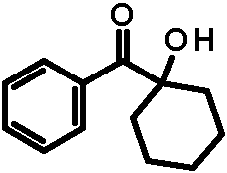
Un matraz de 500 ml de múltiples bocas con camisa de doble pared, equipado con un agitador mecánico, condensador de reflujo, termómetro y un embudo de adición conectado a un termostato, se carga con 75,3 g (400 mmol) de ciclohexil fenil cetona, 2,58 g (8 mmol) de bromuro de tetrabutilamonio y 373,3 g (2,80 mol) de solución acuosa al 30 % de hidróxido sódico. Esto se calienta con agitación a 82-85 °C y en 90 minutos se añade una solución de 96,6 g (408 mmol) de hexacloroetano en 199 g de tetracloroetileno. La mezcla de reacción se agita durante 3 horas más a 84 °C. Después, la temperatura se disminuye hasta 60 °C y se deja en reposo sin agitación para la separación de fases. La fase orgánica inferior se separa; la fase acuosa se extrae con 50 g de tetracloroetileno, las fases orgánicas se combinan y se añaden 100 g de agua. Después, el pH se ajusta a 6,0 usando ácido acético al 5 %. La fase orgánica se separa y el producto se destila al vacío.A 500 ml double-walled jacketed multi-necked flask, equipped with a mechanical stirrer, reflux condenser, thermometer, and addition funnel connected to a thermostat, is charged with 75.3 g (400 mmol) of cyclohexyl phenyl ketone. , 2.58 g (8 mmol) of tetrabutylammonium bromide and 373.3 g (2.80 mol) of 30% aqueous sodium hydroxide solution. This is heated with stirring to 82-85 ° C and in 90 minutes a solution of 96.6 g (408 mmol) of hexachloroethane in 199 g of tetrachlorethylene is added. The reaction mixture is stirred for a further 3 hours at 84 ° C. Then, the temperature is lowered to 60 ° C and allowed to stand without stirring for phase separation. The lower organic phase is separated; the aqueous phase is extracted with 50 g of tetrachlorethylene, the organic phases are combined and 100 g of water are added. The pH is then adjusted to 6.0 using 5% acetic acid. The organic phase is separated and the product is distilled under vacuum.
Rendimiento: 66,3 g (81,2 %) de (1-hidroxiciclohexil) fenil cetona (Irgacure 184) en forma de un aceite de color amarillo pálido; p.e. 143 °C, 0,7 mbar, pureza del 95 % (GC). Los datos de RMN son idénticos a los datos de una muestra de referencia auténtica.Yield: 66.3 g (81.2%) of (1-hydroxycyclohexyl) phenyl ketone (Irgacure 184) as a pale yellow oil; e.g. 143 ° C, 0.7 mbar, 95% purity (GC). The NMR data is identical to the data from an authentic reference sample.
El tetracloroetileno (p.e. 55 °C, 200 mbar) se recupera casi cuantitativamente (97 %, pureza del 99,5 %).Tetrachlorethylene (e.g. 55 ° C, 200 mbar) is recovered almost quantitatively (97%, purity 99.5%).
Ejemplo 3: Preparación de 2-h¡drox¡-2-met¡l-1-(4-v¡n¡lfenil)propan-1-onaExample 3: Preparation of 2-hydrox¡-2-methyl-1- (4-v¡n¡phenyl) propan-1-one
rrVoHrrVoH
En un matraz de 500 ml de múltiples bocas con camisa de doble pared, equipado con un termómetro, condensador de reflujo y un agitador mecánico, se cargan 4-vinilisobutirofenona (1,20 g, 6,89 mmol), bromuro de tetrabutilamonio (44 mg, 0,14 mmol), solución al 30 % de hidróxido sódico (6,5 g, 48,8 mmol), tetracloroetileno (6 g) y ProStab (solución al 1 % en tolueno, 0,02 g). La mezcla se calienta a 50 °C con agitación y se añade gota a gota una solución de hexacloroetano (2,19 g, 9,25 mmol) en tetracloroetileno (5 g) en un tiempo de 30 minutos. La agitación se continúa durante una noche a 50 °C, la mezcla de reacción se enfría a temperatura ambiente y se extrae con tetracloroetileno (3 x 10 ml). La fase orgánica se acidifica a pH 4 con ácido acético al 5 %, se lava con agua (3 x 10 ml) y se seca con sulfato sódico. El disolvente se evapora para dar el producto [1,12 g, 5,89 mmol, 86 %] en forma de un aceite de color amarillo pálido.Charge 4-vinylisobutyrophenone (1.20 g, 6.89 mmol), tetrabutylammonium bromide (44 mg, 0.14 mmol), 30% sodium hydroxide solution (6.5 g, 48.8 mmol), tetrachlorethylene (6 g) and ProStab (1% solution in toluene, 0.02 g). The mixture is heated to 50 ° C with stirring and a solution of hexachloroethane (2.19 g, 9.25 mmol) in tetrachlorethylene (5 g) is added dropwise in a time of 30 minutes. Stirring is continued overnight at 50 ° C, the reaction mixture is cooled to room temperature and extracted with tetrachlorethylene (3 x 10 ml). The organic phase is acidified to pH 4 with 5% acetic acid, washed with water (3 x 10 ml) and dried over sodium sulfate. The solvent is evaporated to give the product [1.12 g, 5.89 mmol, 86%] as a pale yellow oil.
1H RMN (400,1 MHz, CDCla): 5 = 1,61 (s, 6 H), 4,16 (s a, 1 H), 5,40 (dd, 1 H), 5,87 (dd, 1 H), 6,74 (dd, 1 H), 7,44-7,48 (m, 2 H), 7,98-8,02 ppm (m, 2 H). 1H NMR (400.1 MHz, CDCla): 5 = 1.61 (s, 6H), 4.16 (bs, 1H), 5.40 (dd, 1H), 5.87 (dd, 1 H), 6.74 (dd, 1H), 7.44-7.48 (m, 2H), 7.98-8.02 ppm (m, 2H).
Ejemplo 4: Preparación de 1-(4-al¡lox¡-3.5-d¡met¡l-fenil)-2-h¡drox¡-2-met¡l-propan-1-onaExample 4: Preparation of 1- (4-al¡lox¡-3.5-dimethyl-phenyl) -2-hydrox¡-2-methyl-propan-1-one

A un matraz de reacción que contiene 100 ml de benceno y la solución de NaOH (40 g, 1 mol) en 40 ml de agua se le añaden bromuro de tetrabutilamonio (2 g), 1-(4-aliloxi-3,5-dimetil-fenil)-2-metil-propan-1-ona (19,15 g, 0,082 mol, preparada como se describe a continuación) y hexacloroetano (39 g, 0,165 mol). La mezcla heterogénea se agita vigorosamente en atmósfera de nitrógeno durante 90 minutos a 60 °C. Después, la mezcla se enfría a temperatura ambiente y se diluye con 300 ml de agua y 250 ml de f-butil-metil éter. La fase orgánica se separa y la fase acuosa se extrae con 200 ml de t-butil-metil éter. Las fases orgánicas combinadas se secan sobre sulfato de magnesio y se evaporan. El producto semisólido (34 g) se cromatografía sobre gel de sílice con hexano-acetato de etilo (4:1) para proporcionar 18,69 g del producto del título en forma de un aceite de color amarillo claro.Tetrabutylammonium bromide (2 g), 1- (4-allyloxy-3,5- dimethyl-phenyl) -2-methyl-propan-1-one (19.15 g, 0.082 mol, prepared as described below) and hexachloroethane (39 g, 0.165 mol). The heterogeneous mixture is vigorously stirred under nitrogen atmosphere for 90 minutes at 60 ° C. The mixture is then cooled to room temperature and diluted with 300 ml of water and 250 ml of f-butyl-methyl ether. The organic phase is separated and the aqueous phase is extracted with 200 ml of t-butyl-methyl ether. The combined organic phases are dried over magnesium sulfate and evaporated. The semi-solid product (34 g) is chromatographed on silica gel with hexane-ethyl acetate (4: 1) to provide 18.69 g of the title product as a light yellow oil.
1H RMN (CDCla, 400 MHz, 8 ppm): 7,73 (s, 2ArH), 6,15-6,07 (m, 1H), 5,48-5,47 (dd, 1H), 5,44-5,42 (dd, 1H), 4,38-4,36 (d, 2H, CH2), 4,22 (s, 1H, OH), 2,34 (s, 2xCH3), 1,64 (s, 2xCH3)1H NMR (CDCla, 400 MHz, 8 ppm): 7.73 (s, 2ArH), 6.15-6.07 (m, 1H), 5.48-5.47 (dd, 1H), 5.44 -5.42 (dd, 1H), 4.38-4.36 (d, 2H, CH 2 ), 4.22 (s, 1H, OH), 2.34 (s, 2xCH3), 1.64 ( s, 2xCH3)
Ejemplo 5 (Ejemplo comparativo con el ejemplo 4): Preparación de 1-(4-al¡lox¡-3.5-d¡met¡l-fenil)-2-h¡drox¡-2-met¡l-propan-1-ona usando tetraclorometanoExample 5 (Comparative example with example 4): Preparation of 1- (4-al¡lox¡-3.5-d¡meth¡l-phenyl) -2-hydrox¡-2-methyl-propan-1 -one using tetrachloromethane
Realizando la reacción descrita en el ejemplo 4 en condiciones similares, pero reemplazando hexacloroetano por tetraclorometano, se llega a la formación de una cantidad considerable (-10%) del subproducto 1-[4-[(2,2-diclorociclopropil)-metoxi]-3,5-dimetil-fenil]-2-hidroxi-2-metil-propan-1-ona.By carrying out the reaction described in Example 4 under similar conditions, but replacing hexachloroethane with tetrachloromethane, a considerable amount (-10%) of the by-product 1- [4 - [(2,2-dichlorocyclopropyl) -methoxy] is formed. -3,5-dimethyl-phenyl] -2-hydroxy-2-methyl-propan-1-one.

Datos analíticos para 1-[4-[(2,2-diclorociclopropil)-metoxi]-3,5-dimetil-fenil]-2-hidroxi-2-metil-propan-1-ona:Analytical data for 1- [4 - [(2,2-dichlorocyclopropyl) -methoxy] -3,5-dimethyl-phenyl] -2-hydroxy-2-methyl-propan-1-one:
Aceite incoloroColorless oil
MS para C16H20Cl2O3 (331,23); encontrado M = 331.MS for C 16 H 20 Cl 2 O3 (331.23); found M = 331.
1H RMN (CDCl3, 400 MHz, 8 ppm): 7,72 (s, 2 ArH), 4,20 (s, 1H, OH), 4,06-3,91 (m, 2H, CH2-O), 2,36 (s, 2xCH3), 2,19 2,11 (m, 1H), 1,77-1,72 (m, 1H), 1,61 (s, 2xCH3), 1,35-1,25 (s, 1H).1H NMR (CDCl3, 400 MHz, 8 ppm): 7.72 (s, 2 ArH), 4.20 (s, 1H, OH), 4.06-3.91 (m, 2H, CH 2 -O) , 2.36 (s, 2xCH3), 2.19 2.11 (m, 1H), 1.77-1.72 (m, 1H), 1.61 (s, 2xCH3), 1.35-1, 25 (s, 1H).
Ejemplo 6: Preparación de 2-h¡droxi-2-met¡l-1-(1-naft¡l)propan-1-onaExample 6: Preparation of 2-hydroxy-2-methyl-1- (1-naphthyl) propan-1-one

Usando el mismo equipo que en los ejemplos 1-5, a una mezcla de 1-isobutironaftona (1,40 g, 7,06 mmol), bromuro de tetrabutilamonio (46 mg, 0,14 mmol), solución al 30 % de hidróxido sódico (6,6 g, 49,5 mmol) y tetracloroetileno (5 g) se le añade hexacloroetano (1,84 g, 7,77 mmol) disuelto en tetracloroetileno (4 g). Esta mezcla se agita a 50 °C durante 4,5 h. Después de enfriar a temperatura ambiente, se añade ácido acético al 5 % para ajustar el pH a 4 y la fase orgánica se lava con agua (3 x 10 ml). La fase orgánica se seca sobre sulfato sódico y se evapora a sequedad. El producto en bruto se purifica por cromatografía en columna [c-C6H12/AcOEt, 4:1 v:v] y el compuesto del título se aísla en forma de un aceite de color amarillo pálido [0,95 g, 4,43 mmol, 63 %].Using the same equipment as in examples 1-5, to a mixture of 1-isobutyronaphthone (1.40 g, 7.06 mmol), tetrabutylammonium bromide (46 mg, 0.14 mmol), 30% hydroxide solution sodium (6.6 g, 49.5 mmol) and tetrachlorethylene (5 g) add hexachloroethane (1.84 g, 7.77 mmol) dissolved in tetrachlorethylene (4 g). This mixture is stirred at 50 ° C for 4.5 h. After cooling to room temperature, 5% acetic acid is added to adjust the pH to 4 and the organic phase is washed with water (3 x 10 ml). The organic phase is dried over sodium sulfate and evaporated to dryness. The crude product is purified by column chromatography [cC 6 H 12 / AcOEt, 4: 1 v: v] and the title compound is isolated as a pale yellow oil [0.95 g, 4.43 mmol, 63%].
1H RMN (400,1 MHz, CDCl3): 5 = 1,52 (s, 6 H), 3,87 (s, 1 H), 7,43 (dd, 1 H), 7,47-7,53 (m, 2 H), 7,56 (dd, 1 H), 7,73 7,79 (m, 1 H), 7,82-7,87 (m, 1 H), 7,88-7,91 ppm (m, 1 H) 1H NMR (400.1 MHz, CDCl3): 5 = 1.52 (s, 6H), 3.87 (s, 1H), 7.43 (dd, 1H), 7.47-7.53 (m, 2H), 7.56 (dd, 1H), 7.73 7.79 (m, 1H), 7.82-7.87 (m, 1H), 7.88-7, 91 ppm (m, 1H)
Ejemplo 7: Preparación de 2-h¡drox¡-2-metil-1-(2-naft¡l)propan-1-onaExample 7: Preparation of 2-hydrox¡-2-methyl-1- (2-naphthl) propan-1-one

Un matraz de tres bocas de 25 ml se carga 2-isobutironaftona (0,50 g, 2,52 mmol), bromuro de tetrabutilamonio (16 mg, 0,05 mmol), solución de hidróxido sódico (30 %, 2,35 g, 17,65 mmol) y tetracloroetileno (10 g). A esto se le añade hexacloroetano (0,66 g, 2,77 mmol), disuelto en tetracloretileno (2,5 g), y la mezcla de reacción se agita a 50 °C durante una noche. Después de enfriar a temperatura ambiente, el pH se ajusta a 4 con ácido acético al 5 % y la fase orgánica se lava con agua (3 x 10 ml). La fase orgánica se seca sobre sulfato sódico y la solución se evapora a sequedad. El producto en bruto se purifica por cromatografía en columna sobre gel de sílice [c-CaH-^/AcOEt, 9:1 v:v], proporcionando el compuesto del título en forma de un aceite de color amarillento.A 25 ml three-necked flask is charged with 2-isobutyronaphthone (0.50 g, 2.52 mmol), tetrabutylammonium bromide (16 mg, 0.05 mmol), sodium hydroxide solution (30%, 2.35 g , 17.65 mmol) and tetrachlorethylene (10 g). To this is added hexachloroethane (0.66 g, 2.77 mmol), dissolved in tetrachlorethylene (2.5 g), and the reaction mixture is stirred at 50 ° C. for one night. After cooling to room temperature, the pH is adjusted to 4 with 5 % acetic acid and the organic phase is washed with water (3 x 10 ml). The organic phase is dried over sodium sulfate and the solution is evaporated to dryness. The crude product is purified by silica gel column chromatography [c-CaH - ^ / AcOEt, 9: 1 v: v] to provide the title compound as a yellowish oil.
1H RMN (400,1 MHz, CDCh): 5 = 1,71 (s, 6 H), 4,16 (s, 1 H), 7,53-7,63 (m, 2 H), 7,85-7,89 (m, 2 H), 7,95 (dd, 1 H), 8,05 (dd, 1 H), 8,60 (d, 1 H) 1H NMR (400.1 MHz, CDCh): 5 = 1.71 (s, 6H), 4.16 (s, 1H), 7.53-7.63 (m, 2H), 7.85 -7.89 (m, 2H), 7.95 (dd, 1H), 8.05 (dd, 1H), 8.60 (d, 1H)
Ejemplo 8: Preparación de 2-h¡drox¡-2-met¡l-1-ri-r(4-v¡n¡lfen¡nmetoxil-2-naft¡llpropan-1-onaExample 8: Preparation of 2-hydrox¡-2-methyl-1-ri-r (4-v¡n¡lfen¡nmethoxyl-2-naphth¡llpropan-1-one

A una mezcla de 2-metil-1-[1-[(4-vinilfenil)metoxi]-2-naftil]propan-1-ona (0,40 g, 1,21 mmol), bromuro de tetrabutilamonio (8 mg, 0,02 mmol), solución de hidróxido sódico (al 30 %, 1,13 g, 8,47 mmol) y tetracloroetileno (3,5 g) se le añade una solución de hexacloroetano (0,32 g, 1,33 mmol) en tetracloroetileno (1 g) a 50 °C. La agitación se continúa durante 4 h a 50 °C. Después de enfriar a temperatura ambiente, la fase orgánica se separa y la fase acuosa se extrae con tetracloroetileno (3 x 10 ml). Después, el pH de la fase orgánica se ajusta a 4 (ácido acético al 5 %), y la fase orgánica se lava con agua (3 x 10 ml), se seca sobre sulfato sódico y se evapora a sequedad. El producto en bruto se somete a cromatografía en columna [c-C6H12/AcOEt, 19:1 v:v] para dar el compuesto del título [0,42 g, 1,96 mmol, 78 %] en forma de un aceite de color ligeramente amarillo.To a mixture of 2-methyl-1- [1 - [(4-vinylphenyl) methoxy] -2-naphthyl] propan-1-one (0.40 g, 1.21 mmol), tetrabutylammonium bromide (8 mg, 0.02 mmol), sodium hydroxide solution (30%, 1.13 g, 8.47 mmol) and tetrachlorethylene (3.5 g) add a hexachloroethane solution (0.32 g, 1.33 mmol ) in tetrachlorethylene (1 g) at 50 ° C. Stirring is continued for 4 h at 50 ° C. After cooling to room temperature, the organic phase is separated and the aqueous phase is extracted with tetrachlorethylene (3 x 10 ml). Then, the pH of the organic phase is adjusted to 4 (5% acetic acid), and the organic phase is washed with water (3 x 10 ml), dried over sodium sulfate and evaporated to dryness. The crude product is subjected to column chromatography [cC 6 H 12 / AcOEt, 19: 1 v: v] to give the title compound [0.42 g, 1.96 mmol, 78%] as an oil slightly yellow in color.
1H RMN (400,1 MHz, CDCla): 5 = 1,45 (s, 6 H), 3,96 (s, 1 H), 5,04 (s, 2 H), 5,27 (dd, 1 H), 5,77 (dd, 1 H), 6,73 (dd, 1 H), 7,31 (d, 1 H), 7,40-7,47 (m, 4 H), 7,51-7,57 (m, 2 H), 7,67 (d, 1 H), 7,84-7,90 (m, 1 H), 8,11-8,16 ppm (m, 1H); 13C RMN (100,6 MHz, CDCh): 5 = 27,2, 78,3, 114,4, 122,5, 124,0, 124,7, 126,6, 127,0, 127,5, 127,7, 128,3, 128,9, 130,8, 135,7, 135,9, 136,4, 137,9, 151,7, 212,0 ppm 1H NMR (400.1 MHz, CDCla): 5 = 1.45 (s, 6H), 3.96 (s, 1H), 5.04 (s, 2H), 5.27 (dd, 1 H), 5.77 (dd, 1H), 6.73 (dd, 1H), 7.31 (d, 1H), 7.40-7.47 (m, 4H), 7.51 -7.57 (m, 2H), 7.67 (d, 1H), 7.84-7.90 (m, 1H), 8.11-8.16 ppm (m, 1H); 13C NMR (100.6 MHz, CDCh): 5 = 27.2, 78.3, 114.4, 122.5, 124.0, 124.7, 126.6, 127.0, 127.5, 127 , 7, 128.3, 128.9, 130.8, 135.7, 135.9, 136.4, 137.9, 151.7, 212.0 ppm
Ejemplo 9: Preparación de 2-h¡drox¡-2-met¡l-1-r2.3.4-tr¡sr(4-v¡n¡lfen¡l)metox¡l-fenMlpropan-1-onaExample 9: Preparation of 2-hydrox¡-2-methyl-1-r2.3.4-tr¡sr (4-v¡n¡lfen¡l) methox¡l-phenMlpropan-1-one

En un matraz de tres bocas de 25 ml se cargan 2-metil-1-[2,3,4-tris[(4-vinilfenil)metoxi]fenil]propan-1-ona (250 mg, 0,46 mmol), bromuro de tetrabutilamonio (3 mg, 0,01 mmol), solución de hidróxido sódico (al 30 %, 0,43 g, 3,22 mmol) y tetracloroetileno (2,5 g). A esto se le añade una solución de hexacloroetano (120 mg, 0,50 mmol) en tetracloretileno (0,8 g). La mezcla de reacción se agita a 50 °C durante una noche. Se deja que la mezcla de reacción alcance la temperatura ambiente y se extrae con tetracloroetileno (3 x 10 ml), y la fase orgánica se ajusta a un valor de pH de 4, se lavó con agua (3 x 10 ml), se seca sobre sulfato sódico y se evapora a sequedad. El residuo se cromatografía sobre gel de sílice [heptanos/AcOEt, 4:1 v:v], dando el compuesto del título [220 mg, 0,39 mmol, 86%] en forma de un aceite de color amarillo pálido.2-methyl-1- [2,3,4-tris [(4-vinylphenyl) methoxy] phenyl] propan-1-one (250 mg, 0.46 mmol), Tetrabutylammonium bromide (3 mg, 0.01 mmol), sodium hydroxide solution (30%, 0.43 g, 3.22 mmol) and tetrachlorethylene (2.5 g). To this is added a solution of hexachloroethane (120 mg, 0.50 mmol) in tetrachlorethylene (0.8 g). The reaction mixture is stirred at 50 ° C overnight. The reaction mixture is allowed to reach room temperature and is extracted with tetrachlorethylene (3 x 10 ml), and the organic phase is adjusted to a pH value of 4, washed with water (3 x 10 ml), dried over sodium sulfate and evaporated to dryness. The residue is chromatographed on silica gel [heptanes / AcOEt, 4: 1 v: v] to give the title compound [220 mg, 0.39 mmol, 86%] as a pale yellow oil.
IGMIGM
B 15265-EP 1H RMN (400,1 MHz, CDCh): 5 = 1,35 (s, 6 H), 3,99 (s, 1 H), 5,04-5,10 (3 x s, 3 x 2 H), 5,22-5,30 (3 x dd superpuesto, 3 x 1 H), 5,71-5,79 (3 x dd superpuesto, 3 x 1 H), 6,65-6,78 (3 x dd superpuesto, 3 x 1 H), superpuesto con 6,76 (d, 1 H), 6,98 (d, 1 H), 7,20-7,44 ppm (m, 12 H); 13C RMN (100,6 MHz, CDCh): 5 = 27,3, 70,9, 75,4, 76,7, 78,0, 109,6, 123,3, 126,3, 126,4, 126,5, 127,3, 127,8, 128,9, 129,0, 135,8, 136,0, 136,4, 136,5, 136,6, 137,6, 137,7, 141,4, 150,0, 155,1, 210,4 ppmB 15265-EP 1H NMR (400.1 MHz, CDCh): 5 = 1.35 (s, 6H), 3.99 (s, 1H), 5.04-5.10 (3xs, 3x 2H), 5.22-5.30 (3 x dd overlapped, 3 x 1H), 5.71-5.79 (3 x dd overlapped, 3 x 1H), 6.65-6.78 ( 3 x dd overlaid, 3 x 1H), overlaid with 6.76 (d, 1H), 6.98 (d, 1H), 7.20-7.44 ppm (m, 12H); 13C NMR (100.6 MHz, CDCh): 5 = 27.3, 70.9, 75.4, 76.7, 78.0, 109.6, 123.3, 126.3, 126.4, 126 , 5, 127.3, 127.8, 128.9, 129.0, 135.8, 136.0, 136.4, 136.5, 136.6, 137.6, 137.7, 141.4 , 150.0, 155.1, 210.4 ppm
Ejemplo 10: Preparación de 2-h¡drox¡-2-met¡l-1-(4-met¡lt¡ofen¡l)propan-1-onaExample 10: Preparation of 2-hydrox¡-2-methyl-1- (4-methylphenil) propan-1-one

Se añadieron solución de hidróxido sódico (p = 50 %, 12,35 g, 154,4 mmol) y bromuro de tetrabutilamonio (0,15 g, 0,46 mmol) a una solución de 2-metil-1-(4-metiltiofenil)-propan-1-ona (3,00 g, 15,4 mmol) y hexacloroetano (5,48 g, 23,16 mmol) en tetracloroetileno (8 ml). La mezcla de reacción se agitó a 50 °C durante cuatro horas. La solución resultante se recogió con agua (20 ml) y las fases se separaron. El pH de la capa acuosa se ajustó a 3 con solución diluida de HCI. Después, se extrajo con tetracloroetileno (3 x 50 ml). Las fases orgánicas combinadas se lavaron con salmuera (50 ml), se secaron sobre sulfato sódico y el disolvente se retiró a presión reducida. El producto en bruto se obtuvo en forma de un aceite de color amarillo (2,96 g, 14,1 mmol, rendimiento del 91 %).Sodium hydroxide solution (p = 50%, 12.35 g, 154.4 mmol) and tetrabutylammonium bromide (0.15 g, 0.46 mmol) were added to a solution of 2-methyl-1- (4- methylthiophenyl) -propan-1-one (3.00 g, 15.4 mmol) and hexachloroethane (5.48 g, 23.16 mmol) in tetrachlorethylene (8 ml). The reaction mixture was stirred at 50 ° C for four hours. The solution The resulting mixture was taken up with water (20 ml) and the phases were separated. The pH of the aqueous layer was adjusted to 3 with dilute HCl solution. Then it was extracted with tetrachlorethylene (3 x 50 ml). The combined organic phases were washed with brine (50 ml), dried over sodium sulfate and the solvent was removed under reduced pressure. The crude product was obtained as a yellow oil (2.96 g, 14.1 mmol, 91% yield).
1H RMN (400,1 MHz, CDCh): 5 = 1,64 (s, 6H), 2,54 (s, 3H), 4,12 (s ancho, 1H), 7,26-7,32 (m, 2H), 7,96-8,02 (m, 2 H) ppm. 13C RMN (100,6 MHz, CDCla): 5 = 14,7, 28,6, 76,1, 124,79, 129,4, 130,3, 146,3 ppm. 1H NMR (400.1 MHz, CDCh): 5 = 1.64 (s, 6H), 2.54 (s, 3H), 4.12 (s broad, 1H), 7.26-7.32 (m , 2H), 7.96-8.02 (m, 2H) ppm. 13C NMR (100.6 MHz, CDCla): 5 = 14.7, 28.6, 76.1, 124.79, 129.4, 130.3, 146.3 ppm.
Ejemplo de referencia 11: Preparación de 2-met¡l-1-(4-met¡lt¡ofen¡l)-2-morfol¡n-propan-1-onaReference Example 11: Preparation of 2-methyl-1- (4-methylphenil) -2-morpholin-propan-1-one

Una mezcla de metóxido sódico (al 30 % en metanol, 5,56 g, 30,9 mmol), metanol (5), 2-metil-1-(4-metiltiofenil)propan-1-ona (1,00 g, 5,14 mmol) y hexacloroetano (1,34 g, 5,66 mmol) se agitó a temperatura ambiente durante 2 d. Después, el metanol se retiró de la mezcla de reacción por destilación a presión reducida y se añadieron morfolina (22,4 g, 257 mmol) y solución de hidróxido sódico (al 50 %, 4,12 g, 51,5 mmol). La mezcla de reacción se agitó a la temperatura de reflujo durante 10 h. Después, la mezcla de reacción se enfrió a temperatura ambiente, el disolvente se evaporó a presión reducida y el residuo se recogió con agua (30 ml). Las fases se separaron y el pH de la capa acuosa se ajustó a 1,0 con solución de ácido clorhídrico (1 M). La capa acuosa se extrajo con ferc-butilmetiléter (3 x 50 ml) para retirar las impurezas. Después, el pH de la capa acuosa se ajustó a 14,0 con solución de hidróxido sódico (al 50 %) y se extrajo de nuevo con ferc-butilmetiléter (3 x 50 ml). Las capas orgánicas combinadas de la segunda extracción se lavaron con salmuera (50 ml), se secaron sobre Na2SO4 y el disolvente se retiró al vacío. El producto en bruto de 2-metil-1-(4-metiltiofenil)-2-morfolin-propan-1-ona se obtuvo en forma de cristales de color ligeramente amarillento, (0,91 g, 3,3 mmol, rendimiento del 63 %).A mixture of sodium methoxide (30% in methanol, 5.56 g, 30.9 mmol), methanol (5), 2-methyl-1- (4-methylthiophenyl) propan-1-one (1.00 g, 5.14 mmol) and hexachloroethane (1.34 g, 5.66 mmol) was stirred at room temperature for 2 d. Then, the methanol was removed from the reaction mixture by distillation under reduced pressure and morpholine (22.4 g, 257 mmol) and sodium hydroxide solution (50%, 4.12 g, 51.5 mmol) were added. The reaction mixture was stirred at reflux temperature for 10 h. Then the reaction mixture was cooled to room temperature, the solvent was evaporated under reduced pressure and the residue was taken up with water (30 ml). The phases were separated and the pH of the aqueous layer was adjusted to 1.0 with hydrochloric acid solution (1M). The aqueous layer was extracted with tert-butyl methyl ether (3 x 50 ml) to remove impurities. Then, the pH of the aqueous layer was adjusted to 14.0 with sodium hydroxide solution (50%) and extracted again with tert-butylmethyl ether (3 x 50 ml). The combined organic layers from the second extraction were washed with brine (50 ml), dried over Na 2 SO 4 and the solvent was removed in vacuo. The crude product of 2-methyl-1- (4-methylthiophenyl) -2-morpholin-propan-1-one was obtained as slightly yellowish crystals, (0.91 g, 3.3 mmol, yield of 63%).
1H RMN (400,1 MHz, CDCh): 5 = 1,31 (s, 6H), 2,53 (s, 3H), 2,55-2,61 (m, 4H), 3,66-3,73 (m, 4H), 7,20-7,26 (m, 2H), 8,49-8,54 (m, 2 H) ppm. 13C RMN (100,6 MHz, CDCh): 5 = 14,4, 20,4, 47,2, 67,3, 68,3, 124,3, 130,3, 131,8, 144,9, 201,9 ppm. Punto de fusión: 66-68 °C 1H NMR (400.1 MHz, CDCh): 5 = 1.31 (s, 6H), 2.53 (s, 3H), 2.55-2.61 (m, 4H), 3.66-3, 73 (m, 4H), 7.20-7.26 (m, 2H), 8.49-8.54 (m, 2H) ppm. 13C NMR (100.6 MHz, CDCh): 5 = 14.4, 20.4, 47.2, 67.3, 68.3, 124.3, 130.3, 131.8, 144.9, 201 , 9 ppm. Melting point: 66-68 ° C
Ejemplo 12: Preparación de 2-etil-2-h¡drox¡-1-fen¡l-butan-1-onaExample 12: Preparation of 2-ethyl-2-hydrox¡-1-phenyl-butan-1-one

Se añadieron solución de hidróxido sódico (p = 50 %, 9,08 g, 113 mmol) e hidrogenosulfato de tetrabutilamonio (0,19 g, 0,57 mmol) a una solución de 2-etil-1-fenil-butan-1-ona (2,00 g, 11,4 mmol) y hexacloroetano (2,96 g, 12,48 mmol) en tetracloroetileno (12 ml). La mezcla de reacción se agitó a 50 °C durante 1,5 d. La solución resultante se recogió con agua (20 ml) y las fases se separaron. El pH de la capa acuosa se ajustó a 3 con solución diluida de HCl (1 M) y se extrajo con tetracloroetileno (3 x 50 ml). Las fases orgánicas combinadas se lavaron con salmuera (50 ml), se secaron sobre sulfato sódico y el disolvente se retiró a presión reducida. Se obtuvo 2-etil-2-hidroxi-1-fenil-butan-1-ona en forma de un aceite incoloro (2,09 g, 10,9 mmol, rendimiento del 96 %).Sodium hydroxide solution (p = 50%, 9.08 g, 113 mmol) and tetrabutylammonium hydrogen sulfate (0.19 g, 0.57 mmol) were added to a solution of 2-ethyl-1-phenyl-butane-1 -one (2.00 g, 11.4 mmol) and hexachloroethane (2.96 g, 12.48 mmol) in tetrachlorethylene (12 ml). The reaction mixture was stirred at 50 ° C for 1.5 d. The resulting solution was taken up with water (20 ml) and the phases were separated. The pH of the aqueous layer was adjusted to 3 with dilute HCl solution (1 M) and extracted with tetrachlorethylene (3 x 50 ml). The combined organic phases were washed with brine (50 ml), dried over sodium sulfate and the solvent was removed under reduced pressure. 2-Ethyl-2-hydroxy-1-phenyl-butan-1-one was obtained as a colorless oil (2.09 g, 10.9 mmol, 96% yield).
1H RMN (400,1 MHz, CDCh): 5 = 0,82-0,86 (t, 6H), 1,92-2,04 (m, 2H), 2,06-2,18 (m, 2H), 4,39 (s, 1H), 7,45-7,54 (m, 2H), 7,58-7,65 (m, 1H), 7,97-8,05 (m, 2H) ppm. 1H NMR (400.1 MHz, CDCh): 5 = 0.82-0.86 (t, 6H), 1.92-2.04 (m, 2H), 2.06-2.18 (m, 2H ), 4.39 (s, 1H), 7.45-7.54 (m, 2H), 7.58-7.65 (m, 1H), 7.97-8.05 (m, 2H) ppm .
Ejemplo 13: Preparación de 2-met¡l-1-(4-met¡lt¡ofen¡l)-2-morfol¡n-propan-1-onaExample 13: Preparation of 2-methyl-1- (4-methylphenil) -2-morpholin-propan-1-one

Una mezcla de metóxido sódico (al 30 % en metanol, 5,56 g, 30,9 mmol), metanol (5), 2-metil-1-(4-metiltiofenil)propan-1-ona (1,00 g, 5,14 mmol) y hexacloroetano (1,34 g, 5,66 mmol) se agitó a 40 °C durante 24 h. Después, se añadió morfolina (22,4 g, 257 mmol) y el metanol se retiró de la mezcla de reacción por destilación. Después, se añadieron solución de hidróxido sódico (al 50 %, 4,12 g, 51,5 mmol) e hidrogenosulfato de tetrabutilamonio (0,09 g, 0,27 mmol) y la mezcla de reacción se agitó a la temperatura de reflujo durante 10 h. Después, la mezcla de reacción se enfrió a temperatura ambiente, el disolvente se evaporó a presión reducida y el residuo se recogió con agua (30 ml). Las fases se separaron y el pH de la capa acuosa se ajustó a 7 con solución saturada de cloruro de amonio. La capa acuosa se extrajo con acetato de etilo (3 x 50 ml). Las capas orgánicas combinadas se lavaron con salmuera (50 ml), se secaron sobre Na2SO4 y el disolvente se evaporó. El producto en bruto se purificó por cromatografía preparativa de capa fina sobre gel de sílice [ciclohexano/acetato de etilo, 5:1 v:v]. Se obtuvo 2-metil-1-(4-metiltiofenil)-2-morfolin-propan-1-ona en forma de un aceite incoloro (0,95 g, 3,2 mmol, rendimiento del 61 %).A mixture of sodium methoxide (30% in methanol, 5.56 g, 30.9 mmol), methanol (5), 2-methyl-1- (4-methylthiophenyl) propan-1-one (1.00 g, 5.14 mmol) and hexachloroethane (1.34 g, 5.66 mmol) was stirred at 40 ° C for 24 h. Then morpholine (22.4 g, 257 mmol) was added and the methanol was removed from the reaction mixture by distillation. Then, sodium hydroxide solution (50%, 4.12 g, 51.5 mmol) and tetrabutylammonium hydrogen sulfate (0.09 g, 0.27 mmol) were added and the reaction mixture was stirred at reflux temperature. for 10 h. Then the reaction mixture was cooled to room temperature, the solvent was evaporated under reduced pressure and the residue was taken up with water (30 ml). The phases were separated and the pH of the aqueous layer was adjusted to 7 with saturated ammonium chloride solution. The aqueous layer was extracted with ethyl acetate (3 x 50 ml). The combined organic layers were washed with brine (50 ml), dried Na 2 SO 4 and the solvent was evaporated. The crude product was purified by preparative thin layer chromatography on silica gel [cyclohexane / ethyl acetate, 5: 1 v: v]. 2-Methyl-1- (4-methylthiophenyl) -2-morpholin-propan-1-one was obtained as a colorless oil (0.95 g, 3.2 mmol, 61% yield).
1H RMN (400,1 MHz, CDCh): 5 = 1,31 (s, 6H), 2,53 (s, 3H), 2,55-2,61 (m, 4H), 3,66-3,73 (m, 4H), 7,20-7,26 (m, 2H), 8,49-8,54 (m, 2 H) ppm. 13C RMN (100,6 MHz, CDCla): 5 = 14,4, 20,4, 47,2, 67,3, 68,3, 124,3, 130,3, 131,8, 144,9, 201,9 ppm. 1H NMR (400.1 MHz, CDCh): 5 = 1.31 (s, 6H), 2.53 (s, 3H), 2.55-2.61 (m, 4H), 3.66-3, 73 (m, 4H), 7.20-7.26 (m, 2H), 8.49-8.54 (m, 2H) ppm. 13C NMR (100.6 MHz, CDCla): 5 = 14.4, 20.4, 47.2, 67.3, 68.3, 124.3, 130.3, 131.8, 144.9, 201 , 9 ppm.
Ejemplo de referencia 14: Preparación de 2-met¡l-2-morfolin-1-fen¡lpropan-1-onaReference Example 14: Preparation of 2-methyl-2-morpholin-1-phenylpropan-1-one

Una mezcla de metóxido sódico (al 30 % en metanol, 22,1 g, 0,410 mol), metanol (30 ml), isobutirofenona (10,12 g, 68,28 mmol) y hexacloroetano (32,33 g, 136,6 mmol) se agitó a 40 °C durante 2 d. Después, se añadieron más cantidad de metóxido sódico (al 30 % en metanol, 11,85 g, 0,221 mol) y otro equivalente de hexaxhloroetano (16,2 g, 68.3 mmol) y la mezcla de reacción se agitó a 50 °C durante 6 h. Después, el metanol se retiró de la mezcla de reacción por destilación a presión reducida y se añadieron morfolina (150 g, 1,72 mol) y solución de hidróxido sódico (al 50 %, 54.6 g, 0,683 mol). La mezcla de reacción se agitó durante una noche a 110 °C. Después, se enfrió a temperatura ambiente y se vertió lentamente en una solución conc. de ácido clorhídrico (500 ml). La capa acuosa se separó, el pH se ajustó a 0 mediante la adición de más cantidad de solución conc. de ácido clorhídrico y después se extrajo con terc-butilmetiléter (3 x 200 ml) para retirar las impurezas. Después, el pH de la capa acuosa se ajustó a 14 con solución de hidróxido sódico (al 50 %) y se extrajo de nuevo con terc-butilmetiléter (3 x 200 ml). Las capas orgánicas combinadas de la segunda extracción se lavaron con salmuera (2 x 100 ml), se secaron sobre Na2SO4 y el disolvente se evaporó. El producto en bruto de 2-metil-2-morfolin-1-fenilpropan-1-ona se obtuvo en forma de cristales de color rojo, (7,60 g, 32.6 mmol, rendimiento del 48 %).A mixture of sodium methoxide (30% in methanol, 22.1 g, 0.410 mol), methanol (30 ml), isobutyrophenone (10.12 g, 68.28 mmol), and hexachloroethane (32.33 g, 136.6 mmol) was stirred at 40 ° C for 2 d. Then more sodium methoxide (30% in methanol, 11.85 g, 0.221 mol) and another equivalent of hexaxhloroethane (16.2 g, 68.3 mmol) were added and the reaction mixture was stirred at 50 ° C for 6 h. Then, the methanol was removed from the reaction mixture by distillation under reduced pressure and morpholine (150 g, 1.72 mol) and sodium hydroxide solution (50%, 54.6 g, 0.683 mol) were added. The reaction mixture was stirred overnight at 110 ° C. Then it was cooled to room temperature and slowly poured into a conc. Solution. of hydrochloric acid (500 ml). The aqueous layer was separated, the pH was adjusted to 0 by adding more of the conc. Solution. of hydrochloric acid and then extracted with tert- butyl methyl ether (3 x 200 ml) to remove impurities. Then, the pH of the aqueous layer was adjusted to 14 with sodium hydroxide solution (50%) and extracted again with tert-butyl methyl ether (3 x 200 ml). The combined organic layers from the second extraction were washed with brine (2 x 100 ml), dried over Na 2 SO 4 and the solvent was evaporated. The crude product of 2-methyl-2-morpholin-1-phenylpropan-1-one was obtained as red crystals, (7.60 g, 32.6 mmol, 48% yield).
1H RMN (400,1 MHz, CDCh): 5 = 1,34 (s, 6H), 2,57-2,63 (m, 4H), 3,68-3,76 (m, 4H), 7,40-7,46 (m, 2H), 7,50-7,54 (m, 1H), 8,53-8,58 (m, 2H) ppm. 13C RMN (100,6 MHz, CDCh): 5 = 20,3, 47,1, 67,4, 68,4, 124,9, 130,3, 132,4, 135,9, 203.3 ppm. Punto de fusión: 79-81 °C 1H NMR (400.1 MHz, CDCh): 5 = 1.34 (s, 6H), 2.57-2.63 (m, 4H), 3.68-3.76 (m, 4H), 7, 40-7.46 (m, 2H), 7.50-7.54 (m, 1H), 8.53-8.58 (m, 2H) ppm. 13C NMR (100.6 MHz, CDCh): 5 = 20.3, 47.1, 67.4, 68.4, 124.9, 130.3, 132.4, 135.9, 203.3 ppm. Melting point: 79-81 ° C
Ejemplo de referencia 15: Preparación de 2-met¡l-2-morfol¡n-1-(4-v¡n¡lfen¡l)propan-1-onaReference Example 15: Preparation of 2-methyl-2-morpholin-1- (4-v¡n¡lfen¡l) propan-1-one

Una mezcla de metóxido sódico (al 30 % en metanol, 3,72 g, 68,9 mmol), metanol (5 ml), 2-metil-1-(4-vinilfenil)propan-1-ona (2,00 g, 11,5 mmol) y hexacloroetano (5,45 g, 23,0 mmol) se agitó a 40 °C durante 2 d. Después, se añadieron más cantidad de metóxido sódico (al 30% en metanol, 1,85 g, 34,2 mmol) y otro equivalente de hexacloroetano (2,75 g, 11,4 mmol) y la mezcla de reacción se agitó a 50 °C durante 6 h. Después, el metanol se retiró de la mezcla de reacción por destilación a presión reducida y se añadieron morfolina (25,0 g, 0,287 mol) y solución de hidróxido sódico (al 50 %, 9,18 g, 0,115 mol). La mezcla de reacción se agitó durante una noche a 110 °C. Después, se enfrió a temperatura ambiente y se vertió lentamente en una solución conc. de ácido clorhídrico (50 ml). La capa acuosa se separó, el pH se ajustó a 0 mediante la adición de más cantidad de solución conc. de ácido clorhídrico y después se extrajo con terc-butilmetiléter (3 x 20 ml) para retirar las impurezas. Después, el pH de la capa acuosa se ajustó a 14 con solución de hidróxido sódico (al 50 %) y se extrajo de nuevo con terc-butilmetiléter (3 x 20 ml). Las capas orgánicas combinadas de la segunda extracción se lavaron con salmuera (2 x 10 ml), se secaron sobre Na2SO4 y el disolvente se evaporó. El producto en bruto se purificó por cromatografía preparativa de capa fina sobre gel de sílice (c-C6H1 2 : AcOEt = 2 : 1, v: v). Se obtuvo 2-metil-2-morfolin-1-(4-vinilfenil)propan-1-ona en forma de un aceite incoloro, (1,78 g, 6,86 mmol, rendimiento del 60 %). 1H RMN (400,1 MHz, CDCh): 5 = 1,35 (s, 6H), 2,59-2,62 (m, 4H), 3,71-3,73 (m, 4H), 5,39 (dd, 1H), 5,89 (dd, 1H), 6,77 (dd, 1H), 7,42-7,50 (m, 2H), 8,51-8,58 (m, 2H) ppm. 13C RMN (100,6 MHz, CDCh): 5 = 20,2, 47,1, 67,4, 68,4, 116,3, 125,6, 130,7, 134,9, 136,1, 141,4, 202,6 ppm. A mixture of sodium methoxide (30% in methanol, 3.72 g, 68.9 mmol), methanol (5 ml), 2-methyl-1- (4-vinylphenyl) propan-1-one (2.00 g , 11.5 mmol) and hexachloroethane (5.45 g, 23.0 mmol) was stirred at 40 ° C for 2 d. Then more sodium methoxide (30% in methanol, 1.85 g, 34.2 mmol) and another equivalent of hexachloroethane (2.75 g, 11.4 mmol) were added and the reaction mixture was stirred at 50 ° C for 6 h. Then, the methanol was removed from the reaction mixture by distillation under reduced pressure and morpholine (25.0 g, 0.287 mol) and sodium hydroxide solution (50%, 9.18 g, 0.115 mol) were added. The reaction mixture was stirred overnight at 110 ° C. Then it was cooled to room temperature and slowly poured into a conc. Solution. of hydrochloric acid (50 ml). The aqueous layer was separated, the pH was adjusted to 0 by adding more of the conc. Solution. of hydrochloric acid and then extracted with tert-butyl methyl ether (3 x 20 ml) to remove impurities. Then, the pH of the aqueous layer was adjusted to 14 with sodium hydroxide solution (50%) and extracted again with tert-butyl methyl ether (3 x 20 ml). The combined organic layers from the second extraction were washed with brine (2 x 10 ml), dried over Na 2 SO 4 and the solvent was evaporated. The crude product was purified by preparative thin layer chromatography on silica gel (cC 6 H 1 2 : AcOEt = 2: 1, v: v). 2-methyl-2-morpholin-1- (4-vinylphenyl) propan-1-one was obtained as a colorless oil, (1.78 g, 6.86 mmol, 60% yield). 1H NMR (400.1 MHz, CDCh): 5 = 1.35 (s, 6H), 2.59-2.62 (m, 4H), 3.71-3.73 (m, 4H), 5, 39 (dd, 1H), 5.89 (dd, 1H), 6.77 (dd, 1H), 7.42-7.50 (m, 2H), 8.51-8.58 (m, 2H) ppm. 13C NMR (100.6 MHz, CDCh): 5 = 20.2, 47.1, 67.4, 68.4, 116.3, 125.6, 130.7, 134.9, 136.1, 141 , 4,202.6 ppm.
Claims (21)


Applications Claiming Priority (1)
| Application Number | Priority Date | Filing Date | Title |
|---|---|---|---|
| EP17167814.7A EP3395793B9 (en) | 2017-04-24 | 2017-04-24 | Process for the preparation of alpha-functionalized ketones |
Publications (1)
| Publication Number | Publication Date |
|---|---|
| ES2867807T3 true ES2867807T3 (en) | 2021-10-20 |
Family
ID=58606196
Family Applications (1)
| Application Number | Title | Priority Date | Filing Date |
|---|---|---|---|
| ES17167814T Active ES2867807T3 (en) | 2017-04-24 | 2017-04-24 | Process for the preparation of α-functionalized ketones |
Country Status (8)
| Country | Link |
|---|---|
| US (1) | US12410114B2 (en) |
| EP (2) | EP3395793B9 (en) |
| JP (1) | JP6856203B2 (en) |
| CN (1) | CN110494414B (en) |
| BR (1) | BR112019022143A2 (en) |
| ES (1) | ES2867807T3 (en) |
| TW (1) | TWI665182B (en) |
| WO (1) | WO2018197325A1 (en) |
Family Cites Families (21)
| Publication number | Priority date | Publication date | Assignee | Title |
|---|---|---|---|---|
| FR1422701A (en) * | 1964-01-29 | 1965-12-24 | Horizons Inc | Composition for photoresists and method of preparation |
| DE2722264C2 (en) | 1977-05-17 | 1984-06-28 | Merck Patent Gmbh, 6100 Darmstadt | Use of substituted oxyalkylphenones as photosensitizers |
| US4318791A (en) * | 1977-12-22 | 1982-03-09 | Ciba-Geigy Corporation | Use of aromatic-aliphatic ketones as photo sensitizers |
| DE3008411A1 (en) * | 1980-03-05 | 1981-09-10 | Merck Patent Gmbh, 6100 Darmstadt | NEW AROMATIC-ALIPHATIC KETONES, THEIR USE AS PHOTOINITIATORS AND PHOTOPOLYMERIZABLE SYSTEMS CONTAINING SUCH KETONES |
| DE3360384D1 (en) * | 1982-05-07 | 1985-08-14 | Ciba Geigy Ag | Process for the preparation of 1-hydroxyketones |
| DE3512179A1 (en) * | 1985-04-03 | 1986-12-04 | Merck Patent Gmbh, 6100 Darmstadt | PHOTO INITIATORS FOR PHOTOPOLYMERIZATION IN AQUEOUS SYSTEMS |
| DE3512541A1 (en) | 1985-04-06 | 1986-10-16 | Merck Patent Gmbh, 6100 Darmstadt | METHOD FOR PRODUCING KETONES |
| DE3738567A1 (en) | 1987-03-12 | 1988-09-22 | Merck Patent Gmbh | COREACTIVE PHOTOINITIATORS |
| DE69216678T2 (en) * | 1991-04-26 | 1997-07-24 | Agfa Gevaert Nv | Luminescent screen with protective layer and manufacturing |
| US5723511A (en) | 1996-06-17 | 1998-03-03 | Xerox Corporation | Processes for preparing telechelic, branched and star thermoplastic resin polymers |
| JP3769075B2 (en) | 1996-07-08 | 2006-04-19 | Jsr株式会社 | Radiation curable resin composition |
| WO1999048963A2 (en) * | 1998-03-25 | 1999-09-30 | Chevron Phillips Chemical Company Lp | Oxygen scavengers with reduced oxidation products for use in plastic films and beverage and food containers |
| US6376568B1 (en) * | 1999-07-29 | 2002-04-23 | Ciba Specialty Chemicals Corporation | Surface-active photoinitiators |
| EP1146033B1 (en) * | 2000-04-10 | 2009-12-23 | Givaudan SA | Fragrance precursors |
| US6517776B1 (en) * | 2000-11-03 | 2003-02-11 | Chevron Phillips Chemical Company Lp | UV oxygen scavenging initiation in angular preformed packaging articles |
| MXPA05011543A (en) | 2003-05-06 | 2005-12-14 | Ciba Sc Holding Ag | Novel trifunctional photoinitiators. |
| ATE402920T1 (en) * | 2004-09-29 | 2008-08-15 | Ciba Holding Inc | METHOD FOR PRODUCING AROMATIC THIOPHENYLKETONES |
| JP2013254105A (en) | 2012-06-07 | 2013-12-19 | Gunze Ltd | Light diffusion heat shrinkable tube and straight-tube led light |
| US10588980B2 (en) | 2014-06-23 | 2020-03-17 | Novartis Ag | Fatty acids and their use in conjugation to biomolecules |
| JP5812167B2 (en) | 2014-08-18 | 2015-11-11 | 井関農機株式会社 | Seedling transplanter |
| CN118748989A (en) | 2022-01-19 | 2024-10-08 | 氧乙烯有限合伙公司 | Oxychlorination process |
-
2017
- 2017-04-24 ES ES17167814T patent/ES2867807T3/en active Active
- 2017-04-24 EP EP17167814.7A patent/EP3395793B9/en active Active
-
2018
- 2018-04-19 CN CN201880023820.9A patent/CN110494414B/en active Active
- 2018-04-19 EP EP18718464.3A patent/EP3615501A1/en active Pending
- 2018-04-19 US US16/603,533 patent/US12410114B2/en active Active
- 2018-04-19 BR BR112019022143-3A patent/BR112019022143A2/en active Search and Examination
- 2018-04-19 WO PCT/EP2018/060012 patent/WO2018197325A1/en not_active Ceased
- 2018-04-19 TW TW107113295A patent/TWI665182B/en active
- 2018-04-19 JP JP2019552906A patent/JP6856203B2/en not_active Expired - Fee Related
Also Published As
| Publication number | Publication date |
|---|---|
| EP3395793A1 (en) | 2018-10-31 |
| TWI665182B (en) | 2019-07-11 |
| CN110494414B (en) | 2022-07-12 |
| WO2018197325A1 (en) | 2018-11-01 |
| EP3395793B9 (en) | 2021-09-29 |
| JP6856203B2 (en) | 2021-04-07 |
| JP2020517583A (en) | 2020-06-18 |
| EP3395793B1 (en) | 2021-03-17 |
| TW201841876A (en) | 2018-12-01 |
| BR112019022143A2 (en) | 2020-05-12 |
| US12410114B2 (en) | 2025-09-09 |
| EP3615501A1 (en) | 2020-03-04 |
| CN110494414A (en) | 2019-11-22 |
| US20200055806A1 (en) | 2020-02-20 |
Similar Documents
| Publication | Publication Date | Title |
|---|---|---|
| WO2011124130A1 (en) | 1-methoxyl-2,6,10-trimethyl-1,3,5,9-undec-tetraene and preparation method and uses thereof | |
| JP7023166B2 (en) | (9E, 11Z) -9,11-Hexadecadienal manufacturing method | |
| ES2867807T3 (en) | Process for the preparation of α-functionalized ketones | |
| US10494322B2 (en) | Method for producing 3,7-dimethyl-7-octenol and method for producing 3,7-dimethyl-7-octenyl carboxylate compound | |
| TW201833069A (en) | Novel method for the synthesis of 1-aryl-1-trifluoromethylcyclopropane | |
| Ballester et al. | Synthesis of prenylated quinones by the oxidative degradation approach. Birch vs vinylogous Birch hydrogenolysis (BIHY vs VIBIHY) in controlling 2. DELTA. stereochemistry of the prenyl chain | |
| US11203580B2 (en) | Simple oxidative functionalized of alkyl aryl ketones | |
| EP0152324B1 (en) | Tetraene, its preparation and its use | |
| CN102924246B (en) | A kind of preparation method of 2,6,10-trimethyl-2,5,9-undecatriene-1-al | |
| CN114514217B (en) | Method for producing 2,4-dialkylbenzaldehyde | |
| Alcazar et al. | A Convenient and Stereoselective Synthesis of (3Z, 5Z)-5-Fluorotetrade Cadien-1-yl Acetate, A Fluorinated Analog of the sex Pheromone of the Carpenterworm Prionoxistus robiniae (Peck) | |
| JP2502936B2 (en) | Novel acetylene derivative | |
| CN109195942B (en) | Method for preparing polyssantalol compounds | |
| JP4958513B2 (en) | Method for producing sedanenolide | |
| PL241187B1 (en) | (EZ, 2 EZ) -3, 7-dimethyl-N- (oxiran-2 (RS) -ylmethoxy) octa-2,6-diene-1-imine and its preparation | |
| Bunce et al. | (±)-3, 4, 4a, 5, 6, 7-Hexahydro-4a-Methyl-7, 7-Diphenyl-1 (2 H)-Naphthtlenone | |
| Al-Saeedi et al. | Synthesis of [9, 10-Dihydro-9-(2-methylaminoethyl)-9, 10-propanoanthracene] | |
| JPH10316621A (en) | Method for producing cyclopropylacrylic acid derivative | |
| JPH0529355B2 (en) | ||
| JPS6157318B2 (en) | ||
| JPS6126533B2 (en) | ||
| JP2006104203A (en) | 1-acetoxy-3- (substituted phenyl) propene compound | |
| JP2016023159A (en) | Method for producing long-chain vicinal diol | |
| JP2005145953A (en) | Method for producing furanones and novel esters |