ES2717536T3 - Chromatography of overload and elution - Google Patents
Chromatography of overload and elution Download PDFInfo
- Publication number
- ES2717536T3 ES2717536T3 ES17157670T ES17157670T ES2717536T3 ES 2717536 T3 ES2717536 T3 ES 2717536T3 ES 17157670 T ES17157670 T ES 17157670T ES 17157670 T ES17157670 T ES 17157670T ES 2717536 T3 ES2717536 T3 ES 2717536T3
- Authority
- ES
- Spain
- Prior art keywords
- antibody
- chromatography
- polypeptide
- buffer
- antibodies
- Prior art date
- Legal status (The legal status is an assumption and is not a legal conclusion. Google has not performed a legal analysis and makes no representation as to the accuracy of the status listed.)
- Active
Links
Classifications
-
- C—CHEMISTRY; METALLURGY
- C07—ORGANIC CHEMISTRY
- C07K—PEPTIDES
- C07K16/00—Immunoglobulins [IG], e.g. monoclonal or polyclonal antibodies
-
- B—PERFORMING OPERATIONS; TRANSPORTING
- B01—PHYSICAL OR CHEMICAL PROCESSES OR APPARATUS IN GENERAL
- B01D—SEPARATION
- B01D15/00—Separating processes involving the treatment of liquids with solid sorbents; Apparatus therefor
- B01D15/08—Selective adsorption, e.g. chromatography
- B01D15/10—Selective adsorption, e.g. chromatography characterised by constructional or operational features
- B01D15/14—Selective adsorption, e.g. chromatography characterised by constructional or operational features relating to the introduction of the feed to the apparatus
-
- B—PERFORMING OPERATIONS; TRANSPORTING
- B01—PHYSICAL OR CHEMICAL PROCESSES OR APPARATUS IN GENERAL
- B01D—SEPARATION
- B01D15/00—Separating processes involving the treatment of liquids with solid sorbents; Apparatus therefor
- B01D15/08—Selective adsorption, e.g. chromatography
- B01D15/42—Selective adsorption, e.g. chromatography characterised by the development mode, e.g. by displacement or by elution
- B01D15/424—Elution mode
-
- C—CHEMISTRY; METALLURGY
- C07—ORGANIC CHEMISTRY
- C07K—PEPTIDES
- C07K1/00—General methods for the preparation of peptides, i.e. processes for the organic chemical preparation of peptides or proteins of any length
- C07K1/14—Extraction; Separation; Purification
- C07K1/16—Extraction; Separation; Purification by chromatography
-
- C—CHEMISTRY; METALLURGY
- C07—ORGANIC CHEMISTRY
- C07K—PEPTIDES
- C07K1/00—General methods for the preparation of peptides, i.e. processes for the organic chemical preparation of peptides or proteins of any length
- C07K1/14—Extraction; Separation; Purification
- C07K1/16—Extraction; Separation; Purification by chromatography
- C07K1/165—Extraction; Separation; Purification by chromatography mixed-mode chromatography
-
- C—CHEMISTRY; METALLURGY
- C07—ORGANIC CHEMISTRY
- C07K—PEPTIDES
- C07K1/00—General methods for the preparation of peptides, i.e. processes for the organic chemical preparation of peptides or proteins of any length
- C07K1/14—Extraction; Separation; Purification
- C07K1/16—Extraction; Separation; Purification by chromatography
- C07K1/20—Partition-, reverse-phase or hydrophobic interaction chromatography
-
- C—CHEMISTRY; METALLURGY
- C07—ORGANIC CHEMISTRY
- C07K—PEPTIDES
- C07K1/00—General methods for the preparation of peptides, i.e. processes for the organic chemical preparation of peptides or proteins of any length
- C07K1/14—Extraction; Separation; Purification
- C07K1/16—Extraction; Separation; Purification by chromatography
- C07K1/22—Affinity chromatography or related techniques based upon selective absorption processes
-
- B—PERFORMING OPERATIONS; TRANSPORTING
- B01—PHYSICAL OR CHEMICAL PROCESSES OR APPARATUS IN GENERAL
- B01D—SEPARATION
- B01D15/00—Separating processes involving the treatment of liquids with solid sorbents; Apparatus therefor
- B01D15/08—Selective adsorption, e.g. chromatography
- B01D15/26—Selective adsorption, e.g. chromatography characterised by the separation mechanism
- B01D15/32—Bonded phase chromatography
- B01D15/325—Reversed phase
- B01D15/327—Reversed phase with hydrophobic interaction
-
- B—PERFORMING OPERATIONS; TRANSPORTING
- B01—PHYSICAL OR CHEMICAL PROCESSES OR APPARATUS IN GENERAL
- B01D—SEPARATION
- B01D15/00—Separating processes involving the treatment of liquids with solid sorbents; Apparatus therefor
- B01D15/08—Selective adsorption, e.g. chromatography
- B01D15/26—Selective adsorption, e.g. chromatography characterised by the separation mechanism
- B01D15/36—Selective adsorption, e.g. chromatography characterised by the separation mechanism involving ionic interaction, e.g. ion-exchange, ion-pair, ion-suppression or ion-exclusion
- B01D15/361—Ion-exchange
- B01D15/363—Anion-exchange
-
- B—PERFORMING OPERATIONS; TRANSPORTING
- B01—PHYSICAL OR CHEMICAL PROCESSES OR APPARATUS IN GENERAL
- B01D—SEPARATION
- B01D15/00—Separating processes involving the treatment of liquids with solid sorbents; Apparatus therefor
- B01D15/08—Selective adsorption, e.g. chromatography
- B01D15/26—Selective adsorption, e.g. chromatography characterised by the separation mechanism
- B01D15/38—Selective adsorption, e.g. chromatography characterised by the separation mechanism involving specific interaction not covered by one or more of groups B01D15/265 and B01D15/30 - B01D15/36, e.g. affinity, ligand exchange or chiral chromatography
- B01D15/3804—Affinity chromatography
-
- B—PERFORMING OPERATIONS; TRANSPORTING
- B01—PHYSICAL OR CHEMICAL PROCESSES OR APPARATUS IN GENERAL
- B01D—SEPARATION
- B01D15/00—Separating processes involving the treatment of liquids with solid sorbents; Apparatus therefor
- B01D15/08—Selective adsorption, e.g. chromatography
- B01D15/26—Selective adsorption, e.g. chromatography characterised by the separation mechanism
- B01D15/38—Selective adsorption, e.g. chromatography characterised by the separation mechanism involving specific interaction not covered by one or more of groups B01D15/265 and B01D15/30 - B01D15/36, e.g. affinity, ligand exchange or chiral chromatography
- B01D15/3847—Multimodal interactions
-
- C—CHEMISTRY; METALLURGY
- C07—ORGANIC CHEMISTRY
- C07K—PEPTIDES
- C07K1/00—General methods for the preparation of peptides, i.e. processes for the organic chemical preparation of peptides or proteins of any length
- C07K1/14—Extraction; Separation; Purification
- C07K1/16—Extraction; Separation; Purification by chromatography
- C07K1/18—Ion-exchange chromatography
Landscapes
- Chemical & Material Sciences (AREA)
- Organic Chemistry (AREA)
- Health & Medical Sciences (AREA)
- Analytical Chemistry (AREA)
- Life Sciences & Earth Sciences (AREA)
- Proteomics, Peptides & Aminoacids (AREA)
- Biophysics (AREA)
- General Health & Medical Sciences (AREA)
- Genetics & Genomics (AREA)
- Medicinal Chemistry (AREA)
- Molecular Biology (AREA)
- Biochemistry (AREA)
- Chemical Kinetics & Catalysis (AREA)
- Immunology (AREA)
- Peptides Or Proteins (AREA)
- Preparation Of Compounds By Using Micro-Organisms (AREA)
- Medicinal Preparation (AREA)
- Medicines Containing Antibodies Or Antigens For Use As Internal Diagnostic Agents (AREA)
Description
DESCRIPCIÓNDESCRIPTION
Cromatografía de sobrecarga y eluciónChromatography of overload and elution
SOLICITUDES RELACIONADAS RELATED REQUESTS
CAMPO DE LA INVENCIÓNFIELD OF THE INVENTION
La presente invención proporciona procedimientos para purificar un producto a partir de una composición que comprende el producto y al menos un contaminante y formulaciones que comprenden el producto purificado con los procedimientos.The present invention provides methods for purifying a product from a composition comprising the product and at least one contaminant and formulations comprising the product purified by the processes.
ANTECEDENTES DE LA INVENCIÓNBACKGROUND OF THE INVENTION
La cromatografía de intercambio aniónico (AEX) se usa ampliamente en un modo de flujo continuo como una etapa de refinado de plataforma para anticuerpos monoclonales (MAb). Ciertos MAb que se unen a la resina AEX en condiciones normales de flujo pueden plantear problemas de ajuste de la planta. Para el desarrollo clínico en etapa temprana en la que el requerimiento de masa es típicamente bajo, estos MAb sin plataforma se han purificado usando AEX o resina de modo mixto en un modo de unión y elución. Sin embargo, debido a la baja capacidad de unión dinámica (DBC) de estas resinas, la etapa tardía de implementación requeriría columnas que tienen aproximadamente 1000 l de tamaño o múltiples ciclos en una columna más pequeña limitando así el rendimiento de la planta.Anion exchange chromatography (AEX) is widely used in a continuous flow mode as a platform refining step for monoclonal antibodies (MAbs). Certain MAbs that bind to AEX resin under normal flow conditions may pose problems of plant adjustment. For early stage clinical development in which the mass requirement is typically low, these platformless MAbs have been purified using AEX or mixed mode resin in a binding and elution mode. However, due to the low dynamic bonding capacity (DBC) of these resins, the late stage of implementation would require columns that are approximately 1000 l in size or multiple cycles in a smaller column thus limiting the performance of the plant.
La purificación de MAb se realiza típicamente usando cromatografía de unión y elución (B/E) o cromatografía de flujo continuo (F/T). Se han introducido recientemente cromatografía de reparto débil (Kelley, BD et al., 2008 Biotechnol Bioeng 101(3):553-566; publicación de solicitud de patente de EE. UU. n.° 2007/0060741) y cromatografía de sobrecarga (WO2011150110) sobre resinas AEX y resinas de intercambio catiónico (CEX), respectivamente, para mejorar la purificación de MAb. El mecanismo general y las limitaciones de cada uno de estos modos de cromatografía se destacan a continuación.Purification of MAb is typically performed using binding chromatography and elution (B / E) or continuous flow chromatography (F / T). Weakly distributed chromatography (Kelley, BD et al., 2008 Biotechnol Bioeng 101 (3): 553-566, U.S. Patent Application Publication No. 2007/0060741) and overload chromatography ( WO2011150110) on AEX resins and cation exchange resins (CEX), respectively, to improve the purification of MAb. The general mechanism and limitations of each of these modes of chromatography are highlighted below.
Cromatografía de unión y elución: Con cromatografía B/E, el producto se carga usualmente para maximizar la DBC para el material de cromatografía y luego se identifican las condiciones de lavado y elución de modo que se alcanza la máxima pureza del producto en el eluido. Una limitación de la cromatografía B/E es la restricción de la densidad de carga a la DBC real de la resina.Binding chromatography and elution: With B / E chromatography, the product is usually loaded to maximize the DBC for the chromatography material and then the washing and elution conditions are identified so that the maximum purity of the product in the eluate is reached. One limitation of B / E chromatography is the restriction of the charge density to the actual DBC of the resin.
Cromatografía de flujo continuo: Usando cromatografía F/T, las condiciones de carga se identifican cuando las impurezas se unen fuertemente al material de cromatografía mientras el producto fluye. La cromatografía F/T permite una alta densidad de carga para MAb convencionales, pero no puede ser implementable para MAb sin plataforma o las condiciones de solución que permiten el funcionamiento F/T para estos MAb sin plataforma pueden ser tales que no son implementables en plantas de producción existentes.Continuous flow chromatography: Using F / T chromatography, loading conditions are identified when the impurities are strongly bound to the chromatography material while the product flows. F / T chromatography allows a high charge density for conventional MAbs, but may not be implementable for MAb without platform or the solution conditions that allow F / T operation for these MAb without platform may be such that they are not implementable in plants of existing production.
Cromatografía de reparto débil: Este modo de funcionamiento mejora el modo F/T identificando condiciones de solución en las que hay una unión débil de MAb a la resina (2 a 20 g/l). En estas condiciones, las impurezas se unen más fuerte que en el modo F/T y se obtiene así una purificación mejorada. Sin embargo, las condiciones de carga se dirigen a tener un bajo coeficiente de reparto del producto (Kp) en el intervalo de 0,1-20.Weak delivery chromatography: This mode of operation improves the F / T mode by identifying solution conditions in which there is a weak binding of MAb to the resin (2 to 20 g / l). Under these conditions, the impurities bind stronger than in the F / T mode and thus an improved purification is obtained. However, loading conditions are aimed at having a low product distribution coefficient (Kp) in the range of 0.1-20.
Cromatografía de sobrecarga: En este modo de cromatografía, el producto de interés se carga más allá de la capacidad de unión dinámica del material de cromatografía para el producto, por lo que se denomina sobrecarga. Se ha demostrado que el modo de funcionamiento proporciona la purificación de MAb con medios de intercambio catiónico (CEX) y particularmente con membranas. Sin embargo, una limitación de este enfoque es que podría haber rendimientos bajos con resina ya que no hay fase de elución.Overload chromatography: In this chromatography mode, the product of interest is loaded beyond the dynamic bonding capacity of the chromatography material for the product, which is why it is called overload. It has been shown that the mode of operation provides the purification of MAb with cation exchange media (CEX) and particularly with membranes. However, a limitation of this approach is that there could be low resin yields since there is no elution phase.
La purificación a gran escala y rentable de un polipéptido con una pureza suficiente para su uso como agente terapéutico humano sigue siendo un desafío formidable.The large-scale and cost-effective purification of a polypeptide with sufficient purity for use as a human therapeutic agent remains a formidable challenge.
El documento WO2012068134A1 se refiere al enriquecimiento y concentración de determinadas isoformas del producto por cromatografía de unión con sobrecarga y elución. El documento WO2006116064A2 se refiere a un aparato y a procedimientos para la purificación dirigida por espectrometría de masas de biopolímeros. Liu, HF et al., 2011 J Chrom A 1218(39):6943-6952 se refiere a la exploración de la cromatografía de intercambio catiónico con sobrecarga para la purificación de anticuerpos monoclonales. El documento WO9508574A1 se refiere al procedimiento de cromatografía de desplazamiento y producto de hemoglobina purificada. El documento WO2011035282A1 se refiere a la separación por captura doble. El documento US2011065901A1 se refiere a procedimientos para purificar una proteína diana a partir de una o más impurezas en una muestra.WO2012068134A1 refers to the enrichment and concentration of certain isoforms of the product by binding chromatography with overload and elution. WO2006116064A2 refers to an apparatus and methods for the mass spectrometry directed purification of biopolymers. Liu, HF et al., 2011 J Chrom A 1218 (39): 6943-6952 refers to the exploration of cation exchange chromatography with overload for the purification of monoclonal antibodies. WO9508574A1 relates to the process of displacement chromatography and purified hemoglobin product. WO2011035282A1 refers to double capture separation. US2011065901A1 relates to methods for purifying a target protein from one or more impurities in a sample.
BREVE SUMARIO BRIEF SUMMARY
La invención proporciona procedimientos para purificar un anticuerpo a partir de una composición que comprende el anticuerpo y uno o más contaminantes, comprendiendo dicho procedimiento a) cargar la composición en un material de cromatografía de modo mixto, de intercambio iónico, de interacción hidrófoba o de afinidad en una cantidad en exceso de la capacidad de unión dinámica del material de cromatografía para el anticuerpo usando un tampón de carga, en el que el coeficiente de reparto del material de cromatografía para el polipéptido es mayor que 30, b) eluir el anticuerpo del material de cromatografía en condiciones en las que el uno o más contaminantes permanecen unidos al material de cromatografía usando un tampón de elución, en el que el tampón de elución tiene una conductividad menor que la conductividad del tampón de carga y c) agrupar fracciones que comprenden el anticuerpo en el efluente de cromatografía de las etapas a) y b).The invention provides methods for purifying an antibody from a composition comprising the antibody and one or more contaminants, said method comprising a) loading the composition into a mixed-mode, ion-exchange, hydrophobic or affinity interaction chromatography material. in an amount in excess of the dynamic binding capacity of the chromatography material for the antibody using a loading buffer, wherein the partition coefficient of the chromatography material for the polypeptide is greater than 30, b) eluting the antibody from the material of chromatography under conditions in which the one or more contaminants remain bound to the chromatography material using an elution buffer, in which the elution buffer has a conductivity lower than the conductivity of the loading buffer and c) group fractions comprising the antibody in the chromatography effluent of steps a) and b).
En algunos modos de realización, el anticuerpo es un anticuerpo monoclonal; por ejemplo, pero sin limitarse a un anticuerpo quimérico, anticuerpo humanizado o anticuerpo humano.In some embodiments, the antibody is a monoclonal antibody; for example, but not limited to a chimeric antibody, humanized antibody or human antibody.
En algunos modos de realización, el anticuerpo es un fragmento de unión al antígeno; por ejemplo, pero sin limitarse a estos, un fragmento Fab', un fragmento F(ab')2, un scFv, un di-scFv, un bi-scFv, un (di, tri)-scFv en tándem, un Fv, un sdAb, un anticuerpo trifuncional, un BiTE, un diacuerpo y un triacuerpo.In some embodiments, the antibody is an antigen-binding fragment; for example, but without limitation, a Fab 'fragment, an F (ab') 2 fragment, a scFv, a di-scFv, a bi-scFv, a tandem (di, tri) -scFv, an Fv, a sdAb, a trifunctional antibody, a BiTE, a diabody and a triabody.
En algunos modos de realización de la divulgación, el polipéptido es una enzima, una hormona, una proteína de fusión, una proteína que contiene Fc, un inmunoconjugado, una citocina o una interleucina.In some embodiments of the disclosure, the polypeptide is an enzyme, a hormone, a fusion protein, a Fc-containing protein, an immunoconjugate, a cytokine or an interleukin.
En algunos modos de realización, el polipéptido se purifica a partir de una composición que comprende uno o más contaminantes; por ejemplo, proteína de ovario de hámster chino (CHOP), una proteína de célula huésped (HCP), proteína A lixiviada, ácido nucleico, ADN, variantes de producto, proteína agregada, componente de medio de cultivo celular, gentamicina, fragmentos polipeptídicos, endotoxinas y contaminante vírico.In some embodiments, the polypeptide is purified from a composition comprising one or more contaminants; for example, Chinese hamster ovary protein (CHOP), a host cell protein (HCP), leached protein A, nucleic acid, DNA, product variants, aggregated protein, cell culture medium component, gentamicin, polypeptide fragments, endotoxins and viral contaminant.
En algunos modos de realización de la invención, el material de cromatografía se selecciona de un material de modo mixto, un material de intercambio aniónico, un material de interacción hidrófoba y un material de afinidad.In some embodiments of the invention, the chromatography material is selected from a mixed-mode material, an anion exchange material, a hydrophobic interaction material and an affinity material.
En algunos modos de realización, la composición se carga sobre el material de cromatografía a aproximadamente las capacidades de unión dinámica de los materiales de cromatografía para el uno o más contaminantes.In some embodiments, the composition is loaded onto the chromatography material at approximately the dynamic binding capacities of the chromatography materials for the one or more contaminants.
En algunos modos de realización, el coeficiente de reparto del material de cromatografía para el polipéptido es mayor que 30 o mayor que 100.In some embodiments, the partition coefficient of the chromatography material for the polypeptide is greater than 30 or greater than 100.
En algunos modos de realización, los procedimientos proporcionan OEC en la que el tampón de elución tiene una conductividad menor que la conductividad del tampón de carga. En algunos modos de realización, los procedimientos proporcionan OEC en la que el tampón de elución tiene un pH menor que el pH del tampón de carga. En otros modos de realización, el tampón de elución tiene un pH mayor que el pH del tampón de carga.In some embodiments, the methods provide OEC in which the elution buffer has a conductivity less than the conductivity of the charge buffer. In some embodiments, the methods provide OEC in which the elution buffer has a pH lower than the pH of the loading buffer. In other embodiments, the elution buffer has a pH higher than the pH of the loading buffer.
En algunos modos de realización, el polipéptido de los procedimientos está en un eluyente de una cromatografía de afinidad, una cromatografía de intercambio catiónico, una cromatografía de intercambio aniónico, una cromatografía de modo mixto y una cromatografía de interacción hidrófoba. En algunos modos de realización, el polipéptido está en un eluyente de una cromatografía de proteína A.In some embodiments, the polypeptide of the methods is in an eluent of affinity chromatography, cation exchange chromatography, anion exchange chromatography, mixed mode chromatography, and hydrophobic interaction chromatography. In some embodiments, the polypeptide is in an eluent of protein A chromatography.
En algunos modos de realización, el polipéptido de los procedimientos se purifica adicionalmente; por ejemplo, por filtración de virus, cromatografía de afinidad, cromatografía de intercambio catiónico, cromatografía de intercambio aniónico, cromatografía en modo mixto y/o cromatografía de interacción hidrófoba. En algunos modos de realización, el polipéptido se concentra adicionalmente; por ejemplo, por ultrafiltración, diafiltración o una combinación de ultrafiltración y diafiltración. En algunos modos de realización, el polipéptido de los procedimientos se combina adicionalmente con un vehículo farmacéuticamente aceptable.In some embodiments, the polypeptide of the processes is further purified; for example, by virus filtration, affinity chromatography, cation exchange chromatography, anion exchange chromatography, mixed mode chromatography and / or hydrophobic interaction chromatography. In some embodiments, the polypeptide is further concentrated; for example, by ultrafiltration, diafiltration or a combination of ultrafiltration and diafiltration. In some embodiments, the polypeptide of the methods is further combined with a pharmaceutically acceptable carrier.
BREVE DESCRIPCIÓN DE LOS DIBUJOSBRIEF DESCRIPTION OF THE DRAWINGS
La figura 1 muestra resultados de cribado ultrarrápido (HTS) sobre la resina Capto Adhere en condiciones de unión por lotes para MAb 3. La figura 1A muestra contornos de valores constantes de Kp para MAb 3. La figura 1B muestra la capacidad de unión real del MAb 3 en el sobrenadante a 80 g/l de exposición del producto a la resina. La figura 1C muestra la capacidad de unión real de la impureza (proteína de la célula huésped) en el sobrenadante a 80 g/l de exposición de producto a la resina. Todos los gráficos de contorno se generaron usando un modelo de superficie de respuesta derivado de los datos sin procesar.Figure 1 shows ultrafast screening (HTS) results on the Capto Adhere resin under batch binding conditions for MAb 3. Figure 1A shows contours of Kp constant values for MAb 3. Figure 1B shows the actual binding capacity of the MAb 3 in the supernatant at 80 g / l of exposure of the product to the resin. Figure 1C shows the actual binding capacity of the impurity (host cell protein) in the supernatant at 80 g / L of product exposure to the resin. All the contour plots were generated using a response surface model derived from the raw data.
La figura 2 muestra un cromatograma para un modo de funcionamiento OEC optimizado. El MAb 3 se usó para este desarrollo cromatográfico con una densidad de carga de 180 g/l.Figure 2 shows a chromatogram for an optimized OEC operating mode. MAb 3 was used for this chromatographic development with a charge density of 180 g / l.
La figura 3 muestra la optimización de carga para un modo OEC usando MAb 3. Figure 3 shows the load optimization for an OEC mode using MAb 3.
La figura 4 muestra un cromatograma con condiciones de carga objetivo para un modo de funcionamiento OEC. Condiciones similares de carga y elución dan como resultado residuos y, por lo tanto, un aumento del 45 % en el volumen de la agrupación. El MAb 3 se usó para este desarrollo cromatográfico con una densidad de carga de 180 g/l. Figure 4 shows a chromatogram with target load conditions for an OEC operating mode. Similar conditions of loading and elution result in waste and, therefore, a 45% increase in the volume of the pool. MAb 3 was used for this chromatographic development with a charge density of 180 g / l.
La figura 5 muestra la optimización de la elución para el modo OEC usando MAb 3.Figure 5 shows the optimization of the elution for the OEC mode using MAb 3.
La figura 6 muestra el análisis de impurezas en fracciones y el análisis acumulativo de impurezas.Figure 6 shows the analysis of impurities in fractions and the cumulative analysis of impurities.
La figura 7 muestra el análisis de avance de MAb 3 CHOP de la resina Capto Adhere en el modo OEC a una densidad de carga de 1000 g/l.Figure 7 shows the advance analysis of MAb 3 CHOP of the Capto Adhere resin in the OEC mode at a loading density of 1000 g / l.
La figura 8 muestra el análisis del rendimiento entre desarrollos cromatográficos a escala piloto en un amplio intervalo de densidades de carga de 70 g/l a 180 g/l.Figure 8 shows the performance analysis between pilot scale chromatographic developments over a wide range of loading densities from 70 g / l to 180 g / l.
La figura 9 muestra una comparación del modo de funcionamiento de la cromatografía de reparto débil y el modo de funcionamiento de la cromatografía de sobrecarga y elución. El producto era MAb 3 y el material de cromatografía era una resina Capto Adhere.Figure 9 shows a comparison of the mode of operation of the weak partition chromatography and the mode of operation of the overload and elution chromatography. The product was MAb 3 and the chromatography material was a Capto Adhere resin.
La figura 10 muestra el análisis de MAb 3 CHOP en resina QMA en modo de funcionamiento OEC a una densidad de carga de 150 g/l.Figure 10 shows the analysis of MAb 3 CHOP in QMA resin in OEC operating mode at a loading density of 150 g / l.
La figura 11 muestra el análisis de MAb 4 CHOP en resina Capto Adhere en el modo de funcionamiento OEC a una densidad de carga de 150 g/l.Figure 11 shows the analysis of MAb 4 CHOP in Capto Adhere resin in the OEC operating mode at a loading density of 150 g / l.
La figura 12 muestra el análisis de MAb 4 CHOP en resina Capto MMC en el modo de funcionamiento OEC con una densidad de carga de 150 g/l.Figure 12 shows the analysis of MAb 4 CHOP in Capto MMC resin in the OEC operating mode with a charge density of 150 g / l.
La figura 13 muestra el análisis de avance de MAb 3 CHOP en la resina Capto Adhere en el modo OEC a una densidad de carga de 200 g/l. Se cargó una agrupación de MAb 3 proteína A en resina Capto Adhere a 200 g/l (que está más allá de su capacidad de unión al producto de 50 g/l). El análisis de avance de CHOP demostró que la CHOP no avanzaba hasta el procesamiento a 200 g/l de MAb.Figure 13 shows the advance analysis of MAb 3 CHOP in the Capto Adhere resin in the OEC mode at a loading density of 200 g / l. A pool of MAb 3 protein A was loaded on Capto Adhere resin at 200 g / l (which is beyond its binding capacity to the product of 50 g / l). The CHOP progress analysis showed that CHOP did not progress until processing at 200 g / L of MAb.
DESCRIPCIÓN DETALLADA DE LA INVENCIÓNDETAILED DESCRIPTION OF THE INVENTION
I. DefinicionesI. Definitions
El término "producto" como se describe en el presente documento es la sustancia a purificar por OEC; por ejemplo, un polipéptido.The term "product" as described herein is the substance to be purified by OEC; for example, a polypeptide.
El término "polipéptido" o "proteína" se usan de manera intercambiable en el presente documento para referirse a polímeros de aminoácidos de cualquier longitud. El polímero puede ser lineal o ramificado, puede comprender aminoácidos modificados y puede estar interrumpido por moléculas distintas a aminoácidos. Los términos también engloban un polímero de aminoácidos que se ha modificado naturalmente o mediante intervención; por ejemplo, formación de enlaces disulfuro, glucosilación, lipidación, acetilación, fosforilación o cualquier otra manipulación o modificación, tal como conjugación con un componente de marcaje. También se incluyen dentro de la definición, por ejemplo, polipéptidos que contienen uno o más análogos de un aminoácido (incluyendo, por ejemplo, aminoácidos no naturales, etc.), así como otras modificaciones conocidas en la técnica. Los términos "polipéptido" y "proteína" como se usan en el presente documento engloban específicamente anticuerpos.The term "polypeptide" or "protein" is used interchangeably herein to refer to polymers of amino acids of any length. The polymer can be linear or branched, can comprise modified amino acids and can be interrupted by molecules other than amino acids. The terms also encompass an amino acid polymer that has been modified naturally or by intervention; for example, formation of disulfide bonds, glycosylation, lipidation, acetylation, phosphorylation or any other manipulation or modification, such as conjugation with a labeling component. Also included within the definition are, for example, polypeptides containing one or more analogues of an amino acid (including, for example, non-natural amino acids, etc.), as well as other modifications known in the art. The terms "polypeptide" and "protein" as used herein specifically encompass antibodies.
Polipéptido "purificado" (por ejemplo, anticuerpo o inmunoadhesina) significa que el polipéptido se ha incrementado en pureza, de modo que exista en una forma que sea más pura de la que existe en su entorno natural y/o cuando inicialmente se sintetiza y/o amplifica en condiciones de laboratorio. La pureza es un término relativo y no significa necesariamente pureza absoluta."Purified" polypeptide (eg, antibody or immunoadhesin) means that the polypeptide has increased in purity, so that it exists in a form that is purer than it exists in its natural environment and / or when it is initially synthesized and / or amplifies under laboratory conditions. Purity is a relative term and does not necessarily mean absolute purity.
El término "epítopo marcado" cuando se usa en el presente documento se refiere a un polipéptido quimérico que comprende un polipéptido fusionado con un "polipéptido marcador". El polipéptido marcador tiene suficientes residuos para proporcionar un epítopo contra el que se puede producir un anticuerpo, pero es suficientemente corto de modo que no interfiere en la actividad del polipéptido al que está fusionado. El polipéptido marcador también es preferentemente bastante único de manera que el anticuerpo no reacciona sustancialmente de forma cruzada con otros epítopos. Los polipéptidos marcadores adecuados generalmente tienen al menos seis residuos de aminoácidos y habitualmente entre aproximadamente 8 y 50 residuos de aminoácidos (preferentemente, entre aproximadamente 10 y 20 residuos de aminoácidos).The term "labeled epitope" when used herein refers to a chimeric polypeptide comprising a polypeptide fused to a "marker polypeptide". The tag polypeptide has enough residues to provide an epitope against which an antibody can be produced, but is short enough so that it does not interfere with the activity of the polypeptide to which it is fused. The marker polypeptide is also preferably quite unique so that the antibody does not substantially cross-react with other epitopes. Suitable marker polypeptides generally have at least six amino acid residues and usually between about 8 and 50 amino acid residues (preferably, between about 10 and 20 amino acid residues).
"Activo" o "actividad" para los propósitos del presente documento se refiere a la forma o formas de un polipéptido que retienen una actividad biológica y/o inmunológica de un polipéptido natural o de origen natural, en el que actividad "biológica" se refiere a una función biológica (inhibidora o estimuladora) causada por un polipéptido natural o de origen natural que no sea la capacidad para inducir la producción de un anticuerpo contra un epítopo antigénico que posee un polipéptido natural o de origen natural, y una actividad "inmunológica" se refiere a la capacidad para inducir la producción de un anticuerpo contra un epítopo antigénico que posee un polipéptido natural o de origen natural. "Active" or "activity" for the purposes of this document refers to the form or forms of a polypeptide that retain a biological and / or immunological activity of a natural or naturally occurring polypeptide, in which "biological" activity refers to to a biological function (inhibitory or stimulatory) caused by a natural or origin polypeptide natural that is not the ability to induce the production of an antibody against an antigenic epitope that possesses a natural or naturally occurring polypeptide, and an "immunological" activity refers to the ability to induce the production of an antibody to an antigenic epitope that It has a natural polypeptide or of natural origin.
El término "antagonista" se usa en el sentido más amplio e incluye cualquier molécula que bloquee, inhiba o neutralice parcial o completamente una actividad biológica de un polipéptido natural. De una manera similar, el término "agonista" se usa en el sentido más amplio e incluye cualquier molécula que imite una actividad biológica de un polipéptido natural. Las moléculas agonistas o antagonistas adecuadas incluyen específicamente anticuerpos o fragmentos de anticuerpos agonistas o antagonistas, fragmentos o variantes de secuencia de aminoácidos de polipéptidos naturales, etc. Los procedimientos para identificar agonistas o antagonistas de un polipéptido pueden comprender poner en contacto un polipéptido con una molécula candidata a agonista o antagonista y medir un cambio detectable en una o más actividades biológicas normalmente asociadas al polipéptido.The term "antagonist" is used in the broadest sense and includes any molecule that blocks, inhibits or partially or completely neutralizes a biological activity of a natural polypeptide. In a similar manner, the term "agonist" is used in the broadest sense and includes any molecule that mimics a biological activity of a natural polypeptide. Suitable agonist or antagonist molecules specifically include antibodies or fragments of agonist or antagonist antibodies, fragments or amino acid sequence variants of natural polypeptides, etc. Methods for identifying agonists or antagonists of a polypeptide may comprise contacting a polypeptide with an agonist or antagonist candidate molecule and measuring a detectable change in one or more biological activities normally associated with the polypeptide.
"Citotoxicidad dependiente del complemento" o "CDC" se refiere a la capacidad de una molécula de efectuar la lisis de una diana en presencia del complemento. La ruta de activación del complemento se inicia mediante la unión del primer componente del sistema del complemento (C1q) a una molécula (por ejemplo, un polipéptido (por ejemplo, un anticuerpo)) que forma complejos con un antígeno afín. Para evaluar la activación del complemento, se puede realizar un ensayo de CDC, por ejemplo, como se describe en Gazzano-Santoro et al., J. Immunol. Methods 202:163 (1996). "Complement-dependent cytotoxicity" or "CDC" refers to the ability of a molecule to effect lysis of a target in the presence of complement. The complement activation pathway is initiated by binding the first complement system component (C1q) to a molecule (e.g., a polypeptide (e.g., an antibody)) that complexes with a cognate antigen. To evaluate complement activation, a CDC assay can be performed, for example, as described in Gazzano-Santoro et al., J. Immunol. Methods 202: 163 (1996).
Un polipéptido "que se une a" un antígeno de interés, por ejemplo, una diana de antígeno polipeptídico asociado a tumor, es uno que se une al antígeno con afinidad suficiente, de modo que el polipéptido sea útil como un agente de diagnóstico y/o terapéutico en la selección como diana de una célula o tejido que exprese el antígeno, y significativamente no reacciona de forma cruzada con otros polipéptidos. En dichos modos de realización, el grado de unión del polipéptido a un polipéptido "no diana" será de menos de aproximadamente un 10 % de la unión del polipéptido a su polipéptido diana particular, como se determina mediante análisis de clasificación celular activada por fluorescencia (FACS) o radioinmunoprecipitación (RIA).A polypeptide "that binds" to an antigen of interest, eg, a tumor-associated polypeptide antigen target, is one that binds to the antigen with sufficient affinity, so that the polypeptide is useful as a diagnostic agent and / or therapeutic in the targeting of a cell or tissue that expresses the antigen, and significantly does not cross-react with other polypeptides. In such embodiments, the degree of binding of the polypeptide to a "non-target" polypeptide will be less than about 10% of the binding of the polypeptide to its particular target polypeptide, as determined by fluorescence-activated cell sorting analysis ( FACS) or radioimmunoprecipitation (RIA).
Con respecto a la unión de un polipéptido a una molécula diana, el término "unión específica a" o "se une específicamente a" o "específico para" un polipéptido particular o un epítopo en una diana polipeptídica particular significa que la unión es diferente de forma mensurable de una interacción no específica. Se puede medir la unión específica, por ejemplo, determinando la unión de una molécula en comparación con la unión de una molécula de control que, en general, es una molécula de estructura similar que no tiene actividad de unión. Por ejemplo, se puede determinar la unión específica mediante competencia con una molécula de control que sea similar a la diana, por ejemplo, un exceso de diana no marcada. En este caso, se indica la unión específica si la unión de la diana marcada con respecto a una sonda se inhibe de forma competitiva mediante la diana no marcada en exceso.With respect to the binding of a polypeptide to a target molecule, the term "specific binding to" or "specifically binds to" or "specific for" a particular polypeptide or epitope on a particular polypeptide target means that the binding is different from measurable form of a non-specific interaction. The specific binding can be measured, for example, by determining the binding of a molecule compared to the binding of a control molecule which, in general, is a molecule of similar structure that has no binding activity. For example, specific binding can be determined by competition with a control molecule that is similar to the target, for example, an excess of unlabeled target. In this case, the specific binding is indicated if the binding of the labeled target with respect to a probe is competitively inhibited by the target not marked in excess.
El término "anticuerpo" en el presente documento se usa en el sentido más amplio y cubre específicamente anticuerpos monoclonales, anticuerpos policlonales, anticuerpos multiespecíficos (por ejemplo, anticuerpos biespecíficos) formados a partir de al menos dos anticuerpos intactos y fragmentos de anticuerpo, siempre que presenten la actividad biológica deseada. El término "inmunoglobulina" (Ig) se usa de manera intercambiable con anticuerpo en el presente documento.The term "antibody" herein is used in the broadest sense and specifically covers monoclonal antibodies, polyclonal antibodies, multispecific antibodies (e.g., bispecific antibodies) formed from at least two intact antibodies and antibody fragments, provided that present the desired biological activity. The term "immunoglobulin" (Ig) is used interchangeably with antibody herein.
Los anticuerpos son moléculas de inmunoglobulina naturales que tienen estructuras variables, todas basadas en el plegamiento de inmunoglobulina. Por ejemplo, los anticuerpos IgG tienen dos cadenas "pesadas" y dos cadenas "ligeras" que se unen por enlaces disulfuro para formar un anticuerpo funcional. Cada cadena pesada y ligera comprende por sí misma una región "constante" (C) y una región "variable" (V). Las regiones V determinan la especificidad de unión a antígeno del anticuerpo, mientras que las regiones C proporcionan soporte y función estructurales en las interacciones no específicas de antígeno con efectores inmunitarios. La especificidad de unión a antígeno de un anticuerpo o fragmento de unión a antígeno de un anticuerpo es la capacidad de un anticuerpo de unirse específicamente a un antígeno particular.Antibodies are natural immunoglobulin molecules that have variable structures, all based on immunoglobulin folding. For example, IgG antibodies have two "heavy" chains and two "light" chains that are linked by disulfide bonds to form a functional antibody. Each heavy and light chain comprises by itself a "constant" region (C) and a "variable" region (V). The V regions determine the antigen-binding specificity of the antibody, while the C regions provide structural support and function in non-specific antigen interactions with immune effectors. The antigen-binding specificity of an antibody or antigen-binding fragment of an antibody is the ability of an antibody to bind specifically to a particular antigen.
La especificidad de unión a antígeno de un anticuerpo se determina por las características estructurales de la región V. La variabilidad no se distribuye uniformemente entre el tramo de 110 aminoácidos de los dominios variables. En cambio, las regiones V consisten en tramos relativamente invariables denominados regiones estructurales (FR) de 15 30 aminoácidos separados por regiones más cortas de variabilidad extrema denominadas "regiones hipervariables" que tienen cada una 9-12 aminoácidos de longitud. Los dominios variables de las cadenas pesada y ligera naturales comprenden cada uno cuatro FR, que adoptan en gran medida una configuración de lámina p, conectadas mediante tres regiones hipervariables que forman bucles que conectan y, en algunos casos, forman parte de, la estructura de lámina p. Las regiones hipervariables de cada cadena se mantienen juntas en estrecha proximidad por medio de las FR y, con las regiones hipervariables de la otra cadena, contribuyen a la formación del sitio de unión a antígeno de los anticuerpos (véase Kabat et al., Sequences of Proteins of Immunological Interest, 5.a ed. Public Health Service, National Institutes of Health, Bethesda, Md. (1991)). Los dominios constantes no están implicados directamente en la unión de un anticuerpo a un antígeno, pero presentan diversas funciones efectoras, tales como la participación del anticuerpo en la citotoxicidad celular dependiente de anticuerpos (ADCC). The specificity of antigen binding of an antibody is determined by the structural characteristics of the V region. The variability is not evenly distributed among the 110 amino acid stretch of the variable domains. In contrast, the V regions consist of relatively invariant stretches called structural regions (FR) of 15 30 amino acids separated by shorter regions of extreme variability termed "hypervariable regions" each having 9-12 amino acids in length. The variable domains of the natural heavy and light chains each comprise four FRs, which largely adopt a p-sheet configuration, connected by three hypervariable regions that form loops that connect and, in some cases, form part of the structure of sheet p. The hypervariable regions of each chain are held together in close proximity by means of the FRs and, with the hypervariable regions of the other chain, contribute to the formation of the antigen-binding site of the antibodies (see Kabat et al., Sequences of Proteins of Immunological Interest, 5th ed Public Health Service, National Institutes of Health, Bethesda, Md. (1991)). The constant domains are not directly involved in the binding of an antibody to an antigen, but have various effector functions, such as the participation of the antibody in antibody-dependent cellular cytotoxicity (ADCC).
Cada región V comprende típicamente tres regiones determinantes de la complementariedad ("CDR", cada una de las cuales contiene un "bucle hipervariable") y cuatro regiones estructurales. Un sitio de unión de anticuerpo, la unidad estructural mínima requerida para unirse con afinidad sustancial a un antígeno deseado particular, por lo tanto, incluirá típicamente las tres CDR y al menos tres, preferentemente cuatro, regiones estructurales intercaladas entre ellas para mantener y presentar las CDR en la conformación apropiada. Los anticuerpos clásicos de cuatro cadenas tienen sitios de unión a antígeno que están definidos por los dominios V h y VL en cooperación. Ciertos anticuerpos, tales como anticuerpos de camello y tiburón, carecen de cadenas ligeras y se basan en sitios de unión formados únicamente por cadenas pesadas. Se pueden preparar inmunoglobulinas genomanipuladas de dominio único en las que los sitios de unión se forman por cadenas pesadas o cadenas ligeras solas, en ausencia de cooperación entre VH y VL.Each V region typically comprises three complementarity determining regions ("CDR", each of which contains a "hypervariable loop") and four structural regions. An antibody binding site, the minimum structural unit required to bind with substantial affinity to a particular desired antigen, will therefore typically include the three CDRs and at least three, preferably four, structural regions interspersed therebetween to maintain and present the CDR in the appropriate conformation. The classical four-chain antibodies have antigen-binding sites that are defined by the V h and V L domains in cooperation. Certain antibodies, such as camel and shark antibodies, lack light chains and are based on binding sites formed only by heavy chains. Single domain engineered immunoglobulins can be prepared in which the binding sites are formed by heavy chains or light chains alone, in the absence of cooperation between V H and V L.
El término "variable" se refiere al hecho de que determinadas porciones de los dominios variables difieren ampliamente en secuencia entre anticuerpos y se usan en la unión y especificidad de cada anticuerpo particular por su antígeno particular. Sin embargo, la variabilidad no está distribuida uniformemente por los dominios variables de los anticuerpos. Se concentra en tres segmentos llamados regiones hipervariables, tanto en los dominios variables de la cadena ligera como de la cadena pesada. Las porciones más altamente conservadas de los dominios variables se llaman regiones estructurales (FR). Los dominios variables de las cadenas pesada y ligera naturales comprenden cada uno cuatro FR, que adoptan en gran medida una configuración de lámina p, conectadas mediante tres regiones hipervariables que forman bucles que conectan y, en algunos casos, forman parte de, la estructura de lámina p. Las regiones hipervariables de cada cadena se mantienen juntas en estrecha proximidad por medio de las FR y, con las regiones hipervariables de la otra cadena, contribuyen a la formación del sitio de unión a antígeno de los anticuerpos (véase Kabat et al., Sequences of Proteins of Immunological Interest, 5.a ed. Public Health Service, National Institutes of Health, Bethesda, MD. (1991)). Los dominios constantes no están implicados directamente en la unión de un anticuerpo a un antígeno, pero presentan diversas funciones efectoras, tales como la participación del anticuerpo en la citotoxicidad celular dependiente de anticuerpos (ADCC).The term "variable" refers to the fact that certain portions of the variable domains differ widely in sequence between antibodies and are used in the binding and specificity of each particular antibody for its particular antigen. However, the variability is not uniformly distributed across the variable domains of the antibodies. It is concentrated in three segments called hypervariable regions, both in the variable domains of the light chain and the heavy chain. The most highly conserved portions of the variable domains are called structural regions (FR). The variable domains of the natural heavy and light chains each comprise four FRs, which largely adopt a p-sheet configuration, connected by three hypervariable regions that form loops that connect and, in some cases, form part of the structure of sheet p. The hypervariable regions of each chain are held together in close proximity by means of the FRs and, with the hypervariable regions of the other chain, contribute to the formation of the antigen-binding site of the antibodies (see Kabat et al., Sequences of Proteins of Immunological Interest, 5th ed. Public Health Service, National Institutes of Health, Bethesda, MD. (1991)). The constant domains are not directly involved in the binding of an antibody to an antigen, but have various effector functions, such as the participation of the antibody in antibody-dependent cellular cytotoxicity (ADCC).
El término "región hipervariable", cuando se usa en el presente documento, se refiere a los residuos de aminoácido de un anticuerpo que son responsables de la unión al antígeno. La región hipervariable puede comprender residuos de aminoácidos de una "región determinante de la complementariedad" o "CDR" (por ejemplo, en torno a aproximadamente los residuos 24-34 (L1), 50-56 (L2) y 89-97 (L3) del dominio VL y en torno a aproximadamente los residuos 31-35B (H1), 50-65 (H2) y 95-102 (H3) del dominio VH (Kabat et al., Sequences of Proteins of Immunological Interest, 5.a ed. Public Health Service, National Institutes of Health, Bethesda, Md. (1991)) y/o los residuos de un "bucle hipervariable" (por ejemplo, residuos 26-32 (L1), 50-52 (L2) y 91-96 (L3)) en el VL, y 26-32 (H1), 52A-55 (H2) y 96-101 (H3) en el VH (Chothia y Lesk J. Mol. Biol. 196:901-917 (1987)).The term "hypervariable region", when used herein, refers to the amino acid residues of an antibody that are responsible for binding to the antigen. The hypervariable region may comprise amino acid residues of a "complementarity determining region" or "CDR" (e.g., around residues 24-34 (L1), 50-56 (L2) and 89-97 (L3) ) of the V L domain and around approximately residues 31-35B (H1), 50-65 (H2) and 95-102 (H3) of the V H domain (Kabat et al., Sequences of Proteins of Immunological Interest, 5 Public Health Service, National Institutes of Health, Bethesda, Md. (1991)) and / or residues of a "hypervariable loop" (eg, residues 26-32 (L1), 50-52 (L2) and 91-96 (L3)) in V L , and 26-32 (H1), 52A-55 (H2) and 96-101 (H3) in V H (Chothia and Lesk J. Mol. Biol. 196: 901-917 (1987)).
Los residuos de la "región estructural" o "FR" son los residuos del dominio variable distintos de los residuos de la región hipervariable, como se define en el presente documento.The residues of the "structural region" or "FR" are the variable domain residues other than the hypervariable region residues, as defined herein.
Los "fragmentos de anticuerpo" comprenden una porción de un anticuerpo intacto, que comprende preferentemente la región de unión a antígeno del mismo. Los ejemplos de fragmentos de anticuerpo incluyen fragmentos Fab, Fab', F(ab')2 y Fv; diacuerpos; diacuerpos en tándem (taDb), anticuerpos lineales (por ejemplo, la patente de EE. UU. n.° 5.641.870, ejemplo 2; Zapata et al., Protein Eng. 8(10):1057-1062 (1995)); anticuerpos de un solo brazo, anticuerpos de dominio variable único, minicuerpos, moléculas de anticuerpo monocatenario; anticuerpos multiespecíficos formados a partir de fragmentos de anticuerpo (porejemplo, incluyendo pero sin limitarse a, Db-Fc, taDb-Fc, taDb-CH3, (scFV)4-Fc, di-scFv, bi-scFv o (di, tri)-scFv en tándem); y captadores biespecíficos de linfocitos T (BiTE).The "antibody fragments" comprise a portion of an intact antibody, preferably comprising the antigen-binding region thereof. Examples of antibody fragments include Fab, Fab ', F (ab') 2 and Fv fragments; diabodies; tandem diabodies (taDb), linear antibodies (e.g., U.S. Patent No. 5,641,870, Example 2; Zapata et al., Protein Eng. 8 (10): 1057-1062 (1995)) ; single-arm antibodies, single variable domain antibodies, minibodies, single-chain antibody molecules; multispecific antibodies formed from antibody fragments (for example, including but not limited to, Db-Fc, taDb-Fc, taDb-CH3, (scFV) 4-Fc, di-scFv, bi-scFv or (di, tri) -scFv in tandem); and bispecific T lymphocyte sensors (BiTE).
La digestión con papaína de los anticuerpos produce dos fragmentos de unión a antígeno idénticos, llamados fragmentos "Fab", cada uno con un sitio de unión a antígeno único, y un fragmento "Fc" residual, cuyo nombre refleja su capacidad de cristalizar fácilmente. El tratamiento con pepsina proporciona un fragmento F(ab')2 que tiene dos sitios de unión a antígeno y todavía puede reticular el antígeno.The papain digestion of the antibodies produces two identical antigen binding fragments, called "Fab" fragments, each with a unique antigen binding site, and a residual "Fc" fragment, whose name reflects its ability to easily crystallize. The pepsin treatment provides an F (ab ') 2 fragment that has two antigen-binding sites and can still cross-link the antigen.
"Fv" es el fragmento de anticuerpo mínimo que contiene un sitio de reconocimiento de antígeno y de unión a antígeno completo. Esta región consiste en un dímero de un dominio variable de una cadena pesada y de una cadena ligera en estrecha asociación no covalente. Es en esta configuración en la que las tres regiones hipervariables de cada dominio variable interaccionan para definir un sitio de unión a antígeno en la superficie del dímero VH-VL. Colectivamente, las seis regiones hipervariables confieren especificidad de unión a antígeno al anticuerpo. Sin embargo, incluso un dominio variable único (o la mitad de un Fv que comprenda solo tres regiones hipervariables específicas para un antígeno) tiene la capacidad de reconocer y unirse al antígeno, aunque con una afinidad más baja que todo el sitio de unión."Fv" is the minimal antibody fragment that contains an antigen recognition site and complete antigen binding site. This region consists of a dimer of a variable domain of a heavy chain and a light chain in close non-covalent association. It is in this configuration that the three hypervariable regions of each variable domain interact to define an antigen binding site on the surface of the V H -V L dimer. Collectively, the six hypervariable regions confer antigen-binding specificity to the antibody. However, even a single variable domain (or half of an Fv comprising only three hypervariable regions specific for an antigen) has the ability to recognize and bind the antigen, albeit with a lower affinity than the entire binding site.
El fragmento Fab también contiene el dominio constante de la cadena ligera y el primer dominio constante (CH1) de la cadena pesada. Los fragmentos Fab' difieren de los fragmentos Fab en la adición de unos pocos residuos en el extremo carboxílico del dominio CH1 de la cadena pesada, incluyendo una o más cisteínas de la región de bisagra del anticuerpo. Fab'-SH es la denominación en el presente documento para Fab' en el que el/los residuo(s) de cisteína de los dominios constantes tienen al menos un grupo tiol libre. Los fragmentos de anticuerpo F(ab')2 se producían originalmente como pares de fragmentos Fab' que tenían cisteínas de bisagra entre ellos. También son conocidos otros acoplamientos químicos de fragmentos de anticuerpo. The Fab fragment also contains the constant domain of the light chain and the first constant domain (CH1) of the heavy chain. The Fab 'fragments differ from the Fab fragments in the addition of a few residues at the carboxy terminus of the CH1 domain of the heavy chain, including one or more cysteines from the hinge region of the antibody. Fab'-SH is the designation herein for Fab 'in which the cysteine residue (s) of the constant domains have at least one free thiol group. The F (ab ') 2 antibody fragments were originally produced as pairs of Fab' fragments that had hinge cysteines between them. Other chemical couplings of antibody fragments are also known.
Se pueden asignar las "cadenas ligeras" de los anticuerpos (inmunoglobulinas) de cualquier especie de vertebrado a uno de dos tipos claramente distintos, llamados kappa (k) y lambda (A), basados en las secuencias de aminoácidos de sus dominios constantes.The "light chains" of antibodies (immunoglobulins) from any vertebrate species can be assigned to one of two clearly distinct types, called kappa (k) and lambda (A), based on the amino acid sequences of their constant domains.
Dependiendo de la secuencia de aminoácidos del dominio constante de sus cadenas pesadas, se pueden asignar anticuerpos a diferentes clases. Existen cinco clases principales de anticuerpos intactos: IgA, IgD, IgE, IgG e IgM, y varias de ellas se pueden dividir, además, en subclases (isotipos), por ejemplo, IgG1, IgG2, IgG3, IgG4, IgA e IgA2. Los dominios constantes de la cadena pesada que se corresponden con las diferentes clases de anticuerpos se llaman a, 6, £, y y M, respectivamente. Son bien conocidas las estructuras de las subunidades y las configuraciones tridimensionales de las clases de inmunoglobulinas diferentes.Depending on the amino acid sequence of the constant domain of its heavy chains, antibodies can be assigned to different classes. There are five major classes of intact antibodies: IgA, IgD, IgE, IgG and IgM, and several of them can be further divided into subclasses (isotypes), eg, IgG1, IgG2, IgG3, IgG4, IgA and IgA2. The constant domains of the heavy chain that correspond to the different classes of antibodies are called a, 6, £, and and M, respectively. The structures of the subunits and the three-dimensional configurations of the different immunoglobulin classes are well known.
Los fragmentos de anticuerpo "Fv monocatenario" o "scFv" comprenden los dominios VH y VL del anticuerpo, en los que estos dominios están presentes en una única cadena de polipéptido. En algunos modos de realización, el polipéptido Fv comprende además un conector de polipéptido entre los dominios VH y VL que posibilita que el scFv forme la estructura deseada para la unión a antígeno. Para una revisión de los scFv, véase, por ejemplo, Plückthun, en The Pharmacology of Monoclonal Antibodies, vol. 113, Rosenburg y Moore eds., Springer-Verlag, Nueva York, pág.The "single chain Fv" or "scFv" antibody fragments comprise the V H and V L domains of the antibody, wherein these domains are present in a single polypeptide chain. In some embodiments, the Fv polypeptide further comprises a polypeptide linker between the V H and V L domains that enables the scFv to form the desired structure for antigen binding. For a review of scFvs, see, for example, Plückthun, in The Pharmacology of Monoclonal Antibodies, vol. 113, Rosenburg and Moore eds., Springer-Verlag, New York, p.
269-315 (1994).269-315 (1994).
El término "diacuerpos" se refiere a pequeños fragmentos de anticuerpo con dos sitios de unión a antígeno, comprendiendo los fragmentos un dominio variable de la cadena pesada (VH) conectado con un dominio variable de la cadena ligera (VL) en la misma cadena de polipéptido (VH-VL). Usando un conector que sea demasiado corto para permitir el emparejamiento entre los dos dominios en la misma cadena, se obliga a que los dominios se emparejen con los dominios complementarios de otra cadena y creen dos sitios de unión a antígeno. Los diacuerpos se describen más completamente, por ejemplo, en el documento EP 404.097; documento WO 93/11161; y Hollinger et al., Proc. Natl. Acad. Sci. USA, 90:6444-6448 (1993).The term "diabodies" refers to small fragments of antibody with two antigen-binding sites, the fragments comprising a variable domain of the heavy chain (V H ) connected to a variable domain of the light chain (V L ) in the same polypeptide chain (V H -V L ). Using a linker that is too short to allow pairing between the two domains in the same chain, the domains are bound to pair with the complementary domains of another chain and create two antigen-binding sites. Diabodies are more fully described, for example, in EP 404,097; WO 93/11161; and Hollinger et al., Proc. Natl. Acad. Sci. USA, 90: 6444-6448 (1993).
El término "anticuerpo multiespecífico" se usa en el sentido más amplio y cubre específicamente un anticuerpo que tiene especificidad poliepitópica. Dichos anticuerpos multiespecíficos incluyen, pero no se limitan a, un anticuerpo que comprende un dominio variable de cadena pesada (VH) y un dominio variable de cadena ligera (VL), donde la unidad VHVL tiene especificidad poliepitópica, anticuerpos que tienen dos o más dominios V l y VH, uniéndose cada unidad VHVL a un epítopo diferente, anticuerpos que tienen dos o más dominios variables individuales, uniéndose cada dominio variable individual a un epítopo diferente, anticuerpos de longitud completa, fragmentos de anticuerpo tales como Fab, Fv, dsFv, scFv, diacuerpos, diacuerpos biespecíficos, triacuerpos, anticuerpos trifuncionales, fragmentos de anticuerpos que se han unido covalentemente o no covalentemente. "Especificidad poliepitópica" se refiere a la capacidad de unirse específicamente a dos o más epítopos diferentes en la(s) misma(s) o diferente(s) diana(s). "Monoespecífico" se refiere a la capacidad de unirse solo a un epítopo. De acuerdo con un modo de realización, el anticuerpo multiespecífico es un anticuerpo IgG que se une a cada epítopo con una afinidad de 5 pM a 0,001 pM, de 3 pM a 0,001 pM, de 1 pM a 0,001 pM, de 0,5 pM a 0,001 pM o de 0,1 pM a 0,001 pM.The term "multispecific antibody" is used in the broadest sense and specifically covers an antibody having polyepitopic specificity. Such multispecific antibodies include, but are not limited to, an antibody comprising a heavy chain variable domain (V H ) and a light chain variable domain (V L ), where the V H V L unit has polyepitopic specificity, antibodies that they have two or more V l and V H domains, with each V H V L unit binding to a different epitope, antibodies having two or more individual variable domains, each individual variable domain binding to a different epitope, full length antibodies, fragments of antibodies such as Fab, Fv, dsFv, scFv, diabodies, bispecific diabodies, triabodies, trifunctional antibodies, antibody fragments that have been covalently or non-covalently bound. "Polyepitopic specificity" refers to the ability to specifically bind to two or more different epitopes on the same or different target (s). "Monospecific" refers to the ability to bind only to an epitope. According to one embodiment, the multispecific antibody is an IgG antibody that binds to each epitope with an affinity of 5 pM to 0.001 pM, of 3 pM to 0.001 pM, of 1 pM to 0.001 pM, of 0.5 pM at 0.001 pM or from 0.1 pM to 0.001 pM.
La expresión "anticuerpos de dominio único" (sdAb) o "anticuerpos de dominio variable único (SVD)" se refiere, en general, a anticuerpos en los que un dominio variable único (VH o VL) puede conferir unión a antígeno. En otras palabras, el dominio variable único no necesita interactuar con otro dominio variable para reconocer el antígeno diana. Ejemplos de anticuerpos de dominio único incluyen los derivados de camélidos (llamas y camellos) y peces cartilaginosos (por ejemplo, tiburones nodriza) y los derivados de procedimientos recombinantes de anticuerpos humanos y murinos (Nature (1989) 341:544-546; Dev Comp Immunol (2006) 30:43-56; Trend Biochem Sci (2001) 26:230-235; Trends Biotechnol (2003):21:484-490; documento WO 2005/035572; documento WO 03/035694; Febs Lett (1994) 339:285-290; documento WO 00/29004; documento WO 02/051870).The term "single domain antibodies" (sdAb) or "single variable domain antibodies (SVD)" refers, in general, to antibodies in which a single variable domain (VH or VL) can confer antigen binding. In other words, the single variable domain does not need to interact with another variable domain to recognize the target antigen. Examples of single domain antibodies include those derived from camelids (llamas and camels) and cartilaginous fish (e.g., nurse sharks) and those derived from recombinant methods of human and murine antibodies (Nature (1989) 341: 544-546; Dev Comp. Immunol (2006) 30: 43-56; Trend Biochem Sci (2001) 26: 230-235; Trends Biotechnol (2003): 21: 484-490, WO 2005/035572, WO 03/035694, Febs Lett (1994). ) 339: 285-290, WO 00/29004, WO 02/051870).
El término "anticuerpo monoclonal" como se usa en el presente documento se refiere a un anticuerpo obtenido a partir de una población de anticuerpos sustancialmente homogénea, es decir, los anticuerpos individuales que comprenden la población son idénticos y/o se unen al mismo epítopo, excepto las posibles variantes que puedan surgir durante la producción del anticuerpo monoclonal, estando en general presentes dichas variantes en cantidades menores. A diferencia de las preparaciones de anticuerpos policlonales que típicamente incluyen anticuerpos diferentes dirigidos contra determinantes (epítopos) diferentes, cada anticuerpo monoclonal se dirige contra un determinante único en el antígeno. Además de su especificidad, los anticuerpos monoclonales son ventajosos en tanto que no están contaminados por otras inmunoglobulinas. El modificador "monoclonal" indica el carácter del anticuerpo que se obtiene de una población sustancialmente homogénea de anticuerpos, y no se debe interpretar que requiere la producción del anticuerpo mediante ningún procedimiento particular. Por ejemplo, los anticuerpos monoclonales que se van a usar de acuerdo con los procedimientos proporcionados en el presente documento se pueden preparar mediante el procedimiento de hibridoma descrito por primera vez por Kohler et al., Nature 256:495 (1975), o se pueden preparar mediante procedimientos de ADN recombinante (véase, por ejemplo, la patente de EE. UU. n.° 4.816.567). Los "anticuerpos monoclonales" también se pueden aislar de colecciones de anticuerpos de fagos usando las técnicas descritas en Clackson et al., Nature, 352:624-628 (1991) y Marks et al., J. Mol. Biol., 222:581-597 (1991), por ejemplo. The term "monoclonal antibody" as used herein refers to an antibody obtained from a substantially homogenous population of antibodies, ie, the individual antibodies comprising the population are identical and / or bind to the same epitope, except the possible variants that may arise during the production of the monoclonal antibody, said variants being generally present in smaller amounts. Unlike polyclonal antibody preparations that typically include different antibodies directed against different determinants (epitopes), each monoclonal antibody is directed against a single determinant in the antigen. In addition to their specificity, monoclonal antibodies are advantageous in that they are not contaminated by other immunoglobulins. The "monoclonal" modifier indicates the character of the antibody that is obtained from a substantially homogeneous population of antibodies, and should not be construed as requiring the production of the antibody by any particular procedure. For example, the monoclonal antibodies to be used according to the methods provided herein can be prepared by the hybridoma method first described by Kohler et al., Nature 256: 495 (1975), or can be prepared by recombinant DNA methods (see, e.g., U.S. Patent No. 4,816,567). "Monoclonal antibodies" can also be isolated from phage antibody libraries using the techniques described in Clackson et al., Nature, 352: 624-628 (1991) and Marks et al., J. Mol. Biol., 222: 581-597 (1991), for example.
Los anticuerpos monoclonales en el presente documento incluyen específicamente anticuerpos "quiméricos" (inmunoglobulinas) en los que una porción de la cadena pesada y/o ligera es idéntica u homóloga a las secuencias correspondientes en anticuerpos derivados de una especie particular o que pertenecen a una clase o subclase de anticuerpos particular, mientras que el resto de la(s) cadena(s) es idéntico u homólogo a las secuencias correspondientes en anticuerpos derivados de otra especie o que pertenecen a otra clase o subclase de anticuerpos, así como fragmentos de dichos anticuerpos, siempre que presenten la actividad biológica deseada (patente de EE. UU. n.° 4.816.567; Morrison et al., Proc. Natl. Acad. Sci. USA 81:6851-6855 (1984)). Los anticuerpos quiméricos de interés en el presente documento incluyen anticuerpos "primatizados" que comprenden secuencias de unión a antígeno del dominio variable derivadas de un primate no humano (por ejemplo, mono del viejo mundo, tal como babuino, macaco de la India o macaco cangrejero) y secuencias de la región constante humanas (patente de EE. UU. n.° 5.693.780).The monoclonal antibodies herein specifically include "chimeric" antibodies (immunoglobulins) in which a portion of the heavy and / or light chain is identical or homologous to the corresponding sequences in antibodies derived from a particular species or belonging to a class or subclass of particular antibodies, while the rest of the chain (s) is identical or homologous to the corresponding sequences in antibodies derived from another species or belonging to another class or subclass of antibodies, as well as fragments of said antibodies , provided that they exhibit the desired biological activity (U.S. Patent No. 4,816,567; Morrison et al., Proc. Natl. Acad. Sci. USA 81: 6851-6855 (1984)). Chimeric antibodies of interest herein include "primatized" antibodies that comprise variable domain antigen-binding sequences derived from a non-human primate (e.g., old-world monkey, such as baboon, macaque from India, or crab-eating macaque) ) and sequences of the human constant region (U.S. Patent No. 5,693,780).
Las formas "humanizadas" de anticuerpos no humanos (por ejemplo, murinos) son anticuerpos quiméricos que contienen una secuencia mínima derivada de inmunoglobulina no humana. En su mayor parte, los anticuerpos humanizados son inmunoglobulinas humanas (anticuerpo receptor) en las que los residuos de una región hipervariable del receptor se reemplazan por residuos de una región hipervariable de una especie no humana (anticuerpo donador), tal como ratón, rata, conejo o primate no humano, que tiene la especificidad, afinidad y capacidad deseadas. En algunos casos, los residuos de la región estructural (FR) de la inmunoglobulina humana se reemplazan por los residuos no humanos correspondientes. Además, los anticuerpos humanizados pueden comprender residuos que no se encuentran en el anticuerpo receptor ni en el anticuerpo donador. Se pueden realizar estas modificaciones para refinar adicionalmente el funcionamiento del anticuerpo. En general, el anticuerpo humanizado comprenderá sustancialmente todos de al menos uno, y típicamente dos, dominios variables en los que todos o sustancialmente todos los bucles hipervariables corresponden a los de una inmunoglobulina no humana y todas o sustancialmente todas las FR son las de una secuencia de inmunoglobulina humana, excepto por la(s) sustitución/sustituciones en FR como se indica anteriormente. El anticuerpo humanizado también comprenderá opcionalmente al menos una porción de una región constante de inmunoglobulina, típicamente la de una inmunoglobulina humana. Para obtener más detalles, véase Jones et al., Nature 321:522-525 (1986); Riechmann et al., Nature, 332:323-329 (1988); y Presta, Curr. Op. Struct. Biol. 2:593-596 (1992).The "humanized" forms of non-human (e.g., murine) antibodies are chimeric antibodies that contain a minimal sequence derived from non-human immunoglobulin. For the most part, humanized antibodies are human immunoglobulins (receptor antibody) in which the residues of a hypervariable region of the receptor are replaced by residues from a hypervariable region of a non-human species (donor antibody), such as mouse, rat, rabbit or non-human primate, which has the desired specificity, affinity and capacity. In some cases, the residues of the structural region (FR) of the human immunoglobulin are replaced by the corresponding non-human residues. In addition, the humanized antibodies may comprise residues that are not found in the recipient antibody or in the donor antibody. These modifications can be made to further refine the functioning of the antibody. In general, the humanized antibody will comprise substantially all of at least one, and typically two, variable domains in which all or substantially all of the hypervariable loops correspond to those of a non-human immunoglobulin and all or substantially all of the FRs are those of a sequence of human immunoglobulin, except for the (s) substitution / substitutions in FR as indicated above. The humanized antibody will optionally also comprise at least a portion of an immunoglobulin constant region, typically that of a human immunoglobulin. For more details, see Jones et al., Nature 321: 522-525 (1986); Riechmann et al., Nature, 332: 323-329 (1988); and Presta, Curr. Op. Struct. Biol. 2: 593-596 (1992).
Para los propósitos del presente documento, un "anticuerpo intacto" es uno que comprende dominios variables pesados y ligeros, así como una región Fc. Los dominios constantes pueden ser dominios constantes de secuencia natural (por ejemplo, dominios constantes de secuencia natural humana) o una variante de secuencia de aminoácidos de los mismos. Preferentemente, el anticuerpo intacto tiene una o más funciones efectoras.For the purposes of the present document, an "intact antibody" is one comprising heavy and light variable domains, as well as an Fc region. The constant domains can be constant domains of natural sequence (e.g., constant domains of human natural sequence) or a variant of amino acid sequence thereof. Preferably, the intact antibody has one or more effector functions.
Los "anticuerpos naturales" son normalmente glucoproteínas heterotetraméricas de aproximadamente 150 000 dalton, compuestas por dos cadenas ligeras (L) idénticas y dos cadenas pesadas (H) idénticas. Cada cadena ligera se enlaza a una cadena pesada mediante un enlace disulfuro covalente, aunque el número de enlaces disulfuro varía entre las cadenas pesadas de isotipos de inmunoglobulina diferentes. Cada cadena pesada y ligera también tiene puentes disulfuro intracatenarios espaciados regularmente. Cada cadena pesada tiene en un eXtremo un dominio variable (VH) seguido de una serie de dominios constantes. Cada cadena ligera tiene un dominio variable en un extremo (VL) y un dominio constante en su otro extremo; el dominio constante de la cadena ligera se alinea con el primer dominio constante de la cadena pesada y el dominio variable de la cadena ligera se alinea con el dominio variable de la cadena pesada. Se cree que residuos aminoacídicos particulares forman una superficie de contacto entre los dominios variables de la cadena ligera y de la cadena pesada.The "natural antibodies" are usually heterotetrameric glycoproteins of approximately 150,000 dalton, composed of two identical light chains (L) and two identical heavy (H) chains. Each light chain is linked to a heavy chain by a covalent disulfide bond, although the number of disulfide bonds varies between the heavy chains of different immunoglobulin isotypes. Each heavy and light chain also has intrachain disulfide bridges spaced regularly. Each heavy chain has at one eXtreme a variable domain (V H ) followed by a series of constant domains. Each light chain has a variable domain at one end (V L ) and a constant domain at its other end; the constant domain of the light chain is aligned with the first constant domain of the heavy chain and the variable domain of the light chain is aligned with the variable domain of the heavy chain. It is believed that particular amino acid residues form a contact surface between the variable domains of the light chain and the heavy chain.
Un "anticuerpo no marcado" es un anticuerpo (como se define en el presente documento) que no se conjuga con una molécula heteróloga, tal como un resto citotóxico o radiomarcador.An "unlabeled antibody" is an antibody (as defined herein) that is not conjugated with a heterologous molecule, such as a cytotoxic moiety or radiolabel.
En algunos modos de realización, "funciones efectoras" de anticuerpo se refieren a las actividades biológicas atribuibles a la región Fc (una región Fc de secuencia natural o una región Fc de variante de secuencia de aminoácidos) de un anticuerpo y varían con el isotipo de anticuerpo. Los ejemplos de funciones efectoras de anticuerpos incluyen: unión a C1q y citotoxicidad dependiente del complemento; unión al receptor de Fc; citotoxicidad celular dependiente de anticuerpos (ADCC); fagocitosis; regulación por disminución de receptores de superficie celular.In some embodiments, antibody "effector functions" refer to the biological activities attributable to the Fc region (a natural sequence Fc region or an Fc region of amino acid sequence variant) of an antibody and vary with the isotype of antibody. Examples of antibody effector functions include: C1q binding and complement dependent cytotoxicity; Fc receptor binding; antibody-dependent cellular cytotoxicity (ADCC); phagocytosis; down regulation of cell surface receptors.
"Citotoxicidad celular dependiente de anticuerpos" y "ADCC" se refieren a una reacción celular en la que las células citotóxicas no específicas que expresan los receptores Fc (FcR) (por ejemplo, linfocitos citolíticos naturales (NK), neutrófilos y macrófagos) reconocen un anticuerpo unido en una célula diana y posteriormente provocan la lisis de la célula diana. Las células principales para mediar en la ADCC, los linfocitos NK, expresan solo FcyRIII, mientras que los monocitos expresan FcyRI, FcyRII y FcyRIII. La expresión de FcR en células hematopoyéticas se resume en la Tabla 3 de la página 464 de Ravetch y Kinet, Annu. Rev. Immunol 9:457-92 (1991). Para evaluar la actividad de ADCC de una molécula de interés se puede realizar un ensayo de ADCC in vitro, tal como el descrito en la patente de EE. UU. n.° 5.500.362 o 5.821.337. Las células efectoras útiles para dichos ensayos incluyen leucocitos monomorfonucleares en la sangre periférica (PBMC) y linfocitos citolíticos naturales (NK). De forma alternativa, o adicionalmente, la actividad de ADCC de la molécula de interés se puede evaluar in vivo, por ejemplo, en un modelo animal tal como el divulgado en Clynes et al., Proc. Natl. Acad. Sci. (USA) 95:652-656 (1998). "Antibody-dependent cell cytotoxicity" and "ADCC" refer to a cellular reaction in which non-specific cytotoxic cells expressing Fc receptors (FcR) (e.g., natural killer (NK) lymphocytes, neutrophils and macrophages) recognize a antibody bound to a target cell and subsequently cause lysis of the target cell. The main cells to mediate ADCC, the NK cells, express only FcyRIII, whereas the monocytes express FcyRI, FcyRII and FcyRIII. The expression of FcR in hematopoietic cells is summarized in Table 3 on page 464 of Ravetch and Kinet, Annu. Rev. Immunol 9: 457-92 (1991). To evaluate the ADCC activity of a molecule of interest, an in vitro ADCC assay, such as that described in US Pat. UU No. 5,500,362 or 5,821,337. Effector cells useful for such assays include peripheral blood monomorphonuclear leukocytes (PBMC) and natural killer (NK) lymphocytes. Alternatively, or additionally, the ADCC activity of the molecule of interest can be evaluated in vivo, for example, in an animal model such as that disclosed in Clynes et al., Proc. Natl. Acad. Sci. (USA) 95: 652-656 (1998).
Las "células efectoras humanas" son leucocitos que expresan uno o más FcR y realizan funciones efectoras. En algunos modos de realización, las células expresan al menos FcyRIII y llevan a cabo la función efectora ADCC. Los ejemplos de leucocitos humanos que median en la ADCC incluyen leucocitos monomorfonucleares en la sangre periférica (PBMC), linfocitos citolíticos naturales (NK), monocitos, linfocitos T citotóxicos y neutrófilos; siendo preferentes los PBMC y los linfocitos NK."Human effector cells" are leukocytes that express one or more FcR and perform effector functions. In some embodiments, the cells express at least FcyRIII and perform the ADCC effector function. Examples of human leukocytes that mediate ADCC include peripheral blood monomorphonuclear leukocytes (PBMC), natural killer (NK) lymphocytes, monocytes, cytotoxic T lymphocytes and neutrophils; PBMC and NK lymphocytes being preferred.
Los términos "receptor de Fc" o "FcR" se usan para describir un receptor que se une a la región Fc de un anticuerpo. En algunos modos de realización, el FcR es un FcR humano de secuencia natural. Además, un FcR preferente es uno que se une a un anticuerpo IgG (un receptor gamma) e incluye receptores de las subclases FcyRI, FcyRII y FcyRIII, incluyendo variantes alélicas y formas empalmadas de forma alternativa de estos receptores. Los receptores FcyRII incluyen FcyRIIA (un "receptor de activación") y FcyRIIB (un "receptor de inhibición"), que tienen secuencias de aminoácidos similares que difieren principalmente en los dominios citoplásmicos de los mismos. El receptor de activación FcyRIIA contiene un motivo de activación del inmunorreceptor basado en tirosi na (ITAM) en su dominio citoplásmico. El receptor de inhibición FcyRIIB contiene un motivo de inhibición del inmunorreceptor basado en tirosina (ITIM) en su dominio citoplasmático (véase Daeron, Annu. Rev. Immunol. 15:203-234 (1997)). Los FcR se revisan en Ravetch y Kinet, Annu. Rev. Immunol 9:457-92 (1991); Capel et al., Immunomethods 4:25-34 (1994); y de Haas et al., J. Lab. Clin. Med. 126:330-41 (1995). Otros FcR, incluyendo los que se vayan a identificar en el futuro, se engloban por el término "FcR" en el presente documento. El término también incluye el receptor neonatal, FcRn, que es responsable de la transferencia de las IgG maternas al feto (Guyer et al., J. Immunol. 117:587 (1976) y Kim et al., J. Immunol. 24:249 (1994)).The terms "Fc receptor" or "FcR" are used to describe a receptor that binds to the Fc region of an antibody. In some embodiments, the FcR is a human FcR of natural sequence. In addition, a preferred FcR is one that binds to an IgG antibody (a gamma receptor) and includes receptors of the subclasses FcyRI, FcyRII and FcyRIII, including allelic variants and alternatively spliced forms of these receptors. FcyRII receptors include FcyRIIA (an "activation receptor") and FcyRIIB (an "inhibition receptor"), which have similar amino acid sequences that differ mainly in the cytoplasmic domains thereof. The activation receptor FcyRIIA contains an immunoreceptor activation motif based on tyrosine (ITAM) in its cytoplasmic domain. The inhibition receptor FcyRIIB contains a tyrosine-based immunoreceptor inhibition motif (ITIM) in its cytoplasmic domain (see Daeron, Annu , Rev. Immunol., 15: 203-234 (1997)). The FcRs are reviewed in Ravetch and Kinet, Annu. Rev. Immunol 9: 457-92 (1991); Capel et al., Immunomethods 4: 25-34 (1994); and de Haas et al., J. Lab. Clin. Med. 126: 330-41 (1995). Other FcRs, including those to be identified in the future, are encompassed by the term "FcR" in this document. The term also includes the neonatal receptor, FcRn, which is responsible for the transfer of maternal IgGs to the fetus (Guyer et al., J. Immunol. 117: 587 (1976) and Kim et al., J. Immunol. 249 (1994)).
El término "secuencial" como se usa en el presente documento con respecto a la cromatografía se refiere a que presenta una primera cromatografía seguida por una segunda cromatografía. Pueden incluirse etapas adicionales entre la primera cromatografía y la segunda cromatografía.The term "sequential" as used herein with respect to chromatography refers to having a first chromatography followed by a second chromatography. Additional steps may be included between the first chromatography and the second chromatography.
El término "continuo" como se usa en el presente documento con respecto a la cromatografía se refiere a que presenta un primer material de cromatografía y un segundo material de cromatografía directamente conectado o algún otro mecanismo que permita un flujo continuo entre los dos materiales de cromatografía.The term "continuous" as used herein with respect to chromatography refers to having a first chromatography material and a second directly connected chromatography material or some other mechanism that allows a continuous flow between the two chromatography materials. .
"Contaminantes" se refiere a materiales que son diferentes del producto de polipéptido deseado. El contaminante incluye, sin limitación: materiales de la célula huésped, tales como CHOP; proteína A lixiviada; ácido nucleico; una variante, fragmento, agregado o derivado del polipéptido deseado; otro polipéptido; endotoxina; contaminante vírico; componente de medio de cultivo celular, etc. En algunos ejemplos, el contaminante puede ser una proteína de célula huésped (HCP), por ejemplo, pero no limitada a, una célula bacteriana tal como una célula de E. coli, una célula de insecto, una célula procariota, una célula eucariota, una célula de levadura, una célula de mamífero, una célula aviar, una célula fúngica."Contaminants" refers to materials that are different from the desired polypeptide product. The contaminant includes, without limitation: host cell materials, such as CHOP; protein A leached; nucleic acid; a variant, fragment, aggregate or derivative of the desired polypeptide; another polypeptide; endotoxin; viral contaminant; component of cell culture medium, etc. In some examples, the contaminant can be a host cell protein (HCP), for example, but not limited to, a bacterial cell such as an E. coli cell, an insect cell, a prokaryotic cell, a eukaryotic cell, a yeast cell, a mammalian cell, an avian cell, a fungal cell.
La "capacidad de unión dinámica" de un material de cromatografía es la cantidad de producto, por ejemplo, polipéptido, del material que se unirá en condiciones de flujo real antes de que se produzca un avance significativo del producto no unido.The "dynamic binding capacity" of a chromatography material is the amount of product, e.g., polypeptide, of the material that will bind under actual flow conditions before a significant advance of the unbound product occurs.
El "coeficiente de reparto", Kp, como se usa en el presente documento se refiere a la concentración molar del producto, por ejemplo, polipéptido, en la fase estacionaria dividida entre la concentración molar del producto en la fase móvil. The "partition coefficient", Kp, as used herein refers to the molar concentration of the product, eg, polypeptide, in the stationary phase divided by the molar concentration of the product in the mobile phase.
"Densidad de carga" se refiere a la cantidad, por ejemplo, gramos, de composición puesta en contacto con un volumen de material de cromatografía, por ejemplo, litros. En algunos ejemplos, la densidad de carga se expresa en g/l. "Charge density" refers to the amount, eg, grams, of composition contacted with a volume of chromatography material, eg, liters. In some examples, the charge density is expressed in g / l.
La referencia a "aproximadamente" un valor o parámetro en el presente documento incluye (y describe) variaciones que se refieren a ese valor o parámetro per se. Por ejemplo, la descripción que se refiere a "aproximadamente X" incluye la descripción de "X".The reference to "about" a value or parameter in the present document includes (and describes) variations that refer to that value or parameter per se. For example, the description that refers to "approximately X" includes the description of "X".
Como se usa en el presente documento y en las reivindicaciones adjuntas, las formas singulares "un/a", "o" y "el/la" incluyen las referencias plurales a menos que el contexto indique claramente lo contrario. Se entiende que los aspectos y variaciones de la invención descrita en el presente documento incluyen "que consisten en" y/o "que consisten esencialmente en" aspectos y variaciones.As used herein and in the appended claims, the singular forms "a", "or" and "the" include plural references unless the context clearly dictates otherwise. It is understood that the aspects and variations of the invention described herein include "consisting of" and / or "consisting essentially of" aspects and variations.
II. Procedimientos de purificaciónII. Purification procedures
Se proporcionan en el presente documento procedimientos para purificar un producto, tal como un polipéptido, a partir de una composición que comprende el producto y al menos un contaminante usando cromatografía de sobrecarga y elución (OEC). OEC proporciona un modo de funcionamiento en el que las ventajas proporcionadas por diferentes modos de cromatografía se realizan en un modo de cromatografía única. OEC se puede implementar en múltiples resinas, a la vez que proporciona una mayor retirada de impurezas y ventajas significativas de producción, como columnas más pequeñas, mejor ajuste de planta y menor costo. El modo de funcionamiento con OEC se puede dividir en tres componentes diferentes. Methods of purifying a product, such as a polypeptide, from a composition comprising the product and at least one contaminant using overload and elution chromatography (OEC) are provided herein. OEC provides a mode of operation in which the advantages provided by different modes of chromatography are performed in a single chromatography mode. OEC can be implemented in multiple resins, while providing greater removal of impurities and significant production advantages, such as smaller columns, better plant adjustment and lower cost. The operating mode with OEC can be divided into three different components.
1. Sobrecarga - La composición se carga sobre el material de cromatografía de modo que el producto, por ejemplo, un polipéptido, se carga sobre el material de cromatografía en una cantidad que excede la capacidad de unión dinámica (DBC) del material para el producto. En algunos modos de realización, se determinan condiciones de carga, tales como pH y conductividad, donde las impurezas se unen fuertemente al material de cromatografía. En algunos modos de realización, las condiciones de cromatografía se eligen de modo que, incluso si el producto avanza después de unirse, la mayor parte de las impurezas, si no todas, no lo hacen. En algunos modos de realización la composición se carga a o cerca de la DBC del material para el uno o más contaminantes. El modo de sobrecarga permite utilizar el material de cromatografía más allá de la DBC típica del material para el producto.1. Overload - The composition is loaded onto the chromatography material so that the product, eg, a polypeptide, is loaded onto the chromatography material in an amount that exceeds the dynamic binding capacity (DBC) of the material for the product . In some embodiments, charge conditions, such as pH and conductivity, are determined where the impurities are strongly bound to the chromatography material. In some embodiments, the chromatography conditions are chosen so that, even if the product proceeds after binding, most, if not all, impurities do not. In some embodiments, the composition is charged to or near the DBC of the material for the one or more contaminants. The overload mode allows the chromatography material to be used beyond the typical DBC of the material for the product.
2. Agrupamiento - El agrupamiento del producto, por ejemplo, un polipéptido, en el eluyente comienza en el avance del producto. Puesto que las condiciones de carga son de modo que las impurezas continúan uniéndose durante la fase de avance, se puede obtener una agrupación de producto limpia en el eluyente durante la fase de carga de la cromatografía.2. Grouping - The grouping of the product, for example, a polypeptide, in the eluent begins in the advancement of the product. Since the loading conditions are such that the impurities continue to bind during the advance phase, a clean product pool can be obtained in the eluent during the loading phase of the chromatography.
3. Elución - Una vez completada la carga de la composición sobre el material de cromatografía, el producto, por ejemplo, polipéptido, se eluye del material de cromatografía usando condiciones de elución que se identifican de modo que el producto unido se eluye mientras que la mayoría de las impurezas permanecen unidas al material de cromatografía.3. Elution - Upon completion of the loading of the composition onto the chromatography material, the product, e.g., polypeptide, is eluted from the chromatography material using elution conditions that are identified so that the bound product is eluted while the Most impurities remain attached to the chromatography material.
En algunos aspectos, OEC incrementa la utilización de material de cromatografía significativamente más allá de la DBC del material para el producto, proporcionando así una ventaja en comparación con otros procedimientos de cromatografía. Por ejemplo, una utilización del material de cromatografía 10 veces más alta puede dar como resultado un costo significativamente menor.In some aspects, OEC increases the use of chromatography material significantly beyond the DBC of the material for the product, thus providing an advantage compared to other chromatography methods. For example, a 10 times higher utilization of the chromatography material can result in a significantly lower cost.
A diferencia de la cromatografía de unión y elución tradicional donde la carga del material de cromatografía se optimiza para maximizar la unión al producto, por ejemplo, polipéptido, para la resina de cromatografía, con condiciones de carga de OEC se puede optimizar para maximizar la unión de contaminantes al material de cromatografía y no la unión del producto al material de cromatografía. En algunos aspectos, la composición se carga sobre un material de cromatografía en una cantidad que excede la capacidad de unión dinámica del material de cromatografía para el producto. En el procedimiento de carga del material de cromatografía, parte del producto avanzará en el lavado y parte del producto permanecerá unido al material de cromatografía. Una vez completada la carga, el producto restante unido al material de cromatografía se puede eluir del material de cromatografía. En algunos modos de realización de lo anterior, el material de cromatografía es una columna de cromatografía. En algunos modos de realización de lo anterior, el material de cromatografía es una membrana cromatográfica.Unlike traditional binding and elution chromatography where the charge of the chromatography material is optimized to maximize the binding to the product, for example, polypeptide, for the chromatography resin, with OEC loading conditions it can be optimized to maximize the binding of contaminants to the chromatography material and not the binding of the product to the chromatography material. In some aspects, the composition is loaded onto a chromatography material in an amount that exceeds the dynamic binding capacity of the chromatography material for the product. In the process of loading the chromatography material, part of the product will advance in the wash and part of the product will remain attached to the chromatography material. Once the charge is complete, the remaining product bound to the chromatography material can be eluted from the chromatography material. In some embodiments of the foregoing, the chromatography material is a chromatography column. In some embodiments of the foregoing, the chromatography material is a chromatographic membrane.
En algunos aspectos de la invención, se carga una composición sobre un material de cromatografía a aproximadamente la capacidad de unión dinámica del material de cromatografía para uno o más de los contaminantes en la composición. En algunos modos de realización, se carga una composición sobre un material de cromatografía en una cantidad que excede la capacidad de unión del material de cromatografía para el producto. En algunos modos de realización, se carga una composición sobre un material de cromatografía a aproximadamente la capacidad de unión dinámica del material de cromatografía para uno o más de los contaminantes y se supera la capacidad de unión del material de cromatografía para el producto. En algunos modos de realización, la composición se carga sobre el material de cromatografía a 20 veces la DBC del material de cromatografía para el producto. En algunos modos de realización, la composición se carga sobre el material de cromatografía a 100 veces la DBC del material de cromatografía para el producto. En algunos modos de realización, la composición se carga sobre un material de cromatografía a aproximadamente la capacidad de unión dinámica del material de cromatografía para todos los contaminantes en la composición. En algunos modos de realización, se carga una composición sobre un material de cromatografía a aproximadamente la capacidad de unión dinámica del material de cromatografía para todos los contaminantes y superando la capacidad de unión del material de cromatografía para el producto. En algunos modos de realización, se carga una composición sobre un material de cromatografía a menos de la capacidad de unión dinámica del material de cromatografía para todos los contaminantes y superando la capacidad de unión del material de cromatografía para el producto. En algunos modos de realización de lo anterior, el material de cromatografía está en una columna de cromatografía. En algunos modos de realización, la columna de cromatografía es una columna de cromatografía a escala industrial. En algunos modos de realización de lo anterior, el material de cromatografía es una membrana cromatográfica.In some aspects of the invention, a composition is loaded onto a chromatography material at approximately the dynamic binding capacity of the chromatography material for one or more of the contaminants in the composition. In some embodiments, a composition is loaded onto a chromatography material in an amount that exceeds the binding capacity of the chromatography material for the product. In some embodiments, a composition is loaded onto a chromatography material at approximately the dynamic binding capacity of the chromatography material for one or more of the contaminants and the binding capacity of the chromatography material for the product is exceeded. In some embodiments, the composition is loaded onto the chromatography material at 20 times the DBC of the chromatography material for the product. In some embodiments, the composition is loaded onto the chromatography material at 100 times the DBC of the chromatography material for the product. In some embodiments, the composition is loaded onto a chromatography material at approximately the dynamic binding capacity of the chromatography material for all contaminants in the composition. In some embodiments, a composition is loaded onto a chromatography material at approximately the dynamic binding capacity of the chromatography material for all contaminants and overcoming the binding capacity of the chromatography material for the product. In some embodiments, a composition is loaded onto a chromatography material at less than the dynamic binding capacity of the chromatography material for all contaminants and overcoming the binding capacity of the chromatography material for the product. In some embodiments of the foregoing, the chromatography material is on a chromatography column. In some embodiments, the chromatography column is an industrial-scale chromatography column. In some embodiments of the foregoing, the chromatography material is a chromatographic membrane.
La capacidad de unión dinámica de un material de cromatografía para un producto y para uno o más contaminantes se puede estimar determinando el coeficiente de reparto (Kp) para el producto o contaminantes en función del pH y la concentración de contraión para un material de cromatografía particular. Por ejemplo, la capacidad de unión dinámica de un material de cromatografía, por ejemplo, una resina de modo mixto, se puede determinar para un polipéptido. Las capacidades de unión reales de un material de cromatografía para un producto o contaminante en una combinación específica de pH y concentración de contraión se pueden determinar exponiendo la unión a un exceso del producto y/o contaminante.The dynamic binding capacity of a chromatography material for a product and for one or more contaminants can be estimated by determining the partition coefficient (Kp) for the product or pollutants as a function of the pH and the counter-ion concentration for a particular chromatography material . For example, the dynamic binding capacity of a chromatography material, for example, a mixed mode resin, can be determined for a polypeptide. The actual binding capabilities of a chromatography material for a product or contaminant in a specific combination of pH and counter-ion concentration can be determined by exposing the binding to an excess of the product and / or contaminant.
En algunos modos de realización, la OEC se lleva a cabo cuando el Kp del producto, por ejemplo, polipéptido, es mayor que aproximadamente 30. En algunos modos de realización, la OEC se lleva a cabo cuando el Kp del producto es mayor que aproximadamente 50. En algunos modos de realización, la OEC se lleva a cabo cuando el Kp del producto es mayor que aproximadamente 75. En algunos modos de realización, la OEC se lleva a cabo cuando el Kp del producto es mayor que aproximadamente 100.In some embodiments, the OEC is carried out when the Kp of the product, for example, polypeptide, is greater than about 30. In some embodiments, the OEC is carried out when the Kp of the product is greater than about 50. In some embodiments, the OEC is carried out when the Kp of the product is greater than about 75. In some embodiments, the OEC is carried out when the Kp of the product is greater than about 100. .
Las condiciones para OEC de una composición particular que comprende un producto, tal como un polipéptido, y un contaminante se pueden determinar midiendo el Kp y la capacidad de unión dinámica de un material de cromatografía particular a diferentes pH y concentración de contraión. Se puede llevar a cabo un cribado ultrarrápido para determinar las condiciones de la Oe C en las que la unión de contaminantes es alta y donde el producto se puede eluir sin eluir la mayor parte, si no todos, los contaminantes. Por ejemplo, la composición se puede incubar con un material de cromatografía en tampón a varios pH y concentraciones de contraión en un sistema ultrarrápido; por ejemplo, en pocillos de una placa de múltiples pocillos. Después de un período de incubación, el sobrenadante se separa del material de cromatografía y se determina la cantidad de producto o contaminante en el sobrenadante. En algunos modos de realización, se usan concentraciones bajas de composición para determinar el Kp. En algunos modos de realización, se utilizan altas concentraciones de la composición para determinar las capacidades de unión dinámica. The conditions for OEC of a particular composition comprising a product, such as a polypeptide, and a contaminant can be determined by measuring the Kp and the dynamic binding capacity of a particular chromatography material at different pH and counter-ion concentration. Ultra-fast screening can be carried out to determine Oe C conditions where the binding of contaminants is high and where the product can be eluted without eluting most, if not all, of the contaminants. For example, the composition can be incubated with a chromatography material in buffer at various pH and counter-ion concentrations in an ultra-fast system; for example, in wells of a multi-well plate. After an incubation period, the supernatant is separated from the chromatography material and the amount of product or contaminant in the supernatant is determined. In some embodiments, low concentrations of composition are used to determine Kp. In some embodiments, high concentrations of the composition are used to determine the dynamic bonding capabilities.
Además de proporcionar información sobre el Kp y la capacidad de unión dinámica de un material de cromatografía para productos y contaminantes particulares, el cribado ultrarrápido proporciona una guía para condiciones de carga y elución en términos de pH y concentración de contraión. Por ejemplo, en algunos modos de realización, el tampón de carga se selecciona mediante un cribado ultrarrápido para un pH y concentración de contraión para maximizar la unión del contaminante al material de cromatografía, pero también para maximizar la cantidad de producto, por ejemplo, polipéptido, en el eluyente mientras se minimiza la cantidad de contaminante, por ejemplo, proteína de la célula huésped, en el eluyente. En algunos modos de realización, la composición se carga sobre un material de cromatografía a un pH y conductividad determinados mediante cribado ultrarrápido en el que aproximadamente todos los contaminantes en la composición se unen al material de cromatografía. En algunos modos de realización, el producto se eluye del material de cromatografía a un pH y una conductividad determinados mediante un cribado ultrarrápido, en el que aproximadamente todo el producto eluye del material de cromatografía y todos los contaminantes permanecen unidos al material de cromatografía.In addition to providing information on Kp and the dynamic binding capacity of a chromatography material for particular products and contaminants, ultrafast screening provides guidance for loading and elution conditions in terms of pH and counter-ion concentration. For example, in some embodiments, the loading buffer is selected by ultrafast screening for a pH and concentration of counterion to maximize the binding of the contaminant to the chromatography material, but also to maximize the amount of product, eg, polypeptide , in the eluent while minimizing the amount of contaminant, for example, host cell protein, in the eluent. In some embodiments, the composition is loaded onto a chromatography material at a pH and conductivity determined by ultra-rapid screening in which approximately all of the contaminants in the composition are bound to the chromatography material. In some embodiments, the product is eluted from the chromatography material at a pH and conductivity determined by ultrafast screening, in which approximately the entire product elutes from the chromatography material and all contaminants remain attached to the chromatography material.
En algunos modos de realización, la invención proporciona procedimientos para identificar las condiciones de funcionamiento (por ejemplo, utilizando técnicas de cribado ultrarrápido) que hacen que el material de cromatografía se una a una cantidad máxima de contaminantes con independencia de la cantidad de producto unido por ml de material de cromatografía. La etapa de cribado se utiliza para identificar las condiciones de elución de modo que el producto unido eluye del material de cromatografía y las impurezas permanecen estrechamente unidas al material de cromatografía.In some embodiments, the invention provides methods for identifying operating conditions (e.g., using ultrafast screening techniques) that cause the chromatography material to bind to a maximum amount of contaminants irrespective of the amount of product bound by ml of chromatography material. The screening step is used to identify the elution conditions so that the bound product elutes from the chromatography material and the impurities remain tightly bound to the chromatography material.
En algunos modos de realización de cualquiera de los procedimientos descritos en el presente documento, el material de cromatografía es un material de modo mixto que comprende grupos funcionales que pueden tener una o más de las siguientes funcionalidades: intercambio aniónico, intercambio catiónico, enlace de hidrógeno e interacciones hidrófobas. En algunos modos de realización, el material de modo mixto comprende grupos funcionales con capacidad de intercambio aniónico e interacciones hidrófobas. El material de modo mixto puede contener N-bencil-N-metiletanolamina, 4-mercapto-etil-piridina, hexilamina o fenilpropilamina como ligando o contener polialilamina reticulada. Los ejemplos de materiales de modo mixto incluyen resina Capto Adhere, resina QMA, resina Capto MMC, resina MEP HyperCel, resina HEA HyperCel, resina PPA HyperCel o membrana ChromaSorb o Sartobind STIC. En algunos modos de realización, el material de modo mixto es una resina Capto Adhere. En algunos modos de realización de lo anterior, el material de modo mixto es una columna de cromatografía de modo mixto. En algunos modos de realización de lo anterior, el material de modo mixto es una membrana de modo mixto.In some embodiments of any of the methods described herein, the chromatography material is a mixed-mode material comprising functional groups that may have one or more of the following functionalities: anion exchange, cation exchange, hydrogen bonding and hydrophobic interactions. In some embodiments, the mixed mode material comprises functional groups with anion exchange capacity and hydrophobic interactions. The mixed mode material may contain N-benzyl-N-methylethanolamine, 4-mercapto-ethyl-pyridine, hexylamine or phenylpropylamine as a ligand or contain cross-linked polyallylamine. Examples of mixed-mode materials include Capto Adhere resin, QMA resin, Capto MMC resin, MEP HyperCel resin, HEA HyperCel resin, HyperCel PPA resin or ChromaSorb or Sartobind STIC membrane. In some embodiments, the mixed mode material is a Capto Adhere resin. In some embodiments of the foregoing, the mixed mode material is a mixed mode chromatography column. In some embodiments of the foregoing, the mixed mode material is a mixed mode membrane.
En algunos modos de realización de cualquiera de los procedimientos descritos en el presente documento, el material de cromatografía es un material de cromatografía de intercambio iónico; por ejemplo, un material de cromatografía de intercambio aniónico o un material de cromatografía de intercambio catiónico. En algunos modos de realización de cualquiera de los procedimientos descritos en el presente documento, el material de cromatografía es un material de intercambio aniónico. En algunos modos de realización, el material de cromatografía de intercambio aniónico es una fase sólida que está cargada positivamente y tiene aniones libres para el intercambio con aniones en una solución acuosa que pasa por o a través de la fase sólida. En algunos modos de realización de cualquiera de los procedimientos descritos en el presente documento, el material de intercambio aniónico puede ser una membrana, un monolito o resina. En un modo de realización, el material de intercambio aniónico puede ser una resina. En algunos modos de realización, el material de intercambio aniónico puede comprender una amina primaria, una amina secundaria, una amina terciaria o un grupo funcional de ion amonio cuaternario, un grupo funcional poliamina o un grupo funcional dietilaminoetilo. En algunos modos de realización de lo anterior, el material de cromatografía de intercambio aniónico es una columna de cromatografía de intercambio aniónico. En algunos modos de realización de lo anterior, el material de cromatografía de intercambio aniónico es una membrana de cromatografía de intercambio aniónico.In some embodiments of any of the methods described herein, the chromatography material is an ion exchange chromatography material; for example, an anion exchange chromatography material or a cation exchange chromatography material. In some embodiments of any of the methods described herein, the chromatography material is an anion exchange material. In some embodiments, the anion exchange chromatography material is a solid phase that is positively charged and has free anions for exchange with anions in an aqueous solution passing through or through the solid phase. In some embodiments of any of the methods described herein, the anion exchange material may be a membrane, a monolith or resin. In one embodiment, the anion exchange material can be a resin. In some embodiments, the anion exchange material may comprise a primary amine, a secondary amine, a tertiary amine or a quaternary ammonium ion functional group, a polyamine functional group or a diethylaminoethyl functional group. In some embodiments of the foregoing, the anion exchange chromatography material is an anion exchange chromatography column. In some embodiments of the foregoing, the anion exchange chromatography material is an anion exchange chromatography membrane.
En algunos modos de realización de cualquiera de los procedimientos descritos en el presente documento, el material de cromatografía es un material de intercambio catiónico. En algunos modos de realización, el material de intercambio catiónico es una fase sólida que está cargada negativamente y tiene cationes libres para el intercambio con cationes en una solución acuosa que pasa por o a través de la fase sólida. En algunos modos de realización de cualquiera de los procedimientos descritos en el presente documento, el material de intercambio catiónico puede ser una membrana, monolito o resina. En algunos modos de realización, el material de intercambio catiónico puede ser una resina. El material de intercambio catiónico puede comprender un grupo funcional ácido carboxílico o un grupo funcional ácido sulfónico tal como, pero sin limitarse a, sulfonato, carboxílico, ácido carboximetilsulfónico, sulfoisobutilo, sulfoetilo, carboxilo, sulfopropilo, sulfonilo, sulfoxietilo u ortofosfato. En algunos modos de realización de lo anterior, el material de cromatografía de intercambio catiónico es una columna de cromatografía de intercambio catiónico. En algunos modos de realización de lo anterior, el material de cromatografía de intercambio catiónico es una membrana de cromatografía de intercambio catiónico. En algunos modos de realización de la invención, el material de cromatografía no es un material de cromatografía de intercambio catiónico.In some embodiments of any of the methods described herein, the chromatography material is a cation exchange material. In some embodiments, the cation exchange material is a solid phase that is negatively charged and has free cations for exchange with cations in an aqueous solution passing through or through the solid phase. In some embodiments of any of In the methods described herein, the cation exchange material may be a membrane, monolith or resin. In some embodiments, the cation exchange material may be a resin. The cation exchange material may comprise a carboxylic acid functional group or a sulfonic acid functional group such as, but not limited to, sulfonate, carboxylic, carboxymethylsulfonic, sulfoisobutyl, sulfoethyl, carboxyl, sulfopropyl, sulfonyl, sulfoxyethyl or orthophosphate. In some embodiments of the foregoing, the cation exchange chromatography material is a column of cation exchange chromatography. In some embodiments of the foregoing, the cation exchange chromatography material is a cation exchange chromatography membrane. In some embodiments of the invention, the chromatography material is not a cation exchange chromatography material.
En algunos modos de realización de cualquiera de los procedimientos descritos en el presente documento, el material de intercambio iónico puede utilizar un material de cromatografía convencional o un material de cromatografía convectivo. Los materiales de cromatografía convencionales incluyen, por ejemplo, materiales perfusivos (por ejemplo, resina de poli(estireno-divinilbenceno)) y materiales difusivos (por ejemplo, resina de agarosa reticulada). En algunos modos de realización, la resina de poli(estireno-divinilbenceno) puede ser resina Poros. En algunos modos de realización, la resina de agarosa reticulada puede ser resina de sulfopropil-Sepharose Fast Flow ("SPSFF"). El material de cromatografía convectivo puede ser una membrana (por ejemplo, polietersulfona) o un material monolítico (por ejemplo, polímero reticulado). La membrana de polietersulfona puede ser Mustang. El material monolítico de polímero reticulado puede ser poli(metacrilato de glicidilo-co-dimetacrilato de etileno) reticulado.In some embodiments of any of the methods described herein, the ion exchange material may utilize a conventional chromatography material or a convective chromatography material. Conventional chromatography materials include, for example, perfusion materials (e.g., poly (styrene-divinylbenzene) resin) and diffusive materials (e.g., cross-linked agarose resin). In some embodiments, the poly (styrene-divinylbenzene) resin can be Poros resin. In some embodiments, the cross-linked agarose resin may be sulfopropyl-Sepharose Fast Flow resin ("SPSFF"). The convective chromatography material can be a membrane (eg, polyethersulfone) or a monolithic material (eg, crosslinked polymer). The polyethersulfone membrane can be Mustang. The crosslinked polymer monolithic material can be cross-linked poly (glycidyl methacrylate-co-dimethacrylate ethylene).
En la técnica son conocidos ejemplos de materiales de intercambio aniónico e incluyen, pero no se limitan a, Poros HQ 50, Poros PI 50, Poros D, Mustang Q, Q Sepharose FF y DEAE Sepharose.Examples of anion exchange materials are known in the art and include, but are not limited to, Poros HQ 50, Poros PI 50, Poros D, Mustang Q, Q Sepharose FF and DEAE Sepharose.
En la técnica son conocidos ejemplos de materiales de intercambio catiónico e incluyen, pero no se limitan a Mustang S, Sartobind S, SO3 Monolith, S Ceramic HyperD, Poros XS, Poros HS50, Poros Hs 20, SPSFF, SP-Sepharose XL (SPXL), CM Sepharose Fast Flow, Capto S, Fractogel Se HiCap, Fractogel SO3 o Fractogel COO. En algunos modos de realización de cualquiera de los procedimientos descritos en el presente documento, el material de intercambio catiónico es Poros HS50. En algunos modos de realización, la resina Poros HS puede ser partículas Poros HS de 50 pm o Poros HS de 20 pm.Examples of cation exchange materials are known in the art and include, but are not limited to, Mustang S, Sartobind S, Monolith SO3, S Ceramic HyperD, Poros XS, Poros HS50, Poros Hs 20, SPSFF, SP-Sepharose XL (SPXL). ), CM Sepharose Fast Flow, Capto S, Fractogel Se HiCap, Fractogel SO3 or Fractogel COO. In some embodiments of any of the methods described herein, the cation exchange material is Poros HS50. In some embodiments, the Poros HS resin can be Poros HS particles of 50 μm or Poros HS of 20 μm.
En algunos aspectos de la invención, el material de cromatografía es un material de cromatografía de interacción hidrófoba. La cromatografía de interacción hidrófoba (HIC) es una técnica de cromatografía de líquidos que separa las biomoléculas según la hidrofobia. Ejemplos de materiales de cromatografía HIC incluyen, pero no se limitan a, Toyopearl hexilo 650, Toyopear butilo 650, Toyopearl fenilo 650, Toyopearl éter 650, Source, Resource, Sepharose Hi-Trap, octil Sepharose, fenil Sepharose. En algunos modos de realización de lo anterior, el material de cromatografía HIC es una columna de cromatografía HIC. En algunos modos de realización de lo anterior, el material de cromatografía HIC es una membrana de cromatografía HIC.In some aspects of the invention, the chromatography material is a hydrophobic interaction chromatography material. Hydrophobic interaction chromatography (HIC) is a liquid chromatography technique that separates biomolecules according to hydrophobicity. Examples of HIC chromatography materials include, but are not limited to, Toyopearl hexyl 650, Toyopear butyl 650, Toyopearl phenyl 650, Toyopearl ether 650, Source, Resource, Sepharose Hi-Trap, octyl Sepharose, phenyl Sepharose. In some embodiments of the foregoing, the HIC chromatography material is a HIC chromatography column. In some embodiments of the foregoing, the HIC chromatography material is an HIC chromatography membrane.
En algunos aspectos de la invención, el material de cromatografía es un material de cromatografía de hidroxiapatita (HAP). Ejemplos de material de cromatografía de hidroxiapatita incluyen, pero están limitados a HA Ultrogel e hidroxiapatita CHT. En algunos modos de realización de lo anterior, el material de cromatografía de HAP es una columna de cromatografía de HAP. En algunos modos de realización de lo anterior, el material de cromatografía de HAP es una membrana de cromatografía de HAP.In some aspects of the invention, the chromatography material is a hydroxyapatite chromatography (HAP) material. Examples of hydroxyapatite chromatography material include, but are limited to HA Ultrogel and hydroxyapatite CHT. In some embodiments of the foregoing, the PAH chromatography material is a column of HAP chromatography. In some embodiments of the foregoing, the PAH chromatography material is a HAP chromatography membrane.
En algunos aspectos de la invención, el material de cromatografía es un material de cromatografía de afinidad. Ejemplos de materiales de cromatografía de afinidad incluyen, pero no se limitan a materiales de cromatografía derivatizados con proteína A o proteína G. Ejemplos de material de cromatografía de afinidad incluyen, pero no se limitan a, Prosep-VA, Prosep-VA Ultra Plus, proteína A Sepharose Fast Flow, Tyopearl proteína A, MAbSelect, MAbSelect SuRe y MAbSelect SuRe LX. En algunos modos de realización de lo anterior, el material de cromatografía de afinidad es una columna de cromatografía de afinidad. En algunos modos de realización de lo anterior, el material de cromatografía de afinidad es una membrana de cromatografía de afinidad.In some aspects of the invention, the chromatography material is an affinity chromatography material. Examples of affinity chromatography materials include, but are not limited to, chromatography materials derivatized with protein A or protein G. Examples of affinity chromatography material include, but are not limited to, Prosep-VA, Prosep-VA Ultra Plus, protein A Sepharose Fast Flow, Tyopearl protein A, MAbSelect, MAbSelect SuRe and MAbSelect SuRe LX. In some embodiments of the foregoing, the affinity chromatography material is an affinity chromatography column. In some embodiments of the foregoing, the affinity chromatography material is an affinity chromatography membrane.
La carga de la composición sobre el material de cromatografía se puede optimizar para la separación del producto de los contaminantes por OEC. En algunos modos de realización, el producto es un polipéptido. En algunos modos de realización, la carga sobre la composición sobre el material de cromatografía se optimiza para la unión de los contaminantes al material de cromatografía. Por ejemplo, la composición se puede cargar sobre el material de cromatografía, por ejemplo, una columna de cromatografía, en un tampón de carga a una pluralidad de pH diferentes mientras que la conductividad del tampón de carga es constante. De forma alternativa, la composición se puede cargar sobre el material de cromatografía en un tampón de carga a varias conductividades diferentes mientras que el pH del tampón de carga es constante. Una vez completada la carga de la composición sobre el material de cromatografía y la elución del producto del material de cromatografía en una fracción de agrupación, la cantidad de contaminante en la fracción de agrupación proporciona información relativa a la separación del producto de los contaminantes para un pH o conductividad dado. En algunos modos de realización de cualquiera de los procedimientos descritos en el presente documento, la composición se carga sobre un material de cromatografía a una densidad de carga del polipéptido de más de aproximadamente cualquiera de 30 g/l, 40 g/l, 50 g/l, 60 g/l, 70 g/l, 80 g/l, 90 g/l, 100 g/l, 110 g/l, 120 g/l, 130 g/l, 140 g/l, 150 g/l, 160 g/l, 170 g/l, 180 g/l, 190 g/l, 200 g/l, 300 g/l, 400 g/l, 500 g/l, 550 g/l, 600 g/l, 650 g/l, 700 g/l, 800 g/l, 900 g/l, 1000 g/l, 2000 g/l o 5000 g/l de material de cromatografía. En algunos modos de realización, la composición se carga sobre un material de cromatografía a una densidad de carga del polipéptido de aproximadamente cualquiera de 30 g/l, 40 g/l, 50 g/l, 60 g/l, 70 g/l , 80 g/l, 90 g/l, 100 g/l, 110 g/l, 120 g/l, 130 g/l,The charge of the composition on the chromatography material can be optimized for the separation of the product from the contaminants by OEC. In some embodiments, the product is a polypeptide. In some embodiments, the charge on the composition on the chromatography material is optimized for the binding of the contaminants to the chromatography material. For example, the composition can be loaded onto the chromatography material, for example, a chromatography column, in a loading buffer at a plurality of different pHs while the conductivity of the loading buffer is constant. Alternatively, the composition can be loaded onto the chromatography material in a loading buffer at several different conductivities while the pH of the loading buffer is constant. Once the loading of the composition on the chromatography material and the elution of the product from the chromatography material into a grouping fraction is completed, the amount of contaminant in the grouping fraction provides information relative to the separation of the product from the contaminants for a pH or given conductivity. In some embodiments of any of the methods described herein, the composition is loaded onto a chromatography material at a loading density of the polypeptide of greater than about 30 g / L, 40 g / L, 50 g. / l, 60 g / l, 70 g / l, 80 g / l, 90 g / l, 100 g / l, 110 g / l, 120 g / l, 130 g / l, 140 g / l, 150 g / l, 160 g / l, 170 g / l, 180 g / l, 190 g / l, 200 g / l, 300 g / l, 400 g / l, 500 g / l, 550 g / l, 600 g / l, 650 g / l, 700 g / l, 800 g / l, 900 g / l, 1000 g / l, 2000 g / l or 5000 g / l of chromatography material. In some embodiments, the composition is loaded onto a chromatography material at a loading density of the polypeptide of either about 30 g / L, 40 g / L, 50 g / L, 60 g / L, 70 g / L. , 80 g / l, 90 g / l, 100 g / l, 110 g / l, 120 g / l, 130 g / l,
140 g/l, 150 g/l, 160 g/l, 170 g/l, 180 g/l, 190 g/l, 200 g/l, 300 g/l, 400 g/l, 500 g/l, 550 g/l, 600 g/l, 650 g/l, 700 g/l, 800 g/l,140 g / l, 150 g / l, 160 g / l, 170 g / l, 180 g / l, 190 g / l, 200 g / l, 300 g / l, 400 g / l, 500 g / l, 550 g / l, 600 g / l, 650 g / l, 700 g / l, 800 g / l,
900 g/l, 1000 g/l o 2000 g/l de material de cromatografía. La composición se puede cargar en un material de cromatografía a una densidad de carga del polipéptido de entre aproximadamente cualquiera de 30 g/l y 2000 g/l,900 g / l, 1000 g / l or 2000 g / l of chromatography material. The composition can be loaded in a chromatography material at a loading density of the polypeptide of between about any of 30 g / l and 2000 g / l,
30 g/l y 1000 g/l, 30 g/l y 200 g/l, 30 g/l y 180 g/l, 50 g/l y 2000 g/l, 50 g/l y 1000 g/l, 50 g/l y 200 g/l, 50 g/l y 180 g/l,30 g / l and 1000 g / l, 30 g / l and 200 g / l, 30 g / l and 180 g / l, 50 g / l and 2000 g / l, 50 g / l and 1000 g / l, 50 g / l and 200 g / l, 50 g / l and 180 g / l,
150 g/l y 2000 g/l, 150 g/l y 1500 g/l, 150 g/l y 1000 g/l, 200 g/l y 1000 g/l, 200 g/l y 1500 g/l, 300 g/l y 1500 g/l, 400 g/l150 g / l and 2000 g / l, 150 g / l and 1500 g / l, 150 g / l and 1000 g / l, 200 g / l and 1000 g / l, 200 g / l and 1500 g / l, 300 g / l and 1500 g / l, 400 g / l
y 1000 g/l, o 500 g/l y 1000 g/l de material de cromatografía.and 1000 g / l, or 500 g / l and 1000 g / l of chromatography material.
En algunos modos de realización de cualquiera de los procedimientos descritos en el presente documento, la composición se carga sobre un material de cromatografía de modo mixto a una densidad de carga del polipéptido deIn some embodiments of any of the methods described herein, the composition is loaded onto a mixed-mode chromatography material at a loading density of the
más de aproximadamente cualquiera de 30 g/l, 40 g/l, 50 g/l, 60 g/l, 70 g/l, 80 g/l, 90 g/l, 100 g/l, 110 g/l, 120 g/l, 130 g/l,more than about any of 30 g / l, 40 g / l, 50 g / l, 60 g / l, 70 g / l, 80 g / l, 90 g / l, 100 g / l, 110 g / l, 120 g / l, 130 g / l,
140 g/l, 150 g/l, 160 g/l, 170 g/l, 180 g/l, 190 g/l, 200 g/l, 300 g/l, 400 g/l, 500 g/l, 550 g/l, 600 g/l, 650 g/l, 700 g/l, 800 g/l, 900 g/l, 1000 g/l, 2000 g/l o 5000 g/l de material de cromatografía de modo mixto. En algunos modos de realización,140 g / l, 150 g / l, 160 g / l, 170 g / l, 180 g / l, 190 g / l, 200 g / l, 300 g / l, 400 g / l, 500 g / l, 550 g / l, 600 g / l, 650 g / l, 700 g / l, 800 g / l, 900 g / l, 1000 g / l, 2000 g / l or 5000 g / l of mixed-mode chromatography material . In some embodiments,
la composición se carga sobre un material de cromatografía de modo mixto a una densidad de carga del polipéptidothe composition is loaded onto a mixed mode chromatography material at a loading density of the polypeptide
de aproximadamente cualquiera de 30 g/l, 40 g/l, 50 g/l, 60 g/l, 70 g/l, 80 g/l, 90 g/l, 100 g/l, 110 g/l, 120 g/l, 130 g/l,of about any 30 g / l, 40 g / l, 50 g / l, 60 g / l, 70 g / l, 80 g / l, 90 g / l, 100 g / l, 110 g / l, 120 g / l, 130 g / l,
140 g/l, 150 g/l, 160 g/l, 170 g/l, 180 g/l, 190 g/l, 200 g/l, 300 g/l, 400 g/l, 500 g/l, 550 g/l, 600 g/l, 650 g/l, 700 g/l, 800 g/l, 900 g/l, 1000 g/l o 2000 g/l de material de cromatografía de modo mixto. La composición se puede cargar en un material de cromatografía de modo mixto a una densidad de carga del polipéptido de entre aproximadamente cualquiera de 30 g/l y 2000 g/l, 30 g/l y 1000 g/l, 30 g/l y 200 g/l, 30 g/l y 180 g/l, 50 g/l y 2000 g/l, 50 g/l y 1000 g/l,140 g / l, 150 g / l, 160 g / l, 170 g / l, 180 g / l, 190 g / l, 200 g / l, 300 g / l, 400 g / l, 500 g / l, 550 g / l, 600 g / l, 650 g / l, 700 g / l, 800 g / l, 900 g / l, 1000 g / l or 2000 g / l of mixed-mode chromatography material. The composition can be loaded in a mixed-mode chromatography material at a loading density of the polypeptide of between approximately 30 g / l and 2000 g / l, 30 g / l and 1000 g / l, 30 g / l and 200 g / l. l, 30 g / l and 180 g / l, 50 g / l and 2000 g / l, 50 g / l and 1000 g / l,
50 g/l y 200 g/l, 50 g/l y 180 g/l, 150 g/l y 2000 g/l, 150 g/l y 1500 g/l, 150 g/l y 1000 g/l, 200 g/l y 1000 g/l, 200 g/l y50 g / l and 200 g / l, 50 g / l and 180 g / l, 150 g / l and 2000 g / l, 150 g / l and 1500 g / l, 150 g / l and 1000 g / l, 200 g / l and 1000 g / l, 200 g / l
1500 g/l, 300 g/l y 1500 g/l, 400 g/l y 1000 g/l o 500 g/l y 1000 g/l de material de cromatografía de modo mixto. En1500 g / l, 300 g / l and 1500 g / l, 400 g / l and 1000 g / l or 500 g / l and 1000 g / l of mixed-mode chromatography material. In
algunos modos de realización, el polipéptido se carga sobre un material de cromatografía a una densidad de 70 g/l asome embodiments, the polypeptide is loaded onto a chromatography material at a density of 70 g / l at
180 g/l. En algunos modos de realización de la invención, la cromatografía de modo mixto es una resina Capto Adhere.180 g / l. In some embodiments of the invention, the mixed mode chromatography is a Capto Adhere resin.
En algunos modos de realización, el polipéptido se carga sobre un material de cromatografía Capto Adhere a una densidad de 70 g/l a 180 g/l. En otros modos de realización de los modos de realización anteriores, el polipéptido esIn some embodiments, the polypeptide is loaded onto a Capto Adhere chromatography material at a density of 70 g / L to 180 g / L. In other embodiments of the above embodiments, the polypeptide is
un anticuerpo o un fragmento del mismo.an antibody or a fragment thereof.
En algunos modos de realización de cualquiera de los procedimientos descritos en el presente documento, la composición se carga sobre un material de cromatografía de intercambio aniónico a una densidad de carga del polipéptido de más de aproximadamente cualquiera de 30 g/l, 40 g/l, 50 g/l, 60 g/l, 70 g/l, 80 g/l, 90 g/l, 100 g/l, 110 g/l,In some embodiments of any of the methods described herein, the composition is loaded onto an anion exchange chromatography material at a loading density of the polypeptide of more than about any 30 g / L, 40 g / L. , 50 g / l, 60 g / l, 70 g / l, 80 g / l, 90 g / l, 100 g / l, 110 g / l,
120 g/l, 130 g/l, 140 g/l, 150 g/l, 160 g/l, 170 g/l, 180 g/l, 190 g/l, 200 g/l, 300 g/l, 400 g/l, 500 g/l, 550 g/l, 600 g/l, 650 g/l,120 g / l, 130 g / l, 140 g / l, 150 g / l, 160 g / l, 170 g / l, 180 g / l, 190 g / l, 200 g / l, 300 g / l, 400 g / l, 500 g / l, 550 g / l, 600 g / l, 650 g / l,
700 g/l, 800 g/l, 900 g/l, 1000 g/l, 2000 g/l o 5000 g/l de material de cromatografía de intercambio aniónico. En algunos700 g / l, 800 g / l, 900 g / l, 1000 g / l, 2000 g / l or 5000 g / l of anion exchange chromatography material. In some
modos de realización, la composición se carga sobre un material de cromatografía de intercambio aniónico a una densidad de carga del polipéptido de aproximadamente cualquiera de 30 g/l, 40 g/l, 50 g/l, 60 g/l, 70 g/l, 80 g/l, 90 g/l,embodiments, the composition is loaded onto an anion exchange chromatography material at a loading density of the polypeptide of either any of 30 g / l, 40 g / l, 50 g / l, 60 g / l, 70 g / l. l, 80 g / l, 90 g / l,
100 g/l, 110 g/l, 120 g/l, 130 g/l, 140 g/l, 150 g/l, 160 g/l, 170 g/l, 180 g/l, 190 g/l, 200 g/l, 300 g/l, 400 g/l, 500 g/l, 550 g/l,100 g / l, 110 g / l, 120 g / l, 130 g / l, 140 g / l, 150 g / l, 160 g / l, 170 g / l, 180 g / l, 190 g / l, 200 g / l, 300 g / l, 400 g / l, 500 g / l, 550 g / l,
600 g/l, 650 g/l, 700 g/l, 800 g/l, 900 g/l, 1000 g/l o 2000 g/l de material de cromatografía de intercambio aniónico. La composición se puede cargar sobre un material de cromatografía de intercambio aniónico a una densidad de carga600 g / l, 650 g / l, 700 g / l, 800 g / l, 900 g / l, 1000 g / l or 2000 g / l of anion exchange chromatography material. The composition can be loaded onto an anion exchange chromatography material at a charge density
del polipéptido entre aproximadamente cualquiera de 30 g/l y 2000 g/l, 30 g/l y 1000 g/l, 30 g/l y 200 g/l, 30 g/l y 180 g/l,of the polypeptide between about any of 30 g / l and 2000 g / l, 30 g / l and 1000 g / l, 30 g / l and 200 g / l, 30 g / l and 180 g / l,
50 g/l y 2000 g/l, 50 g/l y 1000 g/l, 50 g/l y 200 g/l, 50 g/l y 180 g/l, 150 g/l y 2000 g/l, 150 g/l y 1500 g/l, 150 g/l y50 g / l and 2000 g / l, 50 g / l and 1000 g / l, 50 g / l and 200 g / l, 50 g / l and 180 g / l, 150 g / l and 2000 g / l, 150 g / l and 1500 g / l, 150 g / l
1000 g/l, 200 g/l y 1000 g/l, 200 g/l y 1500 g/l, 300 g/l y 1500 g/l, 400 g/l y 1000 g/l o 500 g/l y 1000 g/l de material de cromatografía de intercambio aniónico.1000 g / l, 200 g / l and 1000 g / l, 200 g / l and 1500 g / l, 300 g / l and 1500 g / l, 400 g / l and 1000 g / l or 500 g / l and 1000 g / l of material of anion exchange chromatography.
En algunos modos de realización de cualquiera de los procedimientos descritos en el presente documento, la composición se carga sobre un material de cromatografía de intercambio catiónico a una densidad de carga del polipéptido de más de aproximadamente cualquiera de 30 g/l, 40 g/l, 50 g/l, 60 g/l, 70 g/l, 80 g/l, 90 g/l, 100 g/l, 110 g/l,In some embodiments of any of the methods described herein, the composition is loaded onto a cation exchange chromatography material at a loading density of the polypeptide of more than about any 30 g / L, 40 g / L. , 50 g / l, 60 g / l, 70 g / l, 80 g / l, 90 g / l, 100 g / l, 110 g / l,
120 g/l, 130 g/l, 140 g/l, 150 g/l, 160 g/l, 170 g/l, 180 g/l, 190 g/l, 200 g/l, 300 g/l, 400 g/l, 500 g/l, 550 g/l, 600 g/l, 650 g/l,120 g / l, 130 g / l, 140 g / l, 150 g / l, 160 g / l, 170 g / l, 180 g / l, 190 g / l, 200 g / l, 300 g / l, 400 g / l, 500 g / l, 550 g / l, 600 g / l, 650 g / l,
700 g/l, 800 g/l, 900 g/l, 1000 g/l, 2000 g/l o 5000 g/l de material de cromatografía de intercambio catiónico. En algunos700 g / l, 800 g / l, 900 g / l, 1000 g / l, 2000 g / l or 5000 g / l of cation exchange chromatography material. In some
modos de realización, la composición se carga sobre un material de cromatografía de intercambio catiónico a una densidad de carga de aproximadamente cualquiera de 30 g/l, 40 g/l, 50 g/l, 60 g/l, 70 g/l, 80 g/l, 90 g/l, 100 g/l, 110 g/l,embodiments, the composition is loaded onto a cation exchange chromatography material at a loading density of about 30 g / l, 40 g / l, 50 g / l, 60 g / l, 70 g / l, 80 g / l, 90 g / l, 100 g / l, 110 g / l,
120 g/l, 130 g/l, 140 g/l, 150 g/l, 160 g/l, 170 g/l, 180 g/l, 190 g/l, 200 g/l, 300 g/l, 400 g/l, 500 g/l, 550 g/l, 600 g/l, 650 g/l,120 g / l, 130 g / l, 140 g / l, 150 g / l, 160 g / l, 170 g / l, 180 g / l, 190 g / l, 200 g / l, 300 g / l, 400 g / l, 500 g / l, 550 g / l, 600 g / l, 650 g / l,
700 g/l, 800 g/l, 900 g/l, 1000 g/l o 2000 g/l de material de cromatografía de intercambio catiónico. La composición se700 g / l, 800 g / l, 900 g / l, 1000 g / l or 2000 g / l of cation exchange chromatography material. The composition
puede cargar sobre un material de cromatografía de intercambio catiónico a una densidad de carga del polipéptido decan charge on a cation exchange chromatography material at a charge density of the polypeptide of
entre aproximadamente cualquiera de 30 g/l y 2000 g/l, 30 g/l y 1000 g/l, 30 g/l y 200 g/l, 30 g/l y 180 g/l, 50 g/l ybetween approximately any of 30 g / l and 2000 g / l, 30 g / l and 1000 g / l, 30 g / l and 200 g / l, 30 g / l and 180 g / l, 50 g / l and
2000 g/l, 50 g/l y 1000 g/l, 50 g/l y 200 g/l, 50 g/l y 180 g/l, 150 g/l y 2000 g/l, 150 g/l y 1500 g/l, 150 g/l y 1000 g/l,2000 g / l, 50 g / l and 1000 g / l, 50 g / l and 200 g / l, 50 g / l and 180 g / l, 150 g / l and 2000 g / l, 150 g / l and 1500 g / l, 150 g / l and 1000 g / l,
200 g/l y 1000 g/l, 200 g/l y 1500 g/l, 300 g/l y 1500 g/l, 400 g/l y 1000 g/l o 500 g/l y 1000 g/l de material de cromatografía de intercambio catiónico.200 g / l and 1000 g / l, 200 g / l and 1500 g / l, 300 g / l and 1500 g / l, 400 g / l and 1000 g / l or 500 g / l and 1000 g / l of cation exchange chromatography material .
Los procedimientos descritos anteriormente pueden comprender además la etapa de cargar la composición en un material de cromatografía de afinidad de proteína A. En algunos modos de realización, el producto polipeptídico es un anticuerpo o fragmento del mismo que se purifica en primer lugar mediante cromatografía de afinidad de proteína AThe methods described above may further comprise the step of loading the composition into a protein A affinity chromatography material. In some embodiments, the polypeptide product is an antibody or fragment thereof that is first purified by affinity chromatography of protein A
antes que por OEC. La etapa de carga de la composición en un material de cromatografía de afinidad de proteína Abefore by OEC. The loading step of the composition in a protein A affinity chromatography material
se efectúa generalmente, pero no necesariamente, antes de la otra u otras etapas de cromatografía. En algunos modosit is carried out generally, but not necessarily, before the other or other chromatography steps. In some modes
de realización, la etapa de carga sobre un material de cromatografía de afinidad de proteína A se puede combinar conof embodiment, the loading step on a protein A affinity chromatography material can be combined with
las etapas secuenciales cromatografía de intercambio con sobrecarga y de elución. En algunos modos de realización, The sequential stages exchange chromatography with overload and elution. In some embodiments,
las etapas secuenciales son continuas. En algunos modos de realización, la purificación continua utiliza el mismo caudal, conductividad y/o pH.the sequential stages are continuous. In some embodiments, the continuous purification uses the same flow rate, conductivity and / or pH.
La elución del producto tal como un polipéptido del material de cromatografía en modo OEC se puede optimizar para el rendimiento del producto con contaminantes mínimos y con un volumen de agrupación mínimo. Por ejemplo, la composición se puede cargar sobre el material de cromatografía, por ejemplo, una columna de cromatografía, en un tampón de carga. Una vez completada la carga, el producto se eluye con tampones a varios pH diferentes mientras que la conductividad del tampón de elución es constante. De forma alternativa, el producto se puede eluir del material de cromatografía en un tampón de elución a varias conductividades diferentes mientras que el pH del tampón de elución es constante. Una vez completada la elución del producto del material de cromatografía, la cantidad de contaminante en la fracción de agrupación proporciona información relativa a la separación del producto de los contaminantes para un pH o conductividad dado. La elución del producto en un número elevado de fracciones (por ejemplo, ocho volúmenes de columna) indica "residuos" del perfil de elución. En algunos modos de realización de la invención, los residuos de la elución se minimizan.Elution of the product such as a polypeptide from the OEC mode chromatography material can be optimized for the performance of the product with minimal contaminants and with a minimum pooling volume. For example, the composition can be loaded onto the chromatography material, for example, a chromatography column, in a loading buffer. Once the charge is complete, the product is eluted with buffers at several different pHs while the conductivity of the elution buffer is constant. Alternatively, the product can be eluted from the chromatography material in an elution buffer at several different conductivities while the pH of the elution buffer is constant. Once the product elution of the chromatography material is complete, the amount of contaminant in the grouping fraction provides information regarding the separation of the product from the contaminants for a given pH or conductivity. Elution of the product in a large number of fractions (e.g., eight column volumes) indicates "residues" of the elution profile. In some embodiments of the invention, the residues of the elution are minimized.
Se pueden emplear diversos tampones dependiendo, por ejemplo, del pH deseado del tampón, de la conductividad deseada del tampón, de las características de la proteína de interés y del procedimiento de purificación. En algunos modos de realización de cualquiera de los procedimientos descritos en el presente documento, los procedimientos comprenden el uso de un tampón. El tampón puede ser un tampón de carga, un tampón de equilibrado o un tampón de lavado. En algunos modos de realización, uno o más del tampón de carga, el tampón de equilibrado y/o el tampón de lavado son iguales. En algunos modos de realización, el tampón de carga, el tampón de equilibrado y/o el tampón de lavado son diferentes. En algunos modos de realización de cualquiera de los procedimientos descritos en el presente documento, el tampón comprende una sal. El tampón de carga puede comprender cloruro de sodio, acetato de sodio o una mezcla de los mismos. En algunos modos de realización, el tampón de carga es un tampón de cloruro de sodio. En algunos modos de realización, el tampón de carga es un tampón de acetato de sodio.Various buffers may be employed depending, for example, on the desired pH of the buffer, the desired conductivity of the buffer, the characteristics of the protein of interest and the purification procedure. In some embodiments of any of the methods described herein, the methods comprise the use of a tampon. The buffer can be a loading buffer, a balancing buffer or a wash buffer. In some embodiments, one or more of the loading buffer, the equilibration buffer and / or the wash buffer are the same. In some embodiments, the loading buffer, the equilibration buffer and / or the washing buffer are different. In some embodiments of any of the methods described herein, the buffer comprises a salt. The loading buffer may comprise sodium chloride, sodium acetate or a mixture thereof. In some embodiments, the loading buffer is a sodium chloride buffer. In some embodiments, the loading buffer is a sodium acetate buffer.
La carga, como se usa en el presente documento, es la composición cargada sobre un material de cromatografía. El tampón de carga es el tampón usado para cargar la composición que comprende el producto de interés sobre un material de cromatografía. El material de cromatografía se puede equilibrar con un tampón de equilibrado antes de cargar la composición que se va a purificar. En algunos ejemplos, el tampón de lavado se usa después de cargar la composición sobre un material de cromatografía y antes de la elución del polipéptido de interés de la fase sólida. Sin embargo, parte del producto de interés, por ejemplo, un polipéptido, se puede retirar del material de cromatografía mediante el tampón de lavado (por ejemplo, similar a un modo de flujo continuo).The filler, as used herein, is the composition loaded onto a chromatography material. The loading buffer is the buffer used to charge the composition comprising the product of interest onto a chromatography material. The chromatography material can be equilibrated with a balancing buffer before loading the composition to be purified. In some examples, the wash buffer is used after loading the composition on a chromatography material and before elution of the polypeptide of interest from the solid phase. However, part of the product of interest, e.g., a polypeptide, can be removed from the chromatography material by the wash buffer (e.g., similar to a continuous flow mode).
La elución, como se usa en el presente documento, es la retirada del producto, por ejemplo, polipéptido, del material de cromatografía. El tampón de elución es el tampón usado para eluir el polipéptido u otro producto de interés de un material de cromatografía. En muchos casos, un tampón de elución tiene una característica física diferente del tampón de carga. Por ejemplo, el tampón de elución puede tener una conductividad diferente del tampón de carga o un pH diferente del tampón de carga. En algunos modos de realización, el tampón de elución tiene una conductividad más baja que el tampón de carga. En algunos modos de realización de la divulgación, el tampón de elución tiene una conductividad más alta que el tampón de carga. En algunos modos de realización, el tampón de elución tiene un pH más bajo que el tampón de carga. En algunos modos de realización, el tampón de elución tiene un pH más alto que el tampón de carga. En algunos modos de realización, el tampón de elución tiene una conductividad diferente y un pH diferente del tampón de carga. El tampón de elución puede tener cualquier combinación de conductividad menor y pH más alto o más bajo.Elution, as used herein, is the removal of the product, eg, polypeptide, from the chromatography material. The elution buffer is the buffer used to elute the polypeptide or other product of interest from a chromatography material. In many cases, an elution buffer has a different physical characteristic of the loading buffer. For example, the elution buffer may have a different conductivity of the loading buffer or a different pH of the loading buffer. In some embodiments, the elution buffer has a lower conductivity than the loading buffer. In some embodiments of the disclosure, the elution buffer has a higher conductivity than the loading buffer. In some embodiments, the elution buffer has a lower pH than the loading buffer. In some embodiments, the elution buffer has a higher pH than the loading buffer. In some embodiments, the elution buffer has a different conductivity and a different pH from the loading buffer. The elution buffer can have any combination of lower conductivity and higher or lower pH.
Conductividad se refiere a la capacidad de una solución acuosa de conducir una corriente eléctrica entre dos electrodos. En solución, la corriente fluye mediante transporte iónico. Por lo tanto, con una cantidad creciente de iones presentes en la solución acuosa, la solución tendrá una conductividad más alta. La unidad de medida básica para la conductividad es el siemensio (o mho), mho (mS/cm), y se puede medir usando un conductímetro, tal como diversos modelos de conductímetros Orion. Puesto que la conductividad electrolítica es la capacidad de los iones en una solución de transportar corriente eléctrica, se puede alterar la conductividad de una solución cambiando la concentración de iones en la misma. Por ejemplo, se puede alterar la concentración de un agente de tamponamiento y/o la concentración de una sal (por ejemplo, cloruro de sodio, acetato de sodio o cloruro de potasio) en la solución para lograr la conductividad deseada. Preferentemente, se modifica la concentración de sal de los diversos tampones para lograr la conductividad deseada.Conductivity refers to the ability of an aqueous solution to conduct an electric current between two electrodes. In solution, the current flows by ionic transport. Therefore, with an increasing amount of ions present in the aqueous solution, the solution will have a higher conductivity. The basic unit of measurement for conductivity is siemens (or mho), mho (mS / cm), and can be measured using a conductivity meter, such as various Orion conductometer models. Since the electrolytic conductivity is the capacity of the ions in a solution to transport electrical current, the conductivity of a solution can be altered by changing the concentration of ions in it. For example, the concentration of a buffering agent and / or the concentration of a salt (eg, sodium chloride, sodium acetate or potassium chloride) in the solution can be altered to achieve the desired conductivity. Preferably, the salt concentration of the various buffers is modified to achieve the desired conductivity.
En algunos modos de realización de cualquiera de los procedimientos descritos en el presente documento, el tampón de carga tiene una conductividad superior a aproximadamente cualquiera de 4,0 mS/cm, 4,5 mS/cm, 5,0 mS/cm, 5.5 mS/cm, 6,0 mS/cm, 6,5 mS/cm, 7,0 mS/cm, 7,5 mS/cm, 8,0 mS/cm, 8,5 mS/cm, 9,0 mS/cm, 9,5 mS/cm o 10 mS/cm. La conductividad puede ser de entre aproximadamente cualquiera de 4 mS/cm y 17 mS/cm, 4 mS/cm y 10 mS/cm, 4 mS/cm y 7 mS/cm, 5 mS/cm y 17 mS/cm, 5 mS/cm y 10 mS/cm o 5 mS/cm y 7 mS/cm. En algunos modos de realización, la conductividad es de aproximadamente 4 mS/cm, 4,5 mS/cm, 5,0 mS/cm, 5,5 mS/cm, 6,0 mS/cm, 6.5 mS/cm, 7,0 mS/cm, 7,5 mS/cm, 8,0 mS/cm, 8,5 mS/cm, 9,0 mS/cm, 9,5 mS/cm o 10 mS/cm. En un aspecto, la conductividad es la conductividad del tampón de carga, el tampón de equilibrado y/o el tampón de lavado. En algunos modos de realización, la conductividad de uno o más del tampón de carga, el tampón de equilibrado y el tampón de lavado son iguales. En algunos modos de realización, la conductividad del tampón de carga es diferente de la conductividad del tampón de lavado y/o del tampón de equilibrado. En algunos modos de realización, la composición se carga sobre un material de cromatografía de modo mixto en un tampón con una conductividad de aproximadamente 5.5 mS/cm. En algunos modos de realización, el polipéptido es un anticuerpo o fragmento del mismo.In some embodiments of any of the methods described herein, the loading buffer has a conductivity greater than about any 4.0 mS / cm, 4.5 mS / cm, 5.0 mS / cm, 5.5 mS / cm, 6.0 mS / cm, 6.5 mS / cm, 7.0 mS / cm, 7.5 mS / cm, 8.0 mS / cm, 8.5 mS / cm, 9.0 mS / cm, 9.5 mS / cm or 10 mS / cm. The conductivity can be between about any of 4 mS / cm and 17 mS / cm, 4 mS / cm and 10 mS / cm, 4 mS / cm and 7 mS / cm, 5 mS / cm and 17 mS / cm, 5 mS / cm and 10 mS / cm or 5 mS / cm and 7 mS / cm. In some embodiments, the conductivity is about 4 mS / cm, 4.5 mS / cm, 5.0 mS / cm, 5.5 mS / cm, 6.0 mS / cm, 6.5 mS / cm, 7 , 0 mS / cm, 7.5 mS / cm, 8.0 mS / cm, 8.5 mS / cm, 9.0 mS / cm, 9.5 mS / cm or 10 mS / cm. In one aspect, the conductivity is the conductivity of the loading buffer, the equilibration buffer and / or the washing buffer. In some embodiments, the conductivity of one or more of the loading buffer, the equilibration buffer and the buffer of washing are the same. In some embodiments, the conductivity of the loading buffer is different from the conductivity of the washing buffer and / or the balancing buffer. In some embodiments, the composition is loaded onto a mixed mode chromatography material in a buffer with a conductivity of about 5.5 mS / cm. In some embodiments, the polypeptide is an antibody or fragment thereof.
En algunos modos de realización, el tampón de elución tiene una conductividad menor que la conductividad del tampón de carga. En algunos modos de realización de cualquiera de los procedimientos descritos en el presente documento, el tampón de elución tiene una conductividad inferior a aproximadamente cualquiera de 0,0 mS/cm, 0,5 mS/cm, 1.0 mS/cm, 1,5 mS/cm, 2,0 mS/cm, 2,5 mS/cm, 3,0 mS/cm, 3,5 mS/cm, 4,0 mS/cm, 4,5 mS/cm, 5,0 mS/cm, 5.5 mS/cm, 6,0 mS/cm, 6,5 mS/cm o 7,0 mS/cm. La conductividad puede ser de entre aproximadamente cualquiera de 0 mS/cm y 7 mS/cm, 1 mS/cm y 7 mS/cm, 2 mS/cm y 7 mS/cm, 3 mS/cm y 7 mS/cm o 4 mS/cm y 7 mS/cm, 0 mS/cm y 5,0 mS/cm, 1 mS/cm y 5 mS/cm, 2 mS/cm y 5 mS/cm, 3 mS/cm y 5 mS/cm o 4 mS/cm y 5 mS/cm. En algunos modos de realización, la conductividad del tampón de elución es aproximadamente cualquiera de 0,0 mS/cm, 0,5 mS/cm, 1,0 mS/cm, 1,5 mS/cm, 2,0 mS/cm, 2,5 mS/cm, 3,0 mS/cm, 3,5 mS/cm, 4 mS/cm, 4,5 mS/cm, 5,0 mS/cm, 5.5 mS/cm, 6,0 mS/cm, 6,5 mS/cm o 7,0 mS/cm. En algunos modos de realización, los tampones de elución descritos anteriormente se usan en OEC de modo mixto, OEC de intercambio aniónico, OEC de intercambio catiónico, OEC de afinidad u OEC HIC.In some embodiments, the elution buffer has a conductivity lower than the conductivity of the charge buffer. In some embodiments of any of the methods described herein, the elution buffer has a conductivity less than about 0.0 mS / cm, 0.5 mS / cm, 1.0 mS / cm, 1.5 mS / cm, 2.0 mS / cm, 2.5 mS / cm, 3.0 mS / cm, 3.5 mS / cm, 4.0 mS / cm, 4.5 mS / cm, 5.0 mS / cm, 5.5 mS / cm, 6.0 mS / cm, 6.5 mS / cm or 7.0 mS / cm. The conductivity can be between approximately any of 0 mS / cm and 7 mS / cm, 1 mS / cm and 7 mS / cm, 2 mS / cm and 7 mS / cm, 3 mS / cm and 7 mS / cm or 4 mS / cm and 7 mS / cm, 0 mS / cm and 5.0 mS / cm, 1 mS / cm and 5 mS / cm, 2 mS / cm and 5 mS / cm, 3 mS / cm and 5 mS / cm or 4 mS / cm and 5 mS / cm. In some embodiments, the conductivity of the elution buffer is approximately either 0.0 mS / cm, 0.5 mS / cm, 1.0 mS / cm, 1.5 mS / cm, 2.0 mS / cm , 2.5 mS / cm, 3.0 mS / cm, 3.5 mS / cm, 4 mS / cm, 4.5 mS / cm, 5.0 mS / cm, 5.5 mS / cm, 6.0 mS / cm, 6.5 mS / cm or 7.0 mS / cm. In some embodiments, the elution buffers described above are used in mixed mode OEC, anion exchange OEC, cation exchange OEC, affinity OEC or OEC HIC.
En algunos modos de realización de la divulgación, el tampón de elución tiene una conductividad mayor que la conductividad del tampón de carga. En algunos modos de realización de cualquiera de los procedimientos descritos en el presente documento, el tampón de elución tiene una conductividad mayor que aproximadamente cualquiera de 5.5 mS/cm, 6,0 mS/cm, 6,5 mS/cm, 7,0 mS/cm, 7,5 mS/cm, 8,0 mS/cm, 8,5 mS/cm, 9,0 mS/cm, 9,5 mS/cm, 10 mS/cm, 11 mS/cm, 12 mS/cm, 13 mS/cm, 14 mS/cm, 15 mS/cm, 16 mS/cm, 17,0 mS/cm, 18,0 mS/cm, 19,0 mS/cm, 20.0 mS/cm, 21,0 mS/cm, 22,0 mS/cm, 23,0 mS/cm, 24,0 mS/cm o 25,0 mS/cm. La conductividad puede ser de entre aproximadamente cualquiera de 5,5 mS/cm y 17 mS/cm, 6,0 mS/cm y 17 mS/cm, 7 mS/cm y 17 mS/cm, 8 mS/cm y 17 mS/cm, 9 mS/cm y 17 mS/cm o 10 mS/cm y 17 mS/cm. En algunos modos de realización, la conductividad del tampón de elución es de aproximadamente cualquiera de 5,5 mS/cm, 6,0 mS/cm, 6,5 mS/cm, 7,0 mS/cm, 7,5 mS/cm, 8.0 mS/cm, 8,5 mS/cm, 9,0 mS/cm, 9,5 mS/cm, 10 mS/cm, 11 mS/cm, 12 mS/cm, 13 mS/cm, 14 mS/cm, 15 mS/cm, 16 mS/cm o 17,0 mS/cm. En algunos modos de realización de la divulgación, los tampones de elución descritos anteriormente se usan en OEC de modo mixto, OEC de intercambio aniónico, OEC de intercambio catiónico, OEC de afinidad u OEC HIC. En algunos modos de realización de la divulgación, el polipéptido se eluye de una cromatografía de modo mixto a una conductividad de aproximadamente 4 hasta aproximadamente 1 mS/cm. En algunos modos de realización de la divulgación, el polipéptido se eluye de una cromatografía Capto Adhere a una conductividad de aproximadamente 4 hasta aproximadamente 1 mS/cm. En algunos modos de realización de la divulgación, un anticuerpo o fragmento del mismo se eluye de una cromatografía Capto Adhere a una conductividad de aproximadamente 4 mS/cm hasta aproximadamente 1 mS/cm.In some embodiments of the disclosure, the elution buffer has a conductivity greater than the conductivity of the charge buffer. In some embodiments of any of the methods described herein, the elution buffer has a conductivity greater than about any 5.5 mS / cm, 6.0 mS / cm, 6.5 mS / cm, 7.0 mS / cm, 7.5 mS / cm, 8.0 mS / cm, 8.5 mS / cm, 9.0 mS / cm, 9.5 mS / cm, 10 mS / cm, 11 mS / cm, 12 mS / cm, 13 mS / cm, 14 mS / cm, 15 mS / cm, 16 mS / cm, 17.0 mS / cm, 18.0 mS / cm, 19.0 mS / cm, 20.0 mS / cm, 21.0 mS / cm, 22.0 mS / cm, 23.0 mS / cm, 24.0 mS / cm or 25.0 mS / cm. The conductivity can be between approximately any of 5.5 mS / cm and 17 mS / cm, 6.0 mS / cm and 17 mS / cm, 7 mS / cm and 17 mS / cm, 8 mS / cm and 17 mS / cm, 9 mS / cm and 17 mS / cm or 10 mS / cm and 17 mS / cm. In some embodiments, the conductivity of the elution buffer is about either 5.5 mS / cm, 6.0 mS / cm, 6.5 mS / cm, 7.0 mS / cm, 7.5 mS / cm, 8.0 mS / cm, 8.5 mS / cm, 9.0 mS / cm, 9.5 mS / cm, 10 mS / cm, 11 mS / cm, 12 mS / cm, 13 mS / cm, 14 mS / cm, 15 mS / cm, 16 mS / cm or 17.0 mS / cm. In some embodiments of the disclosure, the elution buffers described above are used in mixed mode OEC, anion exchange OEC, cation exchange OEC, affinity OEC or OEC HIC. In some embodiments of the disclosure, the polypeptide is eluted from a mixed-mode chromatography at a conductivity of about 4 to about 1 mS / cm. In some embodiments of the disclosure, the polypeptide is eluted from a Capto Adhere chromatography at a conductivity of about 4 to about 1 mS / cm. In some embodiments of the disclosure, an antibody or fragment thereof is eluted from a Capto Adhere chromatography at a conductivity of about 4 mS / cm to about 1 mS / cm.
En algunos aspectos de la divulgación, la conductividad del tampón de elución cambiaba del tampón de carga y/o el tampón de lavado por gradiente escalonado o por gradiente lineal.In some aspects of the disclosure, the conductivity of the elution buffer changed from the loading buffer and / or the washing buffer by step gradient or by linear gradient.
En algunos modos de realización de la invención, la composición que comprende un polipéptido se carga sobre el material de cromatografía en un tampón con una conductividad de aproximadamente 5,5 mS/cm y el polipéptido se eluye del material de cromatografía en un tampón de elución con una conductividad de aproximadamente 4 mS/cm. En algunos modos de realización, el tampón de carga tiene una conductividad de aproximadamente 5,5 mS/cm y el tampón de elución tiene una conductividad de aproximadamente 3 mS/cm. En algunos modos de realización, el tampón de carga tiene una conductividad de aproximadamente 5,5 mS/cm y el tampón de elución tiene una conductividad de aproximadamente 2 mS/cm. En algunos modos de realización, el tampón de carga tiene una conductividad de aproximadamente 5,5 mS/cm y el tampón de elución tiene una conductividad de aproximadamente 1 mS/cm. En modos de realización adicionales de los modos de realización anteriores, el material de cromatografía es una resina Capto Adhere. En modos de realización adicionales de los modos de realización anteriores, el polipéptido es un anticuerpo o fragmento del mismo.In some embodiments of the invention, the composition comprising a polypeptide is loaded onto the chromatography material in a buffer with a conductivity of about 5.5 mS / cm and the polypeptide is eluted from the chromatography material in an elution buffer. with a conductivity of approximately 4 mS / cm. In some embodiments, the loading buffer has a conductivity of about 5.5 mS / cm and the elution buffer has a conductivity of about 3 mS / cm. In some embodiments, the loading buffer has a conductivity of about 5.5 mS / cm and the elution buffer has a conductivity of about 2 mS / cm. In some embodiments, the loading buffer has a conductivity of about 5.5 mS / cm and the elution buffer has a conductivity of about 1 mS / cm. In additional embodiments of the above embodiments, the chromatography material is a Capto Adhere resin. In additional embodiments of the above embodiments, the polypeptide is an antibody or fragment thereof.
En algunos aspectos de la divulgación, la conductividad del tampón de elución cambiaba del tampón de carga y/o el tampón de lavado por gradiente escalonado o por gradiente lineal. En algunos modos de realización de la divulgación, la composición que comprende un polipéptido se carga en una cromatografía Capto Adhere a aproximadamente 5.5 mS/cm y el polipéptido de interés se eluye de una cromatografía Capto Adhere mediante un gradiente de conductividad lineal de aproximadamente 5,5 mS/cm hasta aproximadamente 1 mS/cm sobre aproximadamente 5 volúmenes de columna (VC). En algunos modos de realización de la divulgación, la composición que comprende un polipéptido se carga en una cromatografía Capto Adhere a aproximadamente 5,5 mS/cm y el polipéptido de interés se eluye de una cromatografía Capto Adhere mediante un gradiente de conductividad lineal de aproximadamente 5.5 mS/cm hasta aproximadamente 1 mS/cm sobre 10,0 VC. En algunos modos de realización de la divulgación, la composición que comprende un polipéptido se carga en una cromatografía Capto Adhere a aproximadamente 10 mS/cm y el polipéptido de interés se eluye de una cromatografía Capto Adhere mediante un gradiente de conductividad lineal de aproximadamente 10,0 mS/cm hasta aproximadamente 1 mS/cm sobre aproximadamente 5 VC. En algunos modos de realización de la divulgación, la composición que comprende un polipéptido se carga en una cromatografía Capto Adhere a aproximadamente 10 mS/cm y el polipéptido de interés se eluye de una cromatografía Capto Adhere mediante un gradiente de conductividad lineal de aproximadamente 10,0 mS/cm hasta 1 mS/cm sobre aproximadamente 10 VC. En algunos modos de realización de la divulgación, la composición que comprende un polipéptido se carga en una cromatografía Capto Adhere a aproximadamente 10 mS/cm y el polipéptido de interés se eluye de una cromatografía Capto Adhere mediante un gradiente de conductividad lineal de aproximadamente 10,0 mS/cm hasta aproximadamente 1 mS/cm sobre aproximadamente 15 VC.In some aspects of the disclosure, the conductivity of the elution buffer changed from the loading buffer and / or the washing buffer by step gradient or by linear gradient. In some embodiments of the disclosure, the composition comprising a polypeptide is loaded in a Capto Adhere chromatography at about 5.5 mS / cm and the polypeptide of interest is eluted from a Capto Adhere chromatography by a linear conductivity gradient of about 5, 5 mS / cm to about 1 mS / cm over about 5 column volumes (VC). In some embodiments of the disclosure, the composition comprising a polypeptide is loaded in Capto Adhere chromatography at about 5.5 mS / cm and the polypeptide of interest is eluted from a Capto Adhere chromatography by a linear conductivity gradient of about 5.5 mS / cm to about 1 mS / cm about 10.0 VC. In some embodiments of the disclosure, the composition comprising a polypeptide is loaded in a Capto Adhere chromatography at about 10 mS / cm and the polypeptide of interest is eluted from a Capto Adhere chromatography by a linear conductivity gradient of about 10, 0 mS / cm to about 1 mS / cm about 5 VC. In some embodiments of the disclosure, the composition comprising a polypeptide is loaded in Capto Adhere chromatography at approximately 10 mS / cm and the polypeptide of interest is eluted from a Capto Adhere chromatography using a linear conductivity gradient of about 10.0 mS / cm up to 1 mS / cm over about 10 VC. In some embodiments of the disclosure, the composition comprising a polypeptide is loaded in a Capto Adhere chromatography at about 10 mS / cm and the polypeptide of interest is eluted from a Capto Adhere chromatography by a linear conductivity gradient of about 10, 0 mS / cm to about 1 mS / cm about 15 VC.
En algunos aspectos de cualquiera de la divulgación, la conductividad del tampón de elución cambiaba del tampón de carga y/o de lavado por gradiente escalonado o por gradiente lineal. En algunos modos de realización de la divulgación, la composición que comprende un polipéptido se carga sobre un material de cromatografía a aproximadamente 5.5 mS/cm y el polipéptido de interés se eluye de un material de cromatografía mediante un gradiente de conductividad lineal entre 5,5 mS/cm y 1 mS/cm sobre 5 volúmenes de columna, de 5,5 mS/cm a 1 mS/cm sobre 10,0 volúmenes de columna. En algunos modos de realización de la divulgación, la composición que comprende un polipéptido se carga sobre un material de cromatografía a aproximadamente 10 mS/cm y el polipéptido de interés se eluye de un material de cromatografía mediante un gradiente de conductividad lineal entre 10,0 mS/cm y 1 mS/cm sobre 5 volúmenes de columna, de 10,0 mS/cm a 1 mS/cm sobre 10 volúmenes de columna, de 10,0 mS/cm a 1 mS/cm sobre 15 volúmenes de columna.In some aspects of any of the disclosure, the conductivity of the elution buffer changed from the loading and / or washing buffer by step gradient or by linear gradient. In some embodiments of the disclosure, the composition comprising a polypeptide is loaded onto a chromatography material at about 5.5 mS / cm and the polypeptide of interest is eluted from a chromatography material by a linear conductivity gradient between 5.5 mS / cm and 1 mS / cm over 5 column volumes, from 5.5 mS / cm to 1 mS / cm over 10.0 column volumes. In some embodiments of the disclosure, the composition comprising a polypeptide is loaded onto a chromatography material at about 10 mS / cm and the polypeptide of interest is eluted from a chromatography material by a linear conductivity gradient between 10.0 mS / cm and 1 mS / cm over 5 column volumes, from 10.0 mS / cm to 1 mS / cm over 10 column volumes, from 10.0 mS / cm to 1 mS / cm over 15 column volumes.
En algunos modos de realización de cualquiera de los procedimientos descritos en el presente documento, el tampón de carga tiene un pH menor que aproximadamente cualquiera de 10, 9, 8, 7, 6 o 5. En algunos modos de realización de cualquiera de los procedimientos descritos en el presente documento, el tampón de carga tiene un pH mayor que aproximadamente cualquiera de 4, 5, 6, 7, 8 o 9. El tampón de carga puede tener un pH de entre aproximadamente cualquiera de 4 y 9, 4 y 8, 4 y 7, 5 y 9, 5 y 8, 5 y 7, 5 y 6. En algunos modos de realización, el pH del tampón de carga es aproximadamente cualquiera de 4, 4,5, 5, 5,5, 6, 6,5, 7, 7,5 u 8. El pH puede ser el pH del tampón de carga, el tampón de equilibrado o el tampón de lavado. En algunos modos de realización, el pH de uno o más del tampón de carga, el tampón de equilibrado y/o el tampón de lavado son iguales. En algunos modos de realización, el pH del tampón de carga es diferente del pH del tampón de equilibrado y/o del tampón de lavado.In some embodiments of any of the methods described herein, the loading buffer has a pH less than about any of 10, 9, 8, 7, 6 or 5. In some embodiments of any of the methods described herein, the loading buffer has a pH greater than about any of 4, 5, 6, 7, 8 or 9. The loading buffer may have a pH of between about any of 4 and 9, 4 and 8 , 4 and 7, 5 and 9, 5 and 8, 5 and 7, 5 and 6. In some embodiments, the pH of the loading buffer is approximately any of 4, 4.5, 5, 5.5, 6. , 6.5, 7, 7.5 or 8. The pH can be the pH of the loading buffer, the equilibration buffer or the washing buffer. In some embodiments, the pH of one or more of the loading buffer, the equilibration buffer and / or the wash buffer are the same. In some embodiments, the pH of the loading buffer is different from the pH of the equilibration buffer and / or wash buffer.
En algunos modos de realización, el tampón de elución tiene un pH menor que el pH del tampón de carga. En algunos modos de realización de cualquiera de los procedimientos descritos en el presente documento, el tampón de elución tiene un pH menor que aproximadamente cualquiera de 8, 7, 6, 5, 4, 3 o 2. El pH del tampón de elución puede ser de entre aproximadamente 4 y 9, 4 y 8, 4 y 7, 4 y 6, 4 y 5, 5 y 9, 5 y 8, 5 y 7, 5 y 6, 6 y 9, 6 y 8, 6 y 7. En algunos modos de realización, el pH del tampón de elución es aproximadamente cualquiera de 4,0, 4,5, 5,0, 5,5, 6,0, 6,5, 7,0, 7,5, 8,0, 8.5 o 9,0.In some embodiments, the elution buffer has a pH lower than the pH of the loading buffer. In some embodiments of any of the methods described herein, the elution buffer has a pH less than about any of 8, 7, 6, 5, 4, 3 or 2. The pH of the elution buffer can be between approximately 4 and 9, 4 and 8, 4 and 7, 4 and 6, 4 and 5, 5 and 9, 5 and 8, 5 and 7, 5 and 6, 6 and 9, 6 and 8, 6 and 7 In some embodiments, the pH of the elution buffer is approximately any of 4.0, 4.5, 5.0, 5.5, 6.0, 6.5, 7.0, 7.5, 8. , 0, 8.5 or 9.0.
En algunos modos de realización, el tampón de elución tiene un pH mayor que el pH del tampón de carga. En algunos modos de realización de cualquiera de los procedimientos descritos en el presente documento, el tampón de elución tiene un pH mayor que aproximadamente cualquiera de 5, 6, 7, 8, o 9. El pH del tampón de elución puede ser de entre aproximadamente 4 y 9, 5 y 9, 6 y 9, 7 y 9, 8 y 9, 4 y 8, 5 y 8, 6 y 8, 7 y 8, 4 y 7, 5 y 7, y 6 y 7. En algunos modos de realización, el pH del tampón de elución es aproximadamente cualquiera de 4,0, 4,5, 5,0, 5,5, 6,0, 6,5, 7,0, 7,5, 8,0, 8.5 o 9,0.In some embodiments, the elution buffer has a pH higher than the pH of the loading buffer. In some embodiments of any of the methods described herein, the elution buffer has a pH greater than about any of 5, 6, 7, 8, or 9. The pH of the elution buffer may be between about 4 and 9, 5 and 9, 6 and 9, 7 and 9, 8 and 9, 4 and 8, 5 and 8, 6 and 8, 7 and 8, 4 and 7, 5 and 7, and 6 and 7. In some embodiments, the pH of the elution buffer is approximately any of 4.0, 4.5, 5.0, 5.5, 6.0, 6.5, 7.0, 7.5, 8.0 , 8.5 or 9.0.
En algunos aspectos de cualquiera de los modos de realización anteriores, el pH del tampón de elución cambiaba del tampón de carga y/o el tampón de lavado por gradiente escalonado o por gradiente lineal.In some aspects of any of the above embodiments, the pH of the elution buffer changed from the loading buffer and / or the washing buffer by step gradient or by linear gradient.
En algunos modos de realización de cualquiera de los procedimientos descritos en el presente documento, el caudal es inferior a aproximadamente cualquiera de 50 VC/h, 40 VC/h o 30 VC/h. El caudal puede ser de entre aproximadamente cualquiera de 5 VC/h y 50 VC/h, 10 VC/h y 40 VC/h o 18 VC/h y 36 VC/h. En algunos modos de realización, el caudal es aproximadamente cualquiera de 9 VC/h, 18 VC/h, 25 VC/h, 30 VC/h, 36 VC/h o 40 VC/h. En algunos modos de realización de cualquiera de los procedimientos descritos en el presente documento, el caudal es inferior a aproximadamente cualquiera de 100 cm/h, 75 cm/h o 50 cm/h. El caudal puede ser de entre cualquiera de aproximadamente 25 cm/h y 150 cm/h, 25 cm/h y 100 cm/h, 50 cm/h y 100 cm/h o 65 cm/h y 85 cm/h.In some embodiments of any of the methods described herein, the flow rate is less than about any of 50 VC / h, 40 VC / h or 30 VC / h. The flow rate can be between approximately any of 5 VC / h and 50 VC / h, 10 VC / h and 40 VC / h or 18 VC / h and 36 VC / h. In some embodiments, the flow rate is approximately either 9 V / h, 18 V / h, 25 V / h, 30 V / h, 36 V / h or 40 V / h. In some embodiments of any of the methods described herein, the flow rate is less than about 100 cm / h, 75 cm / h or 50 cm / h. The flow rate may be between any of about 25 cm / h and 150 cm / h, 25 cm / h and 100 cm / h, 50 cm / h and 100 cm / h or 65 cm / h and 85 cm / h.
La altura del lecho es la altura del material de cromatografía usado. En algunos modos de realización de cualquiera de los procedimientos descritos en el presente documento, la altura del lecho es mayor que aproximadamente cualquiera de 3 cm, 10 cm o 15 cm. La altura del lecho puede ser de entre aproximadamente cualquiera de 3 cm y 35 cm, 5 cm y 15 cm, 3 cm y 10 cm, o 5 cm y 8 cm. En algunos modos de realización, la altura del lecho es de aproximadamente cualquiera de 3 cm, 5 cm, 10 cm o 15 cm. En algunos modos de realización, la altura del lecho se determina basándose a la cantidad de polipéptido o contaminantes en la carga.The height of the bed is the height of the chromatography material used. In some embodiments of any of the methods described herein, the bed height is greater than about any 3 cm, 10 cm or 15 cm. The height of the bed can be between approximately any of 3 cm and 35 cm, 5 cm and 15 cm, 3 cm and 10 cm, or 5 cm and 8 cm. In some embodiments, the height of the bed is approximately either 3 cm, 5 cm, 10 cm or 15 cm. In some embodiments, the bed height is determined based on the amount of polypeptide or contaminants in the cargo.
En algunos modos de realización, la cromatografía es en una columna de recipiente con un volumen de más de aproximadamente 1 ml, 2 ml, 3 ml, 4 ml, 5 ml, 6 ml, 7 ml, 8 ml, 9 ml, 10 ml, 15 ml, 20 ml, 25 ml, 30 ml, 40 ml, 50 ml, 75 ml, 100 ml, 200 ml, 300 ml, 400 ml, 500 ml, 600 ml, 700 ml, 800 ml, 900 ml, 1 l, 2 l, 3 l, 4 l, 5 l, 6 l, 7 l, 8 l, 9 l, 10 l, 25 l, 50 l, 100 l, 200 l, 300 l, 400 l, 500 l, 600 l, 700 l, 800 l, 900 l o 1000 l.In some embodiments, the chromatography is on a container column with a volume of more than about 1 ml, 2 ml, 3 ml, 4 ml, 5 ml, 6 ml, 7 ml, 8 ml, 9 ml, 10 ml , 15 ml, 20 ml, 25 ml, 30 ml, 40 ml, 50 ml, 75 ml, 100 ml, 200 ml, 300 ml, 400 ml, 500 ml, 600 ml, 700 ml, 800 ml, 900 ml, 1 1, 2, 3, 4, 5, 6, 7, 8, 9, 10, 25, 50, 100, 200, 300, 400, 500, 600 l, 700 l, 800 l, 900 l or 1000 l.
En algunos modos de realización de la invención, las fracciones se recogen de la cromatografía. En algunos modos de realización, las fracciones recogidas son mayores de aproximadamente 0,01 VC, 0,02 VC, 0,03 VC, 0,04 VC, 0,05 VC, 0,06 VC, 0,07 VC, 0,08 VC, 0,09 VC, 0,1 VC, 0,2 VC, 0,3 VC, 0,4 VC, 0,5 VC, 0,6 VC, 0,7 VC, 0,8 VC, 0,9 VC, 1,0 VC, 2,0 VC, 3,0 VC, 4,0 VC, 5,0 VC, 6,0 VC, 7,0 VC, 8,0 VC, 9,0 VC o 10,0 VC. En algunos modos de realización se agrupan fracciones que contienen el producto, por ejemplo, polipéptido. En algunos modos de realización, se agrupan fracciones que contienen el polipéptido de las fracciones de carga y de las fracciones de elución. La cantidad de polipéptido en una fracción se puede determinar por un experto en la técnica; por ejemplo, la cantidad de polipéptido en una fracción se puede determinar por espectroscopia UV. En algunos modos de realización, se agrupan fracciones que contienen fragmento de polipéptido detectable.In some embodiments of the invention, the fractions are collected from the chromatography. In some embodiments, the fractions collected are greater than about 0.01 VC, 0.02 VC, 0.03 VC, 0.04 VC, 0.05 VC, 0.06 VC, 0.07 VC, 0, 08 VC, 0.09 VC, 0.1 VC, 0.2 VC, 0.3 VC, 0.4 VC, 0.5 VC, 0.6 VC, 0.7 VC, 0.8 VC, 0, 9 VC, 1.0 VC, 2.0 VC, 3.0 VC, 4.0 VC, 5.0 VC, 6.0 VC, 7.0 VC, 8.0 VC, 9.0 VC or 10.0 VC. In some embodiments, fractions containing the product are grouped, for example, polypeptide. In some embodiments, fractions containing the polypeptide of the charge fractions and the elution fractions are pooled. The amount of polypeptide in a fraction can be determined by one skilled in the art; for example, the amount of polypeptide in a fraction can be determined by UV spectroscopy. In some embodiments, fractions containing detectable polypeptide fragment are pooled.
En algunos modos de realización de cualquiera de los procedimientos descritos en el presente documento, el al menos un contaminante es uno o más de materiales de la célula huésped, tales como CHOP; proteína A lixiviada; ácido nucleico; una variante, fragmento, agregado o derivado del polipéptido deseado; otro polipéptido; endotoxina; contaminante vírico; componente de medio de cultivo celular, gentamicina, etc. En algunos ejemplos, el contaminante puede ser una proteína de la célula huésped (HCP), por ejemplo, pero no limitada a, una célula bacteriana tal como una célula de E. coli, una célula de insecto, una célula procariota, una célula eucariota, una célula de levadura, una célula de mamífero, una célula aviar, una célula fúngica.In some embodiments of any of the methods described herein, the at least one contaminant is one or more of host cell materials, such as CHOP; protein A leached; nucleic acid; a variant, fragment, aggregate or derivative of the desired polypeptide; another polypeptide; endotoxin; viral contaminant; component of cell culture medium, gentamicin, etc. In some examples, the contaminant can be a host cell protein (HCP), for example, but not limited to, a bacterial cell such as an E. coli cell, an insect cell, a prokaryotic cell, a eukaryotic cell , a yeast cell, a mammalian cell, an avian cell, a fungal cell.
Las proteínas de la célula huésped (HCP) son proteínas de las células en las que se produjo el polipéptido. Por ejemplo, CHOP son proteínas de células huésped, es decir, proteínas de ovario de hámster chino. La cantidad de CHOP se puede medir mediante ensayo de inmunoadsorción enzimática ("ELISA") o Meso Scale Discovery ("MSD"). En algunos modos de realización de cualquiera de los procedimientos descritos en el presente documento, la cantidad de HCP (por ejemplo, CHOP) se reduce en más de aproximadamente cualquiera de un 10 %, 20 %, 30 %, 40 %, 50 %, 60 %, 70 %, 80 % %, 90 % o 95 %. La cantidad de HCP se puede reducir entre aproximadamente cualquiera de un 10 % y 99 %, 30 % y 95 %, 30 % y 99 %, 50 % y 95 %, 50 % y 99 %, 75 % y 99 % u 85 % y 99 %. En algunos modos de realización, la cantidad de HCP se reduce en aproximadamente cualquiera de un 10 %, 20 %, 30 %, 40 %, 50 %, 60 %, 70 %, 80 %, 85 %, 90 %, 95 % o 98 %. En algunos modos de realización, la reducción se determina comparando la cantidad de HCP en la composición recuperada de una etapa o etapas de purificación con la cantidad de HCP en la composición antes de la etapa o etapas de purificación.The host cell proteins (HCP) are proteins of the cells in which the polypeptide was produced. For example, CHOP are host cell proteins, i.e., Chinese hamster ovary proteins. The amount of CHOP can be measured by enzymatic immunosorbent assay ("ELISA") or Meso Scale Discovery ("MSD"). In some embodiments of any of the methods described herein, the amount of HCP (e.g., CHOP) is reduced by more than about any of 10%, 20%, 30%, 40%, 50%, 60%, 70%, 80%%, 90% or 95%. The amount of HCP can be reduced between approximately any of 10% and 99%, 30% and 95%, 30% and 99%, 50% and 95%, 50% and 99%, 75% and 99% or 85% and 99%. In some embodiments, the amount of HCP is reduced by about any of 10%, 20%, 30%, 40%, 50%, 60%, 70%, 80%, 85%, 90%, 95% or 98%. In some embodiments, the reduction is determined by comparing the amount of HCP in the composition recovered from a purification step or steps with the amount of HCP in the composition before the purification step or steps.
El polipéptido agregado puede ser una proteína de alto peso molecular (HMW). En algunos modos de realización, el polipéptido agregado son multímeros del polipéptido de interés. La proteína HMW puede ser un dímero, hasta 8x monómero, o mayor del polipéptido de interés. Los procedimientos de medición de la proteína agregada (por ejemplo, proteína HMW) son conocidos en la técnica y se describen en la sección de ejemplos. En algunos modos de realización de cualquiera de los procedimientos descritos en el presente documento, la cantidad de proteína agregada se reduce en más de aproximadamente cualquiera de un 5 %, 10 %, 20 %, 30 %, 40 %, 50 %, 60 %, 70 %, 80 %, 90 % o 95 %. La cantidad de proteína agregada se puede reducir entre aproximadamente cualquiera de 10 % y 99 %, 30 % y 95 %, 30 % y 99 %, 50 % y 95 %, 50 % y 99 %, 75 % y 99 % u 85 % y 99 %. La cantidad de proteína agregada se puede reducir en aproximadamente cualquiera de un 5 %, 10 %, 20 %, 30 %, 40 %, 50 %, 60 %, 70 %, 80 %, 90 % o 95 %. En algunos modos de realización, la reducción se determina comparando la cantidad de proteína agregada (por ejemplo, proteína HMW) en la composición recuperada de una etapa o etapas de purificación con la cantidad de proteína agregada (por ejemplo, proteína HMW) en la composición antes de la etapa o etapas de purificación.The added polypeptide can be a high molecular weight protein (HMW). In some embodiments, the added polypeptide is multimers of the polypeptide of interest. The HMW protein can be a dimer, up to 8x monomer, or greater of the polypeptide of interest. Methods of measuring the aggregated protein (e.g., HMW protein) are known in the art and are described in the examples section. In some embodiments of any of the methods described herein, the amount of added protein is reduced by more than about any 5%, 10%, 20%, 30%, 40%, 50%, 60% , 70%, 80%, 90% or 95%. The amount of added protein can be reduced between approximately any of 10% and 99%, 30% and 95%, 30% and 99%, 50% and 95%, 50% and 99%, 75% and 99% or 85% and 99%. The amount of added protein can be reduced by about any 5%, 10%, 20%, 30%, 40%, 50%, 60%, 70%, 80%, 90% or 95%. In some embodiments, the reduction is determined by comparing the amount of added protein (e.g., HMW protein) in the composition recovered from a purification step or steps with the amount of added protein (e.g., HMW protein) in the composition before the purification stage or stages.
El polipéptido fragmentado puede ser proteína de bajo peso molecular (LMW). En algunos modos de realización, el polipéptido fragmentado es un fragmento del polipéptido de interés. Ejemplos de proteína LMW incluyen, pero no se limitan a, un Fab (fragmento de unión a antígeno), Fc (fragmento, cristalizable) o combinación de ambos o cualquier parte aleatoria fragmentada de un anticuerpo de interés. Los procedimientos para medir la proteína fragmentada (por ejemplo, proteína LMW) son conocidos en la técnica y se describen en la sección de ejemplos. En algunos modos de realización de cualquiera de los procedimientos descritos en el presente documento, la cantidad de proteína LMW se reduce en más de aproximadamente cualquiera de un 5 %, 10 %, 20 %, 30 %, 40 %, 50 %, 60 %, 70 %, 80 %, 90 % o 95 %. La cantidad de proteína LMW se puede reducir en aproximadamente entre cualquiera de un 10 % y 99 %, 30 % y 95 %, 30 % y 99 %, 50 % y 95 %, 50 % y 99 %, 75 % y 99 % u 85 % y 99 %. La cantidad de proteína LMW se puede reducir en aproximadamente cualquiera de un 5 %, 10 %, 20 %, 30 %, 40 %, 50 %, 60 %, 70 %, 80 %, 90 % o 95 %. En algunos modos de realización, la reducción se determina comparando la cantidad de proteína fragmentada (por ejemplo, proteína LMW) en la composición recuperada de una etapa o etapas de purificación con la cantidad de proteína fragmentada (por ejemplo, proteína LMW) en la composición antes de la etapa o etapas de purificación. The fragmented polypeptide can be low molecular weight protein (LMW). In some embodiments, the fragmented polypeptide is a fragment of the polypeptide of interest. Examples of LMW protein include, but are not limited to, a Fab (antigen binding fragment), Fc (fragment, crystallizable) or combination of both or any fragmented random part of an antibody of interest. Methods for measuring the fragmented protein (e.g., LMW protein) are known in the art and are described in the examples section. In some embodiments of any of the methods described herein, the amount of LMW protein is reduced by more than about any 5%, 10%, 20%, 30%, 40%, 50%, 60% , 70%, 80%, 90% or 95%. The amount of LMW protein can be reduced by approximately between 10% and 99%, 30% and 95%, 30% and 99%, 50% and 95%, 50% and 99%, 75% and 99% u 85% and 99%. The amount of LMW protein can be reduced by about any of 5%, 10%, 20%, 30%, 40%, 50%, 60%, 70%, 80%, 90% or 95%. In some embodiments, the reduction is determined by comparing the amount of fragmented protein (e.g., LMW protein) in the composition recovered from a purification step or steps with the amount of fragmented protein (e.g., LMW protein) in the composition. before the purification stage or stages.
La proteína A lixiviada es proteína A separada o lavada de una fase sólida a la que está unida. Por ejemplo, la proteína A lixiviada se puede lixiviar de una columna de cromatografía de afinidad de proteína A. La cantidad de proteína A se puede medir, por ejemplo, mediante ELISA. En algunos modos de realización de cualquiera de los procedimientos descritos en el presente documento, la cantidad de proteína A lixiviada se reduce en más de aproximadamente cualquiera de un 10 %, 20 %, 30 %, 40 %, 50 %, 60 %, 70 %, 80 % o 90 %. La cantidad de proteína A lixiviada se puede reducir en aproximadamente entre cualquiera de un 10 % y 99 %, 30 % y 95 %, 30 % y 99 %, 50 % y 95%, 50 % y 99 %, 75 % y 99 % u 85 % y 99 %. En algunos modos de realización, la cantidad de proteína A lixiviada se reduce en aproximadamente cualquiera de un 10 %, 20 %, 30 %, 40 %, 50 %, 60 %, 70 %, 80 %, 90 % o 95 %. En algunos modos de realización, la reducción se determina comparando la cantidad de proteína A lixiviada en la composición recuperada de una etapa o etapas de purificación con la cantidad de proteína A lixiviada en la composición antes de la etapa o etapas de purificación. The leached protein A is protein A separated or washed from a solid phase to which it is attached. For example, the leached protein A can be leached from a protein A affinity chromatography column. The amount of protein A can be measured, for example, by ELISA. In some embodiments of any of the methods described herein, the amount of protein A leached is reduced by more than about any 10%, 20%, 30%, 40%, 50%, 60%, 70 %, 80% or 90%. The amount of protein A leached can be reduced by approximately between 10% and 99%, 30% and 95%, 30% and 99%, 50% and 95%, 50% and 99%, 75% and 99% u 85% and 99%. In some embodiments, the amount of protein A leached is reduced by about any 10%, 20%, 30%, 40%, 50%, 60%, 70%, 80%, 90% or 95%. In some embodiments, the reduction is determined by comparing the amount of protein A leached in the composition recovered from a purification step or steps with the amount of protein A leached into the composition before the purification step or steps.
Los procedimientos de medición del ADN, tales como el ADN de la célula huésped, son conocidos en la técnica y se describen en la sección de ejemplos. En algunos modos de realización de cualquiera de los procedimientos descritos en el presente documento, la cantidad de ADN se reduce en más de aproximadamente cualquiera de un 10 %, 20 %, 30 %, 40 %, 50 %, 60 %, 70 %, 80 % o 90 %. La cantidad de ADN se puede reducir en aproximadamente entre cualquiera de 10 % y 99 %, 30 % y 95 %, 30 % y 99 %, 50 % y 95 %, 50 % y 99 %, 75 % y 99 % u 85 % y 99%. La cantidad de ADN se puede reducir en aproximadamente cualquiera de un 10 %, 20 %, 30 %, 40 %, 50 %, 60 %, 70 %, 80 %, 90 %, 95 % o 99 %. En algunos modos de realización, la reducción se determina comparando la cantidad de ADN en la composición recuperada de una etapa o etapas de purificación con la cantidad de ADN en la composición antes de la etapa o etapas de purificación.DNA measurement methods, such as host cell DNA, are known in the art and are described in the examples section. In some embodiments of any of the methods described herein, the amount of DNA is reduced by more than about any 10%, 20%, 30%, 40%, 50%, 60%, 70%, 80% or 90%. The amount of DNA can be reduced by approximately between 10% and 99%, 30% and 95%, 30% and 99%, 50% and 95%, 50% and 99%, 75% and 99% or 85% and 99%. The amount of DNA can be reduced by about any of 10%, 20%, 30%, 40%, 50%, 60%, 70%, 80%, 90%, 95% or 99%. In some embodiments, the reduction is determined by comparing the amount of DNA in the composition recovered from a purification step or steps with the amount of DNA in the composition before the purification step or steps.
Componente de medio de cultivo celular se refiere a un componente presente en un medio de cultivo celular. Un medio de cultivo celular puede ser un medio de cultivo celular en el momento de la recolección de células. En algunos modos de realización, el componente de medio de cultivo celular es gentamicina. La cantidad de gentamicina se puede medir mediante ELISA. En algunos modos de realización de cualquiera de los procedimientos descritos en el presente documento, la cantidad de componente de medio de cultivo celular se reduce en más de aproximadamente cualquiera de un 10 %, 20 %, 30 %, 40 %, 50 %, 60 %, 70 %, 80 % o 90 %. La cantidad de componente de medio de cultivo celular se puede reducir en aproximadamente entre cualquiera de 10 % y 99 %, 30 % y 95 %, 30 % y 99 %, 50 % y 95 %, 50 % y 99 %, 75 % y 99 % u 85 % y 99 %. En algunos modos de realización, la cantidad de componente de medio de cultivo celular se reduce en aproximadamente cualquiera de un 10 %, 20 %, 30 %, 40 %, 50 %, 60 %, 70 %, 80 %, 90 %, 95 % o 98 %. En algunos modos de realización, la reducción se determina comparando la cantidad de componente de medio de cultivo celular en la composición recuperada de una etapa o etapas de purificación con la cantidad de componente de medio de cultivo celular en la composición antes de la etapa o etapas de purificación. Component of cell culture medium refers to a component present in a cell culture medium. A cell culture medium can be a cell culture medium at the time of cell collection. In some embodiments, the cell culture medium component is gentamicin. The amount of gentamicin can be measured by ELISA. In some embodiments of any of the methods described herein, the amount of cell culture medium component is reduced by more than about any 10%, 20%, 30%, 40%, 50%, 60%. %, 70%, 80% or 90%. The amount of cell culture medium component can be reduced by approximately between 10% and 99%, 30% and 95%, 30% and 99%, 50% and 95%, 50% and 99%, 75% and 99% or 85% and 99%. In some embodiments, the amount of cell culture medium component is reduced by about any of 10%, 20%, 30%, 40%, 50%, 60%, 70%, 80%, 90%, 95 % or 98%. In some embodiments, the reduction is determined by comparing the amount of cell culture medium component in the composition recovered from a purification step or steps with the amount of cell culture medium component in the composition before the step or steps. of purification.
En algunos modos de realización de cualquiera de los procedimientos descritos en el presente documento, los procedimientos pueden comprender además una o más etapas de purificación ya sea antes o después de cualquiera de las OEC descritas en el presente documento. Otros procedimientos de purificación incluyen, por ejemplo, cromatografía de intercambio iónico tal como cromatografía de intercambio aniónico y cromatografía de intercambio catiónico, cromatografía de afinidad tal como cromatografía de proteína A y cromatografía de proteína G, cromatografía de modo mixto, cromatografía de hidroxilapatita; cromatografía de filtración en gel; cromatografía de afinidad; electroforesis en gel; diálisis; precipitación con etanol; HPLC de fase inversa; cromatografía sobre sílice; cromatoenfoque; SDS-PAGE; precipitación con sulfato de amonio; y columnas quelantes de metales que se unen a las formas marcadas con epítopo del polipéptido.In some embodiments of any of the methods described herein, the methods may further comprise one or more purification steps either before or after any of the ECOs described herein. Other purification methods include, for example, ion exchange chromatography such as anion exchange chromatography and cation exchange chromatography, affinity chromatography such as protein A chromatography and G protein chromatography, mixed mode chromatography, hydroxylapatite chromatography; gel filtration chromatography; affinity chromatography; gel electrophoresis; dialysis; precipitation with ethanol; Reverse phase HPLC; chromatography on silica; chromatofocusing; SDS-PAGE; precipitation with ammonium sulfate; and metal chelating columns that bind to the epitope-tagged forms of the polypeptide.
En algunos modos de realización de cualquiera de los procedimientos descritos en el presente documento, los procedimientos comprenden además la recuperación del polipéptido purificado. En algunos modos de realización, el polipéptido purificado se recupera de cualquiera de las etapas de purificación descritas en el presente documento. La etapa de cromatografía puede ser cromatografía de intercambio catiónico, cromatografía de modo mixto o cromatografía de afinidad de proteína A. En algunos modos de realización, la cromatografía OEC es una cromatografía de modo mixto y la cromatografía adicional es una cromatografía de intercambio aniónico. En algunos modos de realización, la cromatografía OEC es una cromatografía de modo mixto y la cromatografía adicional es una cromatografía de intercambio catiónico. En algunos modos de realización, la cromatografía OEC es una cromatografía de modo mixto y la cromatografía adicional es una cromatografía HIC. En algunos modos de realización, la cromatografía OEC es una cromatografía de intercambio aniónico y la cromatografía adicional es una cromatografía de intercambio catiónico. En algunos modos de realización, la cromatografía OEC es una cromatografía de intercambio aniónico y la cromatografía adicional es una cromatografía de modo mixto. En algunos modos de realización, la cromatografía OEC es una cromatografía de intercambio aniónico y la cromatografía adicional es una cromatografía HIC. En algunos modos de realización, la cromatografía OEC es una cromatografía de intercambio catiónico y la cromatografía adicional es una cromatografía de intercambio aniónico. En algunos modos de realización, la cromatografía OEC es una cromatografía de intercambio catiónico y la cromatografía adicional es una cromatografía de modo mixto. En algunos modos de realización, la cromatografía OEC es una cromatografía de intercambio catiónico y la cromatografía adicional es una cromatografía HIC. En algunos modos de realización, la cromatografía OEC es una cromatografía HIC y la cromatografía adicional es una cromatografía de modo mixto. En algunos modos de realización, la cromatografía OEC es una cromatografía HIC y la cromatografía adicional es una cromatografía de intercambio aniónico. En algunos modos de realización, la cromatografía OEC es una cromatografía HIC y la cromatografía adicional es una cromatografía de intercambio catiónico.In some embodiments of any of the methods described herein, the methods further comprise recovering the purified polypeptide. In some embodiments, the purified polypeptide is recovered from any of the purification steps described herein. The chromatography step can be cation exchange chromatography, mixed mode chromatography or protein A affinity chromatography. In some embodiments, OEC chromatography is a mixed mode chromatography and the additional chromatography is anion exchange chromatography. In some embodiments, OEC chromatography is a mixed-mode chromatography and the additional chromatography is a cation exchange chromatography. In some embodiments, OEC chromatography is a mixed-mode chromatography and the additional chromatography is an HIC chromatography. In some embodiments, OEC chromatography is anion exchange chromatography and the additional chromatography is a cation exchange chromatography. In some embodiments, OEC chromatography is anion exchange chromatography and the additional chromatography is a mixed mode chromatography. In some embodiments, the OEC chromatography is anion exchange chromatography and the additional chromatography is an HIC chromatography. In some embodiments, OEC chromatography is a cation exchange chromatography and the additional chromatography is anion exchange chromatography. In some embodiments, OEC chromatography is a cation exchange chromatography and the additional chromatography is a mixed mode chromatography. In some embodiments, OEC chromatography is a cation exchange chromatography and the additional chromatography is an HIC chromatography. In some embodiments, the OEC chromatography is an HIC chromatography and the additional chromatography is a mixed mode chromatography. In some embodiments, the OEC chromatography is an HIC chromatography and the additional chromatography is anion exchange chromatography. In some embodiments, the OEC chromatography is an HIC chromatography and the additional chromatography is a cation exchange chromatography.
En algunos modos de realización, el polipéptido se purifica adicionalmente después de OEC por filtración vírica. La filtración vírica es la retirada de contaminantes víricos en una corriente de alimentación de purificación de polipéptidos. Los ejemplos de filtración vírica incluyen ultrafiltración y microfiltración. En algunos modos de realización, el polipéptido se purifica utilizando un filtro de parvovirus.In some embodiments, the polypeptide is further purified after OEC by viral filtration. Viral filtration is the removal of viral contaminants in a feed stream of polypeptide purification. Examples of viral filtration include ultrafiltration and microfiltration. In some embodiments, the polypeptide is purified using a parvovirus filter.
En algunos modos de realización, el polipéptido se concentra después de la cromatografía por el modo OEC. Son conocidos en la técnica ejemplos de procedimientos de concentración e incluyen, pero no se limitan a, ultrafiltración y diafiltración. In some embodiments, the polypeptide is concentrated after chromatography by the OEC mode. Examples of concentration methods are known in the art and include, but are not limited to, ultrafiltration and diafiltration.
En algunos modos de realización de cualquiera de los procedimientos descritos en el presente documento, los procedimientos comprenden además combinar el polipéptido purificado de los procedimientos de purificación con un vehículo farmacéuticamente aceptable.In some embodiments of any of the methods described herein, the methods further comprise combining the purified polypeptide of the purification procedures with a pharmaceutically acceptable carrier.
En algunos modos de realización, la invención proporciona procedimientos para purificar un anticuerpo, que comprenden: a) cargar una composición que comprende el anticuerpo en una resina Capto Adhere a una densidad de carga de 150-200 g de anticuerpo por litro de resina Capto Adhere en un tampón de carga con un pH de aproximadamente 6,5 y una conductividad de aproximadamente 5,3 mS/cm hasta aproximadamente 5,6 mS/cm; b) eluir el anticuerpo de la resina con un tampón de elución que comprende ácido 2-(W-morfolino)etanosulfónico (MES) 100 mM con un pH de aproximadamente 6,5 y una conductividad de aproximadamente 1 mS/cm; y recoger una agrupación que comprende el anticuerpo.In some embodiments, the invention provides methods for purifying an antibody, comprising: a) charging a composition comprising the antibody in a Capto Adhere resin at a loading density of 150-200 g antibody per liter of Capto Adhere resin in a loading buffer with a pH of about 6.5 and a conductivity of about 5.3 mS / cm to about 5.6 mS / cm; b) eluting the antibody from the resin with an elution buffer comprising 100 mM 2- (W-morpholino) ethanesulfonic acid (MES) with a pH of about 6.5 and a conductivity of about 1 mS / cm; and collecting a grouping comprising the antibody.
En algunos modos de realización, la invención proporciona procedimientos para purificar un anticuerpo, que comprenden: a) cargar una composición que comprende el anticuerpo en una resina Capto Adhere en una columna de 1,6-10,8 l a una densidad de carga de 70-180 g de anticuerpo por litro de resina Capto Adhere en un tampón de carga con un pH de aproximadamente 6,5 y una conductividad de aproximadamente 5,3 mS/cm hasta aproximadamente 5,6 mS/cm; b) eluir el anticuerpo de la resina con un tampón de elución que comprende MES 100 mM con un pH de aproximadamente 6,5 y una conductividad de aproximadamente 1 mS/cm; y recoger una agrupación que comprende el anticuerpo.In some embodiments, the invention provides methods for purifying an antibody, comprising: a) loading a composition comprising the antibody into a Capto Adhere resin on a 1.6-10.8 column at a loading density of 70. -180 g of antibody per liter of Capto Adhere resin in a loading buffer with a pH of about 6.5 and a conductivity of about 5.3 mS / cm to about 5.6 mS / cm; b) eluting the antibody from the resin with an elution buffer comprising 100 mM MES with a pH of about 6.5 and a conductivity of about 1 mS / cm; and collecting a grouping comprising the antibody.
En algunos modos de realización, la invención proporciona procedimientos para purificar un anticuerpo, que comprenden: a) cargar una composición que comprende el anticuerpo en una resina Capto Adhere a una densidad de carga de aproximadamente 200 g de anticuerpo por litro de resina Capto Adhere en un tampón de carga con un pH de aproximadamente 8,6 y una conductividad de aproximadamente menos de 6 mS/cm; b) eluir el anticuerpo de la resina con un tampón de elución de MES 20 mM con un pH de aproximadamente 6,5 y una conductividad de aproximadamente 1 mS/cm; y recoger una agrupación que comprende el anticuerpo.In some embodiments, the invention provides methods for purifying an antibody, comprising: a) loading a composition comprising the antibody in a Capto Adhere resin at a loading density of approximately 200 g of antibody per liter of Capto Adhere resin in a loading buffer with a pH of about 8.6 and a conductivity of approximately less than 6 mS / cm; b) eluting the antibody from the resin with a 20 mM MES elution buffer with a pH of about 6.5 and a conductivity of about 1 mS / cm; and collecting a grouping comprising the antibody.
En algunos modos de realización, la invención proporciona procedimientos para purificar un anticuerpo, que comprenden: a) cargar una composición que comprende el anticuerpo en una resina Capto Adhere a una densidad de carga de aproximadamente 200 g de anticuerpo por litro de resina Capto Adhere en un tampón de carga con un pH de aproximadamente 6,1 y una conductividad de aproximadamente menos de 6 mS/cm; b) eluir el anticuerpo de la resina con un tampón de elución de MES 20 mM con un pH de aproximadamente 6,0 y una conductividad de aproximadamente 0,65 mS/cm; y recoger una agrupación que comprende el anticuerpo.In some embodiments, the invention provides methods for purifying an antibody, comprising: a) loading a composition comprising the antibody in a Capto Adhere resin at a loading density of approximately 200 g of antibody per liter of Capto Adhere resin in a loading buffer with a pH of about 6.1 and a conductivity of approximately less than 6 mS / cm; b) eluting the antibody from the resin with a 20 mM MES elution buffer with a pH of about 6.0 and a conductivity of about 0.65 mS / cm; and collecting a grouping comprising the antibody.
En algunos modos de realización, la invención proporciona procedimientos para purificar un anticuerpo, que comprenden: a) cargar una composición que comprende el anticuerpo en una resina Capto Adhere a una densidad de carga de aproximadamente 200 g de anticuerpo por litro de resina Capto Adhere en un tampón de carga con un pH de aproximadamente 5,5 y una conductividad de aproximadamente menos de 6 mS/cm; b) eluir el anticuerpo de la resina con un tampón de elución de MES 20 mM con un pH de aproximadamente 4,9 y una conductividad de aproximadamente 1,1 mS/cm; y recoger una agrupación que comprende el anticuerpo.In some embodiments, the invention provides methods for purifying an antibody, comprising: a) loading a composition comprising the antibody in a Capto Adhere resin at a loading density of approximately 200 g of antibody per liter of Capto Adhere resin in a loading buffer with a pH of about 5.5 and a conductivity of approximately less than 6 mS / cm; b) eluting the antibody from the resin with a 20 mM MES elution buffer with a pH of about 4.9 and a conductivity of about 1.1 mS / cm; and collecting a grouping comprising the antibody.
En algunos modos de realización, la invención proporciona procedimientos para purificar un anticuerpo, que comprenden: a) cargar una composición que comprende el anticuerpo en una resina Capto Adhere a una densidad de carga de aproximadamente 200 g de anticuerpo por litro de resina Capto Adhere en un tampón de carga con un pH de aproximadamente 6,5 y una conductividad de aproximadamente menos de 6 mS/cm; b) eluir el anticuerpo de la resina con un tampón de elución de MES 20 mM con un pH de aproximadamente 6,5 y una conductividad de aproximadamente 1 mS/cm; y recoger una agrupación que comprende el anticuerpo.In some embodiments, the invention provides methods for purifying an antibody, comprising: a) loading a composition comprising the antibody in a Capto Adhere resin at a loading density of approximately 200 g of antibody per liter of Capto Adhere resin in a loading buffer with a pH of about 6.5 and a conductivity of approximately less than 6 mS / cm; b) eluting the antibody from the resin with a 20 mM MES elution buffer with a pH of about 6.5 and a conductivity of about 1 mS / cm; and collecting a grouping comprising the antibody.
En algunos modos de realización, la invención proporciona procedimientos para purificar un anticuerpo, que comprenden: a) cargar una composición que comprende el anticuerpo sobre una resina QMA a una densidad de carga de aproximadamente 103 g de anticuerpo por litro de resina QMA en un tampón de carga con un pH de aproximadamente 6,5 y una conductividad de aproximadamente menos de 5,5 mS/cm; b) eluir el anticuerpo de la resina con un tampón de elución de MES 20 mM con un pH de aproximadamente 6,5 y una conductividad de aproximadamente 1 mS/cm; y recoger una agrupación que comprende el anticuerpo.In some embodiments, the invention provides methods for purifying an antibody, comprising: a) charging a composition comprising the antibody on a QMA resin at a loading density of approximately 103 g of antibody per liter of QMA resin in a buffer of charge with a pH of approximately 6.5 and a conductivity of approximately less than 5.5 mS / cm; b) eluting the antibody from the resin with a 20 mM MES elution buffer with a pH of about 6.5 and a conductivity of about 1 mS / cm; and collecting a grouping comprising the antibody.
En algunos modos de realización, la invención proporciona procedimientos para purificar un anticuerpo, que comprenden: a) cargar una composición que comprende el anticuerpo en una resina Poros XS a una densidad de carga de aproximadamente 200 g de anticuerpo por litro de resina Poros XS en un tampón de carga con un pH de aproximadamente 5,5 y una conductividad de aproximadamente menos de 6 mS/cm; b) eluir el anticuerpo de la resina con un tampón de elución de acetato 50-350 mM con un pH de aproximadamente 5,5; y recoger una agrupación que comprende el anticuerpo.In some embodiments, the invention provides methods for purifying an antibody, comprising: a) charging a composition comprising the antibody in a Poros XS resin at a loading density of approximately 200 g of antibody per liter of Poros XS resin in a loading buffer with a pH of about 5.5 and a conductivity of approximately less than 6 mS / cm; b) eluting the antibody from the resin with a 50-350 mM acetate elution buffer with a pH of about 5.5; and collecting a grouping comprising the antibody.
En algunos modos de realización, la invención proporciona procedimientos para purificar un anticuerpo, que comprenden: a) cargar una composición que comprende el anticuerpo en una resina Capto MMC a una densidad de carga de aproximadamente 147 g de anticuerpo por litro de resina Capto MMC en un tampón de carga con un pH de aproximadamente 7,0 y una conductividad de aproximadamente menos de 6 mS/cm; b) eluir el anticuerpo de la resina con un tampón de elución de MES 20 mM con un pH de aproximadamente 6,5 y una conductividad de aproximadamente 1 mS/cm; y recoger una agrupación que comprende el anticuerpo.In some embodiments, the invention provides methods for purifying an antibody, comprising: a) charging a composition comprising the antibody in a Capto MMC resin at a loading density of approximately 147 g of antibody per liter of Capto MMC resin in a loading buffer with a pH of about 7.0 and a conductivity of about less than 6 mS / cm; b) elute the antibody from the resin with a 20 mM MES elution buffer with a pH of about 6.5 and a conductivity of about 1 mS / cm; and collecting a grouping comprising the antibody.
III. PolipéptidosIII. Polypeptides
Se proporcionan polipéptidos para su uso en cualquiera de los procedimientos de purificación de polipéptidos y formulaciones que comprenden los polipéptidos purificados por los procedimientos descritos en el presente documento. Polypeptides are provided for use in any of the polypeptide purification methods and formulations comprising the polypeptides purified by the methods described herein.
En algunos modos de realización, la invención proporciona procedimientos para purificar un polipéptido usando cromatografía de sobrecarga y elución. En algunos modos de realización, el polipéptido es un polipéptido terapéutico. En algunos modos de realización de la divulgación, el polipéptido es un antagonista. En algunos modos de realización, el polipéptido es un agonista. En algunos modos de realización, el polipéptido es un anticuerpo. En algunos modos de realización, el polipéptido es un epítopo marcado. En algunos modos de realización, el polipéptido retiene una actividad biológica y/o inmunológica. En algunos modos de realización, el polipéptido es un antagonista. En algunos modos de realización, el polipéptido inicia la citotoxicidad dependiente del complemento. En algunos modos de realización, el polipéptido es un anticuerpo o inmunoadhesina. En modos de realización adicionales de los modos de realización anteriores, el polipéptido se purifica por OEC usando un medio de cromatografía de modo mixto. En modos de realización adicionales de los modos de realización anteriores, el polipéptido se purifica por OEC usando un medio de cromatografía de intercambio aniónico. En modos de realización adicionales de los modos de realización anteriores, el polipéptido se purifica por OEC usando un medio de cromatografía de intercambio catiónico. En modos de realización adicionales de los modos de realización anteriores, el polipéptido se purifica por OEC usando un medio de cromatografía HIC. En modos de realización adicionales de los modos de realización anteriores, el polipéptido se purifica por OEC usando un medio de cromatografía de HAP. En modos de realización adicionales de los modos de realización anteriores, el polipéptido se purifica por OEC usando un medio de cromatografía de afinidad. En modos de realización adicionales de los modos de realización anteriores, el polipéptido se purifica por OEC usando un medio de cromatografía que no es, o no incluye, una cromatografía de intercambio catiónico.In some embodiments, the invention provides methods for purifying a polypeptide using overload and elution chromatography. In some embodiments, the polypeptide is a therapeutic polypeptide. In some embodiments of the disclosure, the polypeptide is an antagonist. In some embodiments, the polypeptide is an agonist. In some embodiments, the polypeptide is an antibody. In some embodiments, the polypeptide is a labeled epitope. In some embodiments, the polypeptide retains a biological and / or immunological activity. In some embodiments, the polypeptide is an antagonist. In some embodiments, the polypeptide initiates complement-dependent cytotoxicity. In some embodiments, the polypeptide is an antibody or immunoadhesin. In additional embodiments of the above embodiments, the polypeptide is purified by OEC using a mixed mode chromatography medium. In additional embodiments of the above embodiments, the polypeptide is purified by OEC using anion exchange chromatography medium. In additional embodiments of the above embodiments, the polypeptide is purified by OEC using a cation exchange chromatography medium. In additional embodiments of the above embodiments, the polypeptide is purified by OEC using an HIC chromatography medium. In additional embodiments of the above embodiments, the polypeptide is purified by OEC using a HAP chromatography medium. In additional embodiments of the above embodiments, the polypeptide is purified by OEC using an affinity chromatography medium. In additional embodiments of the above embodiments, the polypeptide is purified by OEC using a chromatography medium that is not, or does not include, a cation exchange chromatography.
En algunos modos de realización, el polipéptido tiene un peso molecular de más de aproximadamente cualquiera de 5000 dalton, 10000 dalton, 15000 dalton, 25000 dalton, 50000 dalton, 75000 dalton, 100000 dalton, 125000 dalton o 150000 dalton. El polipéptido puede tener un peso molecular entre aproximadamente cualquiera de 50 000 dalton a 200000 dalton o 100000 dalton a 200000 dalton. De forma alternativa, el polipéptido para su uso en el presente documento puede tener un peso molecular de aproximadamente 120 000 dalton o aproximadamente 25 000 dalton.In some embodiments, the polypeptide has a molecular weight of more than about 5000 dalton, 10000 dalton, 15000 dalton, 25000 dalton, 50000 dalton, 75000 dalton, 100000 dalton, 125000 dalton or 150000 dalton. The polypeptide can have a molecular weight between about any 50,000 dalton to 200,000 dalton or 100,000 dalton to 200,000 dalton. Alternatively, the polypeptide for use herein may have a molecular weight of about 120,000 daltons or about 25,000 daltons.
El pI es el punto isoeléctrico y es el pH al que una molécula o superficie particular no tiene carga eléctrica neta. En algunos modos de realización de cualquiera de los procedimientos descritos en el presente documento, el pI del polipéptido puede ser de entre aproximadamente cualquiera de 6 y 10, de 7 a 9 o de 8 a 9. En algunos modos de realización, el polipéptido tiene un pI de aproximadamente cualquiera de 6, 7, 7,5, 8, 8,5, 9, 9,5 o 10.The pI is the isoelectric point and is the pH at which a particular molecule or surface has no net electrical charge. In some embodiments of any of the methods described herein, the pI of the polypeptide can be between about any of 6 and 10, 7 to 9 or 8 to 9. In some embodiments, the polypeptide has a pI of about any of 6, 7, 7.5, 8, 8.5, 9, 9.5 or 10.
Los polipéptidos a purificar usando los procedimientos descritos en el presente documento se producen generalmente utilizando técnicas recombinantes. Se describen procedimientos para producir proteínas recombinantes, por ejemplo, en las pat. de EE.UU. n.° 5.534.615 y 4.816.567. En algunos modos de realización, se produce la proteína de interés en una célula de CHO (véase, por ejemplo, el documento WO 94/11026). Cuando se usan técnicas recombinantes, los polipéptidos se pueden producir intracelularmente, en el espacio periplásmico, o segregar directamente al medio. The polypeptides to be purified using the methods described herein are generally produced using recombinant techniques. Methods for producing recombinant proteins are described, for example, in Pat. from the USA Nos. 5,534,615 and 4,816,567. In some embodiments, the protein of interest is produced in a CHO cell (see, for example, WO 94/11026). When recombinant techniques are used, the polypeptides can be produced intracellularly, in the periplasmic space, or secreted directly into the medium.
Los polipéptidos se pueden recuperar del medio de cultivo o de lisados de células huésped. Se pueden romper las células empleadas en la expresión de los polipéptidos mediante diversos medios físicos o químicos, tales como ciclos de congelación-descongelación, sonicación, ruptura mecánica o agentes de lisis de células. Si el polipéptido se produce intracelularmente, como una primera etapa, se retiran los restos de partículas, células huésped o bien fragmentos lisados, por ejemplo, mediante centrifugación o ultrafiltración. Carter et al., Bio/Technology 10:163-167 (1992) describen un procedimiento para aislar polipéptidos que se segregan al espacio periplásmico de E. coli. En resumen, se descongela la pasta de células en presencia de acetato de sodio (pH 3,5), EDTA y fluoruro de fenilmetilsulfonilo (PMSF) durante aproximadamente 30 min. Los restos celulares se pueden retirar mediante centrifugación. Cuando el polipéptido se segrega al medio, los sobrenadantes de dichos sistemas de expresión en primer lugar se concentran, en general, usando un filtro de concentración de polipéptidos disponible comercialmente, por ejemplo, una unidad de ultrafiltración Amicon o Millipore Pellicon. Se puede incluir un inhibidor de proteasa, tal como PMSF, en cualquiera de las etapas anteriores para inhibir la proteólisis y se pueden incluir antibióticos para prevenir el crecimiento de contaminantes casuales.The polypeptides can be recovered from the culture medium or lysates of host cells. The cells used in the expression of the polypeptides can be broken down by various physical or chemical means, such as freeze-thaw cycles, sonication, mechanical disruption or cell lysis agents. If the polypeptide is produced intracellularly, as a first step, the remains of particles, host cells or lysed fragments are removed, for example, by centrifugation or ultrafiltration. Carter et al., Bio / Technology 10: 163-167 (1992) describe a method for isolating polypeptides that segregate into the periplasmic space of E. coli. Briefly, the cell paste is thawed in the presence of sodium acetate (pH 3.5), EDTA and phenylmethylsulfonyl fluoride (PMSF) for about 30 min. The cell debris can be removed by centrifugation. When the polypeptide is secreted into the medium, the supernatants of said expression systems are first concentrated, in general, using a commercially available polypeptide concentration filter, for example, an Amicon or Millipore Pellicon ultrafiltration unit. A protease inhibitor, such as PMSF, may be included in any of the above steps to inhibit proteolysis and antibiotics may be included to prevent the growth of casual contaminants.
Ejemplos de polipéptidos que se pueden purificar mediante los procedimientos de la divulgación incluyen, pero no se limitan a inmunoglobulinas, inmunoadhesinas, anticuerpos, enzimas, hormonas, proteínas de fusión, proteínas que contienen Fc, inmunoconjugados, citocinas e interleucinas. Ejemplos de polipéptidos incluyen, pero no se limitan a, proteínas de mamífero, tales como, por ejemplo, renina; una hormona; una hormona de crecimiento, incluyendo la hormona de crecimiento humana y la hormona de crecimiento bovina; factor de liberación de la hormona de crecimiento; hormona paratiroidea; hormona estimulante del tiroides; lipoproteínas; alfa-1-antitripsina; cadena A de insulina; cadena B de insulina; proinsulina; hormona foliculoestimulante; calcitonina; hormona luteinizante; glucagón; factores de coagulación tales como factor VIIIC, factor IX, factor tisular y factor de Von Willebrand; factores anticoagulación tales como proteína C; factor natriurético auricular; tensioactivo pulmonar; un activador de plasminógeno, tal como urocinasa o activador de plasminógeno de orina humana o de tipo tisular (t-PA); bombesina; trombina; factor de crecimiento hemopoyético; factor de necrosis tumoral alfa y beta; encefalinasa; RANTES (regulada por activación, normalmente expresada y segregada por linfocitos T); proteína inflamatoria de macrófagos humanos (MIP-1-alfa); una seroalbúmina tal como seroalbúmina humana; hormona antimuleriana; cadena A de relaxina; cadena B de relaxina; prorrelaxina; péptido asociado a gonadotropina de ratón; una enzima; una proteína microbiana, tal como betalactamasa; DNasa; IgE; un antígeno asociado a linfocitos T citotóxicos (CTLA), tal como CTLA-4; inhibina; activina; factor de crecimiento del endotelio vascular (VEGF); receptores para hormonas o factores de crecimiento; proteína A o D; factores reumatoides; un factor neurotrófico tal como el factor neurotrófico derivado del hueso (BDNF), neurotrofina-3, -4, -5 o -6 (NT-3, NT-4, NT-5 o NT-6) o un factor crecimiento de nervios tal como NGF-b; factor de crecimiento derivado de plaquetas (PDGF); factor de crecimiento de fibroblastos tal como aFGF y bFGF; factor de crecimiento epidérmico (EGF); factor de crecimiento transformante (TGF) tal como TGF-alfa y TGF-beta, incluyendo TGF-p1, TGF-p2, TGF-p3, TGF-p4 o TGF-p5; factor insulínico de crecimiento I y II (IGF-I e iGf -II); des(1-3)-IGF-I (IGF-I cerebral), proteínas de unión al factor insulínico de crecimiento (IGFBP); una citocina; proteínas CD tales como CD3, CD4, CD8, CD19 y CD20; eritropoyetina; factores osteoinductivos; inmunotoxinas; un polipéptido de fusión, es decir, un polipéptido compuesto por dos o más polipéptidos heterólogos o fragmentos de los mismos y codificado por un ácido nucleico recombinante; un polipéptido que contiene Fc, por ejemplo, una proteína de fusión que comprende una región Fc de inmunoglobulina, o fragmento de la misma, fusionada a un segundo polipéptido; un inmunoconjugado; una proteína morfogenética ósea (BMP); un interferón tal como interferón alfa, beta y gamma; factores estimulantes de colonias (CSF), por ejemplo, M-CSF, GM-CSF y G-CSF; interleucinas (IL), por ejemplo, IL-1 a IL-10; superóxido dismutasa; receptores de linfocitos T; proteínas de membrana de superficie; factor de aceleración de la descomposición; antígeno vírico tal como, por ejemplo, una porción de la envoltura de SIDA; proteínas de transporte; receptores de la migración dirigida; adresinas; proteínas reguladoras; integrinas tales como CD11a, CD11b, CD11c, CD18, ICAM, VLA-4 y VCAM; un antígeno asociado a un tumor tal como CA125 (antígeno de cáncer de ovario) o receptor HER2, HER3 o HER4; inmunoadhesinas; y fragmentos y/o variantes de cualquiera de las proteínas mencionadas anteriormente, así como anticuerpos, incluyendo fragmentos de anticuerpo, que se unen a una proteína, incluyendo, por ejemplo, cualquiera de las proteínas mencionadas anteriormente.Examples of polypeptides that can be purified by methods of the disclosure include, but are not limited to immunoglobulins, immunoadhesins, antibodies, enzymes, hormones, fusion proteins, Fc-containing proteins, immunoconjugates, cytokines, and interleukins. Examples of polypeptides include, but are not limited to, mammalian proteins, such as, for example, renin; a hormone; a growth hormone, including human growth hormone and bovine growth hormone; growth hormone release factor; parathyroid hormone; Thyroid stimulating hormone; lipoproteins; alpha-1-antitrypsin; A chain of insulin; B chain of insulin; proinsulin; follicle-stimulating hormone; calcitonin; luteinizing hormone; glucagon; factors of coagulation such as factor VIIIC, factor IX, tissue factor and von Willebrand factor; anticoagulation factors such as protein C; auricular natriuretic factor; pulmonary surfactant; a plasminogen activator, such as urokinase or plasminogen activator of human or tissue-type urine (t-PA); bombesin; thrombin; hemopoietic growth factor; tumor necrosis factor alpha and beta; enkephalinase; RANTES (regulated by activation, normally expressed and secreted by T lymphocytes); inflammatory protein of human macrophages (MIP-1-alpha); a serum albumin such as human serum albumin; antimulerian hormone; A chain of relaxin; B chain of relaxin; Prorrelaxin; peptide associated with mouse gonadotropin; an enzyme; a microbial protein, such as beta-lactamase; DNase; IgE; an antigen associated with cytotoxic T lymphocytes (CTLA), such as CTLA-4; inhibin; activin; vascular endothelial growth factor (VEGF); receptors for hormones or growth factors; protein A or D; rheumatoid factors; a neurotrophic factor such as bone-derived neurotrophic factor (BDNF), neurotrophin-3, -4, -5 or -6 (NT-3, NT-4, NT-5 or NT-6) or a nerve growth factor such as NGF-b; platelet-derived growth factor (PDGF); fibroblast growth factor such as aFGF and bFGF; epidermal growth factor (EGF); transforming growth factor (TGF) such as TGF-alpha and TGF-beta, including TGF-p1, TGF-p2, TGF-p3, TGF-p4 or TGF-p5; insulin factor I and II (IGF-I and iGf-II); des (1-3) -IGF-I (cerebral IGF-I), growth factor binding proteins (IGFBP); a cytokine; CD proteins such as CD3, CD4, CD8, CD19 and CD20; erythropoietin; osteoinductive factors; immunotoxins; a fusion polypeptide, i.e., a polypeptide composed of two or more heterologous polypeptides or fragments thereof and encoded by a recombinant nucleic acid; an Fc-containing polypeptide, for example, a fusion protein comprising an immunoglobulin Fc region, or fragment thereof, fused to a second polypeptide; an immunoconjugate; a bone morphogenetic protein (BMP); an interferon such as interferon alpha, beta and gamma; colony stimulating factors (CSF), for example, M-CSF, GM-CSF and G-CSF; interleukins (IL), for example, IL-1 to IL-10; superoxide dismutase; T lymphocyte receptors; surface membrane proteins; acceleration factor of decomposition; viral antigen such as, for example, a portion of the AIDS envelope; transport proteins; recipients of directed migration; adresinas; regulatory proteins; integrins such as CD11a, CD11b, CD11c, CD18, ICAM, VLA-4 and VCAM; an antigen associated with a tumor such as CA125 (ovarian cancer antigen) or HER2 receptor, HER3 or HER4; immunoadhesins; and fragments and / or variants of any of the proteins mentioned above, as well as antibodies, including antibody fragments, that bind to a protein, including, for example, any of the proteins mentioned above.
(A) Anticuerpos(A) Antibodies
En algunos modos de realización de cualquiera de los procedimientos descritos en el presente documento, el polipéptido para su uso en cualquiera de los procedimientos de purificación de polipéptidos y formulaciones que comprenden los polipéptidos purificados por los procedimientos descritos en el presente documento es un anticuerpo. In some embodiments of any of the methods described herein, the polypeptide for use in any of the polypeptide purification methods and formulations comprising the polypeptides purified by the methods described herein is an antibody.
Las dianas moleculares para anticuerpos incluyen las proteínas CD y sus ligandos, tales como, pero sin limitación: (i) CD3, CD4, CD8, CD19, CD11a, CD20, CD22, CD34, CD40, CD79a (CD79a) y CD79P (CD79b); (ii) miembros de la familia de receptores ErbB, tales como el receptor de EGF, el receptor HER2, HER3 o HER4; (iii) moléculas de adhesión celular, tales como LFA-1, Mac1, p150,95, VLA-4, ICAM-1, VCAM e integrina av/p3, incluyendo las subunidades alfa o bien beta de la misma (por ejemplo, anticuerpos anti-CD11 a, anti-CD18 o anti-CD11 b); (iv) factores de crecimiento, tales como VEGF; IgE; antígenos de grupos sanguíneos; receptor flk2/flt3; receptor de obesidad (OB); receptor mpl; CTLA-4; proteína C, BR3, c-met, factor tisular, p7, etc. y (v) antígenos asociados a tumor (TAA) de superficie celular y transmembranarios, tales como los descritos en la patente de EE. UU. n.° 7.521.541.Molecular targets for antibodies include the CD proteins and their ligands, such as, but not limited to: (i) CD3, CD4, CD8, CD19, CD11, CD20, CD34, CD34, CD79a (CD79a) and CD79P (CD79b) ; (ii) members of the ErbB receptor family, such as the EGF receptor, the HER2 receptor, HER3 or HER4; (iii) cell adhesion molecules, such as LFA-1, Mac1, p150.95, VLA-4, ICAM-1, VCAM and integrin av / p3, including alpha or beta subunits thereof (e.g. anti-CD11 a, anti-CD18 or anti-CD11 b); (iv) growth factors, such as VEGF; IgE; blood group antigens; flk2 / flt3 receiver; Obesity receptor (OB); mpl receiver ; CTLA-4; protein C, BR3, c-met, tissue factor, p7, etc. and (v) cell surface and transmembrane cell-associated tumor (TAA) antigens, such as those described in U.S. Pat. UU No. 7,521,541.
Otros anticuerpos ejemplares incluyen los seleccionados de, y sin limitación, anticuerpo antirreceptor de estrógenos, anticuerpo antirreceptor de progesterona, anticuerpo anti-p53, anticuerpo anti-HER-2/neu, anticuerpo anti-EGFR, anticuerpo anticatepsina D, anticuerpo anti-Bcl-2, anticuerpo anticadherina E, anticuerpo anti-CA125, anticuerpo anti-CA15-3, anticuerpo anti-CA19-9, anticuerpo anti-c-erbB-2, anticuerpo antiglucoproteína P, anticuerpo anti-CEA, anticuerpo antiproteína de retinoblastoma, anticuerpo antioncoproteína ras, anticuerpo anti-Lewis X, anticuerpo anti-Ki-67, anticuerpo anti-PCNA, anticuerpo anti-CD3, anticuerpo anti-CD4, anticuerpo anti-CD5, anticuerpo anti-CD7, anticuerpo anti-CD8, anticuerpo anti-CD9/p24, anticuerpo anti-CD10, anticuerpo anti-CD11a, anticuerpo anti-CD11c, anticuerpo anti-CD13, anticuerpo anti-CD14, anticuerpo anti-CD15, anticuerpo anti-CD19, anticuerpo anti-CD20, anticuerpo anti-CD22, anticuerpo anti-CD23, anticuerpo anti-CD30, anticuerpo anti-CD31, anticuerpo anti-CD33, anticuerpo anti-CD34, anticuerpo anti-CD35, anticuerpo anti-CD38, anticuerpo anti-CD41, anticuerpo anti-LCA/CD45, anticuerpo anti-CD45RO, anticuerpo anti-CD45RA, anticuerpo anti-CD39, anticuerpo anti-CD100, anticuerpo anti-CD95/Fas, anticuerpo anti-CD99, anticuerpo anti-CD106, anticuerpo antiubiquitina, anticuerpo anti-CD71, anticuerpo anti-c-myc, anticuerpo anticitoqueratinas, anticuerpo antivimentinas, anticuerpo antiproteínas HPV, anticuerpo anticadenas ligeras kappa, anticuerpo anticadenas ligeras lambda, anticuerpo antimelanosomas, anticuerpo antiantígeno específico de próstata, anticuerpo anti-S-100, anticuerpo antiantígeno tau, anticuerpo antifibrina, anticuerpo antiqueratinas y anticuerpo antiantígeno Tn.Other exemplary antibodies include those selected from, and without limitation, estrogen antireceptor antibody, progesterone antireceptor antibody, anti-p53 antibody, anti-HER-2 / neu antibody, anti-EGFR antibody, anticatepsin D antibody, anti-Bcl-antibody. 2, anti-cadherin antibody E, anti-CA125 antibody, anti-CA15-3 antibody, anti-CA19-9 antibody, anti-c-erbB-2 antibody, anti-P-glycoprotein antibody, anti-CEA antibody, retinoblastoma antiprotein antibody, antioncoprotein antibody ras, anti-Lewis X antibody, anti-Ki-67 antibody, anti-PCNA antibody, anti-CD3 antibody, anti-CD4 antibody, anti-CD5 antibody, anti-CD7 antibody, anti-CD8 antibody, anti-CD9 antibody / p24, anti-CD10 antibody, anti-CD11a antibody, anti-CD11c antibody, anti-CD13 antibody, anti-CD14 antibody, anti-CD15 antibody, anti-CD19 antibody, anti-CD20 antibody, anti-CD22 antibody, anti-CD21 antibody CD23, anti-CD30 antibody, anti-antibody CD31, anti-CD33 antibody, anti-CD34 antibody, anti-CD35 antibody, anti-CD38 antibody, anti-CD41 antibody, anti-LCA / CD45 antibody, anti-CD45RO antibody, anti-CD45RA antibody, anti-CD39 antibody, antibody anti-CD100, anti-CD95 / Fas antibody, anti-CD99 antibody, anti-CD106 antibody, anti-ubiquitin antibody, anti-CD71 antibody, anti-c-myc antibody, anti-cytokeratin antibody, antivimentin antibody, HPV antiprotein antibody, kappa light anti-chain antibody , lambda light chain antibody, antimelanosome antibody, prostate specific antiantigen antibody, anti-S-100 antibody, tau antigen antibody, antifibrin antibody, anti-antitrans antibody and antigen Tn antibody.
(i) Anticuerpos policlonales(i) Polyclonal antibodies
En algunos modos de realización, los anticuerpos son anticuerpos policlonales. Los anticuerpos policlonales se obtienen preferentemente en animales mediante múltiples inyecciones subcutáneas (s.c.) o intraperitoneales (i.p.) del antígeno pertinente y un adyuvante. Puede ser útil conjugar el antígeno pertinente con un polipéptido que sea inmunógeno en la especie que se va a inmunizar, por ejemplo, hemocianina de lapa californiana, seroalbúmina, tiroglobulina bovina o inhibidor de tripsina de soja, usando un agente bifuncional o derivatizante, por ejemplo, éster sulfosuccinimida de maleimidobenzoílo (conjugación a través de residuos de cisteína), N-hidroxisuccinimida (a través de residuos de lisina), glutaraldehído, anhídrido succínico, SOCh o R1N=C=NR, donde R y R1 son grupos alquilo diferentes.In some embodiments, the antibodies are polyclonal antibodies. Polyclonal antibodies are preferably obtained in animals by multiple subcutaneous (sc) or intraperitoneal (ip) injections of the relevant antigen and an adjuvant. It may be useful to conjugate the relevant antigen with a polypeptide that is immunogen in the species to be immunized, for example, keyhole limpet hemocyanin, serum albumin, bovine thyroglobulin or soybean trypsin inhibitor, using a bifunctional or derivatizing agent, for example, maleimidobenzoyl sulfosuccinimide ester (conjugation through residues of cysteine), N-hydroxysuccinimide (via lysine residues), glutaraldehyde, succinic anhydride, SOCh or R1N = C = NR, where R and R1 are different alkyl groups.
Los animales se inmunizan contra el antígeno, conjugados inmunógenos o derivados combinando, por ejemplo, 100 pg o 5 pg del polipéptido o conjugado (para conejos o ratones, respectivamente) con 3 volúmenes de adyuvante completo de Freund e inyectando la solución intradérmicamente en múltiples sitios. Un mes más tarde, se administra una dosis de refuerzo con 1/5 a 1/10 de la cantidad original de péptido o conjugado en adyuvante completo de Freund mediante inyección subcutánea en múltiples sitios. De siete a 14 días más tarde se extrae sangre de los animales y el suero se somete a ensayo para determinar el título de anticuerpos. Se administra una dosis de refuerzo a los animales hasta alcanzar una meseta del título. En algunos modos de realización, se administra una dosis de refuerzo al animal con el conjugado del mismo antígeno, pero conjugado con un polipéptido diferente y/o a través de un reactivo de reticulación diferente. Los conjugados también se pueden preparar en cultivo celular recombinante como fusiones polipeptídicas. Además, los agentes de agregación, como el alumbre, se usan adecuadamente para mejorar la respuesta inmunitaria. The animals are immunized against the antigen, immunogenic conjugates or derivatives by combining, for example, 100 pg or 5 pg of the polypeptide or conjugate (for rabbits or mice, respectively) with 3 volumes of Freund's complete adjuvant and injecting the solution intradermally in multiple sites . One month later, a booster dose is administered with 1/5 to 1/10 of the original amount of peptide or conjugate in complete Freund's adjuvant by subcutaneous injection at multiple sites. Seven to 14 days later, blood is drawn from the animals and the serum is assayed to determine the antibody titer. A booster dose is administered to the animals until a plateau of the titer is reached. In some embodiments, a booster dose is administered to the animal with the conjugate of the same antigen, but conjugated to a different polypeptide and / or through a different cross-linking reagent. The conjugates can also be prepared in recombinant cell culture as polypeptide fusions. In addition, aggregation agents, such as alum, are used appropriately to improve the immune response.
(ii) Anticuerpos monoclonales(ii) Monoclonal antibodies
En algunos modos de realización, los anticuerpos son anticuerpos monoclonales. Se obtienen anticuerpos monoclonales de una población de anticuerpos sustancialmente homogénea, es decir, los anticuerpos individuales que comprenden la población son idénticos y/o se unen al mismo epítopo, excepto por posibles variantes que surjan durante la producción del anticuerpo monoclonal, estando presentes, en general, dichas variantes en cantidades menores. Por tanto, el modificador "monoclonal" indica que el carácter del anticuerpo no es una mezcla de anticuerpos discretos o policlonales.In some embodiments, the antibodies are monoclonal antibodies. Monoclonal antibodies are obtained from a substantially homogenous antibody population, ie, the individual antibodies comprising the population are identical and / or bind to the same epitope, except for possible variants that arise during the production of the monoclonal antibody, being present in general, said variants in smaller quantities. Therefore, the "monoclonal" modifier indicates that the character of the antibody is not a mixture of discrete or polyclonal antibodies.
Por ejemplo, se pueden preparar los anticuerpos monoclonales usando el procedimiento de hibridoma descrito por primera vez por Kohler et al., Nature 256:495 (1975), o se pueden preparar mediante procedimientos de ADN recombinante (patente de EE. UU n.° 4.816.567).For example, monoclonal antibodies can be prepared using the hybridoma method first described by Kohler et al., Nature 256: 495 (1975), or they can be prepared by recombinant DNA methods (U.S. Patent No. 4,816,567).
En el procedimiento de hibridoma, un ratón u otro animal huésped apropiado, tal como un hámster, se inmuniza como se describe en el presente documento para inducir linfocitos que producen o pueden producir anticuerpos que se unirán específicamente al polipéptido usado para la inmunización. De forma alternativa, los linfocitos se pueden inmunizar in vitro. Los linfocitos se fusionan entonces con células de mieloma utilizando un agente de fusión adecuado, tal como polietilenglicol, para formar una célula de hibridoma (Goding, Monoclonal Antibodies: Principies and Practice, pág. 59-103 (Academic Press, 1986)).In the hybridoma method, a mouse or other appropriate host animal, such as a hamster, is immunized as described herein to induce lymphocytes that produce or can produce antibodies that will specifically bind to the polypeptide used for immunization. Alternatively, lymphocytes can be immunized in vitro. The lymphocytes are then fused with myeloma cells using a suitable fusion agent, such as polyethylene glycol, to form a hybridoma cell (Goding, Monoclonal Antibodies: Principles and Practice, pp. 59-103 (Academic Press, 1986)).
Las células de hibridoma preparadas de este modo se siembran y cultivan en un medio de cultivo adecuado que contenga preferentemente una o más sustancias que inhiban el crecimiento o la supervivencia de las células de mieloma originales no fusionadas. Por ejemplo, si las células de mieloma originales carecen de la enzima hipoxantina guanina fosforribosiltransferasa (HGPRT o HPRT), el medio de cultivo para los hibridomas incluirá típicamente hipoxantina, aminopterina y timidina (medio HAT), previniendo dichas sustancias el crecimiento de células carentes de HGPRT.The hybridoma cells prepared in this way are seeded and cultured in a suitable culture medium preferably containing one or more substances that inhibit the growth or survival of the original unfused myeloma cells. For example, if the original myeloma cells lack the enzyme hypoxanthine guanine phosphoribosyltransferase (HGPRT or HPRT), the culture medium for the hybridomas will typically include hypoxanthine, aminopterin and thymidine (HAT medium), such substances preventing the growth of cells lacking in HGPRT.
En algunos modos de realización, las células de mieloma son aquellas que se fusionan eficazmente, soportan una producción estable de alto nivel de anticuerpo mediante las células productoras de anticuerpos seleccionadas y son sensibles a un medio tal como medio HAT. Entre estas, en algunos modos de realización, las líneas de células de mieloma son líneas de mieloma murino, tales como las derivadas de tumores de ratón MOPC-21 y MPC-11 disponibles del Salk Institute Cell Distribution Center, San Diego, California EE. UU., y células SP-2 o X63-Ag8-653 disponibles de la American Type Culture Collection, Rockville, Maryland, EE. UU. También se han descrito líneas de células de heteromieloma de ratón-humano y mieloma humano para la producción de anticuerpos monoclonales humanos (Kozbor, J. Immunol. 133:3001 (1984); Brodeur et al., Monoclonal Antibody Production Techniques and Applications pág. 51-63 (Marcel Dekker, Inc., Nueva York, 1987)).In some embodiments, the myeloma cells are those that fuse effectively, support a stable high-level production of antibody by the selected antibody producing cells and are sensitive to a medium such as HAT medium. Among these, in some embodiments, the myeloma cell lines are murine myeloma lines, such as those derived from MOPC-21 and MPC-11 mouse tumors available from the Salk Institute Cell Distribution Center, San Diego, California, USA. US, and SP-2 or X63-Ag8-653 cells available from the American Type Culture Collection, Rockville, Maryland, USA. UU Mouse-human heteromyeloma cell lines and human myeloma have also been described for the production of human monoclonal antibodies (Kozbor, J. Immunol., 133: 3001 (1984), Brodeur et al., Monoclonal Antibody Production Techniques and Applications p. 51-63 (Marcel Dekker, Inc., New York, 1987)).
El medio de cultivo en el que se cultivan las células de hibridoma se somete a ensayo para determinar la producción de anticuerpos monoclonales dirigidos contra el antígeno. En algunos modos de realización, se determina la especificidad de unión de los anticuerpos monoclonales producidos por células de hibridoma mediante inmunoprecipitación o mediante un ensayo de unión in vitro, tal como radioinmunoanálisis (RIA) o ensayo de inmunoadsorción enzimática (ELISA).The culture medium in which the hybridoma cells are grown is tested for the production of monoclonal antibodies directed against the antigen. In some embodiments, the binding specificity of the monoclonal antibodies produced by hybridoma cells is determined by immunoprecipitation or by an in vitro binding assay, such as radioimmunoassay (RIA) or enzyme-linked immunosorbent assay (ELISA).
La afinidad de unión del anticuerpo monoclonal se puede determinar, por ejemplo, mediante el análisis de Scatchard de Munson et al., Anal. Biochem. 107:220 (1980).The binding affinity of the monoclonal antibody can be determined, for example, by the Scatchard analysis of Munson et al., Anal. Biochem. 107: 220 (1980).
Después de que se identifiquen células de hibridoma que producen anticuerpos de la especificidad, afinidad y/o actividad deseadas, los clones se pueden subclonar mediante procedimientos de dilución limitante y cultivar mediante procedimientos estándar (Goding, Monoclonal Antibodies: Principles and Practice pág. 59-103 (Academic Press, 1986)). Los medios de cultivo adecuados para este propósito incluyen, por ejemplo, medio D-MEM o RPMI-1640. Además, las células de hibridoma se pueden cultivar in vivo como tumores ascíticos en un animal.After hybridoma cells are identified that produce antibodies of the desired specificity, affinity and / or activity, the clones can be subcloned by limiting dilution procedures and cultured by standard procedures (Goding, Monoclonal Antibodies: Principles and Practice page 59- 103 (Academic Press, 1986)). Suitable culture media for this purpose include, for example, D-MEM medium or RPMI-1640. In addition, the hybridoma cells can be cultured in vivo as ascites tumors in an animal.
Los anticuerpos monoclonales segregados por los subclones se separan adecuadamente del medio de cultivo, líquido ascítico o suero mediante procedimientos de purificación de inmunoglobulinas convencionales, tales como, por ejemplo, polipéptido A-Sepharose, cromatografía con hidroxilapatita, electroforesis en gel, diálisis o cromatografía de afinidad.The monoclonal antibodies secreted by the subclones are suitably separated from the culture medium, ascitic fluid or serum by conventional immunoglobulin purification methods, such as, for example, A-Sepharose polypeptide, hydroxylapatite chromatography, gel electrophoresis, dialysis or affinity.
El ADN que codifica los anticuerpos monoclonales se aísla y secuencia fácilmente usando procedimientos convencionales (por ejemplo, usando sondas de oligonucleótidos que se puedan unir específicamente a genes que codifican las cadenas pesada y ligera de anticuerpos murinos). En algunos modos de realización, las células de hibridoma sirven como una fuente de dicho ADN. Una vez aislado, se puede disponer el ADN en vectores de expresión que, a continuación, se transfectan en células huésped, tales como células de E. coli, células COS de simio, células de ovario de hámster chino (CHO) o células de mieloma, que de lo contrario no producen polipéptido inmunoglobulina, para obtener la síntesis de anticuerpos monoclonales en las células huésped recombinantes. Artículos de revisión sobre la expresión recombinante en bacterias de ADN que codifica el anticuerpo incluyen Skerra et al., Curr. Opinión in Immunol. 5:256-262 (1993) y Plückthun, Immunol. Revs., 130:151-188 (1992).The DNA encoding the monoclonal antibodies is easily isolated and sequenced using conventional methods (for example, using oligonucleotide probes that can specifically bind to genes encoding the heavy and light chains of murine antibodies). In some embodiments, the hybridoma cells serve as a source of said DNA. Once isolated, DNA can be arranged in expression vectors that are then transfected into host cells, such as E. coli cells, simian COS cells, Chinese hamster ovary (CHO) cells or myeloma cells. , which otherwise do not produce immunoglobulin polypeptide, to obtain the synthesis of monoclonal antibodies in the recombinant host cells. Review articles on recombinant expression in bacteria of DNA encoding the antibody include Skerra et al., Curr. Opinion in Immunol. 5: 256-262 (1993) and Plückthun, Immunol. Revs., 130: 151-188 (1992).
En otro modo de realización, se pueden aislar anticuerpos o fragmentos de anticuerpo a partir de colecciones de fagos de anticuerpos generadas usando las técnicas descritas en McCafferty et al., Nature 348:552-554 (1990). Clackson et al., Nature 352:624-628 (1991) y Marks et al., J. Mol. Biol. 222:581-597 (1991) describen el aislamiento de anticuerpos murinos y humanos, respectivamente, usando colecciones de fagos. Las publicaciones posteriores describen la producción de anticuerpos humanos de alta afinidad (intervalo nM) mediante reordenamiento de cadenas (Marks et al., Bio/Technology 10:779-783 (1992)), así como la infección combinatoria y la recombinación in vivo como una estrategia para construir colecciones de fagos muy grandes (Waterhouse et al., Nuc. Acids. Res. 21:2265-2266 (1993)). Por tanto, estas técnicas son alternativas viables a las técnicas tradicionales de hibridoma de anticuerpos monoclonales para el aislamiento de anticuerpos monoclonales.In another embodiment, antibodies or antibody fragments can be isolated from antibody phage collections generated using the techniques described in McCafferty et al., Nature 348: 552-554 (1990). Clackson et al., Nature 352: 624-628 (1991) and Marks et al., J. Mol. Biol. 222: 581-597 (1991) describe the isolation of murine and human antibodies, respectively, using phage collections. Subsequent publications describe the production of high affinity human antibodies (nM range) by chain rearrangement (Marks et al., Bio / Technology 10: 779-783 (1992)), as well as combinatorial infection and in vivo recombination as a strategy to build very large phage collections (Waterhouse et al., Nuc Acids, Res. 21: 2265-2266 (1993)). Therefore, these techniques are viable alternatives to traditional hybridoma monoclonal antibody techniques for the isolation of monoclonal antibodies.
También se puede modificar el ADN, por ejemplo, sustituyendo la secuencia codificante para los dominios constantes de la cadena pesada y ligera humana en lugar de las secuencias murinas homólogas (patente de EE. UU. n.° 4.816.567; Morrison et al., Proc. Natl Acad. Sci. USA 81:6851 (1984)) o uniendo de forma covalente a la secuencia codificante de inmunoglobulina toda o parte de la secuencia codificante para un polipéptido distinto a inmunoglobulina. DNA can also be modified, for example, by substituting the coding sequence for the constant domains of the human heavy and light chain in place of the homologous murine sequences (U.S. Patent No. 4,816,567; Morrison et al. , Proc. Natl Acad. Sci. USA 81: 6851 (1984)) or by covalently joining to the immunoglobulin coding sequence all or part of the coding sequence for a polypeptide other than immunoglobulin.
Típicamente, dichos polipéptidos distintos a inmunoglobulina se sustituyen con los dominios constantes de un anticuerpo, o se sustituyen con los dominios variables de un sitio de combinación a antígeno de un anticuerpo para crear un anticuerpo bivalente quimérico que comprenda un sitio de combinación a antígeno que tenga especificidad por un antígeno y otro sitio de combinación a antígeno que tenga especificidad por un antígeno diferente.Typically, said polypeptides other than immunoglobulin are substituted with the constant domains of an antibody, or are substituted with the variable domains of an antigen-combining site of an antibody to create a chimeric bivalent antibody comprising an antigen-combining site having specificity for an antigen and another antigen-combining site that has specificity for a different antigen.
En algunos modos de realización de cualquiera de los procedimientos descritos en el presente documento, el anticuerpo es IgA, IgD, IgE, IgG o IgM. En algunos modos de realización, el anticuerpo es un anticuerpo monoclonal IgG.In some embodiments of any of the methods described herein, the antibody is IgA, IgD, IgE, IgG or IgM. In some embodiments, the antibody is an IgG monoclonal antibody.
(iii) Anticuerpos humanizados(iii) Humanized antibodies
En algunos modos de realización, el anticuerpo es un anticuerpo humanizado. Los procedimientos para humanizar anticuerpos no humanos se han descrito en la técnica. En algunos modos de realización, un anticuerpo humanizado tiene uno o más residuos de aminoácido introducidos en el mismo desde una fuente que es no humana. Estos residuos de aminoácido no humanos se denominan a menudo residuos de "importación", que se toman típicamente de un dominio variable de "importación". La humanización se puede realizar esencialmente siguiendo el procedimiento de Winter y sus colaboradores (Jones et al., Nature 321:522-525 (1986); Riechmann et al., Nature 332:323-327 (1988); Verhoeyen et al., Science 239:1534-1536 (1988)), sustituyendo las secuencias correspondientes de un anticuerpo humano por las secuencias de la región hipervariable. En consecuencia, dichos anticuerpos "humanizados" son anticuerpos quiméricos (patente de EE. UU. n.° 4.816.567) en los que se ha sustituido sustancialmente menos de un dominio variable humano intacto por la secuencia correspondiente de una especie no humana. En la práctica, los anticuerpos humanizados son típicamente anticuerpos humanos en los que algunos residuos de la región hipervariable y posiblemente algunos residuos de FR están sustituidos con residuos de sitios análogos en anticuerpos de roedor. In some embodiments, the antibody is a humanized antibody. Methods for humanizing non-human antibodies have been described in the art. In some embodiments, a humanized antibody has one or more amino acid residues introduced therein from a source that is non-human. These non-human amino acid residues are often referred to as "import" residues, which are typically taken from a "import" variable domain. Humanization can be carried out essentially following the procedure of Winter and his collaborators (Jones et al., Nature 321: 522-525 (1986); Riechmann et al., Nature 332: 323-327 (1988); Verhoeyen et al., Science 239: 1534-1536 (1988)), substituting the corresponding sequences of a human antibody for the sequences of the hypervariable region. Accordingly, said "humanized" antibodies are chimeric antibodies (U.S. Patent No. 4,816,567) wherein substantially less than an intact human variable domain has been substituted by the corresponding sequence from a non-human species. In practice, humanized antibodies are typically human antibodies in which some residues of the hypervariable region and possibly some FR residues are substituted with residues of analogous sites in rodent antibodies.
La elección de los dominios variables humanos, tanto ligeros como pesados, que se van a usar en la preparación de los anticuerpos humanizados es muy importante para reducir la antigenicidad. De acuerdo con el llamado procedimiento de "mejor ajuste", la secuencia del dominio variable de un anticuerpo de roedor se criba frente a toda la colección de secuencias de dominio variable humanas conocidas. A continuación, se acepta la secuencia humana que es la más próxima a la del roedor como la región estructural (FR) humana para el anticuerpo humanizado (Sims et al., J. Immunol. 151:2296 (1993); Chothia et al., J. Mol. Biol. 196:901 (1987)). Otro procedimiento usa una región estructural particular derivada de la secuencia consenso de todos los anticuerpos humanos de un subgrupo particular de regiones variables de la cadena ligera o pesada. Se puede usar la misma región estructural para varios anticuerpos humanizados diferentes (Cárter et al., Proc. Natl. Acad. Sci. USA 89:4285 (1992); Presta et al., J. Immunol. 151:2623 (1993)).The choice of human variable domains, both light and heavy, that will be used in the preparation of humanized antibodies is very important to reduce antigenicity. According to the so-called "best fit" method, the variable domain sequence of a rodent antibody is screened against the entire collection of known human variable domain sequences. Next, the human sequence which is closest to that of the rodent is accepted as the human structural region (FR) for the humanized antibody (Sims et al., J. Immunol., 151: 2296 (1993); Chothia et al. , J. Mol. Biol. 196: 901 (1987)). Another method uses a particular structural region derived from the consensus sequence of all human antibodies of a particular subgroup of variable regions of the light or heavy chain. The same structural region can be used for several antibodies different humanized drugs (Cárter et al., Proc. Natl. Acad. Sci. USA 89: 4285 (1992), Presta et al., J. Immunol. 151: 2623 (1993)).
Es importante además que los anticuerpos se humanicen con retención de alta afinidad por el antígeno y otras propiedades biológicas favorables. Para lograr este objetivo, en algunos modos de realización de los procedimientos, se preparan los anticuerpos humanizados mediante un procedimiento de análisis de las secuencias originales y diversos productos humanizados conceptuales usando modelos tridimensionales de las secuencias originales y humanizadas. Los modelos de inmunoglobulina tridimensionales están disponibles comúnmente y son conocidos por los expertos en la técnica. Están disponibles programas de ordenador que ilustran y presentan estructuras conformacionales tridimensionales probables de secuencias de inmunoglobulina candidatas seleccionadas. La inspección de estas presentaciones permite el análisis del papel probable de los residuos en el funcionamiento de la secuencia de inmunoglobulina candidata, es decir, el análisis de residuos que influyen en la capacidad de la inmunoglobulina candidata de unirse a su antígeno. De esta manera, los residuos de Fr se pueden seleccionar y combinar a partir de las secuencias receptoras y de importación de manera que se logre la característica de anticuerpo deseada, tal como una afinidad aumentada por el(los) antígeno(s) diana. En general, los residuos de la región hipervariable están directa y más sustancialmente implicados en la influencia en la unión a antígeno.It is also important that the antibodies are humanized with retention of high affinity for the antigen and other favorable biological properties. To achieve this goal, in some embodiments of the methods, humanized antibodies are prepared by a procedure of analysis of the original sequences and various conceptual humanized products using three-dimensional models of the original and humanized sequences. Three-dimensional immunoglobulin models are commonly available and are known to those skilled in the art. Computer programs are available that illustrate and present probable three-dimensional conformational structures of selected candidate immunoglobulin sequences. The inspection of these presentations allows the analysis of the probable role of the residues in the functioning of the candidate immunoglobulin sequence, that is, the analysis of residues that influence the ability of the candidate immunoglobulin to bind to its antigen. In this manner, the Fr residues can be selected and combined from the recipient and import sequences so as to achieve the desired antibody characteristic, such as increased affinity for the target antigen (s). In general, the residues of the hypervariable region are directly and more substantially involved in the influence on antigen binding.
(iv) Anticuerpos humanos(iv) Human antibodies
En algunos modos de realización, el anticuerpo es un anticuerpo humano. De forma alternativa a la humanización, se pueden generar anticuerpos humanos. Por ejemplo, ahora es posible producir animales transgénicos (por ejemplo, ratones) que, tras su inmunización, puedan producir un repertorio completo de anticuerpos humanos en ausencia de producción de inmunoglobulina endógena. Por ejemplo, se ha descrito que la eliminación homocigótica del gen de la región de unión de la cadena pesada (JH) de anticuerpo en ratones mutantes quiméricos y de línea germinal da como resultado la inhibición completa de la producción de anticuerpos endógenos. La transferencia de la matriz genética de inmunoglobulina de línea germinal humana a dichos ratones mutantes de línea germinal dará como resultado la producción de anticuerpos humanos tras la exposición a antígeno. Véase, por ejemplo, Jakobovits et al., Proc. Natl. Acad. Sci. USA 90:2551 (1993); Jakobovits et al., Nature 362:255-258 (1993); Bruggermann et al., Year in Immuno. In some embodiments, the antibody is a human antibody. As an alternative to humanization, human antibodies can be generated. For example, it is now possible to produce transgenic animals (e.g., mice) that, upon immunization, can produce a full repertoire of human antibodies in the absence of endogenous immunoglobulin production. For example, homozygous removal of the heavy chain (JH) antibody binding region gene in chimeric and germline mutant mice has resulted in complete inhibition of endogenous antibody production. The transfer of the human germline immunoglobulin genetic matrix to said germline mutant mice will result in the production of human antibodies upon exposure to antigen. See, for example, Jakobovits et al., Proc. Natl. Acad. Sci. USA 90: 2551 (1993); Jakobovits et al., Nature 362: 255-258 (1993); Bruggermann et al., Year in Immuno.
7:33 (1993) y las patentes de EE. UU. n.° 5.591.669; 5.589.369 y 5.545.807.7:33 (1993) and the US patents. UU No. 5,591,669; 5,589,369 and 5,545,807.
De forma alternativa, se puede usar la tecnología de presentación en fagos (McCafferty et al., Nature 348:552-553 (1990)) para producir anticuerpos humanos y fragmentos de anticuerpo in vitro a partir de repertorios de genes de dominio variable (V) de inmunoglobulina de donadores no inmunizados. De acuerdo con esta técnica, los genes de dominio V de anticuerpo se clonan sin cambio de pauta de lectura en un gen de polipéptido de la cápside mayor o bien menor de un bacteriófago filamentoso, tal como M13 o fd, y se presentan como fragmentos de anticuerpo funcional en la superficie de la partícula de fago. Debido a que la partícula filamentosa contiene una copia de ADN monocatenario del genoma del fago, las selecciones basadas en las propiedades funcionales del anticuerpo también dan como resultado la selección del gen que codifica el anticuerpo que presenta esas propiedades. Por tanto, el fago imita algunas de las propiedades del linfocito B. La presentación en fagos se puede realizar en una variedad de formatos; para su revisión véase, por ejemplo, Johnson, Kevin S. y Chiswell, David J., Current Opinion in Structural Biology 3:564-571 (1993). Se pueden usar varias fuentes de segmentos de genes V para la presentación en fagos. Clackson et al., Nature 352:624-628 (1991) aislaron una diversidad de anticuerpos antioxazolona de una pequeña colección combinatoria aleatoria de genes V derivados de los bazos de ratones inmunizados. Se puede construir un repertorio de genes V de donadores humanos no inmunizados y se pueden aislar anticuerpos con respecto a una matriz diversa de antígenos (incluyendo autoantígenos) siguiendo esencialmente las técnicas descritas por Marks et al., J. Mol. Biol. Alternatively, the phage display technology (McCafferty et al., Nature 348: 552-553 (1990)) can be used to produce human antibodies and antibody fragments in vitro from repertoires of variable domain genes (V ) of immunoglobulin from non-immunized donors. According to this technique, the antibody domain V genes are cloned without change of reading frame in a polypeptide gene of the capsid major or less than a filamentous bacteriophage, such as M13 or fd, and are presented as fragments of functional antibody on the surface of the phage particle. Because the filamentous particle contains a single-stranded DNA copy of the phage genome, selections based on the functional properties of the antibody also result in the selection of the gene encoding the antibody that exhibits those properties. Therefore, the phage mimic some of the properties of the B lymphocyte. Phage display can be done in a variety of formats; for review see, for example, Johnson, Kevin S. and Chiswell, David J., Current Opinion in Structural Biology 3: 564-571 (1993). Several sources of V gene segments can be used for phage display. Clackson et al., Nature 352: 624-628 (1991) isolated a variety of antioxazolone antibodies from a small random combinatorial collection of V genes derived from the spleens of immunized mice. A repertoire of V genes from non-immunized human donors can be constructed and antibodies can be isolated with respect to a diverse array of antigens (including autoantigens) essentially following the techniques described by Marks et al., J. Mol. Biol.
222:581-597 (1991) o Griffith et al., EMBO J. 12:725-734 (1993). Véanse también, las patentes de EE. UU. n.° 5.565.332 y 5.573.905.222: 581-597 (1991) or Griffith et al., EMBO J. 12: 725-734 (1993). See also, US patents UU Nos. 5,565,332 and 5,573,905.
Los anticuerpos humanos también se pueden generar por linfocitos B activados in vitro (véanse las patentes de EE. UU.Human antibodies can also be generated by activated B lymphocytes in vitro (see U.S. Pat.
5.567.610 y 5.229.275).5,567,610 and 5,229,275).
(v) Fragmentos de anticuerpo(v) Antibody fragments
En algunos modos de realización, el anticuerpo es un fragmento de anticuerpo. Se han desarrollado diversas técnicas para la producción de fragmentos de anticuerpo. Tradicionalmente, estos fragmentos se derivaban por medio de digestión proteolítica de anticuerpos intactos (véase, por ejemplo, Morimoto et al., Journal of Biochemical and Biophysical Methods 24:107-117 (1992) y Brennan et al., Science 229:81 (1985)). Sin embargo, estos fragmentos se pueden producir ahora directamente mediante células huésped recombinantes. Por ejemplo, se pueden aislar los fragmentos de anticuerpo de las colecciones de fagos de anticuerpos analizadas anteriormente. De forma alternativa, se pueden recuperar directamente los fragmentos Fab'-SH de E. coli y acoplar químicamente para formar fragmentos F(ab')2 (Carter et al., Bio/Technology 10:163-167 (1992)). De acuerdo con otro enfoque, se pueden aislar directamente fragmentos F(ab')2 del cultivo de células huésped recombinantes. Otras técnicas para la producción de fragmentos de anticuerpo serán evidentes para el experto en la técnica. En otros modos de realización, el anticuerpo de elección es un fragmento Fv monocatenario (scFv). Véanse el documento WO 93/16185; la patente de EE. UU. n.° 5.571.894 y la patente de EE. UU. n.° 5.587.458. El fragmento de anticuerpo también puede ser un "anticuerpo lineal", por ejemplo, como se describe en la patente de EE. UU. 5.641.870, por ejemplo. Dichos fragmentos de anticuerpo lineal pueden ser monoespecíficos o biespecíficos.In some embodiments, the antibody is an antibody fragment. Various techniques have been developed for the production of antibody fragments. Traditionally, these fragments were derived by means of proteolytic digestion of intact antibodies (see, for example, Morimoto et al., Journal of Biochemical and Biophysical Methods 24: 107-117 (1992) and Brennan et al., Science 229: 81 ( 1985)). However, these fragments can now be produced directly by recombinant host cells. For example, antibody fragments can be isolated from the phage collections of antibodies discussed above. Alternatively, the Fab'-SH fragments of E. coli can be directly recovered and chemically coupled to form F (ab ') 2 fragments (Carter et al., Bio / Technology 10: 163-167 (1992)). According to another approach, F (ab ') 2 fragments can be directly isolated from the culture of recombinant host cells. Other techniques for the production of antibody fragments will be apparent to the person skilled in the art. In other embodiments, the antibody of choice is a single chain Fv fragment (scFv). See WO 93/16185; the US patent UU No. 5,571,894 and US Pat. UU No. 5,587,458. The antibody fragment can also be a "linear antibody", for example, as described in U.S. Pat. UU 5,641,870, for example. Such linear antibody fragments may be monospecific or bispecific.
En algunos modos de realización, se proporcionan fragmentos de los anticuerpos descritos en el presente documento. En algunos modos de realización, el fragmento de anticuerpo es un fragmento de unión a antígeno. En algunos modos de realización, el fragmento de unión a antígeno se selecciona del grupo que consiste en un fragmento Fab, un fragmento Fab', un fragmento F(ab')2, un scFv, un Fv y un diacuerpo.In some embodiments, fragments of the antibodies described herein are provided. In some embodiments, the antibody fragment is an antigen-binding fragment. In some embodiments, the antigen binding fragment is selected from the group consisting of a Fab fragment, a Fab 'fragment, an F (ab') 2 fragment, a scFv, an Fv and a diabody.
(vi) Anticuerpos biespecíficos(vi) Bispecific antibodies
En algunos modos de realización, el anticuerpo es un anticuerpo biespecífico. Los anticuerpos biespecíficos son anticuerpos que tienen especificidades de unión por al menos dos epítopos diferentes. Los anticuerpos biespecíficos ejemplares se pueden unir a dos epítopos diferentes. De forma alternativa, se puede combinar un brazo de unión de anticuerpo biespecífico con un brazo que se una a una molécula desencadenante en un leucocito, tal como una molécula receptora de linfocitos T (por ejemplo, CD2 o CD3) o receptores de Fc para IgG (FcyR), tales como FcyRI (CD64), FcyRII (CD32) y FcyRIII (CD16) para centrar los mecanismos de defensa celular en la célula. Se pueden preparar anticuerpos biespecíficos como anticuerpos de longitud completa o fragmentos de anticuerpo (por ejemplo, anticuerpos biespecíficos F(ab')2).In some embodiments, the antibody is a bispecific antibody. Bispecific antibodies are antibodies that have binding specificities for at least two different epitopes. Exemplary bispecific antibodies can bind to two different epitopes. Alternatively, a bispecific antibody binding arm can be combined with an arm that binds to a trigger molecule in a leukocyte, such as a T lymphocyte receptor molecule (e.g., CD2 or CD3) or Fc receptors for IgG. (FcyR), such as FcyRI (CD64), FcyRII (CD32) and FcyRIII (CD16) to center cell defense mechanisms in the cell. Bispecific antibodies can be prepared as full-length antibodies or antibody fragments (for example, bispecific antibodies F (ab ') 2).
En la técnica son conocidos procedimientos para preparar anticuerpos biespecíficos. La producción tradicional de anticuerpos biespecíficos de longitud completa se basa en la coexpresión de dos pares de cadena pesada-cadena ligera de inmunoglobulina, donde las dos cadenas tienen especificidades diferentes (Millstein et al., Nature 305:537-539 (1983)). Debido a la variedad aleatoria de las cadenas pesada y ligera de inmunoglobulina, estos hibridomas (cuadromas) producen una mezcla potencial de 10 moléculas de anticuerpo diferentes, de las que solo una tiene la estructura biespecífica correcta. La purificación de la molécula correcta, que se realiza normalmente mediante etapas de cromatografía de afinidad, es bastante engorrosa y los rendimientos de producto son bajos. Se divulgan procedimientos similares en el documento WO 93/08829, y en Traunecker et al., EMBO J., 10:3655-3659 (1991).Methods for preparing bispecific antibodies are known in the art. The traditional production of full length bispecific antibodies is based on the coexpression of two heavy chain-immunoglobulin light chain pairs, where the two chains have different specificities (Millstein et al., Nature 305: 537-539 (1983)). Due to the random variety of immunoglobulin heavy and light chains, these hybridomas (quadromas) produce a potential mixture of 10 different antibody molecules, of which only one has the correct bispecific structure. The purification of the correct molecule, which is usually carried out by affinity chromatography steps, is quite cumbersome and the product yields are low. Similar procedures are disclosed in WO 93/08829, and in Traunecker et al., EMBO J., 10: 3655-3659 (1991).
De acuerdo con un enfoque diferente, los dominios variables de anticuerpo con las especificidades de unión deseadas (sitios de combinación de anticuerpo-antígeno) se fusionan a secuencias de dominio constante de inmunoglobulina. En algunos modos de realización, la fusión es con un dominio constante de la cadena pesada de inmunoglobulina, que comprende al menos parte de las regiones de bisagra, CH2 y CH3. En algunos modos de realización, la primera región constante de la cadena pesada (CH1), que contiene el sitio necesario para la unión a la cadena ligera, está presente en al menos una de las fusiones. Los ADN que codifican las fusiones con la cadena pesada de inmunoglobulina y, si se desea, la cadena ligera de inmunoglobulina, se insertan en vectores de expresión separados y se cotransfectan en un organismo huésped adecuado. Esto proporciona una gran flexibilidad al ajustar las proporciones mutuas de los tres fragmentos de polipéptido en modos de realización en los que proporciones desiguales de las tres cadenas de polipéptido usadas en la construcción proporcionan los rendimientos óptimos. Sin embargo, es posible insertar las secuencias codificantes para dos o las tres cadenas de polipéptido en un vector de expresión cuando la expresión de al menos dos cadenas de polipéptido en proporciones iguales da como resultado altos rendimientos o cuando las proporciones no son de particular importancia.According to a different approach, the variable domains of antibody with the desired binding specificities (antibody-antigen combining sites) are fused to immunoglobulin constant domain sequences. In some embodiments, the fusion is with a constant domain of the immunoglobulin heavy chain, comprising at least part of the hinge, CH2 and CH3 regions. In some embodiments, the first constant region of the heavy chain (CH1), which contains the site necessary for binding to the light chain, is present in at least one of the fusions. The DNAs encoding the immunoglobulin heavy chain fusions and, if desired, the immunoglobulin light chain, are inserted into separate expression vectors and cotransfected into a suitable host organism. This provides great flexibility in adjusting the mutual proportions of the three polypeptide fragments in embodiments in which unequal proportions of the three polypeptide chains used in the construct provide the optimum yields. However, it is possible to insert the coding sequences for two or all three polypeptide chains into an expression vector when the expression of at least two polypeptide chains in equal proportions results in high yields or when the proportions are not of particular importance.
En algunos modos de realización de este enfoque, los anticuerpos biespecíficos se componen de una cadena pesada de inmunoglobulina híbrida con una primera especificidad de unión en un brazo, y un par de cadena pesada-cadena ligera de inmunoglobulina híbrida (proporcionando una segunda especificidad de unión) en el otro brazo. Se descubrió que esta estructura asimétrica facilita la separación del compuesto biespecífico deseado de combinaciones indeseadas de cadenas de inmunoglobulina, ya que la presencia de una cadena ligera de inmunoglobulina en solo una mitad de la molécula biespecífica proporciona una manera fácil de separación. Este enfoque se divulga en el documento WO 94/04690. Para obtener más detalles de la generación de anticuerpos biespecíficos véase, por ejemplo, Suresh et al., Methods in Enzymology 121:210 (1986).In some embodiments of this approach, bispecific antibodies are composed of a hybrid immunoglobulin heavy chain with a first binding specificity in one arm, and a hybrid immunoglobulin light chain-heavy chain pair (providing a second binding specificity). ) in the other arm. It was discovered that this asymmetric structure facilitates the separation of the desired bispecific compound from unwanted combinations of immunoglobulin chains, since the presence of an immunoglobulin light chain in only one half of the bispecific molecule provides an easy way of separation. This approach is disclosed in WO 94/04690. For more details on the generation of bispecific antibodies see, for example, Suresh et al., Methods in Enzymology 121: 210 (1986).
De acuerdo con otro enfoque descrito en la patente de EE. UU. n.° 5.731.168, se puede genomanipular la superficie de contacto entre un par de moléculas de anticuerpo para maximizar el porcentaje de heterodímeros que se recuperan del cultivo de células recombinantes. En algunos modos de realización, la superficie de contacto comprende al menos una parte del dominio Ch3 de un dominio constante de anticuerpo. En este procedimiento, una o más cadenas laterales de aminoácidos pequeños de la superficie de contacto de la primera molécula de anticuerpo se reemplazan por cadenas laterales más grandes (por ejemplo, tirosina o triptófano). Se crean "cavidades" compensatorias de tamaño idéntico o similar a la(s) cadena(s) lateral(es) grande(s) en la superficie de contacto de la segunda molécula de anticuerpo reemplazando las cadenas laterales de aminoácidos grandes por otras más pequeñas (por ejemplo, alanina o treonina). Esto proporciona un mecanismo para incrementar el rendimiento del heterodímero frente a otros productos finales indeseados, tales como homodímeros.According to another approach described in U.S. Pat. UU No. 5,731,168, the contact surface between a pair of antibody molecules can be engineered to maximize the percentage of heterodimers that are recovered from the recombinant cell culture. In some embodiments, the contact surface comprises at least a portion of the C h 3 domain of an antibody constant domain. In this method, one or more small amino acid side chains of the contact surface of the first antibody molecule are replaced by larger side chains (eg, tyrosine or tryptophan). Compensatory "cavities" of identical or similar size to the large lateral chain (s) are created on the contact surface of the second antibody molecule by replacing the large amino acid side chains with smaller ones (for example, alanine or threonine). This provides a mechanism to increase the performance of the heterodimer against other unwanted end products, such as homodimers.
Los anticuerpos biespecíficos incluyen anticuerpos reticulados o "heteroconjugados". Por ejemplo, se puede acoplar uno de los anticuerpos en el heteroconjugado a avidina, el otro a biotina. Por ejemplo, se han propuesto dichos anticuerpos para dirigir células del sistema inmunitario a células indeseadas (patente de EE. UU. n.° 4.676.980) y para el tratamiento de la infección por el VIH (documentos WO 91/00360, WO 92/200373 y EP 03089). Se pueden preparar anticuerpos heteroconjugados usando cualquier procedimiento de reticulación conveniente. Los agentes de reticulación adecuados son bien conocidos en la técnica y se divulgan en la patente de EE. UU. n.° 4.676.980, junto con varias técnicas de reticulación.Bispecific antibodies include crosslinked or "heteroconjugate" antibodies. For example, one of the antibodies in the heteroconjugate can be coupled to avidin, the other to biotin. For example, such antibodies have been proposed to direct cells of the immune system to unwanted cells (U.S. Patent No. 4,676,980) and for the treatment of HIV infection (WO 91/00360, WO 92). / 200373 and EP 03089). They can be prepared heteroconjugate antibodies using any convenient crosslinking method. Suitable crosslinking agents are well known in the art and are disclosed in US Pat. UU No. 4,676,980, together with various crosslinking techniques.
En la literatura también se han descrito técnicas para generar anticuerpos biespecíficos a partir de fragmentos de anticuerpo. Por ejemplo, se pueden preparar anticuerpos biespecíficos usando enlace químico. Brennan et al., Science 229: 81 (1985) describen un procedimiento en el que los anticuerpos intactos se escinden proteolíticamente para generar fragmentos F(ab')2. Estos fragmentos se reducen en presencia del agente arsenito de sodio que forma complejos con ditiol para estabilizar los ditioles vecinos y prevenir la formación de disulfuro intermolecular. A continuación, los fragmentos Fab' generados se convierten en derivados de tionitrobenzoato (TNB). A continuación, uno de los derivados Fab'-TNB se reconvierte en Fab'-tiol mediante reducción con mercaptoetilamina y se mezcla con una cantidad equimolar del otro derivado Fab'-TNB para formar el anticuerpo biespecífico. Los anticuerpos biespecíficos producidos se pueden usar como agentes para la inmovilización selectiva de enzimas.Techniques for generating bispecific antibodies from antibody fragments have also been described in the literature. For example, bispecific antibodies can be prepared using chemical linkage. Brennan et al., Science 229: 81 (1985) describe a method in which intact antibodies are proteolytically excised to generate F (ab ') 2 fragments. These fragments are reduced in the presence of the sodium arsenite agent which forms complexes with dithiol to stabilize the neighboring dithiols and prevent the formation of intermolecular disulfide. Next, the generated Fab 'fragments are converted into thionitrobenzoate derivatives (TNB). Next, one of the Fab'-TNB derivatives is reconverted to Fab'-thiol by reduction with mercaptoethylamine and mixed with an equimolar amount of the other Fab'-TNB derivative to form the bispecific antibody. The bispecific antibodies produced can be used as agents for the selective immobilization of enzymes.
También se han descrito diversas técnicas para preparar y aislar directamente fragmentos de anticuerpo biespecífico del cultivo de células recombinantes. Por ejemplo, se han producido anticuerpos biespecíficos usando cremalleras de leucina. Kostelny et al., J. Immunol. 148(5):1547-1553 (1992). Los péptidos de cremalleras de leucina de las proteínas Fos y Jun se enlazaron a las porciones Fab' de dos anticuerpos diferentes mediante fusión génica. Los homodímeros de anticuerpo se redujeron en la región de bisagra para formar monómeros y, a continuación, se reoxidaron para formar los heterodímeros de anticuerpo. Este procedimiento también se puede utilizar para la producción de homodímeros de anticuerpo. La tecnología de "diacuerpos" descrita por Hollinger et al., Proc. Natl. Acad. Sci. USA 90:6444-6448 (1993) ha proporcionado un mecanismo alternativo para preparar fragmentos de anticuerpo biespecífico. Los fragmentos comprenden un dominio variable de la cadena pesada (VH) conectado a un dominio variable de la cadena ligera (VL) mediante un conector que es demasiado corto para permitir el emparejamiento entre los dos dominios en la misma cadena. En consecuencia, se obliga a que los dominios VH y VL de un fragmento se emparejen con los dominios VL y VH complementarios de otro fragmento, formando de este modo dos sitios de unión a antígeno. También se ha informado de otra estrategia para preparar fragmentos de anticuerpo biespecífico mediante el uso de dímeros de Fv monocatenario (sFv). Véase Gruber et al., J. Immunol. 152:5368 (1994).Various techniques have also been described for directly preparing and isolating fragments of bispecific antibody from recombinant cell culture. For example, bispecific antibodies have been produced using leucine zippers. Kostelny et al., J. Immunol. 148 (5): 1547-1553 (1992). The leucine zipper peptides of the Fos and Jun proteins were linked to the Fab 'portions of two different antibodies by gene fusion. The antibody homodimers were reduced in the hinge region to form monomers and then reoxidized to form the antibody heterodimers. This procedure can also be used for the production of antibody homodimers. The "diabody" technology described by Hollinger et al., Proc. Natl. Acad. Sci. USA 90: 6444-6448 (1993) has provided an alternative mechanism for preparing bispecific antibody fragments. The fragments comprise a variable domain of the heavy chain (V H ) connected to a variable domain of the light chain (V L ) by a linker that is too short to allow pairing between the two domains in the same chain. Accordingly, the V H and V L domains of one fragment are bound to pair with the complementary V L and V H domains of another fragment, thereby forming two antigen-binding sites. Another strategy for preparing bispecific antibody fragments by the use of single chain Fv dimers (sFv) has also been reported. See Gruber et al., J. Immunol. 152: 5368 (1994).
Se contemplan anticuerpos con más de dos valencias. Por ejemplo, se pueden preparar anticuerpos triespecíficos. Tutt et al., J. Immunol. 147: 60 (1991).Antibodies with more than two valencies are contemplated. For example, trispecific antibodies can be prepared. Tutt et al., J. Immunol. 147: 60 (1991).
(vii) Anticuerpos multivalentes(vii) Multivalent antibodies
En algunos modos de realización, los anticuerpos son anticuerpos multivalentes. Un anticuerpo multivalente se puede internalizar (y/o catabolizar) más deprisa que un anticuerpo bivalente por una célula que exprese un antígeno al que se unan los anticuerpos. Los anticuerpos proporcionados en el presente documento pueden ser anticuerpos multivalentes (que son distintos de la clase IgM) con tres o más sitios de unión a antígeno (por ejemplo, anticuerpos tetravalentes), que se pueden producir fácilmente mediante expresión recombinante del ácido nucleico que codifica las cadenas de polipéptido del anticuerpo. El anticuerpo multivalente puede comprender un dominio de dimerización y tres o más sitios de unión a antígeno. El dominio de dimerización preferente comprende (o consiste en) una región Fc o una región de bisagra. En esta situación, el anticuerpo comprende una región Fc y tres o más sitios de unión a antígeno en el extremo amínico con respecto a la región Fc. El anticuerpo multivalente preferente en el presente documento comprende (o consiste en) de tres hasta aproximadamente ocho, pero preferentemente cuatro, sitios de unión a antígeno. El anticuerpo multivalente comprende al menos una cadena de polipéptido (y preferentemente dos cadenas de polipéptido), en el que la(s) cadena(s) de polipéptido comprende(n) dos o más dominios variables. Por ejemplo, la(s) cadena(s) de polipéptido puede(n) comprender VD1-(X1)n-VD2-(X2) n-Fc, en el que VD1 es un primer dominio variable, VD2 es un segundo dominio variable, Fc es una cadena de polipéptido de una región Fc, X1 y X2 representan un aminoácido o polipéptido, y n es 0 o 1. Por ejemplo, la(s) cadena(s) de polipéptido puede(n) comprender: VH-CH1-conector flexible-VH-CH1-cadena de región Fc; o VH-CH1-VH-CH1-cadena de región Fc. El anticuerpo multivalente en el presente documento preferentemente comprende además al menos dos (y preferentemente cuatro) polipéptidos de dominio variable de la cadena ligera. El anticuerpo multivalente en el presente documento puede comprender, por ejemplo, de aproximadamente dos hasta aproximadamente ocho polipéptidos de dominio variable de la cadena ligera. Los polipéptidos de dominio variable de la cadena ligera contemplados aquí comprenden un dominio variable de la cadena ligera y, opcionalmente, comprenden además un dominio Cl .In some embodiments, the antibodies are multivalent antibodies. A multivalent antibody can be internalized (and / or catabolized) faster than a bivalent antibody by a cell that expresses an antigen to which antibodies bind. The antibodies provided herein can be multivalent antibodies (which are distinct from the IgM class) with three or more antigen-binding sites (eg, tetravalent antibodies), which can be easily produced by recombinant expression of the nucleic acid encoding the polypeptide chains of the antibody. The multivalent antibody can comprise a dimerization domain and three or more antigen-binding sites. The preferred dimerization domain comprises (or consists of) an Fc region or a hinge region. In this situation, the antibody comprises an Fc region and three or more antigen-binding sites at the amino terminus with respect to the Fc region. The preferred multivalent antibody herein comprises (or consists of) three to about eight, but preferably four, antigen-binding sites. The multivalent antibody comprises at least one polypeptide chain (and preferably two polypeptide chains), wherein the polypeptide chain (s) comprise (s) two or more variable domains. For example, the polypeptide chain (s) can (n) comprise VD1- (X1) n -VD2- (X2) n -Fc, where VD1 is a first variable domain, VD2 is a second variable domain , Fc is a polypeptide chain of an Fc region, X1 and X2 represent an amino acid or polypeptide, and n is 0 or 1. For example, the polypeptide chain (s) can (n) comprise: VH-CH1- flexible connector-VH-CH1-Fc region chain; or VH-CH1-VH-CH1-Fc region chain. The multivalent antibody herein preferably further comprises at least two (and preferably four) variable domain polypeptides of the light chain. The multivalent antibody herein may comprise, for example, from about two to about eight variable domain polypeptides of the light chain. The light chain variable domain polypeptides contemplated herein comprise a variable domain of the light chain and, optionally, also comprise a Cl domain.
En algunos modos de realización, el anticuerpo es un anticuerpo multiespecífico. Los ejemplos de anticuerpos multiespecíficos incluyen, pero no se limitan a, un anticuerpo que comprende un dominio variable de la cadena pesada (VH) y un dominio variable de la cadena ligera (VL), donde la unidad VHVL tiene especificidad poliepitópica, anticuerpos que tienen dos o más dominios VL y VH, uniéndose cada unidad VHVL a un epítopo diferente, anticuerpos que tienen dos o más dominios variables individuales, uniéndose cada dominio variable individual a un epítopo diferente, anticuerpos de longitud completa, fragmentos de anticuerpo tales como Fab, Fv, dsFv, scFv, diacuerpos, diacuerpos biespecíficos, triacuerpos, anticuerpos trifuncionales, fragmentos de anticuerpo que se han enlazado de forma covalente o no covalente. En algunos modos de realización, ese anticuerpo tiene especificidad poliepitópica; por ejemplo, la capacidad de unirse específicamente a dos o más epítopos diferentes en la(s) misma(s) o diferente(s) diana(s). En algunos modos de realización, los anticuerpos son monoespecíficos; por ejemplo, un anticuerpo que solo se une a un epítopo. De acuerdo con un modo de realización, el anticuerpo multiespecífico es un anticuerpo IgG que se une a cada epítopo con una afinidad de 5 pM a 0,001 pM, de 3 pM a 0,001 pM, de 1 pM a 0,001 pM, de 0,5 pM a 0,001 pM o de 0,1 pM a 0,001 pM.In some embodiments, the antibody is a multispecific antibody. Examples of multispecific antibodies include, but are not limited to, an antibody comprising a variable domain of the heavy chain (V H ) and a variable domain of the light chain (V L ), where the unit V H V L has specificity polyepitopic, antibodies having two or more V L and V H domains, each V H V L unit binding to a different epitope, antibodies having two or more individual variable domains, each individual variable domain joining a different epitope, length antibodies complete, antibody fragments such as Fab, Fv, dsFv, scFv, diabodies, bispecific diabodies, triabodies, trifunctional antibodies, antibody fragments that have been linked covalently or non-covalently. In some embodiments, that antibody has polyepitopic specificity; for example, the ability to specifically bind to two or more different epitopes in the same or different target (s). In some embodiments, the antibodies are monospecific; for example, an antibody that only it binds to an epitope. According to one embodiment, the multispecific antibody is an IgG antibody that binds to each epitope with an affinity of 5 pM to 0.001 pM, of 3 pM to 0.001 pM, of 1 pM to 0.001 pM, of 0.5 pM at 0.001 pM or from 0.1 pM to 0.001 pM.
(viii) Otras modificaciones de los anticuerpos(viii) Other modifications of antibodies
Puede ser deseable modificar el anticuerpo proporcionado en el presente documento con respecto a la función efectora, por ejemplo, para potenciar la citotoxicidad celular dependiente de antígeno (ADCC) y/o la citotoxicidad dependiente del complemento (CDC) del anticuerpo. Esto se puede lograr introduciendo una o más sustituciones de aminoácido en una región Fc del anticuerpo. De forma alternativa o adicional, se puede(n) introducir (un) residuo(s) de cisteína en la región Fc, permitiendo de este modo la formación de enlaces disulfuro intercatenarios en esta región. El anticuerpo homodimérico generado así puede tener una capacidad de internalización mejorada y/o una destrucción celular mediada por el complemento y citotoxicidad celular dependiente de anticuerpos (ADCC) incrementadas. Véase Caron et al., J. Exp Med. 176:1191-1195 (1992) y Shopes, B. J., Immunol. 148:2918-2922 (1992). También se pueden preparar anticuerpos homodiméricos con actividad antitumoral mejorada utilizando agentes de reticulación heterobifuncionales como se describe en Wolff et al., Cancer Research 53:2560-2565 (1993). De forma alternativa, se puede genomanipular un anticuerpo que tenga regiones Fc dobles y, de este modo, pueda tener una lisis mediada por el complemento potenciada y capacidades de ADCC. Véase Stevenson et al., Anti-Cancer Drug Design 3:219-230 (1989).It may be desirable to modify the antibody provided herein with respect to effector function, for example, to enhance antigen-dependent cellular cytotoxicity (ADCC) and / or complement-dependent cytotoxicity (CDC) of the antibody. This can be achieved by introducing one or more amino acid substitutions in an Fc region of the antibody. Alternatively or additionally, (a) cysteine residue (s) can be introduced into the Fc region, thereby allowing the formation of interchain disulfide bonds in this region. The thus-generated homodimeric antibody can have an enhanced internalization capacity and / or increased complement-mediated cell destruction and complement-mediated cell cytotoxicity (ADCC). See Caron et al., J. Exp Med. 176: 1191-1195 (1992) and Shopes, BJ, Immunol. 148: 2918-2922 (1992). Homodimeric antibodies with improved antitumor activity can also be prepared using heterobifunctional crosslinking agents as described in Wolff et al., Cancer Research 53: 2560-2565 (1993). Alternatively, an antibody having double Fc regions can be engineered and, thus, can have enhanced complement-mediated lysis and ADCC capabilities. See Stevenson et al., Anti-Cancer Drug Design 3: 219-230 (1989).
Para incrementar la semivida en suero del anticuerpo, se pueden realizar alteraciones de aminoácido en el anticuerpo como se describe en el documento US 2006/0067930.To increase the serum half-life of the antibody, amino acid alterations can be made in the antibody as described in US 2006/0067930.
(B) Variantes y modificaciones de los polipéptidos(B) Variants and modifications of polypeptides
Se puede(n) usar la(s) modificación/modificaciones de los polipéptidos, incluyendo anticuerpos, descritos en el presente documento en los procedimientos de purificación de polipéptidos (por ejemplo, anticuerpos) descritos en el presente documento.The modification (s) of the polypeptides, including antibodies, described herein can be used in the polypeptide (e.g., antibody) purification methods described herein.
(i) Polipéptidos variantes(i) Variant polypeptides
"Variante de polipéptido" significa un polipéptido, preferentemente un polipéptido activo, como se define en el presente documento, que tiene al menos aproximadamente un 80 % de identidad de secuencia de aminoácidos con una secuencia natural de longitud completa del polipéptido, una secuencia de polipéptido que carece del péptido señal, un dominio extracelular de un polipéptido, con o sin el péptido señal. Dichas variantes de polipéptido incluyen, por ejemplo, polipéptidos en los que se añaden o eliminan uno o más residuos de aminoácido en el extremo N o C de la secuencia de aminoácidos natural de longitud completa. Habitualmente, una variante de polipéptido TAT tendrá al menos aproximadamente un 80 % de identidad de secuencia de aminoácidos, de forma alternativa, al menos aproximadamente cualquiera de un 85 %, 90 %, 95 %, 96 %, 97 %, 98 % o 99 % de identidad de secuencia de aminoácidos con respecto a una secuencia de polipéptido de secuencia natural de longitud completa, una secuencia de polipéptido que carece del péptido señal, un dominio extracelular de un polipéptido, con o sin el péptido señal. Opcionalmente, los polipéptidos variantes no tendrán más de una sustitución aminoacídica conservadora en comparación con la secuencia de polipéptido natural, de forma alternativa, no más de aproximadamente cualquiera de 2, 3, 4, 5, 6, 7, 8, 9 o 10 sustituciones de aminoácido conservadoras en comparación con la secuencia de polipéptido natural."Polypeptide variant" means a polypeptide, preferably an active polypeptide, as defined herein, having at least about 80% amino acid sequence identity with a natural full length sequence of the polypeptide, a polypeptide sequence lacking the signal peptide, an extracellular domain of a polypeptide, with or without the signal peptide. Said polypeptide variants include, for example, polypeptides in which one or more amino acid residues are added or deleted at the N or C terminus of the full length natural amino acid sequence. Typically, a TAT polypeptide variant will have at least about 80% amino acid sequence identity, alternatively, at least about any of 85%, 90%, 95%, 96%, 97%, 98% or 99%. % amino acid sequence identity with respect to a full length natural sequence polypeptide sequence, a polypeptide sequence lacking the signal peptide, an extracellular domain of a polypeptide, with or without the signal peptide. Optionally, the variant polypeptides will have no more than one conservative amino acid substitution compared to the natural polypeptide sequence, alternatively, no more than about 2, 3, 4, 5, 6, 7, 8, 9 or 10 substitutions. of preservative amino acids compared to the natural polypeptide sequence.
El polipéptido variante se puede truncar en el extremo N o en el extremo C, o puede carecer de residuos internos, por ejemplo, cuando se compara con un polipéptido natural de longitud completa. Determinados polipéptidos variantes pueden carecer de residuos de aminoácido que no sean esenciales para una actividad biológica deseada. Estos polipéptidos variantes con truncamientos, eliminaciones e inserciones se pueden preparar mediante cualquiera de varias técnicas convencionales. Los polipéptidos variantes deseados se pueden sintetizar químicamente. Otra técnica adecuada implica aislar y amplificar un fragmento de ácido nucleico que codifique un polipéptido variante deseado mediante reacción en cadena de la polimerasa (PCR). Se emplean oligonucleótidos que definen los extremos deseados del fragmento de ácido nucleico en los cebadores 5' y 3' en la PCR. Preferentemente, los polipéptidos variantes comparten al menos una actividad biológica y/o inmunológica con el polipéptido natural divulgado en el presente documento.The variant polypeptide may be truncated at the N-terminus or at the C-terminus, or it may lack internal residues, for example, when compared to a full length natural polypeptide. Certain variant polypeptides may lack amino acid residues that are not essential for a desired biological activity. These variant polypeptides with truncations, deletions and insertions can be prepared by any of several conventional techniques. The desired variant polypeptides can be chemically synthesized. Another suitable technique involves isolating and amplifying a nucleic acid fragment encoding a desired variant polypeptide by polymerase chain reaction (PCR). Oligonucleotides are used that define the desired ends of the nucleic acid fragment in the 5 'and 3' primers in the PCR. Preferably, the variant polypeptides share at least one biological and / or immunological activity with the natural polypeptide disclosed herein.
Las inserciones en la secuencia de aminoácidos incluyen fusiones en el extremo amínico y/o carboxílico que varían en longitud desde un residuo a polipéptidos que contienen cien o más residuos, así como inserciones intrasecuenciales de residuos de aminoácido únicos o múltiples. Los ejemplos de inserciones en los extremos incluyen un anticuerpo con un residuo de metionilo en el extremo N o el anticuerpo fusionado a un polipéptido citotóxico. Otras variantes de inserción de la molécula de anticuerpo incluyen la fusión en el extremo N o C del anticuerpo a una enzima o un polipéptido que incrementa la semivida en suero del anticuerpo.Inserts in the amino acid sequence include fusions at the amino and / or carboxy terminus ranging in length from a residue to polypeptides containing one hundred or more residues, as well as intrasequential insertions of single or multiple amino acid residues. Examples of end-insertions include an antibody with a methionyl residue at the N-terminus or the antibody fused to a cytotoxic polypeptide. Other insertion variants of the antibody molecule include fusion at the N or C terminus of the antibody to an enzyme or a polypeptide that increases the serum half-life of the antibody.
Por ejemplo, puede ser deseable mejorar la afinidad de unión y/u otras propiedades biológicas del polipéptido. Las variantes de secuencia de aminoácidos del polipéptido se preparan introduciendo cambios de nucleótidos apropiados en el ácido nucleico del anticuerpo o mediante síntesis de péptidos. Dichas modificaciones incluyen, por ejemplo, eliminaciones de y/o inserciones en y/o sustituciones de residuos en las secuencias de aminoácidos del polipéptido. Se realiza cualquier combinación de eliminación, inserción y sustitución para llegar a la construcción final, siempre que la construcción final posea las características deseadas. Los cambios de aminoácido también pueden alterar los procesos postraduccionales del polipéptido (por ejemplo, anticuerpo), tales como el cambio del número o posición de los sitios de glucosilación.For example, it may be desirable to improve the binding affinity and / or other biological properties of the polypeptide. The amino acid sequence variants of the polypeptide are prepared by introducing appropriate nucleotide changes in the antibody nucleic acid or by peptide synthesis. Such modifications include, for example, deletions of and / or insertions in and / or substitutions of residues in the amino acid sequences of the polypeptide. Any combination of elimination, insertion and substitution is made to reach the final construction, provided that the final construction has the desired characteristics. Amino acid changes can also alter the post-translational processes of the polypeptide (eg, antibody), such as changing the number or position of the glycosylation sites.
Se pueden encontrar directrices para determinar el residuo de aminoácido que se puede insertar, sustituir o eliminar sin afectar negativamente a la actividad deseada comparando la secuencia del polipéptido con la de moléculas de polipéptido conocidas homólogas y minimizando el número de cambios en la secuencia de aminoácidos realizados en regiones de homología alta.Guidelines for determining the amino acid residue that can be inserted, substituted or deleted without adversely affecting the desired activity can be found by comparing the polypeptide sequence with that of known homologous polypeptide molecules and minimizing the number of amino acid sequence changes made. in regions of high homology.
Un procedimiento útil para la identificación de determinados residuos o regiones del polipéptido (por ejemplo, anticuerpo) que sean localizaciones preferentes para la mutagénesis se llama "mutagénesis por barrido de alanina" como se describe por Cunningham y Wells, Science 244:1081-1085 (1989). Aquí, un residuo o grupo de residuos diana (por ejemplo, residuos cargados, tales como Arg, Asp, His, Lys y Glu) se identifica y reemplaza por un aminoácido neutro o cargado negativamente (lo más preferentemente alanina o polialanina) para que afecten a la interacción de los aminoácidos con el antígeno. Esas localizaciones de aminoácidos que demuestran sensibilidad funcional a las sustituciones se refinan, a continuación, introduciendo variantes adicionales u otras en, o para, los sitios de sustitución. Por tanto, aunque el sitio para introducir una variación de secuencia de aminoácidos está predeterminado, no es necesario que la naturaleza de la mutación per se esté predeterminada. Por ejemplo, para analizar el funcionamiento de una mutación en un sitio dado, se realiza una mutagénesis aleatoria o por barrido de Ala en el codón o región diana y se criban las variantes de anticuerpo expresadas para determinar la actividad deseada. A useful method for the identification of certain polypeptide residues or regions (eg, antibody) that are preferred locations for mutagenesis is called "alanine scanning mutagenesis" as described by Cunningham and Wells, Science 244: 1081-1085 ( 1989). Here, a residue or group of target residues (eg, charged residues, such as Arg, Asp, His, Lys and Glu) is identified and replaced by a neutral or negatively charged amino acid (most preferably alanine or polyalanine) to affect them. to the interaction of the amino acids with the antigen. Those locations of amino acids that demonstrate functional sensitivity to the substitutions are then refined by introducing additional or other variants in, or for, the substitution sites. Therefore, although the site for introducing an amino acid sequence variation is predetermined, it is not necessary that the nature of the mutation per se be predetermined. For example, to analyze the functioning of a mutation at a given site, random mutagenesis or Ala scanning at the codon or target region is performed and the expressed antibody variants are screened to determine the desired activity.
Otro tipo de variante es una variante de sustitución amioacídica. Estas variantes tienen al menos un residuo de aminoácido en la molécula de anticuerpo reemplazado por un residuo diferente. Los sitios de mayor interés para la mutagénesis por sustitución incluyen las regiones hipervariables, pero también se contemplan alteraciones en Fr . Las sustituciones conservadoras se muestran en la Tabla 1 bajo el encabezamiento de "sustituciones preferentes". Si tales sustituciones dar como resultado un cambio en la actividad biológica, entonces se pueden introducir cambios más sustanciales, denominados "sustituciones ejemplares" en la Tabla 1, o como se describe adicionalmente más adelante con referencia a las clases de aminoácidos, y se examinan los productos. Another type of variant is a variant of amioacid substitution. These variants have at least one amino acid residue in the antibody molecule replaced by a different residue. The sites of greatest interest for substitution mutagenesis include the hypervariable regions, but alterations in Fr. Conservative substitutions are shown in Table 1 under the heading of "preferred substitutions". If such substitutions result in a change in biological activity, then more substantial changes, termed "exemplary substitutions" can be introduced in Table 1, or as further described below with reference to the amino acid classes, and the products.
Tabla 1.Table 1.

Se consiguen modificaciones sustanciales en las propiedades biológicas del polipéptido seleccionando sustituciones que difieran significativamente en su efecto sobre el mantenimiento de (a) la estructura de la cadena principal del polipéptido en el área de sustitución, por ejemplo, como una conformación de lámina o hélice, (b) la carga o hidrofobia de la molécula en el sitio diana o (c) el volumen de la cadena lateral. Los aminoácidos se pueden agrupar de acuerdo con las similitudes en las propiedades de sus cadenas laterales (en A. L. Lehninger, Biochemistry segunda ed., pág.Substantial modifications are achieved in the biological properties of the polypeptide by selecting substitutions that differ significantly in their effect on maintaining (a) the structure of the polypeptide backbone in the substitution area, eg, as a sheet or helix conformation, (b) the charge or hydrophobicity of the molecule at the target site or (c) the volume of the side chain. The amino acids can be grouped according to the similarities in the properties of their side chains (in AL Lehninger, Biochemistry second ed., P.
73-75, Worth Publishers, Nueva York (1975)):73-75, Worth Publishers, New York (1975)):
(1) no polares: Ala (A), Val (V), Leu (L), Ile (I), Pro (P), Phe (F), Trp (W), Met (M)(1) non-polar: Wing (A), Val (V), Leu (L), Ile (I), Pro (P), Phe (F), Trp (W), Met (M)
(2) polares no cargados: Gly (G), Ser (S), Thr (T), Cys (C), Tyr (Y), Asn (N), Gln (Q)(2) polar uncharged: Gly (G), Ser (S), Thr (T), Cys (C), Tyr (Y), Asn (N), Gln (Q)
(3) ácidos: Asp (D), Glu (E)(3) Acids: Asp (D), Glu (E)
(4) básicos: Lys (K), Arg (R), His (H)(4) Basic: Lys (K), Arg (R), His (H)
De forma alternativa, los residuos naturales se pueden dividir en grupos basados en propiedades de cadena lateral comunes:Alternatively, natural waste can be divided into groups based on common side chain properties:
(1) hidrófobos: norleucina, Met, Ala, Val, Leu, Ile;(1) hydrophobes: norleucine, Met, Ala, Val, Leu, Ile;
(2) hidrófilos neutros: Cys, Ser, Thr, Asn, Gln;(2) neutral hydrophilic: Cys, Ser, Thr, Asn, Gln;
(3) ácidos: Asp, Glu;(3) acids: Asp, Glu;
(4) básicos: His, Lys, Arg;(4) Basic: His, Lys, Arg;
(5) residuos que influyen en la orientación de la cadena: Gly, Pro;(5) residues that influence the orientation of the chain: Gly, Pro;
(6) aromáticos: Trp, Tyr, Phe.(6) Aromatics: Trp, Tyr, Phe.
Las sustituciones no conservadoras supondrán intercambiar un miembro de una de estas clases por otra clase. Cualquier residuo de cisteína no implicado en el mantenimiento de la conformación apropiada del anticuerpo también se puede sustituir, en general, con serina, para mejorar la estabilidad oxidativa de la molécula y prevenir la reticulación anómala. Por el contrario, se puede(n) añadir (un) enlace(s) de cisteína al polipéptido para mejorar su estabilidad (en particular, si el anticuerpo es un fragmento de anticuerpo tal como un fragmento Fv). Non-conservative substitutions will involve exchanging a member of one of these classes for another class. Any cysteine residue not involved in maintaining the proper conformation of the antibody can also be substituted, in general, with serine, to improve the oxidative stability of the molecule and prevent abnormal cross-linking. In contrast, a cysteine link (s) can be added to the polypeptide to improve its stability (in particular, if the antibody is an antibody fragment such as an Fv fragment).
Un tipo de variante de sustitución preferente en particular implica sustituir uno o más residuos de la región hipervariable de un anticuerpo original (por ejemplo, un anticuerpo humanizado). En general, la(s) variante(s) resultante(s) seleccionada(s) para su desarrollo adicional tendrá(n) propiedades biológicas mejoradas con respecto al anticuerpo original a partir del que se generan. Una manera conveniente de generar dichas variantes de sustitución implica la maduración de la afinidad usando presentación en fagos. En resumen, se mutan varios sitios de la región hipervariable (por ejemplo, 6-7 sitios) para generar todas las posibles sustituciones de aminoácido en cada sitio. Las variantes de anticuerpo generadas así se presentan de una forma monovalente a partir de partículas de fagos filamentosos como fusiones con el producto del gen III de M13 empaquetadas en cada partícula. A continuación, se criban las variantes de presentación en fagos para determinar su actividad biológica (por ejemplo, afinidad de unión) como se divulga en el presente documento. Para identificar los sitios de la región hipervariable candidatos para la modificación, se puede realizar mutagénesis por barrido de alanina para identificar los residuos de la región hipervariable que contribuyan significativamente a la unión a antígeno. De forma alternativa o adicional, puede ser beneficioso analizar una estructura cristalina del complejo antígeno-anticuerpo para identificar los puntos de contacto entre el anticuerpo y la diana. Dichos residuos de contacto y residuos cercanos son candidatos para la sustitución de acuerdo con las técnicas detalladas en el presente documento. Una vez que se generan dichas variantes, el panel de variantes se somete a cribado como se describe en el presente documento y se pueden seleccionar los anticuerpos con propiedades superiores en uno o más ensayos pertinentes para su desarrollo adicional.One type of preferred substitution variant in particular involves replacing one or more residues of the hypervariable region of an original antibody (eg, a humanized antibody). In general, the resulting variant (s) selected for further development will have improved biological properties with respect to the original antibody from which they are generated. A convenient way to generate said substitution variants involves maturation of affinity using phage display. In summary, several sites in the hypervariable region are mutated (eg, 6-7 sites) to generate all possible amino acid substitutions at each site. The antibody variants thus generated are presented in a monovalent form from filamentous phage particles as fusions with the gene III product of M13 packaged in each particle. Next, phage display variants are screened to determine their biological activity (e.g., binding affinity) as disclosed herein. To identify candidate hypervariable region sites for modification, alanine scanning mutagenesis can be performed to identify hypervariable region residues that significantly contribute to antigen binding. Alternatively or additionally, it may be beneficial to analyze a crystal structure of the antigen-antibody complex to identify the points of contact between the antibody and the target. Such contact residues and nearby residues are candidates for substitution according to the techniques detailed in this document. Once such variants are generated, the panel of variants is screened as described herein and antibodies with superior properties can be selected in one or more relevant assays for further development.
Otro tipo de variante de aminoácidos del polipéptido altera el patrón de glucosilación original del anticuerpo. El polipéptido puede comprender restos distintos a aminoácidos. Por ejemplo, se puede glucosilar el polipéptido. Dicha glucosilación se puede producir de forma natural durante la expresión del polipéptido en la célula huésped u organismo huésped, o puede ser una modificación intencionada que surja de la intervención humana. Por alteración se entiende eliminar uno o más restos glucídicos encontrados en el polipéptido y/o añadir uno o más sitios de glucosilación que no están presentes en el polipéptido.Another type of amino acid variant of the polypeptide alters the original glycosylation pattern of the antibody. The polypeptide may comprise residues other than amino acids. For example, the polypeptide can be glycosylated. Said glycosylation may occur naturally during the expression of the polypeptide in the host cell or host organism, or may be an intentional modification arising from human intervention. By alteration is meant removing one or more glucidic moieties found in the polypeptide and / or adding one or more glycosylation sites that are not present in the polypeptide.
La glucosilación del polipéptido es típicamente con enlace N o bien con enlace O. Con enlace N se refiere al acoplamiento del resto glucídico a la cadena lateral de un residuo de asparagina. Las secuencias de tripéptido asparagina-X-serina y asparagina-X-treonina, donde X es cualquier aminoácido excepto prolina, son las secuencias de reconocimiento para el acoplamiento enzimático del resto glucídico a la cadena lateral de asparagina. Por tanto, la presencia de cualquiera de estas secuencias de tripéptido en un polipéptido crea un sitio de glucosilación potencial. La glucosilación con enlace O se refiere al acoplamiento de uno de los azúcares N-acetilgalactosamina, galactosa o xilosa a un hidroxiaminoácido, lo más comúnmente serina o treonina, aunque también se puede usar 5-hidroxiprolina o 5-hidroxilisina.The glycosylation of the polypeptide is typically N-linked or O-linked. N-linked refers to the coupling of the glucidic moiety to the side chain of an asparagine residue. The tripeptide sequences asparagine-X-serine and asparagine-X-threonine, where X is any amino acid except proline, are the recognition sequences for the enzymatic coupling of the glucidic moiety to the side chain of asparagine. Therefore, the presence of any of these tripeptide sequences in a polypeptide creates a potential glycosylation site. O-linked glycosylation refers to the coupling of one of the sugars N-acetylgalactosamine, galactose or xylose to a hydroxyamino acid, most commonly serine or threonine, although 5-hydroxyproline or 5-hydroxylysine can also be used.
La adición de sitios de glucosilación al polipéptido se consigue convenientemente alterando la secuencia de aminoácidos de modo que contenga una o más de las secuencias de tripéptido descritas anteriormente (para sitios de glucosilación con enlace N). La alteración también se puede realizar mediante la adición de, o sustitución con, uno o más residuos de serina o treonina con respecto a la secuencia del anticuerpo original (para sitios de glucosilación con enlace O).The addition of glycosylation sites to the polypeptide is conveniently achieved by altering the amino acid sequence so as to contain one or more of the tripeptide sequences described above (for N-linked glycosylation sites). The alteration can also be made by the addition of, or substitution with, one or more serine or threonine residues with respect to the original antibody sequence (for O-linked glycosylation sites).
Se puede conseguir la retirada de los restos glucídicos presentes en el polipéptido química o enzimáticamente o mediante sustitución por mutación de codones que codifican residuos de aminoácido que sirven como dianas para la glucosilación. Se puede lograr la escisión enzimática de restos glucídicos en polipéptidos mediante el uso de una variedad de endo y exoglucosidasas.The removal of the glucidic moieties present in the polypeptide can be achieved chemically or enzymatically or by substitution by mutation of codons encoding amino acid residues that serve as targets for glycosylation. Enzymatic cleavage of glucidic moieties in polypeptides can be achieved by the use of a variety of endo and exoglycosidases.
Otras modificaciones incluyen la desamidación de residuos de glutaminilo y asparaginilo en los residuos de glutamilo y aspartilo correspondientes, respectivamente, la hidroxilación de prolina y lisina, la fosforilación de grupos hidroxilo de residuos de serilo o treonilo, la mutilación de los grupos a-amino de las cadenas laterales de lisina, arginina e histidina, la acetilación de la amina del extremo N y la amidación de cualquier grupo carboxilo del extremo C.Other modifications include the deamidation of glutaminyl and asparaginyl residues in the corresponding glutamyl and aspartyl residues, respectively, the hydroxylation of proline and lysine, the phosphorylation of hydroxyl groups of seryl or threonyl residues, the mutilation of the a-amino groups of the side chains of lysine, arginine and histidine, the acetylation of the N-terminal amine and the amidation of any C-terminal carboxyl group.
(ii) Polipéptidos quiméricos(ii) Chimeric polypeptides
El polipéptido descrito en el presente documento se puede modificar de manera que forme moléculas quiméricas que comprendan el polipéptido fusionado a otro polipéptido heterólogo o secuencia de aminoácidos. En algunos modos de realización, una molécula quimérica comprende una fusión del polipéptido con un polipéptido de marca que proporciona un epítopo al que se puede unir selectivamente un anticuerpo antimarca. La marca de epítopo se dispone, en general, en el extremo amínico o carboxílico del polipéptido. La presencia de dichas formas con marca de epítopo del polipéptido se puede detectar usando un anticuerpo frente al polipéptido de marca. Además, la provisión de la marca de epítopo posibilita que el polipéptido se purifique fácilmente mediante purificación por afinidad usando un anticuerpo antimarca u otro tipo de matriz de afinidad que se una a la marca de epítopo.The polypeptide described herein can be modified so as to form chimeric molecules comprising the fused polypeptide to another heterologous polypeptide or amino acid sequence. In some embodiments, a chimeric molecule comprises a fusion of the polypeptide with a tag polypeptide that provides an epitope to which an anti-tag antibody can be selectively linked. The epitope tag is generally disposed at the amino or carboxy terminus of the polypeptide. The presence of such epitope-tagged forms of the polypeptide can be detected using an antibody to the tag polypeptide. In addition, the provision of the epitope tag enables the polypeptide to be easily purified by affinity purification using an anti-tag antibody or another type of affinity matrix that binds to the epitope tag.
En un modo de realización alternativo, la molécula quimérica puede comprender una fusión del polipéptido con una inmunoglobulina o una región particular de una inmunoglobulina. Una forma bivalente de la molécula quimérica se denomina "inmunoadhesina". In an alternative embodiment, the chimeric molecule can comprise a fusion of the polypeptide with an immunoglobulin or a particular region of an immunoglobulin. A bivalent form of the chimeric molecule is called "immunoadhesin".
Como se usa en el presente documento, el término "inmunoadhesina" indica moléculas similares a anticuerpo que combinan la especificidad de unión de un polipéptido heterólogo con las funciones efectoras de dominios constantes de inmunoglobulina. Estructuralmente, las inmunoadhesinas comprenden una fusión de una secuencia de aminoácidos con la especificidad de unión deseada que es distinta del sitio de reconocimiento y unión a antígeno de un anticuerpo (es decir, es "heteróloga"), y una secuencia de dominio constante de inmunoglobulina. La parte de adhesina de una molécula de inmunoadhesina es típicamente una secuencia de aminoácidos contiguos que comprende al menos el sitio de unión de un receptor o un ligando. Se puede obtener la secuencia del dominio constante de inmunoglobulina en la inmunoadhesina a partir de cualquier inmunoglobulina, tal como los subtipos IgG-1, IgG-2, IgG-3 o IgG-4, IgA (incluyendo IgA-1 e IgA-2), IgE, IgD o IgM.As used herein, the term "immunoadhesin" denotes antibody-like molecules that combine the binding specificity of a heterologous polypeptide with the effector functions of constant immunoglobulin domains. Structurally, the immunoadhesins comprise a fusion of an amino acid sequence with the desired binding specificity that is distinct from the site of antigen binding and recognition of an antibody (ie, it is "heterologous"), and an immunoglobulin constant domain sequence . The adhesin part of an immunoadhesin molecule is typically a contiguous amino acid sequence comprising at least the binding site of a receptor or a ligand. The immunoglobulin constant domain sequence in the immunoadhesin can be obtained from any immunoglobulin, such as the subtypes IgG-1, IgG-2, IgG-3 or IgG-4, IgA (including IgA-1 and IgA-2) , IgE, IgD or IgM.
Las fusiones con Ig incluyen preferentemente la sustitución de una forma soluble (dominio transmembranario eliminado o inactivado) de un polipéptido en lugar de al menos una región variable en una molécula de Ig. En un modo de realización preferente en particular, la fusión con inmunoglobulina incluye las regiones de bisagra, CH2 y CH3, o de bisagra, CH1, CH2 y CH3 de una molécula de IgG1.Fusions with Ig preferably include the substitution of a soluble form (deleted or inactivated transmembrane domain) of a polypeptide instead of at least one variable region in an Ig molecule. In a particular preferred embodiment, the immunoglobulin fusion includes the hinge, CH2 and CH3, or hinge, CH1, CH2 and CH3 regions of an IgG1 molecule.
(iii) Conjugados de polipéptido(iii) Polypeptide conjugates
El polipéptido para su uso en formulaciones de polipéptido se puede conjugar con un agente citotóxico, tal como un agente quimioterápico, un agente inhibidor del crecimiento, una toxina (por ejemplo, una toxina activa enzimáticamente de origen bacteriano, fúngico, vegetal o animal, o fragmentos de la misma) o un isótopo radioactivo (es decir, un radioconjugado).The polypeptide for use in polypeptide formulations can be conjugated with a cytotoxic agent, such as a chemotherapeutic agent, a growth inhibitory agent, a toxin (e.g., an enzymatically active toxin of bacterial, fungal, plant or animal origin, or fragments thereof) or a radioactive isotope (i.e., a radioconjugate).
Se pueden usar agentes quimioterápicos útiles en la generación de dichos conjugados. Además, las toxinas activas enzimáticamente y fragmentos de las mismas que se pueden usar incluyen cadena A de difteria, fragmentos activos que no se unen de la toxina diftérica, cadena A de exotoxina (de Pseudomonas aeruginosa), cadena A de ricina, cadena A de abrina, cadena A de modecina, alfa-sarcina, proteínas de Aleurites fordii, proteínas de diantina, proteínas de Phytolaca americana (PAPI, PAPII y PAP-S), inhibidor de Momordica charantia, curcina, crotina, inhibidor de Saponaria officinalis, gelonina, mitogelina, restrictocina, fenomicina, enomicina y los tricotecenos. Una variedad de radionúclidos está disponible para la producción de polipéptidos radioconjugados. Los ejemplos incluyen 212Bi, 131I, 131In, 90Y y 186Re. Se preparan conjugados del polipéptido y del agente citotóxico usando una variedad de agentes bifuncionales de acoplamiento de proteínas tales como N-succinimidil-3-(2-piridilditiol)propionato (SPDP), iminotiolano (IT), derivados bifuncionales de imidoésteres (tales como clorhidrato de adipimidato de dimetilo), ésteres activos (tales como suberato de disuccinimidilo), aldehídos (tales como glutaraldehído), compuestos bis-azido (tales como bis-(pazidobenzoil)hexanodiamina), derivados de bis-diazonio (tales como bis-(p-diazoniobenzoil)etilendiamina), diisocianatos (tales como 2,6-diisocianato de tolueno) y compuestos de flúor bis-activos (tales como 1,5-difluoro-2,4-dinitrobenceno). Por ejemplo, se puede preparar una inmunotoxina de ricina como se describe en Vitetta et al., Science 238:1098 (1987). El ácido 1-isotiocianatobencil-3-metildietilentriaminopentaacético (MX-DTPA) marcado con carbono 14 es un agente quelante ejemplar para la conjugación de radionucleótidos al polipéptido.Chemotherapeutic agents useful in the generation of said conjugates can be used. In addition, enzymatically active toxins and fragments thereof that may be used include diphtheria A chain, active fragments that do not bind diphtheria toxin, exotoxin chain A (from Pseudomonas aeruginosa), ricin A chain, A chain abrin, A chain of modecina, alpha-sarcina, proteins of Aleurites fordii, proteins of diantina, proteins of Phytolaca americana (PAPI, PAPII and PAP-S), inhibitor of Momordica charantia, curcina, crotina, inhibitor of Saponaria officinalis, gelonina, mitogeline, restrictocin, phenomycin, enomycin and the trichothecenes. A variety of radionuclides is available for the production of radioconjugated polypeptides. Examples include 212Bi, 131I, 131In, 90Y and 186Re. Conjugates of the polypeptide and the cytotoxic agent are prepared using a variety of protein-binding bifunctional agents such as N-succinimidyl-3- (2-pyridyldithiol) propionate (SPDP), iminothiolane (IT), bifunctional derivatives of imidoesters (such as hydrochloride) dimethyl adipimidate), active esters (such as disuccinimidyl suberate), aldehydes (such as glutaraldehyde), bis-azido compounds (such as bis- (pazidobenzoyl) hexanediamine), bis-diazonium derivatives (such as bis- (p. diazonium benzoyl) ethylenediamine), diisocyanates (such as toluene-2,6-diisocyanate) and bis-active fluorine compounds (such as 1,5-difluoro-2,4-dinitrobenzene). For example, a ricin immunotoxin can be prepared as described in Vitetta et al., Science 238: 1098 (1987). The 1-isothiocyanatobenzyl-3-methyldiethylenetriaminepentaacetic acid (MX-DTPA) labeled with carbon 14 is an exemplary chelating agent for the conjugation of radionucleotides to the polypeptide.
Los conjugados de un polipéptido y una o más toxinas de molécula pequeña, tales como calicheamicina, maitansinoides, un tricoteno y CC1065, y los derivados de estas toxinas que tienen actividad de toxina, también se contemplan en el presente documento.Conjugates of a polypeptide and one or more small molecule toxins, such as calicheamicin, maytansinoids, a trichotene and CC1065, and derivatives of these toxins having toxin activity, are also contemplated herein.
Los maitansinoides son inhibidores mitóticos que actúan inhibiendo la polimerización de tubulina. La maitansina se aisló por primera vez a partir del arbusto africano Maytenus serrata. Posteriormente, se descubrió que determinados microbios también producen maitansinoides, tales como maitansinol y ésteres C-3 de maitansinol. También se contemplan maitansinol sintético y derivados y análogos del mismo. Existen muchos grupos de enlace conocidos en la técnica para preparar conjugados de polipéptido-maitansinoide, incluyendo, por ejemplo, los divulgados en la pat. de EE. UU. n.° 5.208.020. Los grupos de enlace incluyen grupos disulfuro, grupos tioéter, grupos lábiles en ácido, grupos fotolábiles, grupos lábiles en peptidasas o grupos lábiles en esterasas, como se divulgan en las patentes identificadas anteriormente, siendo preferentes los grupos disulfuro y tioéter.Maytansinoids are mitotic inhibitors that act by inhibiting the polymerization of tubulin. Maytansine was isolated for the first time from the African bush Maytenus serrata. Subsequently, it was discovered that certain microbes also produce maytansinoids, such as maytansinol and C-3 maitansinol esters. Synthetic maytansinol and derivatives and analogs thereof are also contemplated. There are many linking groups known in the art for preparing polypeptide-maytansinoid conjugates, including, for example, those disclosed in Pat. from USA UU No. 5,208,020. The linking groups include disulfide groups, thioether groups, acid-labile groups, photolabile groups, peptidase-labile groups or esterase-labile groups, as disclosed in the patents identified above, with disulfide and thioether groups being preferred.
El conector se puede acoplar a la molécula de maitansinoide en diversas posiciones, dependiendo del tipo de enlace. Por ejemplo, se puede formar un enlace éster mediante reacción con un grupo hidroxilo usando técnicas de acoplamiento convencionales. La reacción se puede producir en la posición C-3, que tiene un grupo hidroxilo, en la posición C-14, modificada con hidroximetilo, en la posición C-15, modificada con un grupo hidroxilo, y en la posición C-20, que tiene un grupo hidroxilo. En un modo de realización preferente, el enlace se forma en la posición C-3 de maitansinol o un análogo de maitansinol.The connector can be coupled to the maytansinoid molecule in various positions, depending on the type of linkage. For example, an ester bond can be formed by reaction with a hydroxyl group using conventional coupling techniques. The reaction can occur at the C-3 position, which has a hydroxyl group, at the C-14 position, modified with hydroxymethyl, at the C-15 position, modified with a hydroxyl group, and at the C-20 position, which has a hydroxyl group. In a preferred embodiment, the bond is formed at the C-3 position of maytansinol or a maytansinol analogue.
Otro conjugado de interés comprende un polipéptido conjugado con una o más moléculas de calicheamicina. Los antibióticos de la familia de calicheamicina pueden producir roturas en el ADN bicatenario en concentraciones subpicomolares. Para la preparación de conjugados de la familia de calicheamicina, véase, por ejemplo, la pat. de EE. UU. n.° 5.712.374. Los análogos estructurales de calicheamicina que se pueden usar incluyen, pero no se limitan a, Y1I, a2I, a3I, N-acetil-Y1I, PSAG y 01I. Otro fármaco antitumoral con el que se puede conjugar el anticuerpo es QFA, que es un antifolato. Tanto calicheamicina como QFA tienen sitios de acción intracelulares y no atraviesan fácilmente la membrana plasmática. Por lo tanto, la captación celular de estos agentes a través de la internalización mediada por el polipéptido (por ejemplo, anticuerpo) potencia en gran medida sus efectos citotóxicos.Another conjugate of interest comprises a polypeptide conjugated to one or more calicheamicin molecules. Antibiotics of the calicheamicin family can produce breaks in the double-stranded DNA at sub-picomolar concentrations. For the preparation of conjugates of the calicheamicin family, see, for example, Pat. from USA UU No. 5,712,374. Structural calicheamicin analogs that can be used include, but are not limited to, Y1I, a2I, a3I, N-acetyl-Y1I, PSAG and 01I. Another antitumor drug with which the antibody can be conjugated is QFA, which is an antifolate. Both calicheamicin and QFA have intracellular sites of action and do not traverse easily the plasma membrane. Therefore, the cellular uptake of these agents through internalization mediated by the polypeptide (e.g., antibody) greatly enhances their cytotoxic effects.
Otros agentes antitumorales con los que se pueden conjugar los polipéptidos descritos en el presente documento incluyen BCNU, estreptozoicina, vincristina y 5-fluorouracilo, la familia de agentes conocidos colectivamente como complejo LL-E33288, así como esperamicinas.Other antitumor agents with which the polypeptides described herein can be conjugated include BCNU, streptozoicin, vincristine and 5-fluorouracil, the family of agents known collectively as LL-E33288 complex, as well as esperamycins.
En algunos modos de realización, el polipéptido puede ser un conjugado entre un polipéptido y un compuesto con actividad nucleolítica (por ejemplo, una ribonucleasa o una ADN endonucleasa, tal como una desoxirribonucleasa, DNasa).In some embodiments, the polypeptide can be a conjugate between a polypeptide and a compound with nucleolytic activity (e.g., a ribonuclease or a DNA endonuclease, such as a deoxyribonuclease, DNase).
Aún en otro modo de realización, el polipéptido (por ejemplo, anticuerpo) se puede conjugar con un "receptor" (tal como estreptavidina) para utilizarse en la preselección como diana de un tumor, en el que el conjugado de polipéptidoreceptor se administra al paciente, seguido de la retirada del conjugado no unido de la circulación usando un agente de aclaramiento y, a continuación, la administración de un "ligando" (por ejemplo, avidina) que se conjuga con un agente citotóxico (por ejemplo, un radionucleótido).In yet another embodiment, the polypeptide (e.g., antibody) can be conjugated to a "receptor" (such as streptavidin) for use in prescreening a tumor, wherein the polypeptide receptor conjugate is administered to the patient , followed by removal of the unbound conjugate from the circulation using a clearing agent, and then the administration of a "ligand" (eg, avidin) which is conjugated with a cytotoxic agent (eg, a radionucleotide).
En algunos modos de realización, el polipéptido se puede conjugar con una enzima activadora de profármacos que convierte un profármaco (por ejemplo, un agente quimioterápico peptidílico) en un fármaco antineoplásico activo. El componente enzimático del inmunoconjugado incluye cualquier enzima que pueda actuar sobre un profármaco de tal manera que lo encubra en su forma citotóxica más activa.In some embodiments, the polypeptide can be conjugated to a prodrug activating enzyme that converts a prodrug (eg, a peptidyl chemotherapeutic agent) to an active antineoplastic drug. The enzyme component of the immunoconjugate includes any enzyme that can act on a prodrug in such a way that it is concealed in its more active cytotoxic form.
Las enzimas que son útiles incluyen, pero no se limitan a, fosfatasa alcalina, útil para convertir profármacos que contienen fosfato en fármacos libres; arilsulfatasa, útil para convertir profármacos que contienen sulfato en fármacos libres; citosina desaminasa, útil para convertir 5-fluorocitosina no tóxica en el antineoplásico, 5-fluorouracilo; proteasas, tales como proteasa de Serratia, termolisina, subtilisina, carboxipeptidasas y catepsinas (tales como catepsinas B y L), que son útiles para convertir profármacos que contienen péptidos en fármacos libres; D-alanilcarboxipeptidasas, útiles para convertir profármacos que contienen sustituyentes de D-aminoácidos; enzimas que escinden glúcidos, tales como p-galactosidasa y neuraminidasa, útiles para convertir profármacos glucosilados en fármacos libres; p-lactamasa, útil para convertir fármacos derivatizados con p-lactamas en fármacos libres; y penicilina amidasas, tales como penicilina V amidasa o penicilina G amidasa, útiles para convertir fármacos derivatizados en sus nitrógenos amínicos con grupos fenoxiacetilo o fenilacetilo, respectivamente, en fármacos libres. De forma alternativa, se pueden usar anticuerpos con actividad enzimática, también conocidos en la técnica como "abzimas", para convertir los profármacos en fármacos activos libres.Enzymes that are useful include, but are not limited to, alkaline phosphatase, useful for converting phosphate-containing prodrugs into free drugs; arylsulfatase, useful for converting sulfate-containing prodrugs into free drugs; cytosine deaminase, useful for converting non-toxic 5-fluorocytosine into the antineoplastic, 5-fluorouracil; proteases, such as serratia protease , thermolysin, subtilisin, carboxypeptidases and cathepsins (such as cathepsins B and L), which are useful for converting prodrugs containing peptides into free drugs; D-alanylcarboxypeptidases, useful for converting prodrugs containing D-amino acid substituents; enzymes that cleave carbohydrates, such as p-galactosidase and neuraminidase, useful for converting glycosylated prodrugs into free drugs; p-lactamase, useful for converting drugs derivatized with p-lactams into free drugs; and penicillin amidases, such as penicillin V amidase or penicillin G amidase, useful for converting derivatized drugs into their amine nitrogens with phenoxyacetyl or phenylacetyl groups, respectively, into free drugs. Alternatively, antibodies with enzymatic activity, also known in the art as "abzymes", can be used to convert the prodrugs into free active drugs.
(iv) Otras(iv) Other
Otro tipo de modificación covalente del polipéptido comprende enlazar el polipéptido a uno de una variedad de polímeros no proteínicos, por ejemplo, polietilenglicol, polipropilenglicol, polioxialquilenos o copolímeros de polietilenglicol y polipropilenglicol. El polipéptido también se puede atrapar en microcápsulas preparadas, por ejemplo, mediante técnicas de coacervación o mediante polimerización en interfase (por ejemplo, microcápsulas de hidroximetilcelulosa o gelatina y microcápsulas de poli(metacrilato de metilo), respectivamente), en sistemas de administración de fármacos coloidales (por ejemplo, liposomas, microesferas de albúmina, microemulsiones, nanopartículas y nanocápsulas) o en macroemulsiones. Dichas técnicas se divulgan en Remington's Pharmaceutical Sciences, 18.a edición, Gennaro, A.R., Ed., (1990).Another type of covalent modification of the polypeptide comprises binding the polypeptide to one of a variety of non-protein polymers, for example, polyethylene glycol, polypropylene glycol, polyoxyalkylenes or copolymers of polyethylene glycol and polypropylene glycol. The polypeptide can also be entrapped in microcapsules prepared, for example, by coacervation techniques or by interphase polymerization (e.g., microcapsules of hydroxymethylcellulose or gelatin and poly (methyl methacrylate) microcapsules, respectively), in drug delivery systems colloidal (for example, liposomes, albumin microspheres, microemulsions, nanoparticles and nanocapsules) or in macroemulsions. Such techniques are disclosed in Remington's Pharmaceutical Sciences, 18th edition, Gennaro, A.R., Ed., (1990).
IV. Obtención de polipéptidos para su uso en las formulaciones y procedimientosIV. Obtaining polypeptides for use in formulations and procedures
Los polipéptidos usados en los procedimientos de purificación descritos en el presente documento se pueden obtener usando procedimientos bien conocidos en la técnica, incluyendo los procedimientos de recombinación. Las siguientes secciones proporcionan directrices sobre estos procedimientos.Polypeptides used in the purification procedures described herein can be obtained using procedures well known in the art, including recombination procedures. The following sections provide guidelines on these procedures.
(A) Polinucleótidos(A) Polynucleotides
"Polinucleótido" o "ácido nucleico", como se usa de manera intercambiable en el presente documento, se refieren a polímeros de nucleótidos de cualquier longitud e incluyen ADN y ARN."Polynucleotide" or "nucleic acid", as used interchangeably herein, refer to polymers of nucleotides of any length and include DNA and RNA.
Se pueden obtener polinucleótidos que codifican polipéptidos a partir de cualquier fuente incluyendo, pero sin limitarse a, una colección de ADNc preparada a partir de tejido que se cree que posee el ARNm del polipéptido y lo expresa a un nivel detectable. En consecuencia, se pueden obtener convenientemente polinucleótidos que codifican polipéptidos a partir de una colección de ADNc preparada a partir de tejido humano. El gen que codifica el polipéptido también se puede obtener a partir de una colección genómica o por procedimientos sintéticos conocidos (por ejemplo, síntesis automatizada de ácidos nucleicos).Polynucleotides encoding polypeptides can be obtained from any source including, but not limited to, a collection of cDNA prepared from tissue believed to possess the mRNA of the polypeptide and expressing it at a detectable level. Accordingly, polynucleotides encoding polypeptides can conveniently be obtained from a collection of cDNA prepared from human tissue. The gene encoding the polypeptide can also be obtained from a genomic library or by known synthetic methods (eg, automated nucleic acid synthesis).
Por ejemplo, el polinucleótido puede codificar toda una cadena de molécula de inmunoglobulina, tal como una cadena ligera o una cadena pesada. Una cadena pesada completa no solo incluye una región variable de la cadena pesada (VH ), sino también una región constante de la cadena pesada (CH), que típicamente comprenderá tres dominios constantes: CH1, CH2 y CH3; y una región de bisagra. En algunas situaciones, es deseable la presencia de una región constante.For example, the polynucleotide can encode an entire chain of immunoglobulin molecule, such as a light chain or a heavy chain. A complete heavy chain not only includes a variable region of the heavy chain (V H ), but also a constant region of the heavy chain (C H ), which will typically comprise three constant domains: C H 1, C H 2 and C H 3; and a hinge region. In some situations, the presence of a constant region is desirable.
Otros polipéptidos que se pueden codificar por el polinucleótido incluyen fragmentos de anticuerpo de unión a antígeno, tales como anticuerpos de dominio único ("dAb"), Fv, scFv, Fab' y F(ab')2 y "minicuerpos". Los minicuerpos son (típicamente) fragmentos de anticuerpo bivalente a partir de los que se ha extraído el dominio C h 1 y Ck o Cl . Como los minicuerpos son más pequeños que los anticuerpos convencionales, deberían lograr una mejor penetración en el tejido en el uso clínico/diagnóstico, aunque al ser bivalentes deberían retener una afinidad de unión más alta que los fragmentos de anticuerpo monovalentes, tales como dAb. En consecuencia, a menos que el contexto lo indique de otro modo, el término "anticuerpo" como se usa en el presente documento no solo engloba moléculas de anticuerpo entero, sino también fragmentos de anticuerpo de unión a antígeno del tipo analizado anteriormente. Preferentemente, cada región estructural presente en el polipéptido codificado comprenderá al menos una sustitución aminoacídica con respecto a la región estructural aceptadora humana correspondiente. Por tanto, por ejemplo, las regiones estructurales pueden comprender, en total, tres, cuatro, cinco, seis, siete, ocho, nueve, diez, once, doce, trece, catorce o quince sustituciones de aminoácido con respecto a las regiones estructurales aceptadoras.Other polypeptides that can be encoded by the polynucleotide include antigen-binding antibody fragments, such as single domain antibodies ("dAb"), Fv, scFv, Fab 'and F (ab') 2 and "minibodies". The minibodies are (typically) bivalent antibody fragments from which the C h 1 and C k or C l domain has been extracted. Since the minibodies are smaller than conventional antibodies, they should achieve better penetration into the tissue in clinical / diagnostic use, although being bivalent they should retain a higher binding affinity than the monovalent antibody fragments, such as dAb. Accordingly, unless the context dictates otherwise, the term "antibody" as used herein not only encompasses whole antibody molecules, but also antigen-binding antibody fragments of the type discussed above. Preferably, each structural region present in the encoded polypeptide will comprise at least one amino acid substitution with respect to the corresponding human acceptor structural region. Thus, for example, the structural regions can comprise, in total, three, four, five, six, seven, eight, nine, ten, eleven, twelve, thirteen, fourteen or fifteen amino acid substitutions with respect to the accepting structural regions .
Convenientemente, los polinucleótidos descritos en el presente documento se pueden aislar y/o purificar. En algunos modos de realización, los polinucleótidos son polinucleótidos aislados.Conveniently, the polynucleotides described herein can be isolated and / or purified. In some embodiments, the polynucleotides are isolated polynucleotides.
El término "polinucleótido aislado" pretende indicar que la molécula se retira o se separa de su entorno normal o natural o se ha producido de tal manera que no está presente en su entorno normal o natural. En algunos modos de realización, los polinucleótidos son polinucleótidos purificados. El término purificado pretende indicar que se han retirado al menos algunas moléculas o sustancias contaminantes.The term "isolated polynucleotide" is intended to indicate that the molecule is removed or separated from its normal or natural environment or has been produced in such a way that it is not present in its normal or natural environment. In some embodiments, the polynucleotides are purified polynucleotides. The term "purified" is intended to indicate that at least some contaminating molecules or substances have been removed.
De forma adecuada, los polinucleótidos están sustancialmente purificados, de modo que los polinucleótidos pertinentes constituyen los polinucleótidos dominantes (es decir, más abundantes) presentes en una composición. Suitably, the polynucleotides are substantially purified, so that the relevant polynucleotides constitute the dominant (ie, most abundant) polynucleotides present in a composition.
(B) Expresión de polinucleótidos(B) Expression of polynucleotides
La descripción que sigue se refiere principalmente a la producción de polipéptidos cultivando células transformadas o transfectadas con un vector que contiene polinucleótidos que codifican polipéptidos. Se contempla, por supuesto, que se pueden emplear procedimientos alternativos, que son bien conocidos en la técnica, para preparar polipéptidos. Por ejemplo, la secuencia de aminoácidos apropiada, o partes de la misma, se puede producir mediante síntesis directa de péptidos usando técnicas en fase sólida (véase, por ejemplo, Stewart et al., Solid-Phase Peptide Synthesis W.H. Freeman Co., San Francisco, Calif. (1969); Merrifield, J. Am. Chem. Soc. 85:2149-2154 (1963)). Se puede realizar la síntesis de proteínas in vitro usando técnicas manuales o por automatización. La síntesis automatizada se puede realizar, por ejemplo, usando un sintetizador de péptidos Applied Biosystems (Foster City, California) usando las instrucciones del fabricante. Se pueden sintetizar varias partes del polipéptido químicamente por separado y combinar usando procedimientos químicos o enzimáticos para producir el polipéptido deseado.The description that follows relates mainly to the production of polypeptides by culturing cells transformed or transfected with a vector containing polynucleotides encoding polypeptides. It is contemplated, of course, that alternative methods, which are well known in the art, can be employed to prepare polypeptides. For example, the appropriate amino acid sequence, or parts thereof, can be produced by direct synthesis of peptides using solid phase techniques (see, for example, Stewart et al., Solid-Phase Peptide Synthesis WH Freeman Co., San. Francisco, Calif. (1969), Merrifield, J. Am. Chem. Soc. 85: 2149-2154 (1963)). Protein synthesis can be performed in vitro using manual techniques or by automation. Automated synthesis can be performed, for example, using an Applied Biosystems peptide synthesizer (Foster City, California) using the manufacturer's instructions. Several parts of the polypeptide can be synthesized chemically separately and combined using chemical or enzymatic methods to produce the desired polypeptide.
Los polinucleótidos como se describen en el presente documento se insertan en un vector o vectores de expresión para la producción de los polipéptidos. El término "secuencias de control" se refiere a secuencias de ADN necesarias para la expresión de una secuencia codificante enlazada de forma funcional en un organismo huésped particular. Las secuencias de control incluyen, pero no se limitan a, promotores (por ejemplo, promotores asociados de forma natural o heterólogos), secuencias señal, elementos potenciadores y secuencias de terminación de la transcripción.The polynucleotides as described herein are inserted into a vector or expression vectors for the production of the polypeptides. The term "control sequences" refers to DNA sequences necessary for the expression of a coding sequence functionally linked to a particular host organism. Control sequences include, but are not limited to, promoters (e.g., naturally associated or heterologous promoters), signal sequences, enhancer elements, and transcription termination sequences.
Un ácido nucleico está "enlazado de forma funcional" cuando se coloca en una relación funcional con otra secuencia de polinucleótido. Por ejemplo, los ácidos nucleicos de una presecuencia o secuencia líder secretora están enlazados de forma funcional a ácidos nucleicos de un polipéptido si se expresan como una preproteína que participa en la secreción del polipéptido; un promotor o potenciador está enlazado de forma funcional a una secuencia codificante si afecta a la transcripción de la secuencia; o un sitio de unión a ribosoma está enlazado de forma funcional a una secuencia codificante si se coloca de manera que facilite la traducción. En general, "enlazado de forma funcional" significa que las secuencias de ADN que están unidas son contiguas y, en el caso de una secuencia líder secretora, que son contiguas y están en la pauta de lectura. Sin embargo, los potenciadores no tienen que ser contiguos. La unión se logra mediante ligamiento en sitios de restricción convenientes. Si no existen dichos sitios, entonces se usan adaptadores o conectores oligonucleotídicos sintéticos de acuerdo con la práctica convencional.A nucleic acid is "functionally linked" when placed in a functional relationship with another polynucleotide sequence. For example, nucleic acids of a presequence or secretory leader sequence are functionally linked to nucleic acids of a polypeptide if they are expressed as a preprotein that participates in the secretion of the polypeptide; a promoter or enhancer is functionally linked to a coding sequence if it affects the transcription of the sequence; or a ribosome binding site is functionally linked to a coding sequence if it is placed in a manner that facilitates translation. In general, "functionally linked" means that the DNA sequences that are linked are contiguous and, in the case of a secretory leader sequence, that they are contiguous and are in the reading pattern. However, the enhancers do not have to be contiguous. Binding is achieved by ligation at convenient restriction sites. If such sites do not exist, then synthetic oligonucleotide adapters or linkers are used in accordance with conventional practice.
Para anticuerpos, las cadenas ligera y pesada se pueden clonar en el mismo o en diferentes vectores de expresión. Los segmentos de ácido nucleico que codifican las cadenas de inmunoglobulina están enlazados de forma funcional a secuencias de control en el vector o vectores de expresión que aseguran la expresión de polipéptidos de inmunoglobulina.For antibodies, light and heavy chains can be cloned in the same or different expression vectors. The nucleic acid segments encoding the immunoglobulin chains are functionally linked to control sequences in the vector or expression vectors that ensure the expression of immunoglobulin polypeptides.
Los vectores que contienen las secuencias polinucleotídicas, por ejemplo, las secuencias codificantes de cadena pesada variable y/o ligera variable y secuencias de control de la expresión opcionales) se pueden transferir a una célula huésped por procedimientos bien conocidos, que varían dependiendo del tipo de huésped celular. Por ejemplo, la transfección con cloruro de calcio se utiliza comúnmente para células procariotas, mientras que el tratamiento con fosfato de calcio, electroporación, lipofección, biolística o transfección basada en virus se pueden usar para otros huéspedes celulares. (Véase, en general, Sambrook et al., Molecular Cloning: A Laboratory Manual (Cold Spring Harbor Press, 2.a ed., 1989). Otros procedimientos usados para transformar células de mamífero incluyen el uso de polibreno, fusión de protoplastos, liposomas, electroporación y microinyección. Para la producción de animales transgénicos, los transgenes se pueden microinyectar en ovocitos fertilizados, o se pueden incorporar al genoma de células madre embrionarias, y los núcleos de dichas células se pueden transferir a ovocitos enucleados.The vectors containing the polynucleotide sequences, for example, the variable variable heavy and / or light chain coding sequences and optional expression control sequences) can be transferred to a host cell by well-known methods, which vary depending on the type of cellular host For example, Transfection with calcium chloride is commonly used for prokaryotic cells, while calcium phosphate treatment, electroporation, lipofection, biolistics or virus-based transfection can be used for other cellular hosts. (See, generally, Sambrook et al., Molecular Cloning: A Laboratory Manual (Cold Spring Harbor Press, 2nd ed., 1989) Other methods used to transform mammalian cells include the use of polybrene, protoplast fusion, liposomes, electroporation and microinjection For the production of transgenic animals, transgenes can be microinjected into fertilized oocytes, or they can be incorporated into the embryonic stem cell genome, and the nuclei of these cells can be transferred to enucleated oocytes.
(C) Vectores(C) Vectors
El término "vector" incluye vectores de expresión y vectores de transformación y vectores lanzadera.The term "vector" includes expression vectors and transformation vectors and shuttle vectors.
El término "vector de expresión" significa una construcción que se puede expresar in vivo o in vitro. The term "expression vector" means a construct that can be expressed in vivo or in vitro.
El término "vector de transformación" significa una construcción que se puede transferir de una entidad a otra entidad, que puede ser de la especie o puede ser de una especie diferente. Si la construcción se puede transferir de una especie a otra, tal como de un plásmido de Escherichia coli a una bacteria, tal como del género Bacillus, entonces el vector de transformación se denomina a veces "vector lanzadera". Puede incluso ser una construcción que se pueda transferir de un plásmido de E. coli a una Agrobacterium a una planta.The term "transformation vector" means a construction that can be transferred from one entity to another entity, which may be of the species or may be of a different species. If the construct can be transferred from one species to another, such as from an Escherichia coli plasmid to a bacterium, such as the genus Bacillus, then the transformation vector is sometimes referred to as a "shuttle vector". It can even be a construction that can be transferred from an E. coli plasmid to an Agrobacterium to a plant.
Los vectores se pueden transformar en una célula huésped adecuada como se describe a continuación para proporcionar la expresión de un polipéptido. Diversos vectores están disponibles públicamente. El vector puede estar, por ejemplo, en forma de un plásmido, cósmido, partícula vírica o fago. La secuencia de ácido nucleico apropiada se puede insertar en el vector mediante varios procedimientos. En general, el ADN se inserta en un(os) sitio(s) de endonucleasa de restricción apropiado(s) usando técnicas conocidas en la técnica. La construcción de vectores adecuados que contienen uno o más de estos componentes emplea técnicas de unión estándar que son conocidos por el experto en la técnica.The vectors can be transformed into a suitable host cell as described below to provide for the expression of a polypeptide. Various vectors are publicly available. The vector can be, for example, in the form of a plasmid, cosmid, viral particle or phage. The appropriate nucleic acid sequence can be inserted into the vector by various methods. In general, the DNA is inserted into an appropriate restriction endonuclease site (s) using techniques known in the art. The construction of suitable vectors containing one or more of these components employs standard binding techniques which are known to the person skilled in the art.
Los vectores pueden ser, por ejemplo, vectores de plásmidos, virus o fagos provistos de un origen de replicación, opcionalmente un promotor para la expresión de dicho polinucleótido y opcionalmente un regulador del promotor. Los vectores pueden contener uno o más genes marcadores seleccionables que son bien conocidos en la técnica.The vectors can be, for example, plasmid, virus or phage vectors provided with an origin of replication, optionally a promoter for the expression of said polynucleotide and optionally a regulator of the promoter. The vectors may contain one or more selectable marker genes that are well known in the art.
Estos vectores de expresión son típicamente replicables en los organismos huésped, bien como episomas o bien como parte integrante del ADN cromosómico del huésped.These expression vectors are typically replicable in host organisms, either as episomes or as an integral part of the chromosomal DNA of the host.
(D) Células huésped(D) Host cells
La célula huésped puede ser una bacteria, una levadura u otra célula fúngica, célula de insecto, una célula de planta, o una célula de mamífero, por ejemplo.The host cell may be a bacterium, a yeast or other fungal cell, insect cell, a plant cell, or a mammalian cell, for example.
Se puede usar un organismo huésped multicelular transgénico que se ha manipulado genéticamente para producir un polipéptido. El organismo puede ser, por ejemplo, un organismo transgénico de mamífero (por ejemplo, una línea transgénica de cabra o de ratón).A transgenic multicellular host organism that has been genetically engineered to produce a polypeptide can be used. The organism can be, for example, a mammalian transgenic organism (for example, a transgenic goat or mouse line).
Los procariotas adecuados incluyen, pero no se limitan a, eubacterias, tales como organismos gramnegativos o grampositivos, por ejemplo, Enterobacteriaceae tales como E. coli. Diversas cepas de E. coli están disponibles públicamente, tales como E. coli K12 cepa MM294 (ATCC 31.446); E. coli X1776 (ATCC 31.537); E. coli cepa W3110 (ATCC 27.325) y K5772 (ATCC 53.635). Otras células huésped procariotas adecuadas incluyen Enterobacteriaceae tales como Escherichia, por ejemplo, E. coli, Enterobacter, Erwinia, Klebsiella, Proteus, Salmonella, por ejemplo, Salmonella typhimurium, Serratia, por ejemplo, Serratia marcescans y Shigella, así como Bacillus tales como B. subtilis y B. licheniformis (por ejemplo, B. licheniformis 41P), Pseudomonas tales como P. aeruginosa y Streptomyces. Estos ejemplos son ilustrativos en lugar de limitantes. La cepa W3110 es un huésped o huésped original particularmente preferente porque es una cepa huésped común para fermentaciones de producto de polinucleótido recombinante. Preferentemente, la célula huésped segrega cantidades mínimas de enzimas proteolíticas. Por ejemplo, la cepa W3110 se puede modificar para efectuar una mutación genética en los genes que codifican polipéptidos endógenos para el huésped, incluyendo los ejemplos de dichos huéspedes E. coli W3110 cepa 1A2, que tiene el genotipo completo tonA; E. coli W3110 cepa 9E4, que tiene el genotipo completo tonA ptr3; E. coli W3110 cepa 27C7 (ATCC 55, 244), que tiene el genotipo completo tonA ptr3 phoA E15 (argF-lac) 169 degP ompT kan'; E. coli W3110 cepa 37D6, que tiene el genotipo completo tonA ptr3 phoA E15 (argF-lac) 169 degP ompT rbs7 ilvG kan'; E. coli W3110 cepa 40B4, que es la cepa 37D6 con una mutación de eliminación de degP no resistente a kanamicina y una cepa de E. coli que tiene proteasa periplásmica mutante. De forma alternativa, son adecuados procedimientos de clonación in vitro, por ejemplo, PCR u otras reacciones de polimerasa de ácido nucleico.Suitable prokaryotes include, but are not limited to, eubacteria, such as gram-negative or gram-positive organisms, for example, Enterobacteriaceae such as E. coli. Various strains of E. coli are publicly available, such as E. coli K12 strain MM294 (ATCC 31,446); E. coli X1776 (ATCC 31,537); E. coli strain W3110 (ATCC 27,325) and K5772 (ATCC 53,635). Other suitable prokaryotic host cells include Enterobacteriaceae such as Escherichia, e.g., E. coli, Enterobacter, Erwinia, Klebsiella, Proteus, Salmonella, e.g., Salmonella typhimurium, Serratia, e.g., Serratia marcescans and Shigella, as well as Bacillus such as B subtilis and B. licheniformis (for example, B. licheniformis 41P), Pseudomonas such as P. aeruginosa and Streptomyces. These examples are illustrative rather than limiting. Strain W3110 is a particularly preferred host or host because it is a common host strain for fermentations of recombinant polynucleotide product. Preferably, the host cell secretes minimal amounts of proteolytic enzymes. For example, strain W3110 can be modified to effect a genetic mutation in genes encoding polypeptides endogenous to the host, including examples of such hosts E. coli W3110 strain 1A2, which has the complete tonA genotype ; E. coli W3110 strain 9E4, which has the complete genotype tonA ptr3; E. coli W3110 strain 27C7 (ATCC 55, 244), which has the complete genotype tonA ptr3 phoA E15 (argF-lac) 169 degP ompT kan '; E. coli W3110 strain 37D6, which has the complete genotype tonA ptr3 phoA E15 (argF-lac) 169 degP ompT rbs7 ilvG kan '; E. coli W3110 strain 40B4, which is strain 37D6 with a deletion mutation of degP not resistant to kanamycin and an E. coli strain having mutant periplasmic protease. Alternatively, in vitro cloning methods , for example, PCR or other nucleic acid polymerase reactions, are suitable.
En estos huéspedes procariotas se pueden producir vectores de expresión, que típicamente contendrán secuencias de control de la expresión compatibles con la célula huésped (por ejemplo, un origen de replicación). Además, estarán presentes muchos de una variedad de promotores bien conocidos, tales como el sistema promotor de lactosa, un sistema promotor de triptófano (trp), un sistema promotor de beta-lactamasa o un sistema promotor del fago lambda. In these prokaryotic hosts, expression vectors can be produced, which will typically contain expression control sequences compatible with the host cell (e.g., an origin of replication). In addition, many of a variety of well-known promoters will be present, such as the lactose promoter system, a tryptophan (trp) promoter system, a beta-lactamase promoter system or a lambda phage promoter system.
Los promotores controlarán típicamente la expresión, opcionalmente con una secuencia operadora, y tendrán secuencias de sitios de unión a ribosoma y similares, para iniciar y completar la transcripción y la traducción.The promoters will typically control expression, optionally with an operator sequence, and will have sequences of ribosome binding sites and the like, to initiate and complete transcription and translation.
Se pueden usar microbios eucariotas para la expresión. Los microbios eucariotas tales como hongos filamentosos o levaduras son huéspedes de clonación o expresión adecuados para vectores codificantes de polipéptidos. Saccharomyces cerevisiae es un microorganismo huésped eucariota inferior comúnmente usado. Otros incluyen Schizosaccharomyces pombe; huéspedes de Kluyveromyces tales como, por ejemplo, K. lactis (MW98-8C, CBS683, CBS4574), K. fragilis (ATCC 12.424), K. bulgaricus (ATCC 16.045 ), K. wickeramii (ATCC 24.178), K. waltii (ATCC 56.500), K. drosophilarum (ATCC 36.906), K. thermotolerans y K. marxianus; Yarrowia (documento EP 402.226); Pichia pastoris; Candida; Trichoderma reesia; Neurospora crassa; Schwanniomyces tales como Schwanniomyces occidentalis y hongos filamentosos tales como, por ejemplo, huéspedes de Neurospora, Penicillium, Tolypocladium, y Aspergillus tales como A. nidulans y A. niger. Las levaduras metilotrópicas son adecuadas en el presente documento e incluyen, pero no se limitan a, levaduras que pueden crecer sobre metanol, seleccionadas de los géneros que consisten en Hansenula, Candida, Kloeckera, Pichia, Saccharomyces, Torulopsis y Rhodotorula. Saccharomyces es un huésped de levadura preferente, con vectores adecuados que tienen secuencias de control de la expresión (por ejemplo, promotores), un origen de replicación, secuencias de terminación y similares según se desee. Los promotores típicos incluyen 3-fosfoglicerato cinasa y otras enzimas glucolíticas. Los promotores de levadura inducibles incluyen, entre otros, promotores de alcohol deshidrogenasa, isocitocromo C y enzimas responsables de la utilización de maltosa y galactosa.Eukaryotic microbes can be used for expression. Eukaryotic microbes such as filamentous fungi or yeasts are suitable cloning or expression hosts for polypeptide-encoding vectors. Saccharomyces cerevisiae is a commonly used lower eukaryotic host microorganism. Others include Schizosaccharomyces pombe; Kluyveromyces hosts such as, for example, K. lactis (MW98-8C, CBS683, CBS4574), K. fragilis (ATCC 12.424), K. bulgaricus (ATCC 16.045), K. wickeramii (ATCC 24.178), K. waltii ( ATCC 56,500), K. drosophilarum (ATCC 36,906), K. thermotolerans and K. marxianus; Yarrowia (EP 402,226); Pichia pastoris; Candida; Trichoderma reesia; Neurospora crassa; Schwanniomyces such as Schwanniomyces occidentalis and filamentous fungi such as, for example, hosts of Neurospora, Penicillium, Tolypocladium, and Aspergillus such as A. nidulans and A. niger. Methylotropic yeasts are suitable herein and include, but are not limited to, yeasts that can grow on methanol, selected from the genera consisting of Hansenula, Candida, Kloeckera, Pichia, Saccharomyces, Torulopsis and Rhodotorula. Saccharomyces is a preferred yeast host, with suitable vectors having expression control sequences (e.g., promoters), an origin of replication, termination sequences and the like as desired. Typical promoters include 3-phosphoglycerate kinase and other glycolytic enzymes. Inducible yeast promoters include, among others, promoters of alcohol dehydrogenase, isocytochrome C and enzymes responsible for the utilization of maltose and galactose.
Además de microorganismos, también se puede usar el cultivo de células de tejido de mamífero para expresar y producir los polipéptidos como se describe en el presente documento y, en algunos casos, es preferente (véase Winnacker, From Genes to Clones VCH Publishers, NY, NY (1987). Para algunos modos de realización, las células eucariotas pueden ser preferentes, porque se han desarrollado en la técnica una serie de líneas de células huésped adecuadas que pueden segregar polipéptidos heterólogos (por ejemplo, inmunoglobulinas intactas), e incluyen líneas celulares de c Ho , diversas líneas celulares Cos, células HeLa, preferentemente, líneas celulares de mieloma o linfocitos B transformados o hibridomas. En algunos modos de realización, la célula huésped de mamífero es una célula de CHO.In addition to microorganisms, the culture of mammalian tissue cells can also be used to express and produce the polypeptides as described herein and, in some cases, is preferred (see Winnacker, From Genes to Clones VCH Publishers, NY, NY (1987). For some embodiments, eukaryotic cells may be preferred, because a number of suitable host cell lines that can secrete heterologous polypeptides (e.g., intact immunoglobulins), and include cell lines have been developed in the art. of c Ho, various Cos cell lines, HeLa cells, preferably, myeloma cell lines or transformed B lymphocytes or hybridomas In some embodiments, the mammalian host cell is a CHO cell.
En algunos modos de realización, la célula huésped es una célula huésped de vertebrado. Son ejemplos de líneas de células huésped de mamífero la línea CV1 de riñón de mono transformada por SV40 (COS-7, ATCC CRL 1651); la línea de riñón embrionario humano (293 o células 293 subclonadas para crecimiento en cultivo de suspensión); células de riñón de cría de hámster (BHK, At CC CCL 10); células de ovario de hámster chino/DHFR (línea Ch O o CHO-DP-12); células de Sertoli de ratón; células de riñón de mono (CV1 ATCC CCL 70); células de riñón de mono verde africano (v Er O-76, ATCC CRL-1587); células de carcinoma de cuello uterino humano (HELA, ATCC CCL 2); células de riñón canino (MDCK, ATCC CCL 34); células de hígado de rata Buffalo (BRL 3A, ATCC CRL 1442); células de pulmón humano (W138, ATCC CCL 75); células de hígado humano (Hep G2, HB 8065); células de tumor mamario de ratón (MMT 060562, ATCC CCL51); células TRI; células MRC 5; células FS4 y una línea de hepatoma humano (Hep G2).In some embodiments, the host cell is a vertebrate host cell. Examples of mammalian host cell lines are monkey kidney CV1 line transformed by SV40 (COS-7, ATCC CRL 1651); the human embryonic kidney line (293 or 293 cells subcloned for growth in suspension culture); Hamster breeding kidney cells (BHK, At CC CCL 10); Chinese hamster ovary cells / DHFR (Ch O line or CHO-DP-12); Mouse Sertoli cells; monkey kidney cells (CV1 ATCC CCL 70); African green monkey kidney cells (v Er O-76, ATCC CRL-1587); human cervical carcinoma cells (HELA, ATCC CCL 2); canine kidney cells (MDCK, ATCC CCL 34); Buffalo rat liver cells (BRL 3A, ATCC CRL 1442); human lung cells (W138, ATCC CCL 75); human liver cells (Hep G2, HB 8065); mouse mammary tumor cells (MMT 060562, ATCC CCL51); TRI cells; MRC 5 cells; FS4 cells and a human hepatoma line (Hep G2).
V. Formulaciones y procedimientos de producción de las formulacionesV. Formulations and production procedures of the formulations
En el presente documento también se proporcionan formulaciones y procedimientos para producir la formulación que comprende los polipéptidos (por ejemplo, anticuerpos) purificada por los procedimientos descritos en el presente documento. Por ejemplo, el polipéptido purificado se puede combinar con un vehículo farmacéuticamente aceptable. Also provided herein are formulations and methods for producing the formulation comprising the polypeptides (e.g., antibodies) purified by the methods described herein. For example, the purified polypeptide can be combined with a pharmaceutically acceptable carrier.
Las formulaciones de polipéptido en algunos modos de realización se pueden preparar para almacenamiento mezclando un polipéptido que tiene el grado deseado de pureza con vehículos, excipientes o estabilizantes farmacéuticamente aceptables (Remington Pharmaceutical Sciences, 16.a edición, Osol, A. Ed. (1980)), en forma de formulaciones liofilizadas o soluciones acuosas.Polypeptide formulations in some embodiments can be prepared for storage by mixing a polypeptide having the desired degree of purity with pharmaceutically acceptable carriers, excipients or stabilizers (Remington Pharmaceutical Sciences, 16th edition, Osol, A. Ed. (1980 )), in the form of lyophilized formulations or aqueous solutions.
Los "vehículos" como se usan en el presente documento incluyen vehículos, excipientes o estabilizantes farmacéuticamente aceptables que no son tóxicos para la célula o mamífero que se expone a los mismos a las dosificaciones y concentraciones empleadas. A menudo, el vehículo fisiológicamente aceptable es una solución acuosa de pH tamponado.The "carriers" as used herein include pharmaceutically acceptable carriers, excipients or stabilizers that are not toxic to the cell or mammal that is exposed thereto at the dosages and concentrations employed. Often, the physiologically acceptable carrier is an aqueous solution of buffered pH.
Los vehículos, excipientes o estabilizantes aceptables no son tóxicos para los destinatarios a las dosificaciones y concentraciones empleadas, e incluyen tampones tales como fosfato, citrato y otros ácidos orgánicos; antioxidantes incluyendo ácido ascórbico y metionina; conservantes (tales como cloruro de octadecildimetilbencilamonio; cloruro de hexametonio; cloruro de benzalconio, cloruro de bencetonio; fenol, alcohol butílico o bencílico; alquilparabenos tales como metilparabeno o propilparabeno; catecol; resorcinol; ciclohexanol; 3-pentanol y m-cresol); polipéptidos de bajo peso molecular (menos de aproximadamente 10 residuos); proteínas, tales como seroalbúmina, gelatina o inmunoglobulinas; polímeros hidrófilos tales como polivinilpirrolidona; aminoácidos tales como glicina, glutamina, asparagina, histidina, arginina o lisina; monosacáridos, disacáridos y otros glúcidos incluyendo glucosa, manosa o dextrinas; agentes quelantes tales como EDTA; azúcares tales como sacarosa, manitol, trehalosa o sorbitol; contraiones formadores de sales tales como sodio; complejos metálicos (por ejemplo, complejos de Zn-proteína) y/o tensioactivos no iónicos tales como TWEEN™, PLURONICS™ o polietilenglicol (PEG). Acceptable vehicles, excipients or stabilizers are not toxic to the recipients at the dosages and concentrations employed, and include buffers such as phosphate, citrate and other organic acids; antioxidants including ascorbic acid and methionine; preservatives (such as octadecyldimethylbenzylammonium chloride, hexamethonium chloride, benzalkonium chloride, benzethonium chloride, phenol, butyl or benzyl alcohol, alkyl parabens such as methylparaben or propylparaben, catechol, resorcinol, cyclohexanol, 3-pentanol and m-cresol); low molecular weight polypeptides (less than about 10 residues); proteins, such as serum albumin, gelatin or immunoglobulins; hydrophilic polymers such as polyvinyl pyrrolidone; amino acids such as glycine, glutamine, asparagine, histidine, arginine or lysine; monosaccharides, disaccharides and other carbohydrates including glucose, mannose or dextrins; chelating agents such as EDTA; sugars such as sucrose, mannitol, trehalose or sorbitol; salt-forming counterions such as sodium; metal complexes (eg, Zn-protein complexes) and / or non-ionic surfactants such as TWEEN ™, PLURONICS ™ or polyethylene glycol (PEG).
En algunos modos de realización, el polipéptido de la formulación de polipéptido mantiene la actividad funcional. In some embodiments, the polypeptide of the polypeptide formulation maintains the functional activity.
Las formulaciones que se vayan a usar para la administración in vivo deben ser estériles. Esto se consigue fácilmente por filtración a través de membranas de filtración estériles.The formulations that are to be used for in vivo administration must be sterile. This is easily achieved by filtration through sterile filtration membranes.
Las formulaciones del presente documento pueden contener también más de un compuesto activo según sea necesario para la indicación particular que se está tratando, preferentemente aquellos que tienen actividades complementarias que no resultan afectadas de manera adversa entre sí. Por ejemplo, además de un polipéptido, puede ser deseable incluir en la formulación un polipéptido adicional (por ejemplo, un anticuerpo). De forma alternativa o adicional, la composición puede comprender además un agente quimioterápico, un agente citotóxico, una citocina, un agente inhibidor del crecimiento, un agente antihormonal y/o un cardioprotector. Dichas moléculas están presentes de forma adecuada en combinación en cantidades que son eficaces para el propósito previsto.The formulations herein may also contain more than one active compound as necessary for the particular indication being treated, preferably those that have complementary activities that are not adversely affected with each other. For example, in addition to a polypeptide, it may be desirable to include an additional polypeptide (e.g., an antibody) in the formulation. Alternatively or additionally, the composition may further comprise a chemotherapeutic agent, a cytotoxic agent, a cytokine, a growth inhibitory agent, an antihormonal agent and / or a cardioprotectant. Said molecules are suitably present in combination in amounts that are effective for the intended purpose.
VI. Artículos de fabricaciónSAW. Manufacturing articles
Los polipéptidos purificados por los procedimientos descritos en el presente documento y/o las formulaciones que comprenden los polipéptidos purificados por los procedimientos descritos en el presente documento pueden estar contenidos en un artículo de fabricación. El artículo de fabricación puede comprender un recipiente que contiene el polipéptido y/o la formulación de polipéptido. Preferentemente, el artículo de fabricación comprende: (a) un recipiente que comprende una composición que comprende el polipéptido y/o la formulación de polipéptido descrita en el presente documento dentro del recipiente y (b) un prospecto con instrucciones para administrar la formulación a un sujeto.The polypeptides purified by the methods described herein and / or the formulations comprising the polypeptides purified by the methods described herein may be contained in an article of manufacture. The article of manufacture may comprise a container containing the polypeptide and / or the polypeptide formulation. Preferably, the article of manufacture comprises: (a) a container comprising a composition comprising the polypeptide and / or polypeptide formulation described herein within the container and (b) a package insert with instructions for administering the formulation to a subject.
El artículo de fabricación comprende un recipiente y una ficha técnica o prospecto en el recipiente o asociado con el mismo. Los recipientes adecuados incluyen, por ejemplo, botellas, viales, jeringas, etc. Los recipientes se pueden obtener en una variedad de materiales, tales como vidrio o plástico. El recipiente retiene o contiene una formulación y puede tener una boquilla de acceso estéril (por ejemplo, el recipiente puede ser una bolsa de solución intravenosa o un vial que tiene un tapón perforable por una aguja de inyección hipodérmica). Al menos un agente activo de la composición es el polipéptido. La ficha técnica o prospecto indica el uso de la composición en un sujeto con directrices específicas en lo referente a las cantidades de dosificación y los intervalos de polipéptido y cualquier otro fármaco que se proporcione. El artículo de fabricación puede incluir además otros materiales deseables desde un punto de vista comercial y del usuario, incluyendo otros tampones, diluyentes, filtros, agujas y jeringas. En algunos modos de realización, el recipiente es una jeringa. En algunos modos de realización, la jeringa está además contenida dentro de un dispositivo de inyección. En algunos modos de realización, el dispositivo de inyección es un autoinyector.The article of manufacture comprises a container and a technical sheet or package insert in or associated with the container. Suitable containers include, for example, bottles, vials, syringes, etc. The containers can be obtained in a variety of materials, such as glass or plastic. The container retains or contains a formulation and may have a sterile access nozzle (for example, the container may be an intravenous solution bag or a vial having a plug pierceable by a hypodermic injection needle). At least one active agent of the composition is the polypeptide. The data sheet or package insert indicates the use of the composition in a subject with specific guidelines regarding the dosage amounts and the polypeptide ranges and any other drugs that are provided. The article of manufacture may also include other desirable materials from a commercial and user's point of view, including other tampons, diluents, filters, needles and syringes. In some embodiments, the container is a syringe. In some embodiments, the syringe is further contained within an injection device. In some embodiments, the injection device is an autoinjector.
El término "prospecto" se usa para hacer referencia a las instrucciones incluidas normalmente en envases comerciales de productos terapéuticos, que contienen información sobre las indicaciones, uso, dosificación, administración, contraindicaciones, otros productos terapéuticos para combinar con el producto envasado y/o advertencias sobre el uso de tales productos terapéuticos.The term "package insert" is used to refer to instructions usually included in commercial packages of therapeutic products, which contain information on indications, use, dosage, administration, contraindications, other therapeutic products to combine with the packaged product and / or warnings about the use of such therapeutic products.
VII. Modos de realización ejemplaresVII. Exemplary modes of accomplishment
En algunos modos de realización, la invención proporciona procedimientos para purificar un anticuerpo a partir de una composición que comprende el anticuerpo y uno o más contaminantes, comprendiendo dicho procedimiento a) cargar la composición en un material de cromatografía de modo mixto, de intercambio iónico, de interacción hidrófoba o de afinidad en una cantidad en exceso de la capacidad de unión dinámica del material de cromatografía para el anticuerpo usando un tampón de carga, en el que el coeficiente de reparto del material de cromatografía para el polipéptido es mayor que 30, b) eluir el anticuerpo del material de cromatografía en condiciones en las que el uno o más contaminantes permanecen unidos al material de cromatografía usando un tampón de elución, en el que el tampón de elución tiene una conductividad menor que la conductividad del tampón de carga y c) agrupar fracciones que comprenden el anticuerpo en el efluente de cromatografía de las etapas a) y b).In some embodiments, the invention provides methods for purifying an antibody from a composition comprising the antibody and one or more contaminants, said method comprising a) loading the composition into a mixed-ion chromatography material, of hydrophobic or affinity interaction in an amount in excess of the dynamic binding capacity of the chromatography material for the antibody using a loading buffer, wherein the partition coefficient of the chromatography material for the polypeptide is greater than 30, b ) eluting the antibody from the chromatography material under conditions in which the one or more contaminants remain bound to the chromatography material using an elution buffer, in which the elution buffer has a conductivity lower than the conductivity of the charge buffer and c) group fractions comprising the antibody in the chromatography effluent of the steps a ) and b).
En otros modos de realización de la divulgación, el polipéptido es un anticuerpo o inmunoadhesina.In other embodiments of the disclosure, the polypeptide is an antibody or immunoadhesin.
En otros modos de realización de la divulgación, el polipéptido es un inmunoadhesina.In other embodiments of the disclosure, the polypeptide is an immunoadhesin.
En otros modos de realización del modo de realización anterior, el polipéptido es un anticuerpo.In other embodiments of the above embodiment, the polypeptide is an antibody.
En otros modos de realización del modo de realización anterior, el anticuerpo es un anticuerpo monoclonal.In other embodiments of the above embodiment, the antibody is a monoclonal antibody.
Aún en otro modo de realización del modo de realización anterior, el anticuerpo monoclonal es un anticuerpo quimérico, un anticuerpo humanizado o un anticuerpo humano.In yet another embodiment of the above embodiment, the monoclonal antibody is a chimeric antibody, a humanized antibody or a human antibody.
En otros modos de realización del modo de realización anterior, el anticuerpo monoclonal es un anticuerpo monoclonal IgG. In other embodiments of the above embodiment, the monoclonal antibody is an IgG monoclonal antibody.
En otros modos de realización del modo de realización anterior, el anticuerpo es un fragmento de unión al antígeno. Aún en otros modos de realización del modo de realización anterior, el fragmento de unión al antígeno se selecciona del grupo que consiste en un fragmento Fab, un fragmento Fab', un fragmento F(ab')2, un scFv, un di-scFv, un bi-scFv, un (di, tri)-scFv en tándem, un Fv, un sdAb, un anticuerpo trifuncional, un BiTE, un diacuerpo y un triacuerpo.In other embodiments of the above embodiment, the antibody is an antigen-binding fragment. In still other embodiments of the above embodiment, the antigen binding fragment is selected from the group consisting of a Fab fragment, a Fab 'fragment, an F (ab') 2 fragment, a scFv, a di-scFv , a bi-scFv, a tandem (di, tri) -scFv, an Fv, an sdAb, a trifunctional antibody, a BiTE, a diabody and a triabody.
En otros modos de realización del modo de realización anterior, el polipéptido se selecciona de una enzima, una hormona, una proteína de fusión, una proteína que contiene Fc, un inmunoconjugado, una citocina y una interleucina. En otros modos de realización del modo de realización anterior, el al menos un contaminante es uno cualquiera o más de proteína de ovario de hámster chino (CHOP), una proteína de célula huésped (HCP), proteína A lixiviada, ácido nucleico, ADN, variantes de producto, proteína agregada, componente de medio de cultivo celular, gentamicina, fragmento polipeptídico, endotoxina y contaminante vírico.In other embodiments of the above embodiment, the polypeptide is selected from an enzyme, a hormone, a fusion protein, an Fc-containing protein, an immunoconjugate, a cytokine and an interleukin. In other embodiments of the above embodiment, the at least one contaminant is any one or more of Chinese hamster ovary protein (CHOP), a host cell protein (HCP), leached protein A, nucleic acid, DNA, product variants, added protein, cell culture medium component, gentamicin, polypeptide fragment, endotoxin and viral contaminant.
En otros modos de realización del modo de realización anterior, el material de cromatografía se selecciona de un material de modo mixto, un material de intercambio aniónico, un material de intercambio catiónico, un material de interacción hidrófoba y un material de afinidad.In other embodiments of the above embodiment, the chromatography material is selected from a mixed-mode material, an anion exchange material, a cation exchange material, a hydrophobic interaction material and an affinity material.
En otros modos de realización del modo de realización anterior, la densidad de carga es de entre aproximadamente 50 g/l y aproximadamente 2000 g/l.In other embodiments of the above embodiment, the charge density is between about 50 g / l and about 2000 g / l.
Aún en otros modos de realización del modo de realización anterior, la densidad de carga es de entre aproximadamente 200 g/l y aproximadamente 1000 g/l.Even in other embodiments of the previous embodiment, the charge density is between approximately 200 g / l and approximately 1000 g / l.
En otros modos de realización del modo de realización anterior, la composición se carga sobre el material de cromatografía a aproximadamente las capacidades de unión dinámica de los materiales de cromatografía para el uno o más contaminantes.In other embodiments of the above embodiment, the composition is loaded onto the chromatography material at approximately the dynamic bonding capabilities of the chromatography materials for the one or more contaminants.
En otros modos de realización del modo de realización anterior, la composición se carga sobre el material de cromatografía a 20 veces la capacidad de unión dinámica del material de cromatografía para el polipéptido.In other embodiments of the above embodiment, the composition is loaded onto the chromatography material at 20 times the dynamic binding capacity of the chromatography material for the polypeptide.
En otros modos de realización del modo de realización anterior, el coeficiente de reparto del material de cromatografía para el polipéptido es mayor que 30.In other embodiments of the above embodiment, the partition coefficient of the chromatography material for the polypeptide is greater than 30.
Aún en otros modos de realización del modo de realización anterior, el coeficiente de reparto del material de cromatografía para el polipéptido es mayor que 100.In still other embodiments of the above embodiment, the partition coefficient of the chromatography material for the polypeptide is greater than 100.
En otros modos de realización del modo de realización anterior, el procedimiento comprende además el uso de un tampón de carga y un tampón de elución.In other embodiments of the above embodiment, the method further comprises the use of a loading buffer and an elution buffer.
En otros modos de realización del modo de realización anterior, el tampón de elución tiene una conductividad menor que la conductividad del tampón de carga.In other embodiments of the above embodiment, the elution buffer has a conductivity lower than the conductivity of the charge buffer.
En otros modos de realización del modo de realización anterior, el tampón de carga tiene una conductividad de aproximadamente 4,0 mS hasta aproximadamente 7,0 mS.In other embodiments of the previous embodiment, the charging buffer has a conductivity of about 4.0 mS to about 7.0 mS.
En otros modos de realización del modo de realización anterior, el tampón de elución tiene una conductividad de aproximadamente 0,0 mS hasta aproximadamente 7,0 mS.In other embodiments of the above embodiment, the elution buffer has a conductivity of about 0.0 mS to about 7.0 mS.
En otros modos de realización de la divulgación, el tampón de elución tiene una conductividad mayor que la conductividad del tampón de carga.In other embodiments of the disclosure, the elution buffer has a conductivity greater than the conductivity of the charge buffer.
En otros modos de realización del modo de realización anterior, el tampón de carga tiene una conductividad de aproximadamente 4,0 mS hasta aproximadamente 7,0 mS.In other embodiments of the previous embodiment, the charging buffer has a conductivity of about 4.0 mS to about 7.0 mS.
En otros modos de realización del modo de realización anterior, el tampón de elución tiene una conductividad de aproximadamente 5,5 mS hasta aproximadamente 17,0 mS.In other embodiments of the above embodiment, the elution buffer has a conductivity of about 5.5 mS to about 17.0 mS.
En otros modos de realización de la divulgación, la conductividad del tampón de elución disminuye en un gradiente de aproximadamente 5,5 mS hasta aproximadamente 1,0 mS sobre aproximadamente 10 volúmenes de columna (VC). En otros modos de realización de la divulgación, la conductividad del tampón de elución disminuye en un gradiente de aproximadamente 5,5 mS hasta aproximadamente 1,0 mS sobre aproximadamente 15 VC.In other embodiments of the disclosure, the conductivity of the elution buffer decreases in a gradient from about 5.5 mS to about 1.0 mS over about 10 column volumes (VC). In other embodiments of the disclosure, the conductivity of the elution buffer decreases in a gradient from about 5.5 mS to about 1.0 mS over about 15 VC.
En otros modos de realización de la divulgación, la conductividad del tampón de elución disminuye en un gradiente de aproximadamente 10,0 mS hasta aproximadamente 1,0 mS sobre aproximadamente 5 VC. In other embodiments of the disclosure, the conductivity of the elution buffer decreases in a gradient from about 10.0 mS to about 1.0 mS about 5 VC.
En otros modos de realización de la divulgación, la conductividad del tampón de elución disminuye en un gradiente de aproximadamente 10,9 mS hasta aproximadamente 1,0 mS sobre aproximadamente 10 VC.In other embodiments of the disclosure, the conductivity of the elution buffer decreases in a gradient from about 10.9 mS to about 1.0 mS over about 10 VC.
En otros modos de realización del modo de realización anterior, el tampón de elución tiene un pH menor que el pH del tampón de carga.In other embodiments of the above embodiment, the elution buffer has a pH lower than the pH of the loading buffer.
En otros modos de realización del modo de realización anterior, el tampón de carga tiene un pH de aproximadamente 4 hasta aproximadamente 9.In other embodiments of the above embodiment, the charging buffer has a pH of about 4 to about 9.
En otros modos de realización del modo de realización anterior, el tampón de elución tiene un pH de aproximadamente 4 hasta aproximadamente 9.In other embodiments of the above embodiment, the elution buffer has a pH of about 4 to about 9.
En otros modos de realización del modo de realización anterior, el tampón de elución tiene un pH mayor que el pH del tampón de carga.In other embodiments of the above embodiment, the elution buffer has a pH higher than the pH of the loading buffer.
En otros modos de realización del modo de realización anterior, el tampón de carga tiene un pH de aproximadamente 4 hasta aproximadamente 9.In other embodiments of the above embodiment, the charging buffer has a pH of about 4 to about 9.
En otros modos de realización del modo de realización anterior, el tampón de elución tiene un pH de aproximadamente 4 hasta aproximadamente 9.In other embodiments of the above embodiment, the elution buffer has a pH of about 4 to about 9.
En otros modos de realización del modo de realización anterior, la composición es un eluyente de una cromatografía de afinidad, una cromatografía de intercambio catiónico, una cromatografía de intercambio aniónico, una cromatografía de modo mixto y una cromatografía de interacción hidrófoba.In other embodiments of the above embodiment, the composition is an eluent of affinity chromatography, cation exchange chromatography, anion exchange chromatography, mixed mode chromatography and hydrophobic interaction chromatography.
En otros modos de realización del modo de realización anterior, la cromatografía de afinidad es una cromatografía de proteína A.In other embodiments of the above embodiment, affinity chromatography is a protein A chromatography.
En otros modos de realización del modo de realización anterior, el polipéptido se purifica adicionalmente.In other embodiments of the above embodiment, the polypeptide is further purified.
Aún en otros modos de realización del modo de realización anterior, el polipéptido se purifica adicionalmente mediante filtración de virus.In still other embodiments of the above embodiment, the polypeptide is further purified by virus filtration.
En otros modos de realización adicionales del modo de realización anterior, el polipéptido se purifica adicionalmente mediante una o más de una cromatografía de afinidad, una cromatografía de intercambio catiónico, una cromatografía de intercambio aniónico, una cromatografía de modo mixto o una cromatografía de interacción hidrófoba.In still other embodiments of the above embodiment, the polypeptide is further purified by one or more of affinity chromatography, cation exchange chromatography, anion exchange chromatography, mixed mode chromatography or hydrophobic interaction chromatography. .
En otros modos de realización del modo de realización anterior, el polipéptido se concentra adicionalmente.In other embodiments of the above embodiment, the polypeptide is further concentrated.
Aún en otros modos de realización del modo de realización anterior, el polipéptido se concentra por ultrafiltración, diafiltración o una combinación de ultrafiltración y diafiltración.In still other embodiments of the above embodiment, the polypeptide is concentrated by ultrafiltration, diafiltration or a combination of ultrafiltration and diafiltration.
En otros modos de realización del modo de realización anterior, los procedimientos comprenden además la combinación del polipéptido con un vehículo farmacéuticamente aceptable.In other embodiments of the above embodiment, the methods further comprise combining the polypeptide with a pharmaceutically acceptable carrier.
Todos los rasgos característicos divulgados en esta memoria descriptiva se pueden combinar en cualquier combinación. Cada rasgo característico divulgado en esta memoria descriptiva se puede reemplazar por un rasgo característico alternativo que cumpla un propósito igual, equivalente o similar. Por tanto, a menos que se establezca expresamente de otro modo, cada rasgo característico divulgado es solo un ejemplo de una serie genérica de rasgos característicos equivalentes o similares.All characteristic features disclosed in this specification can be combined in any combination. Each characteristic feature disclosed in this specification may be replaced by an alternative characteristic feature that serves an equal, equivalent or similar purpose. Therefore, unless otherwise expressly stated, each characteristic feature disclosed is only an example of a generic series of equivalent or similar characteristic features.
Se ilustran más detalles de la invención por los siguientes ejemplos no limitantes.More details of the invention are illustrated by the following non-limiting examples.
EJEMPLOSEXAMPLES
Los ejemplos a continuación pretenden ser puramente ejemplares de la invención y, por lo tanto, no se debe considerar que limitan la invención de ningún modo. Se aportan los siguientes ejemplos y descripción detallada a modo de ilustración y no a modo de limitación.The examples below are intended to be purely exemplary of the invention and, therefore, should not be construed as limiting the invention in any way. The following examples and detailed description are provided by way of illustration and not by way of limitation.
Materiales y procedimientosMaterials and procedures
Los materiales y procedimientos para todos los ejemplos se realizaron como se indica a continuación a menos que se indique lo contrario en el Ejemplo.The materials and procedures for all examples were made as indicated below unless otherwise indicated in the Example.
Materia prima de MAb MAb raw material
La materia prima de MAb para todos los ejemplos se seleccionó de lotes de cultivo celular a escala industrial, piloto o pequeña en Genentech (South San Francisco, CA, EE. UU.). Después de un período de fermentación del cultivo celular, las células se separaron y el líquido depurado se purificó mediante cromatografía de proteína A. La proteína A se usó para investigar el mecanismo de depurado de impurezas. La Tabla 2 muestra las características de la materia prima para cada mAb usado en los ejemplos.The MAb feedstock for all the examples was selected from cell culture batches on an industrial, pilot or small scale at Genentech (South San Francisco, CA, USA). After a period of fermentation of the cell culture, the cells were separated and the purified liquid was purified by protein A chromatography. Protein A was used to investigate the purification mechanism of impurities. Table 2 shows the characteristics of the raw material for each mAb used in the examples.
Tabla 2. Características de la materia prima de MAb.Table 2. Characteristics of the MAb raw material.
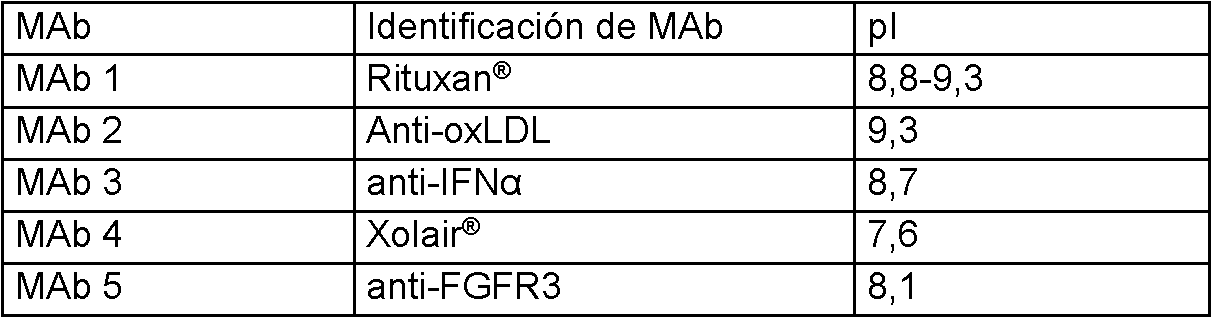
Cuantificación del MAbQuantification of the MAb
La concentración de anticuerpo se determinó mediante absorbancia a 280 y 320 nm usando un espectrofotómetro UV-visible (modelo 8453 G1103A, Agilent Technologies, Santa Clara, CA, EE. UU.) o NanoDrop 1000 modelo ND-1000 (Thermo Fisher Scientific, Waltham, MA, EE. UU.). Especies distintas del anticuerpo (es decir, impurezas) eran demasiado bajas en concentración para tener un efecto apreciable sobre la absorbancia UV. Cuando era necesario, las muestras se diluyeron con un diluyente no interferente apropiado en el intervalo de 0,1-1,0 unidad de absorbancia. La preparación de la muestra y las mediciones de UV se realizaron por duplicado y se registró el valor promedio. Los coeficientes de absorción de MAb variaron de 1,42 a 1,645/mgmlcm.Antibody concentration was determined by absorbance at 280 and 320 nm using a UV-visible spectrophotometer (model 8453 G1103A, Agilent Technologies, Santa Clara, CA, USA) or NanoDrop 1000 model ND-1000 (Thermo Fisher Scientific, Waltham , MA, USA). Species other than the antibody (ie, impurities) were too low in concentration to have an appreciable effect on UV absorbance. When necessary, the samples were diluted with an appropriate non-interfering diluent in the range of 0.1-1.0 absorbance unit. Sample preparation and UV measurements were performed in duplicate and the average value was recorded. The MAb absorption coefficients varied from 1.42 to 1.645 / mgmlcm.
Cuantificación de la proteína de la célula huésped CHO (CHOP)Quantification of the CHO host cell protein (CHOP)
Se usó un ELISA para cuantificar los niveles de la proteína de la célula huésped llamada CHOP. Se inmovilizaron anticuerpos anti-CHoP en pocillos de placas de microvaloración. Las diluciones de las muestras que contenían CHOP, patrones y controles se incubaron en los pocillos, seguido de incubación con anticuerpos anti-CHOP conjugados con peroxidasa de rábano picante (HRP). La actividad enzimática de HRP se detectó con o-fenilendiamina, y la CHOP se cuantificó por lectura de la absorbancia a 490 nm en un lector de placas de microvaloración. Basándose en los principios de ELISA de tipo sándwich, la concentración de peroxidasa correspondía a la concentración de CHOP. El intervalo de ensayo para el ELISA era típicamente 5-320 ng/ml con variabilidad intraensayo <10 %. Los valores de CHOP se informaron en unidades de ng/ml. De forma alternativa, los valores de CHOP se dividieron por la concentración de MAb y los resultados se informaron en PPM (partes por millón, por ejemplo, ng de CHOP/mg de MAb). El ELISA de CHOP se puede usar para cuantificar los niveles totales de CHOP en una muestra, pero no cuantifica la concentración de proteínas individuales.An ELISA was used to quantify the levels of the host cell protein called CHOP. Anti-CHoP antibodies were immobilized in wells of microtiter plates. Dilutions of the samples containing CHOP, standards and controls were incubated in the wells, followed by incubation with anti-CHOP antibodies conjugated with horseradish peroxidase (HRP). The enzymatic activity of HRP was detected with o-phenylenediamine, and the CHOP was quantified by reading the absorbance at 490 nm in a microtiter plate reader. Based on the principles of sandwich ELISA, the peroxidase concentration corresponded to the CHOP concentration. The assay interval for the ELISA was typically 5-320 ng / ml with intra-assay variability <10%. CHOP values were reported in units of ng / ml. Alternatively, the CHOP values were divided by the concentration of MAb and the results were reported in PPM (parts per million, eg, ng CHOP / mg MAb). The CHOP ELISA can be used to quantify the total CHOP levels in a sample, but it does not quantify the concentration of individual proteins.
Condiciones de funcionamiento de cromatografíaOperating conditions of chromatography
Las resinas Capto Adhere y Capto MMC Capto Adhere se adquirieron en GE Healthcare (Uppsala, Suecia). Se adquirieron resinas de intercambio catiónico fuertes (Poros XS y Poros 50 HS) en Applied Biosystems (Address). Todos los experimentos de cromatografía de laboratorio se llevaron a cabo usando un sistema cromatográfico AKLC FPLC de GE Healthcare (Uppsala, Suecia) usando el programa informático UNICORN. Las columnas de laboratorio tenían 0,66 cm de diámetro y 10-20 cm de altura. Las columnas se equilibraron a las condiciones de funcionamiento especificadas de pH y conductividad antes de la carga. A continuación, las agrupaciones de proteína A se cargaron en la columna seguido por el tampón de elución según se requiera para eluir la proteína unida. El flujo o eluido durante las fases de carga, sobrecarga y elución se recogieron como fracciones y después se analizaron las impurezas. La densidad de carga del MAb variaba de 100 a 1000 g por litro de resina.Capto Adhere and Capto MMC Capto Adhere resins were purchased from GE Healthcare (Uppsala, Sweden). Strong cation exchange resins (Poros XS and Poros 50 HS) were purchased from Applied Biosystems (Address). All laboratory chromatography experiments were carried out using an AKLC FPLC chromatographic system from GE Healthcare (Uppsala, Sweden) using the UNICORN software. The laboratory columns were 0.66 cm in diameter and 10-20 cm in height. The columns were balanced to the specified operating conditions of pH and conductivity before loading. Next, pools of protein A were loaded onto the column followed by the elution buffer as required to elute the bound protein. The flow or eluted during the loading, overload and elution phases were collected as fractions and then the impurities were analyzed. The charge density of the MAb varied from 100 to 1000 g per liter of resin.
Análisis de la agrupación cromatográficaAnalysis of the chromatographic cluster
Las agrupaciones de flujo continuo durante las fases de carga, sobrecarga y elución se recogieron en fracciones (1 volumen de columna cada una) y se analizaron para determinar la concentración de MAb, la concentración de CHOP, los agregados, la proteína A lixiviada, el ADN de CHO y el rendimiento. Se generaron gráficos acumulativos en función de las fracciones de la agrupación de elución. El rendimiento acumulado se obtuvo usando la Ecuación 1. The continuous flow groupings during the loading, overload and elution phases were collected in fractions (1 column volume each) and analyzed to determine the concentration of MAb, the concentration of CHOP, the aggregates, the protein A leached, the CHO DNA and performance. Cumulative graphs were generated according to the fractions of the elution cluster. The cumulative yield was obtained using Equation 1.
donde, para la fracción i, Ci es la concentración de Mab (mg/ml), Vi es el volumen de la fracción (ml), Mp es la masa de proteína cargada (mg).where, for fraction i, Ci is the concentration of Mab (mg / ml), Vi is the volume of the fraction (ml), Mp is the mass of loaded protein (mg).

Cromatografía de exclusión molecularMolecular exclusion chromatography
La heterogeneidad de tamaño de los anticuerpos monoclonales se determinó mediante un ensayo de cromatografía de exclusión molecular de alto rendimiento. Una columna TSK G3000SWXL SEC (diámetro = 7,8 mm, altura = 300 mm, número de referencia 08541) fabricada por Tosoh Bioscience (Tokio, Japón) se hizo funcionar a temperatura ambiente en un equipo de HPLC de la serie 1200 (Agilent Technologies) y se usó para determinar los niveles relativos de monómero de MAb para las muestras recogidas. La columna se utilizó a un caudal de 0,3 ml/min usando una fase móvil de fosfato de potasio 200 mM, cloruro de potasio 250 mM y pH 6,2. Se inyectaron 20 pg de anticuerpo para cada muestra. Se usó absorbancia UV a 280 nm para monitorizar la separación de monómeros, proteínas LMW y proteínas HMW. Los porcentajes de monómero, proteínas LMW y proteínas HMW se analizaron manualmente utilizando el programa informático ChemStation (Agilent Technologies).The size heterogeneity of the monoclonal antibodies was determined by a high-throughput gel permeation chromatography assay. A TSK G3000SWXL SEC column (diameter = 7.8 mm, height = 300 mm, reference number 08541) manufactured by Tosoh Bioscience (Tokyo, Japan) was operated at room temperature on a 1200 series HPLC machine (Agilent Technologies ) and was used to determine the relative levels of MAb monomer for the collected samples. The column was used at a flow rate of 0.3 ml / min using a mobile phase of 200 mM potassium phosphate, 250 mM potassium chloride and pH 6.2. 20 pg of antibody was injected for each sample. UV absorbance at 280 nm was used to monitor the separation of monomers, LMW proteins and HMW proteins. The percentages of monomer, LMW proteins and HMW proteins were analyzed manually using the ChemStation software (Agilent Technologies).
Cuantificación de ADN de CHOQuantification of CHO DNA
El ADN de CHO en muestras de producto se cuantificó usando PCR en tiempo real (TaqMan PCR). El ADN de las muestras y los controles se extrajeron primero usando el kit Qiagen Virus Biorobot. Las muestras extraídas, los controles y el ADN de patrón, se sometieron a reacción en cadena de la polimerasa (PCR) en tiempo real TaqMan usando cebadores de PCR y sonda en una placa de 96 pocillos con el sistema de detección de secuencias de ABI. Los cebadores se definieron por un segmento de 110 pares de bases de una secuencia de ADN repetitiva en el genoma de Cricetulus griseus. La sonda se marcó con un tinte indicador fluorescente en el extremo 5' y un tinte de neutralizador en el extremo 3'. Cuando la sonda está intacta, el espectro de emisión del indicador se suprime por el neutralizador. La actividad 5' nucleasa de la polimerasa hidroliza la sonda y libera el indicador, lo que da como resultado un aumento en la emisión de fluorescencia. El detector de secuencia cuantificó el producto amplificado en proporción directa con el aumento de la emisión de fluorescencia medida continuamente durante la amplificación del ADN. Los números de ciclo en los que el ADN se había amplificado más allá del umbral (CT) se calcularon para la curva patrón. Se generó una curva patrón de 1 pg/ml-10000 pg/ml, que se utilizó para cuantificar ADN en muestras. CHO DNA in product samples was quantified using real-time PCR (TaqMan PCR). The DNA from the samples and controls were first extracted using the Qiagen Virus Biorobot kit. The extracted samples, controls and template DNA were subjected to TaqMan real-time polymerase chain reaction (PCR) using PCR primers and probe in a 96-well plate with the ABI sequence detection system. The primers were defined by a segment of 110 base pairs of a repetitive DNA sequence in the genome of Cricetulus griseus. The probe was labeled with a fluorescent indicator dye at the 5 'end and a neutralizing dye at the 3' end. When the probe is intact, the emission spectrum of the indicator is suppressed by the neutralizer. The 5 'nuclease activity of the polymerase hydrolyzes the probe and releases the indicator, which results in an increase in fluorescence emission. The sequence detector quantified the amplified product in direct proportion to the increase in fluorescence emission measured continuously during DNA amplification. The cycle numbers in which the DNA had been amplified beyond the threshold (CT) were calculated for the standard curve. A standard curve of 1 pg / ml-10000 pg / ml was generated, which was used to quantify DNA in samples.
Cuantificación de proteína A lixiviadaQuantification of leached protein A
El nivel de proteína A lixiviada en las agrupaciones de proteína A se determinó mediante un ELISA de tipo sándwich de proteína A. Se inmovilizaron anticuerpos antiproteína A estafilocócica de pollo sobre pocillos de placas de microvaloración. El procedimiento de tratamiento de la muestra incluía la dilución de la muestra y después la disociación del complejo de proteína A/IgG usando calentamiento asistido por microondas como una etapa de pretratamiento antes de someter las muestras a un ELISA de tipo sándwich. La proteína A, si está presente en la muestra, se une al anticuerpo recubierto. La proteína A unida se detectó usando anticuerpos antiproteína conjugados con peroxidasa de rábano picante. La actividad enzimática de la peroxidasa de rábano picante se cuantificó con una solución de sustrato TMB de 2 componentes que produce una señal colorimétrica.The level of protein A leached in protein A pools was determined by sandwich ELISA of protein A. Staphylococcal chicken anti-protein A antibodies were immobilized on wells of microtiter plates. The sample treatment procedure included the dilution of the sample and then the dissociation of the protein A / IgG complex using microwave assisted heating as a pretreatment step before subjecting the samples to a sandwich ELISA. Protein A, if present in the sample, binds to the coated antibody. The bound protein A was detected using anti-protein antibodies conjugated with horseradish peroxidase. The enzymatic activity of horseradish peroxidase was quantified with a 2-component TMB substrate solution that produces a colorimetric signal.
Acondicionamiento de la materia primaConditioning of the raw material
Las materias primas usadas para los experimentos en este estudio eran frescas o se retiraron del almacenamiento en frío (2-8 °C o -70 °C) y se dejaron equilibrar a temperatura ambiente. Posteriormente, se ajustaron el pH y/o la conductividad según se necesitaba usando un agente de valoración (base Tris 1,5 M o ácido acético 1 M) o diluyente (agua purificada, cloruro de sodio 5 M o acetato de sodio 5 M). Todas las materias primas se filtraron a 0,2 pm usando un Millipak 20 (Millipore), AcroPakTM 20 (Pall Corporation) o un filtro de vacío (Thermo Fisher Scientific, Rochester, NY, EE. UU.).The raw materials used for the experiments in this study were fresh or removed from cold storage (2-8 ° C or -70 ° C) and allowed to equilibrate at room temperature. Subsequently, pH and / or conductivity were adjusted as needed using a titration agent (1.5 M Tris base or 1 M acetic acid) or diluent (purified water, 5 M sodium chloride or 5 M sodium acetate) . All raw materials were filtered at 0.2 μm using a Millipak 20 (Millipore), AcroPak ™ 20 (Pall Corporation) or a vacuum filter (Thermo Fisher Scientific, Rochester, NY, USA).
Cribado ultrarrápidoUltra-fast screening
Se utilizó un robot Tecan Freedom Evo 200 (Tecan US, Research Triangle Park, NC) para la manipulación de líquidos y resinas. Se usó una placa de filtro de 96 pocillos (Seahorse 800 pl de polipropileno de 0,45 pm, E & K Scientific EK-2223) para incubar la resina con la proteína y el tampón. Después de incubar la solución de proteína con la resina, la placa de filtro se centrifugó a 1200 xg durante 3 minutos para separar la solución de la resina. Para cada etapa, se pusieron en contacto 300 ml de solución con 50 ml de resina, dando como resultado una proporción volumétrica de la fase de 6:1. Cada pocillo se equilibró hasta el pH y la concentración de acetato de sodio apropiados. El pH variaba de 5,00 a 7,5 a intervalos de 0,5 unidades de pH (se usó acetato para tamponar las condiciones de pH 5,00 a 5,5, se usó MES para tamponar las condiciones de pH 6,00 a 6,5 y se usó MOPS para tamponar las condiciones de 7,00 a 7,5). Todos los experimentos se realizaron a temperatura ambiente. Se usó como carga para estos experimentos una agrupación de proteína A parcialmente purificada, concentrada a 5 g/l o 97 mg/ml, y el tampón se intercambió a NaOAc 15 mM. La resina se expuso a 5 g/l durante los experimentos para determinar los valores Kp de producto. Sin embargo, para la capacidad de unión del producto real, la resina se expuso a 97 g/l. La solución de filtrado se capturó en una placa de recogida y después se analizó usando el lector de placas Infinite M200. La proteína unida se separó posteriormente de la resina usando dos etapas de un tampón de NaCl 2 M para aproximarse al equilibrio de masa. A Tecan Freedom Evo 200 robot (Tecan US, Research Triangle Park, NC) was used for the handling of liquids and resins. A 96-well filter plate (Seahorse 800 μl 0.45 μm polypropylene, E & K Scientific EK-2223) was used to incubate the resin with the protein and buffer. After incubating the protein solution with the resin, the filter plate was centrifuged at 1200 xg for 3 minutes to separate the solution from the resin. For each step, 300 ml of solution was contacted with 50 ml of resin, resulting in a volumetric ratio of the 6: 1 phase. Each well was equilibrated to the appropriate pH and sodium acetate concentration. The pH varied from 5.00 to 7.5 at intervals of 0.5 pH units (acetate was used to buffer the conditions of pH 5.00 to 5.5, MES was used to buffer the conditions of pH 6.00 at 6.5 and MOPS was used to buffer conditions from 7.00 to 7.5). All the experiments were carried out at room temperature. A partially purified protein A pool, concentrated at 5 g / l or 97 mg / ml, was used as a loading for these experiments, and the buffer was exchanged with 15 mM NaOAc. The resin was exposed to 5 g / l during the experiments to determine the Kp values of the product. However, for the binding capacity of the actual product, the resin was exposed to 97 g / l. The filtrate solution was captured on a collection plate and then analyzed using the Infinite M200 plate reader. The bound protein was subsequently removed from the resin using two steps of a 2 M NaCl buffer to approximate mass balance.
Estudios de aclaramiento de virus Virus clearance studies
El objetivo de este estudio fue evaluar la capacidad de retirada de virus de la Capto Adhere para los 2 virus modelo (MMV y X-MuLV). Las columnas, de 0,66 cm de diámetro, se compactaron con resinas originales hasta una altura de lecho de 20 cm. Se hizo pasar la materia prima de MAb con un 1 % de virus y luego se procesó sobre la resina Capto Adhere. Las agrupaciones se recogieron de forma inmediata y las muestras de carga y de elución se ensayaron para determinar los recuentos víricos. Se hicieron múltiples diluciones de las agrupaciones con Medio Completo (1:10 y 1:100) para determinar cualquier interferencia potencial entre los componentes del tampón y los virus.The objective of this study was to evaluate the capacity of virus removal of the Capto Adhere for the 2 model viruses (MMV and X-MuLV). The columns, 0.66 cm in diameter, were compacted with original resins up to a bed height of 20 cm. The MAb raw material was passed with 1% virus and then processed on the Capto Adhere resin. The pools were collected immediately and the loading and elution samples were tested to determine the viral counts. Multiple dilutions of the pools with Complete Medium (1:10 and 1: 100) were made to determine any potential interference between buffer components and viruses.
Ejemplo 1. Cribado ultrarrápidoExample 1. Ultra-fast screening
Este ejemplo describe procedimientos de cribado ultrarrápido para determinar las capacidades de unión del material de cromatografía. Se realizó un cribado ultrarrápido en la resina Capto Adhere en condiciones de unión por lotes para el anticuerpo monoclonal MAb 3.This example describes ultrafast screening methods to determine the binding capabilities of the chromatography material. Ultra fast screening was performed on the Capto Adhere resin under batch binding conditions for the MAb 3 monoclonal antibody.
Los resultados del cribado ultrarrápido de las condiciones de unión se presentan en la figura 1. En las figuras de superficie de respuesta (figuras 1A y 1B), las regiones de unión al producto se indican en rojo (región 8 de la figura 1A y región 7 en la figura 1B) y el producto, por ejemplo, polipéptido, las regiones no unidas son verdes (indicadas como región 1). Los contenidos reales de proteína de la célula huésped (HCP) (ng/mg) en el sobrenadante se muestran en el gráfico de contorno de la figura 1C. El Kp del producto como una función del pH y la concentración de contraión para MAb 3 se muestra en la figura 1A. La resina se cargó a 5 g/l y los datos sin procesar se analizaron usando un modelo de superficie de respuesta. El modelo se utilizó entonces para estimar el Kp para cualquier combinación de pH y la concentración de contraión en el espacio experimental. Los datos muestran que, a medida que el pH aumenta y cuando la conductividad aumenta, el log Kp aumenta. Los incrementos en log Kp reflejan aumentos en el producto que se une a la resina. Para descubrir la capacidad real de unión del producto a la resina, la resina se expuso a 80 g/l en 48 condiciones diferentes combinando diferentes pH y concentraciones de contraión (figura 1B). El sobrenadante de la misma placa experimental se analizó también para HCP (ng/mg) y los datos se representaron en forma de contorno (figura 1C). Se usó agrupación de proteína A parcialmente purificada que contiene varios miles de ppm de CHOP como una carga para los experimentos de cribado ultrarrápido. Las regiones verdes (región 1) de la figura indican la menor cantidad de CHOP en el sobrenadante y las regiones rojas (región 8 de la figura 1B y región 9 de la figura 1C) indican una mayor cantidad de CHOP en el sobrenadante.The results of the ultrafast screening of the binding conditions are presented in Figure 1. In the response surface figures (Figures 1A and 1B), the product binding regions are indicated in red (region 8 of Figure 1A and region 7 in Figure 1B) and the product, for example, polypeptide, the unbound regions are green (indicated as region 1). The actual contents of the host cell protein (HCP) (ng / mg) in the supernatant are shown in the contour plot of Figure 1C. The Kp of the product as a function of pH and the concentration of contraction for MAb 3 is shown in Figure 1A. The resin was loaded at 5 g / l and the raw data was analyzed using a response surface model. The model was then used to estimate the Kp for any combination of pH and the concentration of counterion in the experimental space. The data shows that, as the pH increases and when the conductivity increases, the log Kp increases. Increases in log Kp reflect increases in the product that binds to the resin. To discover the actual ability of the product to bind to the resin, the resin was exposed to 80 g / l in 48 different conditions combining different pH and counter-ion concentrations (Figure 1B). The supernatant from the same experimental plate was also analyzed for HCP (ng / mg) and the data were plotted in contour form (figure 1C). A partially purified protein A pool containing several thousand ppm CHOP was used as a filler for the ultrafast screening experiments. The green regions (region 1) of the figure indicate the lowest amount of CHOP in the supernatant and the red regions (region 8 of figure 1B and region 9 of figure 1C) indicate a greater amount of CHOP in the supernatant.
El espacio de diseño para las condiciones óptimas de carga y elución se puede determinar a partir de los gráficos de contorno de datos de CHOP y de unión. Estos gráficos permiten el diseño de un modo de funcionamiento de flujo o un modo de funcionamiento de unión y elución. Las condiciones de carga para una cromatografía de flujo continuo son, en general, condiciones en las que se minimiza la unión del producto, por ejemplo, polipéptido, y se maximiza la unión de impurezas (CHOP). Las regiones verdes de solapamiento completas (región 1) entre las figuras 1B y 1C sugieren que es posible un modo F/T. Sin embargo, la región verde (región 1) en este gráfico es una región donde la conductividad es realmente baja ~1 mS. Tales condiciones requieren aproximadamente 4 veces la dilución de la agrupación de proteína A, dando como resultado problemas de ajuste potenciales a escala de planta.The design space for optimum loading and elution conditions can be determined from the CHOP data and jointing contour plots. These graphs allow the design of a flow mode of operation or a mode of operation of union and elution. Loading conditions for continuous flow chromatography are, in general, conditions in which the binding of the product, for example, polypeptide, is minimized, and the binding of impurities (CHOP) is maximized. The complete green overlapping regions (region 1) between Figures 1B and 1C suggest that an F / T mode is possible. However, the green region (region 1) in this graph is a region where the conductivity is really low ~ 1 mS. Such conditions require approximately 4 times the dilution of the protein A pool, resulting in potential adjustment problems at the plant scale.
Las regiones rojas (región 7 en la figura 1B y región 8 en la figura 1C) indican regiones de unión para MAb y CHOP. Hay algunas regiones rojas de solapamiento en ambos gráficos. Sin embargo, la figura 1 muestra que, dentro de las concentraciones de pH y contraión funcionales, era posible una capacidad de unión máxima de 55 g/l. Para un procedimiento de título elevado con un título de cultivo celular de ~3,5 g/l, se necesitaría una columna de 1000 l para recuperar todo el producto, tal como un polipéptido, en un ciclo o ciclos múltiples que se realizarían en una columna más pequeña.The red regions (region 7 in figure 1B and region 8 in figure 1C) indicate binding regions for MAb and CHOP. There are some red regions of overlap in both graphs. However, Figure 1 shows that, within the functional pH and counter-ion concentrations, a maximum binding capacity of 55 g / l was possible. For a high titer procedure with a cell culture titer of ~ 3.5 g / l, a 1000 l column would be needed to recover the entire product, such as a polypeptide, in a cycle or multiple cycles that would be performed in a smallest column.
En un modo OEC, se puede elegir una condición de carga basada en el comportamiento de las impurezas (por ejemplo, CHOP) en la columna. La cantidad de MAb que se une a la columna es menos preocupante porque el MAb unido se puede recuperar mediante la fase de elución. Por lo tanto, existe un espacio experimental completo para diseñar la condición de carga de modo que se obtenga el máximo depurado de impurezas sin estar limitada por la capacidad de unión de producto de la resina. Mientras que el modo de unión y elución permite una densidad de carga de 55 g/l, OEC permite una capacidad de carga aproximadamente 10 veces superior permitiendo de este modo la implementación de una columna más pequeña que a su vez puede reducir el costo de la resina por gramo de prod ucto y ofrece un buen ajuste de planta.In an OEC mode, you can choose a load condition based on the behavior of the impurities (for example, CHOP) in the column. The amount of MAb that binds to the column is less concerning because the bound MAb can be recovered by the elution phase. Therefore, there is a complete experimental space to design the loading condition so that the maximum purity of impurities is obtained without being limited by the capacity of product bonding of the resin. While the mode of union and elution allows a charge density of 55 g / l, OEC allows a load capacity approximately 10 times higher allowing in this way the implementation of a smaller column which in turn can reduce the cost of the resin per gram of product and offers a good plant adjustment.
Ejemplo 2. Modo OEC optimizadoExample 2. Optimized OEC mode
Los datos de HTS se usaron para la determinación de parámetros para el funcionamiento en un modo OEC. Basándose en los requisitos de densidad de carga, ajuste de la planta y depurado de impurezas, se seleccionaron las condiciones de carga para el MAb 3 que son pH 6,5 y 5,5 mS/cm. La densidad de carga para el desarrollo cromatográfico optimizado mostrada en la figura 2 fue de 180 g/l. Aproximadamente 50 g/l de producto polipeptídico se une a la resina durante la fase de carga. La agrupación de producto se recogió comenzando a aproximadamente 0,5 DO, y el producto se sobrecargó en la resina hasta 180 g/l. Después de completarse la fase de carga, se usó la fase de elución con tampón de baja conductividad de 1 mS/cm (tampón de elución: MES 20 mM, pH 6,5) para eluir la proteína unida, dando como resultado una reducción del volumen de la agrupación del 10-15 % en comparación con la cromatografía de flujo continuo. El rendimiento y el depurado de impurezas para este desarrollo cromatográfico se muestran en la figura 3.The HTS data was used for the determination of parameters for operation in an OEC mode. Based on the requirements of charge density, plant adjustment and purification of impurities, loading conditions for MAb 3 were selected, which are pH 6.5 and 5.5 mS / cm. The charge density for the optimized chromatographic development shown in Figure 2 was 180 g / l. Approximately 50 g / l of polypeptide product binds to the resin during the loading phase. The product pool was collected starting at about 0.5 OD, and the product was overloaded in the resin to 180 g / l. After completion of the loading phase, the elution phase was used with low conductivity buffer of 1 mS / cm (elution buffer: 20 mM MES, pH 6.5) to elute the bound protein, resulting in a reduction of the grouping volume of 10-15% compared to the continuous flow chromatography. The performance and purification of impurities for this chromatographic development are shown in Figure 3.
Ejemplo 3. Optimización de cargaExample 3. Load optimization
Este estudio se llevó a cabo para comparar los datos de HTS y los datos reales de rendimiento de la columna en el modo de funcionamiento de OEC. Las columnas se cargaron a tres pH diferentes. Se seleccionó pH 6,5 para ser la mejor condición basándose en el depurado inicial de CHOP y en los datos de rendimiento. Las concentraciones de CHOP en las agrupaciones variaron de 900 a 50 hasta 400 ppm en función del pH de la carga. A partir de este estudio, se determinó que el pH 6,5 era la mejor condición para cargar la composición. Además, aunque el rendimiento no se optimizó, el pH 6,5 proporcionó también el rendimiento máximo (figura 3, Tabla 3).This study was carried out to compare the HTS data and the actual performance data of the column in the OEC operating mode. The columns were loaded at three different pH. PH 6.5 was selected to be the best condition based on the initial CHOP debugging and performance data. The concentrations of CHOP in the groups varied from 900 to 50 to 400 ppm depending on the pH of the load. From this study, it was determined that pH 6.5 was the best condition to load the composition. Furthermore, although the yield was not optimized, the pH 6.5 also gave the maximum yield (Figure 3, Table 3).
Tabla 3. Optimización de la condición de carga para un modo OECTable 3. Optimization of the load condition for an OEC mode

Ejemplo 4. Optimización de la eluciónExample 4. Optimization of the elution
Este estudio se llevó a cabo para optimizar las condiciones de elución para OEC. Para recuperar el producto (MAb 3, ~50 g/l) que se unió durante la fase de carga, se pasaron unos cuantos volúmenes de columna de tampón de lavado (MES 50 mM, acetato de Na 30 mM, pH 6,5, ~5,5 mS/cm) a través de la columna después de la finalización de la fase de carga. Se observó una gran cantidad de residuos, que dan como resultado un aumento en el volumen de la agrupación al final de la fase de carga. El aumento en el volumen de la agrupación fue de aproximadamente un 45 % usando un tampón de lavado con un pH y conductividad similares al tampón de carga. Este aumento en el volumen de la agrupación puede dar como resultado problemas de ajuste de la planta (figura 4).This study was carried out to optimize the elution conditions for OEC. To recover the product (MAb 3, ~ 50 g / l) that was bound during the loading phase, a few column volumes of wash buffer were passed (50 mM MES, 30 mM Na acetate, pH 6.5, ~ 5.5 mS / cm) through the column after the completion of the loading phase. A large amount of waste was observed, which results in an increase in the volume of the cluster at the end of the loading phase. The increase in the volume of the pool was about 45% using a wash buffer with a pH and conductivity similar to the loading buffer. This increase in the volume of the cluster can result in problems of adjustment of the plant (figure 4).
El objetivo del estudio de optimización de la elución fue obtener el máximo rendimiento con un mínimo de CHOP y una reducción máxima del volumen de la agrupación. La fase de elución se desarrolló para eluir los 50 g/l de producto unido de la columna. La figura 5 muestra la fase de elución de los cromatogramas. Un tampón de conductividad inferior eluye el producto de la columna en 2 volúmenes de columna dando como resultado un rendimiento más alto y un volumen de agrupación menor (Tabla 4). Por otro lado, los tampones de elución de mayor conductividad dieron como resultado residuos de más de 8 volúmenes de columna. Como se muestra en la Tabla 4, CHOP en la agrupación fue menor de 20 ppm en todos los tampones de elución probados. Por lo tanto, se seleccionó MES 20 mM como tampón de elución para aumentar el rendimiento y para minimizar los residuos.The objective of the elution optimization study was to obtain maximum performance with a minimum of CHOP and a maximum reduction in the volume of the pool. The elution phase was developed to elute the 50 g / l of bound product from the column. Figure 5 shows the elution phase of the chromatograms. A lower conductivity buffer elutes the product from the column in 2 column volumes resulting in a higher yield and a smaller pool volume (Table 4). On the other hand, elution buffers of higher conductivity resulted in residues of more than 8 column volumes. As shown in Table 4, CHOP in the pool was less than 20 ppm in all tested elution buffers. Therefore, 20 mM MES was selected as elution buffer to increase yield and to minimize waste.
Tabla 4. Optimización de la elución para OECTable 4. Optimization of the elution for OEC

Ejemplo 5. Análisis de impurezas en OECExample 5. Analysis of impurities in OEC
Las fracciones de OEC se analizaron en busca de impurezas. La figura 6A muestra las concentraciones de MAb y los niveles de CHOP en las fracciones recogidas durante la fase de carga y durante la fase de elución. Durante la fase de carga, CHOP permaneció entre 20-25 ppm y durante la fase de elución donde solo se eluye el MAb unido, el nivel de CHOP fraccionario disminuye. El análisis acumulativo demuestra que la CHOP y otras impurezas permanecen bastante constantes entre toda la fase de carga y de elución (figura 6b ). La densidad de carga para este desarrollo cromatográfico fue de 180 g/l. El aclaramiento de virus, utilizando X-MuLV y MMV como virus modelo, también se estudió para la misma densidad de carga (Tabla 5). Para este experimento, el pH de carga fue 6,5 y la conductividad de carga fue de 5,5 mS/cm. Las condiciones de elución fueron MES 20 mM pH 6,5 y conductividad de ~1 mS/cm. The OEC fractions were analyzed for impurities. Figure 6A shows MAb concentrations and CHOP levels in the fractions collected during the loading phase and during the elution phase. During the loading phase, CHOP remained between 20-25 ppm and during the elution phase where only the bound MAb is eluted, the fractional CHOP level decreases. The cumulative analysis shows that the CHOP and other impurities remain fairly constant between the entire loading and elution phase (Figure 6b). The charge density for this chromatographic development was 180 g / l. Virus clearance, using X-MuLV and MMV as a model virus, is also studied for the same loading density (Table 5). For this experiment, the loading pH was 6.5 and the charge conductivity was 5.5 mS / cm. The elution conditions were 20 mM MES pH 6.5 and conductivity of ~ 1 mS / cm.
Tabla 5. Aclaramiento del virus para la cromatografía en modo OEC.Table 5. Clearance of the virus for OEC mode chromatography.

Ejemplo 6. Determinación de la capacidad de unión de impurezas máximaExample 6. Determination of maximum impurity binding capacity
Para hallar la máxima capacidad de unión de impurezas a la resina cargada con MAb 3 por el modo OEC, la resina Capto Adhere se expuso a 1000 g/l con la agrupación de proteína A. El tampón de carga fue de pH 6,5, ~5,5 mS/cm; el tampón de elución fue MES 20 mM, pH 6,5, ~1 mS/cm. La muestra en la agrupación se recogió cada 50 g/l y se analizó para CHOP y la concentración de proteínas (figura 7). Para densidades de carga de hasta 800 g/l, CHOP no avanzó y la CHOP en el eluido fue inferior a 20 ng/mg.To find the maximum binding capacity of impurities to the resin loaded with MAb 3 by the OEC mode, the Capto Adhere resin was exposed to 1000 g / l with the protein A pool. The loading buffer was pH 6.5, ~ 5.5 mS / cm; the elution buffer was 20 mM MES, pH 6.5, ~ 1 mS / cm. The sample in the pool was collected every 50 g / l and analyzed for CHOP and protein concentration (figure 7). For loading densities up to 800 g / l, CHOP did not progress and the CHOP in the eluate was less than 20 ng / mg.
Ejemplo 7. Implementación a escala pilotoExample 7. Pilot-scale implementation
El modo de funcionamiento de OEC se implementó en columnas de escala piloto que varían en tamaño de 1,6 l a 10,8 l. Los diámetros de las columnas variaban de 10 cm a 25 cm con alturas de lecho que varían de 20-22 cm (Tabla 6). Las muestras se cargaron a pH 6,5, ~5,5 mS/cm y se eluyeron con MES 20 mM a pH 6,5, ~1 mS/cm. El rendimiento entre los desarrollos cromatográficos a escala piloto se muestra en la figura 8. Las densidades de carga en los desarrollos cromatográficos a escala piloto cubrían un intervalo de densidades de carga de 70 a 180 g/l. Entre todas las densidades de carga se alcanzó un rendimiento promedio de un 94 %. No hubo impacto en el rendimiento sobre el intervalo de densidades de carga ensayadas. Entre todos los desarrollos cromatográficos a escala piloto, la CHOP en la agrupación del modo OEC era inferior a 25 ppm, que se depuró posteriormente hasta <2 ppm de CHOP en el producto polipéptido final (agrupación de UFDF) (Tabla 7). En promedio, hubo una reducción de un 1,1 % en las proteínas HMW entre todos los desarrollos cromatográficos a escala piloto (Tabla 8) y una reducción del 0,19 % en las proteínas LMW entre todos los desarrollos cromatográficos a escala piloto (Tabla 9).The OEC operating mode was implemented in pilot scale columns that vary in size from 1.6 l to 10.8 l. The diameters of the columns varied from 10 cm to 25 cm with bed heights ranging from 20-22 cm (Table 6). Samples were loaded at pH 6.5, ~ 5.5 mS / cm and eluted with 20 mM MES at pH 6.5, ~ 1 mS / cm. The performance between the pilot scale chromatographic developments is shown in Figure 8. The loading densities in the pilot scale chromatographic developments covered a range of loading densities from 70 to 180 g / l. Among all the load densities, an average yield of 94% was reached. There was no impact on the performance over the range of charge densities tested. Among all pilot-scale chromatographic developments, the CHOP in the OEC mode pool was less than 25 ppm, which was subsequently purified to <2 ppm CHOP in the final polypeptide product (pool of UFDF) (Table 7). On average, there was a reduction of 1.1% in the HMW proteins between all the chromatographic developments at pilot scale (Table 8) and a reduction of 0.19% in the LMW proteins among all the chromatographic developments at pilot scale (Table 9).
Tabla 6. Tamaño de columna Capto Adhere para los desarrollos cromatográficos a escala pilotoTable 6. Capto Adhere column size for pilot-scale chromatographic developments

Tabla 7. Datos de CHOP para escala pilotoTable 7. CHOP data for pilot scale

* CHOP después de la filtración en profundidad a pH 6,5* CHOP after deep filtration at pH 6.5
HCCF es el fluido de cultivo celular recolectadoHCCF is the cell culture fluid collected
Tabla 8. % promedio de reducción de proteínas HMW entre 12 desarrollos cromatográficos a escala piloto.Table 8. Average reduction of HMW proteins among 12 pilot scale chromatographic developments.

Tabla 9. % promedio de reducción de proteínas LMW entre 12 desarrollos cromatográficos a escala piloto.Table 9. Average reduction of LMW proteins among 12 pilot scale chromatographic developments.

El ADN de CHO y la proteína A lixiviada eran menos que detectables en la agrupación después de OEC.CHO DNA and protein A leached were less than detectable in the pool after OEC.
Ejemplo 8. Implementación a escala de producciónExample 8. Implementation at production scale
El modo de funcionamiento de OEC se implementó en una columna a escala de producción con un tamaño de 157 l (100 cm de diámetro * 20 cm de altura). A escala de producción, la columna se cargó a ~96 g/l. El % de rendimiento entre los dos desarrollos cromatográficos a escala industrial fue >95 % para ambos desarrollos cromatográficos. Entre todos los desarrollos cromatográficos a escala de producción, la CHOP en la agrupación del modo OEC fue inferior a 17 ppm (Tabla 10), que se depuró posteriormente hasta un nivel menor que el detectable de CHOP. En promedio, hubo una reducción de un 1,1 % en las HMW, una reducción de un 0,1 % en las LMW y una reducción de un 1,65 % en ácidos entre los dos desarrollos cromatográficos a escala de producción.The OEC operating mode was implemented in a production scale column with a size of 157 l (100 cm diameter * 20 cm height). At production scale, the column was loaded at ~ 96 g / l. The% yield between the two chromatographic developments on an industrial scale was> 95% for both chromatographic developments. Among all chromatographic developments at production scale, the CHOP in the OEC mode group was less than 17 ppm (Table 10), which was subsequently purified to a level lower than the detectable level of CHOP. On average, there was a reduction of 1.1% in the HMW, a reduction of 0.1% in the LMW and a reduction of 1.65% in acids between the two chromatographic developments at production scale.
Tabla 10. Datos de CHOP (ppm) a escala de producciónTable 10. CHOP (ppm) data at production scale

El ADN de CHO y la proteína A lixiviada eran menos detectables en la agrupación después del modo OEC.CHO DNA and protein A leached were less detectable in the pool after the OEC mode.
Ejemplo 9. Aplicabilidad de OEC a otros MAbExample 9. Applicability of OEC to other MAb
Las agrupaciones de proteína A se usaron como cargas para estos desarrollos cromatográficos. Las condiciones de carga y elución se seleccionaron para permitir el modo OEC. Las densidades de carga, el % de rendimiento, el MAb unido a la resina (g/l), las impurezas en la carga y la agrupación se muestran en las siguientes tablas (Tabla 11, 12, 13 y 14).Protein A pools were used as fillers for these chromatographic developments. The loading and elution conditions were selected to allow the OEC mode. The load densities, the% yield, the MAb bound to the resin (g / l), the impurities in the load and the grouping are shown in the following tables (Table 11, 12, 13 and 14).
Tabla 11. Aplicabilidad de OEC a otros MAb: CHOPTable 11. Applicability of OEC to other MAb: CHOP
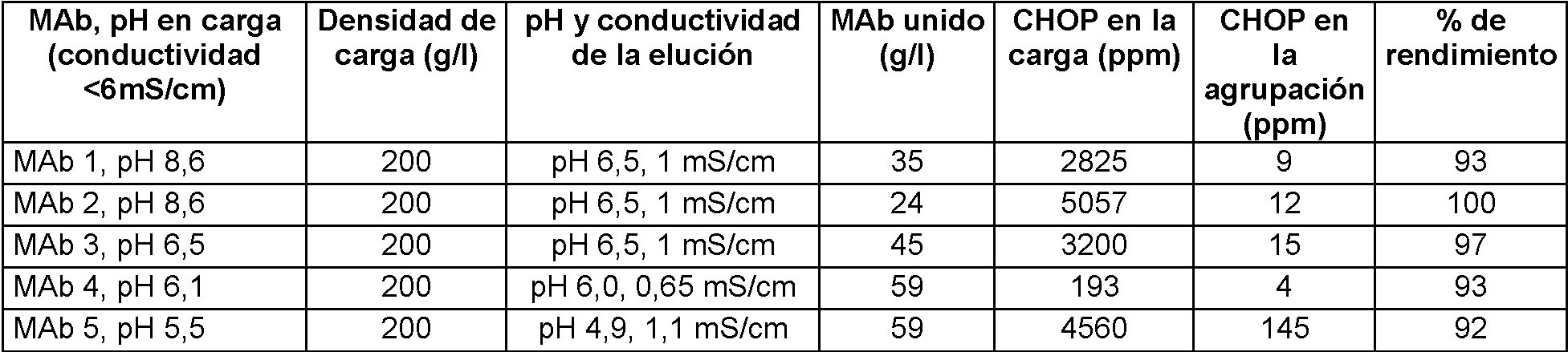
Tabla 12. Aplicabilidad de OEC a otros MAb: % de proteínas HMWTable 12. Applicability of OEC to other MAb:% of HMW proteins

Tabla 13. Aplicabilidad de OEC a otros MAb: % de proteína A lixiviadaTable 13. Applicability of OEC to other MAb:% of protein A leached

* Menos que detectable* Less than detectable
Tabla 14. Aplicabilidad de OEC a otros MAb: ADN de CHOTable 14. Applicability of OEC to other MAb: CHO DNA

Ejemplo 10. Modos de funcionamiento de cromatografía AEX basadas en valores de Kp Example 10. AEX chromatography operating modes based on K p values
En cromatografía de flujo continuo (F/T), Kp es <0,1 y no hay unión de proteína a la resina. En la cromatografía de reparto débil (WPC), Kp es de 0,1 a 20 y hay un reparto débil entre el producto y los medios de cromatografía. En un modo de unión y elución, el producto se une estrechamente a la resina y el Kp es >100, pero la densidad de carga se limita a la capacidad de unión del producto. Sin embargo, en un modo de sobrecarga y elución de cromatografía (MAb 3), se encontraron condiciones de carga de modo que el Kp del producto y las impurezas era >100 y aunque el producto fluye después de alcanzar su capacidad de unión, las impurezas mantienen la unión a la resina y no avanzan hasta que alcanzan su capacidad de unión, que podría ser superior a la capacidad de unión del producto.In continuous flow chromatography (F / T), Kp is <0.1 and there is no protein binding to the resin. In the weak-partition chromatography (WPC), Kp is 0.1 to 20 and there is a weak distribution between the product and the chromatography means. In a binding and elution mode, the product binds tightly to the resin and the Kp is> 100, but the charge density is limited to the binding capacity of the product. However, in an overload mode and chromatography elution (MAb 3), loading conditions were found so that the Kp of the product and the impurities was> 100 and although the product flows after reaching its binding capacity, the impurities they maintain the union to the resin and do not advance until they reach their binding capacity, which could be higher than the bonding capacity of the product.
Se encontraron condiciones de elución de modo que el Kp del producto polipeptídico <2. El producto unido se recupera, pero la mayoría de las impurezas permanecen unidas (Kp de impureza >100). Por tanto, este modo permite una buena depuración de impurezas al tiempo que proporciona un rendimiento muy alto (por ejemplo, ~95 %) (Tabla 15). Tabla 15. MAb 3 como un anticuerpo modelo en la resina Capto AdhereElution conditions were found so that the Kp of the polypeptide product <2. The bound product is recovered, but most of the impurities remain attached (Kp of impurity> 100). Therefore, this mode allows a good depuration of impurities while providing a very high performance (eg, ~95%) (Table 15). Table 15. MAb 3 as a model antibody in the Capto Adhere resin
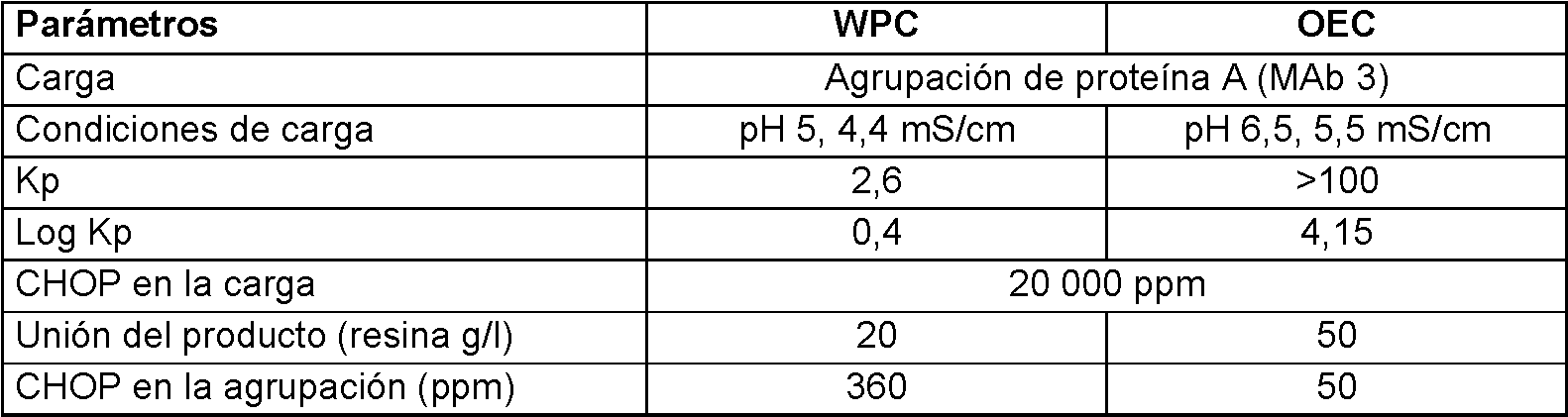

Los cromatogramas de desarrollos cromatográficos en columna en condiciones de reparto débiles (Kp = 2,4) y condiciones de sobrecarga y elución (Kp >100) muestran los efectos del aumento del Kp de mAb en las regiones de avance del producto del cromatograma (figura 9). Condiciones de carga de WPC: pH 5,5, 4,4 mS/cm; condiciones de lavado de WPC: Acetato 20 mM pH 5, 4,4 mS/cm. Condiciones de carga en OEC: pH 6,5, 5,5 mS/cm; condiciones de elución en OEC: MES 20 mM pH 6,5, ~1 mS/cm.Chromatograms of column chromatographic developments under weak partition conditions (Kp = 2.4) and conditions of overload and elution (Kp> 100) show the effects of the increase of the Kp of mAb in the regions of advance of the chromatogram product (figure 9). Loading conditions of WPC: pH 5.5, 4.4 mS / cm; Washing conditions of WPC: Acetate 20 mM pH 5, 4.4 mS / cm. Loading conditions in OEC: pH 6.5, 5.5 mS / cm; Elution conditions in OEC: 20 mM MES pH 6.5, ~ 1 mS / cm.
Tabla 16. Análisis de una etapa de refinado de AEX para un MAb que se une a la resina AEX a un flujo típico con las condiciones del procedimientoTable 16. Analysis of an AEX refining step for a MAb that binds to the AEX resin at a typical flow with the process conditions
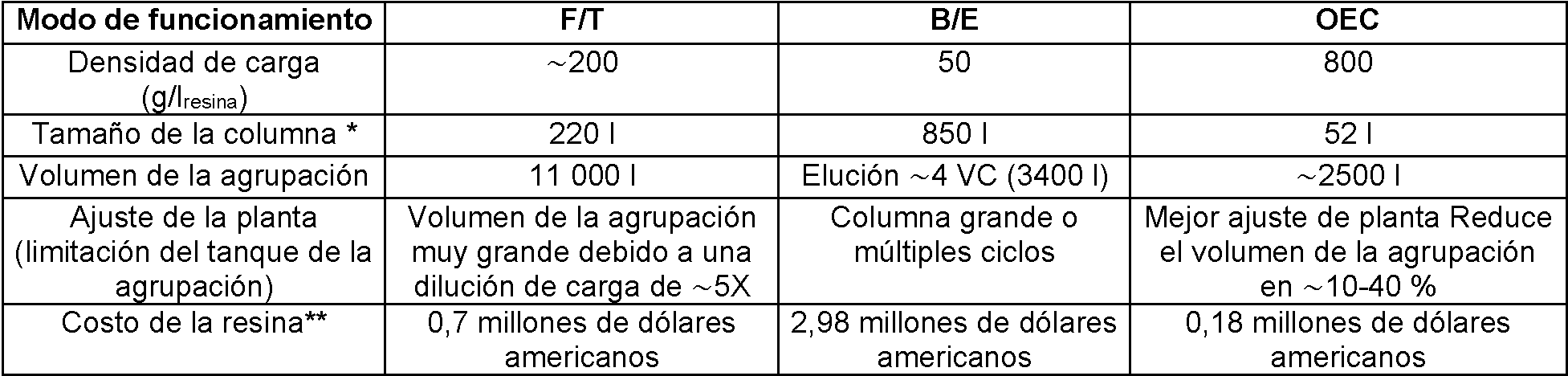
Anticuerpo modelo: MAb 3Antibody model: MAb 3
* Se supone una recolección de 12500 l a un título de 3,5 g/l.* A collection of 12500 l to a title of 3.5 g / l is assumed.
** Resina CA a 3500 dólares americanos/l** CA resin at 3500 US dollars / l
Ejemplo 11. Aplicabilidad de OEC para diferentes resinasExample 11. Applicability of OEC for different resins
Dependiendo del pI de la molécula, se puede aplicar OEC a las siguientes resinas multimodo (Capto Adhere, QMA, MEP Hypercel, HEA Hypercel, PPA Hypercel, Capto MMC). La unión del producto polipeptídico a la resina Capto Adhere era de naturaleza más hidrófoba y el producto unido se podía eluir de la columna disminuyendo la conductividad del tampón de elución (figura 5). Sin embargo, el modo de unión del producto a la resina y la elución del producto de la resina no se limita a las interacciones hidrófobas y, por lo tanto, el modo de funcionamiento de la OEC se puede usar ampliamente también en otros materiales de cromatografía. La Tabla 17 demuestra que OEC se puede aplicar a otras resinas CEX y resinas IEX. Los tampones de elución eran MES 20 mM a menos que se indicara de otro modo. El potencial de OEC no se limita a las resinas anteriores y actualmente se está evaluando. El análisis de avance del MAb 3 en la resina QMA se muestra en la figura 10. El análisis de avance del MAb 4 en la resina Capto Adhere se muestra en la figura 11. El análisis de avance del MAb 4 en la resina Capto MMC se muestra en la figura 12. El análisis de avance del MAb 3 en la resina Capto Adhere se muestra en la figura 13.Depending on the pI of the molecule, OEC can be applied to the following multimode resins (Capto Adhere, QMA, MEP Hypercel, HEA Hypercel, PPA Hypercel, Capto MMC). The binding of the polypeptide product to the Capto Adhere resin was more hydrophobic in nature and the bound product could be eluted from the column by decreasing the conductivity of the elution buffer (Figure 5). However, the mode of attachment of the product to the resin and the elution of the resin product is not limited to the hydrophobic interactions and, therefore, the mode of operation of the OEC can also be widely used in other chromatography materials . Table 17 shows that OEC can be applied to other CEX resins and IEX resins. The elution buffers were 20 mM MES unless indicated otherwise. The OEC potential is not limited to the above resins and is currently being evaluated. The advance analysis of the MAb 3 in the QMA resin is shown in Figure 10. The progress analysis of the MAb 4 in the Capto Adhere resin is shown in Figure 11. The progress analysis of the MAb 4 in the Capto MMC resin is shown in Figure 12. The advance analysis of MAb 3 in the Capto Adhere resin is shown in Figure 13.
Tabla 17. Aplicabilidad de OEC a diferentes resinas.Table 17. Applicability of OEC to different resins.

** Condiciones de carga para Poros XS MAb 3: pH 5,5, <6 mS/cm; condiciones de elución: Tampón A - acetato 50 mM pH 5,5 ~3 mS/cm, tampón B - acetato 350 mM pH 5,5, ~24 mS/cm, gradiente: 20-85 % sobre 10 VC, agrupamiento: 1-8 VC.** Loading conditions for Poros XS MAb 3: pH 5.5, <6 mS / cm; Elution conditions: Buffer A - 50 mM acetate pH 5.5 ~ 3 mS / cm, buffer B - 350 mM acetate pH 5.5, ~ 24 mS / cm, gradient: 20-85% over 10 VC, grouping: 1 -8 VC.
Ejemplo 12. Elución con gradiente en OECExample 12. Elution with gradient in OEC
Otro objetivo del estudio de optimización de la elución fue evaluar el efecto de las condiciones de elución con gradiente en el modo OEC sobre la resina Capto Adhere. La fase de elución se desarrolló para eluir el producto unido (Tabla 18). En un desarrollo cromatográfico de elución con gradiente, se puede variar la fuerza iónica, el pH, la composición y la concentración de la fase móvil basándose en los requerimientos. La Tabla 18 muestra las condiciones de funcionamiento: las condiciones de carga (pH y conductividad) y de elución (pH y gradiente de conductividad). Todos los datos mostrados en la tabla se obtuvieron a partir de desarrollos cromatográficos cargados a una densidad de carga de 150 g/l con MAb 3. Estos desarrollos cromatográficos se realizaron como estudio de viabilidad para demostrar que la elución con gradiente se puede realizar en modo de cromatografía OEC y se puede optimizar la pendiente de gradiente (concentración de la sal (mM)/volumen de columna). Se puede observar que el % de HMW se reduce en un 38 % en promedio cuando se compara con la carga (Tabla 18). La CHOP se redujo a <20 ppm en una conductividad de 5,5 mS/cm y la mayor conductividad funcionó a 10 mS/cm, lo que dio como resultado CHOP en la agrupación de —150 ppm (Tabla 19).Another objective of the elution optimization study was to evaluate the effect of gradient elution conditions in the OEC mode on the Capto Adhere resin. The elution phase was developed to elute the bound product (Table 18). In a gradient elution chromatographic development, the ionic strength, pH, composition and concentration of the mobile phase can be varied based on the requirements. Table 18 shows the conditions of operation: loading conditions (pH and conductivity) and elution (pH and conductivity gradient). All the data shown in the table were obtained from chromatographic developments loaded at a loading density of 150 g / l with MAb 3. These chromatographic developments were carried out as a feasibility study to demonstrate that gradient elution can be performed in mode of OEC chromatography and the gradient slope can be optimized (salt concentration (mM) / column volume). It can be seen that the% of HMW is reduced by 38% on average when compared to the load (Table 18). CHOP was reduced to <20 ppm at a conductivity of 5.5 mS / cm and the highest conductivity ran at 10 mS / cm, resulting in CHOP in the pool of -150 ppm (Table 19).
Tabla 18. Desarrollos cromatográficos de elución con gradiente en OEC: datos de % de HMWTable 18. Elution chromatographic developments with OEC gradient: HMW% data

Tabla 19. Desarrollos cromatográficos de elución con gradiente en OEC: Datos de CHOP:Table 19. Chromatographic elution developments with gradient in OEC: CHOP data:

Claims (15)
Applications Claiming Priority (1)
| Application Number | Priority Date | Filing Date | Title |
|---|---|---|---|
| US201161554898P | 2011-11-02 | 2011-11-02 |
Publications (2)
| Publication Number | Publication Date |
|---|---|
| ES2717536T3 true ES2717536T3 (en) | 2019-06-21 |
| ES2717536T5 ES2717536T5 (en) | 2025-02-04 |
Family
ID=48192803
Family Applications (3)
| Application Number | Title | Priority Date | Filing Date |
|---|---|---|---|
| ES18206718T Active ES3062963T3 (en) | 2011-11-02 | 2012-11-02 | Overload and elute chromatography |
| ES17157670T Active ES2717536T5 (en) | 2011-11-02 | 2012-11-02 | Overload and elute chromatography |
| ES12845437T Active ES2637423T5 (en) | 2011-11-02 | 2012-11-02 | Overload and elution chromatography |
Family Applications Before (1)
| Application Number | Title | Priority Date | Filing Date |
|---|---|---|---|
| ES18206718T Active ES3062963T3 (en) | 2011-11-02 | 2012-11-02 | Overload and elute chromatography |
Family Applications After (1)
| Application Number | Title | Priority Date | Filing Date |
|---|---|---|---|
| ES12845437T Active ES2637423T5 (en) | 2011-11-02 | 2012-11-02 | Overload and elution chromatography |
Country Status (25)
| Country | Link |
|---|---|
| US (3) | US20140301977A1 (en) |
| EP (3) | EP2773438B2 (en) |
| JP (4) | JP6356607B2 (en) |
| KR (1) | KR20140091721A (en) |
| CN (2) | CN107163101B (en) |
| AU (1) | AU2012323995B2 (en) |
| BR (1) | BR112014010406A2 (en) |
| CA (1) | CA2854330A1 (en) |
| DK (2) | DK3257564T4 (en) |
| ES (3) | ES3062963T3 (en) |
| FI (1) | FI3257564T4 (en) |
| HR (2) | HRP20260140T1 (en) |
| HU (2) | HUE043755T2 (en) |
| IL (1) | IL232146A0 (en) |
| LT (1) | LT3257564T (en) |
| MX (1) | MX2014005330A (en) |
| PL (3) | PL3257564T5 (en) |
| PT (1) | PT3257564T (en) |
| RS (1) | RS58472B2 (en) |
| RU (1) | RU2014121884A (en) |
| SG (1) | SG11201402019TA (en) |
| SI (2) | SI3257564T2 (en) |
| TR (1) | TR201903707T4 (en) |
| WO (1) | WO2013067301A1 (en) |
| ZA (1) | ZA201402932B (en) |
Families Citing this family (44)
| Publication number | Priority date | Publication date | Assignee | Title |
|---|---|---|---|---|
| WO2012015908A2 (en) | 2010-07-30 | 2012-02-02 | Millipore Corporation | Chromatography media and method |
| WO2012149197A2 (en) | 2011-04-27 | 2012-11-01 | Abbott Laboratories | Methods for controlling the galactosylation profile of recombinantly-expressed proteins |
| KR20140091721A (en) | 2011-11-02 | 2014-07-22 | 제넨테크, 인크. | Overload and elute chromatography |
| US9181572B2 (en) | 2012-04-20 | 2015-11-10 | Abbvie, Inc. | Methods to modulate lysine variant distribution |
| US9067990B2 (en) | 2013-03-14 | 2015-06-30 | Abbvie, Inc. | Protein purification using displacement chromatography |
| US9150645B2 (en) | 2012-04-20 | 2015-10-06 | Abbvie, Inc. | Cell culture methods to reduce acidic species |
| US9249182B2 (en) * | 2012-05-24 | 2016-02-02 | Abbvie, Inc. | Purification of antibodies using hydrophobic interaction chromatography |
| US9512214B2 (en) | 2012-09-02 | 2016-12-06 | Abbvie, Inc. | Methods to control protein heterogeneity |
| MX379269B (en) * | 2012-10-24 | 2025-03-11 | Genzyme Corp | ELUTION OF BIOMOLECULES FROM MULTIMODAL RESINS USING MES AND MOPS AS MOBILE PHASE MODIFIERS. |
| SG11201507230PA (en) | 2013-03-12 | 2015-10-29 | Abbvie Inc | Human antibodies that bind human tnf-alpha and methods of preparing the same |
| US10023608B1 (en) | 2013-03-13 | 2018-07-17 | Amgen Inc. | Protein purification methods to remove impurities |
| WO2014151878A2 (en) | 2013-03-14 | 2014-09-25 | Abbvie Inc. | Methods for modulating protein glycosylation profiles of recombinant protein therapeutics using monosaccharides and oligosacharides |
| US9017687B1 (en) | 2013-10-18 | 2015-04-28 | Abbvie, Inc. | Low acidic species compositions and methods for producing and using the same using displacement chromatography |
| US9598667B2 (en) | 2013-10-04 | 2017-03-21 | Abbvie Inc. | Use of metal ions for modulation of protein glycosylation profiles of recombinant proteins |
| US9085618B2 (en) | 2013-10-18 | 2015-07-21 | Abbvie, Inc. | Low acidic species compositions and methods for producing and using the same |
| US9181337B2 (en) | 2013-10-18 | 2015-11-10 | Abbvie, Inc. | Modulated lysine variant species compositions and methods for producing and using the same |
| US20150139988A1 (en) | 2013-11-15 | 2015-05-21 | Abbvie, Inc. | Glycoengineered binding protein compositions |
| US9951101B2 (en) | 2013-12-12 | 2018-04-24 | Emd Millipore Corporation | Protein separations using an acrylamide containing filter |
| EP3079722B1 (en) * | 2013-12-13 | 2021-03-24 | Novo Nordisk Health Care AG | Method for thioether conjugation of proteins |
| KR20150083689A (en) * | 2014-01-10 | 2015-07-20 | 삼성전자주식회사 | Method of Purification of anti-c-Met antibody |
| EP3116891B1 (en) | 2014-03-10 | 2020-02-12 | Richter Gedeon Nyrt. | Immunoglobulin purification using pre-cleaning steps |
| CN106460027B (en) * | 2014-03-24 | 2020-07-31 | 日东纺绩株式会社 | Method for separating and concentrating target substance using cationic graft polymer |
| SG11201609908VA (en) * | 2014-05-28 | 2016-12-29 | Agency Science Tech & Res | Virus reduction method |
| CA2951408A1 (en) * | 2014-06-25 | 2015-12-30 | Jhl Biotech, Inc. | Methods and reagents for purification of proteins |
| CN104208719B (en) * | 2014-09-24 | 2017-05-03 | 北京天广实生物技术股份有限公司 | ADC (antibody-drug conjugate) cation exchange chromatographic purification method |
| US20170298091A1 (en) | 2014-12-08 | 2017-10-19 | Emd Millipore Corporation | Mixed Bed Ion Exchange Adsorber |
| HRP20192217T1 (en) * | 2015-03-06 | 2020-02-21 | F. Hoffmann - La Roche Ag | Ultrapurified dsba and dsbc and methods of making and using the same |
| CN106290591B (en) * | 2015-05-14 | 2019-07-26 | 上海医药工业研究院 | A kind of detection method of Gentamicin C1a |
| GB2539420B (en) * | 2015-06-16 | 2021-01-13 | Cytiva Sweden Ab | Determination of chromatography conditions |
| MX388197B (en) | 2015-08-21 | 2025-03-19 | Hoffmann La Roche | METHOD FOR THE REDUCTION OF HOST CELL PROTEINS IN AFFINITY CHROMATOGRAPHY. |
| CN107849122B (en) * | 2015-08-21 | 2022-01-25 | 豪夫迈·罗氏有限公司 | Affinity chromatography purification with low conductivity wash buffer |
| CN115598231B (en) * | 2016-08-15 | 2025-11-18 | 豪夫迈·罗氏有限公司 | Chromatographic method for quantifying nonionic surfactants in compositions containing nonionic surfactants and peptides. |
| GB201702856D0 (en) * | 2017-02-22 | 2017-04-05 | Ge Healthcare Bio Sciences Ab | Method in continuous chromatography |
| US11339377B2 (en) * | 2017-11-08 | 2022-05-24 | Bluesky Immunotherapies Gmbh | SO3 chromatography for use in a method for virus purification |
| CA3104392A1 (en) * | 2018-07-04 | 2020-01-09 | Probiogen Ag | Method for purifying an enveloped virus |
| US12306152B2 (en) * | 2018-12-21 | 2025-05-20 | Solventum Intellectual Properties Company | Method for testing a chromatography device used for ion exchange |
| WO2020172658A1 (en) | 2019-02-24 | 2020-08-27 | Bristol-Myers Squibb Company | Methods of isolating a protein |
| AR119264A1 (en) | 2019-06-05 | 2021-12-09 | Genentech Inc | METHOD FOR REUSE OF CHROMATOGRAPHY |
| CN111351876A (en) * | 2020-04-01 | 2020-06-30 | 上海中科新生命生物科技有限公司 | Semi-absolute quantitative detection method for host cell protein in antibody drug |
| US11379651B1 (en) * | 2020-07-06 | 2022-07-05 | Turtl Surf & Immerse Limited | Methods and systems for interactive content creation |
| CN116194570A (en) * | 2020-09-22 | 2023-05-30 | 百时美施贵宝公司 | Methods for producing therapeutic proteins |
| JP7620456B2 (en) * | 2021-03-15 | 2025-01-23 | 株式会社カネカ | Method for producing an antibody containing a κ chain |
| CA3233419A1 (en) * | 2021-09-28 | 2023-04-06 | Kashiv Biosciences, Llc | An improved process for purification of protein |
| CA3236213A1 (en) * | 2021-10-27 | 2023-05-04 | Eugene ZURLO | Compositions and methods for isolating proteins |
Family Cites Families (56)
| Publication number | Priority date | Publication date | Assignee | Title |
|---|---|---|---|---|
| FR2413974A1 (en) | 1978-01-06 | 1979-08-03 | David Bernard | DRYER FOR SCREEN-PRINTED SHEETS |
| US4816567A (en) | 1983-04-08 | 1989-03-28 | Genentech, Inc. | Recombinant immunoglobin preparations |
| US4676980A (en) | 1985-09-23 | 1987-06-30 | The United States Of America As Represented By The Secretary Of The Department Of Health And Human Services | Target specific cross-linked heteroantibodies |
| US5567610A (en) | 1986-09-04 | 1996-10-22 | Bioinvent International Ab | Method of producing human monoclonal antibodies and kit therefor |
| IL85035A0 (en) | 1987-01-08 | 1988-06-30 | Int Genetic Eng | Polynucleotide molecule,a chimeric antibody with specificity for human b cell surface antigen,a process for the preparation and methods utilizing the same |
| GB8823869D0 (en) | 1988-10-12 | 1988-11-16 | Medical Res Council | Production of antibodies |
| US5175384A (en) | 1988-12-05 | 1992-12-29 | Genpharm International | Transgenic mice depleted in mature t-cells and methods for making transgenic mice |
| EP0402226A1 (en) | 1989-06-06 | 1990-12-12 | Institut National De La Recherche Agronomique | Transformation vectors for yeast yarrowia |
| DE3920358A1 (en) | 1989-06-22 | 1991-01-17 | Behringwerke Ag | BISPECIFIC AND OLIGO-SPECIFIC, MONO- AND OLIGOVALENT ANTI-BODY CONSTRUCTS, THEIR PRODUCTION AND USE |
| EP0739904A1 (en) | 1989-06-29 | 1996-10-30 | Medarex, Inc. | Bispecific reagents for aids therapy |
| US5208020A (en) | 1989-10-25 | 1993-05-04 | Immunogen Inc. | Cytotoxic agents comprising maytansinoids and their therapeutic use |
| US5229275A (en) | 1990-04-26 | 1993-07-20 | Akzo N.V. | In-vitro method for producing antigen-specific human monoclonal antibodies |
| AU8295491A (en) | 1990-06-29 | 1992-01-23 | Biosource Technologies Incorporated | Melanin production by transformed microorganisms |
| US5571894A (en) | 1991-02-05 | 1996-11-05 | Ciba-Geigy Corporation | Recombinant antibodies specific for a growth factor receptor |
| WO1992020373A1 (en) | 1991-05-14 | 1992-11-26 | Repligen Corporation | Heteroconjugate antibodies for treatment of hiv infection |
| EP0590058B1 (en) | 1991-06-14 | 2003-11-26 | Genentech, Inc. | HUMANIZED Heregulin ANTIBODy |
| IE922437A1 (en) | 1991-07-25 | 1993-01-27 | Idec Pharma Corp | Recombinant antibodies for human therapy |
| ES2136092T3 (en) | 1991-09-23 | 1999-11-16 | Medical Res Council | PROCEDURES FOR THE PRODUCTION OF HUMANIZED ANTIBODIES. |
| FI941572L (en) | 1991-10-07 | 1994-05-27 | Oncologix Inc | Combination and method of use of anti-erbB-2 monoclonal antibodies |
| WO1993008829A1 (en) | 1991-11-04 | 1993-05-13 | The Regents Of The University Of California | Compositions that mediate killing of hiv-infected cells |
| DE69233528T2 (en) | 1991-11-25 | 2006-03-16 | Enzon, Inc. | Process for the preparation of multivalent antigen-binding proteins |
| CA2372813A1 (en) | 1992-02-06 | 1993-08-19 | L.L. Houston | Biosynthetic binding protein for cancer marker |
| EP0626012B1 (en) | 1992-02-11 | 2003-07-09 | Cell Genesys, Inc. | Homogenotization of gene-targeting events |
| US5573905A (en) | 1992-03-30 | 1996-11-12 | The Scripps Research Institute | Encoded combinatorial chemical libraries |
| DE69308573T2 (en) | 1992-08-17 | 1997-08-07 | Genentech Inc | SPECIFIC IMMUNOADHESINE |
| ATE139900T1 (en) | 1992-11-13 | 1996-07-15 | Idec Pharma Corp | THERAPEUTIC USE OF CHIMERIC AND LABELED ANTIBODIES AGAINST HUMAN B LYMPHOCYTE RESTRICTED DIFFERENTIATION ANTIGEN FOR THE TREATMENT OF B CELL LYMPHOMA |
| CA2106612C (en) * | 1993-09-21 | 2001-02-06 | Diana Pliura | Displacement chromatography process |
| US5534615A (en) | 1994-04-25 | 1996-07-09 | Genentech, Inc. | Cardiac hypertrophy factor and uses therefor |
| US5731168A (en) | 1995-03-01 | 1998-03-24 | Genentech, Inc. | Method for making heteromultimeric polypeptides |
| US5641870A (en) | 1995-04-20 | 1997-06-24 | Genentech, Inc. | Low pH hydrophobic interaction chromatography for antibody purification |
| US5712374A (en) | 1995-06-07 | 1998-01-27 | American Cyanamid Company | Method for the preparation of substantiallly monomeric calicheamicin derivative/carrier conjugates |
| NZ506214A (en) * | 1996-09-13 | 2002-11-26 | Transkaryotic Therapies Inc | Therapy for alpha-galactosidase A deficiency |
| ES2293661T3 (en) * | 1996-11-27 | 2008-03-16 | Genentech, Inc. | PURIFICATION FOR POLYPEPTIDE AFFINITY IN A PROTEIN MATRIX A. |
| ATE370961T1 (en) * | 1998-05-06 | 2007-09-15 | Genentech Inc | PURIFICATION OF ANTIBODIES BY ION EXCHANGE CHROMATOGRAPHY |
| IL127127A0 (en) | 1998-11-18 | 1999-09-22 | Peptor Ltd | Small functional units of antibody heavy chain variable regions |
| ES2376454T3 (en) | 2000-12-22 | 2012-03-14 | Grad, Carole, Legal Representative Of Howard, Kaplan | EXPRESSION BOOKS IN FAGO OF VH HUMAN FRAGMENTS. |
| JP4259868B2 (en) * | 2001-02-01 | 2009-04-30 | バイオジェン・アイデック・エムエイ・インコーポレイテッド | Neublastin polymer conjugates and similar uses. |
| JP2005289809A (en) | 2001-10-24 | 2005-10-20 | Vlaams Interuniversitair Inst Voor Biotechnologie Vzw (Vib Vzw) | Mutant heavy chain antibody |
| US20070261962A1 (en) * | 2002-04-02 | 2007-11-15 | Ryszard Gajek | Separation Systems with Charge Mosaic Membrane |
| EP1552878A4 (en) * | 2002-10-18 | 2006-03-22 | Asahi Kasei Pharma Corp | Microporous hydrophilic membrane |
| JP5087274B2 (en) | 2003-06-30 | 2012-12-05 | ドマンティス リミテッド | Polypeptide |
| CA2577133A1 (en) | 2004-08-19 | 2006-03-23 | Genentech, Inc. | Polypeptide variants with altered effector function |
| TR201808537T4 (en) | 2004-09-23 | 2018-07-23 | Genentech Inc | Cysteine modified antibodies and conjugates. |
| BRPI0608584B8 (en) * | 2005-03-11 | 2021-05-25 | Wyeth Corp | methods of recovering a purified product |
| DE112006001012B4 (en) | 2005-04-22 | 2017-05-18 | Waters Technologies Corp. (N.D.Ges.D. Staates Delaware) | Process for the preparation of biopolymers for mass spectrometry |
| KR20090058532A (en) * | 2006-08-28 | 2009-06-09 | 아레스 트레이딩 에스.에이. | How to Purify FFC Fusion Proteins |
| CN101535335B (en) * | 2006-08-28 | 2013-10-02 | 阿雷斯贸易股份有限公司 | Process for the purification of fc-containing proteins |
| RU2009148891A (en) | 2007-06-01 | 2011-07-20 | Ф.Хоффманн-Ля Рош Аг (Ch) | IMMUNOGLOBULIN CLEANING |
| DE102009005479A1 (en) * | 2009-01-21 | 2010-07-22 | Sartorius Stedim Biotech Gmbh | Apparatus and process for the separation of substances |
| JP5614936B2 (en) * | 2009-02-19 | 2014-10-29 | 旭化成ケミカルズ株式会社 | Method for purifying nucleic acid using porous membrane with immobilized anion exchange group |
| US8536316B2 (en) * | 2009-08-07 | 2013-09-17 | Emd Millipore Corporation | Methods for purifying a target protein from one or more impurities in a sample |
| WO2011035282A1 (en) * | 2009-09-21 | 2011-03-24 | Ge Healthcare Bio-Sciences Ab | Dual capture separation |
| CN102094034A (en) * | 2009-12-09 | 2011-06-15 | 泰州新生源生物医药有限公司 | Process for purifying recombinant human Fc fusion pegylated interferon |
| WO2012030512A1 (en) * | 2010-09-03 | 2012-03-08 | Percivia Llc. | Flow-through protein purification process |
| JP2014503495A (en) * | 2010-11-15 | 2014-02-13 | バイオジェン アイデック インコーポレイテッド | Enrichment and enrichment of selected product isoforms by overload binding and elution chromatography |
| KR20140091721A (en) | 2011-11-02 | 2014-07-22 | 제넨테크, 인크. | Overload and elute chromatography |
-
2012
- 2012-11-02 KR KR1020147014357A patent/KR20140091721A/en not_active Withdrawn
- 2012-11-02 US US14/355,818 patent/US20140301977A1/en not_active Abandoned
- 2012-11-02 FI FIEP17157670.5T patent/FI3257564T4/en active
- 2012-11-02 MX MX2014005330A patent/MX2014005330A/en unknown
- 2012-11-02 ES ES18206718T patent/ES3062963T3/en active Active
- 2012-11-02 DK DK17157670.5T patent/DK3257564T4/en active
- 2012-11-02 CN CN201710173196.8A patent/CN107163101B/en active Active
- 2012-11-02 HU HUE17157670A patent/HUE043755T2/en unknown
- 2012-11-02 PT PT17157670T patent/PT3257564T/en unknown
- 2012-11-02 DK DK12845437.8T patent/DK2773438T4/en active
- 2012-11-02 PL PL17157670.5T patent/PL3257564T5/en unknown
- 2012-11-02 RS RS20190358A patent/RS58472B2/en unknown
- 2012-11-02 ES ES17157670T patent/ES2717536T5/en active Active
- 2012-11-02 WO PCT/US2012/063242 patent/WO2013067301A1/en not_active Ceased
- 2012-11-02 SI SI201231562T patent/SI3257564T2/en unknown
- 2012-11-02 EP EP12845437.8A patent/EP2773438B2/en active Active
- 2012-11-02 LT LTEP17157670.5T patent/LT3257564T/en unknown
- 2012-11-02 ES ES12845437T patent/ES2637423T5/en active Active
- 2012-11-02 SI SI201231031T patent/SI2773438T2/en unknown
- 2012-11-02 TR TR2019/03707T patent/TR201903707T4/en unknown
- 2012-11-02 PL PL12845437T patent/PL2773438T5/en unknown
- 2012-11-02 RU RU2014121884/10A patent/RU2014121884A/en not_active Application Discontinuation
- 2012-11-02 PL PL18206718.1T patent/PL3527274T3/en unknown
- 2012-11-02 HR HRP20260140TT patent/HRP20260140T1/en unknown
- 2012-11-02 BR BR112014010406A patent/BR112014010406A2/en not_active Application Discontinuation
- 2012-11-02 HR HRP20190485TT patent/HRP20190485T4/en unknown
- 2012-11-02 JP JP2014540118A patent/JP6356607B2/en active Active
- 2012-11-02 EP EP17157670.5A patent/EP3257564B2/en active Active
- 2012-11-02 HU HUE12845437A patent/HUE035685T2/en unknown
- 2012-11-02 SG SG11201402019TA patent/SG11201402019TA/en unknown
- 2012-11-02 EP EP18206718.1A patent/EP3527274B1/en active Active
- 2012-11-02 CN CN201280065729.6A patent/CN104023804B/en active Active
- 2012-11-02 AU AU2012323995A patent/AU2012323995B2/en active Active
- 2012-11-02 CA CA2854330A patent/CA2854330A1/en not_active Abandoned
-
2014
- 2014-04-22 IL IL232146A patent/IL232146A0/en unknown
- 2014-04-23 ZA ZA2014/02932A patent/ZA201402932B/en unknown
-
2018
- 2018-04-18 US US15/956,635 patent/US20190023768A1/en not_active Abandoned
- 2018-06-14 JP JP2018113263A patent/JP2018184405A/en active Pending
-
2019
- 2019-11-20 JP JP2019209674A patent/JP6979442B2/en active Active
-
2020
- 2020-10-20 US US17/075,238 patent/US20210206836A1/en active Pending
-
2021
- 2021-11-15 JP JP2021185350A patent/JP7203928B2/en active Active
Also Published As
Similar Documents
| Publication | Publication Date | Title |
|---|---|---|
| JP7203928B2 (en) | Overload/elution chromatography | |
| ES2991883T3 (en) | Polypeptide purification procedures | |
| TWI870412B (en) | A method for regeneration of an overload chromatography column | |
| HK40061242A (en) | A method for regeneration of an overload chromatography column | |
| HK1240254B (en) | Overload and elute chromatography | |
| HK1240254A1 (en) | Overload and elute chromatography | |
| HK1201489B (en) | Overload and elute chromatography | |
| NZ624317B2 (en) | Overload and elute chromatography |