ES2708856T3 - Vectors of lentiviral gene transfer and its medicinal applications - Google Patents
Vectors of lentiviral gene transfer and its medicinal applications Download PDFInfo
- Publication number
- ES2708856T3 ES2708856T3 ES08827144T ES08827144T ES2708856T3 ES 2708856 T3 ES2708856 T3 ES 2708856T3 ES 08827144 T ES08827144 T ES 08827144T ES 08827144 T ES08827144 T ES 08827144T ES 2708856 T3 ES2708856 T3 ES 2708856T3
- Authority
- ES
- Spain
- Prior art keywords
- vsv
- vector
- compounds
- gag
- protein
- Prior art date
- Legal status (The legal status is an assumption and is not a legal conclusion. Google has not performed a legal analysis and makes no representation as to the accuracy of the status listed.)
- Active
Links
Classifications
-
- C—CHEMISTRY; METALLURGY
- C07—ORGANIC CHEMISTRY
- C07K—PEPTIDES
- C07K14/00—Peptides having more than 20 amino acids; Gastrins; Somatostatins; Melanotropins; Derivatives thereof
- C07K14/005—Peptides having more than 20 amino acids; Gastrins; Somatostatins; Melanotropins; Derivatives thereof from viruses
-
- A—HUMAN NECESSITIES
- A61—MEDICAL OR VETERINARY SCIENCE; HYGIENE
- A61K—PREPARATIONS FOR MEDICAL, DENTAL OR TOILETRY PURPOSES
- A61K39/00—Medicinal preparations containing antigens or antibodies
- A61K39/12—Viral antigens
-
- A—HUMAN NECESSITIES
- A61—MEDICAL OR VETERINARY SCIENCE; HYGIENE
- A61P—SPECIFIC THERAPEUTIC ACTIVITY OF CHEMICAL COMPOUNDS OR MEDICINAL PREPARATIONS
- A61P31/00—Antiinfectives, i.e. antibiotics, antiseptics, chemotherapeutics
- A61P31/04—Antibacterial agents
-
- A—HUMAN NECESSITIES
- A61—MEDICAL OR VETERINARY SCIENCE; HYGIENE
- A61P—SPECIFIC THERAPEUTIC ACTIVITY OF CHEMICAL COMPOUNDS OR MEDICINAL PREPARATIONS
- A61P31/00—Antiinfectives, i.e. antibiotics, antiseptics, chemotherapeutics
- A61P31/12—Antivirals
-
- A—HUMAN NECESSITIES
- A61—MEDICAL OR VETERINARY SCIENCE; HYGIENE
- A61P—SPECIFIC THERAPEUTIC ACTIVITY OF CHEMICAL COMPOUNDS OR MEDICINAL PREPARATIONS
- A61P31/00—Antiinfectives, i.e. antibiotics, antiseptics, chemotherapeutics
- A61P31/12—Antivirals
- A61P31/14—Antivirals for RNA viruses
-
- A—HUMAN NECESSITIES
- A61—MEDICAL OR VETERINARY SCIENCE; HYGIENE
- A61P—SPECIFIC THERAPEUTIC ACTIVITY OF CHEMICAL COMPOUNDS OR MEDICINAL PREPARATIONS
- A61P31/00—Antiinfectives, i.e. antibiotics, antiseptics, chemotherapeutics
- A61P31/12—Antivirals
- A61P31/14—Antivirals for RNA viruses
- A61P31/16—Antivirals for RNA viruses for influenza or rhinoviruses
-
- A—HUMAN NECESSITIES
- A61—MEDICAL OR VETERINARY SCIENCE; HYGIENE
- A61P—SPECIFIC THERAPEUTIC ACTIVITY OF CHEMICAL COMPOUNDS OR MEDICINAL PREPARATIONS
- A61P31/00—Antiinfectives, i.e. antibiotics, antiseptics, chemotherapeutics
- A61P31/12—Antivirals
- A61P31/14—Antivirals for RNA viruses
- A61P31/18—Antivirals for RNA viruses for HIV
-
- A—HUMAN NECESSITIES
- A61—MEDICAL OR VETERINARY SCIENCE; HYGIENE
- A61P—SPECIFIC THERAPEUTIC ACTIVITY OF CHEMICAL COMPOUNDS OR MEDICINAL PREPARATIONS
- A61P33/00—Antiparasitic agents
-
- A—HUMAN NECESSITIES
- A61—MEDICAL OR VETERINARY SCIENCE; HYGIENE
- A61P—SPECIFIC THERAPEUTIC ACTIVITY OF CHEMICAL COMPOUNDS OR MEDICINAL PREPARATIONS
- A61P35/00—Antineoplastic agents
-
- C—CHEMISTRY; METALLURGY
- C07—ORGANIC CHEMISTRY
- C07K—PEPTIDES
- C07K16/00—Immunoglobulins [IG], e.g. monoclonal or polyclonal antibodies
- C07K16/08—Immunoglobulins [IG], e.g. monoclonal or polyclonal antibodies against material from viruses
- C07K16/10—RNA viruses
-
- C—CHEMISTRY; METALLURGY
- C07—ORGANIC CHEMISTRY
- C07K—PEPTIDES
- C07K16/00—Immunoglobulins [IG], e.g. monoclonal or polyclonal antibodies
- C07K16/08—Immunoglobulins [IG], e.g. monoclonal or polyclonal antibodies against material from viruses
- C07K16/10—RNA viruses
- C07K16/112—Retroviridae (F), e.g. leukemia viruses
- C07K16/114—Lentivirus (G), e.g. human immunodeficiency virus [HIV], feline immunodeficiency virus [FIV] or simian immunodeficiency virus [SIV]
- C07K16/1143—Gag-pol proteins, e.g. p17or p24
-
- C—CHEMISTRY; METALLURGY
- C07—ORGANIC CHEMISTRY
- C07K—PEPTIDES
- C07K16/00—Immunoglobulins [IG], e.g. monoclonal or polyclonal antibodies
- C07K16/08—Immunoglobulins [IG], e.g. monoclonal or polyclonal antibodies against material from viruses
- C07K16/10—RNA viruses
- C07K16/116—Togaviridae (F); Matonaviridae (F); Flaviviridae (F)
-
- C—CHEMISTRY; METALLURGY
- C12—BIOCHEMISTRY; BEER; SPIRITS; WINE; VINEGAR; MICROBIOLOGY; ENZYMOLOGY; MUTATION OR GENETIC ENGINEERING
- C12N—MICROORGANISMS OR ENZYMES; COMPOSITIONS THEREOF; PROPAGATING, PRESERVING, OR MAINTAINING MICROORGANISMS; MUTATION OR GENETIC ENGINEERING; CULTURE MEDIA
- C12N15/00—Mutation or genetic engineering; DNA or RNA concerning genetic engineering, vectors, e.g. plasmids, or their isolation, preparation or purification; Use of hosts therefor
- C12N15/09—Recombinant DNA-technology
- C12N15/63—Introduction of foreign genetic material using vectors; Vectors; Use of hosts therefor; Regulation of expression
- C12N15/79—Vectors or expression systems specially adapted for eukaryotic hosts
- C12N15/85—Vectors or expression systems specially adapted for eukaryotic hosts for animal cells
- C12N15/86—Viral vectors
-
- A—HUMAN NECESSITIES
- A61—MEDICAL OR VETERINARY SCIENCE; HYGIENE
- A61K—PREPARATIONS FOR MEDICAL, DENTAL OR TOILETRY PURPOSES
- A61K39/00—Medicinal preparations containing antigens or antibodies
- A61K2039/505—Medicinal preparations containing antigens or antibodies comprising antibodies
-
- A—HUMAN NECESSITIES
- A61—MEDICAL OR VETERINARY SCIENCE; HYGIENE
- A61K—PREPARATIONS FOR MEDICAL, DENTAL OR TOILETRY PURPOSES
- A61K39/00—Medicinal preparations containing antigens or antibodies
- A61K2039/51—Medicinal preparations containing antigens or antibodies comprising whole cells, viruses or DNA/RNA
- A61K2039/525—Virus
-
- A—HUMAN NECESSITIES
- A61—MEDICAL OR VETERINARY SCIENCE; HYGIENE
- A61K—PREPARATIONS FOR MEDICAL, DENTAL OR TOILETRY PURPOSES
- A61K39/00—Medicinal preparations containing antigens or antibodies
- A61K2039/51—Medicinal preparations containing antigens or antibodies comprising whole cells, viruses or DNA/RNA
- A61K2039/525—Virus
- A61K2039/5256—Virus expressing foreign proteins
-
- A—HUMAN NECESSITIES
- A61—MEDICAL OR VETERINARY SCIENCE; HYGIENE
- A61K—PREPARATIONS FOR MEDICAL, DENTAL OR TOILETRY PURPOSES
- A61K39/00—Medicinal preparations containing antigens or antibodies
- A61K2039/545—Medicinal preparations containing antigens or antibodies characterised by the dose, timing or administration schedule
-
- C—CHEMISTRY; METALLURGY
- C07—ORGANIC CHEMISTRY
- C07K—PEPTIDES
- C07K2317/00—Immunoglobulins specific features
- C07K2317/20—Immunoglobulins specific features characterized by taxonomic origin
- C07K2317/21—Immunoglobulins specific features characterized by taxonomic origin from primates, e.g. man
-
- C—CHEMISTRY; METALLURGY
- C07—ORGANIC CHEMISTRY
- C07K—PEPTIDES
- C07K2317/00—Immunoglobulins specific features
- C07K2317/30—Immunoglobulins specific features characterized by aspects of specificity or valency
- C07K2317/34—Identification of a linear epitope shorter than 20 amino acid residues or of a conformational epitope defined by amino acid residues
-
- C—CHEMISTRY; METALLURGY
- C07—ORGANIC CHEMISTRY
- C07K—PEPTIDES
- C07K2317/00—Immunoglobulins specific features
- C07K2317/70—Immunoglobulins specific features characterized by effect upon binding to a cell or to an antigen
- C07K2317/76—Antagonist effect on antigen, e.g. neutralization or inhibition of binding
-
- C—CHEMISTRY; METALLURGY
- C12—BIOCHEMISTRY; BEER; SPIRITS; WINE; VINEGAR; MICROBIOLOGY; ENZYMOLOGY; MUTATION OR GENETIC ENGINEERING
- C12N—MICROORGANISMS OR ENZYMES; COMPOSITIONS THEREOF; PROPAGATING, PRESERVING, OR MAINTAINING MICROORGANISMS; MUTATION OR GENETIC ENGINEERING; CULTURE MEDIA
- C12N2740/00—Reverse transcribing RNA viruses
- C12N2740/00011—Details
- C12N2740/10011—Retroviridae
- C12N2740/15011—Lentivirus, not HIV, e.g. FIV, SIV
- C12N2740/15022—New viral proteins or individual genes, new structural or functional aspects of known viral proteins or genes
-
- C—CHEMISTRY; METALLURGY
- C12—BIOCHEMISTRY; BEER; SPIRITS; WINE; VINEGAR; MICROBIOLOGY; ENZYMOLOGY; MUTATION OR GENETIC ENGINEERING
- C12N—MICROORGANISMS OR ENZYMES; COMPOSITIONS THEREOF; PROPAGATING, PRESERVING, OR MAINTAINING MICROORGANISMS; MUTATION OR GENETIC ENGINEERING; CULTURE MEDIA
- C12N2740/00—Reverse transcribing RNA viruses
- C12N2740/00011—Details
- C12N2740/10011—Retroviridae
- C12N2740/15011—Lentivirus, not HIV, e.g. FIV, SIV
- C12N2740/15034—Use of virus or viral component as vaccine, e.g. live-attenuated or inactivated virus, VLP, viral protein
-
- C—CHEMISTRY; METALLURGY
- C12—BIOCHEMISTRY; BEER; SPIRITS; WINE; VINEGAR; MICROBIOLOGY; ENZYMOLOGY; MUTATION OR GENETIC ENGINEERING
- C12N—MICROORGANISMS OR ENZYMES; COMPOSITIONS THEREOF; PROPAGATING, PRESERVING, OR MAINTAINING MICROORGANISMS; MUTATION OR GENETIC ENGINEERING; CULTURE MEDIA
- C12N2740/00—Reverse transcribing RNA viruses
- C12N2740/00011—Details
- C12N2740/10011—Retroviridae
- C12N2740/15011—Lentivirus, not HIV, e.g. FIV, SIV
- C12N2740/15041—Use of virus, viral particle or viral elements as a vector
- C12N2740/15043—Use of virus, viral particle or viral elements as a vector viral genome or elements thereof as genetic vector
-
- C—CHEMISTRY; METALLURGY
- C12—BIOCHEMISTRY; BEER; SPIRITS; WINE; VINEGAR; MICROBIOLOGY; ENZYMOLOGY; MUTATION OR GENETIC ENGINEERING
- C12N—MICROORGANISMS OR ENZYMES; COMPOSITIONS THEREOF; PROPAGATING, PRESERVING, OR MAINTAINING MICROORGANISMS; MUTATION OR GENETIC ENGINEERING; CULTURE MEDIA
- C12N2740/00—Reverse transcribing RNA viruses
- C12N2740/00011—Details
- C12N2740/10011—Retroviridae
- C12N2740/16011—Human Immunodeficiency Virus, HIV
- C12N2740/16211—Human Immunodeficiency Virus, HIV concerning HIV gagpol
- C12N2740/16222—New viral proteins or individual genes, new structural or functional aspects of known viral proteins or genes
-
- C—CHEMISTRY; METALLURGY
- C12—BIOCHEMISTRY; BEER; SPIRITS; WINE; VINEGAR; MICROBIOLOGY; ENZYMOLOGY; MUTATION OR GENETIC ENGINEERING
- C12N—MICROORGANISMS OR ENZYMES; COMPOSITIONS THEREOF; PROPAGATING, PRESERVING, OR MAINTAINING MICROORGANISMS; MUTATION OR GENETIC ENGINEERING; CULTURE MEDIA
- C12N2760/00—MICROORGANISMS OR ENZYMES; COMPOSITIONS THEREOF; PROPAGATING, PRESERVING, OR MAINTAINING MICROORGANISMS; MUTATION OR GENETIC ENGINEERING; CULTURE MEDIA ssRNA viruses negative-sense
- C12N2760/00011—Details
- C12N2760/20011—Rhabdoviridae
- C12N2760/20211—Vesiculovirus, e.g. vesicular stomatitis Indiana virus
- C12N2760/20222—New viral proteins or individual genes, new structural or functional aspects of known viral proteins or genes
-
- C—CHEMISTRY; METALLURGY
- C12—BIOCHEMISTRY; BEER; SPIRITS; WINE; VINEGAR; MICROBIOLOGY; ENZYMOLOGY; MUTATION OR GENETIC ENGINEERING
- C12N—MICROORGANISMS OR ENZYMES; COMPOSITIONS THEREOF; PROPAGATING, PRESERVING, OR MAINTAINING MICROORGANISMS; MUTATION OR GENETIC ENGINEERING; CULTURE MEDIA
- C12N2770/00—MICROORGANISMS OR ENZYMES; COMPOSITIONS THEREOF; PROPAGATING, PRESERVING, OR MAINTAINING MICROORGANISMS; MUTATION OR GENETIC ENGINEERING; CULTURE MEDIA ssRNA viruses positive-sense
- C12N2770/00011—Details
- C12N2770/24011—Flaviviridae
- C12N2770/24111—Flavivirus, e.g. yellow fever virus, dengue, JEV
- C12N2770/24122—New viral proteins or individual genes, new structural or functional aspects of known viral proteins or genes
-
- C—CHEMISTRY; METALLURGY
- C12—BIOCHEMISTRY; BEER; SPIRITS; WINE; VINEGAR; MICROBIOLOGY; ENZYMOLOGY; MUTATION OR GENETIC ENGINEERING
- C12N—MICROORGANISMS OR ENZYMES; COMPOSITIONS THEREOF; PROPAGATING, PRESERVING, OR MAINTAINING MICROORGANISMS; MUTATION OR GENETIC ENGINEERING; CULTURE MEDIA
- C12N2770/00—MICROORGANISMS OR ENZYMES; COMPOSITIONS THEREOF; PROPAGATING, PRESERVING, OR MAINTAINING MICROORGANISMS; MUTATION OR GENETIC ENGINEERING; CULTURE MEDIA ssRNA viruses positive-sense
- C12N2770/00011—Details
- C12N2770/24011—Flaviviridae
- C12N2770/24111—Flavivirus, e.g. yellow fever virus, dengue, JEV
- C12N2770/24134—Use of virus or viral component as vaccine, e.g. live-attenuated or inactivated virus, VLP, viral protein
-
- C—CHEMISTRY; METALLURGY
- C12—BIOCHEMISTRY; BEER; SPIRITS; WINE; VINEGAR; MICROBIOLOGY; ENZYMOLOGY; MUTATION OR GENETIC ENGINEERING
- C12N—MICROORGANISMS OR ENZYMES; COMPOSITIONS THEREOF; PROPAGATING, PRESERVING, OR MAINTAINING MICROORGANISMS; MUTATION OR GENETIC ENGINEERING; CULTURE MEDIA
- C12N2810/00—Vectors comprising a targeting moiety
- C12N2810/50—Vectors comprising as targeting moiety peptide derived from defined protein
- C12N2810/60—Vectors comprising as targeting moiety peptide derived from defined protein from viruses
- C12N2810/6072—Vectors comprising as targeting moiety peptide derived from defined protein from viruses negative strand RNA viruses
- C12N2810/6081—Vectors comprising as targeting moiety peptide derived from defined protein from viruses negative strand RNA viruses rhabdoviridae, e.g. VSV
-
- Y—GENERAL TAGGING OF NEW TECHNOLOGICAL DEVELOPMENTS; GENERAL TAGGING OF CROSS-SECTIONAL TECHNOLOGIES SPANNING OVER SEVERAL SECTIONS OF THE IPC; TECHNICAL SUBJECTS COVERED BY FORMER USPC CROSS-REFERENCE ART COLLECTIONS [XRACs] AND DIGESTS
- Y02—TECHNOLOGIES OR APPLICATIONS FOR MITIGATION OR ADAPTATION AGAINST CLIMATE CHANGE
- Y02A—TECHNOLOGIES FOR ADAPTATION TO CLIMATE CHANGE
- Y02A50/00—TECHNOLOGIES FOR ADAPTATION TO CLIMATE CHANGE in human health protection, e.g. against extreme weather
- Y02A50/30—Against vector-borne diseases, e.g. mosquito-borne, fly-borne, tick-borne or waterborne diseases whose impact is exacerbated by climate change
Landscapes
- Health & Medical Sciences (AREA)
- Life Sciences & Earth Sciences (AREA)
- Chemical & Material Sciences (AREA)
- Organic Chemistry (AREA)
- Virology (AREA)
- General Health & Medical Sciences (AREA)
- Medicinal Chemistry (AREA)
- Genetics & Genomics (AREA)
- Molecular Biology (AREA)
- Veterinary Medicine (AREA)
- Biochemistry (AREA)
- Biophysics (AREA)
- Pharmacology & Pharmacy (AREA)
- Animal Behavior & Ethology (AREA)
- Public Health (AREA)
- Proteomics, Peptides & Aminoacids (AREA)
- Immunology (AREA)
- Nuclear Medicine, Radiotherapy & Molecular Imaging (AREA)
- General Chemical & Material Sciences (AREA)
- Chemical Kinetics & Catalysis (AREA)
- Communicable Diseases (AREA)
- Oncology (AREA)
- Engineering & Computer Science (AREA)
- Microbiology (AREA)
- Bioinformatics & Cheminformatics (AREA)
- Zoology (AREA)
- Wood Science & Technology (AREA)
- General Engineering & Computer Science (AREA)
- Biotechnology (AREA)
- Biomedical Technology (AREA)
- Gastroenterology & Hepatology (AREA)
- Mycology (AREA)
- Epidemiology (AREA)
- Tropical Medicine & Parasitology (AREA)
- Physics & Mathematics (AREA)
- Plant Pathology (AREA)
- AIDS & HIV (AREA)
- Pulmonology (AREA)
- Medicines That Contain Protein Lipid Enzymes And Other Medicines (AREA)
- Micro-Organisms Or Cultivation Processes Thereof (AREA)
Abstract
Una combinación de compuestos para su uso en el tratamiento terapéutico o profiláctico de una infección por un Virus de la Inmunodeficiencia en donde los compuestos se administran secuencialmente a un hospedador mamífero, para provocar una respuesta inmunitaria celular específica protectora contra dicha infección, que comprende al menos: (i) partículas de vector lentivírico, pseudotipificadas con una primera proteína glucosilada (G) determinada de un Virus de la Estomatitis Vesicular (VSV); (ii) partículas de vector lentivírico, pseudotipificadas con una segunda proteína VSV G determinada diferente de dicha primera proteína VSV G determinada; en donde dicha partícula de vector lentivírico de (i) y (ii) comprende en su genoma un polinucleótido recombinante que codifica uno o varios polipéptidos que comprenden al menos un antígeno procedente de un antígeno GAG de dicho Virus de la Inmunodeficiencia y; en donde dichas primera y segunda proteínas VSV G son respectivamente VSV-G de la cepa de Indiana y VSV-G de la cepa de Nueva Jersey, y, opcionalmente: (iii) partícula de vector lentivírico, pseudotipificada con una tercera proteína VSV G determinada, en donde dicha tercera proteína VSV G no sero-neutraliza con dichas primera y segunda proteínas VSV G.A combination of compounds for use in the therapeutic or prophylactic treatment of an infection by an Immunodeficiency Virus wherein the compounds are administered sequentially to a mammalian host, to elicit a specific cellular protective immune response against said infection, which comprises at least : (i) lentiviral vector particles, pseudotyped with a first glycosylated (G) protein determined from a Vesicular Stomatitis Virus (VSV); (ii) lentiviral vector particles, pseudotyped with a second determined VSV G protein different from said first determined VSV G protein; wherein said lentiviral vector particle of (i) and (ii) comprises in its genome a recombinant polynucleotide encoding one or more polypeptides comprising at least one antigen from a GAG antigen of said Immunodeficiency Virus and; wherein said first and second VSV G proteins are respectively VSV-G of the Indiana strain and VSV-G of the New Jersey strain, and, optionally: (iii) lentiviral vector particle, pseudotyped with a third determined VSV G protein , wherein said third VSV G protein does not sero-neutralize with said first and second VSV G proteins.
Description
DESCRIPCIONDESCRIPTION
Vectores de transferencia de gen lentivmco y sus aplicaciones medicinalesVectors of lentivmco gene transfer and its medicinal applications
La invencion se refiere al diseno de vectores de transferencia de genes y especialmente proporciona vectores de transferencia de genes lentivmcos adecuado para una administracion unica o para administracion repetitiva en un hospedador, y a su aplicacion medicinal.The invention relates to the design of gene transfer vectors and especially provides lentivmc gene transfer vectors suitable for single administration or for repetitive administration in a host, and to their medicinal application.
En una realizacion particular, la presente invencion depende especialmente de los resultados obtenidos en ensayos pre-clmicos realizados con vectores de transferencia de genes lentivmcos en un modelo homologo, con un periodo de seguimiento de mas de 5 meses, para disenar candidatos para la vacunacion contra el Virus de la Inmunodeficiencia, especialmente adecuado en los hospedadores humanos.In a particular embodiment, the present invention depends especially on the results obtained in pre-clinical tests performed with lentivmc gene transfer vectors in a homologous model, with a follow-up period of more than 5 months, to design candidates for vaccination against the Immunodeficiency Virus, especially suitable in human hosts.
La presente invencion se refiere especialmente al uso de vectores de transferencia de genes para la administracion unica o multiple in vivo en un hospedador que la necesita. El campo de aplicacion de la presente descripcion se refiere en particular al tratamiento de animales o tratamiento de seres humanos (por ejemplo, el tratamiento profilactico o terapeutico o sintomatico o curativo).The present invention relates especially to the use of gene transfer vectors for single or multiple administration in vivo in a host in need thereof. The field of application of the present description relates in particular to the treatment of animals or treatment of human beings (for example, prophylactic or therapeutic or symptomatic or curative treatment).
La combinacion de los vectores lentivmcos de acuerdo con la presente invencion es en particular adecuada para utilizarse en el campo de la terapia genetica o vacunacion in vivo. Sin embargo tambien es mas generalmente adecuado para cualquier tratamiento medicinal que requiere las inyecciones unicas o multiples in vivo de los vectores. The combination of the lentivm vectors according to the present invention is particularly suitable for use in the field of gene therapy or in vivo vaccination . However, it is also more generally suitable for any medicinal treatment that requires single or multiple in vivo injections of the vectors.
La presente invencion proporciona especialmente medios adecuados para utilizar los vectores lentivmcos en la administracion repetitiva, ya sea para la prevencion o para el tratamiento de una enfermedad en un hospedador mairnfero, especialmente en seres humanos. Una aplicacion particular de estos vectores es promover una respuesta inmune para prevenir o tratar una condicion patogena, incluyendo infecciones por virus, infecciones por parasitos y bacterianos o canceres, y preferentemente para promover una respuesta inmune duradera y protectora. De acuerdo con una realizacion particular de la presente invencion, los vectores disenados son especialmente de interes en el campo del tratamiento o prevencion, contra el Virus de la Inmunodeficiencia y especialmente contra el SIDA.The present invention especially provides suitable means for using lentivm vectors in repetitive administration, either for the prevention or for the treatment of a disease in a mammalian host, especially in humans. A particular application of these vectors is to promote an immune response to prevent or treat a pathogenic condition, including viral infections, parasite and bacterial infections or cancers, and preferably to promote a durable and protective immune response. According to a particular embodiment of the present invention, the vectors designed are of particular interest in the field of treatment or prevention, against the Immunodeficiency Virus and especially against AIDS.
Otro aspecto de la presente invencion es que los vectores de transferencia de genes son ya sea integrativos o no integrativos (NI). La eleccion de cualquier forma de vectores debe depender del proposito de su uso.Another aspect of the present invention is that the gene transfer vectors are either integrative or non-integrative (NI). The choice of any form of vectors must depend on the purpose of their use.
Los virus, en particular los virus de ARN, y especialmente los lentivirus han sido utilizados en el pasado para disenar vectores de transferencia de genes especialmente debido a la capacidad de los lentivirus para lograr la importacion nuclear independiente de la mitosis que hace posible que se dupliquen de manera eficiente y que no dividan las celulas objetivo. Por consiguiente, los vectores basados en lentivirus han sido explorados para diversas aplicaciones incluyendo la vacunacion profilactica o terapeutica o con la intencion de usar estos vectores como herramientas para la terapia genetica.Viruses, in particular RNA viruses, and especially lentiviruses, have been used in the past to design gene transfer vectors especially due to the ability of lentiviruses to achieve nuclear importation independent of mitosis that makes it possible for them to duplicate efficiently and do not divide the target cells. Accordingly, lentivirus-based vectors have been explored for various applications including prophylactic or therapeutic vaccination or with the intention of using these vectors as tools for gene therapy.
Cuando se prueban vectores lentivmcos in vivo, sin embargo se ha observado que el numero de inyecciones in vivo esta limitado por la respuesta humoral del hospedador promovida contra la protema de la envoltura utilizada en la pseudotipificacion de las partfculas del vector.When testing lentivmcos vectors in vivo, however, it has been observed that the number of in vivo injections is limited by the host humoral response promoted against the envelope protein used in the pseudotyping of the vector particles.
La respuesta que es promovida en el hospedador contra la envoltura de las partfculas del vector pseudotipificado es por consiguiente una desventaja para el uso eficiente de dichos vectores, cuando se requieren multiples administraciones in vivo. The response that is promoted in the host against the envelope of the particles of the pseudotyped vector is therefore a disadvantage for the efficient use of said vectors, when multiple administrations are required in vivo.
La presente invencion propone medios que pretenden remediar, por lo menos en parte, las desventajas debidas a la respuesta inmune contra la envoltura de las partfculas del vector pseudotipificadas, cuando son administradas varias veces a un hospedador en el contexto de la profilaxis o tratamiento.The present invention proposes means which aim to remedy, at least in part, the disadvantages due to the immune response against the envelope of the pseudotyped vector particles, when they are administered several times to a host in the context of prophylaxis or treatment.
La invencion por lo tanto se refiere a diferentes estructuras de vectores lentivmcos, y tambien especialmente a su asociacion en una combinacion de compuestos (tambien disenados como un equipo de compuestos), adecuados para utilizarse en un hospedador que los necesita, en condiciones que permiten ya sea la administracion unica o repetitiva de dichos vectores lentivmcos.The invention therefore relates to different structures of lentivm vectors, and also especially to their association in a combination of compounds (also designed as a team of compounds), suitable for use in a host that needs them, under conditions that already allow be the unique or repetitive administration of said lentivmcos vectors.
En particular, la invencion aprovecha el uso consecutivo de diferentes vectores lentivmcos para administrar un transgen en un hospedador.In particular, the invention takes advantage of the consecutive use of different lentivm vectors to deliver a transgene in a host.
Los vectores lentivmcos de acuerdo con la presente invencion y especialmente su combinacion, es en particular adecuada para utilizarse en el campo del tratamiento medicinal donde especialmente una respuesta inmune, incluyendo una respuesta inmune celular, promovida por el antfgeno expresado de manera endogena es beneficiosa o necesaria; por consiguiente, la presente invencion proporciona herramientas para el diseno de protocolos de vacunacion para utilizarse en hospedadores que necesitan el tratamiento preventivo o curativo contra organismos patogenos intracelulares, incluyendo virus especialmente retrovirus, o mas generalmente contra una condicion patogena, incluyendo realizar una terapia genica in vivo. Es particularmente adecuada para cualquier tratamiento medicinal que requiera inyecciones multiples de los vectores in vivo. The lentivm vectors according to the present invention and especially their combination, is particularly suitable for use in the field of medicinal treatment where especially an immune response, including a cellular immune response, promoted by the endogenously expressed antigen is beneficial or necessary. ; therefore, the present invention provides tools for the design of vaccination protocols for use in hosts that need preventive or curative treatment against intracellular pathogenic organisms, including viruses especially retroviruses, or more generally against a condition pathogenesis, including performing gene therapy in vivo. It is particularly suitable for any medicinal treatment that requires multiple injections of the vectors in vivo.
Los inventores han proporcionado en particular pruebas de que los vectores lentivfticos como se definen en el presente documento, especialmente cuando se utilizan en una combinacion, son apropiados para promover una respuesta inmune celular en un modelo de primate no humano, que puede ser protector en el contexto de la exposicion vftica, cuando los vectores lentivmcos expresan un antigeno de dicho virus.The inventors have provided in particular evidence that lentivistic vectors as defined herein, especially when used in combination, are suitable for promoting a cellular immune response in a non-human primate model, which may be protective in the context of viral exposure, when lentivmcos vectors express an antigen of said virus.
En una realizacion particular de la invencion, los inventores han mostrado especialmente que una respuesta inmune protectora celular se ha obtenido en un modelo de primates no humanos en el contexto de la exposicion vmca con el Virus de la inmunodeficiencia de Simios. Los inventores han mostrado especialmente en una estrategia de sensibilizacion-refuerzo que utiliza vectores lentivmcos pseudotipificados con una glucoprotema G de dos serotipos VSV no reactivos cruzados que estos vectores promovieron respuestas inmunes celulares amplias y robustas contra el antigeno codificado por el vector. Esto se ha mostrado en un modelo que consiste en macaco cynomolgus, y se han disenado de este modo vectores adaptados en particular con respecto al antigeno codificado por el vector, para proporcionar vectores adecuados para la aplicacion especialmente en hospedadores humanos.In a particular embodiment of the invention, the inventors have especially shown that a cellular protective immune response has been obtained in a non-human primate model in the context of vmca exposure with the Simian Immunodeficiency Virus. The inventors have shown especially in a reinforcement-sensitization strategy that uses lentivm vectors pseudotyped with a glycoprotein G of two crossed non-reactive VSV serotypes that these vectors promoted broad and robust cellular immune responses against the antigen encoded by the vector. This has been shown in a model consisting of cynomolgus macaque, and thus adapted vectors have been designed in particular with respect to the antigen encoded by the vector, to provide suitable vectors for application especially in human hosts.
En vista de estos resultados, los inventores han disenado herramientas que senan adecuadas para promover una respuesta inmune eficiente y preferentemente protectora cuando son administradas a un hospedador, especialmente en situaciones de prevencion o tratamiento de infecciones vfticas y en particular en hospedadores humanos, para proporcionar una respuesta inmune contra dichas infecciones vmcas, en particular retrovmcas, por ejemplo, lentivmcos incluyendo contra el Virus de la Inmunodeficiencia Humana y posiblemente para evitar el desarrollo de la patogenia asociada con la infeccion.In view of these results, the inventors have designed tools that are suitable for promoting an efficient and preferably protective immune response when administered to a host, especially in situations of prevention or treatment of viral infections and in particular in human hosts, to provide a immune response against said vmcas infections, in particular retroviruses, for example, lentivms including against the Human Immunodeficiency Virus and possibly to avoid the development of the pathogenesis associated with the infection.
Por consiguiente, la combinacion de vectores lentivmcos de la presente invencion, proporciona especialmente un sistema eficiente de sensibilizacion-refuerzo para el uso para administracion repetitiva, que hace posible la sensibilizacion y el refuerzo sucesivamente de la respuesta inmune en un hospedador, especialmente despues de inyecciones en un hospedador que lo necesita. El termino “repetitivo” significa que el principio activo, es decir, el polinucleotido heterologo contenido en el vector lentivmco de la invencion se administra dos veces o mas, especialmente tres veces, al hospedador, como resultado de la administracion de vectores lentivmcos descritos en el presente documento.Accordingly, the combination of lentivm vectors of the present invention, especially provides an efficient sensitization-booster system for use for repetitive administration, which makes possible the sensitization and reinforcement successively of the immune response in a host, especially after injections in a host that needs it. The term "repetitive" means that the active ingredient, ie, the heterologous polynucleotide contained in the lentivmco vector of the invention is administered twice or more, especially three times, to the host, as a result of the administration of lentivm vectors described in present document.
La invencion por consiguiente se relaciona con una combinacion de compuestos para su uso en el tratamiento terapeutico o profilactico de una infeccion mediante un virus de la inmunodeficiencia en donde los compuestos se administran secuencialmente a un hospedador mairnfero, para inducir una respuesta inmune celular espedfica protectora contra dicha infeccion, que comprende al menos:The invention therefore relates to a combination of compounds for use in the therapeutic or prophylactic treatment of an infection by an immunodeficiency virus wherein the compounds are sequentially administered to a mammalian host, to induce a specific protective cellular immune response against said infection, comprising at least:
(i) partfculas de vector lentivmco (tambien designadas vectores lentivmcos), pseudotipificadas con una primera protema glucosilada (G) determinada de un virus de la estomatitis vesicular (VSV);(i) lentivmc vector particles (also referred to as lentivm vectors), pseudotyped with a first glycosylated (G) protein determined from a vesicular stomatitis virus (VSV);
(ii) partfculas de vector lentivmco (tambien designadas “vectores lentivmcos”), pseudotipificadas con una segunda protema G de VSV determinada diferente de dicha primera protema G de VSV determinada;(ii) lentivm vector vector particles (also referred to as "lentivm vectors"), pseudotyped with a second VSV G protein determined different from said first VSV G protein as determined;
en donde dicha partfcula de vector lentivmco de (i) y (ii) comprende en su genoma un polinucleotido recombinante que codifica uno o varios polipeptidos que comprenden al menos un antfgeno procedente de un antfgeno GAG de dicho virus de la inmunodeficiencia y; en donde dichas primera y segunda protemas de la envoltura vmca son respectivamente VSV-G de la cepa de Indiana y VSV-G de la cepa de Nueva Jersey.wherein said lentivmco vector particle of (i) and (ii) comprises in its genome a recombinant polynucleotide encoding one or more polypeptides comprising at least one antigen derived from a GAG antigen of said immunodeficiency virus and; wherein said first and second envelope proteins vmca are respectively VSV-G of the Indiana strain and VSV-G of the New Jersey strain.
El polinucleotido codificado (contenido) por las partfculas de vector lentivmco en dicho “heterologo”, debido a que se aporta como un inserto en la construccion del genoma del vector. En realizaciones particulares, el vector del genoma y el polinucleotido pueden originarse del mismo grupo de lentivirus, aun del mismo tipo.The polynucleotide encoded (content) by the lentivmco vector particles in said "heterologous", because it is provided as an insert in the construction of the vector genome. In particular embodiments, the genome vector and the polynucleotide can originate from the same group of lentiviruses, even of the same type.
En una realizacion particular de la invencion, el polinucleotido determinado heterologo, codifica uno o varios polipeptidos que comprenden por lo menos un antfgeno procedente de un antfgeno GAG de dicho Virus de la inmunodeficiencia. Especialmente, el antfgeno es o comprende uno o mas epftopos inmunogenicos. El antfgeno procedente de GAG se define en la presente solicitud e ilustrado en los ejemplos. Comprende fragmentos particulares del GAG. El antfgeno GAG ilustrado en los ejemplos se origina del SIV, de acuerdo con el diseno del modelo para el ensayo de la proteccion contra la infeccion por SIV. Cuando se pretende para el diseno de un vector adecuado para un hospedador humano, el antfgeno GAG procede de una poliprotema GAG de un Virus de la Inmunodeficiencia Humana, especialmente el VIH-1 o VIH-2.In a particular embodiment of the invention, the heterologous determined polynucleotide encodes one or more polypeptides comprising at least one antigen from a GAG antigen of said Immunodeficiency Virus. Especially, the antigen is or comprises one or more immunogenic epitopes. The antigen from GAG is defined in the present application and illustrated in the examples. It includes particular fragments of the GAG. The GAG antigen illustrated in the examples originates from SIV, according to the model design for the SIV infection protection assay. When intended for the design of a suitable vector for a human host, the GAG antigen is derived from a GAG polyprotein of a Human Immunodeficiency Virus, especially HIV-1 or HIV-2.
En una realizacion particular de la presente invencion, el polinucleotido determinado heterologo que es un polinucleotido recombinante (o transgen) que codifica uno o varios polipeptidos no codifica un antfgeno POL biologicamente activo de un Virus de la Inmunodeficiencia.In a particular embodiment of the present invention, the heterologous determined polynucleotide which is a recombinant polynucleotide (or transgene) encoding one or more polypeptides does not encode a biologically active POL antigen of an Immunodeficiency Virus.
En una realizacion particular, el antfgeno codificado procedente de GAG, especialmente el epftopo o epftopos inmunogenicos procedentes de GAG, no es un antfgeno GAG funcional biologicamente y no comprende dicho GAG funcional biologicamente; en otras palabras el antigeno es un GAG no funcional biologicamente.In a particular embodiment, the antigen encoded from GAG, especially the epitope or immunogenic epitopes derived from GAG, is not a biologically functional GAG antigen and does not comprise said GAG functional biologically; in other words the antigen is a non-functional GAG biologically.
Los vectores lentivmcos para su uso de acuerdo con la presente invencion son vectores lentivmcos pseudotipificados que consisten en partmulas del vector (por consiguiente tambien designadas “partmulas de vector lentivmco”), portadoras de protema de envoltura o protemas de envoltura (de una envoltura de poliprotema particular), en donde dicha protema o dichas protemas de envoltura se originan de un virus que es diferente al lentivirus particular que proporciona el genoma del vector lentivmco. Por consiguiente, dicha protema de envoltura o protemas de envoltura, son denominadas “protema de envoltura vmca o protemas de envoltura vmca heterologas”. En las paginas siguientes, tambien se hara referencia a la “protema(s) de envoltura” que comprenden cualquier tipo de protema de envoltura o protemas de envoltura adecuadas para realizar la invencion.The lentivm vectors for use according to the present invention are pseudotyped lentivm vectors consisting of vector particles (thus also referred to as "lentivmc vector particles"), envelope protein carriers or envelope proteins (of a polyprotein envelope). particular), wherein said protein or said envelope proteins originate from a virus that is different from the particular lentivirus that provides the genome of the lentivmco vector. Accordingly, said envelope protein or envelope proteins are referred to as "envelope protein vmca or heterologous envelope proteins". In the following pages, reference will also be made to the "envelope protein" (s) comprising any type of envelope protein or envelope proteins suitable for carrying out the invention.
Los vectores lentivmcos para su uso de acuerdo con la invencion son vectores de reemplazo, lo que significa que las secuencias del lentivirus original que codifican las protemas lentivmcas son esencialmente eliminadas del genoma del vector o, cuando estan presentes, son modificadas, y especialmente evitan la expresion del antfgeno POL activo biologicamente y opcionalmente de protemas adicionales estructurales y/o accesorias y/o reguladoras del lentivirus. The lentivm vectors for use according to the invention are replacement vectors, which means that the sequences of the original lentivirus encoding the lentivm proteins are essentially eliminated from the vector genome or, when present, are modified, and especially avoid the expression of the antigen POL active biologically and optionally of additional structural and / or accessory and / or regulatory proteins of the lentivirus.
El “genoma del vector" de las partfculas del vector tambien comprende el polinucleotido o transgen de interes. En una realizacion particular, dicho transgen esta tambien desprovisto de un polinucleotido que codifica protemas POL activas biologicamente. Como consecuencia, el genoma del vector no hace posible recuperar los antfgenos de POL activos biologicamente. Un antfgeno de POL activo biologicamente comprende la proteasa de enzimas vmcas (RT), transcriptasa inversa (RT y RNasa H) y la integrasa (IN) producida por la escision de la poliprotema GAG-POL. El antfgeno POL no es activo biologicamente, cuando la actividad biologica de por lo menos una de estas enzimas no es habilitada. La actividad biologica se describe con estas enzimas en Fields (Virology - Vol. 2 Capftulo 60, paginas 1889 a 1893, Edicion 1996).The "vector genome" of the vector particles also comprises the polynucleotide or transgene of interest In a particular embodiment, said transgene is also devoid of a polynucleotide encoding biologically active POL proteins, As a consequence, the vector genome does not make possible recover biologically active POL antigens An active POL antigen biologically comprises the enzymes protease vmcas (RT), reverse transcriptase (RT and RNase H) and the integrase (IN) produced by the cleavage of the poly-proteogotema GAG-POL. antigen POL is not active biologically, when the biological activity of at least one of these enzymes is not enabled Biological activity is described with these enzymes in Fields (Virology - Vol. 2 Chapter 60, pages 1889 to 1893, Edition 1996) .
En una realizacion particular, el polinucleotido o transgen del genoma del vector esta desprovisto del gen pol funcional, y especialmente no contiene un gen pol completo.In a particular embodiment, the polynucleotide or transgene of the vector genome is devoid of the pol-functional gene, and especially does not contain a complete pol gene.
El genoma del vector como se define en el presente documento contiene, aparte del polinucleotido denominado heterologo de interes terapeutico colocado bajo el control de las secuencias reguladoras apropiadas, las secuencias del genoma lentivmco que no son regiones de codificacion de dicho genoma, y que son necesarias para proporcionar senales de reconocimiento para la smtesis y el procesamiento de ADN o ARN. Estas secuencias son secuencias de accion en cis. La estructura y composicion del genoma del vector utilizado para preparar los vectores lentivmcos de la invencion estan basadas en los principios descritos en la tecnica. Los ejemplos de dichos vectores lentivmcos se describen en (Zennou et al., 2000; Firat H. et al., 2002; VandenDriessche T. et al). Especialmente, se pueden preparar vectores mmimos de administracion de gen lentivmco de un genoma del vector, que solamente contiene, aparte del polinucleotido heterologo de interes terapeutico bajo control de secuencias reguladoras correctas, las secuencias del genoma lentivmco que son regiones no codificantes de dicho genoma, necesarias para proporcionar senales de reconocimiento para la smtesis y procesamiento de ADN o ARN.The genome of the vector as defined herein contains, apart from the polynucleotide termed the therapeutic interest heterologo placed under the control of the appropriate regulatory sequences, the sequences of the lentivmco genome which are not coding regions of said genome, and which are necessary to provide recognition signals for the synthesis and processing of DNA or RNA. These sequences are cis- action sequences . The structure and composition of the vector genome used to prepare the lentivm vectors of the invention are based on the principles described in the art. Examples of such lentivm vectors are described in (Zennou et al., 2000; Firat H. et al., 2002; VandenDriessche T. et al). In particular, minimum lentivmco gene delivery vectors can be prepared from a vector genome, which only contains, apart from the heterologous polynucleotide of therapeutic interest under the control of correct regulatory sequences, lentivmco genome sequences that are non-coding regions of said genome, necessary to provide recognition signals for the synthesis and processing of DNA or RNA.
Por lo tanto, un genoma del vector puede ser un vector de reemplazo en el cual todas las secuencias que codifican protemas vmcas entre las 2 repeticiones terminales largas (LTR) han sido reemplazadas por el polinucleotido de interes.Therefore, a vector genome can be a replacement vector in which all sequences encoding proteins between the 2 long terminal repeats (LTR) have been replaced by the polynucleotide of interest.
A menos que se manifieste lo contrario, o a menos que no sea importante tecnicamente, las caractensticas descritas en la presente solicitud con respecto a cualquiera de las diversas caractensticas, realizaciones o ejemplos de la estructura o uso de los vectores lentivmcos, especialmente con respecto a su protema(s) de envoltura, o el polinucleotido heterologo, pueden ser combinados de acuerdo con cualesquiera combinaciones posibles.Unless otherwise stated, or unless technically important, the features described in the present application with respect to any of the various features, embodiments or examples of the structure or use of the lentivmcos vectors, especially with respect to their Envelope protein (s), or the heterologous polynucleotide, can be combined according to any possible combinations.
La expresion “combinacion de compuestos” o “equipo de compuestos” significa que los vectores lentivmcos que constituyen los principios activos de los equipos o combinaciones, son proporcionados como compuestos separados en dicho equipo o combinacion, y se pretende la administracion separada a un hospedador, especialmente la administracion separada en el tiempo. Por consiguiente, la invencion hace posible realizar una administracion de sensibilizacion-refuerzo en un hospedador que la necesita, donde la primera etapa de administracion promueve una respuesta inmune, especialmente celular, y la posterior etapa o etapas de administracion refuerza o refuerzan la reaccion inmune.The expression "combination of compounds" or "compounding equipment" means that the lentivmcos vectors constituting the active principles of the equipment or combinations are provided as separate compounds in said equipment or combination, and separate administration to a host is intended, especially the administration separated in time. Accordingly, the invention makes it possible to perform a boost-sensitization administration in a host in need, where the first step of administration promotes an immune response, especially cellular, and the subsequent step or steps of administration reinforce or reinforce the immune reaction.
Los compuestos de los equipos por lo tanto son proporcionados por separado al hospedador que los necesita, especialmente a un hospedador mairnfero, en particular un paciente humano.The compounds of the equipments are therefore provided separately to the host that needs them, especially to a mammalian host, in particular a human patient.
Por consiguiente, dichos vectores lentivmcos pueden ser proporcionados en paquetes separados o pueden ser presentados en un paquete comun para un uso separado de los mismos.Accordingly, said lentivm vectors may be provided in separate packages or may be presented in a common package for separate use thereof.
Por lo tanto, las notas incluidas en los paquetes y que comprenden las direcciones de uso, pueden indicar que dichas partfculas de vector lentivmco que son pseudotipificadas con diferente protema de envoltura o protemas de envoltura que son para administracion separada en el tiempo, especialmente para sensibilizar y posteriormente reforzar una reaccion immune en un hospedador.Therefore, the notes included in the packages and comprising the directions of use, may indicate that said lentivmco vector particles that are pseudotyped with different envelope proteins or envelope proteins that are for separate administration in time, especially for sensitizing and then reinforce a immune reaction in a host.
De acuerdo con la invencion, se proporcionan partmulas de vector lentivmco que son pseudotipificadas con una primera protema de envoltura vmca heterologa determinada, o protemas de envoltura vmca, y las partmulas de vector lentivmco que son pseudotipificadas con una segunda protema de envoltura vmca heterologa determinada o protemas de envoltura vmca. Por consiguiente, dicha primera y segunda protema(s) de envoltura vmca heterologas son diferentes y en particular se estan originando de cepas de virus diferentes. Por lo: tanto, las partfculas de vector lentivmco del equipo de compuestos de la invencion son diferentes, por lo menos debido a la protema(s) de envoltura particular utilizada para la pseudotipificacion de las partmulas del vector.According to the invention, lentivm vector vectors are provided which are pseudotyped with a first determined heterologous envelope protein, or envelope proteins vmca, and the lentivmco vector particles that are pseudotyped with a second envelope protein determined to be heterologous or wrap proteins vmca. Accordingly, said first and second heterologous envelope proteins (s) are different and in particular are originating from different virus strains. Therefore, the lentivmco vector particles of the compounding equipment of the invention are different, at least because of the particular envelope protein (s) used for the pseudotyping of the vector particles.
En una realizacion particular de la invencion, la combinacion de compuestos para su uso de acuerdo con la invencion comprende un tercer o un tipo adicional de partfculas de vector lentivmco pseudotipificadas con una tercera protema G de VSV determinada, en donde dicha tercera protema G de VSV no se seroneutraliza con dichas primera y segunda protemas G de VSV.In a particular embodiment of the invention, the combination of compounds for use according to the invention comprises a third or an additional type of lentivmco vector particles pseudotyped with a third determined VSV G protein, wherein said third VSV G protein. it is not seroneutralized with said first and second VSV G proteins.
Aparte de su protema(s) de envoltura de pseudotipificacion, los vectores lentivmcos de la invencion pueden ser identicos y especialmente pueden tener genomas identicos del vector.Apart from its pseudotyping envelope protein (s), the lentivm vectors of the invention may be identical and may especially have identical genomes of the vector.
Como alternativa, sus genomas del vector pueden ser diferentes, siempre que porten el mismo polinucleotido determinado heterologo (tambien designado transgen), especialmente el mismo polinucleotido que tiene un interes terapeutico.Alternatively, their vector genomes may be different, as long as they carry the same heterologous determined polynucleotide (also referred to as a transgene), especially the same polynucleotide that has a therapeutic interest.
En otra realizacion de la invencion, los genomas de vector de los vectores lentivmcos son diferentes teniendo un polinucleotido diferente, siempre que dichos polinucleotidos diferentes codifiquen polipeptidos que tienen determinantes antigenicos comunes, o epftopos comunes. De aim que los polinucleotidos diferentes pueden ser variantes entre ellos.In another embodiment of the invention, the vector genomes of the lentivm vectors are different having a different polynucleotide, provided that said different polynucleotides encode polypeptides having common antigenic determinants, or common epitopes. Thus, different polynucleotides can be variants between them.
Como se especifico anteriormente, la expresion “genoma del vector” se refiere al acido nucleico, es decir, el acido nucleico de origen lentivmco, que constituye el genoma de las partfculas de vector lentivmco. Por consiguiente, la expresion se relaciona con cualquier acido nucleico apropiado, es decir, ADN o ARN, ya sea bi o monocatenario, incluyendo en la forma que contiene el ala de ADN como una secuencia triple. La naturaleza del acido nucleico (ADN, ARN) y su organizacion dependen de la etapa del ciclo de las partfculas, e incluyen el plasmido del vector - usado para la cotransfeccion de las celulas con el plasmido de encapsidacion y el plasmido de envoltura - para la expresion de las partfculas, o el genoma de ARN de las partfculas cuando son formadas, o las diferentes formas (incluyendo el transcrito de ARNm genomicos, el retrotranscrito de ADN no integrado lineal, o una o dos formas circulares de ADN de LTR no integradas o provirus integrados) (vease en Fields Virology) de acido nucleico de este genoma en las celulas transducidas del hospedador al que se administran las partfculas, incluyendo el complejo de pre-integracion del vector.As specified above, the expression "vector genome" refers to nucleic acid, ie, the nucleic acid of lentivmc origin, which constitutes the genome of the lentivmc vector particles. Accordingly, the expression is related to any appropriate nucleic acid, i.e., DNA or RNA, either bi or single-stranded, including in the form containing the DNA wing as a triple sequence. The nature of the nucleic acid (DNA, RNA) and its organization depend on the stage of the particle cycle, and include the plasmid of the vector - used for the co-transfection of the cells with the encapsidation plasmid and the envelope plasmid - for the expression of the particles, or the RNA genome of the particles when they are formed, or the different forms (including the genomic mRNA transcript, the linear non-integrated DNA retrotranscript, or one or two circular forms of non-integrated LTR DNA or integrated proviruses) (see Fields Virology) of nucleic acid from this genome in the transduced cells of the host to which the particles are administered, including the vector pre-integration complex.
Como resultado de la administracion de las partfculas al hospedador, el polinucleotido heterologo permite la expresion endogena de los polipeptidos que codifica en las celulas del hospedador que son transducidas por los vectores lentivmcos.As a result of the administration of the particles to the host, the heterologous polynucleotide allows the endogenous expression of the polypeptides that it encodes in the host cells that are transduced by the lentivm vectors.
Dicha primera y segunda y si existe cualquiera de dicha tercera y posiblemente adicional, protema(s) de envoltura vmca, son seleccionadas por su capacidad para no hacer una seroneutralizacion entre ellas (es decir, no reaccionar de forma cruzada). Por consiguiente, cada una de dicha primera y segunda protema(s) vmca y si existe cualquiera de dicha tercera o adicional protema(s) vmca, utilizadas para la pseudotipificacion de las partfculas del vector en combinacion, no reacciona con y especialmente no es reconocida por los anticuerpos dirigidos contra la otra de dicha primera y segunda y si existe cualquiera de dicha tercera o adicional, protema(s) de envoltura. Por consiguiente, cada una de dicha primera y segunda y si existe cualquiera de dicha tercera o adicional, protema(s) de envoltura vmca, cuando son administradas dentro de un vector lentivmco, no promueven la produccion de anticuerpos, que reconocen otra protema(s) de envoltura vmca, donde dicha produccion de dichos anticuerpos antienvoltura (denominada inmunidad anti-vector) dana como resultado una incapacidad de promover una respuesta inmune contra el producto expresado del polinucleotido.Said first and second and if there is any of said third and possibly additional envelope protein (s) vmca, they are selected by their ability not to make a seroneutralization between them (ie, not to react cross-wise). Accordingly, each of said first and second proteins (s) and if any of said third or additional protein (s) exists, used for the pseudotyping of the vector particles in combination, does not react with and especially is not recognized. by antibodies directed against the other of said first and second and if any of said third or additional, envelope protein (s) exists. Accordingly, each of said first and second and if any of said third or additional envelope protein (s) exist, when administered within a lentivmco vector, they do not promote the production of antibodies, which recognize another protein (s). ) of the vmca envelope, wherein said production of said anti-envelope antibodies (so-called anti-vector immunity) results in an inability to promote an immune response against the expressed product of the polynucleotide.
En una realizacion particular, en el equipo de los compuestos, dicha primera y segunda y si existe cualquiera de dicha tercera o adicional, protema(s) de envoltura vmca se originan de virus humanos, ya sea virus de ADN o ARN.In a particular embodiment, in the kit of the compounds, said first and second and if any of said third or additional, envelope protein (s) exist, they originate from human viruses, either DNA or RNA viruses.
En una realizacion particular del equipo de compuestos de la invencion, dicha primera y segunda y si existe cualquiera de dicha tercera o adicional protema(s) de envoltura se originan de virus de la misma familia de virus.In a particular embodiment of the kit of compounds of the invention, said first and second and if any of said third or additional envelope protein (s) exist, they originate from viruses of the same virus family.
De acuerdo con una realizacion particular de la presente invencion, dicha primera y segunda protema(s) vmcas de envoltura se originan de diferentes tipos de cepas del mismo virus, o de serotipos que no son reactivos cruzados del mismo virus. According to a particular embodiment of the present invention, said first and second envelope protein (s) originate from different types of strains of the same virus, or from serotypes that are not cross-reactive from the same virus.
En otra realizacion de dicho equipo de compuestos, dicha primera y segunda y si existe cualquiera de dicha tercera o adicional protema(s) de envoltura se originan de virus de diferentes generos.In another embodiment of said kit of compounds, said first and second and if any of said third or additional envelope protein (s) exist, they originate from viruses of different genres.
En otra realizacion de dicho equipo de compuestos, dicha primera y segunda y si existe cualquiera de dicha tercera o adicional protema(s) de envoltura se originan del mismo genero o del mismo serotipo pero de diferentes tipos de cepas, o de serotipos no reactivos cruzados del virus.In another embodiment of said kit of compounds, said first and second and if there is any of said third or additional envelope protein (s), they originate from the same or from the same serotype but from different types of strains, or from unreacted cross-reactive serotypes. of the virus.
La presente invencion se refiere especialmente a un equipo de compuestos, en donde dicha primera y segunda y si existe cualquiera de dicha tercera o adicional protema de envoltura vmca o protemas de envoltura vmca se originan de Virus de la Estomatitis Vesicular (VSV).The present invention relates especially to a kit of compounds, wherein said first and second and if there is any of said third or additional envelope protein vmca or envelope proteins vmca originate from Vesicular Stomatitis Virus (VSV).
Se ha propuesto que el VSV proporciona protema o protemas de la envoltura, tambien designadas protemas de superficie, para pseudotipificar vectores vmcos, especialmente partmulas de vector lentivmco.It has been proposed that VSV provides protein or envelope proteins, also referred to as surface proteins, to pseudotyping vmcos vectors, especially lentivmco vector particles.
La glucoprotema del virus de la estomatitis vesicular (VSV-G) es una protema transmembrana que funciona como el recubrimiento de superficie de las partmulas vmcas de tipo silvestre. Tambien es una protema de recubrimiento comun para vectores lentivmcos obtenidos por ingeniena genetica. Actualmente, estan clasificadas definitivamente nueve especies del virus en el genero VSV, y diecinueve en el rhabdovirus son clasificadas provisionalmente en este genero (vease posteriormente en el presente documento), mostrando todas ellas varios grados de neutralizacion cruzada. Cuando se secuencian, los genes de la protema G indican similitudes de secuencia. La protema VSV-G presenta un ectodominio N terminal, una region transmembrana y una cola citoplasmica C terminal. Es exportada a la superficie de la celula por medio de la red transGolgi (retmulo endoplasmico y aparato de Golgi).The vesicular stomatitis virus glycoprotein (VSV-G) is a transmembrane protein that functions as the surface coating of wild-type vmcas particles. It is also a common coating protein for lentivmcos vectors obtained by genetic engineering. Currently, nine species of the virus in the VSV genus are definitively classified, and nineteen in the rhabdovirus are provisionally classified in this genre (see later in this document), all showing several degrees of cross neutralization. When sequenced, the G protein genes indicate sequence similarities. The VSV-G protein has an N-terminal ectodomain, a transmembrane region and a C-terminal cytoplasmic tail. It is exported to the surface of the cell by means of the transGolgi network (endoplasmic reticulum and Golgi apparatus).
Las cepas de VSV incluyen varios serotipos que pueden proporcionar protema(s) de envoltura para la preparacion de los vectores lentivmcos: La glucoprotema de VSV-G puede especialmente ser seleccionada entre las especies clasificadas en el genero de vesiculovirus: virus de Carajas (CJSV), virus de Chandipura (CHPV), virus Cocal (COCV), virus Isfahan (ISFV), virus Maraba (MARAV), virus Piry (PIRIV), virus de Alagoas de estomatitis Vesicular (VSAV), virus de estomatitis vesicular de Indiana (VSIV) y virus de estomatitis vesicular de Nueva Jersey (VSNJV) y/o cepas provisionalmente clasificadas en el genero de vesiculovirus como el rhabdovirus de carpa Grass, el virus BeAn 157575 (BeAn 157575), virus de Boteke (BTKV), virus de Calchaqui (CQIV), virus de Anguila Americana (EVA), virus de Gray Lodge (GLOV), virus de Jurona (jURV), virus de Klamath (KlAV), virus de Kwatta (KWAV), virus de La Joya (LJV), virus de Malpais Spring (MSPV), virus de murcielago de Monte Elgon (FEB), virus de Perinet (PERV), rhabdovirus de Esox indus (PFRV), virus de Porton (PORV), virus de Radi (RADIV), virus de viremia primaveral de carpa (SVCV), virus de Tupaia (TUPV), el rhabdovirus de la enfermedad ulcerativa (UDRV) y virus de Yug Bogdanovac (YBV). The VSV strains include several serotypes that can provide envelope protein (s) for the preparation of lentivm vectors: The VSV-G glycoprotein can be especially selected from the species classified in the genus of vesiculovirus: Carajas virus (CJSV) , Chandipura virus (CHPV), Cocal virus (COCV), Isfahan virus (ISFV), Maraba virus (MARAV), Piry virus (PIRIV), Vesicular stomatitis Alagoas virus (VSAV), Indiana vesicular stomatitis virus (VSIV) ) and New Jersey vesicular stomatitis virus (VSNJV) and / or strains provisionally classified in the genus of vesiculoviruses such as rhabdovirus of Grass carp, BeAn virus 157575 (BeAn 157575), Boteke virus (BTKV), Calchaqui virus ( CQIV), American eel virus (EVA), Gray Lodge virus (GLOV), Jurona virus (jURV), Klamath virus (KlAV), Kwatta virus (KWAV), La Joya virus (LJV), Malpais Spring (MSPV), Monte Elgon bat virus (FEB), Perinet virus (PERV), Esox indus rhabdovirus (PFRV), Porton virus (PORV), Radi virus (RADIV), spring viraemia carp virus (SVCV), Tupaia virus (TUPV), the rhabdovirus of ulcerative disease ( UDRV) and Yug Bogdanovac virus (YBV).
El virus de estomatitis vesicular de Indiana (VSIV) y el virus de estomatitis vesicular de Nueva Jersey (VSNJV) son cepas preferidas para la pseudotipificacion de los vectores lentivmcos de la presente invencion, o para disenar protema(s) de envoltura recombinante para pseudotipificar los vectores lentivmcos. Sin embargo, las envolturas de Isfahan y SVCV proporcionan tambien buenos candidatos para la preparacion de las partmulas pseudotipificadas. Tambien es de interes el virus Cocal, en la medida en que no es usado en las partmulas que senan administradas primero y especialmente sena preferido para una administracion tardfa o la ultima en un regimen de sensibilizacionrefuerzo. Cuando se administran sucesivamente partmulas que tienen diferentes envolturas de pseudotipificacion, podna preferirse el orden de administracion siguiente con respecto a dichas envolturas, Indiana; Nueva Jersey; Isfahan; SVCV/Cocal. Debido a que los vectores lentivmcos pseudotipificados de Cocal seroneutralizan varias otras envolturas, es preferible, en la cronologfa de la vacunacion, cuando las envolturas de Cocal van a ser utilizadas en la preparacion de partmulas, para administrarlas como las ultimas.Indiana vesicular stomatitis virus (VSIV) and New Jersey vesicular stomatitis virus (VSNJV) are preferred strains for pseudotyping the lentivm vectors of the present invention, or for designing recombinant envelope protein (s) for pseudotyping lentivmcos vectors. However, Isfahan and SVCV casings also provide good candidates for the preparation of pseudotypedized particles. The Cocal virus is also of interest, insofar as it is not used in the particles that are administered first and especially it is preferred for a late administration or the last one in a regimen of sensitization and reinforcement. When sequentially administering particles having different pseudotyping envelopes, the following order of administration could be preferred with respect to such envelopes, Indiana; New Jersey; Isfahan; SVCV / Cocal. Because pneumatic pseudotyped Cocal vectors seroneutralize several other casings, it is preferable, in the chronology of vaccination, when the Cocal casings are to be used in the preparation of particles, to administer them as the latter.
Las cepas VSV de los serotipos de Indiana y Nueva Jersey son particularmente interesantes para ser utilizados en los vectores lentivmcos de la invencion. Sus protemas VSV-G se describen en GenBank, donde son presentadas varias cepas. Para la cepa de Nueva Jersey VSV-G se hace referencia especialmente a la secuencia que tiene el numero de referencia V01214.The VSV strains of the Indiana and New Jersey serotypes are particularly interesting to be used in the lentivm vectors of the invention. Their VSV-G proteins are described in GenBank, where several strains are presented. For the New Jersey strain VSV-G reference is made especially to the sequence having the reference number V01214.
Entre los VSV, el virus de Chandipura (CHPV), el virus Cocal (COCV), el virus de Perinet (PERV), el virus de Piry (PIRYV), el virus SVCV o Isfahan pueden ser buenos candidatos para disenar protemas de envoltura alternativas, y especialmente disenar una tercera protema de envoltura o terceras protemas de envoltura, o protema(s) adicionales de envoltura. Sin embargo, se ha mostrado en los ejemplos que el virus de Chandipura (CHPV) y el virus de Piry (PIRYV) proporcionan protemas de envoltura que tienen una capacidad baja de pseudotipificacion cuando son comparadas con los tftulos del vector obtenidos con partmulas preparadas con diferentes envolturas. Por lo tanto en un primer enfoque estas envolturas pueden ser excluidas de la eleccion de envolturas con el objeto de preparar partmulas con una capacidad eficiente de transduccion.Among VSVs, Chandipura virus (CHPV), Cocal virus (COCV), Perinet virus (PERV), Piry virus (PIRYV), SVCV or Isfahan virus may be good candidates for designing alternative envelope proteins , and especially to design a third envelope protein or third envelope proteins, or additional envelope protein (s). However, it has been shown in the examples that Chandipura virus (CHPV) and Piry virus (PIRYV) provide envelope proteins having a low pseudotyping capacity when compared to the vector strands obtained with particles prepared with different wrappers. Therefore in a first approach these wraps can be excluded from the choice of wraps in order to prepare particles with an efficient transduction capacity.
Otros ejemplos de protema(s) de envoltura adecuados para la pseudotipificacion lentivmca se proporcionan posteriormente en la descripcion, especialmente con referencia a sus celulas objetivo en un hospedador. Other examples of envelope protein (s) suitable for lentivmca pseudotyping are provided later in the description, especially with reference to their target cells in a host.
De acuerdo con una realizacion particular, el equipo de compuestos para su uso de acuerdo con la invencion utiliza la primera y segunda y si existe cualquiera de dicha tercera o adicional protema(s) de envoltura de envoltura vmcas, que se originan de Rhabdoviridae, en particular de VSV o de Paramyxoviridae en donde la primera y segunda y si existe cualquiera de dicha tercera o adicional protema(s) de envoltura se originan de virus de diferentes generos, o se originan de diferentes cepas de virus en el mismo serogrupo, especialmente en el serogrupo de la estomatitis vesicular o como alternativa se originan de diferentes serotipos del mismo genero.According to a particular embodiment, the kit of compounds for use according to the invention uses the first and second and if there is any of said third or additional envelope wrapper protein (s) vmcas, which originate from Rhabdoviridae, in particular of VSV or Paramyxoviridae where the first and second and if any of said third or additional envelope protein (s) exist, originate from viruses of different genuses, or originate from different strains of viruses in the same serogroup, especially in the serogroup of vesicular stomatitis or as an alternative originate from different serotypes of the same genus.
En una realizacion particular de la invencion, la protema(s) o glucoprotema(s), adecuadas para utilizarse en el diseno de vectores lentivmcos pseudotipificados del equipo de compuestos son especialmente producidas como protema(s) monomericas o multimericas.In a particular embodiment of the invention, the protein (s) or glycoprotein (s) suitable for use in the design of pseudotyped lentivm vectors of the kit of compounds are especially produced as monomeric or multimeric proteins (s).
En una realizacion particular de la invencion, dicha primera y segunda y si existe cualquiera de dicha tercera o adicional protema(s) envoltura, tienen capacidad de captacion por celulas presentadoras de antfgeno y especialmente por las celulas dendnticas por medio de fusion y/o endocitosis. En una realizacion particular, la eficiencia de la captacion puede ser utilizada como una caractenstica para elegir la envoltura de una VSV para la pseudotipificacion. A este respecto, el tftulo de transduccion relativo (Tftulo DC/Tttulo de otras celulas transducidas, por ejemplo, celulas 293T) puede considerarse y se preferina una envoltura que tiene una capacidad relativamente buena para fusionarse con la DC. Los tttulos de transduccion relativos se ilustran en los ejemplos.In a particular embodiment of the invention, said first and second and if any of said third or additional envelope protein (s) exist, they are capable of uptake by antigen presenting cells and especially by dendritic cells by means of fusion and / or endocytosis. . In a particular embodiment, the efficiency of the uptake can be used as a feature to choose the envelope of a VSV for pseudotyping. In this regard, the relative transduction title (DC / Ttulo title of other transduced cells, eg, 293T cells) can be considered and an envelope that has a relatively good ability to fuse with DC is preferred. The relative transduction tttules are illustrated in the examples.
Las Celulas Presentadoras de Antigeno (APC) y especialmente las celulas Dendnticas (DC) son celulas objetivo apropiadas para los vectores lentivmcos pseudotipificados que se utilizan como composiciones de vacunas, ya sea para un proposito profilactico o terapeutico.Antigen Presenting Cells (APC) and especially dendritic cells (DC) are target cells appropriate for the pseudotyped lentivm vectors that are used as vaccine compositions, either for a prophylactic or therapeutic purpose.
La protema(s) de envoltura utilizadas para pseudotipificar las partfculas del vector lentivmco por lo tanto pueden ser seleccionadas con respecto a las celulas objetivo en un hospedador.The envelope protein (s) used to pseudotyping the particles of the lentivmco vector can therefore be selected with respect to the target cells in a host.
El polinucleotido que codifica la protema(s) de envoltura de VSV (VSV-G) tambien tiene como objetivo los esplenocitos, en particular, las Celulas Presentadoras de Antigeno (APC) o Celulas Dendnticas (DC) o celulas del tngado incluyendo los hepatocitos o celulas no parenquimatosas.The polynucleotide encoding the VSV envelope protein (s) (VSV-G) also targets splenocytes, in particular, Antigen Presenting Cells (APC) or Dendritic Cells (DC) or tungsten cells including hepatocytes or nonparenchymal cells.
Otras celulas objetivo pueden ser cardiomiocitos activados o en proliferacion.Other target cells can be activated or proliferating cardiomyocytes.
Los polinucleotidos que codifican la protema(s) de envoltura adecuados para dirigirse a celulas determinadas y para ser utilizados para la pseudotipificacion del vector lentivmco de la invencion se ilustran posteriormente en el presente documento: polinucleotidos que codifican la protema(s) de envoltura de VSV (VSV-G), (Virus de la coriomeningitis Linfodtica) pueden utilizarse para preparar vectores adecuados para dirigirse a celulas del tngado (Park 2003) (Kang et al., 2002).The polynucleotides encoding the envelope protein (s) suitable for targeting certain cells and for being used for the pseudotyping of the lentivmc vector of the invention are illustrated hereinafter: polynucleotides encoding the VSV envelope protein (s) (VSV-G), (Lymphodic choriomeningitis virus) can be used to prepare vectors suitable for targeting cells of the tngado (Park 2003) (Kang et al., 2002).
Se dice que la protema(s) de envoltura, tambien designada a veces protema de superficie en virus particulares, se "origina” de un organismo diferente, y especialmente de cepas de virus de ARN diferentes, lo que significa que en dichas protema(s), se mantienen caractensticas esenciales de la protema(s) correspondiente expresada en un virus determinado de ARN. Dichas caractensticas esenciales, se relacionan con la estructura o la funcion de la protema y son las que hacen posible especialmente que la protema(s) obtenida sea expresada en la superficie de las partfculas del vector para la pseudotipificacion de dichos vectores. Las protemas de envoltura entonces tienen la capacidad de ser reconocidas e internalizadas en las celulas objetivo de los hospedadores cuando estan presentes en las partfculas del vector.It is said that the envelope protein (s), also sometimes referred to as surface proteins in particular viruses, "originates" from a different organism, and especially from different RNA virus strains, which means that in said proteins (s) ), essential characteristics of the corresponding protein (s) expressed in a specific RNA virus are maintained, and these essential characteristics are related to the structure or function of the protein and are those that make it possible especially that the protein (s) obtained is expressed on the surface of the vector particles for the pseudotyping of said vectors The envelope proteins then have the ability to be recognized and internalized in the target cells of the hosts when they are present in the vector particles.
En una realizacion particular, la protema(s) o glucoprotema(s), adecuadas para utilizarse en el diseno de los vectores lentivmcos pseudotipificados del equipo de compuestos son utilizadas como protemas multimericas, tales como la protema VSV-G que es trimerica.In a particular embodiment, the protein (s) or glycoprotein (s) suitable for use in the design of the pseudotyped lentivm vectors of the kit of compounds are used as multimeric proteins, such as the VSV-G protein which is trimeric.
La protema(s) de envoltura es expresada desde un polinucleotido que contiene la secuencia de codificacion de dicha protema(s), cuyo polinucleotido se inserta en un plasmido (plasmido de expresion de envoltura o plasmido de env de pseudotipificacion) utilizado para la preparacion del vector lentivmco de la invencion. El polinucleotido que codifica la protema(s) de envoltura se encuentra bajo el control de las secuencias reguladoras para la transcripcion y/o expresion de la secuencia de codificacion (incluyendo opcionalmente un polinucleotido tal como una secuencia WPRE de Invitrogen).The envelope protein (s) is expressed from a polynucleotide containing the coding sequence of said protein (s), which polynucleotide is inserted into a plasmid (envelope expression plasmid or pseudotyping env plasmid) used for the preparation of the lentivmco vector of the invention. The polynucleotide encoding the envelope protein (s) is under the control of the regulatory sequences for the transcription and / or expression of the coding sequence (optionally including a polynucleotide such as a WPRE sequence from Invitrogen).
La presente descripcion describe una construccion de acido nucleico que comprende un promotor interno adecuado para el uso en mairnferos, especialmente en ser humano, celulas, in vivo y el acido nucleico que codifica la protema de envoltura bajo el control de dicho promotor. La invencion tambien se refiere a un plasmido que contiene esta construccion. En particular se pueden seleccionar los promotores por sus propiedades como promotores constitutivos, promotores espedficos del tejido o promotores inducibles. Los ejemplos de los promotores adecuados abarcan los promotores de los siguientes genes: EF1a, PGK humano, PPI (preproinsulina), tiodextrina, cadena invariante de HLA DR (P33), cadena alfa de HLA DR, cadena de Ferritina L o cadena de Ferritina H, Beta 2 microglobulina, Quimosina beta 4, Quimosina beta 10 o Protema de Ribosoma de Cistatina L41. The present disclosure describes a nucleic acid construct comprising an internal promoter suitable for use in mammals, especially in human, cells, in vivo and the nucleic acid encoding the envelope protein under the control of said promoter. The invention also relates to a plasmid containing this construction. In particular, promoters can be selected for their properties as constitutive promoters, tissue-specific promoters or inducible promoters. Examples of suitable promoters include promoters of the following genes: EF1a, human PGK, PPI (preproinsulin), thiodextrin, HLA DR invariant chain (P33), HLA DR alpha chain, Ferritin L chain or Ferritin H chain , Beta 2 microglobulin, Chymosin beta 4, Chymosin beta 10 or Ribosome Protein of Cystatin L41.
La secuencia de nucleotidos utilizada para la expresion de la protema(s) de envoltura requerida para la pseudotipificacion de las partmulas del vector lentivmco tambien puede modificarse con respecto al acido nucleico que codifica la protema(s) de envoltura natural utilizada como referencia. La modificacion se puede llevar a cabo para mejorar el uso de los codones (optimizacion de codones) en las celulas para la preparacion de las partmulas del vector y/o en las celulas transducidas del hospedador. Puede modificarse para expresar una protema diferente de las protema(s) nativas, especialmente una que tiene una capacidad mejorada de pseudotipificacion, una capacidad mejorada en el nivel de produccion, o una capacidad mejorada con respecto a la prevencion de la seroneutralizacion con otra protema(s) de envoltura utilizada en el equipo de compuestos.The nucleotide sequence used for the expression of the envelope protein (s) required for the pseudotyping of the lentivmc vector particles can also be modified with respect to the nucleic acid encoding the natural envelope protein (s) used as a reference. The modification can be carried out to improve the codon usage (codon optimization) in the cells for the preparation of the vector particles and / or in the transduced cells of the host. It can be modified to express a different protein from the native proteins (s), especially one that has an improved pseudotyping capacity, an improved capacity at the production level, or an improved capacity with respect to the prevention of seroneutralization with another protein ( s) of wrapping used in the compounding equipment.
Dicha modificacion de la protema(s) de envoltura puede afectar y especialmente mejorar su nivel de produccion en una celula hospedadora o su capacidad para pseudotipificar las partmulas del vector posiblemente mejorando la densidad de las protema(s) de envoltura asociadas con los pseudoviriones. Dicha modificacion puede proceder de una mutacion en la secuencia de aminoacidos de dicha protema(s), por ejemplo, mediante la adicion, eliminacion o sustitucion de uno o varios nucleotidos o fragmentos nucleotfdicos o se pueden relacionar con las modificaciones posteriores a la traduccion y en particular a la condicion de glucosilacion de dichas protema(s) de envoltura.Said modification of the envelope protein (s) can affect and especially improve its production level in a host cell or its ability to pseudotyping the vector particles possibly improving the density of the envelope proteins (s) associated with the pseudovirions. Said modification can come from a mutation in the amino acid sequence of said protein (s), for example, by the addition, elimination or substitution of one or several nucleotides or nucleotide fragments or they can be related to the modifications subsequent to the translation and in particular to the glycosylation condition of said envelope protein (s).
La protema(s) de envoltura utilizadas para pseudotipificar los vectores lentivmcos de la invencion son de hecho especialmente glucoprotemas.The envelope protein (s) used to pseudotyping the lentivm vectors of the invention are in fact especially glycoproteins.
Ya se ha mostrado que la pseudotipificacion de los vectores vmcos con la glucoprotema del Virus de Estomatitis Vesicular (VSV-G) hace posible la transduccion de un amplio rango de tipos de celulas de diferentes especies. Esta glucoprotema de VSV-G, ademas de su tropismo amplio, tiene una estabilidad interesante cuando es utilizada para la pseudotipificacion del vector. Por lo tanto, la protema VSV-G se ha utilizado como un patron para evaluar la eficiencia de otros pseudotipos (Cronin J. et al., 2005). Por consiguiente, VSV-G es un candidato apropiado para la pseudotipificacion de los vectores lentivmcos de la presente invencion.It has already been shown that the pseudotyping of vmcos vectors with the Vesicular Stomatitis Virus (VSV-G) glycoprotein makes possible the transduction of a wide range of cell types of different species. This VSV-G glycoprotein, in addition to its broad tropism, has an interesting stability when used for pseudotyping the vector. Therefore, the VSV-G protein has been used as a standard to evaluate the efficiency of other pseudotypes (Cronin J. et al., 2005). Accordingly, VSV-G is an appropriate candidate for the pseudotyping of the lentivm vectors of the present invention.
La invencion se relaciona especialmente con un equipo de compuestos para su uso como se define en la presente descripcion, en donde ambas de dicha primera y la segunda y si existe dicha tercera o adicionales protemas de envoltura vmca son protemas glucosiladas (G) transmembrana de un virus VSV, teniendo dichas protemas G diferente especificidad del tipo VSV en los vectores lentivmcos del equipo.The invention relates especially to a kit of compounds for use as defined in the present description, wherein both of said first and second ones and if said third or additional envelope proteins exist, are glycosylated (G) transmembrane proteins of a VSV virus, said G proteins having different specificity of the VSV type in the lentivmcos vectors of the equipment.
En particular, dicha primera protema G se origina de un serotipo VSV-Indiana y dicha segunda protema G se origina de un serotipo VSV-Nueva Jersey, o viceversa.In particular, said first G protein originates from a VSV-Indiana serotype and said second G protein originates from a VSV-New Jersey serotype, or vice versa.
Se ha mostrado y senalado en los siguientes ejemplos que tener recurso en un equipo, para partmulas vmcas pseudotipificadas en donde la protema(s) de envoltura, son protemas G del serotipo VSV de Indiana y el serotipo VSV de Nueva Jersey respectivamente hace posible sensibilizar y reforzar una reaccion inmunologica cuando los vectores lentivmcos pseudotipificados con cualquiera de dichas protemas G se utilizan sucesivamente para promover una reaccion en un hospedador al cual son administradas. En dicho caso, se ha mostrado que no se produce una respuesta humoral (sin respuesta humoral reactiva cruzada) o se produce una respuesta humoral baja (baja respuesta humoral reactiva cruzada) contra la primera protema(s) de envoltura utilizada que puede perjudicar a la respuesta promovida en el hospedador contra el producto de expresion del polinucleotido, cuando se administra dicho vector lentivmco pseudotipificado con una segunda protema(s) de envoltura diferente. Esto es habilitado por el hecho de que dichas protema(s) de envoltura diferente no neutralizan de forma cruzada o no reaccionan de forma cruzada de manera significativa entre ellas y por consiguiente no originan una respuesta inmune antivector.It has been shown and pointed out in the following examples that to have recourse in a team, for pseudotypified vmcas particles in which the envelope protein (s), are proteomes G of the serotype VSV of Indiana and the serotype VSV of New Jersey respectively make it possible to sensitize and reinforcing an immunological reaction when lentivm vectors pseudotyped with any of said G proteins are used successively to promote a reaction in a host to which they are administered. In this case, it has been shown that there is no humoral response (no cross-reactive humoral response) or a low humoral response (low cross-reactive humoral response) occurs against the first envelope protein (s) used that can harm the Host-promoted response against the expression product of the polynucleotide, when said lentivmco vector is pseudotyped with a second, different envelope protein (s). This is enabled by the fact that said different envelope proteins (s) do not cross-neutralize or cross-react significantly between them and therefore do not cause an anti-vector immune response.
En una realizacion particular, la invencion se refiere a una protema G que se origina de un VSV que esta modificado con respecto a su forma natural, y/o esta codificado por una molecula de acido nucleico que esta modificada con respecto a la natural, con el objeto de mejorar la pseudotipificacion. Puede ser como resultado de la mejora de la captacion de la protema(s) de envoltura por las partmulas lentivmcas que permiten la mejora de la transduccion de las partmulas lentivmcas por las celulas del hospedador al cual son administradas.In a particular embodiment, the invention relates to a G protein that originates from a VSV that is modified with respect to its natural form, and / or is encoded by a nucleic acid molecule that is modified with respect to the natural one, with the object of improving pseudo-typing. It can be as a result of the improvement of the uptake of the envelope protein (s) by the lentivmca particles that allow the improvement of the transduction of the lentivmca particles by the cells of the host to which they are administered.
Un equipo de compuestos particular comprende vectores lentivmcos en donde uno o dos o mas de ellos es (son) pseudotipificados con protema(s) de envoltura recombinante que comprende dominios o fragmentos que se originan de diferente protema(s) de envoltura de virus diferentes, especialmente de generos diferentes de especies diferentes de VSV.A particular kit of compounds comprises lentivm vectors wherein one or two or more of them are (are) pseudotyped with recombinant envelope protein (s) comprising domains or fragments that originate from different envelope proteins of different viruses, especially of different genera of different species of VSV.
En una realizacion particular de la invencion, por lo menos una de la primera, segunda y si existe una tercera o protema(s) de envoltura adicional(es) es (son) protema(s) de envoltura recombinante que comprenden el determinante de exportacion de la VSV-G de la cepa de Indiana.In a particular embodiment of the invention, at least one of the first, second and if there is a third or additional envelope protein (s) is (are) recombinant envelope protein (s) comprising the export determinant of the VSV-G of the Indiana strain.
El determinante de exportacion de la VSV-G de la cepa de Indiana es un polipeptido codificado por el fragmento citoplasmico del marco de lectura abierto de la envoltura.The export determinant of the VSV-G of the Indiana strain is a polypeptide encoded by the cytoplasmic fragment of the open reading frame of the envelope.
El determinante de exportacion de la VSV-G de la cepa de Indiana es un polipeptido que comprende o tiene una secuencia de aminoacidos YTDIE en la cola citoplasmica (Nishimura N. et al. 20 O2 ). The export determinant of the VSV-G of the Indiana strain is a polypeptide comprising or having a sequence of YTDIE amino acids in the cytoplasmic tail (Nishimura N. et al., 20 O 2 ).
Dichas protema(s) de envoltura recombinantes pueden comprender la cola citoplasmica de la VSV-G de una cepa de Indiana que es la porcion intracelular de la VSV-G delimitada por un dominio transmembrana hidrofobico.Said recombinant envelope protein (s) may comprise the cytoplasmic tail of the VSV-G of an Indiana strain which is the intracellular portion of the VSV-G bounded by a hydrophobic transmembrane domain.
Un equipo de compuestos particular comprende vectores lentivmcos en donde uno o dos o mas de ellos es (son) pseudotipificado con protema(s) de envoltura recombinante que comprenden el dominio citoplasmico del VSV de Indiana y el ectodominio de una cepa de un serotipo de VSV diferente. El dominio transmembrana puede tambien ser el de VSV-G de Indiana.A particular kit of compounds comprises lentivm vectors in which one or two or more of them is (are) pseudotyped with recombinant envelope protein (s) comprising the cytoplasmic domain of the Indiana VSV and the ectodomain of a strain of a VSV serotype different. The transmembrane domain may also be that of VSV-G from Indiana.
Un equipo de compuestos particular comprende vectores lentivmcos en donde uno o ambos de ellos es (son) pseudotipificado con protema(s) de envoltura recombinante que comprenden el dominio transmembrana y el dominio citoplasmico del VSV de Indiana y el ectodominio del VSV de Nueva Jersey.A particular kit of compounds comprises lentivm vectors in which one or both of them is (are) pseudotyped with recombinant envelope protein (s) comprising the transmembrane domain and the cytoplasmic domain of the Indiana VSV and the ectodomain of the VSV of New Jersey.
Otras modificaciones apropiadas comprenden mutaciones, especialmente mutaciones puntuales, que mejoran la pseudotipificacion. Dichas mutaciones de las protemas VSV-G pueden ser llevadas a cabo en el dominio transmembrana sustituyendo o eliminando uno o varios restos de aminoacidos. Otros ejemplos de las mutaciones apropiadas se describen en Fredericksen B.L. et al (1995) o en Nishimura N. et al (2003).Other appropriate modifications include mutations, especially point mutations, which improve pseudotyping. Said mutations of the VSV-G proteins can be carried out in the transmembrane domain by substituting or eliminating one or more amino acid residues. Other examples of the appropriate mutations are described in Fredericksen BL et al (1995) or in Nishimura N. et al (2003).
Cuando se hace referencia a los “fragmentos" en la presente descripcion, se refiere a polinucleotidos o polipeptidos que tienen respectivamente una secuencia de nucleotidos o una secuencia de aminoacidos de por lo menos o mas largas de 6 nucleotidos, respectivamente de por lo menos o mas largas de 2 restos de aminoacidos.When reference is made to "fragments" in the present disclosure, it refers to polynucleotides or polypeptides having respectively a nucleotide sequence or an amino acid sequence of at least or longer than 6 nucleotides, respectively of at least or more long of 2 amino acid residues.
Tambien es especialmente posible modificar las condiciones de glucosilacion de las VSV-G con el objeto de mejorar la eficiencia de transduccion del vector lentivmco pseudotipificado con estas protemas VSV-G, cuando son administradas a un hospedador.It is also especially possible to modify the glycosylation conditions of the VSV-G in order to improve the transduction efficiency of the lentivmco vector pseudotyped with these VSV-G proteins, when administered to a host.
Las protemas VSV-G de diversas cepas de VSV se describen en las figuras y sus secuencias tambien pueden obtenerse de bases de datos, especialmente de GenBank.The VSV-G proteins of various VSV strains are described in the figures and their sequences can also be obtained from databases, especially from GenBank.
Considerando las glucoprotemas de las cepas de Nueva Jersey e Indiana de la VSV, se ha propuesto que la glucosilacion en dos residuos de asparagina (N180 y N336) favorece la pseudotipificacion eficiente de los vectores lentivmcos. Esta caractenstica particular puede ser aplicada en la preparacion de los vectores lentivmcos de la invencion.Considering the glycoproteins of the New Jersey and Indiana strains of VSV, it has been proposed that glycosylation in two asparagine residues (N180 and N336) favors the efficient pseudotyping of lentivm vectors. This particular feature can be applied in the preparation of the lentivmcos vectors of the invention.
La invencion se refiere especialmente a las siguientes construcciones que codifican protemas de envoltura procedentes de VSV-G, para su uso en la preparacion de la combinacion de partmulas del vector lentivmco de la invencion. La invencion tambien se refiere a las protemas de envoltura codificadas por dichas construcciones:The invention especially relates to the following constructs encoding envelope proteins from VSV-G, for use in the preparation of the particle combination of the lentivmco vector of the invention. The invention also relates to envelope proteins encoded by said constructions:
Un gen de VSV-G de Indiana con codones optimizados se describe en la figura 6 y es parte de la invencion. La invencion tambien se refiere a plasmidos de encapsidacion que contienen un gen de envoltura para VSV-G de Indiana. Un plasmido particular de encapsidacion es el pThV-VSV.G (IND-CO) depositado en el CNCM (Pans, Francia) el 10 de octubre de 2007, bajo el numero I-3842 o en una version alternativa de la construccion del plasmido, el 31 de julio de 2008, bajo el numero CNCM I-4056. Otras construcciones pueden proceder de este plasmido particular, especialmente sustituyendo el promotor por un promotor entre los de la lista de la presente descripcion.An Indiana VSV-G gene with optimized codons is described in Figure 6 and is part of the invention. The invention also relates to encapsidation plasmids containing an envelope gene for VSV-G from Indiana. A particular plasmid of encapsidation is the pThV-VSV.G (IND-CO) deposited in the CNCM (Pans, France) on October 10, 2007, under the number I-3842 or in an alternative version of the plasmid construction, on July 31, 2008, under number CNCM I-4056. Other constructs may come from this particular plasmid, especially by substituting the promoter for a promoter among those in the list of the present disclosure.
Un gen VSV-G de Nueva Jersey con codones optimizados se describe en la figura 7 y es parte de la invencion. La invencion tambien se refiere a los plasmidos de encapsidacion que contienen un gen de envoltura para VSV-G de Nueva Jersey. Un plasmido de encapsidacion particular es el pThV-VSV.G (NJ-CO) depositado en el CNCM (Pans, Francia) el l0 de octubre de 2007, bajo el numero I-3843 o en una version alternativa de la construccion del plasmido, el 31 de julio de 2008, bajo el numero CNCM I-4058. Se pueden obtener otras construcciones de este plasmido particular, especialmente sustituyendo el promotor por un promotor entre los enumerados en la presente descripcion. La invencion se refiere a estos plasmidos y el inserto que contienen, que codifica la protema de envoltura del VSV-G. A New Jersey VSV-G gene with codons optimized is described in Figure 7 and is part of the invention. The invention also relates to encapsidation plasmids containing an envelope gene for VSV-G from New Jersey. A particular encapsidation plasmid is pThV-VSV.G (NJ-CO) deposited at the CNCM (Pans, France) on October 10, 2007, under the number I-3843 or in an alternative version of the plasmid construct, on July 31, 2008, under number CNCM I-4058. Other constructs of this particular plasmid can be obtained, especially by substituting the promoter for a promoter among those enumerated in the present description. The invention relates to these plasmids and the insert they contain, which encodes the envelope protein of the VSV-G.
Otros genes de envoltura que tienen secuencias con codones optimizados se ilustran en las figuras de la 6 a la 12 y de la 14 a la 19 y especialmente comprenden el gen VSV-G de Chandipura y su producto de expresion, el gen VSV-G de Cocal y su producto de expresion, el gen VSV-G de Piry y su producto de expresion, el gen VSV-G de Isfahan y su producto de expresion, el gen del virus de la viremia de carpa primaveral VSV-G y su producto de expresion. Un plasmido de encapsidacion particular, que contiene un gen de envoltura para el VSV-G Cocal, es el pThV-VSV.G (COCAL-CO) depositado en el CNCM (Pans, Francia) el 31 de julio de 2008, bajo el numero CNCM I-4055. Otro plasmido de encapsidacion particular, que contiene un gen de envoltura para el VSV-G Isfahan, es el pThV-VSV.G (ISFA-CO) depositado en el Cn CM (Pans, Francia) el 31 de julio de 2008, bajo el numero CNCM I-4057. Otro plasmido de encapsidacion particular, que contiene un gen de envoltura para el virus de viremia de carpa primaveral VSV-G, es el pThV-VSV.G (SVCV-CO) depositado en el CNCM (Pans, Francia) el 31 de julio de 2008, bajo el numero CNCM I-4059. La invencion se refiere a estos plasmidos y el inserto que contienen, que codifica la protema de envoltura VSV-G.Other envelope genes having optimized codon sequences are illustrated in Figures 6 to 12 and 14 to 19 and especially comprise the VSV-G gene of Chandipura and its expression product, the VSV-G gene of Cocal and its expression product, the VSV-G gene of Piry and its expression product, the Isfahan VSV-G gene and its expression product, the VSV-G spring carp viraemia virus gene and its product of expression. A particular encapsidation plasmid, containing an envelope gene for the Cocal VSV-G, is pThV-VSV.G (COCAL-CO) deposited at the CNCM (Pans, France) on July 31, 2008, under the number CNCM I-4055. Another particular encapsidation plasmid, which contains a envelope gene for the Isfahan VSV-G, is the pThV-VSV.G (ISFA-CO) deposited at the Cn CM (Pans, France) on July 31, 2008, under the CNCM number I-4057. Another particular encapsidation plasmid, containing an envelope gene for the VSV-G spring carp viraemia virus, is pThV-VSV.G (SVCV-CO) deposited at the CNCM (Pans, France) on July 31, 2008, under number CNCM I-4059. The invention relates to these plasmids and the insert they contain, which encodes the envelope protein VSV-G.
La presente descripcion tambien describe protemas de envoltura de fusion, especialmente protemas de fusion que comprenden varios fragmentos diferentes de las protemas VSV-G de diferentes virus y a las construcciones de acido nucleico que codifican dichas protemas. Una envoltura de fusion particular es la fusion entre el ectodominio de la protema de envoltura de Nueva Jersey y el dominio transmembrana y el dominio citoplasmico de la protema de envoltura de Indiana como se ilustra en las figuras.The present disclosure also discloses fusion envelope proteins, especially fusion proteins comprising several different fragments of the VSV-G proteins of different viruses and the acid constructs. nucleic that encode said proteins. A particular fusion envelope is the fusion between the ectodomain of the envelope protein of New Jersey and the transmembrane domain and the cytoplasmic domain of the envelope protein of Indiana as illustrated in the figures.
Otra protema de envoltura de fusion de acuerdo con la invencion comprende el ectodominio de una protema VSV-G seleccionada entre VSV-G Chandipura, VSV-G Cocal, VSV-G Piry, VSV-F Isfahan o VSV-G SVCV y los dominios transmembrana y citoplasmicos de VSV-G de Indiana. La presente invencion tambien se refiere a una molecula de acido nucleico que codifica dicha protema de fusion ilustrada en las figuras, y especialmente un acido nucleico con codones optimizados que codifica la protema de fusion tambien descrita en las figuras.Another fusion envelope protein according to the invention comprises the ectodomain of a VSV-G protein selected from VSV-G Chandipura, VSV-G Cocal, VSV-G Piry, VSV-F Isfahan or VSV-G SVCV and the transmembrane domains and cytoplasm from VSV-G of Indiana. The present invention also relates to a nucleic acid molecule encoding said fusion protein illustrated in the figures, and especially a codon-optimized nucleic acid encoding the fusion protein also described in the figures.
La presente invencion tambien se refiere a los vectores de expresion, especialmente los plasmidos que contienen las construcciones de acido nucleico que codifican las protemas de fusion.The present invention also relates to expression vectors, especially plasmids containing the nucleic acid constructs encoding the fusion proteins.
Las caractensticas esenciales basicas que caracterizan el genoma del vector utilizado en la construccion de las partroulas del vector lentivmco pseudotipificado de la invencion han sido descritas anteriormente. Las caractensticas adicionales para la preparacion del genoma del vector adecuado (tambien designado vector de transferencia) se describen mas adelante, incluyendo en los ejemplos y en los dibujos.The basic essential characteristics that characterize the genome of the vector used in the construction of the particles of the pseudotyped lentivmc vector of the invention have been described above. Additional features for the preparation of the appropriate vector genome (also referred to as the transfer vector) are described below, including in the examples and in the drawings.
En una realizacion particular de la invencion, los vectores lentivmcos pseudotipificados son vectores basados en lentivirus humanos. De acuerdo con su genoma se obtiene de un lentivirus humano, especialmente del lentivirus del VIH. En particular, el vector lentivmco pseudotipificado es un vector basado en el VIH, tal como un vector basado en VIH-1 o VIH-2, en particular se obtiene del VIH-1M, por ejemplo, de los aislados BRU o LAI.In a particular embodiment of the invention, the pseudotyped lentivm vectors are vectors based on human lentiviruses. According to its genome it is obtained from a human lentivirus, especially from the HIV lentivirus. In particular, the pseudotyped lentivmco vector is an HIV-based vector, such as a vector based on HIV-1 or HIV-2, in particular obtained from HIV-1M, for example, from the BRU or LAI isolates.
En otra realizacion, los vectores lentivmcos pseudotipificados son vectores basados en lentivirus de primates o felinos. In another embodiment, the pseudotyped lentivm vectors are primate or feline lentivirus-based vectors.
Como se manifesto anteriormente, cuando se considera aparte del transgen que finalmente contiene, el genoma del vector es un vector de reemplazo en el que el acido nucleico entre las 2 repeticiones terminales largas (LTR) en el genoma original del lentivirus han sido restringidas a secuencias de accion en cis para la smtesis de ADN o ARN y el procesamiento, o por lo menos son eliminadas o mutadas para los segmentos esenciales de acido nucleico que hanan posible la expresion de las protemas de estructura lentivmica incluyendo la poliprotema GAG funcional biologica y posiblemente las protemas POL y ENV.As stated above, when considered apart from the transgene it ultimately contains, the vector genome is a replacement vector in which the nucleic acid between the 2 long terminal repeats (LTR) in the original genome of the lentivirus has been restricted to sequences of action in cis for the synthesis of DNA or RNA and processing, or at least they are eliminated or mutated for the essential segments of nucleic acid that have made possible the expression of proteins of lentivmic structure including the functional biological polygotema GAG and possibly the POL and ENV proteins.
En una realizacion particular, el genoma del vector es defectuoso para la expresion del Gag funcional biologicamente, y provechosamente para las protemas POL y ENV funcionales biologicamente.In a particular embodiment, the vector genome is defective for the expression of functional Gag biologically, and advantageously for biologically functional POL and ENV proteins.
Las secuencias 5' LTR y 3' LTR del lentivirus son utilizadas en el genoma del vector, pero la 3'-LTR por lo menos es modificada con respecto a la 3'LTR del lentivirus original por lo menos en la region U3. La 5'LTR tambien puede modificarse, especialmente en su region del promotor.The 5 'LTR and 3' LTR sequences of the lentivirus are used in the vector genome, but the 3'-LTR is at least modified with respect to the 3'LTR of the original lentivirus at least in the U3 region. The 5'LTR can also be modified, especially in its promoter region.
En una realizacion particular, el genoma del vector esta desprovisto en consecuencia de las secuencias de codificacion para los genes accesorios Vif, Vpr, Vpu y Nef (para vectores lentivmcos de VIH-1), o sus genes funcionales o completos.In a particular embodiment, the genome of the vector is consequently devoid of the coding sequences for accessory genes Vif, Vpr, Vpu and Nef (for HIV-1 lentivm vectors), or their functional or complete genes.
En una realizacion preferida, el genoma del vector de las partroulas del vector lentivmco comprende, como un fragmento de accion en cis insertado, por lo menos un polinucleotido que consiste en el ala de ADN o que contiene dicha ala de ADN. En una realizacion particular, el ala de ADN es insertada cadena arriba del polinucleotido de interes, provechosamente pero no necesariamente para ser localizada en una posicion aproximadamente central en el genoma del vector. Un ala de ADN adecuada para la presente invencion puede obtenerse de un retrovirus, especialmente de un lentivirus, en particular un lentivirus humano, o de un organismo similar a un retrovirus tal como un retrotransposon. Puede obtenerse como alternativa del virus CAEV (Virus de Encefalitis de Artritis Caprina), el virus EIAV (Virus de Anemia Infecciosa Equina), el virus VISNA, el virus SIV (Virus de la Inmunodeficiencia de Simios) o el virus FIV (Virus de la Inmunodeficiencia Felina). El ala de ADN puede prepararse sinteticamente (smtesis qmmica) o mediante la amplificacion del ADN proporcionando el ala del ADN de la fuente apropiada como se definio anteriormente tal como por medio de la reaccion en cadena de la polimerasa (PCR). En una realizacion mas preferida, el ala de ADN se obtiene de un retrovirus de VIH, por ejemplo, el virus VIH-1 o VIH-2 incluyendo cualquier aislado de estos dos tipos. In a preferred embodiment, the vector genome of the particles of the lentivm vector comprises, as an inserted cis- acting fragment, at least one polynucleotide consisting of the DNA wing or containing said DNA wing. In a particular embodiment, the DNA wing is inserted upstream of the polynucleotide of interest, beneficially but not necessarily to be located in an approximately central position in the vector genome. A DNA wing suitable for the present invention can be obtained from a retrovirus, especially from a lentivirus, in particular a human lentivirus, or from an organism similar to a retrovirus such as a retrotransposon. It can be obtained as an alternative to the CAEV virus (Caprine Arthritis Encephalitis Virus), the EIAV virus (Equine Infectious Anemia Virus), the VISNA virus, the SIV virus (Simian Immunodeficiency Virus) or the FIV virus (Virus of the Feline immunodeficiency). The DNA wing can be prepared synthetically (chemical synthesis) or by amplifying the DNA by providing the DNA wing of the appropriate source as defined above such as by means of the polymerase chain reaction (PCR). In a more preferred embodiment, the DNA wing is obtained from an HIV retrovirus, for example, the HIV-1 or HIV-2 virus including any isolate of these two types.
El ala de ADN (definida por Zennou V. et al., 2000, en Cell vol 101, 173-185 o en los documentos WO 99/55892 y WO 01/27304), es una estructura que es central en el genoma de algunos lentivirus especialmente en el VIH, donde dan origen a una estructura de ADN tricatenario normalmente sintetizada durante la transcripcion inversa del VIH especialmente y que actua como un determinante cis del genoma de VIH de importacion nuclear. El ala de ADN hace posible el evento de desplazamiento de cadena central controlado en cis por el tramo de polipurina central (cPPT), y la secuencia de terminacion central (CTS) durante la transcripcion inversa. Cuando se inserta en los vectores de origen lentivmco, el polinucleotido que hace posible que el ala de ADN sea producida durante la transcripcion inversa, estimula la eficiencia de transferencia del gen y complementa el nivel de Importacion nuclear de los niveles de tipo silvestre (Zennou et al., Cell, 2000). The DNA wing (defined by Zennou V. et al., 2000, in Cell vol 101, 173-185 or in WO 99/55892 and WO 01/27304), is a structure that is central to the genome of some lentivirus especially in HIV, where they give rise to a three-stranded DNA structure normally synthesized during HIV reverse transcription especially and which acts as a cis determinant of the HIV nuclear import genome. The DNA wing makes possible the central chain shift event controlled in cis by the central polyurine stretch (cPPT), and the central termination sequence (CTS) during reverse transcription. When inserted into vectors of lentivmco origin, the polynucleotide that makes it possible for the DNA wing to be produced during reverse transcription, stimulates the transfer efficiency of the gene and complements the level of nuclear import of wild-type levels (Zennou et al. al., Cell, 2000).
Las secuencias de las alas de ADN han sido descritas en la tecnica anterior, especialmente en las solicitudes de patente anteriormente mencionadas. Estas secuencias tambien se describen en las figuras adjuntas como de la SEQ ID NO 1 a la SEQ ID NO 7. Son preferentemente insertadas como fragmented posiblemente con secuencias flanqueantes adicionales en el genoma del vector en una posicion que es cercana al centro de dicho genoma del vector. Como alternativa pueden ser insertadas inmediatamente cadena arriba del promotor que controla la expresion del polinucleotido de la invencion. Dichos fragmentos que comprenden el ala de ADN, insertados en el genoma del vector pueden tener una secuencia de aproximadamente 80 hasta aproximadamente 200 pb, dependiendo de su origen y preparacion.The sequences of the DNA wings have been described in the prior art, especially in the aforementioned patent applications. These sequences are also described in the accompanying figures as of SEQ ID NO 1 to SEQ ID NO 7. They are preferably inserted as fragmented possibly with additional flanking sequences in the vector genome in a position that is close to the center of said genome. vector. Alternatively they can be inserted immediately upstream of the promoter that controls the expression of the polynucleotide of the invention. Said fragments comprising the DNA wing, inserted in the genome of the vector can have a sequence of about 80 to about 200 bp, depending on their origin and preparation.
De acuerdo con una realizacion particular, el ala de ADN tiene una secuencia de nucleotidos de aproximadamente 90 hasta aproximadamente 140 nucleotidos.According to a particular embodiment, the DNA wing has a nucleotide sequence of from about 90 to about 140 nucleotides.
En el VIH-1, el ala de ADN es un solapamiento de cadenas estable de 99 nucleotidos de longitud. Cuando se utiliza en el vector del genoma del vector lentivmco de la presente invencion, puede insertarse como una secuencia mas larga, especialmente cuando se prepara como un fragmento de PCR. Un polinucleotido apropiado particular que comprende la estructura que proporciona el ala de ADN es un fragmento de reaccion en cadena de la polimerasa (PCR) de 178 pares de bases que comprende las regiones cPPT y CTS del ADN de VIH-1 (Zennou et al., 2000). In HIV-1, the DNA wing is a stable chain overlap of 99 nucleotides in length. When used in the genome vector of the lentivmco vector of the present invention, it can be inserted as a longer sequence, especially when prepared as a PCR fragment. A particular suitable polynucleotide comprising the structure that provides the DNA wing is a 178 base pair polymerase chain reaction (PCR) fragment comprising the cPPT and CTS regions of the HIV-1 DNA (Zennou et al. , 2000).
Este fragmento de PCR puede obtenerse especialmente del clon de ADN infeccioso del LAI de VIH-1, especialmente el pLAI3 de VIH1, como un fragmento correspondiente a la secuencia de los nucleotidos 4793 a 4971. Si es apropiado, se agregan sitios de restriccion a uno o ambos extremos del fragmento obtenido para la clonacion. Por ejemplo, pueden agregarse sitios de restriccion Nar I en los extremos 5' de los cebadores utilizados para llevar a cabo la reaccion de PCR.This PCR fragment can be obtained especially from the infectious DNA clone of HIV-1 LAI, especially HIV1 pLAI3, as a fragment corresponding to the sequence of nucleotides 4793 to 4971. If appropriate, restriction sites are added to one or both ends of the fragment obtained for cloning. For example, restriction sites Nar I may be added at the 5 'ends of the primers used to carry out the PCR reaction.
Por lo tanto, el ala de ADN se utiliza, en la presente invencion, se elimina de las partes 5' y 3' innecesarias del gen pol y se recombina con secuencias de un origen diferente. El ala de ADN puede prepararse sinteticamente (smtesis qmmica) o mediante la amplificacion del ADN proporcionando el ala de a Dn de la fuente apropiada como se definio anteriormente tal como mediante la reaccion en cadena de la polimerasa (PCR). En una realizacion mas preferida, el ala de ADN se obtiene de un retrovirus VIH, por ejemplo, virus VIH-1 o VIH-2 incluyendo cualquier aislado de estos dos tipos.Therefore, the DNA wing is used, in the present invention, is deleted from the unnecessary 5 'and 3' parts of the pol gene and recombines with sequences from a different origin. The DNA wing can be prepared synthetically (chemical synthesis) or by amplifying the DNA by providing the DNA wing of the appropriate source as defined above such as by the polymerase chain reaction (PCR). In a more preferred embodiment, the DNA wing is obtained from an HIV retrovirus, for example, HIV-1 or HIV-2 virus including any isolate of these two types.
Se ha especificado que el ala de ADN utilizada en el vector del genoma y los polinucleotidos del plasmido de encapsidacion que codifican las poliprotemas GAG y POL deben originarse de la misma sub-familia de lentivirus o del mismo organismo similar al retrovirus.It has been specified that the DNA wing used in the genome vector and the encapsidation plasmid polynucleotides encoding the GAG and POL polyprotemes must originate from the same lentivirus sub-family or from the same retrovirus-like organism.
Preferentemente, las otras secuencias de activacion en cis del vector del genoma tambien se originan del mismo lentivirus o de un organismo similar al lentivirus, como el que proporciona el ala de ADN.Preferably, the other cis activation sequences of the genome vector also originate from the same lentivirus or a lentivirus-like organism, such as that provided by the DNA wing.
El genoma del vector puede comprender ademas uno o varios sitios de restriccion unicos para la clonacion del polinucleotido de interes.The genome of the vector may further comprise one or more unique restriction sites for the cloning of the polynucleotide of interest.
De acuerdo con la presente invencion, el vector lentivmco pseudotipificado es un vector lentivmco incompetente para replicacion como resultado del hecho de que los genes funcionales gag y pol son proporcionados exclusivamente en trans y por lo tanto no se presentan en el genoma del vector. En dicho caso, cuando el vector lentivmco se ha administrado al hospedador, no tiene la capacidad de replicarse en las celulas hospedadoras. Por lo tanto, proporciona el polinucleotido de interes terapeutico a las celulas hospedadoras para la expresion pero no forma partteulas adicionales del vector lentivmco. Esta condicion incompetente para la replicacion del vector lentivmco se logra especialmente cuando los genes gag, pol, env lentivmcos no se proporcionan en el genoma del vector o no se proporcionan como genes funcionales. Por “funcional" se entiende un gen que se transcribe correctamente y/o se expresa correctamente. Por lo tanto, el genoma del vector lentivmco de la invencion en esta realizacion contiene por lo menos uno de los genes gag, pol y env que no se transcribe o se transcribe de manera incompleta; la expresion “transcrito de manera incompleta” se refiere a la alteracion de los transcritos gag, gag-pro o gag-pro-pol, no estando transcritos uno o varios de estos. Otras secuencias implicadas en la replicacion lentivmca tambien pueden mutarse en el genoma del vector, con el objeto de lograr esta condicion.According to the present invention, the pseudotyped lentivmco vector is an incompetent lentivmco vector for replication as a result of the fact that the gag and pol functional genes are exclusively provided in trans and therefore do not occur in the vector genome. In this case, when the lentivmco vector has been administered to the host, it does not have the capacity to replicate in the host cells. Therefore, it provides the polynucleotide of therapeutic interest to the host cells for expression but does not form additional vectors of the lentivmco vector. This incompetent condition for lentivmco vector replication is achieved especially when the gag, pol, env lentivmcos genes are not provided in the vector genome or are not provided as functional genes. By "functional" is meant a gene that is correctly transcribed and / or correctly expressed, Therefore, the genome of the lentivmco vector of the invention in this embodiment contains at least one of the gag, pol and env genes that is not transcribes or transcribes incompletely, the expression "incompletely transcribed" refers to the alteration of the transcripts gag, gag-pro or gag-pro-pol, not being transcribed one or several of these. lentivmca replication can also be mutated in the vector genome, in order to achieve this condition.
En una realizacion preferida, en dicho genoma del vector, la secuencia 3' LTR del genoma del vector lentivmco esta desprovista de por lo menos el activador (potenciador) y posiblemente el promotor de la region U3. En otra realizacion particular, la region 3' LTR esta desprovista de una region U3 (delta U3). En este aspecto, se hace referencia a los documentos WO 01/27300 y WO 01/27304.In a preferred embodiment, in said vector genome, the 3 'LTR sequence of the lentivmc vector genome is devoid of at least the activator (enhancer) and possibly the promoter of the U3 region. In another particular embodiment, the 3 'LTR region is devoid of a U3 region (delta U3). In this regard, reference is made to WO 01/27300 and WO 01/27304.
En una realizacion particular, en el genoma del vector, la region U3 de la LTR 5' es reemplazada por una U3 no lentivmca o por un promotor adecuado para operar la transcripcion primaria independiente de tat. En dicho caso, el vector es independiente del transactivador tat. In a particular embodiment, in the genome of the vector, the U3 region of the 5 'LTR is replaced by a non-lentivm U3 or by a suitable promoter to operate the tat independent primary transcription. In this case, the vector is independent of the transactivator tat.
El genoma del vector tambien comprende la senal de empaquetamiento psi (y). La senal de empaquetamiento se obtiene del fragmento N terminal del ORF de gag. En una realizacion particular, su secuencia podna modificarse mediante mutacion (mutaciones) de desplazamiento de fase con el objeto de evitar cualquier interferencia de una posible transcripcion/traduccion del peptido gag, con la del transgen.The vector genome also comprises the psi (y) packaging signal. The packaging signal is obtained from the N terminal fragment of the gag ORF . In a particular embodiment, its sequence could be modified by mutation (mutations) of phase shift in order to avoid any interference of a possible transcription / translation of the gag peptide, with that of the transgene.
El genoma del vector puede opcionalmente comprender tambien elementos seleccionados entre un sitio donante (SD) de corte y empalme, un sitio aceptor (SA) de corte y empalme y/o un elemento de respuesta a Rev (RRE).The vector genome may optionally also comprise elements selected from a splice donor site (SD), a splice acceptor site (SA) and / or a Rev response element (RRE).
De acuerdo con una realizacion particular, el plasmido del vector (o vector de genoma agregado) comprende las siguientes secuencias de accion en cis para un casete de expresion transgenica:According to a particular embodiment, the vector plasmid (or aggregated genome vector) comprises the following cis- action sequences for a transgenic expression cassette:
1. La secuencia LTR (Repeticion Terminal Larga), requerida para la transcripcion inversa, la integracion del ADN vmco y la transcripcion. La 3' LTR se ha eliminado en la region U3, sin alterar las funciones necesarias para la transferencia del gen, por dos razones principales: primero, para evitar la trans-activacion de un gen hospedador, una vez que el ADN se ha integrado en el genoma, y en segundo lugar para permitir la auto-desactivacion de las secuencias en cis vmcas despues de la retrotranscripcion. Opcionalmente, la secuencia U3 dependiente de tat de la 5'-LTR que opera la transcripcion del genoma es reemplazada por una secuencia promotora. Por lo tanto, en celulas diana solamente se transcribiran las secuencias del promotor interno (transgenes) (Figuras 23 y 24). 2. La region y , necesaria para la encapsidacion del ARN vmco.1. The LTR (Long Terminal Repeat) sequence, required for reverse transcription, vmco DNA integration and transcription. The 3 'LTR has been eliminated in the U3 region, without altering the functions necessary for the gene transfer, for two main reasons: first, to avoid the trans-activation of a host gene, once the DNA has been integrated into the genome, and secondly to allow the self-deactivation of the sequences in cis vmcas after retrotranscripcion. Optionally, the U3-dependent sequence of the 5'-LTR that operates the transcription of the genome is replaced by a promoter sequence. Therefore, in target cells only the internal promoter sequences (transgenes) will be transcribed (Figures 23 and 24). 2. The region y, necessary for the encapsidation of vmco RNA.
3. La secuencia RRE (Elemento de Respuesta a REV) permite la exportacion de ARN mensajero vmco del nucleo al citosol despues de la union de la protema Rev.3. The RRE sequence (REV Response Element) allows the export of messenger RNA vmco from the nucleus to the cytosol after the binding of the Rev.
4. La secuencia del ala de ADN (cPpT/CTS, normalmente contenida en el Pol) para facilitar la importacion nuclear.4. The sequence of the DNA wing (cPpT / CTS, normally contained in the Pol) to facilitate nuclear import.
5. Opcionalmente, la secuencia WPRE activa en cis (Elemento Posterior a la Respuesta del virus de la hepatitis B de la marmota) tambien agregado para optimizar la estabilidad del ARNm (Zufferey et al., 1999). No se tradujo el WPRE.5. Optionally, the active WPRE sequence in cis (element following the response of the hepatitis B virus of the marmot) also added to optimize the stability of the mRNA (Zufferey et al., 1999). The WPRE was not translated.
En una realizacion particular, aparte del polinucleotido de interes terapeutico que puede proceder de una region de codificacion de un lentivirus, el plasmido del vector descrito con respecto a las secuencias de accion en cis citadas anteriormente, esta desprovisto de otras secuencias de nucleotidos lentivmcos.In a particular embodiment, apart from the polynucleotide of therapeutic interest that may be derived from a coding region of a lentivirus, the plasmid of the vector described with respect to the cis- acting sequences mentioned above is devoid of other lentivm nucleotide sequences.
El vector lentivmco para su uso de acuerdo con la invencion no es replicativo, por ejemplo, el vector y el genoma del vector lentivmco no pueden formar partmulas nuevas a partir de la celula hospedadora infectada. Esto puede conseguirse mediante la ausencia en el genoma lentivmco de los genes gag, pol o env, como se indica en el parrafo anterior; y esto tambien puede lograrse eliminando otra secuencia(s) de codificacion vmca y/o elementos geneticos de accion en cis necesarios para la formacion de partmulas. La ausencia de replicacion del vector lentivmco debe ser distinta de la replicacion del genoma lentivmco. De hecho, como se describio con anterioridad, el genoma lentivmco puede contener un origen de replicacion que asegura la replicacion del genoma del vector lentivmco sin asegurar necesariamente la replicacion del vector (o partmula).The lentivmco vector for use according to the invention is not replicative, for example, the vector and genome of the lentivmco vector can not form new particles from the infected host cell. This can be achieved by the absence in the lentivmco genome of the gag, pol or env genes , as indicated in the previous paragraph; and this can also be achieved by eliminating another coding sequence (s) vmca and / or genetic elements of cis action necessary for the formation of particles. The absence of replication of the lentivmco vector must be distinct from the replication of the lentivmco genome. In fact, as described previously, the lentivmco genome may contain an origin of replication that ensures the replication of the lentivmc vector genome without necessarily ensuring replication of the vector (or particle).
En una realizacion adicional, particularmente cuando el polinucleotido que codifica el al menos un polipeptido antigenico se origina de un lentivirus, dicho genoma del vector lentivmco no comprende un polinucleotido que codifica gag, pol o rev lentivmco completo, lo que significa que dicho genoma del vector lentivmco comprende un polinucleotido mas corto que los genes gag, pol o rev lentivmcos. Por lo tanto, la secuencia de codificacion de gag es mas corta de 1500 pb para el VIH-1 o VIH-2; la secuencia de codificacion de pol es mas corta de 3000 pb para el VIH-1 y 3300 pb para el VIH-2; la secuencia de codificacion de env es mas corta de 2700 pb para el VIH-1 y 2500 pb para el VIH-2. Este tamano se refiere a la secuencia de nucleotidos continua mas larga encontrada como tal en el genoma lentivmco natural. Sin embargo, en otra realizacion particular, el genoma lentivmco esta desprovisto de todas las secuencias lentivmcas de codificacion endogenas.In a further embodiment, particularly when the polynucleotide encoding at least one antigenic polypeptide originates from a lentivirus, said genome lentivmco vector does not comprise a polynucleotide encoding gag, pol or rev full lentivmco, which means that the vector genome lentivmco comprises a shorter polynucleotide than the gag, pol or rev lentivmcos genes. Therefore, the gag coding sequence is shorter than 1500 bp for HIV-1 or HIV-2; the pol coding sequence is shorter than 3000 bp for HIV-1 and 3300 bp for HIV-2; the env coding sequence is shorter than 2700 bp for HIV-1 and 2500 bp for HIV-2. This size refers to the longest continuous nucleotide sequence found as such in the natural lentivmco genome. However, in another particular embodiment, the lentivmco genome is devoid of all endogenous lentivm coding sequences.
Con el objeto de obtener vectores lentivmcos de acuerdo con la presente invencion, el genoma del vector (como un plasmido vector) debe estar encapsidado en partmulas o pseudo-partmulas. Por consiguiente, las protemas lentivmcas, excepto las protemas de envoltura, tienen que proporcionarse en trans al genoma del vector en el sistema de produccion, especialmente en celulas de produccion, junto con el genoma del vector, que tiene el recurso de por lo menos un plasmido de encapsidacion portador de los genes lentivmcos gag y pol o gen pol incompetente para integracion, y preferentemente que carece de las secuencias de codificacion para los genes accesorios Vif, Vpr, Vpu y Nef (para los vectores lentivmcos de VIH-1).In order to obtain lentivm vectors according to the present invention, the genome of the vector (as a plasmid vector) must be encapsidated in particles or pseudo-particles. Therefore, lentivm proteins, except envelope proteins, have to be provided in trans to the vector genome in the production system, especially in production cells, together with the genome of the vector, which has the resource of at least one encapsidation plasmid carrying the gag and pol lentivm genes and the incompetent pol gene for integration, and preferably lacking the coding sequences for the accessory genes Vif, Vpr, Vpu and Nef (for the HIV-1 lentivmcos vectors).
Se utiliza un plasmido adicional, que porta un polinucleotido que codifica la protema(s) de envoltura seleccionada para la pseudotipificacion de cada vector lentivmco.An additional plasmid is used, which carries a polynucleotide that encodes the envelope protein (s) selected for the pseudotyping of each lentivmco vector.
En una realizacion preferida, el plasmido de empaquetamiento codifica solamente las protemas lentivmcas esenciales para la smtesis de partmulas vmcas. Los genes accesorios cuya presencia en el plasmido podna originar preocupaciones de seguridad son en consecuencia retirados. Las protemas vmcas provistas en trans son respectivamente como se ilustran para el VIH-1:In a preferred embodiment, the packaging plasmid encodes only the lentivm proteins essential for the synthesis of specific particles. Accessory genes whose presence in the plasmid could give rise to safety concerns are consequently withdrawn. The proteins provided in trans are respectively as illustrated for HIV-1:
1. Las protemas gag para la construccion de la matriz (MA, con un Peso Molecular aparente p17), la capsida (CA, p24) y la nucleocapsida (NC, p6).1. The gag proteins for the construction of the matrix (MA, with an apparent Molecular Weight p17), the capsid (CA, p24) and the nucleocapsid (NC, p6).
2. Enzimas codificadas pol: integrasa, proteasa y transcriptasa inversa. 2. Enzymes encoded pol: integrase, protease and reverse transcriptase.
3. Las protemas reguladoras de codificacion de Tat y Rev, Tat es necesaria para el inicio de la transcripcion mediada por la LTR; puede omitirse si la region U3 de 5'LTR es substituida por un promotor que conduce la transcripcion independiente de tat.3. The coding proteins of Tat and Rev, Tat is necessary for the initiation of transcription mediated by the LTR; it can be omitted if the U3 region of 5'LTR is replaced by a promoter that drives the independent transcription of tat.
Con el objeto de evitar cualquier empaquetamiento del ARNm generado de los genes contenidos en el plasmido de empaquetamiento en las partmulas vmcas, la region ^ se elimina del plasmido de empaquetamiento. Un promotor heterologo se inserta en el plasmido para evitar problemas de recombinacion y una cola poli-A es agregada 3' de las secuencias que codifican las protemas.In order to avoid any packaging of the mRNA generated from the genes contained in the packaging plasmid in the vmcas particles, the region is removed from the packaging plasmid. A heterologous promoter is inserted into the plasmid to avoid recombination problems and a poly-A tail is added 3 'of the sequences encoding the proteins.
El plasmido de envoltura codifica la protema(s) de envoltura para la pseudotipificacion que se describe en el presente documento, bajo el control de un promotor interno.The envelope plasmid encodes the envelope protein (s) for the pseudotyping described herein, under the control of an internal promoter.
Cualquiera o todos los plasmidos descritos para la preparacion de las partmulas del vector lentivmco de la invencion pueden tener los codones optimizados (CO) en el segmento que codifica las protemas. La optimizacion de codones de acuerdo con la invencion se lleva a cabo preferentemente para mejorar la traduccion de las secuencias de codificacion contenidas en los plasmidos, en celulas de mairnferos, especialmente celulas humanas. De acuerdo con la invencion, la optimizacion de codones es especialmente adecuada para mejorar directa o indirectamente la preparacion de las partmulas del vector o para mejorar su captacion por las celulas del hospedador al que se administran, o para mejorar la eficiencia de la transferencia del polinucleotido de interes (transgen) en el genoma de las celulas transducidas del hospedador. Se conocen bien en la tecnica metodos para optimizar los codones y la optimizacion de codones se realiza especialmente utilizando los programas disponibles para ello. La optimizacion de codones es ilustrada por las secuencias de codificacion contenidas en los plasmidos pTRIP descritos y plasmidos pThV de la invencion ilustrados en las figuras.Any or all of the plasmids described for the preparation of the lentivmco vector particles of the invention may have the codons optimized (CO) in the segment encoding the proteins. The codon optimization according to the invention is preferably carried out to improve the translation of the coding sequences contained in the plasmids, in mammalian cells, especially human cells. According to the invention, codon optimization is especially suitable to directly or indirectly improve the preparation of the vector particles or to improve their uptake by the host cells to which they are administered, or to improve the efficiency of the transfer of the polynucleotide of interest (transgen) in the genome of the transduced cells of the host. Methods to optimize codons are well known in the art and codon optimization is done especially using the programs available for this. The codon optimization is illustrated by the coding sequences contained in the described pTRIP plasmids and pThV plasmids of the invention illustrated in the figures.
En una realizacion particular de la presente invencion, el vector lentivmco pseudotipificado es tambien, o como alternativa, incompetente para integracion. En dicho caso, el genoma del vector y por lo tanto el polinucleotido heterologo de interes terapeutico no se integran en el genoma de las celulas transducidas o en las celulas del hospedador al que se ha administrado.In a particular embodiment of the present invention, the pseudotyped lentivmco vector is also, or alternatively, incompetent for integration. In this case, the genome of the vector and therefore the heterologous polynucleotide of therapeutic interest are not integrated in the genome of the transduced cells or in the cells of the host to which it has been administered.
La presente invencion se refiere al uso de un vector lentivmco en donde la protema de integrasa expresada es defectuosa y que ademas comprende un polinucleotido que codifica especialmente por lo menos un polipeptido antigenico, para producir una composicion inmunogenica adecuada para promover una respuesta inmune contra dicho al menos un polipeptido, en un hospedador que lo necesita. El polinucleotido es uno que tiene las caractensticas descritas en el presente documento.The present invention relates to the use of a lentivmco vector wherein the expressed integrase protein is defective and which further comprises a polynucleotide that encodes especially at least one antigenic polypeptide, to produce an immunogenic composition suitable for promoting an immune response against said antigen. minus one polypeptide, in a host that needs it. The polynucleotide is one having the features described herein.
Dicho polinucleotido (o genoma del vector lentivmco) comprende todos los elementos necesarios para la importacion nucleica y la expresion correcta del polinucleotido que codifica por lo menos un polipeptido antigenico. Como ejemplos de los elementos que pueden insertarse en el genoma lentivmco del vector lentivmco de la invencion se encuentra por lo menos una (preferentemente dos) Repeticion Terminal Larga (LTR), tal como una LTR5' y una LTR3', una secuencia psi involucrada en la encapsidacion del genoma lentivmco, y opcionalmente por lo menos un ala de ADN que comprende un cRPT y un dominio CTS. El genoma del vector lentivmco tambien puede comprender elementos seleccionados entre un sitio donante (SD) de corte y empalme, un sitio aceptor (SA) de corte y empalme y/o un elemento de respuesta a Rev (RRE).Said polynucleotide (or genome of the lentivmco vector) comprises all the elements necessary for the nucleic import and the correct expression of the polynucleotide encoding at least one antigenic polypeptide. As examples of the elements that can be inserted into the lentivmco genome of the lentivmco vector of the invention is at least one (preferably two) Long Terminal Repeat (LTR), such as an LTR5 'and an LTR3', a psi sequence involved in the encapsidation of the lentivmome genome, and optionally at least one DNA wing comprising a cRPT and a CTS domain. The genome of the lentivmco vector may also comprise elements selected from a splice donor site (SD), a splice acceptor site (SA) and / or a Rev response element (RRE).
Dicho vector lentivmco es pseudotipificado con una protema VSV-G, como se describe en el presente documento. Said lentivmco vector is pseudotyped with a VSV-G protein, as described herein.
Por “defectuoso" se entiende que la integrasa, preferentemente de origen lentivmco, esta desprovista de la capacidad de integracion del genoma lentivmco en el genoma de las celulas hospedadoras, es decir, una protema de integrasa mutada para alterar espedficamente su actividad de integrasa.By "defective" it is understood that the integrase, preferably of lentivmco origin, is devoid of the capacity of integration of the lentivmco genome in the genome of the host cells, that is, a mutated integrase protein to specifically alter its integrase activity.
Los vectores lentivmcos incompetentes para la integracion se obtienen mediante la modificacion del gen pol que codifica la integrasa, dando como resultado un gen pol mutado que codifica una integrasa deficiente en integracion, estando contenido dicho gen pol modificado en el plasmido de encapsidacion. Dichos vectores lentivmcos incompetentes para la integracion se han descrito en la Solicitud de Patente WO 2006/010834. Por consiguiente, la capacidad de la integrasa de la protema se altera mientras que la expresion correcta del plasmido de encapsidacion de las protemas GAG, PRO y POL y/o la formacion de la capsida y por tanto de las partmulas del vector, asf como otras etapas del ciclo vmco, precedentes o posteriores a la etapa de integracion, tales como la transcripcion inversa, la importacion nuclear, permanecen intactos. Una integrasa se denomina defectuosa cuando la integracion que debena habilitar es alterada de modo que la etapa de integracion tiene lugar en menos de 1 entre 1000, preferentemente 1 entre 10000, comparado con el vector lentivmco que contiene una integrasa correspondiente de tipo silvestre.Incompetent lentivm vectors for integration are obtained by modifying the pol gene encoding the integrase, resulting in a mutated pol gene encoding an integrase deficient in integration, said modified pol gene being contained in the encapsidation plasmid. Such incompetent lentivm vectors for integration have been described in Patent Application WO 2006/010834. Therefore, the capacity of the protein integrase is altered while the correct expression of the encapsidation plasmid of the GAG, PRO and POL proteins and / or the formation of the capsid and therefore of the vector particles, as well as other stages of the vmco cycle, preceding or following the integration stage, such as reverse transcription, nuclear import, remain intact. An integrase is called defective when the integration that must be enabled is altered so that the integration step occurs in less than 1 in 1000, preferably 1 in 10000, compared to the lentivmco vector containing a corresponding wild-type integrase.
En una realizacion particular de la invencion, la integrasa defectuosa es el resultado de una mutacion de clase 1, preferentemente sustituciones de aminoacidos (una sustitucion de un aminoacido) o eliminaciones cortas que cumplen con los requisitos de la expresion de una integrasa defectuosa. La mutacion se lleva a cabo dentro del gen pol. Estos vectores pueden portar una integrasa defectuosa con la mutacion D64V en el dominio catalttico de la enzima, que bloquea espedficamente las reacciones de escision y union del ADN de la etapa de integracion. La mutacion D64V disminuye la integracion del VIH-1 pseudotipificado hasta 1/10.000 de tipo silvestre, pero mantiene su capacidad para transducir celulas que no se dividen, permitiendo la expresion eficiente del transgen.In a particular embodiment of the invention, the defective integrase is the result of a class 1 mutation, preferably amino acid substitutions (a substitution of an amino acid) or short eliminations that meet the requirements of the expression of a defective integrase. The mutation takes place within the pol gene. These vectors can carry a defective integrase with the D64V mutation in the catalytic domain of the enzyme, which specifically blocks the DNA cleavage and union reactions of the integration stage. The D64V mutation decreases the integration of HIV-1 pseudotyped up to 1 / 10,000 wild type, but maintains its ability to transduce non-dividing cells, allowing efficient expression of the transgene.
Otras mutaciones en el gen pol que son adecuadas para afectar la capacidad de integrasa de la integrasa del VIH-1 son las siguientes: H12N, H12C, H16C, H16V, S81 R, D41A, K42A, H51A, Q53C, D55V, D64E, D64V, E69A, K71A, E85A, E87A, D116N, D1161, D116A, N120G, N120I, N120E, E152G, E152A, D-35-E, K156E, K156A, E157A, K159E, K159A, K160A, R166A, D167A, E170A, H171A, K173A, K186Q, K186T, K188T, E198A, R199C, R199T, R199A, D202A, K211A, Q214L, Q216L, Q221 L, W235F, W235E, K236S, K236A, K246A, G247W, D253A, R262A, R263A y K264H.Other mutations in the pol gene that are suitable for affecting the integrase capacity of HIV-1 integrase are as follows: H12N, H12C, H16C, H16V, S81R, D41A, K42A, H51A, Q53C, D55V, D64E, D64V , E69A, K71A, E85A, E87A, D116N, D1161, D116A, N120G, N120I, N120E, E152G, E152A, D-35-E, K156E, K156A, E157A, K159E, K159A, K160A, R166A, D167A, E170A, H171A , K173A, K186Q, K186T, K188T, E198A, R199C, R199T, R199A, D202A, K211A, Q214L, Q216L, Q221 L, W235F, W235E, K236S, K236A, K246A, G247W, D253A, R262A, R263A and K264H.
En una realizacion particular, la mutacion en el gen pol se lleva a cabo en cualquiera de las siguientes posiciones D64, D116 o E152, o en varias de estas posiciones que se encuentran en el sitio catalftico de la protema. Cualquier sustitucion en estas posiciones es adecuada, incluyendo las que se describieron anteriormente.In a particular embodiment, the mutation in the pol gene is carried out in any of the following positions D64, D116 or E152, or in several of these positions that are found in the catalytic site of the protein. Any substitution in these positions is adequate, including those described above.
Otra sustitucion propuesta es el reemplazo de los restos de aminoacidos RRK (posiciones de la 262 a la 264) por los restos de aminoacidos AAH.Another proposed substitution is the replacement of the RRK amino acid residues (positions 262 to 264) by the amino acid residues AAH.
En una realizacion particular de la invencion, cuando el vector lentivmco es incompetente para la integracion, el genoma lentivmco comprende ademas un origen de replicacion (ori), cuya secuencia depende de la naturaleza de las celulas donde el genoma lentivmco va a expresarse. Dicho origen de replicacion puede ser de origen eucariotico, preferentemente de origen mairnfero, y mas preferentemente de origen humano. Puede como alternativa ser de origen vmco, especialmente viniendo de virus episomicos circulares de ADN, tales como el SV40 o el RPS. Es una realizacion provechosa de la invencion que tenga un origen o replicacion insertado en el genoma lentivmco del vector lentivmco de la invencion. De hecho, debido a que el genoma lentivmco no se integra en el genoma de la celula hospedadora (debido a la integrasa defectuosa), el genoma lentivmco se pierde en las celulas que experimentan divisiones celulares frecuentes; y esto sucede particularmente en celulas inmunes, tales como linfocitos B o T. La presencia de un origen de replicacion asegura que por lo menos un genoma lentivmco esta presente en cada celula, aun despues de la division de la celula, maximizando la eficiencia de la respuesta inmune.In a particular embodiment of the invention, when the lentivmco vector is incompetent for integration, the lentivmco genome also comprises an origin of replication (ori), whose sequence depends on the nature of the cells where the lentivmco genome is to be expressed. Said origin of replication may be of eukaryotic origin, preferably of maternal origin, and more preferably of human origin. Alternatively, it can be of viral origin, especially coming from circular DNA episomal viruses, such as SV40 or RPS. It is a beneficial embodiment of the invention having an origin or replication inserted into the lentivmco genome of the lentivmco vector of the invention. In fact, because the lentivmco genome is not integrated into the genome of the host cell (due to defective integrase), the lentivmco genome is lost in cells that undergo frequent cell divisions; and this happens particularly in immune cells, such as B or T lymphocytes. The presence of an origin of replication ensures that at least one lentivmco genome is present in each cell, even after the division of the cell, maximizing the efficiency of the cell. immune response.
En una realizacion particular de la presente invencion, el genoma del vector lentivmco es un genoma basado en VIH y tiene las caractensticas de secuencia representadas en las figuras 2 o de la 23 a la 25, en donde dicha secuencia de interes se selecciona por su interes terapeutico y el promotor interno que hace posible su expresion (representada en las figuras por el promotor de CMV) se selecciona de manera provechosa para que sea adecuado para la administracion en seres humanos.In a particular embodiment of the present invention, the genome of the lentivmco vector is an HIV-based genome and has the sequence characteristics represented in FIGS. 2 or 23 through 25, wherein said sequence of interest is selected for its interest. The therapeutic and internal promoter that makes its expression possible (represented in the figures by the CMV promoter) is advantageously selected to be suitable for administration in humans.
El promotor interno contenido en el transgen o en el casete de expresion del genoma del vector puede seleccionarse de los promotores de los siguientes genes: EF1a, PGK humano, PPI (preproinsulina), tiodextrina, cadena invariable DR de HLA (P33), cadena DR alfa de HLA, cadena L de Ferritina o cadena H de Ferritina, Beta 2 microglobulina, Quimosina beta 4, Quimosina beta 10 o Protema de Cistatina del Ribosoma L41.The internal promoter contained in the transgene or in the expression cassette of the vector genome can be selected from the promoters of the following genes: EF1a, human PGK, PPI (preproinsulin), thiodextrin, invariable chain DR of HLA (P33), DR chain HLA alpha, Ferritin L chain or Ferritin H chain, Beta 2 microglobulin, Chymosin beta 4, Chymosin beta 10 or Cystatin Protein of Ribosome L41.
El genoma del vector lentivmco de dichos vectores lentivmcos de la invencion puede especialmente proceder del plasmido de VIH-1 pTRIPAU3.CMV-GFP depositado en el CNCM (Paris, Francia) el 11 de Octubre de 1999 bajo el numero I-2330. La estructura y los sitios de restriccion de las diversas secuencias contenidas en el plasmido se muestran en la Figura 2D. La secuencia del pTRIPAU3.CMV-GFP se proporciona en la Figura 6.The genome of the lentivmco vector of said lentivmcos vectors of the invention may especially come from the HIV-1 plasmid pTRIPAU3.CMV-GFP deposited at the CNCM (Paris, France) on October 11, 1999 under the number I-2330. The structure and restriction sites of the various sequences contained in the plasmid are shown in Figure 2D. The sequence of pTRIPAU3.CMV-GFP is given in Figure 6.
En una realizacion particular de la invencion, el genoma del vector lentivmco puede proceder del plasmido de VIH-1 pTRIP[delta]U3EF1[alfa]-GFP depositado en el CNCM el 11 de Octubre de 1999 bajo el numero I-2328. Una descripcion de las secuencias constitutivas del plasmido se ilustra en la Figura 2E, con los sitios de restriccion de las diversas secuencias.In a particular embodiment of the invention, the genome of the lentivmco vector may be derived from the HIV-1 plasmid pTRIP [delta] U3EF1 [alpha] -GFP deposited at the CNCM on October 11, 1999 under the number I-2328. A description of the constitutive sequences of the plasmid is illustrated in Figure 2E, with the restriction sites of the various sequences.
Cuando el genoma del vector procede de estos plasmidos particulares, se inserta una secuencia de un polinucleotido heterologo descrito en la presente solicitud en el mismo, ademas o en reemplazo del fragmento de codificacion de GFP. La secuencia de codificacion de GFP tambien puede ser substituida por un marcador diferente. El promotor de CMV tambien puede ser substituido por otro promotor, especialmente uno de los promotores descritos anteriormente, especialmente en relacion con la expresion del transgen.When the vector genome comes from these particular plasmids, a sequence of a heterologous polynucleotide described in the present application is inserted therein, in addition to or in replacement of the GFP coding fragment. The GFP coding sequence can also be replaced by a different marker. The CMV promoter can also be substituted by another promoter, especially one of the promoters described above, especially in relation to the expression of the transgene.
Otros genomas del vector lentivmco adecuados para llevar a cabo la presente invencion son los contenidos en el material depositado enumerados posteriormente en el presente documento o proceden de estos plasmidos depositados, especialmente sustituyendo el transgen ya sea por un polinucleotido diferente de interes y/o por un promotor interno diferente. La secuencia WPRE tambien contenida en los vectores pTRIP depositados particulares tambien puede eliminarse.Other genomes of the lentivmco vector suitable for carrying out the present invention are those contained in the deposited material listed hereinafter or come from these deposited plasmids, especially by replacing the transgene either by a different polynucleotide of interest and / or by a different internal promoter. The WPRE sequence also contained in the particular deposited pTRIP vectors can also be deleted.
La invencion por lo tanto se refiere al genoma del vector lentivmco proporcionado por el plasmido pTRIPDeltaU3-CMV-SIV-GAGco-WpRE depositado en el CNCM (Paris, Francia) el 10 de octubre de 2007 bajo el Numero 1-3841. La composicion del plasmido se describe en las figuras y se proporciona su secuencia. Este plasmido expresa la protema GAG del SIV como una protema no miristilada. Se han optimizado los codones del ORF del transgen para la expresion en celulas humanas.The invention therefore relates to the genome of the lentivmco vector provided by the plasmid pTRIPDeltaU3-CMV-SIV-GAGco-WpRE deposited at the CNCM (Paris, France) on October 10, 2007 under No. 1-3841. The composition of the plasmid is described in the figures and its sequence is provided. This plasmid expresses the protein SIV GAG as a non-myristy protein. The codons of the transgene ORF have been optimized for expression in human cells.
La presente invencion tambien se refiere al genoma del vector lentivmco proporcionado por el plasmido pTRlPDelta U3-CMV-SIV-GAG-WPRE depositado en el CNCM (Pans, Francia) el 10 de octubre de 2007 bajo el Numero I 3840. La composicion del plasmido se describe en las figuras y se proporciona su secuencia. Este plasmido expresa la protema GAG del SlV como una protema no miristilada. El ORF del transgen no tiene codones optimizados.The present invention also refers to the genome of the lentivmco vector provided by the plasmid pTRlPDelta U3-CMV-SIV-GAG-WPRE deposited in the CNCM (Pans, France) on October 10, 2007 under the number I 3840. The composition of the plasmid it is described in the figures and its sequence is provided. This plasmid expresses the GAG protein of SlV as a non-myristylated protein. The ORF of the transgene does not have codons optimized.
Las partmulas del vector pueden producirse despues de la transfeccion de las celulas apropiadas, tales como celulas 293T, por dichos plasmidos, o por otros procesos. En las celulas utilizadas para la expresion de las partmulas lentivmcas, todos o algunos de los plasmidos pueden utilizarse para expresar de manera estable sus polinucleotidos de codificacion, o para expresar de manera transitoria o semi-estable sus polinucleotidos de codificacion.The vector particles can be produced after transfection of the appropriate cells, such as 293T cells, by said plasmids, or by other processes. In the cells used for the expression of the lentivmc particles, all or some of the plasmids can be used to stably express their coding polynucleotides, or to transiently or semi-stably express their coding polynucleotides.
La concentracion de las partmulas producidas puede determinarse midiendo el contenido de P24 (protema de la capsida para el VIH-1) de los sobrenadantes de las celulas.The concentration of the produced particles can be determined by measuring the content of P24 (capsid protein for HIV-1) of the supernatants of the cells.
El vector lentivmco para su uso de acuerdo con la presente invencion, una vez que se administra al hospedador, infecta celulas del hospedador, posiblemente celulas espedficas, dependiendo de las protemas de envoltura con las que se pseudotipifico. La infeccion conduce a la liberacion del genoma lentivmco en el citoplasma de la celula hospedadora donde tiene lugar la retrotranscripcion. Una vez bajo una forma triple (por medio de un ala de ADN), el genoma lentivmco se importa dentro del nucleo, donde el polinucleotido de interes se expresa por medio de la maquinaria celular. Cuando se transducen celulas que no estan en division (tales como DC), la expresion puede ser estable. Cuando se transducen celulas en division, tales como linfocitos B, la expresion es temporal en ausencia del origen de replicacion en el genoma lentivmco, debido a la dilucion del acido nucleico y la division celular. La expresion puede ser mas larga proporcionando un origen de replicacion que asegura la difusion apropiada del genoma lentivmco en celulas hijas despues de la division celular. La estabilidad y/o la expresion tambien puede aumentarse mediante la insercion de los elementos MAR (Region Asociada a la Matriz) o SAR (Region Asociada al armazon).The lentivmco vector for use according to the present invention, once administered to the host, infects host cells, possibly specific cells, depending on the envelope proteins with which it is pseudotyped. The infection leads to the release of the lentivmco genome in the cytoplasm of the host cell where retrotranscription takes place. Once under a triple form (by means of a DNA wing), the lentivmco genome is imported into the nucleus, where the polynucleotide of interest is expressed by means of the cellular machinery. When cells that are not in division are transduced (such as DC), the expression may be stable. When dividing cells are transduced, such as B lymphocytes, the expression is temporary in the absence of the origin of replication in the lentivmco genome, due to dilution of the nucleic acid and cell division. The expression may be longer providing an origin of replication that ensures the proper diffusion of the lentivmco genome in daughter cells after cell division. The stability and / or the expression can also be increased by inserting the MAR (Region Associated to the Matrix) or SAR (Region Associated to the framework) elements.
De hecho, estas regiones SAR o MAR son secuencias ricas en AT que hacen posible anclar el genoma lentivmco a la matriz del cromosoma de la celula, regulando de esta manera la transcripcion del polinucleotido que codifica por lo menos un polipeptido antigenico, y particularmente estimulando la expresion genica del transgen y mejorando la accesibilidad a la cromatina.In fact, these SAR or MAR regions are AT rich sequences that make it possible to anchor the lentivmome genome to the matrix of the cell chromosome, thereby regulating the transcription of the polynucleotide encoding at least one antigenic polypeptide, and particularly stimulating the gene expression of the transgene and improving accessibility to chromatin.
Si el genoma lentivmco no es integrador, no se integra en el genoma de la celula hospedadora. No obstante, el al menos un polipeptido codificado por el transgen se expresa lo suficiente y es suficientemente mas largo para ser procesado, asociado con las moleculas del MHC y finalmente dirigido hacia la superficie de la celula. Dependiendo de la naturaleza del polinucleotido de interes, el al menos un epttopo polipeptfdico asociado con la molecula del MHC desencadena una respuesta inmune humoral o celular. La preparacion del vector lentivmco incompetente para integracion, se ha descrito en el presente documento: el plasmido de encapsidacion utilizado para transcomplementar el genoma del vector esta mutado en la region de la protema de integrasa, de modo que dicha integrasa no se expresa o no se expresa funcionalmente en el vector lentivmco cuando dicho vector se produce como partmulas pseudotipificadas en una celula hospedadora, despues de que dicho vector lentivmco se ha administrado a un paciente.If the lentivmco genome is not integrative, it does not integrate into the genome of the host cell. However, the at least one polypeptide encoded by the transgene is expressed sufficiently and is sufficiently longer to be processed, associated with the MHC molecules and finally directed towards the surface of the cell. Depending on the nature of the polynucleotide of interest, the at least one polypeptide epitope associated with the MHC molecule triggers a humoral or cellular immune response. The preparation of the incompetent lentivmco vector for integration, has been described herein: the encapsidation plasmid used to transcomplement the vector genome is mutated in the region of the integrase protein, so that said integrase is not expressed or not functionally expressed in the lentivmco vector when said vector is produced as pseudotypedized particles in a host cell, after said lentivmco vector has been administered to a patient.
La expresion “composicion inmunogenica" se refiere a una composicion que comprende por lo menos el vector lentivmco como se usa en la invencion como principio activo, siendo adecuada dicha composicion para la administracion en un hospedador. Esta composicion puede comprender ademas un excipiente o transportador y/o vehmulo farmaceuticamente adecuado, cuando se utiliza para la administracion sistemica o local. Un “vehculo farmaceuticamente aceptable" se refiere a un material de encapsulacion solido, semisolido o carga lfquida, diluyente no toxico o un adyuvante de formulacion de cualquier tipo convencional. Un “vehculo farmaceuticamente aceptable" no es toxico para los receptores a las dosificaciones y concentraciones empleadas y es compatible con otros ingredientes de la formulacion; los vehmulos adecuados incluyen, pero sin limitacion, soluciones salinas tamponadas por fosfato, agua destilada, emulsiones tales como emulsiones de aceite/agua, diversostipos de agentes humectantes, soluciones esteriles y similares, dextrosa, glicerol, solucion salina, etanol y combinaciones de los mismos.The term "immunogenic composition" refers to a composition comprising at least the lentivmc vector as used in the invention as an active ingredient, said composition being suitable for administration to a host.This composition may further comprise an excipient or carrier and / or pharmaceutically suitable vehicle, when used for systemic or local administration A "pharmaceutically acceptable vehicle" refers to a solid encapsulation material, semi-solid or liquid filler, non-toxic diluent or a formulation aid of any conventional type. A "pharmaceutically acceptable vehicle" is not toxic to recipients at the dosages and concentrations employed and is compatible with other ingredients of the formulation, suitable vehicles include, but are not limited to, phosphate buffered saline solutions, distilled water, emulsions such as emulsions. of oil / water, various types of wetting agents, sterile solutions and the like, dextrose, glycerol, saline solution, ethanol and combinations thereof.
La composicion inmunogenica descrita tiene la capacidad, a pesar de la ausencia de integracion del transgen en el genoma de la celula hospedadora, de promover una respuesta inmune, es decir, cualquier reaccion del sistema inmune del hospedador contra dicho al menos un polipeptido (codificado por dicho transgen).The immunogenic composition described has the ability, despite the absence of integration of the transgene in the genome of the host cell, to promote an immune response, i.e., any reaction of the host immune system against said at least one polypeptide (encoded by said transgen).
La respuesta inmune puede ser una respuesta humoral, por ejemplo, se producen anticuerpos, promovidos por dicha composicion, contra dicho al menos un polipeptido del vector lentivmco. En una realizacion particular, dicha respuesta humoral es una respuesta humoral protectora. La respuesta humoral protectora da como resultado principalmente anticuerpos madurados, que tienen una alta afinidad por su antfgeno, tales como IgG. En un aspecto particular, la respuesta humoral protectora depende de los linfocitos T. En una realizacion particular, la respuesta humoral protectora induce la produccion de anticuerpos neutralizantes. The immune response can be a humoral response, for example, antibodies are produced, promoted by said composition, against said at least one polypeptide of the lentivmco vector. In a particular embodiment, said humoral response is a protective humoral response. The protective humoral response results primarily in matured antibodies, which have a high affinity for their antigen, such as IgG. In a particular aspect, the protective humoral response depends on the T lymphocytes. In a particular embodiment, the protective humoral response induces the production of neutralizing antibodies.
La respuesta immune puede ser una respuesta immune celular (respuesta immune de linfocitos T), particularmente una respuesta immune celular portada por CD8 o una respuesta immune celular mediada por CD4, es decir, una respuesta immune que esta mediada por celulas activadas que albergan receptores CD8 o CD4, preferentemente linfocitos T citotoxicos (CTL).The immune response can be a cellular immune response (immune response of T lymphocytes), particularly a cellular immune response carried by CD8 or a cellular immune response mediated by CD4, that is, an immune response that is mediated by activated cells that harbor CD8 receptors or CD4, preferably cytotoxic T lymphocytes (CTL).
En una realizacion particular de la invencion, el vector lentivftico para su uso de acuerdo con la invencion, a pesar de la integrasa defectuosa, puede promover una respuesta inmune temprana. La expresion “respuesta inmune temprana" se refiere a una respuesta inmune protectora (proteccion contra el patogeno o la celula tumoral portadora de dicho al menos un polipeptido) que es conferida en un periodo de aproximadamente una semana despues de la administracion de la composicion.In a particular embodiment of the invention, the lentivistic vector for use according to the invention, despite the defective integrase, can promote an early immune response. The term "early immune response" refers to a protective immune response (protection against the pathogen or the tumor cell carrying said at least one polypeptide) which is conferred in a period of about one week after the administration of the composition.
En otra realizacion, la respuesta inmune conferida por la composicion para su uso de acuerdo con la invencion es una respuesta inmune de larga duracion, es decir, dicha respuesta inmune puede detectarse todavfa por lo menos dos meses, preferentemente por lo menos 3 meses y mas preferentemente por lo menos 6 meses despues de la administracion de la composicion. Cuando la respuesta inmune es humoral, la respuesta de larga duracion puede ser mostrada por la deteccion de anticuerpos espedficos, por cualquier metodo adecuado tal como ELISA, inmunofluorescencia (IFA), pruebas de neutralizacion de reduccion del foco (FRNT), inmunoprecipitacion o transferencia de Western.In another embodiment, the immune response conferred by the composition for use according to the invention is a long-lasting immune response, ie, said immune response can still be detected for at least two months, preferably at least 3 months and more. preferably at least 6 months after the administration of the composition. When the immune response is humoral, the long-term response can be shown by the detection of specific antibodies, by any suitable method such as ELISA, immunofluorescence (IFA), focus reduction neutralization tests (FRNT), immunoprecipitation or transfer of Western.
En otra realizacion, independiente de la realizacion anterior, la resistencia de la respuesta inmune conferida por la composicion para su uso de acuerdo con la presente invencion depende de las dosis inyectadas de los vectores lentivfticos; cuanto mayor sea la dosis, mayor sera fuerza de la respuesta inmune.In another embodiment, independent of the above embodiment, the resistance of the immune response conferred by the composition for use in accordance with the present invention depends on the injected doses of the lentivistic vectors; the higher the dose, the greater the strength of the immune response.
De manera interesante, dicha respuesta inmune, ya sea humoral o celular, una respuesta inmune temprana y/o respuesta inmune de larga duracion, es promovida con el vector de transferencia del gen no integrador, despues de una sola administracion de la composicion para su uso de acuerdo con la presente invencion.Interestingly, said immune response, either humoral or cellular, an early immune response and / or long-lasting immune response, is promoted with the non-integrating gene transfer vector, after a single administration of the composition for its use according to the present invention.
Con la intencion de usar las partmulas del vector lentivmco y especialmente el equipo de compuestos en el diseno de protocolos de tratamiento medicinales, los vectores lentivmcos para su uso de acuerdo con la presente invencion portan en su genoma de vector, un polinucleotido heterologo (o transgen) que tiene un interes terapeutico. Por la expresion "polinucleotido heterologo”, se entiende que el genoma del vector comprende, independientemente de las secuencias de accion en cis en el genoma del vector que se originan del genoma del lentivirus y que son necesarias o utiles para la actividad del vector, por lo menos un polinucleotido que no es necesario o que no es util para la actividad del vector pero que es adecuado para obtener un efecto biologico, especialmente un efecto medicinal cuando se expresa en un hospedador, especialmente un hospedador humano. En una realizacion preferida, el polinucleotido de interes codifica un polipeptido y preferentemente esta incluido en un casete de expresion.With the intention of using the lentivmco vector particles and especially the compound kit in the design of medicinal treatment protocols, the lentivm vectors for use according to the present invention carry in their vector genome, a heterologous polynucleotide (or transgene). ) that has a therapeutic interest. By the term "heterologous polynucleotide", it is understood that the genome of the vector comprises, independently of the cis- acting sequences in the genome of the vector originating from the genome of the lentivirus and that are necessary or useful for the activity of the vector, at least one polynucleotide which is not necessary or which is not useful for the activity of the vector but which is suitable for obtaining a biological effect, especially a medicinal effect when expressed in a host, especially a human host.In a preferred embodiment, the The polynucleotide of interest encodes a polypeptide and is preferably included in an expression cassette.
El polinucleotido heterologo del presente documento codifica un polipeptido o varios polipeptidos que es (son) adecuados para promover una respuesta inmune en un hospedador, siendo dicha respuesta inmune una respuesta inmune celular y posiblemente una respuesta humoral. El polipeptido(s) codificado(s) (es decir, antfgeno) comprende(n) uno o varios epftopos o consiste(n) en epftopo(s) de un antfgeno. En una realizacion particular, puede ser un poliepftopo. Puede(n) ser procesado(s) en las celulas del hospedador para la presentacion por la APC, especialmente la DC, del hospedador para originar una respuesta inmune, o puede(n) promover directamente una respuesta inmune. Por consiguiente, el polinucleotido de interes comprende o consiste en secuencias de epftopo(s) B y/o epftopo(s) T de uno o varios antfgenos, Incluyendo la asociacion de ambas categonas de epftopos, posiblemente originando un polipeptido quimerico (es decir, no natural).The heterologous polynucleotide of the present document encodes a polypeptide or several polypeptides that is (are) suitable for promoting an immune response in a host, said immune response being a cellular immune response and possibly a humoral response. The encoded polypeptide (s) (ie, antigen) comprises (s) one or more epitopes or consists (s) of epitope (s) of an antigen. In a particular embodiment, it can be a polyeptophope. It can be processed (s) in the host cells for presentation by the APC, especially the DC, of the host to elicit an immune response, or can directly promote an immune response. Accordingly, the polynucleotide of interest comprises or consists of epitope (s) B and / or epitope (s) T sequences of one or more antigens, including the association of both epitope categories, possibly originating a chimeric polypeptide (i.e. unnatural).
El epftopo puede depender ya sea de una conformacion antigenica tridimensional espedfica (epftopo de conformacion), o puede corresponder a una region de secuencia primaria simple (epftopo lineal). El tamano del polipeptido vana de al menos 9 aminoacidos hasta 500 aminoacidos, y preferentemente es de menos de 200 aminoacidos.The epitope may depend on either a specific three-dimensional antigenic conformation (conformational epitope), or it may correspond to a simple primary sequence region (linear epitope). The polypeptide size ranges from at least 9 amino acids to 500 amino acids, and preferably it is less than 200 amino acids.
En un aspecto particular, el polinucleotido heterologo codifica un antfgeno o varios antfgenos o fragmentos de los mismos incluyendo los epftopos (epftopos B y/o T) de un organismo patogeno tal como un virus, especialmente un retrovirus, lentivirus, flavivirus o coronavirus, bacteria o parasito, o de un agente patogeno o compuesto. Puede codificar un antfgeno del organismo patogeno o antfgenos recombinantes, en la medida en que no habilite la expresion del organismo patogeno cuando se administra el vector lentivftico.In a particular aspect, the heterologous polynucleotide encodes an antigen or several antigens or fragments thereof including the epitopes (epitopes B and / or T) of a pathogenic organism such as a virus, especially a retrovirus, lentivirus, flavivirus or coronavirus, bacterium. or parasite, or a pathogenic or compound agent. It can code for an antigen of the pathogenic organism or recombinant antigens, insofar as it does not enable the expression of the pathogenic organism when the lentivtic vector is administered.
El polinucleotido heterologo puede expresarse como un antfgeno endogeno en las celulas del hospedador especialmente despues de la transferencia de dicho polinucleotido en el genoma de las celulas del hospedador y procesado en dichas celulas para la presentacion en asociacion con las moleculas del MHC.The heterologous polynucleotide can be expressed as an endogenous antigen in the host cells especially after the transfer of said polynucleotide into the genome of the host cells and processed in said cells for presentation in association with the MHC molecules.
El polinucleotido de interes puede seleccionarse de modo que la respuesta inmune promovida con el vector, posiblemente despues de la presentacion del APC, puede comprender especialmente una promocion de la respuesta de linfocitos T, incluyendo linfocitos T auxiliares o CTL (citotoxicos). Una respuesta de linfocitos T CD8+, contra el producto de expresion procesado de dicho polinucleotido, en un hospedador es especialmente de interes. The polynucleotide of interest can be selected so that the immune response promoted with the vector, possibly after the presentation of the APC, can especially comprise a promotion of the T lymphocyte response, including helper T lymphocytes or CTL (cytotoxic). A response of CD8 + T lymphocytes against the processed expression product of said polynucleotide in a host is of particular interest.
Tambien se puede expresar una respuesta de linfocitos T CD4+ (inducida o promovida).A response of CD4 + T lymphocytes (induced or promoted) can also be expressed.
Son celulas particulares a las que se dirigen los vectores lentivrncos de la presente invencion ya sea en una version integradora o no integradora celulas implicadas en la respuesta inmune, tales como celulas presentadoras de antigeno (APC), celulas dendnticas (DC), incluyendo DC convencionales (cDC) o plasmacitoides (pDC), linfocitos T, incluyendo CD4+ o CD8+, linfocitos B, monocitos, macrofagos, linfocitos citolfticos naturales, linfocitos T citolfticos naturales, celulas del endotelio y celulas del epitelio. De modo interesante, se ha mostrado recientemente que los linfocitos B interaction con DC maduras en circulacion, activando de esta manera estos linfocitos B, que a su vez presentan de manera eficiente antfgenos a linfocitos T vfrgenes (amplificacion de la poblacion de APC madura); por lo tanto, esto senala el papel crftico de los linfocitos B en las celulas de sensibilizacion comprendidas en la respuesta inmune celular, y particularmente los linfocitos T CD8+ vfrgenes (Dfaz de Durana; 2006).These are particular cells to which the lentivrc vectors of the present invention are directed, whether in an integrating or non-integrating version of cells involved in the immune response, such as antigen-presenting cells (APCs), dendritic cells (DC), including conventional DCs. (cDC) or plasmacytoid (pDC), T lymphocytes, including CD4 + or CD8 +, B lymphocytes, monocytes, macrophages, natural cytolytic lymphocytes, natural cytolytic T lymphocytes, endothelial cells and epithelial cells. Interestingly, it has recently been shown that B-cell interaction with mature DCs in circulation, thereby activating these B lymphocytes, which in turn efficiently present antigens to v T lymphocytes (amplification of the mature APC population); therefore, this indicates the critical role of B lymphocytes in the sensitization cells comprised in the cellular immune response, and particularly the CD8 + T lymphocytes vfrgenes (Dfaz de Durana, 2006).
El polinucleotido de interes puede seleccionarse de modo que el vector de lentivirus para su uso de acuerdo con la presente invencion puede usarse tambien o como alternativa para promover una respuesta inmune humoral, especialmente una respuesta inmune humoral neutralizante, contra el producto de expresion de dicho polinucleotido, en un hospedador.The polynucleotide of interest can be selected so that the lentivirus vector for use according to the present invention can also be used or alternatively to promote a humoral immune response, especially a neutralizing humoral immune response, against the expression product of said polynucleotide. , in a host.
En una realizacion particular de la invencion en donde se pretende usar las partfculas del vector lentivrnco para la prevencion o tratamiento de infecciones no lentivrncas, el polinucleotido heterologo que tiene un interes biologico o terapeutico es de un origen diferente al polinucleotido que constituye el genoma del vector. Especialmente, se origina de un organismo diferente que el lentivirus que proporciona las secuencias del genoma del vector.In a particular embodiment of the invention where it is intended to use the particles of the lentivrnco vector for the prevention or treatment of non-lentiviral infections, the heterologous polynucleotide having a biological or therapeutic interest is of a different origin than the polynucleotide that constitutes the vector genome. . Especially, it originates from a different organism than the lentivirus that provides the sequences of the vector genome.
En una realizacion particular, donde se busca la prevencion o tratamiento de una infeccion lentivrnco, el polinucleotido heterologo puede originarse de la misma familia o del mismo serotipo del lentivirus que proporciona el vector, especialmente cuando las partfculas del vector lentivrnco son vectores lentivrncos basados en VIH.In a particular embodiment, where the prevention or treatment of a lentiviral infection is sought, the heterologous polynucleotide can originate from the same family or from the same serotype of the lentivirus that provides the vector, especially when the lentiviral vector particles are HIV-based lentiviral vectors. .
En una realizacion particular, el polinucleotido heterologo codifica un antfgeno procedente de una proterna lentivrnca o de un fragmento antigenico de la misma o una combinacion de dichos antigenos. En dicho caso, dicho antfgeno de la proterna lentivrnca procedente del mismo o fragmento antigenico del mismo se utiliza en condiciones que evitan la formacion de partfculas lentivrncas naturales o competentes para la replicacion.In a particular embodiment, the heterologous polynucleotide encodes an antigen from a lentiviral protein or an antigenic fragment thereof or a combination of said antigens. In such a case, said antigen of the lentiviral protein derived therefrom or antigenic fragment thereof is used under conditions that prevent the formation of natural lentiviral particles or replication competent.
En una realizacion particular, se utiliza en condiciones que tambien previenen la formacion de pseudopartfculas de lentivirus tales como pseudopartfculas GAG o GAG-POL. Estos antfgenos pueden proceder del mismo lentivirus, especialmente el VIH, en particular el VIH-1, como el utilizado para el diseno del vector lentivrnco.In a particular embodiment, it is used under conditions that also prevent the formation of lentivirus pseudoparticles such as GAG or GAG-POL pseudoparticles. These antigens can come from the same lentivirus, especially HIV, in particular HIV-1, as used for the design of the lentivrnco vector.
Por consiguiente, el polinucleotido puede ser una secuencia de codificacion de uno o varios polipeptidos o poliepftopos de VIH, especialmente polipeptidos o poliepftopos de VIH-1, adecuados para promover una respuesta celular, especialmente una respuesta de linfocitos T citotoxicos (CTL), y posiblemente una respuesta de T auxiliares en un hospedador.Accordingly, the polynucleotide can be a coding sequence for one or more HIV polypeptides or polypeptides, especially polypeptides or HIV-1 polypeptides, suitable for promoting a cellular response, especially a cytotoxic T lymphocyte (CTL) response, and possibly an answer of T auxiliaries in a host.
Los vectores lentivrncos comprenden en su genoma un polinucleotido recombinante que codifica uno o varios polipeptidos que comprenden por lo menos un antfgeno procedente de un antfgeno GAG o poliproterna de un Virus de la inmunodeficiencia, especialmente del VIH, SIV o FIV.The lentivrc vectors comprise in their genome a recombinant polynucleotide which encodes one or more polypeptides comprising at least one antigen derived from a GAG antigen or a polytroterne from an immunodeficiency virus, especially HIV, SIV or FIV.
La poliproterna GAG abarca la proterna de Matriz (MA), la proterna de Capsida (CA) y la proterna de Nucleocapsida (NP). Tambien puede comprender la proterna p7.The polygoterna GAG includes the proterna of Matrix (MA), the proterna of Capsida (CA) and the proterna of Nucleocapsida (NP). You can also understand proterna p7.
Los antfgenos procedentes de GAG como se definieron anteriormente abarcan polipeptidos procedentes de cada una de estas proternas, incluyendo fragmentos de las mismas o versiones mutadas (mediante la eliminacion, sustitucion o adicion) de la misma. Tambien abarca combinaciones de dichos polipeptidos procedentes de cada una de estas proternas.Antigens from GAG as defined above encompass polypeptides from each of these proternas, including fragments thereof or mutated versions (by elimination, substitution or addition) thereof. It also encompasses combinations of said polypeptides from each of these proternes.
En una realizacion particular, un antfgeno procedente de GAG de un virus de la inmunodeficiencia tiene la secuencia de aminoacidos de los antfgenos GAG naturales, especialmente de la poliproterna GAG o la proterna de Matriz o la proterna de Capsida o la proterna de nucleocapsida, o es un fragmento de dicha poliproterna o de dicha proterna, o es un antfgeno GAG que se modifica con respecto al antfgeno GAG natural, especialmente mediante mutacion, incluyendo mediante eliminacion, sustitucion o adicion de uno o varios restos de aminoacidos en la secuencia de aminoacidos, o que se modifica mediante modificaciones post-traduccionales. El antfgeno GAG modificado se selecciona para que sea funcional biologicamente o no funcional biologicamente.In a particular embodiment, an antigen from GAG of an immunodeficiency virus has the amino acid sequence of the natural GAG antigens, especially of the GAG polyprotein or the Matrix proterne or the Capsida proterne or the nucleocapsid proterne, or is a fragment of said polyprotein or of said protrusion, or is a GAG antigen that is modified with respect to the natural GAG antigen, especially by mutation, including by elimination, substitution or addition of one or more amino acid residues in the amino acid sequence, or which is modified by post-translational modifications. The modified GAG antigen is selected to be functional biologically or non-functional biologically.
En una realizacion particular, el polinucleotido recombinante que codifica uno o varios polipeptidos que comprenden por lo menos un antfgeno procedente de una poliproterna Ga g de un Virus de la inmunodeficiencia codifica un polipeptido que es un polipeptido GAG no funcional biologicamente (incluyendo un fragmento antigenico del GAG) del SIV especialmente SIVmac, o del FlV, o del VIH en particular el VIH-1 o VIH-2, y que no tiene la capacidad de formar proternas de capsidas funcionales biologicamente dentro de las celulas transducidas con los vectores lentivrncos, y especialmente no induce la secrecion de las proternas de capsidas de estas celulas que habilitanan la formacion de pseudo partmulas GAG o de pseudo partmulas GAG-POL.In a particular embodiment, the recombinant polynucleotide encoding one or more polypeptides comprising at least one antigen from a polygoterna Gag of an Immunodeficiency Virus encodes a polypeptide that is a biologically non-functional GAG polypeptide (including an antigenic fragment of the GAG) of SIV especially SIV mac , or of FlV, or of HIV in particular HIV-1 or HIV-2, and which does not have the capacity to form proternas of biologically functional capsids within the cells transduced with the lentivrncos vectors, and especially does not induce the secretion of the capsules proternas of these cells that enable the formation of pseudo GAG particles or pseudo GAG-POL particles.
En una realizacion particular, el polinucleotido que incluye el acido nucleico que codifica el antigeno procedente de GAG no habilita la expresion de polipeptidos POL biologicamente activos (poliprotema tambien designada precursor) y por lo tanto no comprende los genes pol naturales o un gen funcional equivalente.In a particular embodiment, the polynucleotide that includes the nucleic acid encoding the antigen from GAG does not enable the expression of biologically active POL polypeptides (polyprotein also referred to as a precursor) and therefore does not comprise the natural pol genes or an equivalent functional gene.
En una realizacion particular, el polinucleotido recombinante que codifica uno o varios polipeptidos que comprenden por lo menos un antigeno procedente de un antfgeno GAG de un virus de la inmunodeficiencia tambien codifica un polipeptido procedente de los antfgenos NEF, TAT o REV de un virus de la inmunodeficiencia y/u opcionalmente de un antfgeno POL de un virus de la inmunodeficiencia o una combinacion de los mismos. Estos polipeptidos son especialmente fragmentos antigenicos de dichos antigenos.In a particular embodiment, the recombinant polynucleotide encoding one or more polypeptides comprising at least one antigen from a GAG antigen of an immunodeficiency virus also encodes a polypeptide derived from the antigens NEF, TAT or REV of a virus of the immunodeficiency and / or optionally of a POL antigen of an immunodeficiency virus or a combination thereof. These polypeptides are especially antigenic fragments of said antigens.
Los ejemplos del polinucleotido recombinante que codifica un antigeno procedente de GAG (de VIH-1) y fragmentos adicionales de nucleotidos que codifican otros antigenos de VIH-1 en una protema de fusion, es uno que codifica una protema GAG como se ilustra en la figura 21, y un fragmento POL y/o un fragmento NEF o una fusion de dichos fragmentos POL y NEF tambien descritos en la figura 21. Estos fragmentos pueden fusionarse 5' y/o 3' del antfgeno GAG, pueden ser contiguos entre ellos y/o con el antfgeno GAG o pueden estar separados por un peptido tal como el peptido 2A del picornavirus. Dicha construccion se ilustra en las figuras. La secuencia del peptido 2A es la siguiente: APVKQTLNFDLLKLAGDVESNPGP. Una organizacion particular de la estructura de la protema de fusion es una de las siguientes: 5' GAG POL NEF 3', o 5' POL NEF GAG 3' o 5' POL GAG NEF 3', o 5' NEF GAG POL 3' o 5' NEF POL GAG 3' o 5' GAG NEF POL 3'.Examples of the recombinant polynucleotide encoding an antigen from GAG (of HIV-1) and additional fragments of nucleotides encoding other HIV-1 antigens in a fusion protein, is one that encodes a GAG protein as illustrated in the figure 21, and a POL fragment and / or an NEF fragment or a fusion of said POL and NEF fragments also described in Figure 21. These fragments can be fused 5 'and / or 3' of the GAG antigen, they can be contiguous with each other and / or with the GAG antigen or they may be separated by a peptide such as picornavirus 2A peptide . Said construction is illustrated in the figures. The sequence of peptide 2A is as follows: APVKQTLNFDLLKLAGDVESNPGP. A particular organization of the structure of the fusion protein is one of the following: 5 'GAG POL NEF 3', or 5 'POL NEF GAG 3' or 5 'POL GAG NEF 3', or 5 'NEF GAG POL 3' or 5 'NEF POL GAG 3' or 5 'GAG NEF POL 3'.
En una realizacion preferida, los antfgenos procedentes de los antfgenos GAG y/o NEF y/o POL proceden del Virus de la Inmunodeficiencia Humana (VIH), en particular VIH-1 o VIH-2.In a preferred embodiment, the antigens from the GAG and / or NEF and / or POL antigens are derived from the Human Immunodeficiency Virus (HIV), in particular HIV-1 or HIV-2.
En una realizacion particular, el polipeptido procedente del antfgeno GAG es una protema GAGAmyr que no es miristilada contraria a la GAG natural.In a particular embodiment, the polypeptide from the GAG antigen is a GAGAmyr protein that is not myristylated contrary to natural GAG.
El GAG del VIH-1 no miristilado puede obtenerse mutando la secuencia de codificacion del GAG en el codon 2 para cambiar el resto de Gly [GGA] a un resto de Ala [GCA], o mediante la eliminacion de dicho codon 2.Non-myristylated HIV-1 GAG can be obtained by mutating the GAG coding sequence at codon 2 to change the rest of Gly [GGA] to a Ala residue [GCA], or by deletion of said codon 2.
Otros antfgenos procedentes del GAG de interes para la invencion son antfgenos formados de fragmentos de por lo menos una de las protemas de Matriz, Capsida o Nucleocapsida de GAG, especialmente estan formadas de una fusion de fragmentos de cada una de dichas protemas.Other antigens from the GAG of interest for the invention are antigens formed from fragments of at least one of the GAG Matrix, Capsida or Nucleocapside proteins, especially they are formed from a fusion of fragments of each of said proteins.
Se ha observado que el antfgeno derivado codificado puede proceder del antfgeno GAG del VIH-1, especialmente del subtipo B del VIH-1 o del grupo O del VIH-1 (figura 21) y utilizarse en una combinacion de compuestos para promover una respuesta inmune contra diversos grupos de VIH, incluyendo diferentes subtipos de VIH-1, VIH-1 y posiblemente VIH-2.It has been observed that the encoded derived antigen can be derived from the HIV-1 GAG antigen, especially subtype B of HIV-1 or group O of HIV-1 (FIG. 21) and used in a combination of compounds to promote an immune response. against various HIV groups, including different subtypes of HIV-1, HIV-1 and possibly HIV-2.
La invencion tambien se refiere al uso de un vector lentivmco como se define en el presente documento que comprende en su genoma, un polinucleotido recombinante que tiene una secuencia con codones optimizados humano que codifica un antfgeno procedente de una poliprotema g Ag de un Virus de la Inmunodeficiencia Humana (VIH), o que codifica un antfgeno de fusion incluyendo un antfgeno procedente del GAG y de por lo menos un fragmento antigenico de NEF, TAT, REV o POL como se describen en el presente documento.The invention also relates to the use of a lentivmco vector as defined herein which comprises in its genome, a recombinant polynucleotide having a codon-optimized human sequence encoding an antigen from a polyprotein g Ag from a Virus of the Human Immunodeficiency (HIV), or which encodes a fusion antigen including an antigen from the GAG and from at least one antigenic fragment of NEF, TAT, REV or POL as described herein.
Un antfgeno procedente del VIH-1 quimerico de la presente invencion es, en una realizacion particular, una protema de fusion que comprende o consiste en la combinacion del antfgeno procedente de GAG que tiene la secuencia de la figura 21, con un antfgeno procedente de NEF, POL, TAT o REV de la cepa del virus VIH-1 o con una combinacion de dichos antfgenos.An antigen derived from the chimeric HIV-1 of the present invention is, in a particular embodiment, a fusion protein comprising or consisting of the combination of the antigen from GAG having the sequence of Figure 21, with an antigen from NEF , POL, TAT or REV of the strain of the HIV-1 virus or with a combination of said antigens.
Una protema de fusion particular como se ha descrito anteriormente es una en donde el antfgeno procedente de POL comprende o tiene la secuencia de aminoacidos de la figura 21.A particular fusion protein as described above is one in which the antigen from POL comprises or has the amino acid sequence of Figure 21.
Una protema de fusion particular como se ha descrito anteriormente es una en donde el antfgeno procedente de NEF comprende o tiene la secuencia de aminoacidos de la figura 21.A particular fusion protein as described above is one in which the antigen from NEF comprises or has the amino acid sequence of Figure 21.
Los antfgenos codificados por el polinucleotido del genoma del vector, y especialmente el antfgeno procedente de GAG, pueden ser de origen natural, sintetico o recombinante y por consiguiente expresados por cualquier metodo convencional.The antigens encoded by the polynucleotide of the vector genome, and especially the antigen derived from GAG, can be of natural, synthetic or recombinant origin and therefore expressed by any conventional method.
La presente descripcion tambien describe construcciones nucleotidicas que codifican dicho antfgeno de fusion, incluyendo en su version con codones optimizados para la expresion en mairnferos, especialmente en celulas humanas.The present disclosure also describes nucleotide constructs encoding said fusion antigen, including in its version with codons optimized for expression in mammals, especially in human cells.
De acuerdo con un aspecto particular de la divulgacion, el polinucleotido recombinante codifica un antfgeno procedente de la poliprotema GAG de la cepa de consenso B del VIH-1.According to a particular aspect of the disclosure, the recombinant polynucleotide encodes an antigen from of the GAG polyprotein of consensus strain B of HIV-1.
En otro aspecto particular de la divulgacion, el polinucleotido recombinante codifica un antigeno procedente de una poliprotema GAG y un grupo de epftopos del antigeno NEF del VIH y opcionalmente un grupo de epftopos de la poliprotema POL del VIH.In another particular aspect of the disclosure, the recombinant polynucleotide encodes an antigen from a GAG polyprotein and a group of epitopes of the HIV NEF antigen and optionally a group of epitopes of the HIV POL polyprotein.
La presente descripcion describe moleculas de acido nucleico que codifican el antigeno descrito en el presente documento. Se refiere en particular a moleculas de acido nucleico insertadas en plasmidos depositados en el CNCM y especialmente los plasmidos pTRlPDelta U3-CMV-SIV-GAG-WPRE o pTRlPDelta U3-CMV-SIV-GAG co-WPRE, depositados en el CNCM o los plasmidos pThV-VSV-G(IND-co), pTh V-VSV-G(NJ-co), pThV-VSV-G(COCAL-co), pThV-VSV-G(ISFA-co) o pThV-VsV-G(SVCV-co) depositados en el CNCM, o a secuencias de hibridacion en condiciones rigurosas con estas moleculas de acido nucleico y que tienen especialmente la misma longitud o que son mas cortas. Los acidos nucleicos particulares codifican por lo menos un antigeno de GAG o un fragmento del mismo y especialmente codifican el antigeno GAG de VIH-1 o VlH-2 o un fragmento del mismo.The present disclosure describes nucleic acid molecules that encode the antigen described herein. It refers in particular to nucleic acid molecules inserted into plasmids deposited in the CNCM and especially the plasmids pTRlPDelta U3-CMV-SIV-GAG-WPRE or pTRlPDelta U3-CMV-SIV-GAG co-WPRE, deposited in the CNCM or the plasmids pThV-VSV-G (IND-co), pTh V-VSV-G (NJ-co), pThV-VSV-G (COCAL-co), pThV-VSV-G (ISFA-co) or pThV-VsV-G (SVCV-co) deposited in the CNCM, or hybridization sequences under stringent conditions with these nucleic acid molecules and which have especially the same length or which are shorter. Particular nucleic acids encode at least one GAG antigen or fragment thereof and especially encode the GAG antigen of HIV-1 or VlH-2 or a fragment thereof.
La especificidad de la respuesta celular se mide cuando se compara la respuesta obtenida con las partfculas del vector del lentivirus que expresan un polinucleotido heterologo que codifica un antigeno del VIH o un antigeno procedente del mismo con la respuesta obtenida con partmulas que no expresan dicho antigeno. Se ha observado que la administracion de las partmulas con capacidad de expresar dicho antigeno del VIH o antigeno procedente del VIH promueve la respuesta inmune de los linfocitos T que no es promovida con las partfculas que no expresan el antigeno. The specificity of the cellular response is measured when comparing the response obtained with the lentivirus vector particles that express a heterologous polynucleotide encoding an antigen of HIV or an antigen derived therefrom with the response obtained with particles that do not express said antigen. It has been observed that the administration of the particles capable of expressing said antigen of HIV or antigen derived from HIV promotes the immune response of the T lymphocytes that is not promoted with the particles that do not express the antigen.
Esto se ilustra en los ejemplos con partfculas que expresan un antigeno procedente de SIV.This is illustrated in the examples with particles expressing an antigen from SIV.
La respuesta es provechosamente protectora lo que significa que hace posible lograr una disminucion en la carga vmca o controlar la carga vftica medida en el plasma del hospedador infectado con un virus de la inmunodeficiencia, que ha recibido por lo menos una sensibilizacion y una o varias administraciones de refuerzo de los compuestos de la combinacion de compuestos para un uso profilactico o terapeutico contra la infeccion por un virus de la inmunodeficiencia, especialmente por un VIH en un hospedador humano o por un SIVmac en un hospedador primate no humano.The response is beneficially protective which means that it makes it possible to achieve a decrease in the viral load or to control the viral load measured in the plasma of the host infected with an immunodeficiency virus, which has received at least one sensitization and one or more administrations. of reinforcing the compounds of the combination of compounds for a prophylactic or therapeutic use against infection by an immunodeficiency virus, especially by an HIV in a human host or by a SIVmac in a non-human primate host.
En otras palabras, cuando se utiliza para el tratamiento profilactico o terapeutico de una infeccion por un virus de la inmunodeficiencia, especialmente un VIH, la combinacion administrada de compuestos permite la eliminacion del virus de cuerpo, o control de la carga vmca, durante un periodo de tiempo de larga duracion (mas de seis meses) y preferentemente hace posible la proteccion contra la enfermedad del SIDA in vivo. Los inventores han mostrado especialmente que, cuando se administra a un hospedador que esta infectado con el virus de la inmunodeficiencia, la combinacion de compuestos de acuerdo con la invencion hace posible la preservacion de la respuesta de linfocitos T CD4+ de Memoria Central durante la fase aguda de la infeccion, que es una correlacion valiosa con proteccion contra la patogenia del retrovirus, por ejemplo, contra el desarrollo del SIDA en un hospedador humano (Letvin, N.L. et al., 2006).In other words, when used for the prophylactic or therapeutic treatment of an infection with an immunodeficiency virus, especially an HIV, the combination of compounds allowed allows the elimination of the body virus, or control of the viral load, for a period of time. of long duration (more than six months) and preferably makes it possible to protect against AIDS disease in vivo. The inventors have especially shown that, when administered to a host that is infected with the immunodeficiency virus, the combination of compounds according to the invention makes it possible to preserve the response of CD4 + T lymphocytes from Central Memory during the acute phase of infection, which is a valuable correlation with protection against the pathogenesis of the retrovirus, for example, against the development of AIDS in a human host (Letvin, NL et al., 2006).
La capacidad de la combinacion de compuestos para producir herramientas para promover una respuesta inmune celular espedfica protectora en un hospedador humano, se obtiene de los resultados experimentales que se han obtenido en un modelo de primate no humano macaco/SIVmac en condiciones que se asemejan esencialmente a las observadas en la situacion humana/VIH-1.The ability of the combination of compounds to produce tools to promote a specific protective cellular immune response in a human host, is obtained from the experimental results that have been obtained in a macaque / SIVmac primate non-human model under conditions that essentially resemble those observed in the human situation / HIV-1.
Por consiguiente, la invencion se refiere al uso de una combinacion de compuestos para la preparacion de un producto medicinal para la administracion consecutiva a un hospedador mairnfero, para promover una respuesta inmune celular espedfica protectora contra un virus de la inmunodeficiencia, especialmente el VIH.Accordingly, the invention relates to the use of a combination of compounds for the preparation of a medicinal product for consecutive administration to a mammalian host, to promote a specific cellular immune response against an immunodeficiency virus, especially HIV.
Los vectores lentivmcos particulares se han disenado de acuerdo con la presente invencion, para promover una respuesta inmune celular espedfica que se ha mostrado que es protectora en el contexto de una exposicion al virus. Aunque por razones obvias, esta demostracion todavfa no se ha llevado a cabo en el ser humano, los resultados descritos en el primate no humano son altamente favorables para una expectativa similar en seres humanos.Particular lentivm vectors have been designed in accordance with the present invention to promote a specific cellular immune response that has been shown to be protective in the context of an exposure to the virus. Although for obvious reasons, this demonstration has not yet been carried out in humans, the results described in the non-human primate are highly favorable for a similar expectation in humans.
Los vectores lentivmcos particulares obtenidos proporcionan candidatos espedficos interesantes para la vacunacion terapeutica o para la vacunacion profilactica contra el SIDA.The particular lentivm vectors obtained provide interesting specific candidates for therapeutic vaccination or for prophylactic vaccination against AIDS.
En un aspecto particular de la divulgacion, los polinucleotidos que codifican los epftopos B y/o epftopos T que se originan de un organismo patogeno son polinucleotidos que codifican la E-glucoprotema (Ewnv) del Virus del Nilo Occidental (WNV) o la envoltura del Virus de la Fiebre Amarilla, o del virus del Dengue (DV), el virus de la encefalitis japonesa (JEV) o el coronavirus asociado con SARS. Otros polipeptidos vfticos interesantes son de la capsida del VIH. In a particular aspect of the disclosure, the polynucleotides encoding epitopes B and / or T epitopes that originate from a pathogenic organism are polynucleotides that encode the E-glycoprotein (E wnv ) of West Nile Virus (WNV) or the envelope of the Yellow Fever Virus, or of the Dengue Virus (DV), the Japanese encephalitis virus (JEV) or the coronavirus associated with SARS. Other interesting viral polypeptides are from the HIV capsid.
En un aspecto particular, el al menos un polipeptido es codificado por un polinucleotido de origen lentivftico (por ejemplo, de gag como se ha descrito anteriormente o pol, o por ejemplo, del env). En una realizacion particular, dichos polinucleotidos de codificacion no son el gen gag o pol completo o no el gen env completo, o no son una version funcional de estos genes, es decir, un gen que codifica una protema funcional. Por ejemplo, tienen un tamano que vana de 30 a 1000, preferentemente de 30 a 500 pb, preferentemente de 30 a 300 pb, mas preferentemente de 30 a 100 pb o su forma soluble o epftopos de codificacion de la misma. La insercion de la secuencia de codificacion de la glucoprotema E soluble de w N v (sEwnv) puede lograrse siguiendo la descripcion de Reimann et al (J. Virol.; 2005), utilizando el sEwnv como se describe en Hel et al (J. Immunol.; 2006).In a particular aspect, the at least one polypeptide is encoded by a polynucleotide of lentivistic origin (eg, from gag as described above or pol, or for example, from the env). In a particular embodiment, said coding polynucleotides are not the complete gag or pol gene or the entire env gene, or are not a functional version of these genes, ie, a gene encoding a functional protein. For example, they have a size that vain from 30 to 1000, preferably from 30 to 500 bp, preferably from 30 to 300 bp, more preferably from 30 to 100 bp or its soluble form or coding epitopes thereof. The insertion of the coding sequence of the soluble glycoprotein E of w N v ( sE wnv ) can be achieved following the description of Reimann et al (J. Virol, 2005), using the sE wnv as described in Hel et al ( J. Immunol, 2006).
De acuerdo con otro aspecto particular de la divulgacion, el polinucleotido heterologo codifica un polipeptido que es un antigeno asociado con un tumor (TAA) o un fragmento del mismo.According to another particular aspect of the disclosure, the heterologous polynucleotide encodes a polypeptide that is an antigen associated with a tumor (TAA) or a fragment thereof.
Son ejemplos conocidos no limitantes del TAA especialmente:Known non-limiting examples of TAA are especially:
- peptidos mutados encontrados en el melanoma tales como p-catetina, MART-2, o leucemia tal como brc-abl, - protemas espedficas del tejido tales como gp100, MART-1, tirosinasa, encontradas en el melanoma, o PSA, PAP, PSM, PSMA encontradas en el cancer de prostata,- mutated peptides found in melanoma such as p-catetin, MART-2, or leukemia such as brc-abl, - tissue specific proteins such as gp100, MART-1, tyrosinase, found in melanoma, or PSA, PAP, PSM, PSMA found in prostate cancer,
- antigeno de cancer-testfculos tal como MAGE,- cancer-testicle antigen such as MAGE,
- Moleculas relacionadas con la tumorigenesis tales como Survivina, hTERT, encontradas en diversos canceres, - Mucinas como MUC-1 encontradas en el cancer de mama, ovarios o pancreas,- Molecules related to tumorigenesis such as Survivina, hTERT, found in various cancers, - Mucinas as MUC-1 found in breast, ovarian or pancreatic cancer,
- protemas vfticas de virus que transforma una celula normal en una celula tumoral (virus tumoral) incluyendo los del VPH (Virus del Papiloma Humano), especialmente VPH16 o VPH 18, incluyendo el antigeno de VPH16-E7 (encontrados expresados en el cancer del cuello uterino), VEB (virus de Epstein-Barr) que ocasiona un linfoma que incluye la protema VEB-EBMA (en el linfoma), VHB (virus de Hepatitis B), VHC (virus de Hepatitis C), VHH (Virus de Herpes Humano) tal como VHH8 o HTLV (Virus de Leucemia T Humana) tales como HTLV-1, tal como la protema HTLV-1 tax (en Leucemia T Aguda).- virus proteins that transform a normal cell into a tumor cell (tumor virus) including those of HPV (Human Papilloma Virus), especially HPV16 or HPV 18, including the HPV16-E7 antigen (found expressed in cancer of the neck uterine), EBV (Epstein-Barr virus) that causes a lymphoma that includes the EBV-EBMA protein (in the lymphoma), HBV (Hepatitis B virus), HCV (Hepatitis C virus), VHH (Human Herpes Virus) ) such as VHH8 or HTLV (Human T Leukemia Virus) such as HTLV-1, such as the HTLV-1 tax protein (in Acute T Leukemia).
Mas generalmente, estos polinucleotidos pueden proceder de las secuencias de peptidos descritas en la base de datos de peptidos titulada Inmunidad del Cancer. Los polinucleotidos pueden ser seleccionados especialmente entre los antfgenos espedficos del tumor compartidos, antfgenos de diferenciacion, antfgenos sobre-expresados en tumores o antfgenos de tumores resultantes de mutaciones. Estos polipeptidos (o parte de los mismos) se pueden originar de la celula (auto peptido) ya sea en una forma mutada o de tipo silvestre.More generally, these polynucleotides may be derived from the peptide sequences described in the peptide database titled Cancer Immunity. The polynucleotides may be selected especially among the shared tumor-specific antigens, differentiation antigens, antigens over-expressed in tumors or tumor antigens resulting from mutations. These polypeptides (or part thereof) can originate from the cell (self peptide) either in a mutated or wild-type form.
En una realizacion particular, el polinucleotido de interes codifica antfgenos humanos.In a particular embodiment, the polynucleotide of interest encodes human antigens.
En otra realizacion de la divulgacion, el polinucleotido de interes puede codificar un polipeptido cuya expresion o expresion funcional pone esta danada en el hospedador afectado por la patologfa considerada. En una realizacion particular, los vectores lentivmcos de la invencion se utilizan para administrar el polinucleotido a celulas diana en el hospedador para buscar la correccion genetica en un tratamiento medicinal de terapia genetica, por ejemplo, enfermedades geneticas que son el resultado de las deficiencias de protema en el suero, o para estrategias de vacunacion genetica contra el cancer o enfermedades infecciosas, vmcas o autoinmunes. En otra realizacion, otras patologfas tales como la diabetes pueden tratarse con el equipo de compuestos de la invencion.In another embodiment of the disclosure, the polynucleotide of interest can encode a polypeptide whose expression or functional expression puts this damage on the host affected by the considered pathology. In a particular embodiment, the lentivm vectors of the invention are used to deliver the polynucleotide to target cells in the host to seek genetic correction in a medicinal therapy of genetic therapy, for example, genetic diseases that are the result of protein deficiencies. in serum, or for genetic vaccination strategies against cancer or infectious diseases, vmcas or autoimmune. In another embodiment, other pathologies such as diabetes can be treated with the kit of compounds of the invention.
Finalmente dicho por lo menos un polipeptido puede ser un polipeptido artificial (no natural), preferentemente un polipeptido de epftopos multiples. Este polipeptido de epftopos multiples codifica por lo menos dos epftopos, originandose de un organismo patogeno, incluyendo virus y/u origen tumoral. En una realizacion particular, dichos al menos dos epftopos se originan del mismo virus o de la misma celula del tumor; en ese caso, dichos al menos dos epftopos pueden seleccionarse por su restriccion de CMH (HLA) diferente. En otra realizacion, dichos al menos dos epftopos se originan de virus diferentes, o de diferentes celulas de tumor. Dichos epftopos pueden disponerse consecutivamente, es decir, el extremo 3' del epftopo esta directamente unido al extremo 5' del segundo epftopo (y asf sucesivamente), correspondiendo a un polinucleotido que codifica una secuencia de peptidos exclusivamente compuesta de epftopos consecutivos. Los al menos dos epftopos de la invencion pueden separarse como alternativa por un separador de un aminoacido o un separador peptfdico, es decir, lo que significa que las unidades de polinucleotido diferentes estan separadas por uno o varios codones que codifican respectivamente uno o varios aminoacidos. Como separadores que mejoran el procesamiento de epftopos multiples, se prefieren peptidos de 4 aminoacidos compuestos de una arginina (R) en la posicion C terminal y restos hidrofflicos (A, K, D y/o T) en otras posiciones. Especialmente, se pueden utilizar peptidos de 4 aminoacidos que tienen un resto con carga positiva o un resto acido en la posicion C terminal, dependientemente o independientemente de los restos hidrofflicos (A, K, D y/o T) en otras posiciones. En una realizacion particular, dichos separadores son secuencias de procesamiento interno tales como secuencia de procesamiento del endosoma o lisosoma, haciendo posible el mejor procesamiento de los epftopos multiples y evitando el procesamiento de nuevos peptidos que resultan del corte solapante. Dicha separacion tiene como recurso un separador puede utilizarse para separar todos o parte de los epftopos.Finally said at least one polypeptide can be an artificial (unnatural) polypeptide, preferably a multiple epitope polypeptide. This multiple epitope polypeptide encodes at least two epitopes, originating from a pathogenic organism, including virus and / or tumor origin. In a particular embodiment, said at least two epitopes originate from the same virus or from the same tumor cell; in that case, said at least two epitopes can be selected by their different CMH (HLA) restriction. In another embodiment, said at least two epitopes originate from different viruses, or from different tumor cells. Said epitopes can be arranged consecutively, that is, the 3 'end of the epitope is directly attached to the 5' end of the second epitope (and so on), corresponding to a polynucleotide encoding a sequence of peptides exclusively composed of consecutive epitopes. The at least two epitopes of the invention can be separated alternatively by an amino acid separator or a peptide separator, ie, which means that the different polynucleotide units are separated by one or more codons which respectively encode one or more amino acids. As separators that enhance the processing of multiple epitopes, 4-amino acid peptides composed of an arginine (R) in the C-terminal position and hydroffic moieties (A, K, D and / or T) in other positions are preferred. In particular, 4-amino acid peptides having a positively charged moiety or an acid moiety in the C-terminal position can be used, independently or independently of the hydrhophylic moieties (A, K, D and / or T) in other positions. In a particular embodiment, said separators are internal processing sequences such as endosome or lysosome processing sequence, making possible the better processing of multiple epitopes and avoiding the processing of new peptides that result from overlapping cleavage. Said separation has as a resource a separator can be used to separate all or part of the epitopes.
El polinucleotido heterologo se inserta en el genoma del vector, bajo el control de secuencias reguladoras para la transcripcion y expresion, incluyendo un promotor y para posiblemente un potenciador. En una realizacion particular, las secuencias reguladoras no son de origen lentivftico. Dichos promotores comprenden el CMV, tambien denominado promotor CMVie, o promotor EF1a, promotor CGA, promotor CD11c y promotores de genes constitutivos tales como promotor PGK, promotor de ubiquitina, promotor de actina, promotor de histona, promotor de alfa- tubulina, promotor de beta-tubulina, promotor de superoxido dismutasa 1 (SOD-1), promotor de dihidrofolato reductasa (DHFR), promotor de hipoxantina fosforribosiltransferasa (HPRT), promotor de adenosina desaminasa, promotor de timidilato sintetasa, promotor de dihidrofolato reductasa P1, promotor de glucosa-6-fosfato deshidrogenasa o promotor de nucleolina. Otros promotores adecuados abarcan los promotores de los siguientes genes: EF1a, PGK humano, PPI (preproinsulina), tiodextrina, cadena invariable DR de HLA (P33), cadena DR alfa de HLA, cadena de Ferretina L o cadena de Ferretina H, Beta 2 microglobulina, Quimosina beta 4, Quimosina beta 10 o Protema de Cistatina de Ribosoma L41.The heterologous polynucleotide is inserted into the vector genome, under the control of regulatory sequences for transcription and expression, including a promoter and possibly an enhancer. In a particular embodiment, the regulatory sequences are not of lentivistic origin. Said promoters comprise CMV, also called CMVie promoter, or EF1a promoter, CGA promoter, CD11c promoter and promoters of constitutive genes such as PGK promoter, ubiquitin promoter, actin promoter, histone promoter, alpha-tubulin promoter, promoter of beta-tubulin, superoxide dismutase 1 (SOD-1) promoter, dihydrofolate reductase (DHFR) promoter, hypoxanthine phosphoribosyltransferase (HPRT) promoter, adenosine deaminase promoter, thymidylate synthetase promoter, P1 dihydrofolate reductase promoter, glucose-6-phosphate dehydrogenase promoter or nucleolin promoter. Other suitable promoters include the promoters of the following genes: EF1a, human PGK, PPI (preproinsulin), thiodextrin, invariable chain DR of HLA (P33), DR alpha chain of HLA, chain of Ferretin L or chain of Ferretin H, Beta 2 microglobulin, Chymosin beta 4, Chymosin beta 10 or Cystatin Protein Ribosome L41.
El equipo de compuestos para su uso de acuerdo con la invencion es especialmente adecuado para utilizarse en un tratamiento medicinal, en donde dicho vector lentivmco pseudotipificado con dicha primera protema(s) de envoltura vmca se administra separado en el tiempo de dicho vector lentivmco pseudotipificado con dicha segunda protema(s) de envoltura vmca, y si es apropiado dicha sensibilizacion y primer refuerzo son seguidos por una o varias etapas de refuerzo, en un tiempo posterior.The kit of compounds for use according to the invention is especially suitable for use in a medicinal treatment, wherein said lentivmco vector pseudotyped with said first coat protein (s) is administered separately at the time of said lentivmco vector pseudotyped with said second wrapping protein (s) vmca, and if appropriate said sensitization and first reinforcement are followed by one or more reinforcing steps, at a later time.
Por consiguiente, el equipo de compuestos de la presente invencion es especialmente adecuado para la administracion repetitiva de los principios activos, especialmente en una reaccion del tipo de sensibilizacion-refuerzo, que abarca posiblemente varias etapas de refuerzo.Accordingly, the kit of compounds of the present invention is especially suitable for the repetitive administration of the active ingredients, especially in a reaction of the reinforcement-sensitization type, possibly comprising several reinforcing steps.
En particular, los compuestos del equipo son tales que dichos vectores lentivmcos pseudotipificados ya sea con la primera protema(s) de envoltura vmca o con dichas segundas protemas de envoltura vmca se utilizan respectivamente para la sensibilizacion de una reaccion inmunogenica o como alternativa para reforzar dicha reaccion inmunogenica en un hospedador que la necesita. La reaccion inmune puede reforzarse adicionalmente mediante el uso de un vector lentivmco que tiene una tercera protema(s) de envoltura como se describe en el presente documento, y opcionalmente etapas de refuerzo adicionales con protemas de envoltura adicionales que no se seroneutralizan con uno de los otros vectores lentivmcos.In particular, the compounds of the kit are such that said lentivm vectors pseudotyped with either the first envelope protein (s) vmca or with said second shell proteins are used respectively for the sensitization of an immunogenic reaction or as an alternative to enhance said Immunogenic reaction in a host that needs it. The immune reaction can be further enhanced by the use of a lentivmco vector having a third envelope protein (s) as described herein, and optionally additional reinforcement steps with additional envelope proteins that are not seroneutralized with one of the other lentivmcos vectors.
En una realizacion particular, el vector lentivmco pseudotipificado con el VSV-G de la cepa de Indiana se administra primero, con el objeto de sensibilizar la reaccion inmunologica, y el vector lentivmco pseudotipificado con el VSV-G de la cepa de Nueva Jersey o con el VSV-G recombinante o modificado como se describe en el presente documento se administra en un segundo caso, para reforzar la reaccion inmunologica.In a particular embodiment, the lentivmco vector pseudotyped with the VSV-G of the Indiana strain is first administered, for the purpose of sensitizing the immunological reaction, and the lentivmco vector pseudotyped with the VSV-G of the New Jersey strain or with The recombinant or modified VSV-G as described herein is administered in a second case, to reinforce the immunological reaction.
En otra realizacion particular, el vector lentivmco pseudotipificado con el VSV-G de la cepa de Nueva Jersey o con el VSV-G modificado o recombinante como se describe en el presente documento se administra primero, con el objeto de sensibilizar la reaccion inmunologica, y el vector lentivmco pseudotipificado con el VSV-G de la cepa de Indiana se administra en el segundo caso, para reforzar la reaccion inmunologica.In another particular embodiment, the lentivmco vector pseudotyped with the VSV-G of the New Jersey strain or with the modified or recombinant VSV-G as described herein is first administered, in order to sensitize the immunological reaction, and the lentivmco vector pseudotyped with the VSV-G of the Indiana strain is administered in the second case, to reinforce the immunological reaction.
La invencion se relaciona especialmente con una realizacion correspondiente a un protocolo de administracion con un ciclo de administracion de ambos compuestos del equipo que puede ser suficiente para promover una respuesta fuerte. The invention relates especially to an embodiment corresponding to a protocol of administration with a cycle of administration of both compounds of the equipment that may be sufficient to promote a strong response.
Para mejorar posiblemente la intensidad o el espectro o la duracion de la respuesta, se pueden realizar etapas de administracion adicionales. En particular, se puede utilizar un vector lentivmco pseudotipificado con una envoltura seleccionada entre los virus VSV-G, Cocal, Perinet, SVCV o Isfahan o una envoltura recombinante que comprende un dominio de una de estas envolturas, como se describen en el presente documento.To possibly improve the intensity or the spectrum or the duration of the response, additional administration steps can be carried out. In particular, a pseudotyped enveloped lentivmco vector selected from VSV-G, Cocal, Perinet, SVCV or Isfahan viruses or a recombinant envelope comprising a domain of one of these envelopes can be used, as described herein.
El equipo de compuestos para su uso de acuerdo con la invencion es adecuado para utilizarse en el tratamiento profilactico o tratamiento terapeutico, incluyendo de curacion, contra una enfermedad vmca o contra una enfermedad infecciosa o tumoral, en donde dicho vector lentivmco comprende un polinucleotido que codifica uno o varios antfgenos vmcos o fragmentos de los mismos adecuados para promover una respuesta inmune.The kit of compounds for use according to the invention is suitable for use in the prophylactic treatment or therapeutic treatment, including cure, against a viral disease or against an infectious or tumoral disease, wherein said lentivmco vector comprises a polynucleotide which encodes one or more vmcos antigens or fragments thereof suitable for promoting an immune response.
Ademas de ser adecuados para preparar una combinacion de compuestos para el tratamiento terapeutico de hospedadores mairnferos infectados con un virus de la inmunodeficiencia, en particular un hospedador humano infectado con un VIH o un hospedador primate no humano infectado con un SIVmac o un animal infectado con el FIV, los vectores lentivmcos descritos en el presente documento tambien proporcionan herramientas para el diseno de una combinacion de compuestos para un uso profilactico contra la infeccion por un virus de la inmunodeficiencia, especialmente por un VIH en un hospedador humano o por un SIVmac en un hospedador primate no humano o por FIV en un animal.In addition, they are suitable for preparing a combination of compounds for the therapeutic treatment of mammalian hosts infected with an immunodeficiency virus, in particular a human host infected with an HIV or a non-human primate host infected with a SIVmac or an animal infected with the same. IVF, the lentivm vectors described herein also provide tools for the design of a combination of compounds for prophylactic use against infection by an immunodeficiency virus, especially by an HIV in a human host or by a SIVmac in a host non-human primate or by FIV in an animal.
La combinacion de compuestos descritos en el presente documento puede utilizarse especialmente para el tratamiento terapeutico de hospedadores humanos infectados con VIH-1 o VIH-2.The combination of compounds described herein can be used especially for the therapeutic treatment of human hosts infected with HIV-1 or HIV-2.
La combinacion de compuestos descritos en el presente documento puede utilizarse especialmente para el tratamiento profilactico de hospedadores humanos contra la infeccion por un VIH-1 o VIH-2.The combination of compounds described herein can be used especially for the prophylactic treatment of human hosts against infection by HIV-1 or HIV-2.
Los datos proporcionados en la seccion experimental posteriormente en el presente documento proporcionan pruebas indudablemente fuertes de la relevancia del vector lentivmco disenado para la transposicion para aplicaciones medicinales en seres humanos. El nivel de proteccion logrado en el modelo de primate no humano ilustrado en los ejemplos es mas fuerte que los resultados senalados en la bibliograffa con otros candidatos de vacuna y es notable que se obtuvo en el contexto de la exposicion al virus con una dosis particular alta del virus SIVmac infeccioso. The data provided in the experimental section later in this document provide undoubtedly strong evidence of the relevance of the lentivmco vector designed for transposition for medicinal applications in humans. The level of protection achieved in the non-human primate model illustrated in the examples is stronger than the results reported in the literature with other vaccine candidates and it is notable that it was obtained in the context of exposure to the virus with a high particular dose. of the infectious SIVmac virus.
A partir de los datos e xpe rim en ta l obtenidos, todav^a se observa que la combinacion de compuestos para la promocion de una respuesta immune celular espedfica protectora contra un virus de la inmunodeficiencia puede prepararse sin agregar un adyuvante de la respuesta immune.From the obtained data, it is still observed that the combination of compounds for the promotion of a protective cellular immune response is protective against an immunodeficiency virus can be prepared without adding an adjuvant of the immune response.
La persona experta puede sin embargo decidir incluir en la combinacion de compuestos, en asociacion con todos o parte de los vectores lentivmcos y/o como un compuesto separado adicional, un agente inmunomodulador. Por ejemplo, una citocina tal como II12 puede incluirse en la combinacion.The skilled person may, however, decide to include in the combination of compounds, in association with all or part of the lentivmcos vectors and / or as an additional separate compound, an immunomodulatory agent. For example, a cytokine such as II12 may be included in the combination.
La invencion proporciona especialmente una combinacion de compuestos para su uso en donde dichos vectores lentivmcos se formulan en composiciones adecuadas para la inyeccion a un hospedador, especialmente para la inyeccion subcutanea. En otra realizacion, la administracion de los compuestos de la invencion puede llevarse a cabo de manera provechosa por la via intramuscular, especialmente mediante inyeccion. Los inventores han mostrado, en un modelo de raton experimental, que la respuesta inmune promovida cuando los compuestos que incluyen las partfculas del vector de transferencia del gen que expresan un antigeno SIV GAG se administran a traves de la via intramuscular, es mas alta que cuando se administran en el mismo modelo, por medio de una inyeccion subcutanea. The invention especially provides a combination of compounds for use wherein said lentivm vectors are formulated into compositions suitable for injection into a host, especially for subcutaneous injection. In another embodiment, the administration of the compounds of the invention can be advantageously carried out intramuscularly, especially by injection. The inventors have shown, in an experimental mouse model, that the immune response promoted when the compounds that include the particles of the gene transfer vector that express an SIV GAG antigen are administered through the intramuscular route, is higher than when they are administered in the same model, by means of a subcutaneous injection.
La combinacion de compuestos es por lo tanto en particular para utilizarse en un regimen de administracion que comprende la inyeccion al hospedador y que comprende sensibilizar la respuesta inmune y posteriormente reforzar la respuesta inmune en un hospedador mamnfero, en donde dicho (i) vector lentivmco pseudotipificado con dicha primera protema(s) de envoltura vmca se administra separado en el tiempo de dicho (ii) vector lentivmco pseudotipificado con dicha segunda protema(s) de envoltura vmca, y si cualquier forma de dichos (iii) vectores lentivmcos pseudotipificados con dicha tercera protema(s) de envoltura vmca, administrandose cada uno de dichos vectores lentivmcos (i) y (ii) y si existe el (iii) ya sea para la sensibilizacion o para el refuerzo de la respuesta inmune.The combination of compounds is therefore in particular for use in an administration regime comprising injection to the host and comprising sensitizing the immune response and subsequently strengthening the immune response in a mammalian host, wherein said (i) pseudotyped lentivmco vector with said first envelope protein (s) vmca is administered separately at the time of said (ii) lentivmco vector pseudotyped with said second envelope protein (s) vmca, and if any form of said (iii) lentivmcos vectors pseudotyped with said third envelope protein (s) vmca, each of said lentivmcos vectors (i) and (ii) being administered and if there is (iii) either for sensitization or for the reinforcement of the immune response.
La seleccion del regimen de administracion puede ser adaptada por el experto en la tecnica en vista de la intensidad y espectro de la respuesta obtenida con dosis seleccionadas utilizadas y el numero de etapas de refuerzo llevadas a cabo.The selection of the administration regime can be adapted by the person skilled in the art in view of the intensity and spectrum of the response obtained with selected doses used and the number of reinforcement steps carried out.
En una realizacion particular, la invencion se refiere a una combinacion de compuestos para administracion secuencial a un hospedador humano, para promover una respuesta inmune celular espedfica protectora contra un VIH y el regimen de administracion abarca la administracion de la misma dosis del vector lentivmco para las etapas de sensibilizacion y refuerzo.In a particular embodiment, the invention relates to a combination of compounds for sequential administration to a human host, to promote a specific cellular immune response against HIV and the administration regime encompasses the administration of the same dose of the lentivmco vector for stages of sensitization and reinforcement.
La invencion tambien se refiere a una composicion inmunogenica que comprende una partfcula lentivmca definida en la presente descripcion, adecuada para la inhibicion in vivo de una infeccion de VIH-1 o VIH-2 o una infeccion de SIV o de FIV en un hospedador mairnfero.The invention also relates to an immunogenic composition comprising a lentivmca particle defined in the present description, suitable for the in vivo inhibition of an HIV-1 or HIV-2 infection or an SIV or FIV infection in a mammalian host.
La presente descripcion tambien describe un metodo para el tratamiento de un hospedador o paciente que lo necesita, que comprende la administracion sucesiva al hospedador de:The present disclosure also describes a method for the treatment of a host or patient in need thereof, comprising successive administration to the host of:
(i) un vector lentivmco, pseudotipificado con una primera protema de envoltura vmca heterologa determinada o protemas de envoltura vmca; seguido por,(i) a lentivmco vector, pseudotyped with a first determined heterologous envelope protein or envelope proteins vmca; followed by,
(ii) un vector lentivmco, pseudotipificado con una segunda protema de envoltura vmca heterologa determinada o protemas de envoltura vmca diferentes de dicha primera protema de envoltura determinada o protemas de envoltura;(ii) a lentivmco vector, pseudotyped with a second determined heterologous envelope protein or vmca envelope proteins different from said first particular envelope protein or envelope proteins;
en donde dicho vector lentivmco de (i) a (ii) codifica un polinucleotido heterologo que tiene un interes terapeutico. wherein said lentivmco vector of (i) to (ii) encodes a heterologous polynucleotide having a therapeutic interest.
En una realizacion particular, se lleva a cabo una tercera etapa de administracion al hospedador de un vector lentivmco pseudotipificado con una tercera protema(s) de envoltura como se describe en el presente documento.In a particular embodiment, a third step of administering to the host a lentivmco vector pseudotyped with a third envelope protein (s) is carried out as described herein.
De acuerdo con una realizacion particular de la invencion, se realizan etapas de administracion adicional con el objeto de reforzar mas la reaccion inmune.According to a particular embodiment of the invention, further administration steps are carried out in order to further strengthen the immune reaction.
El tiempo que se deja entre las dos primeras etapas de administracion puede estar en el intervalo de 3 a 12 semanas o mas dependiendo de la respuesta a la sensibilizacion. El tiempo que se deja entre el primer refuerzo y la ultima etapa de refuerzo puede estar en el intervalo de varias semanas, especialmente mas de 12 semanas, por ejemplo, 6 meses, e incluso puede ser de uno o incluso varios anos.The time left between the first two administration steps may be in the range of 3 to 12 weeks or more depending on the response to sensitization. The time left between the first reinforcement and the last reinforcement stage may be in the range of several weeks, especially more than 12 weeks, for example, 6 months, and may even be one or even several years.
De acuerdo con otra realizacion, los vectores de transferencia del gen de la invencion pueden utilizarse como un unico principio activo, por ejemplo, para una unica administracion a un hospedador.According to another embodiment, the transfer vectors of the gene of the invention can be used as a single active principle, for example, for a single administration to a host.
Por consiguiente, la descripcion de las realizaciones de la invencion, de las caractensticas de los vectores de transferencia del gen o de sus propiedades, se aplica para los vectores cuando se utilizan como un compuesto unico administrado (en contraste con una combinacion), especialmente en su version no integradora. Accordingly, the description of the embodiments of the invention, the characteristics of the gene transfer vectors or their properties, is applied to the vectors when used as a single compound administered (in contrast to a combination), especially in its non-integrating version.
Un tratamiento o tratamiento medicinal de acuerdo con la invencion tiene por objeto mejorar la condicion clmica de un paciente, especialmente un ser humano, que lo necesita, que se ha diagnosticado como infectado (aun en una etapa de primo-infeccion) por un patogeno o que padece una condicion patologica, o este tratamiento tiene por objeto la eliminacion del agente causante u organismo de la enfermedad, o la disminucion de dicho agente u organismo. En una situacion de infeccion vmca, el tratamiento puede dar como resultado una disminucion significativa de la carga vmca en el plasma del hospedador y posiblemente una carga vmca en el plasma que es menor que lo que puede detectarse cuando se mide o, reducir el tamano o el desarrollo de un tumor si es que lo hay.A medicinal treatment or treatment according to the invention aims to improve the clinical condition of a patient, especially a human being, who needs it, who has been diagnosed as infected (even in a primo-infection stage) by a pathogen or that suffers from a pathological condition, or this treatment has for its object the elimination of the causative agent or organism of the disease, or the decrease of said agent or organism. In a vmca infection situation, the treatment may result in a significant decrease in the viral load in the host plasma and possibly a plasma charge in the plasma that is less than what can be detected when measuring or reducing the size or the development of a tumor if there is one.
El tratamiento medicinal incluye, cuando se hace referencia a un paciente diagnosticado con una condicion patologica, mejorar la condicion clmica de dicho paciente y, en una realizacion preferida, restaurar la salud.The medicinal treatment includes, when referring to a patient diagnosed with a pathological condition, improving the clinical condition of said patient and, in a preferred embodiment, restoring health.
Tambien abarca un tratamiento profilactico de un hospedador que lo necesita, especialmente la vacunacion para evitar la aparicion de la condicion patologica en un hospedador.It also covers a prophylactic treatment of a host that needs it, especially vaccination to prevent the appearance of the pathological condition in a host.
Los resultados experimentales obtenidos por los inventores, hacen posible que se definan los usos espedficos para la combinacion de compuestos, equipos, metodos y aplicaciones generalmente terapeuticas o profilacticas descritas en la presente descripcion, especialmente en el campo de las aplicaciones medicas relacionadas con el virus de la inmunodeficiencia, especialmente el VIH y en particular el VIH-1 o VIH-2.The experimental results obtained by the inventors make it possible to define the specific uses for the combination of compounds, equipment, methods and generally therapeutic or prophylactic applications described in the present description, especially in the field of medical applications related to the immunodeficiency, especially HIV and in particular HIV-1 or HIV-2.
Estos usos espedficos de acuerdo con la invencion incluyen, independientemente entre ellos, o en combinacion, las siguientes indicaciones, posiblemente asociadas con las diferentes etapas de la infeccion por un virus de la inmunodeficiencia, especialmente por el VIH o antes de dicha infeccion o antes de la exposicion al retrovirus:These specific uses according to the invention include, independently of each other, or in combination, the following indications, possibly associated with the different stages of the infection by an immunodeficiency virus, especially by HIV or before said infection or before Exposure to the retrovirus:
- el control de la viremia despues de la exposicion a y especialmente despues de la infeccion por el retrovirus, y en particular limitar o reducir la carga vmca en el hospedador;- the control of viremia after exposure to and especially after infection by the retrovirus, and in particular limiting or reducing the viral load on the host;
- la induccion de inmunidad celular protectora contra el retrovirus en un hospedador; especialmente contra el VIH en un hospedador humano;- the induction of protective cellular immunity against the retrovirus in a host; especially against HIV in a human host;
- la proteccion contra la replicacion vmca despues de la exposicion a o infeccion por el retrovirus, especialmente el retrovirus VIH;- protection against replication after exposure to or infection by the retrovirus, especially the HIV retrovirus;
- la proteccion contra el agotamiento de la respuesta de los linfocitos T CD4+ de Memoria Central, especialmente en la fase aguda de infeccion por el retrovirus, especialmente VIH;- the protection against the depletion of the response of CD4 + T lymphocytes from the Central Memory, especially in the acute phase of infection by the retrovirus, especially HIV;
- la conservacion de la respuesta de linfocitos T CD4+ de Memoria Central, especialmente en la fase cronica de infeccion por el retrovirus, especialmente VIH;- the preservation of the response of CD4 + T lymphocytes of the Central Memory, especially in the chronic phase of infection by the retrovirus, especially HIV;
- la promocion de un rebote temprano y/o mas alto de la respuesta de linfocitos T CD8+ de Memoria Central y no expuestos previamente durante la infeccion primaria por el retrovirus, especialmente el VIH;- the promotion of an early and / or higher rebound of the response of CD8 + T lymphocytes of the Central Memory and not previously exposed during the primary infection by the retrovirus, especially HIV;
- la prevencion contra el escape vmco de la presion inmune permitiendo de esta manera el control a largo plazo de la infeccion por un retrovirus, especialmente el VIH.- the prevention against the escape of immune pressure thus allowing long-term control of retrovirus infection, especially HIV.
Estos usos espedficos son beneficiosos para el desarrollo de una respuesta inmune eficiente en una aplicacion profilactica o terapeutica, en el campo de la infeccion por un virus de la inmunodeficiencia. Tambien permiten la direccion de aplicaciones de la invencion a diversas categonas de hospedadores, dependiendo de su perfil clmico, en relacion con el estadio de la infeccion por el retrovirus (incluyendo antes de la infeccion o la exposicion al retrovirus) o patogenia, debido a que influyen en diversos compartimentos del sistema inmune, que estan involucrados en diferentes estadios de la respuesta inmune dependiendo del estadio de la infeccion.These specific uses are beneficial for the development of an efficient immune response in a prophylactic or therapeutic application, in the field of infection by an immunodeficiency virus. They also allow the direction of applications of the invention to various host categories, depending on their clinical profile, in relation to the stage of retrovirus infection (including before infection or exposure to the retrovirus) or pathogenesis, because They influence various compartments of the immune system, which are involved in different stages of the immune response depending on the stage of the infection.
Aunque no parece ser necesario en el caso de la administracion de vectores lentivmcos que expresan los antfgenos de SIV o VIH, se puede decidir, en otras aplicaciones incluir ademas en la combinacion de compuestos, adyuvante y/o vehnculo cuando se utiliza para la administracion sistemica o local, o pueden estar desprovistos de dichos componentes.Although it does not appear to be necessary in the case of the administration of lentivmc vectors expressing SIV or HIV antigens, it may be decided, in other applications, to also include in the combination of compounds, adjuvant and / or vehicle when used for systemic administration. or local, or may be devoid of such components.
En cualquier caso pueden agregarse excipientes adecuados para la formulacion de las composiciones medicinales. In any case, suitable excipients can be added for the formulation of the medicinal compositions.
Las composiciones citadas anteriormente pueden inyectarse en un hospedador por medio de diferentes vfas: inyeccion subcutanea (s.c.), intradermica (i.d.), intramuscular (i.m.) o intravenosa (i.v.), administracion oral y administracion a la mucosa, especialmente administracion intranasal o inhalacion. La cantidad que se va a administrar (dosificacion) depende del sujeto que va a ser tratado, incluyendo la consideracion de la condicion del paciente, el estado del sistema inmune individual, la via de administracion y el tamano del hospedador. Los intervalos de dosificacion adecuados se expresan con respecto al contenido en el antfgeno p24 equivalente de partfculas del vector (para vectores lentivmcos de VIH-1) y pueden determinarse.The compositions cited above can be injected into a host via different routes: subcutaneous (s.c.) injection, intradermal (i.d.), intramuscular (i.m.) or intravenous (i.v.), oral administration and mucosal administration, especially intranasal administration or inhalation. The amount to be administered (dosing) depends on the subject to be treated, including the consideration of the condition of the patient, the state of the individual immune system, the route of administration and the size of the host. Suitable dosage ranges are expressed with respect to the content of the p24 antigen equivalent of vector particles (for HIV-1 lentivm vectors) and can be determined.
Cuando se utiliza para una sola administracion, el vector para su uso de acuerdo con la invencion puede administrarse en dosificaciones que vanan de 1 a 100 |jg, preferentemente de 1 a 50 |jg y mas preferentemente de 1 a 10 |jg, y pueden ser modificadas por un experto en la tecnica, dependiendo de las circunstancias. Cuando se formulan para la inyeccion subcutanea, la composicion inmunogenica de la invencion comprende preferentemente entre 1 y 100 jig del vector lentivmco por peso corporal del hospedador, y mas preferentemente de 1 a 30 jg/dosis, especialmente alrededor de 10 jg/dosis, en una sola inyeccion. When used for a single administration, the vector for use according to the invention can be administered in dosages ranging from 1 to 100 μg, preferably from 1 to 50 μg and more preferably from 1 to 10 μg, and can be modified by an expert in the art, depending on the circumstances. When formulated for subcutaneous injection, the immunogenic composition of the invention preferably comprises between 1 and 100 jig of the lentivmco vector per host body weight, and more preferably from 1 to 30 jg / dose, especially around 10 jg / dose, in a single injection.
Otros ejemplos y caractensticas de la invencion resultaran evidentes en los ejemplos y las figuras.Other examples and features of the invention will be apparent in the examples and figures.
Figura 1: Diversos ejemplos de secuencias de alas de ADN procedentes de diferentes virus.Figure 1: Various examples of sequences of DNA wings from different viruses.
Figura 2: (A) Una organizacion de construccion del genoma del vector para el fin de la invencion, basada en una secuencia del genoma tipico de VIH-1; (B) La representacion esquematica del vector TRIP/sEwnv; (C) Representacion esquematica del vector TRIP/Es(WNV); (D) Representacion esquematica del plasmido pTRIPAU3.CMV-GFp; (E) Representacion esquematica del plasmido pTRIP[deltaJU3EF1[alfa]-GFP.Figure 2: (A) A vector genome construction organization for the purpose of the invention, based on a genome sequence typical of HIV-1; (B) The schematic representation of vector TRIP / sE wnv ; (C) Schematic representation of the vector TRIP / Es (WNV); (D) Schematic representation of the plasmid pTRIPAU3.CMV-GFp; (E) Schematic representation of the plasmid pTRIP [deltaJU3EF1 [alpha] -GFP.
Se usan las siguientes abreviaturas: U3, R y U5 representan los dominios del LTR; AU3: eliminacion del dominio U3; RRE: elemento de respuesta a Rev; ^: senal de encapsidacion; cPPT y CTS representan el ala de ADN; CMVie: representa el promotor temprano inmediato del citomegalovirus.The following abbreviations are used: U3, R and U5 represent the LTR domains; AU3: elimination of the U3 domain; RRE: response element to Rev; ^: encapsidation signal; cPPT and CTS represent the DNA wing; CMVie: represents the immediate early promoter of cytomegalovirus.
Estan disponibles detalles sobre la construccion y especialmente sobre el ala de ADN y su insercion en un genoma basado en VIH-1 en (Zennou et al., 2000).Details on the construction and especially on the DNA wing and its insertion in a genome based on HIV-1 are available (Zennou et al., 2000).
Figura 3: (A) Alineacion de las secuencias de protema VSV-G de diferentes serotipos conocidos en el genero Vesiculovirus para las especies VSV: Indiana (NCBI Numero de Referencia J02428), Chandipura (J04350), Piry (D26175), Nueva Jersey, Cocal /AF045556), Isfahan (AJ810084) y la viremia primaveral de virus de carpa (SVCV) (AY527273). La protema de Indiana y la protema de Nueva Jersey son las utilizadas en los ejemplos. (B) Secuencias de protemas VSV-G de diferentes serotipos conocidos en el genero Vesiculovirus para las especies VSV: Indiana, Chandipura, Piry, Nueva Jersey, Cocal, Isfahan y viremia primaveral del virus de carpa (SVCV). Figura 4: Secuencia de Nucleotidos del vector TRIPsEwnv. La region cPPT/CTS esta subrayada. En esta region, los dominios cPPT y CTS aparecen en minuscula. La secuencia sEwnv, representada en negritas, es un inserto de ADN de BsiWi-BssHIl. Este vector se ha depositado en el CNCM (Paris, Francia), bajo el numero I-3076, el 27 de agosto de 2003.Figure 3: (A) Alignment of the VSV-G protein sequences of different serotypes known in the genus Vesiculovirus for the VSV species: Indiana (NCBI Reference Number J02428), Chandipura (J04350), Piry (D26175), New Jersey, Cocal / AF045556), Isfahan (AJ810084) and the spring viraemia of carp virus (SVCV) (AY527273). The protein from Indiana and the protein from New Jersey are those used in the examples. (B) Sequences of VSV-G proteins of different serotypes known in the genus Vesiculovirus for the VSV species: Indiana, Chandipura, Piry, New Jersey, Cocal, Isfahan and spring viraemia of the carp virus (SVCV). Figure 4: Nucleotide sequence of the vector TRIPsE wnv . The cPPT / CTS region is underlined. In this region, the cPPT and CTS domains appear in lower case. The sequence sE wnv , represented in bold, is a DNA insert of BsiWi-BssHIl. This vector has been deposited at the CNCM (Paris, France), under number I-3076, on August 27, 2003.
Figura 5: Secuencia de nucleotidos del vector TRIP GFP. La region cPPT/CTS esta subrayada. En esta region, los dominios cPPT y CTS aparecen en minuscula. La secuencia GFP esta localizada entre los nucleotidos 2816 a 3573. Este vector se ha depositado en la CNCM, bajo el numero I-2330, el 11 de octubre de 1999 (pTRIP [deltaU3] CMV GFP).Figure 5: Nucleotide sequence of the TRIP GFP vector. The cPPT / CTS region is underlined. In this region, the cPPT and CTS domains appear in lower case. The GFP sequence is located between nucleotides 2816 to 3573. This vector has been deposited in the CNCM, under number I-2330, on October 11, 1999 (pTRIP [deltaU3] CMV GFP).
Figuras de la 6 a la 12: secuencia de la protema VSV-G (con el dominio transmembrana subrayado) (A) y el acido nucleico con codones optimizados codificante (B) para diversas cepas del VSV. Se describe un plasmido de envoltura que comprende cada secuencia con codones optimizados (C). El plasmido procede del plasmido pThV y comprendeFigures 6 through 12: sequence of the VSV-G protein (with the underlined transmembrane domain) (A) and coding-optimized nucleic acid (B) for various strains of VSV. An envelope plasmid comprising each sequence with optimized codons (C) is described. The plasmid comes from the plasmid pThV and comprises
- Un promotor CMV que puede ser substituido por otro promotor;- A CMV promoter that can be replaced by another promoter;
- Un polinucleotido con codones optimizados que codifica el VSV-G;- A polynucleotide with codons optimized that encodes the VSV-G;
- Una secuencia WPRE (AATG) que es opcional;- A WPRE sequence (AATG) that is optional;
- Una secuencia poliA- A polyA sequence
- Un kanR (gen de resistencia a la kanamicina) que puede substituirse o eliminarse- A kanR (kanamycin resistance gene) that can be substituted or deleted
- Un origen de replicacion (pUC ORI)- An origin of replication (pUC ORI)
La envoltura VSV-G representada es respectivamente:The envelope VSV-G represented is respectively:
Figura 6: VSV-G de Indiana. Esta envoltura se ha insertado en el plasmido pThV-VSV-G (IND-CO) depositada bajo el numero I-3842.Figure 6: VSV-G from Indiana. This envelope has been inserted in plasmid pThV-VSV-G (IND-CO) deposited under the number I-3842.
Figura 7: VSV-G de Nueva Jersey. Esta envoltura se ha insertado en el plasmido pThV-VSV-G (NJ-CO) depositada bajo el numero I-3843. Los plasmidos depositados estan en celulas de E. coli. Figure 7: VSV-G of New Jersey. This envelope has been inserted into the plasmid pThV-VSV-G (NJ-CO) deposited under the number I-3843. The plasmids deposited are in E. coli cells .
Su medio de cultivo adecuado es la Kanamicina LB 10 pg/ml y la temperatura de incubacion es de 37 °C. Para el almacenamiento pueden suspenderse en un lfquido con LB al 50 % y glicerol al 50 %.Its adequate culture medium is Kanamycin LB 10 pg / ml and the incubation temperature is 37 ° C. For storage they can be suspended in a liquid with 50% LB and 50% glycerol.
Figura 8: Chandipura VSV-GFigure 8: Chandipura VSV-G
Figura 9: Cocal VSV-GFigure 9: Cocal VSV-G
Figura 10: Piry VSV-GFigure 10: Piry VSV-G
Figura 11: Isfahan VSV-GFigure 11: Isfahan VSV-G
Figura 12: SVCV VSV-GFigure 12: SVCV VSV-G
Figura 13: representa un gen de fusion entre los genes VSV-G de Nueva Jersey y VSV-G de Indiana. El dominio transmembrana se encuentra en negritas y esta subrayado. Se describe la estrategia de PCR para la preparacion del gen de fusion. Los oligonucleotidos utilizados como cebadores tambien se describen.Figure 13: represents a fusion gene between the VSV-G genes of New Jersey and VSV-G of Indiana. The transmembrane domain is in bold and is underlined. The PCR strategy for the preparation of the fusion gene is described. Oligonucleotides used as primers are also described.
Las Figuras de la 14 a la 19 describen las protemas de fusion obtenidas recombinando diferentes dominios de diversas protemas VSV-G. Para cada protema, se proporciona el acido nucleico con codones optimizados (para la expresion en las celulas humanas) (A), junto con un plasmido (B) que comprende dicho acido nucleico.Figures 14 to 19 describe the fusion proteins obtained by recombining different domains of various VSV-G proteins. For each protein, nucleic acid is provided with codons optimized (for expression in human cells) (A), together with a plasmid (B) comprising said nucleic acid.
Figura 14: protema de fusion de VSV-G Chandipura/lndiana.Figure 14: fusion protein of VSV-G Chandipura / lndiana.
Figura 15: protema de fusion de VSV-G Cocal/lndiana.Figure 15: fusion protein of VSV-G Cocal / lndiana.
Figura 16: protema de fusion de VSV-G Piry/lndiana.Figure 16: fusion protein of VSV-G Piry / lndiana.
Figura 17: protema de fusion de VSV-G Isfahan/lndiana.Figure 17: fusion protein of VSV-G Isfahan / lndiana.
Figura 18: protema de fusion de VSV-G SVCV/Indiana.Figure 18: fusion protein of VSV-G SVCV / Indiana.
Figura 19: protema de fusion de VSV-G Nueva Jersey/lndiana.Figure 19: fusion protein of VSV-G New Jersey / lndiana.
Figura 20: muestra el efecto de la optimizacion de codones en los vectores lentivmcos pseudotipificados con la glucoprotema de VSV-G de Nueva Jersey. La optimizacion de codones humanos del gen de VSV-G (serotipo NJ) estimula la transferencia del gen en un factor 100 x. Figure 20: shows the effect of codon optimization on lentivm vectors pseudotyped with the VSV-G glycoprotein of New Jersey. The optimization of human codons of the VSV-G gene (NJ serotype) stimulates the transfer of the gene by a factor of 100 x.
Figura 21: ilustra secuencias de antigenos de interes para la invencion. Los acidos nucleicos que codifican estos antigenos, especialmente en una version con codones optimizados para las celulas humanas pueden insertarse en el polinucleotido heterologo del genoma del vector. Los antigenos ilustrados son:Figure 21: illustrates sequences of antigens of interest for the invention. The nucleic acids encoding these antigens, especially in a version with codons optimized for human cells can be inserted into the heterologous polynucleotide of the vector genome. The illustrated antigens are:
Un antigeno GAG natural del aislado LAI de VIH-1 (subtipo B) (D) y la secuencia de acido nucleico correspondiente (E);A natural GAG antigen of the HIV-1 LAI isolate (subtype B) (D) and the corresponding nucleic acid sequence (E);
un antfgeno GAG de VIH-1 modificado, que es un antfgeno Myr-GAG delta que prohnbe la miristilacion y procedente de la secuencia de consenso del subtipo B (A);a modified HIV-1 GAG antigen, which is a Myr-GAG delta antigen that promotes myristylation and is derived from the consensus sequence of subtype B (A);
un antfgeno procedente del POL de VIH-1, que es un fragmento de la poliprotema POL (B);an antigen from the HIV-1 POL, which is a fragment of the POL (B) polyprotein;
un antfgeno procedente de la NEF de VIH-1, que es un fragmento de la protema NEF (C).an antigen from the HIV-1 NEF, which is a fragment of the NEF protein (C).
Estos antfgenos pueden utilizarse en combinacion en una protema de fusion. Los fragmentos POL y/o NEF pueden insertarse 5' o 3' del antfgeno procedente de GAG.These antigens can be used in combination in a fusion protein. The POL and / or NEF fragments can be inserted 5 'or 3' of the antigen from GAG.
Pueden ser contiguos entre ellos e insertarse en posiciones 5' o 3' del antfgeno procedente de GAG.They can be contiguous with each other and inserted in 5 'or 3' positions of the antigen from GAG.
Pueden estar separados e insertados, uno en posicion 5' y otro en posicion 3' del antfgeno procedente de GAG. Los antfgenos procedentes de POL, NEF y GAG pueden estar separados o no por un peptido, especialmente uno que hace posible la autoescision. Un peptido de separacion adecuado es un peptido 2A proveniente de picornavirus que tiene la secuencia: APVKQTLNFDLLKLAGDVESNPGP.They can be separated and inserted, one in position 5 'and another in position 3' of the antigen from GAG. The antigens from POL, NEF and GAG can be separated or not by a peptide, especially one that makes self-determination possible. A suitable separation peptide is a 2A peptide from picornavirus having the sequence: APVKQTLNFDLLKLAGDVESNPGP.
La Figura 22 ilustra diversas construcciones de antfgeno de acuerdo con la figura 21, para el diseno del antfgeno del VIH-1 humano para la vacunacion contra el SIDA.Figure 22 illustrates various antigen constructs according to Figure 21, for the design of the human HIV-1 antigen for vaccination against AIDS.
Figuras de la 23 a la 27: Principio de la generacion y aplicacion de Vectores Lentivmicos TRIP para la preparacion de las partmulas del vector Lentivmico que expresan un antfgeno procedente de la poliprotema SIVmac239 GAG. El mismo principio se aplicana para otros antfgenos. Las figuras describen especialmente las siguientes caractensticas:Figures 23 to 27: Principle of the generation and application of TRIP Lentiviral Vectors for the preparation of Lentivmic vector particles that express an antigen from the SIVmac239 GAG polyprotein. The same principle applies to other antigens. The figures especially describe the following characteristics:
Figura 23: Principio de la generacion de los Vectores Lentivmcos TRIP.Figure 23: Principle of the generation of TRIP Lentivm vectors.
El genoma del VIH-1 (A) se divide entre un plasmido de vector (B), que contiene las secuencias de accion en cis (LTR, senal de encapsidacion, RRE, Ala de ADN) y el gen de interes (antfgeno para la vacunacion) bajo el control de un promotor heterologo (CMV) u otro promotor, un plasmido de empaquetamiento (C) que contiene los genes gag, pol, tat y rev, necesarios para la encapsidacion (durante la produccion de la partmuia de vector) y para la etapa temprana del ciclo de replicacion vmca (en celulas transducidas), y un plasmido de envoltura (D), que contiene un serotipo Indiana de la glucoprotema G del VSV. El plasmido de empaquetamiento y el plasmido de la envoltura tienen elementos de regulacion de transcripcion heterologos del CMV y se eliminan en la secuencia de encapsidacion, en cPPT, y CTS.The genome of HIV-1 (A) is divided between a vector plasmid (B), which contains the cis- action sequences (LTR, encapsidation signal, RRE, DNA Wing) and the gene of interest (antigen for the vaccination) under the control of a heterologous promoter (CMV) or another promoter, a packaging plasmid (C) containing the gag, pol, tat and rev genes, necessary for encapsidation (during the production of the vector part) and for the early stage of the vmca replication cycle (in transduced cells), and an envelope plasmid (D), which contains an Indiana serotype of the VSV G glycoprotein. The packaging plasmid and the plasmid of the envelope have heterologous CMV transcription regulation elements and are deleted in the encapsidation sequence, in cPPT, and CTS.
Figura 24: Principio del Vector Lentivmico con el U3' eliminado.Figure 24: Principle of the Lentivmic Vector with the U3 'removed.
Durante la transcripcion inversa de un ARN vmco monocatenario, existe una duplicacion de las secuencias U3' y U5' que permite entonces la formacion de los 5'LTR y 3'LTR en el ADN vmco bicatenario. La transcripcion del ADN vmico comienza en la celula del LTR 5'. Si la region U3' se elimina en el plasmido del vector (AU3), el ARN vmco es tambien AU3, consecuentemente, despues de la transcripcion inversa, el ADN vmco pierde la secuencia U3 en el 5'LTR, y no puede comenzar la transcripcion desde el promotor de LTR vmco. Como consecuencia, la transcripcion esta mediada solamente por medio del promotor interno del transgen.During the reverse transcription of a single-stranded vmco RNA, there is a duplication of the U3 'and U5' sequences which then allows the formation of the 5'LTR and 3'LTR in the double-stranded vmco DNA. Transcription of the viral DNA begins in the 5 'LTR cell. If the U3 'region is deleted in the vector plasmid (AU3), the vmco RNA is also AU3, consequently, after the reverse transcription, the vmco DNA loses the U3 sequence in the 5'LTR, and transcription can not begin from the LTR promoter vmco. As a consequence, the transcription is mediated only by means of the internal promoter of the transgene.
Figura 25: Representacion esquematica de los 2 plasmidos del vector utilizados para la produccion de vectores TRIP.Figure 25: Schematic representation of the 2 vector plasmids used for the production of TRIP vectors.
A: TRIP-SIVmac239 Gag. Este plasmido del vector contiene la secuencia que codifica el antfgeno, gag de SIVmac239, eliminado en la secuencia de miristilacion. Esto permite trabajar solamente en el L1, el nivel de bioseguridad P1 debido a que anula la secrecion de protema en las celulas transfectadas y las celulas transducidas.A: TRIP-SIVmac239 Gag. This plasmid of the vector contains the sequence coding for the antigen, gag of SIVmac239, eliminated in the myristylation sequence. This allows to work only in the L1, the biosecurity level P1 because it cancels the secretion of protein in the transfected cells and the transduced cells.
B: TRIP-GFP. Este plasmido del vector contiene la protema fluorescente verde del antfgeno irrelevante (GFP). Ambos plasmidos del vector contienen cadena arriba el promotor de CMV para la expresion del antfgeno y cadena abajo la secuencia WPRE para mejorar la expresion del antfgeno. Tambien contienen las secuencias vmcas necesarias para la formacion de las partmulas del vector y las primeras etapas de la replicacion vmca en las celulas transducidas: Repeticion Terminal Larga (LTR), Ala de ADN (cPPt, CTS), RRE, senal de encapsidacion ^.B: TRIP-GFP. This vector plasmid contains the green fluorescent protein of the irrelevant antigen (GFP). Both vector plasmids contain upstream the CMV promoter for the expression of the antigen and chain down the WPRE sequence to improve the expression of the antigen. They also contain the necessary sequences for the formation of vector particles and the first stages of vmca replication in transduced cells: Long Terminal Repeat (LTR), DNA Wing (cPPt, CTS), RRE, encapsidation signal ^.
C. Mapa de restriccion del pTRIP DeltaU3-CMV-SIVGag- WPRE del genoma del vector (C1) y su secuencia de acido nucleico (C2). La construccion del vector se ha depositado en el CNCM bajo el numero I-3840.C. Restriction map of the pTRIP DeltaU3-CMV-SIVGag-WPRE of the vector genome (C1) and its nucleic acid sequence (C2). The construction of the vector has been deposited in the CNCM under the number I-3840.
D. Mapa de restriccion del pTRIP DeltaU3-CMV-SIVGag co-WPRE del genoma del vector (D1) y su secuencia de acido nucleico (D2). La construccion del vector se ha depositado en el CNCM bajo el numero 1-3841; D. Restriction map of the pTRIP DeltaU3-CMV-SIVGag co-WPRE of the vector genome (D1) and its nucleic acid sequence (D2). The construction of the vector has been deposited in the CNCM under the number 1-3841;
Los plasmidos de los depositos se introducen en celulas de E. coli. El medio de cultivo de la celula es LB Ampi 100 |jg/ml y la incubacion es a 37 °C. El almacenamiento es en un lfquido de suspension con LB al 50 % y glicerol al 50 %.The plasmids of the deposits are introduced into E. coli cells . The culture medium of the cell is LB Ampi 100 | jg / ml and the incubation is at 37 ° C. The storage is in a suspension liquid with 50% LB and 50% glycerol.
Figura 26: Es una representacion esquematica de la protema SIVmac239 GAG dividida en peptidos de 15 unidades de longitud.Figure 26: It is a schematic representation of the SIVmac239 GAG protein divided into peptides of 15 units in length.
La protema SIV mac239 GAG es de un largo de 511 Aminoacidos de longitud. Esta protema se dividio en 125 peptidos. Estos Peptidos son de 15 aminoacidos de longitud; y existe un solapamiento de 11 aminoacidos entre peptidos consecutivos.The SIV mac239 GAG protein has a length of 511 amino acids in length. This protein was divided into 125 peptides. These Peptides are 15 amino acids in length; and there is an overlap of 11 amino acids between consecutive peptides.
Los peptidos se distribuyen en 11 conjuntos denominados de la letra M a la W que contienen de 5 a 12 peptidos. The peptides are distributed in 11 named sets of the letter M to the W that contain 5 to 12 peptides.
Figura 27: (A) Secuencias de cebadores y sondas y programa qPCR utilizados para la titulacion del vector; (B) Esquema de plasmido de estandarizacion utilizado para construir una curva patron en la titulacion del vector Q-PCR con la localizacion de sondas y sitios de hibridacion de cebadores.Figure 27: (A) Sequences of primers and probes and qPCR program used for vector titration; (B) Scheme of standardization plasmid used to construct a standard curve in the titration of the Q-PCR vector with the location of probes and hybridization sites of primers.
Figura 28(1): Una estrategia de vacunacion de sensibilizacion/refuerzo basada en el vector lentivmco induce una inmunidad celular robusta.Figure 28 (1): A sensitization / booster vaccination strategy based on the lentivmco vector induces a robust cellular immunity.
El seguimiento longitudinal de las respuestas de los linfocitos T espedficos de SIVmac239 GAG se realizo en diversos puntos temporales despues de la sensibilizacion, despues del refuerzo y despues de la exposicion mediante un ensayo ELISPOT de IFN-y despues de la re-estimulacion de PBMC completas con conjuntos de peptidos solapantes que comprenden el p55 del SIVmac239 GAG. Las respuestas individuales acumulativas espedficas de GAG de los 6 animales vacunados inyectados con TRIP-SIVmac239 GAG (dosis baja: 20022, 20089; dosis mediana: 20293, 20256; dosis alta: 20195 y 20158, Figura 28a), se muestran 2 animales de control inmunizados con un antfgeno irrelevante (TRIP-GFP) a una dosis alta de p24 (21544 y 20456, Figura 28b) y animales sin vacunar (15661, 14184, 15885 y 14468, Figura 28c).The longitudinal follow-up of the T lymphocyte responses specific to SIVmac239 GAG was performed at various time points after sensitization, after reinforcement and after exposure through an ELISPOT assay of IFN-y after the re-stimulation of complete PBMCs. with sets of overlapping peptides comprising the p55 of SIVmac239 GAG. Specific GAG cumulative individual responses of the 6 vaccinated animals injected with TRIP-SIVmac239 GAG (low dose: 20022, 20089, medium dose: 20293, 20256, high dose: 20195 and 20158, Figure 28a), 2 control animals are shown immunized with an irrelevant antigen (TRIP-GFP) at a high dose of p24 (21544 and 20456, Figure 28b) and unvaccinated animals (15661, 14184, 15885 and 14468, Figure 28c).
Brevemente, se estimularon de nuevo 0,2x10⁶ PBMC por pocillo in vitro durante 40 horas con 11 grupos de 5 a 12 peptidos de 15 unidades solapantes (2 pg/ml de cada peptido). El numero medio de celulas formadoras de manchas IPN-y (SFC) por millon de PBMC se calculo a partir de los pocillos triplicados despues de restar uno de los pocillos de control (sin peptidos). Las respuestas acumulativas mostradas corresponden a la suma del SFC de IPN-Y/millon de PBMC obtenida con cada grupo de peptidos. El sfmbolo indica una subestimacion de la respuesta acumulativa debida a los pocillos ELISPOT saturados para a menos un grupo de peptidos (vease Figura 29(2)). Dos semanas despues de la exposicion, no fue posible cuantificar el numero de manchas en los pocillos de control y por lo tanto calcular la respuesta acumulativa para el animal 20022 (marcado con +) (nd, no determinado). Figura 28(2): La inyeccion subcutanea del vector lentivmco no dio como resultado inflamacion sistemica.Briefly, 0.2x10 6 PBMC were stimulated again per well in vitro for 40 hours with 11 groups of 5 to 12 peptides of 15 overlapping units (2 pg / ml of each peptide). The mean number of IPN-y (SFC) stain-forming cells per million PBMC was calculated from the triplicate wells after subtracting one of the control wells (without peptides). The cumulative responses shown correspond to the sum of the SFC of IPN-Y / millon of PBMC obtained with each group of peptides. The symbol indicates an underestimation of the cumulative response due to saturated ELISPOT wells for at least one group of peptides (see Figure 29 (2)). Two weeks after the exposure, it was not possible to quantify the number of spots in the control wells and therefore calculate the cumulative response for animal 20022 (marked with +) (nd, not determined). Figure 28 (2): Subcutaneous injection of the lentivmco vector did not result in systemic inflammation.
La presencia del FN-a (PBL Biomedical Laboratories) (Figura 28(2)a). IL-6 (U-Cytech Bioscience) (Figura 28(2)b) y TNF-a (U-Cytech Bioscience) (Figura 28(2)c) en el plasma poco tiempo despues de la inyeccion subcutanea se midio mediante ELISA. La ausencia de aumento significativo (IFN-ay TNF-a) o importante (IL-6) en su nivel sugirio que no existfa inflamacion sistemica inducida por la administracion in vivo de las partmulas del vector lentivmco, incluso a dosis alta (2,5x10⁸ TU/animal). Estos datos no excluyeron una inflamacion local probablemente desencadenada por el PAMP intrmseco (Brown B, D et al., 2007; Pichlmair A et al., 2007; Georgel P. et al., 2007). Figura 29(1): Los macacos vacunados tienen un control mejorado de la viremia comparado con los animales de control y sin vacunar.The presence of FN-a (PBL Biomedical Laboratories) (Figure 28 (2) a). IL-6 (U-Cytech Bioscience) (Figure 28 (2) b) and TNF-a (U-Cytech Bioscience) (Figure 28 (2) c) in the plasma shortly after subcutaneous injection was measured by ELISA. The absence of significant increase (IFN-a and TNF-a) or significant (IL-6) at its level suggested that there was no systemic inflammation induced by the in vivo administration of the lentivmco vector particles, even at high doses (2.5x10⁸). TU / animal). These data did not exclude local inflammation probably triggered by intrinsic PAMP (Brown B, D et al., 2007, Pichlmair A et al., 2007, Georgel P. et al., 2007). Figure 29 (1): Vaccinated macaques have improved control of viremia compared to control and unvaccinated animals.
Las cargas vmcas en el plasma se siguieron durante 5 meses despues de la exposicion, dos veces a la semana durante las primeras 3 semanas, luego una vez a la semana durante las 3 siguientes semanas y finalmente una vez al mes. Se muestran la viremia de los animales sin vacunar (Figura 29a lmeas 15661; 14184; 15885; 14468 marcadas con □; 0; A; V ), de control (Figura 29a 21544 con x) y animales vacunados (Figura 29b), asf como la media para el grupo sin exposicion previa y de control (en negro) frente al grupo vacunado (en gris) (Figuras 29a, 29b y 29c). La media de los niveles de replicacion vmca fue mas bajo en el grupo vacunado en todos los puntos temporales probados (Figura 29c). Los valores de P <0,05 se indican con *. Se observo un promedio de reduccion de 10 veces 2 log de la viremia en el pico de la primo-infeccion (Figura 29e). La viremia media de los animales vacunados (en gris), tambien se comparo con la viremia media de los animales en progreso (14184-21544-20456) en color naranja y con la viremia media de los animales que no estan en progreso (15661-15885-14468) en azul claro (Figura 29d). La viremia post-aguda fue menor en los animales vacunados en comparacion con los animales en progreso. Los valores de P. <0,05 se indican con *. Una medida de la replicacion vmca durante los primeros 154 dfas despues de la infeccion se determino integrando las cargas vmcas entre el dfa 0 y el dfa 154 (area bajo de la curva, ABC) para comparar los animales vacunados con los de control sin exposicion previa (Figura 29f). Brevemente, se aislo ARN vmco del plasma (200 pl) con un Reactivo TRI BD (Molecular Research Center). El numero de copias de ARN se determino en una RT-PCR cuantitativa una etapa utilizando la EZ RT-PCR Taqman (Applied Biosystem) y el Mastercycler® ep realplex (Eppendorf). Los cebadores estaban respectivamente en la posicion 389 y 456 del genoma del ARNm de SIVmac251 g Ag (directo, TGTCCACCTGCCATTAAGCCCGA; inverso GCAGAGGAGGAAATTACCCAGTAC). El metodo de cuantificacion de Taqman® se selecciono con una sonda interna que contema los fluoroforos Fam y Tamra respectivamente en posiciones 5' y 3' (TGTCCACCTGCCATTAAGCCCGA). La cantidad de las copias de ARN vmco se evaluo mediante extrapolacion de los valores del umbral de fluorescencia en una curva patron interna preparada a partir de las diluciones en serie en dH20 del ARN obtenido por la transcripcion in vitro con el equipo MAXIscript® (Ambion) de un plasmido pGEM-5Zf(+) GAG linealizado con Spel. El umbral de deteccion fue de 375 copias de ARN/ml (2,57 copias de ARN Iog10/ml).The plasma charges were followed for 5 months after exposure, twice a week for the first 3 weeks, then once a week for the next 3 weeks and finally once a month. The viraemia of the unvaccinated animals is shown (Figure 29a lines 15661; 14184; 15885; 14468 marked with □; 0; A; V ), control (Figure 29a 21544 with x) and vaccinated animals (Figure 29b), as well as the mean for the group without previous exposure and control (in black) versus the vaccinated group (in gray) (Figures 29a, 29b and 29c). Mean replication levels were lower in the vaccinated group at all time points tested (Figure 29c). Values of P <0.05 are indicated with *. An average reduction of 10 times 2 log of viremia was observed at the peak of the primo-infection (Figure 29e). The mean viraemia of the vaccinated animals (in gray) was also compared with the mean viremia of the animals in progress (14184-21544-20456) in orange color and with the mean viremia of the animals that are not in progress (15661- 15885-14468) in light blue (Figure 29d). Post-acute viremia was lower in the vaccinated animals compared to the animals in progress. The values of P. <0.05 are indicated with *. A measure of replication during the first 154 days after infection was determined by integrating the loads between days 0 and day 154 (low area of the curve, ABC) to compare the vaccinated and control animals without prior exposure. (Figure 29f). Briefly, vmco RNA was isolated from the plasma (200 pl) with a TRI BD Reagent (Molecular Research Center). The number of RNA copies was determined in a one-step quantitative RT-PCR using the Taqman EZ RT-PCR (Applied Biosystem) and the Mastercycler® ep realplex (Eppendorf). The primers were respectively at position 389 and 456 of the genome of SIVmac251 g Ag mRNA (direct, TGTCCACCTGCCATTAAGCCCGA, inverse GCAGAGGAGGAAATTACCCAGTAC). The quantification method of Taqman® was selected with an internal probe that contains the fluorophores Fam and Tamra respectively in positions 5 'and 3' (TGTCCACCTGCCATTAAGCCCGA). The quantity of the vmco RNA copies was evaluated by extrapolation of the fluorescence threshold values in an internal standard curve prepared from the dH20 serial dilutions of the RNA obtained by in vitro transcription with the MAXIscript® (Ambion) device. of a pGEM-5Zf (+) GAG plasmid linearized with Spel. The detection threshold was 375 RNA copies / ml (2.57 copies of Iog10 RNA / ml).
Figura 29(2): Saturacion del ensayo ELISPOT.Figure 29 (2): Saturation of the ELISPOT test.
Se realizo un ensayo ELISPOT de IFN-y utilizando diluciones en serie de PBMC para determinar la curva de saturacion del lector de ELISPOT (280 manchas/pocillo correspondientes a 1400 manchas/millon de PBMC ya que se utilizan 200.000 celulas) Figura 29(2)a). Cuando la frecuencia de los linfocitos T espedficos era alta y las manchas se solapaban (adquisicion), el numero de SFC de IPN-Y/millon por lo tanto se subestimo a 1400 antes de restar el fondo (analisis). Se proporciona el ejemplo de PBMC del animal 20056 nuevamente estimulado con los conjuntos de peptidos que abarcan los SIVmac339 GAG: 385-443 y el SIVmac339 GAG: 443-491, 2 semanas despues de la exposicion (Figura 29(2)b). An ELISPOT assay of IFN-y was performed using serial dilutions of PBMC to determine the saturation curve of the ELISPOT reader (280 spots / well corresponding to 1400 spots / million PBMC since 200,000 cells are used) Figure 29 (2) to). When the frequency of specific T lymphocytes was high and the spots overlapped (acquisition), the SFC number of IPN-Y / million was therefore underestimated to 1400 before subtracting the bottom (analysis). The PBMC example of the newly stimulated 20056 animal is provided with the sets of peptides spanning SIVmac339 GAG: 385-443 and SIVmac339 GAG: 443-491, 2 weeks after challenge (Figure 29 (2) b).
Figura 30(1): El compartimento de linfocitos T CD4+ de memoria central esta bien conservado en los macacos vacunados.Figure 30 (1): The central memory CD4 + T lymphocyte compartment is well conserved in vaccinated monkeys.
Los cambios en los numeros de los linfocitos T CD4+ de memoria central (CM) en la sangre periferica, un indicador fuerte de la evolucion, se siguieron durante 5 meses despues de la exposicion. La dinamica de otros compartimentos celulares (linfocitos T CD4+ totales, CD4+ vftgenes, CD8 totales, CD8+ vftgenes, CM CD8+, y CD8+ efectores de memoria (EM)) estan disponibles en la Figura 32(2).Changes in the numbers of central memory (CM) CD4 + T lymphocytes in the peripheral blood, a strong indicator of evolution, were followed for 5 months after exposure. The dynamics of other cellular compartments (total CD4 + T lymphocytes, CD4 + vprgenes, total CD8, CD8 + vprgenes, CM CD8 +, and CD8 + memory effectors (EM)) are available in Figure 32 (2).
Se muestran el % de la medida basal de linfocitos T CD4+ CM de los animales sin exposicion previa (Figura 30a 15661-14184-15885-14468), de control (Figura 30a 21544-20456 marcado con o o x ) y vacunados (Figura 30b todas las lmeas menos la que tiene la marca ♦), asf como la media para el grupo sin exposicion previa y de control (marcado con ▲ en negro) frente al grupo vacunado (marcado con ♦ en gris) (Figuras 30a, 30b y 30c). Los animales vacunados mostraron una conservacion completa de su compartimento de linfocitos T CD4+ de CM durante la primo-infeccion y sin agotamiento gradual en la fase cronica en contraste con los animales sin exposicion previa y de control (Figura 30c), y animales en progreso (14184-21544-20456) con ▲ (Figura 30d) (valores de p. <0,05 estan marcados con un *). Los linfocitos T CD4+ CM de todos los animales se comparan en el pico de la primoinfeccion (Figura 30e).The% of the basal measurement of CD4 + T lymphocytes CM of the animals without previous exposure (Figure 30a 15661-14184-15885-14468), of control (Figure 30a 21544-20456 marked with oox) and vaccinated (Figure 30b all the lines less the one with the mark ♦), as well as the mean for the group without previous exposure and control (marked with ▲ in black) versus the vaccinated group (marked with ♦ in gray) (Figures 30a, 30b and 30c). The vaccinated animals showed complete preservation of their CM CD4 + T lymphocyte compartment during the primary-infection and without gradual depletion in the chronic phase in contrast to the animals without prior exposure and control (Figure 30c), and animals in progress ( 14184-21544-20456) with ▲ (Figure 30d) (values of p <0.05 are marked with an *). The CD4 + CM lymphocytes of all the animals are compared at the peak of the primary infection (Figure 30e).
Se describieron con anterioridad (Karlsson I et al., 2007) las cuantificaciones de recuentos absolutos de linfocitos, proporciones de linfocitos T CD3+CD4+ y de linfocitos T sin exposicion previa, EM y CM (definidos como celulas CD28*CD95-, CD28+CD95+ y CD28'CD95+).The quantifications of absolute lymphocyte counts, CD3 + CD4 + T lymphocyte and T lymphocyte without previous exposure, EM and CM (defined as CD28 * CD95-, CD28 + cells were described previously (Karlsson I et al., 2007) . CD95 + and CD28'CD95 +).
Figura 30(2): Las respuestas de los linfocitos T inducidas por la vacuna fueron amplias y reconocieron anftgenos procedentes del SIV con AT2 desactivado.Figure 30 (2): The T-cell responses induced by the vaccine were broad and recognized antigens from SIV with AT2 deactivated.
La diversidad y la contribucion relativa de las protemas codificadas por GAG (matriz MA, capsida CA, nucleocapsida NC y p6) para las respuestas de linfocitos T espedficos de GAG inducidas por la vacuna, inducidas por el virus e invocadas por el virus en los se estudiaron mediante el ensayo ELISPOT de IPN-y en el pico de las respuestas primarias (2 semanas despues de la sensibilizacion, Figura 30(2)a), una semana despues del refuerzo (Figura 30(2)b) y durante la fase aguda de infeccion (3 semanas despues de la exposicion, Figura 30(2)c). Tambien se utilizo SIVmac251 con AT-2 desactivado (5 pg/ml de protemas vfticas totales) para volver a estimular los linfocitos T CD4+ y CD8+ espedficos de GAG dos semanas despues del refuerzo en un ensayo ELISPOT de IPN-Y PBMC completas (Figura 30(2)d). Se resto el fondo despues del cocultivo con las microvesmulas de control. Las respuestas saturadas se indicaron con . La protema SIVmac251 con AT-2 desactivado y sus microvesmulas de control se obtuvieron de JD Lifson (Frederick, MA) a traves de la Instalacion Centralizada EVA del Programa de la UE para los Reactivos del SIDA (NIBSC, Potters Bar, Reino Unido).The diversity and relative contribution of the GAG-encoded proteins (MA matrix, CA capsid, NC nucleocapsid, and p6) to the vaccine-induced GAG-specific T-cell responses induced by the virus and invoked by the virus in the studied using the ELISPOT assay of IPN-y at the peak of the primary responses (2 weeks after sensitization, Figure 30 (2) a), one week after reinforcement (Figure 30 (2) b) and during the acute phase of infection (3 weeks after the exposure, Figure 30 (2) c). SIVmac251 was also used with deactivated AT-2 (5 pg / ml of total viral proteins) to re-stimulate GAG-specific CD4 + and CD8 + T lymphocytes two weeks after reinforcement in a complete IPN-Y PBMC ELISPOT assay (Figure 30). (2) d). The background is left after cocultivation with the control microvesicles. The saturated responses were indicated with. The SIVmac251 protein with AT-2 deactivated and its control microvesers were obtained from JD Lifson (Frederick, MA) through the EVA Centralized Facility of the EU Program for AIDS Reagents (NIBSC, Potters Bar, United Kingdom).
Figura 31(1): Indicadores de proteccion inmuneFigure 31 (1): Immune protection indicators
El control de las cargas vmcas en el plasma en el pico de la primo-infeccion se ensayaron para determinar su correlacion (clasificacion de Spearman) con las respuestas de linfocitos T espedficos de GAG. Una alta frecuencia de linfocitos T secretores de IPN-y despues de la primera inyeccion (Figura 31a), la inyeccion de refuerzo (Figura 31 b) y despues de la exposicion (Figura 31c) correlacionada con un mejor control de la viremia en el pico de la primo-infeccion. Las significaciones de las correlaciones es subestiman debido a la saturacion ocasional de los pocillos de ELISPOT. La conservacion de los linfocitos T CD4+ de memoria central (CM) durante la fase aguda tambien se correlacionaron de manera fuerte con la reeducacion de las cargas vmcas en el pico de la primoinfeccion (Figura 31d).The control of the plasma charges at the peak of the primo-infection was tested to determine their correlation (Spearman classification) with the T-cell responses specific for GAG. A high frequency of IPN-y secreting T lymphocytes after the first injection (Figure 31a), reinforcement injection (Figure 31 b) and after exposure (Figure 31c) correlated with better control of viremia at the peak of the cousin-infection. The meanings of the correlations are underestimated due to the occasional saturation of the ELISPOT wells. The conservation of CD4 + T lymphocytes from central memory (CM) during the acute phase also correlated strongly with the reeducation of the vmcas loads at the peak of the primary infection (Figure 31d).
Figura 31(2): Los animales inyectados desarrollan respuestas humorales hacia la glucoprotema G del VSV utilizadas para pseudotipificar las partmulas del vectorFigure 31 (2): Injected animals develop humoral responses to the VSV G glycoprotein used to pseudotyping the vector particles
La presencia del anticuerpo de neutralizacion contra la envoltura utilizada para la pseudotipificacion se midio con un ensayo de transduccion in vitro. Las celulas P4 (procedentes de HeLa) se cultivaron en presencia de vectores lentivfticos que codifican el GFP pseudotipificado con VSV-G Indiana (Figura 31(2)a) o VSV-G Nueva Jersey (Figura 31(2)b) previamente incubados con plasma diluido en una proporcion de 1:20 de animales inmunizados recogido en diferentes puntos temporales. La eficacia de transduccion se evaluo mediante citometna de flujo. En ausencia de plasma y a la dosis del vector utilizada, el 61 % y 23 % de las celulas P4 fueron GFP+ despues de la transduccion con los vectores lentivmcos que codifican GFP pseudotipificados con VSV-G de Indiana y de Nueva Jersey, respectivamente.The presence of the neutralization antibody against the envelope used for pseudotyping was measured with an in vitro transduction assay. P4 cells (from HeLa) were cultured in the presence of lentivistic vectors encoding pseudotyped GFP with VSV-G Indiana (Figure 31 (2) a) or VSV-G New Jersey (Figure 31 (2) b) previously incubated with plasma diluted in a ratio of 1:20 of immunized animals collected at different time points. The transduction efficiency was evaluated by cytomene flow. In the absence of plasma and at the dose of the vector used, 61% and 23% of the P4 cells were GFP + after transduction with the lentivm vectors encoding GFP pseudotyped with VSV-G from Indiana and New Jersey, respectively.
Figura 32: Las dinamicas de los linfocitos T CD4+ y CD8+ totales, vftgenes y de memoria en las vacunas difieren de las de los macacos de control y sin vacunar despues de la infeccionFigure 32: The dynamics of total CD4 + and CD8 + T lymphocytes, viral and memory in the vaccines differ from those of the control macaques and without vaccination after the infection
Se siguieron los porcentajes de la medida basal total de linfocitos T CD4+ (Figura 32a), linfocitos T CD4+ vftgenes (Figura 32b), linfocitos T CD8+ (Figura 32c), linfocitos T CD8+ vftgenes (Figura 32d), linfocitos T CD8+ de memoria central (CM) (Figura 32e) y linfocitos T CD8+ de memoria efectora (EM) (Figura 32f). Se muestran la media para el grupo sin exposicion previa y de control (triangulo negro) frente al grupo vacunado (rombo gris). Los valores de P. <0,05 estan marcados con un *.The percentages of the total baseline measurement of CD4 + T lymphocytes (Figure 32a), CD4 + T cells lymphocytes (Figure 32b), CD8 + T lymphocytes (Figure 32c), CD8 + T cells lymphocytes (Figure 32d), central memory CD8 + T lymphocytes were followed. (CM) (Figure 32e) and effector memory (EM) CD8 + T lymphocytes (Figure 32f). The mean for the group is shown without prior exposure and control (black triangle) versus the vaccinated group (gray diamond). The values of P. <0.05 are marked with an *.
Figura 33: La optimizacion de codones mejora de manera crftica la respuesta de CTL inducida por las vacunas basadas en TRIP.NI LV. Las repuestas inmunes celulares espedficas de gag contra el epftopo de los linfocitos T CD8+ de GAG inmunodominante se evaluaron mediante la tincion del tetramero (A ) o ELISPOT de IFN-y (B). SFC, celulas formadoras de manchas. (C) ensayos ELISPOT de IFN-y en respuesta al epftopo inmunodominante de los linfocitos T CD8+ y el epftopo de los linfocitos T CD4+ del gag. Los ratones se sensibilizaron mediante i.p. con 100 ng de TRIP.NI gagAmyr LV o TRIP.NI gagAmyr CO LV. 10 dfas despues, se estimularon los esplenocitos de los ratones inmunizados con los peptidos correspondientes y se analizaron mediante el ensayo ELISPOT. Las frecuencias de fondo se restaron antes de hacer la grafica. Las barras de error representan la DT para 3 ratones por grupo. (D) Comparacion de las actividades lfticas espedficas de gag inducidas por TRIP.NI gagAmyr LV frente a la inmunizacion de TRIP.NI gagAmyr CO LV. La actividad CTL se midio 10 d^as despues de la inmunizacion utilizando un ensayo de 20 horas de CTL in vivo como se describe en Materiales y Metodos. Se muestran la media /- DT de tres ratones.Figure 33: Codon optimization critically improves the CTL response induced by vaccines based on TRIP.NI LV. Specific cellular immune responses of gag against the epitope of the immunodominant GAG CD8 + T lymphocytes were evaluated by staining the tetramer ( A ) or ELISPOT of IFN-y ( B ). SFC, stain-forming cells. ( C ) ELISPOT assays of IFN-y in response to the immunodominant epitope of CD8 + T lymphocytes and the epitope of CD4 + T lymphocytes of gag. Mice were sensitized by ip with 100 ng of TRIP.NI gagAmyr LV or TRIP.NI gagAmyr CO LV. 10 days later, the splenocytes of the mice immunized with the corresponding peptides were stimulated and analyzed by the ELISPOT assay. The background frequencies were subtracted before making the graph. The error bars represent the DT for 3 mice per group. ( D ) Comparison of the specific legal activities of gag induced by TRIP.NI gagAmyr LV versus to the immunization of TRIP.NI gagAmyr CO LV. CTL activity was measured 10 days after immunization using a 20-hour CTL assay in vivo as described in Materials and Methods. The average / DT of three mice are shown.
Figura 34: Una sola inmunizacion con pardculas TRIP.NI GAGAmyr CO induce respuestas inmunes celulares duraderas y fuertes. El ensayo ELISPOT en los esplenocitos (A) o las celulas de medula osea (B) de los ratones inmunizados o no con partmulas TRIP.NI GAGAmyr CO o TRIP.I GAGAmyr de tipo natural a las 8 semanas despues de la inyeccion.Figure 34: A single immunization with TRIP.NI pardculas GAGAmyr CO induces durable and strong cellular immune responses. The ELISPOT assay in splenocytes (A) or bone marrow cells (B) of mice immunized or not with TRIP.NI GAGAmyr CO or TRIP.I GAGAmyr natural-type cells at 8 weeks after injection.
Figura 35: Los ratones se inmunizaron con partmulas TRIP.NI GAGAmyr CO o TRIP.I GAG de tipo silvestre pseudotipificadas con VSV-G de Indiana y 13 semanas despues se reforzaron con partfculas TRIP.NI GAGAmyr CO o TRIP.I GAG de tipo silvestre respectivamente, pseudotipificadas con VSV-G de Nueva Jersey. Los grupos de control para el protocolo de sensibilizacion-refuerzo incluye los ratones inyectados solamente una vez con las partfculas TRIP pseudotipificadas con VSV-G de Indiana (diagramas grises) o partfculas TRIP pseudotipificadas con VSV-G de Nueva Jersey (diagramas azules). Todos los ratones se sacrificaron a los 10 dfas despues de la inmunizacion, y la respuesta inmune celular contra el GAG se evaluo mediante ELISPOT de IFN-y (A) o la tincion del tetramero (B).Figure 35: The mice were immunized with TRIP.NI GAGAmyr CO or TRIP.I GAG wild type pseudotyped with Indiana VSV-G and 13 weeks later were boosted with TRIP.NI GAGAmyr CO or TRIP.I GAG wild type particles. respectively, pseudotyped with VSV-G from New Jersey. The control groups for the reinforcement-sensitization protocol include mice injected only once with the TRIP particles pseudotyped with Indiana VSV-G (gray plots) or TRIP pseudotyped with VSV-G from New Jersey (blue plots). All mice were sacrificed 10 days after immunization, and the cellular immune response against GAG was assessed by ELISPOT of IFN-y (A) or staining of tetramer (B).
Figura 36: Vacunacion de los ratones con un vector lentivftico que codifica el SIVmac239 GAGAmyr WPRE. Los grupos de 2 a 5 ratones 129 se vacunaron una vez con 1 ,l0e7 TU por raton. 10 dfas despues de una sola administracion, las respuestas inmunes espedficas se analizaron mediante un ensayo de citotoxicidad in vivo utilizando esplenocitos congenitos sin exposicion previa tenidos con CFSE y promovidos con peptidos de 15 unidades (SIVmac239 Gag(73-87) y SIVmac239 Gag(309-323) que contienen un epftopo CTL subdominante o inmunodominante) como celulas objetivo, i.d., intradermica; i.p., intraperitoneal; s.c., subcutanea.Figure 36: Vaccination of the mice with a lentivitic vector encoding SIVmac239 GAGAmyr WPRE. Groups of 2 to 5 mice 129 were vaccinated once with 1, 10e7 TU per mouse. 10 days after a single administration, the specific immune responses were analyzed by an in vivo cytotoxicity assay using congenital splenocytes without previous exposure taken with CFSE and promoted with 15 unit peptides (SIVmac239 Gag (73-87) and SIVmac239 Gag (309 -323) that contain a subdominant or immunodominant CTL epitope) as target cells, id, intradermal; ip, intraperitoneal; sc, subcutaneous.
Figura 37: Vacunacion de los ratones con un vector lentivmco que codifica el SIVmac239 GagAMyr WPRE. Los grupos de 2 a 3 ratones 129 se vacunaron una vez con 300 ng de p24 por raton. Diez dfas despues de una sola administracion, se analizaron las respuestas inmunes espedficas mediante un ensayo de citotoxicidad in vivo utilizando esplenocitos sin exposicion previa congenicos tenidos con CFSE y promovidos con peptidos de 15 unidades (SIVmac239 Gag(73-87) y SIVmac239 Gag(309-323) que contienen un epftopo CTL subdominante o inmunodominante) como celulas objetivo. t.c.i., transcutanea, i.d., intradermica; i.p., intraperitoneal.Figure 37: Vaccination of the mice with a lentivmco vector encoding SIVmac239 GagAMyr WPRE. Groups of 2 to 3 mice 129 were vaccinated once with 300 ng of p24 per mouse. Ten days after a single administration, the specific immune responses were analyzed by an in vivo cytotoxicity assay using congenitally exposed splenocytes previously held with CFSE and promoted with 15 unit peptides (SIVmac239 Gag (73-87) and SIVmac239 Gag (309 -323) containing a subdominant or immunodominant CTL epitope) as target cells. tci, transcutaneous, id, intradermal; ip, intraperitoneal.
Figura 38: Vacunacion de ratones con un vector lentivftico que codifica el SIVmac239 GagAMyr WPRE. Los grupos de 5 a 6 ratones C57BL/6j se vacunaron una vez con 1.10e7 TU por raton. Diez dfas despues de una sola administracion, las respuestas inmunes espedficas se analizaron mediante un ensayo de citotoxicidad in vivo utilizando esplenocitos sin exposicion previa congenicos tenidos con CFSE y promovidos con peptidos de 15 unidades (SIVmac239 Gag(73-87) y SIVmac239 Gag(309-323) que contienen un epftopo CTL subdominante o inmunodominante) como celulas objetivo, i.m., intramuscular; i.p., intraperitoneal; s.c., subcutanea.Figure 38: Vaccination of mice with a lentivitic vector encoding SIVmac239 GagAMyr WPRE. Groups of 5 to 6 C57BL / 6j mice were once vaccinated with 1.10e7 TU per mouse. Ten days after a single administration, the specific immune responses were analyzed by an in vivo cytotoxicity assay using congenitally exposed splenocytes previously held with CFSE and promoted with 15 unit peptides (SIVmac239 Gag (73-87) and SIVmac239 Gag (309 -323) which contain a subdominant or immunodominant CTL epitope) as target, im, intramuscular cells; ip, intraperitoneal; sc, subcutaneous.
Figura 39: Vacunacion de ratones con un virus lentivftico que codifica el SIVmac239 GagAMyr WPRE. Los grupos de 6 ratones C57BI/6j se vacunaron una vez con 2.10e6 TU por raton. Doce dfas despues de una sola administracion, las respuestas inmunes espedficas se analizaron mediante un ensayo ELISPOT de INFgamma que estimula las celulas con peptidos de 15 unidades (SIVmac239 GAG(73-87) y SIVmac239 GAG(309-323) que contienen un epftopo CTL subdominante o inmunodominante). i.p., intraperitoneal; i.m., intramuscular. El sfmbolo “asterisco" indica una subestimacion de la respuesta debido a los pocillos ELISPOT saturados.Figure 39: Vaccination of mice with a lentivitic virus encoding SIVmac239 GagAMyr WPRE. Groups of 6 C57BI / 6j mice were once vaccinated with 2.10e6 TU per mouse. Twelve days after a single administration, the specific immune responses were analyzed by an ELISPOT assay of INFgamma that stimulates the cells with peptides of 15 units (SIVmac239 GAG (73-87) and SIVmac239 GAG (309-323) containing a CTL epitope. subdominant or immunodominant). i.p., intraperitoneal; i.m., intramuscular. The "asterisk" symbol indicates an underestimation of the response due to saturated ELISPOT wells.
Figura 40: Neutralizacion in vitro de transduccion de celulas con un vector lentivftico pseudotipificado con el VSV-G de Indiana o con el VSV-G de Nueva Jersey, en donde las celulas son de ratones sin exposicion previa o de un raton previamente inmunizado con un vector lentivftico pseudotipificado con el VSV-G de Indiana.Figure 40: In vitro neutralization of cell transduction with a pseudotyped lentivitic vector with the VSV-G of Indiana or with the VSV-G of New Jersey, where the cells are from mice without previous exposure or from a mouse previously immunized with a Lentivistic vector pseudotyped with the VSV-G of Indiana.
Figura 41: Lisis espedfica in vivo contra un epftopo -CD8 inmunodominante que contiene el peptido (A) o contra un epftopo CD8 subdominante que contiene el peptido (B). Se realizaron reacciones de sensibilizacion, o de sensibilizacion-refuerzo en ratones individuales, ya sea con vectores lentivfticos que tienen la misma envoltura de VSV-G o con vectores lentivfticos que tienen diferentes envolturas de VSV-G en las reacciones de sensibilizacion y refuerzo.Figure 41: Specific lysis in vivo against an immunodominant CD8 epitope containing the peptide (A) or against a subdominant CD8 epitope containing the peptide (B). Sensitization-boosting reactions were performed in individual mice, either with lentiviral vectors having the same VSV-G envelope or with lentiviral vectors having different VSV-G envelopes in the sensitization and booster reactions.
Figura 42: La prueba Elispot de IFN-gamma para determinar la actividad de CTL contra un epftopo -CD8 inmunodominante que contiene el peptido (A) o contra un epftopo CD8 subdominante que contiene el peptido (B) o contra un CD4 que contiene el peptido (C). Se realizaron reacciones de sensibilizacion o sensibilizacion-refuerzo en los ratones individuales, ya sea con vectores lentivfticos que tienen la misma envoltura de VSV-G o con vectores lentivfticos que tienen diferentes envolturas de VSV-G en las reacciones de sensibilizacion y refuerzo.Figure 42: The IFN-gamma Elispot test to determine the activity of CTL against an immunodominant CD8-epitope containing the peptide (A) or against a subdominant CD8 epitope containing the peptide (B) or against a CD4 containing the peptide (C) Sensitization-or boosting-sensitization reactions were performed on the individual mice, either with lentivistic vectors having the same VSV-G envelope or with lentiviral vectors having different VSV-G envelopes in the sensitization and boost reactions.
Figura 43: Transduccion eficiente de celulas que no se dividen con LV defectuoso para la integracion. Las celulas HeLa tratadas con Afidicolina se transdujeron con dosis graduadas (de 1 a 100 ng del anftgeno p24 por ml del medio) del LV integrador de eGFP (eGFP-ILV) o LV no integrador de eGFP (eGFP-NILV). A las 48 horas despues de la transduccion, la expresion del eGFP se analizo mediante citometna de flujo. El panel superior muestra el porcentaje de celulas positivas para GFP y el panel inferior muestra la IFM (intensidad fluorescente media) de las celulas GFP positivas.Figure 43: Efficient transduction of cells that do not divide with defective LV for integration. The HeLa cells treated with Afidicolina were transduced with graduated doses (from 1 to 100 ng of the p24 antigen per ml of the medium) of the integrating LV of eGFP (eGFP-ILV) or non-integrating LV of eGFP (eGFP-NILV). At 48 hours after transduction, the expression of eGFP was analyzed by cytomene flow. The upper panel shows the percentage of positive cells for GFP and the lower panel shows the MFI (mean fluorescent intensity) of the GFP positive cells.
Figura 44: La transduccion del vector lentivftico conduce a la expresion efectiva del anftgeno tanto en las celulas dendrfticas convencionales (cDC) como en las DC plasmacitoides (pDC). (A) Experimentos de transduccion de respuesta a la dosis (de 0 a 300 ng/ml) con el LV integrador de eGFP (eGFP-ILV) o el LV no integrador de eGFP (eGFP-NILV) o con 300 ng/ml de eGFP-ILV o eGFP-NILV inactivadas por calor (Hl). En el dfa 6, los FL-DC se expusieron a las partfculas del vector durante 48 horas, y la transduccion de las celulas positivas para CD11c se evaluo mediante la medicion de la expresion de eGFP por citometna de flujo. Los numeros indican el porcentaje de celulas CD11c que expresan eGFP. (B) Se muestra una transduccion de pDC y cDC mediante LV. La expresion del eGFP por cDC (CD11c+ B220') y pDC (CD11c+ B220+). Lmeas delgadas, celulas de control (Ctl); perfiles llenos, FL-DC transducido con 300 ng/ml de partmulas del vector.Figure 44: The transduction of the lentivitic vector leads to the effective expression of the antigen in both conventional dendritic cells (cDC) and plasmacytoid DC (pDC). (A) Dose response transduction experiments (0 to 300 ng / ml) with the integrating LV of eGFP (eGFP-ILV) or the non-integrating LV of eGFP (eGFP-NILV) or with 300 ng / ml of eGFP-ILV or eGFP-NILV inactivated by heat (Hl). On day 6, the FL-DCs were exposed to the vector particles for 48 hours, and the transduction of the CD11c-positive cells was evaluated by measuring the expression of eGFP by cytomene flow. The numbers indicate the percentage of CD11c cells expressing eGFP. (B) A transduction of pDC and cDC is shown by LV. The expression of eGFP by cDC (CD11c + B220 ') and pDC (CD11c + B220 +). Thin lines, control cells (Ctl); full profiles, FL-DC transduced with 300 ng / ml of vector particles.
Figura 45: Una sola dosis de sEwnv-NILV promueve una respuesta del anticuerpo fuerte y espedfica. Los grupos de ratones adultos se inmunizaron i.p. con dosis graduadas de sEwnv-NILV (de 1 a 100 ng del antigeno p24) (A, B) o sEwnv-ILV (B). En ratones de control se inyectaron sEwnv-LV NI (A, B) o I (B) (Hl 100) inactivado por calor. Despues de 21 dfas, los sueros agrupados (6 ratones por grupo) se evaluaron para determinar anticuerpos espedficos de WNV.Figure 45: A single dose of s E wnv- NILV promotes a strong and specific antibody response. Groups of adult mice were immunized ip with graduated doses of sE wnv- NILV (from 1 to 100 ng of antigen p24) (A, B) or s E wnv -ILV (B). Control mice were injected with heat inactivated s E wnv -LV NI (A, B) or I (B) (Hl 100). After 21 days, the pooled sera (6 mice per group) were evaluated for antibodies specific for WNV.
Figura 46: Proteccion rapida contra la infeccion por WNV conferida mediante la inmunizacion de sEwnv-NILV. Seis ratones/grupo se vacunaron con 100 ng de sEwnv-NILV o 100 ng de sEwnv-ILV. Se incluyo un grupo de control de ratones inoculados con solucion salina tamponada con fosfato (PBS). Una semana despues de la vacunacion, los ratones se expusieron a 1.000 DL50 i.p. de la cepa WNV IS-98-ST1. La supervivencia se registro durante 21 dfas. Figura 47: Proteccion eficiente a largo plazo mediante el sEwnv-NILV contra la infeccion por WNV.Figure 46: Rapid protection against WNV infection conferred by immunization of sE wnv- NILV. Six mice / group were vaccinated with 100 ng of sE wnv- NILV or 100 ng of sE wnv -ILV. A control group of mice inoculated with phosphate buffered saline (PBS) was included. One week after vaccination, the mice were exposed to 1,000 LD 50 ip of strain WNV IS-98-ST1. Survival was recorded for 21 days. Figure 47: Efficient long-term protection using the wnv- NILV sE against WNV infection.
Dos meses despues de la inmunizacion con dosis graduadas de sEwnv-NILV (de 1 a 100 ng del antfgeno p24) (A, B), o sEwnv-ILV (B), los ratones se inocularon con 1.000 DL50 i.p. de la cepa WNV IS-98-ST1. La supervivencia se registro durante 21 dfas.Two months after immunization with graduated doses of sE wnv- NILV (from 1 to 100 ng of p24 antigen) (A, B), or sE wnv -ILV (B), mice were inoculated with 1,000 LD 50 ip of the strain WNV IS-98-ST1. Survival was recorded for 21 days.
Figura 48: Influencia de la optimizacion de codones en el nivel de expresion de gagAmyr. Los celulas 293T se cotransfectaron con plasmidos del vector TRIP que contienen ya sea una secuencia de tipo silvestre (panel izquierdo) o una secuencia con codones optimizados (panel derecho) de gagAmyr, el plasmido de encapsidacion p8.7 D64V y el plasmido de expresion VSV-G.Figure 48: Influence of codon optimization on the expression level of gagAmyr. 293T cells were cotransfected with TRIP vector plasmids containing either a wild-type sequence (left panel) or an optimized codon sequence (right panel) of gagAmyr, the encapsidation plasmid p8.7 D64V and the expression plasmid VSV -G.
Figura 49: Los grupos de ratones (n = 5) se inmunizaron o no (Sin exposicion previa) con TRIP.NI GAGAmyr CO (100 ng) o partfculas TRIP.I GAG de tipo silvestre (100 ng) pseudotipificadas con el VSV-G de Indiana y 13 semanas despues se reforzaron con TRIP.NI GAGAmyr CO (100 ng) o las partfculas TRIP.I GAG de tipo silvestre (100 ng) pseudotipificadas con el VSV-G de Nueva Jersey, respectivamente. Todos los ratones se sacrificaron a los 10 dfas despues de la inmunizacion, y la respuesta inmune celular contra el GAG se evaluo mediante ELISPOT de IFN-y (A) o la tincion del tetramero (B).Figure 49: Groups of mice (n = 5) were immunized or not (without prior exposure) with TRIP.NI GAGAmyr CO (100 ng) or wild-type TRIP.I GAG particles (100 ng) pseudotyped with the VSV-G from Indiana and 13 weeks later were reinforced with TRIP.NI GAGAmyr CO (100 ng) or wild type TRIP.I GAG particles (100 ng) pseudotyped with VSV-G from New Jersey, respectively. All mice were sacrificed 10 days after immunization, and the cellular immune response against GAG was assessed by ELISPOT of IFN-y (A) or staining of tetramer (B).
Figura 50: Titulacion de partfculas del vector lentivmco pseudotipificadas por diversos serotipos de VSV-G con codones optimizados (CO) o de tipo silvestre (WT), cuando estan disponibles.Figure 50: Titration of lentivmco vector particles pseudotyped by various VSV-G serotypes with codon optimized (CO) or wild type (WT), when available.
Figura 51: Ensayo in vitro para la cuantificacion de las actividades neutralizantes del suero. El suero de los ratones se recogio de los animales inyectados dos veces, en intervalos de dos meses, con 300 ng de P24 de partfculas de vector lentivmco por inyeccion, pseudotipificado por las protemas VSV.G de los serotipos diferentes. Las partfculas de vector que codifican la luciferasa, nuevamente pseudotipificadas con los diversos serotipos de las protemas VSV.G, se incubaron en presencia de diluciones de suero durante 1 hora a 37 °C. Despues de la incubacion, las partmulas del vector lentivmco que codifican la luciferasa se utilizaron para transducir las celulas 293T en placas de 96 pocillos con 1 ng de P24 por pocillo.Figure 51: In vitro assay for the quantification of serum neutralizing activities. The serum of the mice was collected from the animals injected twice, at two-month intervals, with 300 ng of P24 of lentivmco vector particles per injection, pseudotyped by the VSV.G proteins of the different serotypes. The vector particles encoding luciferase, again pseudotyped with the various serotypes of the VSV.G proteins, were incubated in the presence of serum dilutions for 1 hour at 37 ° C. After incubation, the lentivmc vector particles encoding the luciferase were used to transduce the 293T cells into 96-well plates with 1 ng of P24 per well.
Despues de una incubacion de 48 horas, la actividad de la luciferasa se midio utilizando un equipo de deteccion de luminiscencia de acuerdo con las instrucciones del fabricante (Boehringer). Los resultados se expresan como porcentaje de la actividad de luminiscencia despues de la incubacion sin suero.After a 48 hour incubation, the luciferase activity was measured using a luminescence detection equipment according to the manufacturer's instructions (Boehringer). The results are expressed as a percentage of the luminescence activity after incubation without serum.
Figura 52: Neutralizacion cruzada de las partfculas del vector lentivmco con diferentes sueros de raton: Las partfculas vmcas pseudotipificadas con las diferentes protemas VSV.G se ensayan en experimentos de transduccion en presencia de diversos sueros de raton. A: La transduccion esta inhibida totalmente (++), parcialmente (+ o /-) o no esta inhibida (-). B: detalles de estos experimentos.Figure 52: Cross-neutralization of the lentivmc vector particles with different mouse sera: The vmcas particles pseudotyped with the different VSV.G proteins are tested in transduction experiments in the presence of various mouse sera. A: The transduction is totally inhibited (++), partially (+ o / -) or not inhibited (-). B: details of these experiments.
Figura 53: Actividad de las partfculas de Indiana pseudotipificadas en presencia de diversos sueros de mono. A: Sueros de monos pre-inmunizados, B: sueros de monos inyectados con partfculas de Indiana pseudotipificadas a diversas dosis (sensibilizacion) y C: sueros de monos despues de una inyeccion con las partfculas de Nueva Jersey pseudotipificadas (refuerzo).Figure 53: Activity of pseudotyped Indiana particles in the presence of various monkey sera. A: Sera from pre-immunized monkeys, B: sera from monkeys injected with Indiana particles pseudotyped at various doses (sensitization) and C: sera from monkeys after an injection with the pseudotyped New Jersey particles (booster).
Figura 54: Actividad de las partfculas de Nueva Jersey pseudotipificadas en presencia de diversos sueros de monos. A: Sueros de los monos pre-inmunizados, B: sueros de monos inyectados con las partfculas de Indiana pseudotipificadas a diversas dosis (sensibilizacion) y C: sueros de monos despues de una inyeccion con las partfculas de Nueva Jersey pseudotipificadas (refuerzo).Figure 54: Activity of the pseudotyped New Jersey particles in the presence of various monkey sera. A: Sera from pre-immunized monkeys, B: sera from monkeys injected with Indiana particles pseudotyped at various doses (sensitization) and C: monkey sera after injection with pseudotyped New Jersey particles (booster).
Figura 55: Actividad de las partfculas de Cocal pseudotipificadas en presencia de diversos sueros de monos. A: sueros de monos pre-inmunizados, B: sueros de monos inyectados con las partfculas del vector lentivmco de Indiana pseudotipificadas en diferentes dosis (sensibilizacion) y C: sueros de monos despues de una inyeccion con las partfculas del vector lentivmco de Nueva Jersey pseudotipificadas (refuerzo).Figure 55: Activity of pseudotyped Cocal particles in the presence of various monkey sera. A: sera from pre-immunized monkeys, B: sera from monkeys injected with the particles of the Indiana lentivmco vector pseudotyped in different doses (sensitization) and C: sera from monkeys after an injection with the particles from the New Jersey lentivmco vector pseudotyped (reinforcement).
Figura 56: Actividad de las partmulas Isfahan pseudotipificadas en presencia de diversos sueros de monos. A: Sueros de monos pre-inmunizados, B: sueros de monos inyectados con partfculas de Indiana pseudotipificadas a diversas dosis (sensibilizacion) y C: sueros de monos despues de una inyeccion con las partmulas de Nueva Jersey pseudotipificadas (refuerzo).Figure 56: Activity of the Isfahan particles pseudotyped in the presence of various monkey sera. A: Sera from pre-immunized monkeys, B: sera from monkeys injected with Indiana particles pseudotyped at various doses (sensitization) and C: sera from monkeys after an injection with the pseudotyped New Jersey particles (booster).
Figura 57: Actividad de las partfculas de SVCV pseudotipificadas en presencia de diversos sueros de monos. A: Sueros de monos pre-inmunizados, B: sueros de monos inyectados con las partmulas de Indiana pseudotipificadas a diversas dosis (sensibilizacion) y C: sueros de monos despues de una inyeccion con las partfculas de Nueva Jersey pseudotipificadas (refuerzo).Figure 57: Activity of pseudotyped SVCV particles in the presence of various monkey sera. A: Sera from pre-immunized monkeys, B: sera from monkeys injected with the Indiana particles pseudotyped at various doses (sensitization) and C: sera from monkeys after an injection with the pseudotyped New Jersey particles (booster).
Figura 58: Prevalencia de anticuerpos contra las protemas VSV.G en el suero humano.Figure 58: Prevalence of antibodies against VSV.G proteins in human serum.
La presencia de anticuerpos neutralizantes contra las protemas VSV-G se determino mediante ensayos de transduccion de partfculas pseudotipificadas con A: VSV-G Indiana, B: VSV-G Nueva Jersey, C: VSV-G Cocal, D: VSV-G SVCV y E: VSV-G Isfahan, en presencia de diversos sueros humanos, calentados o sin calentar.The presence of neutralizing antibodies against the VSV-G proteins was determined by transduction assays of pseudotyped particles with A: VSV-G Indiana, B: VSV-G New Jersey, C: VSV-G Cocal, D: VSV-G SVCV and E: VSV-G Isfahan, in the presence of various human sera, heated or unheated.
Figura 59: Prevalencia de anticuerpos contra la protema VSV.G Cocal en el suero humano. 96 sueros humanos (tanto calentados como sin calentar) se ensayaron en los experimentos de transduccion (en 1/2 dilucion) en presencia de partteulas vmcas pseudotipificadas con protemas de A: Indiana, B: Nueva Jersey, C: Cocal, D: Isfahan y E: SVCV v Sv .G. Estos experimented se han hecho dos veces para cada una de las condiciones.Figure 59: Prevalence of antibodies against the VSV.G Cocal protein in human serum. 96 human sera (both heated and unheated) were tested in transduction experiments (at 1/2 dilution) in presence of pseudotyped vmcas with proteins from A: Indiana, B: New Jersey, C: Cocal, D: Isfahan and E: SVCV v Sv .G. These experiments have been done twice for each of the conditions.
Figura 60: Analisis del suero humano de pacientes que neutralizan las protemas VSV-G. Los pacientes cuyo suero presenta una actividad de neutralizacion contra las protemas VSV-G se investigan mediante ensayos de transduccion (partteulas de A: Indiana, B: Nueva Jersey, C: SVCV, D: Cocal y E: Isfahan en diluciones en serie). Figura 61: Capacidad de las partteulas del vector pseudotipificadas mediante envolturas de VSV-G diferentes para fusionarse o no con el mDCh. Las DC procedentes de monocitos humanos (mDC) se transdujeron con partteulas del vector de GFP pseudotipificadas mediante la envoltura VSV-G de Indiana, Nueva Jersey, Isfahan, SVCV, Cocal y Chandipura. Cinco dfas despues de la transduccion, los mDC se analizaron mediante citometna de flujo para determinar el tftulo. Los tttulos relativos se expresan como la proporcion entre el titulo determinado en mDC y el titulo determinado en las celulas 293T.Figure 60: Analysis of human serum from patients that neutralize the VSV-G proteins. Patients whose serum has a neutralizing activity against the VSV-G proteins are investigated by transduction assays (A: Indiana, B: New Jersey, C: SVCV, D: Cocal and E: Isfahan, serial dilutions). Figure 61: Capacity of the vector particles pseudotyped by different VSV-G envelopes to merge or not with the mDCh. DC from human monocytes (mDC) were transduced with pseudotyped GFP vector vectors by the VSV-G wrapper from Indiana, New Jersey, Isfahan, SVCV, Cocal and Chandipura. Five days after transduction, the mDCs were analyzed by cytomene flow to determine the titer. The relative titles are expressed as the proportion between the title determined in mDC and the title determined in the 293T cells.
LA APLICACION DE LOS VECTORES LENTIVIRICOS TRIP EN UNA ESTRATEGIA DE VACUNACION CONTRA LA INFECCION POR SIV COMO UN MODELO PARA LA ILUSTRACION DE LA VACUNACION CONTRA LA INFECCION POR VIH.THE APPLICATION OF TRIP LENTIVIRIC VECTORS IN A VACCINATION STRATEGY AGAINST INFECTION BY SIV AS A MODEL FOR THE ILLUSTRATION OF VACCINATION AGAINST HIV INFECTION.
I. Potencial del vector TRIP para Inducir respuestas de los linfocitos T especificas anti-SIV en modelos de raton. I. Potential of the TRIP vector to induce anti-SIV specific T lymphocyte responses in mouse models.
Para determinar si los vectores del lentivirus que albergan una protema de envoltura que se originan de un virus VSV podnan modificarse para permitir el refuerzo de las respuestas inmunes, los inventores desarrollaron una nueva estrategia de vector basada en vectores lentivmcos que expresan la glucoprotema de diferentes serotipos de VSV que se esperaba que no tuvieran una reaccion cruzada.To determine whether the lentivirus vectors harboring an envelope protein originating from a VSV virus could be modified to allow reinforcement of the immune responses, the inventors developed a novel vector strategy based on lentivm vectors expressing the glycoprotein of different serotypes of VSV that were expected not to have a cross reaction.
Los aislados del virus de estomatitis Vesicular (VSV) son virus de ARN con envoltura, no segmentados, de cadena negativa que pertenecen al genero Vesiculovirus en la familia Rhabdoviridae. El VSV infecta animales domesticos tales como el ganado, cerdos y caballos, ocasionando lesiones vesiculares en la lengua, los tejidos orales, las ubres y las pezunas. El genoma de VSV se administra al citoplasma de las celulas hospedadoras, donde se produce replicacion, por medio de la endocitosis mediada por receptor de las partteulas vmcas y la fusion inducida por el pH posterior de la envoltura vmca con la membrana del endosoma. La protema VSV G, la untea glucoprotema de superficie vteica, es necesaria para el enlace y la fusion. Existen dos serotipos principales de VSV, Indiana y Nueva Jersey, que se distinguen mediante anticuerpos de neutralizacion contra la glucoprotema G. Ademas de sus estructuras antigenicas, las glucoprotemas de Indiana y Nueva Jersey tambien difieren en el numero (511 y 517, respectivamente) y composicion de aminoacidos (solamente 50 % de identidad), en modificaciones posteriores a la traduccion, y en el plegamiento. De manera correspondiente, las cepas de Indiana y Nueva Jersey no son igualmente importantes con respecto a la patogenia de VSV. Los brotes ocasionados por las cepas de Nueva Jersey son mas frecuentes y mas graves que los ocasionados por las cepas de Indiana. Vesicular stomatitis virus (VSV) isolates are non-segmented, negative-strand, enveloped RNA viruses that belong to the genus Vesiculovirus in the Rhabdoviridae family . The VSV infects domestic animals such as cattle, pigs and horses, causing vesicular lesions in the tongue, oral tissues, udders and hooves. The VSV genome is administered to the cytoplasm of the host cells, where replication occurs, through the receptor-mediated endocytosis of the vmcas and the fusion induced by the subsequent pH of the vmca envelope with the endosome membrane. The VSV G protein, which binds vteic surface glycoprotein, is necessary for binding and fusion. There are two major serotypes of VSV, Indiana and New Jersey, which are distinguished by neutralizing antibodies against the G glycoprotein. In addition to their antigenic structures, the glycoproteins of Indiana and New Jersey also differ in number (511 and 517, respectively) and composition of amino acids (only 50% identity), in post-translational modifications, and in folding. Correspondingly, strains from Indiana and New Jersey are not equally important with respect to the pathogenesis of VSV. The outbreaks caused by the New Jersey strains are more frequent and more serious than those caused by the Indiana strains.
Materiales y MetodosMaterials and methods
Ratones. Ratones hembra C57BL/6 (elevage Janvier, Francia) tambien fueron criados en las instalaciones del Instituto Pasteur.Mice. C57BL / 6 female mice (Janvier Elevage, France) were also bred in the facilities of the Pasteur Institute.
Cultivo celular. Las celulas HeLa (adenocarcinoma del cuello uterino humano) (disponibles en el ECACC) y las celulas 293T de rinon embrionario humano (disponibles en el ATCC), utilizadas en la produccion del vector lentivmco, se cultivaron en un medio Eagle modificado por Dulbecco (DMEM) Glutamax (GIBCO), complementado por suero de ternero fetal inactivado por calor al 10 % (FCS) y antibioticos (penicilina-estreptomicina).Cell culture. HeLa cells (adenocarcinoma of the human cervix) (available from the ECACC) and human embryonic kidney 293T cells (available from the ATCC), used in the production of the lentivmco vector, were cultured in a Dulbecco modified Eagle medium (DMEM). ) Glutamax (GIBCO), supplemented by 10% heat-inactivated fetal calf serum (FCS) and antibiotics (penicillin-streptomycin).
Construccion y produccion del vectorConstruction and production of the vector
El plasmido del vector pTRIP.AU3.CMV.SIVmac239gagAmyr contiene una forma no miristilada de la secuencia de SIVmac239 gag bajo el control del promotor temprano inmediato del citomegalovirus (CMVie).The vector plasmid pTRIP.AU3.CMV.SIVmac239gagAmyr contains a non-myristylated form of the SIVmac239 gag sequence under the control of the cytomegalovirus immediate early promoter (CMVie).
Las partteulas del vector se produjeron mediante la co-transfeccion transitoria con fosfato de calcio de celulas 293T con el plasmido del vector, un plasmido de encapsidacion (p8.7) y un plasmido de expresion de envoltura de VSV-G, el serotipo de Indiana (pHCMV-G) (10) contra el serotipo de Nueva jersey (pcDNA3.1(-) NJ-G) (procedente del plasmido pcDNA3.1 comercializado disponible en Invitrogen). La secuencia de la protema se describe en la Figura 3. The vectors were produced by transient co-transfection with calcium phosphate from 293T cells with the vector plasmid, an encapsidation plasmid (p8.7) and an envelope expressing plasmid from VSV-G, the Indiana serotype. (pHCMV-G) (10) against the New Jersey serotype (pcDNA3.1 (-) NJ-G) (from commercially available plasmid pcDNA3.1 available from Invitrogen). The sequence of the protein is described in Figure 3.
La estrategia de clonacion abarcaba las siguientes etapas:The cloning strategy covered the following stages:
Se ha utilizado un plasmido que contiene el gen de la glucoprotema del serotipo VSV de Nueva Jersey (pBS VSV-G NJ).A plasmid containing the glycoprotein gene of the VSV serotype from New Jersey (pBS VSV-G NJ) has been used.
Se clono en un vector pcDNA 3.1 (-) (Invitrogen) despues de la digestion por Xhol/Notl. El plasmido obtenido mediante este metodo se designo pcDNA3.1(-) VSV-G NJ.It was cloned into a pcDNA 3.1 (-) vector (Invitrogen) after digestion by Xhol / Notl. The plasmid obtained by this method was designated pcDNA3.1 (-) VSV-G NJ.
La secuencia WPRE (elemento post-regulador del virus de hepatitis de la marmota) (11) es un elemento regulador post-transcripcion que se sabe que aumenta de manera significativa la expresion del gen. Se clono en un vector de Clonacion TOPO® (Invitrogen).The WPRE sequence (post-regulatory element of the marmot hepatitis virus) (11) is a post-transcriptional regulatory element that is known to significantly increase gene expression. It was cloned into a TOPO® Cloning vector (Invitrogen).
La secuencia WPRE se clono en el pcDNA3.1(-) VSV-G NJ despues de la digestion con EcoRI y la desfosforilacion. The WPRE sequence was cloned into pcDNA3.1 (-) VSV-G NJ after digestion with EcoRI and dephosphorylation.
El plasmido obtenido mediante este metodo se designo pcDNA3.1 (-) VSV-G NJ WPRE.The plasmid obtained by this method was designated pcDNA3.1 (-) VSV-G NJ WPRE.
La cuantificacion de WPRE del contenido del antigeno p24 de partmulas del vector concentradas se hizo con un equipo de analisis de ELISA p24 comercial de VIH-1 (Perkin-Elmer Life Sciences). Para titulacion de la reserva del vector, las celulas 293T se transdujeron con concentraciones diferentes del vector por 72 horas y se lisaron. Los lisados se trataron con Rnasa y la proteinasa K y luego se utilizaron para la PCR cuantitativa (Lightcycler).The quantification of WPRE of the p24 antigen content of concentrated vector particles was done with a commercial p24 ELISA analysis kit of HIV-1 (Perkin-Elmer Life Sciences). For titration of the vector reserve, 293T cells were transduced with different concentrations of the vector for 72 hours and lysed. The lysates were treated with Rnasa and proteinase K and then used for quantitative PCR (Lightcycler).
Ensayo de inhibicion de la transduccion in vitro. Se sembraron celulas HeLa en placas en una cantidad de 10.000 celulas por placas de 96 pocillos. Un dfa despues, las celulas se transdujeron con los vectores lentivmcos que codifican el eGFP (GFP mejorado) y se pseudotipificaron con la glucoprotema del serotipo VSV de Indiana o Nueva Jersey, despues de 30 minutos previos a la incubacion con el suero de raton descomplementado diluido en una concentracion de 1:6. Los ratones fueron ya sea ratones sin exposicion previa o ratones inmunizados una vez con 0,25x10⁷ unidades de transduccion (TU) del vector lentivmco que codifica una forma no miristilada del SIVmac239 Gag y pseudotipificado con la glucoprotema del serotipo VSV de Indiana y se tomaron muestras de sangre 14 dfas despues de la inmunizacion. Despues de 72 horas, se ensayo la transduccion mediante citometna de flujo. El porcentaje de neutralizacion de transduccion se calculo en comparacion con la transduccion en ausencia de suero.Test of inhibition of in vitro transduction . HeLa cells were plated in an amount of 10,000 cells per 96-well plates. One day later, the cells were transduced with the lentivm vectors encoding the eGFP (enhanced GFP) and pseudotyped with the VSV serotype glycoprotein from New Jersey or Indiana, after 30 minutes prior to incubation with diluted decomplemented mouse serum. in a concentration of 1: 6. Mice were either mice without prior exposure or mice immunized once with 0.25x10⁷ transduction units (TU) of the lentivmco vector encoding a non-myristylated form of SIVmac239 Gag and pseudotyped with the serotype VSV glycoprotein from Indiana and samples were taken of blood 14 days after immunization. After 72 hours, transduction was assayed by flow cytomene. The percentage of transduction neutralization was calculated in comparison with the transduction in the absence of serum.
Inmunizacion de ratones. Todos los experimentos de animales se realizaron de acuerdo con las instrucciones del Laboratorio de la Oficina de Cuidado de Animales en el instituto Pasteur. En ratones de nueve semanas de edad se inocularon intraperitonealmente (i.p.) 0,25x10⁷ unidades de transduccion (TU) de partmulas del vector pTRIP.AU3.CMV.SIVmac239gagAmyr en 0,2 ml de PBS de Dulbecco dos veces en el dfa 0, y luego en el dfa 21. Se tomaron muestras de sangre de los ratones en el dfa 14. Las respuestas inmunes se analizaron en el dfa 28.Immunization of mice. All animal experiments were performed according to the instructions of the Laboratory of the Animal Care Office at the Pasteur Institute. In nine-week-old mice, 0.25 × 10 7 transduction units (TU) of vectors pTRIP.AU3.CMV.SIVmac239gagAmyr in 0.2 ml of Dulbecco's PBS were inoculated intraperitoneally (ip) twice on day 0, and then on day 21. Blood samples were taken from the mice on day 14. Immune responses were analyzed on day 28.
Para la sensibilizacion, se administro un vector lentivmco que codifica una forma no miristilada del SIVmac239 Gag y pseudotipificado con la glucoprotema del serotipo VSV de Indiana, mientras que para el refuerzo, se inyecto el mismo vector pero pseudotipificado con la glucoprotema del VSV de Nueva Jersey.For sensitization, a lentivmco vector encoding a non-myristylated form of SIVmac239 Gag was administered and pseudotyped with the serotype VSV glycoprotein of Indiana, while for reinforcement, the same vector was injected but pseudotyped with the VSV glycoprotein from New Jersey .
La comparacion se hizo con la estrategia de sensibilizacion/refuerzo homologa, utilizando dos inyecciones posteriores del vector lentivmco pseudotipificado con la glucoprotema del serotipo de VSV de Indiana. Como controles, las respuestas primaria (dfa 7) y de memoria (dfa 28) se caracterizaron despues de una sola inyeccion del vector lentivmco pseudotipificado con la glucoprotema del serotipo VSV de Indiana. La respuesta primaria (dfa 7) de los ratones inmunizados solamente una vez con el vector lentivmco pseudotipificado con la glucoprotema del serotipo VSV de Nueva Jersey tambien se ensayaron.The comparison was made with the strategy of sensitization / homologous reinforcement, using two subsequent injections of the lentivmco vector pseudotyped with the glycoprotein of the Indiana VSV serotype. As controls, the primary (day 7) and memory (day 28) responses were characterized after a single injection of the lentivmco vector pseudotyped with the serotype VSV glycoprotein of Indiana. The primary response (day 7) of the mice immunized only once with the lentivmco vector pseudotyped with the glycoprotein of the VSV serotype of New Jersey were also tested.
Ensayo Elispot de IFN-vEssay Elispot of IFN-v
Las microplacas de nitrocelulosa (MAHA S4510, Millipore) se recubrieron durante la noche con el anticuerpo de captura (par de Elispot de raton de IPN-y, BD Pharmingen) y se bloquearon con un medio completo compuesto de Glutamax RPMI1640 complementado con FCS al 10%, antibioticos, HEPES, aminoacidos no esenciales, b-mercaptoetanol y piruvato de sodio. Se agregaron esplenocitos de los ratones inmunizados con el vector a las placas por triplicado en cantidades de 0,25x10⁶ celulas/pocillo y se estimularon con peptidos SIVmac239 gag (Programa de Reactivos de Investigacion y Referencia del SIDA del NIH), concanavalina A (1 pg/ml). Cuarenta horas despues, las manchas se revelaron con el anticuerpo conjugado con biotina (par de Elispot de Raton de IPN-y, BD Pharmingen) seguido por estreptavidina-AP (Roche) y solucion de sustrato BCIP/NBT (Promega). Las manchas se contaron utilizando el Bioreader® 2000 (Biosys. Karben, Alemania) y los resultados se expresaron en las celulas formadoras de manchas de IFN-g (SFC) por millon de esplenocitos.The nitrocellulose microplates (MAHA S4510, Millipore) were coated overnight with the capture antibody (pair of IPN-y mouse Elispot, BD Pharmingen) and blocked with a complete medium composed of Glutamax RPMI1640 supplemented with 10% FCS. %, antibiotics, HEPES, non-essential amino acids, b-mercaptoethanol and sodium pyruvate. Splenocytes from mice immunized with the vector were added to the plates in triplicate in amounts of 0.25x10 6 cells / well and stimulated with SIVmac239 gag peptides (NIH AIDS Reference and Research Reagent Program), concanavalin A (1 pg / ml). Forty hours later, the spots were revealed with biotin-conjugated antibody (pair of IPN-y Raton Elispot, BD Pharmingen) followed by streptavidin-AP (Roche) and BCIP / NBT substrate solution (Promega). The spots were counted using the Bioreader® 2000 (Biosys, Karben, Germany) and the results were expressed in the stain-forming cells of IFN-g (SFC) per million splenocytes.
Ensayo de citotoxicidad in vivo In vivo cytotoxicity assay
Para la preparacion de las celulas objetivo, los esplenocitos de los ratones sin exposicion previa se marcaron con diversas concentraciones (alta, 5 pM; media, 1 pM; baja, 0,2 pM) de CFSE (ester carbosilfluorescein-diacetato succidimidilo, equipo de seguimiento de celulas Vybrant® CFDA-SE, Molecular Probes). Los esplenocitos se impulsaron entonces con peptidos en una cantidad de 5 pg/ml. Cada raton recibio 107 celulas marcadas con CFSE de una mezcla que contiene un numero igual de celulas de cada fraccion, a traves de la vena retroorbital. Despues de 15 a 18 horas, se analizaron por medio de citometna de flujo suspensiones de una sola celula de los bazos (Becton Dickingson, CelIQuest software). La desaparicion de las celulas promovidas por peptido se determino comparando la proporcion de las poblaciones promovidas (intensidad de fluorescencia de CFSE alta/media) con las poblaciones sin promover (baja intensidad de fluorescencia de CFSE) en los ratones inmunizados frente a los ratones sin exposicion previa. El porcentaje de exterminacion espedfica se establecio de acuerdo con el siguiente calculo: [1-[(CFSEbaj0sin exposicion previa/CFSEalto/mediosin exposicion previa)/(CFSEbajoinmunizado/CFSEalto/medioinmunizado)]]x100.For the preparation of the target cells, the splenocytes of the mice without previous exposure were marked with various concentrations (high, 5 pM, medium, 1 pM, low, 0.2 pM) of CFSE (ester carbosilfluorescein-diacetato succidimidilo, cell tracking Vybrant® CFDA-SE, Molecular Probes). The splenocytes were then propelled with peptides in an amount of 5 pg / ml. Each mouse received 107 cells marked with CFSE from a mixture containing an equal number of cells of each fraction, through the retro-orbital vein. After 15 to 18 hours, suspensions of a single cell of the spleens (Becton Dickingson, CelIQuest software) were analyzed by cytomene flow. The disappearance of peptide-promoted cells was determined by comparing the proportion of promoted populations (fluorescence intensity of high / medium CFSE) with the un-promoted populations (low fluorescence intensity of CFSE) in immunized mice versus non-exposed mice. previous. The specific extermination percentage was established according to the following calculation: [1 - [(CFSEbaj0without previous exposure / CFSEalto / media without previous exposure) / (CFSEundermunized / CFSEalto / medioimmunized)]] x100.
Resultados (Figuras de la 40 a la 42)Results (Figures from 40 to 42)
Primero los inventores han mostrado que los ratones inmunizados solamente una vez con una dosis baja (0,25 10e7 TU/raton, correspondiente a 650 ng de p24 para este lote) del vector lentivmco pseudotipificado con la glucoprotema del serotipo VSV de Indiana desarrollan una respuesta humoral fuerte que neutraliza la transduccion in vitro de las celulas con un vector lentivmco pseudotipificado con la misma envoltura. Por el contrario, existe solamente una baja seroneutralizacion de transduccion por el vector pseudotipificado con la glucoprotema del serotipo VSV de Nueva Jersey que se puede detectar.First the inventors have shown that mice immunized only once at a low dose (0.25 10e7 TU / mouse, corresponding to 650 ng of p24 for this lot) of the lentivmco vector pseudotyped with the serotype VSV glycoprotein of Indiana develop a response strong humoral that neutralizes the in vitro transduction of the cells with a lentivmco vector pseudotyped with the same envelope. On the contrary, there is only one low Transduction seroneutralization by the vector pseudotyped with the glycoprotein of the VSV serotype of New Jersey that can be detected.
Un experimento de respuesta a la dosis preliminar utilizando el vector lentivftico que codifica una forma no miristilada del SIVmac239 Gag y pseudotipificada con la glucoprotema del serotipo VSV de Indiana permitio caracterizar las respuestas inmunes e identificar los peptidos que contienen un epftopo CD8 inmunodominante (SIVmac239 gag: 309 323 (QTDAAVKNWMTQTLL)), as ^ como un epftopo CD8 subdominante (SIVmac239 gag: 73-97 (ENLKSLYNTVCVIWC) (datos no mostrados). Una dosis tan baja como de 0,45 107 TU/raton fue suficiente para alcanzar un nivel estable de 100 % de ratones que responden con una lisis espedfica de casi el 100 % para el peptido que contiene el epftopo CD8 inmunodominante. En contraste, incluso dosis altas (hasta de 23107 TU/raton) no fueron suficientes para estimular una actividad citolftica in vivo del 100 % en el caso de peptido que contiene el epftopo CD8 subdominante.A preliminary dose response experiment using the lentivitic vector encoding a non-myristylated form of SIVmac239 Gag and pseudotyped with the serotype VSV glycoprotein from Indiana allowed to characterize immune responses and identify peptides containing an immunodominant CD8 epitope (SIVmac239 gag: 309 323 (QTDAAVKNWMTQTLL)), as well as a subdominant CD8 epitope (SIVmac239 gag: 73-97 (ENLKSLYNTVCVIWC) (data not shown) .A dose as low as 0.45107 TU / mouse was sufficient to reach a stable level of 100% of mice responding with a specific lysis of almost 100% for the peptide containing the immunodominant CD8 epitope.In contrast, even high doses (up to 23107 TU / mouse) were not sufficient to stimulate cytolytic activity in vivo 100% in the case of peptide containing the subdominant CD8 epitope.
En paralelo, un artmulo recientemente publicado que utiliza los vectores adenovfticos que codifican el mismo anftgeno caracterizaron un peptido que contiene el epftopo CD4 (SI Vmac239 gag: 297-311 (y Vd RFYKSLRAEQTD)).In parallel, a recently published article using the adenoviral vectors encoding the same antigen characterized a peptide containing the CD4 epitope (SI Vmac239 gag: 297-311 (and Vd RFYKSLRAEQTD)).
Por lo tanto, los inventores eligieron supervisar la inmunidad dirigida contra estos 3 peptidos e inmunizar a los ratones con una dosis sub-optima del vector 0,25107 TU/raton) con el objeto de poder detectar un efecto de refuerzo tanto en terminos del numero de ratones que responden como de la amplitud de las respuestas.Therefore, the inventors chose to monitor the immunity directed against these 3 peptides and immunize the mice with a sub-optimal dose of the vector 0.25107 TU / mouse) in order to be able to detect a reinforcing effect both in terms of the number of mice that respond as of the amplitude of the responses.
II - Respuesta Protectora contra el SIVMAC en un modelo de primate no humanoII - Protective Response against SIVMAC in a non-human primate model
IntroduccionIntroduction
1 Infeccion por VIH y SIDA1 HIV and AIDS infection
1.1 VIH y su influencia1.1 HIV and its influence
1.1.1 Epidemiologfa1.1.1 Epidemiology
Desde que los primeros casos del smdrome de inmunodeficiencia adquirida (SIDA) se notificaron en 1981, la difusion global del Virus de la Inmunodeficiencia Humana (VIH) ha alcanzado proporciones pandemicas y representa ahora una amenaza del desarrollo global y salud publica (Girard et al., 2006). De hecho, el numero de personas que viven con el VIH en el mundo es en la actualidad de alrededor de 39,5 millones y todavfa esta creciendo exponencialmente, con 4,3 millones de personas infectadas en el ultimo anos y una estimacion de 14.000 personas que se infectan cada dfa (http//www.unaids.org).Since the first cases of acquired immunodeficiency syndrome (AIDS) were reported in 1981, the global spread of the Human Immunodeficiency Virus (HIV) has reached pandemic proportions and now represents a threat to global development and public health (Girard et al. , 2006). In fact, the number of people living with HIV in the world is currently around 39.5 million and it is still growing exponentially, with 4.3 million people infected in the last years and an estimated 14,000 people who become infected every day (http // www.unaids.org).
1.1.2 Biologfa del VIH1.1.2 Biology of HIV
La fisiopatologfa de la infeccion esta directamente correlacionada con las caractensticas del VIH. Este virus pertenece a la familia del Retroviridae, genero lentivirus. Es un virus con envoltura de alrededor de 110 a 120 nm de diametro. La glucoprotema gp120 es la responsable del tropismo del virus; de hecho permite la fijacion al receptor celular CD4 y los correceptores CCR5 o CXCR4, haciendo por lo tanto que los linfocitos CD4+ sean sus celulas objetivo principales. Una vez que el virus se une a los linfocitos CD4+, el ciclo vftico se divide en 2 etapas principales: la etapa temprana y terminal. En el citoplasma, el ARN vftico se transcribe de manera inversa en un ADN bicatenario dentro de la capsida vftica y se importa activamente al nucleo donde se puede integrar en el genoma de la celula (Arhel et al., 2007). La transcripcion del ADN vftico y la traduccion del ARNm vftico permiten la formacion de nuevas partmulas vfticas. The pathophysiology of the infection is directly correlated with the characteristics of HIV. This virus belongs to the Retroviridae family , genus lentivirus. It is a virus with envelope of around 110 to 120 nm in diameter. The gp120 glycoprotein is responsible for the tropism of the virus; in fact, it allows fixation to the CD4 cell receptor and the CCR5 or CXCR4 co-receptors, thus making the CD4 + lymphocytes its main target cells. Once the virus binds to CD4 + lymphocytes, the viral cycle is divided into 2 main stages: the early and terminal stages. In the cytoplasm, viral RNA is reverse transcribed into a double-stranded DNA within the viral capsid and is actively imported into the nucleus where it can be integrated into the cell genome (Arhel et al., 2007). The transcription of viral DNA and the translation of viral mRNA allow the formation of new viral particles.
La mayor parte de los estudios de la patogenia del SIDA se llevan a cabo en primates no humanos con un equivalente del VIH de simios: SIV. De hecho, la estructura vftica y la biologfa de SIV estan directamente relacionadas con las del VIH.Most studies of the pathogenesis of AIDS are conducted in non-human primates with an HIV equivalent of apes: SIV. In fact, the viral structure and biology of SIV are directly related to HIV.
1.1.3 Fisiopatologfa de la infeccion por VIH1.1.3 Pathophysiology of HIV infection
El progreso de la enfermedad se define exactamente mediante mediciones combinadas del ARN del VIH-1 y los linfocitos CD4+ en plasma. La infeccion por VIH natural puede dividirse en 3 fases principales: la primo-infeccion o la infeccion aguda, caracterizada por un pico de carga vftica (alrededor de 106 copias de ARN/ml de sangre) y mediante una disminucion rapida pero transitoria de los linfocitos T CD4+ en circulacion (Weber, 2001). Ademas, en su etapa temprana de la infeccion, los linfocitos T CD4+ espedficos del VIH son los objetivos principales del virus y preferentemente se destruyen en ausencia de cualquier tratamiento (Rosenberg et al., 2000). Sin embargo, este aumento en la carga vftica generalmente esta bien controlado por una respuesta inmune espedfica, principalmente celular. De hecho, existen pruebas de una correlacion temporal entre la aparicion de los linfocitos T CD8+ espedficos del VIH y la disminucion de la viremia primaria (Koup et al., 1994). Como consecuencia, el numero de linfocitos T CD4+ regresa a un nivel mas alto (inferior al nivel anterior a la infeccion) y se estabiliza la viremia (entre 103 y 106 copia de ARN/ml): se alcanza el punto de ajuste (SP); su nivel con frecuencia se correlaciona con la evolucion de la enfermedad (Mellors, 1996). Los individuos infectados entonces entran en un periodo asintomatico, que puede durar de meses hasta anos. Este periodo se caracteriza por una disminucion lenta y lineal en el numero de celulas CD4+ en circulacion, debido a un equilibrio entre el sistema inmune y la replicacion del VIH. En ausencia de un tratamiento, esta fase asintomatica es seguida por el SIDA. En este punto, la viremia regresa progresivamente a un nivel alto y se observa una inflexion en la pendiente de agotamiento de los linfocitos T CD4+ (recuento de celulas CD4 inferior a 200 celulas/mm3 de sangre). Eventualmente, el sistema inmune se colapsa y los agentes que ocasionan la enfermedad que generalmente estan controlados de manera completa o se eliminan facilmente llegan a ser potencialmente letales.The progress of the disease is accurately defined by combined measurements of HIV-1 RNA and CD4 + lymphocytes in plasma. The infection by natural HIV can be divided in 3 main phases: the first infection or the acute infection, characterized by a peak of viral load (around 106 copies of RNA / ml of blood) and by means of a rapid but transitory decrease of the lymphocytes. CD4 + T in circulation (Weber, 2001). In addition, in the early stage of infection, CD4 + T lymphocytes specific to HIV are the main targets of the virus and are preferably destroyed in the absence of any treatment (Rosenberg et al., 2000). However, this increase in viral load is usually well controlled by a specific immune response, mainly cellular. In fact, there is evidence of a temporal correlation between the appearance of CD8 + T lymphocytes specific for HIV and the decrease in primary viremia (Koup et al., 1994). As a consequence, the number of CD4 + T lymphocytes returns to a higher level (lower than the level prior to infection) and the viremia stabilizes (between 103 and 106 RNA copies / ml): the set point (SP) is reached ; its level is often correlated with the evolution of the disease (Mellors, 1996). The infected individuals then enter an asymptomatic period, which may last for months Until years. This period is characterized by a slow and linear decrease in the number of CD4 + cells in circulation, due to a balance between the immune system and HIV replication. In the absence of treatment, this asymptomatic phase is followed by AIDS. At this point, the viremia progressively returns to a high level and an inflection is observed in the depletion slope of CD4 + T lymphocytes (CD4 cell count lower than 200 cells / mm3 of blood). Eventually, the immune system collapses and the agents that cause the disease that are usually completely controlled or eliminated easily become potentially lethal.
2. Tratamientos medicos2. Medical treatments
2.1 De la Monoterapia a HAART2.1 From Monotherapy to HAART
Con el objeto de ralentizar el progreso de la enfermedad hacia SIDA, se colocaron nuevos medicamentos en el mercado en el ano 1986. Se denominaron farmacos antirretrovmcos, su meta era prevenir la replicacion del VIH y por lo tanto posponer el agotamiento de los linfocitos T CD4+. El mas famoso de estos farmacos ciertamente fue AZT (Zidovudina), un inhibidor de la Transcriptasa Inversa (RT) del virus. Sin embargo, se descubrio eventualmente que este metodo monoterapeutico tema una efectividad limitada, ya que el VIH es un virus que tiene el potencial de desarrollar rapidamente una resistencia (a traves de mutaciones) a cualquier medicamento antirretrovmco. En el ano 1996, se comercializaron nuevos inhibidores de RT; fueron qmmicamente diferentes a inhibidores de tipo AZT. Eventualmente, en el ano 1995 aparecio una nueva clase de medicamento del VIH, inhibidores de proteasa (Pl). La combinacion que es el “estandar" en la actualidad en la terapia anti-VIH, llamada Terapia Antirretrovmca Altamente Activa (HAART), consiste en un asociacion de 3 clases de medicamentos antirretrovmcos, normalmente 2 diferentes inhibidores de RT y uno de Pl. HAART permite una potente disminucion de la carga vmca de larga duracion (Figura 5B), para la mayona de los pacientes, las copias de los virus en la sangre pueden incluso volverse indetectables (Gulick et al., 2000). Como consecuencia, aumenta el recuento de CD4, el sistema inmune se recupera parcialmente y nuevamente puede rechazar patogenos oportunistas (Autran et al., 1997). Para pacientes que tienen acceso al tratamiento, HAART ha permitido una reduccion impresionante de la morbilidad relacionada con el SIDA (Palella et al., 1998).In order to slow the progression of the disease to AIDS, new drugs were placed on the market in 1986. They were called antiretroviral drugs, their goal was to prevent HIV replication and therefore postpone the depletion of CD4 + T lymphocytes . The most famous of these drugs was certainly AZT (Zidovudine), an inhibitor of the Reverse Transcriptase (RT) of the virus. However, it was eventually discovered that this monotherapeutic method has a limited effectiveness, since HIV is a virus that has the potential to rapidly develop a resistance (through mutations) to any antiretroviral drug. In 1996, new RT inhibitors were marketed; they were chemically different from AZT type inhibitors. Eventually, in 1995, a new class of HIV drugs, protease inhibitors (PI), appeared. The combination that is currently the "standard" in anti-HIV therapy, called Highly Active Antiretroviral Therapy (HAART), consists of an association of 3 classes of antiretroviral drugs, usually 2 different RT inhibitors and one of PI. HAART. It allows a powerful decrease in the long-term load (Figure 5B), for the majority of patients, the copies of the viruses in the blood can even become undetectable (Gulick et al., 2000). of CD4, the immune system partially recovers and again may reject opportunistic pathogens (Autran et al., 1997) .For patients who have access to treatment, HAART has allowed an impressive reduction of AIDS-related morbidity (Palella et al. , 1998).
2.2 Lfmites de HAART2.2 Limits of HAART
Aunque el exito de HAART es irrefutable, presenta ciertas limitaciones y pueden surgir dudas con respecto a su uso a largo plazo. En primer lugar, el tratamiento de HAART es realmente costoso y no es accesible para pafses en desarrollo. Posteriormente, la toxicidad de estos medicamentos es relativamente alta, desencadena con frecuencia efectos secundarios importantes (diabetes, lipodistrofia, diarrea, cefaleas...). Ademas, se ha mostrado que el VIH tuvo la capacidad de desarrollar resistencias contra el tratamiento HAART. Con frecuencia aparecen mutaciones en regiones de VIH restringidas por el tratamiento. El tratamiento HAART tambien limita la produccion de antfgenos del VIH, aparentemente hasta un valor de umbral debajo de lo que se necesita para estimular los linfocitos T efectores espedficos del VIH o para expandir los linfocitos T vfrgenes espedficos del VIH. Sin embargo, aun persiste la memoria inmune a VIH, como se indica a traves de la restauracion temporal de respuestas inmunes CD4 y CD8 a VIH cuando el sistema inmune se vuelve exponer al virus despues de interrupciones del tratamiento (Autran et al., 2004).Although the success of HAART is irrefutable, it has certain limitations and doubts may arise regarding its long-term use. First, HAART treatment is really expensive and not accessible to developing countries. Subsequently, the toxicity of these drugs is relatively high, often unleashing important side effects (diabetes, lipodystrophy, diarrhea, headaches ...). In addition, it has been shown that HIV had the capacity to develop resistance against HAART treatment. Mutations frequently occur in HIV regions restricted by treatment. The HAART treatment also limits the production of HIV antigens, apparently to a threshold value below what is needed to stimulate HIV-specific effector T lymphocytes or to expand HIV specific lymphocyte T cells. However, immune memory to HIV persists, as indicated by the temporary restoration of CD4 and CD8 immune responses to HIV when the immune system becomes exposed to the virus after treatment interruptions (Autran et al., 2004) .
2.3 Vacunacion de VIH2.3 HIV Vaccination
2.3.1. Vacuna Profilactica/Terapeutica2.3.1. Prophylactic / Therapeutic Vaccine
Debido a que la eficacia de los farmacos aun esta limitada y debido a que HAART debe convertirse en una terapia cronica, demasiado costosa y diffcil de administrar en la mayona de las instalaciones del tercer mundo, se han descubierto otras estrategias para prevenir de forma duradera la aparicion del SIDA. El desarrollo de una vacuna del VIH puede representar la unica forma de ralentizar la pandemia. Se estan probando dos diferentes estrategias de vacunacion. Por una parte, una vacuna profilactica debe tener la capacidad de inducir la inmunidad de esterilizacion y debe evitar tanto la infeccion como sus complicaciones. Dicha vacuna debe tener la capacidad de operar en el momento de la entrada del virus y en la etapa muy temprana de infeccion, antes de que el virus pueda diseminarse a los organos linfaticos. Por otra parte, una vacuna terapeutica esta disenada para pacientes infectados de forma cronica bajo el tratamiento HAART (Autran et al., 2004). Consistina en tratar primero a los pacientes con HAART para restaurar la competencia inmunitaria, y despues inmunizarlos para reforzar posteriormente sus respuestas inmunes en reposo al VIH antes de interrumpir el tratamiento. Eventualmente, si se puede mejorar el control inmune del virus, se atenuana el progreso de la enfermedad, permitiendo interrupciones de tratamiento, y en consecuencia una limitacion en el uso de HAART, minimizando de esta forma su toxicidad y coste.Because the effectiveness of the drugs is still limited and because HAART should become a chronic therapy, too expensive and difficult to administer in most third-world facilities, other strategies have been discovered to permanently prevent appearance of AIDS. The development of an HIV vaccine may represent the only way to slow the pandemic. Two different vaccination strategies are being tested. On the one hand, a prophylactic vaccine must have the ability to induce sterilization immunity and must avoid both infection and its complications. This vaccine must have the ability to operate at the time of entry of the virus and in the very early stage of infection, before the virus can spread to the lymphatic organs. On the other hand, a therapeutic vaccine is designed for chronically infected patients under the HAART treatment (Autran et al., 2004). Consists in treating patients with HAART first to restore immune competence, and then immunize them to further strengthen their immune responses at rest to HIV before stopping treatment. Eventually, if the immune control of the virus can be improved, the progress of the disease is attenuated, allowing treatment interruptions, and consequently a limitation in the use of HAART, minimizing in this way its toxicity and cost.
2.3.2 Estado de la investigacion de la vacuna del SIDA actual2.3.2 Status of current AIDS vaccine research
Siempre que se elija una estrategia, el desarrollo de una vacuna se enfrenta a grandes desaffos cientfficos, tales como la alta variabilidad genetica del virus, la carencia de correlaciones inmunes de proteccion y limitaciones en los modelos animales existentes. Hasta ahora, se han probado mas de 50 candidatos de vacuna en pruebas clmicas fase l/ll (www.iavi.org) (vease apendice 1 para un resumen de pruebas en curso anti-VIH-1). Se han probado hasta la fecha multiples estrategias de vacunacion (Tonks, 2007). En primer lugar, se probaron vacunas atenuadas vivas tradicionales debido a su exito en el pasado contra la viruela, la polio o el sarampion. Un virus atenuado vivo con una eliminacion del gen nef (SIV-Anef), ha sido la vacuna mas efectiva en el modelo SlV/macaco. Sin embargo, su aplicacion esta restringida ya que el virus de la vacuna persiste indefinidamente en un nivel bajo en macacos vacunados y puede ser patogeno para neonatos. Ademas, SIV-Anef puede originar enfermedad en adultos varios anos despues de la vacunacion. No obstante, estas vacunas atenuadas vivas proporcionan una prueba importante de principio para la factibilidad del desarrollo de vacunas del VIH y permiten la caracterizacion de la naturaleza de la inmunidad protectora (Koff et al., 2006). Otra estrategia de vacuna tradicional fue inducir anticuerpos de neutralizacion amplia y de larga duracion para deshabilitar la entrada vmca y evitar la infeccion. Para este fin, se desarrollaron vacunas de subunidad. Han estado compuestas de protemas o peptidos del VIH, con frecuencia recombinantes. Aqu se puede mencionar la prueba VaxGen, evaluada en la fase II en los Estados Unidos de America, con una vacuna basada en un gp120 monomerico administrado en alumbre. Sin embargo, ninguna de estas pruebas de vacuna de subunidades mostro una reduccion estadfsticamente significativa de la infeccion de VIH en las vacunas. Ya que las vacunas que provocan respuestas humorales no consiguieron proporcionar resultados prometedores, los investigadores se han dirigido al aspecto de transmision por celulas. De hecho, anteriormente se ha mostrado que los linfocitos T efectores citotoxicos CD8+ pueden despejar celulas infectadas que despliegan peptidos vmcos en sus moleculas del MHC de clase I. Ademas, los linfocitos T CD8+ son conocidos como importantes para controlar infeccion por SIV y VIH debido (i) a la eliminacion de linfocitos T CD8+ durante la infeccion por SIV cronica en monos incrementa la carga vmca (Jin et al., 1999), (ii) los pacientes positivos para VIH que son heterocigotos en loci del HLA de clase I, tienen menores tasas de progreso de enfermedad (Carrington et al., 1999) y (iii) el virus acumula mutaciones en epttopos en linfocitos T c D8+ (Goulder y Watkins, 2004). Una vacuna que estimula la respuesta de linfocitos T no prevendna la infeccion en la forma tradicional, pero puede al menos suprimirla lo suficiente para evitar las apariciones del SIDA. Entre las vacunas de linfocitos T se encuentran las vacunas de ADN, actualmente en pruebas de fase I, que utilizan genes de VIH aislados codificados por plasmidos, pero que se enfrentan a problemas de inmunogenicidad. Las estrategias mas comunmente utilizadas para inducir respuestas de linfocitos T, es uno de los vectores recombinantes. Consiste en el uso de vectores vmcos (procedentes de viruela, vaccinia o adenovirus) para transportar genes de VIH aislados en celulas humanas.Whenever a strategy is chosen, the development of a vaccine faces great scientific challenges, such as the high genetic variability of the virus, the lack of immune protection correlations and limitations in existing animal models. So far, more than 50 vaccine candidates have been tested in phase I / II clinical trials (www.iavi.org) (see Appendix 1 for a summary of ongoing anti-HIV-1 tests). To date, multiple vaccination strategies have been tried (Tonks, 2007). First, live attenuated vaccines were tested traditional due to its success in the past against smallpox, polio or measles. A live attenuated virus with an elimination of the nef gene (SIV-Anef), has been the most effective vaccine in the SlV / macaque model. However, its application is restricted since the vaccine virus persists indefinitely at a low level in vaccinated macaques and may be a pathogen for neonates. In addition, SIV-Anef can cause disease in adults several years after vaccination. However, these live attenuated vaccines provide important proof of principle for the feasibility of HIV vaccine development and allow characterization of the nature of protective immunity (Koff et al., 2006). Another traditional vaccine strategy was to induce broad-acting, long-lasting neutralization antibodies to disable vmca entry and prevent infection. For this purpose, subunit vaccines were developed. They have been composed of HIV proteins or peptides, often recombinants. Here we can mention the VaxGen test, evaluated in phase II in the United States of America, with a vaccine based on a monomeric gp120 administered in alum. However, none of these subunit vaccine tests showed a statistically significant reduction in HIV infection in the vaccines. Since vaccines that elicit humoral responses failed to provide promising results, researchers have turned to the aspect of cell transmission. In fact, it has previously been shown that CD8 + cytotoxic effector T lymphocytes can clear infected cells that display vmco peptides in their MHC class I molecules. Furthermore, CD8 + T lymphocytes are known to be important for controlling SIV and HIV infection due to ( i) the elimination of CD8 + T lymphocytes during chronic SIV infection in monkeys increases the viral load (Jin et al., 1999); (ii) HIV-positive patients who are heterozygous at HLA class I loci have lower rates of disease progression (Carrington et al., 1999) and (iii) the virus accumulates mutations in eptotopes in T cells D8 + (Goulder and Watkins, 2004). A vaccine that stimulates the response of T lymphocytes does not prevent infection in the traditional way, but it can at least suppress it enough to prevent the occurrence of AIDS. Among the T lymphocyte vaccines are DNA vaccines, currently in phase I trials, which use isolated HIV genes encoded by plasmids, but which face immunogenicity problems. The most commonly used strategies to induce T lymphocyte responses, is one of the recombinant vectors. It consists of the use of vmcos vectors (from smallpox, vaccinia or adenovirus) to transport isolated HIV genes in human cells.
Finalmente, es importante mencionar la tecnica de vacunacion a base de celulas dendnticas, cuyos resultados contra los estfmulos de SIV fueron muy estimulantes. Consiste en inmunizar macacos con celulas dendnticas autologas (DC) impulsadas con SIV qmmicamente desactivado (desactivacion con aldritiol-2, AT-2). El virus desactivado no tiene la capacidad de invertir la transcripcion, pero las partmulas vmcas conservan su estructura intacta y la mayona toda su capacidad de fusion. Esta tecnica se probo incluso con exito en seres humanos infectados cronicamente y no tratados, con DC autologas impulsadas con VIH autologo desactivado (Andrieu y Lu, 2007). A pesar de su eficacia, esta tecnica es mas bien costosa y larga.Finally, it is important to mention the technique of vaccination based on dendritic cells, whose results against SIV stimuli were very stimulating. It consists of immunizing macaques with dendritic autologous cells (DC) driven with SIV that is chemically deactivated (deactivation with aldritiol-2, AT-2). The virus that is deactivated does not have the capacity to reverse the transcription, but the particles still have their structure intact and the majority their fusion capacity. This technique was even successfully tested in chronically infected and untreated humans, with autologous DC driven with autologous HIV inactivated (Andrieu and Lu, 2007). Despite its effectiveness, this technique is rather expensive and long.
2.3.3 Problemas encontrados con las estrategias de vacuna previas2.3.3 Problems encountered with previous vaccine strategies
Aunque muchos tipos de vacuna han sido y aun estan siendo probados, ninguno de ellos ha sido completamente exitoso hasta ahora. De hecho, no se ha observado efecto a largo plazo en la carga vmca con vacunas de ADN, incluso si se estimularon respuestas espedficas de CTL. Las vacunas que provocan una respuesta humoral padecen la gran variabilidad del virus e incluso si se generaron anticuerpos, nunca fueron lo suficientemente versatiles para alcanzar la diversidad genetica del VIH. Incluso la inmunizacion pasiva de individuos infectados por VIH con anticuerpos monoclonales de neutralizacion, de forma subyacente a los lfmites de inmunidad humoral para controlar la infeccion por VIH-1 (Trkola et al., 2005). Los vectores de viruela tuvieron exito en la generacion de respuestas de linfocitos T CD4+ y CD8+ espedficos, pero no permitieron un mejor control de la carga vmca despues de muchas semanas de interrupcion de HAART. En consecuencia, se necesita probar otras estrategias de vacunacion. Aqu los inventores proponen probar una nueva estrategia de vacuna de VIH-1, con base en el uso de Vectores Lentivmcos (LV) procedentes de VIH-1 como una vacuna candidata.Although many types of vaccines have been and are still being tested, none of them has been completely successful so far. In fact, no long-term effect on loading has been observed with DNA vaccines, even if specific CTL responses were stimulated. Vaccines that provoke a humoral response suffer from the great variability of the virus and even if antibodies were generated, they were never versatile enough to reach the genetic diversity of HIV. Even passive immunization of HIV-infected individuals with monoclonal neutralizing antibodies, underlying the limits of humoral immunity to control HIV-1 infection (Trkola et al., 2005). The smallpox vectors were successful in generating specific CD4 + and CD8 + T lymphocyte responses, but they did not allow better load control after many weeks of interruption of HAART. Consequently, other vaccination strategies need to be tested. Here, the inventors propose to test a novel strategy of HIV-1 vaccine, based on the use of Lentivm vectors (LV) from HIV-1 as a candidate vaccine.
3. Vectores Lentivmcos como candidatos para vacunacion de VIH3. Lentivmcos vectors as candidates for HIV vaccination
3.1 Tecnologfa de Vectores Lentivmcos3.1 Lentivmcos Vectors Technology
Se describieron LV por primera vez hace 20 anos (Poznansk et al., 1991). Como un vector recombinante, un LV tiene la capacidad de integrar un transgen (hasta 8-10 kb) en el ADN de la celula hospedadora. La unica particularidad de los vectores procedentes de VIH-1 y de un LV es su capacidad de transducir celulas sin division. De hecho, los lentivirus tipo LV, tienen la capacidad de integrarse independientemente de la mitosis celular. Esta capacidad procede de una importacion nuclear activa del ADN vmco (o ADN de vector) a traves de la membrana nuclear de la celula hospedadora. Una explicacion de esta importacion nuclear activa, es la formacion de un ADN tricatenario unico, denominado Ala o Triplex de ADN a traves de dos secuencias activas en cis en la secuencia pol: cPPT (Tramo de Polipurina central) y CTS (Secuencia de Terminacion Central) descubiertos en el laboratorio (Zennou et al., 2000). LV was first described 20 years ago (Poznansk et al., 1991). As a recombinant vector, an LV has the ability to integrate a transgene (up to 8-10 kb) into the DNA of the host cell. The only particularity of the vectors derived from HIV-1 and from an LV is its ability to transduce cells without division. In fact, LV-type lentiviruses have the ability to integrate independently of cellular mitosis. This capability comes from an active nuclear import of vmco DNA (or vector DNA) through the nuclear membrane of the host cell. An explanation of this active nuclear import, is the formation of a single three-stranded DNA, called Ala or Triplex DNA through two active sequences in cis in the pol sequence: cPPT (Central Polypurine Stretch) and CTS (Central Termination Sequence) ) discovered in the laboratory (Zennou et al., 2000).
El proyecto de vacunacion de los inventores utiliza un LV procedente de VIH-1 habitualmente denominado TRIP (debido a que contiene la estructura de Aleta/Triplex de ADN central). Este vector, que pertenece a la tercera generacion de LV, se ha optimizado en terminos de diseno, produccion, eficacia de transduccion y parametros de bioseguridad (Delenda, 2004). The inventors' vaccination project uses an LV from HIV-1, usually referred to as TRIP (because it contains the central DNA fin / triplex structure). This vector, which belongs to the third generation of LV, has been optimized in terms of design, production, transduction efficiency and biosecurity parameters (Delenda, 2004).
Uno de los principales intereses en utilizar VIH-1 como un vector de transferencia genica es que los retrovirus, de forma contraria a los virus ARN positivos o ADN no son directamente infecciosos. De hecho, un genoma ARN positivo necesita transcripcion inversa y muchas protemas adyuvantes para comenzar la replicacion y patogenia vmca in vivo. Sin embargo, con el objeto de utilizarse como un vector de transferencia genica, el genoma del VIH-1 se ha reducido a las mmimas secuencias vmcas necesarias para la expresion y empaquetamiento de transgen (Figura 8). Las secuencias de accion en cis necesarias para un casete de expresion transgenica, son las siguientes:One of the main interests in using HIV-1 as a gene transfer vector is that retroviruses, in a manner contrary to RNA-positive or DNA viruses, are not directly infectious. In fact, a positive RNA genome needs reverse transcription and many adjuvant proteins to begin vmca replication and pathogenesis in vivo. However, in order to be used as a gene transfer vector, the HIV-1 genome has been reduced to the same number of necessary sequences for transgene expression and packaging (Figure 8). The cis- action sequences necessary for a transgenic expression cassette are the following:
La secuencia LTR (Repeticion Terminal Larga) es necesaria para transcripcion inversa, integracion y transcripcion de ADN vmco. Este 3'LTR se ha eliminado en la region U3, sin alterar las funciones necesarias para la transferencia genica, por dos razones importantes: en primer lugar, para evitar la trans-activacion de un gen hospedador, una vez que el ADN esta integrado en el genoma, y en segundo lugar para permitir la auto-desactivacion de las secuencias en cis vmcas despues de la retrotranscripcion. Por lo tanto, en celulas objetivo unicamente las secuencias del promotor interno se transcribiran (transgen) (Figura 9).The LTR (Long Terminal Repeat) sequence is necessary for reverse transcription, integration and transcription of vmco DNA. This 3'LTR has been eliminated in the U3 region, without altering the functions necessary for the gene transfer, for two important reasons: first, to avoid the trans-activation of a host gene, once the DNA is integrated in the genome, and secondly to allow the self-deactivation of the sequences in cis vmcas after retrotranscripcion. Therefore, in target cells only the sequences of the internal promoter will be transcribed (transgen) (Figure 9).
La region ^ es necesaria para la encapsulacion de ARN vmco.The region ^ is necessary for the encapsulation of vmco RNA.
La secuencia de RRE (Elemento que Responde a REV) permite la exportacion del ARN mensajero vmco del nucleo al citosol despues de la union de la protema Rev. The sequence of RRE (Element Responding to REV) allows the export of the messenger RNA vmco from the nucleus to the cytosol after the binding of the Rev protein .
La secuencia de ala de ADN (cPPT/CTS, normalmente contenido en Pol) facilita la importacion nuclear.The DNA wing sequence (cPPT / CTS, normally contained in Pol) facilitates nuclear import.
La secuencia activa en cis WPRE (Elemento de Post-Respuesta de virus de hepatitis B de marmota) tambien se agrega para optimizar la estabilidad de ARNm (Zuffere et al., 1999). WPRE no se traduce.The active sequence in cis WPRE (Post-Response Element of marmot hepatitis B virus) is also added to optimize the stability of mRNA (Zuffere et al., 1999). WPRE does not translate.
El gen de interes (por ejemplo, que codifica el antfgeno) se inserta en el plasmido del vector de transferencia bajo el control de un promotor fuerte y con frecuencia ubicuo.The gene of interest (for example, which encodes the antigen) is inserted into the plasmid of the transfer vector under the control of a strong and often ubiquitous promoter.
Con el objeto de generar partmulas vmcas (ARN, capsida y envoltura), ciertas protemas de empaquetamiento auxiliar de VIH-1 tiene que llevarse simultaneamente dentro de las celulas productoras. Estan codificadas por dos plasmidos adicionales denominados el plasmido de empaquetamiento o encapsulacion y el plasmido de expresion de envoltura. El plasmido de empaquetamiento codifica unicamente las protemas vmcas esenciales para la smtesis de partfculas vmcas. Los genes adyuvantes, cuya presencia en el plasmido puede dar lugar a preocupaciones de seguridad, se eliminaron. Las protemas vmcas llevadas en trans son respectivamente:In order to generate vmcas particles (RNA, capsid and envelope), certain HIV-1 helper packaging proteins have to be carried simultaneously into the producer cells. They are encoded by two additional plasmids called the packaging plasmid or encapsulation and the shell expression plasmid. The packaging plasmid encodes only the essential proteins for the synthesis of vmcas particles. Adjuvant genes, whose presence in the plasmid may give rise to safety concerns, were eliminated. The vmcas proteins carried in trans are respectively:
Protemas Gag para construccion de la matriz (MA, p17), la capsida (CA, p24) y la nucleocapsida (NC, p6).Gag proteins for matrix construction (MA, p17), capsid (CA, p24) and nucleocapsid (NC, p6).
Enzimas codificadas por Pol: integrasa, proteasa y transcriptasa inversa.Enzymes encoded by Pol: integrase, protease and reverse transcriptase.
Protemas reguladoras que codificaron Tat y Rev, Tat es necesario para el inicio de la transcripcion mediada por LTR. Regulatory proteins that encoded Tat and Rev, Tat is necessary for the initiation of transcription mediated by LTR.
Con el objeto de evitar cualquier empaquetamiento de estos ARNm generados en las partfculas vmcas, se elimino la region ^. Se eligio un promotor heterologo para evitar problemas de recombinacion.In order to avoid any packing of these mRNAs generated in the vmcas particles, the region ^ was eliminated. A heterologous promoter was chosen to avoid recombination problems.
El plasmido de expresion de envoltura no codifica las protemas ENV naturales del VIH-1 (gp120, gp41). De hecho, estas protemas son demasiado labiles para permitir una produccion y concentracion eficiente mediante ultracentrifugacion de partfculas vmcas. Ademas, las protemas ENV de VIH-1 tienen un tropismo limitado (CD4, CCR5, CXCR4). Para contrarrestar estos problemas, la produccion de LV utiliza un proceso llamado pseudotipificacion. Este consiste en generar partmulas vmcas con una glucoprotema de envoltura heterologa. Entre las primeras glucoprotemas y las aun mas ampliamente utilizadas para pseudotipificacion de LV, se encuentra la Glucoprotema G de Virus de Estomatitis Vesicular (VSV-G) del serotipo Indiana. LV pseudotipificado con VSV-G ofrece ventajas significativas, ya que VSV-G interactua con un receptor celular ubicuo en las celulas, dotando al vector con una amplia serie de celulas hospedadoras. Ademas, VSV-G confiere alta estabilidad de partfculas de vector lo que permite un procesamiento corriente abajo de partmulas vmcas: principalmente concentracion mediante ultracentrifugacion. The shell expression plasmid does not encode the natural ENV proteins of HIV-1 (gp120, gp41). In fact, these proteins are too labile to allow efficient production and concentration by ultracentrifugation of vmcas particles. In addition, ENV proteins of HIV-1 have a limited tropism (CD4, CCR5, CXCR4). To counter these problems, LV production uses a process called pseudotyping. This consists in generating vmcas particles with a heterologous envelope glycoprotein. Among the first glycoproteins and those even more widely used for pseudotyping LV, is the Vesicular Stomatitis Virus Glycoprotein G (VSV-G) of the Indiana serotype. LV pseudotyped with VSV-G offers significant advantages, since VSV-G interacts with a cellular receptor ubiquitous in the cells, endowing the vector with a wide series of host cells. In addition, VSV-G confers high stability of vector particles which allows a downstream processing of vmcas particles: mainly concentration by ultracentrifugation.
3.2. ^Por que los Vectores Lentivmcos son candidatos prometedores para vacunacion contra VIH-1?3.2. Why are Lentivm vectors promising candidates for HIV-1 vaccination?
3.2.1 Transduccion de DC3.2.1 DC Transduction
LV se utilizaron inicialmente en terapia genetica y sus capacidades unicas como un sistema de transferencia genica hasta la fecha son innegables.LV were initially used in gene therapy and their unique abilities as a gene transfer system to date are undeniable.
En primer lugar y de forma contraria al adenovirus y a los vectores procedentes de virus vaccinia, no existe una inmunidad preexistente en seres humanos contra virus lentivmcos. Desde su aparicion, LV se ha probado con exito in vitro en una gran variedad de celulas y tejidos de importancia terapeutica, incluyendo Imgado, cerebro y celulas dendnticas (DC) dentro del contexto de protocolos de terapia genica. First and contrary to the adenovirus and the vectors derived from vaccinia virus, there is no pre-existing immunity in humans against lentivmc viruses. Since its inception, LV has been successfully tested in vitro in a wide variety of cells and tissues of therapeutic importance, including Imgado, brain and dendritic cells (DC) within the context of gene therapy protocols.
DC son un grupo heterogeneo de Celulas que Presentan Antfgenos (APC) que desempenan un papel crucial en inmunidad innata, as ^ como en el inicio de respuestas inmunes de adaptacion. Las DC actuan como centinelas del sistema inmune mediante la captura continua de antigenos en tejidos perifericos. Una vez activadas por productos microbianos o senales inflamatorias, experimentan maduracion, migran para drenar los tejidos linfoides donde posteriormente procesan y presentan los antfgenos capturados dentro del contexto de MHC I y II a linfocitos T CD8+ y CD4+. Resulta interesante que entre los tipos celulares que pueden ser transducidos eficientemente por LV, se descubrieron las DC humanas procedentes de CD34+ y monocitos mitoticamente hipoactivas asf como DC procedentes de medula osea de raton. In vitro, la transduccion mediante LV no afecto a su viabilidad. Eventualmente, la transduccion estable de DC permite una presentacion endogena del antfgeno durante toda la vida de las celulas. Por lo tanto, esto hace que LV sea una buena vacuna candidata.DC are a heterogeneous group of Antigen-presenting Cells (APCs) that play a crucial role in innate immunity, as well as in the initiation of adaptive immune responses. The DC act as sentinels of the immune system by continuous capture of antigens in peripheral tissues. Once activated by microbial products or inflammatory signals, they undergo maturation, migrate to drain the lymphoid tissues where they subsequently process and present the antigens captured within the context of MHC I and II to CD8 + and CD4 + T lymphocytes. Interestingly, among the cell types that can be efficiently transduced by LV, human DC from CD34 + and mitotically hypoactive monocytes as well as DC from mouse bone marrow were discovered. In vitro, transduction by LV did not affect its viability. Eventually, the stable transduction of DC allows an endogenous presentation of the antigen throughout the life of the cells. Therefore, this makes LV a good vaccine candidate.
3.2.2 Historia del uso de LV con fines de vacunacion3.2.2 History of the use of LV for vaccination purposes
Ademas de la expresion eficiente de una protema transgenica, se mostro que DC transducidas in vitro con LV, procesan y presentan de forma eficiente peptidos procedentes de la protema. De hecho, las DC transducidas de forma lentivmca tanto humanas como murinas tuvieron la capacidad de re-estimular las lmeas de linfocitos T espedficas o clones in vitro. De manera mas importante, diversos grupos senalaron la sensibilizacion in vitro de linfocitos T vfrgenes contra antigenos relevantes cuando se utilizan DC humanas.In addition to the efficient expression of a transgenic protein, it was shown that DC transduced in vitro with LV, efficiently process and present peptides from the protein. In fact, the DCs transduced in a lentivmca form both human and murine had the ability to re-stimulate the lyses of specific T lymphocytes or clones in vitro. More importantly, several groups pointed to the in vitro sensitization of v T lymphocytes against relevant antigens when using human DC.
Posteriormente muchos grupos evaluaron el uso de DC transducidas de forma lentivmca como agentes inmunoterapeuticos in vivo, principalmente en modelos de raton aunque tambien de forma mas reciente en un modelo de primate. Consistio en inmunizar animales con DC transducidas de forma lentivmca ex vivo, y analizar las respuestas de linfocitos T CD8+ resultantes in vitro. Cuando fue posible, tambien se probo in vivo la capacidad de proteccion dentro del contexto de estimulacion. La mayona de estos estudios utilizo antfgenos de tumor como modelos y probo la capacidad de la respuesta CTL inducida para eliminar las celulas de tumor. Muy pocos equipos de investigacion han demostrado la pertinencia de DC transducidas de forma lentivmca ex vivo contra infecciones vmcas. Zarei et al., por ejemplo demostraron la capacidad de proteccion contra una exposicion a LCMV en ratones inmunizados con DC transducidas con LV que codifican la glucoprotema de virus (Zarei et al., 2004).Subsequently, many groups evaluated the use of transduced DC lentivmca as immunotherapeutic agents in vivo, mainly in mouse models but also more recently in a primate model. It consisted of immunizing animals with transduced DC lentivmca ex vivo, and analyzing the resulting CD8 + T lymphocyte responses in vitro. When possible, the capacity for protection within the stimulation context was also tested in vivo . Most of these studies used tumor antigens as models and tested the ability of the CTL response induced to eliminate tumor cells. Very few research teams have demonstrated the relevance of DC transduced ex vivo lentivmca against viral infections. Zarei et al., For example, demonstrated the ability to protect against exposure to LCMV in mice immunized with DC transduced with LV that encode the virus glycoprotein (Zarei et al., 2004).
Sin embargo, esta tecnica parecio ser diffcil de aplicar en un protocolo de vacunacion humana, en consecuencia LV se probo rapidamente mediante administracion directa in vivo. Muchos grupos han demostrado la eficacia de inyeccion in vivo de Lv en ratones con el objeto de provocar una respuesta inmune espedfica de transgen. Una vez mas, se utilizaron principalmente anffgenos de tumor. Por ejemplo, el laboratorio mostro que la inoculacion directa in vivo de lentivirus que codifican el poliepftopo de melanoma en ratones transgenicos HLA-A*0201, puede provocar respuestas CTL vigorosas contra la mayor parte de los epftopos de melanoma codificados (Firat et al., 1999). Se ha demostrado incluso que la inyeccion de LV fue superior a la inyeccion de DC transducidas ex vivo, tanto en terminos de amplitud como de longevidad de la respuesta CTL (Esslinger et al., 2003). Ademas, se puede generar una respuesta de memoria de linfocitos T CD8+ funcional despues de la inmunizacion directa in vivo con el vector TRIP, incluso en ausencia de linfocitos T CD4+, una ventaja innegable hacia la vacunacion de VIH (Iglesias et al., 2007). Muchos equipos de investigacion ahora estan investigando los intrincados mecanismos que podnan contribuir al alto potencial de LV como herramientas de vacunacion. La expresion antigenica sostenida, particularmente en DC, asf como la activacion de inmunidad innata, podna desempenar un papel principal (Breckpot et al., 2003).However, this technique appeared to be difficult to apply in a human vaccination protocol, consequently LV was rapidly tested by direct in vivo administration . Many groups have demonstrated the efficacy of in vivo injection of Lv in mice in order to elicit a specific transgene immune response. Once again, tumor tumor cells were used mainly. For example, the laboratory showed that the direct in vivo inoculation of lentiviruses encoding the polyeptoptope of melanoma in HLA-A * 0201 transgenic mice, can elicit vigorous CTL responses against most of the encoded melanoma epitopes (Firat et al., 1999). It has even been shown that the injection of LV was superior to the injection of DC transduced ex vivo, both in terms of amplitude and longevity of the CTL response (Esslinger et al., 2003). In addition, a functional CD8 + T lymphocyte memory response can be generated after direct immunization in vivo with the TRIP vector, even in the absence of CD4 + T lymphocytes, an undeniable advantage towards HIV vaccination (Iglesias et al., 2007) . Many research teams are now investigating the intricate mechanisms that could contribute to LV's high potential as a vaccination tool. Sustained antigenic expression, particularly in DC, as well as the activation of innate immunity, could play a major role (Breckpot et al., 2003).
4. Prueba de Vacunacion en macacos Cynomolgus4. Vaccination test in Cynomolgus macaques
4.1 Trabajo previo en laboratorio, primeros dfas del proyecto4.1 Previous work in the laboratory, first days of the project
En el laboratorio, los estudios de inmunogenicidad han demostrado el potencial de respuestas de linfocitos T espedficas anti-SIV en ratones endogamicos inmunizados con vector TRIP, que codifica una forma no miristoilada de SIVmac239 Gag (anterior). Estos modelos murinos permitieron subrayar el potencial de los vectores TRIP como candidatos para vacunacion contra VIH. Sin embargo, no permitieron probar la capacidad de la proteccion de inmunizaciones con vector TRIP dentro del contexto de estfmulo vmco.In the laboratory, immunogenicity studies have demonstrated the potential for anti-SIV specific T lymphocyte responses in inbred mice immunized with TRIP vector, which encodes a non-myristoylated form of SIVmac239 Gag (above). These murine models allowed highlighting the potential of TRIP vectors as candidates for HIV vaccination. However, they did not allow testing the ability of the protection of immunizations with TRIP vector within the context of stimulus vmco.
4.2. El modelo de macaco4.2. The macaque model
Para este proposito, se eligio un modelo de primate no humano para estudios de eficacia de proteccion, mas particularmente el macaco Cynomolgus. El modelo humano/VIH-1 se tradujo al modelo de primate no humano macaco/SIVmac. Los macacos son altamente susceptibles a infeccion por SlVmac y desarrollan de forma progresiva un smdrome de inmunodeficiencia, que se asemeja al SIDA humano. De forma interesante, se pueden observar cargas vmcas en plasma durante infeccion primaria y cronica paralelas a las observadas en seres humanos, como en personas infectadas por VIH-1 que no progresan a largo plazo, asf como progresivas rapidas. Como en seres humanos infectados con VIH-1, las respuestas inmunes celulares a SlVmac durante infeccion primaria y cronica difieren significativamente y las pruebas del escape inmune estan bien documentadas. Como en individuos infectados con VIH-1, el tejido linfoide asociado con intestino, es el sitio principal de replicacion vmca y agotamiento de linfocitos T CD4+. For this purpose, a non-human primate model was chosen for protection efficacy studies, most notably Cynomolgus macaque. The human / HIV-1 model was translated into the non-human primate macaque / SIVmac model. Macaques are highly susceptible to SlVmac infection and progressively develop an immunodeficiency smdrome, which resembles human AIDS. Interestingly, plasma charges can be observed during primary and chronic infection parallel to those observed in humans, such as in persons infected with HIV-1 who do not progress in the long term, as well as rapid progressives. As in humans infected with HIV-1, cellular immune responses to SlVmac during primary and chronic infection differ significantly and evidence of immune escape is well documented. As in individuals infected with HIV-1, the lymphoid tissue associated with the intestine is the main site of replication and depletion of CD4 + T lymphocytes.
Actualmente, los datos de vacuna/estfmulo de SIDA se generan esencialmente en 3 especies de macaco principales: principalmente macacos rhesus de origen indio, pero tambien macacos rhesus de origen chino y macacos Cynomolgus. Cada modelo de especie, presenta ventajas e inconvenientes para estudiar respuestas a la infeccion vmca. Los macacos cynomolgus fueron elegidos para el ensayo de los inventores, debido a que estan mas facilmente disponibles en Europa que los macacos rhesus. Reinman et al., mostraron que la patogenia de SIV estaba atenuada en macacos Cynomolgus en comparacion con rhesus indios (viremia en plasma inferior, conservacion del numero de linfocitos T CD4+, tiempo de supervivencia incrementado). Esta patogenia atenuada estuvo asociada con respuestas de ELISPOT de IPN-y tempranas y mas fuertes a GAG y ENV que en especies rhesus. Estas observaciones apoyan por lo tanto un papel de las respuestas inmunes de linfocitos T tempranas. Finalmente, a pesar de la menor carga vmca en plasma, la viremia despues del estfmulo puede utilizarse de forma significativa como un criterio de valoracion experimental en macacos Cynomolgus, asumiendo que la dosis de virus usada para el estimulo es lo suficientemente alta y que el grupo sin exposicion previa es lo suficientemente grande para limitar la significacion estadfstica de controladores espontaneos. De forma interesante, los macacos Cynomolgus muestran cargas vmcas mas similares a las observadas en la infeccion humana (Reimann et al., 2005).Currently, AIDS vaccine / stimulus data are generated essentially in 3 main macaque species: mainly rhesus macaques of Indian origin, but also rhesus macaques of Chinese origin and cynomolgus macaques. Each species model has advantages and disadvantages to study responses to infection vmca. The cynomolgus macaques were chosen for the inventors' trial, because they are more readily available in Europe than the rhesus macaques. Reinman et al., Showed that the pathogenesis of SIV was attenuated in Cynomolgus monkeys compared to Indian rhesus (viremia in lower plasma, conservation of the number of CD4 + T lymphocytes, increased survival time). This attenuated pathogenesis was associated with IPN-ELISPOT responses and earlier and stronger responses to GAG and ENV than in rhesus species. These observations therefore support a role for the immune responses of early T lymphocytes. Finally, despite the lower plasma load, the viremia after the stimulus can be used significantly as an experimental assessment criterion in cynomolgus macaques, assuming that the dose of virus used for the stimulus is high enough and that the group without prior exposure it is large enough to limit the statistical significance of spontaneous controllers. Interestingly, Cynomolgus macaques show similar loads to those seen in human infection (Reimann et al., 2005).
4.3. Eleccion del antfgeno4.3. Choice of antigen
Dentro del contexto de una prueba de vacuna en primates no humanos, tiene que surgir la cuestion de la eleccion del antfgeno. Se eligio como el antfgeno la protema no miristilada GAG SIVmac239. Los resultados y observaciones previas, asf como datos con respecto a la infeccion por VIH-1 natural y a la estructura vmca pueden justificar la eleccion de esta protema como un antfgeno potencialmente eficiente. En primer lugar, la variabilidad importante en cepas del VIH-1 restringio a los inventores a elegir una protema bien conservada entre las diferentes cepas de VIH-1/SIV. Unicamente GAG, POL y NEF pueden cumplir con este criterio. Sin embargo, se ha mostrado que CTL reconoce principalmente epttopos localizados en GAG y NEF (Addo et al., 2003). Mas recientemente, se demostro que de las protemas de VIH-1 diana, unicamente respuestas espedficas de GAG estuvieron asociadas con reduccion de la viremia y de forma independiente del tipo de HLA particular (Kiepiela et al., 2007). Ademas, cuanto mas diversificadas fueron las respuestas espedficas de GAG, menor fue la viremia en plasma. Ademas, como compone la matriz vmca, GAG es la primera protema que sera procesada y presentada por el MHC de clase I (Sacha et al., 2007), debido a que la entrada/captura es suficiente y que no hay la necesidad de una replicacion de virus. GAG tambien es la mas representada entre las protemas del VIH-1 (1000-1500 CA) (Briggs et al., 2004). Todos estos datos justificaron la eleccion de esta protema como un antfgeno relevante para la primera prueba de vacuna de los inventores. Ademas, esta prueba fue disenada para dar una prueba de concepto de la eficiencia de vectores TRIP como herramientas de vacunacion. Para este fin, un antfgeno sencillo se eligio voluntariamente con el objeto de destacar el papel protector desempenado por parte del propio vector (eficacia de transferencia de gen). Ademas, teniendo la protema GAG sencilla como antfgeno, se permite hacer comparaciones con los estudios de vacunas previos.Within the context of a vaccine test in non-human primates, the question of the choice of antigen must arise. The non-myristylated protein GAG SIVmac239 was chosen as the antigen. The results and previous observations, as well as data regarding natural HIV-1 infection and viral structure may justify the choice of this protein as a potentially efficient antigen. First, the important variability in strains of HIV-1 restricted the inventors to choose a well-conserved protein between the different strains of HIV-1 / SIV. Only GAG, POL and NEF can meet this criterion. However, it has been shown that CTL recognizes mainly localized eptotopes in GAG and NEF (Addo et al., 2003). More recently, it was shown that of the target HIV-1 proteins, only specific GAG responses were associated with reduction of viremia and independently of the particular HLA type (Kiepiela et al., 2007). In addition, the more diversified the specific GAG responses were, the lower the plasma viremia. In addition, as it composes the vmca matrix, GAG is the first protein that will be processed and presented by the MHC class I (Sacha et al., 2007), because the entry / capture is sufficient and there is no need for a virus replication. GAG is also the most represented among the HIV-1 proteins (1000-1500 CA) (Briggs et al., 2004). All these data justified the choice of this protein as an antigen relevant to the first vaccine test of the inventors. In addition, this test was designed to give a proof of concept of the efficiency of TRIP vectors as vaccination tools. For this purpose, a simple antigen was chosen voluntarily in order to highlight the protective role played by the vector itself (gene transfer efficiency). In addition, having the simple GAG protein as an antigen, comparisons with previous vaccine studies are allowed.
4.4. Protocolo de Vacunacion4.4. Vaccination Protocol
Se eligio una estrategia de sensibilizacion-refuerzo con el objeto de reforzar las respuestas primarias. Se supone que una segunda inyeccion incrementa el numero de elementos de respuesta, la frecuencia y avidez de los linfocitos T espedficos de antfgeno y la intensidad de respuestas de linfocitos T. Tambien puede mejorar la diversidad de respuestas asf como las funciones de linfocitos T, tales como exterminacion o migracion a la periferia.A strategy of sensitization-reinforcement was chosen in order to reinforce the primary responses. It is assumed that a second injection increases the number of response elements, the frequency and avidity of antigen-specific T lymphocytes and the intensity of T cell responses. It can also improve the diversity of responses as well as the functions of T lymphocytes, as extermination or migration to the periphery.
Para la sensibilizacion, se inmunizaron 3 grupos de 2 macacos con el vector LV TRIP-SIVmac239 Gag pseudotipificado con un serotipo Indiana VSV-G, en 3 diferentes dosis. Dos animales recibieron un vector TRIP-GFP pseudotipificado con el serotipo Indiana VSV-G como un vector irrelevante. Para el refuerzo, 3 meses despues de la sensibilizacion, todos los animales inmunizados recibieron una dosis similar de TRIP-SIVmac239 Gag o TRIP-GFP pseudotipificado con un serotipo VSV-G sin reaccion cruzada de Indiana.For sensitization, 3 groups of 2 macaques were immunized with the vector LV TRIP-SIVmac239 Gag pseudotyped with an Indiana serotype VSV-G, in 3 different doses. Two animals received a pseudotyped TRIP-GFP vector with the Indiana serotype VSV-G as an irrelevant vector. For reinforcement, 3 months after sensitization, all immunized animals received a similar dose of TRIP-SIVmac239 Gag or TRIP-GFP pseudotyped with a serotype VSV-G without Indiana cross-reaction.
Con el objeto de probar las capacidades de proteccion activadas por esta vacuna a base de vector TRIP, dos meses despues del refuerzo los 8 animales se expusieron por via intrarrectal a 500 Dosis Infecciosas de Animal 50 (DIA50) de SIVmac251. La via de inoculacion y la dosis muy alta de virus para el estfmulo estuvieron justificadas por el tamano de la cohorte, de hecho incrementando la dosis infecciosa, por lo que los inventores esperan limitar el numero de controladores espontaneos en la rama de los animales sin exposicion previa del estudio compuesto unicamente de 4 macacos.In order to test the protection capacities activated by this TRIP vector vaccine, two months after the booster the 8 animals were exposed intrarectally to 500 Infectious Animal Dose 50 (DIA50) of SIVmac251. The route of inoculation and the very high dose of virus for the stimulus were justified by the size of the cohort, in fact increasing the infectious dose, so the inventors hope to limit the number of spontaneous controllers in the branch of animals without exposure. previous study consisting only of 4 macaques.
Se ha llevado a cabo un seguimiento longitudinal de la respuesta inmune celular despues de la sensibilizacion, refuerzo y estfmulo mediante ELISPOT de IPN-y en PBMC.Longitudinal monitoring of the cellular immune response after sensitization, reinforcement and stimulation was carried out by ELISPOT of IPN-y in PBMC.
Materiales y MetodosMaterials and methods
1. Materiales1. Materials
1.1 Antfgenos1.1 Antigens
La protema SIVmac239 GAGAmyr fue elegida como un antfgeno. Es una protema de 511 aminoacidos. Se elimino el dominio de miristilacion de protema para permitir manipulaciones en niveles de bioseguridad L1, laboratorios y para promover la presentacion de clase I mediante APC. La secuencia completa de la poliprotema GAG de SIV mac239, se puede encontrar a traves de la ID de protema: AAA47632. La protema GFP se eligio como antigeno irrelevante.The SIVmac239 GAGAmyr protein was chosen as an antigen. It is a protein of 511 amino acids. The protein myristylation domain to allow manipulations at L1 biosafety levels, laboratories and to promote the presentation of class I by APC. The complete sequence of the SIV mac239 GAG polyprotein can be found through the protein ID: AAA47632. The GFP protein was chosen as an irrelevant antigen.
1.2. Plasmidos1.2. Plasmids
Todos los plasmidos utilizados para transfecciones se produjeron en la cepa JM109 de bacterias E. coli K12 (F' traD36 proA+B+ laclq A(lacZ)M15/ A(lac-proAB) glnV44 e 14- gyrA96 recA1 relAI endAI thi hsdR17), cultivada en un medio LB complementado con ampicilina y extrafdo con el equipo Maxi-prep Nucleobound de Macherey-Nagel (Hoerdt, Francia).All plasmids used for transfections were produced in JM109 strain of E. coli K12 bacteria (F ' traD36 proA + B + laclq A (lacZ) M15 / A (lac-proAB) glnV44 and 14-gyrA96 recA1 relAI endAI thi hsdR17), cultured in an LB medium supplemented with ampicillin and extracted with the Maxi-prep Nucleobound Macherey-Nagel equipment (Hoerdt, France).
Se utilizaron tres construcciones de plasmido para generar las partmulas de TRIP-AU3-CMV-Gag Amyr-WPRE (aqu nombradas TRIP-SIVmac239 Gag, Figura 25A) o TRIP-AU3-c Mv - eGFP-WPRE (aqu nombradas TRIP-GFP, Figura 25B). Un plasmido de vector, que contiene genes activos en cis del VIH-1 (LTR, AU3 en 3', senal de encapsidacion y , RRE y ala de ADN, es decir, cPPT/CTS), y el transgen que codifica ya sea la protema SIVmac239 GAG Amyr o la GFP, bajo control de elementos reguladores de transcripcion heterologa: promotor de Citomegalovirus. La secuencia WPRE (elemento post-regulador de virus de hepatitis de marmota) (Donella J. E. et al., 1998), se agrego para incrementar la expresion de transgen.Three plasmid constructs were used to generate the TRIP-AU3-CMV-Gag Amyr-WPRE particles (here named TRIP-SIVmac239 Gag, Figure 25A) or TRIP-AU3-c Mv-eGFP-WPRE (here named TRIP-GFP, Figure 25B). A vector plasmid, containing cis- active genes of HIV-1 (LTR, AU3 in 3 ', encapsidation signal, and RRE and DNA wing, ie cPPT / CTS), and the transgene encoding either the SIVmac239 GAG Amyr protein or GFP, under the control of heterologous transcriptional regulatory elements: Cytomegalovirus promoter. The WPRE sequence (post-regulatory element of marmot hepatitis virus) (Donella JE et al., 1998), was added to increase the transgene expression.
Un plasmido de empaquetamiento (plasmido de encapsidacion), que contiene los genes de VIH-1 gag, pol, tat y rev, necesarios para la construccion de partmulas vmcas en la lmea celular de produccion, que se pueden disenar como p. 8.7.1 en Zufferey et al., 1998.A packaging plasmid (encapsidation plasmid), which contains the HIV-1 genes gag, pol, tat and rev, necessary for the construction of vmcas particles in the production cell line, which can be designed as p. 8.7.1 in Zufferey et al., 1998.
Un plasmido de envoltura (plasmido de expresion de envoltura), que codifica la Glucoprotema G del Virus de Estomatitis Vesicular (VSV-G) serotipo Indiana (ph CMV VSV-G) (Yee J. et al., 1994, Genebank AJ318514) o serotipo sin reaccion cruzada Indiana tal como el serotipo Nueva Jersey (pcDNA3.1 (-)NJ-G WPRE). pcDNA 3.1 (-)NJG se obtiene del plasmido pcDNA3.1 disponible en Invitrogen. Especialmente, para construir el pcDNA3.1 (-)NJ WPRE, pBS-NJG (GenBank V01214)17 se digirio con Xhol y Notl y se clono en el vector pcDNA3.1(-) (Invitrogen). Para incrementar la expresion, una secuencia WPRE (elemento de regulacion post-transcripcion de marmota) preamplificado mediante PCR y clonado en un vector de clonacion TOPO TA, se agrego mediante digestion con EcoRI. An envelope plasmid (shell expression plasmid), which encodes the G serotype of the Vesicular Stomatitis Virus (VSV-G) serotype Indiana (ph CMV VSV-G) (Yee J. et al., 1994, Genebank AJ318514) or serotype without Indiana cross reaction such as the New Jersey serotype (pcDNA3.1 (-) NJ-G WPRE). pcDNA 3.1 (-) NJG is obtained from plasmid pcDNA3.1 available from Invitrogen. Especially, to construct the pcDNA3.1 (-) NJ WPRE, pBS-NJG (GenBank V01214) 17 was digested with XhoI and NotI and cloned into the vector pcDNA3.1 (-) (Invitrogen). To increase the expression, a WPRE (marmot post-transcriptional regulatory element) sequence pre-amplified by PCR and cloned into a TOPO TA cloning vector, was added by digestion with EcoRI.
Los plasmidos de empaquetamiento y envoltura tienen elementos de transcripcion heterologos (promotor de CMV y senal de poliadenilacion). Todos los plasmidos contienen el gen de resistencia a ampicilina para facilitar la seleccion de crecimiento en bacterias.The packaging and envelope plasmids have heterologous transcription elements (CMV promoter and polyadenylation signal). All plasmids contain the ampicillin resistance gene to facilitate the selection of growth in bacteria.
1.3 Cultivo celular1.3 Cell culture
La lmea celular de rinon embrionario humano (293T humana) se utilizo para produccion del vector TRIP. Para inhibicion de los ensayos de transduccion, se utilizo la lmea celular P4, una lmea celular procedente de HeLa.The human embryonic kidney cell line (human 293T) was used for production of the TRIP vector. To inhibit the transduction assays, the cell line P4, a cell line from HeLa, was used.
Estas celulas se cultivaron en un medio completo compuesto de medio de Eagle modificado por Dulbecco que contiene glutamina (DMEM, Complemento GlutaMAX-l, GIBCO), complementado con Suero de Ternero Fetal desactivado con calor al 10 % (FCS) (pAa Laboratories GmbH, Pasching, Austria) y penicilina, estreptomicina (100 Unidades/ml de penicilina G (sal de sodio) y 100U/mI de sulfato de estreptomicina, GIBCO, Invitrogen). Se cultivaron celulas primarias de macacos en medio completo de RPMI GlutaMAX-l (FCS y antibioticos a 10 %, concentraciones similares a DMEM).These cells were cultured in a complete medium composed of Dulbecco's modified Eagle's medium containing glutamine (DMEM, GlutaMAX-l Supplement, GIBCO), supplemented with 10% heat inactivated Fetal Calf Serum (FCS) (pAa Laboratories GmbH, Pasching, Austria) and penicillin, streptomycin (100 Units / ml penicillin G (sodium salt) and 100U / ml streptomycin sulfate, GIBCO, Invitrogen). Primary macaque cells were cultured in RPMI GlutaMAX-l complete medium (FCS and 10% antibiotics, concentrations similar to DMEM).
1.4 Primates no humanos1.4 Non-human primates
Se incluyeron en la prueba de vacunacion doce Macacos Cynomolgus adultos (Macaca fascicularis), machos de la Isla Mauricio del oceano fndico. Fueron negativos para virus de herpes SIV B, filovirus, STLV-1, SRV-1, SRV-2, sarampion, hepatitis B-HbsAg y hepatitis B-HBcAb antes de la inclusion en este estudio. Las inmunizaciones, estfmulos y recoleccion de sangre fueron manejadas, de acuerdo con las directrices de EC para experimentos utilizando primates no humanos.Twelve adult Cynomolgus Macaques (Macaca fascicularis), males from the Mauritius Island of the oceanic fice, were included in the vaccination test. They were negative for herpes virus SIV B, filovirus, STLV-1, SRV-1, SRV-2, measles, hepatitis B-HbsAg and hepatitis B-HBcAb before inclusion in this study. Immunizations, stimuli, and blood collection were managed, according to EC guidelines for experiments using non-human primates.
1.5 Virus SIV para estfmulo1.5 SIV virus for stimulus
Se utilizo para estfmulo la cepa SIVmac251 (genoma provmco completo y secuencia flanqueante: numero de referencia: M19499). The strain SIVmac251 (complete provmco genome and flanking sequence: reference number: M19499) was used for stimulation.
1.6 Conjuntos de peptidos SIVmac239 GAG y SIVmac251 NEF1.6 Sets of peptides SIVmac239 GAG and SIVmac251 NEF
La re-estimulacion de PBMC in vitro en ELISPOT se llevo a cabo ya sea con grupos de peptido SIV mac239 GAG o SIVmac251 NEF que conteman 125 peptidos o 64 peptidos respectivamente (Programa de Reactivos de Investigacion y Referencia de SIDA del NIH). Los peptidos tuvieron 15 aminoacidos de longitud, con 11 aminoacidos solapantes entre los peptidos secuenciales. Los peptidos GAG se distribuyeron en 11 grupos que conteman de 5 a 12 peptidos consecutivos y solapantes, nombrados de orden de la letra M a W y recuperando la protema SIVmac239 GAG (Figura 26). Los peptidos NEF se dividieron en 12 grupos de 8 peptidos que recuperan la protema NEF SIV mac251 y nombrados en orden de la letra a a h. La mayor parte de los peptidos tuvieron mas del 80 % de pureza. Se suministraron liofilizados cada uno en 1 mg. En el momento de la recepcion, se resuspendieron a 2 mg/ml en DMSO al 5 % para peptidos GAG y a 1 mg/ml en DMSO puro para peptidos NEF, con base en el porcentaje de contenido de peptidos y pureza HPLC.The re-stimulation of PBMC in vitro in ELISPOT was carried out with either SIV mac239 GAG or SIVmac251 NEF peptide groups containing 125 peptides or 64 peptides respectively (NIH AIDS Reference and Research Reagent Program). The peptides had 15 amino acids in length, with 11 amino acids overlapping between the sequential peptides. The GAG peptides were distributed in 11 groups containing 5 to 12 consecutive and overlapping peptides, named after the letter M to W and recovering the SIVmac239 GAG protein (Figure 26). The NEF peptides were divided into 12 groups of 8 peptides that recover the NEF SIV mac251 protein and named in order of the letter aa h. Most of the peptides were more than 80% pure. Each lyophilized was supplied in 1 mg. At the time of reception, they were resuspended at 2 mg / ml in 5% DMSO for GAG peptides and at 1 mg / ml in pure DMSO for NEF peptides, based on the percentage of peptide content and HPLC purity.
2. Metodos2. Methods
2.1 Produccion de Vectores2.1 Production of Vectors
Se produjeron partfculas de vector mediante transfeccion de fosfato de calcio temporal de celulas 293T (CaCl20,125 mM, solucion salina tamponada por HEPES 1X pH 7,10, NaCI 70 mM, Na2HP04 2 H2O 0,75 mM, HEPES 25 mM). Se requirieron diez |jg de plasmido de vector que codifica ya sea GAGAmyr o GFP con 5 a 10 |jg del plasmido que codifica la envoltura de glucoprotema VSV-G, y 10 jg del plasmido de empaquetamiento tal como lo describio previamente Zennou et al 2000 (Zennou et al., 2000). Las celulas se sembraron en placas de Petri de cultivo de tejido tratado con poliestireno de 10 cm2 (Falcon) a 6,106 en medio completo, 24 horas antes de la transfeccion, y el medio se cambio antes de la transfeccion. Las celulas tuvieron al menos el 80 % de confluencia. Veinticuatro horas despues de la transfeccion, se agrego un medio completo sin FCS a las celulas en un volumen menor para concentrar las partfculas. Cuarenta y ocho horas despues de la transfeccion, los sobrenadantes se recogieron de las placas de Petri, se centrifugaron para sedimentar las celulas flotantes (2500 rpm, 5 min) y se trataron 15 minutos a 37 °C con DNasa I (Roche Boehringer, 20 U) y MgCl2 (Sigma, 1 mM) con el objeto de eliminar el ADN de plasmidos residuales. Los vectores se recogieron despues de ultracentrifugacion del sobrenadante (22000 rpm; 1 hora) y se resuspendieron en PBS fno. Los vectores se conservaron a -80 °C en alfcuotas con volumen pequeno.Vector particles were produced by transfection of temporary calcium phosphate from 293T cells (0.125 mM CaCl 2 , saline solution buffered by HEPES 1 × pH 7.10, 70 mM NaCl, Na 2 HP 04 2 H 2 O 0.75 mM, HEPES 25 mM). Ten μg of vector plasmid encoding either GAGAmyr or GFP with 5 to 10 μg of the plasmid encoding the VSV-G glycoprotein envelope, and 10 μg of the packaging plasmid as previously described by Zennou et al 2000 were required. (Zennou et al., 2000). The cells were seeded in Petri dishes from tissue culture treated with 10 cm2 polystyrene (Falcon) at 6.106 in complete medium, 24 hours before transfection, and the medium was changed before transfection. The cells had at least 80% confluence. Twenty-four hours after transfection, a complete medium without FCS was added to the cells in a smaller volume to concentrate the particles. Forty-eight hours after transfection, the supernatants were collected from the Petri dishes, centrifuged to pellet the floating cells (2500 rpm, 5 min) and treated at 37 ° C for 15 minutes with DNase I (Roche Boehringer, 20). U) and MgCl 2 (Sigma, 1 mM) in order to eliminate the DNA from residual plasmids. The vectors were harvested after ultracentrifugation of the supernatant (22000 rpm, 1 hour) and resuspended in FBS PBS. The vectors were stored at -80 ° C in aliquots with small volume.
2.2 Medicion de produccion de antfgeno p24 GAG2.2 Measurement of p24 GAG antigen production
Se determinaron los contenidos de antfgeno de vectores VIH-1 p24 GAG mediante Ensayo Inmunoabsorbente Ligado a Enzimas (Perkin-Elmer Life Sciences, Paris, Francia). Las concentraciones de p24 se proporcionaron en ng/ml de vector.Antigen contents of HIV-1 p24 GAG vectors were determined by Enzyme-Linked Immunosorbent Assay (Perkin-Elmer Life Sciences, Paris, France). The concentrations of p24 were given in ng / ml of vector.
2.3 Titulacion de vector2.3 Titration of vector
Se llevo a cabo la titulacion mediante transduccion de celulas 293T (sembradas 24 horas antes de transduccion en 5.105 celulas/pocillo en placas de Petri de 6 pocillos) con 3 diferentes volumenes de vector. Las celulas tambien se transdujeron con la misma cantidad de vector desactivado con calor previamente a 70 °C. Setenta y dos horas despues de la transduccion, las celulas se lisaron con un tampon de lisado 1X (Tris 20 mM pH = 8.8; NP400,1 %; Tween 0,1 % final) que contiene RNasa, libre de DNasa (Roche Boehringer, 50 jg/m l final). Las protemas celulares se degradaron mediante la adicion de proteinasa K (Proteinasa K estabilizada 100 jg/m l final, Eurobio).Titration was carried out by transduction of 293T cells (seeded 24 hours before transduction in 5.105 cells / well in 6-well Petri dishes) with 3 different vector volumes. The cells were also transduced with the same amount of heat-deactivated vector previously at 70 ° C. Seventy-two hours after transduction, the cells were lysed with a 1X lysate buffer (20 mM Tris pH = 8.8, NP400.1%, 0.1% final Tween) containing RNase, DNase-free (Roche Boehringer, 50 jg / ml final). The cellular proteins were degraded by the addition of proteinase K (stabilized Proteinase K 100 μg / μl, Eurobio).
Se evaluaron los tttulos de vector llevando a cabo una PCR de tiempo real en lisados celulares, utilizando el instrumento Light Cycler (Roche Diagnostics, Meylan Francia). Se determino el numero de copias de ADN de VIH-1 totales mediante la deteccion de una secuencia de ADN vmco, localizada en la region LTR U5 (cebadores AASM inverso y M667 directo). Se utilizaron dos sondas de hibridacion para cada ciclo de PCR, una sonda etiquetada con Fluorescema (FL) en el donante de extremo 3' y la otra etiquetada con LightCycler® Red 640 (FC) como un aceptor 5'. La normalizacion a numero de celulas se realizo detectando la secuencia de CD3 (gen constitutivo), con cebadores CD3 en 3' y CD3 en 5' y sondas FL e iFC. Para PCR, se probaron 5 j l de lisado por duplicado para cada condicion, en 15 j l de mezcla de PCR (Jumpstart taq readymix para Q-PCR, Sigma 1X, MgCh 1,9 mM, 1,5 U de polimerasa Taq (Invitrogen), 1,5 jM de cebadores directo e inverso y 0,2 jM de sondas de hibridacion fluorogenicas). Los numeros de copias se determinaron con referencia a una curva patron preparada mediante amplificacion de 102 a 108 de plasmido clonado diluido en lisado de celulas de raton (3T3) con secuencias de correspondencia (U5R y CD3) (Figura 27).Vector ttiuli were evaluated carrying out a real-time PCR in cell lysates, using the Light Cycler instrument (Roche Diagnostics, Meylan France). The number of total HIV-1 DNA copies was determined by the detection of a vmco DNA sequence, located in the LTR U5 region (reverse AASM primers and direct M667). Two hybridization probes were used for each PCR cycle, one probe labeled with Fluorescema (FL) at the 3 'end donor and the other labeled with LightCycler ® Red 640 (FC) as a 5' acceptor. The cell number normalization was performed by detecting the sequence of CD3 (constitutive gene), with primers CD3 in 3 'and CD3 in 5' and probes FL and iFC. For PCR, 5 jl of lysate was tested in duplicate for each condition, in 15 μl of PCR mixture (Jumpstart taq readymix for Q-PCR, Sigma 1X, MgCh 1.9 mM, 1.5 U of Taq polymerase (Invitrogen) , 1.5 jM of forward and reverse primers and 0.2 jM of fluorogenic hybridization probes). The copy numbers were determined with reference to a standard curve prepared by amplification of 102 to 108 of cloned plasmid diluted in mouse cell lysate (3T3) with correspondence sequences (U5R and CD3) (Figure 27).

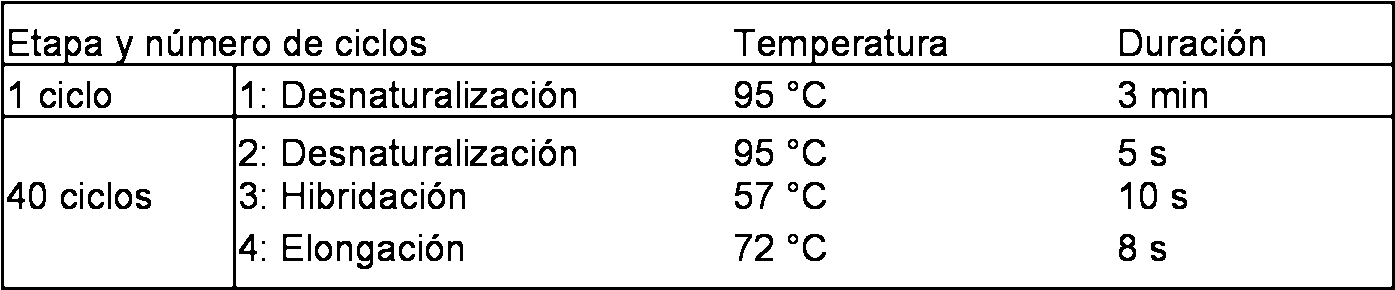
2.4 Inmunizacion de Macacos2.4 Immunization of Macaques
Los macacos se dividieron en cuatro grupos de 2 animales (Tabla A) y se inyectaron de forma subcutanea en 2 puntos con TRIP-SIVmac239 Gag pseudotipificado con la envoltura de VSV-G serotipo Indiana, a 3 dosis diferentes (dosis alta 2,5x10⁸ Unidades de Transduccion (TU), 6863 ng de p24; dosis media 1x10⁸ TU, 2745 ng de p24 o dosis baja 2,5x10⁷ TU, 686 ng de p24) o con TRIP-GFP a la misma dosis de p24 que la dosis alta de TRIP-SIVmac239 Gag (6863 ng de p24).The macaques were divided into four groups of 2 animals (Table A) and injected subcutaneously at 2 points with TRIP-SIVmac239 Gag pseudotyped with the envelope of VSV-G serotype Indiana, at 3 different doses (high dose 2.5x10⁸ Units of Transduction (TU), 6863 ng of p24, average dose 1x10⁸ TU, 2745 ng of p24 or low dose 2.5x10⁷ TU, 686 ng of p24) or with TRIP-GFP at the same dose of p24 as the high dose of TRIP -SIVmac239 Gag (6863 ng of p24).
Para la segunda inmunizacion realizada 87 dfas despues de la sensibilizacion, los animales se inyectaron de forma subcutanea en 4 puntos con un vector pseudotipificado con serotipo de glucoprotema VSV-G sin reaccion cruzada Indiana (VSV-G serotipo Nueva Jersey). Los macacos recibieron 1x10⁸ TU de TRIP-SIVmac239 Gag, 60185 ng de p24 cuando se sensibilizaron con antfgeno GAGdeltamyr, o 60185 ng de p24 de vector TRIP-GFP cuando se sensibilizaron con el antfgeno GFP.For the second immunization performed 87 days after sensitization, the animals were injected subcutaneously at 4 points with a pseudotyped vector with VSV-G glycoprotein serotype without Indiana cross-reaction (VSV-G serotype New Jersey). The macaques received 1x10⁸ TU of TRIP-SIVmac239 Gag, 60185 ng of p24 when sensitized with antigen GAGdeltamyr, or 60185 ng of p24 of vector TRIP-GFP when sensitized with the antigen GFP.

Tabla A: Reparticion de macacos Cynomolgus utilizados en la prueba de vacunacion de TRIPTable A: Distribution of Cynomolgus macaques used in the TRIP vaccination test
Los animales fueron clasificados de acuerdo con el numero de tatuaje y naturaleza/dosis del vector TRIP recibido en la inmunizacion de sensibilizacion.The animals were classified according to the tattoo number and nature / dose of the TRIP vector received in the sensitization immunization.
2.5. Estimulo de SIV mac2512.5. Stimulation of SIV mac251
Se estimularon macacos inmunizados y sin exposicion previa (12 macacos en total) por via intrarrectal 57 dfas despues del refuerzo (es decir, 136 dfas despues de la sensibilizacion) con una sola dosis de 500 DIA50 en 1 ml (dosis infecciosa para Animales suficiente para infectar el 50 % de los animales) de SlVmac 251 patogeno (reserva de A.M. AUBERTIN, Universite Louis Pasteur, Estrasburgo, Francia distribuido por ANRS-o reserva equivalente disponible del NIH). Los animales fueron anestesiados con 10 a 20 mg/kg de Ketamina (Imalgene, Rhone-Merieux) y el procedimiento completo se llevo a cabo de acuerdo con las regulaciones y directrices de la Union Europea del Cuidado y Uso de Animales. Despues de la inoculacion, los macacos se alojaron por separado con precauciones de acuerdo con un alojamiento de animales de bioseguridad de Nivel 3.Immunized macaques were stimulated without prior exposure (12 macaques in total) intrarectally 57 days after reinforcement (ie 136 days after sensitization) with a single dose of 500 DIA50 in 1 ml (sufficient infectious dose for Animals). infect 50% of animals) of SlVmac 251 pathogen (reserve of AM AUBERTIN, Université Louis Pasteur, Strasbourg, France distributed by ANRS-or equivalent reserve available from the NIH). The animals were anesthetized with 10 to 20 mg / kg of Ketamine (Imalgene, Rhone-Merieux) and the entire procedure was carried out in accordance with the regulations and guidelines of the European Union for the Care and Use of Animals. After inoculation, the macaques were housed separately with precautions in accordance with a Tier 3 biosecurity animal housing.
2.6 ELISPOT de IPN-y2.6 ELISPOT of IPN-y
Se anestesiaron animales con 10 a 20 mg/Kg de Ketamina (Imalgene, Rhone-Merieux) para recogida de sangre. Se recogieron 8 ml de sangre para cada macaco en Tubos de Preparacion Celular con Citrato de Sodio (BD Vacutainer™ CPT™) para PBMC y recogida de plasma-citrato y 3 ml en un tubo separador de suero (Vacuette®) para recogida de suero. Despues de la centrifugacion (10 min, 2500 rpm para tubos Vacuette® y 30 minutos, 3000 rpm, sin detencion, para CPT™), y lisis de globulos rojos con 3 a 5 ml de tampon de lisis 1X (tampon de lisis 10X lOtest®, Beckman-Coulter), se sedimentaron PBMC a traves de una centrifugacion de 1600 rpm durante 10 minutos, y posteriormente se enumeraron en una camara de Kova Hycor®, y se distribuyeron a placas ELISPOT de 96 pocillos por triplicado en 2x10⁵ celulas/pocillo, si hubo suficientes celulas disponibles.Animals were anesthetized with 10 to 20 mg / Kg of Ketamine (Imalgene, Rhone-Merieux) for blood collection. 8 ml of blood was collected for each monkey in Sodium Citrate Cell Preparation Tubes (BD Vacutainer ™ CPT ™) for PBMC and plasma-citrate collection and 3 ml in a serum separator tube (Vacuette®) for serum collection . After centrifugation (10 min, 2500 rpm for Vacuette® tubes and 30 minutes, 3000 rpm, without stopping, for CPT ™), and lysis of red blood cells with 3 to 5 ml of 1X lysis buffer (10X lOtest lysis buffer ®, Beckman-Coulter), PBMC were pelleted through a 1600 rpm centrifugation for 10 minutes, and subsequently enumerated in a Kova Hycor® chamber, and distributed to 96-well ELISPOT plates in triplicate in 2x10⁵ cells / well, if there were enough cells available.
Las placas de 96 pocillos con membrana lmmobilon®-P (Fluoruro de Polivinilideno, PVFD) (Sistema de Ensayo de HTS MultiScreen, MSIP; Millipore), se humedecieron previamente (etanol 35 %) y se recubrieron durante la noche a 4 °C con anticuerpo de captura (anticuerpo monoclonal anti- IFN-y humano-de mono IgG1 de raton GZ-4 purificado (Mabtech), 10 pg/ml final en PBS; 50 pl por pocillo). Las placas se lavaron 4 veces en PBS de Dulbecco 1X y se bloquearon con RPMI completo.The 96-well plates with lmmobilon®-P membrane (Polyvinylidene Fluoride, PVFD) (MultiScreen HTS Assay System, MSIP, Millipore), were pre-wetted (35% ethanol) and coated overnight at 4 ° C with capture antibody (monoclonal anti-IFN- and human-monkey IgG1 purified GZ-4 mouse monoclonal antibody (Mabtech), final 10 pg / ml in PBS, 50 μl per well). The plates were washed 4 times in PBS of Dulbecco 1X and blocked with complete RPMI.
Las celulas se volvieron a estimular ya sea mediante la adicion de un conjunto de peptidos (2 ug/ml de cada peptido), SIVmac251 desactivado por AT-2 (5 pg/ml de protemas vmcas totales), o PMA-iono (PMA 0,1 pM e ionomicina 1 pM) como control positivo (4000 celulas/pocillo), o se estimularon de forma simulada con DMSO/RpMI.The cells were re-stimulated either by the addition of a set of peptides (2 ug / ml of each peptide), SIVmac251 deactivated by AT-2 (5 pg / ml of total vmcas proteins), or PMA-iono (PMA 0). , 1 pM and ionomycin 1 pM) as a positive control (4000 cells / well), or stimulated simulated with DMSO / RpMI.
Despues de 40 horas, se revelaron las manchas con un anticuerpo conjugado con biotina (anticuerpo monoclonal antiinterferon-y humano-de mono IgG1 7-B6-1 purificado (Mabtech); 1 pg/ml final en PBS 0,5 % FCS;100 pl por pocillo 2 horas a 37 °C), seguido de estreptavidina-AP (1 h, 1/5000 en PBS 0,5 % FCS, 100 pl por pocillo, 1 h, 37 °C) y solucion de sustrato BCIP/NBT (Mezcla lista para utilizarse, 60 pl por pocillo; 15 minutos, Ta , en la oscuridad). Las manchas se numeraron utilizando un Bioreader® 4000 (Biosys, Karben, Alemania). Los resultados se expresaron como celulas formadoras de manchas de IFN-y (SFC) por millon de PBMC. Las SFC de IPN-Y/millon de PBMC que resultan de una estimulacion por DMSO/RPMI al 5 % se restaron de los resultados como una senal de fondo.After 40 hours, the spots were revealed with a biotin-conjugated antibody (anti-human-monoclonal antibody-purified monkey IgG1 7-B6-1 (Mabtech), 1 pg / ml final in PBS 0.5% FCS; pl per well 2 hours at 37 ° C), followed by streptavidin-AP (1 h, 1/5000 in PBS 0.5% FCS, 100 μl per well, 1 h, 37 ° C) and BCIP / NBT substrate solution (Mix ready to use, 60 pl per well, 15 minutes, Ta, in the dark). The spots were numbered using a Bioreader® 4000 (Biosys, Karben, Germany). The results were expressed as IFN-y stain-forming cells (SFC) per million PBMC. The IPN-Y / million PBMC SFCs resulting from a stimulation by 5% DMSO / RPMI were subtracted from the results as a background signal.
2.7 ELISA2.7 ELISA
La cuantificacion de citocinas innatas (IL6; TNF-a e IFN-a) se llevo a cabo a traves de ELISA utilizando equipos comerciales (equipo de ELISA de IL-6 y TNF-a de mono de U-Cytech Bioscience (Utrech, Pafses Bajos), equipo de IFN-a humano de PBL Biomedical Laboratories (Nueva Jersey, Estados Unidos)). Los plasmas se ensayaron para cada animal 40 dfas antes de la inyeccion de sensibilizacion, 1 hora, 6 horas, 24 horas y 7 dfas despues de la inyeccion de sensibilizacion.The quantification of innate cytokines (IL6, TNF-a and IFN-a) was carried out using ELISA using commercial equipment (IL-6 and TNF-a ELISA equipment of U-Cytech Bioscience monkey (Utrech, Pafses Low), human IFN-a kit from PBL Biomedical Laboratories (New Jersey, United States)). The plasmas were tested for each animal 40 days before the sensitization injection, 1 hour, 6 hours, 24 hours and 7 days after the sensitization injection.
2.8. Ensayo de seroneutralizacion in vitro 2.8. In vitro seroneutralization assay
Se sembraron celulas P4 en 1x10⁵/pocillo en placa de 96 pocillos en un medio completo 24 horas antes de la transduccion. El dfa de la transduccion, las celulas se cultivaron con TRIP-GFP (pseudotipificadas con un VSV-G serotipo Indiana o con un VSV-G sin reaccion cruzada con Indiana tal como VSV-G de Nueva Jersey) incubadas previamente con diferentes diluciones de plasma. Las celulas se transdujeron de forma simulada con el mismo volumen de medio completo. Setenta y dos horas despues de la transduccion, se evaluo la eficiencia de transduccion analizando la fluorescencia de GFP mediante citometna de flujo utilizando un FACScalibur™ (BD).P4 cells were seeded at 1x10⁵ / well in 96-well plate in complete medium 24 hours before transduction. On the day of transduction, the cells were cultured with TRIP-GFP (pseudotyped with a VSV-G serotype Indiana or with a VSV-G without cross-reaction with Indiana such as VSV-G from New Jersey) previously incubated with different plasma dilutions . The cells were transduced in a simulated manner with the same volume of complete medium. Seventy-two hours after transduction, the transduction efficiency was evaluated by analyzing the fluorescence of GFP by cytomene flow using a FACScalibur ™ (BD).
2.9 Determinacion de carga vmca2.9 Determination of load vmca
En resumen, se aislo el ARN vmco de citrato-plasma (200 pl en total) con el Equipo de ARN Vmco de Alta Pureza de Roche. La elucion se llevo a cabo en 50 pl de tampon de elucion (libre de nucleasa, esteril, con doble destilado de agua). El numero de SIV-ARN aislado de plasma se determino en una RT-PCR de una unica etapa cuantitativa utilizando el la qRT-PCR Platinum™ de Invitrogen. Se llevaron a cabo reacciones por duplicado en el Mastercycler ep realplex (Eppendorf) en placas de 96 pocillos de ABgene (AB1100) en un volumen final de 25 pl (10 pl de extracto de ARN y 15 pl de Mezcla). Se eligio el metodo de cuantificacion Taqman, con una sonda interna (500 nM final) que contiene los fluoroforos Fam y Tamra respectivamente en 5' y 3'. Los cebadores (450 nM final) estuvieron respectivamente en la posicion 389 y 456 del genoma de ARNm de SlVmac 251 GAG (Tabla B).Briefly, vmco RNA was isolated from citrate-plasma (200 pl in total) with Roche's High Purity Vmco RNA Kit. The elution was carried out in 50 pl of elution buffer (nuclease-free, sterile, with double distillation of water). The number of SIV-RNA isolated from plasma was determined in a quantitative single-step RT-PCR using the qRT-PCR Platinum ™ from Invitrogen. Reactions were carried out in duplicate in the Mastercycler ep realplex (Eppendorf) in 96-well plates of ABgene (AB1100) in a final volume of 25 μl (10 μl of RNA extract and 15 μl of Mixture). The Taqman quantification method was chosen, with an internal probe (500 nM final) containing the Fam and Tamra fluorophores respectively at 5 'and 3'. The primers (450 nM final) were respectively at position 389 and 456 of the SlVmac 251 GAG mRNA genome (Table B).
La cantidad de copias de ARN vmco, presentada inicialmente, se evaluo mediante extrapolacion de los valores de fluorescencia de umbral en una curva patron interna preparada a partir de diluciones en serie en dH2O de una reserva de virus SIVmac251 titulada previamente mediante la tecnica de “ADN ramificado". Como un control positivo para PCR, se utilizo el plasmido de vector TRIP-SIVmac239 Gag (104 copias/pl).The copy quantity of vmco RNA, presented initially, was evaluated by extrapolation of the threshold fluorescence values in an internal standard curve prepared from serial dilutions in dH 2 O of a SIVmac251 virus pool previously titrated by the technique of "Branched DNA." As a positive control for PCR, the vector plasmid TRIP-SIVmac239 Gag (104 copies / pl) was used.
Tabla B: Secuencias de cebadores y sondas y programa de Taqman RT-PCR utilizado para determinacion de carga vin n l mTable B: Sequences of primers and probes and program of Taqman RT-PCR used for determination of load vin n l m

Resultados: la vacunacion de sensibilizacion-refuerzo de vector lentivirico confiere una fuerte proteccion contra estimulo de SlVmac 251 masivo en macacosResults: the sensitization-reinforcement of lentiviral vector confers a strong protection against massive SlVmac 251 stimulation in macaques
Muchos estudios han destacado el importante papel desempenado por linfocitos T CD8+ en controlar la infeccion por VIH y han sugerido que una vacuna efectiva debe inducir respuestas de linfocitos T CD8+ vigorosas, amplias y de larga duracion. Aun asf, varios vectores vmcos que se ha mostrado que provocan respuestas de linfocitos T CD8+ de SIV espedficas no han conseguido posteriormente controlar la viremia en modelos de SlV/macacos (Schoenly, K. A. y Weiner, 2007). Ya que los inventores y otros han demostrado que los vectores lentivmcos son muy potentes para inducir inmunidad celular (revisado por He, Y. y Falo, L. D., 2007 y Breckpot, K, Aerts, J. L. y Thielemans, K., 2007), los inventores han evaluado si pueden conferir inmunidad celular protectora contra infeccion por SIV y SIDA de simios. Optaron por el modelo de infeccion de SIVmac251 de macacos Cynomolgus que presenta niveles de carga vmca y una diversidad de velocidades de progreso similares a las observadas en infeccion por VIH-1 en seres humanos (Karlsson, I. et al., 2007 y Reimann, K.A., et al., 2005).Many studies have highlighted the important role played by CD8 + T lymphocytes in controlling HIV infection and have suggested that an effective vaccine should induce robust, long-lasting and vigorous CD8 + T-lymphocyte responses. Even so, several viral vectors that have been shown to elicit specific SIV CD8 + T lymphocyte responses have not subsequently succeeded in controlling viraemia in SlV / macaque models (Schoenly, KA and Weiner, 2007). Since the inventors and others have shown that lentivm vectors are very potent for inducing cellular immunity (reviewed by He, Y. and Falo, LD, 2007 and Breckpot, K, Aerts, JL and Thielemans, K., 2007), the inventors have evaluated whether they can confer protective cellular immunity against SIV infection and simian AIDS. They opted for the SIVmac251 infection model of Cynomolgus macaques, which presents vmca load levels and a diversity of progress rates similar to those observed in HIV-1 infection in humans (Karlsson, I. et al., 2007 and Reimann, KA, et al., 2005).
Se inmunizaron dos veces seis macacos Cynomolgus mediante inyecciones subcutaneas de vectores lentivmcos procedentes de VIH-1 que codifican una protema SIVmac239 GAG no secretada en su secuencia nativa (TRIP-SIVmac239 GAG). Este antfgeno individual y no optimizado se eligio para destacar el potencial del sistema de vector lentivirico para vacunacion. Con el objeto de evitar la presencia de anticuerpos antivector neutralizantes, y por lo tanto permitir un efecto de refuerzo eficiente, se diseno una estrategia de intercambio de envoltura. De hecho, los experimentos de preparacion en ratones habfan mostrado que un regimen de sensibilizacion-refuerzo utilizando partmulas TRIP-SIVmac239 GAG pseudotipificadas con VSV-G procedentes de dos serotipos sin reaccion cruzada, Indiana seguido de Nueva Jersey, fue mas eficiente que una sensibilizacion-refuerzo homologa. Los grupos de inmunizacion y diseno experimental se resumen en la tabla 1 que se encuentra mas adelante.Six Cynomolgus monkeys were immunized twice by subcutaneous injections of lentiviral vectors from HIV-1 encoding a SIVmac239 GAG protein not secreted into its native sequence (TRIP-SIVmac239 GAG). This individual and non-optimized antigen was chosen to highlight the potential of the lentiviral vector system for vaccination. In order to avoid the presence of neutralizing antivector antibodies, and therefore to allow an efficient reinforcing effect, an envelope exchange strategy was designed. In fact, mouse preparation experiments had shown that a reinforcement-sensitization regimen using TRIP-SIVmac239 GAG pseudotyped with VSV-G from two serotypes without cross-reaction, Indiana followed by New Jersey, was more efficient than sensitization- homologous reinforcement. The immunization and experimental design groups are summarized in Table 1 below.
Fue suficiente una unica inyeccion de vector lentivirico para inducir inmunidad celular robusta en cada animal inmunizado, independientemente de la dosis recibida (Figura 28a) y sin estimular inflamacion sistemica (Figura 28(2)). Las respuestas de linfocitos T espedficas de SIVmac239 GAG alcanzaron un maximo 16 dfas despues de la sensibilizacion, alcanzando una alta frecuencia de celulas que segregan IPN-y (hasta 3000 SFC de IFN-Y/millon de PBMC), y regresaron a niveles de preinmunizacion dos meses despues de la inmunizacion (Figuras 28(1)a y 28(1)b). Ademas de la robustez de la respuesta primaria, tambien se descubrio que estas eran amplias, abarcando varios conjuntos de peptidos (Figura 30(2)a y Tabla 2a). En la cohorte exogamica de los inventores, observaron que las respuestas de IPN-y espedficas de SIVmac239 GAG se digirieron preferentemente contra dos conjuntos dentro de la region C-terminal de g Ag abarcando una parte de p27 CA y p9 NC. Las 6 vacunas montaron una respuesta vigorosa contra el conjunto SIVmac239 GAG: 337-395 y 4 de 6 contra el conjunto SIVmac239 GAG:385-443.A single lentiviral vector injection was sufficient to induce robust cell immunity in each immunized animal, regardless of the dose received (Figure 28a) and without stimulating systemic inflammation (Figure 28 (2)). The specific T lymphocyte responses of SIVmac239 GAG reached a maximum of 16 days after sensitization, reaching a high frequency of cells that secrete IPN-y (up to 3000 SFC of IFN-Y / million PBMC), and returned to levels of preimmunization. two months after the immunization (Figures 28 (1) a and 28 (1) b). In addition to the robustness of the primary response, it was also discovered that these were broad, encompassing several sets of peptides (Figure 30 (2) a and Table 2a). In the exogamic cohort of the inventors, they observed that the specific IPN-y responses of SIVmac239 GAG were preferentially digested against two sets within the C-terminal region of g Ag spanning a part of p27 CA and p9 NC. The 6 vaccines mounted a vigorous response against the set SIVmac239 GAG: 337-395 and 4 of 6 against the set SIVmac239 GAG: 385-443.
Los animales tambien desarrollaron respuestas humorales neutralizantes contra VSV-serotipo Indiana (Figura 31(2)a), aunque, de manera importante, los sueros de animales vacunados no neutralizaron vectores pseudotipificados con VSV-G Nueva Jersey in vitro (Figura 31(2)b). Por consiguiente los macacos se inyectaron posteriormente con una dosis mediana de partmulas TRIP-SIVmac239 GAG pseudotipificadas con VSV-G Nueva Jersey, 11 semanas despues de la sensibilizacion. Se obtuvo el conjunto completo de peptidos SIVmac239GAG (15 unidades) a traves del Programa de Reactivos de Investigacion y Referencia del SIDA, Division de SIDA, NIAID, NIH.The animals also developed humoral neutralizing against VSV-Indiana serotype (Figure 31 (2)), but, importantly, the vaccinated animals did not neutralize vectors pseudotyped with VSV-G New Jersey in vitro (Figure 31 (2) b) Therefore the macaques were subsequently injected with a medium dose of TRIP-SIVmac239 GAG pseudotyped with VSV-G New Jersey, 11 weeks after sensitization. The complete set of SIVmac239GAG peptides (15 units) was obtained through the AIDS Research and Reference Reagents Program, AIDS Division, NIAID, NIH.
Las respuestas de linfocitos T espedficas de SIVmac239 GAG se re-estimularon de forma eficiente a traves de la segunda inyeccion (Figura 28(1)a). La magnitud de respuestas se incremento con la cinetica tfpica de respuestas secundarias, es decir una aparicion mas rapida y una persistencia mas duradera. Las celulas que segregan IPN-y se detectaron de forma tan temprana como una semana despues de la segunda inmunizacion y hasta dos meses y mas. El alcance de las respuestas celulares no se mejoro (Figura 30(2)b o Tabla 2b). Para imitar de forma mas cercana las etapas de procesamiento y trafico que ocurren en celulas infectadas para presentacion de antfgenos, pero que se evitan por pulsacion de peptidos, tambien se utilizo como antfgeno SIVmac251 desactivada por A T-2. Se observaron respuestas de debiles (macaco 20089) a fuertes (macacos 20022, 20195 y 20056) (Figura 30(2)d). Las tinciones intracelulares llevadas a cabo 10 semanas despues del refuerzo indicaron que los linfocitos T tanto CD4+ como CD8+ contribuyeron a la produccion de IPN-y en respuesta a conjuntos de peptidos (datos no mostrados).The specific T lymphocyte responses of SIVmac239 GAG were re-stimulated efficiently through the second injection (Figure 28 (1) a). The magnitude of responses increased with the typical kinetics of secondary responses, that is, a faster appearance and a more durable persistence. The cells that secrete IPN-y were detected as early as one week after the second immunization and up to two months and more. The range of cellular responses was not improved (Figure 30 (2) b or Table 2b). To more closely mimic the processing and trafficking steps that occur in infected cells for antigen presentation, but which are prevented by peptide pulsation, SIVmac251 antigen deactivated by A T-2 was also used as an antigen. Weak (macaque 20089) to strong (macaques 20022, 20195 and 20056) responses were observed (Figure 30 (2) d). Intracellular staining carried out 10 weeks after the boost indicated that both CD4 + and CD8 + T lymphocytes contributed to the production of IPN- and in response to sets of peptides (data not shown).
Debido a las respuestas inmunes celulares robustas y amplias inducidas por la vacuna, los inventores probaron su eficacia protectora contra infeccion por SIV. Los macacos se expusieron 11 semanas despues del refuerzo mediante inoculacion intrarrectal a una alta dosis de SIVmac251 (500 DIA50) (Tabla 1). Se observaron respuestas espedficas de SIV GAG anamnesicas masivas en la sangre periferica de animales inmunizados poco despues del estfmulo (en una semana) en contraste con animales no vacunados y de control. Estas respuestas alcanzaron maximos de forma mas temprana y mas vigorosa (mas de 4.000 SFC de IPN-y espedficas de SIV GAG/millon de PBMC) (Figura 28). Tambien se documento un rebote mas temprano y mayor de linfocitos T CD8+ totales, vfrgenes y de memoria central, durante la infeccion primaria en animales vacunados en comparacion con los no vacunados y de control (TRIP GFP) (Figura 32(2)). Las regiones GAG mapeadas despues de las inmunizaciones fueron reinvocadas por el estfmulo y tambien se detectaron despues de la infeccion nuevas regiones inmunogenicas. La diversidad de las respuestas espedficas de GAG fue comparable entre animales vacunados y no vacunados o de control (Figura 30(2)c y Tabla 2c). Due to the robust and extensive cellular immune responses induced by the vaccine, the inventors tested their protective efficacy against SIV infection. The macaques were exposed 11 weeks after reinforcement by intrarectal inoculation to a high dose of SIVmac251 (500 DAY 50 ) (Table 1). Specific responses of massive anamnestic SIV GAGs were observed in the peripheral blood of animals immunized shortly after the stimulus (in a week) in contrast to unvaccinated and control animals. These responses reached maxima earlier and more vigorously (more than 4,000 SFC of IPN-specific SIV GAG / million of PBMC) (Figure 28). An earlier and higher rebound of total CD8 + T lymphocytes, vfrgenes and central memory, was also documented during the primary infection in vaccinated animals compared to the unvaccinated and control (TRIP GFP) (Figure 32 (2)). The GAG regions mapped after the immunizations were reinvented by the stimulus and new immunogenic regions were also detected after the infection. The diversity of specific GAG responses was comparable between vaccinated and unvaccinated or control animals (Figure 30 (2) c and Table 2c).
Aunque el estimulo vmco condujo a infeccion en todos los animales, la inmunizacion confirio una fuerte proteccion contra replicacion vmca y agotamiento de linfocitos T CD4+ de memoria central durante la fase aguda. Los animales de control inyectados con TRIP GFP, tuvieron una evolucion de infeccion muy comparable con macacos no vacunados y por consiguiente se reunieron como un unico grupo. En el plasma de estos animales sin exposicion previa y de control, el pico de la replicacion vmca fue alto con una media de 1,02x10⁷ copias de ARN/ml. Posteriormente disminuyeron las cargas vmcas en los 6 animales no vacunados y de control hasta alcanzar niveles de ARN vmco en plasma de punto de ajuste de leve a moderado (dfas 70 a 154) con una media de 3,44x10⁵ copias de ARN/ml (Figuras 29(1)a y 29(1)c). En contraste, la viremia en el pico de primo-infeccion de los 6 animales inmunizados, fue menor que en animales sin exposicion previa y de control en al menos dos ordenes de magnitud con una media de 9,25x10⁴ copias de ARN/ml (Figuras 29(1)b y 29(1)c). De los 6 macacos vacunados, 4 suprimieron la viremia maxima en mas de 2 log de 10 veces (20022, 20293, 20l58), 2 en mas de 3 log de 10 veces (20293 y 20158) y 1 en mas de 4 log de 10 veces (20195) (Figura 29(1)e). Despues de la resolucion de la viremia maxima, las cargas vmcas disminuyeron y permanecieron persistentemente por debajo de las de animales no vacunados y de control en alrededor de un factor de 10 veces, y estadfsticamente inferiores el dfa 49 posterior a la infeccion (Figura 29(1)c). Cuando se compararon las replicaciones acumulativas durante los primeros 154 dfas de infeccion (expresados como area bajo la curva de carga vmca en funcion del tiempo), el beneficio proporcionado por la vacunacion fue estadfsticamente significativo (Figura 29(1)f).Although the vmco stimulus led to infection in all animals, immunization conferred strong protection against replication and depletion of central memory CD4 + T lymphocytes during the acute phase. The control animals injected with TRIP GFP, had an infection evolution very comparable with unvaccinated macaques and consequently they met as a single group. In the plasma of these animals without previous exposure and control, the peak of vmca replication was high with a mean of 1.02x10⁷ copies of RNA / ml. Subsequently, the viral loads in the 6 unvaccinated and control animals decreased to reach levels of vmco RNA in the plasma from mild to moderate (days 70 to 154) with a mean of 3.44x10⁵ copies of RNA / ml (Figures 29 (1) a and 29 (1) c). In contrast, the viremia at the primo-infection peak of the 6 immunized animals was lower than in animals without prior exposure and control in at least two orders of magnitude with an average of 9.25x10⁴ copies of RNA / ml (Figures 29 (1) by 29 (1) c). Of the 6 vaccinated monkeys, 4 suppressed the maximum viremia in more than 2 log 10 times (20022, 20293, 20l58), 2 in more than 3 log 10 times (20293 and 20158) and 1 in more than 4 log of 10 times (20195) (Figure 29 (1) e). After the resolution of maximal viremia, the viral loads decreased and remained persistently below those of unvaccinated and control animals by about a factor of 10 times, and statistically lower on day 49 after infection (Figure 29 ( 1 C). When cumulative replications were compared during the first 154 days of infection (expressed as area under the load curve vs. time), the benefit provided by the vaccination was statistically significant (Figure 29 (1) f).
Los inventores tambien supervisaron la evolucion de linfocitos T CD4+ en la sangre periferica durante el transcurso de la infeccion y mas particularmente los linfocitos T CD4+ de memoria central (CM), debido a que su agotamiento se correlaciona con las cargas vmcas en plasma (Karlsson, I. et al., 2007) y su conservacion durante infeccion SIV aguda y cronica anticipa la supervivencia a largo plazo de monos vacunados, mejor que los niveles de carga vmca de punto de ajuste (Mattapallil, J.J. et al., 2006 y Letvin, N. L., et al., 2006).The inventors also monitored the evolution of CD4 + T lymphocytes in the peripheral blood during the course of the infection and more particularly the central memory (CM) CD4 + T lymphocytes, because their exhaustion correlates with the plasma charges (Karlsson, I. et al., 2007) and its conservation during acute and chronic SIV infection anticipates the long-term survival of vaccinated monkeys, better than the set point load levels (Mattapallil, JJ et al., 2006 and Letvin, NL, et al., 2006).
Durante la infeccion aguda, hubo una disminucion rapida y profunda de linfocitos T CD4+ en la sangre periferica de los animales vacunados y de CM (Figura 30a). Los recuentos de linfocitos T CD4+ CM permanecieron bajos con signos de agotamiento gradual pira 3 de ellos (21544, 14184 y 20456), en tanto que el agotamiento fue temporal y seguido de un regreso a la medida basal para los otros 3 (15661, 15885 y 14468). Estos dos subgrupos demostraron de forma adicional una viremia postaguda moderada y baja de forma correspondiente, y por consiguiente se clasificaron como animales progresivos (14184- 21544-20456) y no progresivos (15661-15885-14468).During the acute infection, there was a rapid and profound decrease in CD4 + T lymphocytes in the peripheral blood of the vaccinated animals and CM (Figure 30a). CM CD4 + T lymphocyte counts remained low with signs of gradual depletion py 3 of them (21544, 14184 and 20456), while the exhaustion was temporary and followed by a return to the baseline measurement for the other 3 (15661, 15885 and 14468). These two subgroups additionally demonstrated a moderate and low post-acute viremia correspondingly, and therefore were classified as progressive (14184- 21544-20456) and non-progressive (15661-15885-14468) animals.
En contraste, los animales vacunados mostraron conservacion completa o unicamente un agotamiento leve de sus linfocitos T CD4+ CM durante la viremia maxima, y todos recuperaron rapidamente sus linfocitos T CD4+ CM, excepto el macaco 20089 (Figuras 30(1)b y 30(1)c).In contrast, the vaccinated animals showed complete preservation or only a mild depletion of their CD4 + CM lymphocytes during maximal viraemia, and all quickly recovered their CD4 + CM lymphocytes, except the macaque 20089 (Figures 30 (1) by 30 (1) c)
Todos los animales sin exposicion previa y de control experimentaron una perdida profunda de linfocitos T CD4+ CM y viremia de alto nivel en el maximo de la primo-infeccion, aunque la mitad de ellos recuperaron rapidamente su compartimento de linfocitos T CD4+ CM en tanto que la otra mitad, por el contrario, mostro una lenta disminucion del numero de linfocitos T CD4+ CM. Estos dos subgrupos demostraron una viremia post-aguda de baja a moderada de forma correspondiente y por consiguiente se clasificaron como animales no progresivos (15661-15885-14468) y progresivos (14184-21544-20456). De manera importante, la viremia de animales vacunados en los ultimos puntos temporales, se redujo en alrededor de un factor de 2 log 10 veces cuando se compararon con animales no vacunados progresivos, en tanto que la viremia post-aguda y los recuentos de linfocitos T CD4+ CM fueron similares entre animales vacunados y no vacunados no progresivos (Figuras 29d y 30d).All the animals without previous exposure and control experienced a profound loss of CD4 + CM lymphocytes and high-level viraemia at the maximum of the first infection, although half of them quickly recovered their CD4 + CM lymphocyte compartment while the another half, on the other hand, showed a slow decrease in the number of CD4 + CM lymphocytes. These two subgroups showed a corresponding low to moderate post-acute viremia and were therefore classified as non-progressive (15661-15885-14468) and progressive (14184-21544-20456) animals. Importantly, the viraemia of animals vaccinated at the last time points was reduced by about a factor of 2 log 10 times when compared to unvaccinated progressive animals, whereas post-acute viremia and T lymphocyte counts CD4 + CM were similar between vaccinated and unvaccinated non-progressive animals (Figures 29d and 30d).
Se encontraron correlaciones entre respuestas inmunes inducidas por vacunas y cargas vmcas, a pesar de la subevaluacion de respuestas celulares debido a la saturacion de algunos pocillos ELISPOT (Figura 29(2)). De manera importante, hubo una correlacion inversa entre el nivel de viremia maxima y la magnitud de respuestas IFN-y espedficas de GAG medidas 2 semanas despues de la sensibilizacion, 1 semana despues del refuerzo y 1 semana despues de la exposicion (Figuras 32a, 32b y 32c). Estos descubrimientos estan en perfecto acuerdo con los estudios en cohortes grandes de pacientes infectados por VIH-1 que muestran una correlacion entre linfocitos T CD8+ espedficos de VIH61 GAG y cargas vmcas bajas y una lenta evolucion de la enfermedad (Kiepiela, P. et al., 2007). Los inventores tambien han observado una fuerte correlacion entre la conservacion de linfocitos T CD4+ CM y las cargas vmcas durante infeccion aguda (Figura 32d).Correlations were found between immune responses induced by vaccines and viral loads, despite the undervaluation of cellular responses due to the saturation of some ELISPOT wells (Figure 29 (2)). Importantly, there was an inverse correlation between the level of maximal viraemia and the magnitude of IFN-specific responses of GAG measured 2 weeks after sensitization, 1 week after reinforcement and 1 week after exposure (Figures 32a, 32b). and 32c). These findings are in perfect agreement with studies in large cohorts of patients infected with HIV-1 that show a correlation between CD8 + T lymphocytes specific for HIV61 GAG and low viral loads and a slow evolution of the disease (Kiepiela, P. et al. , 2007). The inventors have also observed a strong correlation between the preservation of CM CD4 + T lymphocytes and the viral loads during acute infection (Figure 32d).
En resumen, este estudio proporciona pruebas de que un regimen de vacunacion de sensibilizacion/refuerzo basado en vector lentivmco provoca una inmunidad celular fuerte y amplia en macacos cynomologus y confiere proteccion efectiva contra infeccion por SIVmac251 masiva disminuyendo la viremia y evitando completamente la perdida de linfocitos T CD4+ y linfocitos T CD4+ CM en el maximo de la primo-infeccion.In summary, this study provides evidence that a sensitization / booster vaccination regimen based on lentivmco vector causes strong and extensive cell immunity in cynomological macaques and confers effective protection against massive SIVmac251 infection by decreasing viraemia and completely preventing lymphocyte loss T CD4 + and CD4 + T lymphocytes CM at the maximum of the primo-infection.
Un seguimiento a largo plazo indicara si puede suceder o no un escape vmco de la presion inmune en este cohorte de macaco. Despues de un seguimiento de 5 meses, la estabilidad de los numeros de linfocitos T CD4+ y la tendencia de disminucion de las cargas vmcas en animales vacunados apoyan el control a largo plazo. A pesar de esta primera prueba preclmica aunque en una cohorte limitada de macaco es muy prometedora debido a que la proteccion dependfa unicamente de las respuestas dirigidas contra un antfgeno GAG no optimizado. Los inventores esperan una mejora del control de la replicacion incrementando la expresion de antfgeno y la inmunogenicidad mediante optimizacion de codones (Demi, L. et al., 2001 y zur Megede, J. et al., 2000), y a traves del incremento de la diversidad de las respuestas celulares mediante fusion de otros antigenos de SIV con GAG (Wilson, N. A. et al., 2006 y Hel, Z. et al., 2006). A este respecto se presentan algunos resultados mas adelante en un modelo de raton, y una version optimizada de esta estrategia de vacunacion, con un cumplimiento total de los requisitos tanto de eficacia como de seguridad, entrara por consiguiente en pruebas clmicas de vacunacion terapeutica en seres humanos.A long-term follow-up will indicate whether or not an escape of immune pressure may or may not occur in this macaque cohort. After a follow-up of 5 months, the stability of the numbers of CD4 + T lymphocytes and the tendency of decrease in viral loads in vaccinated animals support long-term control. In spite of this first preclmic test, although in a limited cohort of macaques it is very promising because the protection depended only on the responses directed against a non-optimized GAG antigen. The inventors expect an improvement in the control of replication by increasing the expression of antigen and immunogenicity by optimization of codons (Demi, L. et al., 2001 and zur Megede, J. et al., 2000), and through the increase in the diversity of cellular responses by fusion of other SIV antigens with GAG (Wilson, NA et al. ., 2006 and Hel, Z. et al., 2006). In this regard some results are presented later in a mouse model, and an optimized version of this vaccination strategy, with full compliance with the requirements of both efficacy and safety, will therefore enter into clinical tests of therapeutic vaccination in humans. humans.
Tabla 1: Grupos de inmunizacion y diseno experimentalTable 1: Immunization groups and experimental design
Grupo Vacuna Subgrupo n.° de animal Sensibilizacion Refuerzo Estfmulo Group Vacuna Subgroup No. of animals Sensitization Reinforcement Stimulus
Partmulas Partmulas pseudotipificada pseudotipificadasParticles Pseudotyped Pseudotyped Particles
s con VSV-G con VSV-Gs with VSV-G with VSV-G
Indiana Nueva JerseyIndiana New Jersey
Dfa 0 Dfa 79 posterior Dfa 76 posterior a la al refuerzo sensibilizacionDfa 0 Dfa 79 later Dfa 76 after the reinforcement sensitization
Dosis baja 20022, 20089 2,5x10⁷ TULow dose 20022, 20089 2.5x10⁷ TU
Vacunado TRIP- Dosis media 20293, 20058 1x10⁸ TU 1,2 108 TU 500 DIA50Vaccinated TRIP- Average dose 20293, 20058 1x10⁸ TU 1,2 108 TU 500 DIA50
SIVmac239 Dosis Alta 20195,20158 2,5x10⁸ TU SIVmac251 n=6 GAGSIVmac239 High Dose 20195,20158 2.5x10⁸ TU SIVmac251 n = 6 GAG
Control TRIP-GFP 21544,20456 6869 ng de p24 6018 ng de p24 500 DIA50 n=2 SIVmac251Control TRIP-GFP 21544,20456 6869 ng of p24 6018 ng of p24 500 DIA50 n = 2 SIVmac251
No vacunado Ninguno 15661,14184 ninguno ninguno 500 DIA50 n=4 15885, 14468 SIVmac251Not vaccinated None 15661,14184 none none 500 DIA50 n = 4 15885, 14468 SIVmac251
Se incluyeron en la prueba preclmica doce macacos Cynomolgus adultos y macho exogamicos (Macaca fascicularis) de la Isla del oceano fndico de Isla Mauricio. Fueron negativos para SIV, Virus de Herpes B, filovirus, STLV-1, SRV-1, SRV-2, sarampion, hepatitis B-HbsAg y hepatitis B-HBcAb antes de la inclusion en el estudio. Las inmunizaciones, recolecciones de sangre y estfmulo fueron manejadas de acuerdo con las directrices de la Union Europea para experimentos utilizando primates no humanos (decreto N° 2001-486). Las inmunizaciones se realizaron mediante inyecciones subcutaneas el dfa 0 y el dfa 79 de partfculas lentivmcas pseudotipificadas con 2 diferentes envolturas, las glucoprotemas G de 2 serotipos sin reaccion cruzada de VSV, Indiana y Nueva Jersey. La dosis de partfculas de vector lentivmco se expresaron como unidad de transduccion (TU)/animal y ng de p24/animal. Se inmunizaron seis animales con 3 dosis de vectores lentivmcos que codifican una forma no secretada de SIVmac239 GAG (con deficiencia de miristoilacion). Debido a la ausencia de la respuesta de dosis despues de la primera inyeccion, los 6 animales vacunados recibieron la misma dosis de medio de vector para la segunda inyeccion. Dos animales de control se inmunizaron con vector lentivmco que codifica un antfgeno irrelevante, GFP, en la misma dosis de p24 que el subgrupo relevante de alta dosis. Los macacos vacunados, de control y no vacunados se expusieron por via intrarrectal 76 dfas despues del refuerzo a una alta dosis de SIVmac251 patogeno (A-M Aubertin, Universite Louis Pasteur, Estrasburgo, Francia) expresando una protema GAG que corresponde cercanamente a la vacuna (estfmulo homologo). Se eligio una dosis alta de virus (500 DIA50 en comparacion con 20-50 DIA50, normalmente utilizado en estudios de eficacia protectora de vacunas) para limitar el numero de controladores espontaneos5.Twelve adult cynomolgus and exogamous male macaques (Macaca fascicularis) from the island of the Indian Ocean of Mauritius were included in the preclinical test. They were negative for SIV, Herpes B Virus, filovirus, STLV-1, SRV-1, SRV-2, measles, hepatitis B-HbsAg and hepatitis B-HBcAb before inclusion in the study. Immunizations, blood collections and stimuli were handled in accordance with European Union guidelines for experiments using non-human primates (Decree No. 2001-486). Immunizations were performed by subcutaneous injections on day 0 and day 79 of lentivmc pseudotyped particles with 2 different envelopes, G glycoproteins of 2 serotypes without cross-reaction of VSV, Indiana and New Jersey. The dose of lentivmco vector particles was expressed as transduction unit (TU) / animal and ng of p24 / animal. Six animals were immunized with 3 doses of lentivm vectors encoding a non-secreted form of SIVmac239 GAG (with myristoylation deficiency). Due to the absence of the dose response after the first injection, the 6 vaccinated animals received the same dose of vector medium for the second injection. Two control animals were immunized with lentivmco vector encoding an irrelevant antigen, GFP, in the same dose of p24 as the relevant subgroup of high dose. Vaccinated, control and unvaccinated monkeys were exposed intrarectally 76 days after reinforcement to a high dose of SIVmac251 pathogen (AM Aubertin, Universite Louis Pasteur, Strasbourg, France) expressing a GAG protein corresponding closely to the vaccine (stimulus). counterpart). A high dose of virus was chosen (500 DIA 50 compared to 20-50 DIA 50 , normally used in protective efficacy studies of vaccines) to limit the number of spontaneous controllers5.
Tabla 2: Las respuestas de linfocitos T inducidas por vacuna fueron amplias Table 2: T-cell responses induced by vaccine were broad


La diversidad y la contribucion relativa de las protemas codificadas por GAG (matriz MA, capsida CA, nucleocapsida NC y p6) a las respuestas de linfocitos T espedficas por GAG inducidas por vacuna, inducidas por virus y reinvocadas por virus, se estudiaron mediante ensayo ELISPOT de IFN-Yen el maximo de las respuestas primarias (dos semanas despues de la sensibilizacion, Tabla Complementaria 1a), una semana despues del refuerzo (Tabla Complementaria 1b) y durante la fase aguda de la infeccion (3 semanas despues del esftmulo, Tabla Complementaria 1c) utilizando 11 conjuntos de peptidos mostrados en la segunda lrnea de las tablas. Las primeras 2 columnas indican el identificador del animal. Los numeros corresponden a SFC de IFN-Y/millon de PBMC. El subrayado indica pocillos de ELISPOT saturados. Los cuadros sombreados con gris claro corresponden a respuestas positivas (>375 SFC de IFN-g/millon de PBMC) y los cuadros sombreados con gris oscuro representan la respuesta mas fuerte en un animal individual. Las columnas de la derecha muestran el numero de conjuntos de peptidos reconocidos por cada animal, mientras que la fila inferior representa el numero de animales de la cohorte que montaron una respuesta contra cada conjunto individual de peptidos.The diversity and relative contribution of the GAG-encoded proteins (MA matrix, CA capsid, NC nucleocapsid, and p6) to the vaccine-induced, viral-induced GAV-induced esophageal T-cell responses induced by viruses were studied by ELISPOT assay. of IFN-Y in the maximum of the primary responses (two weeks after the sensitization, Complementary Table 1a), one week after the reinforcement (Complementary Table 1b) and during the acute phase of the infection (3 weeks after the stimulus, Complementary Table 1c) using 11 sets of peptides shown in the second line of the tables. The first 2 columns indicate the animal's identifier. The numbers correspond to SFC of IFN-Y / million PBMC. Underlining indicates saturated ELISPOT wells. The shaded boxes with light gray correspond to positive responses (> 375 CFS of IFN-g / million PBMC) and the shaded boxes with dark gray represent the strongest response in an individual animal. The columns on the right show the number of sets of peptides recognized by each animal, while the bottom row represents the number of animals in the cohort that mounted a response against each individual set of peptides.
COMPARACION DE LA RESPUESTA INMUNE OBTENIDA EN RATONES INMUNIZADOS CON UN VECTOR LENTIVIRICO QUE CODIFICA UN ANTIGENO GAG O UNA FORMA CON CODONES OPTIMIZADOS DE DICHO ANTIGENOCOMPARISON OF THE IMMUNE RESPONSE OBTAINED IN IMMUNIZED MICE WITH A LENTIVIRIC VECTOR THAT CODIFIES AN ANTIGEN GAG OR A FORM WITH OPTIMIZED CODONS OF SAID ANTIGEN
1. La optimizacion de codones del polinucleotido que codifica el antfgeno mejora la respuesta de CTL1. The codon optimization of the polynucleotide that encodes the antigen improves the CTL response
Se inmunizaron ratones sin exposicion previa (n=3/grupo) i.p. con una sola inyeccion de diversas dosis de TRIP. NI gag delta myr o TRIP.NI LV que codifican una forma con codones optimizados de GAG delta myr (TRIP NI gagAmyrCO). A los 10 dfas despues de la inmunizacion, se evaluaron las respuestas inmune celulares espedficas de GAG contra el epftopo de linfocitos T CD8+ de gag inmunodominante (Figura 33) mediante tincion de tetramero (A) o ELISPOT de IPN-y (B). Los ensayos ELISPOT de IPN-y de celulas formadoras de manchas SFC (C) en respuesta al epftopo inmunodominante de linfocitos T CD8+ y el epftopo de linfocitos T CD4+ de GAG. Los ratones se sensibilizaron 1. p. con 100 ng de TRIP.N gagAmyr LV o TRIP.NI gagAmyr CO LV. 10 dfas despues, los esplenocitos de ratones inmunizados se estimularon con los peptidos correspondientes y se analizaron mediante ensayos ELISPOT. Las frecuencias de fondo se restaron antes de la representacion grafica. Las barras de error representan DT para 3 ratones por grupo. (D) Comparacion de actividades lfticas espedficas de GAG inducidas por inmunizacion de TRIP.NI gagAmyr LV frente a TRIP.NI gagAmyr CO LV. Se midio la actividad CTL 10 dfas despues de la inmunizacion utilizando un ensayo de 20 horas de CTRL in vivo como se describe en la seccion de Materiales y Metodos, se muestra la Media /- DT de tres ratones.Mice were immunized without prior exposure (n = 3 / group) ip with a single injection of various doses of TRIP. NI gag delta myr or TRIP.NI LV that encode a form with optimized codons of GAG delta myr (TRIP NI gagAmyrCO). At 10 days after immunization, the cellular immune responses specific for GAG against the epitope of CD8 + T lymphocytes of immunodominant gag (Figure 33) were evaluated by staining tetramer (A) or ELISPOT of IPN-y (B). The ELISPOT assays of IPN- and SFC staining-forming cells (C) in response to the immunodominant epitope of CD8 + T lymphocytes and the epitope of CD4 + T cells of GAG. The mice were sensitized 1. p. with 100 ng of TRIP.N gagAmyr LV or TRIP.NI gagAmyr CO LV. 10 days later, splenocytes from immunized mice were stimulated with the corresponding peptides and analyzed by ELISPOT assays. The background frequencies were subtracted before the graphical representation. The error bars represent DT for 3 mice per group. (D) Comparison of GAG-specific lytic activities induced by immunization of TRIP.NI gagAmyr LV against TRIP.NI gagAmyr CO LV. CTL activity was measured 10 days after immunization using a 20 hour CTRL assay in vivo as described in the Materials and Methods section, the Media / DT of three mice is shown.
Los resultados obtenidos muestran que la optimizacion de codones mejora de forma crftica la respuesta CTL inducida por vacunas a base de TRIP. NI LV.The results obtained show that the optimization of codons improves critically the CTL response induced by TRIP-based vaccines. NI LV.
2. Partfculas de vector lentivftico que codifican el anftgeno con codones optimizados inducen una respuesta inmune celular fuerte y duradera despues de incluso una unica inyeccion.2. Lentivistic vector particles encoding the codon optimized antigen induce a strong and lasting cellular immune response after even a single injection.
Los resultados obtenidos muestran que la optimizacion de codones mejora de forma crftica la respuesta CTL inducida por vacunas a base de TRIP.NI LV.The results obtained show that the optimization of codons improves critically the CTL response induced by TRIP.NI LV based vaccines.
Las respuestas de linfocitos T de memoria inducidas por vectores lentivfticos de no integracion se ensayaron en ratones, despues de una unica inyeccion de partfculas TRIP.NI gag Amyr o TRIP.NI gag Amyr CO. La Figura 34 muestra que las partfculas de vector lentivftico que codifican el anftgeno con codones optimizados inducen una respuesta inmune celular fuerte y duradera despues incluso de una unica inyeccion.Memory T lymphocyte responses induced by non-integrating lentiviral vectors were tested in mice, after a single injection of TRIP.NI gag Amyr or TRIP.NI gag Amyr CO particles. Figure 34 shows that the lentivitic vector particles encoding the codon-optimized antigen elicit a strong and lasting cellular immune response after even a single injection.
3. La estrategia de sensibilizacion-refuerzo basada en partfculas TRIP.NI gagAmyr CO pseudotipificadas con una glucoprotema G de serotipos VSV sin reaccion cruzada aumenta la respuesta inmune celular3. The strategy of sensitization-reinforcement based on TRIP.NI gagAmyr CO particles pseudotyped with a G glycoprotein of VSV serotypes without cross reaction increases the cellular immune response
Los ratones se inmunizaron con partfculas TRIP.NI GAGAmyr CO o TRIP.I GAG de tipo silvestre pseudotipificadas con VSV-G Indiana y 13 semanas despues se reforzaron con partfculas TRIP.NI GAGAmyr CO o TRIP.I GAG de tipo silvestre, respectivamente, pseudotipificadas con VSV-G Nueva Jersey. Los grupos de control para el protocolo de sensibilizacion-refuerzo incluyen ratones inyectados unicamente una vez con partfculas TRIP pseudotipificadas con VSV-G Indiana (diagramas grises) o partfculas TRIP pseudotipificadas con VSV-G New Jersey (diagramas azules). Todos los ratones se sacrificaron 10 dfas despues de la inmunizacion, y se evaluo la respuesta inmune celular contra GAG mediante ELISPOT de IPN-y (A) o tincion de tetramero (B) (Figura 35). Los resultados obtenidos muestran que la optimizacion de codones de las partfculas a base de lentivirus, potencia el regimen de vacuna de sensibilizacionrefuerzo.Mice were immunized with wild-type TRIP.NI GAGAmyr CO or TRIP.I GAG particles pseudotyped with VSV-G Indiana and 13 weeks later were boosted with wild-type TRIP.NI GAGAmyr CO or TRIP.I GAG particles, respectively, pseudotyped. with VSV-G New Jersey. Control groups for the booster-sensitization protocol include mice injected only once with TRIP particles pseudotyped with VSV-G Indiana (gray plots) or TRIP particles pseudotyped with VSV-G New Jersey (blue plots). All mice were sacrificed 10 days after immunization, and the cellular immune response against GAG was assessed by IPN-y ELISPOT (A) or tetramer staining (B) (Figure 35). The results obtained show that the codon optimization of lentivirus-based particles enhances the reinforcement-sensitization vaccine regimen.
Los datos obtenidos en ratones muestran que la optimizacion de codones del polinucleotido que codifica el anftgeno en las partfculas de vector lentivftico, proporciona mejona en el nivel de respuesta inmune celular y especialmente la respuesta de CTL en el hospedador, despues de una sola inyeccion o despues de una inyeccion de sensibilizacionrefuerzo. Ademas, la respuesta obtenida es fuerte y duradera. The data obtained in mice show that the codon optimization of the polynucleotide encoding the antigen in the lentivistic vector particles provides mejona in the level of cellular immune response and especially the CTL response in the host, after a single injection or after of an injection of sensibilizacionrefuerzo. In addition, the response obtained is strong and lasting.
COMPARACION DE RESPUESTA INMUNE OBTENIDA EN RATONES INMUNIZADOS A TRAVES DE DIFERENTES VIASCOMPARISON OF IMMUNE RESPONSE OBTAINED IN IMMUNIZED MICE THROUGH DIFFERENT WAYS
Se vacunaron varios grupos de dos diferentes tipos de ratones con partfculas de vector lentivftico que codifican SIVmac239GagA. La respuesta inmune provocada se analizo en cada grupo 10 dfas despues de una unica inyeccion de las partfculas, Nevada a cabo ya sea por via intramuscular (i m.), intradermica (i.d.), intraperitoneal (i.p), subcutanea (s.c.) o transcutanea (t.c.i.).Several groups of two different types of mice were vaccinated with lentivitic vector particles encoding SIVmac239GagA. The evoked immune response was analyzed in each group 10 days after a single injection of the particles, Nevada performed either intramuscularly (i m.), Intradermal (id), intraperitoneal (ip), subcutaneous (sc) or transcutaneous. (tci)
Especialmente la respuesta se analizo en un ensayo de citotoxicidad in vivo (Figuras 36-38) o en un ELISPOT de IFNgamma.Especially the response was analyzed in an in vivo cytotoxicity assay (Figures 36-38) or in an IFNgamma ELISPOT.
En los grupos de ratones (C57BI/6J), cuando la inyeccion se llevo a cabo a traves de la via intramuscular, se genero una mayor respuesta que cuando la inyeccion se llevo a cabo a traves de otra via.In the groups of mice (C57BI / 6J), when the injection was carried out through the intramuscular route, a greater response was generated than when the injection was carried out through another route.
VECTORES LENTIVIRICOS SIN INTEGRACION PARA SU USO PARA GENERAR RESPUESTA INMUNE CUANDO SE ADMINISTRAN PARA PROTECCION EN UN REGIMEN DE VACUNA LENTIVIRIC VECTORS WITHOUT INTEGRATION FOR USE TO GENERATE IMMUNE RESPONSE WHEN ADMINISTERED FOR PROTECTION IN A VACCINE REGIME
MATERIALES Y METODOSMATERIALS AND METHODS
Cultivo celular y preparaciones de virusCell culture and virus preparations
Se cultivaron celulas HeLa (ATCC CCL-2), celulas 293T Humanas y celulas Vero de rinon de mono verde Africano (ATCC CCL-81) en medio de Eagle modificado por Dulbecco (DMEM) complementado con 10 % (celulas HeLa, celulas 293T) o 5 % (celulas Vero) de suero de ternero fetal desactivado por calor (FCS), penicilina, estreptomicina y Glutamax (GIBCO). Se propago el virus del Nilo occidental (WNV) cepa IS-98-ST1 (numero de referencia GenBank AF 481 864), una variante estrechamente relacionada de la cepa NY9910, en monocapas de celulas AP61 de mosquito Aedes pseudoscutellaris. Se llevo a cabo purificacion en gradientes de sacarosa y titulacion de virus en celulas AP61 (celulas de Aedes pseudoscutellaris) mediante ensayo de inmunodeteccion de focos (FIA) utilizando ftquido ascftico de raton hiperinmune anti-WNV (HMAF) como se ha descrito previamente. Se expresaron tftulos de infectividad como unidades formadoras de focos (UFF).HeLa cells (ATCC CCL-2), Human 293T cells and Vero cells of African green monkey kidney (ATCC CCL-81) were cultured in Dulbecco's modified Eagle's medium (DMEM) supplemented with 10% (HeLa cells, 293T cells) or 5% (Vero cells) of heat-deactivated fetal calf serum (FCS), penicillin, streptomycin and Glutamax (GIBCO). West Nile virus (WNV) strain IS-98-ST1 (reference number GenBank AF 481 864), a closely related variant of strain NY9910, was propagated in monolayers of AP61 cells of Aedes pseudoscutellaris mosquito . Purification was carried out on sucrose gradients and virus titration in AP61 cells ( Aedes pseudoscutellaris cells ) by spot immunodetection assay (FIA) using anti-WNV hyperimmune mouse ascitic fluid (HMAF) as previously described. Infectivity titer were expressed as foci forming units (UFF).
Produccion de vector lentivfticoLentivistic vector production
Se construyeron plasmidos de vector TRIPs e w n v (Figura 2) y TRIPg f p como se ha descrito previamente (Iglesias et al., J. Gene Med. Mar 2006; 8(3): 265-74). Las secuencias de nucleotidos de estos dos vectores se presentan respectivamente en las Figuras 4 y 5. Se produjeron partfculas vector mediante cotransfeccion de fosfato de calcio temporal de celulas 293T con el plasmido de vector pTRIPsEwnv o pTRIPg f p , un plasmido de expresion de envoltura de VSV-G (pHCMV-G) y un plasmido de encapsidacion (p8.74 o pD64V para la produccion de vectores proficientes en integracion o deficientes en integracion, respectivamente), como se ha descrito anteriormente. La cuantificacion del contenido de anftgeno p24 de partfculas de vector concentradas se llevo a cabo con un equipo de ensayo inmunoabsorbente ligado a enzimas VIH-1 p24 comercial (ELISA) (Perkin Elemer Life Sciences). Los tftulos de vector de partfculas TRIP.I y TRIP.NI se determinaron transduciendo celulas HeLa tratadas con afidicolina y realizando una PCR cuantitativa como se ha descrito previamente en Iglesias et al., (J Gene Med. Mar 2006; 8(3): 265-74). Los tftulos de vectores lentivfticos de integracion y no integracion fueron similares de acuerdo con el contenido p24 y PCR cuantitativa medida en celulas con crecimiento detenido.Vector plasmids TRIP sewnv (Figure 2) and TRIP gfp were constructed as previously described (Iglesias et al., J. Gene Med. Mar 2006; 8 (3): 265-74). The nucleotide sequences of these two vectors are presented respectively in Figures 4 and 5. Vector particles were produced by co-transfection of temporary calcium phosphate from 293T cells with the vector plasmid pTRIP sEwnv or pTRIP gfp , an envelope-expressing plasmid of VSV-G (pHCMV-G) and an encapsidation plasmid (p8.74 or pD64V for the production of proficient vectors in integration or deficient in integration, respectively), as described above. Quantitation of the p24 antigen content of concentrated vector particles was carried out with a commercial p24 HIV-1 enzyme-linked immunosorbent assay (ELISA) kit (Perkin Elemer Life Sciences). The particle vectors TRIP.I and TRIP.NI were determined by transducing HeLa cells treated with aphidicolin and performing a quantitative PCR as previously described in Iglesias et al., (J Gene Med. Mar 2006; 8 (3): 265-74). The lentivtice vectors of integration and non-integration were similar according to the p24 content and quantitative PCR measured in cells with arrested growth.
Preparacion de DC procedentes de medula oseaPreparation of DC from bone marrow
Las celulas de medula osea se aislaron enjuagando femures y tibias de ratones con RPMI complementado con FCS al 10%. Posteriormente las celulas se pasaron a traves de un tamiz de celulas de 45 pm, se centrifugaron y se resuspendieron en solucion de lisado lOTest® 3 (una solucion de lisado de eritrocitos, mezcla de cloruro de amonio, bicarbonato de potasio y acido etilendiamintetracetico (EDTA); Beckman Coulter) y se incubaron a 4 °C durante 5 minutos para lisar globulos rojos. Las celulas se centrifugaron y se cultivaron durante 8 dfas en 1 x10⁶ celulas/ml en un medio de cultivo que consiste en RPMI con FCS al 10 %, L-glutamina, penicilina, estreptomicina, piruvato de sodio 1 mM, HEPES 10 mM y 2-mercaptoetanol 50 pM complementado con 100 ng/ml de ligando FLT3 de raton recombinante (R&D Systems).The bone marrow cells were isolated by rinsing femures and tibias from mice with RPMI supplemented with 10% FCS. Subsequently, the cells were passed through a 45-μm cell sieve, centrifuged and resuspended in lOTest® 3 lysate solution (a solution of erythrocyte lysate, mixture of ammonium chloride, potassium bicarbonate and ethylenediaminetetracetic acid (EDTA). ); Beckman Coulter) and incubated at 4 ° C for 5 minutes to lyse red blood cells. The cells were centrifuged and cultured for 8 days in 1 x 10 6 cells / ml in a culture medium consisting of RPMI with 10% FCS, L-glutamine, penicillin, streptomycin, 1 mM sodium pyruvate, 10 mM HEPES and 2 50 pM mercaptoethanol supplemented with 100 ng / ml recombinant mouse FLT3 ligand (R & D Systems).
Experimentos de transduccion y analisis de citometna de flujoTransduction experiments and flow cytometric analysis
Para experimentos de transduccion en celulas sin division, se sembraron celulas HeLa en placas de 48 pocillos a 40.000 celulas/pocillo en presencia de afidicolina 8 pM (Sigma). Las celulas se transdujeron con vectores lentivfticos a una concentracion que vana de 1 a 100 ng/ml, 24 horas despues del bloque de afidicolina, que se relleno en el medio en el momento de la transduccion. A los 2 dfas despues de la transduccion, se recogieron las celulas y se analizo la expresion de eGFP mediante citometna de flujo.For transduction experiments in cells without division, HeLa cells were seeded in 48-well plates at 40,000 cells / well in the presence of 8 pM aphidicolin (Sigma). The cells were transduced with lentiviral vectors at a concentration ranging from 1 to 100 ng / ml, 24 hours after the aphidicolin block, which was filled in the medium at the time of transduction. At 2 days after transduction, the cells were harvested and the expression of eGFP was analyzed by flow cytometry.
Para experimentos de transduccion de DC, se transdujeron 500.000 DC procedentes de medula osea generadas por FLT3 (FL-DC) el dfa 6 de la diferenciacion, con vectores lentivmcos a una concentracion que vana de 50 a 300 ng/ml. A los 2 d^as despues de la transduccion, se recolectaron FL-DC y se resuspendieron en PBS con FCS al 2 % y azida de sodio al 0,01 % (tampon de tincion). Las celulas se filtraron con un anticuerpo anti-CD11c conjugado por APC (aloficocianina) y un anticuerpo anti-B220 conjugado por PerCP (protema de clorofila peridinina), se lavaron dos veces y se analizaron mediante citometna de flujo en un FACSCalibur™ (BD biosciences, Franklin Lakes, NJ).For DC transduction experiments, 500,000 DC were derived from bone marrow generated by FLT3 (FL-DC) on day 6 of differentiation, with lentivmcos vectors at a concentration ranging from 50 to 300 ng / ml. At 2 days after transduction, FL-DC was collected and resuspended in PBS with 2% FCS and 0.01% sodium azide (staining buffer). The cells were filtered with an anti-CD11c antibody conjugated with APC (allophycocyanin) and an anti-B220 antibody conjugated with PerCP (chlorophyll peridinin protein), washed twice and analyzed by cytomene flow in a FACSCalibur ™ (BD biosciences , Franklin Lakes, NJ).
Inmunizacion de ratonesImmunization of mice
Todos los experimentos animales se llevaron a cabo de acuerdo con las directrices del Laboratorio de Cuidado de Animales del Instituto Pasteur (Office Laboratory of Animal Care at the Pasteur Institute). Se inocularon por via intraperitoneal (i.p.) ratones C57/BI6 de seis semanas de edad con diversas dosis de partmulas de vector TRIP/sE WNV (de 1 a 100 ng/ml) en 0,1 ml de solucion salina tamponada con fosfato de Dulbecco (DPBS; pH 7,5) complementado con albumina de suero bovino al 0,2 % tamponada (DPBS/BSA al 0,2 %, Sigma).All animal experiments were carried out in accordance with the guidelines of the Animal Care Laboratory of the Pasteur Institute (Office Laboratory of Animal Care at the Pasteur Institute). Six-week-old C57 / BI6 mice were inoculated intraperitoneally (ip) with various doses of TRIP / sE WNV vector particles (from 1 to 100 ng / ml) in 0.1 ml of Dulbecco's phosphate buffered saline solution. (DPBS, pH 7.5) supplemented with 0.2% buffered bovine serum albumin (DPBS / 0.2% BSA, Sigma).
Medicion de respuesta de anticuerpo en sueroMeasurement of antibody response in serum
Se tomaron muestras de sangre de ratones a traves de la ruta periorbital y las muestras de suero fueron desactivadas por calor durante 30 minutos a 56 °C. Se detectaron anticuerpos anti-WNV mediante ELISA, a traves del uso de placas de microtitulacion recubiertas con WNV IS-98-ST1 purificadas con sacarosa. Se utilizo antiinmunoglobulina (H L) de raton de cabra con peroxidasa (Jackson Immuno Research) a una dilucion de 1:4.000 como anticuerpos secundarios. El tftulo de punto final se calculo como el redproco de la ultima dilucion que genera dos veces la densidad optica (DO) del suero de ratones no inmunizados.Blood samples were taken from mice through the periorbital route and the serum samples were deactivated by heat for 30 minutes at 56 ° C. Anti-WNV antibodies were detected by ELISA, through the use of microtitre plates coated with WNV IS-98-ST1 purified with sucrose. Peroxidase goat mouse anti-immunoglobulin (H L) was used (Jackson Immuno Research) at a dilution of 1: 4,000 as secondary antibodies. The endpoint titer was calculated as the redprocus of the last dilution that generates twice the optical density (OD) of the serum of non-immunized mice.
Exposicion a WNVExhibition to WNV
Se llevo a cabo la exposicion a WNV mediante inoculacion i.p. de la cepa de WNV neurovirulenta IS-98-ST1 (i.p. DL 50 = 10 UFF) como se ha descrito anteriormente, ya sea una semana o dos meses despues de vacunacion de vector lentivmco. Los ratones estimulados se supervisaron diariamente con respecto a signos de morbilidad o mortalidad durante hasta 21 dfas despues de la inoculacion de la cepa de WNV.The WNV exposure was carried out by inoculation i.p. of the neurovirulent WNV strain IS-98-ST1 (i.p., DL 50 = 10 UFF) as described above, either one week or two months after lentivmco vector vaccination. Stimulated mice were monitored daily for signs of morbidity or mortality for up to 21 days after inoculation of the WNV strain.
RESULTADOSRESULTS
Transduccion de celulas sin division con vectores TRIP deficientes para resultados de integracion en altos niveles de expresion de transgenTransduction of cells without division with deficient TRIP vectors for integration results in high levels of transgene expression
Para probar la hipotesis de que LV deficiente en integracion (vectores TRIP.NI) puede ser una herramienta eficiente para suministrar antfgenos (Ag) a APC sin division, tal como DC, los inventores evaluaron inicialmente su eficiencia de transduccion de celulas con crecimiento detenido. Para este proposito, las celulas HeLa tratadas con afidicolina, un inhibidor espedfico del ciclo celular, se expusieron a dosis graduadas de partmulas TRIP.NI o TRIP.I que codifican eGFP. Posteriormente la eficiencia de transduccion se determino mediante citometna de flujo. Como se muestra en la Figura 43 (panel superior), los vectores TRIP.NI transdujeron celulas sin division con alta eficiencia y de una forma dependiente de la dosis. Ademas, el analisis del porcentaje de celulas positivas para eGFP revelo diferencias marginales en las capacidades de transduccion de vectores TRIP.NI en comparacion con la de vectores TRIP.I. La transduccion con partmulas TRIP.NI tambien produjo altos niveles de expresion del transgen (Figura 43, panel inferior) aunque significativamente menores en un factor de 2 veces en comparacion con celulas transducidas mediante TRIP.I. To test the hypothesis that LV deficient in integration (TRIP.NI vectors) can be an efficient tool to deliver antigens (Ag) to APC without division, such as DC, the inventors initially evaluated their transduction efficiency of cells with arrested growth. For this purpose, HeLa cells treated with aphidicolin, a specific inhibitor of the cell cycle, were exposed to graduated doses of TRIP.NI or TRIP.I particles that encode eGFP. Subsequently, the transduction efficiency was determined by means of flow cytometry. As shown in Figure 43 (upper panel), the TRIP.NI vectors transduced cells without division with high efficiency and in a dose-dependent manner. In addition, the analysis of the percentage of positive cells for eGFP revealed marginal differences in the transduction capacities of TRIP.NI vectors in comparison with that of TRIP.I vectors. Transduction with TRIP.NI particles also produced high levels of transgene expression (Figure 43, lower panel) although significantly lower by a factor of 2 times compared to cells transduced by TRIP.I.
La transduccion de vector lentivmco sin integracion TRIP conduce a expresion de antfgeno efectiva tanto en celulas dendnticas convencionales como en plasmacitoidesTransduction of lentivmco vector without TRIP integration leads to effective antigen expression in both conventional dendritic cells and plasmacytosis
Posteriormente los inventores estudiaron la capacidad de los vectores TRIP.NI de transducir DC. Las DC se clasifican como convencionales (cDC) (CD11c+B220‘) y plasmacitoides (pDC) (CD11c+B220+) y ambos de estos subtipos de DC tienen la capacidad de estimular respuestas inmune espedficas de Ag. Posteriormente los inventores investigaron la transduccion de DC procedentes de medula osea diferenciadas en presencia de Flt3L (FL-DC), que permite la generacion de grandes numeros de pDC y cDC. Se expusieron FL-DC a dosis graduadas de partmulas TRIP.NIg f p o TRIP.I g f p . Como se muestra en la Figura 44A, los vectores tanto TRIP.I como TRIP.NI tuvieron la capacidad de transducir FL-DC con una transduccion de eficiencia maxima de 60 % y 56 % respectivamente. De forma interesante, los inventores observaron que la transduccion con partmulas TRIP.I conduda a una pequena proporcion de DC que expresan altos niveles de eGFP, en tanto que los experimentos de transduccion con TRIP.NI no lo hacen (vease la presencia de puntos en la esquina superior derecha de la transferencia puntual, experimentos donde las celulas se han transducido con los vectores lentivmcos de la invencion en comparacion con vectores Hl). Para descartar la posibilidad de una pseudotransduccion conferida por protemas eGFP residuales que contaminan la reserva de vector, los inventores tambien evaluaron el porcentaje de DC transducidas despues de la exposicion a partmulas sometidas antes a tratamiento con calor, que se ha mostrado que anula las capacidades de transduccion de LV en diferentes tipos de celulas. Como se esperaba, el tratamiento con calor redujo drasticamente el porcentaje de celulas positivas para eGFP (Figura 2A). Subsequently, the inventors studied the ability of TRIP.NI vectors to transduce DC. DCs are classified as conventional (cDC) (CD11c + B220 ') and plasmacytoid (pDC) (CD11c + B220 +) and both of these DC subtypes have the ability to stimulate specific immune responses of Ag. Subsequently the inventors investigated the transduction of DC from bone marrow differentiated in the presence of Flt3L (FL-DC), which allows the generation of large numbers of pDC and cDC. FL-DC was exposed to graduated doses of TRIP.NI gfp or TRIP.I gfp . As shown in Figure 44A, both TRIP.I and TRIP.NI vectors had the ability to transduce FL-DC with maximum efficiency transduction of 60% and 56% respectively. Interestingly, the inventors observed that transduction with TRIP.I particles leads to a small proportion of DC expressing high levels of eGFP, while transduction experiments with TRIP.NI do not (see the presence of dots in the upper right corner of the point transfer, experiments where the cells have been transduced with the lentivm vectors of the invention in comparison with vectors H1). To rule out the possibility of a pseudotransduction conferred by residual eGFP proteins contaminating the vector stock, the inventors also evaluated the percentage of DC transduced after exposure to particles previously subjected to heat treatment, which has been shown to cancel the capacities of transduction of LV in different types of cells. As expected, the heat treatment drastically reduced the percentage of positive cells for eGFP (Figure 2A).
Posteriormente los inventores clasificaron celulas dendrfticas CD11c+B220+ y celulas dendrfticas CD11c+B220- para evaluar la capacidad de LV de transducir cada subconjunto de DC. Como se muestra en la Figura 44B, no unicamente cDC procedente de FL sino tambien pDC procedente de FL pueden transducirse eficientemente con LV, independientemente de sus competencias de integracion.Subsequently, the inventors classified CD11c + B220 + dendritic cells and CD11c + B220- dendritic cells to evaluate the LV capacity of transducing each subset of DC. As shown in Figure 44B, not only cDC from FL but also pDC from FL can be transduced efficiently with LV, independently of their integration competencies.
La eficiencia de transduccion con partmulas TRIP.NI, fue dependiente de la dosis y ligera, aunque insignificantemente, menor que la obtenida con partfculas TRIP.I. De forma interesante, los inventores observaron que la transduccion con vectores TRIP.I, conduce a una pequena proporcion de DC que expresan altos niveles del transgen, en tanto que la exposicion de DC a vectores TRIP.NI no lo hizo (Fig. 44A). Esta poblacion celular, que unicamente se observo en experimentos de transduccion con vectores TRIP.I, puede ser la consecuencia de integraciones de multiples vectores o integracion del vector en regiones de transcripcion activa del genoma.The efficiency of transduction with TRIP.NI particles was dose-dependent and slight, although insignificantly, less than that obtained with TRIP.I particles. Interestingly, the inventors observed that transduction with TRIP.I vectors leads to a small proportion of DC expressing high levels of the transgene, whereas exposure of DC to TRIP.NI vectors did not (Fig. 44A) . This cell population, which was only observed in transduction experiments with TRIP.I vectors, may be the consequence of integrations of multiple vectors or integration of the vector into regions of active transcription of the genome.
Vectores lentivmcos sin integracion TRIP inducen la produccion de anticuerpos espedficos de AgLentivmcos without TRIP integration induce the production of specific Ag antibodies
Teniendo en cuenta que TRIP.NI, puede suministrar eficientemente un gen extrano a DC, los inventores exploraron posteriormente su capacidad de montar una respuesta inmune espedfica. En un estudio reciente, los inventores han disenado vectores TRIP.I que codifican una forma secretada de envoltura de WNV (TRIP.IEw n v ) que posee epftopos neutralizantes y han demostrado que TRIP.I Ew n v puede estimular una inmunidad protectora a base de anticuerpos en un modelo de raton de infeccion por WNV. Para investigar la capacidad de vectores TRIP.NI para iniciar una respuesta de linfocitos B, los animales se inmunizaron con diversas dosis de partmulas TRIP.NI Ew n v que vanan de 1 a 100 ng de antfgeno p24 por raton. Como un control, los ratones se inocularon con 100 ng de partfculas TRIP.NI Ew n v desactivadas por calentamiento (Hl) para anular sus capacidades de transduccion. Tres semanas despues de la inmunizacion, se tomaron muestras de sangre de los ratones por via periorbital y se ensayaron sueros individuales o agrupados mediante ELISA para determinar los anticuerpos totales anti-WNV. Como se esperaba, las inmunizaciones con vectores TRIP.NI Ew n v desactivados con calor no estuvieron seguidas de la produccion de Abs (Fig. 45A). En contraste, los ratones inmunizados con una dosis tan baja como 10 ng de vectores TRIP.NI Ew n v presento niveles detectables de anticuerpos anti-WNV e inmunizaciones con 100 ng de sE-NILV indujeron una secrecion masiva de Ig anti-WNV con un tftulo promedio que alcanza 8 x 10⁴.Given that TRIP.NI can efficiently deliver a gene foreign to DC, the inventors subsequently explored their ability to mount a specific immune response. In a recent study, the inventors have designed TRIP.I vectors that encode a secreted form of WNV envelope (TRIP.IE wnv ) that possesses neutralizing epitopes and have shown that TRIP.IE wnv can stimulate a protective immunity based on antibodies in a mouse model of WNV infection. To investigate the ability of TRIP.NI vectors to initiate a B lymphocyte response, the animals were immunized with various doses of TRIP.NI E wnv particles ranging from 1 to 100 ng of p24 antigen per mouse. As a control, the mice were inoculated with 100 ng of TRIP.NI E wnv particles inactivated by heating (Hl) to override their transduction capabilities. Three weeks after the immunization, blood samples were taken from the mice periorbitally and individual or grouped sera were assayed by ELISA to determine the total anti-WNV antibodies. As expected, immunizations with TRIP.NI E wnv vectors deactivated with heat were not followed by the production of Abs (Fig. 45A). In contrast, mice immunized with a dose as low as 10 ng of TRIP.NI E wnv vectors showed detectable levels of anti-WNV antibodies and immunizations with 100 ng of sE-NILV induced a massive secretion of anti-WNV Ig with a titer. average that reaches 8 x 10⁴.
Posteriormente los inventores compararon la fuerza de la respuesta inmune provocada mediante vectores TRIP.NI Ew n v y TRIP.I Ew n v . Como se muestra en la Fig. 45B, la vacunacion con TRIP.I Ew n v a una dosis tan baja como 3 ng de partfculas genero una secrecion muy alta de anticuerpos anti-WNV y los tftulos fueron relativamente constantes dentro del intervalo de dosis de inmunizacion de 3 a 100 ng, sin respuesta a la dosis evidente. En contraste y de forma contraria a todas las expectativas, los tftulos en suero de ratones inmunizados con vectores TRIP.NI Ew n v fueron proporcionales a la dosis de partmulas inyectadas. Aunque los vectores TRIP.I provocaron una mayor respuesta inmune de vectores TRIP.NI a dosis inferiores a 30 ng, las vacunaciones con 100 ng de cualquiera de los vectores condujeron a una respuesta equivalente.Subsequently, the inventors compared the strength of the immune response caused by vectors TRIP.NI E wnv and TRIP.IE wnv . As shown in Fig. 45B, vaccination with TRIP.IE wnv at a dose as low as 3 ng of particles generated a very high secretion of anti-WNV antibodies and the titer was relatively constant within the immunization dose range of 3 to 100 ng, without response to the obvious dose. In contrast and contrary to all expectations, the serum titers of mice immunized with TRIP.NI E wnv vectors were proportional to the dose of injected particles. Although TRIP.I vectors elicited a higher immune response of TRIP.NI vectors at doses lower than 30 ng, vaccinations with 100 ng of either vector led to an equivalent response.
Tomados juntos, estos resultados demostraron que una unica inmunizacion con vectores TRIP.NI fue suficiente para provocar una respuesta inmune espedfica humoral con una fuerza comparable a la obtenida con vectores TRIP.I, por encima de una dosis umbral de partfculas. De forma interesante y sorprendente, el uso de vectores de no integracion permitio obtener una respuesta inmune, cuya fuerza depende de la dosis de vectores lentivmcos inyectados.Taken together, these results demonstrated that a single immunization with TRIP.NI vectors was sufficient to elicit a specific humoral immune response with a force comparable to that obtained with TRIP.I vectors, above a threshold dose of particles. Interestingly and surprisingly, the use of non-integration vectors allowed to obtain an immune response, whose strength depends on the dose of lentivmcos vectors injected.
Las inmunizaciones de ratones con una sola dosis de TRIP.NisEwnv proporcionan los siguientes tftulos de anticuerpo.Immunizations of mice with a single dose of TRIP.NisEwnv provide the following antibody titer.

Como se muestra en la figura 45A, se puede obtener una potente secrecion de anticuerpos de WNV espedficos, con un tftulo medio que alcanza 8 x 10⁴ a una dosis 100 ng de antfgeno p24. A esta dosis, las inmunizaciones con TRIP.NI condujeron a una respuesta equivalente a la obtenida con TRIP.I. Sin embargo, los experimentos de respuesta a dosis revelaron que la dosis minima requerida para la induccion de una respuesta de linfocitos B fue inferior con partfculas TRIP.I en comparacion con las partmulas TRIP.NI. Una posible explicacion para este resultado puede relacionarse con la capacidad de los vectores TRIP.I para generar una DC que expresa altamente Ag, ya que, en terminos teoricos, los altos niveles de expresion del Ag en DC pueden favorecer una presentacion mas sostenida de peptidos antigenicos y por lo tanto puede explicar por que las bajas dosis de partteulas TRIP.I fueron suficientes para provocar una respuesta inmune espedfica. Esta hipotesis tambien puede explicar la ausencia de linealidad de la produccion de anticuerpo de WNV observada en experimented de inmunizacion de respuesta a dosis con vectores TRIP.I (Fig. 45B). De hecho, los experimented de respuesta a dosis in vitro llevados a cabo en DC revelaron que la aparicion de DC que expresan en gran cantidad Ag, no parecen correlacionarse con la dosis de partteulas TRIP.I (Fig. 44A). Por lo tanto, la capacidad de generar DC que expresan en gran cantidad Ag, puede contribuir a explicar las diferencias observadas entre TRIP.I y TRIP.NI con bajas dosis de partteulas inyectadas. Otra posibilidad esta ligada al hecho de que LV pseudotipificado con VSV-G tiene un gran tropismo celular y, por lo tanto, puede translucir en el sitio de inyeccion otros tipos celulares distintos de DC, incluyendo celulas en division. Esto puede dar como resultado una expresion mas sostenida del Ag en experimentos de vacunacion con partteulas TRIP.I. Que tipos celulares que son transducidos despues de inyecciones in vivo de LV y hasta que punto estan implicados en la magnitud de la respuesta inmune provocada por vectores TRIP.I y TRIP.NI, es el objeto de investigacion en curso.As shown in Figure 45A, a potent secretion of specific WNV antibodies can be obtained, with a mean titer that reaches 8 x 10 4 at a 100 ng dose of p24 antigen. At this dose, immunizations with TRIP.NI led to a response equivalent to that obtained with TRIP.I. However, the dose response experiments revealed that the minimum dose required for the induction of a B lymphocyte response was lower with TRIP.I particles compared to the TRIP.NI particles. A possible explanation for this result can be related with the ability of TRIP.I vectors to generate a DC that expresses high Ag, since, in theoretical terms, the high expression levels of Ag in DC can favor a more sustained presentation of antigenic peptides and therefore can explain that the low doses of TRIP.I partlets were sufficient to elicit a specific immune response. This hypothesis may also explain the absence of linearity of the WNV antibody production observed in the experiment with immunization of dose response with TRIP.I vectors (Fig. 45B). In fact, the experimented response to in vitro doses carried out in DC revealed that the appearance of DC that express in large amounts Ag, do not seem to correlate with the dose of TRIP.I (Fig. 44A). Therefore, the ability to generate DC that express large amounts of Ag can contribute to explain the differences observed between TRIP.I and TRIP.NI with low doses of injected particles. Another possibility is linked to the fact that LV pseudotyped with VSV-G has a great cellular tropism and, therefore, can be translucent in the injection site other cell types than DC, including cells in division. This may result in a more sustained expression of Ag in experiments with TRIP.I. Which cell types that are transduced after in vivo injections of LV and to what extent they are involved in the magnitude of the immune response elicited by vectors TRIP.I and TRIP.NI, is the subject of ongoing research.
La inmunizacion con vectores TRIP.NI Ew n v confiere proteccion temprana contra exposicion a WNVImmunization with vectors TRIP.NI E wnv confers early protection against exposure to WNV
Los inventores han mostrado anteriormente que TRIP.I Ew n v confiere una inmunidad protectora temprana contra una exposicion a WNV. Para determinar si la respuesta inmune provocada por vectores TRIP.NI, tambien puede conducir a una rapida proteccion, se inmunizaron ratones con 100 ng de partteulas TRIP.NI Ew n v y se estimularon 7 dfas despues con 10.000 UFF de la cepa de WNV altamente virulenta IS-98-ST1 (miles de veces la dosis requerida para exterminar el 50 % de los animales infectados). Los inventores tambien incluyeron en este experimento de exposicion, un grupo de ratones inmunizados con 100 ng de TRIP.I Ew n v como un control positivo de proteccion y otro grupo de ratones inoculados con D-PBS como un control negativo. Como se esperaba, todos los ratones que recibieron D-PBS murieron a los 12 despues de la exposicion (Fig. 46). En contraste, todos los ratones inmunizados con una sola dosis de TRIP.NI Ew n v , estaban protegidos de la exposicion, como tambien los ratones inmunizados con TRIP.I Ew n v . Los ratones protegidos de la exposicion a WNV no desarrollaron senales clmicas de enfermedad durante el periodo de observacion de 3 semanas posterior a la exposicion. Estos resultados demostraron que se consiguio una inmunidad protectora temprana contra WNV con una sola administracion de TRIP Ew n v defectuosa para integracion.The inventors have shown previously that TRIP.IE wnv confers an early protective immunity against an exposure to WNV. To determine whether the immune response elicited by TRIP.NI vectors can also lead to rapid protection, mice were immunized with 100 ng of TRIP.NI E wnv and were stimulated 7 days later with 10,000 UFF of the highly virulent WNV strain. IS-98-ST1 (thousands of times the dose required to kill 50% of infected animals). The inventors also included in this exposure experiment, a group of mice immunized with 100 ng of TRIP.IE wnv as a positive control of protection and another group of mice inoculated with D-PBS as a negative control. As expected, all mice that received D-PBS died at 12 o'clock after exposure (Fig. 46). In contrast, all mice immunized with a single dose of TRIP.NI E wnv , were protected from exposure, as were mice immunized with TRIP.IE wnv. The mice protected from WNV exposure did not develop clinical signs of disease during the observation period of 3 weeks post-exposure. These results demonstrated that early protective immunity against WNV was achieved with a single administration of TRIP E wnv defective for integration.
TRIP.NI Ew n v induce proteccion de larga duracionTRIP.NI E wnv induces long-term protection
Como se ha demostrado anteriormente, la inmunizacion de ratones con TRIP.I Ew n v dio como resultado el establecimiento de inmunidad protectora a largo plazo contra exposicion a WNV. Para evaluar la duracion de la inmunidad protectora provocada por TRIP.NI Ew n v , y la dosis minima de partteulas requeridas para inducir la proteccion a largo plazo, los ratones se inmunizaron con diferentes cantidades de partteulas (1, 3, 10, 30 y 100 ng de anrtgeno p24) y se expusieron despues de un periodo de espera de 2 meses despues de la inmunizacion. Tal como se muestra en la Figura 47A, hubo una relacion dependiente de la dosis entre la dosis de partteulas TRIP.NI Ew n v administradas y el grado de proteccion, con una proteccion total lograda con una dosis de 100 ng de partteulas de vacuna inyectadas.As demonstrated above, immunization of mice with TRIP.IE wnv resulted in the establishment of long-term protective immunity against WNV exposure. To evaluate the duration of the protective immunity caused by TRIP.NI E wnv , and the minimum dose of the required particles to induce long-term protection, the mice were immunized with different amounts of interleukins (1, 3, 10, 30 and 100). ng of anrogen p24) and were exposed after a waiting period of 2 months after immunization. As shown in Figure 47A, there was a dose-dependent relationship between the dose of TRIP.NI E wnv and the degree of protection, with total protection achieved with a dose of 100 ng of injected vaccine cells.
Por lo tanto, los vectores TRIP.NI Ew n v indujeron inmunidad de larga duracion contra infeccion por WNV.Therefore, TRIP.NI E wnv vectors induced long-lasting immunity against WNV infection.
a n A l is isanalysis
Un resultado importante de los presentes experimentos es la demostracion de que la vacunacion con partteulas TRIP.NI puede proporcionar una respuesta inmune eficiente y fuerte, es decir una respuesta inmune tanto temprana como de larga duracion, y de forma adicional ser dependiente de la dosis de anrtgeno, a pesar de la ausencia de integracion del genoma lentivmco administrado. Por lo tanto, se demostro una proteccion completa contra una exposicion a una dosis letal de WNV.An important result of the present experiments is the demonstration that vaccination with TRIP.NI partlets can provide an efficient and strong immune response, ie an early as well as long-term immune response, and additionally be dose-dependent. anrtgeno, despite the absence of integration of the lentivmco genome administered. Therefore, complete protection against exposure to a lethal dose of WNV was demonstrated.
Como se esperaba, la inmunidad protectora de memoria estuvo directamente correlacionada con el tftulo de anticuerpos anti-WNV inducidos mediante partteulas TRIP.NI (Fig. 45 y Fig. 47). De hecho, esta bien establecido que la inmunidad humoral es un componente importante para el establecimiento de inmunidad protectora total contra WNV, ya que anticuerpos espedficos limitan la diseminacion de la infeccion. De forma intrigante, las partteulas TRIP.NI desactivadas con calor asf como las partteulas HI-TRIP.I tuvieron la capacidad de conferir una proteccion parcial (30 %) contra exposicion a WNV (datos no mostrados), aunque no se detectaron anticuerpos de WNV en los sueros de animales 3 semanas despues de la inyeccion de partteulas HI-TRIP (Fig. 45A, B). Esto sugiere que la inmunidad celular tambien puede desempenar un papel parcial en el establecimiento de proteccion contra WNV. De forma coherente con esta hipotesis, los ratones que carecen de celulas CD8+ tienen una mortalidad incrementada despues de infeccion por WNV (Shoresta y Diamonds, datos no publicados). Ademas, los epftopos de linfocitos T citotoxicos se han definido en el dominio III de la envoltura de varios flavivirus. Se requieren trabajos adicionales para aclarar la contribucion relativa de respuestas CTL a la proteccion a largo plazo conferida por vacunas TRIP.NI y TRlP.I. Tambien se necesitan estudios adicionales para definir los mecanismos moleculares que permiten la entrada de partteulas HI-TRIP en DC, ya que el tratamiento con calor desnaturaliza la envoltura de VSV-G y se ha demostrado que anula las capacidades de transduccion de LV en diferentes lmeas celulares. Sin embargo, es tentador especular que, con respecto a las capacidades de internalizacion excepcionales de DC, se puede incorporar una fraccion de partmulas HI TRIP en DC a traves de un mecanismo independiente de VSV-G, permitiendo una expresion de Ag de bajo nivel aunque suficiente, para explicar la proteccion parcial conferida por partmulas HI-TRIP.As expected, the protective memory immunity was directly correlated with the anti-WNV antibody titer induced by TRIP.NI (Fig. 45 and Fig. 47). In fact, it is well established that humoral immunity is an important component for the establishment of total protective immunity against WNV, since specific antibodies limit the spread of infection. Intriguingly, heat-inactivated TRIP.NI particles as well as HI-TRIP.I -particles have the ability to confer partial protection (30%) against WNV exposure (data not shown), although no WNV antibodies were detected. in the sera of animals 3 weeks after the injection of HI-TRIP strands (Fig. 45A, B). This suggests that cellular immunity may also play a part in the establishment of protection against WNV. Consistent with this hypothesis, mice lacking CD8 + cells have an increased mortality after infection with WNV (Shoresta and Diamonds, unpublished data). In addition, the epitopes of cytotoxic T lymphocytes have been defined in domain III of the envelope of several flaviviruses. Additional work is required to clarify the relative contribution of CTL responses to the long-term protection conferred by TRIP.NI and TRlP.I. vaccines. Additional studies are also needed to define the molecular mechanisms that allow the entry of HI-TRIP particles into DC, since heat treatment denatures the envelope of VSV-G and has been shown to cancel the transduction capabilities of LV in different lines. cell phones. However, it is tempting to speculate that, with With respect to the exceptional internalization capacities of DC, a fraction of HI TRIP particles can be incorporated in DC through an independent mechanism of VSV-G, allowing a low level expression of Ag although sufficient, to explain the partial protection conferred by HI-TRIP particles.
Los experimentos de exposicion cinetica en ratones vacunados revelaron que las vacunas TRIP.NI no unicamente confirieron una inmunidad protectora a largo plazo, sino que tambien provocaron proteccion de forma tan temprana como una semana despues de una unica inyeccion de las partmulas. Aunque aun no se comprenden en su totalidad los mecanismos exactos implicados en esta proteccion temprana, los inventores han detectado anticuerpos de WNV espedficos una semana despues de inmunizaciones con partmulas TRIP.NI y TRIP.I. Los inventores han mostrado previamente que esta oleada temprana de anticuerpos estuvieron compuestos exclusivamente de IgM espedfico procedente de ratones 4 dfas despues la inyeccion, ratones completamente protegidos contra infeccion por WNV. Experiments of kinetic exposure in vaccinated mice revealed that TRIP.NI vaccines not only conferred a long-term protective immunity, but also caused protection as early as a week after a single injection of the particles. Although the exact mechanisms involved in this early protection are still not fully understood, the inventors have detected specific WNV antibodies one week after immunizations with TRIP.NI and TRIP.I. The inventors have previously shown that this early wave of antibodies was composed exclusively of specific IgM from mice 4 days after injection, mice completely protected against WNV infection.
En el estudio de los inventores, un regimen de vacunacion basado en una inyeccion directa de una sola dosis de partmulas TRIP.NI provoco una respuesta inmune espedfica robusta, rapida y a largo plazo, logrando una proteccion completa contra WNV. Por lo tanto, la estrategia de vacuna a base de TRIP.NI representa una plataforma segura y eficaz para el desarrollo de vacunas contra agentes patogenos tales como flavivirus que requieren inmunidad de linfocitos B.In the study of the inventors, a vaccination regimen based on a direct injection of a single dose of TRIP.NI particles provoked a robust, rapid and long-term specific immune response, achieving complete protection against WNV. Therefore, the vaccine strategy based on TRIP.NI represents a safe and effective platform for the development of vaccines against pathogenic agents such as flaviviruses that require B cell immunity.
LA OPTIMIZACION DE CODONES PERMITE MEJORAR LA RESPUESTA INMUNE CELULAR DE VECTORES SIN INTEGRACION. SE OBTIENE UNA MEJORIA ADICIONAL CON UN REGIMEN DE SENSIBILIZACION-REFUERZO OPTIMIZATION OF CODONS ALLOWS TO IMPROVE THE IMMUNE CELLULAR RESPONSE OF VECTORS WITHOUT INTEGRATION. ADDITIONAL IMPROVEMENT IS OBTAINED WITH A SENSITIZATION-REINFORCEMENT REGIME
Materiales y MetodosMaterials and methods
Tincion intracelular de gag p27. Se transfectaron celulas 293T junto con plasmidos de vector TRIP que contienen ya sea una secuencia tipo silvestre o una secuencia con codones optimizados de gagAmyr, el plasmido de encapsidacion p8.7 D64V y el plasmido de expresion de Indiana VSV-G. 48 horas despues, las celulas se lavaron y permeabilizaron durante 20 minutos en una solucion Cytofix/Cytoperm™ (BD Pharmingen). Despues de dos lavados con tampon PermWash (BD Pharmingen), las celulas permeabilizadas se incubaron con anticuerpo Anti-GAGSIV p27 (55-2F12, Programa de Reactivos de Investigacion y Referencia del SIDA) durante 30 minutos a 4 °C en una dilucion 1:3 en tampon PermWash™. Las celulas se lavaron dos veces y se incubaron con anticuerpo monoclonal lgG2b kappa de rata conjugado por FITC (553988, BD Biosciences) durante 30 minutos a 4 °C en una dilucion 1:30 en tampon PermWash™. Despues de dos lavados adicionales, las celulas se analizaron mediante citometna de flujo.Intracellular staining of gag p27. 293T cells were transfected together with TRIP vector plasmids containing either a wild-type sequence or an optimized codon sequence from gagAmyr, the encapsidation plasmid p8.7 D64V and the Indiana expression plasmid VSV-G. 48 hours later, the cells were washed and permeabilized for 20 minutes in a Cytofix / Cytoperm ™ solution (BD Pharmingen). After two washes with PermWash buffer (BD Pharmingen), the permeabilized cells were incubated with Anti-GAGSIV p27 antibody (55-2F12, AIDS Reference and Research Reagent Program) for 30 minutes at 4 ° C in a 1 dilution: 3 in PermWash ™ buffer. The cells were washed twice and incubated with FITC-conjugated rat IgG2b monoclonal antibody kappa (553988, BD Biosciences) for 30 minutes at 4 ° C in a 1:30 dilution in PermWash ™ buffer. After two additional washes, the cells were analyzed by flow cytometry.
Inmunizacion de ratones. Para experimentos de sensibilizacion, los grupos de ratones se inocularon de forma intraperitoneal con diversas dosis de partmulas TRIP.NI gagAmyr de tipo silvestre o con codones optimizados (CO) pseudotipificadas con glucoprotema de serotipo de VSV Indiana. Para experimentos de sensibilizacion-refuerzo, los grupos de ratones se inocularon por via intraperitoneal con 100 ng de p24 de TRIP.NI gagAmyr con codones optimizados (CO) o 100 ng de p24 de partmulas TRIP.I gagAmyr pseudotipificadas con la glucoprotema de serotipo de VSV indiana. 13 semanas despues, los ratones sensibilizados con partmulas TRIP NI gagAmyr CO se reforzaron con 100 ng de p24 de partmulas TRIP.NI gagAmyr CO pseudotipificadas con la glucoprotema del serotipo de VSV Nueva Jersey. En paralelo, los ratones sensibilizados con partmulas TRIP.I gagAmyr se reforzaron con 100 ng de p24 de partmulas TRIP.I gagAmyr pseudotipificadas con la glucoprotema de serotipo de VSV Nueva Jersey.Immunization of mice. For sensitization experiments, groups of mice were inoculated intraperitoneally with various doses of TRIP.NI gagAmyr wild-type or with optimized codons (CO) pseudotyped with VSV Indiana serotype glycoprotein. For reinforcement-sensitization experiments, groups of mice were inoculated intraperitoneally with 100 ng p24 TRIP.NI gagAmyr with optimized codons (CO) or 100 ng p24 of TRIP.I gagAmyr particles pseudotyped with the serotype glycoprotein. VSV indiana. 13 weeks later, mice sensitized with TRIP NI gagAmyr CO particles were boosted with 100 ng of p24 of TRIP.NI gagAmyr CO particles pseudotyped with the VSV serotype glycoprotein New Jersey. In parallel, mice sensitized with TRIP.I gagAmyr particles were boosted with 100 ng of p24 of TRIP.I gagAmyr particles pseudotyped with the VSV serotype glycoprotein from New Jersey.
Ensayo Elispot. Se recubrieron microplacas de nitrocelulosa (MAHA S4510, Millipore) con anticuerpo de captura (par Elispot IFNg de Raton, BD Pharmingen) y se bloquearon con medio completo compuesto de RPMI 1640 Glutamax complementado con FCS al 10%, antibiotico, Hepes, aminoacidos no esenciales, b-mercaptoetanol y piruvato de sodio. Se agregaron esplenocitos de ratones inmunizados con vector a las placas por triplicado en 0,25x10⁶ celulas/pocillo, y se estimularon con peptidos SlVmac 239 gag (Programa de Reactivos de Investigacion y Referencia del SIDA del NIH). Cuarenta horas despues, las manchas se revelaron con el anticuerpo conjugado con biotina (par Elispot IFNg de Raton, BD Pliarmingen) seguido de estreptavidina-AP (Roche) y solucion de sustrato BCIP/NB (Promega). Las manchas se contaron utilizando un Bioreader® 2000 (Biosys, Karben, Alemania) y los resultados se expresaron como celulas formadoras de manchas (SFC) de IFNg por millon de esplenocitos.Elispot trial. Nitrocellulose microplates (MAHA S4510, Millipore) were coated with capture antibody (pair Elispot IFNg from Raton, BD Pharmingen) and blocked with complete medium composed of RPMI 1640 Glutamax supplemented with 10% FCS, antibiotic, Hepes, non-essential amino acids , b-mercaptoethanol and sodium pyruvate. Splenocytes from mice immunized with vector were added to the plates in triplicate at 0.25x10 6 cells / well, and stimulated with SlVmac 239 gag peptides (NIH AIDS Reference and Research Reagent Program). Forty hours later, the spots were revealed with the antibody conjugated with biotin (pair Elispot IFNg from Raton, BD Pliarmingen) followed by streptavidin-AP (Roche) and substrate solution BCIP / NB (Promega). The spots were counted using a Bioreader® 2000 (Biosys, Karben, Germany) and the results were expressed as stain-forming cells (SFC) of IFNg per million splenocytes.
Ensayo citotoxico in vivo. Para la preparacion de celulas objetivo, los esplenocitos de ratones sin exposicion previa se etiquetaron con diversas concentraciones (alta, 5 pM; baja, 1 pM) de CFSE (ester de succinimidilo de carbocifluorescein-diacetato, equipo de seguimiento celular Vybrant c FdA-SE, Molecular Probes). Los esplenocitos etiquetados con altas concentraciones de CFSE fueron pulsados con peptidos en 5 pg/ml. La poblacion de control tenida con bajas dosis de CFSE se incubo en un medio sin peptidos. Cada raton recibio 107 celulas etiquetadas con CFSE de una mezcla que contiene un numero igual de celulas de cada fraccion, a traves de la vena retroorbital. Despues de 15 a 18 horas, se analizaron suspensiones de celulas individuales procedentes de bazo mediante citometna de flujo (Becton Dickinson, software CelIQuest). La desaparicion de las celulas pulsadas con peptidos se determino comparando la proporcion de poblaciones pulsadas (Alta intensidad de fluorescencia de CFSE) con respecto a no pulsadas (Baja intensidad de fluorescencia de CFSE) en ratones inmunizados frente a sin exposicion previa. El porcentaje de exterminacion espedfica se establecio de acuerdo con el siguiente calculo: (1 -((CFSEbajosin exposicion previa/CFSEalto sin exposicion previa)/(CFSEbajo inmunizado/ CFSEalto inmunizado)))*100. In vivo cytotoxic assay . For the preparation of target cells, the splenocytes of mice without previous exposure were labeled with various concentrations (high, 5 pM, low, 1 pM) of CFSE (succinimidyl ester of carbocifluorescein-diacetate, cell tracking equipment Vybrant c FdA-SE , Molecular Probes). Splenocytes labeled with high concentrations of CFSE were pulsed with peptides at 5 pg / ml. The control population held with low doses of CFSE was incubated in a medium without peptides. Each mouse received 107 cells labeled with CFSE from a mixture containing an equal number of cells of each fraction, through the retro-orbital vein. After 15 to 18 hours, suspensions of individual cells from the spleen were analyzed by flow cytometry (Becton Dickinson, CelIQuest software). The disappearance of peptide-pulsed cells was determined by comparing the proportion of pulsed populations (high fluorescence intensity of CFSE) with respect to non-pulsed populations (low fluorescence intensity of CFSE) in mice immunized against without prior exposure. The specific extermination percentage was established in accordance with the following calculation: (1 - ((CFSE low in previous exposure / CFSEalto no previous exposure) / (CFSE immunized / CFSEalized immunity))) * 100.
Tincion de tetramero. Se tineron 2x10⁶ esplenocitos de ratones inmunizados a temperature ambiente durante 5 minutes con anti-CD3-FITC (Becton Dickinson), un anti-CD8-APC (Becton Dickinson) y un tetramero-PE especifico de peptido inmunodominante de GAGs i v - Los datos se recogieron utilizando FACSCalibur y se analizaron utilizando CeliQuest. Tetramer staining. 2x10⁶ splenocytes were stained from mice immunized at room temperature for 5 minutes with anti-CD3-FITC (Becton Dickinson), an anti-CD8-APC (Becton Dickinson) and a PE-specific tetramer of immunodominant peptide from GAG siv. collected using FACSCalibur and analyzed using CeliQuest.
ConclusionConclusion
La presente invencion proporciona una solucion para mejorar la respuesta inmune celular inducida con vectores lentivmcos sin integracion a traves del uso de:The present invention provides a solution for improving the cellular immune response induced with lentivmcos vectors without integration through the use of:
1. Una forma con codones optimizados del transgen que codifica el anrtgeno y/o1. A codon-optimized form of the transgene that encodes the angen and / or
2. un regimen de sensibilizacion-refuerzo2. a reinforcement-sensitization regime
1. Los inventores han demostrado que los vectores lentivmcos sin integracion que codifican el anrtgeno de tipo silvestre GAGAmyrsiv, son mucho menos potentes en la induccion de respuestas de linfocitos T espedficas que los vectores lentivmcos de integracion que codifican el mismo anrtgeno. De manera mas importante, los inventores han demostrado que esta deficiente inmunogenicidad puede superarse a traves del uso de una forma con codones optimizados del transgen que codifica GAGAdmyrsiv. La necesidad absoluta de un anrtgeno con codones optimizados con vectores lentivmcos sin integracion para inducir fuertes respuestas de linfocitos T no pudo anticiparse. Este resultado fue inesperado ya que los inventores han demostrado que los vectores lentivmcos sin integracion pueden transducir de forma eficiente celulas sin division y especialmente celulas dendnticas, las celulas presentadoras de anrtgenos mas eficientes, asf como los vectores lentivmcos de integracion. Sin embargo, la expresion de un transgen sin optimizacion de codones fue menor en un factor de dos veces en celulas transducidas con vectores lentivmcos sin integracion o en comparacion con celulas transducidas con vectores lentivmcos de integracion. Este resultado sugirio que in vivo, la respuesta inducida por vectores lentivmcos sin integracion puede ser menos fuerte en un factor de dos veces en comparacion con la respuesta inducida por vectores lentivmcos de integracion y puede anticiparse que la inyeccion de dos veces mas vectores lentivmcos en integracion puede proporcionar respuestas similares a las obtenidas con vectores lentivmcos de integracion. Esto no sucedio en absoluto, ya que las respuestas de linfocitos T espedficas provocadas por vectores lentivmcos sin integracion son de 5 a 10 veces menores que las observadas con vectores lentivmcos de integracion. Ademas, la induccion de respuestas de linfocitos T espedficas con vectores lentivmcos sin integracion puede lograrse unicamente con altas dosis de partteulas inyectadas (la dosis minima requerida para inducir una respuesta de linfocitos T cuantificable con vectores lentivmcos sin integracion es al menos 10 veces mayor que la dosis minima requerida con vectores lentivmcos de integracion). La optimizacion de codones (CO) supera esta deficiente inmunogenicidad. Por lo tanto, a una dosis de 100 ng, los vectores lentivmcos sin integracion que contienen una forma con codones optimizados de gagAmyrsiv indujeron respuestas de linfocitos T de memoria contra el anrtgeno, en tanto que los vectores que contienen la forma de tipo silvestre no lo hicieron. Sin embargo, la respuesta provocada por TRIP.NI gagAmyrsiv CO aun es inferior en un factor de 2 veces a la provocada por TRIP.I gagAmyrsiv de tipo silvestre.1. The inventors have shown that the non-integrative lentivm vectors encoding the wild-type angengen GAGAmyrsiv are much less potent in inducing specific T lymphocyte responses than the lentivm integration vectors encoding the same angen. More importantly, the inventors have shown that this poor immunogenicity can be overcome through the use of an optimized codon form of the transgene encoding GAGAdmyrsiv. The absolute necessity of an angenegen with codons optimized with lentivmc vectors without integration to induce strong T lymphocyte responses could not be anticipated. This result was unexpected since the inventors have shown that non-integrating lentivm vectors can efficiently transduce cells without division and especially dendntic cells, the most efficient antigen presenting cells, as well as the lentivmcos integration vectors. However, the expression of a transgene without codon optimization was reduced by a factor of two times in cells transduced with lentivm vectors without integration or in comparison with cells transduced with lentivmcos vectors of integration. This result suggested that in vivo, the response induced by lentivmc vectors without integration may be less strong by a factor of two times compared to the response induced by lentivmc vectors of integration and it may be anticipated that the injection of twice as many lentivmc vectors in integration can provide similar responses to those obtained with lentivmcos integration vectors. This did not happen at all, since the responses of specific T lymphocytes caused by non-integrating lentivm vectors are 5 to 10 times lower than those observed with lentivmc vectors of integration. In addition, the induction of specific T lymphocyte responses with lentivmc vectors without integration can be achieved only with high doses of injected particles (the minimum dose required to induce a quantifiable T lymphocyte response with lentivm vectors without integration is at least 10 times greater than minimum dose required with lentivmcos integration vectors). Codon optimization (CO) overcomes this poor immunogenicity. Therefore, at a dose of 100 ng, non-integrative lentivm vectors containing a codon optimized form of gagAmyrsiv induced memory T lymphocyte responses against the an- gengen, whereas vectors containing the wild-type form did not. made. However, the response caused by TRIP.NI gagAmyrsiv CO is still less by a factor of 2 times than that caused by wild type TRIP.I gagAmyrsiv.
2. Un regimen de sensibilizacion-refuerzo basado en TRIP.N gagAmyrsiv CO provoca una respuesta similar en terminos de intensidad a un regimen de sensibilizacion-refuerzo basado en TRIP.NI gagAmyrsiv de tipo silvestre. En experimentos de sensibilizacion-refuerzo, los ratones se inmunizaron con 100 ng de TRIP.NI gagAmyrsiv CO o 100 ng de TRIP.NI gagAmyrsIv de tipo silvestre. Los vectores lentivmcos se pseudotipificaron con la envoltura de v s v -G Indiana. 13 semanas despues, los ratones inmunizados con partteulas TRIP.NI se reforzaron con 100 ng de partteulas TRIP.NI gagAmyrsiv CO pseudotipificadas con la envoltura de VSV-G Nueva Jersey sin reaccion cruzada. En paralelo, los ratones sensibilizados con partteulas TRIP.I se reforzaron con 100 ng de TRIP.NI gagAmyrsiv de tipo silvestre pseudotipificado con la envoltura de VSV-G Nueva Jersey. El analisis de la respuesta inmune espedfica de gagAmyrsiv (ELISPOT IFNg, tincion de tetramero) llevado a cabo en ratones en esplenocitos de ratones inmunizados revelo que un regimen de sensibilizacion-refuerzo basado en TRIP.NI gagAmyrsiv CO provoca respuestas al menos similares en terminos de amplitud al regimen de sensibilizacion-refuerzo basado en partteulas TRIP.NI gagAmyrsiv de tipo silvestre. Este resultado nunca se ha publicado y no pudo anticiparse ya que una sola inyeccion con partteulas TRIP.NI gagAmyrsiv CO indujo respuestas inferiores en comparacion con una sola inyeccion de partteulas TRIP.NI gagAmyrsiv de tipo silvestre. 2. A sensitization-boosting regimen based on TRIP.N gagAmyrsiv CO elicits a similar response in terms of intensity to a sensitization-boosting regimen based on wild-type TRIP.NI gagAmyrsiv. In sensitization-boosting experiments, the mice were immunized with 100 ng of TRIP.NI gagAmyrsiv CO or 100 ng of TRIP.NI wild-type gagAmyrsIv. The lentivm vectors were pseudotyped with the envelope of v s v -G Indiana. 13 weeks later, mice immunized with TRIP.NI interleukins were boosted with 100 ng of TRIP.NI gagAmyrsiv CO pseudotyped with the VSV-G New Jersey envelope without cross-reaction. In parallel, mice sensitized with TRIP.I interleukins were boosted with 100 ng TRIP.NI gagAmyrsiv wild-type pseudotyped envelope from VSV-G New Jersey. The analysis of the immune response of gagAmyrsiv (ELISPOT IFNg, tetramer staining) carried out in mice in splenocytes from immunized mice revealed that a sensitization-boosting regimen based on TRIP.NI gagAmyrsiv CO elicits at least similar responses in terms of amplitude to the sensitization-reinforcement regimen based on wild type TRIP.NI gagAmyrsiv. This result has never been published and could not be anticipated since a single injection with TRIP.NI gagAmyrsiv CO interleukins induced lower responses compared to a single injection of TRIP.NI wild type gagAmyrsiv.
USO DE PROTEINA DE ENVOLTURA DE VSV-G DE DIFERENTES SEROTIPOS PARA PSEUDOTIPIFICAR PARTICULAS DE VECTOR LENTIVIRICOUSE OF VSV-G WRAP PROTEIN FROM DIFFERENT SERIES TO PSEUDOTIPIFY LENTIVIRIC VECTOR PARTICLES
La glucoprotema G del virus de la estomatitis vesicular (VSV-G) del serotipo Indiana es una protema de transmembrana habitualmente utilizada como una protema de recubrimiento para construir vectores lentivmcos. The G glycoprotein of vesicular stomatitis virus (VSV-G) of the Indiana serotype is a transmembrane protein usually used as a coating protein to construct lentivm vectors.
Actualmente, nueve especies de virus estan clasificadas de forma definitiva en el genero de VSV y diecinueve rabdovirus estan clasificados provisionalmente en este genero, mostrando todos diversos grados de neutralizacion cruzada. Cuando se secuencian, los genes de protema G indican similitudes de secuencia. La protema VSV-G presenta un ectodominio N-terminal, una region de transmembrana y una cola citoplasmica C-terminal. Se exporta a la superficie celular a traves de la red transgolgi (retteulo endoplasmico y aparato de Golgi). Currently, nine species of viruses are classified definitively in the VSV genus and nineteen rabdoviruses are provisionally classified in this genus, showing all different degrees of cross neutralization. When sequenced, the G protein genes indicate sequence similarities. The VSV-G protein has an N-terminal ectodomain, a transmembrane region and a C-terminal cytoplasmic tail. It is exported to the cell surface through the transgolgi network (endoplasmic reticulum and Golgi apparatus).
Se ha generado un gen con codones optimizados, y se ha clonado entre los sitios BamHI y EcoRI del vector pThV, generando pThV-VSV.G (IND-CO) (Figura 6). La optimizacion de codones para la expresion de las protemas VSV-G en celulas humanas puede estimular la eficiencia de transferencia genica en un factor de 100 veces, como se muestra en el caso del serotipo Nueva Jersey (Figura 20). Los inventores han mostrado de forma adicional que varios serotipos de protemas VSV-G, dentro del contexto espedfico de partmulas de vector lentivmco pseudotipificadas, no inducen anticuerpos de neutralizacion cruzada despues de inyecciones in vivo. A gene with optimized codons has been generated, and has been cloned between the BamHI and EcoRI sites of the pThV vector, generating pThV-VSV.G (IND-CO) (Figure 6). The optimization of codons for the expression of VSV-G proteins in human cells can stimulate the efficiency of gene transfer by a factor of 100 times, as shown in the case of the New Jersey serotype (Figure 20). The inventors have further shown that several serotypes of VSV-G proteins, within the specific context of pseudotyped lentivmc vectors, do not induce cross-neutralizing antibodies after in vivo injections .
Cuando se requieren serotipos VSV-G adicionales para disenar una combinacion adecuada para su uso en el ensayo de vacunas que incluye al menos una inyeccion de refuerzo, se han probado otros serotipos de VSV-G para recubrir partmulas. El primero utilizado fue el serotipo VSV-GNuevaJersey. Un gen con codones optimizados se ha sintetizado y clonado entre los sitios de BamHI y EcoRI del plasmido pThV, generando el vector pThV-VSV.G (NJ CO) (Figura 7). Actualmente, se han secuenciado otros cinco genes de VSV-G (Chandipura, Cocal, Piry, Isfahan y viremia primaveral de virus de carpa, Figura 3) y se han preparado en una version con codones optimizados.When additional VSV-G serotypes are required to design a suitable combination for use in the vaccine assay that includes at least one booster injection, other VSV-G serotypes have been tested to coat particles. The first one used was the serotype VSV-GNuevaJersey. A gene with optimized codons has been synthesized and cloned between the BamHI and EcoRI sites of the plasmid pThV, generating the vector pThV-VSV.G (NJ CO) (Figure 7). Currently, five other VSV-G genes have been sequenced (Chandipura, Cocal, Piry, Isfahan and spring viraemia of carp virus, Figure 3) and have been prepared in an optimized codon version.
MATERIALES Y METODOSMATERIALS AND METHODS
1. Materiales1. Materials
1.1 Plasmidos1.1 Plasmids
Los genes de codones optimizados han sido generados por Gene Art AG (Alemania) para los cinco serotipos VSV-G caracterizados. Los genes se clonaron entre los sitios BamHI y EcroRI del plasmido pThV, generando los siguientes vectores: pThV-VSV.G (CHANDI-CO; Figura 8), pThV-VSV.G (ClOCAL-CO; Figura 9), pThV-VSV.G (PIRY-CO; Figura 10), pThV-VSV.G (ISFA-CO; Figura 11) y pThV-VSV.G (SVCV-CO; Figura 12).The codon optimized genes were generated by Gene Art AG (Germany) for the five characterized VSV-G serotypes. The genes were cloned between the BamHI and EcroRI sites of the plasmid pThV, generating the following vectors: pThV-VSV.G (CHANDI-CO; Figure 8), pThV-VSV.G (ClOCAL-CO; Figure 9), pThV-VSV .G (PIRY-CO; Figure 10), pThV-VSV.G (ISFA-CO; Figure 11) and pThV-VSV.G (SVCV-CO; Figure 12).
2. Metodos2. Methods
2.1 Ensayos de neutralizacion cruzada2.1 Cross-neutralization tests
Se inyectaron por via intraperitoneal en ratones C57BI/6 (haplotipo H2b, con edades de entre 12 y 23 semanas de edad) las partmulas de vector lentivmco pseudotipificadas con los serotipos de VSV-G (Indiana, Nueva Jersey, Isfahan, Cocal y SVCV, 6 ratones por grupo, 450 pl/raton). 4 semanas despues, los ratones se reforzaron con las mismas partmulas (500 pl/raton). Se realiza una primera recogida de sangre retroorbital (en tubos Capiject®) 15 dfas despues del refuerzo y una segunda 21 dfas despues del refuerzo. La sangre se centrifuga 6 minutos a 3500 rpm y el suero se recoge y se mantiene a -20 °C.Injected intraperitoneally into C57BI / 6 mice (haplotype H2b, aged 12 to 23 weeks of age), the lentivmco vector particles pseudotyped with the VSV-G serotypes (Indiana, New Jersey, Isfahan, Cocal and SVCV, 6 mice per group, 450 pl / mouse). 4 weeks later, the mice were boosted with the same particles (500 pl / mouse). A first retro-orbital blood collection is made (in Capiject® tubes) 15 days after the reinforcement and a second 21 days after the reinforcement. The blood is centrifuged for 6 minutes at 3500 rpm and the serum is collected and kept at -20 ° C.
Se realizaron ensayos de transduccion en presencia de diversas diluciones de estos sueros.Transduction assays were performed in the presence of various dilutions of these sera.
2.2. Generacion de DC procedentes de monocitos humanos2.2. Generation of DC from human monocytes
Se obtuvieron capas leucodticas del Banco de Sangre Frances (EFS-Rungis) con consentimiento informado detodos los sujetos y de acuerdo con directrices eticas. Se aislaron PBMC mediante centrifugacion de densidad de Ficoll. Las celulas monodticas se enriquecen mediante adhesion en placas tratadas con cultivo de tejido. Despues de la etapa de adhesion, las celulas se cultivan en un medio RPMI que contiene FCS 10%, Piruvato 0,1 mM Hepes 1 mM y complementados con granulocito-macrofago rhGM-CSF (50 ng/ml, R&D systems) y rlL-4 (20 ng/ml, R&D Systems). Este medio fue reemplazado con un medio nuevo que contiene rhGM-CSF (50 ng/ml) y rhlL-4 (20 ng/ml) cuatro dfas despues. El dfa 7, las celulas se fenotipificaron y transdujeron con vectores lentivmcos. Dos horas despues de las transducciones se agrego medio RPMI (INVITROGEN) que contiene rhGM-CSF y rhlL-4. Las celulas se recogieron 5 dfas despues de la transduccion y se analizaron mediante citometna de flujo LSR II (Becton Dickinson). La expresion de GFP mediante DCs, fue revisada directamente mediante citometna de flujo en el canal de isotiocianato de fluorescema.Leucodotic layers were obtained from the French Blood Bank (EFS-Rungis) with informed consent of all subjects and in accordance with ethical guidelines. PBMC were isolated by Ficoll density centrifugation. Monodic cells are enriched by adhesion in plates treated with tissue culture. After the adhesion step, the cells are cultured in an RPMI medium containing 10% FCS, 0.1 mM Pyruvate 1 mM Hepes and supplemented with granulocyte-macrophage rhGM-CSF (50 ng / ml, R & D systems) and rlL- 4 (20 ng / ml, R & D Systems). This medium was replaced with a new medium containing rhGM-CSF (50 ng / ml) and rhlL-4 (20 ng / ml) four days later. On day 7, the cells were phenotyped and transduced with lentivm vectors. Two hours after the transductions, RPMI medium (INVITROGEN) containing rhGM-CSF and rhlL-4 was added. Cells were harvested 5 days after transduction and analyzed by LSR II flow cytomene (Becton Dickinson). The expression of GFP by DCs was directly checked by cytomene flow in the fluorescema isothiocyanate channel.
2.3. Analisis fenotfpico de DC procedentes de monocitos humanos2.3. Phenotypic analysis of DC from human monocytes
Para analisis fenotfpico, se incubaron DC (1 x10⁶ celulas en 100 pl) durante 5 minutos a temperatura ambiente con anticuerpo anti-CD14, CD86, CD1a y HLA-DR etiquetado con FITC o PE a una concentracion de 0,1 pg/pl (Becton Dickinson). Las celulas tenidas se analizaron mediante citometna de flujo LSR II (Becton Dickinson).For phenotypic analysis, DC (1 x 10 6 cells in 100 pl) were incubated for 5 minutes at room temperature with anti-CD14, CD86, CD1a and HLA-DR antibody labeled with FITC or PE at a concentration of 0.1 pg / pl ( Becton Dickinson). The cells were analyzed by LSR II flow cytomene (Becton Dickinson).
RESULTADOSRESULTS
1. Evaluacion de capacidades de pseudotipificacion de los diferentes serotipos de VSV-G1. Evaluation of pseudotyping capacities of the different serotypes of VSV-G
Se han generado genes con codones optimizados humanos para los cinco serotipos de VSV-G caracterizados, y se han clonado dentro del plasmido pThV, generando los siguientes vectores: pThV-VSV.G (CHANDI-CO), pThV-VSV.G (COCAL-CO), pThV- VSV.G (PIRY-CO), pThV-VSV.G (ISFA-CO) y pThV-VSV.G (SVCV-CO), (Figuras 8 a 12). Estos plasmidos de envoltura se han utilizado para producciones de partmulas de vector lentivftico, y sus capacidades de pseudotipificacion se han evaluado determinando los tftulos de vector (TU/ml). Como se muestra en la figura 50, ademas de VSV-G Indiana y Nueva Jersey, unicamente tres de las cinco protemas VSV-G, tienen la capacidad de pseudotipificar de forma eficiente partmulas de vector lentivftico de los inventores: los serotipos Cocal, Isfahan y SVCV. Se observa el mejor tftulo con el serotipo Indiana (sin diferencia significativa observada entre la protema de tipo silvestre y la de codones optimizados). Los otros serotipos dan lugar a 54 % (Nueva Jersey), 25 % (Cocal), 22 % (SVCV) y 7 % (Isfahan) del tftulo de Indiana.Gene codons optimized human for the five characterized serotypes of VSV-G, and have been cloned into the plasmid pThV, generating the following vectors: pThV-VSV.G (CHANDI-CO), pThV-VSV.G (COCAL -CO), pThV-VSV.G (PIRY-CO), pThV-VSV.G (ISFA-CO) and pThV-VSV.G (SVCV-CO), (Figures 8 to 12). These Shell plasmids have been used for lentivistic vector particle productions, and their pseudotyping capabilities have been evaluated by determining the vector titer (TU / ml). As shown in Figure 50, in addition to VSV-G Indiana and New Jersey, only three of the five VSV-G proteins have the ability to efficiently pseudotyping lentivistic vector particles from the inventors: the Cocal, Isfahan and SVCV. The best titer with the Indiana serotype is observed (no significant difference observed between the wild type protein and the codon optimized). The other serotypes account for 54% (New Jersey), 25% (Cocal), 22% (SVCV) and 7% (Isfahan) of the Indiana title.
Los serotipos de VSV-G tanto Chandipura como Piry dan lugar unicamente al 0,07 % del tftulo de Indiana. Parece que su actividad de fusion muy baja puede evitar su uso efectivo para pseudotipificar las partmulas de vector lentivftico de los inventores, ya que no tendran la capacidad de transducir suficientes celulas diana. Esta baja eficiencia de la protema Chandipura VSV-G puede explicar su carencia senalada en cuanto a la capacidad de reforzar una respuesta inmune dentro del contexto de partmulas del virus de la inmunodeficiencia humana defectuoso en replicacion pseudotipificado por VSV-G (Baliga CS, et al., Molecular Therapy, 2006).The VSV-G serotypes both Chandipura and Piry give rise to only 0.07% of the Indiana title. It seems that its very low melting activity can avoid its effective use to pseudotyping the lentivistic vector particles of the inventors, since they will not have the capacity to transduce enough target cells. This low efficiency of the Chandipura VSV-G protein may explain its marked deficiency in the ability to reinforce an immune response within the context of human immunodeficiency virus particles defective in pseudotyped replication by VSV-G (Baliga CS, et al. ., Molecular Therapy, 2006).
2. Ensayos de neutralizacion cruzada2. Cross neutralization tests
La caracterizacion de la aptitud de las protemas VSV-G de los inventores para generar anticuerpos de neutralizacion y revisar si estos anticuerpos neutralizan de forma cruzada potencialmente los serotipos de VSV-G heterologos, puede ser de ayuda para decidir un orden preferido en que los vectores pseudotipificados deben inyectarse en pruebas de vacunacion.The characterization of the ability of the VSV-G proteins of the inventors to generate neutralizing antibodies and to check whether these antibodies potentially cross-neutralize the heterologous VSV-G serotypes, can be helpful in deciding a preferred order in which the vectors Pseudotypeds should be injected into vaccination tests.
Se inyectaron dos veces partmulas de vector lentivftico pseudotipificadas con las protemas VSV-G eficientes (Indiana, Nueva Jersey, Cocal, Isfahan y SVCV) en ratones C57BI/6, con un intervalo de cuatro semanas entre las inyecciones.Two pseudotyped lentiviral vector particles were injected with the efficient VSV-G proteins (Indiana, New Jersey, Cocal, Isfahan and SVCV) in C57BI / 6 mice, with an interval of four weeks between the injections.
15 dfas despues de la segunda inyeccion, se recogio sangre de los ratones y se probo su capacidad de neutralizar partmulas de vector lentivftico pseudotipificadas con diversas protemas VSV- G. Como se muestra en las Figuras 51 y 52, los pseudotipos VSV-G Indiana, Nueva Jersey, SVCV e Isfahan no inducen anticuerpos detectables contra cualquier otra protema VSV-G. Por lo tanto pueden utilizarse en cualquier orden para la primera inyeccion. En contraste, los anticuerpos anti-Cocal inhiben fuertemente las partmulas pseudotipificadas Indiana y SVCV. Por consiguiente, si se utilizan, las partmulas pseudotipificadas Cocal deben utilizarse para la ultima inyeccion, con el objeto de evitar cualquier reaccion de neutralizacion que inhiba el efecto de la vacunacion. En resumen, cuando las diversas protemas VSV-G probadas se utilizan de forma sucesiva en un regimen de sensibilizacion-refuerzo, las combinaciones de partmulas pseudotipificadas tendnan en cuenta, en particular, el hecho que las partmulas pseudotipificadas VSV-G deben inyectarse en el siguiente orden: Indiana - Nueva Jersey - Isfahan - SVCV / Cocal.15 days after the second injection, blood was collected from the mice and tested for their ability to neutralize lentivitic vector particles pseudotyped with various VSV-G proteins. As shown in Figures 51 and 52, pseudotypes VSV-G Indiana, New Jersey, SVCV and Isfahan do not induce detectable antibodies against any other VSV-G protein. Therefore they can be used in any order for the first injection. In contrast, anti-Cocal antibodies strongly inhibit pseudotyped Indiana and SVCV particles. Therefore, if they are used, the Cocal pseudotyped particles should be used for the last injection, in order to avoid any neutralization reaction that inhibits the effect of the vaccination. In summary, when the various VSV-G proteins tested are used successively in a reinforcement-sensitization regime, the pseudotyped particle combinations take into account, in particular, the fact that pseudotyped VSV-G particles must be injected into the following order: Indiana - New Jersey - Isfahan - SVCV / Cocal.
3. Prevalencia de anticuerpo en suero de monos v humanos3. Prevalence of antibody in serum of monkeys and humans
La presencia en suero humano de anticuerpos que tiene la capacidad de neutralizar las protemas VSV-G debe determinarse antes de utilizarlas para pseudotipificar las partmulas de vector de los inventores. Con el objeto de evaluar la intensidad de las respuestas de neutralizacion que pueden obtenerse con suero humano, primero los inventores decidieron probar sus partmulas pseudotipificadas con las protemas VSV-G seleccionadas en presencia de diversos sueros de monos, obtenidos de animales utilizados en esta prueba. De este modo recogieron suero de cuatro monos (uno no vacunado, tres vacunados con diversas dosis de paiimulas pseudotipificadas con dosis bajas, medias y altas de VSV-G Indiana y reforzados con una dosis unica de partmulas pseudotipificadas de VSV-G Nueva Jersey) en diversos momentos (antes de la inyeccion, despues de la sensibilizacion y despues del refuerzo). Se ha probado la capacidad de estos sueros de mono de neutralizar las partmulas pseudotipificadas con las protemas VSV-G seleccionadas (Indiana, Nueva Jersey, Cocal, Isfahan y SVCV) y los resultados se muestran las figuras 53 a 57, respectivamente. Como se esperaba, se descubrio una fuerte actividad neutralizante contra VSV-G Indiana en sueros de monos que han sido vacunados con partmulas pseudotipificadas Indiana (Figura 53) de una forma dependiente de la dosis, y tambien contra partmulas Nueva Jersey en sueros de monos reforzados con partmulas pseudotipificadas de Nueva Jersey (Figura 54). De este modo se puede ver que una actividad neutralizante homologa se caracteriza por una CI50 de alrededor de 1/1024 de dilucion en suero (se obtiene 50 % de la actividad total con una dilucion en suero de 1/1024). En la figura 55, se puede ver que el mono que ha recibido una alta dosis de partmulas Indiana ha desarrollado espedficamente una actividad neutralizante contra el serotipo VSV-G Cocal (esta respuesta no se observa con dosis inferiores de partmulas Indiana). Sin embargo, no se ha descubierto una actividad neutralizante espedfica contra los serotipos Isfahan ni SVCV en los sueros de monos inmunizados previamente o vacunados (Figura 56 y 57).The presence in human serum of antibodies having the ability to neutralize the VSV-G proteins must be determined before being used to pseudotyping the vector particles of the inventors. In order to evaluate the intensity of the neutralization responses that can be obtained with human serum, first the inventors decided to test their pseudotypedized particles with the selected VSV-G proteins in the presence of various sera of monkeys, obtained from animals used in this test. In this way they collected serum from four monkeys (one unvaccinated, three vaccinated with different doses of pseudotypic paiimulas with low, medium and high doses of VSV-G Indiana and reinforced with a single dose of pseudotyped particles of VSV-G New Jersey) several times (before injection, after sensitization and after reinforcement). The ability of these monkey sera to neutralize the pseudotyped particles with the selected VSV-G proteins (Indiana, New Jersey, Cocal, Isfahan and SVCV) has been tested and the results are shown in Figures 53 to 57, respectively. As expected, a strong neutralizing activity against VSV-G Indiana was discovered in sera from monkeys that have been vaccinated with pseudotypic Indiana particles (Figure 53) in a dose-dependent manner, and also against New Jersey particles in sera from reinforced monkeys with pseudotypified particles from New Jersey (Figure 54). In this way it can be seen that a homologous neutralizing activity is characterized by an IC 50 of about 1/1024 of dilution in serum (50% of the total activity is obtained with a serum dilution of 1/1024). In Figure 55, it can be seen that the monkey that has received a high dose of Indiana particles has specifically developed a neutralizing activity against the Cocal VSV-G serotype (this response is not observed with lower doses of Indiana particles). However, no specific neutralizing activity against the Isfahan serotypes or SVCV has been found in the sera of previously immunized or vaccinated monkeys (Figure 56 and 57).
La presencia en suero humano de anticuerpos que tienen la capacidad de neutralizar las protemas VSV-G se ha determinado en 96 sueros humanos seleccionados de forma aleatoria. Se realizaron experimentos de transduccion con partmulas de vector lentivftico pseudotipificadas con las protemas VSV-G seleccionadas, en presencia de suero humano (calentado y no calentado). Los resultados resumidos en la Figura 58 (los detalles de los experimentos se muestran en la Figura 59) muestran que los sueros de algunos pacientes presentaron fuertes actividades neutralizantes contra protemas VSV-G (2 pacientes contra Indiana, 4 contra Nueva Jersey y 3 contra Cocal). Con el objeto de determinar si esta actividad neutralizante es homologa o no espedfica, estos pacientes se investigaron de forma adicional y se realizaron ensayos de transduccion de partmulas pseudotipificadas con diferentes VSV-G en la presencia de diluciones en serie de estos sueros. Como se muestra en la Figura 60, los pacientes que presentaron una actividad neutralizante contra VSV-G Indiana en presencia de una dilucion de 2 veces de su suero (pacientes n.° 39, 47, 54, 83, 94 y 99) no mostraron esta actividad de neutralizacion mas en un factor de dilucion adicional. Se puede realizar la misma observacion con los pacientes que mostraron previamente actividad neutralizante contra la protema Nueva Jersey VSV-G (pacientes n.° 7, 9, 63, 70, 84 y 88), la protema G-VSV de SVCV (pacientes 10, 78, 94, 39, 84 y 98) y la protema Isfahan VSV-G (pacientes n.° 10, 78, 9, 94, 70, 84 y 98). En contraste, de los pacientes que presentan actividad neutralizante contra la protema Cocal VSV-G (pacientes n.° 9, 57, 67, 80, 88, 54, 62, 69, 83 y 93), dos aun presentaron una actividad neutralizante a altas diluciones de suero (pacientes n.° 67 y 69) con una CI 50 alrededor de 1/512 de dilucion de suero. Estos resultados indican que puede tener que determinarse una prevalencia anti-Cocal en los pacientes, si el serotipo Cocal se utiliza para pseudotipificar las partmulas de vector lentivmco de los inventores.The presence in human serum of antibodies that have the ability to neutralize the VSV-G proteins has been determined in 96 human sera selected at random. Transduction experiments were carried out with lentivitic vector particles pseudotyped with the selected VSV-G proteins, in the presence of human serum (heated and unheated). The results summarized in Figure 58 (the details of the experiments are shown in Figure 59) show that the sera of some patients showed strong neutralizing activities against VSV-G proteins (2 patients against Indiana, 4 against New Jersey and 3 against Cocal ). In order to determine if this neutralizing activity is homologous or non-specific, these patients were investigated additionally and transduction tests were performed on pseudotypedized particles with different VSV-G in the presence of serial dilutions of these sera. As shown in Figure 60, patients who exhibited a neutralizing activity against VSV-G Indiana in the presence of a 2-fold dilution of their serum (patients # 39, 47, 54, 83, 94 and 99) did not show this neutralization activity plus an additional dilution factor. The same observation can be made with patients who previously showed neutralizing activity against the New Jersey VSV-G protein (patients # 7, 9, 63, 70, 84 and 88), the G-VSV protein of SVCV (patients 10 , 78, 94, 39, 84 and 98) and the Isfahan VSV-G protein (patients # 10, 78, 9, 94, 70, 84 and 98). In contrast, of the patients presenting neutralizing activity against the Cocal VSV-G protein (patients # 9, 57, 67, 80, 88, 54, 62, 69, 83 and 93), two still presented a neutralizing activity to high dilutions of serum (patients # 67 and 69) with an IC 50 around 1/512 of serum dilution. These results indicate that an anti-Cocal prevalence may have to be determined in patients, if the Cocal serotype is used to pseudotyping the lentivmco vectors of the inventors.
4. Transduccion de celulas dendriticas derivadas de monocitos humanos con particulas de vector pseudotipificadas con diferentes envolturas de VSV-G4. Transduction of dendritic cells derived from human monocytes with pseudotyped vector particles with different envelopes of VSV-G
En un protocolo de vacunacion propuesto de la invencion, el vector lentivmco pseudotipificado con el pseudotipo Indiana VSV-G, se inyecta primero para sensibilizar la reaccion inmunologica. Con el objeto de reforzar la reaccion inmunologica, se utiliza un vector lentivmco pseudotipificado con uno de los serotipos VSV-G descritos anteriormente para la segunda inyeccion de partmulas de vector lentivmco. Las celulas dendriticas desempenan un papel central en inmunidades innatas y de adaptacion. De este modo los inventores han caracterizado la capacidad de particulas de vector pseudotipificadas mediante diferentes protemas VSV-G para fusionarse con DC humanas. Por consiguiente, las celulas dendriticas procedentes de monocitos humanos (mDC) se transdujeron con vectores lentivmcos pseudotipificados con diversas protemas VSV-G (Nueva Jersey, Isfahan, SVCV, Cocal o Chandipura), lo que conduce a la determinacion de los tftulos (TU/ml) para las diferentes particulas, lo cual se correlaciona directamente con la fusogenicidad de cada VSV-G. Ademas, el tftulo de las particulas de vector, realizado clasicamente en celulas 293T, tambien se caracterizo para establecer el tftulo relativo de transduccion (tftulo DC/tftulo 293T). Los experimentos demostraron que todas las envolturas VSV-G probadas presentaron una capacidad relativa de fusionarse con mDC con la excepcion notable del serotipo Chandipura de VSV-G (Figura 61). VSV-G Indiana parece ser la envoltura mas fusogenica en comparacion con las otras probadas. Sin embargo, VSV-G Nueva Jersey, Isfahan, SVCV y Cocal tambien presentan una buena capacidad de fusionarse con mDC. Considerando las diferentes envolturas, los datos proporcionados (Figura 61) por 2 diferentes experimentos mostraron el mismo patron de fusogenicidad, cualquiera que fuera el valor de tftulo relativo (tftulo DC/tftulo 293 T). Esto se debe a la diferencia en el estado fisiologico de las mDCs utilizadas al momento de la transduccion.In a proposed vaccination protocol of the invention, the lentivmco vector pseudotyped with the pseudotype Indiana VSV-G, is first injected to sensitize the immunological reaction. In order to reinforce the immunological reaction, a lentivmco vector pseudotyped with one of the VSV-G serotypes described above is used for the second injection of lentivmco vector particles. Dendritic cells play a central role in innate and adaptive immunities. In this way the inventors have characterized the capacity of pseudotyped vector particles by different VSV-G proteins to fuse with human DC. Therefore, dendritic cells from human monocytes (mDC) were transduced with lentivm vectors pseudotyped with various VSV-G proteins (New Jersey, Isfahan, SVCV, Cocal or Chandipura), which leads to the determination of the tulls (TU / ml) for the different particles, which correlates directly with the fusogenicity of each VSV-G. In addition, the title of the vector particles, carried out classically in 293T cells, was also characterized to establish the relative transduction title (DC title / title 293T). The experiments demonstrated that all tested VSV-G casings had a relative ability to fuse with mDC with the notable exception of the Chandipura serotype of VSV-G (Figure 61). VSV-G Indiana seems to be the most fusogenic envelope compared to the others tested. However, VSV-G New Jersey, Isfahan, SVCV and Cocal also have a good ability to merge with mDC. Considering the different envelopes, the data provided (Figure 61) by 2 different experiments showed the same pattern of fusogenicity, whatever the relative title value (DC title / title 293 T). This is due to the difference in the physiological state of the mDCs used at the time of transduction.
BIBLIOGRAFfABIBLIOGRAPHY
Addo, M. M., Yu, X. G., Rathod, A., Cohen, D., Eldridge, R. L., Strick, D., Johnston, M. N., Corcoran, C., Wurcel, A. G., Fitzpatrick, C. A., et al. (2003). Comprehensive epitope analysis of human immunodeficiency virus type 1 (HIV-1)-specific T-cell responses directed against the entire expressed HIV-1 genome demonstrate broadly directed responses, but no correlation to viral load. J Virol 77, 2081-2092.Addo, MM, Yu, XG, Rathod, A., Cohen, D., Eldridge, RL, Strick, D., Johnston, MN, Corcoran, C., Wurcel, AG, Fitzpatrick, CA, et al. (2003). Comprehensive epitope analysis of human immunodeficiency virus type 1 (HIV-1) -specific T-cell responses directed against the entire expressed HIV-1 genome demonstrate broadly directed responses, but no correlation to viral load. J Virol 77, 2081-2092.
Andrieu, J. M. y Lu, W. (2007). A dendritic cell-based vaccine for treating HIV infection: background and preliminary results. J Intern Med 261, 123-131.Andrieu, J. M. and Lu, W. (2007). A dendritic cell-based vaccine for treating HIV infection: background and preliminary results. J Intern Med 261, 123-131.
Arhel, N. J., Souquere-Besse, S., Munier, S., Souque, P., Guadagnini, S., Rutherford, S., Prevost, M. C., Allen, T. D., y Charneau, P. (2007). HIV-1 DNA Flap formation promotes uncoating of the pre-integration complex at the nuclear pore. Embo J 26, 3025-3037.Arhel, N. J., Souquere-Besse, S., Munier, S., Souque, P., Guadagnini, S., Rutherford, S., Prevost, M. C., Allen, T. D., and Charneau, P. (2007). HIV-1 DNA Flap formation promotes uncoating of the pre-integration complex at the nuclear pore. Embo J 26, 3025-3037.
Autran, B., Carcelain, G., Combadiere, B., y Debre, P. (2004). Therapeutic vaccines for chronic infections. Science 305, 205-208.Autran, B., Carcelain, G., Combadiere, B., and Debre, P. (2004). Therapeutic vaccines for chronic infections. Science 305, 205-208.
Autran, B., Carcelain, G., Li, T. S., Blanc, C., Mathez, D., Tubiana, R., Katlama, C., Debre, P., y Leibowitch, J. (1997). Positive effects of combined antiretroviral therapy on CD4+ T cell homeostasis and function in advanced HIV disease. Science 277, 112-116.Autran, B., Carcelain, G., Li, S.S., Blanc, C., Mathez, D., Tubiana, R., Katlama, C., Debre, P., and Leibowitch, J. (1997). Positive effects of combined antiretroviral therapy on CD4 + T cell homeostasis and function in advanced HIV disease. Science 277, 112-116.
Andreas Bergthaler, Nicolas U. Gerber, Doron Merkler, Edit Horvath, Juan Carlos de la Torre, Daniel D. Pinschewer, 3- PloS Pathogens Vol. 2, N.° 6, e51, Envelope Exchange for the Generation of Live-Attenuated Arenavirus VaccinesAndreas Bergthaler, Nicolas U. Gerber, Doron Merkler, Edit Horvath, Juan Carlos de la Torre, Daniel D. Pinschewer, 3- PloS Pathogens Vol. 2, No. 6, e51, Envelope Exchange for the Generation of Live-Attenuated Arenavirus Vaccines
Betts, M. R., Nason, M. C., West, S. M., De Rosa, S. C., Migueles, S. A., Abraham, J., Lederman, M. M., Benito, J. M., Goepfert, P. A., Connors, M., et al. (2006). HIV nonprogressors preferentially maintain highly functional HIVspecific CD8+ T cells. Blood 107, 4781-4789.Betts, MR, Nason, MC, West, SM, De Rosa, SC, Migueles, SA, Abraham, J., Lederman, MM, Benito, JM, Goepfert, PA, Connors, M., et al. (2006). HIV nonprogressors preferentially maintain highly functional HIVspecific CD8 + T cells. Blood 107, 4781-4789.
Breckpot, K., Dullaers, M., Bonehill, A., van Meirvenne, S., Heirman, C., de Greef, C., van der Bruggen, P., y Thielemans, K. (2003). Lentivirally transduced dendritic cells as a tool for cancer immunotherapy. J Gene Med 5, 654-667.Breckpot, K., Dullaers, M., Bonehill, A., van Meirvenne, S., Heirman, C., Greef, C., van der Bruggen, P., and Thielemans, K. (2003). Lentivirally transduced dendritic cells as a tool for cancer immunotherapy. J Gene Med 5, 654-667.
(3) Breckpot, K., Aerts, J. L. & Thielemans, K. Lentiviral vectors for cancer immunotherapy: transforming infectiousparticles into therapeutics. Gene Ther 14, 847-62 (2007).(3) Breckpot, K., Aerts, J. L. & Thielemans, K. Lentiviral vectors for cancer immunotherapy: transforming infectious particles into therapeutics. Gene Ther 14, 847-62 (2007).
Brenchley, J. M., Price, D. A., Schacker, T. W., Asher, T. E., Silvestri, G., Rao, S., Kazzaz, Z., Bornstein, E., Lambotte, O., Altmann, D., et al. (2006). Microbial translocation is a cause of systemic immune activation in chronic HIV infection. Nat Med 12, 1365-1371.Brenchley, JM, Price, DA, Schacker, TW, Asher, TE, Silvestri, G., Rao, S., Kazzaz, Z., Bornstein, E., Lambotte, O., Altmann, D., et al. (2006). Microbial translocation is a cause of systemic immune activation in chronic HIV infection. Nat Med 12, 1365-1371.
Briggs, J. A., Simon, M. N., Gross, I., Krausslich, H. G., Fuller, S. D., Vogt, V. M., y Johnson, M. C. (2004). The stoichiometry of Gag protein in HIV-1. Nat Struct Mol Biol 11,672-675.Briggs, J.A., Simon, M.N., Gross, I., Krausslich, H.G., Fuller, S.D., Vogt, V.M., and Johnson, M.C. (2004). The stoichiometry of Gag protein in HIV-1. Nat Struct Mol Biol 11,672-675.
Brown, B. D. et al. In vivo administration of lentiviral vectors triggers a type I interferon response that restricts hepatocyte gene transfer and promotes vector clearance. Blood 109, 2797-805 (2007).Brown, BD et al. In vivo administration of lentiviral vectors triggers to type I interferon response that restricts hepatocyte gene transfer and promotes vector clearance. Blood 109, 2797-805 (2007).
Carrington, M., Nelson, G. W., Martin, M. P., Kissner, T., Vlahov, D., Goedert, J. J., Kaslow, R., Buchbinder, S., Hoots, K., y O'Brien, S. J. (1999). HLA and HIV-1: heterozygote advantage and B*35-Cw*04 disadvantage. Science 283, 1748-1752. Cronin J. et al, Curr Gene Ther. 2005, August; 5(4) : 387-398 Altering the Tropism of Lentiviral Vectors through PseudotypingCarrington, M., Nelson, GW, Martin, MP, Kissner, T., Vlahov, D., Goedert, JJ, Kaslow, R., Buchbinder, S., Hoots, K., and O'Brien, SJ (1999 ). HLA and HIV-1: heterozygote advantage and B * 35-Cw * 04 with. Science 283, 1748-1752. Cronin J. et al, Curr Gene Ther. 2005, August; 5 (4): 387-398 Altering the Tropism of Lentiviral Vectors through Pseudotyping
Day, C. L., Kaufmann, D. E., Kiepiela, P., Brown, J. A., Moodley, E. S., Reddy, S., Mackey, E. W., Miller, J. D., Leslie, A. J., DePierres, C., et al. (2006). PD-1 expression on HIV-specific T cells is associated with T-cell exhaustion and disease progression. Nature 443, 350-354.Day, CL, Kaufmann, DE, Kiepiela, P., Brown, JA, Moodley, ES, Reddy, S., Mackey, EW, Miller, JD, Leslie, AJ, DePierres, C., et al. (2006). PD-1 expression on HIV-specific T cells is associated with T-cell exhaustion and disease progression. Nature 443, 350-354.
Delenda, C. (2004). Lentiviral vectors: optimization of packaging, transduction and gene expression. J Gene Med 6 Supl 1, S125-138.Delenda, C. (2004). Lentiviral vectors: optimization of packaging, transduction and gene expression. J Gene Med 6 Suppl 1, S125-138.
(9) Deml, L. et al. Multiple effects of codon usage optimization on expression and immunogenicity of DNA candidate vaccines encoding the human immunodeficiency virus type 1 Gag protein. J Virol 75, 10991-1001 (2001).(9) Deml, L. et al. Multiple effects of codon usage optimization on expression and immunogenicity of DNA candidate vaccines encoding the human immunodeficiency virus type 1 Gag protein. J Virol 75, 10991-1001 (2001).
Despres P. et al. Infect Dis. 2005; 191: 207-214Despres P. et al. Infect Dis. 2005; 191: 207-214
Donello J.E. et al, J. Virol. 1998, June; 72(6): 5085-92Donello JE et al, J. Virol. 1998, June; 72 (6): 5085-92
Dullaers, M., y Thielemans, K. (2006). From pathogen to medicine: HIV-1-derived lentiviral vectors as vehicles for dendritic cell based cancer immunotherapy. J Gene Med 8, 3-17.Dullaers, M., and Thielemans, K. (2006). From pathogen to medicine: HIV-1-derived lentiviral vectors as vehicles for dendritic cell based cancer immunotherapy. J Gene Med 8, 3-17.
Esslinger, C., Chapatte, L., Finke, D., Miconnet, I., Guillaume, P., Levy, F., y MacDonald, H. R. (2003). In vivo administration of a lentiviral vaccine targets DCs and induces efficient CD8(+) T cell responses. J Clin Invest 111, 1673-1681.Esslinger, C., Chapatte, L., Finke, D., Miconnet, I., Guillaume, P., Levy, F., and MacDonald, H. R. (2003). In vivo administration of a lentiviral vaccine targets DCs and induces efficient CD8 (+) T cell responses. J Clin Invest 111, 1673-1681.
Firat, H., Garcia-Pons, F., Tourdot, S., Pascolo, S., Scardino, A., Garcia, Z., Michel, M. L., Jack, R. W., Jung, G., Kosmatopoulos, K., et al. (1999). H-2 class I knockout, HLA-A2.1-transgenic mice: a versatile animal model for preclinical evaluation of antitumor immunotherapeutic strategies. Eur J Immunol 29, 3112-3121.Firat, H., Garcia-Pons, F., Tourdot, S., Pascolo, S., Scardino, A., Garcia, Z., Michel, ML, Jack, RW, Jung, G., Kosmatopoulos, K. et al. (1999). H-2 class I knockout, HLA-A2.1-transgenic mice: a versatile animal model for preclinical evaluation of antitumor immunotherapeutic strategies. Eur J Immunol 29, 3112-3121.
Firat H. et al. The Journal of Gene Medicine 2002; 4: 38-45Firat H. et al. The Journal of Gene Medicine 2002; 4: 38-45
Frank, I., Santos, J. J., Mehlhop, E., Villamide-Herrera, L., Santisteban, C., Gettie, A., Ignatius, R., Lifson, J. D., y Pope, M. (2003). Presentation of exogenous whole inactivated simian immunodeficiency virus by mature dendritic cells induces CD4+ and CD8+ T-cell responses. J Acquir Immune Defic Syndr 34, 7-19.Frank, I., Santos, J. J., Mehlhop, E., Villamide-Herrera, L., Santisteban, C., Gettie, A., Ignatius, R., Lifson, J. D., and Pope, M. (2003). Presentation of exogenous whole inactivated simian immunodeficiency virus by mature dendritic cells induces CD4 + and CD8 + T-cell responses. J Acquir Immune Defic Syndr 34, 7-19.
Fredericksen B.L. et al .J. Virol. (1995) 69: 1435-1443Fredericksen BL et al .J. Virol. (1995) 69: 1435-1443
Gauduin, M. C., Yu, Y., Barabasz, A., Carville, A., Piatak, M., Lifson, J. D., Desrosiers, R. C., y Johnson, R. P. (2006). Induction of a virus-specific effector-memory CD4+ T cell response by attenuated SIV infection. J Exp Med 203, 2661-2672.Gauduin, M.C., Yu, Y., Barabasz, A., Carville, A., Piatak, M., Lifson, J.D., Desrosiers, R.C., and Johnson, R. P. (2006). Induction of a virus-specific effector-memory CD4 + T cell response by attenuated SIV infection. J Exp Med 203, 2661-2672.
Girard, M. P., Osmanov, S. K., y Kieny, M. P. (2006). A review of vaccine research and development: the human immunodeficiency virus (HIV). Vaccine 24, 4062-4081. Goulder, P. J., y Watkins, D. I. (2004). HIV and SIV CTL escape: implications for vaccine design. Nat Rev Immunol 4, 630-640.Girard, M. P., Osmanov, S.K., and Kieny, M.P. (2006). A review of vaccine research and development: the human immunodeficiency virus (HIV). Vaccine 24, 4062-4081. Goulder, P. J., and Watkins, D. I. (2004). HIV and SIV CTL escape: implications for vaccine design. Nat Rev Immunol 4, 630-640.
Gulick, R. M., Mellors, J. W., Havlir, D., Eron, J. J., Meibohm, A., Condra, J. H., Valentine, F. T., McMahon, D. Gonzalez, C., Jonas, L., et al. (2000). 3-year suppression of HIV viremia with indinavir, zidovudine, and lamivudine. Ann Intern Med 133, 35-39.Gulick, RM, Mellors, JW, Havlir, D., Eron, JJ, Meibohm, A., Condra, JH, Valentine, FT, McMahon, D. Gonzalez, C., Jonas, L., et al. (2000). 3-year suppression of HIV viremia with indinavir, zidovudine, and lamivudine. Ann Intern Med 133, 35-39.
Hacein-Bey-Abina, S., Von Kalle, C., Schmidt, M., McCormack, M. P., Wulffraat, N., Leboulch, P., Lim, A., Osborne, C. S., Pawliuk, R., Morillon, E., et al. (2003). LMO2-associated clonal T cell proliferation in two patients after gene therapy for SCID-X1. Science 302, 415-419.Hacein-Bey-Abina, S., Von Kalle, C., Schmidt, M., McCormack, MP, Wulffraat, N., Leboulch, P., Lim, A., Osborne, CS, Pawliuk, R., Morillon, E., et al. (2003). LMO2-associated clonal T cell proliferation in two patients after gene therapy for SCID-X1. Science 302, 415-419.
He, Y. y Falo, L. D., Jr. Lentivirus as a potent and mechanistically distinct vector for genetic immunization. Curr Opin Mol Ther 9,439-46 (2007).He, Y. and Falo, L. D., Jr. Lentivirus as a potent and mechanistically distinct vector for genetic immunization. Curr Opin Mol Ther 9,439-46 (2007).
Hel, Z. et al. improved vaccine protection from simian AIDS by the addition of nonstructural simian immunodeficiency virus genes. J Immunol 176,85-96 (2006).Hel, Z. et al . improved vaccine protection from simian AIDS by the addition of nonstructural simian immunodeficiency virus genes. J Immunol 176, 85-96 (2006).
Iglesias, M. C., Mollier, K., Beignon, A. S., Souque, P., Adotevi, O., Lemonnier, F., y Charneau, P. (2007). Lentiviral vectors encoding HIV-1 polyepitopes induce broad CTL responses in vivo. Mol Ther 15, 1203-1210.Iglesias, M.C., Mollier, K., Beignon, A.S., Souque, P., Adotevi, O., Lemonnier, F., and Charneau, P. (2007). Lentiviral vectors encoding HIV-1 polyepitopes induces broad CTL responses in vivo. Mol Ther 15, 1203-1210.
Iglesias, M.C. et al. A single immunization with a minute dose of a lentiviral vector-based vaccine is highly effective at eliciting protective humoral immunity against West Nile virus. J Gene Med 8, 265-74 (2006).Iglesias, MC et al. A single immunization with a minute dose of a lentiviral vector-based vaccine is highly effective at eliciting protective humoral immunity against West Nile virus. J Gene Med 8, 265-74 (2006).
Jin, X., Bauer, D. E., Tuttleton, S. E., Lewin, S., Gettie, A., Blanchard, J., Irwin, C. E., Safrit, J. T., Mittler, J., Weinberger, L., et al. (1999). Dramatic rise in plasma viremia after CD8(+) T cell depletion in simian immunodeficiency virus-infected macaques. J Exp Med 189, 991-998.Jin, X., Bauer, DE, Tuttleton, SE, Lewin, S., Gettie, A., Blanchard, J., Irwin, CE, Safrit, JT, Mittler, J., Weinberger, L., et al. (1999). Dramatic rise in plasma viremia after CD8 (+) T cell depletion in simian immunodeficiency virus-infected macaques. J Exp Med 189, 991-998.
Karlsson, I. et al. Dynamics of T-cell responses and memory T cells during primary simian immunodeficiency virus infection in cynomolgus macaques. J Virol Si, 13456-68 (2007).Karlsson, I. et al. Dynamics of T-cell responses and memory T cells during primary simian immunodeficiency virus infection in cynomolgus macaques. J Virol Si, 13456-68 (2007).
Kiepiela, P., Ngumbela, K., Thobakgale, C., Ramduth, D., Honeyborne, I., Moodley, E., Reddy, S., de Pierres, C., Mncube, Z., Mkhwanazi, N., et al. (2007). CD8+ T-cell responses to different HIV proteins have discordant associations with viral load. Nat Med 13, 46-53.Kiepiela, P., Ngumbela, K., Thobakgale, C., Ramduth, D., Honeyborne, I., Moodley, E., Reddy, S., Pierres, C., Mncube, Z., Mkhwanazi, N. , et al. (2007). CD8 + T-cell responses to different HIV proteins have discordant associations with viral load. Nat Med 13, 46-53.
Koff, W. C., Johnson, P. R., Watkins, D. I., Burton, D. R., Lifson, J. D., Hasenkrug, K. J., McDermott, A. B., Schultz, A., Zamb, T. J., Boyle, R., y Desrosiers, R. C. (2006). HIV vaccine design: insights from live attenuated SIV vaccines. Nat Immunol 7, 19-23.Koff, W.C., Johnson, P.R., Watkins, D., Burton, D.R., Lifson, J.D., Hasenkrug, K.J., McDermott, A.B., Schultz, A., Zamb, T.J., Boyle, R., and Desrosiers, R.C. (2006). HIV vaccine design: insights from live attenuated SIV vaccines. Nat Immunol 7, 19-23.
Koup, R. A., Safrit, J. T., Cao, Y., Andrews, C. A., McLeod, G., Borkowsky, W., Farthing, C., y Ho, D. D. (1994). Temporal association of cellular immune responses with the initial control of viremia in primary human immunodeficiency virus type 1 syndrome. J Virol 68, 4650-4655.Koup, R.A., Safrit, J.T., Cao, Y., Andrews, C.A., McLeod, G., Borkowsky, W., Farthing, C., and Ho, D. D. (1994). Temporal association of cellular immune responses with the initial control of viremia in primary human immunodeficiency virus type 1 syndrome. J Virol 68, 4650-4655.
Gallione, C.J. y Rose, J.K. - J. Virol. 46(1), 162-169.Gallione, C.J. and Rose, J.K. - J. Virol. 46 (1), 162-169.
Georgel, P. et al. Vesicular stomatitis virus glycoprotein G activates a specific antiviral Toll-like receptor 4-dependent pathway. Virology 362,304-13 (2007). Iglesias, M. C. et al. Lentiviral vectors encoding HIV-1 polyepitopes induce broad CTL responses in vivo. Mol Ther 15, 1203-10 (2007).Georgel, P. et al . Vesicular stomatitis virus glycoprotein G activates a specific antiviral Toll-like receptor 4-dependent pathway. Virology 362,304-13 (2007). Iglesias, MC et al. Lentiviral vectors encoding HIV-1 polyepitopes induces broad CTL responses in vivo. Mol Ther 15, 1203-10 (2007).
Iglesias MC, et al, A single immunization with a minute dose of a lentiviral vector-based vaccine is highly effective protective humoral immunity against West Nile virus. J. Gene Med. 2006 Mar; 8(3):265-274.Churches MC, et al , A single immunization with a minute dose of a lentiviral vector-based vaccine is highly effective protective humoral immunity against West Nile virus. J. Gene Med. 2006 Mar; 8 (3): 265-274.
Iglesias MC et al, Polyepitopes Induce Broad CTL Responses In Vivo. Mol Ther. Jun 2007, 15(6) : 1203-10. Isidore Martinez y Gail W. Wertz, The Journal of Virology, Mar. 2005, p. 3578-3585 Vol. 79, N.° 6, Biological Differences between Vesicular Stomatitis Virus Indiana and New Jersey Serotype Glycoproteins: Identification of Amino acid Residues Modulating pH-Dependent InfectivityChurches MC et al, Polyepitopes Induces Broad CTL Responses In Vivo. Mol Ther. Jun 2007, 15 (6): 1203-10. Isidore Martinez and Gail W. Wertz, The Journal of Virology, Mar. 2005, p. 3578-3585 Vol. 79, No. 6, Biological Differences between Vesicular Stomatitis Virus Indiana and New Jersey Serotype Glycoproteins: Identification of Amino Acid Residues Modulating pH-Dependent Infectivity
Kiepiela, P. et al. CD8+ T-cell responses to different HIV proteins have discordant associations with viral load. NatMed 13, 46-53 (2007).Kiepiela, P. et al. CD8 + T-cell responses to different HIV proteins have discordant associations with viral load. NatMed 13, 46-53 (2007).
Letvin, N. L. et al. Preserved CD4+ central memory T cells and survival in vaccinated SIV-challenged monkeys. Science 312, 1530-3 (2006).Letvin, NL et al. Preserved CD4 + central memory T cells and survival in vaccinated SIV-challenged monkeys. Science 312, 1530-3 (2006).
Mattapallil, J. J. et al. Vaccination preserves CD4 memory T cells during acute simian immunodeficiency virus challenge. J Exp Med 203, 1533-41 (2006).Mattapallil, JJ et al. Vaccination preserves CD4 memory T cells during acute simian immunodeficiency virus challenge. J Exp Med 203, 1533-41 (2006).
zur Megede, J. et al. Increased expression and immunogenicity of sequence-modified human immunodeficiency virus type 1 gag gene. J Virol 74,2628-35 (2000).zur Megede, J. et al. Increased expression and immunogenicity of sequence-modified human immunodeficiency virus type 1 gag gene. J Virol 74,2628-35 (2000).
Mellors, J. W. (1996). Closing in on human immunodeficiency virus-1. Nat Med 2, 274-275.Mellors, J. W. (1996). Closing in on human immunodeficiency virus-1. Nat Med 2, 274-275.
Montini, E., Cesana, D., Schmidt, M., Sanvito, F., Ponzoni, M., Bartholomae, C., Sergi Sergi, L., Benedicenti, F., Ambrosi, A., Di Serio, C., et al. (2006). Hematopoietic stem cell gene transfer in a tumor-prone mouse model uncovers low genotoxicity of lentiviral vector integration. Nat Biotechnol 24, 687-696.Montini, E., Cesana, D., Schmidt, M., Sanvito, F., Ponzoni, M., Bartholomae, C., Sergi Sergi, L., Benedicenti, F., Ambrosi, A., Di Serio, C ., et al. (2006). Hematopoietic stem cell gene transfer in a tumor-prone mouse model uncovers low genotoxicity of lentiviral vector integration. Nat Biotechnol 24, 687-696.
Palella, F. J., Jr., Delaney, K. M., Moorman, A. C., Loveless, M. O., Fuhrer, J., Satten, G. A., Aschman, D. J., y Holmberg, S. D. (1998). Declining morbidity and mortality among patients with advanced human immunodeficiency virus infection. HIV Outpatient Study Investigators. N Engl J Med 338, 853-860.Palella, F.J., Jr., Delaney, K.M., Moorman, A.C., Loveless, M.O., Fuhrer, J., Satten, G.A., Aschman, D.J., and Holmberg, S.D. (1998). Declining morbidity and mortality among patients with advanced human immunodeficiency virus infection. HIV Outpatient Study Investigators. N Engl J Med 338, 853-860.
Pichlmair, A. et al. Tubulovesicular structures within vesicular stomatitis virus G protein-pseudotyped lentiviral vector preparations carry DNA and stimulate antiviral responses via Toll-Uke receptor 9. J Virol 81,539-47 (2007). Poznansky, M., Lever, A., Bergeron, L., Haseltine, W., y Sodroski, J. (1991). Gene transfer into human lymphocytes by a defective human immunodeficiency virus type 1 vector. J Virol 65, 532-536.Pichlmair, A. et al. Tubulovesicular structures within vesicular stomatitis virus G protein-pseudotyped lentiviral vector preparations carry DNA and stimulate antiviral responses via Toll-Uke receptor 9. J Virol 81,539-47 (2007). Poznansky, M., Lever, A., Bergeron, L., Haseltine, W., and Sodroski, J. (1991). Gene transfer into human lymphocytes by a defective human immunodeficiency virus type 1 vector. J Virol 65, 532-536.
Reimann, K. A., Parker, R. A., Seaman, M. S., Beaudry, K., Beddall, M., Peterson, L., Williams, K. C., Veazey, R. S., Montefiori, D. C., Mascola, J. R., et al. (2005). Pathogenicity of simian-human immunodeficiency virus SHIV-89.6P and SIVmac is attenuated in cynomolgus macaques and associated with early T-lymphocyte responses. J Virol 79, 8878-8885.Reimann, KA, Parker, RA, Seaman, MS, Beaudry, K., Beddall, M., Peterson, L., Williams, KC, Veazey, RS, Montefiori, DC, Mascola, JR, et al. (2005). Pathogenicity of simian-human immunodeficiency virus SHIV-89.6P and SIVmac is attenuated in cynomolgus macaques and associated with early T-lymphocyte responses. J Virol 79, 8878-8885.
Rose, N. F, et al. An effective AIDS vaccine based on live attenuated vesicular stomatitis virus recombinants. Cell 106, 539-49 (2001).Rose, N. F, et al. An effective AIDS vaccine based on live attenuated vesicular stomatitis virus recombinants. Cell 106, 539-49 (2001).
Nina F. Rose, Anjeanette Roberts, Linda Buonocore, y John K. Rose, The Journal of Virology, Dec. 2000, p. 10903 10910 Vol. 74, N.° 23, Glycoprotein Exchange Vectors based on Vesicular Stomatitis Virus Allow Effective Boosting and Generation of Neutralizing Antibodies to a Primary Isolate of Human Immunodeficiency Virus Type 1 Nina F. Rose, Preston A. Marx, Amara Luckay, Douglas F. Nixon, Walter J. Moretto, Sean M. Donahoe, David Montefiori, Anjeanette Roberts, Linda Buonocore, y John K. Rose, Cell, Vol. 106, 539-549, September 7, 2001, An Effective AIDS Vaccine Based on Live Attenuated Vesicular Stomatitis Virus RecombinantsNina F. Rose, Anjeanette Roberts, Linda Buonocore, and John K. Rose, The Journal of Virology, Dec. 2000, p. 10903 10910 Vol. 74, No. 23, Glycoprotein Exchange Vectors based on Vesicular Stomatitis Virus Allow Effective Boosting and Generation of Neutralizing Antibodies to a Primary Isolate of Human Immunodeficiency Virus Type 1 Nina F. Rose, Preston A. Marx, Amara Luckay, Douglas F. Nixon, Walter J. Moretto, Sean M. Donahoe, David Montefiori, Anjeanette Roberts, Linda Buonocore, and John K. Rose, Cell, Vol. 106, 539-549, September 7, 2001, An Effective AIDS Vaccine Based on Live Attenuated Vesicular Stomatitis Virus Recombinants
Nishimura N. et al (PNAS (2002) 99: 6755-6760Nishimura N. et al (PNAS (2002) 99: 6755-6760
Rosenberg, E. S., Altfeld, M., Poon, S. H., Phillips, M. N., Wilkes, B. M., Eldridge, R. L., Robbins, G. K., D'Aquila, R. T., Goulder, P. J., y Walker, B. D. (2000). Immune control of HIV-1 after early treatment of acute infection. Nature 407, 523-526.Rosenberg, E. S., Altfeld, M., Poon, S.H., Phillips, M.N., Wilkes, B.M., Eldridge, R.L., Robbins, G.K., D'Aquila, R.T., Goulder, P.J., and Walker, B.D. (2000). Immune control of HIV-1 after early treatment of acute infection. Nature 407, 523-526.
Saag, M. S. (1997). Use of virologic markers in clinical practice. J Acquir Immune Defic Syndr Hum Retroviral 16 Supl 1, S3-13.Saag, M. S. (1997). Use of virologic markers in clinical practice. J Acquir Immune Defic Syndr Hum Retroviral 16 Supl 1, S3-13.
Sacha, J. B., Chung, C., Rakasz, E. G., Spencer, S. P., Jonas, A. K., Bean, A. T., Lee, W., Burwitz, B. J., Stephany, J. J., Loffredo, J. T., et al. (2007). Gag-specific CD8+ T lymphocytes recognize infected cells before AIDS-virus integration and viral protein expression. J Immunol 178, 2746-2754.Sacha, JB, Chung, C., Rakasz, EG, Spencer, SP, Jonas, AK, Bean, AT, Lee, W., Burwitz, BJ, Stephany, JJ, Loffredo, JT, et al. (2007). Gag-specific CD8 + T lymphocytes recognize infected cells before AIDS-virus integration and viral protein expression. J Immunol 178, 2746-2754.
Schoenly, K. A. y Weiner, D. B. HIV-1 Vaccine Development: Recent Advances in the CTL Platform "Spotty Business". J Viral (2007).Schoenly, K. A. and Weiner, D. B. HIV-1 Vaccine Development: Recent Advances in the CTL Platform "Spotty Business". J Viral (2007).
Steven AC. y Spear PG, Viral Glycoproteins and an Evolutionary Conundrum.Steven AC. and Spear PG, Viral Glycoproteins and an Evolutionary Conundrum.
Tonks, A. (2007). Quest for the AIDS vaccine. Bmj 334, 1346-1348.Tonks, A. (2007). Quest for the AIDS vaccine. Bmj 334, 1346-1348.
Trkola, A., Kuster, H., Rusert, P., Joos, B., Fischer, M., Leemann, C., Manrique, A., Huber, M., Rehr, M., Oxenius, A., et al. (2005). Delay of HIV-1 rebound after cessation of antiretroviral therapy through passive transfer of human neutralizing antibodies. Nat Med 11,615-622.Trkola, A., Kuster, H., Rusert, P., Joos, B., Fischer, M., Leemann, C., Manrique, A., Huber, M., Rehr, M., Oxenius, A., et al. (2005). Delay of HIV-1 rebound after cessation of antiretroviral therapy through passive transfer of human neutralizing antibodies. Nat Med 11,615-622.
VandenDriessche T. et al. Blood, 1 de agosto de 2002-vol. 100, n° 3, p. 813-822VandenDriessche T. et al. Blood, August 1, 2002-vol. 100, n ° 3, p. 813-822
Vargas, J., Jr., Gusella, G. L., Najfeld, V., Klotman, M. E., y Cara, A. (2004). Novel integrase-defective lentiviral episomal vectors for gene transfer. Hum Gene Ther 15, 361-372.Vargas, J., Jr., Gusella, G.L., Najfeld, V., Klotman, M.E., and Cara, A. (2004). Novel integrase-defective lentiviral episomal vectors for gene transfer. Hum Gene Ther 15, 361-372.
Weber, J. (2001). The pathogenesis of HIV-1 infection. Br Med Bull 58, 61-72.Weber, J. (2001). The pathogenesis of HIV-1 infection. Br Med Bull 58, 61-72.
Wei, X., Ghosh, S. K., Taylor, M. E., Johnson, V. A., Emini, E. A., Deutsch, P., Lifson, J. D., Bonhoeffer, S., Nowak, M. A., Hahn, B. H., et al. (1995). Viral dynamics in human immunodeficiency virus type 1 infection. Nature 373, 117 122.Wei, X., Ghosh, SK, Taylor, ME, Johnson, VA, Emini, EA, Deutsch, P., Lifson, JD, Bonhoeffer, S., Nowak, MA, Hahn, BH, et al. (nineteen ninety five). Viral dynamics in human immunodeficiency virus type 1 infection. Nature 373, 117 122.
Wilson, N. A. et al. Vaccine-induced cellular immune responses reduce plasma viral concentrations after repeated low-dose challenge with pathogenic simian immunodeficiency virus SIVmac239. J Virol 80,5875-85 (2006).Wilson, NA et al . Vaccine-induced cellular immune responses reduces plasma viral concentrations after repeated low-dose challenge with pathogenic simian immunodeficiency virus SIVmac239. J Virol 80.5875-85 (2006).
Wiseman, R. W., Wojcechowskyj, J. A., Greene, J. M., Blasky, A. J., Gopon, T., Soma, T., Friedrich, T. C., O'Connor, S. L., y O'Connor, D. H. (2007). Simian immunodeficiency virus SIVmac239 infection of major histocompatibility complex-identical cynomolgus macaques from Mauritius. J Virol 81, 349-361.Wiseman, R.W., Wojcechowskyj, J.A., Greene, J.M., Blasky, A.J., Gopon, T., Soma, T., Friedrich, T.C., O'Connor, S.L., and O'Connor, D.H. (2007). Simian immunodeficiency virus SIVmac239 infection of major histocompatibility complex-identical cynomolgus macaques from Mauritius. J Virol 81, 349-361.
Yee J. et al, 1994, Proc. Natl. Acad. Sci. USA 91, 9564-9568.Yee J. et al, 1994, Proc. Natl. Acad. Sci. USA 91, 9564-9568.
Zarei, S., Abraham, S., Arrighi, J. F., Haller, O., Calzascia, T., Walker, P. R., Kundig, T. M., Hauser, C., y Piguet, V. (2004). Lentiviral transduction of dendritic cells confers protective antiviral immunity in vivo. J Virol 78, 7843 7845.Zarei, S., Abraham, S., Arrighi, JF, Haller, O., Calzascia, T., Walker, PR, Kundig, TM, Hauser, C., and Piguet, V. (2004). Lentiviral transduction of dendritic cells confers protective antiviral immunity in vivo. J Virol 78, 7843 7845.
Zennou, V., Petit, C., Guetard, D., Nerhbass, U., Montagnier, L., y Charneau, P. (2000). HIV-1 genome nuclear import is mediated by a central DNA flap. Cell 101, 173-185.Zennou, V., Petit, C., Guetard, D., Nerhbass, U., Montagnier, L., and Charneau, P. (2000). HIV-1 nuclear genome import is mediated by a central DNA flap. Cell 101, 173-185.
Zufferey, R., Donello, J. E., Trono, D., y Hope, T. J. (1999). Woodchuck hepatitis virus posttranscriptional regulatory element enhances expression of transgenes delivered by retroviral vectors. J Virol 73, 2886-2892.Zufferey, R., Donello, J. E., Trono, D., and Hope, T. J. (1999). Woodchuck hepatitis virus posttranscriptional regulatory element enhances expression of transgenes delivered by retroviral vectors. J Virol 73, 2886-2892.
Zufferey, R., Dull, T., Mandel, R. J., Bukovsky, A., Quiroz, D., Naldini, L., y Trono, D. (1998). Self-inactivating lentivirus vector for safe and efficient in vivo gene delivery. J Virol 72, 9873-9880. Zufferey, R., Dull, T., Mandel, R.J., Bukovsky, A., Quiroz, D., Naldini, L., and Trono, D. (1998). Self-inactivating lentivirus vector for safe and efficient in vivo gene delivery. J Virol 72, 9873-9880.
Claims (41)
Applications Claiming Priority (5)
| Application Number | Priority Date | Filing Date | Title |
|---|---|---|---|
| EP07290980.7A EP2020444B1 (en) | 2007-08-03 | 2007-08-03 | Defective non-integrative lentiviral transfer vectors for vaccines |
| EP07290979 | 2007-08-03 | ||
| EP07291251.2A EP2047861B1 (en) | 2007-10-12 | 2007-10-12 | Lentiviral gene transfer vectors suitable for iterative administration and their medicinal applications |
| EP08156405 | 2008-05-16 | ||
| PCT/IB2008/002930 WO2009019612A2 (en) | 2007-08-03 | 2008-08-01 | Lentiviral gene transfer vectors and their medicinal applications |
Publications (1)
| Publication Number | Publication Date |
|---|---|
| ES2708856T3 true ES2708856T3 (en) | 2019-04-11 |
Family
ID=40341833
Family Applications (1)
| Application Number | Title | Priority Date | Filing Date |
|---|---|---|---|
| ES08827144T Active ES2708856T3 (en) | 2007-08-03 | 2008-08-01 | Vectors of lentiviral gene transfer and its medicinal applications |
Country Status (14)
| Country | Link |
|---|---|
| US (3) | US8420104B2 (en) |
| EP (1) | EP2185192B1 (en) |
| JP (3) | JP5773648B2 (en) |
| CN (2) | CN108114276A (en) |
| AU (1) | AU2008285224B2 (en) |
| BR (1) | BRPI0813194B8 (en) |
| CA (1) | CA2695433C (en) |
| DK (1) | DK2185192T3 (en) |
| ES (1) | ES2708856T3 (en) |
| HK (1) | HK1252608A1 (en) |
| IL (1) | IL243569A (en) |
| MX (2) | MX2010001379A (en) |
| PT (1) | PT2185192T (en) |
| WO (1) | WO2009019612A2 (en) |
Families Citing this family (113)
| Publication number | Priority date | Publication date | Assignee | Title |
|---|---|---|---|---|
| GB0701253D0 (en) | 2007-01-23 | 2007-02-28 | Diagnostics For The Real World | Nucleic acid amplification and testing |
| BRPI0813194B8 (en) | 2007-08-03 | 2021-05-25 | Centre Nat Rech Scient | kit, lentiviral vector particles, composition of plasmid vectors, chimeric hiv-1 derived antigen, vsv-g envelope protein, nucleic acid molecules, immunogenic composition and use of a lentiviral vector |
| WO2010129602A2 (en) * | 2009-05-04 | 2010-11-11 | Fred Hutchinson Cancer Research Center | Cocal vesiculovirus envelope pseudotyped retroviral vectors |
| EP2366776A1 (en) * | 2010-03-01 | 2011-09-21 | Epixis | A method for measuring viral infectivity |
| DK2385107T3 (en) * | 2010-05-03 | 2016-12-12 | Pasteur Institut | Lentiviral vector-based immunological compounds against malaria |
| EP2666477A1 (en) | 2012-05-23 | 2013-11-27 | Theravectys | Lentiviral vectors containing an MHC class I promoter |
| WO2011147622A1 (en) | 2010-05-26 | 2011-12-01 | Deutsches Rheuma-Forschungszentrum Berlin | Antigen-presenting modified naïve b cells for immune suppression and a method for producing said modified cells |
| CN102277380B (en) * | 2010-06-08 | 2013-03-27 | 齐鲁制药有限公司 | A dhfr complementarily expressed cotransfection eukaryotic expression vector and preparation method and application thereof |
| CN103003825A (en) | 2010-06-25 | 2013-03-27 | 奥马尔科网络解决方案有限公司 | Security Improvements for Flexible Substrates |
| WO2012069657A1 (en) | 2010-11-26 | 2012-05-31 | Institut Pasteur | Identification of a human gyrovirus and applications. |
| EP3632463A1 (en) | 2011-04-08 | 2020-04-08 | Immune Design Corp. | Immunogenic compositions and methods of using the compositions for inducing humoral and cellular immune responses |
| WO2013083753A2 (en) | 2011-12-07 | 2013-06-13 | Institut Pasteur | Identification of a swine parecho-like virus and applications |
| GB201202516D0 (en) | 2012-02-13 | 2012-03-28 | Ucl Business Plc | Materials and methods relating to packaging cell lines |
| WO2013140169A1 (en) * | 2012-03-20 | 2013-09-26 | Isis Innovation Limited | Immunogenic composition and methods of use thereof |
| JP2015512263A (en) | 2012-03-30 | 2015-04-27 | イミューン デザイン コーポレイション | Lentiviral vector particles with improved transduction efficacy for cells expressing DC-SIGN |
| US9713635B2 (en) | 2012-03-30 | 2017-07-25 | Immune Design Corp. | Materials and methods for producing improved lentiviral vector particles |
| US20150182617A1 (en) | 2012-07-25 | 2015-07-02 | Theravectys | Glycoproteins for pseudotyping lentivectors |
| FR2996856B1 (en) * | 2012-10-15 | 2015-06-05 | Agronomique Inst Nat Rech | RECOMBINANT NOVIRHABDOVIRUS USEFUL AS ANTIGEN VECTOR |
| CA2932542C (en) | 2012-12-14 | 2023-06-06 | The Regents Of The University Of California | Viral vector nanocapsule for targeting gene therapy and its preparation |
| AU2014277092B2 (en) | 2013-06-03 | 2019-04-04 | Theravectys | Lentiviral vectors containing an MHC class I, MHC class II, or beta-2 microglobulin upstream promoter sequence |
| US9322037B2 (en) | 2013-09-06 | 2016-04-26 | President And Fellows Of Harvard College | Cas9-FokI fusion proteins and uses thereof |
| US9340800B2 (en) | 2013-09-06 | 2016-05-17 | President And Fellows Of Harvard College | Extended DNA-sensing GRNAS |
| EP3009144A1 (en) * | 2014-10-15 | 2016-04-20 | Theravectys | Lentiviral vectors for inducing CD4+ and CD8+ immune responses in vaccination of humans |
| WO2015063707A1 (en) * | 2013-10-31 | 2015-05-07 | Theravectys | LENTIVIRAL VECTORS FOR INDUCING CD4+ and CD8+ IMMUNE RESPONSES IN VACCINATION OF HUMANS |
| EP2878674A1 (en) * | 2013-11-28 | 2015-06-03 | Fundación Centro Nacional de Investigaciones Cardiovasculares Carlos III (CNIC) | Stable episomes based on non-integrative lentiviral vectors |
| EP2878667A1 (en) | 2013-11-29 | 2015-06-03 | Institut Pasteur | TAL effector means useful for partial or full deletion of DNA tandem repeats |
| SG11201606148UA (en) * | 2014-01-27 | 2016-08-30 | Theravectys | Lentiviral vectors for generating immune responses against human t lymphotrophic virus type 1 |
| KR102416194B1 (en) * | 2014-03-01 | 2022-07-04 | 프로펙츄스 바이오사이언스, 인크. | Recombinant isfahan viral vectors |
| WO2016037161A2 (en) | 2014-09-07 | 2016-03-10 | Selecta Biosciences, Inc. | Methods and compositions for attenuating gene editing anti-viral transfer vector immune responses |
| EP3031923A1 (en) | 2014-12-11 | 2016-06-15 | Institut Pasteur | Lentiviral vector-based japanese encephalitis immunogenic composition |
| EP3211003A1 (en) | 2016-02-24 | 2017-08-30 | Institut Pasteur | T cell receptors from the hiv-specific repertoire, means for their production and therapeutic uses thereof |
| US11325948B2 (en) | 2016-03-19 | 2022-05-10 | Exuma Biotech Corp. | Methods and compositions for genetically modifying lymphocytes to express polypeptides comprising the intracellular domain of MPL |
| US11111505B2 (en) | 2016-03-19 | 2021-09-07 | Exuma Biotech, Corp. | Methods and compositions for transducing lymphocytes and regulating the activity thereof |
| US11185555B2 (en) | 2016-04-11 | 2021-11-30 | Noah James Harrison | Method to kill pathogenic microbes in a patient |
| WO2017180587A2 (en) | 2016-04-11 | 2017-10-19 | Obsidian Therapeutics, Inc. | Regulated biocircuit systems |
| EP3235828A1 (en) | 2016-04-21 | 2017-10-25 | Genethon | Stable pseudotyped lentiviral particles and uses thereof |
| WO2017194902A2 (en) * | 2016-05-13 | 2017-11-16 | Vectalys | Particle for the encapsidation of a genome engineering system |
| CN106399376A (en) * | 2016-08-31 | 2017-02-15 | 河南省华隆生物技术有限公司 | Integration-defective lentiviral vector as well as preparation method and application thereof |
| MX2019008143A (en) | 2017-01-07 | 2020-01-13 | Selecta Biosciences Inc | Patterned dosing of immunosuppressants coupled to synthetic nanocarriers. |
| WO2018140946A1 (en) | 2017-01-30 | 2018-08-02 | The United States Of America, As Represented By The Secretary, Department Of Health And Human Services | Recombinant virus vectors for the treatment of glycogen storage disease |
| JP7341900B2 (en) | 2017-03-03 | 2023-09-11 | オブシディアン セラピューティクス, インコーポレイテッド | CD19 compositions and methods for immunotherapy |
| AU2018226857B2 (en) | 2017-03-03 | 2025-01-02 | Obsidian Therapeutics, Inc. | Compositions and methods for immunotherapy |
| US11898179B2 (en) | 2017-03-09 | 2024-02-13 | President And Fellows Of Harvard College | Suppression of pain by gene editing |
| CN110662556A (en) | 2017-03-09 | 2020-01-07 | 哈佛大学的校长及成员们 | Cancer vaccine |
| CN110506060B (en) | 2017-03-30 | 2024-05-07 | 昆士兰大学 | Chimeric molecules and their uses |
| FR3065967B1 (en) * | 2017-05-05 | 2022-06-03 | Univ Paris Descartes | IN VITRO METHOD FOR DETECTION AND QUANTIFICATION OF HIV-2 DNA |
| US11732274B2 (en) | 2017-07-28 | 2023-08-22 | President And Fellows Of Harvard College | Methods and compositions for evolving base editors using phage-assisted continuous evolution (PACE) |
| EP3687561A4 (en) | 2017-09-01 | 2021-06-09 | The Australian National University | IMMUNOREGULATORY MOLECULES AND THEIR USES |
| PL3684786T3 (en) * | 2017-09-22 | 2024-12-16 | Centre National De La Recherche Scientifique (Cnrs) | MUTATED VESICULAR STOMATITIS VIRUS GLYCOPROTEIN |
| JP2020535160A (en) * | 2017-09-28 | 2020-12-03 | タンデム カンパニー,リミテッド | Endoplasmic reticulum based on a novel recombinant plasma membrane for cancer treatment |
| JP6994714B2 (en) | 2017-10-03 | 2022-01-14 | 東亞合成株式会社 | Antiviral peptides and their uses |
| AU2018347583A1 (en) | 2017-10-13 | 2020-05-21 | Selecta Biosciences, Inc. | Methods and compositions for attenuating anti-viral transfer vector IgM responses |
| CN111225682A (en) * | 2017-10-20 | 2020-06-02 | 吉尼松公司 | Use of syncytin for targeted drug and gene delivery to lung tissue |
| BR112020009157A2 (en) | 2017-11-09 | 2020-10-27 | Institut Pasteur | chimeric poliepitope, polynucleotide, vector, host cell and immunogenic composition |
| US12178908B2 (en) | 2018-02-26 | 2024-12-31 | AnTolRx, Inc. | Tolerogenic liposomes and methods of use thereof |
| JP6917942B2 (en) | 2018-04-11 | 2021-08-11 | 株式会社日立製作所 | Data analysis server, data analysis system, and data analysis method |
| CN110577585A (en) * | 2018-06-07 | 2019-12-17 | 中国医学科学院基础医学研究所 | Vesicular stomatitis virus envelope glycoprotein variant and its construction method and application |
| US20220403001A1 (en) | 2018-06-12 | 2022-12-22 | Obsidian Therapeutics, Inc. | Pde5 derived regulatory constructs and methods of use in immunotherapy |
| US12522807B2 (en) | 2018-07-09 | 2026-01-13 | The Broad Institute, Inc. | RNA programmable epigenetic RNA modifiers and uses thereof |
| EP3870600A1 (en) | 2018-10-24 | 2021-09-01 | Obsidian Therapeutics, Inc. | Er tunable protein regulation |
| CN113631703B (en) * | 2018-12-04 | 2025-03-25 | 瑞威帝基因传递股份有限公司 | Viral transduction using poloxamine |
| WO2020154500A1 (en) | 2019-01-23 | 2020-07-30 | The Broad Institute, Inc. | Supernegatively charged proteins and uses thereof |
| MX2021010840A (en) | 2019-03-08 | 2022-01-19 | Obsidian Therapeutics Inc | Human carbonic anhydrase 2 compositions and methods for tunable regulation. |
| EP3708176A1 (en) * | 2019-03-15 | 2020-09-16 | Centre National De La Recherche Scientifique -Cnrs- | Mutant vsv ectodomain polypeptide and uses thereof |
| MX2021011426A (en) | 2019-03-19 | 2022-03-11 | Broad Inst Inc | METHODS AND COMPOSITIONS FOR EDITING NUCLEOTIDE SEQUENCES. |
| WO2020214842A1 (en) | 2019-04-17 | 2020-10-22 | The Broad Institute, Inc. | Adenine base editors with reduced off-target effects |
| WO2020223205A1 (en) | 2019-04-28 | 2020-11-05 | Selecta Biosciences, Inc. | Methods for treatment of subjects with preexisting immunity to viral transfer vectors |
| EP3966227A1 (en) | 2019-05-07 | 2022-03-16 | Voyager Therapeutics, Inc. | Compositions and methods for the vectored augmentation of protein destruction, expression and/or regulation |
| WO2020243261A1 (en) | 2019-05-28 | 2020-12-03 | Selecta Biosciences, Inc. | Methods and compositions for attenuated anti-viral transfer vector immune response |
| CN114258398A (en) | 2019-06-13 | 2022-03-29 | 总医院公司 | Engineered human endogenous virus-like particles and methods of delivery to cells using the same |
| EP3770264A1 (en) | 2019-07-22 | 2021-01-27 | Genethon | Precise integration using nuclease targeted idlv |
| US20230092895A1 (en) | 2019-08-30 | 2023-03-23 | Obsidian Therapeutics, Inc. | Tandem cd19 car-based compositions and methods for immunotherapy |
| WO2021046451A1 (en) | 2019-09-06 | 2021-03-11 | Obsidian Therapeutics, Inc. | Compositions and methods for dhfr tunable protein regulation |
| JP2023516789A (en) * | 2020-03-09 | 2023-04-20 | ヤンセン バイオテツク,インコーポレーテツド | Compositions and methods for quantifying integration of recombinant vector nucleic acids |
| CN111593073B (en) * | 2020-03-18 | 2022-03-08 | 睿丰康生物医药科技(浙江)有限公司 | Double-reporter gene framework vector, four-plasmid pseudovirus packaging system and new packaging corolla pneumonia pseudovirus |
| WO2021188996A1 (en) * | 2020-03-20 | 2021-09-23 | The Broad Institute, Inc. | Compositions and methods for enhanced lentiviral production |
| BR112023001272A2 (en) | 2020-07-24 | 2023-04-04 | Massachusetts Gen Hospital | IMPROVED VIRUS-LIKE PARTICLES AND METHODS OF USING THEM FOR DELIVERY TO CELLS |
| WO2022051240A1 (en) * | 2020-09-01 | 2022-03-10 | The Trustees Of The University Of Pennsylvania | Improved generation of lentiviral vectors for t cell transduction using cocal envelope |
| KR102379144B1 (en) * | 2020-09-29 | 2022-03-28 | 한국표준과학연구원 | SARS-CoV-2 RNA Reference material and Method for providing the information for diagnosis of infection of SARS-CoV-2 using the same |
| KR102283733B1 (en) * | 2020-12-22 | 2021-08-02 | 한국표준과학연구원 | SARS-CoV-2 packaged RNA reference material for COVID-19 virus diagnosis, preparation method and use thereof |
| US20240084330A1 (en) * | 2021-01-28 | 2024-03-14 | The Broad Institute, Inc. | Compositions and methods for delivering cargo to a target cell |
| CN114107393A (en) | 2021-04-07 | 2022-03-01 | 上海劲威生物科技有限公司 | Lentiviral vector and lentiviral particle for treating hepatitis B as well as preparation methods and applications of lentiviral vector and lentiviral particle |
| CN115247190B (en) * | 2021-04-28 | 2024-06-18 | 沛尔生技医药股份有限公司 | Lentivirus packaging system, lentivirus prepared by lentivirus packaging system, cell transduced by lentivirus and application of lentivirus |
| TWI758171B (en) | 2021-04-28 | 2022-03-11 | 沛爾生技醫藥股份有限公司 | Lentivirus packaging system and the method of using the same for improving lentivirus production in a host cell |
| WO2022235929A1 (en) | 2021-05-05 | 2022-11-10 | Radius Pharmaceuticals, Inc. | Animal model having homologous recombination of mouse pth1 receptor |
| US20240316102A1 (en) | 2021-07-01 | 2024-09-26 | Indapta Therapeutics, Inc. | Engineered natural killer (nk) cells and related methods |
| AU2022325231A1 (en) | 2021-08-11 | 2024-02-08 | Sana Biotechnology, Inc. | Genetically modified cells for allogeneic cell therapy to reduce complement-mediated inflammatory reactions |
| AU2022325955A1 (en) | 2021-08-11 | 2024-02-08 | Sana Biotechnology, Inc. | Genetically modified cells for allogeneic cell therapy to reduce instant blood mediated inflammatory reactions |
| WO2023019226A1 (en) | 2021-08-11 | 2023-02-16 | Sana Biotechnology, Inc. | Genetically modified cells for allogeneic cell therapy |
| KR20240073006A (en) | 2021-08-11 | 2024-05-24 | 사나 바이오테크놀로지, 인크. | Genetically modified primary cells for allogeneic cell therapy |
| WO2023064367A1 (en) | 2021-10-12 | 2023-04-20 | Selecta Biosciences, Inc. | Methods and compositions for attenuating anti-viral transfer vector igm responses |
| EP4433081A1 (en) * | 2021-11-15 | 2024-09-25 | Theravectys | Lentiviral vectors for expression of human papillomavirus (hpv) antigens and its implementation in the treatment of hpv induced cancers |
| CN114181972A (en) * | 2021-11-23 | 2022-03-15 | 上海本导基因技术有限公司 | Lentiviral vectors suitable for gene therapy of refractory angiogenic eye diseases |
| WO2023114918A1 (en) | 2021-12-16 | 2023-06-22 | Ludwig Institute For Cancer Research Ltd | Antisense transfer vectors and methods of use thereof |
| EP4463135A2 (en) | 2022-01-10 | 2024-11-20 | Sana Biotechnology, Inc. | Methods of ex vivo dosing and administration of lipid particles or viral vectors and related systems and uses |
| EP4473097A1 (en) | 2022-02-02 | 2024-12-11 | Sana Biotechnology, Inc. | Methods of repeat dosing and administration of lipid particles or viral vectors and related systems and uses |
| AU2023220128A1 (en) | 2022-02-17 | 2024-08-22 | Sana Biotechnology, Inc. | Engineered cd47 proteins and uses thereof |
| WO2023172624A1 (en) | 2022-03-09 | 2023-09-14 | Selecta Biosciences, Inc. | Immunosuppressants in combination with anti-igm agents and related dosing |
| WO2023173123A1 (en) | 2022-03-11 | 2023-09-14 | Sana Biotechnology, Inc. | Genetically modified cells and compositions and uses thereof |
| CA3259982A1 (en) | 2022-06-30 | 2024-01-04 | Indapta Therapeutics, Inc. | Combination of engineered natural killer (nk) cells and antibody therapy and related methods |
| WO2024026377A1 (en) | 2022-07-27 | 2024-02-01 | Sana Biotechnology, Inc. | Methods of transduction using a viral vector and inhibitors of antiviral restriction factors |
| AU2023316754A1 (en) * | 2022-07-27 | 2025-02-13 | Institut Pasteur | Lentiviral vectors for expression of human papillomavirus (hpv) antigens and its implementation in the treatment of hpv induced cancers |
| CN116024269B (en) * | 2022-11-18 | 2024-02-02 | 复百澳(苏州)生物医药科技有限公司 | Preparation method of coronavirus pseudovirions |
| WO2024129696A1 (en) | 2022-12-12 | 2024-06-20 | Retromer Therapeutics Corp. | Aav and lentiviral constructs comprising a sorl1 mini-gene for use in treating neurodegenerative diseases |
| WO2024151541A1 (en) | 2023-01-09 | 2024-07-18 | Sana Biotechnology, Inc. | Type-1 diabetes autoimmune mouse |
| WO2024149284A1 (en) * | 2023-01-10 | 2024-07-18 | Nanjing Legend Biotech Co., Ltd. | Regulatory sequences and uses thereof |
| WO2024178386A1 (en) | 2023-02-24 | 2024-08-29 | Aarhus Universitet | Methods of treating endosomal trafficking diseases |
| WO2024213153A1 (en) * | 2023-04-13 | 2024-10-17 | 深圳市济因生物科技有限公司 | Vector and use thereof |
| US20240390474A1 (en) * | 2023-04-27 | 2024-11-28 | Genvivo, Inc. | Compositions and methods for therapeutic or vaccine delivery |
| EP4704867A1 (en) | 2023-05-03 | 2026-03-11 | Sana Biotechnology, Inc. | Methods of dosing and administration of engineered islet cells |
| WO2024243236A2 (en) | 2023-05-22 | 2024-11-28 | Sana Biotechnology, Inc. | Methods of delivery of islet cells and related methods |
| US12440564B2 (en) | 2023-09-25 | 2025-10-14 | Kelonia Therapeutics, Inc. | Compositions for treating cancer |
| CN119639818A (en) * | 2025-02-18 | 2025-03-18 | 南京市计量监督检测院 | A method for preparing pseudovirus particles |
Family Cites Families (19)
| Publication number | Priority date | Publication date | Assignee | Title |
|---|---|---|---|---|
| DE69941703D1 (en) * | 1999-10-11 | 2010-01-07 | Pasteur Institut | Lentiviral vectors for the preparation of immunotherapeutic compositions |
| KR100807016B1 (en) * | 2000-06-01 | 2008-02-25 | 가부시키가이샤 디나벡크 겐큐쇼 | Pseudotype retroviral vectors comprising membrane proteins having hemagglutinin activity |
| EP1320621A4 (en) | 2000-09-15 | 2005-11-23 | Merck & Co Inc | ADVANCED FIRST-GENE ADENOVIRAL VACCINES EXPRESSING CODON OPTIMIZATION OF THE GAG, POL AND NEF PROTEINS OF HIV-1 AND CHANGES THEREOF |
| US7575924B2 (en) * | 2000-11-13 | 2009-08-18 | Research Development Foundation | Methods and compositions relating to improved lentiviral vectors and their applications |
| SK287471B6 (en) | 2001-05-03 | 2010-11-08 | Fit Biotech Oyj Plc | Novel expression vectors and uses thereof |
| CN100557023C (en) | 2001-06-08 | 2009-11-04 | 株式会社载体研究所 | Gene transfer into primate embryonic stem cells using VSV-G-pseudotyped simian immunodeficiency virus vectors |
| CN1606625A (en) | 2001-10-31 | 2005-04-13 | 南非医学研究会 | HIV-1 subtype isolate regulatory/accessory genes, and modifications and derivatives thereof |
| US20060257416A1 (en) * | 2003-06-13 | 2006-11-16 | Palmowski J M | Materials and methods for improved vaccination |
| EP1678292A4 (en) | 2003-09-18 | 2008-05-07 | Univ Emory | IMPROVED MVA VACCINES |
| FR2872170B1 (en) * | 2004-06-25 | 2006-11-10 | Centre Nat Rech Scient Cnrse | NON-INTERACTIVE AND NON-REPLICATIVE LENTIVIRUS, PREPARATION AND USES |
| KR101253363B1 (en) * | 2004-10-13 | 2013-04-15 | 베쓰 이스라엘 디코니스 메디칼 센터 인크 | Improved adenoviral vectors and uses thereof |
| WO2006127585A2 (en) * | 2005-05-20 | 2006-11-30 | Virxsys Corporation | Transduction of primary cells |
| EP1885186B1 (en) * | 2005-06-01 | 2015-09-02 | California Institute Of Technology | Method of targeted gene delivery using viral vectors |
| ES2281252B1 (en) * | 2005-07-27 | 2009-02-16 | Consejo Superior De Investigaciones Cientificas | RECOMBINANT VECTORS BASED ON THE MODIFIED ANKARA VIRUS (MVA) AS PREVENTIVE AND THERAPEUTIC VACCINES AGAINST AIDS. |
| ZA200803883B (en) | 2005-11-08 | 2009-07-29 | South African Medical Research Council | Chimaeric HIV-1 subtype C Gag-virus-like particles |
| EP1968629A2 (en) | 2005-12-21 | 2008-09-17 | Glaxo Group Limited | Method of eliciting immune response |
| GB0526211D0 (en) | 2005-12-22 | 2006-02-01 | Oxford Biomedica Ltd | Viral vectors |
| WO2007091066A1 (en) | 2006-02-07 | 2007-08-16 | Ucl Business Plc | Applications of non-integrating lentiviral vectors |
| BRPI0813194B8 (en) | 2007-08-03 | 2021-05-25 | Centre Nat Rech Scient | kit, lentiviral vector particles, composition of plasmid vectors, chimeric hiv-1 derived antigen, vsv-g envelope protein, nucleic acid molecules, immunogenic composition and use of a lentiviral vector |
-
2008
- 2008-08-01 BR BRPI0813194A patent/BRPI0813194B8/en active IP Right Grant
- 2008-08-01 CN CN201511036366.5A patent/CN108114276A/en active Pending
- 2008-08-01 JP JP2010519544A patent/JP5773648B2/en active Active
- 2008-08-01 MX MX2010001379A patent/MX2010001379A/en active IP Right Grant
- 2008-08-01 DK DK08827144.0T patent/DK2185192T3/en active
- 2008-08-01 PT PT08827144T patent/PT2185192T/en unknown
- 2008-08-01 MX MX2014010835A patent/MX342449B/en unknown
- 2008-08-01 AU AU2008285224A patent/AU2008285224B2/en active Active
- 2008-08-01 CN CN200880110278.7A patent/CN102083462B/en active Active
- 2008-08-01 US US12/671,898 patent/US8420104B2/en active Active
- 2008-08-01 WO PCT/IB2008/002930 patent/WO2009019612A2/en not_active Ceased
- 2008-08-01 ES ES08827144T patent/ES2708856T3/en active Active
- 2008-08-01 CA CA2695433A patent/CA2695433C/en active Active
- 2008-08-01 EP EP08827144.0A patent/EP2185192B1/en active Active
-
2012
- 2012-04-23 US US13/453,784 patent/US8709799B2/en active Active
-
2014
- 2014-03-05 US US14/197,532 patent/US9328146B2/en active Active
- 2014-11-21 JP JP2014237117A patent/JP2015062425A/en active Pending
-
2016
- 2016-01-11 IL IL243569A patent/IL243569A/en active IP Right Grant
-
2018
- 2018-01-05 JP JP2018000479A patent/JP6480028B2/en active Active
- 2018-09-17 HK HK18111908.8A patent/HK1252608A1/en unknown
Also Published As
| Publication number | Publication date |
|---|---|
| CA2695433A1 (en) | 2009-02-12 |
| JP5773648B2 (en) | 2015-09-02 |
| JP2018076363A (en) | 2018-05-17 |
| CA2695433C (en) | 2025-05-06 |
| US9328146B2 (en) | 2016-05-03 |
| BRPI0813194B8 (en) | 2021-05-25 |
| US20100297168A1 (en) | 2010-11-25 |
| JP2010535495A (en) | 2010-11-25 |
| BRPI0813194B1 (en) | 2020-05-05 |
| CN108114276A (en) | 2018-06-05 |
| PT2185192T (en) | 2019-02-12 |
| MX342449B (en) | 2016-09-29 |
| CN102083462B (en) | 2015-02-18 |
| JP2015062425A (en) | 2015-04-09 |
| IL243569A (en) | 2016-07-31 |
| US20120315296A1 (en) | 2012-12-13 |
| BRPI0813194A2 (en) | 2016-11-01 |
| US8709799B2 (en) | 2014-04-29 |
| MX2010001379A (en) | 2010-06-08 |
| HK1252608A1 (en) | 2019-05-31 |
| EP2185192A2 (en) | 2010-05-19 |
| EP2185192B1 (en) | 2018-10-31 |
| JP6480028B2 (en) | 2019-03-06 |
| WO2009019612A2 (en) | 2009-02-12 |
| US8420104B2 (en) | 2013-04-16 |
| WO2009019612A3 (en) | 2009-12-23 |
| AU2008285224A1 (en) | 2009-02-12 |
| US20140248306A1 (en) | 2014-09-04 |
| DK2185192T3 (en) | 2019-02-18 |
| AU2008285224B2 (en) | 2015-01-22 |
| CN102083462A (en) | 2011-06-01 |
Similar Documents
| Publication | Publication Date | Title |
|---|---|---|
| ES2708856T3 (en) | Vectors of lentiviral gene transfer and its medicinal applications | |
| EP2047861B1 (en) | Lentiviral gene transfer vectors suitable for iterative administration and their medicinal applications | |
| EP2020444B1 (en) | Defective non-integrative lentiviral transfer vectors for vaccines | |
| JP2007505130A5 (en) | ||
| JP2007505130A (en) | Lentiviral vector-based approach for generating an immune response against HIV in humans | |
| AU2013203416B2 (en) | Lentiviral gene transfer vectors and their medicinal applications | |
| HK1140678B (en) | Lentiviral gene transfer vectors and their medicinal applications | |
| HK1140678A (en) | Lentiviral gene transfer vectors and their medicinal applications | |
| Gallinaro | Integrase defective lentiviral vector as a vaccine platform for delivering HIV-1 antigens | |
| Bowder | Contributions of the gp120 Variable Loops to Envelope Glycoprotein Trimer Stability in Primate Lentiviruses | |
| Smith | Investigating the characteristics of HIV-1 Envelope in the context of Simian-Human Immunodeficiency Virus | |
| HK1126146A (en) | Lentiviral gene transfer vectors suitable for iterative administration and their medicinal applications | |
| TW202423456A (en) | Polynucleotides and lentiviral vectors expressing non-structural antigens of a flavivirus selected from the group of denv, zikv and yfv, inducing protective cd8+ t-cell immunity in a host | |
| Langhammer | Neutralisierende Antikörper gegen die transmembranen Hüllproteine von Retroviren | |
| Ng | The effects of passive neutralizing and binding immunoglobulin on SHIV infection in neonatal pig-tailed macaques | |
| Tiberio | ENVolution: Immunoselection of Novel HIV Envelope Immunogens for HIV Vaccine Development. | |
| Richards | Mutations in the vpu and env Genes of HIV-1 Can Adversely Impact Infectivity: A Dissertation |