EP4583104A2 - Verfahren zur codierung eines signals - Google Patents
Verfahren zur codierung eines signals Download PDFInfo
- Publication number
- EP4583104A2 EP4583104A2 EP25172164.3A EP25172164A EP4583104A2 EP 4583104 A2 EP4583104 A2 EP 4583104A2 EP 25172164 A EP25172164 A EP 25172164A EP 4583104 A2 EP4583104 A2 EP 4583104A2
- Authority
- EP
- European Patent Office
- Prior art keywords
- high frequency
- signal
- frequency signals
- signals
- encoding
- Prior art date
- Legal status (The legal status is an assumption and is not a legal conclusion. Google has not performed a legal analysis and makes no representation as to the accuracy of the status listed.)
- Pending
Links
Images




Classifications
-
- G—PHYSICS
- G10—MUSICAL INSTRUMENTS; ACOUSTICS
- G10L—SPEECH ANALYSIS TECHNIQUES OR SPEECH SYNTHESIS; SPEECH RECOGNITION; SPEECH OR VOICE PROCESSING TECHNIQUES; SPEECH OR AUDIO CODING OR DECODING
- G10L19/00—Speech or audio signals analysis-synthesis techniques for redundancy reduction, e.g. in vocoders; Coding or decoding of speech or audio signals, using source filter models or psychoacoustic analysis
- G10L19/02—Speech or audio signals analysis-synthesis techniques for redundancy reduction, e.g. in vocoders; Coding or decoding of speech or audio signals, using source filter models or psychoacoustic analysis using spectral analysis, e.g. transform vocoders or subband vocoders
-
- G—PHYSICS
- G10—MUSICAL INSTRUMENTS; ACOUSTICS
- G10L—SPEECH ANALYSIS TECHNIQUES OR SPEECH SYNTHESIS; SPEECH RECOGNITION; SPEECH OR VOICE PROCESSING TECHNIQUES; SPEECH OR AUDIO CODING OR DECODING
- G10L19/00—Speech or audio signals analysis-synthesis techniques for redundancy reduction, e.g. in vocoders; Coding or decoding of speech or audio signals, using source filter models or psychoacoustic analysis
- G10L19/002—Dynamic bit allocation
-
- G—PHYSICS
- G10—MUSICAL INSTRUMENTS; ACOUSTICS
- G10L—SPEECH ANALYSIS TECHNIQUES OR SPEECH SYNTHESIS; SPEECH RECOGNITION; SPEECH OR VOICE PROCESSING TECHNIQUES; SPEECH OR AUDIO CODING OR DECODING
- G10L19/00—Speech or audio signals analysis-synthesis techniques for redundancy reduction, e.g. in vocoders; Coding or decoding of speech or audio signals, using source filter models or psychoacoustic analysis
- G10L19/04—Speech or audio signals analysis-synthesis techniques for redundancy reduction, e.g. in vocoders; Coding or decoding of speech or audio signals, using source filter models or psychoacoustic analysis using predictive techniques
- G10L19/16—Vocoder architecture
- G10L19/18—Vocoders using multiple modes
-
- G—PHYSICS
- G10—MUSICAL INSTRUMENTS; ACOUSTICS
- G10L—SPEECH ANALYSIS TECHNIQUES OR SPEECH SYNTHESIS; SPEECH RECOGNITION; SPEECH OR VOICE PROCESSING TECHNIQUES; SPEECH OR AUDIO CODING OR DECODING
- G10L21/00—Speech or voice signal processing techniques to produce another audible or non-audible signal, e.g. visual or tactile, in order to modify its quality or its intelligibility
- G10L21/02—Speech enhancement, e.g. noise reduction or echo cancellation
- G10L21/038—Speech enhancement, e.g. noise reduction or echo cancellation using band spreading techniques
-
- G—PHYSICS
- G10—MUSICAL INSTRUMENTS; ACOUSTICS
- G10L—SPEECH ANALYSIS TECHNIQUES OR SPEECH SYNTHESIS; SPEECH RECOGNITION; SPEECH OR VOICE PROCESSING TECHNIQUES; SPEECH OR AUDIO CODING OR DECODING
- G10L19/00—Speech or audio signals analysis-synthesis techniques for redundancy reduction, e.g. in vocoders; Coding or decoding of speech or audio signals, using source filter models or psychoacoustic analysis
- G10L19/02—Speech or audio signals analysis-synthesis techniques for redundancy reduction, e.g. in vocoders; Coding or decoding of speech or audio signals, using source filter models or psychoacoustic analysis using spectral analysis, e.g. transform vocoders or subband vocoders
- G10L19/022—Blocking, i.e. grouping of samples in time; Choice of analysis windows; Overlap factoring
- G10L19/025—Detection of transients or attacks for time/frequency resolution switching
-
- G—PHYSICS
- G10—MUSICAL INSTRUMENTS; ACOUSTICS
- G10L—SPEECH ANALYSIS TECHNIQUES OR SPEECH SYNTHESIS; SPEECH RECOGNITION; SPEECH OR VOICE PROCESSING TECHNIQUES; SPEECH OR AUDIO CODING OR DECODING
- G10L25/00—Speech or voice analysis techniques not restricted to a single one of groups G10L15/00 - G10L21/00
- G10L25/93—Discriminating between voiced and unvoiced parts of speech signals
Definitions
- the present invention relates to the field of voice and audio encoding and decoding, and in particular, to methods and an apparatuses for encoding a signal and decoding a signal, and a system for encoding and decoding.
- one method is as follows. At an encoding end, high frequency signals are not encoded, and an encoding algorithm of low frequency signals in an encoder is not changed. At a decoding end, the high frequency signals are blindly expanded according to the low frequency signals obtained by decoding and a potential relation between the high and low frequencies. In this method, as no relevant information of the high frequency signals may be referred to at the decoding end, the quality of the expanded high frequency signals is poor.
- the other method is as follows. At the encoding end, information of some time envelopes and spectral envelopes of high frequency signals are encoded. At the decoding end, an excitation signal is generated according to spectral information of the low frequency signals, and the high frequency signals are recovered combining the excitation signal and the information of time envelopes and spectral envelopes of the high frequency signals obtained through decoding. Compared with the foregoing method, this method helps better the quality of the expanded high frequency signals is better, but for some harmonic intense signals, large distortion may easy occur; therefore, the quality of output voice and audio signals in this method also needs to be improved.
- the present invention is directed to methods and apparatuses for encoding a signal and decoding a signal, and a system for encoding and decoding, so as to improve the quality of voice and audio output signals.
- An embodiment of the present invention provides a method for encoding a signal, where the method includes: performing a classification decision process on high frequency signals of input signals, wherein the performing the classification decision process on the high frequency signals of the input signals comprises: calculating parameters of the high frequency signals; determining a current frame type of the high frequency signals according to the parameters and a decision mechanism; wherein the frame types of the high frequency signals include a transient signal and a non-transient signal;
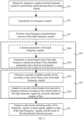
- FIG. 1 is a flow chart of a method for encoding a signal according to Embodiment 1 of the present invention. As shown in FIG. 1 , the method specifically includes the following steps.
- Step 101 perform a classification decision process on high frequency signals of input signals.
- Step 103 output bitstream including the encoded bitstream of low frequency signals, adaptive edcoded bitstream of the high frequency signals, and the result of the classification decision process.
- the classification decision process is performed on the high frequency signals, and adaptive encoding is performed according to the result of the classification decision process; in this way, the adaptive encoding is performed on signals of different types, so the quality of voice and audio output signals is improved.
- FIG. 2 is a flow chart of a method for encoding a signal according to Embodiment 2 of the present invention. As shown in FIG 2 , Embodiment 2 specifically includes the following steps.
- Step 201 perform signal parsing on input signals to obtain low frequency signals and high frequency signals.
- Step 204 perform a classification decision process on the high frequency signals after the time frequency transformation, and the classification decision process may determine a type of the high frequency signals.
- the types of the high frequency signals specifically include a transient signal and a non-transient signal, in which the non-transient signal further includes a harmonic signal, a noise-like signal, and an ordinary signal.
- Step 204 may include the following steps.
- Step 2041 calculate parameters of the high frequency signals.
- a current frame of the high frequency signal is captured, and input into a signal analysis module.
- the signal analysis module is adapted to calculate parameters which include parameters required by classification and parameters required by encoding. For example, parameters requiring calculation to determine the transient signal, such as a time domain envelope and a maximum value obtained by a next time domain envelope minus a previous one of two consecutive time domain envelopes; and parameters requiring calculation to determine the harmonic signal, such as global frequency spectrum energy, frequency domain envelope energy, and subband harmonic intensity.
- Step 2042 determine a current frame type of the high frequency signals according to the calculated parameters and a decision mechanism.
- the types of signals are determined according to the parameters obtained by the signal analysis module and the decision mechanism.
- the decision mechanism may be dynamically adjusted according to a previous frame type of the high frequency signals and a weighted value of several previous frame types. For example, when the transient signal is determined, various parameters of time required comprehensive judgment, and the judgment of whether the previous frame is a transient signal is also required; and when the harmonic signal is determined, a decision threshold value requires dynamic adjustment according to the previous frame type, and the type of signal of the current frame requires to be determined according to the weighted value of the several previous frame types.
- Step 205 adaptively encode the high frequency signals according to the result of the classification decision process, in which the result indicates the current-frame type of the high frequency band signals.
- Step 205 may include the following steps.
- Step 2051 allocate a currently available bits according to the current frame type of the high frequency signals, and B represents the currently available bits, that is, the bits to be allocated.
- Step 2052 adaptively encode time envelopes and spectral envelopes of the current frame of the high frequency signals by using the allocated bits.
- FIG. 3 is a schematic diagram of adaptive encoding in a method for encoding a signal according to Embodiment 2 of the present invention. Specifically, as shown in FIG. 3 , at an encoding end, according to different signal types of current frames obtained through the foregoing classification algorithm, the time envelopes and the spectral envelopes of the current frame are adaptively encoded by using different bit allocation methods.
- the time signal changes sharply, the time signal is more important, so a larger number of bits are used for encoding the time signal;
- the non-transient signal the time signal is relatively stable, and the spectral signal changes fast, so the spectral signal is more important, and a larger number of bits are used for encoding the spectral signal.
- the current frame type of the high frequency signals is a non-transient signal
- B2 represents all bits occupied by the non-transient signal
- M2 represents bits occupied by the spectral envelope of the non-transient signal
- N2 represents bits occupied by the time envelope of the non-transient signal
- B2 M2+N2 where M2 is greater than or equal to N2, and in a condition of shorter frame length, N2 may be 0. That is to say, for the non-transient signal, a larger number of bits are used for encoding the spectral envelopes.
- the other implementation is B>B1, B>B2, and B1 and B2 may be unequal, that is, remaining bits may exist, and the remaining bits is a difference between B and B1 or B and B2.
- the difference between B and B1 may be used for performing fine quantizing encoding on the time envelope and/or the spectral envelope of the transient signal, or used for performing the fine quantizing encoding on the low frequency signals; and the difference between B and B2 is used for performing fine quantizing encoding on the spectral envelope and/or the time envelope of the non-transient signals, or used for performing the fine quantizing encoding on the low frequency signals.
- Values of M1 and N1, or M2 and N2 may be preset, and do not need to be transmitted through codes, that is to say, when the current frame type of the high frequency signals is obtained, the currently available bits is allocated according to the preset bit values, and both the encoding end and decoding end use the preset values; the values of M1 and/or N1 or values of M2 and/or N2 are added in bitstream, for example, the value of M1 is transmitted in the bitstream, and the value of B1 is known at the encoding end and decoding end, so the value of N1 may be obtained through B1-M1 at the decoding end.
- Step 206 bitstream including edcoded bitstream of the low frequency signals, adaptive edcoded bitstream of the high frequency signals, and the result of the classification decision process is output.
- Embodiment 3 of the present invention in the method for encoding a signal, input ultra wide band signals are decomposed to obtain the low frequency signals (wideband signals) having a frequency between 0 kHz to 8 kHz and high frequency signals having a frequency between 8 kHz to 14 kHz.
- the low frequency signals are encoded by using a G 722 encoder, and a time frequency transformation process is performed on the high frequency signals, and the classification decision process is then performed.
- the high frequency signals include the following: the transient signal, the harmonic signal, the noise-like signal, and the ordinary signal, and the harmonic signal, the noise-like signal, and the ordinary signal are collectively called the non-transient signal, and the classification decision process may be referred to Embodiment 2.
- FIG 4 is a schematic diagram of adaptive encoding in a method for encoding a signal according to Embodiment 3 of the present invention.
- the bitstream including codes of the low frequency signals of the input signals, the adaptive codes of the high frequency signals, and the result of the classification decision process is output.
- the non-transient signal is encoded by using a smaller bits, and the remaining bits is used for strengthening the quality of the G. 722 core encoder, that is, fine quantizing encoding is performed on the low frequency signals.
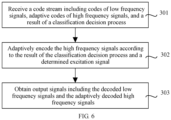
- FIG. 6 is a flow chart of a method for decoding a signal according to Embodiment 1 of the present invention. As shown in FIG 6 , Embodiment 1 specifically includes the following steps.
- Step 301 receive bitstream including encoded stream of low frequency signals, adaptive encoded stream of high frequency signals, and a result of a classification decision process of the high frequency band signals.
- Step 302 adaptively decode the high frequency signals according to the result of the classification decision process and a determined excitation signal.
- Step 303 obtain output signals including the decoded low frequency signals and the adaptively decoded high frequency signals.
- the high frequency signals are adaptively decoded according to the result of the classification decision process, in this way, different types of signals are adaptively decoded, so the quality of the output high frequency signals is improved.
- FIG. 7 is a flow chart of a method for decoding a signal according to Embodiment 2 of the present invention. As shown in FIG 7 , Embodiment 2 may correspond to the method for encoding a signal in Embodiment 2, and specifically include the following steps.
- Step 401 receive bitstream including encoded bitstream of low frequency signals, adaptive edcoded bitstream of high frequency signals, and a result of a classification decision process.
- Step 402 decode the low frequency signals.
- the sequence of performing this step and the following steps 403 to 406 is not limited in Embodiment 2.
- Step 403 determine an excitation signal according to the result of the classification decision process and the low frequency signals on which decoding and a time frequency transformation process are performed.
- the excitation signal is selected according to different types of the high frequency signals, so as to fully use the result of the signal classification decision to obtain higher reconstruction quality. For example, if the high frequency signals are transient signals, signals having broader frequency bands are selected as excitation signals, so as to better use a fine structure of a lower frequency; if the high frequency signals are harmonic signals, signals having boarder frequency bands are selected as the excitation signals, so as to better use a fine structure of the low frequency; if the high frequency signals are noise-like signals, a random noise is selected as the excitation signal; and if the high frequency signals are ordinary signals, the low frequency signals are not selected as the excitation signals, so as to avoid generating too many harmonic waves at a high frequency.
- the high frequency signals are transient signals, signals having broader frequency bands are selected as excitation signals, so as to better use a fine structure of a lower frequency; if the high frequency signals are harmonic signals, signals having boarder frequency bands are selected as the excitation signals, so as to better use a fine structure of the low frequency
- Step 404 adaptively decode the high frequency signals according to the result of the classification decision process, in which the result indicates the current-frame type of the high frequency band signals and the excitation signal.
- This step may include: allocating bits according to the current frame type of the high frequency signals; and adaptively decoding a time envelope and a spectral envelope of the current frame of the high frequency signals according to the selected excitation signal by using the allocated bits.
- FIG. 8 is a schematic diagram of adaptive decoding in a method for decoding a signal according to Embodiment 2 of the present invention.
- values of M1 and N1, M2 and N2 may be preset, and when the current frame type of the high frequency signals is the transient signal, the adaptive decoding is performed according to the bits allocated according to the values of M1 and N1; and when the current frame type of the high frequency signals is the non-transient signal, the adaptive decoding is performed according to bits allocated according to the values of M2 and N2.
- the values of M1 and N1, or M2 and N2 are obtained from values carried in the bitstream, and then the time envelope and the spectral envelope of the high frequency signal are decoded according to the current frame type of the high frequency signal, so as to recover the high frequency signal.
- Step 405 perform a frequency time transformation process on the adaptively decoded high frequency band spectrum signals.
- FIG. 9 is a schematic diagram of adaptive decoding in a method for decoding a signal according to Embodiment 3 of the present invention.
- Embodiment 3 corresponds to the method for encoding a signal in Embodiment 3.
- low frequency signals are decoded by using a G 722 decoder to obtain wideband signals.
- a result of a classification decision process is obtained from bitstream, an excitation signal is selected according to the result of the classification decision process, and different excitation signals are used for different types of high frequency signals.
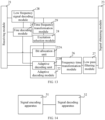
- the signal decoding apparatus 32 receives the bitstream including the codes of the low frequency signals, the adaptive codes of the high frequency signals, and the result of the classification decision process, adaptively decodes the high frequency signals according to the result of the classification decision process and a determined excitation signal, and obtains output signals including the decoded low frequency signals and the adaptively decoded high frequency signals.
- the signal encoding apparatus 31 may be any apparatus for encoding a signal in any embodiment of the present invention
- the signal decoding apparatus 32 may be any apparatus for decoding a signal in any embodiment of the present invention.
- the program may be stored in a computer readable storage medium.
- the storage medium may be any medium that is capable of storing program codes, such as a read-only memory (ROM), a random access memory (RAM), a magnetic disk, and an optical disk.
Landscapes
- Engineering & Computer Science (AREA)
- Physics & Mathematics (AREA)
- Computational Linguistics (AREA)
- Signal Processing (AREA)
- Health & Medical Sciences (AREA)
- Audiology, Speech & Language Pathology (AREA)
- Human Computer Interaction (AREA)
- Acoustics & Sound (AREA)
- Multimedia (AREA)
- Quality & Reliability (AREA)
- Spectroscopy & Molecular Physics (AREA)
- Compression, Expansion, Code Conversion, And Decoders (AREA)
Applications Claiming Priority (9)
| Application Number | Priority Date | Filing Date | Title |
|---|---|---|---|
| CN2008102394515A CN101751926B (zh) | 2008-12-10 | 2008-12-10 | 信号编码、解码方法及装置、编解码系统 |
| PCT/CN2009/075053 WO2010066158A1 (zh) | 2008-12-10 | 2009-11-20 | 信号编码、解码方法及装置、编解码系统 |
| EP17160981.1A EP3223276B1 (de) | 2008-12-10 | 2009-11-20 | Verfahren, vorrichtungen und system zur codierung und decodierung eines signals |
| EP22158373.5A EP4071755B1 (de) | 2008-12-10 | 2009-11-20 | Computerprogrammprodukt zur codierung eines signals |
| EP19207327.8A EP3686886B1 (de) | 2008-12-10 | 2009-11-20 | Verfahren, vorrichtungen und system zur decodierung eines signals |
| EP09831435.4A EP2367168B1 (de) | 2008-12-10 | 2009-11-20 | Verfahren und vorrichtungen zur signalkodierung und signaldekodierung sowie system zur kodierung und dekodierung |
| EP23203369.6A EP4283616B1 (de) | 2008-12-10 | 2009-11-20 | Verfahren zur codierung eines signals |
| EP15187026.8A EP2998957B1 (de) | 2008-12-10 | 2009-11-20 | Verfahren, vorrichtungen und system zur codierung und decodierung eines signals |
| EP13176270.0A EP2650876B1 (de) | 2008-12-10 | 2009-11-20 | Verfahren, Vorrichtungen und System zur Codierung und Decodierung eines Signals |
Related Parent Applications (8)
| Application Number | Title | Priority Date | Filing Date |
|---|---|---|---|
| EP22158373.5A Division EP4071755B1 (de) | 2008-12-10 | 2009-11-20 | Computerprogrammprodukt zur codierung eines signals |
| EP23203369.6A Division-Into EP4283616B1 (de) | 2008-12-10 | 2009-11-20 | Verfahren zur codierung eines signals |
| EP23203369.6A Division EP4283616B1 (de) | 2008-12-10 | 2009-11-20 | Verfahren zur codierung eines signals |
| EP19207327.8A Division EP3686886B1 (de) | 2008-12-10 | 2009-11-20 | Verfahren, vorrichtungen und system zur decodierung eines signals |
| EP13176270.0A Division EP2650876B1 (de) | 2008-12-10 | 2009-11-20 | Verfahren, Vorrichtungen und System zur Codierung und Decodierung eines Signals |
| EP17160981.1A Division EP3223276B1 (de) | 2008-12-10 | 2009-11-20 | Verfahren, vorrichtungen und system zur codierung und decodierung eines signals |
| EP09831435.4A Division EP2367168B1 (de) | 2008-12-10 | 2009-11-20 | Verfahren und vorrichtungen zur signalkodierung und signaldekodierung sowie system zur kodierung und dekodierung |
| EP15187026.8A Division EP2998957B1 (de) | 2008-12-10 | 2009-11-20 | Verfahren, vorrichtungen und system zur codierung und decodierung eines signals |
Publications (2)
| Publication Number | Publication Date |
|---|---|
| EP4583104A2 true EP4583104A2 (de) | 2025-07-09 |
| EP4583104A3 EP4583104A3 (de) | 2025-10-01 |
Family
ID=42242339
Family Applications (8)
| Application Number | Title | Priority Date | Filing Date |
|---|---|---|---|
| EP13176270.0A Active EP2650876B1 (de) | 2008-12-10 | 2009-11-20 | Verfahren, Vorrichtungen und System zur Codierung und Decodierung eines Signals |
| EP25172164.3A Pending EP4583104A3 (de) | 2008-12-10 | 2009-11-20 | Verfahren zur codierung eines signals |
| EP17160981.1A Active EP3223276B1 (de) | 2008-12-10 | 2009-11-20 | Verfahren, vorrichtungen und system zur codierung und decodierung eines signals |
| EP15187026.8A Active EP2998957B1 (de) | 2008-12-10 | 2009-11-20 | Verfahren, vorrichtungen und system zur codierung und decodierung eines signals |
| EP23203369.6A Active EP4283616B1 (de) | 2008-12-10 | 2009-11-20 | Verfahren zur codierung eines signals |
| EP09831435.4A Active EP2367168B1 (de) | 2008-12-10 | 2009-11-20 | Verfahren und vorrichtungen zur signalkodierung und signaldekodierung sowie system zur kodierung und dekodierung |
| EP19207327.8A Active EP3686886B1 (de) | 2008-12-10 | 2009-11-20 | Verfahren, vorrichtungen und system zur decodierung eines signals |
| EP22158373.5A Active EP4071755B1 (de) | 2008-12-10 | 2009-11-20 | Computerprogrammprodukt zur codierung eines signals |
Family Applications Before (1)
| Application Number | Title | Priority Date | Filing Date |
|---|---|---|---|
| EP13176270.0A Active EP2650876B1 (de) | 2008-12-10 | 2009-11-20 | Verfahren, Vorrichtungen und System zur Codierung und Decodierung eines Signals |
Family Applications After (6)
| Application Number | Title | Priority Date | Filing Date |
|---|---|---|---|
| EP17160981.1A Active EP3223276B1 (de) | 2008-12-10 | 2009-11-20 | Verfahren, vorrichtungen und system zur codierung und decodierung eines signals |
| EP15187026.8A Active EP2998957B1 (de) | 2008-12-10 | 2009-11-20 | Verfahren, vorrichtungen und system zur codierung und decodierung eines signals |
| EP23203369.6A Active EP4283616B1 (de) | 2008-12-10 | 2009-11-20 | Verfahren zur codierung eines signals |
| EP09831435.4A Active EP2367168B1 (de) | 2008-12-10 | 2009-11-20 | Verfahren und vorrichtungen zur signalkodierung und signaldekodierung sowie system zur kodierung und dekodierung |
| EP19207327.8A Active EP3686886B1 (de) | 2008-12-10 | 2009-11-20 | Verfahren, vorrichtungen und system zur decodierung eines signals |
| EP22158373.5A Active EP4071755B1 (de) | 2008-12-10 | 2009-11-20 | Computerprogrammprodukt zur codierung eines signals |
Country Status (7)
| Country | Link |
|---|---|
| US (1) | US8135593B2 (de) |
| EP (8) | EP2650876B1 (de) |
| JP (6) | JP5249426B2 (de) |
| KR (2) | KR101311396B1 (de) |
| CN (1) | CN101751926B (de) |
| ES (5) | ES2976210T3 (de) |
| WO (1) | WO2010066158A1 (de) |
Families Citing this family (26)
| Publication number | Priority date | Publication date | Assignee | Title |
|---|---|---|---|---|
| JP2743641B2 (ja) | 1991-08-20 | 1998-04-22 | 松下電器産業株式会社 | 触媒浄化装置 |
| CN101763856B (zh) * | 2008-12-23 | 2011-11-02 | 华为技术有限公司 | 信号分类处理方法、分类处理装置及编码系统 |
| CN102339607A (zh) * | 2010-07-16 | 2012-02-01 | 华为技术有限公司 | 一种频带扩展的方法和装置 |
| KR101826331B1 (ko) | 2010-09-15 | 2018-03-22 | 삼성전자주식회사 | 고주파수 대역폭 확장을 위한 부호화/복호화 장치 및 방법 |
| CN102436820B (zh) * | 2010-09-29 | 2013-08-28 | 华为技术有限公司 | 高频带信号编码方法及装置、高频带信号解码方法及装置 |
| CN102737636B (zh) * | 2011-04-13 | 2014-06-04 | 华为技术有限公司 | 一种音频编码方法及装置 |
| CN102800317B (zh) * | 2011-05-25 | 2014-09-17 | 华为技术有限公司 | 信号分类方法及设备、编解码方法及设备 |
| JP5807453B2 (ja) * | 2011-08-30 | 2015-11-10 | 富士通株式会社 | 符号化方法、符号化装置および符号化プログラム |
| WO2013062392A1 (ko) * | 2011-10-27 | 2013-05-02 | 엘지전자 주식회사 | 음성 신호 부호화 방법 및 복호화 방법과 이를 이용하는 장치 |
| CN102522092B (zh) * | 2011-12-16 | 2013-06-19 | 大连理工大学 | 一种基于g.711.1的语音带宽扩展的装置和方法 |
| KR102070432B1 (ko) * | 2012-03-21 | 2020-03-02 | 삼성전자주식회사 | 대역폭 확장을 위한 고주파수 부호화/복호화 방법 및 장치 |
| JP6200034B2 (ja) * | 2012-04-27 | 2017-09-20 | 株式会社Nttドコモ | 音声復号装置 |
| CN110853667B (zh) | 2013-01-29 | 2023-10-27 | 弗劳恩霍夫应用研究促进协会 | 音频编码器 |
| CN103971694B (zh) | 2013-01-29 | 2016-12-28 | 华为技术有限公司 | 带宽扩展频带信号的预测方法、解码设备 |
| CN103971693B (zh) | 2013-01-29 | 2017-02-22 | 华为技术有限公司 | 高频带信号的预测方法、编/解码设备 |
| MX353240B (es) | 2013-06-11 | 2018-01-05 | Fraunhofer Ges Forschung | Dispositivo y método para extensión de ancho de banda para señales acústicas. |
| EP3525206B1 (de) | 2013-12-02 | 2021-09-08 | Huawei Technologies Co., Ltd. | Codierungsverfahren und -vorrichtung |
| CN111312277B (zh) * | 2014-03-03 | 2023-08-15 | 三星电子株式会社 | 用于带宽扩展的高频解码的方法及设备 |
| KR102865245B1 (ko) | 2014-03-24 | 2025-09-25 | 삼성전자주식회사 | 고대역 부호화방법 및 장치와 고대역 복호화 방법 및 장치 |
| EP3067889A1 (de) | 2015-03-09 | 2016-09-14 | Fraunhofer-Gesellschaft zur Förderung der angewandten Forschung e.V. | Verfahren und vorrichtung zur transformation für signal-adaptive kernelschaltung bei der audiocodierung |
| US9916836B2 (en) * | 2015-03-23 | 2018-03-13 | Microsoft Technology Licensing, Llc | Replacing an encoded audio output signal |
| US11087774B2 (en) * | 2017-06-07 | 2021-08-10 | Nippon Telegraph And Telephone Corporation | Encoding apparatus, decoding apparatus, smoothing apparatus, inverse smoothing apparatus, methods therefor, and recording media |
| US11025964B2 (en) | 2019-04-02 | 2021-06-01 | Wangsu Science & Technology Co., Ltd. | Method, apparatus, server, and storage medium for generating live broadcast video of highlight collection |
| CN109862388A (zh) * | 2019-04-02 | 2019-06-07 | 网宿科技股份有限公司 | 直播视频集锦的生成方法、装置、服务器及存储介质 |
| CN113470667B (zh) * | 2020-03-11 | 2024-09-27 | 腾讯科技(深圳)有限公司 | 语音信号的编解码方法、装置、电子设备及存储介质 |
| CN112904724B (zh) * | 2021-01-19 | 2023-04-07 | 中国人民大学 | 基于误差自适应编解码迭代学习控制信息传输系统和方法 |
Family Cites Families (24)
| Publication number | Priority date | Publication date | Assignee | Title |
|---|---|---|---|---|
| JP3802219B2 (ja) * | 1998-02-18 | 2006-07-26 | 富士通株式会社 | 音声符号化装置 |
| US6266644B1 (en) * | 1998-09-26 | 2001-07-24 | Liquid Audio, Inc. | Audio encoding apparatus and methods |
| US6226608B1 (en) * | 1999-01-28 | 2001-05-01 | Dolby Laboratories Licensing Corporation | Data framing for adaptive-block-length coding system |
| US6959274B1 (en) * | 1999-09-22 | 2005-10-25 | Mindspeed Technologies, Inc. | Fixed rate speech compression system and method |
| US6978236B1 (en) * | 1999-10-01 | 2005-12-20 | Coding Technologies Ab | Efficient spectral envelope coding using variable time/frequency resolution and time/frequency switching |
| US6615169B1 (en) * | 2000-10-18 | 2003-09-02 | Nokia Corporation | High frequency enhancement layer coding in wideband speech codec |
| DE60323331D1 (de) | 2002-01-30 | 2008-10-16 | Matsushita Electric Industrial Co Ltd | Verfahren und vorrichtung zur audio-kodierung und -dekodierung |
| TW594674B (en) * | 2003-03-14 | 2004-06-21 | Mediatek Inc | Encoder and a encoding method capable of detecting audio signal transient |
| US20070038439A1 (en) * | 2003-04-17 | 2007-02-15 | Koninklijke Philips Electronics N.V. Groenewoudseweg 1 | Audio signal generation |
| FI118550B (fi) * | 2003-07-14 | 2007-12-14 | Nokia Corp | Parannettu eksitaatio ylemmän kaistan koodaukselle koodekissa, joka käyttää kaistojen jakoon perustuvia koodausmenetelmiä |
| EP1672618B1 (de) * | 2003-10-07 | 2010-12-15 | Panasonic Corporation | Verfahren zur entscheidung der zeitgrenze zur codierung der spektro-hülle und frequenzauflösung |
| KR100707174B1 (ko) * | 2004-12-31 | 2007-04-13 | 삼성전자주식회사 | 광대역 음성 부호화 및 복호화 시스템에서 고대역 음성부호화 및 복호화 장치와 그 방법 |
| DE102005032724B4 (de) | 2005-07-13 | 2009-10-08 | Siemens Ag | Verfahren und Vorrichtung zur künstlichen Erweiterung der Bandbreite von Sprachsignalen |
| JP2007025290A (ja) * | 2005-07-15 | 2007-02-01 | Matsushita Electric Ind Co Ltd | マルチチャンネル音響コーデックにおける残響を制御する装置 |
| KR20070037945A (ko) * | 2005-10-04 | 2007-04-09 | 삼성전자주식회사 | 오디오 신호의 부호화/복호화 방법 및 장치 |
| KR20070077652A (ko) | 2006-01-24 | 2007-07-27 | 삼성전자주식회사 | 적응적 시간/주파수 기반 부호화 모드 결정 장치 및 이를위한 부호화 모드 결정 방법 |
| KR20070115637A (ko) | 2006-06-03 | 2007-12-06 | 삼성전자주식회사 | 대역폭 확장 부호화 및 복호화 방법 및 장치 |
| WO2007148925A1 (en) | 2006-06-21 | 2007-12-27 | Samsung Electronics Co., Ltd. | Method and apparatus for adaptively encoding and decoding high frequency band |
| US8260609B2 (en) | 2006-07-31 | 2012-09-04 | Qualcomm Incorporated | Systems, methods, and apparatus for wideband encoding and decoding of inactive frames |
| CN101145345B (zh) * | 2006-09-13 | 2011-02-09 | 华为技术有限公司 | 音频分类方法 |
| US8041578B2 (en) * | 2006-10-18 | 2011-10-18 | Fraunhofer-Gesellschaft Zur Foerderung Der Angewandten Forschung E.V. | Encoding an information signal |
| JP4918841B2 (ja) * | 2006-10-23 | 2012-04-18 | 富士通株式会社 | 符号化システム |
| KR100883656B1 (ko) * | 2006-12-28 | 2009-02-18 | 삼성전자주식회사 | 오디오 신호의 분류 방법 및 장치와 이를 이용한 오디오신호의 부호화/복호화 방법 및 장치 |
| JP6424324B2 (ja) * | 2015-12-24 | 2018-11-21 | 株式会社ソフイア | 遊技機 |
-
2008
- 2008-12-10 CN CN2008102394515A patent/CN101751926B/zh active Active
-
2009
- 2009-11-20 ES ES22158373T patent/ES2976210T3/es active Active
- 2009-11-20 EP EP13176270.0A patent/EP2650876B1/de active Active
- 2009-11-20 ES ES09831435.4T patent/ES2440753T3/es active Active
- 2009-11-20 EP EP25172164.3A patent/EP4583104A3/de active Pending
- 2009-11-20 EP EP17160981.1A patent/EP3223276B1/de active Active
- 2009-11-20 EP EP15187026.8A patent/EP2998957B1/de active Active
- 2009-11-20 EP EP23203369.6A patent/EP4283616B1/de active Active
- 2009-11-20 ES ES17160981T patent/ES2779848T3/es active Active
- 2009-11-20 EP EP09831435.4A patent/EP2367168B1/de active Active
- 2009-11-20 KR KR1020117012587A patent/KR101311396B1/ko active Active
- 2009-11-20 ES ES15187026.8T patent/ES2628008T3/es active Active
- 2009-11-20 WO PCT/CN2009/075053 patent/WO2010066158A1/zh not_active Ceased
- 2009-11-20 EP EP19207327.8A patent/EP3686886B1/de active Active
- 2009-11-20 ES ES23203369T patent/ES3035693T3/es active Active
- 2009-11-20 KR KR1020137002434A patent/KR101341078B1/ko active Active
- 2009-11-20 EP EP22158373.5A patent/EP4071755B1/de active Active
- 2009-11-20 JP JP2011539879A patent/JP5249426B2/ja active Active
-
2011
- 2011-05-03 US US13/100,091 patent/US8135593B2/en active Active
-
2013
- 2013-04-11 JP JP2013083039A patent/JP2013174899A/ja active Pending
-
2015
- 2015-06-03 JP JP2015113441A patent/JP6158861B2/ja active Active
-
2017
- 2017-06-08 JP JP2017113217A patent/JP6400790B2/ja active Active
-
2018
- 2018-09-05 JP JP2018165985A patent/JP6752854B2/ja active Active
-
2020
- 2020-08-19 JP JP2020138659A patent/JP6937877B2/ja active Active
Also Published As
Similar Documents
| Publication | Publication Date | Title |
|---|---|---|
| EP4071755B1 (de) | Computerprogrammprodukt zur codierung eines signals | |
| KR101221918B1 (ko) | 신호 처리 방법 및 장치 | |
| RU2383943C2 (ru) | Кодирование звуковых сигналов | |
| KR101540371B1 (ko) | 신호 분류 방법 및 장치, 및 인코딩/디코딩 방법 및 장치 | |
| CN103680509A (zh) | 一种语音信号非连续传输及背景噪声生成方法 | |
| US20120123788A1 (en) | Coding method, decoding method, and device and program using the methods |
Legal Events
| Date | Code | Title | Description |
|---|---|---|---|
| PUAI | Public reference made under article 153(3) epc to a published international application that has entered the european phase |
Free format text: ORIGINAL CODE: 0009012 |
|
| STAA | Information on the status of an ep patent application or granted ep patent |
Free format text: STATUS: THE APPLICATION HAS BEEN PUBLISHED |
|
| AC | Divisional application: reference to earlier application |
Ref document number: 2367168 Country of ref document: EP Kind code of ref document: P Ref document number: 2650876 Country of ref document: EP Kind code of ref document: P Ref document number: 2998957 Country of ref document: EP Kind code of ref document: P Ref document number: 3223276 Country of ref document: EP Kind code of ref document: P Ref document number: 3686886 Country of ref document: EP Kind code of ref document: P Ref document number: 4071755 Country of ref document: EP Kind code of ref document: P Ref document number: 4283616 Country of ref document: EP Kind code of ref document: P |
|
| AK | Designated contracting states |
Kind code of ref document: A2 Designated state(s): AT BE BG CH CY CZ DE DK EE ES FI FR GB GR HR HU IE IS IT LI LT LU LV MC MK MT NL NO PL PT RO SE SI SK SM TR |
|
| REG | Reference to a national code |
Ref country code: DE Ref legal event code: R079 Free format text: PREVIOUS MAIN CLASS: G10L0021020000 Ipc: G10L0019000000 |
|
| PUAL | Search report despatched |
Free format text: ORIGINAL CODE: 0009013 |
|
| AK | Designated contracting states |
Kind code of ref document: A3 Designated state(s): AT BE BG CH CY CZ DE DK EE ES FI FR GB GR HR HU IE IS IT LI LT LU LV MC MK MT NL NO PL PT RO SE SI SK SM TR |
|
| RIC1 | Information provided on ipc code assigned before grant |
Ipc: G10L 19/00 20130101AFI20250822BHEP Ipc: G10L 21/02 20130101ALI20250822BHEP Ipc: G10L 19/02 20130101ALN20250822BHEP |