EP4582874A2 - Elektrophotographisches gerät - Google Patents
Elektrophotographisches gerät Download PDFInfo
- Publication number
- EP4582874A2 EP4582874A2 EP25150150.8A EP25150150A EP4582874A2 EP 4582874 A2 EP4582874 A2 EP 4582874A2 EP 25150150 A EP25150150 A EP 25150150A EP 4582874 A2 EP4582874 A2 EP 4582874A2
- Authority
- EP
- European Patent Office
- Prior art keywords
- group
- toner
- photosensitive member
- resin
- electrophotographic photosensitive
- Prior art date
- Legal status (The legal status is an assumption and is not a legal conclusion. Google has not performed a legal analysis and makes no representation as to the accuracy of the status listed.)
- Pending
Links
Images
Classifications
-
- G—PHYSICS
- G03—PHOTOGRAPHY; CINEMATOGRAPHY; ANALOGOUS TECHNIQUES USING WAVES OTHER THAN OPTICAL WAVES; ELECTROGRAPHY; HOLOGRAPHY
- G03G—ELECTROGRAPHY; ELECTROPHOTOGRAPHY; MAGNETOGRAPHY
- G03G5/00—Recording-members for original recording by exposure, e.g. to light, to heat or to electrons; Manufacture thereof; Selection of materials therefor
- G03G5/02—Charge-receiving layers
- G03G5/04—Photoconductive layers; Charge-generation layers or charge-transporting layers; Additives therefor; Binders therefor
- G03G5/05—Organic bonding materials; Methods for coating a substrate with a photoconductive layer; Inert supplements for use in photoconductive layers
- G03G5/0503—Inert supplements
- G03G5/0507—Inorganic compounds
-
- G—PHYSICS
- G03—PHOTOGRAPHY; CINEMATOGRAPHY; ANALOGOUS TECHNIQUES USING WAVES OTHER THAN OPTICAL WAVES; ELECTROGRAPHY; HOLOGRAPHY
- G03G—ELECTROGRAPHY; ELECTROPHOTOGRAPHY; MAGNETOGRAPHY
- G03G5/00—Recording-members for original recording by exposure, e.g. to light, to heat or to electrons; Manufacture thereof; Selection of materials therefor
- G03G5/02—Charge-receiving layers
- G03G5/04—Photoconductive layers; Charge-generation layers or charge-transporting layers; Additives therefor; Binders therefor
- G03G5/06—Photoconductive layers; Charge-generation layers or charge-transporting layers; Additives therefor; Binders therefor characterised by the photoconductive material being organic
- G03G5/0601—Acyclic or carbocyclic compounds
- G03G5/0612—Acyclic or carbocyclic compounds containing nitrogen
- G03G5/0614—Amines
- G03G5/06149—Amines enamine
-
- G—PHYSICS
- G03—PHOTOGRAPHY; CINEMATOGRAPHY; ANALOGOUS TECHNIQUES USING WAVES OTHER THAN OPTICAL WAVES; ELECTROGRAPHY; HOLOGRAPHY
- G03G—ELECTROGRAPHY; ELECTROPHOTOGRAPHY; MAGNETOGRAPHY
- G03G9/00—Developers
- G03G9/08—Developers with toner particles
- G03G9/087—Binders for toner particles
- G03G9/08702—Binders for toner particles comprising macromolecular compounds obtained by reactions only involving carbon-to-carbon unsaturated bonds
- G03G9/08726—Polymers of unsaturated acids or derivatives thereof
- G03G9/08733—Polymers of unsaturated polycarboxylic acids
-
- G—PHYSICS
- G03—PHOTOGRAPHY; CINEMATOGRAPHY; ANALOGOUS TECHNIQUES USING WAVES OTHER THAN OPTICAL WAVES; ELECTROGRAPHY; HOLOGRAPHY
- G03G—ELECTROGRAPHY; ELECTROPHOTOGRAPHY; MAGNETOGRAPHY
- G03G9/00—Developers
- G03G9/08—Developers with toner particles
- G03G9/087—Binders for toner particles
- G03G9/08742—Binders for toner particles comprising macromolecular compounds obtained otherwise than by reactions only involving carbon-to-carbon unsaturated bonds
- G03G9/08755—Polyesters
-
- G—PHYSICS
- G03—PHOTOGRAPHY; CINEMATOGRAPHY; ANALOGOUS TECHNIQUES USING WAVES OTHER THAN OPTICAL WAVES; ELECTROGRAPHY; HOLOGRAPHY
- G03G—ELECTROGRAPHY; ELECTROPHOTOGRAPHY; MAGNETOGRAPHY
- G03G9/00—Developers
- G03G9/08—Developers with toner particles
- G03G9/097—Plasticisers; Charge controlling agents
- G03G9/09708—Inorganic compounds
- G03G9/09725—Silicon-oxides; Silicates
-
- G—PHYSICS
- G03—PHOTOGRAPHY; CINEMATOGRAPHY; ANALOGOUS TECHNIQUES USING WAVES OTHER THAN OPTICAL WAVES; ELECTROGRAPHY; HOLOGRAPHY
- G03G—ELECTROGRAPHY; ELECTROPHOTOGRAPHY; MAGNETOGRAPHY
- G03G5/00—Recording-members for original recording by exposure, e.g. to light, to heat or to electrons; Manufacture thereof; Selection of materials therefor
- G03G5/02—Charge-receiving layers
- G03G5/04—Photoconductive layers; Charge-generation layers or charge-transporting layers; Additives therefor; Binders therefor
- G03G5/05—Organic bonding materials; Methods for coating a substrate with a photoconductive layer; Inert supplements for use in photoconductive layers
- G03G5/0528—Macromolecular bonding materials
Definitions
- the present disclosure is directed to provide an electrophotographic apparatus in which the occurrence of image density unevenness (pattern memory) at the time of repeated use under a high-temperature and high-humidity environment is suppressed.
- an electrophotographic apparatus including: an electrophotographic photosensitive member; a charging unit configured to charge a surface of the electrophotographic photosensitive member; an image exposing unit configured to irradiate the charged surface of the electrophotographic photosensitive member with image exposure light to form an electrostatic latent image on the surface of the electrophotographic photosensitive member; a developing unit, which includes a toner, and which is configured to develop the electrostatic latent image with the toner to form a toner image on the surface of the electrophotographic photosensitive member; a transfer unit configured to transfer the toner image from the surface of the electrophotographic photosensitive member onto a transfer material; and a cleaning unit configured to remove a residual toner remaining on the surface of the electrophotographic photosensitive member after the toner image is transferred from the surface of the electrophotographic photosensitive member onto the transfer material, wherein the electrophotographic photosensitive member includes a surface layer containing a compound represented by the following formula (A), a binder resin, and silicon atom-containing particles, wherein the electrophotographic photosensitive member
- the inventors have assumed the reasons for which an electrophotographic apparatus of the present disclosure is excellent in suppressing effect on the occurrence of image density unevenness at the time of repeated use under a high-temperature and high-humidity environment to be as described below.
- the compound represented by the formula (A) is a kind of enamine-based compound and is used as a high-sensitivity charge-transporting substance in the electrophotographic photosensitive member.
- the compound also has such a feature that its sensitivity is easily changed by a change in humidity.
- the toner having the polyethylene terephthalate segment tends to have high polarity as compared to a polyester resin that is generally used in a toner, and hence the affinity for water thereof tends to be increased.
- the amount of moisture on the surface of the electrophotographic photosensitive member becomes higher than the amount of moisture in air under a usage environment.
- the electrophotographic photosensitive member containing the enamine-based compound represented by the formula (A) in the surface layer and the toner containing the polyester resin having the polyethylene terephthalate segment under a high-temperature and high-humidity environment When an image is formed through use of the electrophotographic photosensitive member containing the enamine-based compound represented by the formula (A) in the surface layer and the toner containing the polyester resin having the polyethylene terephthalate segment under a high-temperature and high-humidity environment, the amount of moisture present on the surface of the toner having high polarity is increased, and hence the amount of moisture present on the surface of the electrophotographic photosensitive member that is brought into contact with the toner is also increased. When a solid black band image is output, the amount of the toner present on the surface of the electrophotographic photosensitive member is increased, and hence the influence of an increase in amount of moisture on the surface of the electrophotographic photosensitive member is also increased.
- the moisture on the surface of the electrophotographic photosensitive member influences the sensitivity of the charge-generating substance, resulting in a sensitivity difference between a solid black band portion and a solid white band portion in the electrophotographic photosensitive member. It is conceived that, when another pattern image is output under a state in which a sensitivity difference has remained as described above, a density difference occurs in an image portion with no need of the occurrence of the density difference, and this density difference appears on the image as a pattern memory.
- the inventors have made investigations, and as a result, have found that, when silica particles or silicone resin particles are incorporated as silicon atom-containing particles into the surface layer of the electrophotographic photosensitive member, an electrophotographic apparatus having a pattern memory suppressed is obtained.
- the inventors have assumed the reasons for which the electrophotographic apparatus of the present disclosure is excellent in pattern memory-suppressing effect to be as described below.
- the surface layer of the electrophotographic photosensitive member of the present disclosure contains the silicon atom-containing particles and the enamine-based compound represented by the formula (A). It is assumed that, in the surface layer of the electrophotographic photosensitive member, the silicon atom-containing particles interposed between the surface and the enamine-based compound suppress the influence of moisture on the enamine-based compound from the surface. When the influence of moisture on the enamine-based compound from the surface is reduced, a change in sensitivity caused by the moisture is decreased, and a pattern memory is suppressed.
- An electrophotographic photosensitive member of the electrophotographic apparatus of the present invention is characterized by including a surface layer containing a compound represented by the formula (A), a binder resin, and silicon atom-containing particles.
- the outermost surface layer of the electrophotographic photosensitive member is defined as a surface layer.
- the support of the electrophotographic photosensitive member is preferably a support having conductivity (conductive support).
- examples of the shape of the support include a cylindrical shape, a belt shape, and a sheet shape. Of those, a cylindrical support is preferred.
- the surface of the support may be subjected to electrochemical treatment such as anodic oxidation, blast treatment, or cutting treatment.
- a metal, a resin, glass, or the like is preferred as a material for the support.
- conductivity be imparted to the resin or the glass by treatment, such as mixing or coating with a conductive material.
- a conductive layer may be arranged on the support.
- the arrangement of the conductive layer can conceal scratches and irregularities on the surface of the support, and control the reflection of light on the surface of the support.
- the conductive layer preferably contains conductive particles and a resin.
- metal oxide examples include zinc oxide, aluminum oxide, indium oxide, silicon oxide, zirconium oxide, tin oxide, titanium oxide, strontium titanate, magnesium oxide, antimony oxide, and bismuth oxide.
- metal oxide examples include aluminum, nickel, iron, nichrome, copper, zinc, and silver.
- metal oxide particles are preferably used as the conductive particles, and in particular, titanium oxide particles, tin oxide particles, and zinc oxide particles are more preferably used.
- each of the conductive particles may have a laminate configuration including a core particle and a coating layer coating the particle.
- the core particle include a titanium oxide particle, a barium sulfate particle, and a zinc oxide particle.
- the coating layer include metal oxide particles such as tin oxide.
- the conductive layer may further contain a silicone oil, resin particles, a concealing agent such as titanium oxide, and the like.
- the conductive layer may be formed by: preparing a coating liquid for a conductive layer containing each of the above-mentioned materials and a solvent; forming a coat thereof on the support; and drying the coat.
- the solvent to be used in the coating liquid for a conductive layer include an alcohol-based solvent, a sulfoxide-based solvent, a ketone-based solvent, an ether-based solvent, an ester-based solvent, and an aromatic hydrocarbon-based solvent.
- Examples of a dispersion method for dispersing the conductive particles in the coating liquid for a conductive layer include methods using a paint shaker, a sand mill, a ball mill, and a liquid collision-type high-speed disperser.
- the thickness of the conductive layer is preferably 1 ⁇ m or more and 50 ⁇ m or less, particularly preferably 3 ⁇ m or more and 40 ⁇ m or less.
- an undercoat layer may be arranged on the support or the conductive layer.
- the arrangement of the undercoat layer can improve an adhesive function between layers to impart a charge injection-inhibiting function.
- the undercoat layer preferably contains a resin.
- the undercoat layer may be formed as a cured film by polymerizing a composition containing a monomer having a polymerizable functional group.
- the resin examples include a polyester resin, a polycarbonate resin, a polyvinyl acetal resin, an acrylic resin, an epoxy resin, a melamine resin, a polyurethane resin, a phenol resin, a polyvinyl phenol resin, an alkyd resin, a polyvinyl alcohol resin, a polyethylene oxide resin, a polypropylene oxide resin, a polyamide resin, a polyamic acid resin, a polyimide resin, a polyamide imide resin, and a cellulose resin.
- a polyester resin examples include a polyester resin, a polycarbonate resin, a polyvinyl acetal resin, an acrylic resin, an epoxy resin, a melamine resin, a polyurethane resin, a phenol resin, a polyvinyl phenol resin, an alkyd resin, a polyvinyl alcohol resin, a polyethylene oxide resin, a polypropylene oxide resin, a polyamide resin, a polyamic acid resin, a polyimide resin
- Examples of the polymerizable functional group of the monomer having a polymerizable functional group include an isocyanate group, a blocked isocyanate group, a methylol group, an alkylated methylol group, an epoxy group, a metal alkoxide group, a hydroxy group, an amino group, a carboxy group, a thiol group, a carboxylic anhydride group, and a carbon-carbon double bond group.
- the undercoat layer may further contain an electron-transporting substance, metal oxide particles, metal particles, a conductive polymer, and the like for the purpose of improving electrical characteristics.
- an electron-transporting substance and metal oxide particles are preferably used.
- the electron-transporting substance examples include a quinone compound, an imide compound, a benzimidazole compound, a cyclopentadienylidene compound, a fluorenone compound, a xanthone compound, a benzophenone compound, a cyanovinyl compound, a halogenated aryl compound, a silole compound, and a boron-containing compound.
- An electron-transporting substance having a polymerizable functional group may be used as the electron-transporting substance and copolymerized with the above-mentioned monomer having a polymerizable functional group to form the undercoat layer as a cured film.
- metal oxide particles examples include particles of indium tin oxide, tin oxide, indium oxide, titanium oxide, strontium titanate, zinc oxide, and aluminum oxide. Particles of silicon dioxide may also be used. Examples of the metal particles include particles of gold, silver, and aluminum.
- the metal oxide particles to be incorporated into the undercoat layer may be subjected to surface treatment with a surface treatment agent such as a silane coupling agent before use.
- a surface treatment agent such as a silane coupling agent
- a general method is used as a method of subj ecting the metal oxide particles to the surface treatment. Examples thereof include a dry method and a wet method.
- the dry method involves, while stirring the metal oxide particles in a mixer capable of high-speed stirring such as a Henschel mixer, adding an alcohol aqueous solution, an organic solvent solution, or an aqueous solution containing the surface treatment agent, and uniformly dispersing the mixture, followed by drying.
- a mixer capable of high-speed stirring such as a Henschel mixer
- adding an alcohol aqueous solution, an organic solvent solution, or an aqueous solution containing the surface treatment agent and uniformly dispersing the mixture, followed by drying.
- the wet method involves stirring the metal oxide particles and the surface treatment agent in a solvent, or dispersing the metal oxide particles and the surface treatment agent in a solvent with, for example, a sand mill through use of glass beads or the like. After the dispersion, the solvent is removed by filtration or evaporation under reduced pressure. After the removal of the solvent, it is preferred that baking be further performed at 100°C or more.
- the undercoat layer may be formed by: preparing a coating liquid for an undercoat layer containing each of the above-mentioned materials and a solvent; forming a coat thereof on the support or the conductive layer; and drying and/or curing the coat.
- Examples of a dispersion method for preparing the coating liquid for an undercoat layer include methods using a homogenizer, an ultrasonic disperser, a ball mill, a sand mill, a roll mill, a vibration mill, an attritor, and a liquid collision-type high-speed disperser.
- the charge-generating layer preferably contains the charge-generating substance and a resin.
- the charge-generating layer may further contain an additive, such as an antioxidant or a UV absorber.
- an additive such as an antioxidant or a UV absorber.
- Specific examples thereof include a hindered phenol compound, a hindered amine compound, a sulfur compound, a phosphorus compound, and a benzophenone compound.
- the charge-transporting layer preferably contains the charge-transporting substance, a binding material, and silicon atom-containing particles.
- a 1 to a 6 each independently represent a hydrogen atom, a halogen atom, a substituted or unsubstituted alkyl group, a substituted or unsubstituted alkoxy group, a dialkylamino group, or a substituted or unsubstituted aryl group, or may be bonded to each other to form a ring structure
- b 1 to b 5 , c 1 to c 5 , and d 1 to d 5 each independently represent a hydrogen atom, a halogen atom, a substituted or unsubstituted alkyl group, a substituted or unsubstituted alkoxy group, a dialkylamino group, a substituted or unsubstituted aryl group, a substituted or unsubstituted aryloxy group, or a substituted or
- Examples of the aryl group that may have a substituent, the group being represented by each of Ar 1 and Ar 2 , include a phenyl group, an o-tolyl group, a m-tolyl group, a p-tolyl group, a 4-isopropylphenyl group, a 3,4-dimethylphenyl group, a 2-fluorophenyl group, a 4-chlorophenyl group, a 4-(2-fluoroethyl)phenyl group, a 4-methoxyphenyl group, a 2,4-dimethoxyphenyl group, a 2-methyl-4-methoxyphenyl group, a 2,5-dimethyl-4-methoxyphenyl group, a 4-biphenylyl group, a p-terphenyl group, a 4-dimethylaminophenyl group, a 4-trifluoromethylphenyl group, a 1-naphthyl group, a 2-
- Examples of the alkyl group that may have a substituent, the group being represented by each of Ar 1 and Ar 2 , include a methyl group, an ethyl group, a n-propyl group, an isopropyl group, a n-butyl group, an isobutyl group, a trifluoromethyl group, a fluoromethyl group, and a 1-methoxyethyl group.
- Examples of the monovalent heterocyclic group that may have a substituent, the group being represented by each of Ar 1 and Ar 2 , include an 8-chromanyl group, a furyl group, a thienyl group, a 5-methyl-2-furyl group, a 5-methyl-2-thienyl group, a 5-methyl-N-ethylcarbazol-4-yl group, a thiazolyl group, a benzofuryl group, a benzothiophenyl group, an N-methylindolyl group, a benzothiazolyl group, and a benzoxazolyl group.
- Ar 1 and Ar 2 may be bonded to each other through an atom or an atomic group to form a ring structure.
- the atom for bonding include an oxygen atom and a sulfur atom.
- Examples of the alkyl group that may have a substituent, the group being represented by each of a 1 to a 6 , include a methyl group, an ethyl group, a n-propyl group, an isopropyl group, a n-butyl group, an isobutyl group, a trifluoromethyl group, a fluoromethyl group, and a 1-methoxyethyl group.
- Examples of the alkoxy group that may have a substituent, the group being represented by each of a 1 to a 6 , include a methoxy group, an ethoxy group, a n-propoxy group, and an isopropoxy group.
- dialkylamino group that may have a substituent, the group being represented by each of a 1 to a 6 , include a dimethylamino group, a diethylamino group, and a diisopropylamino group.
- Examples of the halogen atom represented by each of a 1 to a 6 include a fluorine atom, a chlorine atom, a bromine atom, and an iodine atom.
- Examples of the alkyl group that may have a substituent include a methyl group, an ethyl group, a n-propyl group, an isopropyl group, a n-butyl group, an isobutyl group, a trifluoromethyl group, a fluoromethyl group, and a 1-methoxyethyl group.
- dialkylamino group that may have a substituent, the group being represented by each of b 1 to b 5 , c 1 to c 5 , and d 1 to d 5 , include a dimethylamino group, a diethylamino group, and a diisopropylamino group.
- aryloxy group that may have a substituent, the group being represented by each of b 1 to b 5 , c 1 to c 5 , and d 1 to d 5 , is a 4-methylphenoxy group.
- arylthio group that may have a substituent, the group being represented by each of b 1 to b 5 , c 1 to c 5 , and d 1 to d 5 , is a phenylthio group.
- the compound represented by the formula (A) is a compound that is generally called "enamine-based compound.”
- Table 1 Exemplary compound 1 Exemplary compound 2 Exemplary compound 3 Exemplary compound 4 Exemplary compound 5
- any other charge-transporting substance such as a polycyclic aromatic compound, a heterocyclic compound, a hydrazone compound, a styryl compound, a triarylamine compound, or a resin having a group derived from each of those substances, may be used in combination with the compound represented by the formula (A).
- the content of the charge-transporting substance in the charge-transporting layer is preferably 25 mass% or more and 70 mass% or less, more preferably 30 mass% or more and 55 mass% or less with respect to the total mass of the charge-transporting layer.
- thermoplastic resin (hereinafter also referred to as "resin”) is used as the binding material.
- thermoplastic resin examples include a polyester resin, a polycarbonate resin, an acrylic resin, and a polystyrene resin. Of those, a polycarbonate resin and a polyester resin are preferred.
- a content ratio (mass ratio) between the charge-transporting substance and the resin is preferably from 3:10 to 20:10, more preferably from 5:10 to 12:10.
- the silicon atom-containing particles are added for the purpose of suppressing the change in sensitivity of the enamine-based compound caused by moisture in the present invention described above.
- the silicon atom-containing particles in the present invention are silica particles or silicone resin particles. Of those, silica particles are preferred.
- silica particles that may be used in the present disclosure are, for example, silica particles available under the product names "AEROSIL (trademark) 130", “AEROSIL R972", “AEROSIL R974", “AEROSIL NY50", and “AEROSIL RX50” from Nippon Aerosil Co., Ltd., silica particles available under the product names "TS-610", “TS-612", “TS-620", and “TS-630” from Cabot Japan K.K., silica particles available under the product name "X-24-9163A” from Shin-Etsu Chemical Co., Ltd., silica particles available under the product names "SO-E1", “SO-E2", “SE100-GDT", and “SE100-SPT” from Admatechs Company Limited, and silica particles available under the product name "SiliNax” from Nittetsu Mining Co., Ltd.
- silicone resin particles that may be used in the present disclosure are, for example, silicone resin particles available under the product names "X-52-854”, “X-52-1621", and “KMP-590” from Shin-Etsu Chemical Co., Ltd., and silicone resin particles available under the product names "MSP-N050” and "MSP-N080” from Nikko Guatemala Corporation.
- the content of the silicon atom-containing particles in the charge-transporting layer is preferably 1 mass% or more and 20 mass% or less with respect to the total mass of the charge-transporting layer.
- the content is 1 mass% or less, the effects of the present invention are not easily obtained.
- the content is more than 20 mass%, a light potential in an exposed portion is increased due to an increase in residual charge at the time of repeated use.
- a mass ratio between the compound represented by the formula (A) and the silicon atom-containing particles in the surface layer is preferably from 3:1 to 20:1.
- the toner to be used in the electrophotographic apparatus of the present disclosure is a toner including toner particles each containing a polyester resin having a polyethylene terephthalate segment.
- Examples of a component for forming the polyester resin having the polyethylene terephthalate segment include a polyethylene terephthalate segment, dihydric or higher alcohol monomer components, and acid monomer components, such as divalent or higher carboxylic acids, divalent or higher carboxylic anhydrides, and divalent or higher carboxylic acid esters.
- the polyethylene terephthalate segment of the present disclosure has a structure in which (C 10 H 8 O 4 ), which is a structural unit of polyethylene terephthalate, is repeated.
- polyethylene terephthalate segment of the present disclosure a polyethylene terephthalate segment that is produced by a condensation reaction or a transesterification reaction between ethylene glycol and terephthalic acid, dimethyl terephthalate, or the like in accordance with an ordinary method may be used.
- a recovered polyethylene terephthalate resin may also be used.
- the synthesis of the polyester resin may be performed in an inert gas atmosphere, preferably in the presence of an esterification catalyst, and further as required, in the presence of an esterification promoter, a polymerization inhibitor, and the like, preferably at a temperature of 180°C or more and 250°C or less.
- esterification catalyst examples include a tin compound, such as dibutyltin oxide or tin(II) 2-ethylhexanoate, and a titanium compound such as titanium diisopropylate bistriethanolaminate. Of those, a tin compound such as tin(II) 2-ethylhexanoate is preferred.
- the usage amount of the esterification catalyst is preferably 0.01 part by mass or more, more preferably 0.1 part by mass or more, and preferably 1.5 parts by mass or less, more preferably 1.0 part by mass or less with respect to 100 parts by mass of the raw material monomers (an alcohol component, a carboxylic acid component, and PET).
- An example of the esterification promoter is gallic acid.
- the usage amount of the esterification promoter is preferably 0.001 part by mass or more, more preferably 0.01 part by mass or more and preferably 0.5 part by mass or less, more preferably 0.1 part by mass or less with respect to 100 parts by mass of the raw material monomers.
- An example of the polymerization inhibitor is tert-butyl catechol.
- the usage amount of the polymerization inhibitor is preferably 0.001 part by mass or more, more preferably 0.01 part by mass or more and preferably 0.5 part by mass or less, more preferably 0.1 part by mass or less with respect to 100 parts by mass of the raw material monomers.
- the spent PET is recovered.
- the recovered PET is washed and sorted so as to be prevented from being mixed with other materials and dust.
- the resultant is pulverized into flakes or the like.
- the pulverized product may be used as it is, or the pulverized product, which is kneaded and coarsely pulverized, may also be used.
- alkali washing may be performed.
- part of the pulverized product is hydrolyzed by the alkali washing, it is preferred that the washed pulverized product, which is melted and pelletized, be subjected to solid phase polymerization in order to restore the reduced polymerization degree.
- a solid-phase polymerization step may be performed by subjecting the washed flakes or the flakes, which are melted and extruded into pellets, to continuous solid-phase polymerization in an inert gas, such as a nitrogen gas or a noble gas, at a temperature of from 180°C to 245°C, preferably from 200°C to 240°C.
- an inert gas such as a nitrogen gas or a noble gas
- the washed pulverized product which is decomposed to a monomer unit by depolymerization and resynthesized, may also be used.
- the regenerated PET is not limited to the above-mentioned spent PET, and fiber scraps or pellets of off-spec PET discharged from factories may also be used.
- the following monomers may be used.
- examples thereof include 1,6-hexanediol, 1,7-heptanediol, 1,8-octanediol, 1,9-nonanediol, 1,10-decanediol, 1,11-undecanediol, 1,12-dodecanediol, suberic acid, azelaic acid, sebacic acid, undecanedioic acid, dodecanedioic acid, hexadecanedioic acid, octadecanedioic acid, dodecenylsuccinic acid, n-octylsuccinic acid, isododecenylsuccinic acid, dodecylsuccinic acid, isoocteny
- the units represented by the formulae (1) to (4) are preferred.
- the alkyl group or alkenyl group having 6 to 16 carbon atoms is branched from the main chain of the polyester backbone.
- the affinity for a release agent is enhanced, and the dispersibility of the release agent is further enhanced.
- amorphous resin A other polyhydric alcohols (dihydric or higher alcohols), polyvalent carboxylic acids (divalent or higher carboxylic acids), and acid anhydrides or lower alkyl esters thereof may be used in addition to the above-mentioned structures and monomers.
- polyhydric alcohols dihydric or higher alcohols
- polyvalent carboxylic acids divalent or higher carboxylic acids
- acid anhydrides or lower alkyl esters thereof may be used in addition to the above-mentioned structures and monomers.
- polyhydric alcohol monomers may each be used as a polyhydric alcohol monomer.
- a dihydric alcohol component there are given, for example: ethylene glycol, propylene glycol, 1,3-butanediol, 1,4-butanediol, 2,3-butanediol, diethylene glycol, triethylene glycol, neopentyl glycol, 2-ethyl-1,3-hexanediol, hydrogenated bisphenol A, and a bisphenol represented by the formula (X) and derivatives thereof:
- Those dihydric alcohols and trihydric or higher alcohols may be used alone or in combination thereof.
- an acid anhydride thereof, or a lower alkyl ester thereof there are given, for example, 1,2,4-benzenetricarboxylic acid, 2,5,7-naphthalenetricarboxylic acid, 1,2,4-naphthalenetricarboxylic acid, 1,2,4-butanetricarboxylic acid, 1,2,5-hexanetricarboxylic acid, 1,3-dicarboxyl-2-methyl-2-methylenecarboxypropane, 1,2,4-cyclohexanetricarboxylic acid, tetra(methylenecarboxyl)methane, 1,2,7,8-octanetetracarboxylic acid, pyromellitic acid, EMPOL trimer acid, and acid anhydrides thereof or lower alkyl esters thereof.
- 1,2,4-benzenetricarboxylic acid 2,5,7-naphthalenetricarboxylic acid, 1,2,4-naphthalenetricarboxylic acid, 1,2,4-
- 1,2,4-benzenetricarboxylic acid that is, trimellitic acid or a derivative thereof is particularly preferably used because trimellitic acid or the derivative thereof is available at low cost and its reaction can be easily controlled.
- trimellitic acid or the derivative thereof is available at low cost and its reaction can be easily controlled.
- divalent carboxylic acids and trivalent or higher carboxylic acids may be used alone or in combination thereof.
- a method of producing the amorphous resin A is not particularly limited, and a known method may be used.
- the polyester resin is produced by simultaneously loading the above-mentioned alcohol monomer and carboxylic acid monomer and polymerizing the mixture through an esterification reaction or a transesterification reaction and a condensation reaction.
- a polymerization temperature is not particularly limited, but preferably falls within the range of 180°C or more and 290°C or less.
- a polymerization catalyst such as a titanium-based catalyst, a tin-based catalyst, zinc acetate, antimony trioxide, or germanium dioxide, may be used.
- the amorphous resin A is more preferably a polyester resin polymerized through use of a tin-based catalyst.
- the peak molecular weight of the amorphous resin A is preferably 3,500 or more and 20,000 or less from the viewpoint of, for example, low-temperature fixability.
- the glass transition temperature of the resin is preferably from 40°C to 70°C.
- a polyhydric alcohol dihydric or trihydric or higher alcohol
- a polyvalent carboxylic acid divalent or trivalent or higher carboxylic acid
- an acid anhydride thereof or a lower alkyl ester thereof are used as monomers to be used for the polyester unit of the crystalline polyester C to be used in the toner of the present disclosure.
- the following polyhydric alcohol monomers may each be used as a polyhydric alcohol monomer to be used for the polyester unit of the crystalline polyester C.
- examples of a trihydric or higher polyhydric alcohol monomer out of the polyhydric alcohol monomers include: an aromatic alcohol such as 1,3,5-trihydroxymethylbenzene; and an aliphatic alcohol, such as pentaerythritol, dipentaerythritol, tripentaerythritol, 1,2,4-butanetriol, 1,2,5-pentanetriol, glycerin, 2-methylpropanetriol, 2-methyl-1,2,4-butanetriol, trimethylol ethane, or trimethylolpropane.
- an aromatic alcohol such as 1,3,5-trihydroxymethylbenzene
- an aliphatic alcohol such as pentaerythritol, dipentaerythritol, tripentaerythritol, 1,2,4-butanetriol, 1,2,5-pentanetriol, glycerin, 2-methylpropanetriol, 2-methyl-1,2,4-butanetriol, trimethylol ethane,
- polyvalent carboxylic acid monomers may each be used as a polyvalent carboxylic acid monomer to be used for the polyester unit of the crystalline polyester C.
- the polyvalent carboxylic acid monomer is not particularly limited, but is preferably a chain (more preferably straight-chain) aliphatic dicarboxylic acid. Specific examples thereof include: oxalic acid, malonic acid, succinic acid, glutaric acid, adipic acid, pimelic acid, suberic acid, glutaconic acid, azelaic acid, sebacic acid, nonanedicarboxylic acid, decanedicarboxylic acid, undecanedicarboxylic acid, dodecanedicarboxylic acid, maleic acid, fumaric acid, mesaconic acid, citraconic acid, and itaconic acid; and products obtained by hydrolyzing acid anhydrides or lower alkyl esters thereof.
- a polyvalent carboxylic acid except the above-mentioned polyvalent carboxylic acid monomers may also be used.
- a divalent carboxylic acid out of the other polyvalent carboxylic acid monomers include: an aromatic carboxylic acid, such as isophthalic acid or terephthalic acid; an aliphatic carboxylic acid, such as n-dodecylsuccinic acid or n-dodecenylsuccinic acid; an alicyclic carboxylic acid such as cyclohexanedicarboxylic acid; and acid anhydrides or lower alkyl esters thereof.
- examples of a trivalent or higher polyvalent carboxylic acid out of the other carboxylic acid monomers include: an aromatic carboxylic acid, such as 1,2,4-benzenetricarboxylic acid (trimellitic acid), 2,5,7-naphthalenetricarboxylic acid, 1,2,4-naphthalenetricarboxylic acid, or pyromellitic acid; an aliphatic carboxylic acid, such as 1,2,4-butanetricarboxylic acid, 1,2,5-hexanetricarboxylic acid, or 1,3-dicarboxy-2-methyl-2-methylenecarboxypropane; and derivatives, such as acid anhydrides or lower alkyl esters, thereof.
- an aromatic carboxylic acid such as 1,2,4-benzenetricarboxylic acid (trimellitic acid), 2,5,7-naphthalenetricarboxylic acid, 1,2,4-naphthalenetricarboxylic acid, or pyromellitic acid
- the crystalline polyester C is preferably a modified crystalline polyester having a structure in which a hydroxy group at a main chain terminal is terminally modified with an aliphatic monocarboxylic acid having 16 to 31 carbon atoms, or a modified crystalline polyester having a structure in which a carboxy group at a main chain terminal is terminally modified with an aliphatic monoalcohol having 15 to 30 carbon atoms.
- Examples of the aliphatic monocarboxylic acid monomer having 16 to 31 carbon atoms include palmitic acid (hexadecanoic acid), margaric acid (heptadecanoic acid), stearic acid (octadecanoic acid), nonadecylic acid, arachidic acid (icosanoic acid), henicosanoic acid, docosanoic acid, tetracosanoic acid, hexacosanoic acid, octacosanoic acid, and triacontanoic acid.
- Examples of the aliphatic monoalcohol having 15 to 30 carbon atoms include cetyl alcohol, palmityl alcohol (hexadecanol), margaryl alcohol (heptadecanol), stearyl alcohol (octadecanol), nonadecanol, arachidyl alcohol (icosanol), heneicosanol, behenyl alcohol, lignoceryl alcohol, ceryl alcohol, 1-heptacosanol, montanyl alcohol, 1-nonacosanol, and myricyl alcohol.
- the crystalline polyester C may be produced in accordance with an ordinary polyester synthesis method.
- the crystalline polyester may be obtained by: subjecting the carboxylic acid monomer and alcohol monomer described above to an esterification reaction or a transesterification reaction; and then subjecting the resultant to a polycondensation reaction in accordance with an ordinary method under reduced pressure or while introducing a nitrogen gas.
- a desired crystalline polyester C is obtained by further adding the above-mentioned aliphatic compound and performing an esterification reaction.
- the esterification or transesterification reaction may be performed with a general esterification catalyst or transesterification catalyst, such as sulfuric acid, titanium butoxide, dibutyltin oxide, manganese acetate, or magnesium acetate, as required.
- a general esterification catalyst or transesterification catalyst such as sulfuric acid, titanium butoxide, dibutyltin oxide, manganese acetate, or magnesium acetate, as required.
- the polycondensation reaction may be performed with a known catalyst, for example, an ordinary polymerization catalyst, such as titanium butoxide, dibutyltin oxide, tin acetate, zinc acetate, tin disulfide, antimony trioxide, or germanium dioxide.
- a polymerization temperature and a catalyst amount are not particularly limited, and may be appropriately determined.
- the following method may be used: all the monomers are collectively loaded in order to improve the strength of the crystalline polyester C to be obtained.
- the following method may be used: the divalent monomers are caused to react with each other first, and then a monomer that is trivalent or more is added to, and caused to react with, the resultant, in order to reduce the amount of a low-molecular weight component.
- the melting point of the crystalline polyester C is preferably from 70°C to 110°C, more preferably from 80°C to 100°C from the viewpoint of low-temperature fixability.
- the crystalline polyester C be used in an amount of from 3 parts by mass or more and 20 parts by mass or less with respect to 100 parts by mass of the amorphous resin from the viewpoints of low-temperature fixability, scratch resistance, and a chargeability maintaining property under a high-temperature and high-humidity environment.
- the toner may include inorganic fine particles as required.
- organic fine particles such as melamine-based resin fine particles and polytetrafluoroethylene resin fine particles, may be used as the external additive.
- the number-based median diameter (D50) of the external additive is preferably 10 nm or more and preferably 250 nm or less, more preferably 200 nm or less, still more preferably 90 nm or less.
- the content of the external additive is preferably from 0.1 part by mass to 10.0 parts by mass with respect to 100 parts by mass of the toner particles.
- a known mixer such as a Henschel mixer may be used in the mixing of the toner particles and the external additive.
- the toner may be used as a one-component developer, but is preferably used as a two-component developer by being be mixed with a magnetic carrier in order to further improve dot reproducibility and to provide stable images over a long period of time.
- the following generally known carriers may each be used as the magnetic carrier: iron oxide; particles of metals, such as iron, lithium, calcium, magnesium, nickel, copper, zinc, cobalt, manganese, chromium, and rare earth metals, alloy particles thereof, and oxide particles thereof; a magnetic material such as ferrite; and a magnetic material-dispersed resin carrier (so-called resin carrier) containing a magnetic material and a binder resin holding the magnetic material in a dispersed state.
- metals such as iron, lithium, calcium, magnesium, nickel, copper, zinc, cobalt, manganese, chromium, and rare earth metals, alloy particles thereof, and oxide particles thereof
- a magnetic material such as ferrite
- resin carrier magnetic material-dispersed resin carrier
- the pulverization method includes, for example: a raw material-mixing step of mixing the crystalline polyester C and the amorphous resin A serving as the binder resin, the phosphorus compound, and the other components, such as other amorphous resins, a wax, a colorant, and a charge control agent, as required; a step of melt-kneading the mixed raw materials to provide a resin composition; and a step of pulverizing the resultant resin composition to provide toner particles.
- the mixed materials are melt-kneaded so that the materials are dispersed in the binder resin.
- a batch-type kneader such as a pressure kneader or a Banbury mixer, or a continuous kneader may be used, and a single-screw or twin-screw extruder has been in the mainstream because of the following superiority: the extruder can perform continuous production.
- Examples thereof include a KTK-type twin-screw extruder (manufactured by Kobe Steel, Ltd.), a TEM-type twin-screw extruder (manufactured by Toshiba Machine Co., Ltd.), a PCM kneader (manufactured by Ikegai Ironworks Corp.), a twin-screw extruder (manufactured by K.C.K.), a co-kneader (manufactured by Buss), and KNEADEX (manufactured by Nippon Coke & Engineering Co., Ltd.). Further, the resin composition obtained by the melt-kneading may be rolled with a twin-roll mill or the like, and may be cooled with water or the like in a cooling step.
- the cooled product of the resin composition is pulverized into a desired particle diameter in the pulverizing step.
- the cooled product is first coarsely pulverized with a pulverizer, such as a crusher, a hammer mill, or a feather mill.
- a pulverizer such as a crusher, a hammer mill, or a feather mill.
- the cooled product is finely pulverized with, for example, KRYPTRON SYSTEM (manufactured by Kawasaki Heavy Industries, Ltd.), SUPER ROTOR (manufactured by Nisshin Engineering Inc.), TURBO MILL (manufactured by Turbo Kogyo Co., Ltd.), or a fine pulverizer based on an air jet system.
- Each of the materials in the toner may be separated from the toner through utilization of differences between the solubilities of the materials in solvents and GPC. The following various physical properties may be measured through use of each separated material.
- the toner is dissolved in methyl ethyl ketone (MEK) at 23°C to be separated into soluble matter (the amorphous resin A, an amorphous resin B (used in Examples; the same applies hereinafter), the crystalline polyester C, and the phosphorus compound) and insoluble matter (the wax, the colorant, the inorganic fine particles, and the like).
- MEK methyl ethyl ketone
- Second separation The soluble matter (the amorphous resin A, the amorphous resin B, the crystalline polyester C, and the phosphorus compound) obtained in the first separation is dissolved in tetrahydrofuran (THF) at 23°C to be separated into soluble matter (the amorphous resin A, the amorphous resin B, and the phosphorus compound) and insoluble matter (the crystalline polyester C).
- THF tetrahydrofuran
- the insoluble matter (the wax, the colorant, the inorganic fine particles, and the like) obtained in the first separation is dissolved in MEK at 100°C to be separated into soluble matter (the wax) and insoluble matter (the colorant, the inorganic fine particles, and the like).
- the soluble matter (the amorphous resin A, the amorphous resin B, and the phosphorus compound) obtained in the second separation is dissolved in tetrahydrofuran (THF) at 23°C to be separated into the amorphous resin A, the amorphous resin B, and the phosphorus compound by preparative GPC.
- THF tetrahydrofuran
- the content ratio of each of the various monomer units is determined by using the integrated values S 1 , S 2 , S 3 , ⁇ S n as described below.
- n 1 , n 2 , n 3 , ⁇ n n represent the numbers of hydrogen atoms in the respective monomer units.
- the content ratio of each of the various monomer units is calculated by changing the numerator term in the same operation.
- the measurement is performed by using 13 C-NMR through use of 13 C as a measurement atomic nucleus in a single-pulse mode, and the calculation is performed in the same manner as in 1 H-NMR.
- the SP value of each of the amorphous resin and the crystalline polyester is calculated in accordance with a calculation method proposed by Fedors.
- the evaporation energy ( ⁇ ei), molar volume ( ⁇ vi), and molar ratio (j) in the resin of each monomer unit are determined.
- the SP value is calculated through use of the determined values from the following equation.
- SP value cal / cm 3 0.5 ⁇ j ⁇ ⁇ ⁇ ei / ⁇ j ⁇ ⁇ ⁇ vi 0.5
- an electrophotographic apparatus of the present invention is characterized by including the electrophotographic photosensitive member described above, a charging unit, an image exposing unit, a developing unit, a transfer unit, and a cleaning unit.
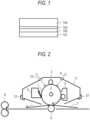
- FIG. 2 An example of the schematic configuration of an electrophotographic apparatus including a process cartridge including the electrophotographic photosensitive member is illustrated in FIG. 2 .
- An electrophotographic photosensitive member 1 having a cylindrical shape is rotationally driven about a shaft 2 in a direction indicated by the arrow at a predetermined peripheral speed.
- the surface of the electrophotographic photosensitive member 1 is charged to a predetermined positive or negative potential by a charging unit 3.
- a roller charging system based on a roller-type charging member is illustrated in the figure, a charging system, such as a corona charging system, a contact charging system, or an injection charging system, may be adopted.
- the charged surface of the electrophotographic photosensitive member 1 is irradiated with image exposure light 4 from an image exposing unit (not shown), and hence an electrostatic latent image corresponding to target image information is formed thereon.
- the electrostatic latent image formed on the surface of the electrophotographic photosensitive member 1 is developed with a toner stored in a developing unit 5, and a toner image is formed on the surface of the electrophotographic photosensitive member 1.
- the toner image formed on the surface of the electrophotographic photosensitive member 1 is transferred onto a transfer material 7 by a transfer unit 6.
- the transfer material 7 onto which the toner image has been transferred is conveyed to a fixing unit 8, is subjected to treatment for fixing the toner image, and is printed out to the outside of the electrophotographic apparatus.
- the electrophotographic apparatus includes a cleaning unit 9 for removing a deposit such as the residual toner remaining on the surface of the electrophotographic photosensitive member 1 after the transfer.
- the electrophotographic apparatus may include a mechanism (not shown) for supplying a lubricant onto the surface of the electrophotographic photosensitive member.
- the electrophotographic apparatus may include an electricity-removing mechanism that subjects the surface of the electrophotographic photosensitive member 1 to electricity-removing treatment with pre-exposure light 10 from a pre-exposing unit (not shown).
- a guiding unit 12 such as a rail may be arranged in order to removably mount the process cartridge of the present invention onto the main body of an electrophotographic apparatus.
- the electrophotographic photosensitive member of the present invention may be used in a laser beam printer, an LED printer, a copying machine, a facsimile, a multifunctional peripheral thereof, and the like.
- copolymerized polyamide (nylon) product name: AMILAN CM8000, manufactured by Toray Industries, Inc.
- the conductive support was immersed in the resultant coating liquid for an undercoat layer and then pulled up.
- the resultant coat was dried at 100°C for 20 minutes to form an undercoat layer having a thickness of 1 ⁇ m on the conductive support.
- the resultant coating liquid for forming a charge-generating layer was applied onto the surface of the undercoat layer arranged in advance by the same method as that in the case of the formation of the undercoat layer, followed by drying at 80°C for 15 minutes, to form a charge-generating layer having a thickness of 0.3 ⁇ m.
- the resultant coating liquid for a charge-transporting layer was applied onto the charge-generating layer by the same immersion method as that in the case of the formation of the undercoat layer, and the resultant coat was dried at 130°C for 1 hour to form a charge-transporting layer (surface layer) having a thickness of 30 ⁇ m.
- a charge-transporting layer surface layer having a thickness of 30 ⁇ m.
- An electrophotographic photosensitive member 2 was produced in the same manner as in the production example of the electrophotographic photosensitive member 1 except that the content of the silica particles in the surface layer was changed from 10 parts by mass to 5 parts by mass.
- An electrophotographic photosensitive member 3 was produced in the same manner as in the production example of the electrophotographic photosensitive member 1 except that the content of the silica particles in the surface layer was changed from 10 parts by mass to 33 parts by mass.
- An electrophotographic photosensitive member 4 was produced in the same manner as in the production example of the electrophotographic photosensitive member 1 except that the silica particles in the surface layer were changed to AEROSII, 300 (manufactured by Nippon Aerosil Co., Ltd., number-average primary particle diameter: 7 nm).
- An electrophotographic photosensitive member 5 was produced in the same manner as in the production example of the electrophotographic photosensitive member 1 except that the silica particles in the surface layer were changed to SO-E1 (manufactured by Admatechs Company Limited, number-average primary particle diameter: 300 nm).
- An electrophotographic photosensitive member 6 was produced in the same manner as in the production example of the electrophotographic photosensitive member 1 except that the compound represented by the formula (A) in the surface layer was changed from the exemplary compound 2 in Table 1 to the exemplary compound 1 in Table 1.
- An electrophotographic photosensitive member 7 was produced in the same manner as in the production example of the electrophotographic photosensitive member 1 except that the content of the silica particles in the surface layer was changed from 10 parts by mass to 3 parts by mass.
- An electrophotographic photosensitive member 8 was produced in the same manner as in the production example of the electrophotographic photosensitive member 1 except that the silica particles in the surface layer were changed to SO-E2 (manufactured by Admatechs Company Limited, number-average primary particle diameter: 500 nm).
- An electrophotographic photosensitive member 9 was produced in the same manner as in the production example of the electrophotographic photosensitive member 1 except that: the content of the exemplary compound 2 in the surface layer was changed from 100 parts by mass to 75 parts by mass; the content of the polycarbonate resin therein was changed from 90 parts by mass to 140 parts by mass; the content of the silica particles therein was changed from 10 parts by mass to 25 parts by mass; and 75 parts by mass of a bistriphenylamine compound represented by the following formula (B) was further added.
- An electrophotographic photosensitive member 10 was produced in the same manner as in the production example of the electrophotographic photosensitive member 1 except that the content of the silica particles in the surface layer was changed from 10 parts by mass to 100 parts by mass.
- An electrophotographic photosensitive member 11 was produced in the same manner as in the production example of the electrophotographic photosensitive member 1 except that: the silica particles in the surface layer were changed to silicone resin particles (X-52-854: manufactured by Shin-Etsu Chemical Co., Ltd., number-average primary particle diameter: 700 nm), and the content thereof was changed from 10 parts by mass to 3 parts by mass.
- silicone resin particles X-52-854: manufactured by Shin-Etsu Chemical Co., Ltd., number-average primary particle diameter: 700 nm
- An electrophotographic photosensitive member 12 was produced in the same manner as in the production example of the electrophotographic photosensitive member 1 except that the silica particles in the surface layer were changed to hollow silica particles (SiliNax: manufactured by Nittetsu Mining Co., Ltd., number-average primary particle diameter: 100 nm).
- An electrophotographic photosensitive member 13 was produced in the same manner as in the production example of the electrophotographic photosensitive member 1 except that the silica particles in the surface layer were not added.
- the softening point of a resin is measured with a constant-pressure extrusion system capillary rheometer (product name: flow characteristic-evaluating device Flowtester CFT-500D, manufactured by Shimadzu Corporation) in accordance with the manual attached to the apparatus.
- a measurement sample filled into a cylinder is increased in temperature to be melted while a predetermined load is applied to the measurement sample with a piston from above, and the melted measurement sample is extruded from a die in a bottom part of the cylinder.
- a flow curve representing a relationship between a piston descent amount and a temperature can be obtained.
- a “melting temperature in a 1/2 method” described in the manual attached to the "flow characteristic-evaluating device Flowtester CFT-500D” is adopted as the softening point.
- the measurement sample to be used is obtained by subjecting about 1.0 g of the resin to compression molding at about 10 MPa for about 60 seconds through use of a tablet compressing machine (e.g., NT-100H, manufactured by NPa SYSTEM Co., Ltd.) under an environment at 25°C to form the sample into a columnar shape having a diameter of about 8 mm.
- a tablet compressing machine e.g., NT-100H, manufactured by NPa SYSTEM Co., Ltd.
- the measurement conditions of the CFT-500D are as described below.
- a reaction was performed for 7 hours by heating the inside of the reaction vessel to 230°C under stirring at 200 rpm. Subsequently, the mixture was cooled to 180°C, and 30 parts by mass of fumaric acid and 0.08 part by mass of hydroquinone were loaded into the reaction vessel, followed by heating to 210°C over 4 hours. After that, the inside of the reaction vessel was reduced in pressure to 8 kPa, and the resultant was subjected to a reaction until the softening point of 103°C was achieved. Thus, a resin 1 was obtained.
- the above-mentioned materials were mixed with a Henschel mixer (model FM-75, manufactured by Mitsui Mining Co., Ltd.) at a number of rotations of 1,500 rpm for a time of rotation of 5 min, and then the mixture was kneaded with a twin-screw kneading machine set to a temperature of 130°C (model PCM-30, manufactured by Ikegai Corp.).
- the kneaded product thus obtained was cooled and coarsely pulverized with a hammer mill to 1 mm or less to provide a coarsely pulverized product.
- the evaluation of each of the electrophotographic apparatus was performed in the same manner as in Example 1 except that the kinds of the electrophotographic photosensitive member and the developer were changed as shown in Tables 7-1 and 7-2.
- the evaluation of each of scratch resistance and low-temperature fixability was also performed by the following method. The evaluation results are shown in Tables 7-1 and 7-2.
- FFh is a value obtained by representing 256 gradations in hexadecimal notation; 00h represents the first gradation (white portion) of the 256 gradations, and FFh represents the 256th gradation (solid portion) of the 256 gradations.
- the above-mentioned evaluation image was output and evaluated for scratch resistance. Specifically, through use of a surface property tester HEIDON TYPE 14FW manufactured by SHINTO Scientific Co., Ltd., a 200 g weight was placed on the surface of the image, the surface was scratched with a needle having a diameter of 0.75 mm at a speed of 60 mm/min and a length of 30 mm, and the image was evaluated based on the scratches that appeared thereon.
- the area ratio of toner peeling was determined by binarizing the area in which the toner peeling occurred with respect to the scratched area by image processing.
- the evaluation image was output and evaluated for low-temperature fixability.
- the value of an image density reduction ratio was used as an indicator for evaluating the low-temperature fixability.
- the image density at the central portion of the image was measured first.
- the fixed image was rubbed (back and forth 5 times) with lens-cleaning paper with the application of a load of 4.9 kPa (50 g/cm 2 ) to the portion at which the image density was measured, and the image density was measured again.
- the reduction ratio of the image density after the rubbing as compared to that before the rubbing was calculated by using the following equation.
- the resultant image density reduction ratio was evaluated in accordance with the following evaluation criteria. A case of being evaluated as A to C was judged to be satisfactory.
- Image density reduction ratio (%) (image density before rubbing-image density after rubbing)/image density before rubbing ⁇ 100
- polyethylene terephthalate regenerated from a spent PET bottle or the like can be used as a toner material, and hence the technologies described in this specification have the potential to contribute to the achievement of a sustainable society, such as a decarbonized society/circular society.
Landscapes
- Physics & Mathematics (AREA)
- General Physics & Mathematics (AREA)
- Chemical & Material Sciences (AREA)
- Chemical Kinetics & Catalysis (AREA)
- Spectroscopy & Molecular Physics (AREA)
- Inorganic Chemistry (AREA)
- Developing Agents For Electrophotography (AREA)
- Photoreceptors In Electrophotography (AREA)
Applications Claiming Priority (2)
| Application Number | Priority Date | Filing Date | Title |
|---|---|---|---|
| JP2024000891 | 2024-01-05 | ||
| JP2024176752A JP2025107135A (ja) | 2024-01-05 | 2024-10-08 | 電子写真装置 |
Publications (2)
| Publication Number | Publication Date |
|---|---|
| EP4582874A2 true EP4582874A2 (de) | 2025-07-09 |
| EP4582874A3 EP4582874A3 (de) | 2026-02-25 |
Family
ID=94173562
Family Applications (1)
| Application Number | Title | Priority Date | Filing Date |
|---|---|---|---|
| EP25150150.8A Pending EP4582874A3 (de) | 2024-01-05 | 2025-01-03 | Elektrophotographisches gerät |
Country Status (2)
| Country | Link |
|---|---|
| US (1) | US20260118790A1 (de) |
| EP (1) | EP4582874A3 (de) |
Citations (2)
| Publication number | Priority date | Publication date | Assignee | Title |
|---|---|---|---|---|
| JP2004280085A (ja) | 2003-02-25 | 2004-10-07 | Kao Corp | 静電荷像現像用トナー |
| JP2005115077A (ja) | 2003-10-08 | 2005-04-28 | Sharp Corp | 電子写真感光体およびそれを備える画像形成装置 |
Family Cites Families (2)
| Publication number | Priority date | Publication date | Assignee | Title |
|---|---|---|---|---|
| JP5659454B2 (ja) * | 2008-12-10 | 2015-01-28 | 三菱化学株式会社 | 電子写真感光体、電子写真感光体カートリッジ、および、画像形成装置 |
| JP7633915B2 (ja) * | 2021-09-16 | 2025-02-20 | シャープ株式会社 | 電子写真感光体およびそれを備えた画像形成装置ならびに電子写真感光体の製造方法およびそれに用いる電荷輸送層用塗布液 |
-
2024
- 2024-12-27 US US19/003,455 patent/US20260118790A1/en active Pending
-
2025
- 2025-01-03 EP EP25150150.8A patent/EP4582874A3/de active Pending
Patent Citations (2)
| Publication number | Priority date | Publication date | Assignee | Title |
|---|---|---|---|---|
| JP2004280085A (ja) | 2003-02-25 | 2004-10-07 | Kao Corp | 静電荷像現像用トナー |
| JP2005115077A (ja) | 2003-10-08 | 2005-04-28 | Sharp Corp | 電子写真感光体およびそれを備える画像形成装置 |
Non-Patent Citations (1)
| Title |
|---|
| POLYM. ENG. SCI., vol. 14, no. 2, 1974, pages 147 - 154 |
Also Published As
| Publication number | Publication date |
|---|---|
| EP4582874A3 (de) | 2026-02-25 |
| US20260118790A1 (en) | 2026-04-30 |
Similar Documents
| Publication | Publication Date | Title |
|---|---|---|
| EP1925982B1 (de) | Toner, Bilderzeugungsvorrichtung damit, Bilderzeugungsverfahren damit und Prozesskartusche | |
| JP7263738B2 (ja) | 電子写真画像形成装置および電子写真画像形成方法 | |
| EP1355197B1 (de) | Toner für Elektrophotographie sowie ein Entwickler für Elektrophotographie den Toner enthaltend, Verfahrenskassette, Bildherstellungsapparat und Verfahren zur Bildherstellung | |
| JP7443810B2 (ja) | 画像形成方法及び画像形成システム | |
| JP5952796B2 (ja) | 画像形成装置、及び画像形成方法 | |
| EP4582874A2 (de) | Elektrophotographisches gerät | |
| EP4603912A2 (de) | Elektrophotographisches gerät und arbeitseinheit | |
| EP4586017A2 (de) | Elektrophotographisches gerät | |
| US20160349639A1 (en) | Image forming apparatus and image forming method | |
| CN101614975B (zh) | 电子照相用载体及其用途 | |
| JP4509001B2 (ja) | 電子写真用キャリア及び画像形成方法 | |
| JP2025107135A (ja) | 電子写真装置 | |
| EP4586016A1 (de) | Elektrophotographisches gerät und arbeitseinheit | |
| JP2024061055A (ja) | 電子写真感光体及びその製造方法、並びにそれを用いた電子写真画像形成装置 | |
| JP2025124041A (ja) | 電子写真装置及びプロセスカートリッジ | |
| JP5573200B2 (ja) | 画像形成装置、プロセスカートリッジ、及び静電潜像現像用トナー | |
| JP2021144137A (ja) | 電子写真感光体及びその製造方法並びに画像形成装置 | |
| JP2025109659A (ja) | 電子写真装置 | |
| JP2025158896A (ja) | 電子写真装置 | |
| US20040234310A1 (en) | Image forming method | |
| JP7683214B2 (ja) | 画像形成方法および画像形成装置 | |
| JP7602972B2 (ja) | 画像形成装置、画像形成方法、及びプロセスカートリッジ | |
| JP2019168617A (ja) | 画像形成装置 | |
| JP2025109175A (ja) | 電子写真装置、及び、プロセスカートリッジ | |
| JP4712655B2 (ja) | 画像形成装置、画像形成方法及びこれに含まれるプロセスカートリッジ |
Legal Events
| Date | Code | Title | Description |
|---|---|---|---|
| PUAI | Public reference made under article 153(3) epc to a published international application that has entered the european phase |
Free format text: ORIGINAL CODE: 0009012 |
|
| STAA | Information on the status of an ep patent application or granted ep patent |
Free format text: STATUS: THE APPLICATION HAS BEEN PUBLISHED |
|
| AK | Designated contracting states |
Kind code of ref document: A2 Designated state(s): AL AT BE BG CH CY CZ DE DK EE ES FI FR GB GR HR HU IE IS IT LI LT LU LV MC ME MK MT NL NO PL PT RO RS SE SI SK SM TR |
|
| PUAL | Search report despatched |
Free format text: ORIGINAL CODE: 0009013 |
|
| AK | Designated contracting states |
Kind code of ref document: A3 Designated state(s): AL AT BE BG CH CY CZ DE DK EE ES FI FR GB GR HR HU IE IS IT LI LT LU LV MC ME MK MT NL NO PL PT RO RS SE SI SK SM TR |
|
| RIC1 | Information provided on ipc code assigned before grant |
Ipc: G03G 5/05 20060101AFI20260120BHEP Ipc: G03G 5/06 20060101ALI20260120BHEP Ipc: G03G 9/087 20060101ALI20260120BHEP |