EP4582482A2 - Fluorpolymerfreie polymerverarbeitungshilfsmittel - Google Patents
Fluorpolymerfreie polymerverarbeitungshilfsmittel Download PDFInfo
- Publication number
- EP4582482A2 EP4582482A2 EP25177378.4A EP25177378A EP4582482A2 EP 4582482 A2 EP4582482 A2 EP 4582482A2 EP 25177378 A EP25177378 A EP 25177378A EP 4582482 A2 EP4582482 A2 EP 4582482A2
- Authority
- EP
- European Patent Office
- Prior art keywords
- mol
- average molecular
- polyethylene glycol
- molecular weight
- polyethylene
- Prior art date
- Legal status (The legal status is an assumption and is not a legal conclusion. Google has not performed a legal analysis and makes no representation as to the accuracy of the status listed.)
- Pending
Links
Images
Classifications
-
- B—PERFORMING OPERATIONS; TRANSPORTING
- B29—WORKING OF PLASTICS; WORKING OF SUBSTANCES IN A PLASTIC STATE IN GENERAL
- B29C—SHAPING OR JOINING OF PLASTICS; SHAPING OF MATERIAL IN A PLASTIC STATE, NOT OTHERWISE PROVIDED FOR; AFTER-TREATMENT OF THE SHAPED PRODUCTS, e.g. REPAIRING
- B29C48/00—Extrusion moulding, i.e. expressing the moulding material through a die or nozzle which imparts the desired form; Apparatus therefor
- B29C48/022—Extrusion moulding, i.e. expressing the moulding material through a die or nozzle which imparts the desired form; Apparatus therefor characterised by the choice of material
-
- C—CHEMISTRY; METALLURGY
- C08—ORGANIC MACROMOLECULAR COMPOUNDS; THEIR PREPARATION OR CHEMICAL WORKING-UP; COMPOSITIONS BASED THEREON
- C08K—Use of inorganic or non-macromolecular organic substances as compounding ingredients
- C08K3/00—Use of inorganic substances as compounding ingredients
- C08K3/18—Oxygen-containing compounds, e.g. metal carbonyls
- C08K3/20—Oxides; Hydroxides
- C08K3/22—Oxides; Hydroxides of metals
-
- C—CHEMISTRY; METALLURGY
- C08—ORGANIC MACROMOLECULAR COMPOUNDS; THEIR PREPARATION OR CHEMICAL WORKING-UP; COMPOSITIONS BASED THEREON
- C08K—Use of inorganic or non-macromolecular organic substances as compounding ingredients
- C08K3/00—Use of inorganic substances as compounding ingredients
- C08K3/18—Oxygen-containing compounds, e.g. metal carbonyls
- C08K3/24—Acids; Salts thereof
- C08K3/26—Carbonates; Bicarbonates
-
- C—CHEMISTRY; METALLURGY
- C08—ORGANIC MACROMOLECULAR COMPOUNDS; THEIR PREPARATION OR CHEMICAL WORKING-UP; COMPOSITIONS BASED THEREON
- C08L—COMPOSITIONS OF MACROMOLECULAR COMPOUNDS
- C08L23/00—Compositions of homopolymers or copolymers of unsaturated aliphatic hydrocarbons having only one carbon-to-carbon double bond; Compositions of derivatives of such polymers
- C08L23/02—Compositions of homopolymers or copolymers of unsaturated aliphatic hydrocarbons having only one carbon-to-carbon double bond; Compositions of derivatives of such polymers not modified by chemical after-treatment
- C08L23/04—Homopolymers or copolymers of ethene
- C08L23/06—Polyethylene
-
- C—CHEMISTRY; METALLURGY
- C08—ORGANIC MACROMOLECULAR COMPOUNDS; THEIR PREPARATION OR CHEMICAL WORKING-UP; COMPOSITIONS BASED THEREON
- C08L—COMPOSITIONS OF MACROMOLECULAR COMPOUNDS
- C08L23/00—Compositions of homopolymers or copolymers of unsaturated aliphatic hydrocarbons having only one carbon-to-carbon double bond; Compositions of derivatives of such polymers
- C08L23/02—Compositions of homopolymers or copolymers of unsaturated aliphatic hydrocarbons having only one carbon-to-carbon double bond; Compositions of derivatives of such polymers not modified by chemical after-treatment
- C08L23/04—Homopolymers or copolymers of ethene
- C08L23/08—Copolymers of ethene
- C08L23/0807—Copolymers of ethene with unsaturated hydrocarbons only containing four or more carbon atoms
- C08L23/0815—Copolymers of ethene with unsaturated hydrocarbons only containing four or more carbon atoms with aliphatic 1-olefins containing one carbon-to-carbon double bond
-
- C—CHEMISTRY; METALLURGY
- C08—ORGANIC MACROMOLECULAR COMPOUNDS; THEIR PREPARATION OR CHEMICAL WORKING-UP; COMPOSITIONS BASED THEREON
- C08L—COMPOSITIONS OF MACROMOLECULAR COMPOUNDS
- C08L71/00—Compositions of polyethers obtained by reactions forming an ether link in the main chain; Compositions of derivatives of such polymers
- C08L71/02—Polyalkylene oxides
-
- B—PERFORMING OPERATIONS; TRANSPORTING
- B29—WORKING OF PLASTICS; WORKING OF SUBSTANCES IN A PLASTIC STATE IN GENERAL
- B29C—SHAPING OR JOINING OF PLASTICS; SHAPING OF MATERIAL IN A PLASTIC STATE, NOT OTHERWISE PROVIDED FOR; AFTER-TREATMENT OF THE SHAPED PRODUCTS, e.g. REPAIRING
- B29C48/00—Extrusion moulding, i.e. expressing the moulding material through a die or nozzle which imparts the desired form; Apparatus therefor
- B29C48/001—Combinations of extrusion moulding with other shaping operations
- B29C48/0018—Combinations of extrusion moulding with other shaping operations combined with shaping by orienting, stretching or shrinking, e.g. film blowing
-
- B—PERFORMING OPERATIONS; TRANSPORTING
- B29—WORKING OF PLASTICS; WORKING OF SUBSTANCES IN A PLASTIC STATE IN GENERAL
- B29K—INDEXING SCHEME ASSOCIATED WITH SUBCLASSES B29B, B29C OR B29D, RELATING TO MOULDING MATERIALS OR TO MATERIALS FOR MOULDS, REINFORCEMENTS, FILLERS OR PREFORMED PARTS, e.g. INSERTS
- B29K2023/00—Use of polyalkenes or derivatives thereof as moulding material
- B29K2023/04—Polymers of ethylene
- B29K2023/06—PE, i.e. polyethylene
-
- B—PERFORMING OPERATIONS; TRANSPORTING
- B29—WORKING OF PLASTICS; WORKING OF SUBSTANCES IN A PLASTIC STATE IN GENERAL
- B29K—INDEXING SCHEME ASSOCIATED WITH SUBCLASSES B29B, B29C OR B29D, RELATING TO MOULDING MATERIALS OR TO MATERIALS FOR MOULDS, REINFORCEMENTS, FILLERS OR PREFORMED PARTS, e.g. INSERTS
- B29K2023/00—Use of polyalkenes or derivatives thereof as moulding material
- B29K2023/04—Polymers of ethylene
- B29K2023/06—PE, i.e. polyethylene
- B29K2023/0608—PE, i.e. polyethylene characterised by its density
- B29K2023/0625—LLDPE, i.e. linear low density polyethylene
-
- B—PERFORMING OPERATIONS; TRANSPORTING
- B29—WORKING OF PLASTICS; WORKING OF SUBSTANCES IN A PLASTIC STATE IN GENERAL
- B29K—INDEXING SCHEME ASSOCIATED WITH SUBCLASSES B29B, B29C OR B29D, RELATING TO MOULDING MATERIALS OR TO MATERIALS FOR MOULDS, REINFORCEMENTS, FILLERS OR PREFORMED PARTS, e.g. INSERTS
- B29K2023/00—Use of polyalkenes or derivatives thereof as moulding material
- B29K2023/04—Polymers of ethylene
- B29K2023/06—PE, i.e. polyethylene
- B29K2023/0608—PE, i.e. polyethylene characterised by its density
- B29K2023/0633—LDPE, i.e. low density polyethylene
-
- B—PERFORMING OPERATIONS; TRANSPORTING
- B29—WORKING OF PLASTICS; WORKING OF SUBSTANCES IN A PLASTIC STATE IN GENERAL
- B29K—INDEXING SCHEME ASSOCIATED WITH SUBCLASSES B29B, B29C OR B29D, RELATING TO MOULDING MATERIALS OR TO MATERIALS FOR MOULDS, REINFORCEMENTS, FILLERS OR PREFORMED PARTS, e.g. INSERTS
- B29K2023/00—Use of polyalkenes or derivatives thereof as moulding material
- B29K2023/04—Polymers of ethylene
- B29K2023/08—Copolymers of ethylene
-
- B—PERFORMING OPERATIONS; TRANSPORTING
- B29—WORKING OF PLASTICS; WORKING OF SUBSTANCES IN A PLASTIC STATE IN GENERAL
- B29K—INDEXING SCHEME ASSOCIATED WITH SUBCLASSES B29B, B29C OR B29D, RELATING TO MOULDING MATERIALS OR TO MATERIALS FOR MOULDS, REINFORCEMENTS, FILLERS OR PREFORMED PARTS, e.g. INSERTS
- B29K2071/00—Use of polyethers, e.g. PEEK, i.e. polyether-etherketone or PEK, i.e. polyetherketone or derivatives thereof, as moulding material
- B29K2071/02—Polyalkylene oxides, e.g. PEO, i.e. polyethylene oxide, or derivatives thereof
-
- B—PERFORMING OPERATIONS; TRANSPORTING
- B29—WORKING OF PLASTICS; WORKING OF SUBSTANCES IN A PLASTIC STATE IN GENERAL
- B29K—INDEXING SCHEME ASSOCIATED WITH SUBCLASSES B29B, B29C OR B29D, RELATING TO MOULDING MATERIALS OR TO MATERIALS FOR MOULDS, REINFORCEMENTS, FILLERS OR PREFORMED PARTS, e.g. INSERTS
- B29K2105/00—Condition, form or state of moulded material or of the material to be shaped
- B29K2105/0094—Condition, form or state of moulded material or of the material to be shaped having particular viscosity
-
- B—PERFORMING OPERATIONS; TRANSPORTING
- B29—WORKING OF PLASTICS; WORKING OF SUBSTANCES IN A PLASTIC STATE IN GENERAL
- B29K—INDEXING SCHEME ASSOCIATED WITH SUBCLASSES B29B, B29C OR B29D, RELATING TO MOULDING MATERIALS OR TO MATERIALS FOR MOULDS, REINFORCEMENTS, FILLERS OR PREFORMED PARTS, e.g. INSERTS
- B29K2105/00—Condition, form or state of moulded material or of the material to be shaped
- B29K2105/06—Condition, form or state of moulded material or of the material to be shaped containing reinforcements, fillers or inserts
- B29K2105/16—Fillers
-
- B—PERFORMING OPERATIONS; TRANSPORTING
- B29—WORKING OF PLASTICS; WORKING OF SUBSTANCES IN A PLASTIC STATE IN GENERAL
- B29K—INDEXING SCHEME ASSOCIATED WITH SUBCLASSES B29B, B29C OR B29D, RELATING TO MOULDING MATERIALS OR TO MATERIALS FOR MOULDS, REINFORCEMENTS, FILLERS OR PREFORMED PARTS, e.g. INSERTS
- B29K2303/00—Use of resin-bonded materials as reinforcement
- B29K2303/04—Inorganic materials
- B29K2303/08—Mineral aggregates, e.g. sand, clay or the like
-
- B—PERFORMING OPERATIONS; TRANSPORTING
- B29—WORKING OF PLASTICS; WORKING OF SUBSTANCES IN A PLASTIC STATE IN GENERAL
- B29K—INDEXING SCHEME ASSOCIATED WITH SUBCLASSES B29B, B29C OR B29D, RELATING TO MOULDING MATERIALS OR TO MATERIALS FOR MOULDS, REINFORCEMENTS, FILLERS OR PREFORMED PARTS, e.g. INSERTS
- B29K2509/00—Use of inorganic materials not provided for in groups B29K2503/00 - B29K2507/00, as filler
- B29K2509/02—Ceramics
-
- B—PERFORMING OPERATIONS; TRANSPORTING
- B29—WORKING OF PLASTICS; WORKING OF SUBSTANCES IN A PLASTIC STATE IN GENERAL
- B29K—INDEXING SCHEME ASSOCIATED WITH SUBCLASSES B29B, B29C OR B29D, RELATING TO MOULDING MATERIALS OR TO MATERIALS FOR MOULDS, REINFORCEMENTS, FILLERS OR PREFORMED PARTS, e.g. INSERTS
- B29K2995/00—Properties of moulding materials, reinforcements, fillers, preformed parts or moulds
- B29K2995/0037—Other properties
- B29K2995/0063—Density
-
- B—PERFORMING OPERATIONS; TRANSPORTING
- B29—WORKING OF PLASTICS; WORKING OF SUBSTANCES IN A PLASTIC STATE IN GENERAL
- B29K—INDEXING SCHEME ASSOCIATED WITH SUBCLASSES B29B, B29C OR B29D, RELATING TO MOULDING MATERIALS OR TO MATERIALS FOR MOULDS, REINFORCEMENTS, FILLERS OR PREFORMED PARTS, e.g. INSERTS
- B29K2995/00—Properties of moulding materials, reinforcements, fillers, preformed parts or moulds
- B29K2995/0037—Other properties
- B29K2995/0078—Shear strength
-
- B—PERFORMING OPERATIONS; TRANSPORTING
- B29—WORKING OF PLASTICS; WORKING OF SUBSTANCES IN A PLASTIC STATE IN GENERAL
- B29K—INDEXING SCHEME ASSOCIATED WITH SUBCLASSES B29B, B29C OR B29D, RELATING TO MOULDING MATERIALS OR TO MATERIALS FOR MOULDS, REINFORCEMENTS, FILLERS OR PREFORMED PARTS, e.g. INSERTS
- B29K2995/00—Properties of moulding materials, reinforcements, fillers, preformed parts or moulds
- B29K2995/0037—Other properties
- B29K2995/0088—Molecular weight
-
- B—PERFORMING OPERATIONS; TRANSPORTING
- B29—WORKING OF PLASTICS; WORKING OF SUBSTANCES IN A PLASTIC STATE IN GENERAL
- B29K—INDEXING SCHEME ASSOCIATED WITH SUBCLASSES B29B, B29C OR B29D, RELATING TO MOULDING MATERIALS OR TO MATERIALS FOR MOULDS, REINFORCEMENTS, FILLERS OR PREFORMED PARTS, e.g. INSERTS
- B29K2995/00—Properties of moulding materials, reinforcements, fillers, preformed parts or moulds
- B29K2995/0037—Other properties
- B29K2995/0094—Geometrical properties
- B29K2995/0097—Thickness
-
- C—CHEMISTRY; METALLURGY
- C08—ORGANIC MACROMOLECULAR COMPOUNDS; THEIR PREPARATION OR CHEMICAL WORKING-UP; COMPOSITIONS BASED THEREON
- C08K—Use of inorganic or non-macromolecular organic substances as compounding ingredients
- C08K3/00—Use of inorganic substances as compounding ingredients
- C08K3/18—Oxygen-containing compounds, e.g. metal carbonyls
- C08K3/20—Oxides; Hydroxides
- C08K3/22—Oxides; Hydroxides of metals
- C08K2003/2296—Oxides; Hydroxides of metals of zinc
-
- C—CHEMISTRY; METALLURGY
- C08—ORGANIC MACROMOLECULAR COMPOUNDS; THEIR PREPARATION OR CHEMICAL WORKING-UP; COMPOSITIONS BASED THEREON
- C08K—Use of inorganic or non-macromolecular organic substances as compounding ingredients
- C08K3/00—Use of inorganic substances as compounding ingredients
- C08K3/18—Oxygen-containing compounds, e.g. metal carbonyls
- C08K3/24—Acids; Salts thereof
- C08K3/26—Carbonates; Bicarbonates
- C08K2003/267—Magnesium carbonate
-
- C—CHEMISTRY; METALLURGY
- C08—ORGANIC MACROMOLECULAR COMPOUNDS; THEIR PREPARATION OR CHEMICAL WORKING-UP; COMPOSITIONS BASED THEREON
- C08L—COMPOSITIONS OF MACROMOLECULAR COMPOUNDS
- C08L2203/00—Applications
- C08L2203/30—Applications used for thermoforming
-
- C—CHEMISTRY; METALLURGY
- C08—ORGANIC MACROMOLECULAR COMPOUNDS; THEIR PREPARATION OR CHEMICAL WORKING-UP; COMPOSITIONS BASED THEREON
- C08L—COMPOSITIONS OF MACROMOLECULAR COMPOUNDS
- C08L2205/00—Polymer mixtures characterised by other features
- C08L2205/02—Polymer mixtures characterised by other features containing two or more polymers of the same C08L -group
- C08L2205/025—Polymer mixtures characterised by other features containing two or more polymers of the same C08L -group containing two or more polymers of the same hierarchy C08L, and differing only in parameters such as density, comonomer content, molecular weight, structure
-
- C—CHEMISTRY; METALLURGY
- C08—ORGANIC MACROMOLECULAR COMPOUNDS; THEIR PREPARATION OR CHEMICAL WORKING-UP; COMPOSITIONS BASED THEREON
- C08L—COMPOSITIONS OF MACROMOLECULAR COMPOUNDS
- C08L2205/00—Polymer mixtures characterised by other features
- C08L2205/03—Polymer mixtures characterised by other features containing three or more polymers in a blend
-
- C—CHEMISTRY; METALLURGY
- C08—ORGANIC MACROMOLECULAR COMPOUNDS; THEIR PREPARATION OR CHEMICAL WORKING-UP; COMPOSITIONS BASED THEREON
- C08L—COMPOSITIONS OF MACROMOLECULAR COMPOUNDS
- C08L2205/00—Polymer mixtures characterised by other features
- C08L2205/03—Polymer mixtures characterised by other features containing three or more polymers in a blend
- C08L2205/035—Polymer mixtures characterised by other features containing three or more polymers in a blend containing four or more polymers in a blend
-
- C—CHEMISTRY; METALLURGY
- C08—ORGANIC MACROMOLECULAR COMPOUNDS; THEIR PREPARATION OR CHEMICAL WORKING-UP; COMPOSITIONS BASED THEREON
- C08L—COMPOSITIONS OF MACROMOLECULAR COMPOUNDS
- C08L2207/00—Properties characterising the ingredient of the composition
- C08L2207/06—Properties of polyethylene
- C08L2207/066—LDPE (radical process)
Definitions
- the present disclosure relates to processing aids for the extrusion of thermoplastic polyolefins and works well in the absence of fluorinated alkene based fluoropolymers.
- surface defects may occur including those referred to as sharkskin, snakeskin and orange peel, and each type of surface defect is generally related to the rheology of the polymer melt.
- a particularly severe form of surface defect which may occur is "melt fracture", which is believed to result when the shear rate at the surface of the polyolefin polymer is sufficiently high that the surface of the polymer begins to fracture. That is, there is a slippage of the surface of the extruded polymer relative to the body of the polymer melt. The surface generally cannot flow fast enough to keep up with the body of the extrudate and a fracture in the melt occurs resulting in a severe loss of surface properties for the extrudate polymer.
- U.S. Pat. No. 3,125,547 discloses blends of polyethylene and small amounts of fluoropolymers to provide a smooth surface on a polyethylene extrudate at high extrusion speeds.
- U.S. Pat. No. 3,222,314 discloses blends of polyethylene and low molecular weight polyethylene glycol to provide heat sealable film which is suitable for printing.
- U.S. Pat. No. 4,013,622 teaches the use of low molecular weight polyethylene glycol to reduce the incidence of "breakdowns" during the manufacture of polyethylene film.
- U.S. Pat. No. 4,540,538 teaches that pinstriping may be reduced during the extrusion of a polyolefin into film by the use of a combination of (i) a polyethylene glycol; (ii) a hindered phenolic antioxidant; and (iii) a selected inorganic antiblock material.
- U.S. Pat. No. 6,294,604 describes the use of a combination of a fluoropolymer, a polyethylene glycol, and magnesium oxide as a polymer processing additive package.
- Fluoroelastomers and fluoropolymers are expensive materials so there is an economic incentive to avoid their use. Further, perfluorinated alkanes and perfluorinated surfactant compounds, such as for example, perfluoroctane sulfonate and perfluorooctanoic acid, which are used during the production of fluoropolymers, are increasingly being recognized for possible negative environmental impacts.
- U.S. Pat. No. 10,982,079 also details the performance of polymer processing aids in the absence of added fluoropolymers.
- the polymer processing aid comprises a high molecular weight polyethylene glycol which has improved thermal stability by virtue of the inclusion of a metal salt of a carboxylic acid, a sulfonic acid, or an alkyl sulfate.
- the present disclosure provides a useful alternative to fluorinated alkene based polymer processing aids.
- An embodiment is a process for preparing a thermoplastic composition extrudate, the process comprising extruding a thermoplastic composition in a melt extrusion process; the thermoplastic composition comprising: i) a linear polyethylene; ii) from 200 to 4,000 parts per million (based on the weight the linear polyethylene) of at least one polyethylene glycol; and iii) from 3.0 to 15.0 weight percent of a high pressure low density polyethylene, LDPE (based on the total weight of the linear polyethylene and the high pressure low density polyethylene, LDPE); wherein the linear polyethylene is selected from the group consisting of LLDPE, MDPE, VLDPE, HPDE, and mixtures thereof; wherein the thermoplastic composition is substantially free of fluoropolymers; and wherein the melt extrusion process is carried out in the absence of fluoropolymers.
- the thermoplastic composition comprising: i) a linear polyethylene; ii) from 200 to 4,000 parts per million (based on the weight the linear polyethylene) of at least
- An embodiment is a process for preparing a thermoplastic composition extrudate, the process comprising: a) preparing a thermoplastic composition by combining a linear polyethylene with i) 200 to 4,000 parts per million of at least one polyethylene glycol (based on the weight of the linear polyethylene) and ii) from 3.0 weight percent to 15.0 weight percent of a high pressure low density polyethylene, LDPE (based on the total weight of the linear polyethylene and the high pressure low density polyethylene, LDPE); and b) extruding the thermoplastic composition in a melt extrusion process; wherein the linear polyethylene is selected from the group consisting of LLDPE, MDPE, VLDPE, HPDE, and mixtures thereof; wherein the thermoplastic composition is substantially free of fluoropolymers; and wherein the melt extrusion process is carried out in the absence of fluoropolymers.
- An embodiment is an extrudable thermoplastic composition
- a linear polyethylene comprising: i) a linear polyethylene; ii) from 200 to 4,000 parts per million (based on the weight the linear polyethylene) of at least one polyethylene glycol; and iii) from 3.0 to 15.0 weight percent of a high pressure low density polyethylene, LDPE (based on the total weight of the linear polyethylene and the high pressure low density polyethylene, LDPE); wherein the extrudable thermoplastic composition is substantially free of fluoropolymers; and wherein the linear polyethylene is selected from the group consisting of LLDPE, MDPE, VLDPE, HPDE, and mixtures thereof.
- At least one polyethylene glycol is a polyethylene glycol having a weight average molecular weight, M w of less than 20,000 g/mol.
- At least one polyethylene glycol is a polyethylene glycol having a weight average molecular weight, M w of at least 50,000 g/mol.
- At least one polyethylene glycol is a first polyethylene glycol having a relatively low molecular weight, and a second polyethylene glycol having a relatively high molecular weight.
- An alternative embodiment is a process for preparing a thermoplastic composition extrudate, the process comprising: a) preparing a thermoplastic composition by combining a linear polyethylene with i) 200 to 2,000 parts per million (based on the weight of the linear polyethylene) of a first polyethylene glycol having a weight average molecular weight, M w of from 2,000 to 10,000 g/mol; and ii) 200 to 2,000 parts per million (based on the weight of the linear polyethylene) of a second polyethylene glycol having a weight average molecular weight, M w of from 15,000 to 50,000 g/mol; and b) extruding the thermoplastic composition in a melt extrusion process; wherein the linear polyethylene is selected from the group consisting of LLDPE, MDPE, VLDPE, HPDE, and mixtures thereof; wherein the thermoplastic composition is substantially free of fluoropolymers; and wherein the melt extrusion process is carried out in the absence of fluoropolymers.
- a linear polyethylene comprises hydrotalcite.
- a linear polyethylene comprises a hydrotalcite having the formula: Mg 6 Al 2 (OH) 16 CO 3 ⁇ n H 2 O.
- a linear polyethylene comprises the mineral hydrotalcite (Mg 6 Al 2 (OH) 16 CO 3 ⁇ 4H 2 O).
- a linear polyethylene comprises a hindered phenol primary antioxidant, and a phosphorus-containing secondary antioxidant.
- a high pressure low density polyethylene LDPE has a melt index, I 2 of from 2.5 to 10.0 grams per 10 minutes.
- a linear polyethylene is a LLDPE.
- a LLDPE has a melt index, I 2 of from 0.1 to 5.0 grams per 10 minutes.
- a LLDPE has a melt index, I 2 of from 0.5 to 5.0 grams per 10 minutes.
- a LLDPE has a density of from 0.910 to 0.936 g/cm 3 .
- a LLDPE is an ethylene copolymer comprising polymerized ethylene and one or more alpha olefin selected from the group consisting of 1-butene, 1-hexene, and 1-octene.
- a first polyethylene glycol has a weight average molecular weight, M w of less than 20,000 g/mol.
- a first polyethylene glycol has a weight average molecular weight, M w of less than 10,000 g/mol.
- a first polyethylene glycol has a weight average molecular weight, M w of from 2,000 to 10,000 g/mol.
- a first polyethylene glycol has a weight average molecular weight, M w of from 2,000 to 8,000 g/mol.
- a first polyethylene glycol has a weight average molecular weight, M w of from 2,000 to 5,000 g/mol.
- a second polyethylene glycol has a weight average molecular weight, M w of at least 25,000 g/mol.
- a second polyethylene glycol has a weight average molecular weight, M w of at least 50,000 g/mol.
- a second polyethylene glycol has a weight average molecular weight, M w of from 25,000 to 50,000 g/mol.
- a second polyethylene glycol has a weight average molecular weight, M w of from 15,000 to 25,000 g/mol.
- a second polyethylene glycol has a weight average molecular weight, M w of from 250,000 to 350,000 g/mol.
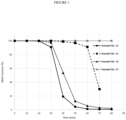
- FIG. 1 shows the results of experiments (Examples 12, 13, 14 and 15) which assess the ability of various polymer processing aids to clear melt extrusion defects when extruding a thermoplastic composition comprising a linear low density polyethylene (LLDPE) in a blown film line melt extrusion process.
- LLDPE linear low density polyethylene
- the term "monomer” refers to a small molecule that may chemically react and become chemically bonded with itself or other monomers to form a polymer.
- ⁇ -olefin or "alpha-olefin” is used to describe a monomer having a linear hydrocarbon chain containing from 3 to 20 carbon atoms having a double bond at one end of the chain; an equivalent term is "linear ⁇ -olefin”.
- An alpha-olefin may also be referred to as a comonomer.
- polyethylene or "ethylene polymer” refers to macromolecules produced from ethylene monomers and optionally one or more additional monomers; regardless of the specific catalyst or specific process used to make the ethylene polymer.
- the one or more additional monomers are often called “comonomer(s)” and typically include ⁇ -olefins.
- homopolymer generally refers to a polymer that contains only one type of monomer.
- copolymer refers to a polymer that contains two or more types of monomer.
- polyethylene types include high pressure low density polyethylene (LDPE), high density polyethylene (HDPE); medium density polyethylene (MDPE); linear low density polyethylene (LLDPE); and very low density polyethylene (VLPDE) or ultralow density polyethylene (ULPDE) which are also known as plastomers and elastomers.
- LDPE high pressure low density polyethylene
- HDPE high density polyethylene
- MDPE medium density polyethylene
- LLDPE linear low density polyethylene
- VLPDE very low density polyethylene
- ULPDE ultralow density polyethylene
- polyethylene also includes polyethylene terpolymers which may include two or more comonomers in addition to ethylene.
- polyethylene also includes combination of, or blends of, the polyethylene types described above.
- fluoropolymers in the present disclosure refers to homopolymers and copolymers of fluorinated olefins.
- the fluorinated olefins may have a fluorine atom to carbon ratio of at least 1:2, or in some embodiments at least 1:1.
- Homopolymers include for example, those derived from vinylidene fluoride and vinyl fluoride.
- Copolymers include, for example those derived from vinylidene fluoride and one or more additional olefins, which can be fluorinated, such as for example hexafluoropropylene or non-fluorinated, such as for example propylene.
- fluoropolymers as the term is used in the present disclosure include those described, for example, in U.S. Pat. Nos. 2,968,649 ; 3,051,677 ; 3,318,854 ; 5,015,693 ; 4,855,360 ; U.S. Pat. No. 5,710,217 ; U.S. Pat. No. 6,277,919 ; U.S. Pat. No. 7,375,157 ; and U.S. Pat. Appl. Pub. No. 2010/0311906 .
- fluoropolymers include for example, copolymers of hexafluoropropylene and vinylidene fluoride which are available under the tradenames "DYNAMAR ® FX 9613” and “DYNAMAR FX 9614”; and copolymers of vinylidene fluoride, tetrafluoroethylene, and hexafluoropropylene available under the tradenames "DYNAMAR FX 5911" and "DYNAMAR FX 5912".
- Other commercially available fluoropolymers include "VITON ® A”, “VITON FREEFLOW TM ", "DAI-EL ® ", and "KYNAR ® " all of which are available in various grades.
- polyalkylene oxide, poly(oxyalkylene), and polyalkylene glycol are used interchangeably. Accordingly, the terms polyethylene oxide, poly(oxyethylene), and polyethylene glycol are also used interchangeably; as are the terms polypropylene oxide, poly(oxypropylene) and polypropylene glycol.
- film is used herein to mean a film having one or more layers which is formed by the extrusion of a polymer through one or more die openings.
- film structure is used to connote that a film has more than one layer (i.e. a film structure may have at least two layers, at least three layers, at least four layers, at least five layers, etc.).
- Alkyl group and the prefix “alk-” are inclusive of both straight chain and branched chain groups and of cyclic groups having up to 30 carbons unless otherwise specified. Cyclic groups can be monocyclic or polycyclic and, in some embodiments, have from 3 to 10 ring carbon atoms.
- ether linkages for example, with regard to an alkyl, alkylene, or arylalkylene refers to having part of the alkyl, alkylene, or arylalkylene on both sides of the functional group.
- An example of an alkylene that is interrupted with -O- is -CH 2 -CH 2 -O-CH 2 -CH 2 -.
- aryl groups include phenyl, naphthyl, biphenyl, fluorenyl as well as furyl, thienyl, oxazolyl, and thiazolyl.
- Arylalkylene refers to an "alkylene” moiety to which an aryl group is attached.
- Alkylarylene refers to an "arylene” moiety to which an alkyl group is attached.
- the extrusion of a thermoplastic polyolefin is improved ("aided") by using a polymer processing aid (PPA).
- PPA polymer processing aid
- one or more components of a polymer processing aid can be co-fed with a thermoplastic polyolefin to an extruder.
- one or more components of a polymer processing aid can be added to a thermoplastic polyolefin to prepare a masterbatch of the polyolefin containing the one or more components of a polymer processing aid.
- the resulting polyolefin masterbatch can then be used to introduce the one or more components of a polymer processing aid into a thermoplastic polyolefin in any conventional manner prior to extrusion of the polyolefin (e.g. dry blending or melt blending) or during the extrusion of the polyolefin (e.g. co-feeding with a polyolefin to an extruder).
- a polymer processing aid used to aid the extrusion of a thermoplastic polyolefin, comprises: i) at least one poly(oxyalkylene) polymer, also known as polyalkylene glycol (PAG) and ii) a high pressure low density polyethylene (LDPE).
- PPA polymer processing aid
- PAG polyalkylene glycol
- LDPE high pressure low density polyethylene
- a polymer processing aid used to aid the extrusion of a thermoplastic polyolefin, comprises: i) at least one poly(oxyethylene) polymer, also known as polyethylene glycol (PEG) and ii) a high pressure low density polyethylene (LDPE).
- PPA polymer processing aid
- PEG polyethylene glycol
- LDPE high pressure low density polyethylene
- a polymer processing aid used to aid the extrusion of a thermoplastic polyolefin, comprises: i) a poly(oxyethylene) polymer, also known as polyethylene glycol (PEG) having a weight average molecular weight, M W of less than 20,000 g/mol and ii) a high pressure low density polyethylene (LDPE).
- PEG polyethylene glycol
- LDPE high pressure low density polyethylene
- a polymer processing aid used to aid the extrusion of a thermoplastic polyolefin, comprises: i) a poly(oxyethylene) polymer, also known as polyethylene glycol (PEG) having a weight average molecular weight, M W of at least 50,000 g/mol and ii) a high pressure low density polyethylene (LDPE).
- PEG polyethylene glycol
- LDPE high pressure low density polyethylene
- a polymer processing aid used to aid the extrusion of a thermoplastic polyolefin, comprises: i) a poly(oxyethylene) polymer, also known as polyethylene glycol (PEG) having a weight average molecular weight, M W of from 25,000 to 50,000 g/mol and ii) a high pressure low density polyethylene (LDPE).
- PEG polyethylene glycol
- LDPE high pressure low density polyethylene
- a polymer processing aid used to aid the extrusion of a thermoplastic polyolefin, comprises: i) at least one poly(oxypropylene) polymer, also known as polypropylene glycol (PPG) and ii) a high pressure low density polyethylene (LDPE).
- PPG polypropylene glycol
- LDPE high pressure low density polyethylene
- a polymer processing aid used to aid the extrusion of a thermoplastic polyolefin, comprises: i) a relatively low molecular weight poly(oxyalkylene) polymer; ii) a relatively high molecular weight poly(oxyalkylene) polymer; and iii) a high pressure low density polyethylene (LDPE).
- PPA polymer processing aid
- a polymer processing aid used to aid the extrusion of a thermoplastic polyolefin, comprises: i) a relatively low molecular weight poly(oxyethylene) polymer; ii) a relatively high molecular weight poly(oxyethylene) polymer; and iii) a high pressure low density polyethylene (LDPE).
- PPA polymer processing aid
- a polymer processing aid used to aid the extrusion of a thermoplastic polyolefin, comprises: i) a relatively low molecular weight poly(oxypropylene) polymer; ii) a relatively high molecular weight poly(oxypropylene) polymer; and iii) a high pressure low density polyethylene (LDPE).
- PPA polymer processing aid
- a polymer processing aid used to aid the extrusion of a thermoplastic polyolefin, comprises: i) a first poly(oxyalkylene) polymer having a weight average molecular weight, Mw of less than 25,000 g/mol; ii) a second poly(oxyalkylene) polymer having a weight average molecular weight, Mw of at least 25,000 g/mol; and iii) a high pressure low density polyethylene (LDPE).
- PPA polymer processing aid
- a polymer processing aid used to aid the extrusion of a thermoplastic polyolefin, comprises: i) at first poly(oxyalkylene) polymer having a weight average molecular weight, Mw of less than 10,000 g/mol; ii) a second poly(oxyalkylene) polymer having a weight average molecular weight, Mw of from 15,000 to 50,000 g/mol; and iii) a high pressure low density polyethylene (LDPE).
- PPA polymer processing aid
- a polymer processing aid used to aid the extrusion of a thermoplastic polyolefin, comprises: i) at first poly(oxyalkylene) polymer having a weight average molecular weight, Mw of from 2,000 to 10,000 g/mol; ii) a second poly(oxyalkylene) polymer having a weight average molecular weight, Mw of from 15,000 to 25,000 g/mol; and iii) a high pressure low density polyethylene (LDPE).
- PPA polymer processing aid
- a polymer processing aid used to aid the extrusion of a thermoplastic polyolefin, comprises: i) a first poly(oxyalkylene) polymer having a weight average molecular weight, Mw of from 2,000 to 10,000 g/mol; ii) a second poly(oxyalkylene) polymer having a weight average molecular weight, Mw of from 25,000 to 50,000 g/mol; and iii) a high pressure low density polyethylene (LDPE).
- PPA polymer processing aid
- a polymer processing aid used to aid the extrusion of a thermoplastic polyolefin, comprises: i) a first poly(oxyalkylene) polymer having a weight average molecular weight, Mw of from 2,000 to 10,000 g/mol; ii) a second poly(oxyalkylene) polymer having a weight average molecular weight, Mw of from 250,000 to 350,000 g/mol; and iii) a high pressure low density polyethylene (LDPE).
- PPA polymer processing aid
- a polymer processing aid used to aid the extrusion of a thermoplastic polyolefin, comprises: i) a first poly(oxyalkylene) polymer having a weight average molecular weight, Mw of less than 10,000 g/mol; ii) a second poly(oxyalkylene) polymer having a weight average molecular weight, Mw of at least 50,000 g/mol; and iii) a high pressure low density polyethylene (LDPE).
- PPA polymer processing aid
- a polymer processing aid used to aid the extrusion of a thermoplastic polyolefin, comprises: i) a first poly(oxyalkylene) polymer having a weight average molecular weight, Mw of less than 20,000 g/mol; ii) a second poly(oxyalkylene) polymer having a weight average molecular weight, Mw of at least 50,000 g/mol; and iii) a high pressure low density polyethylene (LDPE).
- PPA polymer processing aid
- a polymer processing aid used to aid the extrusion of a thermoplastic polyolefin, comprises: i) a first poly(oxyethylene) polymer having a weight average molecular weight, Mw of less than 25,000 g/mol; ii) a second poly(oxyethylene) polymer having a weight average molecular weight, Mw of at least 25,000 g/mol; and iii) a high pressure low density polyethylene (LDPE).
- PPA polymer processing aid
- a polymer processing aid used to aid the extrusion of a thermoplastic polyolefin, comprises: i) a first poly(oxyethylene) polymer having a weight average molecular weight, Mw of less than 10,000 g/mol; ii) a second poly(oxyethylene) polymer having a weight average molecular weight, Mw of from 15,000 to 50,000 g/mol; and iii) a high pressure low density polyethylene (LDPE).
- PPA polymer processing aid
- a polymer processing aid used to aid the extrusion of a thermoplastic polyolefin, comprises: i) a first poly(oxyethylene) polymer having a weight average molecular weight, Mw of from 2,000 to 10,000 g/mol; ii) a second poly(oxyethylene) polymer having a weight average molecular weight, Mw of from 15,000 to 50,000 g/mol; and iii) a high pressure low density polyethylene (LDPE).
- PPA polymer processing aid
- a polymer processing aid used to aid the extrusion of a thermoplastic polyolefin, comprises: i) a first poly(oxyethylene) polymer having a weight average molecular weight, Mw of from 2,000 to 10,000 g/mol; ii) a second poly(oxyethylene) polymer having a weight average molecular weight, Mw of from 15,000 to 25,000 g/mol; and iii) a high pressure low density polyethylene (LDPE).
- PPA polymer processing aid
- a polymer processing aid used to aid the extrusion of a thermoplastic polyolefin, comprises: i) a first poly(oxyethylene) polymer having a weight average molecular weight, Mw of from 2,000 to 10,000 g/mol; ii) a second poly(oxyethylene) polymer having a weight average molecular weight, Mw of from 25,000 to 50,000 g/mol; and iii) a high pressure low density polyethylene (LDPE).
- PPA polymer processing aid
- a polymer processing aid used to aid the extrusion of a thermoplastic polyolefin, comprises: i) a first poly(oxyethylene) polymer having a weight average molecular weight, Mw of from 2,000 to 10,000 g/mol; ii) a second poly(oxyethylene) polymer having a weight average molecular weight, Mw of from 250,000 to 350,000 g/mol; and iii) a high pressure low density polyethylene (LDPE).
- PPA polymer processing aid
- a polymer processing aid used to aid the extrusion of a thermoplastic polyolefin, comprises: i) a first poly(oxyethylene) polymer having a weight average molecular weight, Mw of less than 10,000 g/mol; ii) a second poly(oxyethylene) polymer having a weight average molecular weight, Mw of at least 50,000 g/mol; and iii) a high pressure low density polyethylene (LDPE).
- PPA polymer processing aid
- a polymer processing aid used to aid the extrusion of a thermoplastic polyolefin, comprises: i) a first relatively low molecular weight poly(oxyalkylene) polymer and ii) a second relatively high molecular weight poly(oxyalkylene) polymer.
- a polymer processing aid used to aid the extrusion of a thermoplastic polyolefin, comprises: i) a first relatively low molecular weight poly(oxyethylene) polymer and ii) a second relatively high molecular weight poly(oxyethylene) polymer.
- a polymer processing aid used to aid the extrusion of a thermoplastic polyolefin, comprises: i) a first poly(oxyethylene) polymer having a weight average molecular weight, Mw of less than 10,000 g/mol and ii) a second poly(oxyethylene) polymer having a weight average molecular weight, Mw of from 15,000 to 50,000 g/mol.
- a polymer processing aid used to aid the extrusion of a thermoplastic polyolefin, comprises: i) a first poly(oxyethylene) polymer having a weight average molecular weight, Mw of less than 10,000 g/mol and ii) a second poly(oxyethylene) polymer having a weight average molecular weight, Mw of from 250,000 to 350,000 g/mol.
- a polymer processing aid used to aid the extrusion of a thermoplastic polyolefin, comprises: i) a first poly(oxyethylene) polymer having a weight average molecular weight, Mw of from 2,000 to 10,000 and ii) a second poly(oxyethylene) polymer having a weight average molecular weight, Mw of from 15,000 to 25,000 g/mol.
- a polymer processing aid used to aid the extrusion of a thermoplastic polyolefin, comprises: i) a first poly(oxyethylene) polymer having a weight average molecular weight, Mw of from 2,000 to 10,000 and ii) a second poly(oxyethylene) polymer having a weight average molecular weight, Mw of from 15,000 to 50,000 g/mol.
- a polymer processing aid used to aid the extrusion of a thermoplastic polyolefin, comprises: i) a first poly(oxyethylene) polymer having a weight average molecular weight, Mw of from 2,000 to 10,000 and ii) a second poly(oxyethylene) polymer having a weight average molecular weight, Mw of from 250,000 to 350,000 g/mol.
- a polymer processing aid used to aid the extrusion of a thermoplastic polyolefin, comprises: i) a first poly(oxyethylene) polymer having a weight average molecular weight, Mw of from 2,000 to 8,000 g/mol, or a first poly(oxyethylene) polymer having a weight average molecular weight, Mw from 2,000 to 5000 g/mol; and ii) a second poly(oxyethylene) polymer having a weight average molecular weight, Mw of from 15,000 to 25,000 g/mol, or a second poly(oxyethylene) polymer having a weight average molecular weight, Mw from 25,000 to 50,000 g/mol.
- PPA polymer processing aid
- a polymer processing aid used to aid the extrusion of a thermoplastic polyolefin, comprises: i) a first poly(oxyethylene) polymer having a weight average molecular weight, Mw of about 3,350 g/mol and ii) a second poly(oxyethylene) polymer having a weight average molecular weight, Mw of about 35,000 g/mol.
- a polymer processing aid used to aid the extrusion of a thermoplastic polymer is further characterized by the substantial absence of perfluoroalkane compounds, fluoroelastomers, and fluoropolymers.
- An embodiment of the disclosure is characterized by the substantial absence of perfluoroalkane compounds, fluoroelastomers, and fluoropolymers in an extrudable thermoplastic composition.
- An embodiment of the disclosure is a process for preparing a thermoplastic composition extrudate which comprises melt extruding the thermoplastic composition in a melt extrusion process; where the thermoplastic composition is characterized by the substantial absence of perfluoroalkane compounds, fluoroelastomers, and fluoropolymers and where the melt extrusion process is carried out in the absence of perfluoroalkane compounds, fluoroelastomers, and fluoropolymers.
- melt extrusion processes include film extrusion, extrusion blow molding, injection molding, pipe extrusion, wire extrusion, cable extrusion, and fiber extrusion, all of which are well known to persons skilled in the art.
- a polymer processing aid will comprise at least one poly(oxyalkylene) polymer, also known as polyalkylene glycol (PAG) or polyalkylene oxide.
- PAG polyalkylene glycol
- a polymer processing aid will comprise at least one poly(oxyethylene) polymer, also known as polyethylene glycol or polyethylene oxide.
- a polymer processing aid will comprise at least one poly(oxypropylene) glycol, also known as polypropylene glycol or polypropylene oxide.
- a poly(oxyalkylene) polymer can in embodiments of the disclosure be represented by formula A[(OR 1 ) x OR 2 ] y , wherein A is typically alkylene interrupted by one or more ether linkages, y is 2 or 3, (OR 1 ) x is a poly(oxyalkylene) chain having a plurality (x) of oxyalkylene groups, OR 1 , wherein each R 1 is independently C 2 to C 5 alkylene, in some embodiments, C 2 to C 3 alkylene, R 2 is hydrogen, alkyl, aryl, arylalkenyl, alkylarylenyl, - C(O)-alkyl, -C(O)-aryl, -C(O)-arylalkenyl, or -C(O)-alkylarylenyl, wherein -C(O)-is bonded to the O of OR 2 .
- a poly(oxyalkylene) polymer can in embodiments of the disclosure be represented by formula A[(OR 1 ) x OR 2 ] y , wherein A is typically alkylene interrupted by one or more ether linkages, y is 2 or 3, (OR 1 ) x is a poly(oxyalkylene) chain having a plurality (x) of oxyalkylene groups, OR 1 , wherein each R 1 is independently C 2 to C 5 alkylene, in some embodiments, C 2 to C 3 alkylene, R 2 is hydrogen, alkyl, aryl, arylalkenyl, alkylarylenyl, -C(O)-alkyl, -C(O)-aryl, -C(O)-arylalkenyl, or -C(O)-alkylarylenyl, wherein -C(O)- is bonded to the O of OR 2 .
- a poly(oxyalkylene) polymer can be a homopolymer such as a poly(oxyethylene) polymer (also called a polyethylene glycol in the present disclosure) in which each R 1 is -CH 2 CH 2 -, or a homopolymer such as a poly(oxypropylene) polymer in which each R 1 is -C 3 H 6 -.
- a poly(oxyalkylene) polymer is a poly(oxyalkylene) polymer comprising a chain of randomly distributed oxyalkylene groups (e.g., a copolymer comprising -OC 2 H 4 - and -OC 3 H 6 - units) or having alternating blocks of repeating oxyalkylene groups (e.g., a copolymer comprising (-OC 2 H 4 -) a and (-OC 3 H 6 -) b blocks, wherein a+b is x).
- Poly(oxyalkylene) copolymers comprising randomly distributed, or alternating units of (-OC 2 H 4 -) and (-OC 3 H 6 -) or blocks of (-OC 2 H 4 -) a and (-OC 3 H 6 -) b are sometimes referred to as "poloxamers" and are available commercially under the tradenames PLURONIC ® , KOLLIPHOR ® and SYNPERONIC ® .
- poly(oxyalkylene) polymer is a polyethylene glycol (PEG).
- PEG polyethylene glycol
- Polyethylene glycol (PEG) can be represented by formula H(O-CH 2 CH 2 -) x OH.
- Many polyethylene glycols, as well as their ethers, and their esters are commercially available and they are all contemplated for use in embodiments of the present disclosure.
- a polymer processing aid will comprise at least two polyethylene glycols of different weight average molecular weight, M w , and the difference in weight average molecular weight, M w between the at least two polyethylene glycols will be in the range of from 5:1 to 100,000:1, or from 2:1 to 1000:1, or from 5:1 to 1000:1, or from 2:1 to 500:1, or from 5:1 to 500:1, or from 2:1 to 100:1, or from 5:1 to 100:1.
- a polymer processing aid will comprise at least two polyethylene glycols of different weight average molecular weight, M w , and the at least two polyethylene glycols having different M w , will be present in a mole ratio of from 1:99 to 99:1 including any sub range encompassed within this range and any value within this range.
- a polyalkylene glycol (PAG) or a polyethylene glycol (PEG) is added to a thermoplastic polyolefin (e.g. a linear polyethylene) using a masterbatch formulation containing the PAG or PEG.
- a masterbatch is well known to persons skilled in the art.
- the term "masterbatch” refers to the practice of first melt mixing an additive, for example, a PEG, with a small amount of a given thermoplastic (e.g. a linear polyethylene), followed by blending (by for example melt mixing or dry blending) the resulting "masterbatch" with the remaining bulk of the thermoplastic (e.g. the linear polymer).
- from about 0.1 to about 15.0 weight percent, or from about 0.5 to about 15.0 weight percent, or from about 0.5 to about 10.0 weight percent, or from about 0.1 to about 10.0 weight percent, or from about 0.1 to about 7.5 weight percent, or from about 0.5 to about 7.5 weight percent or from about 0.5 to about 5.0 weight percent, or from about 0.1 to about 5.0 weight percent, or from about 1.0 to about 15.0 weight percent, or from about 1.0 to about 5.0 weight percent, or from about 1.0 to about 7.5 weight percent, or from about 1.0 to about 5.0 weight percent, or from about 0.1 to about 2.5 weight percent, or from about 0.5 to about 2.5 weight percent of a masterbatch will be used in a blend with the bulk polymer (where weight percent of the masterbatch is based on the combined weight of the masterbatch and the bulk polymer).
- a masterbatch may contain an amount of PAG or PEG in the range of from 500 to 40,000 ppm, or from 500 to 35,000 ppm, or from 500 to 40,000 ppm, or from 500 to 25,000 ppm, or from 1,000 to 40,000 ppm, or from 1,000 to 35,000 ppm, or from 1,000 to 30,000 ppm, or from 1,000 to 25,000 parts per million by weight (based on the weight of the masterbatch), or from 5,000 to 25,000 ppm, or from 1,000 to 20,000 ppm, or from 2,000 to 20,000 ppm, or from 3,000 to 20,000, or from 4,000 to 20,000 ppm, or from 5,000 to 20,000 ppm, or from 5,000 to 17,500, or from 5,000 to 15,000 or from 5,000 to 12,500 ppm, or from 2,500 to 15,000 ppm, or from 5,000 to 15,000 ppm, or from 7,500 to 15,000 ppm, or from 7,500 ppm to 12,500 ppm
- the polyalkylene glycol or the polyethylene glycol used as a polymer processing aid (PPA) may be used in the form of a semi solid or a viscous liquid, or as powders, pellets, or granules.
- the High Pressure Low Density Polyethylene (LDPE)
- a polymer processing aid will comprise a high pressure low density polyethylene, LDPE.
- high pressure low density polyethylene is an ethylene homopolymer and is prepared by the free radical homopolymerization of ethylene.
- LDPE has high degrees of so called long chain branching (which may be as long as the main polymer backbone) and which gives the LDPE a non-linear microstructure.
- high pressure low density polyethylene LDPE
- linear polyethylene which is made using ethylene polymerization catalysts, as further described below, and which has a linear polymer microstructure. Further description of the high pressure low density polyethylene, LDPE used in the present disclosure is found in the Kirk-Othmer Encyclopedia of Chemical Technology, in the chapter titled Polyethylene, Low Density by Norma Maraschin, First Published March 18, 2005 , which description is incorporated herein in its entirety by reference.
- a high pressure low density polyethylene is prepared in either a tubular reactor or an autoclave reactor.
- a tubular reactor operates in a continuous mode and at high pressures and temperatures.
- Typical operating pressures for a tubular reactor are from 2000 to 3500 bar. Operating temperatures can range from 140 to 340°C.
- the reactor is designed to have a large length to diameter ratio (for example, from 400 to 40,000) and may have multiple reaction zones which take the shape of an elongated coil. High gas velocities (at least 10 m/s) are used to provide optimal heat transfer. Conversions for multi-zone systems are typically 22 to 30% per pass but can be as high as 36 to 40%.
- Tubular reactors may have multiple injection points for the addition of monomer or initiators to different reaction zones having different temperatures.
- An autoclave reactor may have a length to diameter ratio of between 2 and 20 and may be single stage or multistage.
- low temperature ethylene is passed into a hot reaction zone and conversion may be controlled by the temperature differential between the incoming ethylene gas and the temperature of the autoclave reactor. Conversions are usually lower in an autoclave reactor, up to 23% per pass, than in a tubular reactor which has a higher capacity to remove the heat of polymerization.
- Typical operating pressures for autoclave reactors are from 1,100 to 2,000 bar. Average operating temperatures are from 220 to 300°C, but temperatures can be as high as 340°C.
- initiators may be used with each type of reactor to initiate the free radical polymerization of ethylene.
- Initiators may include oxygen or one or more organic peroxides such as but not limited to di-tert-butylperoxide, cumuyl peroxide, tert-butyl-peroxypivalate, tert-butyl hydroperoxide, benzoyl peroxide, tert-amyl peroxypivalate, tert-butyl-peroxy-2-ethylhexanoate, and decanoyl peroxide.
- Chain transfer reagents may also be used with each type of reactor to control the polymer melt index. Chain transfer reagents include but are not limited to propane, n-butane, n-hexane, cyclohexane, propylene, 1-butene, and isobutylene.
- the LDPE has a density of from about 0.910 g/cm 3 to about 0.940 g/cm 3 , including sub ranges within this range or any value within this range.
- the LDPE has a density of from about 0.914 g/cm 3 to about 0.930 g/cm 3 , or from about 0.916 g/cm 3 to about 0.930 g/cm 3 , or from about 0.920 g/cm 3 to about 0.940 g/cm 3 , or from about 0.920 g/cm 3 to about 0.930 g/cm 3 .
- the LDPE used in the present disclosure will have a melt index, I 2 of from 0.1 to 20.0 g/10min, or from 0.1 to 15.0 g/10min, or from 0.1 to 10.0 g/10 min.
- the LDPE used in the present disclosure will have a melt index, I 2 of at least 1.0 g/10min, or at least 2.0 g/10min, or at least 2.5 g/10min, or at least 3.0 g/10min.
- the LDPE used in the present disclosure will have a melt index, I 2 of from 1.0 to 10.0 g/10min, or from 1.5 to 10.0 g/10min, or from 2.0 to 10 g/10min, or from 2.5 to 10.0 g/10min, or from 3.0 to 10.0 g/10min, or from 3.5 to 10.0 g/10min, or from 4.0 to 10.0 g/10min, or from 2.5 to 9.0 g/10min, or from 2.5 to 8.5 g/10min, or from 2.5 to 8.0 g/10min, or from 3.0 to 9.0 g/10min, or from 3.0 to 8.5 g/10min, or from 3.0 to 8.0 g/10min, or from 3.5 to 9.0 g/10min, or from 3.5 to 8.5 g/10min, or from 3.5 to 8.0 g/10min, or from 4.0 to 9.0 g/10min, or from 4.0 to 8.5 g/10min or from 4.0 to 8.0 g/10min.
- I 2 melt index
- a high pressure low density polyethylene is a blend of LDPE materials having different densities and/or different melt indices, I 2 's.
- the LDPE used is made in a tubular reactor and has a multimodal molecular weight distribution.
- the levels of antioxidant present in a LDPE are from 0 to 2,000 parts per million, ppm, by weight (based on the weight of the LDPE). In further embodiments, the amounts of antioxidant present in a LDPE are from 0 to 1000 ppm, or from 0 to 500 ppm, or from 0 to 300 ppm, by weight (based on the weight of the LDPE).
- an ethylene copolymer comprises polymerized ethylene and one or more than one polymerized alpha olefin selected from the group comprising propylene, 1-butene, 1-hexene, 1-octene, 1-decene, 4-methyl-1-pentene, and 1-octadecene.
- an ethylene copolymer comprises polymerized ethylene and one or more than one polymerized alpha olefin selected from the group comprising 1-butene, 1-hexene, and 1-octene, and polymerized ethylene comprises at least 90 weight percent of the ethylene copolymer.
- the cooled gas stream including monomer, and optional other components (such as condensable liquids), is then re-circulated through the polymerization zone, together with "make-up" monomer to replace that which was polymerized on the previous pass. Simultaneously, polymer product is withdrawn from the reactor.
- the "fluidized” nature of the polymerization bed helps to evenly distribute/mix the heat of reaction and thereby minimize the formation of localized temperature gradients.
- a transition metal polymerization catalyst may be immobilized on a suitable support material, and the resulting particulate catalyst may be employed in a slurry phase polymerization process.
- Slurry phase polymerization processes are conducted in the presence of a hydrocarbon diluent such as an alkane (including for example isoalkanes), an aromatic or a cycloalkane.
- the diluent may also be the alpha olefin comonomer used in copolymerizations.
- alkane diluents include propane, butanes, (i.e.
- the polymerization temperature is from about 5°C to about 200°C, or less than about 120°C, or from about 10°C to about 100°C.
- the reaction temperature is selected so that an ethylene or alpha olefin homopolymer or copolymer is produced in the form of solid particles.
- the reaction pressure is influenced by the choice of diluent and reaction temperature.
- the solvent used in a solution phase polymerization process is selected from the group consisting of C 5-12 hydrocarbons which may be unsubstituted or substituted by C 1-4 alkyl group, and include hydrocarbon solvents such as pentane, methyl pentane, hexane, heptane, octane, cyclohexane, methylcyclohexane and hydrogenated naphtha.
- a suitable solvent for use in embodiments of the present disclosure and which is commercially available is "Isopar E" (C 8-12 aliphatic solvent, Exxon Chemical Co.).
- the polymerization temperature in a conventional solution process may be from about 80°C to about 300°C.
- very low density polyethylene is an ethylene copolymer with another alpha olefin (such as propylene, 1-butene, 4-methyl-1-pentene, 1-hexene, and/or 1-octene) and has a density of less than about 0.910 g/cm 3 and may include so called elastomers and plastomers.
- alpha olefin such as propylene, 1-butene, 4-methyl-1-pentene, 1-hexene, and/or 1-octene
- a VLDPE is an ethylene copolymer with another alpha olefin (such as, for example, propylene, 1-butene, 4-methyl-1-pentene 1-hexene, and/or 1-octene) having a density of from about 0.880 g/cm 3 to about 0.910 g/cm 3 , or from about 0.880 g/cm 3 to about 0.905 g/cm 3 , or from about 0.880 g/cm 3 to about 0.902 g/cm 3 .
- another alpha olefin such as, for example, propylene, 1-butene, 4-methyl-1-pentene 1-hexene, and/or 1-octene
- a linear polyethylene has a density of from 0.900 to 0.955 g/cm 3 , or from 0.900 to 0.950 g/cm 3 .
- a linear polyethylene is selected from the group consisting of linear low density polyethylene (LLDPE), medium density polyethylene (MDPE), high density polyethylene (HDPE), very low density polyethylene (VLDPE) and mixtures thereof.
- LLDPE linear low density polyethylene
- MDPE medium density polyethylene
- HDPE high density polyethylene
- VLDPE very low density polyethylene
- the linear polyethylene may have a weight average molecular weight, M w of at least about 10,000 g/mol, and up to about 1,500,000 g/mol including any sub range within this range or any value within this range.
- the linear polyethylene has a weight average molecular weight, Mw, of from about 50,000 to about 1,000,000 g/mol, or from about 100,000 to about 1,000,000 g/mol, or from about 75,000 to about 750,000 g/mol, or from about 100,000 to about 750,000 g/mol, or from about 75,000 to about 500,000 g/mol, or from about 100,000 to about 500,000 g/mol, or from about 50,000 to about 350,00 g/mol, or from about 75,000 to about 350,000 g/mol, or from about 100,000 to about 350,000 g/mol, or from about 50,000 to about 300,000 g/mol, or from about 75,000 to about 300,000 g/mol, or from about 100,000 to about 300,000 g/mol, or from about 50,000 to about 250,000 g/mol, or from about 75,000 to about 250,000 g/mol, or from about 100,000 to about 250,000 g/mol.
- Mw weight average molecular weight
- the linear polyethylene has a molecular weight distribution, M w /M n of from about 2.0 to about 12.0, including sub ranges within this range or any value within this range.
- the linear polyethylene has a M w /M n value of from about 2.0 to about 10.0, or from about 2.0 to about 8.0, or from about 2.0 to about 5.0.
- a linear polyethylene is characterized by its melt index, I 2 , as determined by ASTM D1238, Condition E, at 190°C.
- a linear polyethylene has a melt index, I 2 of from 0.1 to 20.0 g/10min, including any sub range within this range or any value within this range.
- a linear polyethylene has a melt index, I 2 of from 0.1 to 15.0 g/10min, or from 0.1 to 10.0 g/10min, or from 0.3 to 15.0 g/10min, or from 0.3 to 10.0 g/10min, or from 0.1 to 5.0 g/10min or from 0.3 to 5.0 g/10min, or from 0.5 to 15.0 g/10min, or from 0.5 to 10.0 g/10min, or from 0.5 to 5.0 g/10min.
- a linear polyethylene selected from the group consisting of LLDPE, MDPE, HPDE, VLPDE and mixtures thereof, may be used in the form of powders, pellets, granules, or in any other extrudable form.
- a linear polyethylene is a LLDPE.
- a linear polyethylene is a LLDPE having a melt index, I 2 of from 0.1 to 10.0 g/10min, or from 0.5 to 5.0 g/10min.
- a linear polyethylene is a LLDPE having a density of from about 0.910 g/cm 3 to about 0.936 g/cm 3 and a melt index, I 2 of from 0.1 to 10.0 g/10min.
- a linear polyethylene is a LLDPE having a density of from about 0.910 g/cm 3 to about 0.936 g/cm 3 and a melt index, I 2 of from 0.1 to 5.0 g/10min.
- a linear polyethylene is a LLDPE having a molecular weight distribution, M w /M n of from about 2.0 to about 12.0, including sub ranges within this range or any value within this range.
- a LLDPE has a M w /M n value of from about 2.0 to about 10.0, or from about 2.0 to about 8.0, or from about 2.0 to about 5.0.
- a linear polyethylene will comprise small amounts, defined as ⁇ 3.0 weight percent (wt%, based on the total weight of the linear polymer and the LDPE) of a high pressure low density polyethylene, LDPE having a melt index of below about 1.0 g/10min.
- a homogeneously branched linear polyethylene will comprise small amounts, defined as ⁇ 3.0 weight percent (wt%, based on the total weight of the linear polymer and the LDPE), of a high pressure low density polyethylene, LDPE having a melt index of below about 1.0 g/10min.
- the presence of small amounts of a LDPE having a melt index of below about 1.0 g/10min may be useful in various end use applications.
- thermoplastic compositions in a wide variety of extrusion processes such as profile extrusion in which an extruded part such as a pipe or profiled part is prepared by extruding molten plastic through a shaped die) and film extrusion (in which plastic film is prepared by extruding molten plastic through a slit or annular die).
- a film extrusion process such as for example, a "blown film” extrusion process is employed.
- a blown film extrusion process is described in more detail below in the Examples section.
- the polyolefin e.g. the linear polyethylene
- the polyolefin may contain a pigment/filler such as carbon black and other adjuvants.
- thermoplastic polyolefin such as a linear polyethylene
- used in the present disclosure may further include fillers, antioxidants (such as a primary and optionally a secondary antioxidant), pigments, opacifying agents, static control agents such as glycerol monostearate, lubricants such as fatty acid esters, light stabilizers (such as hindered amine light stabilizers), zinc oxide, antiblock agents and other adjuvants.
- antioxidants such as a primary and optionally a secondary antioxidant
- pigments such as a primary and optionally a secondary antioxidant
- static control agents such as glycerol monostearate
- lubricants such as fatty acid esters
- light stabilizers such as hindered amine light stabilizers
- zinc oxide antiblock agents and other adjuvants.
- a linear polyethylene comprises a primary antioxidant, and a secondary antioxidant.
- a primary antioxidant is selected from benzyl compounds, such as for example, 1,3,5-tris-(3,5-di-tert-butyl-4-hydroxybenzyl)-2,4,6-trimethylbenzene; bis-(3,5-di-tert-butyl-4-hydroxybenzyl)sulfide; isooctyl 3,5-di-tert-butyl-4-hydroxybenzyl-mercaptoacetate; bis-(4-tert-butyl-3hydroxy-2,6-dimethylbenzyl)dithiol-terephthalate; 1,3,5-tris-(3,5-di-tert-butyl-4,10 hydroxybenzyl)isocyanurate; 1,3,5-tris-(4-tert-butyl-3-hydroxy-2,6-dimethylbenzyl)isocyanurate; dioctadecyl 3,5-di-tert-butyl-4-hydroxybenzylphosphon
- a primary antioxidant is selected from acvlaminophenols, such as for example, 4-hydroxy-lauric acid anilide; 4-hydroxy-stearic acid anilide; 2,4-bis-octylmercapto-6-(3,5-tert-butyl-4-hydroxyanilino)-s-triazine; and octyl-N-(3,5-di-tert-butyl-4-hydroxyphenyl)-carbamate.
- acvlaminophenols such as for example, 4-hydroxy-lauric acid anilide; 4-hydroxy-stearic acid anilide; 2,4-bis-octylmercapto-6-(3,5-tert-butyl-4-hydroxyanilino)-s-triazine; and octyl-N-(3,5-di-tert-butyl-4-hydroxyphenyl)-carbamate.
- a secondary antioxidant is selected from phosphites and phosphonites (also described herein as "phosphorus containing secondary antioxidants”), such as, for example, triphenyl phosphite; diphenylalkyl phosphites; phenyldialkyl phosphites; tris (nonyl-phenyl)phosphite [WESTON ® 399, available from SI Group]; phosphorous acid, mixed 2,4-bis(1,1-dimethylpropyl)phenyl and 4-(1,1-dimethylpropyl)phenyl triesters [WESTON 705, CAS Reg. No.
- a secondary antioxidant is selected from peroxide scavengers, such as, for example, esters of betathiodipropionic acid.
- Esters betathiodipropionic acid may be selected from the group consisting of lauryl, stearyl, myristyl or tridecyl esters.
- the secondary antioxidant may also be used in an amount of from 100 to 5,000 ppm, or from 100 to 3,000 ppm, or from 200 to 3,000 ppm, or from 200 to 2,000 ppm, or from 300 to 1,500 ppm, or from 400 to 1,200 ppm (based on the weight of the thermoplastic polyolefin).
- UV Absorbers and Light Stabilizers UV Absorbers and Light Stabilizers
- a UV absorber or light stabilizer is selected from 2-(2'-hydroxyphenyl)-benzotriazoles, such as, for example, the 5'-methyl-; 3',5'-di-tert-butyl-; 5'-tert-butyl-; 5'(1,1,3,3-tetramethylbutyl)-; 5-chloro-3',5'-di-tert-butyl-; 5-chloro-3'-tert-butyl-5'-methyl-; 3'-sec-butyl-5'-tert-butyl-; 4'-octoxy,3',5'-di-tert-amyl-; and 3',5'-bis-(alpha, alpha - dimethylbenzyl) derivatives.
- 2-(2'-hydroxyphenyl)-benzotriazoles such as, for example, the 5'-methyl-; 3',5'-di-tert-butyl-; 5'-tert-buty
- a UV absorber or light stabilizer is selected from 2-hydroxy-benzophenones, such as, for example, the 4-hydroxy-; 4-methoxy-; 4-octoxy; 4-decyloxy-; 4-dodecyloxy-; 4-benzyloxy-; 4,2',4'-trihydroxy-; and 2'-hydroxy-4,4'-dimethoxy derivative.
- a UV absorber or light stabilizer is selected from sterically hindered amines, such as, for example, bis (2,2,6,6-tetramethylpiperidyl)-sebacate; bis-5(1,2,2,6,6-pentamethylpiperidyl)-sebacate; n-butyl-3,5-di-tert-butyl-4-hydroxybenzyl malonic acid bis(1,2,2,6,6,-pentamethylpiperidyl)ester; condensation product of 1-hydroxyethyl-2,2,6,6-tetramethyl-4-hydroxy-piperidine and succinic acid; condensation product of N,N'-(2,2,6,6-tetramethylpiperidyl)-hexamethylendiamine and 4-tert-octylamino-2,6-dichloro-1,3,5-s-triazine; tris-(2,2,6,6-tetramethylpiperidyl)-nitrilotriacetate, te
- HALS Hindered Amines Light Stabilizing
- amines include butane tetracarboxylic acid 2,2,6,6-tetramethyl piperidinol esters.
- Such amines include hydroxylamines derived from hindered amines, such as di(1-hydroxy-2,2,6,6-tetramethylpiperidin-4-yl) sebacate; 1-hydroxy 2,2,6,6-tetramethyl-4-benzoxypiperidine; 1-hydroxy-2,2,6,6-tetramethyl-4-(3,5-di-tert-butyl-4-hydroxy hydrocinnamoyloxy)-piperdine; and N-(1-hydroxy-2,2,6,6-tetramethyl-piperidin-4-yl)-epsiloncaprolactam.
- hindered amines such as di(1-hydroxy-2,2,6,6-tetramethylpiperidin-4-yl) sebacate; 1-hydroxy 2,2,6,6-tetramethyl-4-benzoxypiperidine;
- Suitable commercially available HALS which may be used in embodiments of the disclosure include those sold under the trademarks CHIMASSORB ® 119; CHIMASSORB 944; CHIMASSORB 2020; TINUVIN ® 622 and TINUVIN 770 from BASF, and CYASORB ® UV 3346, CYASORB UV 3529, CYASORB UV 4801, and CYASORB UV 4802 from Solvay.
- CHIMASSORB ® 119 CHIMASSORB 944
- CHIMASSORB 2020 TINUVIN ® 622 and TINUVIN 770 from BASF
- CYASORB ® UV 3346, CYASORB UV 3529, CYASORB UV 4801, and CYASORB UV 4802 from Solvay.
- the use of mixtures of more than one HALS are also contemplated
- a UV absorber or light stabilizer is selected from esters of substituted and unsubstituted benzoic acids, such as for example, phenyl salicilate; 4-tertbutylphenyl-salicilate; octylphenyl salicylate; dibenzoylresorcinol; bis-(4-tert-butylbenzoyl)-resorcinol; benzoylresorcinol; 2,4-di-tert-butyl-phenyl-3,5-di-tert-butyl-4-hydroxybenzoate; and hexadecyl-3,5-di-tert-butyl-4-hydroxybenzoate.
- esters of substituted and unsubstituted benzoic acids such as for example, phenyl salicilate; 4-tertbutylphenyl-salicilate; octylphenyl salicylate; dibenzoylresorcinol; bis-(4-
- a UV absorber or light stabilizer is selected from acrylates, such as, for example, alpha-cyano-beta,beta-diphenylacrylic acid-ethyl ester or isooctyl ester; alpha-carbomethoxy-cinnarnic acid methyl ester; alpha-cyano-beta-methyl-p-methoxy-cinnamic acid methyl ester or butyl ester; alpha-carbomethoxy-p-methoxycinnamic acid methyl ester; and N-(beta-carbomethoxy-beta-cyano-vinyl)-2-methylindoline.
- acrylates such as, for example, alpha-cyano-beta,beta-diphenylacrylic acid-ethyl ester or isooctyl ester; alpha-carbomethoxy-cinnarnic acid methyl ester; alpha-cyano-beta-
- a UV absorber or light stabilizer is selected from nickel compounds, such as, for example, nickel complexes of 2,2'-thio-bis(4-(1,1,1,3-tetramethylbutyl)-phenol), such as the 1:1 or 1:2 complex, optionally with additional ligands such as n-butylamine, triethanolamine or N-cyclohexyl-diethanolamine; nickel dibutyldithiocarbamate; nickel salts of 4-hydroxy-3,5-di-tert-butylbenzylphosphonic acid monoalkyl esters, such as of the methyl, ethyl, or butyl ester; nickel complexes of ketoximes such as of 2-hydroxy-4-methyl-penyl undecyl ketoxime; and nickel complexes of 1-phenyl-4-lauroyl-5-hydroxy-pyrazole, optionally with additional ligands.
- nickel compounds such as, for example, nickel complexes of 2,2'-thio-bis(4-(1,1,
- a UV absorber or light stabilizer is selected from oxalic acid diamides, such as, for example, 4,4'-di-octyloxy-oxanilide; 2,2'-di-octyloxy-5',5'-ditert-butyloxanilide; 2,2'-di-dodecyloxy-5',5'di-tert-butyl-oxanilide; 2-ethoxy-2'-ethyl-oxanilide; N,N'-bis(3-dimethylaminopropyl)-oxalamide; 2-ethoxy-5-tert-butyl-2'-ethyloxanilide and its mixture with 2-ethoxy-2'-ethyl-5,4-di-tert-butyloxanilide; and mixtures of ortho-and para-methoxy as well as of o-and p-ethoxy-disubstituted oxan
- a UV absorber or light stabilizer is selected from hydroxyphenyl-s-triazines, such as, for example, 2,6-bis-(2,4-dimethylphenyl)-4-(2-hydroxy-4octyloxyphenyl)-s-triazine; 2,6-bis(2,4-dimethylphenyl)-4-(2,4-dihydroxyphenyl)-s-triazine; 5,2,4-bis(2,4-dihydroxyphenyl)-6-(4-chlorophenyl)-s-triazine; 2,4-bis(2-hydroxy4-(2-hydroxyethoxy)phenyl)-6-(4-chlorophenyl)-s-triazine; 2,4-bis(2hydroxy4-(2-hydroxyethoxy)phenyl)-6-phenyl-s-triazine; 2,4-bis(2-hydroxy4-(2-hydroxyethoxy)-6-phenyl-s-triazine; 2,4-bis(2-hydroxy4-
- a polyamide stabilizer is selected from for example, copper salts in combination with iodides and/or phosphorus compounds and salts of divalent manganese.
- a basic co-stabilizer is selected from, for example, melamine; polyvinylpyrrolidone; dicyandiamide; triallyl cyanurate; urea derivatives; hydrazine derivatives; amines; polyamides; polyurethanes; alkali metal salts and alkaline earth metal salts of higher fatty acids, for example, Ca stearate, calcium stearoyl lactate, calcium lactate, Zn stearate, Mg stearate, Na ricinoleate and K palmitate; antimony pyrocatecholate or zinc pyrocatecholate, including neutralizers such as zinc oxide, hydrotalcites and synthetic hydrotalcites; and Li, Na, Mg, Ca, Al hydroxy carbonates.
- a hydrotalcite has the formula: [M 2+ 1-x M 3+ x (OH) 2 ] x+ [(A n- ) x/n ⁇ m H 2 O] x- where M 2+ is divalent Mg, Ni, Zn, Cu, or Mn; M 3+ is trivalent Al, Fe, or Cr; A n- is an anion such as for examples, CO 3 2- , or SO 4 2- , NO 3 2- , Cl 1- , or OH 1- ; and x is from 0.1 to 0.5.
- a hydrotalcite has the formula: Mg 6 Al 2 (OH) 16 CO 3 ⁇ n H 2 O.
- hydrotalcite is the mineral hydrotalcite (Mg 6 Al 2 (OH) 16 CO 3 ⁇ 4H 2 O).
- Hydrotalcites which may be used in embodiments of the disclosure, include materials commercially available under the general tradenames DHT-4 ® (A, C, or V), ZHT-4V ® HYCITE ® 713, and AC-207 TM .
- a filler, an antiblocking agent, or a reinforcing agents is selected from calcium carbonate; diatomaceous earth; natural and synthetic silica; silicates; glass fibers; asbestos; talc; kaolin; mica; barium sulfate; metal oxides and hydroxides; carbon black; and graphite.
- the extruder employed in embodiments of the present disclosure may be a twin or single screw extruder. If it a twin screw extruder is employed it may be operated in a co-rotating mode (i.e. both screws turning in the same direction) or in a counter rotating mode (i.e. the screws rotate in opposite directions).
- the extruder will typically extrude a thermoplastic composition as strands which are then cooled and cut into pellets for subsequent use, such as for use in a film extrusion.
- the extruder used for the final extrusion may also be a single or twin screw extruder.
- the die may be a slot die or it may be an annular ring die extruding a film of the polyolefin about a stable bubble of air. The film is collapsed after passing over or about the bubble.
- a typical extruder contains one (or two) flighted screws which rotate within a cylinder or "barrel".
- a thermoplastic polyolefin is sheared between the barrel and the screw by the stresses caused by the rotation of the screw.
- the barrel of the extruder may be heated. The shear and/or heat cause the thermoplastic polyolefin to melt and the action of the flighted screw transports it along the length of the extruder. The molten thermoplastic polyolefin extrudate is then forced through a die to form the desired plastic part.
- a polymer processing aid is used during the melt extrusion of a thermoplastic polyolefin into a thermoplastic polyolefin extrudate.
- the use of a polymer processing aid during the melt extrusion of a thermoplastic polyolefin into a thermoplastic polyolefin extrudate increases the shear rate at which the melt extrusion process may be operated without melt defects in the thermoplastic polyolefin extrudate, compared to the shear rate at which melt defects occur in the thermoplastic polyolefin extrude in the absence of the polymer processing aid.
- the use of a polymer processing aid during the melt extrusion of a thermoplastic polyolefin into a thermoplastic polyolefin extrudate increases the shear rate at which the melt extrusion process may be operated without melt defects in the thermoplastic polyolefin extrudate, by at least 10 percent, or at least 25 percent, or at least 50 percent, or at least 75 percent, or at least 100 percent, or at least 200 percent, or at least 300 percent, or at least 400 percent, or at least 500 percent, compared to the shear rate at which melt defects occur in the thermoplastic polyolefin extrudate in the absence of the polymer processing aid.
- An embodiment of the disclosure is a method to reduce melt defects during the extrusion of a linear polyethylene, the method comprising: combining the linear polyethylene with i) at least one polyethylene glycol, and ii) a high pressure, low density polyethylene, LDPE to give an extrudable thermoplastic composition, and extruding the thermoplastic composition.
- An embodiment of the disclosure is a method to reduce melt defects during the extrusion of a thermoplastic composition; the method comprising: combining a linear polyethylene with i) at least one polyalkylene glycol and ii) a high pressure low density polyethylene, LDPE to give the thermoplastic composition; and melt extruding the thermoplastic composition.
- An alternative embodiment of the disclosure is a method to reduce melt defects during the extrusion of a linear polyethylene, the method comprising: combining the linear polyethylene with i) a first polyethylene glycol having a weight average molecular weight, M w of from 2,000 to 10,000 g/mol, and ii) a second polyethylene glycol having a weight average molecular weight, M w of from 15,000 to 50,000 g/mol to give an extrudable thermoplastic composition, and extruding the thermoplastic composition.
- each polymer specimen was conditioned for at least 24 hours at 23 ⁇ 2°C and 50 ⁇ 10% relative humidity and subsequent testing was conducted at 23 ⁇ 2°C and 50 ⁇ 10% relative humidity.
- ASTM conditions refers to a laboratory that is maintained at 23 ⁇ 2°C and 50 ⁇ 10% relative humidity; and specimens to be tested were conditioned for at least 24 hours in this laboratory prior to testing.
- ASTM refers to the American Society for Testing and Materials.
- Polymer e.g. the linear polyethylene or the LDPE
- Densities were determined using ASTM D792-13 (November 1, 2013).
- Polyethylene melt index was determined using ASTM D1238 (August 1, 2013). Melt indexes, I 2 , I 6 , I 10 and I 21 were measured at 190°C, using weights of 2.16 kg, 6.48 kg, 10 kg and a 21.6 kg respectively.
- Polyethylene samples (polymer) solutions (1 to 3 mg/mL) were prepared by heating the polymer in 1,2,4-trichlorobenzene (TCB) and rotating on a wheel for 4 hours at 150°C in an oven.
- An antioxidant (2,6-di-tert-butyl-4-methylphenol (BHT)) was added to the mixture in order to stabilize the polymer against oxidative degradation.
- the BHT concentration was 250 ppm.
- Polymer solutions were chromatographed at 140°C on a PL 220 high-temperature chromatography unit equipped with four SHODEX ® columns (HT803, HT804, HT805 and HT806) using TCB as the mobile phase with a flow rate of 1.0 mL/minute, with a differential refractive index (DRI) as the concentration detector.
- BHT was added to the mobile phase at a concentration of 250 ppm to protect GPC columns from oxidative degradation.
- the sample injection volume was 200 ⁇ L.
- the GPC columns were calibrated with narrow distribution polystyrene standards.
- the polystyrene molecular weights were converted to polyethylene molecular weights using the Mark-Houwink equation, as described in the ASTM standard test method D6474-12 (December 2012).
- the GPC raw data were processed with the CIRRUS ® GPC software, to produce molar mass averages (M n , M w , M z ) and molar mass distribution (e.g. Polydispersity, M w /M n ).
- M n , M w , M z molar mass averages
- M w /M n molar mass distribution
- SEC Size Exclusion Chromatography.
- the PEG used in an admixture or a masterbatch with a linear polyethylene was PEG 3350 having a weight average molecular weight, M w of about 3350 g/mol, or a mixture of PEG 3350 and PEG 300K having a weight average molecular weight, M w of about 300,000 g/mol.
- PEG 3350 and PEG 300K are commercially available from Clariant and Sumitomo Seika, respectively, and are sold under the tradenames of Polyglykol 3350 and PEO-1, respectively.
- hydrotalcite 800 ppm
- melt fracture is well known to those skilled in the art and generally refers to a film having obvious signs of surface imperfections which manifest as die lines, haze bands or small bands of soft melt fracture (orange peel) or hard melt fracture (shark-skin).
- clear of melt fracture means a film has a clear, defect free surface.
- the blown film line was purged using a resin containing 30 - 40% of diatomaceous earth which was free of any polymer processing aids to clean the die by abrasion.
- a PPA free LLDPE with a melt index of 0.8 g/10 min was introduced to produce an extrudate having 100% hard melt fracture across the entire width of the film (e.g. to produce film having gross surface defects with similar appearance to shark skin).
- the target thermoplastic composition was introduced and this was recoded as time zero.
- the target thermoplastic composition was extruded under constant conditions and swatches of the extrudate film were collected every ten minutes to measure melt fracture defects as a percentage of the width of the swatch.
- the melt extrusion process was continued for 80 minutes for each experiment, and the melt fracture percentage was recorded in ten minute intervals.
- the thermoplastic composition extrudate was considered to be clear of melt fracture, when the melt fracture percentage reached zero.
- the results of the melt fracture clearing experiments are shown in Figure 1 .
- thermoplastic composition comprising a linear polyethylene, a PEG mixture (a 1:1 mixture of PEG 3350 and PEG 35000) and a LDPE began to clear melt fracture after about 30 minutes and was able to clear melt fracture almost completely within about 70 minutes, which was similar to a thermoplastic composition comprising a linear polyethylene and a both an elastomeric fluoropolymer and a polyethylene glycol (DYNAMAR FX 5929M is a fluoroelastomeric polymer sold as a mixture with a polyethylene glycol) as a PPA.
- the data in Figure 1 also shows that a mixture of PEG 3350 and PEG 35000 has some effectiveness on its own as a polymer processing aid, although melt fracture clearance was not as effective as when the LDPE material was also included.
- PPAs Polymer processing aids
Landscapes
- Chemical & Material Sciences (AREA)
- Health & Medical Sciences (AREA)
- Chemical Kinetics & Catalysis (AREA)
- Medicinal Chemistry (AREA)
- Polymers & Plastics (AREA)
- Organic Chemistry (AREA)
- Engineering & Computer Science (AREA)
- Mechanical Engineering (AREA)
- Compositions Of Macromolecular Compounds (AREA)
- Extrusion Moulding Of Plastics Or The Like (AREA)
Applications Claiming Priority (3)
| Application Number | Priority Date | Filing Date | Title |
|---|---|---|---|
| US202163221729P | 2021-07-14 | 2021-07-14 | |
| PCT/IB2022/055379 WO2023285888A1 (en) | 2021-07-14 | 2022-06-09 | Fluoropolymer free polymer processing aids |
| EP22735988.2A EP4370598A1 (de) | 2021-07-14 | 2022-06-09 | Fluorpolymerfreie polymerverarbeitungshilfsmittel |
Related Parent Applications (1)
| Application Number | Title | Priority Date | Filing Date |
|---|---|---|---|
| EP22735988.2A Division EP4370598A1 (de) | 2021-07-14 | 2022-06-09 | Fluorpolymerfreie polymerverarbeitungshilfsmittel |
Publications (2)
| Publication Number | Publication Date |
|---|---|
| EP4582482A2 true EP4582482A2 (de) | 2025-07-09 |
| EP4582482A3 EP4582482A3 (de) | 2025-09-03 |
Family
ID=82358412
Family Applications (2)
| Application Number | Title | Priority Date | Filing Date |
|---|---|---|---|
| EP22735988.2A Pending EP4370598A1 (de) | 2021-07-14 | 2022-06-09 | Fluorpolymerfreie polymerverarbeitungshilfsmittel |
| EP25177378.4A Pending EP4582482A3 (de) | 2021-07-14 | 2022-06-09 | Fluorpolymerfreie polymerverarbeitungshilfsmittel |
Family Applications Before (1)
| Application Number | Title | Priority Date | Filing Date |
|---|---|---|---|
| EP22735988.2A Pending EP4370598A1 (de) | 2021-07-14 | 2022-06-09 | Fluorpolymerfreie polymerverarbeitungshilfsmittel |
Country Status (8)
| Country | Link |
|---|---|
| US (3) | US12502819B2 (de) |
| EP (2) | EP4370598A1 (de) |
| JP (1) | JP2024524718A (de) |
| KR (1) | KR20240033010A (de) |
| CN (1) | CN117999312A (de) |
| CA (1) | CA3219598A1 (de) |
| MX (1) | MX2023014705A (de) |
| WO (1) | WO2023285888A1 (de) |
Families Citing this family (5)
| Publication number | Priority date | Publication date | Assignee | Title |
|---|---|---|---|---|
| US20240392120A1 (en) | 2021-09-30 | 2024-11-28 | Exxonmobil Chemical Patents Inc. | Polyethylene glycol-based polymer processing aids |
| ES3038183A2 (es) * | 2023-01-13 | 2025-11-20 | Dover Chemical Corp | Películas poliméricas que tienen una fractura por fusión reducida y métodos relacionados |
| JP2026505708A (ja) * | 2023-01-24 | 2026-02-18 | ダウ グローバル テクノロジーズ エルエルシー | ポリマーホスファイト、ポリジメチルシロキサン、及びポリアルキレングリコールをベースとするポリマー加工助剤 |
| WO2025003837A1 (en) * | 2023-06-26 | 2025-01-02 | Nova Chemicals (International) S.A. | Polar polymers as processing aids in polyethylene |
| WO2025149673A1 (en) | 2024-01-11 | 2025-07-17 | Totalenergies Onetech | Pfas-free polymer composition |
Citations (32)
| Publication number | Priority date | Publication date | Assignee | Title |
|---|---|---|---|---|
| US2968649A (en) | 1958-12-04 | 1961-01-17 | Du Pont | Elastomeric terpolymers |
| US3051677A (en) | 1955-04-27 | 1962-08-28 | Du Pont | Copolymer elastomer of vinylidenefluoride and hexafluoropropene |
| US3125547A (en) | 1961-02-09 | 1964-03-17 | Extrudable composition consisting of | |
| US3222314A (en) | 1956-06-20 | 1965-12-07 | Du Pont | Polyethylene resin containing a solid polyethylene glycol |
| US3318854A (en) | 1953-04-03 | 1967-05-09 | Minnesota Mining & Mfg | Fluorinated elastomeric copolymers |
| US3645992A (en) | 1967-03-02 | 1972-02-29 | Du Pont Canada | Process for preparation of homogenous random partly crystalline copolymers of ethylene with other alpha-olefins |
| US4013622A (en) | 1975-06-23 | 1977-03-22 | Cities Service Company | Method of reducing breakdown in polyethylene film |
| US4076698A (en) | 1956-03-01 | 1978-02-28 | E. I. Du Pont De Nemours And Company | Hydrocarbon interpolymer compositions |
| US4540538A (en) | 1981-10-08 | 1985-09-10 | Union Carbide Corporation | Anti-block compounds for extrusion of transition metal catalyzed resins |
| US4855360A (en) | 1988-04-15 | 1989-08-08 | Minnesota Mining And Manufacturing Company | Extrudable thermoplastic hydrocarbon polymer composition |
| US5015693A (en) | 1988-04-15 | 1991-05-14 | Minnesota Mining And Manufacturing Company | Extrudable thermoplastic hydrocarbon polymer composition |
| US5272236A (en) | 1991-10-15 | 1993-12-21 | The Dow Chemical Company | Elastic substantially linear olefin polymers |
| US5278272A (en) | 1991-10-15 | 1994-01-11 | The Dow Chemical Company | Elastic substantialy linear olefin polymers |
| US5342868A (en) | 1991-12-05 | 1994-08-30 | Asahi Denka Kogyo Kabushiki Kaisha | Crystalline synthetic resin composition |
| US5582923A (en) | 1991-10-15 | 1996-12-10 | The Dow Chemical Company | Extrusion compositions having high drawdown and substantially reduced neck-in |
| US5589555A (en) | 1991-10-03 | 1996-12-31 | Novacor Chemicals (International) S.A. | Control of a solution process for polymerization of ethylene |
| US5710217A (en) | 1995-09-15 | 1998-01-20 | Minnesota Mining And Manufacturing Company | Extrudable thermoplastic hydrocarbon compositions |
| US5733155A (en) | 1995-07-28 | 1998-03-31 | The Whitaker Corporation | Female contact |
| US5981636A (en) | 1996-12-27 | 1999-11-09 | 3M Innovative Properties Company | Modifying agents for polyolefins |
| US6277919B1 (en) | 1999-05-13 | 2001-08-21 | Dyneon Llc | Polymer processing additive containing a multimodal fluoropolymer and melt processable thermoplastic polymer composition employing the same |
| US6294604B1 (en) | 1998-03-06 | 2001-09-25 | Dyneon Llc | Polymer processing additive having improved stability |
| US6465551B1 (en) | 2001-03-24 | 2002-10-15 | Milliken & Company | Bicyclo[2.2.1]heptane dicarboxylate salts as polyolefin nucleators |
| US6599971B2 (en) | 2001-03-29 | 2003-07-29 | Milliken & Company | Metals salts of hexahydrophthalic acid as nucleating additives for crystalline thermoplastics |
| US20050070644A1 (en) | 2003-09-26 | 2005-03-31 | Nova Chemicals (International) S.A. | High molecular weight polyethylene glycol as polymer process aids |
| US7375157B2 (en) | 2003-06-09 | 2008-05-20 | 3M Innovative Properties Company | Melt-processible polymer composition comprising fluoropolymer having long chain branches |
| US20100311906A1 (en) | 2008-01-23 | 2010-12-09 | Claude Lavallee | Processing aid compositions comprising fluoropolymers having long-chain branches |
| WO2011050042A1 (en) | 2009-10-21 | 2011-04-28 | Milliken & Company | Thermoplastic polymer composition |
| US8563637B2 (en) | 2010-02-19 | 2013-10-22 | Dover Chemical Corporation | Alkylphenol free-liquid polymeric phosphite polymer stabilizers |
| WO2015042562A1 (en) | 2013-09-23 | 2015-03-26 | Milliken & Company | Thermoplastic polymer composition |
| WO2015042563A1 (en) | 2013-09-23 | 2015-03-26 | Milliken & Company | Thermoplastic polymer composition |
| WO2015042561A1 (en) | 2013-09-23 | 2015-03-26 | Milliken & Company | Thermoplastic polymer composition |
| US10982079B2 (en) | 2014-12-19 | 2021-04-20 | 3M Innovative Properties Company | Poly(oxyalkylene) polymer processing additive, compositions, and methods |
Family Cites Families (23)
| Publication number | Priority date | Publication date | Assignee | Title |
|---|---|---|---|---|
| DE2656927C2 (de) | 1976-12-16 | 1983-03-03 | Akzo Gmbh, 5600 Wuppertal | Gleitmittel aus Polyalkylenoxiden für die formgebende Verarbeitung von Kunststoffen |
| US4481324A (en) | 1983-02-25 | 1984-11-06 | Glyco Inc. | Polyglycerol plastic lubricants |
| EP0217585A3 (de) | 1985-09-24 | 1989-08-30 | Du Pont Canada Inc. | Herstellung von Film aus Niederdruck linearem Polyäthylen |
| US5550193A (en) | 1994-12-07 | 1996-08-27 | Novacor Chemicals Ltd. | Melt fracture elimination in film production |
| US5459187A (en) | 1995-02-13 | 1995-10-17 | Novacor Chemicals Ltd. | Polyethylene with reduced melt fracture |
| US5587429A (en) | 1995-04-04 | 1996-12-24 | E. I. Dupont De Nemours And Company | Processing aid system for polyolefins |
| JP3087911B2 (ja) | 1996-11-13 | 2000-09-18 | 旭化成工業株式会社 | 樹脂組成物 |
| US6734252B1 (en) | 1999-01-29 | 2004-05-11 | 3M Innovative Properties Company | Melt processable thermoplastic polymer composition employing a polymer processing additive containing a fluorothermoplastic copolymer |
| CA2264463A1 (en) | 1999-03-05 | 2000-09-05 | P. Scott Chisholm | Fast clearing polyethylene |
| US20020063359A1 (en) | 1999-11-12 | 2002-05-30 | Williams Joseph B. | Melt processing additives for extrusion of polymers |
| US7238748B2 (en) | 2003-08-20 | 2007-07-03 | Dupont Performance Elastomers L.L.C. | Process aid for metallocene catalyzed linear low density polyethylene polymers |
| US8003720B2 (en) | 2005-01-28 | 2011-08-23 | Milliken & Company | Method and compositions for reducing plate-out in the manufacture of plastic articles |
| CA2651485A1 (en) | 2006-05-09 | 2007-11-29 | Jeffrey Jacob Cernohous | Compatibilized polymer processing additives |
| WO2010096757A1 (en) * | 2009-02-23 | 2010-08-26 | Dover Chemcial Corporation | Method for reducing plate-out of solid phosphites in polymers |
| US8648134B2 (en) | 2009-07-28 | 2014-02-11 | Addivant Usa Llc | Polymer processing aids |
| US9034933B2 (en) | 2010-01-15 | 2015-05-19 | Kaneka Corporation | Expanded particle of polyethylene-based resin and in-mold expansion molded article of polyethylene-based resin |
| JP6176254B2 (ja) | 2012-09-12 | 2017-08-09 | 株式会社カネカ | ポリエチレン系樹脂発泡粒子、ポリエチレン系樹脂型内発泡成形体、およびポリエチレン系樹脂発泡粒子の製造方法 |
| CN105579515A (zh) | 2013-09-20 | 2016-05-11 | 3M创新有限公司 | 聚合物加工添加剂、组合物和方法 |
| WO2019068825A1 (en) * | 2017-10-06 | 2019-04-11 | Total Research & Technology Feluy | CONDUCTIVE ARTICLES PRODUCED FROM COMPOSITE MATERIAL, AND METHOD FOR PRODUCING THE SAME |
| US20240392120A1 (en) | 2021-09-30 | 2024-11-28 | Exxonmobil Chemical Patents Inc. | Polyethylene glycol-based polymer processing aids |
| WO2023056250A1 (en) | 2021-09-30 | 2023-04-06 | Exxonmobil Chemical Patents Inc. | Fluoropolymer-free processing aids for ethylene-based polymers |
| US20250145820A1 (en) | 2022-02-07 | 2025-05-08 | Exxonmobil Chemical Patents Inc. | Polyethylene glycol-based polymer processing aids |
| WO2023154744A1 (en) | 2022-02-14 | 2023-08-17 | Exxonmobil Chemical Patents Inc. | Polyethylene glycol-based polymer processing aids |
-
2022
- 2022-06-09 MX MX2023014705A patent/MX2023014705A/es unknown
- 2022-06-09 WO PCT/IB2022/055379 patent/WO2023285888A1/en not_active Ceased
- 2022-06-09 US US18/576,184 patent/US12502819B2/en active Active
- 2022-06-09 EP EP22735988.2A patent/EP4370598A1/de active Pending
- 2022-06-09 KR KR1020247004727A patent/KR20240033010A/ko active Pending
- 2022-06-09 CA CA3219598A patent/CA3219598A1/en active Pending
- 2022-06-09 JP JP2024502235A patent/JP2024524718A/ja active Pending
- 2022-06-09 EP EP25177378.4A patent/EP4582482A3/de active Pending
- 2022-06-09 CN CN202280061963.5A patent/CN117999312A/zh active Pending
-
2024
- 2024-01-10 US US18/409,159 patent/US12502818B2/en active Active
-
2025
- 2025-11-13 US US19/387,961 patent/US20260070275A1/en active Pending
Patent Citations (33)
| Publication number | Priority date | Publication date | Assignee | Title |
|---|---|---|---|---|
| US3318854A (en) | 1953-04-03 | 1967-05-09 | Minnesota Mining & Mfg | Fluorinated elastomeric copolymers |
| US3051677A (en) | 1955-04-27 | 1962-08-28 | Du Pont | Copolymer elastomer of vinylidenefluoride and hexafluoropropene |
| US4076698A (en) | 1956-03-01 | 1978-02-28 | E. I. Du Pont De Nemours And Company | Hydrocarbon interpolymer compositions |
| US4076698B1 (de) | 1956-03-01 | 1993-04-27 | Du Pont | |
| US3222314A (en) | 1956-06-20 | 1965-12-07 | Du Pont | Polyethylene resin containing a solid polyethylene glycol |
| US2968649A (en) | 1958-12-04 | 1961-01-17 | Du Pont | Elastomeric terpolymers |
| US3125547A (en) | 1961-02-09 | 1964-03-17 | Extrudable composition consisting of | |
| US3645992A (en) | 1967-03-02 | 1972-02-29 | Du Pont Canada | Process for preparation of homogenous random partly crystalline copolymers of ethylene with other alpha-olefins |
| US4013622A (en) | 1975-06-23 | 1977-03-22 | Cities Service Company | Method of reducing breakdown in polyethylene film |
| US4540538A (en) | 1981-10-08 | 1985-09-10 | Union Carbide Corporation | Anti-block compounds for extrusion of transition metal catalyzed resins |
| US4855360A (en) | 1988-04-15 | 1989-08-08 | Minnesota Mining And Manufacturing Company | Extrudable thermoplastic hydrocarbon polymer composition |
| US5015693A (en) | 1988-04-15 | 1991-05-14 | Minnesota Mining And Manufacturing Company | Extrudable thermoplastic hydrocarbon polymer composition |
| US5589555A (en) | 1991-10-03 | 1996-12-31 | Novacor Chemicals (International) S.A. | Control of a solution process for polymerization of ethylene |
| US5278272A (en) | 1991-10-15 | 1994-01-11 | The Dow Chemical Company | Elastic substantialy linear olefin polymers |
| US5582923A (en) | 1991-10-15 | 1996-12-10 | The Dow Chemical Company | Extrusion compositions having high drawdown and substantially reduced neck-in |
| US5272236A (en) | 1991-10-15 | 1993-12-21 | The Dow Chemical Company | Elastic substantially linear olefin polymers |
| US5342868A (en) | 1991-12-05 | 1994-08-30 | Asahi Denka Kogyo Kabushiki Kaisha | Crystalline synthetic resin composition |
| US5733155A (en) | 1995-07-28 | 1998-03-31 | The Whitaker Corporation | Female contact |
| US5710217A (en) | 1995-09-15 | 1998-01-20 | Minnesota Mining And Manufacturing Company | Extrudable thermoplastic hydrocarbon compositions |
| US5981636A (en) | 1996-12-27 | 1999-11-09 | 3M Innovative Properties Company | Modifying agents for polyolefins |
| US6294604B1 (en) | 1998-03-06 | 2001-09-25 | Dyneon Llc | Polymer processing additive having improved stability |
| US6277919B1 (en) | 1999-05-13 | 2001-08-21 | Dyneon Llc | Polymer processing additive containing a multimodal fluoropolymer and melt processable thermoplastic polymer composition employing the same |
| US6465551B1 (en) | 2001-03-24 | 2002-10-15 | Milliken & Company | Bicyclo[2.2.1]heptane dicarboxylate salts as polyolefin nucleators |
| US6599971B2 (en) | 2001-03-29 | 2003-07-29 | Milliken & Company | Metals salts of hexahydrophthalic acid as nucleating additives for crystalline thermoplastics |
| US7375157B2 (en) | 2003-06-09 | 2008-05-20 | 3M Innovative Properties Company | Melt-processible polymer composition comprising fluoropolymer having long chain branches |
| US20050070644A1 (en) | 2003-09-26 | 2005-03-31 | Nova Chemicals (International) S.A. | High molecular weight polyethylene glycol as polymer process aids |
| US20100311906A1 (en) | 2008-01-23 | 2010-12-09 | Claude Lavallee | Processing aid compositions comprising fluoropolymers having long-chain branches |
| WO2011050042A1 (en) | 2009-10-21 | 2011-04-28 | Milliken & Company | Thermoplastic polymer composition |
| US8563637B2 (en) | 2010-02-19 | 2013-10-22 | Dover Chemical Corporation | Alkylphenol free-liquid polymeric phosphite polymer stabilizers |
| WO2015042562A1 (en) | 2013-09-23 | 2015-03-26 | Milliken & Company | Thermoplastic polymer composition |
| WO2015042563A1 (en) | 2013-09-23 | 2015-03-26 | Milliken & Company | Thermoplastic polymer composition |
| WO2015042561A1 (en) | 2013-09-23 | 2015-03-26 | Milliken & Company | Thermoplastic polymer composition |
| US10982079B2 (en) | 2014-12-19 | 2021-04-20 | 3M Innovative Properties Company | Poly(oxyalkylene) polymer processing additive, compositions, and methods |
Non-Patent Citations (2)
| Title |
|---|
| KIRK-OTHMER: "Encyclopedia of Chemical Technology", 18 March 2005, article "Polyethylene, Low Density by Norma Maraschin" |
| no. 119345-01-06 |
Also Published As
| Publication number | Publication date |
|---|---|
| EP4582482A3 (de) | 2025-09-03 |
| CN117999312A (zh) | 2024-05-07 |
| US20260070275A1 (en) | 2026-03-12 |
| US20240140012A1 (en) | 2024-05-02 |
| US12502819B2 (en) | 2025-12-23 |
| EP4370598A1 (de) | 2024-05-22 |
| WO2023285888A1 (en) | 2023-01-19 |
| US12502818B2 (en) | 2025-12-23 |
| JP2024524718A (ja) | 2024-07-05 |
| CA3219598A1 (en) | 2023-01-19 |
| KR20240033010A (ko) | 2024-03-12 |
| MX2023014705A (es) | 2024-01-15 |
| US20240327631A1 (en) | 2024-10-03 |
Similar Documents
| Publication | Publication Date | Title |
|---|---|---|
| EP4582482A2 (de) | Fluorpolymerfreie polymerverarbeitungshilfsmittel | |
| EP4516859A2 (de) | Hilfsmittel zur verarbeitung von blockcopolymeren | |
| EP4674909A1 (de) | Verarbeitungshilfsmittel für fluorfreie polymere | |
| US20050070644A1 (en) | High molecular weight polyethylene glycol as polymer process aids | |
| CA2913280C (en) | Phenol free stabilization of polyethylene | |
| CA2464551C (en) | Phenol free stabilization of polyethylene film | |
| US20070254990A1 (en) | Pipe coating composition | |
| US20250346745A1 (en) | Block copolymer polymer processing aids | |
| WO2024079553A1 (en) | Metal salt as a polymer processing aid | |
| CA3176575A1 (en) | Polymer extrusion process | |
| WO2025003837A1 (en) | Polar polymers as processing aids in polyethylene | |
| KR102796131B1 (ko) | 특성이 균형잡힌 폴리에틸렌 호모폴리머 조성물 | |
| WO2025114813A1 (en) | Polyethylene and recycled polyethylene blend compositions with improved toughness |
Legal Events
| Date | Code | Title | Description |
|---|---|---|---|
| PUAI | Public reference made under article 153(3) epc to a published international application that has entered the european phase |
Free format text: ORIGINAL CODE: 0009012 |
|
| STAA | Information on the status of an ep patent application or granted ep patent |
Free format text: STATUS: THE APPLICATION HAS BEEN PUBLISHED |
|
| AC | Divisional application: reference to earlier application |
Ref document number: 4370598 Country of ref document: EP Kind code of ref document: P |
|
| AK | Designated contracting states |
Kind code of ref document: A2 Designated state(s): AL AT BE BG CH CY CZ DE DK EE ES FI FR GB GR HR HU IE IS IT LI LT LU LV MC MK MT NL NO PL PT RO RS SE SI SK SM TR |
|
| REG | Reference to a national code |
Ref country code: DE Ref legal event code: R079 Free format text: PREVIOUS MAIN CLASS: C08L0071020000 Ipc: C08L0023080000 |
|
| PUAL | Search report despatched |
Free format text: ORIGINAL CODE: 0009013 |
|
| AK | Designated contracting states |
Kind code of ref document: A3 Designated state(s): AL AT BE BG CH CY CZ DE DK EE ES FI FR GB GR HR HU IE IS IT LI LT LU LV MC MK MT NL NO PL PT RO RS SE SI SK SM TR |
|
| RIC1 | Information provided on ipc code assigned before grant |
Ipc: C08L 23/08 20250101AFI20250728BHEP Ipc: C08L 71/02 20060101ALI20250728BHEP Ipc: C08L 23/0807 20250101ALI20250728BHEP |
|
| STAA | Information on the status of an ep patent application or granted ep patent |
Free format text: STATUS: REQUEST FOR EXAMINATION WAS MADE |
|
| 17P | Request for examination filed |
Effective date: 20251107 |
|
| GRAP | Despatch of communication of intention to grant a patent |
Free format text: ORIGINAL CODE: EPIDOSNIGR1 |
|
| STAA | Information on the status of an ep patent application or granted ep patent |
Free format text: STATUS: GRANT OF PATENT IS INTENDED |