EP4582176A2 - Vorrichtung zum mischen kleiner flüssigkeitsmengen - Google Patents
Vorrichtung zum mischen kleiner flüssigkeitsmengen Download PDFInfo
- Publication number
- EP4582176A2 EP4582176A2 EP25171632.0A EP25171632A EP4582176A2 EP 4582176 A2 EP4582176 A2 EP 4582176A2 EP 25171632 A EP25171632 A EP 25171632A EP 4582176 A2 EP4582176 A2 EP 4582176A2
- Authority
- EP
- European Patent Office
- Prior art keywords
- liquid
- chamber
- pressure
- container
- static mixer
- Prior art date
- Legal status (The legal status is an assumption and is not a legal conclusion. Google has not performed a legal analysis and makes no representation as to the accuracy of the status listed.)
- Pending
Links
Images




Classifications
-
- B—PERFORMING OPERATIONS; TRANSPORTING
- B01—PHYSICAL OR CHEMICAL PROCESSES OR APPARATUS IN GENERAL
- B01F—MIXING, e.g. DISSOLVING, EMULSIFYING OR DISPERSING
- B01F25/00—Flow mixers; Mixers for falling materials, e.g. solid particles
- B01F25/10—Mixing by creating a vortex flow, e.g. by tangential introduction of flow components
-
- B—PERFORMING OPERATIONS; TRANSPORTING
- B01—PHYSICAL OR CHEMICAL PROCESSES OR APPARATUS IN GENERAL
- B01F—MIXING, e.g. DISSOLVING, EMULSIFYING OR DISPERSING
- B01F25/00—Flow mixers; Mixers for falling materials, e.g. solid particles
- B01F25/20—Jet mixers, i.e. mixers using high-speed fluid streams
- B01F25/23—Mixing by intersecting jets
-
- B—PERFORMING OPERATIONS; TRANSPORTING
- B01—PHYSICAL OR CHEMICAL PROCESSES OR APPARATUS IN GENERAL
- B01F—MIXING, e.g. DISSOLVING, EMULSIFYING OR DISPERSING
- B01F25/00—Flow mixers; Mixers for falling materials, e.g. solid particles
- B01F25/40—Static mixers
-
- B—PERFORMING OPERATIONS; TRANSPORTING
- B01—PHYSICAL OR CHEMICAL PROCESSES OR APPARATUS IN GENERAL
- B01F—MIXING, e.g. DISSOLVING, EMULSIFYING OR DISPERSING
- B01F35/00—Accessories for mixers; Auxiliary operations or auxiliary devices; Parts or details of general application
- B01F35/20—Measuring; Control or regulation
- B01F35/22—Control or regulation
- B01F35/2201—Control or regulation characterised by the type of control technique used
- B01F35/2207—Use of data, i.e. barcodes, 3D codes or similar type of tagging information, as instruction or identification codes for controlling the computer programs, e.g. for manipulation, handling, production or compounding in mixing plants
-
- B—PERFORMING OPERATIONS; TRANSPORTING
- B01—PHYSICAL OR CHEMICAL PROCESSES OR APPARATUS IN GENERAL
- B01F—MIXING, e.g. DISSOLVING, EMULSIFYING OR DISPERSING
- B01F35/00—Accessories for mixers; Auxiliary operations or auxiliary devices; Parts or details of general application
- B01F35/71—Feed mechanisms
- B01F35/717—Feed mechanisms characterised by the means for feeding the components to the mixer
- B01F35/71745—Feed mechanisms characterised by the means for feeding the components to the mixer using pneumatic pressure, overpressure, gas or air pressure in a closed receptacle or circuit system
-
- B—PERFORMING OPERATIONS; TRANSPORTING
- B01—PHYSICAL OR CHEMICAL PROCESSES OR APPARATUS IN GENERAL
- B01F—MIXING, e.g. DISSOLVING, EMULSIFYING OR DISPERSING
- B01F35/00—Accessories for mixers; Auxiliary operations or auxiliary devices; Parts or details of general application
- B01F35/71—Feed mechanisms
- B01F35/717—Feed mechanisms characterised by the means for feeding the components to the mixer
- B01F35/71795—Squeezing a flexible container
-
- B—PERFORMING OPERATIONS; TRANSPORTING
- B01—PHYSICAL OR CHEMICAL PROCESSES OR APPARATUS IN GENERAL
- B01F—MIXING, e.g. DISSOLVING, EMULSIFYING OR DISPERSING
- B01F2101/00—Mixing characterised by the nature of the mixed materials or by the application field
- B01F2101/2202—Mixing compositions or mixers in the medical or veterinary field
Definitions
- Process automation as well as up- and downscaling of mixing processes are tasks regularly dealt with in various fields of biotechnology and medicine.
- Systems for the production of mixed fluids or products based on combination of two or more components need a source of liquid raw material, supply lines, a chamber in which the mixing or reaction takes place and an outlet for harvesting the product.
- the chamber often represents the heart of such systems and can for example be bulky, like e.g. containers, or miniaturized, like in microfluidic approaches.
- setup of the system, conditions and the quality of the raw material also plays a decisive role in these processes.
- a discontinuous mixing system is the apparatus for mixing, storing and homogenizing liquids as disclosed in US7784997B2 . It comprises a rigid container fitted with a non-invasive pump. The container encloses a single-use bag that has an orifice at the lower face used as an outlet for the liquid and further orifices on the top of the bag for the addition of various liquids in order to produce a mixture. One of the upper orifices is used for the liquid to return to the inside of the bag (with help of the pump) enabling a closed-circuit circulation.
- the system is intended for single-use and prevents the cleaning and sterilisation steps that are necessary when rigid tanks are used for the mixing. It is able to handle bags with a volume of 25 to 3000 1 but is does not appear to be suitable for the production of small amount, like e.g. ⁇ l- or ml amounts.
- EP1146959B1 discloses an apparatus for the continuous production of encapsulated therapeutic compounds that gives an example for a precisely controlled metering system.
- the apparatus comprises a lipid phase storage means and an aqueous phase storage means, a pressurised transfer means for transferring the phases to a mixing device that preferably is a static mixer.
- the apparatus of EP1146959B1 additionally comprises a pre-mixing system. The phases are transported from the means to the pre-mixing and mixing chamber with help of metering pumps driven by a motor. Since this system is a continuous system, it is able to produce higher amounts of the desired product.
- an apparatus for mixing a first and a second liquid comprises a static mixer and a first and a second feed module which are adapted for providing the first and the second liquid to the static mixer.
- the feed modules are characterised in that each of them comprises: a substrate chamber for holding a flexible container having an interior space for holding the first liquid or the second liquid, respectively; a conduit for providing fluid communication between the interior space of the flexible container and the first or the second inlet of the static mixer, respectively; a pressure reservoir chamber for holding a pressurised gas; a connector for providing fluid communication between the pressure reservoir chamber and the substrate chamber.
- the connector comprises a means for reversibly interrupting the fluid communication between the pressure reservoir chamber and the substrate chamber, wherein the means has an open state and a closed state, and wherein said fluid communication is for permitting a flow of pressurised gas from the pressure reservoir chamber to the substrate chamber such as to exert pressure on an external surface of the flexible container and to force the first or second liquid from the container into the conduit.
- the connector and said means are arranged for achieving immediate pressure equilibration between the pressure reservoir chamber and the substrate chamber upon changing the state of said means from closed to open.
- the invention provides a method of mixing a first liquid and a second liquid based on the use of the apparatus.
- the method comprises the steps of:
- the feed modules are adapted to accommodate flexible containers in which the liquid substrates are initially provided and from which these are fed into the mixing device.
- a flexible container means any container capable of holding a liquid material that has at least one flexible wall.
- the container exhibits a type of flexibility by which the internal volume or interior space of the container may be significantly reduced, as is the case of collapsible containers where the collapsibility results from the flexibility of the container wall(s), similar to infusion bags.
- the feed module can be easily reconfigured to achieve the same target pressure and the same flow rate rate, e.g., by adapting the starting pressure or the internal volume of the pressure reservoir chamber.
- This versatility is another advantage of the invention.
- a static vortex mixer is typically a precision engineered device for the continuous mixing of liquids based on baffle-like structures that are shapes such as to create a vortex, which is a region in the liquid mixture in which the flow revolves around an axis which is parallel to the overall direction of flow. Accordingly, such vortex mixer may also be understood as a special type of a baffle-based static mixer.
- a microfluidic mixing device is any static mixing device whose fluid conduits typically have a diameter of not more than 2 or 3 mm, and often below 1 mm, which may be designed to offer a relatively (compared to the diameter of the fluid conduits) large interfacial surface between the two liquid substrates, for example by dividing the fluid streams into pluralities of microfluidic streams before bringing the substrates into contact with one another.
- a multi-inlet vortex mixer MIVM is a special type of a static vortex mixer having more than 2 fluid inlets.
- jet impingement reactors involves the injection of two fluid streams, e.g., a first stream of the first liquid and a second stream of the second liquid to be mixed, through nozzles into a reactor cavity such that the streams collide in a turbulent mixing zone.
- the first and the second stream are injected from directly opposite positions of the reactor, preferably such that the streams collide substantially frontally, i.e., in an angle of substantially about 180°.
- jet impingement reactors include confined impingement jet (CIJ) reactors and microjet reactors (MJR).
- the static mixer is a jet impingement reactor (31) having a mixing chamber (36) defined by an interior surface (32) of a mixing chamber wall (33), the mixing chamber (36) having a substantially spheroidal overall shape, wherein the mixing chamber (36) preferably comprises:
- the apparatus comprises a conduit for providing fluid communication between the interior space of the flexible container and the respective inlet of the static mixer.
- the conduit of the first feed module provides a fluid connection between the interior space of the flexible container holding the first liquid and the first inlet
- the conduit of the second feed module provides a fluid connection between the interior space of the flexible container holding the second liquid and the second inlet.
- the conduit may, for example, comprise or represent a tube, which may be flexible, such as a tube made of an elastomeric (polymeric) material, or rigid, such as a metal tube.
- the conduit of the first and/or the second feed module comprises a means for - preferably reversibly - interrupting the fluid communication between the interior space of the flexible container and the respective inlet of the static mixer.
- the means is a valve.
- the conduit is a flexible tube, such as plastic tubing
- the fluid communication may alternatively be interrupted initially by a tube clamp, in which case the respective fluid connection is generated by opening or removing the clamp, which allows the fluid to flow from the flexible container to the static mixer once the substrate chamber becomes pressurised.
- the conduit may comprise a connection, e.g. achieved by the engagement of a connecting piece initially introduced as part of the outlet of the respective flexible container with a complementary connecting piece of a downstream part of the conduit that leads to the respective inlet of the static mixing device.
- the means for reversibly interrupting the fluid communication between the pressure reservoir chamber and the substrate chamber is opened or removed, such that the connector is open or free and generates said fluid connection.
- the connector is any piece, conduit, pipe or tube capable of allowing pressurised gas to flow from the pressure reservoir chamber to the substrate chamber, or between these chambers.
- the means may be a clamp, if the connector material is flexible, or a valve. In one of the preferred embodiments, the means is a valve.
- the pressure reservoir chamber may be designed to be relatively large.
- the pressure reservoir chamber may have a larger volume than the substrate chamber with which it is in fluid communication.
- the volume should be understood as the internal volume of the respective chamber.
- the volume of the pressure reservoir chamber may be twice as large as that of the respective substrate chamber, or even larger.
- the ratio of the volume of the pressure reservoir chamber to the volume of the substrate chamber is at least about 10, and optionally in the range from about 10 to about 100, such as about 20 to about 50.
- the pressure reservoir chamber may have an internal volume of about 5 to about 30 litres, and the corresponding substrate chamber may have an internal volume of about 0.3 to about 3 litres, or of about 0.3 to about 1 litre.
- the pressure reservoir chamber has a substantially cylindrical or cylindroidal overall shape.
- the preparation of the apparatus for producing a batch of a liquid mixture (i.e. the third liquid) by mixing two liquid substrates (i.e. the first and the second liquid) would involve the filling of the pressure reservoir chambers of the first and the second feed module with a pressurised gas.
- the amount of pressurised gas to be used for this purpose, or the pressure that a pressure reservoir chamber should have at the beginning of the batch production, is selected with an eye on the volume of that chamber and of the corresponding substrate chamber, also taking into account the viscosity of the respective liquid, the flow resistance of the flow path and the desired flow rate.
- a typical initial pressure in a pressure reservoir chamber may, for example, be in the range of about 2 bar to 40 bar. Other pressures may also be used, depending on the selection of the pressurised gas that is used.
- the pressures may be selected such that the first and the second liquid are forced from the container into the respective conduit that directs it to the static mixer at a flow rate in the range from about 10 to about 200 ml/min.
- any technically suitable pressurised gas or gas mixture may be used.
- gases include, without limitation, nitrogen, oxygen, air, inert gases such as helium, carbon dioxide, nitrous oxide, diethyl ether, n-butane, isobutane, heptafluoropropane, tetrafluoroethane, dichlorodifluoromethane, or propane.
- gases include nitrogen, air, and carbon dioxide.
- the (pressurised) gas may be filled into the pressure reservoir chamber via its connector before the latter is affixed to, or connected with, the respective substrate chamber.
- the pressure reservoir chamber comprises an inlet for pressurised gas.
- This inlet may optionally comprise a means for closing the inlet, such as a valve.
- the inlet is optionally independent from the connector.
- independent means functionally independent; structurally, it may be attached to, or associated with the connector.
- the connector may have a three-way valve by which it is connected to the inlet for the pressurised gas.
- the valve may have a first position in which there is no fluid communication between either of the gas inlet, the pressure reservoir chamber, and the substrate chamber; a second valve position that opens a fluid communication only between the gas inlet and the pressure reservoir chamber; and a third position that opens a fluid communication only between the pressure reservoir chamber and the substrate chamber.
- the inlet is positioned independently of the connector, and is equipped with a separate valve.
- the inlet is preferably connectable with a source of pressurised gas, such as by a pressure-tight tube fitting.
- a source of pressurised gas such as by a pressure-tight tube fitting.
- the inlet for pressurised gas is connected to a source of pressurised gas.
- the connection to the source of pressurised gas is equipped with a pressure reducing means, such as a pressure regulator, e.g., a gas pressure-regulating valve.
- All embodiments and optional features relating to the gas inlet described above may be used for one of the feed modules or for both feed modules.
- the apparatus may optionally have an asymmetric setup of the gas inlets, e.g., the gas inlet of the first or the second feed module can be attached to the reservoir chamber and the gas inlet of the second or first feed module can be attached to the connector.
- the substrate chambers are adapted for holding a flexible container comprising the first or second liquid.
- the substrate chamber of the first or the second feed module may comprise a means for it to be opened and closed.
- both the substrate chambers exhibit this feature.
- the substrate chambers may comprise a two-piece wall or housing, e.g., a main part and a lid-like part, and a means for affixing the lid to the main part in a gas-tight manner.
- the flexible container holding the first and/or the second liquid may be tagged with an identification means.
- This identification means may, for example, be an RFID tag.
- a sensor adapted for recognising the identification means such as an RFID reader.
- the RFID reader may communicate with a controller that enables or disables the operation of the apparatus, such that only upon correct insertion of the designated flexible containers the apparatus may be activated to perform a batch process.
- each substrate chamber are selected such that its internal volume (or interior space) is only slightly larger than the overall, or external, volume of the flexible container that it should hold.
- the flexible container in its initial dimensions i.e., when filled with the liquid substrate and before a fluid communication with the static mixer is established, or when it is inserted into the substrate chamber, may fill at least about 30% of the total internal volume of the respective substrate chamber, or at least about 50%.
- the total internal volume of the chamber - which is the basis of these percentages - should be understood as the total internal volume of the substrate chamber when empty.
- the initial overall volume of the flexible container is at least about 60%, or at least about 70%, or in the range from about 60% to about 95%, of the total internal volume of the substrate chamber.
- the dimensions of the two flexible containers that hold the first and the second liquid, respectively may differ from one another.
- the dimensions of the two substrate chambers that hold the flexible containers differ from one another.
- the difference between the internal volume of the substrate chamber of the first feed module and the internal volume of the substrate chamber of the second feed module is a factor in the range from about 1.5 to about 10, or from about 2 to about 5.
- the internal volume means the total internal volume of the respective chamber, i.e., when empty.
- the flexible containers are for holding the liquid substrates, i.e., the first and the second liquid from which the third liquid is formed by mixing, using the apparatus of the invention.
- the containers are flexible to the extent that they are at least partially collapsible. In other words, their internal volume may substantially change depending on the shape of the container wall(s) at a given moment.
- the inlet of the product container may be arranged in a higher position relative to the outlet of the static mixer.
- connection between the outlet of the mixing device and the product container may comprise a filter, such as a sterile filter with a filter membrane having an effective pore diameter of 0.2 ⁇ m or 0.22 ⁇ m which is capable of removing microbiological contaminants from the third liquid.
- filters may also optionally be used at other positions within the apparatus, such as at the inlets for pressurised gas, or within the conduits for providing fluid communication between the interior space of the flexible container holding the liquid substrates and the corresponding inlet of the static mixer.
- filters may also be at the inlets of the flexible container and provide for an aseptic filling of the substate into the container. These filters may be removable under sterile conditions, such that they can be removed when the containers are placed into the substrate chambers.
- the apparatus comprises a means for reversibly interrupting the fluid connection between the outlet of the static mixer and the first container for receiving the third liquid.
- a pinch valve is suitable as a means for interrupting this fluid connection. Both electrically and pneumatically driven pinch valves are suitable in the context of carrying out the invention according to this embodiment.
- the first container for receiving the third liquid comprises a first and a second fluid inlet, wherein the first fluid inlet is connectable to the outlet of the static mixer, and the second fluid inlet is adapted for filling a quantity of a liquid diluent into said first container.
- “connectible” means fluidically connectable.
- This embodiment is advantageous in case it is desired to change the composition of the third liquid after its discharge from the static mixer by adding one or more further constituents. Typically, these one or more further constituents are added in liquid form, i.e. in the form of the liquid diluent.
- the second fluid inlet allows the introduction of such liquid diluent either before or after the first container receives the third liquid.
- lyophilisation aids include, without limitation, trehalose, sucrose, glucose, mannitol and sorbitol. Any combinations of a pH-adjusting agent, an isotonising agents, and/or lyophilisation aid may also be used.
- a means for reversibly interrupting the fluid connection between the outlet of the static mixer and the second container for receiving the third liquid may be arranged.
- the apparatus is configured to have both a first and a second container for receiving the third liquid in fluid connection with the outlet of the static mixer, with a means for reversibly interrupting the fluid connection arranged upstream of each of the two containers, and downstream of the position where the fluid paths to the two containers divide, e.g. the T-piece if used.
- a pinch valve is suitable as a means for interrupting the fluid connection also between the static mixer outlet and the second container for receiving the product, which may represent a waste container.
- Both electrically and pneumatically driven pinch valves are suitable in the context of carrying out the invention according to this embodiment.
- the apparatus is configured to operate the pinch valves in response to a parameter measured in the third liquid generated by the mixing process.
- the third liquid is a liposome dispersion or a dispersion comprising lipid nanoparticles
- an important product parameter could be represented by the particle size measured in the third liquid.
- the apparatus may therefore comprise a means for inline particle size measurement of the third liquid.
- inline means that the measurement is performed in real time during the mixing process without interrupting the process or the liquid flow, and without requiring the withdrawal of a sample of the third liquid for the purpose of measurement.
- the means for inline particle size measurement may comprise a transparent sensing window, or measuring window, for allowing the transmission of optical signals from the third liquid to a sensor which is not in fluid communication with the third liquid.
- the transparent measuring window may provided in the form of a capillary made of glass or plastic.
- Sensing a signal emitted or returned from the third liquid during its flow in the apparatus requires the presence of a transparent portion or window in the wall of any of the structures in which the third liquid flows.
- a transparent portion or window may be present in a downstream portion of the static mixer, in the outlet of the static mixer, or in a downstream of and in fluid connection with the outlet of the static mixer, such as near the outlet of the static mixer, and - if two containers for receiving the third liquid are used - preferably upstream of the position where the fluid paths to these two containers separate.
- step (dd) may include a sudden, or abrupt, increase of pressure in each of the first and the second pressurisable substrate chamber.
- the pressure in the substrate chambers increases the from an initial pressure to a maximum process pressure within less than about 2 seconds, and preferably within less than about 1 seconds.
- the abrupt nature of this pressure increase may also be described in relation to the duration of the subsequent step (ee) of collecting the third liquid.
- the duration of the abrupt pressure increase in each of the first and the second pressurisable substrate chamber up to an initial equilibrium pressure is less than about 10 percent of the duration of step (ee), or less than about 5 percent, less than about 2 percent, or even less than about 1 percent of the duration of step (ee).
- the duration of step (ee) substantially reflects the time period during which the third liquid is actually generated in the static mixing device from the mixing of the first and the second liquid.
- the initial pressure is approximately ambient pressure and the maximum process pressure is in the range from about 1 to 16 bar. Also preferred is a maximum process pressure in the range from about 2 to 12 bar, such as about 2 to 5 bar, or 4 to 8 bar, or 3 to 10 bar, respectively.
- the pressurisation of the substrate chambers is achieved by means of a pressurised gas which exerts pressure on an external surface of the respective substrate chamber.
- this pressurised gas is provided by a pressure reservoir chamber, as already described.
- the maximum process pressure in a substrate chamber corresponds to the initial equilibrium pressure that is reached upon the pressure equilibration between a pressure reservoir chamber and the respective substrate chamber.
- each of the first and the second pressurisable substrate chamber is connected to a first and a second pressure reservoir chamber for holding the pressurised gas by means of a connector for providing fluid communication between the pressure reservoir chamber and the respective pressurisable substrate chamber, wherein a means for reversibly interrupting the fluid communication between each pressure reservoir chamber and the respective pressurisable substrate chamber is arranged, said means having an open state and a closed state; before conducting the pressurising step (dd), the respective pressure reservoir chamber is in a pressurised state such that its pressure is about 2 to 20 times higher than the pressure of the respective pressurisable substrate chamber, and the means for reversibly interrupting the fluid communication between the respective pressure reservoir chamber and the respective pressurisable substrate chamber is in the closed state.
- the first pressurisable substrate chamber is connected to the first pressure reservoir chamber via a first connector
- the second pressurisable substrate chamber is connected to the second pressure reservoir chamber via a second connector
- a first means is arranged for reversibly interrupting the fluid communication between the first pressure reservoir chamber and the first pressurisable substrate chamber, which means may be associated with the first connector
- a second means is arranged for reversibly interrupting the fluid communication between the second pressure reservoir chamber and the second pressurisable substrate chamber, which means may be associated with the second connector.
- the pressurising step (dd) comprises the substeps of (i) changing the state of the means for reversibly interrupting the fluid communication between each pressure reservoir chamber and the respective pressurisable substrate chamber from closed to open and generating a pressure equilibrium between each pressure reservoir chamber and the respective pressurisable substrate chamber within a period of not more than about 2 seconds; and (ii) forcing essentially the entire amount of said first and said second liquid to flow from the respective flexible container through the static mixer such as to generate the third liquid over a period of at least about 5 seconds, and preferably of at least 10 seconds, such as from about 10 seconds to about 15 minutes.
- the duration of liquid flow will vary depending on the flow rates but also the batch sizes.
- the first container for receiving the third liquid which may also be referred to as the product container, is configured to receive a liquid diluent either before or after receiving the third liquid.
- the container may - at least initially - comprise a further inlet and, associated with this inlet, a means for inline sterile filtration.
- the method of the invention may comprise a step of filling a liquid diluent into the first container before or after the third liquid is received in said first container, preferably through a further inlet of the container and a sterile filter that is associated with this inlet.
- the liquid diluent is preferably an aqueous liquid composition. As mentioned, it may comprise a pH-adjusting agent, an isotonising agent, a lyophilisation aid, or any combination thereof.
- further processing steps may follow, for example in order to further purify or characterise the product or to render it more stable and facilitate handling, storage, and shipment.
- further processing is also conducted under aseptic conditions.
- further processing may include a step of tangential flow filtration, chromatography, freezing or freeze drying of the third liquid collected according to step (ee) or a mixture of the third liquid with the liquid diluent.
- Tangential flow filtration or chromatography may be useful for the purpose of concentrating the product, e.g. in the sense that the concentration of any particles generated by the mixing of the first and the second liquid such as liposomes or lipid nanoparticles is increased; or for removing or reducing the concentration of certain solutes, such as free molecules of a biologically active ingredient, i.e. molecules that are not incorporated in liposomes or lipid nanoparticles.
- the apparatus may comprise a means for inline particle size measurement on the third liquid. Accordingly, it is also one of the preferred embodiments of the method of the invention to make use of this apparatus feature and conduct a step of performing an inline particle size measurement on the third liquid before said third liquid is received by the first container. In this manner it can be ensured that an important product parameter, i.e. a targeted particle size, is actually achieved by the product in form of the third liquid as it is collected in a product container.
- This embodiment is particularly relevant in the context of manufacturing small batches of liquid products that comprise liposomes or lipid nanoparticles.
- step (ee) may comprise collecting at least a further portion of the third liquid in a second container for receiving the third liquid, said second container being arranged in fluid connection with the outlet of the static mixer.
- the collecting of the portion or portions of the third liquid in the second container may be effected by interrupting the fluid connection between the outlet of the static mixer and the first container for receiving the third liquid.
- the apparatus features both the arrangement comprising a means for inline particle size measurement and the arrangement comprising a first and a second container for receiving the third liquid, and also exhibits means - such as pinch valves - for reversibly interrupting the fluid connection between the outlet of the static mixer and each of the first and the second container. Furthermore, this embodiment would also provide a means for controlling the e.g. pinch valves to interrupt or open the respective fluid connection in response to the particle size measurement.
- this apparatus arrangement and configuration may be used such that during steps (dd) and (ee), during which the mixing process is ongoing and the third liquid is generated and discharged from the static mixing device through its outlet, the inline particle size measurement is performed.
- the pinch valves will be operated such that there is either an open fluid connection between the outlet and the first container which is used as product container, while the fluid connection to the second container is interrupted; or that there is an open fluid connection between the outlet and the second container which is used as waste container, while the fluid connection to the first container is interrupted.
- the method comprises performing inline particle size measurement on the third liquid during steps (dd) and (ee); if the inline particle size measurement gives an undesirable result, collecting the third liquid in the second container for receiving the third liquid by interrupting the fluid connection between the outlet of the static mixer and the first container for receiving the third liquid; and if the inline particle size measurement gives a desirable result, collecting the third liquid in the first container for receiving the third liquid by interrupting the fluid connection between the outlet of the static mixer and the second container for receiving the third liquid.
- the particle size measured in the third liquid may not yet fulfil the pre-set target criteria such that the first amount of the third liquid should be directed to the waste container, which is achieved by the respective settings of the pinch valves.
- the settings of the valves are changed and the third liquid is now directed into the product container.
- the method of the invention may be used, for example, for making particles, such as micro- or nanoparticles of poorly water-soluble compounds by flash precipitation.
- one of the liquid substrates for example the first liquid, may comprise an organic solution of the poorly soluble compound in a water-miscible solvent or solvent mixture; and the second liquid may represent an aqueous solution, such that the mixing of the two liquids according to the invention results in the precipitation of the poorly soluble compound in the form of micro- or preferably nanoparticles.
- poorly soluble compounds that are ionisable may be precipitated as micro- or nanoparticles using the method of the invention by providing a first liquid which is an aqueous solution of the poorly soluble compound having a pH at which the compound is predominantly ionised and soluble, and a second liquid which represents an aqueous solution that due to its pH acts as an antisolvent to the poorly soluble compound.
- the poorly soluble compound is a biologically active agent, such as a drug substance, a vaccine or a diagnostic compound.
- the first and/or the second liquid may comprise one or more polymers, and the process may be conducted such that polymeric particles comprising a biologically active ingredient are produced.
- the first liquid comprises an organic solution of one or more lipids;
- the second liquid comprises an aqueous solution of a biologically active agent; such that lipid nanoparticles are formed by the mixing of the first and the second liquid, wherein the biologically active agent is associated with and/or encapsulated within the lipid nanoparticles.
- more than one lipid is used in the first liquid.
- an organic (e.g. ethanolic) solution of a combination of lipids that are known to be useful for making lipid nanoparticles (LNPs) may be used.
- These lipids may include a cationic or cationisable lipid, a PEGylated lipid, a structural lipid, and cholesterol.
- a cationic lipid is a lipid comprising a positive charge in an aqueous environment of any pH, such as a lipid having a quaternary nitrogen atom (i.e., an ammonium moiety); whereas a cationisable lipid is a lipid comprising a positive charge only in an aqueous environment of neutral or acidic pH, such as a lipid representing a primary, secondary or tertiary amine.
- the biologically active agent is an oligo- or polynucleotide.
- the oligo- or polynucleotide is an optionally modified mRNA molecule comprising a nucleic acid sequence encoding an antigen, in particular a tumour antigen, a viral antigen, a bacterial antigen, a fungal antigen, or a protozoal antigen.
- the static mixer is part of an apparatus as described above, and the use further involves one or more features described in the context of the method disclosed herein.
- the invention provides the use of the apparatus or of the method as described above for the production of lipid nanoparticles.
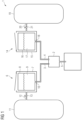
- Figure 1 shows the general setup of an apparatus according to the invention.
- an apparatus (1) for mixing two liquids with a static mixing device (2), having a first inlet (3) for receiving the first liquid (9), a second inlet (4) for receiving the second liquid (17), an outlet (5) for discharging the liquid mixture (product), a first feed module (6) for providing the first liquid (9) to the first inlet (3).
- the first feed module (6) comprises a substrate chamber (7) for holding a flexible container (8), a flexible container (8) with interior space holding the first liquid (9), a conduit (10) for providing fluid communication between the interior space of the flexible container (8) and the first inlet (3), a first pressure reservoir chamber (11) for holding a pressurised gas, a connector (12) for providing fluid communication between the pressure reservoir chamber (11) and the substrate chamber (7), with a valve (13) for reversibly interrupting the fluid communication.
- the apparatus further comprises a second feed module (14) for providing the second liquid (17) to the second inlet (4).
- the second feed module (14) comprises a second substrate chamber (15) for holding a second flexible container (16), a second flexible container (16) with interior space holding the second liquid (17), a conduit (18) for providing fluid communication between the interior space of the second flexible container (16) and the second inlet (4), a second pressure reservoir chamber (19) for holding a pressurised gas, a connector (20) for providing fluid communication between the second pressure reservoir chamber (19) and the second substrate chamber (15), with a means (21) for reversibly interrupting the fluid communication.
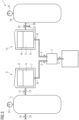
- Figure 2 shows a similar apparatus as described in Figure 1 which additionally comprises valves (26, 27) between the interior spaces of the flexible containers (8, 16) and the inlets (3, 4) of the static mixer (2).
- the outlet (5) comprises a means (28) for reversibly interrupting the discharging of the liquid mixture (product) from the static mixing device (2).
- Figure 3 shows a similar apparatus, further comprising means (24, 25) for indicating the pressure.
- the pressure reservoir chambers (11, 19) comprise inlets (29) for pressurised gas with means (22, 23) for closing the inlet (29).
- the means (22) for reversibly interrupting the fluid communication between second pressure reservoir chamber (19) and the second substrate chamber (15) is a three-way valve.
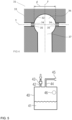
- Figure 4 depicts an example of a jet impingement reactor (31). It comprises a reaction chamber (36) defined by the interior surface (32) of the chamber wall (33) and is substantially spherical, except for the two fluid inlets (34) and the fluid outlet (37).
- the fluid inlets (34) are arranged at opposite positions on a first central axis (x) of the reaction chamber (36) and point at one another.
- Each of the fluid inlets (34) comprises a nozzle (35), which is a plain orifice nozzle in this embodiment.
- the fluid outlet (37) is positioned on a second central axis (y) which is perpendicular to the first central axis (x).
- the distance (d) between the two nozzles (35) is substantially the same as the diameter of the spherical reaction chamber (36).
- Figure 5 illustrates an optional type of a flexible container (40) holding a first or second liquid (41).
- a flexible container (40) with the same or a very similar design may also be useful as a container for receiving the third liquid.
- the flexible container (40) comprises an inlet (42) with a filtration means (43) such as a sterile filter to enable the aseptic introduction of the liquid (41).
- a part of the inlet (42) may be removed by thermal clamping, which closes and seals the remaining part of the inlet (42) and which may simultaneously remove the filtration means (43), prior to the introduction of the pre-filled flexible container (40) into a pressurisable substrate chamber.
- an outlet (44) is provided through which the liquid (41) may flow from the flexible container (40) to an inlet of the static mixing device.
- the downstream end of the outlet (44) exhibits a connecting piece (45) which may engage with a complementary connecting piece, e.g., to establish a fluid connection with the static mixing device.
- the container further has an identification means (46), such as an RFID code.
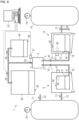
- FIG. 6 shows another version of the apparatus (1) similar to that of Fig. 2 , but with some further modifications.
- the flexible containers (8, 16) for the first and the second liquid (9, 17) have identification tags (46), such as RFID tags, and each of the first and the second substrate chamber (7, 15) has a sensor (47), such as an RFID reader, configured to read the identification tag.
- the flexible containers (8, 16) further comprise closed or sealed inlets (48), i.e. the structures that remain after melt sealing of the original inlets.
- the conduits between the flexible containers (8, 16) and the inlets (3, 4) of the static mixer (2) are arranged without valves.
- Engaged connecting pieces (45) are shown that help to ensure that a fluid connection between the flexible containers (8, 16) and the inlets (3, 4) is established or maintained.
- a container (30) for receiving the third fluid is depicted as a flexible container. The remaining features are the same as in Fig. 2 .
- Figure 7 depicts a further alternative version of the apparatus (1).
- the overall direction of liquid flow from the flexible containers (8, 16) in the pressurisable substrate chambers (7, 15) through the static mixing device (2) to the containers (30, 49) for receiving the third liquid is upwards, i.e. against gravity, or from a lower position to a higher position.
- the inlets (3, 4) of the static mixer (2) are higher than the outlets (10, 18) of the flexible containers (8, 16) that hold the first and the second liquid (9, 17).
- the orientation of the static mixer (2) itself is such that the outlet (5) is in a higher position than the inlets (3, 4), and the inlets of the containers (30, 49) for receiving the third liquid are in a higher position than the outlet (5) of the static mixer.
- the first container (30) for the third liquid which may serve as a product container, has been pre-filled with an amount of a liquid diluent.
- the second container (49) for the third liquid which may serve as a waste container, is also fluidically connected with the outlet (5) of the static mixer (2), like the first container (30).
- a means (28) for reversibly interrupting the fluid connection with the outlet (5) of the static mixer (2) is arranged for both the first container (30) and the second container (49).
- Figure 8 depicts another version of the apparatus (1).
- the second container (49) for receiving the third liquid which may function as a waste container already contains a portion of the third liquid, indicating that the mixing process, i.e. steps (dd) and (ee) according to the method of the invention, has already started.
- a means for inline particle size measurement of the third liquid comprising a sensing window (50) arranged downstream of, and in fluid connection with, the static mixing device (2), allowing the transmission of optical signals between the third liquid to an analyser (51) with a sensor capable of receiving such optical signals.
- the analyser (51) which is typically adapted for inline particle size measurement can communicate (e.g.
- controller (52) which is also in communication (e.g. electrically or wireless) with two means (28), such as pinch valves, for interrupting the fluid connection between the outlet (5) of the static mixing device (2) and the first (30) or second (49) container for receiving the third liquid, respectively.
- two means such as pinch valves
- the controller (52) By the action of the controller (52), those portions of the third liquid whose particle size as measured by the analyser (51) via the sensing window (50) do not comply with the desired particle size, can be directed to the second container (49), i.e. the waste container, in that the controller (52) operates the (e.g.) valves (28) to interrupt the fluid connection of the static mixer (2) to the first container (30) but not to the second container (49).
- the controller (52) can direct the third liquid into the first container (30), i.e. the product container, by operating the (e.g.) valves (28) to interrupt the fluid connection of the static mixer (2) to the second container (49) but not to the first container (30).
- the controller (52) can direct the third liquid into the first container (30), i.e. the product container, by operating the (e.g.) valves (28) to interrupt the fluid connection of the static mixer (2) to the second container (49) but not to the first container (30).
- Figure 9 shows a schematic illustration of a typical overall relationship between the pressure (P) in a pressure reservoir chamber, the pressure (P) in a corresponding pressurisable substrate chamber, and the flow rate (F) of a liquid as it is forced out from a flexible container accommodated in the substrate chamber over time (t) when conducting the method of the invention according to one embodiment.
- the figure is not to scale and only uses arbitrary units. Initially, i.e. before conducting step (dd) of the method, the pressure (101) in the pressure reservoir chamber which contains a pressurised gas is substantially higher than the pressure (102) in the corresponding pressurisable substrate chamber holding a flexible container with liquid.
- Step (dd) which may be initiated by changing the state of the means for reversibly interrupting the fluid communication between the pressure reservoir chamber and the substrate chamber from closed to open, which will cause an abrupt pressure equilibration (103) between the pressure reservoir chamber and the substrate chamber.
- this pressure equilibration involves an abrupt decrease of the pressure in the pressure reservoir chamber and an abrupt increase of the pressure in the corresponding substrate chamber, which is now above the ambient pressure level.
- the now increased pressure (104) in the substrate chamber i.e.
- the equilibrium pressure which acts on an external surface of the flexible container holding the liquid, now forces the liquid to flow out from the flexible container towards the static mixer at a substantially constant flow rate (105).
- no further pressurised gas is introduced to the pressure reservoir chamber or the substrate chamber.
- the pressure (104) in substrate chamber after equilibration remains nearly constant as the volume of the liquid flowing out from the flexible container is very small compared to the total volume of the pressure reservoir chamber and the substrate chamber.
- a minor decrease could, for example, result from the small increase of the volume of the pressurised gas in the substrate chamber, whereas a minor increase could result from a small temperature increase of the pressurised gas during the process.
- the minor pressure changes over time may also result in very minor changes in the flow rate, even though the flow rate ratio between the first and the second liquid remains substantially unaffected.
- the factors that could lead to a minor increase of the pressure (104) and of the flow rate (105) over time may also substantially compensate the effect of factors that could lead to a minor decrease of the pressure (104) and of the flow rate (105) over time such that the pressure (104) and the flow rate (105) remain substantially constant after the abrupt pressure equilibration.
- the non-optimised apparatus (non-optimised e.g. with respect to minimal dead volumes) comprised, as a static mixer, a jet impingement reactor as described in co-pending European patent application 21192535.9 .
- the substantially spherical reaction chamber had a diameter of 5 mm, and the first and the second inlet were each provided by a plain orifice nozzle having a pinhole diameter of 200 ⁇ m.
- Water was used as surrogate for the both first and the second liquid.
- the water was provided in two flexible containers, similar to infusion bags, and placed into the first and the second substrate chamber, respectively.
- the internal volume of the substrate chambers was approx. 10 L and the volume of water in each flexible container was approx.
- the apparatus was further equipped with flow meters (Cori-Flow TM ) arranged in fluid conduits between the interior space of the flexible containers and the first or the second inlet of the jet impingement reactor, respectively, and with various pressure sensors.
- flow meters Cori-Flow TM
- Pressure equilibration immediately triggered the flow of water out of the flexible containers in the substrate chambers in a downstream direction, i.e. towards and through the jet impingement reactor.
- the flow rates were rather constant starting from about two seconds after the initial pressure equilibration:
- the flow rate in the first feed module increased only very slightly and evenly from about 53 to about 54 mL/min, and in the second feed module from about 54 to about 55 mL/min.
- a flow rate peak was observed which was considered an artifact caused by the initial pressure impulse traveling through the water-filled system.
- the very minor difference between the two feed modules is likely to be caused by minimal pinhole differences due to manufacturing tolerance, whereas the slight and technically rather negligible increase of the flow rates over time may result from the corresponding increase in pressure.
- the experiment demonstrates that the apparatus is suitable to achieve an almost instant onset of flow of two liquids from flexible substrate containers into a static mixing device followed by highly controlled flow rates and flow rate ratios between the flow rates. It also demonstrates that small-scale mixing of two liquids without pumps may be performed using the apparatus.
- Example 2 A similar prototype apparatus as in Example 1 was used for mixing two model liquids which upon mixing lead to the formation of solid barium sulphate particles, except that the reaction chamber of the jet impingement reactor had a diameter of 3 mm.
- the first liquid consisted of about 500 mL of an aqueous solution of barium chloride, and the second liquid was about 500 mL of an aqueous solution of barium sulphate.
- the two liquids were provided in flexible bags which were placed into a first and a second substrate chamber having a volume of about 10 L, respectively.
- the first pressure reservoir chamber had a volume of 20 L and was filled with pressurised air up to a pressure of 10.9 bar.
- the second pressure reservoir chamber also had a volume of 20 L and was pressurised with air to 6.1 bar.
- Connectors between the first pressure reservoir chamber and the first substrate chamber and between the second pressure reservoir chamber and the second substrate chamber were equipped with solenoid valves. Upon simultaneously opening the valves, substantially instant pressure equilibration between each pressure reservoir chamber and the therewith connected substrate chamber was observed: For the first feed module (i.e. with the first pressure reservoir chamber and the first substrate chamber), a pressure of 7.2 bar was recorded, for the second feed module (i.e. with the second pressure reservoir chamber and the second substrate chamber), the pressure was 4.6 bar. The overpressure caused the two liquids to flow from the respective flexible containers at a total flow rate (i.e.
- the liquid product (i.e. the third liquid) resulting from the mixing of the first and the second liquid in the jet impingement reactor was an aqueous dispersion of barium sulphate nanoparticles having a z-average particle size of 79.4 nm and a polydispersity index of 0.14, as measured by dynamic light scattering (DLS) using a Anton Paar TM Litesizer 500.
Landscapes
- Chemical & Material Sciences (AREA)
- Chemical Kinetics & Catalysis (AREA)
- Engineering & Computer Science (AREA)
- General Engineering & Computer Science (AREA)
- Software Systems (AREA)
- Dispersion Chemistry (AREA)
- Accessories For Mixers (AREA)
- Mixers With Rotating Receptacles And Mixers With Vibration Mechanisms (AREA)
- Apparatus Associated With Microorganisms And Enzymes (AREA)
- Manufacturing Of Micro-Capsules (AREA)
- Package Specialized In Special Use (AREA)
Applications Claiming Priority (5)
| Application Number | Priority Date | Filing Date | Title |
|---|---|---|---|
| EP21206216 | 2021-11-03 | ||
| EP22157837 | 2022-02-21 | ||
| EP22183341 | 2022-07-06 | ||
| PCT/EP2022/080743 WO2023079039A1 (en) | 2021-11-03 | 2022-11-03 | Apparatus and method for mixing small liquid volumes, and use of the apparatus |
| EP22813250.2A EP4247529B1 (de) | 2021-11-03 | 2022-11-03 | Vorrichtung und verfahren zum mischen von kleinen flüssigkeitsvolumen, und verwendung der vorrichtung |
Related Parent Applications (1)
| Application Number | Title | Priority Date | Filing Date |
|---|---|---|---|
| EP22813250.2A Division EP4247529B1 (de) | 2021-11-03 | 2022-11-03 | Vorrichtung und verfahren zum mischen von kleinen flüssigkeitsvolumen, und verwendung der vorrichtung |
Publications (2)
| Publication Number | Publication Date |
|---|---|
| EP4582176A2 true EP4582176A2 (de) | 2025-07-09 |
| EP4582176A3 EP4582176A3 (de) | 2025-10-15 |
Family
ID=84363050
Family Applications (2)
| Application Number | Title | Priority Date | Filing Date |
|---|---|---|---|
| EP25171632.0A Pending EP4582176A3 (de) | 2021-11-03 | 2022-11-03 | Vorrichtung zum mischen kleiner flüssigkeitsmengen |
| EP22813250.2A Active EP4247529B1 (de) | 2021-11-03 | 2022-11-03 | Vorrichtung und verfahren zum mischen von kleinen flüssigkeitsvolumen, und verwendung der vorrichtung |
Family Applications After (1)
| Application Number | Title | Priority Date | Filing Date |
|---|---|---|---|
| EP22813250.2A Active EP4247529B1 (de) | 2021-11-03 | 2022-11-03 | Vorrichtung und verfahren zum mischen von kleinen flüssigkeitsvolumen, und verwendung der vorrichtung |
Country Status (8)
| Country | Link |
|---|---|
| EP (2) | EP4582176A3 (de) |
| JP (1) | JP2024543826A (de) |
| KR (1) | KR20240116908A (de) |
| AU (1) | AU2022381525A1 (de) |
| CA (1) | CA3237294A1 (de) |
| ES (1) | ES3025099T3 (de) |
| PL (1) | PL4247529T3 (de) |
| WO (1) | WO2023079039A1 (de) |
Families Citing this family (3)
| Publication number | Priority date | Publication date | Assignee | Title |
|---|---|---|---|---|
| WO2024056683A1 (en) | 2022-09-12 | 2024-03-21 | Leon-Nanodrugs Gmbh | Disposable reactor for mixing two liquids |
| CA3268291A1 (en) | 2022-09-30 | 2024-04-04 | Leon-Nanodrugs Gmbh | CASSETTE SYSTEM FOR ASEPTIC MIXING PROCESS |
| CN119507914B (zh) * | 2024-10-29 | 2025-10-21 | 河南理工大学 | 一种煤层增透用纳米流体与活性剂联合注入装置 |
Citations (2)
| Publication number | Priority date | Publication date | Assignee | Title |
|---|---|---|---|---|
| EP1146959B1 (de) | 1998-11-13 | 2008-06-04 | William A. Heriot | Vorrichtung zur herstellung von liposomen |
| US7784997B2 (en) | 2003-07-04 | 2010-08-31 | Sartorius Stedim Biotech Sa | Closed single-use system for mixing, storing and homogenizing liquids in clean or sterile conditions |
Family Cites Families (4)
| Publication number | Priority date | Publication date | Assignee | Title |
|---|---|---|---|---|
| GB9000753D0 (en) * | 1990-01-12 | 1990-03-14 | Harper Alan | Positive displacement device |
| EP2223332A4 (de) * | 2007-12-06 | 2012-07-11 | Foresight Proc Llc | Systeme und verfahren zur ablieferung von fluidhaltigen prozessmaterialkombinationen |
| WO2011085012A2 (en) * | 2010-01-06 | 2011-07-14 | Advanced Technology Materials, Inc. | Liquid dispensing systems with gas removal and sensing capabilities |
| WO2019246615A1 (en) * | 2018-06-22 | 2019-12-26 | Delphi Scientific, Llc | Apparatus, systems, and methods for continuous manufacturing of nanomaterials and high purity chemicals |
-
2022
- 2022-11-03 KR KR1020247018538A patent/KR20240116908A/ko active Pending
- 2022-11-03 AU AU2022381525A patent/AU2022381525A1/en active Pending
- 2022-11-03 WO PCT/EP2022/080743 patent/WO2023079039A1/en not_active Ceased
- 2022-11-03 EP EP25171632.0A patent/EP4582176A3/de active Pending
- 2022-11-03 JP JP2024526757A patent/JP2024543826A/ja active Pending
- 2022-11-03 ES ES22813250T patent/ES3025099T3/es active Active
- 2022-11-03 EP EP22813250.2A patent/EP4247529B1/de active Active
- 2022-11-03 PL PL22813250.2T patent/PL4247529T3/pl unknown
- 2022-11-03 CA CA3237294A patent/CA3237294A1/en active Pending
Patent Citations (2)
| Publication number | Priority date | Publication date | Assignee | Title |
|---|---|---|---|---|
| EP1146959B1 (de) | 1998-11-13 | 2008-06-04 | William A. Heriot | Vorrichtung zur herstellung von liposomen |
| US7784997B2 (en) | 2003-07-04 | 2010-08-31 | Sartorius Stedim Biotech Sa | Closed single-use system for mixing, storing and homogenizing liquids in clean or sterile conditions |
Also Published As
| Publication number | Publication date |
|---|---|
| AU2022381525A1 (en) | 2024-06-20 |
| CA3237294A1 (en) | 2023-05-11 |
| EP4247529A1 (de) | 2023-09-27 |
| JP2024543826A (ja) | 2024-11-26 |
| EP4582176A3 (de) | 2025-10-15 |
| KR20240116908A (ko) | 2024-07-30 |
| PL4247529T3 (pl) | 2025-08-25 |
| EP4247529B1 (de) | 2025-04-23 |
| EP4247529C0 (de) | 2025-04-23 |
| WO2023079039A1 (en) | 2023-05-11 |
| ES3025099T3 (en) | 2025-06-06 |
Similar Documents
| Publication | Publication Date | Title |
|---|---|---|
| EP4247529B1 (de) | Vorrichtung und verfahren zum mischen von kleinen flüssigkeitsvolumen, und verwendung der vorrichtung | |
| US10597291B2 (en) | Disposable microfluidic cartridge | |
| US10342760B2 (en) | Lipid nanoparticles for transfection and related methods | |
| EP1695758B1 (de) | Verfahren zur Herstellung einer monodispersen Blase | |
| US20080171078A1 (en) | Uniformly sized liposomes | |
| US7985058B2 (en) | Method and apparatus for making uniformly sized particles | |
| EP4526027B1 (de) | Vorrichtung und verfahren zum betrieb einer statischen mischvorrichtung | |
| ES2959185T3 (es) | Sistemas y métodos de intercambio de soluciones tampón | |
| US20230330618A1 (en) | Flow channel structure, method for agitating fluid and method for manufacturing lipid particles | |
| US20240299653A1 (en) | A Cartridge for Mixing a Liquid Intended for Intracorporeal Use | |
| CN118541208A (zh) | 用于混合小液体体积的设备和方法以及该设备的用途 | |
| HK40116872A (zh) | 用於混合小液体体积的设备和方法以及该设备的用途 | |
| CN116887910A (zh) | 非聚集微流体混合器和用于其的方法 | |
| WO2024057580A1 (en) | Flow channel structure and method for producing lipid particle | |
| KR20250080871A (ko) | 무균 혼합 공정용 카세트 시스템 | |
| CN116897055A (zh) | 用于混合旨在用于体内使用的磷脂组合物的筒 | |
| CN116635078A (zh) | 用于制备含有脂质体的液体的方法和装置以及制备的液体 |
Legal Events
| Date | Code | Title | Description |
|---|---|---|---|
| PUAI | Public reference made under article 153(3) epc to a published international application that has entered the european phase |
Free format text: ORIGINAL CODE: 0009012 |
|
| STAA | Information on the status of an ep patent application or granted ep patent |
Free format text: STATUS: THE APPLICATION HAS BEEN PUBLISHED |
|
| AC | Divisional application: reference to earlier application |
Ref document number: 4247529 Country of ref document: EP Kind code of ref document: P |
|
| AK | Designated contracting states |
Kind code of ref document: A2 Designated state(s): AL AT BE BG CH CY CZ DE DK EE ES FI FR GB GR HR HU IE IS IT LI LT LU LV MC ME MK MT NL NO PL PT RO RS SE SI SK SM TR |
|
| REG | Reference to a national code |
Ref country code: DE Ref legal event code: R079 Free format text: PREVIOUS MAIN CLASS: B01F0035220000 Ipc: B01F0025400000 |
|
| PUAL | Search report despatched |
Free format text: ORIGINAL CODE: 0009013 |
|
| AK | Designated contracting states |
Kind code of ref document: A3 Designated state(s): AL AT BE BG CH CY CZ DE DK EE ES FI FR GB GR HR HU IE IS IT LI LT LU LV MC ME MK MT NL NO PL PT RO RS SE SI SK SM TR |
|
| RIC1 | Information provided on ipc code assigned before grant |
Ipc: B01F 25/40 20220101AFI20250911BHEP Ipc: B01F 25/23 20220101ALI20250911BHEP Ipc: B01F 35/71 20220101ALI20250911BHEP Ipc: B01J 19/26 20060101ALI20250911BHEP |
|
| STAA | Information on the status of an ep patent application or granted ep patent |
Free format text: STATUS: REQUEST FOR EXAMINATION WAS MADE |