EP4582168A1 - Acidic-gas adsorption device - Google Patents
Acidic-gas adsorption device Download PDFInfo
- Publication number
- EP4582168A1 EP4582168A1 EP23860340.1A EP23860340A EP4582168A1 EP 4582168 A1 EP4582168 A1 EP 4582168A1 EP 23860340 A EP23860340 A EP 23860340A EP 4582168 A1 EP4582168 A1 EP 4582168A1
- Authority
- EP
- European Patent Office
- Prior art keywords
- adsorption
- acid gas
- fluid
- adsorption portion
- gas adsorption
- Prior art date
- Legal status (The legal status is an assumption and is not a legal conclusion. Google has not performed a legal analysis and makes no representation as to the accuracy of the status listed.)
- Pending
Links
Images




Classifications
-
- B—PERFORMING OPERATIONS; TRANSPORTING
- B01—PHYSICAL OR CHEMICAL PROCESSES OR APPARATUS IN GENERAL
- B01D—SEPARATION
- B01D53/00—Separation of gases or vapours; Recovering vapours of volatile solvents from gases; Chemical or biological purification of waste gases, e.g. engine exhaust gases, smoke, fumes, flue gases, aerosols
- B01D53/02—Separation of gases or vapours; Recovering vapours of volatile solvents from gases; Chemical or biological purification of waste gases, e.g. engine exhaust gases, smoke, fumes, flue gases, aerosols by adsorption, e.g. preparative gas chromatography
- B01D53/04—Separation of gases or vapours; Recovering vapours of volatile solvents from gases; Chemical or biological purification of waste gases, e.g. engine exhaust gases, smoke, fumes, flue gases, aerosols by adsorption, e.g. preparative gas chromatography with stationary adsorbents
- B01D53/0407—Constructional details of adsorbing systems
- B01D53/0415—Beds in cartridges
-
- B—PERFORMING OPERATIONS; TRANSPORTING
- B01—PHYSICAL OR CHEMICAL PROCESSES OR APPARATUS IN GENERAL
- B01D—SEPARATION
- B01D53/00—Separation of gases or vapours; Recovering vapours of volatile solvents from gases; Chemical or biological purification of waste gases, e.g. engine exhaust gases, smoke, fumes, flue gases, aerosols
- B01D53/02—Separation of gases or vapours; Recovering vapours of volatile solvents from gases; Chemical or biological purification of waste gases, e.g. engine exhaust gases, smoke, fumes, flue gases, aerosols by adsorption, e.g. preparative gas chromatography
- B01D53/04—Separation of gases or vapours; Recovering vapours of volatile solvents from gases; Chemical or biological purification of waste gases, e.g. engine exhaust gases, smoke, fumes, flue gases, aerosols by adsorption, e.g. preparative gas chromatography with stationary adsorbents
-
- B—PERFORMING OPERATIONS; TRANSPORTING
- B01—PHYSICAL OR CHEMICAL PROCESSES OR APPARATUS IN GENERAL
- B01D—SEPARATION
- B01D53/00—Separation of gases or vapours; Recovering vapours of volatile solvents from gases; Chemical or biological purification of waste gases, e.g. engine exhaust gases, smoke, fumes, flue gases, aerosols
- B01D53/02—Separation of gases or vapours; Recovering vapours of volatile solvents from gases; Chemical or biological purification of waste gases, e.g. engine exhaust gases, smoke, fumes, flue gases, aerosols by adsorption, e.g. preparative gas chromatography
- B01D53/04—Separation of gases or vapours; Recovering vapours of volatile solvents from gases; Chemical or biological purification of waste gases, e.g. engine exhaust gases, smoke, fumes, flue gases, aerosols by adsorption, e.g. preparative gas chromatography with stationary adsorbents
- B01D53/0407—Constructional details of adsorbing systems
-
- B—PERFORMING OPERATIONS; TRANSPORTING
- B01—PHYSICAL OR CHEMICAL PROCESSES OR APPARATUS IN GENERAL
- B01D—SEPARATION
- B01D2253/00—Adsorbents used in seperation treatment of gases and vapours
- B01D2253/30—Physical properties of adsorbents
- B01D2253/34—Specific shapes
- B01D2253/342—Monoliths
- B01D2253/3425—Honeycomb shape
-
- B—PERFORMING OPERATIONS; TRANSPORTING
- B01—PHYSICAL OR CHEMICAL PROCESSES OR APPARATUS IN GENERAL
- B01D—SEPARATION
- B01D2257/00—Components to be removed
- B01D2257/50—Carbon oxides
- B01D2257/504—Carbon dioxide
-
- B—PERFORMING OPERATIONS; TRANSPORTING
- B01—PHYSICAL OR CHEMICAL PROCESSES OR APPARATUS IN GENERAL
- B01D—SEPARATION
- B01D2258/00—Sources of waste gases
- B01D2258/06—Polluted air
-
- Y—GENERAL TAGGING OF NEW TECHNOLOGICAL DEVELOPMENTS; GENERAL TAGGING OF CROSS-SECTIONAL TECHNOLOGIES SPANNING OVER SEVERAL SECTIONS OF THE IPC; TECHNICAL SUBJECTS COVERED BY FORMER USPC CROSS-REFERENCE ART COLLECTIONS [XRACs] AND DIGESTS
- Y02—TECHNOLOGIES OR APPLICATIONS FOR MITIGATION OR ADAPTATION AGAINST CLIMATE CHANGE
- Y02C—CAPTURE, STORAGE, SEQUESTRATION OR DISPOSAL OF GREENHOUSE GASES [GHG]
- Y02C20/00—Capture or disposal of greenhouse gases
- Y02C20/40—Capture or disposal of greenhouse gases of CO2
Definitions
- the present invention relates to an acid gas adsorption device.
- a fluid containing CO 2 is supplied so that a carbon oxide adsorption material adsorbs CO 2 from the fluid, and the adsorbed CO 2 is desorbed under predetermined conditions.
- the fluid supplied to the carbon oxide adsorption device may contain a poisoning and deteriorating component that deteriorates the carbon dioxide adsorption material.
- the activity of the carbon dioxide adsorption material may be reduced by the poisoning and deteriorating component. In this case, it is required to stop the operation of the carbon dioxide adsorption device and then replace the entirety of a CO 2 adsorption part.
- problems of troublesome replacement work and an increase in running cost there arise problems of troublesome replacement work and an increase in running cost.
- a primary object of the present invention is to provide an acid gas adsorption device that allows an acid gas adsorption part, which has been deteriorated, to be partly replaced so as to achieve a reduction in running cost.
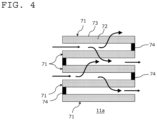
- An acid gas adsorption device 100 of the illustrated example includes an acid gas adsorption part 1 that allows passage of a fluid in a predetermined direction.
- the acid gas adsorption part 1 includes an acid gas adsorption material capable of adsorbing an acid gas.
- the acid gas adsorption part 1 is divided into at least a first adsorption portion 11 and a second adsorption portion 12.
- the first adsorption portion 11 includes an upstream end surface 1a of the acid gas adsorption part 1 in the direction of passage of the fluid.
- the second adsorption portion 12 is arranged on a downstream side of the first adsorption portion 11 in the direction of passage of the fluid.
- the second adsorption portion 12 is typically adjacent to the first adsorption portion 11.
- the fluid to be supplied to the acid gas adsorption device sometimes contains a poisoning and deteriorating component that deteriorates the acid gas adsorption material.
- the fluid passes through the first adsorption portion and the second adsorption portion in the stated order.
- the poisoning and deteriorating component contained in the fluid is relatively more liable to adhere to the first adsorption portion, and hence an acid gas adsorption material in the first adsorption portion is more prone to deterioration than an acid gas adsorption material in the second adsorption portion.
- the lifetime of the first adsorption portion is shorter than the lifetime of the second adsorption portion.
- the first adsorption portion having a relatively short lifetime and the second adsorption portion having a relatively long lifetime are separated from each other.
- the first adsorption portion and the second adsorption portion can be replaced separately based on their lifetimes.
- the acid gas adsorption part can be partly and smoothly replaced.
- time required for the replacement of the acid gas adsorption part can be reduced.
- the operation stop time period of the acid gas adsorption device can be shortened.
- the first adsorption portion and the second adsorption portion can be replaced at appropriate timing in accordance with their lifetimes.
- running cost specifically, cost for preparing a new adsorption portion and cost for disposal of the used adsorption portion
- the acid gas to be adsorbed in the acid gas adsorption device examples include carbon dioxide (CO 2 ), hydrogen sulfide, sulfur dioxide, nitrogen dioxide, dimethyl sulfide (DMS), and hydrogen chloride.
- the acid gas is carbon dioxide (CO 2 )
- the fluid is a CO 2 -containing gas.
- the CO 2 -containing gas may contain nitrogen in addition to CO 2 .
- the CO 2 -containing gas is typically air (atmosphere).
- a concentration of CO 2 in the CO 2 -containing gas before being supplied to the acid gas adsorption device is, for example, 100 ppm (on a volume basis) or more and 2 vol% or less.
- the acid gas is carbon dioxide (CO 2 ).
- the acid gas adsorption material is a carbon dioxide adsorption material.
- any appropriate compound capable of adsorbing and desorbing CO 2 may be adopted as the carbon dioxide adsorption material.
- the carbon dioxide adsorption material include: nitrogen-containing compounds; ionic liquids; deep eutectic solvents; alkali compounds, such as sodium hydroxide and potassium hydroxide; carbonate salts, such as calcium carbonate and potassium carbonate; and hydrogen carbonate salts, such as calcium hydrogen carbonate and potassium hydrogen carbonate.
- the carbon dioxide adsorption material includes a nitrogen-containing compound.
- nitrogen-containing compound examples include: primary amines, such as monoethanolamine and polyvinylamine; secondary amines, such as diethanolamine, a cyclic amine, and N-(3-aminopropyl)diethanolamine; tertiary amines, such as methyldiethylamine and triethanolamine; ethyleneamine compounds such as tetraethylenepentamine; aminosilane coupling agents, such as aminopropyltrimethoxysilane, 3-aminopropyltriethoxysilane, N-(2-aminoethyl)-3-aminopropyltrimethoxysilane, and polyethyleneimine-trimethoxysilane; organic monomers each having a primary amino group to a tertiary amino group, such as ethyleneimine and a styrene having an amino group added thereto; organic polymers each having a primary amino group to a tertiary amino group, such as a linear polyethylenei
- carbon dioxide adsorption materials methyldiethylamine, monoethanolamine, a cyclic amine, diethanolamine, tetraethylenepentamine, ethyleneimine, a linear polyethyleneimine, a branched polyethyleneimine, and organic/inorganic compounds each having an amino group added as a substituent thereto are preferred.
- Those carbon dioxide adsorption materials may be used alone or in combination thereof.
- the first adsorption portion 11 and the second adsorption portion 12 may include the same acid gas adsorption material among the above-mentioned acid gas adsorption materials (carbon oxide adsorption materials) or may include different acid gas adsorption materials. In one embodiment, the first adsorption portion 11 and the second adsorption portion 12 include the same acid gas adsorption material.
- the first adsorption portion including the upstream end surface has hydrophobicity.
- the intrusion of water into the acid gas adsorption part can be prevented.
- excellent acid gas adsorption performance can be stably maintained.
- Such a first adsorption portion 11 typically includes an acid gas adsorption material having hydrophobicity (hereinafter referred to as "hydrophobic adsorption material").
- the solubility of the hydrophobic adsorption material in water is, for example, 1.0 g/100 g-H 2 O or less, preferably 0.8 g/100 g-H 2 O or less.
- the lower limit of the solubility of the hydrophobic adsorption material in water is typically 0.01 g/100 g-H 2 O.
- excellent hydrophobicity can be stably imparted to the first adsorption portion.
- the solubility in water is measured based on, for example, a change in mass after a target object is immersed in water at 25°C for three hours so as to be dissolved therein.
- the Hildebrand solubility parameter of the hydrophobic adsorption material at 25°C is, for example, from 7.0 (cal/cm 3 ) 1/2 to 11.0 (cal/cm 3 ) 1/2 , preferably from 8.8 (cal/cm 3 ) 1/2 to 10.0 (cal/cm 3 ) 1/2 .
- the Hildebrand solubility parameter can be calculated by, for example, the Fedors method described in " Polymer Engineering and Science, February, 1974, Vol. 14, No. 2, Page 147- 154 " based on information from a functional group detected by structural analysis such as infrared spectroscopy or Raman spectroscopy, or can be calculated by a Hildebrand method.
- the hydrophobic adsorption material in the first adsorption portion is specified by: for example, structural analysis such as infrared spectroscopy and Raman spectroscopy; mass analysis such as gas chromatography and liquid chromatography; or elemental analysis such as CHN elemental analysis and an electron probe microanalyzer (EPMA).
- structural analysis such as infrared spectroscopy and Raman spectroscopy
- mass analysis such as gas chromatography and liquid chromatography
- elemental analysis such as CHN elemental analysis and an electron probe microanalyzer (EPMA).
- EPMA electron probe microanalyzer
- a sample having a columnar shape is first collected from a part of the first adsorption portion, which includes the hydrophobic adsorption material (typically, an acid gas adsorption material layer described later or a pellet-like adsorption material described later).
- the hydrophobic adsorption material typically, an acid gas adsorption material layer described later or a pellet-like adsorption material described later.
- elemental mapping images at the following nine positions in the sample are acquired at a 300-fold magnification by, for example, an electron probe microanalyzer (EPMA) capable of detecting a light element such as nitrogen.
- EPMA electron probe microanalyzer
- a first position a center on one end surface of the sample, a second position: an end on the one end surface, a third position: a midpoint of a line segment connecting the first position and the second position,
- an area ratio (element ratio) of the plurality of hydrophobic adsorption materials is obtained from each of the above-mentioned elemental mapping images at the first position to the ninth position. After that, an average value of the obtained plurality of area ratios (element ratios) is calculated. Subsequently, a volume percentage (vol%) of each of the hydrophobic adsorption materials to the sum of volumes of the plurality of hydrophobic adsorption materials as 100 vol% is calculated.
- the products each being a product of the volume ratio and the SP value of each of the hydrophobic adsorption materials
- the hydrophobic adsorption material is, for example, a material having hydrophobicity among the above-mentioned carbon dioxide adsorption materials.
- Specific examples of the hydrophobic adsorption material include amine compounds each having a hydrophobic group, ionic liquids, hydrophobic deep eutectic solvents, and nitrogen-containing carbon.
- the hydrophobic adsorption materials may be used alone or in combination thereof.
- hydrophobic group in the amine compound there are given, for example, an alkyl group such as a methyl group, and an aryl group such as a phenyl group.
- an alkyl group such as a methyl group
- an aryl group such as a phenyl group.
- a specific example of the amine compound having a hydrophobic group is phenethylamine.
- the amine compounds each having a hydrophobic group may be used alone or in combination thereof.
- the ionic liquid is a "salt" of a liquid formed only of an ion (an anion or a cation).
- examples of the cation of the ionic liquid include: an ammonium-based ion, such as an imidazolium salt or a pyridinium salt; a phosphonium-based ion; a sulfonium salt; and an inorganic ion.
- Examples of the anion of the ionic liquid include: a halogen-based ion, such as a bromide ion or a triflate ion; a boron-based ion such as a tetraphenylborate ion; a phosphorus-based ion such as a hexafluorophosphate ion; and a sulfur-based ion such as an alkyl sulfonate ion.
- the ionic liquids may be used alone or in combination thereof.
- hydrophobic deep eutectic solvent examples include: organic compounds each containing a carboxylic acid typified by decanoic acid as a hydrogen-bond donor (HBD); ester-containing organic matters typified by phenyl salicylate; alcohols typified by decanol; phenols typified by thymol; ketone-containing organic matters typified by camphor; ammonium salts each having a halogen or a hydroxy anion typified by tetra-n-octyl ammonium bromide as a hydrogen-bond acceptor (HBA); amine compound salts each having a halogen or a hydroxy anion typified by triethylenetetramine chloride; organic compounds each containing a carboxylic acid typified by lauric acid; alcohols typified by menthol; and phenols typified by thymol.
- the hydrophobic deep eutectic solvents may be used alone or in combination thereof.
- the acid gas-adsorbable particles are each in a solid state under normal temperature and normal pressure (23°C, 0.1 MPaA (absolute pressure)).
- the first adsorption portion 11 typically includes a plurality of acid gas-adsorbable particles.
- the acid gas-adsorbable particles, under a state of being incorporated in the first adsorption portion 11, may be primary particles, or may be secondary particles in which a plurality of primary particles aggregate.
- the acid gas-adsorbable particles may be formed only of an acid gas adsorption material that is a solid under normal temperature and normal pressure or may be formed of an acid gas adsorption material and a carrier.
- the acid gas adsorption material in the acid gas-adsorbable particles is, for example, the above-mentioned carbon oxide adsorption material.
- the acid gas adsorption material in the acid gas-adsorbable particles may be the above-mentioned hydrophobic adsorption material or may be a hydrophilic adsorption material being soluble in water.
- the solubility of the hydrophilic adsorption material in water is, for example, more than 1.0 g/100 g-H 2 O, preferably 3.0 g/100 g-H 2 O or more.
- the upper limit of the solubility of the hydrophilic adsorption material in water is typically 800 g/100 g-H 2 O.
- the CO 2 adsorption capacity of the hydrophilic adsorption material is, for example, 0.1 mol/kg-adsorption material or more, preferably 0.7 mol/kg-adsorption material or more, more preferably 1.0 mol/kg-adsorption material or more.
- the CO 2 adsorption capacity can be measured by, for example, a method described in Document 3-2-1, the Second Review Meeting (2) on Carbon Dioxide Capture and Storage in 2015.
- the CO 2 adsorption capacity of the hydrophobic adsorption material is, for example, less than 2.0 mol/kg-adsorption material, for example, less than 1.0 mol/kg-adsorption material, for example, less than 0.7 mol/kg-adsorption material, or, for example, less than 0.1 mol/kg-adsorption material.
- the hydrophilic adsorption material is, for example, an amine compound without a hydrophobic group.
- the amine compound without a hydrophobic group include a linear polyethyleneimine and a branched polyethyleneimine having a primary amino group to a tertiary amino group.
- the hydrophilic adsorption materials may be used alone or in combination thereof.
- the carrier supports the acid gas adsorption material.
- Any appropriate carrier may be adopted as the carrier.
- the carrier is preferably a porous carrier.
- mesopores can be formed in a surface of the carrier, which is contactable with the acid gas.
- the porous carrier is described later in detail.
- a metal material may be adopted as the carrier. Examples thereof include: iron and steel materials, such as carbon steel and alloy steel; and non-ferrous metals, such as copper, aluminum, and nickel, and alloys thereof.
- the shape of the carrier is not limited to a porous shape.
- the acid gas-adsorbable particles are typically formed of any appropriate combination of the above-mentioned acid gas adsorption material and the above-mentioned carrier.
- Specific examples of the acid gas-adsorbable particles include amine-supported polymers, amine-supported MOF, and amine-supported nitrogen-doped carbon.
- the mass ratio of the acid gas adsorption material to the carrier is, for example, from 0.1 to 5, preferably from 1 to 3.
- the hydrophobic binder is capable of binding the acid gas-adsorbable particles.
- the hydrophobic binder is typically an organic binder that is substantially insoluble in water.
- the solubility of the hydrophobic binder in water is, for example, 1.0 g/100 g-H 2 O or less, preferably 0.5 g/100 g-H 2 O or less.
- the lower limit of the solubility of the hydrophobic binder in water is typically 0.01 g/100 g-H 2 O.
- the Hildebrand solubility parameter (SP value) of the hydrophobic binder at 25°C is, for example, from 5.0 (cal/cm 3 ) 1/2 to 11.0 (cal/cm 3 ) 1/2 , preferably from 6.2 (cal/cm 3 ) 1/2 to 10.4 (cal/cm 3 ) 1/2 .
- the SP value of the hydrophilic binders is calculated in the same manner as that for the above-mentioned SP value of the hydrophobic adsorption material.
- hydrophobic binder examples include: fluorine polymers, such as polyvinylidene fluoride (PVDF), polytetrafluoroethylene (PTFE), a perfluoroalkoxyalkane (PFA), a perfluoroethylene propene copolymer (FEP), and an ethylene tetrafluoroethylene copolymer (ETFE); and amorphous plastics, such as polysulfone, polyvinylidene chloride, polyimide, polyvinyl chloride, and polyethersulfone (PES).
- PVDF polyvinylidene fluoride
- PTFE polytetrafluoroethylene
- PFA perfluoroalkoxyalkane
- FEP perfluoroethylene propene copolymer
- ETFE ethylene tetrafluoroethylene copolymer
- amorphous plastics such as polysulfone, polyvinylidene chloride, polyimide, polyvinyl chloride, and
- hydrophobic binders a fluorine polymer is preferred, and polyvinylidene fluoride is more preferred.
- the hydrophobic binder contains a fluorine polymer (polyvinylidene fluoride)
- the hydrophobicity of the first adsorption portion can be further improved.
- the weight average molecular weight Mw (in terms of polystyrene) of the hydrophobic binder is, for example, from 10,000 to 10,000,000, preferably from 200,000 to 1,000,000.
- the content ratio of the hydrophobic binder is, for example, from 0.01 part by mass to 5.0 parts by mass, preferably from 0.12 part by mass to 1.0 part by mass with respect to 1 part by mass of the acid gas-adsorbable particles.
Landscapes
- Chemical & Material Sciences (AREA)
- Engineering & Computer Science (AREA)
- Analytical Chemistry (AREA)
- General Chemical & Material Sciences (AREA)
- Oil, Petroleum & Natural Gas (AREA)
- Chemical Kinetics & Catalysis (AREA)
- Separation Of Gases By Adsorption (AREA)
Applications Claiming Priority (2)
| Application Number | Priority Date | Filing Date | Title |
|---|---|---|---|
| JP2022139534 | 2022-09-01 | ||
| PCT/JP2023/031207 WO2024048578A1 (ja) | 2022-09-01 | 2023-08-29 | 酸性ガス吸着装置 |
Publications (1)
| Publication Number | Publication Date |
|---|---|
| EP4582168A1 true EP4582168A1 (en) | 2025-07-09 |
Family
ID=90099524
Family Applications (1)
| Application Number | Title | Priority Date | Filing Date |
|---|---|---|---|
| EP23860340.1A Pending EP4582168A1 (en) | 2022-09-01 | 2023-08-29 | Acidic-gas adsorption device |
Country Status (7)
| Country | Link |
|---|---|
| US (1) | US20250186931A1 (https=) |
| EP (1) | EP4582168A1 (https=) |
| JP (1) | JPWO2024048578A1 (https=) |
| CN (1) | CN119836319A (https=) |
| AU (1) | AU2023334313A1 (https=) |
| TW (1) | TW202417105A (https=) |
| WO (1) | WO2024048578A1 (https=) |
Families Citing this family (1)
| Publication number | Priority date | Publication date | Assignee | Title |
|---|---|---|---|---|
| WO2026062923A1 (ja) * | 2024-09-18 | 2026-03-26 | 三菱電機株式会社 | ガス回収装置 |
Family Cites Families (10)
| Publication number | Priority date | Publication date | Assignee | Title |
|---|---|---|---|---|
| JPS5831022U (ja) * | 1981-08-19 | 1983-03-01 | 株式会社クボタ | 吸着装置 |
| JPH05222A (ja) * | 1991-06-26 | 1993-01-08 | Matsushita Electric Ind Co Ltd | 吸着材再生装置 |
| JP3586890B2 (ja) * | 1994-06-08 | 2004-11-10 | マツダ株式会社 | 排気ガス浄化装置 |
| JP2000157620A (ja) * | 1998-11-26 | 2000-06-13 | Hitachi Ltd | 脱臭装置 |
| JP2003053119A (ja) * | 2001-08-17 | 2003-02-25 | Okuto:Kk | 浄化装置 |
| JP5846546B2 (ja) * | 2012-02-10 | 2016-01-20 | Jfeエンジニアリング株式会社 | 揮発性有機化合物を含有する排ガスの処理装置および処理方法 |
| NO2986357T3 (https=) | 2013-04-18 | 2018-07-14 | ||
| JP2016221428A (ja) * | 2015-05-28 | 2016-12-28 | 宇部興産株式会社 | ガスの処理装置及びガスの処理カートリッジ |
| JP6805770B2 (ja) * | 2016-12-05 | 2020-12-23 | 株式会社Ihi | 気体濃縮装置 |
| JP7147727B2 (ja) * | 2019-10-08 | 2022-10-05 | Jfeスチール株式会社 | ガス分離回収方法 |
-
2023
- 2023-08-29 WO PCT/JP2023/031207 patent/WO2024048578A1/ja not_active Ceased
- 2023-08-29 CN CN202380056423.2A patent/CN119836319A/zh active Pending
- 2023-08-29 JP JP2024544282A patent/JPWO2024048578A1/ja active Pending
- 2023-08-29 EP EP23860340.1A patent/EP4582168A1/en active Pending
- 2023-08-29 AU AU2023334313A patent/AU2023334313A1/en active Pending
- 2023-08-31 TW TW112132940A patent/TW202417105A/zh unknown
-
2025
- 2025-02-24 US US19/060,845 patent/US20250186931A1/en active Pending
Also Published As
| Publication number | Publication date |
|---|---|
| JPWO2024048578A1 (https=) | 2024-03-07 |
| WO2024048578A1 (ja) | 2024-03-07 |
| US20250186931A1 (en) | 2025-06-12 |
| TW202417105A (zh) | 2024-05-01 |
| AU2023334313A1 (en) | 2025-03-13 |
| CN119836319A (zh) | 2025-04-15 |
Similar Documents
| Publication | Publication Date | Title |
|---|---|---|
| RU2611519C2 (ru) | Способ нанесения поглощающего покрытия на субстрат, основу и/или субстрат, покрытый основой | |
| KR101149079B1 (ko) | 가스투과능이 향상된 이온성액체-고분자 겔 멤브레인 및 그 제조방법 | |
| US20250186931A1 (en) | Acid gas adsorption device | |
| EP4360739A1 (en) | Regeneration method for acid-gas adsorption device, and manufacturing method for acid-gas adsorption device | |
| JP7851400B2 (ja) | 酸性ガス吸着装置の再生方法、および、酸性ガス吸着装置の製造方法 | |
| US20250229213A1 (en) | Acid gas adsorption device | |
| Lee et al. | Integrated membrane contactor absorber/regeneration column process for CO2 capture with large scale module at various operating conditions | |
| EP4582167A1 (en) | Acidic gas recovery system | |
| US20250242289A1 (en) | Method of capturing an acid gas | |
| US20250235811A1 (en) | Acid gas adsorption device and method of producing acid gas adsorption device | |
| WO2023212547A1 (en) | Phenyl containing sorbents, bicarbonate containing sorbents, systems including sorbents, and methods using the sorbents | |
| AU2024368117A1 (en) | Acidic gas adsorption device | |
| US20260091341A1 (en) | Acid gas adsorption device | |
| EP4582171A1 (en) | Acidic-gas adsorption device | |
| WO2025088956A1 (ja) | 酸性ガス吸着装置 | |
| EP4696401A1 (en) | Acidic-gas collection system and acidic-gas collection method | |
| EP4696402A1 (en) | Acid gas recovery system and acid gas recovery method | |
| US20240116007A1 (en) | Hollow Fiber Membrane Supported Metal Organic Framework (MOF) Based Device | |
| EP4497490A2 (en) | Atmospheric carbon dioxide sorbent | |
| WO2025229534A2 (en) | Atmospheric carbon dioxide sorbent | |
| AU2023323643A1 (en) | Regenerable gas absorption material and device |
Legal Events
| Date | Code | Title | Description |
|---|---|---|---|
| STAA | Information on the status of an ep patent application or granted ep patent |
Free format text: STATUS: THE INTERNATIONAL PUBLICATION HAS BEEN MADE |
|
| PUAI | Public reference made under article 153(3) epc to a published international application that has entered the european phase |
Free format text: ORIGINAL CODE: 0009012 |
|
| STAA | Information on the status of an ep patent application or granted ep patent |
Free format text: STATUS: REQUEST FOR EXAMINATION WAS MADE |
|
| 17P | Request for examination filed |
Effective date: 20250401 |
|
| AK | Designated contracting states |
Kind code of ref document: A1 Designated state(s): AL AT BE BG CH CY CZ DE DK EE ES FI FR GB GR HR HU IE IS IT LI LT LU LV MC ME MK MT NL NO PL PT RO RS SE SI SK SM TR |
|
| DAV | Request for validation of the european patent (deleted) | ||
| DAX | Request for extension of the european patent (deleted) |