EP4581976A2 - Sohlenstrukturen mit mittelfussspalten und vorderfussblasen in verstärkungskäfigen für schuhartikel - Google Patents
Sohlenstrukturen mit mittelfussspalten und vorderfussblasen in verstärkungskäfigen für schuhartikel Download PDFInfo
- Publication number
- EP4581976A2 EP4581976A2 EP25177697.7A EP25177697A EP4581976A2 EP 4581976 A2 EP4581976 A2 EP 4581976A2 EP 25177697 A EP25177697 A EP 25177697A EP 4581976 A2 EP4581976 A2 EP 4581976A2
- Authority
- EP
- European Patent Office
- Prior art keywords
- outsole
- cage
- cushion
- fluid
- midsole
- Prior art date
- Legal status (The legal status is an assumption and is not a legal conclusion. Google has not performed a legal analysis and makes no representation as to the accuracy of the status listed.)
- Pending
Links
Images


Classifications
-
- A—HUMAN NECESSITIES
- A43—FOOTWEAR
- A43B—CHARACTERISTIC FEATURES OF FOOTWEAR; PARTS OF FOOTWEAR
- A43B13/00—Soles; Sole-and-heel integral units
- A43B13/14—Soles; Sole-and-heel integral units characterised by the constructive form
- A43B13/18—Resilient soles
- A43B13/189—Resilient soles filled with a non-compressible fluid, e.g. gel, water
-
- A—HUMAN NECESSITIES
- A43—FOOTWEAR
- A43B—CHARACTERISTIC FEATURES OF FOOTWEAR; PARTS OF FOOTWEAR
- A43B13/00—Soles; Sole-and-heel integral units
- A43B13/14—Soles; Sole-and-heel integral units characterised by the constructive form
- A43B13/18—Resilient soles
- A43B13/20—Pneumatic soles filled with a compressible fluid, e.g. air, gas
-
- A—HUMAN NECESSITIES
- A43—FOOTWEAR
- A43B—CHARACTERISTIC FEATURES OF FOOTWEAR; PARTS OF FOOTWEAR
- A43B13/00—Soles; Sole-and-heel integral units
- A43B13/02—Soles; Sole-and-heel integral units characterised by the material
- A43B13/04—Plastics, rubber or vulcanised fibre
-
- A—HUMAN NECESSITIES
- A43—FOOTWEAR
- A43B—CHARACTERISTIC FEATURES OF FOOTWEAR; PARTS OF FOOTWEAR
- A43B13/00—Soles; Sole-and-heel integral units
- A43B13/02—Soles; Sole-and-heel integral units characterised by the material
- A43B13/12—Soles with several layers of different materials
- A43B13/125—Soles with several layers of different materials characterised by the midsole or middle layer
-
- A—HUMAN NECESSITIES
- A43—FOOTWEAR
- A43B—CHARACTERISTIC FEATURES OF FOOTWEAR; PARTS OF FOOTWEAR
- A43B13/00—Soles; Sole-and-heel integral units
- A43B13/14—Soles; Sole-and-heel integral units characterised by the constructive form
- A43B13/18—Resilient soles
- A43B13/187—Resiliency achieved by the features of the material, e.g. foam, non liquid materials
- A43B13/188—Differential cushioning regions
Definitions
- the present disclosure relates generally to articles of footwear. More specifically, aspects of this disclosure relate to athletic shoes with fluid-filled bladders and split-region sole structures.
- Articles of footwear are generally composed of two primary elements: an upper for securing the footwear to a user's foot, and a sole for providing subjacent support to the foot.
- Uppers may be fabricated from a variety of materials, including textiles, polymers, natural and synthetic leathers, etc., that are stitched or bonded together to form a shell or harness for securely receiving a foot.
- Many sandals and slippers for example, have an upper with an open toe and/or open heel construction.
- Some designs employ an upper that is limited to a series of straps extending over the instep and, optionally, around the user's ankle.
- boot and shoe designs employ a full upper with a closed toe and heel construction that encases the foot.
- An ankle opening through a rear quarter portion of the upper provides access to the footwear's interior, facilitating entry and removal of the foot into and from the upper.
- a lace or strap may be utilized to secure the foot within the upper.
- a sole structure is mounted to the underside of the upper, positioned between the user's foot and the ground.
- the sole structure is a layered construction that generally incorporates a comfort-enhancing insole, an impact-mitigating midsole, and a surface-contacting outsole.
- the insole is typically a thin and compressible member that provides a contact surface for the underside "plantar" region of the user's foot.
- the midsole is mounted underneath the insole, forming a middle layer of the sole structure. In addition to attenuating ground reaction forces, the midsole may help to control foot motion and impart enhanced stability.
- Secured underneath the midsole is an outsole that forms the ground-contacting portion of the footwear.
- the outsole is usually fashioned from a durable, wearproof material that includes tread patterns engineered to improve traction.
- Midsoles are single-layer, unitary structures that extend continuously along the fore-aft length and medial-lateral width of the shoe.
- Midsoles are typically made of an impact-attenuating polymer foam material, such as polyurethane or ethylene vinyl acetate. These materials compress resiliently under an applied load, such as user-generated forces during running, jumping, lateral gait, etc., to provide cushioning to the user's feet and legs. Additional durability and ground-reaction-force attenuation may be provided to the wearer of the footwear through the inclusion of fluid-filled chambers and bladders within the midsole.
- footwear sole structures with midfoot flexion gaps and cage-reinforced forefoot bladders methods for making and methods for using such sole structures, and footwear fabricated with such sole structures.
- a sole structure for an article of footwear is segmented into a forefoot region and a hindfoot region with a midfoot flexion gap separating the forefoot and hindfoot sole regions.
- the midfoot flexion gap altogether eliminates polymer foam in the gap region to thereby structurally separate forefoot and hindfoot regions of the midsole.
- the midsole's hindfoot segment includes a hindfoot cushion that is attached on one side thereof to the outsole's upper surface and is attached on an opposite side thereof to the upper's hindfoot region.
- the midsole's forefoot segment includes a rear forefoot cushion, a front forefoot cushion, and a fluid-filled bladder that is interposed between and longitudinally spaced from the forefoot cushions by respective forefoot gaps.
- Each of the forefoot cushions and the bladder is attached on one side thereof to the outsole's upper surface and on an opposite side thereof to the upper's forefoot region.
- a cage at least partially surrounds the midsole's forefoot segment.
- the cage wings may be arcuate/rounded/bowed and may wrap around, without touching, the medial and lateral sides of the fluid-filled bladder.
- each arcuate cage wing may include a proximal end that is integral with the cage plate and a distal end, opposite the proximal end, that is interposed between the second cushion and the outsole.
- the distal ends of the arcuate wings may be separated from each other via a raised section of the outsole.
- the distal ends of the arcuate wings may be spaced from, without touching, the fluid-filled bladder.
- the outsole may be a bipartite construction with multiple discrete outsole segments that do not touch and are spaced from each other by the midfoot gap.
- a first outsole segment includes an upper surface that is mounted to the first midsole segment
- a second outsole segment includes an upper surface that is mounted to the second midsole segment.
- the first outsole segment may also include a lower surface opposite its upper surface that defines one segment of the footwear's ground-engaging surface.
- the second outsole segment may include a lower surface opposite its upper surface that defines another discrete segment of the footwear's ground-engaging surface.
- the second midsole segment may include multiple cushions that are spaced from the fluid-filled bladder by respective forefoot-region gaps. Each such cushion may attach on one side thereof to the upper's forefoot region and attaches on an opposite side thereof to the outsole's upper surface.
- the footwear may include a strobel that defines the bottom surface of the upper; one or more of the midfoot cushions may mount directly to the strobel.
- one cushion may be located on a front side of the bladder and another cushion may be located on a rear side of the bladder such that the fluid-filled bladder is interposed between - without touching - the neighboring cushions.
- the sole structure may also include a moderator plate that mounts to the forefoot, midfoot, and hindfoot regions of the upper.
- the fluid-filled bladder and one or more of the midfoot cushions may mount directly to the moderator plate.
- the cage including the cage plate and wings, may be integrally formed with the moderator plate as a single-piece structure.
- the midfoot cushions may be formed, in whole or in part, from a polymeric foam material
- the outsole may be formed, in whole or in part, from a synthetic rubber material
- the cage may be formed, in whole or in part, from a thermoplastic elastomer.
- directional adjectives and adverbs such as fore, aft, medial, lateral, proximal, distal, vertical, horizontal, front, back, left, right, etc., may be with respect to an article of footwear when worn on a user's foot and operatively oriented with the base of the sole structure seated on a flat surface, for example.
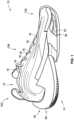
- FIG. 1 a representative article of footwear, which is designated generally at 10 and portrayed herein for purposes of discussion as an athletic shoe in the form of a basketball sneaker.
- the illustrated article of footwear 10 - also referred to herein as "footwear” or “shoe” for brevity - is an exemplary application with which novel aspects of this disclosure may be practiced.
- implementation of the present concepts for a quad-layer polymer sole structure should also be appreciated as a representative implementation of the disclosed concepts.
- the representative article of footwear 10 is generally depicted in FIGS. 1-4 as a bipartite construction that is primarily composed of a foot-receiving upper 12 mounted on top of a subjacent sole structure 14.
- footwear 10 may be divided into three anatomical regions: a forefoot (front) region R FF , a midfoot (middle) region R MF , and a hindfoot (heel or rear) region R HF , as shown in FIG. 4 .
- the forefoot region R FF is located at the front of the footwear 10 and generally corresponds with the phalanges (toes), metatarsals, and any interconnecting joints thereof.
- the midfoot region R MF Interposed between the forefoot and hindfoot regions R FF and R HF is the midfoot region R MF , which generally corresponds with the cuneiform, navicular, and cuboid bones (i.e., the arch area of the foot).
- Hindfoot region R HF in contrast, is located at the rear of the footwear 10 and generally corresponds with the talus (ankle) and calcaneus (heel) bones.
- Footwear 10 of FIGS. 1-4 may also be divided along a vertical plane into a lateral segment S LA and an adjoining medial segment S ME , as shown in FIG. 3 .
- the lateral segment S LA may be typified as a distal half of the shoe 10 farthest from the sagittal plane of the human body.
- the medial segment S ME may be typified as a proximal half of the shoe 10 closest to the sagittal plane of the human body.
- Both lateral and medial segments S LA and S ME of the footwear 10 extend through all three anatomical foot regions R FF , R MF , R HF , and each corresponds to a respective transverse side of the footwear 10.
- FIGS. 1 and 2 While only a single shoe 10 for a right foot of a user is shown in FIGS. 1 and 2 , a mirrored, structurally similar counterpart may be provided for a left foot of a user. Recognizably, the shape, size, material composition, and method of manufacture of the shoe 10 may be varied, singly or collectively, to accommodate practically any conventional or nonconventional footwear application.
- the vamp 12B also defines a throat with a fore-aft-spaced series of lace eyelets 16 and a shoe tongue 18. Positioned aft of the vamp 12B is a rear quarter section 12C that the defines the rear end and rear sides of the upper 12. Rear quarter 12C wraps around the calcaneus bone and originates/terminates at the transverse ends of the tarsal joint. While portrayed in the drawings as a multipiece construction comprising three primary sections, the upper 12 may be fabricated as a single-piece construction or may be composed of any number of segments, including a toe shield, heel cap, ankle cuff, interior liner, etc. For sandal and slipper applications, the upper 12 may take on an open toe configuration, an open heel configuration or, optionally, may be replaced with a single strap or a set of interconnected straps.
- the upper 12 portion of the footwear 10 may be fabricated from any one or combination of a variety of materials, such as textiles, engineered foams, polymers, natural and synthetic leathers, etc. Individual segments of the upper 12, once assembled or cut to shape and size, may be stitched, adhesively bonded, fastened, welded, or otherwise joined together to form an interior void for comfortably receiving a foot.
- the individual material elements of the upper 12 may be selected and located with respect to the footwear 10 in order to impart desired properties of durability, air-permeability, wear-resistance, flexibility, appearance, and comfort, for example.
- An ankle opening 15 in the rear quarter 12C of the upper 12 provides access to the interior of the shoe 10.
- a shoelace 20, strap, buckle, or other commercially available mechanism may be utilized to modify the girth of the upper 12 in order to more securely retain the foot within the interior of the shoe 10 as well as to facilitate entry and removal of the foot to/from the upper 12.
- Shoelace 20 may be threaded through the series of eyelets 16 in the upper 12; the tongue 18 may extend between the lace 20 and the interior void of the upper 12.
- Sole structure 14 is rigidly secured to the upper 12 such that the sole structure 14 extends between the upper 12 and a support surface upon which a user is standing.
- the sole structure 14 functions as an intermediate support platform that separates and protects the user's foot from the ground.
- sole structure 14 of FIGS. 1-4 may provide traction, impart stability, and help to limit various foot motions, such as inadvertent foot inversion and eversion.
- the sole structure 14 may be attached to the upper 12 via any presently available or hereafter developed joining techniques.
- the upper 12 may be coupled directly to the midsole 24, e.g., with the upper 12 adhesively attached to an upper periphery of a midsole top face and secured with a bonding allowance via priming, cementing, and pressing.
- the sole structure 14 is a discontinuous structure with gaps along the fore-aft length of the footwear 10.
- the outsole 26 of FIGS. 1-4 is portrayed as a bipartite structure composed of a hindfoot outsole segment 26A (also referred to herein as "first outsole segment”) and a distinct forefoot outsole segment 26B (also referred to herein as "second outsole segment”) that is physically separated from the hindfoot outsole segment 26A by a midfoot flexion gap 11.
- an upper surface of the hindfoot outsole segment 26A is mounted or otherwise directly attached to an underside surface or surfaces of a hindfoot midsole segment 24A (also referred to herein as "first midsole segment”).
- an upper surface of the forefoot outsole segment 26B is mounted or otherwise directly attached to an underside surface or surfaces of a forefoot midsole segment 24B (also referred to herein as "second midsole segment”).
- the hindfoot outsole segment 26A lacks a direct physical attachment to/contact with the forefoot midsole segment 24B
- the forefoot outsole segment 26B lacks a direct physical attachment to/contact with the hindfoot midsole segment 24A.
- Each outsole segment 26A, 26B may be formed from a resilient material, such as natural or synthetic rubber, polyvinyl chloride (PVC), acrylonitrile butadiene styrene (ABS), or polyurethane, that provides the footwear 10 with traction, flexibility, and durability.
- a resilient material such as natural or synthetic rubber, polyvinyl chloride (PVC), acrylonitrile butadiene styrene (ABS), or polyurethane, that provides the footwear 10 with traction, flexibility, and durability.
- a lower outsole surface ( FIG. 3 ) with low-friction traction features that provide a distinct ground-engaging surface in the hindfoot region R HF of the footwear 10.
- a lower surface of the forefoot outsole segment 26B - opposite the upper outsole surface onto which is mounted the forefoot midsole segment 24B - is fabricated with low-friction traction features that provide a forefoot ground-engaging surface that is discrete from the hindfoot ground-engaging surface of the footwear 10.
- the lower, ground-contacting surfaces may be fabricated with any of an assortment of traction features, such as an engineered tread pattern ( FIG. 3 ), cleats, protuberances, etc., to increase footwear grip and minimize sliding friction.
- the hindfoot midsole segment 24A may be a one-piece design that consists essentially of a hindfoot (first) cushion 30A ( FIG. 2 ) with an arcuate and upwardly projecting rear tail 31 ( FIG. 4 ) and a longitudinally elongated central cavity 33 ( FIG. 3 ).
- Hindfoot cushion 30A may be directly or indirectly attached along a bottom side thereof to the upper surface of the hindfoot outsole segment 26A and along a top side thereof to the hindfoot region R HF of the upper 12. While not per se required, a rear portion of the hindfoot cushion 30A is portrayed in FIG.
- the rear tail 31 of midsole segment 24A is shown wrapping around and abutting the upper's heel counter (aftward section of rear quarter 12C) to define a heel stabilizer that increases the wear life of the footwear heel and improves absorption/attenuation of shock from a heel strike.
- forefoot midsole segment 24B is a multi-piece assembly with a pair of forefoot cushions 30B and 30C that sandwich therebetween a fluid-filled forefoot bladder 32.
- the rear-most forefoot cushion 30B (also referred to herein as "second cushion”) is located aft of the forefoot bladder 32 and spaced therefrom by a rear forefoot gap 13.
- the forward-most forefoot cushion 30C (also referred to herein as "third cushion”), on the other hand, is located in front of the forefoot bladder 32 and spaced therefrom by a forward forefoot gap 15.
- the forefoot bladder 32 may include a hermetically sealed elastomeric sack that is filled with a pressurized gas. It is envisioned that the forefoot midsole segment 24B may include additional cushions and additional bladders arranged in similar or alternative patterns within the intended scope of this disclosure.
- the top surfaces of the rearward forefoot cushion 30B and bladder 32 are mounted directly to the underside surface of the moderator plate 34 and indirectly attached, via the moderator plate 34, to the strobel 28.
- the bottom surfaces of the forefoot cushions 30B, 30C and bladder 32 are all mounted directly to the upper surface of outsole segment 26B.
- the neighboring cushions of the hindfoot and forefoot midsole segments 24A, 24B may be juxtaposed in opposing spaced relation in a manner that provides a structural barrier between the ground and a bottom surface of the moderator plate 34 exposed by the midfoot flexion gap 11.
- the hindfoot cushion 30A is formed with an upper cushion ledge 37 that projects forward from the hindfoot region R HF into the midfoot region R MF of the footwear 10.
- the upper cushion ledge 37 may lay flush against the bottom surface of the moderator plate 34.
- the rear forefoot cushion 30B includes a lower cushion ledge 39 that projects rearward from the forefoot region R FF into the midfoot region R MF of the footwear 10.
- the lower cushion ledge 39 may lay flush against the top surface of the forefoot outsole segment 26B.
- the lower cushion ledge 39 is located underneath and spaced from the upper cushion ledge 37 by the midfoot gap 11 such that the two ledges 37, 39 collectively form a barrier along a vertical plane between the ground and the exposed underside of the moderator plate 38.
- a moderator plate 34 Interposed between the footwear upper 12 and select segments of the footwear midsole 24 is a moderator plate 34 that attaches, either directly or indirectly, to predefined sections of the upper's forefoot, midfoot, and hindfoot regions R FF , R MF , R HF .
- the moderator plate 34 is attached directly to the upper 12, e.g., via bonding to an underside surface of the strobel 28. With this arrangement, select portions of the moderator plate 34 are visible from the exterior of the footwear 10, as best seen in FIG. 1 .
- the moderator plate 34 may be indirectly attached to the upper 12, for example, by the midsole.
- the moderator plate 34 may be embedded within a complementary cavity formed in one or more of the cushions 30A-30C of the midsole; the plate 34 is thereafter attached to the upper 12 by affixing the midsole 24 to the upper 12. This allows the moderator plate 34 to be substantially or completely concealed within the midsole 24 and/or upper 12.
- the hindfoot and forefoot cushions 30A, 30B and the forefoot bladder 32 are mounted directly to an underside surface of the moderator plate 34.
- the moderator plate 34 may be formed with a material having a hardness (e.g., Shore A durometer value) that is higher than a hardness of the material that forms the cushions 30A-30C.
- the moderator plate 34 may be a single-piece structure molded from a thermoplastic polyurethane (TPU), a fiber-reinforced polymer (FRP), a thermoplastic elastomer, or other non-foamed, relatively inflexible polymeric materials.
- a second moderator plate (not shown) may be interposed between the forefoot outsole segment 26B and the constituent parts of the forefoot midsole segment 24A.
- the moderator plate 24 may be partially or wholly removed from the footwear 10 architecture such that one or more or all of the midsole cushions 30A-30C mount directly to the upper 12.
- a forefoot cage 36 partially surrounds the forefoot midsole segment 24B.
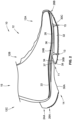
- the forefoot cage 36 (also referred to herein as "cage") is generally composed of a horizontally oriented, curvilinear cage plate 38 with a pair of arcuate cage wings 40A and 40B that project from opposing medial and lateral sides, respectively, of the cage plate 38.
- a top surface of the cage plate 38 may directly attach to the footwear upper 12, e.g., via bonding to the underside of strobel 28.
- a lower surface of the cage plate 38 may directly mount onto a top surface of the forefoot bladder 32.
- the cage plate 38 may extend continuously in a fore-aft direction from an anterior edge to a posterior edge of the bladder's 32 upper contact surface.
- the cage plate 38 may take on alternative shapes and sizes within the scope of this disclosure.
- the moderator plate 34 and the forefoot cage 36 including the cage plate 38 and cage wings 40A, 40B, may be integrally formed as a single-piece, unitary structure.
- the forefoot cage 36 may take on the same material composition as the moderator plate 36 or, alternatively, may be a separate structure formed from a distinct material.
- the forefoot cage 36 may lack physical contact with the longitudinal and lateral faces of the forefoot bladder 32 to maintain an "open-faced" construction that allows the bladder 32 to expand and contract without impediment.
- the arcuate cage wings 40A, 40B project upward, rearward, and downward from the cage plate 38; the cage wings 40A, 40B wrap around, without physically contacting, the medial and lateral sides of the fluid-filled forefoot bladder 32.
- Proximal ends of the arcuate cage wings 40A, 40B ( FIG. 5B ) are integrally formed to or otherwise adjoined with the cage plate 38.
- FIG. 5B illustrates the cage wings 40A, 40B initially projecting outwards and upwards from the cage plate 36.
- the cage wings 40A, 40B then project further outwards and downwards with respect to the footwear 10, as best seen in FIG. 5C .
- Distal ends of the arcuate cage wings 40A, 40B ( FIG. 5D ) then insert underneath the rear forefoot cushion 30B such that the cage wings 40A, 40B are interposed between the forefoot cushion 30B and the forefoot outsole segment 26B.
- the distal ends of the arcuate cage wings 40A, 40B may be separated from each other via a raised outsole section 41 of the outsole segment 26B.
- the distal ends of the arcuate cage wings 40A, 40B are spaced from, without touching, the fluid-filled bladder 32.
- the forefoot cage 36 may also function as a passive strut assembly that structurally reinforces the forefoot midsole segment 24B while damping impact forces during use of the footwear 10 and concomitantly biasing the forefoot outsole segment 26B away from the upper 12 in a manner similar to a vehicle suspension system.
- the forefoot cage 36 also protects that medial and lateral faces of the forefoot bladder 32 from debris and inadvertent puncturing.
- the cage wings 40A, 40B may also define outermost sidewalls of the footwear midsole 24.
Landscapes
- Chemical & Material Sciences (AREA)
- Engineering & Computer Science (AREA)
- Materials Engineering (AREA)
- Footwear And Its Accessory, Manufacturing Method And Apparatuses (AREA)
Applications Claiming Priority (3)
| Application Number | Priority Date | Filing Date | Title |
|---|---|---|---|
| US202163208961P | 2021-06-09 | 2021-06-09 | |
| PCT/US2022/032655 WO2022261193A1 (en) | 2021-06-09 | 2022-06-08 | Sole structures with midfoot gaps and forefoot bladders in reinforcing cages for articles of footwear |
| EP22738810.5A EP4351376B1 (de) | 2021-06-09 | 2022-06-08 | Sohlenstrukturen mit mittelfussspalten und vorderfussblasen in verstärkungskäfigen für schuhartikel |
Related Parent Applications (1)
| Application Number | Title | Priority Date | Filing Date |
|---|---|---|---|
| EP22738810.5A Division EP4351376B1 (de) | 2021-06-09 | 2022-06-08 | Sohlenstrukturen mit mittelfussspalten und vorderfussblasen in verstärkungskäfigen für schuhartikel |
Publications (2)
| Publication Number | Publication Date |
|---|---|
| EP4581976A2 true EP4581976A2 (de) | 2025-07-09 |
| EP4581976A3 EP4581976A3 (de) | 2025-08-27 |
Family
ID=82458721
Family Applications (2)
| Application Number | Title | Priority Date | Filing Date |
|---|---|---|---|
| EP25177697.7A Pending EP4581976A3 (de) | 2021-06-09 | 2022-06-08 | Sohlenstrukturen mit mittelfussspalten und vorderfussblasen in verstärkungskäfigen für schuhartikel |
| EP22738810.5A Active EP4351376B1 (de) | 2021-06-09 | 2022-06-08 | Sohlenstrukturen mit mittelfussspalten und vorderfussblasen in verstärkungskäfigen für schuhartikel |
Family Applications After (1)
| Application Number | Title | Priority Date | Filing Date |
|---|---|---|---|
| EP22738810.5A Active EP4351376B1 (de) | 2021-06-09 | 2022-06-08 | Sohlenstrukturen mit mittelfussspalten und vorderfussblasen in verstärkungskäfigen für schuhartikel |
Country Status (5)
| Country | Link |
|---|---|
| US (2) | US11986052B2 (de) |
| EP (2) | EP4581976A3 (de) |
| CN (1) | CN117440763A (de) |
| TW (2) | TWI876877B (de) |
| WO (1) | WO2022261193A1 (de) |
Families Citing this family (8)
| Publication number | Priority date | Publication date | Assignee | Title |
|---|---|---|---|---|
| USD1010298S1 (en) * | 2022-10-12 | 2024-01-09 | Frampton E. Ellis | Pair of footwear soles |
| USD1017992S1 (en) * | 2023-07-28 | 2024-03-19 | Nike, Inc. | Shoe |
| USD1017993S1 (en) * | 2023-07-28 | 2024-03-19 | Nike, Inc. | Shoe |
| USD1017994S1 (en) * | 2023-07-28 | 2024-03-19 | Nike, Inc. | Shoe |
| USD1018006S1 (en) * | 2023-07-28 | 2024-03-19 | Nike, Inc. | Shoe |
| USD1017991S1 (en) * | 2023-07-28 | 2024-03-19 | Nike, Inc. | Shoe |
| USD1088471S1 (en) * | 2023-08-11 | 2025-08-19 | Nike, Inc. | Shoe |
| USD1076393S1 (en) * | 2023-11-30 | 2025-05-27 | Skechers U.S.A., Inc. Ii | Shoe upper |
Family Cites Families (55)
| Publication number | Priority date | Publication date | Assignee | Title |
|---|---|---|---|---|
| US3834046A (en) | 1973-04-09 | 1974-09-10 | D Fowler | Shoe sole structure |
| US5279051A (en) * | 1992-01-31 | 1994-01-18 | Ian Whatley | Footwear cushioning spring |
| US5367791A (en) | 1993-02-04 | 1994-11-29 | Asahi, Inc. | Shoe sole |
| US5930916A (en) | 1996-06-14 | 1999-08-03 | Connor; Dennis J. | Insoles liners and footwear incorporating loofah material |
| US5799417A (en) * | 1997-01-13 | 1998-09-01 | Bata Limited | Shoe sole with removal insert |
| US6314664B1 (en) | 1997-04-18 | 2001-11-13 | Mizuno Corporation | Athletic shoe midsole design and construction |
| US6675501B2 (en) | 1999-07-26 | 2004-01-13 | Phoenix Footwear Group, Inc. | Insole construction for footwear |
| US6665958B2 (en) | 2001-09-17 | 2003-12-23 | Nike, Inc. | Protective cage for footwear bladder |
| DE10234913B4 (de) * | 2002-07-31 | 2005-11-10 | Adidas International Marketing B.V. | Schuhsohle |
| US6990755B2 (en) | 2003-10-09 | 2006-01-31 | Nike, Inc. | Article of footwear with a stretchable upper and an articulated sole structure |
| US7200955B2 (en) | 2004-06-04 | 2007-04-10 | Nike, Inc. | Article of footwear incorporating a sole structure with compressible inserts |
| US7600332B2 (en) | 2006-02-13 | 2009-10-13 | Nike, Inc. | Article of footwear with a removable foot-supporting insert |
| US7941938B2 (en) | 2006-05-26 | 2011-05-17 | Nike, Inc. | Article of footwear with lightweight sole assembly |
| US8978273B2 (en) | 2007-10-19 | 2015-03-17 | Nike, Inc. | Article of footwear with a sole structure having fluid-filled support elements |
| US8978272B2 (en) | 2008-01-11 | 2015-03-17 | Nike, Inc. | Article of footwear with forefoot plates |
| US9456655B2 (en) | 2008-09-26 | 2016-10-04 | Nike, Inc. | Systems and methods for stabilization of a phylon article |
| KR200454043Y1 (ko) * | 2010-05-18 | 2011-06-14 | 주식회사 엘에스네트웍스 | 브리지 구조를 갖는 신발 |
| US8881428B2 (en) | 2010-09-02 | 2014-11-11 | Nike, Inc. | Sole assembly for article of footwear with plural cushioning members |
| US20120197812A1 (en) | 2011-01-31 | 2012-08-02 | Nike, Inc. | System And Method For Collecting, Recycling, And Tracking Products Such As Golf Balls |
| US20130008050A1 (en) * | 2011-07-07 | 2013-01-10 | Michel Marc | Shoe Insole |
| US9179733B2 (en) | 2011-12-23 | 2015-11-10 | Nike, Inc. | Article of footwear having an elevated plate sole structure |
| US9074061B2 (en) | 2012-09-06 | 2015-07-07 | Nike, Inc. | EVA recycling method |
| US10849387B2 (en) | 2012-09-20 | 2020-12-01 | Nike, Inc. | Sole structures and articles of footwear having plate moderated fluid-filled bladders and/or foam type impact force attenuation members |
| US9301566B2 (en) | 2013-03-15 | 2016-04-05 | Nike, Inc. | Sole structures and articles of footwear having a lightweight midsole member with protective elements |
| US9241535B2 (en) * | 2013-03-14 | 2016-01-26 | Nike, Inc. | Sole structures and articles incorporating same |
| US9603414B2 (en) | 2013-03-15 | 2017-03-28 | Nike, Inc. | Fluid-filled chamber with a tensile element |
| US9554622B2 (en) | 2013-09-18 | 2017-01-31 | Nike, Inc. | Multi-component sole structure having an auxetic configuration |
| US9554620B2 (en) | 2013-09-18 | 2017-01-31 | Nike, Inc. | Auxetic soles with corresponding inner or outer liners |
| US9554624B2 (en) | 2013-09-18 | 2017-01-31 | Nike, Inc. | Footwear soles with auxetic material |
| US10010137B2 (en) | 2014-07-30 | 2018-07-03 | Nike, Inc. | Article of footwear with banking midsole with embedded resilient plate |
| WO2016126909A1 (en) * | 2015-02-04 | 2016-08-11 | Nike Innovate C.V. | Support structures for an article of footwear and methods of manufacturing support structures |
| USD782798S1 (en) | 2015-08-14 | 2017-04-04 | Nike, Inc. | Shoe outsole |
| USD782795S1 (en) | 2015-08-14 | 2017-04-04 | Nike, Inc. | Shoe outsole |
| USD782796S1 (en) | 2015-08-14 | 2017-04-04 | Nike, Inc. | Shoe outsole |
| USD782797S1 (en) | 2015-08-14 | 2017-04-04 | Nike, Inc. | Shoe outsole |
| USD783964S1 (en) | 2015-08-14 | 2017-04-18 | Nike, Inc. | Shoe outsole |
| USD783965S1 (en) | 2015-08-17 | 2017-04-18 | Nike, Inc. | Shoe outsole |
| JP6657388B2 (ja) | 2015-09-24 | 2020-03-04 | ナイキ イノベイト シーブイ | コーティングされたキャリア内の粒子状発泡体 |
| US10278450B2 (en) | 2015-10-07 | 2019-05-07 | Nike, Inc. | Sole structures and articles of footwear having an elongated hexagonal siping pattern and/or a heel pocket structure |
| CN108348038B (zh) * | 2015-11-03 | 2020-11-10 | 耐克创新有限合伙公司 | 包括具有缓冲部件的囊状元件的鞋类物品及其制造方法 |
| USD790180S1 (en) | 2015-11-17 | 2017-06-27 | Nike, Inc. | Shoe outsole |
| USD782790S1 (en) | 2016-01-21 | 2017-04-04 | Nike, Inc. | Shoe midsole |
| US10206454B2 (en) | 2016-02-24 | 2019-02-19 | Nike, Inc. | Dual layer sole system with auxetic structure |
| USD807000S1 (en) | 2016-05-31 | 2018-01-09 | Nike, Inc. | Shoe outsole |
| USD807002S1 (en) | 2016-08-12 | 2018-01-09 | Nike, Inc. | Shoe outsole |
| USD819315S1 (en) | 2016-11-12 | 2018-06-05 | Nike, Inc. | Shoe outsole |
| USD812356S1 (en) | 2016-11-14 | 2018-03-13 | Nike, Inc. | Shoe outsole |
| KR102207241B1 (ko) | 2017-02-01 | 2021-01-22 | 나이키 이노베이트 씨.브이. | 밑창 구조체를 위한 적층형 완충 장치 |
| WO2019046438A1 (en) | 2017-08-31 | 2019-03-07 | Nike Innovate C.V. | SOLE STRUCTURE OF A FOOTWEAR ARTICLE AND ASSOCIATED METHODS |
| US11096443B2 (en) * | 2018-02-09 | 2021-08-24 | Nike, Inc. | Sole structure for article of footwear |
| US10548370B2 (en) | 2018-02-28 | 2020-02-04 | Rockport Ip Holdings, Llc | Shoe sole construction |
| KR102432499B1 (ko) * | 2018-04-20 | 2022-08-12 | 나이키 이노베이트 씨.브이. | 플레이트들 및 개재된 유체 충전 블래더를 구비하는 솔 구조체 및 제조 방법 |
| CN208573102U (zh) * | 2018-06-11 | 2019-03-05 | 浙江信步儿童用品有限公司 | 一种具有缓冲减震功能的机能童鞋 |
| US11666117B2 (en) * | 2019-11-19 | 2023-06-06 | Nike, Inc. | Sole structure for article of footwear |
| US12225968B2 (en) * | 2021-01-20 | 2025-02-18 | Puma SE | Article of footwear having a sole plate |
-
2022
- 2022-06-08 EP EP25177697.7A patent/EP4581976A3/de active Pending
- 2022-06-08 CN CN202280040908.8A patent/CN117440763A/zh active Pending
- 2022-06-08 EP EP22738810.5A patent/EP4351376B1/de active Active
- 2022-06-08 WO PCT/US2022/032655 patent/WO2022261193A1/en not_active Ceased
- 2022-06-08 TW TW113105517A patent/TWI876877B/zh active
- 2022-06-08 TW TW111121223A patent/TWI835159B/zh active
- 2022-06-08 US US17/835,386 patent/US11986052B2/en active Active
-
2024
- 2024-04-22 US US18/641,976 patent/US12439999B2/en active Active
Also Published As
| Publication number | Publication date |
|---|---|
| US20220395057A1 (en) | 2022-12-15 |
| WO2022261193A1 (en) | 2022-12-15 |
| EP4351376A1 (de) | 2024-04-17 |
| US20240268514A1 (en) | 2024-08-15 |
| TWI835159B (zh) | 2024-03-11 |
| US12439999B2 (en) | 2025-10-14 |
| TWI876877B (zh) | 2025-03-11 |
| CN117440763A (zh) | 2024-01-23 |
| TW202300050A (zh) | 2023-01-01 |
| US11986052B2 (en) | 2024-05-21 |
| TW202421023A (zh) | 2024-06-01 |
| EP4351376B1 (de) | 2025-05-21 |
| EP4581976A3 (de) | 2025-08-27 |
Similar Documents
| Publication | Publication Date | Title |
|---|---|---|
| US12439999B2 (en) | Sole structures with midfoot gaps and forefoot bladders in reinforcing cages for articles of footwear | |
| US11839259B2 (en) | Articles of footwear and sole structures with pressure-mapped midsole topographies and inlaid outsoles | |
| US12011061B2 (en) | Footwear and sole structure assemblies with adhesive-free mechanical attachments between insoles and midsoles | |
| US11918078B2 (en) | Foot support members that provide dynamically transformative properties | |
| US12310446B2 (en) | Footwear and sole structure assemblies with split midsoles having peripheral walls for lateral stability | |
| US8667713B2 (en) | Footwear with a foot stabilizer | |
| EP2856899B1 (de) | Fußbekleidungsartikel | |
| US20150150339A1 (en) | Article of Footwear | |
| US20130000152A1 (en) | Article of Footwear with a Midsole Structure | |
| CN105286190A (zh) | 具有跟靠补足条带的鞋 | |
| BR112015006329B1 (pt) | estrutura de sola para um artigo de calçado |
Legal Events
| Date | Code | Title | Description |
|---|---|---|---|
| PUAI | Public reference made under article 153(3) epc to a published international application that has entered the european phase |
Free format text: ORIGINAL CODE: 0009012 |
|
| STAA | Information on the status of an ep patent application or granted ep patent |
Free format text: STATUS: THE APPLICATION HAS BEEN PUBLISHED |
|
| AC | Divisional application: reference to earlier application |
Ref document number: 4351376 Country of ref document: EP Kind code of ref document: P |
|
| AK | Designated contracting states |
Kind code of ref document: A2 Designated state(s): AL AT BE BG CH CY CZ DE DK EE ES FI FR GB GR HR HU IE IS IT LI LT LU LV MC MK MT NL NO PL PT RO RS SE SI SK SM TR |
|
| PUAL | Search report despatched |
Free format text: ORIGINAL CODE: 0009013 |
|
| AK | Designated contracting states |
Kind code of ref document: A3 Designated state(s): AL AT BE BG CH CY CZ DE DK EE ES FI FR GB GR HR HU IE IS IT LI LT LU LV MC MK MT NL NO PL PT RO RS SE SI SK SM TR |
|
| RIC1 | Information provided on ipc code assigned before grant |
Ipc: A43B 13/18 20060101AFI20250721BHEP |
|
| STAA | Information on the status of an ep patent application or granted ep patent |
Free format text: STATUS: REQUEST FOR EXAMINATION WAS MADE |
|
| 17P | Request for examination filed |
Effective date: 20260129 |