EP4579680A1 - Système d'analyse d'échantillon et procédé d'affichage d'informations d'échantillon - Google Patents
Système d'analyse d'échantillon et procédé d'affichage d'informations d'échantillon Download PDFInfo
- Publication number
- EP4579680A1 EP4579680A1 EP24223279.1A EP24223279A EP4579680A1 EP 4579680 A1 EP4579680 A1 EP 4579680A1 EP 24223279 A EP24223279 A EP 24223279A EP 4579680 A1 EP4579680 A1 EP 4579680A1
- Authority
- EP
- European Patent Office
- Prior art keywords
- sample
- image
- sample container
- images
- user interface
- Prior art date
- Legal status (The legal status is an assumption and is not a legal conclusion. Google has not performed a legal analysis and makes no representation as to the accuracy of the status listed.)
- Pending
Links
Images


Classifications
-
- G—PHYSICS
- G16—INFORMATION AND COMMUNICATION TECHNOLOGY [ICT] SPECIALLY ADAPTED FOR SPECIFIC APPLICATION FIELDS
- G16H—HEALTHCARE INFORMATICS, i.e. INFORMATION AND COMMUNICATION TECHNOLOGY [ICT] SPECIALLY ADAPTED FOR THE HANDLING OR PROCESSING OF MEDICAL OR HEALTHCARE DATA
- G16H40/00—ICT specially adapted for the management or administration of healthcare resources or facilities; ICT specially adapted for the management or operation of medical equipment or devices
- G16H40/60—ICT specially adapted for the management or administration of healthcare resources or facilities; ICT specially adapted for the management or operation of medical equipment or devices for the operation of medical equipment or devices
- G16H40/63—ICT specially adapted for the management or administration of healthcare resources or facilities; ICT specially adapted for the management or operation of medical equipment or devices for the operation of medical equipment or devices for local operation
-
- G—PHYSICS
- G01—MEASURING; TESTING
- G01N—INVESTIGATING OR ANALYSING MATERIALS BY DETERMINING THEIR CHEMICAL OR PHYSICAL PROPERTIES
- G01N35/00—Automatic analysis not limited to methods or materials provided for in any single one of groups G01N1/00 - G01N33/00; Handling materials therefor
-
- G—PHYSICS
- G01—MEASURING; TESTING
- G01N—INVESTIGATING OR ANALYSING MATERIALS BY DETERMINING THEIR CHEMICAL OR PHYSICAL PROPERTIES
- G01N33/00—Investigating or analysing materials by specific methods not covered by groups G01N1/00 - G01N31/00
- G01N33/48—Biological material, e.g. blood, urine; Haemocytometers
-
- G—PHYSICS
- G01—MEASURING; TESTING
- G01N—INVESTIGATING OR ANALYSING MATERIALS BY DETERMINING THEIR CHEMICAL OR PHYSICAL PROPERTIES
- G01N35/00—Automatic analysis not limited to methods or materials provided for in any single one of groups G01N1/00 - G01N33/00; Handling materials therefor
- G01N35/00584—Control arrangements for automatic analysers
- G01N35/00722—Communications; Identification
-
- G—PHYSICS
- G01—MEASURING; TESTING
- G01N—INVESTIGATING OR ANALYSING MATERIALS BY DETERMINING THEIR CHEMICAL OR PHYSICAL PROPERTIES
- G01N35/00—Automatic analysis not limited to methods or materials provided for in any single one of groups G01N1/00 - G01N33/00; Handling materials therefor
- G01N35/00584—Control arrangements for automatic analysers
- G01N35/00722—Communications; Identification
- G01N2035/00891—Displaying information to the operator
-
- G—PHYSICS
- G01—MEASURING; TESTING
- G01N—INVESTIGATING OR ANALYSING MATERIALS BY DETERMINING THEIR CHEMICAL OR PHYSICAL PROPERTIES
- G01N35/00—Automatic analysis not limited to methods or materials provided for in any single one of groups G01N1/00 - G01N33/00; Handling materials therefor
- G01N35/02—Automatic analysis not limited to methods or materials provided for in any single one of groups G01N1/00 - G01N33/00; Handling materials therefor using a plurality of sample containers moved by a conveyor system past one or more treatment or analysis stations
- G01N35/04—Details of the conveyor system
- G01N2035/0401—Sample carriers, cuvettes or reaction vessels
- G01N2035/0406—Individual bottles or tubes
Definitions
- the disclosure relates to the field of medical detection technologies, and in particular, to a sample analysis system, a sample information display method, an electronic device, and a storage medium.
- Abnormal quality of a blood sample may affect accuracy of test results of the blood sample.
- a chylous sample may cause a pseudo high hemoglobin measurement result
- a blood clot may cause an abnormality in sample aspiration.
- Blood sample quality detection is an important part of clinical laboratory blood sample detection.
- a clinician or laboratory technician In order to control quality of a blood sample, after obtaining test results by a sample testing pipeline, when finding an abnormal test result, it is common practice for a clinician or laboratory technician to leave a sample result reviewing region to manually find the blood sample, and then visually determine whether the quality of the blood sample is abnormal. In this process, it is time-consuming and labor-consuming to manually find a blood sample, and efficiency of reviewing blood samples is low.
- embodiments of the disclosure provide a sample analysis system, a sample information display method, an electronic device, and a storage medium.
- An embodiment of the disclosure provides a sample analysis system, including:
- An embodiment of the disclosure further provides a sample analysis system, including an input module, a transfer track, an analysis device, an image obtaining module, a processor, and a display screen; wherein
- An embodiment of the disclosure further provides a sample information display method, including:
- An embodiment of the disclosure further provides an electronic device, including a processor, and a memory configured to store a computer program runnable on the processor.
- the processor is configured to run the computer program to perform the steps of any one of above methods.
- the processor may be configured to generate, based on the at least two first images, the rotatable three-dimensional representative of the sample container containing the blood sample, and/or an animation for displaying from different angles the sample container containing the blood sample, or may be configured to perform image stitching on the at least two first images, to obtain the third image.
- the display screen is configured to display the analysis result and output the rotatable three-dimensional representative and/or the animation and/or the third image on the user interface. According to the above solutions, a user may review whether the blood sample is abnormal based on the analysis result of the blood sample outputted by the display screen on the user interface, so that efficiency of reviewing the blood sample is improved.
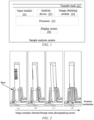
- the input module 101 is configured to carry a sample container loaded with a blood sample, and transfer the sample container to the transfer track 102.
- the transfer track 102 is configured to transfer the sample container to the analysis device 103.
- the analysis device 103 is configured to analyze the blood sample in the sample container, to obtain an analysis result.
- the image obtaining module 104 is configured to capture at least two first images of the sample container, which are different from each other, before the analysis device 103 performs the sample analysis. For example, each first image at least partially displays at least part of the blood sample in the sample container.
- the processor 105 is configured to generate, based on the at least two first images, a rotatable three-dimensional representative of the sample container containing the blood sample, and/or an animation for displaying from different angles the sample container containing the blood sample.
- the display screen 106 is configured to display the analysis result and output the rotatable three-dimensional representative and/or output the animation on the user interface.
- the input module 101 transfers the carried sample container to the transfer track 102
- the image obtaining apparatus 104 captures the at least two first images of the sample container
- the transfer track 102 transfers the sample container to the analysis device 103
- the analysis device 103 may analyze the blood sample in the sample container, to obtain the analysis result.
- the analysis device 103 includes a sample component, a reagent component, and a measurement component. Specifically, after the transfer track 102 transfers the sample container to the analysis device 103, the sample component of the analysis device 103 aspirates the blood sample from the sample container, and provides the aspirated blood sample to the measurement component of the analysis device 103.
- the reagent component of the analysis device 103 aspirates a reagent, and provides the aspirated reagent to the measurement component of the analysis device 103.
- the measurement component of the analysis device 103 uniformly mixes the blood sample provided by the sample component and the reagent provided by the reagent component to prepare a reaction solution, incubates the reaction solution, and analyzes the reaction solution that is incubated, to obtain the analysis result of the blood sample in the sample container.
- the analysis device 103 may send the analysis result to the processor 105 and/or the display screen 106 when obtaining the analysis result of the blood sample in the sample container, or may send the analysis result to the processor 105 and/or the display screen 106 when the analysis result of the blood sample in the sample container does not satisfy a preset condition.
- the set condition indicates a condition that a normal blood sample satisfies. If the analysis result satisfies the preset condition, it indicates that the blood sample is a normal sample; or if the analysis result does not satisfy the preset condition, it indicates that the blood sample is abnormal, for example, the blood sample is at least one of a hemolytic sample, a jaundice sample, and a lipemic sample.
- the image obtaining apparatus 104 may capture at least two first images of the sample container that are different from each other before the analysis device performs sample analysis, where each first image at least partially displays at least part of a blood sample in the sample container.
- the image obtaining apparatus 104 may capture the at least two first images of the sample container during rotation before the analysis device performs the sample analysis on the blood sample. Capturing the at least two first images of the sample container during rotation may be understood as capturing the at least two first images of the sample container during rotation of the sample container about a vertical central axis or about a vertical direction, that is, performing rotary scanning or rotary imaging on the same sample container.
- the at least two first images of the sample container captured by the image obtaining apparatus 104 include first images captured from different viewing angles or different imaging angles.
- the image obtaining apparatus 104 may directly transfer all first images of the sample container to the processor 105.
- the image obtaining apparatus may transfer all first images of the sample container to another device for storage, and the processor 105 may obtain the first images of the sample container from the another device.
- the image obtaining apparatus 104 stores the captured first images of the sample container to a preset storage path of a camera 103 or another electronic device, and the processor 105 obtains the first images of the sample container from the preset storage path, and stores the first images.
- a sample container may be understood as a transparent or translucent container for loading a blood sample, and may be a blood collection tube, a testing tube, a sample tube, a sampling tube, a test tube, a bottle, a sample cup, etc.
- the sample container is loaded with the blood sample, which may be a serum sample or a plasma sample, and reagents for detection may be added to the blood sample.
- a surface of the sample container is affixed or attached with a label for marking or recording related information of the blood sample.
- the label may include identification information of the blood sample in the sample container, such as a barcode, or a sequence code combining letters and/or numbers.
- the processor 105 obtains the at least two first images of the same sample container captured by the image obtaining apparatus 104, and generates, based on the at least two first images obtained, the rotatable three-dimensional representative of the sample container containing the blood sample, and/or an animation for displaying from different angles the sample container containing the blood sample.
- the rotatable three-dimensional representative may be used to display the sample container containing the blood sample from a plurality of angles, especially lateral angles.
- the animation consists of a plurality of image frames.
- the processor 106 may be further configured to generate, as the rotatable three-dimensional representative, a three-dimensional image or a three-dimensional model of the sample container containing the blood sample, based on the at least two first images obtained.
- the three-dimensional image may be obtained by performing image stitching on the at least two first images.
- the processor 105 may determine the obtained first images as image frames for forming the animation of the sample container; or when obtaining few first images corresponding to a same sample container, the processor 105 may perform frame interpolation on the first images, to obtain image frames for forming the animation of the sample container.
- the processor 105 may preprocess the obtained first images of the same sample container, and generate, based on preprocessed first images, image frames for forming the animation of the sample container.
- a preprocessing operation may include cropping the first images to reduce size of the first images, so that storage resources are saved.
- the preprocessing operation may further include denoising, to improve image sharpness.
- the processor 105 may store the image frames that correspond to the sample container and that are used to form the animation, and may further generate, based on the image frames that correspond to the sample container and that are used to form the animation, the animation for displaying the sample container in rotation, for example, stitch, in a preset sequence, the image frames for forming the animation, to obtain the animation for displaying the sample container in rotation.
- the image frames stored by the processor 105 are used for the display screen 106 to generate, based on the image frames that correspond to the sample container and that are used to form the animation, the animation for displaying the sample container during rotation.
- the processor 105 may further instruct or control the display screen 106 to display the three-dimensional representative and/or the animation on the user interface, for example, control the display screen 106 to display the three-dimensional representative in rotation on the user interface, in response to a first set instruction.
- the display screen 106 displays the analysis result of the blood sample in the sample container, and outputs the three-dimensional representative and/or the animation corresponding to the same sample container, on the user interface.
- the analysis result displayed by the display screen 106 may be sent by the processor 105 or the analysis device 103. There is a correspondence or an association relationship between the three-dimensional representative and/or the animation of the sample container and the analysis result of the blood sample in the sample container.
- the three-dimensional representative and/or the animation of the sample container and the analysis result corresponding to the same sample container may be associated by using information indicated by the label affixed to the sample container.
- the display screen 106 may obtain the animation for displaying the sample container during rotation, which is generated in advance by the processor 105, and output, on the user interface, the animation generated in advance by the processor 105.
- the display screen 106 may obtain the image frames that are stored by the processor 105, that correspond to the sample container and that are used to form the animation, generate, based on the obtained image frames for forming the animation, the animation for displaying the sample container during rotation, and output, on the user interface, the animation generated in real time.
- the three-dimensional representative and/or the animation outputted by the display screen 106 is used for a related person to determine or check whether sample quality of the blood sample in the sample container is abnormal.
- the gripping mechanism is configured to grip an end portion of the sample container, to keep the sample container in a vertical state.
- the camera is prone to motion artifacts when imaging a moving object
- a rotary imaging scenario in order to ensure that the camera of the image obtaining apparatus 104 can obtain clear images of the sample container from different angles during one revolution of the sample container, further, there is a preset correspondence or mapping relationship between an exposure duration and/or a imaging frequency of the camera and a rotational speed of the rotation mechanism.
- Different rotational speeds of the rotation mechanism correspond to different exposure durations, and/or different rotational speeds of the rotation mechanism correspond to different imaging frequencies.
- the rotational speed of the rotation mechanism may be determined based on a speed of identifying the label on the sample container. Certainly, the rotational speed of the rotation mechanism may be a fixed preset rotational speed.
- the exposure duration may also be understood as exposure time. In order to ensure that the camera can capture a clear image, the exposure duration of the camera is less than or equal to a quotient of accuracy of the camera and the rotational speed of the rotation mechanism.
- the accuracy of the camera may also be referred to as pixel accuracy, which is equal to a quotient of a unidirectional field of view and a unidirectional resolution of the camera.
- the imaging frequency may be replaced with a frame rate.
- the frame rate may be understood as the number of image frames captured per second. For example, the frame rate is 20 frames per second.
- the gripping mechanism includes:
- the image obtaining apparatus 104 may grip the bottom of the sample container through the base, to keep the sample container in the vertical state, drive the base through the rotation mechanism to rotate, to drive the sample container to rotate about the vertical direction, and perform rotary imaging on the sample container.
- the base may be a base for accommodating a single tube.
- the base of the image obtaining apparatus 104 is configured to grip one sample.
- the base may also be referred to as a sample base.
- FIG. 2 shows an example in which the image obtaining apparatus 104 drives the base through the rotation mechanism to rotate for rotary imaging.
- the image obtaining apparatus 104 may further grip the top of the sample container via the manipulator, lift the sample container by a specific height, drive the manipulator through the rotation mechanism to rotate, to drive the sample container gripped by the manipulator to rotate about the vertical direction, and perform rotary imaging on the sample container.
- FIG. 3 shows an example in which the image obtaining apparatus 104 drives the manipulator through the rotation mechanism to rotate for rotary imaging.
- the image obtaining apparatus 104 may be arranged on the transfer track 102 for conveying sample containers.
- the image obtaining apparatus 104 may capture at least two first images of a fixedly placed sample container from different lateral angles before the analysis device performs sample analysis.
- the image obtaining apparatus 104 may rotate circumferentially about the fixedly placed sample container, to image, from different lateral angles, the sample container loaded with a blood sample.
- the image obtaining apparatus 104 may include a plurality of cameras arranged circumferentially around the fixedly placed sample container, to image, from different lateral angles, the sample container loaded with a blood sample.
- the processor 105 may be further configured to find a target image from the at least two first images, where a preset parameter value of the target image is the largest among the at least two first images, and is greater than a preset threshold. Accordingly, the display screen is further configured to display the target image on the user interface.
- the target image which displays the blood sample best, among the at least two first images can be obtained and outputted, to help the user determine the quality of the blood sample.
- the processor 105 performing frame interpolation on the at least two first images includes:
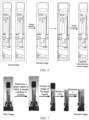
- the processor 105 performs first image processing on each first image to remove the surface curvature of the sample container in said first image, to obtain a second image corresponding to said first image, where one first image corresponds to one second image; performs frame interpolation on the obtained second images by using the preset frame interpolation algorithm, to obtain a plurality of second images; and performs second image processing on each second image to recover the surface curvature of the sample container in said second image, to obtain the image frames for forming the animation of the sample container.
- the processor 105 may obtain the image frames for forming the animation of the sample container in the following manner.
- a target region, in which the sample container is located, in each first image is determined, and said first image is cropped based on the boundary of the target region, to obtain a first image including the target region.
- the sample container in the cropped first image is determined, and first image processing is performed on the cropped first image by using a set image processing algorithm, to remove the surface curvature of the sample container in the cropped first image, thereby obtaining a corresponding second image.
- FIG. 5 shows an example of the cropped first image and the second image, and there is one first image and one second image in FIG. 5 .
- Second image processing is performed on the second images in the image pair and the corresponding transition frame, to recover the surface curvature of the sample container in the corresponding images, thereby obtaining the image frames for forming the animation of the sample container.
- the processor 105 may be configured to receive, from the user interface, the first set instruction entered by the user, that is, the first set instruction is entered by the user through the user interface.
- the user may click on a "play" option or button on the user interface.
- the processor 105 may alternatively control the display screen 106 to display the three-dimensional representative, e.g. the three-dimensional image interactively on the user interface.
- the user may directly operate, for example, click on or drag, the three-dimensional representative displayed on the user interface, to rotate the three-dimensional representative on the user interface, so that the user can observe, from different angles, the sample container represented by the three-dimensional representative.
- the display screen 106 displays the interactive three-dimensional representative, e.g. the three-dimensional image on the user interface
- the user may click on the three-dimensional representative with a mouse, to enter the first set instruction, and the processor 105 controls, in response to the first set instruction, the display screen 106 to automatically rotate the three-dimensional representative on the user interface, to display the sample container from various angles.
- the user may further click on a stop button or click on the three-dimensional representative again with the mouse, and the processor 105 controls, in response to the further instruction, the display screen 106 to stop rotating the three-dimensional representative on the user interface and to display a current image at which rotation is stopped.
- the first set instruction may be generated when the analysis result obtained by the analysis device 103 does not satisfy a preset condition.
- the processor 105 is further configured to control the display screen 106 to output prompt information on the user interface when the analysis result does not satisfy the preset condition, where the prompt information is used to prompt the user to enter the first set instruction through the user interface.
- the processor 105 controls the display screen 106 to output the prompt information on the user interface, so that the user enters the first set instruction through the user interface, to view the three-dimensional representative, e.g. the three-dimensional image, or the animation of the sample container corresponding to the analysis result and further determine whether the blood sample in the sample container is abnormal.
- the prompt information may include the identification information (such as barcode) of the blood sample corresponding to the analysis result.
- the related person when the analysis result of the blood sample in the sample container is abnormal, the related person only needs to review the sample quality of the blood sample based on the three-dimensional representative, e.g. the three-dimensional image, or the animation corresponding to the sample container, to determine whether the blood sample is abnormal. Therefore, only when the analysis result of the blood sample in the sample container is abnormal, the display screen 106 outputs the prompt information on the user interface, to prompt the user to enter the first set instruction through the user interface, and then the processor 105 instructs, in response to the first set instruction, the display screen 106 to output the three-dimensional representative, e.g. the three-dimensional image, or the animation of the sample container on the user interface.
- This can reduce data processing of the display screen and reduce workload of the related person in reviewing sample quality, so that sample quality reviewing efficiency is improved.
- the processor 105 may be further configured to generate the first set instruction when the analysis result does not satisfy the preset condition.
- the processor 105 is further configured to, when the analysis result does not satisfy the preset condition, control the display screen 106 to output, on the user interface, prompt information indicating that the analysis result does not satisfy the preset condition, the three-dimensional representative, and optionally the target image, and/or the animation.
- the display screen 106 outputting the animation on the user interface includes:
- the preset image frame meeting a preset image quality parameter requirement is selected based on the at least one image parameter, so that image quality of the preset image frame and sharpness of an image of the blood sample included in the preset image frame can be ensured. This helps the user manually review the sample quality of the blood sample or re-check the analysis result, thereby improving accuracy and reliability of the review result of the blood sample.
- the processor 105 is further configured to:
- the display screen in the sample analysis system may display the analysis result of the blood sample in the sample container and the three-dimensional representative and/or the animation of the sample container, and the user may review, based on the analysis result of the blood sample outputted by the display screen on the user interface, whether the blood sample is abnormal, without visually determining whether quality of the blood sample is abnormal, so that efficiency in reviewing the blood sample may be improved.
- whether the analysis result is accurate may be further checked or re-checked by using the three-dimensional representative and/or the animation of the sample container when the analysis result indicates that the blood sample is abnormal, so that accuracy and reliability of the review result of the blood sample can be improved.
- the display screen in the sample analysis system may display the analysis result of the blood sample in the sample container and the third image of the same sample container, and a user may review, based on the analysis result of the blood sample outputted by the display screen on the user interface, whether the blood sample is abnormal, without visually determining whether quality of the blood sample is abnormal, so that efficiency in reviewing the blood sample can be improved.
- the third image includes the image of the sample in the sample container, whether the analysis result is accurate may be further checked or re-checked by using the third image if the analysis result indicates that the blood sample is abnormal, so that accuracy and reliability of the review result of the blood sample can be improved.
- the third image includes the complete image of the barcode and the sequence code outside the sample container
- sample information may also be successfully identified by using the complete image of the barcode and the sequence code included in the third image, so that accuracy and success rate in obtaining the sample information for the sample container are improved.
- an embodiment of the disclosure further provides a sample information display method applied to an electronic device.
- the electronic device includes only the processor 105 in the above embodiments, or may include the processor 105 and the display screen 106 in the above embodiments.
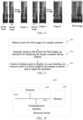
- the electronic device may generate a three-dimensional representative and/or an animation for displaying a sample container. Referring to FIG. 9 , the method includes the following steps.
- Step 901 Obtaining at least two first images of a sample container loaded with a blood sample, where the at least two first images are obtained by imaging the sample container before an analysis device performs sample analysis. For example, the at least two first images are obtained by imaging the sample container during rotation before the analysis device performs sample analysis.
- each first image at least partially displays at least part of the blood sample in the sample container.
- Step 902 Generating, based on the at least two first images, a rotatable three-dimensional representative, e.g. a three-dimensional image of the sample container containing the blood sample, and/or an animation for displaying from different angles the sample container containing the blood sample, for example, generating an animation for displaying the sample container during rotation.
- a rotatable three-dimensional representative e.g. a three-dimensional image of the sample container containing the blood sample
- an animation for displaying from different angles the sample container containing the blood sample for example, generating an animation for displaying the sample container during rotation.
- step 902 for implementation process of step 902, reference is made to the above implementation process in which the processor 105 generates the three-dimensional representative and/or the animation of the sample container. Details are not described herein again.
- the method further includes:
- the method further includes: in response to a first set instruction, controlling the display screen to display the three-dimensional representative and/or the animation on the user interface, for example, to display the three-dimensional image in animation, and optionally, controlling the display screen to display the three-dimensional representative, e.g. the three-dimensional image in rotation on the user interface.
- the first set instruction is entered by a user through the user interface.
- the user may enter the first set instruction through the user interface based on an actual need, and the electronic device controls, in response to the first set instruction, the display screen to output, on the user interface, the three-dimensional representative and/or the animation for displaying the sample container, for example, the sample container in rotation, so that the user can observe whether the blood sample in the sample container is abnormal. This may reduce data processing of the processor.
- the method further includes: when the analysis result does not satisfy a preset condition, automatically generating the first set instruction, or controlling the display screen to output, on the user interface, prompt information indicating that the analysis result does not satisfy the preset condition, and the three-dimensional representative and/or the animation.
- At least one image parameter of the preset image frame meets a preset parameter requirement, where the at least one image parameter includes at least one of the following:
- the method further includes:
- generating, based on the at least two first images, an animation for displaying from different angles the sample container containing the blood sample includes: performing frame interpolation on the at least two first images, to generate the animation for displaying the sample container during rotation.
- performing frame interpolation on the at least two first images includes:
- generating, based on the at least two first images, a rotatable three-dimensional representative of the sample container containing the blood sample includes: generating, as the three-dimensional representative, a rotatable three-dimensional image or a rotatable three-dimensional model of the sample container containing the blood sample, based on the at least two first images.
- the electronic device may display the analysis result of the blood sample in the sample container and the three-dimensional representative and/or the animation of the same sample container, on the user interface, and the user may review, based on the analysis result of the blood sample output in the user interface, whether the blood sample is abnormal, without visually determining whether quality of the blood sample is abnormal, so that efficiency in reviewing the blood sample can be improved.
- whether the analysis result is accurate may be further checked or re-checked by using the three-dimensional representative and/or the animation of the sample container when the analysis result indicates that the blood sample is abnormal, so that accuracy and reliability of the review result of the blood sample can be improved.
- an embodiment of the disclosure further provides an electronic device.
- the electronic device 1000 includes:
- the processor 1002 is configured to: obtain at least two first images of a sample container; generate, based on the at least two first images, a rotatable three-dimensional representative of the sample container containing a blood sample, and/or an animation for displaying from different angles the sample container containing the blood sample, for example, generate an animation for displaying the sample container during rotation; and control a display screen to display an analysis result of the blood sample in the sample container, and to output the three-dimensional representative and/or the animation, on a user interface, where the at least two first images are obtained by imaging the sample container before an analysis device performs sample analysis.
- the processor 1002 is further configured to: perform image stitching on the at least two first images, to obtain a third image; and control the display screen to display the analysis result of the blood sample in the sample container, and to output the third image, on the user interface.
- the processor 1002 is further configured to control the display screen to output prompt information on the user interface when the analysis result does not satisfy a preset condition, where the prompt information is used to prompt the user to enter the first set instruction through the user interface.
- At least one image parameter of the preset image frame meets a preset parameter requirement, where the at least one image parameter includes at least one of the following:
- the processor 1002 is specifically configured to perform frame interpolation on the at least two first images, to generate the animation for displaying the sample container during rotation.
- bus system 1004. is configured to implement connection and communication between these components.
- the bus system 1004 further includes a power bus, a control bus, and a status signal bus.
- various buses are marked as the bus system 1004 in FIG. 10 .
- the memory 1003 in embodiments of the disclosure is configured to store various types of data to support the operation of the electronic device 1000.
- Examples of such data include any computer program for the operation on the electronic device 1000.
- the method disclosed in the foregoing embodiment of the disclosure may be applied to the processor 1002, or may be implemented by the processor 1002.
- the processor 1002 may be an integrated circuit chip having a signal processing capability. During implementation, each step of the method may be completed by an integrated logic circuit of hardware in the processor 1002 or an instruction in the form of software.
- the above processor 1002 may be a general-purpose processor, a digital signal processor (DSP) or other programmable logic devices, a discrete gate or a transistor logic device, a discrete hardware component, or the like.
- DSP digital signal processor
- the processor 1002 may implement or perform various methods, steps, and logic block diagrams disclosed in the embodiments of the disclosure.
- the general-purpose processor may be a microprocessor, any conventional processor, or the like.
- the electronic device 1000 may be implemented by one or more application-specific integrated circuits (ASICs), DSPs, programmable logic devices (PLDs), complex programmable logic devices (CPLDs), field programmable gate arrays (FPGAs), general-purpose processors, controllers, microcontroller units (MCUs), microprocessors (microprocessors), or other electronic components for performing the above method.
- ASICs application-specific integrated circuits
- DSPs programmable logic devices
- CPLDs complex programmable logic devices
- FPGAs field programmable gate arrays
- general-purpose processors controllers, microcontroller units (MCUs), microprocessors (microprocessors), or other electronic components for performing the above method.
- MCUs microcontroller units
- microprocessors microprocessors
- the memory (memory 1003) in embodiments of the disclosure may be a volatile memory or a non-volatile memory, or may include both a volatile memory and a non-volatile memory.
- the non-volatile memory may be a read-only memory (ROM), a programmable read-only memory (PROM), an erasable programmable read-only memory (EPROM), an electrically erasable programmable read-only memory (EEPROM), a ferromagnetic random access memory (FRAM), a flash Memory, a magnetic surface memory, an optical disc, or a compact disc read-only memory (CD-ROM).
- the magnetic surface memory may be a disk memory or a magnetic tape memory.
- the volatile memory may be a random access memory (RAM), which acts as an external cache.
- RAM random access memory
- many forms of RAMs may be used, such as a static random access memory (SRAM), a synchronous static random access memory (SSRAM), a dynamic random access memory (DRAM), a synchronous dynamic random access memory (SDRAM), a double data rate synchronous dynamic random access memory (DDR SDRAM), an enhanced synchronous dynamic random access memory (ESDRAM), a synclink dynamic random access memory (SLDRAM), and a direct rambus random access memory (DR RAM).
- SRAM static random access memory
- SSRAM synchronous static random access memory
- DRAM dynamic random access memory
- SDRAM synchronous dynamic random access memory
- DDR SDRAM double data rate synchronous dynamic random access memory
- ESDRAM enhanced synchronous dynamic random access memory
- SLDRAM synclink dynamic random access memory
- DR RAM direct rambus random access memory
- an embodiment of the disclosure further provides a storage medium, such as a computer storage medium, specifically a computer-readable storage medium, for example, including the memory 1003 storing a computer program that may be executed by the processor 1002 of the electronic device 1000 to perform the steps of the method from the electronic device side.
- the computer-readable storage medium may be a memory such as a FRAM, a ROM, a PROM, an EPROM, an EEPROM, a flash memory, a magnetic surface memory, an optical disc, or a CD-ROM.
Landscapes
- Health & Medical Sciences (AREA)
- Life Sciences & Earth Sciences (AREA)
- Engineering & Computer Science (AREA)
- Chemical & Material Sciences (AREA)
- General Health & Medical Sciences (AREA)
- Biochemistry (AREA)
- Biomedical Technology (AREA)
- Pathology (AREA)
- Immunology (AREA)
- General Physics & Mathematics (AREA)
- Physics & Mathematics (AREA)
- Analytical Chemistry (AREA)
- Urology & Nephrology (AREA)
- Medicinal Chemistry (AREA)
- Food Science & Technology (AREA)
- Molecular Biology (AREA)
- Hematology (AREA)
- Business, Economics & Management (AREA)
- General Business, Economics & Management (AREA)
- Epidemiology (AREA)
- Medical Informatics (AREA)
- Primary Health Care (AREA)
- Public Health (AREA)
- Investigating Or Analysing Biological Materials (AREA)
- Ultra Sonic Daignosis Equipment (AREA)
Applications Claiming Priority (2)
| Application Number | Priority Date | Filing Date | Title |
|---|---|---|---|
| CN202311798514 | 2023-12-25 | ||
| CN202411605029 | 2024-11-11 |
Publications (1)
| Publication Number | Publication Date |
|---|---|
| EP4579680A1 true EP4579680A1 (fr) | 2025-07-02 |
Family
ID=94117134
Family Applications (1)
| Application Number | Title | Priority Date | Filing Date |
|---|---|---|---|
| EP24223279.1A Pending EP4579680A1 (fr) | 2023-12-25 | 2024-12-25 | Système d'analyse d'échantillon et procédé d'affichage d'informations d'échantillon |
Country Status (2)
| Country | Link |
|---|---|
| EP (1) | EP4579680A1 (fr) |
| CN (1) | CN120214346A (fr) |
Citations (2)
| Publication number | Priority date | Publication date | Assignee | Title |
|---|---|---|---|---|
| WO2017132168A1 (fr) * | 2016-01-28 | 2017-08-03 | Siemens Healthcare Diagnostics Inc. | Procédés et appareil pour caractérisation multi-vue |
| US20230097384A1 (en) * | 2020-04-09 | 2023-03-30 | Hitachi High-Tech Corporation | Biological sample analysis device |
-
2024
- 2024-12-19 CN CN202411888866.0A patent/CN120214346A/zh active Pending
- 2024-12-25 EP EP24223279.1A patent/EP4579680A1/fr active Pending
Patent Citations (2)
| Publication number | Priority date | Publication date | Assignee | Title |
|---|---|---|---|---|
| WO2017132168A1 (fr) * | 2016-01-28 | 2017-08-03 | Siemens Healthcare Diagnostics Inc. | Procédés et appareil pour caractérisation multi-vue |
| US20230097384A1 (en) * | 2020-04-09 | 2023-03-30 | Hitachi High-Tech Corporation | Biological sample analysis device |
Also Published As
| Publication number | Publication date |
|---|---|
| CN120214346A (zh) | 2025-06-27 |
Similar Documents
| Publication | Publication Date | Title |
|---|---|---|
| JP6651537B2 (ja) | 視覚システムのための画像ベースチューブスロット円検出 | |
| EP4134677B1 (fr) | Dispositif d'analyse d'échantillon biologique | |
| TWI900505B (zh) | 執行分析測量的方法及相關電腦程式、電腦可讀取儲存媒體、行動裝置及套組 | |
| US12481146B2 (en) | Sample image capturing system and method, and computer-readable storage medium | |
| US20250321241A1 (en) | Methods and apparatus for determining a viewpoint for inspecting a sample within a sample container | |
| WO2023031622A1 (fr) | Système et procédé d'identification et de comptage d'espèces biologiques | |
| CN111488846A (zh) | 一种识别水位的方法及设备 | |
| CN114339046A (zh) | 基于自动旋转试管的图像采集方法、装置、设备及介质 | |
| EP4579680A1 (fr) | Système d'analyse d'échantillon et procédé d'affichage d'informations d'échantillon | |
| CN115359412B (zh) | 一种盐酸中和实验评分方法、装置、设备及可读存储介质 | |
| CN115901624A (zh) | 一种回转体零件瑕疵检测装置 | |
| CN119780402A (zh) | 样本分析系统及样本分析方法、电子设备及存储介质 | |
| CN112557105A (zh) | 自动取样设备和自动取样方法 | |
| JPH09145594A (ja) | 臨床検査における反応済検体の粒子凝集パターンの判定方法及び粒子凝集パターンの表示とプリント方式 | |
| CN114359799A (zh) | 一种病理样本的实时监测系统 | |
| JP2024002211A (ja) | 試料状態判定装置、試料状態判定方法及び試料検査装置 | |
| CN114858795A (zh) | 样本图像获取系统、样本图像获取方法及可读存储介质 | |
| WO2025112057A1 (fr) | Système et procédé de reconnaissance d'échantillon, dispositif de commande et support de stockage | |
| JPH0896134A (ja) | 画像処理装置および画像処理方法 | |
| JP7693729B2 (ja) | 組織カセットリーダ | |
| US20230306630A1 (en) | Image analysis server, object counting method using image analysis server, and object counting syste | |
| US20240290085A1 (en) | Classification of interference with diagnostic testing of defects in blank test cards | |
| TWI770561B (zh) | 產品瑕疵檢測方法、電腦裝置及儲存介質 | |
| CN117336594A (zh) | 一种物品图像采集系统及采集方法 | |
| CN115754267A (zh) | 胶体金免疫层析检测方法及装置、设备、存储介质 |
Legal Events
| Date | Code | Title | Description |
|---|---|---|---|
| PUAI | Public reference made under article 153(3) epc to a published international application that has entered the european phase |
Free format text: ORIGINAL CODE: 0009012 |
|
| STAA | Information on the status of an ep patent application or granted ep patent |
Free format text: STATUS: REQUEST FOR EXAMINATION WAS MADE |
|
| 17P | Request for examination filed |
Effective date: 20250117 |
|
| AK | Designated contracting states |
Kind code of ref document: A1 Designated state(s): AL AT BE BG CH CY CZ DE DK EE ES FI FR GB GR HR HU IE IS IT LI LT LU LV MC ME MK MT NL NO PL PT RO RS SE SI SK SM TR |
|
| GRAP | Despatch of communication of intention to grant a patent |
Free format text: ORIGINAL CODE: EPIDOSNIGR1 |
|
| STAA | Information on the status of an ep patent application or granted ep patent |
Free format text: STATUS: GRANT OF PATENT IS INTENDED |