EP4578337A1 - Tooth brush, and method of manufacturing thereof - Google Patents
Tooth brush, and method of manufacturing thereof Download PDFInfo
- Publication number
- EP4578337A1 EP4578337A1 EP24210428.9A EP24210428A EP4578337A1 EP 4578337 A1 EP4578337 A1 EP 4578337A1 EP 24210428 A EP24210428 A EP 24210428A EP 4578337 A1 EP4578337 A1 EP 4578337A1
- Authority
- EP
- European Patent Office
- Prior art keywords
- length
- section
- user
- brush
- handle section
- Prior art date
- Legal status (The legal status is an assumption and is not a legal conclusion. Google has not performed a legal analysis and makes no representation as to the accuracy of the status listed.)
- Granted
Links
Images

Classifications
-
- A—HUMAN NECESSITIES
- A46—BRUSHWARE
- A46B—BRUSHES
- A46B5/00—Brush bodies; Handles integral with brushware
- A46B5/02—Brush bodies; Handles integral with brushware specially shaped for holding by the hand
-
- A—HUMAN NECESSITIES
- A46—BRUSHWARE
- A46B—BRUSHES
- A46B5/00—Brush bodies; Handles integral with brushware
- A46B5/0095—Removable or interchangeable brush heads
-
- A—HUMAN NECESSITIES
- A46—BRUSHWARE
- A46B—BRUSHES
- A46B2200/00—Brushes characterized by their functions, uses or applications
- A46B2200/10—For human or animal care
- A46B2200/1066—Toothbrush for cleaning the teeth or dentures
Definitions
- Patent Literature 1 Japanese Utility Model Registration No. 3227573
- the tooth brush is used by being held by a user's hand, but the size of the hand varies depending on the gender, age, height, and the like of the user.
- conventional tooth brushes are roughly classified into types such as those for children and those for adults. Therefore, the tooth brush is not adapted to the user, and it cannot be said that the excessive brushing pressure at the time of use can be sufficiently suppressed.
- the present invention provides a tooth brush suitable for a user which can suppress excessive brushing pressure and control the brushing pressure to an appropriate brushing pressure at the time of use, and a method of manufacturing thereof.
- first member and the second member are configured to be attachable/detachable. Therefore, the first member having the handle section customized for the user can be attached to the second member. In addition, the first member and the second member can be replaced according to the user. This facilitates customization according to the user.
- the length of the brush of the head section of the second member may be a length set based on a condition in the oral cavity of the user.
- the brush of the head section is suited to the condition in the oral cavity of the user. Therefore, in addition to the first member, the second member can also be customized for the user. In addition, it is possible to further exhibit the effect of suppressing the excessive brushing pressure and controlling the brushing pressure to an appropriate brushing pressure at the time of use.
- the first member having the handle section can be easily customized according to the user.
- the attachment step the first member customized for the user is attached to the second member.
- the tooth brush customized for the user can be easily obtained.
- the back end portion of the handle section of the first member may have a triangular cross-section orthogonal to the longitudinal direction of the handle section. In this case, it is possible to obtain the tooth brush in which excessive brushing pressure can be further suppressed and the brushing pressure can be easily controlled to an appropriate brushing pressure at the time of use.
- the length of the middle finger of the hand of the user is further measured, and the length of the neck section of the second member prepared in the second preparation step may be a length set based on the length of the middle finger of the hand of the user measured in the measurement step.
- the length of the neck section becomes a length suitable for the user, so that it is easy to use for the user.
- the length of the brush of the head section of the second member prepared in the second preparation step is a length set based on the condition in the oral cavity of the user.
- the brush of the head section is suited to the condition in the oral cavity of the user. Therefore, in addition to the first member, the second member can also be easily customized for the user.
- the hardness of the brush of the head section of the second member prepared in the second preparation step is a hardness set based on the condition in the oral cavity of the user.
- the brush of the head section is suited to the condition in the oral cavity of the user. Therefore, in addition to the first member, the second member can also be easily customized for the user.
- a tooth brush 1 of the present embodiment is used when brushing teeth, and includes two members, a first member 11 and a second member 12.
- materials of the first member 11 and the second member 12 various synthetic resins, wood, and the like can be used.
- the first member 11 constitutes a back side portion of the tooth brush 1.
- various synthetic resins, wood, and the like can be used.
- the first member 11 has a handle section 2 serving as a portion of the handle of the tooth brush 1.
- the handle section 2 is a portion where the user holds the tooth brush 1 by hand.
- the first member 11 includes only the handle section 2.
- a distal end portion 201 of the handle section 2 is coupled to the second member 12.
- the handle section 2 is formed in a triangular prism shape.
- the handle section 2 has three side surfaces, a first side surface 211, a second side surface 212, and a third side surface 213.
- the third side surface 213 is formed on the rear surface side of the tooth brush 1.
- the rear surface side of the tooth brush 1 is a side opposite to a side (front surface side) of a head section 3 on which a brush 31 to be described later is provided.
- a length C of the handle section 2 is a length in the longitudinal direction (axial direction) B of the handle section 2.
- the length C of the handle section 2 is a length set based on the length of the palm of the user. That is, the length of the handle section 2 is adjusted to match the length of the palm of the user. The setting of the length C of the handle section 2 will be described later.
- the second member 12 constitutes a tip side portion of the tooth brush 1.
- the second member 12 includes a head section 3 and a neck section 4.
- the second member 12 integrally constitutes the head section 3 and the neck section 4.
- the head section 3 is provided at a distal end portion of the second member 12.
- the neck section 4 is provided between the head section 3 and the first member 11 (handle section 2).
- a back end portion 401 of the neck section 4 is coupled to the first member 11.
- the second member 12 has an inclined portion 121 inclined toward the rear surface side of the tooth brush 1 with respect to the longitudinal direction B of the handle section 2.
- the inclined portion 121 is formed of a portion of the second member 12 excluding the back end portion 401 of the neck section 4. That is, the inclined portion 121 is configured to include the head section 3 and a portion of the neck section 4 excluding the back end portion 401.
- the inclined portion 121 is bent and extended from the back end portion 401 of the neck section 4 extending in the longitudinal direction B of the handle section 2 toward the rear surface side of the tooth brush 1.
- the inclined portion 121 is formed in a thin plate shape having a predetermined thickness.
- the inclined portion 121 is inclined toward the rear surface side of the tooth brush 1 so as to form an angle D with respect to the longitudinal direction B of the handle section 2.
- the inclination angle D of the inclined portion 121 is 20°.
- the inclination angle D of the inclined portion 121 is constant over the entire inclined portion 121. Note that the inclination angle D of the inclined portion 121 can be set within a range of greater than or equal to 10° and less than or equal to 30°.
- the head section 3 is provided with a brush surface 301.
- the brush surface 301 is formed on the front surface side of the tooth brush 1. Similarly to the inclined portion 121, the brush surface 301 is inclined so as to form an angle D with respect to the longitudinal direction B of the handle section 2.
- the brush surface 301 of head section 3 is provided with a brush 31.
- the brush 31 includes a plurality of bristle bundles 311.
- the plurality of bristle bundles 311 are implanted in a plurality of circular recesses provided on the brush surface 301.
- the bristle bundle 311 is configured by bundling a plurality of bristles having a predetermined thickness.
- the brush 31 is provided in the entire region of the brush surface 301 of the head section 3 (the bristle bundle 311 is implanted).
- nylon, saturated polyester resin (PBT), or the like can be used as a material of the brush 31, nylon, saturated polyester resin (PBT), or the like can be used.
- the length E of the neck section 4 is set based on the length of the middle finger of the hand of the user. That is, the neck section 4 is adjusted to a length corresponding to the length of the middle finger of the hand of the user. Note that the setting of the length E of the neck section 4 will be described later.
- a length F of the brush 31 of the head section 3 is a length set based on a condition in the oral cavity of the user.
- the length F of the brush 31 is a length from the brush surface 301 of the head section 3. That is, length F of brush 31 refers to a length (height) of a portion exposed from the brush surface 301 of head section 3.
- a coupling recess 22 for coupling the second member 12 is provided at the distal end portion 201 of the handle section 2 of the first member 11.
- the coupling recess 22 is provided so as to be recessed from the distal end face of the distal end portion 201 of the handle section 2.
- the back end portion 401 of the neck section 4 of the second member 12 is provided with a coupling projection 41 for coupling the first member 11.
- the coupling projection 41 is provided so as to project out from the back end face of the back end portion 401 of the neck section 4.
- the user brushes his/her teeth with his/her dominant hand (right hand in Fig. 6 ) holding the back end portion 202 of the handle section 2 of the tooth brush 1.
- the thumb of the dominant hand supports the first side surface 211
- the index finger supports the third side surface 213, and the middle finger supports the second side surface 212. Then, the teeth are brushed in a state where the back end portion 202 of the handle section 2 of the tooth brush 1 is held by three fingers of the thumb, the index finger, and the middle finger of the dominant hand.
- a length C of the handle section 2 of the first member 11 prepared in the first preparation step is a length set based on the length g1 of the palm of the user measured in the measurement step. That is, the length of the handle section 2 is selected according to the length of the palm of the user, and the first member 11 having the handle section 2 of the selected length is prepared. The first member 11 is thereby customized for the user.
- the length C of the handle section 2 is 85 mm based on the length g1 of the palm of the user (the child himself/herself), and the length E of the neck section 4 is 65 mm based on the length g2 of the middle finger of the hand of the user.
- the length F of the brush 31 and the thickness (hardness) of the bristles are set to 9 mm and 5 mil, respectively.
- the length C of the handle section 2 is 90 mm based on the length g1 of the palm of the user (guardian)
- the length E of the neck section 4 is 70 mm based on the length g2 of the middle finger of the hand of the user.
- the length F of the brush 31 and the thickness (hardness) of the bristles are set to 8 mm and 4 mil, respectively.
- the length C of the handle section 2 of the first member 11, which is a portion held by the user's hand, is a length set based on the length g1 of the palm of the user. Therefore, the length C of the handle section 2 is a length suitable for the user, so that the user can easily hold the handle section 2. As a result, it is possible to suppress an excessive brushing pressure and control the brushing pressure to an appropriate brushing pressure at the time of use (at the time of brushing teeth).
- first member 11 and the second member 12 are configured to be attachable/detachable. Therefore, the first member 11 having the handle section 2 customized for the user can be attached to the second member 12. In addition, the first member 11 and the second member 12 can be replaced according to the user. This facilitates customization according to the user.
- the back end portion 202 of the handle section 2 of the first member 11 has a triangular cross-section orthogonal to the longitudinal direction B of the handle section 2. Therefore, the back end portion 202 of the handle section 2 can be held by three fingers, the thumb, the index finger, and the middle finger. As a result, the excessive brushing pressure is further suppressed and it becomes easy to control the brushing pressure to an appropriate brushing pressure at the time of use.
- the second member 12 includes the head section 3 and includes an inclined portion 121 inclined toward the rear surface side of the tooth brush 1 so as to form an angle (angle D) of 20° with respect to the longitudinal direction B of the handle section 2. Therefore, the head section 3 provided with the brush 31 can be inclined with respect to the handle section 2. As a result, the excessive brushing pressure is further suppressed and it becomes easy to control the brushing pressure to an appropriate brushing pressure at the time of use.
- the length E of the neck section 4 of the second member 12 is a length set based on the length g2 of the middle finger of the hand of the user. Therefore, the length E of the neck section 4 becomes a length suitable for the user, thereby facilitating use by the user. As a result, the excessive brushing pressure is further suppressed and it becomes easy to control the brushing pressure to an appropriate brushing pressure at the time of use.
- the length F and the hardness (hair thickness) of the brush 31 of the head section 3 of the second member 12 are length and hardness set based on the condition in the oral cavity of the user.
- the brush 31 of the head section 3 is thus suited to the condition in the oral cavity of the user. Therefore, in addition to the first member 11, the second member 12 can also be customized for the user. In addition, it is possible to further exhibit the effect of suppressing the excessive brushing pressure and controlling the brushing pressure to an appropriate brushing pressure at the time of use.
- the first member 11 having the handle section 2 which is a portion held by the user's hand is prepared.
- the length C of the handle section 2 is a length set based on the length g1 of the palm of the user measured in the measurement step. Therefore, the length C of the handle section 2 is a length suitable for the user, so that the user can easily hold the handle section 2.
- the tooth brush 1 in which excessive brushing pressure can be suppressed and the brushing pressure can be controlled to an appropriate brushing pressure at the time of use.
- the first member 11 having the handle section 2 can be easily customized according to the user.
- the attachment step the first member 11 customized for the user is attached to the second member 12.
- the tooth brush 1 customized for the user can be easily obtained.
- the length E of the neck section 4 of the second member 12 prepared in the second preparation step is set to a length set based on the length g2 of the middle finger of the hand of the user measured in the measurement step. Therefore, the length E of the neck section 4 becomes a length suitable for the user, thereby facilitating use by the user. As a result, it is possible to obtain the tooth brush 1 in which excessive brushing pressure can be further suppressed and the brushing pressure can be easily controlled to an appropriate brushing pressure at the time of use.
- the length F and the hardness (hair thickness) of the brush 31 of the head section 3 of the second member 12 prepared in the second preparation step are length and hardness set based on the condition in the oral cavity of the user.
- the brush 31 of the head section 3 is thus suited to the condition in the oral cavity of the user. Therefore, in addition to the first member 11, the second member 12 can also be easily customized for the user.
Landscapes
- Brushes (AREA)
Abstract
Description
- The present invention relates to a tooth brush and a method of manufacturing thereof.
- Conventionally, there are various tooth brushes that suppress excessive brushing pressure at the time of use in order to prevent symptoms such as gingivitis and periodontitis in the oral cavity. For example,
Patent Literature 1 discloses a tooth brush provided with a spring member between a head member and a handle member, the spring member being configured to be detachable from both members and the spring member being elastically deformable. - Patent Literature 1:
Japanese Utility Model Registration No. 3227573 - The tooth brush is used by being held by a user's hand, but the size of the hand varies depending on the gender, age, height, and the like of the user. However, conventional tooth brushes are roughly classified into types such as those for children and those for adults. Therefore, the tooth brush is not adapted to the user, and it cannot be said that the excessive brushing pressure at the time of use can be sufficiently suppressed.
- The present invention provides a tooth brush suitable for a user which can suppress excessive brushing pressure and control the brushing pressure to an appropriate brushing pressure at the time of use, and a method of manufacturing thereof.
- A tooth brush according to one aspect of the present invention includes a first member having a handle section, and a second member having a head section provided with a brush and a neck section. The first member and the second member are configured to be attachable/detachable. A length of the handle section of the first member is a length set based on a length of a palm of a user.
- According to the above tooth brush, the length of the handle section of the first member, which is a portion held by the user's hand, is a length set based on the length of the palm of the user. Therefore, the length of the handle section is a length suitable for the user, so that the user can easily hold the handle section. As a result, it is possible to suppress an excessive brushing pressure and control the brushing pressure to an appropriate brushing pressure at the time of use (at the time of brushing teeth).
- In addition, the first member and the second member are configured to be attachable/detachable. Therefore, the first member having the handle section customized for the user can be attached to the second member. In addition, the first member and the second member can be replaced according to the user. This facilitates customization according to the user.
- In the above-described tooth brush, the back end portion of the handle section of the first member may have a triangular cross-section orthogonal to the longitudinal direction of the handle section. In this case, the back end portion of the handle section can be held by three fingers, the thumb, the index finger, and the middle finger. As a result, the excessive brushing pressure is further suppressed and it becomes easy to control the brushing pressure to an appropriate brushing pressure at the time of use.
- Furthermore, the length of the neck section of the second member is a length set based on the length of the middle finger of the hand of the user. In this case, the length of the neck section becomes a length suitable for the user, so that it is easy to use for the user. As a result, the excessive brushing pressure is further suppressed and it becomes easy to control the brushing pressure to an appropriate brushing pressure at the time of use.
- In addition, the second member may include a head section, and may have an inclined portion inclined toward the rear surface side of the tooth brush so as to form an angle of greater than or equal to 10° and less than or equal to 30° with respect to the longitudinal direction of the handle section. Therefore, the head section provided with the brush can be inclined with respect to the handle section. As a result, the excessive brushing pressure is further suppressed and it becomes easy to control the brushing pressure to an appropriate brushing pressure at the time of use.
- Furthermore, the length of the brush of the head section of the second member may be a length set based on a condition in the oral cavity of the user. In this case, the brush of the head section is suited to the condition in the oral cavity of the user. Therefore, in addition to the first member, the second member can also be customized for the user. In addition, it is possible to further exhibit the effect of suppressing the excessive brushing pressure and controlling the brushing pressure to an appropriate brushing pressure at the time of use.
- Furthermore, the hardness of the brush of the head section of the second member may be a hardness set based on a condition in the oral cavity of the user. In this case, the brush of the head section is suited to the condition in the oral cavity of the user. Therefore, in addition to the first member, the second member can also be customized for the user. In addition, it is possible to further exhibit the effect of suppressing the excessive brushing pressure and controlling the brushing pressure to an appropriate brushing pressure at the time of use.
- A method of manufacturing a tooth brush according to another aspect of the present invention includes a measurement step of measuring a length of a palm of a user, a first preparation step of preparing a first member having a handle section, a second preparation step of preparing a second member having a head section provided with a brush and a neck section, and an attachment step of attaching the first member and the second member. A length of the handle section of the first member prepared in the first preparation step is a length set based on the length of the palm of the user measured in the measurement step.
- Furthermore, according to the method of manufacturing the tooth brush, in the first preparation step, the first member having the handle section which is a portion held by the user's hand is prepared. At this time, the length of the handle section is a length set based on the length of the palm of the user measured in the measurement step. Therefore, the length of the handle section is a length suitable for the user, so that the user can easily hold the handle section. As a result, it is possible to obtain the tooth brush in which excessive brushing pressure can be suppressed and the brushing pressure can be controlled to an appropriate brushing pressure at the time of use.
- Furthermore, in the first preparation step, the first member having the handle section can be easily customized according to the user. Then, in the attachment step, the first member customized for the user is attached to the second member. Thus, the tooth brush customized for the user can be easily obtained.
- In the method of manufacturing the tooth brush described above, the back end portion of the handle section of the first member may have a triangular cross-section orthogonal to the longitudinal direction of the handle section. In this case, it is possible to obtain the tooth brush in which excessive brushing pressure can be further suppressed and the brushing pressure can be easily controlled to an appropriate brushing pressure at the time of use.
- Furthermore, in the measurement step, the length of the middle finger of the hand of the user is further measured, and the length of the neck section of the second member prepared in the second preparation step may be a length set based on the length of the middle finger of the hand of the user measured in the measurement step. In this case, the length of the neck section becomes a length suitable for the user, so that it is easy to use for the user. As a result, it is possible to obtain the tooth brush in which excessive brushing pressure can be further suppressed and the brushing pressure can be easily controlled to an appropriate brushing pressure at the time of use.
- In addition, the second member may include a head section, and may have an inclined portion inclined toward the rear surface side of the tooth brush so as to form an angle of greater than or equal to 10° and less than or equal to 30° with respect to the longitudinal direction of the handle section. In this case, it is possible to obtain the tooth brush that can effectively exhibit the effects of suppressing excessive brushing pressure and controlling the brushing pressure to an appropriate brushing pressure.
- Furthermore, the length of the brush of the head section of the second member prepared in the second preparation step is a length set based on the condition in the oral cavity of the user. In this case, the brush of the head section is suited to the condition in the oral cavity of the user. Therefore, in addition to the first member, the second member can also be easily customized for the user.
- Furthermore, the hardness of the brush of the head section of the second member prepared in the second preparation step is a hardness set based on the condition in the oral cavity of the user. In this case, the brush of the head section is suited to the condition in the oral cavity of the user. Therefore, in addition to the first member, the second member can also be easily customized for the user.
-
-
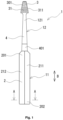
Fig. 1 is a front view of a tooth brush of the present embodiment. -
Fig. 2 is a rear view of the tooth brush of the present embodiment. -
Fig. 3 is a side view of the tooth brush of the present embodiment. -
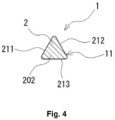
Fig. 4 is a cross-sectional view taken along line A-A ofFig. 1 . -
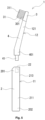
Fig. 5 is an explanatory view illustrating a state in which a first member and a second member of the tooth brush of the present embodiment are separated. -
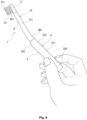
Fig. 6 is an explanatory view illustrating a method of using the tooth brush of the present embodiment. -
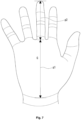
Fig. 7 is an explanatory view illustrating a length of a palm and a length of a middle finger of a hand of a user to be measured in a measurement step in the method of manufacturing a tooth brush of the present embodiment. -
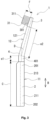
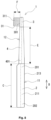
Fig. 8 is a side view of a tooth brush of another embodiment. - Hereinafter, embodiments of the present invention will be described with reference to the drawings.
- As illustrated in
Figs. 1 to 3 , atooth brush 1 of the present embodiment is used when brushing teeth, and includes two members, afirst member 11 and asecond member 12. As materials of thefirst member 11 and thesecond member 12, various synthetic resins, wood, and the like can be used. - The
first member 11 constitutes a back side portion of thetooth brush 1. As a material of thefirst member 11, various synthetic resins, wood, and the like can be used. Thefirst member 11 has ahandle section 2 serving as a portion of the handle of thetooth brush 1. Thehandle section 2 is a portion where the user holds thetooth brush 1 by hand. In the present embodiment, thefirst member 11 includes only thehandle section 2. Adistal end portion 201 of thehandle section 2 is coupled to thesecond member 12. - The
handle section 2 is formed in a triangular prism shape. Thehandle section 2 has three side surfaces, afirst side surface 211, asecond side surface 212, and athird side surface 213. Among these, thethird side surface 213 is formed on the rear surface side of thetooth brush 1. Here, the rear surface side of thetooth brush 1 is a side opposite to a side (front surface side) of ahead section 3 on which abrush 31 to be described later is provided. - As illustrated in
Fig. 4 , thehandle section 2 has a triangular cross-section orthogonal to the longitudinal direction (axial direction) B of thehandle section 2 as a whole including aback end portion 202. In the present embodiment, thehandle section 2 has an equilateral triangular cross-section orthogonal to the longitudinal direction B of thehandle section 2. Three corner portions formed by three side surfaces (first side surface 211,second side surface 212, and third side surface 213) of thehandle section 2 are chamfered R surfaces (curved surfaces). - As illustrated in
Fig. 3 , a length C of thehandle section 2 is a length in the longitudinal direction (axial direction) B of thehandle section 2. The length C of thehandle section 2 is a length set based on the length of the palm of the user. That is, the length of thehandle section 2 is adjusted to match the length of the palm of the user. The setting of the length C of thehandle section 2 will be described later. - As illustrated in
Figs. 1 to 3 , thesecond member 12 constitutes a tip side portion of thetooth brush 1. As a material of thesecond member 12, various synthetic resins, wood, and the like can be used. Thesecond member 12 includes ahead section 3 and aneck section 4. In the present embodiment, thesecond member 12 integrally constitutes thehead section 3 and theneck section 4. Thehead section 3 is provided at a distal end portion of thesecond member 12. Theneck section 4 is provided between thehead section 3 and the first member 11 (handle section 2). Aback end portion 401 of theneck section 4 is coupled to thefirst member 11. - The
second member 12 has aninclined portion 121 inclined toward the rear surface side of thetooth brush 1 with respect to the longitudinal direction B of thehandle section 2. Theinclined portion 121 is formed of a portion of thesecond member 12 excluding theback end portion 401 of theneck section 4. That is, theinclined portion 121 is configured to include thehead section 3 and a portion of theneck section 4 excluding theback end portion 401. - The
inclined portion 121 is bent and extended from theback end portion 401 of theneck section 4 extending in the longitudinal direction B of thehandle section 2 toward the rear surface side of thetooth brush 1. Theinclined portion 121 is formed in a thin plate shape having a predetermined thickness. Theinclined portion 121 is inclined toward the rear surface side of thetooth brush 1 so as to form an angle D with respect to the longitudinal direction B of thehandle section 2. In the present embodiment, the inclination angle D of theinclined portion 121 is 20°. Furthermore, the inclination angle D of theinclined portion 121 is constant over the entireinclined portion 121. Note that the inclination angle D of theinclined portion 121 can be set within a range of greater than or equal to 10° and less than or equal to 30°. - The
head section 3 is provided with abrush surface 301. Thebrush surface 301 is formed on the front surface side of thetooth brush 1. Similarly to theinclined portion 121, thebrush surface 301 is inclined so as to form an angle D with respect to the longitudinal direction B of thehandle section 2. - The
brush surface 301 ofhead section 3 is provided with abrush 31. Thebrush 31 includes a plurality of bristle bundles 311. The plurality of bristle bundles 311 are implanted in a plurality of circular recesses provided on thebrush surface 301. Thebristle bundle 311 is configured by bundling a plurality of bristles having a predetermined thickness. In the present embodiment, thebrush 31 is provided in the entire region of thebrush surface 301 of the head section 3 (thebristle bundle 311 is implanted). As a material of thebrush 31, nylon, saturated polyester resin (PBT), or the like can be used. - As illustrated in
Fig. 3 , the length E of theneck section 4 is set based on the length of the middle finger of the hand of the user. That is, theneck section 4 is adjusted to a length corresponding to the length of the middle finger of the hand of the user. Note that the setting of the length E of theneck section 4 will be described later. - In the present embodiment, the length E of the
neck section 4 is a length (E=e1+e2) obtained by adding an axial length e1 of theback end portion 401 of theneck section 4 and an axial length e2 of the portion of theneck section 4 in theinclined portion 121. - A length F of the
brush 31 of thehead section 3 is a length set based on a condition in the oral cavity of the user. The length F of thebrush 31 is a length from thebrush surface 301 of thehead section 3. That is, length F ofbrush 31 refers to a length (height) of a portion exposed from thebrush surface 301 ofhead section 3. - The hardness of the
brush 31 of thehead section 3 is a hardness set based on a condition in the oral cavity of the user. The hardness of thebrush 31 can be adjusted by the thickness of bristles of thebrush 31. The hardness of thebrush 31 becomes soft by thinning the thickness of the bristles of thebrush 31, and the hardness of thebrush 31 becomes hard by thickening the thickness of the bristles of thebrush 31. - That is, the length F and the hardness of the
brush 31 of thehead section 3 are adjusted to a length and a hardness corresponding to a condition in the oral cavity of the user. Note that the setting of the length F and the hardness of thebrush 31 will be described later. - As illustrated in
Fig. 5 , acoupling recess 22 for coupling thesecond member 12 is provided at thedistal end portion 201 of thehandle section 2 of thefirst member 11. Thecoupling recess 22 is provided so as to be recessed from the distal end face of thedistal end portion 201 of thehandle section 2. - The
back end portion 401 of theneck section 4 of thesecond member 12 is provided with acoupling projection 41 for coupling thefirst member 11. Thecoupling projection 41 is provided so as to project out from the back end face of theback end portion 401 of theneck section 4. - The
first member 11 and thesecond member 12 can be attached and detached by inserting thecoupling projection 41 of theneck section 4 of thesecond member 12 into thecoupling recess 22 of thehandle section 2 of thefirst member 11 or pulling out thecoupling projection 41 of theneck section 4 of thesecond member 12 from thecoupling recess 22 of thehandle section 2 of thefirst member 11. That is, thefirst member 11 and thesecond member 12 are configured to be attachable/detachable. Note that other conventionally known mechanisms or the like may be used for the coupling mechanism and the attaching/detaching mechanism between thefirst member 11 and thesecond member 12. - Next, a method of using the
tooth brush 1 of the present embodiment will be described. - As illustrated in
Fig. 6 , the user brushes his/her teeth with his/her dominant hand (right hand inFig. 6 ) holding theback end portion 202 of thehandle section 2 of thetooth brush 1. - Specifically, at the
back end portion 202 of thehandle section 2 of thetooth brush 1, the thumb of the dominant hand supports thefirst side surface 211, the index finger supports thethird side surface 213, and the middle finger supports thesecond side surface 212. Then, the teeth are brushed in a state where theback end portion 202 of thehandle section 2 of thetooth brush 1 is held by three fingers of the thumb, the index finger, and the middle finger of the dominant hand. - Next, a method of manufacturing (customizing) the
tooth brush 1 according to the present embodiment will be described. - First, a measurement step is performed. In the measurement step, as illustrated in
Fig. 7 , a length g1 of the palm of the dominant hand (the hand to hold thetooth brush 1, the right hand inFig. 7 ) of the user and a length g2 of the middle finger of the hand are measured. The length g1 of the palm of the user is a length (g1=G-g2) obtained by subtracting the length g2 of the middle finger of the hand from the length of the hand (so-called hand length) G of the user. In other words, the length G of the hand of the user is a length (G=g1+g2) obtained by adding the length g1 of the palm of the hand of the user and the length g2 of the middle finger of the hand of the user. Note that the length G of the hand of the user is a distance from the tip of the middle finger to the wrinkle of the wrist. - Next, a first preparation step of preparing the
first member 11 is performed. A length C of thehandle section 2 of thefirst member 11 prepared in the first preparation step is a length set based on the length g1 of the palm of the user measured in the measurement step. That is, the length of thehandle section 2 is selected according to the length of the palm of the user, and thefirst member 11 having thehandle section 2 of the selected length is prepared. Thefirst member 11 is thereby customized for the user. - Here, the length C of the
handle section 2 is preferably the same as the length g1 of the palm of the user. The length C of thehandle section 2 may be the same length as the length g1 of the palm of the user, or the length may be adjusted in a stepwise manner based on the length g1 of the palm of the user. - In the present embodiment, the length C of the
handle section 2 is 75 mm when the length g1 of the palm of the user is greater than 70 mm and less than or equal to 75 mm, 80 mm when the length g1 is greater than 75 mm and less than or equal to 80 mm, 85 mm when the length g1 is greater than 80 mm and less than or equal to 85 mm, 90 mm when the length g1 is greater than 85 mm and less than or equal to 90 mm, 95 mm when the length g1 is greater than 90 mm and less than or equal to 95 mm, 100 mm when the length g1 is greater than 95 mm and less than or equal to 100 mm, and 105 mm when the length g1 is greater than 100 mm and less than or equal to 105 mm. - Next, a second preparation step of preparing the
second member 12 is performed. A length E (=e1+e2) of theneck section 4 of thesecond member 12 prepared in the second preparation step is a length set based on the length g2 of the middle finger of the hand of the user measured in the measurement step. That is, the length of theneck section 4 is selected according to the length of the middle finger of the hand of the user, and thesecond member 12 having theneck section 4 of the selected length is prepared. Thesecond member 12 is thereby customized for the user. - Here, the length E of the
neck section 4 is preferably the same as the length g2 of the middle finger of the hand of the user. The length E of theneck section 4 may be the same length as the length g2 of the middle finger of the hand of the user, or the length may be adjusted in a stepwise manner based on the length g2 of the middle finger of the hand of the user. - In the present embodiment, the length E of the
neck section 4 is 55 mm when the length g2 of the middle finger of the hand of the user is greater than 50 mm and less than or equal to 55 mm, 60 mm when the length g2 is greater than 55 mm and less than or equal to 60 mm, 65 mm when the length g2 is greater than 60 mm and less than or equal to 65 mm, 70 mm when the length g2 is greater than 65 mm and less than or equal to 70 mm, 75 mm when the length g2 is greater than 70 mm and less than or equal to 75 mm, 80 mm when the length g2 is greater than 75 mm and less than or equal to 80 mm, and 85 mm when the length g2 is greater than 80 mm and less than or equal to 85 mm. - Furthermore, the length F of the
brush 31 of thehead section 3 of thesecond member 12 prepared in the second preparation step is a length set based on the condition in the oral cavity of the user. Moreover, the hardness of thebrush 31 of thehead section 3 of thesecond member 12 prepared in the second preparation step is a hardness set based on the condition in the oral cavity of the user. The hardness of thebrush 31 can be adjusted by the thickness of bristles of thebrush 31. - That is, in the second preparation step, the length and the hardness of the
brush 31 of thehead section 3 of thesecond member 12 are selected in accordance with the condition in the oral cavity of the user, and thesecond member 12 having the selected length and hardness of thebrush 31 is prepared. Thesecond member 12 is thereby customized for the user. - Here, examples of the condition in the oral cavity of the user include, for example, exudative gingivitis, adolescent gingivitis, juvenile periodontitis, mild periodontitis, moderate periodontitis, high degree periodontitis, post-surgical treatment (tooth extraction or the like), periodontitis, and dentin hypersensitivity.
- In the present embodiment, the length F of the
brush 31 is 9 mm when the condition in the oral cavity of the user is exudative gingivitis, and is 8 mm when the symptom in the oral cavity of the user is high degree periodontitis or after surgical treatment (tooth extraction etc.). In addition, regarding the hardness of thebrush 31, the thickness of thebrush 31 is set to 5 mil to be hard when the condition in the oral cavity of the user is the exudative gingivitis, and the thickness of thebrush 31 is set to 4 mil to be soft after the surgical treatment (tooth extraction or the like), when the symptom in the oral cavity of the user is the high degree periodontitis or dentin hypersensitivity. - Next, an attachment step of attaching the
first member 11 and thesecond member 12 is performed. In the attachment step, thecoupling projection 41 of theneck section 4 of thesecond member 12 is inserted into thecoupling recess 22 of thehandle section 2 of thefirst member 11 to attach thefirst member 11 and thesecond member 12. As a result, thetooth brush 1 customized for the user can be obtained. - As described above, according to the method of manufacturing the
tooth brush 1 of the present embodiment, thetooth brush 1 customized for the user can be obtained. For example, when the child is in the mixed dentition period, the baby teeth and the permanent teeth coexist, so that thetooth brush 1 for self-brushing and thetooth brush 1 for guardian's finishing can be customized according to the state. - For example, in the
tooth brush 1 for self-brushing, the length C of thehandle section 2 is 85 mm based on the length g1 of the palm of the user (the child himself/herself), and the length E of theneck section 4 is 65 mm based on the length g2 of the middle finger of the hand of the user. The length F of thebrush 31 and the thickness (hardness) of the bristles are set to 9 mm and 5 mil, respectively. Furthermore, in thetooth brush 1 for guardian's finishing, the length C of thehandle section 2 is 90 mm based on the length g1 of the palm of the user (guardian), and the length E of theneck section 4 is 70 mm based on the length g2 of the middle finger of the hand of the user. The length F of thebrush 31 and the thickness (hardness) of the bristles are set to 8 mm and 4 mil, respectively. - Next, operations and effects of the
tooth brush 1 of the present embodiment and a method of manufacturing (customizing) the same will be described. - According to the
tooth brush 1 of the present embodiment, the length C of thehandle section 2 of thefirst member 11, which is a portion held by the user's hand, is a length set based on the length g1 of the palm of the user. Therefore, the length C of thehandle section 2 is a length suitable for the user, so that the user can easily hold thehandle section 2. As a result, it is possible to suppress an excessive brushing pressure and control the brushing pressure to an appropriate brushing pressure at the time of use (at the time of brushing teeth). - In addition, the
first member 11 and thesecond member 12 are configured to be attachable/detachable. Therefore, thefirst member 11 having thehandle section 2 customized for the user can be attached to thesecond member 12. In addition, thefirst member 11 and thesecond member 12 can be replaced according to the user. This facilitates customization according to the user. - In the
tooth brush 1 of the present embodiment, theback end portion 202 of thehandle section 2 of thefirst member 11 has a triangular cross-section orthogonal to the longitudinal direction B of thehandle section 2. Therefore, theback end portion 202 of thehandle section 2 can be held by three fingers, the thumb, the index finger, and the middle finger. As a result, the excessive brushing pressure is further suppressed and it becomes easy to control the brushing pressure to an appropriate brushing pressure at the time of use. - In addition, the
second member 12 includes thehead section 3 and includes aninclined portion 121 inclined toward the rear surface side of thetooth brush 1 so as to form an angle (angle D) of 20° with respect to the longitudinal direction B of thehandle section 2. Therefore, thehead section 3 provided with thebrush 31 can be inclined with respect to thehandle section 2. As a result, the excessive brushing pressure is further suppressed and it becomes easy to control the brushing pressure to an appropriate brushing pressure at the time of use. - Furthermore, the length E of the
neck section 4 of thesecond member 12 is a length set based on the length g2 of the middle finger of the hand of the user. Therefore, the length E of theneck section 4 becomes a length suitable for the user, thereby facilitating use by the user. As a result, the excessive brushing pressure is further suppressed and it becomes easy to control the brushing pressure to an appropriate brushing pressure at the time of use. - Moreover, the length F and the hardness (hair thickness) of the
brush 31 of thehead section 3 of thesecond member 12 are length and hardness set based on the condition in the oral cavity of the user. Thebrush 31 of thehead section 3 is thus suited to the condition in the oral cavity of the user. Therefore, in addition to thefirst member 11, thesecond member 12 can also be customized for the user. In addition, it is possible to further exhibit the effect of suppressing the excessive brushing pressure and controlling the brushing pressure to an appropriate brushing pressure at the time of use. - Furthermore, according to the method of manufacturing the
tooth brush 1 of the present embodiment, in the first preparation step, thefirst member 11 having thehandle section 2 which is a portion held by the user's hand is prepared. At this time, the length C of thehandle section 2 is a length set based on the length g1 of the palm of the user measured in the measurement step. Therefore, the length C of thehandle section 2 is a length suitable for the user, so that the user can easily hold thehandle section 2. As a result, it is possible to obtain thetooth brush 1 in which excessive brushing pressure can be suppressed and the brushing pressure can be controlled to an appropriate brushing pressure at the time of use. - Furthermore, in the first preparation step, the
first member 11 having thehandle section 2 can be easily customized according to the user. Then, in the attachment step, thefirst member 11 customized for the user is attached to thesecond member 12. Thus, thetooth brush 1 customized for the user can be easily obtained. - In addition, in the method of manufacturing the
tooth brush 1 of the present embodiment, the length E of theneck section 4 of thesecond member 12 prepared in the second preparation step is set to a length set based on the length g2 of the middle finger of the hand of the user measured in the measurement step. Therefore, the length E of theneck section 4 becomes a length suitable for the user, thereby facilitating use by the user. As a result, it is possible to obtain thetooth brush 1 in which excessive brushing pressure can be further suppressed and the brushing pressure can be easily controlled to an appropriate brushing pressure at the time of use. - The length F and the hardness (hair thickness) of the
brush 31 of thehead section 3 of thesecond member 12 prepared in the second preparation step are length and hardness set based on the condition in the oral cavity of the user. Thebrush 31 of thehead section 3 is thus suited to the condition in the oral cavity of the user. Therefore, in addition to thefirst member 11, thesecond member 12 can also be easily customized for the user. - It is needless to say that the present invention is not limited to the above embodiment and can be implemented in various modes within a scope not deviating from the present invention.
- (1) In the above embodiment, the
handle section 2 of thefirst member 11 has a triangular cross-section orthogonal to the longitudinal direction B of thehandle section 2 as a whole including theback end portion 202, but at least the back end portion of the handle section may have a triangular cross-section orthogonal to the longitudinal direction of the handle section. - (2) In the above embodiment, the
inclined portion 121 is provided in thesecond member 12, but for example, as illustrated inFig. 8 , thehead section 3 and theneck section 4 may be provided so as to extend linearly in the longitudinal direction B of thehandle section 2 without providing the inclined portion in thesecond member 12. In this case, the length E of theneck section 4 is the length in the axial direction of theneck section 4. - (3) In the above embodiment, a part of the
second member 12, specifically, a portion of thesecond member 12 excluding theback end portion 401 of theneck section 4 is configured as theinclined portion 121, but the entire second member may be configured as the inclined portion. - (4) In the above embodiment, the inclination angle D of the
inclined portion 121 of thesecond member 12 is constant over the entireinclined portion 121, but the inclination angle of the inclined portion may be changed partially or in a stepwise manner. For example, the inclination angle may be changed between the head section (brush surface) and the neck section. - (5) In the above embodiment, the
head section 3 and theneck section 4 of thesecond member 12 are integrally formed, but the head section and the neck section may be configured by separate members. Furthermore, when the head section and the neck section are configured by separate members, the head section and the neck section may be configured to be attachable/detachable. - (6) In the above embodiment, the
brush 31 is provided in the entire region of thebrush surface 301 of thehead section 3, but the brush may be provided in a partial region of the brush surface of the head section. Furthermore, the shape, type, material, and the like of the brush provided on the brush surface may be variously changed. At this time, the change may be made based on a condition in the oral cavity of the user. - (7) The functions of one component in the above embodiment may be distributed to a plurality of components, or the functions of a plurality of components may be integrated into one component. Furthermore, a part of the configuration of the above embodiment may be omitted. In addition, at least a part of the configuration of the above embodiment may be added to or replaced with the configuration of another embodiment described above. Note that all aspects included in the technical idea specified from the wording described in the Claims are embodiments of the present invention.
-
- 1
- tooth brush
- 2
- handle section
- 3
- head section
- 4
- neck section
- 11
- first member
- 12
- second member
- 31
- brush
Claims (6)
- A tooth brush (1) comprising:a first member (11) having a handle section (2); anda second member (12) having a head section (3) provided with a brush (31) and a neck section (4); characterized in thatthe first member (11) and the second member (12) are configured to be attachable/detachable;a back end portion of the handle section (2) of the first member (11) has a triangular cross-section orthogonal to a longitudinal direction of the handle section (2), and has three side surfaces to be supported by a thumb, an index finger, and a middle finger of a hand of a user;the tooth brush (1) is configured to brush teeth in a state where the three side surfaces of the back end portion of the handle section (2) of the first member (11) are held with three fingers of the thumb, the index finger, and the middle finger of the hand of the user; anda length of the handle section (2) of the first member (11) is a length selected from a plurality of set lengths of the handle section (2) set at predetermined intervals, and is a second set length when a length of a palm of the user exceeds a first set length of the handle section (2) and is less than or equal to the second set length (however, the second set length is longer than the first set length by the predetermined interval).
- The tooth brush (1) according to claim 1, characterized in that
a length of the neck section (4) of the second member (12) is a length selected from a plurality of set lengths of the neck section (4) set at predetermined intervals, and is a second set length when a length of the middle finger of the hand of the user exceeds a first set length of the neck section (4) and is less than or equal to the second set length (however, the second set length is longer than the first set length by the predetermined interval). - The tooth brush (1) according to claim 1 or 2, characterized in that the second member (12) includes the head section (3), and includes an inclined portion inclined toward a rear surface side of the tooth brush (1) to form an angle of greater than or equal to 10° and less than or equal to 30° with respect to a longitudinal direction of the handle section (2).
- A method of manufacturing a tooth brush (1), characterized in thatthe tooth brush (1) includes a first member (11) having a handle section (2), and a second member (12) having a head section (3) provided with a brush (31) and a neck section (4); the first member (11) and the second member (12) are configured to be attachable/detachable;a back end portion of the handle section (2) of the first member (11) has a triangular cross-section orthogonal to a longitudinal direction of the handle section (2), and has three side surfaces to be supported by a thumb, an index finger, and a middle finger of a hand of a user;the tooth brush (1) is configured to brush teeth in a state where the three side surfaces of the back end portion of the handle section (2) of the first member (11) are held with three fingers of the thumb, the index finger, and the middle finger of the hand of the user; the method including:a measurement step of measuring a length of a palm of a user,a first preparation step of preparing the first member (11),a second preparation step of preparing the second member (12) andan attachment step of attaching the first member (11) and the second member (12); anda length of the handle section (2) of the first member (11) prepared in the first preparation step is a length selected from a plurality of set lengths of the handle section (2) set at predetermined intervals, and is a second set length when a length of a palm of the user exceeds a first set length of the handle section (2) and is less than or equal to the second set length (however, the second set length is longer than the first set length by the predetermined interval).
- The method of manufacturing the tooth brush (1) according to claim 4, characterized in that
in the measurement step, a length of the middle finger of the hand of the user is measured, and a length of the neck section (4) of the second member (12) prepared in the second preparation step is a length selected from a plurality of set lengths of the neck section (4) set at predetermined intervals, and is a second set length when the length of the middle finger of the hand of the user exceeds a first set length of the neck section (4) and is less than or equal to the second set length (however, the second set length is longer than the first set length by the predetermined interval). - The method of manufacturing the tooth brush (1) according to claim 4 or 5, characterized in that the second member (12) includes the head section (3), and includes an inclined portion inclined toward a rear surface side of the tooth brush (1) to form an angle of greater than or equal to 10° and less than or equal to 30° with respect to a longitudinal direction of the handle section (2).
Applications Claiming Priority (1)
| Application Number | Priority Date | Filing Date | Title |
|---|---|---|---|
| JP2023203983A JP7495170B1 (en) | 2023-12-01 | 2023-12-01 | Toothbrush and manufacturing method thereof |
Publications (2)
| Publication Number | Publication Date |
|---|---|
| EP4578337A1 true EP4578337A1 (en) | 2025-07-02 |
| EP4578337B1 EP4578337B1 (en) | 2026-08-12 |
Family
ID=91321889
Family Applications (1)
| Application Number | Title | Priority Date | Filing Date |
|---|---|---|---|
| EP24210428.9A Active EP4578337B1 (en) | 2023-12-01 | 2024-11-01 | Method of manufacturing of toothbrush |
Country Status (3)
| Country | Link |
|---|---|
| EP (1) | EP4578337B1 (en) |
| JP (1) | JP7495170B1 (en) |
| TW (1) | TWI874286B (en) |
Cited By (1)
| Publication number | Priority date | Publication date | Assignee | Title |
|---|---|---|---|---|
| GB2701117A (en) * | 2024-06-04 | 2026-04-22 | Nishio Co Ltd | Toothbrush |
Citations (6)
| Publication number | Priority date | Publication date | Assignee | Title |
|---|---|---|---|---|
| US20040139569A1 (en) * | 2003-01-16 | 2004-07-22 | Yu-Shan Chen | Labeled toothbrush |
| US20080036227A1 (en) * | 2006-08-11 | 2008-02-14 | Fumimaru Watanabe | Finger fitting product |
| WO2011047489A1 (en) * | 2009-10-19 | 2011-04-28 | Terxo Ag | Toothbrush |
| EP1926409B1 (en) * | 2005-09-21 | 2017-11-15 | Alessio Battaglia | Toothbrush |
| JP3227573U (en) | 2020-05-22 | 2020-09-03 | 安達 正晃 | toothbrush |
| WO2023180316A1 (en) * | 2022-03-22 | 2023-09-28 | Curaden Ag | Interdental brush set |
Family Cites Families (14)
| Publication number | Priority date | Publication date | Assignee | Title |
|---|---|---|---|---|
| JPH09117325A (en) * | 1995-08-23 | 1997-05-06 | Yuji Ota | Toothbrush and its brush drive mechanism |
| JPH1042955A (en) * | 1996-08-08 | 1998-02-17 | Goro Sumiyoshi | toothbrush |
| AR037639A1 (en) * | 2001-12-04 | 2004-11-17 | Johnson & Johnson Ind Ltda | TOOTH BRUSH HANDLE |
| JP2005185649A (en) * | 2003-12-26 | 2005-07-14 | Lion Corp | Toothbrush handle |
| JP3105822U (en) * | 2004-03-12 | 2004-12-02 | 博敏 田上 | Rotatable toothbrush |
| KR20090106182A (en) * | 2008-04-04 | 2009-10-08 | 장영근 | toothbrush |
| JP5035639B2 (en) * | 2009-03-10 | 2012-09-26 | 博敏 田上 | Mt. Fuji cut toothbrush |
| JP5357622B2 (en) * | 2009-05-08 | 2013-12-04 | 花王株式会社 | toothbrush |
| CN201806152U (en) * | 2010-09-09 | 2011-04-27 | 李敏琪 | An improved toothbrush |
| JP6364641B2 (en) * | 2013-09-13 | 2018-08-01 | ライオン株式会社 | toothbrush |
| AU2015402891B2 (en) * | 2015-07-23 | 2019-01-24 | Colgate-Palmolive Company | Oral care implement |
| JP3205146U (en) * | 2016-04-25 | 2016-07-07 | 法子 狩野 | Infant toothbrush |
| CN218528014U (en) * | 2021-08-18 | 2023-02-28 | 太阳星光齿磨公司 | Tooth brush |
| CN216534276U (en) * | 2021-11-09 | 2022-05-17 | 重庆登康口腔护理用品股份有限公司 | Portable toothbrush suitable for infant and old man |
-
2023
- 2023-12-01 JP JP2023203983A patent/JP7495170B1/en active Active
-
2024
- 2024-10-23 TW TW113140398A patent/TWI874286B/en active
- 2024-11-01 EP EP24210428.9A patent/EP4578337B1/en active Active
Patent Citations (6)
| Publication number | Priority date | Publication date | Assignee | Title |
|---|---|---|---|---|
| US20040139569A1 (en) * | 2003-01-16 | 2004-07-22 | Yu-Shan Chen | Labeled toothbrush |
| EP1926409B1 (en) * | 2005-09-21 | 2017-11-15 | Alessio Battaglia | Toothbrush |
| US20080036227A1 (en) * | 2006-08-11 | 2008-02-14 | Fumimaru Watanabe | Finger fitting product |
| WO2011047489A1 (en) * | 2009-10-19 | 2011-04-28 | Terxo Ag | Toothbrush |
| JP3227573U (en) | 2020-05-22 | 2020-09-03 | 安達 正晃 | toothbrush |
| WO2023180316A1 (en) * | 2022-03-22 | 2023-09-28 | Curaden Ag | Interdental brush set |
Cited By (1)
| Publication number | Priority date | Publication date | Assignee | Title |
|---|---|---|---|---|
| GB2701117A (en) * | 2024-06-04 | 2026-04-22 | Nishio Co Ltd | Toothbrush |
Also Published As
| Publication number | Publication date |
|---|---|
| EP4578337B1 (en) | 2026-08-12 |
| TWI874286B (en) | 2025-02-21 |
| TW202523229A (en) | 2025-06-16 |
| JP2025089040A (en) | 2025-06-12 |
| JP7495170B1 (en) | 2024-06-04 |
Similar Documents
| Publication | Publication Date | Title |
|---|---|---|
| JPH0342805Y2 (en) | ||
| EP3387947B1 (en) | Oral care implement and method for manufacturing such oral care implement | |
| US6332233B1 (en) | Toothbrush handle | |
| US7055205B2 (en) | Toothbrush and head thereof | |
| HUP0204086A2 (en) | Toothbrush | |
| JP2018114424A (en) | toothbrush | |
| EP4578337B1 (en) | Method of manufacturing of toothbrush | |
| KR102569015B1 (en) | Oral care toothbrush with multiple functions | |
| EP3777607A1 (en) | Toothbrush | |
| KR102892717B1 (en) | toothbrush | |
| US20230355086A1 (en) | Combination toothbrush and mirror device for dental examination | |
| US20070022552A1 (en) | Dental hygiene device | |
| CN215960417U (en) | Brush heads and electric toothbrushes | |
| US5778477A (en) | Toothbrush | |
| JP2020075125A (en) | Liquid toothpaste application brush | |
| JP2021023778A (en) | Brushing method | |
| JP6446981B2 (en) | Single tuft brush | |
| JP2005270567A (en) | Tooth brushing implement | |
| CN113456273A (en) | Brush head and electric toothbrush | |
| US11122882B2 (en) | Oral care implement and method for manufacturing such oral care implement | |
| JPH1042955A (en) | toothbrush | |
| CN113710194A (en) | Oral hygiene device | |
| CN201438973U (en) | Application device held with dental floss | |
| CN111345915A (en) | Teeth cleaning device capable of containing and assembling interdental brush | |
| US20210153636A1 (en) | Toothbrush |
Legal Events
| Date | Code | Title | Description |
|---|---|---|---|
| PUAI | Public reference made under article 153(3) epc to a published international application that has entered the european phase |
Free format text: ORIGINAL CODE: 0009012 |
|
| STAA | Information on the status of an ep patent application or granted ep patent |
Free format text: STATUS: REQUEST FOR EXAMINATION WAS MADE |
|
| 17P | Request for examination filed |
Effective date: 20241107 |
|
| AK | Designated contracting states |
Kind code of ref document: A1 Designated state(s): AL AT BE BG CH CY CZ DE DK EE ES FI FR GB GR HR HU IE IS IT LI LT LU LV MC ME MK MT NL NO PL PT RO RS SE SI SK SM TR |
|
| STAA | Information on the status of an ep patent application or granted ep patent |
Free format text: STATUS: EXAMINATION IS IN PROGRESS |
|
| 17Q | First examination report despatched |
Effective date: 20260226 |
|
| GRAP | Despatch of communication of intention to grant a patent |
Free format text: ORIGINAL CODE: EPIDOSNIGR1 |
|
| STAA | Information on the status of an ep patent application or granted ep patent |
Free format text: STATUS: GRANT OF PATENT IS INTENDED |
|
| GRAS | Grant fee paid |
Free format text: ORIGINAL CODE: EPIDOSNIGR3 |
|
| INTG | Intention to grant announced |
Effective date: 20260609 |
|
| GRAA | (expected) grant |
Free format text: ORIGINAL CODE: 0009210 |
|
| STAA | Information on the status of an ep patent application or granted ep patent |
Free format text: STATUS: THE PATENT HAS BEEN GRANTED |
|
| AK | Designated contracting states |
Kind code of ref document: B1 Designated state(s): AL AT BE BG CH CY CZ DE DK EE ES FI FR GB GR HR HU IE IS IT LI LT LU LV MC ME MK MT NL NO PL PT RO RS SE SI SK SM TR |
|
| REG | Reference to a national code |
Ref country code: CH Ref legal event code: F10 Free format text: ST27 STATUS EVENT CODE: U-0-0-F10-F00 (AS PROVIDED BY THE NATIONAL OFFICE) Effective date: 20260812 Ref country code: GB Ref legal event code: FG4D |
|
| REG | Reference to a national code |
Ref country code: DE Ref legal event code: R096 Ref document number: 602024006817 Country of ref document: DE |
|
| REG | Reference to a national code |
Ref country code: IE Ref legal event code: FG4D |