EP4576584A2 - Datenverarbeitungsverfahren und -vorrichtung für strukturierten ldpc-code - Google Patents
Datenverarbeitungsverfahren und -vorrichtung für strukturierten ldpc-code Download PDFInfo
- Publication number
- EP4576584A2 EP4576584A2 EP25165678.1A EP25165678A EP4576584A2 EP 4576584 A2 EP4576584 A2 EP 4576584A2 EP 25165678 A EP25165678 A EP 25165678A EP 4576584 A2 EP4576584 A2 EP 4576584A2
- Authority
- EP
- European Patent Office
- Prior art keywords
- check matrix
- coding
- positive integer
- basic check
- expansion factor
- Prior art date
- Legal status (The legal status is an assumption and is not a legal conclusion. Google has not performed a legal analysis and makes no representation as to the accuracy of the status listed.)
- Pending
Links
Images




Classifications
-
- H—ELECTRICITY
- H03—ELECTRONIC CIRCUITRY
- H03M—CODING; DECODING; CODE CONVERSION IN GENERAL
- H03M13/00—Coding, decoding or code conversion, for error detection or error correction; Coding theory basic assumptions; Coding bounds; Error probability evaluation methods; Channel models; Simulation or testing of codes
- H03M13/03—Error detection or forward error correction by redundancy in data representation, i.e. code words containing more digits than the source words
- H03M13/05—Error detection or forward error correction by redundancy in data representation, i.e. code words containing more digits than the source words using block codes, i.e. a predetermined number of check bits joined to a predetermined number of information bits
- H03M13/11—Error detection or forward error correction by redundancy in data representation, i.e. code words containing more digits than the source words using block codes, i.e. a predetermined number of check bits joined to a predetermined number of information bits using multiple parity bits
- H03M13/1102—Codes on graphs and decoding on graphs, e.g. low-density parity check [LDPC] codes
- H03M13/1148—Structural properties of the code parity-check or generator matrix
-
- H—ELECTRICITY
- H03—ELECTRONIC CIRCUITRY
- H03M—CODING; DECODING; CODE CONVERSION IN GENERAL
- H03M13/00—Coding, decoding or code conversion, for error detection or error correction; Coding theory basic assumptions; Coding bounds; Error probability evaluation methods; Channel models; Simulation or testing of codes
- H03M13/03—Error detection or forward error correction by redundancy in data representation, i.e. code words containing more digits than the source words
- H03M13/033—Theoretical methods to calculate these checking codes
- H03M13/036—Heuristic code construction methods, i.e. code construction or code search based on using trial-and-error
-
- H—ELECTRICITY
- H03—ELECTRONIC CIRCUITRY
- H03M—CODING; DECODING; CODE CONVERSION IN GENERAL
- H03M13/00—Coding, decoding or code conversion, for error detection or error correction; Coding theory basic assumptions; Coding bounds; Error probability evaluation methods; Channel models; Simulation or testing of codes
-
- H—ELECTRICITY
- H03—ELECTRONIC CIRCUITRY
- H03M—CODING; DECODING; CODE CONVERSION IN GENERAL
- H03M13/00—Coding, decoding or code conversion, for error detection or error correction; Coding theory basic assumptions; Coding bounds; Error probability evaluation methods; Channel models; Simulation or testing of codes
- H03M13/03—Error detection or forward error correction by redundancy in data representation, i.e. code words containing more digits than the source words
- H03M13/05—Error detection or forward error correction by redundancy in data representation, i.e. code words containing more digits than the source words using block codes, i.e. a predetermined number of check bits joined to a predetermined number of information bits
- H03M13/11—Error detection or forward error correction by redundancy in data representation, i.e. code words containing more digits than the source words using block codes, i.e. a predetermined number of check bits joined to a predetermined number of information bits using multiple parity bits
-
- H—ELECTRICITY
- H03—ELECTRONIC CIRCUITRY
- H03M—CODING; DECODING; CODE CONVERSION IN GENERAL
- H03M13/00—Coding, decoding or code conversion, for error detection or error correction; Coding theory basic assumptions; Coding bounds; Error probability evaluation methods; Channel models; Simulation or testing of codes
- H03M13/03—Error detection or forward error correction by redundancy in data representation, i.e. code words containing more digits than the source words
- H03M13/05—Error detection or forward error correction by redundancy in data representation, i.e. code words containing more digits than the source words using block codes, i.e. a predetermined number of check bits joined to a predetermined number of information bits
- H03M13/11—Error detection or forward error correction by redundancy in data representation, i.e. code words containing more digits than the source words using block codes, i.e. a predetermined number of check bits joined to a predetermined number of information bits using multiple parity bits
- H03M13/1102—Codes on graphs and decoding on graphs, e.g. low-density parity check [LDPC] codes
- H03M13/1105—Decoding
- H03M13/1131—Scheduling of bit node or check node processing
- H03M13/1137—Partly parallel processing, i.e. sub-blocks or sub-groups of nodes being processed in parallel
-
- H—ELECTRICITY
- H03—ELECTRONIC CIRCUITRY
- H03M—CODING; DECODING; CODE CONVERSION IN GENERAL
- H03M13/00—Coding, decoding or code conversion, for error detection or error correction; Coding theory basic assumptions; Coding bounds; Error probability evaluation methods; Channel models; Simulation or testing of codes
- H03M13/03—Error detection or forward error correction by redundancy in data representation, i.e. code words containing more digits than the source words
- H03M13/05—Error detection or forward error correction by redundancy in data representation, i.e. code words containing more digits than the source words using block codes, i.e. a predetermined number of check bits joined to a predetermined number of information bits
- H03M13/11—Error detection or forward error correction by redundancy in data representation, i.e. code words containing more digits than the source words using block codes, i.e. a predetermined number of check bits joined to a predetermined number of information bits using multiple parity bits
- H03M13/1102—Codes on graphs and decoding on graphs, e.g. low-density parity check [LDPC] codes
- H03M13/1105—Decoding
- H03M13/1131—Scheduling of bit node or check node processing
- H03M13/114—Shuffled, staggered, layered or turbo decoding schedules
-
- H—ELECTRICITY
- H03—ELECTRONIC CIRCUITRY
- H03M—CODING; DECODING; CODE CONVERSION IN GENERAL
- H03M13/00—Coding, decoding or code conversion, for error detection or error correction; Coding theory basic assumptions; Coding bounds; Error probability evaluation methods; Channel models; Simulation or testing of codes
- H03M13/03—Error detection or forward error correction by redundancy in data representation, i.e. code words containing more digits than the source words
- H03M13/05—Error detection or forward error correction by redundancy in data representation, i.e. code words containing more digits than the source words using block codes, i.e. a predetermined number of check bits joined to a predetermined number of information bits
- H03M13/11—Error detection or forward error correction by redundancy in data representation, i.e. code words containing more digits than the source words using block codes, i.e. a predetermined number of check bits joined to a predetermined number of information bits using multiple parity bits
- H03M13/1102—Codes on graphs and decoding on graphs, e.g. low-density parity check [LDPC] codes
- H03M13/1148—Structural properties of the code parity-check or generator matrix
- H03M13/116—Quasi-cyclic LDPC [QC-LDPC] codes, i.e. the parity-check matrix being composed of permutation or circulant sub-matrices
-
- H—ELECTRICITY
- H03—ELECTRONIC CIRCUITRY
- H03M—CODING; DECODING; CODE CONVERSION IN GENERAL
- H03M13/00—Coding, decoding or code conversion, for error detection or error correction; Coding theory basic assumptions; Coding bounds; Error probability evaluation methods; Channel models; Simulation or testing of codes
- H03M13/03—Error detection or forward error correction by redundancy in data representation, i.e. code words containing more digits than the source words
- H03M13/05—Error detection or forward error correction by redundancy in data representation, i.e. code words containing more digits than the source words using block codes, i.e. a predetermined number of check bits joined to a predetermined number of information bits
- H03M13/11—Error detection or forward error correction by redundancy in data representation, i.e. code words containing more digits than the source words using block codes, i.e. a predetermined number of check bits joined to a predetermined number of information bits using multiple parity bits
- H03M13/1102—Codes on graphs and decoding on graphs, e.g. low-density parity check [LDPC] codes
- H03M13/1148—Structural properties of the code parity-check or generator matrix
- H03M13/118—Parity check matrix structured for simplifying encoding, e.g. by having a triangular or an approximate triangular structure
- H03M13/1185—Parity check matrix structured for simplifying encoding, e.g. by having a triangular or an approximate triangular structure wherein the parity-check matrix comprises a part with a double-diagonal
-
- H—ELECTRICITY
- H03—ELECTRONIC CIRCUITRY
- H03M—CODING; DECODING; CODE CONVERSION IN GENERAL
- H03M13/00—Coding, decoding or code conversion, for error detection or error correction; Coding theory basic assumptions; Coding bounds; Error probability evaluation methods; Channel models; Simulation or testing of codes
- H03M13/03—Error detection or forward error correction by redundancy in data representation, i.e. code words containing more digits than the source words
- H03M13/05—Error detection or forward error correction by redundancy in data representation, i.e. code words containing more digits than the source words using block codes, i.e. a predetermined number of check bits joined to a predetermined number of information bits
- H03M13/11—Error detection or forward error correction by redundancy in data representation, i.e. code words containing more digits than the source words using block codes, i.e. a predetermined number of check bits joined to a predetermined number of information bits using multiple parity bits
- H03M13/1102—Codes on graphs and decoding on graphs, e.g. low-density parity check [LDPC] codes
- H03M13/1148—Structural properties of the code parity-check or generator matrix
- H03M13/118—Parity check matrix structured for simplifying encoding, e.g. by having a triangular or an approximate triangular structure
- H03M13/1185—Parity check matrix structured for simplifying encoding, e.g. by having a triangular or an approximate triangular structure wherein the parity-check matrix comprises a part with a double-diagonal
- H03M13/1188—Parity check matrix structured for simplifying encoding, e.g. by having a triangular or an approximate triangular structure wherein the parity-check matrix comprises a part with a double-diagonal wherein in the part with the double-diagonal at least one column has an odd column weight equal or greater than three
-
- H—ELECTRICITY
- H03—ELECTRONIC CIRCUITRY
- H03M—CODING; DECODING; CODE CONVERSION IN GENERAL
- H03M13/00—Coding, decoding or code conversion, for error detection or error correction; Coding theory basic assumptions; Coding bounds; Error probability evaluation methods; Channel models; Simulation or testing of codes
- H03M13/29—Coding, decoding or code conversion, for error detection or error correction; Coding theory basic assumptions; Coding bounds; Error probability evaluation methods; Channel models; Simulation or testing of codes combining two or more codes or code structures, e.g. product codes, generalised product codes, concatenated codes, inner and outer codes
- H03M13/2906—Coding, decoding or code conversion, for error detection or error correction; Coding theory basic assumptions; Coding bounds; Error probability evaluation methods; Channel models; Simulation or testing of codes combining two or more codes or code structures, e.g. product codes, generalised product codes, concatenated codes, inner and outer codes using block codes
-
- H—ELECTRICITY
- H03—ELECTRONIC CIRCUITRY
- H03M—CODING; DECODING; CODE CONVERSION IN GENERAL
- H03M13/00—Coding, decoding or code conversion, for error detection or error correction; Coding theory basic assumptions; Coding bounds; Error probability evaluation methods; Channel models; Simulation or testing of codes
- H03M13/61—Aspects and characteristics of methods and arrangements for error correction or error detection, not provided for otherwise
- H03M13/615—Use of computational or mathematical techniques
- H03M13/616—Matrix operations, especially for generator matrices or check matrices, e.g. column or row permutations
-
- H—ELECTRICITY
- H03—ELECTRONIC CIRCUITRY
- H03M—CODING; DECODING; CODE CONVERSION IN GENERAL
- H03M13/00—Coding, decoding or code conversion, for error detection or error correction; Coding theory basic assumptions; Coding bounds; Error probability evaluation methods; Channel models; Simulation or testing of codes
- H03M13/63—Joint error correction and other techniques
- H03M13/635—Error control coding in combination with rate matching
- H03M13/6356—Error control coding in combination with rate matching by repetition or insertion of dummy data, i.e. rate reduction
-
- H—ELECTRICITY
- H03—ELECTRONIC CIRCUITRY
- H03M—CODING; DECODING; CODE CONVERSION IN GENERAL
- H03M13/00—Coding, decoding or code conversion, for error detection or error correction; Coding theory basic assumptions; Coding bounds; Error probability evaluation methods; Channel models; Simulation or testing of codes
- H03M13/65—Purpose and implementation aspects
- H03M13/6508—Flexibility, adaptability, parametrability and configurability of the implementation
- H03M13/6516—Support of multiple code parameters, e.g. generalized Reed-Solomon decoder for a variety of generator polynomials or Galois fields
-
- H—ELECTRICITY
- H03—ELECTRONIC CIRCUITRY
- H03M—CODING; DECODING; CODE CONVERSION IN GENERAL
- H03M13/00—Coding, decoding or code conversion, for error detection or error correction; Coding theory basic assumptions; Coding bounds; Error probability evaluation methods; Channel models; Simulation or testing of codes
- H03M13/03—Error detection or forward error correction by redundancy in data representation, i.e. code words containing more digits than the source words
- H03M13/05—Error detection or forward error correction by redundancy in data representation, i.e. code words containing more digits than the source words using block codes, i.e. a predetermined number of check bits joined to a predetermined number of information bits
- H03M13/09—Error detection only, e.g. using cyclic redundancy check [CRC] codes or single parity bit
Definitions
- the present disclosure relates to communication technology, and more particularly, to a method and an apparatus for data processing with structured Low Density Parity Check (LDPC) codes.
- LDPC Low Density Parity Check
- a digital communication system typically includes three portions: a transmitter, a channel and a receiver.
- the transmitter can perform channel encoding on an information sequence to obtain encoded words, interleave the encoded words, map the interleaved bits onto modulated symbols, and then process and transmit the modulated symbols based on communication channel information.
- the channel may have a particular channel response due to various factors such as multipath and movements, which makes the data transmission distorted. Moreover, noises and interferences may further deteriorate the data transmission.
- the receiver receives the modulated symbol data that has passed through the channel. In this case, the modulated symbol data has been distorted and some processing will be required before the original information sequence can be restored.
- the receiver can perform corresponding processing on the received data, so as to restore the original information sequence reliably.
- the coding scheme needs to be visible to both the transmitter and the receiver.
- the coding processing scheme is Forward Error Correction (FEC) based coding, which adds some redundant information to the information sequence.
- FEC Forward Error Correction
- the receiver can utilize the redundant information to restore the original information sequence reliably.
- Some common FEC coding schemes include convolutional coding, turbo coding and LDPC coding.
- FEC coding process a k-bit information sequence is FEC encoded into n-bit FEC encoded words (with n-k redundant bits), with an FEC coding rate of k/n.
- the convolutional coding can easily encode blocks having any arbitrary sizes.
- turbo coding different sizes of information sequences can be supported by utilizing two encoding components used for processing the information sequence and a code interleaving scheme capable of supporting different sizes.
- the LDPC coding is linear block coding that can be defined using a very sparse parity check matrix or a bipartite graph. Low complexity of encoding/decoding is made possible with the sparsity of the check matrix, such that the LDPC can be applicable in practice. It has been proven by various practices and theories that the LDPC coding is the channel coding having the optimal performance in an Additive White Gaussian Noise (AWGN) channel. Its performance is very close to the Shannon limit and is superior to those of the convolutional coding and turbo coding.
- AWGN Additive White Gaussian Noise
- structured LDPC codes have become a mainstream application due to its structured feature. They have been widely applied in e.g., IEEE 802.11ac, IEEE 802.11ad, IEEE 802.11aj, IEEE 802.16e, IEEE 802.11n, DVB, microwave communications and optical fiber communications.
- Such structured LDPC codes have a parity check matrix H having mb ⁇ z rows and nb ⁇ z columns. It is composed of mb ⁇ nb block matrices. The respective block matrices represent different powers of a z ⁇ z basic permutation matrix and are cyclically shifted matrices of the identity matrix.
- the exponent h ij b can uniquely identify each block matrix. If a block matrix is an all-zero matrix, generally it can be represented as -1. If a block matrix is obtained by cyclically shifting the identity matrix by s, h ij b equals to s. Thus, all ' h ij b ' s can constitute a basic check matrix Hb. z indicates the number of dimensions of the standard permutation matrix and is referred to as expansion factor herein. In this case, the structure LDPC codes can be uniquely determined from the basic check matrix Hb and the expansion factor z.
- Layered decoding i.e., a partially parallel decoding scheme
- the above parity check matrix has 8 rows, which means there are 8 parity check codes.
- each parity check matrix needs to be decoded individually. Data updates being completed for all the 8 parity check codes is referred to as one iteration.
- the partially parallel (i.e., layered) decoding is utilized, e.g., with a degree of parallelism, p, meaning that p parity check codes are updated in parallel
- the current and next p parity check codes will operate using the same updating module. In this case, the complexity of the decoder can be much lower.
- the currently updated data can be used for updating the data at the next layer, which means a smaller number of iterations will be required and the decoding throughput will be higher.
- the degree of parallelism is 2, then for every 4 rows of the parity check matrix (one row of the basic check matrix), two (the degree of parallelism) of the parity check codes will be updated in parallel.
- parity check matrix could be very large and difficult to store and process. It would be much easier to store the basic check matrix.
- Prime number is a natural number greater than 1 that cannot be formed by multiplying two smaller natural numbers.
- a prime number is an integer larger than 1, e.g., 2, 3, 5, 7, 11, 13, 17, 19 and so on.
- the encoder has a relatively low complexity and the complexity lies basically in the decoder at the receiver.
- the LDPC coding has a higher decoding speed and throughput as it has the parallelism feature such that the parallel decoding can be applied.
- typically the basic check matrix for the LDPC codes can only be adapted to particular lengths and it may not be easy to accommodate various, flexible lengths of code blocks. It will be more complicated to accommodate different lengths of code blocks.
- the embodiments of the present disclosure provide a method and an apparatus for data processing with structured LDPC codes, capable of solving the problem in the related art associated with low flexibility in data sequence processing with LDPC coding.
- LDPC Low Density Parity Check
- the operation of determining the coding expansion factor based at least on the code block size CBS, the parameter kb of the basic check matrix and the positive integer value p includes: determining the coding expansion factor in accordance with: CBS / kb ⁇ p ⁇ p , where ⁇ ⁇ denotes a ceiling operation.
- the operation of obtaining the code block size for structured LDPC coding includes: the code block size being equal to a value obtained by multiplying the parameter kb of the basic check matrix with one of a set of natural numbers sorted in ascending order.
- the set of natural numbers sorted in ascending order includes a plurality of subsets each having an equal, first difference between neighboring elements.
- the first difference for the i-th subset in the set of natural numbers sorted in ascending order is smaller than the first difference for the (i+1)-th subset, where i is a positive integer.
- the operation of determining the coding expansion factor based on the code block size includes: the code block size being one of a set of code block sizes, the set of code block sizes being a first set of natural numbers stored in ascending order; and the coding expansion factor being one of a set of coding expansion factors, the set of coding expansion factors being a second set of natural numbers stored in ascending order.
- the set of code block sizes includes a number, a, of successive elements.
- the coding expansion factor corresponding to the successive elements is z ( j +1), where a is a positive integer, z ( j ) is the j-th element of the set of coding expansion factors, j is a positive integer and kb is the parameter of the basic check matrix.
- the coding expansion factor is z ( j +1) when the obtained code block size is one of the successive elements.
- the coding expansion factor is determined as z ( j +1) when a ratio of the code block size to the parameter kb of the basic check matrix is larger than z ( j ) and smaller than or equal to z ( j+ 1) , where z ( j ) is the j-th element of the set of coding expansion factors.
- the set of coding expansion factors includes a plurality of subsets each having an equal, second difference between neighboring elements, and the second difference for the h-th subset of the plurality of subsets is smaller than the second difference for the (h+1)-th subset, where h is a positive integer.
- each of the elements in the set of coding expansion factors that is larger than the positive integer value p is n times the positive integer value p, where n is a positive integer.
- the set of code block sizes includes at least products of the parameter kb of the basic check matrix and respective ones of the set of coding expansion factors, and integers spaced by a positive integer B among all the products.
- the method further includes, prior to encoding the data sequence to be encoded based on the basic check matrix and the coding expansion factor: adding padding bits to a first data sequence by dividing the first data sequence into a plurality of data sub-sequences and adding padding bits to each of the plurality of data sub-sequences, such that all the data sub-sequences with the padding bits constitute the data sequence to be encoded.
- the method further includes, prior to encoding the data sequence to be encoded based on the basic check matrix and the coding expansion factor: adding padding bits to a second data sequence by dividing the second data sequence into kb data sub-sequences each including z or less bits and adding padding bits to each of the data sub-sequences such that each of the data sub-sequences includes z bits and all the data sub-sequences with the padding bits constitute the data sequence to be encoded, where kb is the parameter of the basic check matrix and z is the coding expansion factor.
- the method further includes, prior to adding the padding bits to the first or second data sequence: adding an L-bit Cyclic Redundancy Check (CRC) sequence to a third data sequence to obtain the first or second data sequence, where L is an integer larger than or equal to 0.
- CRC Cyclic Redundancy Check
- the parameter kb of the basic check matrix is a difference between the number of columns of the basic check matrix and the number of rows of the basic check matrix, where kb is an integer larger than or equal to 4 and smaller than or equal to 64.
- the positive integer value p is a degree of parallelism of LDPC decoding.
- the positive integer value p is a fixed positive integer
- the degree p of parallelism of LDPC decoding includes: the positive integer value p being a positive integer power of 2 or a product of a positive integer power of 2 and a prime number.
- the positive integer value p is an element of a subset P, which is a subset of a set of all positive integer factors of Pmax, where Pmax is an integer larger than 3 and smaller than or equal to 1024.
- the subset nSet includes one of: a subset of the first F elements of the set of positive integers Ns, a subset of the last F elements of the set of positive integers Ns, a subset of F prime numbers in the set of positive integers Ns, a subset of F odd numbers in the set of positive integers Ns or a subset of F even numbers in the set of positive integers Ns, where F is a positive integer smaller than M.
- the coding expansion factor equals to a positive integer power of 2 minus 1, or a product of a positive integer power of 2 and a prime number.
- the prime number includes one of: 3, 5, 7, 11, 13, 17, 19, 23 or 29.
- the coding expansion factor equals to a product of a positive integer power of 2 and a prime number.
- the prime number includes one of 3 or 5.
- the coding expansion factor equals to a product of a positive integer power of 2 and a prime number.
- the prime number includes one of 5 or 7.
- the coding expansion factor equals to a product of a positive integer power of 2 and a prime number.
- the prime number includes one of 3, 5 or 7.
- the coding expansion factor includes one of: 7, 15, 31, 63, 127, 255, 511, 1023, 2047 or 4095.
- the method further includes, subsequent to determining the coding expansion factor z based on at least one of the code block size, the parameter kb of the basic check matrix, the positive integer value p or the basic check matrix: storing at least the basic check matrix.
- the expansion factor z is n times a positive integer pl.
- the positive integer pl is an element of a subset Pset, which is a subset composed of all values of the positive integer n, Kmax ⁇ kb ⁇ plmax ⁇ nmax ⁇ 1.2 ⁇ Kmax, where plmax is the largest value in the subset Pset, nmax is the largest value in the subset nSet, and Kmax is an integer larger than 1024.
- Kmax equals to 2000, 2048, 4000, 4096, 6000, 6144, 8000, 8192, 12000 or 12288.
- the parameter kb of the basic check matrix is a number of system columns of the basic check matrix.
- LDPC Low Density Parity Check
- the first difference for the i-th subset in the set of natural numbers sorted in ascending order is smaller than the first difference for the (i+1)-th subset, where i is a positive integer.
- the coding expansion factor is determined as z ( j +1) when a ratio of the code block size to the parameter kb of the basic check matrix is larger than z ( j ) and smaller than or equal to z ( j+ 1) , where z ( j ) is the j-th element of the set of coding expansion factors.
- the set of coding expansion factors includes a plurality of subsets each having an equal, second difference between neighboring elements, and the second difference for the h-th subset of the plurality of subsets is smaller than the second difference for the (h+1)-th subset, where h is a positive integer.
- each of the elements in the set of coding expansion factors that is larger than the positive integer value p is n times the positive integer value p, where n is a positive integer.
- the set of code block sizes includes at least products of the parameter kb of the basic check matrix and respective ones of the set of coding expansion factors, and integers spaced by a positive integer B among all the products.
- the apparatus further includes: a first bit padding module configured to add padding bits to a first data sequence by dividing the first data sequence into a plurality of data sub-sequences and adding padding bits to each of the plurality of data sub-sequences, such that all the data sub-sequences with the padding bits constitute the data sequence to be encoded.
- a first bit padding module configured to add padding bits to a first data sequence by dividing the first data sequence into a plurality of data sub-sequences and adding padding bits to each of the plurality of data sub-sequences, such that all the data sub-sequences with the padding bits constitute the data sequence to be encoded.
- the apparatus further includes: a second bit padding module configured to add padding bits to a second data sequence by dividing the second data sequence into kb data sub-sequences each including z or less bits and adding padding bits to each of the data sub-sequences such that each of the data sub-sequences includes z bits and all the data sub-sequences with the padding bits constitute the data sequence to be encoded, where kb is the parameter of the basic check matrix and z is the coding expansion factor.
- a second bit padding module configured to add padding bits to a second data sequence by dividing the second data sequence into kb data sub-sequences each including z or less bits and adding padding bits to each of the data sub-sequences such that each of the data sub-sequences includes z bits and all the data sub-sequences with the padding bits constitute the data sequence to be encoded, where kb is the parameter of the basic check matrix and z is the coding expansion factor.
- the apparatus further includes: an adding module configured to add an L-bit Cyclic Redundancy Check (CRC) sequence to a third data sequence to obtain the first or second data sequence, where L is an integer larger than or equal to 0.
- CRC Cyclic Redundancy Check
- the parameter kb of the basic check matrix is a difference between the number of columns of the basic check matrix and the number of rows of the basic check matrix, where kb is an integer larger than or equal to 4 and smaller than or equal to 64.
- the positive integer value p is a degree of parallelism of LDPC decoding.
- the positive integer value p is a fixed positive integer
- the degree p of parallelism of LDPC decoding includes: the positive integer value p being a positive integer power of 2 or a product of a positive integer power of 2 and a prime number.
- the positive integer value p is an element of a subset P, which is a subset of a set of all positive integer factors of Pmax, where Pmax is an integer larger than 3 and smaller than or equal to 1024.
- the subset nSet includes one of: a subset of the first F elements of the set of positive integers Ns, a subset of the last F elements of the set of positive integers Ns, a subset of F prime numbers in the set of positive integers Ns, a subset of F odd numbers in the set of positive integers Ns or a subset of F even numbers in the set of positive integers Ns, where F is a positive integer smaller than M.
- the coding expansion factor equals to a positive integer power of 2 minus 1, or a product of a positive integer power of 2 and a prime number.
- the prime number includes one of: 3, 5, 7, 11, 13, 17, 19, 23 or 29.
- the coding expansion factor equals to a product of a positive integer power of 2 and a prime number.
- the prime number includes one of 3 or 5.
- the coding expansion factor equals to a product of a positive integer power of 2 and a prime number.
- the prime number includes one of 5 or 7.
- the coding expansion factor equals to a product of a positive integer power of 2 and a prime number.
- the prime number includes one of 3, 5 or 7.
- the coding expansion factor includes one of: 7, 15, 31, 63, 127, 255, 511, 1023, 2047 or 4095.
- the apparatus further includes: a storage module configured to store at least the basic check matrix.
- the apparatus is further configured to, prior to encoding the data sequence to be encoded: add k' dummy bits to the data sequence to be encoded, to obtain the data sequence to be encoded having a length of kb*z bits, where a ratio of k' to kb*z is smaller or equal to 1/4, k' is an integer larger than or equal to 0, kb is a number of system columns of the basic check matrix and is an integer larger than 1, and z is the expansion factor to be used in the coding and is an integer larger than 0.
- the expansion factor z is n times a positive integer pl.
- the positive integer pl is an element of a subset Pset, which is a subset of a set of all positive integer factors of Pmax, where n is a natural number and Pmax is an integer larger than or equal to 4.
- the positive integer pl is an element of a subset Pset, which is a subset composed of all values of the positive integer n, Kmax ⁇ kb ⁇ plmax ⁇ nmax ⁇ 1.2 ⁇ Kmax, where plmax is the largest value in the subset Pset, nmax is the largest value in the subset nSet, and Kmax is an integer larger than 1024.
- Kmax equals to 2000, 2048, 4000, 4096, 6000, 6144, 8000, 8192, 12000 or 12288.
- the parameter kb of the basic check matrix is a number of system columns of the basic check matrix.
- a code block size for structured LDPC coding is obtained.
- a coding expansion factor z is determined based on at least one of the code block size, a parameter kb of a basic check matrix, a positive integer value p or the basic check matrix having mb rows and nb columns.
- a data sequence to be encoded is encoded, or a data sequence to be decoded is decoded, based on the basic check matrix and the coding expansion factor.
- kb nb-mb and each of kb, p, mb, z and nb is an integer larger than 1.
- the coding expansion factor is determined based on at least one of the code block size, the parameter kb of the basic check matrix, the positive integer value p or the basic check matrix having mb rows and nb columns.
- the LDPC encoding and decoding are performed based on the basic check matrix and the coding expansion factor. In this way, the flexibility in data processing with LDPC coding can be improved, thereby solving the problem in the related art associated with low flexibility in data processing with LDPC coding.
- FIG. 1 is a block diagram showing a hardware structure of a mobile terminal in which a method for data processing with LDPC codes can be applied according to an embodiment of the present disclosure.
- the mobile terminal 10 can include: one or more processors 102 (only one is shown, including, but not limited to, a processing device such as a microprocessor or a Micro Control Unit (MCU) or a programmable logic device such as Field Programmable Gate Array (FPGA)), a memory 104 for storing data, and a transmission device 106 for providing communication functions.
- processors 102 only one is shown, including, but not limited to, a processing device such as a microprocessor or a Micro Control Unit (MCU) or a programmable logic device such as Field Programmable Gate Array (FPGA)
- MCU Micro Control Unit
- FPGA Field Programmable Gate Array
- the structure shown in FIG. 1 is illustrative only, and the structure of the above electronic device is not limited thereto.
- the mobile terminal 10 may include more or less components than those shown in FIG. 1 , or have a different configuration from the one shown in FIG. 1 .
- the memory 104 can store software programs and modules of software applications, e.g., program instructions/modules associated with the method for carrier phase recovery according to an embodiment of the present disclosure.
- the processor 102 performs various functional applications and data processing operations, i.e., performing the above method, by executing the software programs and modules stored in the memory 104.
- the memory 104 may include a random cache or a non-volatile memory such as one or more magnetic storage devices, flash memories or other non-volatile solid-state memories.
- the memory 104 may further include one or more memories provided remotely from the processor 102, which can be connected to the mobile terminal 10 via a network. Examples of such network include, but not limited to, Internet, an intranet of an enterprise, a Local Area Network (LAN), a mobile communication network, or any combination thereof.
- LAN Local Area Network
- the transmission device 106 can transmit or receive data via a network.
- the network can be e.g., a wireless network provided by a communication provider of the mobile terminal 10.
- the transmission device 106 includes a Network Interface Controller (NIC), which can be connected to other network devices via a base station for communication with Internet.
- the transmission device 106 can be a Radio Frequency (RF) module for communicating with Internet wirelessly.
- NIC Network Interface Controller
- RF Radio Frequency
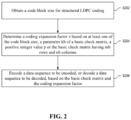
- FIG. 2 is a flowchart illustrating a method for data processing with structured LDPC codes according to an embodiment of the present disclosure. As shown in FIG. 2 , the method includes the following steps.
- a code block size for structured LDPC coding is obtained.
- a coding expansion factor z is determined based on at least one of the code block size, a parameter kb of a basic check matrix, a positive integer value p or the basic check matrix having mb rows and nb columns.
- a data sequence to be encoded is encoded, or a data sequence to be decoded is decoded, based on the basic check matrix and the coding expansion factor.
- kb nb-mb and each of kb, p, mb, z and nb is an integer larger than 1.
- the above method for data processing with structured LDPC codes can, but not limited to, be applied in data sequence processing scenarios, e.g., a scenario in which a data sequence is processed with LDPC encoding or decoding.
- the above method for data processing with structured LDPC codes can, but not limited to, be applied in an LDPC encoder or an LDPC decoder, e.g., a transmitter with LDPC encoding or a receiver with LDPC decoding.
- a code block size for structured LDPC coding is obtained.
- a coding expansion factor z is determined based on at least one of the code block size, a parameter kb of a basic check matrix or a positive integer value p.
- a data sequence to be encoded is encoded, or a data sequence to be decoded is decoded, based on the basic check matrix and the coding expansion factor.
- the coding expansion factor is determined based on at least one of the code block size, the parameter kb of the basic check matrix or the positive integer value p.
- the LDPC encoding and decoding are performed based on the basic check matrix and the coding expansion factor.
- LDPC encoding and decoding can be applied effectively to different code block sizes, such that the complexity of the LDPC coding can be reduced.
- the coding expansion factor can be determined in accordance with: CBS / kb ⁇ p ⁇ p , where CBS is the code block size and ⁇ ⁇ denotes a ceiling operation.
- the code block size is equal to a value obtained by multiplying the parameter kb of the basic check matrix with one of a set of natural numbers sorted in ascending order.
- the set of natural numbers sorted in ascending order can include a plurality of subsets each having an equal, first difference between neighboring elements.
- the first difference for the i-th subset in the set of natural numbers sorted in ascending order is smaller than the first difference for the (i+1)-th subset, where i is a positive integer.
- the operation of determining the coding expansion factor based on the code block size can include: the code block size being one of a set of code block sizes, the set of code block sizes being a first set of natural numbers stored in ascending order; and the coding expansion factor being one of a set of coding expansion factors, the set of coding expansion factors being a second set of natural numbers stored in ascending order.
- the set of code block sizes includes a number, a, of successive elements.
- the coding expansion factor corresponding to the successive elements is z ( j +1), where a is a positive integer, z ( j ) is the j-th element of the set of coding expansion factors, j is a positive integer and kb is the parameter of the basic check matrix.
- the coding expansion factor can be z ( j +1) when the obtained code block size is one of the successive elements.
- the coding expansion factor is determined as z ( j +1) when a ratio of the code block size to the parameter kb of the basic check matrix is larger than z ( j ) and smaller than or equal to z ( j+ 1) , where z ( j ) is the j-th element of the set of coding expansion factors.
- the set of coding expansion factors can include a plurality of subsets each having an equal, second difference between neighboring elements, and the second difference for the h-th subset of the plurality of subsets is smaller than the second difference for the (h+1)-th subset, where h is a positive integer.
- each of the elements in the set of coding expansion factors that is larger than the positive integer value p is n times the positive integer value p, where n is a positive integer.
- the set of code block sizes can include at least products of the parameter kb of the basic check matrix and respective ones of the set of coding expansion factors, and integers spaced by a positive integer B among all the products.
- padding bits can be added to a first data sequence by dividing the first data sequence into a plurality of data sub-sequences and adding padding bits to each of the plurality of data sub-sequences, such that all the data sub-sequences with the padding bits constitute the data sequence to be encoded.
- padding bits can be added to a second data sequence by dividing the second data sequence into kb data sub-sequences each including z or less bits and adding padding bits to each of the data sub-sequences such that each of the data sub-sequences includes z bits and all the data sub-sequences with the padding bits constitute the data sequence to be encoded, where kb is the parameter of the basic check matrix and z is the coding expansion factor.
- an L-bit Cyclic Redundancy Check (CRC) sequence can be added to a third data sequence to obtain the first or second data sequence, where L is an integer larger than or equal to 0.
- CRC Cyclic Redundancy Check
- the parameter kb of the basic check matrix is a difference between the number of columns of the basic check matrix and the number of rows of the basic check matrix, where kb is an integer larger than or equal to 4 and smaller than or equal to 64.
- the positive integer value p is a degree of parallelism of LDPC decoding.
- the positive integer value p is a fixed positive integer
- the degree p of parallelism of LDPC decoding includes: the positive integer value p being a positive integer power of 2 or a product of a positive integer power of 2 and a prime number.
- the positive integer value p is an element of a subset P, which is a subset of a set of all positive integer factors of Pmax, where Pmax is an integer larger than 3 and smaller than or equal to 1024.
- the subset nSet includes one of: a subset of the first F elements of the set of positive integers Ns, a subset of the last F elements of the set of positive integers Ns, a subset of F prime numbers in the set of positive integers Ns, a subset of F odd numbers in the set of positive integers Ns or a subset of F even numbers in the set of positive integers Ns, where F is a positive integer smaller than M.
- the coding expansion factor can equal to a positive integer power of 2 minus 1, or a product of a positive integer power of 2 and a prime number, and the prime number includes one of: 3, 5, 7, 11, 13, 17, 19, 23 or 29.
- the coding expansion factor equals to a product of a positive integer power of 2 and a prime number, and the prime number includes one of 3 or 5.
- the coding expansion factor equals to a product of a positive integer power of 2 and a prime number, and the prime number includes one of 5 or 7.
- the coding expansion factor equals to a product of a positive integer power of 2 and a prime number, and the prime number includes one of 3, 5 or 7.
- the coding expansion factor includes one of: 7, 15, 31, 63, 127, 255, 511, 1023, 2047 or 4095.
- the basic check matrix can be stored.
- k' dummy bits can be added to the data sequence to be encoded, to obtain the data sequence to be encoded having a length of kb*z bits, where a ratio of k' to kb*z is smaller or equal to 1/4, k' is an integer larger than or equal to 0, kb is a number of system columns of the basic check matrix and is an integer larger than 1, and z is the expansion factor to be used in the coding and is an integer larger than 0.
- the basic check matrix of LDPC codes has a certain degree distribution characteristic, which may be damaged if too many padding bits are added, resulting in a degraded decoding performance of the LDPC codes.
- the padding length By limiting the padding length within 1/4, it is advantageous in that the fundamental characteristics of the basic check matrix of the LDPC codes, and thus the decoding performance of the LDPC codes, may remain substantially the same.
- the number and position of the padding bits are known to both the transmitter and receiver.
- the padding bits are not included in the data transmission. During the decoding of the LDPC codes, these known bits will not affect the decoding result. If all bits in a particular column of the basic check matrix are padding bits, this column should be deleted from the basic check matrix and in this case the degree distribution of the basic check matrix will be changed.
- the expansion factor z is n times a positive integer pl.
- the positive integer pl is an element of a subset Pset, which is a subset of a set of all positive integer factors of Pmax, where n is a natural number and Pmax is an integer larger than or equal to 4.
- the parameter kb of the basic check matrix is a number of system columns of the basic check matrix.
- an apparatus for data processing with structured LDPC codes is also provided.
- the apparatus can implement the above embodiments and optional embodiments (details thereof will be omitted here).
- the term "module” can be software, hardware, or a combination thereof, capable of performing a predetermined function. While the apparatuses to be described in the following embodiments are preferably implemented in software, it can be contemplated that they can also be implemented in hardware or a combination of software and hardware.
- FIG. 3 is a first block diagram of an apparatus for data processing with structured LDPC codes according to an embodiment of the present disclosure. As shown in FIG. 3 , the apparatus includes:
- the above apparatus for data processing with structured LDPC codes can, but not limited to, be applied in data sequence processing scenarios, e.g., a scenario in which a data sequence is processed with LDPC encoding or decoding.
- the above apparatus for data processing with structured LDPC codes can, but not limited to, be applied in an LDPC encoder or an LDPC decoder, e.g., a transmitter with LDPC encoding or a receiver with LDPC decoding.
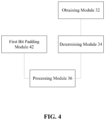
- an obtaining module obtains a code block size for structured LDPC coding.
- a determining module determines a coding expansion factor z based on at least one of the code block size, a parameter kb of a basic check matrix, a positive integer value p or the basic check matrix having mb rows and nb columns.
- a processing module encodes a data sequence to be encoded, or decodes a data sequence to be decoded, based on the basic check matrix and the coding expansion factor.
- kb nb-mb and each of kb, p, mb, z and nb is an integer larger than 1.
- the coding expansion factor is determined based on at least one of the code block size, the parameter kb of the basic check matrix or the positive integer value p.
- the LDPC encoding and decoding are performed based on the basic check matrix and the coding expansion factor. In this way, the flexibility in data processing with LDPC coding can be improved, thereby solving the problem in the related art associated with low flexibility in data processing with LDPC coding. Further, LDPC encoding and decoding can be applied effectively to different code block sizes, such that the complexity of the LDPC coding can be reduced.
- the determining module can be configured to: determine the coding expansion factor in accordance with CBS / kb ⁇ p ⁇ p , where CBS is the code block size and ⁇ ⁇ denotes a ceiling operation.
- the obtaining module can be configured such that the code block size is equal to a value obtained by multiplying the parameter kb of the basic check matrix with one of a set of natural numbers sorted in ascending order.
- the set of natural numbers sorted in ascending order can include a plurality of subsets each having an equal, first difference between neighboring elements.
- the first difference for the i-th subset in the set of natural numbers sorted in ascending order is smaller than the first difference for the (i+1)-th subset, where i is a positive integer.
- the determining module is configured such that: the code block size is one of a set of code block sizes, the set of code block sizes being a first set of natural numbers stored in ascending order; and the coding expansion factor is one of a set of coding expansion factors, the set of coding expansion factors being a second set of natural numbers stored in ascending order.
- the set of code block sizes includes a number, a, of successive elements.
- the coding expansion factor corresponding to the successive elements is z ( j +1), where a is a positive integer, z ( j ) is the j-th element of the set of coding expansion factors, j is a positive integer and kb is the parameter of the basic check matrix.
- the coding expansion factor is z ( j +1) when the obtained code block size is one of the successive elements.
- the coding expansion factor is determined as z ( j +1) when a ratio of the code block size to the parameter kb of the basic check matrix is larger than z ( j ) and smaller than or equal to z ( j+ 1) , where z ( j ) is the j-th element of the set of coding expansion factors.
- the set of coding expansion factors includes a plurality of subsets each having an equal, second difference between neighboring elements, and the second difference for the h-th subset of the plurality of subsets is smaller than the second difference for the (h+1)-th subset, where h is a positive integer.
- each of the elements in the set of coding expansion factors that is larger than the positive integer value p is n times the positive integer value p, where n is a positive integer.
- the set of code block sizes includes at least products of the parameter kb of the basic check matrix and respective ones of the set of coding expansion factors, and integers spaced by a positive integer B among all the products.
- FIG. 4 is a second block diagram of an apparatus for data processing with structured LDPC codes according to an embodiment of the present disclosure.
- the apparatus further includes: a first bit padding module 42 coupled to the processing module 36 and configured to add padding bits to a first data sequence by dividing the first data sequence into a plurality of data sub-sequences and adding padding bits to each of the plurality of data sub-sequences, such that all the data sub-sequences with the padding bits constitute the data sequence to be encoded.
- FIG. 5 is a third block diagram of an apparatus for data processing with structured LDPC codes according to an embodiment of the present disclosure.
- the apparatus further includes: a second bit padding module 52 coupled to the processing module 36 and configured to add padding bits to a second data sequence by dividing the second data sequence into kb data sub-sequences each including z or less bits and adding padding bits to each of the data sub-sequences such that each of the data sub-sequences includes z bits and all the data sub-sequences with the padding bits constitute the data sequence to be encoded, where kb is the parameter of the basic check matrix and z is the coding expansion factor.
- the apparatus further includes: an adding module coupled to the first bit padding module 42 or the second bit padding module 52 and configured to add an L-bit Cyclic Redundancy Check (CRC) sequence to a third data sequence to obtain the first or second data sequence, where L is an integer larger than or equal to 0.
- CRC Cyclic Redundancy Check
- the parameter kb of the basic check matrix is a difference between the number of columns of the basic check matrix and the number of rows of the basic check matrix, where kb is an integer larger than or equal to 4 and smaller than or equal to 64.
- the positive integer value p can be a degree of parallelism of LDPC decoding.
- the positive integer value p is a fixed positive integer
- the degree p of parallelism of LDPC decoding includes: the positive integer value p being a positive integer power of 2 or a product of a positive integer power of 2 and a prime number.
- the positive integer value p is an element of a subset P, which is a subset of a set of all positive integer factors of Pmax, where Pmax is an integer larger than 3 and smaller than or equal to 1024.
- the subset nSet includes one of: a subset of the first F elements of the set of positive integers Ns, a subset of the last F elements of the set of positive integers Ns, a subset of F prime numbers in the set of positive integers Ns, a subset of F odd numbers in the set of positive integers Ns or a subset of F even numbers in the set of positive integers Ns, where F is a positive integer smaller than M.
- the first case in which the positive integer value p is a positive integer power of 2 and the second case in which the positive integer value p is a product of a positive integer power of 2 and a prime number are mutual exclusive. If the prime number is 2, the first case and the second case are the same, which is unreasonable. Hence, the case in which the prime number is 2 is considered to be the first case. Further, in this context, the first case includes a power of 1*2, but 1 is not a prime number. Thus, the prime number here is at least larger than or equal to 3.
- the coding expansion factor equals to a positive integer power of 2 minus 1, or a product of a positive integer power of 2 and a prime number, and the prime number includes one of: 3, 5, 7, 11, 13, 17, 19, 23 or 29.
- the coding expansion factor equals to a product of a positive integer power of 2 and a prime number, and the prime number includes one of 3 or 5.
- the coding expansion factor equals to a product of a positive integer power of 2 and a prime number, and the prime number includes one of 5 or 7.
- the coding expansion factor equals to a product of a positive integer power of 2 and a prime number, and the prime number includes one of 3, 5 or 7.
- the coding expansion factor includes one of: 7, 15, 31, 63, 127, 255, 511, 1023, 2047 or 4095.
- the apparatus is further configured to, prior to encoding the data sequence to be encoded: add k' dummy bits to the data sequence to be encoded, to obtain the data sequence to be encoded having a length of kb*z bits, where a ratio of k' to kb*z is smaller or equal to 1/4, k' is an integer larger than or equal to 0, kb is a number of system columns of the basic check matrix and is an integer larger than 1, and z is the expansion factor to be used in the coding and is an integer larger than 0.
- the expansion factor z is n times a positive integer pl.
- the positive integer pl is an element of a subset Pset, which is a subset of a set of all positive integer factors of Pmax, where n is a natural number and Pmax is an integer larger than or equal to 4.
- each of the above-described modules can be implemented by means of software or hardware, and the latter can be implemented in, but not limited to, the following manner: the above-mentioned modules can be located at the same processor, or can be distributed over a plurality of processors.
- a code block size for structured LDPC coding is obtained.
- a coding expansion factor z is determined based on at least one of the code block size, a parameter kb of a basic check matrix, a positive integer value p or the basic check matrix.
- a data sequence to be encoded is encoded, or a data sequence to be decoded is decoded, based on the basic check matrix and the coding expansion factor.
- the operation of determining the coding expansion factor based at least on the code block size CBS, the parameter kb of the basic check matrix and the positive integer value p includes: the coding expansion factor being equal to CBS / kb ⁇ p ⁇ p , where CBS is the code block size.
- the positive integer value p corresponds to a degree of parallelism of LDPC decoding or a multiple thereof.
- the coding expansion factor is dependent on the degree of parallelism, which is advantageous in that the hardware implementation for the layered LDPC decoding can be simple, without any mismatch between interleaving and de-interleaving in the decoder.
- the code block size can be equal to a value obtained by multiplying the parameter kb of the basic check matrix with one of a set of natural numbers sorted in ascending order.
- the parameter kb of the basic check matrix is a difference between the number of columns of the basic check matrix and the number of rows of the basic check matrix, where kb is an integer larger ranging from 4 to 64.
- the set of natural numbers sorted in ascending order includes a plurality of subsets each having an equal difference within the subset.
- the difference for the i-th subset is smaller than the difference for the (i+1)-th subset, where i is a positive integer.
- the code block size is one of a set of code block sizes.
- the set of code block sizes is a set of natural numbers stored in ascending order.
- the coding expansion factor is one of a set of coding expansion factors.
- the set of coding expansion factors is a set of natural numbers stored in ascending order.
- the set of code block sizes includes a number, a, of successive elements.
- the coding expansion factor corresponding to the successive elements is z ( j +1), where a is a positive integer and z ( j ) is the j-th element of the set of coding expansion factors.
- the code block size is one of the successive elements, the coding expansion factor is limited to z ( j +1).
- the set of coding expansion factors includes a plurality of subsets each having an equal difference within the subset.
- the difference for the h-th subset of the plurality of subsets is smaller than the difference for the (h+1)-th subset, where h is a positive integer.
- the set of code block sizes includes at least products of the parameter kb of the basic check matrix and respective ones of the set of coding expansion factors, and integers spaced by a positive integer B among all the products.
- the products of the parameter kb of the basic check matrix and respective ones of the set of coding expansion factors are numbers of maximum system bits that can be supported by LDPC codes for different coding expansion factors. There may also be code block sizes among the respective numbers of system bits, such that the code block sizes can be more flexible to be used in various communication systems. The problem associated with lack of flexibility in code lengths and code rates of LDPC codes can be solved.
- the coding expansion factor may equal to a positive integer power of 2 minus 1. More particularly, the coding expansion factor can include one of: 7, 15, 31, 63, 127, 255, 511, 1023, 2047 or 4095.
- each subset of z bits in the LDPC codes includes a corresponding number of CRC bits. Owing to the characteristic of the CRC cyclic code that a CRC cyclic code shifted cyclically by any arbitrary number of bits still belongs to a CRC cyclic codeword space (i.e., it is still a CRC cyclic code), each subset of z bits in the check bits for the LDPC codes is still a CRC cyclic code and can thus still be used for CRC check.
- the coding expansion factor may equal to a product of a positive integer power of 2 and a prime number. More particularly, the prime number can be e.g., one of 3, 5, 7, 11, 13, 17, 19, 23 or 29. By definition, an integer is a prime number if it has no integer factor other than 1 and itself. Hence, 1 is not a prime number.
- the use of such coding expansion factor may facilitate simplifying interleaving and de-interleaving networks of the LDPC codes.
- each element in the basic check matrix corresponds to a number of cyclically shifted bits.
- the use of the above values may simplify the interleaving and de-interleaving networks, which in turn reduces the complexity of the LDPC codes (nearly 40% of the decoding complexity of the LDPC codes lies in the interleaving network and once the interleaving network is simplified, the decoding complexity of the LDPC codes can be reduced).
- the coding expansion factor may equal to a product of a positive integer power of 2 and a prime number and the prime number may include one of 3 or 5 and the positive integer may include one of 1, 2, 3, 4, 5, 6, 7 or 8. It is advantageous to use the expansion factor to reduce the complexity of the LDPC decoder and support a flexible design of code length.
- An LDPC decoder typically includes a storage module, an interleaving network module, a de-interleaving network module and a computation module.
- the storage module stores updated total soft information, which is a sum of all extrinsic information.
- one storage block needs to be allocated for each column of the basic check matrix (e.g., for a basic check matrix having mb rows and nb columns, nb storage blocks are needed) and each storage block is divided into a number of address blocks each defined as one word.
- one storage block may store a number of words.
- the degree of parallelism of the decoding typically equals to the size of one word, which refers to the number of soft bits stored in one word.
- the maximum prime number is 5 and the maximum power of 2 is 2 8 .
- the code block size may be limited to a value obtained by multiplying the parameter kb of the basic check matrix with one of a set of natural numbers sorted in ascending order.
- the parameter kb of the basic check matrix can be a difference between the number of columns of the basic check matrix and the number of rows of the basic check matrix.
- the parameter kb of the basic check matrix can be an integer ranging from 4 to 64.
- the set of natural numbers sorted in ascending order may include a plurality of subsets each having an equal difference within the subset. The difference for the i-th subset in the set of natural numbers sorted in ascending order can be smaller than the difference for the (i+1)-th subset, where i is a positive integer.
- the code block size can be one of a set of code block sizes.
- the coding expansion factor is one of a set of coding expansion factors.
- the set of code block sizes is a set of natural numbers stored in ascending order.
- the set of coding expansion factors is a set of natural numbers stored in ascending order.
- the number of dimensions of the set of code block sizes is larger than or equal to that of the set of coding expansion factors.
- the set of code block sizes includes a number, a, of successive elements.
- the coding expansion factor may equal to a positive integer power of 2 minus 1, or a product of a positive integer power of 2 and a prime number.
- the coding expansion factor may include one of: 7, 15, 31, 63, 127, 255, 511, 1023, 2047 or 4095.
- a method for data processing with structured LDPC codes is provided.
- the method is applied in a transmitter and includes the following steps.
- each of the elements in the set of coding expansion factors that is larger than the positive integer value p is n times the positive integer value p, where n is a positive integer.
- the subset nSet can include one of: a subset of the first F elements of the set of positive integers Ns, a subset of the last F elements of the set of positive integers Ns, a subset of F prime numbers in the set of positive integers Ns, a subset of F odd numbers in the set of positive integers Ns or a subset of F even numbers in the set of positive integers Ns, where F is a positive integer smaller than M.
- a size of a transport block to be transmitted is 4000 bits and a basic check matrix for LDPC codes is as follows, corresponding to a set of coding expansion factors: [2 4 6 8 10 12 16 20 24 32 40 48 64 80 96 128 160 192 256 320 384 512 640 768 1024 1280].
- the basic check matrix for LDPC codes equals to:
- This example includes the following steps.
- a receiver for receive the transmitted LDPC codeword.
- An LDPC decoding method at the receiver includes the following steps.
- the LDPC codes may include the following example.
- the set of expansion factors is [18 21 30 35 42 63 70 105 126 210], including two sets [6 7 14 21 42]*3 and [6 7 14 21 42]*5.
- the subset Pset is [6 7 14 21 42] and the subset nSet is [3 5].
- the expansion factor used in the encoding is determined as 63, the actual degree of parallelism of decoding is 31 as it is divided into 3 words. If the expansion factor used in the encoding is one of [6 7 14 21 42]*5, the soft information required for decoding can be stored in a storage block consisting of 5 words. When the expansion factor used in the encoding is 70 for example, the actual degree of parallelism of decoding is 14 as it is divided into 5 words.
- a method for data processing with structured LDPC codes is also provided.
- the method can implement the above method for LDPC encoding/decoding (details thereof will be omitted here).
- the term "method” or “module” can be software, hardware, or a combination thereof, capable of performing a predetermined function. While the apparatuses to be described in the following embodiments are preferably implemented in software, it can be contemplated that they can also be implemented in hardware or a combination of software and hardware.
- the basic check matrix includes at least two types of elements: 1) elements each indicating an all-zero square matrix, denoted herein as -1 (which can instead be denoted as null or any other descriptor); and 2) elements each indicating a square matrix obtained by cyclically shifting an identity matrix (i.e., a non-all-zero matrix), denoted as an integer which is larger than or equal to 0 and smaller than the expansion factor and indicates the number of bits by which the identity matrix is cyclically shifted.
- the basic check matrix may also include a multi-sided structure, which means that it includes at least: two elements at the same pair of row index and column index, indicating a sum of two square matrices cyclically shifted by particular numbers of bits.
- a data sequence to be encoded is encoded based on the basic check matrix and the coding expansion factor.
- a basic check matrix used in the method for structured LDPC encoding is provided below.
- the value of the expansion factor for the basic check matrix is dependent on Pset and nSet, i.e., equal to 3*Pset and 5*Pset. That is, all the expansion factors constitute a set ⁇ 18 30 63 105 126 210 ⁇ . It can be seen that Pset is a subset of a set of all positive integer factors of Pmax.
- the basic check matrix Hb0 is: 14 14 14 7 14 7 7 0 7 -1 -1 -1 14 14 0 0 0 7 7 0 14 0 -1 -1 0 14 7 7 14 14 14 7 0 0 -1 0 14 7 7 14 14 7 0 0 -1 0 14 7 7 7 14 .
- the basic check matrix Hb1 is: 7 7 21 28 28 21 28 0 7 -1 -1 -1 14 21 28 21 0 14 21 7 7 0 -1 -1 28 7 7 21 21 7 0 21 28 7 21 -1 28 7 21 21 21 7 28 7 28 7 21 21 .
- the basic check matrix Hb2 is: 60 32 20 48 56 10 4 34 4 ⁇ 1 ⁇ 1 ⁇ 1 4 2 14 22 20 38 8 38 36 44 ⁇ 1 ⁇ 1 48 54 52 54 32 24 56 60 46 30 4 ⁇ 1 28 40 8 52 0 52 58 6 16 50 10 40 .
- the basic check matrix Hb3 is: 52 40 94 70 2 2 12 14 90 ⁇ 1 ⁇ 1 ⁇ 1 96 12 44 22 100 94 64 54 14 100 ⁇ 1 ⁇ 1 16 82 64 90 62 98 30 36 14 24 62 ⁇ 1 14 42 8 4 50 62 48 54 34 46 0 80 .
- the basic check matrix Hb5 is: 187 58 193 192 136 18 124 102 110 ⁇ 1 ⁇ 1 ⁇ 1 121 74 189 200 85 103 71 123 52 52 ⁇ 1 ⁇ 1 120 46 147 101 51 36 126 147 5 152 51 ⁇ 1 96 41 41 170 146 51 169 49 58 193 129 85 .
- the storage modules corresponding to 1004 as shown in FIG. 10 can be used, with the black color indicating the stored information. Since in this case the expansion factors are 63 and 105, the soft bit information corresponding to each column of the basic check matrix includes 63 and 105 only. Hence, the soft bit information is placed every 2 bits in each word. Hb2 uses 3 words and Hb3 uses 5 words.
- the storage modules corresponding to 1005 as shown in FIG. 10 can be used, with the black color indicating the stored information. Since in this case the expansion factors are 126 and 210, the soft bit information corresponding to each column of the basic check matrix includes 126 and 210 only. Hence, each word is filled with the soft bit information. Hb2 uses 3 words and Hb3 uses 5 words.
- the methods according to the optional embodiments of the present disclosure can be applied in the Long Term Evolution (LTE) mobile communication system or the 5 th Generation (5G) mobile communication system in the future.
- the data transmission direction can be data transmitted from a base station to a mobile user device (i.e., downlink transmission traffic data) or data transmitted from a mobile user device to a base station (i.e., uplink transmission traffic data).
- the mobile user device may include a mobile device, which can be referred to as an access terminal, a user terminal, a user station, a user unit, a mobile station, a remote station, a remote terminal, a user agent, a user equipment, a user device, or any other terminology.
- a base station may include an Access Point (AP), which can be referred to as a Node B, a Radio Network Controller (RNC), an evolved Node B (eNB), a Base Station Controller (BSC), a Base Transceiver Station (BTS), a Base Station (BS), a Transceiver Function (TF), a radio router, a radio transceiver, a Basic Service Set (BSS), an Extended Service Set (ESS), a Radio Base Station (RBS) or any other terminology.
- AP Access Point
- RNC Radio Network Controller
- eNB evolved Node B
- BSC Base Station Controller
- BTS Base Transceiver Station
- BS Base Station
- TF Transceiver Function
- radio router a radio transceiver
- BSS Basic Service Set
- ESS Extended Service Set
- RBS Radio Base Station
- the operation of determining the coding expansion factor based on the code block size CBS, the parameter kb of the basic check matrix and the positive integer value p includes: determining the coding expansion factor in accordance with: CBS / kb ⁇ p ⁇ p , where ⁇ ⁇ denotes a ceiling operation.
- the operation of obtaining the code block size for structured LDPC coding includes: the code block size being equal to a value obtained by multiplying the parameter kb of the basic check matrix with one of a set of natural numbers sorted in ascending order.
- the set of natural numbers sorted in ascending order includes a plurality of subsets each having an equal, first difference between neighboring elements.
- the first difference for the i-th subset in the set of natural numbers sorted in ascending order is smaller than the first difference for the (i+1)-th subset, where i is a positive integer.
- the coding expansion factor corresponding to the successive elements is z ( j+ 1) , where a is a positive integer, z ( j ) is the j-th element of the set of coding expansion factors, j is a positive integer and kb is the parameter of the basic check matrix.
- the coding expansion factor is z ( j +1) when the obtained code block size is one of the successive elements.
- the set of coding expansion factors includes a plurality of subsets each having an equal, second difference between neighboring elements.
- the second difference for the h-th subset of the plurality of subsets is smaller than the second difference for the (h+1)-th subset, where h is a positive integer.
- the set of code block sizes includes at least products of the parameter kb of the basic check matrix and respective ones of the set of coding expansion factors, and integers spaced by a positive integer B among all the products.
- the purpose of limiting the expansion factor to equal to a multiple of the degree p of parallelism is that the layered LDPC decoding process can eliminate the address collision problem in the interleaving and de-interleaving networks in the decoder, without any additional overhead of hardware circuit indications, such that the decoding complexity can be reduced and a smaller area of hardware circuit is required.
- 1120 is divided into 8 data sub-sequences each having 140 bits plus 10 padding bits (i.e., 150 bits).
- the data sub-sequences are combined to obtain a system bit sequence. From the performances shown in FIG. 9 , it can be seen that the padding solution according to the present disclosure can obtain a higher gain (approximately 0.4dB).
- the above positive integer value p is a fixed positive integer.
- the degree p of parallelism of LDPC decoding includes a positive integer power of 2 or a product of a positive integer power of 2 and a prime number. It is advantageous in that p can be a multiple of a small value.
- a smaller degree p of parallelism of layered decoding can still be used, which can in turn support a circuit design with a lower power consumption so as to be used in e.g., the nMTC scenario.
- FIG. 7 is a first schematic diagram showing a basic check matrix Hb' according to an optional embodiment of the present disclosure. As shown in FIG. 7 , the basic check matrix Hb' to be used in the actual encoding can be obtained.
- the LDPC code blocks are modulated and transmitted.
- Example 2 differs from Example 1 in that the source data packet to be transmitted has a size of 3256 bits. It is assumed that the code block size for the structured LDPC codes is 3360.
- the set of natural numbers sorted in ascending order includes a plurality of subsets each having an equal, first difference between neighboring elements.
- the first difference for the i-th subset in the set of natural numbers sorted in ascending order is smaller than the first difference for the (i+1)-th subset, where i is a positive integer.
- the set of natural numbers sorted in ascending order can be [[2:1:200], [202:2:400], [406:6:796], [804:8:1004]].
- the coding expansion factor corresponding to the successive elements is z ( j+ 1) , where a is a positive integer, z ( j ) is the j-th element of the set of coding expansion factors, j is a positive integer and kb is the parameter of the basic check matrix.
- the coding expansion factor is z ( j+ 1) when the obtained code block size is one of the successive elements.
- the set of coding expansion factors includes a plurality of subsets each having an equal, second difference between neighboring elements.
- the second difference for the h-th subset of the plurality of subsets is smaller than the second difference for the (h+1)-th subset, where h is a positive integer.
- the LDPC code block is modulated and transmitted.
- the number of columns of the matrix is nb
- the number of rows of the matrix is mb
- a method for data processing with structured LDPC codes is also provided.
- the term "method” or “module” can be software, hardware, or a combination thereof, capable of performing a predetermined function. While the apparatuses to be described in the following embodiments are preferably implemented in software, it can be contemplated that they can also be implemented in hardware or a combination of software and hardware.
- a method for data processing with structured LDPC codes is provided.
- the method is applied in a transmitter and includes the following steps.
- the basic check matrix for the structured LDPC coding is obtained.
- the basic check matrix includes at least two types of elements: 1) elements each indicating an all-zero square matrix, denoted herein as -1 (which can instead be denoted as null or any other descriptor); and 2) elements each indicating a square matrix obtained by cyclically shifting an identity matrix (i.e., a non-all-zero matrix), denoted as an integer which is larger than or equal to 0 and smaller than the expansion factor and indicates the number of bits by which the identity matrix is cyclically shifted.
- the basic check matrix may also include a multi-sided structure, which means that it includes at least: two elements at the same pair of row index and column index, indicating a sum of two square matrices cyclically shifted by particular numbers of bits.
- a data sequence to be encoded is encoded, or a data sequence to be decoded is decoded, based on the basic check matrix and the coding expansion factor z.
- the number of bits in the data sequence to be encoded is kb*z, and the length of the data sequence to be decoded is nb*z.
Landscapes
- Physics & Mathematics (AREA)
- Engineering & Computer Science (AREA)
- Probability & Statistics with Applications (AREA)
- Theoretical Computer Science (AREA)
- Mathematical Physics (AREA)
- General Physics & Mathematics (AREA)
- Computational Mathematics (AREA)
- Mathematical Analysis (AREA)
- Mathematical Optimization (AREA)
- Pure & Applied Mathematics (AREA)
- Algebra (AREA)
- Computing Systems (AREA)
- Error Detection And Correction (AREA)
- Document Processing Apparatus (AREA)
Applications Claiming Priority (4)
| Application Number | Priority Date | Filing Date | Title |
|---|---|---|---|
| CN201610322409 | 2016-05-13 | ||
| CN201610879343.9A CN107370489B (zh) | 2016-05-13 | 2016-09-30 | 结构化ldpc码的数据处理方法及装置 |
| PCT/CN2016/104744 WO2017193558A1 (zh) | 2016-05-13 | 2016-11-04 | 结构化ldpc码的数据处理方法及装置 |
| EP16901513.8A EP3457574B1 (de) | 2016-05-13 | 2016-11-04 | Datenverarbeitungsverfahren und -vorrichtung für strukturierte ldpc-codes |
Related Parent Applications (1)
| Application Number | Title | Priority Date | Filing Date |
|---|---|---|---|
| EP16901513.8A Division EP3457574B1 (de) | 2016-05-13 | 2016-11-04 | Datenverarbeitungsverfahren und -vorrichtung für strukturierte ldpc-codes |
Publications (2)
| Publication Number | Publication Date |
|---|---|
| EP4576584A2 true EP4576584A2 (de) | 2025-06-25 |
| EP4576584A3 EP4576584A3 (de) | 2025-09-17 |
Family
ID=60266148
Family Applications (1)
| Application Number | Title | Priority Date | Filing Date |
|---|---|---|---|
| EP25165678.1A Pending EP4576584A3 (de) | 2016-05-13 | 2016-11-04 | Datenverarbeitungsverfahren und -vorrichtung für strukturierten ldpc-code |
Country Status (5)
| Country | Link |
|---|---|
| US (1) | US11683051B2 (de) |
| EP (1) | EP4576584A3 (de) |
| ES (1) | ES3024210T3 (de) |
| FI (1) | FI3457574T3 (de) |
| WO (1) | WO2017193558A1 (de) |
Families Citing this family (2)
| Publication number | Priority date | Publication date | Assignee | Title |
|---|---|---|---|---|
| CN117060932A (zh) * | 2023-08-10 | 2023-11-14 | 上海思朗科技有限公司 | 基于基本图的并行ldpc译码方法、装置、设备及介质 |
| CN119154892B (zh) * | 2024-11-14 | 2025-02-25 | 深圳鹏龙通科技有限公司 | 低密度奇偶校验码的译码方法、装置、电子设备及存储介质 |
Family Cites Families (13)
| Publication number | Priority date | Publication date | Assignee | Title |
|---|---|---|---|---|
| WO2006039801A1 (en) * | 2004-10-12 | 2006-04-20 | Nortel Networks Limited | System and method for low density parity check encoding of data |
| CN100502245C (zh) * | 2005-10-21 | 2009-06-17 | 中兴通讯股份有限公司 | 支持任何码率/码长的低密度奇偶校验码编码装置和方法 |
| CN101217337B (zh) | 2007-01-01 | 2013-01-23 | 中兴通讯股份有限公司 | 一种支持递增冗余混合自动重传的低密度奇偶校验码编码装置和方法 |
| TW201334425A (zh) | 2007-01-24 | 2013-08-16 | Qualcomm Inc | 可變大小之封包的低密度同位檢查編碼與解碼 |
| CN104821868B (zh) | 2007-04-30 | 2018-06-01 | 诺基亚通信公司 | 用于无线通信的方法和装置 |
| CN101141133B (zh) * | 2007-10-23 | 2011-09-14 | 北京邮电大学 | 一种结构化低密度校验码的编码方法 |
| CN101459430B (zh) | 2007-12-14 | 2010-12-08 | 中兴通讯股份有限公司 | 低密度生成矩阵码的编码方法及装置 |
| EP2351250B1 (de) * | 2008-11-18 | 2018-10-31 | ViaSat, Inc. | Effiziente steuerungssignalisierung über gemeinsam genutzte kommunikationskanäle mit breitem dynamikbereich |
| CN101834613B (zh) | 2009-03-09 | 2012-11-21 | 电信科学技术研究院 | 一种ldpc码的编码方法及编码器 |
| US8559539B2 (en) | 2009-06-26 | 2013-10-15 | Nokia Corporation | Method, apparatus and computer readable storage medium |
| CN102412842B (zh) * | 2010-09-25 | 2016-06-15 | 中兴通讯股份有限公司 | 一种低密度奇偶校验码的编码方法及装置 |
| CN102457286B (zh) | 2010-10-21 | 2013-08-28 | 航天信息股份有限公司 | 准循环ldpc码编码方法、装置及校验矩阵生成方法 |
| CN104868925B (zh) * | 2014-02-21 | 2019-01-22 | 中兴通讯股份有限公司 | 结构化ldpc码的编码方法、译码方法、编码装置和译码装置 |
-
2016
- 2016-11-04 ES ES16901513T patent/ES3024210T3/es active Active
- 2016-11-04 EP EP25165678.1A patent/EP4576584A3/de active Pending
- 2016-11-04 FI FIEP16901513.8T patent/FI3457574T3/fi active
- 2016-11-04 WO PCT/CN2016/104744 patent/WO2017193558A1/zh not_active Ceased
-
2021
- 2021-10-04 US US17/493,612 patent/US11683051B2/en active Active
Also Published As
| Publication number | Publication date |
|---|---|
| EP4576584A3 (de) | 2025-09-17 |
| WO2017193558A1 (zh) | 2017-11-16 |
| US20220038115A1 (en) | 2022-02-03 |
| FI3457574T3 (fi) | 2025-06-27 |
| ES3024210T3 (en) | 2025-06-04 |
| US11683051B2 (en) | 2023-06-20 |
Similar Documents
| Publication | Publication Date | Title |
|---|---|---|
| US11139835B2 (en) | Method and apparatus for data processing with structured LDPC codes | |
| US11791933B2 (en) | Data encoding method and device, storage medium, and processor | |
| US11043967B2 (en) | Method and apparatus for channel encoding and decoding in a communication system using a low-density parity check code | |
| EP3479486B1 (de) | Verfahren und systeme zur codierung und decodierung von ldpc-codes mit rate 7/8 | |
| EP2337259B1 (de) | Verfahren und Vorrichtung zum Senden und Empfangen von Daten in einem Kommunikationssystem | |
| EP3648379B1 (de) | Entwurfsverfahren und -vorrichtung für quasizyklische paritätsprüfung mit geringer dichte | |
| US11671115B2 (en) | High-rate long LDPC codes | |
| US20210297091A1 (en) | Method for transmitting ldpc code using row-orthogonal and apparatus therefor | |
| US11683051B2 (en) | Method and apparatus for data processing with structured LDPC codes |
Legal Events
| Date | Code | Title | Description |
|---|---|---|---|
| PUAI | Public reference made under article 153(3) epc to a published international application that has entered the european phase |
Free format text: ORIGINAL CODE: 0009012 |
|
| STAA | Information on the status of an ep patent application or granted ep patent |
Free format text: STATUS: THE APPLICATION HAS BEEN PUBLISHED |
|
| AC | Divisional application: reference to earlier application |
Ref document number: 3457574 Country of ref document: EP Kind code of ref document: P |
|
| AK | Designated contracting states |
Kind code of ref document: A2 Designated state(s): AL AT BE BG CH CY CZ DE DK EE ES FI FR GB GR HR HU IE IS IT LI LT LU LV MC MK MT NL NO PL PT RO RS SE SI SK SM TR |
|
| REG | Reference to a national code |
Ref country code: DE Ref legal event code: R079 Free format text: PREVIOUS MAIN CLASS: H03M0013090000 Ipc: H03M0013110000 |
|
| PUAL | Search report despatched |
Free format text: ORIGINAL CODE: 0009013 |
|
| AK | Designated contracting states |
Kind code of ref document: A3 Designated state(s): AL AT BE BG CH CY CZ DE DK EE ES FI FR GB GR HR HU IE IS IT LI LT LU LV MC MK MT NL NO PL PT RO RS SE SI SK SM TR |
|
| RIC1 | Information provided on ipc code assigned before grant |
Ipc: H03M 13/11 20060101AFI20250811BHEP Ipc: H03M 13/29 20060101ALI20250811BHEP Ipc: H03M 13/03 20060101ALI20250811BHEP Ipc: H03M 13/00 20060101ALI20250811BHEP Ipc: H03M 13/09 20060101ALN20250811BHEP |
|
| STAA | Information on the status of an ep patent application or granted ep patent |
Free format text: STATUS: REQUEST FOR EXAMINATION WAS MADE |
|
| 17P | Request for examination filed |
Effective date: 20260316 |