EP4576408A1 - Stromabnehmerplatte, zylindrische batteriezelle damit und batteriepack und fahrzeug mit der zylindrischen batteriezelle - Google Patents
Stromabnehmerplatte, zylindrische batteriezelle damit und batteriepack und fahrzeug mit der zylindrischen batteriezelle Download PDFInfo
- Publication number
- EP4576408A1 EP4576408A1 EP24849659.8A EP24849659A EP4576408A1 EP 4576408 A1 EP4576408 A1 EP 4576408A1 EP 24849659 A EP24849659 A EP 24849659A EP 4576408 A1 EP4576408 A1 EP 4576408A1
- Authority
- EP
- European Patent Office
- Prior art keywords
- current collection
- collection plate
- battery cell
- cylindrical battery
- connection
- Prior art date
- Legal status (The legal status is an assumption and is not a legal conclusion. Google has not performed a legal analysis and makes no representation as to the accuracy of the status listed.)
- Pending
Links
Images





Classifications
-
- H—ELECTRICITY
- H01—ELECTRIC ELEMENTS
- H01M—PROCESSES OR MEANS, e.g. BATTERIES, FOR THE DIRECT CONVERSION OF CHEMICAL ENERGY INTO ELECTRICAL ENERGY
- H01M50/00—Constructional details or processes of manufacture of the non-active parts of electrochemical cells other than fuel cells, e.g. hybrid cells
- H01M50/20—Mountings; Secondary casings or frames; Racks, modules or packs; Suspension devices; Shock absorbers; Transport or carrying devices; Holders
- H01M50/204—Racks, modules or packs for multiple batteries or multiple cells
- H01M50/207—Racks, modules or packs for multiple batteries or multiple cells characterised by their shape
- H01M50/213—Racks, modules or packs for multiple batteries or multiple cells characterised by their shape adapted for cells having curved cross-section, e.g. round or elliptic
-
- H—ELECTRICITY
- H01—ELECTRIC ELEMENTS
- H01M—PROCESSES OR MEANS, e.g. BATTERIES, FOR THE DIRECT CONVERSION OF CHEMICAL ENERGY INTO ELECTRICAL ENERGY
- H01M10/00—Secondary cells; Manufacture thereof
- H01M10/04—Construction or manufacture in general
- H01M10/0422—Cells or battery with cylindrical casing
-
- H—ELECTRICITY
- H01—ELECTRIC ELEMENTS
- H01M—PROCESSES OR MEANS, e.g. BATTERIES, FOR THE DIRECT CONVERSION OF CHEMICAL ENERGY INTO ELECTRICAL ENERGY
- H01M50/00—Constructional details or processes of manufacture of the non-active parts of electrochemical cells other than fuel cells, e.g. hybrid cells
- H01M50/10—Primary casings; Jackets or wrappings
- H01M50/102—Primary casings; Jackets or wrappings characterised by their shape or physical structure
- H01M50/107—Primary casings; Jackets or wrappings characterised by their shape or physical structure having curved cross-section, e.g. round or elliptic
-
- H—ELECTRICITY
- H01—ELECTRIC ELEMENTS
- H01M—PROCESSES OR MEANS, e.g. BATTERIES, FOR THE DIRECT CONVERSION OF CHEMICAL ENERGY INTO ELECTRICAL ENERGY
- H01M50/00—Constructional details or processes of manufacture of the non-active parts of electrochemical cells other than fuel cells, e.g. hybrid cells
- H01M50/20—Mountings; Secondary casings or frames; Racks, modules or packs; Suspension devices; Shock absorbers; Transport or carrying devices; Holders
- H01M50/249—Mountings; Secondary casings or frames; Racks, modules or packs; Suspension devices; Shock absorbers; Transport or carrying devices; Holders specially adapted for aircraft or vehicles, e.g. cars or trains
-
- H—ELECTRICITY
- H01—ELECTRIC ELEMENTS
- H01M—PROCESSES OR MEANS, e.g. BATTERIES, FOR THE DIRECT CONVERSION OF CHEMICAL ENERGY INTO ELECTRICAL ENERGY
- H01M50/00—Constructional details or processes of manufacture of the non-active parts of electrochemical cells other than fuel cells, e.g. hybrid cells
- H01M50/50—Current conducting connections for cells or batteries
- H01M50/531—Electrode connections inside a battery casing
- H01M50/538—Connection of several leads or tabs of wound or folded electrode stacks
-
- H—ELECTRICITY
- H01—ELECTRIC ELEMENTS
- H01M—PROCESSES OR MEANS, e.g. BATTERIES, FOR THE DIRECT CONVERSION OF CHEMICAL ENERGY INTO ELECTRICAL ENERGY
- H01M2220/00—Batteries for particular applications
- H01M2220/20—Batteries in motive systems, e.g. vehicle, ship, plane
-
- Y—GENERAL TAGGING OF NEW TECHNOLOGICAL DEVELOPMENTS; GENERAL TAGGING OF CROSS-SECTIONAL TECHNOLOGIES SPANNING OVER SEVERAL SECTIONS OF THE IPC; TECHNICAL SUBJECTS COVERED BY FORMER USPC CROSS-REFERENCE ART COLLECTIONS [XRACs] AND DIGESTS
- Y02—TECHNOLOGIES OR APPLICATIONS FOR MITIGATION OR ADAPTATION AGAINST CLIMATE CHANGE
- Y02E—REDUCTION OF GREENHOUSE GAS [GHG] EMISSIONS, RELATED TO ENERGY GENERATION, TRANSMISSION OR DISTRIBUTION
- Y02E60/00—Enabling technologies; Technologies with a potential or indirect contribution to GHG emissions mitigation
- Y02E60/10—Energy storage using batteries
Definitions
- the present disclosure relates to a current collection plate, a cylindrical battery cell including the same, and a battery pack and a vehicle including the cylindrical battery cell. More specifically, the present disclosure relates to a current collection plate having a connection portion that may be disconnected without increasing an internal resistance of a battery cell when a short-circuit current is applied, and a cylindrical battery cell including the same, and a battery pack and a vehicle including the cylindrical battery cell.
- secondary batteries are not only commonly applied to portable devices, but universally applied to electric vehicles (EVs) or hybrid electric vehicle (HEVs) that are driven by an electrical driving source.
- EVs electric vehicles
- HEVs hybrid electric vehicle
- Such secondary batteries are gaining attention for their primary advantage of remarkably reducing the use of fossil fuels and not generating by-products from the use of energy, making it a new eco-friendly and energy efficient source of energy.
- the types of secondary batteries widely used at present include lithium ion batteries, lithium polymer batteries, nickel cadmium batteries, nickel hydrogen batteries, nickel zinc batteries or the like.
- This unit secondary battery cell has an operating voltage of about 2.5V to 4.5V.
- a plurality of battery cells may be connected in series to form a battery module or a battery pack.
- the battery module or the battery pack may be fabricated by connecting the plurality of battery cells in parallel according to the required charge/discharge capacity. Accordingly, the number of battery cells included in the battery module or the battery pack and the electrical connection type may be variously set depending on at least one of the required output voltage or charge/discharge capacity.
- the secondary battery cells include cylindrical, prismatic and pouch-type battery cells.
- a cylindrical battery cell is fabricated by winding a positive electrode plate and a negative electrode plate with an insulator or a separator interposed therebetween to form a jelly-roll type electrode assembly, and inserting the jelly-roll type electrode assembly in a battery can together with an electrolyte.
- the cylindrical battery cell may use a current collection plate to electrically connect the positive electrode plate and the negative electrode plate.
- the form factor of the cylindrical battery cells increases. That is, the diameter and height of the cylindrical battery cells increase compared to cylindrical battery cells with 18650, 21700 form factors.
- the increase in form factor leads to the increased energy density, enhanced safety against thermal runaway and improved cooling efficiency.
- a fusing portion e.g. a notching groove
- simply forming a fusing portion on the current collection plate does not make it easy to smoothly disconnect the connection portion of the current collection plate without increasing the internal resistance of the battery cell when a short-circuit current is applied.
- the present disclosure is directed to providing a current collection plate having a connection portion that may be disconnected without increasing an internal resistance of a battery cell when a short-circuit current is applied, and a cylindrical battery cell including the same, and a battery pack and a vehicle including the cylindrical battery cell.
- the present invention is directed to providing a current collection plate capable of preventing ignition of a battery cell by blocking the flow of current due to rupture of a connection portion of the current collection plate when a short-circuit current is applied, a cylindrical battery cell including the same, and a battery pack and a vehicle including the cylindrical battery cell.
- a current collection plate which electrically connects an electrode assembly accommodated in a cylindrical battery cell, the current collection plate comprising: a border portion defining a border; a center portion spaced apart from the border portion and coupled to the electrode assembly; and a connection portion configured to connect the border portion and the center portion, the connection portion being formed to have a varying width.
- the border portion may have a rim shape in which at least a part of an inner region thereof is empty.
- connection portion may include a first part connected to the center portion and a second part connected to the border portion, and a width of the first part may be narrower than a width of the second part.
- a first connection part between the first part and the second part may be formed to be inclined.
- the first connection part may include a first inclined part at one side and a second inclined part at the other side, and the first inclined part and the second inclined part may be formed symmetrically to each other.
- an end of the second part may be located further from the center portion than an end of the first part at an outside of the end of the first part, and the first connection part may connect the end of the first part and the end of the second part from the end of the first part toward the second part.
- the first connection part may be formed to be inclined so as to extend from the first part toward the center portion and may be connected to the second part.
- an end of the second part may be located closer to the center portion than an end of the first part at an outside of the end of the first part, and the first connection part may connect the end of the second part from the end of the first part toward the center portion.
- first part and the second part may be connected perpendicularly to each other.
- an end of the second part may be located outer than an end of the first part, the end of the second part and the end of the first part may be located at the same distance from the center portion, and the first connection part may connect the end of the first part and the end of the second part to each other.
- a second connection part between the second part and the border portion may be formed to be inclined.
- the second connection part may include a third inclined part at one side and a fourth inclined part at the other side, and the third inclined part and the fourth inclined part may be formed symmetrically.
- a through-hole may be formed between the third inclined part and the fourth inclined part.
- a cylindrical battery cell including at least one current collection plate as described above
- a battery pack including at least one cylindrical battery cell as described above
- a vehicle including at least one cylindrical battery cell as described above.
- connection portion may be disconnected without increasing the internal resistance of the battery cell when a short-circuit current is applied.
- each component or a specific portion constituting the component is exaggerated, omitted, or schematically illustrated for convenience and clarity of description. Therefore, the size of each component does not fully reflect the actual size. If it is determined that a detailed description of a related known function or configuration may unnecessarily obscure the gist of the present disclosure, such a description will be omitted.
- the term 'coupling' or 'connection' refers to not only a case where one member and another member are directly coupled or directly connected, but also a case where one member is indirectly coupled or indirectly connected to another member through a joint member.
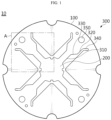
- FIG. 1 is a drawing showing a current collection plate according to an embodiment of the present disclosure
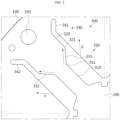
- FIG. 2 is an enlarged view of part A of FIG. 1 .
- a current collection plate 10 is configured to electrically connect an electrode assembly 21 (see FIG. 13 ) accommodated inside a cylindrical battery cell 20 (see FIG. 13 ).
- the cylindrical battery cell 20 will be described later in detail.
- the current collection plate 10 according to an embodiment of the present disclosure may be used as a positive electrode current collection plate 23 (see FIG. 13 ) of the cylindrical battery cell 20.
- the current collection plate 10 includes a border portion 100, a center portion 200, and a connection portion 300.
- the current collection plate 10 is configured to electrically connect the electrode assembly 21 accommodated inside the cylindrical battery cell 20.
- the border portion 100 defines a border and may have an approximate rim shape in which at least a part of the inner region thereof is empty to form an inner space.
- the border portion 100 is illustrated as having an approximately circular rim shape, but the shape of the border portion 100 is not limited thereto. Unlike this, the border portion 100 may have an approximately rectangular rim shape, a hexagonal rim shape, an octagonal rim shape, or other shapes.
- the border portion 100 may be coupled to the connection portion 300.
- the center portion 200 is located at the inner side of the border portion 100 and is spaced apart from the border portion 100.
- the center portion 200 may be located at the exact center of the inner space of the border portion 100, but is not limited thereto.
- the center portion 200 is coupled to the connection portion 300 and is connected to the border portion 100 by the connection portion 300.
- the center portion 200 is coupled to the electrode assembly 21 of the cylindrical battery cell 20.
- the center portion 200 may be arranged at a position corresponding to a center hole of the electrode assembly 21.
- connection portion 300 connects the border portion 100 and the center portion 200.
- the connection portion 300 may be provided in plurality, and the plurality of connection portions 300 may be spaced apart from each other. In FIG. 1 , four connection portions 300 are provided, but the number of connection portions 300 is not limited thereto. In addition, the plurality of connection portions 300 may be arranged at equal intervals from each other, but is not limited thereto.
- connection portion 300 may be formed to have a varying width. That is, the connection portion 300 connects the border portion 100 and the center portion 200, and the width of the connection portion 300 changes from the border portion 100 to the center portion 200, or from the center portion 200 to the border portion 100.
- the connection portion 300 may include a first part 310 connected to the center portion 200 and a second part 320 connected to the border portion 100.
- the width of the first part 310 may be narrower than the width of the second part 320. That is, the width of the connection portion 300 gradually increases from the relatively narrow first part 310 toward the second part 320.
- first connection part 330 of the first part 310 and the second part 320 may be formed to be inclined. That is, the first connection part 330 is connected to be inclined from the first part 310 toward the second part 320.
- the first connection part 330 may include a first inclined part 331 at one side and a second inclined part 332 at the other side, and the first inclined part 331 and the second inclined part 332 may be configured to have the same inclination toward opposite directions. That is, referring to FIG. 2 , the first inclined part 331 may be formed in the X direction, and the second inclined part 332 may be formed in the Y direction. By this structure, the first inclined part 331 and the second inclined part 332 may be formed symmetrically.
- the first connection part 330 may be formed to be inclined so as to extend from the first part 310 toward the second part 320 and may be connected to the second part 320.
- the end 321 of the second part 320 is located farther from the center portion 200 than the end 311 of the first part 310 at the outside of the end 311 of the first part 310.
- the first connection part 330 may be configured to connect the end 311 of the first part 310 and the end 321 of the second part 320 from the end 311 of the first part 310 toward the second part 320.
- FIG. 3 is a drawing showing a current collection plate according to a modified embodiment of FIG. 1
- FIG. 4 is an enlarged view of part B of FIG. 3 .
- the end 321 of the second part 320 may be located further outside than the end 311 of the first part 310, the end 321 of the second part 320 and the end 311 of the first part 310 may be located at the same distance from the center portion 200, and the first connection part 330 may be configured to connect the end 311 of the first part 310 and the end 321 of the second part 320 to each other. Accordingly, the first part 310 and the second part 320 may be connected perpendicularly to each other.
- FIG. 5 is a drawing showing a current collection plate according to another modified embodiment of FIG. 1
- FIG. 6 is an enlarged view of part C of FIG. 5 .
- the first connection part 330 may be formed to be inclined so as to extend from the first part 310 toward the center portion 200 and may be connected to the second part 320.
- the end 321 of the second part 320 may be located closer to the center portion 200 than the end 311 of the first part 310 at the outside of the end 311 of the first part 310, and the first connection part 330 may be configured to connect the end 321 of the second part 320 from the end 311 of the first part 310 toward the center portion 200.
- the second connection part 340 of the second part 320 and the border portion 100 may also be formed to be inclined. That is, the second connection part 340 is connected to be inclined from the second part 320 toward the border portion 100.
- the second connection part 340 includes a third inclined part 341 at one side and a fourth inclined part 342 at the other side, and the third inclined part 341 and the fourth inclined part 342 may be configured to have the same inclination toward opposite directions.
- the third inclined part 341 may be formed in the X direction, and the fourth inclined part 342 may be formed in the Y direction.
- the third inclined part 341 may be formed parallel to the X direction, but does not necessarily have to be parallel, and the fourth inclined part 342 may also be formed parallel to the Y direction, but does not necessarily have to be parallel.
- first inclined part 331 and the third inclined part 341 may be parallel, but do not have to be parallel
- second inclined part 332 and the fourth inclined part 342 may also be parallel, but do not have to be parallel
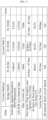
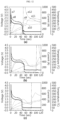
- the fusing start time in each of the three tests was 16.1 [sec], 16.5 [sec], and 17.2 [sec], and it did not exceed 20 [sec] in any of the three tests.
- the thick solid line (a1) at the left in FIG. 8(a) represents voltage
- the thick dotted line (a2) at the left represents current (the same applies to FIGS. 8(b) and 8(c) ).
- FIGS. 8(a) to 8(c) in FIG. 8(a) , it may be confirmed that fusing occurs at 16.1 [sec] and the voltage and current drop sharply, in FIG.
- the external short-circuit result was a pass in all of three tests.
- the pass in the external short-circuit result means that when a short-circuit current is applied to the battery cell, the internal resistance does not exceed a preset range (e.g., 1.5 [m ⁇ ]), and within a preset time (e.g., 20 [sec]), fusing, namely disconnection of the connection portion 300, occurs so that the battery cell does not catch fire or explode.
- fusing 360 has occurred near the connection point between the center portion 200 and the first part 310.
- the temperature of the positive electrode tab rises slightly and then decreases (see a3), and the temperature of the negative electrode tab, the temperature of the battery can 22, and the temperature of the venting section are maintained within an appropriate range. That is, according to an embodiment of the present disclosure, it may be experimentally confirmed that the temperature rise is not excessive and, as a result, the cylindrical battery cell 20 does not ignite.
- the current collection plate has the effect of enabling smooth fusing by disconnecting the connection portion without increasing the internal resistance of the battery cell when a short-circuit current is applied, and also preventing ignition of the battery cell by blocking the flow of current due to the rupture of the connection portion of the current collection plate when a short-circuit current is applied.
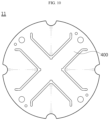
- FIG. 10 is a drawing showing a current collection plate according to a comparative example of each embodiment of the present disclosure
- FIG. 11 is a drawing showing test conditions of the current collection plate of FIG. 10
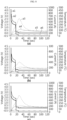
- FIGS. 12(a) to 12(c) are graphs showing test results according to the test conditions of FIG. 11 .
- the externally applied resistance of each of the three tests is 5.08 [m ⁇ ], 5.23 [m ⁇ ], and 5.3 [m ⁇ ].
- the internal resistance of the battery cell of each of the three tests is 1.38 [m ⁇ ], 1.42 [m ⁇ ], and 1.37 [m ⁇ ].
- the maximum current of each of the three tests is 764 [A], 732 [A], and 754 [A].
- the temperature of the battery cell of each of the three tests at the start of the shutdown is 89.6 [°C], 81.9 [°C], and 79.2 [°C].
- the internal resistance of the battery cell does not exceed 1.5 [m ⁇ ].
- the thick solid line (a7) at the left in FIG. 12(a) represents voltage
- the thick dotted line (a8) at the left represents current (the same applies to FIGS. 12(b) and 12(c) ).
- the fusing start time in each of the three tests is 45.3 [sec], 53.5 [sec], and 44.8 [sec], which exceeds 20 [sec] in all three cases.
- the external short-circuit result was a failure in all three tests.
- the failure of the external short-circuit result means that when a short-circuit current is applied to the battery cell, fusing does not occur within a preset time (e.g., 20 [sec]), i.e., the connection portion 300 is not disconnected, which may eventually cause ignition or explosion of the battery cell.
- the thin dotted line (a9) is the temperature of the positive electrode tab of the cylindrical battery cell 20
- the thin solid line (a10) is the temperature of the negative electrode tab of the cylindrical battery cell 20
- the single-dot chain line (a11) is the temperature of the battery can 22 (see FIG. 13 ) of the cylindrical battery cell 20
- the two-dot chain line (a12) is the temperature of the venting portion of the cylindrical battery cell 20 (the same applies to FIGS. 12(b) and 12(c) ).
- the temperature of the venting portion of the cylindrical battery cell 20 rapidly increases (see a12), and the temperature of the battery can 22 of the cylindrical battery cell 20 also increases (see a11), which means that fire occurs inside the cylindrical battery cell 20 and the flame is discharged to the outside through the venting portion. That is, regarding the current collection plate according to the prior art, it may be experimentally confirmed that the cylindrical battery cell is easily ignited.
- connection portion 300 is disconnected within a preset time without the internal resistance of the cylindrical battery cell 20 exceeding a preset range, thereby preventing ignition or explosion of the cylindrical battery cell 20.
- the current collection plate of the comparative example 11 referring to FIGS. 11 and 12 , although the internal resistance of the battery cell does not exceed a preset range, as the connection portion 400 is not disconnected within a preset time, the battery cell is ignited.
- the current collection plate 10 may cause the connection portion 300 to be disconnected without increasing the internal resistance of the cylindrical battery cell 20 when a short-circuit current is applied, and also has the effect of preventing ignition of the cylindrical battery cell 20 by blocking the flow of current due to the rupture of the connection portion 300 of the current collection plate 10.
- FIG. 13 is a schematic cross-sectional view showing a cylindrical battery cell including the current collection plate according to each embodiment of the present disclosure.
- the cylindrical battery cell 20 includes an electrode assembly 21, a battery can 22, a positive electrode current collection plate 23, a cell terminal 24, and a negative electrode current collection plate 25.
- the positive electrode current collection plate 23 of FIG. 13 may be the current collection plate 10 according to an embodiment of the present disclosure described above.
- the electrode assembly 21 has a structure in which a positive electrode plate, a negative electrode plate, and a separator interposed between the positive electrode plate and the negative electrode plate are wound in one direction.
- a center hole is formed at the center of the electrode assembly 21, and the electrode assembly 21 may be formed in a jelly-roll type.
- the electrode assembly 21 may be manufactured by winding a stack that is formed by sequentially stacking a negative electrode plate, a separator, a positive electrode plate, and a separator at least once.
- the positive electrode plate and the negative electrode plate may be formed in a sheet shape.
- the electrode assembly 21 applied to this embodiment may be a winding-type electrode assembly 21.
- an additional separator may be provided on the outer surface of the electrode assembly 21 for insulation from the battery can 22.
- the electrode assembly 21 may have a winding structure well known in the art without limitation.
- a positive electrode active material may be coated on one or both surfaces of the positive electrode plate, and a first uncoated portion where the positive electrode active material is not coated may be formed at an end of the positive electrode plate.
- a positive electrode plate on which a first uncoated portion is formed is illustrated in FIG. 13
- the cylindrical battery cell 20 according to an embodiment of the present disclosure includes an embodiment of a positive electrode plate on which a first uncoated portion is not formed.
- the first uncoated portion may be exposed to the outside of the separator while forming a plurality of winding turns based on the center of the electrode assembly 21, and may be used as an electrode tab in itself.
- a negative electrode active material may be coated on one or both surfaces of the negative electrode plate, and a second uncoated portion where the negative electrode active material is not coated may be formed at an end of the negative electrode plate.
- FIG. 13 illustrates a negative electrode plate on which the second uncoated portion is formed
- the cylindrical battery cell 20 includes an embodiment of a negative electrode plate on which the second uncoated portion is not formed.
- the second uncoated portion may be exposed to the outside of the separator while forming a plurality of winding turns based on the center of the electrode assembly 21, and may be used as an electrode tab in itself.
- At least one of the positive electrode plate and the negative electrode plate may include an uncoated portion where the active material is not coated at a long side end in the winding direction.
- the first uncoated portion and the second uncoated portion may be configured to face opposite directions.
- the positive electrode active material coated on the positive electrode plate and the negative electrode active material coated on the negative electrode plate may use any active materials known in the art be used without limitation.
- the separator may include a porous polymer film, for example, a porous polymer film made of a polyolefin-based polymer such as an ethylene homopolymer, a propylene homopolymer, an ethylene/butene copolymer, an ethylene/hexene copolymer and an ethylene/methacrylate copolymer, used singly or a stack of them.
- a porous polymer film for example, a porous polymer film made of a polyolefin-based polymer such as an ethylene homopolymer, a propylene homopolymer, an ethylene/butene copolymer, an ethylene/hexene copolymer and an ethylene/methacrylate copolymer, used singly or a stack of them.
- the separator may include a common porous nonwoven fabric, for example, a nonwoven fabric made of high melting point glass fibers and polyethylene terephthalate fibers.
- the separator may have a coating layer of inorganic particles on at least one surface thereof. Additionally, the separator itself may be a coating layer of inorganic particles. The particles that form the coating layer may be bonded to each other with a binder to create interstitial volume between adjacent particles.
- the center hole of the electrode assembly 21 is also used for welding the cell terminal (positive electrode terminal) 24 and the positive electrode current collection plate 23. That is, the cell terminal 24 and the positive electrode current collection plate 23 may be welded by irradiating a laser through the center hole of the electrode assembly 21.
- the electrode assembly 21 is accommodated in the battery can 22.
- a through-hole may be formed in the battery can 22.
- the battery can 22 may be formed in a cylindrical shape, and the electrode assembly 21 may be accommodated inside the battery can 22 and may be electrically connected to the negative electrode plate of the electrode assembly 21. Accordingly, the battery can 22 may have the same polarity as the negative electrode plate, i.e., a negative polarity.
- the diameter of the battery can 22 is larger than the diameter of the electrode assembly 21.
- a gap of a preset size is formed between the battery can 22 and the positive electrode current collection plate 23, and an insulator may be interposed in the gap.
- the size of the battery can 22 is set according to the preset standards, as the size of the electrode assembly 21 increases, the total capacity of the battery cells increases, but the gap between the battery can 22 and the electrode assembly 21 decreases
- the gap between the battery can 22 and the electrode assembly 21 decreases with the increasing size of the electrode assembly 21 to increase the total capacity of the battery cells.
- the insulator needs to be disposed in the reduced gap between the battery can 22 and the electrode assembly 21, and to this end, the thickness of the insulator is preferably as small as possible.
- the battery can 22 may have the closed portion and the open portion opposite each other.
- the battery can 22 may have the open portion on bottom.
- the electrode assembly 21 is accommodated through the open portion on the bottom of the battery can 22, and the electrolyte is injected through the open portion on the bottom of the battery can 22.
- the battery can 22 is an approximately cylindrical container having the open portion on the bottom, and is made of, for example, a conductive material such as a metal.
- the battery can 22 may be made of a conductive metal, for example, aluminum, steel and stainless steel, but is not limited thereto.
- a closed portion may be formed at the upper portion of the battery can 22.
- the closed portion may be partially formed at a side opposite to the open portion.
- a through-hole is formed in the closed portion, and as shown in FIG. 13 , the cell terminal 24 is coupled to the through-hole and electrically connected to the positive electrode current collection plate 23 through the through-hole.
- an insulator may be interposed between the battery can 22 and the positive electrode current collection plate 23 at the closed portion.
- the positive electrode current collection plate 23 is electrically connected to the positive electrode plate, and for example, referring to FIG. 13 , the positive electrode current collection plate 23 is connected to the positive electrode plate at the upper portion of the electrode assembly 21.
- the cell terminal 24 is made of a conductive metal material and is coupled to the through-hole formed in the closed portion of the battery can 22 and electrically connected to the positive electrode current collection plate 23 through the through-hole. In addition, the cell terminal 24 is electrically connected to the positive electrode plate of the electrode assembly 21 through the positive electrode current collection plate 23 and thereby has a positive polarity.
- the cell terminal 24 may function as a positive electrode terminal.
- the battery can 22 is electrically connected to the negative electrode plate of the electrode assembly 21 as described above and thereby has a negative polarity.
- the negative electrode current collection plate 25 may be electrically connected to the battery can 22.
- at least a part of an edge portion of the negative electrode current collection plate 25 may be interposed and fixed between the inner surface of the battery can 22 and the sealing gasket.
- At least a part of an edge portion of the negative electrode current collection plate 25 may be supported on the lower surface of the beading portion 27 formed at the lower end of the battery can 22 and fixed to the beading portion 27 by welding. In a modified embodiment, at least a part of an edge portion of the negative electrode current collection plate 25 may be directly welded to the inner wall surface of the battery can 22.
- At least a part of the remaining portion, excluding the coupling portion of the beading portion 27 of the negative electrode current collection plate 25, may be coupled to the bent surface of the second uncoated portion by welding, for example, laser welding.
- At least a part of an edge of the negative electrode current collection plate 25 may be electrically coupled to a surface adjacent to the crimping portion 28 among the upper and lower surfaces of the beading portion 27.
- the cap plate 26 is configured to seal the open portion formed at the lower end of the battery can 22.
- the cap plate 26 may be made of, for example, a metal material to secure rigidity.
- the cap plate 26 may be provided as nonpolar by being separated from the electrode assembly 21. That is, even if the cap plate 26 is made of a conductive metal material, the cap plate 26 may not have polarity.
- the non-polarity of the cap plate 26 means that the cap plate 26 is electrically insulated from the battery can 22 and the cell terminal 24. As such, the cap plate 26 may not be polarized, and its material does not necessarily have to be a conductive metal.
- the cap plate 26 may be placed on and supported by the beading portion 27 formed at the battery can 22.
- the cap plate 26 is fixed by the crimping portion 28.
- a sealing gasket may be interposed between the cap plate 26 and the crimping portion 28 of the battery can 22 to ensure airtightness of the battery can 22. That is, the sealing gasket may be arranged to be interposed between the edge of the cap plate 26 and the open portion of the battery can 22.
- the battery can 22 may include a beading portion 27 and a crimping portion 28 at the lower part.
- the beading portion 27 is formed by inward beading of the periphery of the outer circumferential surface of the battery can 22 in an area adjacent to the open portion of the battery can 22.
- the beading portion 27 may support the electrode assembly 21 to prevent the electrode assembly 21 having a size approximately corresponding to the width of the battery can 22 from slipping out of the open portion formed on the bottom of the battery can 22, and act as a support on which a cap plate 26 is seated. Additionally, the beading portion 27 may support the outer circumferential surface of the sealing gasket.
- the crimping portion 28 is extended and bent to the inner side of the battery can 22 to fix the cap plate 26 together with the sealing gasket around the edge of the cap plate 26.
- the crimping portion 28 is formed at the lower part of the battery can 22 on the basis of the placement of the battery can 22.
- the crimping portion 28 is formed at the lower part of the battery can 22 on the basis of FIG. 13 .
- the crimping portion 28 is formed below the beading portion 27.
- the present disclosure does not preclude the battery can 22 that does not include at least one of the beading portion 27 or the crimping portion 28.
- the securing of the electrode assembly 21, the securing of the cap plate 26 or the sealing of the battery can 22 may be accomplished through at least one of additional application of a component that acts as a stopper for the electrode assembly 21, additional application of a structure on which the cap plate 26 is seated, or welding between the battery can 22 and the cap plate 26.
- the crimping portion 28 is formed below the beading portion 27.
- the crimping portion 28 is extended and bent around the edge of the cap plate 26 disposed below the beading portion 27. By the bent shape of the crimping portion 28, the cap plate 26 is fixed above the beading portion 27.
- the battery can 22 of the present disclosure may not have at least one of the beading portion 27 and the crimping portion 28, and in this case, the sealing gasket may be interposed between a fixing structure provided at the open portion of the battery can 22 and the cap plate 26 to secure the airtightness of the battery can 22.
- the crimping portion 28 may be omitted and any other securing structure may be used to fix the cap plate 26 that covers the open portion of the battery can 22.
- the applicant's patent publication KR 10-2019-0030016 A discloses a cylindrical battery cell in which the beading portion 27 is omitted, and this structure may be employed in the present disclosure.
- the cap plate 26 may include a vent notch 29 designed to rupture when the internal pressure of the battery can 22 is higher than the threshold.
- the vent notch 29 may be formed on two surfaces of the cap plate 26, and may be formed in at least one of a continuous circular pattern, a discontinuous circular pattern or a linear pattern on the surface of the cap plate 26. Additionally, the vent notch 29 may be formed in a variety of different patterns.
- the vent notch 29 may be formed on the bottom of the battery can 22 on the basis of the placement of the battery can 22 of FIG. 13 , and when the vent notch 29 ruptures, gas in the battery can 22 may be discharged out through the bottom of the battery can 22.
- the vent notch 29 may be formed on the bottom of the battery can 22 on the basis of FIG. 13 .
- the vent notch 29 may be an area having a smaller thickness than any other area of the cap plate 26.
- vent notch 29 Since the vent notch 29 is thinner than the surrounding area, the vent notch 29 may be more prone to rupture than the surrounding area, and when the internal pressure of the battery can 22 is equal to or higher than the predetermined level, the vent notch 29 may rupture to discharge out gas inside of the battery can 22.
- vent notch 29 may be formed by partially reducing the thickness of the battery can 22 through notching on one or two surfaces of the cap plate 26.
- the cylindrical battery cell 20 may have a structure in which positive and negative electrode terminals are arranged at the upper part on the basis of FIG. 13 , resulting in the more complex upper structure than the lower structure.
- the cap plate 26 that forms the lower surface of the cylindrical battery cell 20 may have the vent notch 29.
- the cylindrical battery cell 20 is positioned immediately below the driver's seat in an electric vehicle, when gas is discharged out upwards, there may be safety accident risks of the driver.
- the above-described problem does not occur in case that the cylindrical battery cell 20 is positioned immediately below the driver's seat in an electric vehicle.
- FIG. 14 is a schematic drawing showing the configuration of a battery pack including the cylindrical battery cell according to each embodiment of the present disclosure.
- a battery pack 30 may include at least one cylindrical battery cell 20 according to an embodiment of the present disclosure as described above.
- the cylindrical battery cell 20 may include at least one current collection plate 10 according to an embodiment of the present disclosure as described above.
- the battery pack 30 may further include a pack housing 31 for accommodating the cylindrical battery cell 20, and various devices for controlling charging and discharging of the cylindrical battery cell 20, such as a BMS, a current sensor, a fuse, etc.
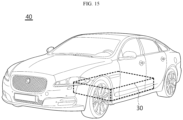
- FIG. 15 is a drawing for explaining a vehicle including the battery pack according to each embodiment of the present disclosure.
- a vehicle 40 may include at least one cylindrical battery cell 20 or at least one battery pack 30 according to each of the embodiments described above.
- the battery pack 30 includes the cylindrical battery cell 20 according to each of the embodiments described above.
- the vehicle 40 includes various vehicles that are designed to use electricity, such as an electric vehicle or a hybrid electric vehicle.
- the present disclosure relates to a current collection plate, a cylindrical battery cell including the same, and a battery pack and a vehicle including the cylindrical battery cell, and particularly, is available to industries related to secondary batteries.
Landscapes
- Chemical & Material Sciences (AREA)
- Chemical Kinetics & Catalysis (AREA)
- Electrochemistry (AREA)
- General Chemical & Material Sciences (AREA)
- Engineering & Computer Science (AREA)
- Manufacturing & Machinery (AREA)
- Aviation & Aerospace Engineering (AREA)
- Connection Of Batteries Or Terminals (AREA)
Applications Claiming Priority (3)
| Application Number | Priority Date | Filing Date | Title |
|---|---|---|---|
| KR20230101813 | 2023-08-03 | ||
| KR1020240037365A KR20250020285A (ko) | 2023-08-03 | 2024-03-18 | 집전판 및 이를 포함하는 원통형 배터리 셀 및, 원통형 배터리 셀을 포함하는 배터리 팩 및 자동차 |
| PCT/KR2024/011431 WO2025029092A1 (ko) | 2023-08-03 | 2024-08-02 | 집전판 및 이를 포함하는 원통형 배터리 셀 및, 원통형 배터리 셀을 포함하는 배터리 팩 및 자동차 |
Publications (1)
| Publication Number | Publication Date |
|---|---|
| EP4576408A1 true EP4576408A1 (de) | 2025-06-25 |
Family
ID=94395582
Family Applications (1)
| Application Number | Title | Priority Date | Filing Date |
|---|---|---|---|
| EP24849659.8A Pending EP4576408A1 (de) | 2023-08-03 | 2024-08-02 | Stromabnehmerplatte, zylindrische batteriezelle damit und batteriepack und fahrzeug mit der zylindrischen batteriezelle |
Country Status (4)
| Country | Link |
|---|---|
| EP (1) | EP4576408A1 (de) |
| CN (1) | CN120391015A (de) |
| MX (1) | MX2025007768A (de) |
| WO (1) | WO2025029092A1 (de) |
Family Cites Families (8)
| Publication number | Priority date | Publication date | Assignee | Title |
|---|---|---|---|---|
| KR101023865B1 (ko) * | 2009-02-25 | 2011-03-22 | 에스비리모티브 주식회사 | 이차 전지 |
| US9496539B2 (en) * | 2011-08-12 | 2016-11-15 | Johnson Controls Technology Llc | Current collector for an electromechanical cell |
| US9324976B2 (en) * | 2012-02-21 | 2016-04-26 | Johnson Controls Technology Company | Electrochemical cell having a fixed cell element |
| KR102263435B1 (ko) | 2017-09-13 | 2021-06-11 | 주식회사 엘지에너지솔루션 | 비딩부가 생략된 원통형 전지셀 |
| JP7365898B2 (ja) | 2019-12-27 | 2023-10-20 | 東京エレクトロン株式会社 | 成膜方法及び成膜装置 |
| JP7767840B2 (ja) | 2020-11-02 | 2025-11-12 | 三菱ケミカル株式会社 | 組成物、液状封止剤、樹脂複合材、封止材、封止材の製造方法、及び電子デバイス |
| CN119812692A (zh) * | 2021-01-19 | 2025-04-11 | 株式会社Lg新能源 | 电极端子的铆接结构、包括其的圆柱形电池单元、电池组和车辆 |
| WO2023101384A1 (ko) * | 2021-11-30 | 2023-06-08 | 주식회사 엘지에너지솔루션 | 전극 조립체, 원통형 배터리 셀, 이를 포함하는 배터리 팩 및 자동차 |
-
2024
- 2024-08-02 CN CN202480005784.9A patent/CN120391015A/zh active Pending
- 2024-08-02 EP EP24849659.8A patent/EP4576408A1/de active Pending
- 2024-08-02 WO PCT/KR2024/011431 patent/WO2025029092A1/ko active Pending
-
2025
- 2025-07-01 MX MX2025007768A patent/MX2025007768A/es unknown
Also Published As
| Publication number | Publication date |
|---|---|
| MX2025007768A (es) | 2025-08-01 |
| WO2025029092A1 (ko) | 2025-02-06 |
| CN120391015A (zh) | 2025-07-29 |
Similar Documents
| Publication | Publication Date | Title |
|---|---|---|
| EP2357685B1 (de) | Wiederaufladbare Batterie | |
| EP2575189B1 (de) | Wiederaufladbare Batterie | |
| US20240128605A1 (en) | Electrode assembly, battery, and battery pack and vehicle including the same | |
| KR102080903B1 (ko) | 전극 리드 및 이를 포함하는 이차 전지 | |
| EP4113733B1 (de) | Batteriezelle mit elektrodenlasche mit darauf geformtem spannungsabbauabschnitt | |
| US9455479B2 (en) | Rechargable battery having a fuse | |
| KR20220092100A (ko) | 이차전지 및 이의 제조 방법 | |
| JP7779000B2 (ja) | 二次電池およびこれを含むデバイス | |
| EP4576408A1 (de) | Stromabnehmerplatte, zylindrische batteriezelle damit und batteriepack und fahrzeug mit der zylindrischen batteriezelle | |
| CA3276334A1 (en) | Current collection plate, cylindrical battery cell including the same, and battery pack and vehicle including cylindrical battery cell | |
| KR20240102770A (ko) | 원통형 배터리 셀 및 이를 포함하는 배터리 팩 및 자동차 | |
| CA3259672A1 (en) | CYLINDRICAL BATTERY COMPONENT, BATTERY BLOCK, AND VEHICLE CONTAINING IT | |
| EP4576377A1 (de) | Batteriepack und fahrzeug damit | |
| KR20250020285A (ko) | 집전판 및 이를 포함하는 원통형 배터리 셀 및, 원통형 배터리 셀을 포함하는 배터리 팩 및 자동차 | |
| EP4243194B1 (de) | Beutelförmige batteriezelle mit verbesserter thermischer stabilität | |
| EP4664665A1 (de) | Zylindrische batteriezelle, batteriepack und fahrzeug damit sowie stromabnehmerplatte | |
| EP4654364A1 (de) | Batteriepack und fahrzeug damit | |
| EP4654362A1 (de) | Stromabnehmer, batteriezelle, batteriepack und fahrzeug damit | |
| KR20240097710A (ko) | 원통형 배터리 셀 및, 이를 포함하는 배터리 팩 및 자동차 및, 원통형 배터리 셀 제조 방법 | |
| EP4564547A1 (de) | Batteriezelle und batteriemodul damit | |
| KR102891459B1 (ko) | 배터리 셀, 및 배터리 셀을 포함하는 배터리 팩 및 자동차 | |
| EP4572078A1 (de) | Batteriezellenlade- und -entladevorrichtung und damit hergestellte batteriezelle sowie batteriepack und fahrzeug mit batteriezellen | |
| EP4621953A1 (de) | Batteriepack | |
| KR20240100241A (ko) | 배터리 팩 및 이를 포함하는 자동차 | |
| EP4632907A2 (de) | Batteriepack |
Legal Events
| Date | Code | Title | Description |
|---|---|---|---|
| STAA | Information on the status of an ep patent application or granted ep patent |
Free format text: STATUS: THE INTERNATIONAL PUBLICATION HAS BEEN MADE |
|
| PUAI | Public reference made under article 153(3) epc to a published international application that has entered the european phase |
Free format text: ORIGINAL CODE: 0009012 |
|
| STAA | Information on the status of an ep patent application or granted ep patent |
Free format text: STATUS: REQUEST FOR EXAMINATION WAS MADE |
|
| 17P | Request for examination filed |
Effective date: 20250319 |
|
| AK | Designated contracting states |
Kind code of ref document: A1 Designated state(s): AL AT BE BG CH CY CZ DE DK EE ES FI FR GB GR HR HU IE IS IT LI LT LU LV MC ME MK MT NL NO PL PT RO RS SE SI SK SM TR |