EP4574591A1 - Method and device for carrying out braking in an ego vehicle - Google Patents
Method and device for carrying out braking in an ego vehicle Download PDFInfo
- Publication number
- EP4574591A1 EP4574591A1 EP24200546.0A EP24200546A EP4574591A1 EP 4574591 A1 EP4574591 A1 EP 4574591A1 EP 24200546 A EP24200546 A EP 24200546A EP 4574591 A1 EP4574591 A1 EP 4574591A1
- Authority
- EP
- European Patent Office
- Prior art keywords
- vehicle
- data
- braking
- opponent
- ego
- Prior art date
- Legal status (The legal status is an assumption and is not a legal conclusion. Google has not performed a legal analysis and makes no representation as to the accuracy of the status listed.)
- Pending
Links
Images

Classifications
-
- B—PERFORMING OPERATIONS; TRANSPORTING
- B60—VEHICLES IN GENERAL
- B60T—VEHICLE BRAKE CONTROL SYSTEMS OR PARTS THEREOF; BRAKE CONTROL SYSTEMS OR PARTS THEREOF, IN GENERAL; ARRANGEMENT OF BRAKING ELEMENTS ON VEHICLES IN GENERAL; PORTABLE DEVICES FOR PREVENTING UNWANTED MOVEMENT OF VEHICLES; VEHICLE MODIFICATIONS TO FACILITATE COOLING OF BRAKES
- B60T7/00—Brake-action initiating means
- B60T7/12—Brake-action initiating means for automatic initiation; for initiation not subject to will of driver or passenger
-
- B—PERFORMING OPERATIONS; TRANSPORTING
- B60—VEHICLES IN GENERAL
- B60W—CONJOINT CONTROL OF VEHICLE SUB-UNITS OF DIFFERENT TYPE OR DIFFERENT FUNCTION; CONTROL SYSTEMS SPECIALLY ADAPTED FOR HYBRID VEHICLES; ROAD VEHICLE DRIVE CONTROL SYSTEMS FOR PURPOSES NOT RELATED TO THE CONTROL OF A PARTICULAR SUB-UNIT
- B60W30/00—Purposes of road vehicle drive control systems not related to the control of a particular sub-unit, e.g. of systems using conjoint control of vehicle sub-units
- B60W30/08—Active safety systems predicting or avoiding probable or impending collision or attempting to minimise its consequences
- B60W30/09—Taking automatic action to avoid collision, e.g. braking and steering
-
- B—PERFORMING OPERATIONS; TRANSPORTING
- B60—VEHICLES IN GENERAL
- B60T—VEHICLE BRAKE CONTROL SYSTEMS OR PARTS THEREOF; BRAKE CONTROL SYSTEMS OR PARTS THEREOF, IN GENERAL; ARRANGEMENT OF BRAKING ELEMENTS ON VEHICLES IN GENERAL; PORTABLE DEVICES FOR PREVENTING UNWANTED MOVEMENT OF VEHICLES; VEHICLE MODIFICATIONS TO FACILITATE COOLING OF BRAKES
- B60T7/00—Brake-action initiating means
- B60T7/12—Brake-action initiating means for automatic initiation; for initiation not subject to will of driver or passenger
- B60T7/16—Brake-action initiating means for automatic initiation; for initiation not subject to will of driver or passenger operated by remote control, i.e. initiating means not mounted on vehicle
- B60T7/18—Brake-action initiating means for automatic initiation; for initiation not subject to will of driver or passenger operated by remote control, i.e. initiating means not mounted on vehicle operated by wayside apparatus
-
- B—PERFORMING OPERATIONS; TRANSPORTING
- B60—VEHICLES IN GENERAL
- B60T—VEHICLE BRAKE CONTROL SYSTEMS OR PARTS THEREOF; BRAKE CONTROL SYSTEMS OR PARTS THEREOF, IN GENERAL; ARRANGEMENT OF BRAKING ELEMENTS ON VEHICLES IN GENERAL; PORTABLE DEVICES FOR PREVENTING UNWANTED MOVEMENT OF VEHICLES; VEHICLE MODIFICATIONS TO FACILITATE COOLING OF BRAKES
- B60T7/00—Brake-action initiating means
- B60T7/12—Brake-action initiating means for automatic initiation; for initiation not subject to will of driver or passenger
- B60T7/22—Brake-action initiating means for automatic initiation; for initiation not subject to will of driver or passenger initiated by contact of vehicle, e.g. bumper, with an external object, e.g. another vehicle, or by means of contactless obstacle detectors mounted on the vehicle
-
- B—PERFORMING OPERATIONS; TRANSPORTING
- B60—VEHICLES IN GENERAL
- B60T—VEHICLE BRAKE CONTROL SYSTEMS OR PARTS THEREOF; BRAKE CONTROL SYSTEMS OR PARTS THEREOF, IN GENERAL; ARRANGEMENT OF BRAKING ELEMENTS ON VEHICLES IN GENERAL; PORTABLE DEVICES FOR PREVENTING UNWANTED MOVEMENT OF VEHICLES; VEHICLE MODIFICATIONS TO FACILITATE COOLING OF BRAKES
- B60T8/00—Arrangements for adjusting wheel-braking force to meet varying vehicular or ground-surface conditions, e.g. limiting or varying distribution of braking force
- B60T8/17—Using electrical or electronic regulation means to control braking
- B60T8/1755—Brake regulation specially adapted to control the stability of the vehicle, e.g. taking into account yaw rate or transverse acceleration in a curve
- B60T8/17558—Brake regulation specially adapted to control the stability of the vehicle, e.g. taking into account yaw rate or transverse acceleration in a curve specially adapted for collision avoidance or collision mitigation
-
- B—PERFORMING OPERATIONS; TRANSPORTING
- B60—VEHICLES IN GENERAL
- B60W—CONJOINT CONTROL OF VEHICLE SUB-UNITS OF DIFFERENT TYPE OR DIFFERENT FUNCTION; CONTROL SYSTEMS SPECIALLY ADAPTED FOR HYBRID VEHICLES; ROAD VEHICLE DRIVE CONTROL SYSTEMS FOR PURPOSES NOT RELATED TO THE CONTROL OF A PARTICULAR SUB-UNIT
- B60W30/00—Purposes of road vehicle drive control systems not related to the control of a particular sub-unit, e.g. of systems using conjoint control of vehicle sub-units
- B60W30/08—Active safety systems predicting or avoiding probable or impending collision or attempting to minimise its consequences
- B60W30/095—Predicting travel path or likelihood of collision
- B60W30/0953—Predicting travel path or likelihood of collision the prediction being responsive to vehicle dynamic parameters
-
- B—PERFORMING OPERATIONS; TRANSPORTING
- B60—VEHICLES IN GENERAL
- B60W—CONJOINT CONTROL OF VEHICLE SUB-UNITS OF DIFFERENT TYPE OR DIFFERENT FUNCTION; CONTROL SYSTEMS SPECIALLY ADAPTED FOR HYBRID VEHICLES; ROAD VEHICLE DRIVE CONTROL SYSTEMS FOR PURPOSES NOT RELATED TO THE CONTROL OF A PARTICULAR SUB-UNIT
- B60W30/00—Purposes of road vehicle drive control systems not related to the control of a particular sub-unit, e.g. of systems using conjoint control of vehicle sub-units
- B60W30/08—Active safety systems predicting or avoiding probable or impending collision or attempting to minimise its consequences
- B60W30/095—Predicting travel path or likelihood of collision
- B60W30/0956—Predicting travel path or likelihood of collision the prediction being responsive to traffic or environmental parameters
-
- B—PERFORMING OPERATIONS; TRANSPORTING
- B60—VEHICLES IN GENERAL
- B60T—VEHICLE BRAKE CONTROL SYSTEMS OR PARTS THEREOF; BRAKE CONTROL SYSTEMS OR PARTS THEREOF, IN GENERAL; ARRANGEMENT OF BRAKING ELEMENTS ON VEHICLES IN GENERAL; PORTABLE DEVICES FOR PREVENTING UNWANTED MOVEMENT OF VEHICLES; VEHICLE MODIFICATIONS TO FACILITATE COOLING OF BRAKES
- B60T2201/00—Particular use of vehicle brake systems; Special systems using also the brakes; Special software modules within the brake system controller
- B60T2201/02—Active or adaptive cruise control system; Distance control
- B60T2201/022—Collision avoidance systems
-
- B—PERFORMING OPERATIONS; TRANSPORTING
- B60—VEHICLES IN GENERAL
- B60T—VEHICLE BRAKE CONTROL SYSTEMS OR PARTS THEREOF; BRAKE CONTROL SYSTEMS OR PARTS THEREOF, IN GENERAL; ARRANGEMENT OF BRAKING ELEMENTS ON VEHICLES IN GENERAL; PORTABLE DEVICES FOR PREVENTING UNWANTED MOVEMENT OF VEHICLES; VEHICLE MODIFICATIONS TO FACILITATE COOLING OF BRAKES
- B60T2210/00—Detection or estimation of road or environment conditions; Detection or estimation of road shapes
- B60T2210/30—Environment conditions or position therewithin
- B60T2210/32—Vehicle surroundings
-
- B—PERFORMING OPERATIONS; TRANSPORTING
- B60—VEHICLES IN GENERAL
- B60T—VEHICLE BRAKE CONTROL SYSTEMS OR PARTS THEREOF; BRAKE CONTROL SYSTEMS OR PARTS THEREOF, IN GENERAL; ARRANGEMENT OF BRAKING ELEMENTS ON VEHICLES IN GENERAL; PORTABLE DEVICES FOR PREVENTING UNWANTED MOVEMENT OF VEHICLES; VEHICLE MODIFICATIONS TO FACILITATE COOLING OF BRAKES
- B60T2210/00—Detection or estimation of road or environment conditions; Detection or estimation of road shapes
- B60T2210/30—Environment conditions or position therewithin
- B60T2210/36—Global Positioning System [GPS]
-
- B—PERFORMING OPERATIONS; TRANSPORTING
- B60—VEHICLES IN GENERAL
- B60W—CONJOINT CONTROL OF VEHICLE SUB-UNITS OF DIFFERENT TYPE OR DIFFERENT FUNCTION; CONTROL SYSTEMS SPECIALLY ADAPTED FOR HYBRID VEHICLES; ROAD VEHICLE DRIVE CONTROL SYSTEMS FOR PURPOSES NOT RELATED TO THE CONTROL OF A PARTICULAR SUB-UNIT
- B60W2710/00—Output or target parameters relating to a particular sub-units
- B60W2710/18—Braking system
Definitions
- the present invention relates to a method for performing braking in an ego vehicle and a corresponding device.
- the opponent vehicle refers to the vehicle or road user with whom the ego vehicle has calculated a collision with a certain probability. In the simplest case, there is only one possible collision opponent. However, there can also be two or more likely collision opponents, which can increase the computational effort. The collision opponent relevant for this analysis is the one with the highest collision probability. This is then considered the opponent vehicle.
- the opponent vehicle can be any vehicle or road user for which information is available and for which a correspondingly high collision probability has been calculated. Accordingly, a pedestrian or cyclist, for example, can also be considered an "opponent vehicle.”
- data from a pedestrian's or cyclist's mobile phone or smartwatch can be transmitted to the ego vehicle via V2X communication.
- two-wheeled vehicles with their own power source e.g., pedelecs or e-bikes
- V2X communication units may also be equipped with their own V2X communication units.
- sensor data about a road user without their own V2X communication unit may be transmitted to the ego vehicle via V2V or V2I.
- sensors from a third-party vehicle or road infrastructure can collect data about a pedestrian, cyclist, or vehicle without V2X equipment and transmit this data to the ego vehicle via V2V or V2I.
- initial data is acquired from one or more sensors on board the ego vehicle that detect the environment of the ego vehicle.
- a sensor can be, for example, a camera, a Radar, a lidar, an ultrasonic sensor, or the like.
- the first data concerns the environment of the ego vehicle. Based on this first data, other road users, traffic signs, road boundaries, road markings, roadside buildings, obstacles, and the like can be detected.
- the collision probability calculation can be performed, for example, by processors on board the ego vehicle or on an edge server. Artificial intelligence or algorithms using machine learning can also be applied to increase accuracy and/or reduce computation time.
- a first braking application is performed with a first braking force if a first set of conditions is met.
- a second braking application is performed with a second braking force if a second set of conditions is met.
- the second braking force is greater than the first braking force.
- the first set of conditions requires that the first data not include any information about the enemy vehicle.
- the on-board sensors cannot collect data about the enemy vehicle, for example, because a direct line of sight is blocked by an obstacle.
- the second data collected via V2X must include information about the enemy vehicle so that a collision probability can be determined.
- Another condition for performing the first braking stage is that the calculated collision probability is equal to or greater than a first threshold value.
- the threshold for the collision probability can be selected depending on several factors, such as driver preference. For example, the threshold (this applies to both the first and second thresholds) can be lowered for defensive driving, which can increase false-positive function triggering and reduce false-negative triggering. For aggressive driving, the opposite can be true. Furthermore, predicted speeds of the ego vehicle and the opponent vehicle can be (the limit values can be selected lower at higher speeds because the potential accident severity is higher, and vice versa) and the vehicle types of the ego vehicle and opponent vehicle (the limit value is selected lower for vulnerable road users because the potential accident severity is higher) are taken into account when determining the limit values.
- the second set of conditions requires that the initial data include the position, direction, and speed of the opponent vehicle. In other words, the second braking is only initiated if the ego vehicle's on-board sensors detect information about the opponent vehicle.
- a further condition is that the collision probability, now also calculated based on the initial data, is equal to or greater than a second threshold.
- a preferred embodiment of the method comprises a step for generating an environmental model of the ego vehicle, which describes a position, direction, and speed of the ego vehicle and the enemy vehicle, as well as their respective uncertainties.
- trajectories for the ego vehicle and the enemy vehicle can be generated in a vehicle or world coordinate system.
- spatial existence probabilities for the ego vehicle and the enemy vehicle can be calculated. The collision probability can then be determined depending on the environmental model. For example, it can be calculated whether the respective trajectories intersect or whether the spaces described by the existence probabilities of the vehicles overlap.
- the environment model may further include information about a lane of the ego vehicle and/or the opponent vehicle and/or map information describing the topography of the surroundings of the ego vehicle and/or the opponent vehicle and/or information about the right-of-way of the ego vehicle and/or the opponent vehicle. This data can be used to calculate the collision probability more accurately.
- the first data may further include an acceleration of the opponent vehicle and/or a yaw rate of the opponent vehicle and/or a vehicle type of the opponent vehicle and/or dimensions of the opponent vehicle and/or a past trajectory of the opponent vehicle and/or a planned trajectory of the opponent vehicle.
- the accuracy of the collision probability can be increased. This allows the risk of a collision, as well as its location and time of the collision, to be determined more precisely, thus avoiding false-positive detection of a collision risk and improving the safety of road users.
- the second data may further include an acceleration of the opponent vehicle and/or a braking force of the opponent vehicle and/or a steering angle of the opponent vehicle and/or a yaw rate of the opponent vehicle and/or a vehicle type of the opponent vehicle and/or dimensions of the opponent vehicle and/or a past trajectory of the opponent vehicle and/or, particularly in the case of a self-driving vehicle, a planned trajectory of the opponent vehicle.
- the accuracy of the collision probability can be increased. This allows the risk of a collision, as well as its location and time of the collision, to be determined more precisely, thus avoiding false-positive detection of a collision risk and improving the safety of road users.
- third data may further include an acceleration of the ego vehicle and/or a braking force of the ego vehicle and/or a steering angle of the ego vehicle and/or a yaw rate of the ego vehicle and/or a vehicle type of the ego vehicle and/or dimensions of the ego vehicle and/or a past
- the trajectory of the ego vehicle and/or, particularly in the case of a self-driving vehicle, a planned trajectory of the ego vehicle This allows the risk of a collision, as well as the location and time of the collision, to be determined more precisely, thus avoiding false-positive detection of a collision risk and improving the safety of road users.
- the first braking force causes a deceleration of the ego vehicle of at most 4 ms -2 .
- This value corresponds to a typical deceleration in inner-city traffic, which is also expected by other road users. This makes it possible, in particular, to avoid rear-end collisions with another vehicle behind the ego vehicle.
- the first braking force causes a deceleration of the ego vehicle of approximately 3 to 4 ms -2 .
- the second braking force preferably causes maximum deceleration of the ego vehicle, for example, approximately 9 ms -2 .
- the maximum deceleration is preferably triggered as late as possible to avoid unnecessary braking maneuvers and endangering other road users.
- the braking or stopping distance can be shortened, and a collision can be prevented as late as possible.
- the first braking is initiated at a time when a calculated time until collision falls below a maximum value.
- the first braking should be initiated at the latest possible time in order to achieve the highest possible accuracy in calculating the collision probability, thus avoiding false-positive first braking.
- the first set of conditions may further comprise detecting an obstacle that prevents detection of the opponent vehicle using the first data.
- it is determined, for example, using the on-board sensors and/or data about the environment of the ego vehicle (e.g., map data), that an Visual contact with an enemy vehicle is blocked, preventing the on-board sensors from collecting data about the enemy vehicle.
- the presence of the enemy vehicle is detected by receiving the second data.
- a malfunction of the on-board sensors for example, can be ruled out. This further increases safety.
- the method comprises a step for acquiring information about the right-of-way of the ego vehicle and the opponent vehicle. This can be done, for example, using map data and/or by recognizing traffic signs and the like.
- the first set of conditions can accordingly further include that the ego vehicle must respect the right-of-way of the opponent vehicle.
- the first braking can be performed, for example, when the method detects that the driver of the ego vehicle is not respecting the right-of-way of the opponent vehicle. Depending on the situation, a high collision probability can be detected and the collision can be prevented.
- a device for performing braking in an ego vehicle comprises, for example, one or more control and/or regulating devices that communicate with sensors and communication devices as well as the CAN bus of the ego vehicle in order to acquire first, second, and third data.
- the device is configured to perform a method according to the invention.
- the device can, for example, also interact with an ESP and/or ABS system in order to perform the first and/or second braking.
- steering can preferably also be performed to evade and avoid a collision.
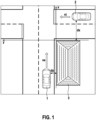
- Fig. 1 shows a schematic plan view of an intersection where a building blocks the view.
- X and y denote orthogonal axes of a (spatially fixed) coordinate system.
- FIG. 1 An ego vehicle 1 approaching from below at speed ve is approaching the intersection.
- An opponent vehicle 2 is approaching the intersection from the right at speed vt.
- a building 3 on the right side of the road next to the lane of ego vehicle 1 blocks the line of sight between ego vehicle 1 and opponent vehicle 2. Consequently, neither the driver of ego vehicle 1 nor sensors on board ego vehicle 1 can detect opponent vehicle 2. If both vehicles 1 and 2 were to continue driving straight ahead, a collision would occur. A conventional vision-based braking assistant would fail and could not prevent the collision.
- the situation shown is often found in urban traffic. However, the invention is not limited to this situation. It is also effective in other situations of this type, such as roundabouts, intersections on curves, side streets with parked vehicles, cycle path intersections, railway crossings, tram crossings, when there is heavy traffic around the ego vehicle, when there is an oncoming vehicle in the ego vehicle's lane, when there is a slow vehicle in front of the ego vehicle on a curve, etc.
- the present invention comprises a first braking application with moderate braking force, which is triggered early enough by receiving V2X data, before the opposing vehicle 2 is visible, so that the collision can be avoided. Due to the high safety requirements of an emergency braking function, the V2X data only triggers moderate braking, since emergency braking requires a higher safety level (e.g. ASIL B) due to the strong deceleration of, for example, 9 ms -2 .
- ASIL B e.g. ASIL B
- Fig. 2 shows a schematic view of an embodiment of a device or method for performing emergency braking.
- the first three boxes on the left denote the first data 11, the second data 12, and the third data 13. These data 11, 12, 13 are combined to form an environmental model 14 of the ego vehicle. Collision probabilities 15 are calculated based on the environmental model 14 and the third data 13. A decision is then made as to whether a first braking stage S1 and/or a second braking stage S2 should be performed. Based on this decision, braking signals are generated and output to a braking system 4 of the ego vehicle.
- the first data 11 is collected by sensors on board the ego vehicle 1.
- Vision-based sensors on board are required to detect the enemy vehicle 2 with a high functional safety level and serve as the data source for initiating the second braking application, the emergency braking with maximum braking force. They can consist of a single sensor, a combination of similar sensors, or a combination of different sensor technologies (such as radar, video, lidar, or ultrasound) to meet the functional safety level and sensor range requirements.
- the second data 12 are acquired by means of V2X and relate to the opponent vehicle 2.
- the second data 12 comprise at least a position, a direction and a speed of the opponent vehicle 2.
- the ego vehicle 1 comprises a suitable V2X interface.
- the second data 12 includes an acceleration, a brake pressure, a yaw rate, a vehicle type, dimensions, a past trajectory, and/or a planned trajectory, e.g., in the case of a self-driving opponent vehicle.
- the sender of the V2X communication can be the opponent vehicle 2 itself (V2V), an infrastructure (V2I) equipped with sensors to detect the opponent vehicle and a V2X communication unit, or a third road user that can detect the opponent vehicle and pass on the information about the opponent vehicle via V2X.
- V2V opponent vehicle 2 itself
- V2I infrastructure
- V2X communication unit a third road user that can detect the opponent vehicle and pass on the information about the opponent vehicle via V2X.
- the third data 13 describes the state of the ego-vehicle 1, in particular its position, speed, and direction.
- further state information of the ego-vehicle 1 that improves the movement prediction of the ego-vehicle 1, such as acceleration, braking pressure, yaw rate, vehicle type, dimensions, a past trajectory, and/or a planned trajectory in the case of an automatically driving ego-vehicle 1, can be recorded.
- the first data 11, the second data 12, and the third data 13 can be combined to generate an environmental model 14 of the ego vehicle.
- collision probabilities 15 can be calculated.
- the environmental model 14 combines all information about states and trajectories and uncertainties or location probabilities in a unified representation (e.g., in a world or vehicle coordinate system). about the ego vehicle and all potential opponent vehicles.
- the environment model 14 can include additional information about the traffic situation and traffic regulations.
- Collision probabilities 15 between the ego vehicle and each potential adversary vehicle can, for example, be calculated by a specially configured device comprising a processor and a memory device, as well as suitable interfaces for inputting and outputting data. This requires a motion prediction for the ego vehicle and each potential adversary. This prediction takes into account all object data, including the existence probabilities and uncertainties from the environmental model 14 and the data components of the ego vehicle.
- a braking application device decides whether the ego vehicle applies the first braking application S1.
- this response pattern is a moderate braking intervention requiring only a relatively low ASIL level, which can be met through V2X communication, so this first braking stage S1 can be activated using information derived exclusively from the V2X communication (second data 12).
- the first braking intervention S1 can be limited to a maximum deceleration value of approximately 4 m/s 2 .
- the first braking application S1 can be applied with a constant deceleration value or with a deceleration value adapted to the need for collision avoidance.
- a high deceleration value close to the QM limit is used, as this reduces the prediction time and thus false-positive braking triggers.
- a first set of triggering conditions for the first braking S1 comprises the following criteria, all of which must preferably be met.
- a first condition is that, without braking, a collision between the ego vehicle and the opponent vehicle is predicted with a certain probability. Furthermore, second data 12 on the position and state of the opponent vehicle received via V2X communication must be available.
- a third condition for triggering is that a last possible time at which the first braking S1 that can avoid the collision has been achieved. In other words, the first braking S1 is initiated as late as possible to achieve the highest possible prediction accuracy and avoid false-positive braking.
- the latest possible time can be achieved by calculating a stopping distance under the assumption that the first braking action S1 is initiated at the current time. This condition is met if the currently remaining distance to the calculated collision position is less than the stopping distance. With this strategy, the ego vehicle should always come to a stop before the calculated collision position of the opponent vehicle. Alternatively, the latest possible time can be determined so that the ego vehicle can use the space behind the opponent vehicle after it has passed the path of the ego vehicle.
- the triggering time is preferably limited by a maximum value for the remaining time to collision in order to limit the prediction time to an upper limit and thus reduce false-positive braking.
- An example value for this maximum permissible time to collision is 2 to 2.5 seconds for urban speeds.
- the device for implementing the braking makes the decision as to whether the vehicle should perform the second braking application S2.
- This reaction pattern is an emergency braking application, which requires a high ASIL level (e.g. ASIL B), which cannot usually be met by data received via V2X communication alone. Therefore, the second braking application S2 is only triggered when there is a line of sight to the opposing vehicle and this can be detected by the on-board sensors, i.e. when initial data 11 is available.
- the deceleration value for the second braking application S2 is preferably close to an emergency braking application. A typical value is, for example, 9 m/s 2 .
- a second set of triggering conditions for the second braking S2 comprises the following criteria, which preferably all have to be met. According to a In the first condition, a collision between the ego vehicle and the opponent vehicle must be predicted with a certain probability if no braking or only the first braking S1 is performed. Alternatively, the second braking S2 can also be triggered completely independently of the first braking S1.
- Another mandatory requirement for the second braking S2 is that the position and state of the enemy vehicle are detected by the on-board sensors, i.e., that initial data 11 about the enemy vehicle is available. This ensures that the position, speed, direction, and acceleration of the enemy vehicle are detected with high reliability and safety.
- a further condition is that the last possible time at which the second braking action S2 can avoid the collision is reached.
- the strategies described above for the first braking action can also be applied here.
- the ego vehicle should come to a stop in an area ahead of the opponent vehicle.
- the reference number 4 in Fig. 2 A braking device is shown. This can, for example, be a component that transmits the required braking force to the brakes of the ego vehicle. This is usually a control unit of an ESC or ESP system ("Electronic Stability Control") with corresponding interfaces.
- Fig. 3 shows a chronological sequence of a method for performing braking according to an embodiment.
- the vertical axis indicates a deceleration (negative acceleration) in m/s 2 .
- the horizontal axis is the time axis.
- the thick line illustrates the temporal progression of the deceleration of the ego vehicle. The following describes the Fig. 3 marked times t1 to t6 are explained.
- the enemy vehicle is within communication range for V2X communication.
- second data 12 can be periodically transmitted via the enemy vehicle using V2X. received.
- the probability of the enemy vehicle's existence can be increased with each received message, which includes, for example, the second data 12 and a timestamp.
- the present method or the corresponding system can then calculate the collision probability with the enemy vehicle and the corresponding remaining time to collision as described above.
- Time t2 denotes the latest possible trigger point for avoiding a collision by means of the first braking action S1.
- the first braking action S1 should be triggered to avoid a collision.
- not all conditions of the first set of conditions are yet met.
- the remaining time until collision is still greater than a specified maximum value for triggering the first braking action S1.
- Time t5 represents the latest possible time for triggering the second braking action S2 to avoid the collision. At this moment, all second conditions are met, and the second braking action S2 is triggered by the second trigger signal TS2.
- the second braking force B2 is applied to achieve a maximum deceleration of 9 m/ s2 .
- the automatic braking intervention is deactivated.
- the ego vehicle has come to a standstill and/or a collision is no longer predicted.
- the ego vehicle behind the enemy vehicle that has completely passed the path of the ego vehicle.
- the triggering of the first braking action S1 can be limited to cases in which an obstacle that prevents direct detection of the opposing vehicle is directly detected by the on-board sensors.
- second data 12 about the opposing vehicle is collected via V2X but no first data 11 is available, it can be concluded that an obstacle is blocking direct detection of the opposing vehicle. This check can also be made dependent, for example, on the opposing vehicle being within range of the on-board sensors.
- the triggering of the first braking action S1 can also be limited to cases in which the ego vehicle does not have the right of way.
- the first braking action S1 is generally triggered at a later time than the driver would start braking if they recognized the existing right-of-way situation. If the driver fails to brake for any reason, the method according to the invention can prevent an accident.
- the first braking S1 is not triggered if the opponent vehicle violates the right-of-way of the ego vehicle.
- a false-positive braking is likely if the opponent vehicle has not yet begun its braking maneuver. Omitting these situations has a great potential to reduce the occurrence of false-positive braking altogether.
- the process requires information about applicable right-of-way rules, which can be obtained, for example, from map information and/or the recognition of traffic signs and traffic lights.
- driver decelerate in a range of up to 3 m/s 2 to cope with situations in urban environments.
- the first braking application S1 can therefore be delayed until it is unlikely that the opponent vehicle will decelerate and/or swerve. This can be achieved if the first braking application S1 is only allowed to be initiated, for example, if the opponent vehicle would have to brake with an above-average deceleration, e.g., greater than 3 m/s 2 , to avoid a collision with the ego vehicle. This restriction can reduce false-positive braking applications. The same condition can also be applied to braking applications by the driver of the ego vehicle.
- the absence of the first data 11 about the opposing vehicle may have reasons other than obstructed vision due to an obstacle.
- the sensor range may be limited by weather conditions such as fog, snow, or heavy rain, or by glare (low) sun, or by dust, dirt, or snow on the sensor itself.
- the sensors may have poor quality or measurement accuracy.
- Other reasons include a malfunction of one or more on-board sensors.
- the first braking S1 based on the second data 12 received via V2X can prevent collisions.
Landscapes
- Engineering & Computer Science (AREA)
- Transportation (AREA)
- Mechanical Engineering (AREA)
- Automation & Control Theory (AREA)
- Traffic Control Systems (AREA)
Abstract
Die vorliegende Erfindung betrifft ein Verfahren zum Durchführen einer Bremsung in einem Ego-Fahrzeug (1). Erste Daten werden von Sensoren an Bord des Ego-Fahrzeugs (1), die eine Umgebung des Ego-Fahrzeugs (1) detektieren, erfasst. Zweiter Daten werden mittels Fahrzeug-Kommunikation, V2X, über ein Gegner-Fahrzeug (2) erfasst. Die zweiten Daten umfassen eine Position, eine Richtung und eine Geschwindigkeit des Gegner-Fahrzeugs (2). Dritte Daten, die eine Position, eine Richtung und eine Geschwindigkeit des Ego-Fahrzeugs (1) umfassen, werden erfasst. Es wird eine Kollisionswahrscheinlichkeit zwischen dem Ego-Fahrzeug (1) und dem Gegner-Fahrzeug (2) in Abhängigkeit der ersten Daten, zweiten Daten und dritten Daten ermittelt. Eine erste Bremsung wird mit einer ersten Bremskraft durchgeführt, wenn ein erster Satz von Bedingungen erfüllt ist. Eine zweite Bremsung wird mit einer zweiten Bremskraft durchgeführt, wenn ein zweiter Satz von Bedingungen erfüllt ist.

Description
Die vorliegende Erfindung betrifft ein Verfahren zum Durchführen einer Bremsung in einem Ego-Fahrzeug sowie eine entsprechende Vorrichtung.The present invention relates to a method for performing braking in an ego vehicle and a corresponding device.
Es existiert derzeit ein langfristiges Ziel, die Anzahl der Verkehrstoten und Schwerverletzten in Verkehrsunfällen auf Null zu reduzieren. Ein durchschnittlicher menschlicher Fahrer kann Fehler verursachen, die zu kritischen Situationen führen können. Ferner sind die menschlichen Fähigkeiten zum Vermeiden von Unfällen aufgrund physikalischer Beschränkungen begrenzt. Um die Zahl der Toten und Verletzten zu verringern, unterstützen moderne Autos den menschlichen Fahrer durch verschiedene Assistenzfunktionen. Eine der wichtigsten Funktionen zum Vermeiden und/oder Abmildern von Unfällen ist das automatische Bremsen. In kritischster Form wird dies als automatischer Notbremsassistent ("automated emergency brake", AEB) bezeichnet. Diese Funktion aktiviert eine Vollbremsung, wenn ein Unfall droht, den der Fahrer nicht mehr vermeiden kann.There is currently a long-term goal to reduce the number of fatalities and serious injuries in traffic accidents to zero. An average human driver can make errors that can lead to critical situations. Furthermore, human ability to avoid accidents is limited due to physical limitations. To reduce the number of fatalities and injuries, modern cars support the human driver with various assistance functions. One of the most important functions for avoiding and/or mitigating accidents is automatic braking. In its most critical form, this is known as automated emergency braking (AEB). This function activates emergency braking when an accident is imminent that the driver can no longer avoid.
Das Auslösen der AEB beruht auf Daten, die ein Sensorsystem des Fahrzeugs liefert, das in der Regel Kameras, Radar und möglicherweise Lidar umfasst. Diese fahrzeuginternen Sensoren benötigen jedoch eine direkte Sichtverbindung zwischen Sensor und Kollisionsgegner. Diese Einschränkung trifft jedoch auch auf den menschlichen Fahrer zu. Die Sichtverbindung kann beispielsweise durch Wettereinfluss, dichten Verkehr oder andere physikalische Hindernisse, z.B. an verdeckten Kreuzungen oder nicht einsehbaren Kurven, beeinträchtigt werden.The activation of AEB is based on data provided by a vehicle's sensor system, which typically includes cameras, radar, and possibly lidar. However, these in-vehicle sensors require a direct line of sight between the sensor and the collision opponent. This limitation also applies to the human driver. Line of sight can be impaired, for example, by weather conditions, heavy traffic, or other physical obstacles, such as at hidden intersections or blind curves.
Fahrzeug-Kommunikation ("Vehicle-to-Everything", V2X) ermöglicht es dem Ego-Fahrzeug, Informationen beispielsweise mit anderen Verkehrsteilnehmern, einer Infrastruktur und/oder Netzwerk-Diensten, wie z.B. einer Cloud oder einem Server, auszutauschen. Diese Form der Kommunikation erfordert Sende- und Empfangsfähigkeiten der Fahrzeuge sowie den Aufbau einer sicheren und zuverlässigen drahtlosen Verbindung zwischen den Kommunikationspartnern. Eine Sichtverbindung zwischen den Kommunikationspartnern ist dafür jedoch nicht zwingend erforderlich. Daher kann V2X als zusätzlicher Sensor eingesetzt werden, der die Sensoren an Bord des Ego-Fahrzeugs in Szenarien mit eingeschränkter Sicht ergänzt. Somit kann ein automatisches Bremsen oder ein Durchführen von Kollisionsvermeidungsmaßnahmen ermöglicht werden, auch wenn der Gegner für den Fahrer und die sichtbasierten Sensoren an Bord des Ego-Fahrzeugs nicht sichtbar ist.Vehicle-to-Everything (V2X) communication enables the ego vehicle to exchange information with other road users, an infrastructure, and/or network services, such as a cloud or a server. This form of communication requires the vehicles to have transmit and receive capabilities, as well as the establishment of a secure and reliable wireless connection between the communication partners. However, a line of sight between the communication partners is not mandatory. Therefore, V2X can be used as an additional sensor, supplementing the sensors on board the ego vehicle in scenarios with limited visibility. This enables automatic braking or the implementation of collision avoidance measures, even if the opponent is not visible to the driver and the vision-based sensors on board the ego vehicle.
Die Patentanmeldung
Die Patentanmeldung
Das Verfahren der Patentanmeldung
Ein möglicher Nachteil von V2X-Kommunikation ist, dass empfangene V2X-Daten möglicherweise nicht ausreichend zuverlässig und/oder vertrauenswürdig für eine Nutzung in sicherheitskritische Fahrfunktionen sind. Funktionen wie z.B. AEB müssen jedoch hohe Sicherheitsanforderungen erfüllen, die insbesondere durch einen entsprechenden Automotive Safety Integrity Level (ASIL) laut der Norm ISO 26262 festgelegt werden. Das erforderliche Sicherheitsniveau, das zum Auslösen einer AEB erforderlich ist, kann durch V2X-Kommunikation allein unter Umständen nicht erreicht werden. Allerdings kann in vielen Situationen, in denen die Sichtverbindung zwischen Ego-Fahrzeug und Gegner-Fahrzeug beeinträchtigt ist, das Auslösen der AEB allein auf Grundlage der bordeigenen Sensoren des Ego-Fahrzeugs die Kollision nicht verhindern.A potential disadvantage of V2X communication is that received V2X data may not be sufficiently reliable and/or trustworthy for use in safety-critical driving functions. However, functions such as AEB must meet high safety requirements, which are defined in particular by an appropriate Automotive Safety Integrity Level (ASIL) according to the ISO 26262 standard. The required safety level to trigger AEB may not be achievable through V2X communication alone. However, in many situations where the line of sight between the ego vehicle and the adversary vehicle is impaired, triggering AEB based solely on the ego vehicle's on-board sensors may not prevent a collision.
Mit der vorliegenden Erfindung lässt sich ein Ego-Fahrzeug sicher abbremsen, um eine Kollision mit einem Gegner-Fahrzeug zu vermeiden, selbst wenn das Gegner-Fahrzeug nicht von Sensoren an Bord des Ego-Fahrzeugs erfasst werden kann.With the present invention, an ego vehicle can be safely braked to avoid a collision with an opponent vehicle, even if the opponent vehicle cannot be detected by sensors on board the ego vehicle.
Erfindungsgemäß werden daher ein Verfahren zum Durchführen einer Bremsung in einem Ego-Fahrzeug nach Patentanspruch 1 sowie eine Vorrichtung zum Durchführen einer Bremsung in einem Ego-Fahrzeug mit den Merkmalen des Patentanspruchs 10 angegeben. Als Bremsung wird hier ein automatisierter Bremsvorgang zum Vermeiden einer Kollision mit einem anderen Verkehrsteilnehmer verstanden, bei dem der Fahrer des Ego-Fahrzeugs den Bremsvorgang nicht selbst einleitet.According to the invention, a method for performing braking in an ego vehicle according to
Vorteilhafte Ausgestaltungen und Weiterbildungen ergeben sich aus den weiteren Unteransprüchen sowie aus der Beschreibung unter Bezugnahme auf die Figuren.Advantageous embodiments and further developments emerge from the further subclaims and from the description with reference to the figures.
Die vorliegende Erfindung schlägt vor, ein zweistufiges Bremsschema zu verwenden, so dass Kollisionen auch in Situationen vermieden werden können, in denen ein Sichthindernis das rechtzeitige Erkennen einer potenziellen Kollision durch bordeigene Sensoren nicht zulässt. Die erste Stufe umfasst ein moderates Bremsschema, das nur ein niedriges ASIL-Niveau erfordert, beispielsweise das als QM ("Qualitätsmanagement") bezeichnete Niveau, und daher allein auf Grundlage von V2X-Daten ausgelöst werden kann, wenn keine Sichtverbindung hergestellt werden kann. Bei diesem moderaten Bremsschema wird die Bremskraft begrenzt, z.B. auf eine maximale Verzögerung von 4 m/s2.The present invention proposes the use of a two-stage braking scheme so that collisions can be avoided even in situations where a visual obstruction prevents timely detection of a potential collision by on-board sensors. The first stage comprises a moderate braking scheme that requires only a low ASIL level, for example, the level referred to as QM ("Quality Management"), and can therefore be triggered based solely on V2X data when line-of-sight cannot be established. In this moderate braking scheme, the braking force is limited, e.g., to a maximum deceleration of 4 m/s 2 .
In einer zweiten Stufe kann eine Notbremsung mit einer höheren Bremskraft (z.B. maximaler Bremskraft) zu einem späteren Zeitpunkt mit Hilfe bordeigener Sensoren ausgelöst werden, wenn eine Sichtverbindung zwischen Ego-Fahrzeug und Gegner-Fahrzeug hergestellt werden kann und die Kollision nicht allein durch die erste Bremsstufe vermieden werden kann. Die zweite Stufe erfordert aufgrund der notwendig höheren Bremskraft ein höheres ASIL-Niveau, z.B. ASIL B, das nach aktuellem Stand der Technik nur durch Verwenden der Daten der bordeigenen Sensoren erfüllt werden kann. Dadurch wird eine maximale Verzögerung von beispielsweise 9 m/s2 ermöglicht.In a second stage, emergency braking with a higher braking force (e.g., maximum braking force) can be triggered at a later time using on-board sensors if a line of sight can be established between the ego vehicle and the enemy vehicle and the collision cannot be avoided by the first braking stage alone. Due to the necessary higher braking force, the second stage requires a higher ASIL level, e.g., ASIL B, which, according to the current state of the art, can only be met by using data from the on-board sensors. This enables a maximum deceleration of, for example, 9 m/ s² .
Neben der verbesserten Fähigkeit zum Vermeiden von Unfällen und einem erhöhten Fahrkomfort durch die moderate Bremsung der ersten Stufe gewinnt das zweistufige Bremsschema an Robustheit gegenüber Ungenauigkeiten aller Art, insbesondere Messfehler und Toleranzen beim Berechnen von Position, Geschwindigkeit und Richtung des Ego-Fahrzeugs und/oder des Gegner-Fahrzeugs und dergleichen. Erreicht wird dies durch die unabhängige zweite Bremsstufe, die aufgrund der späteren Auslösung Ungenauigkeiten korrigieren kann, die zum Zeitpunkt des Auslösens der ersten Stufe in Kauf genommen werden können. Wenn die zweite Stufe zu einem späteren Zeitpunkt ausgelöst wird, können die Ungenauigkeiten aufgrund der besseren Datenqualität, der längeren Beobachtungszeit und der kürzeren Vorhersagezeit verringert werden.In addition to the improved ability to avoid accidents and increased driving comfort due to the moderate braking of the first stage, the two-stage braking scheme gains robustness against inaccuracies of all kinds, especially measurement errors and tolerances in calculating the position, speed, and direction of the ego vehicle and/or the enemy vehicle, and the like. This is achieved by the independent second braking stage, which, due to its later activation, can correct inaccuracies that can be accepted at the time of triggering the first stage. If the second stage is triggered at a later time, the inaccuracies can be reduced due to the better data quality, longer observation time, and shorter prediction time.
Als Ego-Fahrzeug wird vorliegend dasjenige Fahrzeug bezeichnet, aus dessen Perspektive das erfindungsgemäße Verfahren durchgeführt wird, bzw. das die erfindungsgemäße Vorrichtung aufweist. Das Ego-Fahrzeug kann ein von einem Menschen gelenkter PKW, Nutzfahrzeug, Motorrad oder ein autonom fahrendes Fahrzeug sein.In this context, the ego vehicle refers to the vehicle from whose perspective the method according to the invention is carried out or which has the device according to the invention. The ego vehicle can be a human-driven passenger car, commercial vehicle, motorcycle, or an autonomously driving vehicle.
Das Gegner-Fahrzeug bezeichnet dasjenige Fahrzeug oder allgemein Verkehrsteilnehmer, mit dem das Ego-Fahrzeug eine Kollision zu einer gewissen Wahrscheinlichkeit berechnet hat. Im einfachsten Fall gibt es nur einen möglichen Kollisionsgegner. Es kann jedoch auch zwei oder mehr wahrscheinliche Kollisionsgegner geben, was den Rechenaufwand erhöhen kann. Der für die vorliegende Betrachtung relevante Kollisionsgegner ist derjenige mit der höchsten Kollisionswahrscheinlichkeit. Dieser wird dann als Gegner-Fahrzeug betrachtet. Das Gegner-Fahrzeug kann ein beliebiges Fahrzeug bzw. allgemein Verkehrsteilnehmer sein, über das bzw. über den Informationen verfügbar sind und eine entsprechend hohe Kollisionswahrscheinlichkeit berechnet wurde. Entsprechend können z.B. auch ein Fußgänger oder Fahrradfahrer als "Gegner-Fahrzeug" betrachtet werden.The opponent vehicle refers to the vehicle or road user with whom the ego vehicle has calculated a collision with a certain probability. In the simplest case, there is only one possible collision opponent. However, there can also be two or more likely collision opponents, which can increase the computational effort. The collision opponent relevant for this analysis is the one with the highest collision probability. This is then considered the opponent vehicle. The opponent vehicle can be any vehicle or road user for which information is available and for which a correspondingly high collision probability has been calculated. Accordingly, a pedestrian or cyclist, for example, can also be considered an "opponent vehicle."
Beispielsweise können Daten von einem Mobiltelefon oder einer Smart-Watch eines Fußgängers oder Fahrradfahrers mittels V2X-Kommunikation an das Ego-Fahrzeug übertragen werden. Zukünftig können zusätzlich Zweiradfahrzeuge mit eigener Stromquelle (z.B. Pedelecs oder E-Bikes) mit eigenen V2X-Kommunikationseinheiten ausgestattet sein. Darüber hinaus kann es möglich sein, mittels V2V oder V2I Sensordaten über einen Verkehrsteilnehmer ohne eigene V2X-Kommunikationseinheit an das Ego-Fahrzeug zu übertragen. Beispielsweise können Sensoren eines Drittfahrzeugs oder einer Straßeninfrastruktur Daten über einen Fußgänger, Fahrradfahrer oder Fahrzeug ohne V2X-Austattung erfassen und diese Daten mittels V2V beziehungsweise V2I an das Ego-Fahrzeug übertragen.For example, data from a pedestrian's or cyclist's mobile phone or smartwatch can be transmitted to the ego vehicle via V2X communication. In the future, two-wheeled vehicles with their own power source (e.g., pedelecs or e-bikes) may also be equipped with their own V2X communication units. Furthermore, it may be possible to transmit sensor data about a road user without their own V2X communication unit to the ego vehicle via V2V or V2I. For example, sensors from a third-party vehicle or road infrastructure can collect data about a pedestrian, cyclist, or vehicle without V2X equipment and transmit this data to the ego vehicle via V2V or V2I.
In einem Schritt des Verfahrens werden erste Daten von einem Sensor oder mehreren Sensoren an Bord des Ego-Fahrzeugs, die eine Umgebung des Ego-Fahrzeugs detektieren, erfasst. Ein Sensor kann beispielsweise eine Kamera, ein Radar, ein Lidar, einen Ultraschallsensor oder dergleichen umfassen. Die ersten Daten betreffen die Umgebung des Ego-Fahrzeugs. Anhand der ersten Daten können andere Verkehrsteilnehmer, Verkehrszeichen, Straßenbegrenzungen, Straßenmarkierungen, Gebäude am Straßenrand, Hindernisse und dergleichen detektiert werden.In one step of the method, initial data is acquired from one or more sensors on board the ego vehicle that detect the environment of the ego vehicle. A sensor can be, for example, a camera, a Radar, a lidar, an ultrasonic sensor, or the like. The first data concerns the environment of the ego vehicle. Based on this first data, other road users, traffic signs, road boundaries, road markings, roadside buildings, obstacles, and the like can be detected.
In einem Schritt des Verfahrens werden zweite Daten mittels Fahrzeug-Kommunikation, V2X ("Vehicle-to-Everything"), über ein Gegner-Fahrzeug erfasst. Die zweiten Daten umfassen eine Position, eine Richtung und eine Geschwindigkeit des Gegner-Fahrzeugs. Diese Informationen können alternativ als zwei- oder dreidimensionale geplante Trajektorie beschrieben werden, die den zukünftigen Positionsverlauf des Gegner-Fahrzeugs über die Zeit beschreibt. Die geplante Trajektorie kann beispielsweise als Punkteliste oder mit stückweise Polynomfunktionen (Spline-Funktionen) beschrieben werden. Dadurch, dass die zweiten Daten erfasst werden, ist keine direkte Sichtverbindung der Sensoren an Bord des Ego-Fahrzeugs zum Gegner-Fahrzeug notwendig, um Informationen über das Gegner-Fahrzeug zu erhalten. Folglich kann die Sicherheit der Verkehrsteilnehmer erhöht werden. Dies kann insbesondere an schlecht einsehbaren Kreuzungen im städtischen Verkehr nützlich sein, wo z.B. Gebäude, Bäume, andere Fahrzeuge und dergleichen die Sicht versperren können.In one step of the method, second data is collected about an opponent vehicle using vehicle-to-everything (V2X) communication. The second data includes the position, direction, and speed of the opponent vehicle. This information can alternatively be described as a two- or three-dimensional planned trajectory that describes the future position of the opponent vehicle over time. The planned trajectory can be described, for example, as a list of points or with piecewise polynomial functions (spline functions). By collecting the second data, a direct line of sight between the sensors on board the ego vehicle and the opponent vehicle is not necessary to obtain information about the opponent vehicle. Consequently, the safety of road users can be increased. This can be particularly useful at poorly visible intersections in urban traffic, where, for example, buildings, trees, other vehicles, and the like can obstruct the view.
In einem Schritt des Verfahrens werden dritte Daten, die eine Position, eine Richtung und eine Geschwindigkeit des Ego-Fahrzeugs umfassen, erfasst. Diese dritten Daten können z.B. mittels CAN-Bus von Steuergeräten des Fahrzeugs ausgelesen werden. Position, Geschwindigkeit und Richtung des Ego-Fahrzeugs können z.B. auch über einen GNSS-Sensor oder dergleichen ermittelt werden. Ferner können Informationen über einen Lenkwinkel, eine Stellung des Gaspedals, eine Bremskraft, eine Drehgeschwindigkeit der Räder usw. ermittelt werden. Anhand der dritten Daten kann beispielsweise eine zwei- oder dreidimensionale Trajektorie erzeugt werden, der einen Anfangspunkt als Position und weitere Punkte, die basierend auf der aktuellen Geschwindigkeit und Richtung des Ego-Fahrzeugs prädiziert werden, umfasst.In one step of the method, third data comprising a position, a direction, and a speed of the ego vehicle are recorded. This third data can be read out, for example, by the vehicle's control units via CAN bus. The position, speed, and direction of the ego vehicle can also be determined, for example, via a GNSS sensor or the like. Furthermore, information about a steering angle, a position of the accelerator pedal, a braking force, a rotational speed of the wheels, etc. can be determined. Based on the third data, for example, a two- or three-dimensional trajectory can be generated, which includes a starting point as the position and further points that are predicted based on the current speed and direction of the ego vehicle.
Ermitteln einer Kollisionswahrscheinlichkeit zwischen dem Ego-Fahrzeug und dem Gegner-Fahrzeug in Abhängigkeit der ersten Daten, zweiten Daten und dritten Daten. Das Berechnen der Kollisionswahrscheinlichkeit kann beispielsweise durch Prozessoren an Bord des Ego-Fahrzeugs oder auf einem Edge-Server durchgeführt werden. Hierbei können beispielsweise auch künstliche Intelligenz bzw. Algorithmen, die maschinelles Lernen verwenden, angewendet werden, um die Genauigkeit zu erhöhen und/oder die Rechenzeit zu verkürzen.Determining a collision probability between the ego vehicle and the opponent vehicle depending on the first data, second data and third data. The collision probability calculation can be performed, for example, by processors on board the ego vehicle or on an edge server. Artificial intelligence or algorithms using machine learning can also be applied to increase accuracy and/or reduce computation time.
Gemäß dem Verfahren wird in einer ersten Stufe eine erste Bremsung mit einer ersten Bremskraft durchgeführt, wenn ein erster Satz von Bedingungen erfüllt ist. In einer zweiten Stufe wird eine zweite Bremsung mit einer zweiten Bremskraft durchgeführt, wenn ein zweiter Satz von Bedingungen erfüllt ist. Hierbei ist die zweite Bremskraft größer als die erste Bremskraft. Somit wird ein zweistufiges Bremsschema realisiert, bei dem zunächst eine moderate Bremsung (erste Stufe) durchgeführt wird, nach der gegebenenfalls eine Notbremsung (zweite Stufe) durchgeführt werden kann, um eine Kollision mit dem Gegner-Fahrzeug zu vermeiden.According to the method, in a first stage, a first braking application is performed with a first braking force if a first set of conditions is met. In a second stage, a second braking application is performed with a second braking force if a second set of conditions is met. In this case, the second braking force is greater than the first braking force. Thus, a two-stage braking scheme is implemented in which moderate braking (first stage) is initially performed, after which, if necessary, emergency braking (second stage) can be performed to avoid a collision with the opposing vehicle.
Der erste Satz von Bedingungen umfasst, dass die ersten Daten keine Informationen über das Gegner-Fahrzeug umfassen. Mit anderen Worten, die bordeigenen Sensoren können keine Daten über das Gegner-Fahrzeug erfassen, da z.B. eine direkte Sichtverbindung durch ein Hindernis blockiert ist. Entsprechend ist es notwendig, dass die über V2X erfassten zweiten Daten Informationen über das Gegner-Fahrzeug umfassen, so dass eine Kollisionswahrscheinlichkeit ermittelt werden kann. Eine weitere Bedingung für das Durchführen der ersten Bremsstufe ist, dass die berechnete Kollisionswahrscheinlichkeit gleich groß wie oder größer als ein erster Grenzwert ist.The first set of conditions requires that the first data not include any information about the enemy vehicle. In other words, the on-board sensors cannot collect data about the enemy vehicle, for example, because a direct line of sight is blocked by an obstacle. Accordingly, the second data collected via V2X must include information about the enemy vehicle so that a collision probability can be determined. Another condition for performing the first braking stage is that the calculated collision probability is equal to or greater than a first threshold value.
Der Grenzwert für die Kollisionswahrscheinlichkeit kann abhängig von mehreren Faktoren ausgewählt werden, beispielsweise eine Fahrerpräferenz. So kann der Grenzwert (dies gilt sowohl für den ersten als auch zweiten Grenzwert) z.B. bei einer defensiven Fahrweise niedriger ausgewählt werden, was eine falsch-positive Funktionsauslösungen erhöh und falsch-negative reduzieren kann. Bei einer aggressiven Fahrweise kann dies entsprechend umgekehrt sein. Ferner können vorhergesagte Geschwindigkeiten des Ego-Fahrzeugs und des Gegner-Fahrzeugs (die Grenzwerte können bei höheren Geschwindigkeiten niedriger ausgewählt werden, da die potentielle Unfallschwere höher ist, und umgekehrt) und die Fahrzeugtypen des Ego-Fahrzeugs und Gegner-Fahrzeugs (der Grenzwert wird bei schwachen Verkehrsteilnehmern, "Vulnerable Road Users", niedriger ausgewählt, da die potentielle Unfallschwere höher ist) beim Bestimmen der Grenzwerte berücksichtigt werden.The threshold for the collision probability can be selected depending on several factors, such as driver preference. For example, the threshold (this applies to both the first and second thresholds) can be lowered for defensive driving, which can increase false-positive function triggering and reduce false-negative triggering. For aggressive driving, the opposite can be true. Furthermore, predicted speeds of the ego vehicle and the opponent vehicle can be (the limit values can be selected lower at higher speeds because the potential accident severity is higher, and vice versa) and the vehicle types of the ego vehicle and opponent vehicle (the limit value is selected lower for vulnerable road users because the potential accident severity is higher) are taken into account when determining the limit values.
Die berechnete Kollisionswahrscheinlichkeit betrifft hier vorzugsweise den Fall, dass keine Bremsung durchgeführt wird. Mit anderen Worten, es wird in Abhängigkeit der erfassten ersten, zweiten und/oder dritten Daten berechnet, ob eine Kollision wahrscheinlich ist, wenn das Ego-Fahrzeug ohne Bremsung weiterfährt.The calculated collision probability here preferably applies to the case where no braking is performed. In other words, depending on the first, second, and/or third data collected, it is calculated whether a collision is likely if the ego vehicle continues driving without braking.
Der zweite Satz von Bedingungen umfasst, dass die ersten Daten eine Position, eine Richtung und eine Geschwindigkeit des Gegner-Fahrzeugs umfassen. Mit anderen Worten, die zweite Bremsung wird nur dann eingeleitet, wenn die bordeigenen Sensoren des Ego-Fahrzeugs Informationen über das Gegner-Fahrzeug erfassen. Eine weitere Bedingung ist, dass die nun auch anhand der vorliegenden ersten Daten berechnete Kollisionswahrscheinlichkeit gleich groß wie oder größer als ein zweiter Grenzwert ist.The second set of conditions requires that the initial data include the position, direction, and speed of the opponent vehicle. In other words, the second braking is only initiated if the ego vehicle's on-board sensors detect information about the opponent vehicle. A further condition is that the collision probability, now also calculated based on the initial data, is equal to or greater than a second threshold.
Eine bevorzugte Ausführung des Verfahrens umfasst einen Schritt zum Erzeugen eines Umgebungsmodells des Ego-Fahrzeugs, das eine Position, Richtung und Geschwindigkeit des Ego-Fahrzeugs und des Gegner-Fahrzeugs sowie deren jeweiligen Unsicherheiten beschreibt. Hierbei können insbesondere Trajektorien für das Ego-Fahrzeug und das Gegner-Fahrzeug in einem Fahrzeug- oder Welt-Koordinatensystem erzeugt werden. Ferner können räumliche Existenzwahrscheinlichkeiten für Ego-Fahrzeug und Gegner-Fahrzeug berechnet werden. Die Kollisionswahrscheinlichkeit kann anschließend in Abhängigkeit des Umgebungsmodells bestimmt werden. Beispielsweise kann berechnet werden, ob sich die jeweiligen Trajektorien schneiden, oder die Räume, beschrieben durch die Existenzwahrscheinlichkeit der Fahrzeuge, überlappen.A preferred embodiment of the method comprises a step for generating an environmental model of the ego vehicle, which describes a position, direction, and speed of the ego vehicle and the enemy vehicle, as well as their respective uncertainties. In particular, trajectories for the ego vehicle and the enemy vehicle can be generated in a vehicle or world coordinate system. Furthermore, spatial existence probabilities for the ego vehicle and the enemy vehicle can be calculated. The collision probability can then be determined depending on the environmental model. For example, it can be calculated whether the respective trajectories intersect or whether the spaces described by the existence probabilities of the vehicles overlap.
Gemäß einer bevorzugten Ausführung kann das Umgebungsmodel ferner Informationen über eine Fahrspur des Ego-Fahrzeugs und/oder des Gegner-Fahrzeugs und/oder Karteninformationen, die eine Topographie einer Umgebung des Ego-Fahrzeugs und/oder des Gegner-Fahrzeugs beschreiben und/oder Informationen über ein Vorfahrtsrecht des Ego-Fahrzeugs und/oder des Gegner-Fahrzeugs umfassen. Anhand dieser Daten kann die Kollisionswahrscheinlichkeit genauer berechnet werden.According to a preferred embodiment, the environment model may further include information about a lane of the ego vehicle and/or the opponent vehicle and/or map information describing the topography of the surroundings of the ego vehicle and/or the opponent vehicle and/or information about the right-of-way of the ego vehicle and/or the opponent vehicle. This data can be used to calculate the collision probability more accurately.
Gemäß einer bevorzugten Ausführung können die ersten Daten ferner eine Beschleunigung des Gegner-Fahrzeugs und/oder eine Gierrate des Gegner-Fahrzeugs und/oder ein Fahrzeugtyp des Gegner-Fahrzeugs und/oder Abmessungen des Gegner-Fahrzeugs und/oder eine vergangene Trajektorie des Gegner-Fahrzeugs, und/oder eine geplante Trajektorie des Gegner-Fahrzeugs umfassen. Mit Hilfe dieser zusätzlichen Daten kann die Genauigkeit der Kollisionswahrscheinlichkeit erhöht werden. So lassen sich die Gefahr einer Kollision sowie deren Ort und ein Zeitpunkt der Kollision genauer bestimmen, so dass ein falsch-positives Erkennen einer Kollisionsgefahr vermieden und die Sicherheit der Verkehrsteilnehmer verbessert werden können.According to a preferred embodiment, the first data may further include an acceleration of the opponent vehicle and/or a yaw rate of the opponent vehicle and/or a vehicle type of the opponent vehicle and/or dimensions of the opponent vehicle and/or a past trajectory of the opponent vehicle and/or a planned trajectory of the opponent vehicle. With the help of this additional data, the accuracy of the collision probability can be increased. This allows the risk of a collision, as well as its location and time of the collision, to be determined more precisely, thus avoiding false-positive detection of a collision risk and improving the safety of road users.
Gemäß einer bevorzugten Ausführung können die zweiten Daten ferner eine Beschleunigung des Gegner-Fahrzeugs und/oder eine Bremskraft des Gegner-Fahrzeugs und/oder einen Lenkwinkel des Gegner-Fahrzeugs und/oder eine Gierrate des Gegner-Fahrzeugs und/oder ein Fahrzeugtyp des Gegner-Fahrzeugs und/oder Abmessungen des Gegner-Fahrzeugs und/oder eine vergangene Trajektorie des Gegner-Fahrzeugs und/oder, insbesondere im Fall eines selbstfahrenden Fahrzeugs, eine geplante Trajektorie des Gegner-Fahrzeugs umfassen. Mit Hilfe dieser zusätzlichen Daten kann die Genauigkeit der Kollisionswahrscheinlichkeit erhöht werden. So lassen sich die Gefahr einer Kollision sowie deren Ort und ein Zeitpunkt der Kollision genauer bestimmen, so dass ein falsch-positives Erkennen einer Kollisionsgefahr vermieden und die Sicherheit der Verkehrsteilnehmer verbessert werden können.According to a preferred embodiment, the second data may further include an acceleration of the opponent vehicle and/or a braking force of the opponent vehicle and/or a steering angle of the opponent vehicle and/or a yaw rate of the opponent vehicle and/or a vehicle type of the opponent vehicle and/or dimensions of the opponent vehicle and/or a past trajectory of the opponent vehicle and/or, particularly in the case of a self-driving vehicle, a planned trajectory of the opponent vehicle. With the help of this additional data, the accuracy of the collision probability can be increased. This allows the risk of a collision, as well as its location and time of the collision, to be determined more precisely, thus avoiding false-positive detection of a collision risk and improving the safety of road users.
Gemäß einer bevorzugten Ausführung können dritten Daten ferner eine Beschleunigung des Ego-Fahrzeugs und/oder eine Bremskraft des Ego-Fahrzeugs und/oder einen Lenkwinkel des Ego-Fahrzeugs und/oder eine Gierrate des Ego-Fahrzeugs und/oder ein Fahrzeugtyp des Ego-Fahrzeugs und/oder Abmessungen des Ego-Fahrzeugs und/oder eine vergangene Trajektorie des Ego-Fahrzeugs und/oder, insbesondere im Fall eines selbstfahrenden Fahrzeugs, eine geplante Trajektorie des Ego-Fahrzeugs umfassen. So lassen sich die Gefahr einer Kollision sowie deren Ort und ein Zeitpunkt der Kollision genauer bestimmen, so dass ein falsch-positives Erkennen einer Kollisionsgefahr vermieden und die Sicherheit der Verkehrsteilnehmer verbessert werden können.According to a preferred embodiment, third data may further include an acceleration of the ego vehicle and/or a braking force of the ego vehicle and/or a steering angle of the ego vehicle and/or a yaw rate of the ego vehicle and/or a vehicle type of the ego vehicle and/or dimensions of the ego vehicle and/or a past The trajectory of the ego vehicle and/or, particularly in the case of a self-driving vehicle, a planned trajectory of the ego vehicle. This allows the risk of a collision, as well as the location and time of the collision, to be determined more precisely, thus avoiding false-positive detection of a collision risk and improving the safety of road users.
Vorzugsweise bewirkt die erste Bremskraft eine Verzögerung des Ego-Fahrzeugs von höchstens 4 ms-2. Dieser Wert entspricht einer üblichen Verzögerung im innerstädtischen Verkehr, die auch von anderen Verkehrsteilnehmern erwartet wird. Somit können insbesondere Auffahrunfälle mit einem weiteren Fahrzeug hinter dem Ego-Fahrzeug vermieden werden. Besonders vorzugsweise kann die erste Bremskraft eine Verzögerung des Ego-Fahrzeugs von ungefähr 3 bis 4 ms-2 bewirken.Preferably, the first braking force causes a deceleration of the ego vehicle of at most 4 ms -2 . This value corresponds to a typical deceleration in inner-city traffic, which is also expected by other road users. This makes it possible, in particular, to avoid rear-end collisions with another vehicle behind the ego vehicle. Particularly preferably, the first braking force causes a deceleration of the ego vehicle of approximately 3 to 4 ms -2 .
Die zweite Bremskraft bewirkt vorzugsweise eine maximale Verzögerung des Ego-Fahrzeugs, von beispielsweise ungefähr 9 ms-2. Die maximale Verzögerung wird vorzugsweise in einem möglichst späten Zeitpunkt ausgelöst, um unnötige Bremsmanöver und eine Gefährdung anderer Verkehrsteilnehmer zu vermeiden. Durch Verwenden der maximalen Bremskraft kann der Bremsweg bzw. Anhalteweg verkürzt werden und eine Kollision kann so spät wie möglich verhindert werden.The second braking force preferably causes maximum deceleration of the ego vehicle, for example, approximately 9 ms -2 . The maximum deceleration is preferably triggered as late as possible to avoid unnecessary braking maneuvers and endangering other road users. By applying the maximum braking force, the braking or stopping distance can be shortened, and a collision can be prevented as late as possible.
Gemäß einer bevorzugten Ausführung wird die erste Bremsung zu einem Zeitpunkt eingeleitet, zu dem ein berechneter Zeitraum bis zur Kollision einen Maximalwert unterschreitet. Mit anderen Worten, die erste Bremsung soll zu einem spätest möglichen Zeitpunkt eingeleitet werden, um eine möglichst hohe Genauigkeit beim Berechnen der Kollisionswahrscheinlichkeit zu erreichen, so dass falsch-positive erste Bremsungen vermieden werden können.According to a preferred embodiment, the first braking is initiated at a time when a calculated time until collision falls below a maximum value. In other words, the first braking should be initiated at the latest possible time in order to achieve the highest possible accuracy in calculating the collision probability, thus avoiding false-positive first braking.
Der erste Satz von Bedingungen kann gemäß einer bevorzugten Ausführung ferner umfassen, dass ein Hindernis erkannt wird, das ein Erfassen des Gegner-Fahrzeugs mittels der ersten Daten verhindert. Mit anderen Worten, es wird z.B. mittels der bordeigenen Sensoren und/oder anhand von Daten über die Umgebung des Ego-Fahrzeugs (z.B. Kartendaten) festgestellt, dass ein Sichtkontakt mit einem Gegner-Fahrzeug blockiert ist, so dass die bordeigenen Sensoren keine Daten über das Gegner-Fahrzeug erfassen können. Die Existenz des Gegner-Fahrzeugs ist über das Empfangen der zweiten Daten bekannt. Anhand des aktiven Bestimmens, dass ein Hindernis vorliegt, kann z.B. eine Fehlfunktion der bordeigenen Sensoren ausgeschlossen werden. Somit kann die Sicherheit weiter erhöht werden.According to a preferred embodiment, the first set of conditions may further comprise detecting an obstacle that prevents detection of the opponent vehicle using the first data. In other words, it is determined, for example, using the on-board sensors and/or data about the environment of the ego vehicle (e.g., map data), that an Visual contact with an enemy vehicle is blocked, preventing the on-board sensors from collecting data about the enemy vehicle. The presence of the enemy vehicle is detected by receiving the second data. By actively determining that an obstacle is present, a malfunction of the on-board sensors, for example, can be ruled out. This further increases safety.
Gemäß einer bevorzugten Ausführung umfasst das Verfahren einen Schritt zum Erfassen von Informationen über ein Vorfahrtsrecht des Ego-Fahrzeugs und des Gegner-Fahrzeugs. Dies kann beispielsweise anhand von Kartendaten und/oder durch Erkennen von Verkehrsschildern und dergleichen erfolgen. Der erste Satz von Bedingungen kann entsprechend ferner umfassen, dass das Ego-Fahrzeug ein Vorfahrtsrecht des Gegner-Fahrzeugs achten muss. Die erste Bremsung kann z.B. dann ausgeführt werden, wenn das Verfahren erkennt, dass der Fahrer des Ego-Fahrzeugs die Vorfahrt des Gegner-Fahrzeugs nicht beachtet. So kann situationsabhängig eine hohe Kollisionswahrscheinlichkeit erkannt und die Kollision verhindert werden.According to a preferred embodiment, the method comprises a step for acquiring information about the right-of-way of the ego vehicle and the opponent vehicle. This can be done, for example, using map data and/or by recognizing traffic signs and the like. The first set of conditions can accordingly further include that the ego vehicle must respect the right-of-way of the opponent vehicle. The first braking can be performed, for example, when the method detects that the driver of the ego vehicle is not respecting the right-of-way of the opponent vehicle. Depending on the situation, a high collision probability can be detected and the collision can be prevented.
Eine Vorrichtung zum Durchführen einer Bremsung in einem Ego-Fahrzeug umfasst beispielsweise eine oder mehrere Steuer- und/oder Regeleinrichtungen, die mit Sensoren und Kommunikationseinrichtungen sowie dem CAN-Bus des Ego-Fahrzeugs kommunizieren, um erste, zweite und dritte Daten zu erfassen. Die Vorrichtung ist konfiguriert, ein erfindungsgemäßes Verfahren durchzuführen. Hierzu kann die Vorrichtung beispielsweise auch mit einem ESP- und/oder ABS-System zusammenwirken, um die erste und/oder zweite Bremsung durchzuführen. In Weiterbildungen der vorliegenden Erfindung kann vorzugsweise auch eine Lenkung zum Ausweichen und Vermeiden einer Kollision durchgeführt werden.A device for performing braking in an ego vehicle comprises, for example, one or more control and/or regulating devices that communicate with sensors and communication devices as well as the CAN bus of the ego vehicle in order to acquire first, second, and third data. The device is configured to perform a method according to the invention. For this purpose, the device can, for example, also interact with an ESP and/or ABS system in order to perform the first and/or second braking. In further developments of the present invention, steering can preferably also be performed to evade and avoid a collision.
Die vorliegende Erfindung wird nachfolgend anhand der in den schematischen Figuren angegebenen Ausführungsbeispiele näher erläutert. Es zeigen dabei:
- Fig. 1
- eine schematische Draufsicht auf eine Kreuzung, bei der ein Gebäude die Sicht blockiert;
- Fig. 2
- eine schematische Ansicht eines Ausführungsbeispiels einer Vorrichtung zum Durchführen einer Bremsung;
- Fig. 3
- einen zeitlichen Ablauf eines Verfahrens zum Durchführen einer Bremsung gemäß einem Ausführungsbeispiel;
- Fig. 1
- a schematic plan view of an intersection with a building blocking the view;
- Fig. 2
- a schematic view of an embodiment of a device for performing braking;
- Fig. 3
- a time sequence of a method for performing braking according to an embodiment;
Die beiliegenden Figuren sollen ein weiteres Verständnis der Ausführungsformen der Erfindung vermitteln. Sie veranschaulichen Ausführungsformen und dienen im Zusammenhang mit der Beschreibung der Erklärung von Prinzipien und Konzepten der Erfindung. Andere Ausführungsformen und viele der genannten Vorteile ergeben sich im Hinblick auf die Zeichnungen. Die Elemente der Zeichnungen sind nicht notwendigerweise maßstabsgetreu zueinander gezeigt.The accompanying figures are intended to provide a further understanding of embodiments of the invention. They illustrate embodiments and, in conjunction with the description, serve to explain principles and concepts of the invention. Other embodiments and many of the noted advantages will be apparent upon consideration of the drawings. Elements of the drawings are not necessarily shown to scale relative to one another.
In den Figuren der Zeichnung sind gleiche, funktionsgleiche und gleich wirkende Elemente, Merkmale und Komponenten - sofern nichts anderes ausgeführt ist - jeweils mit denselben Bezugszeichen versehen.In the figures of the drawing, identical, functionally identical and acting elements, features and components are provided with the same reference symbols, unless otherwise stated.
In
Die in
Bei der in
Die ersten Daten 11 werden von Sensoren an Bord des Ego-Fahrzeugs 1 erfasst. Sichtbasierte Sensoren an Bord sind erforderlich, um das Gegner-Fahrzeug 2 mit einem hohen funktionalen Sicherheitsniveau zu erkennen und dienen als Datenquelle für das Auslösen der zweiten Bremsung, als der Notbremsung mit maximaler Bremskraft. Sie können aus einem einzigen Sensor, einer Kombination ähnlicher Sensoren oder einer Kombination verschiedener Sensortechnologien (wie z.B. Radar, Video, Lidar oder Ultraschall) bestehen, um die Anforderungen an das funktionale Sicherheitsniveau und die Sensorreichweite zu erfüllen.The
Die zweiten Daten 12 werden mittels V2X erfasst und betreffen das Gegner-Fahrzeug 2. Die zweiten Daten 12 umfassen mindestens eine Position, eine Richtung und eine Geschwindigkeit des Gegner-Fahrzeugs 2. Zum Empfangen der zweiten Daten 12 umfasst das Ego-Fahrzeug 1 eine geeignete V2X-Schnittstelle.The
Optional können weitere Zustandsinformationen, die eine Vorhersage der Bewegung des Gegner-Fahrzeugs 2 verbessern können, in den zweiten Daten 12 enthalten sein. Beispielsweise umfassen die zweiten Daten 12 eine Beschleunigung, einen Bremsdruck, eine Gierrate, ein Fahrzeugtyp, Abmessungen, eine vergangene Trajektorie und/oder eine geplante Trajektorie, z.B. im Fall eines selbstfahrenden Gegner-Fahrzeugs.Optionally, further state information that can improve a prediction of the movement of the
Der Absender der V2X-Kommunikation kann das Gegner-Fahrzeug 2 selbst sein (V2V), eine Infrastruktur (V2I), die mit Sensoren zum Erkennen des Gegner-Fahrzeugs und einer V2X-Kommunikationseinheit ausgestattet ist, oder ein dritter Verkehrsteilnehmer, der das gegnerische Fahrzeug erkennen und die Informationen über das gegnerische Fahrzeug über V2X weitergeben kann.The sender of the V2X communication can be the
Die dritten Daten 13 beschreiben den Zustand des Ego-Fahrzeugs 1, insbesondere Position, Geschwindigkeit und Richtung. Optional können weitere Zustandsinformationen des Ego-Fahrzeugs 1, die die Bewegungsvorhersage des Ego-Fahrzeugs 1 verbessern, wie z. B. eine Beschleunigung, einen Bremsdruck, eine Gierrate, ein Fahrzeugtyp, Abmessungen, eine vergangene Trajektorie und/oder eine geplante Trajektorie im Falle eines automatisch fahrenden Ego-Fahrzeugs 1 erfasst werden.The
In einer Recheneinrichtung des Ego-Fahrzeugs können die ersten Daten 11, die zweiten Daten 12 und die dritten Daten 13 zusammengeführt werden, um ein Umgebungsmodell 14 des Ego-Fahrzeugs zu erzeugen. Anhand des Umgebungsmodells 14 können Kollisionswahrscheinlichkeiten 15 berechnet werden. Das Umgebungsmodell 14 kombiniert in einer einheitlichen Darstellung (z.B. in einem Welt- oder Fahrzeug-Koordinatensystem) alle Informationen über Zustände und Trajektorien und Unsicherheiten bzw. Ortswahrscheinlichkeiten über das Ego-Fahrzeug und aller potenzieller Gegner-Fahrzeuge. Ferner kann das Umgebungsmodell 14 zusätzliche Informationen über die Verkehrssituation und Verkehrsregeln umfassen.In a computing device of the ego vehicle, the
Kollisionswahrscheinlichkeiten 15 zwischen dem Ego-Fahrzeug und jedem potenziellen Gegner-Fahrzeug können beispielsweise von einer speziell dazu konfigurierten Einrichtung berechnet werden, die einen Prozessor und eine Speichereinrichtung sowie geeignete Schnittstellen zum Eingeben und Ausgeben von Daten umfasst. Dazu ist eine Bewegungsvorhersage für das Ego-Fahrzeug und jeden potenziellen Gegner notwendig. Sie berücksichtigt alle Objektdaten einschließlich der Existenzwahrscheinlichkeiten und Unsicherheiten aus dem Umgebungsmodell 14 und den Datenkomponenten des Ego-Fahrzeugs.
Eine Einrichtung zum Durchführen der Bremsung trifft die Entscheidung, ob das Ego-Fahrzeug die erste Bremsung S1 anwendet. Wie oben beschrieben ist dieses Reaktionsmuster ein moderater Bremseingriff, der nur ein relativ geringes ASIL-Niveau erfordert, das durch V2X-Kommunikation erfüllt werden kann, so dass diese erste Bremsstufe S1 mit Informationen aktiviert werden kann, die ausschließlich aus der V2X-Kommunikation stammen (zweite Daten 12). Wenn z.B. ein ASIL-Niveau "QM" erreicht wird, kann der erste Bremseingriff S1 auf einen maximalen Verzögerungswert von etwa 4 m/s2 beschränkt sein. Eine solche Verzögerung tritt im städtischen Verkehr häufig auf und gefährdet andere Verkehrsteilnehmer nicht. Die erste Bremsung S1 kann mit einem konstanten Verzögerungswert oder mit einem an die Notwendigkeit der Kollisionsvermeidung angepassten Verzögerungswert durchgeführt werden. Vorzugsweise wird ein hoher Verzögerungswert nah bei der QM-Grenze verwendet, da dies die Vorhersagezeit und damit falsch-positive Auslöser von Bremsungen reduziert.A braking application device decides whether the ego vehicle applies the first braking application S1. As described above, this response pattern is a moderate braking intervention requiring only a relatively low ASIL level, which can be met through V2X communication, so this first braking stage S1 can be activated using information derived exclusively from the V2X communication (second data 12). For example, if an ASIL level "QM" is reached, the first braking intervention S1 can be limited to a maximum deceleration value of approximately 4 m/s 2 . Such deceleration occurs frequently in urban traffic and does not endanger other road users. The first braking application S1 can be applied with a constant deceleration value or with a deceleration value adapted to the need for collision avoidance. Preferably, a high deceleration value close to the QM limit is used, as this reduces the prediction time and thus false-positive braking triggers.
Ein erster Satz Auslösebedingungen für die erste Bremsung S1 umfasst die folgenden Kriterien, die vorzugsweise alle erfüllt sein müssen. Eine erste Bedingung ist, dass ohne Bremsung eine Kollision zwischen dem Ego-Fahrzeug und dem Gegner-Fahrzeug mit einer bestimmten Wahrscheinlichkeit vorhergesagt wird. Ferner müssen über V2X-Kommunikation empfangene zweite Daten 12 über Position und Zustand des Gegner-Fahrzeugs vorliegen. Eine dritte Bedingung für das Auslösen ist, dass ein letztmöglicher Zeitpunkt, zu dem die erste Bremsung S1 die Kollision vermeiden kann, erreicht wurde. Mit anderen Worten, die erste Bremsung S1 wird so spät wie möglich eingeleitet, um eine möglichst hohe Vorhersagegenauigkeit zu erreichen und falsch-positive Bremsungen zu vermeiden.A first set of triggering conditions for the first braking S1 comprises the following criteria, all of which must preferably be met. A first condition is that, without braking, a collision between the ego vehicle and the opponent vehicle is predicted with a certain probability. Furthermore,
Der spätest mögliche Zeitpunkt kann durch Berechnen eines Anhaltewegs unter der Annahme erreicht werden, dass die erste Bremsung S1 zum aktuellen Zeitpunkt eingeleitet wird. Die Bedingung ist erfüllt, wenn der aktuell verbleibende Abstand zur berechneten Kollisionsposition den Anhaltewegs unterschreitet. Mit dieser Strategie soll das Ego-Fahrzeug immer vor der berechneten Kollisionsposition des Gegner-Fahrzeugs zum Stehen kommen. Alternativ kann der letztmögliche Zeitpunkt so bestimmt werden, dass das Ego-Fahrzeug den Raum hinter dem Gegner-Fahrzeug nutzen kann, nachdem dieser den Weg des Ego-Fahrzeugs passiert hat.The latest possible time can be achieved by calculating a stopping distance under the assumption that the first braking action S1 is initiated at the current time. This condition is met if the currently remaining distance to the calculated collision position is less than the stopping distance. With this strategy, the ego vehicle should always come to a stop before the calculated collision position of the opponent vehicle. Alternatively, the latest possible time can be determined so that the ego vehicle can use the space behind the opponent vehicle after it has passed the path of the ego vehicle.
Darüber hinaus wird der Auslösezeitpunkt vorzugsweise durch einen Maximalwert für die verbleibende Zeit zur Kollision beschränkt, um die Vorhersagezeit auf eine Obergrenze zu begrenzen und so die falsch-positive Bremsungen zu reduzieren. Ein beispielhafter Wert für diese maximal zulässige Zeit bis zur Kollision beträgt 2 bis 2,5 Sekunden für innerstädtische Geschwindigkeiten.Furthermore, the triggering time is preferably limited by a maximum value for the remaining time to collision in order to limit the prediction time to an upper limit and thus reduce false-positive braking. An example value for this maximum permissible time to collision is 2 to 2.5 seconds for urban speeds.
Die Einrichtung zum Durchführen der Bremsung trifft die Entscheidung, ob das Fahrzeug die zweite Bremsung S2 durchführen soll. Bei diesem Reaktionsmuster handelt es sich um eine Notbremsung, die ein hohes ASIL-Niveau (z.B. ASIL B) erfordert, das durch über V2X-Kommunikation empfangenen Daten allein üblicherweise nicht erfüllt werden kann. Daher wird die zweite Bremsung S2 erst dann ausgelöst, wenn eine Sichtverbindung zum Gegner-Fahrzeug besteht und dieses von den bordeigenen Sensoren erkannt werden kann, also wenn erste Daten 11 vorliegen. Der Verzögerungswert bei der zweiten Bremsung S2 liegt vorzugsweise nahe an einer Vollbremsung. Ein typischer Wert beträgt z.B. 9 m/s2.The device for implementing the braking makes the decision as to whether the vehicle should perform the second braking application S2. This reaction pattern is an emergency braking application, which requires a high ASIL level (e.g. ASIL B), which cannot usually be met by data received via V2X communication alone. Therefore, the second braking application S2 is only triggered when there is a line of sight to the opposing vehicle and this can be detected by the on-board sensors, i.e. when
Ein zweiter Satz von Auslösebedingungen für die zweite Bremsung S2 umfasst die folgenden Kriterien, die vorzugsweise alle erfüllt sein müssen. Gemäß einer ersten Bedingung muss für den Fall, dass keine Bremsung oder nur die erste Bremsung S1 durchgeführt werden, eine Kollision zwischen dem Ego-Fahrzeug und dem Gegner-Fahrzeug mit einer bestimmten Wahrscheinlichkeit vorhergesagt werden. Alternativ kann die zweite Bremsung S2 auch völlig unabhängig von der ersten Bremsung S1 ausgelöst werden.A second set of triggering conditions for the second braking S2 comprises the following criteria, which preferably all have to be met. According to a In the first condition, a collision between the ego vehicle and the opponent vehicle must be predicted with a certain probability if no braking or only the first braking S1 is performed. Alternatively, the second braking S2 can also be triggered completely independently of the first braking S1.
Eine weitere zwingende Voraussetzung für die zweite Bremsung S2 ist, dass Position und Zustand des Gegner-Fahrzeugs von den bordeigenen Sensoren erfasst werden, also dass erste Daten 11 über das Gegner-Fahrzeug vorliegen. Hierdurch wird sichergestellt, dass die Position, Geschwindigkeit, Richtung und Beschleunigung des Gegner-Fahrzeugs mit hoher Zuverlässigkeit und hoher Sicherheit erfasst werden.Another mandatory requirement for the second braking S2 is that the position and state of the enemy vehicle are detected by the on-board sensors, i.e., that
Eine weitere Bedingung ist, dass der letztmögliche Zeitpunkt erreicht wird, zu dem das Durchführen der zweiten Bremsung S2 die Kollision vermeiden kann. Hierbei können auch die oben in Bezug auf die erste Bremsung beschriebenen Strategien angewendet werden. Vorzugsweise soll das Ego-Fahrzeug in einem Bereich vor dem Gegner-Fahrzeug zum Stehen kommen.A further condition is that the last possible time at which the second braking action S2 can avoid the collision is reached. The strategies described above for the first braking action can also be applied here. Preferably, the ego vehicle should come to a stop in an area ahead of the opponent vehicle.
Mit dem Bezugszeichen 4 ist in
Zum ersten Zeitpunkt t1 befindet sich das Gegner-Fahrzeug in Kommunikationsreichweite für V2X-Kommunikation. Ab diesem ersten Zeitpunkt t1 können periodisch zweite Daten 12 über das Gegner-Fahrzeug mittels V2X empfangen werden. Die Existenzwahrscheinlichkeit des Gegner-Fahrzeugs kann mit jeder empfangenen Nachricht, welche z.B. die zweiten Daten 12 und einen Zeitstempel umfasst, erhöht werden. Das vorliegende Verfahren bzw. das entsprechende System kann dann wie oben beschrieben die Kollisionswahrscheinlichkeit mit dem Gegner-Fahrzeug und die entsprechende verbleibende Zeit zur Kollision berechnen.At the first time t1, the enemy vehicle is within communication range for V2X communication. From this first time t1,
Der Zeitpunkt t2 bezeichnet einen spätestmöglichen Auslösepunkt zum Vermeiden einer Kollision mittels erster Bremsung S1. Zum Zeitpunkt t2 sollte die erste Bremsung S1 ausgelöst werden, um eine Kollision zu vermeiden. Allerdings sind noch nicht alle Bedingungen des ersten Satzes von Bedingungen erfüllt. Insbesondere ist die verbleibende Zeit zur Kollision noch größer als ein vorgegebener Maximalwert zum Auslösen der ersten Bremsung S1.Time t2 denotes the latest possible trigger point for avoiding a collision by means of the first braking action S1. At time t2, the first braking action S1 should be triggered to avoid a collision. However, not all conditions of the first set of conditions are yet met. In particular, the remaining time until collision is still greater than a specified maximum value for triggering the first braking action S1.
Zum Zeitpunkt t3 erreicht die verbleibende Zeit zur Kollision den höchsten zulässigen Wert zum Auslösen ersten Bremsung S1. Jetzt sind alle erste Bedingungen erfüllt und die erste Bremsung S1 wird ausgelöst. Dabei wird eine erste Bremskraft B1 aufgewendet, um eine Verzögerung von hier ca. 4 m/s2 zu bewirken. Mit TS1 wird das Triggersignal für die erste Bremsung S1 bezeichnet.At time t3, the remaining time until collision reaches the maximum permissible value for triggering the first braking action S1. All initial conditions are now met, and the first braking action S1 is triggered. An initial braking force B1 is applied to cause a deceleration of approximately 4 m/s 2 . TS1 denotes the trigger signal for the first braking action S1.
Zum Zeitpunkt t4 besteht erstmals eine Sichtverbindung zum Gegner-Fahrzeug: Jetzt wird das Gegner-Fahrzeug von den bordeigenen Sensoren des Ego-Fahrzeugs erkannt, so dass erste Daten 11 über das Gegner-Fahrzeug erfasst werden. Noch ist es jedoch nicht notwendig, eine Notbremsung S2 einzuleiten.At time t4, a line of sight to the enemy vehicle is established for the first time: The enemy vehicle is now detected by the ego vehicle's on-board sensors, so that
Der Zeitpunkt t5 bezeichnet den spätestmöglichen Zeitpunkt zum Auslösen der zweiten Bremsung S2 zum Vermeiden der Kollision. In diesem Moment sind alle zweiten Bedingungen erfüllt und die zweite Bremsung S2 wird durch das zweite Triggersignal TS2 ausgelöst. Hierbei wird die zweite Bremskraft B2 aufgewendet, um eine maximale Verzögerung von 9 m/s2 zu bewirken.Time t5 represents the latest possible time for triggering the second braking action S2 to avoid the collision. At this moment, all second conditions are met, and the second braking action S2 is triggered by the second trigger signal TS2. The second braking force B2 is applied to achieve a maximum deceleration of 9 m/ s2 .
Zum Zeitpunkt t6 wird der automatische Bremseingriff deaktiviert. Hierfür kann es zwei Gründen geben: Das Ego-Fahrzeug ist zum Stillstand gekommen und/oder es wird keine Kollision mehr vorhergesagt. Beispielsweise kann das Ego-Fahrzeug hinter dem Gegner-Fahrzeug passieren, das den Weg des Ego-Fahrzeugs vollständig passiert hat.At time t6, the automatic braking intervention is deactivated. There are two possible reasons for this: the ego vehicle has come to a standstill and/or a collision is no longer predicted. For example, the ego vehicle behind the enemy vehicle that has completely passed the path of the ego vehicle.
Es wird davon ausgegangen, dass ein mäßiges Bremsen keine gefährlichen Situationen mit anderen Verkehrsteilnehmern hervorruft. Dennoch sollen unnötige Bremsauslösungen, sogenannte falsch-positive Bremsungen, aus Akzeptanzgründen geringgehalten werden. Die Wahrscheinlichkeit einer falschpositiven Bremsung ist bei hoher verbleibender Zeit zur Kollision noch groß, da Unsicherheiten mit der Zeit zunehmen. Beispielsweise kann sich das Verhalten der Fahrer ändern. Die moderate erste Bremsung S1 muss jedoch früher ausgelöst werden als eine Vollbremsung und kann daher eine höhere Falsch-Positiv-Rate haben. Im Folgenden werden Maßnahmen beschrieben, um falschpositiven Bremsungen zu vermeiden bzw. zu reduzieren.It is assumed that moderate braking will not cause dangerous situations with other road users. Nevertheless, unnecessary braking applications, so-called false-positive braking, should be kept to a minimum for reasons of acceptance. The probability of a false-positive braking application is still high when there is a high time remaining before a collision, as uncertainties increase over time. For example, driver behavior may change. However, the moderate initial braking S1 must be initiated earlier than a full braking application and can therefore have a higher false-positive rate. The following measures to avoid or reduce false-positive braking applications are described.
Das Auslösen der ersten Bremsung S1 kann auf Fälle beschränkt werden, in denen ein Hindernis, das ein direktes Erkennen des Gegner-Fahrzeugs behindert, von den bordeigenen Sensoren direkt erkannt wird. Alternativ kann dadurch, dass über V2X erfasste zweite Daten 12 über das Gegner-Fahrzeug aber keine erste Daten 11 vorhanden sind, darauf geschlossen werden, dass ein Hindernis ein direktes Erkennen des Gegner-Fahrzeugs blockiert. Diese Prüfung kann beispielsweise auch davon abhängig gemacht werden, dass sich das Gegner-Fahrzeug innerhalb der Reichweite der bordeigenen Sensoren befindet.The triggering of the first braking action S1 can be limited to cases in which an obstacle that prevents direct detection of the opposing vehicle is directly detected by the on-board sensors. Alternatively, if
Das Auslösen der ersten Bremsung S1 kann ferner auf Fälle beschränkt werden, in denen das Ego-Fahrzeug keine Vorfahrt hat. Die erste Bremsung S1 wird in der Regel zu einem späteren Zeitpunkt ausgelöst, als der Fahrer zu bremsen beginnen würde, wenn er die vorliegende Vorfahrtssituation erkennt. Wenn der Fahrer aus irgendeinem Grund nicht bremst, kann das erfindungsgemäße Verfahren einen Unfall verhindern.The triggering of the first braking action S1 can also be limited to cases in which the ego vehicle does not have the right of way. The first braking action S1 is generally triggered at a later time than the driver would start braking if they recognized the existing right-of-way situation. If the driver fails to brake for any reason, the method according to the invention can prevent an accident.
Vorzugsweise wird die erste Bremsung S1 jedoch nicht ausgelöst, wenn das Gegner-Fahrzeug die Vorfahrt des Ego-Fahrzeugs verletzt. In dieser Situation ist eine falsch-positive Bremsung wahrscheinlich, wenn das Gegner-Fahrzeug sein Bremsmanöver noch nicht begonnen hat. Das Weglassen dieser Situationen birgt ein großes Potenzial, das Auftreten falsch-positiver Bremsungen insgesamt zu reduzieren. Hierzu benötigt das Verfahren Informationen über geltende Vorfahrtsregeln, die beispielsweise durch Karteninformationen und/oder das Erkennen von Verkehrszeichen und Ampeln gewonnen werden können.Preferably, however, the first braking S1 is not triggered if the opponent vehicle violates the right-of-way of the ego vehicle. In this situation, a false-positive braking is likely if the opponent vehicle has not yet begun its braking maneuver. Omitting these situations has a great potential to reduce the occurrence of false-positive braking altogether. To do this, the process requires information about applicable right-of-way rules, which can be obtained, for example, from map information and/or the recognition of traffic signs and traffic lights.
Normalerweise bremsen Fahrer in einem Bereich von bis zu 3 m/s2 ab, um Situationen in städtischen Umgebungen zu bewältigen. Die erste Bremsung S1 kann daher so lange verzögert werden, bis es unwahrscheinlich ist, dass das Gegner-Fahrzeug abbremst und/oder ausweicht. Dies kann erreicht werden, wenn die erste Bremsung S1 beispielsweise nur dann ausgelöst werden darf, wenn das Gegner-Fahrzeug mit einer überdurchschnittlichen Verzögerung, z.B. größer als 3 m/s2, bremsen müsste, um eine Kollision mit dem Ego-Fahrzeug zu vermeiden. Diese Einschränkung kann falsch-positive Bremsungen verringern. Die gleiche Bedingung kann auch auf Bremsungen durch den Fahrer des Ego-Fahrzeugs angewendet werden.Typically, drivers decelerate in a range of up to 3 m/s 2 to cope with situations in urban environments. The first braking application S1 can therefore be delayed until it is unlikely that the opponent vehicle will decelerate and/or swerve. This can be achieved if the first braking application S1 is only allowed to be initiated, for example, if the opponent vehicle would have to brake with an above-average deceleration, e.g., greater than 3 m/s 2 , to avoid a collision with the ego vehicle. This restriction can reduce false-positive braking applications. The same condition can also be applied to braking applications by the driver of the ego vehicle.
Das Fehlen der ersten Daten 11 über das Gegner-Fahrzeug kann andere Gründe haben als eine Sichtbehinderung durch ein Hindernis. Beispielsweise kann die Sensorreichweite durch Wettereinflüsse wie Nebel, Schnee oder starken Regen oder durch blendende (tiefstehende) Sonne oder durch Staub, Schmutz oder Schnee auf dem Sensor selbst eingeschränkt sein. Ferner können die Sensoren eine geringe Qualität oder Messgenauigkeit haben. Weitere Gründe umfassen eine Fehlfunktion eines oder mehrerer bordseitiger Sensoren. In diesen Fällen kann die erste Bremsung S1 auf Grundlage der mittels V2X empfangenen zweiten Daten 12 Kollisionen verhindern.The absence of the
In der vorliegenden Erfindung wurden mehrere Merkmale mit der Bezeichnung "erste/r" und "zweite/r" versehen. Diese Bezeichnungen dienen nur der verständlichen Abgrenzung der einzelnen Merkmale. Insbesondere soll sich daraus keine räumliche oder funktionelle Anordnung oder Priorisierung ableiten.In the present invention, several features have been designated "first" and "second." These designations serve only to clearly distinguish the individual features. In particular, no spatial or functional arrangement or prioritization should be derived from them.
Wenn in der vorliegenden Anmeldung eine Auflistung von Alternativen mit der Bezeichnung "oder" versehen ist, soll darunter verstanden werden, dass sowohl die aufgelisteten Alternativen jeweils für sich allein genommen aber auch, falls sinnvoll, eine Kombination mehrerer oder aller aufgelisteten Alternativen verstanden werden sollen.When a list of alternatives in this application is marked with the designation "or", this should be understood to mean both the listed alternatives taken individually and, where appropriate, a combination of several or all of the listed alternatives.
Claims (11)
und/oder
and/or
die zweite Bremskraft (B2) eine maximale Verzögerung des Ego-Fahrzeugs (1) bewirkt.Method (1) according to one of the preceding claims, wherein the first braking force (B1) causes a deceleration of the ego vehicle (1) of at most 4 ms -2 ; and/or
the second braking force (B2) causes maximum deceleration of the ego vehicle (1).
Erfassen von Informationen über ein Vorfahrtsrecht des Ego-Fahrzeugs (1) und des Gegner-Fahrzeugs (2), wobei der erste Satz von Bedingungen ferner umfasst:
das Ego-Fahrzeug (1) muss ein Vorfahrtsrecht des Gegner-Fahrzeugs (2) achten.Method (1) according to one of the preceding claims, further comprising:
Collecting information about a right of way of the ego vehicle (1) and the opponent vehicle (2), wherein the first set of conditions further comprises:
the ego vehicle (1) must respect the right of way of the opponent vehicle (2).
Applications Claiming Priority (1)
| Application Number | Priority Date | Filing Date | Title |
|---|---|---|---|
| DE102023212830.6A DE102023212830A1 (en) | 2023-12-18 | 2023-12-18 | Method and device for performing braking in an ego vehicle |
Publications (1)
| Publication Number | Publication Date |
|---|---|
| EP4574591A1 true EP4574591A1 (en) | 2025-06-25 |
Family
ID=92801364
Family Applications (1)
| Application Number | Title | Priority Date | Filing Date |
|---|---|---|---|
| EP24200546.0A Pending EP4574591A1 (en) | 2023-12-18 | 2024-09-16 | Method and device for carrying out braking in an ego vehicle |
Country Status (3)
| Country | Link |
|---|---|
| EP (1) | EP4574591A1 (en) |
| CN (1) | CN120171517A (en) |
| DE (1) | DE102023212830A1 (en) |
Citations (5)
| Publication number | Priority date | Publication date | Assignee | Title |
|---|---|---|---|---|
| US20070046449A1 (en) * | 2005-08-31 | 2007-03-01 | Honda Motor Co., Ltd. | Travel safety apparatus for vehicle |
| US9566959B2 (en) * | 2012-02-14 | 2017-02-14 | Wabco Gmbh | Method for determining an emergency braking situation of a vehicle |
| US20200257308A1 (en) | 2019-02-07 | 2020-08-13 | Ford Global Technologies, Llc | Autonomous vehicle systems utilizing vehicle-to-vehicle communication |
| FR3123616A1 (en) | 2021-06-02 | 2022-12-09 | Psa Automobiles Sa | Method and device for determining a risk of collision between vehicles configured to communicate in V2X |
| US20230070314A1 (en) | 2021-09-07 | 2023-03-09 | Aptiv Technologies Limited | Estimated-Acceleration Determination for Automatic Emergency Braking |
-
2023
- 2023-12-18 DE DE102023212830.6A patent/DE102023212830A1/en active Pending
-
2024
- 2024-09-16 EP EP24200546.0A patent/EP4574591A1/en active Pending
- 2024-12-18 CN CN202411868482.2A patent/CN120171517A/en active Pending
Patent Citations (6)
| Publication number | Priority date | Publication date | Assignee | Title |
|---|---|---|---|---|
| US20070046449A1 (en) * | 2005-08-31 | 2007-03-01 | Honda Motor Co., Ltd. | Travel safety apparatus for vehicle |
| US9566959B2 (en) * | 2012-02-14 | 2017-02-14 | Wabco Gmbh | Method for determining an emergency braking situation of a vehicle |
| US20200257308A1 (en) | 2019-02-07 | 2020-08-13 | Ford Global Technologies, Llc | Autonomous vehicle systems utilizing vehicle-to-vehicle communication |
| DE102020102965A1 (en) * | 2019-02-07 | 2020-08-13 | Ford Global Technologies, Llc | AUTONOMOUS VEHICLE SYSTEMS THAT USE VEHICLE-TO-VEHICLE COMMUNICATION |
| FR3123616A1 (en) | 2021-06-02 | 2022-12-09 | Psa Automobiles Sa | Method and device for determining a risk of collision between vehicles configured to communicate in V2X |
| US20230070314A1 (en) | 2021-09-07 | 2023-03-09 | Aptiv Technologies Limited | Estimated-Acceleration Determination for Automatic Emergency Braking |
Also Published As
| Publication number | Publication date |
|---|---|
| CN120171517A (en) | 2025-06-20 |
| DE102023212830A1 (en) | 2025-06-18 |
Similar Documents
| Publication | Publication Date | Title |
|---|---|---|
| EP1554604B1 (en) | Method and device for preventing a collision of vehicles | |
| EP2404195B1 (en) | Method for automatically detecting a driving maneuver of a motor vehicle and a driver assistance system comprising said method | |
| EP2681089B1 (en) | Limiting the activation of an evasive steering support | |
| DE102008036131B4 (en) | Method and device for detecting the traffic situation in a vehicle environment | |
| DE112020005298T5 (en) | VEHICLE CONTROL SYSTEM AND VEHICLE CONTROL PROCEDURES | |
| DE102016122686B4 (en) | Method for informing a road user about a traffic situation | |
| EP3027479B1 (en) | Making available a model of the surroundings when a sensor of a vehicle fails | |
| DE112020005236T5 (en) | VEHICLE CONTROL UNIT AND VEHICLE CONTROL SYSTEM | |
| DE102020207928A1 (en) | DEVICE FOR ASSISTING THE DRIVING OF A VEHICLE AND METHOD FOR THEREFORE | |
| WO2006072342A1 (en) | Method for operating a collision avoidance system or collision sequence reducing system of a vehicle, and collision avoidance system or collision sequence reducing system | |
| DE102020123658B4 (en) | DRIVER ASSISTANCE APPARATUS AND METHOD THEREOF | |
| DE102006047131A1 (en) | Method for automatically controlling a vehicle | |
| WO2017008800A1 (en) | Anticipatory control system of a motor vehicle | |
| DE102007042792A1 (en) | Method for monitoring external environment of motor vehicle, involves determining drive operation values of opponent vehicle in external environment of motor vehicle by signal concerned to opponent vehicle | |
| WO2014170432A1 (en) | Method and system for preventing a following vehicle from driving up on a vehicle driving directly in front and use of the system | |
| DE102018105912A1 (en) | Collision avoidance device | |
| DE102018215509A1 (en) | Method and device for operating an at least partially automated first vehicle | |
| DE102017204878A1 (en) | Method for operating a vehicle convoy | |
| DE102004057060A1 (en) | Drive assistance device for detecting vehicle, has unit for detecting lane and for localizing of objects in surroundings of motor vehicle, and unit operable by evaluating device and for displaying of warning signals | |
| DE102017205495A1 (en) | Device and method for focusing sensors in the driving dynamic limit range for a motor vehicle | |
| DE102015208697A1 (en) | Longitudinal driver assistance system of a motor vehicle with situation-dependent parameterization | |
| DE102017201196A1 (en) | Method for operating a vehicle convoy | |
| EP3803830B1 (en) | Method for warning a motor vehicle driver of a collision | |
| WO2009109244A2 (en) | Cooperative safety system for motor vehicles | |
| WO2016124368A1 (en) | Method for operating a vehicle, computer program, machine-readable storage medium and electronic control unit |
Legal Events
| Date | Code | Title | Description |
|---|---|---|---|
| PUAI | Public reference made under article 153(3) epc to a published international application that has entered the european phase |
Free format text: ORIGINAL CODE: 0009012 |
|
| STAA | Information on the status of an ep patent application or granted ep patent |
Free format text: STATUS: THE APPLICATION HAS BEEN PUBLISHED |
|
| AK | Designated contracting states |
Kind code of ref document: A1 Designated state(s): AL AT BE BG CH CY CZ DE DK EE ES FI FR GB GR HR HU IE IS IT LI LT LU LV MC ME MK MT NL NO PL PT RO RS SE SI SK SM TR |
|
| STAA | Information on the status of an ep patent application or granted ep patent |
Free format text: STATUS: REQUEST FOR EXAMINATION WAS MADE |
|
| 17P | Request for examination filed |
Effective date: 20260102 |