EP4574232A1 - Vorrichtung zur gas-feststoff-trennung - Google Patents
Vorrichtung zur gas-feststoff-trennung Download PDFInfo
- Publication number
- EP4574232A1 EP4574232A1 EP24174647.8A EP24174647A EP4574232A1 EP 4574232 A1 EP4574232 A1 EP 4574232A1 EP 24174647 A EP24174647 A EP 24174647A EP 4574232 A1 EP4574232 A1 EP 4574232A1
- Authority
- EP
- European Patent Office
- Prior art keywords
- gas
- solid separation
- nickel
- alloy
- corrosion
- Prior art date
- Legal status (The legal status is an assumption and is not a legal conclusion. Google has not performed a legal analysis and makes no representation as to the accuracy of the status listed.)
- Pending
Links
Images


Classifications
-
- B—PERFORMING OPERATIONS; TRANSPORTING
- B01—PHYSICAL OR CHEMICAL PROCESSES OR APPARATUS IN GENERAL
- B01D—SEPARATION
- B01D46/00—Filters or filtering processes specially modified for separating dispersed particles from gases or vapours
- B01D46/10—Particle separators, e.g. dust precipitators, using filter plates, sheets or pads having plane surfaces
-
- B—PERFORMING OPERATIONS; TRANSPORTING
- B01—PHYSICAL OR CHEMICAL PROCESSES OR APPARATUS IN GENERAL
- B01D—SEPARATION
- B01D39/00—Filtering material for liquid or gaseous fluids
- B01D39/10—Filter screens essentially made of metal
-
- B—PERFORMING OPERATIONS; TRANSPORTING
- B01—PHYSICAL OR CHEMICAL PROCESSES OR APPARATUS IN GENERAL
- B01D—SEPARATION
- B01D39/00—Filtering material for liquid or gaseous fluids
- B01D39/10—Filter screens essentially made of metal
- B01D39/12—Filter screens essentially made of metal of wire gauze; of knitted wire; of expanded metal
-
- B—PERFORMING OPERATIONS; TRANSPORTING
- B01—PHYSICAL OR CHEMICAL PROCESSES OR APPARATUS IN GENERAL
- B01D—SEPARATION
- B01D39/00—Filtering material for liquid or gaseous fluids
- B01D39/14—Other self-supporting filtering material ; Other filtering material
- B01D39/20—Other self-supporting filtering material ; Other filtering material of inorganic material, e.g. asbestos paper, metallic filtering material of non-woven wires
- B01D39/2027—Metallic material
- B01D39/2051—Metallic foam
-
- B—PERFORMING OPERATIONS; TRANSPORTING
- B01—PHYSICAL OR CHEMICAL PROCESSES OR APPARATUS IN GENERAL
- B01D—SEPARATION
- B01D45/00—Separating dispersed particles from gases or vapours by gravity, inertia, or centrifugal forces
- B01D45/02—Separating dispersed particles from gases or vapours by gravity, inertia, or centrifugal forces by utilising gravity
-
- B—PERFORMING OPERATIONS; TRANSPORTING
- B01—PHYSICAL OR CHEMICAL PROCESSES OR APPARATUS IN GENERAL
- B01D—SEPARATION
- B01D46/00—Filters or filtering processes specially modified for separating dispersed particles from gases or vapours
- B01D46/66—Regeneration of the filtering material or filter elements inside the filter
- B01D46/70—Regeneration of the filtering material or filter elements inside the filter by acting counter-currently on the filtering surface, e.g. by flushing on the non-cake side of the filter
- B01D46/71—Regeneration of the filtering material or filter elements inside the filter by acting counter-currently on the filtering surface, e.g. by flushing on the non-cake side of the filter with pressurised gas, e.g. pulsed air
-
- B—PERFORMING OPERATIONS; TRANSPORTING
- B01—PHYSICAL OR CHEMICAL PROCESSES OR APPARATUS IN GENERAL
- B01D—SEPARATION
- B01D50/00—Combinations of methods or devices for separating particles from gases or vapours
- B01D50/20—Combinations of devices covered by groups B01D45/00 and B01D46/00
-
- C—CHEMISTRY; METALLURGY
- C10—PETROLEUM, GAS OR COKE INDUSTRIES; TECHNICAL GASES CONTAINING CARBON MONOXIDE; FUELS; LUBRICANTS; PEAT
- C10B—DESTRUCTIVE DISTILLATION OF CARBONACEOUS MATERIALS FOR PRODUCTION OF GAS, COKE, TAR, OR SIMILAR MATERIALS
- C10B57/00—Other carbonising or coking processes; Features of destructive distillation processes in general
-
- F—MECHANICAL ENGINEERING; LIGHTING; HEATING; WEAPONS; BLASTING
- F23—COMBUSTION APPARATUS; COMBUSTION PROCESSES
- F23G—CREMATION FURNACES; CONSUMING WASTE PRODUCTS BY COMBUSTION
- F23G5/00—Incineration of waste; Incinerator constructions; Details, accessories or control therefor
- F23G5/44—Details; Accessories
- F23G5/48—Preventing corrosion
-
- H—ELECTRICITY
- H01—ELECTRIC ELEMENTS
- H01M—PROCESSES OR MEANS, e.g. BATTERIES, FOR THE DIRECT CONVERSION OF CHEMICAL ENERGY INTO ELECTRICAL ENERGY
- H01M10/00—Secondary cells; Manufacture thereof
- H01M10/54—Reclaiming serviceable parts of waste accumulators
-
- F—MECHANICAL ENGINEERING; LIGHTING; HEATING; WEAPONS; BLASTING
- F23—COMBUSTION APPARATUS; COMBUSTION PROCESSES
- F23G—CREMATION FURNACES; CONSUMING WASTE PRODUCTS BY COMBUSTION
- F23G2900/00—Special features of, or arrangements for incinerators
- F23G2900/70—Incinerating particular products or waste
- F23G2900/7007—Incinerating or pyrolysing used batteries
-
- Y—GENERAL TAGGING OF NEW TECHNOLOGICAL DEVELOPMENTS; GENERAL TAGGING OF CROSS-SECTIONAL TECHNOLOGIES SPANNING OVER SEVERAL SECTIONS OF THE IPC; TECHNICAL SUBJECTS COVERED BY FORMER USPC CROSS-REFERENCE ART COLLECTIONS [XRACs] AND DIGESTS
- Y02—TECHNOLOGIES OR APPLICATIONS FOR MITIGATION OR ADAPTATION AGAINST CLIMATE CHANGE
- Y02W—CLIMATE CHANGE MITIGATION TECHNOLOGIES RELATED TO WASTEWATER TREATMENT OR WASTE MANAGEMENT
- Y02W30/00—Technologies for solid waste management
- Y02W30/50—Reuse, recycling or recovery technologies
- Y02W30/84—Recycling of batteries or fuel cells
Definitions
- the invention relates to a device for gas-solid separation, in particular to a corrosion-resistant device for gas-solid separation .
- gas-solid separation device When treating waste gases containing dusts in industry, gas-solid separation device is indispensable.
- Commonly-used gas-solid separation devices include cyclone separators, inertial separators, etc.
- commonly-used materials are stainless steel, aluminum alloy, ceramic, etc.
- stainless steel, aluminum alloy, and ceramics are not resistant to corrosion, and thus are not suitable for environments containing corrosive gases (such as HF and/or chlorine).
- cyclone separators or inertial separators have following problems: be large in size, need a large amount of metal materials for production, occupy more space during use, and can not completely separating fine dusts.
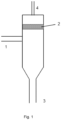
- a corrosion-resistant device for gas-solid separation includes a feeding inlet (1), a filter element (2), a solid outlet (3), and a gas outlet (4), wherein the filter element (2) uses corrosion-resistant metal material, and the metal material is nickel, or nickel alloy with a nickel content of 50% or above.
- the nickel alloy is one or more selected from the following: Hastelloy alloy, Monel alloy, or NS3301 alloy.
- the device is resistant to corrosion by anhydrous HF and/or chlorine at a temperature of above 400°C.
- the filter element is metal wire mesh, or sintered porous metal material, preferably a sintered porous metal on a porous substrate.
- the device further comprises a blowback part (5), such as a venturi tube.
- a blowback part can blow the which can prevent the filter element from being clogged by solid particles.
- An apparatus for recycling batteries comprising a pyrolysis furnace, wherein a gas outlet of the pyrolysis furnace is connected to the feeding inlet of the gas-solid separation device of the present invention, so as to perform gas-solid separation of pyrolysis products.
- An apparatus for recycling batteries comprising a chlorination furnace, wherein a gas outlet of the chlorination furnace is connected to the feeding inlet of the gas-solid separation device of the present invention, so as to perform gas-solid separation of chlorination products.
- the present invention provides a corrosion-resistant device for gas-solid separation.
- the present invention uses a filtration device with a filter element, wherein a porous filter element is used, so that the gas components in a gas-solid mixture can pass through the filter element, but the solid components cannot.
- the metal material of the present invention is resistant to both HF and chlorine corrosion. It is preferably nickel, or a nickel alloy with a nickel content of 50% or above, for example Hastelloy (e.g. Hastelloy C-276), or NS3301 alloy.
- Hastelloy e.g. Hastelloy C-276
- NS3301 alloy e.g. Hastelloy C-276
- NS3301 alloy is nickel-chromium-molybdenum alloy with a low molybdenum content. It can withstand high-temperature HF gas and is easy to be processed and shaped.
- the chemical composition of NS3301 alloy is the following: C ⁇ 0.03 wt%, Cr 14-17 wt%, Fe ⁇ 8.0 wt%, Mo 2-3 wt%, Ti 0.4-0.9 wt%, P ⁇ 0.03 wt%, S ⁇ 0.02 wt%, Si ⁇ 0.7 wt%, Mn ⁇ 1.0 wt%, the balance is Ni and inevitable impurities.
- the filter material in the present invention is metal wire mesh.
- the above-mentioned corrosion-resistant metal material is drawn into wires and then woven into a mesh.
- pure nickel metal or NS3301 alloy or Hastelloy C-276 alloy is drawn into wires, and then woven into a mesh.
- the diameter of the wire after drawing is preferably less than 0.5 mm, more preferably less than 0.3 mm, more preferably less than 0.2 mm; the size (the length of the longest side) of the mesh hole is preferably less than 0.5 mm, more preferably less than 0.3 mm.
- the metal wire mesh can be plain weave, or be pressed into corrugations.
- the filtration effect can be increased by laminating multiple layers of metal meshes. When laminating multiple layers, multiple layers of wire meshes can be cross-overlapped at a certain angle, or the patterns of different layers can be staggered by a certain distance.
- the filter material of the present invention is a sintered porous metal material.
- porous metal material is obtained by sintering nickel powders or nickel alloy powders.
- nickel powders with an average particle size of no more than 100 microns are molded into a sheet, and then vacuum sintering is used, the vacuum degree is less than 1 Pa, the sintering temperature is 1000-1300 °C (such as 1200 °C), and the sintering time is more than 1 hour, thus the porous nickel material can be obtained.
- the powder sintering method it can easily adjust the pore size of the porous metal material.
- the filter material of the present invention is a sintered porous metal on a porous substrate.
- the porous substrate may be metal foam or metal wire mesh.
- Metal foam / metal wire mesh has the advantages of good strength and is not easily broken. However, the pore size of metal foam / metal wire mesh is relatively large. By applying sintered porous metal material on it, the efficient pore size of the filter material can be reduced and the filtration effect can be improved.
- a metal foam used in the present invention may be for example nickel foam.
- a metal wire mesh used in the present invention may be for example drawing pure nickel or NS3301 alloy or Hastelloy C-276 alloy into wires and then weaving into a mesh, but the present invention is not limited thereto.
- the metal wire mesh is a plain weave mesh obtained by drawing NS3301 alloy into wires.
- the diameter of the wire after drawing is preferably less than 0.5 mm, and the size (the length of the longest side) of the mesh hole is preferably less than 0.5 mm.
- a slurry containing nickel powders is coated on the mesh, and then sintered.
- nickel powders with a nearly spherical shape and with a particle size of less than 10 microns, ethanol as a dispersant, and polyvinyl butyral (PVB) as the binder are mixed into a slurry.
- the mass ratio of nickel powders: ethanol: PVB is 50-85: 100: 2-5.
- the sintering temperature is 1000-1200 °C (such as 1100 °C).
- the sintering time is no less than 1h.
- the metal material that is not easily corroded by HF and/or chlorine is also used for the inner wall of the gas-solid separation device and the air channels connected thereof.
- the above-mentioned nickel, or nickel alloy, or molybdenum alloy is also used for the inner wall of the gas-solid separation device and the air channels connected thereof.
- the preferred material is nickel, or a nickel alloy with a nickel content of 50% or above.
- Hastelloy alloy e.g. Hastelloy C-276) or NS3301 alloy.
- Venturi tube comprises an inlet section followed by a convergent section, a throat section and then a divergent outlet section.
- the inlet section is a cylindrical section having an internal diameter D
- the convergent section has a shape of a tapered tube with a cone angle of approximately 21° ⁇ 2°
- the throat section is a cylindrical section having an internal diameter of 1/3-1/4 D
- the divergent outlet section has a shape of a tapered tube with a cone angle of 8°-15°.
- the device for gas-solid separation in the present invention is suitable to be used in a battery recycling device.
- a basic introduction to battery recycling (especially lithium battery recycling) is as follows.
- lithium battery is a synonym for “lithium ion battery”.
- the present invention takes several lithium batteries on the market as examples.
- lithium batteries on the market can be classified into ternary lithium batteries, lithium iron phosphate batteries, etc.
- lithium batteries can be classified into soft-pack lithium batteries, aluminum-cased lithium batteries and steel-cased lithium batteries.
- soft-pack lithium battery an aluminum-plastic film is usually used as a soft casing for packaging the battery cell.
- aluminum-cased lithium battery aluminum or aluminum alloy is used as an aluminium hard casing for packaging the battery cell.
- stainless steel is used as a hard casing for packaging the battery cell.
- the to-be-recycled lithium battery mainly comprises the following components: positive current collector, negative current collector, binder, positive-electrode active material, negative-electrode active material, porous separator, electrolyte liquid, and casing.
- Particles of the positive-electrode active material are mixed with the binder and then evenly coated on the positive current collector (aluminum foil), so as to form the positive electrode of the battery.
- a conductive agent can be added, that is to say, the positive-electrode active material, the conductive agent and the binder are mixed, and then evenly coated on the positive current collector (aluminum foil).
- the negative-electrode active material is normally graphite or graphene.
- the negative-electrode active material is mixed with a binder (optionally, a conductive agent may be added), and then evenly coated on the negative current collector (copper foil), so as to form the negative electrode of the battery.
- the binder may be polyvinylidene fluoride (PVDF), cellulose binder such as sodium carboxymethylcellulose (CMC), polyacrylic acid binder (PAA), styrene-butadiene rubber (SBR), or conductive binder, etc.
- PVDF polyvinylidene fluoride
- CMC sodium carboxymethylcellulose
- PAA polyacrylic acid binder
- SBR styrene-butadiene rubber
- conductive binder etc.
- the conductive agent for lithium batteries may be traditional conductive agents (such as carbon black, conductive graphite, carbon fiber, etc.), or new-type conductive agents (such as carbon nanotubes, graphene, mixed conductive slurries, etc.).
- the commercial conductive agent on the market may be acetylene black (AB), Ketjen black (KB), vapor grown carbon fiber (VGCF), carbon nanotubes (CNT), etc.
- the electrolyte contains lithium salt and organic solvent.
- the commonly-used lithium salt in lithium batteries is LiPF 6 .
- the organic solvent is generally a carbonate organic compound, such as ethylene carbonate, propylene carbonate, diethyl carbonate, dimethyl carbonate, etc.
- the porous separator is normally a polyolefin separator.
- PE polyethylene
- PP polypropylene
- the separator may have a structure of a single layer or a structure of three layers.
- the recycling of lithium batteries aims to use physical and/or chemical means to separate and/or convert the above components in the mixture. Firstly, some elements (especially some high-value metal elements) can be purified and reused; secondly, the discharged pollutants can be reduced.
- the gas-solid separation device of the present invention is suitable to be used in a battery recycling device, to perform gas-solid separation of pyrolysis products, and/or to perform gas-solid separation of chlorination products.
- the present invention provides a device of recycling batteries, comprising a pyrolysis furnace and/or a chlorination furnace, wherein the above-mentioned gas-solid separation device is connected to the gas outlet of the pyrolysis furnace and/or chlorination furnace, so as to perform gas-solid separation of pyrolysis products and/or chlorination products.
- the device for of recycling batteries in the present invention may include a device of battery discharging.
- Battery discharging is normally the first step in battery recycling. Completely discharging the battery pack can prevent the discarded batteries from concentrated heat release or short circuit during subsequent processing, and thus avoid fire and explosion incidents.
- discharging can be conducted by chemical methods, that is, using the positive metal and negative metal of the battery as cathode and anode, and using an electrolysis process in a solution to consume the remaining power in the battery.
- sodium chloride solution can be used as the electrolyte to discharge the lithium batteries.
- the battery recycling in the present invention may also include disassembling.
- a battery pack a battery module or a battery system
- single battery cells can be obtained by disassembling.
- single battery cells can be separated from structural parts, wires, and/or connectors (such as battery terminals).
- the device for of recycling batteries in the present invention may also include a crusher.
- Crushing is to fragment the battery through a crusher to obtain crushed products.
- the size of the longest side of the crushed product is ⁇ 6 cm, more preferably ⁇ 4 cm. If it is a steel-cased lithium battery, a hammer crusher may be used for crushing. If it is a soft-packed lithium battery, a tearing machine can be firstly used to tear the casing, and then a crusher is used for crushing.
- a crusher may have a function of crushing with charges, which can directly fragment the batteries which have not been discharged.
- a device of magnetic separation is provided after crushing.
- ferromagnetic substances such as stainless steel can be separated easily. This enables the separation and recycling of ferromagnetic materials such as stainless steel.
- a device of winnowing For example, crushed products are thrown into an upward airflow. Under the action of an upward suction force generated by a ventilation fan, the lightest part of the products floating on the top is first sucked away through a side pipe. This enables the separation and recycling of (porous) separators. Besides, removing the separators can also reduce the waste gases generated by the pyrolysis of organic matter in subsequent pyrolysis process.
- organic components are removed.
- the binder is removed, so as to separate positive-electrode active materials from current collectors.
- pyrolysis e.g. oxygen-free pyrolysis
- pyrolysis is used to remove the binder, so as to separate positive-electrode active materials from current collectors.
- F and organic components in the lithium battery are removed.
- F and organic components in lithium batteries can be removed through oxygen-free pyrolysis.
- the device of pretreating in the present invention preferably contains a pyrolysis furnace.
- the present invention does not intentionally remove the electrolyte from the lithium batteries. Instead, the electrolyte is directly sent to the oxygen-free pyrolysis.
- oxygen-free means to under the condition of vacuum or under the protection of protective gas (nitrogen or argon). Thereby the reactants will not have a chemical reaction with oxygen.
- the pyrolysis is preferably performed under vacuum. It can avoid too many inert protective gases in the gas products which may reduce the efficiency of combustion.
- the furnace is evacuated, until the vacuum degree in the furnace is less than 1000 Pa, more preferably less than 500 Pa, and then heating is started.
- replacement by nitrogen is combined with vacuuming, so as to eliminate oxygen from the furnace, until the vacuum degree in the furnace is less than 2000 Pa, more preferably less than 1000 Pa, and then heating is started.
- the temperature of the oxygen-free pyrolysis in the present invention is 400-600°C, preferably 400-500°C, more preferably 430-480°C, such as 450°C.
- organic matter such as the binder is thermally decomposed, so that the positive/negative-electrode active materials can be easily separated from the positive/negative current collectors.
- lithium hexafluorophosphate in the electrolyte will also be fully pyrolyzed, and its pyrolysis products include phosphorus pentafluoride (PF 5 ) and hydrogen fluoride (HF).
- reaction time of the oxygen-free pyrolysis lasts for no less than 30 minutes.
- a gas outlet of the pyrolysis furnace is connected to a gas-solid separation device according to the present invention.
- a gas-solid separation device for the pyrolysis product is performed.
- phosphorus pentafluoride (PF 5 ) and hydrogen fluoride (HF) are generated after pyrolysis.
- hydrogen fluoride (HF) is highly corrosive, and phosphorus pentafluoride (PF 5 ) will enhance the corrosiveness of hydrogen fluoride ( HF).
- the gas-solid separation device of the present invention is resistant to the corrosion by HF and PFs.
- the metal material that is not easily corroded by HF and PF 5 is also used for the inner wall of the pyrolysis furnace and the air channels connected thereof.
- the above-mentioned nickel, chromium, titanium or corresponding alloy for example, the above-mentioned platinum, gold, or silver is expensive, but applicable. It is preferred to use nickel or a nickel alloy with a nickel content of 50% or above.
- the above-mentioned Hastelloy alloy, Monel alloy, or NS3301 alloy is preferred.
- the gas products obtained after gas-solid separation may contain one or more components from the following: H 2 , CH 4 , CO, HF, PF 5 , CO 2 .
- lithium hexafluorophosphate when used in electrolyte in the present invention, it generates phosphorus pentafluoride (PF 5 ) and hydrogen fluoride (HF) after pyrolysis.
- the binder such as polyvinylidene fluoride (PVDF)
- PVDF polyvinylidene fluoride
- the pyrolysis products of PVDF mainly include fluorides, such as hydrofluoric acid, fluorocarbons, etc., and also include a small amount of alkanes and hydrocarbons.
- the organic solvent such as ethylene carbonate, propylene carbonate, diethyl carbonate
- the organic solvent such as ethylene carbonate, propylene carbonate, diethyl carbonate
- the mixture entering the pyrolysis may contain residual separators (polyethylene (PE) or polypropylene (PP)).
- PE polyethylene
- PP polypropylene
- a combustion furnace may be provided after the pyrolysis furnace.
- the gas products obtained after gas-solid separation may be sent to a combustion furnace.
- the high-temperature pyrolyzed gas is directly sent to the combustion furnace after the gas-solid separation, without an additional cooling step. That is to say, the high-temperature gas passes through the gas-solid separation device in a high temperature of above 200°C, preferably above 300°C, and is then sent to the combustion furnace in a high temperature of above 200°C, preferably above 300°C. This can make full use of the heat of the flue gas to promote combustion and thus can save energy.
- oxygen-enriched combustion technology is used.
- oxygen-enriched air with an oxygen content of 25% or above, or even 35% or above, or pure oxygen is used as a combustion-supporting gas.
- the excess oxygen coefficient is 100% or above, or even 120% or above.
- the high-temperature gas products with a temperature of above 200°C are injected into the combustion furnace in batches, which will spontaneously combust under the oxygen-enriched condition.
- a flue gas heat exchanger is connected to a gas outlet of the combustion furnace.
- the flue gas heat exchanger is used to reuse the heat from the flue gas after combustion.
- a device of alkaline solution such as a spray tower which sprays alkaline solution, may be connected to the combustion furnace or the flue gas heat exchanger.
- the combustion products of the gas components are acidic substances (carbonic acid, phosphoric acid, hydrofluoric acid, etc.), therefore, the acid radicals therein can be absorbed by an alkaline solution (such as limewater).
- the produced salts such as calcium salts, can be used in industry.
- the produced salts may be calcium fluoride, calcium phosphate, etc.
- the flue gas after combustion in the present invention can be deacidified by alkaline solution.
- a flue gas purification device may be used.
- an injecting device is used to inject alkaline solution into the flue gas in a purification furnace, so as to perform a deacidification reaction.
- the alkaline solution may be limewater, such as a saturated aqueous solution of calcium hydroxide.
- phosphorus-containing acidic gas in flue gas may be converted into calcium phosphate
- fluorine-containing acidic gas in flue gas may be converted into calcium fluoride, etc.
- the device of alkaline solution is connected to a dust collector or an activated carbon tower.
- the gas after deacidification by the alkaline solution can be further treated by a simple post-processing (such as using a dust collector to remove dust or using activated carbon to absorb pollutants), and then meet the emission standards, and then can be directly discharged.
- a simple post-processing such as using a dust collector to remove dust or using activated carbon to absorb pollutants
- dust particles in the flue gas can be separated and removed, so as to meet the emission standards required by environmental protection.
- an activated-carbon adsorption tower may be used to purify the exhaust gas and to remove particulate pollutants from flue gas, so as to meet the emission standards required by environmental protection.
- a dust-removal device such as a cyclone dust-removal tower and/or a bag dust-removal tower, may be provided before the device of alkaline solution, so as to pre-remove some dust particles.
- the gas products obtained after pyrolysis and gas-solid separation, first pass through the device of alkaline solution (to remove HF, PF 5 ), and then are sent to the combustion furnace for combustion (to remove H 2 , CH 4 , and CO).
- the main products after combustion are water and carbon dioxide. Therefore, if the dust particles after combustion meet the standards, the exhaust gas can be discharged directly; if there are too many dust particles after combustion, a dust-removal device can be used until the standards are met, then the exhaust gas can be discharged.
- the solid products after the pyrolysis mainly include current collectors (such as aluminum foil, copper foil), carbon (from negative-electrode active materials, and from the pyrolysis of some organic matter), positive-electrode materials (such as lithium iron phosphate or ternary materials).
- current collectors such as aluminum foil, copper foil
- carbon from negative-electrode active materials, and from the pyrolysis of some organic matter
- positive-electrode materials such as lithium iron phosphate or ternary materials.
- the apparatus of recycling batteries comprises a device of physical sorting, so as to perform physical sorting on the solid products after the pyrolysis.
- physical sorting metal sheets of current collectors can be sorted out, and then a mixture of powders is left.
- physical screening such as vibrating screening, metal sheets can be separated from powders.
- two or more stages of vibrating screenings may be used.
- the large particles large metal sheets
- the medium particles medium metal sheets
- the powders are left.
- a screen having a mesh size of 10-40 mesh is used for the first screening
- a screen having a mesh size of 100-200 mesh is used for the second screening.
- the metal sheets obtained after physical screening are normally copper foil and/or aluminum foil. Since the aluminum foil is lighter and the copper foil is heavier, the copper foil and aluminum foil can be further separated by a shaker.
- the powder mixture obtained after physical screening contains the positive-electrode material(s), as well as carbon from the negative-electrode active material(s).
- the present invention may recycle metal elements from the powders (powder mixture), by a wet method or a chlorination method.
- the device of recycling batteries in the present invention comprise a chlorination furnace.
- the present invention provides an apparatus for recycling metal elements from powders containing cathode materials of lithium batteries, comprising
- the powders (powder mixture) of the present invention contain carbon, which is derived from the negative-electrode active material (graphite). This kind of carbon will not leave during oxygen-free pyrolysis, and thus can be used as carbon sources to assist the chlorination. Carbon can promote the reaction that metal oxides are chlorinated into chlorine salts. For the chlorination process with the help of carbon, it may undergo a one-step reaction, or a two-step reaction, that is, the metal oxide is first reduced by carbon into metal, and then chlorinated by chlorine into chloride salt.
- the carbon content in the powder mixture is preferably 10 wt% or more (in view of the total powder mixture), more preferably 20 wt% or more. If the carbon content in the powder mixture is less than 10 wt%, additional carbon powders may be added to achieve a carbon content of 10 wt% or above, and then the chlorination step is performed.
- the pretreating does not separate positive electrode material from negative electrode material, so the mixture of powders obtained in Step 1 contains both the positive electrode active material and carbon.
- discarded lithium batteries usually contain more than 20 wt% carbon.
- the carbon content therein is definitely more than needed, thus the addition of carbon source is not required.
- the temperature for chlorination can be 500 to 1200°C. However, the higher the temperature, the greater the energy consumption and the higher the safety requirements for the equipment. The present invention found that even at a lower temperature, such as below 800°C, or even below 600°C, a sufficiently good effect of chlorination can be achieved.
- the amount of feeding material can be determined by experiences or by measuring the total metal concentration through sampling. It is preferred that the powders and chlorine gas are so fed that the excess of chlorine gas is at least 10%.
- the chlorination reaction of the present invention lasts for preferably 20 minutes or more, more preferably in a range from 20 minutes to 4 hours, and more preferably in a range from 30 minutes to 2 hours, for example 50 minutes.
- the chlorination furnace does not require a high-pressure environment, and the initial gas pressure before heating may be approximately 1 atm or be slightly greater than 1 atm, such as 110 kPa to 130 kPa.
- the gas products after chlorination pass through a gas-solid separation device of the present invention at high temperature (320°C or above) for gas-solid separation.
- the gas-solid separation device in the present invention is resistant to the corrosion by high-temperature chlorine.
- the gas-solid separation after chlorination at a temperature of below 500°C, or even below 400°C.
- the chlorinated products undergo a certain cooling (or heat exchange or heat recovery) and then pass through a gas-solid separation device.
- a gas-solid separation device Such a lower temperature can significantly reduce the chlorine corrosion on the metal filter.
- the gas-solid separation device is configured to maintain a high temperature of 320°C or above.
- the gas products after chlorination pass through a gas-solid separation device at high temperature (320°C or above) for gas-solid separation.
- the gases passing through the gas-solid separation device include FeCl 3 (melting point 306°C, boiling point 316°C) and/or AlCl 3 (melting point 194°C, boiling point 180°C).
- the Fe element may come from the positive-electrode active material of the lithium iron phosphate battery, or may come from the remnants of the steel casings.
- the Al element may come from the casings (such as aluminum casing or aluminum-plastic casing). Aluminum is relatively easy to be broken, if there are many small aluminum powders after crushing, the aluminum content in the powder mixture entering chlorination may be relatively high, often reaching 4 wt% or more.
- the temperature of the first-stage desublimation device is set to be below 306°C and above 178°C, so that FeCl 3 is desublimated into solid deposition, which can be used for recycling Fe element;
- the temperature of the second-stage desublimation device is set to be below 178°C, so that AlCl 3 is desublimated into solid deposition, which can be used for recycling Al element.
- silicon tetrachloride gas at 220-240°C may be used as the cooling agent to perform the first-stage desublimation.
- silicon tetrachloride gas at 100-120°C may be used as the cooling agent to perform the second-stage desublimation.
- the exhaust gas is further treated, and can be discharged if meeting the standards.
- the exhaust gas may contain excess chlorine, which can be absorbed by alkaline solution, for example by a spray tower of alkaline solution.
- the chlorination reaction in the presence of carbon will produce carbon dioxide, which is neither toxic nor harmful, and thus can be directly discharged after the removal of chlorine.
- an alkaline solution that can provide OH - (such as NaOH aqueous solution, such as 5-30 wt% NaOH aqueous solution, for example 10 wt%)
- nickel, cobalt and manganese elements can be precipitated.
- the second filtrate is obtained.
- the second filtrate contains lithium chloride, which can be used to recycle lithium element.
- a precipitating agent by adding a precipitating agent, precipitation of lithium salt can be obtained.
- a precipitation of lithium carbonate can be obtained.
- a 200-500 g/L (such as 300 g/L) sodium carbonate aqueous solution is heated to above 90°C (such as 95°C), and then lithium solution is added. Holding the temperature for more than 30 minutes.
- the lithium concentration in the lithium solution is first measured, and then the amount of excess sodium carbonate is adjusted to be 10% or more.
- a sample is taken out to analyze the carbonate concentration in the mother solution, and the carbonate concentration is controlled to be 13-18 g/L. If the carbonate concentration is too high, adding lithium solution; and if it is too low, adding sodium carbonate aqueous solution.
- a corrosion-resistant device for gas-solid separation comprising a feeding inlet 1, a filter element 2, a solid outlet 3, and a gas outlet 4.
- the filter element 2 is a metal wire mesh, wherein NS3301 alloy is drawn into wires, and then woven into a plain-weave mesh.
- the diameter of the wire after drawing is less than 0.5 mm; the size (the length of the longest side) of the mesh hole is less than 0.5 mm.
- There layers of wire meshes are laminated together, wherein the patterns between two adjacent layers are staggered by an angle of about 45 degrees.
- a corrosion-resistant device for gas-solid separation comprising a feeding inlet 1, a filter element 2, a solid outlet 3, and a gas outlet 4.
- the filter element 2 is a sintered porous metal material. Nickel powders with an average particle size of 100 microns are molded into a sheet, and then vacuum sintering is used, the vacuum degree is less than 1 Pa, the sintering temperature is 1200 °C, and the sintering time is more than 1 hour, thus the porous nickel material is obtained.
- a corrosion-resistant device for gas-solid separation comprising a feeding inlet 1, a filter element 2, a solid outlet 3, and a gas outlet 4.
- the filter element 2 s a sintered porous metal on a metal wire mesh.
- the metal wire mesh is a plain-weave mesh, which is obtained by drawing NS3301 alloy into wires.
- the diameter of the wire after drawing is less than 0.5 mm, and the size (the length of the longest side) of the mesh hole is preferably less than 0.5 mm. Then a slurry containing nickel powders is coated on the mesh, and then sintered.
- nickel powders with a nearly spherical shape and with a particle size of less than 10 microns, ethanol as a dispersant, and polyvinyl butyral (PVB) as the binder are mixed into a slurry.
- the mass ratio of nickel powders: ethanol: PVB is 50-85: 100: 2-5.
- the sintering temperature is 1100 °C.
- the sintering time is 1h.
- a corrosion-resistant device for gas-solid separation comprising a feeding inlet 1, a filter element 2, a solid outlet 3, a gas outlet 4, and a blowback part 5.
- the filter element use any of the material as mentioned in Examples 1 to 3.
- the blowback part 5 is a venturi tube.
- the inner wall of the venturi tube is made of Hastelloy C276 or NS3301 alloy material.
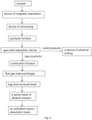
- the example provides a device for pretreating batteries, including a pyrolysis furnace, and a gas-solid separation device according to any of Examples 1 to 4.
- the example provides a device for pretreating lithium batteries, comprising
- the example provides an apparatus for recycling metals, including a chlorination furnace, and a gas-solid separation device according to any of Examples 1 to 4.
- the example provides an apparatus for recycling metals, which can be used for recycling metal elements from powders containing cathode materials of lithium batteries, comprising
Landscapes
- Chemical & Material Sciences (AREA)
- Chemical Kinetics & Catalysis (AREA)
- Engineering & Computer Science (AREA)
- Textile Engineering (AREA)
- Life Sciences & Earth Sciences (AREA)
- Geology (AREA)
- General Engineering & Computer Science (AREA)
- Mechanical Engineering (AREA)
- Manufacturing & Machinery (AREA)
- Electrochemistry (AREA)
- General Chemical & Material Sciences (AREA)
- Materials Engineering (AREA)
- Oil, Petroleum & Natural Gas (AREA)
- Organic Chemistry (AREA)
- Manufacture And Refinement Of Metals (AREA)
Applications Claiming Priority (1)
| Application Number | Priority Date | Filing Date | Title |
|---|---|---|---|
| CN202311749796.6A CN117695768A (zh) | 2023-12-19 | 2023-12-19 | 一种气固分离装置 |
Publications (1)
| Publication Number | Publication Date |
|---|---|
| EP4574232A1 true EP4574232A1 (de) | 2025-06-25 |
Family
ID=90147673
Family Applications (1)
| Application Number | Title | Priority Date | Filing Date |
|---|---|---|---|
| EP24174647.8A Pending EP4574232A1 (de) | 2023-12-19 | 2024-05-07 | Vorrichtung zur gas-feststoff-trennung |
Country Status (3)
| Country | Link |
|---|---|
| US (1) | US12357931B2 (de) |
| EP (1) | EP4574232A1 (de) |
| CN (1) | CN117695768A (de) |
Families Citing this family (1)
| Publication number | Priority date | Publication date | Assignee | Title |
|---|---|---|---|---|
| CN121003873B (zh) * | 2025-10-27 | 2026-02-06 | 连云港旺和新型建材有限公司 | 一种用于超细矿渣微粉加工的除尘装置 |
Citations (4)
| Publication number | Priority date | Publication date | Assignee | Title |
|---|---|---|---|---|
| US4401463A (en) * | 1981-09-24 | 1983-08-30 | Sab Nife Ab | Process for the recovery of metals from the scrap from nickel-cadmium electric storage batteries |
| CN202569807U (zh) * | 2012-04-19 | 2012-12-05 | 新乡正源净化科技有限公司 | 蒙乃尔镍铜合金多层烧结网 |
| CN104474783A (zh) * | 2015-01-07 | 2015-04-01 | 江苏云才材料有限公司 | 一种镍铜合金烧结丝网过滤板及其制备方法 |
| CN111681796A (zh) * | 2020-06-12 | 2020-09-18 | 中国核电工程有限公司 | 一种放射性废料热解装置 |
Family Cites Families (8)
| Publication number | Priority date | Publication date | Assignee | Title |
|---|---|---|---|---|
| US7833329B2 (en) * | 2007-05-03 | 2010-11-16 | Mott Corporation | Plenum based high pressure blowback gas delivery system in a continuous process flow filtration system |
| EP2634244A4 (de) * | 2010-10-25 | 2017-03-22 | Cytogen Co. Ltd. | Zellsammelvorrichtung |
| US9433882B2 (en) * | 2012-02-20 | 2016-09-06 | Nv Bekaert Sa | Metal fiber web based filter |
| CN106362879A (zh) * | 2016-11-03 | 2017-02-01 | 太原理工大学 | 一种煤热解高温产物的分离装置 |
| CN215085560U (zh) * | 2021-02-03 | 2021-12-10 | 顺尔茨环保(北京)有限公司 | 一种废旧锂电池电解液回收系统除尘过滤器 |
| CN214552274U (zh) * | 2021-04-13 | 2021-11-02 | 山东杰富意振兴化工有限公司 | 一种锂电池负极材料生产中尾气处理回收装置 |
| CN116750793B (zh) * | 2023-07-07 | 2026-04-24 | 朝阳东锆新材料有限公司 | 一种生产精四氯化锆的方法 |
| CN116851779B (zh) * | 2023-09-04 | 2024-01-02 | 华南理工大学 | 一种耐腐蚀、高过滤的高温镍基合金多级过滤器制备方法 |
-
2023
- 2023-12-19 CN CN202311749796.6A patent/CN117695768A/zh active Pending
-
2024
- 2024-04-15 US US18/635,692 patent/US12357931B2/en active Active
- 2024-05-07 EP EP24174647.8A patent/EP4574232A1/de active Pending
Patent Citations (4)
| Publication number | Priority date | Publication date | Assignee | Title |
|---|---|---|---|---|
| US4401463A (en) * | 1981-09-24 | 1983-08-30 | Sab Nife Ab | Process for the recovery of metals from the scrap from nickel-cadmium electric storage batteries |
| CN202569807U (zh) * | 2012-04-19 | 2012-12-05 | 新乡正源净化科技有限公司 | 蒙乃尔镍铜合金多层烧结网 |
| CN104474783A (zh) * | 2015-01-07 | 2015-04-01 | 江苏云才材料有限公司 | 一种镍铜合金烧结丝网过滤板及其制备方法 |
| CN111681796A (zh) * | 2020-06-12 | 2020-09-18 | 中国核电工程有限公司 | 一种放射性废料热解装置 |
Non-Patent Citations (1)
| Title |
|---|
| MAKUZA BRIAN ET AL: "Synergetic carbothermic reduction and selective hydrochlorination of spent Li-ion batteries black mass towards enhanced metal recovery", JOURNAL OF CLEANER PRODUCTION, ELSEVIER, AMSTERDAM, NL, vol. 386, 31 December 2022 (2022-12-31), XP087248343, ISSN: 0959-6526, [retrieved on 20221231], DOI: 10.1016/J.JCLEPRO.2022.135831 * |
Also Published As
| Publication number | Publication date |
|---|---|
| CN117695768A (zh) | 2024-03-15 |
| US20250196034A1 (en) | 2025-06-19 |
| US12357931B2 (en) | 2025-07-15 |
Similar Documents
| Publication | Publication Date | Title |
|---|---|---|
| US12331381B1 (en) | Method of using a chlorination method to recycle metal elements in lithium batteries | |
| US20250201954A1 (en) | Method of using a wet method to recycle metal elements in lithium batteries | |
| CN111790728B (zh) | 一种利用水蒸气高效还原回收废旧锂电池的处置方法 | |
| CN112768796B (zh) | 一种处理废旧锂电池的方法 | |
| CN104577249A (zh) | 一种废旧钴酸锂锂离子电池资源化的处理方法 | |
| US12431553B2 (en) | Methods and systems for scalable direct recycling of battery waste | |
| JP7371237B2 (ja) | 廃電池の処理方法 | |
| KR20240024110A (ko) | 재생 양극재 전구체, 재생 양극재 및 그들의 제조 방법, 그리고 재생 리튬 이온 이차 전지 | |
| EP4574232A1 (de) | Vorrichtung zur gas-feststoff-trennung | |
| CN113426804A (zh) | 一种废弃锂离子电池资源性组分的物理分离富集方法 | |
| CN110828888A (zh) | 锂离子电池正极材料的全干法提纯方法及提纯得到的锂离子电池正极材料 | |
| CN110808430A (zh) | 锂离子电池正极材料的分离提纯方法及得到的锂离子电池正极材料 | |
| CN116613411A (zh) | 一种锂离子动力电池的回收方法 | |
| Li et al. | Spray pyrolysis technology-based closed-loop for regenerating single-crystal cathodes from spent lithium-ion batteries | |
| US12237483B1 (en) | Apparatus for a chlorination method to recycle metal elements in lithium batteries | |
| US20250196207A1 (en) | Method for recycling lithium batteries | |
| CN223038990U (zh) | 一种废旧三元软包锂电池回收处理设备 | |
| US20250210742A1 (en) | Apparatus for separating and recycling metal elements in cathode materials of lithium batteries | |
| CN216698489U (zh) | 废旧三元动力电池处理系统 | |
| WO2024204732A1 (ja) | 炭酸リチウムの製造方法及び炭酸リチウムの製造装置 | |
| TW202410535A (zh) | 再生正極材料及其製造方法、再生正極材料的使用方法、再生正極以及鋰離子二次電池 | |
| CN115911635B (en) | Low-copper aluminum fluoride-free black powder and preparation method thereof | |
| JP2024146890A (ja) | 炭酸リチウムの製造方法及び炭酸リチウムの製造装置 | |
| WO2024130855A1 (zh) | 一种低铜铝无氟黑粉及其制备方法 | |
| CN119972730A (zh) | 一种热失控锂离子电池中有价组分的回收方法和回收装置 |
Legal Events
| Date | Code | Title | Description |
|---|---|---|---|
| PUAI | Public reference made under article 153(3) epc to a published international application that has entered the european phase |
Free format text: ORIGINAL CODE: 0009012 |
|
| STAA | Information on the status of an ep patent application or granted ep patent |
Free format text: STATUS: THE APPLICATION HAS BEEN PUBLISHED |
|
| AK | Designated contracting states |
Kind code of ref document: A1 Designated state(s): AL AT BE BG CH CY CZ DE DK EE ES FI FR GB GR HR HU IE IS IT LI LT LU LV MC ME MK MT NL NO PL PT RO RS SE SI SK SM TR |