EP4572136A1 - Verfahren zur bereitstellung einer autonomen wartung von solarpaneelen und darin verwendete roboter - Google Patents
Verfahren zur bereitstellung einer autonomen wartung von solarpaneelen und darin verwendete roboter Download PDFInfo
- Publication number
- EP4572136A1 EP4572136A1 EP23215883.2A EP23215883A EP4572136A1 EP 4572136 A1 EP4572136 A1 EP 4572136A1 EP 23215883 A EP23215883 A EP 23215883A EP 4572136 A1 EP4572136 A1 EP 4572136A1
- Authority
- EP
- European Patent Office
- Prior art keywords
- robot
- coating
- cleaning
- chassis
- weight
- Prior art date
- Legal status (The legal status is an assumption and is not a legal conclusion. Google has not performed a legal analysis and makes no representation as to the accuracy of the status listed.)
- Pending
Links
Images

Classifications
-
- H—ELECTRICITY
- H02—GENERATION; CONVERSION OR DISTRIBUTION OF ELECTRIC POWER
- H02S—GENERATION OF ELECTRIC POWER BY CONVERSION OF INFRARED RADIATION, VISIBLE LIGHT OR ULTRAVIOLET LIGHT, e.g. USING PHOTOVOLTAIC [PV] MODULES
- H02S40/00—Components or accessories in combination with PV modules, not provided for in groups H02S10/00 - H02S30/00
- H02S40/10—Cleaning arrangements
-
- F—MECHANICAL ENGINEERING; LIGHTING; HEATING; WEAPONS; BLASTING
- F24—HEATING; RANGES; VENTILATING
- F24S—SOLAR HEAT COLLECTORS; SOLAR HEAT SYSTEMS
- F24S40/00—Safety or protection arrangements of solar heat collectors; Preventing malfunction of solar heat collectors
- F24S40/20—Cleaning; Removing snow
-
- H—ELECTRICITY
- H10—SEMICONDUCTOR DEVICES; ELECTRIC SOLID-STATE DEVICES NOT OTHERWISE PROVIDED FOR
- H10F—INORGANIC SEMICONDUCTOR DEVICES SENSITIVE TO INFRARED RADIATION, LIGHT, ELECTROMAGNETIC RADIATION OF SHORTER WAVELENGTH OR CORPUSCULAR RADIATION
- H10F19/00—Integrated devices, or assemblies of multiple devices, comprising at least one photovoltaic cell covered by group H10F10/00, e.g. photovoltaic modules
-
- Y—GENERAL TAGGING OF NEW TECHNOLOGICAL DEVELOPMENTS; GENERAL TAGGING OF CROSS-SECTIONAL TECHNOLOGIES SPANNING OVER SEVERAL SECTIONS OF THE IPC; TECHNICAL SUBJECTS COVERED BY FORMER USPC CROSS-REFERENCE ART COLLECTIONS [XRACs] AND DIGESTS
- Y02—TECHNOLOGIES OR APPLICATIONS FOR MITIGATION OR ADAPTATION AGAINST CLIMATE CHANGE
- Y02E—REDUCTION OF GREENHOUSE GAS [GHG] EMISSIONS, RELATED TO ENERGY GENERATION, TRANSMISSION OR DISTRIBUTION
- Y02E10/00—Energy generation through renewable energy sources
- Y02E10/50—Photovoltaic [PV] energy
Definitions
- the present invention relates to a method for providing an autonomous maintenance of solar panels, comprising at least one autonomous maintenance cycle comprising a cleaning of a surface area of the solar panels exposed to light by a cleaning unit of a robot comprising at least one suitable cleaning assembly, and a subsequent coating of the surface area of the solar panels exposed to light by a coating unit of a robot comprising at least one suitable coating assembly, comprising applying of a protective coating composition comprising at least one SiOz generating agent.
- the present invention also provides the robots used for performing the above-mentioned methods.
- a photovoltaic system is considered as large scale, when the nominal output of the system exceeds 30 kWp.
- photovoltaic systems are mostly located in remote areas, cover a large area, and spacings are found between the photovoltaic systems. Consequently, manual cleaning and/or manual control of mechanical cleaning is tedious and generally inefficient. The same holds true for standard maintenance work, like surface treatments of the sun collector panels.
- CN109379040B discloses a machine vision-based inspection and cleaning drone for photovoltaic power stations.
- the machine vision-based inspection includes several cameras such as an infrared thermal imaging camera or a color visible light camera.
- An attitude sensing device is used to obtain attitude information of a drone and a pollutant cleaning device is fixed at the movable arm of the drone.
- the pollutant cleaner includes a scraper with atomizing nozzles connected to the water pump and a high-pressure air outlet is connected to an air pump.
- the cleaning includes three cleaning modes.
- the first stage is a high-pressure air outlet for the release of gas blowing the pollutants off.
- the second stage is in order when the pollution still exists after the first stage.
- the second stage is the release of the agent aerosol via the atomizing nozzles and a following scraping off the pollutants with a scraper.
- the third stage is carried out if there are still pollutants left after the first and/or second stage.
- KR102315501B1 discloses an apparatus for cleaning a photovoltaic module or a glass window of a building and a drone.
- the drone flies to the solar panel to detect the contamination level of the panel, if there is a high level of contamination, the drone flies back to the starting point and transports a cleaning robot to the solar system.
- the cleaning robot can be detachably gripped on the lower side of the drone.
- the drone call signal is wirelessly transmitted from the cleaning robot and is received through a communication unit in the control board of the charging station of the drone.
- US2021/0408963A1 discloses a system, method, and robot for cleaning solar panels.
- the robot includes a frame, a propulsion system and cleaning system coupled to the frame.
- the robot can further include a user interface for manually operating the robot.
- the cleaning system comprises a water distribution system included in an electric drone with a supply hose extending to both a water reservoir and the robot.
- the method of the cleaning robots is autonomous and semi-autonomous. It can for example include a vehicle that has an elevation system for lifting and lowering the cleaning robots onto and off the sets of solar panels.
- CN111800081A discloses a photovoltaic panel drone cleaning system that comprises a sweeping robot which can be connected to a drone through a grab and place device, wherein the grab and place device is electrically connected to the drone.
- the grab and place device includes a ferromagnetic plate which is connected to the lower part of the drone and a magnetic base is fixedly connected to the upper part of the sweeping robot.
- a stepping motor is coupled to the permanent magnet of the magnetic base, wherein the rotation of the stepping motor drives the permanent magnet of the stepping motor to rotate to switch the on-off state of the magnetic base.
- KR101984202B1 discloses a dronbot for landing on solar panels in a right angle for a cleaning position for cleaning the upper surface of the solar panel, including a flight control unit, wherein the dronbot measures the attitude information of the main body.
- a take-off and landing control unit reduces or stops the lifting force of a lift generating unit in a direction in which the lift control unit comes into contact with the solar panel for the first time to ensure the landing of the dronbot in a right angle on the solar panels.
- WO2022/097171A1 discloses an autonomous, dynamic cleaning system for photovoltaic panels and the methods thereof.
- the system comprises an autonomous solar bot for cleaning photovoltaic panels, wherein the solar bot is capable of re-orientation, dynamic path-tracing as well as predictive cleaning.
- the solar bot comprises multiple sensors, a holder for attaching a camera, a tower light, a display, multiple brushes, an onboard mini photovoltaic panel for its own energy supply, and specialized mecanum wheels for enabling enhanced movement across the panels.
- the disclosed system also provides for a solar cleaning system which uses drones to transport the solar bot, and which can be controlled through fleet control via an loT dashboard.
- the dashboard may also be used for solar plant management.
- WO2022/242811A1 discloses a cleaning device for automatically cleaning of a solar system.
- the cleaning device has at least one first movable cleaning robot comprising a cleaning unit for cleaning the solar modules and a drone for transporting the cleaning robot and/or a charging station for charging the drone and/or the cleaning robot.
- the autonomous mobile cleaning robot has wheels on both sides and a rotating brush arranged between them for cleaning a surface of a solar panel.
- cleaning robots are largely based on being controlled remotely by a user and are semi-autonomous comprising online tracer.
- the problem with existing technology is that with remote devices, there is still a large dependency on human manual intervention, with is not feasible in large-scale photovoltaic systems.
- the above object of the present invention is solved by a method for providing autonomous maintenance of solar panels, comprising at least one autonomous maintenance cycle comprising i) cleaning of a surface area of the solar panels exposed to light by a cleaning unit of a robot comprising at least one suitable cleaning assembly (7), and ii) subsequent coating of the surface area of the solar panels exposed to light by a coating unit of a robot comprising at least one suitable coating assembly (13), comprising applying of a protective coating composition comprising at least one SiO 2 generating agent, the robot further comprising at least one suitable sensor device associated with the cleaning unit for detecting the degree of cleanliness of the surface area of the solar panel to be cleaned, the robot further comprising at least one suitable sensor device associated with the coating unit for detecting the wear of a coating of the surface area of the solar panel to be coated, and wherein based on the data obtained from the at least one suitable sensor device, the need for performing an autonomous maintenance cycle is calculated and a resource optimization of water, cleaning/coating agents and cleaning/coating intensity is calculated,
- a first robot for performing the method according to the present invention
- the robot comprises (i) a chassis (1) having a longitudinal axis, (ii) a propulsion system (2) coupled to the chassis (1) for moving the robot on the surface area of the solar panels to be cleaned, (iii) at least one arm (6) coupled to the chassis (1) in the longitudinal axis, (iv) at least one cleaning agent distribution device (4) attached to the robot for distributing cleaning agent during an autonomous maintenance cycle, (v) at least one suitable sensor device associated with the cleaning unit for detecting the degree of cleanliness of the surface area of the solar panel to be cleaned, (vi) a control unit arranged in the chassis (1) for operating the robot and controlling the propulsion system (2), arms (6), distribution device (4), the at least one suitable sensor device, and optionally (vi) a drone system configured to facilitate moving the robot between solar panels that have a discontinuous surface and/or are spaced apart from each other.
- the above object of the present invention is solved by a second robot for performing the method according to the present invention, wherein the robot comprises (i) a chassis (1) having a longitudinal axis, (ii) a propulsion system (2) coupled to the chassis (1) for moving the robot on the surface area of the solar panels to be cleaned, (iii) at least one arm (6) coupled to the chassis (1) in the longitudinal axis, (iv) at least one coating agent distribution device (12) attached to the robot for distributing cleaning agent during an autonomous maintenance cycle, (v) at least one suitable sensor device associated with the coating unit for detecting the wear of a coating of the surface area of the solar panel to be coated, (vi) a control unit arranged in the chassis (1) for operating the robot and controlling the propulsion system (2), arms (6), distribution device (12), the at least one suitable sensor device, and optionally (vi) a drone system configured to facilitate moving the robot between solar panels that have a discontinuous surface and/or are spaced apart from each other.
- the robot comprises (i) a chassis (1) having a
- the robot for performing the method according to the present invention, wherein the robot comprises (i) a chassis (1) having a longitudinal axis, (ii) a propulsion system (2) coupled to the chassis (1) for moving the robot on the surface area of the solar panels to be cleaned, (iii) at least one arm (6) coupled to the chassis (1) in the longitudinal axis, (iva) at least one cleaning agent distribution device (4) attached to the robot for distributing cleaning agent during an autonomous maintenance cycle, (ivb) at least one coating agent distribution device (12) attached to the robot for distributing coating agent during an autonomous maintenance cycle, (va) at least one suitable sensor device associated with the coating unit for detecting the wear of a coating of the surface area of the solar panel to be coated, (vb) at least one suitable sensor device associated with the cleaning unit for detecting the degree of cleanliness of the surface area of the solar panel to be cleaned, (vi) a control unit arranged in the chassis (1) for operating the robot and controlling the propulsion system (2), arms (6), distribution devices (4, 12), the at least one suitable
- a proper coating of the solar panels requires an evenly distributed coating over the entire solar system as a first step, and a maintenance of this coating by (re)filling all the gaps in the coating originating from weather and other environmental conditions.
- the maintenance of the coating can be only guaranteed when coarse dirt such as leaves, snow or fine desert dust is removed first by a cleaning unit of a robot and subsequent a new or replacement coating is applied on the solar panels via the coating unit of a robot.
- Maintaining a higher efficiency of the solar panel also has the advantage that a higher amount of energy is obtained, which equals an additional reduction of CO 2 -emmissions. Therefore, the present invention provides and constitutes an attractive tool in the generation and trading of CO2-emmission certificates.
- the object of the invention is solved by a method for providing autonomous maintenance of solar panels, comprising at least one autonomous maintenance cycle comprising a cleaning of a surface area of the solar panels exposed to light by a cleaning unit of a robot comprising at least one suitable cleaning assembly and a subsequent coating of the surface area of the solar panels exposed to light by a coating unit of a robot comprising at least one suitable coating assembly, comprising applying of a protective coating composition comprising at least one SiOz generating agent.
- the robot further comprises at least one suitable sensor device associated with the cleaning unit for detecting the degree of cleanliness of the surface area of the solar panel to be cleaned and the robot further comprises at least one suitable sensor device associated with the coating unit for detecting the wear of a coating of the surface area of the solar panel to be coated, and wherein based on the data obtained from the at least one suitable sensor device, the need for performing an autonomous maintenance cycle is calculated and a resource optimization of water, cleaning/coating agents and cleaning/coating intensity is calculated, and optionally, an autonomous maintenance cycle is initiated.
- the steps of cleaning and coating are performed by individual cleaning or coating robots or by one combined cleaning and coating robot.
- autonomous relates to a suitable sensor device detecting the degree of cleanliness of the surface area of the solar panel to be cleaned and the wear of a coating of the surface area of the solar panel to be coated, and wherein based on the data obtained from the sensor device, a resource optimization of water, cleaning/coating agents and cleaning/coating intensity is calculated and the need for an autonomous maintenance cycle is calculated, and optionally, the autonomous maintenance cycle is initiated.
- autonomous shall mean self-reliant or reliable.
- the whole system works without direct or indirect instruction from humans, thus an operator does not have to monitor the maintenance of solar panels via a control unit on a daily basis, because the system comprises robots with monitor themselves with a control unit in their chassis. If the system has any problems, it will inform the operator via an alarm signal to ensure the fixing of the problem, otherwise the system works autonomously.
- the data obtained by the sensors is bundled in a blockchain-based solution and used to feed algorithms and the Al model for performance optimization and robot control.
- An additional drone system allows for the autonomous maintenance of the solar panels.
- the drone system is configured to facilitate the transportation of a robot between solar panels that are discontinuous and spaced apart from each other.
- the robot flies or the robots fly via the drone system in steady intervals predicted from the data stored in the control unit based on the weather data and the data collected from the previous maintenance cycle, wherein subsequent the robot takes off autonomously from the start platform, flies a designated route and lands on the solar panels, wherein the robot automatically returns to the starting platform to recharge itself after the maintenance cycle.
- sealing of the solar panels with a certain protective coating composition is most effective for the maintenance of the solar panels.
- sealing of the solar panels with a SiOz generating agent enhances the productivity of the solar panels and improves the efficiency of maintenance of solar panels because less dirt sticks to the panels after coating, and the coating does not have scratches or other light-excluding blemishes. Therefore, the cleaning robots have to perform less cleaning cycles and the coating is more efficient when the panels are cleaned first and then coated.
- EP1825752A2 (herewith incorporated by reference), for example, discloses suitable coatings comprising SiOz generating agents.
- the sealing of the solar panels with the SiOz generating agent decreases the tendency for growing of algae and other biofilms and reliably protects the solar panels against the dangers of biological pitting corrosion by black fungi and mold.
- the protective coating composition comprises at least one SiO 2 generating agent
- the SiOz generating agent is selected from 0 up to 100 weight-%, preferably 1 up to 99 weight-%, tetraethoxysilane, 0 up to 100 weight-%, preferably 1 up to 99 weight-%, trimethoxymethylsilane, and 0 up to 100 weight-%, preferably 1 up to 99 weight-%, dimethoxydimethylsilane.
- the SiOz generating agent further comprises up to 20 weight-% Al 2 O 3 , TiO 2 , ZrO 2 , MgO and/or V 2 O 5 , wherein these additives are present at any mixing ratio, preferably in mixing ratios between 0.1 weight-% and 50 weight-% from the group of Al 2 O 3 , TiO 2 , ZrO 2 , MgO and V 2 O 5 , more preferably in mixing ratios between 1 weight-% and 20 weight-% from the group of Al 2 O 3 , TiO 2 and ZrO 2 .
- the protective coating composition comprises 50 weight-% up to 99.9 weight-%, preferably 80 weight-% up to 99 weight-% of an SiO 2 generating agent.
- the SiOz generating agent is selected from 0 up to 100 weight-%, preferably 1 up to 99 weight-%, tetraethoxysilane, 0 up to 100 weight-%, preferably 1 up to 99 weight-%, trimethoxymethylsilane, and 0 up to 100 weight-%, preferably 1 up to 99 weight-%, dimethoxydimethylsilane.
- the SiOz generating agent may further comprise up to 20 weight-% Al 2 O 3 , TiO 2 , ZrO 2 , MgO and/or V 2 O 5 , wherein these additives are present at any mixing ratio, preferably in mixing ratios between 0.1 weight-% and 50 weight-% from the group of Al 2 O 3 , TiO 2 , ZrO 2 , MgO and V 2 O 5 , more preferably in mixing ratios between 1 weight-% and 20 weight-% from the group of Al 2 O 3 , TiO 2 and ZrO 2 .
- the present invention furthermore relates to the devices, in this case robots, for performing the method according to the invention.
- the devices in this case robots
- any kind of robot can be used, as long as it comprises the features as below, and can be used for the autonomous cleaning and coating operation according to the invention.
- a particularly preferred robot is one that includes all necessary functions/units for performing the method according to the invention, and is embodied as an autonomous drone.
- a robot comprising a chassis having a longitudinal axis, a propulsion system coupled to the chassis for moving the robot on the surface area of the solar panels to be cleaned, at least one arm coupled to the chassis in the longitudinal axis, at least one cleaning agent distribution device attached to the robot for distributing cleaning agent during an autonomous maintenance cycle, at least one suitable sensor device associated with the cleaning unit for detecting the degree of cleanliness of the surface area of the solar panel to be cleaned, a control unit arranged in the chassis for operating the robot and controlling the propulsion system, arms, distribution device, the at least one suitable sensor device, and optionally a drone system configured to facilitate moving the robot between solar panels that have a discontinuous surface and/or are spaced apart from each other.
- a cleaning unit robot for performing the first step of the method according to the invention.
- the cleaning robot in a first step provides the basis for the second step of the method, in this case as performed by the coating robot.
- the at least one suitable cleaning assembly comprises at least one cleaning element for cleaning at least one (light-exposed) surface of a solar panel, wherein the cleaning element is arranged outside of the chassis and rotating around a vertical axis to the chassis, in particular when cleaning the surface of the solar panel.
- the robot according to the present invention wherein furthermore at least one cleaning agent distribution device comprising a cleaning agent tank is mounted to the chassis, and at least one hose is connecting the cleaning agent tank to a cleaning agent pump included in the chassis, and there are at least two hoses that extend from the chassis to the cleaning assembly.
- at least one cleaning agent distribution device comprising a cleaning agent tank is mounted to the chassis, and at least one hose is connecting the cleaning agent tank to a cleaning agent pump included in the chassis, and there are at least two hoses that extend from the chassis to the cleaning assembly.
- the robot then comprises at least one suitable sensor device associated with the cleaning unit for detecting the degree of cleanliness of the surface area of the solar panel to be cleaned.
- the sensor may also sense and record scratches and other surface damage of the solar panel.
- a robot comprising a chassis having a longitudinal axis, a propulsion system coupled to the chassis for moving the robot on the surface area of the solar panels to be cleaned, at least one arm coupled to the chassis in the longitudinal axis, at least one coating agent distribution device attached to the robot for distributing cleaning agent during an autonomous maintenance cycle, at least one suitable sensor device associated with the coating unit for detecting the wear of a coating of the surface area of the solar panel to be coated, a control unit arranged in the chassis for operating the robot and controlling the propulsion system, arms, distribution device, the at least one suitable sensor device, and optionally a drone system configured to facilitate moving the robot between solar panels that have a discontinuous surface and/or are spaced apart from each other.
- a coating unit robot is provided for performing the first step of the method according to the invention.
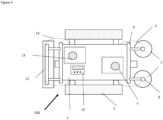
- the cleaning robot provides the second step of the method, the coating (see Figure 3 ).
- the robot according to the present invention wherein the at least one suitable coating assembly comprises at least two coating elements in at least two operating positions relative to a chassis via at least one holding device, wherein in one operating position SiOz generating agent is applied on one coating element, wherein in the other operating position, the other coating element with the already applied SiOz generating agent faces towards the solar panel for coating the solar panel with the SiO 2 generating agent, wherein a rotation of one of the coating elements from one operating position into the other operating position is accompanied by the rotation of the other coating element from one operating position into the other operating position and vice versa.
- the at least one coating agent distribution device comprises a protective coating composition tank mounted on one side of the chassis, at least a hose wound from the tank to a pump included in the chassis, at least a hose that extends from the chassis to a tube system, wherein the tube system is arranged as several fittings, which are distributed on top of the holding device wherein the lower piece of the fittings passes through holes arranged on top of the holding device for applying the protective coating composition onto one coating element wherein the fittings are connected via a hose passing through all upper sides of the fittings.
- each coating element comprises at least two cushion-like rectangular microfiber cloths that can be used to distribute the coating.
- the robot then comprises at least one suitable sensor device associated with the coating unit for detecting the wear of a coating of the surface area of the solar panel to be coated.
- the sensor may also sense and record scratches and other surface damage of the solar panel, for example in order to report a more extensive reason for repair back to the central unit.
- a robot comprising a chassis having a longitudinal axis, a propulsion system coupled to the chassis for moving the robot on the surface area of the solar panels to be cleaned, at least one arm coupled to the chassis in the longitudinal axis, at least one cleaning agent distribution device attached to the robot for distributing cleaning agent during an autonomous maintenance cycle, at least one coating agent distribution device attached to the robot for distributing cleaning agent during an autonomous maintenance cycle, at least one suitable sensor device associated with the coating unit for detecting the wear of a coating of the surface area of the solar panel to be coated, at least one suitable sensor device associated with the cleaning unit for detecting the degree of cleanliness of the surface area of the solar panel to be cleaned, a control unit arranged in the chassis for operating the robot and controlling the propulsion system, arms, distribution devices, the at least one suitable sensor devices, and optionally a drone system configured to facilitate moving the robot between solar panels that have a discontinuous surface and/or are spaced apart from each other.
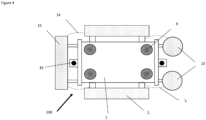
- This embodiment relates to the combination of the units for cleaning and coating as herein in one robot.
- the propulsion system comprises a driving track set connected to a power supply, wherein the driving track set is coupled to opposite sides of the chassis in the lateral axis.
- the device may even comprise a releasable suction cup mechanism allowing the robot to be "locked in position" on the surface of the solar panels.
- Respective suction mechanisms, pumps and movable arms are known and can be readily implemented accordingly, e.g. as disclosed in WO2018195866A1 for grabbing parts or DE202004003324U1 for a climbing device.
- the releasable suction cup mechanism may be placed at the corners of the chassis of the robot, either underneath or on specific extensions or arms.
- the robot according to the present invention wherein the at least one arm is a rod construction of at least one side of the chassis, wherein the rod construction consists of a mounting system and two rods, wherein the part of the mounting system facing to the chassis is arranged with at least four screws to the chassis and the part of the mounting system facing away from the chassis comprises receiving openings in which one rod is received, wherein the other rod is pivotably arranged at the center of the rod arranged in the mounting system, wherein the cleaning/coating assembly is arranged at the arms.
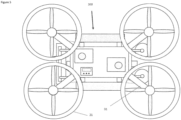
- the robot When implemented as a drone system, preferred is the robot according to the present invention, wherein the drone system comprises a data interaction device used for data interaction between the drone and an operator in case of an issue of the system, and at least two propellers, each coupled at an outer end of the chassis.
- the drone system comprises a data interaction device used for data interaction between the drone and an operator in case of an issue of the system, and at least two propellers, each coupled at an outer end of the chassis.
- Drone systems are known in the art (see, for example, above), and can be readily implemented for the present robot(s).
- the robot is adapted to fly via the drone system in steady intervals as predicted from the data stored in the control unit based on the weather data and the data collected from the previous maintenance cycle, wherein subsequently the robot takes off autonomously from a start platform, flies a designated route and lands on the solar panels, and wherein the robot automatically returns to the starting platform to recharge itself after the maintenance cycle.
- Another aspect of the present invention thus relates to use of the robots as disclosed according to the invention for providing autonomous maintenance of solar panels according to the method herein.
- the present invention relates to the following items.
- a method for providing autonomous maintenance of solar panels comprising at least one autonomous maintenance cycle comprising i) cleaning of a surface area of the solar panels exposed to light by a cleaning unit of a robot comprising at least one suitable cleaning assembly, and ii) subsequent coating of the surface area of the solar panels exposed to light by a coating unit of a robot comprising at least one suitable coating assembly, comprising applying of a protective coating composition comprising at least one SiO 2 generating agent, the robot further comprising at least one suitable sensor device associated with the cleaning unit for detecting the degree of cleanliness of the surface area of the solar panel to be cleaned, the robot further comprising at least one suitable sensor device associated with the coating unit for detecting the wear of a coating of the surface area of the solar panel to be coated, and wherein based on the data obtained from the at least one suitable sensor device, the need for performing an autonomous maintenance cycle is calculated and a resource optimization of water, cleaning/coating agents and cleaning/coating intensity is calculated, and optionally, an autonomous maintenance cycle is initiated.
- Item 2 The method according to Item 1, wherein the steps of cleaning and coating are performed by individual cleaning or coating robots or by one combined cleaning and coating robot.
- Item 3 The method according to Item 1 or 2, wherein the protective coating composition comprises 50 weight-% up to 99.9 weight-%, preferably 80 weight-% up to 99 weight-% of an SiOz generating agent.
- Item 4 The method according to any one of Items 1 to 3, wherein the SiOz generating agent is selected from 0 up to 100 weight-%, preferably 1 up to 99 weight-%, tetraethoxysilane, 0 up to 100 weight-%, preferably 1 up to 99 weight-%, trimethoxymethylsilane, and 0 up to 100 weight-%, preferably 1 up to 99 weight-%, dimethoxydimethylsilane.
- the SiOz generating agent is selected from 0 up to 100 weight-%, preferably 1 up to 99 weight-%, tetraethoxysilane, 0 up to 100 weight-%, preferably 1 up to 99 weight-%, trimethoxymethylsilane, and 0 up to 100 weight-%, preferably 1 up to 99 weight-%, dimethoxydimethylsilane.
- Item 5 The method according to any one of Items 1 to 4, wherein the SiOz generating agent further comprises up to 20 weight-% Al 2 O 3 , TiO 2 , ZrO 2 , MgO and/or V 2 O 5 , wherein these additives are present at any mixing ratio, preferably in mixing ratios between 0.1 weight-% and 50 weight-% from the group of Al 2 O 3 , TiO 2 , ZrO 2 , MgO and V 2 O 5 , more preferably in mixing ratios between 1 weight-% and 20 weight-% from the group of Al 2 O 3 , TiO 2 and ZrO 2 .
- Item 6 A robot for performing the method according to any one of Items 1 to 5, wherein the robot comprises (i) a chassis having a longitudinal axis (ii) a propulsion system coupled to the chassis for moving the robot on the surface area of the solar panels to be cleaned, (iii) at least one arm coupled to the chassis (1) in the longitudinal axis, (iv) at least one cleaning agent distribution device attached to the robot for distributing cleaning agent during an autonomous maintenance cycle, (v) at least one suitable sensor device associated with the cleaning unit for detecting the degree of cleanliness of the surface area of the solar panel to be cleaned, (vi) a control unit arranged in the chassis for operating the robot and controlling the propulsion system, arms, distribution device, the at least one suitable sensor device, and optionally (vi) a drone system configured to facilitate moving the robot between solar panels that have a discontinuous surface and/or are spaced apart from each other.
- a propulsion system coupled to the chassis for moving the robot on the surface area of the solar panels to be cleaned
- at least one arm coupled to the chassis
- Item 7 A robot for performing the method according to any one of Items 1 to 5, wherein the robot comprises (i) a chassis having a longitudinal axis (ii) a propulsion system coupled to the chassis for moving the robot on the surface area of the solar panels to be cleaned, (iii) at least one arm coupled to the chassis in the longitudinal axis, (iv) at least one coating agent distribution device attached to the robot for distributing cleaning agent during an autonomous maintenance cycle, (v) at least one suitable sensor device associated with the coating unit for detecting the wear of a coating of the surface area of the solar panel to be coated, (vi) a control unit arranged in the chassis for operating the robot and controlling the propulsion system, arms, distribution device, the at least one suitable sensor device, and optionally (vi) a drone system configured to facilitate moving the robot between solar panels that have a discontinuous surface and/or are spaced apart from each other.
- a propulsion system coupled to the chassis for moving the robot on the surface area of the solar panels to be cleaned
- at least one arm coupled to the
- Item 8 A robot for performing the method according to any one of Items 1 to 5, wherein the robot comprises (i) a chassis having a longitudinal axis (ii) a propulsion system coupled to the chassis for moving the robot on the surface area of the solar panels to be cleaned, (iii) at least one arm coupled to the chassis in the longitudinal axis, (iva) at least one cleaning agent distribution device attached to the robot for distributing cleaning agent during an autonomous maintenance cycle, (ivb) at least one coating agent distribution device attached to the robot for distributing cleaning agent during an autonomous maintenance cycle, (va) at least one suitable sensor device associated with the coating unit for detecting the wear of a coating of the surface area of the solar panel to be coated, (vb) at least one suitable sensor device associated with the cleaning unit for detecting the degree of cleanliness of the surface area of the solar panel to be cleaned, (vi) a control unit arranged in the chassis for operating the robot and controlling the propulsion system, arms, distribution devices, the at least one suitable sensor devices, and optionally (vi) a drone system configured to
- Item 9 The robot according to any one of Items 6 to 8, wherein the propulsion system comprises a driving track set connected to a power supply, wherein the driving track set is coupled to opposite sides of the chassis in the lateral axis.
- the at least one arm is a rod construction of at least one side of the chassis, wherein the rod construction consists of a mounting system and two rods, wherein the part of the mounting system facing to the chassis is arranged with at least four screws to the chassis and the part of the mounting system facing away from the chassis comprises receiving openings in which one rod is received, wherein the other rod is pivotably arranged at the center of the rod arranged in the mounting system, wherein the cleaning/coating assembly is arranged at the arms.
- Item 11 The robot according to any one of Items 6 to 10, wherein the at least one suitable cleaning assembly comprises at least one cleaning element for cleaning at least one surface of a solar panel, wherein the cleaning element is arranged outside the chassis when rotating around a vertical axis to the chassis, and in particular when cleaning the surface of the solar panel.
- Item 12 The robot according to any one of Items 6 to 11, wherein the at least two cleaning elements are cleaning disks.
- Item 13 The robot according to any one of Items 6 to 12, wherein at least one cleaning agent distribution device, comprising: a cleaning agent tank mounted to the chassis, at least a hose wound from the cleaning agent tank to a cleaning agent pump included in the chassis, at least two hoses that extend from the chassis to the cleaning assembly.
- the at least one suitable coating assembly comprises at least two coating elements in at least two operating positions relative to a chassis via at least one holding device, wherein in one operating position SiOz generating agent is applied on one coating element, wherein in the other operating position, the other coating element with the already applied SiOz generating agent faces towards the solar panel for coating the solar panel with the SiO 2 generating agent, wherein a rotation of one of the coating elements from one operating position into the other operating position is accompanied by the rotation of the other coating element from one operating position into the other operating position and vice versa.
- the at least one coating agent distribution device comprises a protective coating composition tank mounted on one side of the chassis, at least a hose wound from the tank to a pump included in the chassis, at least a hose that extends from the chassis to a tube system, wherein the tube system is arranged as several fittings, which are distributed on top of the holding device wherein, the lower piece of the fittings passes through holes arranged on top of the holding device for applying the protective coating composition onto one coating element wherein, the fittings are connected via a hose passing through all upper sides of the fittings.
- each coating element comprises at least two cushion-like rectangular microfiber cloths.
- Item 17 The robot according to any one of Items 6 to 16, wherein the drone system comprises (i) a data interaction device used for data interaction between the drone and an operator in case of an issue of the system, and (ii) at least two propellers, each coupled at an outer end of the chassis.
- Item 18 The robot according to any one of Items 6 to 17, wherein the robot is adapted to fly via the drone system in steady intervals as predicted from the data stored in the control unit based on the weather data and the data collected from the previous maintenance cycle, wherein subsequently the robot takes off autonomously from a start platform, flies a designated route and lands on the solar panels, and wherein the robot automatically returns to the starting platform to recharge itself after the maintenance cycle.
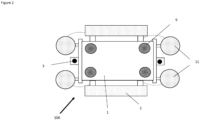
- Figure 1 shows a robot with a cleaning unit.
- the robot comprises a chassis arranged as a rectangular metallic box. Furthermore, the robot comprises a propulsion system coupled to the chassis for moving the robot on solar panels.
- the propulsion system comprises a driving track set connected to a power supply, wherein the driving track set is coupled to the opposite sides of the chassis (1) in the lateral axis.
- the robot comprises two arms coupled to the chassis in the longitudinal axis.
- Each arm is a rod construction consisting of a mounting system and two rods.
- the part of the mounting system facing to the chassis is arranged with at least four screws to the chassis (1) and the part of the mounting system facing away from the chassis comprises receiving openings in which a rod is received.
- Another T-shaped rod is arranged with its vertical end as a swivel joint to the rod received in the mounting system.
- the horizontal ends of the T-shaped rod comprise each a cleaning element representing the cleaning assembly.
- both cleaning elements are cleaning disks.
- the pivoting arrangement of the T-shaped rod to the rod received in the mounting system at the chassis allows an adjustment of the downward force applied by the cleaning elements.
- the cleaning assembly of the robot can be arranged as one cleaning element.
- the robot comprises a cleaning agent distribution device for the distribution of the cleaning agent under the cleaning elements rotating around a vertical axis to the chassis and in particular when cleaning the surface of the solar panel.
- the cleaning agent distribution device (4) comprises a cleaning agent tank mounted on top of the chassis and a hose wound from the cleaning agent tank to the cleaning agent pump included in the chassis, wherein at least two hoses extend from the chassis to the cleaning assembly.
- each of the two hoses comprise a plug connection for another two thinner hose which lead to each of the cleaning elements.
- the cleaning and coating robot are different robots.
- one robot can comprise the cleaning and coating unit.
- FIG 3 shows a robot with a coating unit.
- the robot comprises a chassis (1) arranged as a rectangular metallic box and a propulsion system (2) coupled to the chassis (1) for moving the robot on solar panels.
- the propulsion system (2) comprises a driving track set connected to a power supply, wherein the driving track set is coupled to the opposite sides of the chassis (1) in the lateral axis.
- the robot comprises one arm coupled to the chassis (1) in the longitudinal axis.
- the arm is a rod construction (6) consisting of a mounting system and two rods.
- the rod construction (6) (not shown) is similar to the rod construction of the robot with the cleaning unit.
- a coating assembly is arranged at the horizontal ends of the T-shaped rod.
- the coating assembly comprises two coating elements in at least two operating positions relative to a chassis (1) via at least one holding device, wherein in one operating position a protective coating composition is applied on one coating element, wherein in the other operating position, the other coating element with the already applied protective coating composition faces towards the solar panel for coating the solar panel with the protective coating composition, wherein a rotation of one of the coating elements from one operating position into the other operating position is accompanied by the rotation of the other coating element from one operating position into the other operating position and vice versa.
- the protective coating composition comprises at least one SiOz generating agent.
- Each coating element comprises at least two cushion-like rectangular microfiber cloths.
- the robot comprises a coating agent distribution device, comprising a protective coating composition tank mounted on the side of the chassis (1), wherein a hose is wound from the tank to a pump included in the chassis (1).
- An additional hose extends from the chassis (1) to a tube system, wherein the tube system is arranged as several fittings, which are distributed on top of the holding device.
- the fittings are arranged in a T-shape, wherein the vertical end of the T-shaped fittings is arranged as a small metal pipe, which passes through holes arranged on top of the holding device for applying the protective coating composition onto one coating element.
- the horizontal ends of the fittings are hollow pipes, which are connected via a hose passing through all upper sides of the fittings.
- Both robots comprise a control unit arranged in the chassis (1) for operating the robots and controlling the propulsion system (2), arms (6), distribution devices (4, 12), drone system and at least one suitable sensor device.
- the at least one suitable sensor device detects the degree of cleanliness of the surface area of the solar panel to be cleaned and the wear of a coating of the surface area of the solar panel to be coated, wherein based on the data obtained from the at least one suitable sensor device, a resource optimization of water, cleaning/coating agents and cleaning/coating intensity is calculated and the need for an autonomous maintenance cycle is calculated, and optionally, the autonomous maintenance cycle is initiated.
- the data obtained by the sensors is bundled in a blockchain-based solution.
- the data on the increased production of electricity is used to determine the resulting CO 2 savings and the associated certificates. Additionally, the data will be used to feed algorithms and Al models for performance optimization and robot control.
- the coating of the autonomous maintenance cycle can be initiated. Conversely, if the wear of a coating of the whole surface area of the solar panels is intact, only a cleaning of the solar panels can be initiated.
- the robots may comprise a drone system (not shown) which is configured to facilitate the transportation of the robots between solar panels that are discontinuous and spaced apart from each other.
- the drone system comprises a data interaction device used for data interaction between the drone and an operator and at least two propellor at an outer end of the chassis.
Landscapes
- Photovoltaic Devices (AREA)
Priority Applications (2)
| Application Number | Priority Date | Filing Date | Title |
|---|---|---|---|
| EP23215883.2A EP4572136A1 (de) | 2023-12-12 | 2023-12-12 | Verfahren zur bereitstellung einer autonomen wartung von solarpaneelen und darin verwendete roboter |
| PCT/EP2024/085735 WO2025125357A1 (en) | 2023-12-12 | 2024-12-11 | Method for providing autonomous maintenance of solar panels and robots used therein |
Applications Claiming Priority (1)
| Application Number | Priority Date | Filing Date | Title |
|---|---|---|---|
| EP23215883.2A EP4572136A1 (de) | 2023-12-12 | 2023-12-12 | Verfahren zur bereitstellung einer autonomen wartung von solarpaneelen und darin verwendete roboter |
Publications (1)
| Publication Number | Publication Date |
|---|---|
| EP4572136A1 true EP4572136A1 (de) | 2025-06-18 |
Family
ID=89190576
Family Applications (1)
| Application Number | Title | Priority Date | Filing Date |
|---|---|---|---|
| EP23215883.2A Pending EP4572136A1 (de) | 2023-12-12 | 2023-12-12 | Verfahren zur bereitstellung einer autonomen wartung von solarpaneelen und darin verwendete roboter |
Country Status (2)
| Country | Link |
|---|---|
| EP (1) | EP4572136A1 (de) |
| WO (1) | WO2025125357A1 (de) |
Citations (11)
| Publication number | Priority date | Publication date | Assignee | Title |
|---|---|---|---|---|
| DE202004003324U1 (de) | 2004-01-24 | 2004-05-19 | Universitätsklinikum Lübeck | Roboterfuß mit Saugnäpfen zur Fortbewegung auf beliebig geneigten, glatten Flächen |
| EP1825752A2 (de) | 2006-02-22 | 2007-08-29 | Stiftung nano innovations -for a better living | Beschichtungszusammensetzung, aus SiO2-erzeugendem Mittel, mit wenigstens einem antibakteriellen Wirkstoff |
| WO2018195866A1 (zh) | 2017-04-27 | 2018-11-01 | 深圳配天智能技术研究院有限公司 | 基于机器人系统的零件抓取方法及机器人系统、夹具 |
| KR101984202B1 (ko) | 2018-08-13 | 2019-05-30 | 남영훈 | 드론을 이용한 태양광 패널 클리닝 시스템 |
| CN109379040B (zh) | 2018-11-26 | 2020-01-14 | 武汉理工大学 | 基于机器视觉的光伏电站巡检清洁无人机及其清洁方法 |
| KR102137841B1 (ko) * | 2020-02-25 | 2020-07-28 | 김원일 | 태양전지 패널의 청소와 광촉매 코팅이 가능한 다기능 청소로봇 및 이를 이용한 태양전지 패널의 유지관리 방법 |
| CN111800081A (zh) | 2020-06-18 | 2020-10-20 | 中国电建集团贵州电力设计研究院有限公司 | 一种光伏板无人机清扫系统及抓取和释放的控制方法 |
| KR102315501B1 (ko) | 2021-04-13 | 2021-10-22 | 황병호 | 드론을 이용한 태양광 모듈 청소 시스템 |
| US20210408963A1 (en) | 2020-06-30 | 2021-12-30 | Solar Service Cleaning, LLC | System, method and device for robotic cleaning of solar panels |
| WO2022097171A1 (en) | 2020-11-03 | 2022-05-12 | Mohan Suraj | Autonomous dynamic cleaning system for photovoltaic panels and method thereof |
| DE102021112751A1 (de) * | 2021-05-17 | 2022-11-17 | Hochschule für Technik und Wirtschaft Berlin, Körperschaft des öffentlichen Rechts | Reinigungsvorrichtung zum automatischen Reinigen von Solarmodulen einer Solar-Anlage |
-
2023
- 2023-12-12 EP EP23215883.2A patent/EP4572136A1/de active Pending
-
2024
- 2024-12-11 WO PCT/EP2024/085735 patent/WO2025125357A1/en active Pending
Patent Citations (12)
| Publication number | Priority date | Publication date | Assignee | Title |
|---|---|---|---|---|
| DE202004003324U1 (de) | 2004-01-24 | 2004-05-19 | Universitätsklinikum Lübeck | Roboterfuß mit Saugnäpfen zur Fortbewegung auf beliebig geneigten, glatten Flächen |
| EP1825752A2 (de) | 2006-02-22 | 2007-08-29 | Stiftung nano innovations -for a better living | Beschichtungszusammensetzung, aus SiO2-erzeugendem Mittel, mit wenigstens einem antibakteriellen Wirkstoff |
| WO2018195866A1 (zh) | 2017-04-27 | 2018-11-01 | 深圳配天智能技术研究院有限公司 | 基于机器人系统的零件抓取方法及机器人系统、夹具 |
| KR101984202B1 (ko) | 2018-08-13 | 2019-05-30 | 남영훈 | 드론을 이용한 태양광 패널 클리닝 시스템 |
| CN109379040B (zh) | 2018-11-26 | 2020-01-14 | 武汉理工大学 | 基于机器视觉的光伏电站巡检清洁无人机及其清洁方法 |
| KR102137841B1 (ko) * | 2020-02-25 | 2020-07-28 | 김원일 | 태양전지 패널의 청소와 광촉매 코팅이 가능한 다기능 청소로봇 및 이를 이용한 태양전지 패널의 유지관리 방법 |
| CN111800081A (zh) | 2020-06-18 | 2020-10-20 | 中国电建集团贵州电力设计研究院有限公司 | 一种光伏板无人机清扫系统及抓取和释放的控制方法 |
| US20210408963A1 (en) | 2020-06-30 | 2021-12-30 | Solar Service Cleaning, LLC | System, method and device for robotic cleaning of solar panels |
| WO2022097171A1 (en) | 2020-11-03 | 2022-05-12 | Mohan Suraj | Autonomous dynamic cleaning system for photovoltaic panels and method thereof |
| KR102315501B1 (ko) | 2021-04-13 | 2021-10-22 | 황병호 | 드론을 이용한 태양광 모듈 청소 시스템 |
| DE102021112751A1 (de) * | 2021-05-17 | 2022-11-17 | Hochschule für Technik und Wirtschaft Berlin, Körperschaft des öffentlichen Rechts | Reinigungsvorrichtung zum automatischen Reinigen von Solarmodulen einer Solar-Anlage |
| WO2022242811A1 (de) | 2021-05-17 | 2022-11-24 | Hochschule Für Technik Und Wirtschaft Berlin | Reinigungsvorrichtung zum automatischen reinigen von solarmodulen einer solar-anlage |
Also Published As
| Publication number | Publication date |
|---|---|
| WO2025125357A1 (en) | 2025-06-19 |
Similar Documents
| Publication | Publication Date | Title |
|---|---|---|
| CN109379040B (zh) | 基于机器视觉的光伏电站巡检清洁无人机及其清洁方法 | |
| US12290922B2 (en) | Robot for solar farms | |
| EP3126067B1 (de) | Agcfds: automatisiertes scheibenreinigendes flugdrohnensystem | |
| CN109420629B (zh) | 倾斜面上的作业装置及其应用在光伏电站的清扫方法 | |
| US10011352B1 (en) | System, mobile base station and umbilical cabling and tethering (UCAT) assist system | |
| US8046101B2 (en) | Cleaning robot system and method of controlling same | |
| JP7253209B2 (ja) | マルチロボットシステム及びその使用方法 | |
| US11426770B2 (en) | Scrub plate system, vacuum rail system, control system, irregular surface cleaning system, process, and methods of use | |
| CN206868677U (zh) | 一种用于高空设施清洁的无人机 | |
| CN105149253A (zh) | 太阳能电池板清扫装置及系统 | |
| AU2014207468A1 (en) | Mechanism for cleaning solar collector surfaces | |
| CN106269601A (zh) | 太阳能电池板清扫装置及系统 | |
| CN115889271B (zh) | 一种与无人机相结合的光伏清洁方法 | |
| CN214719212U (zh) | 一种基于图像识别的光伏巡检清洗机器人 | |
| WO2019167079A1 (en) | Automatic cleaning vehicle for photovoltaic panels | |
| US20220355343A1 (en) | Vacuum rail system having a squeegee system, control system, irregular surface cleaning system, process, and methods of use | |
| Sarkis et al. | Novel design of a hybrid drone system for cleaning solar panels | |
| WO2018186461A1 (ja) | 作業装置 | |
| CN113578612A (zh) | 一种搭载多功能模块的高空自动喷漆作业机器人 | |
| EP4572136A1 (de) | Verfahren zur bereitstellung einer autonomen wartung von solarpaneelen und darin verwendete roboter | |
| JP6583733B2 (ja) | 自走式ロボットを使用した作業システム | |
| CN106593788B (zh) | 设备维护装置、系统及设备维护方法 | |
| WO2022198948A1 (zh) | 一种空中智能喷涂建筑机器人 | |
| CN113458088A (zh) | 一种太阳能光伏板板面清洗方法及系统 | |
| CN212349557U (zh) | 一种太阳能路灯的太阳能电池板的全自动清洁装置 |
Legal Events
| Date | Code | Title | Description |
|---|---|---|---|
| PUAI | Public reference made under article 153(3) epc to a published international application that has entered the european phase |
Free format text: ORIGINAL CODE: 0009012 |
|
| STAA | Information on the status of an ep patent application or granted ep patent |
Free format text: STATUS: THE APPLICATION HAS BEEN PUBLISHED |
|
| AK | Designated contracting states |
Kind code of ref document: A1 Designated state(s): AL AT BE BG CH CY CZ DE DK EE ES FI FR GB GR HR HU IE IS IT LI LT LU LV MC ME MK MT NL NO PL PT RO RS SE SI SK SM TR |
|
| STAA | Information on the status of an ep patent application or granted ep patent |
Free format text: STATUS: REQUEST FOR EXAMINATION WAS MADE |
|
| 17P | Request for examination filed |
Effective date: 20251204 |