EP4572085A1 - Verfahren zum ultraschnellen laden einer elektrochemischen speicherzelle - Google Patents
Verfahren zum ultraschnellen laden einer elektrochemischen speicherzelle Download PDFInfo
- Publication number
- EP4572085A1 EP4572085A1 EP24208798.9A EP24208798A EP4572085A1 EP 4572085 A1 EP4572085 A1 EP 4572085A1 EP 24208798 A EP24208798 A EP 24208798A EP 4572085 A1 EP4572085 A1 EP 4572085A1
- Authority
- EP
- European Patent Office
- Prior art keywords
- voltage
- charging
- cell
- charge
- bat
- Prior art date
- Legal status (The legal status is an assumption and is not a legal conclusion. Google has not performed a legal analysis and makes no representation as to the accuracy of the status listed.)
- Pending
Links
Images



Classifications
-
- H—ELECTRICITY
- H01—ELECTRIC ELEMENTS
- H01M—PROCESSES OR MEANS, e.g. BATTERIES, FOR THE DIRECT CONVERSION OF CHEMICAL ENERGY INTO ELECTRICAL ENERGY
- H01M10/00—Secondary cells; Manufacture thereof
- H01M10/42—Methods or arrangements for servicing or maintenance of secondary cells or secondary half-cells
- H01M10/44—Methods for charging or discharging
- H01M10/441—Methods for charging or discharging for several batteries or cells simultaneously or sequentially
-
- H—ELECTRICITY
- H02—GENERATION; CONVERSION OR DISTRIBUTION OF ELECTRIC POWER
- H02J—ELECTRIC POWER NETWORKS; CIRCUIT ARRANGEMENTS OR SYSTEMS FOR SUPPLYING OR DISTRIBUTING ELECTRIC POWER; SYSTEMS FOR STORING ELECTRIC ENERGY
- H02J7/00—Circuit arrangements for charging or discharging batteries or for supplying loads from batteries
- H02J7/90—Regulation of charging or discharging current or voltage
- H02J7/96—Regulation of charging or discharging current or voltage in response to battery voltage
-
- H—ELECTRICITY
- H02—GENERATION; CONVERSION OR DISTRIBUTION OF ELECTRIC POWER
- H02J—ELECTRIC POWER NETWORKS; CIRCUIT ARRANGEMENTS OR SYSTEMS FOR SUPPLYING OR DISTRIBUTING ELECTRIC POWER; SYSTEMS FOR STORING ELECTRIC ENERGY
- H02J7/00—Circuit arrangements for charging or discharging batteries or for supplying loads from batteries
- H02J7/90—Regulation of charging or discharging current or voltage
- H02J7/94—Regulation of charging or discharging current or voltage in response to battery current
- H02J7/947—Regulation of charging or discharging current or voltage in response to battery current in response to integrated charge or discharge current
-
- H—ELECTRICITY
- H02—GENERATION; CONVERSION OR DISTRIBUTION OF ELECTRIC POWER
- H02J—ELECTRIC POWER NETWORKS; CIRCUIT ARRANGEMENTS OR SYSTEMS FOR SUPPLYING OR DISTRIBUTING ELECTRIC POWER; SYSTEMS FOR STORING ELECTRIC ENERGY
- H02J7/00—Circuit arrangements for charging or discharging batteries or for supplying loads from batteries
- H02J7/80—Circuit arrangements for charging or discharging batteries or for supplying loads from batteries including monitoring or indicating arrangements
- H02J7/82—Control of state of charge [SOC]
-
- Y—GENERAL TAGGING OF NEW TECHNOLOGICAL DEVELOPMENTS; GENERAL TAGGING OF CROSS-SECTIONAL TECHNOLOGIES SPANNING OVER SEVERAL SECTIONS OF THE IPC; TECHNICAL SUBJECTS COVERED BY FORMER USPC CROSS-REFERENCE ART COLLECTIONS [XRACs] AND DIGESTS
- Y02—TECHNOLOGIES OR APPLICATIONS FOR MITIGATION OR ADAPTATION AGAINST CLIMATE CHANGE
- Y02E—REDUCTION OF GREENHOUSE GAS [GHG] EMISSIONS, RELATED TO ENERGY GENERATION, TRANSMISSION OR DISTRIBUTION
- Y02E60/00—Enabling technologies; Technologies with a potential or indirect contribution to GHG emissions mitigation
- Y02E60/10—Energy storage using batteries
Definitions
- the present invention relates to a method for charging an electrochemical accumulator cell, as well as to a system capable of implementing the method.
- An electrochemical storage cell is the basic unit of a battery or electrochemical accumulator. It consists of two electrodes (an anode and a cathode) and an electrolyte that enables the chemical reactions that generate electrical energy.
- the electrochemical cells in a battery are connected in series or parallel, or a combination of both, depending on the voltage and capacity required for the specific application.
- the charging speed of a cell depends on many factors, including cell capacity, cell technology, charging current, and safety features.
- Document [1] describes an adaptive charging protocol implemented for rapidly charging a rechargeable battery having electrode terminals connected to the terminals of a power supply intended to apply time-varying voltages to the electrodes, comprising, before starting a charging operation for the battery, the steps of: detecting the existence of historical data on previous charging operations of the battery; if detected, processing the historical data to adjust the charging parameters to optimize the charging operation; if not detected, electrically testing the battery to obtain data on the variations in the state of charge (SOC) of the battery, with a view to building a learning model on the SOC variations to be used to optimize the charging operation.
- SOC state of charge
- Document [2] describes a method for rapid charging of lithium batteries which consists of charging the battery in a first phase by maximizing the current of charging, then charging the battery in a second phase by decreasing the charging current in response to an anode potential determined by a reference electrode to maintain the anode potential at or above a threshold, then charging the battery in a third phase by decreasing the charging current in response to the cathode potential determined by the reference electrode such that the cathode potential is maximized without exceeding the cathode potential threshold.
- a controller may determine an anode potential or a cathode potential in real time using a cell potential signal and an anode cathode reference electrode signal, respectively.
- the threshold is the anode potential above which essentially no lithium plating occurs.
- Document [3] describes a rechargeable battery comprising an anode, a cathode, an electrolyte disposed between the anode and the cathode, a protective housing which at least partially surrounds the anode, the cathode and the electrolyte, a heat distributing element disposed at least partially within the protective housing and configured to receive heat from an external heat source at a desired heating temperature Th in order to heat the battery to a desired temperature Tc for charging the battery, thereby lowering the charging time.
- the first step is applied for a charging parameter such that the internal resistance of the cell is not greater than a predetermined threshold.
- the charging parameter is selected from a charging capacity, a charging current, a charging voltage, or a charging time.
- the percentage of charge capacity generated at the usual charge voltage out of the total capacity generated at the first charge voltage and at the usual charge voltage is between 10% and 50%.
- the cell comprises an electrolyte whose electronic conductivity is less than 10 -9 ( ⁇ .m) -1 .
- the cell comprises a solid electrolyte.
- the electrolyte comprises one of the materials selected from LiPoN, Li 3 OCl, LiSiON, LiN, LATP.
- the invention also relates to a system for managing the charge of a cell, characterized in that it is configured to implement the aforementioned method.
- the method according to the invention is illustrated by the Figure 1 .
- the cell is connected to a suitable power source, which may be a specific charger designed for the cell's chemistry.
- the method may also comprise a step of providing a fast charging current in order to accelerate the charging.
- the method according to the invention comprises applying a constant voltage across the terminals of the cell, in which the voltage is kept constant at at least two successive predefined voltage levels, the current gradually decreasing as the cell charges.
- the process involves two steps.
- the first step E1 consists of applying a first voltage V 1 to the terminals of the cell, the first voltage V 1 being higher than a usual charging voltage V bat .
- the usual charging voltage V bat is defined as being a voltage such that it would not cause electrochemical degradation of the cell if it were applied over a complete charging cycle of the cell.
- the usual charging voltage V bat also called the “charge cut-off voltage” also corresponds to the voltage at which the cell reaches its maximum capacity at the end of the charging process. It is therefore the voltage at which the cell should not be charged beyond this to avoid safety, performance or battery life issues.
- the usual charging voltage is calculated based on the total number of cells and the series/parallel arrangement of the cells.
- the charging voltage of a cell is variable depending on the type of anode and cathode chosen.
- the usual charging voltage V bat of a lithium-ion cell is 4.2 V.
- the method starts at substep E10.
- the state of charge SOC (for "State Of Charge") is measured at substep E11. If the state of charge is lower than a limit state of charge SOC limit (substep E12), the first voltage V 1 is applied (substep E13), then the state of charge SOC is measured (substep E14), and so on as long as the state of charge is lower than a limit state of charge SOC limit .
- the second step E2 consists of applying the usual charging voltage V bat .
- the charger can either reduce the current to a very low level (maintenance charge) or stop charging completely (step not shown in the Figure 1 ).
- the usual charging voltage V bat is imposed (sub-step E21) as soon as the state of charge is greater than or equal to a limit state of charge SOC limit (sub-step E12).
- the state of charge SOC is measured (sub-step E22). If the state of charge is greater than a maximum state of charge SOC max (sub-step E23), the method ends (sub-step E24). Otherwise, the usual charging voltage V bat is maintained.
- the cell once the cell is fully charged, it can be disconnected from the power source to prevent overcharging which could damage the cell (step not shown in the Figure 1 ).
- Charging time (h) Battery capacity (A.h) / Charging current (A)
- the first voltage V 1 can be set to 6 V, 7 V, 8 V, 9 V or 10 V.
- V 1 max 2,5 * V bat ou 10,5 V
- Max corresponds to the maximum function.
- FIG. 4 illustrates a graph of the energy supplied as a function of the number of charge/discharge cycles, in comparison with the method according to the invention (Pi) with a conventional method (Pc) of constant voltage charging, for a TFB battery.
- the first step is applied for a charge quantity such that the internal resistance of the cell is not greater than a predetermined threshold during the first sub-step.
- V bat 4.2 V
- the end of charging causes very little damage to the cell (internal resistance around 10 M ⁇ /cm 2 ).
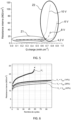
- a constant voltage step which would only involve applying a voltage higher than the usual charging voltage would cause an increase in the internal resistance of the cell.
- the increase in internal resistance may be slight at the start of charging (zone Z1), then exponential during charging (zone Z2).
- the method according to the invention is based on the fact that the start of charging can be carried out with a first voltage V 1 higher than the usual charging voltage V bat , so as to remain in zone Z1, then, before the internal resistance exceeds a threshold value, the charging voltage is brought back to the usual charging voltage V bat .
- One or more intermediate voltages can be used, to avoid a sudden change from the first voltage V 1 to the usual charging voltage V bat .
- the charging voltage can switch from the first voltage V1 to the usual charging voltage V bat without systematic analysis of the internal resistance.
- the transition moment can be determined initially using a graph such as the one shown in Figure 5
- the tipping point can be determined from a minimum current reached or a charged capacity reached or a measured resistance. Once this point is selected for a configuration, it can be imposed systematically.
- the internal resistance of the cell can be determined by various methods, including: analyzing the internal voltage drop of the cell when a current is applied, sending a pulsed current to the cell and measuring the voltage response, or impedance analysis by applying an AC signal to the cell.
- the proportion of charge at the first voltage V 1 , relative to the total charge quantity i.e. charge at the first voltage V 1 and charge at the maximum charge voltage V bat ) is variable. It can be chosen before the start of the charge cycle, as indicated previously, or in real time.
- the cycle life of a cell refers to its ability to repeatedly and reliably undergo charge and discharge cycles without significant degradation in performance or capacity.
- the cell includes a solid electrolyte, which improves the cell's energy density. This allows the cell to store more energy for a given size.
- Solid electrolyte cells are particularly suitable for portable devices such as phones or other connected electronics.
- Electrolyte ⁇ el ( ⁇ .m) -1 LPS 10-9 LTP 10 -9 -10 -2 ⁇ LZP 10-9 LAGP 10 -8 - 10 -8 LATP 10 -10 LGPS - LLZO 10 -8 LLTO 10-9 LiPON 10 -15 - 10 -9 LiSiON 10 -13 - 10 -8 Li 3 OCl 10-11 Linen 10-12 PEO - ⁇ el corresponds to the electronic conductivity, in ( ⁇ .m) -1 .
- LiPON Lithium Phosphorus OxyNitride
- Li phosphorus oxynitride LiPON
- the electronic conductivity ⁇ el is between 10 -15 and 10 -9 ( ⁇ .m) -1 ), and can therefore be used as an electrolyte in the charging method according to the invention.
- Electrolytes with an electronic conductivity of less than 10 -9 ( ⁇ .m) -1 have good performance in terms of charging speed. If the electronic conductivity is greater than 10 -9 , the electrolyte becomes a less good electrical insulator. Thus, the probability of having electrons in this layer under an electric field is greater, therefore the probability of having the following reaction is higher: Li + + e - ⁇ Li
- electrolyte Other materials can be used as electrolyte, such as Li3OCl, LiSiON, LiN, LATP (Lithium Aluminum Titanium Phosphate).
- LLZTO Lithium Lanthanum Tantalum Zirconia Oxide
- LLZO Lithium Lanthanum Zirconate Oxide
- the method according to the invention makes it possible to obtain the fastest charging time (100 seconds against 300 seconds for method [8] and 3000 seconds for method [9]).
- the invention also relates to a system for managing the charging of a battery, configured to implement the aforementioned method.
- the method has been described for the charging of an electrochemical accumulator cell. It can be extended to the charging of a battery comprising a plurality of cells connected in series and/or in parallel, without this posing any difficulty for those skilled in the art.
- the battery charge management system may in particular control the battery charge according to the defined parameters to avoid excessive overcharging, which could damage the battery.
- it may include a calculation unit which determines in particular the value of the constant current during step E1, the usual charging voltage, the duration of step E1, the value of the first voltage V 1 , and the duration of step E2.
Landscapes
- Engineering & Computer Science (AREA)
- Power Engineering (AREA)
- Manufacturing & Machinery (AREA)
- Chemical & Material Sciences (AREA)
- Chemical Kinetics & Catalysis (AREA)
- Electrochemistry (AREA)
- General Chemical & Material Sciences (AREA)
- Secondary Cells (AREA)
- Charge And Discharge Circuits For Batteries Or The Like (AREA)
Applications Claiming Priority (1)
| Application Number | Priority Date | Filing Date | Title |
|---|---|---|---|
| FR2312650A FR3155636A1 (fr) | 2023-11-17 | 2023-11-17 | Procédé de charge ultra rapide d’une cellule d’accumulateur électrochimique |
Publications (1)
| Publication Number | Publication Date |
|---|---|
| EP4572085A1 true EP4572085A1 (de) | 2025-06-18 |
Family
ID=90363025
Family Applications (1)
| Application Number | Title | Priority Date | Filing Date |
|---|---|---|---|
| EP24208798.9A Pending EP4572085A1 (de) | 2023-11-17 | 2024-10-24 | Verfahren zum ultraschnellen laden einer elektrochemischen speicherzelle |
Country Status (5)
| Country | Link |
|---|---|
| US (1) | US20250167580A1 (de) |
| EP (1) | EP4572085A1 (de) |
| JP (1) | JP2025082822A (de) |
| CN (1) | CN120021070A (de) |
| FR (1) | FR3155636A1 (de) |
Citations (2)
| Publication number | Priority date | Publication date | Assignee | Title |
|---|---|---|---|---|
| US20100172010A1 (en) * | 2007-06-01 | 2010-07-08 | Chromogenics Sweden Ab | Control of electrochromic device |
| US20190184836A1 (en) * | 2017-12-19 | 2019-06-20 | Nio Usa, Inc. | Ultra-fast charge profile for an electric vehicle |
-
2023
- 2023-11-17 FR FR2312650A patent/FR3155636A1/fr active Pending
-
2024
- 2024-10-24 EP EP24208798.9A patent/EP4572085A1/de active Pending
- 2024-11-06 US US18/939,188 patent/US20250167580A1/en active Pending
- 2024-11-08 CN CN202411589059.9A patent/CN120021070A/zh active Pending
- 2024-11-13 JP JP2024197990A patent/JP2025082822A/ja active Pending
Patent Citations (2)
| Publication number | Priority date | Publication date | Assignee | Title |
|---|---|---|---|---|
| US20100172010A1 (en) * | 2007-06-01 | 2010-07-08 | Chromogenics Sweden Ab | Control of electrochromic device |
| US20190184836A1 (en) * | 2017-12-19 | 2019-06-20 | Nio Usa, Inc. | Ultra-fast charge profile for an electric vehicle |
Non-Patent Citations (11)
| Title |
|---|
| CHIA-HSIANG LIN ET AL: "Fast charging technique for Li-Ion battery charger", ELECTRONICS, CIRCUITS AND SYSTEMS, 2008. ICECS 2008. 15TH IEEE INTERNATIONAL CONFERENCE ON, IEEE, PISCATAWAY, NJ, USA, 31 August 2008 (2008-08-31), pages 618 - 621, XP031362563, ISBN: 978-1-4244-2181-7, DOI: 10.1109/ICECS.2008.4674929 * |
| G.-L. ZHU ET AL., ENERGY STORAGE MATERIALS, vol. 31, October 2020 (2020-10-01), pages 267 - 273 |
| H. YAMAUCHI ET AL., SCI REP, vol. 10, June 2020 (2020-06-01), pages 9453 |
| J. SASTRE ET AL., ACS APPL. MATER. INTERFACES, vol. 12, August 2020 (2020-08-01), pages 196 - 36 |
| K. NIITANI ET AL., ACS ENERGY LETT., vol. 7, January 2022 (2022-01-01), pages 145 - 149 |
| N. J. TAYLOR ET AL., JOURNAL OF POWER SOURCES, vol. 396, August 2018 (2018-08-01), pages 314 - 318 |
| RACHNA KHURANA ET AL.: "Suppression of Lithium Dendrite Growth Using Cross-Linked Polyethylene/Poly(ethylene oxide) Electrolytes: A New Approach for Practical Lithium-Metal Polymer Batteries", J. AM. CHEM. SOC., vol. 136, no. 20, May 2014 (2014-05-01), pages 7395 - 7402 |
| T. KOBAYASHI ET AL., ELECTROCHIMICA ACTA, vol. 53, June 2008 (2008-06-01), pages 5045 - 5050 |
| TILL FUCHS ET AL.: "Current Dependent Lithium Metal Growth Modes in ''AnodeFree'' SolidState Batteries at the Cu|LLZO Interface", ADVANCED ENERGY MATERIALS, vol. 13, no. 1, January 2023 (2023-01-01), pages 2203174 |
| YAOYU REN ET AL.: "Direct observation of lithium dendrites inside garnet-type lithium-ion solid electrolyte", ELECTROCHEMISTRY COMMUNICATIONS, vol. 57, August 2015 (2015-08-01), pages 27 - 30, XP029212462, DOI: 10.1016/j.elecom.2015.05.001 |
| Z. WANG ET AL., ACS APPL. MATER. INTERFACES, vol. 12, October 2020 (2020-10-01), pages 677 - 48 |
Also Published As
| Publication number | Publication date |
|---|---|
| US20250167580A1 (en) | 2025-05-22 |
| JP2025082822A (ja) | 2025-05-29 |
| FR3155636A1 (fr) | 2025-05-23 |
| CN120021070A (zh) | 2025-05-20 |
Similar Documents
| Publication | Publication Date | Title |
|---|---|---|
| EP2957018B1 (de) | Verwaltung der aufladung einer batterie | |
| EP2269954B1 (de) | Positives Elektrodenmaterial für sekundäre Lithiumzellen | |
| EP2926404B1 (de) | Verfahren zum laden einer zink-luft-batterie mit begrenztem potential | |
| EP3729553B1 (de) | Verfahren zur verwaltung des ladungszustandes einer batterie, die ruht | |
| EP2270900B1 (de) | Unausgeglichene Lithium-Ionen-Mikrobatterie | |
| EP2926403A1 (de) | Metall-luft-batterie mit einer vorrichtung zum steuern des potentials der negativelektrode davon | |
| EP3469645B1 (de) | Verfahren zur thermischen behandlung einer lithiumbatterie | |
| EP2079125B1 (de) | Verfahren zur Steuerung des Aufladevorgangs einer Batterie | |
| EP2583345A1 (de) | Elektrochemischer lithiumakkumulator mit einer bipolaren architektur und mit einem spezifischen elektrolytadditiv | |
| EP0729212B1 (de) | Verfahren zum Laden einer mit einer Kohlenstoffanode versehenen Lithiumbatterie | |
| EP2989677A1 (de) | Vorrichtung zur verwaltung eines akkumulators | |
| EP4572085A1 (de) | Verfahren zum ultraschnellen laden einer elektrochemischen speicherzelle | |
| EP1714340A2 (de) | Lithiumbatterie, die im fall ungeeigneter benutzung geschützt ist | |
| FR3095552A1 (fr) | Procédé de formation d’une cellule de batterie Li-ion | |
| EP3235048A1 (de) | Verfahren und vorrichtung zum laden einer lithium-ionen-batterie mit impulsen | |
| EP2959530B1 (de) | Elektrochemische zelle für eine lithium-ionen-batterie mit einer negativelektrode aus silicium und einem spezifischen elektrolyt | |
| FR3099647A1 (fr) | Système d'alimentation électrique à modules Li/MnO2 | |
| Fear | Overdischarge and External Short Behavior of Lithium-Ion Batteries | |
| CA3011742C (fr) | Cathode d'accumulateur, accumulateur et batterie associes | |
| EP4531151A1 (de) | Feststoffbatterie und verfahren zu ihrer herstellung | |
| WO2025003609A1 (fr) | Électrolyte et accumulateur lithium-ion le comprenant | |
| EP3678226A1 (de) | Elektrochemische zelle für lithiumbatterie mit einer spezifischen metallischen negativen lithiumelektrode und einer positiven elektrode auf einem aluminiumkollektor | |
| FR3150043A1 (fr) | Procede de formation et de vieillissement de cellules pour batteries electriques | |
| CH720374A2 (fr) | Éléments de batterie bipolaire à l'état solide | |
| WO2019077263A1 (fr) | Utilisation d'une batterie li-ion comprenant une anode contenant un alliage a base d'etain et d'antimoine |
Legal Events
| Date | Code | Title | Description |
|---|---|---|---|
| PUAI | Public reference made under article 153(3) epc to a published international application that has entered the european phase |
Free format text: ORIGINAL CODE: 0009012 |
|
| STAA | Information on the status of an ep patent application or granted ep patent |
Free format text: STATUS: REQUEST FOR EXAMINATION WAS MADE |
|
| 17P | Request for examination filed |
Effective date: 20241024 |
|
| AK | Designated contracting states |
Kind code of ref document: A1 Designated state(s): AL AT BE BG CH CY CZ DE DK EE ES FI FR GB GR HR HU IE IS IT LI LT LU LV MC ME MK MT NL NO PL PT RO RS SE SI SK SM TR |