EP4570930A1 - Method for producing iron ore pellets, and iron ore pellets - Google Patents
Method for producing iron ore pellets, and iron ore pellets Download PDFInfo
- Publication number
- EP4570930A1 EP4570930A1 EP22961050.6A EP22961050A EP4570930A1 EP 4570930 A1 EP4570930 A1 EP 4570930A1 EP 22961050 A EP22961050 A EP 22961050A EP 4570930 A1 EP4570930 A1 EP 4570930A1
- Authority
- EP
- European Patent Office
- Prior art keywords
- iron ore
- equal
- pellets
- ore pellets
- raw material
- Prior art date
- Legal status (The legal status is an assumption and is not a legal conclusion. Google has not performed a legal analysis and makes no representation as to the accuracy of the status listed.)
- Pending
Links
Images

Classifications
-
- C—CHEMISTRY; METALLURGY
- C22—METALLURGY; FERROUS OR NON-FERROUS ALLOYS; TREATMENT OF ALLOYS OR NON-FERROUS METALS
- C22B—PRODUCTION AND REFINING OF METALS; PRETREATMENT OF RAW MATERIALS
- C22B1/00—Preliminary treatment of ores or scrap
- C22B1/14—Agglomerating; Briquetting; Binding; Granulating
- C22B1/24—Binding; Briquetting ; Granulating
- C22B1/2406—Binding; Briquetting ; Granulating pelletizing
-
- C—CHEMISTRY; METALLURGY
- C21—METALLURGY OF IRON
- C21B—MANUFACTURE OF IRON OR STEEL
- C21B5/00—Making pig-iron in the blast furnace
- C21B5/008—Composition or distribution of the charge
-
- C—CHEMISTRY; METALLURGY
- C22—METALLURGY; FERROUS OR NON-FERROUS ALLOYS; TREATMENT OF ALLOYS OR NON-FERROUS METALS
- C22B—PRODUCTION AND REFINING OF METALS; PRETREATMENT OF RAW MATERIALS
- C22B1/00—Preliminary treatment of ores or scrap
- C22B1/14—Agglomerating; Briquetting; Binding; Granulating
- C22B1/16—Sintering; Agglomerating
- C22B1/20—Sintering; Agglomerating in sintering machines with movable grates
-
- C—CHEMISTRY; METALLURGY
- C22—METALLURGY; FERROUS OR NON-FERROUS ALLOYS; TREATMENT OF ALLOYS OR NON-FERROUS METALS
- C22B—PRODUCTION AND REFINING OF METALS; PRETREATMENT OF RAW MATERIALS
- C22B1/00—Preliminary treatment of ores or scrap
- C22B1/14—Agglomerating; Briquetting; Binding; Granulating
- C22B1/16—Sintering; Agglomerating
- C22B1/216—Sintering; Agglomerating in rotary furnaces
-
- C—CHEMISTRY; METALLURGY
- C22—METALLURGY; FERROUS OR NON-FERROUS ALLOYS; TREATMENT OF ALLOYS OR NON-FERROUS METALS
- C22B—PRODUCTION AND REFINING OF METALS; PRETREATMENT OF RAW MATERIALS
- C22B1/00—Preliminary treatment of ores or scrap
- C22B1/14—Agglomerating; Briquetting; Binding; Granulating
- C22B1/24—Binding; Briquetting ; Granulating
- C22B1/2413—Binding; Briquetting ; Granulating enduration of pellets
-
- C—CHEMISTRY; METALLURGY
- C22—METALLURGY; FERROUS OR NON-FERROUS ALLOYS; TREATMENT OF ALLOYS OR NON-FERROUS METALS
- C22B—PRODUCTION AND REFINING OF METALS; PRETREATMENT OF RAW MATERIALS
- C22B1/00—Preliminary treatment of ores or scrap
- C22B1/14—Agglomerating; Briquetting; Binding; Granulating
- C22B1/24—Binding; Briquetting ; Granulating
- C22B1/242—Binding; Briquetting ; Granulating with binders
- C22B1/243—Binding; Briquetting ; Granulating with binders inorganic
Definitions
- the present invention relates to a method for producing iron ore pellets and iron ore pellets.
- the blast pressure is low and stable, i.e., that the gas permeability is favorable.
- the blast pressure depends on characteristics of burdens.
- iron ore, sintered iron ore, and iron ore pellets are each turned to be a mixture of metallic iron and an oxide when exposed to high temperatures and a reducing atmosphere and subjected to a reduction reaction. At the same time, they are softened and transformed by a load in the blast furnace. The softening and transformation cause gaps between the burden particles to be filled, thereby impairing the gas permeability in the furnace. An event caused principally by this phenomenon is referred to as a furnace lower-part pressure loss, and a reduction thereof is intended.
- the reducibility at high temperatures is improved by setting the CaO/SiO 2 mass ratio to greater than or equal to 0.8 and setting the MgO/SiO 2 mass ratio to greater than or equal to 0.4, and the gas permeability is ensured by controlling the grain diameter distribution.
- Patent Document 1 Japanese Unexamined Patent Application, Publication No. 2008-280556
- the gas permeability can be ensured, but this effect is relatively limited, and thus, the gas permeability resistance in a relatively low-temperature region in an upper part of a shaft furnace (upper pressure loss) is likely to degrade.
- it has become more popular to inject pulverized coal from a tuyere of a blast furnace to reduce the amount of expensive coke used.
- the injection amount of the pulverized coal increases, the amount of the coke for supporting the gas permeability in the blast furnace decreases, leading to a tendency to entirely increase the gas permeability resistance. Therefore, it is required to particularly reduce an upper gas permeability resistance in the blast furnace.
- the present invention has been made in view of the foregoing circumstances, and an object of the present invention is to provide: a method for producing iron ore pellets which are superior in reducibility at high temperatures and enable a reduction in the upper gas permeability resistance in the blast furnace; and the iron ore pellets.
- An aspect of the present invention is a method for producing iron ore pellets for use in blast furnace operation, wherein the iron ore pellets are self-fluxing, the method including: raw material blending, wherein an auxiliary material containing CaO and MgO is blended into an iron ore material such that a CaO/SiO 2 mass ratio is greater than or equal to 0.8 and a MgO/SiO 2 mass ratio is greater than or equal to 0.4; pelletizing, wherein green pellets having a porosity of greater than or equal to 15% and less than or equal to 22% are made from a raw material mixture obtained in the raw material blending; and firing the green pellets at a temperature of greater than or equal to 1,200 °C and less than or equal to 1,300 °C.
- Another aspect of the present invention is iron ore pellets for use in blast furnace operation, the iron ore pellets being self-fluxing, wherein: a CaO/SiO 2 mass ratio is greater than or equal to 0.8, and a MgO/SiO 2 mass ratio is greater than or equal to 0.4; and an average crushing strength is greater than or equal to 270 kg/p.
- iron ore pellets which are superior in reducibility at high temperatures and enable a reduction in the upper gas permeability resistance in the blast furnace can be produced. Furthermore, the iron ore pellets of the present invention are superior in reducibility at high temperatures and enable a reduction in the upper gas permeability resistance in the blast furnace.
- the present inventors have found that even when the proportion of iron ore pellets having small grain diameters, which leads to degradation of the pressure loss during the production of the pellets, is reduced, such pellets are broken during subsequent transportation and/or in a step of charging into the blast furnace to inevitably generate powder. Furthermore, they have found that a decrease in the powder generated from the iron ore pellets owing to transportation and/or an impact in the blast furnace leads to a reduction in the upper gas permeability resistance in the blast furnace. Moreover, the present inventors have found out that to decrease the powder, it is preferred to increase the average crushing strength to 270 kg/p.
- iron ore pellets having a CaO/SiO 2 mass ratio of greater than or equal to 0.8 and a MgO/SiO 2 mass ratio of greater than or equal to 0.4 to have an increased reducibility required for iron ore pellets in the blast furnace operation
- iron ore pellets having an average crushing strength of greater than or equal to 270 kg/p have not yet been obtained. It is considered that this is because coarse crystal grains of CaO, MgO, SiO 2 , and Fe 2 O 3 compounds are generated during firing and cause a decrease in strength. In other words, when the crystal grains are large, it is likely that the orientations of sliding planes on which dislocations are likely to occur are aligned, and thus, dislocations are likely to occur with a low stress to cause breakage.
- the present inventors have further studied and found that the firing temperature is high when the coarse crystal grains are generated. Crystals of a mineral texture are generated and expanded by diffusion. The diffusion coefficients of Fe, Ca, Si, Mg, Al, and the like in a solid phase and a liquid phase become larger as the temperature increases. That is to say, as the firing temperature increases, the crystal grains diffuse more and become larger, whereby coarse crystal grains are generated. Therefore, the present inventors have considered that a reduction in the firing temperature can inhibit the generation of the coarse crystal grains.
- the present inventors have focused on the fact that the porosity does not decrease when the pellets fail to be sintered owing to a low firing temperature.
- the decrease in porosity occurs when the ore particles come close to and are integrated with each other owing to a diffusion phenomenon such that the surface area of the iron ore particles is decreased to lower the surface energy thereof. Therefore, it is considered that in pellets having high porosity, the force constituting the pellet strength is weakened because, for example, the distance between the ore particles is still large and the number of contacts between the particles decreases.
- the present inventors have considered that if the porosity can be controlled independently from the firing temperature, the crushing strength can be sufficiently improved. Furthermore, they have found out that the crushing strength can be sufficiently improved by controlling the porosity at a stage of green pellets, which has not been conventionally performed, and completed the present invention.
- an aspect of the present invention is a method for producing iron ore pellets for use in blast furnace operation, wherein the iron ore pellets are self-fluxing, the method including: raw material blending, wherein an auxiliary material containing CaO and MgO is blended into an iron ore material such that a CaO/SiO 2 mass ratio is greater than or equal to 0.8 and a MgO/SiO 2 mass ratio is greater than or equal to 0.4; pelletizing, wherein green pellets having a porosity of greater than or equal to 15% and less than or equal to 22% are made from a raw material mixture obtained in the raw material blending; and firing the green pellets at a temperature of greater than or equal to 1,200 °C and less than or equal to 1,300 °C.
- the iron ore pellets produced according to the method for producing iron ore pellets have high reducibility. Furthermore, since the green pellets are fired at a temperature within the above range in the firing after the porosity is set within the above range at the stage of green pellets, the crushing strength of the iron ore pellets produced can be sufficiently improved. Accordingly, by using the method for producing iron ore pellets, iron ore pellets which are superior in reducibility at high temperatures and enable a reduction in the upper gas permeability resistance in the blast furnace can be produced.
- a rotary pelletizer is used in the pelletizing, and that the porosity is controlled by a raw material grain size in the raw material blending and balling time in the pelletizing.
- a grain size range of the green pellets is preferably adjusted in the pelletizing such that a grain diameter after the firing is greater than or equal to 4 mm and less than or equal to 20 mm.
- classification by a sieve group including an oversize screen and a seed screen which are each adjusted to have a predetermined sieve mesh size is preferably used.
- Another aspect of the present invention is iron ore pellets for use in blast furnace operation, the iron ore pellets being self-fluxing, wherein: a CaO/SiO 2 mass ratio is greater than or equal to 0.8, and a MgO/SiO 2 mass ratio is greater than or equal to 0.4; and an average crushing strength is greater than or equal to 270 kg/p.
- the iron ore pellets Since being self-fluxing and having a CaO/SiO 2 mass ratio that is greater than or equal to the lower limit and a MgO/SiO 2 mass ratio that is greater than or equal to the lower limit, the iron ore pellets have high reducibility. Furthermore, since the iron ore pellets have an average crushing strength that is greater than or equal to the lower limit, powder generated from the iron ore pellets owing to transportation and/or an impact in the blast furnace can be decreased, and thus, the upper gas permeability resistance in the blast furnace can be reduced.
- a proportion by mass of iron ore pellets having a crushing strength of less than or equal to 100 kg/p is preferably less than or equal to 10%.
- crushing strength means a strength specified by JIS-M8718:2017
- average crushing strength refers to an average value of crushing strengths of at least ten arbitrary iron ore pellets.
- the method for producing iron ore pellets illustrated in FIG. 1 includes a raw material blending step S1, a pelletizing step S2, a firing step S3, and a cooling step S4.
- self-fluxing iron ore pellets 1 for use in blast furnace operation can be produced using a production apparatus with a grate kiln system (hereinafter, may be simply referred to as "production apparatus 2").
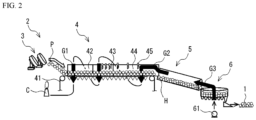
- the production apparatus 2 includes a pan pelletizer 3, a grate furnace 4, a kiln 5, and an annular cooler 6.
- an auxiliary material containing CaO and MgO is blended into an iron ore material such that a CaO/SiO 2 mass ratio is greater than or equal to 0.8 and a MgO/SiO 2 mass ratio is greater than or equal to 0.4.
- limestone serving as a CaO source and dolomite serving as a MgO source are blended as the auxiliary material in accordance with the iron grade of iron ore (pellet feed) which is the iron ore material.
- the iron ore material and the auxiliary material are preferably pulverized in a ball mill or the like in advance or after the blending to adjust the grain size of the raw material mixture in which the iron ore material and the auxiliary material are mixed.
- the present inventors have found that a porosity of green pellets P is proportional to a raw material grain size index. In other words, when the raw material grain size index is appropriately controlled, the porosity of the green pellets P is controlled, and the strength of the iron ore pellets 1 can be controlled by the porosity of the green pellets P.
- the "raw material grain size index" can be determined by the following method. First, a grain size distribution of the raw material mixture is measured. In the measurement, one of JIS-A-1204:2010, JIS-A-8815:1994, and JIS-Z-8825:2022 can be employed. Next, a sum ⁇ 3/Pi ⁇ mi in a range from 3 ⁇ m to 1,000 ⁇ m is calculated using a proportion mi by mass or volume in each grain size range Pi (representative value) and defined as the raw material grain size index.
- the relation between the raw material grain size index and the porosity of the green pellets P holds in the case of a raw material mixture in which iron ore and an auxiliary material under the same brand are blended in the same proportion; however, for example, if the iron ore is under a different brand, the coefficient of proportionality may change owing to influences of the surface shape, wettability, and the like.
- a suitable value of the raw material grain size index can be determined by the following method. First, as raw material mixtures having a specific mixing ratio, raw material mixtures having at least two types of raw material grain size indices are prepared, green pellets P are produced, and the porosities thereof are measured. From the results, the relation between the raw material grain size index and the porosity can be calculated.
- a proportional relation also holds between the porosity and the strength of the iron ore pellets 1, and thus, a necessary porosity can be calculated from the strength required for the iron ore pellets 1. Consequently, a raw material grain size index at which the necessary porosity is obtained can be determined; therefore, the grain size of the raw material is adjusted such that this raw material grain size index can be obtained. It is to be noted that the adjustment of the grain size also includes purchasing a raw material having such a grain size.
- a binder such as bentonite or the like may be appropriately blended into the raw material mixture to obtain the strength of the green pellets P required for transportation in the production process.
- the green pellets P having a porosity of greater than or equal to 15% and less than or equal to 22% are made from the raw material mixture obtained in the raw material blending step S1.
- the green pellets P can be made using a rotary pelletizer.
- the rotary pelletizer the pan pelletizer 3 illustrated in FIG. 2 , a drum pelletizer, or the like may be used.
- the pelletizing step S2 moisture (water) is added to the raw material mixture, and then this water-containing mixture (the raw material mixture containing the water) is charged into the pan pelletizer 3 and rolled to produce the green pellets P having a ball shape.
- the porosity of the green pellets P is controlled as described above.
- the lower limit of the porosity is 15% and more preferably 17%.
- the upper limit of the porosity is 22% and more preferably 20%.
- a phreatic explosion bursting phenomenon
- the porosity is less than the lower limit, a phreatic explosion (bursting phenomenon) may occur in the firing step S3.
- the porosity is greater than the upper limit, the crushing strength of the iron ore pellets 1 may decrease.
- the porosity is preferably controlled by the raw material grain size in the raw material blending step S1 and by the balling time in the pelletizing step S2.
- the porosity can be easily controlled to be a desired value, and thus, the crushing strength can be more surely improved.
- a grain size range of the green pellets P is preferably adjusted in the pelletizing step S2 such that a grain diameter after the firing step S3 is greater than or equal to 4 mm and less than or equal to 20 mm, more preferably greater than or equal to 6 mm and less than or equal to 15 mm.
- classification by a sieve group including an oversize screen (upper limit sieve) and a seed screen (lower limit sieve) which are each adjusted to have a predetermined sieve mesh size.
- the green pellets P are fired at a temperature of greater than or equal to 1,200 °C and less than or equal to 1,300 °C.
- the grate furnace 4 and the kiln 5 are used in the firing step S3.
- the grate furnace 4 includes a traveling grate 41, a drying chamber 42, a dehydrating chamber 43, and a preheating chamber 44.
- the traveling grate 41 is configured to be endless and can transfer the green pellets P placed on the traveling grate 41 to the drying chamber 42, the dehydrating chamber 43, and the preheating chamber 44 in this order.
- the green pellets P are subjected to drying, dehydrating, and preheating by a heating gas G1, whereby strength sufficient to resist the rotation in the kiln 5 is imparted to the green pellets P to obtain preheated pellets H.
- the green pellets P are dried at an ambient temperature of approximately 250 °C.
- the green pellets P after the drying are heated to approximately 450 °C to mainly decompose and remove water of crystallization in the iron ore.
- the preheating chamber 44 the green pellets P are heated to approximately 1,100 °C, whereby carbonate contained in limestone, dolomite, and/or the like is decomposed to remove carbon dioxide, and magnetite in the iron ore is oxidized. Accordingly, the preheated pellets H are obtained.
- the heating gas G1 used in the dehydrating chamber 43 is reused as the heating gas G1 in the drying chamber 42.
- the heating gas G1 in the preheating chamber 44 is reused as the heating gas G1 in the dehydrating chamber 43
- a combustion exhaust gas G2 used in the kiln 5 is reused as the heating gas G1 in the preheating chamber 44.
- a burner 45 may be provided in each chamber to control the temperature of the heating gas G1.
- the burners 45 are provided in the dehydrating chamber 43 and the preheating chamber 44.
- the heating gas G1 used in the drying chamber 42 is eventually discharged from a smokestack C.
- the kiln 5 is directly connected to the grate furnace 4 and is a rotary furnace having a sloped cylindrical shape.
- the kiln 5 fires the preheated pellets H discharged from the preheating chamber 44 of the grate furnace 4.
- the preheated pellets H are fired by combustion with a kiln burner (not illustrated) provided on the outlet side. Accordingly, the iron ore pellets 1 having a high temperature are obtained.
- the lower limit of a firing temperature at which the preheated pellets H are fired is 1,200 °C and more preferably 1,220 °C.
- the upper limit of the firing temperature is 1,300 °C and more preferably 1,280 °C.
- an atmosphere serving as a cooling gas G3 used in the annular cooler 6 is used. Furthermore, the high-temperature combustion exhaust gas G2 used for firing the preheated pellets H is sent to the preheating chamber 44 as the heating gas G1.
- the cooling step S4 the high-temperature iron ore pellets 1 obtained in the firing step S3 are cooled.
- the annular cooler 6 is used.
- the iron ore pellets 1 cooled in the cooling step S4 are accumulated and used in the blast furnace operation.
- the iron ore pellets 1 can be cooled by blowing the atmosphere serving as the cooling gas G3 by using a blowing apparatus 61, while transferring the high-temperature iron ore pellets 1 discharged from the kiln 5.
- cooling gas G3 used in the annular cooler 6 and having an increased temperature is sent to the kiln 5 and used as the air for combustion.
- the iron ore pellets 1 produced according to the method for producing iron ore pellets have high reducibility. Furthermore, since the green pellets P are fired at a temperature of greater than or equal to 1,200 °C and less than or equal to 1,300 °C in the firing step S3 after the porosity at the stage of the green pellets P is set to greater than or equal to 15% and less than or equal to 22%, the crushing strength of the iron ore pellets 1 produced can be sufficiently improved. Accordingly, by using the method for producing iron ore pellets, the iron ore pellets 1 which are superior in reducibility at high temperatures and enable a reduction in the upper gas permeability resistance in the blast furnace can be produced.
- the iron ore pellets 1 according to another aspect of the present invention are self-fluxing iron ore pellets used in the blast furnace operation.
- the iron ore pellets 1 are obtained by pelletizing and firing finely pulverized ore to form agglomerated ore having high strength, and can be produced, for example, by the above-described method for producing iron ore pellets.
- the CaO/SiO 2 mass ratio in the iron ore pellets 1 is set to greater than or equal to 0.8.
- the raw materials are iron ore (iron oxide) and limestone (CaO-containing compound)
- calcium ferrite compounds are generated in the firing step by a solid phase reaction between the iron oxide and CaO generated by thermal decomposition, and are simultaneously bound at the interfaces thereof through solid phase diffusion bonding. Since this bonding is local, fine pores which were present prior to the firing are retained even after the firing, whereby the iron ore pellets 1 are porous bodies in which fine pores are present relatively uniformly.
- a reducing gas diffusively enters the fine pores, whereby a reduction reaction proceeds from an outer surface to an inner portion of the iron ore pellets 1. Due to removal of oxygen from the iron oxide by the reduction reaction, the existing fine pores are enlarged and new fine pores are generated, while metallic iron is generated. In a process in which aggregation of the metallic iron causes shrinkage of an external shape of the iron ore pellets 1, the fine pores start to decrease. As a result, diffusion of the reducing gas into the iron ore pellets 1 is inhibited, whereby the reduction is likely to stagnate.
- the iron ore pellets 1 are self-fluxing. Due to the iron ore pellets 1 being self-fluxing, melting down of reduced iron is easily accelerated. It is to be noted that the self-fluxing property of the iron ore pellets 1 is determined by an auxiliary material and/or the like.
- the lower limit of an average crushing strength of the iron ore pellets 1 is 270 kg/p and more preferably 300 kg/p.
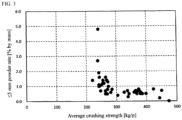
- FIG. 3 shows a relation between the average crushing strength and a mass fraction of powder having a grain diameter of less than or equal to 5 mm ( ⁇ 5 mm powder rate) generated owing to transportation of the iron ore pellets 1.
- the ⁇ 5 mm powder rate of the iron ore pellets 1 having an average crushing strength that is greater than or equal to the lower limit is stably low.
- the upper limit of the average crushing strength of the iron ore pellets 1 is not particularly limited and is realistically, for example, 500 kg/p.
- a proportion by mass of iron ore pellets having a crushing strength of less than or equal to 100 kg/p is preferably less than or equal to 10%, more preferably less than or equal to 5%, and still more preferably less than or equal to 1%. Even in a case in which the average crushing strength of the iron ore pellets 1 is high, it is considered that a large variation in strength between pellets leads to an increase in the absolute amount of the iron ore pellets 1 to be pulverized.
- the powder generated from the iron ore pellets 1 can be further decreased, and thus, the upper gas permeability resistance in the blast furnace can be further reduced.
- the iron ore pellets 1 Since being self-fluxing and having a CaO/SiO 2 mass ratio of greater than or equal to 0.8 and a MgO/SiO 2 mass ratio of greater than or equal to 0.4, the iron ore pellets 1 have high reducibility. Furthermore, since the iron ore pellets 1 have an average crushing strength of greater than or equal to 270 kg/p, powder generated from the iron ore pellets 1 owing to transportation and/or an impact in the blast furnace can be decreased, and thus, the upper gas permeability resistance in the blast furnace can be reduced.
- the method for producing iron ore pellets by using the production apparatus with the grate kiln system has been described; however, a production apparatus with a straight grate system may also be used in the production.
- the grate furnace includes a traveling grate, a drying chamber, a dehydrating chamber, a preheating chamber, and a firing chamber, and the firing step is completed only in the grate furnace.
- the green pellets are dried, dehydrated, and preheated by a heating gas in the drying chamber, the dehydrating chamber, and the preheating chamber, and finally fired in the firing chamber.
- Iron ore was prepared as an iron ore material, and limestone, dolomite, and bentonite were prepared as an auxiliary material.
- the auxiliary material was blended into the iron ore material such that the CaO/SiO 2 mass ratio was 1.2 and the MgO/SiO 2 mass ratio was 0.4 to obtain a raw material mixture.
- Green pellets were made from the raw material mixture by using a disc pelletizer and fired at 1,260 °C by using a firing apparatus constituted by a stationary grate furnace and a kiln furnace to obtain iron ore pellets No. 1.
- a firing apparatus constituted by a stationary grate furnace and a kiln furnace to obtain iron ore pellets No. 1.
- the raw material grain size index, the porosity of the green pellets, and the average crushing strength of the iron ore pellets are shown in Table 1.
- Iron ore pellets No. 2 were obtained in the same manner as No. 1, except that the raw material mixture was pulverized in a ball mill for 30 min. With regard to the iron ore pellets No. 2, the raw material grain size index, the porosity of the green pellets, and the average crushing strength of the iron ore pellets are shown in Table 1.
- Iron ore pellets No. 3 to No. 5 were obtained in the same manner as No. 1, except that their raw material grain size indices were set to 1.8 times, 2.0 times, and 2.2 times, respectively, of the raw material grain size index of No. 1 as a reference such that their average crushing strengths were greater than or equal to 270 kg/p relative to the raw material grain size indices of No. 1 and No. 2 and the iron ore pellets obtained.
- the raw material grain size index, the porosity of the green pellets, and the average crushing strength of the iron ore pellets are shown in Table 1.
- Table 1 Raw material grain size index (relative value) Porosity (%) Average crushing strength (kg/p) No. 1 1.0 27.5 210 No. 2 1.5 25.0 230 No. 3 1.8 24.0 270 No. 4 2.0 22.0 272 No. 5 2.2 21.0 272
- iron ore pellets which are superior in reducibility at high temperatures and enable a reduction in the upper gas permeability resistance in the blast furnace can be produced. Furthermore, the iron ore pellets of the present invention are superior in reducibility at high temperatures and enable a reduction in the upper gas permeability resistance in the blast furnace.
Landscapes
- Chemical & Material Sciences (AREA)
- Engineering & Computer Science (AREA)
- Manufacturing & Machinery (AREA)
- Organic Chemistry (AREA)
- Metallurgy (AREA)
- Materials Engineering (AREA)
- Geochemistry & Mineralogy (AREA)
- Geology (AREA)
- Life Sciences & Earth Sciences (AREA)
- Mechanical Engineering (AREA)
- General Life Sciences & Earth Sciences (AREA)
- Environmental & Geological Engineering (AREA)
- Inorganic Chemistry (AREA)
- Manufacture And Refinement Of Metals (AREA)
- Manufacture Of Iron (AREA)
Abstract
Description
- The present invention relates to a method for producing iron ore pellets and iron ore pellets.
- As blast furnace operation, a method is known in which iron ore and/or fired iron ore agglomerates containing iron oxide as well as coke as a carbon source are charged from an upper part of the blast furnace, the air and/or oxygen are blown from (a) tuyere(s) in the lower part to promote generation of carbon monoxide and a reduction reaction for removing oxygen from the iron oxide in the furnace, and then molten iron is tapped from the lower part of the furnace.
- To smoothly conduct the continuous operation, smooth blast is important. For this purpose, it is desired that the blast pressure is low and stable, i.e., that the gas permeability is favorable. The blast pressure depends on characteristics of burdens. Of the burdens, iron ore, sintered iron ore, and iron ore pellets are each turned to be a mixture of metallic iron and an oxide when exposed to high temperatures and a reducing atmosphere and subjected to a reduction reaction. At the same time, they are softened and transformed by a load in the blast furnace. The softening and transformation cause gaps between the burden particles to be filled, thereby impairing the gas permeability in the furnace. An event caused principally by this phenomenon is referred to as a furnace lower-part pressure loss, and a reduction thereof is intended.
- As iron ore pellets which enable a reduction in the furnace lower-part pressure loss, self-fluxing pellets having a CaO/SiO2 mass ratio of greater than or equal to 0.8, a MgO/SiO2 mass ratio of greater than or equal to 0.4, and a predetermined grain diameter distribution are known (see
Japanese Unexamined Patent Application, Publication No. 2008-280556 - With regard to the iron ore pellets, the reducibility at high temperatures is improved by setting the CaO/SiO2 mass ratio to greater than or equal to 0.8 and setting the MgO/SiO2 mass ratio to greater than or equal to 0.4, and the gas permeability is ensured by controlling the grain diameter distribution.
- Patent Document 1:
Japanese Unexamined Patent Application, Publication No. 2008-280556 - In the case of the conventional iron ore pellets, the gas permeability can be ensured, but this effect is relatively limited, and thus, the gas permeability resistance in a relatively low-temperature region in an upper part of a shaft furnace (upper pressure loss) is likely to degrade. Furthermore, in recent operation, it has become more popular to inject pulverized coal from a tuyere of a blast furnace to reduce the amount of expensive coke used. As a result, as the injection amount of the pulverized coal increases, the amount of the coke for supporting the gas permeability in the blast furnace decreases, leading to a tendency to entirely increase the gas permeability resistance. Therefore, it is required to particularly reduce an upper gas permeability resistance in the blast furnace.
- The present invention has been made in view of the foregoing circumstances, and an object of the present invention is to provide: a method for producing iron ore pellets which are superior in reducibility at high temperatures and enable a reduction in the upper gas permeability resistance in the blast furnace; and the iron ore pellets.
- An aspect of the present invention is a method for producing iron ore pellets for use in blast furnace operation, wherein the iron ore pellets are self-fluxing, the method including: raw material blending, wherein an auxiliary material containing CaO and MgO is blended into an iron ore material such that a CaO/SiO2 mass ratio is greater than or equal to 0.8 and a MgO/SiO2 mass ratio is greater than or equal to 0.4; pelletizing, wherein green pellets having a porosity of greater than or equal to 15% and less than or equal to 22% are made from a raw material mixture obtained in the raw material blending; and firing the green pellets at a temperature of greater than or equal to 1,200 °C and less than or equal to 1,300 °C.
- Another aspect of the present invention is iron ore pellets for use in blast furnace operation, the iron ore pellets being self-fluxing, wherein: a CaO/SiO2 mass ratio is greater than or equal to 0.8, and a MgO/SiO2 mass ratio is greater than or equal to 0.4; and an average crushing strength is greater than or equal to 270 kg/p.
- According to the method for producing iron ore pellets of the present invention, iron ore pellets which are superior in reducibility at high temperatures and enable a reduction in the upper gas permeability resistance in the blast furnace can be produced. Furthermore, the iron ore pellets of the present invention are superior in reducibility at high temperatures and enable a reduction in the upper gas permeability resistance in the blast furnace.
-
-
FIG. 1 is a flowchart illustrating a method for producing iron ore pellets according to one embodiment of the present invention. -
FIG. 2 is a schematic view illustrating a configuration of a production apparatus used in the method for producing iron ore pellets inFIG. 1 . -
FIG. 3 is a graph showing a relation between an average crushing strength and a ≤5 mm powder rate due to transportation of the iron ore pellets. - As a result of intensive studies on the upper gas permeability resistance in the blast furnace, the present inventors have found that even when the proportion of iron ore pellets having small grain diameters, which leads to degradation of the pressure loss during the production of the pellets, is reduced, such pellets are broken during subsequent transportation and/or in a step of charging into the blast furnace to inevitably generate powder. Furthermore, they have found that a decrease in the powder generated from the iron ore pellets owing to transportation and/or an impact in the blast furnace leads to a reduction in the upper gas permeability resistance in the blast furnace. Moreover, the present inventors have found out that to decrease the powder, it is preferred to increase the average crushing strength to 270 kg/p.
- However, with regard to iron ore pellets having a CaO/SiO2 mass ratio of greater than or equal to 0.8 and a MgO/SiO2 mass ratio of greater than or equal to 0.4 to have an increased reducibility required for iron ore pellets in the blast furnace operation, iron ore pellets having an average crushing strength of greater than or equal to 270 kg/p have not yet been obtained. It is considered that this is because coarse crystal grains of CaO, MgO, SiO2, and Fe2O3 compounds are generated during firing and cause a decrease in strength. In other words, when the crystal grains are large, it is likely that the orientations of sliding planes on which dislocations are likely to occur are aligned, and thus, dislocations are likely to occur with a low stress to cause breakage.
- The present inventors have further studied and found that the firing temperature is high when the coarse crystal grains are generated. Crystals of a mineral texture are generated and expanded by diffusion. The diffusion coefficients of Fe, Ca, Si, Mg, Al, and the like in a solid phase and a liquid phase become larger as the temperature increases. That is to say, as the firing temperature increases, the crystal grains diffuse more and become larger, whereby coarse crystal grains are generated. Therefore, the present inventors have considered that a reduction in the firing temperature can inhibit the generation of the coarse crystal grains.
- Meanwhile, when the firing temperature is low, there arises a problem in that the pellets fail to be sintered. That is to say, wider distances between ore particles, a decrease in the number of contacts between the particles, etc. weaken a force constituting the pellet strength; accordingly, the crushing strength tends to decrease. Therefore, even when the firing temperature is lowered to inhibit the generation of the coarse crystal grains, the crushing strength is not sufficiently improved.
- At this point, the present inventors have focused on the fact that the porosity does not decrease when the pellets fail to be sintered owing to a low firing temperature. The decrease in porosity occurs when the ore particles come close to and are integrated with each other owing to a diffusion phenomenon such that the surface area of the iron ore particles is decreased to lower the surface energy thereof. Therefore, it is considered that in pellets having high porosity, the force constituting the pellet strength is weakened because, for example, the distance between the ore particles is still large and the number of contacts between the particles decreases. Thus, the present inventors have considered that if the porosity can be controlled independently from the firing temperature, the crushing strength can be sufficiently improved. Furthermore, they have found out that the crushing strength can be sufficiently improved by controlling the porosity at a stage of green pellets, which has not been conventionally performed, and completed the present invention.
- That is to say, an aspect of the present invention is a method for producing iron ore pellets for use in blast furnace operation, wherein the iron ore pellets are self-fluxing, the method including: raw material blending, wherein an auxiliary material containing CaO and MgO is blended into an iron ore material such that a CaO/SiO2 mass ratio is greater than or equal to 0.8 and a MgO/SiO2 mass ratio is greater than or equal to 0.4; pelletizing, wherein green pellets having a porosity of greater than or equal to 15% and less than or equal to 22% are made from a raw material mixture obtained in the raw material blending; and firing the green pellets at a temperature of greater than or equal to 1,200 °C and less than or equal to 1,300 °C.
- Since being self-fluxing and having a CaO/SiO2 mass ratio that is greater than or equal to the lower limit and a MgO/SiO2 mass ratio that is greater than or equal to the lower limit, the iron ore pellets produced according to the method for producing iron ore pellets have high reducibility. Furthermore, since the green pellets are fired at a temperature within the above range in the firing after the porosity is set within the above range at the stage of green pellets, the crushing strength of the iron ore pellets produced can be sufficiently improved. Accordingly, by using the method for producing iron ore pellets, iron ore pellets which are superior in reducibility at high temperatures and enable a reduction in the upper gas permeability resistance in the blast furnace can be produced.
- It is preferred that a rotary pelletizer is used in the pelletizing, and that the porosity is controlled by a raw material grain size in the raw material blending and balling time in the pelletizing. By thus controlling the porosity, the porosity can be easily controlled to be a desired value, and the crushing strength can be more surely improved.
- A grain size range of the green pellets is preferably adjusted in the pelletizing such that a grain diameter after the firing is greater than or equal to 4 mm and less than or equal to 20 mm. By thus setting the grain diameter after the firing within the above range, a decrease in the upper gas permeability resistance in the blast furnace can be inhibited while maintaining the reducibility at high temperatures.
- For the adjustment of the grain size range of the green pellets, classification by a sieve group including an oversize screen and a seed screen which are each adjusted to have a predetermined sieve mesh size is preferably used. By thus adjusting the grain size range of the green pellets by classification, the grain diameter after the firing can be easily and surely adjusted.
- Another aspect of the present invention is iron ore pellets for use in blast furnace operation, the iron ore pellets being self-fluxing, wherein: a CaO/SiO2 mass ratio is greater than or equal to 0.8, and a MgO/SiO2 mass ratio is greater than or equal to 0.4; and an average crushing strength is greater than or equal to 270 kg/p.
- Since being self-fluxing and having a CaO/SiO2 mass ratio that is greater than or equal to the lower limit and a MgO/SiO2 mass ratio that is greater than or equal to the lower limit, the iron ore pellets have high reducibility. Furthermore, since the iron ore pellets have an average crushing strength that is greater than or equal to the lower limit, powder generated from the iron ore pellets owing to transportation and/or an impact in the blast furnace can be decreased, and thus, the upper gas permeability resistance in the blast furnace can be reduced.
- A proportion by mass of iron ore pellets having a crushing strength of less than or equal to 100 kg/p is preferably less than or equal to 10%. By thus setting the proportion by mass of the iron ore pellets having a crushing strength of less than or equal to 100 kg/p to be less than or equal to the upper limit, the powder generated from the iron ore pellets can be further decreased, and thus, the upper gas permeability resistance in the blast furnace can be further reduced.
- As referred to herein, the "crushing strength" means a strength specified by JIS-M8718:2017, and the "average crushing strength" refers to an average value of crushing strengths of at least ten arbitrary iron ore pellets.
- Hereinafter, the method for producing iron ore pellets and the iron ore pellets according to the embodiments of the present invention will be described with reference to the drawings as appropriate.
- The method for producing iron ore pellets illustrated in
FIG. 1 includes a raw material blending step S1, a pelletizing step S2, a firing step S3, and a cooling step S4. In the method for producing iron ore pellets, as illustrated inFIG. 2 , self-fluxingiron ore pellets 1 for use in blast furnace operation can be produced using a production apparatus with a grate kiln system (hereinafter, may be simply referred to as "production apparatus 2"). Theproduction apparatus 2 includes apan pelletizer 3, agrate furnace 4, akiln 5, and an annular cooler 6. - In the raw material blending step S1, an auxiliary material containing CaO and MgO is blended into an iron ore material such that a CaO/SiO2 mass ratio is greater than or equal to 0.8 and a MgO/SiO2 mass ratio is greater than or equal to 0.4.
- Specifically, in the raw material blending step S1, limestone serving as a CaO source and dolomite serving as a MgO source are blended as the auxiliary material in accordance with the iron grade of iron ore (pellet feed) which is the iron ore material.
- As needed, the iron ore material and the auxiliary material are preferably pulverized in a ball mill or the like in advance or after the blending to adjust the grain size of the raw material mixture in which the iron ore material and the auxiliary material are mixed. The present inventors have found that a porosity of green pellets P is proportional to a raw material grain size index. In other words, when the raw material grain size index is appropriately controlled, the porosity of the green pellets P is controlled, and the strength of the
iron ore pellets 1 can be controlled by the porosity of the green pellets P. - As referred to herein, the "raw material grain size index" can be determined by the following method. First, a grain size distribution of the raw material mixture is measured. In the measurement, one of JIS-A-1204:2010, JIS-A-8815:1994, and JIS-Z-8825:2022 can be employed. Next, a sum Σ3/Pi·mi in a range from 3 µm to 1,000 µm is calculated using a proportion mi by mass or volume in each grain size range Pi (representative value) and defined as the raw material grain size index.
- The relation between the raw material grain size index and the porosity of the green pellets P holds in the case of a raw material mixture in which iron ore and an auxiliary material under the same brand are blended in the same proportion; however, for example, if the iron ore is under a different brand, the coefficient of proportionality may change owing to influences of the surface shape, wettability, and the like. Hence, a suitable value of the raw material grain size index can be determined by the following method. First, as raw material mixtures having a specific mixing ratio, raw material mixtures having at least two types of raw material grain size indices are prepared, green pellets P are produced, and the porosities thereof are measured. From the results, the relation between the raw material grain size index and the porosity can be calculated. As described later, a proportional relation also holds between the porosity and the strength of the
iron ore pellets 1, and thus, a necessary porosity can be calculated from the strength required for theiron ore pellets 1. Consequently, a raw material grain size index at which the necessary porosity is obtained can be determined; therefore, the grain size of the raw material is adjusted such that this raw material grain size index can be obtained. It is to be noted that the adjustment of the grain size also includes purchasing a raw material having such a grain size. - Furthermore, a binder such as bentonite or the like may be appropriately blended into the raw material mixture to obtain the strength of the green pellets P required for transportation in the production process.
- In the pelletizing step S2, the green pellets P having a porosity of greater than or equal to 15% and less than or equal to 22% are made from the raw material mixture obtained in the raw material blending step S1. The green pellets P can be made using a rotary pelletizer. As the rotary pelletizer, the
pan pelletizer 3 illustrated inFIG. 2 , a drum pelletizer, or the like may be used. - Specifically, in the pelletizing step S2, moisture (water) is added to the raw material mixture, and then this water-containing mixture (the raw material mixture containing the water) is charged into the
pan pelletizer 3 and rolled to produce the green pellets P having a ball shape. - In the method for producing iron ore pellets, the porosity of the green pellets P is controlled as described above. The lower limit of the porosity is 15% and more preferably 17%. On the other hand, the upper limit of the porosity is 22% and more preferably 20%. When the porosity is less than the lower limit, a phreatic explosion (bursting phenomenon) may occur in the firing step S3. Conversely, when the porosity is greater than the upper limit, the crushing strength of the
iron ore pellets 1 may decrease. - The porosity is preferably controlled by the raw material grain size in the raw material blending step S1 and by the balling time in the pelletizing step S2. By thus controlling the porosity, the porosity can be easily controlled to be a desired value, and thus, the crushing strength can be more surely improved.
- Furthermore, a grain size range of the green pellets P is preferably adjusted in the pelletizing step S2 such that a grain diameter after the firing step S3 is greater than or equal to 4 mm and less than or equal to 20 mm, more preferably greater than or equal to 6 mm and less than or equal to 15 mm. By thus setting the grain diameter after the firing step S3 within the above range, a decrease in the upper gas permeability resistance in the blast furnace can be inhibited while maintaining the reducibility at high temperatures.
- For the adjustment of the grain size range of the green pellets P, classification by a sieve group including an oversize screen (upper limit sieve) and a seed screen (lower limit sieve) which are each adjusted to have a predetermined sieve mesh size. By thus adjusting the grain size range of the green pellets P by classification, the grain diameter after the firing step S3 can be easily and surely adjusted. It is to be noted that non-standard products removed by the classification are preferably disintegrated and reused as the raw material mixture.
- In the firing step S3, the green pellets P are fired at a temperature of greater than or equal to 1,200 °C and less than or equal to 1,300 °C. In the
production apparatus 2 illustrated inFIG. 2 , thegrate furnace 4 and thekiln 5 are used in the firing step S3. - As illustrated in
FIG. 2 , thegrate furnace 4 includes a travelinggrate 41, a dryingchamber 42, a dehydratingchamber 43, and a preheatingchamber 44. - The traveling
grate 41 is configured to be endless and can transfer the green pellets P placed on the travelinggrate 41 to the dryingchamber 42, the dehydratingchamber 43, and the preheatingchamber 44 in this order. - In the drying
chamber 42, the dehydratingchamber 43, and the preheatingchamber 44, the green pellets P are subjected to drying, dehydrating, and preheating by a heating gas G1, whereby strength sufficient to resist the rotation in thekiln 5 is imparted to the green pellets P to obtain preheated pellets H. - Specifically, the following procedure is followed. First, in the drying
chamber 42, the green pellets P are dried at an ambient temperature of approximately 250 °C. Next, in the dehydratingchamber 43, the green pellets P after the drying are heated to approximately 450 °C to mainly decompose and remove water of crystallization in the iron ore. Furthermore, in the preheatingchamber 44, the green pellets P are heated to approximately 1,100 °C, whereby carbonate contained in limestone, dolomite, and/or the like is decomposed to remove carbon dioxide, and magnetite in the iron ore is oxidized. Accordingly, the preheated pellets H are obtained. - As illustrated in
FIG. 2 , the heating gas G1 used in the dehydratingchamber 43 is reused as the heating gas G1 in the dryingchamber 42. Similarly, the heating gas G1 in the preheatingchamber 44 is reused as the heating gas G1 in the dehydratingchamber 43, and a combustion exhaust gas G2 used in thekiln 5 is reused as the heating gas G1 in the preheatingchamber 44. By thus reusing the downstream heating gas G1 or combustion exhaust gas G2 which has a high temperature, heating cost of the heating gas G1 can be reduced. It is to be noted that aburner 45 may be provided in each chamber to control the temperature of the heating gas G1. InFIG. 2 , theburners 45 are provided in the dehydratingchamber 43 and the preheatingchamber 44. Furthermore, the heating gas G1 used in the dryingchamber 42 is eventually discharged from a smokestack C. - The
kiln 5 is directly connected to thegrate furnace 4 and is a rotary furnace having a sloped cylindrical shape. Thekiln 5 fires the preheated pellets H discharged from the preheatingchamber 44 of thegrate furnace 4. Specifically, the preheated pellets H are fired by combustion with a kiln burner (not illustrated) provided on the outlet side. Accordingly, theiron ore pellets 1 having a high temperature are obtained. - The lower limit of a firing temperature at which the preheated pellets H are fired is 1,200 °C and more preferably 1,220 °C. On the other hand, the upper limit of the firing temperature is 1,300 °C and more preferably 1,280 °C. The present inventors have found that in the case in which the firing temperature falls within the above range, a proportional relation holds between the porosity of the green pellets P and the strength of the
iron ore pellets 1. In other words, when the firing temperature is less than the lower limit, the pellets fail to be sintered, and furthermore, when the firing temperature is greater than the upper limit, coarse crystal grains are likely to be generated, resulting in a possibility that the crushing strength of theiron ore pellets 1 may decrease. Conversely, when a desired strength is determined, the porosity of the green pellets P can be determined from the proportional relation. - In the
kiln 5, as air for combustion, an atmosphere serving as a cooling gas G3 used in the annular cooler 6 is used. Furthermore, the high-temperature combustion exhaust gas G2 used for firing the preheated pellets H is sent to the preheatingchamber 44 as the heating gas G1. - In the cooling step S4, the high-temperature
iron ore pellets 1 obtained in the firing step S3 are cooled. In the cooling step S4, the annular cooler 6 is used. Theiron ore pellets 1 cooled in the cooling step S4 are accumulated and used in the blast furnace operation. - In the annular cooler 6, the
iron ore pellets 1 can be cooled by blowing the atmosphere serving as the cooling gas G3 by using ablowing apparatus 61, while transferring the high-temperatureiron ore pellets 1 discharged from thekiln 5. - It is to be noted that the cooling gas G3 used in the annular cooler 6 and having an increased temperature is sent to the
kiln 5 and used as the air for combustion. - Since being self-fluxing and having a CaO/SiO2 mass ratio of greater than or equal to 0.8 and a MgO/SiO2 mass ratio of greater than or equal to 0.4, the
iron ore pellets 1 produced according to the method for producing iron ore pellets have high reducibility. Furthermore, since the green pellets P are fired at a temperature of greater than or equal to 1,200 °C and less than or equal to 1,300 °C in the firing step S3 after the porosity at the stage of the green pellets P is set to greater than or equal to 15% and less than or equal to 22%, the crushing strength of theiron ore pellets 1 produced can be sufficiently improved. Accordingly, by using the method for producing iron ore pellets, theiron ore pellets 1 which are superior in reducibility at high temperatures and enable a reduction in the upper gas permeability resistance in the blast furnace can be produced. - The
iron ore pellets 1 according to another aspect of the present invention are self-fluxing iron ore pellets used in the blast furnace operation. Theiron ore pellets 1 are obtained by pelletizing and firing finely pulverized ore to form agglomerated ore having high strength, and can be produced, for example, by the above-described method for producing iron ore pellets. - Regarding the production of the
iron ore pellets 1, it is known that adding a CaO-containing compound such as limestone or the like to an iron ore material to increase the CaO/SiO2 mass ratio in theiron ore pellets 1 improves the reducibility of theiron ore pellets 1. On the basis of this finding, the CaO/SiO2 mass ratio in theiron ore pellets 1 is set to greater than or equal to 0.8. - In a case in which the raw materials are iron ore (iron oxide) and limestone (CaO-containing compound), calcium ferrite compounds are generated in the firing step by a solid phase reaction between the iron oxide and CaO generated by thermal decomposition, and are simultaneously bound at the interfaces thereof through solid phase diffusion bonding. Since this bonding is local, fine pores which were present prior to the firing are retained even after the firing, whereby the
iron ore pellets 1 are porous bodies in which fine pores are present relatively uniformly. - During the blast furnace operation, a reducing gas diffusively enters the fine pores, whereby a reduction reaction proceeds from an outer surface to an inner portion of the
iron ore pellets 1. Due to removal of oxygen from the iron oxide by the reduction reaction, the existing fine pores are enlarged and new fine pores are generated, while metallic iron is generated. In a process in which aggregation of the metallic iron causes shrinkage of an external shape of theiron ore pellets 1, the fine pores start to decrease. As a result, diffusion of the reducing gas into theiron ore pellets 1 is inhibited, whereby the reduction is likely to stagnate. - To inhibit this stagnation of the reduction, addition of a high-melting point component which inhibits a loss of the fine pores during the aggregation process of the metallic iron is effective. Particularly, it is known that adding dolomite as a source of MgO, which is a high-melting point component, to increase the MgO/SiO2 mass ratio in the
iron ore pellets 1 enables obtaining a powerful effect of inhibiting the stagnation of the reduction. On the basis of this finding, the MgO/SiO2 mass ratio in theiron ore pellets 1 is set to greater than or equal to 0.4. - The
iron ore pellets 1 are self-fluxing. Due to theiron ore pellets 1 being self-fluxing, melting down of reduced iron is easily accelerated. It is to be noted that the self-fluxing property of theiron ore pellets 1 is determined by an auxiliary material and/or the like. - The lower limit of an average crushing strength of the
iron ore pellets 1 is 270 kg/p and more preferably 300 kg/p. As described above, as a result of intensive studies of the present inventors based on the finding that a decrease in the powder generated from theiron ore pellets 1 owing to transportation and/or an impact in the blast furnace leads to a reduction in the upper gas permeability resistance in the blast furnace, it has been concluded that the amount of the powder can be controlled by the average crushing strength.FIG. 3 shows a relation between the average crushing strength and a mass fraction of powder having a grain diameter of less than or equal to 5 mm (≤5 mm powder rate) generated owing to transportation of theiron ore pellets 1. These results are based on the results of an experiment conducted along a transportation path.FIG. 3 also includes a sample having a CaO/SiO2 mass ratio of less than 0.8 and a sample having a MgO/SiO2 mass ratio of less than 0.4; however, it can be seen that regardless of these characteristics, the ≤5 mm powder rate of theiron ore pellets 1 having an average crushing strength that is greater than or equal to the lower limit is stably low. It is to be noted that in the present invention, the upper limit of the average crushing strength of theiron ore pellets 1 is not particularly limited and is realistically, for example, 500 kg/p. - In the
iron ore pellets 1, a proportion by mass of iron ore pellets having a crushing strength of less than or equal to 100 kg/p is preferably less than or equal to 10%, more preferably less than or equal to 5%, and still more preferably less than or equal to 1%. Even in a case in which the average crushing strength of theiron ore pellets 1 is high, it is considered that a large variation in strength between pellets leads to an increase in the absolute amount of theiron ore pellets 1 to be pulverized. In this regard, by setting the proportion by mass of the iron ore pellets having a crushing strength of less than or equal to 100 kg/p to be less than or equal to the upper limit, the powder generated from theiron ore pellets 1 can be further decreased, and thus, the upper gas permeability resistance in the blast furnace can be further reduced. - Since being self-fluxing and having a CaO/SiO2 mass ratio of greater than or equal to 0.8 and a MgO/SiO2 mass ratio of greater than or equal to 0.4, the
iron ore pellets 1 have high reducibility. Furthermore, since theiron ore pellets 1 have an average crushing strength of greater than or equal to 270 kg/p, powder generated from theiron ore pellets 1 owing to transportation and/or an impact in the blast furnace can be decreased, and thus, the upper gas permeability resistance in the blast furnace can be reduced. - It is to be noted that the present invention is not limited to the above embodiments.
- In the above embodiments, the method for producing iron ore pellets by using the production apparatus with the grate kiln system has been described; however, a production apparatus with a straight grate system may also be used in the production. In the production apparatus with the straight grate system, the grate furnace includes a traveling grate, a drying chamber, a dehydrating chamber, a preheating chamber, and a firing chamber, and the firing step is completed only in the grate furnace. Specifically, the green pellets are dried, dehydrated, and preheated by a heating gas in the drying chamber, the dehydrating chamber, and the preheating chamber, and finally fired in the firing chamber.
- Hereinafter, the present invention will be described more in detail by way of Examples; however, the present invention is not limited to these Examples.
- Iron ore was prepared as an iron ore material, and limestone, dolomite, and bentonite were prepared as an auxiliary material. The auxiliary material was blended into the iron ore material such that the CaO/SiO2 mass ratio was 1.2 and the MgO/SiO2 mass ratio was 0.4 to obtain a raw material mixture.
- Green pellets were made from the raw material mixture by using a disc pelletizer and fired at 1,260 °C by using a firing apparatus constituted by a stationary grate furnace and a kiln furnace to obtain iron ore pellets No. 1. With regard to the iron ore pellets No. 1, the raw material grain size index, the porosity of the green pellets, and the average crushing strength of the iron ore pellets are shown in Table 1.
- Iron ore pellets No. 2 were obtained in the same manner as No. 1, except that the raw material mixture was pulverized in a ball mill for 30 min. With regard to the iron ore pellets No. 2, the raw material grain size index, the porosity of the green pellets, and the average crushing strength of the iron ore pellets are shown in Table 1.
- Iron ore pellets No. 3 to No. 5 were obtained in the same manner as No. 1, except that their raw material grain size indices were set to 1.8 times, 2.0 times, and 2.2 times, respectively, of the raw material grain size index of No. 1 as a reference such that their average crushing strengths were greater than or equal to 270 kg/p relative to the raw material grain size indices of No. 1 and No. 2 and the iron ore pellets obtained. With regard to the iron ore pellets No. 3 to No. 5, the raw material grain size index, the porosity of the green pellets, and the average crushing strength of the iron ore pellets are shown in Table 1.
Table 1 Raw material grain size index (relative value) Porosity (%) Average crushing strength (kg/p) No. 1 1.0 27.5 210 No. 2 1.5 25.0 230 No. 3 1.8 24.0 270 No. 4 2.0 22.0 272 No. 5 2.2 21.0 272 - The results in Table 1 indicate that even in the case of the iron ore pellets having a CaO/SiO2 mass ratio of greater than or equal to 0.8 and a MgO/SiO2 mass ratio of greater than or equal to 0.4, by setting the porosity of the green pellets to greater than or equal to 15% and less than or equal to 22% and firing them at a temperature of greater than or equal to 1,200 °C and less than or equal to 1,300 °C, iron ore pellets having an average crushing strength of greater than or equal to 270 kg/p can be obtained.
- According to the method for producing iron ore pellets of the present invention, iron ore pellets which are superior in reducibility at high temperatures and enable a reduction in the upper gas permeability resistance in the blast furnace can be produced. Furthermore, the iron ore pellets of the present invention are superior in reducibility at high temperatures and enable a reduction in the upper gas permeability resistance in the blast furnace.
-
- 1
- Iron ore pellets
- 2
- Production apparatus
- 3
- Pan pelletizer
- 4
- Grate furnace
- 41
- Traveling grate
- 42
- Drying chamber
- 43
- Dehydrating chamber
- 44
- Preheating chamber
- 45
- Burner
- 5
- Kiln
- 6
- Annular cooler
- 61
- Blowing apparatus
- P
- Green pellets
- H
- Preheated pellets
- G1
- Heating gas
- G2
- Combustion exhaust gas
- G3
- Cooling gas
- C
- Smokestack
Claims (6)
- A method for producing iron ore pellets for use in blast furnace operation, wherein the iron ore pellets are self-fluxing, the method comprising:raw material blending, wherein an auxiliary material comprising CaO and MgO is blended into an iron ore material such that a CaO/SiO2 mass ratio is greater than or equal to 0.8 and a MgO/SiO2 mass ratio is greater than or equal to 0.4;pelletizing, wherein green pellets having a porosity of greater than or equal to 15% and less than or equal to 22% are made from a raw material mixture obtained in the raw material blending; andfiring the green pellets at a temperature of greater than or equal to 1,200 °C and less than or equal to 1,300 °C.
- The method for producing iron ore pellets according to claim 1,
wherein:a rotary pelletizer is used in the pelletizing, andthe porosity is controlled by a raw material grain size in the raw material blending and by balling time in the pelletizing. - The method for producing iron ore pellets according to claim 1 or 2, wherein a grain size range of the green pellets is adjusted in the pelletizing such that a grain diameter after the firing is greater than or equal to 4 mm and less than or equal to 20 mm.
- The method for producing iron ore pellets according to claim 3, wherein for the adjustment of the grain size range of the green pellets, classification by a sieve group comprising an oversize screen and a seed screen which are each adjusted to have a predetermined sieve mesh size is used.
- Iron ore pellets for use in blast furnace operation, the iron ore pellets being self-fluxing,
wherein:a CaO/SiO2 mass ratio is greater than or equal to 0.8, and a MgO/SiO2 mass ratio is greater than or equal to 0.4; andan average crushing strength is greater than or equal to 270 kg/p. - The iron ore pellets according to claim 5, wherein a proportion by mass of iron ore pellets having a crushing strength of less than or equal to 100 kg/p is less than or equal to 10%.
Applications Claiming Priority (2)
| Application Number | Priority Date | Filing Date | Title |
|---|---|---|---|
| JP2022152829A JP7836742B2 (en) | 2022-09-26 | 2022-09-26 | Method for manufacturing iron ore pellets |
| PCT/JP2022/038913 WO2024069991A1 (en) | 2022-09-26 | 2022-10-19 | Method for producing iron ore pellets, and iron ore pellets |
Publications (2)
| Publication Number | Publication Date |
|---|---|
| EP4570930A1 true EP4570930A1 (en) | 2025-06-18 |
| EP4570930A4 EP4570930A4 (en) | 2025-08-13 |
Family
ID=90476693
Family Applications (1)
| Application Number | Title | Priority Date | Filing Date |
|---|---|---|---|
| EP22961050.6A Pending EP4570930A4 (en) | 2022-09-26 | 2022-10-19 | Method for producing iron ore pellets, and iron ore pellets |
Country Status (6)
| Country | Link |
|---|---|
| EP (1) | EP4570930A4 (en) |
| JP (1) | JP7836742B2 (en) |
| CN (1) | CN119744310A (en) |
| AU (1) | AU2022480928A1 (en) |
| CL (1) | CL2025000883A1 (en) |
| WO (1) | WO2024069991A1 (en) |
Family Cites Families (5)
| Publication number | Priority date | Publication date | Assignee | Title |
|---|---|---|---|---|
| JPS63219534A (en) * | 1987-03-09 | 1988-09-13 | Kobe Steel Ltd | Manufacture of self-fluxing pellet |
| JP4630304B2 (en) | 2007-05-08 | 2011-02-09 | 株式会社神戸製鋼所 | Self-fluxing pellets for blast furnace and manufacturing method thereof |
| JP5578057B2 (en) | 2010-12-14 | 2014-08-27 | 新日鐵住金株式会社 | Porous unevenly-distributed fired pellet and method for producing the same |
| CN107254585B (en) * | 2017-05-22 | 2018-08-21 | 中南大学 | A method of recycling zinc, indium, iron, gallium from iron vitriol slag |
| JP7339222B2 (en) * | 2020-09-03 | 2023-09-05 | 株式会社神戸製鋼所 | Pig iron manufacturing method |
-
2022
- 2022-09-26 JP JP2022152829A patent/JP7836742B2/en active Active
- 2022-10-19 WO PCT/JP2022/038913 patent/WO2024069991A1/en not_active Ceased
- 2022-10-19 CN CN202280099834.5A patent/CN119744310A/en active Pending
- 2022-10-19 EP EP22961050.6A patent/EP4570930A4/en active Pending
- 2022-10-19 AU AU2022480928A patent/AU2022480928A1/en active Pending
-
2025
- 2025-03-25 CL CL2025000883A patent/CL2025000883A1/en unknown
Also Published As
| Publication number | Publication date |
|---|---|
| AU2022480928A1 (en) | 2025-03-27 |
| JP2024047288A (en) | 2024-04-05 |
| CL2025000883A1 (en) | 2025-08-01 |
| EP4570930A4 (en) | 2025-08-13 |
| WO2024069991A1 (en) | 2024-04-04 |
| JP7836742B2 (en) | 2026-03-27 |
| CN119744310A (en) | 2025-04-01 |
Similar Documents
| Publication | Publication Date | Title |
|---|---|---|
| EP2239344B1 (en) | Self-fluxing pellets for use in a blast furnace and process for the production of the same | |
| EP3892744B1 (en) | Sintered ore manufacturing method | |
| JPS6223944A (en) | Refining method for nickel oxide or the like | |
| CA1246343A (en) | Agglomerated ores and a producing method therefor | |
| JP2023033734A (en) | Method for manufacturing fired iron ore pellet | |
| US3495971A (en) | Smelting furnace charge composition and method of making same | |
| CN103917669B (en) | Process for the manufacture of ferrochrome | |
| JP2001348623A (en) | Method for producing high quality low SiO2 sintered ore for blast furnace | |
| CA3191576A1 (en) | Iron ore pellets and method for producing iron ore pellets | |
| EP1749894A1 (en) | Semi-reduced sintered ore and method for production thereof | |
| JPS63219534A (en) | Manufacture of self-fluxing pellet | |
| AU2022480928A1 (en) | Method for producing iron ore pellets, and iron ore pellets | |
| JP7424339B2 (en) | Raw material particles for producing agglomerates, method for producing raw material particles for producing agglomerates, agglomerates, method for producing agglomerates, and method for producing reduced iron | |
| EP4600388A1 (en) | Method for determining high temperature properties of iron ore pellets, method for producing iron ore pellets, and iron ore pellets | |
| JP2003129141A (en) | Sinter for blast furnace and method for producing the same | |
| JP3395554B2 (en) | Sinter production method | |
| JP2002129247A (en) | High-grade calcined agglomerate for iron making and method for producing the same | |
| RU2859510C2 (en) | Method for producing iron ore pellets and iron ore pellets | |
| JP2001348622A (en) | Method for producing high quality low SiO2 sintered ore for blast furnace | |
| JP5206030B2 (en) | Method for producing sintered ore | |
| JP2003306723A (en) | Method for producing sintered ore for blast furnace | |
| EP4575020A1 (en) | Iron ore pellet production method | |
| JPH05339653A (en) | Pretreatment of sintered ore raw material and sintered ore raw material for iron making | |
| JP6004191B2 (en) | Sintering raw material manufacturing method | |
| JP5801752B2 (en) | Sintered ore |
Legal Events
| Date | Code | Title | Description |
|---|---|---|---|
| STAA | Information on the status of an ep patent application or granted ep patent |
Free format text: STATUS: THE INTERNATIONAL PUBLICATION HAS BEEN MADE |
|
| PUAI | Public reference made under article 153(3) epc to a published international application that has entered the european phase |
Free format text: ORIGINAL CODE: 0009012 |
|
| STAA | Information on the status of an ep patent application or granted ep patent |
Free format text: STATUS: REQUEST FOR EXAMINATION WAS MADE |
|
| 17P | Request for examination filed |
Effective date: 20250310 |
|
| AK | Designated contracting states |
Kind code of ref document: A1 Designated state(s): AL AT BE BG CH CY CZ DE DK EE ES FI FR GB GR HR HU IE IS IT LI LT LU LV MC ME MK MT NL NO PL PT RO RS SE SI SK SM TR |
|
| A4 | Supplementary search report drawn up and despatched |
Effective date: 20250715 |
|
| RIC1 | Information provided on ipc code assigned before grant |
Ipc: C22B 1/16 20060101AFI20250709BHEP Ipc: C21B 5/00 20060101ALI20250709BHEP Ipc: C22B 1/14 20060101ALI20250709BHEP Ipc: C22B 1/24 20060101ALI20250709BHEP Ipc: C22B 1/243 20060101ALI20250709BHEP |
|
| DAV | Request for validation of the european patent (deleted) | ||
| DAX | Request for extension of the european patent (deleted) |