EP4570844A1 - Novel polythiophene/polyanion complexes - Google Patents
Novel polythiophene/polyanion complexes Download PDFInfo
- Publication number
- EP4570844A1 EP4570844A1 EP23216129.9A EP23216129A EP4570844A1 EP 4570844 A1 EP4570844 A1 EP 4570844A1 EP 23216129 A EP23216129 A EP 23216129A EP 4570844 A1 EP4570844 A1 EP 4570844A1
- Authority
- EP
- European Patent Office
- Prior art keywords
- group
- polyanion
- substituted
- unsubstituted
- polythiophene
- Prior art date
- Legal status (The legal status is an assumption and is not a legal conclusion. Google has not performed a legal analysis and makes no representation as to the accuracy of the status listed.)
- Pending
Links
Classifications
-
- C—CHEMISTRY; METALLURGY
- C08—ORGANIC MACROMOLECULAR COMPOUNDS; THEIR PREPARATION OR CHEMICAL WORKING-UP; COMPOSITIONS BASED THEREON
- C08G—MACROMOLECULAR COMPOUNDS OBTAINED OTHERWISE THAN BY REACTIONS ONLY INVOLVING UNSATURATED CARBON-TO-CARBON BONDS
- C08G61/00—Macromolecular compounds obtained by reactions forming a carbon-to-carbon link in the main chain of the macromolecule
- C08G61/12—Macromolecular compounds containing atoms other than carbon in the main chain of the macromolecule
-
- C—CHEMISTRY; METALLURGY
- C08—ORGANIC MACROMOLECULAR COMPOUNDS; THEIR PREPARATION OR CHEMICAL WORKING-UP; COMPOSITIONS BASED THEREON
- C08G—MACROMOLECULAR COMPOUNDS OBTAINED OTHERWISE THAN BY REACTIONS ONLY INVOLVING UNSATURATED CARBON-TO-CARBON BONDS
- C08G61/00—Macromolecular compounds obtained by reactions forming a carbon-to-carbon link in the main chain of the macromolecule
- C08G61/12—Macromolecular compounds containing atoms other than carbon in the main chain of the macromolecule
- C08G61/122—Macromolecular compounds containing atoms other than carbon in the main chain of the macromolecule derived from five- or six-membered heterocyclic compounds, other than imides
- C08G61/123—Macromolecular compounds containing atoms other than carbon in the main chain of the macromolecule derived from five- or six-membered heterocyclic compounds, other than imides derived from five-membered heterocyclic compounds
- C08G61/126—Macromolecular compounds containing atoms other than carbon in the main chain of the macromolecule derived from five- or six-membered heterocyclic compounds, other than imides derived from five-membered heterocyclic compounds with a five-membered ring containing one sulfur atom in the ring
-
- C—CHEMISTRY; METALLURGY
- C08—ORGANIC MACROMOLECULAR COMPOUNDS; THEIR PREPARATION OR CHEMICAL WORKING-UP; COMPOSITIONS BASED THEREON
- C08L—COMPOSITIONS OF MACROMOLECULAR COMPOUNDS
- C08L65/00—Compositions of macromolecular compounds obtained by reactions forming a carbon-to-carbon link in the main chain; Compositions of derivatives of such polymers
-
- C—CHEMISTRY; METALLURGY
- C09—DYES; PAINTS; POLISHES; NATURAL RESINS; ADHESIVES; COMPOSITIONS NOT OTHERWISE PROVIDED FOR; APPLICATIONS OF MATERIALS NOT OTHERWISE PROVIDED FOR
- C09D—COATING COMPOSITIONS, e.g. PAINTS, VARNISHES OR LACQUERS; FILLING PASTES; CHEMICAL PAINT OR INK REMOVERS; INKS; CORRECTING FLUIDS; WOODSTAINS; PASTES OR SOLIDS FOR COLOURING OR PRINTING; USE OF MATERIALS THEREFOR
- C09D165/00—Coating compositions based on macromolecular compounds obtained by reactions forming a carbon-to-carbon link in the main chain; Coating compositions based on derivatives of such polymers
-
- H—ELECTRICITY
- H01—ELECTRIC ELEMENTS
- H01B—CABLES; CONDUCTORS; INSULATORS; SELECTION OF MATERIALS FOR THEIR CONDUCTIVE, INSULATING OR DIELECTRIC PROPERTIES
- H01B1/00—Conductors or conductive bodies characterised by the conductive materials; Selection of materials as conductors
- H01B1/06—Conductors or conductive bodies characterised by the conductive materials; Selection of materials as conductors mainly consisting of other non-metallic substances
- H01B1/12—Conductors or conductive bodies characterised by the conductive materials; Selection of materials as conductors mainly consisting of other non-metallic substances organic substances
- H01B1/124—Intrinsically conductive polymers
- H01B1/127—Intrinsically conductive polymers comprising five-membered aromatic rings in the main chain, e.g. polypyrroles, polythiophenes
-
- C—CHEMISTRY; METALLURGY
- C08—ORGANIC MACROMOLECULAR COMPOUNDS; THEIR PREPARATION OR CHEMICAL WORKING-UP; COMPOSITIONS BASED THEREON
- C08G—MACROMOLECULAR COMPOUNDS OBTAINED OTHERWISE THAN BY REACTIONS ONLY INVOLVING UNSATURATED CARBON-TO-CARBON BONDS
- C08G2261/00—Macromolecular compounds obtained by reactions forming a carbon-to-carbon link in the main chain of the macromolecule
- C08G2261/10—Definition of the polymer structure
- C08G2261/11—Homopolymers
-
- C—CHEMISTRY; METALLURGY
- C08—ORGANIC MACROMOLECULAR COMPOUNDS; THEIR PREPARATION OR CHEMICAL WORKING-UP; COMPOSITIONS BASED THEREON
- C08G—MACROMOLECULAR COMPOUNDS OBTAINED OTHERWISE THAN BY REACTIONS ONLY INVOLVING UNSATURATED CARBON-TO-CARBON BONDS
- C08G2261/00—Macromolecular compounds obtained by reactions forming a carbon-to-carbon link in the main chain of the macromolecule
- C08G2261/10—Definition of the polymer structure
- C08G2261/12—Copolymers
-
- C—CHEMISTRY; METALLURGY
- C08—ORGANIC MACROMOLECULAR COMPOUNDS; THEIR PREPARATION OR CHEMICAL WORKING-UP; COMPOSITIONS BASED THEREON
- C08G—MACROMOLECULAR COMPOUNDS OBTAINED OTHERWISE THAN BY REACTIONS ONLY INVOLVING UNSATURATED CARBON-TO-CARBON BONDS
- C08G2261/00—Macromolecular compounds obtained by reactions forming a carbon-to-carbon link in the main chain of the macromolecule
- C08G2261/10—Definition of the polymer structure
- C08G2261/14—Side-groups
- C08G2261/141—Side-chains having aliphatic units
- C08G2261/1412—Saturated aliphatic units
-
- C—CHEMISTRY; METALLURGY
- C08—ORGANIC MACROMOLECULAR COMPOUNDS; THEIR PREPARATION OR CHEMICAL WORKING-UP; COMPOSITIONS BASED THEREON
- C08G—MACROMOLECULAR COMPOUNDS OBTAINED OTHERWISE THAN BY REACTIONS ONLY INVOLVING UNSATURATED CARBON-TO-CARBON BONDS
- C08G2261/00—Macromolecular compounds obtained by reactions forming a carbon-to-carbon link in the main chain of the macromolecule
- C08G2261/10—Definition of the polymer structure
- C08G2261/14—Side-groups
- C08G2261/142—Side-chains containing oxygen
- C08G2261/1424—Side-chains containing oxygen containing ether groups, including alkoxy
-
- C—CHEMISTRY; METALLURGY
- C08—ORGANIC MACROMOLECULAR COMPOUNDS; THEIR PREPARATION OR CHEMICAL WORKING-UP; COMPOSITIONS BASED THEREON
- C08G—MACROMOLECULAR COMPOUNDS OBTAINED OTHERWISE THAN BY REACTIONS ONLY INVOLVING UNSATURATED CARBON-TO-CARBON BONDS
- C08G2261/00—Macromolecular compounds obtained by reactions forming a carbon-to-carbon link in the main chain of the macromolecule
- C08G2261/30—Monomer units or repeat units incorporating structural elements in the main chain
- C08G2261/32—Monomer units or repeat units incorporating structural elements in the main chain incorporating heteroaromatic structural elements in the main chain
- C08G2261/322—Monomer units or repeat units incorporating structural elements in the main chain incorporating heteroaromatic structural elements in the main chain non-condensed
- C08G2261/3223—Monomer units or repeat units incorporating structural elements in the main chain incorporating heteroaromatic structural elements in the main chain non-condensed containing one or more sulfur atoms as the only heteroatom, e.g. thiophene
-
- C—CHEMISTRY; METALLURGY
- C08—ORGANIC MACROMOLECULAR COMPOUNDS; THEIR PREPARATION OR CHEMICAL WORKING-UP; COMPOSITIONS BASED THEREON
- C08G—MACROMOLECULAR COMPOUNDS OBTAINED OTHERWISE THAN BY REACTIONS ONLY INVOLVING UNSATURATED CARBON-TO-CARBON BONDS
- C08G2261/00—Macromolecular compounds obtained by reactions forming a carbon-to-carbon link in the main chain of the macromolecule
- C08G2261/70—Post-treatment
- C08G2261/79—Post-treatment doping
- C08G2261/794—Post-treatment doping with polymeric dopants
-
- Y—GENERAL TAGGING OF NEW TECHNOLOGICAL DEVELOPMENTS; GENERAL TAGGING OF CROSS-SECTIONAL TECHNOLOGIES SPANNING OVER SEVERAL SECTIONS OF THE IPC; TECHNICAL SUBJECTS COVERED BY FORMER USPC CROSS-REFERENCE ART COLLECTIONS [XRACs] AND DIGESTS
- Y02—TECHNOLOGIES OR APPLICATIONS FOR MITIGATION OR ADAPTATION AGAINST CLIMATE CHANGE
- Y02E—REDUCTION OF GREENHOUSE GAS [GHG] EMISSIONS, RELATED TO ENERGY GENERATION, TRANSMISSION OR DISTRIBUTION
- Y02E60/00—Enabling technologies; Technologies with a potential or indirect contribution to GHG emissions mitigation
- Y02E60/10—Energy storage using batteries
Definitions
- the present invention relates to novel polythiophene/polyanion compositions and their use in polymer capacitors and Li-ion batteries.
- the electrical systems inside these vehicles require improved battery and capacitor properties, such as battery capacity, cycling stability or charging speed.
- Batteries used in EVs are typically Li-ion batteries (LIB).
- LIB Li-ion batteries
- NMC Li Nickel Manganese Cobalt oxide
- Conventional LIBs have a Li Nickel Manganese Cobalt oxide (NMC) cathode in which equal amounts of the transition metals are used (referred to as NMC111).
- NMC111 Li Nickel Manganese Cobalt oxide
- Increasing the amount of Nickel results in a higher intrinsic capacity of the cathode, however at the cost of a lower stability.
- These stability problems may be minimized by covering the cathode surface with a conductive polymer layer.
- Hybrid polymer aluminum electrolytic capacitors are often applied in this field. These capacitors consist of an etched Al/Al 2 O 3 foil, which serves as respectively the anode and the dielectric layer, covered by a conductive polymer layer, which functions as the cathode.
- a conductive polymer layer which functions as the cathode.
- PEDOT:PSS Poly(3,4-ethylene-dioxythiophene):poly(styrene sulfonate)
- PEDOT:PSS Poly(3,4-ethylene-dioxythiophene):poly(styrene sulfonate)
- an etched Al foil is used that is anodized to provide a thin layer of Al 2 O 3 .
- This process creates a porous Al/Al 2 O 3 substrate, which is then dip-coated with the aqueous PEDOT:PSS dispersion.
- a sufficient penetration of PEDOT:PSS particles into the Al/Al 2 O 3 substrate is necessary to obtain optimal capacitor properties.
- Smaller PEDOT:PSS particles for example resulted in improved capacitor properties, as disclosed in for example EP-A 1927120 (HERAEUS PRECIOUS METALS GMBH&CO).
- WO2022/254012 discloses the use of a copolymer of styrene sulfonic acid and styrene methanesulfonic acid in capacitors resulting in PEDOT layers having an improved thermal stability.
- US2018/240564 discloses the use of a dopant polymer with a benzamide or acrylamide structure and a sulfonyl group. These monomers are mutually combined in copolymers or applied in combination with styrene sulfonic acid to improve the filterability and coatability of the resultant aqueous PEDOT dispersions.
- KR102211926 (YONSEI UNIV ) describes the use of copolymers of styrene sulfonic acid and fluorinated styrene or acrylate monomers. The use of these copolymers improves the flexibility, solution stability and coatability of the resultant PEDOT dispersions.
- JP6785390 (TOSOH CORP) discloses the use of styrene sulfonic acid and vinyl alcohol for co-polymer dispersants for PEDOT showing improved film formation and lower hygroscopicity compared to PEDOT:PSS, however at the cost of a lower adhesion.
- US10388463 (PANASONIC IP MAN CO LTD ) describes the use of acrylic type of co-polymers with alcohol or carboxylic acid groups in combination with styrene sulfonic acid as dispersant/dopant for PEDOT and their use in capacitors, showing an improved moisture resistance by using these materials.
- Alternative polyanions for PSS according to the present invention include metal ligands. It has been observed that using such alternative PEDOT/Polyanion compositions results in lower equivalent series resistance (ESR) and improved capacitance of polymer capacitors and improved capacity and cycling performance of Li-ion batteries.
- ESR equivalent series resistance
- aqueous dispersions of these novel polythiophene/polyanion complexes may be applied by an industrially viable wet-coating method.
- ESR equivalent series resistance
- the object of the invention is realized by the polythiophene/polyanion composition as defined in claim 1.
- monofunctional in e.g. monofunctional polymerizable compound means that the polymerizable compound includes one polymerizable group.
- difunctional in e.g. difunctional polymerizable compound means that the polymerizable compound includes two polymerizable groups.
- polyfunctional in e.g. polyfunctional polymerizable compound means that the polymerizable compound includes more than two polymerizable groups.
- alkyl means all variants possible for each number of carbon atoms in the alkyl group i.e. methyl, ethyl, for three carbon atoms: n-propyl and isopropyl; for four carbon atoms: n-butyl, isobutyl and tertiary-butyl; for five carbon atoms: n-pentyl, 1,1-dimethyl-propyl, 2,2-dimethylpropyl and 2-methyl-butyl, etc.
- a substituted or unsubstituted alkyl group is preferably a C 1 to C 6 -alkyl group.
- a substituted or unsubstituted alkenyl group is preferably a C 2 to C 6 -alkenyl group.
- a substituted or unsubstituted alkynyl group is preferably a C 2 to C 6 -alkynyl group.
- a substituted or unsubstituted alkaryl group is preferably a phenyl or naphthyl group including one, two, three or more C 1 to C 6 -alkyl groups.
- a substituted or unsubstituted aralkyl group is preferably a C 7 to C 20 -alkyl group including a phenyl group or naphthyl group.
- a substituted or unsubstituted aryl group is preferably a phenyl group or naphthyl group.
- a substituted or unsubstituted heteroaryl group is preferably a five- or six-membered ring substituted by one, two or three oxygen atoms, nitrogen atoms, sulphur atoms, selenium atoms or combinations thereof.
- a substituted or unsubstituted alkylene group is preferably a C 1 to C 6 -alkylene group.
- substituted in e.g. substituted alkyl group means that the alkyl group may be substituted by other atoms than the atoms normally present in such a group, i.e. carbon and hydrogen.
- a substituted alkyl group may include a halogen atom or a thiol group.
- An unsubstituted alkyl group contains only carbon and hydrogen atoms.
- a substituted alkyl group, a substituted alkenyl group, a substituted alkynyl group, a substituted aralkyl group, a substituted alkaryl group, a substituted aryl and a substituted heteroaryl group are preferably substituted by one or more constituents selected from the group consisting of methyl, ethyl, n-propyl, isopropyl, n-butyl, isobutyl and tertiary-butyl, ester, amide, amine, ether, thioether, ketone, aldehyde, sulfoxide, sulfone, sulfonate ester, sulphonamide, -Cl, -Br, -I, -OH, -SH, -CN and -NO 2 .
- the polythiophene/polyanion composition according to the present invention comprises:
- a metal ligand B as used herein represents a chemical group that interacts with a metal oxide, in particular with aluminum oxide or tantalum oxide (Polymer Capacitors) or Li Nickel Manganese Cobalt oxide (LIB batteries).
- Incorporating a metal ligand B into the polyanion may result in an improved adhesion/interaction of the conductive coatings of the polythiophene/polyanion complex onto the metal oxide surface, resulting in improved capacitor and/or battery performances.
- the polythiophene/polyanion composition is preferably an aqueous dispersion comprising oligo- or polythiophene/polyanion particles.
- the dispersion medium is preferably water.
- the dispersion medium may also comprise water-soluble organic solvents such as alcohols or acids.
- the median particle size (d 50 ) of the polythiophene/polyanion particles is preferably from 1 to 100 nm, more preferably from 2 to 75 nm, most preferably from 5 to 50 nm, particularly preferred from 10 to 40 nm.
- the d 50 particle size is preferably measured by centrifugal liquid sedimentation particle size analysis or by laser diffraction analysis.
- the polythiophene/polyanion composition may comprise additional ingredients, typically dependent on the application for which the composition is used.
- additional ingredients are for example selected from solvents, surface-active compounds, adhesion promoters, crosslinking agents, binders, conductivity increasing compounds, other conductive agents, heat and moisture stability improving agents, acidic compounds, alkaline compounds and electro-active materials.
- the polythiophene/polyanion composition may have a pH from 1 to 14, more preferably a pH from 1 to 8.
- the pH of the composition is typically optimized for the application wherein it will be used.
- the pH is preferably from 4 to 9 to avoid corrosion of the dielectric.
- the pH of the cathode active composition is preferably between 4 and 9.
- the viscosity of the polythiophene/polyanion composition is typically optimized as function of the application method and may be from 1 to 1 000 mPa ⁇ s (measured with a rheometer at 20 °C and a shear rate of 100 s -1 ).
- the viscosity is from 5 to 500 mPa s, more preferably from 10 to 250 mPa s.
- the adjustment of the viscosity can, for example, be accomplished by adding appropriate rheology modifiers as a further additive.
- the viscosity When used in polymer capacitors, the viscosity may not be too high to ensure a good application/ penetration of the dispersion on and in the porous dielectric.
- the viscosity When used in Li-ion batteries, the viscosity may not be too low to ensure a proper coating of the cathode active composition on the current collector.
- the polythiophene according to the present invention is an oligo- or polythiophene obtained by the polymerization of at least one monomer according to Formula I, wherein A represents a substituted or unsubstituted C 1 to C 5 alkylene bridge.
- C 1 to C 5 alkylene bridge as used in Formula I means an alkylene bridge comprising 1 to 5 carbon atoms.
- the C 1 to C 5 alkylene bridge is preferably methylene, ethylene, n-propylene, n-butylene or n-pentylene, most preferably ethylene.
- the monomer according to Formula I is 3,4-ethylenedioxythiophene (EDOT).
- the polythiophene may be a homopolymer or a copolymer.
- the polythiophene is preferably poly(3,4-ethylenedioxythiophene) (PEDOT).
- the polyanion according to the present invention is obtained by the polymerization of at least one monomer according to Formula II, wherein
- the metal ligand B preferably comprises an electron-donating group, i.e. a group with a free electron pair.
- the metal ligand B preferably includes a monodentate, bidentate or tridentate ligand group.
- the metal ligand B preferably includes a hydroxyl group, a nitrogen-containing group, a sulfur-containing group, an acidic group, a ketone, a heterocyclic ring or a combination thereof. More preferably, the metal ligand includes a 5- or 6 membered nitrogen-containing ring, a hydroxyl group, an amine, an acidic group, a sulfur-containing group or a ketone.
- acidic group as used herein means a group with a pKa value below 7.
- the metal ligand B is preferably selected from the group consisting of a mono or diphosphonic acid or salt thereof, a phosphate or salt thereof, a phosphate ester or salt thereof, a dicarboxylic acid or salt thereof, a beta-diketone, a salicylic acid or salt thereof, a benzenediol, a triazole, a thiadiazole, a thiourea, a benzotriazole, a benzothiazole, a triazine, a pyridine, a bipyridyl, a diazine, a pyrazole, a tetrazole, an imidazole, an amidine, a benzimidazole, an oxazole, a benzoxazole, a thiazole, an oxadiazole, a hydroxyquinoline, a diethanolamine group, an oxime, a thiol, a dithiocarbamate,
- R 1 is preferably selected from the group consisting of hydrogen and a substituted or unsubstituted alkyl group, more preferably R 1 represents a hydrogen or a methyl group.
- K is preferably selected from the group consisting of a substituted or unsubstituted arylene group, an ester group or an amide group, more preferably K represents a phenylene group or an amide group.
- L is preferably selected from the group consisting of a substituted or unsubstituted alkylene group, an ether group and a thioether group, more preferably L represents an unsubstituted alkylene group.
- Typical monomers according to Formula II are disclosed in Table 1 without being limited thereto.
- Table 1 Monomer-01 Monomer-02 Monomer-03 Monomer-04 Monomer-05 Monomer-06 Monomer-07 Monomer-08 Monomer-09 Monomer-10 Monomer-11 Monomer-12 Monomer-13 Monomer-14 Monomer-15 Monomer-16 Monomer-17 Monomer-18 Monomer-19 Monomer-20 Monomer-21 Monomer-22 Monomer-23 Monomer-24 Monomer-25 Monomer-26 Monomer-27
- the polyanion is preferably a copolymer obtained by the polymerization of at least one monomer according to Formula II and at least one other monomer.
- the total amount of monomers according to Formula II is preferably from 0.1 to 50 mol%, more preferably from 1 to 25 mol%, most preferably from 2 to 10 mol%, all relative to the total amount of monomers of the polyanion.
- Copolymers with styrene sulfonic acid are particularly preferred copolymers.
- the weight average molecular weight (Mw) of the polymeric anion is preferably from 1 to 1000 kDa, more preferably from 50 to 500 kDa, most preferably from 100 to 300 kDa.
- Typical polyanions according to the invention are shown in Table 2 without being limited thereto.
- Table 2 Polyanion-01 Polyanion-02 Polyanion-03 Polyanion-04 Polyanion-05 Polyanion-06 Polyanion-07 Polyanion-08 Polyanion-09 Polyanion-10 Polyanion-11 Polyanion-12 Polyanion-13 Polyanion-14 Polyanion-15 Polyanion-16 Polyanion-17 Polyanion-18 Polyanion-19 Polyanion-20 Polyanion-21 Polyanion-22 Polyanion-23
- x + y is 1 and y is preferably from 0.001 to 0.5, more preferably from 0.01 to 0.25, most preferably from 0.02 to 0.1.
- the polyanion is preferably prepared by a radical polymerization. More preferably, the polyanion is prepared by a free radical polymerization of styrene sulfonic acid and at least one monomer according to Formula II or a free radical polymerization of styrene sulfonic acid and a precursor that can be modified post polymerization to obtain a polyanion described in Table 2.
- the free radical polymerization is preferably carried out in an aqueous reaction medium.
- the polythiophene/polyanion composition may comprise one or more other polyanions.
- the polyanion described above may be combined with polystyrene sulphonic acid (PSS).
- PSS polystyrene sulphonic acid
- the polythiophene is preferably prepared by oxidative polymerization of the thiophene monomers described above. More preferably, the oligo- or polythiophene is prepared by oxidative polymerization of the thiophene monomers described above in an aqueous reaction medium.
- the oxidative polymerization is preferably carried out in the presence of the polyanion described above.
- the concentration of the thiophene monomer in the aqueous medium is preferably from 0.1 to 25 wt%, more preferably from 0.5 to 10 wt%, all relative to the total weight of the aqueous reaction medium.
- Suitable oxidizing agents are iron(III) salts, such as FeCl 3 and iron(III) salts of aromatic and aliphatic sulfonic acids; H 2 O2; K 2 Cr 2 O 7 ; KMnO4; alkali metal perborates; alkali metal or ammonium persulfates; and mixtures thereof.
- Particularly preferred oxidizing agents are salts of a peroxydisulfate, in particular K 2 S 2 O 8 and Na 2 S 2 O 8 ; iron(III) salts, in particular iron(III) chloride and iron(III) sulphate; or a combination thereof.
- the oxidizing agent is a mixture of Fe 2 (SO 4 ) 3 and Na 2 S 2 O 8 .
- the thiophene monomer can be dissolved or dispersed in the aqueous reaction medium followed by the addition of the oxidizing agent(s), which can also be dissolved or dispersed in an aqueous phase, or, the oxidizing agent(s) is/are first dissolved or dispersed in the aqueous reaction medium, followed by the addition of the thiophene monomer, which can also be dissolved or dispersed in an aqueous phase.
- oxidizing agent for example a mixture of Fe 2 (SO 4 ) 3 and Na 2 S 2 O 8 , it is furthermore possible to first mix one of these components with the thiophene monomer in the aqueous reaction medium followed by the addition of the second oxidizing agent.
- the oxidative polymerization is preferably carried out under an inert atmosphere as disclosed in EP-A 11453877 (AGFA-GEVAERT NV) .
- the oxygen content of the reaction medium when the oxidizing agent, for example a salt of peroxydisulfate, is added to it is preferably less than 3 mg per liter, more preferably less than 1.5 mg/liter, most preferably less than 0.5 mg/liter.
- the concentration of oxygen in the reaction medium can be regulated by any means, such as freeze-thaw techniques, prolonged bubbling of an inert gas such as Argon, Nitrogen or Helium through the reaction medium, consumption of oxygen in a sacrificial reaction under an inert gas blanket.
- an inert gas is bubbled through the reaction medium until the polymerization is completed thereby maintaining the oxygen concentration below 3 mg/l.
- the oxidative polymerization is preferably carried out at low pH, as disclosed in EP-A 1384739 .
- the pH is preferably 1.5 or less, more preferably 1.00 or less.
- an acid may be used, preferably selected from the group of water-soluble inorganic acids and water-soluble organic acids.
- inorganic acids are hydrochloric acid, sulfuric acid, nitric acid and phosphoric acid.
- organic acids include p-toluenesulfonic acid, benzenesulfonic acid, methanesulfonic acid and trifluoromethanesulfonic acid.
- the temperature of the reaction mixture is preferably from 0 to 100°C, more preferably from 0 to 50°C, most preferably from 5 to 30°C.
- the amount of thiophene monomers and polyanions in the reaction mixture is typically optimized to obtain stable polythiophene/polyanion dispersions of which the solid content is preferably from 0.05 to 25 wt%, more preferably from 0.1 to 10 wt%, most preferably from 0.8 to 2 wt%, all relative to the total weight of the dispersion.
- the liquid composition may be further purified, for example by means of filtration, in particular by means of ultrafiltration, and/or by a treatment with ion exchanger, in particular by a treatment with an anion exchanger and a cation exchanger.
- homogenization techniques may be used during the preparation of the polythiophene/polyanion composition.
- the homogenizing techniques may be selected from:
- Preferred mechanical homogenizers are rotor-stator homogenizers and blade type homogenizers.
- Another mechanical homogenization technique may be the use of a spinning disk reactor.
- Preferred high-pressure homogenizers such as for example a Gaulin homogenizer or an Ariete homogenizer, force the dispersion through a very narrow channel or orifice under pressure.
- Another preferred high-pressure homogenizer is a microfluidizer.
- Two or more homogenizers may be used in combination, preferably in a consecutive way.
- the homogenization techniques may be used before, during and after the polymerization reaction.
- the surface-active compounds may be:
- Particularly preferred surfactants are the commercially available surfactants available under the trademarks Dynol ® and Zonyl ® .
- Preferred adhesion promoters are organofunctional silanes or hydrolysates thereof such as 3-glycidoxypropyltrialkoxysilane, 3-amino-propyl-triethoxysilane, 3-mercaptopropyltrimethoxysilane, 3-methacryloxypropyl-trimethoxysilane, vinyltrimethoxysilane or octyltriethoxysilane.
- Preferred crosslinking agents are melamine compounds, blocked isocyanates, functional silanes such as tetraethoxysilane, alkoxysilane hydrolysates, such as tetraethoxysilane, epoxysilanes such as 3-glycidoxy-propyltrialkoxysilane.
- Preferred binders are polyurethanes, polyacrylates or polyolefins.
- Preferred conductivity increasing compounds are:
- Particularly preferred conductivity increasing compounds are selected from the groups consisting of N-methyl-pyrrolidinone, N-butyl-pyrrolidone, N-hydroxyethyl-pyrrolidone, DMSO, ethylene glycol and diethylene glycol.
- Preferred stability improving compounds are gallic acid derivatives.
- a polymer capacitor also referred to as a polymer electrolyte capacitor, is an electrolytic capacitor comprising a solid conductive polymer electrolyte.
- Electrolytic capacitors use a chemical feature of some special metals, often referred to as so-called valve metals, that by anodic oxidation form an insulating oxide layer.
- valve metals By applying a positive voltage to the anode material in an electrolytic bath, an oxide barrier layer with a thickness corresponding to the applied voltage may be formed. This oxide layer acts as the dielectric in the electrolytic capacitor.
- the anode surface is roughened before anodization, resulting in roughened oxide layer surface.
- a counter electrode has to match the rough insulating oxide surface. This is accomplished by the electrolyte, which acts as the cathode of the electrolytic capacitor.
- this counter electrode consists of one or more layers of a conductive polymer, for example a polythiophene conductive polymer.
- the cathode includes the polythiophene/polyanion composition described above.
- the main difference between the polymer capacitors is the anode material and its oxide used as the dielectric:
- Preferred capacitors according to the present invention are polymer aluminum capacitors.
- porous metal layer (anode) covered with its oxide layer (dielectric) is hereinafter referred to as a porous anode body.
- the polymer capacitor according to the present invention includes a polythiophene/polyanion composition described above.
- the polymer capacitor according to the present invention is preferably prepared by a method comprising the step of introducing the polythiophene/polyanion composition described above into at least part of a porous anode body.
- the polythiophene/polyanion composition may be introduced into the porous anode body by any known process such as impregnation, dipping, pouring, dripping on, spraying, misting on, knife coating, brushing or printing, for example inkjet, screen or tampon printing.
- the polythiophene/polyanion composition is introduced into at least part of the porous anode body by dipping the porous anode body into the polythiophene/polyanion composition and thus impregnating it with the polythiophene/polyanion composition.
- the dipping into or the impregnation with the polythiophene/polyanion composition is preferably carried out for a period of from 1 second to 120 minutes, more preferably from 5 seconds to 60 minutes, most preferably from 10 seconds to 15 minutes.
- the introduction of the polythiophene/polyanion composition into the anode body can be facilitated, for example, by increased or reduced pressure, vibration, ultrasound or heat.
- solvents contained in the composition are preferably, at least partially, removed to obtain a solid electrolyte, which completely or partly covers the dielectric thereby forming a capacitor body.
- the coverage of the dielectric by the solid electrolyte is preferably at least 10%, more preferably at least 25%, most preferably at least 50%. The coverage may be determined as described in DE-A-10 2005 043 828 .
- the solvents are preferably removed by removing the electrode body from the composition and drying it.
- the drying step is preferably carried out at a temperature from 20 °C to 260 °C, more preferably from 50 °C to 220 °C, most preferably from 80 °C to 200 °C.
- the dipping and the drying step may be repeated once or several times to adapt the thickness of the solid electrolyte layer deposited on the dielectric or the degree of filling of the electrolyte in the electrode body to the particular requirements.
- a polythiophene typically has a positive charge located on the main chain of the polymer.
- the positive charge is preferably, at least partially, compensated by an anion.
- the anion is covalently bound to the polymer, the polymer is then often referred to as a self-doped polymer or an intrinsically conductive polymer.
- the monomers used to make such self-doped polymers, i.e. comprising an anionic group, are also referred to as self-doped monomers.
- the polymer is then typically referred to as a foreign-doped polymer or an extrinsically conductive polymer.
- Both types of polythiophene polymers may be combined in a single composition and introduced as described above. However, it is preferred that both types of polythiophenes are introduced in the capacitor using different compositions each comprising a self-doped or a foreign- doped polythiophene. Preferably, first a self-doped polythiophene is introduced into the porous anode body followed by the introduction of the foreign-doped polythiophene. Using both self-doped and foreign-doped polythiophenes is disclosed in for example WO2014/048562 (Heraeus ) and US2016/0351338 (AVX ).
- the capacitor bodies can be further modified by methods known to the person skilled in the art.
- the capacitor bodies can be covered, for example, with a polymeric outer layer, as is described in DE-A-10 2004 022674 or DE-A-10 2009 007 594 , and/or a graphite layer and a silver layer, as is known from DE-A-10 2005 043 828 , while in the case of an aluminum wound capacitor, in accordance with the teaching of US749879 , the capacitor body may be incorporated into an aluminum beaker, provided with a sealing glass and firmly closed mechanically by crimping. The capacitor may then be freed from defects in the dielectric in a known manner by ageing.
- Secondary lithium ion batteries operate by reversibly passing lithium ions between the negative electrode (anode) and the positive electrode (cathode).
- a separator and an electrolyte are disposed between the negative and positive electrodes.
- the electrolyte is suitable for conducting lithium ions and may be in solid or liquid form. Lithium ions move from the cathode to the anode during charging of the battery and in the opposite direction when discharging the battery. Both electrodes include an electroactive material.
- the cathode or positive electrode for a Li-ion battery according to the present invention includes a polythiophene/polyanion composition described above.
- the cathode or positive electrode for a Li-ion battery according to the present invention is preferably prepared by applying a cathode active composition on a current collector, preferably an Aluminum foil.
- the cathode active composition includes:
- the cathode active composition may further comprise a binder, other conductive agents, dispersant, etc.
- the applied cathode active composition is then preferably dried to, at least partially, remove the solvent.
- the drying step is preferably carried out at a temperature from 20 °C to 260 °C, more preferably from 50 °C to 220 °C, most preferably from 80 °C to 200 °C.
- the positive electroactive material and the polythiophene/polyanion complex may form core-shell particles wherein the core includes the electroactive material and the shell includes the polythiophene/polyanion complex, the optional binder and the optional conductive agents.
- the positive electroactive material of the positive electrode or cathode include, but is not limited, to a layered metal oxide.
- the metal oxide may be selected from:
- a preferred metal oxide is LiNi x Mn y Co 1-x-y O 2 , also referred to as NMC.
- a particularly preferred metal oxide is LiNi x Mn y Co 1-x-y O 2 with a high Ni content (x ⁇ 0.8).
- the discharge capacity of NMC materials is generally determined by the Ni content, as Ni is the major redox species (Ni 2+ /Ni 4+ ).Thus higher Ni content cathode active materials guarantee a high specific capacity. As a result, a high energy density can be obtained.
- NMC cathode materials with higher Ni content have shown poor rate capability, poor cycling life and poor thermal stability, due to structural instabilities.
- the amount of electroactive material is preferably from 75 to 99 wt%, more preferably form 80 to 95 wt%, most preferably from 85 to 95 wt%, all relative to the total weight of the cathode active composition.
- the solvent is preferably N-methylpyrrolidone (NMP) or water, more preferably water.
- the binder is preferably selected from the group consisting of styrene-butadiene rubber (SBR), carboxymethyl cellulose (CMC), acrylonitrile copolymer, polyacrylic acid (PAA), polyacrylonitrile (PAN), polyacrylic latex such as LA132, LA133 or LA138, a salt of alginic acid, polyvinylidene fluoride (PVDF), poly(vinylidene fluoride)hexafluoripropene (PVDF-HFP), polytetrafluorethylene (PTFE), polystyrene, poly(vinyl alcohol) (PVA), polyvinyl acetate, polyisoprene, polyaniline, polyethylene, polymide, polyurethane, polyvinyl butyral (PVB), polyvinyl pyrrolidone (PVP), gelatin, chitosan, starch, agar-agar, xanthan gum, gum arabic, gellan gum, guar gum
- the binder amount is preferably from 0.01 to 10 wt %, more preferably from 0.1 to 7.5 wt%, most preferably from 1 to 5 wt%, all relative to the total weight of the cathode active composition.
- the current collectors used are not particularly limited as long as they have a high conductivity without causing a chemical change in the battery.
- the current collector may be, for example, copper, stainless steel, aluminum, nickel, titanium, baked carbon, those that the surface of copper or stainless steel is surface-treated with carbon, nickel, titanium, silver, or the like, an aluminum-cadmium alloy, and the like.
- the current collector may have a thickness of 3 ⁇ m to 500 ⁇ m.
- the adhesion of the electrode active material on the current collector may be strengthened by forming fine irregularities on the surface of the current collector.
- the current collector may be used in various forms of, for example, a film, a sheet, a foil, a net, a porous body, a foam, a non-woven body, and the like.
- a particularly preferred positive electrode current collector is an aluminum foil while a particularly preferred negative electrode current collector is a copper foil.
- the separator is preferably a microporous polymer film having pores with a size of several nm to several mm, which separates the negative electrode and the positive electrode and provide passages for lithium ions.
- the separator can be used without any particular limitation as long as it is usually used as a separator in a lithium secondary battery, and in particular, it is preferable that the separator has low resistance to ion movement of the electrolyte as well as excellent electrolyte moisture content capability.
- the separator may be, for example, a porous polymer film made of a polyolefin-based polymer such as ethylene homopolymer, propylene homopolymer, ethylene/butene copolymer, ethylene/hexene copolymer, and ethylene/methacrylate copolymer, or a laminated structure of two layers thereof, and the like, or may be a conventional porous nonwoven fabric made of high-melting glass fiber, polyethylene terephthalate fiber, and the like, and in another example, a coating separator comprising a ceramic component or a polymer material may also be used to secure heat resistance or mechanical strength.
- a polyolefin-based polymer such as ethylene homopolymer, propylene homopolymer, ethylene/butene copolymer, ethylene/hexene copolymer, and ethylene/methacrylate copolymer, or a laminated structure of two layers thereof, and the like
- a coating separator comprising
- the thickness of the separator may be, for example, from 1 ⁇ m to 100 ⁇ m, more preferably from 5 to 75 ⁇ m, most preferably from 10 to 50 ⁇ m.
- the negative electrode of the lithium ion battery may comprise a negative current collector and a negative electrode active material formed on the negative electrode current collector described above.
- the anode is typically made up of graphite, coated on a current collector, preferably a copper foil. Silicon Carbon (Si-C) composites are also used to prepare anode materials. Other type of anode materials are Silicon and Li-metal.
- Liquid electrolytes in lithium-ion batteries include lithium salts, such as LiPF 6 , LiBF 4 or LiClO 4 in an organic solvent, such as ethylene carbonate, dimethyl carbonate, ethyl methyl carbonate and diethyl carbonate.
- a liquid electrolyte acts as a conductive pathway for the movement of cations passing from the negative to the positive electrodes during discharge.
- Solid ceramic electrolytes are mostly lithium metal oxides, which allow lithium-ion transport through the solid more readily due to the intrinsic lithium.
- the main benefit of solid electrolytes is that there is no risk of leaks, which is a serious safety issue for batteries with liquid electrolytes.
- the polythiophene/polyanion composition according to the present invention is preferably used in polymer capacitors and Li-ion batteries as described above.
- the polythiophene/polyanion composition may be used in any electronic device, such as is selected from photoconductive cells, photoresistors, photoswitches, phototransistors, phototubes, IR detectors, photovoltaic device, solar cells, coating materials for memory storage devices, field effect resistance devices, anti-static films, biosensors, electrochromic devices, solid electrolyte capacitors, hybrid capacitors, super capacitors, energy storage devices, batteries and electromagnetic shielding.
- EDOT is 3,4-ethylenedioxythiophene commercially available from Heraeus.
- PSS-1 is an aqueous solution of polystyrenesulfonic acid having a Mw of 300 kDa prepared according to a method disclosed in Houben-Weyl, Methoden der organischen Chemie, Vol. E 20, Makromolekulaire Stoffe, Mol 2 (1987), page 1141 .
- Lewatit ® MonoPlus M600 is a basic, gelular anion exchange resin commercially available from Lanxess AG.
- Lewatit ® MonoPlus S 108 H is an acidic, gelular cation exchange resin commercially available from Lanxess AG.
- the molecular weight of the polymers was determined by gel permeation chromatography (GPC) on a Waters e2695 alliance with a 2998A PDA detector, calibrated with polystyrene sulfonate standards.
- the molecular weight distribution (polydispersity ⁇ ) is calculated with Waters Empower 3.
- the viscosity was measured with a glass capillary viscometer.
- the surface resistance SER was measured at room temperature using a two point probe method.
- the capacitance of a capacitor was measured at 120 Hz at room temperature with a potentiostat.
- ESR equivalent series resistance
- a dispersion of 60 wt% of sodium hydride (3.2 g) in mineral oil was mixed with 130 mL of tetrahydrofuran, cooled to -10 °C and stirred. Diethylphosphite (10.9 g) was added dropwise and stirred for 15 min. Then, the reaction mixture was allowed to warm up to room temperature. The mixture was then heated to 55 °C and stirred for 1.5 h. Then, the mixture was cooled down to room temperature and 11.2 g of 4-vinylbenzylchloride was added dropwise. The mixture was again heated to 55 °C, stirred for 2 hours and allowed to cool to room temperature.
- reaction mixture was extracted with MTBE (300 mL) and NaOH 0.5 N (300 mL).
- the organic phase was isolated, dried on magnesium sulfate and the solvent was evaporated.
- the product was further dried under high vacuum.
- a purification by column chromatography was performed (RP, MeOH/NaCl (0.5 M) 80/20) to obtain I-01 as a colorless oil (9 g, 53.6%).
- a dispersion of 60 wt% of sodium hydride (1.93 g) in mineral oil was mixed with 18.6 mL of tetrahydrofuran, and stirred.
- a solution of Monomer-24 from Example 9 (9.32 g) in tetrahydrofuran (55.9 mL) was added dropwise. After the addition, the reaction mixture was further stirred for 1h. Then, a solution of 1,4-butanesultone (5.48 g) in tetrahydrofuran (18.6 mL) was added and the reaction was refluxed for 1h. 300 mL of methyl-tert-butylether was added and after 10 min. of stirring the upper phase was decanted.
- a polymerization was carried out in the same manner as described for Polyanion-01(a) except for using 10.66 g of 4-vinylbenzenesulfonic acid, sodium salt, 26.12 g of initiator solution and 0.54 g of Monomer-01.
- a polymerization was carried out in the same manner as described for Polyanion-01(a) except for using 10.96 g of 4-vinylbenzenesulfonic acid, sodium salt, 26.03 g of initiator solution and 0.23 g of Monomer-04 from Example 2 instead of Monomer-01.
- a polymerization was carried out in the same manner as described for Polyanion-01(a) except for using 22.0 g of 4-vinylbenzenesulfonic acid, sodium salt, 52.25 g of initiator solution, 0.40 g of Monomer-05 from Example 3 instead of Monomer-01 and 128 mL of water.
- a polymerization was carried out in the same manner as described for Polyanion-04(a) except for using 20.40 g of 4-vinylbenzenesulfonic acid, sodium salt, 52.78 g of initiator solution, 2.01 g of Monomer-05 and 127 mL of water.
- a polymerization was carried out in the same manner as described for Polyanion-01(a) except for using 10.95 g of 4-vinylbenzenesulfonic acid, sodium salt, 26.02 g of initiator solution and 0.24 g of Monomer-06 from Example 4 instead of Monomer-01.
- a polymerization was carried out in the same manner as described for Polyanion-06(a) except for using 10.59 g of 4-vinylbenzenesulfonic acid, sodium salt, 25.95 g of initiator solution and 0.60 g of Monomer-06.
- a polymerization was carried out in the same manner as described for Polyanion-06(a) except for using 9.99 g of 4-vinylbenzenesulfonic acid, sodium salt, 25.85 g of initiator solution and 1.19 g of Monomer-06.
- a polymerization was carried out in the same manner as described for Polyanion-01(a) except for heating to 90 °C, using 10.93 g of 4-vinylbenzenesulfonic acid, sodium salt, 25.96 g of initiator solution and 0.24 g of Monomer-08 from Example 5 instead of Monomer-01.
- For the ion exchange treatment 60 g Lewatit ® MonoPlus S 108 H was used and 50 mL of water.
- a polymerization was carried out in the same manner as described for Polyanion-08(a) except for using 10.53 g of 4-vinylbenzenesulfonic acid, sodium salt, 25.80 g of initiator solution and 0.59 g of Monomer-08.
- a polymerization was carried out in the same manner as described for Polyanion-08(a) except for using 9.88 g of 4-vinylbenzenesulfonic acid, sodium salt, 25.55 g of initiator solution and 1.18 g of Monomer-08.
- a polymerization was carried out in the same manner as described for Polyanion-01(a) except for using 10.94 g of 4-vinylbenzenesulfonic acid, sodium salt, 26.00 g of initiator solution and 0.25 g of Monomer-16 from Example 6 instead of Monomer-01. A few drops of a NaOH solution were added to dissolve Monomer-16.
- a polymerization was carried out in the same manner as described for Polyanion-12(a) except for using 10.57 g of 4-vinylbenzenesulfonic acid, sodium salt, 25.91 g of initiator solution and 0.62 g of Monomer-16.
- a polymerization was carried out in the same manner as described for Polyanion-12(a) except for using 9.96 g of 4-vinylbenzenesulfonic acid, sodium salt, 25.75 g of initiator solution and 1.22 g of Monomer-16.
- a polymerization was carried out in the same manner as described for Polyanion-01(a) except for using 10.99 g of 4-vinylbenzenesulfonic acid, sodium salt, 26.11 g of initiator solution and 0.20 g of Monomer-18 from Example 7 instead of Monomer-01. A few drops of a NaOH solution were added to dissolve Monomer-18.
- a polymerization was carried out in the same manner as described for Polyanion-14(a) except for using 10.69 g of 4-vinylbenzenesulfonic acid, sodium salt, 26.19 g of initiator solution and 0.51 g of Monomer-18.
- a polymerization was carried out in the same manner as described for Polyanion-14(a) except for using 10.17 g of 4-vinylbenzenesulfonic acid, sodium salt, 26.32 g of initiator solution and 1.03 g of Monomer-18.
- a polymerization was carried out in the same manner as described for Polyanion-01(a) except for using 10.96 g of 4-vinylbenzenesulfonic acid, sodium salt, 26.03 g of initiator solution and 0.24 g of Monomer-19 from Example 8 instead of Monomer-01. A few drops of a NaOH solution were added to dissolve Monomer-19.
- a polymerization was carried out in the same manner as described for Polyanion-01(a) except for using 11.50 g of 4-vinylbenzenesulfonic acid, sodium salt, 25.40 g of initiator solution and 0.45 g of Monomer-25 from example 10 instead of Monomer-01.
- a polymerization was carried out in the same manner as described for Polyanion-23(a) except for using 10.73 g of 4-vinylbenzenesulfonic acid, sodium salt, 24.46 g of initiator solution and 1.08 g of Monomer-25.
- a polymerization was carried out in the same manner as described for Polyanion-23(a) except for using 9.58 g of 4-vinylbenzenesulfonic acid, sodium salt, 23.05 g of initiator solution and 2.04 g of Monomer-25.
- the reaction mixture was treated with ion exchanger (81.4 g Lewatit ® MonoPlus M600 + 43.4 g Lewatit ® MonoPlus S 108 H, filtered and washed 2x 60 mL water, repeated).
- the resulting viscous mixture was treated with high shear homogenization (Lab Gaulin, 4x 600 bar).
- the dispersion was concentrated in vacuo. This procedure yielded a blue dispersion of PEDOT:Polyanion-01(a) in water (1.05 wt%).
- a polymerization was carried out in the same manner as in Example 21 except for using 20.68 g of Polyanion-01(b) obtained in Example 11 and 278 mL of deionized water. This procedure yielded a blue dispersion of PEDOT:Polyanion-01(b) in water (1.03 wt%).
- a polymerization was carried out in the same manner as in Example 21 except for using 18.59 g of Polyanion-03(a) obtained in Example 12 and 280 mL of deionized water.
- the reaction mixture was treated with ion exchanger (81.4 g Lewatit ® MonoPlus M600 + 43.4 g Lewatit ® MonoPlus S 108 H, filtered and washed 2x 30 mL water, repeated). This procedure yielded a blue dispersion of PEDOT:Polyanion-03(a) in water (1.14 wt%).
- a polymerization was carried out in the same manner as in Example 23 except for using 37.25 g of Polyanion-04(a) obtained in Example 13 and 261 mL of deionized water. This procedure yielded a blue dispersion of PEDOT:Polyanion-04(a) in water (1.02 wt%).
- a polymerization was carried out in the same manner as in Example 23 except for using 67.10 g of Polyanion-04(b) obtained in Example 13 and 232 mL of deionized water. This procedure yielded a blue dispersion of PEDOT:Polyanion-04(b) in water (1.28 wt%).
- a polymerization was carried out in the same manner as in Example 23 except for using 30.07 g of Polyanion-06(a) obtained in Example14 and 269 mL of deionized water. This procedure yielded a blue dispersion of PEDOT:Polyanion-06(a) in water (1.18 wt%).
- a polymerization was carried out in the same manner as in Example 23 except for using 28.37 g of Polyanion-06(b) obtained in Example 14 and 270 mL of deionized water. This procedure yielded a blue dispersion of PEDOT:Polyanion-06(b) in water (1.02 wt%).
- a polymerization was carried out in the same manner as in Example 23 except for using 40.38 g of Polyanion-06(c) obtained in Example 14 and 258 mL of deionized water. This procedure yielded a blue dispersion of PEDOT:Polyanion-06(c) in water (1.01 wt%).
- a polymerization was carried out in the same manner as in Example 23 except for using 110.7 g of Polyanion-08(a) obtained in Example 15, 213 mL of deionized water, 3.51 g of nitric acid, 0.13 g of iron(III) sulfate, 2.56 g of sodium persulfate and 1.39 g of EDOT.
- the reaction mixture was treated with ion exchanger (90 g Lewatit ® MonoPlus M600 + 50 g Lewatit ® MonoPlus S 108 H, filtered and washed 2x 80 mL water, repeated). This procedure yielded a blue dispersion of PEDOT:Polyanion-08(a) in water (1.40 wt%).
- a polymerization was carried out in the same manner as in Example 29 except for using 118 g of Polyanion-08(b) obtained in Example 15, 206 mL of deionized water, 3.50 g of nitric acid, 2.55 g of sodium persulfate and 1.38 g of EDOT. This procedure yielded a blue dispersion of PEDOT:Polyanion-08(b) in water (1.10 wt%).
- a polymerization was carried out in the same manner as in Example 29 except for using 128.7 g of Polyanion-08(c) obtained in Example 15, 195 mL of deionized water, 3.48 g of nitric acid, 0.12 g of iron(III) sulfate, 2.53 g of sodium persulfate and 1.37 g of EDOT. This procedure yielded a blue dispersion of PEDOT:Polyanion-08(c) in water (1.25 wt%).
- a polymerization was carried out in the same manner as in Example 21 except for using 37.38 g of Polyanion-12(a) obtained in Example 16 and 261 mL of deionized water. This procedure yielded a blue dispersion of PEDOT:Polyanion-12(a) in water (1.05 wt%).
- a polymerization was carried out in the same manner as in Example 21 except for using 56.29 g of Polyanion-12(b) obtained in Example 16 and 242 mL of deionized water. This procedure yielded a blue dispersion of PEDOT:Polyanion-12(b) in water (1.27 wt%).
- a polymerization was carried out in the same manner as in Example 21 except for using 35.24 g of Polyanion-12(c) obtained in Example 16 and 263 mL of deionized water. This procedure yielded a blue dispersion of PEDOT:Polyanion-12(c) in water (1.15 wt%).
- a polymerization was carried out in the same manner as in Example 21 except for using 32.57 g of Polyanion-14(a) obtained in Example 17 and 266 mL of deionized water. This procedure yielded a blue dispersion of PEDOT:Polyanion-14(a) in water (1.24 wt%).
- a polymerization was carried out in the same manner as in Example 21 except for using 36.90 g of Polyanion-14(b) obtained in Example 17 and 262 mL of deionized water. This procedure yielded a blue dispersion of PEDOT:Polyanion-14(b) in water (1.27 wt%).
- a polymerization was carried out in the same manner as in Example 21 except for using 36.28 g of Polyanion-14(c) obtained in Example 17 and 262 mL of deionized water. This procedure yielded a blue dispersion of PEDOT:Polyanion-14(c) in water (1.13 wt%).
- a polymerization was carried out in the same manner as in Example 21 except for using 35.56 g of Polyanion-15(a) obtained in Example 18 and 263 mL of deionized water. This procedure yielded a blue dispersion of PEDOT:Polyanion-15(a) in water (1.20 wt%).
- a polymerization was carried out in the same manner as in Example 29 except for using 116.9 g of Polyanion-23(a) obtained in Example 19, 207 mL of deionized water, 3.46 g of nitric acid, 0.12 g of iron(III) sulfate, 2.52 g of sodium persulfate and 1.37 g of EDOT. This procedure yielded a blue dispersion of PEDOT:Polyanion-23(a) in water (1.19 wt%).
- a polymerization was carried out in the same manner as in Example 39 except for using 119.0 g of Polyanion-23(b) obtained in Example 19, 205 mL of deionized water, 3.38 g of nitric acid, 2.45 g of sodium persulfate and 1.33 g of EDOT. This procedure yielded a blue dispersion of PEDOT:Polyanion-23(c) in water (1.25 wt%).
- a polymerization was carried out in the same manner as in Example 39 except for using 125.5 g of Polyanion-23(c) obtained in Example 19, 198 mL of deionized water, 3.23 g of nitric acid, 2.35 g of sodium persulfate and 1.27 g of EDOT. This procedure yielded a blue dispersion of PEDOT:Polyanion-23(c) in water (1.16 wt%).
- a polymerization was carried out in the same manner as in Comparative example 1 to obtain a 1.07 wt% blue dispersion of PEDOT/PSS-1(b) in water.
- the reaction mixture was then treated with ion exchanger (62 g Lewatit ® MonoPlus M600 + 32 g Lewatit ® MonoPlus S 108 H, filtered, repeated).
- the resulting viscous mixture was treated with high shear homogenization (Lab Gaulin, 4x 600 bar). After a concentration step in vacuo a 1.22 wt% blue dispersion of PEDOT/PSS-1(c) in water was obtained.
- a chemically converted aluminum foil including an etching layer on a surface was prepared as a valve metal base.
- a dielectric layer was formed to cover the aluminum foil.
- the resulting chemically converted aluminum foil was used as an anode component.
- the rated voltage of the alumina layer was 90 V and the capacitance was 6.4 ⁇ F/cm 2 .
- a 20 ⁇ m thick solder mask was printed on the Al foil with arrays of openings of 10 mm ⁇ 10 mm separated 10 mm from each other.
- the patterned foil was cut to 30 mm ⁇ 105 mm strips with 5 openings on them. The edge of the strips and the space between the openings were covered with tape.
- the conductive polymer dispersion used in the manufacturing of the capacitors were treated with an ultrasound homogenization step to reduce the viscosity below 20 mPa.s and formulated with polyglycerin (0.257 parts for 1 part of PEDOT/Polyanion), diethyleneglycol (0.026 parts for 1 part of PEDOT/Polyanion), DYNOL TM 604 (0.001 for 1 part of PEDOT/Polyanion) and dimethylaminoethanol (up to a pH of 3.5 ⁇ 0.5).
- the strip was dip-coated with the formulation of PEDOT/Polyanion-01(a) and dried at 150 °C for 5 minutes. The dip-coating and curing steps were repeated for several times. Then, carbon paste and silver paste were sequentially screen-printed on the PEDOT layer and cured. The tape was removed and the strips were cut to 5 capacitors. The capacitance and equivalent series resistance (ESR) were measured as described above.
- Additional capacitors were prepared and measured as described above where PEDOT/Polyanion-01(b), PEDOT/Polyanion-03(a), PEDOT/Polyanion-04(a) and PEDOT/Polyanion-04(b), PEDOT/Polyanion-06(a) to PEDOT/Polyanion-06(c), PEDOT/Polyanion-08(a) to PEDOT/Polyanion-08(c), PEDOT/Polyanion-12(a) to PEDOT/Polyanion-12(c), PEDOT/Polyanion-14(a) to PEDOT/Polyanion-14(c), PEDOT/Polyanion-15(a), PEDOT/PSS-1(a), PEDOT/PSS-1(b) and PEDOT/PSS-1(c) were used as conductive polymer dispersions.
Landscapes
- Chemical & Material Sciences (AREA)
- Organic Chemistry (AREA)
- Chemical Kinetics & Catalysis (AREA)
- Polymers & Plastics (AREA)
- Health & Medical Sciences (AREA)
- Medicinal Chemistry (AREA)
- Physics & Mathematics (AREA)
- Spectroscopy & Molecular Physics (AREA)
- Life Sciences & Earth Sciences (AREA)
- Engineering & Computer Science (AREA)
- Materials Engineering (AREA)
- Wood Science & Technology (AREA)
- Compositions Of Macromolecular Compounds (AREA)
- Polyoxymethylene Polymers And Polymers With Carbon-To-Carbon Bonds (AREA)
Abstract
i) an oligo- or polythiophene obtained by the polymerization of a monomer according to Formula I, and

A represents a substituted or unsubstituted C1 to C5 alkylene bridge,
ii) a polyanion obtained by the polymerization of at least one monomer according to Formula II,

R1 is selected from the group consisting of hydrogen, a substituted or unsubstituted alkyl group, a substituted or unsubstituted alkenyl group, a substituted or unsubstituted alkynyl group, a substituted or unsubstituted aralkyl group, a substituted or unsubstituted alkaryl group and a substituted or unsubstituted aryl or heteroaryl group;
K is selected from the group consisting of a substituted or unsubstituted alkylene group, an ether group, an ester group, a substituted or unsubstituted amide group, a substituted or unsubstituted alkenylene group, a substituted or unsubstituted alkynylene group, a substituted or unsubstituted aralkylene group, a substituted or unsubstituted alkarylene group and a substituted or unsubstituted arylene or heteroarylene group;
L is selected from the group consisting of a substituted or unsubstituted alkylene group, a substituted or unsubstituted alkenylene group, an ether group, a thioether group, an amine group, a substituted or unsubstituted alkynylene group, a substituted or unsubstituted aralkylene group, a substituted or unsubstituted alkarylene group and a substituted or unsubstituted arylene or heteroarylene group;
B is a metal ligand,
n represents 0 or 1.
Description
- The present invention relates to novel polythiophene/polyanion compositions and their use in polymer capacitors and Li-ion batteries.
- Environmental concerns about greenhouse gas emissions have stimulated the demand for electric and (plug in) hybrid electric vehicles (EVs).
- The electrical systems inside these vehicles require improved battery and capacitor properties, such as battery capacity, cycling stability or charging speed.
- Batteries used in EVs are typically Li-ion batteries (LIB). To improve the energy density of such LIBs, cathode materials having a higher intrinsic capacity are explored. Conventional LIBs have a Li Nickel Manganese Cobalt oxide (NMC) cathode in which equal amounts of the transition metals are used (referred to as NMC111). Increasing the amount of Nickel results in a higher intrinsic capacity of the cathode, however at the cost of a lower stability. These stability problems may be minimized by covering the cathode surface with a conductive polymer layer. For example Poly(3,4-ethylenedioxythiophene) applied by chemical vapor deposition onto a Ni-rich NMC cathode improved the cycling stability of the battery (Liu et al., ACS Nano 2022 16(9), 14527-14538). However, an industrially viable coating method for applying a conductive polymer on NMC cathode material is still lacking, which limits the applicability of this concept.
- Besides batteries, EVs also require improved capacitors, which are used, for example, in the control units of these vehicles. Hybrid polymer aluminum electrolytic capacitors are often applied in this field. These capacitors consist of an etched Al/Al2O3 foil, which serves as respectively the anode and the dielectric layer, covered by a conductive polymer layer, which functions as the cathode. Typically, Poly(3,4-ethylene-dioxythiophene):poly(styrene sulfonate) (PEDOT:PSS) is used, a conductive polymer complex that is coated on the Al/Al2O3 substrate by dip-coating from an aqueous dispersion. To increase the surface area of the capacitor, an etched Al foil is used that is anodized to provide a thin layer of Al2O3. This process creates a porous Al/Al2O3 substrate, which is then dip-coated with the aqueous PEDOT:PSS dispersion. A sufficient penetration of PEDOT:PSS particles into the Al/Al2O3 substrate is necessary to obtain optimal capacitor properties. Smaller PEDOT:PSS particles for example resulted in improved capacitor properties, as disclosed in for example
EP-A 1927120 (HERAEUS PRECIOUS METALS GMBH&CO). - In the present inventions, it has been observed that using an alternative polyanion instead of PSS results in improved properties of both LIBs and polymer capacitors.
- Some alternatives for PSS are disclosed in the prior art. For example
WO2022/254012 (AGFA-GEVAERT NV) discloses the use of a copolymer of styrene sulfonic acid and styrene methanesulfonic acid in capacitors resulting in PEDOT layers having an improved thermal stability.US2018/240564 (SHIN ETSU CHEM CO LTD ) discloses the use of a dopant polymer with a benzamide or acrylamide structure and a sulfonyl group. These monomers are mutually combined in copolymers or applied in combination with styrene sulfonic acid to improve the filterability and coatability of the resultant aqueous PEDOT dispersions.KR102211926 (YONSEI UNIV JP6785390 (TOSOH CORP) US10388463 (PANASONIC IP MAN CO LTD - Alternative polyanions for PSS according to the present invention include metal ligands. It has been observed that using such alternative PEDOT/Polyanion compositions results in lower equivalent series resistance (ESR) and improved capacitance of polymer capacitors and improved capacity and cycling performance of Li-ion batteries. In addition, aqueous dispersions of these novel polythiophene/polyanion complexes may be applied by an industrially viable wet-coating method.
- It is an object of the invention to provide novel polythiophene/polyanion compositions with which polymer capacitors having improved equivalent series resistance (ESR) and capacitance and Li-ion batteries having improved capacity and cycle life can be obtained.
- The object of the invention is realized by the polythiophene/polyanion composition as defined in claim 1.
- Other objects of the invention are a polymer capacitor and a Li-ion battery both comprising the polythiophene/polyanion composition and the preparation thereof.
- Further objects of the invention will become apparent from the description hereinafter.
- The term "monofunctional" in e.g. monofunctional polymerizable compound means that the polymerizable compound includes one polymerizable group.
- The term "difunctional" in e.g. difunctional polymerizable compound means that the polymerizable compound includes two polymerizable groups.
- The term "polyfunctional" in e.g. polyfunctional polymerizable compound means that the polymerizable compound includes more than two polymerizable groups.
- The term "alkyl" means all variants possible for each number of carbon atoms in the alkyl group i.e. methyl, ethyl, for three carbon atoms: n-propyl and isopropyl; for four carbon atoms: n-butyl, isobutyl and tertiary-butyl; for five carbon atoms: n-pentyl, 1,1-dimethyl-propyl, 2,2-dimethylpropyl and 2-methyl-butyl, etc.
- Unless otherwise specified a substituted or unsubstituted alkyl group is preferably a C1 to C6-alkyl group.
- Unless otherwise specified a substituted or unsubstituted alkenyl group is preferably a C2 to C6-alkenyl group.
- Unless otherwise specified a substituted or unsubstituted alkynyl group is preferably a C2 to C6-alkynyl group.
- Unless otherwise specified a substituted or unsubstituted alkaryl group is preferably a phenyl or naphthyl group including one, two, three or more C1 to C6-alkyl groups.
- Unless otherwise specified a substituted or unsubstituted aralkyl group is preferably a C7 to C20-alkyl group including a phenyl group or naphthyl group.
- Unless otherwise specified a substituted or unsubstituted aryl group is preferably a phenyl group or naphthyl group.
- Unless otherwise specified a substituted or unsubstituted heteroaryl group is preferably a five- or six-membered ring substituted by one, two or three oxygen atoms, nitrogen atoms, sulphur atoms, selenium atoms or combinations thereof.
- Unless otherwise specified a substituted or unsubstituted alkylene group is preferably a C1 to C6-alkylene group.
- The term "substituted", in e.g. substituted alkyl group means that the alkyl group may be substituted by other atoms than the atoms normally present in such a group, i.e. carbon and hydrogen. For example, a substituted alkyl group may include a halogen atom or a thiol group. An unsubstituted alkyl group contains only carbon and hydrogen atoms.
- Unless otherwise specified a substituted alkyl group, a substituted alkenyl group, a substituted alkynyl group, a substituted aralkyl group, a substituted alkaryl group, a substituted aryl and a substituted heteroaryl group are preferably substituted by one or more constituents selected from the group consisting of methyl, ethyl, n-propyl, isopropyl, n-butyl, isobutyl and tertiary-butyl, ester, amide, amine, ether, thioether, ketone, aldehyde, sulfoxide, sulfone, sulfonate ester, sulphonamide, -Cl, -Br, -I, -OH, -SH, -CN and -NO2.
- The polythiophene/polyanion composition according to the present invention comprises:
- i) an oligo- or polythiophene obtained by the polymerization of at least one monomer according to Formula I, and

A represents a substituted or unsubstituted C1 to C5 alkylene bridge, - ii) a polyanion obtained by the polymerization of at least one monomer according to Formula II,
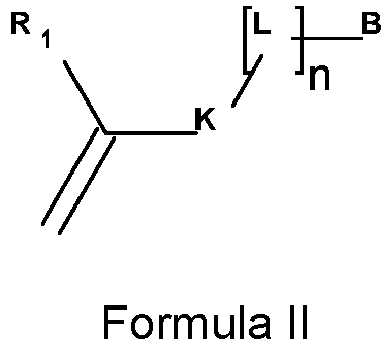
- R1 is selected from the group consisting of hydrogen, a substituted or unsubstituted alkyl group, a substituted or unsubstituted alkenyl group, a substituted or unsubstituted alkynyl group, a substituted or unsubstituted aralkyl group, a substituted or unsubstituted alkaryl group and a substituted or unsubstituted aryl or heteroaryl group;
- K is selected from the group consisting of a substituted or unsubstituted alkylene group, an ether group, an ester group, a substituted or unsubstituted amide group, a substituted or unsubstituted alkenylene group, a substituted or unsubstituted alkynylene group, a substituted or unsubstituted aralkylene group, a substituted or unsubstituted alkarylene group and a substituted or unsubstituted arylene or heteroarylene group;
- L is selected from the group consisting of a substituted or unsubstituted alkylene group, a substituted or unsubstituted alkenylene group, an ether group, a thioether group, an amine group, a substituted or unsubstituted alkynylene group, a substituted or unsubstituted aralkylene group, a substituted or unsubstituted alkarylene group and a substituted or unsubstituted arylene or heteroarylene group;
- B is a metal ligand,
- n represents 0 or 1.
- A metal ligand B as used herein represents a chemical group that interacts with a metal oxide, in particular with aluminum oxide or tantalum oxide (Polymer Capacitors) or Li Nickel Manganese Cobalt oxide (LIB batteries).
- Incorporating a metal ligand B into the polyanion may result in an improved adhesion/interaction of the conductive coatings of the polythiophene/polyanion complex onto the metal oxide surface, resulting in improved capacitor and/or battery performances.
- The polythiophene/polyanion composition is preferably an aqueous dispersion comprising oligo- or polythiophene/polyanion particles. The dispersion medium is preferably water. However, the dispersion medium may also comprise water-soluble organic solvents such as alcohols or acids.
- The median particle size (d50) of the polythiophene/polyanion particles is preferably from 1 to 100 nm, more preferably from 2 to 75 nm, most preferably from 5 to 50 nm, particularly preferred from 10 to 40 nm. The d50 particle size is preferably measured by centrifugal liquid sedimentation particle size analysis or by laser diffraction analysis.
- The polythiophene/polyanion composition may comprise additional ingredients, typically dependent on the application for which the composition is used. Such additional ingredients are for example selected from solvents, surface-active compounds, adhesion promoters, crosslinking agents, binders, conductivity increasing compounds, other conductive agents, heat and moisture stability improving agents, acidic compounds, alkaline compounds and electro-active materials.
- The polythiophene/polyanion composition may have a pH from 1 to 14, more preferably a pH from 1 to 8. The pH of the composition is typically optimized for the application wherein it will be used. When used for polymer capacitors, the pH is preferably from 4 to 9 to avoid corrosion of the dielectric. Also, when used for Li-ion batteries, the pH of the cathode active composition (see below) is preferably between 4 and 9.
- The viscosity of the polythiophene/polyanion composition is typically optimized as function of the application method and may be from 1 to 1 000 mPa·s (measured with a rheometer at 20 °C and a shear rate of 100 s-1). Preferably, the viscosity is from 5 to 500 mPa s, more preferably from 10 to 250 mPa s.
- The adjustment of the viscosity can, for example, be accomplished by adding appropriate rheology modifiers as a further additive. When used in polymer capacitors, the viscosity may not be too high to ensure a good application/ penetration of the dispersion on and in the porous dielectric. When used in Li-ion batteries, the viscosity may not be too low to ensure a proper coating of the cathode active composition on the current collector.
- The polythiophene according to the present invention is an oligo- or polythiophene obtained by the polymerization of at least one monomer according to Formula I,

A represents a substituted or unsubstituted C1 to C5 alkylene bridge. - The term C1 to C5 alkylene bridge as used in Formula I means an alkylene bridge comprising 1 to 5 carbon atoms.
- The C1 to C5 alkylene bridge is preferably methylene, ethylene, n-propylene, n-butylene or n-pentylene, most preferably ethylene.
- In a particular preferred embodiment, the monomer according to Formula I is 3,4-ethylenedioxythiophene (EDOT).
- The polythiophene may be a homopolymer or a copolymer.
- The polythiophene is preferably poly(3,4-ethylenedioxythiophene) (PEDOT).
- The polyanion according to the present invention is obtained by the polymerization of at least one monomer according to Formula II,

- R1 is selected from the group consisting of hydrogen, a substituted or unsubstituted alkyl group, a substituted or unsubstituted alkenyl group, a substituted or unsubstituted alkynyl group, a substituted or unsubstituted aralkyl group, a substituted or unsubstituted alkaryl group and a substituted or unsubstituted aryl or heteroaryl group;
- K is selected from the group consisting of a substituted or unsubstituted alkylene group, an ether group, an ester group, a substituted or unsubstituted amide group, a substituted or unsubstituted alkenylene group, a substituted or unsubstituted alkynylene group, a substituted or unsubstituted aralkylene group, a substituted or unsubstituted alkarylene group and a substituted or unsubstituted arylene or heteroarylene group;
- L is selected from the group consisting of a substituted or unsubstituted alkylene group, a substituted or unsubstituted alkenylene group, an ether group, a thioether group, an amine group, a substituted or unsubstituted alkynylene group, a substituted or unsubstituted aralkylene group, a substituted or unsubstituted alkarylene group and a substituted or unsubstituted arylene or heteroarylene group;
- B is a metal ligand;
- n represents 0 or 1.
- The metal ligand B preferably comprises an electron-donating group, i.e. a group with a free electron pair.
- The metal ligand B preferably includes a monodentate, bidentate or tridentate ligand group.
- The metal ligand B preferably includes a hydroxyl group, a nitrogen-containing group, a sulfur-containing group, an acidic group, a ketone, a heterocyclic ring or a combination thereof. More preferably, the metal ligand includes a 5- or 6 membered nitrogen-containing ring, a hydroxyl group, an amine, an acidic group, a sulfur-containing group or a ketone.
- The term acidic group as used herein means a group with a pKa value below 7.
- The metal ligand B is preferably selected from the group consisting of a mono or diphosphonic acid or salt thereof, a phosphate or salt thereof, a phosphate ester or salt thereof, a dicarboxylic acid or salt thereof, a beta-diketone, a salicylic acid or salt thereof, a benzenediol, a triazole, a thiadiazole, a thiourea, a benzotriazole, a benzothiazole, a triazine, a pyridine, a bipyridyl, a diazine, a pyrazole, a tetrazole, an imidazole, an amidine, a benzimidazole, an oxazole, a benzoxazole, a thiazole, an oxadiazole, a hydroxyquinoline, a diethanolamine group, an oxime, a thiol, a dithiocarbamate, an amine group, an ammonium group and a thiol group.
- R1 is preferably selected from the group consisting of hydrogen and a substituted or unsubstituted alkyl group, more preferably R1 represents a hydrogen or a methyl group.
- K is preferably selected from the group consisting of a substituted or unsubstituted arylene group, an ester group or an amide group, more preferably K represents a phenylene group or an amide group.
- L is preferably selected from the group consisting of a substituted or unsubstituted alkylene group, an ether group and a thioether group, more preferably L represents an unsubstituted alkylene group.
- Typical monomers according to Formula II are disclosed in Table 1 without being limited thereto.
Table 1 
Monomer-01 
Monomer-02 
Monomer-03 
Monomer-04 
Monomer-05 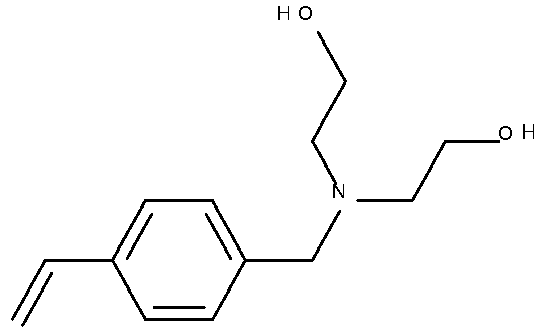
Monomer-06 
Monomer-07 
Monomer-08 
Monomer-09 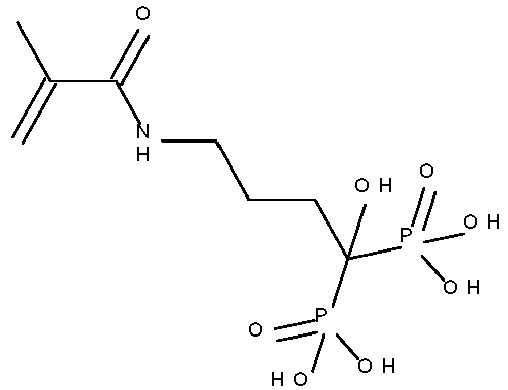
Monomer-10 
Monomer-11 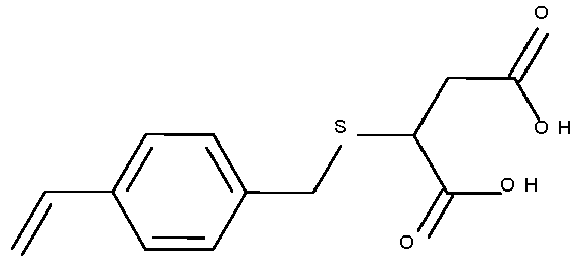
Monomer-12 
Monomer-13 
Monomer-14 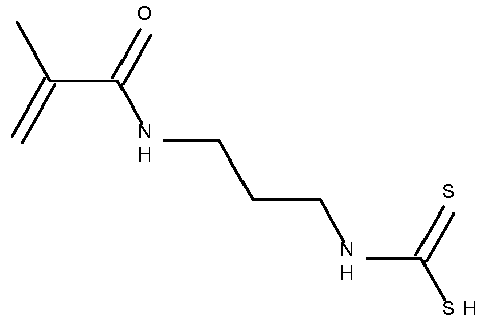
Monomer-15 
Monomer-16 
Monomer-17 
Monomer-18 
Monomer-19 
Monomer-20 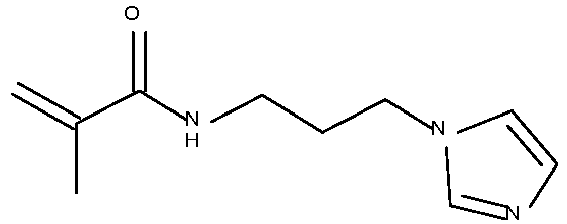
Monomer-21 
Monomer-22 
Monomer-23 
Monomer-24 
Monomer-25 
Monomer-26 
Monomer-27 - The polyanion is preferably a copolymer obtained by the polymerization of at least one monomer according to Formula II and at least one other monomer. In such a copolymer the total amount of monomers according to Formula II is preferably from 0.1 to 50 mol%, more preferably from 1 to 25 mol%, most preferably from 2 to 10 mol%, all relative to the total amount of monomers of the polyanion. Copolymers with styrene sulfonic acid are particularly preferred copolymers.
- The weight average molecular weight (Mw) of the polymeric anion is preferably from 1 to 1000 kDa, more preferably from 50 to 500 kDa, most preferably from 100 to 300 kDa.
- Typical polyanions according to the invention are shown in Table 2 without being limited thereto.
Table 2 
Polyanion-01 
Polyanion-02 
Polyanion-03 
Polyanion-04 
Polyanion-05 
Polyanion-06 
Polyanion-07 
Polyanion-08 
Polyanion-09 
Polyanion-10 
Polyanion-11 
Polyanion-12 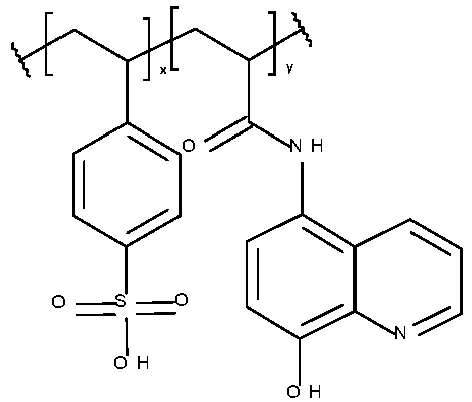
Polyanion-13 
Polyanion-14 
Polyanion-15 
Polyanion-16 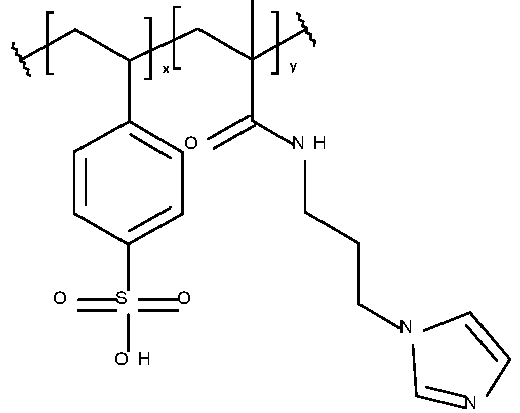
Polyanion-17 
Polyanion-18 
Polyanion-19 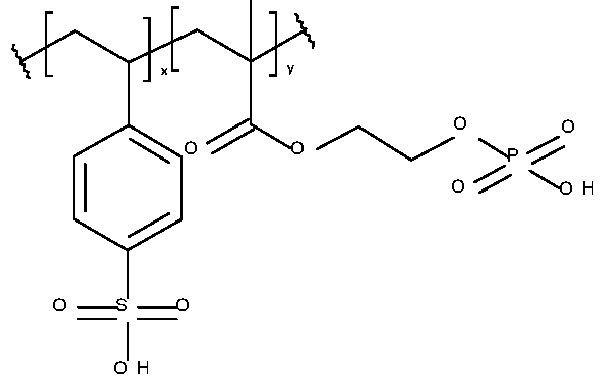
Polyanion-20 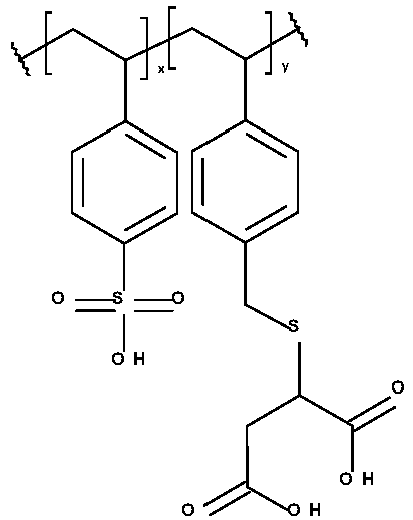
Polyanion-21 
Polyanion-22 
Polyanion-23 - x + y is 1 and y is preferably from 0.001 to 0.5, more preferably from 0.01 to 0.25, most preferably from 0.02 to 0.1.
- The polyanion is preferably prepared by a radical polymerization. More preferably, the polyanion is prepared by a free radical polymerization of styrene sulfonic acid and at least one monomer according to Formula II or a free radical polymerization of styrene sulfonic acid and a precursor that can be modified post polymerization to obtain a polyanion described in Table 2. The free radical polymerization is preferably carried out in an aqueous reaction medium.
- In addition to the polyanion described above, the polythiophene/polyanion composition may comprise one or more other polyanions. For example, the polyanion described above may be combined with polystyrene sulphonic acid (PSS).
- The polythiophene is preferably prepared by oxidative polymerization of the thiophene monomers described above. More preferably, the oligo- or polythiophene is prepared by oxidative polymerization of the thiophene monomers described above in an aqueous reaction medium.
- The oxidative polymerization is preferably carried out in the presence of the polyanion described above.
- The concentration of the thiophene monomer in the aqueous medium is preferably from 0.1 to 25 wt%, more preferably from 0.5 to 10 wt%, all relative to the total weight of the aqueous reaction medium.
- Suitable oxidizing agents are iron(III) salts, such as FeCl3 and iron(III) salts of aromatic and aliphatic sulfonic acids; H2O2; K2Cr2O7; KMnO4; alkali metal perborates; alkali metal or ammonium persulfates; and mixtures thereof.
- Further suitable oxidants are described, for example, in Handbook of Conducting Polymers (Ed. Skotheim, T. A., Marcel Dekker: New York, 1986, Vol. 1, pages 46-57).
- Particularly preferred oxidizing agents are salts of a peroxydisulfate, in particular K2S2O8 and Na2S2O8; iron(III) salts, in particular iron(III) chloride and iron(III) sulphate; or a combination thereof.
- A mixture of salts of a peroxydisulfate and at least one further compound that catalyzes the cleavage of the peroxydisulfate, such as an iron(III) salt, is particularly preferred.
- According to a particularly preferred embodiment the oxidizing agent is a mixture of Fe2(SO4)3 and Na2S2O8.
- There are different ways for preparing the aqueous reaction medium. The thiophene monomer can be dissolved or dispersed in the aqueous reaction medium followed by the addition of the oxidizing agent(s), which can also be dissolved or dispersed in an aqueous phase, or, the oxidizing agent(s) is/are first dissolved or dispersed in the aqueous reaction medium, followed by the addition of the thiophene monomer, which can also be dissolved or dispersed in an aqueous phase.
- If more than one oxidizing agent is used, for example a mixture of Fe2(SO4)3 and Na2S2O8, it is furthermore possible to first mix one of these components with the thiophene monomer in the aqueous reaction medium followed by the addition of the second oxidizing agent.
- The oxidative polymerization is preferably carried out under an inert atmosphere as disclosed in
EP-A 11453877 (AGFA-GEVAERT NV) - The concentration of oxygen in the reaction medium can be regulated by any means, such as freeze-thaw techniques, prolonged bubbling of an inert gas such as Argon, Nitrogen or Helium through the reaction medium, consumption of oxygen in a sacrificial reaction under an inert gas blanket. Preferably, an inert gas is bubbled through the reaction medium until the polymerization is completed thereby maintaining the oxygen concentration below 3 mg/l.
- The oxidative polymerization is preferably carried out at low pH, as disclosed in
EP-A 1384739 . The pH is preferably 1.5 or less, more preferably 1.00 or less. - To adjust the pH, an acid may be used, preferably selected from the group of water-soluble inorganic acids and water-soluble organic acids. Examples of inorganic acids are hydrochloric acid, sulfuric acid, nitric acid and phosphoric acid. Examples of organic acids include p-toluenesulfonic acid, benzenesulfonic acid, methanesulfonic acid and trifluoromethanesulfonic acid.
- The temperature of the reaction mixture is preferably from 0 to 100°C, more preferably from 0 to 50°C, most preferably from 5 to 30°C.
- The amount of thiophene monomers and polyanions in the reaction mixture is typically optimized to obtain stable polythiophene/polyanion dispersions of which the solid content is preferably from 0.05 to 25 wt%, more preferably from 0.1 to 10 wt%, most preferably from 0.8 to 2 wt%, all relative to the total weight of the dispersion.
- After the polymerization reaction is completed the liquid composition may be further purified, for example by means of filtration, in particular by means of ultrafiltration, and/or by a treatment with ion exchanger, in particular by a treatment with an anion exchanger and a cation exchanger.
- Various homogenization techniques may be used during the preparation of the polythiophene/polyanion composition. The homogenizing techniques may be selected from:
- ultrasonic homogenization techniques;
- pressure homogenization techniques; and
- mechanical homogenization techniques.
- Preferred mechanical homogenizers are rotor-stator homogenizers and blade type homogenizers. Another mechanical homogenization technique may be the use of a spinning disk reactor.
- Preferred high-pressure homogenizers, such as for example a Gaulin homogenizer or an Ariete homogenizer, force the dispersion through a very narrow channel or orifice under pressure. Another preferred high-pressure homogenizer is a microfluidizer.
- Two or more homogenizers may be used in combination, preferably in a consecutive way.
- The homogenization techniques may be used before, during and after the polymerization reaction.
- The surface-active compounds may be:
- anionic surfactants such as alkylbenzenesulphonic acids and salts, paraffin sulphonates, alcohol sulphonates, ether sulphonates, sulphosuccinates, phosphate esters, alkyl ether carboxylic acids or carboxylates;
- cationic surfactants such as quaternary alkylammonium salts;
- nonionic surfactants such as linear alcohol ethoxylates, oxo alcohol ethoxylates, alkylphenol ethoxylates or alkyl polyglucosides; and
- zwitterionic surfactants such as compounds comprising both a carboxylic acid group and a quaternary ammonium group, for example lauryl-N,N -(dimethyl-ammonio)-butyrate and lauryl-N,N-(dimethyl)-glycinebetaine; compounds comprising both a sulfuric acid group and quaternary ammonium group, for example 3-[(3-cholamido-propyl)dimethylammonio]-1-propane-sulfonate, 3-(4-tert-butyl-1-pyridinio)-1-propanesulfonate, 3-(1-pyridinio)-1-propanesulfonate and 3-(benzyl-dimethyl-ammonio)propanesulfonate; compounds comprising both a phosphoric acid group and a quaternary ammonium group, for example with hexadecyl phosphocholine; compounds comprising a quaternary ammonium group with an attached hydroxy group, for example lauryldimethylamine N-oxide; and phospholipids, which consist of a quaternary ammonium head coupled via a phosphate group and glycerol to two hydrophobic fatty acids.
- Particularly preferred surfactants are the commercially available surfactants available under the trademarks Dynol® and Zonyl®.
- Preferred adhesion promoters are organofunctional silanes or hydrolysates thereof such as 3-glycidoxypropyltrialkoxysilane, 3-amino-propyl-triethoxysilane, 3-mercaptopropyltrimethoxysilane, 3-methacryloxypropyl-trimethoxysilane, vinyltrimethoxysilane or octyltriethoxysilane.
- Preferred crosslinking agents are melamine compounds, blocked isocyanates, functional silanes such as tetraethoxysilane, alkoxysilane hydrolysates, such as tetraethoxysilane, epoxysilanes such as 3-glycidoxy-propyltrialkoxysilane.
- Preferred binders are polyurethanes, polyacrylates or polyolefins.
- Preferred conductivity increasing compounds are:
- compounds containing ether groups such as e.g. tetrahydrofuran;
- compounds containing lactone groups such as γ-butyrolactone or γ-valero-lactone;
- compounds containing amide or lactam groups such as caprolactam, N-methylcaprolactam, N,N-dimethylacetamide, N-methylacetamide, formamide, N,N-dimethylformamide (DMF), N-methyl-formamide, N-methyl-formanilide, N-methyl-2-pyrrolidone (NMP), N-octyl-pyrrolidone, 2-pyrrolidone, N-butyl-pyrrolidone, and N-hydroxyethyl-pyrrolidon;
- sulphones and sulphoxides such as sulpholane (tetramethylene sulphone) or dimethylsulphoxide (DMSO);
- sugar or sugar derivatives such as arabinose, saccharose, glucose, fructose or lactose;
- di- or polyalcohols such as sorbitol, xylitol, mannitol, mannose, galactose, sorbose, gluconic acid or ethylene glycol, di- or tri(ethylene glycol), 1,1,1-trimethylol-propane, 1,3-propanediol, 1-,2-propane-diol, 1,5-pentanediol, 1,2,3-propanetriol, 1,2,4-butanetriol or 1,2,6-hexanetriol, aromatic di- or polyalcohols such as resorcinol.
- Particularly preferred conductivity increasing compounds are selected from the groups consisting of N-methyl-pyrrolidinone, N-butyl-pyrrolidone, N-hydroxyethyl-pyrrolidone, DMSO, ethylene glycol and diethylene glycol.
- Preferred stability improving compounds are gallic acid derivatives.
- A polymer capacitor, also referred to as a polymer electrolyte capacitor, is an electrolytic capacitor comprising a solid conductive polymer electrolyte.
- Electrolytic capacitors use a chemical feature of some special metals, often referred to as so-called valve metals, that by anodic oxidation form an insulating oxide layer. By applying a positive voltage to the anode material in an electrolytic bath, an oxide barrier layer with a thickness corresponding to the applied voltage may be formed. This oxide layer acts as the dielectric in the electrolytic capacitor. To increase the capacitors capacitance the anode surface is roughened before anodization, resulting in roughened oxide layer surface.
- To complete the capacitor, a counter electrode has to match the rough insulating oxide surface. This is accomplished by the electrolyte, which acts as the cathode of the electrolytic capacitor. In a polymer electrolyte capacitor, this counter electrode consists of one or more layers of a conductive polymer, for example a polythiophene conductive polymer. In the capacitor according to the present invention the cathode includes the polythiophene/polyanion composition described above.
- The main difference between the polymer capacitors is the anode material and its oxide used as the dielectric:
- Polymer tantalum electrolytic capacitors use high purity sintered tantalum powder as an anode with tantalum pentoxide (Ta2O5) as a dielectric; and
- Polymer aluminum electrolytic capacitors use a high purity and electrochemically etched (roughened) aluminum foil as an anode with aluminum oxide (Al2O3) as the dielectric.
- Preferred capacitors according to the present invention are polymer aluminum capacitors.
- The porous metal layer (anode) covered with its oxide layer (dielectric) is hereinafter referred to as a porous anode body.
- The polymer capacitor according to the present invention includes a polythiophene/polyanion composition described above.
- The polymer capacitor according to the present invention is preferably prepared by a method comprising the step of introducing the polythiophene/polyanion composition described above into at least part of a porous anode body.
- The polythiophene/polyanion composition may be introduced into the porous anode body by any known process such as impregnation, dipping, pouring, dripping on, spraying, misting on, knife coating, brushing or printing, for example inkjet, screen or tampon printing.
- Preferably, the polythiophene/polyanion composition is introduced into at least part of the porous anode body by dipping the porous anode body into the polythiophene/polyanion composition and thus impregnating it with the polythiophene/polyanion composition.
- The dipping into or the impregnation with the polythiophene/polyanion composition is preferably carried out for a period of from 1 second to 120 minutes, more preferably from 5 seconds to 60 minutes, most preferably from 10 seconds to 15 minutes. The introduction of the polythiophene/polyanion composition into the anode body can be facilitated, for example, by increased or reduced pressure, vibration, ultrasound or heat.
- After the porous anode body is impregnated with the polythiophene/polyanion composition, solvents contained in the composition are preferably, at least partially, removed to obtain a solid electrolyte, which completely or partly covers the dielectric thereby forming a capacitor body. The coverage of the dielectric by the solid electrolyte is preferably at least 10%, more preferably at least 25%, most preferably at least 50%. The coverage may be determined as described in
DE-A-10 2005 043 828 . - The solvents are preferably removed by removing the electrode body from the composition and drying it. The drying step is preferably carried out at a temperature from 20 °C to 260 °C, more preferably from 50 °C to 220 °C, most preferably from 80 °C to 200 °C.
- The dipping and the drying step may be repeated once or several times to adapt the thickness of the solid electrolyte layer deposited on the dielectric or the degree of filling of the electrolyte in the electrode body to the particular requirements.
- It may be advantageous to use both so-called self-doped and foreign-doped polythiophenes for the formation of the polymer cathode layer. A polythiophene typically has a positive charge located on the main chain of the polymer. The positive charge is preferably, at least partially, compensated by an anion. When the anion is covalently bound to the polymer, the polymer is then often referred to as a self-doped polymer or an intrinsically conductive polymer. The monomers used to make such self-doped polymers, i.e. comprising an anionic group, are also referred to as self-doped monomers.
- When the anion is a separate compound, as is the case in the polythiophene/ polyanion composition described above, the polymer is then typically referred to as a foreign-doped polymer or an extrinsically conductive polymer.
- Both types of polythiophene polymers may be combined in a single composition and introduced as described above. However, it is preferred that both types of polythiophenes are introduced in the capacitor using different compositions each comprising a self-doped or a foreign- doped polythiophene. Preferably, first a self-doped polythiophene is introduced into the porous anode body followed by the introduction of the foreign-doped polythiophene. Using both self-doped and foreign-doped polythiophenes is disclosed in for example
WO2014/048562 (Heraeus ) andUS2016/0351338 (AVX ). - After the capacitor bodies have been produced in this manner, they can be further modified by methods known to the person skilled in the art. In the case of a tantalum electrolytic capacitor, the capacitor bodies can be covered, for example, with a polymeric outer layer, as is described in
DE-A-10 2004 022674 orDE-A-10 2009 007 594 , and/or a graphite layer and a silver layer, as is known fromDE-A-10 2005 043 828 , while in the case of an aluminum wound capacitor, in accordance with the teaching ofUS749879 , the capacitor body may be incorporated into an aluminum beaker, provided with a sealing glass and firmly closed mechanically by crimping. The capacitor may then be freed from defects in the dielectric in a known manner by ageing. - Secondary lithium ion batteries operate by reversibly passing lithium ions between the negative electrode (anode) and the positive electrode (cathode). A separator and an electrolyte are disposed between the negative and positive electrodes. The electrolyte is suitable for conducting lithium ions and may be in solid or liquid form. Lithium ions move from the cathode to the anode during charging of the battery and in the opposite direction when discharging the battery. Both electrodes include an electroactive material.
- The cathode or positive electrode for a Li-ion battery according to the present invention includes a polythiophene/polyanion composition described above.
- The cathode or positive electrode for a Li-ion battery according to the present invention is preferably prepared by applying a cathode active composition on a current collector, preferably an Aluminum foil.
- The cathode active composition includes:
- a positive electroactive material,
- the polythiophene/polyanion composition described above, and
- a solvent.
- The cathode active composition may further comprise a binder, other conductive agents, dispersant, etc.
- The applied cathode active composition is then preferably dried to, at least partially, remove the solvent. The drying step is preferably carried out at a temperature from 20 °C to 260 °C, more preferably from 50 °C to 220 °C, most preferably from 80 °C to 200 °C.
- The positive electroactive material and the polythiophene/polyanion complex may form core-shell particles wherein the core includes the electroactive material and the shell includes the polythiophene/polyanion complex, the optional binder and the optional conductive agents.
- The positive electroactive material of the positive electrode or cathode include, but is not limited, to a layered metal oxide.
- The metal oxide may be selected from:
- lithium cobalt oxide (LiCoO2) or lithium nickel oxide (LiNiO2), or a compound substituted with one or more transition metals;
- lithium manganese oxides represented by formula Li1+xMn2-xO4 (0 ≤ x ≤ 0.33) such as LiMnOs, LiMn2O3, LiMnO2;
- a lithium copper oxide (Li2CuO2);
- LiFe3O4;
- vanadium oxides such as LiVsOs, V2O5, Cu2V2O7;
- Ni site-type lithium nickel oxides represented by formula LiNi1-xMxO2 (M = Co, Mn, Al, Cu, Fe, Mg, B or Ga, and 0.01 ≤ x ≤ 0.3);
- lithium manganese composite oxides represented by formula LiMn2-xMxO2 (M = Co, Ni, Fe, Cr, Zn or Ta, and 0.01 ≤ x ≤ 0.1) or Li2Mn3MO8 (M = Fe, Co, Ni, Cu or Zn);
- lithium manganese composite oxides having a spinel structure represented by LiNixMn2-xO4; LiMn2O4 in which a part of Li in the formula is substituted with an alkaline earth metal ion;
- Lithium iron phosphate (LiFePO4).
- A preferred metal oxide is LiNixMnyCo1-x-yO2, also referred to as NMC. A particularly preferred metal oxide is LiNixMnyCo1-x-yO2 with a high Ni content (x ≥ 0.8). The discharge capacity of NMC materials is generally determined by the Ni content, as Ni is the major redox species (Ni2+/Ni4+).Thus higher Ni content cathode active materials guarantee a high specific capacity. As a result, a high energy density can be obtained. However, NMC cathode materials with higher Ni content have shown poor rate capability, poor cycling life and poor thermal stability, due to structural instabilities.
- The amount of electroactive material is preferably from 75 to 99 wt%, more preferably form 80 to 95 wt%, most preferably from 85 to 95 wt%, all relative to the total weight of the cathode active composition.
- The solvent is preferably N-methylpyrrolidone (NMP) or water, more preferably water.
- The binder is preferably selected from the group consisting of styrene-butadiene rubber (SBR), carboxymethyl cellulose (CMC), acrylonitrile copolymer, polyacrylic acid (PAA), polyacrylonitrile (PAN), polyacrylic latex such as LA132, LA133 or LA138, a salt of alginic acid, polyvinylidene fluoride (PVDF), poly(vinylidene fluoride)hexafluoripropene (PVDF-HFP), polytetrafluorethylene (PTFE), polystyrene, poly(vinyl alcohol) (PVA), polyvinyl acetate, polyisoprene, polyaniline, polyethylene, polymide, polyurethane, polyvinyl butyral (PVB), polyvinyl pyrrolidone (PVP), gelatin, chitosan, starch, agar-agar, xanthan gum, gum arabic, gellan gum, guar gum, gum karaya, tara gum, gum tragacanth, casein, amylose, pectin, carrageenans, and combinations thereof. The type of binder used is typically dependent on the solvent used. For NMP a preferred binder is polyvinylidene fluoride (PVDF), for water the binder is preferably CMC, sodium alginate or PAA.
- The binder amount is preferably from 0.01 to 10 wt %, more preferably from 0.1 to 7.5 wt%, most preferably from 1 to 5 wt%, all relative to the total weight of the cathode active composition.
- The current collectors used are not particularly limited as long as they have a high conductivity without causing a chemical change in the battery. The current collector may be, for example, copper, stainless steel, aluminum, nickel, titanium, baked carbon, those that the surface of copper or stainless steel is surface-treated with carbon, nickel, titanium, silver, or the like, an aluminum-cadmium alloy, and the like. The current collector may have a thickness of 3 µm to 500 µm.
- The adhesion of the electrode active material on the current collector may be strengthened by forming fine irregularities on the surface of the current collector. The current collector may be used in various forms of, for example, a film, a sheet, a foil, a net, a porous body, a foam, a non-woven body, and the like.
- A particularly preferred positive electrode current collector is an aluminum foil while a particularly preferred negative electrode current collector is a copper foil.
- The separator is preferably a microporous polymer film having pores with a size of several nm to several mm, which separates the negative electrode and the positive electrode and provide passages for lithium ions. The separator can be used without any particular limitation as long as it is usually used as a separator in a lithium secondary battery, and in particular, it is preferable that the separator has low resistance to ion movement of the electrolyte as well as excellent electrolyte moisture content capability.
- The separator may be, for example, a porous polymer film made of a polyolefin-based polymer such as ethylene homopolymer, propylene homopolymer, ethylene/butene copolymer, ethylene/hexene copolymer, and ethylene/methacrylate copolymer, or a laminated structure of two layers thereof, and the like, or may be a conventional porous nonwoven fabric made of high-melting glass fiber, polyethylene terephthalate fiber, and the like, and in another example, a coating separator comprising a ceramic component or a polymer material may also be used to secure heat resistance or mechanical strength.
- The thickness of the separator may be, for example, from 1 µm to 100 µm, more preferably from 5 to 75 µm, most preferably from 10 to 50 µm.
- The negative electrode of the lithium ion battery may comprise a negative current collector and a negative electrode active material formed on the negative electrode current collector described above.
- The anode is typically made up of graphite, coated on a current collector, preferably a copper foil. Silicon Carbon (Si-C) composites are also used to prepare anode materials. Other type of anode materials are Silicon and Li-metal.
- Liquid electrolytes in lithium-ion batteries include lithium salts, such as LiPF6, LiBF4 or LiClO4 in an organic solvent, such as ethylene carbonate, dimethyl carbonate, ethyl methyl carbonate and diethyl carbonate. A liquid electrolyte acts as a conductive pathway for the movement of cations passing from the negative to the positive electrodes during discharge.
- Recent advances in battery technology involve using a solid as the electrolyte material. The most promising of these are ceramics. Solid ceramic electrolytes are mostly lithium metal oxides, which allow lithium-ion transport through the solid more readily due to the intrinsic lithium. The main benefit of solid electrolytes is that there is no risk of leaks, which is a serious safety issue for batteries with liquid electrolytes.
- The polythiophene/polyanion composition according to the present invention is preferably used in polymer capacitors and Li-ion batteries as described above. However, the polythiophene/polyanion composition may be used in any electronic device, such as is selected from photoconductive cells, photoresistors, photoswitches, phototransistors, phototubes, IR detectors, photovoltaic device, solar cells, coating materials for memory storage devices, field effect resistance devices, anti-static films, biosensors, electrochromic devices, solid electrolyte capacitors, hybrid capacitors, super capacitors, energy storage devices, batteries and electromagnetic shielding.
- All materials used in the following examples were readily available from standard sources such as ALDRICH CHEMICAL Co. (Belgium) and ACROS (Belgium) unless otherwise specified. The water used was deionized water.
- 4-vinylbenzenesulfonic acid, sodium salt commercially available from TCI Europe (Belgium).
- EDOT is 3,4-ethylenedioxythiophene commercially available from Heraeus.
- PSS-1 is an aqueous solution of polystyrenesulfonic acid having a Mw of 300 kDa prepared according to a method disclosed in Houben-Weyl, Methoden der organischen Chemie, Vol. E 20, Makromolekulaire Stoffe, Teil 2 (1987), page 1141.
- Lewatit ® MonoPlus M600 is a basic, gelular anion exchange resin commercially available from Lanxess AG.
- Lewatit ® MonoPlus S 108 H is an acidic, gelular cation exchange resin commercially available from Lanxess AG.
- The molecular weight of the polymers was determined by gel permeation chromatography (GPC) on a Waters e2695 alliance with a 2998A PDA detector, calibrated with polystyrene sulfonate standards. The molecular weight distribution (polydispersity Ð) is calculated with Waters Empower 3.
- The molar amount of monomer according to this invention in the copolymer polyanion was determined by nuclear magnetic resonance (NMR) on a JEOL ECZ400R with Royal probe in D2O (at = 2.04" - d1 = 10" - nt = 64 - 25 gr C - pw45). When no value is listed in Table 3, the amount of monomer could not be determined due to overlapping signals in the NMR spectrum.
- The viscosity was measured with a glass capillary viscometer.
- The surface resistance SER was measured at room temperature using a two point probe method.
- The capacitance of a capacitor was measured at 120 Hz at room temperature with a potentiostat.
- The equivalent series resistance (ESR) was measured at 100 kHz at room temperature with a potentiostat.
-

- A dispersion of 60 wt% of sodium hydride (3.2 g) in mineral oil was mixed with 130 mL of tetrahydrofuran, cooled to -10 °C and stirred. Diethylphosphite (10.9 g) was added dropwise and stirred for 15 min. Then, the reaction mixture was allowed to warm up to room temperature. The mixture was then heated to 55 °C and stirred for 1.5 h. Then, the mixture was cooled down to room temperature and 11.2 g of 4-vinylbenzylchloride was added dropwise. The mixture was again heated to 55 °C, stirred for 2 hours and allowed to cool to room temperature. The reaction mixture was extracted with MTBE (300 mL) and NaOH 0.5 N (300 mL). The organic phase was isolated, dried on magnesium sulfate and the solvent was evaporated. The product was further dried under high vacuum. A purification by column chromatography was performed (RP, MeOH/NaCl (0.5 M) 80/20) to obtain I-01 as a colorless oil (9 g, 53.6%).
-

- 2.5 g of !-01 and 22 mg of butylated hydroxytoluene were dissolved in 15 mL of dichloromethane. To the stirring solution 7.3 g of trimethylsilylbromide was added dropwise. The reaction mixture was stirred overnight at room temperature. Afterwards, the solvent was evaporated and 7 mL of water was added and the mixture was stirred for 3 hours. The formed precipitate was filtered off and dried to obtain Monomer-01 (1.0 g, 50.5%).
-

- 7.2 g of acetylacetone, 9.9 g of sodium acetylacetonate, 0.4 g of sodium iodide and 0.3 g of butylated hydroxytoluene were dissolved in a mixture of acetonitrile and dimethylformamide (60 mL/30 mL). 4-Vinylbenzyl chloride (12.1 g) was added to the stirring mixture, the reaction was heated to 80 °C and stirred for 3 hours. Afterwards, the mixture was allowed to cool to room temperature and stirred further overnight. The formed precipitate was filtered off and water and methyl-tert-butyl ether were added to the filtrate to extract the product. The organic phase was isolated, dried on magnesium sulfate and the solvent was evaporated. A purification by column chromatography was performed (NP, DCM/heptane 70/30) to obtain Monomer-04 as a colorless oil (6.7 g, 43.4%).
-

- 40.4 g of N-methylolacrylamide, 44.0 g of acetylacetone, 0.9 g of butylated hydroxytoluene and 1 mL HCl (12N solution) were dissolved in 100 mL of acetonitrile. The reaction mixture was heated to 50 °C and stirred for 2 hours. Afterwards, the mixture was allowed to cool to room temperature. The formed precipitate was filtered off and dried. The obtained product was dissolved in ethyl acetate (150 mL) and the solution was added to methyl-tert-butyl ether (400 mL). The formed precipitate was filtered off and dried again. This procedure was repeated with 20 mL of ethyl acetate and 150 mL of methyl-tert-butyl ether. A purification by column chromatography was performed (NP, DCM/ethyl acetate 80/20) to obtain Monomer-05 as an off-white powder (25.4 g, 34.6%).
-

- 31.5 g of diethanolamine and 0.13 g of butylated hydroxytoluene were mixed. Then, 9.2 g of 4-vinylbenzyl chloride was added to the stirring mixture dropwise, the reaction was heated to 60 °C and stirred for 1 hour. Afterwards, the mixture was allowed to cool to room temperature. 100 mL of DCM and 2x100 mL of water were added. The organic phase was isolated, dried on magnesium sulfate and the solvent was evaporated to obtain Monomer-06 as a yellow oil (13.3 g, quantitative yield).
-

- 382.85 g of 4-aminosalicylic acid was dissolved in 2500 mL of acetone and cooled to 0 °C. 423.96 g of methacrylic anhydride was added to the stirring mixture. Then, a solution of 255.75 g of triethylamine in 500 mL of acetone was added dropwise. The reaction mixture was allowed to warm up to room temperature and stirred further overnight. Afterwards, acetone was removed by rotary evaporation. The obtained oil was redissolved in 2500 mL of dichloromethane and 500 mL of a 3N HCl solution was added. The formed precipitate was filtered off. To the dichloromethane phase again 500 mL of 3N HCl was added and the formed precipitate was filtered off. Both precipitates were combined and redissolved in 2500 mL of acetone under reflux conditions and added to 5000 mL of water at 0 °C. The precipitated powder was filtered off and dried in a vacuum oven at 50 °C. Monomer-08 was obtained as an off-white powder (400 g, 72.3%).
-

- 2.98 g of phenothiazine was dissolved in 250 mL of sulfuric acid at 0 °C. 77.07 g of 8-hydroxyquinoline was added to the stirring mixture in portions. Then, 57.66 g of N-methylol acrylamide was added in portions. The reaction mixture was allowed to warm up to room temperature and stirred further overnight. Afterwards, the mixture was added to 3000 mL of water cooled at 0 °C and neutralized with a 10 N NaOH solution to a pH of 7. A powder precipitated which was filtered off and dried. The obtained powder was recrystallized in 400 mL of a methanol/acetone mixture (1/1) and dried afterwards. Monomer-16 was obtained as an off-white powder (24.0 g, 35.0%).
-

- A suspension of 44.9 g of NaHCOs in 450 mL of water was prepared and cooled to 0 °C. 31.06 g of 5-aminobenzotriazole dihydrochloride was added in portions to the stirring suspension. Then, 14.93 g of acryloyl chloride was added dropwise. The reaction mixture was allowed to warm up to room temperature and stirred further for 4 hours. The formed precipitate was filtered off and washed twice with 100 mL of water. The obtained powder was recrystallized in a mixture dimethylacetamide and water (150 mL/750 mL) and washed twice with 100 mL of water. Finally, the powder was dried in a vacuum oven at 50 °C. Monomer-18 was obtained as a brown powder (17.9 g, 63.4%).
-

- 0.11 g of 2,6-di-tert-butyl-p-cresol and 6.7 g of 4-mercapto-1,2,3-triazole sodium salt were added to 60 mL of ethanol while stirring. A solution of 8.24 g of 4-vinylbenzyl chloride in 30 mL of ethanol was added over two minutes. The reaction mixture was stirred for 1 hour at room temperature. Afterwards, ethanol was removed by rotary evaporation. The obtained oil was redissolved in 100 mL of isopropyl acetate and 700 mL of hexane was added in portions. A powder precipitated was filtered off and washed twice with 30 mL of hexane. Monomer-19 was obtained as an off-white powder (5.7 g, 48.5%).
-
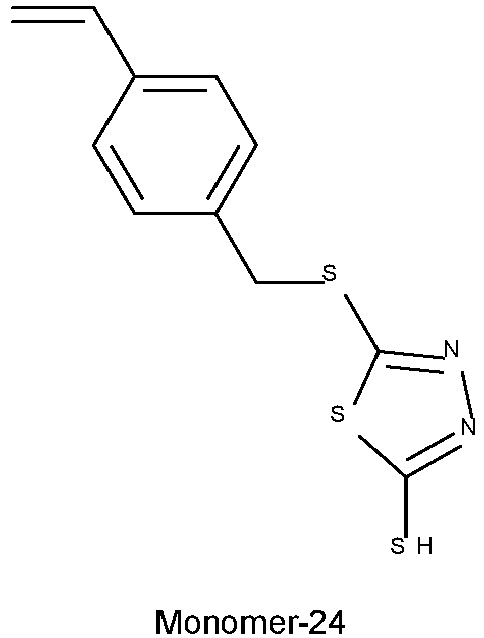
- 36.1 g of 1,3,4-thiadiazole-2,5-dithiol and 150 mL of methanol were mixed and stirred under nitrogen at room temperature. Triethylamine (24.2 g) was added dropwise and the reaction mixture was further stirred for 30 min. A solution of 4-vinylbenzylchloride (30.5 g) in methanol (50 mL) was added. After stirring for 2 hours, the reaction mixture was poured in 600 mL of water. The precipitated product was filtered off and dried overnight. A purification by column chromatography was performed (NP, DCM/ethyl acetate 97/3) to obtain Monomer-24 as an off-white powder (37.9 g, 71.2%).
-

- A dispersion of 60 wt% of sodium hydride (1.93 g) in mineral oil was mixed with 18.6 mL of tetrahydrofuran, and stirred. A solution of Monomer-24 from Example 9 (9.32 g) in tetrahydrofuran (55.9 mL) was added dropwise. After the addition, the reaction mixture was further stirred for 1h. Then, a solution of 1,4-butanesultone (5.48 g) in tetrahydrofuran (18.6 mL) was added and the reaction was refluxed for 1h. 300 mL of methyl-tert-butylether was added and after 10 min. of stirring the upper phase was decanted. Another time 300 mL of methyl-tert-butylether was added and the mixture was stirred for 30 min. Finally, the precipitated product was filtered off, washed with methyl-tert-butylether and dried under vacuum at room temperature. Monomer-25 was obtained as an off-white powder (14.8 g, quantitative yield).
- 10.98 g of 4-vinylbenzenesulfonic acid, sodium salt and 0.22 g of Monomer-01 from Example 1 were dissolved in 64 mL of water. A 2 wt% initiator solution of 2,2'-azobis[2-methyl-N-(2-hydroxyethyl)propionamide] was prepared and degassed with nitrogen for 1 hour. 26.08 g of this solution was then added. The reaction mixture was then heated and refluxed for 20 hours. Afterwards, the reaction mixture was cooled to room temperature. The reaction mixture was treated with ion exchanger (60 g Lewatit ® MonoPlus S 108 H, filtered and washed 2x 17 mL water, repeated). Afterwards, the solution dialyzed with dialysis tubes with a cutoff point of 1000 Da under a water flow. The solution was concentrated in vacuo. This procedure yielded a clear to slightly yellow solution of Polyanion-01(a) in water.
- A polymerization was carried out in the same manner as described for Polyanion-01(a) except for using 10.66 g of 4-vinylbenzenesulfonic acid, sodium salt, 26.12 g of initiator solution and 0.54 g of Monomer-01.
- A polymerization was carried out in the same manner as described for Polyanion-01(a) except for using 10.96 g of 4-vinylbenzenesulfonic acid, sodium salt, 26.03 g of initiator solution and 0.23 g of Monomer-04 from Example 2 instead of Monomer-01.
- A polymerization was carried out in the same manner as described for Polyanion-01(a) except for using 22.0 g of 4-vinylbenzenesulfonic acid, sodium salt, 52.25 g of initiator solution, 0.40 g of Monomer-05 from Example 3 instead of Monomer-01 and 128 mL of water. For the ion exchange treatment 120 g Lewatit® MonoPlus S 108 H was used and 35 mL of water.
- A polymerization was carried out in the same manner as described for Polyanion-04(a) except for using 20.40 g of 4-vinylbenzenesulfonic acid, sodium salt, 52.78 g of initiator solution, 2.01 g of Monomer-05 and 127 mL of water.
- A polymerization was carried out in the same manner as described for Polyanion-01(a) except for using 10.95 g of 4-vinylbenzenesulfonic acid, sodium salt, 26.02 g of initiator solution and 0.24 g of Monomer-06 from Example 4 instead of Monomer-01.
- A polymerization was carried out in the same manner as described for Polyanion-06(a) except for using 10.59 g of 4-vinylbenzenesulfonic acid, sodium salt, 25.95 g of initiator solution and 0.60 g of Monomer-06.
- A polymerization was carried out in the same manner as described for Polyanion-06(a) except for using 9.99 g of 4-vinylbenzenesulfonic acid, sodium salt, 25.85 g of initiator solution and 1.19 g of Monomer-06.
- A polymerization was carried out in the same manner as described for Polyanion-01(a) except for heating to 90 °C, using 10.93 g of 4-vinylbenzenesulfonic acid, sodium salt, 25.96 g of initiator solution and 0.24 g of Monomer-08 from Example 5 instead of Monomer-01. For the ion exchange treatment 60 g Lewatit ® MonoPlus S 108 H was used and 50 mL of water.
- A polymerization was carried out in the same manner as described for Polyanion-08(a) except for using 10.53 g of 4-vinylbenzenesulfonic acid, sodium salt, 25.80 g of initiator solution and 0.59 g of Monomer-08.
- A polymerization was carried out in the same manner as described for Polyanion-08(a) except for using 9.88 g of 4-vinylbenzenesulfonic acid, sodium salt, 25.55 g of initiator solution and 1.18 g of Monomer-08.
- A polymerization was carried out in the same manner as described for Polyanion-01(a) except for using 10.94 g of 4-vinylbenzenesulfonic acid, sodium salt, 26.00 g of initiator solution and 0.25 g of Monomer-16 from Example 6 instead of Monomer-01. A few drops of a NaOH solution were added to dissolve Monomer-16.
- A polymerization was carried out in the same manner as described for Polyanion-12(a) except for using 10.57 g of 4-vinylbenzenesulfonic acid, sodium salt, 25.91 g of initiator solution and 0.62 g of Monomer-16.
- A polymerization was carried out in the same manner as described for Polyanion-12(a) except for using 9.96 g of 4-vinylbenzenesulfonic acid, sodium salt, 25.75 g of initiator solution and 1.22 g of Monomer-16.
- A polymerization was carried out in the same manner as described for Polyanion-01(a) except for using 10.99 g of 4-vinylbenzenesulfonic acid, sodium salt, 26.11 g of initiator solution and 0.20 g of Monomer-18 from Example 7 instead of Monomer-01. A few drops of a NaOH solution were added to dissolve Monomer-18.
- A polymerization was carried out in the same manner as described for Polyanion-14(a) except for using 10.69 g of 4-vinylbenzenesulfonic acid, sodium salt, 26.19 g of initiator solution and 0.51 g of Monomer-18.
- A polymerization was carried out in the same manner as described for Polyanion-14(a) except for using 10.17 g of 4-vinylbenzenesulfonic acid, sodium salt, 26.32 g of initiator solution and 1.03 g of Monomer-18.
- A polymerization was carried out in the same manner as described for Polyanion-01(a) except for using 10.96 g of 4-vinylbenzenesulfonic acid, sodium salt, 26.03 g of initiator solution and 0.24 g of Monomer-19 from Example 8 instead of Monomer-01. A few drops of a NaOH solution were added to dissolve Monomer-19.
- A polymerization was carried out in the same manner as described for Polyanion-01(a) except for using 11.50 g of 4-vinylbenzenesulfonic acid, sodium salt, 25.40 g of initiator solution and 0.45 g of Monomer-25 from example 10 instead of Monomer-01. For the ion exchange treatment 80 g Lewatit ® MonoPlus S 108 H was used and 50 mL of water.
- A polymerization was carried out in the same manner as described for Polyanion-23(a) except for using 10.73 g of 4-vinylbenzenesulfonic acid, sodium salt, 24.46 g of initiator solution and 1.08 g of Monomer-25.
- A polymerization was carried out in the same manner as described for Polyanion-23(a) except for using 9.58 g of 4-vinylbenzenesulfonic acid, sodium salt, 23.05 g of initiator solution and 2.04 g of Monomer-25.
- The Molecular Weight (Mw) in Da of Polyanion-01(a) and Polyanion-01(b), Polyanion-03(a), Polyanion-04(a) and Polyanion-04(b), Polyanion-06(a) to Polyanion-06(c), Polyanion-08(a) to Polyanion-08(c), Polyanion-12(a) to Polyanion-12(c), Polyanion-14(a) to Polyanion-14(c), Polyanion-15(a) and Polyanion-23(a) to Polyanion-23(c) was determined as described above. The results are shown in Table 3. The amount of monomer according to Formula II (mol%) and the amount of monomer according to NMR analysis are also shown in Table 3.
Table 3 Mol % Monomer NMR % Mw (Da) D Conc. (wt%) Polyanion-01(a) 2 1.8 175169 5.76 9.39 Polyanion-01(b) 5 5.0 166961 3.36 15.54 Polyanion-03(a) 2 - 136548 5.31 17.29 Polyanion-04(a) 2 - 224820 7.37 4.29 Polyanion-04(b) 10 - 229474 9.29 4.62 Polyanion-06(a) 2 1.8 213838 6.04 10.69 Polyanion-06(b) 5 4.0 221277 6.06 11.33 Polyanion-06(c) 10 5.5 191762 5.66 7.96 Polyanion-08(a) 2 - 366025 4.63 3.15 Polyanion-08(b) 5 - 354851 4.31 2.96 Polyanion-08(c) 10 - 282338 5.36 2.72 Polyanion-12(a) 2 1.0 216875 9.66 8.60 Polyanion-12(b) 5 2.3 187584 13.0 5.71 Polyanion-12(c) 10 6.0 157860 14.9 9.12 Polyanion-14(a) 2 - 189162 10.6 9.87 Polyanion-14(b) 5 - 169923 10.7 8.71 Polyanion-14(c) 10 - 134582 10.4 8.86 Polyanion-15(a) 2 - 175906 8.58 9.04 Polyanion-23(a) 2 1.5 310616 3.41 3.00 Polyanion-23(b) 5 5.0 299847 3.93 2.98 Polyanion-23(c) 10 8.0 252608 4.88 2.87 - 31.4 g of Polyanion-01(a) obtained in Example 11, deionized water (267 mL), nitric acid (2.28 g) were mixed in a reaction vessel. Iron(III) sulfate (0.12 g) and sodium persulfate (2.37 g) were added. The reaction mixture was stirred and cooled to 5 °C under nitrogen flow for 90 min. The oxygen level was below 30 ppb. 3,4-Ethylenedioxythiophene (EDOT) (1.29 g) was added to the reaction mixture and it was stirred for 20 hours at 5 °C under nitrogen. The reaction mixture was treated with ion exchanger (81.4 g Lewatit ® MonoPlus M600 + 43.4 g Lewatit ® MonoPlus S 108 H, filtered and washed 2x 60 mL water, repeated). The resulting viscous mixture was treated with high shear homogenization (Lab Gaulin, 4x 600 bar). The dispersion was concentrated in vacuo. This procedure yielded a blue dispersion of PEDOT:Polyanion-01(a) in water (1.05 wt%).
- A polymerization was carried out in the same manner as in Example 21 except for using 20.68 g of Polyanion-01(b) obtained in Example 11 and 278 mL of deionized water. This procedure yielded a blue dispersion of PEDOT:Polyanion-01(b) in water (1.03 wt%).
- A polymerization was carried out in the same manner as in Example 21 except for using 18.59 g of Polyanion-03(a) obtained in Example 12 and 280 mL of deionized water. The reaction mixture was treated with ion exchanger (81.4 g Lewatit ® MonoPlus M600 + 43.4 g Lewatit ® MonoPlus S 108 H, filtered and washed 2x 30 mL water, repeated). This procedure yielded a blue dispersion of PEDOT:Polyanion-03(a) in water (1.14 wt%).
- A polymerization was carried out in the same manner as in Example 23 except for using 37.25 g of Polyanion-04(a) obtained in Example 13 and 261 mL of deionized water. This procedure yielded a blue dispersion of PEDOT:Polyanion-04(a) in water (1.02 wt%).
- A polymerization was carried out in the same manner as in Example 23 except for using 67.10 g of Polyanion-04(b) obtained in Example 13 and 232 mL of deionized water. This procedure yielded a blue dispersion of PEDOT:Polyanion-04(b) in water (1.28 wt%).
- A polymerization was carried out in the same manner as in Example 23 except for using 30.07 g of Polyanion-06(a) obtained in Example14 and 269 mL of deionized water. This procedure yielded a blue dispersion of PEDOT:Polyanion-06(a) in water (1.18 wt%).
- A polymerization was carried out in the same manner as in Example 23 except for using 28.37 g of Polyanion-06(b) obtained in Example 14 and 270 mL of deionized water. This procedure yielded a blue dispersion of PEDOT:Polyanion-06(b) in water (1.02 wt%).
- A polymerization was carried out in the same manner as in Example 23 except for using 40.38 g of Polyanion-06(c) obtained in Example 14 and 258 mL of deionized water. This procedure yielded a blue dispersion of PEDOT:Polyanion-06(c) in water (1.01 wt%).
- A polymerization was carried out in the same manner as in Example 23 except for using 110.7 g of Polyanion-08(a) obtained in Example 15, 213 mL of deionized water, 3.51 g of nitric acid, 0.13 g of iron(III) sulfate, 2.56 g of sodium persulfate and 1.39 g of EDOT. The reaction mixture was treated with ion exchanger (90 g Lewatit ® MonoPlus M600 + 50 g Lewatit ® MonoPlus S 108 H, filtered and washed 2x 80 mL water, repeated). This procedure yielded a blue dispersion of PEDOT:Polyanion-08(a) in water (1.40 wt%).
- A polymerization was carried out in the same manner as in Example 29 except for using 118 g of Polyanion-08(b) obtained in Example 15, 206 mL of deionized water, 3.50 g of nitric acid, 2.55 g of sodium persulfate and 1.38 g of EDOT. This procedure yielded a blue dispersion of PEDOT:Polyanion-08(b) in water (1.10 wt%).
- A polymerization was carried out in the same manner as in Example 29 except for using 128.7 g of Polyanion-08(c) obtained in Example 15, 195 mL of deionized water, 3.48 g of nitric acid, 0.12 g of iron(III) sulfate, 2.53 g of sodium persulfate and 1.37 g of EDOT. This procedure yielded a blue dispersion of PEDOT:Polyanion-08(c) in water (1.25 wt%).
- A polymerization was carried out in the same manner as in Example 21 except for using 37.38 g of Polyanion-12(a) obtained in Example 16 and 261 mL of deionized water. This procedure yielded a blue dispersion of PEDOT:Polyanion-12(a) in water (1.05 wt%).
- A polymerization was carried out in the same manner as in Example 21 except for using 56.29 g of Polyanion-12(b) obtained in Example 16 and 242 mL of deionized water. This procedure yielded a blue dispersion of PEDOT:Polyanion-12(b) in water (1.27 wt%).
- A polymerization was carried out in the same manner as in Example 21 except for using 35.24 g of Polyanion-12(c) obtained in Example 16 and 263 mL of deionized water. This procedure yielded a blue dispersion of PEDOT:Polyanion-12(c) in water (1.15 wt%).
- A polymerization was carried out in the same manner as in Example 21 except for using 32.57 g of Polyanion-14(a) obtained in Example 17 and 266 mL of deionized water. This procedure yielded a blue dispersion of PEDOT:Polyanion-14(a) in water (1.24 wt%).
- A polymerization was carried out in the same manner as in Example 21 except for using 36.90 g of Polyanion-14(b) obtained in Example 17 and 262 mL of deionized water. This procedure yielded a blue dispersion of PEDOT:Polyanion-14(b) in water (1.27 wt%).
- A polymerization was carried out in the same manner as in Example 21 except for using 36.28 g of Polyanion-14(c) obtained in Example 17 and 262 mL of deionized water. This procedure yielded a blue dispersion of PEDOT:Polyanion-14(c) in water (1.13 wt%).
- A polymerization was carried out in the same manner as in Example 21 except for using 35.56 g of Polyanion-15(a) obtained in Example 18 and 263 mL of deionized water. This procedure yielded a blue dispersion of PEDOT:Polyanion-15(a) in water (1.20 wt%).
- A polymerization was carried out in the same manner as in Example 29 except for using 116.9 g of Polyanion-23(a) obtained in Example 19, 207 mL of deionized water, 3.46 g of nitric acid, 0.12 g of iron(III) sulfate, 2.52 g of sodium persulfate and 1.37 g of EDOT. This procedure yielded a blue dispersion of PEDOT:Polyanion-23(a) in water (1.19 wt%).
- A polymerization was carried out in the same manner as in Example 39 except for using 119.0 g of Polyanion-23(b) obtained in Example 19, 205 mL of deionized water, 3.38 g of nitric acid, 2.45 g of sodium persulfate and 1.33 g of EDOT. This procedure yielded a blue dispersion of PEDOT:Polyanion-23(c) in water (1.25 wt%).
- A polymerization was carried out in the same manner as in Example 39 except for using 125.5 g of Polyanion-23(c) obtained in Example 19, 198 mL of deionized water, 3.23 g of nitric acid, 2.35 g of sodium persulfate and 1.27 g of EDOT. This procedure yielded a blue dispersion of PEDOT:Polyanion-23(c) in water (1.16 wt%).
- 56.0 g of PSS-1, deionized water (243 mL), and nitric acid (2.28 g) were mixed in a reaction vessel. Iron(III) sulfate (0.12 g) and sodium persulfate (2.37 g) were added. The reaction mixture was stirred and cooled to 5°C under nitrogen flow. The oxygen level was below 30 ppb. EDOT (1.29 g) was added to the reaction mixture and stirred for 20 hours at 5°C. The reaction mixture was then treated with ion exchanger (81.4 g Lewatit ® MonoPlus M600 + 43.4 g Lewatit ® MonoPlus S 108 H, filtered and washed 2x 30 mL water, repeated). The resulting viscous mixture was treated with high shear homogenization (Lab Gaulin, 4x 600 bar). After a concentration step in vacuo a 1.13 wt% blue dispersion of PEDOT/PSS-1(a) in water was obtained.
- A polymerization was carried out in the same manner as in Comparative example 1 to obtain a 1.07 wt% blue dispersion of PEDOT/PSS-1(b) in water.
- 73.3 g of PSS-1, deionized water (325 mL), and sulfuric acid (6N solution in water, 7.03 g) were mixed in a reaction vessel at 30 °C. The reaction mixture was stirred under nitrogen flow. The oxygen level was below 30 ppb. EDOT (1.71 g) was added to the stirring mixture. A solution of iron(III) sulfate (0.078 g) and sulfuric acid (6N solution in water, 0.09 g) in 10 mL of deionized water was added. Then, sodium persulfate (3.44 g) added to the reaction mixture and stirred for 16 hours at 30 °C. The reaction mixture was then treated with ion exchanger (62 g Lewatit ® MonoPlus M600 + 32 g Lewatit ® MonoPlus S 108 H, filtered, repeated). The resulting viscous mixture was treated with high shear homogenization (Lab Gaulin, 4x 600 bar). After a concentration step in vacuo a 1.22 wt% blue dispersion of PEDOT/PSS-1(c) in water was obtained.
- The viscosity of the dispersions and the SER of bar-coated films of these dispersions on PET are shown in Table 4.
Table 4 Viscosity (mPa.s) SER (Ω/□) PEDOT/Polyanion-01(a) 30 87 PEDOT/Polyanion-01(b) 19 109 PEDOT/Polyanion-03(a) 58 75 PEDOT/Polyanion-04(a) 36 73 PEDOT/Polyanion-04(b) 45 74 PEDOT/Polyanion-06(a) 41 111 PEDOT/Polyanion-06(b) 70 129 PEDOT/Polyanion-06(c) 98 145 PEDOT/Polyanion-08(a) 84 67 PEDOT/Polyanion-08(b) 47 90 PEDOT/Polyanion-08(c) 51 112 PEDOT/Polyanion-12(a) 15 96 PEDOT/Polyanion-12(b) 19 80 PEDOT/Polyanion-12(c) 15 91 PEDOT/Polyanion-14(a) 15 92 PEDOT/Polyanion-14(b) 17 126 PEDOT/Polyanion-14(c) 11 295 PEDOT/Polyanion-15(a) 20 68 PEDOT/Polyanion-23(a) 74 90 PEDOT/Polyanion-23(b) 38 141 PEDOT/Polyanion-23(c) 19 260 PEDOT/PSS-1(a) 16 73 PEDOT/PSS-1(b) 15 71 PEDOT/PSS-1(c) 47 94 - A chemically converted aluminum foil including an etching layer on a surface was prepared as a valve metal base. A dielectric layer was formed to cover the aluminum foil. The resulting chemically converted aluminum foil was used as an anode component. The rated voltage of the alumina layer was 90 V and the capacitance was 6.4 µF/cm2. A 20 µm thick solder mask was printed on the Al foil with arrays of openings of 10 mm × 10 mm separated 10 mm from each other. The patterned foil was cut to 30 mm × 105 mm strips with 5 openings on them. The edge of the strips and the space between the openings were covered with tape.
- The conductive polymer dispersion used in the manufacturing of the capacitors were treated with an ultrasound homogenization step to reduce the viscosity below 20 mPa.s and formulated with polyglycerin (0.257 parts for 1 part of PEDOT/Polyanion), diethyleneglycol (0.026 parts for 1 part of PEDOT/Polyanion), DYNOL™ 604 (0.001 for 1 part of PEDOT/Polyanion) and dimethylaminoethanol (up to a pH of 3.5±0.5).
- The strip was dip-coated with the formulation of PEDOT/Polyanion-01(a) and dried at 150 °C for 5 minutes. The dip-coating and curing steps were repeated for several times. Then, carbon paste and silver paste were sequentially screen-printed on the PEDOT layer and cured. The tape was removed and the strips were cut to 5 capacitors. The capacitance and equivalent series resistance (ESR) were measured as described above.
- Additional capacitors were prepared and measured as described above where PEDOT/Polyanion-01(b), PEDOT/Polyanion-03(a), PEDOT/Polyanion-04(a) and PEDOT/Polyanion-04(b), PEDOT/Polyanion-06(a) to PEDOT/Polyanion-06(c), PEDOT/Polyanion-08(a) to PEDOT/Polyanion-08(c), PEDOT/Polyanion-12(a) to PEDOT/Polyanion-12(c), PEDOT/Polyanion-14(a) to PEDOT/Polyanion-14(c), PEDOT/Polyanion-15(a), PEDOT/PSS-1(a), PEDOT/PSS-1(b) and PEDOT/PSS-1(c) were used as conductive polymer dispersions.
- In Table 5 the results of the capacitor evaluation are summarized.
Table 5 Capacitance (µF) ESR (mΩ) PEDOT/Polyanion-01(a) 5.8 42.6 PEDOT/Polyanion-01(b) 5.8 67.2 PEDOT/Polyanion-03(a) 6.1 84.7 PEDOT/Polyanion-04(a) 6.0 65.5 PEDOT/Polyanion-04(b) 5.8 40.3 PEDOT/Polyanion-06(a) 6.6 35.6 PEDOT/Polyanion-06(b) 6.1 38.1 PEDOT/Polyanion-06(c) 6.0 35.8 PEDOT/Polyanion-08(a) 7.2 37.3 PEDOT/Polyanion-08(b) 6.8 39.8 PEDOT/Polyanion-08(c) 6.7 38.8 PEDOT/Polyanion-12(a) 6.2 45.5 PEDOT/Polyanion-12(b) 6.3 39.9 PEDOT/Polyanion-12(c) 6.5 40.5 PEDOT/Polyanion-14(a) 6.0 39.8 PEDOT/Polyanion-14(b) 6.2 35.3 PEDOT/Polyanion-14(c) 6.0 53.6 PEDOT/Polyanion-15(a) 6.7 43.4 PEDOT/PSS-1(a) 5.6 34.8 PEDOT/PSS-1(b) 5.6 37.9 PEDOT/PSS-1(c) 5.6 62.7 - It is clear from the results in Table 5 that the dispersions wherein a polyanion according to the present invention is used, the capacitance of the capacitors can be increased while maintaining a comparable ESR.
Claims (15)
- A polythiophene/polyanion composition comprising:i) an oligo- or polythiophene obtained by the polymerization of a monomer according to Formula I, and

A represents a substituted or unsubstituted C1 to C5 alkylene bridge,ii) a polyanion obtained by the polymerization of at least one monomer according to Formula II, R1 is selected from the group consisting of hydrogen, a substituted or unsubstituted alkyl group, a substituted or unsubstituted alkenyl group, a substituted or unsubstituted alkynyl group, a substituted or unsubstituted aralkyl group, a substituted or unsubstituted alkaryl group and a substituted or unsubstituted aryl or heteroaryl group;K is selected from the group consisting of a substituted or unsubstituted alkylene group, an ether group, an ester group, a substituted or unsubstituted amide group, a substituted or unsubstituted alkenylene group, a substituted or unsubstituted alkynylene group, a substituted or unsubstituted aralkylene group, a substituted or unsubstituted alkarylene group and a substituted or unsubstituted arylene or heteroarylene group;L is selected from the group consisting of a substituted or unsubstituted alkylene group, a substituted or unsubstituted alkenylene group, an ether group, a thioether group, an amine group, a substituted or unsubstituted alkynylene group, a substituted or unsubstituted aralkylene group, a substituted or unsubstituted alkarylene group and a substituted or unsubstituted arylene or heteroarylene group;B is a metal ligand,n represents 0 or 1.
 - The polythiophene/polyanion composition according to claim 1 wherein the metal ligand B includes a hydroxyl group, a nitrogen-containing group, a sulfur-containing group, a phosphor containing group, an acidic group, a ketone, a heterocyclic ring or a combination thereof.
- The polythiophene/polyanion composition according to claim 1 or 2 wherein the metal ligand B is selected from the group consisting of a mono or diphosphonic acid or salt thereof, a phosphate or salt thereof, a phosphate ester or salt thereof, a dicarboxylic acid or salt thereof, a beta-diketone, a salicylic acid or salt thereof, a benzenediol, a triazole, a thiadiazole, a thiourea, a benzotriazole, a benzothiazole, a triazine, a pyridine, a bipyridyl, a diazine, a pyrazole, a tetrazole, an imidazole, an amidine, a benzimidazole, an oxazole, a benzoxazole, a thiazole, an oxadiazole, a hydroxyquinoline, a diethanolamine group, an oxime, a thiol, a dithiocarbamate, an amine group, an ammonium group and a thiol group.
- The polythiophene/polyanion composition according to any of the preceding claims wherein the metal ligand B is selected from the group consisting of salicylic acid, diethanolamine and triazole.
- The polythiophene/polyanion composition according to any of the preceding claims wherein K represents a phenylene group or an amide group.
- The polythiophene/polyanion composition according to any of the preceding claims wherein L represents an unsubstituted alkylene group.
- The polythiophene/polyanion composition according any of the preceding claims wherein the polyanion is a copolymer obtained by the polymerization of at least one monomer according to Formula II and at least one other monomer.
- The polythiophene/polyanion composition according to claim 7 wherein the total amount of monomers according to Formula II is from 1 to 25 mol%, relative to the total amount of monomers of the polyanion.
- The polythiophene/polyanion composition according to claim 7 or 8 wherein at least one other monomer is styrene sulphonic acid.
- The polythiophene/polyanion composition according to any of the preceding claims wherein the oligo- or polythiophene is poly(3,4-ethylenedioxythiophene).
- A method of preparing a polymer capacitor comprising a porous anode body including the step of introducing a polythiophene/polyanion composition as defined in any of the claims 1 to 10 into at least part of the anode body.
- A method of preparing a cathode for a Li-ion battery including the step of applying a cathode active composition on a current collector, the cathode active composition comprising:- a cathode electroactive material;- a polythiophene/polyanion composition as defined in any of the claims 1 to 10; and- a solvent.
- The method according to claim 12 wherein the cathode electroactive material is a layered metal oxide.
- The method according to any of the claim 12 or 13 wherein the solvent is water or N-methyl pyrrolidone (NMP).
- The use of the polythiophene/polyanion composition as defined in any of the claims 1 to 10 for the preparation of a conductive layer in an electronic device.
Priority Applications (2)
| Application Number | Priority Date | Filing Date | Title |
|---|---|---|---|
| EP23216129.9A EP4570844A1 (en) | 2023-12-13 | 2023-12-13 | Novel polythiophene/polyanion complexes |
| PCT/EP2024/083419 WO2025124871A1 (en) | 2023-12-13 | 2024-11-25 | Novel polythiophene/polyanion complexes |
Applications Claiming Priority (1)
| Application Number | Priority Date | Filing Date | Title |
|---|---|---|---|
| EP23216129.9A EP4570844A1 (en) | 2023-12-13 | 2023-12-13 | Novel polythiophene/polyanion complexes |
Publications (1)
| Publication Number | Publication Date |
|---|---|
| EP4570844A1 true EP4570844A1 (en) | 2025-06-18 |
Family
ID=89222247
Family Applications (1)
| Application Number | Title | Priority Date | Filing Date |
|---|---|---|---|
| EP23216129.9A Pending EP4570844A1 (en) | 2023-12-13 | 2023-12-13 | Novel polythiophene/polyanion complexes |
Country Status (2)
| Country | Link |
|---|---|
| EP (1) | EP4570844A1 (en) |
| WO (1) | WO2025124871A1 (en) |
Citations (19)
| Publication number | Priority date | Publication date | Assignee | Title |
|---|---|---|---|---|
| US749879A (en) | 1904-01-19 | Buckle | ||
| EP1384739A1 (en) | 2002-07-26 | 2004-01-28 | H.C. Starck GmbH | Aqueous dispersion containing a complex of poly(3,4-dialkoxythiophene) and a polyanion and method for producing the same |
| DE102004022674A1 (en) | 2004-05-07 | 2005-11-24 | H.C. Starck Gmbh | Electrolytic condenser for use in electronic circuits, e.g. for computers, comprises porous electrode, dielectric, solid electrolyte and a layer containing a polymeric anion, a polyaniline or polythiophene and a binder |
| JP2006244994A (en) * | 2005-02-07 | 2006-09-14 | Fuji Photo Film Co Ltd | Solid electrolyte, manufacturing method of solid electrolyte, electrode membrane junction and fuel cell |
| DE102005043828A1 (en) | 2005-09-13 | 2007-03-22 | H.C. Starck Gmbh | Process for the preparation of electrolytic capacitors |
| DE102009007594A1 (en) | 2009-02-05 | 2010-08-12 | H.C. Starck Clevios Gmbh | Process for the preparation of electrolytic capacitors with a polymeric outer layer. |
| EP2520618A2 (en) * | 2009-12-29 | 2012-11-07 | Cheil Industries Inc. | Conductive polymer, conductive polymer composition, conductive polymer composition film, and photoelectric device using same |
| WO2014048562A2 (en) | 2012-09-27 | 2014-04-03 | Heraeus Precious Metals Gmbh & Co. Kg | Use of mixtures of self-doped and foreign-doped conductive polymers in a capacitor |
| EP2957597A1 (en) * | 2013-02-15 | 2015-12-23 | Shin-Etsu Polymer Co. Ltd. | Conductive composition, conductive composition production method, anti-static resin composition and antistatic resin film |
| US20160064113A1 (en) * | 2014-08-28 | 2016-03-03 | Shin-Etsu Chemical Co., Ltd. | Conductive polymer composite and substrate |
| US20160351338A1 (en) | 2015-05-29 | 2016-12-01 | Avx Corporation | Solid Electrolytic Capacitor Element for Use in Dry Conditions |
| US20180240564A1 (en) | 2017-02-22 | 2018-08-23 | Shin-Etsu Chemical Co., Ltd. | Conductive polymer composite and substrate |
| US10388463B2 (en) | 2015-05-29 | 2019-08-20 | Panasonic Intellectual Property Management Co., Ltd. | Electrolytic capacitor and conductive polymer dispersion |
| TWI670343B (en) * | 2014-09-05 | 2019-09-01 | 日商信越化學工業股份有限公司 | Conductive polymer composite and substrate |
| TWI673308B (en) * | 2014-09-11 | 2019-10-01 | 日商信越化學工業股份有限公司 | Conductive polymer material and substrate |
| JP6785390B1 (en) | 2020-03-23 | 2020-11-18 | 東ソー・ファインケム株式会社 | Conductive polymer aqueous dispersion, conductive polymer coating film and its manufacturing method |
| DE102020114473A1 (en) * | 2019-06-10 | 2020-12-10 | Kemet Electronics Corporation | CONDUCTIVE POLYMER DISPERSION FOR IMPROVED RESISTANCE |
| KR102211926B1 (en) | 2019-01-08 | 2021-02-03 | 동의대학교 산학협력단 | Unit of smart door locks using augmented reality |
| WO2022254012A1 (en) | 2021-06-04 | 2022-12-08 | Agfa-Gevaert Nv | Polythiophene/polyanion compositions |
-
2023
- 2023-12-13 EP EP23216129.9A patent/EP4570844A1/en active Pending
-
2024
- 2024-11-25 WO PCT/EP2024/083419 patent/WO2025124871A1/en active Pending
Patent Citations (20)
| Publication number | Priority date | Publication date | Assignee | Title |
|---|---|---|---|---|
| US749879A (en) | 1904-01-19 | Buckle | ||
| EP1384739A1 (en) | 2002-07-26 | 2004-01-28 | H.C. Starck GmbH | Aqueous dispersion containing a complex of poly(3,4-dialkoxythiophene) and a polyanion and method for producing the same |
| DE102004022674A1 (en) | 2004-05-07 | 2005-11-24 | H.C. Starck Gmbh | Electrolytic condenser for use in electronic circuits, e.g. for computers, comprises porous electrode, dielectric, solid electrolyte and a layer containing a polymeric anion, a polyaniline or polythiophene and a binder |
| JP2006244994A (en) * | 2005-02-07 | 2006-09-14 | Fuji Photo Film Co Ltd | Solid electrolyte, manufacturing method of solid electrolyte, electrode membrane junction and fuel cell |
| DE102005043828A1 (en) | 2005-09-13 | 2007-03-22 | H.C. Starck Gmbh | Process for the preparation of electrolytic capacitors |
| EP1927120A1 (en) | 2005-09-13 | 2008-06-04 | H.C. Starck GmbH | Method for producing electrolyte capacitors |
| DE102009007594A1 (en) | 2009-02-05 | 2010-08-12 | H.C. Starck Clevios Gmbh | Process for the preparation of electrolytic capacitors with a polymeric outer layer. |
| EP2520618A2 (en) * | 2009-12-29 | 2012-11-07 | Cheil Industries Inc. | Conductive polymer, conductive polymer composition, conductive polymer composition film, and photoelectric device using same |
| WO2014048562A2 (en) | 2012-09-27 | 2014-04-03 | Heraeus Precious Metals Gmbh & Co. Kg | Use of mixtures of self-doped and foreign-doped conductive polymers in a capacitor |
| EP2957597A1 (en) * | 2013-02-15 | 2015-12-23 | Shin-Etsu Polymer Co. Ltd. | Conductive composition, conductive composition production method, anti-static resin composition and antistatic resin film |
| US20160064113A1 (en) * | 2014-08-28 | 2016-03-03 | Shin-Etsu Chemical Co., Ltd. | Conductive polymer composite and substrate |
| TWI670343B (en) * | 2014-09-05 | 2019-09-01 | 日商信越化學工業股份有限公司 | Conductive polymer composite and substrate |
| TWI673308B (en) * | 2014-09-11 | 2019-10-01 | 日商信越化學工業股份有限公司 | Conductive polymer material and substrate |
| US20160351338A1 (en) | 2015-05-29 | 2016-12-01 | Avx Corporation | Solid Electrolytic Capacitor Element for Use in Dry Conditions |
| US10388463B2 (en) | 2015-05-29 | 2019-08-20 | Panasonic Intellectual Property Management Co., Ltd. | Electrolytic capacitor and conductive polymer dispersion |
| US20180240564A1 (en) | 2017-02-22 | 2018-08-23 | Shin-Etsu Chemical Co., Ltd. | Conductive polymer composite and substrate |
| KR102211926B1 (en) | 2019-01-08 | 2021-02-03 | 동의대학교 산학협력단 | Unit of smart door locks using augmented reality |
| DE102020114473A1 (en) * | 2019-06-10 | 2020-12-10 | Kemet Electronics Corporation | CONDUCTIVE POLYMER DISPERSION FOR IMPROVED RESISTANCE |
| JP6785390B1 (en) | 2020-03-23 | 2020-11-18 | 東ソー・ファインケム株式会社 | Conductive polymer aqueous dispersion, conductive polymer coating film and its manufacturing method |
| WO2022254012A1 (en) | 2021-06-04 | 2022-12-08 | Agfa-Gevaert Nv | Polythiophene/polyanion compositions |
Non-Patent Citations (2)
| Title |
|---|
| "Handbook of Conducting Polymers", vol. 1, 1986, MARCEL DEKKER, pages: 46 - 57 |
| LIU ET AL., ACS NANO, vol. 16, no. 9, 2022, pages 14527 - 14538 |
Also Published As
| Publication number | Publication date |
|---|---|
| WO2025124871A1 (en) | 2025-06-19 |
Similar Documents
| Publication | Publication Date | Title |
|---|---|---|
| KR102486394B1 (en) | Polymer electrolyte, Polymer, Electrocheical device, and Preparation method of polymer | |
| EP1713103B1 (en) | Electrolytic capacitors having a polymeric outer layer and process of their production | |
| US9722249B2 (en) | Use of conductive polymers in battery electrodes | |
| EP2509138B1 (en) | Use of a binder comprising 2-cyanoethyl group-containing polymer for a separator of non-aqueous electrolyte battery , and process for preparing the separator | |
| KR20190072968A (en) | Negative electrode for metal battery, metal battery comprising the same, and method of preparing the negative electrode for metal battery | |
| EP1598841A1 (en) | Method for producing electrolytic capacitors | |
| US12492303B2 (en) | Polythiophene/polyanion compositions | |
| KR102664385B1 (en) | Protected anode and Lithium battery comprising protected anode, and Preparation method of protected andoe | |
| EP4347708B1 (en) | Polythiophene/polyanion compositions | |
| KR20230086622A (en) | Method for preparing polymer solid electrolyte and polymer solid electrolyte prepared therefrom | |
| WO2025124871A1 (en) | Novel polythiophene/polyanion complexes | |
| EP4570845A1 (en) | Novel polythiophene/polyanion compositions | |
| EP4324866A1 (en) | High purity sulfonated thiophene monomers | |
| EP4325618A1 (en) | Method for preparing polymer solid electrolyte and polymer solid electrolyte prepared thereby | |
| KR20240086226A (en) | Solid electrolyte composition, solid electrolyte formed from the composition and lithium secondary battery including the same electrolyte | |
| KR102940470B1 (en) | Compound for solid polymer electrolyte, composition including the same, solid polymer electrolyte formed therefrom and lithium secondary battery comprising the same electrolyte | |
| EP4329033A1 (en) | Solid electrolyte and preparation method therefor | |
| WO2024046965A1 (en) | Method of preparing a polymer capacitor, a conductive polymer composition, and it's use as a conductive layer in an electronic device | |
| KR20260021260A (en) | Compound, complex, solid electrolyte and all-solid-state battery comprising the same | |
| KR20250014593A (en) | Compound, complex, solid electrolyte and all-solid-state battery comprising the same | |
| EP4692169A1 (en) | Compound, composite, and solid electrolyte and all-solid-state battery comprising same | |
| KR20240160961A (en) | Compound, complex, polymer, solid electrolyte and all-solid-state battery comprising the same | |
| KR20240160958A (en) | Compound, complex, solid electrolyte and all-solid-state battery comprising the same | |
| KR20220150215A (en) | Ion-conductive material, solid polymer electrolyte composition including polymer compound formed therefrom, and solid polymer electrolyte formed from the same composition | |
| KR20260018725A (en) | Composition, polymer membrane comprising the same and secondary battery |
Legal Events
| Date | Code | Title | Description |
|---|---|---|---|
| PUAI | Public reference made under article 153(3) epc to a published international application that has entered the european phase |
Free format text: ORIGINAL CODE: 0009012 |
|
| STAA | Information on the status of an ep patent application or granted ep patent |
Free format text: STATUS: THE APPLICATION HAS BEEN PUBLISHED |
|
| AK | Designated contracting states |
Kind code of ref document: A1 Designated state(s): AL AT BE BG CH CY CZ DE DK EE ES FI FR GB GR HR HU IE IS IT LI LT LU LV MC ME MK MT NL NO PL PT RO RS SE SI SK SM TR |
|
| STAA | Information on the status of an ep patent application or granted ep patent |
Free format text: STATUS: REQUEST FOR EXAMINATION WAS MADE |
|
| 17P | Request for examination filed |
Effective date: 20251218 |
|
| STAA | Information on the status of an ep patent application or granted ep patent |
Free format text: STATUS: EXAMINATION IS IN PROGRESS |
|
| 17Q | First examination report despatched |
Effective date: 20260203 |