WO2022254012A1 - Polythiophene/polyanion compositions - Google Patents
Polythiophene/polyanion compositions Download PDFInfo
- Publication number
- WO2022254012A1 WO2022254012A1 PCT/EP2022/065198 EP2022065198W WO2022254012A1 WO 2022254012 A1 WO2022254012 A1 WO 2022254012A1 EP 2022065198 W EP2022065198 W EP 2022065198W WO 2022254012 A1 WO2022254012 A1 WO 2022254012A1
- Authority
- WO
- WIPO (PCT)
- Prior art keywords
- group
- substituted
- polyanion
- conductive polymer
- unsubstituted
- Prior art date
- Legal status (The legal status is an assumption and is not a legal conclusion. Google has not performed a legal analysis and makes no representation as to the accuracy of the status listed.)
- Ceased
Links
Classifications
-
- C—CHEMISTRY; METALLURGY
- C08—ORGANIC MACROMOLECULAR COMPOUNDS; THEIR PREPARATION OR CHEMICAL WORKING-UP; COMPOSITIONS BASED THEREON
- C08F—MACROMOLECULAR COMPOUNDS OBTAINED BY REACTIONS ONLY INVOLVING CARBON-TO-CARBON UNSATURATED BONDS
- C08F112/00—Homopolymers of compounds having one or more unsaturated aliphatic radicals, each having only one carbon-to-carbon double bond, and at least one being terminated by an aromatic carbocyclic ring
- C08F112/02—Monomers containing only one unsaturated aliphatic radical
- C08F112/04—Monomers containing only one unsaturated aliphatic radical containing one ring
- C08F112/14—Monomers containing only one unsaturated aliphatic radical containing one ring substituted by hetero atoms or groups containing heteroatoms
- C08F112/30—Sulfur
-
- C—CHEMISTRY; METALLURGY
- C09—DYES; PAINTS; POLISHES; NATURAL RESINS; ADHESIVES; COMPOSITIONS NOT OTHERWISE PROVIDED FOR; APPLICATIONS OF MATERIALS NOT OTHERWISE PROVIDED FOR
- C09D—COATING COMPOSITIONS, e.g. PAINTS, VARNISHES OR LACQUERS; FILLING PASTES; CHEMICAL PAINT OR INK REMOVERS; INKS; CORRECTING FLUIDS; WOODSTAINS; PASTES OR SOLIDS FOR COLOURING OR PRINTING; USE OF MATERIALS THEREFOR
- C09D5/00—Coating compositions, e.g. paints, varnishes or lacquers, characterised by their physical nature or the effects produced; Filling pastes
- C09D5/24—Electrically-conducting paints
-
- C—CHEMISTRY; METALLURGY
- C08—ORGANIC MACROMOLECULAR COMPOUNDS; THEIR PREPARATION OR CHEMICAL WORKING-UP; COMPOSITIONS BASED THEREON
- C08F—MACROMOLECULAR COMPOUNDS OBTAINED BY REACTIONS ONLY INVOLVING CARBON-TO-CARBON UNSATURATED BONDS
- C08F212/00—Copolymers of compounds having one or more unsaturated aliphatic radicals, each having only one carbon-to-carbon double bond, and at least one being terminated by an aromatic carbocyclic ring
- C08F212/02—Monomers containing only one unsaturated aliphatic radical
- C08F212/04—Monomers containing only one unsaturated aliphatic radical containing one ring
- C08F212/14—Monomers containing only one unsaturated aliphatic radical containing one ring substituted by heteroatoms or groups containing heteroatoms
- C08F212/30—Sulfur
-
- C—CHEMISTRY; METALLURGY
- C08—ORGANIC MACROMOLECULAR COMPOUNDS; THEIR PREPARATION OR CHEMICAL WORKING-UP; COMPOSITIONS BASED THEREON
- C08G—MACROMOLECULAR COMPOUNDS OBTAINED OTHERWISE THAN BY REACTIONS ONLY INVOLVING UNSATURATED CARBON-TO-CARBON BONDS
- C08G61/00—Macromolecular compounds obtained by reactions forming a carbon-to-carbon link in the main chain of the macromolecule
- C08G61/12—Macromolecular compounds containing atoms other than carbon in the main chain of the macromolecule
- C08G61/122—Macromolecular compounds containing atoms other than carbon in the main chain of the macromolecule derived from five- or six-membered heterocyclic compounds, other than imides
- C08G61/123—Macromolecular compounds containing atoms other than carbon in the main chain of the macromolecule derived from five- or six-membered heterocyclic compounds, other than imides derived from five-membered heterocyclic compounds
- C08G61/126—Macromolecular compounds containing atoms other than carbon in the main chain of the macromolecule derived from five- or six-membered heterocyclic compounds, other than imides derived from five-membered heterocyclic compounds with a five-membered ring containing one sulfur atom in the ring
-
- C—CHEMISTRY; METALLURGY
- C08—ORGANIC MACROMOLECULAR COMPOUNDS; THEIR PREPARATION OR CHEMICAL WORKING-UP; COMPOSITIONS BASED THEREON
- C08L—COMPOSITIONS OF MACROMOLECULAR COMPOUNDS
- C08L25/00—Compositions of, homopolymers or copolymers of compounds having one or more unsaturated aliphatic radicals, each having only one carbon-to-carbon double bond, and at least one being terminated by an aromatic carbocyclic ring; Compositions of derivatives of such polymers
- C08L25/18—Homopolymers or copolymers of aromatic monomers containing elements other than carbon and hydrogen
-
- C—CHEMISTRY; METALLURGY
- C08—ORGANIC MACROMOLECULAR COMPOUNDS; THEIR PREPARATION OR CHEMICAL WORKING-UP; COMPOSITIONS BASED THEREON
- C08L—COMPOSITIONS OF MACROMOLECULAR COMPOUNDS
- C08L65/00—Compositions of macromolecular compounds obtained by reactions forming a carbon-to-carbon link in the main chain; Compositions of derivatives of such polymers
-
- C—CHEMISTRY; METALLURGY
- C09—DYES; PAINTS; POLISHES; NATURAL RESINS; ADHESIVES; COMPOSITIONS NOT OTHERWISE PROVIDED FOR; APPLICATIONS OF MATERIALS NOT OTHERWISE PROVIDED FOR
- C09D—COATING COMPOSITIONS, e.g. PAINTS, VARNISHES OR LACQUERS; FILLING PASTES; CHEMICAL PAINT OR INK REMOVERS; INKS; CORRECTING FLUIDS; WOODSTAINS; PASTES OR SOLIDS FOR COLOURING OR PRINTING; USE OF MATERIALS THEREFOR
- C09D125/00—Coating compositions based on homopolymers or copolymers of compounds having one or more unsaturated aliphatic radicals, each having only one carbon-to-carbon double bond, and at least one being terminated by an aromatic carbocyclic ring; Coating compositions based on derivatives of such polymers
- C09D125/18—Homopolymers or copolymers of aromatic monomers containing elements other than carbon and hydrogen
-
- C—CHEMISTRY; METALLURGY
- C09—DYES; PAINTS; POLISHES; NATURAL RESINS; ADHESIVES; COMPOSITIONS NOT OTHERWISE PROVIDED FOR; APPLICATIONS OF MATERIALS NOT OTHERWISE PROVIDED FOR
- C09D—COATING COMPOSITIONS, e.g. PAINTS, VARNISHES OR LACQUERS; FILLING PASTES; CHEMICAL PAINT OR INK REMOVERS; INKS; CORRECTING FLUIDS; WOODSTAINS; PASTES OR SOLIDS FOR COLOURING OR PRINTING; USE OF MATERIALS THEREFOR
- C09D165/00—Coating compositions based on macromolecular compounds obtained by reactions forming a carbon-to-carbon link in the main chain; Coating compositions based on derivatives of such polymers
-
- H—ELECTRICITY
- H01—ELECTRIC ELEMENTS
- H01G—CAPACITORS; CAPACITORS, RECTIFIERS, DETECTORS, SWITCHING DEVICES, LIGHT-SENSITIVE OR TEMPERATURE-SENSITIVE DEVICES OF THE ELECTROLYTIC TYPE
- H01G11/00—Hybrid capacitors, i.e. capacitors having different positive and negative electrodes; Electric double-layer [EDL] capacitors; Processes for the manufacture thereof or of parts thereof
- H01G11/22—Electrodes
- H01G11/26—Electrodes characterised by their structure, e.g. multi-layered, porosity or surface features
-
- H—ELECTRICITY
- H01—ELECTRIC ELEMENTS
- H01G—CAPACITORS; CAPACITORS, RECTIFIERS, DETECTORS, SWITCHING DEVICES, LIGHT-SENSITIVE OR TEMPERATURE-SENSITIVE DEVICES OF THE ELECTROLYTIC TYPE
- H01G11/00—Hybrid capacitors, i.e. capacitors having different positive and negative electrodes; Electric double-layer [EDL] capacitors; Processes for the manufacture thereof or of parts thereof
- H01G11/22—Electrodes
- H01G11/30—Electrodes characterised by their material
- H01G11/48—Conductive polymers
-
- H—ELECTRICITY
- H01—ELECTRIC ELEMENTS
- H01G—CAPACITORS; CAPACITORS, RECTIFIERS, DETECTORS, SWITCHING DEVICES, LIGHT-SENSITIVE OR TEMPERATURE-SENSITIVE DEVICES OF THE ELECTROLYTIC TYPE
- H01G11/00—Hybrid capacitors, i.e. capacitors having different positive and negative electrodes; Electric double-layer [EDL] capacitors; Processes for the manufacture thereof or of parts thereof
- H01G11/84—Processes for the manufacture of hybrid or EDL capacitors, or components thereof
- H01G11/86—Processes for the manufacture of hybrid or EDL capacitors, or components thereof specially adapted for electrodes
-
- H—ELECTRICITY
- H01—ELECTRIC ELEMENTS
- H01G—CAPACITORS; CAPACITORS, RECTIFIERS, DETECTORS, SWITCHING DEVICES, LIGHT-SENSITIVE OR TEMPERATURE-SENSITIVE DEVICES OF THE ELECTROLYTIC TYPE
- H01G9/00—Electrolytic capacitors, rectifiers, detectors, switching devices, light-sensitive or temperature-sensitive devices; Processes of their manufacture
- H01G9/004—Details
- H01G9/022—Electrolytes; Absorbents
- H01G9/025—Solid electrolytes
- H01G9/028—Organic semiconducting electrolytes, e.g. TCNQ
-
- C—CHEMISTRY; METALLURGY
- C08—ORGANIC MACROMOLECULAR COMPOUNDS; THEIR PREPARATION OR CHEMICAL WORKING-UP; COMPOSITIONS BASED THEREON
- C08G—MACROMOLECULAR COMPOUNDS OBTAINED OTHERWISE THAN BY REACTIONS ONLY INVOLVING UNSATURATED CARBON-TO-CARBON BONDS
- C08G2261/00—Macromolecular compounds obtained by reactions forming a carbon-to-carbon link in the main chain of the macromolecule
- C08G2261/10—Definition of the polymer structure
- C08G2261/11—Homopolymers
-
- C—CHEMISTRY; METALLURGY
- C08—ORGANIC MACROMOLECULAR COMPOUNDS; THEIR PREPARATION OR CHEMICAL WORKING-UP; COMPOSITIONS BASED THEREON
- C08G—MACROMOLECULAR COMPOUNDS OBTAINED OTHERWISE THAN BY REACTIONS ONLY INVOLVING UNSATURATED CARBON-TO-CARBON BONDS
- C08G2261/00—Macromolecular compounds obtained by reactions forming a carbon-to-carbon link in the main chain of the macromolecule
- C08G2261/10—Definition of the polymer structure
- C08G2261/14—Side-groups
- C08G2261/141—Side-chains having aliphatic units
- C08G2261/1412—Saturated aliphatic units
-
- C—CHEMISTRY; METALLURGY
- C08—ORGANIC MACROMOLECULAR COMPOUNDS; THEIR PREPARATION OR CHEMICAL WORKING-UP; COMPOSITIONS BASED THEREON
- C08G—MACROMOLECULAR COMPOUNDS OBTAINED OTHERWISE THAN BY REACTIONS ONLY INVOLVING UNSATURATED CARBON-TO-CARBON BONDS
- C08G2261/00—Macromolecular compounds obtained by reactions forming a carbon-to-carbon link in the main chain of the macromolecule
- C08G2261/10—Definition of the polymer structure
- C08G2261/14—Side-groups
- C08G2261/142—Side-chains containing oxygen
- C08G2261/1424—Side-chains containing oxygen containing ether groups, including alkoxy
-
- C—CHEMISTRY; METALLURGY
- C08—ORGANIC MACROMOLECULAR COMPOUNDS; THEIR PREPARATION OR CHEMICAL WORKING-UP; COMPOSITIONS BASED THEREON
- C08G—MACROMOLECULAR COMPOUNDS OBTAINED OTHERWISE THAN BY REACTIONS ONLY INVOLVING UNSATURATED CARBON-TO-CARBON BONDS
- C08G2261/00—Macromolecular compounds obtained by reactions forming a carbon-to-carbon link in the main chain of the macromolecule
- C08G2261/10—Definition of the polymer structure
- C08G2261/14—Side-groups
- C08G2261/145—Side-chains containing sulfur
-
- C—CHEMISTRY; METALLURGY
- C08—ORGANIC MACROMOLECULAR COMPOUNDS; THEIR PREPARATION OR CHEMICAL WORKING-UP; COMPOSITIONS BASED THEREON
- C08G—MACROMOLECULAR COMPOUNDS OBTAINED OTHERWISE THAN BY REACTIONS ONLY INVOLVING UNSATURATED CARBON-TO-CARBON BONDS
- C08G2261/00—Macromolecular compounds obtained by reactions forming a carbon-to-carbon link in the main chain of the macromolecule
- C08G2261/30—Monomer units or repeat units incorporating structural elements in the main chain
- C08G2261/32—Monomer units or repeat units incorporating structural elements in the main chain incorporating heteroaromatic structural elements in the main chain
- C08G2261/322—Monomer units or repeat units incorporating structural elements in the main chain incorporating heteroaromatic structural elements in the main chain non-condensed
- C08G2261/3223—Monomer units or repeat units incorporating structural elements in the main chain incorporating heteroaromatic structural elements in the main chain non-condensed containing one or more sulfur atoms as the only heteroatom, e.g. thiophene
-
- C—CHEMISTRY; METALLURGY
- C08—ORGANIC MACROMOLECULAR COMPOUNDS; THEIR PREPARATION OR CHEMICAL WORKING-UP; COMPOSITIONS BASED THEREON
- C08G—MACROMOLECULAR COMPOUNDS OBTAINED OTHERWISE THAN BY REACTIONS ONLY INVOLVING UNSATURATED CARBON-TO-CARBON BONDS
- C08G2261/00—Macromolecular compounds obtained by reactions forming a carbon-to-carbon link in the main chain of the macromolecule
- C08G2261/40—Polymerisation processes
- C08G2261/43—Chemical oxidative coupling reactions, e.g. with FeCl3
-
- C—CHEMISTRY; METALLURGY
- C08—ORGANIC MACROMOLECULAR COMPOUNDS; THEIR PREPARATION OR CHEMICAL WORKING-UP; COMPOSITIONS BASED THEREON
- C08G—MACROMOLECULAR COMPOUNDS OBTAINED OTHERWISE THAN BY REACTIONS ONLY INVOLVING UNSATURATED CARBON-TO-CARBON BONDS
- C08G2261/00—Macromolecular compounds obtained by reactions forming a carbon-to-carbon link in the main chain of the macromolecule
- C08G2261/50—Physical properties
- C08G2261/51—Charge transport
-
- C—CHEMISTRY; METALLURGY
- C08—ORGANIC MACROMOLECULAR COMPOUNDS; THEIR PREPARATION OR CHEMICAL WORKING-UP; COMPOSITIONS BASED THEREON
- C08G—MACROMOLECULAR COMPOUNDS OBTAINED OTHERWISE THAN BY REACTIONS ONLY INVOLVING UNSATURATED CARBON-TO-CARBON BONDS
- C08G2261/00—Macromolecular compounds obtained by reactions forming a carbon-to-carbon link in the main chain of the macromolecule
- C08G2261/70—Post-treatment
- C08G2261/71—Purification
-
- C—CHEMISTRY; METALLURGY
- C08—ORGANIC MACROMOLECULAR COMPOUNDS; THEIR PREPARATION OR CHEMICAL WORKING-UP; COMPOSITIONS BASED THEREON
- C08G—MACROMOLECULAR COMPOUNDS OBTAINED OTHERWISE THAN BY REACTIONS ONLY INVOLVING UNSATURATED CARBON-TO-CARBON BONDS
- C08G2261/00—Macromolecular compounds obtained by reactions forming a carbon-to-carbon link in the main chain of the macromolecule
- C08G2261/70—Post-treatment
- C08G2261/79—Post-treatment doping
- C08G2261/794—Post-treatment doping with polymeric dopants
-
- C—CHEMISTRY; METALLURGY
- C08—ORGANIC MACROMOLECULAR COMPOUNDS; THEIR PREPARATION OR CHEMICAL WORKING-UP; COMPOSITIONS BASED THEREON
- C08K—Use of inorganic or non-macromolecular organic substances as compounding ingredients
- C08K2201/00—Specific properties of additives
- C08K2201/001—Conductive additives
-
- C—CHEMISTRY; METALLURGY
- C08—ORGANIC MACROMOLECULAR COMPOUNDS; THEIR PREPARATION OR CHEMICAL WORKING-UP; COMPOSITIONS BASED THEREON
- C08K—Use of inorganic or non-macromolecular organic substances as compounding ingredients
- C08K5/00—Use of organic ingredients
- C08K5/04—Oxygen-containing compounds
- C08K5/05—Alcohols; Metal alcoholates
- C08K5/053—Polyhydroxylic alcohols
-
- C—CHEMISTRY; METALLURGY
- C08—ORGANIC MACROMOLECULAR COMPOUNDS; THEIR PREPARATION OR CHEMICAL WORKING-UP; COMPOSITIONS BASED THEREON
- C08L—COMPOSITIONS OF MACROMOLECULAR COMPOUNDS
- C08L2201/00—Properties
- C08L2201/50—Aqueous dispersion, e.g. containing polymers with a glass transition temperature (Tg) above 20°C
Definitions
- the present invention relates to novel polythiophene/polyanion compositions and their use in various applications, such as for example polymer capacitors.
- Polymer hybrid aluminium-electrolytic capacitors are often applied in this field. These capacitors consist of an etched aluminium/aluminium oxide (AI/AI2O3) foil which serves as the electrode and the dielectric layer, covered by a conductive polymer layer which functions as the counter electrode.
- AI/AI2O3 etched aluminium/aluminium oxide
- a conductive polymer layer which functions as the counter electrode.
- PEDOT:PSS Poly(3,4-ethylenedioxythiophene):poly(styrene sulfonic acid)
- PEDOT:PSS Poly(3,4-ethylenedioxythiophene):poly(styrene sulfonic acid)
- PEDOT:PSS poly(styrene sulfonic acid)
- the temperature stability of the conductive polymer film has a direct influence on the reliability of the capacitors at high temperatures.
- PEDOT:PSS the polyanion PSS is associated with a degradation at higher temperatures, therefore limiting
- the manufacturing of these capacitors is performed by the dip coating of a capacitor element in the aqueous dispersion of PEDOT:PSS.
- These dispersions generally have a pH of 1.5 - 2 due to the acidity of the PSS polymer.
- the AI2O3 layer which functions as the dielectric layer of the capacitor is stable in a pH range of 4 to 8.5. Therefore, the conductive polymer dispersions are usually neutralized with a base up to a pH within this pH range.
- PEDOT:PSS dispersions this leads to an increase in surface resistance of the resultant PEDOT:PSS layers.
- a higher surface resistance of the polymer layer is associated with an increase in the equivalent series resistance (ESR) of the capacitor.
- An additional aspect of the manufacturing of these capacitors is the penetration of the conductive polymer particles in the AI/AI2O3 foil.
- an etched foil of Al is used, which is then anodized to provide a thin layer of AI2O3.
- This process creates a porous AI/AI2O3 substrate, which is dip coated with the aqueous PEDOT:PSS dispersion.
- the particle size of the conductive polymer particles therefore determines the ability of the polymer to penetrate the pores of the AI/AI2O3 substrate.
- a lower median particle size of the conductive polymer dispersion typically results in a better coating.
- the particle size preferably remains small within the stable pH range of the aluminium oxide material mentioned above.
- PSS is commonly used as dispersant for PEDOT in an aqueous dispersion.
- KR102211924 discloses copolymers of styrene sulfonic acid and fluorinated styrene or acrylate monomers. Their use improves the flexibility, solution stability and coatability of the resultant PEDOT dispersions.
- JP6785390 (Sagami Central Chemical Research Center) discloses the use of styrene sulfonic acid and vinyl alcohol to prepare copolymer dispersants for PEDOT. These copolymers show an improved film formation and a lower hygroscopicity compared to PSS. However, a lower adhesion is observed.
- US2018/068801 discloses a so-called acrylic type polymer dopant prepared from three different monomers respectively having a sulfonate group, a carboxy group and a hydroxyl group. These polymer dopants are used for PEDOT dispersions which are used to prepare polymer capacitors.
- the treatment liquid comprises small molecule additives such as naphthalenesulfonic acid.
- small molecule additives such as naphthalenesulfonic acid.
- such a treatment liquid comprises aromatic carboxylic acids.
- US2015/0279503 (Heraeus Precious Metals) discloses a process for the production of a capacitor wherein a dispersion comprising a dispersing agent and complexes of polythiophenes and polyanions wherein the weight ratio of polythiophenes:polyanions in the dispersion is greater than 0.5.
- a conductive polymer dispersion which improves the temperature stability of the conductive polymer layers formed therewith may lead to an improved high temperature reliability of a polymer capacitor.
- the dispersion may be used in a pH window of 4 to 8.5 without an increased particle size or increased surface resistance of the resultant conductive polymer layers, the ESR of the polymer capacitors may also be improved.
- a dispersion with a lower median particle size will further improve the ESR of the resulting capacitor due to an improved penetration of conductive polymer particles in the porous substrate.
- ESR Equivalent Surface Resistance
- monofunctional in e.g. monofunctional polymerizable compound means that the polymerizable compound includes one polymerizable group.
- difunctional in e.g. difunctional polymerizable compound means that the polymerizable compound includes two polymerizable groups.
- polyfunctional in e.g. polyfunctional polymerizable compound means that the polymerizable compound includes more than two polymerizable groups.
- alkyl means all variants possible for each number of carbon atoms in the alkyl group i.e. methyl, ethyl, for three carbon atoms: n-propyl and isopropyl; for four carbon atoms: n-butyl, isobutyl and tertiary-butyl; for five carbon atoms: n-pentyl, 1,1-dimethyl-propyl, 2,2-dimethylpropyl and 2- methyl-butyl, etc.
- a substituted or unsubstituted alkyl group is preferably a Ci to C 6 -alkyl group.
- a substituted or unsubstituted alkenyl group is preferably a C2 to C 6 -alkenyl group.
- a substituted or unsubstituted alkynyl group is preferably a C2 to C 6 -alkynyl group.
- a substituted or unsubstituted alkaryl group is preferably a phenyl or naphthyl group including one, two, three or more Ci to C 6 -alkyl groups.
- a substituted or unsubstituted aralkyl group is preferably a C 7 to C 2 o-alkyl group including a phenyl group or naphthyl group.
- a substituted or unsubstituted aryl group is preferably a phenyl group or naphthyl group
- a substituted or unsubstituted heteroaryl group is preferably a five- or six-mem bered ring substituted by one, two or three oxygen atoms, nitrogen atoms, sulphur atoms, selenium atoms or combinations thereof.
- a substituted or unsubstituted alkylene group is preferably a Ci to C 6 -alkylene group.
- substituted in e.g. substituted alkyl group means that the alkyl group may be substituted by other atoms than the atoms normally present in such a group, i.e. carbon and hydrogen.
- a substituted alkyl group may include a halogen atom or a thiol group.
- An unsubstituted alkyl group contains only carbon and hydrogen atoms.
- a substituted alkyl group, a substituted alkenyl group, a substituted alkynyl group, a substituted aralkyl group, a substituted alkaryl group, a substituted aryl and a substituted heteroaryl group are preferably substituted by one or more constituents selected from the group consisting of methyl, ethyl, n-propyl, isopropyl, n-butyl, isobutyl and tertiary- butyl, ester, amide, amine, ether, thioether, ketone, aldehyde, sulfoxide, sulfone, sulfonate ester, sulphonamide, -Cl, -Br, -I, -OH, -SH, -CN and -NO2.
- a dispersion comprising a conductive polymer is referred to herein as a conductive polymer dispersion.
- the conductive polymer dispersion according to the present invention comprises a polyanion and a conductive polymer as described below.
- the polythiophene is preferably prepared in the presence of the polyanion.
- the polyanion may stabilize the polythiophene thereby forming polythiophene/polyanion particles dispersed in the dispersion medium, preferably water.
- the conductive polymer dispersion is preferably an aqueous dispersion.
- the mass ratio of poly(thiophene) and polyanion ranges from 1 : 10 to 10:1, more preferably from 1 :5 to 5:1 , most preferably from 1 :3 to 3:1.
- a dispersion medium of the conductive polymer dispersion is water, a water- soluble organic solvent, or mixtures thereof.
- Preferred organic solvents are protic organic solvents, such as alcohols or acids.
- the dispersion medium is preferable water.
- the conductive polymer dispersion may comprise other ingredients such as for example dispersing agents.
- the conductive polymer dispersion is preferably prepared as described below.
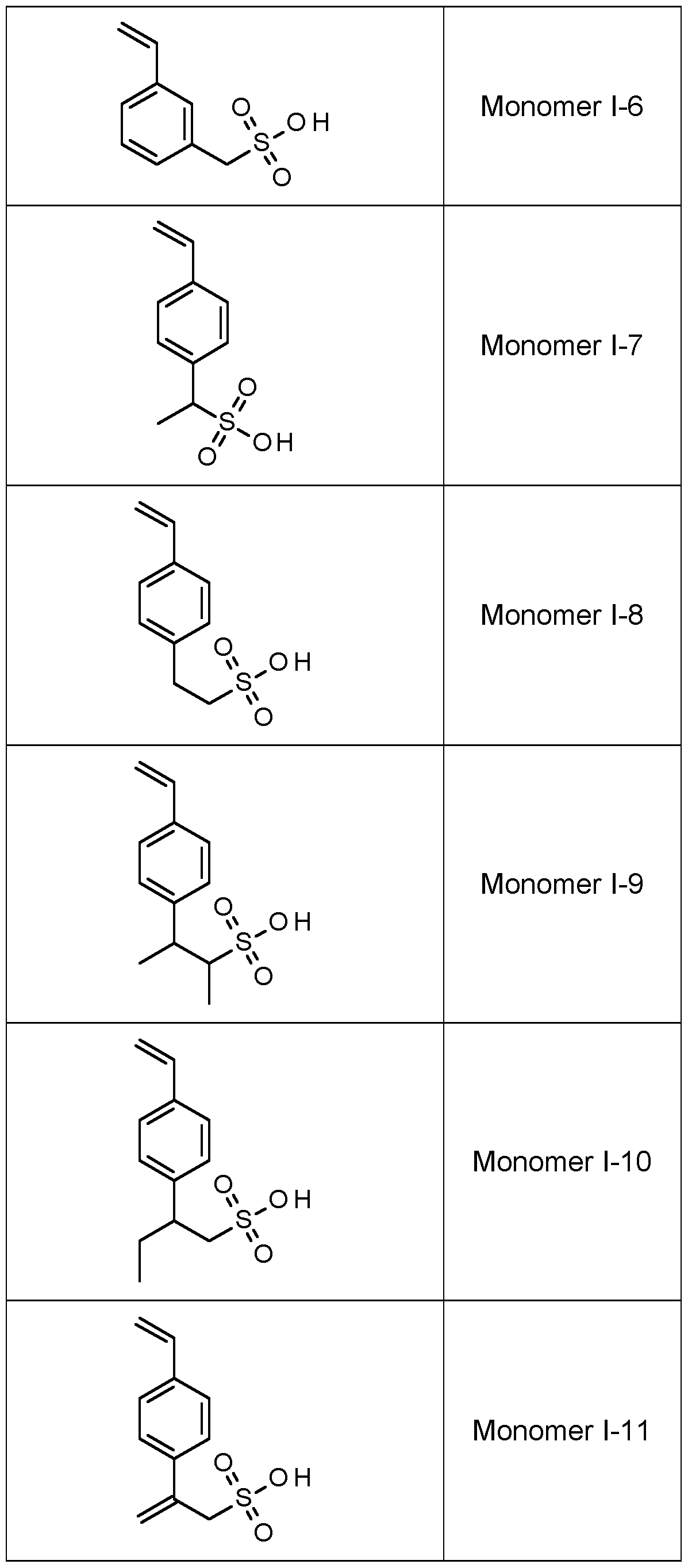
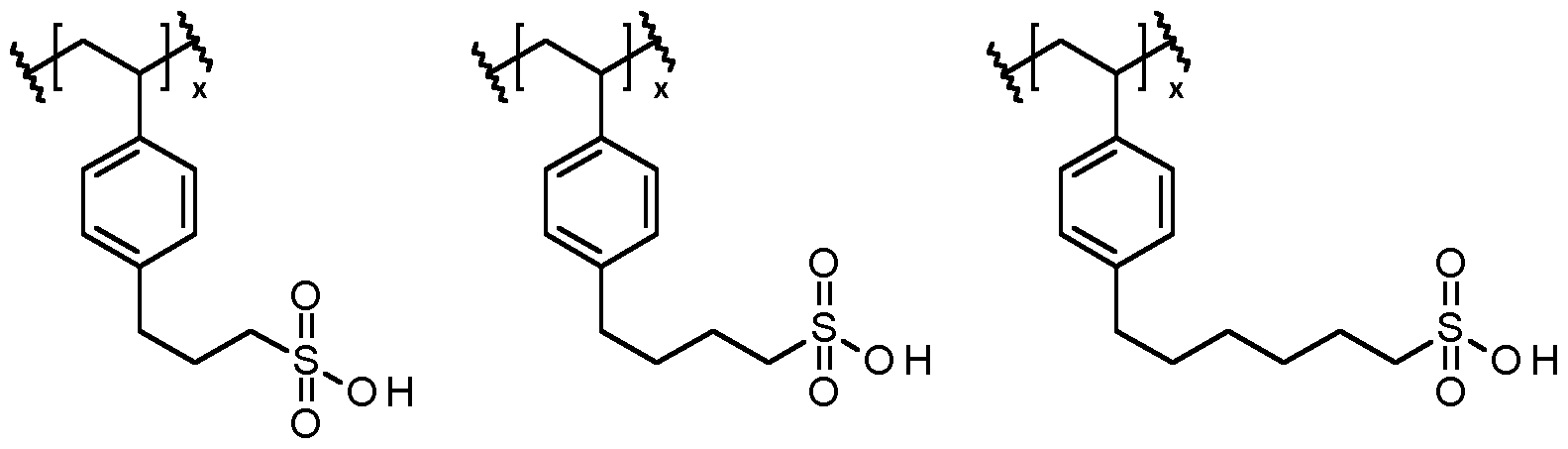
- the conductive polymer dispersion comprises a polyanion, which is a homo- or copolymer of a monomer according Formula I,
- Ri to Rs is selected from the group consisting of hydrogen, a halogen, an ether and a substituted or unsubstituted alkyl group with the proviso that at least one of Ri to Rs is a substituent according to Formula II,
- L represents a divalent linking group having less than 20 carbon atoms
- n represents 0 or 1 ;
- R 6 and R7 are independently selected from the group consisting of hydrogen, a substituted or unsubstituted alkyl group, a substituted or unsubstituted alkenyl group, a substituted or unsubstituted alkynyl group, a substituted or unsubstituted aralkyl group, a substituted or unsubstituted alkaryl group and a substituted or unsubstituted aryl or heteroaryl group; any of L, R 6 and R7 may represent the necessary atoms to form a 5 to 8 membered ring;
- L is preferably selected from the group consisting of substituted or unsubstituted alkylene group, a substituted or unsubstituted alkenylene group and a substituted or unsubstituted alkynylene group, a substituted or unsubstituted alkylene group being more preferred.
- L is preferably a substituted or unsubstituted Ci to C10 alkylene group, more preferably a substituted or unsubstituted Ci to C5 alkylene group.
- n 0.
- R 6 and R7 are preferably independently selected from the group consisting of hydrogen and a substituted or unsubstituted alkyl group, hydrogen being most preferred.
- Ri to R5 is a substituent represented by Formula II.
- R2, R3 and R4 is a substituent represented by Formula II.
- R3 is a substituent represented by Formula II and Ri, R2, R4 and R5 represent hydrogen.
- M preferably represents a quaternary ammonium group, FT or Na + , most preferably M represents FT.
- the polyanion may be a copolymer of a monomer according to Formula I and at least one other monomer.
- the amount of monomers according to Formula I is preferably at least 25 mol%, more preferably at least 50 mol%, most preferably at least 75 mol%, particularly preferred at least 90 mol%, all relative to the total amount of monomer units of the copolymer.
- Copolymers with styrene sulfonic acid are particularly preferred copolymers.
- the weight average molecular weight of the polyanion (Mw) is preferably from 1 000 to 1 000000 Da, more preferably from 50000 to 500000 Da, most preferably from 100000 to 300000 Da.
- X + Y is 1 and X is preferably from 0.25 to 1 , more preferably from 0.50 to 1 , most preferably from 0.75 to 1 , particularly preferred from 0.9 to 1.
- the conductive polymer dispersion may comprise one or more other polyanions.
- the polyanion described above may be combined with PSS.
- the conductive polymer dispersion comprises a conductive polymer.
- the conductive polymer is preferably a polythiophene.
- Such a polythiophene typically has a positive charge located on the main chain of the polymer.
- the positive charge is preferably, at least partially, compensated by an anion.
- the polymer is then often referred to as a self-doped polymer or a intrinsically conductive polymers.
- the monomers used to make such self-doped polymers i.e. comprising an anionic group, are also referred to as self-doped monomers.
- the anion is a separate compound
- the polymer is then typically referred to as a foreign-doped polymer or an extrinsically conductive polymer.
- Anions added as separate compounds are preferably polyanions.
- the conductive polymer dispersion comprises an extrinsically conductive polymer.
- An extrinsically conductive polymer as referred to herein has a positive charge located on the main chain, which is at least partially compensated by anions not covalently bound to the polymer.
- the cationic charge of the extrinsically conductive polymer is at least partially compensated by a polyanion as described above.
- the extrinsically conductive polymer is preferably a polythiophene.
- the polythiophene may be a homopolymer or a copolymer.
- a preferred polythiophene is represented by Formula III, wherein 2 ⁇ n ⁇ 100
- R a and R b independently represents hydrogen, a substituted or unsubstituted C1-C4 alkyl group, or together form a substituted or unsubstituted C1-C4 alkylene group or a substituted or unsubstituted C3-C10 cycloalkylene group.
- n is an integer from 3 to 50, more preferably from 4 to 20.
- R a and R b independently represent an unsubstituted ethylene group, an unsubstituted methylene group, an optionally alkyl-substituted methylene group, an optionally C1-12 alkyl- or phenyl-substituted ethylene group, an unsubstituted 1,3-propylene group or an unsubstituted 1,2- cyclohexylene group.
- a preferred polythiophene is a homopolymer or copolymer of a 3,4-dialkoxy- thiophene of which the two alkoxy groups together form an optionally substituted oxy-alkylene-oxy bridge selected from the group consisting of: 3,4-methylenedioxy-thiophene, 3,4-ethylenedioxythiophene, 3,4-propylene- dioxythiophene, 3,4-butylenedioxythiophene and derivatives thereof.
- a particular preferred extrinsically conductive polymer is polyethylene- dioxythiophene (PEDOT), a homopolymer of 3,4-ethylene-dioxythiopene (EDOT).
- PEDOT polyethylene- dioxythiophene
- EDOT 3,4-ethylene-dioxythiopene
- an intrinsically conductive polymer may also be used in combination with the extrinsically conductive polymer described above.
- such an intrinsically conductive polymer is used as a separate polymer conductive dispersion besides the polymer conductive dispersion including the extrinsically conductive polymer and the polyanion described above.
- An intrinsically conductive polymer as referred to herein means that it has a positive charge located on the main chain that is at least partially compensated by anions covalently bound to the polymer.
- Such intrinsically conductive polymers are for example disclosed in EP-A 1122274.
- Preferred intrinsically conductive polymers are thiophene homo- or co polymers of a monomer according to the Formula IV,
- A represents a substituted or unsubstituted Ci to Cs alkylene bridge further functionalized with at least one functional group selected from the group consisting of a sulfonic acid or salt thereof, a phosphonic acid or salt thereof, a phosphate ester or salt thereof, a sulfate ester or salt thereof and a carboxylic acid or salt thereof,
- a in Formula IV preferably represents a C2-alkylene bridge.
- More preferred intrinsically conductive polymers are thiophene (co-)polymers of a monomer according to the Formula V,
- Li represents a divalent linking group comprising 1 to 15 carbon atoms
- C represents a functional group selected from the group consisting of a sulfonic acid or salt thereof, a phosphonic acid or salt thereof, a phosphate ester or salt thereof, a sulfate ester or salt thereof and a carboxylic acid or salt thereof.
- C preferably represents a sulfonic acid or salt thereof.
- a particularly preferred intrinsically conductive polymer is a thiophene homo- or copolymer including a monomeric unit according to the Formula VI,
- M represents a hydrogen or a counterion to compensate the negative charge of the sulfonate group.
- the polythiophene polymers are preferably prepared by oxidative polymerization of thiophene monomers in an aqueous medium.
- the oxidative polymerization is preferably carried out in the presence of a polyanion.
- the concentration of the thiophene monomer in the aqueous phase medium is preferably in a range from 0.1 to 25 wt%, preferably in a range from 0.5 to 10 wt%, all relative to the total weight of the aqueous reaction medium.
- Suitable oxidizing agents are iron(lll)-salts, such as FeCb, and iron(lll)-salts of aromatic and aliphatic sulfonic acids; H2O2; K2q2q7; alkali metal perborates; alkali metal or ammonium persulfates; and mixtures thereof.
- Particularly preferred oxidizing agents are salts of a peroxydisulfate, in particular K2S2O8, Na 2 S 2 0s; iron(lll)-salts, in particular iron(lll) chloride; or a combination thereof.
- the oxidizing agent is a mixture of Fe2(S04)3 and Na2S208.
- the thiophene monomer can be dissolved or dispersed in the aqueous reaction medium followed by the addition of the oxidizing agent(s), which can also be dissolved or dispersed in an aqueous phase, or the oxidizing agent(s) is/are first dissolved or dispersed in the aqueous reaction medium, followed by the addition of the thiophene monomer, which can also be dissolved or dispersed in an aqueous phase.
- oxidizing agent for example a mixture of Fe 2 (S0 4 ) 3 and Na2S208
- the oxidative polymerization is preferably carried out under an inert atmosphere as disclosed in EP-11453877 (Agfa Gevaert).
- the oxygen content of the reaction medium when the oxidizing agent, for example a salt of peroxydisulfate, is added to it is preferably less than 3 mg per liter, more preferably less than 1.5 mg/liter, most preferably less than 0.5 mg/liter.
- the concentration of oxygen in the reaction medium can be regulated by any means, such as freeze-thaw techniques, prolonged bubbling of an inert gas such as Argon, Nitrogen or Flelium though the reaction medium, consumption of oxygen in a sacrificial reaction under an inert gas blanket.
- the inert gas is preferably bubbled through the reaction medium until the polymerization is completed thereby maintaining the oxygen concentration below 3 mg/I.
- the oxidative polymerization is preferably carried out at low pH , as disclosed in EP-A 1384739 (Fleraeus).
- the pH is preferably 1.5 or less, more preferably 1.00 or less.
- an acid is preferably selected from the group of water- soluble inorganic acids and water-soluble organic acids.
- inorganic acids are hydrochloric acid, sulfuric acid, nitric acid and phosphoric acid.
- organic acids include p-toluenesulfonic acid, benzenesulfonic acid, methanesulfonic acid and trifluoromethanesulfonic acid.
- the temperature of the reaction mixture is preferably between 0 to 100 °C, more preferably between 0 to 50 °C, most preferably between 5 and 30 °C.
- the amount of thiophene monomers and polyanions in the reaction mixture are chosen so that stable polythiophene/polyanion dispersions are obtained of which the solid content is preferably from 0.05 to 25 wt%, more preferably from 0.1 to 10 wt%, most preferably from 0.8 to 2 wt%.
- the liquid composition may be further purified, for example by means of filtration, in particular by means of ultrafiltration, and/or by a treatment with ion exchanger, in particular by a treatment with an anion exchanger and a cation exchanger.
- the conductive polymer dispersion may be further optimized for the application wherein it will be used.
- a polymer capacitor formulation described below may be prepared from the conductive polymer dispersion.
- homogenization techniques may be used during the preparation of the conductive polymer.
- the homogenizing techniques may be selected from:
- Preferred mechanical homogenizers are rotor-stator homogenizers and blade type homogenizers.
- Another mechanical homogenization technique may be the use of a spinning disk reactor.
- Preferred high-pressure homogenizers such as for example a Gaulin homogenizer or an Ariete homogenizer, force the dispersion through a very narrow channel or orifice under pressure.
- Another preferred high-pressure homogenizer is a microfluidizer.
- Two or more homogenizers may be used in combination, preferably in a consecutive way.
- the homogenization techniques may be used before, during and after the polymerization reaction. These homogenization techniques may also be used during the preparation of the liquid formulation described below.
- a liquid formulation may be referred to as a polymer capacitor formulation.
- the formulation may comprise further additives such as surface-active substances, adhesion promoters, crosslinking agents, binders, conductivity increasing compounds, heat-and moisture-stability improving compounds, acidic compounds and alkaline compounds.
- the surface-active compounds may be:
- anionic surfactants such as alkylbenzenesulphonic acids and salts, paraffin sulphonates, alcohol sulphonates, ether sulphonates, sulphosuccinates, phosphate esters, alkyl ether carboxylic acids or carboxylates;
- cationic surfactants such as quaternary alkylammonium salts;
- nonionic surfactants such as linear alcohol ethoxylates, oxo alcohol ethoxylates, alkylphenol ethoxylates or alkyl polyglucosides; and
- - zwitterionic surfactants such as compounds comprising both a carboxylic acid group and a quaternary ammonium group, for example lauryl -N,N - (dimethyl-ammonio)-butyrate and lauryl-/V,/V-(dimethyl)-glycinebetaine; compounds comprising both a sulfuric acid group and quaternary ammonium group, for example 3-[(3-cholamido-propyl)dimethylammonio]-1 -propane- sulfonate, 3-(4-fe/f-butyl-1 -pyridinio)-1 -propanesulfonate, 3-(1 -pyridinio)-1 - propanesulfonate and 3-(benzyl-dimethyl-ammonio)propanesulfonate; compounds comprising both a phosphoric acid group and a quaternary ammonium group, for example with hexadecyl phosphocholine;
- Particular preferred surfactants are the commercially available surfactants available under the trademarks Dynol® and Zonyl®.
- Preferred adhesion promoters are organofunctional silanes or hydrolysates thereof such as 3-glycidoxypropyltrialkoxysilane, 3-amino-propyl- triethoxysilane, 3-mercaptopropyltrimethoxysilane, 3-methacryloxypropyl- trimethoxysilane, vinyltrimethoxysilane or octyltriethoxysilane.
- Preferred crosslinking agents are melamine compounds, blocked isocyanates, functional silanes such as tetraethoxysilane, alkoxysilane hydrolysates, such as tetraethoxysilane, epoxysilanes such as 3-glycidoxy- propyltrialkoxysilane.
- Preferred binders are polyurethanes, polyacrylates or polyolefins.
- Preferred conductivity increasing are:
- lactone groups such as g-butyrolactone or y-valero- lactone
- amide or lactam groups such as caprolactam, N-methylcaprolactam, N,N-dimethylacetamide, N-methylacetamide, formamide, N,N-dimethylformamide (DMF), N-methyl-formamide, N-methyl- formanilide, N-methyl-2-pyrrolidone (NMP), N-octyl-pyrrolidone,
- sulpholane tetramethylene sulphone
- DMSO dimethylsulphoxide
- sugar or sugar derivatives such as arabinose, saccharose, glucose, fructose or lactose
- - di- or polyalcohols such as sorbitol, xylitol, mannitol, mannose, galactose, sorbose, gluconic acid or ethylene glycol, di- or tri(ethylene glycol), 1,1,1- trimethylol-propane, 1,3-propanediol, 1-,2-propane-diol, 1 ,5-pentanediol,
- Particularly preferred conductivity increasing compounds are selected from the groups consisting of N-methyl-pyrrolidinone, N-butyl-pyrrolidone, N-hydroxyethyl-pyrrolidone, DMSO, ethylene glycol and diethylene glycol.
- Preferred stability improving compounds are gallic acid derivatives.
- the polymer capacitor formulation may have a pH of from 1 to 14, more preferably a pH of from 1 to 8.
- the polymer capacitor formulation preferably has a pH of from 2.5 to 8, in order not to damage the dielectric.
- lines 13-32 are preferably used. These compounds do not impair the film formation of the polymer capacitor formulation and are not volatile at higher temperatures such as soldering temperatures.
- Preferred compounds are the bases 2-dimethylaminoethanol, 2,2’-iminodiethanol or 2,2’,2"-nitrilotriethanol and the acid polystyrenesulphonic acid.
- the viscosity of the polymer capacitor formulation is typically optimized as function of the application method and may be between 0.01 and 1 000 mPa-s (measured with a rheometer at 20 °C and a shear rate of 100 s 1 ).
- the viscosity is from 1 to 500 mPa-s, more preferably between from 1 to 250 mPa-s.
- the viscosity is preferably from 1 to 200 mPa-s while in the production of tantalum electrolytic capacitors or aluminium stacked capacitors the viscosity is preferably from 1 to 50 mPa-s.
- the adjustment of the viscosity can, for example, be accomplished by adding appropriate rheology modifiers as a further additive.
- the particle size of the dispersed conductive polymer may have an influence on the impregnation of the porous anode body.
- the median particle size (dso) of the polythiophene/polyanion particles is preferably from 1 to 150 nm, more preferably from 2 to 50 nm, most preferably from 5 to 40 nm.
- the dso particle size is preferably measured by laser diffraction.
- the solids content of polymer capacitor formulation is preferably from 0.01 to 20 wt%, more preferably from 0.1 to 15 wt%, most preferably from 0.25 to 10 wt%, in each case based on the total weight of the formulation.
- a polymer capacitor also referred to as a polymer electrolyte capacitor, is an electrolytic capacitor comprising a solid conductive polymer electrolyte.
- Electrolytic capacitors use a chemical feature of some special metals, often referred to as so-called valve metals, that by anodic oxidation form an insulating oxide layer.
- valve metals By applying a positive voltage to the anode material in an electrolytic bath an oxide barrier layer with a thickness corresponding to the applied voltage may be formed. This oxide layer acts as the dielectric in the electrolytic capacitor.
- the anode surface is roughened and so the oxide layer surface also is roughened.
- a counter electrode has to match the rough insulating oxide surface. This is accomplished by the electrolyte, which acts as the cathode electrode of an electrolytic capacitor.
- this counter electrode consists of one or more layers of a conductive polymer, preferably a polythiophene conductive polymer.
- the main difference between the polymer capacitors is the anode material and its oxide used as the dielectric: - Polymer tantalum electrolytic capacitors use high purity sintered tantalum powder as an anode with tantalum pentoxide (Ta20s) as a dielectric; and
- porous metal layer (anode) covered with its oxide layer (dielectric) is referred to herein as a porous anode body.
- the method of preparing the polymer capacitor according to the present inventions comprises the step of introducing the polymer capacitor formulation into at least part of a porous anode body.
- the polymer capacitor formulation may be introduced into the porous anode body by any known process such as impregnation, dipping, pouring, dripping on, spraying, misting on, knife coating, brushing or printing, for example ink jet, screen or tampon printing.
- the polymer capacitor formulation is introduced into at least part of the porous anode body by dipping body into the polymer capacitor formulation and thus impregnating it with the liquid composition.
- the dipping into or the impregnation with the liquid composition is preferably carried out for a period of from 1 second to 120 minutes, more preferably of from 5 seconds to 60 minutes, most preferably in a range of from 10 seconds to 15 minutes.
- the introduction of the liquid composition into the anode body can be facilitated, for example, by increased or reduced pressure, vibration, ultrasound or heat.
- the solvent contained in the liquid composition is preferably, at least partially, removed to obtain a solid electrolyte which completely or partly covers the dielectric thereby forming a capacitor body.
- the coverage of the dielectric by the solid electrolyte is preferably at least 10%, more preferably at least 25%, most preferably at least 50%. The coverage may be as is described in DE-A-102005043828.
- the solvent is preferably removed by removing the electrode body from the liquid composition and drying it.
- the drying step is preferably carried out at a temperature of from 20 °C to 260 °C, more preferably of from 50 °C to 220 °C, most preferably of from 80 °C to 200 °C.
- the dipping and the drying step may be repeated once or several times to adapt the thickness of the solid electrolyte layer deposited on the dielectric or the degree of filling of the electrolyte in the electrode body to the particular requirements.
- both self-doped and foreign-doped polythiophenes may be used for the formation of the polymer cathode layer.
- Both types of polythiophene polymers may be combined in a single polymer capacitor formulation and introduced as described above.
- both types of polythiopenes are introduced in the capacitor using different polymer capacitor formulations each comprising a self-doped or a foreign- doped polythiophene.
- a self-doped polythiopene is introduced into the porous anode body followed by the introduction of the foreign-doped polythiophene.
- Using both self-doped and foreign-doped polythiophenes is disclosed in for example WO2014/048562 (Heraeus) and US2016/0351338 (AVX).
- the capacitor bodies can be further modified by the method and manner known to the person skilled in the art.
- the capacitor bodies can be covered, for example, with a polymeric outer layer, as is described in DE- A-10 2004 022674 or DE-A-102009 007 594, and/or a graphite layer and a silver layer, as is known from DE-A-10 2005 043 828, while in the case of an aluminium wound capacitor, in accordance with the teaching of US 7,497,879 B2, the capacitor body is incorporated into an aluminium beaker, provided with a sealing glass and firmly closed mechanically by crimping. The capacitor can then be freed from defects in the dielectric in a known manner by ageing.
- INI-01 is 2,2'-Azobis[2-methyl-N-2-hydroxyethyl)propionamide] commercially available from Fujifilm (Belgium).
- INI-02 is 2,2'-azobis[2-(2-imidazolin-2-yl)propane]dihydrochloride commercially available from Fujifilm (Belgium).
- EDOT is 3,4-ethylenedioxythiophene commercially available from Heraeus.
- PSS-1 is a 5.85 wt% aqueous solution of polystyrenesulfonic acid having a Mw of 300 kDa prepared according to a method disclosed in Houben-Weyl, Methoden der organischen Chemie, Vol. E 20, Makromolekulaire Stoffe, Mol 2 (1987), page 1141 ).
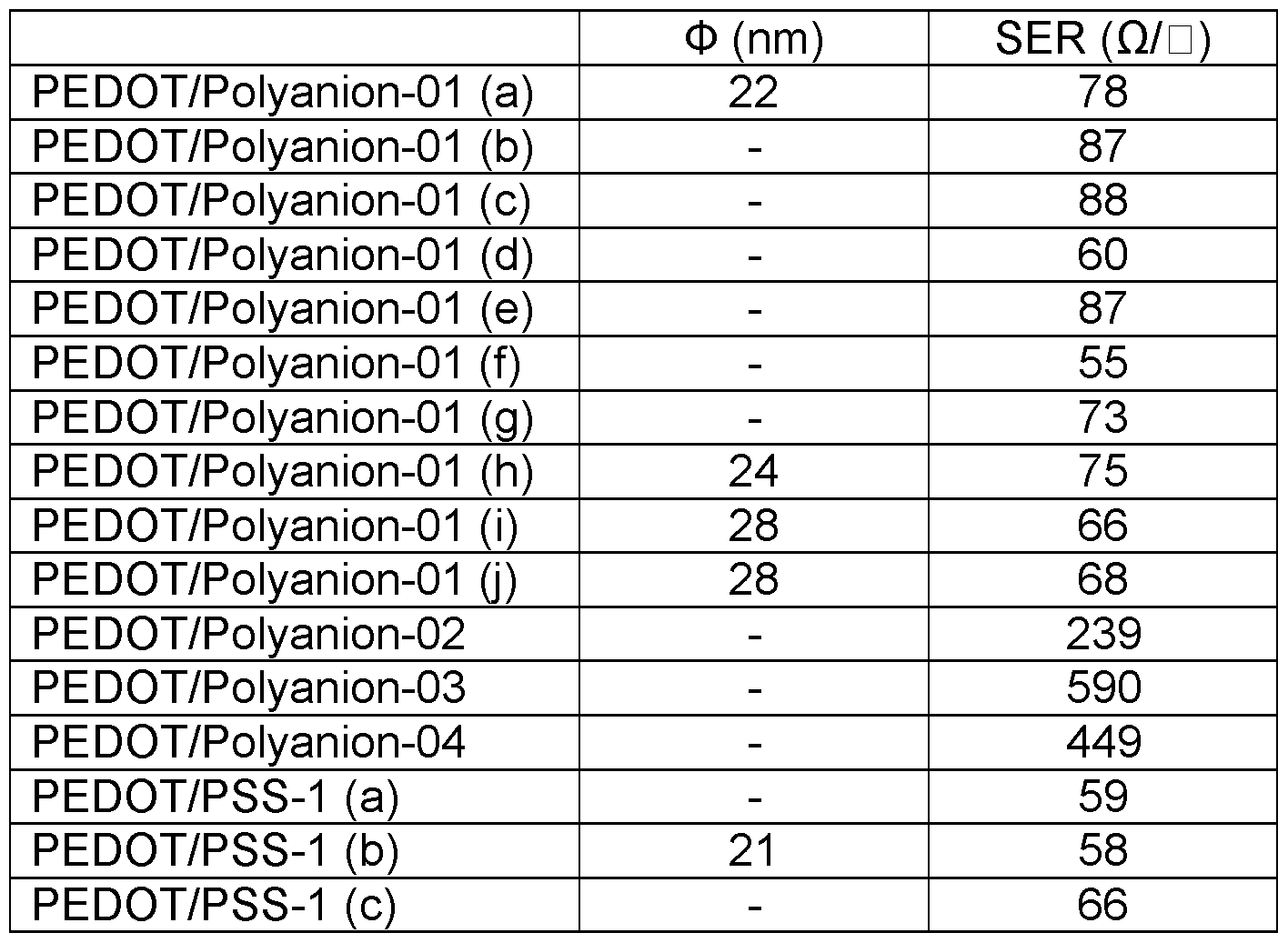
- the surface resistance SER was measured at room temperature using a two point probe method.
- the median particle size was determined by laser diffraction analysis on a Malvern-Panalytical Mastersizer 3000. Molecular weight measurement
- the molecular weight of the polymers was determined by gel permeation chromatography (GPC) on a Waters e2695 alliance with a 2998A PDA detector, calibrated with polystyrene sulfonate standards. The molecular weight distribution is calculated with Waters Empower 3.
- ESR equivalent series resistance
- a 2 wt% solution of INI-01 in water was prepared and degassed with nitrogen for 1 hour. An amount of the initiator solution was added rapidly to the reaction mixture to result in an initiator concentration of 3.33 mol %. The solution was stirred for 20 hours at 90 °C. [0164] Then, the reaction mixture was treated twice with ion exchanger (30 g Lewatit ® MonoPlus S 108 H, filtered and washed with 2x 20 mL water).
- Polyanion-01 (b) synthesized as described for Polyanion-01 (a) using 10.55 g of Monomer I-2 and 73.05 mL of water.
- Polyanion-01 (c) was synthesized as described in Polyanion-01 (a) using 5.22 g of Monomer I-2 and 30.92 mL of water.
- Polyanion-01 (d) was synthesized as described in Polyanion-01 (a) using a 2 wt% solution of INI-02, 4.00 g of Monomer I-2, 22.62 ml_ of water and a reaction temperature of 60 °C.
- Polyanion-01 (e) was synthesized as described in Polyanion-01 (a) using initiator concentration of 2.00 mol %, 5.22 g of Monomer I-2 and 35.46 mL of water.
- Polyanion-01 (f) was synthesized as described in Polyanion-01 (a) using 5.22 g of Monomer I-2 and 30.92 mL of water.
- Polyanion-01 (g) was synthesized as described in Polyanion-01 (a) using a 3.33 mol % solution of INI-02, 10.00 g of Monomer I-2 and 56.56 mL of water.
- a 2 wt% solution of INI-01 in water was prepared and degassed with nitrogen for 1 hour. An amount of the initiator solution was added rapidly to the reaction mixture to result in an initiator concentration of 3.33 mol %. The solution was stirred for 20 hours at 90 °C.
- reaction mixture was treated twice with ion exchanger (50 g Lewatit ® MonoPlus S 108 H, filtered and washed with 2x 50 ml_ water).
- Polyanion-01 (i) was synthesized as described in Polyanion-01 (h) using 3.77 g of 4-vinylbenzenesulfonic acid, sodium salt and 4.03 g of Monomer I-2 and 45.43 ml_ of water.
- Polyanion-01 (j) was synthesized as described in Polyanion-01 (h) using 1.85 g of 4-vinylbenzenesulfonic acid, sodium salt and 5.94 g of Monomer I-2 and 45.74 mL of water.
- a 2 wt% solution of INI-01 in water was prepared and degassed with nitrogen for 1 hour. An amount of the initiator solution was added rapidly to the reaction mixture to result in an initiator concentration of 3.33 mol %. The solution was stirred for 20 hours at 90 °C.
- reaction mixture was diluted with water (25 mL) and treated twice with ion exchanger (10 g Lewatit ® MonoPlus S 108 H, filtered and washed with 2x 10 mL water).
- a 2 wt% solution of INI-01 in water was prepared and degassed with nitrogen for 1 hour. An amount of the initiator solution was added rapidly to the reaction mixture to result in an initiator concentration of 3.33 mol %. The solution was stirred for 20 hours at 90 °C.
- reaction mixture was diluted with water (25 mL) and treated twice with ion exchanger (10 g Lewatit ® MonoPlus S 108 H, filtered and washed with 2x 10 mL water).
- a 2 wt% solution of INI-01 in water was prepared and degassed with nitrogen for 1 hour. An amount of the initiator solution was added rapidly to the reaction mixture to result in an initiator concentration of 3.33 mol %. The solution was stirred for 20 hours at 90 °C.
- reaction mixture was treated twice with ion exchanger (10 g Lewatit ® MonoPlus S 108 H, filtered and washed with 2x 15 mL water).
- the reaction mixture is treated with ion exchanger (65 g Lewatit ® MonoPlus M600 + 35 g Lewatit ® MonoPlus S 108 H, filtered and washed 3x 25 ml_ water, repeated).
- the resulting viscous mixture was treated with high shear homogenization (Lab Gaulin, 4x 600 bar).
- the dispersion is concentrated in vacuo. This procedure yielded a blue dispersion of PEDOT/Polyanion-01 (a) in water (1.38 wt%).
- a polymerization was carried out in the same manner as in Example 6 except for using 88.7 g of Polyanion-01 (b) obtained in Example 2, 210 mL of deionized water, 3.1 g of nitric acid, 0.11 g of iron(lll) sulfate, 2.26 g of sodium persulfate and 1 .23 g of EDOT.
- the reaction mixture is treated with ion exchanger (77 g Lewatit ® MonoPlus M600 + 42 g Lewatit ® MonoPlus S 108 H, filtered and washed 3x 30 ml_ water, repeated). This procedure yielded a blue dispersion of PEDOT : Polyanion-01 (b) in water (1.15 wt%).
- a polymerization was carried out in the same manner as in Example 6 except for using 172.8 g of Polyanion-01 (c) obtained in Example 2, 206 ml_ of deionized water, 3.9 g of nitric acid, 0.14 g of iron(lll) sulfate, 2.86 g of sodium persulfate and 1 .55 g of EDOT.
- the reaction mixture is treated with ion exchanger (100 g Lewatit ® MonoPlus M600 + 55 g Lewatit ® MonoPlus S 108 H, filtered and washed 2x 50 ml_ water, repeated). This procedure yielded a blue dispersion of PEDOT/Polyanion-01 (c) in water (1.28 wt%).
- a polymerization was carried out in the same manner as in Example 6 except for using 83.2 g of Polyanion-01 (d) obtained in Example 2, 176 mL of deionized water, 2.70 g of nitric acid, 0.10 g of iron(lll) sulfate, 1.96 g of sodium persulfate and 1 .06 g of EDOT.
- the reaction mixture is treated with ion exchanger (70 g Lewatit ® MonoPlus M600 + 40 g Lewatit ® MonoPlus S 108 H, filtered and washed 2x 50 mL water, repeated). This procedure yielded a blue dispersion of PEDOT/Polyanion-01 (d) in water (1.27 wt%).
- a polymerization was carried out in the same manner as in Example 6 except for using 191 .7 g of Polyanion-01 (e) obtained in Example 2, 197 ml_ of deionized water, 4.0 g of nitric acid, 0.15 g of iron(lll) sulfate, 2.94 g of sodium persulfate and 1 .59 g of EDOT.
- the reaction mixture is treated with ion exchanger (100 g Lewatit ® MonoPlus M600 + 55 g Lewatit ® MonoPlus S 108 H, filtered and washed 2x 50 mL water, repeated). This procedure yielded a blue dispersion of PEDOT/Polyanion-01 (e) in water (1 .23 wt%).
- a polymerization was carried out in the same manner as in Example 6 except for using 131.9 g of Polyanion-01 (f) obtained in Example 2, 346 ml_ of deionized water, 5.0 g of nitric acid, 0.18 g of iron(lll) sulfate, 3.62 g of sodium persulfate and 1 .96 g of EDOT.
- the reaction mixture is treated with ion exchanger (125 g Lewatit ® MonoPlus M600 + 66 g Lewatit ® MonoPlus S 108 H, filtered and washed 2x 50 mL water, repeated). This procedure yielded a blue dispersion of PEDOT/Polyanion-01 (f) in water (1.40 wt%).
- a polymerization was carried out in the same manner as in Example 6 except for using 134.9 g of Polyanion-01 (g) obtained in Example 2, 323 ml_ of deionized water, 4.8 g of nitric acid, 0.17 g of iron(lll) sulfate, 3.47 g of sodium persulfate and 1.88 g of EDOT.
- the reaction mixture is treated with ion exchanger (120 g Lewatit ® MonoPlus M600 + 65 g Lewatit ® MonoPlus S 108 H, filtered and washed 2x 50 ml_ water, repeated). This procedure yielded a blue dispersion of PEDOT/Polyanion-01 (g) in water (1.22 wt%).
- a polymerization was carried out in the same manner as in Example 6 except for using 110.8 g of Polyanion-01 (h) obtained in Example 3, 213 mL of deionized water, 3.48 g of nitric acid, 0.12 g of iron(lll) sulfate, 2.53 g of sodium persulfate and 1.37 g of EDOT.
- the reaction mixture is treated with ion exchanger (90 g Lewatit ® MonoPlus M600 + 50 g Lewatit ® MonoPlus S 108 H, filtered and washed 2x 50 mL water, repeated). This procedure yielded a blue dispersion of PEDOT/Polyanion-01 (h) in water (1.23 wt%).
- a polymerization was carried out in the same manner as in Example 6 except for using 125.7 g of Polyanion-01 (i) obtained in Example 3, 198 mL of deionized water, 3.43 g of nitric acid, 0.12 of iron(lll) sulfate, 2.50 g of sodium persulfate and 1.35 g of EDOT.
- the reaction mixture is treated with ion exchanger (90 g Lewatit ® MonoPlus M600 + 50 g Lewatit ® MonoPlus S 108 H, filtered and washed 2x 50 mL water, repeated). This procedure yielded a blue dispersion of PEDOT/Polyanion-01 (i) in water (1.38 wt%).
- a polymerization was carried out in the same manner as in Example 6 except for using 119.2 g of Polyanion-01 (j) obtained in Example 3, 205 mL of deionized water, 3.39 g of nitric acid, 0.12 g of iron(lll) sulfate, 2.46 g of sodium persulfate and 1.34 g of EDOT.
- the reaction mixture is treated with ion exchanger (90 g Lewatit ® MonoPlus M600 + 45 g Lewatit ® MonoPlus S 108 H, filtered and washed 2x 50 mL water, repeated). This procedure yielded a blue dispersion of PEDOT/Polyanion-01 (j) in water (1.32 wt%).
- a polymerization was carried out in the same manner as in Example 6 except for using 22.6 g of Polyanion-02 obtained in Example 4, 14.8 mL of deionized water, 0.35 g of nitric acid, 0.013 g of iron(lll) sulfate, 0.25 g of sodium persulfate and 0.14 g of EDOT.
- the reaction mixture is treated with ion exchanger (10 g Lewatit ® MonoPlus M600 + 5 g Lewatit ® MonoPlus S 108 H, filtered and washed 2x 15 mL water, repeated). This procedure yielded a blue dispersion of PEDOT/Polyanion-02 in water (1.00 wt%).
- a polymerization was carried out in the same manner as in Example 6 except for using 24.3 g of Polyanion-03 obtained in Example 4, 13.6 mL of deionized water, 0.34 g of nitric acid, 0.012 g of iron(lll) sulfate, 0.25 g of sodium persulfate and 0.13 g of EDOT.
- the reaction mixture is treated with ion exchanger (10 g Lewatit ® MonoPlus M600 + 5 g Lewatit ® MonoPlus S 108 H, filtered and washed 2x 15 mL water, repeated). This procedure yielded a blue dispersion of PEDOT/Polyanion-03 in water (1.32 wt%).
- a polymerization was carried out in the same manner as in Example 6 except for using 46.6 g of Polyanion-04 obtained in Example 4, 8.2 mL of deionized water, 0.45 g of nitric acid, 0.016 g of iron(lll) sulfate, 0.33 g of sodium persulfate and 0.18 g of EDOT.
- the reaction mixture is treated with ion exchanger (12 g Lewatit ® MonoPlus M600 + 6 g Lewatit ® MonoPlus S 108 H, filtered and washed 2x 15 mL water, repeated). This procedure yielded a blue dispersion of PEDOT/Polyanion-04 in water (1.90 wt%).
- reaction mixture was then treated with ion exchanger (110 g Lewatit ® MonoPlus M600 + 60 g Lewatit ® MonoPlus S 108 H, filtered and washed 2x 50 mL water, repeated).
- ion exchanger 110 g Lewatit ® MonoPlus M600 + 60 g Lewatit ® MonoPlus S 108 H, filtered and washed 2x 50 mL water, repeated).
- the resulting viscous mixture was treated with high shear homogenization (Lab Gaulin, 4x 600 bar).
- Example 1 This procedure yielded a blue dispersion of PEDOT/PSS-1 (b) in water (1.22 wt%) and the pH level was modified to 3.16 with 2-dimethyl- amino-ethanol.
- Example 1 with 2.06 g of EDOT, 88.7 g of PSS-1 , 389 mL of deionized water, 14.3 g of nitric acid, 0.094 g of iron(lll) sulfate, 3.48 g of sodium persulfate, 130 g of Lewatit ® MonoPlus M600 and 70 g of Lewatit ® MonoPlus S 108 H. This procedure yielded a blue dispersion of PEDOT/PSS-1 (c) in water (1.15 wt%).
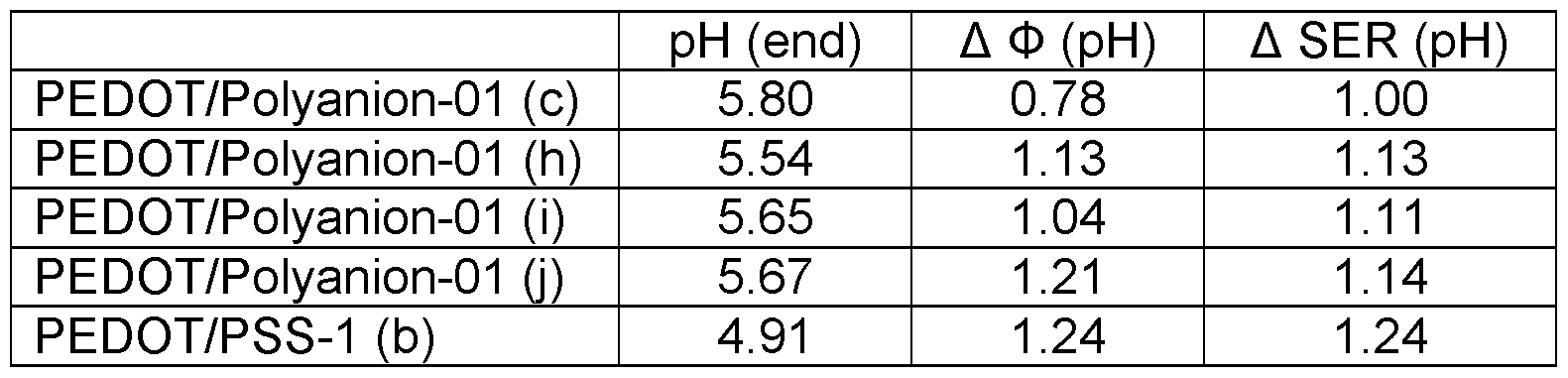
- Table 9 shows the ratio of the median particle size of the dispersion at the end pH to the median particle of the dispersion at the start pH [F pH(end)/0 pH(start)].
- Table 9 also shows the ratio of the SER of the coated layers of dispersions at both the start and the end pH (D SER (pH)).
- a chemically converted aluminum foil including an etching layer on a surface was prepared as a valve metal base.
- a dielectric layer was formed to cover the aluminum foil.
- the resulting chemically converted aluminum foil was used as an anode component.
- the rated voltage of the alumina layer is 90 V and the capacitance is 6.4 pF/cm 2
- a 20 pm thick sold mask was printed on the Al foil with arrays of openings of 10 mm c 10 mm.
- the patterned foil was cut to 30 mm x 105 mm strips with 5 openings on them.
- the conductive polymer dispersions used in the manufacturing of the capacitors were formulated with water, diethyleneglycol and DYNOLTM 604 and treated with an ultrasound homogenization step prior to coating of the aluminum foils.
- the strip was then dip-coated with PEDOT/Polyanion-01 (e) dispersion and dried at 150 °C for 5 minutes. The dip-coating and curing steps were repeated for several times. Then, carbon paste and silver paste were sequentially screen-printed on the PEDOT layer and cured.
- Additional capacitors were prepared and measured as described above where PEDOT/Polyanion-01 (f), PEDOT/Polyanion-01 (g) and PEDOT/PSS-1 (c) were used as conductive polymer dispersions.
Landscapes
- Chemical & Material Sciences (AREA)
- Engineering & Computer Science (AREA)
- Chemical Kinetics & Catalysis (AREA)
- Organic Chemistry (AREA)
- Power Engineering (AREA)
- Polymers & Plastics (AREA)
- Materials Engineering (AREA)
- Health & Medical Sciences (AREA)
- Medicinal Chemistry (AREA)
- Life Sciences & Earth Sciences (AREA)
- Wood Science & Technology (AREA)
- Microelectronics & Electronic Packaging (AREA)
- Electrochemistry (AREA)
- Manufacturing & Machinery (AREA)
- Polyoxymethylene Polymers And Polymers With Carbon-To-Carbon Bonds (AREA)
- Addition Polymer Or Copolymer, Post-Treatments, Or Chemical Modifications (AREA)
- Compositions Of Macromolecular Compounds (AREA)
Abstract
Description








Claims


Priority Applications (5)
| Application Number | Priority Date | Filing Date | Title |
|---|---|---|---|
| EP22732492.8A EP4347708B1 (en) | 2021-06-04 | 2022-06-03 | Polythiophene/polyanion compositions |
| CN202280040100.XA CN117460779A (en) | 2021-06-04 | 2022-06-03 | Polythiophene/polyanionic composition |
| JP2023572730A JP7773569B2 (en) | 2021-06-04 | 2022-06-03 | Polythiophene/Polyanion Compositions |
| KR1020237041897A KR20240005866A (en) | 2021-06-04 | 2022-06-03 | Polythiophene/polyanion composition |
| US18/566,238 US20240279489A1 (en) | 2021-06-04 | 2022-06-03 | Polythiophene/Polyanion Compositions |
Applications Claiming Priority (2)
| Application Number | Priority Date | Filing Date | Title |
|---|---|---|---|
| EP21177790 | 2021-06-04 | ||
| EP21177790.9 | 2021-06-04 |
Publications (1)
| Publication Number | Publication Date |
|---|---|
| WO2022254012A1 true WO2022254012A1 (en) | 2022-12-08 |
Family
ID=76502663
Family Applications (1)
| Application Number | Title | Priority Date | Filing Date |
|---|---|---|---|
| PCT/EP2022/065198 Ceased WO2022254012A1 (en) | 2021-06-04 | 2022-06-03 | Polythiophene/polyanion compositions |
Country Status (6)
| Country | Link |
|---|---|
| US (1) | US20240279489A1 (en) |
| EP (1) | EP4347708B1 (en) |
| JP (1) | JP7773569B2 (en) |
| KR (1) | KR20240005866A (en) |
| CN (1) | CN117460779A (en) |
| WO (1) | WO2022254012A1 (en) |
Cited By (3)
| Publication number | Priority date | Publication date | Assignee | Title |
|---|---|---|---|---|
| US20220084756A1 (en) * | 2019-01-25 | 2022-03-17 | Panasonic Intellectual Property Management Co., Ltd. | Electrolytic capacitor and method for production thereof |
| EP4570844A1 (en) | 2023-12-13 | 2025-06-18 | Agfa-Gevaert Nv | Novel polythiophene/polyanion complexes |
| EP4570845A1 (en) * | 2023-12-13 | 2025-06-18 | Agfa-Gevaert Nv | Novel polythiophene/polyanion compositions |
Citations (22)
| Publication number | Priority date | Publication date | Assignee | Title |
|---|---|---|---|---|
| US3306871A (en) * | 1959-09-23 | 1967-02-28 | Dow Chemical Co | Synthetic latexes comprising ar-monovinyl aromatic sulfonic acid saltstyrene-butadiene terpolymers |
| EP0440957A2 (en) | 1990-02-08 | 1991-08-14 | Bayer Ag | New polythiophene dispersions, their preparation and their use |
| EP1122274A1 (en) | 2000-02-03 | 2001-08-08 | Bayer Ag | Method for making pi-conjugated water soluble polymers |
| EP1384739A1 (en) | 2002-07-26 | 2004-01-28 | H.C. Starck GmbH | Aqueous dispersion containing a complex of poly(3,4-dialkoxythiophene) and a polyanion and method for producing the same |
| DE102004022674A1 (en) | 2004-05-07 | 2005-11-24 | H.C. Starck Gmbh | Electrolytic condenser for use in electronic circuits, e.g. for computers, comprises porous electrode, dielectric, solid electrolyte and a layer containing a polymeric anion, a polyaniline or polythiophene and a binder |
| JP2006244994A (en) * | 2005-02-07 | 2006-09-14 | Fuji Photo Film Co Ltd | Solid electrolyte, manufacturing method of solid electrolyte, electrode membrane junction and fuel cell |
| DE102005043828A1 (en) | 2005-09-13 | 2007-03-22 | H.C. Starck Gmbh | Process for the preparation of electrolytic capacitors |
| US7497879B2 (en) | 2006-06-29 | 2009-03-03 | Sanyo Electric Co., Ltd. | Method of manufacturing electrolytic capacitor and electrolytic capacitor |
| WO2010003874A2 (en) | 2008-07-11 | 2010-01-14 | H.C. Starck Clevios Gmbh | Method for production of electrolyte capacitors |
| DE102009007594A1 (en) | 2009-02-05 | 2010-08-12 | H.C. Starck Clevios Gmbh | Process for the preparation of electrolytic capacitors with a polymeric outer layer. |
| WO2014048562A2 (en) | 2012-09-27 | 2014-04-03 | Heraeus Precious Metals Gmbh & Co. Kg | Use of mixtures of self-doped and foreign-doped conductive polymers in a capacitor |
| US20150279503A1 (en) | 2012-09-27 | 2015-10-01 | Heraeus Precious Metals Gmbh & Co. Kg | Use of PEDOT/PSS Dispersions of High PEDOT Content for the Production of Capacitors and Solar Cells |
| US20160064113A1 (en) * | 2014-08-28 | 2016-03-03 | Shin-Etsu Chemical Co., Ltd. | Conductive polymer composite and substrate |
| US20160351338A1 (en) | 2015-05-29 | 2016-12-01 | Avx Corporation | Solid Electrolytic Capacitor Element for Use in Dry Conditions |
| US20180068801A1 (en) | 2015-05-29 | 2018-03-08 | Panasonic Intellectual Property Management Co., Ltd. | Electrolytic capacitor and conductive polymer dispersion |
| US20180240564A1 (en) | 2017-02-22 | 2018-08-23 | Shin-Etsu Chemical Co., Ltd. | Conductive polymer composite and substrate |
| US20200211785A1 (en) | 2018-12-28 | 2020-07-02 | Panasonic Intellectual Property Management Co., Ltd. | Electrolytic capacitor |
| US20200279692A1 (en) | 2017-12-28 | 2020-09-03 | Panasonic Intellectual Property Management Co., Ltd. | Electrolytic capacitor and method for manufacturing same |
| JP2020183493A (en) | 2019-05-09 | 2020-11-12 | 東ソー株式会社 | Complex composed of polythiophene-polystyrene sulfonate copolymer, and water dispersion containing the same |
| JP6785390B1 (en) | 2020-03-23 | 2020-11-18 | 東ソー・ファインケム株式会社 | Conductive polymer aqueous dispersion, conductive polymer coating film and its manufacturing method |
| CN112047921A (en) * | 2020-09-11 | 2020-12-08 | 山东海科新源材料科技股份有限公司 | Sulfur-containing additive based on vinyl sulfate, electrolyte containing sulfur-containing additive and lithium ion battery |
| KR102211924B1 (en) | 2013-10-02 | 2021-02-04 | 주식회사 넥슨코리아 | Apparatus and method for exchanging items at close range |
Family Cites Families (5)
| Publication number | Priority date | Publication date | Assignee | Title |
|---|---|---|---|---|
| JP2005174220A (en) | 2003-12-15 | 2005-06-30 | Konica Minolta Photo Imaging Inc | Ic card and method for manufacturing ic card |
| US7396880B2 (en) | 2005-05-24 | 2008-07-08 | Arkema Inc. | Blend of ionic (co)polymer resins and matrix (co)polymers |
| JP2007035611A (en) | 2005-06-21 | 2007-02-08 | Aisin Seiki Co Ltd | Electrolyte composition for fuel cell and fuel cell |
| DE102010047086A1 (en) | 2010-10-01 | 2012-04-05 | Heraeus Clevios Gmbh | Layered structures with improved electrical characteristics including PEDOT / PSS and a stabilizer |
| TW201838974A (en) | 2017-04-19 | 2018-11-01 | 印度商Pi工業公司 | Heterocyclic compounds with microbicidal properties |
-
2022
- 2022-06-03 EP EP22732492.8A patent/EP4347708B1/en active Active
- 2022-06-03 US US18/566,238 patent/US20240279489A1/en active Pending
- 2022-06-03 KR KR1020237041897A patent/KR20240005866A/en active Pending
- 2022-06-03 CN CN202280040100.XA patent/CN117460779A/en active Pending
- 2022-06-03 JP JP2023572730A patent/JP7773569B2/en active Active
- 2022-06-03 WO PCT/EP2022/065198 patent/WO2022254012A1/en not_active Ceased
Patent Citations (22)
| Publication number | Priority date | Publication date | Assignee | Title |
|---|---|---|---|---|
| US3306871A (en) * | 1959-09-23 | 1967-02-28 | Dow Chemical Co | Synthetic latexes comprising ar-monovinyl aromatic sulfonic acid saltstyrene-butadiene terpolymers |
| EP0440957A2 (en) | 1990-02-08 | 1991-08-14 | Bayer Ag | New polythiophene dispersions, their preparation and their use |
| EP1122274A1 (en) | 2000-02-03 | 2001-08-08 | Bayer Ag | Method for making pi-conjugated water soluble polymers |
| EP1384739A1 (en) | 2002-07-26 | 2004-01-28 | H.C. Starck GmbH | Aqueous dispersion containing a complex of poly(3,4-dialkoxythiophene) and a polyanion and method for producing the same |
| DE102004022674A1 (en) | 2004-05-07 | 2005-11-24 | H.C. Starck Gmbh | Electrolytic condenser for use in electronic circuits, e.g. for computers, comprises porous electrode, dielectric, solid electrolyte and a layer containing a polymeric anion, a polyaniline or polythiophene and a binder |
| JP2006244994A (en) * | 2005-02-07 | 2006-09-14 | Fuji Photo Film Co Ltd | Solid electrolyte, manufacturing method of solid electrolyte, electrode membrane junction and fuel cell |
| DE102005043828A1 (en) | 2005-09-13 | 2007-03-22 | H.C. Starck Gmbh | Process for the preparation of electrolytic capacitors |
| US7497879B2 (en) | 2006-06-29 | 2009-03-03 | Sanyo Electric Co., Ltd. | Method of manufacturing electrolytic capacitor and electrolytic capacitor |
| WO2010003874A2 (en) | 2008-07-11 | 2010-01-14 | H.C. Starck Clevios Gmbh | Method for production of electrolyte capacitors |
| DE102009007594A1 (en) | 2009-02-05 | 2010-08-12 | H.C. Starck Clevios Gmbh | Process for the preparation of electrolytic capacitors with a polymeric outer layer. |
| WO2014048562A2 (en) | 2012-09-27 | 2014-04-03 | Heraeus Precious Metals Gmbh & Co. Kg | Use of mixtures of self-doped and foreign-doped conductive polymers in a capacitor |
| US20150279503A1 (en) | 2012-09-27 | 2015-10-01 | Heraeus Precious Metals Gmbh & Co. Kg | Use of PEDOT/PSS Dispersions of High PEDOT Content for the Production of Capacitors and Solar Cells |
| KR102211924B1 (en) | 2013-10-02 | 2021-02-04 | 주식회사 넥슨코리아 | Apparatus and method for exchanging items at close range |
| US20160064113A1 (en) * | 2014-08-28 | 2016-03-03 | Shin-Etsu Chemical Co., Ltd. | Conductive polymer composite and substrate |
| US20160351338A1 (en) | 2015-05-29 | 2016-12-01 | Avx Corporation | Solid Electrolytic Capacitor Element for Use in Dry Conditions |
| US20180068801A1 (en) | 2015-05-29 | 2018-03-08 | Panasonic Intellectual Property Management Co., Ltd. | Electrolytic capacitor and conductive polymer dispersion |
| US20180240564A1 (en) | 2017-02-22 | 2018-08-23 | Shin-Etsu Chemical Co., Ltd. | Conductive polymer composite and substrate |
| US20200279692A1 (en) | 2017-12-28 | 2020-09-03 | Panasonic Intellectual Property Management Co., Ltd. | Electrolytic capacitor and method for manufacturing same |
| US20200211785A1 (en) | 2018-12-28 | 2020-07-02 | Panasonic Intellectual Property Management Co., Ltd. | Electrolytic capacitor |
| JP2020183493A (en) | 2019-05-09 | 2020-11-12 | 東ソー株式会社 | Complex composed of polythiophene-polystyrene sulfonate copolymer, and water dispersion containing the same |
| JP6785390B1 (en) | 2020-03-23 | 2020-11-18 | 東ソー・ファインケム株式会社 | Conductive polymer aqueous dispersion, conductive polymer coating film and its manufacturing method |
| CN112047921A (en) * | 2020-09-11 | 2020-12-08 | 山东海科新源材料科技股份有限公司 | Sulfur-containing additive based on vinyl sulfate, electrolyte containing sulfur-containing additive and lithium ion battery |
Non-Patent Citations (5)
| Title |
|---|
| "Handbook of Conducting Polymers", vol. 1, 1986, MARCEL DEKKER, pages: 46 - 57 |
| D. M. WELSH ET AL., POLYMER PREPRINTS, vol. 38, no. 2, 1997, pages 320 |
| L. GROENENDAAL ET AL., ADVANCED MATERIALS, vol. 12, 2000, pages 481 - 494 |
| L. J. KLOEPPNER ET AL., POLYMER PREPRINTS, vol. 40, no. 2, 1999, pages 792 |
| P. SCHOTTLAND ET AL., SYNTHETIC METALS, vol. 101, 1999, pages 7 - 8 |
Cited By (7)
| Publication number | Priority date | Publication date | Assignee | Title |
|---|---|---|---|---|
| US20220084756A1 (en) * | 2019-01-25 | 2022-03-17 | Panasonic Intellectual Property Management Co., Ltd. | Electrolytic capacitor and method for production thereof |
| US11769637B2 (en) * | 2019-01-25 | 2023-09-26 | Panasonic Intellectual Property Management Co., Ltd. | Electrolytic capacitor and method for production thereof |
| US12183518B2 (en) | 2019-01-25 | 2024-12-31 | Panasonic Intellectual Property Management Co., Ltd. | Electrolytic capacitor and method for production thereof |
| EP4570844A1 (en) | 2023-12-13 | 2025-06-18 | Agfa-Gevaert Nv | Novel polythiophene/polyanion complexes |
| EP4570845A1 (en) * | 2023-12-13 | 2025-06-18 | Agfa-Gevaert Nv | Novel polythiophene/polyanion compositions |
| WO2025124871A1 (en) | 2023-12-13 | 2025-06-19 | Agfa-Gevaert Nv | Novel polythiophene/polyanion complexes |
| WO2025125281A1 (en) * | 2023-12-13 | 2025-06-19 | Agfa-Gevaert Nv | Novel polythiophene/polyanion compositions |
Also Published As
| Publication number | Publication date |
|---|---|
| KR20240005866A (en) | 2024-01-12 |
| JP7773569B2 (en) | 2025-11-19 |
| EP4347708A1 (en) | 2024-04-10 |
| US20240279489A1 (en) | 2024-08-22 |
| CN117460779A (en) | 2024-01-26 |
| JP2024521771A (en) | 2024-06-04 |
| EP4347708B1 (en) | 2025-01-15 |
Similar Documents
| Publication | Publication Date | Title |
|---|---|---|
| KR101803997B1 (en) | A Method for improving electrical parameters in capacitors comprising PEDOT/PSS as a solid electrolyte through a polyalkylene glycol | |
| EP4347708B1 (en) | Polythiophene/polyanion compositions | |
| US7990684B2 (en) | Dispersion liquid of a conductive composition, a conductive composition, and a solid electrolytic capacitor | |
| KR101786157B1 (en) | Layer compositions With Improved Electrical Parameters Comprising PEDOT/PSS and a Stabilizer | |
| EP2154197B1 (en) | Conductive polymer suspension and method for producing the same, conductive polymer material, electrolytic capacitor, and solid electrolytic capacitor and method for producing the same | |
| EP3037497B1 (en) | Process for producing functionalized polythiophenes | |
| DE60224724T2 (en) | 3,4-ALKYLENDIOXYTHIOPHONE COMPOUNDS AND THEIR POLYMERS | |
| EP1498920B1 (en) | Electrolytic capacitors having polythiophene with alkylenoxythiathiopen units | |
| EP1375560B1 (en) | Alkylenedioxythiophene dimers and trimers | |
| EP2161293B1 (en) | Conductive polymer suspension and method for producing the same, conductive polymer material, electrolytic capacitor, and solid electrolytic capacitor and method for producing the same | |
| US20110122546A1 (en) | Conductive polymer suspension and method for producing the same, conductive polymer material, electrolytic capacitor, and solid electrolytic capacitor and method for producing the same | |
| WO2010015468A1 (en) | Method for producing polythiophenes using hydrogen peroxide as an oxidizing agent | |
| JP2011521464A (en) | Process for manufacturing an electrolytic capacitor | |
| US12492303B2 (en) | Polythiophene/polyanion compositions | |
| EP4324866A1 (en) | High purity sulfonated thiophene monomers | |
| EP4581654A1 (en) | Method of preparing a polymer capacitor, a conductive polymer composition, and it's use as a conductive layer in an electronic device | |
| EP4465318A1 (en) | Pedot-dispersion with high number of particles | |
| EP4465319A1 (en) | Pedot dispersion with low power index n | |
| EP4570845A1 (en) | Novel polythiophene/polyanion compositions | |
| EP4570844A1 (en) | Novel polythiophene/polyanion complexes |
Legal Events
| Date | Code | Title | Description |
|---|---|---|---|
| 121 | Ep: the epo has been informed by wipo that ep was designated in this application |
Ref document number: 22732492 Country of ref document: EP Kind code of ref document: A1 |
|
| WWE | Wipo information: entry into national phase |
Ref document number: 2023572730 Country of ref document: JP |
|
| WWE | Wipo information: entry into national phase |
Ref document number: 18566238 Country of ref document: US |
|
| ENP | Entry into the national phase |
Ref document number: 20237041897 Country of ref document: KR Kind code of ref document: A |
|
| WWE | Wipo information: entry into national phase |
Ref document number: 202280040100.X Country of ref document: CN Ref document number: 1020237041897 Country of ref document: KR |
|
| WWE | Wipo information: entry into national phase |
Ref document number: 202317084974 Country of ref document: IN |
|
| WWE | Wipo information: entry into national phase |
Ref document number: 2022732492 Country of ref document: EP |
|
| NENP | Non-entry into the national phase |
Ref country code: DE |
|
| ENP | Entry into the national phase |
Ref document number: 2022732492 Country of ref document: EP Effective date: 20240104 |