EP4570525A1 - Reifen - Google Patents
Reifen Download PDFInfo
- Publication number
- EP4570525A1 EP4570525A1 EP24216414.3A EP24216414A EP4570525A1 EP 4570525 A1 EP4570525 A1 EP 4570525A1 EP 24216414 A EP24216414 A EP 24216414A EP 4570525 A1 EP4570525 A1 EP 4570525A1
- Authority
- EP
- European Patent Office
- Prior art keywords
- tire
- groove
- crown
- circumferential
- lateral grooves
- Prior art date
- Legal status (The legal status is an assumption and is not a legal conclusion. Google has not performed a legal analysis and makes no representation as to the accuracy of the status listed.)
- Pending
Links
Images

Classifications
-
- B—PERFORMING OPERATIONS; TRANSPORTING
- B60—VEHICLES IN GENERAL
- B60C—VEHICLE TYRES; TYRE INFLATION; TYRE CHANGING; CONNECTING VALVES TO INFLATABLE ELASTIC BODIES IN GENERAL; DEVICES OR ARRANGEMENTS RELATED TO TYRES
- B60C11/00—Tyre tread bands; Tread patterns; Anti-skid inserts
- B60C11/03—Tread patterns
- B60C11/0306—Patterns comprising block rows or discontinuous ribs
-
- B—PERFORMING OPERATIONS; TRANSPORTING
- B60—VEHICLES IN GENERAL
- B60C—VEHICLE TYRES; TYRE INFLATION; TYRE CHANGING; CONNECTING VALVES TO INFLATABLE ELASTIC BODIES IN GENERAL; DEVICES OR ARRANGEMENTS RELATED TO TYRES
- B60C11/00—Tyre tread bands; Tread patterns; Anti-skid inserts
- B60C11/03—Tread patterns
- B60C11/0327—Tread patterns characterised by special properties of the tread pattern
- B60C11/033—Tread patterns characterised by special properties of the tread pattern by the void or net-to-gross ratios of the patterns
-
- B—PERFORMING OPERATIONS; TRANSPORTING
- B60—VEHICLES IN GENERAL
- B60C—VEHICLE TYRES; TYRE INFLATION; TYRE CHANGING; CONNECTING VALVES TO INFLATABLE ELASTIC BODIES IN GENERAL; DEVICES OR ARRANGEMENTS RELATED TO TYRES
- B60C11/00—Tyre tread bands; Tread patterns; Anti-skid inserts
- B60C11/03—Tread patterns
- B60C2011/0337—Tread patterns characterised by particular design features of the pattern
- B60C2011/0339—Grooves
- B60C2011/0341—Circumferential grooves
-
- B—PERFORMING OPERATIONS; TRANSPORTING
- B60—VEHICLES IN GENERAL
- B60C—VEHICLE TYRES; TYRE INFLATION; TYRE CHANGING; CONNECTING VALVES TO INFLATABLE ELASTIC BODIES IN GENERAL; DEVICES OR ARRANGEMENTS RELATED TO TYRES
- B60C11/00—Tyre tread bands; Tread patterns; Anti-skid inserts
- B60C11/03—Tread patterns
- B60C2011/0337—Tread patterns characterised by particular design features of the pattern
- B60C2011/0339—Grooves
- B60C2011/0341—Circumferential grooves
- B60C2011/0346—Circumferential grooves with zigzag shape
-
- B—PERFORMING OPERATIONS; TRANSPORTING
- B60—VEHICLES IN GENERAL
- B60C—VEHICLE TYRES; TYRE INFLATION; TYRE CHANGING; CONNECTING VALVES TO INFLATABLE ELASTIC BODIES IN GENERAL; DEVICES OR ARRANGEMENTS RELATED TO TYRES
- B60C11/00—Tyre tread bands; Tread patterns; Anti-skid inserts
- B60C11/03—Tread patterns
- B60C2011/0337—Tread patterns characterised by particular design features of the pattern
- B60C2011/0339—Grooves
- B60C2011/0358—Lateral grooves, i.e. having an angle of 45 to 90 degees to the equatorial plane
-
- B—PERFORMING OPERATIONS; TRANSPORTING
- B60—VEHICLES IN GENERAL
- B60C—VEHICLE TYRES; TYRE INFLATION; TYRE CHANGING; CONNECTING VALVES TO INFLATABLE ELASTIC BODIES IN GENERAL; DEVICES OR ARRANGEMENTS RELATED TO TYRES
- B60C11/00—Tyre tread bands; Tread patterns; Anti-skid inserts
- B60C11/03—Tread patterns
- B60C2011/0337—Tread patterns characterised by particular design features of the pattern
- B60C2011/0339—Grooves
- B60C2011/0358—Lateral grooves, i.e. having an angle of 45 to 90 degees to the equatorial plane
- B60C2011/0365—Lateral grooves, i.e. having an angle of 45 to 90 degees to the equatorial plane characterised by width
-
- B—PERFORMING OPERATIONS; TRANSPORTING
- B60—VEHICLES IN GENERAL
- B60C—VEHICLE TYRES; TYRE INFLATION; TYRE CHANGING; CONNECTING VALVES TO INFLATABLE ELASTIC BODIES IN GENERAL; DEVICES OR ARRANGEMENTS RELATED TO TYRES
- B60C11/00—Tyre tread bands; Tread patterns; Anti-skid inserts
- B60C11/03—Tread patterns
- B60C2011/0337—Tread patterns characterised by particular design features of the pattern
- B60C2011/0339—Grooves
- B60C2011/0358—Lateral grooves, i.e. having an angle of 45 to 90 degees to the equatorial plane
- B60C2011/0372—Lateral grooves, i.e. having an angle of 45 to 90 degees to the equatorial plane with particular inclination angles
-
- B—PERFORMING OPERATIONS; TRANSPORTING
- B60—VEHICLES IN GENERAL
- B60C—VEHICLE TYRES; TYRE INFLATION; TYRE CHANGING; CONNECTING VALVES TO INFLATABLE ELASTIC BODIES IN GENERAL; DEVICES OR ARRANGEMENTS RELATED TO TYRES
- B60C11/00—Tyre tread bands; Tread patterns; Anti-skid inserts
- B60C11/03—Tread patterns
- B60C2011/0337—Tread patterns characterised by particular design features of the pattern
- B60C2011/0386—Continuous ribs
- B60C2011/0388—Continuous ribs provided at the equatorial plane
Definitions
- the present invention relates to a tire.
- Patent Document 1 discloses a tire with tread blocks whose shapes are improved for mud performance, wet performance, and steering stability performance on dry road surfaces.
- Patent Document 1 Japanese Patent Application Publication No.2018-149978
- the present invention was made in view of the above circumstances, and a primary objective of the present invention is to provide a tire improved in noise performance while maintaining excellent mud performance.
- a tire comprises: a tread portion having a first tread edge and a second tread edge, and provided with four circumferential grooves disposed between the first and second tread edges and extending continuously in a tire circumferential direction so that the tread portion is axially divided into five land portions, wherein
- the "virtual zone” is, in other words, the trace left when the circumferential width of the groove end is moved parallel to the tire axis direction.
- the tire of the present invention can be improved in noise performance while maintaining mud performance.
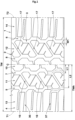
- FIG. 1 is a developed partial view of a tread portion 2 of a tire 1 as an embodiment of the present invention.
- the tire 1 is a pneumatic tire designed to be suitable for use in four-wheel drive vehicles such as SUVs so as to run not only on paved roads but also off-road such as muddy terrains and rocky terrain.
- four-wheel drive vehicles such as SUVs so as to run not only on paved roads but also off-road such as muddy terrains and rocky terrain.
- application of the present invention is not limited to tires such as in the present embodiment.
- the tread portion 2 has a pair of tread edges: a first tread edge T1 and a second tread edge T2.
- the tread portion 2 is provided with four circumferential grooves 3 continuously extending in the tire circumferential direction, and thereby, the tread portion 2 is axially divided into five land portions 4.
- the tread edges T1 and T2 are the axial outermost edges of the ground contacting patch of the tire which occurs when the tire under its normal state is contacted with a flat horizontal surface at a camber angle of 0 degrees and is loaded with 58% of the normal tire load for the tire.
- the normal state of the tire 1 is such that the tire is mounted on a normal rim, and inflated to a normal pressure, but loaded with no tire load.
- the normal state of the tire 1 is such that the tire is put under a standard usage condition according to the purpose of use of the tire, but not yet attached to the vehicle and loaded with no tire load.
- the above-mentioned normal rim is a wheel rim officially approved or recommended for the tire by the standardization organization on which the tire is based, i.e. JATMA (Japan and Asia), T&RA (North America), ETRTO (Europe), TRAA (Australia), STRO (Scandinavia), ALAPA (Latin America), ITTAC (India) and the like which are effective in the area where the tire is manufactured, sold or used.
- the above-mentioned normal pressure is the maximum air pressure officially approved or recommended for the tire by the standardization organization on which the tire is based, for example, the “maximum air pressure” in JATMA, the maximum pressure given in the "Tire Load Limits at Various Cold Inflation Pressures” table in TRA, the “Inflation Pressure” in ETRTO, or the like.
- the normal tire load is the maximum tire load officially approved or recommended for the tire by the same standardization organization and specified in the Air-pressure/Maximum-load Table or similar list, for example, the "maximum air pressure” in JATMA, the “Inflation Pressure” in ETRTO, the maximum pressure given in the "Tire Load Limits at Various Cold Inflation Pressures” table in TRA or the like.
- the normal tire load is the maximum tire load recommended for the tire by the tire manufacturer.
- the four circumferential grooves 3 are a first shoulder circumferential groove 5, a second shoulder circumferential groove 6, a first crown circumferential groove 7, and a second crown circumferential groove 8.
- the first shoulder circumferential groove 5 is located closest to the first tread edge T1
- the second shoulder circumferential groove 6 is located closest to the second tread edge T2.
- the first crown circumferential groove 7 is located between the first shoulder circumferential groove 5 and the tire equator C.
- the second crown circumferential groove 8 is located between the second shoulder circumferential groove 6 and the tire equator C.
- the groove widths W1 of the circumferential grooves 3 are at least 3 mm.
- the groove widths W1 are not less than 3.0% and not more than 7.0% of the tread width TW.
- the tread width TW corresponds to the distance in the tire axial direction from the first tread edge T1 to the second tread edge T2 in the normal state.
- the depths of the circumferential grooves 3 are preferably 5 to 10 mm in the case that the tire 1 is of a passenger car tire size.
- the five land portions 4 are:
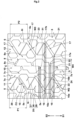
- FIG. 2 shows the crown land portion 10, the first middle land portion 11, and the second middle land portion 12.
- the first middle land portion 11 is provided with a plurality of first middle lateral grooves 16.
- the first middle lateral grooves 16 each extend across the entire axial width of the first middle land portion 11.
- the second middle land portion 12 is provided with a plurality of second middle lateral grooves 17.
- the second middle lateral grooves 17 each extend across the entire axial width of the second middle land portion 12.
- the first middle lateral grooves 16 and the second middle lateral grooves 17 are each inclined with respect to the tire axial direction.
- first middle lateral grooves 16 and the second middle lateral grooves 17 are inclined in a same direction with respect to the tire axial direction.
- first middle lateral grooves 16 are inclined in one direction with respect to the tire axial direction
- second middle lateral grooves 17 are inclined in one direction with respect to the tire axial direction which is different from the first middle lateral grooves 16.
- each of these grooves 16 and 17 has its first end and second end respectively located on one side (first side S1) and the other side (second side S2) in the tire circumferential direction.
- first side S1 is in the downward direction
- second side S2 is in the upward direction.
- each first middle lateral groove 16 has a first end 16a on the first side S1 and a second end 16b on the second side S2 in the tire circumferential direction
- each second middle lateral groove 17 has a first end 17a on the first side S1 and a second end 17b on the second side S2 in the tire circumferential direction.
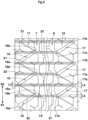
- FIG.3 shows the first middle land portion 11 and the second middle land portion 12, omitting the crown portion land 10.
- the first end 16a of each first middle lateral groove 16 overlaps with a first virtual zone 21 formed by extending the second end 17b of one of the second middle lateral grooves 17 to the first middle land portion 11 in parallel with the tire axial direction
- the second end 16b of each first middle lateral grooves 16 overlaps with a second virtual zone 22 formed by extending the first end 17a of one of the second middle lateral grooves 17 to the first middle land portion 11 in parallel with the tire axial direction.
- the tread portion 2 is provided with four circumferential grooves 3. Further, the first middle land portion 11 is provided with the first middle lateral grooves 16, and the second middle land portion 12 is provided with the second middle lateral grooves 17. Such various grooves provide reaction forces in multiple directions when running on mud terrain, and help to maintain mud performance.
- pitch sound has been known as a noise generated from a tire when running.
- One of the causes of such pitch sound is impact force generated when lateral grooves extending in the tire axial direction contact a road surface. Such impact force causes the tread portion and sidewall portions (not shown) to vibrate periodically which may generate pitch sound.
- first middle lateral grooves 16 and the second middle lateral grooves 17 are arranged as described above, it becomes possible for the first middle lateral grooves 16 and the second middle lateral grooves 17 to alternately and thereby continuously contact with the ground when running, and as a result, the pulsation of the impact force described above can be reduced. In the tire 1 of the present invention, therefore, pitch noise caused by impact force can be reduced, and the noise performance can be improved.
- the tread portion 2 is provided with a tread pattern which is substantially point symmetrical with respect to a point on the tire equator C as shown in FIG. 1 .
- the expression “substantially” means that the tread pattern is not strictly point symmetric when a so-called pitch variation technique is employed. Accordingly, below descriptions for components (such as grooves, sipes and ground contacting elements) located on the first tread edge T1 side of the tire equator C, can be applied to corresponding components located on the second tread edge T2 side of the tire equator C mutatis mutandis.
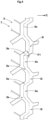
- first crown circumferential groove 7 shown in FIG. 4 as an example of the circumferential grooves 3, the configuration of the circumferential groove 3 will be described below. The description below can be applied to not only the first crown circumferential groove 7, but also the second crown circumferential groove 8, the first shoulder circumferential groove 5 and the second shoulder circumferential groove 6.
- the circumferential groove 3 extends in a zigzag shape. But, the circumferential groove 3 may be extended linearly in parallel with the tire circumferential direction.
- the circumferential groove 3 may take various forms such that the center line 3c of the groove is in a triangular waveform, a sine waveform, a trapezoidal waveform or the like.
- the center line 3c of the circumferential groove 3 is formed in a trapezoidal waveform. This can improve not only mud performance but also running performance on rocky terrain with relatively large rocks.
- the circumferential groove 3 comprises axially inner groove segments 3i, axially outer groove segments 3o, and oblique groove segments 3s.
- the axially inner groove segments 3i each extend linearly in the tire circumferential direction on the tire equator C side.
- the axially outer groove segments 3o each extends linearly in the tire circumferential direction on the axially outer side of the axially inner groove segments 3i.
- the oblique groove segments 3s connects between the axially inner groove segments 3i and the axially outer groove segments 3o.
- each oblique groove segment 3s is, for example, 40 to 60 degrees with respect to the tire axial direction.
- the axially inner groove segments 3i and the axially outer groove segments 3o in the present embodiment each extend in parallel with the tire circumferential direction, but are not to be limited to such an arrangement.
- the distance L1 in the tire axial direction from the tire equator C to the center line of the first crown circumferential groove 7 is 5% to 20% of a half tread width TWh.
- the half tread width TWh is a half of the tread width TW between the first and second tread edges T1 and T2, corresponding to the distance in the tire axial direction from the tire equator C to the first tread edge T1 or second tread edge T2.
- the first shoulder circumferential groove 5 extends in a zigzag shape, its center line extends in the tire circumferential direction while oscillating in the tire axial direction within the above-mentioned range.
- the distance in the tire axial direction from the tire equator C to the center line of the second crown circumferential groove 8 is 5% to 20% of the half tread width TWh.
- the distance L2 in the tire axial direction from the tire equator C to the center line of the first shoulder circumferential groove 5 is 45% to 55% of the half tread width TWh.
- the distance in the tire axial direction from the tire equator C to the center line of the second shoulder circumferential groove 6 is 45% to 55% of the half tread width TWh.
- first middle lateral grooves 16 and the second middle lateral grooves 17 are inclined in a first direction with respect to the tire axis direction (upward slope to the right in the figures of the present embodiment).
- first middle lateral groove 16 and the second middle lateral groove 17 extend linearly with the above-mentioned slope, but they are not limited to such arrangement.
- first middle lateral grooves 16 and the second middle lateral grooves 17 are each inclined at an angle ⁇ 2 of from 20 to 60 degrees with respect to the tire axial direction.
- the angle ⁇ 2 is preferably not less than 30 degrees, more preferably not less than 35 degrees, but preferably not more than 50 degrees, more preferably not more than 45 degrees.
- the first middle lateral groove 16 has a groove width W2 which is constant in its longitudinal direction.
- the groove width W2 of the first middle lateral groove 16 is 5% to 20%, preferably 10% to 15% of the average value of pitch lengths P1 of the first middle lateral grooves 16 in the tire circumferential direction.
- the groove width W3 of the second middle lateral groove 17 is 5% to 20%, preferably 10% to 15% of the average value of pitch lengths P2 of the second middle lateral grooves 17 in the tire circumferential direction.
- the overlapping length L4 in the tire circumferential direction of the first end 16a of the first middle lateral groove 16 with the first virtual zone 21 is preferably 30% to 100%, more preferably 60% to 100% of the length L3 in the tire circumferential direction of the first virtual zone 21.
- the overlapping length L6 in the tire circumferential direction of the second end 16b of the first middle lateral groove 16 with the second virtual zone 22 is preferably 30% to 100%, more preferably 60% to 100% of the length L5 in the tire circumferential direction of the second virtual zone 22.
- each of the first middle lateral grooves 16 is connected to one of connection positions between the axially outer groove segments 7o and the oblique groove segments 7s of the first crown circumferential groove 7 so that the angle between the first middle lateral groove 16 and the axially outer groove segment 7o is an obtuse angle.
- each of the first middle lateral grooves 16 is connected to one of connection positions between the axially inner groove segments 5i and the oblique groove segments 5s of the first shoulder circumferential groove 5 so that the angle between the first middle lateral groove 16 and the axially inner groove segment 5i is an obtuse angle.
- each of the second middle lateral grooves 17 is connected to one of connection positions between the axially outer groove segments 8o and the oblique groove segments 8s of the second crown circumferential groove 8 so that the angle between the second middle lateral groove 17 and the axially outer groove segment 8o is an obtuse angle.
- each of the second middle lateral grooves 17 is connected to one of connection positions between the axially inner groove segments 6i and the oblique groove segments 6s of the second shoulder circumferential groove 6 so that the angle between the second middle lateral groove 17 and the axially inner groove segment 6i is an obtuse angle.
- the mud performance can be further improved.
- the first middle land portion 11 is provided with sipes 25.
- sipe means a very narrow groove or cut whose main portion has a width of 1.5 mm or less between its two opposite sipe walls.
- the main portion means a portion where the two opposite sipe walls extend substantially parallel to each other in the tire radial direction.
- substantially parallel means that the angle formed between the two opposite sipe walls is 10 degrees or less.
- a groove in the general sense namely, for drainage purpose means a groove whose two opposite walls do not come into contact with each other even when ground pressure is applied, to maintain a substantial drainage path. Therefore, the width of the groove is at least 2.0 mm.
- the sipes 25 extend in the tire radial direction with a constant width.
- the sipe 25 may have a chamfered portion formed on its edge(s) where the width is increased toward the radially outside.
- the sipe 25 may be provided with a so-called flask bottom in which the width is increased at the bottom.
- the sipes 25 provided in the first middle land portion 11 in this example include a center sipe 26, an inner sipe 27, and an outer sipe 28.
- the sipes 25 are inclined, for example, in a second direction with respect to the tire axial direction (downward sloe to the right in the figures of the present embodiment). Thereby, the sipes 25 are inclined in an opposite direction to the first middle lateral groove 16 with respect to the tire axial direction.
- the angles of the sipes 25 are, for example, 20 to 40 degrees with respect to the tire axial direction.
- the center sipe 26 extends from the first crown circumferential groove 7 to the first shoulder circumferential groove 5.
- the center sipe 26 extends from the connection position between the first middle lateral groove 16 and the first crown circumferential groove 7 to the connection position between the first middle lateral groove 16 and the first shoulder circumferential groove 5.
- Such center sipe 26 provides a large frictional force on muddy or rocky terrain, and is useful for improving off-road performance.
- the inner sipe 27 extends from the first crown circumferential groove 7 and ends within the first middle land portion 11 without communicating with other grooves and sipes, for example.
- the inner sipe 27 is connected to the connection position between the axially outer groove segment 7o and the oblique groove segment 7s of the first crown circumferential groove 7.
- the inner sipe 27 has an angular difference of 5 degrees or less from the center sipe 26.
- the angular difference is preferably zero, that is, these sipes are parallel with each other.
- the length of the inner sipe 27 is 50% or less, preferably 20% to 40% of the length of the center sipe 26.
- Such inner sipe 27 helps to improve the mud performance and steering stability in a well-balanced manner.
- the outer sipe 28 extends from the first shoulder circumferential groove 5 and ends within the first middle land portion 11 without communicating with other grooves and sipes.
- the outer sipe 28 is connected to the connection position between the axially inner groove segment 5i and the oblique groove segment 5s of the first shoulder circumferential groove 5.
- the outer sipe 28 has an angular difference of 5 degrees or less from the center sipes 26. The angular difference is preferably zero, that is, these sipes are parallel with each other. Further, the length of the outer sipe 28 is 50% or less, preferably 20% to 40% of the length of the center sipe 26.
- the second middle land portion 12 is provided with sipes similar to the first middle land portion 11.
- the sipes of the second middle land portion 12 have the same configurations as the sipes 25 provided in the first middle land portion 11, therefore, the above description for the sipes 25 of the first middle land portion 11 can also be applied to the sipes of the second middle land portion 12 mutatis mutandis, so the description will be omitted.
- the crown land portion 10 is provided with a plurality of first crown lateral grooves 31 and a plurality of second crown lateral grooves 32.
- the first crown lateral grooves 31 are connected to the first crown circumferential groove 7 at positions in the tire circumferential direction different from the positions at which the first middle lateral grooves 16 are connected to the first crown circumferential groove 7.
- a T-junction formed by the first middle lateral groove 16 and the first crown circumferential groove 7 and a T-junction formed by the first crown lateral groove 31 and the first crown circumferential groove 7 are arranged alternately in the tire circumferential direction.
- the second crown lateral grooves 32 are connected to the second crown circumferential groove 8 in the same way as the first crown lateral grooves 31 as described above.
- the first crown lateral grooves 31 end within the crown land portion 10.
- the length L7 in the tire axial direction of the first crown lateral groove 31 is 15% to 30% of the maximum width W4 in the tire axial direction of the crown land portion 10.
- the angle of the first crown lateral groove 31 with respect to the tire axial direction is, for example, 10 degrees or less.
- the second crown lateral grooves 32 are the same configuration as the first crown lateral grooves 31 as the tread pattern is point symmetrical.
- third virtual zones 23 which are formed by extending the first crown lateral grooves 31 in parallel with the tire axial direction to the first middle land portion 11 do not overlap with the first virtual zones 21 and the second virtual zones 22.
- fourth virtual zones 24 which are formed by extending the second crown lateral grooves 32 in parallel with the tire axial direction to the first middle land portion 11 do not overlap with the first virtual zones 21 and the second virtual zones 22.
- Such arrangement of the lateral grooves can improve wear resistance of the first middle land portion 11 and the crown land portion 10.
- FIG. 5 is an enlarged partial view showing the first shoulder land portion 13.
- the first shoulder land portion 13 is provided with a plurality of transverse shoulder lateral grooves 36 and a plurality of non-transverse shoulder lateral grooves 37.
- these lateral grooves 36 and 37 are arranged alternately in the tire circumferential direction.
- the transverse shoulder lateral groove 36 extends from the first shoulder circumferential groove 5 to the first tread edge T1.
- the non-transverse shoulder lateral groove 37 extends axially outward from the first shoulder circumferential groove 5, and ends on the axially inside of the first tread edge T1.
- the transverse shoulder lateral groove 36 is connected to a connection position between the axially outer groove segment 5o and the oblique groove segment 5s of the first shoulder circumferential groove 5.
- the transverse shoulder lateral groove 36 has a groove width continuously increasing toward the first tread edge T1, and the angle ⁇ 3 formed between two groove edges of the transverse shoulder lateral groove 36 is 3 to 8 degrees for example.
- Such transverse shoulder lateral groove 36 can quickly discharge mud that has gotten into the groove when running on muddy terrain, and helps to continuously exhibit excellent mud performance.
- the transverse shoulder lateral groove 36 in this example is arranged at a smaller angle with respect to the tire axial direction than the angle ⁇ 2 of the first middle lateral groove 16.
- the angle of the transverse shoulder lateral groove 36 is, for example, 5 degrees or less with respect to the tire axial direction.
- Such transverse shoulder lateral grooves 36 is useful for improving traction performance of the tire on muddy terrain.
- the non-transverse shoulder lateral groove 37 is connected to a connection position between the axially inner groove segment 5i and the oblique groove segment 5s of the first shoulder circumferential groove 5.
- the non-transverse shoulder lateral groove 37 in this example is composed of a short groove segment 37a extending axially outward from the first shoulder circumferential groove 5, and a major groove segment 37b extending axially outward from the axially outer end of the short groove segment 37a.
- the short groove segment 37a is inclined with respect to the tire axial direction to the second side S2.
- the major groove segment 37b is inclined with respect to the tire axial direction to the second side S2 at a smaller angle than the short groove segment 37a.
- the angle of the major groove segment 37b is, for example, 5 degrees or less with respect to the tire axial direction.
- the non-transverse shoulder lateral groove 37 has a constant groove width W6 along its longitudinal direction.
- the groove width W6 of the non-transverse shoulder lateral groove 37 is in a range from 40% to 60% of the groove width W5 of the transverse shoulder lateral groove 36 measured at the first tread edge T1.
- Such non-transverse shoulder lateral groove 37 helps to improve the mud performance and steering stability in a well-balanced manner.
- the distance L8 in the tire axial direction from the axially outer end of the non-transverse shoulder lateral groove 37 to the first tread edge T1 is 15% or less, for example, 5% to 10% of the maximum width W7 in the tire axial direction of the first shoulder land portion 13.
- Such non-transverse shoulder lateral grooves 37 can suppress uneven wear and chipping-off of tread rubber around the first tread edge T 1.
- the second shoulder land portion 14 has substantially the same configuration as the first shoulder land portion 13 described above since the tread pattern is point symmetrical. Therefore, the description of the first shoulder land portion 13 can be applied to the second shoulder land portion 14 mutatis mutandis, so the description will be omitted.
- the land ratio of the tread portion 2 in the present embodiment is 60% to 80%, preferably 65% to 75%.
- the "land ratio" of a tread element means the ratio of the actual ground contacting area of the tread element to the overall area (inclusive of grooves and sipes) of the tread element.
- the land ratio of the crown land portion 10 is, for example, 80% to 95%, preferably 90% to 95%.
- the land ratios of the first middle land portion 11 and the second middle land portion 12 are, for example, 75% to 95%, preferably 80% to 90%.
- the land ratios of the first shoulder land portion 13 and the second shoulder land portion 14 are, for example, 70% to 90%, preferably 75% to 85%.
Landscapes
- Engineering & Computer Science (AREA)
- Mechanical Engineering (AREA)
- Tires In General (AREA)
Applications Claiming Priority (1)
| Application Number | Priority Date | Filing Date | Title |
|---|---|---|---|
| JP2023212336A JP2025095937A (ja) | 2023-12-15 | 2023-12-15 | タイヤ |
Publications (1)
| Publication Number | Publication Date |
|---|---|
| EP4570525A1 true EP4570525A1 (de) | 2025-06-18 |
Family
ID=93742909
Family Applications (1)
| Application Number | Title | Priority Date | Filing Date |
|---|---|---|---|
| EP24216414.3A Pending EP4570525A1 (de) | 2023-12-15 | 2024-11-29 | Reifen |
Country Status (3)
| Country | Link |
|---|---|
| US (1) | US20250196541A1 (de) |
| EP (1) | EP4570525A1 (de) |
| JP (1) | JP2025095937A (de) |
Citations (6)
| Publication number | Priority date | Publication date | Assignee | Title |
|---|---|---|---|---|
| US20170225514A1 (en) * | 2016-02-04 | 2017-08-10 | Sumitomo Rubber Industries, Ltd. | Tire |
| JP2018149978A (ja) | 2017-03-14 | 2018-09-27 | 住友ゴム工業株式会社 | タイヤ |
| US20180312009A1 (en) * | 2017-04-28 | 2018-11-01 | Sumitomo Rubber Industries, Ltd. | Tire |
| US20190054775A1 (en) * | 2017-08-17 | 2019-02-21 | The Goodyear Tire & Rubber Company | Tread for a pneumatic tire |
| US20190202242A1 (en) * | 2017-12-28 | 2019-07-04 | Sumitomo Rubber Industries, Ltd. | Tire |
| US10363780B2 (en) * | 2014-12-17 | 2019-07-30 | Sumitomo Rubber Industries, Ltd. | Pneumatic tire |
-
2023
- 2023-12-15 JP JP2023212336A patent/JP2025095937A/ja active Pending
-
2024
- 2024-11-15 US US18/948,740 patent/US20250196541A1/en active Pending
- 2024-11-29 EP EP24216414.3A patent/EP4570525A1/de active Pending
Patent Citations (6)
| Publication number | Priority date | Publication date | Assignee | Title |
|---|---|---|---|---|
| US10363780B2 (en) * | 2014-12-17 | 2019-07-30 | Sumitomo Rubber Industries, Ltd. | Pneumatic tire |
| US20170225514A1 (en) * | 2016-02-04 | 2017-08-10 | Sumitomo Rubber Industries, Ltd. | Tire |
| JP2018149978A (ja) | 2017-03-14 | 2018-09-27 | 住友ゴム工業株式会社 | タイヤ |
| US20180312009A1 (en) * | 2017-04-28 | 2018-11-01 | Sumitomo Rubber Industries, Ltd. | Tire |
| US20190054775A1 (en) * | 2017-08-17 | 2019-02-21 | The Goodyear Tire & Rubber Company | Tread for a pneumatic tire |
| US20190202242A1 (en) * | 2017-12-28 | 2019-07-04 | Sumitomo Rubber Industries, Ltd. | Tire |
Also Published As
| Publication number | Publication date |
|---|---|
| US20250196541A1 (en) | 2025-06-19 |
| JP2025095937A (ja) | 2025-06-26 |
Similar Documents
| Publication | Publication Date | Title |
|---|---|---|
| US9555669B2 (en) | Pneumatic tire | |
| KR101576303B1 (ko) | 공기 타이어 | |
| CN111137072B (zh) | 轮胎 | |
| US10967684B2 (en) | Tire | |
| US10118445B2 (en) | Pneumatic tire | |
| CN110509724B (zh) | 轮胎 | |
| US20180370290A1 (en) | Tire | |
| CN108688411B (zh) | 充气轮胎 | |
| US11267291B2 (en) | Tire | |
| US11541692B2 (en) | Tyre | |
| CN112644227B (zh) | 轮胎 | |
| EP3208112B1 (de) | Reifen | |
| CN108569086B (zh) | 轮胎 | |
| JP7459675B2 (ja) | タイヤ | |
| US11571934B2 (en) | Tire | |
| CN114728551A (zh) | 轮胎 | |
| EP3925796B1 (de) | Reifen | |
| JP7095371B2 (ja) | タイヤ | |
| US11654721B2 (en) | Tire | |
| EP3686035B1 (de) | Reifen | |
| US10195906B2 (en) | Tire | |
| CN110588249B (zh) | 轮胎 | |
| EP4570525A1 (de) | Reifen | |
| EP3970996B1 (de) | Reifen | |
| US11628690B2 (en) | Tire |
Legal Events
| Date | Code | Title | Description |
|---|---|---|---|
| PUAI | Public reference made under article 153(3) epc to a published international application that has entered the european phase |
Free format text: ORIGINAL CODE: 0009012 |
|
| STAA | Information on the status of an ep patent application or granted ep patent |
Free format text: STATUS: THE APPLICATION HAS BEEN PUBLISHED |
|
| AK | Designated contracting states |
Kind code of ref document: A1 Designated state(s): AL AT BE BG CH CY CZ DE DK EE ES FI FR GB GR HR HU IE IS IT LI LT LU LV MC ME MK MT NL NO PL PT RO RS SE SI SK SM TR |
|
| STAA | Information on the status of an ep patent application or granted ep patent |
Free format text: STATUS: REQUEST FOR EXAMINATION WAS MADE |
|
| 17P | Request for examination filed |
Effective date: 20251103 |