EP4570102A1 - Kleidungsstück - Google Patents
Kleidungsstück Download PDFInfo
- Publication number
- EP4570102A1 EP4570102A1 EP24218571.8A EP24218571A EP4570102A1 EP 4570102 A1 EP4570102 A1 EP 4570102A1 EP 24218571 A EP24218571 A EP 24218571A EP 4570102 A1 EP4570102 A1 EP 4570102A1
- Authority
- EP
- European Patent Office
- Prior art keywords
- edge
- fabric
- garment
- front panel
- back panel
- Prior art date
- Legal status (The legal status is an assumption and is not a legal conclusion. Google has not performed a legal analysis and makes no representation as to the accuracy of the status listed.)
- Pending
Links
Images


Classifications
-
- A—HUMAN NECESSITIES
- A41—WEARING APPAREL
- A41D—OUTERWEAR; PROTECTIVE GARMENTS; ACCESSORIES
- A41D1/00—Garments
- A41D1/06—Trousers
- A41D1/08—Trousers specially adapted for sporting purposes
- A41D1/089—Shorts
-
- A—HUMAN NECESSITIES
- A41—WEARING APPAREL
- A41D—OUTERWEAR; PROTECTIVE GARMENTS; ACCESSORIES
- A41D1/00—Garments
- A41D1/06—Trousers
-
- A—HUMAN NECESSITIES
- A41—WEARING APPAREL
- A41D—OUTERWEAR; PROTECTIVE GARMENTS; ACCESSORIES
- A41D27/00—Details of garments or of their making
-
- A—HUMAN NECESSITIES
- A41—WEARING APPAREL
- A41D—OUTERWEAR; PROTECTIVE GARMENTS; ACCESSORIES
- A41D27/00—Details of garments or of their making
- A41D27/24—Hems; Seams
-
- A—HUMAN NECESSITIES
- A41—WEARING APPAREL
- A41D—OUTERWEAR; PROTECTIVE GARMENTS; ACCESSORIES
- A41D31/00—Materials specially adapted for outerwear
- A41D31/04—Materials specially adapted for outerwear characterised by special function or use
- A41D31/18—Elastic
-
- D—TEXTILES; PAPER
- D04—BRAIDING; LACE-MAKING; KNITTING; TRIMMINGS; NON-WOVEN FABRICS
- D04B—KNITTING
- D04B1/00—Weft knitting processes for the production of fabrics or articles not dependent on the use of particular machines; Fabrics or articles defined by such processes
- D04B1/10—Patterned fabrics or articles
- D04B1/102—Patterned fabrics or articles with stitch pattern
-
- D—TEXTILES; PAPER
- D04—BRAIDING; LACE-MAKING; KNITTING; TRIMMINGS; NON-WOVEN FABRICS
- D04B—KNITTING
- D04B1/00—Weft knitting processes for the production of fabrics or articles not dependent on the use of particular machines; Fabrics or articles defined by such processes
- D04B1/10—Patterned fabrics or articles
- D04B1/12—Patterned fabrics or articles characterised by thread material
-
- D—TEXTILES; PAPER
- D04—BRAIDING; LACE-MAKING; KNITTING; TRIMMINGS; NON-WOVEN FABRICS
- D04B—KNITTING
- D04B1/00—Weft knitting processes for the production of fabrics or articles not dependent on the use of particular machines; Fabrics or articles defined by such processes
- D04B1/14—Other fabrics or articles characterised primarily by the use of particular thread materials
- D04B1/16—Other fabrics or articles characterised primarily by the use of particular thread materials synthetic threads
-
- D—TEXTILES; PAPER
- D04—BRAIDING; LACE-MAKING; KNITTING; TRIMMINGS; NON-WOVEN FABRICS
- D04B—KNITTING
- D04B1/00—Weft knitting processes for the production of fabrics or articles not dependent on the use of particular machines; Fabrics or articles defined by such processes
- D04B1/14—Other fabrics or articles characterised primarily by the use of particular thread materials
- D04B1/18—Other fabrics or articles characterised primarily by the use of particular thread materials elastic threads
-
- A—HUMAN NECESSITIES
- A41—WEARING APPAREL
- A41D—OUTERWEAR; PROTECTIVE GARMENTS; ACCESSORIES
- A41D2300/00—Details of garments
- A41D2300/20—Inserts
- A41D2300/22—Elastic inserts
-
- A—HUMAN NECESSITIES
- A41—WEARING APPAREL
- A41D—OUTERWEAR; PROTECTIVE GARMENTS; ACCESSORIES
- A41D2500/00—Materials for garments
- A41D2500/10—Knitted
-
- A—HUMAN NECESSITIES
- A41—WEARING APPAREL
- A41D—OUTERWEAR; PROTECTIVE GARMENTS; ACCESSORIES
- A41D2500/00—Materials for garments
- A41D2500/20—Woven
-
- A—HUMAN NECESSITIES
- A41—WEARING APPAREL
- A41D—OUTERWEAR; PROTECTIVE GARMENTS; ACCESSORIES
- A41D2600/00—Uses of garments specially adapted for specific purposes
- A41D2600/10—Uses of garments specially adapted for specific purposes for sport activities
-
- D—TEXTILES; PAPER
- D10—INDEXING SCHEME ASSOCIATED WITH SUBLASSES OF SECTION D, RELATING TO TEXTILES
- D10B—INDEXING SCHEME ASSOCIATED WITH SUBLASSES OF SECTION D, RELATING TO TEXTILES
- D10B2331/00—Fibres made from polymers obtained otherwise than by reactions only involving carbon-to-carbon unsaturated bonds, e.g. polycondensation products
- D10B2331/04—Fibres made from polymers obtained otherwise than by reactions only involving carbon-to-carbon unsaturated bonds, e.g. polycondensation products polyesters, e.g. polyethylene terephthalate [PET]
Definitions
- Embodiments relate to a garment, such as a shorts garment, for athletic activities including football (soccer), or for leisure wear.
- a garment such as a shorts garment, for athletic activities including football (soccer), or for leisure wear.
- Football is a sport that requires a great amount of movement, including running, quick changes in direction, and various agility skills like dribbling, passing, trapping, and shooting.
- Well-fitting shorts allow football players to move freely without restriction, enabling them to perform these on-field actions effectively.
- football players often have a thigh to waist ratio which is higher than that of the general population, such that shorts that fit a player in the waist may be too tight in the thigh, causing discomfort and irritation during play.
- Such ill-fitting shorts can also diminish a player's confidence, focus, performance, and professional appearance on the field.
- a garment in one or more embodiments, includes a front panel having a top edge, a bottom edge, a first side edge, and a second side edge.
- the garment further includes a back panel having a top edge, a bottom edge, a first side edge, and a second side edge, the back panel coupled to the front panel.
- a first limb portion extends from the front panel bottom edge and the back panel bottom edge to form a first limb opening
- a second limb portion extends from the front panel bottom edge and the back panel bottom edge to form a second limb opening.
- the front panel and the back panel are constructed from a first fabric
- the first limb portion and the second limb portion are constructed from a second fabric having a greater stretch characteristic than the first fabric, wherein the second fabric includes a seamless lower edge.
- the second fabric comprises an interlock knit fabric.
- the interlock knit fabric includes approximately 83% PET and approximately 17% elastane.
- the first fabric comprises a double weave knit fabric.
- the double weave knit fabric includes approximately 88% PET and approximately 12% elastane.
- the second fabric comprises between about 15% to 25% of a total length of the garment from the front panel top edge to the lower edge.
- the garment further includes a crotch panel joining the front panel and the back panel adjacent to the front panel bottom edge and the back panel bottom edge.
- a garment in one or more embodiments, includes a front panel having a top edge, a bottom edge, a first side edge, and a second side edge.
- the garment further includes a back panel having a top edge, a bottom edge, a first side edge, and a second side edge.
- a first limb portion has a first side portion extending between the front panel first side edge and the back panel first side edge, and a first end portion extending from the front panel bottom edge and the back panel bottom edge to form a first limb opening.
- a second limb portion has a second side portion extending between the front panel second side edge and the back panel second side edge, and a second end portion extending from the front panel bottom edge and the back panel bottom edge to form a second limb opening.
- the front panel and the back panel are constructed from a first fabric, and the first limb portion and the second limb portion are constructed from a second fabric having a greater stretch characteristic than the first fabric, wherein the second fabric includes a seamless lower edge.
- first side portion and the second side portion each comprise between about 11% to 21% of a circumference of the first limb portion and the second limb portion, respectively.
- a garment in one or more embodiments, includes a front panel having a top edge, a bottom edge, a first side edge, and a second side edge.
- the garment further includes a back panel having a top edge, a bottom edge, a first side edge, and a second side edge.
- the front panel first side edge is joined to the back panel first side edge with a first seam
- the front panel second side edge is joined to the back panel second side edge with a second seam.
- a first limb portion extends from the front panel bottom edge and the back panel bottom edge to form a first limb opening
- a second limb portion extends from the front panel bottom edge and the back panel bottom edge to form a second limb opening.
- the front panel and the back panel are constructed from a first fabric
- the first limb portion and the second limb portion are constructed from a second fabric having a greater stretch characteristic than the first fabric, the second fabric including an interlock knit fabric having a seamless lower edge.
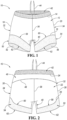
- the garment 10 such as, but not limited to, a shorts garment, is illustrated according to one or more embodiments.
- the garment 10 may include a front panel 12 having a top edge 14, a bottom edge 16, a first side edge 18, and a second side edge 20.
- the garment 10 may further include a back panel 22 having a top edge 24, a bottom edge 26, a first side edge 28, and a second side edge 30.
- the back panel 22 may be coupled to the front panel 12, either directly or indirectly, according to one or more embodiments.
- the front panel 12 and the back panel 22 may be configured to generally overlie a lower torso region of the wearer. As shown in FIGS.
- the first side edge 18 of the front panel 12 may be joined to the first side edge 28 of the back panel 22 with a first seam 32
- the second side edge 20 of the front panel 12 may be joined to the second side edge 30 of the back panel 22 with a second seam 34.
- panel as used herein is not limited to one continuous fabric section, but instead may include multiple pieces of fabric joined together or single pieces of fabric with intermediate seams.
- the front panel 12 may have a central seam 36 and the back panel 22 may have a central seam 38.
- the front panel 12 and the back panel 22 could be joined at other seams or could be integrally formed together.
- the front panel 12 and the back panel 22 are constructed from a first fabric, which may include a double weave knit fabric.
- the first fabric may include a polyester component and an elastane component.
- the first fabric may comprise approximately 88% PET (polyethylene terephthalate), which may be recycled PET, and approximately 12% elastane.
- the first fabric may have a fabric weight (GSM) of about 177 g/m 2 .
- GSM fabric weight
- the first fabric is not limited to the above-described composition and/or construction, and other compositions and/or constructions of the first fabric are also contemplated.
- the first fabric provides shape and structure to the garment 10, prevents undesired movement of the garment 10 along the limbs (e.g. legs) of a wearer during activity, and provides a suitable surface for adhering logos, indicia, or the like.
- the garment 10 may include a crotch panel 40 joining the front panel 12 and the back panel 22 adjacent to the front panel bottom edge 16 and the back panel bottom edge 26, along an inseam area of the garment 10.
- the garment 10 may include a waistband 42 adjacent to or including the front panel top edge 14 and the back panel top edge 24 and, in the case of a shorts garment, may be configured to encircle a waist of the wearer.
- the waistband 42 may include an elastic material and a drawstring 44 for providing adjustability of fit of the garment 10 around the wearer's waist.
- the back panel 22 may include a yoke portion 46 adjacent to the back panel top edge 24 which may be defined by a yoke seam 48, wherein the yoke portion 46 may serve to reduce excess material near the waistband 42 of the garment 10.
- the garment 10 further includes a first limb portion 50 extending from the front panel bottom edge 16 and the back panel bottom edge 26 to form a first limb opening 52, and a second limb portion 54 extending from the front panel bottom edge 16 and the back panel bottom edge 26 to form a second limb opening 56.
- the first limb portion 50 and the second limb portion 54 may each have a continuous configuration arranged to encircle the circumference of a first limb (e.g. first leg) and a second limb (e.g. second leg) of the wearer, respectively.
- the first limb portion 50 and the second limb portion 54 are constructed from a second fabric having a greater stretch characteristic than the first fabric.
- the greater stretch characteristic may be a greater elastane content of the second fabric compared with the first fabric.
- other parameters which define the stretch characteristic are also contemplated.
- the greater stretch characteristic of the second fabric provides increased stretch and forgiveness in the fabric encircling the wearer's limbs compared with the first fabric, thus increasing the comfort for the wearer, especially during movement.
- the second fabric may comprise an interlock knit fabric.
- the second fabric may include a polyester component and an elastane component.
- the second fabric may comprise approximately 83% PET (e.g. recycled) and approximately 17% elastane, such that the second fabric is highly stretchable.
- the second fabric may have a fabric weight (GSM) of about 170 g/m 2 .
- GSM fabric weight
- the second fabric is not limited to the above-described composition and/or construction, and other compositions and/or constructions of the second fabric are also contemplated.
- the first fabric and the second fabric exist on the same plane and are connected by seams.
- first transition seam 58 may join the front panel bottom edge 16 and the back panel bottom edge 26 to the first limb portion 50
- a second transition seam 60 may join the front panel bottom edge 16 and the back panel bottom edge 26 to the second limb portion 54.
- stretch bonding tape may be used to finish the first transition seam 58 and the second transition seam 60.
- the second fabric is provided with built-in stretch and excellent drape on the wearer's body.
- the second fabric may have high stretch (e.g., greater than 80% elongation) in both the warp and weft directions.
- the front and back sides of interlock knit fabric are identical since they are knitted together at the same time and remain interlocked with a tight knit, giving the impression that the second fabric comprises two layers.
- the second fabric with this construction is thick, soft, smooth, and comfortable to wear.
- the second fabric has good recovery (e.g. greater than 90%), meaning that the second fabric substantially returns to its original shape after being stretched and will not lose shape over time.
- tightness around the limb may be alleviated in the garment 10 by the incorporation of a seamless lower edge 62 of the first limb portion 50 and the second limb portion 54.
- an interlock knit fabric as the second fabric, it is possible to have a raw edge finish without a seam, since the sturdy, tight knit structure prevents fraying of the fabric (i.e. prevents the fibers from protruding downward or falling out over time), and the second fabric will not unravel or curl at the lower edge 62 in the absence of a seam.
- the use of the second fabric with high stretch capability and no seam allows the wearer to move more freely with greater comfort during athletic play or other activities.
- the second fabric may comprise between about 10% to 30% of a total length of the garment 10 from the front panel top edge 14 to the lower edge 62. In one or more embodiments, the second fabric may comprise between about 15% to 25% of a total length of the garment 10 from the front panel top edge 14 to the lower edge 62. In one non-limiting example, the second fabric may comprise an average of about 20% of the total length of the garment 10 from the front panel top edge 14 to the lower edge 62. In one non-limiting example, near the area of the crotch panel 40, the second fabric may comprise about 15% of a total length of the garment 10 from the front panel top edge 14 to the lower edge 62.
- the second fabric may comprise about 25% of a total length of the garment 10 from the front panel top edge 14 to the lower edge 62. It is understood that these various relative dimensions are merely construction options for the garment 10 and are not intended to be limiting.
- a length of the second fabric between the front panel bottom edge 16 and the lower edge 62 may be greater than a length of the second fabric between the back panel bottom edge 26 and the lower edge 62, such as illustrated in FIG. 3 .
- Such a construction may facilitate a greater range of motion of the wearer's limbs, such as motion of the legs during flexion of the hips.
- a length from the back panel top edge 24 to the lower edge 62 may be greater than a length from the front panel top edge 14 to the lower edge 62, effectively providing the back of the garment 10 with a longer hem than the front of the garment 10 and providing greater coverage.
- the lower edge 62 may be angled so as to be longer at the inseam area where joined with the crotch panel 40 for increased coverage and comfort in this area where the wearer's limbs (e.g. legs or thighs) are in close proximity to each other.
- FIGS. 4-6 a garment 110 is illustrated according to one or more embodiments. It is understood that all of the features described above with reference to garment 10 may also be applicable to garment 110, and thus will not be described again below. Like elements from FIGS. 1-3 have been given like reference numerals in FIGS. 4-6 with the addition of a "1" prefix.
- the first limb portion 150 may include a first side portion 164 extending between the first side edge 118 of the front panel 112 and the first side edge 128 of the back panel 122.
- the first limb portion 150 further includes a first end portion 166 extending from the front panel bottom edge 116 and the back panel bottom edge 126 to form the first limb opening 152.
- the second limb portion 154 may include a second side portion 168 extending between the second side edge 120 of the front panel 112 and the second side edge 130 of the back panel 122.
- the second limb portion 154 further includes a second end portion 170 extending from the front panel bottom edge 116 and the back panel bottom edge 126 to form the second limb opening 156.
- first side edge 118 and the second side edge 120 of the front panel 112 may be continuous with the front panel bottom edge 116, and the first side edge 128 and the second side edge 130 of the back panel 122 may be continuous with the back panel bottom edge 126 as shown. While the first limb portion 150 and the second limb portion 154 of the garment 110 are shown herein as being continuous fabric sections, it is understood that the garment 110 is not limited to this configuration.
- the first limb portion 150 (comprising the first side portion 164 and the first end portion 166) and the second limb portion 154 (comprising the second side portion 168 and the second end portion 170) are constructed from the second fabric, while the front panel 112 and the back panel 122 are constructed from the first fabric.
- the first fabric and the second fabric exist on the same plane and are connected by seams. More particularly, a first front transition seam 172 may join the first side edge 118 of the front panel 112 and the front panel bottom edge 116 to the first limb portion 150, and a second front transition seam 174 may join the second side edge 120 of the front panel 112 and the front panel bottom edge 116 to the second limb portion 154.
- first back transition seam 176 may join the first side edge 128 of the back panel 122 and the back panel bottom edge 126 to the first limb portion 150
- second back transition seam 178 may join the second side edge 130 of the back panel 122 and the back panel bottom edge 126 to the second limb portion 154.
- first side portion 164 and the second side portion 168 are shown herein as being generally symmetrically distributed on the garment 110 about a side axis 180 between the front panel 112 and the back panel 122, it is understood that the garment 110 is not limited to this configuration and that the first side portion 164 and the second side portion 168 could alternatively be skewed to be asymmetric about the side axis 180, either toward the front panel 112 or the back panel 122 of the garment 110.
- first side portion 164 and the second side portion 168 may each comprise between about 11% to 21% of a circumference of the first limb portion 150 and the second limb portion 154, respectively. In one non-limiting example, the first side portion 164 and the second side portion 168 may each comprise about 16% of the circumference of the first limb portion 150 and the second limb portion 154, respectively.
- the garment 10, 110 shown and described herein may have a wide range of applicability not only as gear for women's football and men's football, but also for other sports, training, and even leisure wear for both women and men.
- the garment 10, 110 is depicted herein as comprising a shorts garment, the garment 10, 110 is not limited to this configuration, and it is understood that other configurations of the garment 10, 110 for lower body or upper body applications are also fully contemplated.
Landscapes
- Engineering & Computer Science (AREA)
- Textile Engineering (AREA)
- Professional, Industrial, Or Sporting Protective Garments (AREA)
Applications Claiming Priority (1)
| Application Number | Priority Date | Filing Date | Title |
|---|---|---|---|
| US18/536,450 US20250185731A1 (en) | 2023-12-12 | 2023-12-12 | Garment |
Publications (1)
| Publication Number | Publication Date |
|---|---|
| EP4570102A1 true EP4570102A1 (de) | 2025-06-18 |
Family
ID=93853367
Family Applications (1)
| Application Number | Title | Priority Date | Filing Date |
|---|---|---|---|
| EP24218571.8A Pending EP4570102A1 (de) | 2023-12-12 | 2024-12-10 | Kleidungsstück |
Country Status (3)
| Country | Link |
|---|---|
| US (1) | US20250185731A1 (de) |
| EP (1) | EP4570102A1 (de) |
| CN (1) | CN120130710A (de) |
Citations (3)
| Publication number | Priority date | Publication date | Assignee | Title |
|---|---|---|---|---|
| US20060206993A1 (en) * | 2003-03-19 | 2006-09-21 | Michel Bonnin | Boxer short-type underwear article and production method thereof |
| EP3599916B1 (de) * | 2017-03-20 | 2022-05-04 | HBI Branded Apparel Enterprises, LLC | Formwäschekleidungsstück mit netzbereichen |
| JP7346298B2 (ja) * | 2016-11-03 | 2023-09-19 | スプラッシュ アバウト インターナショナル リミテッド | 衣類 |
Family Cites Families (7)
| Publication number | Priority date | Publication date | Assignee | Title |
|---|---|---|---|---|
| US3906754A (en) * | 1974-02-08 | 1975-09-23 | Bear Brand Hosiery Co | Panty and parts thereof and method of manufacture |
| US6401250B1 (en) * | 2001-01-24 | 2002-06-11 | Mcnabb Mark J. | Ventilated athletic support garment |
| US6874337B2 (en) * | 2002-06-05 | 2005-04-05 | Mizuno Corporation | Underpant garment |
| US8966667B2 (en) * | 2010-11-17 | 2015-03-03 | Oakley, Inc. | Outer garment with suspension system for attaching an inner garment |
| US9198469B2 (en) * | 2012-03-19 | 2015-12-01 | Hayabusa Fightwear Inc. | Short pant having a seamless body |
| US20190274373A1 (en) * | 2018-03-06 | 2019-09-12 | Gravitate, LLC | Performance apparel and methods of making same |
| CA3115963A1 (en) * | 2018-10-23 | 2020-04-30 | Clearview Systems, Llc | Athletic garment |
-
2023
- 2023-12-12 US US18/536,450 patent/US20250185731A1/en active Pending
-
2024
- 2024-12-10 EP EP24218571.8A patent/EP4570102A1/de active Pending
- 2024-12-11 CN CN202411817391.6A patent/CN120130710A/zh active Pending
Patent Citations (3)
| Publication number | Priority date | Publication date | Assignee | Title |
|---|---|---|---|---|
| US20060206993A1 (en) * | 2003-03-19 | 2006-09-21 | Michel Bonnin | Boxer short-type underwear article and production method thereof |
| JP7346298B2 (ja) * | 2016-11-03 | 2023-09-19 | スプラッシュ アバウト インターナショナル リミテッド | 衣類 |
| EP3599916B1 (de) * | 2017-03-20 | 2022-05-04 | HBI Branded Apparel Enterprises, LLC | Formwäschekleidungsstück mit netzbereichen |
Also Published As
| Publication number | Publication date |
|---|---|
| US20250185731A1 (en) | 2025-06-12 |
| CN120130710A (zh) | 2025-06-13 |
Similar Documents
| Publication | Publication Date | Title |
|---|---|---|
| US6543062B1 (en) | Pants garment with body profile enhancement features | |
| US8347412B2 (en) | Athletic pants | |
| US9198469B2 (en) | Short pant having a seamless body | |
| US9642401B2 (en) | Lower-body garment | |
| JP6297975B2 (ja) | 衣服 | |
| WO2004096105A1 (ja) | 股付き衣類 | |
| US3945051A (en) | Short pants with panel overlap | |
| CN103179871B (zh) | 裙型的修整用内衣 | |
| TWI760529B (zh) | 下半身用衣物 | |
| EP4570102A1 (de) | Kleidungsstück | |
| WO2021006150A1 (ja) | 水着 | |
| US2176790A (en) | Knitted undergarment | |
| JP6543528B2 (ja) | 衣類 | |
| JP5069361B2 (ja) | 軽スポーツ用パンツ | |
| JP2008138322A (ja) | 旋回機能を有するスポーツウェア | |
| US3285248A (en) | Corsets, girdles and like gaments | |
| JP6744563B1 (ja) | 下衣 | |
| JP3159291U (ja) | 伸縮性を有するズボン | |
| JP6811832B1 (ja) | スポーツ用衣料 | |
| JP4846349B2 (ja) | スパッツ | |
| US20020007506A1 (en) | Pants | |
| JP3212971U (ja) | クラシカルパンツ | |
| KR102078075B1 (ko) | 남성용 팬티 | |
| US1545499A (en) | Knickerbockers | |
| US2702388A (en) | Man's shorts |
Legal Events
| Date | Code | Title | Description |
|---|---|---|---|
| PUAI | Public reference made under article 153(3) epc to a published international application that has entered the european phase |
Free format text: ORIGINAL CODE: 0009012 |
|
| STAA | Information on the status of an ep patent application or granted ep patent |
Free format text: STATUS: REQUEST FOR EXAMINATION WAS MADE |
|
| 17P | Request for examination filed |
Effective date: 20241210 |
|
| AK | Designated contracting states |
Kind code of ref document: A1 Designated state(s): AL AT BE BG CH CY CZ DE DK EE ES FI FR GB GR HR HU IE IS IT LI LT LU LV MC ME MK MT NL NO PL PT RO RS SE SI SK SM TR |