EP4567408A1 - Verbergungsleistungsbeurteilungsverfahren - Google Patents
Verbergungsleistungsbeurteilungsverfahren Download PDFInfo
- Publication number
- EP4567408A1 EP4567408A1 EP23849854.7A EP23849854A EP4567408A1 EP 4567408 A1 EP4567408 A1 EP 4567408A1 EP 23849854 A EP23849854 A EP 23849854A EP 4567408 A1 EP4567408 A1 EP 4567408A1
- Authority
- EP
- European Patent Office
- Prior art keywords
- hiding power
- abs
- particles
- pigment
- containing body
- Prior art date
- Legal status (The legal status is an assumption and is not a legal conclusion. Google has not performed a legal analysis and makes no representation as to the accuracy of the status listed.)
- Pending
Links
Images



Classifications
-
- G—PHYSICS
- G01—MEASURING; TESTING
- G01N—INVESTIGATING OR ANALYSING MATERIALS BY DETERMINING THEIR CHEMICAL OR PHYSICAL PROPERTIES
- G01N21/00—Investigating or analysing materials by the use of optical means, i.e. using sub-millimetre waves, infrared, visible or ultraviolet light
- G01N21/84—Systems specially adapted for particular applications
- G01N21/8422—Investigating thin films, e.g. matrix isolation method
-
- G—PHYSICS
- G01—MEASURING; TESTING
- G01N—INVESTIGATING OR ANALYSING MATERIALS BY DETERMINING THEIR CHEMICAL OR PHYSICAL PROPERTIES
- G01N21/00—Investigating or analysing materials by the use of optical means, i.e. using sub-millimetre waves, infrared, visible or ultraviolet light
- G01N21/17—Systems in which incident light is modified in accordance with the properties of the material investigated
- G01N21/59—Transmissivity
-
- G—PHYSICS
- G01—MEASURING; TESTING
- G01N—INVESTIGATING OR ANALYSING MATERIALS BY DETERMINING THEIR CHEMICAL OR PHYSICAL PROPERTIES
- G01N33/00—Investigating or analysing materials by specific methods not covered by groups G01N1/00 - G01N31/00
- G01N33/26—Oils; Viscous liquids; Paints; Inks
- G01N33/32—Paints; Inks
-
- C—CHEMISTRY; METALLURGY
- C01—INORGANIC CHEMISTRY
- C01P—INDEXING SCHEME RELATING TO STRUCTURAL AND PHYSICAL ASPECTS OF SOLID INORGANIC COMPOUNDS
- C01P2002/00—Crystal-structural characteristics
- C01P2002/80—Crystal-structural characteristics defined by measured data other than those specified in group C01P2002/70
- C01P2002/84—Crystal-structural characteristics defined by measured data other than those specified in group C01P2002/70 by UV- or VIS- data
-
- C—CHEMISTRY; METALLURGY
- C01—INORGANIC CHEMISTRY
- C01P—INDEXING SCHEME RELATING TO STRUCTURAL AND PHYSICAL ASPECTS OF SOLID INORGANIC COMPOUNDS
- C01P2006/00—Physical properties of inorganic compounds
- C01P2006/60—Optical properties, e.g. expressed in CIELAB-values
-
- C—CHEMISTRY; METALLURGY
- C09—DYES; PAINTS; POLISHES; NATURAL RESINS; ADHESIVES; COMPOSITIONS NOT OTHERWISE PROVIDED FOR; APPLICATIONS OF MATERIALS NOT OTHERWISE PROVIDED FOR
- C09C—TREATMENT OF INORGANIC MATERIALS, OTHER THAN FIBROUS FILLERS, TO ENHANCE THEIR PIGMENTING OR FILLING PROPERTIES ; PREPARATION OF CARBON BLACK ; PREPARATION OF INORGANIC MATERIALS WHICH ARE NO SINGLE CHEMICAL COMPOUNDS AND WHICH ARE MAINLY USED AS PIGMENTS OR FILLERS
- C09C1/00—Treatment of specific inorganic materials other than fibrous fillers; Preparation of carbon black
- C09C1/62—Metallic pigments or fillers
- C09C1/64—Aluminium
- C09C1/644—Aluminium treated with organic compounds, e.g. polymers
-
- G—PHYSICS
- G01—MEASURING; TESTING
- G01N—INVESTIGATING OR ANALYSING MATERIALS BY DETERMINING THEIR CHEMICAL OR PHYSICAL PROPERTIES
- G01N21/00—Investigating or analysing materials by the use of optical means, i.e. using sub-millimetre waves, infrared, visible or ultraviolet light
- G01N21/17—Systems in which incident light is modified in accordance with the properties of the material investigated
- G01N2021/1748—Comparative step being essential in the method
-
- G—PHYSICS
- G01—MEASURING; TESTING
- G01N—INVESTIGATING OR ANALYSING MATERIALS BY DETERMINING THEIR CHEMICAL OR PHYSICAL PROPERTIES
- G01N21/00—Investigating or analysing materials by the use of optical means, i.e. using sub-millimetre waves, infrared, visible or ultraviolet light
- G01N21/84—Systems specially adapted for particular applications
- G01N21/8422—Investigating thin films, e.g. matrix isolation method
- G01N2021/8427—Coatings
Definitions
- the present invention relates generally to a method for evaluating hiding power of a particle containing body which contains particles and, in particular, to a method for evaluating hiding power of coating film which uses pigment as particles.
- hiding power of coating film which contains particles of pigment or the like is evaluated.
- measurement of a degree at which a basic color is hidden by paint can be obtained by applying paint onto white and black undercoat and actually measuring a tristimulus value of a dried color card as in JIS K 5600-4-1: 1999K (ISO/FDIS 6504-3: 1998).
- Non-Patent Literature 2 a water surface diffusion area (WCA) prescribed in JIS K 5906: 1998 (Non-Patent Literature 2) is used as an index which represents hiding power of the coating film using the metal effect pigment.
- the hiding power of the coating film is adjusted by repeating adjustment of a pigment concentration in the paint or a film thickness of the coating film and visual evaluation of the hiding power.
- Non-Patent Literature 2 is not applicable to pigment which does not float on water. In addition, the method in Non-Patent Literature 2 takes labor.
- the present invention can reduce the time required for evaluation and a used paint amount when absolute evaluation and relative evaluation of the hiding power can be made by measuring visible light transmission intensity of a color card or coated paper, which is made available for color tone evaluation to confirm quality, such as art paper (coated paper) or PET film without using black and white hiding power test paper.
- an object of the present invention is to provide an simpler method for evaluating the hiding power.
- the present inventors have devoted themselves to earnest research.
- absorbance obtained on the basis of a ratio of light transmission amounts of coating film which contains pigment and coating film which contains no pigment is in a proportional relationship with a water surface diffusion area (WCA).
- WCA water surface diffusion area
- the evaluation method of the present invention can evaluate hiding power not only in a case where the pigment is contained in the coating film formed on the base material but also in a case where the pigment is kneaded in the base material. Moreover, it was also found that by measuring absorbance of electromagnetic waves other than visible light, shielding power of the electromagnetic waves can be evaluated.
- a method for evaluating hiding power, a method for controlling quality, and a method for assuring quality, according to the present invention have the below-described configurations.
- hiding power test paper As a base material.
- a simpler method for evaluating hiding power can be provided.
- the absorbance (Abs) of the electromagnetic waves may be referred to as light absorbance (Abs).
- the method for evaluating hiding power according to the present invention includes a step of calculating a value of (the absorbance (Abs))/(a concentration (C) of the particles of the particle containing body).
- the particles are contained in coating film formed on the base material or are kneaded in the base material.
- the particles are pigment.
- the electromagnetic waves are visible light.
- the particles are particles having electromagnetic wave shielding performance and the hiding power is electromagnetic wave shielding power.
- the electromagnetic waves are electromagnetic waves other than visible light and the hiding power is electromagnetic wave shielding power.
- a method for controlling quality of a product includes a step of prescribing absolute hiding power or relative hiding power by the above-mentioned method for evaluating hiding power and a step of performing quality control of a product on a basis of the absolute hiding power or the relative hiding power.
- a method for assuring quality of a product includes a step of prescribing absolute hiding power and relative hiding power by the above-mentioned method for evaluating hiding power and a step of performing quality assurance of a product on a basis of the absolute hiding power or the relative hiding power.
- the hiding power evaluation target is coating film which contains pigment and hiding power of visible light is evaluated.
- paint which contains particles of pigment is applied onto a base material (hereinafter, also referred to as "undercoat”) and is dried, thereby forming pigment containing coating film.
- the pigment non-containing coating film (hereinafter, also referred to as a "blank” or “control”) having the same composition as that of the pigment containing coating film except that the pigment non-containing coating film contains no particles of the pigment is formed onto a base material or undercoat.
- the pigment containing coating film is one example of the particle containing body and the pigment non-containing coating film is one example of the non-particle containing body.
- the heretofore known paint such as paint obtained by dispersing aluminum pigment (paste) in nitrocellulose (cellulose nitrate) lacquer, acryl lacquer, or waterborne paint is used. Since due to affinity of a resin component and the pigment in the paint, the later-descried correlation coefficient of Abs and WCA fluctuates, it is desired that the nitrocellulose lacquer having a wide range of affinity is used.
- Th base material is not limited and as the base material, a color card, coated paper, or the like, which is made available for color tone evaluation to confirm quality, such as art paper (coated paper) and PET film can be used.
- a method for preparing the coating film is made the same between the pigment containing coating film and the pigment non-containing coating film, and conditions of the lacquer, a film thickness of the coating film, the color card, an applicating method, a drying temperature, a drying method, and the like are made the same therebetween.
- Paint application is made, for example, by employing a doctor blade method and thereby applying the paint onto the base material.
- a doctor blade method for example, the commercially available nitrocellulose (cellulose nitrate) lacquer is used, the doctor blade method is employed, and application onto the PET film or the art paper (coated paper) is made, thereby allowing the particle containing body and a particle non-containing body to be obtained.
- a film applicator used in the doctor blade method in order to make orientation of the pigment constant, for example, a film applicator having 2 mils (50.8 ⁇ m) can be used, and a film applicator having 6 mils, 9 mils, or the like may be used.
- a thickness of the coating film obtained by the application in 9 mils is 4.5-fold of that of coating film obtained by the application in 2 mils, and there is a case where due to disorder of orientation of pigment and influence of secondary reflection, absorbance Abs becomes slightly smaller than the 4.5-fold.
- the pigment containing coating film obtained as described above contains particles of pigment.
- the particle containing body may be prepared by kneading particles of pigment or the like in the base material.
- the transmittance measurement may be measured by using a white LED light source and an illuminometer.
- a value of the absorbance (Abs) obtained as described above reflects hiding power of particles of pigment or the like as described in Examples in detail.
- the method includes a step of calculating a value of (absorbance (Abs))/(concentration (C) of particles of a particle containing body).
- the present inventors found that the value of (absorbance (Abs))/(concentration (C) of particles of a particle containing body) is proportional to a WCA (water surface diffusion area). Accordingly, by calculating the value of (absorbance (Abs))/(concentration (C) of particles of a particle containing body), also as to particles which do not flow on water, hiding power of such particles can be evaluated without measuring the WCA as in a case where the WCA is used.
- L Abs / ⁇ ⁇ C
- a concentration (C) of the particles of the particle containing body having the desired hiding power can be calculated on the basis of the absorbance (Abs) of the electromagnetic waves of the particle containing body, the thickness (L) of the particle containing body, and the absorption coefficient ( ⁇ ) of the electromagnetic waves of the particles by the following Equation (3).
- C Abs / ⁇ ⁇ L
- a weight ratio of the respective kinds of particles required for obtaining desired hiding power can be obtained.
- absorbance (Abs) of electromagnetic waves of a particle containing body having desired hiding power absorbance (Abs 1 ) of electromagnetic waves of a first particle containing body which contains only first particles as particles, and absorbance (Abs 2 ) of electromagnetic waves of a second particle containing body which contains only second particles as particles
- a weight ratio (X) of the first particles and a weight ratio (1-X) of the second particles in the mixed particle containing body which has the desired hiding power and contains the first particles and the second particles can be calculated by the following Equation (4).
- Abs 1 ⁇ X + Abs 2 ⁇ 1 ⁇ X Abs 0 ⁇ X ⁇ 1 .
- a method for controlling quality according to the present invention includes a step of prescribing absolute hiding power or relative hiding power by the above-described method for evaluating hiding power and a step of controlling quality of a product on the basis of the absolute hiding power or the relative hiding power.
- a method for assuring quality according to the present invention includes a step of prescribing absolute hiding power and relative hiding power by the above-described method for evaluating hiding power and a step of assuring quality of a product on the basis of the absolute hiding power or the relative hiding power.
- each paint was applied onto PET film by using an applicator having 2 mils (50.8 ⁇ m), and the resultant was dried at a room temperature, thereby obtaining pigment containing coating film in each of Examples.
- nitrocellulose lacquer was applied thereonto by using an applicator having 2 mils, and the resultant was dried at a room temperature, thereby preparing pigment non-containing coating film.
- An L* value of the test specimen of the pigment containing coating film and an L* value of the test specimen of the pigment non-containing coating film were measured by using a transmitted light intensity measurement unit of a spectrophotometric colorimeter CM-5 (manufactured by Konica Minolta, Inc.), and (L* value of pigment containing coating film)/(L* value of pigment non-containing coating film) was treated as transmittance, thereby obtaining absorbance Abs.
- a result is shown in Table 3.
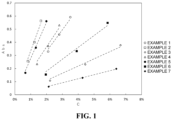
- FIG. 1 Each absorbance Abs plotted with respect to the pigment concentration C on the basis of this result is shown in FIG. 1 . It is seen from FIG. 1 that as to any of kinds of pigment, the relationship of the absorbance Abs and the pigment concentration C can be approximated by a straight line passing through a point of origin. In addition, values of inclination Abs/C of these straight lines passing through the point of origin, obtained by the least squares method, are shown in Table 3.
- Each of the prepared kinds of pigment containing coating film and the pigment non-containing coating film were irradiated with a white LED whose front illuminance was 345,000 lux and by using the commercially available illuminometer, values of light transmission amounts I of respective specimens of the coating film and a light transmission amount I 0 of standard coating film were measured.
- From the light source to the illuminometer in order to avoid leak and mixing of light from an external light source, cylindrical black ABS resin was used.
- the apparatus was configured such that a distance from the light source to the coating film was approximately 40 mm and a distance from the coating film to a surface of the illuminometer was approximately 15 mm.
- the absorbance Abs of the specimens of coating film, calculated from the measurement result, are shown in Table 4.
- Example 8 Pigment A C 2.10% 2.80% 4.20% Abs 0.673 0.930 1.369
- Example 9 Pigment B C 1.23% 1.64% 2.46% 3.28% 4.11% 4.93% Abs 0.810 1.109 1.643 2.246 2.863 3.514
- Example 10 Pigment C C C 2.22% 2.96% 4.45% Abs 0.243 0.334 0.501
- Example 11 Pigment D C 2.10% 2.80% 4.20% Abs 0.755 1.035 1.525
- Example 12 Pigment E C 1.99% 2.65% 3.98% Abs 1.012 1.320 2.002
- Example 13 Pigment F C 1.95% 2.60% 3.90% Abs 0.350 0.474 0.705
- Example 14 Pigment G C 2.13% 2.85% 4.27% Abs 0.130 0.180 0.269
- the WCAs of respective kinds of pigment plotted with respect to the above-mentioned Abs/C are shown in FIG. 4 . It is from FIG. 4 that even in a case where as a base material, opaque art paper is used, a ratio of Abs/C is proportional to WCA, hiding power can be evaluated.
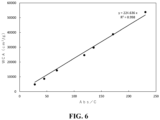
- the inclination obtained by the least squares method was 776.5. From this result, Equation (6) can be derived.
- Example 15 Pigment A c 2.10% 0.98% 1.68% 1.40% 0.42% 0.14% 2.52% 0.70% Abs 2.478 1.158 1.989 1.647 0.487 0.171 3.008 0.831
- Example 16 Pigment B c 1.68% 1.40% 0.70% 0.14% 0.98% 0.42% Abs 3.835 3.242 1.681 0.354 2.245 1.017
- Example 17 Pigment C c 1.39% 0.70% 2.52% 0.13% Abs 0.637 0.327 1.128 0.081
- Example 18 Pigment D c 1.40% 0.70% 2.52% 0.14% Abs 1.831 0.986 3.447 0.210
- Example 19 Pigment E c 1.41% 0.70% 2.52% 0.15% Abs 2.565 1.297 4.193 0.338
- Example 20 Pigment F c 1.40% 0.70% 2.52% 0.14% Abs 0.975 0.506 1.704 0.097
- Example 21 Pigment G c 1.39% 0.70% 2.52% 0.14% Abs 0.380 0.
- an estimated WCA can be obtained from the above-described correlation coefficient.
- an estimated WCA value of aluminum pigment EMR-B5680 (paste manufactured by TOYO ALUMINIUM K.K.) whose WCA cannot be obtained by the method in Non-Patent Literature 2 and which was coated with silica, 24,000 cm 2 /g (per one g of aluminum) was obtained.
- each paste was weighed so as to achieve 0.7 g of a weight of the pigment, and commercially available nitrocellulose lacquer was added thereto so as to achieve 50 g of a total weight. Then, uniform agitation was performed by a planetary mixer, thereby preparing each paint. The prepared each paint was applied to art paper by using an applicator having 9 mils (228.6 ⁇ m) and the resultant was dried at a room temperature, thereby obtaining each specimen coating film.
- nitrocellulose lacquer used for preparation of the paint was separately applied to art paper as it was by using an applicator having 9 mils and the resultant was dried at a room temperature, thereby preparing target coating film having desired hiding power.
- Absorbance Abs of each of the kinds of aluminum pigment A, H, and I was obtained by a measurement method similar to that employed in Example 15 and relative absorbance with respect to absorbance Abs of target pigment was calculated. The relative absorbance is shown in Table 9.
- Table 9 Solid Content Relative Absorbance Pigment Weight Ratio Target Pigment Aluminum Pigment A 70% 1.00 First Pigment Aluminum Pigment H 70% 1.34 48.0% Second Pigment Aluminum Pigment I 71% 0.69 52.0%
- Example 22 Mixed Pigment Calculated value 70% 1.00 Actually Measured Value 70% 1.02
- Equation (8) When a weight ratio of the aluminum pigment H is defined as X and a weight ratio of the aluminum pigment I is defined as (1-X), the following Equation (8) can be established.
- the aluminum pigment (paste) H and the aluminum pigment (paste) I were mixed, thereby preparing mixed pigment.
- the obtained mixed pigment was collected so as to achieve 0.7 g of a total weight of the pigment blended into the paint and the commercially available nitrocellulose lacquer was added thereto so as to achieve 50 g of a total amount.
- uniform agitation was performed by a planetary mixer, thereby preparing the paint.
- the prepared paint was applied to art paper by using an applicator having 9 mils (228.6 ⁇ m) and the resultant was dried at a room temperature, thereby obtaining specimen coating film.
- nitrocellulose lacquer used for preparation of the paint was separately applied to art paper as it was by using an applicator having 9 mils and the resultant was dried at a room temperature, thereby preparing pigment non-containing coating film.
- Absorbance Abs of the mixed pigment (paste) was obtained by a measurement method similar to that employed in Example 15, relative absorbance with respect to the absorbance Abs of the target pigment was calculated, and as a result, a value of the relative absorbance with respect to that of the target pigment A was 1.02, whereby it was made possible to confirm that the mixed pigment had hiding power equivalent to that of the target pigment. Thus, it is made possible to suppress variation of hiding power caused, for example, among production lots of pigment.
- Example 23 Blue Pigment Lionol Blue 7185-PM C 0.56% 1.11% 1.67% 2.22% Abs 0.371 0.560 0.728 0.879
- Example 24 Red Pigment Irgazin Red L3630 C 0.39% 0.78% 1.18% 1.57% Abs 0.431 0.596 0.703 0.815
- the obtained calibration curve can be used for adjustment of the hiding power as with examination using the aluminum pigment.
Landscapes
- Physics & Mathematics (AREA)
- Health & Medical Sciences (AREA)
- Life Sciences & Earth Sciences (AREA)
- Chemical & Material Sciences (AREA)
- Analytical Chemistry (AREA)
- Biochemistry (AREA)
- General Health & Medical Sciences (AREA)
- General Physics & Mathematics (AREA)
- Immunology (AREA)
- Pathology (AREA)
- Mathematical Physics (AREA)
- Engineering & Computer Science (AREA)
- Food Science & Technology (AREA)
- Medicinal Chemistry (AREA)
- Investigating Or Analysing Materials By Optical Means (AREA)
- Paints Or Removers (AREA)
Applications Claiming Priority (2)
| Application Number | Priority Date | Filing Date | Title |
|---|---|---|---|
| JP2022122763A JP2024019959A (ja) | 2022-08-01 | 2022-08-01 | 隠蔽力評価方法 |
| PCT/JP2023/025720 WO2024029295A1 (ja) | 2022-08-01 | 2023-07-12 | 隠蔽力評価方法 |
Publications (1)
| Publication Number | Publication Date |
|---|---|
| EP4567408A1 true EP4567408A1 (de) | 2025-06-11 |
Family
ID=89849191
Family Applications (1)
| Application Number | Title | Priority Date | Filing Date |
|---|---|---|---|
| EP23849854.7A Pending EP4567408A1 (de) | 2022-08-01 | 2023-07-12 | Verbergungsleistungsbeurteilungsverfahren |
Country Status (5)
| Country | Link |
|---|---|
| US (1) | US20250389669A1 (de) |
| EP (1) | EP4567408A1 (de) |
| JP (1) | JP2024019959A (de) |
| CN (1) | CN119487381A (de) |
| WO (1) | WO2024029295A1 (de) |
Family Cites Families (5)
| Publication number | Priority date | Publication date | Assignee | Title |
|---|---|---|---|---|
| US6236460B1 (en) * | 1999-01-29 | 2001-05-22 | E. I. Du Pont De Nemours And Company | Method to determine light scattering efficiency of pigments |
| JP5224562B1 (ja) * | 2012-07-07 | 2013-07-03 | 日本テストパネル株式会社 | 隠ぺい力判断用の貼着型積層シート、およびその貼着型積層シートを用いた塗膜の隠ぺい力および膜厚の評価方法 |
| JP2015184648A (ja) * | 2014-03-26 | 2015-10-22 | 東洋紡株式会社 | 感光性導電ペースト、導電性薄膜、電気回路、及びタッチパネル |
| CN106029266B (zh) * | 2014-03-28 | 2021-02-19 | 东洋铝株式会社 | 薄片状金属颜料及其制造方法,及其金属组合物和涂布物 |
| JP2019167510A (ja) * | 2018-03-26 | 2019-10-03 | 旭化成株式会社 | 化合物付着アルミニウム顔料 |
-
2022
- 2022-08-01 JP JP2022122763A patent/JP2024019959A/ja active Pending
-
2023
- 2023-07-12 US US18/996,929 patent/US20250389669A1/en active Pending
- 2023-07-12 CN CN202380053989.XA patent/CN119487381A/zh active Pending
- 2023-07-12 EP EP23849854.7A patent/EP4567408A1/de active Pending
- 2023-07-12 WO PCT/JP2023/025720 patent/WO2024029295A1/ja not_active Ceased
Also Published As
| Publication number | Publication date |
|---|---|
| US20250389669A1 (en) | 2025-12-25 |
| CN119487381A (zh) | 2025-02-18 |
| JP2024019959A (ja) | 2024-02-14 |
| WO2024029295A1 (ja) | 2024-02-08 |
Similar Documents
| Publication | Publication Date | Title |
|---|---|---|
| DE19636774C2 (de) | Verfahren zur Anpassung einer Farbrezeptur | |
| DE69329131T2 (de) | Dreidimensionaler automatischer Gonio-Spektrophotometer | |
| US7804597B2 (en) | Method for matching paint | |
| EP2553426B1 (de) | Verfahren zur charakterisierung eines streuenden gefärbten pigments | |
| Hatcher et al. | Developments in the use of image analysis for the assessment of oriental noodle appearance and colour | |
| GB2039033A (en) | A method and apparatus for identifying botanical component parts of plants in particular of seeds and kernels | |
| KR20050120815A (ko) | 색-일치 코팅 조성물의 제조방법 및 여기에 사용되는 장치 | |
| EP0931247A1 (de) | Verfahren zur farbrezeptberechnung pigmentierter effektfarbtöne | |
| EP4567408A1 (de) | Verbergungsleistungsbeurteilungsverfahren | |
| WO2002004567A1 (fr) | Procede d'appariement des couleurs de peinture brillante | |
| Alman et al. | Integrating‐sphere errors in the colorimetry of fluorescent materials | |
| Dattner et al. | 20-Characterization of Print Quality in Terms of Colorimetric Aspects | |
| Dennison et al. | Color of dental restorative resins | |
| US7042566B2 (en) | Method of verifying color and strength properties of batches of wood stains | |
| EP0684808B1 (de) | Lichtstabile farbzusammensetzungen | |
| US3512895A (en) | Spectroreflectrometric reference standard and method | |
| US6636315B2 (en) | Method for estimating the quality of distribution of pigments in a matrix | |
| Aida | Glossiness of colored papers and its application to specular glossiness measuring instruments | |
| DE102021115728A1 (de) | Verfahren und Vorrichtung zum Inspizieren von lackierten Oberflächen mit Effektpigmenten | |
| DE102004059186A1 (de) | Verfahren und Vorrichtung zur ortsauflösenden Bewertung von Oberflächeneigenschaften | |
| Bristow | Optical properties of pulp and paper | |
| CN110455730A (zh) | 采用分光光度法测定白色塑料薄膜中钛白粉晶型的方法 | |
| DE102022132807A1 (de) | Verfahren und Vorrichtung zum Inspizieren von lackierten Oberflächen mit Effektpigmenten | |
| Verrill | Advances in spectrophotometric transfer standards at the National Physical Laboratory | |
| Bruce | Tinting strength of pigments |
Legal Events
| Date | Code | Title | Description |
|---|---|---|---|
| STAA | Information on the status of an ep patent application or granted ep patent |
Free format text: STATUS: THE INTERNATIONAL PUBLICATION HAS BEEN MADE |
|
| PUAI | Public reference made under article 153(3) epc to a published international application that has entered the european phase |
Free format text: ORIGINAL CODE: 0009012 |
|
| STAA | Information on the status of an ep patent application or granted ep patent |
Free format text: STATUS: REQUEST FOR EXAMINATION WAS MADE |
|
| 17P | Request for examination filed |
Effective date: 20250115 |
|
| AK | Designated contracting states |
Kind code of ref document: A1 Designated state(s): AL AT BE BG CH CY CZ DE DK EE ES FI FR GB GR HR HU IE IS IT LI LT LU LV MC ME MK MT NL NO PL PT RO RS SE SI SK SM TR |
|
| DAV | Request for validation of the european patent (deleted) | ||
| DAX | Request for extension of the european patent (deleted) |