EP4567079A1 - Molybdenum carbide, composite, catalyst ink, production method for molybdenum carbide, and production method for composite - Google Patents
Molybdenum carbide, composite, catalyst ink, production method for molybdenum carbide, and production method for composite Download PDFInfo
- Publication number
- EP4567079A1 EP4567079A1 EP23850148.0A EP23850148A EP4567079A1 EP 4567079 A1 EP4567079 A1 EP 4567079A1 EP 23850148 A EP23850148 A EP 23850148A EP 4567079 A1 EP4567079 A1 EP 4567079A1
- Authority
- EP
- European Patent Office
- Prior art keywords
- molybdenum carbide
- molybdenum
- composite product
- palladium
- particles
- Prior art date
- Legal status (The legal status is an assumption and is not a legal conclusion. Google has not performed a legal analysis and makes no representation as to the accuracy of the status listed.)
- Pending
Links
Images


Classifications
-
- B—PERFORMING OPERATIONS; TRANSPORTING
- B01—PHYSICAL OR CHEMICAL PROCESSES OR APPARATUS IN GENERAL
- B01J—CHEMICAL OR PHYSICAL PROCESSES, e.g. CATALYSIS OR COLLOID CHEMISTRY; THEIR RELEVANT APPARATUS
- B01J27/00—Catalysts comprising the elements or compounds of halogens, sulfur, selenium, tellurium, phosphorus or nitrogen; Catalysts comprising carbon compounds
- B01J27/20—Carbon compounds
- B01J27/22—Carbides
-
- B—PERFORMING OPERATIONS; TRANSPORTING
- B01—PHYSICAL OR CHEMICAL PROCESSES OR APPARATUS IN GENERAL
- B01J—CHEMICAL OR PHYSICAL PROCESSES, e.g. CATALYSIS OR COLLOID CHEMISTRY; THEIR RELEVANT APPARATUS
- B01J23/00—Catalysts comprising metals or metal oxides or hydroxides, not provided for in group B01J21/00
- B01J23/38—Catalysts comprising metals or metal oxides or hydroxides, not provided for in group B01J21/00 of noble metals
- B01J23/40—Catalysts comprising metals or metal oxides or hydroxides, not provided for in group B01J21/00 of noble metals of the platinum group metals
- B01J23/44—Palladium
-
- B—PERFORMING OPERATIONS; TRANSPORTING
- B01—PHYSICAL OR CHEMICAL PROCESSES OR APPARATUS IN GENERAL
- B01J—CHEMICAL OR PHYSICAL PROCESSES, e.g. CATALYSIS OR COLLOID CHEMISTRY; THEIR RELEVANT APPARATUS
- B01J23/00—Catalysts comprising metals or metal oxides or hydroxides, not provided for in group B01J21/00
- B01J23/70—Catalysts comprising metals or metal oxides or hydroxides, not provided for in group B01J21/00 of the iron group metals or copper
- B01J23/74—Iron group metals
- B01J23/755—Nickel
-
- B—PERFORMING OPERATIONS; TRANSPORTING
- B01—PHYSICAL OR CHEMICAL PROCESSES OR APPARATUS IN GENERAL
- B01J—CHEMICAL OR PHYSICAL PROCESSES, e.g. CATALYSIS OR COLLOID CHEMISTRY; THEIR RELEVANT APPARATUS
- B01J35/00—Catalysts, in general, characterised by their form or physical properties
- B01J35/30—Catalysts, in general, characterised by their form or physical properties characterised by their physical properties
- B01J35/391—Physical properties of the active metal ingredient
- B01J35/393—Metal or metal oxide crystallite size
-
- B—PERFORMING OPERATIONS; TRANSPORTING
- B01—PHYSICAL OR CHEMICAL PROCESSES OR APPARATUS IN GENERAL
- B01J—CHEMICAL OR PHYSICAL PROCESSES, e.g. CATALYSIS OR COLLOID CHEMISTRY; THEIR RELEVANT APPARATUS
- B01J35/00—Catalysts, in general, characterised by their form or physical properties
- B01J35/60—Catalysts, in general, characterised by their form or physical properties characterised by their surface properties or porosity
- B01J35/61—Surface area
- B01J35/613—10-100 m2/g
-
- B—PERFORMING OPERATIONS; TRANSPORTING
- B01—PHYSICAL OR CHEMICAL PROCESSES OR APPARATUS IN GENERAL
- B01J—CHEMICAL OR PHYSICAL PROCESSES, e.g. CATALYSIS OR COLLOID CHEMISTRY; THEIR RELEVANT APPARATUS
- B01J35/00—Catalysts, in general, characterised by their form or physical properties
- B01J35/60—Catalysts, in general, characterised by their form or physical properties characterised by their surface properties or porosity
- B01J35/61—Surface area
- B01J35/615—100-500 m2/g
-
- B—PERFORMING OPERATIONS; TRANSPORTING
- B01—PHYSICAL OR CHEMICAL PROCESSES OR APPARATUS IN GENERAL
- B01J—CHEMICAL OR PHYSICAL PROCESSES, e.g. CATALYSIS OR COLLOID CHEMISTRY; THEIR RELEVANT APPARATUS
- B01J35/00—Catalysts, in general, characterised by their form or physical properties
- B01J35/60—Catalysts, in general, characterised by their form or physical properties characterised by their surface properties or porosity
- B01J35/61—Surface area
- B01J35/617—500-1000 m2/g
-
- B—PERFORMING OPERATIONS; TRANSPORTING
- B01—PHYSICAL OR CHEMICAL PROCESSES OR APPARATUS IN GENERAL
- B01J—CHEMICAL OR PHYSICAL PROCESSES, e.g. CATALYSIS OR COLLOID CHEMISTRY; THEIR RELEVANT APPARATUS
- B01J35/00—Catalysts, in general, characterised by their form or physical properties
- B01J35/60—Catalysts, in general, characterised by their form or physical properties characterised by their surface properties or porosity
- B01J35/61—Surface area
- B01J35/618—Surface area more than 1000 m2/g
-
- B—PERFORMING OPERATIONS; TRANSPORTING
- B01—PHYSICAL OR CHEMICAL PROCESSES OR APPARATUS IN GENERAL
- B01J—CHEMICAL OR PHYSICAL PROCESSES, e.g. CATALYSIS OR COLLOID CHEMISTRY; THEIR RELEVANT APPARATUS
- B01J37/00—Processes, in general, for preparing catalysts; Processes, in general, for activation of catalysts
- B01J37/02—Impregnation, coating or precipitation
-
- B—PERFORMING OPERATIONS; TRANSPORTING
- B01—PHYSICAL OR CHEMICAL PROCESSES OR APPARATUS IN GENERAL
- B01J—CHEMICAL OR PHYSICAL PROCESSES, e.g. CATALYSIS OR COLLOID CHEMISTRY; THEIR RELEVANT APPARATUS
- B01J37/00—Processes, in general, for preparing catalysts; Processes, in general, for activation of catalysts
- B01J37/08—Heat treatment
-
- C—CHEMISTRY; METALLURGY
- C01—INORGANIC CHEMISTRY
- C01B—NON-METALLIC ELEMENTS; COMPOUNDS THEREOF; METALLOIDS OR COMPOUNDS THEREOF NOT COVERED BY SUBCLASS C01C
- C01B32/00—Carbon; Compounds thereof
- C01B32/90—Carbides
- C01B32/914—Carbides of single elements
- C01B32/949—Tungsten or molybdenum carbides
-
- C—CHEMISTRY; METALLURGY
- C09—DYES; PAINTS; POLISHES; NATURAL RESINS; ADHESIVES; COMPOSITIONS NOT OTHERWISE PROVIDED FOR; APPLICATIONS OF MATERIALS NOT OTHERWISE PROVIDED FOR
- C09D—COATING COMPOSITIONS, e.g. PAINTS, VARNISHES OR LACQUERS; FILLING PASTES; CHEMICAL PAINT OR INK REMOVERS; INKS; CORRECTING FLUIDS; WOODSTAINS; PASTES OR SOLIDS FOR COLOURING OR PRINTING; USE OF MATERIALS THEREFOR
- C09D11/00—Inks
- C09D11/02—Printing inks
- C09D11/03—Printing inks characterised by features other than the chemical nature of the binder
- C09D11/037—Printing inks characterised by features other than the chemical nature of the binder characterised by the pigment
-
- C—CHEMISTRY; METALLURGY
- C25—ELECTROLYTIC OR ELECTROPHORETIC PROCESSES; APPARATUS THEREFOR
- C25B—ELECTROLYTIC OR ELECTROPHORETIC PROCESSES FOR THE PRODUCTION OF COMPOUNDS OR NON-METALS; APPARATUS THEREFOR
- C25B1/00—Electrolytic production of inorganic compounds or non-metals
- C25B1/01—Products
- C25B1/02—Hydrogen or oxygen
- C25B1/04—Hydrogen or oxygen by electrolysis of water
-
- C—CHEMISTRY; METALLURGY
- C25—ELECTROLYTIC OR ELECTROPHORETIC PROCESSES; APPARATUS THEREFOR
- C25B—ELECTROLYTIC OR ELECTROPHORETIC PROCESSES FOR THE PRODUCTION OF COMPOUNDS OR NON-METALS; APPARATUS THEREFOR
- C25B11/00—Electrodes; Manufacture thereof not otherwise provided for
- C25B11/04—Electrodes; Manufacture thereof not otherwise provided for characterised by the material
- C25B11/051—Electrodes formed of electrocatalysts on a substrate or carrier
- C25B11/052—Electrodes comprising one or more electrocatalytic coatings on a substrate
-
- C—CHEMISTRY; METALLURGY
- C25—ELECTROLYTIC OR ELECTROPHORETIC PROCESSES; APPARATUS THEREFOR
- C25B—ELECTROLYTIC OR ELECTROPHORETIC PROCESSES FOR THE PRODUCTION OF COMPOUNDS OR NON-METALS; APPARATUS THEREFOR
- C25B11/00—Electrodes; Manufacture thereof not otherwise provided for
- C25B11/04—Electrodes; Manufacture thereof not otherwise provided for characterised by the material
- C25B11/051—Electrodes formed of electrocatalysts on a substrate or carrier
- C25B11/073—Electrodes formed of electrocatalysts on a substrate or carrier characterised by the electrocatalyst material
- C25B11/075—Electrodes formed of electrocatalysts on a substrate or carrier characterised by the electrocatalyst material consisting of a single catalytic element or catalytic compound
-
- C—CHEMISTRY; METALLURGY
- C25—ELECTROLYTIC OR ELECTROPHORETIC PROCESSES; APPARATUS THEREFOR
- C25B—ELECTROLYTIC OR ELECTROPHORETIC PROCESSES FOR THE PRODUCTION OF COMPOUNDS OR NON-METALS; APPARATUS THEREFOR
- C25B11/00—Electrodes; Manufacture thereof not otherwise provided for
- C25B11/04—Electrodes; Manufacture thereof not otherwise provided for characterised by the material
- C25B11/051—Electrodes formed of electrocatalysts on a substrate or carrier
- C25B11/073—Electrodes formed of electrocatalysts on a substrate or carrier characterised by the electrocatalyst material
- C25B11/075—Electrodes formed of electrocatalysts on a substrate or carrier characterised by the electrocatalyst material consisting of a single catalytic element or catalytic compound
- C25B11/081—Electrodes formed of electrocatalysts on a substrate or carrier characterised by the electrocatalyst material consisting of a single catalytic element or catalytic compound the element being a noble metal
-
- C—CHEMISTRY; METALLURGY
- C25—ELECTROLYTIC OR ELECTROPHORETIC PROCESSES; APPARATUS THEREFOR
- C25B—ELECTROLYTIC OR ELECTROPHORETIC PROCESSES FOR THE PRODUCTION OF COMPOUNDS OR NON-METALS; APPARATUS THEREFOR
- C25B11/00—Electrodes; Manufacture thereof not otherwise provided for
- C25B11/04—Electrodes; Manufacture thereof not otherwise provided for characterised by the material
- C25B11/051—Electrodes formed of electrocatalysts on a substrate or carrier
- C25B11/073—Electrodes formed of electrocatalysts on a substrate or carrier characterised by the electrocatalyst material
- C25B11/091—Electrodes formed of electrocatalysts on a substrate or carrier characterised by the electrocatalyst material consisting of at least one catalytic element and at least one catalytic compound; consisting of two or more catalytic elements or catalytic compounds
-
- B—PERFORMING OPERATIONS; TRANSPORTING
- B01—PHYSICAL OR CHEMICAL PROCESSES OR APPARATUS IN GENERAL
- B01J—CHEMICAL OR PHYSICAL PROCESSES, e.g. CATALYSIS OR COLLOID CHEMISTRY; THEIR RELEVANT APPARATUS
- B01J2235/00—Indexing scheme associated with group B01J35/00, related to the analysis techniques used to determine the catalysts form or properties
- B01J2235/15—X-ray diffraction
-
- B—PERFORMING OPERATIONS; TRANSPORTING
- B01—PHYSICAL OR CHEMICAL PROCESSES OR APPARATUS IN GENERAL
- B01J—CHEMICAL OR PHYSICAL PROCESSES, e.g. CATALYSIS OR COLLOID CHEMISTRY; THEIR RELEVANT APPARATUS
- B01J2235/00—Indexing scheme associated with group B01J35/00, related to the analysis techniques used to determine the catalysts form or properties
- B01J2235/30—Scanning electron microscopy; Transmission electron microscopy
-
- B—PERFORMING OPERATIONS; TRANSPORTING
- B01—PHYSICAL OR CHEMICAL PROCESSES OR APPARATUS IN GENERAL
- B01J—CHEMICAL OR PHYSICAL PROCESSES, e.g. CATALYSIS OR COLLOID CHEMISTRY; THEIR RELEVANT APPARATUS
- B01J23/00—Catalysts comprising metals or metal oxides or hydroxides, not provided for in group B01J21/00
- B01J23/16—Catalysts comprising metals or metal oxides or hydroxides, not provided for in group B01J21/00 of arsenic, antimony, bismuth, vanadium, niobium, tantalum, polonium, chromium, molybdenum, tungsten, manganese, technetium or rhenium
- B01J23/24—Chromium, molybdenum or tungsten
- B01J23/28—Molybdenum
-
- B—PERFORMING OPERATIONS; TRANSPORTING
- B01—PHYSICAL OR CHEMICAL PROCESSES OR APPARATUS IN GENERAL
- B01J—CHEMICAL OR PHYSICAL PROCESSES, e.g. CATALYSIS OR COLLOID CHEMISTRY; THEIR RELEVANT APPARATUS
- B01J35/00—Catalysts, in general, characterised by their form or physical properties
- B01J35/70—Catalysts, in general, characterised by their form or physical properties characterised by their crystalline properties, e.g. semi-crystalline
-
- C—CHEMISTRY; METALLURGY
- C01—INORGANIC CHEMISTRY
- C01P—INDEXING SCHEME RELATING TO STRUCTURAL AND PHYSICAL ASPECTS OF SOLID INORGANIC COMPOUNDS
- C01P2002/00—Crystal-structural characteristics
- C01P2002/60—Compounds characterised by their crystallite size
-
- C—CHEMISTRY; METALLURGY
- C01—INORGANIC CHEMISTRY
- C01P—INDEXING SCHEME RELATING TO STRUCTURAL AND PHYSICAL ASPECTS OF SOLID INORGANIC COMPOUNDS
- C01P2002/00—Crystal-structural characteristics
- C01P2002/80—Crystal-structural characteristics defined by measured data other than those specified in group C01P2002/70
- C01P2002/82—Crystal-structural characteristics defined by measured data other than those specified in group C01P2002/70 by IR- or Raman-data
-
- C—CHEMISTRY; METALLURGY
- C01—INORGANIC CHEMISTRY
- C01P—INDEXING SCHEME RELATING TO STRUCTURAL AND PHYSICAL ASPECTS OF SOLID INORGANIC COMPOUNDS
- C01P2004/00—Particle morphology
- C01P2004/60—Particles characterised by their size
- C01P2004/61—Micrometer sized, i.e. from 1-100 micrometer
-
- C—CHEMISTRY; METALLURGY
- C01—INORGANIC CHEMISTRY
- C01P—INDEXING SCHEME RELATING TO STRUCTURAL AND PHYSICAL ASPECTS OF SOLID INORGANIC COMPOUNDS
- C01P2004/00—Particle morphology
- C01P2004/60—Particles characterised by their size
- C01P2004/62—Submicrometer sized, i.e. from 0.1-1 micrometer
-
- C—CHEMISTRY; METALLURGY
- C01—INORGANIC CHEMISTRY
- C01P—INDEXING SCHEME RELATING TO STRUCTURAL AND PHYSICAL ASPECTS OF SOLID INORGANIC COMPOUNDS
- C01P2006/00—Physical properties of inorganic compounds
- C01P2006/12—Surface area
-
- C—CHEMISTRY; METALLURGY
- C01—INORGANIC CHEMISTRY
- C01P—INDEXING SCHEME RELATING TO STRUCTURAL AND PHYSICAL ASPECTS OF SOLID INORGANIC COMPOUNDS
- C01P2006/00—Physical properties of inorganic compounds
- C01P2006/80—Compositional purity
-
- Y—GENERAL TAGGING OF NEW TECHNOLOGICAL DEVELOPMENTS; GENERAL TAGGING OF CROSS-SECTIONAL TECHNOLOGIES SPANNING OVER SEVERAL SECTIONS OF THE IPC; TECHNICAL SUBJECTS COVERED BY FORMER USPC CROSS-REFERENCE ART COLLECTIONS [XRACs] AND DIGESTS
- Y02—TECHNOLOGIES OR APPLICATIONS FOR MITIGATION OR ADAPTATION AGAINST CLIMATE CHANGE
- Y02E—REDUCTION OF GREENHOUSE GAS [GHG] EMISSIONS, RELATED TO ENERGY GENERATION, TRANSMISSION OR DISTRIBUTION
- Y02E60/00—Enabling technologies; Technologies with a potential or indirect contribution to GHG emissions mitigation
- Y02E60/30—Hydrogen technology
- Y02E60/36—Hydrogen production from non-carbon containing sources, e.g. by water electrolysis
Definitions
- the present invention relates to molybdenum carbide, a composite product, a catalyst ink, a method for producing molybdenum carbide, and a method for producing a composite product.
- Water electrolysis technology has been attracting attention as the technology that produces hydrogen from water using electricity from renewable energy sources, aiming to solve environmental problems and energy resource problems.
- Molybdenum compounds represented by molybdenum carbide have been expected as materials having high catalytic activity despite low price and abundant resource amount.
- PTL 1 has described electrodes for hydrogen evolution including a metal (A) in which Volmer reaction occurs at least on the metal surface and a metal (B) in which Heyrovsky reaction or Tafel reaction occurs on the metal surface.
- PTL 2 has described that the combination of the metal (A) and the metal (B) may be a combination of at least one or more metals selected from the group consisting of molybdenum carbide, molybdenum boride, molybdenum oxide, nickel molybdate, molybdenum sulfide, tungsten carbide, tungsten boride, and tungsten oxide and at least one or more metals selected from the group consisting of nickel and cobalt.
- PTL 2 has described a method for reacting a compound of a heavy metal such as Mo in a gaseous state with a reactive carbon having a specific surface area of 200 m 2 /g or more at a temperature of 900°C to 1,400°C.
- the present invention has been made in view of the above circumstances and an object of the present invention is to provide molybdenum carbide having a desired particle structure and a composition, a catalyst ink including the molybdenum carbide, a composite product of the molybdenum carbide and noble metal particles, transition metals, or transition metal compounds, a catalyst ink including the composite product, a method for producing molybdenum carbide, and a method for producing a composite product.
- the present invention includes the following aspects.
- molybdenum carbide having a desired particle structure and a composition a catalyst ink including the molybdenum carbide, a composite product of the molybdenum carbide and noble metal particles, transition metals, or transition metal compounds, a catalyst ink including the composite product, a method for producing molybdenum carbide, and a method for producing a composite product can be provided.
- the molybdenum carbide according to the present embodiment contains the crystal structure of a Mo 2 C crystal structure, in which a content of carbon with respect to a total mass (100 mass%) of the molybdenum carbide is 6% or more.
- the presence of the Mo 2 C crystal structure can be detected by the diffraction profile obtained from XRD analysis using molybdenum carbide as a sample.
- the Mo 2 C crystal structure may be either an ⁇ -crystal or a ⁇ -crystal, and the ⁇ -crystal is preferable.
- the molybdenum carbide according to the present embodiment has a carbon content of 6% or more with respect to the total mass of the molybdenum carbide (100 mass%), and the content is preferably 8% or more, more preferably 10% or more, and even more preferably 15% or more.
- the molybdenum carbide having the carbon content of the lower limit value of the above range or more allows the electrical conductivity of molybdenum carbide to be easily improved.
- the upper limit value of the content of carbon with respect to the total mass of the molybdenum carbide (100 mass%) is not particularly limited, and is preferably 90% or less, more preferably 80% or less, and even more preferably 60% or less.
- the molybdenum carbide having the carbon content of the upper limit value of the above range or less allows the electrical conductivity and the catalytic performance of the molybdenum carbide to be easily improved.
- compositional analysis of molybdenum carbide can be determined by acid decomposition under heated and sealed condition-ICP-AES (inductively coupled plasma atomic emission spectrometry) and the carbon content can be determined by CHN elemental analysis.
- ICP-AES inductively coupled plasma atomic emission spectrometry
- a graphite band G and a diamond band D derived from carbon measured by Raman spectroscopic analysis are preferably present.
- the molybdenum carbide according to the present embodiment is preferably a hybrid structure of crystalline Mo 2 C and carbon.
- the state of presence of crystalline Mo 2 C and carbon is not particularly limited. Examples of the state include a state where carbon is present on the surface of Mo 2 C and a state where carbon domains scattered in a Mo 2 C matrix.
- a ratio (G/D) of the graphite band G to the diamond band D is preferably 0.75 or more, more preferably 0.78 or more, and even more preferably 0.80 or more.
- the molybdenum carbide having the G/D of the lower limit value of the above range or more allows defects derived from the diamond band D to be reduced and the conductivity and the catalytic performance of the molybdenum carbide to be easily improved.
- the upper limit value of the G/D ratio is not particularly limited.
- the upper limit value is preferably 2.0 or less, more preferably 1.5 or less, and even more preferably 1.0 or less.
- the molybdenum carbide having the G/D ratio of the upper limit value of the above range or less allows synergistic effect to be easily exhibited and the catalytic performance to be easily improved.
- the specific surface area of the molybdenum carbide which is measured by a BET method, is preferably 10 m 2 /g to 2,000 m 2 /g, more preferably 20 m 2 /g to 1,500 m 2 /g, and even more preferably 50 m 2 /g to 1,500 m 2 /g.
- the specific surface area measured by the BET method within the above preferable range allows an increase in the catalytically active sites and the mass transfer in the reaction system to be easily achieved, and thus the catalytic efficiency to be even more effectively improved.
- specific surface area measurement is performed with a specific surface area meter (for example, BELSORP-mini, manufactured by MicrotracBEL Corp.) and the surface area per gram of a sample measured from the amount of adsorbed nitrogen gas by the BET method (Brunauer-Emmett-Teller method) is calculated as the specific surface area (m 2 /g).
- BELSORP-mini manufactured by MicrotracBEL Corp.
- BET method Brunauer-Emmett-Teller method
- the median diameter D 50 of the molybdenum carbide determined by a dynamic light scattering method is preferably 1,500 nm or less, more preferably 1,000 nm or less, and even more preferably 500 nm or less.
- the molybdenum carbide having the median diameter D 50 of the upper limit value of the above preferable range or less allows the catalytic efficiency to be more effectively exhibited, for example, in the case where the molybdenum carbide is used as a catalyst.
- the median diameter D 50 of the molybdenum carbide according to the embodiment determined by the dynamic light scattering method may be 20 nm or more or 40 nm or more.
- the range may be 20 nm or more and 1,500 nm or less, 40 nm or more and 1,000 nm or less, or 40 nm or more and 500 nm or less.
- the median diameter D 50 of the molybdenum carbide according to the embodiment calculated by the dynamic light scattering method can be obtained as a particle diameter at which the ratio of a volume integration percent is 50% in the particle size distribution measured in a wet manner using a dynamic light scattering particle size distribution analyzer (for example, Nanotrac Wave II manufactured by MicrotracBEL Corp.).
- a dynamic light scattering particle size distribution analyzer for example, Nanotrac Wave II manufactured by MicrotracBEL Corp.
- the above average crystallite size is considered to reflect the particle size and the shape of the molybdenum carbide particles.
- the smaller the crystallite size the more catalytically active sites such as interfaces and defects tend to increase, which is preferable.
- the average crystallite size of the molybdenum carbide according to the embodiment can be measured by the following measurement method.
- the measurement is performed by using an X-ray diffraction apparatus (for example, SmartLab 9kW manufactured by Rigaku Corporation), using a scintillation counter as a detector, and using PDXL2 as analysis software.
- the measurement method is a 2 ⁇ / ⁇ method.
- the scanning speed (2 ⁇ ) is 2.0°/min
- the scan range (2 ⁇ ) is 10° to 70°
- the step (2 ⁇ ) is 0.02°
- the instrument standard width is determined to be zero.
- the molybdenum carbide according to the present embodiment contains the crystal structure of a Mo 2 C crystal structure, in which a content of carbon with respect to a total mass (100 mass%) of the molybdenum carbide is 6% or more. Therefore, the molybdenum carbide according to the present embodiment has a large specific surface area, has excellent conductivity and catalytic performance, and is particularly useful in water electrolysis catalyst applications.
- the method for producing molybdenum carbide according to the present embodiment includes a step of calcining molybdenum trioxide containing an ⁇ crystal having an average crystallite size of 50 nm or less and carbon in the presence of at least one inorganic compound selected from the group consisting of inorganic salts and inorganic hydroxides.
- alkali metal compounds are preferable, at least one compound selected from the group consisting of sodium compounds and potassium compounds is more preferable, and at least one compound selected from the group consisting of KCl, NaCl, and KOH is even more preferable
- the amount of the at least one inorganic compound is not particularly limited and is preferably 5% to 1,000%, more preferably 10% to 500%, and even more preferably 20% to 200% with respect to the mass of molybdenum trioxide and carbon.
- the amount of the at least one inorganic compound within the above preferable range allows the molybdenum carbide having high conductivity and catalytic activity to be easily formed.
- the at least one inorganic compound functions as a flux and promotes the reaction between molybdenum trioxide and carbon.
- the flux method is characterized by being possible to synthesize inorganic compounds or to control the crystal structure and the composition thereof at a temperature comparatively lower than that of normal calcination.
- the calcining temperature is not particularly limited and is preferably 400°C to 1,500°C, more preferably 500°C to 1,000°C, and even more preferably 750°C to 880°C.
- the calcining temperature within the above preferable range allows the molybdenum carbide having high electrical conductivity and catalytic activity to be easily formed.
- the heating time is not particularity limited and may be 1 hour to 48 hours, 2 hours to 24 hours, or 4 hours to 12 hours as long as the reaction proceeds sufficiently.
- the production method according to the present embodiment may include a step of washing the calcined product with water to remove the at least one inorganic compound after calcination of molybdenum trioxide and carbon.
- carbon is not particularly limited. Commercially available carbon particles such as carbon black and carbon nanotubes may be used.
- a molybdenum trioxide powder has a median diameter D 50 of the primary particles determined by the dynamic light scattering method of preferably 10 nm or more and 2,000 nm or less, more preferably 10 nm or more and 500 nm or less, and even more preferably 10 nm or more and 200 nm or less.
- the median diameter D 50 of the primary particles within the above preferable range allows the reactivity of molybdenum trioxide powder with carbon to tend to be more excellent.
- the median diameter D 50 of the primary particles of molybdenum trioxide powder is calculated, for example, from the volume-based cumulative particle size distribution measured using a dynamic light scattering particle size analyzer.
- the average particle diameter of the primary particles of the molybdenum trioxide powder refers to an average value of primary particle diameters of 50 primary particles randomly selected when the molybdenum trioxide powder is photographed with a transmission electron microscope (TEM) or a scanning electron microscope (SEM), the major axis (the Feret diameter of the longest portion observed) and the minor axis (the short Feret diameter in a direction perpendicular to the Feret diameter of the longest portion) of the minimum unit particles (that is, the primary particles) constituting aggregates on a two-dimensional image are measured, and an average value thereof is defined as the primary particle diameter.
- TEM transmission electron microscope
- SEM scanning electron microscope
- the ratio of MoO 3 content measured by X-ray fluorescence (XRF) with respect to the total mass of the molybdenum trioxide powder is preferably 99.5 mass% or more, more preferably 99.7 mass% or more, and even more preferably 99.9 mass% or more with respect to the total detected peak intensity.
- the ratio of the MoO 3 content within the above preferable range allows the molybdenum carbide having high purity and excellent storage stability with no risk of generating impurity-derived carbides by carbonization reaction of the molybdenum trioxide powder to be easily obtained.
- the specific surface area of the molybdenum trioxide powder is preferably 10 m 2 /g or more, more preferably 20 m 2 /g or more, and even more preferably 30 m 2 /g or more from the viewpoint of excellent reactivity with carbon.
- the specific surface area is preferably 100 m 2 /g and may be 90 m 2 /g or 80 m 2 /g from the viewpoint of facilitation in production.
- the average crystallite size of the ⁇ crystal contained in the crystal structure of molybdenum trioxide is 50 nm or less, preferably 5 nm or more and 50 nm or less, more preferably 5 nm or more and 45 nm or less, even more preferably 10 nm or more and 40 nm or less, and particularly preferably 10 nm or more and 35 nm or less.
- the average crystallite size of the ⁇ crystal within the above range allows the reactivity of molybdenum trioxide powder with carbon to tend to be more excellent.
- the crystal structure of molybdenum trioxide may further contain the ⁇ crystal having an average crystallite size of 50 nm or less.
- the reactivity of molybdenum trioxide powder with carbon tends to be more excellent when the crystal structure of molybdenum trioxide contains the ⁇ crystal and the ⁇ crystal.
- the average crystallite size of the ⁇ crystal contained in the crystal structure of molybdenum trioxide is preferably 5 nm or more and 50 nm or less, more preferably 5 nm or more and 45 nm or less, even more preferably 10 nm or more and 40 nm or less, and particularly preferably 10 nm or more and 30 nm or less.
- the average crystallite size of the ⁇ crystal within the above preferable range allows the reactivity of molybdenum trioxide powder with carbon to tend to be more excellent.
- the ⁇ crystal structure of molybdenum trioxide can be observed by the presence of a peak (in the vicinity of 2 ⁇ : 27.32°, No. 166363 (inorganic crystal structure database, ICSD)) of the plane (021) of the ⁇ crystal of MoO 3 in a profile obtained by the powder X-ray diffraction (XRD) using the Cu-K ⁇ rays as the X-ray source.
- the ⁇ crystal structure can be observed by the presence of a peak (in the vicinity of 2 ⁇ : 23.01°, No.
- the molybdenum trioxide powder preferably has a ratio ( ⁇ (011)/ ⁇ (021)) of intensity of a peak attributed to the plane (011) of the ⁇ crystal of MoO 3 to intensity of a peak attributed to the plane (021) of the ⁇ crystal of MoO 3 of 0.1 or more, more preferably 0.2 or more, and even more preferably 0.4 or more, in the profile obtained by the powder X-ray diffraction (XRD) using the Cu-K ⁇ rays as the X-ray source.
- XRD powder X-ray diffraction
- the molybdenum trioxide particles preferably have a ratio ( ⁇ (011)/ ⁇ (021)) of 10.0 or less.
- each maximum peak intensity is read to obtain the ratio ( ⁇ (011)/ ⁇ (021)).
- the ratio ( ⁇ (011)/ ⁇ (021)) is preferably 0.1 to 10.0, more preferably 0.2 to 10.0, and particularly preferably 0.4 to 10.0.
- the ratio of the ⁇ crystal content of the molybdenum trioxide powder is not particularly limited, and may be 20% or more, 50% or more, 70% or more, 80% or more, or 100%.
- the ratio of the ⁇ crystal content in MoO 3 can be determined from the obtained profile data by a RIR (reference intensity ratio) method.
- the ratio of the ⁇ crystal content in MoO 3 can be determined in accordance with the following formula (2) using the RIR value K A of the ⁇ crystal in MoO 3 , the integrated intensity I A of the plane (021) (in the vicinity of 2 ⁇ : 27.32°, No. 166363 (inorganic crystal structure database, ICSD)) of the ⁇ crystal in MoO 3 , the RIR value K B of the ⁇ crystal in MoO 3 , and the integrated intensity I B attributed to the plane (011) (in the vicinity of 2 ⁇ : 23.01°, No.
- Ratio of ⁇ crystal content in MoO 3 (%) (I A /K A )/((I A /K A ) + (I B /K B )) ⁇ 100
- values described in the ICSD database can be used as the RIR values, and integrated X-ray powder diffraction software (PDXL2 manufactured by Rigaku Corporation) can be used for analysis.
- PXL2 integrated X-ray powder diffraction software
- the molybdenum trioxide powder can be produced by vaporizing a molybdenum oxide precursor compound to form molybdenum trioxide vapor and cooling the molybdenum trioxide vapor.
- the method for producing a molybdenum trioxide powder includes calcining a raw material mixture containing a molybdenum oxide precursor compound and a metal compound other than the molybdenum oxide precursor compound to vaporize the molybdenum oxide precursor compound so as to form molybdenum trioxide vapor.
- the ratio of the metal compound to 100% by mass of the raw material mixture is preferably 70% by mass or less in terms of oxide.
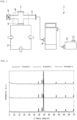
- the method for producing a molybdenum trioxide powder can be suitably carried out by using a production apparatus 1 shown in FIG. 1 .
- FIG. 1 is a schematic view of an example of an apparatus used for producing the molybdenum trioxide powder.
- the production apparatus 1 includes a calcining furnace 2 for calcining a molybdenum oxide precursor compound or the raw material mixture to vaporize the molybdenum oxide precursor compound, a cross-shaped cooling pipe 3 connected to the calcining furnace 2 for powdering the molybdenum trioxide vapor vaporized by the calcining, and a collection device 4 as a collection unit for collecting the molybdenum trioxide powder aggregated in a powder form in the cooling pipe 3.
- the calcining furnace 2 and the cooling pipe 3 are connected to each other via a discharge port 5.
- an opening degree adjustment damper 6 is disposed at an outside air intake port (not shown) at a left end portion, and an observation window 7 is disposed at an upper end portion.
- the production apparatus 1 may include an external cooling device 9, which makes it possible to freely control cooling conditions for the molybdenum trioxide vapor generated from the calcining furnace 2.
- the opening degree adjustment damper 6 takes in air from the outside air intake port and the molybdenum trioxide vapor vaporized in the calcining furnace 2 is cooled in an air atmosphere to obtain a molybdenum trioxide powder, whereby the ratio (I/II) can be made more than 1.1, and the ⁇ crystal structure of MoO 3 can be easily obtained in the molybdenum trioxide powder.
- the molybdenum trioxide vapor is cooled in a state where an oxygen concentration in a nitrogen atmosphere is low, for example, when the molybdenum trioxide vapor is cooled using liquid nitrogen, the oxygen defect density is likely to increase and the ratio (I/II) is likely to decrease.
- the molybdenum oxide precursor compound is not particularly limited as long as it is a precursor compound for forming the molybdenum trioxide powder made of an aggregate of the primary particles containing molybdenum trioxide having a ⁇ crystal structure.
- molybdenum oxide precursor compounds may be used alone or in combination of two or more thereof.
- the form of the molybdenum oxide precursor compound is not particularly limited, and for example, the molybdenum oxide precursor compound may be in a powder form such as molybdenum trioxide, or may be in a liquid form such as an aqueous solution of ammonium molybdate.
- the molybdenum oxide precursor compound is preferably in the powder form having good handling properties and good energy efficiency.
- molybdenum oxide precursor compound commercially available ⁇ -crystal molybdenum trioxide is preferably used. Further, when ammonium molybdate is used as the molybdenum oxide precursor compound, the ammonium molybdate is converted by calcining into molybdenum trioxide that is thermodynamically stable, and thus the molybdenum oxide precursor compound to be vaporized becomes molybdenum trioxide.
- molybdenum trioxide is preferably contained from the viewpoint of easily controlling the purity of the obtained molybdenum trioxide powder, the average particle diameter of the primary particles, and the crystal structure.
- the molybdenum trioxide vapor can also be formed by calcining a raw material mixture containing a molybdenum oxide precursor compound and a metal compound other than the molybdenum oxide precursor compound.
- the metal compound other than the molybdenum oxide precursor compound is not particularly limited, and examples thereof include an aluminum compound, a silicon compound, a titanium compound, a magnesium compound, a sodium compound, a potassium compound, a zirconium compound, an yttrium compound, a zinc compound, a copper compound, and an iron compound. Among these, it is preferable to use an aluminum compound, a silicon compound, a titanium compound, or a magnesium compound.
- the molybdenum oxide precursor compound and the metal compound other than the molybdenum oxide precursor compound may form an intermediate, but even in this case, the intermediate is decomposed by calcining, and molybdenum trioxide can be vaporized in a thermodynamically stable form.
- an aluminum compound is preferably used to prevent damage to a calcining furnace, and the metal compound other than the molybdenum oxide precursor compound may not be used to improve the purity of the molybdenum trioxide powder.
- Examples of the aluminum compound include aluminum chloride, aluminum sulfate, basic aluminum acetate, aluminum hydroxide, boehmite, pseudo-boehmite, transition aluminum oxides ( ⁇ -aluminum oxide, ⁇ -aluminum oxide, ⁇ -aluminum oxide, etc.), ⁇ -aluminum oxide, and a mixed aluminum oxide having two or more crystal phases.
- the content of the molybdenum oxide precursor compound is preferably 40% by mass to 100% by mass, and may be 45% by mass to 100% by mass or 50% by mass to 100% by mass with respect to 100% by mass of the raw material mixture.
- the calcining temperature varies depending on the molybdenum oxide precursor compound, the metal compound, and the like to be used, and the desired molybdenum trioxide powder, and is usually preferably a temperature at which the intermediate can be decomposed.
- the calcining temperature is preferably 500°C to 1500°C, more preferably 600°C to 1550°C, and still more preferably 700°C to 1600°C.
- the calcining time is also not particularly limited, and may be, for example, 1 minute to 30 hours, 10 minutes to 25 hours, or 100 minutes to 20 hours.
- the temperature rising rate varies depending on the molybdenum oxide precursor compound and the metal compound to be used, and the properties of the desired molybdenum trioxide powder, and is preferably 0.1°C/min or more and 100°C/min or less, more preferably 1°C/min or more and 50°C/minor less, and even more preferably 2°C/min or more and 10°C/min or less from the viewpoint of production efficiency.
- the internal pressure in the calcining furnace is not particularly limited, and may be a positive pressure or a reduced pressure, but from the viewpoint of suitably discharging the molybdenum oxide precursor compound from the calcining furnace to the cooling pipe, the calcining is preferably performed under a reduced pressure.
- the degree of pressure reduction is preferably -5,000 Pa to -10 Pa, more preferably -2,000 Pa to -20 Pa, and still more preferably -1,000 Pa to -50 Pa.
- the degree of pressure reduction is -5,000 Pa or more, high airtightness and mechanical strength of the calcining furnace are not excessively required, and production costs can be reduced, which is preferable.
- the degree of pressure reduction is -10 Pa or less, clogging of the molybdenum oxide precursor compound at a discharge port of the calcining furnace can be prevented, which is preferable.
- the temperature of the blown gas is preferably 5°C to 500°C, and more preferably 10°C to 100°C.
- the blowing speed of the gas is preferably 1 L/min ore more and 500 L/min or less, and more preferably 10 L/min or more and 200 L/min or less with respect to 100 L of an effective volume of the calcining furnace.
- the temperature of the vaporized molybdenum trioxide vapor varies depending on the type of the molybdenum oxide precursor compound to be used, and is preferably 200°C to 2000°C, and more preferably 400°C to 1500°C.
- the temperature of the vaporized molybdenum trioxide vapor is 2,000°C or lower, usually, the vapor tends to be easily turned into a powder by blowing outside air (0°C to 100°C) to the cooling pipe.
- the discharge rate of the molybdenum trioxide vapor discharged from the calcining furnace can be controlled based on the amount of the molybdenum oxide precursor compound to be used, the amount of the metal compound to be used, the temperature of the calcining furnace, blowing of the gas into the calcining furnace, and the diameter of the discharge port of the calcining furnace.
- the discharge rate of the molybdenum trioxide vapor discharged from the calcining furnace to the cooling pipe varies depending on the cooling capacity of the cooling pipe, and is preferably 0.001 g/min or more and 100 g/min or less, and more preferably 0.1 g/min or more and 50 g/min or less.
- the content of the molybdenum trioxide vapor contained in the gas discharged from the calcining furnace is preferably 0.01 g/min or more and 1,000 mg/L or less, and more preferably 1 g/min or more and 500 mg/Lg/min or less.
- the molybdenum trioxide vapor is cooled to be powdered.
- the molybdenum trioxide vapor is cooled by lowering the temperature of the cooling pipe.
- examples of a cooling method include cooling by blowing a gas into the cooling pipe as described above, cooling by a cooling mechanism included in the cooling pipe, and cooling by an external cooling device.
- the molybdenum trioxide vapor is preferably cooled in an air atmosphere.
- the ratio (I/II) can be made more than 1.1, and the ⁇ crystal structure of MoO 3 can be easily obtained in the molybdenum trioxide powder.
- the cooling temperature (temperature of the cooling pipe) is not particularly limited, and is preferably -100°C to 600°C, and more preferably -50°C to 400°C.
- the cooling rate of the molybdenum trioxide vapor is not particularly limited, and is preferably 100°C/s or more and 100,000°C/s or less, and more preferably 1,000°C/s or more and 50,000°C/s or less. As the cooling rate of the molybdenum trioxide vapor increases, a molybdenum trioxide powder having a small particle diameter and a large specific surface area tends to be obtained.
- the temperature of the blown gas is preferably -100°C to 300°C, and more preferably -50°C to 100°C.
- the blowing speed of the gas is preferably 0.1 m 3 /min or more and 20 m 3 /min or less, and more preferably 1 m 3 /min or more and 10 m 3 /min or less.
- the blowing speed of the gas is 0.1 m 3 /min or more, a high cooling rate can be achieved, and clogging in the cooling pipe can be prevented, which is preferable.
- the blowing speed of the gas is 20 m 3 /min or less, the first air blowing unit (such as an air exhauster) which is expensive is no longer needed, and production costs can be reduced, which is preferable.
- the powder obtained by cooling the molybdenum trioxide vapor is transported to the collection device for collection.
- the powder obtained by cooling the molybdenum trioxide vapor may be calcined again at a temperature of 100°C to 320°C.
- the molybdenum trioxide powder obtained by the method for producing a molybdenum trioxide powder may be calcined again at a temperature of 100°C to 320°C.
- the calcining temperature in the re-calcining may be 120°C to 280°C or 140°C to 240°C.
- a calcining time in the re-calcining may be, for example, 1 min to 4 h, 10 min to 5 h, or 100 min to 6 h.
- the molybdenum carbide having the desired particle structure and composition can be obtained. Further, according to the method for producing molybdenum carbide according to the present embodiment, there are such advantage that mass production is possible, an apparatus having the risk caused by high pressure is not required, and a post-treatment process is not required.
- the catalyst ink according to the present embodiment (hereinafter also referred to as a "first catalyst ink”) includes the molybdenum carbide according to the present embodiment and a solvent.
- the solvents are not particularly limited.
- the solvent include alcohol solvents such as methanol and ethanol, or a mixture solvent of the alcohol solvents and water. Of these solvents, methanol and ethanol are particularly preferable as the solvents.
- the first catalyst ink may include only one type of the solvent or two or more types thereof.
- the first catalyst ink according to the present embodiment may further include a conductive material.
- Examples of the conductive material include carbon and a metal that have high conductivity.
- the first catalyst ink may include only one type of the conductive material or two or more types thereof.
- Examples of the carbon include carbon black such as acetylene black, Cabot carbon black, and Ketjen Black, graphite, carbon fibers, and metal powders.
- Ketjen Black has a high specific surface area and conductivity, and is excellent from the viewpoint of suppressing aggregation of the molybdenum carbide.
- Examples of the metal that is the conductive material include gold, silver, copper, palladium, aluminum, rhodium, molybdenum, tungsten, iron, nickel, cobalt, and indium.
- the first catalyst ink according to the present embodiment may include only one type of the metal serving as the conductive material or two or more types thereof.
- the first catalyst ink according to the present embodiment may include the carbon and no metal, may include the metal and no carbon, or may include both the metal and the carbon.
- the first catalyst ink according to the present embodiment can be applied to, for example, a substrate for a working electrode to form a catalyst layer.
- the first catalyst ink according to the present embodiment may further include polyelectrolyte.
- polyelectrolytes generally used in formation of a catalyst layer can be used.
- specific examples thereof include a perfluorocarbon polymer having a sulfonic acid group (for example, Nafion (registered trademark)), a hydrocarbon-based polymer compound having a sulfonic acid group, a polymer compound doped with an inorganic acid such as phosphoric acid, organic/inorganic hybrid polymers partially substituted with proton-conducting functional groups, and a proton conductor in which a polymer matrix is impregnated with a phosphoric acid solution or a sulfuric acid solution.
- a perfluorocarbon polymer having a sulfonic acid group for example, Nafion (registered trademark)
- a hydrocarbon-based polymer compound having a sulfonic acid group for example, a hydrocarbon-based polymer compound having a sulfonic acid group
- a polymer compound doped with an inorganic acid such as phosphoric acid
- the composite product according to the present embodiment (hereinafter also referred to as a "first composite product”) is a composite product of noble metal particles having an average particle size of 20 nm or less and the molybdenum carbide according to the embodiment.
- the noble metal particles are not particularly limited. Gold, silver, platinum, palladium, rhodium, and iridium are preferable and palladium is more preferable.
- the first composite product may contain only one type of the noble metal particles or two or more types thereof.
- the palladium particles contained in the first composite product according to the embodiment are a particle structure product containing palladium and constitute the composite product of palladium and the molybdenum carbide by compositing with the molybdenum carbide particles.
- the shape of the palladium particles is not particularly limited. Examples of the shape include a spherical shape and a hemispherical shape.
- the contained form of the palladium particles in the first composite product according to the embodiment is not particularly limited.
- the palladium particles may be present on the surface of the molybdenum carbide particles or may be attached to the surface of the molybdenum carbide particles.
- the number of the palladium particles present per 100 nm ⁇ 100 nm surface area of the surface of the molybdenum carbide particles may be, for example, 5 particles to 5,000 particles or 10 particles to 1,000 particles.
- the average particle diameter of the palladium particles is 20 nm or less, or may be 15 nm or less or 10 nm or less.
- the lower limit value of the average particle diameter of the palladium particles may be 0.5 nm or more, 0.7 nm or more, or 1 nm or more.
- the range may be 0.5 nm or more and 20 nm or less, 0.7 nm or more and 15 nm or less, or 1 nm or more and 10 nm or less.
- the average particle diameter of the palladium particles the average value of measured maximum lengths in the distance between two points on the contour line of 50 randomly selected palladium particles, which are identified on the two-dimensional image obtained by photographing the first composite product according to the present embodiment with a transmission electron microscope (TEM) is adapted.
- TEM transmission electron microscope
- the palladium particles are aggregates of palladium (Pd) atoms and contain palladium.
- the contained form of palladium contained in the composite product according to the embodiment is not particularly limited.
- palladium may be contained in the palladium particles as a palladium compound.
- the palladium particles preferably have a diffraction pattern of XRD analysis that does not indicate the crystal structure of the palladium metal crystal.
- the first composite product according to the present embodiment exhibits excellent catalytic performance.
- the palladium particles may contain amorphous palladium.
- the palladium particles may contain palladium that is not in a form substituted with a part of molybdenum in the crystal structure of molybdenum disulfide.
- the palladium particles may contain zero valence palladium.
- the palladium particles may contain palladium without having the crystal structure of the palladium metal crystal.
- the palladium particles may contain 50% or more of amorphous palladium with respect to the palladium contained in the palladium particles in terms of mole.
- the palladium particles may contain 50% or more of palladium that is not in the form substituted with a part of molybdenum in the crystal structure of molybdenum disulfide with respect to the palladium contained in the palladium particles in terms of mole.
- the palladium particles may contain 50% or more of zero valence palladium with respect to the palladium contained in the palladium particles in terms of mole.
- the palladium particles may contain 50% or more of palladium without having the crystal structure of the palladium metal crystal (close-packed structure) with respect to the palladium contained in the palladium particles in terms of mole.
- the first composite product according to the present embodiment may contain amorphous palladium.
- the first composite product according to the embodiment may contain palladium that is not in the form substituted with a part of molybdenum in the crystal structure of the molybdenum carbide.
- the first composite product according to the embodiment may contain palladium of which valence is zero valence.
- the first composite product according to the embodiment may contain palladium without having the crystal structure of the palladium metal crystal.
- the first composite product according to the embodiment may contain 50% or more of amorphous palladium with respect to the palladium contained in the first composite product in terms of mole.
- the first composite product according to the embodiment may contain 50% or more of palladium that is not in the form substituted with a part of molybdenum in the crystal structure of the molybdenum carbide with respect to the palladium contained in the first composite product in terms of mole.
- the first composite product according to the embodiment may contain 50% or more of palladium of which valence is zero valence with respect to the palladium contained in the composite product in terms of mole.
- the first composite product according to the embodiment may contain 50% or more of palladium without having the crystal structure of the palladium metal crystal with respect to the palladium contained in the first composite product in terms of mole.
- Palladium in the first composite product according to the embodiment may form palladium clusters.
- the palladium in the palladium particles may also form the palladium clusters.
- the presence of crystal structures containing palladium can be detected by diffraction profiles obtained from analysis by XRD using the first composite product according to the embodiment as a sample.
- the molybdenum carbide and metal particles are composited together, whereby excellent catalytic performance can be exhibited.
- the noble metal in the noble metal particles does not form the crystal structure of the noble metal crystal and is preferably present as the aggregates of noble metal atoms in the molybdenum carbide.
- the first composite product according to the embodiment can be suitably used as a catalyst, particularly as a hydrogen generation catalyst applied to water electrolysis and the like.
- the first composite product according to the embodiment can be suitably used as an electrode material used as a constituent material of the electrocatalyst layer.
- the method for producing the first composite product according to the embodiment is not particularly limited.
- the method includes a step of mixing the molybdenum carbide and a noble metal solution, and more preferably includes a step of mixing the molybdenum carbide and a palladium solution.
- the first composite product may contain only one type of the noble metal solution or two or more types thereof.
- the palladium solution can be obtained by dissolving any palladium source in a solvent.
- any palladium source that can produce the palladium solution may be used.
- the palladium source include palladium compound such as palladium acetate, palladium nitrate, palladium nitrite, palladium sulfate, palladium carbonate, palladium chloride, palladium hydroxide, and palladium oxide.
- the first composite product may contain only one type of the palladium solution or two or more types thereof.
- any solvent that can dissolve the palladium source may be used.
- the solvent include alcohols such as methanol, benzene, dichloromethane, acetone, and chloroform.
- the first catalyst ink may include only one type of the solvent or two or more types thereof.
- the method for mixing is not particularly limited.
- the palladium solution is preferably mixed with the dispersion liquid of the molybdenum carbide.
- the dispersion liquid of the molybdenum carbide can be obtained by mixing the molybdenum carbide with the solvent exemplified in the palladium solution described above.
- the composite product of the molybdenum carbide and the palladium particles can be formed by bringing the molybdenum carbide into contact with the palladium solution by mixing the palladium solution and the molybdenum carbide to obtain a mixture.
- the mixture of the palladium solution and the molybdenum carbide is preferably stirred.
- the degree of the stirring 50 rpm to 1,000 rpm may be exemplified.
- the concentration of palladium in the palladium solution may be, for example, 0.00001 mol/L to 0.1 mol/L or 0.0001 mol/L to 0.01 mol/L.
- the temperature of the mixture of the molybdenum carbide and the palladium solution may be as high as possible to form the first composite product.
- the temperature may be 10°C to 100°C or 20°C to 80°C.
- the retention time of the mixture of the molybdenum carbide and the palladium solution is as long as possible to form the first composite product.
- the time may be 10 minutes or more and within 48 hours or 30 minutes or more and within 12 hours.
- light irradiation may be performed to the mixture of the molybdenum carbide and the palladium solution in order to promote photoreduction of palladium.
- the light irradiation can be performed by appropriately selecting the light intensity and wavelength to the extent that photoreduction of palladium occurs.
- the light irradiation may be performed by installing a light source and controlling the degree of light, or may be the irradiation of light from the normal indoor environment (by fluorescent lamps, LEDs, or other lightings) or the irradiation of natural light.
- the first composite product can be produced without performing the heat treatment in the method for producing the first composite product according to the embodiment.
- the obtained first composite product and the mixture of the palladium solution and the molybdenum carbide are preferably not heated at 200°C or higher, more preferably not heated at 100°C or higher, and still more preferably not heated 80°C or higher.
- the composite product After the composite product is formed from the above mixture, the composite product can be isolated by performing treatment such as centrifugation and drying to easily collect the first composite product according to the embodiment.
- the first composite product according to the embodiment can be suitably used as a catalyst for the hydrogen evolution reaction (HER) (herein also referred to as "hydrogen generation catalyst"). Also, the first composite product according to the embodiment can be used as the hydrogen generation catalyst used together with the conductive material. That is, preferable examples of the hydrogen generation catalyst include a substance containing the first composite product according to the embodiment.
- the hydrogen generation catalyst may further contain the conductive material in addition to the first composite product according to the embodiment.
- the catalytic activity of the hydrogen generation catalyst containing the first composite product according to the embodiment and the conductive material in the hydrogen evolution reaction (HER) is higher.
- the conductive material may be a publicly known conductive material.
- Examples of the conductive material include carbon and a metal that have high conductivity.
- the hydrogen generation catalyst may contain only one type of the conductive material or two or more types thereof.
- Examples of the carbon include carbon black such as acetylene black, Cabot carbon black, and Ketjen Black, graphite, carbon fibers, and metal powders.
- Ketjen Black has a high specific surface area and conductivity, and is excellent from the viewpoint of suppressing aggregation of the molybdenum carbide.
- Examples of the metal that is the conductive material include gold, silver, copper, aluminum, rhodium, molybdenum, tungsten, iron, nickel, cobalt, and indium.
- the metal serving as the conductive material which is different from the noble metal in the first composite product according to the embodiment, is merely mixed with the first composite product according to the embodiment in the hydrogen generation catalyst.
- the hydrogen generation catalyst may contain only one type of the metal that is the conductive material or two or more types thereof.
- the hydrogen generation catalyst may contain the carbon and no metal, may contain the metal and no carbon, or may contain both the metal and the carbon.
- the content of the conductive material in the hydrogen generation catalyst is preferably 0.1 mass% to 50 mass% and more preferably 0.5 mass% to 40 mass% with respect to the content of the first composite product according to the embodiment.
- the ratio of the total content of the first composite product according to the embodiment and the conductive material in the hydrogen generation catalyst to the whole mass (100 mass%) of the hydrogen generation catalyst is preferably 80 mass% or more, more preferably 90 mass% or more, and still more preferably 95 mass% or more, and may be, for example, any of 97 mass% or more and 99 mass% or more, or 100 mass%.
- the ratio is equal to or more than the lower limit value, the catalytic activity of the hydrogen generation catalyst in the hydrogen evolution reaction (HER) is higher.
- the ratio may be 100 mass% or less.
- the first composite product is suitable as a component contained in a catalyst ink.
- the catalyst ink according to the embodiment (hereinafter also referred to as a "second catalyst ink”) includes the first composite product according to the embodiment and a solvent.
- the second catalyst ink according to the embodiment can include the first composite product according to the embodiment, a polyelectrolyte, and a solvent.
- the second catalyst ink according to the present embodiment may further include a conductive material.
- a conductive material include those exemplified above.
- the second catalyst ink can be applied to, for example, a substrate for a working electrode to form a catalyst layer.
- polyelectrolytes generally used in a catalyst layer can be used.
- specific examples thereof include a perfluorocarbon polymer having a sulfonic acid group (for example, Nafion (registered trademark)), a hydrocarbon-based polymer compound having a sulfonic acid group, a polymer compound doped with an inorganic acid such as phosphoric acid, organic/inorganic hybrid polymers partially substituted with proton-conducting functional groups, and a proton conductor in which a polymer matrix is impregnated with a phosphoric acid solution or a sulfuric acid solution.
- a perfluorocarbon polymer having a sulfonic acid group for example, Nafion (registered trademark)
- a hydrocarbon-based polymer compound having a sulfonic acid group for example, a hydrocarbon-based polymer compound having a sulfonic acid group
- a polymer compound doped with an inorganic acid such as phosphoric acid
- the solvent examples include a solvent that is capable of dispersing the first composite product according to the embodiment and being applied to the substrate for a working electrode to form a catalyst layer.
- Preferred examples of the solvent include alcohols such as 1-propanol, 2-propanol, 1-butanol, 2-butanol, 1-pentanol, 2-pentanol, 1-hexanol, 2-hexanol, 1-heptanol, and 2-heptanol.
- the composite product according to the present embodiment (hereinafter referred to as a "second composite product”) is a composite product of at least one transition metal species selected from the group consisting of transition metals and transition metal compounds and the molybdenum carbide.
- the transition metals are not particularly limited. Nickel, iron, cobalt, chromium, vanadium, manganese, copper, zinc, ruthenium, and iridium are preferable and nickel, iron, cobalt, and manganese are more preferable.
- the transition metal compounds are not particularly limited.
- the transition metal compounds include transition metal hydroxides and transition metal oxides. Of these transition metal compounds, nickel compounds are preferable and Ni(OH) 2 and NiO are more preferable.
- the transition metal compounds may be compounds containing two or more transition metals such as NiFeO x .
- the second composite product may contain only one type of the transition metal species or two or more types thereof.
- the primary particle shape of the nickel compounds in a two-dimensional image photographed with a transmission electron microscopy (TEM) may be a particle shape, a spherical shape, a plate shape (a sheet shape), a needle shape, a string shape, or a ribbon shape by visual observation or an image photograph, or may include a combination of these shapes.
- the primary particle shape in the two-dimensional image photographed with TEM is preferably the sheet shape.
- the molybdenum carbide and the transition metal species are composited to exhibit excellent catalytic performance.
- the second composite product according to the embodiment can be suitably used as a catalyst, particularly as an oxygen generation catalyst applied to water electrolysis and the like.
- the second composite product according to the embodiment can be suitably used as an electrode material used as a constituent material of the electrocatalyst layer.
- the method for producing the second composite product according to the embodiment is not particularly limited.
- the method includes a step of mixing the molybdenum carbide and the solution of the transition metal source.
- transition metal source examples include transition metal acetates, transition metal nitrates, transition metal nitrites, transition metal sulfates, transition metal carbonates, transition metal chlorides, transition metal hydroxides, and transition metal oxides.
- nickel acetate is preferable as the transition metal source.
- the transition metal source is preferably an aqueous solution and more preferably an aqueous nickel acetate solution.
- the second composite product may contain only one type of the transition metal source or two or more types thereof.
- urea may be mixed in order to provide a basic environment by generating amines in the aqueous nickel acetate solution and to facilitate the formation of the target Ni(OH) 2 .
- the method for mixing is not particularly limited.
- the nickel solution is preferably mixed with the dispersion liquid of the molybdenum carbide.
- the dispersion liquid of the molybdenum carbide the mixture of water and the molybdenum carbide may be exemplified.
- the composite product of the molybdenum carbide and the nickel compound solution can be formed by bringing the molybdenum carbide into contact with the nickel compound solution by mixing the nickel compound solution and the molybdenum carbide to obtain a mixture.
- the mixture of the nickel compound solution and the molybdenum carbide is preferably stirred.
- the degree of the stirring 50 rpm to 1,000 rpm may be exemplified.
- the concentration of nickel in the nickel compound solution may be, for example, 0.0001 mol/L to 1 mol/L or 0.001 mol/L to 0.1 mol/L.
- the temperature of the mixture may be as high as possible to form the second composite product.
- the temperature may be 10°C to 100°C or 20°C to 90°C.
- the retention time of the mixture is as long as possible to form the second composite product.
- the time may be 10 minutes or more and within 48 hours or 30 minutes or more and within 12 hours.
- the second composite product can be produced without performing the heat treatment in the method for producing the second composite product according to the embodiment.
- the obtained second composite product and the mixture of the nickel compound solution and the molybdenum carbide are preferably not heated at 200°C or higher, more preferably not heated at higher than 100°C, and even more preferably not heated at higher than 80°C.
- the second composite product After the second composite product is formed from the above mixture, the second composite product can be isolated by performing treatment such as centrifugation and drying to easily collect the second composite product according to the embodiment.
- the second composite product according to the embodiment can be suitably used as a catalyst for the oxygen evolution reaction (OER) (herein also referred to as "oxygen generation catalyst").
- the second composite product according to the embodiment can be used as the oxygen generation catalyst used together with the conductive material. That is, preferable examples of the oxygen generation catalyst include a substance containing the second composite product according to the embodiment.
- the oxygen generation catalyst may further contain the conductive material in addition to the second composite product according to the embodiment. The catalytic activity of the oxygen generation catalyst containing the second composite product according to the embodiment and the conductive material in the oxygen evolution reaction (OER) is higher.
- the conductive material is the same as the conductive material in the oxygen generation catalyst.
- the oxygen generation catalyst may contain only one type or two or more types of the metals that serves as the conductive material.
- the oxygen generation catalyst may contain the carbon and no metal, may contain the metal and no carbon, or may contain both the metal and the carbon.
- the content of the conductive material in the oxygen generation catalyst is preferably 0.1 mass% to 50 mass% and more preferably 0.5 mass% to 40 mass% with respect to the content of the second composite product according to the embodiment.
- the ratio of the total content of the second composite product according to the embodiment and the conductive material in the oxygen generation catalyst to the whole mass (100 mass%) of the oxygen generation catalyst is preferably 80 mass% or more, more preferably 90 mass% or more, and further preferably 95 mass% or more, and may be, for example, any of 97 mass% or more and 99 mass% or more, or 100 mass%.
- the ratio is equal to or more than the lower limit value, the catalytic activity of the oxygen generation catalyst in the oxygen evolution reaction (OER) is higher.
- the ratio may be 100 mass% or less.
- the electrolyte is not particularly limited and any known electrolyte can be used. Potassium hydroxide solution is preferable.
- the second composite product is suitable for use as a component contained in a catalyst ink.
- the catalyst ink according to the embodiment (hereinafter also referred to as a "third catalyst ink”) includes the second composite product according to the embodiment and a solvent.
- the third catalyst ink according to the embodiment can include the second composite product according to the embodiment, the polyelectrolyte, and the solvent.
- the third catalyst ink according to the present embodiment may further include a conductive material.
- a conductive material include those exemplified above.
- the third catalyst ink can be applied to, for example, a substrate for a working electrode to form a catalyst layer.
- the polyelectrolytes and the solvent are the same as those in the second catalyst ink described above.
- An RHK simulator (manufactured by Noritake Co., Ltd.) was used as the calcining furnace, and a VF-5N dust collector (manufactured by AMANO Corporation) was used as the dust collector to produce molybdenum trioxide.
- the median diameter D 50 of the primary particles determined by dynamic light scattering was 87.8 nm, and the purity (content ratio of MoO 3 ) of molybdenum trioxide 1 was confirmed to be 99.9 mass% by fluorescence X-ray measurement.
- molybdenum trioxide (1) was evaluated using the Scherrer method by applying integrated powder X-ray analysis software PDXL2 manufactured by Rigaku Corporation and determining a XRD instrument constant using LaB 6 (NIST SRM660c LaB 6 Standard Powder) as the standard material. Molybdenum trioxide (1) was confirmed to have a crystal structure containing the ⁇ -crystal having an average crystallite size of 15.7 nm and the ⁇ -crystal having an average crystallite size of 16.8 nm.
- 0.1 g of the molybdenum trioxide powder was added to 10 cc of ethanol and subjected to an ultrasonic treatment in an ice bath for 4 hours, and then the concentration thereof was appropriately adjusted with ethanol to a concentration within a measurable range of a dynamic light scattering type particle diameter distribution measuring device (Nanotrac Wave II manufactured by MicrotracBEL) to obtain a measurement sample.
- a dynamic light scattering type particle diameter distribution measuring device Nanotrac Wave II manufactured by MicrotracBEL
- the particle diameter distribution in the range of particle diameters of 0.0001 ⁇ m to 10 ⁇ m was measured by a dynamic light scattering type particle diameter distribution measuring device (Nanotrac Wave II manufactured by MicrotracBEL) to calculate the median diameter D 50 .
- the sample of the collected molybdenum compound obtained in each Example was filled in a holder for a measurement sample having a depth of 0.5 mm, set in an X-ray diffraction (XRD) apparatus (Ultima IV, manufactured by Rigaku Corporation, as an optical system, a parallel beam method plus scintillation counter and a rotation stage were used), and was subjected to measurement under conditions of Cu/K ⁇ rays, 40 kV/40 mA, a scanning speed (2 ⁇ ) of 2°/min, a step (2 ⁇ ) of 0.02°, and a scanning range (2 ⁇ ) of 10° or more and 70° or less.
- XRD X-ray diffraction
- molybdenum trioxide 1 0.5 g of molybdenum trioxide 1, 0.17 g of Ketjen Black (EC300J manufactured by Lion Specialty Chemicals Co., Ltd.), 0.33 g of sodium chloride, and 0.33 g of potassium chloride were mixed in a mortar for 1 minute. Then, the resultant mixture was placed in a crucible and calcined at 850°C for 3 hours under a nitrogen atmosphere. After natural cooling, the calcined product was washed with ion exchanged water to remove salts. According to the XRD measurement, the obtained molybdenum carbide was confirmed to exhibit the ⁇ crystal structure of molybdenum carbide (Mo 2 C).
- Molybdenum carbides were synthesized in the same manner as the manner in Example 1 except that the raw materials were changed to those listed in Table 1.
- Ketjen Black (EC300J manufactured by Lion Specialty Chemicals Co., Ltd.) was evaluated in the same manner as the manner for the molybdenum carbides in Examples 1 to 3. The results are listed in Table 2.
- MoO 3 (1) represents molybdenum trioxide 1 and “KB” represents Ketjen Black (EC300J manufactured by Lion Specialty Chemicals, Co., Ltd.).
- the content of molybdenum was determined by acid decomposition under heated and sealed condition-ICP-AES (Inductively Coupled Plasma Atomic Emission Spectrometry). More specifically, samples were dissolved in a mixture of sulfuric acid and nitric acid at 180°C for 12 hours or more and the resultant solutions were measured under the following conditions.
- ICP-AES Inductively Coupled Plasma Atomic Emission Spectrometry
- ICP emission spectrometry instrument: iCAP 6300 DUO manufactured by Thermo Fisher Scientific Inc.
- the carbon content was determined by CHN elemental analysis (MICROCORDER JM10 manufactured by J-Science Labs Co., Ltd).
- XRD X-ray diffraction
- 0.1 g of the sample powder was added to 20 cc of acetone and the resultant mixture was subjected to ultrasonic treatment in an ice bath for 4 hours. Thereafter, the concentration thereof was appropriately adjusted with acetone to a concentration within a measurable range of a dynamic light scattering type particle diameter distribution measuring device (Nanotrac Wave II, manufactured by MicrotracBEL Corp.) to give a measurement sample.
- a dynamic light scattering type particle diameter distribution measuring device Nanotrac Wave II, manufactured by MicrotracBEL Corp.
- the particle diameter distribution in the range of a particle diameters of 0.0001 ⁇ m to 10 ⁇ m was measured by a dynamic light scattering type particle diameter distribution measuring device to calculate the median diameter D 50 , which is a diameter of which the ratio of accumulated volume percentage was 50%.
- a powder sample was placed on a slide glass and measured with a laser Raman spectrophotometer (NRS-5500 manufactured by JASCO Corporation) under the measurement conditions of an excitation laser of 532 nm, a laser intensity of 0.6 mW, an exposure time of 30 sec, and point measurement using an objective lens having a magnification of 100 times.
- a baseline-corrected XPS spectrum was analyzed with analysis software Spectra manager. The results are listed in Table 2 as "G/D(a.u.)".
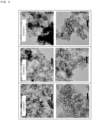
- FIG. 2 The result of the XRD analysis is illustrated in FIG. 2 .
- all of the molybdenum carbides obtained in Examples 1 to 3 were confirmed to exhibit the crystal structure of molybdenum carbide (Mo 2 C).
- All of the molybdenum carbides in Examples 1 to 3 were confirmed to have an ⁇ crystal of a molybdenum carbide (Mo 2 C) crystal structure.
- FIG. 3 illustrates the observed images of each of the particles in Examples 1 to 3 obtained by using a transmission electron microscope (TEM, JEM-1400 manufactured by JEOL Ltd.). As illustrated in FIG. 3 , all of the molybdenum carbides in Examples 1 to 3 were confirmed to have a sheet structure.
- TEM transmission electron microscope
- FIG. 4 illustrates the observed images of the particles in Examples 1 obtained by using a high-resolution transmission electron microscope (HRTEM, JEM-ARM300F manufactured by JEOL Ltd.).
- HRTEM high-resolution transmission electron microscope
- JEM-ARM300F manufactured by JEOL Ltd.
- the EDS mapping image illustrates that Mo and C appeared to be overlapped and the crystal lattice image of Mo 2 C was observed by the high-resolution TEM, confirming that Mo 2 C is the main phase of the compound in Example 1.
- An oxide layer (MoO 3 ) was observed on the surface of the particles.
- the hydrogen evolution activity of the prepared electrode was evaluated using a three-electrode method.
- a LSV method was used and a scan voltage range was -0.3 V to 0 V at a scanning speed of 5 mV/S.
- Overvoltages (mV) at a current density of 10 mA/cm 2 and the current densities (mA/cm 2 ) at a voltage of -0.3 V are listed in Table 3. [Table 3] Overvoltage (mV) Current density (mA/cm 2 ) Ex. 1 249 28.6 Ex. 2 284 14.6 Ex. 3 Impossible to measure 0.7 Comp. Ex. 1 234 33.9 Comp. Ex. 2 Impossible to measure 1.2 Comp. Ex. 3 256 22.1
- Example 2 100 mg of the molybdenum carbide in Example 2 was dispersed in 50 ml of methanol (CH 3 OH, a reagent manufactured by Kanto Chemical Co., Inc.) by sonication for 30 minutes to give a dispersion liquid. 42.2 mg of palladium acetate (Pd(CH 3 COO) 2 , a reagent manufactured by Kanto Chemical Co., Inc.) was dissolved in methanol, and then the obtained solution was added to the above dispersion liquid with stirring. The dispersion liquid was then stirred at room temperature under light irradiation for 2 hours or more.
- methanol CH 3 OH, a reagent manufactured by Kanto Chemical Co., Inc.
- Precipitate in the dispersion liquid was collected by centrifugation, washed by sonication three times with water, and dried in vacuum to give a Pd-modified molybdenum carbide powder (palladium-molybdenum carbide composite product 1).
- a palladium-molybdenum carbide composite product 2 and a palladium-molybdenum carbide composite product 3 were synthesized in the same manner as the manner in Example 4 except that the raw materials were changed to those listed in Table 4.
- Mo 2 C-4" represents the molybdenum carbide in Example 1
- Mo 2 C-6 represents the molybdenum carbide in Example 2
- KB represents Ketjen Black (EC300J manufactured by Lion Specialty Chemicals, Inc.).
- FIG. 5 illustrates the observed images of each of the particles in Examples 4 to 6 obtained by using a transmission electron microscope (TEM, JEM-1400 manufactured by JEOL Ltd.).
- TEM transmission electron microscope
- JEM-1400 manufactured by JEOL Ltd.
- the results illustrated in FIG. 5 and FIG. 6 confirmed that all of the compounds obtained in Examples 4 to 6 were Pd-molybdenum carbide composite products.
- FIG. 7 illustrates the observed images of the particles in Example 4 obtained by using a high-resolution transmission electron microscope (HRTEM, JEM-ARM300F manufactured by JEOL Ltd.). From the EDS mapping image, the white spherical particles are considered to correspond to Pd particles.
- HRTEM high-resolution transmission electron microscope
- FIG. 8 is a HAADF-STEM image (transmission electron image, JEM-ARM300F manufactured by JEOL Ltd.) of the particles in Example 4.
- FIG. 9 is a SEI image (secondary electron image, JEM-ARM300F manufactured by JEOL Ltd.) of the particles in Example 4. The same Pd particles are indicated by the same types of arrows in FIG. 8 and FIG. 9 .
- the hydrogen evolution activity of the prepared electrode was evaluated using a three-electrode method.
- a LSV method was used and a scan voltage range was -0.3 V to 0 V at a scanning speed of 5 mV/S.
- Overvoltages (mV) at a current density of 10 mA/cm 2 and the current densities (mA/cm 2 ) at a voltage of -0.3 V are listed in Table 6. [Table 6] Overvoltage (mV) Current density (mA/cm 2 ) Ex. 4 121 123.8 Ex. 5 106 163.4 Ex. 6 56 214.7 Comp. Ex. 1 234 33.9 Comp. Ex. 4 235 21.7
- Example 2 100 mg of the molybdenum carbide in Example 2 was dispersed in 40 ml of pure water by sonication for 30 minutes to give a dispersion liquid. 198.7 mg of nickel(II) acetate tetrahydrate (Ni(CH 3 COO) 2 ⁇ 4H 2 O manufactured by Kanto Chemical Co., Ltd.) and 320 mg of urea (NH 2 CONH 2 manufactured by Kanto Chemical Co., Ltd.) were dissolved in 40 ml of pure water to give a solution. The dispersion liquid was added to the above solution with stirring and the resultant dispersion liquid was held at 85°C for 3 hours.
- nickel(II) acetate tetrahydrate Ni(CH 3 COO) 2 ⁇ 4H 2 O manufactured by Kanto Chemical Co., Ltd.
- urea NH 2 CONH 2 manufactured by Kanto Chemical Co., Ltd.
- Mo 2 C-6 represents the molybdenum carbide in Example 2.
- the palladium content (mass%) in the composite product was calculated by taking into account the amount of palladium, the amount of molybdenum, and the composition of the molybdenum carbide (listed in Table 2) determined by the XRF analysis results with respect to 100 mass% of the sample particles.
- FIG. 10 The result of the XRD analysis is illustrated in FIG. 10 .
- FIG. 11 illustrates the observed images of the particles in Example 7 obtained by using a transmission electron microscope (TEM).
- TEM transmission electron microscope
- the results illustrated in FIG. 11 confirmed the generation of Ni(OH) 2 nanosheets on the surface of the molybdenum carbide compared to the TEM photograph of the molybdenum carbide in FIG. 3 .
- the electrolyte was 1.0 Mol/L potassium hydroxide solution (Potassiumhydroxidesolution manufactured by Kanto Chemical Co.).
- a LSV method was used and a scan voltage range was 1.0 V to 1.8 V at a scanning speed of 5 mV/S.
- Overvoltages (mV) at a current density of 10 mA/cm 2 and the current densities (mA/cm 2 ) at a voltage of 1.8 V are listed in Table 9. [Table 9] Overvoltage (mV) Current density (mA/cm 2 ) Ex. 7 335 104.3 Comp. Ex. 5 392 66.4
Landscapes
- Chemical & Material Sciences (AREA)
- Organic Chemistry (AREA)
- Materials Engineering (AREA)
- Engineering & Computer Science (AREA)
- Chemical Kinetics & Catalysis (AREA)
- Electrochemistry (AREA)
- Metallurgy (AREA)
- Inorganic Chemistry (AREA)
- Physics & Mathematics (AREA)
- Thermal Sciences (AREA)
- General Chemical & Material Sciences (AREA)
- Life Sciences & Earth Sciences (AREA)
- Wood Science & Technology (AREA)
- Catalysts (AREA)
Applications Claiming Priority (2)
| Application Number | Priority Date | Filing Date | Title |
|---|---|---|---|
| JP2022125418 | 2022-08-05 | ||
| PCT/JP2023/028443 WO2024029595A1 (ja) | 2022-08-05 | 2023-08-03 | モリブデン炭化物、複合体、触媒インク、モリブデン炭化物の製造方法、及び複合体の製造方法 |
Publications (1)
| Publication Number | Publication Date |
|---|---|
| EP4567079A1 true EP4567079A1 (en) | 2025-06-11 |
Family
ID=89849475
Family Applications (1)
| Application Number | Title | Priority Date | Filing Date |
|---|---|---|---|
| EP23850148.0A Pending EP4567079A1 (en) | 2022-08-05 | 2023-08-03 | Molybdenum carbide, composite, catalyst ink, production method for molybdenum carbide, and production method for composite |
Country Status (6)
| Country | Link |
|---|---|
| EP (1) | EP4567079A1 (https=) |
| JP (1) | JP7601286B2 (https=) |
| KR (1) | KR20250047713A (https=) |
| CN (1) | CN119173474A (https=) |
| TW (1) | TW202411162A (https=) |
| WO (1) | WO2024029595A1 (https=) |
Families Citing this family (1)
| Publication number | Priority date | Publication date | Assignee | Title |
|---|---|---|---|---|
| WO2025164180A1 (ja) * | 2024-02-01 | 2025-08-07 | Dic株式会社 | 複合体、水素発生触媒、触媒インク、電極及び複合体の製造方法 |
Family Cites Families (7)
| Publication number | Priority date | Publication date | Assignee | Title |
|---|---|---|---|---|
| ATE124666T1 (de) | 1989-03-28 | 1995-07-15 | Pechiney Recherche | Herstellung von schwermetallkarbiden mit erhöhter spezifischer oberfläche. |
| FR2794260B1 (fr) | 1999-05-31 | 2002-08-02 | France Telecom | Dispositif d'interfacage homme/machine adaptatif |
| JP2001234380A (ja) | 2000-02-16 | 2001-08-31 | Asahi Kasei Corp | 水素発生用電極 |
| JP4273215B2 (ja) * | 2004-08-27 | 2009-06-03 | 独立行政法人産業技術総合研究所 | 炭素で被覆された金属微粒子からなるレドックス型キャパシタの電極材料、このものからなるレドックス型キャパシタの電極および該電極を備えたレドックス型キャパシタ |
| KR20140002628A (ko) * | 2010-09-14 | 2014-01-08 | 바스프 에스이 | 탄소-함유 지지체의 제조 방법 |
| JPWO2012169257A1 (ja) * | 2011-06-08 | 2015-02-23 | 株式会社東芝 | モリブデン造粒粉の製造方法およびモリブデン造粒粉 |
| JP2022125418A (ja) | 2021-02-17 | 2022-08-29 | 株式会社ユニバーサルエンターテインメント | 遊技機 |
-
2023
- 2023-07-11 TW TW112125829A patent/TW202411162A/zh unknown
- 2023-08-03 KR KR1020257000665A patent/KR20250047713A/ko active Pending
- 2023-08-03 CN CN202380038526.6A patent/CN119173474A/zh active Pending
- 2023-08-03 JP JP2024521303A patent/JP7601286B2/ja active Active
- 2023-08-03 WO PCT/JP2023/028443 patent/WO2024029595A1/ja not_active Ceased
- 2023-08-03 EP EP23850148.0A patent/EP4567079A1/en active Pending
Also Published As
| Publication number | Publication date |
|---|---|
| TW202411162A (zh) | 2024-03-16 |
| CN119173474A (zh) | 2024-12-20 |
| KR20250047713A (ko) | 2025-04-04 |
| WO2024029595A1 (ja) | 2024-02-08 |
| JPWO2024029595A1 (https=) | 2024-02-08 |
| JP7601286B2 (ja) | 2024-12-17 |
Similar Documents
| Publication | Publication Date | Title |
|---|---|---|
| EP4036062A1 (en) | Molybdenum sulfide powder and method for manufacturing same, heavy-metal adsorbent, photothermal conversion material, distillation method, oxygen reduction catalyst, and catalyst ink | |
| EP4292985A1 (en) | Metal-doped molybdenum sulfide powder and production method therefor | |
| EP4292705A1 (en) | Hydrogen generation catalyst, and catalyst ink | |
| Anantharaj et al. | Electrochemically chopped WS 2 quantum dots as an efficient and stable electrocatalyst for water reduction | |
| Kiran et al. | Morphology dependent oxygen reduction activity of titanium carbide: bulk vs. nanowires | |
| WO2014136908A1 (ja) | 燃料電池電極材料用タンタル含有酸化スズ | |
| EP4036061A1 (en) | Molybdenum trioxide powder and method for producing same | |
| EP4566709A1 (en) | Composite body, catalytic ink, and method for manufacturing composite body | |
| EP4567079A1 (en) | Molybdenum carbide, composite, catalyst ink, production method for molybdenum carbide, and production method for composite | |
| Liu et al. | A free standing Ru–TiC nanowire array/carbon textile cathode with enhanced stability for Li–O 2 batteries | |
| JP7605374B2 (ja) | 複合体、触媒インク、及び複合体の製造方法 | |
| WO2026060623A1 (en) | Oxygen evolution catalyst, catalyst ink, electrode, and method for producing oxygen evolution catalyst | |
| WO2025164180A1 (ja) | 複合体、水素発生触媒、触媒インク、電極及び複合体の製造方法 | |
| WO2026004633A1 (ja) | 金属複合酸化物、複合体、触媒インク、酸素発生触媒及び電極、並びに金属複合酸化物及び複合体の製造方法 | |
| WO2026088814A1 (ja) | 複合体、水素発生触媒、触媒インク、電極及び複合体の製造方法 | |
| JP6137011B2 (ja) | 燃料電池用触媒の製造方法 | |
| WO2026063450A1 (ja) | 金属複合酸化物、複合体、酸素発生触媒、触媒インク及び電極、並びに金属複合酸化物及び複合体の製造方法 |
Legal Events
| Date | Code | Title | Description |
|---|---|---|---|
| STAA | Information on the status of an ep patent application or granted ep patent |
Free format text: STATUS: THE INTERNATIONAL PUBLICATION HAS BEEN MADE |
|
| PUAI | Public reference made under article 153(3) epc to a published international application that has entered the european phase |
Free format text: ORIGINAL CODE: 0009012 |
|
| STAA | Information on the status of an ep patent application or granted ep patent |
Free format text: STATUS: REQUEST FOR EXAMINATION WAS MADE |
|
| 17P | Request for examination filed |
Effective date: 20250113 |
|
| AK | Designated contracting states |
Kind code of ref document: A1 Designated state(s): AL AT BE BG CH CY CZ DE DK EE ES FI FR GB GR HR HU IE IS IT LI LT LU LV MC ME MK MT NL NO PL PT RO RS SE SI SK SM TR |
|
| DAV | Request for validation of the european patent (deleted) | ||
| DAX | Request for extension of the european patent (deleted) |