EP4564901A1 - Datenübertragungsverfahren und kommunikationsvorrichtung - Google Patents
Datenübertragungsverfahren und kommunikationsvorrichtung Download PDFInfo
- Publication number
- EP4564901A1 EP4564901A1 EP23849141.9A EP23849141A EP4564901A1 EP 4564901 A1 EP4564901 A1 EP 4564901A1 EP 23849141 A EP23849141 A EP 23849141A EP 4564901 A1 EP4564901 A1 EP 4564901A1
- Authority
- EP
- European Patent Office
- Prior art keywords
- pdu
- protocol
- pdu set
- sets
- entity
- Prior art date
- Legal status (The legal status is an assumption and is not a legal conclusion. Google has not performed a legal analysis and makes no representation as to the accuracy of the status listed.)
- Pending
Links
Images


Classifications
-
- H—ELECTRICITY
- H04—ELECTRIC COMMUNICATION TECHNIQUE
- H04L—TRANSMISSION OF DIGITAL INFORMATION, e.g. TELEGRAPHIC COMMUNICATION
- H04L1/00—Arrangements for detecting or preventing errors in the information received
- H04L1/12—Arrangements for detecting or preventing errors in the information received by using return channel
- H04L1/16—Arrangements for detecting or preventing errors in the information received by using return channel in which the return channel carries supervisory signals, e.g. repetition request signals
- H04L1/1607—Details of the supervisory signal
-
- H—ELECTRICITY
- H04—ELECTRIC COMMUNICATION TECHNIQUE
- H04L—TRANSMISSION OF DIGITAL INFORMATION, e.g. TELEGRAPHIC COMMUNICATION
- H04L1/00—Arrangements for detecting or preventing errors in the information received
- H04L1/12—Arrangements for detecting or preventing errors in the information received by using return channel
- H04L1/16—Arrangements for detecting or preventing errors in the information received by using return channel in which the return channel carries supervisory signals, e.g. repetition request signals
- H04L1/18—Automatic repetition systems, e.g. Van Duuren systems
- H04L1/1829—Arrangements specially adapted for the receiver end
- H04L1/1854—Scheduling and prioritising arrangements
-
- H—ELECTRICITY
- H04—ELECTRIC COMMUNICATION TECHNIQUE
- H04W—WIRELESS COMMUNICATION NETWORKS
- H04W28/00—Network traffic management; Network resource management
- H04W28/02—Traffic management, e.g. flow control or congestion control
- H04W28/06—Optimizing the usage of the radio link, e.g. header compression, information sizing, discarding information
-
- H—ELECTRICITY
- H04—ELECTRIC COMMUNICATION TECHNIQUE
- H04W—WIRELESS COMMUNICATION NETWORKS
- H04W28/00—Network traffic management; Network resource management
- H04W28/02—Traffic management, e.g. flow control or congestion control
- H04W28/06—Optimizing the usage of the radio link, e.g. header compression, information sizing, discarding information
- H04W28/065—Optimizing the usage of the radio link, e.g. header compression, information sizing, discarding information using assembly or disassembly of packets
-
- H—ELECTRICITY
- H04—ELECTRIC COMMUNICATION TECHNIQUE
- H04W—WIRELESS COMMUNICATION NETWORKS
- H04W72/00—Local resource management
- H04W72/12—Wireless traffic scheduling
- H04W72/1263—Mapping of traffic onto schedule, e.g. scheduled allocation or multiplexing of flows
-
- H—ELECTRICITY
- H04—ELECTRIC COMMUNICATION TECHNIQUE
- H04W—WIRELESS COMMUNICATION NETWORKS
- H04W72/00—Local resource management
- H04W72/50—Allocation or scheduling criteria for wireless resources
- H04W72/56—Allocation or scheduling criteria for wireless resources based on priority criteria
Definitions
- This application relates to the communication field, and in particular, to a data transmission method and a communication apparatus.
- Extended reality includes many virtual reality technologies such as virtual reality (virtual reality, VR), augmented reality (augmented reality, AR), and mediated reality (mediated reality, MR).
- Each frame of picture in an XR video is actually split into dozens to hundreds of protocol data units (protocol data unit, PDU) for transmission.
- PDU protocol data unit
- the complete frame can be restored as long as a specific proportion (for example, 80%) of the PDUs are successfully received. In other words, if more than a specific proportion (for example, 20%) of the PDUs are lost, the complete frame cannot be restored even if all the remaining PDUs are correctly received. Therefore, to restore the complete frame, the receiving end needs to learn of a frame of picture to which a received PDU belongs.
- a transmitting end may send a frame number to the receiving end, and the receiving end may learn of, based on the received frame number, a frame to which a received PDU belongs.
- This application provides a data transmission method and a communication apparatus, to reduce resource overheads while ensuring that a receiving end can learn of a PDU set to which a PDU belongs.
- a data transmission method includes: sequentially delivering k consecutive PDU sets to m protocol entities in a first sequence; and sequentially sending the k PDU sets.
- k>m k-m consecutive PDU sets starting from the (m+1) th PDU set in the k PDU sets are sequentially delivered to the m protocol entities in the first sequence, priorities of the m protocol entities are different from each other, k ⁇ 1, and m>1.
- the first sequence is a polling sequence of the 1 st to the m th protocol entities in the m protocol entities, or the first sequence is an arrangement sequence of the m protocol entities, or the m protocol entities are arranged in the first sequence.
- the PDU sets are delivered to the m protocol entities in a polling manner in a sequence of the PDU sets. Only one PDU set is delivered to one protocol entity at a same moment, a transmitting end sends the PDU sets in sequence, and a receiving end receives the PDU sets on protocol entities corresponding to the protocol entities of the transmitting end. Therefore, numbers of the PDU sets do not need to be transmitted through an air interface, and the receiving end can also learn of a PDU set to which each PDU that is to be sent, that is being sent, or that has been received belongs, so that air interface resources can be saved.
- the sequentially sending the k PDU sets includes: sequentially sending the k PDU sets by using a transmission resource; and adjusting the priorities of the m protocol entities if a current transmission resource is exhausted or less than a first preset value.
- the adjusting the priorities of the m protocol entities if a current transmission resource is exhausted or less than a first preset value includes: if the current transmission resource is insufficient to send the s th PDU set in the k PDU sets completely, adjusting a priority of a protocol entity corresponding to the s th PDU set to highest; or if the current transmission resource is used to send the s th PDU set completely but is insufficient to send the (s+1) th PDU set, adjusting a priority of a protocol entity corresponding to the (s+1) th PDU set to highest.
- the receiving end may first send a remaining PDU in the s th PDU set that is being transmitted before, or send the (s+1) th PDU set, to ensure that the PDU sets are sent in sequence.
- the sequentially sending the k PDU sets includes: adjusting the priorities of the m protocol entities after each PDU set is sent completely.
- the unadjusted priorities of the m protocol entities are sequentially m1, m2, ..., and mm, and adjusted priorities of the m protocol entities are sequentially mm, m1, ..., and m(m-1), where m1 is the highest priority in m1 to mm, and mm is the lowest priority in m1 to mm.
- the first type is a P-frame, and the second type is not a P-frame.
- the first type is a P-slice (slice), and the second type is not a P-slice.
- the first type is a PDU set that can be discarded, and the second type is a PDU set that cannot be discarded.
- the first type is an unimportant PDU set, and the second type is an important PDU set.
- the first type is a PDU set carrying video data, and the second type is a PDU set carrying voice data.
- the first type is a PDU set carrying non-control information
- the second type is a PDU set carrying control information.
- the first type is a PDU set with a lower priority
- the second type is a PDU set with a higher priority.
- the first type is a dependent PDU set
- the second type is a depended PDU set.
- the PDU sets are delivered to the m protocol entities in a polling manner in a sequence of the PDU sets. Only one PDU set is delivered to one protocol entity at a same moment, a transmitting end sends the PDU sets in sequence, and a receiving end receives the PDU sets on protocol entities corresponding to the protocol entities of the transmitting end. Therefore, numbers of the PDU sets do not need to be transmitted through an air interface, and the receiving end can also learn of a PDU set to which each PDU that is to be sent, that is being sent, or that has been received belongs, so that air interface resources can be saved.
- the protocol entity is any one of the following: a PDCP entity, an RLC entity, an SDAP entity, or a MAC entity.
- m ⁇ x, and x is determined based on one or more of the following: a periodicity of the PDU set, validity duration of the PDU set, or maximum duration of the PDU set.
- x T / P + 1
- x T / P + 1
- x T / P + 1
- x t + T / P
- ⁇ ⁇ indicates rounding up
- P is the periodicity of the PDU set
- T is the validity duration of the PDU set
- t is the maximum duration of the PDU set.
- the receiving end may infer a number of a PDU set based on a protocol entity for receiving the PDU set. In this way, the number of the PDU set does not need to be transmitted through an air interface, so that air interface resources can be saved.
- the priority of the protocol entity is a priority of a first resource associated with the protocol entity
- the first resource includes one or more of the following: a logical channel, a logical channel group, a slice, a frequency, a data radio bearer DRB, a quality of service flow QoS flow, a PDU session (session), or a general packet radio service tunneling protocol for the user plane (GPRS Tunnelling Protocol for the user plane, GTP-U) tunnel (tunnel).
- the m protocol entities are associated with m logical channels, one protocol entity is associated with one logical channel, and any two protocol entities are associated with different logical channels.
- any one of the m logical channels is a logical channel group.
- a terminal device may report, to a network device by using a buffer status report (buffer status report, BSR), a current amount of to-be-transmitted data in a buffer.
- BSR buffer status report
- a current protocol stipulates that a BSR trigger condition is that new to-be-transmitted data is generated, and a logical channel to which the to-be-transmitted data belongs is the 1 st logical channel with to-be-transmitted data in a logical channel group to which the logical channel belongs.
- each protocol entity is associated with one logical channel group, and one protocol entity carries only one PDU set at a same moment. Therefore, a BSR is triggered each time a new PDU set arrives at a protocol entity or a logical channel group.
- a BSR can be reported at a PDU set granularity without changing a BSR trigger condition or trigger mechanism. Further, the network device can learn of, based on BSR reporting at the PDU set granularity, an amount of to-be-transmitted data in each PDU set, to properly allocate a transmission resource to the PDU set.
- a communication apparatus includes a module or unit configured to perform the method in any one of the second aspect or the possible implementations of the second aspect.
- a communication apparatus includes a processor.
- the processor is coupled to a memory, the memory is configured to store a computer program or instructions, and the processor is configured to execute the computer program or the instructions stored in the memory, to implement the method in any one of the first aspect or the possible implementations of the first aspect.
- processors there are one or more processors and/or one or more memories.
- the memory and the processor may be integrated together, or the memory and the processor are disposed separately.
- the apparatus further includes a communication interface, and the processor is coupled to the communication interface.
- the apparatus is a chip in the transmitting end.
- the communication interface may be an input/output interface.
- a communication apparatus includes a processor.
- the processor is coupled to a memory, the memory is configured to store a computer program or instructions, and the processor is configured to execute the computer program or the instructions stored in the memory, to implement the method in any one of the second aspect or the possible implementations of the second aspect.
- the apparatus further includes the memory coupled to the processor.
- processors there are one or more processors and/or one or more memories.
- the memory and the processor may be integrated together, or the memory and the processor are disposed separately.
- the apparatus further includes a communication interface, and the processor is coupled to the communication interface.
- the apparatus is a chip in the receiving end.
- the communication interface may be an input/output interface.
- a processor including an input circuit, an output circuit, and a processing circuit.
- the processing circuit is configured to receive a signal through the input circuit, and transmit a signal through the output circuit, to enable the processor to perform the method in any one of the first aspect or the possible implementations of the first aspect, or the method in any one of the second aspect or the possible implementations of the second aspect.
- the processor may be a chip
- the input circuit may be an input pin
- the output circuit may be an output pin
- the processing circuit may be a transistor, a gate circuit, a trigger, various logic circuits, or the like.
- An input signal received by the input circuit may be received and input by, for example, but not limited to, a receiver
- a signal output by the output circuit may be output to, for example, but not limited to, a transmitter and transmitted by the transmitter
- the input circuit and the output circuit may be a same circuit, where the circuit is used as the input circuit and the output circuit at different moments.
- Specific implementations of the processor and various circuits are not limited in this application.
- a communication system includes the communication apparatuses provided in the third aspect and the fourth aspect, or includes the communication apparatuses provided in the fifth aspect and the sixth aspect.
- a computer-readable storage medium stores a computer program (or referred to as code or instructions).
- the computer program When the computer program is run on a computer, the computer is enabled to perform the method in any one of the first aspect or the possible implementations of the first aspect, or the method in any one of the second aspect or the possible implementations of the second aspect.
- A/B may represent A or B.
- the term "and/or” in this application describes only an association relationship for describing associated objects and represents that three relationships may exist.
- a and/or B may represent the following three cases: Only A exists, both A and B exist, and only B exists.
- a and B each may be singular or plural.
- a plurality of means two or more than two.
- At least one of the following items (pieces) or a similar expression thereof means any combination of these items, including any combination of singular items (pieces) or plural items (pieces).
- the technical solutions in embodiments of this application may be applied to various communication systems, for example, a long term evolution (long term evolution, LTE) system, a 5th generation (5th Generation, 5G) mobile communication system, a new radio (New Radio, NR) mobile communication system, and another mobile communication system that may appear in the future.
- LTE long term evolution
- 5G 5th generation
- NR new Radio
- V2X may be specifically any one of the following: vehicle to vehicle (vehicle to vehicle, V2V) communication, vehicle to pedestrian (vehicle to pedestrian, V2P) communication, a vehicle to network (vehicle to network, V2N) service, or vehicle to infrastructure (vehicle to infrastructure, V2I) communication.
- V2V vehicle to vehicle
- V2P vehicle to pedestrian
- V2N vehicle to network
- V2I vehicle to infrastructure
- a transmitting end in this application corresponds to one terminal device
- a receiving end corresponds to the other terminal device.
- both the transmitting end and the receiving end may be terminal devices, chips configured in the terminal devices, or modules configured in the terminal devices.
- the two terminal devices may be of a same type or different types.
- the two terminal devices may be both mobile phones, or one is a mobile phone, and the other is a notebook computer.
- the terminal device in embodiments of this application may be user equipment (UE), a station (station), an access terminal, a subscriber unit, a subscriber station, a mobile station, a remote station, a remote terminal, a mobile device, a user terminal, a terminal, a wireless communication device, a user agent, or a user apparatus.
- UE user equipment
- station station
- access terminal a subscriber unit, a subscriber station, a mobile station, a remote station, a remote terminal, a mobile device, a user terminal, a terminal, a wireless communication device, a user agent, or a user apparatus.
- the terminal device may alternatively be a cellular phone, a cordless phone, a session initiation protocol (session initiation protocol, SIP) phone, a wireless local loop (wireless local loop, WLL) station, a personal digital assistant (personal digital assistant, PDA), a handheld device having a wireless communication function, a computing device, another processing device connected to a wireless modem, a vehicle-mounted device, a wearable device, a terminal device in a 5G network, a terminal device in a future evolved public land mobile network (public land mobile network, PLMN), or the like. This is not limited in embodiments of this application.
- a network device in embodiments of this application may be a device configured to communicate with a terminal device.
- the network device may be a base station (base station), an evolved NodeB (evolved NodeB, eNodeB), a transmission reception point (transmission reception point, TRP), a next generation NodeB (next generation NodeB, gNB) in a 5G mobile communication system, a base station in a future mobile communication system, or an access point (access point, AP) in a Wi-Fi system.
- the network device may alternatively be a module or unit that completes a part of functions of a base station, for example, may be a central unit (central unit, CU) or a distributed unit (distributed unit, DU).
- the network device may alternatively be a radio controller in a cloud radio access network (cloud radio access network, CRAN) scenario, a relay station, an access point, a vehicle-mounted device, a wearable device, or an access network device in another future evolved communication system.
- cloud radio access network cloud radio access network, CRAN
- a specific technology and a specific device form used by a network device are not limited in this application.
- the terminal device or the network device includes a hardware layer, an operating system layer running above the hardware layer, and an application layer running above the operating system layer.
- the hardware layer includes hardware such as a central processing unit (central processing unit, CPU), a memory management unit (memory management unit, MMU), and a memory (also referred to as a main memory).
- the operating system may be any one or more computer operating systems that implement service processing through a process (process), for example, a Linux operating system, a Unix operating system, an Android operating system, an iOS operating system, or a Windows operating system.
- the application layer includes applications such as a browser, an address book, word processing software, and instant messaging software.
- a specific structure of an execution body of a method provided in embodiments of this application is not specifically limited in embodiments of this application, provided that a program that records code of the method provided in embodiments of this application can be run to perform communication according to the method provided in embodiments of this application.
- the method provided in embodiments of this application may be performed by the terminal device or the network device, or a functional module that can invoke and execute the program in the terminal device or the network device.
- aspects or features of this application may be implemented as a method, an apparatus, or a product that uses standard programming and/or engineering technologies.
- product used in this application covers a computer program that can be accessed from any computer-readable component, carrier, or medium.
- a computer-readable medium may include but is not limited to: a magnetic storage component (for example, a hard disk, a floppy disk, or a magnetic tape), an optical disc (for example, a compact disc (compact disc, CD) or a digital versatile disc (digital versatile disc, DVD)), a smart card and a flash memory component (for example, an erasable programmable read-only memory (erasable programmable read-only memory, EPROM), a card, a stick, or a key drive).
- various storage media described in this specification may represent one or more devices and/or other machine-readable media that are configured to store information.
- the term "machine-readable media” may include but is not limited to a radio channel, and various other media that can store, contain and/or carry instructions and/or data.
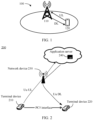
- FIG. 1 is a block diagram of a communication system applicable to this application.
- the communication system 100 may include at least one network device, for example, a network device 110 shown in FIG. 1 .
- the communication system 100 may further include at least one terminal device, for example, a terminal device 120 shown in FIG. 1 .
- a signal may be transmitted between the network device 110 and the terminal device 120. Sending a signal by the network device 110 to the terminal device 120 is referred to as downlink transmission, and sending a signal by the terminal device 120 to the network device 110 is referred to as uplink transmission.
- a transmitting end may be the terminal device 120, and a receiving end may be the network device 110; and in a downlink transmission scenario, a transmitting end may be the network device 110, and a receiving end may be the terminal device 120.
- FIG. 2 is a diagram of another communication system applicable to this application.
- a system 200 shown in FIG. 2 is a V2X communication architecture. Refer to FIG. 2 .
- the system 200 includes two types of communication interfaces: a PC5 interface and a Uu interface.
- the PC5 interface is a direct communication interface between two terminal devices (for example, a terminal device 210 and a terminal device 220 shown in the figure).
- the direct communication link between the terminal devices is also defined as a side link or a sidelink (sidelink, SL).
- Uu interface communication is a communication mode in which a transmitter terminal device (for example, the terminal device 210) sends V2X data to a network device 230 through the Uu interface, the network device 230 sends the V2X data to an application server 240 for processing, the application server 240 delivers processed V2X data to the network device 230, and the network device 230 sends the processed V2X data to a receiver terminal device (for example, the terminal device 220).
- a network device that forwards uplink data from the transmitter terminal device to the application server and a network device that forwards downlink data delivered by the application server to the receiver terminal device may be a same network device, or may be different network devices. This may be specifically determined by the application server. It should be understood that sending by the transmitter terminal device to the network device is referred to as uplink (uplink, UL) transmission, and sending by the network device to the receiver terminal device is referred to as downlink (downlink, DL) transmission.
- a transmitting end may be the terminal device 210, and a receiving end may be the terminal device 220; or a transmitting end may be the terminal device 220, and a receiving end may be the terminal device 210.
- the communication systems shown in FIG. 1 and FIG. 2 may further include more network nodes, for example, more terminal devices or network devices.
- the network nodes are not shown one by one in the figures in embodiments of this application.
- the PDU and the packet may be replaced with each other, and a PDU may also be referred to as a packet.
- One frame (or one frame of picture) includes one or more PDUs, and the one or more PDUs may be referred to as one PDU set. Therefore, it may also be understood that a PDU set is a frame.
- PDU sets are periodic. For example, a frame rate is 60 fps. That is, 60 PDU sets are transmitted per second. A periodicity of a PDU set is 1/60 seconds (approximately equal to 16.67 ms). That is, one PDU set appears every 1/60 seconds. fps indicates frames per second (frames per second).
- the PDU set has a transmission delay requirement.
- a packet delay budget packet delay budget (packet delay budget, PDB) may represent the transmission delay requirement of the PDU set.
- PDB packet delay budget
- a transmitting end may discard the PDU set, and does not need to send, to the transmitting end, a PDU that is not successfully sent in the PDU set.
- the first sequence is a polling sequence of the 1 st to the m th protocol entities in the m protocol entities, or the first sequence is an arrangement sequence of the m protocol entities, or the m protocol entities are arranged in the first sequence.
- the transmitting end may deliver the PDU set 1 to the protocol entity 1 and deliver the PDU set 2 to the protocol entity 2 based on the frame numbers of the PDU sets.
- the transmitting end may deliver the PDU set 1, the PDU set 4, the PDU set 7, and the PDU set 10 to the protocol entity 1, deliver the PDU set 2, the PDU set 5, and the PDU set 8 to the protocol entity 2, and deliver the PDU set 3, the PDU set 6, and the PDU set 9 to the protocol entity 3.
- a number of a PDU set may be carried in a PDU in the PDU set, or may be indicated in another manner.
- the number of the PDU set may be indicated by a control plane packet, or the number of the PDU set may be indicated by a PDU that carries the number of the PDU set.
- the control plane packet or the PDU may be, for example, a start marker/end marker.
- a manner in which a protocol entity obtains the number of the PDU set is not limited in this application.
- the number of the PDU set may alternatively be replaced with information such as an index or a sequence number of the PDU set that can indicate a PDU sequence.
- the information that can indicate a PDU sequence may start from 1, or may start from another number, for example, start from 0, or start from a number obtained by adding 1 to a number of a last PDU set of a previous XR service.
- the k PDU sets correspond to a same XR service.
- the protocol entity may be any one of the following: a PDCP entity, an RLC entity, an SDAP entity, or a MAC entity.
- delivering a PDU set to a protocol entity may also be described as: storing the PDU set in a cache/window/queue/buffer/memory/storage/register/storage space corresponding to the protocol entity corresponding to the PDU set.
- S320 The transmitting end sequentially sends the k PDU sets.
- the receiving end sequentially receives the k PDU sets.
- the transmitting end sends the k PDU sets in a sequence of the k PDU sets. For example, if the k PDU sets are the PDU set 1 to the PDU set 10 shown in FIG. 5 , the PDU set 1 is first sent, then the PDU set 2 is sent, and then the PDU set 3, the PDU set 4, ..., the PDU set 9, and the PDU set 10 are sent. Correspondingly, the receiving end first receives the PDU set 1, then receives the PDU set 2, and then receives the PDU set 3, the PDU set 4, ..., the PDU set 9, and the PDU set 10.
- the receiving end sequentially delivers the k PDU sets to m protocol entities in the first sequence.
- the m protocol entities of the receiving end are in one-to-one correspondence with the m protocol entities of the transmitting end.
- a protocol entity 1 of the transmitting end corresponds to a protocol entity 1 of the receiving end
- a protocol entity 2 of the transmitting end corresponds to a protocol entity 2 of the receiving end
- a protocol entity 3 of the transmitting end corresponds to a protocol entity 3 of the receiving end.
- S330 is described by using an example in which the k PDU sets are a PDU set 1 to a PDU set 10, and the protocol entity is a PDCP entity.
- an RLC layer of the transmitting end sequentially receives the PDCP set 1, the PDU set 4, the PDU set 7, and the PDU set 10 from a MAC layer.
- the MAC layer processes the PDU set, and then delivers a processed PDU set to a PDCP entity 1 of the receiving end.
- the PDCP entity 1 separately processes the PDCP set 1, the PDU set 4, the PDU set 7, and the PDU set 10 that are processed by the RLC layer.
- the RLC layer of the transmitting end sequentially receives the PDCP set 2, the PDU set 5, and the PDU set 8 from the MAC layer.
- the MAC layer processes the PDU set, and then delivers a processed PDU set to a PDCP entity 2 of the receiving end.
- the PDCP entity 2 separately processes the PDCP set 2, the PDU set 5, and the PDU set 8 that are processed by the RLC layer.
- the RLC layer of the transmitting end sequentially receives the PDCP set 3, the PDU set 6, and the PDU set 9 from the MAC layer.
- the MAC layer processes the PDU set, and then delivers a processed PDU set to a PDCP entity 3 of the receiving end.
- the PDCP entity 3 separately processes the PDCP set 3, the PDU set 6, and the PDU set 9 that are processed by the RLC layer.
- the MAC layer, the RLC layer, and the PDCP layer process the PDCP set refer to existing data processing manners of the MAC layer, the RLC layer, and the PDCP layer. Details are not described herein.
- a subsequent operation performed after the PDCP layer processes the PDU set is not specifically limited in this application.
- the PDU sets are delivered to the m protocol entities in a polling manner in a sequence of the PDU sets. Only one PDU set is delivered to one protocol entity at a same moment, the transmitting end sends the PDU sets in sequence, and the receiving end receives the PDU sets on protocol entities corresponding to the protocol entities of the transmitting end. Therefore, numbers of the PDU sets do not need to be transmitted through an air interface, and the receiving end can also learn of a PDU set to which each PDU that is to be sent, that is being sent, or that has been received belongs, so that air interface resources can be saved.
- m ⁇ x, and x is determined based on one or more of the following: a periodicity of the PDU set, validity duration of the PDU set, or maximum duration of the PDU set.
- the periodicity of the PDU set is respectively denoted as P, T, and t.
- f represents a frame rate of the k PDU sets or a service corresponding to the k PDU sets, or a quantity of PDU sets in a unit of time.
- the transmitting end may discard the PDU set. Alternatively, even if a PDU in the PDU set is successfully sent to the receiving end after T, the PDU is useless to the receiving end.
- T may be defined as the PDB described above, or may be defined as an access network (access network, AN) PDB or a core network (core network, CN) PDB.
- access network access network
- AN access network
- core network core network
- T may be duration of a discard timer (discard timer) of a protocol entity, and the discard timer may be a timer related to a PDU set, or may be a timer related to a PDU in a PDU set.
- discard timer may be a timer related to a PDU set, or may be a timer related to a PDU in a PDU set.
- t a time interval between a moment at which the transmitting end receives the 1 st PDU/1 st byte/1 st bit (bit) in the PDU set and a moment at which the transmitting end receives the last PDU/last byte/last bit in the PDU set, or (maximum value/minimum value/average value of) a time interval between the 1 st PDU/1 st byte/1 st bit (bit) in the PDU set and the last PDU/last byte/last bit in the PDU set.
- x T / P + 1
- x T / P + 1
- x t + T / P , where ⁇ ⁇ represents rounding up.
- a PDU in a PDU set may arrive at any time in a time period of 16.67 ms (for example, the last PDU in a PDU set may arrive at the last moment of in a 16.67 periodicity).
- a sum of two periodicities is 33.3 ms, and is greater than invalidity duration. Therefore, when a PDU set 4 arrives, the PDU set 1 has been transmitted, or the PDU set 1 is invalid because the validity duration expires.
- the PDU set 1 may be delivered to a protocol entity 1
- a PDU set 2 may be delivered to a protocol entity 2
- a PDU set 3 may be delivered to a protocol entity 3.
- the PDU set 4 arrives, the PDU set 1 has been scheduled completely.
- the PDU set 4 may be delivered to the protocol entity 1, and a PDU set 5 may be delivered to the protocol entity 2.
- Such cyclic scheduling can ensure that there is a PDU of only one PDU set in any protocol entity at any moment, and PDUs in two PDU sets are not mixed.
- time elapsed since all PDUs in a PDU set 1 arrive until all PDUs in a PDU set 3 arrive is exactly two 16.67 ms periodicities.
- the PDU set 3 is received completely 33.3 ms after the PDU set 1 arrives (in this case, the PDU set 1 is invalid).
- T is not 33.3 ms but 30 ms, as long as t ⁇ 3.3 ms, it can be ensured that the 1 st PDU in the PDU set 3 just arrives upon the last PDU in the PDU set 1 is received for 30 ms and is just invalid.
- the PDU set 3 may be delivered to the protocol entity in which the PDU set 1 is located. Therefore, in this case, only two protocol entities can ensure that there is a PDU of only one PDU set in any protocol entity at any moment, and PDUs in two PDU sets are not mixed.
- a quantity of protocol entities is properly set, so that it can be ensured that there is a PDU of only one PDU set in any protocol entity at any moment, and PDUs in two PDU sets are not mixed. Because the m protocol entities used by the receiving end are in one-to-one correspondence with the m protocol entities of the transmitting end, the receiving end may infer a number of a PDU set based on a protocol entity for receiving the PDU set. In this way, the number of the PDU set does not need to be transmitted through an air interface, so that air interface resources can be saved.
- the m protocol entities are associated with m logical channels, one protocol entity is associated with one logical channel, and any two protocol entities are associated with different logical channels.
- any one of the m logical channels is a logical channel group.
- the m protocol entities are a protocol entity 1, a protocol entity 2, and a protocol entity 3, the protocol entity 1 is associated with a logical channel 1, the protocol entity 2 is associated with a logical channel 2, and the protocol entity 3 is associated with a logical channel 3.
- the logical channel 1 is a logical channel group 1, the logical channel 2 is a logical channel group 2, and the logical channel 3 is a logical channel group 3.
- a terminal device may report, to a network device by using a buffer status report (buffer status report, BSR), a current amount of to-be-transmitted data in a buffer.
- BSR buffer status report
- a current protocol stipulates that a BSR trigger condition is that new to-be-transmitted data is generated, and a logical channel to which the to-be-transmitted data belongs is the 1 st logical channel with to-be-transmitted data in a logical channel group to which the logical channel belongs.
- each protocol entity is associated with one logical channel group, and one protocol entity carries only one PDU set at a same moment. Therefore, a BSR is triggered each time a new PDU set arrives at a protocol entity or a logical channel group.
- a BSR can be reported at a PDU set granularity without changing a BSR trigger condition or trigger mechanism. Further, the network device can learn of, based on BSR reporting at the PDU set granularity, an amount of to-be-transmitted data in each PDU set, to properly allocate a transmission resource to the PDU set.
- priorities of the m protocol entities are in descending order.
- the priority of the protocol entity is represented by a number in this application, and it is assumed that a smaller number indicates a higher priority.
- that the priorities of the m protocol entities are in descending order may be that the priorities of the m protocol entities are sequentially decreased by one level.
- the priorities of the m protocol entities are 1, 2, 3, ..., and m.
- a priority of any protocol entity is a priority of a first resource associated with the protocol entity.
- the first resource may include one or more of the following: a logical channel, a logical channel group, a slice, a frequency, a DRB, a QoS flow, a PDU session, or a GTP-U tunnel.
- S320 may specifically include: sequentially sending the k PDU sets by using a transmission resource; and adjusting the priorities of the m protocol entities if a current transmission resource is exhausted or less than a first preset value.
- Uplink transmission is used as an example for description.
- the receiving end may allocate a transmission resource to the transmitting end.
- the BSR reported by the transmitting end for the first time is an amount of to-be-transmitted data of a PDU set 1, and the receiving end allocates a transmission resource 1 for transmitting the PDU set 1.
- the transmitting end transmits the PDU set 1 completely, if the transmission resource 1 remains and a remaining transmission resource (denoted as a transmission resource 1a) is greater than the first preset value, the transmitting end may transmit a PDU set 2 by using the transmission resource 1a.
- the transmitting end After the transmitting end transmits the PDU set 2 completely, if the transmission resource 1 is exhausted, that is, the transmission resource 1a is used up, or if the transmission resource 1a remains but a remaining transmission resource (denoted as a transmission resource 1b) is less than the first preset value, the priorities of the m protocol entities are adjusted. After the transmitting end transmits the PDU set 2 completely, if the transmission resource 1a remains and the remaining transmission resource 1b is not exhausted or is greater than the first preset value, the transmitting end may continue to transmit a PDU set 3 by using the transmission resource 1b. If the transmission resource 1b is exhausted or a remaining transmission resource in the transmission resource 1b is less than the first preset value after a part of PDUs in the PDU set 3 are transmitted, the priorities of the m protocol entities are adjusted.
- the receiving end may allocate a resource to the transmitting end again, and the transmitting end may continue to transmit, by using the resource allocated by the receiving end this time, a PDU set or a PDU of a PDU set that has not been transmitted or has not been successfully transmitted.
- the transmission resource may be a time-frequency resource.
- the first preset value may be specified in a protocol, or may be preconfigured. This is not limited in this application.
- a priority of a protocol entity corresponding to the s th PDU set is adjusted to highest.
- a priority of a protocol entity corresponding to the PDU set 3 is adjusted to highest.
- the receiving end may first send a remaining PDU in the s th PDU set that is being transmitted before, to ensure that the PDU sets are sent in sequence.
- priorities of other m-1 protocol entities in the m protocol entities may also be adjusted.
- an adjusted priority of the j th protocol entity in the m protocol entities is an unadjusted priority of the ([j+(a-b)+m] mod m) th protocol entity in the m protocol entities.
- the a th protocol entity in the m protocol entities is used to carry the s th PDU set, and before the adjustment, the b th protocol entity in the m protocol entities is a protocol entity with a highest priority in the m protocol entities, where 1 ⁇ a ⁇ m, and 1 ⁇ b ⁇ m.
- the m protocol entities are a protocol entity 1, a protocol entity 2, and a protocol entity 3.
- the protocol entity 1 has a highest priority
- the protocol entity corresponding to the s th PDU set is the protocol entity 3.
- an adjusted priority of the protocol entity 3 is an unadjusted priority of the protocol entity 1
- an adjusted priority of the protocol entity 1 is an unadjusted priority of the protocol entity 2
- an adjusted priority of the protocol entity 2 is an unadjusted priority of the protocol entity 3.
- the m protocol entities are a protocol entity 1, a protocol entity 2, and a protocol entity 3.
- the protocol entity 2 Before adjustment, the protocol entity 2 has a highest priority, and the protocol entity corresponding to the s th PDU set is the protocol entity 3.
- an adjusted priority of the protocol entity 3 is an unadjusted priority of the protocol entity 2
- an adjusted priority of the protocol entity 1 is an unadjusted priority of the protocol entity 3
- an adjusted priority of the protocol entity 2 is an unadjusted priority of the protocol entity 1.
- a priority of a protocol entity corresponding to the (s+1) th PDU set is adjusted to highest.
- a priority of a protocol entity corresponding to the PDU set 3 is adjusted to highest.
- the receiving end may first send the (s+1) th PDU set, to ensure that the PDU sets are sent in sequence.
- priorities of other m-1 protocol entities in the m protocol entities may also be adjusted.
- an adjusted priority of the j th protocol entity in the m protocol entities is an unadjusted priority of the ([j+(a-b)+m] mod m) th protocol entity in the m protocol entities.
- the a th protocol entity in the m protocol entities is used to carry the (s+1) th PDU set, and before the adjustment, the b th protocol entity in the m protocol entities is a protocol entity with a highest priority in the m protocol entities, where 1 ⁇ a ⁇ m, and 1 ⁇ b ⁇ m.
- the m protocol entities are a protocol entity 1, a protocol entity 2, and a protocol entity 3.
- the protocol entity 1 Before adjustment, the protocol entity 1 has a highest priority, and the protocol entity corresponding to the (s+1) th PDU set is the protocol entity 3.
- an adjusted priority of the protocol entity 3 is an unadjusted priority of the protocol entity 1
- an adjusted priority of the protocol entity 1 is an unadjusted priority of the protocol entity 2
- an adjusted priority of the protocol entity 2 is an unadjusted priority of the protocol entity 3.
- the m protocol entities are a protocol entity 1, a protocol entity 2, and a protocol entity 3.
- the protocol entity 2 Before adjustment, the protocol entity 2 has a highest priority, and the protocol entity corresponding to the (s+1) th PDU set is the protocol entity 3.
- an adjusted priority of the protocol entity 3 is an unadjusted priority of the protocol entity 2
- an adjusted priority of the protocol entity 1 is an unadjusted priority of the protocol entity 3
- an adjusted priority of the protocol entity 2 is an unadjusted priority of the protocol entity 1.
- S320 may specifically include: adjusting the priorities of the m protocol entities after each PDU set is sent completely.
- the unadjusted priorities of the m protocol entities are sequentially m1, m2, ..., and mm, and adjusted priorities of the m protocol entities are sequentially mm, m1, ..., and m(m-1).
- the adjusted priority of the j th protocol entity in the m protocol entities is an unadjusted priority of the (j-1) th protocol entity in the m protocol entities.
- the m protocol entities are a protocol entity 1, a protocol entity 2, and a protocol entity 3.
- priorities of the protocol entity 1, the protocol entity 2, and the protocol entity 3 are respectively 1, 3, and 4.
- the transmitting end adjusts the priorities of the three protocol entities. Adjusted priorities of the protocol entity 1, the protocol entity 2, and the protocol entity 3 are respectively 4, 1, and 3.
- the transmitting end adjusts the priorities of the three protocol entities. Adjusted priorities of the protocol entity 1, the protocol entity 2, and the protocol entity 3 are respectively 3, 4, and 1.
- the transmitting end adjusts the priorities of the three protocol entities. Adjusted priorities of the protocol entity 1, the protocol entity 2, and the protocol entity 3 are respectively 1, 3, and 4.
- Another PDU set is similar, and details are not described herein again.
- the PDU set is invalid may be any one of the following: a PDCP discard timer associated with a PDU in the PDU set expires, a discard timer of the PDU set expires, a PDU set in a protocol entity associated with the PDU set has not been sent completely but another subsequent PDU set has been received, a PDU in the PDU set has not been sent completely within validity duration of the PDU set, a proportion of PDUs that are in the PDU set and that are not sent within the validity duration of the PDU set exceeds a specific value, the PDU set is not sent within expected time, the PDU set is not received by the receiving end within expected time, or an ACK response for the PDU set is not received from the receiving end within expected time.
- Embodiment 3 is described by using an example in which the m protocol entities are three protocol entities. It can be learned from the foregoing corresponding descriptions of FIG. 7 that, when the PDU set 4 arrives, if the PDU set 1 is not sent completely, the PDU set 1 is invalid. In this case, a PDU that is not successfully transmitted in the PDU set 1 may be discarded. Similarly, when a PDU set 7 arrives, if the PDU set 4 is not sent completely, the PDU set 4 is invalid. In this case, a PDU that is not successfully transmitted in the PDU set 4 may be discarded.
- At least one PDU set may be discarded.
- the at least one PDU set is the (w+1) th PDU set to the (w+e) th PDU set, and e ⁇ 1.
- the at least one PDU set is of a first type and is associated with the w th PDU set, both the w th PDU set and the (w+e+1) th PDU set are of a second type, and the first type is different from the second type.
- PDU sets There is a dependency relationship between some PDU sets. For example, refer to a plurality of frames shown in FIG. 10 .
- An I-frame carries complete information, and a P-frame can be successfully decoded only by depending on the I-frame. Therefore, if the I-frame fails to be transmitted, the P-frame that depends on the I-frame does not need to be transmitted.
- P frames there is a dependency relationship between P frames. For example, the last P frame can be successfully decoded only by depending on a previous P frame.
- the one or more PDU sets that depend on the w th PDU set may be discarded.
- the first type may be a P-frame
- the second type is not a P-frame, for example, an I-frame.
- the first type is a P-slice
- the second type is not a P-slice.
- the first type is a PDU set that can be discarded
- the second type is a PDU set that cannot be discarded.
- the first type is an unimportant PDU set
- the second type is an important PDU set.
- the first type is a PDU set carrying video data
- the second type is a PDU set carrying voice data.
- the first type is a PDU set carrying non-control information
- the second type is a PDU set carrying control information.
- the first type is a PDU set with a lower priority
- the second type is a PDU set with a higher priority.
- the first type is a dependent PDU set
- the second type is a depended PDU set.
- the PDU set 1 may be discarded. If the PDU set 2 is a P-frame, the PDU set 2 may also be discarded. If the PDU set 3 is an I-frame, the PDU set 3 is not discarded. If the PDU set 3 is a P-frame, the PDU set 3 is discarded. This continues until an I-frame is encountered, and then discarding stops.
- the PDU set 1 may be discarded. If the PDU set 2 is an unimportant PDU set frame, the PDU set 2 may also be discarded. If the PDU set 3 is an important PDU set, the PDU set 3 is not discarded. If the PDU set 3 is an unimportant PDU set, the PDU set 3 is discarded. This continues until an important PDU set is encountered, and then discarding stops.
- Embodiment 3 may be combined with Embodiment 1 or Embodiment 2.
- an adjusted priority of the j th protocol entity in the m protocol entities is an unadjusted priority of the ([j+(a-b)+m] mod m) th protocol entity in the m protocol entities.
- the a th protocol entity in the m protocol entities is used to carry the (w+e+1) th PDU set, and before the adjustment, the b th protocol entity in the m protocol entities is a protocol entity with a highest priority in the m protocol entities, where 1 ⁇ a ⁇ m, and 1 ⁇ b ⁇ m.
- PDU sets of different types may be delivered to a same protocol entity.
- only frames of a same type can be delivered to a same protocol entity.
- the k consecutive PDU sets may be delivered to a corresponding protocol entity based on a type of each PDU set.
- quantities of protocol entities corresponding to the first-type PDU sets and the second-type PDU sets are both m.
- m For a value of m, refer to the foregoing descriptions.
- the 1 st to the k1 th first-type PDU sets are sequentially delivered, according to the delivery sequence or rule described above, to the m protocol entities corresponding to the first-type PDU sets
- the 1 st to the k1 th second-type PDU sets are sequentially delivered, according to the delivery sequence or rule described above, to the m protocol entities corresponding to the second-type PDU sets.
- the PDU set 1 and the PDU set 2 are of the first type
- the PDU set 1 and the PDU set 2 are the 1 st and the 2 nd first-type PDU sets.
- the PDU set 3 is of the second type
- the PDU set 3 is the 1 st second-type PDU set.
- the PDU set 4 is of the first type
- the PDU set 3 is the 3 rd first-type PDU set. It is assumed that the m protocol entities corresponding to the first-type PDU sets are a protocol entity 1, a protocol entity 2, and a protocol entity 3, and the m protocol entities corresponding to the second-type PDU sets are a protocol entity 4, a protocol entity 5, and a protocol entity 6.
- the PDU set 1 may be delivered to the protocol entity 1
- the PDU set 2 may be delivered to the protocol entity 2
- the PDU set 3 may be delivered to the protocol entity 4
- the PDU set 4 may be delivered to the protocol entity 3. If there is still a first-type PDU set 5, the first-type PDU set 5 may be delivered to the PDU set 1.
- Other PDU set delivery rules are similar, and details are not described herein again.
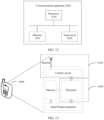
- FIG. 11 is a block diagram of a communication apparatus according to an embodiment of this application.
- the apparatus 2000 may include a processing unit 2100 and a transceiver unit 2200.
- the transceiver unit 2200 may implement a corresponding communication function, for example, receive or send a PDU set.
- the processing unit 2100 may implement a corresponding processing function, for example, deliver a PDU set to a protocol entity.
- the transceiver unit 2200 may also be referred to as a communication interface or a communication unit.
- the apparatus 2000 may further include a storage unit.
- the storage unit may be configured to store instructions and/or data.
- the processing unit 2100 may read the instructions and/or the data in the storage unit, so that the apparatus implements the foregoing method embodiments.
- the apparatus 2000 may be the transmitting end in the foregoing method embodiments, or may be a module or a chip used in the transmitting end.
- the apparatus 2000 may be configured to perform steps or procedures performed by the transmitting end in any one of the foregoing method embodiments.
- the processing unit 2100 is configured to sequentially deliver k consecutive protocol data unit sets PDU sets to m protocol entities in a first sequence.
- k>m k-m consecutive PDU sets starting from the (m+1) th PDU set in the k PDU sets are sequentially delivered to the m protocol entities in the first sequence, priorities of the m protocol entities are different from each other, and m>1.
- the transceiver unit 2200 is configured to sequentially send the k PDU sets.
- the first sequence is an arrangement sequence of the m protocol entities, or the m protocol entities are arranged in the first sequence.
- the transceiver unit 2200 is specifically configured to sequentially send the k PDU sets by using a transmission resource.
- the processing unit 2100 is further configured to adjust the priorities of the m protocol entities if a current transmission resource is exhausted or less than a first preset value.
- the processing unit 2100 is specifically configured to: if the current transmission resource is insufficient to send the s th PDU set in the k PDU sets completely, adjust a priority of a protocol entity corresponding to the s th PDU set to highest; or if the current transmission resource is used to send the s th PDU set completely but is insufficient to send the (s+1) th PDU set, adjust a priority of a protocol entity corresponding to the (s+1) th PDU set to highest.
- the transceiver unit 2200 is specifically configured to: adjust the priorities of the m protocol entities after each PDU set is sent completely.
- the unadjusted priorities of the m protocol entities are sequentially m1, m2, ..., and mm, and adjusted priorities of the m protocol entities are sequentially mm, m1, ..., and m(m-1).
- the processing unit 2100 is further configured to: when the w th PDU set in the k PDU sets is invalid, discard a PDU that is not successfully transmitted in the w th PDU set, where w ⁇ 1.
- the processing unit 2100 is further configured to discard at least one PDU set.
- the at least one PDU set is the (w+1) th PDU set to the (w+e) th PDU set, e ⁇ 1, the at least one PDU set is of a first type and is associated with the w th PDU set, both the w th PDU set and the (w+e+1) th PDU set are of a second type, and the first type is different from the second type.
- the protocol entity is any one of the following: a packet data convergence protocol PDCP entity, a radio link control RLC entity, a service data adaptation protocol SDAP entity, or a medium access control MAC entity.
- m ⁇ x, and x is determined based on one or more of the following: a periodicity of the PDU set, validity duration of the PDU set, or maximum duration of the PDU set.
- the apparatus 2000 may be the receiving end in the foregoing method embodiments, or may be a module or a chip used in the receiving end.
- the apparatus 2000 may be configured to perform steps or procedures performed by the receiving end in any one of the foregoing method embodiments.
- the transceiver unit 2200 is configured to sequentially receive k consecutive protocol data unit sets PDU set.
- the processing unit 2100 is configured to sequentially deliver the k PDU sets to m protocol entities in a first sequence.
- k>m k-m consecutive PDU sets starting from the (m+1) th PDU set in the k PDU sets are sequentially delivered to the m protocol entities in the first sequence, priorities of the m protocol entities are different from each other, and m>1.
- the first sequence is an arrangement sequence of the m protocol entities, or the m protocol entities are arranged in the first sequence.
- the protocol entity is any one of the following: a packet data convergence protocol PDCP entity, a radio link control RLC entity, a service data adaptation protocol SDAP entity, or a medium access control MAC entity.
- m ⁇ x, and x is determined based on one or more of the following: a periodicity of the PDU set, validity duration of the PDU set, or maximum duration of the PDU set.
- the "unit" in the apparatus 2000 may be implemented by hardware, or may be implemented by software, or may be implemented by hardware executing corresponding software.
- the "unit" herein may be an application-specific integrated circuit (application-specific integrated circuit, ASIC), an electronic circuit, a processor (for example, a shared processor, a dedicated processor, or a group processor) configured to execute one or more software or firmware programs, a memory, a merged logic circuit, and/or another appropriate component that supports the described function.
- the transceiver unit 2200 may be replaced with a transceiver circuit (for example, may include a receiving circuit and a sending circuit), and the processing unit 2100 may be replaced with a processor or a processing circuit.
- FIG. 12 is a block diagram of another communication apparatus 3000 according to an embodiment of this application.
- the apparatus 3000 may be a transmitting end, or may be a receiving end, or may be a chip, a chip system, a processor, or the like that supports the transmitting end in implementing the foregoing method, or may be a chip, a chip system, a processor, or the like that supports the receiving end in implementing the foregoing method.
- the apparatus may be configured to implement the methods described in the foregoing method embodiments. For details, refer to the descriptions in the foregoing method embodiments.
- the apparatus 3000 may include one or more processors 3100.
- the processor 3100 may also be referred to as a processing unit, and may implement a specific control function.
- the processor 3100 may be a general-purpose processor, a dedicated processor, or the like, for example, a baseband processor or a central processing unit.
- the baseband processor may be configured to process a communication protocol and communication data.
- the central processing unit may be configured to control the communication apparatus (for example, a base station, a baseband chip, a user chip, a DU, or a CU), execute a software program, and process data of the software program.
- the processor 3100 may also store instructions and/or data, and the instructions and/or the data 47 may be run by the processor 3100, so that the apparatus 3000 performs the method described in the foregoing method embodiments.
- the processor 3100 may include a transceiver 3200 configured to implement receiving and sending functions.
- the transceiver 3200 may be a transceiver circuit, an interface, or an interface circuit.
- the transceiver circuit, the interface, or the interface circuit configured to implement the receiving and sending functions may be separated, or may be integrated together.
- the transceiver circuit, the interface, or the interface circuit may be configured to read and write code or data.
- the transceiver circuit, the interface, or the interface circuit may be configured to transmit or transfer a signal.
- the apparatus 3000 may include a circuit.
- the circuit may implement a sending, receiving, or communication function in the foregoing method embodiments.
- the apparatus 3000 may include one or more memories 3300.
- the memory 3300 may store instructions.
- the instructions may be run on the processor 3100, so that the apparatus 3000 performs the method described in the foregoing method embodiments.
- the memory 3300 may further store data.
- the processor 3100 may also store instructions and/or data.
- the processor 3100 and the memory may be separately arranged, or may be integrated together.
- FIG. 13 is a diagram of a structure of a terminal device 4000 according to this application.
- the communication apparatus 2000 or the communication apparatus 3000 may be configured in the terminal device 4000.
- the communication apparatus 2000 or the communication apparatus 3000 may be the terminal device 4000.
- the terminal device 4000 may perform an action performed by the transmitting end or the receiving end in the foregoing method embodiments.
- FIG. 13 shows only main components of the terminal device.
- the terminal device 4000 includes a processor, a memory, a control circuit, an antenna, and an input/output apparatus.
- the processor is mainly configured to: process a communication protocol and communication data; control an entire terminal device; execute a software program; and process data of the software program.
- the processor is configured to support the terminal device in performing an action described in the embodiment of the foregoing data transmission method.
- the memory is mainly configured to store the software program and the data, for example, store the PDU set described in the foregoing embodiments.
- the control circuit is mainly configured to perform conversion between a baseband signal and a radio frequency signal, and process the radio frequency signal.
- a combination of the control circuit and the antenna may also be referred to as a transceiver, mainly configured to send/receive a radio frequency signal in an electromagnetic wave form.
- the input/output apparatus such as a touchscreen, a display, or a keyboard, is mainly configured to: receive data input by a user and output data to the user.
- the processor may read the software program in a storage unit, interpret and execute instructions of the software program, and process the data of the software program.
- the processor outputs a baseband signal to a radio frequency circuit.
- the radio frequency circuit After performing radio frequency processing on the baseband signal, the radio frequency circuit sends a radio frequency signal in the electromagnetic wave form through the antenna.
- the radio frequency circuit receives a radio frequency signal through the antenna, converts the radio frequency signal into a baseband signal, and outputs the baseband signal to the processor.
- the processor converts the baseband signal into data and processes the data.
- FIG. 13 shows only one memory and one processor.
- the memory may also be referred to as a storage medium, a storage device, or the like. This is not limited in embodiments of this application.
- the processor may include a baseband processor and a central processing unit.
- the baseband processor is mainly configured to process the communication protocol and the communication data.
- the central processing unit is mainly configured to: control the entire terminal device, execute the software program, and process the data of the software program.
- the processor in FIG. 13 integrates functions of the baseband processor and the central processing unit.
- the baseband processor and the central processing unit may alternatively be independent processors, and are interconnected by using a technology such as a bus.
- the terminal device may include a plurality of baseband processors to adapt to different network standards, and the terminal device may include a plurality of central processing units to enhance processing capabilities of the terminal device, and components of the terminal device may be connected through various buses.
- the baseband processor may also be expressed as a baseband processing circuit or a baseband processing chip.
- the central processing unit may also be expressed as a central processing circuit or a central processing chip.
- a function of processing the communication protocol and the communication data may be embedded in the processor, or may be stored in a storage unit in a form of the software program.
- the processor executes the software program to implement a baseband processing function.
- the antenna and the control circuit that have receiving and sending functions may be considered as a transceiver unit 4100 of the terminal device 4000, and the processor that has a processing function may be considered as a processing unit 4200 of the terminal device 4000.
- the terminal device 4000 includes the transceiver unit 4100 and the processing unit 4200.
- the transceiver unit may also be referred to as a transceiver, a transceiver machine, a transceiver apparatus, or the like.
- a component configured to implement a receiving function in the transceiver unit 4100 may be considered as a receiving unit, and a component configured to implement a sending function in the transceiver unit 4100 may be considered as a sending unit. That is, the transceiver unit 4100 includes the receiving unit and the sending unit.
- the receiving unit may also be referred to as a receiver, a receiver machine, a receiver circuit, or the like
- the sending unit may be referred to as a transmitter, a transmitter machine, a transmitter circuit, or the like.
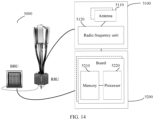
- FIG. 14 is a diagram of a structure of a network device 5000 according to an embodiment of this application.
- the communication apparatus 2000 or the communication apparatus 3000 may be configured in the network device 5000.
- the communication apparatus 2000 or the communication apparatus 3000 may be the network device 5000.
- the network device 5000 may perform an action performed by the transmitting end or the receiving end in the foregoing method embodiments.
- the network device 5000 may include one or more radio frequency units, such as a remote radio frequency unit (remote radio unit, RRU) 5100 and one or more baseband units (baseband unit, BBU) 5200 (which may also be referred to as digital units (digital unit, DU)).
- the RRU 5100 may be referred to as a transceiver unit, a transceiver machine, a transceiver circuit, a transceiver, or the like, and may include at least one antenna 5110 and a radio frequency unit 5120.
- the RRU 5100 is mainly configured to: receive and send radio frequency signals, and perform conversion between a radio frequency signal and a baseband signal.
- the BBU 5200 is mainly configured to perform baseband processing, control the network device 5000, and the like.
- the RRU 5100 and the BBU 5200 may be physically disposed together, or may be physically disposed separately, that is, in a distributed base station.
- the BBU 5200 is a control center of the network device 5000, may also be referred to as a processing unit, and is mainly configured to perform baseband processing functions such as channel coding, multiplexing, modulation, and spectrum spreading.
- the BBU (the processing unit) 5200 may be configured to control the network device 5000 to perform an operation procedure related to the transmitting end or the receiving end in the foregoing method embodiments.
- the BBU 5200 may include one or more boards.
- a plurality of boards may jointly support a radio access network (for example, an LTE system or a 5G system) of a single access standard, or may separately support radio access networks of different access standards.
- the BBU 5200 further includes a memory 5210 and a processor 5220.
- the memory 5210 is configured to store necessary instructions and data.
- the processor 5220 is configured to control the network device 5000 to perform a necessary action, for example, configured to control the network device 5000 to perform an operation procedure related to the transmitting end or the receiving end in the foregoing method embodiments.
- the memory 5210 and the processor 5220 may serve one or more boards. In other words, a memory and a processor may be deployed on each board. Alternatively, a plurality of boards may share a same memory and a same processor. In addition, a necessary circuit may be further disposed on each board.
- SoC system-on-chip
- all or a part of functions of the parts 5200 and 5100 may be implemented by using the SoC technology, for example, implemented by using one base station function chip.
- the base station function chip integrates components such as a processor, a memory, and an antenna port.
- a program of a base station-related function is stored in the memory, and the processor executes the program to implement the base station-related function.
- the base station function chip can also read an external memory of the chip, to implement the base station-related function.
- FIG. 14 the structure of the network device shown in FIG. 14 is merely a possible form, and should not constitute any limitation on the embodiments of this application. In this application, a possibility that there may be a base station structure in another form in the future is not excluded.
- the steps in the method embodiments provided in this application may be implemented by using a hardware integrated logic circuit in the processor or by using instructions in a form of software.
- the steps of the method disclosed with reference to embodiments of this application may be directly performed by a hardware processor, or may be performed by a combination of hardware and software modules in the processor.
- the software module may be located in a mature storage medium in the art, such as a random access memory, a flash memory, a read-only memory, a programmable read-only memory, an electrically erasable programmable memory, or a register.
- the storage medium is located in the memory, and the processor reads information in the memory and completes the steps in the foregoing methods in combination with hardware of the processor. To avoid repetition, details are not described herein again.
- the processor in embodiments of this application may be an integrated circuit chip, and has a signal processing capability.
- steps in the foregoing method embodiments can be implemented by using a hardware integrated logic circuit in the processor, or by using instructions in a form of software.
- the processor may be a general purpose processor, a digital signal processor (DSP), an application-specific integrated circuit (ASIC), a field programmable gate array (FPGA) or another programmable logic device, a discrete gate or a transistor logic device, or a discrete hardware component.
- the processor may implement or perform the methods, steps, and logical block diagrams that are disclosed in embodiments of this application.
- the general-purpose processor may be a microprocessor, or the processor may be any conventional processor or the like.
- the steps of the method disclosed with reference to embodiments of this application may be directly performed by a hardware decoding processor, or may be performed by a combination of hardware and software modules in the decoding processor.
- the software module may be located in a mature storage medium in the art, such as a random access memory, a flash memory, a read-only memory, a programmable read-only memory, an electrically erasable programmable memory, or a register.
- the storage medium is located in the memory, and the processor reads information in the memory and completes the steps in the foregoing methods in combination with hardware of the processor.
- the memory in embodiments of this application may be a volatile memory or a non-volatile memory, or may include a volatile memory and a non-volatile memory.
- the non-volatile memory may be a read-only memory (read-only memory, ROM), a programmable read-only memory (programmable ROM, PROM), an erasable programmable read-only memory (erasable PROM, EPROM), an electrically erasable programmable read-only memory (electrically EPROM, EEPROM), or a flash memory.
- the volatile memory may be a random access memory (random access memory, RAM) and is used as an external cache.
- RAMs in many forms may be used, for example, a static random access memory (static RAM, SRAM), a dynamic random access memory (dynamic RAM, DRAM), a synchronous dynamic random access memory (synchronous DRAM, SDRAM), a double data rate synchronous dynamic random access memory (double data rate SDRAM, DDR SDRAM), an enhanced synchronous dynamic random access memory (enhanced SDRAM, ESDRAM), a synchlink dynamic random access memory (synchlink DRAM, SLDRAM), and a direct rambus random access memory (direct rambus RAM, DR RAM).
- static random access memory static random access memory
- DRAM dynamic random access memory
- DRAM dynamic random access memory
- SDRAM synchronous dynamic random access memory
- double data rate SDRAM double data rate SDRAM
- DDR SDRAM double data rate SDRAM
- ESDRAM enhanced synchronous dynamic random access memory
- synchlink dynamic random access memory synchlink dynamic random access memory
- direct rambus RAM direct rambus RAM
- the computer program product includes computer program code.
- the computer program code When the computer program code is run on a computer, the computer is enabled to perform the steps or procedures performed by the transmitting end or the receiving end in any one of the foregoing method embodiments.
- This application further provides a computer-readable storage medium.
- the computer-readable storage medium stores program code.
- the program code When the program code is run on a computer, the computer is enabled to perform the steps or procedures performed by the transmitting end or the receiving end in any one of the foregoing method embodiments.
- This application further provides a communication system, including a transmitting end and a receiving end.
- a corresponding module or unit performs a corresponding step.
- a transceiver unit or a transceiver performs a receiving step or a sending step in the method embodiments
- a processing unit or a processor may perform a step other than the sending step or the receiving step.
- a component may be, but is not limited to, a process that is run on a processor, a processor, an object, an executable file, a thread of execution, a program, and/or a computer.
- a computing device and an application that is run on the computing device may be components.
- One or more components may reside within a process and/or a thread of execution, and a component may be located on one computer and/or distributed between two or more computers.
- these components may be executed from a variety of computer-readable storage media having various data structures stored thereon.
- the components may communicate by using a local and/or remote process and based on a signal having one or more data packets (for example, data from two components interacting with another component in a local system, a distributed system, and/or across a network such as the internet interacting with another system by using the signal).
- a signal having one or more data packets (for example, data from two components interacting with another component in a local system, a distributed system, and/or across a network such as the internet interacting with another system by using the signal).
- the disclosed system, apparatus, and method may be implemented in another manner.
- the described apparatus embodiment is merely an example.
- division into the units is merely logic function division and may be other division during actual implementation.
- a plurality of units or components may be combined or integrated into another system, or some features may be ignored or not performed.
- the displayed or discussed mutual couplings or direct couplings or communication connections may be implemented through some interfaces.
- the indirect couplings or communication connections between the apparatuses or units may be implemented in electrical, mechanical, or another form.
- the units described as separate parts may or may not be physically separate, and parts displayed as units may or may not be physical units, may be located in one position, or may be distributed on a plurality of network units. Some or all of the units may be selected based on actual requirements to achieve the objectives of the solutions of embodiments.
- all or some of the functions of the functional units may be implemented by software, hardware, firmware, or any combination thereof.
- software is used to implement the embodiments, all or a part of the embodiments may be implemented in a form of a computer program product.
- the computer program product includes one or more computer instructions (programs).
- programs When the computer program instructions (programs) are loaded and executed on a computer, the procedures or functions according to embodiments of this application are all or partially generated.
- the computer may be a general-purpose computer, a dedicated computer, a computer network, or another programmable apparatus.
- the computer instructions may be stored in a computer-readable storage medium or may be transmitted from a computer-readable storage medium to another computer-readable storage medium.
- the computer instructions may be transmitted from a website, computer, server, or data center to another website, computer, server, or data center in a wired (for example, a coaxial cable, an optical fiber, or a digital subscriber line (DSL)) or wireless (for example, infrared, radio, or microwave) manner.
- the computer-readable storage medium may be any usable medium accessible by the computer, or a data storage device, for example, a server or a data center, integrating one or more usable media.
- the usable medium may be a magnetic medium (for example, a floppy disk, a hard disk, or a magnetic tape), an optical medium (for example, a DVD), a semiconductor medium (for example, a solid state drive (solid state drive, SSD)), or the like.
- a magnetic medium for example, a floppy disk, a hard disk, or a magnetic tape
- an optical medium for example, a DVD
- a semiconductor medium for example, a solid state drive (solid state drive, SSD)
- the functions When the functions are implemented in a form of a software functional unit and sold or used as an independent product, the functions may be stored in a computer-readable storage medium. Based on such an understanding, the technical solutions of this application essentially, or the part contributing to the conventional technology, or some of the technical solutions may be implemented in a form of a software product.
- the computer software product is stored in a storage medium, and includes several instructions for instructing a computer device (which may be a personal computer, a server, or a network device) to perform all or some of the steps of the methods described in embodiments of this application.
- the foregoing storage medium includes any medium that can store program code, such as a USB flash drive, a removable hard disk, a read-only memory (read-only memory, ROM), a random access memory (random access memory, RAM), a magnetic disk, or an optical disc.
- program code such as a USB flash drive, a removable hard disk, a read-only memory (read-only memory, ROM), a random access memory (random access memory, RAM), a magnetic disk, or an optical disc.
Landscapes
- Engineering & Computer Science (AREA)
- Computer Networks & Wireless Communication (AREA)
- Signal Processing (AREA)
- Mobile Radio Communication Systems (AREA)
Applications Claiming Priority (2)
| Application Number | Priority Date | Filing Date | Title |
|---|---|---|---|
| CN202210948232.4A CN117580097A (zh) | 2022-08-05 | 2022-08-05 | 数据传输方法和通信装置 |
| PCT/CN2023/105231 WO2024027431A1 (zh) | 2022-08-05 | 2023-06-30 | 数据传输方法和通信装置 |
Publications (2)
| Publication Number | Publication Date |
|---|---|
| EP4564901A1 true EP4564901A1 (de) | 2025-06-04 |
| EP4564901A4 EP4564901A4 (de) | 2025-11-05 |
Family
ID=89848439
Family Applications (1)
| Application Number | Title | Priority Date | Filing Date |
|---|---|---|---|
| EP23849141.9A Pending EP4564901A4 (de) | 2022-08-05 | 2023-06-30 | Datenübertragungsverfahren und kommunikationsvorrichtung |
Country Status (5)
| Country | Link |
|---|---|
| US (1) | US20250184041A1 (de) |
| EP (1) | EP4564901A4 (de) |
| JP (1) | JP2025529696A (de) |
| CN (1) | CN117580097A (de) |
| WO (1) | WO2024027431A1 (de) |
Family Cites Families (4)
| Publication number | Priority date | Publication date | Assignee | Title |
|---|---|---|---|---|
| JP4062489B2 (ja) * | 2002-02-07 | 2008-03-19 | 独立行政法人情報通信研究機構 | 通信方法、基地局および端末 |
| WO2018087154A1 (en) * | 2016-11-08 | 2018-05-17 | Telefonaktiebolaget Lm Ericsson (Publ) | Optimization of logical channel processing for multiple transport blocks |
| CN110945901B (zh) * | 2017-04-24 | 2022-03-01 | 摩托罗拉移动有限责任公司 | 复制用于无线电承载的pdcp pdu |
| CN114268991A (zh) * | 2021-12-27 | 2022-04-01 | 展讯通信(上海)有限公司 | 数据传输方法、装置、电子设备、存储介质 |
-
2022
- 2022-08-05 CN CN202210948232.4A patent/CN117580097A/zh active Pending
-
2023
- 2023-06-30 JP JP2025506194A patent/JP2025529696A/ja active Pending
- 2023-06-30 WO PCT/CN2023/105231 patent/WO2024027431A1/zh not_active Ceased
- 2023-06-30 EP EP23849141.9A patent/EP4564901A4/de active Pending
-
2025
- 2025-01-31 US US19/042,535 patent/US20250184041A1/en active Pending
Also Published As
| Publication number | Publication date |
|---|---|
| US20250184041A1 (en) | 2025-06-05 |
| CN117580097A (zh) | 2024-02-20 |
| WO2024027431A1 (zh) | 2024-02-08 |
| JP2025529696A (ja) | 2025-09-09 |
| EP4564901A4 (de) | 2025-11-05 |
Similar Documents
| Publication | Publication Date | Title |
|---|---|---|
| KR102888515B1 (ko) | 전송 및 수신 동작을 수행하는 사용자 장비 및 시스템 | |
| EP3734847B1 (de) | Ressourcenkonfigurationsverfahren, kommunikationsvorrichtung, und computerprogramm | |
| US11277799B2 (en) | Communication method, network device, and terminal | |
| CN112134672A (zh) | 探测参考信号传输方法、终端设备和网络设备 | |
| EP4475451A2 (de) | Signalempfangs- oder sendeverfahren und -vorrichtung und -system | |
| WO2018171605A1 (zh) | 接收信息的方法及其装置和发送信息的方法及其装置 | |
| US10506580B2 (en) | Uplink data transmission method and device | |
| CN111465110A (zh) | 传输数据的方法和终端设备 | |
| US20260059498A1 (en) | Communication method and communication apparatus | |
| US12302335B2 (en) | Methods and apparatuses for transmitting and receiving downlink control information and communication system | |
| CN108271270B (zh) | 一种sr/bsr触发方法和装置 | |
| CN112469127A (zh) | 一种通信方法、终端及网络设备 | |
| TW202329730A (zh) | 通信裝置及通信方法 | |
| EP3627944B1 (de) | Verfahren und vorrichtung zur übertragung von daten | |
| US11564246B2 (en) | Information transmission method, communications device, and network device | |
| US20240188053A1 (en) | Terminal, base station, and communication method | |
| CN113810949A (zh) | 数据传输方法和装置 | |
| EP4564901A1 (de) | Datenübertragungsverfahren und kommunikationsvorrichtung | |
| US20240080846A1 (en) | Method for transmitting control information and apparatus | |
| EP4311338A1 (de) | Verfahren und vorrichtung zur übertragung von uplink-steuerungsinformationen | |
| CN114070501B (zh) | 非周期探测参考信号的发送方法及设备 | |
| RU2801706C2 (ru) | Пользовательское оборудование и система, выполняющие операции передачи и приема | |
| CN109996335A (zh) | 一种传输时间处理方法及相关设备 | |
| EP4666788A1 (de) | Drahtloskommunikationsverfahren und zugehörige vorrichtungen | |
| CN120917838A (zh) | 用于配置授权的传输的设备和方法 |
Legal Events
| Date | Code | Title | Description |
|---|---|---|---|
| STAA | Information on the status of an ep patent application or granted ep patent |
Free format text: STATUS: THE INTERNATIONAL PUBLICATION HAS BEEN MADE |
|
| PUAI | Public reference made under article 153(3) epc to a published international application that has entered the european phase |
Free format text: ORIGINAL CODE: 0009012 |
|
| STAA | Information on the status of an ep patent application or granted ep patent |
Free format text: STATUS: REQUEST FOR EXAMINATION WAS MADE |
|
| 17P | Request for examination filed |
Effective date: 20250228 |
|
| AK | Designated contracting states |
Kind code of ref document: A1 Designated state(s): AL AT BE BG CH CY CZ DE DK EE ES FI FR GB GR HR HU IE IS IT LI LT LU LV MC ME MK MT NL NO PL PT RO RS SE SI SK SM TR |
|
| A4 | Supplementary search report drawn up and despatched |
Effective date: 20251008 |
|
| RIC1 | Information provided on ipc code assigned before grant |
Ipc: H04W 28/06 20090101AFI20251001BHEP Ipc: H04W 72/1263 20230101ALI20251001BHEP Ipc: H04W 72/56 20230101ALI20251001BHEP |
|
| DAV | Request for validation of the european patent (deleted) | ||
| DAX | Request for extension of the european patent (deleted) |