EP4559664A2 - Procédé de fabrication sans outil d'une structure creuse - Google Patents
Procédé de fabrication sans outil d'une structure creuse Download PDFInfo
- Publication number
- EP4559664A2 EP4559664A2 EP24206470.7A EP24206470A EP4559664A2 EP 4559664 A2 EP4559664 A2 EP 4559664A2 EP 24206470 A EP24206470 A EP 24206470A EP 4559664 A2 EP4559664 A2 EP 4559664A2
- Authority
- EP
- European Patent Office
- Prior art keywords
- extrusion
- active medium
- hollow structure
- extrusion material
- section
- Prior art date
- Legal status (The legal status is an assumption and is not a legal conclusion. Google has not performed a legal analysis and makes no representation as to the accuracy of the status listed.)
- Pending
Links
Images

Classifications
-
- B—PERFORMING OPERATIONS; TRANSPORTING
- B29—WORKING OF PLASTICS; WORKING OF SUBSTANCES IN A PLASTIC STATE IN GENERAL
- B29C—SHAPING OR JOINING OF PLASTICS; SHAPING OF MATERIAL IN A PLASTIC STATE, NOT OTHERWISE PROVIDED FOR; AFTER-TREATMENT OF THE SHAPED PRODUCTS, e.g. REPAIRING
- B29C64/00—Additive manufacturing, i.e. manufacturing of three-dimensional [3D] objects by additive deposition, additive agglomeration or additive layering, e.g. by 3D printing, stereolithography or selective laser sintering
- B29C64/10—Processes of additive manufacturing
- B29C64/106—Processes of additive manufacturing using only liquids or viscous materials, e.g. depositing a continuous bead of viscous material
- B29C64/118—Processes of additive manufacturing using only liquids or viscous materials, e.g. depositing a continuous bead of viscous material using filamentary material being melted, e.g. fused deposition modelling [FDM]
-
- B—PERFORMING OPERATIONS; TRANSPORTING
- B29—WORKING OF PLASTICS; WORKING OF SUBSTANCES IN A PLASTIC STATE IN GENERAL
- B29C—SHAPING OR JOINING OF PLASTICS; SHAPING OF MATERIAL IN A PLASTIC STATE, NOT OTHERWISE PROVIDED FOR; AFTER-TREATMENT OF THE SHAPED PRODUCTS, e.g. REPAIRING
- B29C48/00—Extrusion moulding, i.e. expressing the moulding material through a die or nozzle which imparts the desired form; Apparatus therefor
- B29C48/03—Extrusion moulding, i.e. expressing the moulding material through a die or nozzle which imparts the desired form; Apparatus therefor characterised by the shape of the extruded material at extrusion
- B29C48/09—Articles with cross-sections having partially or fully enclosed cavities, e.g. pipes or channels
-
- B—PERFORMING OPERATIONS; TRANSPORTING
- B29—WORKING OF PLASTICS; WORKING OF SUBSTANCES IN A PLASTIC STATE IN GENERAL
- B29C—SHAPING OR JOINING OF PLASTICS; SHAPING OF MATERIAL IN A PLASTIC STATE, NOT OTHERWISE PROVIDED FOR; AFTER-TREATMENT OF THE SHAPED PRODUCTS, e.g. REPAIRING
- B29C48/00—Extrusion moulding, i.e. expressing the moulding material through a die or nozzle which imparts the desired form; Apparatus therefor
- B29C48/03—Extrusion moulding, i.e. expressing the moulding material through a die or nozzle which imparts the desired form; Apparatus therefor characterised by the shape of the extruded material at extrusion
- B29C48/13—Articles with a cross-section varying in the longitudinal direction, e.g. corrugated pipes
-
- B—PERFORMING OPERATIONS; TRANSPORTING
- B29—WORKING OF PLASTICS; WORKING OF SUBSTANCES IN A PLASTIC STATE IN GENERAL
- B29C—SHAPING OR JOINING OF PLASTICS; SHAPING OF MATERIAL IN A PLASTIC STATE, NOT OTHERWISE PROVIDED FOR; AFTER-TREATMENT OF THE SHAPED PRODUCTS, e.g. REPAIRING
- B29C48/00—Extrusion moulding, i.e. expressing the moulding material through a die or nozzle which imparts the desired form; Apparatus therefor
- B29C48/25—Component parts, details or accessories; Auxiliary operations
- B29C48/30—Extrusion nozzles or dies
-
- B—PERFORMING OPERATIONS; TRANSPORTING
- B29—WORKING OF PLASTICS; WORKING OF SUBSTANCES IN A PLASTIC STATE IN GENERAL
- B29C—SHAPING OR JOINING OF PLASTICS; SHAPING OF MATERIAL IN A PLASTIC STATE, NOT OTHERWISE PROVIDED FOR; AFTER-TREATMENT OF THE SHAPED PRODUCTS, e.g. REPAIRING
- B29C48/00—Extrusion moulding, i.e. expressing the moulding material through a die or nozzle which imparts the desired form; Apparatus therefor
- B29C48/25—Component parts, details or accessories; Auxiliary operations
- B29C48/92—Measuring, controlling or regulating
-
- B—PERFORMING OPERATIONS; TRANSPORTING
- B29—WORKING OF PLASTICS; WORKING OF SUBSTANCES IN A PLASTIC STATE IN GENERAL
- B29C—SHAPING OR JOINING OF PLASTICS; SHAPING OF MATERIAL IN A PLASTIC STATE, NOT OTHERWISE PROVIDED FOR; AFTER-TREATMENT OF THE SHAPED PRODUCTS, e.g. REPAIRING
- B29C49/00—Blow-moulding, i.e. blowing a preform or parison to a desired shape within a mould; Apparatus therefor
- B29C49/0015—Making articles of indefinite length, e.g. corrugated tubes
-
- B—PERFORMING OPERATIONS; TRANSPORTING
- B29—WORKING OF PLASTICS; WORKING OF SUBSTANCES IN A PLASTIC STATE IN GENERAL
- B29C—SHAPING OR JOINING OF PLASTICS; SHAPING OF MATERIAL IN A PLASTIC STATE, NOT OTHERWISE PROVIDED FOR; AFTER-TREATMENT OF THE SHAPED PRODUCTS, e.g. REPAIRING
- B29C49/00—Blow-moulding, i.e. blowing a preform or parison to a desired shape within a mould; Apparatus therefor
- B29C49/02—Combined blow-moulding and manufacture of the preform or the parison
- B29C49/04—Extrusion blow-moulding
- B29C49/04102—Extrusion blow-moulding extruding the material continuously
-
- B—PERFORMING OPERATIONS; TRANSPORTING
- B29—WORKING OF PLASTICS; WORKING OF SUBSTANCES IN A PLASTIC STATE IN GENERAL
- B29C—SHAPING OR JOINING OF PLASTICS; SHAPING OF MATERIAL IN A PLASTIC STATE, NOT OTHERWISE PROVIDED FOR; AFTER-TREATMENT OF THE SHAPED PRODUCTS, e.g. REPAIRING
- B29C49/00—Blow-moulding, i.e. blowing a preform or parison to a desired shape within a mould; Apparatus therefor
- B29C49/18—Blow-moulding, i.e. blowing a preform or parison to a desired shape within a mould; Apparatus therefor using several blowing steps
-
- B—PERFORMING OPERATIONS; TRANSPORTING
- B29—WORKING OF PLASTICS; WORKING OF SUBSTANCES IN A PLASTIC STATE IN GENERAL
- B29C—SHAPING OR JOINING OF PLASTICS; SHAPING OF MATERIAL IN A PLASTIC STATE, NOT OTHERWISE PROVIDED FOR; AFTER-TREATMENT OF THE SHAPED PRODUCTS, e.g. REPAIRING
- B29C64/00—Additive manufacturing, i.e. manufacturing of three-dimensional [3D] objects by additive deposition, additive agglomeration or additive layering, e.g. by 3D printing, stereolithography or selective laser sintering
- B29C64/20—Apparatus for additive manufacturing; Details thereof or accessories therefor
- B29C64/205—Means for applying layers
- B29C64/209—Heads; Nozzles
-
- B—PERFORMING OPERATIONS; TRANSPORTING
- B29—WORKING OF PLASTICS; WORKING OF SUBSTANCES IN A PLASTIC STATE IN GENERAL
- B29C—SHAPING OR JOINING OF PLASTICS; SHAPING OF MATERIAL IN A PLASTIC STATE, NOT OTHERWISE PROVIDED FOR; AFTER-TREATMENT OF THE SHAPED PRODUCTS, e.g. REPAIRING
- B29C64/00—Additive manufacturing, i.e. manufacturing of three-dimensional [3D] objects by additive deposition, additive agglomeration or additive layering, e.g. by 3D printing, stereolithography or selective laser sintering
- B29C64/30—Auxiliary operations or equipment
-
- B—PERFORMING OPERATIONS; TRANSPORTING
- B29—WORKING OF PLASTICS; WORKING OF SUBSTANCES IN A PLASTIC STATE IN GENERAL
- B29C—SHAPING OR JOINING OF PLASTICS; SHAPING OF MATERIAL IN A PLASTIC STATE, NOT OTHERWISE PROVIDED FOR; AFTER-TREATMENT OF THE SHAPED PRODUCTS, e.g. REPAIRING
- B29C64/00—Additive manufacturing, i.e. manufacturing of three-dimensional [3D] objects by additive deposition, additive agglomeration or additive layering, e.g. by 3D printing, stereolithography or selective laser sintering
- B29C64/30—Auxiliary operations or equipment
- B29C64/307—Handling of material to be used in additive manufacturing
- B29C64/314—Preparation
-
- B—PERFORMING OPERATIONS; TRANSPORTING
- B33—ADDITIVE MANUFACTURING TECHNOLOGY
- B33Y—ADDITIVE MANUFACTURING, i.e. MANUFACTURING OF THREE-DIMENSIONAL [3-D] OBJECTS BY ADDITIVE DEPOSITION, ADDITIVE AGGLOMERATION OR ADDITIVE LAYERING, e.g. BY 3-D PRINTING, STEREOLITHOGRAPHY OR SELECTIVE LASER SINTERING
- B33Y10/00—Processes of additive manufacturing
-
- B—PERFORMING OPERATIONS; TRANSPORTING
- B33—ADDITIVE MANUFACTURING TECHNOLOGY
- B33Y—ADDITIVE MANUFACTURING, i.e. MANUFACTURING OF THREE-DIMENSIONAL [3-D] OBJECTS BY ADDITIVE DEPOSITION, ADDITIVE AGGLOMERATION OR ADDITIVE LAYERING, e.g. BY 3-D PRINTING, STEREOLITHOGRAPHY OR SELECTIVE LASER SINTERING
- B33Y30/00—Apparatus for additive manufacturing; Details thereof or accessories therefor
-
- B—PERFORMING OPERATIONS; TRANSPORTING
- B33—ADDITIVE MANUFACTURING TECHNOLOGY
- B33Y—ADDITIVE MANUFACTURING, i.e. MANUFACTURING OF THREE-DIMENSIONAL [3-D] OBJECTS BY ADDITIVE DEPOSITION, ADDITIVE AGGLOMERATION OR ADDITIVE LAYERING, e.g. BY 3-D PRINTING, STEREOLITHOGRAPHY OR SELECTIVE LASER SINTERING
- B33Y40/00—Auxiliary operations or equipment, e.g. for material handling
-
- B—PERFORMING OPERATIONS; TRANSPORTING
- B29—WORKING OF PLASTICS; WORKING OF SUBSTANCES IN A PLASTIC STATE IN GENERAL
- B29C—SHAPING OR JOINING OF PLASTICS; SHAPING OF MATERIAL IN A PLASTIC STATE, NOT OTHERWISE PROVIDED FOR; AFTER-TREATMENT OF THE SHAPED PRODUCTS, e.g. REPAIRING
- B29C49/00—Blow-moulding, i.e. blowing a preform or parison to a desired shape within a mould; Apparatus therefor
- B29C49/42—Component parts, details or accessories; Auxiliary operations
- B29C49/78—Measuring, controlling or regulating
- B29C49/786—Temperature
- B29C2049/7866—Temperature of the blowing medium
-
- B—PERFORMING OPERATIONS; TRANSPORTING
- B29—WORKING OF PLASTICS; WORKING OF SUBSTANCES IN A PLASTIC STATE IN GENERAL
- B29C—SHAPING OR JOINING OF PLASTICS; SHAPING OF MATERIAL IN A PLASTIC STATE, NOT OTHERWISE PROVIDED FOR; AFTER-TREATMENT OF THE SHAPED PRODUCTS, e.g. REPAIRING
- B29C49/00—Blow-moulding, i.e. blowing a preform or parison to a desired shape within a mould; Apparatus therefor
- B29C49/42—Component parts, details or accessories; Auxiliary operations
- B29C49/78—Measuring, controlling or regulating
- B29C2049/788—Controller type or interface
- B29C2049/78805—Computer or PLC control
-
- B—PERFORMING OPERATIONS; TRANSPORTING
- B29—WORKING OF PLASTICS; WORKING OF SUBSTANCES IN A PLASTIC STATE IN GENERAL
- B29C—SHAPING OR JOINING OF PLASTICS; SHAPING OF MATERIAL IN A PLASTIC STATE, NOT OTHERWISE PROVIDED FOR; AFTER-TREATMENT OF THE SHAPED PRODUCTS, e.g. REPAIRING
- B29C2948/00—Indexing scheme relating to extrusion moulding
- B29C2948/92—Measuring, controlling or regulating
- B29C2948/92504—Controlled parameter
- B29C2948/92514—Pressure
-
- B—PERFORMING OPERATIONS; TRANSPORTING
- B29—WORKING OF PLASTICS; WORKING OF SUBSTANCES IN A PLASTIC STATE IN GENERAL
- B29C—SHAPING OR JOINING OF PLASTICS; SHAPING OF MATERIAL IN A PLASTIC STATE, NOT OTHERWISE PROVIDED FOR; AFTER-TREATMENT OF THE SHAPED PRODUCTS, e.g. REPAIRING
- B29C2948/00—Indexing scheme relating to extrusion moulding
- B29C2948/92—Measuring, controlling or regulating
- B29C2948/92504—Controlled parameter
- B29C2948/9258—Velocity
- B29C2948/926—Flow or feed rate
-
- B—PERFORMING OPERATIONS; TRANSPORTING
- B29—WORKING OF PLASTICS; WORKING OF SUBSTANCES IN A PLASTIC STATE IN GENERAL
- B29C—SHAPING OR JOINING OF PLASTICS; SHAPING OF MATERIAL IN A PLASTIC STATE, NOT OTHERWISE PROVIDED FOR; AFTER-TREATMENT OF THE SHAPED PRODUCTS, e.g. REPAIRING
- B29C2948/00—Indexing scheme relating to extrusion moulding
- B29C2948/92—Measuring, controlling or regulating
- B29C2948/92504—Controlled parameter
- B29C2948/92704—Temperature
-
- B—PERFORMING OPERATIONS; TRANSPORTING
- B29—WORKING OF PLASTICS; WORKING OF SUBSTANCES IN A PLASTIC STATE IN GENERAL
- B29C—SHAPING OR JOINING OF PLASTICS; SHAPING OF MATERIAL IN A PLASTIC STATE, NOT OTHERWISE PROVIDED FOR; AFTER-TREATMENT OF THE SHAPED PRODUCTS, e.g. REPAIRING
- B29C2949/00—Indexing scheme relating to blow-moulding
- B29C2949/07—Preforms or parisons characterised by their configuration
- B29C2949/071—Preforms or parisons characterised by their configuration the preform being a tube, i.e. with both ends open
-
- B—PERFORMING OPERATIONS; TRANSPORTING
- B29—WORKING OF PLASTICS; WORKING OF SUBSTANCES IN A PLASTIC STATE IN GENERAL
- B29K—INDEXING SCHEME ASSOCIATED WITH SUBCLASSES B29B, B29C OR B29D, RELATING TO MOULDING MATERIALS OR TO MATERIALS FOR MOULDS, REINFORCEMENTS, FILLERS OR PREFORMED PARTS, e.g. INSERTS
- B29K2023/00—Use of polyalkenes or derivatives thereof as moulding material
- B29K2023/18—Polymers of hydrocarbons having four or more carbon atoms, e.g. polymers of butylene, e.g. PB, i.e. polybutylene
-
- B—PERFORMING OPERATIONS; TRANSPORTING
- B29—WORKING OF PLASTICS; WORKING OF SUBSTANCES IN A PLASTIC STATE IN GENERAL
- B29L—INDEXING SCHEME ASSOCIATED WITH SUBCLASS B29C, RELATING TO PARTICULAR ARTICLES
- B29L2023/00—Tubular articles
- B29L2023/003—Tubular articles having irregular or rough surfaces
Definitions
- the present invention relates to a method and a device for the tool-free production of a hollow structure, and in particular to a tool-free, continuous free-form process for the production of hollow structures of variable size, for example in 3D printing or robotic manufacturing.
- extrusion blow molding extruded material is extruded from a nozzle to create a tubular preform.
- the preform is placed into a blow mold, which often consists of two parts that are closed around the preform.
- the preform is pressed under pressure against an inner wall of the blow mold to create a hollow body in a shape that conforms to the blow mold.
- coaxial dies are used for the coextrusion of multiple materials or extrusion materials. Fibers can be added to the extrusion materials to reinforce the product.
- Extrusion processes are also used in additive manufacturing.
- additive manufacturing hollow structures are created layer by layer, which is a time-consuming process.
- Support structures are required, particularly for overhangs, due to the insufficient flexural rigidity of the individual layers; free-form production is generally not possible.
- additional tools are typically used to process hollow structures after printing.
- Extrusion technology is used in additive manufacturing, for example, in so-called fused filament fabrication.
- a long filament of plastic is pressed into a nozzle and deposited layer by layer.
- the present invention relates to a method for the tool-free production of a hollow structure having a cross-section that varies along an axis of the hollow structure.
- the method comprises extruding an extrusion material and, during the extrusion process, introducing an active medium into an interior of the extrusion material in order to produce the hollow structure with the varying cross-section based on the extrusion and the introduction.
- the hollow structure can be a structure comprising a shell or casing around a cavity, wherein the cavity can be filled with a substance that can be separated from the shell or casing, in particular with air or with the active medium.
- the shell or casing of the hollow structure is formed by the extrusion material.
- the extrusion material can be a plastic or a building material such as mortar or concrete, or even cement.
- Extrusion can be defined as pressing or executing the extrusion material under pressure in a continuous manner from a shaping opening, in particular an extrusion nozzle.
- the nozzle can have a core, so that the extrusion material is pressed from a topologically annular opening. In exemplary embodiments, however, the nozzle does not necessarily have a core; the opening then has the topology of a circular disk.
- topological or “topology” is intended to indicate that the opening does not necessarily have to have rotational symmetry; rather, it can have any shape that has the same topology.
- the opening can be defined by one or more polygonal surfaces or contours.
- the hollow structure is produced by the method "in one piece," i.e., continuously, or at least continuously in sections.
- the axis of the hollow structure can be defined by an extrusion direction, i.e., a direction in which the extrusion material is extruded.
- the axis can thus be determined, in particular, by an axis of the nozzle.
- the axis of the hollow structure can also be defined by a deposition direction of the extrusion material.
- the hollow structure does not necessarily have to exhibit rotational symmetry with respect to the axis.
- the cross-section comprises a contour of the hollow structure and in particular of the shell or casing in a plane perpendicular to the axis.
- the cross-section varies when the contour changes locally along the axis.
- the hollow structure thus has different contours at at least two points on the axis in corresponding cross-sections of the hollow structure.
- a radius of the casing varies; in particular, for a fixed azimuthal angle with respect to the axis, a distance of the casing from the axis can be non-constant as a function of the axis.
- the active medium can be a manufacturing aid which, by exerting pressure on the extrusion material and/or by a chemical reaction effected in or on the extrusion material, causes changes to the extruded Extrusion material.
- the active medium can comprise solid particles, for example granules.
- the active medium can be at least partially gaseous or liquid.
- the active medium is a liquid or a gas.
- the active medium is air.
- the active medium is not to be understood as a supporting structure.
- the active medium is not itself a structure that comes into contact with the extrusion material in order to support the extrusion material at individual points; rather, the active medium acts locally and continuously on the extrusion material.
- the active medium consists entirely of a material or a material mixture that distinguishes it from the extrusion material.
- the active medium is introduced into the interior of the jacket or casing formed by the extrusion material.
- the active medium is introduced into the extrusion material through the extrusion nozzle.
- the active medium can already be encompassed by the extrusion material in the interior of the nozzle or can press the extrusion material against a wall of the nozzle.
- the nozzle can also comprise a core around which the extrusion material is extruded; in such embodiments, the active medium can be introduced into the extrusion material through a channel in the core. The introduction takes place during extrusion, i.e. in close temporal proximity or sequence, and in embodiments also together with extrusion through the same nozzle.
- an object e.g. a component
- the hollow structure can therefore directly correspond to a desired shape.
- the process optionally includes layer-by-layer deposition of the hollow structure for additive manufacturing.
- the hollow structure with the varying cross-section can thus be used to form an object or a desired shape layer-by-layer using additive manufacturing.
- the process can thus be part of an additive manufacturing process.
- it can also involve layer-by-layer deposition of the hollow structure to create a component.
- the varying cross-section is based in particular on the extrusion of the extrusion material at a varying speed.
- the active medium can thus be temporarily accelerated or decelerated for introduction.
- the variation of the speed is to be understood as temporal; it occurs in such a way that it causes or contributes to, or determines or contributes to, the varying cross-section of the hollow structure.
- the varying cross-section is based on a movement or relative movement of the shaping opening.
- the extrusion nozzle can be deflected, rotated, or tilted in a time-varying manner, and/or a shape of the shaping opening in the extrusion nozzle can be varied over time to thereby cause or contribute to the varying cross-section.
- the varying cross-section is based on the introduction of the active medium at a varying volume flow.
- different volumes of the active medium can be introduced into the interior of the extrusion material per unit of time to create or contribute to the varying cross-section.
- the varying cross-section is based on the introduction of the active medium with a varying pressure.
- the pressure in the active medium can be controlled during the introduction in order to cause or contribute to the varying cross-section.
- the introduction of the active medium causes pressure on the extrusion material, which determines the cross-section or expansion of the hollow body.
- the pressure that the active medium exerts on the extrusion material can also be varied, in particular, by changing the external pressure (i.e., the pressure on the outside of the extrusion material). or the hollow structure during extrusion and insertion).
- the varying cross-section is based on the introduction of the active medium at a varying temperature.
- the temperature of the active medium can be changed over time during the introduction to cause or contribute to the varying cross-section.
- the varying cross-section is based on a change in the active medium or its composition.
- different active media can be used at different times or an additive can be introduced in varying proportions to cause or contribute to the varying cross-section.
- the varying cross-section is based on an interaction of several of the options mentioned above.
- the extrusion material is a thermoplastic material. It can thus be a plastic that can be reversibly deformed within a certain temperature range.
- the extrusion material can comprise, for example, an acrylonitrile-butadiene-styrene copolymer, ABS, a polyamide, a thermoplastic elastomer, acrylate-styrene-acrylonitrile, ASA, polyethylene terephthalate, PET, Iglidur, a polyetherimide, or a polylactide.
- the extrusion material can comprise fibers such as polyamide or carbon fibers; this can provide reinforcement or improved extensibility of the hollow structure.
- glycol-modified polyethylene terephthalate PETG
- the extrusion material is a plastic wire, or the extrusion material has the shape of a wire.
- plastic wire can be understood as a wire-shaped, particularly thermoplastic material.
- the plastic wire can, for example, be a continuous strand on a The spool can be prefabricated.
- the plastic wire can be a conventional 3D printing filament. This can preferably have a wire diameter of 1.75 or 2.85 mm.
- the plastic wire can also have a diameter other than typical for conventional 3D printing filaments.
- the use of a plastic wire has proven particularly advantageous in further exemplary embodiments of the method, particularly compared to alternatives such as granules or pellets.
- the plastic wire can be melted for extrusion using a smaller melting unit.
- the plastic wire can be metered more easily.
- a particular advantage is that the plastic wire can be retracted during extrusion and also during the introduction of the active medium, which, in conjunction with the introduction of the active medium, enables a greater variety of shapes when designing the hollow structure with a variable cross-section.
- the method can thus comprise retracting the extrusion material embodied as a plastic wire. This step can be carried out during or alternately with the extrusion.
- Another advantage over granules and pellets is that the extrusion material can be cut from the extrusion material or plastic wire and joined with another extrusion material or plastic wire. This allows a change in the material properties of the resulting hollow structure. The change can, for example, affect the color, stiffness, hardness, or other physical properties, or even the material itself.
- the cutting and joining can be achieved by cutting an extruded plastic wire and fusing it with another plastic wire.
- the active medium can also be designed as a plastic wire, for example in the form of a material soluble in water or limonene in molten form.
- the method comprises tempering, i.e. cooling or heating, the extrusion material by a tempering medium in an exterior of the extrusion material and/or by locally introduced energy from an exterior of the extrusion material, wherein the varying cross-section is based on the tempering.
- the temperature control medium can be air or a gas.
- the energy can be applied locally, for example, using a laser or infrared light.
- the active medium comprises a photopolymer. This can, for example, cause the manufactured hollow structure to exhibit a self-healing effect in the event of damage to the casing or shell.
- the active medium comprises a solvator-chromic material designed to produce a different color depending on the solvent liquid or solvent gel.
- the solvent liquid or solvent gel can vary in certain sections of the hollow structure.
- the active medium comprises a phase-change material designed to undergo a phase transition at a specific temperature transition.
- the phase-change material can be a direct part of the active medium or the active medium itself.
- the phase-change material can also be contained in the active medium as an additive, e.g., encapsulated. In this way, a thermally insulating effect can be achieved.
- the active medium comprises a gas or a gas mixture, such as air.
- the active medium is a substance soluble in water or limonene (monocyclic monoterpene) and/or a thermoplastic.
- the active medium can, in particular, be a material that rapidly solidifies into a solid, thus providing significantly better support for the hollow structure or the extruded extrusion material than, for example, a gas or a liquid.
- a thermoplastic active medium can, for example, be polyvinyl alcohol (PVOH) or polystyrene (PS).
- PVOH polyvinyl alcohol
- PS polystyrene
- the process can then comprise dissolving the active medium, based on water or limonene, from the interior of the extrusion material in order to produce the hollow structure.
- the active medium is in particular a thermoplastic or a thermoplastic material that can be extruded in a similar way to the extrusion material itself.
- the thermoplastic solidifies after introduction and can thus, as described, offer a much better support effect for the hollow structure or the extruded extrusion material.
- the thermoplastic does not have to be water-soluble, but can have a melting temperature that is below a melting temperature of the extrusion material, so that the thermoplastic can be liquefied.
- the method can then therefore comprise dissolving the active medium from the interior of the extrusion material based on heating in order to produce the hollow structure.
- Possible thermoplastics can be polybutylene succinate (PBS) or polyethylene (PE).
- the thermoplastic itself is water-soluble.
- the active medium is designed to cause a melting process on a surface of the extrusion material upon contact with the extrusion material under suitable external conditions (in particular, pressure and temperature). This can, for example, cause a stiffening or sealing of the extrusion material.
- suitable external conditions in particular, pressure and temperature.
- Embodiments also relate to a device for the tool-free production of a hollow structure, wherein the hollow structure has a cross-section that varies along an axis of the hollow structure.
- the device comprises an extrusion nozzle or combination unit for extruding an extrusion material, wherein the extrusion nozzle is configured to introduce an active medium into an interior of the extrusion material during extrusion.
- the device further comprises a control device configured to extrude the extrusion material through the extrusion nozzle and to introduce the active medium, and to produce the hollow structure with the varying cross-section based thereon.
- the extrusion nozzle can introduce the active medium into the extrusion material while still inside the extrusion nozzle.
- the shape of the extrusion nozzle can ensure that the extrusion material is pressed against a wall inside the extrusion nozzle, so that when the active medium exits the nozzle, it is located inside the extrusion material together with the extrusion material.
- the nozzle comprises a core and is configured to extrude the extrusion material around the core.
- the core has a channel configured to introduce the active medium into the interior of the extrusion material through the channel.
- the core has a flexible molded body that protrudes from an extrusion opening of the nozzle. This allows for tempering of the extrusion material after exiting the nozzle, but before the active medium is introduced. Furthermore, it can be used to guide the extrusion material after exiting the molding opening.
- Embodiments also relate to a computer program product with instructions stored thereon which, when executed by a data processing machine, cause the machine to carry out a method of the type described above.
- Hollow structures are manufactured intrinsically; i.e., the hollow structures are extruded directly, tool-free, continuously, and freely in space.
- the diameter is directly changed by applying internal pressure using an active medium.
- three-dimensional hollow structures with varying or variable cross-sections are manufactured.
- An important aspect of the process is therefore the implementation of the internal pressure, which is applied here by the active medium during or in direct temporal connection with the extrusion and causes the cross-sectional change.
- the direct production of the hollow cross-section eliminates the need for layered construction.
- flexural rigidity is increased to such an extent that the structures can be manufactured freely in space.
- variable cross-section or the continuous change in cross-section creates a new degree of freedom in production, for example for use in architecture, mold making, for seals or for design applications.
- an extrusion process for producing hollow structures with varying cross-sections or variable hollow cross-sections, consisting of at least temporarily plastically deformable extrusion materials, which at least can be filled sectionally with at least one active medium in a combination unit and are manufactured without the use of tools.
- the extrusion process is particularly characterized by the fact that the cross-section can be varied by introducing these active media via an active medium actuator connected to a control unit.
- At least one introduced active medium can be gaseous and can subject the hollow body or hollow cross-section to an internal pressure which can lead to a targeted change in the hollow cross-section.
- the hollow body or hollow cross-section can be produced continuously, with the at least one active medium also being able to be continuously supplied at least in sections.
- the hollow body can be expressed as an object itself, or it can be intended or used for use in additive manufacturing.
- the at least one active medium can be used, at least in sections, for functional integration, in particular as an indicator function or sensor function, for contributing to such a function or for at least partially changing the product properties.
- the active media can be introduced individually, simultaneously, sequentially or alternately, in particular in order to use their respective properties for functional integration.
- the hollow cross-section can be variably tempered at least in sections by means of an active medium, in particular in order to influence the duration of curing.
- the hollow cross-section can be the combination unit can be temporarily stabilized by means of a shaped body located inside the hollow cross-section, in particular in the form of a tubular, flexible body.
- the advantages offered by the presented process is the significant savings in time and material during production, and thus in costs.
- the ability to vary the cross-section creates a new degree of freedom that can be used for both technical applications (lightweight construction, seals, displacement bodies in construction, sound) and design applications (architecture/facades, lighting).
- the active medium can remain in the manufactured hollow body and be used for other purposes (e.g., for insulation, sensor technology, structural monitoring, self-healing).
- the process can be easily integrated into existing devices. In particular, it can be implemented in devices for large-format 3D printing.
- the process can be used to produce displacement bodies for lightweight concrete ceilings, facade elements, and components for sound absorption or lighting.
- hollow seals with variable cross-sections can be manufactured. Where hollow bodies can be used instead of solid molds, material savings can be achieved.
- Fig. 1 shows steps of a method for the tool-free production of a hollow structure, wherein the hollow structure has a cross-section that varies along an axis of the hollow structure.
- the method comprises extruding S110 an extrusion material, and during the extrusion S110, introducing S120 an active medium into an interior of the extrusion material in order to thus produce the hollow structure with the varying cross-section.
- the active medium can be introduced in sections to achieve efficient material utilization and a targeted change in the cross-section during the manufacturing process.
- the varying cross-section allows for functions such as predetermined breaking points or localized reinforcement of the hollow structure, resulting in a targeted change in component strength.
- photopolymers can be used as an active medium to integrate a self-healing effect into the finished hollow structure in the event of crack formation.
- the cooling process of the extrusion material can be influenced in order to change or influence properties of the extrusion material such as curing time, hardness, texture, dimensional accuracy and/or strength.
- the hollow structure can be stabilized after extrusion S110. In particular, this ensures that the hollow cross-section is maintained.
- Fig. 2 shows a schematic representation of a device for carrying out the method for producing a hollow structure 10 with a varying cross-section.
- An extrusion material 30 and an active medium 50 can be conveyed into an extrusion nozzle 110 or combination unit via a corresponding extrusion material actuator 130 or an active medium actuator 150.
- a variable cross-section of the hollow structure 10 is created.
- the extrusion material actuator 130 and the active medium actuator can be controlled via a control device 120 or regulating unit in order to regulate the volume flows and pressures of the extrusion material 30 and the active medium 50.
- solid arrows indicate a material flow and dashed arrows indicate an information flow to an electronic control system or within the framework of a control loop (e.g. as feedback).
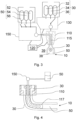
- Fig. 3 illustrates aspects of a device 100 for the tool-free production of a hollow structure 10, wherein the hollow structure 10 has a cross-section that varies along an axis of the hollow structure.
- the device 100 comprises a combination unit or an extrusion nozzle 110 with a core 115, designed to extrude an extrusion material 30 around the core 115, wherein the core 115 is designed to introduce an active medium 50 into an interior 38 of the extrusion material 30 during the extrusion.
- the device 100 further comprises a control device 120, which is designed to extrude the extrusion material 30 through the extrusion nozzle 110 and to introduce the active medium 50. Based on the extrusion nozzle 110, the introduction S120 of the active medium 50 takes place during the extrusion S110 of the extrusion material 30 in order to produce the hollow structure 10 with the varying cross-section.
- the device 100 comprises a first storage container 32, 52 for solid components, a second storage container 34, 54 for liquid components, and a third storage container 36, 56 for gaseous components of the extrusion material 30 or the active medium 50.
- the storage containers 32, 34, 36, 52, 54, 56 can each contain the same extrusion material 30 or active medium 50 in different aggregate states or different extrusion materials 30 and/or active media 30. Several different extrusion materials 30 or active media 50 can also be provided within one aggregate state.
- the extrusion nozzle 110 includes a channel in the core 115 through which the active medium 50 is introduced into the interior 38 of the extrusion material 30.
- the device 100 can be configured to adjust temperatures, opening shapes, and/or pressures in the extrusion nozzle 110 and/or in the core 115.
- the device 100 comprises an extrusion actuator 130 configured to selectively feed extrusion material 30 from the first reservoir 32, the second reservoir 34, or the third reservoir 36 of the extrusion material 30 into the extrusion nozzle 110.
- the extrusion material actuator 130 is configured to apply pressure to the extrusion material 30 and to advance the extrusion material 30 through the extrusion nozzle 110 around the core 115.
- the device 100 comprises an active medium actuator 150 configured to convey mixtures of active media 50 from the first reservoir 52, the second reservoir 54, and/or the third reservoir 56 of the active medium 50 into the extrusion nozzle 110.
- the active medium actuator 150 is configured to apply pressure to the active medium 50 and to advance the active medium 50 through the core 115 of the extrusion nozzle 110.
- the control device 120 controls the extrusion material actuator 130 and the active medium actuator 150. In embodiments, the control device controls 120 also the extrusion nozzle 110 and thus carries out the disclosed method for tool-free production of the hollow structure 10.
- the active medium 50 enters the interior 38 of the extrusion material. Based on the selection of the extrusion material 30 and the active medium 50 (or active media 50), the varying cross-section can be achieved by adjusting a temperature, pressure, and/or volumetric flow rate of the extrusion material 30 and/or the active medium 50.
- the method allows a strand diameter of the hollow structure 10 or the cross-section to be achieved that corresponds to a multiple of the diameter of the extrusion nozzle 110.
- the strand diameter can be varied, for example, to serve as a design feature (e.g., in hollow structures 10 for architecture, design) or to be selected according to the load (e.g., in hollow structures for lightweight construction).
- the finished hollow body 10 can be filled at least in sections with active media 50 (e.g., with gas as insulation, with liquid as a crack indicator); in sections, it can also have a cavity, e.g., for insulation or for inserting a sensor.
- active media 50 e.g., with gas as insulation, with liquid as a crack indicator
- the device 100 can be configured to perform a tempering of the extrusion material 30 by means of a tempering medium in an exterior 39 of the extrusion material 30 and/or by locally introduced energy from the exterior 39 of the extrusion material 30.
- the tempering can co-determine the varying cross-section.
- Tempering from the exterior 39 and/or selecting the temperature of the active medium 50 can be used in particular for creating overhangs.
- Targeted tempering can, for example, be used to significantly reduce curing time.
- the extrusion material 30 solidifies without sinking.
- the active medium 50 can comprise photopolymers, a thermochromic material, a solvator-chromic material, and/or a phase-change material, the latter, for example, in capsules.
- the device 100 can be configured for alternating introduction S120 of gas and foam as the active medium 50. In this way, properties of the hollow structure 10, or component properties, can be selectively modified in sections, since the foam-filled cross-section can have better strength properties than the gas-filled cross-section.
- a low-density hollow structure 10 can thus be reinforced from the inside with foam at critical points during production.
- Fig. 4 shows further aspects of a device 100 for the tool-free production of a hollow structure 10, wherein the hollow structure 10 has a cross-section that varies along an axis of the hollow structure 10.
- the core 115 comprises a flexible molded body 117 that protrudes from an extrusion opening of the extrusion nozzle 110.
- the molded body 117 is designed to additionally stabilize the cross-section or the extrusion material 30.
- An advantage of the device 100 shown here lies in the possibility of stabilizing the hollow structure 10 directly after extrusion, which can result in greater process reliability, particularly for use in additive manufacturing processes.
- the production of radii and angled deposition can be supported.
Landscapes
- Engineering & Computer Science (AREA)
- Manufacturing & Machinery (AREA)
- Mechanical Engineering (AREA)
- Chemical & Material Sciences (AREA)
- Materials Engineering (AREA)
- Physics & Mathematics (AREA)
- Optics & Photonics (AREA)
- Extrusion Moulding Of Plastics Or The Like (AREA)
- Extrusion Of Metal (AREA)
Applications Claiming Priority (1)
| Application Number | Priority Date | Filing Date | Title |
|---|---|---|---|
| DE102023132852.2A DE102023132852A1 (de) | 2023-11-24 | 2023-11-24 | Verfahren zum werkzeuglosen Herstellen einer Hohlstruktur |
Publications (2)
| Publication Number | Publication Date |
|---|---|
| EP4559664A2 true EP4559664A2 (fr) | 2025-05-28 |
| EP4559664A3 EP4559664A3 (fr) | 2025-09-17 |
Family
ID=93119570
Family Applications (1)
| Application Number | Title | Priority Date | Filing Date |
|---|---|---|---|
| EP24206470.7A Pending EP4559664A3 (fr) | 2023-11-24 | 2024-10-14 | Procédé de fabrication sans outil d'une structure creuse |
Country Status (2)
| Country | Link |
|---|---|
| EP (1) | EP4559664A3 (fr) |
| DE (1) | DE102023132852A1 (fr) |
Citations (2)
| Publication number | Priority date | Publication date | Assignee | Title |
|---|---|---|---|---|
| EP0468260A2 (fr) | 1990-07-24 | 1992-01-29 | Bridgestone/Firestone, Inc. | Dispositif de coextrusion et procédé utilisant une filière rigide pour faire varier le profil extérieur d'un extrudat tubulaire |
| WO2022029211A1 (fr) | 2020-08-06 | 2022-02-10 | Signify Holding B.V. | Impression continue d'un tube creux à l'aide de la fdm |
Family Cites Families (6)
| Publication number | Priority date | Publication date | Assignee | Title |
|---|---|---|---|---|
| US3674404A (en) * | 1970-08-06 | 1972-07-04 | Sherwood Medical Ind Inc | Extruder apparatus and accumulator |
| US3712782A (en) * | 1971-02-25 | 1973-01-23 | Sherwood Medical Ind Inc | Extruder |
| US4333906A (en) * | 1979-03-12 | 1982-06-08 | Extracorporeal Medical Specialties, Inc. | Process for producing hollow fibers having a non-uniform wall thickness and a non-uniform cross-sectional area |
| BE1023722B1 (de) * | 2015-11-13 | 2017-06-27 | Inexco Europe | Extrusionswerkzeug |
| US12138843B2 (en) * | 2018-06-13 | 2024-11-12 | University Of Washington | Extruded hydrogel tubes and coaxial fibers and applications thereof |
| WO2021173618A2 (fr) * | 2020-02-27 | 2021-09-02 | Univeristy Of Massachusetts | Impression 3d par combinaison et extrusion de matériaux multiples |
-
2023
- 2023-11-24 DE DE102023132852.2A patent/DE102023132852A1/de active Pending
-
2024
- 2024-10-14 EP EP24206470.7A patent/EP4559664A3/fr active Pending
Patent Citations (2)
| Publication number | Priority date | Publication date | Assignee | Title |
|---|---|---|---|---|
| EP0468260A2 (fr) | 1990-07-24 | 1992-01-29 | Bridgestone/Firestone, Inc. | Dispositif de coextrusion et procédé utilisant une filière rigide pour faire varier le profil extérieur d'un extrudat tubulaire |
| WO2022029211A1 (fr) | 2020-08-06 | 2022-02-10 | Signify Holding B.V. | Impression continue d'un tube creux à l'aide de la fdm |
Non-Patent Citations (1)
| Title |
|---|
| SCHRIFT N. HOPKINSR.J. VAN VUURENH. BROOKS: "Additive Manufacturing", vol. 36, December 2020, pages: 101606 |
Also Published As
| Publication number | Publication date |
|---|---|
| EP4559664A3 (fr) | 2025-09-17 |
| DE102023132852A1 (de) | 2025-05-28 |
Similar Documents
| Publication | Publication Date | Title |
|---|---|---|
| DE2726787C3 (de) | Aus Kunststoff hergestellter Gegenstand | |
| EP2961589B1 (fr) | Procede d'obtention d'un objet en trois dimensions par fabrication additive | |
| DE69228171T2 (de) | Verfahren zur Herstellung von Gegenständen aus Polymermaterial bestehend aus einem geschäumten Kern mit einer umhüllenden Schale, und Vorrichtung für dieses Verfahren | |
| EP2705942B1 (fr) | Procédé et dispositif pour la fabrication d'objets tridimensionnels dotés de parties non soutenues et/ou en surplomb | |
| DE3708006A1 (de) | Verfahren zum herstellen von hohlkoerpern aus thermoplastischem kunststoff mit einer mehrschichtigen wandung | |
| DE69810487T2 (de) | Verfahren zum formen von hohlen körpern, die mindestens eine schicht aus verstärktem kunststoff aufweisen | |
| DE10106923A1 (de) | Verfahren zur Herstellung von Bauteilen aus faserverstärktem Kunststoff | |
| DE102011105775B4 (de) | Verfahren zum Spritzgießen von Kunststoff-Formteilen aus thermoplastischem Kunststoff | |
| EP3243633A1 (fr) | Impression 3d de pièces ayant une structure cellulaire, en particulier en matière plastique | |
| EP4559664A2 (fr) | Procédé de fabrication sans outil d'une structure creuse | |
| EP1502726B1 (fr) | Matériaux pour moulages | |
| EP1493777B1 (fr) | Objets moulés comprenant résine et particules de charges poreuses ayant des cavités remplies | |
| DE102013226018B4 (de) | Wiederverwendbarer Kern für Faserverbundbauteile komplexer Geometrie | |
| EP3790729B1 (fr) | Dispositif et procédé de moulage par soufflage continu de profilés creux thermoplastiques, renforcés par des fibres, ayant une section transversale constante ou variable | |
| DE10107211A1 (de) | Verfahren zum Herstellen von länglichen Gegenständen sowie mit diesem Verfahren hergestellter Gegenstand | |
| DE102016005379A1 (de) | Hybrider, textilverstärker Multi-Material-Verbundwerkstoff und Verfahren zu seiner Herstellung | |
| EP1208955B1 (fr) | Méthode de moulage par injection acec une cavité variable pour la fabrication de bouchons | |
| EP0835745B1 (fr) | Procédé et dispositif pour la fabrication de corps creux tubulaires | |
| EP0477590A2 (fr) | Procédé et dispositif pour la fabrication d'articles en forme de colonne | |
| WO2018114757A1 (fr) | Corps creux comprenant une paroi en matière thermoplastique multicouche ainsi que procédé pour sa fabrication | |
| EP1424190B1 (fr) | Objet moulé par injection ou extrusion et procédé pour sa fabrication | |
| EP2436501B1 (fr) | Procédé et dispositif de fabrication d'un produit en plastique extrudé | |
| EP4363200A1 (fr) | Conception de tête d'impression pour fabrication additive à l'aide de fibres continues et de matériaux à matrice thermoplastique pour coupe dans la zone chaude de la tête d'impression au moyen d'un mouvement axial ou rotatif | |
| EP2799206B1 (fr) | Procédé de fabrication d'un profilé en matière synthétique doté de micro-inclusions | |
| EP0487839A1 (fr) | Corps en forme de colonne et procédé pour sa fabrication |
Legal Events
| Date | Code | Title | Description |
|---|---|---|---|
| PUAI | Public reference made under article 153(3) epc to a published international application that has entered the european phase |
Free format text: ORIGINAL CODE: 0009012 |
|
| STAA | Information on the status of an ep patent application or granted ep patent |
Free format text: STATUS: THE APPLICATION HAS BEEN PUBLISHED |
|
| AK | Designated contracting states |
Kind code of ref document: A2 Designated state(s): AL AT BE BG CH CY CZ DE DK EE ES FI FR GB GR HR HU IE IS IT LI LT LU LV MC ME MK MT NL NO PL PT RO RS SE SI SK SM TR |
|
| PUAL | Search report despatched |
Free format text: ORIGINAL CODE: 0009013 |
|
| AK | Designated contracting states |
Kind code of ref document: A3 Designated state(s): AL AT BE BG CH CY CZ DE DK EE ES FI FR GB GR HR HU IE IS IT LI LT LU LV MC ME MK MT NL NO PL PT RO RS SE SI SK SM TR |
|
| RIC1 | Information provided on ipc code assigned before grant |
Ipc: B29C 64/118 20170101AFI20250814BHEP Ipc: B29C 64/30 20170101ALI20250814BHEP Ipc: B29C 64/314 20170101ALI20250814BHEP Ipc: B33Y 10/00 20150101ALI20250814BHEP Ipc: B33Y 30/00 20150101ALI20250814BHEP Ipc: B33Y 40/00 20200101ALI20250814BHEP Ipc: B29C 64/209 20170101ALI20250814BHEP Ipc: B29C 48/09 20190101ALI20250814BHEP Ipc: B29C 48/13 20190101ALI20250814BHEP Ipc: B29C 48/30 20190101ALI20250814BHEP |
|
| STAA | Information on the status of an ep patent application or granted ep patent |
Free format text: STATUS: REQUEST FOR EXAMINATION WAS MADE |
|
| 17P | Request for examination filed |
Effective date: 20251030 |