EP4559533A1 - Brandverhütungs- und steuerungssystem für wiederaufladbare schiffsbatteriekabine - Google Patents
Brandverhütungs- und steuerungssystem für wiederaufladbare schiffsbatteriekabine Download PDFInfo
- Publication number
- EP4559533A1 EP4559533A1 EP24150784.7A EP24150784A EP4559533A1 EP 4559533 A1 EP4559533 A1 EP 4559533A1 EP 24150784 A EP24150784 A EP 24150784A EP 4559533 A1 EP4559533 A1 EP 4559533A1
- Authority
- EP
- European Patent Office
- Prior art keywords
- control
- cabin
- fire
- battery
- control board
- Prior art date
- Legal status (The legal status is an assumption and is not a legal conclusion. Google has not performed a legal analysis and makes no representation as to the accuracy of the status listed.)
- Pending
Links
Images

Classifications
-
- A—HUMAN NECESSITIES
- A62—LIFE-SAVING; FIRE-FIGHTING
- A62C—FIRE-FIGHTING
- A62C37/00—Control of fire-fighting equipment
- A62C37/36—Control of fire-fighting equipment an actuating signal being generated by a sensor separate from an outlet device
- A62C37/38—Control of fire-fighting equipment an actuating signal being generated by a sensor separate from an outlet device by both sensor and actuator, e.g. valve, being in the danger zone
-
- A—HUMAN NECESSITIES
- A62—LIFE-SAVING; FIRE-FIGHTING
- A62C—FIRE-FIGHTING
- A62C3/00—Fire prevention, containment or extinguishing specially adapted for particular objects or places
- A62C3/07—Fire prevention, containment or extinguishing specially adapted for particular objects or places in vehicles, e.g. in road vehicles
- A62C3/10—Fire prevention, containment or extinguishing specially adapted for particular objects or places in vehicles, e.g. in road vehicles in ships
-
- A—HUMAN NECESSITIES
- A62—LIFE-SAVING; FIRE-FIGHTING
- A62C—FIRE-FIGHTING
- A62C3/00—Fire prevention, containment or extinguishing specially adapted for particular objects or places
- A62C3/16—Fire prevention, containment or extinguishing specially adapted for particular objects or places in electrical installations, e.g. cableways
-
- A—HUMAN NECESSITIES
- A62—LIFE-SAVING; FIRE-FIGHTING
- A62C—FIRE-FIGHTING
- A62C31/00—Delivery of fire-extinguishing material
-
- A—HUMAN NECESSITIES
- A62—LIFE-SAVING; FIRE-FIGHTING
- A62C—FIRE-FIGHTING
- A62C35/00—Permanently-installed equipment
- A62C35/58—Pipe-line systems
-
- A—HUMAN NECESSITIES
- A62—LIFE-SAVING; FIRE-FIGHTING
- A62C—FIRE-FIGHTING
- A62C35/00—Permanently-installed equipment
- A62C35/58—Pipe-line systems
- A62C35/60—Pipe-line systems wet, i.e. containing extinguishing material even when not in use
-
- A—HUMAN NECESSITIES
- A62—LIFE-SAVING; FIRE-FIGHTING
- A62C—FIRE-FIGHTING
- A62C35/00—Permanently-installed equipment
- A62C35/58—Pipe-line systems
- A62C35/68—Details, e.g. of pipes or valve systems
-
- A—HUMAN NECESSITIES
- A62—LIFE-SAVING; FIRE-FIGHTING
- A62C—FIRE-FIGHTING
- A62C37/00—Control of fire-fighting equipment
- A62C37/04—Control of fire-fighting equipment with electrically-controlled release
-
- B—PERFORMING OPERATIONS; TRANSPORTING
- B63—SHIPS OR OTHER WATERBORNE VESSELS; RELATED EQUIPMENT
- B63H—MARINE PROPULSION OR STEERING
- B63H21/00—Use of propulsion power plant or units on vessels
- B63H21/12—Use of propulsion power plant or units on vessels the vessels being motor-driven
- B63H21/17—Use of propulsion power plant or units on vessels the vessels being motor-driven by electric motor
-
- G—PHYSICS
- G08—SIGNALLING
- G08B—SIGNALLING SYSTEMS, e.g. PERSONAL CALLING SYSTEMS; ORDER TELEGRAPHS; ALARM SYSTEMS
- G08B17/00—Fire alarms; Alarms responsive to explosion
-
- G—PHYSICS
- G08—SIGNALLING
- G08B—SIGNALLING SYSTEMS, e.g. PERSONAL CALLING SYSTEMS; ORDER TELEGRAPHS; ALARM SYSTEMS
- G08B21/00—Alarms responsive to a single specified undesired or abnormal condition and not otherwise provided for
- G08B21/18—Status alarms
- G08B21/182—Level alarms, e.g. alarms responsive to variables exceeding a threshold
-
- H—ELECTRICITY
- H01—ELECTRIC ELEMENTS
- H01M—PROCESSES OR MEANS, e.g. BATTERIES, FOR THE DIRECT CONVERSION OF CHEMICAL ENERGY INTO ELECTRICAL ENERGY
- H01M50/00—Constructional details or processes of manufacture of the non-active parts of electrochemical cells other than fuel cells, e.g. hybrid cells
- H01M50/20—Mountings; Secondary casings or frames; Racks, modules or packs; Suspension devices; Shock absorbers; Transport or carrying devices; Holders
- H01M50/204—Racks, modules or packs for multiple batteries or multiple cells
-
- H—ELECTRICITY
- H01—ELECTRIC ELEMENTS
- H01M—PROCESSES OR MEANS, e.g. BATTERIES, FOR THE DIRECT CONVERSION OF CHEMICAL ENERGY INTO ELECTRICAL ENERGY
- H01M50/00—Constructional details or processes of manufacture of the non-active parts of electrochemical cells other than fuel cells, e.g. hybrid cells
- H01M50/30—Arrangements for facilitating escape of gases
- H01M50/383—Flame arresting or ignition-preventing means
-
- B—PERFORMING OPERATIONS; TRANSPORTING
- B60—VEHICLES IN GENERAL
- B60L—PROPULSION OF ELECTRICALLY-PROPELLED VEHICLES; SUPPLYING ELECTRIC POWER FOR AUXILIARY EQUIPMENT OF ELECTRICALLY-PROPELLED VEHICLES; ELECTRODYNAMIC BRAKE SYSTEMS FOR VEHICLES IN GENERAL; MAGNETIC SUSPENSION OR LEVITATION FOR VEHICLES; MONITORING OPERATING VARIABLES OF ELECTRICALLY-PROPELLED VEHICLES; ELECTRIC SAFETY DEVICES FOR ELECTRICALLY-PROPELLED VEHICLES
- B60L2200/00—Type of vehicles
- B60L2200/32—Waterborne vessels
-
- H—ELECTRICITY
- H01—ELECTRIC ELEMENTS
- H01M—PROCESSES OR MEANS, e.g. BATTERIES, FOR THE DIRECT CONVERSION OF CHEMICAL ENERGY INTO ELECTRICAL ENERGY
- H01M2220/00—Batteries for particular applications
- H01M2220/20—Batteries in motive systems, e.g. vehicle, ship, plane
-
- Y—GENERAL TAGGING OF NEW TECHNOLOGICAL DEVELOPMENTS; GENERAL TAGGING OF CROSS-SECTIONAL TECHNOLOGIES SPANNING OVER SEVERAL SECTIONS OF THE IPC; TECHNICAL SUBJECTS COVERED BY FORMER USPC CROSS-REFERENCE ART COLLECTIONS [XRACs] AND DIGESTS
- Y02—TECHNOLOGIES OR APPLICATIONS FOR MITIGATION OR ADAPTATION AGAINST CLIMATE CHANGE
- Y02E—REDUCTION OF GREENHOUSE GAS [GHG] EMISSIONS, RELATED TO ENERGY GENERATION, TRANSMISSION OR DISTRIBUTION
- Y02E60/00—Enabling technologies; Technologies with a potential or indirect contribution to GHG emissions mitigation
- Y02E60/10—Energy storage using batteries
-
- Y—GENERAL TAGGING OF NEW TECHNOLOGICAL DEVELOPMENTS; GENERAL TAGGING OF CROSS-SECTIONAL TECHNOLOGIES SPANNING OVER SEVERAL SECTIONS OF THE IPC; TECHNICAL SUBJECTS COVERED BY FORMER USPC CROSS-REFERENCE ART COLLECTIONS [XRACs] AND DIGESTS
- Y02—TECHNOLOGIES OR APPLICATIONS FOR MITIGATION OR ADAPTATION AGAINST CLIMATE CHANGE
- Y02T—CLIMATE CHANGE MITIGATION TECHNOLOGIES RELATED TO TRANSPORTATION
- Y02T70/00—Maritime or waterways transport
- Y02T70/50—Measures to reduce greenhouse gas emissions related to the propulsion system
Definitions
- the present invention relates to the field of ship firefighting technologies, and specifically to a fire prevention and control system for a rechargeable battery cabin of a ship.
- an electric ship uses a power battery as a power source.
- the ship has high driving power and long endurance. Therefore, a marine power battery system has large total storage energy, and the battery system is complex.
- a plurality of battery clusters are usually disposed.
- a plurality of battery packs are disposed in each battery cluster. For example, for some electric ships, nearly 20 battery clusters need to be disposed. 10 to 40 battery packs are disposed in each battery cluster, and a dedicated cabin (rechargeable battery cabin) is disposed for arrangement.
- a dedicated cabin rechargeable battery cabin
- the fire in the battery usually has characteristics such as suddenness, quick spreading, and explosions. Once thermal runaway occurs in one battery pack, thermal runaway may be caused in the power battery system of the entire electric ship, leading to fire.
- thermal runaway may be caused in the power battery system of the entire electric ship, leading to fire.
- a ship is susceptible to influences of randomness of factors such as weather, hydrology, waterway, and traffic and frequent load fluctuations and large change ranges of the ship, the complexity of a battery management system of the ship is correspondingly increased. Therefore, compared with an electric vehicle, a fire prevention and control system for a rechargeable battery cabin of a ship has a higher requirement of reliability, or even it is required that fire prevention and control can still be performed when the battery management system partially fails or is partially faulty.
- An objective of the present invention is to overcome deficiencies in the prior art and provide a fire prevention and control system for a rechargeable battery cabin of a ship. Detection apparatuses and control apparatuses are redundantly disposed, to provide high reliability of detection and high reliability of control, and implement a dual-path monitoring-control process of detection apparatus-control apparatus-fire suppression apparatus, thereby greatly improving the reliability of the fire prevention and control system.
- a fire prevention and control system for a rechargeable battery cabin of a ship where a plurality of battery clusters are disposed in the rechargeable battery cabin, a plurality of battery packs are disposed in each battery cluster, the battery packs are managed by a battery management system
- the fire prevention and control system includes a detection apparatus, a fire suppression apparatus, and a control apparatus
- the detection apparatus is configured to detect fire information in the battery packs and the rechargeable battery cabin
- the detection apparatus includes a first detection apparatus and a second detection apparatus
- the control apparatus includes a first control apparatus and a second control apparatus
- the first control apparatus is connected to the first detection apparatus
- the second control apparatus is connected to the second detection apparatus
- the first control apparatus and/or the second control apparatus is configured to control whether the fire suppression apparatus releases a fire extinguishing agent.
- the fire suppression apparatus includes a cluster level suppression apparatus and a cabin level suppression apparatus, one cluster level suppression apparatus is disposed corresponding to one or more battery clusters, the cluster level suppression apparatus is configured to introduce the fire extinguishing agent to the battery packs of the battery cluster, and the cabin level suppression apparatus is configured to introduce the fire extinguishing agent to the rechargeable battery cabin.
- the first control apparatus include a remote control host and a first control board connected to the remote control host
- the second control apparatus includes a local control host and a second control board connected to the local control host
- the first control board and/or the second control board is configured to control whether the fire suppression apparatus releases the fire extinguishing agent
- the first control board and the second control board are disposed in the fire suppression apparatus
- the local control host is disposed outside the rechargeable battery cabin
- the remote control host is disposed in a cockpit of the ship.
- the first detection apparatus includes a first pack level detector and a first cabin level detector
- the second detection apparatus includes a second pack level detector and a second cabin level detector
- one first pack level detector and one second pack level detector are correspondingly disposed inside each battery pack
- the first cabin level detector and the second cabin level detector are disposed in the battery cabin.
- first pack level detector in each battery cluster is connected to a first control board in a cluster level suppression apparatus corresponding to the battery cluster
- the second pack level detector in each battery cluster is connected to a second control board in a cluster level suppression apparatus corresponding to the battery cluster
- the first cabin level detector is connected to the remote control host
- the second cabin level detector is connected to the local control host.
- the cluster level suppression apparatus is connected to the plurality of battery packs by a shunting component, and the shunting component is configured to control the fire extinguishing agent to be delivered to a designated battery pack.
- the fire suppression apparatus includes a fire extinguishing agent storage tank, an outlet end of the fire extinguishing agent storage tank is connected to a cylinder valve, an outlet of the cylinder valve is connected to a firefighting pipe, the firefighting pipe is configured to deliver the fire extinguishing agent, and the cylinder valve is configured to control whether the fire extinguishing agent storage tank releases the fire extinguishing agent.
- each fire suppression apparatus further includes one reversing valve, the reversing valve is disposed at the firefighting pipe at an outlet end of the cylinder valve of the fire suppression apparatus, and the plurality of reversing valves are connected by a connecting pipe.
- the prevention and control system further includes an emergency start/stop switch, the emergency start/stop switch is connected to both the first control apparatus and the second control apparatus, emergency start of the fire suppression apparatus is controlled through the emergency start/stop switch, an overhaul knob switch is further disposed on the emergency start/stop switch, and when the overhaul knob switch is turned on, the fire prevention and control system enters an overhaul state.
- control circuits are disposed in each of the first control board and the second control board, one is a main control circuit, the other is a spare circuit, and when the main control circuit is faulty, the spare circuit starts working.
- each of the remote control host and the local control host is connected to a marine 220-V power supply by a charging adapter, the remote control host supplies power to the first control board, and therefore the local control host supplies power to the second control board.
- a spare rechargeable battery is disposed in each of the remote control host, the local control host, the cluster level suppression apparatus, and the cabin level suppression apparatus.
- This application provides a fire prevention and control system for a rechargeable battery cabin of a ship. Detection apparatuses and control apparatuses are redundantly disposed, to provide high reliability of detection and high reliability of control, and implement a dual-path monitoring-control process of detection apparatus-control apparatus-fire suppression apparatus, thereby greatly improving the reliability of the fire prevention and control system.
- Detection apparatuses and control apparatuses are redundantly disposed, to provide high reliability of detection and high reliability of control, and implement a dual-path monitoring-control process of detection apparatus-control apparatus-fire suppression apparatus, thereby greatly improving the reliability of the fire prevention and control system.
- the rechargeable battery cabin is divided into regions, and one fire suppression apparatus (cluster level suppression apparatus) is correspondingly disposed in each division region.
- the marine 220-V power supply and the spare battery are disposed to implement power supply redundancy for the fire prevention and control system.
- the spare battery may be used to supply power, to ensure that the fire prevention and control system can perform detection, alarm raising, and fire extinguishing.
- remote control host 2. local control host, 3. first cluster level control board, 4. second cluster level control board, 5. first cabin level control board, 6. second cabin level control board, 7. first pack level detector, 8. second pack level detector, 9. cylinder valve, 10. puncture valve, 11. first cabin level detector, 12. second cabin level detector, 13. first emergency start/stop switch, 14. second emergency start/stop switch, 15. fire extinguishing agent storage tank, and 16. reversing valve.
- a fire prevention and control system for a rechargeable battery cabin of a ship is provided.
- a plurality of battery clusters are disposed in the rechargeable battery cabin.
- a plurality of battery packs are disposed in each battery cluster.
- the battery packs are managed by a battery management system.
- the fire prevention and control system is independent of the battery management system.
- the fire prevention and control system includes a detection apparatus, a fire suppression apparatus, and a control apparatus.
- the detection apparatus is configured to detect fire information in the battery packs and the rechargeable battery cabin.
- the detection apparatus includes a detection device.
- the detection device includes one or more of a temperature sensor, a smoke sensor, a CO sensor, a hydrogen sensor, a VOC sensor, a flame sensor, and a CO2 sensor.
- the detection apparatus may perform composite determination on a parameter signal detected by the detection device and then deliver the parameter signal to the control apparatus. For example, the detection apparatus may categorize fire into four levels including a latent period, a prewarning period, an alarm period, and an open fire period according to parameter ranges to raise an alarm. For the alarm of the second, third, and fourth levels, detected information is uploaded to the control apparatus.
- the fire suppression apparatus is configured to introduce a fire extinguishing agent into the battery packs or the rechargeable battery cabin to suppress fire.
- the control apparatus is configured to receive the parameter signal sent by the detection apparatus, perform determination and analysis on the parameter signal, and send an execution command to the fire suppression apparatus.
- the fire prevention and control system may further include an audible and visual alarm apparatus that can send out audible and visual alarm information, and the audible and visual alarm apparatus is controlled by the control apparatus.
- the detection apparatus includes a first detection apparatus and a second detection apparatus. The first detection apparatus and the second detection apparatus are redundancies of each other.
- the control apparatus includes a first control apparatus and a second control apparatus. The first control apparatus and the second control apparatus are redundancies of each other.
- the first control apparatus is connected to the first detection apparatus.
- the second control apparatus is connected to the second detection apparatus.
- the first control apparatus and/or the second control apparatus is configured to control whether the fire suppression apparatus releases the fire extinguishing agent.
- the first control apparatus and the second control apparatus may separately perform independent control to start the fire suppression apparatus, or may jointly perform control to start the fire suppression apparatus.
- the detection apparatuses and the control apparatuses are separately redundantly disposed, to implement a dual-path monitoring-control process of detection apparatus-control apparatus-fire suppression apparatus, thereby greatly improving the reliability of the fire prevention and control system.
- the fire prevention and control system in this application may be integrally disposed with the battery management system, that is, the control apparatus of the battery management system is used as the first control apparatus or the second control apparatus of this application, or may be disposed independently of the battery management system.
- the fire prevention and control system is disposed independently, to perform independent monitoring and control on fire in the rechargeable battery cabin of the ship without causing any additional interference and control to the operation safety of the ship and a battery power system. Even if battery power of the ship is faulty, the functions of detection, alarm raising, and fire extinguishing are still provided.
- the fire suppression apparatus includes a cluster level suppression apparatus and a cabin level suppression apparatus, one cluster level suppression apparatus is disposed corresponding to one or more battery clusters, the cluster level suppression apparatus is configured to introduce the fire extinguishing agent to the battery packs of the battery cluster, and the cabin level suppression apparatus is configured to introduce the fire extinguishing agent to the rechargeable battery cabin.
- one cluster level suppression apparatus may be disposed corresponding to one battery cluster, or one cluster level suppression apparatus may be disposed corresponding to several battery clusters.
- one cluster level suppression apparatus is disposed corresponding to two or three battery clusters.
- the cluster level suppression apparatus is disposed close to the battery cluster corresponding to the cluster level suppression apparatus, so that the fire extinguishing agent in the cluster level suppression apparatus can be delivered in time to a battery pack that catches fire.
- the rechargeable battery cabin is divided into regions, and one fire suppression apparatus (cluster level suppression apparatus) is correspondingly disposed in each division region.
- cluster level suppression apparatus When a battery pack in a battery cluster encounters thermal runaway and catches fire, a cluster level suppression apparatus corresponding to the battery pack may separately perform fire extinguishing on the battery pack, and the fire suppression apparatus makes a quick response to a fire point.
- the fire prevention and control system in this application can perform local suppression before fire spreads, to reduce damage to a power battery system of an electric ship.
- the cabin level suppression apparatus is further disposed for the rechargeable battery cabin, and the fire extinguishing agent is introduced into the entire rechargeable battery cabin through the cabin level suppression apparatus. If local fire fails to be suppressed and the fire spreads, fire extinguishing can further be performed through the cabin level suppression apparatus.
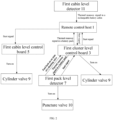
- the first control apparatus includes a remote control host 1 and a first control board connected to the remote control host 1.
- the second control apparatus includes a local control host 2 and a second control board connected to the local control host 2.
- the remote control host 1 and the local control host 2 are redundancies of each other.
- the remote control host 1 and the local control host 2 further have the effect of monitoring and displaying operation states of all the fire suppression apparatuses.
- the first control board and the second control board are redundancies of each other.
- the first control board and/or the second control board is configured to control whether the fire suppression apparatus releases the fire extinguishing agent. That is, the first control board and the second control board may separately perform independent control to start the fire suppression apparatus, or may jointly perform control to start the fire suppression apparatus.
- the first control board and the second control board are disposed in the fire suppression apparatus, the local control host 2 is disposed outside the rechargeable battery cabin, and the remote control host 1 is disposed in a cockpit of the ship.
- the local control host 2 may be disposed near a cabin door of the rechargeable battery cabin, for example, disposed on a side of the cabin door of the rechargeable battery cabin.
- the remote control host 1 is disposed in the cockpit of the ship, and the local control host 2 and the remote control host 1 are distributed at different positions of the ship, making it convenient for a worker to discover fire in time and take measures.
- the fire suppression apparatus in this application includes the cluster level suppression apparatus and the cabin level suppression apparatus. Therefore, to facilitate distinguishing, the first control board and the second control board in the cluster level suppression apparatus in this application are respectively defined as a first cluster level control board 3 and a second cluster level control board 4.
- the first control board and the second control board in the cabin level suppression apparatus are respectively defined as a first cabin level control board 5 and a second cabin level control board 6.
- the first cluster level control board 3 and the second cluster level control board 4 are redundancies of each other, and the first cabin level control board 5 and the second cabin level control board 6 are redundancies of each other.
- One first cluster level control board 3 and one second cluster level control board 4 are correspondingly disposed in each cluster level suppression apparatus.
- One first cabin level control board 5 and one second cabin level control board 6 are correspondingly disposed in each cabin level suppression apparatus.
- the first cluster level control board 3 may perform CAN communication with the remote control host 1.
- the second cluster level control board 4 may perform CAN communication with the local control host 2.
- the first cluster level control board 3 and the second cluster level control board 4 may separately perform independent control to start the cluster level suppression apparatus, or may jointly perform control to start the cluster level suppression apparatus.
- the first cabin level control board 5 may perform CAN communication with the remote control host 1.
- the second cabin level control board 6 may perform CAN communication with the local control host 2.
- the first cabin level control board 5 and the second cabin level control board 6 may separately perform independent control to start the cabin level suppression apparatus, or may jointly perform control to start the cabin level suppression apparatus.
- the first detection apparatus includes a first pack level detector 7 and a first cabin level detector 11, the second detection apparatus includes a second pack level detector 8 and a second cabin level detector 12, one first pack level detector 7 and one second pack level detector 8 are correspondingly disposed inside each battery pack, and the first cabin level detector 11 and the second cabin level detector 12 are disposed in the battery cabin.
- the first pack level detector 7 and the second pack level detector 8 are configured to detect the fire information in the battery packs, and the first cabin level detector 11 and the second cabin level detector 12 are configured to detect the fire information in the rechargeable battery cabin.
- An early period of thermal runaway of the battery packs is detected through the first pack level detector 7 and the second pack level detector 8, and detection is performed in the early period of thermal runaway and suppression is performed in time, to avoid fire spreading.
- first pack level detector 7 and the second pack level detector 8 are redundancies of each other
- first cabin level detector 11 and the second cabin level detector 12 are redundancies of each other.
- the first pack level detector 7 in each battery cluster is connected to a first control board in a cluster level suppression apparatus corresponding to the battery cluster, and the second pack level detector 8 in each battery cluster is connected to a second control board in a cluster level suppression apparatus corresponding to the battery cluster; and the first cabin level detector 11 is connected to the remote control host 1, and the second cabin level detector 12 is connected to the local control host 2.
- the first pack level detector 7 may perform CAN communication or wireless communication with the first cluster level control board 3
- the second pack level detector 8 may perform CAN communication or wireless communication with the second cluster level control board 4.
- a plurality of first pack level detectors 7 in each battery cluster may be connected in parallel.
- One of the plurality of first pack level detectors 7 is connected to the first cluster level control board 3.
- a plurality of second pack level detectors 8 in each battery cluster may be connected in parallel, and one of the plurality of second pack level detectors 8 is connected to the second cluster level control board 4.
- the first cabin level detector 11 may perform CAN communication or wireless communication with the remote control host 1
- the second cabin level detector 12 may perform CAN communication or wireless communication with the local control host 2.
- Each cluster level suppression apparatus only receives fire information in a battery cluster corresponding to the cluster level suppression apparatus, and a plurality of cluster level suppression apparatuses do not interfere with each other.
- the remote control host 1 and the local control host 2 only need to receive fire information fed back by all the cluster level suppression apparatuses and detected information of the first cabin level detector 11 and the second cabin level detector 12, and the remote control host 1 and the local control host 2 do not need to directly receive all the fire information in the battery packs.
- the remote control host 1 is connected to the local control host 2, and the first control board is connected to the second control board. Specifically, the remote control host 1 and the local control host 2 may synchronize data in real time through RS485 communication. The first control board and the second control board may exchange information in an internal serial port manner.
- the cluster level suppression apparatus is connected to the plurality of battery packs by a shunting component, and the shunting component is configured to control the fire extinguishing agent to be delivered to a designated battery pack.
- the shunting component may be a shunting valve having a shunting effect, or a valve assembly formed by a plurality of valves. If the shunting component is a shunting valve, a multi-way shunting valve may be used, that is, a shunting valve having a plurality of outlet ends and can independently control opening or closing of the plurality of outlet ends. The outlet ends of the shunting valve are respectively in communication with the battery packs through firefighting pipes.
- the fire extinguishing agent flowing out of the cluster level suppression apparatus may flow through an inlet end of the shunting valve to enter the shunting valve and enter a designated battery pack through an outlet end of the shunting valve.
- the shunting valve may be electrically connected to the control apparatus, or may be electrically connected to the detection apparatus. When the shunting valve is electrically connected to the detection apparatus, the shunting valve may be electrically connected to both the first pack level detector 7 and the second pack level detector 8. If the shunting component is a valve assembly, the valve assembly may be a valve that can control on or off of a fluid, for example, a puncture valve 10, a ball valve, or a solenoid valve.
- one puncture valve 10 is disposed corresponding to each battery pack.
- a liquid inlet channel, a liquid outlet channel, and a mounting channel are disposed in the puncture valve 10.
- a film is used for sealing between the liquid inlet channel and the liquid outlet channel.
- the liquid outlet channel is in communication with the battery packs.
- a puncture mechanism is mounted in the mounting channel.
- the puncture mechanism is configured to puncture the film.
- the puncture mechanism may be electrically connected to the control apparatus, or may be electrically connected to the detection apparatus. When the puncture mechanism is electrically connected to the detection apparatus, the puncture mechanism may be electrically connected to both the first pack level detector 7 and the second pack level detector 8.
- the puncture mechanism punctures the film
- the liquid inlet channel is in communication with the liquid outlet channel
- the fire extinguishing agent of the cluster level suppression apparatus may flow through liquid inlet channel-liquid outlet channel to enter the battery packs.
- the valve assembly is a ball valve or a solenoid valve
- one ball valve or solenoid valve is disposed corresponding to each battery pack.
- the fire extinguishing agent of the cluster level suppression apparatus may flow into an inlet end of the ball valve or the solenoid valve and flow into a battery pack through an outlet end of the ball valve or the solenoid valve. It is only necessary to control the ball valve or the solenoid valve to be opened to implement that the fire extinguishing agent flows into a designated battery pack.
- the ball valve or the solenoid valve may be electrically connected to the control apparatus, or may be electrically connected to the detection apparatus. When the ball valve or the solenoid valve is electrically connected to the detection apparatus, the ball valve or the solenoid valve may be electrically connected to both the first pack level detector 7 and the second pack level detector 8.
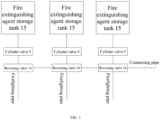
- the fire suppression apparatus includes a fire extinguishing agent storage tank 15, an outlet end of the fire extinguishing agent storage tank 15 is connected to a cylinder valve 9, an outlet of the cylinder valve 9 is connected to a firefighting pipe, the firefighting pipe is configured to deliver the fire extinguishing agent, and the cylinder valve 9 controls whether the fire extinguishing agent storage tank 15 releases the fire extinguishing agent.
- the fire extinguishing agent is stored in the fire extinguishing agent storage tank 15, and the fire extinguishing agent storage tank 15 may be a stored-pressure storage tank.
- the opening and closing of the cylinder valve 9 may be controlled by the control apparatus.
- the fire suppression apparatus in this application may be the cluster level suppression apparatus or may be the cabin level suppression apparatus.
- the firefighting pipe is configured to deliver the fire extinguishing agent into a battery packs, and the cylinder valve 9 may be electrically connected to both the first cluster level control board 3 and the second cluster level control board 4.
- the firefighting pipe is configured to deliver the fire extinguishing agent into the rechargeable battery cabin, and the cylinder valve 9 may be electrically connected to both the first cabin level control board 5 and the second cabin level control board 6.
- Each fire suppression apparatus further includes one reversing valve 16.
- the reversing valve 16 is configured to change a delivery direction of the fire extinguishing agent.
- the reversing valve 16 is disposed at the firefighting pipe at an outlet end of the cylinder valve 9 of the fire suppression apparatus.
- the plurality of reversing valves 16 are connected by a connecting pipe.
- the reversing valve 16 at least includes one liquid inlet end, one liquid outlet end, and one connecting end.
- the liquid inlet end is connected to the outlet end of the cylinder valve 9.
- the connecting end is connected to the connecting pipe.
- the liquid outlet end is connected to the firefighting pipe.
- the fire extinguishing agent that flows out of the outlet end of the cylinder valve 9 may flow through liquid inlet end-liquid outlet end to enter the firefighting pipe, or may flow through liquid inlet end-connecting end to enter the connecting pipe.
- the fire extinguishing agent in the connecting pipe may flow through connecting end-liquid outlet end to enter the firefighting pipe.
- the fire suppression apparatus When the fire suppression apparatus performs fire extinguishing, if the fire extinguishing agent in the fire suppression apparatus is insufficient, the fire extinguishing agent may flow through the connecting pipe and connecting end-liquid outlet end to enter the firefighting pipe by changing a circulation direction of the reversing valve 16 and opening cylinder valves 9 of other fire suppression apparatuses, thereby ensuring the supply of the fire extinguishing agent.
- the reversing valve 16 may be controlled by the control apparatus.
- the fire suppression apparatus may be the cluster level suppression apparatus, or may be the cabin level suppression apparatus.
- the reversing valve 16 of the cluster level suppression apparatus is controlled by the first cluster level control board 3 and/or the second cluster level control board 4.
- the reversing valve 16 of the cabin level suppression apparatus is controlled by the first cabin level control board 5 and/or the second cabin level control board 6.
- the prevention and control system further includes an emergency start/stop switch, the emergency start/stop switch is connected to both the first control apparatus and the second control apparatus, emergency start of the fire suppression apparatus is controlled through the emergency start/stop switch, an overhaul knob switch is further disposed on the emergency start/stop switch, and when the overhaul knob switch is turned on, the fire prevention and control system enters an overhaul state.
- an emergency start/stop switch that is, a first emergency start/stop switch 13 and a second emergency start/stop switch 14, may be disposed.
- the first emergency start/stop switch 13 is disposed in the cockpit of the ship, and the second emergency start/stop switch 14 is disposed outside the rechargeable battery cabin.
- the first emergency start/stop switch 13 and the second emergency start/stop switch 14 are connected to both the first control apparatus and the second control apparatus. Further, the first emergency start/stop switch 13 and the second emergency start/stop switch 14 are connected to both the remote control host 1 and the local control host 2.
- the emergency start/stop switch includes a control board, and an emergency start/stop button and the overhaul knob switch are disposed on the control board. When the emergency start/stop button is pressed, the prevention and control system is turned on or stopped emergently. When the overhaul knob switch is turned on, the prevention and control system enters the overhaul state.
- the overhaul state includes that the first control apparatus and the second control apparatus enter a faulty detection state, that is, the local control host 2, the remote control host 1, the first cluster level control board 3, the second cluster level control board 4, the first cabin level control board 5, and the second cabin level control board 6 enter a faulty overhaul state.
- the overhaul state further includes online faulty detection of the detection apparatus, that is, the alarm sensitivity of the first cabin level detector 11 and the second cabin level detector 12 is detected by manually changing a concentration of a gas around the first cabin level detector 11 and the second cabin level detector 12. In the overhaul state, the fire suppression apparatus is not started.
- Two control circuits are disposed in each of the first control board and the second control board, one is a main control circuit, the other is a spare circuit, and when the main control circuit is faulty, the spare circuit starts working.
- the main control circuit and the spare circuit are same circuits having same logic. Switching is performed through circuit control. When the main control circuit works, the spare circuit does not work. When the main control circuit is faulty, switching is automatically performed to the spare circuit for normal working.
- Each of the remote control host 1 and the local control host 2 is connected to a marine 220-V power supply by a charging adapter, the remote control host 1 supplies power to the first control board, and the local control host 2 supplies power to the second control board.
- the charging adapter converts marine AC 220 V into DC 24 V
- the remote control host 1 supplies power to the first cluster level control board 3 and the first cabin level control board 5, and the local control host 2 supplies power to the second cluster level control board 4 and the second cabin level control board 6.
- the remote control host 1 and the local control host 2 further supply power to the first emergency start/stop switch 13 and the second emergency start/stop switch 14 and the first cabin level detector 11 and the second cabin level detector 12.
- the first cluster level control board 3 supplies power to the first pack level detector 7, and the second cluster level control board 4 supplies power to the second pack level detector 8.
- a spare rechargeable battery is disposed in each of the remote control host 1, the local control host 2, the cluster level suppression apparatus, and the cabin level suppression apparatus.
- the spare power source is a DC 24-V power source. When a marine 220-V power supply is faulty, the spare power source supplies power to the remote control host 1, the local control host 2, the first cluster level control board 3, the second cluster level control board 4, the first cabin level control board 5, and the second cabin level control board 6.
- prevention and control may be performed through a two-path monitoring-control process of first pack level detector-first cluster level control board-remote control host and second pack level detector-second cluster level control board-local control host.
- prevention and control may also be performed through two paths. One path is used as an example for detailed description below.
- the first pack level detector 7 detects thermal runaway information and uploads the thermal runaway information to the first cluster level control board 3.
- the first cluster level control board 3 uploads the thermal runaway information to the remote control host 1, and the remote control host 1 delivers a start signal according to the thermal runaway information.
- the first cluster level control board 3 receives the start signal and delivers the start signal to the first pack level detector 7.
- the first pack level detector 7 electrically opens the puncture valve 10 after receiving the start signal, and simultaneously, feeds back an open state of the puncture valve 10 to the first cluster level control board 3.
- the first cluster level control board 3 opens the cylinder valve 9 after receiving the open state of the puncture valve 10, and introduces the fire extinguishing agent into a battery pack. Moreover, the first cluster level control board 3 feeds back a start state of the fire extinguishing agent to the remote control host 1.
- the first cabin level detector 11 detects fire information and uploads the fire information to the remote control host 1.
- the remote control host 1 delivers the start signal after receiving the fire information.
- the first cabin level control board 5 opens the cylinder valve 9 after receiving the start signal, and introduces the fire extinguishing agent into the rechargeable battery cabin to perform fire suppression.
- orientation or location relationships indicated by terms “center”, “up”, “down”, “left”, “right”, “vertical”, and “horizontal”, are based on orientation or location relationships shown in the accompanying drawings, and are only used to facilitate description of the present invention and simplify description, but are not used to indicate or imply that the apparatuses or elements must have specific orientations or are constructed and operated by using specific orientations, and therefore, cannot be understood as a limitation to the present invention.
- the terms “first”, “second”, and “third” are used only for description, but are not intended to indicate or imply relative importance.
- the term "and/or" in this specification describes only an association relationship for describing associated objects and represents that three relationships may exist.
- a and/or B may represent the following three cases: Only A exists, both A and B exist, and only B exists.
- the character "/" herein generally indicates an "or" relationship between the contextual objects.
Landscapes
- Emergency Management (AREA)
- Business, Economics & Management (AREA)
- Public Health (AREA)
- Health & Medical Sciences (AREA)
- Ocean & Marine Engineering (AREA)
- Engineering & Computer Science (AREA)
- Chemical & Material Sciences (AREA)
- General Physics & Mathematics (AREA)
- Physics & Mathematics (AREA)
- Chemical Kinetics & Catalysis (AREA)
- Electrochemistry (AREA)
- General Chemical & Material Sciences (AREA)
- Mechanical Engineering (AREA)
- Combustion & Propulsion (AREA)
- Fire-Extinguishing By Fire Departments, And Fire-Extinguishing Equipment And Control Thereof (AREA)
- Fire Alarms (AREA)
- Battery Mounting, Suspending (AREA)
- Secondary Cells (AREA)
Applications Claiming Priority (1)
| Application Number | Priority Date | Filing Date | Title |
|---|---|---|---|
| CN202311573135.2A CN117442906A (zh) | 2023-11-23 | 2023-11-23 | 一种船舶蓄电池舱用火灾防控系统 |
Publications (1)
| Publication Number | Publication Date |
|---|---|
| EP4559533A1 true EP4559533A1 (de) | 2025-05-28 |
Family
ID=89512357
Family Applications (1)
| Application Number | Title | Priority Date | Filing Date |
|---|---|---|---|
| EP24150784.7A Pending EP4559533A1 (de) | 2023-11-23 | 2024-01-08 | Brandverhütungs- und steuerungssystem für wiederaufladbare schiffsbatteriekabine |
Country Status (6)
| Country | Link |
|---|---|
| US (1) | US12533538B2 (de) |
| EP (1) | EP4559533A1 (de) |
| JP (1) | JP7665232B1 (de) |
| KR (1) | KR102859709B1 (de) |
| CN (1) | CN117442906A (de) |
| AU (1) | AU2024201888B2 (de) |
Families Citing this family (1)
| Publication number | Priority date | Publication date | Assignee | Title |
|---|---|---|---|---|
| CN119587935A (zh) * | 2024-12-09 | 2025-03-11 | 上海船舶电子设备研究所(中国船舶集团有限公司第七二六研究所) | 火灾报警显示控制器联动灭火安全控制系统 |
Citations (4)
| Publication number | Priority date | Publication date | Assignee | Title |
|---|---|---|---|---|
| CN111613842A (zh) * | 2020-05-11 | 2020-09-01 | 中国舰船研究设计中心 | 一种船舶锂离子动力电池安全保障系统及方法 |
| CN215323250U (zh) * | 2021-07-21 | 2021-12-28 | 中船黄埔文冲船舶有限公司 | 一种船舶锂电池舱监测防护系统 |
| CN116808472A (zh) * | 2023-05-18 | 2023-09-29 | 无锡赛思亿电气科技有限公司 | 一种船舶集装箱电池组用消防装置及其工作方法 |
| US20230318066A1 (en) * | 2022-03-31 | 2023-10-05 | Artemis Technologies Limited | Battery safety system and method |
Family Cites Families (26)
| Publication number | Priority date | Publication date | Assignee | Title |
|---|---|---|---|---|
| JP3414693B2 (ja) | 2000-03-31 | 2003-06-09 | 株式会社新来島どっく | 車両運搬船用高膨張泡消火設備 |
| KR200375733Y1 (ko) * | 2004-11-30 | 2005-03-08 | 디에이치엠(주) | 이동식 소화장치 |
| FI117271B (fi) | 2005-10-03 | 2006-08-31 | Waertsilae Finland Oy | Palonsammutusjärjestelmä |
| JP3171206U (ja) * | 2011-08-08 | 2011-10-20 | 株式会社水防協 | スプリンクラー装置 |
| KR20140070779A (ko) * | 2012-11-27 | 2014-06-11 | 대우조선해양 주식회사 | 선박의 통합 소방 관리 시스템 및 방법 |
| US12409756B2 (en) * | 2017-04-05 | 2025-09-09 | H55 Sa | Aircraft monitoring system and method for electric or hybrid aircrafts |
| CN110270032B (zh) | 2019-07-19 | 2024-03-22 | 应急管理部天津消防研究所 | 一种锂离子电池储能系统火灾防控装置及实现方法 |
| KR102307536B1 (ko) * | 2019-12-13 | 2021-09-30 | 정대원 | 배터리 에너지 저장시스템의 소화시스템 및 그 소화방법 |
| KR102935720B1 (ko) * | 2020-01-30 | 2026-03-05 | 주식회사 엘지에너지솔루션 | 소화 유닛을 포함한 배터리 팩, 이를 포함하는 배터리 랙, 및 전력 저장 시스템 |
| KR102714492B1 (ko) * | 2020-03-11 | 2024-10-08 | 현대자동차주식회사 | 차량의 화재 진압 장치 |
| CN111803831B (zh) | 2020-07-23 | 2022-01-28 | 中国矿业大学 | 一种锂离子电池预制舱用火灾防控系统及控制方法 |
| CN112870616A (zh) * | 2021-01-25 | 2021-06-01 | 南京南瑞继保电气有限公司 | 一种cafs联动控制系统 |
| US11760227B2 (en) * | 2021-02-15 | 2023-09-19 | Raymond Anthony Joao | Battery power management apparatus and method |
| JP7716934B2 (ja) * | 2021-08-31 | 2025-08-01 | 三菱造船株式会社 | 安全システム、陸上システム、船内システム及び制御方法 |
| CN113813542B (zh) * | 2021-10-16 | 2023-04-18 | 远景能源有限公司 | 一种多联动火灾控制方法、装置及户外柜系统 |
| US20230166142A1 (en) * | 2021-11-30 | 2023-06-01 | Hyundai Motor Company | Fire-extinguishing device for a vehicle battery |
| KR102802974B1 (ko) * | 2021-12-30 | 2025-05-08 | 컨템포러리 엠퍼렉스 테크놀로지 (홍콩) 리미티드 | 전지 제어 회로, 방법 및 전기 장치 |
| CN216798538U (zh) * | 2022-01-26 | 2022-06-24 | 胡朝汉 | 一种可用于电动船及储能站的安全控制系统 |
| KR102602783B1 (ko) * | 2022-02-21 | 2023-11-15 | 호남대학교 산학협력단 | 이동형 수송 차량용 배터리 화재 진압 시스템 및 그 제어방법 |
| CN217444493U (zh) * | 2022-03-04 | 2022-09-16 | 澄瑞电力科技(上海)有限公司 | 一种箱式电源用消防通风系统 |
| US20250161728A1 (en) * | 2022-03-25 | 2025-05-22 | Tyco Fire Products Lp | Fire suppression system for batteries with multiple stages |
| US12438203B2 (en) * | 2022-09-07 | 2025-10-07 | GM Global Technology Operations LLC | Distributed battery management for a vehicle |
| CN116899148A (zh) * | 2023-07-05 | 2023-10-20 | 上海国轩数字能源科技有限公司 | 一种液冷储能集装箱智能多冗余消防系统和消防方法 |
| CN116808478A (zh) * | 2023-07-15 | 2023-09-29 | 浙江宇安消防装备有限公司 | 一种用于储能电池组的释能式灭火系统 |
| CN221286701U (zh) * | 2023-11-23 | 2024-07-09 | 烟台创为新能源科技股份有限公司 | 一种船舶蓄电池舱用火灾防控系统 |
| CN120511940A (zh) * | 2025-04-10 | 2025-08-19 | 贵州创星电力科学研究院有限责任公司 | 一种应急装备智慧管理终端电源适配器 |
-
2023
- 2023-11-23 CN CN202311573135.2A patent/CN117442906A/zh active Pending
-
2024
- 2024-01-05 KR KR1020240002527A patent/KR102859709B1/ko active Active
- 2024-01-08 EP EP24150784.7A patent/EP4559533A1/de active Pending
- 2024-01-09 JP JP2024001228A patent/JP7665232B1/ja active Active
- 2024-01-11 US US18/410,641 patent/US12533538B2/en active Active
- 2024-03-22 AU AU2024201888A patent/AU2024201888B2/en active Active
Patent Citations (4)
| Publication number | Priority date | Publication date | Assignee | Title |
|---|---|---|---|---|
| CN111613842A (zh) * | 2020-05-11 | 2020-09-01 | 中国舰船研究设计中心 | 一种船舶锂离子动力电池安全保障系统及方法 |
| CN215323250U (zh) * | 2021-07-21 | 2021-12-28 | 中船黄埔文冲船舶有限公司 | 一种船舶锂电池舱监测防护系统 |
| US20230318066A1 (en) * | 2022-03-31 | 2023-10-05 | Artemis Technologies Limited | Battery safety system and method |
| CN116808472A (zh) * | 2023-05-18 | 2023-09-29 | 无锡赛思亿电气科技有限公司 | 一种船舶集装箱电池组用消防装置及其工作方法 |
Also Published As
| Publication number | Publication date |
|---|---|
| KR102859709B1 (ko) | 2025-09-15 |
| US20250170438A1 (en) | 2025-05-29 |
| AU2024201888A1 (en) | 2025-06-12 |
| AU2024201888B2 (en) | 2025-09-04 |
| JP2025085056A (ja) | 2025-06-04 |
| KR20250077308A (ko) | 2025-05-30 |
| JP7665232B1 (ja) | 2025-04-21 |
| US12533538B2 (en) | 2026-01-27 |
| CN117442906A (zh) | 2024-01-26 |
Similar Documents
| Publication | Publication Date | Title |
|---|---|---|
| CN110335438A (zh) | 一种氢燃料电池船舶安全保护系统和保护方法 | |
| CN110947120B (zh) | 一种机车火灾防控系统 | |
| CN117382829B (zh) | 一种船舶甲醇燃料安全系统 | |
| CN112249255A (zh) | 一种在lng扩散环境下安全航行的船舶安全防护系统 | |
| CN106512259A (zh) | 基于模糊控制的船舶蓄电池舱室通风及自动灭火方法及系统 | |
| EP4559533A1 (de) | Brandverhütungs- und steuerungssystem für wiederaufladbare schiffsbatteriekabine | |
| CN114204178A (zh) | 一种集空调通风与消防排烟于一体的船用锂电池箱柜 | |
| CN111991729B (zh) | 电源灭火装置及机车 | |
| US20240082610A1 (en) | Fire extinguishing system for a vehicle | |
| KR20240039248A (ko) | 차량의 배터리 화재 진압 장치 | |
| JP2025528314A (ja) | 自己検出型消防吸排気制御システム及び制御方法 | |
| JP7825028B2 (ja) | 燃料電池船 | |
| CN221286701U (zh) | 一种船舶蓄电池舱用火灾防控系统 | |
| CN116581341A (zh) | 一种船用氢燃料电池安全监控系统及方法 | |
| JP2025124762A (ja) | 発電システム | |
| CN118477274B (zh) | 储能装置及移动储能设备 | |
| CN220475129U (zh) | 一种基于声纹振动检测的液冷储能户外柜 | |
| CN216148905U (zh) | 灭火系统 | |
| CN207165703U (zh) | 一种液冷电池pack漏液保护系统及使用该系统的汽车 | |
| CN116832368A (zh) | 储能电站的消防系统 | |
| CN113844606A (zh) | 一种船舶防护系统 | |
| CN113730849A (zh) | 灭火系统 | |
| CN222599644U (zh) | 一种lng船舶可燃气体探测系统及船舶 | |
| CN221867182U (zh) | 船用消防系统及水域可移动平台 | |
| CN224163346U (zh) | 一种电池舱排气检测系统以及电池 |
Legal Events
| Date | Code | Title | Description |
|---|---|---|---|
| PUAI | Public reference made under article 153(3) epc to a published international application that has entered the european phase |
Free format text: ORIGINAL CODE: 0009012 |
|
| STAA | Information on the status of an ep patent application or granted ep patent |
Free format text: STATUS: REQUEST FOR EXAMINATION WAS MADE |
|
| 17P | Request for examination filed |
Effective date: 20240110 |
|
| AK | Designated contracting states |
Kind code of ref document: A1 Designated state(s): AL AT BE BG CH CY CZ DE DK EE ES FI FR GB GR HR HU IE IS IT LI LT LU LV MC ME MK MT NL NO PL PT RO RS SE SI SK SM TR |
|
| STAA | Information on the status of an ep patent application or granted ep patent |
Free format text: STATUS: EXAMINATION IS IN PROGRESS |
|
| GRAP | Despatch of communication of intention to grant a patent |
Free format text: ORIGINAL CODE: EPIDOSNIGR1 |
|
| STAA | Information on the status of an ep patent application or granted ep patent |
Free format text: STATUS: GRANT OF PATENT IS INTENDED |
|
| 17Q | First examination report despatched |
Effective date: 20260212 |
|
| INTG | Intention to grant announced |
Effective date: 20260305 |