EP4557680A1 - Netzwerküberwachungssystem und verfahren mit softwareagenten - Google Patents
Netzwerküberwachungssystem und verfahren mit softwareagenten Download PDFInfo
- Publication number
- EP4557680A1 EP4557680A1 EP24191826.7A EP24191826A EP4557680A1 EP 4557680 A1 EP4557680 A1 EP 4557680A1 EP 24191826 A EP24191826 A EP 24191826A EP 4557680 A1 EP4557680 A1 EP 4557680A1
- Authority
- EP
- European Patent Office
- Prior art keywords
- node
- software
- nodes
- monitoring system
- network
- Prior art date
- Legal status (The legal status is an assumption and is not a legal conclusion. Google has not performed a legal analysis and makes no representation as to the accuracy of the status listed.)
- Pending
Links
Images

Classifications
-
- H—ELECTRICITY
- H04—ELECTRIC COMMUNICATION TECHNIQUE
- H04L—TRANSMISSION OF DIGITAL INFORMATION, e.g. TELEGRAPHIC COMMUNICATION
- H04L41/00—Arrangements for maintenance, administration or management of data switching networks, e.g. of packet switching networks
- H04L41/14—Network analysis or design
- H04L41/145—Network analysis or design involving simulating, designing, planning or modelling of a network
-
- H—ELECTRICITY
- H04—ELECTRIC COMMUNICATION TECHNIQUE
- H04L—TRANSMISSION OF DIGITAL INFORMATION, e.g. TELEGRAPHIC COMMUNICATION
- H04L43/00—Arrangements for monitoring or testing data switching networks
- H04L43/04—Processing captured monitoring data, e.g. for logfile generation
- H04L43/045—Processing captured monitoring data, e.g. for logfile generation for graphical visualisation of monitoring data
-
- G—PHYSICS
- G06—COMPUTING OR CALCULATING; COUNTING
- G06F—ELECTRIC DIGITAL DATA PROCESSING
- G06F11/00—Error detection; Error correction; Monitoring
- G06F11/30—Monitoring
- G06F11/3003—Monitoring arrangements specially adapted to the computing system or computing system component being monitored
- G06F11/302—Monitoring arrangements specially adapted to the computing system or computing system component being monitored where the computing system component is a software system
-
- G—PHYSICS
- G06—COMPUTING OR CALCULATING; COUNTING
- G06F—ELECTRIC DIGITAL DATA PROCESSING
- G06F11/00—Error detection; Error correction; Monitoring
- G06F11/30—Monitoring
- G06F11/3003—Monitoring arrangements specially adapted to the computing system or computing system component being monitored
- G06F11/3037—Monitoring arrangements specially adapted to the computing system or computing system component being monitored where the computing system component is a memory, e.g. virtual memory, cache
-
- G—PHYSICS
- G06—COMPUTING OR CALCULATING; COUNTING
- G06F—ELECTRIC DIGITAL DATA PROCESSING
- G06F11/00—Error detection; Error correction; Monitoring
- G06F11/30—Monitoring
- G06F11/3051—Monitoring arrangements for monitoring the configuration of the computing system or of the computing system component, e.g. monitoring the presence of processing resources, peripherals, I/O links, software programs
-
- H—ELECTRICITY
- H04—ELECTRIC COMMUNICATION TECHNIQUE
- H04L—TRANSMISSION OF DIGITAL INFORMATION, e.g. TELEGRAPHIC COMMUNICATION
- H04L41/00—Arrangements for maintenance, administration or management of data switching networks, e.g. of packet switching networks
- H04L41/04—Network management architectures or arrangements
- H04L41/046—Network management architectures or arrangements comprising network management agents or mobile agents therefor
-
- H—ELECTRICITY
- H04—ELECTRIC COMMUNICATION TECHNIQUE
- H04L—TRANSMISSION OF DIGITAL INFORMATION, e.g. TELEGRAPHIC COMMUNICATION
- H04L41/00—Arrangements for maintenance, administration or management of data switching networks, e.g. of packet switching networks
- H04L41/12—Discovery or management of network topologies
-
- H—ELECTRICITY
- H04—ELECTRIC COMMUNICATION TECHNIQUE
- H04L—TRANSMISSION OF DIGITAL INFORMATION, e.g. TELEGRAPHIC COMMUNICATION
- H04L41/00—Arrangements for maintenance, administration or management of data switching networks, e.g. of packet switching networks
- H04L41/22—Arrangements for maintenance, administration or management of data switching networks, e.g. of packet switching networks comprising specially adapted graphical user interfaces [GUI]
-
- H—ELECTRICITY
- H04—ELECTRIC COMMUNICATION TECHNIQUE
- H04L—TRANSMISSION OF DIGITAL INFORMATION, e.g. TELEGRAPHIC COMMUNICATION
- H04L43/00—Arrangements for monitoring or testing data switching networks
- H04L43/02—Capturing of monitoring data
- H04L43/028—Capturing of monitoring data by filtering
-
- H—ELECTRICITY
- H04—ELECTRIC COMMUNICATION TECHNIQUE
- H04L—TRANSMISSION OF DIGITAL INFORMATION, e.g. TELEGRAPHIC COMMUNICATION
- H04L43/00—Arrangements for monitoring or testing data switching networks
- H04L43/08—Monitoring or testing based on specific metrics, e.g. QoS, energy consumption or environmental parameters
- H04L43/0805—Monitoring or testing based on specific metrics, e.g. QoS, energy consumption or environmental parameters by checking availability
- H04L43/0811—Monitoring or testing based on specific metrics, e.g. QoS, energy consumption or environmental parameters by checking availability by checking connectivity
-
- H—ELECTRICITY
- H04—ELECTRIC COMMUNICATION TECHNIQUE
- H04L—TRANSMISSION OF DIGITAL INFORMATION, e.g. TELEGRAPHIC COMMUNICATION
- H04L43/00—Arrangements for monitoring or testing data switching networks
- H04L43/10—Active monitoring, e.g. heartbeat, ping or trace-route
- H04L43/106—Active monitoring, e.g. heartbeat, ping or trace-route using time related information in packets, e.g. by adding timestamps
-
- H—ELECTRICITY
- H04—ELECTRIC COMMUNICATION TECHNIQUE
- H04L—TRANSMISSION OF DIGITAL INFORMATION, e.g. TELEGRAPHIC COMMUNICATION
- H04L43/00—Arrangements for monitoring or testing data switching networks
- H04L43/12—Network monitoring probes
-
- H—ELECTRICITY
- H04—ELECTRIC COMMUNICATION TECHNIQUE
- H04L—TRANSMISSION OF DIGITAL INFORMATION, e.g. TELEGRAPHIC COMMUNICATION
- H04L43/00—Arrangements for monitoring or testing data switching networks
- H04L43/14—Arrangements for monitoring or testing data switching networks using software, i.e. software packages
-
- H—ELECTRICITY
- H04—ELECTRIC COMMUNICATION TECHNIQUE
- H04L—TRANSMISSION OF DIGITAL INFORMATION, e.g. TELEGRAPHIC COMMUNICATION
- H04L43/00—Arrangements for monitoring or testing data switching networks
- H04L43/20—Arrangements for monitoring or testing data switching networks the monitoring system or the monitored elements being virtualised, abstracted or software-defined entities, e.g. SDN or NFV
-
- H—ELECTRICITY
- H04—ELECTRIC COMMUNICATION TECHNIQUE
- H04L—TRANSMISSION OF DIGITAL INFORMATION, e.g. TELEGRAPHIC COMMUNICATION
- H04L45/00—Routing or path finding of packets in data switching networks
- H04L45/74—Address processing for routing
-
- H—ELECTRICITY
- H04—ELECTRIC COMMUNICATION TECHNIQUE
- H04L—TRANSMISSION OF DIGITAL INFORMATION, e.g. TELEGRAPHIC COMMUNICATION
- H04L61/00—Network arrangements, protocols or services for addressing or naming
- H04L61/50—Address allocation
- H04L61/5007—Internet protocol [IP] addresses
-
- H—ELECTRICITY
- H04—ELECTRIC COMMUNICATION TECHNIQUE
- H04L—TRANSMISSION OF DIGITAL INFORMATION, e.g. TELEGRAPHIC COMMUNICATION
- H04L63/00—Network architectures or network communication protocols for network security
- H04L63/14—Network architectures or network communication protocols for network security for detecting or protecting against malicious traffic
- H04L63/1408—Network architectures or network communication protocols for network security for detecting or protecting against malicious traffic by monitoring network traffic
- H04L63/1425—Traffic logging, e.g. anomaly detection
-
- H—ELECTRICITY
- H04—ELECTRIC COMMUNICATION TECHNIQUE
- H04L—TRANSMISSION OF DIGITAL INFORMATION, e.g. TELEGRAPHIC COMMUNICATION
- H04L67/00—Network arrangements or protocols for supporting network services or applications
- H04L67/50—Network services
- H04L67/56—Provisioning of proxy services
-
- H—ELECTRICITY
- H04—ELECTRIC COMMUNICATION TECHNIQUE
- H04L—TRANSMISSION OF DIGITAL INFORMATION, e.g. TELEGRAPHIC COMMUNICATION
- H04L43/00—Arrangements for monitoring or testing data switching networks
- H04L43/06—Generation of reports
- H04L43/067—Generation of reports using time frame reporting
Definitions
- the present invention relates to the field of network monitoring for network visibility.
- Network visibility refers to the process of creating visual representations of networks, performance metrics, and data flows. It can also be defined as the ability to monitor and analyze network traffic to identify potential problems, security threats, and performance bottlenecks. This can be done with the following functions: topology graph, bilayer map, dependency graph, visualization chart.
- Network monitoring and visibility can be achieved via packet sniffing and Deep Packet Inspection (DPI) by attaching a dedicated appliance to a network switch or router that supports traffic mirroring.
- DPI Deep Packet Inspection
- the present disclosure refers to a network monitoring system comprising:
- said software resources are part of a cloud computing service.
- the software resources are configured to construct the abstract model under the form of a displayable topological graph.
- the software resources are configured so as said source addresses and destination addresses include addresses of the network layer; moreover, the software resources are configured to identify links between nodes processing said addresses of the network layer.
- the software resources are configured so as said source addresses and destination addresses include addresses of the physical layer; moreover, the software resources are configured to identify links between nodes processing said addresses of the physical layer.
- the software resources have Deep Packet Inspection capabilities.
- the network monitoring system is so as: the plurality of nodes are associated to a managing entity and the communication network further includes at least one public network device.
- a first node of said plurality of nodes includes a first asset comprising a computer running any version of Windows, Linux or macOS.
- the plurality of software agents is configured to operate as packet sniffers. More particularly, the plurality of software agents is configured to operate as packet sniffers and extract from said packet at least one of the following technical information relating to each asset: host label, operating system version, firmware version in case of an Operation Technology device, Central Processing Unit usage, RAM Random Access Memory usage, disk usage, installed software. According to an example, the plurality of software agents is configured to associate to the technical information relating to each asset a timestamp representing an extraction time.
- the said software resources are configured to: perform a merging process by processing the technical information received by the plurality of software agents; and associate to each node of the abstract model a corresponding technical information relating to the corresponding asset.
- said software resources are configured to: receive from a first software agent a first value assumed by a technical information key; the first value being associated with a first timestamp value and related to a selected node; receive from a second software agent a second value assumed by said technical information key; the second value being associated with a second timestamp value and related to said selected node; selectively associate to the abstract model the first value and the second value depending on said first and second timestamp values.
- said software resource and/or said plurality of agents is configured to perform anomaly detection.
- the present disclosure refers to a network monitoring method comprising:
- FIG. 1 shows an example of a network monitoring system 100 comprising a communication network NT including a plurality of nodes N 1 -N M and a plurality of connections (or, equivalently, links) E 1 -E P between nodes.
- Part of the plurality of nodes includes a respective asset AS i (AS 1 -ASF) which is associable to a specific entity (e.g. a private entity).
- AS 1 -ASF asset AS i
- each of the assets AS 1 -AS F comprises hardware (e.g. computer, switches, routers), software (e.g. mission critical applications and support systems) and may store confidential information
- An asset can be a computer, a tablet, a printer, or any other kind of device able to communicate in a TCP/IP or a like network.
- each of the assets AS 1 -ASF comprises a computer running any version of Windows, Linux or macOS.
- connection means a model which represents a communication between two assets over the network with some protocol.
- An asset can communicate or have the possibility to communicate with other assets. If an asset can communicate with another asset, they have a common link.
- Computer networks can have several components in between assets and different equipment types (routers, firewalls, application firewalls, etc.) exist that can inhibit all or some protocols between two assets.
- Another part of the plurality of nodes may include public servers PS (or other public devices) and therefore such nodes are non-considered assets, according to the present description.
- Each of the nodes N 1 -N M of the communication network NT is configured to receive and transmit packets over the connections E 1 -E P , according to packet switching technologies.
- the communication network NT operates according to an Internet Protocol.
- packet means a finite sequence of bytes that represents a message exchanged between assets on a network, in particular between two nodes.
- Each protocol defines a particular structure for the set of valid packets that could be exchanged, and it defines the rules that govern a sensible communication.
- the network monitoring system 100 further comprises at least one monitoring computer provided with monitoring software resources, connected to the network NT.
- monitoring computer and software resources are external to the assets AS 1 -A F and the nodes N 1 -N M and, particularly, can be provided under the form of a cloud service CS.
- cloud service CS In the embodiment described below, reference is made to the exemplary use of the cloud service CS.
- each node including an asset AS 1 -AS F (or part of them) is provided with a software agent AG 1 -AG N configured to capture packets from the respective asset in which it is installed ad redirect them towards the cloud service CS.
- the software agents AG 1 -AG N may have also analysis capabilities and, therefore, are packet sniffers which can perform Deep Patent Inspection (DPI).
- DPI Deep Patent Inspection
- each agent AG 1 -AG N is stored in the corresponding asset AS 1 -AS F .
- Each software agent AG 1 -AG N has the following basic attributes, typical of any agents:
- every node including an asset provided with a corresponding agent (such as the first node N 1 ) is also called “endpoint”.
- the packet traffic can be captured and/or analysed by an agent AG j from every network interface of an endpoint Nx.
- the cloud service CS is configured to process the packet traffic received by the agent AG 1 -AG F and construct an abstract model representing the communication network NT.
- the abstract model can be under the form of a topological graph of the network NT.
- the cloud service CS can be configured to receive from the agents AG 1 -AG F additional information concerning the respective assets AS 1 -AS N and associate such additional information to the respective node in the abstract model such as the topological graph.
- the cloud service CS can be provided with additional DPI capabilities.
- Every software agent AG 1 -AG N captures packet traffic from the respective endpoint on which is installed and sends (as an example, periodically) such traffic to the cloud service CS.
- the software agent AG 1 -AG N are able to observe the interaction between an asset and the public internet.
- the cloud service CS extracts from said received packets source addresses and destination addresses. Particularly, thanks to its DPI capabilities, the cloud service CS decodes every packet received from the agents AG 1 -AG N and understands a wide range of protocols and network layers.
- a non -limitative list of exemplary protocols can be found at the following web page: https://www.nozominetworks.com/resources/protocol-support-list.
- the cloud service CS extracts source and destination IP addresses from the network-layer (i.e. the 3 rd layer of the Open Systems Interconnection model - OSI model).
- the IP addresses are used to uniquely identifies the connection of the network with that device takes part in a network.
- the cloud service CS may extract source and destination MAC (Media Access Protocol) addresses.
- a MAC address sometimes referred to as a hardware or physical address, is a unique, 12-character alphanumeric attribute that is used to identify individual electronic devices on a network.
- the MAC addresses are extracted from the physical layer (i.e. the 2 nd layer of OSI model).
- the cloud service CS identifies the plurality of nodes N 1 -N M (particularly, the assets AS 1 -AS F and the public devices PS) and the plurality of node connections E 1 -E P between the nodes and associate each node to a corresponding node identifier (such as the respective IP address).
- the first software agent AG 1 observes the followings node connections (i.e. links):
- the second software agent AG 2 observes these node connections:
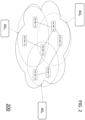
- the cloud service CS With the knowledge of the node identifiers and the node connections, the cloud service CS elaborates and stores an abstract model of the network NT. Such abstract model may be represented by a topological graph 200 (shown in FIG. 2 ) which describes the communication network NT.
- the abstract model is accessible to a user and, particularly, the graph 200 is displayable by the user of the cloud service CS on a monitor, in order to get a clear description of the network NT.
- the construction of the graph 200 is performed by the cloud service CS thanks to the fact the software agents AG 1 -AG N globally provides redundant information and so the cloud service CS can merge all the links and create the global network graph 200.
- the graph 200 can be represented by a set of pairs where each item in a pair represents a node in the graph and the pair itself represent a link between nodes.
- the cloud service CS receives the list of pairs and merges the duplicated, the resulting set can be directly rendered as a graph.
- the network monitoring system 100 is further configured to enrich the abstract model above described with technical information on each asset AS 1 -AS F and associate each information to the corresponding node.
- the software agents AG 1 -AG N are packet sniffers adapted to perform Deep Patent Inspection (DPI) on the assets AS 1 -AS F and also extract information about the public network (such as the public servers PS). Particularly, at least part of the software agents AG 1 -AG N are also configured to extract information by directly calling the operating system API (Application Program Interface) of the assets.
- DPI Deep Patent Inspection
- the operating system API Application Program Interface
- each software agent AG 1 -AG F may extract and send to the cloud service CS one or more of the following technical data related to the corresponding asset: host label, operating system version, firmware version in case of an OT (Operation Technology) device, CPU (Central Processing Unit) usage, RAM (Random Access Memory) usage, disk usage, installed software, etc.
- OT Operaation Technology
- CPU Central Processing Unit
- RAM Random Access Memory
- OT is hardware and software that detects or causes a change, through the direct monitoring and/or control of industrial equipment, assets, processes and events.
- CPU usage indicates the total percentage of processing power exhausted to process data and run various programs on a network device, server, or computer at any given point.
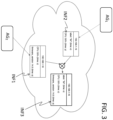
- the agents AG 1 -AG F may operate as indicated below, with reference to FIG. 3 .
- the second software agent AG 2 observes the endpoint 192.168.1.16 (corresponding to first node N 1 as an example) and extracts the CPU usage (e.g. 55%, time: z) from a SNMP (Simple Network Management Protocol) packet and the firmware version (e.g. 14.5, time: a) from an Ethernet/IP packet. As indicated above, every field has a timestamp (time: z ; time : a) associated to it to mark the observation time of each value. The second software agent AG 2 sends these two fields (INF1) to the cloud service CS.
- the CPU usage e.g. 55%, time: z
- firmware version e.g. 14.5, time: a
- every field has a timestamp (time: z ; time : a) associated to it to mark the observation time of each value.
- the second software agent AG 2 sends these two fields (INF1) to the cloud service CS.
- the first software agent AG 1 that is installed on the endpoint 192.168.1.16, extracts the CPU usage (e.g. 50%, time: y) and host label (label: "lbl", time: x), together with the corresponding timestamps, directly via the endpoint operating system APIs of this endpoint (N1).
- the first software agent AG 1 sends these two fields (INF2) to the cloud service CS in the same way the second agent AG 2 did.
- the cloud service CS receive label, CPU and firmware version for the endpoint 192.168.1.16 and process said information to enrich the network model.
- the label and firmware version information received from the first and second software agents AG 1 and AG 2 are complementary and don't have any conflict; therefore the cloud service CS adds to the endpoint 192.168.1.16 the label ("lbl"-time:x) and firmware version (14.5, time:a) information.
- the cloud service CS considers that keys are unique i.e., an asset can only contain a single instance of every key.
- the software agent AG 1 -AG F and/or the cloud service CS can be configured to also perform anomaly detection and the result of such detection can be integrated in the abstract model and displayed into the graph 200 representing the network NT.
- the network monitoring system 100 and the method according to the present description find a useful application in any kind of physical infrastructures or automation systems connected in a network, in particular in industrial automation systems, such as industrial processes for manufacturing production, industrial processes for power generation, infrastructures for distribution of fluids (water, oil and gas), infrastructures for the generation and/or transmission of electric power, infrastructures for transport management. Moreover, it finds useful application with all the technology environments, including Information Technology (IT), Operation Technology (OT) and Internet of Things (IoT).
- IT Information Technology
- OT Operation Technology
- IoT Internet of Things
- the above disclosed monitoring system and method ensure a full network visibility avoiding the use of dedicated hardware thanks to the software agents installed in the assets of the network.
- the software resources dedicated to the abstract model construction such as the cloud service, are configured to inspect a wide range of protocol and network layers on the packet traffic redirected by the software agents fully overcoming the need of a dedicated device associated to each asset.
- the fact that the above-described monitoring system is able to extract and merge several types of technical information regarding the asset allows obtaining a complete asset inventory enriching the abstract model of the network.
Landscapes
- Engineering & Computer Science (AREA)
- Computer Networks & Wireless Communication (AREA)
- Signal Processing (AREA)
- Theoretical Computer Science (AREA)
- Computing Systems (AREA)
- Data Mining & Analysis (AREA)
- Physics & Mathematics (AREA)
- General Engineering & Computer Science (AREA)
- Computer Security & Cryptography (AREA)
- General Physics & Mathematics (AREA)
- Quality & Reliability (AREA)
- Mathematical Physics (AREA)
- Health & Medical Sciences (AREA)
- General Health & Medical Sciences (AREA)
- Cardiology (AREA)
- Environmental & Geological Engineering (AREA)
- Computer Hardware Design (AREA)
- Human Computer Interaction (AREA)
- Data Exchanges In Wide-Area Networks (AREA)
- Computer And Data Communications (AREA)
- Debugging And Monitoring (AREA)
Applications Claiming Priority (1)
| Application Number | Priority Date | Filing Date | Title |
|---|---|---|---|
| US18/508,414 US12438783B2 (en) | 2023-11-14 | 2023-11-14 | Network monitoring system and method including software agents |
Publications (1)
| Publication Number | Publication Date |
|---|---|
| EP4557680A1 true EP4557680A1 (de) | 2025-05-21 |
Family
ID=92142168
Family Applications (1)
| Application Number | Title | Priority Date | Filing Date |
|---|---|---|---|
| EP24191826.7A Pending EP4557680A1 (de) | 2023-11-14 | 2024-07-30 | Netzwerküberwachungssystem und verfahren mit softwareagenten |
Country Status (8)
| Country | Link |
|---|---|
| US (1) | US12438783B2 (de) |
| EP (1) | EP4557680A1 (de) |
| JP (1) | JP2025080750A (de) |
| KR (1) | KR20250071161A (de) |
| CN (1) | CN120017542A (de) |
| AU (1) | AU2024216365A1 (de) |
| MX (1) | MX2024013571A (de) |
| TW (1) | TW202520691A (de) |
Families Citing this family (1)
| Publication number | Priority date | Publication date | Assignee | Title |
|---|---|---|---|---|
| CN121727865A (zh) * | 2026-02-24 | 2026-03-24 | 中国铁路西安局集团有限公司 | 一种用于隔离网络盲区资产发现的Agent测绘方法及系统 |
Citations (4)
| Publication number | Priority date | Publication date | Assignee | Title |
|---|---|---|---|---|
| US1095583A (en) | 1912-12-18 | 1914-05-05 | Otto G Luyties | Automobile search-light. |
| US20080222287A1 (en) * | 2007-03-06 | 2008-09-11 | Microsoft Corporation | Constructing an Inference Graph for a Network |
| US20180309637A1 (en) * | 2017-04-25 | 2018-10-25 | Nutanix, Inc. | Systems and methods for networked microservice modeling and visualization |
| US20230006899A1 (en) * | 2021-06-30 | 2023-01-05 | Forescout Technologies, Inc. | Generating network system maps based on network traffic |
Family Cites Families (4)
| Publication number | Priority date | Publication date | Assignee | Title |
|---|---|---|---|---|
| KR20150038245A (ko) * | 2012-09-13 | 2015-04-08 | 닛본 덴끼 가부시끼가이샤 | 정보 처리 장치, 구성 방법, 통신 시스템, 및 프로그램 |
| US10536357B2 (en) * | 2015-06-05 | 2020-01-14 | Cisco Technology, Inc. | Late data detection in data center |
| US10536356B2 (en) * | 2015-09-21 | 2020-01-14 | Splunk Inc. | Generating and displaying topology map time-lapses of cloud computing resources |
| US11606258B2 (en) * | 2019-04-23 | 2023-03-14 | Red Hat, Inc. | Determining network topology based on packet traffic |
-
2023
- 2023-11-14 US US18/508,414 patent/US12438783B2/en active Active
-
2024
- 2024-07-30 EP EP24191826.7A patent/EP4557680A1/de active Pending
- 2024-08-27 AU AU2024216365A patent/AU2024216365A1/en active Pending
- 2024-09-24 KR KR1020240128665A patent/KR20250071161A/ko active Pending
- 2024-10-09 CN CN202411400258.0A patent/CN120017542A/zh active Pending
- 2024-10-09 TW TW113138558A patent/TW202520691A/zh unknown
- 2024-10-21 JP JP2024185002A patent/JP2025080750A/ja active Pending
- 2024-11-01 MX MX2024013571A patent/MX2024013571A/es unknown
Patent Citations (4)
| Publication number | Priority date | Publication date | Assignee | Title |
|---|---|---|---|---|
| US1095583A (en) | 1912-12-18 | 1914-05-05 | Otto G Luyties | Automobile search-light. |
| US20080222287A1 (en) * | 2007-03-06 | 2008-09-11 | Microsoft Corporation | Constructing an Inference Graph for a Network |
| US20180309637A1 (en) * | 2017-04-25 | 2018-10-25 | Nutanix, Inc. | Systems and methods for networked microservice modeling and visualization |
| US20230006899A1 (en) * | 2021-06-30 | 2023-01-05 | Forescout Technologies, Inc. | Generating network system maps based on network traffic |
Also Published As
| Publication number | Publication date |
|---|---|
| CN120017542A (zh) | 2025-05-16 |
| US20250158893A1 (en) | 2025-05-15 |
| MX2024013571A (es) | 2025-06-02 |
| KR20250071161A (ko) | 2025-05-21 |
| AU2024216365A1 (en) | 2025-05-29 |
| TW202520691A (zh) | 2025-05-16 |
| US12438783B2 (en) | 2025-10-07 |
| JP2025080750A (ja) | 2025-05-26 |
Similar Documents
| Publication | Publication Date | Title |
|---|---|---|
| US12068938B2 (en) | Network health data aggregation service | |
| US20260106812A1 (en) | Visualization of network health information | |
| US10243820B2 (en) | Filtering network health information based on customer impact | |
| US10911263B2 (en) | Programmatic interfaces for network health information | |
| EP1742416B1 (de) | Verfahren, rechnerlesbares Medium und System zur Analyse und Verwaltung von Applikationsverkehr auf Netzwerken | |
| US10079846B2 (en) | Domain name system (DNS) based anomaly detection | |
| JP5237034B2 (ja) | イベント情報取得外のit装置を対象とする根本原因解析方法、装置、プログラム。 | |
| US11095611B2 (en) | Traffic visibility and segmentation policy enforcement for workloads in different address spaces | |
| WO2018064111A1 (en) | Visualization of network health information | |
| EP4557680A1 (de) | Netzwerküberwachungssystem und verfahren mit softwareagenten | |
| US10129342B2 (en) | Mapping network service dependencies | |
| JP6542538B2 (ja) | ネットワーク監視システム、監視装置および監視方法 | |
| CA3253114A1 (en) | Network monitoring system and method including software agents | |
| JP6733923B1 (ja) | ネットワーク管理システム、ネットワーク管理方法およびネットワーク管理プログラム | |
| BR102024018042A2 (pt) | Sistema e método de monitoramento de rede incluindo agentes de software | |
| Bytyci | Monitoring Changes in the Stability of Networks Using Eigenvector Centrality | |
| Fikre | Diploma Thesis Performance Monitoring of highly Complex Network Systems | |
| WO2025041249A1 (ja) | 分析装置および分析方法 | |
| Preston Frazier et al. | Examining Correlation Techniques to Improve Strategic Decision-Making Through Advanced Cyber Situational Awareness |
Legal Events
| Date | Code | Title | Description |
|---|---|---|---|
| PUAI | Public reference made under article 153(3) epc to a published international application that has entered the european phase |
Free format text: ORIGINAL CODE: 0009012 |
|
| STAA | Information on the status of an ep patent application or granted ep patent |
Free format text: STATUS: THE APPLICATION HAS BEEN PUBLISHED |
|
| AK | Designated contracting states |
Kind code of ref document: A1 Designated state(s): AL AT BE BG CH CY CZ DE DK EE ES FI FR GB GR HR HU IE IS IT LI LT LU LV MC ME MK MT NL NO PL PT RO RS SE SI SK SM TR |
|
| STAA | Information on the status of an ep patent application or granted ep patent |
Free format text: STATUS: REQUEST FOR EXAMINATION WAS MADE |
|
| 17P | Request for examination filed |
Effective date: 20251103 |