EP4553937A2 - Elektrodenanordnung und batterie mit der elektrodenanordnung sowie batteriepack und fahrzeug mit der batterie - Google Patents
Elektrodenanordnung und batterie mit der elektrodenanordnung sowie batteriepack und fahrzeug mit der batterie Download PDFInfo
- Publication number
- EP4553937A2 EP4553937A2 EP23912962.0A EP23912962A EP4553937A2 EP 4553937 A2 EP4553937 A2 EP 4553937A2 EP 23912962 A EP23912962 A EP 23912962A EP 4553937 A2 EP4553937 A2 EP 4553937A2
- Authority
- EP
- European Patent Office
- Prior art keywords
- electrode assembly
- separator
- electrode
- battery
- support portion
- Prior art date
- Legal status (The legal status is an assumption and is not a legal conclusion. Google has not performed a legal analysis and makes no representation as to the accuracy of the status listed.)
- Pending
Links
Images



Classifications
-
- H—ELECTRICITY
- H01—ELECTRIC ELEMENTS
- H01M—PROCESSES OR MEANS, e.g. BATTERIES, FOR THE DIRECT CONVERSION OF CHEMICAL ENERGY INTO ELECTRICAL ENERGY
- H01M10/00—Secondary cells; Manufacture thereof
- H01M10/04—Construction or manufacture in general
- H01M10/0431—Cells with wound or folded electrodes
-
- H—ELECTRICITY
- H01—ELECTRIC ELEMENTS
- H01M—PROCESSES OR MEANS, e.g. BATTERIES, FOR THE DIRECT CONVERSION OF CHEMICAL ENERGY INTO ELECTRICAL ENERGY
- H01M50/00—Constructional details or processes of manufacture of the non-active parts of electrochemical cells other than fuel cells, e.g. hybrid cells
- H01M50/10—Primary casings; Jackets or wrappings
- H01M50/102—Primary casings; Jackets or wrappings characterised by their shape or physical structure
- H01M50/107—Primary casings; Jackets or wrappings characterised by their shape or physical structure having curved cross-section, e.g. round or elliptic
-
- H—ELECTRICITY
- H01—ELECTRIC ELEMENTS
- H01M—PROCESSES OR MEANS, e.g. BATTERIES, FOR THE DIRECT CONVERSION OF CHEMICAL ENERGY INTO ELECTRICAL ENERGY
- H01M10/00—Secondary cells; Manufacture thereof
- H01M10/05—Accumulators with non-aqueous electrolyte
- H01M10/058—Construction or manufacture
- H01M10/0587—Construction or manufacture of accumulators having only wound construction elements, i.e. wound positive electrodes, wound negative electrodes and wound separators
-
- H—ELECTRICITY
- H01—ELECTRIC ELEMENTS
- H01M—PROCESSES OR MEANS, e.g. BATTERIES, FOR THE DIRECT CONVERSION OF CHEMICAL ENERGY INTO ELECTRICAL ENERGY
- H01M2220/00—Batteries for particular applications
- H01M2220/20—Batteries in motive systems, e.g. vehicle, ship, plane
-
- Y—GENERAL TAGGING OF NEW TECHNOLOGICAL DEVELOPMENTS; GENERAL TAGGING OF CROSS-SECTIONAL TECHNOLOGIES SPANNING OVER SEVERAL SECTIONS OF THE IPC; TECHNICAL SUBJECTS COVERED BY FORMER USPC CROSS-REFERENCE ART COLLECTIONS [XRACs] AND DIGESTS
- Y02—TECHNOLOGIES OR APPLICATIONS FOR MITIGATION OR ADAPTATION AGAINST CLIMATE CHANGE
- Y02E—REDUCTION OF GREENHOUSE GAS [GHG] EMISSIONS, RELATED TO ENERGY GENERATION, TRANSMISSION OR DISTRIBUTION
- Y02E60/00—Enabling technologies; Technologies with a potential or indirect contribution to GHG emissions mitigation
- Y02E60/10—Energy storage using batteries
-
- Y—GENERAL TAGGING OF NEW TECHNOLOGICAL DEVELOPMENTS; GENERAL TAGGING OF CROSS-SECTIONAL TECHNOLOGIES SPANNING OVER SEVERAL SECTIONS OF THE IPC; TECHNICAL SUBJECTS COVERED BY FORMER USPC CROSS-REFERENCE ART COLLECTIONS [XRACs] AND DIGESTS
- Y02—TECHNOLOGIES OR APPLICATIONS FOR MITIGATION OR ADAPTATION AGAINST CLIMATE CHANGE
- Y02P—CLIMATE CHANGE MITIGATION TECHNOLOGIES IN THE PRODUCTION OR PROCESSING OF GOODS
- Y02P70/00—Climate change mitigation technologies in the production process for final industrial or consumer products
- Y02P70/50—Manufacturing or production processes characterised by the final manufactured product
Definitions
- the present disclosure relates to an electrode assembly, a battery including the same, and a battery pack and a vehicle including such a battery.
- Batteries which are easy to apply depending on the product groups and have electrical features such as high energy density and the like, are generally used in electric vehicles (EVs) or hybrid electric vehicles (HEVs) that are driven by an electrical drive source, as well as in portable devices.
- EVs electric vehicles
- HEVs hybrid electric vehicles
- a battery pack may be configured by connecting a plurality of battery cells in series.
- a battery pack may be configured by connecting multiple battery cells in parallel depending on the charge/discharge capacity required for the battery pack. Accordingly, the number of battery cells included in the battery pack and electric connection types thereof may be set in various ways depending on the required output voltage or charge/discharge capacity.
- a cylindrical battery may have a structure in which a jelly roll-type electrode assembly obtained by winding a stack, in which a negative electrode (positive electrode), a separator, a positive electrode (negative electrode), and a separator are stacked in sequence, is accommodated in a roughly cylindrical battery housing.
- the jelly roll-type electrode assembly applied to the cylindrical batteries may have a central winding hole formed in the core as it is wound. As the battery is repeatedly charged and discharged, the electrodes constituting the electrode assembly may repeat expansion and contraction.
- Repetition of expansion and contraction of the electrode described above may cause a core collapse phenomenon in which the electrode is partially bent from the inner wall of the central winding hole of the electrode assembly and protrudes toward the central winding hole.
- This core collapse phenomenon may increase the risk of short circuits occurring in the core of the electrode assembly and make it difficult to ensure safety in the use of secondary batteries.
- the present disclosure has been designed to solve the problems of the related art, and therefore the present disclosure is directed to providing an electrode assembly having a structure capable of suppressing deformation of the core structure of the electrode assembly due to expansion and contraction of the electrodes caused by repetition of charging and discharging of the battery.
- an electrode assembly having a structure in which a stack, in which a first electrode, a first separator, a second electrode, and a second separator are sequentially stacked, is wound, wherein the electrode assembly may include a support portion provided on the inner wall of a central winding hole formed in a core of the electrode assembly by winding the stack so as to increase the rigidity of the inner wall.
- the first separator may be located on the inner circumferential surface of the central winding hole.
- the support portion may include a coating layer formed on at least one of the first separator and the second separator.
- the coating layer may include a UV curing agent.
- the coating layer may be formed on the inner surface of the first separator.
- the support portion may extend at least a length corresponding to the circumference of the central winding hole.
- the core of the electrode assembly may include a separator area where the first electrode and the second electrode are not interposed between the first separator and the second separator and where the first separator and the second separator are wound at least one turn while being in direct contact with each other.
- the coating layer may be formed within the separator area.
- the support portion may be configured in a predetermined pattern.
- the support portion may be configured in a stripe pattern.
- Respective stripes constituting the stripe pattern may extend along a direction at an angle of more than 0 degrees and less than 90 degrees with the circumferential direction of the central winding hole.
- a battery including: the electrode assembly according to an embodiment of the present disclosure; and a battery housing configured to accommodate the electrode assembly.
- a battery pack including: the battery according to an embodiment of the present disclosure; and a pack housing configured to accommodate the battery.
- a vehicle including the battery pack according to an embodiment of the present disclosure.
- an electrode assembly 10 according to an embodiment of the present disclosure will be described with reference to FIGS. 1 to 5 .
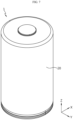
- FIG. 1 is a perspective view illustrating an electrode assembly according to an embodiment of the present disclosure
- FIG. 2 is a plan view illustrating an electrode assembly according to an embodiment of the present disclosure
- FIG. 3 is a diagram illustrating a process of winding a stack constituting an electrode assembly according to an embodiment of the present disclosure
- FIG. 4 is an enlarged view illustrating an area including a core of an electrode assembly according to an embodiment of the present disclosure (from which a support portion of the present disclosure is omitted)
- FIG. 5 is a diagram illustrating a core collapse phenomenon that occurs as a battery including the electrode assembly shown in FIG. 4 repeats charging and discharging.
- the electrode assembly 10 may include a first electrode 11, a second electrode 12, a first separator 13, and a second separator 14, and a support portion 15.
- the electrode assembly 10 may be, for example, a jelly roll-type electrode assembly.
- the electrode assembly 10 may have a structure obtained by winding a stack S, in which the first electrode 11, the first separator 13, the second electrode 12, and the second separator 14 are sequentially stacked, in one direction.
- the first electrode 11 may be a positive electrode or a negative electrode.
- the first electrode 11 may have a structure in which a first electrode active material is coated on one or both sides of a thin metal foil.
- the second electrode 12 may be an electrode having a polarity opposite that of the first electrode 11.
- the second electrode 12 may have a structure in which a second electrode active material is coated on one or both sides of a thin metal foil.
- the first electrode 11 may include a first uncoated portion that is not coated with the first electrode active material, and similarly, the second electrode 12 may include a second uncoated portion that is not coated with the second electrode active material. If the first electrode 11 is a negative electrode and if the second electrode 12 is a positive electrode, the area of the first electrode 11 may be greater than the area of the second electrode 12 in the stack S.
- the support portion 15 may be provided on the inner wall of a central winding hole 10a formed in the core of the electrode assembly 10 by winding the stack S.
- the support portion 15 may be configured to increase the rigidity of the inner wall of the central winding hole 10a.
- the electrode assembly 10 of the present disclosure has a support portion 15 provided on the inner wall of the central winding hole 10a, it is possible to significantly reduce the risk of short circuits due to core collapse in the core of the electrode assembly 10 according to repeated charging and discharging of the battery including the electrode assembly 10.
- the end of the first electrode 11 may be bent in the core of the electrode assembly 10 toward the core. This bending of the end of the first electrode 11 may cause damage to the first separator 13 forming the inner wall of the central winding hole 10a, which may increase the risk of occurrence of short circuits in the area adjacent to the core of the electrode assembly 10. Therefore, if a structure capable of improving the rigidity of the core of the electrode assembly 10 is applied, as in the present disclosure, the problem caused by the core collapse may be solved.
- the first separator 13 may be located on the inner circumferential surface of the central winding hole 10a. In the stack S, the first separator 13 may be interposed between the first electrode 11 and the second electrode 12.
- the second separator 14 may be provided on the outermost side of the stack S. The first separator 13 may be located on the inner circumferential surface of the central winding hole 10a when the stack S is wound in one direction. The second separator 14 may be configured to cover the outer circumferential surface of the electrode assembly 10 when the stack S is wound in one direction.
- the support portion 15 may include a coating layer formed on at least one of the first separator 13 and the second separator 14. In the case where the support portion 15 is configured to be coated on the first separator 13 and/or the second separator 14, a process is not further required to insert a separate component into the core, thereby improving process efficiency and productivity and having an advantage in energy density.
- the coating layer may include a UV curing agent.
- the support portion 15 may be configured such that a UV curing agent is coated on the first separator 13 and/or the second separator 14 and then cured by irradiating the UV curing agent with UV ultraviolet rays at a desired time.
- the curing of the UV curing agent may be performed after or before winding the stack S.
- the time of the curing process may be determined in consideration of the application thickness and/or application area of the UV curing agent. If the first separator 13 and/or the second separator 14 are easily wound even in the state in which the coating layer is cured, it may be advantageous to perform the curing process before winding the stack S.
- the coating layer may be formed on the inner surface of the first separator 13.
- the coating layer may be provided on the inner wall of the central winding hole 10a of the electrode assembly 10. Therefore, curing of the coating layer may be conducted by UV radiation after winding the stack S. That is, the coating layer may be exposed through the central winding hole 10a formed when the stack S is wound, and accordingly, the coating layer may be cured by radiating UV rays into the central winding hole 10a.
- the formation position of the coating layer of the present disclosure is not limited thereto, and the coating layer may be formed on the inner surface of the first separator 13, the outer surface of the first separator 13, the inner surface of the second separator 14, and/or the outer surface of the second separator 14.
- the support portion 15 may extend at least a length corresponding to the circumference of the central winding hole 10a.
- the support portion 15 may be configured to surround the core of the electrode assembly 10 at least one turn.
- the support portion 15 may be configured to cover the inner wall surface of the central winding hole 10a of the electrode assembly 10 at least one turn.
- the overall rigidity around the core of the electrode assembly 10 may be improved, thereby be preventing or minimizing deformation of the core structure even if the battery is repeatedly charged and discharged. If the deformation of the core structure is suppressed as described above, the occurrence of micro-shorts due to unnecessary electrical contact may be prevented, for example, in the core.
- the core of the electrode assembly 10 may include an area where the first electrode 11 and the second electrode 12 are not interposed between the first separator 13 and the second separator 14 and where the first separator 13 and the second separator 14 are wound at least one turn while being in direct contact with each other (hereinafter referred to as a separator area).
- first separator 13 and the second separator 14 extending further outward than the ends of the first electrode 11 and the second electrode 12 in the longitudinal direction, are held and wound using a winding tool M in the direction of the arrow in FIG. 3 , there may be an area where only the first separator 13 and the second separator 14 are wound while overlapping each other, excluding the first electrode 11 and the second electrode 12.
- the area where only the first separator 13 and the second separator 14 overlap each other, excluding the first electrode 11 and the second electrode 12, may cover the central winding hole 10a by at least one turn, thereby forming the separator area.
- the support portion 15 may be provided in at least a portion of the separator area. If the support portion 15 is a coating layer formed on the first separator 13 and/or the second separator 14, the coating layer may be formed within the separator area.
- the length D of the area where the support portion 15 is formed may be long enough to cover the core at least one turn. As described above, if the support portion 15 is formed to have a length capable of covering the core at least one turn, the core of the electrode assembly 10 may be effectively strengthened.
- FIG. 6 is a diagram illustrating a structure in which a support portion is provided in a stripe pattern on a portion of the electrode (first electrode or second electrode) of the present disclosure.
- the support portion 15 of the present disclosure may be configured in a predetermined pattern.
- the support portion 15 may be configured, for example, in a stripe pattern. If the support portion 15 is provided in a predetermined pattern, it is possible to prevent the elasticity of the core of the electrode assembly 10 from being excessively suppressed. As described above, if the support portion 15 is configured in a predetermined pattern to partially secure the elasticity of the first separator 13 and/or the second separator 14, the stress due to expansion and contraction of the electrode assembly 10 may be prevented from excessively accumulating on the core.
- the support portion 15 is configured in a predetermined pattern, it is possible to minimize a reduction in infiltration rate of the electrolyte through the core due to the formation of the support portion 15 for strengthening the core of the electrode assembly 10.
- the first separator 13 and/or the second separator 14 may be porous. Therefore, the electrolyte may infiltrate into the interior of the electrode assembly 10 through the inner wall of the central winding hole 10a of the electrode assembly 10 covered by the first separator 13 and/or the second separator 14.
- the support portion 15 is formed on at least one side of the first separator 13 and/or the second separator 14, it may hinder the infiltration of the electrolyte. Therefore, in the case where the support portion 15 is provided in a predetermined pattern on the inner wall of the central winding hole 10a, the effect on the infiltration of the electrolyte may be minimized.
- the respective stripes constituting the stripe pattern may extend in the circumferential direction of the central winding hole 10a, that is, in a direction at a predetermined angle ⁇ with the winding direction of the electrode assembly 10.
- the angle ⁇ may be approximately greater than 0 degrees and less than 90 degrees.
- the respective stripes constituting the stripe pattern extend in a direction approximately parallel to the winding direction of the electrode assembly 10, there is no area in which the support portion 15 is omitted in the circumferential direction of the electrode assembly 10, making it difficult to partially secure the elasticity of the first separator 13 and/or the second separator 14.
- the respective stripes constituting the stripe pattern extend in a direction approximately perpendicular to the winding direction of the electrode assembly 10, there may be an area in which the support portion 15 is not partially present in the circumferential direction of the electrode assembly 10, so it may be difficult to effectively strengthen the first separator 13 and/or the second separator 14.
- FIG. 7 is a diagram illustrating a battery according to an embodiment of the present disclosure.
- a battery 1 may include the electrode assembly 10 of the present disclosure and a battery housing 20 configured to accommodate the electrode assembly 10.
- the battery 1 may be, for example, a cylindrical battery.
- FIG. 8 is a diagram illustrating a battery pack according to an embodiment of the present disclosure.
- a battery pack 3 may include the battery 1 of the present disclosure.
- the battery pack 3 may include an assembly of a plurality of batteries 1 electrically connected to each other and a pack housing 2 that accommodates the same.
- components such as a bus-bar for electrical connection of the batteries 1, a cooling unit, external terminals, and the like are omitted from the drawing.
- FIG. 9 is a diagram illustrating a vehicle according to an embodiment of the present disclosure.
- the vehicle 5 may include the battery pack 3 of the present disclosure.
- the battery pack 3 may be mounted to the vehicle 5.
- the vehicle 5 of the present disclosure may be, for example, an electric vehicle, a hybrid vehicle, or a plug-in hybrid vehicle.
- the vehicle may include a four-wheeled vehicle or a two-wheeled vehicle.
- the vehicle 5 may be configured to drive by receiving power from the battery pack 3 according to an embodiment of the present disclosure.
Landscapes
- Chemical & Material Sciences (AREA)
- Chemical Kinetics & Catalysis (AREA)
- Electrochemistry (AREA)
- General Chemical & Material Sciences (AREA)
- Engineering & Computer Science (AREA)
- Manufacturing & Machinery (AREA)
- Secondary Cells (AREA)
- Cell Separators (AREA)
Applications Claiming Priority (3)
| Application Number | Priority Date | Filing Date | Title |
|---|---|---|---|
| KR20220187593 | 2022-12-28 | ||
| KR1020230193316A KR20240105300A (ko) | 2022-12-28 | 2023-12-27 | 전극 조립체 및 이를 포함하는 배터리, 그리고 이러한 배터리를 포함하는 배터리 팩 및 자동차 |
| PCT/KR2023/021794 WO2024144288A2 (ko) | 2022-12-28 | 2023-12-28 | 전극 조립체 및 이를 포함하는 배터리, 그리고 이러한 배터리를 포함하는 배터리 팩 및 자동차 |
Publications (2)
| Publication Number | Publication Date |
|---|---|
| EP4553937A2 true EP4553937A2 (de) | 2025-05-14 |
| EP4553937A4 EP4553937A4 (de) | 2026-02-18 |
Family
ID=91718525
Family Applications (1)
| Application Number | Title | Priority Date | Filing Date |
|---|---|---|---|
| EP23912962.0A Pending EP4553937A4 (de) | 2022-12-28 | 2023-12-28 | Elektrodenanordnung und batterie mit der elektrodenanordnung sowie batteriepack und fahrzeug mit der batterie |
Country Status (4)
| Country | Link |
|---|---|
| EP (1) | EP4553937A4 (de) |
| JP (1) | JP2025526488A (de) |
| CN (1) | CN120226177A (de) |
| WO (1) | WO2024144288A2 (de) |
Family Cites Families (7)
| Publication number | Priority date | Publication date | Assignee | Title |
|---|---|---|---|---|
| JPH08273698A (ja) * | 1995-03-30 | 1996-10-18 | Fuji Elelctrochem Co Ltd | リチウム二次電池 |
| JP2003109658A (ja) * | 2001-09-28 | 2003-04-11 | Sanyo Electric Co Ltd | 密閉型電池およびその製造方法 |
| KR102153044B1 (ko) * | 2013-11-11 | 2020-09-07 | 삼성전자주식회사 | 가요성 이차 전지 |
| KR101882329B1 (ko) * | 2016-07-06 | 2018-08-24 | 주식회사 플라즈맵 | 대기압 유전체 장벽 방전 플라즈마를 이용한 이차전지의 분리막 처리 방법 |
| KR102327226B1 (ko) * | 2017-09-01 | 2021-11-15 | 주식회사 엘지에너지솔루션 | 전기화학소자용 분리막 및 상기 분리막을 제조하는 방법 |
| KR102859963B1 (ko) * | 2020-06-16 | 2025-09-15 | 주식회사 엘지에너지솔루션 | 전극 조립체 |
| WO2022216092A1 (ko) * | 2021-04-08 | 2022-10-13 | 주식회사 엘지에너지솔루션 | 전극 조립체, 배터리 셀, 배터리 팩 및 자동차 |
-
2023
- 2023-12-28 WO PCT/KR2023/021794 patent/WO2024144288A2/ko not_active Ceased
- 2023-12-28 EP EP23912962.0A patent/EP4553937A4/de active Pending
- 2023-12-28 JP JP2025505827A patent/JP2025526488A/ja active Pending
- 2023-12-28 CN CN202380042923.0A patent/CN120226177A/zh active Pending
Also Published As
| Publication number | Publication date |
|---|---|
| WO2024144288A2 (ko) | 2024-07-04 |
| CN120226177A (zh) | 2025-06-27 |
| EP4553937A4 (de) | 2026-02-18 |
| WO2024144288A3 (ko) | 2025-05-22 |
| JP2025526488A (ja) | 2025-08-13 |
Similar Documents
| Publication | Publication Date | Title |
|---|---|---|
| CN116868420B (zh) | 电池单体及其制造方法和装置、用电装置 | |
| US9005789B2 (en) | Jelly-roll type electrode assembly pattern-coated with active material and secondary battery including the same | |
| EP4057438A1 (de) | Biegevorrichtung und -verfahren für elektrodenzungen | |
| KR102411957B1 (ko) | 배터리 셀용 전극 스택의 제조 방법, 그리고 배터리 셀 | |
| EP3675239A1 (de) | Batteriemodul sowie batteriepack und automobil damit | |
| CN116601813B (zh) | 电极组件及其制造方法和设备、电池、用电装置 | |
| EP3168918B1 (de) | In beide richtungen gewundene elektrodenanordnung und lithiumsekundärbatterie damit | |
| KR20140014839A (ko) | 이차전지 | |
| US20240372153A1 (en) | Battery cell, battery, electric device, and electrode assembly and manufacturing method thereof | |
| CN102714293A (zh) | 具有介入的隔离体的模块化电池用电池单元模块 | |
| US8703342B2 (en) | Electrode assembly, rechargeable battery including the same, and method of manufacturing an electrode thereof | |
| US20230246306A1 (en) | Electrode assembly, battery, device, and method for manufacturing electrode assembly | |
| US9437898B2 (en) | Secondary battery including plurality of electrode assemblies | |
| EP4277007A1 (de) | Elektrodenanordnung und herstellungsverfahren und -vorrichtung, batteriezelle, batterie und elektrische vorrichtung | |
| EP4095965B1 (de) | Elektrodenanordnung, batteriezelle, batterie, vorrichtung | |
| EP4553937A2 (de) | Elektrodenanordnung und batterie mit der elektrodenanordnung sowie batteriepack und fahrzeug mit der batterie | |
| KR102162723B1 (ko) | 절곡된 한 개의 분리막으로 이루어진 단위셀을 포함하고 있는 전극조립체 | |
| US20210028494A1 (en) | Unit cell and method for manufacturing the same | |
| EP3598555B1 (de) | Elektrode, elektrodenanordnung und verfahren zu deren herstellung | |
| KR20240105300A (ko) | 전극 조립체 및 이를 포함하는 배터리, 그리고 이러한 배터리를 포함하는 배터리 팩 및 자동차 | |
| CN222394901U (zh) | 电池单体、电池和用电设备 | |
| US20260011894A1 (en) | Electrode, electrode assembly and method of manufacturing electrode assembly | |
| EP4589700A1 (de) | Elektrodenanordnung | |
| KR20200095914A (ko) | 원통형 이차 전지 및 이의 제조 방법 | |
| KR102841896B1 (ko) | 이차전지 및 그 이차전지를 내장한 전지팩 및 그 이차전지를 사용하는 디바이스 |
Legal Events
| Date | Code | Title | Description |
|---|---|---|---|
| STAA | Information on the status of an ep patent application or granted ep patent |
Free format text: STATUS: THE INTERNATIONAL PUBLICATION HAS BEEN MADE |
|
| PUAI | Public reference made under article 153(3) epc to a published international application that has entered the european phase |
Free format text: ORIGINAL CODE: 0009012 |
|
| STAA | Information on the status of an ep patent application or granted ep patent |
Free format text: STATUS: REQUEST FOR EXAMINATION WAS MADE |
|
| 17P | Request for examination filed |
Effective date: 20250205 |
|
| AK | Designated contracting states |
Kind code of ref document: A2 Designated state(s): AL AT BE BG CH CY CZ DE DK EE ES FI FR GB GR HR HU IE IS IT LI LT LU LV MC ME MK MT NL NO PL PT RO RS SE SI SK SM TR |
|
| PUAK | Availability of information related to the publication of the international search report |
Free format text: ORIGINAL CODE: 0009015 |