EP4552984A2 - Verfahren und vorrichtung zum stapeln und verpacken von gefalteten gegenständen - Google Patents
Verfahren und vorrichtung zum stapeln und verpacken von gefalteten gegenständen Download PDFInfo
- Publication number
- EP4552984A2 EP4552984A2 EP24206867.4A EP24206867A EP4552984A2 EP 4552984 A2 EP4552984 A2 EP 4552984A2 EP 24206867 A EP24206867 A EP 24206867A EP 4552984 A2 EP4552984 A2 EP 4552984A2
- Authority
- EP
- European Patent Office
- Prior art keywords
- folded
- folded items
- items
- stacking area
- support
- Prior art date
- Legal status (The legal status is an assumption and is not a legal conclusion. Google has not performed a legal analysis and makes no representation as to the accuracy of the status listed.)
- Pending
Links
Images




Classifications
-
- B—PERFORMING OPERATIONS; TRANSPORTING
- B65—CONVEYING; PACKING; STORING; HANDLING THIN OR FILAMENTARY MATERIAL
- B65B—MACHINES, APPARATUS OR DEVICES FOR, OR METHODS OF, PACKAGING ARTICLES OR MATERIALS; UNPACKING
- B65B35/00—Supplying, feeding, arranging or orientating articles to be packaged
- B65B35/30—Arranging and feeding articles in groups
- B65B35/40—Arranging and feeding articles in groups by reciprocating or oscillatory pushers
-
- B—PERFORMING OPERATIONS; TRANSPORTING
- B65—CONVEYING; PACKING; STORING; HANDLING THIN OR FILAMENTARY MATERIAL
- B65B—MACHINES, APPARATUS OR DEVICES FOR, OR METHODS OF, PACKAGING ARTICLES OR MATERIALS; UNPACKING
- B65B25/00—Packaging other articles presenting special problems
- B65B25/14—Packaging paper or like sheets, envelopes, or newspapers, in flat, folded, or rolled form
- B65B25/145—Packaging paper or like sheets, envelopes, or newspapers, in flat, folded, or rolled form packaging folded articles
-
- B—PERFORMING OPERATIONS; TRANSPORTING
- B65—CONVEYING; PACKING; STORING; HANDLING THIN OR FILAMENTARY MATERIAL
- B65B—MACHINES, APPARATUS OR DEVICES FOR, OR METHODS OF, PACKAGING ARTICLES OR MATERIALS; UNPACKING
- B65B5/00—Packaging individual articles in containers or receptacles, e.g. bags, sacks, boxes, cartons, cans, jars
- B65B5/06—Packaging groups of articles, the groups being treated as single articles
-
- B—PERFORMING OPERATIONS; TRANSPORTING
- B65—CONVEYING; PACKING; STORING; HANDLING THIN OR FILAMENTARY MATERIAL
- B65G—TRANSPORT OR STORAGE DEVICES, e.g. CONVEYORS FOR LOADING OR TIPPING, SHOP CONVEYOR SYSTEMS OR PNEUMATIC TUBE CONVEYORS
- B65G47/00—Article or material-handling devices associated with conveyors; Methods employing such devices
- B65G47/02—Devices for feeding articles or materials to conveyors
- B65G47/04—Devices for feeding articles or materials to conveyors for feeding articles
- B65G47/06—Devices for feeding articles or materials to conveyors for feeding articles from a single group of articles arranged in orderly pattern, e.g. workpieces in magazines
- B65G47/08—Devices for feeding articles or materials to conveyors for feeding articles from a single group of articles arranged in orderly pattern, e.g. workpieces in magazines spacing or grouping the articles during feeding
- B65G47/082—Devices for feeding articles or materials to conveyors for feeding articles from a single group of articles arranged in orderly pattern, e.g. workpieces in magazines spacing or grouping the articles during feeding grouping articles in rows
-
- B—PERFORMING OPERATIONS; TRANSPORTING
- B65—CONVEYING; PACKING; STORING; HANDLING THIN OR FILAMENTARY MATERIAL
- B65G—TRANSPORT OR STORAGE DEVICES, e.g. CONVEYORS FOR LOADING OR TIPPING, SHOP CONVEYOR SYSTEMS OR PNEUMATIC TUBE CONVEYORS
- B65G47/00—Article or material-handling devices associated with conveyors; Methods employing such devices
- B65G47/02—Devices for feeding articles or materials to conveyors
- B65G47/04—Devices for feeding articles or materials to conveyors for feeding articles
- B65G47/06—Devices for feeding articles or materials to conveyors for feeding articles from a single group of articles arranged in orderly pattern, e.g. workpieces in magazines
- B65G47/08—Devices for feeding articles or materials to conveyors for feeding articles from a single group of articles arranged in orderly pattern, e.g. workpieces in magazines spacing or grouping the articles during feeding
- B65G47/084—Devices for feeding articles or materials to conveyors for feeding articles from a single group of articles arranged in orderly pattern, e.g. workpieces in magazines spacing or grouping the articles during feeding grouping articles in a predetermined 2-dimensional pattern
-
- B—PERFORMING OPERATIONS; TRANSPORTING
- B65—CONVEYING; PACKING; STORING; HANDLING THIN OR FILAMENTARY MATERIAL
- B65G—TRANSPORT OR STORAGE DEVICES, e.g. CONVEYORS FOR LOADING OR TIPPING, SHOP CONVEYOR SYSTEMS OR PNEUMATIC TUBE CONVEYORS
- B65G47/00—Article or material-handling devices associated with conveyors; Methods employing such devices
- B65G47/22—Devices influencing the relative position or the attitude of articles during transit by conveyors
- B65G47/26—Devices influencing the relative position or the attitude of articles during transit by conveyors arranging the articles, e.g. varying spacing between individual articles
- B65G47/28—Devices influencing the relative position or the attitude of articles during transit by conveyors arranging the articles, e.g. varying spacing between individual articles during transit by a single conveyor
- B65G47/29—Devices influencing the relative position or the attitude of articles during transit by conveyors arranging the articles, e.g. varying spacing between individual articles during transit by a single conveyor by temporarily stopping movement
-
- B—PERFORMING OPERATIONS; TRANSPORTING
- B65—CONVEYING; PACKING; STORING; HANDLING THIN OR FILAMENTARY MATERIAL
- B65G—TRANSPORT OR STORAGE DEVICES, e.g. CONVEYORS FOR LOADING OR TIPPING, SHOP CONVEYOR SYSTEMS OR PNEUMATIC TUBE CONVEYORS
- B65G47/00—Article or material-handling devices associated with conveyors; Methods employing such devices
- B65G47/22—Devices influencing the relative position or the attitude of articles during transit by conveyors
- B65G47/26—Devices influencing the relative position or the attitude of articles during transit by conveyors arranging the articles, e.g. varying spacing between individual articles
- B65G47/28—Devices influencing the relative position or the attitude of articles during transit by conveyors arranging the articles, e.g. varying spacing between individual articles during transit by a single conveyor
- B65G47/29—Devices influencing the relative position or the attitude of articles during transit by conveyors arranging the articles, e.g. varying spacing between individual articles during transit by a single conveyor by temporarily stopping movement
- B65G47/295—Devices influencing the relative position or the attitude of articles during transit by conveyors arranging the articles, e.g. varying spacing between individual articles during transit by a single conveyor by temporarily stopping movement by means of at least two stopping elements
-
- B—PERFORMING OPERATIONS; TRANSPORTING
- B65—CONVEYING; PACKING; STORING; HANDLING THIN OR FILAMENTARY MATERIAL
- B65G—TRANSPORT OR STORAGE DEVICES, e.g. CONVEYORS FOR LOADING OR TIPPING, SHOP CONVEYOR SYSTEMS OR PNEUMATIC TUBE CONVEYORS
- B65G47/00—Article or material-handling devices associated with conveyors; Methods employing such devices
- B65G47/22—Devices influencing the relative position or the attitude of articles during transit by conveyors
- B65G47/26—Devices influencing the relative position or the attitude of articles during transit by conveyors arranging the articles, e.g. varying spacing between individual articles
- B65G47/30—Devices influencing the relative position or the attitude of articles during transit by conveyors arranging the articles, e.g. varying spacing between individual articles during transit by a series of conveyors
- B65G47/32—Applications of transfer devices
-
- B—PERFORMING OPERATIONS; TRANSPORTING
- B65—CONVEYING; PACKING; STORING; HANDLING THIN OR FILAMENTARY MATERIAL
- B65G—TRANSPORT OR STORAGE DEVICES, e.g. CONVEYORS FOR LOADING OR TIPPING, SHOP CONVEYOR SYSTEMS OR PNEUMATIC TUBE CONVEYORS
- B65G57/00—Stacking of articles
- B65G57/02—Stacking of articles by adding to the top of the stack
- B65G57/16—Stacking of articles of particular shape
- B65G57/20—Stacking of articles of particular shape three-dimensional, e.g. cubiform, cylindrical
- B65G57/22—Stacking of articles of particular shape three-dimensional, e.g. cubiform, cylindrical in layers each of predetermined arrangement
- B65G57/24—Stacking of articles of particular shape three-dimensional, e.g. cubiform, cylindrical in layers each of predetermined arrangement the layers being transferred as a whole, e.g. on pallets
-
- B—PERFORMING OPERATIONS; TRANSPORTING
- B65—CONVEYING; PACKING; STORING; HANDLING THIN OR FILAMENTARY MATERIAL
- B65G—TRANSPORT OR STORAGE DEVICES, e.g. CONVEYORS FOR LOADING OR TIPPING, SHOP CONVEYOR SYSTEMS OR PNEUMATIC TUBE CONVEYORS
- B65G61/00—Use of pick-up or transfer devices or of manipulators for stacking or de-stacking articles not otherwise provided for
-
- B—PERFORMING OPERATIONS; TRANSPORTING
- B65—CONVEYING; PACKING; STORING; HANDLING THIN OR FILAMENTARY MATERIAL
- B65H—HANDLING THIN OR FILAMENTARY MATERIAL, e.g. SHEETS, WEBS, CABLES
- B65H31/00—Pile receivers
- B65H31/04—Pile receivers with movable end support arranged to recede as pile accumulates
- B65H31/06—Pile receivers with movable end support arranged to recede as pile accumulates the articles being piled on edge
-
- B—PERFORMING OPERATIONS; TRANSPORTING
- B65—CONVEYING; PACKING; STORING; HANDLING THIN OR FILAMENTARY MATERIAL
- B65H—HANDLING THIN OR FILAMENTARY MATERIAL, e.g. SHEETS, WEBS, CABLES
- B65H31/00—Pile receivers
- B65H31/30—Arrangements for removing completed piles
- B65H31/3036—Arrangements for removing completed piles by gripping the pile
- B65H31/3045—Arrangements for removing completed piles by gripping the pile on the outermost articles of the pile for clamping the pile
-
- B—PERFORMING OPERATIONS; TRANSPORTING
- B65—CONVEYING; PACKING; STORING; HANDLING THIN OR FILAMENTARY MATERIAL
- B65H—HANDLING THIN OR FILAMENTARY MATERIAL, e.g. SHEETS, WEBS, CABLES
- B65H33/00—Forming counted batches in delivery pile or stream of articles
-
- B—PERFORMING OPERATIONS; TRANSPORTING
- B65—CONVEYING; PACKING; STORING; HANDLING THIN OR FILAMENTARY MATERIAL
- B65B—MACHINES, APPARATUS OR DEVICES FOR, OR METHODS OF, PACKAGING ARTICLES OR MATERIALS; UNPACKING
- B65B35/00—Supplying, feeding, arranging or orientating articles to be packaged
- B65B35/30—Arranging and feeding articles in groups
- B65B35/50—Stacking one article, or group of articles, upon another before packaging
-
- B—PERFORMING OPERATIONS; TRANSPORTING
- B65—CONVEYING; PACKING; STORING; HANDLING THIN OR FILAMENTARY MATERIAL
- B65B—MACHINES, APPARATUS OR DEVICES FOR, OR METHODS OF, PACKAGING ARTICLES OR MATERIALS; UNPACKING
- B65B35/00—Supplying, feeding, arranging or orientating articles to be packaged
- B65B35/56—Orientating, i.e. changing the attitude of, articles, e.g. of non-uniform cross-section
-
- B—PERFORMING OPERATIONS; TRANSPORTING
- B65—CONVEYING; PACKING; STORING; HANDLING THIN OR FILAMENTARY MATERIAL
- B65B—MACHINES, APPARATUS OR DEVICES FOR, OR METHODS OF, PACKAGING ARTICLES OR MATERIALS; UNPACKING
- B65B63/00—Auxiliary devices, not otherwise provided for, for operating on articles or materials to be packaged
- B65B63/02—Auxiliary devices, not otherwise provided for, for operating on articles or materials to be packaged for compressing or compacting articles or materials prior to wrapping or insertion in containers or receptacles
-
- B—PERFORMING OPERATIONS; TRANSPORTING
- B65—CONVEYING; PACKING; STORING; HANDLING THIN OR FILAMENTARY MATERIAL
- B65H—HANDLING THIN OR FILAMENTARY MATERIAL, e.g. SHEETS, WEBS, CABLES
- B65H2701/00—Handled material; Storage means
- B65H2701/10—Handled articles or webs
- B65H2701/11—Dimensional aspect of article or web
- B65H2701/112—Section geometry
- B65H2701/1123—Folded article or web
Definitions
- the present invention relates to a system and a method for stacking of folded Items. More specifically, the present invention relates a system and method for securely holding and transporting folded items in an upright position during the stacking process.
- brushes can cause wear and tear on the folded items over time, compromising the quality of the printed information.
- the constant friction and pressure exerted by the brushes can lead to scuffing, bending, or other forms of physical damage to the folded items. This damage not only affects the aesthetic quality of the packaging but also risks making the printed information illegible, which is particularly problematic for critical information such as pharmaceutical instructions or medical device guidelines.
- An object of the present invention is to provide a system and method for stacking folded items that ensures the folded items remain in an upright position throughout the transport and stacking process.
- Another object of the present invention is to overcome the limitations of traditional brush-based systems by introducing a guiding arrangement that offers lateral and front support to prevent the folded items from toppling over.
- a further object of the present invention is to enhance the efficiency and reliability of the stacking and packaging process by reducing misalignment and damage to the folded items, thus maintaining the integrity and quality of the printed information they contain.
- An additional object of the present invention is to integrate sensors and control mechanisms into the guiding arrangement to enable real-time monitoring and adjustments, ensuring optimal positioning and stability of the folded items during transport.
- a still further object of the present invention is to reduce downtime and manual intervention in the stacking and packaging process by providing automated and synchronized control of the guiding, supporting, and stacking mechanisms.
- a system for stacking folded items which comprises a feeding mechanism configured to transport the folded items from a conveyor unit to a transport platform, where the feeding mechanism sequentially introduces individual folded items into the transport platform, and the transport platform facilitates the transportation of the stack or a partially assembled stack of the folded items from a first stacking area to a designated stacking area.
- the system includes a support mechanism linearly movable along the transport direction of the folded item, where the support mechanism includes a support pad and a horizontal rod extending in the transport direction and connected to an actuating device.
- the support structutre is arranged on a free end of the rod and is adapted to hold the folded items in an upright position during transportation of the folded items along the transport platform, with the support structure being movable in a length direction along the platform to facilitate the movement of a first set of folded items from the first stacking area to the designated stacking area in a first cycle.
- a slider arrangement is positioned at the feeding area of the folded item to move the folded items from the first stacking area to the designated stacking area, with the slider arrangement including a pushing tool movably arranged above the transport direction/the transport platform to engage with a stacked folded item or a partially stacked folded item on the first stacking area and move the stacked folded item or a partially stacked folded item from the first stacking area to the designated stacking area.
- a temporary support is movably arranged on either side of the transport platform and adjacent to the feeding mechanism to securely hold the folded items in the upright position when the first set of folded items are moved from the first stacking area to the designated stacking area in the first cycle.
- the temporary support is operably connected to an actuation mechanism, which actuates the guiding arrangement to engage with or hold the folded item and the subsequent folded items transported to the transport platform by the feeding mechanism when the first set of folded items are moved from the first stacking area to the designated stacking area.
- the temporary support holds the folded items in the upright position until the support mechanism returns from the designated stacking area and engages with the folded items held by the temporary support to initiate a second cycle.
- the support mechanism is operatively coupled to a control unit to control the direction of movement of the support structure along the transport platform.
- the support mechanism includes an actuation cylinder operatively coupled to the rod, enabling controlled linear movement of the support structure along the rod to maintain the folded items in an upright position during transit on the transport platform.
- the feeding mechanism may include a pusher unit comprising a cylinder and a pusher, which interfaces with the folded items before entry into the transport platform and is configured to push the folded items into the transport platform toward the first stacking area, with the pusher unit being capable of pneumatic, hydraulic, or motor-driven operation.
- the slider arrangement includes a guide on the frame that facilitates a sliding motion of the slider arrangement in the transport direction, configured to reset to an original position using a recoil and reset mechanism after moving a folded item from the first stacking area to the designated stacking area.
- the temporary support may include two guides operably arranged on either side of the transport platform, the guides being pneumatically actuated to move towards the transport platform to engage with the folded items and provide lateral support to the folded items when the support pad along with the first set of folded items are moved from the first stacking area to the designated stacking area in the first cycle.
- the system further comprises at least one stopper arranged to extend from the transport platform towards the folded items in the designated stacking area, configured to cooperate with the support pad to maintain the folded items in an upright position.
- the control unit is configured to receive signals from proximity sensors or photoelectric sensors integrated into the transport platform and the support mechanism, with the sensors detecting the presence and movement of the folded items and enabling the operation of the support mechanism based on detected positions of the folded items.
- Each guide of the guiding arrangement is adjustable in height to accommodate various sizes of folded items, ensuring that the folded items remain in an upright position during the transfer of folded items to the transport platform from the feeding area.
- a method for stacking folded items comprises transporting folded items from a conveyor unit to a transport platform using a feeding mechanism, sequentially introducing individual folded items into the transport platform, actuating a support mechanism that includes a horizontal rod extending in the transport direction and a support pad arranged on a free end of the horizontal rod to hold or support the folded items in an upright position until a first stack of folded items is collected in a first stacking area, moving the folded items from the first stacking area to a designated stacking area using a slider arrangement with a pushing tool arranged to engage with the first stacked folded items to complete a first cycle of transporting the folded items, holding the first stack of folded items in the designated stacking area by a stopper arrangement arranged to extend from the transport platform towards the folded items in the designated stacking area, with the stopper arrangement configured to cooperate with the support pad to maintain the folded items in the upright position.
- the method further comprises securing the folded items transported to the transport platform by the feeding mechanism in an upright position when the slider arrangement moves the folded items in the first cycle, with the folded items secured using a guiding arrangement movably arranged on either side of the transport platform.
- the guiding arrangement is actuated to engage and support the folded items to provide lateral support to the folded items when the support pad along with the first set of folded items are moved from the first stacking area to the designated stacking area in the first cycle.
- the support mechanism is returned from the designated stacking area to engage with folded items held by the guiding arrangement to initiate a second cycle, with the guiding arrangement supporting and holding the folded items until the support structure returns from the designated stacking area and engages with the folded items to initiate the second cycle.
- the step of moving the folded items includes actuating the slider arrangement to slide along the transport direction and move the folded items from the first stacking area to the designated stacking area, and subsequently retracting the slider arrangement to an original position for the next cycle.
- the step of securing the folded items includes pneumatically actuating the guiding arrangement to adjust a first guide and a second guide towards the transport platform to provide lateral support to the folded items.
- the method further involves adjusting the position, height, and force applied by the support pad of the support structure based on the size and weight of the folded items being handled. Controlling the operation of the support mechanism, the slider arrangement, and the guiding arrangement is achieved through signals received from proximity sensors or photoelectric sensors that detect the presence and movement of the folded items.
- the method further comprises using a control unit to synchronize the operation of the support mechanism, the slider arrangement, and a linear stopper and transverse stopper to maintain the folded items in the upright position within the designated stacking area.
- the temporary support supports and holds the folded items until the support structure returns from the designated stacking area and engages with the folded items to initiate the second cycle.
- the method includes the step of disengaging each guide of the temporary support from the folded items and retracting to the initial position once the support mechanism engages with the folded items in the second cycle, and reengaging with another batch of folded items as the cycle repeats.
- first, second, and the like, herein do not denote any order, quantity, or importance, but rather are used to distinguish one element from another, and the terms “a” and “an” herein do not denote a limitation of quantity, but rather denote the presence of at least one of the referenced item.
- the outsert (1) is a paper fold containing information in the form of write-ups, especially printed information or documentation that is folded and inserted into product packaging, such as pharmaceuticals, medical devices, and consumer goods.
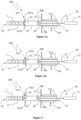
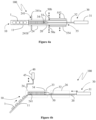
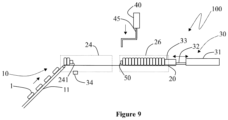
- the machinery (100) includes a feeding mechanism (10), a transport platform (20), a support mechanism (30), a slider arrangement (40), a stopper arrangement (50), a temporary support (241), and a handling apparatus (60).
- the feeding mechanism (10) is configured to transport the folded items (1) from a conveyor unit (11) to a transport platform (20).
- the feeding mechanism (10) is positioned after, preferably not immediately after, an outsert folding unit (not shown), to ensure an organized feeding of the folded items (1).
- the feeding mechanism (10) sequentially introduces individual folded items (1) into the transport platform (20).
- the feeding mechanism (10) includes a conveyor unit for transferring the folded item (1) to a first stacking area (24) of the transport platform (20).
- the conveyor unit (11) is arranged in such a way that the folded items (1) are conveyed in the upstream direction.
- the conveyor unit (11) is arranged in such a way that the folded items (1) are conveyed in the downstream direction as shown in Figure 1a' .
- the feeding mechanism (10) includes a pusher unit (12) arranged within the feeding area and on a frame (5) arranged in the feeding area.
- the pusher unit (12) includes a cylinder (121) and a pusher (122).
- the pusher (122) interfaces with the folded items (1) before the folded items (1) enter the transport platform (20) and pushes the folded items (1) into the transport platform (20) and specifically towards the first stacking area (24).
- the pusher unit (12) is capable of either pneumatic, hydraulic, or motor-driven operation. As the folded items (1) are placed in the feeding area, the pusher (122) of the pusher unit (12) engages, applying the required force to push each folded item (1) into the transport platform (20) to achieve an upright position of the folded items (1).
- the pusher unit (12) is positioned within the feeding area where it interfaces with the folded items (1) before the folded items (1) enter the transport platform (20).
- the pusher unit (12) is a linear actuator that facilitates the movement of folded items (1) from the feeding area into the transport platform (20) and eventually to the first stacking area (24).
- the pusher (122) can be actuated using various methods, including pneumatic systems, hydraulic systems, or motor-driven mechanisms. It may be obvious to a person skilled in the art to configure the pusher unit (12) with any other suitable actuation mechanism.
- the feeding mechanism (10) may include a control unit which receives signals from sensors that detect the presence of a folded item (1) ready to be fed into the transport platform (20). Based on these signals, the control unit may activate the pusher (122) of the pusher unit (12) to push the folded items (1) into the first stacking area (24) of the transport platform (20).
- the transport platform (20) facilitates transporting the upright stack or a partially assembled stack of folded items (1) into the stacking area.
- the transport platform (20) is generally a flat platform which provides a platform to convey the upright stack or a partially formed stack of folded items (1) towards the designated stacking area (26).
- the transport platform (20) is movable, such that when the platform detects the specific quantity of folded items (1) in the transport platform (20), it gets activated to move the folded items (1), maintaining an upright stack or partially assembled stack. This motion is at the right angle to the direction of transportation, guiding the folded items (1) into the designated stacking area (26) for further processing.
- Proximity sensors or photoelectric sensors may be integrated into the transport platform (20) to detect the presence and movement of the folded items (1). Automation controls linked to these sensors regulate the platform's speed and operation, ensuring efficient and synchronized movement of the folded items (1).
- the support mechanism (30) is arranged along the transport direction of the folded items (1) which is above the transport platform (20).
- the support mechanism (30) acts as a deadweight, holding the folded items (1) in an upright position during transportation of the folded items (1) on the transport platform (20).
- the support mechanism (30) includes a support structure (33), a rod (32), and an actuation cylinder (36).
- the rod (32) extends in the transport direction and is connected to an actuation device (38) or a motorized actuator.
- the actuation device (38) can be a linear actuator to move the support mechanism (30).
- the support structure (33) is arranged on a free end of the rod (32) to support the folded items (1).
- the support structure (33) is adapted to hold the folded items (1) in an upright position during transportation of the folded items along the transport platform (20). Specifically, the support structure (33) is arranged centrally to the transport platform (20) and is adapted to engage with the front face of the folded items (1) in the upright position.
- the support structure (33) is a vertical element arranged substantially perpendicular to the rod (32).
- the support mechanism (30) is constructed with mechanisms to facilitate controlled movement of the folded items (1) along the transport direction. In the present embodiment, the support mechanism (30) is movable in a length direction along the platform and facilitates the movement of a first set of folded items (1) from the first stacking area (24) to the designated stacking area (26) in a first cycle.
- the first cycle refers to a complete sequence of operations that begins with the initial handling and transportation of a first batch of folded items (1) from the first stacking area (24) and ends with their delivery to the designated stacking area (26).
- the support mechanism (30) includes a support pad (34).
- the support pad (34) is arranged adjacent to the support pad (33) to support the initial leaflets of the next batch while the support mechanism (30) returns to support the leaflets after the collection of leaflets by the handling apparatus (60).
- the support structure (33) has a C-shaped structure to receive the support pad (34) within the support structure (33). In the first cycle, the support structure (33) along with the support pad (34) provides support to the folded items (1).
- the support pad (34) When the first stack of folded items (1) reaches the designated stacking area (26), the support pad (34) is already detached from the support structure (33) and travels to the first stacking area (24) to support the next stack of folded items (1).
- the support pad (34) has an extension rod to facilitate the linear motion of the support pad (34) towards the first stacking area (24). Specifically, the support pad (34) detaches from the support structure (33) to move downward, below the transport platform (20), and travels linearly towards the first stacking area (24). Further, the extension rod along with the support pad (34) moves upward to place the support pad (34) in the transport direction to support the new stack of folded items (1).
- the extension rod moves linearly against the transport direction, facilitating the movement of the second support pad (50b) towards the new folded items (1) that are being pushed by the pusher (122) in the first stacking area (24).
- the support pad (34) provides support to the new folded items (1) for maintaining the upright position of the folded items (1) while being transported in the transport direction.
- the support structure (33) with a cushioning spring along with the rod (32) also moves accordingly.
- the support mechanism (30) maintains pressure on the folded items (1) to prevent them from collapsing or losing their upright orientation as they advance through the transport platform (20).
- the support mechanism (30) is equipped with an actuating device, which may utilize a motor, gearbox, and a mechanism like a cam or a rack-and-pinion system.
- the motor provides the necessary rotational force, and this force is then converted into a linear movement of the rod (32) that controls the position of the support structure (33).
- the support structure (33) is a spring-loaded element that facilitates supporting the folded items (1) in the first stacking area (24) and maintains the upright position of the folded items (1) when the first batch of folded items (1) is transported to the designated stacking area (26).
- the support structure (33) of the support mechanism (30) has a flat or contoured surface to make contact with the folded items (1) and apply the necessary pressure to hold the folded items (1) in the upright position during transportation.
- the surface of the support structure (33) is often coated with materials that provide a good grip without damaging the folded items (1).
- the surface may be a flat plate, a padded surface, or a specialized gripper designed to securely hold the folded items (1).
- proximity sensors or encoders may be integrated into the support mechanism (30) to precisely detect the position of the support structure (33). These sensors send signals to the control system to ensure accurate positioning and movement control.
- the support mechanism (30) is controlled by a control unit, allowing for precise positioning and activation at specific stages of the folding and stacking process.
- the control unit governs the timing, movement, and force applied by the support structure (33), ensuring the folded items (1) are securely held in an upright position.
- the position, height, and force of the support structure (33) can often be adjusted to accommodate different sizes and weights of folded items (1).
- the slider arrangement (40) is positioned at the feeding area of the folded items (1) to move the folded items (1) from the first stacking area (24) to the designated stacking area (26).
- the slider arrangement (40) is arranged on the frame (5) near the feeding area, and the slider arrangement (40) has an inverted L-shaped pushing tool (45) which is movably arranged above the transport direction/the transport platform (20) to engage with a stacked folded item or a partially stacked folded item on the first stacking area (24) and move the stacked folded item or a partially stacked folded item from the first stacking area (24) to the designated stacking area (26).
- the inverted L-shaped pushing tool (45) is referred to as the pushing tool (45).
- the pushing tool (45) is movable back and forth in the transport direction.
- the frame (5) has a guide (6) that facilitates the sliding motion of the slider arrangement (40) in the transport direction.
- the slider arrangement (40) is activated to move the folded items (1) towards the designated stacking area (26). Specifically, the pushing tool (45) retracts in a downward direction from an initial position to reach a stack of folded items (1). Once the pushing tool (45) reaches the stack of folded items (1), the slider arrangement (40) slides along the transport direction toward the designated stacking area (26). Once the folded item (1) is placed in the designated stacking area (26), the pushing tool (45) moves upward and configures to the initial position. Further, the slider arrangement (40) retracts to the original position and secures near the feeding area.
- the slider arrangement (40) may be operable by pneumatic, hydraulic, or motor-driven systems.
- a recoil and reset mechanism may be integrated to quickly retract the slider arrangement (40) to its initial position after each feed, readying it for the next cycle.
- a stopper arrangement (50) extends from or towards the transport platform (20) and engages with the folded items (1), holding the stack of folded items (1) within the space between the stopper arrangement (50) and the support pad (33).
- the stopper arrangement (50) and the support structure (33) ensure the stack of folded items (1) remains in the upright position.
- the stopper arrangement (50) and the support structure (33) also provide support to the folded items (1) from both ends.
- the stopper arrangement (50) in the designated stacking area (26) has a linear stopper (50) and a transverse stopper (55).
- the linear stopper (50) is adapted to hold the stack in the designated stacking area (20a) in an upright position, avoiding an expansion of the stack or toppling of the folded items (1) in the designated stacking area (26).
- the transverse stopper (55) includes a first transverse stopper (552) and a second transverse stopper movably arranged in the designated stacking area (26) to hold the stack from a transverse direction.
- the linear stopper (50) and the transverse stopper (55) are interfaced with a control module to synchronize their operation with the slider arrangement (40).
- the linear stopper (50) includes a first linear stopper (50a) and a second linear stopper (50b) adapted to travel horizontally in the transport path from a side support of the transport platform (20) to hold the stack (2) in the designated stacking area (26).
- the first linear stopper (50a) and the second linear stopper (50b) are configurable in an engaged position and a disengaged position. In the engaged position (shown in figure 1 ), the first linear stopper (50a) and the second linear stopper (50b) are in the path of the transport direction. In the disengaged position, the first linear stopper (50a) and the second linear stopper (50b) are retracted back into the sidewalls of the transport platform (20).
- the transverse stopper (55) includes a first transverse stopper (552) and a second transverse stopper (554) movably arranged in the designated stacking area (26) to hold the stack (2) from a transverse direction.
- the first transverse stopper (552) and the second transverse stopper (554) are elongated members extended along the length of the stack (2) and adapted to move in a direction perpendicular to the transport direction.
- the control module is in connection with the slider arrangement (40), the support mechanism (30), the linear stopper (50), and the transverse stopper (55) to facilitate the transportation of the stack and holding the stack in the designated stacking area (26).
- the control unit Upon receiving the stack in the designated stacking area (26) from the first stacking area (24) using the slider arrangement (40), the control unit actuates the linear stopper (50) and the transverse stopper (55) to hold the stack in the upright position in the designated stacking area (26).
- the slider arrangement (40) and the support mechanism (30) are retrieved and moved to the original position for transporting the next stack from the first stacking area (24) to the designated stacking area (26), initiating the second cycle.
- the pushing tool (45) on the slider arrangement (40) moves upwards and travels back to the original position.
- the support structure (33) of the support mechanism (30) moves downwards on the transport platform (20), and the actuating device pushes or moves the support mechanism (30) linearly along the length direction of the transport platform (20) towards the first stacking area (24) to support or hold the folded items (1) in the first stacking area (24) to perform the second cycle of transfer.
- the feeding mechanism (10) still feeds the folded items (1) towards the transport platform (20).
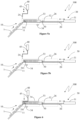
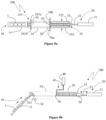
- the temporary support (241) is provided on the sides of the transport platform (20) as shown in figures 3a-3d.
- the temporary support (241) securely holds the folded items (1) in the first stacking area (24) of the transport platform (20) in the upright position when the first batch of folded items (1) is transferred from the first stacking area (24) to the designated stacking area (26).
- the temporary support (241) is movably arranged on either side of the transport platform (20) and adjacent to the feeding mechanism (10) to securely hold the folded items (1) in the upright position when the first set of folded items (1) are moved from the first stacking area (24) to the designated stacking area (26) in the first cycle.
- the temporary support (241) is operably connected to an actuation mechanism, which actuates the temporary support (241) to engage with or hold the folded items (1) and the subsequent folded items (1) transported to the transport platform (20) by the feeding mechanism (10) when the first set of folded items (1) are moved from the first stacking area (24) to the designated stacking area (26).
- the temporary support (241) includes two guides operably arranged on either side of the transport platform (20) which are adapted to move away and towards the transport platform (20).
- the temporary support (241) is a pneumatically operated mechanism which, when actuated, allows the guides to move towards the transport platform (20) and engage with the folded items (1) fed through the feeding area after the first cycle of transfer of the folded items (1) from the first stacking area (24) to the designated stacking area (26).
- the temporary support (241) is arranged in the first designated stacking area (24) to support the initial batch of folded items in the upright position.
- the temporary support (241) includes a first temporary support (241a) and a second temporary support (241b) arranged on the sidewall of the transport platform (20) and movable in a direction transverse to the transport direction.
- Each of the temporary supports are configured to extend from the sidewalls of the transport platform (20) to support the newly coming folded items (1) to the transport platform (20).
- the temporary support (241) includes a first temporary support (241a) and a second temporary support (241b) slidably extending from the sidewalls in the path of folded items (1) to hold, support, and guide the folded items (1) in the transport platform (20). Further, the first temporary support (241a) and the second temporary support (241b) are slidable in the transport direction to securely hold the newly coming folded items (1).
- the first guide and the second guide are immediately extended from the sidewalls to support the subsequent folded item (1) pushed by the pusher (122) in the transport platform (20).
- the first temporary support (241b) and the second temporary support (241b) are a flat projection that synchronously moves towards or away from the transport platform (20) to hold the folded items (1) in the transport platform (20).
- the temporary supports (241a, 241b) are also movable along the length direction of the transport platform (20) to provide support to the folded items (1).
- the temporary supports (241a, 241b) are positioned at a height suitable for supporting the folded items (1).
- the temporary supports (241a, 241b) from both sides of the transport platform (20) provide lateral support, assisting the folded items (1) to remain in an upright position.
- first temporary support (241a) and the second temporary support (241b) are spring-loaded members to facilitate sliding movement along the transport direction.
- the temporary support (241) supports and holds the folded items (1) in the upright position until the support mechanism (30) returns from the designated stacking area (26) and engages with the folded items (1) held by the temporary support (241) to initiate the second cycle of transferring a second batch of folded items (1).
- the temporary support (241) includes two sidewalls spaced apart from each other and adapted to receive the folded items (1) within them.
- the two sidewalls are capable of changing the distance between them to receive the variable sizes of the folded items (1) while travelling on the transport platform (20).
- the two sidewalls are arranged in such a way that the folded items (1) are maintained in an upright position.
- the temporary support (241) includes a motorized guide arranged on either side of the transport platform (20).
- the motorized guide holds and guides the folded items (1) in the upright position as they enter the first stacking area (24).
- the motorized guide may include guiding rails, chutes, or spring-loaded supports that direct the folded items (1) towards the first stacking area (24).
- the temporary support (241) includes pneumatic air cushions or air jets positioned in the feeding area of the transport platform (20). These cushions release a gentle stream of air, creating a cushioning effect that keeps the folded items (1) elevated and in an upright position.
- the air pressure and flow can be adjusted to suit the specific weight and size of the folded items (1).
- the temporary support (241) includes a roller conveyor with upright guide rails on either side.
- the guide rails have a smooth surface and are positioned at a height suitable for the folded items (1).
- the guide rails provide lateral support, assisting the folded items (1) to remain upright.
- the temporary support (241) includes non-slip belts in the feeding area to convey the folded items (1).
- the non-slip property of the belts prevents the folded items (1) from slipping or tilting.
- each of the temporary supports (241a, 241b) in the temporary support (241) disengages or cuts contact with the folded items (1) and retracts from the transport platform (20) to the initial position.
- the temporary supports (241a, 241b) reengage with another batch of the folded items (1) when the slider arrangement (40) pushes or moves the second batch of the folded items (1) from the first stacking area (24) to the designated stacking area (26) in the second cycle.
- the control unit Upon receiving the stack of folded items (1) in the designated stacking area (26) from the first stacking area (24), the control unit actuates the linear stopper (50) and the transverse stopper (55) to hold the stack of folded items (1) in the upright position in the designated stacking area (26).
- the linear stopper (50) extends into the transport path to support the stack of folded items (1) from an end that is near the first designated stacking area (20a).
- the designated stacking area (20a) has a fixed support (not shown) from the other end of the stack of folded items (1) to firmly hold the stack between the fixed support and the linear stopper (50).
- the control module controls the position of the linear stopper (50) and the transverse stopper (55) to hold the stack in the designated stacking area (26) upon receiving the stack from the first stacking area (24). Then, the control unit of the handling apparatus (60) initiates the handling apparatus (60) to pick the stack of folded items (1) from the designated stacking area (26) and deliver the first stack of folded items (1) into a receptacle arranged in a delivery area (70).
- the handling apparatus (60) includes a base (601), a plurality of articulated segments (61a, 61b, ...) arranged on the base (601), a holding arrangement (62), and a control unit configured to manage the movement and operation of the handling apparatus (60).
- the base (601) is fixed to the ground or to the rigid structure to provide stability to the handling apparatus (60).
- the base (601) is adapted to receive the plurality of articulated segments (61a, 61b, ...) over there.
- the plurality of articulated segments (61a, 61b, ...) are movably arranged on the base (601) and connected to each other by joints to allow multidirectional movement.
- the holding arrangement (62) includes a first holding element (621) and a second holding element (622).
- the first holding element (621) and the second holding element (622) are movable in a longitudinal direction facilitating the variable gap between the first holding element (621) and the second holding element (622) to receive the stack (2) therebetween.
- the first holding element (621) and the second holding element (622) are movable towards each other for firmly gripping the stack (2) in the gap.
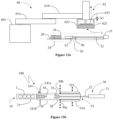
- the holding arrangement (62) is positioned (shown in figure 4a, and 4b ) over the designated stacking area (26) by actuating the plurality of articulated segments (61a, 61b, ).
- the first holding element (621) and the second holding element (622) of the holding arrangement (62) are then actuated to grip the stack (2) from the designated stacking area (26).
- the holding arrangement (62) moves in a downward direction by distance X2 to reach the designated stacking area (26).
- the first holding element (621) and the second holding element (622) move toward each other configuring the distance Y2 therebetween to grip the stack (2).
- the distance Y2 is less than the distance Y1 and sufficient to compress the stack (2) in a longitudinal direction without damaging the folded items of the stack (2) (shown in figures 11a, and 11b ).
- the control unit communicates with the control module (80) to release the stack (2) by actuating the linear stopper (50) and the transverse stopper (55).
- control unit receives a communication signal from the control module (80) to operate the holding arrangement (62) to pick the stack (2) and move in the upward direction.
- the holding arrangement (62) is moved in the upward direction until the distance X1 is achieved by the holding arrangement (62) (as shown in figure 12a, and 12b ).
- the support structure (33) is released by the controller and moves towards the first designated stacking area (24) to support the next stack (2).
- the delivery area (70) is provided adjacent to the transport platform (20).
- the delivery area (70) has at least one receptacle which is adapted to receive the stack of folded items (1) from the designated stacking area (26).
- the handling apparatus (60) is arranged between the transport platform (20) and the delivery area (70) to transport the stack of folded items (1) from the designated stacking area (26) to the delivery area (70).
Landscapes
- Engineering & Computer Science (AREA)
- Mechanical Engineering (AREA)
- Folding Of Thin Sheet-Like Materials, Special Discharging Devices, And Others (AREA)
- Pile Receivers (AREA)
- Supplying Of Containers To The Packaging Station (AREA)
Applications Claiming Priority (1)
| Application Number | Priority Date | Filing Date | Title |
|---|---|---|---|
| IN202321070784 | 2023-10-17 |
Publications (2)
| Publication Number | Publication Date |
|---|---|
| EP4552984A2 true EP4552984A2 (de) | 2025-05-14 |
| EP4552984A3 EP4552984A3 (de) | 2025-07-30 |
Family
ID=93150240
Family Applications (3)
| Application Number | Title | Priority Date | Filing Date |
|---|---|---|---|
| EP24206867.4A Pending EP4552984A3 (de) | 2023-10-17 | 2024-10-16 | Verfahren und vorrichtung zum stapeln und verpacken von gefalteten gegenständen |
| EP24206873.2A Pending EP4556384A1 (de) | 2023-10-17 | 2024-10-16 | System und verfahren zum verpacken und abgeben von gefalteten artikeln |
| EP24206872.4A Pending EP4566955A3 (de) | 2023-10-17 | 2024-10-16 | Maschine und verfahren zur handhabung eines stapels gefalteter artikel |
Family Applications After (2)
| Application Number | Title | Priority Date | Filing Date |
|---|---|---|---|
| EP24206873.2A Pending EP4556384A1 (de) | 2023-10-17 | 2024-10-16 | System und verfahren zum verpacken und abgeben von gefalteten artikeln |
| EP24206872.4A Pending EP4566955A3 (de) | 2023-10-17 | 2024-10-16 | Maschine und verfahren zur handhabung eines stapels gefalteter artikel |
Country Status (1)
| Country | Link |
|---|---|
| EP (3) | EP4552984A3 (de) |
Cited By (1)
| Publication number | Priority date | Publication date | Assignee | Title |
|---|---|---|---|---|
| CN120736032A (zh) * | 2025-09-04 | 2025-10-03 | 石狮市三佳实业有限公司 | 一种用于服装加工的成品打包装置 |
Citations (1)
| Publication number | Priority date | Publication date | Assignee | Title |
|---|---|---|---|---|
| US11130599B2 (en) | 2018-07-02 | 2021-09-28 | H+H Gmbh & Co. Kg | Device for stacking and packaging folded products |
Family Cites Families (3)
| Publication number | Priority date | Publication date | Assignee | Title |
|---|---|---|---|---|
| EP1405809B1 (de) * | 2002-10-02 | 2009-07-01 | Müller Martini Holding AG | Einrichtung zur Herstellung von Stapelpaketen |
| US10604355B2 (en) * | 2017-06-30 | 2020-03-31 | Pearson Packaging Systems | Flight and product indexing assemblies for packaging |
| BR112020006078B1 (pt) * | 2017-09-28 | 2024-01-23 | Fabio Perini S.P.A | Máquina de embalar para embalar artigos em embalagens de filme plástico e método para embalar artigos em embalagens tubulares de filme plástico |
-
2024
- 2024-10-16 EP EP24206867.4A patent/EP4552984A3/de active Pending
- 2024-10-16 EP EP24206873.2A patent/EP4556384A1/de active Pending
- 2024-10-16 EP EP24206872.4A patent/EP4566955A3/de active Pending
Patent Citations (1)
| Publication number | Priority date | Publication date | Assignee | Title |
|---|---|---|---|---|
| US11130599B2 (en) | 2018-07-02 | 2021-09-28 | H+H Gmbh & Co. Kg | Device for stacking and packaging folded products |
Cited By (1)
| Publication number | Priority date | Publication date | Assignee | Title |
|---|---|---|---|---|
| CN120736032A (zh) * | 2025-09-04 | 2025-10-03 | 石狮市三佳实业有限公司 | 一种用于服装加工的成品打包装置 |
Also Published As
| Publication number | Publication date |
|---|---|
| EP4566955A3 (de) | 2025-08-13 |
| EP4552984A3 (de) | 2025-07-30 |
| EP4566955A2 (de) | 2025-06-11 |
| EP4556384A1 (de) | 2025-05-21 |
Similar Documents
| Publication | Publication Date | Title |
|---|---|---|
| US11897222B2 (en) | Method and apparatus for erecting cartons | |
| US9914601B2 (en) | Method and tool for palletizing mixed load products | |
| US5393291A (en) | Mini case erector | |
| EP2141097B1 (de) | Temporärer Verpackungslagerungssteuerungsmechanismus für eine Transportvorrichtung für kubische Verpackungen und Betriebsverfahren dafür | |
| EP2678232B1 (de) | Kartonentpackungssystem | |
| EP2634099A1 (de) | Inline-Zuführer mit kontinuierlicher Bewegung | |
| CN102227353A (zh) | 包装设备 | |
| CN102083697A (zh) | 包装机及包装物件的方法 | |
| CN210338481U (zh) | 一种自动装箱机 | |
| EP4552984A2 (de) | Verfahren und vorrichtung zum stapeln und verpacken von gefalteten gegenständen | |
| US6783317B2 (en) | Method and device for stacking flat-folded boxes | |
| US7607282B2 (en) | Machine for automated packaging of products(s) in a cardboard box | |
| WO1999000305A1 (en) | Combination counter-ejector shingle-output delivery system | |
| EP0734948B1 (de) | Vorrichtung zum automatischen Verpacken von Gegenständen in aus schlauchförmigen Zuschnitten hergestellten Verpackungen | |
| AU2009291682B2 (en) | Packaging apparatus and method | |
| CN113911451A (zh) | 一种工件打包方法 | |
| EP3945037A1 (de) | Verbesserungen an oder im zusammenhang mit einer verpackungsvorrichtung | |
| US12269633B2 (en) | Packaging apparatus | |
| EP3945038B1 (de) | Verbesserungen an oder im zusammenhang mit einer verpackungsvorrichtung | |
| CN120607007A (zh) | 一种自动包装机 | |
| JP2002059494A (ja) | 箱の形成装置 | |
| JP2011136801A (ja) | ケーサー装置及びこれに適用されるシート整形装置 | |
| WO2005044700A1 (en) | Positioning apparatus for container forming machine | |
| JPS61111218A (ja) | 胴巻き包装機 |
Legal Events
| Date | Code | Title | Description |
|---|---|---|---|
| PUAI | Public reference made under article 153(3) epc to a published international application that has entered the european phase |
Free format text: ORIGINAL CODE: 0009012 |
|
| STAA | Information on the status of an ep patent application or granted ep patent |
Free format text: STATUS: THE APPLICATION HAS BEEN PUBLISHED |
|
| AK | Designated contracting states |
Kind code of ref document: A2 Designated state(s): AL AT BE BG CH CY CZ DE DK EE ES FI FR GB GR HR HU IE IS IT LI LT LU LV MC ME MK MT NL NO PL PT RO RS SE SI SK SM TR |
|
| PUAL | Search report despatched |
Free format text: ORIGINAL CODE: 0009013 |
|
| AK | Designated contracting states |
Kind code of ref document: A3 Designated state(s): AL AT BE BG CH CY CZ DE DK EE ES FI FR GB GR HR HU IE IS IT LI LT LU LV MC ME MK MT NL NO PL PT RO RS SE SI SK SM TR |
|
| RIC1 | Information provided on ipc code assigned before grant |
Ipc: B65B 25/14 20060101AFI20250620BHEP Ipc: B65B 35/40 20060101ALI20250620BHEP Ipc: B65B 63/02 20060101ALN20250620BHEP |