EP4545777A1 - Piston ring - Google Patents
Piston ring Download PDFInfo
- Publication number
- EP4545777A1 EP4545777A1 EP23937791.4A EP23937791A EP4545777A1 EP 4545777 A1 EP4545777 A1 EP 4545777A1 EP 23937791 A EP23937791 A EP 23937791A EP 4545777 A1 EP4545777 A1 EP 4545777A1
- Authority
- EP
- European Patent Office
- Prior art keywords
- piston ring
- coating
- intermediate layer
- gas
- base material
- Prior art date
- Legal status (The legal status is an assumption and is not a legal conclusion. Google has not performed a legal analysis and makes no representation as to the accuracy of the status listed.)
- Pending
Links
Images


Classifications
-
- F—MECHANICAL ENGINEERING; LIGHTING; HEATING; WEAPONS; BLASTING
- F16—ENGINEERING ELEMENTS AND UNITS; GENERAL MEASURES FOR PRODUCING AND MAINTAINING EFFECTIVE FUNCTIONING OF MACHINES OR INSTALLATIONS; THERMAL INSULATION IN GENERAL
- F16J—PISTONS; CYLINDERS; SEALINGS
- F16J9/00—Piston-rings, e.g. non-metallic piston-rings, seats therefor; Ring sealings of similar construction
- F16J9/26—Piston-rings, e.g. non-metallic piston-rings, seats therefor; Ring sealings of similar construction characterised by the use of particular materials
-
- F—MECHANICAL ENGINEERING; LIGHTING; HEATING; WEAPONS; BLASTING
- F02—COMBUSTION ENGINES; HOT-GAS OR COMBUSTION-PRODUCT ENGINE PLANTS
- F02F—CYLINDERS, PISTONS OR CASINGS, FOR COMBUSTION ENGINES; ARRANGEMENTS OF SEALINGS IN COMBUSTION ENGINES
- F02F5/00—Piston rings, e.g. associated with piston crown
Definitions
- the present disclosure relates to a piston ring.
- Patent Literature 1 discloses a piston ring obtained by replacing conventional spring steel or carbon steel with chromium-based stainless steel having more excellent heat resistance.
- Patent Literature 1 Japanese Unexamined Patent Publication No. S56-81243
- the amount of blow-by gas which is one type of emission, may increase even under a condition in which heat deformation does not occur in a piston ring made of chromium-based stainless steel.
- the present disclosure provides a piston ring advantageous in sufficiently reducing the amount of blow-by gas.
- thermal resistance value correlates with the fuel consumption and the blow-by gas, that is, the amount of blow-by gas can be sufficiently reduced when the thermal resistance value of the coating is within a predetermined range.
- the thermal resistance value is a value represented by the following Formula 1, and the thermal resistance value and thermal conductivity have a relationship represented by the following Formula 2.
- Thermal resistance value Film thickness/(Specific gravity ⁇ Specific heat ⁇ Thermal diffusivity)
- Thermal resistance value Film thickness / Thermal conductivity
- the piston ring according to the present disclosure includes a piston ring base material having a joint portion and the coating covering at least an outer peripheral surface of the piston ring base material, the coating having a thermal resistance value of 2.0 ⁇ 10 -6 to 12.0 ⁇ 10 -6 m 2 . K/W.
- the amount of blow-by gas can be sufficiently reduced.
- the present inventors presume the main cause thereof as follows. That is, the temperature of the piston ring rises with the operation of an engine, and accordingly, the piston ring moderately expands to narrow a gap at the joint portion of the piston ring.
- the thermal resistance value of the coating is 2.0 ⁇ 10 -6 m 2 ⁇ K/W or more
- the piston ring base material is heated by heat from a piston, but heat dissipation to a cylinder liner is suppressed, so that the gap at the joint portion of the piston ring is sufficiently narrowed by thermal expansion, and the amount of blow-by gas can be suppressed.
- the thermal resistance value of the coating is 12.0 ⁇ 10 -6 m 2 ⁇ K/W or less, it is possible to suppress an excessive rise of the temperature of the piston ring base material, and it is possible to prevent heat deformation of the piston ring which causes an increase in the amount of blow-by gas.
- the piston ring advantageous in sufficiently reducing the amount of blow-by gas is provided.
- FIG. 1 is a plan view schematically illustrating a piston ring according to the present embodiment.
- FIG. 2 is a cross-sectional view taken along line II-II illustrated in FIG. 1 .
- a piston ring 10 has an annular shape and has a joint portion 11.
- the piston ring 10 has a pair of side surfaces 12 and 13, an inner peripheral surface 14, and an outer peripheral surface 15.
- the side surfaces 12 and 13 intersect the inner peripheral surface 14, and are, for example, substantially orthogonal to the inner peripheral surface 14.
- An outer diameter d1 of the piston ring 10 is, for example, 40 to 300 mm.
- a gap S1 of the joint portion 11 is, for example, 0.15 to 0.60 mm.
- the piston ring 10 may have a perfect circular shape or an elliptical shape in plan view.
- the piston ring 10 includes a piston ring base material 1 having the joint portion 11, a coating 5 forming the outer peripheral surface 15 of the piston ring 10, and an intermediate layer 3.
- the intermediate layer 3 is provided between the piston ring base material 1 and the coating 5, and for example, serves to enhance adhesion of the coating 5 to the piston ring base material 1.
- the piston ring 10 may have a substantially rectangular cross section, and the outer peripheral surface 15 of the piston ring 10 may be rounded and bulged outward.
- the outer peripheral surface 15 is a surface that slides with respect to an inner surface of a cylinder liner.
- the piston ring 10 is a pressure ring for an internal combustion engine (for example, a high-load diesel engine or an automobile engine).
- the pressure ring is attached to, for example, a ring groove formed in a side surface of a piston.
- the pressure ring is exposed to an environment with a high thermal load of the engine.
- One of functions of the pressure ring is gas sealing.
- the pressure ring suppresses gas (blow-by gas) leaking from a combustion chamber side to a crank chamber side.
- An increase in the blow-by gas leads to deterioration of engine oil, deterioration of fuel consumption, an increase in environmental load, and the like.
- the joint portion of the piston ring is one of the blow-by gas leakage paths. From the viewpoint of blow-by gas suppression, the gap of the joint portion is desirably as small as possible when the engine is driven.
- Another function of the pressure ring is cooling the piston by heat dissipation.
- the piston is heated by heat of the combustion chamber, and the heat of the piston is dissipated to the cylinder liner through the pressure ring. If the temperature of the piston rises too much, a piston material agglutinates and the fuel consumption of the engine significantly deteriorates. On the other hand, when the heat dissipation through the piston and the piston ring is excessive, the thermal efficiency of the engine deteriorates, leading to the deterioration of fuel consumption. Therefore, the thermal resistance of the piston ring is required to be within a predetermined range from the viewpoint of fuel consumption.
- the piston ring base material 1 is made of an alloy having heat resistance.
- Specific examples of the alloy include martensitic stainless steel typified by chromium-based stainless steel, tool steel, and heat-resistant steel.
- martensitic stainless steel typified by chromium-based stainless steel, tool steel, and heat-resistant steel.
- the intermediate layer 3 serves to enhance the adhesion between the piston ring base material 1 and the coating 5.
- a thickness of the intermediate layer 3 is preferably 0.1 to 3.0 ⁇ m, and more preferably 0.5 to 2.5 ⁇ m.
- the thickness of the intermediate layer 3 is desirably 3.0 ⁇ m or less.
- the intermediate layer 3 may be made of, for example, chromium or chromium containing Si, Al, or the like.
- the Si content of the intermediate layer 3 is preferably 2.0 to 10.0 at%.
- the Si content is 2.0 at% or more, the thermal resistivity of the intermediate layer 3 increases, and the total thermal resistivity of the intermediate layer 3 and the coating 5 increases, so that an effect of further contributing to the suppression of the amount of blow-by gas is exhibited.
- the Si content is 10.0 at% or less, an effect of maintaining the effect of mitigating the internal stress by the intermediate layer 3 is exhibited.
- a lower limit value of the Si content may be 2.5 at% or 3.0 at%.
- An upper limit value of the Si content may be 8.5 at% or 6.0 at%.
- the Al content of the intermediate layer 3 is preferably 10.0 to 50.0 at%.
- the thermal resistivity of the intermediate layer 3 increases, and the total thermal resistivity of the intermediate layer 3 and the coating 5 increases, so that an effect of further contributing to the suppression of the amount of blow-by gas is exhibited.
- the Al content is 50.0 at% or less, an effect of maintaining the effect of mitigating the internal stress by the intermediate layer 3 is exhibited.
- a lower limit value of the Al content may be 13 at% or 15 at%.
- An upper limit value of the Al content may be 25 at% or 20 at%.
- the coating 5 is preferably made of chromium nitride containing Si. Since the intermediate layer 3 and the coating 5 are formed using these materials, mutual diffusion occurs at an interface between the intermediate layer 3 and the coating 5, and adhesion between the intermediate layer 3 and the coating 5 is improved. As a result, even when the piston ring 10 is used in a severe environment, the effects of improving the fuel consumption and suppressing the amount of blow-by gas can be maintained for a sufficiently long period of time.
- the coating 5 is preferably made of chromium nitride containing Al. Since the intermediate layer 3 and the coating 5 are formed using these materials, mutual diffusion occurs at an interface between the intermediate layer 3 and the coating 5, and adhesion between the intermediate layer 3 and the coating 5 is improved. As a result, even when the piston ring 10 is used in a severe environment, the effects of improving the fuel consumption and suppressing the amount of blow-by gas can be maintained for a sufficiently long period of time.
- the coating 5 forms the outer peripheral surface 15 of the piston ring 10.
- a thickness of the coating 5 is preferably 3 to 100 ⁇ m, and more preferably 5 to 70 ⁇ m.
- the thickness of the coating 5 is 3 ⁇ m or more, not only an effect of enhancing the durability of the coating 5 due to sliding contact between the outer peripheral surface 15 of the piston ring 10 and the cylinder liner is obtained, but also the effects of improving the fuel consumption and suppressing the amount of blow-by gas by increasing the thermal resistivity of the piston ring 10 are obtained.
- the thickness of the coating 5 is 100 ⁇ m or less, an excessive rise of the temperature of the piston ring base material 1 can be suppressed, and thus, not only heat deformation of the piston ring 10 that causes an increase in the amount of blow-by gas can be prevented, but also an effect that high productivity can be secured is achieved.
- the coating 5 is made of, for example, a metal nitride such as chromium nitride or titanium nitride, or an amorphous carbon film.
- the coating 5 may be a single layer or a laminate of two or more kinds of layers as long as a predetermined thermal resistance value is obtained as a whole. Examples of the laminate of two or more kinds of layers include a laminate of a chromium nitride layer and a chromium nitride layer containing carbon.
- the surface (the outer peripheral surface 15) of the coating 5 is made of metal nitride or amorphous carbon, the progress of wear of the coating 5 can be suppressed, and the function of the coating 5 can be maintained for a sufficiently long period of time.
- the coating 5 may further contain Si, Al, C, H, or the like. When the coating 5 contains Si or Al, the blow-by gas can be more effectively suppressed.
- the Si content of the coating 5 is preferably 1.0 to 10.0 at%.
- Chromium nitride having the Si content of 1.0 at% or more consists of refined crystal grains, and has good crack resistance and peeling resistance.
- chromium nitride having the Si content of 10.0 at% or less is good to form an appropriate amorphous phase, and has good crack resistance. Therefore, the coating 5 made of chromium nitride containing Si within the above range can maintain the effects of improving the fuel consumption and suppressing the amount of blow-by gas even in a more severe use environment. Further, chromium nitride containing Si within the above range has excellent wear resistance.
- a lower limit value of the Si content may be 1.5 at% or 2.0 at%.
- An upper limit value of the Si content may be 8.0 at% or 6.0 at%.
- the Al content of the coating 5 is preferably 10 to 50 at%.
- the thermal conductivity of the material forming the coating 5 can be sufficiently reduced, and thermal insulation performance can be imparted to the coating 5.
- the wear resistance of the coating 5 can be enhanced, and the effects of improving the fuel consumption and suppressing the amount of blow-by gas can be maintained for a longer period.
- the Al content is 50 at% or less, Al is sufficiently dissolved in chromium nitride, and the uniform coating 5 can be obtained. Further, chromium nitride containing Al within the above range has excellent wear resistance.
- a lower limit value of the Al content may be 13 at% or 15 at%.
- An upper limit value of the Al content may be 25 at% or 20 at%.
- the thermal resistance value of the coating 5 is 2.0 ⁇ 10 -6 m 2 ⁇ K/W or more, preferably 2.5 ⁇ 10 -6 m 2 ⁇ K/W or more, more preferably 4.0 ⁇ 10 -6 m 2 ⁇ K/W or more, still more preferably 5.0 ⁇ 10 -6 m 2 ⁇ K/W or more, and most preferably 7.0 ⁇ 10 -6 m 2 ⁇ K/W or more.
- the thermal resistance value of the coating 5 is 2.0 ⁇ 10 -6 m 2 ⁇ K/W or more, appropriate thermal insulation performance can be imparted to the piston ring 10, and the temperature of the piston ring base material 1 can be sufficiently increased when the engine is driven.
- the gap of the joint portion 11 is reduced, and the amount of blow-by gas can be suppressed.
- the piston ring 10 has the thermal insulation performance, a decrease in the temperature of the combustion chamber can be suppressed. That is, the engine that can suppress the amount of blow-by gas and has good fuel consumption characteristics is achieved since the piston ring 10 has the appropriate thermal insulation performance.
- the thermal resistance value of the coating 5 is 12.0 ⁇ 10 -6 or less, preferably 11.0 ⁇ 10 -6 m 2 ⁇ K/W or less, more preferably 10.3 ⁇ 10 -6 m 2 ⁇ K/W or less, and still more preferably 9.0 ⁇ 10 -6 m 2 ⁇ K/W or less.
- the thermal resistance value of the coating 5 is 12.0 ⁇ 10 -6 m 2 ⁇ K/W or less, excessive thermal insulation performance of the piston ring 10 can be prevented. Therefore, it is possible to prevent in advance problems that may occur when the piston ring 10 is overheated. Such problems include the heat deformation of the piston ring base material 1 and agglutination of the piston ring 10 to the piston.
- the "thermal resistance value” as used herein means a value obtained by a laser heat reflection method.
- thermal diffusivity is obtained by forming a molybdenum (Mo) film on a surface of a sample in a mirror surface condition and analyzing modulation of reflectance on a metal surface when such a thin film surface is periodically heated by laser irradiation. More specifically, first, the sample surface is periodically heated by laser light, and heat is diffused from the surface of the metal thin film into the sample. At this time, the temperature of the sample surface changes according to the thermal conductivity of the sample.
- Mo molybdenum
- continuous wave laser light for detection which is not coaxially modulated with heating light
- continuous wave laser light for detection is emitted using the property of Mo that the reflectance changes depending on the temperature, thereby obtaining reflected light corresponding to temperature modulation of the sample surface.
- a phase delay of the reflected light with respect to the heating cycle becomes small.
- the phase delay of the reflected light with respect to the heating cycle becomes large.
- the thermal diffusivity of the sample is obtained by analyzing the phase delay of the reflected light with respect to the heating light. A value of the thermal diffusivity and a specific heat value obtained by differential scanning calorimetry are applied to Formula 1 to calculate the thermal resistance value.
- the thermal resistance value may be obtained by a method other than the laser heat reflection method as long as it can be confirmed that a value equivalent to the thermal resistance value measured by the laser heat reflection method can be obtained or that there is a correlation with the thermal resistance value measured by the laser heat reflection method.
- thermal diffusivity and specific heat may be obtained by a laser flash method, and these may be applied to Formula 1 to calculate the thermal resistance value.
- the laser flash method a disk-shaped sample held in a vacuum is irradiated with pulsed laser light for heating, and a temperature history of a back surface of the sample is analyzed to determine the thermal diffusivity and the specific heat.
- the disk-shaped sample is placed in a vacuum, and the entire sample is held at a constant temperature T 0 .
- the entire front surface of the sample is pulse-heated by laser light having a pulse width of about 100 ⁇ s, and a temperature change of the back surface is measured.
- the thermal diffusivity is obtained by applying a time t half required for the entire sample to reach half the uniform temperature and a thickness L of the sample to Formula 3.
- the specific heat is obtained by applying a weight W s and a final reaching temperature T s of the sample, and specific heat C p,r , a weight W r , and a final reaching temperature T r of a reference substance to Formula 4.
- Thermal diffusivity 0.1388 ⁇ L 2 / t half
- Specific heat C p , r ⁇ W r ⁇ T r ⁇ T 0 / W s ⁇ T s ⁇ T 0
- the piston ring 10 is manufactured by, for example, the following steps.
- the step (a) is a step for bringing the surface of the piston ring base material 1 into a clean state prior to the formation of the intermediate layer 3. For example, it is sufficient to perform a cleaning treatment by degreasing or shot blasting. In addition, bombardment cleaning may be performed in a chamber.
- the formation of the intermediate layer 3 and the coating 5 in the step (b) and the step (c) can be performed by a physical vapor deposition method.
- the physical vapor deposition method include an ion plating method and a sputtering method. All of these physical vapor deposition methods are performed in a vacuum chamber, and for example, the pressure in the vacuum chamber is set to a range of 1 to 6 Pa. Further, a bias voltage is set in a range of -1 to 18 V, for example.
- Compositions of the intermediate layer 3 and the coating 5 can be changed by changing a target used in the physical vapor deposition method.
- a target for example, an alloy of Si or Al and Cr, a Cr ingot, or the like may be used.
- the vacuum atmosphere is replaced with an inert gas such as argon gas of 1.0 ⁇ 10 -3 Pa, whereby the intermediate layer 3 and the coating 5 containing only atoms derived from a cathode can be formed.
- a gas containing any of oxygen, nitrogen, and hydrogen for example, is introduced into the chamber, whereby the intermediate layer 3 and the coating 5 containing the respective atoms can be formed.
- a common target may be used to change a gas to be introduced into the chamber.
- the intermediate layer 3 and the coating 5 having good adhesion can be obtained, and manufacturing cost of the piston ring 10 can be reduced.
- the present disclosure is not limited to the above-described embodiment.
- the piston ring 10 including the intermediate layer 3 is exemplified in the above embodiment, the intermediate layer 3 is not necessarily provided as long as the adhesion of the coating 5 to the piston ring base material 1 can be sufficiently secured.
- the coating 5 is directly formed on an outer peripheral surface of the piston ring base material 1. Note that one having at least an outer peripheral surface subjected to a surface treatment may be used as the piston ring base material 1.
- the present disclosure relates to the following matters.
- a ring having the following composition corresponding to SUS440 and having a joint gap of 0.40 mm was prepared.
- a surface of a piston ring base material was subjected to a nitriding treatment under the following conditions to form a nitride layer. That is, first, the piston ring base material was degreased and cleaned, and then placed in a chamber. Subsequently, an ammonia gas was added into the chamber by a gas nitriding method, and the nitriding treatment was performed under conditions of a nitriding temperature of 570°C and a treatment time of two hours. A thickness of the nitride layer was 60 ⁇ m.
- Piston rings according to Experimental Examples 1 to 4 and Comparative Examples 2 to 4 were prepared through the following three steps. Note that a film formation time in each step was appropriately adjusted according to a target thermal resistance value of a coating or a film thickness of an intermediate layer.
- a piston ring base material was degreased and cleaned, and then placed in a chamber. Subsequently, the inside of the chamber was brought into a vacuum atmosphere of 1.0 ⁇ 10 -2 Pa, and then the inside of the chamber was replaced with an argon gas to set an argon pressure to 1.0 Pa. Then, the piston ring base material was subjected to bombardment cleaning by glow discharge under a condition of a bias voltage of -700 V.
- the intermediate layer was formed on an outer peripheral surface of the cleaned piston ring base material by a chamber ion plating method under the following conditions.
- Example 1 the step of forming the intermediate layer was not performed.
- Example 1 and Comparative Example 2 the coating was formed on a surface of the piston ring base material by a chamber ion plating method under the following conditions.
- Example 2 to 4 and Comparative Examples 3 and 4 the coating was formed on the surface on which the intermediate layer was formed by a chamber ion plating method under the following conditions.
- Piston rings according to Examples 5 and 6 were prepared in the same manner as in Example 2 except that the following step (c-2) was performed instead of the step (c-1).
- Piston rings according to Examples 7 and 8 and Comparative Examples 7 and 8 were prepared in the same manner as in Example 2 except that film formation was performed under the following conditions in the step (c-1).
- Piston rings according to Examples 9 and 10 and Comparative Examples 9 and 10 were prepared in the same manner as in Example 7 except that an atmosphere in a chamber was an acetylene gas under 1.0 ⁇ 10 -1 Pa in the step (c-1).
- a piston ring according to Example 11 was prepared in the same manner as in Example 1 except that a Cr-Al alloy (Al content: 50 at%) was used as a target in the step (c-1).
- Piston rings according to Examples 12 and 13 were prepared in the same manner as in Example 2 except that a Cr-Al alloy (Al content: 50 at%) was used as a target in the steps (b-1) and (c-1).
- a piston ring according to Example 14 was prepared in the same manner as in Example 1 except that a Cr-Si alloy (Si content: 10 at%) was used as a target in the step (c-1).
- Piston rings according to Examples 15 to 17 and Comparative Examples 5 and 6 were prepared in the same manner as in Example 2 except that a Cr-Si alloy (Si content: 10 at%) was used as a target in the steps (b-1) and (c-1).
- Thermal resistance values of the coatings of the piston rings according to Example 1 to 17 and Comparative Example 1 to 10 were calculated by applying the film thickness, specific gravity, specific heat, and thermal diffusivity measured by a method described later to Formula 1. The obtained thermal resistance values are shown in Table 1.
- the film thickness of the coating was measured by observing a cross section by the following method. That is, first, the piston ring was cut in a direction perpendicular to a coated surface, and embedded in a resin such that a cut surface was exposed. Next, a surface where the cut surface was exposed was wet-polished with water-resistant polishing paper, and then, finish polishing was performed using a diamond film #8000 to obtain a sample for cross-section observation. Then, a surface of the obtained sample was magnified and observed using an optical microscope to measure the film thickness of the coating.
- the specific gravity of the coating was calculated from a volume obtained from the film thickness of the coating and the area of a surface-treated surface of the piston ring, and a weight change of the piston ring before and after a coating formation treatment.
- the specific heat of the coating was measured using differential scanning calorimetry (device name: DSC-50, manufactured by Shimadzu Corporation). The measurement was performed on the piston ring under conditions in accordance with JIS R1672:2006 using, as a sample, a thin film prepared under the same conditions as those of the coating.
- the thermal diffusivity of the coating was measured by a laser heat reflection method with a measurement sample prepared by the following method. That is, first, the piston ring was cut in a direction perpendicular to a coated surface, and embedded in a resin so as to expose a cut surface. Subsequently, a surface (measurement surface) where the cut surface was exposed was wet-polished with water-resistant abrasive paper, and then finish polishing was performed using a diamond film #8000 to polish the piston ring until the cut surface became a mirror surface. Furthermore, a 50 nm Mo film was produced on the measurement surface by a sputtering method.
- the resin was cut into small pieces using a fine cutter, and then, the measurement surface was machined to be 10 mm ⁇ 10 mm or less with a height of 3 mm or less using a plane grinding machine to obtain a measurement sample for laser heat reflection measurement.
- the thermal diffusivity of the obtained measurement sample was measured by a laser heat reflection method.
- the measurement was performed under the following conditions using a thermophysical property microscope (device name: Thermal microscope TM3, manufactured by BETHEL Co., Ltd.). Note that a measurement position was set such that an outer peripheral surface of the coating and the piston ring base material were within a measurement range, and an average value obtained by performing the measurement thirty times was taken as a measurement result.
- Example 1 to 17 and Comparative Example 1 to 10 were attached to the engine, and the amount of blow-by gas was measured when the engine was operated under the following conditions.
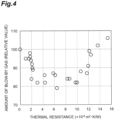
- Table 1 and FIG. 4 show relative values of the amount of blow-by gas in each of Examples and Comparative Examples when the amount of blow-by gas in Comparative Example 1 is 100.
- Examples 1 to 10 a decrease in the blow-by gas was observed as compared with Comparative Example 1.
- the fuel consumption tended to be improved as the thermal resistance value increased.
- Examples 11 to 17 a more remarkable decrease in the blow-by gas was observed as compared with Examples 1 to 10 having similar thermal resistance values.
- the reason why the amount of blow-by gas was large in Comparative Examples 4, 6, 8, and 10 is presumed that heat deformation of the piston ring occurred because thermal resistance of the coating was large.
Landscapes
- Engineering & Computer Science (AREA)
- General Engineering & Computer Science (AREA)
- Mechanical Engineering (AREA)
- Chemical & Material Sciences (AREA)
- Combustion & Propulsion (AREA)
- Pistons, Piston Rings, And Cylinders (AREA)
- Physical Vapour Deposition (AREA)
Abstract
Description
- The present disclosure relates to a piston ring.
- In recent years, awareness of the global environment has been increasing, and low fuel consumption and low emission are strongly required in engines. In order to improve combustion efficiency, a higher compression ratio and a higher load of engine specifications have become a trend. An accompanying temperature rise of a combustion chamber causes heat deformation of a piston ring, and as a result, tension of the piston ring decreases so that sealing performance decreases. As a means for solving this problem,
Patent Literature 1 discloses a piston ring obtained by replacing conventional spring steel or carbon steel with chromium-based stainless steel having more excellent heat resistance. - Patent Literature 1:
Japanese Unexamined Patent Publication No. S56-81243 - According to studies of the present inventors, it has been found that the amount of blow-by gas, which is one type of emission, may increase even under a condition in which heat deformation does not occur in a piston ring made of chromium-based stainless steel. The present disclosure provides a piston ring advantageous in sufficiently reducing the amount of blow-by gas.
- The present inventors have focused on the fact that the amount of blow-by gas and fuel consumption vary depending on a material forming an outer peripheral surface of a piston ring. As a result of repeating experiments while changing a material and a thickness of a coating, it has been found that a thermal resistance value of the coating correlates with the fuel consumption and the blow-by gas, that is, the amount of blow-by gas can be sufficiently reduced when the thermal resistance value of the coating is within a predetermined range. Note that the thermal resistance value is a value represented by the following
Formula 1, and the thermal resistance value and thermal conductivity have a relationship represented by the followingFormula 2.Thermal resistance value = Film thickness/(Specific gravity × Specific heat × Thermal diffusivity) 
- One aspect of the present disclosure relates to a piston ring including a coating. That is, the piston ring according to the present disclosure includes a piston ring base material having a joint portion and the coating covering at least an outer peripheral surface of the piston ring base material, the coating having a thermal resistance value of 2.0 × 10⁻⁶ to 12.0 × 10⁻⁶ m2. K/W.
- According to the piston ring, the amount of blow-by gas can be sufficiently reduced. The present inventors presume the main cause thereof as follows. That is, the temperature of the piston ring rises with the operation of an engine, and accordingly, the piston ring moderately expands to narrow a gap at the joint portion of the piston ring. When the thermal resistance value of the coating is 2.0 × 10⁻⁶ m2·K/W or more, the piston ring base material is heated by heat from a piston, but heat dissipation to a cylinder liner is suppressed, so that the gap at the joint portion of the piston ring is sufficiently narrowed by thermal expansion, and the amount of blow-by gas can be suppressed. On the other hand, when the thermal resistance value of the coating is 12.0 × 10⁻⁶ m2·K/W or less, it is possible to suppress an excessive rise of the temperature of the piston ring base material, and it is possible to prevent heat deformation of the piston ring which causes an increase in the amount of blow-by gas.
- According to the present disclosure, the piston ring advantageous in sufficiently reducing the amount of blow-by gas is provided.
-
-
FIG. 1 is a plan view schematically illustrating one embodiment of a piston ring according to the present disclosure. -
FIG. 2 is a cross-sectional view taken along line II-II illustrated inFIG. 1 . -
FIG. 3 is a cross-sectional view schematically illustrating another embodiment of the piston ring according to the present disclosure. -
FIG. 4 is a graph showing results of Examples and Comparative Examples. - Hereinafter, embodiments of the present disclosure will be described in detail with reference to the drawings. Note that the present invention is not limited to the following embodiments.
-
FIG. 1 is a plan view schematically illustrating a piston ring according to the present embodiment.FIG. 2 is a cross-sectional view taken along line II-II illustrated inFIG. 1 . As illustrated inFIG. 1 , apiston ring 10 has an annular shape and has ajoint portion 11. Thepiston ring 10 has a pair ofside surfaces peripheral surface 14, and an outerperipheral surface 15. Theside surfaces peripheral surface 14, and are, for example, substantially orthogonal to the innerperipheral surface 14. An outer diameter d1 of thepiston ring 10 is, for example, 40 to 300 mm. A gap S1 of thejoint portion 11 is, for example, 0.15 to 0.60 mm. Thepiston ring 10 may have a perfect circular shape or an elliptical shape in plan view. - As illustrated in
FIG. 2 , thepiston ring 10 includes a pistonring base material 1 having thejoint portion 11, acoating 5 forming the outerperipheral surface 15 of thepiston ring 10, and anintermediate layer 3. Theintermediate layer 3 is provided between the pistonring base material 1 and thecoating 5, and for example, serves to enhance adhesion of thecoating 5 to the pistonring base material 1. Thepiston ring 10 may have a substantially rectangular cross section, and the outerperipheral surface 15 of thepiston ring 10 may be rounded and bulged outward. The outerperipheral surface 15 is a surface that slides with respect to an inner surface of a cylinder liner. - The
piston ring 10 is a pressure ring for an internal combustion engine (for example, a high-load diesel engine or an automobile engine). The pressure ring is attached to, for example, a ring groove formed in a side surface of a piston. The pressure ring is exposed to an environment with a high thermal load of the engine. One of functions of the pressure ring is gas sealing. The pressure ring suppresses gas (blow-by gas) leaking from a combustion chamber side to a crank chamber side. An increase in the blow-by gas leads to deterioration of engine oil, deterioration of fuel consumption, an increase in environmental load, and the like. The joint portion of the piston ring is one of the blow-by gas leakage paths. From the viewpoint of blow-by gas suppression, the gap of the joint portion is desirably as small as possible when the engine is driven. - Another function of the pressure ring is cooling the piston by heat dissipation. The piston is heated by heat of the combustion chamber, and the heat of the piston is dissipated to the cylinder liner through the pressure ring. If the temperature of the piston rises too much, a piston material agglutinates and the fuel consumption of the engine significantly deteriorates. On the other hand, when the heat dissipation through the piston and the piston ring is excessive, the thermal efficiency of the engine deteriorates, leading to the deterioration of fuel consumption. Therefore, the thermal resistance of the piston ring is required to be within a predetermined range from the viewpoint of fuel consumption.
- The piston
ring base material 1 is made of an alloy having heat resistance. Specific examples of the alloy include martensitic stainless steel typified by chromium-based stainless steel, tool steel, and heat-resistant steel. When the piston ring base material is made of martensitic stainless steel, heat deformation of the piston ring base material is suppressed, and the piston ring capable of maintaining good gas sealability even in the case of being used at a high temperature is achieved. - As described above, the
intermediate layer 3 serves to enhance the adhesion between the pistonring base material 1 and thecoating 5. A thickness of theintermediate layer 3 is preferably 0.1 to 3.0 µm, and more preferably 0.5 to 2.5 µm. When the thickness of theintermediate layer 3 is 0.1 µm or more, an effect of improving the adhesion by mitigating the internal stress of each of the pistonring base material 1 and thecoating 5 is exhibited. On the other hand, when theintermediate layer 3 is excessively thick, the effect of mitigating the internal stress is saturated, and a film formation cost tends to increase. Therefore, the thickness of theintermediate layer 3 is desirably 3.0 µm or less. - The
intermediate layer 3 may be made of, for example, chromium or chromium containing Si, Al, or the like. When theintermediate layer 3 is made of chromium containing Si, the Si content of theintermediate layer 3 is preferably 2.0 to 10.0 at%. When the Si content is 2.0 at% or more, the thermal resistivity of theintermediate layer 3 increases, and the total thermal resistivity of theintermediate layer 3 and thecoating 5 increases, so that an effect of further contributing to the suppression of the amount of blow-by gas is exhibited. On the other hand, when the Si content is 10.0 at% or less, an effect of maintaining the effect of mitigating the internal stress by theintermediate layer 3 is exhibited. A lower limit value of the Si content may be 2.5 at% or 3.0 at%. An upper limit value of the Si content may be 8.5 at% or 6.0 at%. When theintermediate layer 3 is made of chromium containing Al, the Al content of theintermediate layer 3 is preferably 10.0 to 50.0 at%. When the Al content is 10.0 at% or more, the thermal resistivity of theintermediate layer 3 increases, and the total thermal resistivity of theintermediate layer 3 and thecoating 5 increases, so that an effect of further contributing to the suppression of the amount of blow-by gas is exhibited. On the other hand, when the Al content is 50.0 at% or less, an effect of maintaining the effect of mitigating the internal stress by theintermediate layer 3 is exhibited. A lower limit value of the Al content may be 13 at% or 15 at%. An upper limit value of the Al content may be 25 at% or 20 at%. - When the
intermediate layer 3 is made of chromium containing Si, thecoating 5 is preferably made of chromium nitride containing Si. Since theintermediate layer 3 and thecoating 5 are formed using these materials, mutual diffusion occurs at an interface between theintermediate layer 3 and thecoating 5, and adhesion between theintermediate layer 3 and thecoating 5 is improved. As a result, even when thepiston ring 10 is used in a severe environment, the effects of improving the fuel consumption and suppressing the amount of blow-by gas can be maintained for a sufficiently long period of time. - When the
intermediate layer 3 is made of chromium containing Al, thecoating 5 is preferably made of chromium nitride containing Al. Since theintermediate layer 3 and thecoating 5 are formed using these materials, mutual diffusion occurs at an interface between theintermediate layer 3 and thecoating 5, and adhesion between theintermediate layer 3 and thecoating 5 is improved. As a result, even when thepiston ring 10 is used in a severe environment, the effects of improving the fuel consumption and suppressing the amount of blow-by gas can be maintained for a sufficiently long period of time. - As described above, the
coating 5 forms the outerperipheral surface 15 of thepiston ring 10. A thickness of thecoating 5 is preferably 3 to 100 µm, and more preferably 5 to 70 µm. When the thickness of thecoating 5 is 3 µm or more, not only an effect of enhancing the durability of thecoating 5 due to sliding contact between the outerperipheral surface 15 of thepiston ring 10 and the cylinder liner is obtained, but also the effects of improving the fuel consumption and suppressing the amount of blow-by gas by increasing the thermal resistivity of thepiston ring 10 are obtained. On the other hand, when the thickness of thecoating 5 is 100 µm or less, an excessive rise of the temperature of the pistonring base material 1 can be suppressed, and thus, not only heat deformation of thepiston ring 10 that causes an increase in the amount of blow-by gas can be prevented, but also an effect that high productivity can be secured is achieved. - The
coating 5 is made of, for example, a metal nitride such as chromium nitride or titanium nitride, or an amorphous carbon film. Thecoating 5 may be a single layer or a laminate of two or more kinds of layers as long as a predetermined thermal resistance value is obtained as a whole. Examples of the laminate of two or more kinds of layers include a laminate of a chromium nitride layer and a chromium nitride layer containing carbon. - Since the surface (the outer peripheral surface 15) of the
coating 5 is made of metal nitride or amorphous carbon, the progress of wear of thecoating 5 can be suppressed, and the function of thecoating 5 can be maintained for a sufficiently long period of time. Thecoating 5 may further contain Si, Al, C, H, or the like. When thecoating 5 contains Si or Al, the blow-by gas can be more effectively suppressed. - When the
coating 5 is made of chromium nitride containing Si, the Si content of thecoating 5 is preferably 1.0 to 10.0 at%. Chromium nitride having the Si content of 1.0 at% or more consists of refined crystal grains, and has good crack resistance and peeling resistance. On the other hand, chromium nitride having the Si content of 10.0 at% or less is good to form an appropriate amorphous phase, and has good crack resistance. Therefore, thecoating 5 made of chromium nitride containing Si within the above range can maintain the effects of improving the fuel consumption and suppressing the amount of blow-by gas even in a more severe use environment. Further, chromium nitride containing Si within the above range has excellent wear resistance. Therefore, when a sliding surface is made of this chromium nitride, the effects of improving the fuel consumption and suppressing the amount of blow-by gas can be maintained for a longer period. A lower limit value of the Si content may be 1.5 at% or 2.0 at%. An upper limit value of the Si content may be 8.0 at% or 6.0 at%. - When the
coating 5 is made of chromium nitride containing Al, the Al content of thecoating 5 is preferably 10 to 50 at%. When the Al content is 10 at% or more, the thermal conductivity of the material forming thecoating 5 can be sufficiently reduced, and thermal insulation performance can be imparted to thecoating 5. In addition, the wear resistance of thecoating 5 can be enhanced, and the effects of improving the fuel consumption and suppressing the amount of blow-by gas can be maintained for a longer period. On the other hand, when the Al content is 50 at% or less, Al is sufficiently dissolved in chromium nitride, and theuniform coating 5 can be obtained. Further, chromium nitride containing Al within the above range has excellent wear resistance. Therefore, a sliding surface is made of this chromium nitride, the effects of improving the fuel consumption and suppressing the amount of blow-by gas can be maintained for a longer period. A lower limit value of the Al content may be 13 at% or 15 at%. An upper limit value of the Al content may be 25 at% or 20 at%. - The thermal resistance value of the
coating 5 is 2.0 × 10⁻⁶ m2·K/W or more, preferably 2.5 × 10⁻⁶ m2·K/W or more, more preferably 4.0 × 10⁻⁶ m2·K/W or more, still more preferably 5.0 × 10⁻⁶ m2·K/W or more, and most preferably 7.0 × 10⁻⁶ m2·K/W or more. When the thermal resistance value of thecoating 5 is 2.0 × 10⁻⁶ m2·K/W or more, appropriate thermal insulation performance can be imparted to thepiston ring 10, and the temperature of the pistonring base material 1 can be sufficiently increased when the engine is driven. As a result, the gap of thejoint portion 11 is reduced, and the amount of blow-by gas can be suppressed. In addition, since thepiston ring 10 has the thermal insulation performance, a decrease in the temperature of the combustion chamber can be suppressed. That is, the engine that can suppress the amount of blow-by gas and has good fuel consumption characteristics is achieved since thepiston ring 10 has the appropriate thermal insulation performance. - The thermal resistance value of the
coating 5 is 12.0 × 10⁻⁶ or less, preferably 11.0 × 10⁻⁶ m2·K/W or less, more preferably 10.3 × 10⁻⁶ m2·K/W or less, and still more preferably 9.0 × 10⁻⁶ m2·K/W or less. When the thermal resistance value of thecoating 5 is 12.0 × 10⁻⁶ m2·K/W or less, excessive thermal insulation performance of thepiston ring 10 can be prevented. Therefore, it is possible to prevent in advance problems that may occur when thepiston ring 10 is overheated. Such problems include the heat deformation of the pistonring base material 1 and agglutination of thepiston ring 10 to the piston. - The "thermal resistance value" as used herein means a value obtained by a laser heat reflection method. In the laser heat reflection method, thermal diffusivity is obtained by forming a molybdenum (Mo) film on a surface of a sample in a mirror surface condition and analyzing modulation of reflectance on a metal surface when such a thin film surface is periodically heated by laser irradiation. More specifically, first, the sample surface is periodically heated by laser light, and heat is diffused from the surface of the metal thin film into the sample. At this time, the temperature of the sample surface changes according to the thermal conductivity of the sample. Here, continuous wave laser light for detection, which is not coaxially modulated with heating light, is emitted using the property of Mo that the reflectance changes depending on the temperature, thereby obtaining reflected light corresponding to temperature modulation of the sample surface. In the case of the sample in which thermal diffusion is fast and the temperature changes following a cycle of the heating light, a phase delay of the reflected light with respect to the heating cycle becomes small. On the other hand, in the case of the sample in which thermal diffusion is slow and the temperature changes with a lag behind the cycle of the heating light, the phase delay of the reflected light with respect to the heating cycle becomes large. The thermal diffusivity of the sample is obtained by analyzing the phase delay of the reflected light with respect to the heating light. A value of the thermal diffusivity and a specific heat value obtained by differential scanning calorimetry are applied to
Formula 1 to calculate the thermal resistance value. - Note that the thermal resistance value may be obtained by a method other than the laser heat reflection method as long as it can be confirmed that a value equivalent to the thermal resistance value measured by the laser heat reflection method can be obtained or that there is a correlation with the thermal resistance value measured by the laser heat reflection method. For example, thermal diffusivity and specific heat may be obtained by a laser flash method, and these may be applied to
Formula 1 to calculate the thermal resistance value. In the laser flash method, a disk-shaped sample held in a vacuum is irradiated with pulsed laser light for heating, and a temperature history of a back surface of the sample is analyzed to determine the thermal diffusivity and the specific heat. More specifically, first, the disk-shaped sample is placed in a vacuum, and the entire sample is held at a constant temperature T0. Next, the entire front surface of the sample is pulse-heated by laser light having a pulse width of about 100 µs, and a temperature change of the back surface is measured. At this time, since the front surface of the sample is uniformly heated, heat is one-dimensionally diffused from the front surface toward the back surface, and the temperature finally becomes uniform. Therefore, the thermal diffusivity is obtained by applying a time thalf required for the entire sample to reach half the uniform temperature and a thickness L of the sample toFormula 3. Similarly, the specific heat is obtained by applying a weight Ws and a final reaching temperature Ts of the sample, and specific heat Cp,r, a weight Wr, and a final reaching temperature Tr of a reference substance toFormula 4.

- The
piston ring 10 is manufactured by, for example, the following steps. - (a) A step of cleaning the surface of the piston
ring base material 1. - (b) A step of forming the
intermediate layer 3 to cover at least the outer peripheral surface of the pistonring base material 1. - (c) A step of forming the
coating 5 on the surface of theintermediate layer 3. - The step (a) is a step for bringing the surface of the piston
ring base material 1 into a clean state prior to the formation of theintermediate layer 3. For example, it is sufficient to perform a cleaning treatment by degreasing or shot blasting. In addition, bombardment cleaning may be performed in a chamber. - The formation of the
intermediate layer 3 and thecoating 5 in the step (b) and the step (c) can be performed by a physical vapor deposition method. Examples of the physical vapor deposition method include an ion plating method and a sputtering method. All of these physical vapor deposition methods are performed in a vacuum chamber, and for example, the pressure in the vacuum chamber is set to a range of 1 to 6 Pa. Further, a bias voltage is set in a range of -1 to 18 V, for example. - Compositions of the
intermediate layer 3 and thecoating 5 can be changed by changing a target used in the physical vapor deposition method. As the target, for example, an alloy of Si or Al and Cr, a Cr ingot, or the like may be used. After the chamber is brought into a vacuum atmosphere, for example, the vacuum atmosphere is replaced with an inert gas such as argon gas of 1.0 × 10⁻³ Pa, whereby theintermediate layer 3 and thecoating 5 containing only atoms derived from a cathode can be formed. Alternatively, a gas containing any of oxygen, nitrogen, and hydrogen, for example, is introduced into the chamber, whereby theintermediate layer 3 and thecoating 5 containing the respective atoms can be formed. In the formation of theintermediate layer 3 and thecoating 5, a common target may be used to change a gas to be introduced into the chamber. As a result, theintermediate layer 3 and thecoating 5 having good adhesion can be obtained, and manufacturing cost of thepiston ring 10 can be reduced. - Although the embodiment of the present disclosure has been described above, the present disclosure is not limited to the above-described embodiment. Although the
piston ring 10 including theintermediate layer 3 is exemplified in the above embodiment, theintermediate layer 3 is not necessarily provided as long as the adhesion of thecoating 5 to the pistonring base material 1 can be sufficiently secured. In apiston ring 20 illustrated inFIG. 3 , thecoating 5 is directly formed on an outer peripheral surface of the pistonring base material 1. Note that one having at least an outer peripheral surface subjected to a surface treatment may be used as the pistonring base material 1. - The present disclosure relates to the following matters.
- [1] A piston ring including:
- a piston ring base material having a joint portion; and
- a coating covering at least an outer peripheral surface of the piston ring base material,
- wherein a thermal resistance value of the coating is 2.0 × 10⁻⁶ to 12.0 × 10⁻⁶ m2·K/W.
- [2] The piston ring according to [1], wherein the coating contains Al or Si.
- [3] The piston ring according to [1] or [2], further including an intermediate layer formed on a surface of the piston ring base material, wherein the coating is formed on a surface of the intermediate layer.
- [4] The piston ring according to [3], wherein the intermediate layer contains Al or Si.
- [5] The piston ring according to [3] or [4], wherein the coating is made of chromium nitride containing Si, and the intermediate layer is made of chromium containing Si.
- [6] The piston ring according to any one of [3] to [5], wherein the coating is made of chromium nitride containing Al, and the intermediate layer is made of chromium containing Al.
- Hereinafter, the present disclosure will be described in more detail based on Examples. Note that the present invention is not limited to the following Examples.
- As a piston ring base material, a ring having the following composition corresponding to SUS440 and having a joint gap of 0.40 mm was prepared.
- ·Fe: 80.4% by mass
- ·C: 0.85% by mass
- ·Cr: 17.0% by mass
- ·Si: 0.5% by mass
- ·Mn: 0.5% by mass
- ·Other elements: rest
- A surface of a piston ring base material was subjected to a nitriding treatment under the following conditions to form a nitride layer. That is, first, the piston ring base material was degreased and cleaned, and then placed in a chamber. Subsequently, an ammonia gas was added into the chamber by a gas nitriding method, and the nitriding treatment was performed under conditions of a nitriding temperature of 570°C and a treatment time of two hours. A thickness of the nitride layer was 60 µm.
- Piston rings according to Experimental Examples 1 to 4 and Comparative Examples 2 to 4 were prepared through the following three steps. Note that a film formation time in each step was appropriately adjusted according to a target thermal resistance value of a coating or a film thickness of an intermediate layer.
- First, a piston ring base material was degreased and cleaned, and then placed in a chamber. Subsequently, the inside of the chamber was brought into a vacuum atmosphere of 1.0 × 10⁻² Pa, and then the inside of the chamber was replaced with an argon gas to set an argon pressure to 1.0 Pa. Then, the piston ring base material was subjected to bombardment cleaning by glow discharge under a condition of a bias voltage of -700 V.
- In Examples 2 to 4 and Comparative Examples 3 and 4, the intermediate layer was formed on an outer peripheral surface of the cleaned piston ring base material by a chamber ion plating method under the following conditions.
-
- ·Arc current: 150 A
- ·Bias voltage: -10 V
- ·Film formation temperature: 500°C
- ·Atmosphere: Argon gas, 1.0 × 10⁻¹ Pa
- ·Target: Chromium
- In Example 1 and Comparative Example 2, the step of forming the intermediate layer was not performed.
- In Example 1 and Comparative Example 2, the coating was formed on a surface of the piston ring base material by a chamber ion plating method under the following conditions. In Examples 2 to 4 and Comparative Examples 3 and 4, the coating was formed on the surface on which the intermediate layer was formed by a chamber ion plating method under the following conditions.
-
- ·Arc current: 150 A
- ·Bias voltage: -10 V
- ·Film formation temperature: 500°C
- ·Atmosphere: Nitrogen gas, 4.0 Pa
- ·Target: Chromium
- Piston rings according to Examples 5 and 6 were prepared in the same manner as in Example 2 except that the following step (c-2) was performed instead of the step (c-1).
- In film formation by the ion plating method, CrN(C) and CrN were alternately used so as to be deposited circumferentially. A film formation time was adjusted such that a lamination ratio of CrN(C) and CrN was 1 : 2.
- Piston rings according to Examples 7 and 8 and Comparative Examples 7 and 8 were prepared in the same manner as in Example 2 except that film formation was performed under the following conditions in the step (c-1).
-
- ·Arc current: 70 A
- ·Bias voltage: 0 V
- ·Atmosphere in chamber: Argon gas, 1.0 × 10⁻³ Pa
- ·Film formation temperature: 300°C
- ·Target: Carbon
- Piston rings according to Examples 9 and 10 and Comparative Examples 9 and 10 were prepared in the same manner as in Example 7 except that an atmosphere in a chamber was an acetylene gas under 1.0 × 10⁻¹ Pa in the step (c-1).
- A piston ring according to Example 11 was prepared in the same manner as in Example 1 except that a Cr-Al alloy (Al content: 50 at%) was used as a target in the step (c-1).
- Piston rings according to Examples 12 and 13 were prepared in the same manner as in Example 2 except that a Cr-Al alloy (Al content: 50 at%) was used as a target in the steps (b-1) and (c-1).
- A piston ring according to Example 14 was prepared in the same manner as in Example 1 except that a Cr-Si alloy (Si content: 10 at%) was used as a target in the step (c-1).
- Piston rings according to Examples 15 to 17 and Comparative Examples 5 and 6 were prepared in the same manner as in Example 2 except that a Cr-Si alloy (Si content: 10 at%) was used as a target in the steps (b-1) and (c-1).
- Thermal resistance values of the coatings of the piston rings according to Example 1 to 17 and Comparative Example 1 to 10 were calculated by applying the film thickness, specific gravity, specific heat, and thermal diffusivity measured by a method described later to
Formula 1. The obtained thermal resistance values are shown in Table 1. - The film thickness of the coating was measured by observing a cross section by the following method. That is, first, the piston ring was cut in a direction perpendicular to a coated surface, and embedded in a resin such that a cut surface was exposed. Next, a surface where the cut surface was exposed was wet-polished with water-resistant polishing paper, and then, finish polishing was performed using a diamond film #8000 to obtain a sample for cross-section observation. Then, a surface of the obtained sample was magnified and observed using an optical microscope to measure the film thickness of the coating.
- The specific gravity of the coating was calculated from a volume obtained from the film thickness of the coating and the area of a surface-treated surface of the piston ring, and a weight change of the piston ring before and after a coating formation treatment.
- The specific heat of the coating was measured using differential scanning calorimetry (device name: DSC-50, manufactured by Shimadzu Corporation). The measurement was performed on the piston ring under conditions in accordance with JIS R1672:2006 using, as a sample, a thin film prepared under the same conditions as those of the coating.
- The thermal diffusivity of the coating was measured by a laser heat reflection method with a measurement sample prepared by the following method. That is, first, the piston ring was cut in a direction perpendicular to a coated surface, and embedded in a resin so as to expose a cut surface. Subsequently, a surface (measurement surface) where the cut surface was exposed was wet-polished with water-resistant abrasive paper, and then finish polishing was performed using a diamond film #8000 to polish the piston ring until the cut surface became a mirror surface. Furthermore, a 50 nm Mo film was produced on the measurement surface by a sputtering method. Then, the resin was cut into small pieces using a fine cutter, and then, the measurement surface was machined to be 10 mm × 10 mm or less with a height of 3 mm or less using a plane grinding machine to obtain a measurement sample for laser heat reflection measurement.
- The thermal diffusivity of the obtained measurement sample was measured by a laser heat reflection method. The measurement was performed under the following conditions using a thermophysical property microscope (device name: Thermal microscope TM3, manufactured by BETHEL Co., Ltd.). Note that a measurement position was set such that an outer peripheral surface of the coating and the piston ring base material were within a measurement range, and an average value obtained by performing the measurement thirty times was taken as a measurement result.
-
- ·Heating laser shape: Elliptical shape of 28 µm × 25 µm
- ·Heating laser wavelength: 808 nm
- ·Modulation frequency: 1 MHz modulation frequency
- ·Detection laser shape: Circular shape with a diameter of 3 µm
- ·Detection laser wavelength: 658 nm
- ·Measurement range: Width 120 µm × Depth 60 µm
- ·Inter-measurement pitch: 2 µm
- As an internal combustion engine to which the piston rings are applied, an engine having the following performance was prepared.
- ·Bore diameter: φ120 mm
- ·Displacement: 10 L
- ·Fuel: Diesel
- The piston rings according to Example 1 to 17 and Comparative Example 1 to 10 were attached to the engine, and the amount of blow-by gas was measured when the engine was operated under the following conditions. Table 1 and
FIG. 4 show relative values of the amount of blow-by gas in each of Examples and Comparative Examples when the amount of blow-by gas in Comparative Example 1 is 100. - ·Engine speed: 2000 rpm
- ·Cooling water temperature: 90°C
- ·Oil temperature: 100°C
- In Examples 1 to 10, a decrease in the blow-by gas was observed as compared with Comparative Example 1. In Examples 1 to 10, the fuel consumption tended to be improved as the thermal resistance value increased. In Examples 11 to 17, a more remarkable decrease in the blow-by gas was observed as compared with Examples 1 to 10 having similar thermal resistance values. The reason why the amount of blow-by gas was large in Comparative Examples 4, 6, 8, and 10 is presumed that heat deformation of the piston ring occurred because thermal resistance of the coating was large.
-
- 1
- PISTON RING BASE MATERIAL
- 3
- INTERMEDIATE LAYER
- 5
- COATING
- 10, 20
- PISTON RING
- 11
- JOINT PORTION
- 12, 13
- SIDE SURFACE
- 14
- INNER PERIPHERAL SURFACE
- 15
- OUTER PERIPHERAL SURFACE.
| Intermediate Laver | Coating | Amount of Blow-by Gas (Relative Value) | ||
| Material | Material | Thermal Resistance (10-6m2·K/W) | ||
| Example 1 | - | CrN | 5.8 | 87 |
| Example 2 | Cr | CrN | 6.1 | 86 |
| Example 3 | Cr | CrN | 2.1 | 92 |
| Example 4 | Cr | CrN | 11.9 | 91 |
| Example 5 | Cr | CrN(C)/CrN Laminate | 2.1 | 90 |
| Example 6 | Cr | CrN(C)/CrN Laminate | 4.3 | 86 |
| Example 7 | Cr | DLC(ta-C) | 8.3 | 84 |
| Example 8 | Cr | DLC(ta-C) | 2.2 | 89 |
| Example 9 | Cr | DLC(a-C:H) | 10.6 | 88 |
| Example 10 | Cr | DLC(a-C:H) | 8.6 | 84 |
| Example 11 | - | CrN(Al) | 9.7 | 82 |
| Example 12 | Cr-Al | CrN(Al) | 3.0 | 82 |
| Example 13 | Cr-Al | CrN(Al) | 11.7 | 87 |
| Example 14 | - | CrN(Si) | 4.3 | 82 |
| Example 15 | Cr-Si | CrN(Si) | 2.0 | 84 |
| Example 16 | Cr-Si | CrN(Si) | 6.4 | 79 |
| Example 17 | Cr-Si | CrN(Si) | 10.0 | 82 |
| Comparative Example 1 | - | Nitride | 0.0 | 100 |
| Comparative Example 2 | - | CrN | 1.9 | 94 |
| Comparative Example 3 | Cr | CrN | 1.5 | 95 |
| Comparative Example 4 | Cr | CrN | 13.6 | 102 |
| Comparative Example 5 | Cr-Si | CrN(Si) | 1.0 | 95 |
| Comparative Example 6 | Cr-Si | CrN(Si) | 12.1 | 99 |
| Comparative Example 7 | Cr | DLC(ta-C) | 1.7 | 98 |
| Comparative Example 8 | Cr | DLC(ta-C) | 12.4 | 97 |
| Comparative Example 9 | Cr | DLC(a-C:H) | 1.8 | 96 |
| Comparative Example 10 | Cr | DLC(a-C:H) | 15.4 | 106 |
Claims (6)
- A piston ring comprising:a piston ring base material comprising a joint portion; anda coating covering at least an outer peripheral surface of the piston ring base material,wherein a thermal resistance value of the coating is 2.0 × 10⁻⁶ to 12.0 × 10⁻⁶ m2·K/W.
- The piston ring according to claim 1, wherein the coating contains Al or Si.
- The piston ring according to claim 1, further comprising an intermediate layer formed on a surface of the piston ring base material,
wherein the coating is formed on a surface of the intermediate layer. - The piston ring according to claim 3, wherein the intermediate layer contains Al or Si.
- The piston ring according to claim 3 or 4, wherein the coating is made of chromium nitride containing Si, and the intermediate layer is made of chromium containing Si.
- The piston ring according to claim 3 or 4, wherein the coating is made of chromium nitride containing Al, and the intermediate layer is made of chromium containing Al.
Applications Claiming Priority (1)
| Application Number | Priority Date | Filing Date | Title |
|---|---|---|---|
| PCT/JP2023/031339 WO2025046758A1 (en) | 2023-08-29 | 2023-08-29 | Piston ring |
Publications (2)
| Publication Number | Publication Date |
|---|---|
| EP4545777A1 true EP4545777A1 (en) | 2025-04-30 |
| EP4545777A4 EP4545777A4 (en) | 2025-10-22 |
Family
ID=90096791
Family Applications (1)
| Application Number | Title | Priority Date | Filing Date |
|---|---|---|---|
| EP23937791.4A Pending EP4545777A4 (en) | 2023-08-29 | 2023-08-29 | PISTON RING |
Country Status (7)
| Country | Link |
|---|---|
| US (1) | US20250129847A1 (en) |
| EP (1) | EP4545777A4 (en) |
| JP (1) | JP7445828B1 (en) |
| KR (1) | KR102828260B1 (en) |
| CN (1) | CN119907884A (en) |
| MX (1) | MX2025000362A (en) |
| WO (1) | WO2025046758A1 (en) |
Family Cites Families (23)
| Publication number | Priority date | Publication date | Assignee | Title |
|---|---|---|---|---|
| JPS5681243A (en) | 1979-12-04 | 1981-07-03 | Hitachi Metals Ltd | Pressure ring |
| JPH05223172A (en) * | 1992-02-13 | 1993-08-31 | Riken Corp | Piston ring |
| US20020175476A1 (en) * | 2001-03-30 | 2002-11-28 | Nippon Piston Ring Co., Ltd. | Piston ring, and combined structure of piston ring and ring groove of piston |
| JP2003113941A (en) * | 2001-03-30 | 2003-04-18 | Nippon Piston Ring Co Ltd | Piston ring and combination structure of piston ring and ring groove of piston |
| DE10207078B4 (en) * | 2002-02-20 | 2004-02-12 | Federal-Mogul Burscheid Gmbh | Piston ring with a PVD coating |
| JP5036232B2 (en) * | 2006-07-06 | 2012-09-26 | Tpr株式会社 | Piston ring for internal combustion engine |
| KR20130033580A (en) * | 2011-09-27 | 2013-04-04 | 현대자동차주식회사 | Piston ring for engine and manufacturing method thereof |
| WO2013137060A1 (en) * | 2012-03-14 | 2013-09-19 | 株式会社リケン | Combination of cylinder and piston ring |
| DE102012219930A1 (en) * | 2012-10-31 | 2014-04-30 | Federal-Mogul Burscheid Gmbh | Sliding element, in particular piston ring, with a coating |
| JP5564099B2 (en) * | 2012-12-28 | 2014-07-30 | 株式会社リケン | Combination of cylinder and piston ring |
| JP6454103B2 (en) * | 2013-08-12 | 2019-01-16 | 株式会社リケン | Pressure ring |
| JP6339784B2 (en) * | 2013-09-30 | 2018-06-06 | 株式会社リケン | piston ring |
| JP6496578B2 (en) * | 2015-03-12 | 2019-04-03 | 株式会社リケン | piston ring |
| BR102015008817B1 (en) * | 2015-04-17 | 2022-08-30 | Mahle International Gmbh | PISTON RING FOR INTERNAL COMBUSTION ENGINES |
| JP6718452B2 (en) * | 2015-07-31 | 2020-07-08 | 日本ピストンリング株式会社 | Piston ring and manufacturing method thereof |
| JP6499949B2 (en) * | 2015-09-15 | 2019-04-10 | Tpr株式会社 | piston ring |
| JP2017227274A (en) * | 2016-06-23 | 2017-12-28 | 株式会社リケン | piston ring |
| CN110770362B (en) * | 2017-06-20 | 2022-03-22 | 日本活塞环株式会社 | Sliding member and covering film |
| US11692248B2 (en) * | 2017-11-30 | 2023-07-04 | Nippon Piston Ring Co., Ltd. | Sliding member |
| EP4039846A4 (en) * | 2019-09-30 | 2023-10-25 | Nippon Piston Ring Co., Ltd. | Sliding member and method for producing same, and coating film |
| JP7402790B2 (en) * | 2020-12-17 | 2023-12-21 | 株式会社リケン | Coating and piston rings |
| EP4202199A4 (en) * | 2021-09-30 | 2023-12-06 | TPR Co., Ltd. | SLIDING ELEMENT |
| EP4350035A1 (en) * | 2022-10-04 | 2024-04-10 | MAHLE International GmbH | Sliding member and use thereof |
-
2023
- 2023-08-29 CN CN202380036034.3A patent/CN119907884A/en active Pending
- 2023-08-29 US US18/867,808 patent/US20250129847A1/en active Pending
- 2023-08-29 EP EP23937791.4A patent/EP4545777A4/en active Pending
- 2023-08-29 KR KR1020247034818A patent/KR102828260B1/en active Active
- 2023-08-29 JP JP2023555669A patent/JP7445828B1/en active Active
- 2023-08-29 WO PCT/JP2023/031339 patent/WO2025046758A1/en active Pending
-
2025
- 2025-01-09 MX MX2025000362A patent/MX2025000362A/en unknown
Also Published As
| Publication number | Publication date |
|---|---|
| US20250129847A1 (en) | 2025-04-24 |
| JP7445828B1 (en) | 2024-03-07 |
| CN119907884A (en) | 2025-04-29 |
| KR20250034013A (en) | 2025-03-10 |
| JPWO2025046758A1 (en) | 2025-03-06 |
| KR102828260B1 (en) | 2025-07-01 |
| MX2025000362A (en) | 2025-04-02 |
| WO2025046758A1 (en) | 2025-03-06 |
| EP4545777A4 (en) | 2025-10-22 |
Similar Documents
| Publication | Publication Date | Title |
|---|---|---|
| EP1876345B1 (en) | Piston ring for internal combustion engines | |
| US7955691B2 (en) | Hard amorphous carbon film | |
| US9644738B2 (en) | Combination of cylinder and piston ring | |
| US8123227B2 (en) | Sliding member | |
| EP2119807B1 (en) | Process for producing chromium nitride coating film by ion plating for piston ring | |
| JP2003113941A (en) | Piston ring and combination structure of piston ring and ring groove of piston | |
| EP3054137A1 (en) | Piston ring | |
| JP2739722B2 (en) | piston ring | |
| JP2005060810A (en) | Coating material and its production method | |
| EP4545777A1 (en) | Piston ring | |
| JP4666788B2 (en) | Sliding member and manufacturing method thereof | |
| AU2013255538B2 (en) | Internal combustion engine jacket | |
| JP2003042294A (en) | Piston ring | |
| JP7058781B1 (en) | Piston ring and its manufacturing method | |
| JP4374160B2 (en) | piston ring | |
| JP6339812B2 (en) | piston ring | |
| JP4656741B2 (en) | Sliding member and manufacturing method thereof | |
| JP3286097B2 (en) | Sliding member and manufacturing method thereof | |
| JPH05223172A (en) | Piston ring | |
| JP2021110403A (en) | Sliding members and piston rings | |
| JP2002250443A (en) | Sliding material and manufacturing method | |
| JPH0693990A (en) | Slide member for compressor |
Legal Events
| Date | Code | Title | Description |
|---|---|---|---|
| STAA | Information on the status of an ep patent application or granted ep patent |
Free format text: STATUS: UNKNOWN |
|
| STAA | Information on the status of an ep patent application or granted ep patent |
Free format text: STATUS: THE INTERNATIONAL PUBLICATION HAS BEEN MADE |
|
| PUAI | Public reference made under article 153(3) epc to a published international application that has entered the european phase |
Free format text: ORIGINAL CODE: 0009012 |
|
| STAA | Information on the status of an ep patent application or granted ep patent |
Free format text: STATUS: REQUEST FOR EXAMINATION WAS MADE |
|
| 17P | Request for examination filed |
Effective date: 20241129 |
|
| AK | Designated contracting states |
Kind code of ref document: A1 Designated state(s): AL AT BE BG CH CY CZ DE DK EE ES FI FR GB GR HR HU IE IS IT LI LT LU LV MC ME MK MT NL NO PL PT RO RS SE SI SK SM TR |
|
| A4 | Supplementary search report drawn up and despatched |
Effective date: 20250919 |
|
| RIC1 | Information provided on ipc code assigned before grant |
Ipc: F02F 5/00 20060101AFI20250915BHEP Ipc: F16J 9/26 20060101ALI20250915BHEP |