EP4538541A1 - Zentrifugalverdichter - Google Patents
Zentrifugalverdichter Download PDFInfo
- Publication number
- EP4538541A1 EP4538541A1 EP24780841.3A EP24780841A EP4538541A1 EP 4538541 A1 EP4538541 A1 EP 4538541A1 EP 24780841 A EP24780841 A EP 24780841A EP 4538541 A1 EP4538541 A1 EP 4538541A1
- Authority
- EP
- European Patent Office
- Prior art keywords
- blade
- centrifugal compressor
- bearing
- drive shaft
- gap
- Prior art date
- Legal status (The legal status is an assumption and is not a legal conclusion. Google has not performed a legal analysis and makes no representation as to the accuracy of the status listed.)
- Pending
Links
Images


Classifications
-
- F—MECHANICAL ENGINEERING; LIGHTING; HEATING; WEAPONS; BLASTING
- F04—POSITIVE - DISPLACEMENT MACHINES FOR LIQUIDS; PUMPS FOR LIQUIDS OR ELASTIC FLUIDS
- F04D—NON-POSITIVE-DISPLACEMENT PUMPS
- F04D29/00—Details, component parts, or accessories
- F04D29/05—Shafts or bearings, or assemblies thereof, specially adapted for elastic fluid pumps
- F04D29/056—Bearings
- F04D29/058—Bearings magnetic; electromagnetic
-
- F—MECHANICAL ENGINEERING; LIGHTING; HEATING; WEAPONS; BLASTING
- F04—POSITIVE - DISPLACEMENT MACHINES FOR LIQUIDS; PUMPS FOR LIQUIDS OR ELASTIC FLUIDS
- F04D—NON-POSITIVE-DISPLACEMENT PUMPS
- F04D17/00—Radial-flow pumps, e.g. centrifugal pumps; Helico-centrifugal pumps
- F04D17/08—Centrifugal pumps
- F04D17/10—Centrifugal pumps for compressing or evacuating
- F04D17/12—Multi-stage pumps
- F04D17/122—Multi-stage pumps the individual rotor discs being, one for each stage, on a common shaft and axially spaced, e.g. conventional centrifugal multi- stage compressors
-
- F—MECHANICAL ENGINEERING; LIGHTING; HEATING; WEAPONS; BLASTING
- F04—POSITIVE - DISPLACEMENT MACHINES FOR LIQUIDS; PUMPS FOR LIQUIDS OR ELASTIC FLUIDS
- F04D—NON-POSITIVE-DISPLACEMENT PUMPS
- F04D29/00—Details, component parts, or accessories
- F04D29/08—Sealings
- F04D29/16—Sealings between pressure and suction sides
- F04D29/161—Sealings between pressure and suction sides especially adapted for elastic fluid pumps
- F04D29/162—Sealings between pressure and suction sides especially adapted for elastic fluid pumps of a centrifugal flow wheel
-
- F—MECHANICAL ENGINEERING; LIGHTING; HEATING; WEAPONS; BLASTING
- F04—POSITIVE - DISPLACEMENT MACHINES FOR LIQUIDS; PUMPS FOR LIQUIDS OR ELASTIC FLUIDS
- F04D—NON-POSITIVE-DISPLACEMENT PUMPS
- F04D29/00—Details, component parts, or accessories
- F04D29/26—Rotors specially for elastic fluids
- F04D29/28—Rotors specially for elastic fluids for centrifugal or helico-centrifugal pumps for radial-flow or helico-centrifugal pumps
- F04D29/284—Rotors specially for elastic fluids for centrifugal or helico-centrifugal pumps for radial-flow or helico-centrifugal pumps for compressors
-
- F—MECHANICAL ENGINEERING; LIGHTING; HEATING; WEAPONS; BLASTING
- F04—POSITIVE - DISPLACEMENT MACHINES FOR LIQUIDS; PUMPS FOR LIQUIDS OR ELASTIC FLUIDS
- F04D—NON-POSITIVE-DISPLACEMENT PUMPS
- F04D29/00—Details, component parts, or accessories
- F04D29/26—Rotors specially for elastic fluids
- F04D29/28—Rotors specially for elastic fluids for centrifugal or helico-centrifugal pumps for radial-flow or helico-centrifugal pumps
- F04D29/30—Vanes
-
- F—MECHANICAL ENGINEERING; LIGHTING; HEATING; WEAPONS; BLASTING
- F04—POSITIVE - DISPLACEMENT MACHINES FOR LIQUIDS; PUMPS FOR LIQUIDS OR ELASTIC FLUIDS
- F04D—NON-POSITIVE-DISPLACEMENT PUMPS
- F04D29/00—Details, component parts, or accessories
- F04D29/60—Mounting; Assembling; Disassembling
- F04D29/62—Mounting; Assembling; Disassembling of radial or helico-centrifugal pumps
- F04D29/622—Adjusting the clearances between rotary and stationary parts
-
- F—MECHANICAL ENGINEERING; LIGHTING; HEATING; WEAPONS; BLASTING
- F04—POSITIVE - DISPLACEMENT MACHINES FOR LIQUIDS; PUMPS FOR LIQUIDS OR ELASTIC FLUIDS
- F04D—NON-POSITIVE-DISPLACEMENT PUMPS
- F04D29/00—Details, component parts, or accessories
- F04D29/60—Mounting; Assembling; Disassembling
- F04D29/62—Mounting; Assembling; Disassembling of radial or helico-centrifugal pumps
- F04D29/624—Mounting; Assembling; Disassembling of radial or helico-centrifugal pumps especially adapted for elastic fluid pumps
-
- F—MECHANICAL ENGINEERING; LIGHTING; HEATING; WEAPONS; BLASTING
- F05—INDEXING SCHEMES RELATING TO ENGINES OR PUMPS IN VARIOUS SUBCLASSES OF CLASSES F01-F04
- F05D—INDEXING SCHEME FOR ASPECTS RELATING TO NON-POSITIVE-DISPLACEMENT MACHINES OR ENGINES, GAS-TURBINES OR JET-PROPULSION PLANTS
- F05D2250/00—Geometry
- F05D2250/70—Shape
Definitions
- the present disclosure relates to a centrifugal compressor.
- a refrigerator applied to an air conditioner includes a compressor, a condenser, an expansion valve, and an evaporator.
- Patent Document 1 discloses a centrifugal compressor as a compressor.
- the centrifugal compressor described in Patent Document 1 includes a rotor having a hub and blades, and a casing surrounding the rotor.
- An object of the present disclosure is to provide a centrifugal compressor capable of reducing a leakage flow in a gap between a blade tip and a casing.
- the second gap between the outer periphery edge of the blade on the gas outlet side and the inner wall of the casing is narrower than the first gap between the outer periphery edge of the blade on the gas inlet side and the inner wall of the casing.
- a second gap narrower than the first gap on the inlet side where the pressure is lower is formed on the outlet side where the pressure is higher in the gas flow direction.
- a minimum point of a blade angle of the blade is located in a latter half of the blade.
- the blade load is high at the position where the blade angle becomes the minimum point. In the part where the blade load is high, the pressure difference between the positive pressure surface and the negative pressure surface of the blade becomes large. In the centrifugal compressor of the present embodiment, the pressure difference between the positive pressure surface and the negative pressure surface of the blade becomes large at the latter half of the blade.
- the minimum point of the blade angle is located at a position of 0.6 m or more and 1.0 m or less with respect to a meridional length m.
- the meridional length is defined on the meridional plane (shapes of the blade shape being rotated and projected around the rotational axis are superimposed, in a cross section along the rotational axis).
- the minimum point of the blade angle may be located at the latter half of the blade.
- the bearing may be an air bearing, a foil bearing, an active magnetic bearing, a rolling bearing, or a sliding bearing.
- a distance of the first gap may be twice or more than a distance of the second gap.
- a rotational speed of the impeller may be 30,000 rpm or more.
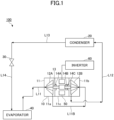
- the refrigerator 100 illustrated in FIG. 1 is used, for example, for air conditioning equipment, freezing equipment, and refrigeration equipment.
- the refrigerator 100 may be used for other equipment.
- the refrigerator 100 performs a refrigeration cycle.
- a refrigeration cycle of the refrigerator 100 is a vapor compression refrigeration cycle.
- the refrigerator 100 includes a centrifugal compressor 10, a condenser 20, an expansion valve 30, and an evaporator 40.
- the centrifugal compressor 10 is a turbo compressor.
- a refrigerant which is the working fluid of the refrigerator 100 is not particularly limited.
- the centrifugal compressor 10 compresses the refrigerant gas.
- the condenser 20 condenses the refrigerant gas compressed by the centrifugal compressor 10.
- the expansion valve 30 expands the refrigerant condensed by the condenser 20.
- the evaporator 40 evaporates the refrigerant expanded by the expansion valve 30.
- the refrigerant gas evaporated by the evaporator 40 is sucked into the centrifugal compressor 10.
- the centrifugal compressor 10 performs reversible adiabatic compression of the refrigerant gas.
- the refrigerant gas supplied to the condenser 20 releases heat at a constant pressure and liquifies.
- the liquefied refrigerant is irreversibly expanded at a constant enthalpy by the expansion valve 30, and a part of the refrigerant is evaporated.
- the refrigerant absorbs heat at a constant pressure in the evaporator 40.
- the refrigerator 100 includes pipes L11 to L14 through which the refrigerant flows.
- the pipe L11 is a suction pipe connecting the evaporator 40 and the centrifugal compressor 10.
- the pipe L12 connects the centrifugal compressor 10 and the condenser 20.
- the pipe L13 connects the condenser 20 and the expansion valve 30.
- the pipe L14 connects the expansion valve 30 and the evaporator 40.
- the refrigerant gas flows through the pipe L11 and is sucked into the centrifugal compressor 10.
- the refrigerant gas compressed by the centrifugal compressor 10 flows through the pipe L12 and is supplied to the condenser 20.
- the refrigerant liquid liquefied in the condenser 20 flows through the pipe L13 and flows into the expansion valve 30.
- the refrigerant expanded in the expansion valve 30 flows through the pipe L14 and is supplied to the evaporator 40.
- the refrigerant gas that has absorbed heat at the evaporator 40 flows through the pipe L11 and is supplied to the centrifugal compressor 10.
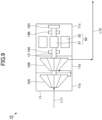
- the centrifugal compressor 10 is, for example, a two-stage compressor.
- the centrifugal compressor 10 may be a single-stage compressor.
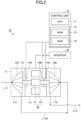
- the centrifugal compressor 10 includes a casing 11, impellers 12A and 12B, a drive shaft 13, bearings 14A and 14B, and a motor 50.
- the casing 11 accommodates impellers 12A and 12B, a drive shaft 13, bearings 14A and 14B, and a motor 50.
- the centrifugal compressor 10 has a back-to-back structure in which the backsides of the impellers 12A and 12B face each other.
- the centrifugal compressor 10 may have an in-line structure in which the impellers 12A and 12B are connected in the same direction.
- the casing 11 has a compression chamber 11a containing the impeller 12A, a compression chamber 11b containing the impeller 12B, and a motor chamber 11c containing the motor 50.
- the centrifugal compressor 10 includes a pipe L11B connecting the compression chamber 11a and the compression chamber 11b.
- the pipe L11B is a pipe for supplying the refrigerant gas discharged from the low-pressure compression chamber 11a to the high-pressure compression chamber 11b.
- the impellers 12A and 12B are provided at both ends of the drive shaft 13.
- the impeller 12A is provided at one end of the drive shaft 13, and the impeller 12B is provided at the other end of the drive shaft 13.
- the impellers 12A and 12B are arranged apart in the axial direction of the drive shaft 13.
- the drive shaft 13 includes a rotating shaft of the motor 50.
- the rotating shaft of the motor 50 includes a portion between the impeller 12A and the impeller 12B in the drive shaft 13.
- the bearings 14A and 14B rotatably support the drive shaft 13.
- the bearings 14A and 14B are fixed to the casing 11.
- the bearings 14A, 14B, and 14C are radial bearings and thrust bearings.
- the centrifugal compressor 10 includes a plurality of bearings 14A, 14B, and 14C.
- the bearings 14A, 14B, and 14C are oilless bearings, for example.
- the bearings 14A and 14B may be sliding bearings or rolling bearings.
- the bearings 14A, 14B, and 14C may be static pressure bearings. Oilless bearings do not require the supply of lubricating oil. Examples of oilless bearings include gas bearings, air bearings, foil bearings, and magnetic bearings.
- the bearings 14A, 14B, and 14C may be air bearings.
- the air bearings are a kind of static pressure bearings, and can support the load by blowing compressed air between the drive shaft 13 and the bearing surface to float the drive shaft 13 by air pressure.
- the bearings 14A and 14B may be gas bearings that float the drive shaft 13 by blowing compressed gas between the drive shaft 13 and the bearing surface.
- the gas bearings may be those that float the drive shaft 13 by blowing refrigerant gas as compressed gas.
- the bearings 14A, 14B, and 14C may be foil bearings which are a kind of pneumatic dynamic pressure bearings.
- the foil bearing has a thin film (foil) as a bearing surface.
- the thin film has low rigidity against bending, and has flexibility.
- the foil bearing supports the load by allowing the deflection of the foil.
- a fluid film air film
- the foil bearing supports the drive shaft 13 by using the foil and the fluid film.
- the foil bearing can form a bearing gap depending on the rotational speed of the drive shaft 13, the load of the drive shaft 13, the ambient temperature of the drive shaft 13, and other operating conditions due to the flexibility of the foil.
- the bearings 14A, 14B, and 14C may be magnetic bearings supporting the rotating shaft by utilizing magnetic attraction or repulsion.
- the bearings 14A, 14B, and 14C may be active magnetic bearings (AMB).
- AMB active magnetic bearings
- the bearings 14A and 14B may be radial magnetic bearings and the bearing 14C may be a thrust magnetic bearing.
- the radial magnetic bearing includes an electromagnet arranged around the drive shaft 13.
- the electromagnet has an iron core and a coil.
- the thrust magnetic bearing includes an axial disk projecting radially outward from the drive shaft 13 and an electromagnet arranged so as to face the axial disk in the axial direction.
- the centrifugal compressor 10 may include a touchdown bearing.
- the touchdown bearing is also referred to as an auxiliary bearing or a backup bearing.
- the touchdown bearing limits the movable range of the drive shaft 13.
- the touchdown bearing limits the movable range of the drive shaft 13 in the radial direction.
- the touchdown bearing can limit the movable range of the drive shaft 13 in the axial direction.
- the touchdown bearing can prevent the stator from contacting the rotor.
- the touchdown bearing can support the drive shaft 13 when the magnetic bearing is not energized.
- the active magnetic bearing can control the position of the drive shaft 13 so that the distance to the touchdown in the radial direction of the drive shaft 13 is greater than the distance to the touchdown in the axial direction of the drive shaft 13.
- the distance to the touchdown may be the distance until the drive shaft 13 contacts the touchdown bearing.
- the distance to the touchdown may be the movable range of the drive shaft 13.
- the distance to the touchdown may be the maximum movable range of the drive shaft 13.
- the centrifugal compressor 10 may include a control unit 70 capable of controlling the movable range of the drive shaft 13.
- the control unit 70 can control the current supplied to the coils of the bearings 14A, 14B, and 14C, which are active magnetic bearings.
- the control unit 70 can control the movable range in the radial direction and the movable range in the axial direction of the drive shaft 13 by controlling the current supplied to the coils.
- the control unit 70 can control the position of the drive shaft 13 so that the movable range in the radial direction of the drive shaft 13 is larger than the movable range in the axial direction of the drive shaft 13.
- the motor 50 is a driving source of the centrifugal compressor 10.
- the motor 50 has a rotor 51 and a stator 52.
- the rotor 51 is fixed to the drive shaft 13 and rotates with the drive shaft 13.
- the stator 52 is fixed to the casing 11 and is arranged around the rotor 51.
- the refrigerator 100 includes an inverter 60.
- the inverter 60 controls the rotational speed of the motor 50.
- the inverter 60 is a controller that controls the operating frequency of the motor 50.
- the rotational speed of the impellers 12A and 12B and the drive shaft 13 may be 30,000 rpm or more.
- the inverter 60 can change the rotational speed of the impellers 12A and 12B and the drive shaft 13 by controlling the operating frequency of the motor 50.
- the impellers 12A and 12B of the centrifugal compressor 10 rotate by receiving the rotational driving force of the motor 50. By rotating the impellers 12A and 12B, refrigerant gas is compressed.
- the impeller 12A is a low-pressure side impeller, and the impeller 12B is a high-pressure side impeller.
- the refrigerant gas compressed by the impeller 12A is supplied to the impeller 12B.
- the impeller 12B further compresses the refrigerant gas discharged from the impeller 12A.
- the control unit 70 includes a CPU 71 and a storage unit 72.
- the CPU (Central Processing Unit) 71 controls the overall processing in the refrigerator 100.
- the CPU 71 can control the rotational speed of the motor 50 via the inverter 60.
- the CPU 71 can control the opening and closing operation of the expansion valve 30.
- the storage unit 72 includes a ROM (Read Only Memory) 73 and a RAM (Random Access Memory) 74.
- the ROM 73 stores various programs for making the CPU 71 execute control processing and various kinds of data necessary for the operation of the refrigerator 100.
- the RAM 74 can temporarily store data and the like acquired from various sensors.
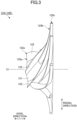
- the impeller 12A As illustrated in FIG. 3 , the impeller 12A has and a hub 121 and a blade 122 provided on the outer periphery of the hub 121.
- the hub 121 is connected to the end of the drive shaft 13.
- the hub 121 has a substantially conical shape whose diameter expands from the front to the rear.
- the hub 121 rotates integrally with the drive shaft 13.
- the inside of the hub 121 may be hollow except for the peripheral part of the shaft and the outer peripheral edge part from the viewpoint of weight reduction.
- the blades 122 project radially outward from the outer peripheral surface of the hub 121.
- the blades 122 are arranged spirally along the outer peripheral surface of the hub 121.
- the impeller 12B is the same as the impeller 12A, and a description thereof will be omitted.
- the movable range of the drive shaft 13 In the centrifugal compressor 10, the movable range of the drive shaft 13 in the radial direction is larger than the movable range of the drive shaft 13 in the axial direction.
- the movable range of the drive shaft 13 in the radial direction with respect to the bearings 14A, 14B, and 14C is larger than the movable range of the drive shaft 13 in the axial direction with respect to the bearings 14A, 14B, and 14C.
- the movable range of the drive shaft 13 may be the actual movable range of the drive shaft 13 or the movable range of the impellers 12A and 12B connected to the drive shaft 13.
- the movable range of the drive shaft 13 may be the movable range of the rotor 51 fixed to the drive shaft 13.
- the movable range of the drive shaft 13 may be the movable range of any one position or the average value of a plurality of positions.
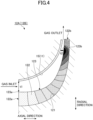
- FIG. 4 is a longitudinal sectional view illustrating the gap between the outer peripheral edges 123 of the impellers 12A and 12B and the inner wall 15 of the casing 11, and includes meridional sections of the impellers 12A and 12B.
- the blade tip gap t1 between the gas inlet side outer peripheral edge 123a of the blade 122 and the inner wall 15 of the casing 11 is larger than the blade tip gap t2 between the gas outlet side outer peripheral edge 123b of the blade 122 and the inner wall 15 of the casing 11.
- the blade tip gap t1 is an example of the first gap.
- the blade tip gap t2 is an example of the second gap.
- the outer peripheral edges 123a and 123b are the tips of the blades 122.
- the outer peripheral edges 123a and 123b are away from the outer peripheral surface of the hub 121 in the radial direction of the impellers 12A and 12B.
- the outer peripheral edges 123a and 123b are the ends of the impellers 12A and 12B in the radial direction.
- the gas inlet side is the small-diameter side of the hub 121
- the gas outlet side is the large-diameter side of the hub 121.
- the small-diameter side of the hub 121 is far from the motor 50 in the axial direction of the drive shaft 13, and the large-diameter side of the hub 121 is close to the motor 50 in the axial direction of the drive shaft 13.
- the blade tip gap t1 on the gas inlet side may be at least twice as large as the blade tip gap t2 on the gas outlet side.
- the blade tip gap t1 on the gas inlet side may be a blade tip gap at a position of the leading edge 122a close to the gas inlet, or a blade tip gap at a position behind the leading edge 122a in the axial direction.
- the blade tip gap t1 may be a position where the blade tip gap becomes maximum.
- the blade tip gap may be a distance between a curve representing the shape of the outer peripheral edge 123 and a curve representing the shape of the inner wall 15 of the casing 11 on the axially cut surfaces of the impellers 12A and 12B.
- the blade tip gap may be a length along a normal line with respect to the curve representing the shape of the outer peripheral edge 123.
- the blade tip gap t2 on the gas outlet side may be a blade tip gap at a position of the trailing edge 122b close to the gas outlet, or a blade tip gap at a position in front of the trailing edge 122b in the axial direction.
- the blade tip gap t2 on the gas outlet side may be a position where the blade tip gap is minimized.
- the blade tip gap t2 on the gas outlet side may be a blade tip gap at a position of 0.5 m or more and 1.0 m or less with respect to the meridional length m described later. Note that 0.5 m and 1.0 m mean lengths 0.5 and 1.0 times the meridional length m, respectively.
- the blade tip gap t2 may be a blade tip gap at a position of 0.6 m or more and 1.0 m or less with respect to the meridional length m, or a blade tip gap at a position of 0.75 m or more and 0.95 m or less.
- the blade tip gap t2 may be a blade tip gap at a position of, for example, 0.8 m with respect to the meridional length m, or a blade tip gap at a position of, for example, 0.9 m with respect to the meridional length m.
- FIG. 5 is a graph illustrating the relationship between meridional length and blade angle.
- the normalized meridional length is indicated on the horizontal axis
- the blade angle is indicated on the vertical axis.
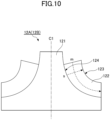
- the "meridional length” is the length defined on the meridional plane (see FIG. 10 , a diagram in which shapes of the blade shape being rotated and projected around the rotational axis C1 are superimposed, in a cross section along the rotational axis C1).
- the rotational axis C1 is the rotational axis of the drive shaft 13 and the rotational axis of the impellers 12A and 12B.
- the blade shape is the shape along the outer peripheral edge of the blade 122.
- the horizontal axis illustrated in FIG. 5 indicates the ratio (normalized value) of the meridional length when the total length is "m".
- the notation of "0” is the length corresponding to 0 times the meridional length m at the end of the gas inlet side and the position of the leading edge 122a of the blade 122
- the notation of "1” is the length corresponding to 1 times the meridional length m at the end of the gas outlet side and the position of the trailing edge 122b of the blade 122.
- FIGS. 6 to 9 The same applies to FIGS. 6 to 9 below.
- the minimum point ⁇ min of the blade angle ⁇ of the blade 122 is the value of the blade angle at a position existing in the latter half of the meridional length m of the blade 122.
- the latter half of the meridional length m is a portion of 0.5 m or more and 1.0 m or less.
- the minimum point ⁇ min of the blade angle ⁇ may be at a position of 0.6 m or more and 1.0 m or less.
- the minimum point ⁇ min of the blade angle ⁇ may be at a position of 0.75 m or more and 0.95 m or less.
- the minimum point ⁇ min of the blade angle ⁇ may be, for example, 0.8 m or 0.9 m.
- the notation of "r” is the length in the radial direction from the rotational axis C1 of the impellers 12A and 12B to the outer peripheral edge 123 of the blade 122.
- the notation of " ⁇ ” is the angle between the radial line segment connecting the outer peripheral edge 123a and the rotational axis C1 and the radial line segment connecting any point J on the outer peripheral edge 123 and the rotational axis C1 when viewed along the rotational axis C1.
- the notation of "m” is the meridional length.
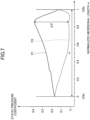
- FIG. 7 is a graph illustrating the relationship between meridional length and static pressure coefficient.
- the normalized meridional length m is indicated on the horizontal axis, and the static pressure coefficient is indicated on the vertical axis.
- FIG. 7 illustrates the static pressure coefficient P1 on the positive pressure surface of the blade 122 and the static pressure coefficient P2 on the negative pressure surface of the blade 122.
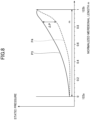
- FIG. 8 is a graph illustrating the static pressure distribution, which is the relationship between meridional length and static pressure.
- the normalized meridional length m is indicated on the horizontal axis
- the static pressure is indicated on the vertical axis.
- FIG. 8 illustrates the static pressure P3 on the positive pressure surface of the blade 122 and the static pressure P4 on the negative pressure surface of the blade 122.
- FIG. 10 is a diagram in which shapes of the blade shape being rotated and projected around the rotational axis C1 are superimposed, in a cross section along the rotational axis C1.
- the span direction S is the direction orthogonal to the direction along the meridional length m, and is the direction along the blade 122.
- the "span length s" is the length from the outer peripheral surface 124 of the hub 121 to the outer peripheral edge 123 of the blade 122 in the span direction S.
- the position where the span length s is 0 is the position on the outer peripheral surface 124 of the hub 121.
- the position where the span length s is 1 is the position on the outer peripheral edge 123.
- the position where the span length s is 0.5 s is the intermediate position between the outer peripheral surface 124 and the outer peripheral edge 123 of the hub 121.
- the position where the span length s exceeds 0.5 s is the position closer to the outer peripheral edge 123 than the position of 0.5 s.
- the minimum point ⁇ min of the blade angle ⁇ of the blade 122 exists in the latter half of the meridional length m of the blade 122.
- the minimum point ⁇ min of the blade angle ⁇ exists at a position of 0.5 s or more with respect to the span length s.
- the minimum point ⁇ min of the blade angle ⁇ may exist at a position of 0.9 s or more with respect to the span length s.
- the operation of the centrifugal compressor 10 will be described.
- the motor 50 is energized. Power is supplied to the motor 50, and the drive shaft 13 is driven to rotate. As the drive shaft 13 rotates, the impellers 12A and 12B rotate.
- the refrigerant gas flows into the compression chamber 11a from the pipe L11.
- the refrigerant gas in the compression chamber 11a is compressed and boosted by the rotation of the impeller 12A.
- the refrigerant gas flowing into the compression chamber 11a is compressed to an intermediate pressure, for example.
- the refrigerant gas compressed to an intermediate pressure passes through the pipe L11B and is supplied to the impeller 12B.
- the refrigerant gas in the pipe L11B is sucked into the compression chamber 11b with the rotation of the impeller 12B.
- the refrigerant gas in the compression chamber 11b is compressed and boosted by the rotation of the impeller 12B.
- the compressed refrigerant gas is discharged into the pipe L12.
- the refrigerant gas discharged from the centrifugal compressor 10 flows into the pipe L12 and flows into the condenser 20.
- the centrifugal compressor 10 includes, as illustrated in FIG. 3 , open-type impellers 12A and 12B having a hub 121 and a blade 122 provided on the outer periphery of the hub 121, a drive shaft 13 connected to the impellers 12A and 12B as illustrated in FIG. 1 , bearings 14A and 14B supporting the drive shaft 13, and a casing 11 covering the impellers 12A and 12B, wherein the movable range of the drive shaft 13 in the radial direction with respect to the bearings 14A and 14B is larger than the movable range of the drive shaft 13 with respect to the bearings 14A, 14B, and as illustrated in FIG.
- the blade tip gap t1 (first gap) between the gas inlet side outer peripheral edge 123a of the blade 122 and the inner wall 15 of the casing 11 is larger than the blade tip gap t2 (second gap) between the gas outlet side outer peripheral edge 123b of the blade 122 and the inner wall 15 of the casing 11.
- the blade tip gap t2 between the gas outlet side outer peripheral edge 123b of the blade 122 and the inner wall 15 of the casing 11 is narrower than the blade tip gap t1 between the gas inlet side outer peripheral edge 123a of the blade 122 and the inner wall 15 of the casing 11.
- the blade tip gap t2 which is narrower than the blade tip gap t1 on the inlet side where the pressure is lower, is formed on the outlet side where the pressure is higher.
- the leakage flow in the blade tip gap t2 between the outer peripheral edge 123b of the blade 122 and the inner wall 15 of the casing 11 can be reduced.
- the reduction in the operating efficiency of the centrifugal compressor 10 can be prevented by reducing the blade tip leakage.
- the minimum point of the blade angle ⁇ of the blade 122 exists in the latter half of the meridional length m of the blade 122.
- a compressor having an impeller of the latter half load of a blade load distribution can be realized.
- the contact between the outer peripheral edge 123a at the gas inlet side and the casing 11 can be prevented, and the occurrence of leakage flow in the blade tip gap can be reduced.
- the blade tip gap t1 on the gas inlet side is large, the separation of fluid on the negative pressure surface side can be prevented, and the occurrence of surging can be prevented. Further, because the impellers 12A and 12B are open impellers, they are easier to process than closed impellers.
- the blade load is high at the position where the blade angle ⁇ becomes the minimum point.
- the pressure difference between the positive pressure surface and the negative pressure surface of the blade 122 increases.
- the pressure difference between the positive pressure surface and the negative pressure surface of the blade 122 increases in the latter half part of the blade 122.
- the positive pressure surface is the surface with higher pressure among the surfaces facing the blade 122 in the thickness direction, and the negative pressure surface is the surface with lower pressure.
- the minimum point of blade angle ⁇ exists at a position of 0.6 m or more and 1.0 m or less with respect to meridional length m.
- the minimum point of blade angle ⁇ exists at a position of 0.5 s or more with respect to the span length s in the latter half of the blade 122.
- the position where the pressure difference between the positive pressure surface and the negative pressure surface of the blade 122 increases exists at a position of 0.5 s or more of the span length with respect to the span direction S.
- the leakage flow in the gap between the tip of the blade 122 and the casing can be reduced. As a result, the reduction in the operating efficiency of the centrifugal compressor 10 can be prevented.
- the minimum point of the blade angle ⁇ may exist at the latter half of the blade 122.
- the bearings 14A, 14B, and 14C may be air bearings. In the centrifugal compressor 10, the bearings 14A, 14B, and 14C may be foil bearings. In the centrifugal compressor 10, the bearings 14A and 14B may be active magnetic bearings. The centrifugal compressor 10 having such bearings 14A, 14B, and 14C can support the drive shaft 13 rotating at high speed. The bearings 14A and 14B can reduce the maintenance of the bearings 14A, 14B, and 14C.
- the bearings 14A, 14B, and 14C which are active magnetic bearings can control the position of the drive shaft 13 so that the distance to the touchdown in the radial direction of the drive shaft 13 is greater than the distance to the touchdown in the axial direction of the drive shaft 13.
- the rotational speed of the impellers 12A and 12B may be 30,000 rpm or more.
- the centrifugal compressor 10 can be used as a compressor equipped with a high-head impeller requiring high-speed rotation. In the centrifugal compressor 10, the rotational speed of the impellers 12A and 12B may be less than 30,000 rpm.
- centrifugal compressor 10 can tolerate large unsteady vibrations compared to the that of the conventional technology.
- the centrifugal compressor 10 can tolerate unsteady vibrations of the impellers 12A and 12B.
- the centrifugal compressor 10 can be used, for example, as an air-cooled high-pressure turbo compressor.
- the centrifugal compressor 10 can be used as a small-capacity compressor.
- Conventional centrifugal compressors are often used for high-capacity, low-differential compressors, but this type of the centrifugal compressor 10 can be used as a small-capacity, high-differential compressor.
- the centrifugal compressor 10 can be applied to applications other than the refrigerator 100.
- the internal fluid of the centrifugal compressor 10 is not limited to a refrigerant.
- One aspect of the present invention may be as follows.
Landscapes
- Engineering & Computer Science (AREA)
- Mechanical Engineering (AREA)
- General Engineering & Computer Science (AREA)
- Physics & Mathematics (AREA)
- Electromagnetism (AREA)
- Structures Of Non-Positive Displacement Pumps (AREA)
Applications Claiming Priority (2)
| Application Number | Priority Date | Filing Date | Title |
|---|---|---|---|
| JP2023058713 | 2023-03-31 | ||
| PCT/JP2024/013113 WO2024204746A1 (ja) | 2023-03-31 | 2024-03-29 | 遠心圧縮機 |
Publications (2)
| Publication Number | Publication Date |
|---|---|
| EP4538541A1 true EP4538541A1 (de) | 2025-04-16 |
| EP4538541A4 EP4538541A4 (de) | 2025-12-10 |
Family
ID=92905921
Family Applications (1)
| Application Number | Title | Priority Date | Filing Date |
|---|---|---|---|
| EP24780841.3A Pending EP4538541A4 (de) | 2023-03-31 | 2024-03-29 | Zentrifugalverdichter |
Country Status (4)
| Country | Link |
|---|---|
| EP (1) | EP4538541A4 (de) |
| JP (1) | JP7633579B2 (de) |
| CN (1) | CN121002287A (de) |
| WO (1) | WO2024204746A1 (de) |
Family Cites Families (10)
| Publication number | Priority date | Publication date | Assignee | Title |
|---|---|---|---|---|
| JP2008267278A (ja) * | 2007-04-20 | 2008-11-06 | Mitsubishi Heavy Ind Ltd | 遠心圧縮機 |
| JP5223779B2 (ja) * | 2009-05-29 | 2013-06-26 | 株式会社豊田中央研究所 | コンプレッサ及びこれを用いたターボチャージャ |
| JP2012149588A (ja) | 2011-01-20 | 2012-08-09 | Denso Corp | 内燃機関の制御装置 |
| JP6328877B2 (ja) * | 2012-12-25 | 2018-05-23 | 株式会社Ihi | 遠心式過給機 |
| DE102013201771A1 (de) * | 2013-02-04 | 2014-08-07 | Bosch Mahle Turbo Systems Gmbh & Co. Kg | Verdichter eines Abgasturboladers |
| CN110036208B (zh) | 2017-02-08 | 2021-05-28 | 三菱重工发动机和增压器株式会社 | 离心压缩机以及涡轮增压器 |
| JP2019132131A (ja) | 2018-01-29 | 2019-08-08 | パナソニックIpマネジメント株式会社 | 遠心圧縮機用インペラ |
| KR102532401B1 (ko) | 2018-04-26 | 2023-05-15 | 니뽄 다바코 산교 가부시키가이샤 | 히터 어셈블리 및 용기 |
| TWI696761B (zh) * | 2018-11-14 | 2020-06-21 | 財團法人工業技術研究院 | 磁浮離心式壓縮機及其控制方法 |
| JP7765166B2 (ja) * | 2019-03-28 | 2025-11-06 | ダイキン工業株式会社 | 遠心圧縮機 |
-
2024
- 2024-03-29 JP JP2024055206A patent/JP7633579B2/ja active Active
- 2024-03-29 EP EP24780841.3A patent/EP4538541A4/de active Pending
- 2024-03-29 WO PCT/JP2024/013113 patent/WO2024204746A1/ja not_active Ceased
- 2024-03-29 CN CN202480021978.8A patent/CN121002287A/zh active Pending
Also Published As
| Publication number | Publication date |
|---|---|
| CN121002287A (zh) | 2025-11-21 |
| JP7633579B2 (ja) | 2025-02-20 |
| EP4538541A4 (de) | 2025-12-10 |
| WO2024204746A1 (ja) | 2024-10-03 |
| JP2024146896A (ja) | 2024-10-15 |
Similar Documents
| Publication | Publication Date | Title |
|---|---|---|
| CN109477487B (zh) | 离心压缩机和用于离心压缩机的磁轴承备用系统 | |
| CN108779779B (zh) | 离心压缩机 | |
| US10072663B2 (en) | Variable-speed multi-stage refrigerant centrifugal compressor with diffusers | |
| US11698074B2 (en) | Turbo compressor and turbo chiller including the same | |
| US11781561B2 (en) | Compressor and chiller including the same | |
| JP2002005089A (ja) | ターボ形圧縮機及びそれを備えた冷凍装置 | |
| JP6687748B2 (ja) | チラーシステムにおいて使用されるエコノマイザ | |
| EP3704383A1 (de) | Zentrifugalverdichter mit dichtungslager | |
| EP4538541A1 (de) | Zentrifugalverdichter | |
| US20250020135A1 (en) | Turbomachine | |
| EP4403786A1 (de) | Gaslager für zentrifugalverdichter, zentrifugalverdichter und kühlsystem | |
| JP2020159294A (ja) | ターボ圧縮機及び冷凍サイクル装置 | |
| JP2026061596A (ja) | 回転機械、ターボ圧縮機、及び冷凍システム | |
| JP2026061434A (ja) | ターボ圧縮機および冷凍機 | |
| WO2020129326A1 (ja) | ターボ圧縮機及び冷凍サイクル装置 | |
| CN219067999U (zh) | 一种用于离心压缩机的转子系统及永磁同步电机 | |
| CN223203279U (zh) | 一种离心式压缩机 | |
| JP7393712B2 (ja) | 遠心式圧縮機および冷凍装置 | |
| US20220243966A1 (en) | Refrigerant compressor with impeller having dual splitter blade arrangement | |
| Tamaki et al. | Development of High-Efficiency Centrifugal Compressor for Turbo Chiller | |
| JP2002155896A (ja) | ターボ形圧縮機及びそれを備えた冷凍装置 | |
| WO2026024316A1 (en) | Refrigerant compressor including configuration of toroidal and centrifugal stages |
Legal Events
| Date | Code | Title | Description |
|---|---|---|---|
| STAA | Information on the status of an ep patent application or granted ep patent |
Free format text: STATUS: THE INTERNATIONAL PUBLICATION HAS BEEN MADE |
|
| PUAI | Public reference made under article 153(3) epc to a published international application that has entered the european phase |
Free format text: ORIGINAL CODE: 0009012 |
|
| STAA | Information on the status of an ep patent application or granted ep patent |
Free format text: STATUS: REQUEST FOR EXAMINATION WAS MADE |
|
| 17P | Request for examination filed |
Effective date: 20250110 |
|
| AK | Designated contracting states |
Kind code of ref document: A1 Designated state(s): AL AT BE BG CH CY CZ DE DK EE ES FI FR GB GR HR HU IE IS IT LI LT LU LV MC ME MK MT NL NO PL PT RO RS SE SI SK SM TR |
|
| P01 | Opt-out of the competence of the unified patent court (upc) registered |
Free format text: CASE NUMBER: UPC_APP_3794_4538541/2025 Effective date: 20250820 |
|
| A4 | Supplementary search report drawn up and despatched |
Effective date: 20251112 |
|
| RIC1 | Information provided on ipc code assigned before grant |
Ipc: F04D 29/66 20060101AFI20251106BHEP Ipc: F04D 29/058 20060101ALI20251106BHEP Ipc: F04D 29/28 20060101ALI20251106BHEP Ipc: F04D 29/30 20060101ALI20251106BHEP |