EP4538410A1 - Zn-al-mg hot-dip plated steel sheet - Google Patents
Zn-al-mg hot-dip plated steel sheet Download PDFInfo
- Publication number
- EP4538410A1 EP4538410A1 EP23819914.5A EP23819914A EP4538410A1 EP 4538410 A1 EP4538410 A1 EP 4538410A1 EP 23819914 A EP23819914 A EP 23819914A EP 4538410 A1 EP4538410 A1 EP 4538410A1
- Authority
- EP
- European Patent Office
- Prior art keywords
- hot
- phase
- dip plated
- plated layer
- steel sheet
- Prior art date
- Legal status (The legal status is an assumption and is not a legal conclusion. Google has not performed a legal analysis and makes no representation as to the accuracy of the status listed.)
- Pending
Links
Images
Classifications
-
- C—CHEMISTRY; METALLURGY
- C23—COATING METALLIC MATERIAL; COATING MATERIAL WITH METALLIC MATERIAL; CHEMICAL SURFACE TREATMENT; DIFFUSION TREATMENT OF METALLIC MATERIAL; COATING BY VACUUM EVAPORATION, BY SPUTTERING, BY ION IMPLANTATION OR BY CHEMICAL VAPOUR DEPOSITION, IN GENERAL; INHIBITING CORROSION OF METALLIC MATERIAL OR INCRUSTATION IN GENERAL
- C23C—COATING METALLIC MATERIAL; COATING MATERIAL WITH METALLIC MATERIAL; SURFACE TREATMENT OF METALLIC MATERIAL BY DIFFUSION INTO THE SURFACE, BY CHEMICAL CONVERSION OR SUBSTITUTION; COATING BY VACUUM EVAPORATION, BY SPUTTERING, BY ION IMPLANTATION OR BY CHEMICAL VAPOUR DEPOSITION, IN GENERAL
- C23C2/00—Hot-dipping or immersion processes for applying the coating material in the molten state without affecting the shape; Apparatus therefor
- C23C2/04—Hot-dipping or immersion processes for applying the coating material in the molten state without affecting the shape; Apparatus therefor characterised by the coating material
- C23C2/06—Zinc or cadmium or alloys based thereon
-
- B—PERFORMING OPERATIONS; TRANSPORTING
- B32—LAYERED PRODUCTS
- B32B—LAYERED PRODUCTS, i.e. PRODUCTS BUILT-UP OF STRATA OF FLAT OR NON-FLAT, e.g. CELLULAR OR HONEYCOMB, FORM
- B32B15/00—Layered products comprising a layer of metal
- B32B15/01—Layered products comprising a layer of metal all layers being exclusively metallic
-
- B—PERFORMING OPERATIONS; TRANSPORTING
- B32—LAYERED PRODUCTS
- B32B—LAYERED PRODUCTS, i.e. PRODUCTS BUILT-UP OF STRATA OF FLAT OR NON-FLAT, e.g. CELLULAR OR HONEYCOMB, FORM
- B32B15/00—Layered products comprising a layer of metal
- B32B15/01—Layered products comprising a layer of metal all layers being exclusively metallic
- B32B15/012—Layered products comprising a layer of metal all layers being exclusively metallic one layer being formed of an iron alloy or steel, another layer being formed of aluminium or an aluminium alloy
-
- B—PERFORMING OPERATIONS; TRANSPORTING
- B32—LAYERED PRODUCTS
- B32B—LAYERED PRODUCTS, i.e. PRODUCTS BUILT-UP OF STRATA OF FLAT OR NON-FLAT, e.g. CELLULAR OR HONEYCOMB, FORM
- B32B15/00—Layered products comprising a layer of metal
- B32B15/01—Layered products comprising a layer of metal all layers being exclusively metallic
- B32B15/013—Layered products comprising a layer of metal all layers being exclusively metallic one layer being formed of an iron alloy or steel, another layer being formed of a metal other than iron or aluminium
-
- B—PERFORMING OPERATIONS; TRANSPORTING
- B32—LAYERED PRODUCTS
- B32B—LAYERED PRODUCTS, i.e. PRODUCTS BUILT-UP OF STRATA OF FLAT OR NON-FLAT, e.g. CELLULAR OR HONEYCOMB, FORM
- B32B15/00—Layered products comprising a layer of metal
- B32B15/04—Layered products comprising a layer of metal comprising metal as the main or only constituent of a layer, which is next to another layer of the same or of a different material
-
- B—PERFORMING OPERATIONS; TRANSPORTING
- B32—LAYERED PRODUCTS
- B32B—LAYERED PRODUCTS, i.e. PRODUCTS BUILT-UP OF STRATA OF FLAT OR NON-FLAT, e.g. CELLULAR OR HONEYCOMB, FORM
- B32B15/00—Layered products comprising a layer of metal
- B32B15/04—Layered products comprising a layer of metal comprising metal as the main or only constituent of a layer, which is next to another layer of the same or of a different material
- B32B15/043—Layered products comprising a layer of metal comprising metal as the main or only constituent of a layer, which is next to another layer of the same or of a different material of metal
-
- B—PERFORMING OPERATIONS; TRANSPORTING
- B32—LAYERED PRODUCTS
- B32B—LAYERED PRODUCTS, i.e. PRODUCTS BUILT-UP OF STRATA OF FLAT OR NON-FLAT, e.g. CELLULAR OR HONEYCOMB, FORM
- B32B15/00—Layered products comprising a layer of metal
- B32B15/18—Layered products comprising a layer of metal comprising iron or steel
-
- C—CHEMISTRY; METALLURGY
- C22—METALLURGY; FERROUS OR NON-FERROUS ALLOYS; TREATMENT OF ALLOYS OR NON-FERROUS METALS
- C22C—ALLOYS
- C22C18/00—Alloys based on zinc
-
- C—CHEMISTRY; METALLURGY
- C22—METALLURGY; FERROUS OR NON-FERROUS ALLOYS; TREATMENT OF ALLOYS OR NON-FERROUS METALS
- C22C—ALLOYS
- C22C18/00—Alloys based on zinc
- C22C18/04—Alloys based on zinc with aluminium as the next major constituent
-
- C—CHEMISTRY; METALLURGY
- C23—COATING METALLIC MATERIAL; COATING MATERIAL WITH METALLIC MATERIAL; CHEMICAL SURFACE TREATMENT; DIFFUSION TREATMENT OF METALLIC MATERIAL; COATING BY VACUUM EVAPORATION, BY SPUTTERING, BY ION IMPLANTATION OR BY CHEMICAL VAPOUR DEPOSITION, IN GENERAL; INHIBITING CORROSION OF METALLIC MATERIAL OR INCRUSTATION IN GENERAL
- C23C—COATING METALLIC MATERIAL; COATING MATERIAL WITH METALLIC MATERIAL; SURFACE TREATMENT OF METALLIC MATERIAL BY DIFFUSION INTO THE SURFACE, BY CHEMICAL CONVERSION OR SUBSTITUTION; COATING BY VACUUM EVAPORATION, BY SPUTTERING, BY ION IMPLANTATION OR BY CHEMICAL VAPOUR DEPOSITION, IN GENERAL
- C23C2/00—Hot-dipping or immersion processes for applying the coating material in the molten state without affecting the shape; Apparatus therefor
- C23C2/02—Pretreatment of the material to be coated, e.g. for coating on selected surface areas
-
- C—CHEMISTRY; METALLURGY
- C23—COATING METALLIC MATERIAL; COATING MATERIAL WITH METALLIC MATERIAL; CHEMICAL SURFACE TREATMENT; DIFFUSION TREATMENT OF METALLIC MATERIAL; COATING BY VACUUM EVAPORATION, BY SPUTTERING, BY ION IMPLANTATION OR BY CHEMICAL VAPOUR DEPOSITION, IN GENERAL; INHIBITING CORROSION OF METALLIC MATERIAL OR INCRUSTATION IN GENERAL
- C23C—COATING METALLIC MATERIAL; COATING MATERIAL WITH METALLIC MATERIAL; SURFACE TREATMENT OF METALLIC MATERIAL BY DIFFUSION INTO THE SURFACE, BY CHEMICAL CONVERSION OR SUBSTITUTION; COATING BY VACUUM EVAPORATION, BY SPUTTERING, BY ION IMPLANTATION OR BY CHEMICAL VAPOUR DEPOSITION, IN GENERAL
- C23C2/00—Hot-dipping or immersion processes for applying the coating material in the molten state without affecting the shape; Apparatus therefor
- C23C2/02—Pretreatment of the material to be coated, e.g. for coating on selected surface areas
- C23C2/024—Pretreatment of the material to be coated, e.g. for coating on selected surface areas by cleaning or etching
-
- C—CHEMISTRY; METALLURGY
- C23—COATING METALLIC MATERIAL; COATING MATERIAL WITH METALLIC MATERIAL; CHEMICAL SURFACE TREATMENT; DIFFUSION TREATMENT OF METALLIC MATERIAL; COATING BY VACUUM EVAPORATION, BY SPUTTERING, BY ION IMPLANTATION OR BY CHEMICAL VAPOUR DEPOSITION, IN GENERAL; INHIBITING CORROSION OF METALLIC MATERIAL OR INCRUSTATION IN GENERAL
- C23C—COATING METALLIC MATERIAL; COATING MATERIAL WITH METALLIC MATERIAL; SURFACE TREATMENT OF METALLIC MATERIAL BY DIFFUSION INTO THE SURFACE, BY CHEMICAL CONVERSION OR SUBSTITUTION; COATING BY VACUUM EVAPORATION, BY SPUTTERING, BY ION IMPLANTATION OR BY CHEMICAL VAPOUR DEPOSITION, IN GENERAL
- C23C2/00—Hot-dipping or immersion processes for applying the coating material in the molten state without affecting the shape; Apparatus therefor
- C23C2/02—Pretreatment of the material to be coated, e.g. for coating on selected surface areas
- C23C2/026—Deposition of sublayers, e.g. adhesion layers or pre-applied alloying elements or corrosion protection
-
- C—CHEMISTRY; METALLURGY
- C23—COATING METALLIC MATERIAL; COATING MATERIAL WITH METALLIC MATERIAL; CHEMICAL SURFACE TREATMENT; DIFFUSION TREATMENT OF METALLIC MATERIAL; COATING BY VACUUM EVAPORATION, BY SPUTTERING, BY ION IMPLANTATION OR BY CHEMICAL VAPOUR DEPOSITION, IN GENERAL; INHIBITING CORROSION OF METALLIC MATERIAL OR INCRUSTATION IN GENERAL
- C23C—COATING METALLIC MATERIAL; COATING MATERIAL WITH METALLIC MATERIAL; SURFACE TREATMENT OF METALLIC MATERIAL BY DIFFUSION INTO THE SURFACE, BY CHEMICAL CONVERSION OR SUBSTITUTION; COATING BY VACUUM EVAPORATION, BY SPUTTERING, BY ION IMPLANTATION OR BY CHEMICAL VAPOUR DEPOSITION, IN GENERAL
- C23C2/00—Hot-dipping or immersion processes for applying the coating material in the molten state without affecting the shape; Apparatus therefor
- C23C2/04—Hot-dipping or immersion processes for applying the coating material in the molten state without affecting the shape; Apparatus therefor characterised by the coating material
-
- C—CHEMISTRY; METALLURGY
- C23—COATING METALLIC MATERIAL; COATING MATERIAL WITH METALLIC MATERIAL; CHEMICAL SURFACE TREATMENT; DIFFUSION TREATMENT OF METALLIC MATERIAL; COATING BY VACUUM EVAPORATION, BY SPUTTERING, BY ION IMPLANTATION OR BY CHEMICAL VAPOUR DEPOSITION, IN GENERAL; INHIBITING CORROSION OF METALLIC MATERIAL OR INCRUSTATION IN GENERAL
- C23C—COATING METALLIC MATERIAL; COATING MATERIAL WITH METALLIC MATERIAL; SURFACE TREATMENT OF METALLIC MATERIAL BY DIFFUSION INTO THE SURFACE, BY CHEMICAL CONVERSION OR SUBSTITUTION; COATING BY VACUUM EVAPORATION, BY SPUTTERING, BY ION IMPLANTATION OR BY CHEMICAL VAPOUR DEPOSITION, IN GENERAL
- C23C2/00—Hot-dipping or immersion processes for applying the coating material in the molten state without affecting the shape; Apparatus therefor
- C23C2/14—Removing excess of molten coatings; Controlling or regulating the coating thickness
- C23C2/16—Removing excess of molten coatings; Controlling or regulating the coating thickness using fluids under pressure, e.g. air knives
-
- C—CHEMISTRY; METALLURGY
- C23—COATING METALLIC MATERIAL; COATING MATERIAL WITH METALLIC MATERIAL; CHEMICAL SURFACE TREATMENT; DIFFUSION TREATMENT OF METALLIC MATERIAL; COATING BY VACUUM EVAPORATION, BY SPUTTERING, BY ION IMPLANTATION OR BY CHEMICAL VAPOUR DEPOSITION, IN GENERAL; INHIBITING CORROSION OF METALLIC MATERIAL OR INCRUSTATION IN GENERAL
- C23C—COATING METALLIC MATERIAL; COATING MATERIAL WITH METALLIC MATERIAL; SURFACE TREATMENT OF METALLIC MATERIAL BY DIFFUSION INTO THE SURFACE, BY CHEMICAL CONVERSION OR SUBSTITUTION; COATING BY VACUUM EVAPORATION, BY SPUTTERING, BY ION IMPLANTATION OR BY CHEMICAL VAPOUR DEPOSITION, IN GENERAL
- C23C2/00—Hot-dipping or immersion processes for applying the coating material in the molten state without affecting the shape; Apparatus therefor
- C23C2/26—After-treatment
-
- C—CHEMISTRY; METALLURGY
- C23—COATING METALLIC MATERIAL; COATING MATERIAL WITH METALLIC MATERIAL; CHEMICAL SURFACE TREATMENT; DIFFUSION TREATMENT OF METALLIC MATERIAL; COATING BY VACUUM EVAPORATION, BY SPUTTERING, BY ION IMPLANTATION OR BY CHEMICAL VAPOUR DEPOSITION, IN GENERAL; INHIBITING CORROSION OF METALLIC MATERIAL OR INCRUSTATION IN GENERAL
- C23C—COATING METALLIC MATERIAL; COATING MATERIAL WITH METALLIC MATERIAL; SURFACE TREATMENT OF METALLIC MATERIAL BY DIFFUSION INTO THE SURFACE, BY CHEMICAL CONVERSION OR SUBSTITUTION; COATING BY VACUUM EVAPORATION, BY SPUTTERING, BY ION IMPLANTATION OR BY CHEMICAL VAPOUR DEPOSITION, IN GENERAL
- C23C2/00—Hot-dipping or immersion processes for applying the coating material in the molten state without affecting the shape; Apparatus therefor
- C23C2/26—After-treatment
- C23C2/28—Thermal after-treatment, e.g. treatment in oil bath
-
- C—CHEMISTRY; METALLURGY
- C23—COATING METALLIC MATERIAL; COATING MATERIAL WITH METALLIC MATERIAL; CHEMICAL SURFACE TREATMENT; DIFFUSION TREATMENT OF METALLIC MATERIAL; COATING BY VACUUM EVAPORATION, BY SPUTTERING, BY ION IMPLANTATION OR BY CHEMICAL VAPOUR DEPOSITION, IN GENERAL; INHIBITING CORROSION OF METALLIC MATERIAL OR INCRUSTATION IN GENERAL
- C23C—COATING METALLIC MATERIAL; COATING MATERIAL WITH METALLIC MATERIAL; SURFACE TREATMENT OF METALLIC MATERIAL BY DIFFUSION INTO THE SURFACE, BY CHEMICAL CONVERSION OR SUBSTITUTION; COATING BY VACUUM EVAPORATION, BY SPUTTERING, BY ION IMPLANTATION OR BY CHEMICAL VAPOUR DEPOSITION, IN GENERAL
- C23C2/00—Hot-dipping or immersion processes for applying the coating material in the molten state without affecting the shape; Apparatus therefor
- C23C2/34—Hot-dipping or immersion processes for applying the coating material in the molten state without affecting the shape; Apparatus therefor characterised by the shape of the material to be treated
- C23C2/36—Elongated material
- C23C2/40—Plates; Strips
-
- C—CHEMISTRY; METALLURGY
- C23—COATING METALLIC MATERIAL; COATING MATERIAL WITH METALLIC MATERIAL; CHEMICAL SURFACE TREATMENT; DIFFUSION TREATMENT OF METALLIC MATERIAL; COATING BY VACUUM EVAPORATION, BY SPUTTERING, BY ION IMPLANTATION OR BY CHEMICAL VAPOUR DEPOSITION, IN GENERAL; INHIBITING CORROSION OF METALLIC MATERIAL OR INCRUSTATION IN GENERAL
- C23C—COATING METALLIC MATERIAL; COATING MATERIAL WITH METALLIC MATERIAL; SURFACE TREATMENT OF METALLIC MATERIAL BY DIFFUSION INTO THE SURFACE, BY CHEMICAL CONVERSION OR SUBSTITUTION; COATING BY VACUUM EVAPORATION, BY SPUTTERING, BY ION IMPLANTATION OR BY CHEMICAL VAPOUR DEPOSITION, IN GENERAL
- C23C30/00—Coating with metallic material characterised only by the composition of the metallic material, i.e. not characterised by the coating process
-
- C—CHEMISTRY; METALLURGY
- C23—COATING METALLIC MATERIAL; COATING MATERIAL WITH METALLIC MATERIAL; CHEMICAL SURFACE TREATMENT; DIFFUSION TREATMENT OF METALLIC MATERIAL; COATING BY VACUUM EVAPORATION, BY SPUTTERING, BY ION IMPLANTATION OR BY CHEMICAL VAPOUR DEPOSITION, IN GENERAL; INHIBITING CORROSION OF METALLIC MATERIAL OR INCRUSTATION IN GENERAL
- C23C—COATING METALLIC MATERIAL; COATING MATERIAL WITH METALLIC MATERIAL; SURFACE TREATMENT OF METALLIC MATERIAL BY DIFFUSION INTO THE SURFACE, BY CHEMICAL CONVERSION OR SUBSTITUTION; COATING BY VACUUM EVAPORATION, BY SPUTTERING, BY ION IMPLANTATION OR BY CHEMICAL VAPOUR DEPOSITION, IN GENERAL
- C23C30/00—Coating with metallic material characterised only by the composition of the metallic material, i.e. not characterised by the coating process
- C23C30/005—Coating with metallic material characterised only by the composition of the metallic material, i.e. not characterised by the coating process on hard metal substrates
-
- Y—GENERAL TAGGING OF NEW TECHNOLOGICAL DEVELOPMENTS; GENERAL TAGGING OF CROSS-SECTIONAL TECHNOLOGIES SPANNING OVER SEVERAL SECTIONS OF THE IPC; TECHNICAL SUBJECTS COVERED BY FORMER USPC CROSS-REFERENCE ART COLLECTIONS [XRACs] AND DIGESTS
- Y10—TECHNICAL SUBJECTS COVERED BY FORMER USPC
- Y10T—TECHNICAL SUBJECTS COVERED BY FORMER US CLASSIFICATION
- Y10T428/00—Stock material or miscellaneous articles
- Y10T428/12—All metal or with adjacent metals
- Y10T428/12493—Composite; i.e., plural, adjacent, spatially distinct metal components [e.g., layers, joint, etc.]
- Y10T428/12771—Transition metal-base component
- Y10T428/12785—Group IIB metal-base component
- Y10T428/12792—Zn-base component
- Y10T428/12799—Next to Fe-base component [e.g., galvanized]
-
- Y—GENERAL TAGGING OF NEW TECHNOLOGICAL DEVELOPMENTS; GENERAL TAGGING OF CROSS-SECTIONAL TECHNOLOGIES SPANNING OVER SEVERAL SECTIONS OF THE IPC; TECHNICAL SUBJECTS COVERED BY FORMER USPC CROSS-REFERENCE ART COLLECTIONS [XRACs] AND DIGESTS
- Y10—TECHNICAL SUBJECTS COVERED BY FORMER USPC
- Y10T—TECHNICAL SUBJECTS COVERED BY FORMER US CLASSIFICATION
- Y10T428/00—Stock material or miscellaneous articles
- Y10T428/12—All metal or with adjacent metals
- Y10T428/12493—Composite; i.e., plural, adjacent, spatially distinct metal components [e.g., layers, joint, etc.]
- Y10T428/12771—Transition metal-base component
- Y10T428/12861—Group VIII or IB metal-base component
- Y10T428/12951—Fe-base component
-
- Y—GENERAL TAGGING OF NEW TECHNOLOGICAL DEVELOPMENTS; GENERAL TAGGING OF CROSS-SECTIONAL TECHNOLOGIES SPANNING OVER SEVERAL SECTIONS OF THE IPC; TECHNICAL SUBJECTS COVERED BY FORMER USPC CROSS-REFERENCE ART COLLECTIONS [XRACs] AND DIGESTS
- Y10—TECHNICAL SUBJECTS COVERED BY FORMER USPC
- Y10T—TECHNICAL SUBJECTS COVERED BY FORMER US CLASSIFICATION
- Y10T428/00—Stock material or miscellaneous articles
- Y10T428/12—All metal or with adjacent metals
- Y10T428/12493—Composite; i.e., plural, adjacent, spatially distinct metal components [e.g., layers, joint, etc.]
- Y10T428/12771—Transition metal-base component
- Y10T428/12861—Group VIII or IB metal-base component
- Y10T428/12951—Fe-base component
- Y10T428/12972—Containing 0.01-1.7% carbon [i.e., steel]
-
- Y—GENERAL TAGGING OF NEW TECHNOLOGICAL DEVELOPMENTS; GENERAL TAGGING OF CROSS-SECTIONAL TECHNOLOGIES SPANNING OVER SEVERAL SECTIONS OF THE IPC; TECHNICAL SUBJECTS COVERED BY FORMER USPC CROSS-REFERENCE ART COLLECTIONS [XRACs] AND DIGESTS
- Y10—TECHNICAL SUBJECTS COVERED BY FORMER USPC
- Y10T—TECHNICAL SUBJECTS COVERED BY FORMER US CLASSIFICATION
- Y10T428/00—Stock material or miscellaneous articles
- Y10T428/12—All metal or with adjacent metals
- Y10T428/12493—Composite; i.e., plural, adjacent, spatially distinct metal components [e.g., layers, joint, etc.]
- Y10T428/12771—Transition metal-base component
- Y10T428/12861—Group VIII or IB metal-base component
- Y10T428/12951—Fe-base component
- Y10T428/12972—Containing 0.01-1.7% carbon [i.e., steel]
- Y10T428/12979—Containing more than 10% nonferrous elements [e.g., high alloy, stainless]
-
- Y—GENERAL TAGGING OF NEW TECHNOLOGICAL DEVELOPMENTS; GENERAL TAGGING OF CROSS-SECTIONAL TECHNOLOGIES SPANNING OVER SEVERAL SECTIONS OF THE IPC; TECHNICAL SUBJECTS COVERED BY FORMER USPC CROSS-REFERENCE ART COLLECTIONS [XRACs] AND DIGESTS
- Y10—TECHNICAL SUBJECTS COVERED BY FORMER USPC
- Y10T—TECHNICAL SUBJECTS COVERED BY FORMER US CLASSIFICATION
- Y10T428/00—Stock material or miscellaneous articles
- Y10T428/24—Structurally defined web or sheet [e.g., overall dimension, etc.]
- Y10T428/24942—Structurally defined web or sheet [e.g., overall dimension, etc.] including components having same physical characteristic in differing degree
- Y10T428/2495—Thickness [relative or absolute]
Definitions
- the present invention relates to a Zn-Al-Mg-based hot-dip plated steel sheet having a lustrous external appearance.
- a hot-dip plated steel sheet is used as a steel sheet having good corrosion resistance.
- a hot-dip galvanized steel sheet which is a representative example of the hot-dip plated steel sheet, is widely used in various manufacturing industries such as the fields of automobiles, home appliances, and building materials.
- a highly corrosion-resistant hot-dip galvanized steel sheet obtained by incorporating Al or Mg into a hot-dip galvanized layer has been proposed for the purpose of further improving the corrosion resistance of the hot-dip galvanized steel sheet.
- Patent Documents 1 to 3 propose a Zn-Al-Mg-based hot-dip plated steel sheet.
- the Zn-Al-Mg-based hot-dip plated steel sheet mainly contains four types of phases and microstructures of an [Al phase], a [Zn phase], a [MgZn 2 phase], and an [Al/MgZn 2 /Zn ternary eutectic structure] in the hot-dip plated layer.
- Si is contained in the hot-dip plated layer in addition to Zn, Al, and Mg
- mainly five types of phases and microstructures including a [Mg 2 Si phase] are contained in addition to the above four types of phases and microstructures.
- the surface of the hot-dip plated layer has a satin-like external appearance.
- a Zn-Al-Mg-based hot-dip plated steel sheet is widely used in various manufacturing industries such as the fields of automobiles, home appliances, and building materials.
- a Zn-Al-Mg-based hot-dip plated steel sheet is required to have an external appearance with stronger metallic luster.
- the present invention has been made in view of the above circumstances, and an object of the present invention is to provide a Zn-Al-Mg-based hot-dip plated steel sheet in which the metallic luster of the surface of a hot-dip plated layer is excellent as compared with the related art, and corrosion resistance is also excellent.
- the present invention adopts the following configurations.
- the present invention it is possible to provide a Zn-Al-Mg-based hot-dip plated steel sheet in which the metallic luster of a surface of a hot-dip plated layer is excellent as compared with the related art, and corrosion resistance is also excellent.
- the present inventors investigated in detail a plated layer of a conventional Zn-Al-Mg-based hot-dip plated steel sheet having a satin-like external appearance.
- the satin-like external appearance appears due to coexistence of a fine lustrous portion exhibiting metallic luster and a fine white portion exhibiting white in a mixed state.
- the microstructure of the plated layer in the lustrous portion was examined, it was found that the area fraction of a [Zn phase] on the surface of the plated layer is smaller than that in the white portion.
- the present inventors intensively studied in order to obtain a lustrous external appearance as a whole by increasing the lustrous portion and decreasing the white portion in the hot-dip plated layer, and found that the surface external appearance of the plated layer exhibits metallic luster as a whole by adjusting the chemical composition of the hot-dip plated layer and decreasing the proportion of the [Zn phase].
- the present inventors found that when the ratio of the [Zn phase] to the total of the [Al/MgZn 2 /Zn ternary eutectic structure] and the [Zn phase] is reduced in the entire plated layer, the external appearance of the plated layer exhibits more metallic luster.
- the Zn-Al-Mg-based hot-dip plated steel sheet of the present embodiment includes a steel sheet and a hot-dip plated layer formed on a surface of the steel sheet, in which the hot-dip plated layer contains, as an average composition, Al: more than 10 to 22 mass% and Mg: 1.0 to 10 mass%, with a remainder including Zn and impurities, and in a case where a 5 mm square cross section parallel to a surface of the plated layer is exposed at any position of a 3t/4 position, a t/2 position, and a t/4 position from the surface of the hot-dip plated layer with a thickness of the hot-dip plated layer represented by t, an area fraction of a [Zn phase] of a plating microstructure in at least one of the cross sections is less than 20%.
- the 5 mm square cross section parallel to a surface of the plated layer refers to a square-shaped exposed surface that is parallel to the surface and has a 5 mm square size in plane view.
- the hot-dip plated layer may contain one or two selected from the group consisting of group A and group B below.
- the content of Al is in the range of more than 10 mass% and 22 mass% or less as an average composition.
- Al is an element necessary for ensuring corrosion resistance.
- the content of Al in the hot-dip plated layer is 10 mass% or less, the effect of improving corrosion resistance becomes insufficient, and when the content exceeds 22 mass%, corrosion resistance is deteriorated although the cause is unknown.
- the content is preferably set to more than 10 mass% and 20 mass% or less.
- the content is more preferably set to more than 10 mass% and 18 mass% or less.
- the content is more preferably set to 11 mass% or more.
- the content is more preferably set to 19 mass% or less.
- the content of Mg is in the range of 1.0 to 10 mass% as an average composition.
- Mg is an element necessary for improving the corrosion resistance of the hot-dip plated layer.
- the content is preferably set to 1.5 mass% or more from the viewpoint of balance between the corrosion resistance and the occurrence of dross.
- the content is preferably set to 8 mass% or less.
- the content is more preferably set to 2 mass% or more.
- the content is more preferably set to 6 mass% or less.
- the hot-dip plated layer may contain Si in the range of 0.0001 to 2 mass%.
- Si is an element effective for improving the adhesion of the hot-dip plated layer.
- Si is incorporated in an amount of 0.0001 mass% or more, an effect of improving adhesion is exhibited, and therefore Si is preferably incorporated in an amount of 0.0001 mass% or more.
- the content of Si is set to 2 mass% or less. From the viewpoint of plating adhesion, the content may be set to 0.01 mass% or more, or 1 mass% or less. The content may be set to 0.03 mass% or more, or 0.8 mass% or more.
- the composition of the hot-dip plated layer can be measured by the following method. First, the surface layer coating film is removed with a coating film remover (for example, NEOREVER SP-751 manufactured by SANSAIKAKO) that does not erode plating, then the hot-dip plated layer is dissolved with hydrochloric acid containing an inhibitor (for example, HIBIRON manufactured by Sugimura Chemical Industry Co., Ltd.), and the obtained solution is subjected to inductively coupled plasma (ICP) optical emission spectroscopy, whereby the composition can be determined.
- a coating film remover for example, NEOREVER SP-751 manufactured by SANSAIKAKO
- hydrochloric acid containing an inhibitor for example, HIBIRON manufactured by Sugimura Chemical Industry Co., Ltd.
- microstructure of the hot-dip plated layer may have, for example, the following microstructure.
- the hot-dip plated layer containing Al, Mg, and Zn contains an [Al phase], a [MgZn 2 phase], and a [Zn phase], and an [Al/Zn/MgZn 2 ternary eutectic structure]. Specifically, it has a form in which an [Al phase], a [MgZn 2 phase], and a [Zn phase] are contained in the matrix of an [Al/Zn/MgZn 2 ternary eutectic structure]. When Si is incorporated, a [Mg 2 Si phase] may be contained in the matrix of an [Al/Zn/MgZn 2 ternary eutectic structure].
- the [Al/Zn/MgZn 2 ternary eutectic structure] is a ternary eutectic structure of an Al phase, a Zn phase, and an intermetallic compound MgZn 2 phase, and the Al phase forming the ternary eutectic structure corresponds to, for example, an "Al" phase” (which is an Al solid solution in which Zn is solid-dissolved and contains a small amount of Mg) at a high temperature in an Al-Zn-Mg ternary equilibrium phase diagram.
- the Al" phase at a high temperature usually appears separated into a fine Al phase and a fine Zn phase at normal temperature.
- the Zn phase in the ternary eutectic structure is a Zn solid solution in which a small amount of Al is solid-dissolved, and in some cases, further a small amount of Mg is solid-dissolved.
- the MgZn 2 phase in the ternary eutectic structure is an intermetallic compound phase present in the vicinity of Zn: about 84 mass% in a Zn-Mg binary equilibrium phase diagram.
- the phase diagram it is considered that another additive element is not solid-dissolved in each phase, or even if an additive element is solid-dissolved, the amount of the additive element is extremely small.
- the ternary eutectic structure formed of these three phases is represented by an [Al/Zn/MgZn 2 ternary eutectic structure] in the present specification.
- the [Al phase] is a phase that looks like an island with a clear boundary in the matrix of the [Al/Zn/MgZn 2 ternary eutectic structure], and this corresponds to, for example, an "Al" phase" (which is an Al solid solution in which Zn is solid-dissolved and contains a small amount of Mg) at a high temperature in an Al-Zn-Mg ternary equilibrium phase diagram.
- Al Al solid solution in which Zn is solid-dissolved and contains a small amount of Mg
- the amount of Zn and the amount of Mg to be solid-dissolved differ depending on the Al and Mg concentrations in the plating bath.
- the Al" phase at a high temperature is usually separated into a fine Al phase and a fine Zn phase at normal temperature, but the islandlike shape observed at normal temperature is considered to be attributed to the shape of the Al" phase at a high temperature.
- the [Al phase] can be clearly distinguished from the Al phase forming the [Al/Zn/MgZn 2 ternary eutectic structure] by microscopic observation.
- the [Zn phase] is a phase that looks like an island with a clear boundary in the matrix of the [Al/Zn/MgZn 2 ternary eutectic structure], and in practice, a small amount of Al or a small amount of Mg may be solid-dissolved. As seen in the phase diagram, it is considered that another additive element is not solid-dissolved in this phase, or even if an additive element is solid-dissolved, the amount of the additive element is extremely small.
- the [Zn phase] is a region in which a Zn phase has a circle equivalent diameter of 2.5 ⁇ m or more, and can be clearly distinguished from the Zn phase forming the [Al/Zn/MgZn 2 ternary eutectic structure] by microscopic observation.
- the [MgZn 2 phase] is a phase that looks like an island with a clear boundary in the matrix of the [Al/Zn/MgZn 2 ternary eutectic structure], and in practice, a small amount of Al may be solid-dissolved. As seen in the phase diagram, it is considered that another additive element is not solid-dissolved in this phase, or even if an additive element is solid-dissolved, the amount of the additive element is extremely small.
- the [MgZn 2 phase] and the MgZn 2 phase forming the [Al/Zn/MgZn 2 ternary eutectic structure] can be clearly distinguished from each other by microscopic observation.
- the hot-dip plated layer according to the present embodiment may not contain [MgZn 2 phase] depending on the manufacturing conditions, but it is contained in the hot-dip plated layer under most manufacturing conditions.
- the [Mg 2 Si phase] is a phase that looks like an island with a clear boundary in a solidified microstructure of the hot-dip plated layer to which Si is added. As seen in the phase diagram, it is considered that Zn, Al, or another additive element is not solid-dissolved in the [Mg 2 Si phase], or even if it is solid-dissolved, the amount of thereof is extremely small.
- the [Mg 2 Si phase] can be clearly distinguished from other phases in the hot-dip plated layer by microscopic observation.
- the content of the [Zn phase] will be described.
- the area fraction of the [Zn phase] of the plating microstructure in at least one of the exposed surfaces 3 to 5 is less than 20%.
- the area fraction of the [Zn phase] may be 15% or less, less than 15%, 10% or less, or 5% or less.
- the occupancy ratio of a fine lustrous portion exhibiting metallic luster increases on the surface of the hot-dip plated layer, so that the entire external appearance of the hot-dip plated layer exhibits metallic luster.
- the lower limit of the area fraction of the [Zn phase] does not need to be particularly limited, but may be more than 0%, 1% or more, or 2% or more.
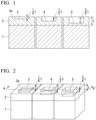
- the schematic cross-sectional view shown in FIG. 1 is a cross-sectional view taken along plane A-A' of FIG. 2 .
- the ratio (B/A (%)) of an area fraction B of a [Zn phase] to a total area fraction A of a [Zn phase] and an [Al/MgZn 2 /Zn ternary eutectic structure] of a plating microstructure is less than 20%.
- the ratio (B/A (%) may be 15% or less, less than 15%, or 10% or less.
- the lower limit of the ratio (B/A (%)) does not need to be particularly limited, but may be 1% or more, 2% or more, or 5% or more.
- the area fraction of the [Al phase] in the exposed surface for which the area fraction of the [Zn phase] has been measured may be, for example, 30 to 80 area% or 40 to 65 area%.
- the area fraction of the [Al/MgZn 2 /Zn ternary eutectic structure] in the exposed surface for which the area fraction of the [Zn phase] has been measured may be, for example, 10 to 75 area% or 20 to 65 area%.
- the area fraction of the [MgZn 2 phase] in the exposed surface for which the area fraction of the [Zn phase] has been measured may be, for example, 0 to 60 area% or 10 to 40 area%.
- the area fraction of the [Mg 2 Si phase] in the exposed surface for which the area fraction of the [Zn phase] has been measured may be, for example, 0 to 5 area% or 0 to 1 area%.
- the hot-dip plated layer is scraped off by a method such as grinding or argon sputtering.
- the exposed surface is desirably a mirror surface, and for example, the maximum height Rz of the exposed surface is desirably 0.2 ⁇ m or less.
- the exposed surface to be observed may be an exposed surface at any depth of the 3t/4 position, the t/2 position, and the t/4 position from the surface of the hot-dip plated layer. It is preferable to select the exposed surface at the t/2 position.
- the area fraction of the [Zn phase] or the B/A ratio satisfies the range of the present invention in the exposed surface at the t/2 position, there is a high possibility that the area fraction of the [Zn phase] or the B/A ratio satisfies the range of the present invention also at the other positions. More preferably, the area fraction of the [Zn phase] or the B/A ratio may satisfy the range of the present invention in the exposed surfaces at any two depths of the 3 t/4 position, the t/2 position, and the t/4 position from the surface of the hot-dip plated layer.
- the area fraction of the [Zn phase] or the B/A ratio may satisfy the range of the present invention in the exposed surfaces at all depths of the 3t/4 position, the t/2 position, and the t/4 position from the surface of the hot-dip plated layer.
- the plating microstructure is observed in a secondary electron image of a scanning electron microscope (SEM) on an exposed surface having a size of 5 mm ⁇ 5 mm to identify the [Zn phase] and the [Al/MgZn 2 /Zn ternary eutectic structure].
- SEM scanning electron microscope
- an elemental analysis by an energy dispersive X-ray elemental analyzer attached to the SEM is used in combination, and each phase and a microstructure are identified while the distributions of Zn, Al, and Mg are checked.
- a region where Zn is mainly detected is defined as a Zn phase
- a region where Al is mainly detected is defined as an Al phase
- a region where Zn and Mg are mainly detected is defined as a MgZn 2 phase. From the distribution of each phase detected, the phases are classified into [Al phase], [MgZn 2 phase], and [Zn phase], and [Al/Zn/MgZn 2 ternary eutectic structure] according to the above-described method.
- the area fraction of the [Zn phase] in the exposed surface is determined, and the ratio (B/A (%)) of the area fraction B of the [Zn phase] to the total area fraction A of the [Zn phase] and the [Al/MgZn 2 /Zn ternary eutectic structure] is further determined.
- the [Zn phase] a region having a circle equivalent diameter of 2.5 ⁇ m or more is measured as the [Zn phase].
- the Zn phase in the [Al/MgZn 2 /Zn ternary eutectic structure] and the [Zn phase] are distinguished.
- the Zn-Al-Mg-based hot-dip plated steel sheet of the present embodiment is manufactured, it is necessary to control the microstructure of the hot-dip plated layer so that the area fraction of the [Zn phase] in the exposed surface parallel to the surface of the hot-dip plated layer at any position of the 3t/4 position, the t/2 position, and the t/4 position from the surface is small.
- the steel sheet In order to manufacture the Zn-Al-Mg-based hot-dip plated steel sheet by a hot-dip plating method, the steel sheet is immersed in a hot-dip plating bath in which chemical composition is adjusted, thereby adhering a molten metal to the sheet surface. Subsequently, the steel sheet is pulled up from the plating bath, and the molten metal is solidified after the adhesion amount is controlled by gas wiping. During solidification, depending on the composition, an [Al phase] is first formed, and then an [Al/Zn/MgZn 2 ternary eutectic structure] is formed as the temperature of the molten metal decreases.
- a [MgZn 2 phase] and a [Zn phase] are formed in the matrix of the [Al/Zn/MgZn 2 ternary eutectic structure]. Further, when Si is contained in the hot-dip plated layer, a [Mg 2 Si phase] is formed in the matrix of the [Al/Zn/MgZn 2 ternary eutectic structure].
- the present inventors have found that by increasing the number of nucleation points for Zn, the formation of a coarse [Zn phase] can be prevented to improve the quality of the surface external appearance.
- As a method for increasing the number of nucleation points for Zn it is conceivable to adhere a substance that can become a nucleation point for Zn to the surface of the steel sheet that is the original sheet.
- a hot-rolled steel sheet is manufactured, and hot-rolled sheet annealing is performed as necessary. After pickling, cold rolling is performed as necessary to obtain a cold-rolled sheet.
- the hot-rolled sheet or the cold-rolled sheet is degreased and washed with water, then annealed, and the hot-rolled sheet or the cold-rolled sheet after annealing is immersed in a hot-dip plating bath to form a hot-dip plated layer.
- a Zn powder is adhered to the hot-rolled sheet or the cold-rolled sheet after annealing before immersion in the hot-dip plating bath.
- the adhered Zn powder is not completely dissolved during hot-dip plating, and becomes a nucleation site for Zn at the time of final solidification of plating.
- Part of the Zn powder is diffused in the plating bath as a solid. In the manufacturing method of the present embodiment, it is achieved only when the Zn powder is adhered after annealing and before immersion in the plating bath.
- Zn powder is adhered before annealing, Zn is alloyed with the steel sheet during annealing, and formation of a hot-dip plated layer is inhibited.
- the Zn powder to be adhered may be a Zn powder containing Zn and impurities.
- the average grain size of the Zn powder may be, for example, in the range of 4 to 6 ⁇ m.
- the adhesion amount of the Zn powder is preferably, for example, about 1 to 5 g/m 2 per surface. When the average grain size and the adhesion amount are within these ranges, the Zn powder can be made to function as a nucleation site for Zn.
- the adhesion of the Zn powder may be performed when the sheet temperature of the hot-rolled sheet or the cold-rolled sheet is in the range of the bath temperature + 10°C to 20°C.
- the hot-dip plating bath preferably contains Al: more than 10 to 22 mass% and Mg: 1.0 to 10 mass%, with the remainder including Zn and impurities.
- the hot-dip plating bath may contain Si: 0.0001 to 2 mass%.
- the hot-dip plating bath may contain any one or two or more of Ni, Ti, Zr, Sr, Fe, Sb, Pb, Sn, Ca, Co, Mn, P, B, Bi, Cr, Sc, Y, REM, Hf, and C in a total amount of 0.0001 to 2 mass%.
- the temperature of the hot-dip plating bath is preferably in the range of 400 to 500°C. This is because when the temperature of the hot-dip plating bath is in this range, a desired hot-dip plated layer can be formed.
- the adhesion amount of the hot-dip plating layer may be adjusted by means such as gas wiping on the steel sheet pulled up from the hot-dip plating bath.
- the adhesion amount of the hot-dip plated layer is preferably adjusted so that the total adhesion amount on both surfaces of the steel sheet falls within the range of 30 to 600 g/m 2 . It is not preferable that the adhesion amount is less than 30 g/m 2 because the corrosion resistance of the Zn-Al-Mg-based hot-dip plated steel sheet is deteriorated. It is not preferable that the adhesion amount exceeds 600 g/m 2 because a molten metal adhered to the steel sheet drips, and the surface of the hot-dip plated layer cannot be made smooth.
- the steel sheet is cooled. Cooling of the molten metal adhered to the steel sheet is started after the steel sheet is pulled up from the hot-dip plating bath. Depending on the composition of the hot-dip plating bath, the [Al phase] starts to crystallize around 430°C. Subsequently, [MgZn 2 ] starts to crystallize at around 370°C, and an [Al/Zn/MgZn 2 ternary eutectic structure] starts to crystallize at around 340°C, and further a [Zn phase] starts to crystallize, and solidification is completed.
- Zn in the liquid phase is formed as a fine Zn phase in the [Al/Zn/MgZn 2 ternary eutectic structure], and meanwhile, formation of a coarse Zn phase ([Zn phase]) having a circle equivalent diameter of 2.5 ⁇ m or more is prevented.
- the hot-dip plated steel sheet after the hot-dip plated layer is formed is subjected to a chemical conversion treatment.
- the type of the chemical conversion treatment is not particularly limited, and a known chemical conversion treatment can be used.
- the hot-dip plated steel sheet after the hot-dip plated layer is formed or after the chemical conversion treatment layer is formed is subjected to a coating treatment.
- the type of the coating treatment is not particularly limited, and a known coating treatment can be used.
- the metallic luster of the surface of the hot-dip plated layer can be enhanced as compared with the related art.
- the steel sheet after cold rolling was degreased and washed with water. Thereafter, the steel sheet was subjected to cold-rolled annealing.
- a Zn powder having an average grain size in the range of 4 to 6 ⁇ m was adhered to the steel sheet after cold-rolled annealing in an adhesion amount of 1 to 5 g/m 2 per surface, and the steel sheet was immersed in a hot-dip plating bath and then pulled up. Thereafter, the adhesion amount was adjusted by gas wiping, and further cooling was performed.
- No. 67 annealing and hot-dip plating were performed after the Zn powder was adhered, in No.
- 5 mm square exposed surfaces parallel to the surface of the hot-dip plated layer were formed at the t/4 position, the t/2 position, and the 3t/4 position from the surface in the obtained hot-dip plated steel sheet.
- the exposed surfaces were formed by scraping the hot-dip plated layer by grinding and then performing mirror polishing.
- the plating microstructure was observed in a secondary electron image of a scanning electron microscope (SEM) on each exposed surface having a size of 5 mm ⁇ 5 mm to identify the [Zn phase] and the [Al/MgZn 2 /Zn ternary eutectic structure].
- SEM scanning electron microscope
- an elemental analysis by an energy dispersive X-ray elemental analyzer attached to the SEM was used in combination, and each phase and a microstructure were identified while the distributions of Zn, Al, and Mg were checked.
- the area fraction of the [Zn phase] in each exposed surface was determined, and the ratio (B/A (%)) of the area fraction B of the [Zn phase] to the total area fraction A of the [Zn phase] and the [Al/MgZn 2 /Zn ternary eutectic structure] was further determined.
- the [Zn phase] a region having a circle equivalent diameter of 2.5 ⁇ m or more was measured as the [Zn phase].
- the Zn phase in the [Al/MgZn 2 /Zn ternary eutectic structure] and the [Zn phase] were distinguished.
- the area fraction of the [Al phase] was in the range of 30 to 80 area%
- the area fraction of the [Al/MgZn 2 /Zn ternary eutectic structure] was in the range of 10 to 75 area%
- the area fraction of the [MgZn 2 phase] was in the range of 0 to 60 area%
- the area fraction of the [Mg 2 Si phase] was in the range of 0 to 5 area%.
Landscapes
- Chemical & Material Sciences (AREA)
- Engineering & Computer Science (AREA)
- Materials Engineering (AREA)
- Mechanical Engineering (AREA)
- Metallurgy (AREA)
- Organic Chemistry (AREA)
- Chemical Kinetics & Catalysis (AREA)
- Physics & Mathematics (AREA)
- Oil, Petroleum & Natural Gas (AREA)
- Thermal Sciences (AREA)
- Coating With Molten Metal (AREA)
Abstract
Description
- The present invention relates to a Zn-Al-Mg-based hot-dip plated steel sheet having a lustrous external appearance.
- Priority is claimed on
Japanese Patent Application No. 2022-094346, filed June 10, 2022 - A hot-dip plated steel sheet is used as a steel sheet having good corrosion resistance. A hot-dip galvanized steel sheet, which is a representative example of the hot-dip plated steel sheet, is widely used in various manufacturing industries such as the fields of automobiles, home appliances, and building materials. In addition, a highly corrosion-resistant hot-dip galvanized steel sheet obtained by incorporating Al or Mg into a hot-dip galvanized layer has been proposed for the purpose of further improving the corrosion resistance of the hot-dip galvanized steel sheet. For example, Patent Documents 1 to 3 propose a Zn-Al-Mg-based hot-dip plated steel sheet.
- The Zn-Al-Mg-based hot-dip plated steel sheet mainly contains four types of phases and microstructures of an [Al phase], a [Zn phase], a [MgZn2 phase], and an [Al/MgZn2/Zn ternary eutectic structure] in the hot-dip plated layer. When Si is contained in the hot-dip plated layer in addition to Zn, Al, and Mg, mainly five types of phases and microstructures including a [Mg2Si phase] are contained in addition to the above four types of phases and microstructures. As described above, since various phases and microstructures are present in a mixed state in the hot-dip plated layer of the Zn-Al-Mg-based hot-dip plated steel sheet, the surface of the hot-dip plated layer has a satin-like external appearance.
-
- Patent Document 1:
Japanese Unexamined Patent Application, First Publication No. H10-226865 - Patent Document 2:
Japanese Unexamined Patent Application, First Publication No. H10-306357 - Patent Document 3:
Japanese Unexamined Patent Application, First Publication No. 2004-68075 - Like a hot-dip galvanized steel sheet, a Zn-Al-Mg-based hot-dip plated steel sheet is widely used in various manufacturing industries such as the fields of automobiles, home appliances, and building materials. In recent years, there has been an increasing demand from consumers for the surface external appearance of a plated steel sheet, and a Zn-Al-Mg-based hot-dip plated steel sheet is required to have an external appearance with stronger metallic luster.
- The present invention has been made in view of the above circumstances, and an object of the present invention is to provide a Zn-Al-Mg-based hot-dip plated steel sheet in which the metallic luster of the surface of a hot-dip plated layer is excellent as compared with the related art, and corrosion resistance is also excellent.
- In order to solve the above problem, the present invention adopts the following configurations.
- [1] A Zn-Al-Mg-based hot-dip plated steel sheet, including a steel sheet and a hot-dip plated layer formed on a surface of the steel sheet, wherein
- the hot-dip plated layer contains, as an average composition, Al: more than 10 to 22 mass% and Mg: 1.0 to 10 mass%, with a remainder including Zn and impurities, and
- in a case where a 5 mm square cross section parallel to a surface of the hot-dip plated layer is exposed at any position of a 3t/4 position, a t/2 position, and a t/4 position from the surface with a thickness of the hot-dip plated layer represented by t, an area fraction of a [Zn phase] of a plating microstructure in at least one of the cross sections is less than 20%.
- [2] A Zn-Al-Mg-based hot-dip plated steel sheet, including a steel sheet and a hot-dip plated layer formed on a surface of the steel sheet, wherein
- the hot-dip plated layer contains, as an average composition, Al: more than 10 to 22 mass% and Mg: 1.0 to 10 mass%, with a remainder including Zn and impurities, and
- further contains one or two selected from the group consisting of group A and group B below, and
- in a case where a 5 mm square cross section parallel to a surface of the hot-dip plated layer is exposed at any position of a 3t/4 position, a t/2 position, and a t/4 position from the surface with a thickness of the hot-dip plated layer represented by t, an area fraction of a [Zn phase] of a plating microstructure in at least one of the cross sections is less than 20%.
- [Group A] Si: 0.0001 to 2 mass%
- [Group B] one or two or more of Ni, Ti, Zr, Sr, Fe, Sb, Pb, Sn, Ca, Co, Mn, P, B, Bi, Cr, Sc, Y, REM, Hf, and C: 0.0001 to 2 mass% in total
- [3] The Zn-Al-Mg-based hot-dip plated steel sheet according to [1] or [2], wherein a ratio (B/A (%)) of an area fraction B of a [Zn phase] to a total area fraction A of a [Zn phase] and an [Al/MgZn2/Zn ternary eutectic structure] of a plating microstructure in at least one of the cross sections is less than 20%.
- [4] The Zn-Al-Mg-based hot-dip plated steel sheet according to [2], wherein the hot-dip plated layer has an average composition containing the group A in terms of mass%.
- [5] The Zn-Al-Mg-based hot-dip plated steel sheet according to [2], wherein the hot-dip plated layer has an average composition containing the group B in terms of mass%.
- According to the present invention, it is possible to provide a Zn-Al-Mg-based hot-dip plated steel sheet in which the metallic luster of a surface of a hot-dip plated layer is excellent as compared with the related art, and corrosion resistance is also excellent.
-
-
FIG. 1 is a schematic cross-sectional view for explaining an exposed surface for measuring a plating microstructure of a hot-dip plated layer in a Zn-Al-Mg-based hot-dip plated steel sheet according to an embodiment of the present invention. -
FIG. 2 is a perspective view for explaining an exposed surface for measuring a plating microstructure of a hot-dip plated layer in a Zn-Al-Mg-based hot-dip plated steel sheet according to an embodiment of the present invention. - The present inventors investigated in detail a plated layer of a conventional Zn-Al-Mg-based hot-dip plated steel sheet having a satin-like external appearance. The satin-like external appearance appears due to coexistence of a fine lustrous portion exhibiting metallic luster and a fine white portion exhibiting white in a mixed state. Among them, when the microstructure of the plated layer in the lustrous portion was examined, it was found that the area fraction of a [Zn phase] on the surface of the plated layer is smaller than that in the white portion. Meanwhile, when the microstructure of the plated layer in the white portion was examined, it was found that the ratio of the [Zn phase] to the [Al/MgZn2/Zn ternary eutectic structure] is higher than that in the lustrous portion.
- Therefore, the present inventors intensively studied in order to obtain a lustrous external appearance as a whole by increasing the lustrous portion and decreasing the white portion in the hot-dip plated layer, and found that the surface external appearance of the plated layer exhibits metallic luster as a whole by adjusting the chemical composition of the hot-dip plated layer and decreasing the proportion of the [Zn phase]. In addition, the present inventors found that when the ratio of the [Zn phase] to the total of the [Al/MgZn2/Zn ternary eutectic structure] and the [Zn phase] is reduced in the entire plated layer, the external appearance of the plated layer exhibits more metallic luster.
- Hereinafter, a Zn-Al-Mg-based hot-dip plated steel sheet according to an embodiment of the present invention will be described.
- The Zn-Al-Mg-based hot-dip plated steel sheet of the present embodiment includes a steel sheet and a hot-dip plated layer formed on a surface of the steel sheet, in which the hot-dip plated layer contains, as an average composition, Al: more than 10 to 22 mass% and Mg: 1.0 to 10 mass%, with a remainder including Zn and impurities, and in a case where a 5 mm square cross section parallel to a surface of the plated layer is exposed at any position of a 3t/4 position, a t/2 position, and a t/4 position from the surface of the hot-dip plated layer with a thickness of the hot-dip plated layer represented by t, an area fraction of a [Zn phase] of a plating microstructure in at least one of the cross sections is less than 20%. Here, the 5 mm square cross section parallel to a surface of the plated layer refers to a square-shaped exposed surface that is parallel to the surface and has a 5 mm square size in plane view.
- The material of the steel material as a base of the hot-dip plated layer is not particularly limited. As the material, it can be applied to general steel, Al-killed steel, and some high-alloy steels, and the shape is not particularly limited. The steel material may be subjected to Ni pre-plating. The hot-dip plated layer according to the present embodiment is formed by applying a hot-dip plating method described later to a steel material.
- Next, the chemical composition of the hot-dip plated layer will be described.
- The hot-dip plated layer according to the present embodiment contains, as an average composition, Al: more than 10 to 22 mass% and Mg: 1.0 to 10 mass%, with the remainder including Zn and impurities.
- Further, the hot-dip plated layer may contain one or two selected from the group consisting of group A and group B below.
- [Group A] Si: 0.0001 to 2 mass%
- [Group B] one or two or more of Ni, Ti, Zr, Sr, Fe, Sb, Pb, Sn, Ca, Co, Mn, P, B, Bi, Cr, Sc, Y, REM, Hf, and C: 0.0001 to 2 mass% in total
- The content of Al is in the range of more than 10 mass% and 22 mass% or less as an average composition. Al is an element necessary for ensuring corrosion resistance. When the content of Al in the hot-dip plated layer is 10 mass% or less, the effect of improving corrosion resistance becomes insufficient, and when the content exceeds 22 mass%, corrosion resistance is deteriorated although the cause is unknown. From the viewpoint of corrosion resistance, the content is preferably set to more than 10 mass% and 20 mass% or less. The content is more preferably set to more than 10 mass% and 18 mass% or less. The content is more preferably set to 11 mass% or more. The content is more preferably set to 19 mass% or less.
- The content of Mg is in the range of 1.0 to 10 mass% as an average composition. Mg is an element necessary for improving the corrosion resistance of the hot-dip plated layer. When the content of Mg in the hot-dip plated layer is less than 1.0 mass%, the effect of improving the corrosion resistance is insufficient, and when the content exceeds 10 mass%, the occurrence of dross in a plating bath becomes significant, and it becomes difficult to stably manufacture a plated steel material. The content is preferably set to 1.5 mass% or more from the viewpoint of balance between the corrosion resistance and the occurrence of dross. The content is preferably set to 8 mass% or less. The content is more preferably set to 2 mass% or more. The content is more preferably set to 6 mass% or less.
- The hot-dip plated layer may contain Si in the range of 0.0001 to 2 mass%. Si is an element effective for improving the adhesion of the hot-dip plated layer. When Si is incorporated in an amount of 0.0001 mass% or more, an effect of improving adhesion is exhibited, and therefore Si is preferably incorporated in an amount of 0.0001 mass% or more. On the other hand, even when Si is incorporated in an amount exceeding 2 mass%, the effect of improving plating adhesion is saturated, and therefore the content of Si is set to 2 mass% or less. From the viewpoint of plating adhesion, the content may be set to 0.01 mass% or more, or 1 mass% or less. The content may be set to 0.03 mass% or more, or 0.8 mass% or more.
- In addition, the hot-dip plated layer may contain, as an average composition, any one or two or more of Ni, Ti, Zr, Sr, Fe, Sb, Pb, Sn, Ca, Co, Mn, P, B, Bi, Cr, Sc, Y, REM, Hf, and C in a total amount of 0.0001 to 2 mass%. The content may be in the range of 0.01 to 2 mass%. By the incorporation of these elements, corrosion resistance can be further improved. REM is one or two or more of rare earth elements having atomic numbers 57 to 71 in the periodic table.
- The remainder of the chemical composition of the hot-dip plated layer includes zinc and impurities.
- The composition of the hot-dip plated layer can be measured by the following method. First, the surface layer coating film is removed with a coating film remover (for example, NEOREVER SP-751 manufactured by SANSAIKAKO) that does not erode plating, then the hot-dip plated layer is dissolved with hydrochloric acid containing an inhibitor (for example, HIBIRON manufactured by Sugimura Chemical Industry Co., Ltd.), and the obtained solution is subjected to inductively coupled plasma (ICP) optical emission spectroscopy, whereby the composition can be determined.
- Next, the microstructure of the hot-dip plated layer will be described. The microstructure of the hot-dip plated layer of the present embodiment may have, for example, the following microstructure.
- The hot-dip plated layer containing Al, Mg, and Zn contains an [Al phase], a [MgZn2 phase], and a [Zn phase], and an [Al/Zn/MgZn2 ternary eutectic structure]. Specifically, it has a form in which an [Al phase], a [MgZn2 phase], and a [Zn phase] are contained in the matrix of an [Al/Zn/MgZn2 ternary eutectic structure]. When Si is incorporated, a [Mg2Si phase] may be contained in the matrix of an [Al/Zn/MgZn2 ternary eutectic structure].
- The [Al/Zn/MgZn2 ternary eutectic structure] is a ternary eutectic structure of an Al phase, a Zn phase, and an intermetallic compound MgZn2 phase, and the Al phase forming the ternary eutectic structure corresponds to, for example, an "Al" phase" (which is an Al solid solution in which Zn is solid-dissolved and contains a small amount of Mg) at a high temperature in an Al-Zn-Mg ternary equilibrium phase diagram.
- The Al" phase at a high temperature usually appears separated into a fine Al phase and a fine Zn phase at normal temperature. The Zn phase in the ternary eutectic structure is a Zn solid solution in which a small amount of Al is solid-dissolved, and in some cases, further a small amount of Mg is solid-dissolved. The MgZn2 phase in the ternary eutectic structure is an intermetallic compound phase present in the vicinity of Zn: about 84 mass% in a Zn-Mg binary equilibrium phase diagram.
- As seen in the phase diagram, it is considered that another additive element is not solid-dissolved in each phase, or even if an additive element is solid-dissolved, the amount of the additive element is extremely small. However, since the amount thereof cannot be clearly distinguished by an ordinary analysis, the ternary eutectic structure formed of these three phases is represented by an [Al/Zn/MgZn2 ternary eutectic structure] in the present specification.
- The [Al phase] is a phase that looks like an island with a clear boundary in the matrix of the [Al/Zn/MgZn2 ternary eutectic structure], and this corresponds to, for example, an "Al" phase" (which is an Al solid solution in which Zn is solid-dissolved and contains a small amount of Mg) at a high temperature in an Al-Zn-Mg ternary equilibrium phase diagram. In the Al" phase at a high temperature, the amount of Zn and the amount of Mg to be solid-dissolved differ depending on the Al and Mg concentrations in the plating bath. The Al" phase at a high temperature is usually separated into a fine Al phase and a fine Zn phase at normal temperature, but the islandlike shape observed at normal temperature is considered to be attributed to the shape of the Al" phase at a high temperature.
- As seen in the phase diagram, it is considered that another additive element is not solid-dissolved in this phase, or even if an additive element is solid-dissolved, the amount of the additive element is extremely small. However, since it cannot be clearly distinguished by an ordinary analysis, a phase, which is derived from the Al" phase at a high temperature and whose shape is attributed to the shape of the Al" phase is referred to as [Al phase] in the present specification.
- The [Al phase] can be clearly distinguished from the Al phase forming the [Al/Zn/MgZn2 ternary eutectic structure] by microscopic observation.
- The [Zn phase] is a phase that looks like an island with a clear boundary in the matrix of the [Al/Zn/MgZn2 ternary eutectic structure], and in practice, a small amount of Al or a small amount of Mg may be solid-dissolved. As seen in the phase diagram, it is considered that another additive element is not solid-dissolved in this phase, or even if an additive element is solid-dissolved, the amount of the additive element is extremely small.
- The [Zn phase] is a region in which a Zn phase has a circle equivalent diameter of 2.5 µm or more, and can be clearly distinguished from the Zn phase forming the [Al/Zn/MgZn2 ternary eutectic structure] by microscopic observation.
- The [MgZn2 phase] is a phase that looks like an island with a clear boundary in the matrix of the [Al/Zn/MgZn2 ternary eutectic structure], and in practice, a small amount of Al may be solid-dissolved. As seen in the phase diagram, it is considered that another additive element is not solid-dissolved in this phase, or even if an additive element is solid-dissolved, the amount of the additive element is extremely small.
- The [MgZn2 phase] and the MgZn2 phase forming the [Al/Zn/MgZn2 ternary eutectic structure] can be clearly distinguished from each other by microscopic observation. The hot-dip plated layer according to the present embodiment may not contain [MgZn2 phase] depending on the manufacturing conditions, but it is contained in the hot-dip plated layer under most manufacturing conditions.
- The [Mg2Si phase] is a phase that looks like an island with a clear boundary in a solidified microstructure of the hot-dip plated layer to which Si is added. As seen in the phase diagram, it is considered that Zn, Al, or another additive element is not solid-dissolved in the [Mg2Si phase], or even if it is solid-dissolved, the amount of thereof is extremely small. The [Mg2Si phase] can be clearly distinguished from other phases in the hot-dip plated layer by microscopic observation.
- Next, the content of the [Zn phase] will be described. In the present embodiment, as shown in
FIGS. 1 and 2 , in a case where a hot-dip platedlayer 2 is cut out at any position of a 3t/4 position, a t/2 position, and a t/4 position from asurface 2a of the hot-dip platedlayer 2 with the thickness of the hot-dip platedlayer 2 formed on a steel sheet 1 represented by t, so that exposed surfaces 3, 4, and 5 parallel to thesurface 2a and having a square shape with a 5 mm square size in plane view appear, the area fraction of the [Zn phase] of the plating microstructure in at least one of the exposedsurfaces 3 to 5 is less than 20%. The area fraction of the [Zn phase] may be 15% or less, less than 15%, 10% or less, or 5% or less. When the area fraction of the [Zn phase] is 20% or less, the occupancy ratio of a fine lustrous portion exhibiting metallic luster increases on the surface of the hot-dip plated layer, so that the entire external appearance of the hot-dip plated layer exhibits metallic luster. The lower limit of the area fraction of the [Zn phase] does not need to be particularly limited, but may be more than 0%, 1% or more, or 2% or more. The schematic cross-sectional view shown inFIG. 1 is a cross-sectional view taken along plane A-A' ofFIG. 2 . - Further, it is preferable that in at least one of the exposed
surfaces 3 to 5, the ratio (B/A (%)) of an area fraction B of a [Zn phase] to a total area fraction A of a [Zn phase] and an [Al/MgZn2/Zn ternary eutectic structure] of a plating microstructure is less than 20%. The ratio (B/A (%) may be 15% or less, less than 15%, or 10% or less. The lower limit of the ratio (B/A (%)) does not need to be particularly limited, but may be 1% or more, 2% or more, or 5% or more. - In addition, the area fraction of the [Al phase] in the exposed surface for which the area fraction of the [Zn phase] has been measured may be, for example, 30 to 80 area% or 40 to 65 area%.
- Further, the area fraction of the [Al/MgZn2/Zn ternary eutectic structure] in the exposed surface for which the area fraction of the [Zn phase] has been measured may be, for example, 10 to 75 area% or 20 to 65 area%.
- Still further, the area fraction of the [MgZn2 phase] in the exposed surface for which the area fraction of the [Zn phase] has been measured may be, for example, 0 to 60 area% or 10 to 40 area%.
- Still further, the area fraction of the [Mg2Si phase] in the exposed surface for which the area fraction of the [Zn phase] has been measured may be, for example, 0 to 5 area% or 0 to 1 area%.
- When the exposed
surfaces surface 2a of the hot-dip platedlayer 2, the hot-dip plated layer is scraped off by a method such as grinding or argon sputtering. In addition, the exposed surface is desirably a mirror surface, and for example, the maximum height Rz of the exposed surface is desirably 0.2 µm or less. The exposed surface to be observed may be an exposed surface at any depth of the 3t/4 position, the t/2 position, and the t/4 position from the surface of the hot-dip plated layer. It is preferable to select the exposed surface at the t/2 position. If the area fraction of the [Zn phase] or the B/A ratio satisfies the range of the present invention in the exposed surface at the t/2 position, there is a high possibility that the area fraction of the [Zn phase] or the B/A ratio satisfies the range of the present invention also at the other positions. More preferably, the area fraction of the [Zn phase] or the B/A ratio may satisfy the range of the present invention in the exposed surfaces at any two depths of the 3 t/4 position, the t/2 position, and the t/4 position from the surface of the hot-dip plated layer. More preferably, the area fraction of the [Zn phase] or the B/A ratio may satisfy the range of the present invention in the exposed surfaces at all depths of the 3t/4 position, the t/2 position, and the t/4 position from the surface of the hot-dip plated layer. - The plating microstructure is observed in a secondary electron image of a scanning electron microscope (SEM) on an exposed surface having a size of 5 mm × 5 mm to identify the [Zn phase] and the [Al/MgZn2/Zn ternary eutectic structure]. When each phase and a microstructure are identified, an elemental analysis by an energy dispersive X-ray elemental analyzer attached to the SEM is used in combination, and each phase and a microstructure are identified while the distributions of Zn, Al, and Mg are checked. That is, among Zn, Al, and Mg, a region where Zn is mainly detected is defined as a Zn phase, a region where Al is mainly detected is defined as an Al phase, and a region where Zn and Mg are mainly detected is defined as a MgZn2 phase. From the distribution of each phase detected, the phases are classified into [Al phase], [MgZn2 phase], and [Zn phase], and [Al/Zn/MgZn2 ternary eutectic structure] according to the above-described method. Then, the area fraction of the [Zn phase] in the exposed surface is determined, and the ratio (B/A (%)) of the area fraction B of the [Zn phase] to the total area fraction A of the [Zn phase] and the [Al/MgZn2/Zn ternary eutectic structure] is further determined. As for the [Zn phase], a region having a circle equivalent diameter of 2.5 µm or more is measured as the [Zn phase]. Thus, the Zn phase in the [Al/MgZn2/Zn ternary eutectic structure] and the [Zn phase] are distinguished.
- Next, a method for manufacturing the Zn-Al-Mg-based hot-dip plated steel sheet of the present embodiment will be described.
- When the Zn-Al-Mg-based hot-dip plated steel sheet of the present embodiment is manufactured, it is necessary to control the microstructure of the hot-dip plated layer so that the area fraction of the [Zn phase] in the exposed surface parallel to the surface of the hot-dip plated layer at any position of the 3t/4 position, the t/2 position, and the t/4 position from the surface is small.
- In order to manufacture the Zn-Al-Mg-based hot-dip plated steel sheet by a hot-dip plating method, the steel sheet is immersed in a hot-dip plating bath in which chemical composition is adjusted, thereby adhering a molten metal to the sheet surface. Subsequently, the steel sheet is pulled up from the plating bath, and the molten metal is solidified after the adhesion amount is controlled by gas wiping. During solidification, depending on the composition, an [Al phase] is first formed, and then an [Al/Zn/MgZn2 ternary eutectic structure] is formed as the temperature of the molten metal decreases. In addition, a [MgZn2 phase] and a [Zn phase] are formed in the matrix of the [Al/Zn/MgZn2 ternary eutectic structure]. Further, when Si is contained in the hot-dip plated layer, a [Mg2Si phase] is formed in the matrix of the [Al/Zn/MgZn2 ternary eutectic structure].
- It has been found that when a coarse [Zn phase] is formed, the proportion of the [Al phase] or the [MgZn2 phase] in the hot-dip plated layer relatively increases, and these phases are exposed on the plated surface, and therefore the quality of the surface external appearance is deteriorated. It is presumed that the formation of the [Zn phase] is affected by the number of nucleation points for Zn. That is, when the number of nucleation points for Zn is large, Zn in the liquid phase immediately before final solidification crystallizes as a fine Zn phase in the [Al/Zn/MgZn2 ternary eutectic structure]. Therefore, the present inventors have found that by increasing the number of nucleation points for Zn, the formation of a coarse [Zn phase] can be prevented to improve the quality of the surface external appearance. As a method for increasing the number of nucleation points for Zn, it is conceivable to adhere a substance that can become a nucleation point for Zn to the surface of the steel sheet that is the original sheet.
- Hereinafter, the manufacturing method will be described in detail.
- A hot-rolled steel sheet is manufactured, and hot-rolled sheet annealing is performed as necessary. After pickling, cold rolling is performed as necessary to obtain a cold-rolled sheet. The hot-rolled sheet or the cold-rolled sheet is degreased and washed with water, then annealed, and the hot-rolled sheet or the cold-rolled sheet after annealing is immersed in a hot-dip plating bath to form a hot-dip plated layer.
- Here, a Zn powder is adhered to the hot-rolled sheet or the cold-rolled sheet after annealing before immersion in the hot-dip plating bath. The adhered Zn powder is not completely dissolved during hot-dip plating, and becomes a nucleation site for Zn at the time of final solidification of plating. Part of the Zn powder is diffused in the plating bath as a solid. In the manufacturing method of the present embodiment, it is achieved only when the Zn powder is adhered after annealing and before immersion in the plating bath. When the Zn powder is adhered before annealing, Zn is alloyed with the steel sheet during annealing, and formation of a hot-dip plated layer is inhibited. When the Zn powder is adhered after immersion in the hot-dip plating bath, the adhered Zn powder may cause the surface external appearance of plating to become rough instead. The Zn powder to be adhered may be a Zn powder containing Zn and impurities. The average grain size of the Zn powder may be, for example, in the range of 4 to 6 µm. The adhesion amount of the Zn powder is preferably, for example, about 1 to 5 g/m2 per surface. When the average grain size and the adhesion amount are within these ranges, the Zn powder can be made to function as a nucleation site for Zn. The adhesion of the Zn powder may be performed when the sheet temperature of the hot-rolled sheet or the cold-rolled sheet is in the range of the bath temperature + 10°C to 20°C.
- Subsequently, the steel sheet is immersed in a hot-dip plating bath. The hot-dip plating bath preferably contains Al: more than 10 to 22 mass% and Mg: 1.0 to 10 mass%, with the remainder including Zn and impurities. The hot-dip plating bath may contain Si: 0.0001 to 2 mass%. In addition, the hot-dip plating bath may contain any one or two or more of Ni, Ti, Zr, Sr, Fe, Sb, Pb, Sn, Ca, Co, Mn, P, B, Bi, Cr, Sc, Y, REM, Hf, and C in a total amount of 0.0001 to 2 mass%.
- The temperature of the hot-dip plating bath is preferably in the range of 400 to 500°C. This is because when the temperature of the hot-dip plating bath is in this range, a desired hot-dip plated layer can be formed.
- The adhesion amount of the hot-dip plating layer may be adjusted by means such as gas wiping on the steel sheet pulled up from the hot-dip plating bath. The adhesion amount of the hot-dip plated layer is preferably adjusted so that the total adhesion amount on both surfaces of the steel sheet falls within the range of 30 to 600 g/m2. It is not preferable that the adhesion amount is less than 30 g/m2 because the corrosion resistance of the Zn-Al-Mg-based hot-dip plated steel sheet is deteriorated. It is not preferable that the adhesion amount exceeds 600 g/m2 because a molten metal adhered to the steel sheet drips, and the surface of the hot-dip plated layer cannot be made smooth.
- After the adhesion amount of the hot-dip plated layer is adjusted, the steel sheet is cooled. Cooling of the molten metal adhered to the steel sheet is started after the steel sheet is pulled up from the hot-dip plating bath. Depending on the composition of the hot-dip plating bath, the [Al phase] starts to crystallize around 430°C. Subsequently, [MgZn2] starts to crystallize at around 370°C, and an [Al/Zn/MgZn2 ternary eutectic structure] starts to crystallize at around 340°C, and further a [Zn phase] starts to crystallize, and solidification is completed.
- At this time, since many Zn powder grains adhered to the steel sheet act as nucleation points for Zn, Zn in the liquid phase is formed as a fine Zn phase in the [Al/Zn/MgZn2 ternary eutectic structure], and meanwhile, formation of a coarse Zn phase ([Zn phase]) having a circle equivalent diameter of 2.5 µm or more is prevented.
- When a chemical conversion treatment layer is formed on the surface of the hot-dip plated layer, the hot-dip plated steel sheet after the hot-dip plated layer is formed is subjected to a chemical conversion treatment. The type of the chemical conversion treatment is not particularly limited, and a known chemical conversion treatment can be used.
- When a coating film layer is formed on the surface of the hot-dip plated layer or the surface of the chemical conversion treatment layer, the hot-dip plated steel sheet after the hot-dip plated layer is formed or after the chemical conversion treatment layer is formed is subjected to a coating treatment. The type of the coating treatment is not particularly limited, and a known coating treatment can be used.
- As described above, according to the present embodiment, the metallic luster of the surface of the hot-dip plated layer can be enhanced as compared with the related art. Examples
- Next, Examples of the present invention will be described. The steel sheet after cold rolling was degreased and washed with water. Thereafter, the steel sheet was subjected to cold-rolled annealing. A Zn powder having an average grain size in the range of 4 to 6 µm was adhered to the steel sheet after cold-rolled annealing in an adhesion amount of 1 to 5 g/m2 per surface, and the steel sheet was immersed in a hot-dip plating bath and then pulled up. Thereafter, the adhesion amount was adjusted by gas wiping, and further cooling was performed. In No. 67, annealing and hot-dip plating were performed after the Zn powder was adhered, in No. 68, the Zn powder was adhered after hot-dip plating, and in No. 69, hot-dip plating was performed without the Zn powder. In this way, hot-dip plated steel sheets of Nos. 1 to 69 shown in Tables 1A and 2B were manufactured.
- As shown in
FIG. 1 , 5 mm square exposed surfaces parallel to the surface of the hot-dip plated layer were formed at the t/4 position, the t/2 position, and the 3t/4 position from the surface in the obtained hot-dip plated steel sheet. The exposed surfaces were formed by scraping the hot-dip plated layer by grinding and then performing mirror polishing. - The plating microstructure was observed in a secondary electron image of a scanning electron microscope (SEM) on each exposed surface having a size of 5 mm × 5 mm to identify the [Zn phase] and the [Al/MgZn2/Zn ternary eutectic structure]. When each phase and a microstructure were identified, an elemental analysis by an energy dispersive X-ray elemental analyzer attached to the SEM was used in combination, and each phase and a microstructure were identified while the distributions of Zn, Al, and Mg were checked. Then, the area fraction of the [Zn phase] in each exposed surface was determined, and the ratio (B/A (%)) of the area fraction B of the [Zn phase] to the total area fraction A of the [Zn phase] and the [Al/MgZn2/Zn ternary eutectic structure] was further determined. As for the [Zn phase], a region having a circle equivalent diameter of 2.5 µm or more was measured as the [Zn phase]. Thus, the Zn phase in the [Al/MgZn2/Zn ternary eutectic structure] and the [Zn phase] were distinguished.
- The results are shown in Tables 2A and 2B.
- In addition, in the exposed surface for which the area fraction of the [Zn phase] was measured in Nos. 1 to 62, the area fraction of the [Al phase] was in the range of 30 to 80 area%, the area fraction of the [Al/MgZn2/Zn ternary eutectic structure] was in the range of 10 to 75 area%, the area fraction of the [MgZn2 phase] was in the range of 0 to 60 area%, and the area fraction of the [Mg2Si phase] was in the range of 0 to 5 area%.
- In addition, the surface of the hot-dip plated layer of the obtained hot-dip plated steel sheet was observed and visually evaluated based on the following determination criteria. A and B were evaluated as acceptable. The results are shown in Tables 2A and 2B.
-
- A: No uneven external appearance other than luster is observed even from 0.5 m ahead.
- B: Uneven external appearance other than luster is observed from 0.5 m ahead, but uneven external appearance other than luster is not observed from 2 m ahead.
- C: Uneven external appearance other than luster is observed even from 2 m ahead.
- The corrosion resistance of the hot-dip plated steel sheet was evaluated by the corrosion loss after a CCT test. The plated steel sheet was cut into 150 × 70 mm, and the corrosion loss after 30 cycles of CCT was investigated using CCT in accordance with JASO-M609. In the evaluation, a corrosion loss of less than 30 g/m2 was evaluated as F, a corrosion loss of 30 g/m2 or more and less than 50 g/m2 was evaluated as G, a corrosion loss of 50 g/m2 or more was evaluated as P, and F and G were evaluated as acceptable. The results are shown in Tables 2A and 2B.
- In the hot-dip plated steel sheets of No. 1 to No. 62, the chemical composition of the hot-dip plated layer fell within the range of the present invention, and a Zn powder was adhered after annealing and before hot-dip plating. Therefore, the Zn powder functioned as each generation site for Zn during solidification of the hot-dip plated layer, and as a result, when a 5 mm square exposed surface was formed at the 3t/4 position, the t/2 position, or the t/4 position from the surface of the hot-dip plated layer, the area fraction of the [Zn phase] of the plating microstructure in at least one exposed surface was less than 20%. Therefore, the external appearance of the hot-dip plated layer became a lustrous external appearance. In addition, corrosion resistance was also good.
- In the hot-dip plated steel sheet of No. 63, since the Al content of the hot-dip plated layer was small, the corrosion resistance was deteriorated.
- In the hot-dip plated steel sheet of No. 64, since the Al content of the hot-dip plated layer was excessive, the corrosion resistance was deteriorated.
- In the hot-dip plated steel sheet of No. 65, since the Mg content of the hot-dip plated layer was small, the corrosion resistance was deteriorated.
- In the hot-dip plated steel sheet of No. 66, since the Mg content of the hot-dip plated layer was excessive, the corrosion resistance was deteriorated. In addition, the area fraction of the [Zn phase] of the plating microstructure was 20% or more, and the luster of the external appearance of the hot-dip plated layer was insufficient.
- In the hot-dip plated steel sheet of No. 67, since annealing and hot-dip plating were performed after adhesion of the Zn powder, the Zn powder was alloyed with the steel sheet during annealing, and did not function as a nucleation site for Zn. For this reason, the area fractions of the [Zn phase] were all 20% or more at the 3 t/4 position, the t/2 position, and the t/4 position from the surface of the hot-dip plated layer, and the luster of the external appearance of the hot-dip plated layer was insufficient.
- In the hot-dip plated steel sheet of No. 68, since the Zn powder was adhered after hot-dip plating, the Zn powder did not function as a nucleation site for Zn. For this reason, the area fractions of the [Zn phase] were all 20% or more at the 3 t/4 position, the t/2 position, and the t/4 position from the surface of the hot-dip plated layer, and the luster of the external appearance of the hot-dip plated layer was insufficient.
- In the hot-dip plated steel sheet of No. 69, since a Zn powder was not adhered, the Zn powder did not function as a nucleation site for Zn. For this reason, the area fractions of the [Zn phase] were all 20% or more at the 3 t/4 position, the t/2 position, and the t/4 position from the surface of the hot-dip plated layer, and the luster of the external appearance of the hot-dip plated layer was insufficient.
[Table 1A] No. Manufacturing method Hot-dip plated steel sheet Average composition (mass%) remainder: Zn and impurities Plating adhesion amount (total amount on both surfaces) (g/m2) Al Mg Si Others 1 Zn powder adhered after annealing 10.2 3.0 0.2 - 290 2 Zn powder adhered after annealing 11 3.0 0.2 - 300 3 Zn powder adhered after annealing 19 6.0 0.2 - 310 4 Zn powder adhered after annealing 22 6.0 0.2 - 280 5 Zn powder adhered after annealing 11 1.0 0.2 - 600 6 Zn powder adhered after annealing 11 1.5 0.2 - 500 7 Zn powder adhered after annealing 11 2.0 0.2 - 450 8 Zn powder adhered after annealing 11 6.0 0.2 - 340 9 Zn powder adhered after annealing 11 8.0 0.2 - 150 10 Zn powder adhered after annealing 11 10 0.2 - 30 11 Zn powder adhered after annealing 11 3.0 0.0001 - 180 12 Zn powder adhered after annealing 11 3.0 0.01 - 240 13 Zn powder adhered after annealing 11 3.0 0.03 - 220 14 Zn powder adhered after annealing 11 3.0 0.08 - 300 15 Zn powder adhered after annealing 11 3.0 1 - 190 16 Zn powder adhered after annealing 11 3.0 2 - 290 17 Zn powder adhered after annealing 11 3.0 0.2 Ti 0.01% 300 18 Zn powder adhered after annealing 11 3.0 0.2 Ni 0.01% 320 19 Zn powder adhered after annealing 11 3.0 0.2 Zr 0.01% 280 20 Zn powder adhered after annealing 11 3.0 0.2 Ni 0.01% 320 21 Zn powder adhered after annealing 11 3.0 0.2 Sr 0.01% 310 22 Zn powder adhered after annealing 11 3.0 0.2 Fe 0.01% 320 23 Zn powder adhered after annealing 11 3.0 0.2 Sb 0.01 % 300 24 Zn powder adhered after annealing 11 3.0 0.2 Pb 0.01 % 290 25 Zn powder adhered after annealing 11 3.0 0.2 Sn 0.01 % 280 26 Zn powder adhered after annealing 11 3.0 0.2 Ca 0.01% 310 27 Zn powder adhered after annealing 11 3.0 0.2 Co 0.01% 300 28 Zn powder adhered after annealing 11 3.0 0.2 Mn 0.01 % 300 29 Zn powder adhered after annealing 11 3.0 0.2 P 0.01% 310 30 Zn powder adhered after annealing 11 3.0 0.2 B 0.01% 320 31 Zn powder adhered after annealing 11 3.0 0.2 Bi 0.01% 290 32 Zn powder adhered after annealing 11 3.0 0.2 Cr 0.01 % 300 33 Zn powder adhered after annealing 11 3.0 0.2 Sc 0.01% 290 34 Zn powder adhered after annealing 11 3.0 0.2 Y 0.01% 310 [Table 1B] No. Manufacturing method Hot-dip plated steel sheet Average composition (mass%) remainder: Zn and impurities Plating adhesion amount (total amount on both surfaces) (g/m2) Al Mg Si Others 35 Zn powder adhered after annealing 11 3.0 0.2 REM 0.01% 320 36 Zn powder adhered after annealing 11 3.0 0.2 Hf 0.01% 290 37 Zn powder adhered after annealing 11 3.0 0.2 C 0.01% 290 38 Zn powder adhered after annealing 11 3.0 - Ti 0.01% 300 39 Zn powder adhered after annealing 11 3.0 - Ni 0.01% 320 40 Zn powder adhered after annealing 11 3.0 - Z r0.01% 320 41 Zn powder adhered after annealing 11 3.0 - Ni 0.01% 310 42 Zn powder adhered after annealing 11 3.0 - Sr 0.01 % 310 43 Zn powder adhered after annealing 11 3.0 - Fe 0.01% 290 44 Zn powder adhered after annealing 11 3.0 - Sb 0.01% 300 45 Zn powder adhered after annealing 11 3.0 - Pb 0.01% 320 46 Zn powder adhered after annealing 11 3.0 - Sn 0.01% 310 47 Zn powder adhered after annealing 11 3.0 - Ca 0.01% 290 48 Zn powder adhered after annealing 11 3.0 - Co 0.01% 300 49 Zn powder adhered after annealing 11 3.0 - Mn 0.01% 280 50 Zn powder adhered after annealing 11 3.0 - P 0.01% 280 51 Zn powder adhered after annealing 11 3.0 - B 0.01% 310 52 Zn powder adhered after annealing 11 3.0 - Bi 0.01% 310 53 Zn powder adhered after annealing 11 3.0 - Cr 0.01% 280 54 Zn powder adhered after annealing 11 3.0 - Sc 0.01% 290 55 Zn powder adhered after annealing 11 3.0 - Y 0.01% 280 56 Zn powder adhered after annealing 11 3.0 - REM 0.01% 320 57 Zn powder adhered after annealing 11 3.0 - Hf 0.01% 320 58 Zn powder adhered after annealing 11 3.0 - C 0.01% 280 59 Zn powder adhered after annealing 11 3.0 - Ti 0.01% + Ca 0.01 % 310 60 Zn powder adhered after annealing 11 3.0 - - 300 61 Zn powder adhered after annealing 11 3.0 0.2 - 280 62 Zn powder adhered after annealing 11 3.0 0.2 - 310 63 Zn powder adhered after annealing 9 3.0 0.2 - 290 64 Zn powder adhered after annealing 23 3.0 0.2 - 310 65 Zn powder adhered after annealing 11 0.5 0.2 - 290 66 Zn powder adhered after annealing 11 11 0.2 - 310 67 Zn powder adhered after annealing 11 3.0 0.2 - 320 68 Zn powder adhered after plating 11 3.0 0.2 - 310 69 No Zn powder adhered 11 3.0 0.2 - 330 Underlined values indicate values outside the scope of the present invention. [Table 2A] No. Hot-dip plated steel sheet Evaluation Remarks t/4 position t/2 position 3t/4 position Visual evaluation Corrosion resistance [Zn phase] (area%) B/A (%) [Zn phase] (area%) B/A (%) [Zn phase] (area%) B/A (%) 1 2 4 3 5 2 4 A G 2 3 6 4 7 4 7 A F 3 2 4 2 3 1 2 A F 4 2 3 3 4 3 4 A G 5 5 8 2 4 2 5 A G 6 3 5 4 6 2 5 A F Inventive Example 7 5 9 4 8 4 8 A F 8 5 8 3 8 5 9 A F 9 5 9 4 9 3 8 A F 10 5 9 4 8 5 9 A G 11 2 5 3 7 2 4 A F 12 3 8 5 9 5 9 A F 13 5 9 1 3 4 9 A F 14 2 3 3 6 5 9 A F 15 5 7 6 10 4 8 A F 16 4 6 3 7 5 9 A F 17 5 9 4 9 4 8 A F 18 3 5 3 6 5 9 A F 19 4 8 5 9 2 4 A F 20 4 7 3 7 5 10 A F 21 1 2 4 10 1 2 A F 22 3 7 4 9 3 5 A F 23 3 5 3 6 3 6 A F 24 1 2 2 5 1 2 A F 25 5 9 5 9 5 9 A F 26 2 5 5 10 3 7 A F 27 1 2 4 9 2 4 A F 28 2 5 1 2 1 2 A F 29 3 5 5 10 1 2 A F 30 1 2 3 6 3 6 A F 31 3 7 1 2 3 5 A F 32 5 9 3 7 3 6 A F 33 4 7 5 11 4 8 A F 34 4 9 5 11 4 7 A F [Table 2B] No. Hot-dip plated steel sheet Evaluation Remarks t/4 position t/2 position 3t/4 position Visual evaluation Corrosion resistance [Zn phase] (area%) B/A (%) [Zn phase] (area%) B/A (%) [Zn phase] (area%) B/A (%) 35 4 10 5 11 1 2 A F 36 5 9 5 12 4 9 A F 37 1 2 4 10 3 7 A F 38 3 6 2 3 3 8 A F 39 3 6 5 7 2 7 A F 40 3 6 4 5 3 6 A F 41 5 9 4 8 4 7 A F 42 5 7 5 8 2 5 A F Inventive Example 43 2 6 4 7 4 6 A F 44 2 4 1 4 3 7 A F 45 5 9 4 5 3 5 A F 46 2 4 1 5 1 3 A F 47 3 5 4 6 5 9 A F 48 3 7 1 3 3 4 A F 49 5 7 2 6 2 6 A F 50 4 8 4 6 2 6 A F 51 4 8 5 6 4 7 A F 52 4 7 3 7 4 8 A F 53 1 4 3 4 2 4 A F 54 3 6 5 10 2 4 A F 55 2 5 5 7 3 7 A F 56 2 6 5 6 5 8 A F 57 5 7 3 7 5 8 A F 58 5 7 3 7 3 6 A F 59 3 5 4 6 3 4 A F 60 10 19 7 15 16 19 B F 61 8 14 6 11 8 15 A F 62 5 8 5 10 5 9 A F 63 7 15 5 11 8 16 A P Comparati ve Example 64 19 28 16 27 18 26 B P 65 8 17 9 18 7 16 A P 66 29 39 25 40 26 42 C P 67 35 60 28 58 29 62 C F 68 21 43 22 40 20 45 C F 69 30 55 31 58 30 59 C F Underlined values indicate values outside the scope of the present invention. - The Zn-Al-Mg-based hot-dip plated steel sheet of the present disclosure has high industrial applicability because the metallic luster of the surface of the hot-dip plated layer is excellent, and the corrosion resistance is also excellent.
-
- 1 Steel sheet
- 2 Hot-dip plated layer
- 2a Surface of hot-dip plated layer
- 3 Cross section (exposed surface) at t/4 position
- 4 Cross section (exposed surface) at t/2 position
- 5 Cross section (exposed surface) at 3t/4 position
Claims (5)
- A Zn-Al-Mg-based hot-dip plated steel sheet, comprising a steel sheet and a hot-dip plated layer formed on a surface of the steel sheet, whereinthe hot-dip plated layer contains, as an average composition, Al: more than 10 to 22 mass% and Mg: 1.0 to 10 mass%, with a remainder including Zn and impurities, andin a case where a 5 mm square cross section parallel to a surface of the hot-dip plated layer is exposed at any position of a 3t/4 position, a t/2 position, and a t/4 position from the surface with a thickness of the hot-dip plated layer represented by t, an area fraction of a [Zn phase] of a plating microstructure in at least one of the cross sections is less than 20%.
- A Zn-Al-Mg-based hot-dip plated steel sheet, comprising a steel sheet and a hot-dip plated layer formed on a surface of the steel sheet, whereinthe hot-dip plated layer contains, as an average composition, Al: more than 10 to 22 mass% and Mg: 1.0 to 10 mass%, with a remainder including Zn and impurities, andfurther contains one or two selected from the group consisting of group A and group B below, andin a case where a 5 mm square cross section parallel to a surface of the hot-dip plated layer is exposed at any position of a 3t/4 position, a t/2 position, and a t/4 position from the surface with a thickness of the hot-dip plated layer represented by t, an area fraction of a [Zn phase] of a plating microstructure in at least one of the cross sections is less than 20%:[group A] Si: 0.0001 to 2 mass%[group B] one or two or more of Ni, Ti, Zr, Sr, Fe, Sb, Pb, Sn, Ca, Co, Mn, P, B, Bi, Cr, Sc, Y, REM, Hf, and C: 0.0001 to 2 mass% in total.
- The Zn-Al-Mg-based hot-dip plated steel sheet according to claim 1 or 2, wherein a ratio (B/A (%)) of an area fraction B of a [Zn phase] to a total area fraction A of a [Zn phase] and an [Al/MgZn2/Zn ternary eutectic structure] of a plating microstructure in at least one of the cross sections is less than 20%.
- The Zn-Al-Mg-based hot-dip plated steel sheet according to claim 2, wherein the hot-dip plated layer has an average composition containing the group A in terms of mass%.
- The Zn-Al-Mg-based hot-dip plated steel sheet according to claim 2, wherein the hot-dip plated layer has an average composition containing the group B in terms of mass%.
Applications Claiming Priority (2)
| Application Number | Priority Date | Filing Date | Title |
|---|---|---|---|
| JP2022094346 | 2022-06-10 | ||
| PCT/JP2023/021552 WO2023238934A1 (en) | 2022-06-10 | 2023-06-09 | Zn-al-mg hot-dip plated steel sheet |
Publications (2)
| Publication Number | Publication Date |
|---|---|
| EP4538410A1 true EP4538410A1 (en) | 2025-04-16 |
| EP4538410A4 EP4538410A4 (en) | 2025-10-15 |
Family
ID=89118445
Family Applications (1)
| Application Number | Title | Priority Date | Filing Date |
|---|---|---|---|
| EP23819914.5A Pending EP4538410A4 (en) | 2022-06-10 | 2023-06-09 | ZN-AL-MG HOT-DIP PLATED STEEL SHEET |
Country Status (9)
| Country | Link |
|---|---|
| US (1) | US20250369082A1 (en) |
| EP (1) | EP4538410A4 (en) |
| JP (1) | JP7866217B2 (en) |
| KR (1) | KR20250010042A (en) |
| CN (1) | CN119301292A (en) |
| AU (1) | AU2023282694A1 (en) |
| MX (1) | MX2024014723A (en) |
| TW (1) | TWI860745B (en) |
| WO (1) | WO2023238934A1 (en) |
Family Cites Families (12)
| Publication number | Priority date | Publication date | Assignee | Title |
|---|---|---|---|---|
| JP3179401B2 (en) | 1996-12-13 | 2001-06-25 | 日新製鋼株式会社 | Hot-dip Zn-Al-Mg plated steel sheet with good corrosion resistance and surface appearance and method for producing the same |
| JP3149129B2 (en) | 1997-03-04 | 2001-03-26 | 日新製鋼株式会社 | Hot-dip Zn-Al-Mg-based coated steel sheet with good corrosion resistance and surface appearance and method for producing the same |
| JP3779941B2 (en) * | 2002-01-09 | 2006-05-31 | 新日本製鐵株式会社 | Galvanized steel sheet with excellent post-painting corrosion resistance and paint clarity |
| JP3760901B2 (en) | 2002-08-06 | 2006-03-29 | Jfeスチール株式会社 | Hot-dip Zn-Al-Mg-based plated steel sheet excellent in workability and corrosion resistance and method for producing the same |
| MX2019008678A (en) * | 2017-01-27 | 2019-11-11 | Nippon Steel Corp | Plated steel. |
| KR102235255B1 (en) * | 2017-12-26 | 2021-04-02 | 주식회사 포스코 | Zinc alloy coated steel having excellent corrosion resistance and surface smoothness, and method for manufacturing the same |
| KR20200051723A (en) * | 2017-12-28 | 2020-05-13 | 닛폰세이테츠 가부시키가이샤 | Hot-dip Zn-based galvanized steel after coating |
| KR102516012B1 (en) * | 2019-04-19 | 2023-03-31 | 닛폰세이테츠 가부시키가이샤 | plated steel |
| BR112021026239A2 (en) * | 2019-06-27 | 2022-02-15 | Nippon Steel Corp | Hot dip coated steel product |
| JP7445128B2 (en) * | 2020-04-30 | 2024-03-07 | 日本製鉄株式会社 | Hot-dip Zn-Al-Mg coated steel with excellent workability and corrosion resistance |
| DE102020133309A1 (en) | 2020-12-14 | 2022-06-15 | Klingelnberg Gmbh | Process and device for optical gear measurement |
| TWI883457B (en) * | 2022-06-10 | 2025-05-11 | 日商日本製鐵股份有限公司 | Zn-Al-Mg series hot-dip plated steel plate |
-
2023
- 2023-06-09 KR KR1020247040945A patent/KR20250010042A/en active Pending
- 2023-06-09 TW TW112121710A patent/TWI860745B/en active
- 2023-06-09 US US18/872,647 patent/US20250369082A1/en active Pending
- 2023-06-09 WO PCT/JP2023/021552 patent/WO2023238934A1/en not_active Ceased
- 2023-06-09 JP JP2024527033A patent/JP7866217B2/en active Active
- 2023-06-09 CN CN202380044360.9A patent/CN119301292A/en active Pending
- 2023-06-09 AU AU2023282694A patent/AU2023282694A1/en active Pending
- 2023-06-09 EP EP23819914.5A patent/EP4538410A4/en active Pending
-
2024
- 2024-11-27 MX MX2024014723A patent/MX2024014723A/en unknown
Also Published As
| Publication number | Publication date |
|---|---|
| MX2024014723A (en) | 2025-01-09 |
| EP4538410A4 (en) | 2025-10-15 |
| JPWO2023238934A1 (en) | 2023-12-14 |
| KR20250010042A (en) | 2025-01-20 |
| TW202407116A (en) | 2024-02-16 |
| CN119301292A (en) | 2025-01-10 |
| US20250369082A1 (en) | 2025-12-04 |
| TWI860745B (en) | 2024-11-01 |
| AU2023282694A1 (en) | 2024-12-19 |
| JP7866217B2 (en) | 2026-05-27 |
| WO2023238934A1 (en) | 2023-12-14 |
Similar Documents
| Publication | Publication Date | Title |
|---|---|---|
| KR102845023B1 (en) | HOT-DIP Al-Zn-Mg-Si-Sr COATED STEEL SHEET AND METHOD OF PRODUCING SAME | |
| JP7798753B2 (en) | Zinc alloy plated steel material with excellent corrosion resistance after processing and its manufacturing method | |
| EP3266900B1 (en) | Molten al-zn-mg-si-plated steel sheet | |
| EP4071265A1 (en) | Hot-dipped galvanized steel sheet having excellent bending workability and corrosion resistance and manufacturing method therefor | |
| CN114466948A (en) | Plated steel sheet excellent in corrosion resistance, wear resistance, workability and surface quality, and method for producing same | |
| JP7719187B2 (en) | Plated steel sheet with excellent sealer adhesion and manufacturing method thereof | |
| EP1466994B1 (en) | Zinc-plated steel sheet excellent in corrosion resistance after coating and clarity of coating thereon | |
| KR20190116470A (en) | Plated steel sheet | |
| CN111989420A (en) | Plated steel material | |
| EP3561135B1 (en) | Hot-dipped galvanized steel material having excellent weldability and press workability and manufacturing method therefor | |
| KR20190120284A (en) | Plated steel sheet | |
| JP5672178B2 (en) | High corrosion resistance hot-dip galvanized steel sheet with excellent appearance uniformity | |
| EP3396007B1 (en) | High-strength hot-dip zinc plated steel material having excellent plating properties and method for preparing thereof | |
| AU2020384747B2 (en) | Coated Steel Material | |
| JP7545497B2 (en) | Coated steel sheet with excellent corrosion resistance, workability and surface quality, and manufacturing method thereof | |
| EP4234735A1 (en) | Plated steel material | |
| EP4163412A1 (en) | Hot-dipped zn?al?mg-based plated steel | |
| JP2016166415A (en) | MOLTEN Al-Zn-Mg-Si PLATED SHEET STEEL AND PRODUCTION METHOD THEREOF | |
| EP4411015A1 (en) | Plated steel sheet having excellent corrosion resistance and surface appearance and method for manufacturing same | |
| EP4230756A1 (en) | Plated steel sheet for automobile structural members | |
| US20250376750A1 (en) | Zn-Al-Mg-BASED HOT-DIP PLATED STEEL SHEET | |
| EP4079923A1 (en) | Hot dip alloy coated steel material having excellent anti-corrosion properties and method of manufacturing same | |
| EP4411017A1 (en) | Plated steel sheet having excellent corrosion resistance and whiteness and method for manufacturing same | |
| EP3901320A1 (en) | Zinc alloy-plated steel material having excellent corrosion resistance and surface quality, and method for producing same | |
| KR102513354B1 (en) | Plated steel sheet having excellent corrosion resistance and bendability and method for manufacturing the same |
Legal Events
| Date | Code | Title | Description |
|---|---|---|---|
| STAA | Information on the status of an ep patent application or granted ep patent |
Free format text: STATUS: THE INTERNATIONAL PUBLICATION HAS BEEN MADE |
|
| PUAI | Public reference made under article 153(3) epc to a published international application that has entered the european phase |
Free format text: ORIGINAL CODE: 0009012 |
|
| STAA | Information on the status of an ep patent application or granted ep patent |
Free format text: STATUS: REQUEST FOR EXAMINATION WAS MADE |
|
| 17P | Request for examination filed |
Effective date: 20241212 |
|
| AK | Designated contracting states |
Kind code of ref document: A1 Designated state(s): AL AT BE BG CH CY CZ DE DK EE ES FI FR GB GR HR HU IE IS IT LI LT LU LV MC ME MK MT NL NO PL PT RO RS SE SI SK SM TR |
|
| DAV | Request for validation of the european patent (deleted) | ||
| DAX | Request for extension of the european patent (deleted) | ||
| A4 | Supplementary search report drawn up and despatched |
Effective date: 20250915 |
|
| RIC1 | Information provided on ipc code assigned before grant |
Ipc: C23C 2/06 20060101AFI20250909BHEP Ipc: C22C 18/00 20060101ALI20250909BHEP Ipc: C22C 18/04 20060101ALI20250909BHEP Ipc: C23C 2/02 20060101ALI20250909BHEP Ipc: C23C 2/40 20060101ALI20250909BHEP Ipc: C23C 2/26 20060101ALI20250909BHEP Ipc: B32B 15/01 20060101ALI20250909BHEP Ipc: C23C 30/00 20060101ALI20250909BHEP |