EP4535883A2 - Dynamische umschaltung der leistungsklasse eines benutzergeräts - Google Patents
Dynamische umschaltung der leistungsklasse eines benutzergeräts Download PDFInfo
- Publication number
- EP4535883A2 EP4535883A2 EP24204060.8A EP24204060A EP4535883A2 EP 4535883 A2 EP4535883 A2 EP 4535883A2 EP 24204060 A EP24204060 A EP 24204060A EP 4535883 A2 EP4535883 A2 EP 4535883A2
- Authority
- EP
- European Patent Office
- Prior art keywords
- power class
- power
- base station
- class
- data
- Prior art date
- Legal status (The legal status is an assumption and is not a legal conclusion. Google has not performed a legal analysis and makes no representation as to the accuracy of the status listed.)
- Pending
Links
Images



Classifications
-
- H—ELECTRICITY
- H04—ELECTRIC COMMUNICATION TECHNIQUE
- H04W—WIRELESS COMMUNICATION NETWORKS
- H04W52/00—Power management, e.g. Transmission Power Control [TPC] or power classes
- H04W52/04—Transmission power control [TPC]
- H04W52/18—TPC being performed according to specific parameters
-
- H—ELECTRICITY
- H04—ELECTRIC COMMUNICATION TECHNIQUE
- H04W—WIRELESS COMMUNICATION NETWORKS
- H04W52/00—Power management, e.g. Transmission Power Control [TPC] or power classes
- H04W52/04—Transmission power control [TPC]
- H04W52/18—TPC being performed according to specific parameters
- H04W52/24—TPC being performed according to specific parameters using SIR [Signal to Interference Ratio] or other wireless path parameters
-
- H—ELECTRICITY
- H04—ELECTRIC COMMUNICATION TECHNIQUE
- H04B—TRANSMISSION
- H04B17/00—Monitoring; Testing
- H04B17/30—Monitoring; Testing of propagation channels
- H04B17/391—Modelling the propagation channel
- H04B17/3913—Predictive models, e.g. based on neural network models
-
- H—ELECTRICITY
- H04—ELECTRIC COMMUNICATION TECHNIQUE
- H04W—WIRELESS COMMUNICATION NETWORKS
- H04W52/00—Power management, e.g. Transmission Power Control [TPC] or power classes
- H04W52/02—Power saving arrangements
- H04W52/0209—Power saving arrangements in terminal devices
- H04W52/0225—Power saving arrangements in terminal devices using monitoring of external events, e.g. the presence of a signal
- H04W52/0245—Power saving arrangements in terminal devices using monitoring of external events, e.g. the presence of a signal according to signal strength
-
- H—ELECTRICITY
- H04—ELECTRIC COMMUNICATION TECHNIQUE
- H04W—WIRELESS COMMUNICATION NETWORKS
- H04W52/00—Power management, e.g. Transmission Power Control [TPC] or power classes
- H04W52/02—Power saving arrangements
- H04W52/0209—Power saving arrangements in terminal devices
- H04W52/0225—Power saving arrangements in terminal devices using monitoring of external events, e.g. the presence of a signal
- H04W52/0248—Power saving arrangements in terminal devices using monitoring of external events, e.g. the presence of a signal dependent on the time of the day, e.g. according to expected transmission activity
-
- H—ELECTRICITY
- H04—ELECTRIC COMMUNICATION TECHNIQUE
- H04W—WIRELESS COMMUNICATION NETWORKS
- H04W52/00—Power management, e.g. Transmission Power Control [TPC] or power classes
- H04W52/02—Power saving arrangements
- H04W52/0209—Power saving arrangements in terminal devices
- H04W52/0261—Power saving arrangements in terminal devices managing power supply demand, e.g. depending on battery level
-
- H—ELECTRICITY
- H04—ELECTRIC COMMUNICATION TECHNIQUE
- H04W—WIRELESS COMMUNICATION NETWORKS
- H04W52/00—Power management, e.g. Transmission Power Control [TPC] or power classes
- H04W52/04—Transmission power control [TPC]
- H04W52/18—TPC being performed according to specific parameters
- H04W52/24—TPC being performed according to specific parameters using SIR [Signal to Interference Ratio] or other wireless path parameters
- H04W52/241—TPC being performed according to specific parameters using SIR [Signal to Interference Ratio] or other wireless path parameters taking into account channel quality metrics, e.g. SIR, SNR, CIR or Eb/lo
-
- H—ELECTRICITY
- H04—ELECTRIC COMMUNICATION TECHNIQUE
- H04W—WIRELESS COMMUNICATION NETWORKS
- H04W52/00—Power management, e.g. Transmission Power Control [TPC] or power classes
- H04W52/04—Transmission power control [TPC]
- H04W52/18—TPC being performed according to specific parameters
- H04W52/26—TPC being performed according to specific parameters using transmission rate or quality of service QoS [Quality of Service]
- H04W52/265—TPC being performed according to specific parameters using transmission rate or quality of service QoS [Quality of Service] taking into account the quality of service QoS
-
- H—ELECTRICITY
- H04—ELECTRIC COMMUNICATION TECHNIQUE
- H04W—WIRELESS COMMUNICATION NETWORKS
- H04W52/00—Power management, e.g. Transmission Power Control [TPC] or power classes
- H04W52/04—Transmission power control [TPC]
- H04W52/18—TPC being performed according to specific parameters
- H04W52/26—TPC being performed according to specific parameters using transmission rate or quality of service QoS [Quality of Service]
- H04W52/267—TPC being performed according to specific parameters using transmission rate or quality of service QoS [Quality of Service] taking into account the information rate
-
- H—ELECTRICITY
- H04—ELECTRIC COMMUNICATION TECHNIQUE
- H04W—WIRELESS COMMUNICATION NETWORKS
- H04W52/00—Power management, e.g. Transmission Power Control [TPC] or power classes
- H04W52/04—Transmission power control [TPC]
- H04W52/30—Transmission power control [TPC] using constraints in the total amount of available transmission power
- H04W52/34—TPC management, i.e. sharing limited amount of power among users or channels or data types, e.g. cell loading
- H04W52/343—TPC management, i.e. sharing limited amount of power among users or channels or data types, e.g. cell loading taking into account loading or congestion level
-
- H—ELECTRICITY
- H04—ELECTRIC COMMUNICATION TECHNIQUE
- H04W—WIRELESS COMMUNICATION NETWORKS
- H04W52/00—Power management, e.g. Transmission Power Control [TPC] or power classes
- H04W52/02—Power saving arrangements
- H04W52/0209—Power saving arrangements in terminal devices
- H04W52/0251—Power saving arrangements in terminal devices using monitoring of local events, e.g. events related to user activity
- H04W52/0258—Power saving arrangements in terminal devices using monitoring of local events, e.g. events related to user activity controlling an operation mode according to history or models of usage information, e.g. activity schedule or time of day
Definitions
- a user equipment can wirelessly connect to a base station in order to engage in voice calls, video calls, data transfers, or other types of communications.
- a mobile device such as a smart phone, can wirelessly connect to a gNB or other base station of a radio access network (RAN) to access the telecommunication network.
- RAN radio access network
- UEs can operate according to different power classes that are associated with different output power levels for transmissions.
- 3GPP defines various power classes, including Power Class 3, Power Class 2, and Power Class 1.5, that define maximum output power levels for uplink transmissions. Accordingly, a UE may transmit uplink data to a base station of the RAN according to a particular power class.
- a UE can support multiple power classes.
- a power class can define a maximum output power, such as a maximum output power for uplink transmissions from the UE to a RAN.
- 3GPP Power Class 3 allows uplink transmissions at up to an output power of 23 decibels relative to one milliwatt (dBm).
- 3GPP Power Class 2 allows uplink transmissions at up to an output power of 26 dBm.
- 3GPP Power Class 1.5 allows uplink transmissions at up to an output power of 29 dBm.
- transmitting at higher output power levels can have benefits relative to transmitting at lower output power levels. For instance, if a UE uses Power Class 1.5 to transmit uplink signals at up to 29 dBm, the uplink signals may propagate farther and/or through more barriers than uplink signals transmitted at up to 26 dBm according to Power Class 2. In some examples, using Power Class 1.5 may also result in higher uplink data transmission rates than could be achieved using Power Class 2.
- transmitting at higher output power levels can also have drawbacks relative to transmitting at lower output power levels. For instance, transmitting at higher output power levels can cause a UE to consume more power than transmitting at lower output power levels, and thereby cause the UE to drain its battery more quickly and/or cause the UE to generate more heat. Accordingly, in some situations, a UE that uses Power Class 1.5 may need to be recharged more often, and/or may have a higher risk of overheating, than a UE that uses Power Class 2.
- the UE may be configured to select one of those power classes according to a maximum output power allowed by the RAN. For example, if a base station of the RAN indicates that the highest allowed output power for uplink transmissions in a cell is 29 dBm, and the UE supports Power Class 1.5, the UE may use Power Class 1.5 to perform all uplink transmissions at output power levels of up to 29 dBm to while the UE is connected to that base station.
- the UE 102, the RAN 104, and/or the core network 106 can be compatible with one or more types of radio access technologies, wireless access technologies, protocols, and/or standards.
- the UE 102, the RAN 104, and/or the core network 106 can be compatible with fifth generation (5G) New Radio (NR) technology, Long-Term Evolution (LTE) / LTE Advanced technology, other fourth generation (4G) technology, High-Speed Data Packet Access (HSDPA)/Evolved High-Speed Packet Access (HSPA+) technology, Universal Mobile Telecommunications System (UMTS) technology, Code Division Multiple Access (CDMA) technology, Global System for Mobile Communications (GSM) technology, WiMax ® technology, WiFi ® technology, and/or any other previous or future generation of radio access technology or wireless access technology.
- 5G Fifth Generation
- NR New Radio
- LTE Long-Term Evolution
- 4G fourth generation
- HSPA+ High-Speed Packet Access
- UMTS Universal Mobile T
- the RAN 104 and/or the core network 106 may be based on LTE technology.
- the RAN 104 may be an LTE access network known as an Evolved UMTS Terrestrial Radio Access Network (E-UTRAN), and can include one or more LTE base stations known as evolved Node Bs (eNBs).
- the core network 106 may also be an LTE packet core network, known as an Evolved Packet Core (EPC).
- EPC Evolved Packet Core
- the RAN 104 and/or the core network 106 may be based on 5G technology.
- the RAN 104 may be a 5G access network that includes one or more 5G base stations knowns as gNBs
- the core network 106 may be a 5G core network.
- the UE 102 can have a battery 108, a temperature sensor 110, and one or more transmission interfaces 112.
- the UE 102 can also support multiple power classes 114, and at any point in time can operate according to a power class selected from the multiple power classes 114 supported by the UE 102.
- a base station such as a gNB or eNB, or another element of the RAN 104, can include a power class switcher 116 that is configured to dynamically determine which one of the power classes 114 the UE 102 should use. Based on a power class determination by the power class switcher 116, the RAN 104 can transmit a power class change indicator 118 to the UE 102.
- the power class change indicator 118 may identify a specific power class the UE 102 should use, or instruct the UE 102 to change from using a current power class to using a different power class.
- the power class change indicator 118 provided by the RAN 104 can accordingly cause the UE 102 to dynamically change a power class associated with the transmission interfaces 112, for instance by changing a maximum output power for uplink transmissions.
- Other elements of the UE 102 are illustrated in greater detail in FIG. 4 , and are described in detail below with reference to that figure.
- the battery 108 can store energy used to power functions of the UE 102.
- the battery 108 can be a lithium-ion (Li-ion) battery, a lithium-ion polymer (LiPo) battery, a nickel cadmium (NiCd) battery, a nickel-metal hydride (NiMH) battery, or other type of battery.
- the battery 108 may be rechargeable. For instance, the battery 108 can charge when the UE 102 is connected to a wall outlet, a portable charger, or another external power source. However, operations of the UE 102 can also use energy and thus drain the battery 108, for instance when the battery 108 is not charging.
- the UE 102 may include the temperature sensor 110.
- the temperature sensor 110 may be a thermocouple, thermistor, resistance temperature detector (RTD), semiconductor-based integrated circuit, thermometer, and/or any other type of temperature sensor.
- the temperature sensor 110 may be configured to measure or derive the internal temperature of the UE 102 or temperatures of one or more individual components of the UE 102, such as a temperature of the battery 108, a temperature of a central processing unit (CPU) or other processor, or a temperature of any other component of the UE 102.
- the UE 102 may have multiple temperature sensors, such as a CPU temperature sensor and a battery temperature sensor.
- the UE 102 may lack a dedicated temperature sensor, but heat generated by the UE 102 may be estimated based on how quickly the battery 108 drains and/or other UE power consumption metrics.
- the transmission interfaces 112 of the UE 102 can be configured to establish wireless connections with the RAN 104, and to perform uplink and/or downlink data transmissions via the wireless connections.
- the transmission interfaces 112 can include radio interfaces, transceivers, modems, interfaces, antennas, and/or other components that perform or assist in exchanging radio frequency (RF) communications with one or more base stations of the RAN 104.
- the transmission interfaces 112 may be compatible with one or more radio access technologies, such as 5G NR radio access technologies and/or LTE radio access technologies.
- the transmission interfaces 112 can establish a single connection with a base station of the RAN 104 for uplink transmissions and/or downlink transmissions. In other examples, the transmission interfaces 112 can establish multiple connections with one or more base stations of the RAN 104 for uplink transmissions and/or downlink transmissions.
- the transmission interfaces 112 may have multiple antennas, such that the UE 102 may use multiple-input multiple-output (MIMO) techniques to exchange different data streams with a base station via different antennas.
- MIMO multiple-input multiple-output
- the UE 102 may be configured to operate according to any of two or more power classes 114.
- a power class may indicate allowable power levels and/or other power configurations for transmissions via the transmission interfaces 112, such as a maximum output power for uplink transmissions.
- the UE 102 may be configured to operate according to two or more of: 3GPP Power Class 1.5, 3GPP Power Class 2, or 3GPP Power Class 3.
- Power Class 1.5 can permit uplink transmissions at up to 29 dBm.
- Power Class 2 can permit uplink transmissions at up to 26 dBm.
- Power Class 3 can permit uplink transmissions at up to 23 dBm. Because a decibel is a logarithmic value, a 3 dBm increase in output power can be equivalent to doubling the output power. Accordingly, using Power Class 2 may allow the UE 102 to double its uplink output power relative to using Power Class 3. Similarly, using Power Class 1.5 may allow the UE 102 to double its uplink output power relative to using Power Class 2.
- the UE 102 can be considered a High-Power or High-Performance UE (HPUE) if the UE 102 is configured to use Power Class 1.5 and/or Power Class 2.
- HPUE High-Power or High-Performance UE
- Power Class 3 may be defined for use with LTE frequency bands that are associated with frequency division duplexing (FDD) or time division duplexing (TDD).
- Power Class 2 and Power Class 1.5 may not be defined for use with FDD frequency bands, and may instead be defined for use with TDD frequency bands.
- Power Class 1.5 may be defined for use with 5G TDD frequency bands such as n40, n41, n77, n78, and n79.
- the power class used by the UE 102 can affect signal quality, connection reliability, signal propagation range, transmission rates, and/or other transmission metrics. For example, transmitting at higher output power levels can allow signals to propagate farther, and/or more easily pass through walls or other barriers, relative to transmitting at lower output power levels. In some situations, transmitting at higher output power levels may also result in higher uplink data transmission rates than could be achieved by transmitting at higher output power levels. Such benefits of transmitting at higher output power levels instead of lower output power levels may be appreciated by a user of the UE 102, and thus offer an improved user experience, as the user may perceive that the UE 102 is able to connect to the telecommunication network more reliably and/or with higher data speeds.
- the power class used by the UE 102 may also affect the power consumption of the UE 102.
- the power consumption of the UE 102 may in turn affect how quickly the battery 108 drains, and/or affect the temperature of the UE 102.
- Power Class 1.5 may use twice the uplink output power relative to Power Class 2. Accordingly, if the UE 102 uses Power Class 1.5, the battery 108 may drain more quickly than if the UE 102 had used Power Class 2.
- the temperature sensor 110 may indicate that the UE 102 generates more heat when the UE 102 uses Power Class 1.5 relative to when the UE 102 uses Power Class 2.
- the UE 102 may thus operate at higher temperatures when using Power Class 1.5 instead of Power Class 2, which may degrade overall performance of the UE 102 and/or put the UE 102 at a higher risk of overheating.
- Power Class 1.5 instead of Power Class 2
- Such drawbacks of transmitting at higher output power levels may be appreciated by a user of the UE 102, and thus offer a degraded user experience, as the user may perceive that the battery 108 of the UE 102 does not last as long between charges or that performance of the UE 102 suffers overall at higher heat levels.
- a power class that allows a higher output power than another power class may have advantages and disadvantages.
- Power Class 1.5 may result in advantages relative to Power Class 2, such as a larger signal coverage area and/or higher uplink data transmission speeds.
- Power Class 1.5 may also have disadvantages relative to Power Class 2, such as increased power consumption or increased heat levels at the UE 102.
- the advantages of a power class that allows a higher output power than another power class may outweigh the corresponding disadvantages.
- the disadvantages of that power class may outweigh its advantages. For instance, if the UE 102 is located at a position that is relatively close to a gNB of the RAN 104, Power Class 2 may provide a sufficient signal propagation range for uplink transmissions to reach the gNB. In this situation, the UE 102 may not benefit from an increased signal propagation range that Power Class 1.5 may provide over Power Class 2. The UE 102 may also drain the battery 108 more quickly, and/or generate more heat, due to the use of Power Class 1.5 instead of Power Class 2, without any appreciable user experience benefit or other benefit to the UE 102.
- the power class switcher 116 of the RAN 104 can be configured to dynamically determine which power class the UE 102 should use, and to provide a corresponding power class change indicator 118 to the UE 102.
- the power class change indicator 118 may instruct the UE 102 to use a specific power class, or instruct the UE 102 to switch from a current power class to a different power class.
- the power class switcher 116 can store data indicating which set of power classes 114 the UE 102 supports.
- the power class switcher 116 may use UE capability data 120 provided by the UE 102 during an initial network registration process, and/or at other times, to determine which power classes 114 the UE 102 supports.
- the UE capability data 120 can be a Radio Resource Control (RRC) message, or other type of message, that indicates capabilities of the UE 102, including an indication of the power classes 114 that the UE 102 supports.
- RRC Radio Resource Control
- the UE 102 can provide UE capability data 120 to the gNB indicating that the UE 102 supports both Power Class 1.5 and Power Class 2.
- the UE 102 may be configured to, by default, initially select a power class based on an output power limit that is broadcast by a base station of the RAN 104 to all UEs in range of that base station.
- a gNB may broadcast a System Information Block #1 (SIB1), which may be received by any UE in range of the gNB.
- SIB1 may indicate a maximum allowable output power for uplink transmissions in the cell.
- the UE 102 can, by default, select one of its supported power levels that corresponds to the maximum allowable output power.
- a base station or other element of the RAN 104 may infer the power class used by the UE 102 upon initial network registration based on the output power limit broadcast by the RAN 104 and based on the UE capability data 120 provided by the UE 102 to the RAN 104. For example, if a base station is configured to broadcast a SIB1 indicating a 29 dBm output power limit, and the UE 102 provides UE capability data 120 during network registration with the base station that indicates that the UE 102 supports both Power Class 1.5 and Power Class 2, the base station can determine that the UE 102 will initially use Power Class 1.5 according to the SIB1 broadcast by the RAN 104.
- the base station may store information tracking which power class the UE 102 is currently using, and may initialize this tracking information based on the initial power class inferred by the base station based on the output power limit broadcast by the base station and the UE capability data 120.
- the UE report 122 can be an RRC message, or other type of message, that indicates metrics and/or other information associated with the UE 102, as discussed further below with respect to FIG. 3 .
- the UE report 122 can be an RRC message that includes UE Assistance Information.
- the power class switcher 116 of the RAN 104 can evaluate one or more types of information in the UE report 122, and/or other information associated with other connected UEs or the cell overall, and determine whether the UE 102 should change from its current power class to a different power class. If the power class switcher 116 does determine that the UE 102 should change to a different power class, the power class switcher 116 can cause the base station, or other RAN element, to send the power class change indicator 118 to the UE 102. The RAN 104 may also update information that tracks which power class the UE 102 is using, based on the power class change indicator 118 sent to the UE 102.
- the UE 102 may have reported to a gNB in UE capability data 120 that the UE 102 supports both Power Class 1.5 and Power Class 2.
- the UE 102 may have initially started using Power Class 1.5 based on a SIB1 broadcast by a gNB.
- the gNB may determine, based on a UE report 122 and/or other data, that the UE should change from using Power Class 1.5 to using Power Class 2.
- the gNB may accordingly send an RRC reconfiguration message that instructs the UE 102 to switch from its current power class to a different power class. Accordingly, the UE 102 may follow the instruction in the RRC reconfiguration message, and dynamically switch from using Power Class 1.5 to using Power Class 2.
- the RRC reconfiguration message may not directly indicate that the UE 102 should use Power Class 2, but instead instruct the UE 102 to change between the two power classes it supports. Because the UE 102 was using Power Class 1.5, the RRC reconfiguration message may implicitly instruct the UE 102 to dynamically change to using Power Class 2. However, in other examples, the RRC reconfiguration message may directly indicate that the UE 102 should use a specific power class, such as Power Class 2.
- the power class change indicator 118 can be sent by the RAN 104 to the UE 102 as information that can be interpreted by the UE 102 at the physical layer. Accordingly, the UE 102 may be able to interpret the power class change indicator 118 at the physical layer, and/or initiate a corresponding change in the power class of the UE 102, more quickly than if the power class change indicator 118 were sent as an RRC reconfiguration message or other message that the UE 102 interprets at an RRC layer or other protocol layer above the physical layer.
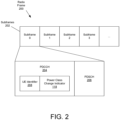
- the power class change indicator 118 can be included by a base station, or other RAN element, in a radio frame 200, as shown in FIG. 2 . Accordingly, in some examples the UE 102 may locate, interpret, and/or follow the power class change indicator 118 at the physical layer, without passing the power class change indicator 118 to an RRC layer or other higher protocol layer for interpretation.
- the radio frame 200 can include a series of subframes 202.
- the radio frame 200 can include ten subframes 202.
- An individual subframe may include data in a Physical Downlink Control Channel (PDCCH) 204.
- An individual subframe may also include other types of data, such as data in a Physical Downlink Shared Channel (PDSCH) 206 or a Physical Uplink Shared Channel (PUSCH), depending on the type of subframe.
- PDSCH Physical Downlink Shared Channel
- PUSCH Physical Uplink Shared Channel
- the UE identifier 208 may be a cell-radio network temporary identifier (C-RNTI) that is assigned to the UE 102 by a base station of the RAN 104 when the UE 102 initially connects to the base station.
- C-RNTI cell-radio network temporary identifier
- the power class change indicator 118 in the PDCCH 204 may be expressed using a single bit.
- one binary value for the bit may indicate that the UE 102 should continue using its current power class, while the other binary value for the bit may indicate that the UE 102 should change to another power class.
- the UE 102 may support both Power Class 1.5 and Power Class 2. If the UE 102 is currently using Power Class 1.5, a value of "0" for the power class change indicator 118 in the PDCCH 204 may indicate that the UE should continue using Power Class 1.5. However, a value of "1" for the power class change indicator 116 in the PDCCH 204 may indicate that the UE 102 should switch to using Power Class 2. The meanings of these binary values can be reversed in some examples, such that a value of "0” instead indicates that the UE 102 should switch to a different power class, and a value of "1" indicates that the UE 102 should continue using its current power class.
- the power class change indicator 118 in the PDCCH 204 may be expressed using multiple bits. Different possible combinations of values for the multiple bits of the power class change indicator 118 in the PDCCH 204 may map to corresponding instructions regarding the power class of the UE 102, or map to specific corresponding power classes. For example, a value of "00" may indicate that the UE 102 should use Power Class 3, a value of "01” may indicate that the UE 102 should use Power Class 2, and a value of "10" may indicate that the UE 102 should use Power Class 1.5.
- FIG. 3 show an example 300 of metrics and other data that can be included in the UE report 122 sent by the UE 102 to the RAN 104.
- the UE report 122 can include one or more of power data 302, temperature data 304, radio condition data 306, uplink transmission data 308, or other types of information.
- the power class switcher 116 can determine, based on information in the UE report 122 and/or other data, whether the UE 102 should change from its current power class to a different power class. If the power class switcher 116 does determine that the UE 102 should change to a different power class, the power class switcher 116 can cause the RAN 104 to send the power class change indicator 118 to the UE 102.
- Power data 302 can include information about the power consumption of the UE 102.
- the power data 302 may indicate rates at which the UE 102 has consumed power over one or more periods of time. Such power consumption rates may indicate how quickly the UE 102 is draining the battery 108.
- the power data 302 may also indicate current power levels of the battery 108, such as an indication of how much power is stored in the battery 108 and/or a current battery level relative to an overall battery capacity. For instance, the power data 302 may indicate that the battery 108 is currently charged to a level that is 75% full.
- the power data 302 may also indicate power headroom levels associated with the UE 102, such as a measure of how much power is available for transmissions in addition to power currently being used for transmissions.
- the power class switcher 116 may, in some situations, determine whether to dynamically change the power class used by the UE 102 based in part on the power data 302 in the UE report 122.
- the power class switcher 116 may be configured with one or more battery power thresholds that correspond with one or more power classes 114.
- the power class switcher 116 may be configured to instruct the UE 102 to use Power Class 1.5.
- the power class switcher 116 may be configured to instruct the UE 102 to use Power Class 2 in order to conserve battery life of the UE 102.
- the power class switcher 116 may be configured to instruct the UE 102 to use Power Class 1.5 if the charge level of the battery 108 is above a first threshold, instruct the UE 102 to use Power Class 2 if the charge level of the battery 108 is below a second threshold, and use one or more other factors to select between Power Class 1.5 and Power Class 2 if the charge level of the battery 108 is between the first threshold and the second threshold.
- the power class switcher 116 may, in some situations, determine whether to dynamically change the power class used by the UE 102 based in part on the temperature data 304 included in the UE report 122 or determined by the RAN 104 based on power data 302 in the UE report 122. For example, if the UE 102 is using Power Class 1.5, and the temperature data 304 indicates that the UE 102 is operating at a temperature above a temperature threshold, the power class switcher 116 may instruct the UE 102 to switch to using Power Class 2 in order to decrease the power consumption of the UE 102 and thereby lower the operating temperature of the UE 102.
- Radio condition data 306 can include metrics or other key performance indicators (KPIs) associated with radio conditions associated with the UE 102.
- the UE 102 may include, in the UE report 122, signal-to-interference-plus-noise (SINR) metrics, signal-to-noise (SNR) metrics, received signal strength indicator (RSSI) values, reference signal received power (RSRP) values, reference signal received quality (RSRQ) values, and/or other signal quality or signal strength metrics measured by the UE 102.
- SINR signal-to-interference-plus-noise
- RSSI received signal strength indicator
- RSRP reference signal received power
- RSRQ reference signal received quality
- one or more elements of the RAN 104 may separately measure or determine signal strength or signal quality metrics associated with transmissions between the RAN 104 and the UE 102.
- the radio condition data 306 may indicate a location of the UE 102 relative to a base station of the RAN 104.
- the base station may determine that the UE 102 is at a near-cell position relatively close to the base station if signal strength metrics are relatively strong, that the UE 102 is at a far-cell position relatively far away from the base station if signal strength metrics are relatively weak, or that the UE 102 is at a mid-cell position if signal strength metrics are in an intermediate range.
- base station or other RAN element can also, or alternately, determine an estimated location of the UE 102 based on Global Positioning System (GPS) coordinates included in the UE report 122, based on triangulation methods, and/or any other location determination method.
- GPS Global Positioning System
- the radio condition data 306 may indicate whether the UE 102 is indoors or outdoors.
- relatively poor signal strength metrics may indicate that the UE 102 is inside a building, and walls of the building are interfering with signal propagation.
- the power class switcher 116 may, in some situations, determine whether to dynamically change the power class used by the UE 102 based in part on the radio condition data 306 included in the UE report 122 and/or determined by the RAN 104. As an example, if the UE 102 is currently using Power Class 1.5, and relatively strong signal strength and/or signal quality metrics in the radio condition data 306 indicate that the UE 102 is likely outside and/or at a mid-cell or near-cell position, the power class switcher 116 may determine that Power Class 2 would be sufficient for uplink signals from the UE 102 to reach a base station.
- the power class switcher 116 may transmit the power class change indicator 118 with a value that instructs the UE 102 to dynamically change from using Power Class 1.5 to using Power Class 2.
- the power class switcher 116 may determine the UE 102 should continue using Power Class 1.5 to maintain current chances of uplink signals reaching the base station. In this situation, the power class switcher 116 may avoid transmitting the power class change indicator 118 to the UE 102 such that the UE 102 continues to use Power Class 1.5, or may transmit the power class change indicator 118 with a value that instructs the UE 102 to continue to use its current power class.
- the power class switcher 116 may determine that the UE 102 should instead use Power Class 1.5 to increase the output power for of uplink transmissions and increase the likelihood of uplink transmissions reaching the base station. Accordingly, in this situation, the power class switcher 116 may transmit the power class change indicator 118 to the UE 102 with a value that instructs the UE 102 to dynamically change from using Power Class 2 to using Power Class 1.5.
- Uplink transmission data 308 can include metrics, KPIs, or other data associated with uplink transmissions that have been performed and/or are to be performed, by the UE 102.
- uplink transmission data 308 may indicate buffer fullness levels associated with pending uplink transmissions.
- the uplink transmission data 308 may also indicate amounts and/or types of pending uplink data the UE 102 will be transmitting.
- the uplink transmission data 308 may indicate that the UE 102 will be transmitting a large upload file, and/or relatively small heartbeat messages.
- the uplink transmission data 308 can also indicate throughput levels measured by the UE 102.
- a base station or other RAN element may also, or alternately, measure or derive throughput levels associated with the UE 102.
- the power class switcher 116 may, in some situations, determine whether to dynamically change the power class used by the UE 102 based in part on the uplink transmission data 308 included in the UE report 122 and/or determined by the RAN 104. As an example, the UE 102 may currently be using Power Class 2, and uplink buffer fullness levels reported by the UE 102 in UE reports may indicate that the UE's uplink buffer is continuously full despite significantly uplink resources allocated by the RAN 104 to the UE 102.
- the power class switcher 116 may determine that Power Class 1.5 could allow the UE 102 to use more output power for uplink transmissions and transmit data from its uplink buffer more quickly, thereby lowering the fullness level of the UE's uplink buffer and increasing uplink throughput from the UE 102 overall. Accordingly, the power class switcher 116 may transmit the power class change indicator 118 to the UE 102 to instruct the UE 102 to dynamically change from using Power Class 2 to using Power Class 1.5. However, if the UE's buffer fullness level is below a buffer fullness threshold, the current uplink throughput associated with the UE may be sufficient and the power class switcher 116 may determine that the UE 102 should continue using Power Class 2.
- the power class switcher 116 can use UE reports provided by multiple UEs connected to a base station of the RAN 104, and/or other types of data, to determine overall metrics associated with a cell. For example, the power class switcher 116 may use SINR metrics or other interference metrics associated with a set of UEs in a cell to determine an overall interference level within the cell. The power class switcher 116 may be configured to determine power classes for different UEs based on UE reports provided by the different UEs, and/or based on overall cell metrics.
- the power class switcher 116 may determine that Power Class 2 would provide sufficient signal propagation ranges for all of the near-cell UEs, the power class switcher 116 may determine that instructing all of the near-cell UEs to use Power Class 2 would increase overall interference levels in the cell. Accordingly, the power class switcher 116 may instruct some of the near-cell UEs to use Power Class 1.5 and other near-cell UEs to use Power Class 2, as the use of different power classes by different subsets of UEs may reduce overall interference levels in the cell.
- the power class switcher 116 may evaluate different types of factors against different thresholds to determine which power class the UE 102 should use, for instance as discussed below with respect to FIG. 6 . In other examples, the power class switcher 116 may assign different weights to different types of factors, and use a weighted combination of the factors to determine which power class the UE 102 should use. For instance, the power class switcher 116 may be configured to weight factors associated power data 302 and/or temperature data 304 more heavily than factors associated with radio condition data 306 and/or uplink transmission data 308.
- the power class switcher 116 can evaluate data in the UE report 122 to dynamically determine whether the UE 102 should change power classes.
- the power class switcher 116 can use the power class change indicator 118 to dynamically instruct the UE 102 to use a particular power class selected by the power class switcher 116 from a set of power classes 114 noted by the UE 102 in the UE capability data 120.
- the power class switcher 116 can receive new UE reports from the UE 102 periodically or occasionally, and can also determine whether to change the UE's power class on a periodic or occasional basis. For example, if the power class switcher 116 is configured to provide power class change indicators in radio frames, such that a power class change indicator is interpretably the UE 102 at a physical layer as discussed above with respect to FIG. 2 , the power class switcher 116 may evaluate whether to include a power class change indicator that instructs the UE 102 to change its power class with respect to every radio frame transmitted by a base station, every ten radio frames transmitted by the base station, every hundred radio frames transmitted by the base station, or at any other interval.
- the power class switcher 116 may evaluate whether to send a power class change indicator that instructs the UE 102 to change its power class at the same or longer intervals, such as with respect to every hundred radio frames transmitted by the base station, every two hundred radio frames transmitted by the base station, every five hundred radio frames transmitted by the base station, or at any other interval.
- the power class switcher 116 may evaluate whether to send a power class change indicator that instructs the UE 102 to change its power class at intervals selected based on data provided by the UE 102 in UE reports. For example, if power data 302 reported by the UE 102 indicates that the battery 108 is charged to above a threshold level, the power class switcher 116 may send power class change indicators that cause the UE 102 to change its power class relatively frequency. However, if the power data 302 indicates that the battery 108 has a charge level below the threshold level, the power class switcher 116 may send power class change indicators that cause the UE 102 to change its power class less frequently to assist with preserving the battery life of the UE 102.
- the power class switcher 116 can dynamically determine whether the UE 102 should change power classes as discussed above, in some examples the UE 102 can be configured to limit which the set of power classes the power class switcher 116 can select from. For example, the UE 102 may support Power Class 1.5 and Power Class 2. However, if the battery 108 of the UE 102 has a charge level under a defined threshold when the UE 102 first registers with a base station, the UE 102 may provide UE capability data 120 during network registration indicating that the UE 102 only supports Power Class 2.
- the UE 102 can prevent the power class switcher 116 from considering Power Class 1.5 as an option for the UE 102. Accordingly, in this situation the UE 102 may operate based on Power Class 2 while connected to the base station due to the low charge level of the battery 108, without the power class switcher 116 potentially instructing the UE 102 to change to using Power Class 1.5 and thus potentially causing the UE to consumer power at higher power consumption levels.
- the UE 102 may also suppress information in the UE capability data 120 indicating that the UE 102 also supports Power Class 1.5 in addition to Power Class 2, such that the UE 102 can use Power Class 2 while idle. However, if the UE 102 moves from the idle state to an active state, the UE 102 may provide new UE capability data 120 indicating that the UE 102 does support both Power Class 1.5 and Power Class 2, such that the power class switcher 116 can dynamically instruct the UE 102 which of those power classes to use while the UE 102 is in the active state.
- FIG. 4 shows an example 400 of system architecture for the UE 102, in accordance with various examples.
- the UE 102 can include the battery 108, the temperature sensor 110, and the transmission interfaces 112 discussed above.
- the UE 102 can also have at least one memory 402, processor(s) 404, a display 406, output devices 408, input devices 410, and/or a drive unit 412 including a machine readable medium 414.
- the battery 108 can be a Li-ion battery, a LiPo battery, a NiCd battery, a NiMH battery, or other type of battery.
- the temperature sensor 110 can be a thermocouple, thermistor, RTD, semiconductor-based integrated circuit, thermometer, and/or any other type of temperature sensor.
- the transmission interfaces 112 can include transceivers, modems, interfaces, antennas, and/or other components that perform or assist in exchanging radio frequency (RF) communications with base stations of the RAN 104, a Wi-Fi access point, or otherwise implement connections with one or more networks.
- the transmission interfaces 112 can be compatible with one or more radio access technologies, such as 5G NR radio access technologies and/or LTE radio access technologies.
- the transmission interfaces 112 can also be configured to transmit data according to a selected power class, as described herein.
- the transmission interfaces 112 can be configured to interpret a power class change indicator in a radio frame at a physical layer, and use a power class indicated by the power class change indicator, as described above with respect to FIG. 2 .
- elements of the UE 102 above the physical layer can interpret a power class change indicator received in another type of message, such as an RRC reconfiguration message, and can instruct the transmission interfaces 112 to use the power class indicated by the power class change indicator.
- the memory 402 can include system memory, which may be volatile (such as RAM), non-volatile (such as ROM, flash memory, etc.) or some combination of the two.
- the memory 402 can further include non-transitory computer-readable media, such as volatile and nonvolatile, removable and non-removable media implemented in any method or technology for storage of information, such as computer readable instructions, data structures, program modules, or other data.
- System memory, removable storage, and non-removable storage are all examples of non-transitory computer-readable media.
- non-transitory computer-readable media examples include, but are not limited to, RAM, ROM, EEPROM, flash memory or other memory technology, CD-ROM, digital versatile discs (DVD) or other optical storage, magnetic cassettes, magnetic tape, magnetic disk storage or other magnetic storage devices, or any other non-transitory medium which can be used to store the desired information and which can be accessed by the UE 102. Any such non-transitory computer-readable media may be part of the UE 102.
- the memory 402 can include one or more software or firmware elements, such as computer-readable instructions that are executable by the one or more processors 404.
- the memory 402 can store computer-executable instructions that cause the UE 102 to transmit UE capability data 120 to the RAN 104, transmit the UE report 122 to the RAN 104, and/or interpret and implement the power class change indicator 118.
- the memory 402 can also store other modules and data 416, which can be utilized by the UE 102 to perform or enable performing any action taken by the UE 102.
- the other modules and data 416 can include a UE platform, operating system, and applications, and data utilized by the platform, operating system, and applications.
- the processor(s) 404 can be a CPU, a graphics processing unit (GPU), or both CPU and GPU, or any other type of processing unit.
- Each of the one or more processor(s) 404 may have numerous arithmetic logic units (ALUs) that perform arithmetic and logical operations, as well as one or more control units (CUs) that extract instructions and stored content from processor cache memory, and then executes these instructions by calling on the ALUs, as necessary, during program execution.
- the processor(s) 404 may also be responsible for executing all computer applications stored in the memory 402, which can be associated with common types of volatile (RAM) and/or nonvolatile (ROM) memory.
- the display 406 can be a liquid crystal display or any other type of display commonly used in UEs.
- the display 406 may be a touch-sensitive display screen, and can thus also act as an input device or keypad, such as for providing a soft-key keyboard, navigation buttons, or any other type of input.
- the output devices 408 can include any sort of output devices known in the art, such as the display 406, speakers, a vibrating mechanism, and/or a tactile feedback mechanism. Output devices 408 can also include ports for one or more peripheral devices, such as headphones, peripheral speakers, and/or a peripheral display.
- the input devices 410 can include any sort of input devices known in the art.
- input devices 410 can include a microphone, a keyboard/keypad, and/or a touch-sensitive display, such as the touch-sensitive display screen described above.
- a keyboard/keypad can be a push button numeric dialing pad, a multi-key keyboard, or one or more other types of keys or buttons, and can also include a j oystick-like controller, designated navigation buttons, or any other type of input mechanism.
- the machine readable medium 414 can store one or more sets of instructions, such as software or firmware, that embodies any one or more of the methodologies or functions described herein.
- the instructions can also reside, completely or at least partially, within the memory 402, processor(s) 404, and/or transmission interface(s) 112 during execution thereof by the UE 102.
- the memory 402 and the processor(s) 404 also can constitute machine readable media 414.
- the processor(s) 502 may be a CPU or any other type of processing unit. Each of the one or more processor(s) 502 may have numerous ALUs that perform arithmetic and logical operations, as well as one or more CUs that extract instructions and stored content from processor cache memory, and then executes these instructions by calling on the ALUs, as necessary, during program execution. The processor(s) 502 may also be responsible for executing all computer-executable instructions and/or computer applications stored in the memory 504.
- the memory 504 can include system memory, which may be volatile (such as RAM), non-volatile (such as ROM, flash memory, etc.) or some combination of the two.
- the memory 504 can also include additional data storage devices (removable and/or non-removable) such as, for example, magnetic disks, optical disks, or tape.
- Memory 504 can further include non-transitory computer-readable media, such as volatile and nonvolatile, removable and non-removable media implemented in any method or technology for storage of information, such as computer readable instructions, data structures, program modules, or other data.
- System memory, removable storage, and non-removable storage are all examples of non-transitory computer-readable media.
- non-transitory computer-readable media include, but are not limited to, RAM, ROM, EEPROM, flash memory or other memory technology, CD-ROM, DVD, or other optical storage, magnetic cassettes, magnetic tape, magnetic disk storage or other magnetic storage devices, or any other non-transitory medium which can be used to store the desired information and which can be accessed by the base station 500. Any such non-transitory computer-readable media may be part of the base station 500.
- the memory 504 can store computer-readable instructions and/or other data associated with operations of the base station 500.
- the memory 504 can store UE power class data 508, UE reports 510, cell data 512, and the power class switcher 116.
- the UE power class data 508 can indicate a set of power classes that each UE registered with the base station 500 supports, based on UE capability data reported by the UEs during network registration or at other times. For example, the UE power class data 508 may indicate that a first UE supports Power Class 1.5 and Power Class 2, such that the power class switcher 116 can dynamically instruct the first UE to switch between using Power Class 1.5 and Power Class 2. However, the UE power class data 508 may indicate that a second UE only supports Power Class 2, such that the power class switcher 116 is not configured to dynamically change the power class of the second UE. The UE power class data 508 may also indicate that a third UE supports Power Class 2 and Power Class 3, such that the power class switcher 116 can dynamically instruct the first UE to switch between using Power Class 2 and Power Class 3.
- the UE reports 510 can include data from one or more UE reports, such as UE report 122, collected from one or more UEs over time. For example, the UE 102 may periodically send new UE reports to the base station 500 over time. Different UEs may also send in different UE reports. The base station 500 can store some or all of the received UE reports in the memory 504 for use by the power class switcher 116.
- the cell data 512 can include metrics or other KPIs that are measured or derived for a cell associated with the base station 500.
- the cell data 512 can include an aggregated interference level associated with the cell, based on individual SINR measurements included in UE reports 510 provided by a set of UEs registered with the base station 500.
- the cell data 512 may also include an indication of how many UEs are currently registered with the base station 500.
- the power class switcher 116 may consider the cell data 512 in addition to, or instead of, one or more of the UE reports 510 and/or the UE power class data 508 to determine whether to change the power class used by any of the registered UEs.
- the transmission interfaces 506 can include one or more modems, receivers, transmitters, antennas, error correction units, symbol coders and decoders, processors, chips, application specific integrated circuits (ASICs), programmable circuit (e.g., field programmable gate arrays), firmware components, and/or other components that can establish connections with one or more UEs, other base stations or elements of the RAN 104, elements of the core network 106, and/or other network elements, and can transmit data over such connections.
- ASICs application specific integrated circuits
- programmable circuit e.g., field programmable gate arrays
- firmware components e.g., firmware components
- the transmission interfaces 506 can establish one or more connections with the UE 102 over air interfaces.
- the transmission interfaces 506 can also support transmissions using one or more radio access technologies, such as 5G NR or LTE.
- FIG. 6 shows a flowchart of an example method 600 by which the power class switcher 116 can dynamically determine a power class for the UE 102.
- the power class switcher 116 may be an element of a base station, or other network element of the RAN 104.
- the power class switcher 116 may have information that indicates a set of power classes 114 supported by the UE 102, for instance based on UE capability data 120 reported by the UE 102 during network registration.
- the set of power classes 114 can include a first power class with a higher maximum output power, and a second power class with a lower maximum output power.
- the first power class can be Power Class 1.5
- the second power class can be Power Class 2.
- the power class switcher 116 determines that the current charge level of the battery 108 is less than the predefined battery threshold (Block 604 - Yes)
- the power class switcher 116 can determine that the UE 102 should be using the second power class. Because the second power class has a lower maximum output power than the first power class, and the current charge level of the battery 108 is less than the predefined battery threshold, use of the second power class may assist with preserving battery life of the battery 108. Accordingly, at block 606, the power class switcher 116 can configure the UE 102 to use the second power class, by sending the power class change indicator 118 to the UE 102 with a value indicating that the UE 102 should use the second power class.
- the machine learning model 706 can evaluate such factors in the historical UE data 708, and determine which factors should be considered by the power class switcher 116 in which situations, determine weights to assign to those factors in those situations, determine an order in which the power class switcher 116 should evaluate the factors, and/or otherwise determine how the power class switcher 116 should evaluate factors.
- the machine learning model 706 can accordingly generate the power class switcher configuration 704 to indicate the identified factors, weights for the factors, values for thresholds, and/or other adjustments to how the power class switcher 116 operates.
Landscapes
- Engineering & Computer Science (AREA)
- Computer Networks & Wireless Communication (AREA)
- Signal Processing (AREA)
- Quality & Reliability (AREA)
- Artificial Intelligence (AREA)
- Evolutionary Computation (AREA)
- Physics & Mathematics (AREA)
- Electromagnetism (AREA)
- Mobile Radio Communication Systems (AREA)
Applications Claiming Priority (2)
| Application Number | Priority Date | Filing Date | Title |
|---|---|---|---|
| US17/204,754 US11533688B2 (en) | 2021-03-17 | 2021-03-17 | Dynamic switching of user equipment power class |
| EP22159830.3A EP4061067B1 (de) | 2021-03-17 | 2022-03-02 | Dynamische umschaltung der leistungsklasse eines benutzergerätes |
Related Parent Applications (2)
| Application Number | Title | Priority Date | Filing Date |
|---|---|---|---|
| EP22159839.4A Previously-Filed-Application EP4152057A1 (de) | 2021-09-17 | 2022-03-02 | Blendfreie folie mit hoher opazität und blendfreie antireflexionsfolie mit hoher opazität |
| EP22159830.3A Division EP4061067B1 (de) | 2021-03-17 | 2022-03-02 | Dynamische umschaltung der leistungsklasse eines benutzergerätes |
Publications (2)
| Publication Number | Publication Date |
|---|---|
| EP4535883A2 true EP4535883A2 (de) | 2025-04-09 |
| EP4535883A3 EP4535883A3 (de) | 2025-05-07 |
Family
ID=80625203
Family Applications (2)
| Application Number | Title | Priority Date | Filing Date |
|---|---|---|---|
| EP22159830.3A Active EP4061067B1 (de) | 2021-03-17 | 2022-03-02 | Dynamische umschaltung der leistungsklasse eines benutzergerätes |
| EP24204060.8A Pending EP4535883A3 (de) | 2021-03-17 | 2022-03-02 | Dynamische umschaltung der leistungsklasse eines benutzergeräts |
Family Applications Before (1)
| Application Number | Title | Priority Date | Filing Date |
|---|---|---|---|
| EP22159830.3A Active EP4061067B1 (de) | 2021-03-17 | 2022-03-02 | Dynamische umschaltung der leistungsklasse eines benutzergerätes |
Country Status (2)
| Country | Link |
|---|---|
| US (4) | US11533688B2 (de) |
| EP (2) | EP4061067B1 (de) |
Families Citing this family (7)
| Publication number | Priority date | Publication date | Assignee | Title |
|---|---|---|---|---|
| EP4104297A1 (de) * | 2020-02-14 | 2022-12-21 | Telefonaktiebolaget LM Ericsson (publ) | Erweiterte leistungsklasse für uplink-mimo-kommunikation |
| US11533688B2 (en) * | 2021-03-17 | 2022-12-20 | T-Mobile Usa, Inc. | Dynamic switching of user equipment power class |
| US12101180B2 (en) * | 2021-05-06 | 2024-09-24 | Apple Inc. | Systems and methods for high power operation in user equipment |
| US11601837B1 (en) * | 2021-10-12 | 2023-03-07 | T-Mobile Innovations Llc | Adaptive distribution of content |
| US20260089486A1 (en) * | 2022-09-23 | 2026-03-26 | Apple Inc. | Supporting ue maximum output power declaration and capability reporting |
| CN119997170A (zh) * | 2023-11-10 | 2025-05-13 | 华为技术有限公司 | 功率确定方法及相关产品 |
| WO2025136351A1 (en) * | 2023-12-18 | 2025-06-26 | Google Llc | Dynamic control of power class based on operational state |
Family Cites Families (174)
| Publication number | Priority date | Publication date | Assignee | Title |
|---|---|---|---|---|
| US4636741A (en) * | 1985-11-01 | 1987-01-13 | Motorola, Inc. | Multi-level power amplifying circuitry for portable radio transceivers |
| US5652893A (en) * | 1994-12-13 | 1997-07-29 | 3Com Corporation | Switching hub intelligent power management |
| US5999832A (en) * | 1997-07-31 | 1999-12-07 | Vannatta; Louis J. | Method of and apparatus for controlling a transmit power of a communication device |
| FR2769158B1 (fr) * | 1997-09-26 | 1999-11-26 | Sagem | Procede de gestion de l'alimentation d'un poste de radiotelephonie cellulaire |
| GB2339113B (en) * | 1998-06-30 | 2003-05-21 | Nokia Mobile Phones Ltd | Data transmission in tdma system |
| JP3882463B2 (ja) * | 2000-05-12 | 2007-02-14 | 日本電気株式会社 | Ieee1394装置 |
| EP1533915A1 (de) * | 2003-11-20 | 2005-05-25 | Siemens Aktiengesellschaft | Verfahren und Vorrichtung zur Sendeleistungsregelung |
| WO2008133576A1 (en) * | 2007-04-30 | 2008-11-06 | Telefonaktiebolaget Lm Ericsson (Publ) | Recommending a transmission mode for a mimo -supporting ue |
| CN103123702B (zh) * | 2007-08-28 | 2017-11-28 | Commvault系统公司 | 如数据存储操作的自适应能耗管理的数据处理资源的能耗管理 |
| US8718694B2 (en) * | 2007-12-07 | 2014-05-06 | Interdigital Patent Holdings, Inc. | Method and apparatus of signaling and procedure to support uplink power level determination |
| US20090175187A1 (en) * | 2008-01-07 | 2009-07-09 | Kristina Jersenius | Method and Arrangement for Triggering Power Headroom Report Transmissions in a Telecommunications System |
| US8843069B2 (en) * | 2008-02-01 | 2014-09-23 | Qualcomm Incorporated | Interference reduction request in a wireless communication system |
| US8825046B2 (en) * | 2008-02-01 | 2014-09-02 | Qualcomm Incorporated | Short-term interference mitigation in a wireless communication system |
| CN102017723B (zh) * | 2008-05-05 | 2014-11-19 | 诺基亚通信公司 | 涉及随机接入过程的功率控制的方法、设备和计算机程序 |
| CN102177753B (zh) * | 2008-08-08 | 2014-06-25 | 诺基亚西门子通信公司 | 用于控制移动站功率的方法和设备 |
| CN102257860A (zh) * | 2008-12-22 | 2011-11-23 | 日本电气株式会社 | 通信系统、用户设备、基站、发射功率确定方法和程序 |
| US8274951B2 (en) * | 2009-03-17 | 2012-09-25 | Samsung Electronics Co., Ltd. | System and method for dynamic cell selection and resource mapping for CoMP joint transmission |
| US8971299B2 (en) * | 2009-03-17 | 2015-03-03 | Samsung Electronics Co., Ltd | Uplink transmission power control in multi-carrier communication systems |
| US8600424B2 (en) * | 2009-06-19 | 2013-12-03 | Qualcomm Incorporated | Method and apparatus for managing downlink transmission power in a heterogeneous network |
| US8768397B2 (en) | 2009-10-02 | 2014-07-01 | Sharp Kabushiki Kaisha | Transmission power control on a wireless communication device for a plurality of regulated bands or component carriers |
| US8315661B2 (en) * | 2009-12-31 | 2012-11-20 | Cellco Partnership | Enhanced power headroom reporting |
| US8867420B2 (en) * | 2010-03-15 | 2014-10-21 | Qualcomm Incorporated | Method and apparatus for enhancing high data rate uplink operations |
| US8873439B2 (en) * | 2010-03-25 | 2014-10-28 | Qualcomm Incorporated | Subframe dependent physical uplink control channel (PUCCH) region design |
| US8897236B2 (en) * | 2010-03-26 | 2014-11-25 | Qualcomm Incorporated | Physical downlink shared channel (PDSCH) protection |
| WO2012002684A2 (en) * | 2010-06-28 | 2012-01-05 | Samsung Electronics Co., Ltd. | Method and apparatus for reporting maximum transmission power in wireless communication |
| US20130114562A1 (en) * | 2010-07-16 | 2013-05-09 | Lg Electronics Inc. | Method and apparatus for controlling uplink transmission power in wireless communication system |
| US8934362B2 (en) * | 2011-01-06 | 2015-01-13 | Mediatek Inc. | Power control method to mitigate interference for in-device coexistence |
| WO2012096520A2 (en) * | 2011-01-11 | 2012-07-19 | Samsung Electronics Co., Ltd. | Uplink transmission power configuration method and apparatus for mobile communication system |
| EP2749081B1 (de) * | 2011-08-22 | 2019-03-27 | Samsung Electronics Co., Ltd. | Verfahren und vorrichtung zur unterstützung mehrerer frequenzbänder in einem mobilen kommunikationssystem |
| WO2013048143A2 (en) * | 2011-09-27 | 2013-04-04 | Samsung Electronics Co., Ltd. | A method and appratus for transmission power control for a sounding reference signal |
| US9078253B2 (en) * | 2011-11-28 | 2015-07-07 | Samsung Electronics Co., Ltd. | Apparatus and method for machine-type communications |
| US9543787B2 (en) * | 2011-12-30 | 2017-01-10 | Scrutiny, Inc. | FRAME (forced recuperation, aggregation and movement of exergy) |
| CN104380625B (zh) * | 2012-03-22 | 2018-02-02 | Lg电子株式会社 | 用于发送或接收上行信号的方法 |
| CN103369582B (zh) * | 2012-04-06 | 2016-08-03 | 中兴通讯股份有限公司 | 长期演进系统的物理下行控制信道质量预测方法及装置 |
| US9031601B2 (en) * | 2012-06-25 | 2015-05-12 | Telefonaktiebolaget L M Ericsson (Publ) | Controlling radio transmitter power based on signal performance |
| EP2883397B1 (de) * | 2012-08-13 | 2019-07-31 | Telefonaktiebolaget LM Ericsson (publ) | Verbesserung von uplink-messdaten zur positionierung mit anpassbaren verwendung mehrfachantennensysteme |
| US9398480B2 (en) * | 2012-11-02 | 2016-07-19 | Telefonaktiebolaget L M Ericsson (Publ) | Methods of obtaining measurements in the presence of strong and/or highly varying interference |
| RU2629430C2 (ru) * | 2013-01-16 | 2017-08-29 | Интердиджитал Пэйтент Холдингз, Инк. | Генерация и прием сигнала обнаружения |
| US9420476B2 (en) * | 2013-02-20 | 2016-08-16 | Telefonaktiebolaget L M Ericsson (Publ) | Systems and methods of triggering interference mitigation without resource partitioning |
| US8934400B2 (en) * | 2013-02-22 | 2015-01-13 | General Dynamics C4 Systems, Inc. | Apparatus and methods for relay-assisted uplink communication |
| US8934401B2 (en) * | 2013-02-22 | 2015-01-13 | General Dynamics C4 Systems, Inc. | Apparatus and methods for relay-assisted uplink communication |
| US9173109B2 (en) * | 2013-03-15 | 2015-10-27 | Blackberry Limited | Radio link quality monitoring |
| EP2978150B1 (de) * | 2013-03-20 | 2018-10-24 | LG Electronics Inc. | Verfahren zum senden und empfangen von signalen mittels vorrichtung-zu-vorrichtung-kommunikation in einem drahtloskommunikationssystem und vorrichtung dafür |
| RU2631667C2 (ru) * | 2013-05-22 | 2017-09-26 | Телефонактиеболагет Л М Эрикссон (Пабл) | Подавление интерференции сигналов в беспроводной сети |
| US9146814B1 (en) * | 2013-08-26 | 2015-09-29 | Amazon Technologies, Inc. | Mitigating an impact of a datacenter thermal event |
| US9883465B2 (en) * | 2013-09-04 | 2018-01-30 | Qualcomm Incorporated | Determining transmit power based on categorization of access terminals |
| US9078220B2 (en) | 2013-09-27 | 2015-07-07 | Motorola Solutions, Inc. | Method and apparatus for UE power class adaption for coverage extension in LTE |
| WO2015087271A2 (en) * | 2013-12-12 | 2015-06-18 | Koninklijke Philips N.V. | Method to enable standard alternating current (ac)/direct current (dc) power adapters to operate in high magnetic fields |
| FR3016702B1 (fr) * | 2014-01-17 | 2017-08-04 | Blue Solutions | Procede et systeme de gestion d'une pluralite d'ensemble de stockage d'energie. |
| GB201412265D0 (en) * | 2014-07-10 | 2014-08-27 | Vodafone Ip Licensing Ltd | Carrier aggregation activation |
| GB2529143A (en) * | 2014-07-10 | 2016-02-17 | Vodafone Ip Licensing Ltd | Carrier aggregation mode selection |
| GB201412264D0 (en) * | 2014-07-10 | 2014-08-27 | Vodafone Ip Licensing Ltd | Resource management for inter-enodeb carrier aggregation |
| US20160100360A1 (en) * | 2014-10-07 | 2016-04-07 | Qualcomm Incorporated | Methods and apparatus for using enhancements for diverse data applications (edda)/power preference indication (ppi) |
| US20160149679A1 (en) * | 2014-10-10 | 2016-05-26 | Telefonaktiebolaget L M Ericsson (Publ) | Method for dynamic csi feedback |
| AU2015328743B2 (en) * | 2014-10-10 | 2018-01-04 | Telefonaktiebolaget Lm Ericsson (Publ) | Method for dynamic CSI feedback |
| WO2016089185A1 (ko) * | 2014-12-05 | 2016-06-09 | 엘지전자 주식회사 | 기기 간 사이드링크를 이용하여 단말이 신호를 송수신하는 방법 및 장치 |
| US10034190B2 (en) * | 2015-02-12 | 2018-07-24 | Qualcomm Incorporated | Enhancing network operation with UE context awareness |
| US10708920B2 (en) * | 2015-03-03 | 2020-07-07 | Qualcomm Incorporated | Method and apparatus for dynamic device capability signaling in wireless communications |
| CN108352954B (zh) * | 2015-08-20 | 2021-07-16 | 瑞典爱立信有限公司 | 在无线通信网络中执行和处理叠加发送的网络节点、无线设备及其中的方法 |
| US11147044B2 (en) * | 2016-03-04 | 2021-10-12 | Lg Electronics Inc. | V2X transmission resource selecting method implemented by terminal in wireless communication system and terminal using same |
| WO2017191142A1 (en) * | 2016-05-03 | 2017-11-09 | AVAILON GmbH | Status monitoring for mechanical plants, in particular wind turbines |
| CN115133963B (zh) * | 2016-05-11 | 2024-09-27 | 三菱电机株式会社 | 通信系统、通信终端装置以及基站 |
| US10367677B2 (en) * | 2016-05-13 | 2019-07-30 | Telefonaktiebolaget Lm Ericsson (Publ) | Network architecture, methods, and devices for a wireless communications network |
| US10630410B2 (en) * | 2016-05-13 | 2020-04-21 | Telefonaktiebolaget Lm Ericsson (Publ) | Network architecture, methods, and devices for a wireless communications network |
| WO2017212104A1 (en) * | 2016-06-07 | 2017-12-14 | Nokia Technologies Oy | Multi-connectivity of terminal device |
| JP6758957B2 (ja) * | 2016-07-01 | 2020-09-23 | ソニーモバイルコミュニケーションズ株式会社 | 制御装置、制御方法、及びプログラム |
| US11039492B2 (en) * | 2016-07-07 | 2021-06-15 | Telefonaktiebolaget Lm Ericsson (Publ) | Data receiving mode configuration for dual connectivity communication |
| WO2018017468A1 (en) * | 2016-07-18 | 2018-01-25 | Phluido, Inc. | Synchronization of radio units in radio access networks |
| ES2848726T3 (es) * | 2016-09-30 | 2021-08-11 | Ericsson Telefon Ab L M | Métodos y nodos para la selección de células en una red de comunicación inalámbrica |
| WO2018063077A1 (en) * | 2016-09-30 | 2018-04-05 | Telefonaktiebolaget Lm Ericsson (Publ) | Effective master information block acquisition for a user equipment device |
| CN110192372B (zh) * | 2016-11-14 | 2022-12-02 | 瑞典爱立信有限公司 | 在缩短的tti模式中导出连续传输时间间隔(tti)的配置输出功率 |
| CN114938533A (zh) * | 2016-12-30 | 2022-08-23 | 英特尔公司 | 用于无线电通信的方法和设备 |
| EP3566373A1 (de) * | 2017-01-06 | 2019-11-13 | Convida Wireless, LLC | Mechanismen für effizienten zugang und übertragung in nr |
| US10891342B2 (en) * | 2017-01-12 | 2021-01-12 | Google Llc | Content data determination, transmission and storage for local devices |
| WO2018129853A1 (zh) * | 2017-01-13 | 2018-07-19 | 华为技术有限公司 | 一种终端功率调整的方法及终端 |
| WO2018143853A1 (en) | 2017-02-03 | 2018-08-09 | Telefonaktiebolaget Lm Ericsson (Publ) | Methods for determining reporting configuration based on ue power class |
| US11102786B2 (en) * | 2017-03-27 | 2021-08-24 | Huawei Technologies Co., Ltd. | Methods and apparatus for enhanced spectral efficiency and reliability of transmission without grant |
| EP3628133B1 (de) * | 2017-05-04 | 2024-01-10 | Koninklijke Philips N.V. | Intragruppe kommunikation |
| US10962623B1 (en) * | 2017-05-17 | 2021-03-30 | Heathkit Company, Inc. | Accurate and model-based measurement and management systems and methods |
| DE102017212324A1 (de) | 2017-07-19 | 2019-01-24 | Robert Bosch Gmbh | Verfahren und Vorrichtung zur Hochdruckfluidbearbeitung |
| US11184848B2 (en) * | 2017-08-11 | 2021-11-23 | Qualcomm Incorporated | Connected discontinuous reception wake up procedure |
| US10779198B1 (en) | 2017-08-16 | 2020-09-15 | Sprint Spectrum L.P. | Adjusting handover thresholds for high power class wireless devices |
| US10264534B1 (en) | 2017-09-07 | 2019-04-16 | Sprint Spectrum L.P. | Power control for high power class wireless devices |
| US11006355B2 (en) * | 2017-09-21 | 2021-05-11 | Qualcomm Incorporated | Radio access technology (RAT) selection based on device usage patterns |
| US10582454B2 (en) * | 2017-09-27 | 2020-03-03 | Ofinno, Llc | Power control for uplink control channel |
| US10892929B2 (en) * | 2017-09-29 | 2021-01-12 | Telefonaktiebolaget Lm Ericsson (Publ) | Multi-antenna processing for reference signal |
| US11310769B2 (en) * | 2017-10-02 | 2022-04-19 | Telefonaktiebolaget Lm Ericsson (Publ) | Method, apparatus, and computer-readable medium for enhanced decoding of narrowband master information blocks (MIB-NB) |
| EP3701692A1 (de) * | 2017-10-27 | 2020-09-02 | Telefonaktiebolaget LM Ericsson (Publ) | Dm-rs von pi/2-bpsk-signalen |
| US10979988B2 (en) * | 2017-11-07 | 2021-04-13 | Apple Inc. | Methods of limited buffer rate-matching (LBRM), pre-emption, and sidelink synchronization in new radio (NR) systems |
| US11140695B1 (en) * | 2017-11-09 | 2021-10-05 | Verana Networks, Inc. | Wireless mesh network |
| BR112020007563A2 (pt) * | 2017-11-17 | 2020-09-24 | Telefonaktiebolaget Lm Ericsson (Publ) | método para monitoramento da qualidade de serviço de um fluxo, e, primeiro e segundo nós de rede |
| US11006413B2 (en) * | 2017-12-06 | 2021-05-11 | Google Llc | Narrow-band communication |
| KR102536118B1 (ko) * | 2017-12-30 | 2023-05-23 | 인텔 코포레이션 | 차량 무선 통신을 위한 방법 및 디바이스 |
| WO2019139254A1 (ko) * | 2018-01-12 | 2019-07-18 | 엘지전자 주식회사 | 복수의 수신 빔을 사용하여 측정을 수행하는 방법 및 사용자 장치 |
| US11025456B2 (en) * | 2018-01-12 | 2021-06-01 | Apple Inc. | Time domain resource allocation for mobile communication |
| US10863494B2 (en) * | 2018-01-22 | 2020-12-08 | Apple Inc. | Control signaling for uplink multiple input multiple output, channel state information reference signal configuration and sounding reference signal configuration |
| US10986602B2 (en) * | 2018-02-09 | 2021-04-20 | Intel Corporation | Technologies to authorize user equipment use of local area data network features and control the size of local area data network information in access and mobility management function |
| US11166275B2 (en) * | 2018-02-15 | 2021-11-02 | Qualcomm Incorporated | Flexible search space configuration and overbooking handling |
| WO2019158461A1 (en) | 2018-02-15 | 2019-08-22 | Telefonaktiebolaget Lm Ericsson (Publ) | Indication of multiple power classes |
| US11129103B2 (en) * | 2018-03-15 | 2021-09-21 | Qualcomm Incorporated | Skipping periodic measurements to enable power saving in user equipments |
| US10980359B2 (en) * | 2018-04-03 | 2021-04-20 | Walmart Apollo, Llc | Temperature-controlled display case maintenance cart system |
| US10986622B2 (en) * | 2018-05-10 | 2021-04-20 | Apple Inc. | User equipment (UE) downlink transmission configuration indication (TCI)-state selection |
| US11057846B2 (en) * | 2018-05-11 | 2021-07-06 | Lg Electronics Inc. | Method for transmitting capability information including power class information and wireless device |
| US11729782B2 (en) * | 2018-06-11 | 2023-08-15 | Apple Inc. | Enhanced uplink beam management |
| US12176970B2 (en) * | 2018-06-12 | 2024-12-24 | Qualcomm Incorporated | Antenna element feed path component management for 5G-NR millimeter wave |
| US11425599B2 (en) * | 2018-06-21 | 2022-08-23 | Telefonaktiebolaget Lm Ericsson (Publ) | Preventing/mitigating packet loss in integrated access backhaul (IAB) networks |
| DE112019003172T5 (de) * | 2018-08-09 | 2021-03-18 | Lg Electronics Inc. | Verfahren zum übertragen/empfangen eines signals in einemdrahtloskommunikationssystem und vorrichtung dafür |
| US11244242B2 (en) * | 2018-09-07 | 2022-02-08 | Intel Corporation | Technologies for distributing gradient descent computation in a heterogeneous multi-access edge computing (MEC) networks |
| US11923945B2 (en) * | 2018-09-07 | 2024-03-05 | Nokia Technologies Oy | Facilitating efficient multi-beam beam recovery |
| CN118214524A (zh) * | 2018-09-13 | 2024-06-18 | 苹果公司 | 用于无线通信的混合自动重传请求反馈 |
| US10958328B2 (en) * | 2018-11-02 | 2021-03-23 | Qualcomm Incorporated | Beam management enhancements for mmWave operations |
| KR102541220B1 (ko) * | 2018-11-21 | 2023-06-09 | 삼성전자 주식회사 | 무선 통신 시스템에서 신호를 송수신하는 방법 및 장치 |
| US10716124B1 (en) * | 2018-12-04 | 2020-07-14 | Sprint Spectrum L.P. | Use of Euclidian distance between UEs as basis to control grouping for MU-MIMO service |
| US10602478B1 (en) * | 2018-12-06 | 2020-03-24 | Sprint Spectrum L.P. | Use of mobility as basis to control configuration of MU-MIMO service |
| US10470073B1 (en) * | 2018-12-06 | 2019-11-05 | Sprint Spectrum L.P. | Use of block error rate as basis to control configuration of MU-MIMO service |
| US10412691B1 (en) * | 2018-12-06 | 2019-09-10 | Sprint Spectrum, L.P. | Use of power headroom as basis to control configuration of MU-MIMO service |
| US11140639B1 (en) * | 2018-12-06 | 2021-10-05 | Sprint Spectrum L.P. | Use of power class as basis to control configuration of MU-MIMO service |
| US10826576B1 (en) * | 2018-12-06 | 2020-11-03 | Sprint Spectrum L.P. | Use of RF stability as basis to control configuration of MU-MIMO service |
| US10819402B1 (en) * | 2018-12-07 | 2020-10-27 | Sprint Spectrum L.P. | Grouping UEs for MU-MIMO service based on commonality of primary serving carriers |
| US11375518B2 (en) * | 2019-01-23 | 2022-06-28 | Samsung Electronics Co., Ltd. | Method and apparatus for managing PDCCH processing timelines |
| US10958317B1 (en) * | 2019-01-25 | 2021-03-23 | Sprint Spectrum L.P. | Controlling maximum MU-MIMO group size based on cell dimension |
| US11716694B2 (en) * | 2019-01-31 | 2023-08-01 | Commscope Technologies Llc | Estimating and controlling transmit power of user equipment by a base station |
| US12464041B2 (en) * | 2019-02-13 | 2025-11-04 | Telefonaktiebolaget Lm Ericsson (Publ) | Industrial automation with 5G and beyond |
| US10790885B1 (en) * | 2019-02-22 | 2020-09-29 | Sprint Spectrum L.P. | Control of MIMO configuration based on retransmission rate |
| US11423254B2 (en) * | 2019-03-28 | 2022-08-23 | Intel Corporation | Technologies for distributing iterative computations in heterogeneous computing environments |
| US11358613B2 (en) * | 2019-04-23 | 2022-06-14 | Lg Electronics Inc. | Autonomous vehicle and service providing system and method using the same |
| US11132991B2 (en) * | 2019-04-23 | 2021-09-28 | Lg Electronics Inc. | Method and apparatus for determining voice enable device |
| US10623070B1 (en) * | 2019-04-29 | 2020-04-14 | Sprint Spectrum L.P. | Base station selection based on quantity of MIMO layers supported |
| US10461421B1 (en) * | 2019-05-07 | 2019-10-29 | Bao Tran | Cellular system |
| US11026235B2 (en) * | 2019-05-16 | 2021-06-01 | Qualcomm Incorporated | Beam grouping for inter-band carrier aggregation |
| WO2020250035A1 (en) * | 2019-06-12 | 2020-12-17 | Lenovo (Singapore) Pte. Ltd. | Responding to a new data indicator for a hybrid automatic repeat request process |
| WO2020263945A1 (en) * | 2019-06-24 | 2020-12-30 | Qualcomm Incorporated | Bandwidth part full-duplex communication techniques |
| US10862553B1 (en) * | 2019-07-12 | 2020-12-08 | Sprint Spectrum L.P. | Use of RF correlation between UEs in a MU-MIMO group as a basis to bias MCS |
| EP3780882B1 (de) * | 2019-08-15 | 2025-10-01 | Comcast Cable Communications LLC | Sidelink-kommunikation |
| US11483839B2 (en) * | 2019-08-15 | 2022-10-25 | Ofinno, Llc | Sidelink resource pool selection for urgent packet transmission |
| US20200389876A1 (en) * | 2019-08-16 | 2020-12-10 | Intel Corporation | Uplink cancelation indication |
| US11412455B2 (en) * | 2019-08-16 | 2022-08-09 | Ofinno, Llc | Power control for sidelink feedback |
| US11601840B2 (en) * | 2019-08-16 | 2023-03-07 | Ofinno, Llc | Enhanced congestion control mechanism for sidelink |
| CN114270918B (zh) * | 2019-08-21 | 2023-08-22 | 联想(新加坡)私人有限公司 | 无线电链路故障恢复的方法和装置 |
| US11991728B2 (en) * | 2019-08-27 | 2024-05-21 | Intel Corporation | Techniques for high frequency wireless communication |
| US11751100B2 (en) * | 2019-09-10 | 2023-09-05 | Intel Corporation | Techniques for integrated access and backhaul (IAB) nodes |
| US11751251B2 (en) * | 2019-09-19 | 2023-09-05 | Intel Corporation | Grant based PUSCH transmission and configured grant based PUSCH transmission in NR systems operating on unlicensed spectrum |
| US11729243B2 (en) * | 2019-09-20 | 2023-08-15 | Intel Corporation | Dash-based streaming of point cloud content based on recommended viewports |
| CN112543485B (zh) * | 2019-09-23 | 2023-07-14 | 北京小米移动软件有限公司 | 语音通话控制方法、装置及存储介质 |
| US11418278B2 (en) * | 2019-09-23 | 2022-08-16 | Qualcomm Incorporated | Configured dependency between modulation and coding scheme (MCS) and power control |
| US20210076275A1 (en) * | 2019-10-02 | 2021-03-11 | Candy Yiu | Apparatus, system and method to configure conditions for radio resource management measurement relaxation in a new radio network |
| US20210022018A1 (en) * | 2019-10-03 | 2021-01-21 | Intel Corporation | Methods for selection of ca configuration for nr normal ca requirements |
| US11497010B2 (en) * | 2019-10-04 | 2022-11-08 | Qualcomm Incorporated | Physical downlink control channel candidate hopping across control resource sets |
| US20210045125A1 (en) * | 2019-10-11 | 2021-02-11 | Intel Corporation | Multiplexing transmission types in multiple-panel user equipments |
| US20210058989A1 (en) * | 2019-11-06 | 2021-02-25 | Intel Corporation | Network coding and delay-efficient integrated access and backhaul network topologies |
| US11510079B2 (en) * | 2019-11-07 | 2022-11-22 | Ofinno, Llc | Sidelink sensing measurement |
| US11963041B2 (en) * | 2019-11-08 | 2024-04-16 | Intel Corporation | Load balancing optimization for 5G self-organizing networks |
| US20210058970A1 (en) * | 2019-11-08 | 2021-02-25 | Intel Corporation | Mechanisms to operate on a downlink wideband carrier in unlicensed band |
| US11996967B2 (en) * | 2019-11-15 | 2024-05-28 | Intel Corporation | Low peak-to-average power ratio (PAPR) reference signal (RS) design for high frequency bands |
| US11871419B2 (en) * | 2019-11-19 | 2024-01-09 | Intel Corporation | Multi-transmission time interval (TTI) scheduling for data transmission |
| US11743006B2 (en) * | 2019-11-27 | 2023-08-29 | Intel Corporation | Physical uplink control channel design for discrete fourier transform-spread-orthogonal frequency-division multiplexing (DFT-s-OFDM) waveforms |
| US12057977B2 (en) * | 2019-12-02 | 2024-08-06 | Intel Corporation | Synchronization signal block configuration for above 52.6GHZ carrier frequency |
| US11812405B2 (en) * | 2019-12-10 | 2023-11-07 | Intel Corporation | User equipment operation with multiple subscriber identity modules |
| US11770848B2 (en) * | 2019-12-11 | 2023-09-26 | Intel Corporation | Techniques for uplink cancellation indication signaling |
| US11588602B2 (en) * | 2019-12-13 | 2023-02-21 | Samsung Electronics Co., Ltd. | Beam management and coverage enhancements for semi-persistent and configured grant transmissions |
| US20210105451A1 (en) * | 2019-12-23 | 2021-04-08 | Intel Corporation | Scene construction using object-based immersive media |
| US20210105338A1 (en) * | 2020-01-06 | 2021-04-08 | Intel Corporation | Quality of service (qos) management with network-based media processing (nbmp) |
| WO2021158347A1 (en) * | 2020-02-04 | 2021-08-12 | Commscope Technologies Llc | Data analysis and configuration of a distributed radio access network |
| US20210203397A1 (en) * | 2020-02-13 | 2021-07-01 | Intel Corporation | Systems and methods for multiple-beam uplink transmission |
| US12010053B2 (en) * | 2020-02-13 | 2024-06-11 | Intel Corporation | Transport block size (TBS) determination for sidelink communication |
| US11838886B2 (en) * | 2020-03-03 | 2023-12-05 | Intel Corporation | Mechanisms for integrated access and backhaul (IAB) mobile terminal distributed unit simultaneous operation |
| US11146987B1 (en) * | 2020-03-26 | 2021-10-12 | Sprint Spectrum L.P. | Dynamically adjusting extent of MU-MIMO service based on buffer occupancy |
| US12213096B2 (en) * | 2020-03-30 | 2025-01-28 | Intel Corporation | Tracking area update for moving cell and timing advance broadcast for non-terrestrial networks |
| US11102835B1 (en) * | 2020-04-07 | 2021-08-24 | Sprint Spectrum L.P. | Use of MU-MIMO grouping efficiency as a basis to control configuration of dual-connectivity service |
| US11902963B2 (en) * | 2020-04-17 | 2024-02-13 | Intel Corporation | Coverage enhancement for physical uplink control channel transmissions in new radio |
| US20210243782A1 (en) * | 2020-04-21 | 2021-08-05 | Honglei Miao | Methods of enhanced sps transmission and harq feedback |
| US12120692B2 (en) * | 2020-05-29 | 2024-10-15 | Qualcomm Incorporated | Scheduling resources for user equipment (UE) sidelink communication |
| US11115935B1 (en) * | 2020-07-22 | 2021-09-07 | Sprint Spectrum L.P. | Use of power headroom on first air interface as basis to dynamically control UE service capability with respect to second air interface |
| US11533688B2 (en) * | 2021-03-17 | 2022-12-20 | T-Mobile Usa, Inc. | Dynamic switching of user equipment power class |
-
2021
- 2021-03-17 US US17/204,754 patent/US11533688B2/en active Active
-
2022
- 2022-03-02 EP EP22159830.3A patent/EP4061067B1/de active Active
- 2022-03-02 EP EP24204060.8A patent/EP4535883A3/de active Pending
- 2022-12-19 US US18/083,724 patent/US11889430B2/en active Active
-
2024
- 2024-01-29 US US18/426,050 patent/US12250641B2/en active Active
-
2025
- 2025-01-17 US US19/029,788 patent/US20250168779A1/en active Pending
Also Published As
| Publication number | Publication date |
|---|---|
| EP4535883A3 (de) | 2025-05-07 |
| US20250168779A1 (en) | 2025-05-22 |
| EP4061067C0 (de) | 2024-10-30 |
| US11533688B2 (en) | 2022-12-20 |
| US12250641B2 (en) | 2025-03-11 |
| US11889430B2 (en) | 2024-01-30 |
| US20230117857A1 (en) | 2023-04-20 |
| EP4061067A1 (de) | 2022-09-21 |
| US20220303914A1 (en) | 2022-09-22 |
| EP4061067B1 (de) | 2024-10-30 |
| US20240172127A1 (en) | 2024-05-23 |
Similar Documents
| Publication | Publication Date | Title |
|---|---|---|
| US12250641B2 (en) | Dynamic switching of user equipment power class | |
| CN109845130B (zh) | 与为在无线通信网络中工作的通信设备提供波束覆盖有关的方法和装置 | |
| CA2980775C (en) | Cell selection procedures for machine type communication devices supporting coverage enhancement | |
| US12016042B2 (en) | Dynamic switching between uplink waveforms | |
| US12150053B2 (en) | Connected mode discontinuous reception enablement and parameter adaptation | |
| CN115315970B (zh) | 确定小区间多下行链路控制信息多传输接收点中的波束故障检测参考信号 | |
| US12538197B2 (en) | Electronic device, method and storage medium for radio link measurement | |
| JP2024109986A (ja) | 拡張された早期測定報告 | |
| US20210105645A1 (en) | Method of limiting needed beam measurement in cell re-selection | |
| CN110121907A (zh) | Rstd测量的条件终止 | |
| EP4014457B1 (de) | Verfahren und vorrichtung zur übertragungskonfiguration | |
| EP2749090A1 (de) | Verbessertes telekommunikationssystem, basisstation, benutzervorrichtung und verfahren zur sicherstellung von qualitativ hochwertigen verbindungen | |
| US20250220572A1 (en) | Transmission processing method, network device, terminal, apparatus and storage medium | |
| US20230327819A1 (en) | Transmission method, terminal device, and network device | |
| EP4412131A1 (de) | Verfahren und vorrichtung zur bestimmung des adaptiven verhaltens der pdcch-überwachung | |
| GB2643082A (en) | DCI for cell DTX/DRX configuration and cell turn-off | |
| WO2023198275A1 (en) | User equipment machine learning action decision and evaluation | |
| EP4205473B1 (de) | Verfahren und vorrichtungen zur kanalschätzung | |
| GB2493290A (en) | Forming a common relative grant channel monitoring set of neighbour cells up to an upper limit of neighbour cells | |
| US10856233B2 (en) | Coverage extension for wireless devices | |
| CN119521294A (zh) | 模型监控方法和通信设备 | |
| US11064442B1 (en) | Uplink channel power management in dual connectivity devices | |
| US20250261062A1 (en) | Use of fdd scell to mitigate interference to uplink tdd pcell | |
| US11937288B2 (en) | Base station selection of UE uplink configuration | |
| US20240179622A1 (en) | Carrier aggregation configuration based on power headroom report |
Legal Events
| Date | Code | Title | Description |
|---|---|---|---|
| PUAI | Public reference made under article 153(3) epc to a published international application that has entered the european phase |
Free format text: ORIGINAL CODE: 0009012 |
|
| STAA | Information on the status of an ep patent application or granted ep patent |
Free format text: STATUS: THE APPLICATION HAS BEEN PUBLISHED |
|
| REG | Reference to a national code |
Ref country code: DE Ref legal event code: R079 Free format text: PREVIOUS MAIN CLASS: H04W0052020000 Ipc: H04W0052180000 |
|
| PUAL | Search report despatched |
Free format text: ORIGINAL CODE: 0009013 |
|
| AC | Divisional application: reference to earlier application |
Ref document number: 4061067 Country of ref document: EP Kind code of ref document: P |
|
| AK | Designated contracting states |
Kind code of ref document: A2 Designated state(s): AL AT BE BG CH CY CZ DE DK EE ES FI FR GB GR HR HU IE IS IT LI LT LU LV MC MK MT NL NO PL PT RO RS SE SI SK SM TR |
|
| AK | Designated contracting states |
Kind code of ref document: A3 Designated state(s): AL AT BE BG CH CY CZ DE DK EE ES FI FR GB GR HR HU IE IS IT LI LT LU LV MC MK MT NL NO PL PT RO RS SE SI SK SM TR |
|
| RIC1 | Information provided on ipc code assigned before grant |
Ipc: H04W 52/34 20090101ALN20250328BHEP Ipc: H04W 52/26 20090101ALN20250328BHEP Ipc: H04W 52/24 20090101ALN20250328BHEP Ipc: H04W 52/18 20090101AFI20250328BHEP |
|
| STAA | Information on the status of an ep patent application or granted ep patent |
Free format text: STATUS: REQUEST FOR EXAMINATION WAS MADE |
|
| 17P | Request for examination filed |
Effective date: 20251106 |