EP4535697A1 - Verfahren zur rückkopplung von kanalstatusinformationen, endgerätevorrichtung und zugangsnetzwerkvorrichtung - Google Patents
Verfahren zur rückkopplung von kanalstatusinformationen, endgerätevorrichtung und zugangsnetzwerkvorrichtung Download PDFInfo
- Publication number
- EP4535697A1 EP4535697A1 EP23834627.4A EP23834627A EP4535697A1 EP 4535697 A1 EP4535697 A1 EP 4535697A1 EP 23834627 A EP23834627 A EP 23834627A EP 4535697 A1 EP4535697 A1 EP 4535697A1
- Authority
- EP
- European Patent Office
- Prior art keywords
- basis
- access network
- terminal device
- csi
- network device
- Prior art date
- Legal status (The legal status is an assumption and is not a legal conclusion. Google has not performed a legal analysis and makes no representation as to the accuracy of the status listed.)
- Pending
Links
Images



Classifications
-
- H—ELECTRICITY
- H04—ELECTRIC COMMUNICATION TECHNIQUE
- H04L—TRANSMISSION OF DIGITAL INFORMATION, e.g. TELEGRAPHIC COMMUNICATION
- H04L1/00—Arrangements for detecting or preventing errors in the information received
- H04L1/02—Arrangements for detecting or preventing errors in the information received by diversity reception
- H04L1/06—Arrangements for detecting or preventing errors in the information received by diversity reception using space diversity
- H04L1/0618—Space-time coding
- H04L1/0675—Space-time coding characterised by the signaling
- H04L1/0693—Partial feedback, e.g. partial channel state information [CSI]
-
- H—ELECTRICITY
- H04—ELECTRIC COMMUNICATION TECHNIQUE
- H04L—TRANSMISSION OF DIGITAL INFORMATION, e.g. TELEGRAPHIC COMMUNICATION
- H04L1/00—Arrangements for detecting or preventing errors in the information received
- H04L1/0001—Systems modifying transmission characteristics according to link quality, e.g. power backoff
- H04L1/0023—Systems modifying transmission characteristics according to link quality, e.g. power backoff characterised by the signalling
- H04L1/0026—Transmission of channel quality indication
-
- H—ELECTRICITY
- H04—ELECTRIC COMMUNICATION TECHNIQUE
- H04B—TRANSMISSION
- H04B7/00—Radio transmission systems, i.e. using radiation field
- H04B7/02—Diversity systems; Multi-antenna system, i.e. transmission or reception using multiple antennas
- H04B7/04—Diversity systems; Multi-antenna system, i.e. transmission or reception using multiple antennas using two or more spaced independent antennas
- H04B7/06—Diversity systems; Multi-antenna system, i.e. transmission or reception using multiple antennas using two or more spaced independent antennas at the transmitting station
- H04B7/0613—Diversity systems; Multi-antenna system, i.e. transmission or reception using multiple antennas using two or more spaced independent antennas at the transmitting station using simultaneous transmission
- H04B7/0615—Diversity systems; Multi-antenna system, i.e. transmission or reception using multiple antennas using two or more spaced independent antennas at the transmitting station using simultaneous transmission of weighted versions of same signal
- H04B7/0619—Diversity systems; Multi-antenna system, i.e. transmission or reception using multiple antennas using two or more spaced independent antennas at the transmitting station using simultaneous transmission of weighted versions of same signal using feedback from receiving side
- H04B7/0621—Feedback content
- H04B7/0626—Channel coefficients, e.g. channel state information [CSI]
-
- H—ELECTRICITY
- H04—ELECTRIC COMMUNICATION TECHNIQUE
- H04B—TRANSMISSION
- H04B7/00—Radio transmission systems, i.e. using radiation field
- H04B7/02—Diversity systems; Multi-antenna system, i.e. transmission or reception using multiple antennas
- H04B7/04—Diversity systems; Multi-antenna system, i.e. transmission or reception using multiple antennas using two or more spaced independent antennas
- H04B7/06—Diversity systems; Multi-antenna system, i.e. transmission or reception using multiple antennas using two or more spaced independent antennas at the transmitting station
- H04B7/0613—Diversity systems; Multi-antenna system, i.e. transmission or reception using multiple antennas using two or more spaced independent antennas at the transmitting station using simultaneous transmission
- H04B7/0615—Diversity systems; Multi-antenna system, i.e. transmission or reception using multiple antennas using two or more spaced independent antennas at the transmitting station using simultaneous transmission of weighted versions of same signal
- H04B7/0619—Diversity systems; Multi-antenna system, i.e. transmission or reception using multiple antennas using two or more spaced independent antennas at the transmitting station using simultaneous transmission of weighted versions of same signal using feedback from receiving side
- H04B7/0621—Feedback content
- H04B7/0632—Channel quality parameters, e.g. channel quality indicator [CQI]
-
- H—ELECTRICITY
- H04—ELECTRIC COMMUNICATION TECHNIQUE
- H04B—TRANSMISSION
- H04B7/00—Radio transmission systems, i.e. using radiation field
- H04B7/02—Diversity systems; Multi-antenna system, i.e. transmission or reception using multiple antennas
- H04B7/04—Diversity systems; Multi-antenna system, i.e. transmission or reception using multiple antennas using two or more spaced independent antennas
- H04B7/06—Diversity systems; Multi-antenna system, i.e. transmission or reception using multiple antennas using two or more spaced independent antennas at the transmitting station
- H04B7/0613—Diversity systems; Multi-antenna system, i.e. transmission or reception using multiple antennas using two or more spaced independent antennas at the transmitting station using simultaneous transmission
- H04B7/0615—Diversity systems; Multi-antenna system, i.e. transmission or reception using multiple antennas using two or more spaced independent antennas at the transmitting station using simultaneous transmission of weighted versions of same signal
- H04B7/0619—Diversity systems; Multi-antenna system, i.e. transmission or reception using multiple antennas using two or more spaced independent antennas at the transmitting station using simultaneous transmission of weighted versions of same signal using feedback from receiving side
- H04B7/0636—Feedback format
- H04B7/0639—Using selective indices, e.g. of a codebook, e.g. pre-distortion matrix index [PMI] or for beam selection
-
- H—ELECTRICITY
- H04—ELECTRIC COMMUNICATION TECHNIQUE
- H04L—TRANSMISSION OF DIGITAL INFORMATION, e.g. TELEGRAPHIC COMMUNICATION
- H04L1/00—Arrangements for detecting or preventing errors in the information received
- H04L1/0001—Systems modifying transmission characteristics according to link quality, e.g. power backoff
- H04L1/0023—Systems modifying transmission characteristics according to link quality, e.g. power backoff characterised by the signalling
- H04L1/0027—Scheduling of signalling, e.g. occurrence thereof
-
- H—ELECTRICITY
- H04—ELECTRIC COMMUNICATION TECHNIQUE
- H04W—WIRELESS COMMUNICATION NETWORKS
- H04W76/00—Connection management
- H04W76/30—Connection release
- H04W76/38—Connection release triggered by timers
Definitions
- This application relates to the communication field, and more specifically, to a channel state information feedback method, a terminal device, and an access network device.
- a 5G communication system has higher requirements on aspects such as a system capacity and spectral efficiency.
- application of a massive multiple-antenna technology plays a critical role in improving the spectral efficiency of the system.
- MIMO multiple-input multiple-output
- an access network device needs to precode data before sending the data to UE.
- a frequency division duplex frequency division duplex, FDD
- FDD frequency division duplex
- the access network device requires a terminal device to feed back channel state information (channel state information, CSI) of a downlink channel to the access network device, to determine a precoding matrix. Therefore, how to accurately feed back the CSI is an important factor that affects system performance.
- channel state information channel state information
- This application provides a channel state information feedback method, a terminal device, and an access network device, to accurately feed back CSI information, improve accuracy of a precoding matrix, and improve system performance.
- a channel state information feedback method including: A terminal device sends first channel state information CSI to an access network device, where the first CSI includes indication information of a first basis of statistical eigen subspace, and a periodicity for sending the first CSI by the terminal device is a first periodicity. Before the terminal device updates a second basis to the first basis, the terminal device sends second CSI to the access network device, where the second CSI includes indication information of a first linear combination coefficient, a periodicity for sending the second CSI by the terminal device is a second periodicity, the first periodicity is greater than the second periodicity, and the first linear combination coefficient is a combination coefficient corresponding to the second basis.
- the second CSI is generated by the terminal device based on the second basis of the statistical eigen subspace, the first basis is different from the second basis, and the first basis and the second basis separately indicate a change rule of a downlink channel in at least one of space domain and frequency domain, or the first basis and the second basis separately indicate a change rule of a downlink channel in joint space-frequency domain.
- the terminal device updates the second basis to the first basis based on trigger information.
- the terminal device sends third CSI to the access network device, where the third CSI includes indication information of a second linear combination coefficient, the third CSI is generated by the terminal device based on the updated second basis, and a periodicity for sending the third CSI by the terminal device is the second periodicity.
- the terminal device updates a statistical eigen subspace basis based on the trigger information, and updates the second basis to the first basis. Based on the trigger information, it may be ensured that the access network device and the terminal device synchronously update the statistical eigen subspace basis.
- the terminal device sends, to the access network device, the third CSI generated based on the updated second basis.
- a basis used by the access network device is the updated second basis. Therefore, the second linear combination coefficient obtained by the access network device based on the received indication information that is of the second linear combination coefficient and that is reported in the second periodicity can match the first basis that is of the statistical eigen subspace and that is used to restore a precoding matrix. This improves accuracy of the precoding matrix and improves system performance.
- the terminal device updates the second basis to the first basis based on trigger information includes: When the timing information reaches specified time, the terminal device updates the second basis to the first basis.
- the terminal device updates the second basis to the first basis based on the timing information, to ensure that the access network device (the access network device also updates the second basis to the first basis based on the timing information) and the terminal device synchronously update the statistical eigen subspace basis. Therefore, signaling overheads can be further reduced by accurately feeding back CSI information.
- the timing information is obtained by the terminal device from the access network device by using configuration information, or the timing information is predefined.
- the terminal device receives update indication information sent by the access network device, where the update indication information indicates the terminal device to update the second basis of the statistical eigen subspace to the first basis. That the terminal device updates the second basis to the first basis based on trigger information includes: The terminal device updates the second basis to the first basis based on the update indication information.
- the terminal device After receiving the indication information, the terminal device updates the second basis to the first basis, to ensure that the access network device (the access network device updates the second basis to the first basis after sending the indication information) and the terminal device synchronously update the statistical eigen subspace basis. Therefore, CSI information is accurately fed back.
- the method before that the terminal device updates the second basis to the first basis based on trigger information, the method further includes: The terminal device receives retransmission signaling sent by the access network device, where the retransmission signaling indicates the terminal device to retransmit the first CSI. The terminal device retransmits the first CSI to the access network device based on the retransmission signaling.
- the access network device When the access network device fails to obtain the indication information of the first basis, the access network device sends the retransmission signaling to the terminal device to indicate the terminal device to retransmit the first CSI, so that the indication information of the first basis is re-obtained. Then, the terminal device updates the second basis of the statistical eigen subspace to the first basis based on the timing information. Therefore, the second linear combination coefficient obtained by the access network device based on the received indication information that is of the second linear combination coefficient and that is reported in the second periodicity can match the first basis that is of the statistical eigen subspace and that is used to restore the precoding matrix. This improves the accuracy of the precoding matrix and improves the system performance.
- duration of the timing information is information locally configured on the terminal device, is predefined in a protocol, and is known to both the access network device and the terminal device.
- the access network device sends duration of the first periodicity, duration of the second periodicity, and duration of the timing information to the terminal device by using the configuration information.
- duration of the timing information may be determined by the terminal device and then reported to the access network device.
- At least one of the update indication information, the configuration information, or the retransmission signaling is included in radio resource control RRC signaling, media access control-control element MAC-CE signaling, or downlink control information DCI.
- a channel state information feedback method including: An access network device receives and parses first channel state information CSI sent by a terminal device, where the first CSI includes indication information of a first basis of statistical eigen subspace, and a periodicity for receiving the first CSI by the access network device is a first periodicity. Before the access network device updates a second basis to the first basis, the access network device receives and parses second CSI sent by the terminal device, where the second CSI includes indication information of a first linear combination coefficient, a periodicity for receiving the second CSI by the access network device is a second periodicity, the first periodicity is greater than the second periodicity, and the first linear combination coefficient is a combination coefficient corresponding to the second basis.
- a statistical eigen subspace basis currently used by the access network device is the second basis of the statistical eigen subspace
- the second CSI is generated by the terminal device based on the second basis of the statistical eigen subspace
- the first basis is different from the second basis
- the first basis and the second basis separately indicate a change rule of a downlink channel in at least one of space domain and frequency domain, or the first basis and the second basis separately indicate a change rule of a downlink channel in joint space-frequency domain.
- the access network device updates the second basis to the first basis based on timing information.
- the access network device After the access network device updates the second basis to the first basis, the access network device receives and parses third CSI sent by the terminal device, where the third CSI includes indication information of a second linear combination coefficient, the third CSI is generated by the terminal device based on the updated second basis, and a periodicity for sending the third CSI by the terminal device is the second periodicity.
- the access network device determines a precoding matrix based on the first basis and the second linear combination coefficient.
- the access network device updates the statistical eigen subspace basis based on the timing information, and updates the second basis to the first basis. Based on the timing information, it may be ensured that the access network device and the terminal device synchronously update the statistical eigen subspace basis.
- the access network device receives the third CSI, where the third CSI includes the indication information of the second linear combination coefficient, the third CSI is generated by the terminal device based on the updated second basis, and a basis used by the access network device is the updated second basis.
- the second linear combination coefficient obtained by the access network device based on the received indication information that is of the second linear combination coefficient and that is reported in the second periodicity can match the first basis that is of the statistical eigen subspace and that is used to restore the precoding matrix. This improves accuracy of the precoding matrix and improves system performance.
- the timing information is determined by the access network device or predefined.
- the method when the timing information is determined by the access network device, the method further includes: The access network device sends configuration information to the terminal device.
- the method before that the access network device updates the second basis to the first basis based on timing information, the method further includes: When the access network device fails to obtain the first basis, the access network device sends retransmission signaling to the terminal device, where the retransmission signaling indicates the terminal device to retransmit the first CSI.
- the access network device receives the first CSI retransmitted by the terminal device.
- that the access network device fails to obtain the first basis includes: The access network device fails to receive the first CSI; or the access network device fails to parse the first CSI.
- duration of the timing information is information locally configured on the terminal device, is predefined in a protocol, and is known to both the access network device and the terminal device.
- the access network device sends duration of the first periodicity, duration of the second periodicity, and duration of the timing information to the terminal device by using the configuration information.
- duration of the timing information may be determined by the terminal device and then reported to the access network device.
- At least one of the configuration information and the retransmission signaling is included in radio resource control RRC signaling, media access control-control element MAC-CE signaling, or downlink control information DCI.
- a channel state information feedback method including: An access network device receives and parses first channel state information CSI sent by a terminal device, where the first CSI includes indication information of a first basis of statistical eigen subspace, and a periodicity for receiving the first CSI by the access network device is a first periodicity. Before the access network device updates a second basis to the first basis, the access network device receives and parses second CSI sent by the terminal device, where the second CSI includes indication information of a first linear combination coefficient, a periodicity for receiving the second CSI by the access network device is a second periodicity, the first periodicity is greater than the second periodicity, and the first linear combination coefficient is a combination coefficient corresponding to the second basis.
- a statistical eigen subspace basis currently used by the access network device is the second basis
- the second CSI is generated by the terminal device based on the second basis of the statistical eigen subspace
- the first basis is different from the second basis
- the first basis and the second basis separately indicate a change rule of a downlink channel in at least one of space domain and frequency domain, or the first basis and the second basis separately indicate a change rule of a downlink channel in joint space-frequency domain.
- the access network device updates the second basis to the first basis.
- the access network device sends update indication information to the terminal device, where the update indication information indicates the terminal device to update the second basis to the first basis.
- the access network device After the access network device updates the second basis to the first basis, the access network device receives and parses third CSI sent by the terminal device, where the third CSI includes indication information of a second linear combination coefficient, the third CSI is generated by the terminal device based on the updated second basis, and a periodicity for sending the third CSI by the terminal device is the second periodicity.
- the access network device determines a precoding matrix based on the first basis and the second linear combination coefficient.
- the access network device determines to update a statistical eigen subspace basis, and the access network device sends indication information to the terminal device to indicate the terminal device to update the statistical eigen subspace basis, so that the access network device and the terminal device can synchronously update the statistical eigen subspace basis. Therefore, the second linear combination coefficient obtained by the access network device based on the received indication information that is of the second linear combination coefficient and that is reported in the second periodicity can match the first basis that is of the statistical eigen subspace and that is used to restore the precoding matrix. This improves accuracy of the precoding matrix and improves system performance.
- the method further includes: When the access network device fails to obtain the first basis, the access network device sends retransmission signaling to the terminal device, where the retransmission signaling indicates the terminal device to retransmit the first CSI. The access network device receives the first CSI retransmitted by the terminal device.
- that the access network device fails to obtain the first basis includes: The access network device fails to receive the first CSI; or the access network device fails to parse the first CSI.
- the access network device sends duration of the first periodicity and duration of the second periodicity to the terminal device by using configuration information.
- duration of timing information may be determined by the terminal device and then reported to the access network device.
- At least one of the update indication information and the retransmission signaling is sent by using radio resource control RRC signaling, media access control-control element MAC-CE signaling, or downlink control information DCI.
- a terminal device including: a transceiver, configured to send first channel state information CSI to an access network device, where the first CSI includes indication information of a first basis of statistical eigen subspace, and a periodicity for sending the first CSI by the terminal device is a first periodicity, where the transceiver is further configured to: before the terminal device updates a second basis to the first basis, send second CSI to the access network device, where the second CSI includes indication information of a first linear combination coefficient, a periodicity for sending the second CSI by the terminal device is a second periodicity, the first periodicity is greater than the second periodicity, and the first linear combination coefficient is a combination coefficient corresponding to the second basis, where the second CSI is generated by the terminal device based on the second basis of the statistical eigen subspace, the first basis is different from the second basis, and the first basis and the second basis separately indicate a change rule of a downlink channel in at least one of space domain and frequency domain, or the first basis and
- the processor is further configured to: when timing information reaches specified time, update the second basis to the first basis.
- the timing information is obtained by the transceiver from the access network device by using configuration information, or the timing information is predefined.
- the transceiver is configured to receive update indication information sent by the access network device, where the update indication information indicates the terminal device to update the second basis of the statistical eigen subspace to the first basis.
- the processor is specifically configured to update the second basis to the first basis based on the update indication information.
- the transceiver is further configured to: receive retransmission signaling sent by the access network device, where the retransmission signaling indicates the terminal device to retransmit the first CSI; and retransmit the first CSI to the access network device based on the retransmission signaling.
- duration of the timing information is information locally configured on the terminal device, is predefined in a protocol, and is known to both the access network device and the terminal device.
- the access network device sends duration of the first periodicity, duration of the second periodicity, and duration of the timing information to the terminal device by using the configuration information.
- duration of the timing information may be determined by the terminal device and then reported to the access network device.
- At least one of the update indication information, the configuration information, or the retransmission signaling is included in radio resource control RRC signaling, media access control-control element MAC-CE signaling, or downlink control information DCI.
- an access network device including: a transceiver, configured to receive first channel state information CSI sent by a terminal device, where the first CSI includes indication information of a first basis of statistical eigen subspace, and a periodicity for receiving the first CSI by the access network device is a first periodicity; and a processor, configured to parse the first CSI.
- the transceiver is configured to: before the access network device updates a second basis to the first basis, receive second CSI sent by the terminal device, where the second CSI includes indication information of a first linear combination coefficient, a periodicity for receiving the second CSI by the access network device is a second periodicity, the first periodicity is greater than the second periodicity, and the first linear combination coefficient is a combination coefficient corresponding to the first basis.
- a statistical eigen subspace basis currently used by the processor is the second basis of the statistical eigen subspace
- the second CSI is generated by the terminal device based on the second basis of the statistical eigen subspace
- the first basis is different from the second basis
- the first basis and the second basis separately indicate a change rule of a downlink channel in at least one of space domain and frequency domain, or the first basis and the second basis separately indicate a change rule of a downlink channel in joint space-frequency domain.
- the processor is configured to parse the second CSI.
- the processor is configured to update the second basis to the first basis based on timing information.
- the transceiver receives third CSI sent by the terminal device, where the third CSI includes indication information of a second linear combination coefficient, the third CSI is generated by the terminal device based on the updated second basis, and a periodicity for sending the third CSI by the terminal device is the second periodicity.
- the processor is configured to parse the third CSI.
- the processor is configured to determine a precoding matrix based on the first basis and the second linear combination coefficient.
- the timing information is determined by the access network device or predefined.
- that the access network device fails to obtain the first basis includes: The transceiver fails to receive the first CSI; or the processor fails to parse the first CSI.
- duration of the timing information is information locally configured on the terminal device, is predefined in a protocol, and is known to both the access network device and the terminal device.
- the access network device sends duration of the first periodicity, duration of the second periodicity, and duration of the timing information to the terminal device by using the configuration information.
- duration of the timing information may be determined by the terminal device and then reported to the access network device.
- At least one of the configuration information and the retransmission signaling is included in radio resource control RRC signaling, media access control-control element MAC-CE signaling, or downlink control information DCI.
- an access network device including: a transceiver, configured to receive first channel state information CSI sent by a terminal device, where the first CSI includes indication information of a first basis of statistical eigen subspace, and a periodicity for receiving the first CSI by the access network device is a first periodicity; and a processor, configured to parse the first CSI.
- a statistical eigen subspace basis currently used by the processor is the second basis of the statistical eigen subspace
- the second CSI is generated by the terminal device based on the second basis of the statistical eigen subspace
- the first basis is different from the second basis
- the first basis and the second basis separately indicate a change rule of a downlink channel in at least one of space domain and frequency domain, or the first basis and the second basis separately indicate a change rule of a downlink channel in joint space-frequency domain.
- the processor is configured to parse the second CSI.
- the access network device updates the second basis to the first basis.
- the transceiver sends update indication information to the terminal device, where the update indication information indicates the terminal device to update the second basis to the first basis.
- the transceiver receives third CSI sent by the terminal device, where the third CSI includes indication information of a second linear combination coefficient, the third CSI is generated by the terminal device based on the updated second basis, and a periodicity for sending the third CSI by the terminal device is the second periodicity.
- the processor is configured to parse the third CSI.
- the processor is configured to determine a precoding matrix based on the first basis and the second linear combination coefficient.
- the transceiver is further configured to: when the first basis is failed to be obtained, send retransmission signaling to the terminal device, where the retransmission signaling indicates the terminal device to retransmit the first CSI; and receive the first CSI retransmitted by the terminal device.
- that the first basis is failed to be obtained includes: The transceiver fails to receive the first CSI; or the processor fails to parse the first CSI.
- the access network device sends duration of the first periodicity and duration of the second periodicity to the terminal device by using configuration information.
- At least one of the update indication information and the retransmission signaling is sent by using radio resource control RRC signaling, media access control-control element MAC-CE signaling, or downlink control information DCI.
- a computer program product includes instructions. When the instructions are run on a computer, the computer is enabled to perform the method in any one of the first aspect or the possible implementations of the first aspect, perform the method in any one of the second aspect or the possible implementations of the second aspect, or perform the method in any one of the third aspect or the possible implementations of the third aspect.
- a computer-readable storage medium stores a computer program.
- the computer program is used to perform the method in any one of the first aspect or the possible implementations of the first aspect, perform the method in any one of the second aspect or the possible implementations of the second aspect, or perform the method in any one of the third aspect or the possible implementations of the third aspect.
- a chip system includes a processor, and is used by a communication apparatus to implement a function in the foregoing aspects, such as generating, receiving, sending, or processing data and/or information related to the foregoing methods.
- the chip system further includes a memory.
- the memory is configured to store program instructions and data that are necessary for the communication apparatus.
- the chip system may include a chip, or may include a chip and another discrete component.
- a communication system includes a terminal device that has a function of implementing the method and the possible designs in the first aspect and an access network device that has a function of implementing the method and the possible designs in the second aspect.
- the communication system includes a terminal device that has a function of implementing the method and the possible designs in the first aspect and an access network device that has a function of implementing the method and the possible designs in the third aspect.
- the technical solutions in embodiments of this application may be applied to various communication systems, for example, a global system for mobile communications (Global System For Mobile Communications, GSM), a code division multiple access (Code Division Multiple Access, CDMA) system, a wideband code division multiple access (Wideband Code Division Multiple Access, WCDMA) system, a general packet radio service (General Packet Radio Service, GPRS) system, a long term evolution (Long Term Evolution, LTE) system, an LTE frequency division duplex (frequency division duplex, FDD) system, an LTE time division duplex (time division duplex, TDD) system, a universal mobile telecommunications system (Universal Mobile Telecommunications System, UMTS), a worldwide interoperability for microwave access (Worldwide Interoperability for Microwave Access, WiMAX) communication system, and a 5th generation (5th generation, 5G) system or a new radio (New Radio, NR) system.
- GSM Global System For Mobile Communications
- CDMA code division multiple access
- WCDMA Wideband Code
- An access network device in embodiments of this application may be a device that communicates with a terminal device, may be a base station, an access point, or a network device, or may be a device that communicates with a wireless terminal over an air interface in an access network by using one or more sectors.
- the network device may be configured to mutually convert a received over-the-air frame and an IP packet and serve as a router between the wireless terminal and a rest portion of the access network, where the rest portion of the access network may include an internet protocol (IP) network.
- IP internet protocol
- the network device may further coordinate attribute management of the air interface.
- the access network device may be a base station (Base Transceiver Station, BTS) in the GSM or the CDMA, may be a NodeB (NodeB, NB) in the WCDMA, may be an evolved NodeB (evolved NodeB, eNB or eNodeB) in the LTE system, or may be a radio controller in a cloud radio access network (cloud radio access network, CRAN) scenario.
- BTS Base Transceiver Station
- NB NodeB
- eNodeB evolved NodeB
- CRAN cloud radio access network
- the network device may be further divided into a control unit (Control Unit, CU) and a data unit (Data Unit, DU). There may be a plurality of DUs under one CU.
- the measurement reporting method described in embodiments of this application may be used for each DU and the terminal.
- a difference between a CU-DU separation scenario and a multi-TRP scenario lies in that a TRP only serves as a radio frequency unit or an antenna device, but a DU may implement a protocol stack function, for example, the DU may implement a physical layer function.
- the access network device is a device in an access network (radio access network, RAN), in other words, a RAN node that connects the terminal device to a wireless network.
- the access network device may be a gNB, a transmission reception point (transmission reception point, TRP), an evolved NodeB (evolved NodeB, eNB), a radio network controller (radio network controller, RNC), a NodeB (NodeB, NB), a base station controller (base station controller, BSC), a base transceiver station (base transceiver station, BTS), a home base station (for example, a home evolved NodeB, or a home NodeB, HNB), a baseband unit (baseband unit, BBU), a wireless fidelity (wireless fidelity, Wi-Fi) access point (access point, AP), or the like.
- the access network device provides a service for a cell.
- the terminal device communicates with the access network device by using a transmission resource (for example, a frequency domain resource, in other words, a spectrum resource) used for the cell.
- the cell may be a cell corresponding to the access network device (for example, a base station), and the cell may belong to a macro base station, or may belong to a base station corresponding to a small cell (small cell).
- the small cell herein may include: a metro cell (metro cell), a micro cell (micro cell), a pico cell (pico cell), a femto cell (femto cell), and the like. These small cells have features of small coverage and low transmit power, and are suitable for providing a high-rate data transmission service.
- the terminal device in embodiments of this application may also be referred to as user equipment (user equipment, UE), a mobile station (mobile station, MS), a mobile terminal (mobile terminal, MT), an access terminal, a subscriber unit, a subscriber station, a mobile station, a remote station, a remote terminal, a mobile device, a user terminal, a terminal, a wireless communication device, a user agent, a user apparatus, or the like.
- user equipment user equipment
- MS mobile station
- MT mobile terminal
- an access terminal a subscriber unit, a subscriber station, a mobile station, a remote station, a remote terminal, a mobile device, a user terminal, a terminal, a wireless communication device, a user agent, a user apparatus, or the like.
- the terminal device may be a device that provides voice/data connectivity for a user, for example, a handheld device or a vehicle-mounted device that has a wireless connection function.
- a mobile phone mobile phone
- a tablet computer a notebook computer
- a handheld computer a mobile internet device (mobile internet device, MID)
- a wearable device a virtual reality (virtual reality, VR) device, an augmented reality (augmented reality, AR) device
- a wireless terminal in industrial control industrial control
- a wireless terminal in remote medical surgery remote medical surgery
- a wireless terminal in smart grid smart grid
- a wireless terminal in transportation safety transportation safety
- a wireless terminal in a smart city smart city
- a wireless terminal in a smart home smart home
- cellular phone a cordless phone
- session initiation protocol session initiation protocol
- SIP session initiation protocol
- WLL wireless local loop
- the wearable device may also be referred to as a wearable intelligent device, and is a general name of a wearable device developed by intelligently designing daily wear through a wearable technology, such as glasses, gloves, watches, clothing, and shoes.
- the wearable device is a portable device that can be directly worn on the body or integrated into clothes or an accessory of the user.
- the wearable device is not only a hardware device, but also implements a powerful function through software support, data exchange, and cloud interaction.
- intelligent wearable devices include full-featured and large-size devices that can implement complete or partial functions without depending on smartphones, for example, smart watches or smart glasses, and devices that focus on only one type of application function and need to be work with other devices such as smartphones, such as various smart bands or smart jewelry for monitoring physical signs.
- the terminal device may alternatively be a terminal device in an internet of things (internet of things, IoT) system.
- IoT internet of things
- a main technical feature of the IoT is to connect things to a network by using a communication technology to implement an intelligent network for interconnection between a person and a machine or between things.
- the terminal devices may be all considered as vehicle-mounted terminal devices.
- the vehicle-mounted terminal device is also referred to as an on-board unit (on-board unit, OBU).
- OBU on-board unit
- the terminal device may further include a relay (relay).
- a relay relay
- any device that can perform data communication with a base station may be considered as the terminal device.
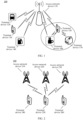
- FIG. 1 is a diagram of a communication system 100 according to this application.
- an access network device 110 a terminal device 120, a terminal device 130, a terminal device 140, a terminal device 150, a terminal device 160, and a terminal device 170 are included.
- the access network device 110 works in an evolved universal mobile telecommunications system terrestrial radio access (evolved UMTS terrestrial radio access, E-UTRA) system, works in an NR system, or works in a next generation communication system or another communication system.
- E-UTRA evolved universal mobile telecommunications system terrestrial radio access
- the access network device 110 may communicate with the terminal device 120 to the terminal device 170 through Uu interfaces, the access network device 110 and the terminal device 120 to the terminal device 170 form a communication system.
- the terminal device 120 to the terminal device 170 may send uplink data to the access network device 110, the access network device 110 needs to receive the uplink data sent by the terminal device 120 to the terminal device 170, and the access network device 110 may send downlink data to the terminal device 120 to the terminal device 170.
- the terminal device 150 to the terminal device 170 may also form a communication system.
- the access network device may send downlink information to the terminal device 150, and the terminal device 150 may also send downlink information to terminal devices 160 and 170.
- one access network device may serve a plurality of terminal devices.
- FIG. 1 only some of the terminal devices are used as examples.
- the access network device is, for example, a base station.
- the access network device corresponds to different devices in different systems.
- the access network device may correspond to an eNB in a 4G system, and corresponds to an access network device in 5G in a 5G system, for example, a gNB.
- Technical solutions provided in embodiments of this application may also be applied to a future mobile communication system. Therefore, the access network device in FIG. 1 may alternatively correspond to an access network device in the future mobile communication system.
- the access network device is the base station is used.
- the access network device may alternatively be a device such as an RSU.
- FIG. 2 is a diagram of an architecture of another communication system 200 according to this application.
- a plurality of access network devices an access network device 210, an access network device 220, and an access network device 230
- a plurality of terminal devices form a communication system
- the plurality of access network devices simultaneously serve one terminal device.
- the access network device 210, the access network device 220, and the access network device 230 simultaneously serve the terminal device 250.
- the access network device is, for example, a base station.
- the access network device corresponds to different devices in different systems.
- the access network device may correspond to an eNB in a 4G system, and corresponds to an access network device in 5G in a 5G system, for example, a gNB.
- Technical solutions provided in this application may also be applied to a future mobile communication system. Therefore, the access network device in FIG. 1 may alternatively correspond to an access network device in the future mobile communication system.
- FIG. 1 or FIG. 2 an example in which the access network device is the base station is used.
- the access network device may alternatively be a device such as an RSU.
- the communication system shown in FIG. 1 or FIG. 2 may further include more network nodes, for example, another terminal device or access network device.
- the access network devices or the terminal devices included in the communication system shown in FIG. 1 or FIG. 2 may be the foregoing access network devices or terminal devices in various forms. Details are not described one by one in the figure in embodiments of this application.
- a 5G communication system has higher requirements on aspects such as a system capacity and spectral efficiency.
- application of a massive multiple-antenna (Massive MIMO) technology plays a critical role in improving the spectral efficiency of the system.
- MIMO massive multiple-antenna
- the access network device needs to precode data before sending the data to UE. How to perform precoding needs to depend on channel state information (channel state information, CSI) fed back by the user equipment to the access network device. Therefore, accurate CSI feedback information is an important factor that affects system performance.
- channel state information channel state information
- the access network device may obtain CSI of the downlink channel through the uplink channel by using the channel reciprocity, to further perform the precoding.
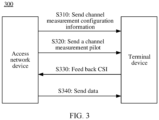
- FIG. 3 is a schematic flowchart of a method 300 for feeding back CSI of a downlink channel by user equipment to an access network device.
- the method 300 includes S310 to S340.
- the access network device sends channel measurement configuration information to a terminal device, where the channel measurement configuration information is used to configure time and a behavior of performing channel measurement by the terminal device.
- S320 The access network device sends a reference signal to the terminal device for the channel measurement.
- the terminal device performs the measurement based on the reference signal sent by the access network device, performs calculation based on a measurement result to obtain a final CSI feedback amount, and the terminal device feeds back CSI to the access network device.
- S340 The access network device sends data based on the CSI fed back by the terminal device.
- the CSI may include parameters such as a precoding matrix indicator (precoding matrix indicator, PMI), a channel rank indicator (rank indicator, RI), and a channel state indicator (channel quality indicator, CQI).
- PMI precoding matrix indicator
- RI rank indicator
- CQI channel state indicator
- the access network device may determine, based on a PMI fed back by the terminal device, the precoding matrix for performing transmission of data to the terminal device; the access network device may determine, based on an RI fed back by the terminal device, a quantity of streams for performing transmission of the data to the terminal device; and the access network device may determine, based on a CQI fed back by the terminal device, a modulation order and a channel coding rate for performing transmission of the data to the terminal device.
- the PMI is determined and reported based on one set of codebooks, and indicates the precoding matrix.
- a network device restores the precoding matrix based on the PMI and the codebooks.
- the precoding matrix may be a precoding matrix determined by the network device based on a channel matrix of each frequency domain unit. For example, the precoding matrix may be obtained by performing singular value decomposition (singular value decomposition, SVD) on a channel matrix or a covariance matrix of a channel matrix, or may be obtained by performing eigenvalue decomposition (eigenvalue decomposition, EVD) on a covariance matrix of a channel matrix.
- the precoding matrix includes channel information of a transmit end of the network device. Design of an FDD CSI codebook is a basic and important problem in a 5G communication system.
- 3rd generation partnership project 3rd generation partnership project, 3GPP
- 3rd generation partnership project, 3GPP 3rd generation partnership project, 3GPP
- 3rd generation partnership project, 3GPP 3rd generation partnership project, 3GPP
- 3rd generation partnership project, 3GPP 3rd generation partnership project, 3GPP
- 3rd generation partnership project, 3GPP 3rd generation partnership project, 3GPP
- 3rd generation partnership project, 3GPP R15 Type II (Type II) codebook a space domain (angle domain) compression idea is used, and sparsity of a channel in angle domain is used.
- a multipath signal has strong energy in several angle directions and weak energy in other directions.
- a space domain discrete fourier transform (discrete fourier transform, DFT) basis vector indicates an angle direction with strong energy
- the precoding matrix is represented by a linear combination of several space domain DFT basis vectors.
- a 3GPP R16 Type II codebook a dual-domain compression idea is proposed.
- Frequency domain (delay domain) compression is added based on the R15 codebook by using frequency domain correlations between amplitudes and phase coefficients of different subbands.
- Channel information is separately compressed and fed back in space domain and frequency domain.
- the precoding matrix is approximately represented by using a weighted sum of a space-frequency component matrix.
- a space-frequency component matrix is constructed by using one or more space domain basis vectors compressed by space domain and one or more frequency domain basis vectors compressed by frequency domain.
- sparsity of a channel in delay domain is further used.
- energy of a multipath signal is strong on several delay components, energy of the multipath signal is weak on other delay components, and corresponding frequency domain compression is completed.
- the foregoing dual-domain compression codebook only respectively uses the sparsity of the channel in angle domain (space domain) and the sparsity of the channel in delay domain (frequency domain).
- the one or more selected space domain basis vectors, the one or more selected frequency domain basis vectors, and a weighting coefficient corresponding to the space-frequency component matrix constructed based on the one or more space domain basis vectors and the one or more frequency domain basis vectors need to be reported, and overheads are still high.
- both the space domain basis vector and the frequency domain basis vector are DFT vectors, and resolutions in angle domain and delay domain are limited. Therefore, separate reporting of the space domain basis vector and the frequency domain basis vector limits sparsity of a weighting coefficient matrix. This leads to low system performance.
- feedback may be performed in a manner of statistical eigen subspace codebook.
- the codebook indicates a downlink channel or a precoding matrix by using a statistical eigen subspace basis in a long periodicity and a corresponding linear combination coefficient.
- the codebook may be similar to the R16 Type II codebook, and a bilinear combination of a set of statistical eigen subspace bases in space domain and a set of statistical eigen subspace bases in frequency domain represents the downlink channel or the precoding matrix. Further, in the codebook, space domain and frequency domain may alternatively be joint, and a linear combination of a set of statistical eigen subspace bases that are joint in space domain and frequency domain represents the downlink channel or the precoding matrix.
- the statistical eigen subspace basis is an eigenvector or an eigenvector group that may indicate a statistical change rule of a channel in space domain, frequency domain, or joint space-frequency domain, and is usually obtained by performing eigenvalue decomposition on a statistical covariance matrix of the channel.
- Joint space-frequency domain is a joint domain of space domain and frequency domain.
- a signal is propagated through a plurality of paths, leaves a transmit end at different angles, and arrives at a receive end at different angles after different delays.
- Space domain mainly describes an angle direction feature of a channel
- frequency domain mainly describes a delay distribution feature of a channel. Both are considered from a single dimension.
- angle direction and delay distribution features of a multipath are mainly described, and an angle direction and a delay distribution are in one-to-one correspondence.
- a statistical eigen subspace basis indicating a statistical change rule of a channel in space domain is referred to as a space domain basis for short
- a statistical eigen subspace basis indicating a statistical change rule of a channel in frequency domain is referred to as a frequency domain basis for short
- a statistical eigen subspace basis indicating a statistical change rule of a channel in joint space-frequency domain is referred to as a space-frequency joint basis for short.
- the terminal device may feed back the statistical eigen subspace basis in a long periodicity (namely, a first periodicity).
- a long periodicity namely, a first periodicity
- a linear combination coefficient describes a variable that changes fast, for example, a strength or a phase of a path on a channel
- the terminal device may feed back, in a short periodicity (namely, a second periodicity)
- the long periodicity and the short periodicity are relative concepts. Duration of the first periodicity is greater than duration of the second periodicity.
- the duration of the first periodicity is a plurality of integer multiples of the duration of the second periodicity.
- the access network device restores the eigen subspace basis based on a CSI report amount reported by the terminal device in the first periodicity, and restores a precoding matrix of the terminal device in each second periodicity based on a linear combination coefficient reported by the terminal device in the second periodicity.
- a CSI report codebook with the long periodicity and the short periodicity a basis in the long periodicity and a linear combination coefficient in the short periodicity that are used by the access network device during restoration need to match. How to align ideas of the terminal device and the access network device about whether to update an eigen subspace basis in the long periodicity is extremely important. If a mismatch between the basis in the long periodicity and the linear combination coefficient in the short periodicity occurs when the access network device restores the precoding matrix, the precoding matrix is inaccurate, and a performance loss occurs.
- FIG. 4 is a schematic flowchart of air interface interaction of CSI when a statistical eigen subspace codebook is used.
- a terminal device feeds back a first basis B of statistical eigen subspace based on a CSI report amount in a long periodicity (namely, a first periodicity), and feeds back, based on a CSI report amount in a short periodicity (namely, a second periodicity), a linear combination coefficient C 2 corresponding to the first basis B.
- An access network device sends a channel state information-reference signal (channel state information-reference signal, CSI-RS) to the terminal device in the second periodicity.
- CSI-RS channel state information-reference signal
- the terminal device receives the CSI-RS in each second periodicity, determines the first basis B of the statistical eigen subspace based on CSI-RS measurement results in a current short periodicity and a plurality of historical short periodicities, and feeds back the first basis B to the access network device in the first periodicity.
- the terminal device determines the linear combination coefficient C 2 based on a CSI-RS measurement result in a short periodicity and the first basis B of the statistical eigen subspace, and feeds back the linear combination coefficient C 2 to the access network device in the second periodicity.
- FIG. 4 shows an air interface interaction process in two first periodicities.
- a UE receives a CSI-RS sent by a RAN device, and the UE determines a first basis B of the statistical eigen subspace based on a current CSI-RS measurement result and a plurality of historical CSI-RS measurement results, and feeds back the first basis B (refer to a first B in FIG. 4 ) to the RAN device.
- the UE determines linear combination coefficients C 2 based on CSI-RS measurement results in a plurality of second periodicities and the first basis B (refer to the first B in FIG.
- the RAN device separately determines, based on the first B and the linear combination coefficients C 2 (for example, the first C 2 and the second C 2 ) received in the plurality of second periodicities within the 1 st first periodicity, precoding matrices corresponding to the plurality of second periodicities (for example, a precoding matrix determined based on the first B and the first C 2 and a precoding matrix determined based on the first B and the second C 2 ).
- the UE receives the CSI-RS sent by the RAN device, and the UE determines a first basis B of the statistical eigen subspace based on a current CSI-RS measurement result and a plurality of historical CSI-RS measurement results, and feeds back the first basis B (refer to a second B in FIG. 4 ) to the RAN device.
- the UE determines linear combination coefficients C 2 based on CSI-RS measurement results in a plurality of second periodicities and the first basis B (refer to the second B in FIG.
- the RAN device separately determines, based on the second B and the linear combination coefficients C 2 (for example, the third C 2 and the fourth C 2 ) received in the plurality of second periodicities within the 2 nd first periodicity, precoding matrices corresponding to the plurality of second periodicities (for example, a precoding matrix determined based on the second B and the third C 2 and a precoding matrix determined based on the second B and the fourth C 2 ).
- the CSI-RS is only used as an example for description, but is not limited to the CSI-RS.
- the access network device may further measure another reference signal, for example, a synchronization signal block (synchronization signal block, SSB), a demodulation reference signal (demodulation reference signal, DMRS), and a cell reference signal (cell reference signal, CRS), by configuring the terminal device.
- a synchronization signal block synchronization signal block, SSB
- demodulation reference signal demodulation reference signal
- CRS cell reference signal
- the terminal device feeds back, based on the CSI report amount in the long periodicity (namely, the first periodicity), the first basis B that is of the statistical eigen subspace and that is obtained through measurement, and feeds back, based on the CSI report amount in the short periodicity (namely, the second periodicity), the linear combination coefficient C 2 corresponding to the first basis B.
- the first basis B fed back by the UE in the 1 st first periodicity may be different from the first basis B fed back in the 2 nd first periodicity.
- the linear combination coefficients C 2 fed back by the UE in each second periodicity may also be different.
- a periodicity for sending the CSI-RS by the access network device to the terminal device is the second periodicity
- a periodicity for feeding back the first basis B of the statistical eigen subspace by the terminal device to the access network device is the first periodicity
- the first basis B that is of the statistical eigen subspace and that is fed back by the terminal device to the access network device is a result of a plurality of accumulated times of measurement
- a periodicity for feeding back the linear combination coefficient C 2 by the terminal device to the access network device is the second periodicity.
- the periodicity for sending the CSI-RS by the access network device to the terminal device is 5 ms
- the periodicity for feeding back the first basis B of the statistical eigen subspace by the terminal device to the access network device is 200 ms
- the periodicity for feeding back the linear combination coefficient C 2 by the terminal device to the access network device is 5 ms.
- the terminal device calculates the first basis B of the statistical eigen subspace based on a channel measurement result in the long periodicity, and reports the first basis B.
- the terminal device calculates a linear combination coefficient C 2 in the short periodicity based on a current first basis B of the statistical eigen subspace and the channel measurement result, and reports the linear combination coefficient C 2 in the short periodicity.
- the access network device After receiving a current CSI report amount in the long periodicity, the access network device updates, based on the report amount, a statistical eigen subspace basis stored in the access network device to the first basis B.
- the access network device restores the precoding matrix based on both a current first basis B of the statistical eigen subspace and a linear combination coefficient C 2 that is in the short periodicity and that is determined based on each CSI report amount in the short periodicity.
- calculation of the linear combination coefficient in the short periodicity by the terminal device is related to the statistical eigen subspace basis, and whether the statistical eigen subspace basis in the long periodicity and the linear combination coefficient in the short periodicity that are used by the access network device to restore the precoding matrix are matched greatly affects accuracy of the precoding matrix.
- An update and alignment manner of the statistical eigen subspace basis of the access network device and the terminal device in the long periodicity mainly has the following two problems:
- this application provides a channel information feedback method, to resolve a problem of a performance loss caused by an inaccurate precoding matrix due to a mismatch between a linear combination coefficient in a short periodicity and a space-frequency joint basis in a long periodicity.
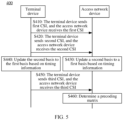
- FIG. 5 is a schematic flowchart of a channel state information feedback method 400 according to this application.
- the method 400 may be applied to the foregoing application scenario. It is clear that the method 400 may alternatively be applied to another communication scenario. This is not limited in this application.
- the method is described by using an example in which the method is performed by an access network device and a terminal device.
- the method may alternatively be performed by chips, chip systems, processors, or the like used in the terminal device and the access network device.
- the method 400 shown in FIG. 5 may include S410 to S460.
- the terminal device sends first CSI to the access network device, and correspondingly, the access network device receives the first CSI from the terminal device.
- the first CSI includes indication information of a first basis of statistical eigen subspace, a periodicity for sending the first CSI by the terminal device is a first periodicity, and the first basis indicates a change rule of a downlink channel in space domain and/or frequency domain, or the first basis indicates a change rule of a downlink channel in joint space-frequency domain.
- the indication information of the first basis directly or indirectly indicates the first basis, or may indicate a part or all of the first basis.
- the first basis may be determined based on the indication information of the first basis. For example, a mapping relationship between the indication information and the first basis may be pre-established, and the mapping relationship between the indication information and the first basis is stored in the access network device and the terminal device.
- the terminal device sends the indication information of the first basis to the access network device.
- the access network device determines the first basis based on the mapping relationship between the indication information and the first basis. In this way, signaling overheads can be reduced.
- the terminal device periodically sends the first CSI to the access network device, and the sending periodicity is the first periodicity.
- the terminal device sends the first CSI to the access network device at a start moment or an end moment of each first periodicity.
- the first basis may indicate the change rule of the downlink channel in space domain and/or frequency domain by using a vector or a vector group, or the first basis may indicate the change rule of the downlink channel in joint space-frequency domain by using a vector or a vector group.
- the terminal device sends second CSI to the access network device, and correspondingly, the access network device receives the second CSI from the terminal device.
- the second CSI includes indication information of a first linear combination coefficient.
- a periodicity for sending the second CSI by the terminal device is a second periodicity, and the first linear combination coefficient is a combination coefficient corresponding to a second basis.
- the indication information of the first linear combination coefficient directly or indirectly indicates the first linear combination coefficient, or may indicate a part or all of the first linear combination coefficient.
- the first linear combination coefficient may be determined based on the indication information of the first linear combination coefficient. For example, a mapping relationship between the indication information and the first linear combination coefficient may be pre-established, and the mapping relationship between the indication information and the first linear combination coefficient is stored in the access network device and the terminal device.
- the terminal device sends the indication information of the first linear combination coefficient to the access network device.
- the access network device determines the first linear combination coefficient based on the mapping relationship between the indication information and the first linear combination coefficient. In this way, signaling overheads can be reduced.
- the first linear combination coefficient matches the second basis of the statistical eigen subspace.
- a statistical eigen subspace basis used when the terminal device sends the second CSI is the second basis
- the second basis is reported to the access network device in a first periodicity before a first periodicity at which the terminal device sends the second CSI
- the first basis is reported to the access network device in the first periodicity at which the terminal device sends the second CSI, that is, the second basis is a previous first basis.
- the terminal device sends the second CSI to the access network device in the second periodicity.
- the terminal device sends the second CSI to the access network device at a start moment or an end moment of each second periodicity.
- duration of the first periodicity and duration of the second periodicity may be determined by the access network device, and the duration of the first periodicity and the duration of the second periodicity are sent to the terminal device by using configuration information.
- the access network device sends a CSI-RS to the terminal device in the second periodicity, the terminal device sends the first CSI to the access network device in the first periodicity, and the terminal device sends the second CSI to the access network device in the second periodicity.
- the access network device sends, to the terminal device in the first periodicity, first trigger information for reporting the first CSI. After receiving the first trigger information, the terminal device sends the first CSI to the access network device.
- the access network device sends, to the terminal device in the second periodicity, second trigger information for reporting the second channel state information. After receiving the second trigger information, the terminal device sends the second CSI to the access network device.
- the first CSI and the second CSI may be simultaneously reported, or may be separately reported.
- the indication information of the first basis and the indication information of the first linear combination coefficient may be reported in one piece of CSI, or may be reported in different pieces of CSI.
- a statistical eigen subspace basis used by the access network device is also the second basis, and the second basis is obtained by the access network device based on previous first CSI.
- the access network device determines a precoding matrix based on the second basis and the first linear combination coefficient.
- a basis used when the access network device determines the precoding matrix is the second basis, and the terminal device reports the second CSI based on the second basis.
- the access network device updates the second basis of the statistical eigen subspace to the first basis based on timing information.
- S440 The terminal device updates the second basis of the statistical eigen subspace to the first basis based on timing information.
- the timing information may be implemented by a timer.
- specified duration is 20 ms.
- Duration of the timing information configured on the access network device may be the same as or different from duration of the timing information configured on the terminal device.
- the duration of the timing information on the access network device may be greater than the duration of the timing information on the terminal device.
- the duration of the timing information on the access network device may be equal to the duration of the timing information on the terminal device.
- An objective of using the timing information is to enable the terminal device and the access network device to jointly update the second basis of the statistical eigen subspace to the first basis.
- the timing information is timing information preconfigured on the access network device and the terminal device.
- the timing information is known to both the access network device and the terminal device.
- the timing information is determined by the access network device, and is sent to the terminal device by using the configuration information.
- the timing information is determined by the terminal device, and is reported to the access network device. It should be understood that, before the terminal device and the access network device synchronously update the second basis to the first basis, the terminal device periodically sends the second CSI to the access network device. Correspondingly, the access network device periodically receives the second CSI sent by the terminal device.
- the terminal device sends third CSI to the access network device, and correspondingly, the access network device receives the third CSI from the terminal device.
- the third CSI includes indication information of a second linear combination coefficient, and the third CSI is generated by the terminal device based on the updated second basis (namely, the first basis), that is, the terminal device generates the third CSI based on a first basis indicated by first CSI closest to a current moment.
- a periodicity for sending the third CSI by the terminal device is the second periodicity.
- the terminal device After both the terminal device and the access network device update the second basis to the first basis, the terminal device periodically sends the third CSI to the access network device.
- the access network device periodically receives the third CSI from the terminal device. For example, the access network device sends the CSI-RS to the terminal device in the second periodicity. After receiving the CSI-RS, the terminal device sends the third CSI to the access network device also in the second periodicity.
- the access network device parses the third CSI sent by the terminal device, obtains the indication information of the second linear combination coefficient, and determines the second linear combination coefficient.
- the access network device determines the precoding matrix based on the first basis and the second linear combination coefficient.
- the access network device and the terminal device jointly update a statistical eigen subspace basis based on the timing information, so that the second linear combination coefficient that is reported in the second periodicity and that is obtained by the access network device can match the first basis that is of the statistical eigen subspace and that is used to restore the precoding matrix. This improves accuracy of the precoding matrix, and improves system performance.
- FIG. 6 is a schematic flowchart of air interface interaction between an access network device and a terminal device according to this application.
- the access network device sends a CSI-RS to the terminal device in a second periodicity.
- the terminal device receives the CSI-RS.
- the terminal device determines a second basis B ⁇ of statistical eigen subspace based on a result of current downlink channel measurement and results of one or more times of downlink channel measurement before the current measurement.
- the terminal device feeds back the second basis B ⁇ to the access network device at a start moment of the 1 st first periodicity.
- the access network device and the terminal device also update a basis. For this process, refer to the following descriptions of updating the basis by the access network device and the terminal device in a 2 nd first periodicity.
- the access network device receives, in the second periodicity, a first linear combination coefficient fed back by the terminal device.
- the access network device sends the CSI-RS to the terminal device in the second periodicity.
- the terminal device receives the CSI-RS.
- the terminal device determines a first basis B of the statistical eigen subspace based on a result of current downlink channel measurement and results of one or more times of downlink channel measurement before the current measurement, and feeds back the first basis B to the access network device at a start moment of the 2 nd first periodicity.
- the terminal device determines a first linear combination coefficient C 2 based on the result of the current downlink channel measurement and a previous second basis B ⁇ of the statistical eigen subspace, and feeds back the first linear combination coefficient C 2 to the access network device. It should be understood that the terminal device may feed back the first basis B and the first linear combination coefficient C 2 in one message, or may separately feed back the first basis B and the first linear combination coefficient C 2 .
- the access network device currently uses the second basis B ⁇ , and the access network device determines a precoding matrix based on the previous second basis B ⁇ of the statistical eigen subspace and the first linear combination coefficient C 2 .
- the terminal device starts timing of a timer of the terminal device based on timing information (for example, after the terminal device sends the first basis B to the access network device), and the access network device starts timing of a timer of the access network device based on timing information (for example, the access network device starts the timing when receiving the first basis B fed back by the terminal device).
- the access network device sends the CSI-RS to the terminal device in the second periodicity.
- the terminal device receives the CSI-RS, and feeds back the first linear combination coefficient C 2 to the access network device based on a measurement result.
- the access network device still determines the precoding matrix based on the second basis B ⁇ and the first linear combination coefficients C 2 .
- the access network device and the terminal device simultaneously update the second basis B ⁇ to the first basis B.
- the terminal device and the access network device reset respective timers.
- the terminal device reports a second linear combination coefficient C 2 ′ to the access network device based on the first basis B.
- the access network device determines the precoding matrix based on the first basis B obtained through the update and the second linear combination coefficient C 2 ′ reported by the terminal device.
- the procedure described in FIG. 6 is performed after the terminal device feeds back a statistical eigen subspace basis in a next first periodicity.
- the access network device and the terminal device update the statistical eigen subspace basis based on the timing information, so that the access network device can match a corresponding statistical eigen subspace basis when receiving a linear combination coefficient in a short periodicity. This resolves a problem that the linear combination coefficient in the short periodicity does not match the statistical eigen subspace basis.
- the terminal device reports a basis or a linear combination coefficient to the access network device is merely for ease of description. Generally, the terminal device does not report the basis or the linear combination coefficient to the access network device, but reports indication information of the basis or indication information of the linear combination coefficient. In this way, signaling overheads are reduced.
- FIG. 7 , FIG. 9 , and FIG. 10 are also for ease of description, and do not constitute any limitation on this application.
- the access network device does not obtain indication information of the first basis.
- the access network device does not receive current first CSI; or the access network device receives current first CSI, but fails to parse the current first CSI, and does not obtain the indication information of the first basis.
- the method 400 may further include: The access network device sends retransmission signaling to the terminal device, where the retransmission signaling indicates the terminal device to retransmit first CSI.
- the terminal device receives the retransmission signaling.
- the terminal device retransmits the first CSI to the access network device.
- the terminal device After sending the first CSI to the access network device, the terminal device starts the timing information.
- the terminal device receives the retransmission signaling within duration of the timing information.
- the terminal device stops current timing.
- the terminal device restarts the timer again after retransmitting the first CSI to the access network device.
- the access network device receives the retransmission signaling sent by the terminal device, to obtain the indication information of the first basis, and restarts the timer again.
- time of the timer that is restarted again expires the access network device and the terminal device simultaneously update the second basis to the first basis.
- the terminal device After sending the first CSI to the access network device, the terminal device starts the timing information.
- the terminal device receives the retransmission signaling within duration of the timing information.
- the terminal device retransmits the first CSI to the access network device.
- the access network device receives the retransmission signaling sent by the terminal device, to obtain the indication information of the first basis.
- time of the timer expires, the access network device and the terminal device simultaneously update the second basis to the first basis.
- duration of the timer should be set to be long. For example, the duration of the timer is greater than a propagation delay of the retransmission signaling.
- the access network device When the access network device does not obtain the indication information of the first basis, the access network device sends the retransmission signaling to the terminal device to indicate the terminal device to retransmit the first CSI, so that the indication information of the first basis is re-obtained. Then, the access network device and the terminal device update the second basis of the statistical eigen subspace to the first basis based on the timing information. Therefore, the second linear combination coefficient obtained by the access network device based on received indication information that is of the second linear combination coefficient and that is reported in the second periodicity can match the first basis that is of the statistical eigen subspace and that is used to restore the precoding matrix. This improves accuracy of the precoding matrix and improves system performance.
- the retransmission signaling may be sent by using radio resource control (Radio Resource Control, RRC) signaling, media access control-control element (Media Access Control-Control Element, MAC-CE) signaling, or downlink control information (Downlink Control Information, DCI).
- RRC Radio Resource Control
- MAC-CE Media Access Control-Control Element
- DCI Downlink Control Information
- FIG. 7 is a schematic flowchart of air interface interaction between an access network device and a terminal device according to this application.
- the access network device sends a CSI-RS to the terminal device in a second periodicity.
- the terminal device receives the CSI-RS.
- the terminal device determines a second basis B ⁇ of statistical eigen subspace based on a result of current downlink channel measurement and results of one or more times of downlink channel measurement before the current measurement.
- the terminal device feeds back the second basis B ⁇ to the access network device at a start moment of the 1 st first periodicity (which may be considered as the 1 st first periodicity).
- the access network device and the terminal device also update a basis. For this process, refer to the following descriptions of updating the basis by the access network device and the terminal device in a 2 nd first periodicity.
- the access network device receives, in the second periodicity, a first linear combination coefficient fed back by the terminal device.
- the access network device sends the CSI-RS to the terminal device in the second periodicity.
- the terminal device receives the CSI-RS.
- the terminal device determines a first basis B of the statistical eigen subspace based on a result of current downlink channel measurement and results of one or more times of downlink channel measurement before the current measurement, and feeds back the first basis B to the access network device at a start moment of the 2 nd first periodicity.
- the terminal device determines a first linear combination coefficient C 2 based on the result of the current downlink channel measurement and a previous second basis B ⁇ of the statistical eigen subspace, and feeds back the first linear combination coefficient C 2 to the access network device.
- the access network device currently uses the second basis B ⁇ .
- the access network device determines a precoding matrix based on the second basis B ⁇ and the first linear combination coefficient C 2 . If the access network device fails to obtain the first basis B, the access network device sends retransmission signaling to the terminal device.
- the terminal device receives the retransmission signaling sent by the access network device, and retransmits the first basis B of the statistical eigen subspace to the access network device.
- the terminal device starts timing based on timing information after sending the retransmission signaling
- the access network device starts timing based on timing information after receiving the retransmission signaling.
- the access network device sends the CSI-RS to the terminal device in the second periodicity.
- the terminal device receives the CSI-RS, and feeds back the first linear combination coefficient C 2 to the access network device based on a measurement result.
- the terminal device still determines the precoding matrix based on the previous second basis B ⁇ of the statistical eigen subspace and the first linear combination coefficient C 2 .
- the access network device and the terminal device simultaneously update the second basis B ⁇ to the first basis B.
- the terminal device and the access network device reset respective timers. Then, the terminal device reports a second linear combination coefficient C 2 ′ to the access network device based on the first basis B. The access network device determines the precoding matrix based on the first basis B obtained through the update and the second linear combination coefficient C 2 ′ reported by the terminal device.
- the procedure described in FIG. 7 is performed after the terminal device feeds back a statistical eigen subspace basis in a next first periodicity.
- the access network device sends the retransmission signaling to the terminal device to indicate the terminal device to retransmit current first channel state information, so that the indication information of the first basis is re-obtained.
- the access network device and the terminal device update the second basis of the statistical eigen subspace to the first basis based on the timing information. Therefore, the access network device can match a corresponding statistical eigen subspace basis when receiving a linear combination coefficient in a short periodicity. This resolves a problem that the linear combination coefficient in the short periodicity does not match the statistical eigen subspace basis.
- FIG. 8 is a schematic flowchart of the precoding matrix determining method 500 according to this application.
- the method 500 may be applied to the foregoing application scenario. It is clear that the method 500 may alternatively be applied to another communication scenario. This is not limited in this application.
- the method is described by using an example in which the method is performed by an access network device and a terminal device.
- the method may alternatively be performed by chips, chip systems, processors, or the like used in the terminal device and the access network device.
- the method 500 shown in FIG. 8 may include S510 to S570.
- the terminal device sends first CSI to the access network device, and correspondingly, the access network device receives the first CSI from the terminal device.
- the first CSI includes indication information of a first basis of statistical eigen subspace, a periodicity for sending the first CSI by the terminal device is a first periodicity, and the first basis indicates a change rule of a downlink channel in space domain and/or frequency domain, or the first basis further indicates a change rule of a downlink channel in joint space-frequency domain.
- the terminal device periodically sends the first CSI to the access network device, and the sending periodicity is the first periodicity.
- the terminal device sends the first CSI to the access network device at a start moment or an end moment of each first periodicity.
- the terminal device sends second CSI to the access network device, and correspondingly, the access network device receives the second CSI from the terminal device.
- the second CSI includes indication information of a first linear combination coefficient.
- a periodicity for sending the second CSI by the terminal device is a second periodicity, and the first linear combination coefficient is a combination coefficient corresponding to a second basis.
- the first linear combination coefficient matches the second basis of the statistical eigen subspace.
- a statistical eigen subspace basis used when the terminal device sends the second CSI is the second basis
- the second basis is reported to the access network device in a first periodicity before a first periodicity at which the terminal device sends the second CSI
- the first basis is fed back to the access network device in the first periodicity at which the terminal device sends the second CSI, that is, the second basis is a previous first basis.
- the terminal device sends the second CSI to the access network device in the second periodicity.
- the terminal device sends the second CSI to the access network device at a start moment or an end moment of each second periodicity.
- duration of the first periodicity and duration of the second periodicity may be determined by the access network device, and the duration of the first periodicity and the duration of the second periodicity are sent to the terminal device by using configuration information.
- the first CSI and the second CSI may be simultaneously reported, or may be separately reported.
- the indication information of the first basis and the indication information of the first linear combination coefficient may be reported in one piece of CSI, or may be reported in different pieces of CSI.
- a statistical eigen subspace basis used by the access network device is also the second basis, and the second basis is obtained by the access network device based on previous first CSI.
- the access network device determines a precoding matrix based on the second basis and the first linear combination coefficient.
- a basis used when the access network device determines the precoding matrix is the second basis, and the terminal device reports the second CSI based on the second basis.
- the access network device sends update indication information to the terminal device, where the update indication information indicates the terminal device to update the second basis of the statistical eigen subspace to the first basis, and correspondingly, the terminal device receives the update indication information from the access network device.
- the access network device After the access network device sends the update indication information to the terminal device, the access network device updates the second basis of the statistical eigen subspace to the first basis.
- the terminal device updates the second basis of the statistical eigen subspace to the first basis based on the update indication information.
- the terminal device sends third CSI to the access network device, and correspondingly, the access network device receives the third CSI from the terminal device.
- the third CSI includes indication information of a second linear combination coefficient, and the third CSI is generated by the terminal device based on the updated second basis (namely, the first basis), that is, the terminal device generates the third CSI based on a first basis indicated by first CSI closest to a current moment.
- a periodicity for sending the third CSI by the terminal device is the second periodicity.
- the terminal device After both the terminal device and the access network device update the second basis to the first basis, the terminal device periodically sends the third CSI to the access network device.
- the access network device periodically receives the third CSI from the terminal device. For example, the access network device sends a CSI-RS to the terminal device in the second periodicity. After receiving the CSI-RS, the terminal device sends the third CSI to the access network device also in the second periodicity.
- the access network device parses the third CSI sent by the terminal device, obtains the indication information of the second linear combination coefficient, and determines the second linear combination coefficient.
- the access network device determines the precoding matrix based on the first basis and the second linear combination coefficient.
- the access network device when the access network device determines a new statistical eigen subspace basis, the access network device sends an update indication information to the terminal device to indicate the terminal device to update a statistical eigen subspace basis, and simultaneously, the access network device updates the second basis to the first basis.
- the access network device and the terminal device jointly update the statistical eigen subspace basis, so that the second linear combination coefficient that is reported in the second periodicity and that is obtained by the access network device can match the first basis that is of the statistical eigen subspace and that is used to restore the precoding matrix. This improves accuracy of the precoding matrix and improves system performance.
- FIG. 9 is a schematic flowchart of air interface interaction between an access network device and a terminal device according to this application.
- the access network device sends a CSI-RS to the terminal device in a second periodicity.
- the terminal device receives the CSI-RS.
- the terminal device determines a second basis B ⁇ of statistical eigen subspace based on a result of current downlink channel measurement and results of one or more times of downlink channel measurement before the current measurement.
- the terminal device feeds back the second basis B ⁇ to the access network device at a start moment of the 1 st first periodicity (which may be considered as the 1 st first periodicity).
- the access network device and the terminal device also update a basis. For this process, refer to the following descriptions of updating the basis by the access network device and the terminal device in a 2 nd first periodicity.
- the access network device receives, in the second periodicity, a first linear combination coefficient fed back by the terminal device.
- the access network device sends the CSI-RS to the terminal device in the second periodicity.
- the terminal device receives the CSI-RS.
- the terminal device determines a first basis B of the statistical eigen subspace based on a result of current downlink channel measurement and results of one or more times of downlink channel measurement before the current measurement, and feeds back the first basis B to the access network device at a start moment of the 2 nd first periodicity.
- the terminal device determines a first linear combination coefficient C 2 based on the result of the current downlink channel measurement and a previous second basis B ⁇ of the statistical eigen subspace, and feeds back the first linear combination coefficient C 2 to the access network device. It should be understood that the terminal device may feed back the first basis B and the first linear combination coefficient C 2 in one message, or may separately feed back the first basis B and the first linear combination coefficient C 2 .
- the access network device currently uses the second basis B ⁇ , and the access network device determines a precoding matrix based on the second basis B ⁇ and the first linear combination coefficient C 2 .
- the access network device updates the second basis B ⁇ to the first basis B, and the access network device sends an update indication information to the terminal device to indicate the terminal device to update the second basis B ⁇ to the first basis B.
- the terminal device updates the second basis B ⁇ to the first basis B.
- the terminal device reports a second linear combination coefficient C 2 ′ to the access network device based on the first basis B.
- the access network device determines the precoding matrix based on the first basis B and the second linear combination coefficient C 2 ′ reported by the terminal device.
- the procedure described in FIG. 9 is performed after the terminal device feeds back a statistical eigen subspace basis in a next first periodicity.
- the indication information may be sent by using radio resource control (Radio Resource Control, RRC) signaling, media access control-control element (Media Access Control-Control Element, MAC-CE) signaling, or downlink control information (Downlink Control Information, DCI).
- RRC Radio Resource Control
- MAC-CE Media Access Control-Control Element
- DCI Downlink Control Information
- the access network device does not obtain indication information of the first basis.
- the access network device does not receive current first channel state information; or the access network device receives current first channel state information, but fails to parse the current first channel state information, and does not obtain the indication information of the first basis.
- the method 500 may further include: The access network device sends retransmission signaling to the terminal device, where the retransmission signaling indicates the terminal device to retransmit first channel state information.
- the terminal device receives the retransmission signaling and retransmits the first channel state information to the access network device.
- the access network device receives the first channel state information retransmitted by the terminal device, to obtain the indication information of the first basis. After the access network device obtains the indication information of the first basis, the access network device sends the indication information to the terminal device, where the indication information indicates the terminal device to update the second basis of the statistical eigen subspace to the first basis. After the access network device sends the indication information to the terminal device, the access network device updates the second basis of the statistical eigen subspace to the first basis.
- the access network device When the access network device does not obtain the indication information of the first basis, the access network device sends the retransmission signaling to the terminal device to indicate the terminal device to retransmit the first channel state information, so that the indication information of the first basis is re-obtained. Then, when the access network device determines a new statistical eigen subspace basis, the access network device sends the indication information to the terminal device to indicate the terminal device to update the statistical eigen subspace basis, so that the access network device and the terminal device can synchronously update the statistical eigen subspace basis.
- the second linear combination coefficient obtained by the access network device based on received indication information that is of the second linear combination coefficient and that is reported in the second periodicity can match the first basis that is of the statistical eigen subspace and that is used to restore the precoding matrix. This improves accuracy of the precoding matrix and improves system performance.
- FIG. 10 is a schematic flowchart of air interface interaction between an access network device and a terminal device according to this application.
- the access network device sends a CSI-RS to the terminal device in a second periodicity.
- the terminal device receives the CSI-RS.
- the terminal device determines a second basis B ⁇ of statistical eigen subspace based on a result of current downlink channel measurement and results of one or more times of downlink channel measurement before the current measurement.
- the terminal device feeds back the second basis B ⁇ to the access network device at a start moment of the 1 st first periodicity (which may be considered as the 1 st first periodicity).
- the access network device and the terminal device also update a basis. For this process, refer to the following descriptions of updating the basis by the access network device and the terminal device in a 2 nd first periodicity.
- the access network device receives, in the second periodicity, a first linear combination coefficient fed back by the terminal device.
- the access network device sends the CSI-RS to the terminal device in the second periodicity.
- the terminal device receives the CSI-RS.
- the terminal device determines a first basis B of the statistical eigen subspace based on a result of current downlink channel measurement and results of one or more times of downlink channel measurement before the current measurement, and feeds back the first basis B to the access network device at a start moment of the 2 nd first periodicity.
- the terminal device determines a first linear combination coefficient C 2 based on the result of the current downlink channel measurement and a previous second basis B ⁇ of the statistical eigen subspace, and feeds back the first linear combination coefficient C 2 to the access network device.
- the access network device currently uses the second basis B ⁇ .
- the access network device determines a precoding matrix based on the second basis B ⁇ and the first linear combination coefficient C 2 . If the access network device fails to obtain the first basis B, the access network device sends retransmission signaling to the terminal device.
- the terminal device receives the retransmission signaling sent by the access network device, and retransmits the first basis B of the statistical eigen subspace to the access network device.
- the access network device After the access network device obtains the first basis B, the access network device updates the second basis B ⁇ to the first basis B, and the access network device sends an update indication to the terminal device to indicate the terminal device to update the second basis B ⁇ to the first basis B. After receiving the indication information, the terminal device updates the second basis B ⁇ to the first basis B. Then, the terminal device reports a second linear combination coefficient C 2 ′ to the access network device based on the first basis B. The access network device determines the precoding matrix based on the first basis B and the second linear combination coefficient C 2 ′ reported by the terminal device. The procedure described in FIG. 10 is performed after the terminal device feeds back a statistical eigen subspace basis in a next first periodicity.
- FIG. 11 is a diagram of module interaction between a terminal device and an access network device according to this application.
- the access network device and the terminal device each include an RRC signaling exchange module, a MAC signaling exchange module, and a port physical layer (Port Physical Layer, PHY) signaling and data exchange module.
- the RRC signaling exchange module is a module used by the access network device and the terminal device to send and receive RRC signaling.
- the MAC signaling exchange module is a module used by the access network device and the terminal device to send and receive MAC-CE signaling.
- the PHY signaling and data exchange module is a module used by the access network device and the terminal device to send and receive downlink control signaling and downlink data.
- the downlink control signaling may be sent and received through a downlink control channel (Physical Downlink Control Channel, PDCCH), and the downlink data may be sent and received through a physical downlink shared channel (Physical Downlink Shared CHannel, PDSCH).
- PDCCH Physical Downlink Control Channel
- PDSCH Physical Downlink Shared CHannel
- Both indication information and retransmission signaling in this application may be sent by using the RRC signaling, the MAC-CE signaling, or DCI.
- FIG. 12 is a block diagram of a communication apparatus 600 according to an embodiment of this application.
- the apparatus 600 may be a terminal device, or may be a chip or a circuit, for example, a chip or a circuit that may be disposed in a terminal device.
- the apparatus 600 may be an access network device, or may be a chip or a circuit, for example, a chip or a circuit that may be disposed in an access network device.
- the apparatus 600 may include a processing unit 610 (that is, an example of a processor) and a transceiver unit 630.
- the processing unit 610 may be further referred to as a determining unit.
- the transceiver unit 630 may include a receiving unit and a sending unit.
- the transceiver unit 630 may be implemented by a transceiver, a transceiver-related circuit, or an interface circuit.
- the apparatus may further include a storage unit 620.
- the storage unit 620 is configured to store instructions.
- the storage unit may also be configured to store data or information.
- the storage unit 620 may be implemented by a memory.
- the processing unit 610 is configured to execute the instructions stored in the storage unit 620, to enable the apparatus 600 to implement steps performed by the terminal device in the foregoing method.
- the processing unit 610 may be configured to invoke the data in the storage unit 620, to enable the apparatus 600 to implement steps performed by the terminal device in the foregoing method.
- the processing unit 610 is configured to execute the instructions stored in the storage unit 620, to enable the apparatus 600 to implement steps performed by the access network device in the foregoing method.
- the processing unit 610 may be configured to invoke the data in the storage unit 620, to enable the apparatus 600 to implement steps performed by the access network device in the foregoing method.
- the processing unit 610, the storage unit 620, and the transceiver unit 630 may communicate with each other through an internal connection path, to transfer a control signal and/or a data signal.
- the storage unit 620 is configured to store a computer program
- the processing unit 610 may be configured to invoke the computer program from the storage unit 620 and run the computer program, to control the transceiver unit 630 to receive a signal and/or send a signal, so that steps of the terminal device or the access network device in the foregoing method are completed.
- the storage unit 620 may be integrated into the processing unit 610, or may be disposed separately from the processing unit 610.
- the transceiver unit 630 includes a receiver and a transmitter.
- the receiver and the transmitter may be a same physical entity or different physical entities.
- the receiver and the transmitter may be collectively referred to as a transceiver.
- the transceiver unit 630 includes an input interface and an output interface.
- a function of the transceiver unit 630 is implemented by a transceiver circuit or a dedicated transceiver chip. It may be considered that the processing unit 610 is implemented by a dedicated processing chip, a processing circuit, a processing unit, or a general-purpose chip.
- the communication device for example, the terminal device or the access network device
- the communication device is implemented by a general-purpose computer.
- program code for implementing functions of the processing unit 610 and the transceiver unit 630 is stored in the storage unit 620, and a general-purpose processing unit implements the functions of the processing unit 610 and the transceiver unit 630 by executing the code in the storage unit 620.
- the apparatus 600 may be a terminal device, or a chip or a circuit disposed in a terminal device.
- the transceiver unit 630 is configured to send first channel state information to the access network device, where the first channel state information includes indication information of a first basis of statistical eigen subspace, and a periodicity for sending the first channel state information by the terminal device is a first periodicity.
- the transceiver unit 630 is further configured to: before the terminal device updates a second basis to the first basis, send second channel state information to the access network device, where the second channel state information includes indication information of a first linear combination coefficient, a periodicity for sending the second channel state information by the transceiver unit 630 is a second periodicity, the first periodicity is greater than the second periodicity, and the first linear combination coefficient is a combination coefficient corresponding to the second basis.
- the second channel state information is generated by the terminal device based on the second basis of the statistical eigen subspace, the first basis is different from the second basis, and the first basis and the second basis separately indicate a change rule of a downlink channel in at least one of space domain and frequency domain, or the first basis and the second basis separately indicate a change rule of a downlink channel in joint space-frequency domain.
- the processing unit 610 is configured to update the second basis to the first basis based on trigger information.
- the transceiver unit 630 is further configured to: after the terminal device updates the second basis to the first basis, send third channel state information to the access network device, where the third channel state information includes indication information of a second linear combination coefficient, the third channel state information is generated by the terminal device based on the updated second basis, and a periodicity for sending the third channel state information by the terminal device is the second periodicity.
- processing unit 610 is further configured to: when timing information reaches specified time, update the second basis to the first basis.
- the timing information is obtained by the transceiver from the access network device by using configuration information, or the timing information is predefined.
- the transceiver unit 630 is configured to receive update indication information sent by the access network device, where the update indication information indicates the terminal device to update the second basis of the statistical eigen subspace to the first basis.
- the processing unit is specifically configured to update the second basis to the first basis based on the update indication information.
- the transceiver unit 630 is further configured to: receive retransmission signaling sent by the access network device, where the retransmission signaling indicates the terminal device to retransmit the first channel state information; and retransmit the first channel state information to the access network device based on the retransmission signaling.
- duration of the timing information is information locally configured on the terminal device; or the transceiver unit receives the configuration information sent by the access network device, where the configuration information includes duration of the first periodicity, duration of the second periodicity, and duration of the timing information.
- At least one of the update indication information, the configuration information, or the retransmission signaling is included in radio resource control RRC signaling, media access control-control element MAC-CE signaling, or downlink control information DCI.
- modules or units in the apparatus 600 may be configured to perform actions or processing processes performed by the terminal device in the foregoing method. To avoid repetition, detailed descriptions thereof are omitted herein.
- the apparatus 600 may be the access network device, or the chip or the circuit disposed in the access network device.
- the transceiver unit 630 is configured to receive first channel state information sent by the terminal device, where the first channel state information includes indication information of a first basis of statistical eigen subspace, and a periodicity for receiving the first channel state information by the transceiver unit 630 is a first periodicity.
- the processing unit is configured to parse the first channel state information.
- the transceiver unit 630 is configured to receive second channel state information sent by the terminal device, where the second channel state information includes indication information of a first linear combination coefficient, a periodicity for receiving the second channel state information by the transceiver unit 630 is a second periodicity, the first periodicity is greater than the second periodicity, and the first linear combination coefficient is a combination coefficient corresponding to a second basis.
- a statistical eigen subspace basis currently used by the processing unit 610 is the second basis of the statistical eigen subspace
- the second channel state information is generated by the terminal device based on the second basis of the statistical eigen subspace
- the first basis is different from the second basis
- the first basis and the second basis separately indicate a change rule of a downlink channel in at least one of space domain and frequency domain, or the first basis and the second basis separately indicate a change rule of a downlink channel in joint space-frequency domain.
- the processing unit is configured to parse the second channel state information.
- the processing unit 610 is configured to update the second basis to the first basis based on timing information.
- the transceiver unit 630 receives third channel state information sent by the terminal device, where the third channel state information includes indication information of a second linear combination coefficient, the third channel state information is generated by the terminal device based on the updated second basis, and a periodicity for sending the third channel state information by the transceiver unit 630 is the second periodicity.
- the processing unit 610 is configured to parse the third channel state information.
- the processing unit 610 is configured to determine a precoding matrix based on the first basis and the second linear combination coefficient.
- the timing information is determined by the access network device or predefined.
- the transceiver is further configured to send configuration information to the terminal device.
- the transceiver unit 630 is further configured to: when the first basis is failed to be obtained, send retransmission signaling to the terminal device, where the retransmission signaling indicates the terminal device to retransmit the first channel state information; and receive the first channel state information retransmitted by the terminal device.
- that the access network device fails to obtain the first basis includes: The transceiver unit fails to receive the first channel state information. Alternatively, the processing unit fails to parse the first channel state information.
- duration of the timing information is information locally configured on the access network device; or the transceiver unit sends indication information to the terminal device, where the indication information includes duration of the first periodicity, duration of the second periodicity, and duration of the timing information.
- At least one of the configuration information and the retransmission signaling is included in radio resource control RRC signaling, media access control-control element MAC-CE signaling, or downlink control information DCI.
- modules or units in the apparatus 600 may be configured to perform actions or processing processes performed by the access network device in the foregoing method. To avoid repetition, detailed descriptions thereof are omitted herein.
- the apparatus 600 may be the access network device, or the chip or the circuit disposed in the access network device.
- the transceiver unit 630 is configured to receive first channel state information sent by the terminal device, where the first channel state information includes indication information of a first basis of statistical eigen subspace, and a periodicity for receiving the first channel state information by the transceiver unit 630 is a first periodicity.
- the processing unit 610 is configured to parse the first channel state information.
- the transceiver unit 630 is configured to receive second channel state information sent by the terminal device, where the second channel state information includes indication information of a first linear combination coefficient, a periodicity for receiving the second channel state information by the access network device is a second periodicity, the first periodicity is greater than the second periodicity, and the first linear combination coefficient is a combination coefficient corresponding to a second basis.
- a statistical eigen subspace basis currently used by the processing unit 610 is the second basis of the statistical eigen subspace
- the second channel state information is generated by the terminal device based on the second basis of the statistical eigen subspace
- the first basis is different from the second basis
- the first basis and the second basis separately indicate a change rule of a downlink channel in at least one of space domain and frequency domain, or the first basis and the second basis separately indicate a change rule of a downlink channel in joint space-frequency domain.
- the processing unit 610 is configured to parse the second channel state information.
- the access network device updates the second basis to the first basis.
- the transceiver unit 630 sends update indication information to the terminal device, where the update indication information indicates the terminal device to update the second basis to the first basis.
- the transceiver unit 630 receives third channel state information sent by the terminal device, where the third channel state information includes indication information of a second linear combination coefficient, the third channel state information is generated by the terminal device based on the updated second basis, and a periodicity for sending the third channel state information by the terminal device is the second periodicity.
- the processing unit 610 is configured to parse the third channel state information.
- the processing unit 610 is configured to determine a precoding matrix based on the first basis and the second linear combination coefficient.
- the transceiver unit 630 is further configured to: when the first basis is failed to be obtained, send retransmission signaling to the terminal device, where the retransmission signaling indicates the terminal device to retransmit the first channel state information; and receive the first channel state information retransmitted by the terminal device.
- That the first basis is failed to be obtained includes: The transceiver unit 630 fails to receive the first channel state information. Alternatively, the processing unit 610 fails to parse the first channel state information.
- the access network device sends duration of the first periodicity and/or duration of the second periodicity to the terminal device by using second indication information.
- At least one of the update indication information and the retransmission signaling is sent by using radio resource control RRC signaling, media access control-control element MAC-CE signaling, or downlink control information DCI.
- FIG. 13 is a diagram of a structure of a communication apparatus 700 according to this application.
- the communication apparatus 700 may include a processor 710, a memory 720, and a transceiver 730.
- the processor 710, the memory 720, and the transceiver 730 are respectively configured to implement functions of the processing unit 610, the storage unit 620, and the transceiver unit 630. Details are not described herein.
- FIG. 14 is a diagram of a structure of a terminal device 800 according to this application.
- the terminal device 800 may perform the actions performed by the terminal device in the foregoing method embodiments.
- FIG. 14 shows only main components of the terminal device.
- the terminal device 800 includes a processor, a memory, a control circuit, an antenna, and an input/output apparatus.
- the processor is mainly configured to process a communication protocol and communication data, control an entire terminal device, execute a software program, and process data of the software program, for example, is configured to support the terminal device to perform the actions described in the foregoing embodiments of an indication method for a precoding matrix used for transmission.
- the memory is mainly configured to store the software program and the data, for example, store a codebook described in the foregoing embodiments.
- the control circuit is mainly configured to: convert a baseband signal and a radio frequency signal and process the radio frequency signal.
- the control circuit and the antenna together may also be referred to as a transceiver, and are mainly configured to receive and send a radio frequency signal in a form of an electromagnetic wave.
- the input/output apparatus such as a touchscreen, a display, or a keyboard, is mainly configured to: receive data input by a user and output data to the user.
- the processor may read the software program in the storage unit, interpret and execute instructions of the software program, and process data of the software program.
- the processor performs baseband processing on the to-be-sent data, and then outputs a baseband signal to a radio frequency circuit.
- the radio frequency circuit performs radio frequency processing on the baseband signal, and then sends, through the antenna, a radio frequency signal in an electromagnetic wave form.
- the radio frequency circuit receives the radio frequency signal through the antenna, converts the radio frequency signal into a baseband signal, and outputs the baseband signal to the processor.
- the processor converts the baseband signal into data, and processes the data.
- FIG. 14 shows only one memory and only one processor.
- the memory may also be referred to as a storage medium, a storage device, or the like. This is not limited in embodiments of this application.
- the processor may include a baseband processor and a central processing unit.
- the baseband processor is mainly configured to process the communication protocol and the communication data.
- the central processing unit is mainly configured to: control the entire terminal device, execute the software program, and process the data of the software program.
- the processor in FIG. 14 integrates functions of the baseband processor and the central processing unit.
- the baseband processor and the central processing unit may alternatively be separate processors, and are interconnected by using a technology such as a bus.
- the terminal device may include a plurality of baseband processors to adapt to different network standards, and the terminal device may include a plurality of central processing units to enhance a processing capability of the terminal device, and components of the terminal device may be connected through various buses.
- the baseband processor may also be expressed as a baseband processing circuit or a baseband processing chip.
- the central processing unit may also be expressed as a central processing circuit or a central processing chip.
- a function of processing the communication protocol and the communication data may be built in the processor, or may be stored in the storage unit in a form of a software program, and the processor executes the software program to implement a baseband processing function.
- the antenna and the control circuit that have receiving and sending functions may be considered as a transceiver unit 810 of the terminal device 800
- the processor that have a processing function may be considered as a processing unit 820 of the terminal device 800.
- the terminal device 800 includes the transceiver unit 810 and the processing unit 820.
- the transceiver unit may also be referred to as a transceiver, a transceiver machine, a transceiver apparatus, or the like.
- a component that is in the transceiver unit 810 and that is configured to implement a receiving function may be considered as a receiving unit
- a component that is in the transceiver unit 810 and that is configured to implement a sending function may be considered as a sending unit
- the transceiver unit includes a receiving unit and a sending unit.
- the receiving unit may also be referred to as a receiver, a receiver machine, or a receiver circuit
- the sending unit may also be referred to as a transmitter, a transmitter machine, or a transmitter circuit.
- FIG. 15 is a diagram of a structure of an access network device 900 according to an embodiment of this application.
- the access network device 900 may be configured to implement functions of the access device (for example, a first access network device, a second access network device, or a third access network device) in the foregoing method.
- the access network device 900 includes one or more radio frequency units such as a remote radio unit (remote radio unit, RRU) 910 and one or more baseband units (baseband units, BBUs) (which may also be referred to as a digital unit (digital unit, DU)) 920.
- RRU remote radio unit
- baseband units baseband units
- DU digital unit
- the RRU 910 may be referred to as a transceiver unit, a transceiver, a transceiver circuit, a transceiver machine, or the like, and may include at least one antenna 911 and a radio frequency unit 912.
- the RRU 910 part is mainly configured to: send and receive a radio frequency signal, and perform conversion between a radio frequency signal and a baseband signal, for example, is configured to send the signaling messages in the foregoing embodiments to the terminal device.
- the BBU 920 part is mainly configured to: perform baseband processing, control a base station, and the like.
- the RRU 910 and the BBU 920 may be physically disposed together, or may be physically disposed separately, that is, a distributed base station.
- the BBU 920 is a control center of the base station, may also be referred to as a processing unit, and is mainly configured to complete a baseband processing function such as channel coding, multiplexing, modulation, or spreading.
- the BBU (the processing unit) 920 may be configured to control a base station 40 to perform an operation procedure related to the access network device in the foregoing method embodiments.
- the BBU 920 may include one or more boards, and a plurality of boards may jointly support a radio access network (for example, an LTE system or a 5G system) of a single access standard, or may separately support radio access networks of different access standards.
- the BBU 920 further includes a memory 921 and a processor 922.
- the memory 921 is configured to store necessary instructions and data.
- the memory 921 stores the codebook and the like in the foregoing embodiments.
- the processor 922 is configured to control the base station to perform a necessary action, for example, configured to control the base station to perform an operation procedure related to the access network device in the foregoing method embodiments.
- the memory 921 and the processor 922 may serve one or more boards. In other words, a memory and a processor may be disposed on each board. Alternatively, a plurality of boards may share a same memory and a same processor. In addition, a necessary circuit may be further disposed on each board.
- SoC system-on-chip
- all or some functions of the parts 920 and 910 may be implemented by using the SoC technology, for example, implemented by one base station function chip.
- the base station function chip integrates components such as a processor, a memory, and an antenna port.
- a program of a base station-related function is stored in the memory, and the processor executes the program to implement the base station-related function.
- the base station function chip can also read from an external memory of the chip, to implement the base station-related function.
- FIG. 15 the structure of the access network device shown in FIG. 15 is merely a possible form, and should not constitute any limitation on embodiments of this application. In this application, a possibility that there may be a base station structure in another form in the future is not excluded.
- the processor in embodiments of this application may be a central processing unit (central processing unit, CPU), or the processor may be another general purpose processor, a digital signal processor (digital signal processor, DSP), an application-specific integrated circuit (application-specific integrated circuit, ASIC), a field programmable gate array (field programmable gate array, FPGA), or another programmable logic device, a discrete gate or transistor logic device, a discrete hardware component, or the like.
- a general-purpose processor may be a microprocessor, or the processor may be any conventional processor or the like.
- the memory in embodiments of this application may be a volatile memory or a non-volatile memory, or may include a volatile memory and a non-volatile memory.
- the non-volatile memory may be a read-only memory (read-only memory, ROM), a programmable read-only memory (programmable ROM, PROM), an erasable programmable read-only memory (erasable PROM, EPROM), an electrically erasable programmable read-only memory (electrically EPROM, EEPROM), or a flash memory.
- the volatile memory may be a random access memory (random access memory, RAM), and is used as an external cache.
- random access memories in many forms may be used, for example, a static random access memory (static RAM, SRAM), a dynamic random access memory (DRAM), a synchronous dynamic random access memory (synchronous DRAM, SDRAM), a double data rate synchronous dynamic random access memory (double data rate SDRAM, DDR SDRAM), an enhanced synchronous dynamic random access memory (enhanced SDRAM, ESDRAM), a synchlink dynamic random access memory (synchlink DRAM, SLDRAM), and a direct rambus random access memory (direct rambus RAM, DR RAM).
- static random access memory static random access memory
- DRAM dynamic random access memory
- SDRAM synchronous dynamic random access memory
- double data rate SDRAM double data rate SDRAM
- DDR SDRAM double data rate SDRAM
- ESDRAM enhanced synchronous dynamic random access memory
- synchlink dynamic random access memory synchlink dynamic random access memory
- direct rambus RAM direct rambus RAM, DR RAM
- All or some of the foregoing embodiments may be implemented by software, hardware, firmware, or any combination thereof.
- the foregoing embodiments may be implemented completely or partially in a form of a computer program product.
- the computer program product includes one or more computer instructions or computer programs. When the computer instructions or the computer programs are loaded and executed on a computer, procedures or functions according to embodiments of this application are all or partially generated.
- the computer may be a general-purpose computer, a dedicated computer, a computer network, or another programmable apparatus.
- the computer instructions may be stored in a computer-readable storage medium or may be transmitted from a computer-readable storage medium to another computer-readable storage medium.
- the computer instructions may be transmitted from a website, computer, server, or data center to another website, computer, server, or data center in a wired (for example, infrared, radio, microwave, or the like) manner.
- the computer-readable storage medium may be any usable medium accessible by the computer, or a data storage device, such as a server or a data center, integrating one or more usable media.
- the usable medium may be a magnetic medium (for example, a floppy disk, a hard disk, or a magnetic tape), an optical medium (for example, a DVD), or a semiconductor medium.
- the semiconductor medium may be a solid-state drive.
- An embodiment of this application further provides a computer-readable medium.
- the computer-readable medium stores a computer program.
- the steps performed by the terminal device or the steps performed by the access network device in any one of the foregoing embodiments are implemented.
- An embodiment of this application further provides a computer program product.
- the computer program product is executed by a computer, the steps performed by the terminal device or the steps performed by the access network device in any one of the foregoing embodiments are implemented.
- An embodiment of this application further provides a system chip.
- the system chip includes a communication unit and a processing unit.
- the processing unit may be, for example, a processor.
- the communication unit may be, for example, a communication interface, an input/output interface, a pin, or a circuit.
- the processing unit may execute computer instructions, so that the chip in the communication apparatus performs the steps performed by the terminal device or the steps performed by the access network device provided in the foregoing embodiments of this application.
- the computer instructions are stored in a storage unit.
- an embodiment of this application further provides a communication system, including the foregoing access network device and terminal device.
- Embodiments of this application may be used alone or used in combination. This is not limited herein.
- a and/or B may indicate the following three cases: Only A exists, both A and B exist, and only B exists.
- the character “/” generally indicates an "or” relationship between the associated objects.
- At least one means one or more.
- At least one of A and B is similar to "A and/or B", is used to describe an association relationship between associated objects, and indicates that there may be three relationships.
- at least one of A and B may indicate the following three cases: Only A exists, both A and B exist, and only B exists.
- the disclosed system, apparatus, and method may be implemented in another manner.
- the described apparatus embodiment is merely an example.
- division into the units is merely logical function division and may be other division in actual implementation.
- a plurality of units or components may be combined or integrated into another system, or some features may be ignored or not performed.
- the displayed or discussed mutual couplings, direct couplings, or communication connections may be implemented through some interfaces.
- the indirect couplings or communication connections between the apparatuses or units may be implemented in electrical, mechanical, or another form.
- the units described as separate components may or may not be physically separate, and components displayed as units may or may not be physical units, that is, may be located in one position, or may be distributed on a plurality of network units. Some or all of the units may be selected based on actual requirements to achieve the objectives of the solutions in embodiments.
- the functions When the functions are implemented in a form of a software functional unit and sold or used as an independent product, the functions may be stored in a computer-readable storage medium. Based on such an understanding, technical solutions of this application essentially, or the part contributing to the current technology, or some of the technical solutions may be implemented in a form of a software product.
- the computer software product is stored in a storage medium, and includes several instructions for instructing a computer device (which may be a personal computer, a server, an access network device, or the like) to perform all or some of the steps of the methods described in embodiments of this application.
- the foregoing storage medium includes any medium that can store program code, such as a USB flash drive, a removable hard disk, a read-only memory (Read-Only Memory, ROM), a random access memory (Random Access Memory, RAM), a magnetic disk, or an optical disc.
- program code such as a USB flash drive, a removable hard disk, a read-only memory (Read-Only Memory, ROM), a random access memory (Random Access Memory, RAM), a magnetic disk, or an optical disc.
Landscapes
- Engineering & Computer Science (AREA)
- Computer Networks & Wireless Communication (AREA)
- Signal Processing (AREA)
- Quality & Reliability (AREA)
- Physics & Mathematics (AREA)
- Mathematical Physics (AREA)
- Mobile Radio Communication Systems (AREA)
Applications Claiming Priority (2)
| Application Number | Priority Date | Filing Date | Title |
|---|---|---|---|
| CN202210779750.8A CN117394959A (zh) | 2022-07-04 | 2022-07-04 | 一种信道状态信息反馈的方法、终端设备和接入网设备 |
| PCT/CN2023/101221 WO2024007853A1 (zh) | 2022-07-04 | 2023-06-20 | 一种信道状态信息反馈的方法、终端设备和接入网设备 |
Publications (2)
| Publication Number | Publication Date |
|---|---|
| EP4535697A1 true EP4535697A1 (de) | 2025-04-09 |
| EP4535697A4 EP4535697A4 (de) | 2025-08-06 |
Family
ID=89454184
Family Applications (1)
| Application Number | Title | Priority Date | Filing Date |
|---|---|---|---|
| EP23834627.4A Pending EP4535697A4 (de) | 2022-07-04 | 2023-06-20 | Verfahren zur rückkopplung von kanalstatusinformationen, endgerätevorrichtung und zugangsnetzwerkvorrichtung |
Country Status (4)
| Country | Link |
|---|---|
| US (1) | US20250141520A1 (de) |
| EP (1) | EP4535697A4 (de) |
| CN (1) | CN117394959A (de) |
| WO (1) | WO2024007853A1 (de) |
Families Citing this family (1)
| Publication number | Priority date | Publication date | Assignee | Title |
|---|---|---|---|---|
| WO2025222519A1 (zh) * | 2024-04-26 | 2025-10-30 | Oppo广东移动通信有限公司 | Csi反馈方法、终端设备和网络设备 |
Family Cites Families (3)
| Publication number | Priority date | Publication date | Assignee | Title |
|---|---|---|---|---|
| CN106506112B (zh) * | 2015-09-08 | 2020-02-14 | 华为技术有限公司 | 反馈信道状态信息的方法和网络设备 |
| CN113746514A (zh) * | 2020-05-29 | 2021-12-03 | 华为技术有限公司 | 一种通信方法、装置及系统 |
| CN113840324B (zh) * | 2020-06-24 | 2024-01-30 | 华为技术有限公司 | 一种测量上报方法及装置 |
-
2022
- 2022-07-04 CN CN202210779750.8A patent/CN117394959A/zh active Pending
-
2023
- 2023-06-20 EP EP23834627.4A patent/EP4535697A4/de active Pending
- 2023-06-20 WO PCT/CN2023/101221 patent/WO2024007853A1/zh not_active Ceased
-
2025
- 2025-01-03 US US19/008,897 patent/US20250141520A1/en active Pending
Also Published As
| Publication number | Publication date |
|---|---|
| US20250141520A1 (en) | 2025-05-01 |
| WO2024007853A1 (zh) | 2024-01-11 |
| EP4535697A4 (de) | 2025-08-06 |
| CN117394959A (zh) | 2024-01-12 |
Similar Documents
| Publication | Publication Date | Title |
|---|---|---|
| US11923929B2 (en) | Channel information obtaining method | |
| US12267132B2 (en) | Channel state information reporting method and communications apparatus | |
| US20250226870A1 (en) | Channel information feedback method and communication apparatus | |
| EP4535682A1 (de) | Verfahren zur meldung von kanalstatusinformationen und kommunikationsvorrichtung | |
| EP4274112A1 (de) | Verfahren zur rückkopplung von kanalstatusinformationen und kommunikationsvorrichtung | |
| US20240056139A1 (en) | Communication method and communication apparatus | |
| US12418905B2 (en) | Update method and communications apparatus | |
| EP4027543A1 (de) | Kanalmessungsverfahren und kommunikationsvorrichtung | |
| WO2023011570A1 (zh) | 一种信道信息反馈的方法及通信装置 | |
| CN111586724A (zh) | 通信方法和设备 | |
| US12476674B2 (en) | Channel measurement method and precoding method and apparatus | |
| EP4258566A1 (de) | Verfahren zur rückkopplung von kanalinformationen und kommunikationsvorrichtung | |
| US20260129496A1 (en) | Communication method and apparatus | |
| US20250097950A1 (en) | Communication method and apparatus | |
| US20260051962A1 (en) | Correction method, apparatus, and storage medium | |
| US20250141520A1 (en) | Channel state information feedback method, terminal device, and access network device | |
| US12355499B2 (en) | UE selection for UE aided antenna calibration | |
| US20240235628A1 (en) | Communication method and apparatus | |
| WO2025044904A1 (zh) | 一种信道状态信息上报的方法及相关装置 | |
| EP4693939A1 (de) | Kommunikationsverfahren und -vorrichtung | |
| WO2024149042A1 (zh) | 通信方法和通信装置 | |
| CN112262536B (zh) | 一种数据传输方法及装置 | |
| CN117676622A (zh) | 一种传输模式的确定方法及相关装置 | |
| US20250038795A1 (en) | Methods and apparatuses for transmitting and receiving parameter and communication system | |
| US20260074762A1 (en) | Methods and apparatuses for transmitting and receiving channel state information and communication system |
Legal Events
| Date | Code | Title | Description |
|---|---|---|---|
| STAA | Information on the status of an ep patent application or granted ep patent |
Free format text: STATUS: THE INTERNATIONAL PUBLICATION HAS BEEN MADE |
|
| PUAI | Public reference made under article 153(3) epc to a published international application that has entered the european phase |
Free format text: ORIGINAL CODE: 0009012 |
|
| STAA | Information on the status of an ep patent application or granted ep patent |
Free format text: STATUS: REQUEST FOR EXAMINATION WAS MADE |
|
| 17P | Request for examination filed |
Effective date: 20250102 |
|
| AK | Designated contracting states |
Kind code of ref document: A1 Designated state(s): AL AT BE BG CH CY CZ DE DK EE ES FI FR GB GR HR HU IE IS IT LI LT LU LV MC ME MK MT NL NO PL PT RO RS SE SI SK SM TR |
|
| A4 | Supplementary search report drawn up and despatched |
Effective date: 20250704 |
|
| RIC1 | Information provided on ipc code assigned before grant |
Ipc: H04L 1/06 20060101AFI20250630BHEP Ipc: H04B 7/06 20060101ALI20250630BHEP Ipc: H04L 1/00 20060101ALI20250630BHEP |
|
| DAV | Request for validation of the european patent (deleted) | ||
| DAX | Request for extension of the european patent (deleted) |