EP4535680A1 - System und verfahren zur kanalschätzung in mehrträgermodulationsbasierten kommunikationen - Google Patents
System und verfahren zur kanalschätzung in mehrträgermodulationsbasierten kommunikationen Download PDFInfo
- Publication number
- EP4535680A1 EP4535680A1 EP23306729.7A EP23306729A EP4535680A1 EP 4535680 A1 EP4535680 A1 EP 4535680A1 EP 23306729 A EP23306729 A EP 23306729A EP 4535680 A1 EP4535680 A1 EP 4535680A1
- Authority
- EP
- European Patent Office
- Prior art keywords
- sub
- pilot symbols
- user
- carriers
- assigned
- Prior art date
- Legal status (The legal status is an assumption and is not a legal conclusion. Google has not performed a legal analysis and makes no representation as to the accuracy of the status listed.)
- Pending
Links
Images



Classifications
-
- H—ELECTRICITY
- H04—ELECTRIC COMMUNICATION TECHNIQUE
- H04L—TRANSMISSION OF DIGITAL INFORMATION, e.g. TELEGRAPHIC COMMUNICATION
- H04L25/00—Baseband systems
- H04L25/02—Details ; arrangements for supplying electrical power along data transmission lines
- H04L25/0202—Channel estimation
- H04L25/0224—Channel estimation using sounding signals
- H04L25/0226—Channel estimation using sounding signals sounding signals per se
-
- H—ELECTRICITY
- H04—ELECTRIC COMMUNICATION TECHNIQUE
- H04B—TRANSMISSION
- H04B7/00—Radio transmission systems, i.e. using radiation field
- H04B7/02—Diversity systems; Multi-antenna system, i.e. transmission or reception using multiple antennas
- H04B7/04—Diversity systems; Multi-antenna system, i.e. transmission or reception using multiple antennas using two or more spaced independent antennas
- H04B7/0413—MIMO systems
- H04B7/0452—Multi-user MIMO systems
-
- H—ELECTRICITY
- H04—ELECTRIC COMMUNICATION TECHNIQUE
- H04L—TRANSMISSION OF DIGITAL INFORMATION, e.g. TELEGRAPHIC COMMUNICATION
- H04L25/00—Baseband systems
- H04L25/02—Details ; arrangements for supplying electrical power along data transmission lines
- H04L25/0202—Channel estimation
- H04L25/0204—Channel estimation of multiple channels
-
- H—ELECTRICITY
- H04—ELECTRIC COMMUNICATION TECHNIQUE
- H04L—TRANSMISSION OF DIGITAL INFORMATION, e.g. TELEGRAPHIC COMMUNICATION
- H04L25/00—Baseband systems
- H04L25/02—Details ; arrangements for supplying electrical power along data transmission lines
- H04L25/0202—Channel estimation
- H04L25/0224—Channel estimation using sounding signals
- H04L25/0228—Channel estimation using sounding signals with direct estimation from sounding signals
-
- H—ELECTRICITY
- H04—ELECTRIC COMMUNICATION TECHNIQUE
- H04L—TRANSMISSION OF DIGITAL INFORMATION, e.g. TELEGRAPHIC COMMUNICATION
- H04L5/00—Arrangements affording multiple use of the transmission path
- H04L5/003—Arrangements for allocating sub-channels of the transmission path
- H04L5/0048—Allocation of pilot signals, i.e. of signals known to the receiver
- H04L5/005—Allocation of pilot signals, i.e. of signals known to the receiver of common pilots, i.e. pilots destined for multiple users or terminals
Definitions
- the invention pertains to channel estimation in multicarrier modulation based communications such as FBMC/OQAM.
- CMOS complementary metal-oxide-semiconductor
- SE Spectral Efficiency
- FBMC/OQAM shows only real field orthogonality. Therefore, corresponding signals suffer from intrinsic interference, penalizing its reliability and motivating the use of alternative Channel Estimation techniques.
- typical Channel Estimation methods for mMIMO-FBMC systems require large training overheads, particularly for a large number of users or for flat-fading channel conditions over each subcarrier band.
- h is the CIR
- ⁇ ( k ) is the Additive White Gaussian Noise (AWGN) term
- s is the transmitted signal.
- the received pilot on the mth subcarrier is obtained by the preceding equation.
- Figure 1 presents schematically the basis for Time Domain channel estimation for FBMC as known in the prior art.
- a transmitted frame is represented as a matrix of symbols, with respective symbols being distinguished by the frequency at which they are transmitted on one axis, and the time sequence of successive transmissions on the other axis.
- Pilot symbols transmitted for the purpose of performing Channel Estimation as discussed hereon are represented as black filled circles, Data symbols belonging to the channel payload are represented as hatched circles, and blank circles represent the transmission of zero symbols.
- the first set of transmissions 110 in time sequence are used for the transmission of pilot symbol at every frequency.
- the transmission of data symbols 130 begins at every frequency.
- a method of performing channel characteristic estimation for one or more users in a multicarrier modulation based communication channel offering a plurality of sub-carriers comprising assigning a plurality of sub-carriers for the transmission of complex pilot symbols for each user, where no two adjacent sub-carriers are so assigned, transmitting the complex pilot symbols from each user on each assigned sub-carrier, receiving the pilot symbols on each assigned sub-carrier, and performing a frequency domain based analysis of the communication channel on the basis of the received pilot symbols to obtain an estimated channel.
- the frequency domain based analysis of the communication channel on the basis of the received pilot symbols comprises a Linear Channel estimator based analysis.
- L is the sequence length
- U is the number of users
- m is the index of the respective sub-carrier.
- the number of successive sub-carriers not assigned to transmitting pilot symbols from each user after each sub-carriers assigned to transmitting pilot symbols from each user is determined as a function of the channel fading characteristics of all users.
- the method comprises a further step of filtering the pilot symbols by a prototype filter with an overlapping factor of one.
- a second aspect there is provided method of supporting channel characteristic estimation at a user device for a user in a multicarrier modulation based communication channel offering a plurality of sub-carriers, the method comprising receiving a carrier assignment assigning a plurality of the sub-carriers for the transmission of a pilot data structure for the user, where no two adjacent sub-carriers are so assigned, transmitting pilot symbols on each assigned sub-carrier, for a frequency domain based analysis of the communication channel on the basis of the received pilot symbols.
- a third aspect there is provided method of performing channel characteristic estimation at a base station for one or more users in a multicarrier modulation based communication channel offering a plurality of sub-carriers, the method comprising assigning a plurality of the sub-carriers for the transmission of a pilot data structure for each user, where no two adjacent sub-carriers are so assigned, transmitting the carrier assignments to each user, receiving pilot symbols from each user on each assigned sub-carrier on each assigned sub-carrier, and performing a frequency domain based analysis of the communication channel on the basis of the received pilot symbols.
- a linear modulation based communications system adapted to performing channel characteristic estimation for one or more users in a multicarrier modulation based communication channel offering a plurality of sub-carriers, the system being adapted to assign a plurality of the sub-carriers for the transmission of pilot data symbols for each user, where no two adjacent sub-carriers are so assigned, transmitting pilot symbols from each user on each assigned sub-carrier, to receive the pilot symbols on each assigned sub-carrier, and to perform a frequency domain based analysis of the communication channel on the basis of the received pilot symbols.
- a user device supporting channel characteristic estimation in a multicarrier modulation based communication system offering a plurality of sub-carriers, the user device adapted to receive a carrier assignment assigning a plurality of sub-carriers for the transmission of pilot symbols, where no two adjacent sub-carriers are so assigned, transmitting pilot symbols on each assigned sub-carrier, for a frequency domain based analysis of the communication channel on the basis of the received pilot symbols.
- a base station for performing channel characteristic estimation for one or more users in a multicarrier modulation based communication system offering a plurality of sub-carriers, the base station adapted to assigning a plurality of the sub-carriers for the transmission of pilot symbols, where no two adjacent sub-carriers are so assigned, to transmit the carrier assignments to each user, to receive pilot symbols from each user on each assigned sub-carrier on each assigned sub-carrier, and to perform a frequency domain based analysis of the communication channel on the basis of the received pilot symbols.
- the prototype filter of the transmitter or the receiver has an overlapping factor of one.
- a computer program comprising instructions which, when the program is executed by a computer, cause the computer to carry out the method of any of the first, second or third aspects.
- a computer-readable medium comprising instructions which, when executed by a computer, cause the computer to carry out the method of any of the first, second or third aspects.
- figure 3 This is illustrated in figure 3 which may be compared to the prior art situation of figure 1 .
- a transmitted frame is represented as a matrix of symbols, with respective symbols being distinguished by the frequency at which they are transmitted on one axis, and the time sequence of successive transmissions on the other axis.
- Pilot symbols transmitted for the purpose of performing Channel Estimation as discussed hereon are represented as black filled circles, Data symbols belonging to the channel payload are represented as hatched circles, and blank circles represent the transmission of zero symbols.
- Zadoff-Chu (ZC) sequence one of the pilot sequences used in the 5G NR wireless system and described in the article by D. Chu entitled “Polyphase codes with good periodic correlation properties (corresp.)," IEEE Transactions on Information Theory, vol. 18, no. 4, pp. 531-532, 1972 . has a constant amplitude zero autocorrelation (CAZAC) property that is preserved even when it is processed by an IFFT/FFT since the output samples remain a Zadoff-Chu sequence. Moreover, the low peak to average power ratio makes this an attractive choice for Channel Estimation. The following discussion will take the Zadoff-Chu sequence as the selected constant Amplitude Zero Auto-Correlation sequence.
- the complex-valued Pilot sequences can still be employed for multicarrier modulation based communication channels such as FBMC/OQAM, along with the Channel Estimation techniques considered for OFDM.
- FBMC/OQAM multicarrier modulation based communication channels
- Channel Estimation techniques considered for OFDM the Channel Estimation techniques considered for OFDM.
- a sufficient number of guard symbols must be introduced among the training and data symbols to ensure their total isolation, resulting in a data rate loss.
- the required number of FBMC guard symbols depends on the overlapping factor of the considered Prototype filter, which may suggest a long or short prototype filter.
- a short Prototype filter such as the Near Perfect Reconstruction 1 (NPR1) short Prototype filter may be employed since only 1 FBMC symbol is necessary as a guard interval to perfectly isolate the pilots from the data, leading to a minimal data rate loss as set out in the article by J. Nadal, C. A. Nour, and A. Baghdadi, entitled “Design and Evaluation of a Novel Short Prototype Filter for FBMC/OQAM Modulation," published in IEEE Access, vol. 6, pp. 19 610-19 625, 2018 (NADAL ET AL).
- Other Prototype filters can be used, and any short Prototype filter brings the benefit of requiring only one Guard Band symbol.
- the NPR1 is preferable among the others due to its improved performance.
- the noise correlation is generally included in the LS channel due to the lack of complex orthogonality.
- the interference only affects adjacent FBMC symbols. This means that the value of a is limited to -1, or 1.
- the proposed pilot structure includes a Guard Band as the neighboring FBMC symbol, making the correlation between noise components negligible in equation (14) (i.e., Cov [ ⁇ m , , ⁇ m ' , n '] ⁇ 0). Therefore, the assumption of uncorrelated noise is valid, and a conventional Linear Channel estimator based analysis method as used in OFDM systems for example can be applied to obtain the Channel Estimate without considering the noise correlation matrix (as required in the prior art Time domain approaches discussed above, reducing the complexity.
- De-noising is the process of eliminating noise from a noisy signal.
- the estimated channel in (15) can be observed to be corrupted by noise.
- the CIR can be considered as a noisy signal, and de-noising it can lead to an improved CIR estimation.
- De-noising can be performed by pruning the CIR coefficients using a threshold.
- ICT4 Inverse Discrete Cosine Transform-Type-IV
- the method of figure 2 may comprise an additional optional step of de-noising the estimated channel.
- conventional channel estimation techniques are not based on channel de-noising.
- Channel de-noising may be implemented in embodiments to remove the intrinsic interference coming from adjacent users. As a result, the intrinsic interference term will not be included in the channel estimation, significantly reducing the complexity.
- the channel on the odd subcarriers can be interpolated for example using the method presented in the article by H. Akima, entitled “A new method of interpolation and smooth curve fitting based on local procedures," J. ACM, vol. 17, no. 4, p. 589-602, Oct 1970. [Online]. Available: https://doi.org/10.1145/321607.321609 , or other approaches as may occur to the skilled person.
- figure 3 shows alternate sub-carriers as assigned for the transmission of a pilot data structure for the or each user, it will be appreciated that other sequences where no two adjacent sub-carriers are assigned are envisaged-for example every r th sub-band may be assigned, where r is any integer. Still further, the interval between assigned sub bands need not be constant, so long as no two adjacent sub bands are ever assigned.
- the number of successive sub-carriers not assigned to transmitting pilot symbols from each user after each sub-carriers assigned to transmitting pilot symbols from each user is determined as a function of the channel fading characteristics of all users, e.g. in view of the Doppler effect (slow or fast fading).
- the number of successive sub-carriers not assigned to transmitting pilot symbols from each user after each sub-carriers assigned to transmitting pilot symbols from each user for successive transmissions may be adapted over time in response to a detected change in the channel fading characteristics of all users.
- guard symbols are typically required in prior art approaches.
- most of the available solutions in the literature are not efficient in terms of spectral usage as discussed above.
- the frequency resources used for pilot signals of different users are mutually inclusive such that each frequency slot is used by all users.
- pilot symbols for each user in sequence on each sub-channel are subjected to a subcarrier shift of a predetermined increment with respect to the preceding user in sequence such that pilot symbols from each user on each assigned sub-carrier are interleaved in frequency domain.
- Figure 4a illustrates the basic principle of the assignment of pilot symbols to sub-carriers in multi-user environments in accordance with embodiments.
- a set of pilot symbols 401a-e are defined for a first user and a corresponding set of pilot symbols 402a-e are defined for example for a second user.
- a separation distance defines the predetermined increment between the sub-carrier 411, 412, 413,414, 415, 416, 417, 418, 419, 420, 421, 422 to which a respective pilot symbol a-e is assigned for respective users.
- this distance may not necessarily be uniform for all pilots, although this may be the case in some embodiments such as based on a circular shift as discussed below.
- this separation distance is in all cases at least as large as the delay spread of the channel.
- Possible approaches may include the following: Perform a multiplication operation on each user's set of pilots using a specific sequence. This operation ensures that the resulting set of pilots for each user becomes orthogonal to the sets of pilots belonging to all other users. In simpler terms, this process ensures that the pilot signals used by different users are separated and do not interfere with each other.
- Another method includes the development of an interleaving scheme that carefully reorganizes the position of pilot signals from different users.
- This process preferably guarantees that the time-frequency resources allocated for pilot signals of different users are mutually inclusive.
- elements like '401e' from the second user may be situated on the same frequency subcarrier as elements like '401d' from the first user as exemplified in Figure 4a .
- the preferred condition is to consistently uphold a minimum separation distance, equivalent to the delay spread of the channel, between corresponding elements of different users, such as between '402e' and '401e'
- the CE for MU reduces to a SU one, where the channel estimate of the u th user can be computed by adopting equations (17) (19) and (20).
- Figure 4b presents schematically the basis for Time Domain channel estimation for FBMC in a multi user scenario in accordance with an embodiment.
- a plurality of sub-carriers are assigned for the transmission of pilot symbols for each user, where no two adjacent sub-carriers are so assigned.
- the method of figure 2 may be adapted for a multi user scenario by subjecting the pilot symbols for each user in sequence on each sub-channel are subjected to a circular shift of a predetermined increment with respect to the preceding user in sequence such that pilot symbols from each user on each assigned sub-carrier are interleaved in both time and frequency domains.
- figure 4 This is illustrated in figure 4 which may be compared to the single user scenario of figure 3 .
- the proposed pilot structure eliminates the need for guard bands between users' pilots. This is advantageous is comparison to the majority of pilot structures in the literature for FBMC/OQAM usually use guard bands to prevent interference from neighboring users, or alternatively, if they don't insert guard bands between users' pilots, they incorporate the intrinsic interference term into the channel estimation technique, leading to increased complexity compared to OFDM.
- embodiments allow for the use of conventional OFDM channel estimation techniques without requiring the inclusion of the intrinsic interference term.
- the method of figure 2 presents a method from the perspective of the system as a whole. The method may equally be considered from the point of view of a user device.
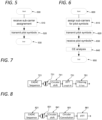
- Figure 5 presents a method in accordance with an embodiment, as executed at a user device.
- figure 5 shows a method of supporting channel characteristic estimation at a user device for a user in a multicarrier modulation based communication channel offering a plurality of sub-carriers.
- the method starts at step 500, before proceeding to step 510 at which a carrier assignment assigning a plurality of sub-carriers for the transmission of a pilot data structure for the user, where no two adjacent sub-carriers are so assigned is received.
- the method then proceeds to step 520 at which pilot symbols are transmitted on each assigned sub-carrier, for a frequency domain based analysis of the communication channel on the basis of the received pilot symbols.
- the method then terminates at step 530.
- the method may be adapted mutatis mutandis to incorporate any of the variants described with respect to figures 2 to 4 .
- the method of figure 2 presents a method from the perspective of the system as a whole. The method may equally be considered from the point of view of a base station.
- Figure 6 presents a method in accordance with an embodiment, as executed at a base station.
- figure 6 shows a method of supporting channel characteristic estimation at a user device for a user in a multicarrier modulation based communication channel offering a plurality of sub-carriers.
- the method starts at step 600 before proceeding to step 610 of assigning a plurality of the sub-carriers for the transmission of a pilot data structure for each user, where no two adjacent sub-carriers are so assigned.
- the method then proceeds to transmit the carrier assignments to each user at step 620.
- the base station receives pilot symbols from each user on the assigned sub-carriers, and at step 640 performs a frequency domain based analysis of the communication channel on the basis of the received pilot symbols before terminating at step 650.
- the method may be adapted mutatis mutandis to incorporate any of the variants described with respect to figures 2 to 4 .
- Figure 7 shows a first exemplary transmitter implementation in accordance with embodiments.
- figure 7 comprises one processing channel which comprises in sequence an Inverse Fast Fourier Transform (IFFT) unit 751, and a filtering stage 761.
- IFFT Inverse Fast Fourier Transform
- the values indicated by the chosen constant amplitude zero autocorrelation sequence are provided from memory 721.
- the processing channel comprises an up-sampling module 731, which upscale each signal by a factor of q, receiving values from the up-sampling module 731, the outputs of which are then processed by the circular shift module 741, in line with the foregoing discussion.
- IFFT Inverse Fast Fourier Transform
- n ( m ) is the complex CAZAC sequence element at subcarrier index m and time slot n, and M is the total number of available sub-carriers.
- g ( k ) is the impulse response of the prototype filter with overlapping factor K and length KM.
- the filtering operation 761 can be seen as a digital filter, whose design represents important trade-offs between performance and system complexity.
- Figure 8 shows a second exemplary transmitter implementation in accordance with embodiments.
- the implementation of figure 8 comprises in sequence a Finite Impulse Response (FIR) filter 851, and an Inverse Fast Fourier Transform block 861.
- FIR Finite Impulse Response
- the values indicated by the chosen constant amplitude zero autocorrelation sequence are provided from memory 821.
- the processing channel comprises an up-sampling module 831, which upscales each signal by a factor of q, receiving values from the respective up-sampling module 831, the outputs of which are then processed by respective circular shift modules 841, in line with the foregoing discussion.
- the original concept of this design is to shift the filtering stage into the frequency domain.
- Corresponding arrangements may be provided at the receiver side.
- a linear modulation based communications system based for example of the implementations of figure 7 or 8 adapted to performing channel characteristic estimation for one or more users in a multicarrier modulation based communication channel offering a plurality of sub-carriers, adapted to assign a plurality of sub-carriers for the transmission of pilot data symbols for each user, where no two adjacent sub-carriers are so assigned, transmitting pilot symbols from each user on each assigned sub-carrier, to receive the pilot symbols on each assigned sub-carrier, and to perform a frequency domain based analysis of the communication channel on the basis of the received pilot symbols.
- a user device based for example of the implementations of figure 7 or 8 supporting channel characteristic estimation in a multicarrier modulation based communication system offering a plurality of sub-carriers, the user device adapted to receive a carrier assignment assigning a plurality of sub-carriers for the transmission of pilot symbols, where no two adjacent sub-carriers are so assigned, transmitting pilot symbols on each assigned sub-carrier, for a frequency domain based analysis of the communication channel on the basis of the received pilot symbols.
- a base station based for example of the implementations of figure 7 or 8 for performing channel characteristic estimation for one or more users in a multicarrier modulation based communication system offering a plurality of sub-carriers, the base station adapted to assigning a plurality of sub-carriers for the transmission of pilot symbols, where no two adjacent sub-carriers are so assigned, to transmit the carrier assignments to each user, to receive pilot symbols from each user on each assigned sub-carrier on each assigned sub-carrier, and to perform a frequency domain based analysis of the communication channel on the basis of the received pilot symbols.
- a Channel Estimation mechanism in an FBMC or other multicarrier modulation based communication channel offering a plurality of sub-carriers comprises transmitting pilot symbols based on the Zadoff Chu or other Constant Amplitude Zero Auto-Correlation sequence on non-adjacent (for example alternating) sub-channels.
- pilot symbols from each user device are transmitted on the same selected sub-channels, but subjected to a circular shift.
- the disclosed methods can take form of an entirely hardware embodiment (e.g. FPGA), an entirely software embodiment (for example to control a system according to the invention) or an embodiment containing both hardware and software elements.
- Software embodiments include but are not limited to firmware, resident software, microcode, etc.
- the invention can take the form of a computer program product accessible from a computer-usable or computer-readable medium providing program code for use by or in connection with a computer or an instruction execution system.
- a computer-usable or computer-readable can be any apparatus that can contain, store, communicate, propagate, or transport the program for use by or in connection with the instruction execution system, apparatus, or device.
- the medium can be an electronic, magnetic, optical, electromagnetic, infrared, or semiconductor system (or apparatus or device) or a propagation medium.
- the inventive method can be performed by a suitably-programmed general-purpose computer or computer system, possibly including a computer network, storing a suitable program in non-volatile form on a computer-readable medium such as a hard disk, a solid state disk or a CD-ROM and executing the program using its microprocessor(s) and memory.
- a suitably-programmed general-purpose computer or computer system possibly including a computer network, storing a suitable program in non-volatile form on a computer-readable medium such as a hard disk, a solid state disk or a CD-ROM and executing the program using its microprocessor(s) and memory.
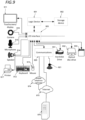
- Figure 9 presents a computer suitable for carrying out a method according to an embodiment.
- the computer includes a Central Processing Unit (CPU) 901 which may perform the method steps described above while running an executable program, i.e. a set of computer-readable instructions, stored in a memory device such as RAM 902a or ROM 902b or hard disk drive 931, DVD/CD drive 932, or stored remotely.
- an executable program i.e. a set of computer-readable instructions
- RAM 902a or ROM 902b or hard disk drive 931, DVD/CD drive 932 or stored remotely.
- one or more computer files defining the spatial relations graphs, and computer files comprising the virtual space and objects defined therein may also be stored on one or more of memory devices 902a, 902b, 931, 932, or remotely.
- the claimed invention is not limited by the form of the computer-readable media on which the computer-readable instructions of the inventive process are stored.
- the instructions and files can be stored on CDs, DVDs, in FLASH memory, RAM, ROM, PROM, EPROM, EEPROM, hard disk or any other information processing device with which the computer communicates, such as a server or computer.
- the program can be stored on a same memory device or on different memory devices.
- a computer program suitable for carrying out the inventive method can be provided as a utility application, background daemon, or component of an operating system, or combination thereof, executing in conjunction with CPU 901 and an operating system such as Microsoft XP, Microsoft Windows 10, UNIX, Solaris, LINUX, Apple MAC-OS and other systems known to those skilled in the art.
- an operating system such as Microsoft XP, Microsoft Windows 10, UNIX, Solaris, LINUX, Apple MAC-OS and other systems known to those skilled in the art.
- CPU 901 can be a Xenon processor from Intel of America or a Ryzen processor from AMD of America, or can be other processor types, such as a Freescale ColdFire, IMX, or ARM processor from NXP Semiconductors.
- the CPU can be a processor such as a Core from Intel Corporation of America, or can be implemented on an FPGA, ASIC, PLD or using discrete logic circuits, as one of ordinary skill in the art would recognize.
- the CPU can be implemented as multiple processors cooperatively working to perform the computer-readable instructions of the inventive processes described above.
- the computer may include a network interface 920, such as an Intel Ethernet PRO network interface card from Intel Corporation of America, for interfacing with a network, such as a local area network (LAN) 974, wide area network (WAN), the Internet 975 and the like.
- a network such as a local area network (LAN) 974, wide area network (WAN), the Internet 975 and the like.
- the method may be implemented remotely, by means of a web application, e.g. operating on remote server 776.
- the computer may further include a display controller 910, such as a NVIDIA GeForce RTX graphics adaptor from NVIDIA Corporation of America for interfacing with display 911.
- a general purpose I/O interface 903 interfaces with a keyboard 912 and pointing device 913, such as a roller ball, mouse, touchpad and the like.
- Disk controller 930 connects HDD 931 and DVD/CD 932 with communication bus 920, which can be an ISA, EISA, VESA, PCI, or similar, for interconnecting all of the components of the computer.
- communication bus 920 can be an ISA, EISA, VESA, PCI, or similar, for interconnecting all of the components of the computer.
- the system of figure 9 may implement the operations ascribed to the base station, or any user device. As such, multiple such systems may be provided operating in coordination to execute respective parts of the methods and operations described.
- Figure 10 presents a base station 910 incorporating computer suitable for carrying out a method according to an embodiment.
- a computer 900 comprises a subset of the components described with respect to figure 9 as appropriate to such an implementation context.
- the computer includes a Central Processing Unit (CPU) 901 which may perform the method steps described above while running an executable program, i.e. a set of computer-readable instructions, stored in a memory device 902, in communication with I/O interface 903.
- CPU Central Processing Unit
- an executable program i.e. a set of computer-readable instructions
- the computer may include a network interface 920, for interfacing with a network, such as a local area network (LAN) 974, wide area network (WAN), the Internet 975 and the like. Operations of the method may be implemented remotely, by means of a web application, e.g. operating on remote server 976.
- a network such as a local area network (LAN) 974, wide area network (WAN), the Internet 975 and the like.
- Operations of the method may be implemented remotely, by means of a web application, e.g. operating on remote server 976.
Landscapes
- Engineering & Computer Science (AREA)
- Computer Networks & Wireless Communication (AREA)
- Signal Processing (AREA)
- Power Engineering (AREA)
- Mobile Radio Communication Systems (AREA)
Priority Applications (2)
| Application Number | Priority Date | Filing Date | Title |
|---|---|---|---|
| EP23306729.7A EP4535680A1 (de) | 2023-10-06 | 2023-10-06 | System und verfahren zur kanalschätzung in mehrträgermodulationsbasierten kommunikationen |
| PCT/EP2024/077249 WO2025073603A1 (en) | 2023-10-06 | 2024-09-27 | System and method for channel estimation in multicarrier modulation based communications |
Applications Claiming Priority (1)
| Application Number | Priority Date | Filing Date | Title |
|---|---|---|---|
| EP23306729.7A EP4535680A1 (de) | 2023-10-06 | 2023-10-06 | System und verfahren zur kanalschätzung in mehrträgermodulationsbasierten kommunikationen |
Publications (1)
| Publication Number | Publication Date |
|---|---|
| EP4535680A1 true EP4535680A1 (de) | 2025-04-09 |
Family
ID=89119269
Family Applications (1)
| Application Number | Title | Priority Date | Filing Date |
|---|---|---|---|
| EP23306729.7A Pending EP4535680A1 (de) | 2023-10-06 | 2023-10-06 | System und verfahren zur kanalschätzung in mehrträgermodulationsbasierten kommunikationen |
Country Status (2)
| Country | Link |
|---|---|
| EP (1) | EP4535680A1 (de) |
| WO (1) | WO2025073603A1 (de) |
Citations (2)
| Publication number | Priority date | Publication date | Assignee | Title |
|---|---|---|---|---|
| US20170310525A1 (en) * | 2014-10-03 | 2017-10-26 | B<>Com | A method for transmitting a multi-carrier signal, a receiving method, devices, and associated computer programs |
| US10116478B2 (en) * | 2001-10-17 | 2018-10-30 | Blackberry Limited | Scattered pilot pattern and channel estimation method for MIMO-OFDM systems |
-
2023
- 2023-10-06 EP EP23306729.7A patent/EP4535680A1/de active Pending
-
2024
- 2024-09-27 WO PCT/EP2024/077249 patent/WO2025073603A1/en active Pending
Patent Citations (2)
| Publication number | Priority date | Publication date | Assignee | Title |
|---|---|---|---|---|
| US10116478B2 (en) * | 2001-10-17 | 2018-10-30 | Blackberry Limited | Scattered pilot pattern and channel estimation method for MIMO-OFDM systems |
| US20170310525A1 (en) * | 2014-10-03 | 2017-10-26 | B<>Com | A method for transmitting a multi-carrier signal, a receiving method, devices, and associated computer programs |
Non-Patent Citations (16)
| Title |
|---|
| A. S. AHMEDM. M. HAMDIM. S. ABOODA. M. KHALEELM. FATHYS. H. KHALEEFAH: "Channel estimation using LS and MMSE channel estimation techniques for MIMO-OFDM systems", 2022 INTERNATIONAL CONGRESS ON HUMAN-COMPUTER INTERACTION, OPTIMIZATION AND ROBOTIC APPLICATIONS (HORA, 2022, pages 1 - 6, XP034139986, DOI: 10.1109/HORA55278.2022.9799887 |
| C. LELEJ.-P. JAVAUDINR. LEGOUABLEA. SKRZYPCZAKP. SIOHAN: "Channel estimation methods for preamble-based OFDM/OQAM modulations", EUROPEAN TRANSACTIONS ON TELECOMMUNICATIONS, vol. 19, no. 7, 2008, pages 741 - 750, XP001517656, DOI: 10.1002/ett.1332 |
| C. LELEP. SIOHANR. LEGOUABLE: "2dB better than CP-OFDM with OFDM/OQAM for preamble-based channel estimation", 2008 IEEE INTERNATIONAL CONFERENCE ON COMMUNICATIONS. IEEE, 2008, pages 1302 - 1306, XP031265574 |
| C. LELEP. SIOHANR. LEGOUABLEJ.-P. JAVAUDIN: "Preamble-based channel estimation techniques for OFDM/OQAM over the powerline", 2007 IEEE INTERNATIONAL SYMPOSIUM ON POWER LINE COMMUNICATIONS AND ITS APPLICATIONS, 2007, pages 59 - 64, XP031176308, DOI: 10.1109/ISPLC.2007.371098 |
| D. CHU: "Polyphase codes with good periodic correlation properties (corresp.", IEEE TRANSACTIONS ON INFORMATION THEORY, vol. 18, no. 4, 1972, pages 531 - 532 |
| D. KONGD. QUT. JIANG: "Time domain channel estimation for OQAM-OFDM systems: Algorithms and performance bounds", IEEE TRANSACTIONS ON SIGNAL PROCESSING, vol. 62, no. 2, 2014, pages 322 - 330, XP011536442, DOI: 10.1109/TSP.2013.2290498 |
| E. KOFIDISD. KATSELISA. RONTOGIANNISS. THEODORIDIS: "Preamble-based channel estimation in OFDM/OQAM systems: A review", SIGNAL PROCESSING, vol. 93, no. 7, 2013, pages 2038 - 2054, XP055169006, DOI: 10.1016/j.sigpro.2013.01.013 |
| H. AKIMA: "A new method of interpolation and smooth curve fitting based on local procedures", J. ACM, vol. 17, no. 4, October 1970 (1970-10-01), pages 589 - 602, XP058292626, Retrieved from the Internet <URL:httDs://doi.orq/10.1145/321607.321609> DOI: 10.1145/321607.321609 |
| H. HOSSEINYA. FARHANGB. FARHANG-BOROUJENY: "Spectrally efficient pilot structure and channel estimation for multiuser FBMC systems", ICC 2020 - 2020 IEEE INTERNATIONAL CONFERENCE ON COMMUNICATIONS (ICC, 2020, pages 1 - 7 |
| HOSSEINY HAMED ET AL: "Spectrally Efficient Pilot Structure and Channel Estimation for Multiuser FBMC Systems", ICC 2020 - 2020 IEEE INTERNATIONAL CONFERENCE ON COMMUNICATIONS (ICC), IEEE, 7 June 2020 (2020-06-07), pages 1 - 7, XP033797864, DOI: 10.1109/ICC40277.2020.9148851 * |
| J. DUS. SIGNELL: "Novel preamble-based channel estimation for OFDM/OQAM systems", 2009 IEEE INTERNATIONAL CONFERENCE ON COMMUNICATIONS. IEEE, 2009, pages 1 - 6, XP031506200 |
| J. NADALC. A. NOURA. BAGHDADI: "Design and Evaluation of a Novel Short Prototype Filter for FBMC/OQAM Modulation", IEEE ACCESS, vol. 6, 2018, pages 19610 - 19625 |
| M. CAUSA. I. PEREZ-NEIRA: "Transmitter-receiver designs for highly frequency selective channels in MIMO FBMC systems", IEEE TRANSACTIONS ON SIGNAL PROCESSING, vol. 60, no. 12, 2012, pages 6519 - 6532 |
| NADAL JEREMY ET AL: "Design and Evaluation of a Novel Short Prototype Filter for FBMC/OQAM Modulation", IEEE ACCESS, 25 April 2018 (2018-04-25), USA, pages 19610 - 19625, XP093135480, ISSN: 2169-3536, Retrieved from the Internet <URL:https://ieeexplore.ieee.org/ielx7/6287639/8274985/08323364.pdf?tp=&arnumber=8323364&isnumber=8274985&ref=aHR0cHM6Ly9pZWVleHBsb3JlLmllZWUub3JnL2Fic3RyYWN0L2RvY3VtZW50LzgzMjMzNjQ=> [retrieved on 20240227], DOI: 10.1109/ACCESS.2018.2818883 * |
| P. SINGHK. VASUDEVAN: "Time domain channel estimation for MIMO-FBMC/OQAM systems", WIRELESS PERSONAL COMMUNICATIONS, vol. 108, no. 10, 2019 |
| ZHU ZHIYUAN ET AL: "Decision Feedback CIR and CFO Estimation Algorithm for FBMC/OQAM System", 2019 IEEE INTERNATIONAL SYMPOSIUM ON BROADBAND MULTIMEDIA SYSTEMS AND BROADCASTING (BMSB), IEEE, 5 June 2019 (2019-06-05), pages 1 - 5, XP033697668, DOI: 10.1109/BMSB47279.2019.8971865 * |
Also Published As
| Publication number | Publication date |
|---|---|
| WO2025073603A1 (en) | 2025-04-10 |
Similar Documents
| Publication | Publication Date | Title |
|---|---|---|
| US7082159B2 (en) | Methods and arrangements in a telecommunications system | |
| EP2989767B1 (de) | Verfahren und vorrichtung zum senden und empfangen von daten in einem multiträger-drahtloskommunikationssystem | |
| KR100498953B1 (ko) | 불충분한 주기적 프리픽스를 사용하는 직교 주파수 분할다중화 시스템을 위한 송수신 장치 및 방법 | |
| US11070415B2 (en) | Overlap-save FBMC receiver | |
| US9800445B2 (en) | Transmission apparatus, reception apparatus, and communication system | |
| US7945005B2 (en) | Method and module for estimating transmission chanels of a multi-antenna multi-carrier system | |
| WO2009089733A1 (fr) | Procédé et dispositif de limitation du rapport valeur de crête sur valeur moyenne dans un système de multiplexage par répartition orthogonale de la fréquence multiporteuses | |
| TW201301800A (zh) | 無線通信系統中用於引導多工之方法及裝置 | |
| KR100882880B1 (ko) | Ofdm 시스템을 위한 단일화된 dft-기반채널추정시스템 및 기법 | |
| WO2004028105A1 (en) | An orthogonal frequency division multiplexing system | |
| KR101291683B1 (ko) | Tds-ofdm 수신기의 등화방법 및 상기 등화방법을이용한 등화장치 | |
| KR102132253B1 (ko) | 윈도윙과 사이클릭 프리픽스와 사이클릭 포스트픽스를 이용한 직교 주파수 분할 멀티플렉싱 시스템 | |
| EP4535680A1 (de) | System und verfahren zur kanalschätzung in mehrträgermodulationsbasierten kommunikationen | |
| Son et al. | Non-contiguous OTFS | |
| Hou et al. | Low-complexity enhanced DFT-based channel estimation for OFDM systems with virtual subcarriers | |
| CN100521554C (zh) | 基于二值全通序列保护间隔填充的频域信道估计方法 | |
| EP2840745B1 (de) | Verfahren und vorrichtung zur kanalschätzung unter verwendung einer adaptiven fensteranzeige | |
| KR20200054842A (ko) | 직교 주파수 분할 다중화 기반 수신기에서 시간 도메인 분리를 위한 시스템 및 방법 | |
| JP2020088576A (ja) | 送信装置および送信方法 | |
| Hajizadeh et al. | Channel estimation in OFDM system based on the linear interpolation, FFT and decision feedback | |
| KR100992369B1 (ko) | Ofdm 시스템의 채널 추정 장치 | |
| US20060251037A1 (en) | Apparatus and method for performance improvement of channel estimation in broadband wireless access communication system | |
| EP2077625B1 (de) | Abgestimmter Filter und Empfänger | |
| Hazareena et al. | Performance of Filtered OFDM Over Different Fading Channels | |
| Nigam et al. | Performance evaluation of CFO in single carrier-FDMA |
Legal Events
| Date | Code | Title | Description |
|---|---|---|---|
| PUAI | Public reference made under article 153(3) epc to a published international application that has entered the european phase |
Free format text: ORIGINAL CODE: 0009012 |
|
| STAA | Information on the status of an ep patent application or granted ep patent |
Free format text: STATUS: THE APPLICATION HAS BEEN PUBLISHED |
|
| AK | Designated contracting states |
Kind code of ref document: A1 Designated state(s): AL AT BE BG CH CY CZ DE DK EE ES FI FR GB GR HR HU IE IS IT LI LT LU LV MC ME MK MT NL NO PL PT RO RS SE SI SK SM TR |
|
| STAA | Information on the status of an ep patent application or granted ep patent |
Free format text: STATUS: REQUEST FOR EXAMINATION WAS MADE |
|
| 17P | Request for examination filed |
Effective date: 20251009 |