EP4535524A2 - Bipolare batterie - Google Patents
Bipolare batterie Download PDFInfo
- Publication number
- EP4535524A2 EP4535524A2 EP24201467.8A EP24201467A EP4535524A2 EP 4535524 A2 EP4535524 A2 EP 4535524A2 EP 24201467 A EP24201467 A EP 24201467A EP 4535524 A2 EP4535524 A2 EP 4535524A2
- Authority
- EP
- European Patent Office
- Prior art keywords
- current collector
- layer
- bipolar
- insulator
- battery
- Prior art date
- Legal status (The legal status is an assumption and is not a legal conclusion. Google has not performed a legal analysis and makes no representation as to the accuracy of the status listed.)
- Pending
Links
Images







Classifications
-
- H—ELECTRICITY
- H01—ELECTRIC ELEMENTS
- H01M—PROCESSES OR MEANS, e.g. BATTERIES, FOR THE DIRECT CONVERSION OF CHEMICAL ENERGY INTO ELECTRICAL ENERGY
- H01M4/00—Electrodes
- H01M4/02—Electrodes composed of, or comprising, active material
-
- H—ELECTRICITY
- H01—ELECTRIC ELEMENTS
- H01M—PROCESSES OR MEANS, e.g. BATTERIES, FOR THE DIRECT CONVERSION OF CHEMICAL ENERGY INTO ELECTRICAL ENERGY
- H01M10/00—Secondary cells; Manufacture thereof
- H01M10/04—Construction or manufacture in general
- H01M10/0413—Large-sized flat cells or batteries for motive or stationary systems with plate-like electrodes
- H01M10/0418—Large-sized flat cells or batteries for motive or stationary systems with plate-like electrodes with bipolar electrodes
-
- H—ELECTRICITY
- H01—ELECTRIC ELEMENTS
- H01M—PROCESSES OR MEANS, e.g. BATTERIES, FOR THE DIRECT CONVERSION OF CHEMICAL ENERGY INTO ELECTRICAL ENERGY
- H01M10/00—Secondary cells; Manufacture thereof
- H01M10/05—Accumulators with non-aqueous electrolyte
- H01M10/058—Construction or manufacture
- H01M10/0585—Construction or manufacture of accumulators having only flat construction elements, i.e. flat positive electrodes, flat negative electrodes and flat separators
-
- H—ELECTRICITY
- H01—ELECTRIC ELEMENTS
- H01M—PROCESSES OR MEANS, e.g. BATTERIES, FOR THE DIRECT CONVERSION OF CHEMICAL ENERGY INTO ELECTRICAL ENERGY
- H01M10/00—Secondary cells; Manufacture thereof
- H01M10/42—Methods or arrangements for servicing or maintenance of secondary cells or secondary half-cells
- H01M10/4235—Safety or regulating additives or arrangements in electrodes, separators or electrolyte
-
- H—ELECTRICITY
- H01—ELECTRIC ELEMENTS
- H01M—PROCESSES OR MEANS, e.g. BATTERIES, FOR THE DIRECT CONVERSION OF CHEMICAL ENERGY INTO ELECTRICAL ENERGY
- H01M4/00—Electrodes
- H01M4/02—Electrodes composed of, or comprising, active material
- H01M4/64—Carriers or collectors
- H01M4/70—Carriers or collectors characterised by shape or form
-
- H—ELECTRICITY
- H01—ELECTRIC ELEMENTS
- H01M—PROCESSES OR MEANS, e.g. BATTERIES, FOR THE DIRECT CONVERSION OF CHEMICAL ENERGY INTO ELECTRICAL ENERGY
- H01M50/00—Constructional details or processes of manufacture of the non-active parts of electrochemical cells other than fuel cells, e.g. hybrid cells
- H01M50/10—Primary casings; Jackets or wrappings
- H01M50/102—Primary casings; Jackets or wrappings characterised by their shape or physical structure
- H01M50/105—Pouches or flexible bags
-
- H—ELECTRICITY
- H01—ELECTRIC ELEMENTS
- H01M—PROCESSES OR MEANS, e.g. BATTERIES, FOR THE DIRECT CONVERSION OF CHEMICAL ENERGY INTO ELECTRICAL ENERGY
- H01M50/00—Constructional details or processes of manufacture of the non-active parts of electrochemical cells other than fuel cells, e.g. hybrid cells
- H01M50/10—Primary casings; Jackets or wrappings
- H01M50/172—Arrangements of electric connectors penetrating the casing
- H01M50/174—Arrangements of electric connectors penetrating the casing adapted for the shape of the cells
- H01M50/178—Arrangements of electric connectors penetrating the casing adapted for the shape of the cells for pouch or flexible bag cells
-
- H—ELECTRICITY
- H01—ELECTRIC ELEMENTS
- H01M—PROCESSES OR MEANS, e.g. BATTERIES, FOR THE DIRECT CONVERSION OF CHEMICAL ENERGY INTO ELECTRICAL ENERGY
- H01M50/00—Constructional details or processes of manufacture of the non-active parts of electrochemical cells other than fuel cells, e.g. hybrid cells
- H01M50/40—Separators; Membranes; Diaphragms; Spacing elements inside cells
- H01M50/463—Separators, membranes or diaphragms characterised by their shape
-
- H—ELECTRICITY
- H01—ELECTRIC ELEMENTS
- H01M—PROCESSES OR MEANS, e.g. BATTERIES, FOR THE DIRECT CONVERSION OF CHEMICAL ENERGY INTO ELECTRICAL ENERGY
- H01M50/00—Constructional details or processes of manufacture of the non-active parts of electrochemical cells other than fuel cells, e.g. hybrid cells
- H01M50/50—Current conducting connections for cells or batteries
- H01M50/572—Means for preventing undesired use or discharge
- H01M50/584—Means for preventing undesired use or discharge for preventing incorrect connections inside or outside the batteries
- H01M50/586—Means for preventing undesired use or discharge for preventing incorrect connections inside or outside the batteries inside the batteries, e.g. incorrect connections of electrodes
-
- H—ELECTRICITY
- H01—ELECTRIC ELEMENTS
- H01M—PROCESSES OR MEANS, e.g. BATTERIES, FOR THE DIRECT CONVERSION OF CHEMICAL ENERGY INTO ELECTRICAL ENERGY
- H01M10/00—Secondary cells; Manufacture thereof
- H01M10/05—Accumulators with non-aqueous electrolyte
- H01M10/052—Li-accumulators
- H01M10/0525—Rocking-chair batteries, i.e. batteries with lithium insertion or intercalation in both electrodes; Lithium-ion batteries
-
- H—ELECTRICITY
- H01—ELECTRIC ELEMENTS
- H01M—PROCESSES OR MEANS, e.g. BATTERIES, FOR THE DIRECT CONVERSION OF CHEMICAL ENERGY INTO ELECTRICAL ENERGY
- H01M4/00—Electrodes
- H01M4/02—Electrodes composed of, or comprising, active material
- H01M2004/026—Electrodes composed of, or comprising, active material characterised by the polarity
- H01M2004/029—Bipolar electrodes
-
- H—ELECTRICITY
- H01—ELECTRIC ELEMENTS
- H01M—PROCESSES OR MEANS, e.g. BATTERIES, FOR THE DIRECT CONVERSION OF CHEMICAL ENERGY INTO ELECTRICAL ENERGY
- H01M50/00—Constructional details or processes of manufacture of the non-active parts of electrochemical cells other than fuel cells, e.g. hybrid cells
- H01M50/50—Current conducting connections for cells or batteries
- H01M50/572—Means for preventing undesired use or discharge
- H01M50/584—Means for preventing undesired use or discharge for preventing incorrect connections inside or outside the batteries
- H01M50/59—Means for preventing undesired use or discharge for preventing incorrect connections inside or outside the batteries characterised by the protection means
- H01M50/593—Spacers; Insulating plates
-
- Y—GENERAL TAGGING OF NEW TECHNOLOGICAL DEVELOPMENTS; GENERAL TAGGING OF CROSS-SECTIONAL TECHNOLOGIES SPANNING OVER SEVERAL SECTIONS OF THE IPC; TECHNICAL SUBJECTS COVERED BY FORMER USPC CROSS-REFERENCE ART COLLECTIONS [XRACs] AND DIGESTS
- Y02—TECHNOLOGIES OR APPLICATIONS FOR MITIGATION OR ADAPTATION AGAINST CLIMATE CHANGE
- Y02E—REDUCTION OF GREENHOUSE GAS [GHG] EMISSIONS, RELATED TO ENERGY GENERATION, TRANSMISSION OR DISTRIBUTION
- Y02E60/00—Enabling technologies; Technologies with a potential or indirect contribution to GHG emissions mitigation
- Y02E60/10—Energy storage using batteries
-
- Y—GENERAL TAGGING OF NEW TECHNOLOGICAL DEVELOPMENTS; GENERAL TAGGING OF CROSS-SECTIONAL TECHNOLOGIES SPANNING OVER SEVERAL SECTIONS OF THE IPC; TECHNICAL SUBJECTS COVERED BY FORMER USPC CROSS-REFERENCE ART COLLECTIONS [XRACs] AND DIGESTS
- Y02—TECHNOLOGIES OR APPLICATIONS FOR MITIGATION OR ADAPTATION AGAINST CLIMATE CHANGE
- Y02P—CLIMATE CHANGE MITIGATION TECHNOLOGIES IN THE PRODUCTION OR PROCESSING OF GOODS
- Y02P70/00—Climate change mitigation technologies in the production process for final industrial or consumer products
- Y02P70/50—Manufacturing or production processes characterised by the final manufactured product
Definitions
- This disclosure generally relates to batteries, more particularly, to a bipolar battery.
- bipolar batteries come with their own set of problems. Specifically, they present a risk of shortage: if current collectors from different layers come into contact, the battery cells fail to exhibit the necessary voltage, leading to lower overall voltage. Similarly, if the electrolytes of different battery layers touch, the cells likewise fail to produce the required voltage.
- separators made of inorganic solid electrolyte to avoid electrical short circuits. This particular method involves covering the current collector with an insulating polymer to prevent electrical short circuits. This approach, however, still leaves open the risk of ionic short circuits. Specifically, if the electrolyte collapses due to external shock, the separator may generate small particles, causing the electrolytes of different layers to come into contact and resulting in an ionic short circuit. The separator, in that case, is not covered, which leaves it vulnerable to these issues. Therefore, a need exists to provide a bipolar battery that helps to prevent a short circuit in bipolar stacked cells.
- a bipolar stacked battery has a plurality of bipolar electrodes. Each of the bipolar electrodes has a current collector. A cathode layer containing a cathode active material is formed on a first surface of the current collector. An anode layer containing an anode active material is formed on a second surface of the current collector. A separator layer is formed on the cathode layer and the anode layer, wherein the separator layer extends past opposing side edges of the cathode layer and the anode layer. An insulator is formed on exposed side edges on at least one side of the current collector and extends past the current collector. A pair of terminal stacks is provided, wherein one of the pair of terminal stacks is formed at a higher voltage side of the bipolar stacked battery and a second of the pair of terminal stacks is formed on a lower voltage side of the bipolar stacked battery.
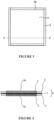
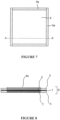
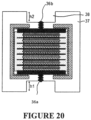
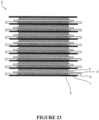
- FIGURES 1-20 together show an embodiment of a bipolar battery of the present invention.
- the bipolar battery comprises a stacked cell 13, an insulator 5 that covers the entire surface of electrode and separator 4 allowing for a much lower risk of an ionic short.
- the components of the bipolar battery may be formed in an air-tight pouch 23, and a unique battery casing which has electric connector 36 in a concavity 38.
- the stacked cell 13 comprises the layer of the current collector 1, the cathode layer 2, the separator 4, the anode layer 3, the current collector 1, the cathode layer 2, the separator 4, the anode layer 3 and so on in this repeating order.
- Possible carbon filler materials include acetylene black (AB), Ketjen black (KB), vapor grown carbon fiber (VGCF), carbon nanotubes, carbon nanohorns, and fullerenes.
- Possible filler metals include stainless steel, Cu, Ni, Cr, Au, Pt, Ag, Au, Al, Fe, Ti, Zn, Co.
- the shape of the filler may be spherical, fibrous, needle-like, or hollow. When needle or fiber-shaped fillers are used, it may be effective to make them oriented. This is because the orientation controls the flow of electrons and makes it easier to interrupt the current in the event of an abnormality.
- the thickness of the current collector 1 may be of any suitable thickness.
- the thickness of the current collector 1 is preferably between 0.1 um to 1 mm, and is more preferably between 1 um to 50 um.
- the cathode layer 2 is a layer containing at least a cathode active material (CAM).
- the CAM include, layered lithium containing oxide materials, such as LiCoO 2 , LiMnO 2 , LiNiO 2 , LiNi x Mn y Co 1-x-y O 2 , LiNi x Co y Al 1-x-y O 2 , lithium containing phosphate with olivine structure, such as LiFePO 4 , LiFe x Mn 1-x PO 4 , LiMnPO 4 , LiFe x Co 1-x PO 4 , LiCoPO 4 , lithium containing oxide materials with spinel structure, such as LiNi 0.5 Mn 1.5 O 4 , LiMn 2 O 4 , lithium excess layered structured oxide, such as Li 2 MnO 3 , Li 2 RuO 3 , Li 2 Ru x Ti 1-x O 3 , Li 2 Ru x Sn 1-x O 3 , Li 2 Mn x Ti 1-x O 3 , Li 2 M
- Examples of a binder that may be contained in the cathode layer 2 include butadiene rubber (BR), butyl rubber (IIR), acrylate butadiene rubber (ABR), polyvinylidene difluoride (PVDF), and Polytetrafluoroethylene (PTFE). Side chains of the binder may be modified by functional groups.
- BR butadiene rubber
- IIR butyl rubber
- ABR acrylate butadiene rubber
- PVDF polyvinylidene difluoride
- PTFE Polytetrafluoroethylene
- the anode layer 3 may further contain solid electrolytes, binders, electron conductive additives, in addition to AAM.
- electrolyte include organic liquid, organic polymer, inorganic solids.
- the electrolyte comprises inorganic solids because of higher transference number of lithium compared to liquid and higher ionic conductivity than organic polymer.
- inorganic solids are usually rigid and do not show liquidity which is preferred to compose stacked cell 13 without ionic shorting.
- binder examples include butadiene rubber (BR), butyl rubber (IIR), acrylate butadiene rubber (ABR), polyvinylidene difluoride (PVDF), Polytetrafluoroethylene (PTFE). Side chains of the binder may be modified by functional groups.
- BR butadiene rubber
- IIR butyl rubber
- ABR acrylate butadiene rubber
- PVDF polyvinylidene difluoride
- PTFE Polytetrafluoroethylene
- the separator 4 is an electron insulator but an ionic conductor.
- the electrolyte can be either organic liquid, organic polymer or inorganic solid. If an organic based electrolyte (liquid or polymer) is chosen, the separator 4 might be porous membrane comprising polymers such as Polyethylene (PE), Polypropylene (PP) and any combination of those; the membrane is immersed by organic based electrolyte.
- PE Polyethylene
- PP Polypropylene
- separator 4 is comprised of inorganic solids because of higher transference number of lithium compared to liquid and higher ionic conductivity than organic polymer. This is also because inorganic solids are usually rigid and do not show liquidity which is preferred to compose stacked cell 13 without ionic shorting.
- the solid electrolyte layer may contain a binder in addition to the above-mentioned solid electrolyte material.
- a binder may include butadiene rubber (BR), butyl rubber (IIR), acrylate butadiene rubber (ABR), polyvinylidene difluoride (PVDF), Polytetrafluoroethylene (PTFE). Side chains of the binder may be modified by functional groups.
- the electron and ion insulator 5 is made to enhance of insulation between layers and thus enable the stacked cell 13 to exhibit high voltage. It is intricately formed on the current collector 1, enveloping both its longer and shorter sides meticulously. Its very presence is to ensure that any surface area of the current collector 1, which remains unoccupied by the cathode layer 2 or anode layer 3, is fully shielded.
- the position of the electron and ion insulator 5 is not bound by stringent restrictions.
- the guiding principle is that the current collector 1 should be comprehensively shielded. In practical terms, this might mean that the insulator 5 could grace both sides of the current collector - one side that faces the cathode layer 2 and the other that faces the anode layer 3.
- the exact area of the insulator 5 on the current collector's 1 surface is not strictly defined, it's essential for it to sufficiently cover any regions left exposed from the edge of the electrode active material layer. The key is for it to insulate the current collector's 1 surface electronically. Yet, it's vital to avoid the formation of the insulator 5 on either the cathode layer 2 or the anode layer 3. Such a placement could be problematic during the bonding process when creating the stacked cells 13. Overlaps between the electrode and insulator layers could create regions of uneven pressure. Such disparities in pressure could damage the current collector 1 or even the separator layer. Moreover, overlapping areas would naturally be bulkier than the mere edges of the electrode, compromising the insulator's sealing capabilities.
- the gap or distance between the cathode layer 2 and the insulator 5, denoted as width (r) of the bare surface of the current collector 1, should be carefully calibrated to ensure insulation between layers. It is not limited by rigid parameters, but the width r should ideally span a range from 0.0001 % to 10% of the square root of S, where S represents the area of the cathode layer 2, measured in cm 2 . This ensures a balanced design, offering optimum insulation while maintaining the structural integrity and performance of the battery.
- the gap or distance criteria between cathode layer 2 and insulator 5 is applicable to those between anode layer 3 and insulator 5.
- Examples of materials for the electron and ion insulator 5 include; Acrylic, such as Polyacrylic acids (PAA), Poly(methyl methacrylate) (PMMA); Acrylonitrile butadiene styrene (ABS); Polyamide (PA); Polyimide (PI); Polyamide-imide (PAI); Polycarbonate (PC); Polyoxymethylene (POM); Polyether ether ketone (PEEK); Polyetherimide (PEI); Polyethylene (PE); Polyethylene terephthalate (PET); Polyphenylene oxide (PPO); Polyphenylene sulfide (PPS); Polypropylene (PP); Polyvinyl chloride (PVC); Polyvinylidene fluoride (PVDF); Polytetrafluoroethylene (PTFE).
- Acrylic such as Polyacrylic acids (PAA), Poly(methyl methacrylate) (PMMA); Acrylonitrile butadiene styrene (ABS); Polyamide (PA); Polyimide (PI); Polyamide-imide
- the air-tight pouch 23 shown in FIGURES 15-18 plays a multifaceted role in the overall architecture of the proposed battery system.
- the air-tight pouch 23 comprises the current collector 21 and the insulator 20 and the pouch 23 serves several functions.
- the air-tight pouch 23 One of the primary roles of the air-tight pouch 23 is its robust protection against moisture intrusion. With air-tightness, it forms an impenetrable barrier, ensuring that no moisture makes its way into the stacked cells 13 housed within it. The significance of this feature cannot be overstated, as moisture ingress can be detrimental to the overall health, efficiency, and life of battery cells.
- the pouch 23 has a salient feature that allows the creation of a vacuum environment for the stacked cell 13. By doing so, the environment within the pouch 23 remains inert, which is crucial for maintaining the chemical and physical integrity of the stacked cell 13. An inert environment ensures that there's no undesired chemical reaction that might otherwise compromise the performance or safety of the cell. Also, air-tight pouch 23 is the provision of atmospheric pressure to the stacked cell 13. This feature is ingeniously designed without the addition of any mechanical parts. Subjecting the battery to a modicum of pressure can have a plethora of benefits. It can aid in the reduction of internal resistance within the battery, thereby enhancing its cycling capabilities and overall efficiency.
- the air-tight pouch 23 is compatible with further densification of the stacked cell 13 using an isostatic press. This ensures that the cell components are compacted uniformly, ensuring optimum performance and longevity.
- the air-tight pouch 23 plays a role in facilitating vacuum operations of the system. Since the current collector 21 of the airtight pouch 23 establishes an electrical connection with the stacked cell 13, it ensures that the cell operates seamlessly under vacuum conditions.
- Plastic materials for insulator 20 include Acrylic, such as Polyacrylic acids (PAA), Poly (methyl methacrylate) (PMMA); Acrylonitrile butadiene styrene (ABS); Polyamide (PA); Polyimide (PI); Polyamide-imide (PAI); Polycarbonate (PC); Polyoxymethylene (POM); Polyether ether ketone (PEEK); Polyetherimide (PEI); Polyethylene (PE); Polyethylene terephthalate (PET); Polyphenylene oxide (PPO); Polyphenylene sulfide (PPS); Polypropylene (PP); Polyvinyl chloride (PVC); Polyvinylidene fluoride (PVDF); Polytetrafluoroethylene (PTFE).
- PAA Polyacrylic acids
- PMMA Poly (methyl methacrylate)
- ABS Acrylonitrile butadiene styrene
- PA Polyamide
- PI Polyimide
- PAI Polycarbonate
- PC Polyoxymethylene
- thermoplastic material 22 inside insulator 20. This is expected to improve the thermal weldability of insulator 20, reduce moisture permeability, and maintain a high vacuum. If thermoplastic material 22 is used, its welding temperature should be lower than that of insulator 20. This will improve the air-tightness of the air-tight pouch 23 while maintaining the mechanical strength of the insulator 20.
- the thermoplastic layer 22 may consist of a single material or may be multilayered, consisting of multiple materials.
- Acrylic such as Polyacrylic acids (PAA), Poly(methyl methacrylate) (PMMA); Acrylonitrile butadiene styrene (ABS); Polyamide (PA); Polyimide (PI); Polyamide-imide (PAI); Polycarbonate (PC); Polyoxymethylene (POM); Polyether ether ketone (PEEK); Polyetherimide (PEI); Polyethylene (PE); Polyethylene terephthalate (PET); Polyphenylene oxide (PPO); Polyphenylene sulfide (PPS); Polypropylene (PP); Polyvinyl chloride (PVC); Polyvinylidene fluoride (PVDF); Polytetrafluoroethylene (PTFE) are candidates for materials.
- PAA Polyacrylic acids
- PMMA Poly(methyl methacrylate)
- ABS Acrylonitrile butadiene styrene
- PA Polyamide
- the thickness of insulator 20 is not specifically limited, but a thinner layer may be preferred when higher capacity is required.
- the thickness of insulator 20 is preferably between 1 um to 2 mm, and is more preferably between 10um to 1,000 um.
- the current collector 21 of the air-tight pouch 23 may be composed of metal foil, a metal mesh, etc., and is especially preferably metal foil.
- metal constituting the current collector 1 include Cu, Ni, Cr, Au, Pt, Ag, Au, Al, Fe, Ti, Zn, Co and stainless steel. It can be the metal pure element, doped, alloy, or clad.
- the surface of the metal may also be covered with carbon or other material. This will ensure good adhesion with the cathode layer 2 and anode layer 3.
- carbon can also be used for the current collector 21.
- Resin composites with an electron conductor (metal or carbon) as filler can also be used for the current collector 1.
- Possible carbon filler materials include acetylene black (AB), Ketjen black (KB), VGCF, carbon nanotubes, carbon nanohorns, and fullerenes.
- Possible filler metals include stainless steel, Cu, Ni, Cr, Au, Pt, Ag, Au, Al, Fe, Ti, Zn, Co.
- the shape of the filler can be spherical, fibrous, needle-like, or hollow. When needle or fiber-shaped fillers are used, it may be effective to make them oriented. This is because the orientation controls the flow of electrons and makes it easier to interrupt the current in the event of an abnormality.
- the bipolar battery of the present invention is an improvement over currently existing bipolar batteries, because the air-tight pouch 23 is equipped with a current collector 21 and insulating surface 20. Furthermore, the air-tight pouch 23 allows the densification process of the stack and the air-tight pouch 23 is positioned inside a vacuum.
- a bipolar battery is preferably accommodated in the battery casing as a whole stacked cell 13, as shown in FIGURES 19-20 , to prevent external impact and environmental deterioration in use. Also, the casing enables one to handle the high voltage battery system during operation, installation to device, disassembly or maintenance.
- the battery casing comprises a housing 37 that protects the stacked cell 13 (which may or may not be in air-tight pouch 23) from outside air and shock during actual use.
- housing 37 should be of a more insulating construction because stacked cell 13 has a higher voltage than a normal electrochemical cell.
- the material should be composed exclusively of electrically insulating materials.
- a metal housing such as those normally used for lithium-ion batteries or nickel-metal hydride, is not desirable, as there is concern that battery performance may be compromised by insulation breakdown.
- housing 37 is a sealed structure.
- o-rings, welds, adhesives, etc. may be used to create a sealed structure.
- the internal atmosphere should be considered from two perspectives. First, from the standpoint of the chemical stability of the battery itself, the concentration of moisture and oxygen should preferably be low.
- noble gases such as He, Ar, and Xe should be avoided, as these gases tend to cause dielectric breakdown under high voltage conditions.
- the atmosphere inside stacked cell 13 should be vacuum, N 2 , SF 6 , etc.
- the method for manufacturing a high-voltage electrochemical cell comprises the following steps described below.
- the method of manufacturing a high voltage electrochemical cell comprises the following steps: a process for protecting the edge of the current collector 1 by placing an insulator 5 on the edge of the current collector 1, a process for manufacturing an electrode layer by creating a free-standing film of cathode layer 2 and anode layer 3, a process for placing the free-standing film created by the above process at a position r inside the current collector 1 of the insulator 5 formed on the edge of the current collector 1, and a process for manufacturing a cathode layer 2 and anode layer 3.
- Cathode terminal stack 9 or 10 where only cathode layer 2 is formed on current collector 1 and anode terminal stack 11 or 12 where only anode layer 3 is formed on current collector 1 are created.
- Stack 11 or 12 is created where only anode layer 3 is formed on current collector 1.
- the individual processes are the same as the bipolar stack process, so the description here is omitted.
- the stacked cell 13' may have an insulator 5.
- the insulator 5 may be made to enhance insulation between layers and thus enable the stacked cell 13' to exhibit high voltage.
- the insulator 5 may be intricately formed on the current collector 1.
- the insulator 5 may be configured to ensure that any surface area of the current collector 1, which remains unoccupied by the cathode layer 2 or anode layer 3, is fully shielded.
- the exact area of the insulator 5 on the exposed surfaces of the current collector 1 may not be strictly defined, it may be essential for the insulator 5 to sufficiently cover any regions left exposed from the edge of the electrode active material layer.
- the key may be for the insulator 5 to insulate the surfaces of the current collector 1 electronically.
- it may be important to avoid the formation of the insulator 5 on exposed areas of either the cathode layer 2 or the anode layer 3.
- Such a placement could be problematic during the bonding process when creating the stacked cell 13'. Overlaps between the electrode and insulator 5 could create regions of uneven pressure. Such disparities in pressure could damage the current collector 1 or even the separator 4.
- overlapping areas would naturally be bulkier than the mere edges of the electrode, compromising the insulating capabilities.
- a gap T on the current collectors 1 may be formed.
- the distance of the gap T on the current collector 1 should be carefully calibrated to ensure insulation between layers. It is not limited by rigid parameters, but the distance should span a range from 0.0001 % to 10% of the square root of S6, where S6 may represents the area of the anode layer 3, measured in cm 2 . This may ensure a balanced design, offering optimum insulation while maintaining the structural integrity and performance of the stacked cell 13'.
- the gap or distance criteria between the anode layer 3 and insulator 5 may also be applicable to those between cathode layer 2 and insulator 5.
- the materials used for the insulating 5 is not limited to specific materials as long as the material has required capability for insulations.
- the materials used may have been listed previously above.
- a thermosoft plastic may be preferred because softened plastic can fill the gap or void that may be created during lamination process, and may also cover the edge of current collector 1 and separator 4 after the lamination process due to liquidity or plastic deformation.
- Examples of the insulator 5 may include, but not limited to: Acrylic, such as Polyacrylic acids (PAA), Poly(methyl methacrylate) (PMMA); Acrylonitrile butadiene styrene (ABS); Polyamide (PA); Polyimide (PI); Polyamide-imide (PAI); Polycarbonate (PC); Polyoxymethylene (POM); Polyether ether ketone (PEEK); Polyetherimide (PEI); Polyethylene (PE); Polyethylene terephthalate (PET); Polyphenylene oxide (PPO); Polyphenylene sulfide (PPS); Polypropylene (PP); Polyvinyl chloride (PVC); Polyvinylidene fluoride (PVDF); Polytetrafluoroethylene (PTFE).
- the insulator 5 can consist of multiple different materials, such as combinations of the above listed.
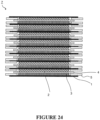
- the stacked cell 13" may consist of the current collector 1, the cathode layer 2, the separator 4, the anode layer 3, and another current collector 1.
- This configuration of elements 1, 2, 4, 3, 1, 2,.... 2, 4, 3, 1 may be repeated in this repeating order forming the stacked cell 13".
- Each of the layers are formed so that none of the layers are contacting any of the other layers in/between the electric stacks.
- the current collector 1 When the insulator 5 is attached on the exposed surface of current collector 1 adjacent the anode layer 3 as shown in FIGURES 25-26 , the current collector 1 may be designed to bend up at the edge of the anode layer 3, generating an angled edge 1A for the stacked cell 13". This angled edge 1A may enhance the structural integrity and ionic insulation of the cells by covering the separator 4 up from the external of cells.
- the insulator 5 may be laminated onto the current collector 1 and bends up together with the current collector 1, ensuring proper insulation and alignment within the stacked cell 13" configuration.
- the same criteria used between the anode layer 3 and insulator 5 is applicable to those between the cathode layer 2 and insulator 5.
- the angle X may range from 3 degrees to 90 degrees. More specifically, the angle X may range from 5 degrees to 80 degrees.
- the stacked cell 13" has been formulated and test as described below.
- the stacked cell 13" formed may satisfy the area relationship of: S1 > S3 > S4 > S 2 > S5 ⁇ S6 or S1 > S3 > S4 > S2 > S6 ⁇ S5 where:
- the cathode layer 2 may be fabricated of a powder of Cathode Active Material (LiNi 1/3 Co 1/3 Mn 1/3 O 2 , MTI corporation), solid electrolyte (SSE-10, NEI) and PTFE (Daikin America) mixed in the ratio of 87:12:1 (wt%). Then the mixture was extended to the sheet with the thickness 120um to form the cathode layer 2. The area of the cathode layer 2 is S5.
- the anode layer 3 may be fabricated of a powder of Anode Active Material (Li 4 Ti 5 O 12 , MSE supplies LLC), solid electrolyte (SSE-10, NEI), carbon black (Imerys) and PTFE (Daikin America) mixed in the ratio of 80:15:1:4 (wt%). Then the mixture was extended to the sheet with the thickness 300um to form the anode layer 3. The area of anode layer 3 is S6.
- the separator 4 may be fabricated of a powder of solid electrolyte (SSE-10, NEI) and PTFE (Daikin America) mixed in the ratio of 97:3 (wt%). Then the mixture was extended to the sheet with the thickness 120um to form the separator 4. The area of the separator 4 is S4.
- the bipolar stacked cell 13" may be charged and discharged at a current density of 1.0 mA/cm 2 in the voltage range of 15 V to 27 V.
- the bipolar stacked cell 13" was able to charge and discharge without any ionic or electronic short.
- the charge and discharge profile may be shown in FIGURE 31 .
- the stacked cell 13" was formulated and tested again as described below.
- the stacked cell 13" satisfied the same area relationships as described above.
- the current collector 1 was formed in the same manner as in the previous test embodiment except for the thickness of Polyetherimide (PEI) film.
- PEI Polyetherimide
- PIB adhesive Polyisobutene
Landscapes
- Chemical & Material Sciences (AREA)
- Chemical Kinetics & Catalysis (AREA)
- Electrochemistry (AREA)
- General Chemical & Material Sciences (AREA)
- Engineering & Computer Science (AREA)
- Manufacturing & Machinery (AREA)
- Secondary Cells (AREA)
- Connection Of Batteries Or Terminals (AREA)
Applications Claiming Priority (2)
| Application Number | Priority Date | Filing Date | Title |
|---|---|---|---|
| US202363542587P | 2023-10-05 | 2023-10-05 | |
| US18/809,612 US20250118877A1 (en) | 2023-10-05 | 2024-08-20 | Bipolar battery |
Publications (2)
| Publication Number | Publication Date |
|---|---|
| EP4535524A2 true EP4535524A2 (de) | 2025-04-09 |
| EP4535524A3 EP4535524A3 (de) | 2025-07-16 |
Family
ID=92882515
Family Applications (1)
| Application Number | Title | Priority Date | Filing Date |
|---|---|---|---|
| EP24201467.8A Pending EP4535524A3 (de) | 2023-10-05 | 2024-09-19 | Bipolare batterie |
Country Status (5)
| Country | Link |
|---|---|
| US (1) | US20250118877A1 (de) |
| EP (1) | EP4535524A3 (de) |
| JP (1) | JP2025072295A (de) |
| KR (1) | KR20250049956A (de) |
| CN (1) | CN119786641A (de) |
Family Cites Families (7)
| Publication number | Priority date | Publication date | Assignee | Title |
|---|---|---|---|---|
| US5254415A (en) * | 1992-04-09 | 1993-10-19 | Saft America Inc. | Stacked cell array bipolar battery with thermal sprayed container and cell seal |
| JP4238645B2 (ja) * | 2003-06-12 | 2009-03-18 | 日産自動車株式会社 | バイポーラ電池 |
| DE102014210803A1 (de) * | 2014-06-05 | 2015-12-17 | Fraunhofer-Gesellschaft zur Förderung der angewandten Forschung e.V. | Elektroenergiespeicherelement, Verfahren und Vorrichtung zu seiner Herstellung |
| US11127999B2 (en) * | 2016-03-15 | 2021-09-21 | Intel Corporation | Package-less battery cell apparatus, and method for forming the same |
| CN112913065B (zh) * | 2018-12-28 | 2024-10-01 | 松下知识产权经营株式会社 | 电池 |
| JP7491776B2 (ja) * | 2020-08-25 | 2024-05-28 | 株式会社豊田自動織機 | 蓄電装置 |
| CN116615793A (zh) * | 2020-11-24 | 2023-08-18 | 株式会社丰田自动织机 | 蓄电装置 |
-
2024
- 2024-08-20 US US18/809,612 patent/US20250118877A1/en active Pending
- 2024-09-19 EP EP24201467.8A patent/EP4535524A3/de active Pending
- 2024-09-20 JP JP2024163878A patent/JP2025072295A/ja active Pending
- 2024-09-30 KR KR1020240133009A patent/KR20250049956A/ko active Pending
- 2024-10-08 CN CN202411393268.6A patent/CN119786641A/zh active Pending
Also Published As
| Publication number | Publication date |
|---|---|
| CN119786641A (zh) | 2025-04-08 |
| KR20250049956A (ko) | 2025-04-14 |
| EP4535524A3 (de) | 2025-07-16 |
| JP2025072295A (ja) | 2025-05-09 |
| US20250118877A1 (en) | 2025-04-10 |
Similar Documents
| Publication | Publication Date | Title |
|---|---|---|
| CN101252208B (zh) | 堆叠非水电解质电池及其制造方法和堆叠设备 | |
| CN108336256B (zh) | 全固体电池 | |
| JP4555549B2 (ja) | ケースを備えた電池 | |
| CN103069614B (zh) | 具有内置的密封装置的集电体、和包括这种集电体的双极电池 | |
| KR101154881B1 (ko) | 바이폴라 셀을 포함하는 이차전지 | |
| EP2405506B1 (de) | Tasche und akkumulator damit | |
| CN104752657B (zh) | 非水电解质电池、电池组及蓄电池装置 | |
| EP1531505B1 (de) | Flachzelle | |
| KR20190030176A (ko) | 고체 전해질을 포함하는 전고체 전지용 전극 | |
| KR20150081662A (ko) | 계단 구조의 하이브리드 전극조립체 | |
| EP2662920A2 (de) | Elektrodenanordnung mit einer asymmetrisch beschichteten trennmembran sowie elektrochemische vorrichtung mit der elektrodenanordnung | |
| EP3905416A1 (de) | Batterie | |
| US8003241B2 (en) | Lithium battery with external positive thermal coefficient layer | |
| KR101515672B1 (ko) | 2 이상의 양극 및 음극을 포함하는 전극 조립체 및 이에 의한 전기 화학 소자 | |
| EP4535524A2 (de) | Bipolare batterie | |
| KR20220014767A (ko) | 전극, 전극 조립체 및 이차 전지 | |
| JP2011060564A (ja) | 蓄電デバイスの製造方法 | |
| KR102052920B1 (ko) | 밀봉용 폴딩부를 포함하는 전지셀 | |
| EP4607625A1 (de) | Verhinderung der bildung von luftfallen während der herstellung von bipolarer stapelbatterie | |
| KR101656082B1 (ko) | 전극의 구성이 상이한 단위셀들을 포함하고 있는 전지셀 | |
| US20250210670A1 (en) | Current collector for bipolar stacked batteries | |
| US20250046893A1 (en) | Device and method for manufacturing device | |
| KR20250155807A (ko) | 리튬 이차 전지용 전극 조립체 및 이를 포함하는 리튬 이차 전지 | |
| KR20250088155A (ko) | 양극, 이를 포함하는 전극 조립체, 및 이를 포함하는 리튬 이차전지 | |
| KR101522655B1 (ko) | 케이블형 이차전지 |
Legal Events
| Date | Code | Title | Description |
|---|---|---|---|
| PUAI | Public reference made under article 153(3) epc to a published international application that has entered the european phase |
Free format text: ORIGINAL CODE: 0009012 |
|
| STAA | Information on the status of an ep patent application or granted ep patent |
Free format text: STATUS: THE APPLICATION HAS BEEN PUBLISHED |
|
| AK | Designated contracting states |
Kind code of ref document: A2 Designated state(s): AL AT BE BG CH CY CZ DE DK EE ES FI FR GB GR HR HU IE IS IT LI LT LU LV MC ME MK MT NL NO PL PT RO RS SE SI SK SM TR |
|
| PUAL | Search report despatched |
Free format text: ORIGINAL CODE: 0009013 |
|
| AK | Designated contracting states |
Kind code of ref document: A3 Designated state(s): AL AT BE BG CH CY CZ DE DK EE ES FI FR GB GR HR HU IE IS IT LI LT LU LV MC ME MK MT NL NO PL PT RO RS SE SI SK SM TR |
|
| RIC1 | Information provided on ipc code assigned before grant |
Ipc: H01M 50/172 20210101AFI20250610BHEP Ipc: H01M 50/463 20210101ALI20250610BHEP Ipc: H01M 50/471 20210101ALI20250610BHEP |
|
| STAA | Information on the status of an ep patent application or granted ep patent |
Free format text: STATUS: REQUEST FOR EXAMINATION WAS MADE |
|
| 17P | Request for examination filed |
Effective date: 20260115 |