EP4534751A2 - Schublade und wäschebehandlungsmaschine damit - Google Patents
Schublade und wäschebehandlungsmaschine damit Download PDFInfo
- Publication number
- EP4534751A2 EP4534751A2 EP25152995.4A EP25152995A EP4534751A2 EP 4534751 A2 EP4534751 A2 EP 4534751A2 EP 25152995 A EP25152995 A EP 25152995A EP 4534751 A2 EP4534751 A2 EP 4534751A2
- Authority
- EP
- European Patent Office
- Prior art keywords
- treatment agent
- clothes treatment
- drawer
- housing
- space
- Prior art date
- Legal status (The legal status is an assumption and is not a legal conclusion. Google has not performed a legal analysis and makes no representation as to the accuracy of the status listed.)
- Pending
Links
Images








Classifications
-
- D—TEXTILES; PAPER
- D06—TREATMENT OF TEXTILES OR THE LIKE; LAUNDERING; FLEXIBLE MATERIALS NOT OTHERWISE PROVIDED FOR
- D06F—LAUNDERING, DRYING, IRONING, PRESSING OR FOLDING TEXTILE ARTICLES
- D06F39/00—Details of washing machines not specific to a single type of machines covered by groups D06F9/00 - D06F27/00
- D06F39/02—Devices for adding soap or other washing agents
- D06F39/022—Devices for adding soap or other washing agents in a liquid state
-
- D—TEXTILES; PAPER
- D06—TREATMENT OF TEXTILES OR THE LIKE; LAUNDERING; FLEXIBLE MATERIALS NOT OTHERWISE PROVIDED FOR
- D06F—LAUNDERING, DRYING, IRONING, PRESSING OR FOLDING TEXTILE ARTICLES
- D06F39/00—Details of washing machines not specific to a single type of machines covered by groups D06F9/00 - D06F27/00
- D06F39/02—Devices for adding soap or other washing agents
-
- D—TEXTILES; PAPER
- D06—TREATMENT OF TEXTILES OR THE LIKE; LAUNDERING; FLEXIBLE MATERIALS NOT OTHERWISE PROVIDED FOR
- D06F—LAUNDERING, DRYING, IRONING, PRESSING OR FOLDING TEXTILE ARTICLES
- D06F39/00—Details of washing machines not specific to a single type of machines covered by groups D06F9/00 - D06F27/00
- D06F39/12—Casings; Tubs
Definitions
- the drawer is provided with a configuration for allowing the user to manually supply detergent or softener.
- the configuration may be defined as a "manual supply unit.”
- the storage container is filled with detergent or softener required for performing a plurality of clothes treating processes, while the manual supply unit is filled with detergent or softener required for a single clothes treating process. Accordingly, the manual supply unit is smaller than the storage container in volume.
- the invention is specified by the independent claims. Preferred embodiments are defined by the dependent claims.
- the present disclosure is directed to providing a drawer having a structure capable of solving the above-mentioned problems and a clothes treating machine including the same.
- Another aspect of the present disclosure is to provide a drawer having a structure capable of preventing a clothes treatment agent or fluid overflowed from a clothes treatment agent housing from remaining in an inner space of the drawer, and a clothes treating machine including the same.
- Another aspect of the present disclosure is to provide a drawer having a structure capable of supplying a clothes treatment agent or fluid overflowed from a clothes treatment agent housing into a tub without discard, and a clothes treating machine including the same.
- Another aspect of the present disclosure is to provide a drawer having a structure capable of stably mounting a clothes treatment agent housing in a housing accommodation part, and a clothes treating machine including the same.
- Another aspect of the present disclosure is to provide a drawer having a structure capable of preventing an unnecessary movement of a clothes treatment agent housing after the clothes treatment agent housing is mounted in a housing accommodation part, and a clothes treating machine including the same.
- Another aspect of the present disclosure is to provide a drawer having a structure capable of stably supporting a dispenser assembly into which the drawer is inserted, and a clothes treating machine including the same.
- the drawer may include a drawer frame extending in a lengthwise direction and having a predetermined inner space, an inner wall located in the predetermined inner space and configured to divide the predetermined inner space into at least two spaces, and a housing accommodation part defined as a space surrounded by the inner wall, of the divided spaces, and configured to accommodate the clothes treatment agent housing.
- the housing accommodation part may be provided with a protruding portion protruding from one side of the inner wall by a predetermined distance.
- One side of the clothes treatment agent housing facing the one side of the inner wall may be brought into contact with the protruding portion so as to be spaced apart from the one side of the inner wall when the clothes treatment agent housing is accommodated in the housing accommodation part.
- the housing accommodation part spaced apart from the inner wall of the clothes treating machine by a predetermined distance may be provided with a support rod disposed on one side thereof, and extending from one of plane portions of the inner wall extending in a lengthwise direction to another plane portion opposite to the one plane portion, so as to support the accommodated clothes treatment agent housing.
- the clothes treatment agent housing of the clothes treating machine may be provided with a support protrusion surface continuously formed with the outer circumferential surface and extending toward the another side of the clothes treatment agent housing to be inclined with respect to the outer circumferential surface.
- the support protrusion surface may be brought into contact with the support rod so as to be supported by the support rod when the clothes treatment agent housing is accommodated in the housing accommodation part.
- the clothes treatment agent housing of the clothes treating machine may be provided with an alignment pin protruding from a lower side of the one side thereof by a predetermined distance.
- the housing accommodation part may include a lower surface defining one side of the housing accommodation part.
- a support boss portion may protrude from one side of the lower surface facing the inner wall.
- An alignment pin insertion groove may be recessed in the support boss portion. The alignment pin may be inserted into the alignment pin insertion groove when the clothes treatment agent housing is accommodated in the housing accommodation part.
- the discharge inclined portion of the clothes treating machine may include a first bottom surface extending by a predetermined distance from the another side opposite to the one side of the storage body portion in the lengthwise direction at a predetermined angle with respect to the storage cover portion, and a second bottom surface connected to the first bottom surface and extending by a predetermined distance toward the one side of the storage body portion in the lengthwise direction.
- the check valve may be located adjacent to the second bottom surface. The clothes treatment agent accommodated in the storage container may flow to the second bottom surface via the first bottom surface.
- a protruding portion is formed on a rear plane portion of an inner wall, adjacent to a clothes treatment agent housing.
- a rear side of the clothes treatment agent housing is brought into contact with the protruding portion. Accordingly, the rear side of the clothes treatment agent housing is spaced a predetermined distance apart from the rear plane portion of the inner wall, thereby defining a space portion between the clothes treatment agent housing and the inner wall.
- the fluid outlet port and the tub communicate with each other.
- the clothes treatment agent or fluid can thus be introduced into the tub through the fluid outlet port.
- the clothes treatment agent or fluid overflowed from the clothes treatment agent housing can also be used for performing a clothes treating process. This may result in preventing the overflowed clothes treatment agent from being discarded to outside of the clothes treating machine or from remaining in the drawer and causing contamination.
- a rear end portion is formed on the rear of the drawer.
- the rear end portion includes an opening in which a sensor portion and the check valve of the storage container are accommodated, and a partition member for partitioning the opening.
- the partitioned openings do not communicate with each other due to the partitioning member.
- the sensor portion or the check valve can be inserted only in a direction and order of bypassing the partition member.
- the sensor portion or the check valve can be detached only in the direction and order of bypassing the partition member.
- treatment of clothes refers to treatment such as washing, sterilization, bleaching, softening and drying performed on clothes.
- softener used in the following description refers to any substance or chemical used to soften clothing, textiles, or the like.
- bleaching agent used in the following description refers to any substance or chemical that decomposes and removes colored substances contained in fibers and the like by a chemical action to whiten the fibers and the like.
- clothes treatment agent refers to any substance capable of causing a chemical or physical action to treat clothing.
- the clothes treatment agent may be used as meaning including detergent, softener, bleach, and the like.
- the clothes treatment agent may be in a liquid phase.
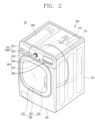
- the clothes treating machine 10 includes a storage unit 400, a clothes treatment agent housing 500, and a support member 600.
- the clothes treating machine 10 includes the housing 100.
- the housing 100 defines appearance of the clothes treating machine 10.
- a predetermined inner space S is formed inside the housing 100.
- Various components for treating clothes by the clothes treating machine 10 may be accommodated in the predetermined inner space S.
- a compressor (not illustrated) for a clothes treating process related to heat transfer, such as a drying treatment, may be accommodated in the inner space, in addition to components to be described later.
- the inside and outside of the housing 100 may be electrically connected to each other. Accordingly, power for operating the clothes treating machine 10 can be supplied. For example, as power is supplied, a drum 171 may be rotated to treat clothes.
- the housing 100 includes a housing frame 110, a front surface 120, a rear surface 130, side surfaces 140, a door unit 150, a manipulation unit 160, a tub 170, and a drum 171.
- the housing frame 110 forms a framework of the housing 100.
- the housing frame 110 may include a top surface, the front surface 120, the rear surface 130, the side surfaces 140, and the like defining an outer surface of the housing 100.
- the top surface, the front surface 120, the rear surface 130, and the side surfaces 140 may be coupled to the housing frame 110, so that the predetermined inner space S can be defined as a closed space to be opened by the door unit 150.
- the dispenser assembly 200 may be coupled to the housing frame 110.
- the dispenser assembly 200 is located in the predetermined inner space S.
- One side, namely, a right side of the dispenser assembly 200 and a part of an upper side of the dispenser assembly 200 may be fixedly coupled to the housing frame 110.
- the clothes treating machine 10 includes the support member 600.
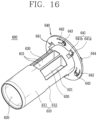
- the support member 600 is coupled through the rear surface 130 of the housing 100.
- the front surface 120 defines one side of the housing 100, namely, the front side in the illustrated embodiment.
- the front surface 120 may be coupled to the housing frame 110.
- the front surface 120 may be formed smaller than a space defined by the front of the housing frame 110. This results from that the manipulation unit 160 and the drawer 300 are also provided on the front of the housing 100.
- the drawer 300 and the manipulation unit 160 are located on an upper portion of the front surface 120.
- the drawer 300 is located on a right side
- the manipulation unit 160 is located on a left side.
- the rear surface 130 defines one side of the housing 100, namely, the rear side in the illustrated embodiment.
- the rear surface 130 may be coupled to the housing frame 110.
- the rear surface 130 is provided with a plurality of through holes.
- a conductor member (not illustrated) for electrically connecting an external power source and internal components of the clothes treating machine 10 may be inserted through any of the through holes.
- a hose member (not illustrated) for communicating an external water pipe with internal components of the clothes treating machine 10 may be inserted through any of the through holes.
- heat and air may be sucked or discharged through the through holes. Accordingly, a clothes treating process related to heat transfer or a clothes treating process by air may be performed.
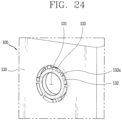
- the support member coupling hole 132 and the support member guide hole 133 are formed along a radially outer side of the support member insertion hole 131.
- the support member coupling hole 132 is provided in plurality spaced apart from the support member insertion hole 131 by a predetermined distance.
- the plurality of support member coupling holes 132 is spaced apart from one another by predetermined distances.
- the plurality of support member coupling holes 132 is arranged in a circumferential direction radially outside the support member insertion hole 131.
- a support member coupling portion 132a is formed on one end portion of each support member coupling hole 132 in the circumferential direction.
- the support member coupling portion 132a may be engaged with the coupling protrusion 641.
- the coupling protrusion 641 When the coupling protrusion 641 is brought into contact with the supporting member coupling portion 132a, an arbitrary rotation of the support member 600 can be prevented. That is, the coupling protrusion 641 and the support member coupling portion 132a are not arbitrarily spaced apart from each other.
- the support member guide hole 133 is configured to guide the rotation of the support member 600.
- the guide protrusion 643 inserted into the support member guide hole 133 is moved in response to the rotation of the support member 600.
- the guide protrusion 643 may be moved by a predetermined distance while being inserted in the support member guide hole 133.
- the door unit 150 is configured to open or close a front opening of the drum 171. When the door unit 150 is opened, the opening of the drum 171 is exposed. The user may put clothes and the like to be treated into the drum 171 through the exposed opening.
- the door unit 150 includes a door frame 151, a window 152, and a handle 153.
- the door frame 151 defines an outer side of the door unit 150.
- the door frame 151 may support the window 152 from outside.
- the handle 153 may be disposed between the door frame 151 and the window 152.
- the door frame 151 may cover a part of the front surface 120.
- the window 152 is located inside the door frame 151.
- the window 152 is a portion that allows the user to visually recognize a state inside the drum 171.
- the window 152 may be formed of a transparent material.
- the window 152 may be formed of tempered glass or the like.
- the handle 153 is located between the window 152 and the door frame 151.
- the display module 161 is configured to output a power signal and a control signal input by the user.
- the manipulation button module 163 is pressed by the user so that a control signal related to a clothes treating process to be performed is input.
- the clothes treating process selected by the manipulation button module 163 may be additional rinsing, additional dehydration, reserved washing, and the like.
- the operation button module 164 may include a plurality of buttons. A power signal may be input to any one of the buttons. Also, a control signal may be input to another button.
- tub 170 and the drum 171 may be electrically connected to the manipulation unit 160.
- a conductor member (not illustrated) may be provided for the electric connection.
- the tub 170 and the drum 171 may have any shape capable of accommodating clothes and the like therein and treating the same.
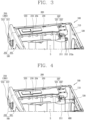
- the clothes treating machine 10 includes the dispenser assembly 200.
- a predetermined space may be defined inside the dispenser assembly 200.
- the drawer 300 is inserted into the predetermined space.
- the dispenser assembly 200 may supply the clothes treatment agent to the tub 170 according to the input power signal and control signal. In addition, the dispenser assembly 200 may supply a fluid for treating clothes to the tub 170. To this end, the dispenser assembly 200 is in communication with the tub 170.
- the dispenser assembly 200 is in communication with an external fluid supply unit (not illustrated).
- the dispenser assembly 200 may receive the fluid from the fluid supply unit (not illustrated) according to the input power signal and control signal.
- the dispenser assembly 200 is in communication with the drawer 300.
- the clothes treatment agent introduced into the drawer 300 may be supplied to the tub 170 together with the fluid through the dispenser assembly 200.
- a predetermined space is defined inside the frame unit 210.
- the inserted drawer 300 is accommodated in the predetermined space.
- the rear side of the frame unit 210 may communicate with an external fluid supply unit (not illustrated).
- the rear side of the frame unit 210 may also be electrically connected to the manipulation unit 160.
- the fluid supply unit 230 and the clothes treatment agent supply unit 240 are provided on one side of the frame unit 210, namely, on an upper side in the embodiment.
- the lower side of the frame unit 210 may be in communication with the tub 170.
- the fluid and clothes treatment agent introduced into the drawer 300 may be supplied to the tub 170 through the frame unit 210.
- the frame unit 210 includes a lower body portion 211 and a rear protrusion 212.
- the lower body portion 211 is disposed on a lower side of the frame unit 210. Specifically, the lower body portion 211 protrudes rearward from one side of the frame unit 210, namely, from a rear lower side of the frame unit 210 in the embodiment.
- the rear protrusion 212 may be inserted into the support member 600.
- both sides of the dispenser assembly 200 namely, front and right sides of the dispenser assembly 200 in the embodiment are supported by the housing frame 110.
- one side of the dispenser assembly 200 namely, the rear side of the dispenser assembly 200 in the embodiment is supported by the support member 600.
- the clothes treatment agent pump unit 220 is in communication with the clothes treatment agent supply unit 240.
- the clothes treatment agent accommodated in the storage unit 400 may flow to the clothes treatment agent supply unit 240 through the clothes treatment agent pump unit 220.
- the first clothes treatment agent pump 221 communicates with a first clothes treatment agent flow path 241 of the clothes treatment agent supply unit 240.
- the clothes treatment agent discharged from the first storage container 410 may flow to the first clothes treatment agent flow path 241 by the first clothes treatment agent pump 221.
- the second clothes treatment agent pump 222 communicates with a second clothes treatment agent flow path 242 of the clothes treatment agent supply unit 240.
- the clothes treatment agent discharged from the second storage container 420 may flow to the second clothes treatment agent flow path 242 by the second clothes treatment agent pump 222.
- the clothes treatment agent pump unit 220 includes a pump valve coupling portion 223, a primary pump valve 224, a secondary pump valve 225, and a discharge portion 226. Those components may be provided in the first clothes treatment agent pump 221 and the second clothes treatment agent pump 222, respectively.
- One side of the pump valve coupling portion 223 facing the secondary pump valve 225 namely, a rear side in the embodiment is coupled to the secondary pump valve 225 having an opening.
- the secondary pump valve 225 may hermetically seal or close the opening. Accordingly, the flow of the clothes treatment agent is allowed or blocked.
- the clothes treatment agent pump unit 220 may allow or block the flow of the clothes treatment agent by such dual pump valves 224 and 225. This may result in preventing a leakage of the clothes treatment agent accommodated in the storage unit 400.
- the primary pump valve 224 is located between the storage container 410, 420 and the clothes treatment agent pump unit 220.
- the primary pump valve 224 pushes the check valve cap portion 416b, 426b of the check valve 416, 426 to one side, namely, to the front side in the embodiment. Accordingly, the check valve cylinder portion 416a, 426a of the check valve 416, 426 communicates with the inner space of the storage container 410, 420.
- the rear side of the primary pump valve 224 is partially accommodated in the pump valve coupling portion 223 so that their insides communicate with each other.
- the primary pump valve 224 is hermetically coupled to the pump valve coupling portion 223.
- a primary valve cap portion 224b of the primary pump valve 224 is moved to one side, namely, to the rear side in the embodiment, so that the inner space of the primary pump valve 224 and the inner space of the pump valve coupling portion 223 can communicate with each other.
- the clothes treatment agent accommodated in the storage container 410, 420 can be introduced into the inner space of the clothes treatment agent pump unit 220.
- the primary valve cylinder portion 224a defines an outer side of the primary pump valve 224.
- One side of the primary valve cylinder portion 224a namely, a front side thereof in the embodiment is closed.
- Another side of the primary valve cylinder portion 224a namely, a rear side thereof in the embodiment is opened.
- the opened rear side may be opened or closed by the primary valve cap portion 224b.
- the front side of the primary valve cylinder portion 224a is inserted into the hollow portion of the check valve cylinder portion 416a, 426a.
- a sealing member may be provided on a coupled portion between the primary valve cylinder portion 224a and the check valve cylinder portion 416a, 426a to prevent a leakage through the coupled portion.
- the rear side of the primary valve cylinder portion 224a is inserted into the pump valve coupling portion 223.
- An outer circumferential surface of the rear side of the primary valve cylinder portion 224a may be hermetically coupled to an inner circumferential surface of the front side of the pump valve coupling portion 223.
- the primary valve cylinder portion 224a extends in the lengthwise direction.
- the primary valve cylinder portion 224a is formed in a cylindrical shape which has a circular cross section and extends in the lengthwise direction.
- a hollow portion is formed inside the primary valve cylinder portion 224a.
- the hollow portion penetrates through the primary valve cylinder portion 224a in the lengthwise direction from a portion, which is spaced a predetermined distance apart from the front side, to the rear side.
- the clothes treatment agent accommodated in the storage container 410, 420 may flow along the hollow portion.
- the primary valve cap portion 224b is configured to allow or block the communication between the inner space of the primary valve cylinder portion 224a and the inner space of the pump valve coupling portion 223.
- the primary valve cap portion 224b may be moved in the lengthwise direction, namely, in the back and forth direction in the embodiment.
- the primary valve cap portion 224b closes the opening formed on the rear side of the primary valve cylinder portion 224a.
- the primary valve elastic portion 224c elastically supports the primary valve cap portion 224b.
- the primary valve elastic portion 224c can prevent an arbitrary movement of the primary valve cap portion 224b in the lengthwise direction.
- the primary valve elastic portion 224c is located on one side of the primary valve cap portion 224b in the lengthwise direction, namely, on the rear side thereof in the embodiment.
- one side of the secondary pump valve 225 namely, the front side thereof in the embodiment is coupled to the rear side of the pump valve coupling portion 223.
- the rear side of the secondary pump valve 225 is opened to communicate with the discharge portion 226.
- the inner space of the secondary pump valve 225 and the inner space of the discharge portion 226b communicate with each other. Therefore, the clothes treatment agent can be introduced into the inner space of the discharge portion 226b.
- the inner space of the primary valve cylinder portion 224a and the inner space of the secondary valve cylinder portion 225a may be in communication with each other.
- the inner space of the primary valve cylinder portion 224a and the inner space of the secondary valve cylinder portion 225a are not in communication with each other.
- the secondary valve cylinder portion 225a extends in the lengthwise direction.
- the secondary valve cylinder portion 225a is formed in a cylindrical shape which has a circular cross section similar to the pump valve coupling portion 223 and extends in the lengthwise direction.
- a hollow portion is formed inside the secondary valve cylinder portion 225a.
- the hollow portion penetrates from the front side to the rear side of the secondary valve cylinder portion 225a.
- the hollow portion communicates with the openings formed on the front and rear sides of the secondary valve cylinder portion 225a, respectively.
- the clothes treatment agent introduced into the pump valve coupling portion 223 may flow along the hollow portion.
- the secondary valve cap portion 225b is configured to allow or block the communication between the inner space of the secondary valve cylinder portion 225a and the inner space of the pump valve coupling portion 223.
- the secondary valve cap portion 225b may be moved in the lengthwise direction, namely, in the back and forth in the embodiment.
- the secondary valve cap portion 225b opens the opening of the secondary valve cylinder portion 225a. That is, the secondary valve cap portion 225b may be moved to the rear side by the transfer force which exceeds an elastic force by the secondary valve elastic portion 225c.
- the secondary valve elastic portion 225c elastically supports the secondary valve cap portion 225b.
- the secondary valve elastic portion 225c can prevent an arbitrary movement of the secondary valve cap portion 225b in the lengthwise direction.
- the secondary valve elastic portion 225c is located on one side of the secondary valve cap portion 225b in the lengthwise direction, namely, on the rear side thereof in the embodiment.
- One side of the secondary valve elastic portion 225c namely, the front side thereof in the embodiment may be in contact with the rear end portion of the secondary valve cap portion 225b.
- another side of the secondary valve elastic portion 225c namely, the rear side thereof in the embodiment may be in contact with an inner circumference of the front side of the discharge portion 226.
- the secondary valve elastic portion 225c may be provided in any form capable of applying a stored restored force to the secondary valve cap portion 225b as the secondary valve cap portion 225b is moved to the rear side.
- the secondary valve elastic portion 225c may be provided in the form of a coil spring.
- the secondary valve elastic portion 225c may have a predetermined elastic modulus.
- a value of the elastic modulus is preferably determined depending on pressure required for the clothes treatment pump unit 220 to pump the clothes treatment agent from the storage unit 400.
- the secondary valve elastic portion 225c may be configured so as not to be compressed by a pressure difference between the inside of the storage unit 400 and the inside of the clothes treatment agent pump unit 220 when the clothes treatment agent pump unit 220 is not operated.
- the secondary valve elastic portion 225c may be configured to be compressed by a pressure difference between the inside of the storage unit 400 and the inside of the clothes treatment agent pump unit 220 when the clothes treatment agent pump unit 220 is operated.
- the hollow portion and the inner space of the secondary valve cylinder portion 225a may be communicated or blocked as the secondary valve cap portion 225b is moved in the lengthwise direction, namely, in the back and forth direction in the embodiment.
- the clothes treatment agent supply unit 240 is connected to another side of the discharge portion 226 in the lengthwise direction, namely, to the rear side of the discharge portion 226 in the embodiment.
- the clothes treatment agent supply unit 240 is provided with an inner space in which the clothes treatment agent flows.
- the hollow portion of the discharge portion 226 may communicate with the inner space of the clothes treatment agent supply unit 240.
- the clothes treatment agent introduced into the discharge portion 226 may flow into the tub 170 through an opening formed through a lower side of the dispenser assembly 200 via the clothes treatment agent supply unit 240.
- the fluid supply unit 230 supplies a fluid to the drawer 300.
- the fluid supply unit 230 may communicate with an external fluid supply unit (not illustrated).
- a hose member (not illustrated) may be provided.
- the clothes treatment agent may be dissolved in the fluid.
- the second fluid flow path 232 allows the second fluid discharge portion 234 to communicate with the external fluid supply unit (not illustrated).
- the second fluid flow path 232 is a path through which a fluid introduced from the external fluid supply unit (not illustrated) flows toward the second fluid discharge portion 234.
- one end portion of the clothes treatment agent supply unit 240 communicates with the discharge portion 226.
- another end portion of the clothes treatment agent supply unit 240 communicates with a space which is defined as the lower space of the frame unit 210, namely, an inner surface of the lower side of the frame unit 210 is spaced a predetermined distance apart from the drawer 300.
- the clothes treatment agent supply unit 240 may be formed of a material that can be changed in shape to some extent for facilitating the discharge portion 226 to communicate with the inner space of the frame unit 210.
- the clothes treatment agent supply unit 240 may be provided with a hose member formed of a flexible material.
- the clothes treatment agent accommodated in the storage unit 400 may be supplied to the lower space of the frame unit 210 through the clothes treatment agent supply unit 240 by the clothes treatment agent pump unit 220.
- the clothes treatment agent supply unit 240 includes a first clothes treatment agent flow path 241 and a second clothes treatment agent flow path 242.
- the drawer 300 is filled with a clothes treatment agent, a fluid and the like for treating the clothes accommodated in the drum 171.
- the drawer 300 may be inserted into the inner space of the dispenser assembly 200. Specifically, the drawer 300 may be inserted into the inner space of the dispenser assembly 200 through an opening formed through the front side of the dispenser assembly 200.
- a predetermined space is defined in the drawer 300.
- the storage unit 400 may be accommodated in the predetermined space.
- a clothes treatment agent to be automatically supplied for performing a clothes treating process is accommodated in the storage unit 400.
- the drawer 300 and the dispenser assembly 200 communicate with each other. Also, the dispenser assembly 200 communicates with the tub 170.
- the clothes treatment agent accommodated in the storage unit 400 may be supplied to the tub 170 through the check valve 416, 426.
- the drawer 300 may be inserted into the dispenser assembly 200 in a sliding manner. Also, the drawer 300 may be slid out of the dispenser assembly 200 to be exposed by a predetermined distance or completely detached.
- the grip portion 310 includes a front surface 311, a handle groove 312, and a rear surface 313.
- the front surface 311 is a part brought into direct contact with the user's body. Therefore, the front surface 311 is preferably formed seamlessly to prevent an occurrence of a safety accident.
- the handle groove 312 is a space in which the user puts his/her fingers to grip the grip portion 310.
- the handle groove 312 is recessed by a predetermined distance into the front surface 311.
- the drawer frame 320 is coupled to the rear surface 313. Accordingly, it may be said that the rear surface 313 supports the drawer frame 320.
- the drawer frame 320 forms a framework of the drawer 300.
- the drawer frame 320 extends in the lengthwise direction, namely, in the back and forth direction in the embodiment.
- One side of the drawer frame 320 in the lengthwise direction, namely, the front side thereof in the embodiment is coupled to the rear surface 313.
- the first outer wall 321 defines an outer circumference of one side of the drawer frame 320 in the lengthwise direction, namely, an outer circumference of a left side in the embodiment.
- the first outer wall 321 extends in the lengthwise direction.
- the second outer wall 322 is located at one side opposite to the first outer wall 321, namely, at a right side of the first outer wall 321 in the embodiment.
- the first outer wall 321 is spaced apart from the second outer wall 322 by a predetermined distance.
- the second outer wall 322 defines an outer circumference of one side of the drawer frame 320 in the lengthwise direction, namely, an outer circumference of a right side in the embodiment. Since structure and function of the second outer wall 322 are the same as those of the first outer wall 321, repeated description will be omitted.
- a first step portion 321a and a second step portion 322a may be formed respectively on one surface of the first outer wall 321 and one surface of the second outer wall 322, namely, their upper surfaces in the embodiment.
- the step portions 321a and 322a prevent the drawer 300 from sagging downward when the drawer 300 is exposed by a predetermined distance.
- first outer wall 321 and the second outer wall 322 may be configured by a plurality of planes.
- the plurality of planes may extend from the front to rear sides at predetermined angles with respect to one another.
- the space surrounded by the first outer wall 321 and the second outer wall 322 has different widths in the left and right direction, namely, in the back and forth direction.
- the width of the space decreases from the front to the rear of the drawer 300. This is to facilitate the drawer 300 to be pushed in and drawn out.
- One end portion of each of the first outer wall 321 and the second outer wall 322 in the lengthwise direction, namely, a front end portion in the embodiment may come in contact with the grip portion 310.
- the another end portions of the first outer wall 321 and the second outer wall 322, namely, their rear end portions in the embodiment may be bent to be rounded toward each other (see FIG. 10 ).
- Spaces defined between the bent portions and the rear wall 325 may be defined as openings 332 constituting the rear end part 330 of the drawer 300.
- a distance-limiting protrusion 326 may be formed on the bent portion.
- the distance-limiting protrusion 326 protrudes from an upper side of the bent portion of the first outer wall 321 by a predetermined distance.
- the distance by which the check valve 416, 426 is moved by the primary pump valve 224 can be adjusted appropriately.
- the inner wall 323 is located to be spaced a predetermined distance apart from the first outer wall 321 and the second outer wall 322 in the space surrounded by the first outer wall 321 and the second outer wall 322.
- the inner wall 323 divides the space surrounded by the first outer wall 321 and the second outer wall 322 into two or more spaces.
- the space between the first outer wall 321 and the second outer wall 322 may be divided into an inner space surrounded by the inner wall 323, and an outer space surrounded by the first outer wall 321, the second outer wall 322, and the inner wall 323. That is, the outer space may be formed to surround the inner wall 323.
- the inner space of the divided spaces may be defined as the housing accommodation part 350. That is, the clothes treatment agent housing 500 is detachably accommodated in the inner space.
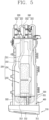
- the storage unit 400 includes a first storage container 410 and a second storage container 420. Accordingly, the first storage container 410 and the second storage container 420 may be accommodated in the outer space defined in the widthwise direction of the housing accommodation part 350, namely, in the left and right sides of the housing accommodation part 350 in the embodiment.
- each surface of the storage unit 400 may come in contact with the first outer wall 321, the second outer wall 322, and the inner wall 323. Therefore, the storage unit 400 may not be moved arbitrarily after being inserted into the outer space.
- the inner wall 323 may be configured by a plurality of planes.
- the inner wall 323 includes first plane portions disposed to face each other in the left and right direction, second plane portions disposed to face each other in the lengthwise direction, and third plane portions connecting the first plane portions and the second plane portions and each formed to be rounded.
- the inner space surrounded by the inner wall 323 may be further divided into a manual introduction part 340 and a housing accommodation part 350.
- the manual introduction part 340 and the housing accommodation part 350 may be partitioned by a partition plate 342.
- the clothes treatment agent injected into the manual introduction part 340 is not introduced into a space between the storage unit 400 and the inner wall 323.
- the user can easily detach the storage unit 400 by gripping such a part of the storage cover portion 412, 422.
- the clothes treatment agent accommodated in the storage unit 400 may naturally move from the front to the rear.
- the rear wall 325 may be disposed to be spaced apart from the first outer wall 321 and the second outer wall 322 by a predetermined distance.
- the openings 332 are formed between the rear wall 325 and the first and second outer walls 321 and 322, respectively.
- a sensor portion 417, 427 and the check valve 416, 426 provided at the storage unit 400 protrude rearward by a predetermined distance through the opening 332.
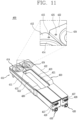
- the rear end part 330 is located on one side of the drawer frame 320 in the lengthwise direction, namely, on the rear side in the embodiment.
- the partition member 331 connects the bent portions of the first outer wall 321 and the second outer wall 322 to the rear wall 325.
- the partition member 331 may be provided in plurality.
- the partition member 331 may partition the opening 332 into at least two parts in the height direction.
- the partition member 331 extends in the widthwise direction of the drawer frame 320.
- the partition member 331 may connect the first outer wall 321, the second outer wall 322, and the rear wall 325.
- Each of the openings 332 may be divided into the check valve opening 332a and the sensor opening 332b by the corresponding partition member 331.
- the sensor opening 332b is a space through which the sensor portion 417, 427 and a sealing portion 418, 428 configured to cover the sensor portion 417, 427 are inserted.
- An external control unit (not illustrated) may be electrically connected to the sensor portion 417, 427 through the sensor opening 332b.
- the check valve 416, 426 When the check valve 416, 426 is inserted into the check valve opening 332a, the check valve 416, 426 protrudes more toward the rear side than the partition member 331.
- the opening 332 may be partitioned into the check valve opening 332a and the sensor opening 332b by the partition member 331. As the check valve 416, 426 is exposed to the outside, the direction of inserting and separating the storage unit 400 can be limited.
- the sensor portion 417, 427 is first inserted into the sensor opening 332b, and then the check valve 416, 426 is inserted into the check valve opening 332a. Conversely, the check valve 416, 426 is first separated from the check valve opening 332a, and then the sensor portion 417, 427 is separated from the sensor opening 332b. This will be described in detail later.
- the clothes treatment agent may be filled in the manual introduction part 340 for each clothes treating process.
- the manual introduction part 340 may be defined as a part of the inner space surrounded by the inner wall 323. That is, the manual introduction part 340 is defined as a space formed in a front part of the inner space.
- the manual introduction part 340 includes an inclined portion 341 and a partition plate 342.
- the clothes treatment agent supplied to the manual introduction part 340 can flow to the rear side along the inclined portion 341.
- the partition plate 342 is configured as a plate extending in the width direction of the inner wall 323.
- the partition plate 342 may be provided in any form that allows the user to recognize a boundary between the manual introduction part 340 and the housing accommodation part 350.
- the partition plate 342 is spaced apart from the inclined portion 341 by a predetermined distance. That is, a predetermined space is defined between the partition plate 342 and the inclined portion 341.
- the clothes treatment agent supplied to the manual introduction part 340 can flow to the housing accommodation part 350 through the predetermined space.
- the housing accommodation part 350 is located at the rear side of the manual introduction part 340.
- the manual introduction part 340 may communicate with the housing accommodation part 350.
- the clothes treatment agent supplied to the manual introduction part 340 can flow to the housing accommodation part 350.
- the clothes treatment agent introduced into the housing accommodation part 350 may flow out of the drawer 300 through the fluid outlet port 359.
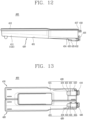
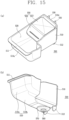
- the clothes treatment agent housing 500 is accommodated in the housing accommodation part 350. Specifically, the clothes treatment agent housing 500 is accommodated in the housing accommodation part 350 in a manner of being spaced a predetermined distance apart from a rear surface and the lower surface 351 of the housing accommodation part 350.
- the housing accommodation part 350 communicates with the manual introduction part 340.
- the clothes treatment agent supplied to the manual introduction part 340 can flow to the housing accommodation part 350.
- the housing accommodation part 350 communicates with the outside of the drawer 300.
- the clothes treatment agent supplied to the clothes treatment agent housing 500 and the clothes treatment agent supplied to the manual introduction part 340 may be supplied to the tub 170 together with a fluid.
- the housing accommodation part 350 includes a lower surface 351, a support rod 352, a support pin 353, a support boss portion 354, a protruding portion 355, a space portion 356, a drop prevention member 357, a discharge space portion 358, and a fluid outlet port 359.
- the lower surface 351 defines one surface of the housing accommodation part 350, namely, a bottom of the housing accommodation part 350 in the embodiment.
- the lower surface 351 may extend at a predetermined angle with respect to the inclined portion 341.
- the lower surface 351 is formed to be inclined toward one side of the lower surface 351 in the lengthwise direction, namely, to the rear side in the embodiment.
- the fluid outlet port 359 is formed through the lower surface 351. Specifically, the fluid outlet port 359 may be formed through the lower surface 351 at a position biased toward the rear side of the lower surface 351.
- the support pin 353 protrudes from the lower surface 351 by a predetermined distance.
- the support boss portion 354 protrudes by a predetermined distance from one side of the lower surface 351 opposite to the grip portion 310, namely, from the rear side of the lower surface 351 in the embodiment. Specifically, the support boss portion 354 protrudes from the lower surface 351 by a predetermined distance so as to have a predetermined tilt with respect to the lower surface 351.
- the support rod 352 is positioned at a predetermined distance from the inner wall 323 of one side, namely, from the rear second plane portion of the inner wall 323 in the illustrated embodiment.
- the support rod 352 is located inside the housing accommodation part 350.
- a support protrusion surface 511 of the clothes treatment agent housing 500 is seated on the support rod 352. Accordingly, the front side of the clothes treatment agent housing 500 can be stably supported by the support rod 352.
- the support rod 352 is cylindrical, but may alternatively have any shape on which the support protrusion surface 511 can be seated.
- the support pin 353 supports the lower side of the accommodated clothes treatment agent housing 500.
- the support pin 353 protrudes from the lower surface 351 by a predetermined distance.
- Protruding portions 355 are formed on an upper side of the support boss portion 354. Accordingly, the space portion 356 defined between the protruding portions 355 is also located on the upper side of the support boss portion 354.
- the fluid output port 359 is formed at one side of the support boss portion 354, namely, at the front side in the embodiment.
- An alignment pin insertion groove 354a is recessed in the support boss portion 354. An alignment pin 512 of the clothes treatment agent housing 500 is inserted and seated in the alignment pin insertion groove 354a.
- the alignment pin insertion groove 354a is recessed by a predetermined distance into one surface of the support boss portion 354, namely, into the upper surface of the support boss portion 354 in the embodiment.
- the alignment pin insertion groove 354a is provided by two spaced apart from each other by a predetermined distance.
- a recessed distance of each alignment pin insertion groove 354a and a spaced distance between the plurality of alignment pin insertion grooves 354a may change depending on a protruded distance of each alignment pin 512 and a spaced distance between the alignment pins 512.
- the clothes treatment agent housing 500 seated on the support boss portion 354 does not fluctuate in the left and right direction.
- the protruding portion 355 is configured such that the clothes treatment agent housing 500 is spaced a predetermined distance apart from the inner wall 323 surrounding the housing accommodation part 350. Such spacing results in defining the space portion 356.
- the protruding portion 355 protrudes by a predetermined distance from one side of the inner wall 323 surrounding the housing accommodation part 350, namely, from the second plane portion located at the rear in the embodiment. Further, a lower side of the protruding portion 355 comes in contact with the support boss portion 354.
- the protruding portion 355 includes a first surface 355a brought into contact with the spacing protrusion 530 of the clothes treatment agent housing 500.
- the first surface 355a extends in the up and down direction.
- a lower end portion of the first surface 355a may extend to come in contact with the upper surface of the support boss portion 354.
- a second surface 355b of the protruding portion 355 extends from an upper end portion of the first surface 355a to one side of the inner wall 323 at a predetermined angle.
- the second surface 355b is formed to be inclined toward the clothes treatment agent housing 500. That is, the second surface 355b is formed such that a front side thereof is higher than a rear side.
- the space portion 356 is a space in which the clothes treatment agent overflowed from the clothes treatment agent housing 500 flows.
- the space portion 356 may correspond to a space which is defined as the plurality of protruding portions 355 are spaced apart from each other.
- the space portion 356 may correspond to a space which is defined as the clothes treatment agent housing 500 and the rear second plane portion of the inner wall 323 are spaced apart from each other due to at least one of the protruding portion 355 or the spacing protrusion 530.
- the space portion 356 communicates with the discharge space portion 358.
- the clothes treatment agent introduced into the space portion 356 may flow to the discharge space portion 358.
- the drop prevention member 357 limits a distance by which the drawer 300 is drawn out of the dispenser assembly 200.
- a stopping jaw protruding from one side of the drop prevention member 357 namely, from a rear side in the embodiment, is engaged with the dispenser assembly 200.
- a portion of one side of the drop prevention member 357 namely, the front side in the embodiment, may be pressed or pulled, so that the engaged state between the stopping jaw and the dispenser assembly 200 can be released.
- the discharge space portion 358 is a space in which the clothes treatment agent is collected to be supplied to the tub 170.
- the discharge space portion 358 may be defined as a space surrounded by the inner wall 323, the lower surface 351, and the support boss portion 354.
- the clothes treatment agent supplied to the manual introduction part 340 or the clothes treatment agent housing 500 may also be introduced into the discharge space portion 358.
- the fluid supplied through the fluid supply unit 230 also flows into the discharge space portion 358 through the manual introduction part 340 and the clothes treatment agent housing 500.
- the lower surface 351 defining a front lower side of the discharge space portion 358 is formed to be inclined toward the fluid outlet port 359. Accordingly, the clothes treatment agent supplied through the manual introduction part 340 and the clothes treatment agent housing 500 flows from the discharge space portion 358 toward the fluid outlet port 359.
- an upper surface of the support boss portion 354 formed on the rear side of the housing accommodation part 350 is also inclined toward the fluid outlet port 359. Accordingly, the clothes treatment agent which has been overflowed from the clothes treatment agent housing 500 and introduced into the space portion 356 can also be moved toward the fluid outlet port 359.
- the fluid outlet port 359 is a path through which the clothes treatment agent and the fluid collected in the discharge space portion 358 are supplied to the tub 170.
- the fluid outlet port 359 may be formed in a shape of a through hole.
- the fluid outlet port 359 communicates with the tub 170.
- a hose member (not illustrated) may be provided.
- the fluid outlet port 359 communicates with the discharge space portion 358.
- the fluid outlet port 359 is formed through the lower side of the discharge space portion 358. Accordingly, the clothes treatment agent and the fluid collected in the discharge space portion 358 flow toward the fluid outlet port 359.
- the storage unit 400 accommodates and stores a clothes treatment agent required to carry out a clothes treating process.
- the clothes treatment agent stored in the storage unit 400 may be in a liquid phase.
- the clothes treatment agent accommodated in the storage unit 400 may be automatically supplied to the tub 170 according to a clothes treating process input by the user through the manipulation unit 160. Accordingly, the clothes treatment agent accommodated in the storage unit 400 may be referred to as an "automatically-supplied clothes treatment agent".
- the storage unit 400 extends in the lengthwise direction.
- the storage unit 400 may be formed in a shape corresponding to the dispenser assembly 200 and the drawer 300.
- the storage unit 400 is accommodated in the drawer 300. Specifically, the storage unit 400 is inserted into the predetermined space defined inside the drawer frame 320.
- the storage unit 400 may be inserted at a predetermined angle with respect to the drawer 300 in the lengthwise direction. Specifically, one side of the storage unit 400 facing the rear end part 330 is inserted first, and another side of the storage unit 400 facing the grip portion 310 is inserted later.
- the rear side of the storage unit 400 is first inserted into the rear end part 330 formed on the rear side of the drawer 300. Then, the front side of the storage unit 400 may be inserted into the front side of the drawer 300.
- the storage unit 400 may be separated or detached from the drawer 300 at a predetermined angle with respect to the drawer 300 in the lengthwise direction. Specifically, the another side of the storage unit 400 facing the grip portion 310 is separated first, and the one side of the storage unit 400 facing the rear end part 330 is separated later.
- the front side of the storage unit 400 is first separated from the front side of the drawer 300. Then, the rear side of the storage unit 400 may be separated from the rear side and the rear end part 330 of the drawer 300.
- the storage unit 400 may be provided in plurality.
- the storage unit 400 includes a first storage container 410 and a second storage container 420.
- the clothes treatment agent may be accommodated in each of the storage containers 410 and 420.
- the storage unit 400 communicates with the dispenser assembly 200.
- the check valve 416, 426 provided on the rear side of the storage unit 400 communicate with the clothes treatment agent pump unit 220. Accordingly, the clothes treatment agent stored in the storage unit 400 may be supplied to the tub 170 via the drawer 300 by means of the clothes treatment agent pump unit 220.
- the storage unit 400 inserted in the drawer 300 is surrounded by the outer walls 321 and 322 and the inner wall 323 of the drawer frame 320.
- the rear side of the storage unit 400 is partially surrounded by the rear wall 325.
- the storage unit 400 includes a first storage container 410, a second storage container 420 and a discharge inclined portion 430.
- the first storage container 410 and the second storage container 420 each store the clothes treatment agent therein.
- the stored clothes treatment agent may be supplied to the tub 170 through the clothes treatment agent pump unit 220.
- the first storage container 410 and the second storage container 420 are located adjacent to each other in a state accommodated in the drawer 300.
- a predetermined space is defined inside each of the first storage container 410 and the second storage container 420.
- the clothes treatment agent is accommodated in each of the spaces.
- one of detergent and softener may be accommodated inside the first storage container 410 and another may be accommodated inside the second storage container 420.
- the first storage container 410 and the second storage container 420 according to the exemplary embodiment of the present disclosure have the same or like structure and function to each other, except for the fact that the first storage container 410 and the second storage container 420 accommodate different types of clothes treatment agents and have partially different shapes.
- first storage container 410 and the second storage container 420 will be described together to avoid redundant description.
- the first storage container 410 and the second storage container 420 may be accommodated in a space defined in the drawer frame 320.
- the first storage container 410 is accommodated in a space formed in a left side of the drawer frame 320 (see FIG. 6 ).
- the second storage container 420 is accommodated in a space defined in a right side of the drawer frame 320.
- the first storage container 410 includes a first storage body portion 411, a first storage cover portion 412, a first detachment/attachment protrusion 413, a first storage cap portion 414, and a first through hole 415, a first check valve 416, a first sensor portion 417, and a first sealing portion 418.
- the storage body portions 411 and 421 define spaces in which the clothes treatment agent is accommodated.
- the storage body portions 411 and 421 extend in the lengthwise direction, namely, in the back and forth direction in the embodiment.
- the storage cover portions 412 and 422 are located on upper sides of the storage body portions 411 and 421.
- the storage body portions 411 and 421 and the storage cover portions 412 and 422 may be integrally formed with each other. That is, the storage body portions 411 and 421 and the storage cover portions 412 and 422 may be coupled so as not to be arbitrarily separated from each other.
- the detachment/attachment protrusions 413 and 423 protrude between the storage body portions 411 and 421 and the storage cover portions 412 and 422.
- the user can easily detach the storage containers 410 and 420 by gripping the detachment/attachment protrusions 413 and 423.
- the discharge inclined portions 430 are formed on lower sides of the storage body portions 411 and 421, respectively.
- the clothes treatment agent accommodated in the inner spaces of the storage body portions 411 and 421 may flow to the rear side along the discharge inclined portions 430.
- the check valves 416 and 426 are provided on the rear sides of the storage body portions 411 and 421, respectively.
- the inner spaces of the storage body portions 411 and 421 may communicate with the clothes treatment agent pump unit 220 by the check valves 416 and 426.
- the storage body portions 411 and 421 are provided on the rear sides thereof with the sensor portions 417 and 427 and the sealing portions 418 and 428 configured to seal the sensor portions 417 and 427.
- Information related to a remaining amount of clothes treatment agents accommodated in the storage body portions 411 and 421 may be transmitted to a control unit (not illustrated) through the sensor portions 417 and 427.
- the storage body portions 411 and 421 extend in the lengthwise direction, namely, in the back and forth direction in the embodiment. Widths of the storage body portions 411 and 421 in the left and right direction in the embodiment may be different in the lengthwise direction.
- each of the storage body portions 411 and 421 may be divided along the lengthwise direction into one side facing the grip portion 310, another side facing the rear end part 330, and still another side located between the one side and the another side.
- each of the storage body portions 411 and 421 namely, the front side in the embodiment, is formed to have a wider width than the still another side of the storage body portion 411, 421 brought into contact with the inner wall 323 in the lengthwise direction.
- the another side of the storage body portion 411, 421, namely, the rear side in the embodiment, is formed to have a wider width than the still another side of the storage body portion 411, 421.
- the storage body portion 411, 421 is formed such that the width of the still another side is narrower than the widths of the one side and the another side.
- the housing accommodation part 350 is located between the still another sides of the storage containers 410 and 420. Accordingly, the storage containers 410 and 420 may be disposed to surround the housing accommodation part 350 at the outside of the housing accommodation part 350.
- each storage container 410 and 420 may be in contact with an outer side of the inner wall 323 extending in the lengthwise direction.
- Each of the storage cover portions 412 and 422 is located on one side of each of the storage body portions 411 and 421, namely, on the upper side in the embodiment.
- the storage cover portions 412 and 422 are configured to cover the storage body portions 411 and 421, respectively. That is, the storage cover portions 412 and 422 function as covers of the storage body portions 411 and 421.
- the storage cover portions 412 and 422 extend in the lengthwise direction, namely, in the back and forth direction in the embodiment.
- the shape of the storage cover portions 412 and 422 may correspond to the shape of the storage body portions 411 and 421.
- the storage cap portions 414 and 424 are provided on the front sides of the storage cover portions 412 and 422, respectively.
- the storage cap portions 414 and 424 are configured to seal openings (not illustrated) formed on the front sides of the storage cover parts 412 and 422, respectively.
- the storage cap portion 414, 424 can open the storage cap portion 414, 424 and supply the clothes treatment agent through the opening (not illustrated).
- the storage cap portions 414 and 424 may be configured to be coupled to or separated from the storage cover portions 412 and 422 in a rotating manner.
- the through holes 415 and 425 are formed in a penetrating manner at the front sides of the storage cap portions 414 and 424, respectively, on the storage cover portions 412 and 422.
- the through holes 415 and 425 allow inside and outside of the storage body portions 411 and 421 to communicate with each other, so as to maintain the balance of pressure inside the storage body portions 411 and 421.
- the through holes 415 and 425 communicate the inside and outside of the storage body portions 411 and 421, so as to balance the internal pressure of the storage body portions 411 and 421 and atmospheric pressure. Accordingly, the internal pressure of the storage body portions 411 and 421 can be maintained to be the same as the atmospheric pressure, despite the outflow of the clothes treatment agent.
- the through holes 415 and 425 may be formed in any shape capable of communicating the inside and outside of the storage body portions 411 and 421. In one embodiment, the through holes 415 and 425 may be formed to have a circular cross section.
- the through holes 415 and 425 may be located adjacent to each other. That is, the first through hole 415 may be located on one side of the first storage cover portion 412 adjacent to the second storage container 420. Likewise, the second through hole 425 may be located on one side of the second storage cover portion 422 adjacent to the first storage container 410.
- the storage unit 400 is configured such that the front side thereof where the through holes 415 and 425 are formed rises upward when the storage unit 400 is attached to or detached from the drawer 300. Accordingly, the clothes treatment agent is not discharged through the through holes 415 and 425. This will be described in detail later.
- the check valves 416 and 426 are located on rear lower sides of the storage body portions 411 and 421, respectively.
- the check valves 416 and 426 protrude outward from the rear surfaces of the storage body portions 411 and 421, respectively, by a predetermined distance. This may result in that the storage containers 410 and 420 can be inserted into the space of the drawer 300 only from their rear sides.
- the primary pump valves 224 are insertedly coupled to the check valves 416 and 426, respectively. At this time, the primary pump valves 224 are in contact with the check valves 416 and 426 to push forward the check valves 416 and 426 by a predetermined distance.
- the clothes treatment agent does not leak through the check valves 416 and 426.
- the check valves 416 and 426 each include a check valve cylinder portion 416a, 426a, a check valve cap portion 416b, 426b, a check valve elastic portion 416c, 426c, and an intake port 416d, 426d (see FIG. 20 ).
- the space portion is formed to have a diameter equal to or larger than a diameter of the primary valve cylinder portion 224a.
- the primary valve cylinder portion 224a is inserted into one side of the space portion in the lengthwise direction, namely, into the rear side in the embodiment.
- the primary valve cylinder portion 224a may be moved in the lengthwise direction, namely, in the back and forth direction in the embodiment, in the state inserted in the space portion.
- the intake port 416d, 426d is formed on the outer circumference of the check valve cylinder portion 416a, 426a.
- the space portion, the inner space of the storage body portion 411, 421, and the inner space of the primary valve cylinder portion 224a communicate with one another through the intake port 416d, 426d.
- the first part is coupled through an opening formed through the front side of the check valve cylinder portion 416a, 426a. Further, the third part is configured to close an opening formed through the rear side of the check valve cylinder portion 416a, 426a.
- the check valve cap portion 416b, 426b is moved in the lengthwise direction, namely, in the back and forth direction in the embodiment, so as to allow or block the communication of the space portion, the inner space of the storage body portion 411, 421, and the primary valve cylinder portion 224a.
- the forward movement of the check valve cap portion 416b, 426b may be achieved by being pushed by the primary pump valve 224.
- the check valve elastic portion 416c, 426c is compressed due to the forward movement of the check valve cap portion 416b, 426b so as to store the elastic restoring force.
- the check valve cap portion 416b, 426b is moved rearward by a predetermined distance by the stored elastic restoring force. Accordingly, the rear opening of the check valve cylinder portion 416a, 426a can be closed.
- the check valve elastic portion 416c, 426c is restored to its original shape.
- the check valve cap portion 416b, 426b is moved rearward by the stored elastic restoring force, so as to close the rear opening of the check valve cylinder portion 416a, 426a.
- the clothes treatment agent accommodated in the inner space of the storage body portion 411, 421 may be introduced into the inner space of the check valve cylinder portion 416a, 426a through the intake port 416d, 426d.
- the introduced clothes treatment agent may flow into the inner space of the primary valve cylinder portion 224a.
- the intake port 416d, 426d is formed on the circumference of the check valve cylinder portion 416a, 426a.
- the intake port 416d, 426d may be formed on one side of the check valve cylinder portion 416a, 426a facing the discharge inclined portion 430, namely, on the lower side of the check valve cylinder portion 416a, 426a in the embodiment.
- the intake port 416d, 426d is located in a space defined at the rear side of two spaces partitioned by the check valve cap portion 416b, 426b.
- the inner space of the storage body portion 411, 421 and the inner space of the check valve cylinder portion 416a, 426a may communicate with the inner space pf the primary valve cylinder portion 224a.
- the clothes treatment agent accommodated in the storage body portion 411, 421 may flow into the inner space of the primary valve cylinder portion 224a by the communication.
- the sensor portion 417, 427 is located above the check valve 416, 426 at the rear of the storage body portion 411, 421. This is to prevent the clothes treatment agent from flowing into the sensor portion 417, 427 when the storage unit 400 is detached from the drawer 300.
- the check valve 416, 426 communicates with the clothes treatment agent pump unit 220 when the storage unit 400 is inserted into the drawer 300.
- the clothes treatment agent accommodated in the storage unit 400 can be introduced into the clothes treatment agent pump unit 220.
- the sensor portion 417, 427 according to the embodiment of the present disclosure is located above the check valve 416, 426, thereby fundamentally preventing an occurrence of such a situation.
- the sensor portion 417, 427 protrudes outward, namely, rearward in the embodiment, from the storage body portion 411, 421 by a predetermined distance.
- the sensor portion 417, 427 includes three terminal spaces. This is because three terminals (not illustrated) are provided. The number of terminal spaces provided in the sensor portion 417, 427 may change depending on the number of terminals (not illustrated).
- the sensor portion 417, 427 is electrically connected to an external control unit (not illustrated). Information related to a remaining amount of clothes treatment agents detected by the sensor portion 417, 427 may be transmitted to the control unit (not illustrated). To this end, a plurality of connectors (not illustrated) may be electrically connected to the sensor portion 417, 427.
- the sensor portion 417, 427 may be sealed by the sealing portion 418, 428.
- the sealing portion 418, 428 is provided on an outer side of the sensor portion 417, 427.
- the sealing portion 418, 428 is configured to seal the sensor portion 417, 427.
- the fluid or clothes treatment agent does not flow into the sensor portion 417, 427. Accordingly, the electrical connection state between the sensor portion 417, 427 and the external control unit (not illustrated) can be smoothly maintained.
- An opening may be formed through one side of the sealing portion 418, 428 facing the sensor portion 417, 427.
- the sensor portion 417, 427 may be electrically connected to the external control unit (not illustrated) through the opening.
- the sealing portion 418, 428 may be formed of an insulating material.
- the sealing portion 418, 428 may be formed of rubber, synthetic resin, or a silicone material.
- the partition member 331 is disposed between the check valve 416, 426 and the sensor portion 417, 427. Accordingly, the check valve 416, 426 is caught by the partition member 331, thereby limiting a direction of inserting and separating the storage container 410, 420.
- the discharge inclined portion 430 defines one side of the storage body portion 411, 421, namely, a lower surface in the embodiment.
- the discharge inclined portion 430 may allow the clothes treatment agent accommodated in the inner space of the storage container 410, 420 to flow toward the check valve 416, 426 located at the rear side.
- collection space portions 436 and 437 are formed in one side of the discharge inclined portion 430 in the lengthwise direction, namely, in the rear side in the embodiment.
- the collection space portions 436 and 437 are located in the rearmost and lower sides of the discharge inclined portion 430.
- the clothes treatment agent collected in the collection space portions 436 and 437 may flow into the inner space of the check valve 416, 426 through the intake port 416d, 426d. Accordingly, the amount of clothes treatment agents remaining inside the storage container 410, 420 can be minimized.
- the discharge inclined portion 430 extends in the lengthwise direction at a predetermined inclination. In other words, a vertical distance between the discharge inclined portion 430 and the storage cover portion 412, 422 increases from the front side to the rear side.
- the clothes treatment agent may flow in the discharge inclined portion 430.
- the discharge inclined portion 430 includes a first bottom surface 431, a second bottom surface 432, a third bottom surface 433, a first joint surface 434, a second joint surface 435, and a first collection space portion 436, and a second collection space portion 437.
- the first bottom surface 431 defines the front side of the discharge inclined portion 430.
- the first bottom surface 431 may be defined as a portion having the shortest vertical distance from the storage cover portion 412, 422.
- the first bottom surface 431 extends from the front to the rear with a predetermined inclination. That is, a distance between the front side of the first bottom surface 431 and the storage cover portion 412, 422 is shorter than a distance between the rear side of the first bottom surface 431 and the storage cover portion 412, 422. Accordingly, the clothes treatment agent accommodated in the storage container 410, 420 may flow to the rear side along the first bottom surface 431.
- the second bottom surface 432 is located at the rear side of the first bottom surface 431.
- the second bottom surface 432 defines the rearmost side of the discharge inclined portion 430. That is, the second bottom surface 432 is located on an opposite side of the grip portion 310.
- the second bottom surface 432 extends in the lengthwise direction with a predetermined angle with the first bottom surface 431. In one embodiment, the second bottom surface 432 may extend horizontally.
- the second bottom surface 432 may be rounded in the lengthwise direction. That is, the second bottom surface 432 may have a shape of a semicircular column that is convex downward and extends in the lengthwise direction. Accordingly, the clothes treatment agent introduced into the second bottom surface 432 may be collected in the downwardly-convex portion.
- the check valve 416, 426 is located adjacent to the second bottom surface 432. Specifically, the check valve 416, 426 is located with being spaced apart from the second bottom surface 432 by a predetermined distance. The check valves 416 and 426 is spaced apart from the second bottom surface 432 by the predetermined distance in a direction facing the storage cover portion 412, 422, namely, in an upward direction in the embodiment.
- the third bottom surface 433 may be located between the first bottom surface 431 and the second bottom surface 432.
- another side of the third bottom surface 433 in the lengthwise direction namely, the rear side thereof in the embodiment is connected to one side of the second bottom surface 432 in the lengthwise direction, namely, to the front side in the embodiment.
- the third bottom surface 433 may not be formed in the discharge inclined portion 430. That is, the first bottom surface 431 and the second bottom surface 432 may be directly connected to each other.
- the third bottom surface 433 continuously connects the first bottom surface 431 and the second bottom surface 432.
- the third bottom surface 433 may be located between the first bottom surface 431 and the second bottom surface 432.
- the third bottom surface 433 is located lower than the first bottom surface 431. That is, the longest distance D1 between the first bottom surface 431 and the storage cover portion 412, 422 is shorter than the shortest distance D3 between the third bottom surface 433 and the storage cover portion 412, 422.
- the third bottom surface 433 is located higher than the second bottom surface 432. That is, the shortest distance D2 between the second bottom surface 432 and the storage cover portion 412, 422 is longer than a longest distance D3' between the third bottom surface 433 and the storage cover portion 412, 422.
- the first joint surface 434 extends from one side of the first bottom surface 431, namely, from a rear end in the embodiment, to one side of the third bottom surface 433, namely, to a front end in the embodiment.
- the second joint surface 434 may extend at a predetermined angle with respect to the third bottom surface 433.
- the first joint surface 434 may extend so that a distance up to the storage cover portion 412, 422 is decreased as it is farther away from the third bottom surface 433.
- a space partially surrounded by the third bottom surface 433 may be defined as the second collection space portion 437.
- the definition may extend so that the second collection space portion 437 may also be defined as a space partially surrounded by the third bottom surface 433 and the first joint surface 434.
- the second bottom surface 432 and the third bottom surface 435 may be continuously connected to each other by the second joint surface 435.
- the second joint surface 435 extends from one side of the third bottom surface 433, namely, from a rear end in the embodiment, to one side of the second bottom surface 432, namely, to a front end in the embodiment.
- the clothes treatment agent flowing along the first bottom surface 431 and the third bottom surface 433 may flow toward the third bottom surface 433 via the second joint surface 435.
- the first collection space portion 436 is a space where the clothes treatment agent flowing along the first bottom surface 431 and the third bottom surface 433 is finally collected.
- the first collection space portion 436 may also be defined as a space partially surrounded by the second joint surface 435. That is, the first collection space portion 436 is a space formed on one side of the second joint surface 435 facing the storage cover portion 412, 422, namely, on the upper side in the embodiment.
- the clothes treatment agent accommodated in the storage container 410, 420 flows toward the first collection space portion 436 along the first bottom surface 431, the first joint surface 434, and the third bottom surface 433.
- the clothes treatment agent collected in the first collection space portion 436 can flow into the inner space of the primary valve cylinder portion 224a. Accordingly, the amount of clothes treatment agents remaining inside the storage container 410, 420 can be minimized.
- the second collection space portion 437 is a space in which the clothes treatment agent flowing along the second bottom surface 432 is primarily collected.
- the clothes treatment agent housing 500 may be detachably accommodated in the housing accommodation part 350 of the drawer 300.
- a predetermined space is defined inside the clothes treatment agent housing 500.
- the supplied clothes treatment agent or fluid may stay in the predetermined space.
- an amount of clothes treatment agents or fluids staying in the predetermined space exceeds a predetermined reference value, the clothes treatment agent or fluid may be discharged to the outside through a discharge passage 580.
- the clothes treatment agent housing 500 includes an outer circumferential surface 510, an opening 520, a spacing protrusion 530, a siphon portion 540, a siphon cover portion 550, a siphon coupling portion 560, and a collecting portion 570, and a discharge passage 580.
- the outer circumferential surface 510 defines an outer surface of the clothes treatment agent housing 500.
- the clothes treatment agent or fluid supplied in the inner space of the clothes treatment agent housing 500 may flow to the discharge passage 580 along inner surfaces of the first to third parts 510a, 510b, and 510c.
- the support protrusion surface 511 may horizontally protrude or may protrude to be inclined toward a front lower side or a front upper side.
- the support protrusion surface 511 is seated on the support rod 352. Therefore, the front side of the clothes treatment agent housing 500 can be stably supported in a state of being spaced apart from the lower surface 351 by a predetermined distance.
- An alignment pin 512 protrudes from one side of the third part 510c of the outer circumferential surface 510, namely, from a lower side in the embodiment, by a predetermined distance.
- the opening 520 may be surrounded by an inner surface of the outer circumferential surface 510. That is, the opening 520 may be defined as a space surrounded by the inner surfaces of the first to third parts 510a, 510b, and 510c of the outer circumferential surface 510.
- the opening 520 may be partially covered by the siphon cover portion 550.
- the siphon cover portion 550 is configured to cover a part of a rear side of the opening 520.
- the opening 520 communicates with the outside.
- the user can directly supply the clothes treatment agent through the opening 520.
- the spacing protrusion 530 is provided so that one side of the inner wall 323 surrounding the housing accommodation part 350 is spaced a predetermined distance apart from the clothes treatment agent housing 500. Specifically, the spacing protrusion 530 allows the inner wall 323 of the rear side in the embodiment to be spaced the predetermined distance apart from the rear side of the clothes treatment agent housing 500.
- the spacing protrusion 530 protrudes from the third part 510c of the outer circumferential surface 510 by a predetermined distance.
- the spacing protrusion 530 extends from an upper side of the third part 510c by a predetermined distance (see FIG. 21 ).
- the spacing protrusion 530 may be provided in plurality.
- the spacing protrusion 530 is provided by two, which are spaced apart from each other by a predetermined distance.
- the number and spaced distance of the spacing protrusions 530 may change depending on the number and spaced distance of the protruding portions 355.
- the spacing protrusion 530 may be formed in a plate shape having a small thickness relative to a width or length. Accordingly, a space occupied by the spacing protrusion 530 in the space portion 356 in the widthwise direction, namely, in the left and right direction in the embodiment, can be minimized.
- the spacing protrusion 530 includes a first spacing surface 531, a second spacing surface 532, and a third spacing surface 533.
- the second spacing surface 532 defines a rear surface of the spacing protrusion 530.
- the second spacing surface 532 extends downward from a rear end portion of the first spacing surface 531 at a predetermined angle with respect to the first spacing surface 531. In one embodiment, the second spacing surface 532 may extend at an acute or right angle with respect to the first spacing surface 531.
- the second spacing surface 532 comes in contact with at least part of the first surface 355a of the protruding portion 355.
- the third spacing surface 533 defines a lower surface of the spacing protrusion 530.
- the third spacing surface 533 extends forward from a lower end portion of the second spacing surface 532 at a predetermined angle with respect to the second spacing surface 532.
- the third spacing surface 533 may extend up to the third part 510c. In one embodiment, the third spacing surface 533 may extend at a right angle or an obtuse angle with respect to the second spacing surface 532.
- the siphon portion 540 discharges the clothes treatment agent or fluid supplied to the clothes treatment agent housing 500 into the discharge passage 580 using a siphon effect (see FIG. 21 ).
- the siphon portion 540 may be provided with a hollow portion in which the clothes treatment agent or fluid flows.
- the hollow portion may communicate with the collecting portion 570 and the discharge passage 580.
- the siphon portion 540 is located in the inner space of the clothes treatment agent housing 500. In the embodiment, the siphon portion 540 is located between the second part 510b and the third part 510c. In addition, a lower end portion of the siphon portion 540 is located on the discharge passage 580.
- the clothes treatment agent or the fluid collected by the collecting portion 554 along the first to third parts 510a, 510b, and 510c may be discharged to the outside of the clothes treatment agent housing 500 through the discharge passage 580 by the siphon portion 540.
- the siphon portion 540 extends in the lengthwise direction, namely, in the up and down direction in the embodiment.
- the siphon cover portion 550 is located on an upper side of the siphon portion 540.
- the siphon portion 540 is inserted into the siphon coupling portion 560.
- the siphon cover portion 550 is configured to shield the upper side of the siphon portion 540.
- the siphon cover portion 550 may be configured to seal an upper opening of the hollow portion formed in the siphon portion 540. Accordingly, the fluid or clothes treatment agent does not flow into the hollow portion inside the siphon portion 540 through the upper opening.
- the siphon cover portion 550 includes a first cover surface 551 and a second cover surface 552.
- the first cover surface 551 is configured to shield the hollow portion.
- the second cover surface 552 extends from a front end of the first cover surface 551 at a predetermined angle with respect to the first cover surface 551.
- the predetermined angle may be an obtuse angle.
- the second cover surface 552 may be provided with an arbitrary symbol thereon to indicate the maximum amount of clothes treatment agents to be introduced.
- the siphon portion 540 is inserted into the siphon coupling portion 560.
- the siphon coupling portion 560 extends in the lengthwise direction, namely, in the up and down direction in the embodiment.
- the siphon coupling portion 560 is provided with a hollow portion formed therethrough.
- the siphon portion 540 is inserted into the siphon coupling portion 560.
- the siphon coupling portion 560 and the siphon cover portion 550 may be integrally formed with each other.
- the siphon portion 540 When the siphon portion 540 is inserted into the siphon coupling portion 560, the upper side of the siphon portion 540 may be shielded by the siphon cover portion 550. Accordingly, the siphon portion 540 is not exposed to the outside.
- the clothes treatment agent or fluid supplied to the inner space of the clothes treatment agent housing 500 may flow toward the collecting portion 570.
- the collecting portion 570 communicates with the siphon portion 540.
- the clothes treatment agent or fluid collected in the collecting portion 570 may flow to the discharge passage 580 by the siphon portion 540.
- the discharge passage 580 communicates with the siphon portion 540.
- the clothes treatment agent or fluid collected in the collecting portion 570 is discharged through the discharge passage 580 via the hollow portion formed through the inside of the siphon portion 540.
- the discharge passage 580 communicates with the discharge space portion 358.
- the clothes treatment agent or fluid discharged through the discharge passage 580 may be supplied to the tub 170 through the fluid outlet port 359 via the discharge space portion 358.
- the support member 600 is configured to support the dispenser assembly 200 at the rear side.
- the support member 600 may be coupled to the rear protrusion 212 of the dispenser assembly 200.
- the support member 600 is coupled through the rear surface 130 of the housing 100. After the support member 600 is inserted through the rear surface 130, it may be rotated to be coupled to the rear surface 130 (see FIG. 4 ).
- the dispenser assembly 200 can be stably supported by the support member 600.
- the support member 600 includes a support body portion 610, a support hollow portion 620, a support rib portion 630, and a support head portion 640.
- the support body portion 610 defines the body of the support member 600.
- the support body portion 610 extends by a predetermined distance in the lengthwise direction.
- the support body portion 610 is formed to have a circular cross section. That is, the support body portion 610 has a cylindrical shape.
- the shape of the support body 610 may change to a polygonal column, an elliptical column, or the like.
- the support body portion 610 is rotatably coupled through the support member insertion hole 131 of the rear surface 130.
- the support body portion 610 includes a first body part 611 and a second body part 612.
- the sum of extended distances of the first body part 611 and the second body part 612 is preferably equal to or greater than the sum of a distance between one end of the rear protrusion 212 and the rear surface 130 and a protruded length of the rear protrusion 212.
- the first body part 611 extends by a predetermined distance from one end of the support body portion 610 opposite to the support head portion 640, namely, from the front end in the embodiment.
- the first body part 611 defines a body of one side of the support body portion 610 in the lengthwise direction.
- the support hollow portion 620 is formed inside the first body portion 611 in a penetrating manner.
- the rear protrusion 212 of the frame unit 210 may be inserted into the support hollow portion 620.
- the support head portion 640 is coupled to one end of the second body portion 612 opposite to the first body part 611.
- the rear protrusion 212 is inserted into the support hollow portion 620.
- An opening is formed on one side of the support hollow portion 620, namely, on one side opposite to the support head portion 640 in the embodiment in a manner of being recessed by a predetermined distance.
- the rear protrusion 212 may be inserted into the support hollow portion 620 through the opening.
- the support hollow portion 620 is a portion recessed by the predetermined distance in the lengthwise direction into the one end portion of the first body part 611 opposite to the support head portion 640.
- the support hollow portion 620 may extend up to a boundary between the first body part 611 and the second body part 612. That is, the support hollow portion 620 is not formed inside the second body part 612. This results from that the support space portion 631 is recessed into an outer circumference of the second body part 612.
- the shape and extended distance of the support hollow portion 620 may be determined to correspond to the shape and protruded length of the rear protrusion 212.
- the support rib portion 630 is configured to reinforce rigidity of the support body portion 610. In addition, the support rib portion 630 is configured to reduce an overall weight of the support body portion 610.
- the support rib portion 630 may extend in the lengthwise direction. In the embodiment, the support rib portion 630 extends by a predetermined distance in the lengthwise direction of the second body part 612.
- Support space portions 631 are formed at both sides of the support rib portion 630 in a direction perpendicular to the lengthwise direction of the support rib portion 630, namely, at right and left sides in the embodiment.
- the support space portion 631 is recessed by a predetermined distance into the outer circumference of the second body part 612.
- the support space portion 631 may be provided in plurality.
- the plurality of support space portions 631 may be spaced apart from one another by predetermined distances.
- the support rib portion 630 is located between the support space portions 631 adjacent to each other. In other words, it may be said that the support rib portion 630 partitions the support space portions 631.
- the support space portion 631 may extend in the lengthwise direction. In the embodiment, the support space portion 631 extends by a predetermined distance in the lengthwise direction of the second body part 612.
- the extended distances of the support rib portion 630 and the support space portion 631 are preferably determined to be shorter than the extended distance of the second body part 612. That is, the support rib portion 630 and the support space portion 631 are preferably formed only on the outer circumference of the second body part 612.
- the support hollow portion 620 is formed through the inside of the first body part 611 in the lengthwise direction. That is, the support hollow portion 620 and the support space portion 631 are not in communication with each other.
- the support head portion 640 is a portion that is gripped by the user to couple the support member 600 to the rear surface 130 after inserting the support member 600 through the rear surface 130.
- the support head portion 640 is located on one end of the second body part 612 opposite to the first body part 611.
- the support head portion 640 When the support member 600 is inserted through the rear surface 130, the support head portion 640 is located outside the rear surface 130. That is, the support head portion 640 is exposed to the outside of the housing 100. Therefore, the user can grip the support head portion 640 to rotate the support head portion 640, or insert or separate the support member 600 into or from the rear surface 130.
- the support head portion 640 includes a coupling protrusion 641, a direction indicating groove 642, a guide protrusion 643, and a grip protrusion 644.
- the coupling protrusion 641 is a portion where the support member 600 inserted through the support member insertion hole 131 is coupled to the rear surface 130.
- the coupling protrusion 641 may be coupled to the support member coupling portion 132a as the support member 600 is rotated.
- the coupling protrusion 641 is provided in plurality radially on an inner side of one surface of the support head portion 640 facing the support body portion 610 in a circumferential direction.
- the plurality of coupling protrusions 641 are spaced apart from one another by predetermined distances.
- the coupling protrusion 641 is provided by three, but the number may vary.
- the coupling protrusion 641 and the guide protrusion 643 may be alternately arranged on the one surface of the support head portion 640 along the circumferential direction.
- the second protrusion 641b protrudes from one end portion of the first protrusion 641a at a predetermined angle with respect to the first protrusion 641a.
- the second protrusion 641b may protrude at an acute angle with respect to the first protrusion 641a.
- the direction indicating groove 642 allows the user to recognize a rotating direction of the support member 600. That is, the direction indicating groove 642 may indicate either a direction in which the support member 600 is to be coupled to the rear surface 130 or a direction in which the support member 600 is to be separated from the rear surface 130.
- the direction indicating groove 642 is provided in plurality formed on a radially inner side of the support head portion 640 in the circumferential direction.
- the plurality of direction indicating grooves 642 are spaced apart from one another by predetermined distances.
- the direction indicating groove 642 is provided by three, but the number may vary.
- the clothes treating machine 10 is configured to limit a direction in which the storage unit 400 is inserted into the drawer 300 and a direction in which the storage unit 400 is detached from the drawer 300.
- FIG. 18 illustrates a rear side of the drawer frame 320 in a state in which the storage unit 400 has been accommodated.
- the rear side of the storage unit 400 should be inserted first.
- the rear side of the storage unit 400 should be separated later.
- the check valve 416, 426 passing through the upper sensor opening 332b is stopped by the partition member 331.
- the leakage of the clothes treatment agent through the through hole 415, 425 formed on the front side of the storage unit 400 can be prevented during the process of inserting the storage unit 400 into the drawer 300.
- the through hole 415, 425 formed through the front side of the storage unit 400 faces an upper side or a direction forming a predetermined inclination with the upper side during the process of detaching the storage unit 400 from the drawer 300.
- the residual of the clothes treatment agent accommodated in the storage unit 400 can be minimized.
- the first joint surface 434 connecting the first bottom surface 431 and the third bottom surface 433 is formed such that the rear side is lower than the front side in height.
- the second joint surface 435 connecting the second bottom surface 432 and the third bottom surface 433 is also formed such that the rear side is lower than the front side in height.
- the check valve 416, 426 is partially accommodated in the first collection space portion 436.
- the intake port 416d, 426d is formed through one side, namely, a lower side of the check valve cylinder portion 416a, 426a facing the second bottom surface 432.
- the discharge inclined portion 430 is configured such that its height is lowered toward the rear side. Therefore, the clothes treatment agent is collected by gravity in the first collection space portion 436 formed in the rearmost side of the storage container 410, 420.
- the clothes treatment agent is collected in the first collection space portion 436 without being scattered in the storage container 410, 420. Accordingly, the residual clothes treatment agent can be collected smoothly.
- the clothes treating machine 10 includes the support member 600 for stably supporting the dispenser assembly 200.
- the support member coupling hole 132 and the support member guide hole 133 are provided in plurality formed on the radially outer side of the support member insertion hole 131 along the circumferential direction.
- the coupling protrusion 641 is inserted into the support member coupling hole 132, and the guide protrusion 643 is inserted into the support member guide hole 133.
- the support member coupling portion 132a is formed on one end portion of each support member coupling hole 132 in the circumferential direction.
- the coupling protrusion 641 of the support member 600 is coupled to the support member coupling portion 132a.
- the coupling may be achieved by rotating the inserted support member 600.
- one end of the rear protrusion 212 may be spaced a predetermined distance apart from one end of the support hollow portion 620 facing the second body portion 612, namely, from a boundary between the first body portion 611 and the second body portion 612.
- the rear protrusion 212 is inserted into the support hollow portion 620.
- the end portion of the rear protrusion 212 may be spaced a predetermined distance apart from the boundary between the first body portion 611 and the second body portion 612 in which the support hollow portion 620 is formed. In another embodiment, the end portion of the rear protrusion 212 may be inserted into the support hollow portion 620 until it contacts the boundary.
- the dispenser assembly 200 can be stably kept located on its original position.
- the clothes treatment agent or fluid can be stably supplied to the tub 170. Accordingly, clothes treatment efficiency of the clothes treating machine 10 can be improved.
Landscapes
- Engineering & Computer Science (AREA)
- Textile Engineering (AREA)
- Detail Structures Of Washing Machines And Dryers (AREA)
- Packaging Of Annular Or Rod-Shaped Articles, Wearing Apparel, Cassettes, Or The Like (AREA)
Applications Claiming Priority (3)
| Application Number | Priority Date | Filing Date | Title |
|---|---|---|---|
| KR20190106708 | 2019-08-29 | ||
| KR1020200018598A KR102882231B1 (ko) | 2019-08-29 | 2020-02-14 | 드로워 및 이를 포함하는 의류 처리 장치 |
| EP20191974.3A EP3786339B1 (de) | 2019-08-29 | 2020-08-20 | Schublade und wäschebehandlungsmaschine damit |
Related Parent Applications (2)
| Application Number | Title | Priority Date | Filing Date |
|---|---|---|---|
| EP20191974.3A Division EP3786339B1 (de) | 2019-08-29 | 2020-08-20 | Schublade und wäschebehandlungsmaschine damit |
| EP20191974.3A Division-Into EP3786339B1 (de) | 2019-08-29 | 2020-08-20 | Schublade und wäschebehandlungsmaschine damit |
Publications (2)
| Publication Number | Publication Date |
|---|---|
| EP4534751A2 true EP4534751A2 (de) | 2025-04-09 |
| EP4534751A3 EP4534751A3 (de) | 2025-06-18 |
Family
ID=72178450
Family Applications (2)
| Application Number | Title | Priority Date | Filing Date |
|---|---|---|---|
| EP20191974.3A Active EP3786339B1 (de) | 2019-08-29 | 2020-08-20 | Schublade und wäschebehandlungsmaschine damit |
| EP25152995.4A Pending EP4534751A3 (de) | 2019-08-29 | 2020-08-20 | Schublade und wäschebehandlungsmaschine damit |
Family Applications Before (1)
| Application Number | Title | Priority Date | Filing Date |
|---|---|---|---|
| EP20191974.3A Active EP3786339B1 (de) | 2019-08-29 | 2020-08-20 | Schublade und wäschebehandlungsmaschine damit |
Country Status (4)
| Country | Link |
|---|---|
| US (2) | US11761139B2 (de) |
| EP (2) | EP3786339B1 (de) |
| CN (1) | CN112442862B (de) |
| AU (1) | AU2020223727B2 (de) |
Families Citing this family (2)
| Publication number | Priority date | Publication date | Assignee | Title |
|---|---|---|---|---|
| EP3617379B1 (de) | 2018-08-30 | 2021-08-04 | Electrolux Appliances Aktiebolag | Wäschebehandlungsgerät mit einer verbesserten schublade |
| KR102799615B1 (ko) * | 2022-06-16 | 2025-04-23 | 엘지전자 주식회사 | 의류처리장치 |
Citations (2)
| Publication number | Priority date | Publication date | Assignee | Title |
|---|---|---|---|---|
| KR100471446B1 (ko) | 2002-09-03 | 2005-03-10 | 엘지전자 주식회사 | 세탁기의 세제 공급장치 |
| KR101176483B1 (ko) | 2005-07-30 | 2012-08-22 | 엘지전자 주식회사 | 드럼 세탁기의 세제 투입 장치 |
Family Cites Families (15)
| Publication number | Priority date | Publication date | Assignee | Title |
|---|---|---|---|---|
| CN1256478C (zh) | 2002-01-11 | 2006-05-17 | Lg电子株式会社 | 在洗衣机中供应洗涤剂的设备 |
| KR101082561B1 (ko) * | 2004-04-14 | 2011-11-10 | 엘지전자 주식회사 | 세탁기의 세제 공급장치 |
| EP1849908B1 (de) | 2006-04-28 | 2011-09-07 | Electrolux Home Products Corporation N.V. | Waschmitteleinspülvorrichtung einer Waschmaschine, integriert in dem Wäsche-Einfüll-Trichter |
| JP4674594B2 (ja) | 2007-04-12 | 2011-04-20 | パナソニック株式会社 | 洗濯機 |
| US7900486B2 (en) | 2007-08-20 | 2011-03-08 | Whirlpool Corporation | Agent dispenser |
| EP2374927B1 (de) | 2008-11-17 | 2018-01-10 | LG Electronics Inc. | Waschmaschine |
| KR101375715B1 (ko) * | 2009-11-24 | 2014-03-19 | 삼성전자주식회사 | 세제 공급 장치 및 이를 포함하는 세탁기 |
| KR101757740B1 (ko) * | 2011-01-12 | 2017-07-27 | 삼성전자주식회사 | 세제함 및 이를 포함하는 세탁기 |
| KR102071704B1 (ko) | 2013-05-02 | 2020-03-02 | 삼성전자주식회사 | 세제공급장치 및 이를 포함하는 세탁기 |
| BR112016011867B1 (pt) | 2013-11-28 | 2022-01-11 | Lg Electronics Inc. | Máquina de lavar |
| JP6311124B2 (ja) | 2014-11-26 | 2018-04-18 | パナソニックIpマネジメント株式会社 | 洗濯機 |
| KR102281340B1 (ko) * | 2015-01-05 | 2021-07-23 | 엘지전자 주식회사 | 세탁장치 |
| KR20180136090A (ko) | 2017-06-14 | 2018-12-24 | 주식회사 대우전자 | 벽걸이형 세탁기 |
| KR102448494B1 (ko) | 2017-10-20 | 2022-09-30 | 삼성전자주식회사 | 세탁기 |
| EP3617376B1 (de) * | 2018-08-30 | 2022-03-16 | Electrolux Appliances Aktiebolag | Wäschebehandlungsmaschine mit verbessertem einschub |
-
2020
- 2020-08-20 EP EP20191974.3A patent/EP3786339B1/de active Active
- 2020-08-20 EP EP25152995.4A patent/EP4534751A3/de active Pending
- 2020-08-27 AU AU2020223727A patent/AU2020223727B2/en active Active
- 2020-08-28 US US17/006,210 patent/US11761139B2/en active Active
- 2020-08-31 CN CN202010898041.2A patent/CN112442862B/zh active Active
-
2023
- 2023-08-14 US US18/233,600 patent/US12392076B2/en active Active
Patent Citations (2)
| Publication number | Priority date | Publication date | Assignee | Title |
|---|---|---|---|---|
| KR100471446B1 (ko) | 2002-09-03 | 2005-03-10 | 엘지전자 주식회사 | 세탁기의 세제 공급장치 |
| KR101176483B1 (ko) | 2005-07-30 | 2012-08-22 | 엘지전자 주식회사 | 드럼 세탁기의 세제 투입 장치 |
Also Published As
| Publication number | Publication date |
|---|---|
| AU2020223727A1 (en) | 2021-03-18 |
| EP4534751A3 (de) | 2025-06-18 |
| AU2020223727B2 (en) | 2022-04-07 |
| US12392076B2 (en) | 2025-08-19 |
| EP3786339B1 (de) | 2025-04-09 |
| CN112442862A (zh) | 2021-03-05 |
| US11761139B2 (en) | 2023-09-19 |
| EP3786339A1 (de) | 2021-03-03 |
| CN112442862B (zh) | 2023-03-10 |
| US20210062392A1 (en) | 2021-03-04 |
| US20230383457A1 (en) | 2023-11-30 |
| EP3786339C0 (de) | 2025-04-09 |
Similar Documents
| Publication | Publication Date | Title |
|---|---|---|
| EP3786338B1 (de) | Lagerbehälter und wäschebehandlungsmaschine damit | |
| EP3786340B1 (de) | Schublade | |
| US12392076B2 (en) | Drawer and clothes treating machine including the same | |
| KR20170135237A (ko) | 의류처리장치 | |
| EP3786336B1 (de) | Waschmittelzuführvorrichtung | |
| EP3786337B1 (de) | Wäschebehandlungsmaschine | |
| RU2744859C1 (ru) | Выдвижной ящик и машина для обработки одежды, содержащая такой выдвижной ящик | |
| RU2744802C1 (ru) | Выдвижной ящик и машина для обработки одежды, содержащая такой выдвижной ящик | |
| EP3617376B1 (de) | Wäschebehandlungsmaschine mit verbessertem einschub |
Legal Events
| Date | Code | Title | Description |
|---|---|---|---|
| PUAI | Public reference made under article 153(3) epc to a published international application that has entered the european phase |
Free format text: ORIGINAL CODE: 0009012 |
|
| STAA | Information on the status of an ep patent application or granted ep patent |
Free format text: STATUS: THE APPLICATION HAS BEEN PUBLISHED |
|
| AC | Divisional application: reference to earlier application |
Ref document number: 3786339 Country of ref document: EP Kind code of ref document: P |
|
| AK | Designated contracting states |
Kind code of ref document: A2 Designated state(s): AL AT BE BG CH CY CZ DE DK EE ES FI FR GB GR HR HU IE IS IT LI LT LU LV MC MK MT NL NO PL PT RO RS SE SI SK SM TR |
|
| PUAL | Search report despatched |
Free format text: ORIGINAL CODE: 0009013 |
|
| AK | Designated contracting states |
Kind code of ref document: A3 Designated state(s): AL AT BE BG CH CY CZ DE DK EE ES FI FR GB GR HR HU IE IS IT LI LT LU LV MC MK MT NL NO PL PT RO RS SE SI SK SM TR |
|
| RIC1 | Information provided on ipc code assigned before grant |
Ipc: D06F 39/02 20060101AFI20250513BHEP |
|
| STAA | Information on the status of an ep patent application or granted ep patent |
Free format text: STATUS: REQUEST FOR EXAMINATION WAS MADE |
|
| 17P | Request for examination filed |
Effective date: 20250725 |
|
| STAA | Information on the status of an ep patent application or granted ep patent |
Free format text: STATUS: EXAMINATION IS IN PROGRESS |
|
| 17Q | First examination report despatched |
Effective date: 20260219 |