EP4534503A1 - Dental workpiece and method for producing same - Google Patents
Dental workpiece and method for producing same Download PDFInfo
- Publication number
- EP4534503A1 EP4534503A1 EP23816157.4A EP23816157A EP4534503A1 EP 4534503 A1 EP4534503 A1 EP 4534503A1 EP 23816157 A EP23816157 A EP 23816157A EP 4534503 A1 EP4534503 A1 EP 4534503A1
- Authority
- EP
- European Patent Office
- Prior art keywords
- mol
- dental
- zirconia
- sintered body
- dental workpiece
- Prior art date
- Legal status (The legal status is an assumption and is not a legal conclusion. Google has not performed a legal analysis and makes no representation as to the accuracy of the status listed.)
- Pending
Links
Images
Classifications
-
- A—HUMAN NECESSITIES
- A61—MEDICAL OR VETERINARY SCIENCE; HYGIENE
- A61C—DENTISTRY; APPARATUS OR METHODS FOR ORAL OR DENTAL HYGIENE
- A61C13/00—Dental prostheses; Making same
- A61C13/08—Artificial teeth; Making same
- A61C13/083—Porcelain or ceramic teeth
-
- A—HUMAN NECESSITIES
- A61—MEDICAL OR VETERINARY SCIENCE; HYGIENE
- A61K—PREPARATIONS FOR MEDICAL, DENTAL OR TOILETRY PURPOSES
- A61K6/00—Preparations for dentistry
- A61K6/80—Preparations for artificial teeth, for filling teeth or for capping teeth
- A61K6/802—Preparations for artificial teeth, for filling teeth or for capping teeth comprising ceramics
- A61K6/818—Preparations for artificial teeth, for filling teeth or for capping teeth comprising ceramics comprising zirconium oxide
-
- A—HUMAN NECESSITIES
- A61—MEDICAL OR VETERINARY SCIENCE; HYGIENE
- A61C—DENTISTRY; APPARATUS OR METHODS FOR ORAL OR DENTAL HYGIENE
- A61C13/00—Dental prostheses; Making same
- A61C13/0003—Making bridge-work, inlays, implants or the like
- A61C13/0004—Computer-assisted sizing or machining of dental prostheses
-
- A—HUMAN NECESSITIES
- A61—MEDICAL OR VETERINARY SCIENCE; HYGIENE
- A61C—DENTISTRY; APPARATUS OR METHODS FOR ORAL OR DENTAL HYGIENE
- A61C8/00—Means to be fixed to the jaw-bone for consolidating natural teeth or for fixing dental prostheses thereon; Dental implants; Implanting tools
-
- A—HUMAN NECESSITIES
- A61—MEDICAL OR VETERINARY SCIENCE; HYGIENE
- A61K—PREPARATIONS FOR MEDICAL, DENTAL OR TOILETRY PURPOSES
- A61K6/00—Preparations for dentistry
- A61K6/80—Preparations for artificial teeth, for filling teeth or for capping teeth
- A61K6/802—Preparations for artificial teeth, for filling teeth or for capping teeth comprising ceramics
- A61K6/816—Preparations for artificial teeth, for filling teeth or for capping teeth comprising ceramics comprising titanium oxide
-
- A—HUMAN NECESSITIES
- A61—MEDICAL OR VETERINARY SCIENCE; HYGIENE
- A61K—PREPARATIONS FOR MEDICAL, DENTAL OR TOILETRY PURPOSES
- A61K6/00—Preparations for dentistry
- A61K6/80—Preparations for artificial teeth, for filling teeth or for capping teeth
- A61K6/802—Preparations for artificial teeth, for filling teeth or for capping teeth comprising ceramics
- A61K6/822—Preparations for artificial teeth, for filling teeth or for capping teeth comprising ceramics comprising rare earth metal oxides
-
- C—CHEMISTRY; METALLURGY
- C04—CEMENTS; CONCRETE; ARTIFICIAL STONE; CERAMICS; REFRACTORIES
- C04B—LIME, MAGNESIA; SLAG; CEMENTS; COMPOSITIONS THEREOF, e.g. MORTARS, CONCRETE OR LIKE BUILDING MATERIALS; ARTIFICIAL STONE; CERAMICS; REFRACTORIES; TREATMENT OF NATURAL STONE
- C04B35/00—Shaped ceramic products characterised by their composition; Ceramics compositions; Processing powders of inorganic compounds preparatory to the manufacturing of ceramic products
- C04B35/01—Shaped ceramic products characterised by their composition; Ceramics compositions; Processing powders of inorganic compounds preparatory to the manufacturing of ceramic products based on oxide ceramics
- C04B35/48—Shaped ceramic products characterised by their composition; Ceramics compositions; Processing powders of inorganic compounds preparatory to the manufacturing of ceramic products based on oxide ceramics based on zirconium or hafnium oxides, zirconates, zircon or hafnates
- C04B35/486—Fine ceramics
-
- C—CHEMISTRY; METALLURGY
- C04—CEMENTS; CONCRETE; ARTIFICIAL STONE; CERAMICS; REFRACTORIES
- C04B—LIME, MAGNESIA; SLAG; CEMENTS; COMPOSITIONS THEREOF, e.g. MORTARS, CONCRETE OR LIKE BUILDING MATERIALS; ARTIFICIAL STONE; CERAMICS; REFRACTORIES; TREATMENT OF NATURAL STONE
- C04B35/00—Shaped ceramic products characterised by their composition; Ceramics compositions; Processing powders of inorganic compounds preparatory to the manufacturing of ceramic products
- C04B35/622—Forming processes; Processing powders of inorganic compounds preparatory to the manufacturing of ceramic products
- C04B35/64—Burning or sintering processes
- C04B35/645—Pressure sintering
- C04B35/6455—Hot isostatic pressing
-
- C—CHEMISTRY; METALLURGY
- C04—CEMENTS; CONCRETE; ARTIFICIAL STONE; CERAMICS; REFRACTORIES
- C04B—LIME, MAGNESIA; SLAG; CEMENTS; COMPOSITIONS THEREOF, e.g. MORTARS, CONCRETE OR LIKE BUILDING MATERIALS; ARTIFICIAL STONE; CERAMICS; REFRACTORIES; TREATMENT OF NATURAL STONE
- C04B41/00—After-treatment of mortars, concrete, artificial stone or ceramics; Treatment of natural stone
- C04B41/009—After-treatment of mortars, concrete, artificial stone or ceramics; Treatment of natural stone characterised by the material treated
-
- C—CHEMISTRY; METALLURGY
- C04—CEMENTS; CONCRETE; ARTIFICIAL STONE; CERAMICS; REFRACTORIES
- C04B—LIME, MAGNESIA; SLAG; CEMENTS; COMPOSITIONS THEREOF, e.g. MORTARS, CONCRETE OR LIKE BUILDING MATERIALS; ARTIFICIAL STONE; CERAMICS; REFRACTORIES; TREATMENT OF NATURAL STONE
- C04B41/00—After-treatment of mortars, concrete, artificial stone or ceramics; Treatment of natural stone
- C04B41/53—After-treatment of mortars, concrete, artificial stone or ceramics; Treatment of natural stone involving the removal of at least part of the materials of the treated article, e.g. etching, drying of hardened concrete
- C04B41/5338—Etching
- C04B41/5346—Dry etching
-
- C—CHEMISTRY; METALLURGY
- C04—CEMENTS; CONCRETE; ARTIFICIAL STONE; CERAMICS; REFRACTORIES
- C04B—LIME, MAGNESIA; SLAG; CEMENTS; COMPOSITIONS THEREOF, e.g. MORTARS, CONCRETE OR LIKE BUILDING MATERIALS; ARTIFICIAL STONE; CERAMICS; REFRACTORIES; TREATMENT OF NATURAL STONE
- C04B41/00—After-treatment of mortars, concrete, artificial stone or ceramics; Treatment of natural stone
- C04B41/80—After-treatment of mortars, concrete, artificial stone or ceramics; Treatment of natural stone of only ceramics
- C04B41/91—After-treatment of mortars, concrete, artificial stone or ceramics; Treatment of natural stone of only ceramics involving the removal of part of the materials of the treated articles, e.g. etching
-
- C—CHEMISTRY; METALLURGY
- C04—CEMENTS; CONCRETE; ARTIFICIAL STONE; CERAMICS; REFRACTORIES
- C04B—LIME, MAGNESIA; SLAG; CEMENTS; COMPOSITIONS THEREOF, e.g. MORTARS, CONCRETE OR LIKE BUILDING MATERIALS; ARTIFICIAL STONE; CERAMICS; REFRACTORIES; TREATMENT OF NATURAL STONE
- C04B2111/00—Mortars, concrete or artificial stone or mixtures to prepare them, characterised by specific function, property or use
- C04B2111/00474—Uses not provided for elsewhere in C04B2111/00
- C04B2111/00836—Uses not provided for elsewhere in C04B2111/00 for medical or dental applications
-
- C—CHEMISTRY; METALLURGY
- C04—CEMENTS; CONCRETE; ARTIFICIAL STONE; CERAMICS; REFRACTORIES
- C04B—LIME, MAGNESIA; SLAG; CEMENTS; COMPOSITIONS THEREOF, e.g. MORTARS, CONCRETE OR LIKE BUILDING MATERIALS; ARTIFICIAL STONE; CERAMICS; REFRACTORIES; TREATMENT OF NATURAL STONE
- C04B2235/00—Aspects relating to ceramic starting mixtures or sintered ceramic products
- C04B2235/02—Composition of constituents of the starting material or of secondary phases of the final product
- C04B2235/30—Constituents and secondary phases not being of a fibrous nature
- C04B2235/32—Metal oxides, mixed metal oxides, or oxide-forming salts thereof, e.g. carbonates, nitrates, (oxy)hydroxides, chlorides
- C04B2235/3201—Alkali metal oxides or oxide-forming salts thereof
-
- C—CHEMISTRY; METALLURGY
- C04—CEMENTS; CONCRETE; ARTIFICIAL STONE; CERAMICS; REFRACTORIES
- C04B—LIME, MAGNESIA; SLAG; CEMENTS; COMPOSITIONS THEREOF, e.g. MORTARS, CONCRETE OR LIKE BUILDING MATERIALS; ARTIFICIAL STONE; CERAMICS; REFRACTORIES; TREATMENT OF NATURAL STONE
- C04B2235/00—Aspects relating to ceramic starting mixtures or sintered ceramic products
- C04B2235/02—Composition of constituents of the starting material or of secondary phases of the final product
- C04B2235/30—Constituents and secondary phases not being of a fibrous nature
- C04B2235/32—Metal oxides, mixed metal oxides, or oxide-forming salts thereof, e.g. carbonates, nitrates, (oxy)hydroxides, chlorides
- C04B2235/3201—Alkali metal oxides or oxide-forming salts thereof
- C04B2235/3203—Lithium oxide or oxide-forming salts thereof
-
- C—CHEMISTRY; METALLURGY
- C04—CEMENTS; CONCRETE; ARTIFICIAL STONE; CERAMICS; REFRACTORIES
- C04B—LIME, MAGNESIA; SLAG; CEMENTS; COMPOSITIONS THEREOF, e.g. MORTARS, CONCRETE OR LIKE BUILDING MATERIALS; ARTIFICIAL STONE; CERAMICS; REFRACTORIES; TREATMENT OF NATURAL STONE
- C04B2235/00—Aspects relating to ceramic starting mixtures or sintered ceramic products
- C04B2235/02—Composition of constituents of the starting material or of secondary phases of the final product
- C04B2235/30—Constituents and secondary phases not being of a fibrous nature
- C04B2235/32—Metal oxides, mixed metal oxides, or oxide-forming salts thereof, e.g. carbonates, nitrates, (oxy)hydroxides, chlorides
- C04B2235/3217—Aluminum oxide or oxide forming salts thereof, e.g. bauxite, alpha-alumina
-
- C—CHEMISTRY; METALLURGY
- C04—CEMENTS; CONCRETE; ARTIFICIAL STONE; CERAMICS; REFRACTORIES
- C04B—LIME, MAGNESIA; SLAG; CEMENTS; COMPOSITIONS THEREOF, e.g. MORTARS, CONCRETE OR LIKE BUILDING MATERIALS; ARTIFICIAL STONE; CERAMICS; REFRACTORIES; TREATMENT OF NATURAL STONE
- C04B2235/00—Aspects relating to ceramic starting mixtures or sintered ceramic products
- C04B2235/02—Composition of constituents of the starting material or of secondary phases of the final product
- C04B2235/30—Constituents and secondary phases not being of a fibrous nature
- C04B2235/32—Metal oxides, mixed metal oxides, or oxide-forming salts thereof, e.g. carbonates, nitrates, (oxy)hydroxides, chlorides
- C04B2235/3224—Rare earth oxide or oxide forming salts thereof, e.g. scandium oxide
-
- C—CHEMISTRY; METALLURGY
- C04—CEMENTS; CONCRETE; ARTIFICIAL STONE; CERAMICS; REFRACTORIES
- C04B—LIME, MAGNESIA; SLAG; CEMENTS; COMPOSITIONS THEREOF, e.g. MORTARS, CONCRETE OR LIKE BUILDING MATERIALS; ARTIFICIAL STONE; CERAMICS; REFRACTORIES; TREATMENT OF NATURAL STONE
- C04B2235/00—Aspects relating to ceramic starting mixtures or sintered ceramic products
- C04B2235/02—Composition of constituents of the starting material or of secondary phases of the final product
- C04B2235/30—Constituents and secondary phases not being of a fibrous nature
- C04B2235/32—Metal oxides, mixed metal oxides, or oxide-forming salts thereof, e.g. carbonates, nitrates, (oxy)hydroxides, chlorides
- C04B2235/3224—Rare earth oxide or oxide forming salts thereof, e.g. scandium oxide
- C04B2235/3225—Yttrium oxide or oxide-forming salts thereof
-
- C—CHEMISTRY; METALLURGY
- C04—CEMENTS; CONCRETE; ARTIFICIAL STONE; CERAMICS; REFRACTORIES
- C04B—LIME, MAGNESIA; SLAG; CEMENTS; COMPOSITIONS THEREOF, e.g. MORTARS, CONCRETE OR LIKE BUILDING MATERIALS; ARTIFICIAL STONE; CERAMICS; REFRACTORIES; TREATMENT OF NATURAL STONE
- C04B2235/00—Aspects relating to ceramic starting mixtures or sintered ceramic products
- C04B2235/02—Composition of constituents of the starting material or of secondary phases of the final product
- C04B2235/30—Constituents and secondary phases not being of a fibrous nature
- C04B2235/32—Metal oxides, mixed metal oxides, or oxide-forming salts thereof, e.g. carbonates, nitrates, (oxy)hydroxides, chlorides
- C04B2235/3224—Rare earth oxide or oxide forming salts thereof, e.g. scandium oxide
- C04B2235/3227—Lanthanum oxide or oxide-forming salts thereof
-
- C—CHEMISTRY; METALLURGY
- C04—CEMENTS; CONCRETE; ARTIFICIAL STONE; CERAMICS; REFRACTORIES
- C04B—LIME, MAGNESIA; SLAG; CEMENTS; COMPOSITIONS THEREOF, e.g. MORTARS, CONCRETE OR LIKE BUILDING MATERIALS; ARTIFICIAL STONE; CERAMICS; REFRACTORIES; TREATMENT OF NATURAL STONE
- C04B2235/00—Aspects relating to ceramic starting mixtures or sintered ceramic products
- C04B2235/02—Composition of constituents of the starting material or of secondary phases of the final product
- C04B2235/30—Constituents and secondary phases not being of a fibrous nature
- C04B2235/32—Metal oxides, mixed metal oxides, or oxide-forming salts thereof, e.g. carbonates, nitrates, (oxy)hydroxides, chlorides
- C04B2235/3224—Rare earth oxide or oxide forming salts thereof, e.g. scandium oxide
- C04B2235/3229—Cerium oxides or oxide-forming salts thereof
-
- C—CHEMISTRY; METALLURGY
- C04—CEMENTS; CONCRETE; ARTIFICIAL STONE; CERAMICS; REFRACTORIES
- C04B—LIME, MAGNESIA; SLAG; CEMENTS; COMPOSITIONS THEREOF, e.g. MORTARS, CONCRETE OR LIKE BUILDING MATERIALS; ARTIFICIAL STONE; CERAMICS; REFRACTORIES; TREATMENT OF NATURAL STONE
- C04B2235/00—Aspects relating to ceramic starting mixtures or sintered ceramic products
- C04B2235/02—Composition of constituents of the starting material or of secondary phases of the final product
- C04B2235/30—Constituents and secondary phases not being of a fibrous nature
- C04B2235/32—Metal oxides, mixed metal oxides, or oxide-forming salts thereof, e.g. carbonates, nitrates, (oxy)hydroxides, chlorides
- C04B2235/3231—Refractory metal oxides, their mixed metal oxides, or oxide-forming salts thereof
- C04B2235/3232—Titanium oxides or titanates, e.g. rutile or anatase
-
- C—CHEMISTRY; METALLURGY
- C04—CEMENTS; CONCRETE; ARTIFICIAL STONE; CERAMICS; REFRACTORIES
- C04B—LIME, MAGNESIA; SLAG; CEMENTS; COMPOSITIONS THEREOF, e.g. MORTARS, CONCRETE OR LIKE BUILDING MATERIALS; ARTIFICIAL STONE; CERAMICS; REFRACTORIES; TREATMENT OF NATURAL STONE
- C04B2235/00—Aspects relating to ceramic starting mixtures or sintered ceramic products
- C04B2235/02—Composition of constituents of the starting material or of secondary phases of the final product
- C04B2235/30—Constituents and secondary phases not being of a fibrous nature
- C04B2235/32—Metal oxides, mixed metal oxides, or oxide-forming salts thereof, e.g. carbonates, nitrates, (oxy)hydroxides, chlorides
- C04B2235/3231—Refractory metal oxides, their mixed metal oxides, or oxide-forming salts thereof
- C04B2235/3251—Niobium oxides, niobates, tantalum oxides, tantalates, or oxide-forming salts thereof
-
- C—CHEMISTRY; METALLURGY
- C04—CEMENTS; CONCRETE; ARTIFICIAL STONE; CERAMICS; REFRACTORIES
- C04B—LIME, MAGNESIA; SLAG; CEMENTS; COMPOSITIONS THEREOF, e.g. MORTARS, CONCRETE OR LIKE BUILDING MATERIALS; ARTIFICIAL STONE; CERAMICS; REFRACTORIES; TREATMENT OF NATURAL STONE
- C04B2235/00—Aspects relating to ceramic starting mixtures or sintered ceramic products
- C04B2235/02—Composition of constituents of the starting material or of secondary phases of the final product
- C04B2235/50—Constituents or additives of the starting mixture chosen for their shape or used because of their shape or their physical appearance
- C04B2235/54—Particle size related information
- C04B2235/5418—Particle size related information expressed by the size of the particles or aggregates thereof
- C04B2235/5445—Particle size related information expressed by the size of the particles or aggregates thereof submicron sized, i.e. from 0,1 to 1 micron
-
- C—CHEMISTRY; METALLURGY
- C04—CEMENTS; CONCRETE; ARTIFICIAL STONE; CERAMICS; REFRACTORIES
- C04B—LIME, MAGNESIA; SLAG; CEMENTS; COMPOSITIONS THEREOF, e.g. MORTARS, CONCRETE OR LIKE BUILDING MATERIALS; ARTIFICIAL STONE; CERAMICS; REFRACTORIES; TREATMENT OF NATURAL STONE
- C04B2235/00—Aspects relating to ceramic starting mixtures or sintered ceramic products
- C04B2235/60—Aspects relating to the preparation, properties or mechanical treatment of green bodies or pre-forms
- C04B2235/608—Green bodies or pre-forms with well-defined density
-
- C—CHEMISTRY; METALLURGY
- C04—CEMENTS; CONCRETE; ARTIFICIAL STONE; CERAMICS; REFRACTORIES
- C04B—LIME, MAGNESIA; SLAG; CEMENTS; COMPOSITIONS THEREOF, e.g. MORTARS, CONCRETE OR LIKE BUILDING MATERIALS; ARTIFICIAL STONE; CERAMICS; REFRACTORIES; TREATMENT OF NATURAL STONE
- C04B2235/00—Aspects relating to ceramic starting mixtures or sintered ceramic products
- C04B2235/60—Aspects relating to the preparation, properties or mechanical treatment of green bodies or pre-forms
- C04B2235/61—Mechanical properties, e.g. fracture toughness, hardness, Young's modulus or strength
-
- C—CHEMISTRY; METALLURGY
- C04—CEMENTS; CONCRETE; ARTIFICIAL STONE; CERAMICS; REFRACTORIES
- C04B—LIME, MAGNESIA; SLAG; CEMENTS; COMPOSITIONS THEREOF, e.g. MORTARS, CONCRETE OR LIKE BUILDING MATERIALS; ARTIFICIAL STONE; CERAMICS; REFRACTORIES; TREATMENT OF NATURAL STONE
- C04B2235/00—Aspects relating to ceramic starting mixtures or sintered ceramic products
- C04B2235/65—Aspects relating to heat treatments of ceramic bodies such as green ceramics or pre-sintered ceramics, e.g. burning, sintering or melting processes
- C04B2235/656—Aspects relating to heat treatments of ceramic bodies such as green ceramics or pre-sintered ceramics, e.g. burning, sintering or melting processes characterised by specific heating conditions during heat treatment
- C04B2235/6562—Heating rate
-
- C—CHEMISTRY; METALLURGY
- C04—CEMENTS; CONCRETE; ARTIFICIAL STONE; CERAMICS; REFRACTORIES
- C04B—LIME, MAGNESIA; SLAG; CEMENTS; COMPOSITIONS THEREOF, e.g. MORTARS, CONCRETE OR LIKE BUILDING MATERIALS; ARTIFICIAL STONE; CERAMICS; REFRACTORIES; TREATMENT OF NATURAL STONE
- C04B2235/00—Aspects relating to ceramic starting mixtures or sintered ceramic products
- C04B2235/65—Aspects relating to heat treatments of ceramic bodies such as green ceramics or pre-sintered ceramics, e.g. burning, sintering or melting processes
- C04B2235/656—Aspects relating to heat treatments of ceramic bodies such as green ceramics or pre-sintered ceramics, e.g. burning, sintering or melting processes characterised by specific heating conditions during heat treatment
- C04B2235/6567—Treatment time
-
- C—CHEMISTRY; METALLURGY
- C04—CEMENTS; CONCRETE; ARTIFICIAL STONE; CERAMICS; REFRACTORIES
- C04B—LIME, MAGNESIA; SLAG; CEMENTS; COMPOSITIONS THEREOF, e.g. MORTARS, CONCRETE OR LIKE BUILDING MATERIALS; ARTIFICIAL STONE; CERAMICS; REFRACTORIES; TREATMENT OF NATURAL STONE
- C04B2235/00—Aspects relating to ceramic starting mixtures or sintered ceramic products
- C04B2235/65—Aspects relating to heat treatments of ceramic bodies such as green ceramics or pre-sintered ceramics, e.g. burning, sintering or melting processes
- C04B2235/66—Specific sintering techniques, e.g. centrifugal sintering
- C04B2235/661—Multi-step sintering
-
- C—CHEMISTRY; METALLURGY
- C04—CEMENTS; CONCRETE; ARTIFICIAL STONE; CERAMICS; REFRACTORIES
- C04B—LIME, MAGNESIA; SLAG; CEMENTS; COMPOSITIONS THEREOF, e.g. MORTARS, CONCRETE OR LIKE BUILDING MATERIALS; ARTIFICIAL STONE; CERAMICS; REFRACTORIES; TREATMENT OF NATURAL STONE
- C04B2235/00—Aspects relating to ceramic starting mixtures or sintered ceramic products
- C04B2235/65—Aspects relating to heat treatments of ceramic bodies such as green ceramics or pre-sintered ceramics, e.g. burning, sintering or melting processes
- C04B2235/66—Specific sintering techniques, e.g. centrifugal sintering
- C04B2235/661—Multi-step sintering
- C04B2235/662—Annealing after sintering
- C04B2235/664—Reductive annealing
-
- C—CHEMISTRY; METALLURGY
- C04—CEMENTS; CONCRETE; ARTIFICIAL STONE; CERAMICS; REFRACTORIES
- C04B—LIME, MAGNESIA; SLAG; CEMENTS; COMPOSITIONS THEREOF, e.g. MORTARS, CONCRETE OR LIKE BUILDING MATERIALS; ARTIFICIAL STONE; CERAMICS; REFRACTORIES; TREATMENT OF NATURAL STONE
- C04B2235/00—Aspects relating to ceramic starting mixtures or sintered ceramic products
- C04B2235/70—Aspects relating to sintered or melt-casted ceramic products
- C04B2235/74—Physical characteristics
- C04B2235/78—Grain sizes and shapes, product microstructures, e.g. acicular grains, equiaxed grains, platelet-structures
- C04B2235/785—Submicron sized grains, i.e. from 0,1 to 1 micron
-
- C—CHEMISTRY; METALLURGY
- C04—CEMENTS; CONCRETE; ARTIFICIAL STONE; CERAMICS; REFRACTORIES
- C04B—LIME, MAGNESIA; SLAG; CEMENTS; COMPOSITIONS THEREOF, e.g. MORTARS, CONCRETE OR LIKE BUILDING MATERIALS; ARTIFICIAL STONE; CERAMICS; REFRACTORIES; TREATMENT OF NATURAL STONE
- C04B2235/00—Aspects relating to ceramic starting mixtures or sintered ceramic products
- C04B2235/70—Aspects relating to sintered or melt-casted ceramic products
- C04B2235/74—Physical characteristics
- C04B2235/78—Grain sizes and shapes, product microstructures, e.g. acicular grains, equiaxed grains, platelet-structures
- C04B2235/786—Micrometer sized grains, i.e. from 1 to 100 micron
-
- C—CHEMISTRY; METALLURGY
- C04—CEMENTS; CONCRETE; ARTIFICIAL STONE; CERAMICS; REFRACTORIES
- C04B—LIME, MAGNESIA; SLAG; CEMENTS; COMPOSITIONS THEREOF, e.g. MORTARS, CONCRETE OR LIKE BUILDING MATERIALS; ARTIFICIAL STONE; CERAMICS; REFRACTORIES; TREATMENT OF NATURAL STONE
- C04B2235/00—Aspects relating to ceramic starting mixtures or sintered ceramic products
- C04B2235/70—Aspects relating to sintered or melt-casted ceramic products
- C04B2235/96—Properties of ceramic products, e.g. mechanical properties such as strength, toughness, wear resistance
-
- C—CHEMISTRY; METALLURGY
- C04—CEMENTS; CONCRETE; ARTIFICIAL STONE; CERAMICS; REFRACTORIES
- C04B—LIME, MAGNESIA; SLAG; CEMENTS; COMPOSITIONS THEREOF, e.g. MORTARS, CONCRETE OR LIKE BUILDING MATERIALS; ARTIFICIAL STONE; CERAMICS; REFRACTORIES; TREATMENT OF NATURAL STONE
- C04B2235/00—Aspects relating to ceramic starting mixtures or sintered ceramic products
- C04B2235/70—Aspects relating to sintered or melt-casted ceramic products
- C04B2235/96—Properties of ceramic products, e.g. mechanical properties such as strength, toughness, wear resistance
- C04B2235/9646—Optical properties
- C04B2235/9653—Translucent or transparent ceramics other than alumina
-
- C—CHEMISTRY; METALLURGY
- C04—CEMENTS; CONCRETE; ARTIFICIAL STONE; CERAMICS; REFRACTORIES
- C04B—LIME, MAGNESIA; SLAG; CEMENTS; COMPOSITIONS THEREOF, e.g. MORTARS, CONCRETE OR LIKE BUILDING MATERIALS; ARTIFICIAL STONE; CERAMICS; REFRACTORIES; TREATMENT OF NATURAL STONE
- C04B2235/00—Aspects relating to ceramic starting mixtures or sintered ceramic products
- C04B2235/70—Aspects relating to sintered or melt-casted ceramic products
- C04B2235/96—Properties of ceramic products, e.g. mechanical properties such as strength, toughness, wear resistance
- C04B2235/9646—Optical properties
- C04B2235/9661—Colour
Definitions
- zirconia sintered bodies when used in dental material applications, are typically processed into the shape of a desired dental prosthesis while in a more easily processable, semi-sintered state known as a pre-sintered body, rather than as a fully sintered body.
- the shaped pre-sintered body is then sintered into a sintered body in the required dental prosthesis shape. Afterward, minor adjustments are made to the sintered body to ensure that its shape as a dental prosthesis fits comfortably when placed in the patient's mouth at the dental clinic.
- CAD/CAM systems have been utilized to machine pre-sintered bodies into the required shape for dental prostheses, allowing customization to fit the patient's teeth at the treatment site.
- CAD/CAM-compatible pre-sintered bodies mill blanks are commonly used for this purpose.
- Patent Literatures 1 and 2 are machinable, a continuous process with a single processing tool can produce only a small number of dental prostheses. Additionally, the tool wears out quickly, necessitating frequent replacements, which increases tool change times and reduces both productivity and cost-effectiveness.
- the present invention can also provide a dental workpiece that, when it is a sintered body containing zirconia or a sintered body containing alumina, can be machined in a sintered state with short machining times while reducing wear on processing tools, increasing the number of dental prostheses that can be cut out in continuous processing with a single processing tool (hereinafter, also referred to simply as "continuous processing"), leading to increased productivity and cost-effectiveness.
- numeric ranges for example, ranges of contents of components, ranges of proportions or values calculated from components, and ranges of physical properties
- a dental workpiece of the present invention satisfies at least one of the following (i) and (ii) when a spherical alumina slurry with an average particle diameter 3.0 ⁇ m is projected in an MSE test:
- a dental workpiece of the present invention may satisfy both (i) and (ii).
- a dental workpiece of the present invention in a certain preferred embodiment exhibits an erosion rate of 6.5 ⁇ m/g or more, preferably 8.0 ⁇ m/g or more, more preferably 8.5 ⁇ m/g or more when a spherical alumina slurry with an average particle diameter of 3.0 ⁇ m is projected in an MSE test.
- the erosion rate is even more preferably 9.0 ⁇ m/g or more, particularly preferably 10.0 ⁇ m/g or more, most preferably 12.0 ⁇ m/g or more.
- a dental workpiece of the present invention when it is, for example, a ceramic sintered body (preferably, a sintered body containing zirconia), can reduce the strength of the interface (also referred to as "grain boundary" hereinbelow) of the constituent particles in the sintered body within a range suited for dental use. This can lead to superior machinability in a sintered state, shorter machining times, and reduced wear on processing tools, increasing the number of dental prostheses that can be cut in continuous processing.
- the MSE testing method (hereinafter, also referred to as "localized slurry jet erosion method") is a procedure used to assess the mechanical properties of materials based on energy scales by employing a fine particles projection technique.
- the quantity of fine particles colliding under a constant collision velocity corresponds to the applied energy, and the resulting wear amount indicates the material's strength.
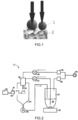
- the slurry 34 is contained in a slurry tank 35 and is stirred by an agitator 36.
- a compressed air source 38 applies slurry pressure to the slurry tank 35 through a slurry pressure regulating valve 40, enabling the slurry 34 in slurry tank 35 to be supplied to the projection gun 42 via a slurry flow meter 44.
- the projection nozzle 50 situated at the bottom of the projection gun 42, is a nozzle with a projection cross-sectional area of 1.0 mm 2 (1 mm in length ⁇ 1 mm in width), and is enclosed by a projection booth 54.
- the projection gun 42 mixes the supplied slurry 34 with air, and locally ejects the mixture through the projection nozzle 50 at a distance of 4 mm toward a dental workpiece sample W secured to a fixture 52. This creates localized wear on the surface of the dental workpiece sample W, resulting in the formation of depressions.
- the fixture 52 which secures the dental workpiece sample W, is transported in and out of the projection booth 54 by a table drive unit 56.
- the slurry 34 accumulated in the projection booth 54 is transferred back into the slurry tank 35 by a recovery pump 58.
- the spherical alumina may be a commercially available product (for example, product number: MSE-BA-3-3, manufactured by Palmeso Co., Ltd.).
- the average particle diameter of the spherical alumina slurry used in the MSE test can be measured by volume using, for example, a laser diffraction particle size distribution analyzer (SALD-2300, manufactured by Shimadzu Corporation) with a 0.2% sodium hexametaphosphate aqueous solution used as dispersion medium.
- SALD-2300 laser diffraction particle size distribution analyzer
- the dental workpiece of embodiment (A) is a sintered body containing zirconia. Because a dental workpiece of the present invention is not limited to sintered bodies containing zirconia, "sintered body containing zirconia" can be read as referring to "sintered body containing alumina", except where specified otherwise.
- the sintered body containing zirconia is preferably one comprising ZrO 2 , HfO 2 , a stabilizer capable of preventing a phase transformation of zirconia, and Nb 2 O 5 and/or Ta 2 O 5 , along with an optional Group I element.
- the preferred embodiments described below are based on a zirconia-containing sintered body comprising ZrO 2 , HfO 2 , a stabilizer capable of preventing a phase transformation of zirconia (hereinafter, also referred to simply as "stabilizer"), and Nb 2 O 5 and/or Ta 2 O 5 , along with an optional Group I element.
- stabilizer capable of preventing a phase transformation of zirconia
- the total content of ZrO 2 and HfO 2 is preferably 78 to 97.5 mol% in total 100 mol% of ZrO 2 , HfO 2 , the stabilizer, Nb 2 O 5 , and Ta 2 O 5 .
- the total content of ZrO 2 and HfO 2 is more preferably 79 mol% or more and 96 mol% or less, even more preferably 80 mol% or more and 94 mol% or less, particularly preferably 81 mol% or more and 93 mol% or less.
- the stabilizer may be absent in the sintered body containing alumina.
- a certain preferred embodiment is, for example, a sintered body containing zirconia in which the stabilizer capable of preventing a phase transformation of zirconia comprises Y 2 O 3 and/or CeO 2 , and the total content of Y 2 O 3 and CeO 2 is 2 mol% or more and 10 mol% or less.
- the content of Y 2 O 3 and CeO 2 may be appropriately varied within the ranges specified in this specification.
- the total content of Y 2 O 3 and CeO 2 may be 2.5 mol% or more and 10 mol% or less, or 3 mol% or more and 9 mol% or less.
- the presence of Group I elements at the grain boundary of zirconia particles appears to reduce the grain boundary strength, facilitating particles to separate, thereby improving grindability. Presumably, this leads to an erosion rate within the foregoing ranges, resulting in improved machinability in the sintered state (particularly in continuous processing) while reducing a decrease in strength.
- the content of Group I elements is even more preferably 0.06 mol% or more and 2.5 mol% or less, particularly preferably 0.07 mol% or more and 1.0 mol% or less, most preferably 0.08 mol% or more and 0.34 mol% or less.
- Another preferred embodiment is a zirconia-containing sintered body that does not comprise Nb 2 O 5 and/or Ta 2 O 5 , and in which the content of Group I elements is 0.5 mol% or more and 6 mol% or less.
- the content of Group I elements is more preferably 0.8 mol% or more and 5 mol% or less, even more preferably 1.0 mol% or more and 4.0 mol% or less, particularly preferably 1.2 mol% or more and 3.5 mol% or less, most preferably 1.5 mol% or more and 3.0 mol% or less.
- Group I elements examples include Li, Na, K, Rb, Cs, and Fr. In view of the ability to more greatly improve machinability in a sintered state, preferred are Li, Na, and K.
- the Group I elements may be used alone, or two or more thereof may be used in combination.
- the Group I elements act integrally with Nb 2 O 5 and/or Ta 2 O 5 , and these components do not compromise the effectiveness of the stabilizer. Accordingly, the present invention can exhibit its effects without particularly restricting the choice of stabilizer.
- the content of the components ZrO 2 , HfO 2 , stabilizer, Nb 2 O 5 , and Ta 2 O 5 in the dental workpiece can be measured using a technique, for example, such as inductively coupled plasma (ICP) emission spectral analysis or X-ray fluorescence analysis.
- ICP inductively coupled plasma
- the content (mol%) of Group I element refers to the proportion external to total 100 mol% of ZrO 2 , HfO 2 , the stabilizer, Nb 2 O 5 , and Ta 2 O 5 . Accordingly, the content of Group I element in the dental workpiece can be calculated by converting the quantity (mass) of the raw material added into mol%.
- the content of the components ZrO 2 , HfO 2 , stabilizer, Nb 2 O 5 , and Ta 2 O 5 represents the proportion of each component in total 100 mol% of ZrO 2 , HfO 2 , stabilizer, Nb 2 O 5 , and Ta 2 O 5 , and the sum of ZrO 2 , HfO 2 , stabilizer, Nb 2 O 5 , and Ta 2 O 5 does not exceed 100 mol%.
- a certain preferred embodiment (A-1) is, for example, a dental workpiece that exhibits an erosion rate of 8.0 ⁇ m/g or more when a spherical alumina slurry with an average particle diameter of 3.0 ⁇ m is projected in a micro slurry-jet erosion test, and a biaxial flexural strength of 300 MPa or more as measured in compliance with ISO 6872:2015, and that comprises ZrO 2 , HfO 2 , a stabilizer capable of preventing a phase transformation of zirconia, and Nb 2 O 5 and/or Ta 2 O 5 ,
- a certain embodiment (A-2) of the present invention is, for example, a dental workpiece that further comprises a zirconia enhancer, in addition to ZrO 2 , HfO 2 , the stabilizer capable of preventing a phase transformation of zirconia, Nb 2 O 5 and/or Ta 2 O 5 , and the Group I element.
- a zirconia enhancer in addition to ZrO 2 , HfO 2 , the stabilizer capable of preventing a phase transformation of zirconia, Nb 2 O 5 and/or Ta 2 O 5 , and the Group I element.
- the content of zirconia enhancer is preferably more than 0 mass% and 5.0 mass% or less relative to total 100 mass% of ZrO 2 , HfO 2 , a stabilizer capable of preventing a phase transformation of zirconia, Nb 2 O 5 , and Ta 2 O 5 .
- the content of zirconia enhancer is more preferably 0.01 mass% or more and 4.5 mass% or less, even more preferably 0.5 mass% or more and 4.0 mass% or less.
- zirconia enhancer examples include TiO 2 and Al 2 O 3 .
- the zirconia enhancer may be used alone, or two or more thereof may be used in combination.
- Another certain preferred embodiment is, for example, a dental workpiece in which the zirconia enhancer in any one of the embodiments above comprises TiO 2 , and the content of TiO 2 is 0.6 to 3.7 mass%.
- a certain preferred embodiment is, for example, a dental workpiece that exhibits an erosion rate of 8.0 ⁇ m/g or more when a spherical alumina slurry with an average particle diameter of 3.0 ⁇ m is projected in a micro slurry-jet erosion test, and a biaxial flexural strength of 300 MPa or more as measured in compliance with ISO 6872:2015, and that comprises ZrO 2 , HfO 2 , a stabilizer capable of preventing a phase transformation of zirconia, and Nb 2 O 5 and/or Ta 2 O 5 ,
- a dental workpiece of the present invention in view of achieving machinability in a sintered state while exhibiting superior strength for dental use, has a product of erosion rate ( ⁇ m/g) ⁇ average crystal grain size ( ⁇ m) greater than or equal to 15 ⁇ m 2 /g when a spherical alumina slurry with an average particle diameter of 3.0 ⁇ m is projected in an MSE test.
- the upper limit of erosion rate ( ⁇ m/g) ⁇ average crystal grain size ( ⁇ m) is not particularly limited, as long as the present invention can exhibit its effects.
- the upper limit of erosion rate ( ⁇ m/g) ⁇ average crystal grain size ( ⁇ m) is preferably 100 ⁇ m 2 /g or less, more preferably 80 ⁇ m 2 /g or less, even more preferably 65 ⁇ m 2 /g or less, particularly preferably 50 ⁇ m 2 /g or less.
- the dental workpiece may have an average crystal grain size of 0.05 to 15.0 ⁇ m.
- the average crystal grain size is preferably 3.0 ⁇ m to 15.0 ⁇ m, more preferably 4.0 to 15.0 ⁇ m, even more preferably 5.0 to 15.0 ⁇ m, particularly preferably 5.5 to 15.0 ⁇ m.
- the erosion rate may be 8.0 ⁇ m/g or more, or less than 8.0 ⁇ m/g, or may be 6.5 ⁇ m/g or more, less than 6.5 ⁇ m/g, or 6.0 ⁇ m/g or less.
- the erosion rate may overlap or exclude the erosion rate of embodiment (A), provided that the present invention can exhibit its effects.
- Embodiment (B), including embodiments (B-1) and (B-2), does not differ from embodiment (A) with regard to the total content of ZrO 2 and HfO 2 , the type and content of the stabilizer capable of preventing a phase transformation of zirconia, the total content of Nb 2 O 5 and Ta 2 O 5 , the type and content of Group I elements, the ratio A/B (A represents the stabilizer content in mol%, and B represents the total content of Nb 2 O 5 and Ta 2 O 5 in mol%), and the type and content of the zirconia enhancer.
- the density of the processable zirconia composite sintered body is preferably 5.5 g/cm 3 or more, more preferably 5.7 g/cm 3 or more, even more preferably 5.9 g/cm 3 or more.
- the processable zirconia composite sintered body is essentially void free.
- the density of the composite sintered body can be calculated by dividing its mass by its volume ((mass of composite sintered body) / (volume of composite sintered body)).
- an example of a method for producing a dental workpiece of the present invention comprises the steps of:
- the conditions provided are applicable to all embodiments of the production method.
- the sintered body can be produced by modifying the production method for a dental workpiece that is a sintered body containing zirconia, for example, by changing components such as replacing ZrO 2 and HfO 2 with and excluding the stabilizer, and adjusting the content of each component within the ranges specified in this specification.
- the raw material composition used for the production of the dental workpiece comprises ZrO 2 , HfO 2 , a stabilizer capable of preventing a phase transformation of zirconia, Nb 2 O 5 and/or Ta 2 O 5 , and, optionally, a raw material compound of a Group I element.
- the raw material composition used for the production of the dental workpiece may be in a dry state, or in a liquid state containing liquid or contained in liquid.
- the raw material composition may have a form of a powder, a granule or granulated material, a paste, or a slurry.
- the raw material composition does not comprise a raw material compound of a Group I element.
- bicarbonates of Group I elements include lithium bicarbonate, sodium bicarbonate, potassium bicarbonate, rubidium bicarbonate, francium bicarbonate, and cesium bicarbonate.
- hydroxides and salts of Group I elements may be used alone, or two or more thereof may be used in combination.
- zirconia powders can be used for ZrO 2 and HfO 2 .
- Examples of such commercially available products include zirconia powders manufactured by Tosoh Corporation under the trade names Zpex ® (Y 2 O 3 content: 3 mol%), Zpex ® 4 (Y 2 O 3 content: 4 mol%), Zpex ® 4 Smile ® (Y 2 O 3 content: 5.5 mol%), TZ-3Y (Y 2 O 3 content: 3 mol%), TZ-3YS (Y 2 O 3 content: 3 mol%), TZ-4YS (Y 2 O 3 content: 4 mol%), TZ-6Y (Y 2 O 3 content: 6 mol%), TZ-6YS (Y 2 O 3 content: 6 mol%), TZ-8YS (Y 2 O 3 content: 8 mol%), TZ-10YS (Y 2 O 3 content: 10 mol%), TZ-3Y-E (Y 2 O 3 content: 3 mol%), TZ-3YS-E (Y 2 O 3 content: 3 mol%), TZ-3YS-E (Y 2 O 3 content: 3 mol%)
- the type of zirconia powder in the raw material composition is not particularly limited. It is possible to additionally incorporate stabilizer particles when the zirconia powder comprises ZrO 2 and HfO 2 but does not contain a stabilizer, or when increasing the content of stabilizer as needed.
- the stabilizer particles are not particularly limited, as long as the content of the stabilizer within the dental workpiece can be adjusted to the predetermined ranges mentioned above.
- a peak derived from the stabilizer is basically not observable in an XRD pattern when the stabilizer is fully dissolved in ZrO 2 and HfO 2 as a solid solution. It is, however, possible, depending on the crystal state or other conditions of the stabilizer, that the stabilizer is not dissolved in ZrO 2 and HfO 2 as a solid solution even when the XRD pattern does not show peaks for stabilizers.
- the formula can be applied to calculate the percentage presence of undissolved stabilizers other than yttria by substituting I 29 with the peaks of other stabilizers.
- the percentage presence f y of undissolved yttria falls within the following ranges when the yttria content in the raw material composition or molded body of the present invention is 3 mol% or more and 8 mol% or less.
- f y may be 15% or less.
- f y may be 20% or less.
- f y may be 25% or less.
- f y is preferably 2% or more, more preferably 3% or more, even more preferably 4% or more, particularly preferably 5% or more.
- f y is preferably 3% or more, more preferably 4% or more, even more preferably 5% or more, yet more preferably 6% or more, particularly preferably 7% or more.
- f y is preferably 4% or more, more preferably 5% or more, even more preferably 6% or more, yet more preferably 7% or more, particularly preferably 8% or more.
- Nb 2 O 5 and/or Ta 2 O 5 incorporated in the raw material composition of the present invention, as long as the content of Nb 2 O 5 and/or Ta 2 O 5 within the dental workpiece can be adjusted in the predetermined ranges mentioned above.
- commercially available products may be used for Nb 2 O 5 and/or Ta 2 O 5 without any particular restrictions. These may be used after pulverizing its powder using a known pulverizing mixer (such as a ball mill).
- An example method of obtaining the raw material composition involves a process whereby the raw material composition is prepared by, for example, wet mixing each raw material of the raw material composition (ZrO 2 , HfO 2 , a stabilizer, Nb 2 O 5 and/or Ta 2 O 5 , a raw material compound of a Group I element (for example, a hydroxide and/or salt of a Group I element), and, optionally, a zirconia enhancer) in a solvent containing water.
- a raw material of the raw material composition ZrO 2 , HfO 2 , a stabilizer, Nb 2 O 5 and/or Ta 2 O 5
- a raw material compound of a Group I element for example, a hydroxide and/or salt of a Group I element
- a zirconia enhancer for example, a zirconia enhancer
- the method for wet mixing the raw materials in a solvent containing water is not particularly limited.
- the raw materials may be formed into a slurry through wet pulverization and mixing using a known pulverizing mixer (such as a ball mill).
- the slurry can then be dried and granulated to produce a granular raw material composition.
- additives such as binders, plasticizers, dispersants, emulsifiers, antifoaming agents, pH adjusters, and lubricants.
- the additives may be used alone, or two or more thereof may be used in combination.
- the binder is not particularly limited, and known binders may be used.
- the binders include polyvinyl alcohol binders, acrylic binders, wax binders (such as paraffin wax), methyl cellulose, carboxymethyl cellulose, polyvinyl butyral, polymethylmethacrylate, ethyl cellulose, polyethylene, polypropylene, ethylene-vinyl acetate copolymer, polystyrene, atactic polypropylene, and methacrylic resin.
- plasticizers examples include polyethylene glycol, glycerin, propylene glycol, and dibutyl phthalic acid.
- dispersants examples include ammonium polycarboxylates (such as triammonium citrate), ammonium polyacrylate, acrylic copolymer resin, acrylic acid ester copolymer, polyacrylic acid, bentonite, carboxymethyl cellulose, anionic surfactants (for example, polyoxyethylene alkyl ether phosphoric acid esters such as polyoxyethylene lauryl ether phosphoric acid ester), non-ionic surfactants, oleic glyceride, amine salt surfactants, oligosaccharide alcohols, and stearic acid.
- ammonium polycarboxylates such as triammonium citrate
- ammonium polyacrylate acrylic copolymer resin
- acrylic acid ester copolymer acrylic acid ester copolymer
- polyacrylic acid bentonite
- carboxymethyl cellulose examples include anionic surfactants (for example, polyoxyethylene alkyl ether phosphoric acid esters such as polyoxyethylene lauryl ether phosphoric acid ester
- emulsifiers examples include alkyl ethers, phenyl ethers, sorbitan derivatives, and ammonium salts.
- antifoaming agents examples include alcohols, polyethers, silicone, and waxes.
- pH adjusters examples include ammonia, and ammonium salts (including ammonium hydroxides such as tetramethylammonium hydroxide).
- lubricants examples include polyoxyethylene alkylate ethers, and waxes.
- the solvent used for wet mixing is not particularly limited, as long as it contains water.
- the solvent may be a mixed solvent of water and organic solvent.
- the solvent may be solely water.
- the organic solvents include ketone solvents such as acetone, and ethyl methyl ketone; and alcohol solvents such as ethanol, 1-propanol, 2-propanol, 2-methyl-2-propanol, glycerin, diglycerin, polyglycerin, propylene glycol, dipropylene glycol, polypropylene glycol, ethylene glycol, diethylene glycol, polyethylene glycol, polyethylene glycol monomethyl ether, 1,2-pentadiol, 1,2-hexanediol, and 1,2-octanediol.
- the molding pressure is appropriately set to an optimum value according to the desired size of molded body, open porosity, biaxial flexural strength, and the particle size of raw material powder. Typically, the molding pressure ranges from 5 MPa to 1,000 MPa. Increasing the molding pressure during molding in the method of production above allows for setting lower values for open porosity and increasing the density of the molded body by filling the voids more effectively in the molded body. To increase the density of the zirconia molded body obtained, cold isostatic pressing (CIP) may be applied after uniaxial pressing.
- CIP cold isostatic pressing
- primary sintered body is used to refer to sintered bodies obtained through sintering at the highest sintering temperature
- HIP sintered body is used to refer to sintered bodies after a HIP process.
- the temperature for HIP process is not particularly limited. However, for advantages such as obtaining a high-strength and dense dental workpiece, the HIP temperature is preferably 1,200°C or more, more preferably 1,300°C or more, even more preferably 1,400°C or more. The HIP temperature is preferably 1,700°C or less, more preferably 1,650°C or less, even more preferably 1,600°C or less.
- the HIP pressure in the HIP process of the primary sintered body is not particularly limited.
- the HIP pressure is preferably 100 MPa or more, more preferably 125 MPa or more, even more preferably 130 MPa or more.
- the upper limit of HIP pressure is not particularly limited, and may be, for example, 400 MPa or less, 300 MPa or less, or 200 MPa or less.
- the pressure medium in the HIP process of the primary sintered body is not particularly limited.
- the pressure medium may be at least one selected from the group consisting of oxygen, oxygen with 3% hydrogen, air, and various inert gases (for example, nitrogen, argon).
- the heat treatment temperature in the atmosphere or an excess oxygen atmosphere is preferably 1,650°C or less, more preferably 1,600°C or less, even more preferably 1,550°C or less.
- the heat treatment temperature in the atmosphere or an excess oxygen atmosphere is preferably 1,400°C or less, more preferably 1,300°C or less, even more preferably 1,200°C or less.
- another certain embodiment is, for example, a method for producing a dental workpiece that comprises the steps of fabricating a molded body using the raw material composition, pre-sintering the molded body to form a zirconia pre-sintered body (pre-sintering step), and sintering the zirconia pre-sintered body.
- the firing temperature (pre-sintering temperature) in the pre-sintering step is, for example, preferably 800°C or more, more preferably 900°C or more, even more preferably 950°C or more.
- the pre-sintering temperature is, for example, preferably 1,200°C or less, more preferably 1,150°C or less, even more preferably 1,100°C or less.
- the preferred range of pre-sintering temperatures is, for example, 800°C to 1,200°C. It is believed that, at these pre-sintering temperatures, no significant progression of the formation of the solid solution of the stabilizer occurs in the pre-sintering step.
- a zirconia pre-sintered body of the present invention refers to a state where ZrO 2 particles have formed necks between particles but the ZrO 2 particles (powder) have not been fully sintered (semi-sintered state).
- the zirconia pre-sintered body has a density of preferably 2.7 g/cm 3 or more.
- the zirconia pre-sintered body has a density of preferably 4.0 g/cm 3 or less, more preferably 3.8 g/cm 3 or less, even more preferably 3.6 g/cm 3 or less. Processing becomes easier when the density falls within these ranges.
- the density of the pre-sintered body can be calculated, for example, as the mass-to-volume ratio of the pre-sintered body ((mass of pre-sintered body) / (volume of pre-sintered body)).
- a spectrophotometer can be used to measure ⁇ L* for a dental workpiece with a diameter of 15 mm and a thickness of 1.2 mm.
- the dental colorimeter Crystaleye CE100-CE/JP with a 7-band LED illuminant and analysis software Crystaleye manufactured by Olympus Corporation may be used for measurement.
- dental prostheses produced using a dental workpiece of the present invention include crown restorations such as inlays, onlays, veneers, crowns, core-integrated crowns, and bridges, as well as abutment teeth, dental posts, dentures, denture bases, and implant parts (fixtures, abutments).
- crown restorations such as inlays, onlays, veneers, crowns, core-integrated crowns, and bridges
- abutment teeth dental posts, dentures, denture bases, and implant parts (fixtures, abutments).
- CAD/CAM system is used for machining.
- Examples of such CAD/CAM systems include the CEREC system manufactured by Dentsply Sirona, and the KATANA ® system manufactured by Kuraray Noritake Dental Inc.
- a dental workpiece of the present invention can also be used in applications other than dental use, and is particularly suited for zirconia parts that require irregular or complex shapes and strength.
- a dental workpiece of the present invention can be directly processed as a sintered body, instead of employing existing production methods (such as injection molding, CIP, casting, and 3D printing). This can be cost-effective, for example, when a desired zirconia part is obtained in short time periods. For parts that are complex in shape and difficult to produce with traditional methods, this technique eliminates the need for mechanical fitting of multiple parts, allowing for the production of zirconia parts with maintained high strength.
- the average particle diameter can be measured by volume using a laser diffraction particle size distribution analyzer (SALD-2300, manufactured by Shimadzu Corporation) with a 0.2% sodium hexametaphosphate aqueous solution used as dispersion medium.
- SALD-2300 laser diffraction particle size distribution analyzer
- the measurement samples for Examples and Comparative Example were prepared by fabricating a granular raw material composition, a molded body, and a sintered body (the fabrication of a primary sintered body, as well as HIP processing and tempering) through these processes.
- the average particle diameter is a measured value determined by volume using a laser diffraction particle size distribution analyzer (SALD-2300, manufactured by Shimadzu Corporation) with a 0.2% sodium hexametaphosphate aqueous solution used as dispersion medium.
- SALD-2300 laser diffraction particle size distribution analyzer
- pellet-shaped molded bodies and block-shaped molded bodies were produced in preparation for the fabrication of sintered body samples for both translucency and strength evaluation and processability evaluation, as follows.
- a cylindrical mold with a diameter of 19 mm was used to create pellet-shaped molded bodies.
- the raw material composition was placed in the mold to ensure that sintering produces a dental workpiece with a thickness of 1.2 mm.
- the raw material composition was molded under a surface pressure of 200 MPa to obtain a pellet-shaped molded body, using a uniaxial press molding machine.
- the raw material composition was placed in a mold with inside dimensions of 19 mm ⁇ 18 mm, ensuring that sintering produces a dental workpiece with a height of 14.5 mm.
- Example 6 the primary sintered body of Example 6 was evaluated for its properties as a dental workpiece, without HIP processing or tempering.
- the pellet-shaped and block-shaped zirconia- or alumina-containing sintered bodies were held for 2 hours at 150 MPa and the HIP temperatures specified in Tables 1 and 2, using the HIP device O 2 -Dr.HIP manufactured by Kobe Steel, Ltd. This resulted in zirconia- or alumina-containing sintered body (HIP sintered body) samples in both pellet and block shapes.
- the content (mol%) of Group I elements in Tables 1 and 2 refers to the proportion external to total 100 mol% of ZrO 2 , HfO 2 , the stabilizer, Nb 2 O 5 , and Ta 2 O 5 .
- the content (mol%) of ZrO 2 , HfO 2 , the stabilizer, Nb 2 O 5 , and Ta 2 O 5 in Tables 1 and 2 refers to the content of each component in total 100 mol% of ZrO 2 , HfO 2 , the stabilizer, Nb 2 O 5 , and Ta 2 O 5 .
- the content is presented as the total content of ZrO 2 and HfO 2 .
- the content (mass%) of TiO 2 in Tables 1 and 2 refers to the proportion external to total 100 mass% of ZrO 2 , HfO 2 , the stabilizer, Nb 2 O 5 , and Ta 2 O 5 .
- A/B in Tables 1 and 2 represents the ratio of A to B, where A is the Y 2 O 3 content in mol%, and B is the total content of Nb 2 O 5 and Ta 2 O 5 in mol%.
- a spherical alumina slurry was prepared by mixing spherical alumina (product number: MSE-BA-3-3, manufactured by Palmeso Co., Ltd.) of 3.0 ⁇ m average particle diameter with water at 3 volume%, and this spherical alumina slurry was used in the localized slurry jet erosion method. The spherical alumina slurry was used immediately after being prepared.
- the projection pressure was adjusted by projecting the spherical alumina slurry onto a standard specimen (product number: HRC45, manufactured by Palmeso Co., Ltd.) to attain a reference value (erosion rate: 1.00 ⁇ m/g ⁇ 5%).
- the evaluation was carried out under the conditions set by selecting an impact mode with an air pressure of 0.335 MPa, a slurry pressure of 0.317 MPa, an airflow rate of 10.8 L/min, and a slurry flow rate of 125 L/min, all directed to the projection nozzle.
- the projection force for this impact mode was verified by achieving an erosion rate of 24.0 ⁇ 5% ⁇ m/g on a standard specimen made of acrylic resin.
- the maximum value D ( ⁇ m) of the wear depth was measured at each measurement point.
- the amount of projected particles (g) on the sample was then calculated based on the flow rate of the slurry supplied to the projection nozzle 50.
- the spherical particle-induced wear rate (spherical particle-induced erosion rate) ( ⁇ m/g) according to the localized slurry jet erosion method with the spherical alumina slurry containing spherical alumina particles was calculated by dividing the average maximum value D ( ⁇ m) of the sample by the amount of projected particles (g).
- the average erosion rate from the three measurement points is presented in Tables 1 and 2.
- the dental colorimeter Crystaleye (7-band LED illuminant) manufactured by Olympus Corporation was used as the measurement device.
- a white background (underlay) was arranged for the sample (the opposite side of the sample from the measurement device is white), and the sample was measured for L* value according to L*a*b*color system (JIS Z 8781-4:2013 Color Measurements - Part 4: CIE 1976 L*a*b* color space). This was recorded as a first L* value.
- the pellet-shaped dental workpiece (tempered sintered body) samples of each Example and Comparative Example were directly used to measure biaxial flexural strength.
- the measurement results are presented as average values in Tables 1 and 2. A strength of 300 MPa or more was considered acceptable.
Landscapes
- Health & Medical Sciences (AREA)
- Chemical & Material Sciences (AREA)
- Ceramic Engineering (AREA)
- Engineering & Computer Science (AREA)
- Oral & Maxillofacial Surgery (AREA)
- Epidemiology (AREA)
- Life Sciences & Earth Sciences (AREA)
- Animal Behavior & Ethology (AREA)
- General Health & Medical Sciences (AREA)
- Public Health (AREA)
- Veterinary Medicine (AREA)
- Organic Chemistry (AREA)
- Materials Engineering (AREA)
- Structural Engineering (AREA)
- Plastic & Reconstructive Surgery (AREA)
- Manufacturing & Machinery (AREA)
- Dentistry (AREA)
- Composite Materials (AREA)
- Inorganic Chemistry (AREA)
- Orthopedic Medicine & Surgery (AREA)
- Dental Preparations (AREA)
- Dental Prosthetics (AREA)
Applications Claiming Priority (2)
| Application Number | Priority Date | Filing Date | Title |
|---|---|---|---|
| JP2022089663 | 2022-06-01 | ||
| PCT/JP2023/020517 WO2023234400A1 (ja) | 2022-06-01 | 2023-06-01 | 歯科用被加工体及びその製造方法 |
Publications (1)
| Publication Number | Publication Date |
|---|---|
| EP4534503A1 true EP4534503A1 (en) | 2025-04-09 |
Family
ID=89025002
Family Applications (1)
| Application Number | Title | Priority Date | Filing Date |
|---|---|---|---|
| EP23816157.4A Pending EP4534503A1 (en) | 2022-06-01 | 2023-06-01 | Dental workpiece and method for producing same |
Country Status (6)
| Country | Link |
|---|---|
| US (1) | US20250345247A1 (https=) |
| EP (1) | EP4534503A1 (https=) |
| JP (2) | JP7535211B2 (https=) |
| KR (1) | KR20250011167A (https=) |
| CN (1) | CN119301089A (https=) |
| WO (1) | WO2023234400A1 (https=) |
Families Citing this family (3)
| Publication number | Priority date | Publication date | Assignee | Title |
|---|---|---|---|---|
| WO2025115985A1 (ja) * | 2023-11-28 | 2025-06-05 | クラレノリタケデンタル株式会社 | ジルコニア複合焼結体及びそれを含む歯科保存修復用キット |
| WO2025143124A1 (ja) * | 2023-12-28 | 2025-07-03 | クラレノリタケデンタル株式会社 | ジルコニア複合焼結体 |
| WO2025206348A1 (ja) * | 2024-03-29 | 2025-10-02 | クラレノリタケデンタル株式会社 | セラミックス仮焼体の製造方法 |
Family Cites Families (4)
| Publication number | Priority date | Publication date | Assignee | Title |
|---|---|---|---|---|
| EP2889279B1 (en) | 2013-12-27 | 2022-08-24 | Vatechacucera, Inc. | Machinable Zirconia |
| JP6978925B2 (ja) | 2017-12-18 | 2021-12-08 | クラレノリタケデンタル株式会社 | 歯科用ジルコニア仮焼体 |
| JP7838224B2 (ja) * | 2019-12-10 | 2026-04-01 | 東ソー株式会社 | 耐衝撃性に優れる焼結体 |
| EP4082991A4 (en) | 2019-12-26 | 2024-01-24 | Kuraray Noritake Dental Inc. | Production method for workable zirconia composite sintered body, raw material composition for workable zirconia composite sintered body, and workable zirconia composite calcined body |
-
2023
- 2023-06-01 US US18/870,497 patent/US20250345247A1/en active Pending
- 2023-06-01 EP EP23816157.4A patent/EP4534503A1/en active Pending
- 2023-06-01 KR KR1020247041471A patent/KR20250011167A/ko active Pending
- 2023-06-01 WO PCT/JP2023/020517 patent/WO2023234400A1/ja not_active Ceased
- 2023-06-01 CN CN202380044113.9A patent/CN119301089A/zh active Pending
- 2023-06-01 JP JP2024524950A patent/JP7535211B2/ja active Active
-
2024
- 2024-08-02 JP JP2024126485A patent/JP2024156857A/ja active Pending
Also Published As
| Publication number | Publication date |
|---|---|
| WO2023234400A1 (ja) | 2023-12-07 |
| JP7535211B2 (ja) | 2024-08-15 |
| US20250345247A1 (en) | 2025-11-13 |
| KR20250011167A (ko) | 2025-01-21 |
| JP2024156857A (ja) | 2024-11-06 |
| CN119301089A (zh) | 2025-01-10 |
| JPWO2023234400A1 (https=) | 2023-12-07 |
Similar Documents
| Publication | Publication Date | Title |
|---|---|---|
| EP4534503A1 (en) | Dental workpiece and method for producing same | |
| EP4534505A1 (en) | Sintered zirconia composite object and production method therefor | |
| EP4082991A1 (en) | Production method for workable zirconia composite sintered body, raw material composition for workable zirconia composite sintered body, and workable zirconia composite calcined body | |
| EP4534507A1 (en) | Zirconia composite sintered body and method for producing same | |
| EP4223723A1 (en) | Zirconia calcined body having excellent machinability | |
| EP4534504A1 (en) | Black zirconia composite sintered body and method for manufacturing same | |
| Lan et al. | Milling properties of low temperature sintered zirconia blocks for dental use | |
| EP4534506A1 (en) | Sintered zirconia composite object and production method therefor | |
| JP7820618B1 (ja) | セラミックス仮焼体の製造方法 | |
| EP4458773A1 (en) | Zirconia sintered body and method for producing same | |
| US20230202931A1 (en) | Method and composition to produce high translucency dental ceramics | |
| EP4458772A1 (en) | Zirconia sintered body and method for producing same | |
| WO2025143124A1 (ja) | ジルコニア複合焼結体 | |
| WO2025115986A1 (ja) | ジルコニア複合焼結体 | |
| JP2025156254A (ja) | セラミックス仮焼体の製造方法 | |
| WO2025143125A1 (ja) | 歯科用補綴物の製造方法 | |
| JP2025156253A (ja) | セラミックス仮焼体の製造方法 | |
| WO2025206348A1 (ja) | セラミックス仮焼体の製造方法 | |
| Li et al. | CAD/CAM Zirconia for Dental Application |
Legal Events
| Date | Code | Title | Description |
|---|---|---|---|
| STAA | Information on the status of an ep patent application or granted ep patent |
Free format text: STATUS: THE INTERNATIONAL PUBLICATION HAS BEEN MADE |
|
| PUAI | Public reference made under article 153(3) epc to a published international application that has entered the european phase |
Free format text: ORIGINAL CODE: 0009012 |
|
| STAA | Information on the status of an ep patent application or granted ep patent |
Free format text: STATUS: REQUEST FOR EXAMINATION WAS MADE |
|
| 17P | Request for examination filed |
Effective date: 20241218 |
|
| AK | Designated contracting states |
Kind code of ref document: A1 Designated state(s): AL AT BE BG CH CY CZ DE DK EE ES FI FR GB GR HR HU IE IS IT LI LT LU LV MC ME MK MT NL NO PL PT RO RS SE SI SK SM TR |
|
| DAV | Request for validation of the european patent (deleted) | ||
| DAX | Request for extension of the european patent (deleted) |