EP4531493A2 - Verfahren zur auswahl eines netzwerk-slices in bezug auf eine anwendung - Google Patents
Verfahren zur auswahl eines netzwerk-slices in bezug auf eine anwendung Download PDFInfo
- Publication number
- EP4531493A2 EP4531493A2 EP25157557.7A EP25157557A EP4531493A2 EP 4531493 A2 EP4531493 A2 EP 4531493A2 EP 25157557 A EP25157557 A EP 25157557A EP 4531493 A2 EP4531493 A2 EP 4531493A2
- Authority
- EP
- European Patent Office
- Prior art keywords
- terminal
- rule
- application
- network slice
- identifier
- Prior art date
- Legal status (The legal status is an assumption and is not a legal conclusion. Google has not performed a legal analysis and makes no representation as to the accuracy of the status listed.)
- Pending
Links
Images



Classifications
-
- H—ELECTRICITY
- H04—ELECTRIC COMMUNICATION TECHNIQUE
- H04L—TRANSMISSION OF DIGITAL INFORMATION, e.g. TELEGRAPHIC COMMUNICATION
- H04L67/00—Network arrangements or protocols for supporting network services or applications
- H04L67/01—Protocols
- H04L67/10—Protocols in which an application is distributed across nodes in the network
- H04L67/1097—Protocols in which an application is distributed across nodes in the network for distributed storage of data in networks, e.g. transport arrangements for network file system [NFS], storage area networks [SAN] or network attached storage [NAS]
-
- H—ELECTRICITY
- H04—ELECTRIC COMMUNICATION TECHNIQUE
- H04L—TRANSMISSION OF DIGITAL INFORMATION, e.g. TELEGRAPHIC COMMUNICATION
- H04L67/00—Network arrangements or protocols for supporting network services or applications
- H04L67/50—Network services
- H04L67/60—Scheduling or organising the servicing of application requests, e.g. requests for application data transmissions using the analysis and optimisation of the required network resources
-
- H—ELECTRICITY
- H04—ELECTRIC COMMUNICATION TECHNIQUE
- H04W—WIRELESS COMMUNICATION NETWORKS
- H04W48/00—Access restriction; Network selection; Access point selection
- H04W48/08—Access restriction or access information delivery, e.g. discovery data delivery
- H04W48/14—Access restriction or access information delivery, e.g. discovery data delivery using user query or user detection
-
- H—ELECTRICITY
- H04—ELECTRIC COMMUNICATION TECHNIQUE
- H04W—WIRELESS COMMUNICATION NETWORKS
- H04W48/00—Access restriction; Network selection; Access point selection
- H04W48/18—Selecting a network or a communication service
-
- H—ELECTRICITY
- H04—ELECTRIC COMMUNICATION TECHNIQUE
- H04L—TRANSMISSION OF DIGITAL INFORMATION, e.g. TELEGRAPHIC COMMUNICATION
- H04L41/00—Arrangements for maintenance, administration or management of data switching networks, e.g. of packet switching networks
- H04L41/08—Configuration management of networks or network elements
- H04L41/085—Retrieval of network configuration; Tracking network configuration history
- H04L41/0859—Retrieval of network configuration; Tracking network configuration history by keeping history of different configuration generations or by rolling back to previous configuration versions
-
- H—ELECTRICITY
- H04—ELECTRIC COMMUNICATION TECHNIQUE
- H04L—TRANSMISSION OF DIGITAL INFORMATION, e.g. TELEGRAPHIC COMMUNICATION
- H04L41/00—Arrangements for maintenance, administration or management of data switching networks, e.g. of packet switching networks
- H04L41/08—Configuration management of networks or network elements
- H04L41/0896—Bandwidth or capacity management, i.e. automatically increasing or decreasing capacities
- H04L41/0897—Bandwidth or capacity management, i.e. automatically increasing or decreasing capacities by horizontal or vertical scaling of resources, or by migrating entities, e.g. virtual resources or entities
-
- H—ELECTRICITY
- H04—ELECTRIC COMMUNICATION TECHNIQUE
- H04L—TRANSMISSION OF DIGITAL INFORMATION, e.g. TELEGRAPHIC COMMUNICATION
- H04L41/00—Arrangements for maintenance, administration or management of data switching networks, e.g. of packet switching networks
- H04L41/50—Network service management, e.g. ensuring proper service fulfilment according to agreements
- H04L41/5041—Network service management, e.g. ensuring proper service fulfilment according to agreements characterised by the time relationship between creation and deployment of a service
- H04L41/5051—Service on demand, e.g. definition and deployment of services in real time
-
- H—ELECTRICITY
- H04—ELECTRIC COMMUNICATION TECHNIQUE
- H04L—TRANSMISSION OF DIGITAL INFORMATION, e.g. TELEGRAPHIC COMMUNICATION
- H04L41/00—Arrangements for maintenance, administration or management of data switching networks, e.g. of packet switching networks
- H04L41/50—Network service management, e.g. ensuring proper service fulfilment according to agreements
- H04L41/508—Network service management, e.g. ensuring proper service fulfilment according to agreements based on type of value added network service under agreement
- H04L41/5096—Network service management, e.g. ensuring proper service fulfilment according to agreements based on type of value added network service under agreement wherein the managed service relates to distributed or central networked applications
-
- H—ELECTRICITY
- H04—ELECTRIC COMMUNICATION TECHNIQUE
- H04W—WIRELESS COMMUNICATION NETWORKS
- H04W60/00—Affiliation to network, e.g. registration; Terminating affiliation with the network, e.g. de-registration
- H04W60/04—Affiliation to network, e.g. registration; Terminating affiliation with the network, e.g. de-registration using triggered events
-
- H—ELECTRICITY
- H04—ELECTRIC COMMUNICATION TECHNIQUE
- H04W—WIRELESS COMMUNICATION NETWORKS
- H04W88/00—Devices specially adapted for wireless communication networks, e.g. terminals, base stations or access point devices
- H04W88/02—Terminal devices
- H04W88/06—Terminal devices adapted for operation in multiple networks or having at least two operational modes, e.g. multi-mode terminals
Definitions
- the application for invention is in the field of telecommunications infrastructures and techniques relating to network slices .
- the architecture of mobile telecommunications networks is standardized through a standards group known as 3GPP. This is particularly the case for so-called “2G”, “3G”, and “4G” mobile networks, whose different architectures are defined in technical specifications established by this organization.
- 5G next generation of mobile networks
- 5G networks are intended to concern both mobile and fixed networks. Consequently, the techniques inherent in the development of 5G networks concern both fixed and mobiles.
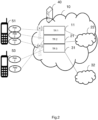
- Figure 1 presents a simplified view of an organization of a communications infrastructure 10, according to prior art, comprising network slices TR1, TR2, TR3 each representing a mobile network which share functions (routing, addressing, data flow control, naming, etc.) implemented for example in data centers .
- the terminal 50 is connected to two network slices TR1 and TR2 while the terminal 51 is attached to the slice TR2 and the terminal 53 to the slice TR3.
- the slice TR1 provides access to the data network 12
- the network slice TR2 provides access to the network 22
- the network slice TR3 provides access to the network 32.
- the network slices provide access to separate data networks but the network slices can also provide access to the same communications network.
- Network slices, which can be related to separate mobile networks are determined by the characteristics of the data flows passing through these slices which have common points in terms of destination, routing, security constraints justifying common management within a network slice.
- Each of the slices is thus optimized for the needs of a particular type of service and/or a type of customer or terminal.
- a network slice implemented for services related to loT ( Internet of Things ) services may require managing a large number of terminals but a rather low throughput associated with each terminal, if it is for example meter readings.
- a service offered to a professional clientele will require advanced security and availability functions. The objective is to activate for a given network slice only the functions essential for the use case corresponding to the network slice.
- This network slice architecture aims to provide more flexibility to the operator and to offer customers services corresponding to their needs by activating the functions necessary for the required service.
- Such a network slicing technique thus allows the operator of a telecommunications network to create "tailor-made” networks, capable of providing optimized solutions for very varied scenarios with very diverse constraints in terms of functionality and performance.
- the present invention aims to remedy these drawbacks.
- the rule management entity returns a set of rules to the terminal, not limited to the single rule corresponding to the identifier received.
- the transmitted rule can for example correspond to the S-NSSAI parameter ( Single Network Slice Selection Assistance Information ), used by the terminal to determine the network slice corresponding to the application.
- this prior art does not provide a means of associating a network slice with application characteristics so that the data flows of a terminal are routed according to their characteristics, by selecting a network slice adapted to these characteristics.
- the request message comprises the identifiers of the applications installed on the terminal at the time of attachment of the terminal to said infrastructure.
- a terminal attaching to the network may already have several applications installed. In this case, the terminal must obtain the set of rules corresponding to these different applications. It is therefore necessary for the terminal, when attaching to the network, to obtain these different rules. This allows the terminal to hold all the rules as soon as it is attached and consequently faster use of applications since the terminal does not have to request the rule management entity when an application must be used.
- the protocol used to transmit the request message can be an attachment protocol to the infrastructure or an attachment-independent protocol such as a REST API ( Applications Programming Interface - Representational State Transfer ) dedicated to the need to transmit the identifiers to a rules server.
- the request message is a message relating to the attachment of the terminal.
- Retrieval of rules during terminal attachment can further be implemented using the communications protocols used during attachment.
- the terminal when the terminal connects to a mobile telecommunications network, the terminal can retrieve the rules, for example in the data present in the PCO ( Protocol Configuration Option ) when establishing the PDN ( Packet Data Network ) connection and if it is a fixed network, the terminal can obtain the rules in a DHCP ( Dynamic Host Configuration Protocol ) or PPP ( Point-to-Point Protocol ) message for connection to the fixed network.
- PCO Protocol Configuration Option
- PDN Packet Data Network
- PPP Point-to-Point Protocol
- the at least one application identifier further comprises information relating to an application version.
- information about the application version may be required to associate a rule.
- one version of an application may be associated with a network slice, while a newer version, which may include more security or routing performance settings, may be associated with a network slice in accordance with the advanced settings of the newer version. efficient.
- the at least one application identifier is determined by the terminal.
- an application it is possible for an application to have a unique identifier that allows the rule management entity to be able, from this identifier, to unambiguously distinguish the application, or even the version of the application. This is particularly the case if the application is loaded from an application server accessible from a terminal attached to any type of communications infrastructure.
- the application identifier is not sufficiently explicit to be used by the management entity and the terminal can determine a unique identifier for an application.
- it can for example add a suffix or a prefix to an identifier that is not sufficiently explicit.
- the suffix or the prefix can for example identify the application server requested to load the application, or the operating system of the terminal or even a terminal identifier or a combination of these information.
- the determined identifier must be able to be explicit by the management entity so that the latter can select a rule from this identifier.
- the possibly added prefix or suffix must be interpreted by the management entity.
- a priority parameter is associated with the at least one rule and transmitted to the terminal.
- the data associated with an application can be transmitted over several network slices. For example, depending on whether the terminal is attached to a visited network (in English "roaming") or to its "mother” network, the application data can be transmitted over different network slices.
- the data of an application can, according to another option, be transported over separate slices depending in particular on the availability or quality of service criteria of the network slice at a given time. It may be useful for the management entity to transmit a priority indicator in addition to the rules.
- the terminal can determine which rule to take first and if this rule is not available, which other rule it must consider. In the case of "roaming", the network slice with the highest priority, corresponding to a network slice of the mother network, cannot be selected and the terminal then opts for the second or one of the network slices with a lower priority, according to the terminal's selection algorithm.
- the rule associated with the at least one identifier relates to a class of service.
- a network slice can advantageously be implemented for applications requiring the same processing by an operator, in order to meet quality of service criteria in particular.
- real-time applications can be associated with a network slice while applications with fewer constraints can be associated with another slice.
- a class of service can thus be determined from an application identifier and the terminal will use the information on the class of service received to select a suitable network slice, by requesting a server or from an internal database.
- a default rule is determined and transmitted to the terminal in the case where the at least one application identifier is not associated with any rule.
- the rule management entity is implemented in an application server.
- the rule management entity can advantageously be implemented in an application server. Indeed, when a terminal downloads a new application, it can also retrieve the rules corresponding to the downloaded application. Thus, obtaining the rules is optimized since there is no need to request another server when an application is downloaded and, in addition, it appears advantageous to transmit, in addition to the application, the rule(s) allowing its use on a communications infrastructure. Knowing that the architectures of communications networks are specific to operators, it may be necessary to identify the operator's network or the operator to provide the rules corresponding to the network or operator ensuring the connection of the terminal, in particular if it is an application server that is not specific to an operator.
- This device capable of implementing in all its embodiments the selection method which has just been described, is intended to be implemented in a terminal.
- This device capable of implementing in all its embodiments the association method which has just been described, is intended to be implemented in a rules management entity.
- the invention also relates to a system for selecting a network slice including a terminal comprising a selection device and a rule management entity comprising an association device.
- the invention also relates to a computer program comprising instructions for implementing the steps of the selection method which has just been described, when this program is executed by a processor.
- the invention also relates to a computer program comprising instructions for implementing the steps of the association method which has just been described, when this program is executed by a processor.
- These programs can use any programming language, and be in the form of source code, object code, or code intermediate between source code and object code, such as in a partially compiled form, or in any other desirable form.
- the invention also relates to an information medium readable by a computer, and comprising instructions of the computer programs as mentioned above.
- the information carrier may be any entity or device capable of storing programs.
- the carrier may include a storage medium, such as a ROM, for example a CD-ROM or a microelectronic circuit ROM, or a magnetic recording medium, for example a floppy disk or a hard disk.
- the information carrier may be a transmissible carrier such as an electrical or optical signal, which may be conveyed via an electrical or optical cable, by radio or by other means.
- the program according to the invention may in particular be downloaded from a network such as the Internet.
- the information carrier may be an integrated circuit in which the program is incorporated, the circuit being adapted to perform or to be used in performing the method in question.
- the terminal 51 supports the applications App1, App2, App3 while the terminal 53 supports the applications App2 and App4.
- the applications App1 and App2 are respectively audio and video applications while the applications App3 and App4 are so-called non-real-time applications, for example used for text transfer.
- the operator of the communications infrastructure 10 structures its infrastructure by deploying 3 network slices TR1, TR2, TR3 used respectively to route audio, video and non-real-time data. These three slices TR1, TR2, TR3 are implemented in the same communications infrastructure 10 and are instantiated using common data center software resources, but offer capacities and performances in terms of routing adapted to the data flows of the respective applications. In particular, the network slice TR1 offers low routing capacities but with very low latency times.
- the TR2 network slice requires significant transport capacities to carry video data streams as well as relatively low latency times. This slice has in addition to temporary storage capacities (in English " buffering "). Finally, the last TR3 slice is characterized by fairly large capacities and fairly long latency times. This infrastructure can be supplemented by other network slices not shown in the figure, depending on the operator's needs. In particular, a default network slice could be considered for unidentified application flows or those not requiring specific routing needs.
- the network slices TR1 and TR2 provide access to a service platform hosted in a communications network 22 included in the communications infrastructure 10 of the operator, while the slice TR3 provides access to a data network 32 not included in the infrastructure 10.
- This data network may, for example, be a network of a service provider or a corporate network.
- the communications infrastructure further comprises a rules server 40 whose role is to provide the rules for associating network slices to the terminal applications.
- the network slices may include access network functions only, core network functions only, or both access network functions and core network functions.
- the selection method can in fact be implemented for any type of network slice considered.
- the terminal 51 in a step not shown in the figure, attaches to the network according to a procedure known and specified in the prior art, in particular by the 3GPP ( Third Generation Partnership Project ) organization if the terminal 51 attaches to a mobile network or the BBF ( BroadBand Forum ) organization if the terminal attaches to a fixed network.
- 3GPP Third Generation Partnership Project
- BBF BroadBand Forum
- the terminal 51 transmits to the Rules Server 40 a request message M1 comprising the identifiers of the applications already installed on the terminal 51.
- the message may be a specific message or a message relating to the attachment of the terminal 51, in particular if the rules server 40 is co-located with another server requested by the terminal 51 to attach itself to the communications infrastructure, for example an AAA ( Authentication Authorization Accounting) server or a DHCP ( Dynamic Host Configuration Protocol ) server.
- the protocol used to transport the message may be, for example, the HTTP ( HyperText Transfer Protocol ) protocol.
- the terminal 51 can transmit all the identifiers in a single message or, alternatively, send one identifier per message.
- the terminal 51 can transmit to the rules server 40 a message comprising not only the application but also the application version, and in this case, it is possible to associate an appropriate network slice corresponding not only to the application but also to the application version.
- a more recent version of an application can thus benefit from more efficient network slice routing parameters.
- the prospect of offering network slices in line with application versions can also represent an argument for encouraging users to use more recent versions of applications and thus limit the complex management of different application versions.
- the information can be configured on this card.
- the terminal can obtain the information via a protocol such as OMA-DM ( Open Mobile Alliance - Device Management ) or DHCP.
- OMA-DM Open Mobile Alliance - Device Management
- DHCP Home Location Protocol
- An alternative is to obtain the information about the policy server in a control plane message, for example when attaching the terminal to an access network.
- the information about the policy server can be deduced from a portion of the application identifier.
- the policy server can be reachable at the address slice.com.xample for the rules applicable to applications whose identifiers begin with com.example.
- the rules server 40 upon receipt of the request message M1 from the terminal 51, determines during a step E20 the rules corresponding to the identifiers of the applications received. To accomplish this task, the rules server 40 can use an internal database or one located outside the rules server. According to one option, it can request an administration server to obtain the rules.
- the rules server 40 transmits the rules to the terminal 51 in a response message M2.
- the rules server can choose to transmit one rule per message or to transmit all the rules in a single message.
- the terminal 51 receives the response message M2 in a step F2 and, based on the rules received, determines, in a step E21, the network slices associated with the various installed applications.
- the terminal 51 can, for example, maintain a table associating each application with a network slice and refer to it when the application is used to flow the data streams relating to this application or, according to an option, it can add information on the network slice in the software of each application so that the network slice is directly identified when the application is launched. It should be noted that the determination of network slices is not linked to the use of the application and can be carried out before the application is actually activated.
- step E3 on the terminal 51, an application is activated, for example, following an action by the user of the terminal.
- the network slice TR2 was determined for this application in step E21. In this example, it is considered that the terminal 51 has not yet associated any applications with the network slice TR2. No application activated until then on the terminal 51 has in fact required selection of the slice TR2.
- the terminal 51 transmits an attachment message M3 to the network slice TR2 according to the prior art, notably described in the specification 3GPP TS 23.502 (version 0.3.0 from March 2017 ), in particular using the S-NSSAI parameter (in English Single-Network Slice Selection Assistance Information ) identifying the TR2 network slice.
- a device in the TR2 slice for example a mobile gateway or a BNG ( Broadband Network Gateway ) type device, receives the message M3 during a step F3 and transmits a connection acknowledgment message M4 to the terminal 51 during a step E4 and from this moment, when the terminal 51 receives the message M4 during a step F4, the application data can actually be routed to the TR2 slice.
- a device in the TR2 slice for example a mobile gateway or a BNG ( Broadband Network Gateway ) type device, receives the message M3 during a step F3 and transmits a connection acknowledgment message M4 to the terminal 51 during a step E4 and from this moment, when the terminal 51 receives the message M4 during a step F4, the application data can actually be routed to the TR2 slice.
- BNG Broadband Network Gateway
- the terminal 51 requests the application server 70 to load a new application.
- the terminal 51 therefore transmits a message M5 requesting an application, for example using the HTTP protocol.
- the server 70 can be either a public application server or a server specific to the operator in charge of the communications infrastructure within which the network slices are implemented.
- the application server upon receipt of the message M5 during a step F5, and if it agrees to send the new application requested by the terminal 51, transmits the requested application in a message M6 to the terminal 51 during a step E6.
- the terminal 51 upon receipt of the message M6 during a step F6, then has a new application for which no network slice is selected.
- the rules server 40 requests the rules server 40 during a step E7 by transmitting a message M7 comprising the identifier of the application loaded during steps E5, F5, E6, F6.
- the identifier of the application may have been transmitted by the application server 40, in particular if it is a public application having an unambiguous identifier, or the terminal has itself defined an identifier according to a technique which must be able to be understood by the rules server, typically by adding an identifier of the terminal or of the operating system of the terminal to an identifier of the application, thus making it unambiguous and usable by the rules server.
- the rules server 40 after having received the request message M7 during step F7, associates a rule with the identifier received during step E22, and transmits it in a message M8 to the terminal 51 during step E8.
- the terminal 51 can memorize the rule received for the application so that it can avoid requesting the rules server again to obtain the rule in case it needs to associate a rule with the application, which will have been uninstalled or for which it will have lost the obtained rule.
- This memorization step makes it possible on the one hand to avoid overloading the network with rule request and reception messages and on the other hand to request the management entity repeatedly.
- the memorization of the obtained rule also allows faster use of the application since the step of retrieving the rule from the management entity is no longer necessary. According to an alternative, this memorization can make it possible to avoid the terminal requesting the rules server, even if it is a different application.
- the terminal could deduce from a first rule obtained for a first application, the rule to be applied for a second application. For example, if the first application is App1 .tpsreel.com and it retrieved a rule A, it could reuse this rule for all applications of type %.tpsreel.com where % takes any value.
- the terminal 53 also loads a new application, which may be identical to or different from an application loaded by the terminal 51, during steps E9, F9 and E10, F10 in accordance with the sequence of steps E5, F5, E6, F6 for the terminal 51.
- the terminal 53 requests the rules server 40 during step E11 to obtain a rule for associating a network slice with this application by sending the identifier of this application in a request message M11.
- the rules server 40 receives the message M11 during step F11.
- the server 40 associates during step E24 a rule determining a default slice because the identifier transmitted by the terminal 53 does not correspond to any specific slice or the data of the application does not require, depending on the entity in charge of the rules, processing. specific rule applied on a particular network slice.
- the server transmits this rule during step E12 in a message M12.
- the terminal receives the response message M12 during a step F12.
- the terminal 53 selects during step E25 a default slice TR1 when it receives the rule from the server 40 and connects to it when activating the application if it is not already connected to it. This connection is established during steps E13, F13, E14, F14 in accordance with the descriptions of steps E3, F3, E4, F4 except that the network slice differs.
- FIG. 4 presents an overview of the method for selecting a network slice according to a second embodiment of the invention.
- This second embodiment is distinguished from the first embodiment by the fact that an application server itself contacts an authority server to obtain a rule relating to an application and then transmits the application and the associated rule to the terminal which wishes to install the application.
- the terminal 51 transmits a request message M'1 to the application server 70 during step E'1 to load a new application.
- the application server 70 is also a rules server but obtains the rules from an authority server specific to the operator of the network to which the terminal 51 is connected.
- the server 70 upon receiving the request message M'1 during step F'1, associates the rule with the application required by the terminal 51 by requesting the rules server 40. If it is an application server not specific to an operator, the server 70 identifies the rules server 40 to be requested, according to an option, from the identifier of the application transmitted by the terminal 51, if the identifier was established by the terminal by adding an operator prefix or suffix for example.
- the server 70 identifies the server 40 from the IP address (in English Internet Protocol ) used by the terminal 51 to transmit the message M'1 or according to another option, by configuration by associating the rules server with a parameter of the terminal 51 (IMEI code (in English International Mobile Equipment Identity ) , IMSI code (in English International Mobile Subscriber Identity ) .
- the server 70 requests during step E'2 the authority server 40 by transmitting a message M'2 to obtain the rule(s) associated with the application required by the terminal 51.
- the authority server 40 upon receipt of the message M'2 during step F'2, transmits several rules with a priority parameter specific to each rule in a message M'3 to the application server 70 during a step E'3.
- the rules server 70 obtains the message M'3 during step F'3.
- the rules server 70 transmits to the terminal 51 during step E'4 the application as well as the received rules and the associated priority parameters in a response message M'4.
- the terminal 51 upon receiving this message M'4 during step F'4, determines during step E'21 the network slice to be used for the received application.
- the terminal 51 being attached to its "mother" network, it considers the rule with the highest priority to determine the network slice corresponding to the application.
- the terminal 51 then attaches itself during steps E'5, F'5, E'6, F'6 comparable to steps E3, F3, E4, F4 of the Figure 3 .
- the terminal 51 requests the server 70 to load a new application during step E'7 by transmitting a message M'7.
- This message is identical to the message M'1 except for the application which differs.
- the server 70 receives the message M'7 during step F'7 and associates one or more rules with this application requested by the terminal 51.
- the server 70 has already associated a rule with this application during a previous request and has stored this rule. It therefore associates the requested application with a rule stored during step E'22, without requesting an authority server and transmits during step E'8 the application and the rule to the terminal 51 in a message M'8.
- the terminal 51 receives the message M'8 during step F'8 and selects the network slice TR2 from this rule and does not connect to it when launching the application because it has already attached itself to it previously.
- the terminal 53 is attached to a network which is for it a visited network and that it is therefore in a “roaming” situation.
- the terminal 53 requests the application server 70 during step E'11 to obtain an application by transmitting a message M'11.
- the server receives the request message M'11 during step F'11.
- the server 70 initiates the association phase by sending a message M'12 to the rules server 60 corresponding to the terminal 53 or corresponding to the operator ensuring the connection of the terminal 53 to the infrastructure of communications.
- the server 60 receives the message M'12 during step F'12 and transmits during step E'13 the rules associated with the identifier of the application requested by the terminal 53 in a message M'13 to the application server 70. Priority parameters are also transmitted.
- the server 70 receives the message M'13 comprising the rules and the priority parameters and stores this information relating to the identifier of the application for which it requested these rules. This information is in fact valid since it is transmitted by the authority server 60, and transmits these rules to the terminal 53 together with the application or in a specific message M'14 different from the message comprising the application during step E'14.
- the application server 70 stores the rules according to the rules server that transmitted them so as not to transmit invalid or non-compliant rules to a terminal requesting the same application but from a communications infrastructure different from the previous one.
- the terminal 53 receives the message M'14 comprising the rules and optionally the application.
- the terminal 53 selects a rule according to the rules obtained and whose priority parameter corresponds to a roaming situation because the terminal 53 is located on a visited network.
- the terminal 53 determines during step E'25 the network slice TR1 corresponding to the rule of lowest priority among the rules obtained.
- the terminal 53 then connects to the network slice TR1 during steps E'15, F'15, E'16 and F'16 equivalent to steps E'5, F'5, E'6 and F'6 except that the terminal connects this time to a visited network.
- the selection of a rule by a terminal can be carried out in two stages.
- a terminal obtains a rule from a rule server or from an application server having previously obtained a rule from an authority server.
- a rule server transmits to a terminal information on a class of service corresponding to the received application identifier.
- the terminal upon receiving the information on the class of service, matches a slice identifier to this class of service, either by requesting a server or by using an internal database associating the class of service with a network slice. In the case where it contacts a server to associate the class of service with a slice, it may be the same server as the one requested to obtain the class of service or a different server.
- the information on the class of service obtained corresponds to a rule relating to the required network slice but the selection of the slice is different from the two previous embodiments.
- This embodiment is particularly suited to a context where an operator has structured its communication network by deploying network slices capable of routing data according to their relative characteristics (classes of service), as defined for example and not only in the Diffserv ( Differentiated Services) approach.
- the device 100 for selecting a set of functions of a communications infrastructure implements the selection method, different embodiments of which have just been described.
- Such a device 100 may be implemented in a terminal.
- the terminal may be a mobile terminal or a fixed terminal.
- the device 100 comprises a processing unit 106, equipped for example with a microprocessor ⁇ P, and controlled by a computer program 105, stored in a memory 107 and implementing the selection method according to the invention.
- a computer program 105 stored in a memory 107 and implementing the selection method according to the invention.
- the code instructions of the computer program 105 are for example loaded into a RAM memory, before being executed by the processor of the processing unit 106.
- the device 200 for associating a rule relating to a set of functions of a communications infrastructure, called a network slice, implements the selection method, different embodiments of which have just been described.
- Such a device 200 can be implemented in a terminal which can be a mobile terminal or a fixed terminal.
- the device 200 comprises a processing unit 206, equipped for example with a microprocessor ⁇ P, and controlled by a computer program 205, stored in a memory 207 and implementing the selection method according to the invention.
- a computer program 205 stored in a memory 207 and implementing the selection method according to the invention.
- the code instructions of the computer program 205 are for example loaded into a RAM memory, before being executed by the processor of the processing unit 206.
- the modules described in relation to the Figure 5 and the Figure 6 can be hardware or software modules.
- the exemplary embodiments of the invention which have just been presented are only some of the possible embodiments.
- the method for selecting a network slice and the method for associating a rule with a set of functions of a communications infrastructure make it possible to improve the quality of customer experience. It is indeed possible to match a network slice to the specificities of a group of applications having common characteristics and requiring identical or similar processing.
- an operator of a communications infrastructure can implement separate mobile networks, here identified as network slices, within the same infrastructure, to carry data flows whose characteristics are identical. This structuring of the communications infrastructure can be more or less fine-grained depending on whether the operator takes into account an application version, an application or a set of applications, taking into account, for example, a class of service.
- an operator can also associate network slices depending on the service provider offering the application. For example, depending on whether the application is provided by provider A or B or by the operator itself, it is possible to associate the application data with a slice implementing more or less guarantees regarding the quality of service in particular.
Landscapes
- Engineering & Computer Science (AREA)
- Computer Networks & Wireless Communication (AREA)
- Signal Processing (AREA)
- Computer Security & Cryptography (AREA)
- Mobile Radio Communication Systems (AREA)
- Data Exchanges In Wide-Area Networks (AREA)
- Telephonic Communication Services (AREA)
Applications Claiming Priority (4)
| Application Number | Priority Date | Filing Date | Title |
|---|---|---|---|
| FR1754875A FR3067197A1 (fr) | 2017-06-01 | 2017-06-01 | Procede de selection d'une tranche de reseau relative a une application |
| EP18749414.1A EP3632087B1 (de) | 2017-06-01 | 2018-05-25 | Auswahl einer netzwerkscheibe in bezug auf eine anwendung |
| PCT/FR2018/000142 WO2018220291A1 (fr) | 2017-06-01 | 2018-05-25 | Selection d'une tranche de reseau relative à une application |
| EP22180616.9A EP4087305B1 (de) | 2017-06-01 | 2018-05-25 | Auswahl eines anwendungsbezogenen netzabschnitts |
Related Parent Applications (2)
| Application Number | Title | Priority Date | Filing Date |
|---|---|---|---|
| EP22180616.9A Division EP4087305B1 (de) | 2017-06-01 | 2018-05-25 | Auswahl eines anwendungsbezogenen netzabschnitts |
| EP18749414.1A Division EP3632087B1 (de) | 2017-06-01 | 2018-05-25 | Auswahl einer netzwerkscheibe in bezug auf eine anwendung |
Publications (2)
| Publication Number | Publication Date |
|---|---|
| EP4531493A2 true EP4531493A2 (de) | 2025-04-02 |
| EP4531493A3 EP4531493A3 (de) | 2025-06-11 |
Family
ID=59974527
Family Applications (3)
| Application Number | Title | Priority Date | Filing Date |
|---|---|---|---|
| EP18749414.1A Active EP3632087B1 (de) | 2017-06-01 | 2018-05-25 | Auswahl einer netzwerkscheibe in bezug auf eine anwendung |
| EP22180616.9A Active EP4087305B1 (de) | 2017-06-01 | 2018-05-25 | Auswahl eines anwendungsbezogenen netzabschnitts |
| EP25157557.7A Pending EP4531493A3 (de) | 2017-06-01 | 2018-05-25 | Verfahren zur auswahl eines netzwerk-slices in bezug auf eine anwendung |
Family Applications Before (2)
| Application Number | Title | Priority Date | Filing Date |
|---|---|---|---|
| EP18749414.1A Active EP3632087B1 (de) | 2017-06-01 | 2018-05-25 | Auswahl einer netzwerkscheibe in bezug auf eine anwendung |
| EP22180616.9A Active EP4087305B1 (de) | 2017-06-01 | 2018-05-25 | Auswahl eines anwendungsbezogenen netzabschnitts |
Country Status (8)
| Country | Link |
|---|---|
| US (1) | US10958541B2 (de) |
| EP (3) | EP3632087B1 (de) |
| CN (3) | CN115426372B (de) |
| ES (2) | ES2927276T3 (de) |
| FR (1) | FR3067197A1 (de) |
| PL (2) | PL4087305T3 (de) |
| PT (1) | PT3632087T (de) |
| WO (1) | WO2018220291A1 (de) |
Families Citing this family (28)
| Publication number | Priority date | Publication date | Assignee | Title |
|---|---|---|---|---|
| FR3074626A1 (fr) * | 2017-12-01 | 2019-06-07 | Orange | Procede d'acheminement de donnees d'une session initialisee entre un terminal et un serveur |
| CN110621045B (zh) * | 2018-06-20 | 2022-05-13 | 华为云计算技术有限公司 | 一种物联网业务路由的方法 |
| EP3793136A1 (de) * | 2019-09-10 | 2021-03-17 | Orange | Netzwerk-slicing-anwendungszugangskontrolle |
| EP3826340A1 (de) * | 2019-11-21 | 2021-05-26 | Thales Dis France Sa | Verfahren zur authentifizierung eines benutzers auf einem netzwerk-slice |
| FR3105694A1 (fr) * | 2019-12-23 | 2021-06-25 | Orange | Procédé de configuration d’un équipement utilisateur, équipement utilisateur, et entité de gestion de règles |
| US11792251B2 (en) * | 2020-01-06 | 2023-10-17 | International Business Machines Corporation | Media stream network action decisions |
| CN113824578B (zh) * | 2020-06-19 | 2025-05-09 | 中兴通讯股份有限公司 | 网络切片管理方法、终端及计算机可读存储介质 |
| CN113852995B (zh) * | 2020-06-28 | 2025-07-25 | 中兴通讯股份有限公司 | 网络切片的分配方法、终端及存储介质 |
| CN114126005B (zh) * | 2020-08-27 | 2025-06-03 | 中兴通讯股份有限公司 | 网络切片管理方法、系统和计算机可读存储介质 |
| US11689367B2 (en) * | 2020-09-24 | 2023-06-27 | Huawei Technologies Co., Ltd. | Authentication method and system |
| US11601447B1 (en) * | 2020-11-05 | 2023-03-07 | T-Mobile Innovations Llc | Remote monitoring and assessment of operating system parameters |
| CN114599046B (zh) * | 2020-11-19 | 2025-04-04 | 中国移动通信有限公司研究院 | 业务标识的转换、信息配置方法、装置及通信设备 |
| CN114521004A (zh) * | 2020-11-19 | 2022-05-20 | 中国移动通信集团有限公司 | 数据发送方法、装置、设备及存储介质 |
| US11601348B2 (en) | 2020-12-10 | 2023-03-07 | Amazon Technologies, Inc. | Managing radio-based private networks |
| US11627472B2 (en) | 2020-12-10 | 2023-04-11 | Amazon Technologies, Inc. | Automated deployment of radio-based networks |
| US11729091B2 (en) | 2020-12-10 | 2023-08-15 | Amazon Technologies, Inc. | Highly available data-processing network functions for radio-based networks |
| US11886315B2 (en) | 2020-12-10 | 2024-01-30 | Amazon Technologies, Inc. | Managing computing capacity in radio-based networks |
| CN112804679B (zh) * | 2020-12-29 | 2023-07-14 | 中兴通讯股份有限公司 | 一种网络切片连接方法、装置、存储介质及电子装置 |
| US11564159B2 (en) * | 2021-02-01 | 2023-01-24 | T-Mobile Usa, Inc. | Orchestration and mediation stack |
| US11245767B1 (en) * | 2021-02-17 | 2022-02-08 | Hitachi, Ltd. | Multi-route communication system and route selection system |
| US11711727B1 (en) | 2021-03-16 | 2023-07-25 | Amazon Technologies, Inc. | Provisioning radio-based networks on demand |
| US11895508B1 (en) | 2021-03-18 | 2024-02-06 | Amazon Technologies, Inc. | Demand-based allocation of ephemeral radio-based network resources |
| US11838273B2 (en) | 2021-03-29 | 2023-12-05 | Amazon Technologies, Inc. | Extending cloud-based virtual private networks to radio-based networks |
| CN113068226A (zh) * | 2021-04-06 | 2021-07-02 | 中国联合网络通信集团有限公司 | 流量控制方法、流量控制规则同步方法、终端、服务器 |
| US11743953B2 (en) | 2021-05-26 | 2023-08-29 | Amazon Technologies, Inc. | Distributed user plane functions for radio-based networks |
| US11871240B2 (en) | 2021-06-28 | 2024-01-09 | Amazon Technologies, Inc. | Interfaces for creating radio-based private networks |
| US12192113B2 (en) | 2022-03-02 | 2025-01-07 | Telia Company Ab | Method and a network device for network slicing |
| FR3155398A1 (fr) * | 2023-11-15 | 2025-05-16 | Orange | Procédé de contrôle d’une communication au cours de laquelle sont échangées des données relatives à un service, et dispositifs électroniques associés |
Family Cites Families (18)
| Publication number | Priority date | Publication date | Assignee | Title |
|---|---|---|---|---|
| WO2011144846A1 (fr) * | 2010-05-20 | 2011-11-24 | France Telecom | Technique d'acces a un service par un utilisateur |
| CA2762739C (en) * | 2010-12-29 | 2021-01-12 | Bce Inc. | Method and system for transmitting a network-initiated message to a mobile device |
| CN107113195B (zh) * | 2015-06-01 | 2019-12-06 | 华为技术有限公司 | 用于控制平面和数据平面中的虚拟化功能的系统和方法 |
| CN106341832B (zh) * | 2015-07-07 | 2020-11-06 | 中国移动通信集团公司 | 网络切片的管理及选择方法、系统、基站、路由交换设备 |
| JP6670926B2 (ja) * | 2015-08-03 | 2020-03-25 | コンヴィーダ ワイヤレス, エルエルシー | ユーザ機器のためのモバイルコアネットワークサービスエクスポージャ |
| US10644955B2 (en) * | 2015-08-21 | 2020-05-05 | Huawei Technologies Co., Ltd. | Method and apparatus for network slicing |
| US10506489B2 (en) * | 2015-09-18 | 2019-12-10 | Huawei Technologies Co., Ltd. | System and methods for network slice reselection |
| CN106572517B (zh) * | 2015-10-09 | 2018-12-18 | 中国移动通信集团公司 | 网络切片的处理方法、接入网络的选择方法及装置 |
| US11632714B2 (en) * | 2015-10-15 | 2023-04-18 | Telefonaktiebolaget Lm Ericsson (Publ) | Apparatus and method for attaching user equipment to a mobile communications network |
| US10667181B2 (en) * | 2016-04-04 | 2020-05-26 | Motorola Mobility Llc | PDU sessions with various types of session continuity |
| US11184830B2 (en) * | 2016-06-21 | 2021-11-23 | Huawei Technologies Co., Ltd. | Systems and methods for user plane path selection, reselection, and notification of user plane changes |
| CN107852608B (zh) * | 2016-07-04 | 2021-11-09 | 苹果公司 | 网络分片选择 |
| WO2018008980A1 (ko) * | 2016-07-05 | 2018-01-11 | 엘지전자(주) | 무선 통신 시스템에서 사용자가 선호하는 자원 운용 선택 방법 및 이를 위한 장치 |
| WO2018066876A1 (ko) * | 2016-10-06 | 2018-04-12 | 엘지전자(주) | 무선 통신 시스템에서 v2x 통신 지원 방법 |
| US10531420B2 (en) * | 2017-01-05 | 2020-01-07 | Huawei Technologies Co., Ltd. | Systems and methods for application-friendly protocol data unit (PDU) session management |
| GB2558585A (en) * | 2017-01-06 | 2018-07-18 | Nec Corp | Communication system |
| US10231250B2 (en) * | 2017-03-20 | 2019-03-12 | Qualcomm Incorporated | Policy communication via control plane signaling |
| BR112019023429A2 (pt) * | 2017-05-09 | 2020-06-16 | Huawei Technologies Co., Ltd. | Método de atualização de política de seleção de fatia de rede e aparelho |
-
2017
- 2017-06-01 FR FR1754875A patent/FR3067197A1/fr not_active Withdrawn
-
2018
- 2018-05-25 CN CN202210890631.XA patent/CN115426372B/zh active Active
- 2018-05-25 US US16/617,976 patent/US10958541B2/en active Active
- 2018-05-25 PL PL22180616.9T patent/PL4087305T3/pl unknown
- 2018-05-25 ES ES18749414T patent/ES2927276T3/es active Active
- 2018-05-25 CN CN201880035894.4A patent/CN110720203B/zh active Active
- 2018-05-25 EP EP18749414.1A patent/EP3632087B1/de active Active
- 2018-05-25 EP EP22180616.9A patent/EP4087305B1/de active Active
- 2018-05-25 PT PT187494141T patent/PT3632087T/pt unknown
- 2018-05-25 CN CN202210890629.2A patent/CN115426371B/zh active Active
- 2018-05-25 PL PL18749414.1T patent/PL3632087T3/pl unknown
- 2018-05-25 ES ES22180616T patent/ES3027359T3/es active Active
- 2018-05-25 EP EP25157557.7A patent/EP4531493A3/de active Pending
- 2018-05-25 WO PCT/FR2018/000142 patent/WO2018220291A1/fr not_active Ceased
Also Published As
| Publication number | Publication date |
|---|---|
| EP3632087B1 (de) | 2022-06-29 |
| CN115426371A (zh) | 2022-12-02 |
| PT3632087T (pt) | 2022-09-28 |
| EP4087305A1 (de) | 2022-11-09 |
| CN110720203B (zh) | 2022-07-12 |
| PL3632087T3 (pl) | 2022-10-17 |
| EP4531493A3 (de) | 2025-06-11 |
| EP4087305C0 (de) | 2025-02-19 |
| US10958541B2 (en) | 2021-03-23 |
| US20200112492A1 (en) | 2020-04-09 |
| ES2927276T3 (es) | 2022-11-03 |
| PL4087305T3 (pl) | 2025-06-23 |
| EP4087305B1 (de) | 2025-02-19 |
| ES3027359T3 (en) | 2025-06-13 |
| CN115426372B (zh) | 2025-07-29 |
| EP3632087A1 (de) | 2020-04-08 |
| WO2018220291A1 (fr) | 2018-12-06 |
| CN110720203A (zh) | 2020-01-21 |
| FR3067197A1 (fr) | 2018-12-07 |
| CN115426371B (zh) | 2025-12-02 |
| CN115426372A (zh) | 2022-12-02 |
Similar Documents
| Publication | Publication Date | Title |
|---|---|---|
| EP3632087B1 (de) | Auswahl einer netzwerkscheibe in bezug auf eine anwendung | |
| EP3739843A1 (de) | Udp-kommunikationsverfahren über multiple kommunikationswege zwischen zwei endgeräten | |
| EP3656142B1 (de) | Laden eines neuen teilnehmerprofils in ein integriertes teilnehmeridentifikationsmodul | |
| EP3676992B1 (de) | Verfahren zur gebührenabrechnung von daten, die auf einem abschnitt eines kommunikationsnetzwerks geleitet werden | |
| EP3603024B1 (de) | Verfahren zur empfehlung eines kommunikationsstapels | |
| EP3427449A1 (de) | Auswahl einer netzwerk-slice-instanziierung zum übertragen von uplink-paketen | |
| EP3732829B1 (de) | Verfahren zur durchführung von daten aus einer initialisierten sitzung zwischen terminal und server | |
| FR3036574A1 (fr) | Chargement de profil d'abonnement dans une carte sim embarquee | |
| WO2020120850A1 (fr) | Terminal pouvant être connecté simultanément à plusieurs réseaux d'accès, procédé de différentiation de trafic émis par le terminal, dispositif et procédé de gestion du trafic | |
| EP3542589B1 (de) | Delegieren von anweisungen an eine vorrichtung in abhängigkeit ihrer ressourcen | |
| EP4335144A1 (de) | Konfiguration eines endgeräts | |
| WO2025061515A1 (fr) | Procédés, dispositifs et système de contrôle d'une communication dans un réseau | |
| WO2025133031A1 (fr) | Procédé de fourniture à une application d'un accès à une fonction d'un système d'exploitation d'un terminal | |
| WO2009125145A1 (fr) | Procede d'obtention de donnees relatives a la configuration d'un equipement terminal et serveur | |
| WO2025133029A1 (fr) | Procédé d'accès à un service par un dispositif de communication via au moins un réseau de communication | |
| EP3348090B1 (de) | Verfahren und vorrichtung zum aufbau und zur aufrechterhaltung des internetzugangs durch die verwendung eines drahtloskommunikationsprotokolls in einem lokalen computernetzwerk von einer mobilen client-station | |
| EP3195662A1 (de) | Verfahren und vorrichtung zur verwaltung der verbindung eines endgeräts mit einem zugangsnetzwerk | |
| WO2025078594A1 (fr) | Procédés de sélection de tranches réseau adaptées à un service, de gestion d'au moins une tranche réseau et de communication, et entités configurées pour mettre en œuvre ces procédés | |
| WO2015181484A1 (fr) | Technique d'obtention d'une politique de routage de requêtes émises par un module logiciel s'exécutant sur un dispositif client |
Legal Events
| Date | Code | Title | Description |
|---|---|---|---|
| PUAI | Public reference made under article 153(3) epc to a published international application that has entered the european phase |
Free format text: ORIGINAL CODE: 0009012 |
|
| STAA | Information on the status of an ep patent application or granted ep patent |
Free format text: STATUS: THE APPLICATION HAS BEEN PUBLISHED |
|
| AC | Divisional application: reference to earlier application |
Ref document number: 3632087 Country of ref document: EP Kind code of ref document: P Ref document number: 4087305 Country of ref document: EP Kind code of ref document: P |
|
| AK | Designated contracting states |
Kind code of ref document: A2 Designated state(s): AL AT BE BG CH CY CZ DE DK EE ES FI FR GB GR HR HU IE IS IT LI LT LU LV MC MK MT NL NO PL PT RO RS SE SI SK SM TR |
|
| REG | Reference to a national code |
Ref country code: DE Ref legal event code: R079 Free format text: PREVIOUS MAIN CLASS: H04W0088060000 Ipc: H04L0067109700 |
|
| PUAL | Search report despatched |
Free format text: ORIGINAL CODE: 0009013 |
|
| AK | Designated contracting states |
Kind code of ref document: A3 Designated state(s): AL AT BE BG CH CY CZ DE DK EE ES FI FR GB GR HR HU IE IS IT LI LT LU LV MC MK MT NL NO PL PT RO RS SE SI SK SM TR |
|
| RIC1 | Information provided on ipc code assigned before grant |
Ipc: H04W 60/04 20090101ALN20250502BHEP Ipc: H04W 48/14 20090101ALN20250502BHEP Ipc: H04L 41/50 20220101ALN20250502BHEP Ipc: H04L 41/5051 20220101ALN20250502BHEP Ipc: H04L 41/0897 20220101ALN20250502BHEP Ipc: H04L 41/0859 20220101ALN20250502BHEP Ipc: H04W 88/06 20090101ALI20250502BHEP Ipc: H04W 48/16 20090101ALI20250502BHEP Ipc: H04W 48/18 20090101ALI20250502BHEP Ipc: H04W 24/02 20090101ALI20250502BHEP Ipc: H04L 67/1097 20220101AFI20250502BHEP |
|
| STAA | Information on the status of an ep patent application or granted ep patent |
Free format text: STATUS: REQUEST FOR EXAMINATION WAS MADE |
|
| 17P | Request for examination filed |
Effective date: 20251127 |